
A English
Rolling motion on horizontal Surface Questions in English
Class 11 Physics · System of Particles and Rotational Motion · Rolling motion on horizontal Surface
144+
Questions
English
Language
100%
With Solutions
Showing 44 of 144 questions in English
101
EasyMCQ
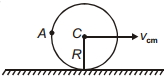
In the case of pure rolling,what will be the velocity of point $A$ of the ring of radius $R$?
A
$v_{cm}$
B
$\sqrt{2} v_{cm}$
C
$\frac{v_{cm}}{2}$
D
$2 v_{cm}$
Solution
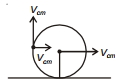
(B) In pure rolling,the velocity of any point on the ring is the vector sum of the translational velocity of the center of mass $(v_{cm})$ and the tangential velocity due to rotation $(v_{rot} = \omega R = v_{cm})$.
For point $A$,the translational velocity is directed horizontally to the right $(v_{cm})$,and the rotational velocity is directed vertically upwards $(v_{rot} = v_{cm})$.
Since these two velocity vectors are perpendicular to each other,the net velocity $v_{net}$ is given by:
$v_{net} = \sqrt{v_{cm}^2 + v_{rot}^2} = \sqrt{v_{cm}^2 + v_{cm}^2} = \sqrt{2 v_{cm}^2} = \sqrt{2} v_{cm}$
For point $A$,the translational velocity is directed horizontally to the right $(v_{cm})$,and the rotational velocity is directed vertically upwards $(v_{rot} = v_{cm})$.
Since these two velocity vectors are perpendicular to each other,the net velocity $v_{net}$ is given by:
$v_{net} = \sqrt{v_{cm}^2 + v_{rot}^2} = \sqrt{v_{cm}^2 + v_{cm}^2} = \sqrt{2 v_{cm}^2} = \sqrt{2} v_{cm}$
0 likes
View Solution102
EasyMCQ
When a body is rolling without slipping on a rough horizontal surface,the work done by friction is ........
A
Always zero
B
May be zero
C
Always positive
D
Always negative
Solution
(A) The work done by a force is given by $W = \vec{F} \cdot \vec{d}$,where $\vec{F}$ is the force and $\vec{d}$ is the displacement of the point of application.
In the case of pure rolling (rolling without slipping) on a stationary horizontal surface,the point of contact of the body with the surface is instantaneously at rest.
Since the velocity of the point of contact is $0$,the displacement of the point of contact during the time it is in contact with the surface is also $0$.
Because the displacement of the point where the friction force acts is $0$,the work done by the static friction force is $0$.
In the case of pure rolling (rolling without slipping) on a stationary horizontal surface,the point of contact of the body with the surface is instantaneously at rest.
Since the velocity of the point of contact is $0$,the displacement of the point of contact during the time it is in contact with the surface is also $0$.
Because the displacement of the point where the friction force acts is $0$,the work done by the static friction force is $0$.
0 likes
View Solution103
MediumMCQ
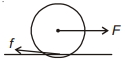
$A$ force $F$ is applied at the centre of a disc of mass $M$. The minimum value of the coefficient of friction of the surface for pure rolling is:
A
$\frac{F}{2 M g}$
B
$\frac{F}{3 M g}$
C
$\frac{2 F}{5 M g}$
D
$\frac{2 F}{7 M g}$
Solution
(B) For pure rolling,the linear acceleration $a$ and angular acceleration $\alpha$ are related by $a = r\alpha$.
Applying Newton's second law for translational motion:
$F - f = M a \quad \dots (1)$
Applying torque equation about the centre of mass:
$\tau = I \alpha$
$f r = (\frac{1}{2} M r^2) (\frac{a}{r})$
$f = \frac{1}{2} M a \quad \dots (2)$
Substituting $(2)$ into $(1)$:
$F - \frac{1}{2} M a = M a$
$F = \frac{3}{2} M a \Rightarrow a = \frac{2 F}{3 M}$
Now,substitute $a$ back into $(2)$ to find the friction force $f$:
$f = \frac{1}{2} M (\frac{2 F}{3 M}) = \frac{F}{3}$
For pure rolling to occur,the friction force must satisfy $f \le \mu N$,where $N = Mg$.
$\frac{F}{3} \le \mu M g$
$\mu \ge \frac{F}{3 M g}$
Thus,the minimum value of the coefficient of friction is $\mu = \frac{F}{3 M g}$.
Applying Newton's second law for translational motion:
$F - f = M a \quad \dots (1)$
Applying torque equation about the centre of mass:
$\tau = I \alpha$
$f r = (\frac{1}{2} M r^2) (\frac{a}{r})$
$f = \frac{1}{2} M a \quad \dots (2)$
Substituting $(2)$ into $(1)$:
$F - \frac{1}{2} M a = M a$
$F = \frac{3}{2} M a \Rightarrow a = \frac{2 F}{3 M}$
Now,substitute $a$ back into $(2)$ to find the friction force $f$:
$f = \frac{1}{2} M (\frac{2 F}{3 M}) = \frac{F}{3}$
For pure rolling to occur,the friction force must satisfy $f \le \mu N$,where $N = Mg$.
$\frac{F}{3} \le \mu M g$
$\mu \ge \frac{F}{3 M g}$
Thus,the minimum value of the coefficient of friction is $\mu = \frac{F}{3 M g}$.
0 likes
View Solution104
EasyMCQ
When a rolling body enters onto a smooth horizontal surface,it will ............
A
Continue rolling
B
Starts slipping
C
Come to rest
D
Slipping as well as rolling
Solution
(A) The correct answer is $A$.
When a body is rolling on a surface,it possesses both translational velocity $v$ and angular velocity $\omega$.
On a smooth horizontal surface,there is no friction to exert a torque or a force that would change the linear or angular momentum of the body.
Since there is no external torque acting on the body,the angular momentum remains conserved.
Therefore,the body will continue to roll with its constant translational velocity $v$ and constant angular velocity $\omega$ without any change in its state of motion.
When a body is rolling on a surface,it possesses both translational velocity $v$ and angular velocity $\omega$.
On a smooth horizontal surface,there is no friction to exert a torque or a force that would change the linear or angular momentum of the body.
Since there is no external torque acting on the body,the angular momentum remains conserved.
Therefore,the body will continue to roll with its constant translational velocity $v$ and constant angular velocity $\omega$ without any change in its state of motion.
0 likes
View Solution105
EasyMCQ
$A$ heavy solid sphere is thrown on a horizontal rough surface with initial velocity $u$ without rolling. What will be its speed when it starts pure rolling motion?
A
$\frac{3u}{5}$
B
$\frac{2u}{5}$
C
$\frac{5u}{7}$
D
$\frac{2u}{7}$
Solution
(C) When the sphere is thrown,it experiences a frictional force that opposes its motion,causing it to decelerate linearly and accelerate rotationally.
Since the frictional force acts through the point of contact,the angular momentum about the point of contact on the ground remains conserved.
Initial angular momentum about the point of contact: $L_i = m u r$.
Final angular momentum when pure rolling starts (at velocity $v$ and angular velocity $\omega = v/r$): $L_f = m v r + I \omega = m v r + (\frac{2}{5} m r^2)(\frac{v}{r}) = m v r + \frac{2}{5} m v r = \frac{7}{5} m v r$.
Equating $L_i = L_f$:
$m u r = \frac{7}{5} m v r$.
Solving for $v$:
$u = \frac{7}{5} v \implies v = \frac{5u}{7}$.
Since the frictional force acts through the point of contact,the angular momentum about the point of contact on the ground remains conserved.
Initial angular momentum about the point of contact: $L_i = m u r$.
Final angular momentum when pure rolling starts (at velocity $v$ and angular velocity $\omega = v/r$): $L_f = m v r + I \omega = m v r + (\frac{2}{5} m r^2)(\frac{v}{r}) = m v r + \frac{2}{5} m v r = \frac{7}{5} m v r$.
Equating $L_i = L_f$:
$m u r = \frac{7}{5} m v r$.
Solving for $v$:
$u = \frac{7}{5} v \implies v = \frac{5u}{7}$.
1 likes
View Solution106
EasyMCQ
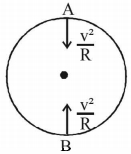
$A$ wheel of radius $R$ rolls on the ground with a uniform velocity $v$. The relative acceleration of the topmost point of the wheel with respect to the bottommost point is
A
$\frac{v^2}{R}$
B
$\frac{2v^2}{R}$
C
$\frac{v^2}{2R}$
D
$\frac{4v^2}{R}$
Solution
(B) For a wheel rolling with a uniform velocity $v$ of its center of mass,the acceleration of the center of mass is $a_{CM} = 0$.
Each point on the rim of the wheel has a centripetal acceleration directed towards the center,given by $a_c = \frac{v^2}{R}$.
Let the topmost point be $A$ and the bottommost point be $B$.
The acceleration of point $A$ is $\vec{a}_A = \frac{v^2}{R}$ (directed downwards towards the center).
The acceleration of point $B$ is $\vec{a}_B = \frac{v^2}{R}$ (directed upwards towards the center).
The relative acceleration of $A$ with respect to $B$ is $\vec{a}_{AB} = \vec{a}_A - \vec{a}_B$.
Taking the downward direction as positive,$\vec{a}_A = \frac{v^2}{R}$ and $\vec{a}_B = -\frac{v^2}{R}$.
Thus,$\vec{a}_{AB} = \frac{v^2}{R} - (-\frac{v^2}{R}) = \frac{2v^2}{R}$.
Therefore,the magnitude of the relative acceleration is $\frac{2v^2}{R}$.
Each point on the rim of the wheel has a centripetal acceleration directed towards the center,given by $a_c = \frac{v^2}{R}$.
Let the topmost point be $A$ and the bottommost point be $B$.
The acceleration of point $A$ is $\vec{a}_A = \frac{v^2}{R}$ (directed downwards towards the center).
The acceleration of point $B$ is $\vec{a}_B = \frac{v^2}{R}$ (directed upwards towards the center).
The relative acceleration of $A$ with respect to $B$ is $\vec{a}_{AB} = \vec{a}_A - \vec{a}_B$.
Taking the downward direction as positive,$\vec{a}_A = \frac{v^2}{R}$ and $\vec{a}_B = -\frac{v^2}{R}$.
Thus,$\vec{a}_{AB} = \frac{v^2}{R} - (-\frac{v^2}{R}) = \frac{2v^2}{R}$.
Therefore,the magnitude of the relative acceleration is $\frac{2v^2}{R}$.
0 likes
View Solution107
MediumMCQ
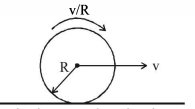
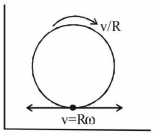
$A$ disc is performing pure rolling on a smooth stationary surface with constant angular velocity as shown in the figure. At any instant,for the lowermost point of the disc -
A
velocity is $v$,acceleration is zero
B
velocity is zero,acceleration is zero
C
velocity is $v$,acceleration is $v^2/R$
D
velocity is zero,acceleration is $v^2/R$
Solution
(D) The correct option is $(d)$.
As the disc is in combined rotation and translation,each point on the disc has a translational velocity $v$ (in the forward direction) and a tangential velocity $v = R\omega$ (due to rotation).
For the lowermost point of the disc:
$1$. The net velocity is $v_{\text{net}} = v - R\omega$. Since it is pure rolling,$v = R\omega$,therefore $v_{\text{net}} = v - v = 0$.
$2$. The acceleration of any point on a rotating body has two components: tangential acceleration $(a_t)$ and centripetal acceleration $(a_c)$.
- Since the angular velocity $\omega$ is constant,the tangential acceleration $a_t = R\alpha = 0$.
- The centripetal acceleration is $a_c = v^2/R$ directed towards the center of the disc.
- Thus,the net acceleration of the lowermost point is $a = a_c + a_t = v^2/R + 0 = v^2/R$,directed towards the center of the disc.
As the disc is in combined rotation and translation,each point on the disc has a translational velocity $v$ (in the forward direction) and a tangential velocity $v = R\omega$ (due to rotation).
For the lowermost point of the disc:
$1$. The net velocity is $v_{\text{net}} = v - R\omega$. Since it is pure rolling,$v = R\omega$,therefore $v_{\text{net}} = v - v = 0$.
$2$. The acceleration of any point on a rotating body has two components: tangential acceleration $(a_t)$ and centripetal acceleration $(a_c)$.
- Since the angular velocity $\omega$ is constant,the tangential acceleration $a_t = R\alpha = 0$.
- The centripetal acceleration is $a_c = v^2/R$ directed towards the center of the disc.
- Thus,the net acceleration of the lowermost point is $a = a_c + a_t = v^2/R + 0 = v^2/R$,directed towards the center of the disc.
0 likes
View Solution108
MediumMCQ
$A$ uniform sphere of mass $500\,g$ rolls without slipping on a plane surface such that its centre moves at a speed of $0.02\,m/s$. The total kinetic energy of the rolling sphere would be (in $J$):
A
$1.4 \times 10^{-4}\,J$
B
$0.75 \times 10^{-3}\,J$
C
$5.75 \times 10^{-3}\,J$
D
$4.9 \times 10^{-5}\,J$
Solution
(A) The total kinetic energy $(K)$ of a rolling sphere is the sum of its translational kinetic energy and rotational kinetic energy.
$K = K_{\text{trans}} + K_{\text{rot}} = \frac{1}{2}mv^2 + \frac{1}{2}I\omega^2$
For a solid sphere,the moment of inertia $I = \frac{2}{5}mR^2$.
Since the sphere rolls without slipping,$v = R\omega$,which implies $\omega = \frac{v}{R}$.
Substituting these into the energy equation:
$K = \frac{1}{2}mv^2 + \frac{1}{2}(\frac{2}{5}mR^2)(\frac{v}{R})^2$
$K = \frac{1}{2}mv^2 + \frac{1}{5}mv^2 = \frac{7}{10}mv^2$
Given: $m = 500\,g = 0.5\,kg$ and $v = 0.02\,m/s$.
$K = \frac{7}{10} \times 0.5 \times (0.02)^2$
$K = 0.7 \times 0.5 \times 0.0004 = 0.35 \times 0.0004 = 0.00014\,J = 1.4 \times 10^{-4}\,J$.
$K = K_{\text{trans}} + K_{\text{rot}} = \frac{1}{2}mv^2 + \frac{1}{2}I\omega^2$
For a solid sphere,the moment of inertia $I = \frac{2}{5}mR^2$.
Since the sphere rolls without slipping,$v = R\omega$,which implies $\omega = \frac{v}{R}$.
Substituting these into the energy equation:
$K = \frac{1}{2}mv^2 + \frac{1}{2}(\frac{2}{5}mR^2)(\frac{v}{R})^2$
$K = \frac{1}{2}mv^2 + \frac{1}{5}mv^2 = \frac{7}{10}mv^2$
Given: $m = 500\,g = 0.5\,kg$ and $v = 0.02\,m/s$.
$K = \frac{7}{10} \times 0.5 \times (0.02)^2$
$K = 0.7 \times 0.5 \times 0.0004 = 0.35 \times 0.0004 = 0.00014\,J = 1.4 \times 10^{-4}\,J$.
0 likes
View Solution109
MediumMCQ
$A$ solid sphere of mass $2\,kg$ is making pure rolling on a horizontal surface with kinetic energy $2240\,J$. The velocity of the centre of mass of the sphere will be $..........\,m/s$.
A
$40$
B
$38$
C
$37$
D
$36$
Solution
(A) The total kinetic energy $(KE)$ of a body in pure rolling motion is the sum of its translational kinetic energy and rotational kinetic energy.
$KE = \frac{1}{2}mv^2 + \frac{1}{2}I\omega^2$
For a solid sphere,the moment of inertia about its centre of mass is $I = \frac{2}{5}mR^2$.
For pure rolling,the relation between linear velocity $(v)$ and angular velocity $(\omega)$ is $v = R\omega$,or $\omega = \frac{v}{R}$.
Substituting these into the energy equation:
$KE = \frac{1}{2}mv^2 + \frac{1}{2}(\frac{2}{5}mR^2)(\frac{v}{R})^2$
$KE = \frac{1}{2}mv^2 + \frac{1}{5}mv^2 = \frac{7}{10}mv^2$
Given $m = 2\,kg$ and $KE = 2240\,J$:
$2240 = \frac{7}{10} \times 2 \times v^2$
$2240 = \frac{7}{5}v^2$
$v^2 = \frac{2240 \times 5}{7} = 320 \times 5 = 1600$
$v = \sqrt{1600} = 40\,m/s$.
$KE = \frac{1}{2}mv^2 + \frac{1}{2}I\omega^2$
For a solid sphere,the moment of inertia about its centre of mass is $I = \frac{2}{5}mR^2$.
For pure rolling,the relation between linear velocity $(v)$ and angular velocity $(\omega)$ is $v = R\omega$,or $\omega = \frac{v}{R}$.
Substituting these into the energy equation:
$KE = \frac{1}{2}mv^2 + \frac{1}{2}(\frac{2}{5}mR^2)(\frac{v}{R})^2$
$KE = \frac{1}{2}mv^2 + \frac{1}{5}mv^2 = \frac{7}{10}mv^2$
Given $m = 2\,kg$ and $KE = 2240\,J$:
$2240 = \frac{7}{10} \times 2 \times v^2$
$2240 = \frac{7}{5}v^2$
$v^2 = \frac{2240 \times 5}{7} = 320 \times 5 = 1600$
$v = \sqrt{1600} = 40\,m/s$.
0 likes
View Solution110
DifficultMCQ
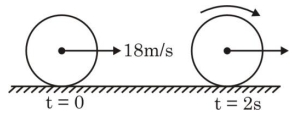
$A$ uniform disc of mass $0.5\,kg$ and radius $r$ is projected with velocity $18\,m/s$ at $t = 0\,s$ on a rough horizontal surface. It starts off with a purely sliding motion at $t = 0\,s$. After $2\,s$ it acquires a purely rolling motion (see figure). The total kinetic energy of the disc after $2\,s$ will be $..............J$ (given,coefficient of friction is $0.3$ and $g = 10\,m/s^2$).
A
$53$
B
$52$
C
$54$
D
$51$
Solution
(C) Given: mass $m = 0.5\,kg$,initial velocity $u = 18\,m/s$,coefficient of friction $\mu = 0.3$,$g = 10\,m/s^2$,time $t = 2\,s$.
The acceleration of the disc due to friction is $a = -\mu g = -0.3 \times 10 = -3\,m/s^2$.
The velocity of the center of mass at $t = 2\,s$ is $v = u + at = 18 - 3 \times 2 = 12\,m/s$.
For pure rolling,the condition is $v = \omega r$,so $\omega = v/r$.
The total kinetic energy $KE$ is the sum of translational and rotational kinetic energy:
$KE = \frac{1}{2}mv^2 + \frac{1}{2}I\omega^2$
Since $I = \frac{1}{2}mr^2$ for a disc,we have:
$KE = \frac{1}{2}mv^2 + \frac{1}{2}(\frac{1}{2}mr^2)(\frac{v}{r})^2 = \frac{1}{2}mv^2 + \frac{1}{4}mv^2 = \frac{3}{4}mv^2$.
Substituting the values:
$KE = \frac{3}{4} \times 0.5 \times (12)^2 = \frac{3}{4} \times 0.5 \times 144 = 3 \times 0.5 \times 36 = 54\,J$.
The acceleration of the disc due to friction is $a = -\mu g = -0.3 \times 10 = -3\,m/s^2$.
The velocity of the center of mass at $t = 2\,s$ is $v = u + at = 18 - 3 \times 2 = 12\,m/s$.
For pure rolling,the condition is $v = \omega r$,so $\omega = v/r$.
The total kinetic energy $KE$ is the sum of translational and rotational kinetic energy:
$KE = \frac{1}{2}mv^2 + \frac{1}{2}I\omega^2$
Since $I = \frac{1}{2}mr^2$ for a disc,we have:
$KE = \frac{1}{2}mv^2 + \frac{1}{2}(\frac{1}{2}mr^2)(\frac{v}{r})^2 = \frac{1}{2}mv^2 + \frac{1}{4}mv^2 = \frac{3}{4}mv^2$.
Substituting the values:
$KE = \frac{3}{4} \times 0.5 \times (12)^2 = \frac{3}{4} \times 0.5 \times 144 = 3 \times 0.5 \times 36 = 54\,J$.
0 likes
View Solution111
MediumMCQ
$A$ solid sphere of mass $1\,kg$ rolls without slipping on a plane surface. Its kinetic energy is $7 \times 10^{-3}\,J$. The speed of the centre of mass of the sphere is $.........\,cm\,s^{-1}$.
A
$10$
B
$9$
C
$8$
D
$7$
Solution
(A) The total kinetic energy of a rolling body is the sum of its translational and rotational kinetic energies: $K = \frac{1}{2} Mv^2 + \frac{1}{2} I\omega^2$.
For a solid sphere,the moment of inertia about its center of mass is $I = \frac{2}{5} MR^2$.
Since the sphere rolls without slipping,$\omega = \frac{v}{R}$.
Substituting these into the energy equation: $K = \frac{1}{2} Mv^2 + \frac{1}{2} (\frac{2}{5} MR^2) (\frac{v}{R})^2 = \frac{1}{2} Mv^2 + \frac{1}{5} Mv^2 = \frac{7}{10} Mv^2$.
Given $K = 7 \times 10^{-3}\,J$ and $M = 1\,kg$,we have $\frac{7}{10} (1) v^2 = 7 \times 10^{-3}$.
$v^2 = 10^{-2} \implies v = 0.1\,m/s$.
Converting to $cm/s$: $v = 0.1 \times 100 = 10\,cm/s$.
For a solid sphere,the moment of inertia about its center of mass is $I = \frac{2}{5} MR^2$.
Since the sphere rolls without slipping,$\omega = \frac{v}{R}$.
Substituting these into the energy equation: $K = \frac{1}{2} Mv^2 + \frac{1}{2} (\frac{2}{5} MR^2) (\frac{v}{R})^2 = \frac{1}{2} Mv^2 + \frac{1}{5} Mv^2 = \frac{7}{10} Mv^2$.
Given $K = 7 \times 10^{-3}\,J$ and $M = 1\,kg$,we have $\frac{7}{10} (1) v^2 = 7 \times 10^{-3}$.
$v^2 = 10^{-2} \implies v = 0.1\,m/s$.
Converting to $cm/s$: $v = 0.1 \times 100 = 10\,cm/s$.
0 likes
View Solution112
MediumMCQ
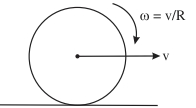
For a rolling spherical shell,the ratio of rotational kinetic energy and total kinetic energy is $\frac{x}{5}$. The value of $x$ is ................
A
$4$
B
$6$
C
$8$
D
$2$
Solution
(D) The rotational kinetic energy of a body is given by $K_{\text{rot}} = \frac{1}{2} I \omega^2$,where $I$ is the moment of inertia and $\omega$ is the angular velocity.
For a spherical shell,the moment of inertia about its center is $I = \frac{2}{3} mR^2$.
For pure rolling,$\omega = \frac{v}{R}$,so $K_{\text{rot}} = \frac{1}{2} (\frac{2}{3} mR^2) (\frac{v}{R})^2 = \frac{1}{3} mv^2$.
The total kinetic energy is $K_{\text{total}} = K_{\text{trans}} + K_{\text{rot}} = \frac{1}{2} mv^2 + \frac{1}{3} mv^2 = \frac{5}{6} mv^2$.
The ratio of rotational kinetic energy to total kinetic energy is $\frac{K_{\text{rot}}}{K_{\text{total}}} = \frac{\frac{1}{3} mv^2}{\frac{5}{6} mv^2} = \frac{1}{3} \times \frac{6}{5} = \frac{2}{5}$.
Given that the ratio is $\frac{x}{5}$,we have $\frac{x}{5} = \frac{2}{5}$,which implies $x = 2$.
For a spherical shell,the moment of inertia about its center is $I = \frac{2}{3} mR^2$.
For pure rolling,$\omega = \frac{v}{R}$,so $K_{\text{rot}} = \frac{1}{2} (\frac{2}{3} mR^2) (\frac{v}{R})^2 = \frac{1}{3} mv^2$.
The total kinetic energy is $K_{\text{total}} = K_{\text{trans}} + K_{\text{rot}} = \frac{1}{2} mv^2 + \frac{1}{3} mv^2 = \frac{5}{6} mv^2$.
The ratio of rotational kinetic energy to total kinetic energy is $\frac{K_{\text{rot}}}{K_{\text{total}}} = \frac{\frac{1}{3} mv^2}{\frac{5}{6} mv^2} = \frac{1}{3} \times \frac{6}{5} = \frac{2}{5}$.
Given that the ratio is $\frac{x}{5}$,we have $\frac{x}{5} = \frac{2}{5}$,which implies $x = 2$.
0 likes
View Solution113
MediumMCQ
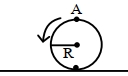
$A$ disc is rolling without slipping on a surface. The radius of the disc is $R$. At $t=0$,the top most point on the disc is $A$ as shown in the figure. When the disc completes half of its rotation,the displacement of point $A$ from its initial position is
A
$R \sqrt{\pi^2+4}$
B
$R \sqrt{\pi^2+1}$
C
$2 R$
D
$2 R \sqrt{1+4 \pi^2}$
Solution
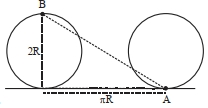
(A) When the disc rolls without slipping,the center of the disc moves forward by a distance equal to the arc length covered. For half a rotation,the center moves by a horizontal distance of $\pi R$.
The point $A$,which was initially at the top,moves to the bottom of the disc after half a rotation. The vertical displacement of point $A$ is equal to the diameter of the disc,which is $2R$.
The horizontal displacement of point $A$ is equal to the distance moved by the center,which is $\pi R$.
The total displacement $d$ is the vector sum of the horizontal and vertical displacements:
$d = \sqrt{(\text{horizontal displacement})^2 + (\text{vertical displacement})^2}$
$d = \sqrt{(\pi R)^2 + (2R)^2}$
$d = \sqrt{\pi^2 R^2 + 4R^2}$
$d = R \sqrt{\pi^2 + 4}$
The point $A$,which was initially at the top,moves to the bottom of the disc after half a rotation. The vertical displacement of point $A$ is equal to the diameter of the disc,which is $2R$.
The horizontal displacement of point $A$ is equal to the distance moved by the center,which is $\pi R$.
The total displacement $d$ is the vector sum of the horizontal and vertical displacements:
$d = \sqrt{(\text{horizontal displacement})^2 + (\text{vertical displacement})^2}$
$d = \sqrt{(\pi R)^2 + (2R)^2}$
$d = \sqrt{\pi^2 R^2 + 4R^2}$
$d = R \sqrt{\pi^2 + 4}$
0 likes
View Solution114
MediumMCQ
$A$ solid sphere is rolling on a horizontal plane without slipping. If the ratio of angular momentum about the axis of rotation of the sphere to the total energy of the moving sphere is $\pi: 22$,then the value of its angular speed will be $...........\,rad/s$.
A
$2$
B
$6$
C
$4$
D
$8$
Solution
(C) For a solid sphere rolling without slipping,the angular momentum $L$ about the axis of rotation is $L = I_{com}\omega = (\frac{2}{5}MR^2)\omega$.
Since $V_{com} = R\omega$,we have $L = \frac{2}{5}MR^2(\frac{V_{com}}{R}) = \frac{2}{5}MRV_{com}$.
The total kinetic energy $K$ is $K = \frac{1}{2}I_{com}\omega^2 + \frac{1}{2}MV_{com}^2 = \frac{1}{2}(\frac{2}{5}MR^2)(\frac{V_{com}}{R})^2 + \frac{1}{2}MV_{com}^2 = \frac{1}{5}MV_{com}^2 + \frac{1}{2}MV_{com}^2 = \frac{7}{10}MV_{com}^2$.
The ratio $\frac{L}{K} = \frac{\frac{2}{5}MRV_{com}}{\frac{7}{10}MV_{com}^2} = \frac{2}{5} \times \frac{10}{7} \times \frac{R}{V_{com}} = \frac{4}{7} \times \frac{R}{R\omega} = \frac{4}{7\omega}$.
Given $\frac{L}{K} = \frac{\pi}{22}$,we have $\frac{4}{7\omega} = \frac{\pi}{22}$. Assuming $\pi \approx \frac{22}{7}$,we get $\frac{4}{7\omega} = \frac{22/7}{22} = \frac{1}{7}$.
Therefore,$7\omega = 28$,which gives $\omega = 4\,rad/s$.
Since $V_{com} = R\omega$,we have $L = \frac{2}{5}MR^2(\frac{V_{com}}{R}) = \frac{2}{5}MRV_{com}$.
The total kinetic energy $K$ is $K = \frac{1}{2}I_{com}\omega^2 + \frac{1}{2}MV_{com}^2 = \frac{1}{2}(\frac{2}{5}MR^2)(\frac{V_{com}}{R})^2 + \frac{1}{2}MV_{com}^2 = \frac{1}{5}MV_{com}^2 + \frac{1}{2}MV_{com}^2 = \frac{7}{10}MV_{com}^2$.
The ratio $\frac{L}{K} = \frac{\frac{2}{5}MRV_{com}}{\frac{7}{10}MV_{com}^2} = \frac{2}{5} \times \frac{10}{7} \times \frac{R}{V_{com}} = \frac{4}{7} \times \frac{R}{R\omega} = \frac{4}{7\omega}$.
Given $\frac{L}{K} = \frac{\pi}{22}$,we have $\frac{4}{7\omega} = \frac{\pi}{22}$. Assuming $\pi \approx \frac{22}{7}$,we get $\frac{4}{7\omega} = \frac{22/7}{22} = \frac{1}{7}$.
Therefore,$7\omega = 28$,which gives $\omega = 4\,rad/s$.
0 likes
View Solution115
DifficultMCQ
$A$ solid circular disc of mass $50 \,kg$ rolls along a horizontal floor so that its center of mass has a speed of $0.4 \,m/s$. The absolute value of work done on the disc to stop it is . . . . . . $J$.
A
$3$
B
$4$
C
$5$
D
$6$
Solution
(D) According to the work-energy theorem, the work done $W$ is equal to the change in kinetic energy $\Delta KE$.
Since the disc is rolling, its total kinetic energy $KE$ is the sum of translational and rotational kinetic energy: $KE = \frac{1}{2}mv^2 + \frac{1}{2}I\omega^2$.
For a solid disc, the moment of inertia $I = \frac{1}{2}mR^2$ and for rolling without slipping, $\omega = \frac{v}{R}$.
Substituting these, $KE = \frac{1}{2}mv^2 + \frac{1}{2}(\frac{1}{2}mR^2)(\frac{v}{R})^2 = \frac{1}{2}mv^2 + \frac{1}{4}mv^2 = \frac{3}{4}mv^2$.
Given $m = 50 \,kg$ and $v = 0.4 \,m/s$, the initial kinetic energy is $KE_i = \frac{3}{4} \times 50 \times (0.4)^2 = \frac{3}{4} \times 50 \times 0.16 = 0.75 \times 8 = 6 \,J$.
To stop the disc, the final kinetic energy $KE_f = 0$.
Thus, $W = KE_f - KE_i = 0 - 6 = -6 \,J$.
The absolute value of the work done is $|W| = 6 \,J$.
Since the disc is rolling, its total kinetic energy $KE$ is the sum of translational and rotational kinetic energy: $KE = \frac{1}{2}mv^2 + \frac{1}{2}I\omega^2$.
For a solid disc, the moment of inertia $I = \frac{1}{2}mR^2$ and for rolling without slipping, $\omega = \frac{v}{R}$.
Substituting these, $KE = \frac{1}{2}mv^2 + \frac{1}{2}(\frac{1}{2}mR^2)(\frac{v}{R})^2 = \frac{1}{2}mv^2 + \frac{1}{4}mv^2 = \frac{3}{4}mv^2$.
Given $m = 50 \,kg$ and $v = 0.4 \,m/s$, the initial kinetic energy is $KE_i = \frac{3}{4} \times 50 \times (0.4)^2 = \frac{3}{4} \times 50 \times 0.16 = 0.75 \times 8 = 6 \,J$.
To stop the disc, the final kinetic energy $KE_f = 0$.
Thus, $W = KE_f - KE_i = 0 - 6 = -6 \,J$.
The absolute value of the work done is $|W| = 6 \,J$.
0 likes
View Solution116
DifficultMCQ
$A$ hollow sphere is rolling on a plane surface about its axis of symmetry. The ratio of rotational kinetic energy to its total kinetic energy is $\frac{x}{5}$. The value of $x$ is . . . . . . .
A
$2$
B
$5$
C
$4$
D
$3$
Solution
(A) For a hollow sphere rolling without slipping,the moment of inertia about its axis of symmetry is $I = \frac{2}{3} mR^2$.
The rotational kinetic energy is $K_{rot} = \frac{1}{2} I \omega^2 = \frac{1}{2} (\frac{2}{3} mR^2) \omega^2 = \frac{1}{3} mR^2 \omega^2$.
The total kinetic energy is $K_{total} = K_{rot} + K_{trans} = \frac{1}{2} I \omega^2 + \frac{1}{2} mv^2$.
Since $v = R\omega$,we have $K_{total} = \frac{1}{2} (\frac{2}{3} mR^2) \omega^2 + \frac{1}{2} m(R\omega)^2 = \frac{1}{3} mR^2 \omega^2 + \frac{1}{2} mR^2 \omega^2 = (\frac{2+3}{6}) mR^2 \omega^2 = \frac{5}{6} mR^2 \omega^2$.
The ratio of rotational kinetic energy to total kinetic energy is $\frac{K_{rot}}{K_{total}} = \frac{\frac{1}{3} mR^2 \omega^2}{\frac{5}{6} mR^2 \omega^2} = \frac{1}{3} \times \frac{6}{5} = \frac{2}{5}$.
Comparing this with $\frac{x}{5}$,we get $x = 2$.
The rotational kinetic energy is $K_{rot} = \frac{1}{2} I \omega^2 = \frac{1}{2} (\frac{2}{3} mR^2) \omega^2 = \frac{1}{3} mR^2 \omega^2$.
The total kinetic energy is $K_{total} = K_{rot} + K_{trans} = \frac{1}{2} I \omega^2 + \frac{1}{2} mv^2$.
Since $v = R\omega$,we have $K_{total} = \frac{1}{2} (\frac{2}{3} mR^2) \omega^2 + \frac{1}{2} m(R\omega)^2 = \frac{1}{3} mR^2 \omega^2 + \frac{1}{2} mR^2 \omega^2 = (\frac{2+3}{6}) mR^2 \omega^2 = \frac{5}{6} mR^2 \omega^2$.
The ratio of rotational kinetic energy to total kinetic energy is $\frac{K_{rot}}{K_{total}} = \frac{\frac{1}{3} mR^2 \omega^2}{\frac{5}{6} mR^2 \omega^2} = \frac{1}{3} \times \frac{6}{5} = \frac{2}{5}$.
Comparing this with $\frac{x}{5}$,we get $x = 2$.
0 likes
View Solution117
MediumMCQ
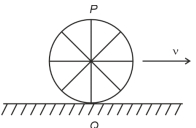
$A$ wheel of a bullock cart is rolling on a level road as shown in the figure. If its linear speed is $v$ in the direction shown,which one of the following options is correct ($P$ and $Q$ are the highest and lowest points on the wheel,respectively)?
A
Point $P$ moves faster than point $Q$
B
Both the points $P$ and $Q$ move with equal speed
C
Point $P$ has zero speed
D
Point $P$ moves slower than point $Q$
Solution
(A) In the case of pure rolling motion,the velocity of any point on the rim of the wheel is the vector sum of the translational velocity of the center of mass $(v)$ and the tangential velocity due to rotation $(v = r\omega)$.
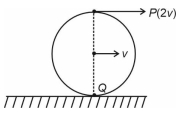
For the topmost point $P$,the translational velocity and the rotational velocity are in the same direction. Thus,the resultant velocity is $v + v = 2v$.
For the lowest point $Q$,the translational velocity is in the forward direction $(v)$ and the rotational velocity is in the backward direction $(v)$. Thus,the resultant velocity is $v - v = 0$.
Since the velocity of point $P$ is $2v$ and the velocity of point $Q$ is $0$,point $P$ moves faster than point $Q$.
For the topmost point $P$,the translational velocity and the rotational velocity are in the same direction. Thus,the resultant velocity is $v + v = 2v$.
For the lowest point $Q$,the translational velocity is in the forward direction $(v)$ and the rotational velocity is in the backward direction $(v)$. Thus,the resultant velocity is $v - v = 0$.
Since the velocity of point $P$ is $2v$ and the velocity of point $Q$ is $0$,point $P$ moves faster than point $Q$.
0 likes
View Solution118
DifficultMCQ
$A$ sphere is rolling without slipping on a fixed horizontal plane surface. In the figure,$A$ is the point of contact,$B$ is the centre of the sphere and $C$ is its topmost point. Then,
$(A)$ $\vec{V}_C-\vec{V}_A=2(\vec{V}_B-\vec{V}_C)$
$(B)$ $\vec{V}_C-\vec{V}_B=\vec{V}_B-\vec{V}_A$
$(C)$ $|\vec{V}_C-\vec{V}_A|=2|\vec{V}_B-\vec{V}_C|$
$(D)$ $|\vec{V}_C-\vec{V}_A|=4|\vec{V}_B|$
$(A)$ $\vec{V}_C-\vec{V}_A=2(\vec{V}_B-\vec{V}_C)$
$(B)$ $\vec{V}_C-\vec{V}_B=\vec{V}_B-\vec{V}_A$
$(C)$ $|\vec{V}_C-\vec{V}_A|=2|\vec{V}_B-\vec{V}_C|$
$(D)$ $|\vec{V}_C-\vec{V}_A|=4|\vec{V}_B|$
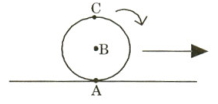
A
$(B, C)$
B
$(B, D)$
C
$(A, C)$
D
$(A, D)$
Solution
(C) Let $\vec{V}_0$ be the velocity of the centre of the sphere. For a sphere rolling without slipping on a fixed horizontal surface:
$\vec{V}_A = 0$ (velocity of the point of contact)
$\vec{V}_B = \vec{V}_0$ (velocity of the centre)
$\vec{V}_C = 2\vec{V}_0$ (velocity of the topmost point)
Now,let's evaluate the given options:
For $(B)$: $\vec{V}_C - \vec{V}_B = 2\vec{V}_0 - \vec{V}_0 = \vec{V}_0$ and $\vec{V}_B - \vec{V}_A = \vec{V}_0 - 0 = \vec{V}_0$. Thus,$\vec{V}_C - \vec{V}_B = \vec{V}_B - \vec{V}_A$ is correct.
For $(C)$: $|\vec{V}_C - \vec{V}_A| = |2\vec{V}_0 - 0| = 2|\vec{V}_0|$ and $2|\vec{V}_B - \vec{V}_C| = 2|\vec{V}_0 - 2\vec{V}_0| = 2|-\vec{V}_0| = 2|\vec{V}_0|$. Thus,$|\vec{V}_C - \vec{V}_A| = 2|\vec{V}_B - \vec{V}_C|$ is correct.
Therefore,both $(B)$ and $(C)$ are correct statements.
$\vec{V}_A = 0$ (velocity of the point of contact)
$\vec{V}_B = \vec{V}_0$ (velocity of the centre)
$\vec{V}_C = 2\vec{V}_0$ (velocity of the topmost point)
Now,let's evaluate the given options:
For $(B)$: $\vec{V}_C - \vec{V}_B = 2\vec{V}_0 - \vec{V}_0 = \vec{V}_0$ and $\vec{V}_B - \vec{V}_A = \vec{V}_0 - 0 = \vec{V}_0$. Thus,$\vec{V}_C - \vec{V}_B = \vec{V}_B - \vec{V}_A$ is correct.
For $(C)$: $|\vec{V}_C - \vec{V}_A| = |2\vec{V}_0 - 0| = 2|\vec{V}_0|$ and $2|\vec{V}_B - \vec{V}_C| = 2|\vec{V}_0 - 2\vec{V}_0| = 2|-\vec{V}_0| = 2|\vec{V}_0|$. Thus,$|\vec{V}_C - \vec{V}_A| = 2|\vec{V}_B - \vec{V}_C|$ is correct.
Therefore,both $(B)$ and $(C)$ are correct statements.
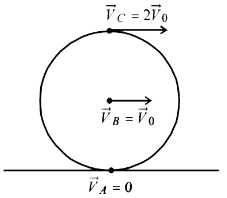
0 likes
View Solution119
AdvancedMCQ
$A$ boy is pushing a ring of mass $2 \ kg$ and radius $0.5 \ m$ with a stick as shown in the figure. The stick applies a force of $2 \ N$ on the ring and rolls it without slipping with an acceleration of $0.3 \ m/s^2$. The coefficient of friction between the ground and the ring is large enough that rolling always occurs,and the coefficient of friction between the stick and the ring is $(P/10)$. The value of $P$ is
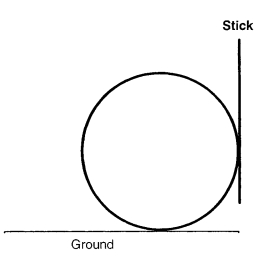
A
$8$
B
$6$
C
$4$
D
$2$
Solution
(C) Let $M = 2 \ kg$,$R = 0.5 \ m$,$a = 0.3 \ m/s^2$,and $N = 2 \ N$ (force applied by the stick).
For a ring,the moment of inertia about the center is $I = MR^2$.
Since it rolls without slipping,the angular acceleration is $\alpha = a/R$.
Let $f_s$ be the friction from the ground and $f_a$ be the friction from the stick.
Applying Newton's second law for translational motion: $N - f_s = Ma$.
$2 - f_s = 2 \times 0.3 = 0.6 \implies f_s = 1.4 \ N$.
Applying torque equation about the center of the ring: $(f_s - f_a)R = I\alpha$.
$(1.4 - f_a)R = (MR^2)(a/R) = MaR$.
$1.4 - f_a = Ma = 2 \times 0.3 = 0.6$.
$f_a = 1.4 - 0.6 = 0.8 \ N$.
The friction from the stick is $f_a = \mu N$,where $\mu = P/10$.
$0.8 = (P/10) \times 2$.
$0.8 = P/5 \implies P = 4$.
For a ring,the moment of inertia about the center is $I = MR^2$.
Since it rolls without slipping,the angular acceleration is $\alpha = a/R$.
Let $f_s$ be the friction from the ground and $f_a$ be the friction from the stick.
Applying Newton's second law for translational motion: $N - f_s = Ma$.
$2 - f_s = 2 \times 0.3 = 0.6 \implies f_s = 1.4 \ N$.
Applying torque equation about the center of the ring: $(f_s - f_a)R = I\alpha$.
$(1.4 - f_a)R = (MR^2)(a/R) = MaR$.
$1.4 - f_a = Ma = 2 \times 0.3 = 0.6$.
$f_a = 1.4 - 0.6 = 0.8 \ N$.
The friction from the stick is $f_a = \mu N$,where $\mu = P/10$.
$0.8 = (P/10) \times 2$.
$0.8 = P/5 \implies P = 4$.
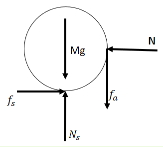
0 likes
View Solution120
AdvancedMCQ
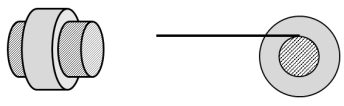
$A$ small roller of diameter $20 \ cm$ has an axle of diameter $10 \ cm$. It is on a horizontal floor and a meter scale is positioned horizontally on its axle with one edge of the scale on top of the axle. The scale is now pushed slowly on the axle so that it moves without slipping on the axle,and the roller starts rolling without slipping. After the roller has moved $50 \ cm$,the position of the scale will look like (figures are schematic and not drawn to scale)-
A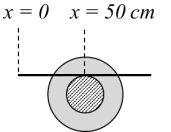
B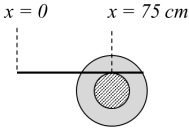
C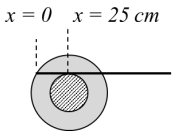
D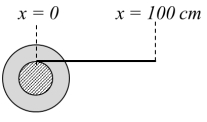
Solution
(C) Let $R$ be the radius of the roller and $r$ be the radius of the axle.
Given: $2R = 20 \ cm \implies R = 10 \ cm$ and $2r = 10 \ cm \implies r = 5 \ cm$.
For the roller to roll without slipping on the floor,the velocity of the center of the roller is $V_{\text{center}} = \omega R$,where $\omega$ is the angular velocity.
The velocity of the scale,which is on top of the axle,is $V_{\text{scale}} = V_{\text{center}} + \omega r$.
Substituting $\omega = \frac{V_{\text{center}}}{R}$,we get:
$V_{\text{scale}} = V_{\text{center}} + \left(\frac{V_{\text{center}}}{R}\right)r = V_{\text{center}} \left(1 + \frac{r}{R}\right)$.
Given $r = 5 \ cm$ and $R = 10 \ cm$,we have $V_{\text{scale}} = V_{\text{center}} \left(1 + \frac{5}{10}\right) = 1.5 V_{\text{center}}$.
If the roller moves a distance $d_{\text{roller}} = 50 \ cm$ in time $t$,then $V_{\text{center}} \cdot t = 50 \ cm$.
The distance moved by the scale in the same time $t$ is $d_{\text{scale}} = V_{\text{scale}} \cdot t = 1.5 V_{\text{center}} \cdot t = 1.5 \times 50 \ cm = 75 \ cm$.
Thus,the scale moves $75 \ cm$ relative to the ground,while the center of the roller moves $50 \ cm$ relative to the ground. The position of the scale relative to the center of the roller is $75 \ cm - 50 \ cm = 25 \ cm$ ahead of the center.
Given: $2R = 20 \ cm \implies R = 10 \ cm$ and $2r = 10 \ cm \implies r = 5 \ cm$.
For the roller to roll without slipping on the floor,the velocity of the center of the roller is $V_{\text{center}} = \omega R$,where $\omega$ is the angular velocity.
The velocity of the scale,which is on top of the axle,is $V_{\text{scale}} = V_{\text{center}} + \omega r$.
Substituting $\omega = \frac{V_{\text{center}}}{R}$,we get:
$V_{\text{scale}} = V_{\text{center}} + \left(\frac{V_{\text{center}}}{R}\right)r = V_{\text{center}} \left(1 + \frac{r}{R}\right)$.
Given $r = 5 \ cm$ and $R = 10 \ cm$,we have $V_{\text{scale}} = V_{\text{center}} \left(1 + \frac{5}{10}\right) = 1.5 V_{\text{center}}$.
If the roller moves a distance $d_{\text{roller}} = 50 \ cm$ in time $t$,then $V_{\text{center}} \cdot t = 50 \ cm$.
The distance moved by the scale in the same time $t$ is $d_{\text{scale}} = V_{\text{scale}} \cdot t = 1.5 V_{\text{center}} \cdot t = 1.5 \times 50 \ cm = 75 \ cm$.
Thus,the scale moves $75 \ cm$ relative to the ground,while the center of the roller moves $50 \ cm$ relative to the ground. The position of the scale relative to the center of the roller is $75 \ cm - 50 \ cm = 25 \ cm$ ahead of the center.
0 likes
View Solution121
AdvancedMCQ
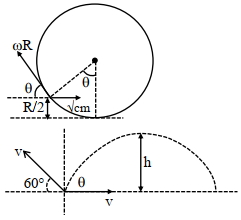
At time $t=0$,a disk of radius $1 \text{ m}$ starts to roll without slipping on a horizontal plane with an angular acceleration of $\alpha = \frac{2}{3} \text{ rad s}^{-2}$. $A$ small stone is stuck to the disk. At $t=0$,it is at the contact point of the disk and the plane. Later,at time $t=\sqrt{\pi} \text{ s}$,the stone detaches itself and flies off tangentially from the disk. The maximum height (in $\text{m}$) reached by the stone measured from the plane is $\frac{1}{2} + \frac{x}{10}$. The value of $x$ is. . . . . . . [Take $g=10 \text{ m s}^{-2}$.]
A
$0.20$
B
$0.30$
C
$0.52$
D
$0.60$
Solution
(C) At $t=0$,$\omega=0$. At $t=\sqrt{\pi} \text{ s}$,$\omega = \alpha t = \frac{2}{3} \sqrt{\pi} \text{ rad/s}$.
The linear velocity of the center of mass is $v_{cm} = \omega R = \frac{2}{3} \sqrt{\pi} \times 1 = \frac{2}{3} \sqrt{\pi} \text{ m/s}$.
The angle rotated by the disk is $\theta = \frac{1}{2} \alpha t^2 = \frac{1}{2} \times \frac{2}{3} \times (\sqrt{\pi})^2 = \frac{\pi}{3} = 60^{\circ}$.
At this instant,the stone is at a height $y = R - R \cos \theta = 1 - \cos 60^{\circ} = 1 - 0.5 = 0.5 \text{ m}$ from the ground.
The velocity of the stone relative to the ground is the vector sum of the velocity of the center of mass and the tangential velocity relative to the center of mass. The vertical component of this velocity is $v_y = v_{cm} \sin \theta = (\frac{2}{3} \sqrt{\pi}) \sin 60^{\circ} = \frac{2}{3} \sqrt{\pi} \times \frac{\sqrt{3}}{2} = \frac{\sqrt{3\pi}}{3} \text{ m/s}$.
The additional height gained by the stone after detaching is $h = \frac{v_y^2}{2g} = \frac{(\frac{\sqrt{3\pi}}{3})^2}{2 \times 10} = \frac{3\pi / 9}{20} = \frac{\pi}{60} \text{ m}$.
The total maximum height from the plane is $H = y + h = 0.5 + \frac{\pi}{60} = \frac{1}{2} + \frac{\pi/6}{10}$.
Comparing with $\frac{1}{2} + \frac{x}{10}$,we get $x = \frac{\pi}{6} \approx \frac{3.14}{6} \approx 0.523$. Thus,$x \approx 0.52$.
The linear velocity of the center of mass is $v_{cm} = \omega R = \frac{2}{3} \sqrt{\pi} \times 1 = \frac{2}{3} \sqrt{\pi} \text{ m/s}$.
The angle rotated by the disk is $\theta = \frac{1}{2} \alpha t^2 = \frac{1}{2} \times \frac{2}{3} \times (\sqrt{\pi})^2 = \frac{\pi}{3} = 60^{\circ}$.
At this instant,the stone is at a height $y = R - R \cos \theta = 1 - \cos 60^{\circ} = 1 - 0.5 = 0.5 \text{ m}$ from the ground.
The velocity of the stone relative to the ground is the vector sum of the velocity of the center of mass and the tangential velocity relative to the center of mass. The vertical component of this velocity is $v_y = v_{cm} \sin \theta = (\frac{2}{3} \sqrt{\pi}) \sin 60^{\circ} = \frac{2}{3} \sqrt{\pi} \times \frac{\sqrt{3}}{2} = \frac{\sqrt{3\pi}}{3} \text{ m/s}$.
The additional height gained by the stone after detaching is $h = \frac{v_y^2}{2g} = \frac{(\frac{\sqrt{3\pi}}{3})^2}{2 \times 10} = \frac{3\pi / 9}{20} = \frac{\pi}{60} \text{ m}$.
The total maximum height from the plane is $H = y + h = 0.5 + \frac{\pi}{60} = \frac{1}{2} + \frac{\pi/6}{10}$.
Comparing with $\frac{1}{2} + \frac{x}{10}$,we get $x = \frac{\pi}{6} \approx \frac{3.14}{6} \approx 0.523$. Thus,$x \approx 0.52$.
0 likes
View Solution122
MediumMCQ
$A$ solid sphere is rolling without slipping on a horizontal plane. The ratio of the linear kinetic energy of the centre of mass of the sphere and rotational kinetic energy is $:$
A
$2/5$
B
$5/2$
C
$3/4$
D
$4/3$
Solution
(B) The linear kinetic energy of the centre of mass is given by $K_{linear} = \frac{1}{2} mv_{cm}^2$.
The rotational kinetic energy of the sphere is given by $K_{rotational} = \frac{1}{2} I \omega^2$.
For a solid sphere,the moment of inertia about its centre of mass is $I = \frac{2}{5} mR^2$.
Since the sphere is rolling without slipping,we have the condition $v_{cm} = \omega R$.
Substituting these into the ratio:
$\frac{K_{linear}}{K_{rotational}} = \frac{\frac{1}{2} mv_{cm}^2}{\frac{1}{2} (\frac{2}{5} mR^2) \omega^2} = \frac{mv_{cm}^2}{\frac{2}{5} m(v_{cm}^2)} = \frac{1}{2/5} = \frac{5}{2}$.
Thus,the ratio is $5/2$.
The rotational kinetic energy of the sphere is given by $K_{rotational} = \frac{1}{2} I \omega^2$.
For a solid sphere,the moment of inertia about its centre of mass is $I = \frac{2}{5} mR^2$.
Since the sphere is rolling without slipping,we have the condition $v_{cm} = \omega R$.
Substituting these into the ratio:
$\frac{K_{linear}}{K_{rotational}} = \frac{\frac{1}{2} mv_{cm}^2}{\frac{1}{2} (\frac{2}{5} mR^2) \omega^2} = \frac{mv_{cm}^2}{\frac{2}{5} m(v_{cm}^2)} = \frac{1}{2/5} = \frac{5}{2}$.
Thus,the ratio is $5/2$.
0 likes
View Solution123
DifficultMCQ
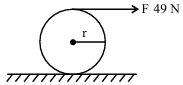
$A$ force of $49 \ N$ acts tangentially at the highest point of a solid sphere of mass $20 \ kg$,kept on a rough horizontal plane. If the sphere rolls without slipping,then the acceleration of the center of the sphere is (in $m/s^2$)
A
$3.5$
B
$0.35$
C
$2.5$
D
$0.25$
Solution
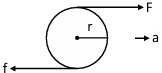
(A) Let $F = 49 \ N$ be the applied force,$m = 20 \ kg$ be the mass of the solid sphere,and $r$ be its radius.
For a solid sphere,the moment of inertia about its center of mass is $I_{cm} = \frac{2}{5} mr^2$.
The moment of inertia about the point of contact (bottom point) is $I = I_{cm} + mr^2 = \frac{2}{5} mr^2 + mr^2 = \frac{7}{5} mr^2$.
The torque about the point of contact is $\tau = F \times (2r)$.
Using $\tau = I \alpha$,we have $F \times 2r = (\frac{7}{5} mr^2) \alpha$.
$49 \times 2r = \frac{7}{5} \times 20 \times r^2 \times \alpha$.
$98r = 28r^2 \alpha$.
Since the sphere rolls without slipping,the linear acceleration $a$ of the center is $a = r \alpha$,so $\alpha = \frac{a}{r}$.
Substituting this into the equation: $98r = 28r^2 (\frac{a}{r}) = 28ra$.
$98 = 28a$.
$a = \frac{98}{28} = 3.5 \ m/s^2$.
For a solid sphere,the moment of inertia about its center of mass is $I_{cm} = \frac{2}{5} mr^2$.
The moment of inertia about the point of contact (bottom point) is $I = I_{cm} + mr^2 = \frac{2}{5} mr^2 + mr^2 = \frac{7}{5} mr^2$.
The torque about the point of contact is $\tau = F \times (2r)$.
Using $\tau = I \alpha$,we have $F \times 2r = (\frac{7}{5} mr^2) \alpha$.
$49 \times 2r = \frac{7}{5} \times 20 \times r^2 \times \alpha$.
$98r = 28r^2 \alpha$.
Since the sphere rolls without slipping,the linear acceleration $a$ of the center is $a = r \alpha$,so $\alpha = \frac{a}{r}$.
Substituting this into the equation: $98r = 28r^2 (\frac{a}{r}) = 28ra$.
$98 = 28a$.
$a = \frac{98}{28} = 3.5 \ m/s^2$.
0 likes
View Solution124
MediumMCQ
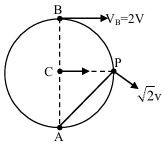
$A$ wheel is rolling on a plane surface. The speed of a particle on the highest point of the rim is $8 \ m/s$. The speed of the particle on the rim of the wheel at the same level as the centre of the wheel will be
A
$4 \sqrt{2} \ m/s$
B
$8 \ m/s$
C
$4 \ m/s$
D
$8 \sqrt{2} \ m/s$
Solution
(A) For a wheel rolling on a plane surface,the velocity of the highest point $B$ is $V_B = 2v$,where $v$ is the velocity of the center of mass.
Given $V_B = 8 \ m/s$,we have $2v = 8 \ m/s$,which implies $v = 4 \ m/s$.
The point $A$ at the bottom is the instantaneous center of rotation.
The velocity of any point $P$ on the rim is given by $V_P = \omega r_P$,where $r_P$ is the distance from the instantaneous center $A$.
For a point $P$ at the same level as the center $C$,the distance $AP = \sqrt{R^2 + R^2} = R\sqrt{2}$,where $R$ is the radius of the wheel.
Since $v = \omega R$,we have $\omega = v/R$.
Thus,$V_P = (v/R) \times (R\sqrt{2}) = v\sqrt{2}$.
Substituting $v = 4 \ m/s$,we get $V_P = 4\sqrt{2} \ m/s$.
Given $V_B = 8 \ m/s$,we have $2v = 8 \ m/s$,which implies $v = 4 \ m/s$.
The point $A$ at the bottom is the instantaneous center of rotation.
The velocity of any point $P$ on the rim is given by $V_P = \omega r_P$,where $r_P$ is the distance from the instantaneous center $A$.
For a point $P$ at the same level as the center $C$,the distance $AP = \sqrt{R^2 + R^2} = R\sqrt{2}$,where $R$ is the radius of the wheel.
Since $v = \omega R$,we have $\omega = v/R$.
Thus,$V_P = (v/R) \times (R\sqrt{2}) = v\sqrt{2}$.
Substituting $v = 4 \ m/s$,we get $V_P = 4\sqrt{2} \ m/s$.
0 likes
View Solution125
MediumMCQ
Which of the following statements is not correct?
A
During pure rolling on ground,the instantaneous speed of the point of contact is zero.
B
During pure rolling on ground,the instantaneous acceleration of the point of contact is zero.
C
For pure rolling motion on ground,work done against friction is zero.
D
$A$ wheel moving down a perfectly frictionless inclined plane will slip but not roll on the plane.
Solution
(B) rolling body can be imagined to be rotating about an axis passing through the point of contact of the body with the ground.
Hence,the instantaneous speed of the point of contact is zero.
Thus,statement $A$ is correct.
As the body is rotating,the point of contact has a centripetal acceleration directed towards the center of the body,so its instantaneous acceleration is not zero.
Hence,statement $B$ is incorrect.
In perfect rolling on ground,the velocity of the point of contact is zero.
Since the point of contact does not move relative to the ground,the work done against friction is zero.
Thus,statement $C$ is correct.
Rolling cannot take place in the absence of friction on an inclined plane because it is the frictional force that provides the necessary torque which makes the body roll.
When the inclined plane is perfectly smooth,the wheel will simply slip under the effect of its weight.
Hence,statement $D$ is correct.
Hence,the instantaneous speed of the point of contact is zero.
Thus,statement $A$ is correct.
As the body is rotating,the point of contact has a centripetal acceleration directed towards the center of the body,so its instantaneous acceleration is not zero.
Hence,statement $B$ is incorrect.
In perfect rolling on ground,the velocity of the point of contact is zero.
Since the point of contact does not move relative to the ground,the work done against friction is zero.
Thus,statement $C$ is correct.
Rolling cannot take place in the absence of friction on an inclined plane because it is the frictional force that provides the necessary torque which makes the body roll.
When the inclined plane is perfectly smooth,the wheel will simply slip under the effect of its weight.
Hence,statement $D$ is correct.
0 likes
View Solution126
EasyMCQ
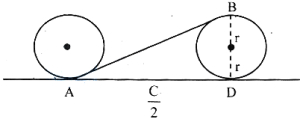
$A$ wheel of radius $1 \ m$ rolls through $180^{\circ}$ over a plane surface. The magnitude of the displacement of the point of the wheel initially in contact with the surface is:
A
$2 \pi$
B
$\pi$
C
$\sqrt{\pi^2+4}$
D
$3 \pi$
Solution
(C) The distance travelled by the wheel in a half revolution is given by $d = \frac{C}{2} = \frac{2 \pi r}{2} = \pi r$,where $C$ is the circumference of the wheel.
After a half revolution,the point initially in contact with the surface (point $A$) moves to the top of the wheel (point $B$).
The horizontal distance covered by the center of the wheel is $\pi r$,and the vertical displacement of the point is equal to the diameter of the wheel,which is $2r$.
Using the Pythagorean theorem for the displacement vector $AB$:
$AB = \sqrt{(\text{horizontal distance})^2 + (\text{vertical distance})^2}$
$AB = \sqrt{(\pi r)^2 + (2r)^2} = r \sqrt{\pi^2 + 4}$
Given $r = 1 \ m$,the magnitude of the displacement is $AB = \sqrt{\pi^2 + 4} \ m$.
After a half revolution,the point initially in contact with the surface (point $A$) moves to the top of the wheel (point $B$).
The horizontal distance covered by the center of the wheel is $\pi r$,and the vertical displacement of the point is equal to the diameter of the wheel,which is $2r$.
Using the Pythagorean theorem for the displacement vector $AB$:
$AB = \sqrt{(\text{horizontal distance})^2 + (\text{vertical distance})^2}$
$AB = \sqrt{(\pi r)^2 + (2r)^2} = r \sqrt{\pi^2 + 4}$
Given $r = 1 \ m$,the magnitude of the displacement is $AB = \sqrt{\pi^2 + 4} \ m$.
0 likes
View Solution127
MediumMCQ
$A$ ring and a disc roll on a horizontal surface without slipping with the same linear velocity. If both have the same mass and the total kinetic energy of the ring is $6 \ J$,then the total kinetic energy of the disc is: (in $/2 \ J$)
A
$3$
B
$5$
C
$7$
D
$9$
Solution
(D) The total kinetic energy of a body rolling without slipping is given by $K.E. = \frac{1}{2} Mv^2 + \frac{1}{2} I\omega^2 = \frac{1}{2} Mv^2 (1 + \frac{k^2}{R^2})$.
For a ring,the radius of gyration $k = R$,so $K.E._{\text{ring}} = \frac{1}{2} Mv^2 (1 + 1) = Mv^2$.
Given $K.E._{\text{ring}} = 6 \ J$,therefore $Mv^2 = 6 \ J$.
For a disc,the moment of inertia $I = \frac{1}{2} MR^2$,so $k^2 = \frac{1}{2} R^2$.
$K.E._{\text{disc}} = \frac{1}{2} Mv^2 (1 + \frac{1}{2}) = \frac{1}{2} Mv^2 (\frac{3}{2}) = \frac{3}{4} Mv^2$.
Substituting $Mv^2 = 6 \ J$ into the equation for the disc:
$K.E._{\text{disc}} = \frac{3}{4} \times 6 = \frac{18}{4} = 4.5 \ J = \frac{9}{2} \ J$.
For a ring,the radius of gyration $k = R$,so $K.E._{\text{ring}} = \frac{1}{2} Mv^2 (1 + 1) = Mv^2$.
Given $K.E._{\text{ring}} = 6 \ J$,therefore $Mv^2 = 6 \ J$.
For a disc,the moment of inertia $I = \frac{1}{2} MR^2$,so $k^2 = \frac{1}{2} R^2$.
$K.E._{\text{disc}} = \frac{1}{2} Mv^2 (1 + \frac{1}{2}) = \frac{1}{2} Mv^2 (\frac{3}{2}) = \frac{3}{4} Mv^2$.
Substituting $Mv^2 = 6 \ J$ into the equation for the disc:
$K.E._{\text{disc}} = \frac{3}{4} \times 6 = \frac{18}{4} = 4.5 \ J = \frac{9}{2} \ J$.
0 likes
View Solution128
DifficultMCQ
$A$ wheel of radius $2 \ cm$ is at rest on a horizontal surface. $A$ point $P$ on the circumference of the wheel is in contact with the horizontal surface. When the wheel rolls without slipping on the surface,the displacement of point $P$ after half a rotation of the wheel is:
A
$2(\pi^{2}+4)^{1/2} \ cm$
B
$(\pi^{2}+4)^{1/2} \ cm$
C
$2(\pi^{2}+2)^{1/2} \ cm$
D
$(\pi^{2}+2)^{1/2} \ cm$
Solution
(A) Let the radius of the wheel be $R = 2 \ cm$.
Initially,point $P$ is at the origin $(0, 0)$.
After half a rotation,the center of the wheel moves forward by a distance equal to half the circumference,which is $\pi R$.
The new position of the center is $(\pi R, R)$.
After half a rotation,point $P$ moves from the bottom to the top of the wheel.
The new coordinates of point $P$ will be $(\pi R, 2R)$.
The displacement $d$ is the distance between the initial position $(0, 0)$ and the final position $(\pi R, 2R)$.
Using the distance formula: $d = \sqrt{(\pi R - 0)^2 + (2R - 0)^2} = \sqrt{\pi^2 R^2 + 4R^2} = R\sqrt{\pi^2 + 4}$.
Substituting $R = 2 \ cm$: $d = 2\sqrt{\pi^2 + 4} \ cm$ or $2(\pi^2 + 4)^{1/2} \ cm$.
Initially,point $P$ is at the origin $(0, 0)$.
After half a rotation,the center of the wheel moves forward by a distance equal to half the circumference,which is $\pi R$.
The new position of the center is $(\pi R, R)$.
After half a rotation,point $P$ moves from the bottom to the top of the wheel.
The new coordinates of point $P$ will be $(\pi R, 2R)$.
The displacement $d$ is the distance between the initial position $(0, 0)$ and the final position $(\pi R, 2R)$.
Using the distance formula: $d = \sqrt{(\pi R - 0)^2 + (2R - 0)^2} = \sqrt{\pi^2 R^2 + 4R^2} = R\sqrt{\pi^2 + 4}$.
Substituting $R = 2 \ cm$: $d = 2\sqrt{\pi^2 + 4} \ cm$ or $2(\pi^2 + 4)^{1/2} \ cm$.
0 likes
View Solution129
MediumMCQ
$A$ solid sphere of mass $2 \ kg$ is rolling on a frictionless horizontal surface with velocity $6 \ m \ s^{-1}$. It collides with the free end of an ideal spring whose other end is fixed. The maximum compression produced in the spring will be (Force constant of the spring $= 36 \ N \ m^{-1}$). (in $m$)
A
$1.4$
B
$2.8$
C
$0.7$
D
$1.0$
Solution
(C) The total kinetic energy of a rolling solid sphere is the sum of its translational and rotational kinetic energies.
$KE_{total} = \frac{1}{2} m V^2 + \frac{1}{2} I \omega^2$
For a solid sphere,the moment of inertia $I = \frac{2}{5} m r^2$ and the rolling condition is $V = r \omega$.
$KE_{total} = \frac{1}{2} m V^2 + \frac{1}{2} (\frac{2}{5} m r^2) (\frac{V}{r})^2 = \frac{1}{2} m V^2 + \frac{1}{5} m V^2 = \frac{7}{10} m V^2$.
When the sphere compresses the spring by a maximum distance $x$,all its kinetic energy is converted into the potential energy of the spring $(U = \frac{1}{2} k x^2)$.
$\frac{1}{2} k x^2 = \frac{7}{10} m V^2$
$x^2 = \frac{14}{10} \frac{m V^2}{k} = \frac{1.4 \times 2 \times 6^2}{36} = \frac{1.4 \times 2 \times 36}{36} = 2.8$.
$x = \sqrt{2.8} \approx 1.67 \ m$.
Note: Given the options provided,there appears to be a discrepancy in the calculation or the provided options. Based on the standard physics approach,the result is $\sqrt{2.8} \ m$.
$KE_{total} = \frac{1}{2} m V^2 + \frac{1}{2} I \omega^2$
For a solid sphere,the moment of inertia $I = \frac{2}{5} m r^2$ and the rolling condition is $V = r \omega$.
$KE_{total} = \frac{1}{2} m V^2 + \frac{1}{2} (\frac{2}{5} m r^2) (\frac{V}{r})^2 = \frac{1}{2} m V^2 + \frac{1}{5} m V^2 = \frac{7}{10} m V^2$.
When the sphere compresses the spring by a maximum distance $x$,all its kinetic energy is converted into the potential energy of the spring $(U = \frac{1}{2} k x^2)$.
$\frac{1}{2} k x^2 = \frac{7}{10} m V^2$
$x^2 = \frac{14}{10} \frac{m V^2}{k} = \frac{1.4 \times 2 \times 6^2}{36} = \frac{1.4 \times 2 \times 36}{36} = 2.8$.
$x = \sqrt{2.8} \approx 1.67 \ m$.
Note: Given the options provided,there appears to be a discrepancy in the calculation or the provided options. Based on the standard physics approach,the result is $\sqrt{2.8} \ m$.
0 likes
View Solution130
MediumMCQ
$A$ ring and a disc roll on a horizontal surface without slipping with the same linear velocity. If both have the same mass and the total kinetic energy of the ring is $4 \ J$,then the total kinetic energy of the disc is: (in $J$)
A
$3$
B
$4$
C
$5$
D
$6$
Solution
(A) The total kinetic energy $(K.E.)$ of a body rolling without slipping is given by $K.E. = \frac{1}{2}mv^2 + \frac{1}{2}I\omega^2$.
Since the objects roll without slipping,$v = R\omega$,so $\omega^2 = \frac{v^2}{R^2}$.
For a ring,the moment of inertia $I_{ring} = mR^2$. Thus,$K.E._{ring} = \frac{1}{2}mv^2 + \frac{1}{2}(mR^2)(\frac{v^2}{R^2}) = \frac{1}{2}mv^2 + \frac{1}{2}mv^2 = mv^2$.
Given $K.E._{ring} = 4 \ J$,we have $mv^2 = 4 \ J$.
For a disc,the moment of inertia $I_{disc} = \frac{1}{2}mR^2$. Thus,$K.E._{disc} = \frac{1}{2}mv^2 + \frac{1}{2}(\frac{1}{2}mR^2)(\frac{v^2}{R^2}) = \frac{1}{2}mv^2 + \frac{1}{4}mv^2 = \frac{3}{4}mv^2$.
Substituting $mv^2 = 4 \ J$,we get $K.E._{disc} = \frac{3}{4} \times 4 \ J = 3 \ J$.
Since the objects roll without slipping,$v = R\omega$,so $\omega^2 = \frac{v^2}{R^2}$.
For a ring,the moment of inertia $I_{ring} = mR^2$. Thus,$K.E._{ring} = \frac{1}{2}mv^2 + \frac{1}{2}(mR^2)(\frac{v^2}{R^2}) = \frac{1}{2}mv^2 + \frac{1}{2}mv^2 = mv^2$.
Given $K.E._{ring} = 4 \ J$,we have $mv^2 = 4 \ J$.
For a disc,the moment of inertia $I_{disc} = \frac{1}{2}mR^2$. Thus,$K.E._{disc} = \frac{1}{2}mv^2 + \frac{1}{2}(\frac{1}{2}mR^2)(\frac{v^2}{R^2}) = \frac{1}{2}mv^2 + \frac{1}{4}mv^2 = \frac{3}{4}mv^2$.
Substituting $mv^2 = 4 \ J$,we get $K.E._{disc} = \frac{3}{4} \times 4 \ J = 3 \ J$.
0 likes
View Solution131
DifficultMCQ
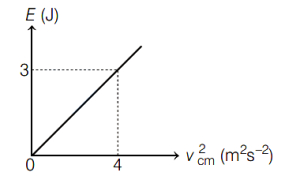
In the figure,$E$ and $v_{cm}$ represent the total energy and speed of the centre of mass of an object of mass $1 \ kg$ in pure rolling. The object is
A
sphere
B
ring
C
disc
D
hollow cylinder
Solution
(C) The total kinetic energy of an object in pure rolling motion is given by:
$E = \frac{1}{2} m v_{cm}^{2} \left(1 + \frac{k^{2}}{R^{2}}\right)$
where $k$ is the radius of gyration,$R$ is the radius,and $m$ is the mass of the object.
Given $m = 1 \ kg$,the expression becomes:
$\frac{E}{v_{cm}^{2}} = \frac{1}{2} \left(1 + \frac{k^{2}}{R^{2}}\right) \quad ...(i)$
From the given graph,the slope of the line is $\frac{E}{v_{cm}^{2}} = \frac{3}{4}$.
Substituting this value into Eq. $(i)$:
$\frac{3}{4} = \frac{1}{2} \left(1 + \frac{k^{2}}{R^{2}}\right)$
$\frac{3}{2} = 1 + \frac{k^{2}}{R^{2}}$
$\frac{k^{2}}{R^{2}} = \frac{3}{2} - 1 = \frac{1}{2}$
We know that for a disc,the moment of inertia $I = \frac{1}{2} m R^{2}$,so $k^{2} = \frac{1}{2} R^{2}$,which means $\frac{k^{2}}{R^{2}} = \frac{1}{2}$.
Thus,the object is a disc.
$E = \frac{1}{2} m v_{cm}^{2} \left(1 + \frac{k^{2}}{R^{2}}\right)$
where $k$ is the radius of gyration,$R$ is the radius,and $m$ is the mass of the object.
Given $m = 1 \ kg$,the expression becomes:
$\frac{E}{v_{cm}^{2}} = \frac{1}{2} \left(1 + \frac{k^{2}}{R^{2}}\right) \quad ...(i)$
From the given graph,the slope of the line is $\frac{E}{v_{cm}^{2}} = \frac{3}{4}$.
Substituting this value into Eq. $(i)$:
$\frac{3}{4} = \frac{1}{2} \left(1 + \frac{k^{2}}{R^{2}}\right)$
$\frac{3}{2} = 1 + \frac{k^{2}}{R^{2}}$
$\frac{k^{2}}{R^{2}} = \frac{3}{2} - 1 = \frac{1}{2}$
We know that for a disc,the moment of inertia $I = \frac{1}{2} m R^{2}$,so $k^{2} = \frac{1}{2} R^{2}$,which means $\frac{k^{2}}{R^{2}} = \frac{1}{2}$.
Thus,the object is a disc.
0 likes
View Solution132
EasyMCQ
$A$ uniform solid sphere of radius $R$ and radius of gyration $K$ about an axis passing through the centre of mass,is rolling without slipping. Then the fraction of total energy associated with its rotation will be
A
$\frac{K^2+R^2}{K^2}$
B
$\frac{K^2}{R^2}$
C
$\frac{K^2}{K^2+R^2}$
D
$\frac{R^2}{K^2+R^2}$
Solution
(C) In pure rolling motion,the total kinetic energy is the sum of translational and rotational kinetic energy.
Translational $KE = \frac{1}{2}mv^2$.
Rotational $KE = \frac{1}{2}I\omega^2 = \frac{1}{2}(mK^2)(\frac{v}{R})^2 = \frac{1}{2}mv^2(\frac{K^2}{R^2})$.
Total $KE = \frac{1}{2}mv^2 + \frac{1}{2}mv^2(\frac{K^2}{R^2}) = \frac{1}{2}mv^2(1 + \frac{K^2}{R^2}) = \frac{1}{2}mv^2(\frac{R^2+K^2}{R^2})$.
The fraction of total energy associated with rotation is $\frac{Rotational \ KE}{Total \ KE} = \frac{\frac{1}{2}mv^2(\frac{K^2}{R^2})}{\frac{1}{2}mv^2(\frac{R^2+K^2}{R^2})} = \frac{K^2}{K^2+R^2}$.
Translational $KE = \frac{1}{2}mv^2$.
Rotational $KE = \frac{1}{2}I\omega^2 = \frac{1}{2}(mK^2)(\frac{v}{R})^2 = \frac{1}{2}mv^2(\frac{K^2}{R^2})$.
Total $KE = \frac{1}{2}mv^2 + \frac{1}{2}mv^2(\frac{K^2}{R^2}) = \frac{1}{2}mv^2(1 + \frac{K^2}{R^2}) = \frac{1}{2}mv^2(\frac{R^2+K^2}{R^2})$.
The fraction of total energy associated with rotation is $\frac{Rotational \ KE}{Total \ KE} = \frac{\frac{1}{2}mv^2(\frac{K^2}{R^2})}{\frac{1}{2}mv^2(\frac{R^2+K^2}{R^2})} = \frac{K^2}{K^2+R^2}$.
0 likes
View Solution133
MediumMCQ
$A$ thin uniform circular disc rolls with a constant velocity without slipping on a horizontal surface. Its total kinetic energy is
A
$3$ times its rotational kinetic energy
B
$3$ times its translational kinetic energy
C
$1.5$ times its rotational kinetic energy
D
$2$ times its translational kinetic energy
Solution
(A) For a rolling disc of mass $M$ and radius $R$ moving with velocity $v$ and angular velocity $\omega = v/R$,the translational kinetic energy is $K_t = \frac{1}{2} Mv^2$.
The rotational kinetic energy about the center of mass is $K_r = \frac{1}{2} I \omega^2$.
For a disc,the moment of inertia $I = \frac{1}{2} MR^2$.
Substituting $I$ and $\omega = v/R$,we get $K_r = \frac{1}{2} (\frac{1}{2} MR^2) (v/R)^2 = \frac{1}{4} Mv^2$.
The total kinetic energy $K = K_t + K_r = \frac{1}{2} Mv^2 + \frac{1}{4} Mv^2 = \frac{3}{4} Mv^2$.
Comparing $K$ with $K_r$: $K = \frac{3/4 Mv^2}{1/4 Mv^2} K_r = 3 K_r$.
Thus,the total kinetic energy is $3$ times its rotational kinetic energy.
The rotational kinetic energy about the center of mass is $K_r = \frac{1}{2} I \omega^2$.
For a disc,the moment of inertia $I = \frac{1}{2} MR^2$.
Substituting $I$ and $\omega = v/R$,we get $K_r = \frac{1}{2} (\frac{1}{2} MR^2) (v/R)^2 = \frac{1}{4} Mv^2$.
The total kinetic energy $K = K_t + K_r = \frac{1}{2} Mv^2 + \frac{1}{4} Mv^2 = \frac{3}{4} Mv^2$.
Comparing $K$ with $K_r$: $K = \frac{3/4 Mv^2}{1/4 Mv^2} K_r = 3 K_r$.
Thus,the total kinetic energy is $3$ times its rotational kinetic energy.
0 likes
View Solution134
MediumMCQ
$A$ thin circular ring and a circular disc of equal mass are rolling without sliding. If their linear velocities are equal and the total kinetic energy of the disc is $6 \ J$,then the total kinetic energy of the ring is (in $J$)
A
$6$
B
$3$
C
$8$
D
$4$
Solution
(C) The total kinetic energy of a body rolling without sliding is given by $K = \frac{1}{2}mv^2(1 + \frac{k^2}{R^2})$,where $k$ is the radius of gyration.
For a circular disc,the moment of inertia is $I = \frac{1}{2}mR^2$,so $k^2 = \frac{1}{2}R^2$. The kinetic energy is $K_{disc} = \frac{1}{2}mv^2(1 + \frac{1}{2}) = \frac{3}{4}mv^2 = 6 \ J$.
From this,$\frac{1}{2}mv^2 = \frac{6 \times 2}{3} = 4 \ J$.
For a thin circular ring,the moment of inertia is $I = mR^2$,so $k^2 = R^2$. The kinetic energy is $K_{ring} = \frac{1}{2}mv^2(1 + 1) = mv^2$.
Since $\frac{1}{2}mv^2 = 4 \ J$,then $mv^2 = 8 \ J$.
Therefore,the total kinetic energy of the ring is $8 \ J$.
For a circular disc,the moment of inertia is $I = \frac{1}{2}mR^2$,so $k^2 = \frac{1}{2}R^2$. The kinetic energy is $K_{disc} = \frac{1}{2}mv^2(1 + \frac{1}{2}) = \frac{3}{4}mv^2 = 6 \ J$.
From this,$\frac{1}{2}mv^2 = \frac{6 \times 2}{3} = 4 \ J$.
For a thin circular ring,the moment of inertia is $I = mR^2$,so $k^2 = R^2$. The kinetic energy is $K_{ring} = \frac{1}{2}mv^2(1 + 1) = mv^2$.
Since $\frac{1}{2}mv^2 = 4 \ J$,then $mv^2 = 8 \ J$.
Therefore,the total kinetic energy of the ring is $8 \ J$.
0 likes
View Solution135
MediumMCQ
If a solid sphere is rolling without slipping on a horizontal plane,then the ratio of its rotational and total kinetic energies is
A
$2: 5$
B
$2: 7$
C
$4: 3$
D
$1: 2$
Solution
(B) For a solid sphere,the moment of inertia about its center is $I = \frac{2}{5}MR^2$.
Since the sphere is rolling without slipping,the velocity of the center of mass is $v = R\omega$,where $\omega$ is the angular velocity.
The rotational kinetic energy is $K_{rot} = \frac{1}{2}I\omega^2 = \frac{1}{2} (\frac{2}{5}MR^2) \omega^2 = \frac{1}{5}M(R\omega)^2 = \frac{1}{5}Mv^2$.
The translational kinetic energy is $K_{trans} = \frac{1}{2}Mv^2$.
The total kinetic energy is $K_{total} = K_{rot} + K_{trans} = \frac{1}{5}Mv^2 + \frac{1}{2}Mv^2 = \frac{2+5}{10}Mv^2 = \frac{7}{10}Mv^2$.
The ratio of rotational kinetic energy to total kinetic energy is $\frac{K_{rot}}{K_{total}} = \frac{\frac{1}{5}Mv^2}{\frac{7}{10}Mv^2} = \frac{1}{5} \times \frac{10}{7} = \frac{2}{7}$.
Thus,the ratio is $2: 7$.
Since the sphere is rolling without slipping,the velocity of the center of mass is $v = R\omega$,where $\omega$ is the angular velocity.
The rotational kinetic energy is $K_{rot} = \frac{1}{2}I\omega^2 = \frac{1}{2} (\frac{2}{5}MR^2) \omega^2 = \frac{1}{5}M(R\omega)^2 = \frac{1}{5}Mv^2$.
The translational kinetic energy is $K_{trans} = \frac{1}{2}Mv^2$.
The total kinetic energy is $K_{total} = K_{rot} + K_{trans} = \frac{1}{5}Mv^2 + \frac{1}{2}Mv^2 = \frac{2+5}{10}Mv^2 = \frac{7}{10}Mv^2$.
The ratio of rotational kinetic energy to total kinetic energy is $\frac{K_{rot}}{K_{total}} = \frac{\frac{1}{5}Mv^2}{\frac{7}{10}Mv^2} = \frac{1}{5} \times \frac{10}{7} = \frac{2}{7}$.
Thus,the ratio is $2: 7$.
0 likes
View Solution136
EasyMCQ
$A$ circular hoop of radius $50 \ cm$ and mass $1 \ kg$ rotating with an angular velocity $\omega_0$ is placed on a rough horizontal surface. The initial velocity of the centre of the hoop is zero. Let $v$ be the velocity of the centre of the hoop when it ceases to slip. The ratio $v / \omega_0$ will be (in $cm$)
A
$10$
B
$50$
C
$25$
D
$12.5$
Solution
(C) The initial angular momentum of the hoop about the point of contact is $L_i = I_{cm} \omega_0 + m r^2 \omega_0 = m r^2 \omega_0 + m r^2 \omega_0 = 2 m r^2 \omega_0$. However,considering the angular momentum about the contact point $P$ at the instant it is placed: $L_i = I_P \omega_0 = (I_{cm} + m r^2) \omega_0 = (m r^2 + m r^2) \omega_0 = 2 m r^2 \omega_0$.
When the hoop stops slipping,it rolls without slipping,so $v = r \omega$. The final angular momentum about the contact point $P$ is $L_f = I_{cm} \omega + m r v = m r^2 (v/r) + m r v = m r v + m r v = 2 m r v$.
Since the frictional force acts through the contact point,the net torque about the contact point is zero. Thus,angular momentum is conserved: $L_i = L_f$.
$2 m r^2 \omega_0 = 2 m r v$.
Dividing both sides by $2 m r$,we get $v = r \omega_0$.
Wait,re-evaluating: $L_i = I_{cm} \omega_0 = m r^2 \omega_0$. The angular momentum about the contact point is $L_i = I_{cm} \omega_0 = m r^2 \omega_0$.
$L_f = I_{cm} \omega + m r v = m r^2 (v/r) + m r v = 2 m r v$.
Equating $L_i = L_f$: $m r^2 \omega_0 = 2 m r v$.
Therefore,$v / \omega_0 = r / 2 = 50 \ cm / 2 = 25 \ cm$.
When the hoop stops slipping,it rolls without slipping,so $v = r \omega$. The final angular momentum about the contact point $P$ is $L_f = I_{cm} \omega + m r v = m r^2 (v/r) + m r v = m r v + m r v = 2 m r v$.
Since the frictional force acts through the contact point,the net torque about the contact point is zero. Thus,angular momentum is conserved: $L_i = L_f$.
$2 m r^2 \omega_0 = 2 m r v$.
Dividing both sides by $2 m r$,we get $v = r \omega_0$.
Wait,re-evaluating: $L_i = I_{cm} \omega_0 = m r^2 \omega_0$. The angular momentum about the contact point is $L_i = I_{cm} \omega_0 = m r^2 \omega_0$.
$L_f = I_{cm} \omega + m r v = m r^2 (v/r) + m r v = 2 m r v$.
Equating $L_i = L_f$: $m r^2 \omega_0 = 2 m r v$.
Therefore,$v / \omega_0 = r / 2 = 50 \ cm / 2 = 25 \ cm$.
0 likes
View Solution137
DifficultMCQ
$A$ circular ring of mass $10 \text{ kg}$ rolls along a horizontal floor. The center of mass of the ring has a speed of $1.5 \text{ m/s}$. The work required to stop the ring is: (in $\text{ J}$)
A
$10$
B
$-6$
C
$14.5$
D
$-22.5$
Solution
(D) Given, mass of the circular ring, $m = 10 \text{ kg}$.
Linear speed of the center of mass, $v = 1.5 \text{ m/s}$.
The total initial kinetic energy of the rolling ring is the sum of its rotational and translational kinetic energies:
$K_i = K_{\text{rotational}} + K_{\text{translational}} = \frac{1}{2} I \omega^2 + \frac{1}{2} m v^2$.
For a ring, the moment of inertia $I = m R^2$ and the angular velocity $\omega = \frac{v}{R}$.
Substituting these values:
$K_i = \frac{1}{2} (m R^2) \left(\frac{v}{R}\right)^2 + \frac{1}{2} m v^2 = \frac{1}{2} m v^2 + \frac{1}{2} m v^2 = m v^2$.
$K_i = 10 \times (1.5)^2 = 10 \times 2.25 = 22.5 \text{ J}$.
According to the work-energy theorem, the work required to stop the ring is equal to the change in kinetic energy:
$W = K_f - K_i = 0 - 22.5 = -22.5 \text{ J}$.
Linear speed of the center of mass, $v = 1.5 \text{ m/s}$.
The total initial kinetic energy of the rolling ring is the sum of its rotational and translational kinetic energies:
$K_i = K_{\text{rotational}} + K_{\text{translational}} = \frac{1}{2} I \omega^2 + \frac{1}{2} m v^2$.
For a ring, the moment of inertia $I = m R^2$ and the angular velocity $\omega = \frac{v}{R}$.
Substituting these values:
$K_i = \frac{1}{2} (m R^2) \left(\frac{v}{R}\right)^2 + \frac{1}{2} m v^2 = \frac{1}{2} m v^2 + \frac{1}{2} m v^2 = m v^2$.
$K_i = 10 \times (1.5)^2 = 10 \times 2.25 = 22.5 \text{ J}$.
According to the work-energy theorem, the work required to stop the ring is equal to the change in kinetic energy:
$W = K_f - K_i = 0 - 22.5 = -22.5 \text{ J}$.
0 likes
View Solution138
EasyMCQ
$A$ body is rolling without slipping on a horizontal plane. If the rotational kinetic energy of the body is $50 \%$ of its total kinetic energy,then the body is
A
Hollow sphere
B
Solid sphere
C
Solid cylinder
D
Thin circular ring
Solution
(D) For rolling without slipping,the velocity is $v = r \omega$.
Total kinetic energy $E = K_{rot} + K_{trans} = \frac{1}{2} I \omega^2 + \frac{1}{2} m v^2$.
Substituting $v = r \omega$,we get $E = \frac{1}{2} I \omega^2 + \frac{1}{2} m r^2 \omega^2 = \frac{1}{2} (I + m r^2) \omega^2$.
Rotational kinetic energy is $K_{rot} = \frac{1}{2} I \omega^2$.
Given that $K_{rot} = 50 \% \text{ of } E$,so $K_{rot} = \frac{1}{2} E$.
Substituting the expressions: $\frac{1}{2} I \omega^2 = \frac{1}{2} [\frac{1}{2} (I + m r^2) \omega^2]$.
$I = \frac{1}{2} I + \frac{1}{2} m r^2$.
$\frac{1}{2} I = \frac{1}{2} m r^2$,which implies $I = m r^2$.
The moment of inertia $I = m r^2$ corresponds to a thin circular ring.
Total kinetic energy $E = K_{rot} + K_{trans} = \frac{1}{2} I \omega^2 + \frac{1}{2} m v^2$.
Substituting $v = r \omega$,we get $E = \frac{1}{2} I \omega^2 + \frac{1}{2} m r^2 \omega^2 = \frac{1}{2} (I + m r^2) \omega^2$.
Rotational kinetic energy is $K_{rot} = \frac{1}{2} I \omega^2$.
Given that $K_{rot} = 50 \% \text{ of } E$,so $K_{rot} = \frac{1}{2} E$.
Substituting the expressions: $\frac{1}{2} I \omega^2 = \frac{1}{2} [\frac{1}{2} (I + m r^2) \omega^2]$.
$I = \frac{1}{2} I + \frac{1}{2} m r^2$.
$\frac{1}{2} I = \frac{1}{2} m r^2$,which implies $I = m r^2$.
The moment of inertia $I = m r^2$ corresponds to a thin circular ring.
0 likes
View Solution139
MediumMCQ
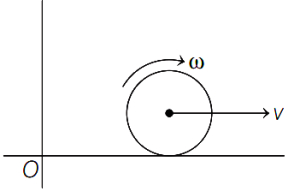
$A$ solid sphere and a solid cylinder,each of mass $M$ and radius $R$,are rolling with a linear speed $v$ on a flat surface without slipping. Let $L_1$ be the magnitude of the angular momentum of the sphere with respect to a fixed point $O$ on the surface along the path of the sphere. Likewise,let $L_2$ be the magnitude of the angular momentum of the cylinder with respect to the same fixed point $O$ along its path. The ratio $\frac{L_1}{L_2}$ is
A
$\frac{14}{15}$
B
$\frac{4}{5}$
C
$\frac{2}{5}$
D
$\frac{7}{15}$
Solution
(A) The angular momentum of a body rolling on a surface with respect to a point $O$ on the surface is given by the sum of the angular momentum due to the motion of the centre of mass and the angular momentum due to rotation about the centre of mass.
$L_O = L_{\text{linear}} + L_{\text{rotational}} = MvR + I\omega$
Since the body is rolling without slipping,$v = R\omega$,so $\omega = \frac{v}{R}$.
$L_O = MvR + I\left(\frac{v}{R}\right) = vR \left(M + \frac{I}{R^2}\right)$
For a solid sphere,$I_1 = \frac{2}{5}MR^2$. Thus,$L_1 = vR \left(M + \frac{2}{5}M\right) = \frac{7}{5}MvR$.
For a solid cylinder,$I_2 = \frac{1}{2}MR^2$. Thus,$L_2 = vR \left(M + \frac{1}{2}M\right) = \frac{3}{2}MvR$.
The ratio is $\frac{L_1}{L_2} = \frac{\frac{7}{5}MvR}{\frac{3}{2}MvR} = \frac{7}{5} \times \frac{2}{3} = \frac{14}{15}$.
$L_O = L_{\text{linear}} + L_{\text{rotational}} = MvR + I\omega$
Since the body is rolling without slipping,$v = R\omega$,so $\omega = \frac{v}{R}$.
$L_O = MvR + I\left(\frac{v}{R}\right) = vR \left(M + \frac{I}{R^2}\right)$
For a solid sphere,$I_1 = \frac{2}{5}MR^2$. Thus,$L_1 = vR \left(M + \frac{2}{5}M\right) = \frac{7}{5}MvR$.
For a solid cylinder,$I_2 = \frac{1}{2}MR^2$. Thus,$L_2 = vR \left(M + \frac{1}{2}M\right) = \frac{3}{2}MvR$.
The ratio is $\frac{L_1}{L_2} = \frac{\frac{7}{5}MvR}{\frac{3}{2}MvR} = \frac{7}{5} \times \frac{2}{3} = \frac{14}{15}$.
0 likes
View Solution140
MediumMCQ
$A$ solid sphere of mass $2 \ kg$ and radius $0.5 \ m$ is rolling without slipping on a horizontal surface. The ratio of the rotational and translational kinetic energies of the sphere is (in $: 5$)
A
$3$
B
$2$
C
$4$
D
$7$
Solution
(B) For a solid sphere rolling without slipping,the moment of inertia about its center of mass is $I = \frac{2}{5}MR^2$.
The rotational kinetic energy is $K_{rot} = \frac{1}{2}I\omega^2 = \frac{1}{2}(\frac{2}{5}MR^2)\omega^2 = \frac{1}{5}MR^2\omega^2$.
Since the sphere is rolling without slipping,the velocity of the center of mass is $v = R\omega$,so $\omega = \frac{v}{R}$.
Substituting $\omega$ into the rotational kinetic energy expression: $K_{rot} = \frac{1}{5}MR^2(\frac{v}{R})^2 = \frac{1}{5}Mv^2$.
The translational kinetic energy is $K_{trans} = \frac{1}{2}Mv^2$.
The ratio of rotational to translational kinetic energy is $\frac{K_{rot}}{K_{trans}} = \frac{\frac{1}{5}Mv^2}{\frac{1}{2}Mv^2} = \frac{2}{5}$.
Thus,the ratio is $2: 5$.
The rotational kinetic energy is $K_{rot} = \frac{1}{2}I\omega^2 = \frac{1}{2}(\frac{2}{5}MR^2)\omega^2 = \frac{1}{5}MR^2\omega^2$.
Since the sphere is rolling without slipping,the velocity of the center of mass is $v = R\omega$,so $\omega = \frac{v}{R}$.
Substituting $\omega$ into the rotational kinetic energy expression: $K_{rot} = \frac{1}{5}MR^2(\frac{v}{R})^2 = \frac{1}{5}Mv^2$.
The translational kinetic energy is $K_{trans} = \frac{1}{2}Mv^2$.
The ratio of rotational to translational kinetic energy is $\frac{K_{rot}}{K_{trans}} = \frac{\frac{1}{5}Mv^2}{\frac{1}{2}Mv^2} = \frac{2}{5}$.
Thus,the ratio is $2: 5$.
0 likes
View Solution141
EasyMCQ
$A$ solid sphere of mass $5 \,kg$ rolls on a plane surface. Find its kinetic energy at an instant when its centre moves with speed $4 \,m/s$. (in $\,J$)
A
$56$
B
$45$
C
$75$
D
$105$
Solution
(A) The total kinetic energy $(KE)$ of a rolling body is the sum of its translational and rotational kinetic energies, given by the formula:
$KE = \frac{1}{2} mv^2 + \frac{1}{2} I\omega^2$
For a solid sphere, the moment of inertia about its centre is $I = \frac{2}{5} mR^2$ and the angular velocity is $\omega = \frac{v}{R}$.
Substituting these values, we get:
$KE = \frac{1}{2} mv^2 + \frac{1}{2} (\frac{2}{5} mR^2)(\frac{v}{R})^2 = \frac{1}{2} mv^2 + \frac{1}{5} mv^2 = \frac{7}{10} mv^2$
Given $m = 5 \,kg$ and $v = 4 \,m/s$:
$KE = \frac{7}{10} \times 5 \times (4)^2 = \frac{7}{10} \times 5 \times 16 = 7 \times 8 = 56 \,J$
Thus, the correct option is $A$.
$KE = \frac{1}{2} mv^2 + \frac{1}{2} I\omega^2$
For a solid sphere, the moment of inertia about its centre is $I = \frac{2}{5} mR^2$ and the angular velocity is $\omega = \frac{v}{R}$.
Substituting these values, we get:
$KE = \frac{1}{2} mv^2 + \frac{1}{2} (\frac{2}{5} mR^2)(\frac{v}{R})^2 = \frac{1}{2} mv^2 + \frac{1}{5} mv^2 = \frac{7}{10} mv^2$
Given $m = 5 \,kg$ and $v = 4 \,m/s$:
$KE = \frac{7}{10} \times 5 \times (4)^2 = \frac{7}{10} \times 5 \times 16 = 7 \times 8 = 56 \,J$
Thus, the correct option is $A$.
0 likes
View Solution142
EasyMCQ
$A$ solid uniform sphere resting on a rough horizontal plane is given a horizontal impulse directed through its centre so that it starts sliding with an initial velocity $v_{0}$. When it finally starts rolling without slipping,the speed of its centre is
A
$\frac{2}{7} v_{0}$
B
$\frac{3}{7} v_{0}$
C
$\frac{5}{7} v_{0}$
D
$\frac{6}{7} v_{0}$
Solution
(C) Let $v$ be the final velocity of the centre of the sphere and $\omega$ be the final angular velocity when it starts rolling without slipping.
Since the friction force acts at the point of contact,the net torque about the point of contact is zero.
Therefore,the angular momentum about the point of contact remains conserved.
Initial angular momentum about the point of contact: $L_i = m v_0 r$
Final angular momentum about the point of contact: $L_f = mvr + I_{cm}\omega$
For a solid sphere,the moment of inertia about its centre is $I_{cm} = \frac{2}{5} mr^2$.
Since it rolls without slipping,the condition is $v = r\omega$,or $\omega = \frac{v}{r}$.
Equating initial and final angular momentum:
$mv_0 r = mvr + (\frac{2}{5} mr^2)(\frac{v}{r})$
$mv_0 r = mvr + \frac{2}{5} mvr$
$v_0 = v + \frac{2}{5} v$
$v_0 = \frac{7}{5} v$
$v = \frac{5}{7} v_0$
Since the friction force acts at the point of contact,the net torque about the point of contact is zero.
Therefore,the angular momentum about the point of contact remains conserved.
Initial angular momentum about the point of contact: $L_i = m v_0 r$
Final angular momentum about the point of contact: $L_f = mvr + I_{cm}\omega$
For a solid sphere,the moment of inertia about its centre is $I_{cm} = \frac{2}{5} mr^2$.
Since it rolls without slipping,the condition is $v = r\omega$,or $\omega = \frac{v}{r}$.
Equating initial and final angular momentum:
$mv_0 r = mvr + (\frac{2}{5} mr^2)(\frac{v}{r})$
$mv_0 r = mvr + \frac{2}{5} mvr$
$v_0 = v + \frac{2}{5} v$
$v_0 = \frac{7}{5} v$
$v = \frac{5}{7} v_0$
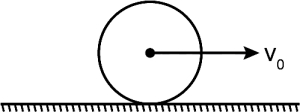
0 likes
View Solution143
MediumMCQ
$A$ circular disc rolls on a horizontal floor without slipping and the centre of the disc moves with a uniform velocity $v$. Which of the following values can the velocity of a point on the rim of the disc have?
A
$v$
B
$-v$
C
$2v$
D
Zero
Solution
(A, C, D) For a circular disc rolling without slipping on a horizontal floor, the velocity of any point on the rim is the vector sum of the translational velocity of the centre $(v)$ and the tangential velocity due to rotation $(\omega R)$.
Since the disc rolls without slipping, $v = \omega R$.
$1$. At the point of contact $(P)$ with the floor, the velocity is $v_P = v - \omega R = v - v = 0$.
$2$. At the top point $(S)$, the velocity is $v_S = v + \omega R = v + v = 2v$.
$3$. At any other point on the rim, the magnitude of the velocity lies between $0$ and $2v$. Specifically, at the level of the centre, the velocity is $\sqrt{v^2 + v^2} = \sqrt{2}v$.
Thus, the possible values for the velocity of a point on the rim include $0$, $v$, $\sqrt{2}v$, and $2v$. Among the given options, $v$, $2v$, and $0$ are valid.
Since the disc rolls without slipping, $v = \omega R$.
$1$. At the point of contact $(P)$ with the floor, the velocity is $v_P = v - \omega R = v - v = 0$.
$2$. At the top point $(S)$, the velocity is $v_S = v + \omega R = v + v = 2v$.
$3$. At any other point on the rim, the magnitude of the velocity lies between $0$ and $2v$. Specifically, at the level of the centre, the velocity is $\sqrt{v^2 + v^2} = \sqrt{2}v$.
Thus, the possible values for the velocity of a point on the rim include $0$, $v$, $\sqrt{2}v$, and $2v$. Among the given options, $v$, $2v$, and $0$ are valid.
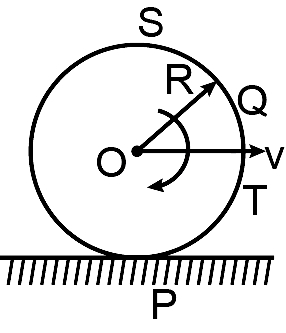
0 likes
View Solution144
DifficultMCQ
$A$ solid cylinder having radius $R$ and length $L$ is slipping on a rough horizontal plane. At time $t = 0$ the cylinder has a translational velocity $v_0 = 49 \text{ m/s}$,perpendicular to its axis and a rotational velocity $v_0/4R$ about the centre. The time taken by the cylinder to start rolling is . . . . . . seconds. (coefficient of kinetic friction $\mu_K = 0.25$ and $g = 9.8 \text{ m/s}^2$)
A
$15$
B
$5$
C
$10$
D
$7.5$
Solution
(B) The friction force $f = \mu_K mg$ acts opposite to the direction of translational velocity $v$. The linear acceleration is $a = -\mu_K g$.
The velocity at time $t$ is given by $v(t) = v_0 - \mu_K gt$.
The torque due to friction about the center is $\tau = fR = \mu_K mgR$.
The angular acceleration is $\alpha = \tau/I = \frac{\mu_K mgR}{(1/2)mR^2} = \frac{2\mu_K g}{R}$.
The angular velocity at time $t$ is $\omega(t) = \omega_0 + \alpha t = \frac{v_0}{4R} + \frac{2\mu_K g}{R}t$.
Rolling starts when the condition $v(t) = \omega(t)R$ is satisfied.
Substituting the expressions: $v_0 - \mu_K gt = (\frac{v_0}{4R} + \frac{2\mu_K g}{R}t)R$.
This simplifies to: $v_0 - \mu_K gt = \frac{v_0}{4} + 2\mu_K gt$.
Rearranging terms: $\frac{3v_0}{4} = 3\mu_K gt$.
Solving for $t$: $t = \frac{v_0}{4\mu_K g}$.
Plugging in the values: $t = \frac{49}{4 \times 0.25 \times 9.8} = \frac{49}{9.8} = 5 \text{ s}$.
The velocity at time $t$ is given by $v(t) = v_0 - \mu_K gt$.
The torque due to friction about the center is $\tau = fR = \mu_K mgR$.
The angular acceleration is $\alpha = \tau/I = \frac{\mu_K mgR}{(1/2)mR^2} = \frac{2\mu_K g}{R}$.
The angular velocity at time $t$ is $\omega(t) = \omega_0 + \alpha t = \frac{v_0}{4R} + \frac{2\mu_K g}{R}t$.
Rolling starts when the condition $v(t) = \omega(t)R$ is satisfied.
Substituting the expressions: $v_0 - \mu_K gt = (\frac{v_0}{4R} + \frac{2\mu_K g}{R}t)R$.
This simplifies to: $v_0 - \mu_K gt = \frac{v_0}{4} + 2\mu_K gt$.
Rearranging terms: $\frac{3v_0}{4} = 3\mu_K gt$.
Solving for $t$: $t = \frac{v_0}{4\mu_K g}$.
Plugging in the values: $t = \frac{49}{4 \times 0.25 \times 9.8} = \frac{49}{9.8} = 5 \text{ s}$.
0 likes
View SolutionSystem of Particles and Rotational Motion — Rolling motion on horizontal Surface · Frequently Asked Questions
1Are these System of Particles and Rotational Motion questions useful for JEE and NEET?
Yes. All questions in this section are mapped to JEE Main and NEET exam patterns. Previous year questions from JEE Main, NEET, GUJCET and state-level exams are included with full solutions.
2Can I switch to Hindi or Gujarati for these questions?
Yes. Use the language tabs in the hero section or the sidebar to view the same questions and solutions in English, Hindi or Gujarati.
3How do I generate a question paper from this subtopic?
Use the Vedclass Exam Paper Generator — select the chapter and subtopic, set difficulty, and generate Sets A, B, C, D automatically. First 3 chapters of every subject are free.
Vedclass Products
For Students
Vedclass Test Series
Mock tests in real JEE/NEET style with performance analysis. 5-day free trial.
Start Free TrialFor Teachers
Exam Paper Generator
Generate Set A/B/C/D papers from this chapter in 2 minutes. 3 chapters free.
Try FreeFor Institutes
Online Exam Module
Live online exams with unlimited students, 360° analytics & white-label branding.
See DemoFor Teachers & Institutes
Generate a System of Particles and Rotational Motion Exam Paper in 2 Minutes
Select subtopic & difficulty — Sets A, B, C, D auto-generated with No Repeat logic.
First 3 chapters of every subject are free — no payment required.