
A English
Rolling motion on horizontal Surface Questions in English
Class 11 Physics · System of Particles and Rotational Motion · Rolling motion on horizontal Surface
144+
Questions
English
Language
100%
With Solutions
Showing 49 of 144 questions in English
1
DifficultMCQ
$A$ wheel of radius $1 \text{ m}$ rolls forward half a revolution on a horizontal ground. The magnitude of the displacement of the point of the wheel initially in contact with the ground is
A
$2\pi$
B
$\sqrt{2}\pi$
C
$\sqrt{\pi^2 + 4}$
D
$\pi$
Solution
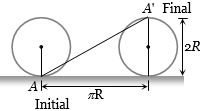
(C) The horizontal distance covered by the wheel in half a revolution is equal to half of its circumference,which is $\pi R$.
The vertical displacement of the point initially in contact with the ground is equal to the diameter of the wheel,which is $2R$.
Let the initial position of the point be $A$ and the final position be $A'$. The displacement is the vector sum of the horizontal and vertical displacements.
The magnitude of the displacement is given by $\sqrt{(\pi R)^2 + (2R)^2}$.
Given $R = 1 \text{ m}$,the magnitude of the displacement is $\sqrt{(\pi \times 1)^2 + (2 \times 1)^2} = \sqrt{\pi^2 + 4} \text{ m}$.
The vertical displacement of the point initially in contact with the ground is equal to the diameter of the wheel,which is $2R$.
Let the initial position of the point be $A$ and the final position be $A'$. The displacement is the vector sum of the horizontal and vertical displacements.
The magnitude of the displacement is given by $\sqrt{(\pi R)^2 + (2R)^2}$.
Given $R = 1 \text{ m}$,the magnitude of the displacement is $\sqrt{(\pi \times 1)^2 + (2 \times 1)^2} = \sqrt{\pi^2 + 4} \text{ m}$.
0 likes
View Solution2
DifficultMCQ
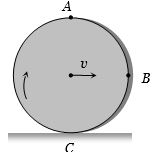
$A$ solid disc rolls clockwise without slipping over a horizontal path with a constant speed $v$. Then the magnitude of the velocities of points $A, B$ and $C$ (see figure) with respect to a standing observer are:
A
$v, v, v$
B
$2v, \sqrt{2}v, 0$
C
$2v, 2v, 0$
D
$2v, \sqrt{2}v, \sqrt{2}v$
Solution
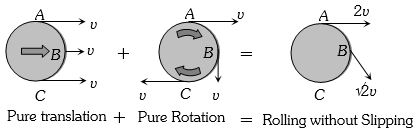
(B) For a disc rolling without slipping,the velocity of any point is the vector sum of its translational velocity $(v)$ and rotational velocity $(r\omega)$. Since it rolls without slipping,$v = r\omega$.
$1$. At point $A$ (top): Both translational and rotational velocities are in the same direction (forward). Thus,$v_A = v + r\omega = v + v = 2v$.
$2$. At point $B$ (side): The translational velocity is horizontal $(v)$ and the rotational velocity is vertical downward $(v)$. The resultant velocity is $v_B = \sqrt{v^2 + v^2} = \sqrt{2}v$.
$3$. At point $C$ (bottom): The translational velocity is forward $(v)$ and the rotational velocity is backward $(v)$. The resultant velocity is $v_C = v - v = 0$.
Therefore,the magnitudes are $2v, \sqrt{2}v, 0$. The correct option is $B$.
$1$. At point $A$ (top): Both translational and rotational velocities are in the same direction (forward). Thus,$v_A = v + r\omega = v + v = 2v$.
$2$. At point $B$ (side): The translational velocity is horizontal $(v)$ and the rotational velocity is vertical downward $(v)$. The resultant velocity is $v_B = \sqrt{v^2 + v^2} = \sqrt{2}v$.
$3$. At point $C$ (bottom): The translational velocity is forward $(v)$ and the rotational velocity is backward $(v)$. The resultant velocity is $v_C = v - v = 0$.
Therefore,the magnitudes are $2v, \sqrt{2}v, 0$. The correct option is $B$.
0 likes
View Solution3
EasyMCQ
$A$ cylinder rolls without slipping down an inclined plane. The number of degrees of freedom it has is:
A
$2$
B
$3$
C
$5$
D
$1$
Solution
(A) The degree of freedom of a system is defined as the number of independent coordinates required to specify the state of the system completely.
For a cylinder rolling without slipping on an inclined plane,the motion is constrained.
The cylinder has translational motion along the plane and rotational motion about its axis.
Since it rolls without slipping,the condition $v = r\omega$ links the translational velocity $v$ and angular velocity $\omega$.
Thus,only one coordinate is needed to describe the position along the plane,and the rotation is automatically determined by the rolling condition.
However,in the context of rigid body dynamics,a cylinder rolling on a plane has $2$ degrees of freedom: one for the position along the plane $(x)$ and one for the rotation about its axis $(\theta)$,provided the rolling constraint is not treated as a reduction in the degrees of freedom of the body itself,but rather as a constraint on the motion.
Standard physics convention for a rolling cylinder on a plane considers $2$ degrees of freedom.
For a cylinder rolling without slipping on an inclined plane,the motion is constrained.
The cylinder has translational motion along the plane and rotational motion about its axis.
Since it rolls without slipping,the condition $v = r\omega$ links the translational velocity $v$ and angular velocity $\omega$.
Thus,only one coordinate is needed to describe the position along the plane,and the rotation is automatically determined by the rolling condition.
However,in the context of rigid body dynamics,a cylinder rolling on a plane has $2$ degrees of freedom: one for the position along the plane $(x)$ and one for the rotation about its axis $(\theta)$,provided the rolling constraint is not treated as a reduction in the degrees of freedom of the body itself,but rather as a constraint on the motion.
Standard physics convention for a rolling cylinder on a plane considers $2$ degrees of freedom.
0 likes
View Solution4
MediumMCQ
$A$ ball rolls without slipping. The radius of gyration of the ball about an axis passing through its centre of mass is $K$. If the radius of the ball is $R$,then the fraction of total energy associated with its rotational energy is:
A
$\frac{K^2}{R^2}$
B
$\frac{K^2}{K^2 + R^2}$
C
$\frac{R^2}{K^2 + R^2}$
D
$\frac{K^2 + R^2}{R^2}$
Solution
(B) For a ball rolling without slipping,the rotational kinetic energy is given by $K_{rot} = \frac{1}{2} I \omega^2$. Since $I = MK^2$ and $\omega = \frac{v}{R}$,we have $K_{rot} = \frac{1}{2} MK^2 \frac{v^2}{R^2}$.
The translational kinetic energy is $K_{trans} = \frac{1}{2} Mv^2$.
The total kinetic energy $E$ is the sum of rotational and translational kinetic energy:
$E = K_{rot} + K_{trans} = \frac{1}{2} MK^2 \frac{v^2}{R^2} + \frac{1}{2} Mv^2 = \frac{1}{2} Mv^2 \left( \frac{K^2}{R^2} + 1 \right) = \frac{1}{2} Mv^2 \left( \frac{K^2 + R^2}{R^2} \right)$.
The fraction of total energy associated with rotational energy is $\frac{K_{rot}}{E}$:
$\text{Fraction} = \frac{\frac{1}{2} MK^2 \frac{v^2}{R^2}}{\frac{1}{2} Mv^2 \left( \frac{K^2 + R^2}{R^2} \right)} = \frac{K^2}{K^2 + R^2}$.
The translational kinetic energy is $K_{trans} = \frac{1}{2} Mv^2$.
The total kinetic energy $E$ is the sum of rotational and translational kinetic energy:
$E = K_{rot} + K_{trans} = \frac{1}{2} MK^2 \frac{v^2}{R^2} + \frac{1}{2} Mv^2 = \frac{1}{2} Mv^2 \left( \frac{K^2}{R^2} + 1 \right) = \frac{1}{2} Mv^2 \left( \frac{K^2 + R^2}{R^2} \right)$.
The fraction of total energy associated with rotational energy is $\frac{K_{rot}}{E}$:
$\text{Fraction} = \frac{\frac{1}{2} MK^2 \frac{v^2}{R^2}}{\frac{1}{2} Mv^2 \left( \frac{K^2 + R^2}{R^2} \right)} = \frac{K^2}{K^2 + R^2}$.
0 likes
View Solution5
MediumMCQ
In a bicycle,the radius of the rear wheel is twice the radius of the front wheel. If $r_F$ and $r_r$ are the radii,and $v_F$ and $v_r$ are the speeds of the topmost points of the wheels respectively,then:
A
$v_r = 2 v_F$
B
$v_F = 2 v_r$
C
$v_F = v_r$
D
$v_F > v_r$
Solution
(C) For a bicycle moving with a constant linear velocity $v$ of its center of mass,the velocity of any point on the rim of the wheel relative to the ground is given by the vector sum of the translational velocity and the rotational velocity.
At the topmost point of a wheel,the linear velocity is $v_{top} = v_{translational} + v_{rotational} = v + r\omega$.
Since the bicycle is moving as a single rigid body,the translational velocity $v$ of the center of mass for both wheels is the same.
For pure rolling motion,$v = r\omega$,so $v_{top} = v + v = 2v$.
Since both wheels move forward with the same translational speed $v$ of the bicycle,the speed of the topmost point for both the front wheel $(v_F)$ and the rear wheel $(v_r)$ is $2v$.
Therefore,$v_F = 2v$ and $v_r = 2v$,which implies $v_F = v_r$.
At the topmost point of a wheel,the linear velocity is $v_{top} = v_{translational} + v_{rotational} = v + r\omega$.
Since the bicycle is moving as a single rigid body,the translational velocity $v$ of the center of mass for both wheels is the same.
For pure rolling motion,$v = r\omega$,so $v_{top} = v + v = 2v$.
Since both wheels move forward with the same translational speed $v$ of the bicycle,the speed of the topmost point for both the front wheel $(v_F)$ and the rear wheel $(v_r)$ is $2v$.
Therefore,$v_F = 2v$ and $v_r = 2v$,which implies $v_F = v_r$.
0 likes
View Solution6
MediumMCQ
$A$ solid sphere of mass $500 \ g$ and radius $10 \ cm$ rolls without slipping with a velocity of $20 \ cm/s$. The total kinetic energy of the sphere will be ........ $J$.
A
$0.014$
B
$0.028$
C
$280$
D
$140$
Solution
(A) Given: Mass $M = 500 \ g = 0.5 \ kg$,Radius $R = 10 \ cm = 0.1 \ m$,Velocity $v = 20 \ cm/s = 0.2 \ m/s$.
For a solid sphere,the moment of inertia about its center is $I = \frac{2}{5} MR^2$.
For pure rolling,the total kinetic energy is the sum of translational and rotational kinetic energy: $K.E._{total} = K.E._{trans} + K.E._{rot} = \frac{1}{2} Mv^2 + \frac{1}{2} I\omega^2$.
Since $v = \omega R$,we have $\omega = \frac{v}{R}$.
Substituting $I$ and $\omega$ into the equation: $K.E._{total} = \frac{1}{2} Mv^2 + \frac{1}{2} (\frac{2}{5} MR^2) (\frac{v}{R})^2 = \frac{1}{2} Mv^2 + \frac{1}{5} Mv^2 = \frac{7}{10} Mv^2$.
Substituting the values: $K.E._{total} = \frac{7}{10} \times 0.5 \times (0.2)^2 = 0.7 \times 0.5 \times 0.04 = 0.35 \times 0.04 = 0.014 \ J$.
For a solid sphere,the moment of inertia about its center is $I = \frac{2}{5} MR^2$.
For pure rolling,the total kinetic energy is the sum of translational and rotational kinetic energy: $K.E._{total} = K.E._{trans} + K.E._{rot} = \frac{1}{2} Mv^2 + \frac{1}{2} I\omega^2$.
Since $v = \omega R$,we have $\omega = \frac{v}{R}$.
Substituting $I$ and $\omega$ into the equation: $K.E._{total} = \frac{1}{2} Mv^2 + \frac{1}{2} (\frac{2}{5} MR^2) (\frac{v}{R})^2 = \frac{1}{2} Mv^2 + \frac{1}{5} Mv^2 = \frac{7}{10} Mv^2$.
Substituting the values: $K.E._{total} = \frac{7}{10} \times 0.5 \times (0.2)^2 = 0.7 \times 0.5 \times 0.04 = 0.35 \times 0.04 = 0.014 \ J$.
0 likes
View Solution7
MediumMCQ
$A$ body is rolling without slipping on a horizontal plane. If the rotational kinetic energy of the body is $40\%$ of the total kinetic energy,then the body might be:
A
Cylinder
B
Hollow sphere
C
Solid cylinder
D
Ring
Solution
(B) The total kinetic energy $(K_{total})$ of a body rolling without slipping is the sum of translational kinetic energy $(K_{trans})$ and rotational kinetic energy $(K_{rot})$.
$K_{total} = K_{trans} + K_{rot} = \frac{1}{2}mv^2 + \frac{1}{2}I\omega^2$.
Given that $K_{rot} = 40\%$ of $K_{total}$,it implies $K_{rot} = 0.4 K_{total}$,which means $K_{trans} = 0.6 K_{total}$.
Therefore,the ratio $\frac{K_{rot}}{K_{trans}} = \frac{0.4}{0.6} = \frac{2}{3}$.
Substituting $K_{rot} = \frac{1}{2}I\omega^2$ and $K_{trans} = \frac{1}{2}mv^2$ with $v = R\omega$:
$\frac{\frac{1}{2}I\omega^2}{\frac{1}{2}m(R\omega)^2} = \frac{2}{3} \implies \frac{I}{mR^2} = \frac{2}{3}$.
Thus,$I = \frac{2}{3}mR^2$.
This moment of inertia corresponds to a hollow sphere.
$K_{total} = K_{trans} + K_{rot} = \frac{1}{2}mv^2 + \frac{1}{2}I\omega^2$.
Given that $K_{rot} = 40\%$ of $K_{total}$,it implies $K_{rot} = 0.4 K_{total}$,which means $K_{trans} = 0.6 K_{total}$.
Therefore,the ratio $\frac{K_{rot}}{K_{trans}} = \frac{0.4}{0.6} = \frac{2}{3}$.
Substituting $K_{rot} = \frac{1}{2}I\omega^2$ and $K_{trans} = \frac{1}{2}mv^2$ with $v = R\omega$:
$\frac{\frac{1}{2}I\omega^2}{\frac{1}{2}m(R\omega)^2} = \frac{2}{3} \implies \frac{I}{mR^2} = \frac{2}{3}$.
Thus,$I = \frac{2}{3}mR^2$.
This moment of inertia corresponds to a hollow sphere.
0 likes
View Solution8
MediumMCQ
$A$ solid sphere is moving on a horizontal plane. The ratio of its translational kinetic energy to its rotational kinetic energy is:
A
$1/5$
B
$5/2$
C
$3/5$
D
$5/7$
Solution
(B) For a solid sphere of mass $M$ and radius $R$ rolling without slipping on a horizontal plane,the translational kinetic energy $(K_t)$ is given by $K_t = \frac{1}{2} M v^2$.
The rotational kinetic energy $(K_r)$ is given by $K_r = \frac{1}{2} I \omega^2$,where $I = \frac{2}{5} M R^2$ is the moment of inertia about the center of mass and $\omega = v/R$ is the angular velocity.
Substituting the values: $K_r = \frac{1}{2} \times (\frac{2}{5} M R^2) \times (\frac{v}{R})^2 = \frac{1}{5} M v^2$.
The ratio of translational kinetic energy to rotational kinetic energy is $\frac{K_t}{K_r} = \frac{\frac{1}{2} M v^2}{\frac{1}{5} M v^2} = \frac{1/2}{1/5} = \frac{5}{2}$.
The rotational kinetic energy $(K_r)$ is given by $K_r = \frac{1}{2} I \omega^2$,where $I = \frac{2}{5} M R^2$ is the moment of inertia about the center of mass and $\omega = v/R$ is the angular velocity.
Substituting the values: $K_r = \frac{1}{2} \times (\frac{2}{5} M R^2) \times (\frac{v}{R})^2 = \frac{1}{5} M v^2$.
The ratio of translational kinetic energy to rotational kinetic energy is $\frac{K_t}{K_r} = \frac{\frac{1}{2} M v^2}{\frac{1}{5} M v^2} = \frac{1/2}{1/5} = \frac{5}{2}$.
0 likes
View Solution9
MediumMCQ
The speed of rolling of a ring of mass $M$ changes from $V$ to $3\ V$. What is the change in its kinetic energy (in $,MV^2$)?
A
$3$
B
$4$
C
$6$
D
$8$
Solution
(D) For a ring rolling without slipping,the total kinetic energy $K$ is the sum of translational and rotational kinetic energy.
$K = K_{trans} + K_{rot} = \frac{1}{2}MV^2 + \frac{1}{2}I\omega^2$.
Since $I = MR^2$ and $\omega = V/R$ for a ring,we have $K = \frac{1}{2}MV^2 + \frac{1}{2}(MR^2)(V/R)^2 = \frac{1}{2}MV^2 + \frac{1}{2}MV^2 = MV^2$.
Initial kinetic energy $K_i = M(V)^2 = MV^2$.
Final kinetic energy $K_f = M(3V)^2 = 9MV^2$.
Change in kinetic energy $\Delta K = K_f - K_i = 9MV^2 - MV^2 = 8MV^2$.
$K = K_{trans} + K_{rot} = \frac{1}{2}MV^2 + \frac{1}{2}I\omega^2$.
Since $I = MR^2$ and $\omega = V/R$ for a ring,we have $K = \frac{1}{2}MV^2 + \frac{1}{2}(MR^2)(V/R)^2 = \frac{1}{2}MV^2 + \frac{1}{2}MV^2 = MV^2$.
Initial kinetic energy $K_i = M(V)^2 = MV^2$.
Final kinetic energy $K_f = M(3V)^2 = 9MV^2$.
Change in kinetic energy $\Delta K = K_f - K_i = 9MV^2 - MV^2 = 8MV^2$.
0 likes
View Solution10
MediumMCQ
$A$ disc of radius $1\,m$ and mass $4\,kg$ rolls on a horizontal plane without slipping in such a way that its centre of mass moves with a speed of $10\,cm/s$. Its rotational kinetic energy is (in $,J$)
A
$0.01$
B
$0.02$
C
$0.03$
D
$0.04$
Solution
(A) Given:
Radius $R = 1\,m$
Mass $M = 4\,kg$
Linear velocity $v = 10\,cm/s = 0.1\,m/s$
For a disc rolling without slipping,the moment of inertia about the central axis is $I = \frac{1}{2}MR^2$.
The angular velocity is $\omega = \frac{v}{R}$.
Rotational kinetic energy $K_{rot} = \frac{1}{2}I\omega^2$.
Substituting $I = \frac{1}{2}MR^2$ and $\omega = \frac{v}{R}$:
$K_{rot} = \frac{1}{2} \left( \frac{1}{2}MR^2 \right) \left( \frac{v}{R} \right)^2 = \frac{1}{4}Mv^2$.
$K_{rot} = \frac{1}{4} \times 4\,kg \times (0.1\,m/s)^2 = 1 \times 0.01 = 0.01\,J$.
Radius $R = 1\,m$
Mass $M = 4\,kg$
Linear velocity $v = 10\,cm/s = 0.1\,m/s$
For a disc rolling without slipping,the moment of inertia about the central axis is $I = \frac{1}{2}MR^2$.
The angular velocity is $\omega = \frac{v}{R}$.
Rotational kinetic energy $K_{rot} = \frac{1}{2}I\omega^2$.
Substituting $I = \frac{1}{2}MR^2$ and $\omega = \frac{v}{R}$:
$K_{rot} = \frac{1}{2} \left( \frac{1}{2}MR^2 \right) \left( \frac{v}{R} \right)^2 = \frac{1}{4}Mv^2$.
$K_{rot} = \frac{1}{4} \times 4\,kg \times (0.1\,m/s)^2 = 1 \times 0.01 = 0.01\,J$.
0 likes
View Solution11
MediumMCQ
The ratio of kinetic energies of two spheres rolling with equal centre of mass velocities is $2 : 1$. If their radii are in the ratio $2 : 1$,then the ratio of their masses will be
A
$2:1$
B
$1:8$
C
$1:7$
D
$2\sqrt{2}:1$
Solution
(A) For a sphere rolling without slipping,the total kinetic energy $K$ is the sum of translational and rotational kinetic energy:
$K = K_{tr} + K_{rot} = \frac{1}{2}mv^2 + \frac{1}{2}I\omega^2$
Since the moment of inertia for a solid sphere is $I = \frac{2}{5}mr^2$ and $\omega = \frac{v}{r}$,we have:
$K = \frac{1}{2}mv^2 + \frac{1}{2}(\frac{2}{5}mr^2)(\frac{v}{r})^2 = \frac{1}{2}mv^2 + \frac{1}{5}mv^2 = \frac{7}{10}mv^2$
Given that the velocities of the centers of mass are equal $(v_1 = v_2)$,the ratio of kinetic energies is:
$\frac{K_1}{K_2} = \frac{\frac{7}{10}m_1v_1^2}{\frac{7}{10}m_2v_2^2} = \frac{m_1}{m_2}$
Given $\frac{K_1}{K_2} = \frac{2}{1}$,it follows that $\frac{m_1}{m_2} = \frac{2}{1}$.
Thus,the ratio of their masses is $2:1$.
$K = K_{tr} + K_{rot} = \frac{1}{2}mv^2 + \frac{1}{2}I\omega^2$
Since the moment of inertia for a solid sphere is $I = \frac{2}{5}mr^2$ and $\omega = \frac{v}{r}$,we have:
$K = \frac{1}{2}mv^2 + \frac{1}{2}(\frac{2}{5}mr^2)(\frac{v}{r})^2 = \frac{1}{2}mv^2 + \frac{1}{5}mv^2 = \frac{7}{10}mv^2$
Given that the velocities of the centers of mass are equal $(v_1 = v_2)$,the ratio of kinetic energies is:
$\frac{K_1}{K_2} = \frac{\frac{7}{10}m_1v_1^2}{\frac{7}{10}m_2v_2^2} = \frac{m_1}{m_2}$
Given $\frac{K_1}{K_2} = \frac{2}{1}$,it follows that $\frac{m_1}{m_2} = \frac{2}{1}$.
Thus,the ratio of their masses is $2:1$.
0 likes
View Solution12
MediumMCQ
$A$ symmetrical body of mass $M$ and radius $R$ is rolling without slipping on a horizontal surface with linear speed $v$. Then its angular speed is
A
$v/R$
B
Continuously increasing
C
Dependent on mass $M$
D
Independent of radius $R$
Solution
(A) For a body rolling without slipping on a horizontal surface,the condition for pure rolling is that the velocity of the point of contact with the surface is zero.
Let $v$ be the linear velocity of the center of mass and $\omega$ be the angular velocity of the body about its center of mass.
The condition for rolling without slipping is given by $v = r\omega$,where $r$ is the radius of the body.
Given the radius is $R$,the relation becomes $v = R\omega$.
Therefore,the angular speed is $\omega = v/R$.
Let $v$ be the linear velocity of the center of mass and $\omega$ be the angular velocity of the body about its center of mass.
The condition for rolling without slipping is given by $v = r\omega$,where $r$ is the radius of the body.
Given the radius is $R$,the relation becomes $v = R\omega$.
Therefore,the angular speed is $\omega = v/R$.
0 likes
View Solution13
MediumMCQ
$A$ solid sphere of mass $1 \ kg$ rolls on a table with linear speed $1 \ m/s$. Its total kinetic energy is .......... $J$.
A
$1$
B
$0.5$
C
$0.7$
D
$1.4$
Solution
(C) The total kinetic energy $(K)$ of a rolling body is the sum of its translational kinetic energy $(K_t)$ and rotational kinetic energy $(K_r)$.
$K = K_t + K_r = \frac{1}{2} M v^2 + \frac{1}{2} I \omega^2$
For a solid sphere,the moment of inertia about its center is $I = \frac{2}{5} M R^2$ and the angular velocity is $\omega = \frac{v}{R}$.
Substituting these values:
$K = \frac{1}{2} M v^2 + \frac{1}{2} (\frac{2}{5} M R^2) (\frac{v}{R})^2$
$K = \frac{1}{2} M v^2 + \frac{1}{5} M v^2$
$K = (\frac{1}{2} + \frac{1}{5}) M v^2 = \frac{7}{10} M v^2$
Given $M = 1 \ kg$ and $v = 1 \ m/s$:
$K = \frac{7}{10} \times 1 \times (1)^2 = 0.7 \ J$.
$K = K_t + K_r = \frac{1}{2} M v^2 + \frac{1}{2} I \omega^2$
For a solid sphere,the moment of inertia about its center is $I = \frac{2}{5} M R^2$ and the angular velocity is $\omega = \frac{v}{R}$.
Substituting these values:
$K = \frac{1}{2} M v^2 + \frac{1}{2} (\frac{2}{5} M R^2) (\frac{v}{R})^2$
$K = \frac{1}{2} M v^2 + \frac{1}{5} M v^2$
$K = (\frac{1}{2} + \frac{1}{5}) M v^2 = \frac{7}{10} M v^2$
Given $M = 1 \ kg$ and $v = 1 \ m/s$:
$K = \frac{7}{10} \times 1 \times (1)^2 = 0.7 \ J$.
0 likes
View Solution14
DifficultMCQ
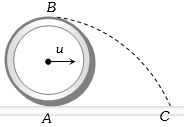
$A$ wheel of radius $r$ rolls without slipping with a speed $v$ on a horizontal road. When it is at a point $A$ on the road,a small piece of mud separates from the wheel at its highest point $B$ and drops at point $C$ on the road. The distance $AC$ will be
A
$v\sqrt{\frac{r}{g}}$
B
$2v\sqrt{\frac{r}{g}}$
C
$4v\sqrt{\frac{r}{g}}$
D
$\sqrt{\frac{3r}{g}}$
Solution
(C) For a wheel rolling without slipping with speed $v$,the velocity of the highest point $B$ is $2v$ in the horizontal direction.
When the mud separates at point $B$,it acts as a projectile with an initial horizontal velocity $u_x = 2v$ and initial vertical velocity $u_y = 0$.
The height of point $B$ from the ground is $2r$.
Using the equation of motion for vertical displacement: $h = u_y t + \frac{1}{2} g t^2$,we have $2r = 0 + \frac{1}{2} g t^2$.
Solving for time $t$,we get $t = \sqrt{\frac{4r}{g}} = 2\sqrt{\frac{r}{g}}$.
The horizontal distance covered by the mud during this time is $AC = u_x \times t$.
Substituting the values,$AC = (2v) \times (2\sqrt{\frac{r}{g}}) = 4v\sqrt{\frac{r}{g}}$.
When the mud separates at point $B$,it acts as a projectile with an initial horizontal velocity $u_x = 2v$ and initial vertical velocity $u_y = 0$.
The height of point $B$ from the ground is $2r$.
Using the equation of motion for vertical displacement: $h = u_y t + \frac{1}{2} g t^2$,we have $2r = 0 + \frac{1}{2} g t^2$.
Solving for time $t$,we get $t = \sqrt{\frac{4r}{g}} = 2\sqrt{\frac{r}{g}}$.
The horizontal distance covered by the mud during this time is $AC = u_x \times t$.
Substituting the values,$AC = (2v) \times (2\sqrt{\frac{r}{g}}) = 4v\sqrt{\frac{r}{g}}$.
0 likes
View Solution15
EasyMCQ
$A$ sphere cannot roll on a ..........
A
smooth horizontal surface
B
smooth inclined surface
C
rough horizontal surface
D
rough inclined surface
Solution
(B) Rolling motion requires the presence of friction to provide the necessary torque for rotation.
On a smooth surface,the coefficient of friction $\mu = 0$.
Without friction,there is no torque to cause the sphere to rotate about its center of mass.
Therefore,if a sphere is placed on a smooth horizontal or smooth inclined surface,it will undergo pure translational motion (sliding) rather than rolling motion.
On a smooth surface,the coefficient of friction $\mu = 0$.
Without friction,there is no torque to cause the sphere to rotate about its center of mass.
Therefore,if a sphere is placed on a smooth horizontal or smooth inclined surface,it will undergo pure translational motion (sliding) rather than rolling motion.
0 likes
View Solution16
EasyMCQ
$A$ body is rolling on a horizontal surface without slipping. Its rotational kinetic energy is equal to its translational kinetic energy. The body is a .......
A
Disc
B
Sphere
C
Cylinder
D
Ring
Solution
(D) Let $m$ be the mass,$v$ be the linear velocity,$R$ be the radius,and $I$ be the moment of inertia of the body.
Translational kinetic energy $(TKE)$ is given by: $TKE = \frac{1}{2}mv^2$
Rotational kinetic energy $(RKE)$ is given by: $RKE = \frac{1}{2}I\omega^2$
Since the body is rolling without slipping,$\omega = \frac{v}{R}$.
Substituting this into the $RKE$ formula: $RKE = \frac{1}{2}I\left(\frac{v}{R}\right)^2 = \frac{1}{2} \frac{Iv^2}{R^2}$
Given that $TKE = RKE$,we have: $\frac{1}{2}mv^2 = \frac{1}{2} \frac{Iv^2}{R^2}$
This simplifies to: $m = \frac{I}{R^2}$,which means $I = mR^2$.
The moment of inertia $I = mR^2$ corresponds to a ring (or a hollow cylinder) about its central axis.
Therefore,the body is a ring.
Translational kinetic energy $(TKE)$ is given by: $TKE = \frac{1}{2}mv^2$
Rotational kinetic energy $(RKE)$ is given by: $RKE = \frac{1}{2}I\omega^2$
Since the body is rolling without slipping,$\omega = \frac{v}{R}$.
Substituting this into the $RKE$ formula: $RKE = \frac{1}{2}I\left(\frac{v}{R}\right)^2 = \frac{1}{2} \frac{Iv^2}{R^2}$
Given that $TKE = RKE$,we have: $\frac{1}{2}mv^2 = \frac{1}{2} \frac{Iv^2}{R^2}$
This simplifies to: $m = \frac{I}{R^2}$,which means $I = mR^2$.
The moment of inertia $I = mR^2$ corresponds to a ring (or a hollow cylinder) about its central axis.
Therefore,the body is a ring.
0 likes
View Solution17
MediumMCQ
$A$ thin hollow cylinder,open at both ends,slides without rotating and then rolls without slipping with the same speed. The ratio of kinetic energies in the two cases will be:
A
$1 : 1$
B
$1 : 2$
C
$2 : 1$
D
$1 : 4$
Solution
(B) Case $1$: When the hollow cylinder slides without rotating,it possesses only translational kinetic energy.
$K_{slide} = \frac{1}{2}mv^2$
Case $2$: When it rolls without slipping,it possesses both translational and rotational kinetic energy.
The total kinetic energy is given by $K_{roll} = \frac{1}{2}mv^2(1 + \frac{k^2}{R^2})$,where $k$ is the radius of gyration.
For a thin hollow cylinder,the moment of inertia $I = mR^2$,so $mk^2 = mR^2$,which implies $\frac{k^2}{R^2} = 1$.
Substituting this into the formula: $K_{roll} = \frac{1}{2}mv^2(1 + 1) = mv^2$.
Now,the ratio of kinetic energies is:
$\frac{K_{slide}}{K_{roll}} = \frac{\frac{1}{2}mv^2}{mv^2} = \frac{1}{2}$.
Thus,the ratio is $1 : 2$.
$K_{slide} = \frac{1}{2}mv^2$
Case $2$: When it rolls without slipping,it possesses both translational and rotational kinetic energy.
The total kinetic energy is given by $K_{roll} = \frac{1}{2}mv^2(1 + \frac{k^2}{R^2})$,where $k$ is the radius of gyration.
For a thin hollow cylinder,the moment of inertia $I = mR^2$,so $mk^2 = mR^2$,which implies $\frac{k^2}{R^2} = 1$.
Substituting this into the formula: $K_{roll} = \frac{1}{2}mv^2(1 + 1) = mv^2$.
Now,the ratio of kinetic energies is:
$\frac{K_{slide}}{K_{roll}} = \frac{\frac{1}{2}mv^2}{mv^2} = \frac{1}{2}$.
Thus,the ratio is $1 : 2$.
0 likes
View Solution18
DifficultMCQ
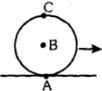
$A$ sphere rolls without slipping on a fixed horizontal surface. In the figure,$A$ is the point of contact,$B$ is the center,and $C$ is the topmost point. Then...
A
$|\vec{V}_C - \vec{V}_A| = 2 |\vec{V}_B - \vec{V}_C|$
B
$\vec{V}_C - \vec{V}_B = 2\vec{V}_B + \vec{V}_A$
C
$|\vec{V}_A - \vec{V}_A| = 2 |\vec{V}_B - \vec{V}_C|$
D
$|\vec{V}_C - \vec{V}_A| = 4 |\vec{V}_B|$
Solution
(A) Let $\vec{\omega}$ be the angular velocity of the sphere and $R$ be its radius. The velocity of any point $P$ on the sphere is given by $\vec{V}_P = \vec{V}_B + \vec{\omega} \times \vec{r}_{BP}$,where $\vec{V}_B$ is the velocity of the center.
Since the sphere rolls without slipping,the velocity of the contact point $A$ is zero,i.e.,$\vec{V}_A = 0$.
For point $B$ (center),$\vec{V}_B = \vec{V}_B$.
For point $C$ (topmost point),$\vec{V}_C = \vec{V}_B + \vec{\omega} \times \vec{R}_{BC}$. Since $\vec{V}_B = \vec{\omega} \times \vec{R}_{BA}$ (where $\vec{R}_{BA}$ is the vector from $A$ to $B$),we have $\vec{V}_C = 2\vec{V}_B$.
Now,let's evaluate the magnitudes:
$|\vec{V}_C - \vec{V}_A| = |2\vec{V}_B - 0| = 2|\vec{V}_B|$.
$|\vec{V}_B - \vec{V}_C| = |\vec{V}_B - 2\vec{V}_B| = |-\vec{V}_B| = |\vec{V}_B|$.
Comparing these,we get $|\vec{V}_C - \vec{V}_A| = 2 |\vec{V}_B - \vec{V}_C|$.
Since the sphere rolls without slipping,the velocity of the contact point $A$ is zero,i.e.,$\vec{V}_A = 0$.
For point $B$ (center),$\vec{V}_B = \vec{V}_B$.
For point $C$ (topmost point),$\vec{V}_C = \vec{V}_B + \vec{\omega} \times \vec{R}_{BC}$. Since $\vec{V}_B = \vec{\omega} \times \vec{R}_{BA}$ (where $\vec{R}_{BA}$ is the vector from $A$ to $B$),we have $\vec{V}_C = 2\vec{V}_B$.
Now,let's evaluate the magnitudes:
$|\vec{V}_C - \vec{V}_A| = |2\vec{V}_B - 0| = 2|\vec{V}_B|$.
$|\vec{V}_B - \vec{V}_C| = |\vec{V}_B - 2\vec{V}_B| = |-\vec{V}_B| = |\vec{V}_B|$.
Comparing these,we get $|\vec{V}_C - \vec{V}_A| = 2 |\vec{V}_B - \vec{V}_C|$.
0 likes
View Solution19
DifficultMCQ
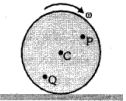
$A$ disc is performing pure rolling on a surface. The positions of $P$ and $Q$ at an instant are shown in the figure. $C$ is the center of the disc. Which of the following is true for their velocities at the instant when $P$ and $Q$ are at the same distance from the center?
A
$V_Q = V_C, \frac{1}{2} V_C = V_P$
B
$V_Q > V_C > V_P$
C
$V_P > V_C > V_Q$
D
$V_Q > V_C < V_P$
Solution
(C) In pure rolling,the velocity of any point on the disc is the vector sum of the velocity of the center of mass $(V_C)$ and the tangential velocity due to rotation about the center $(V_{rot} = \omega r)$.
Let $r$ be the distance of points $P$ and $Q$ from the center $C$. The velocity of the center is $V_C = \omega R$,where $R$ is the radius of the disc.
The velocity of any point at distance $r$ from the center is given by $\vec{V} = \vec{V_C} + \vec{V_{rot}}$.
For point $P$,which is in the upper half,the rotational velocity vector $\vec{V_{rot,P}}$ has a component in the same direction as $V_C$. Thus,its magnitude is $V_P = \sqrt{V_C^2 + V_{rot}^2 + 2 V_C V_{rot} \cos \theta}$,where $\theta$ is the angle between the vectors. Since the components add up,$V_P > V_C$.
For point $Q$,which is in the lower half,the rotational velocity vector $\vec{V_{rot,Q}}$ has a component opposing $V_C$. Thus,its magnitude is $V_Q = \sqrt{V_C^2 + V_{rot}^2 - 2 V_C V_{rot} \cos \phi}$. Since the components subtract,$V_Q < V_C$.
Therefore,the correct relation is $V_P > V_C > V_Q$.
Let $r$ be the distance of points $P$ and $Q$ from the center $C$. The velocity of the center is $V_C = \omega R$,where $R$ is the radius of the disc.
The velocity of any point at distance $r$ from the center is given by $\vec{V} = \vec{V_C} + \vec{V_{rot}}$.
For point $P$,which is in the upper half,the rotational velocity vector $\vec{V_{rot,P}}$ has a component in the same direction as $V_C$. Thus,its magnitude is $V_P = \sqrt{V_C^2 + V_{rot}^2 + 2 V_C V_{rot} \cos \theta}$,where $\theta$ is the angle between the vectors. Since the components add up,$V_P > V_C$.
For point $Q$,which is in the lower half,the rotational velocity vector $\vec{V_{rot,Q}}$ has a component opposing $V_C$. Thus,its magnitude is $V_Q = \sqrt{V_C^2 + V_{rot}^2 - 2 V_C V_{rot} \cos \phi}$. Since the components subtract,$V_Q < V_C$.
Therefore,the correct relation is $V_P > V_C > V_Q$.
0 likes
View Solution20
MediumMCQ
Consider a point $P$ at the contact point of a wheel on the ground,which rolls on the ground without slipping. Find the displacement of point $P$ when the wheel completes half of a rotation (given the radius of the wheel is $1 \ m$).
A
$2 \ m$
B
$\sqrt{\pi^2 + 4} \ m$
C
$\pi \ m$
D
$\sqrt{\pi^2 + 2} \ m$
Solution
(B) When a wheel of radius $R$ rolls without slipping,the horizontal distance covered by the center of the wheel in half a revolution is equal to $\pi R$.
The vertical displacement of the point $P$ (which was initially at the contact point $A$ and moves to the topmost point $A'$) is equal to the diameter of the wheel,which is $2R$.
The total displacement is the vector sum of the horizontal and vertical displacements,which is the hypotenuse of a right-angled triangle with sides $\pi R$ and $2R$.
Displacement $= \sqrt{(\pi R)^2 + (2R)^2} = R\sqrt{\pi^2 + 4}$.
Given $R = 1 \ m$,the displacement $= 1 \times \sqrt{\pi^2 + 4} = \sqrt{\pi^2 + 4} \ m$.
The vertical displacement of the point $P$ (which was initially at the contact point $A$ and moves to the topmost point $A'$) is equal to the diameter of the wheel,which is $2R$.
The total displacement is the vector sum of the horizontal and vertical displacements,which is the hypotenuse of a right-angled triangle with sides $\pi R$ and $2R$.
Displacement $= \sqrt{(\pi R)^2 + (2R)^2} = R\sqrt{\pi^2 + 4}$.
Given $R = 1 \ m$,the displacement $= 1 \times \sqrt{\pi^2 + 4} = \sqrt{\pi^2 + 4} \ m$.
0 likes
View Solution21
DifficultMCQ
$A$ wheel is rolling on the ground with a speed of $2 \ m/s$. What is the velocity of the endpoints of the horizontal diameter of the wheel?
A
$2\sqrt{2} \ m/s$
B
$2\sqrt{3} \ m/s$
C
$2 \ m/s$
D
$4 \ m/s$
Solution
(A) For a wheel rolling without slipping,the velocity of the center of mass is $v = 2 \ m/s$.
At any point on the rim,the velocity is the vector sum of the translational velocity $(v)$ and the rotational velocity $(v = r\omega)$.
For a wheel rolling with speed $v$,the magnitude of the rotational velocity at the rim is also $v$.
At the endpoints of the horizontal diameter,the translational velocity vector is horizontal ($v$ to the right),and the rotational velocity vector is vertical ($v$ upwards or downwards).
Since these two vectors are perpendicular,the resultant velocity $v_{res}$ is given by:
$v_{res} = \sqrt{v^2 + v^2} = \sqrt{2v^2} = v\sqrt{2}$.
Substituting $v = 2 \ m/s$:
$v_{res} = 2\sqrt{2} \ m/s$.
At any point on the rim,the velocity is the vector sum of the translational velocity $(v)$ and the rotational velocity $(v = r\omega)$.
For a wheel rolling with speed $v$,the magnitude of the rotational velocity at the rim is also $v$.
At the endpoints of the horizontal diameter,the translational velocity vector is horizontal ($v$ to the right),and the rotational velocity vector is vertical ($v$ upwards or downwards).
Since these two vectors are perpendicular,the resultant velocity $v_{res}$ is given by:
$v_{res} = \sqrt{v^2 + v^2} = \sqrt{2v^2} = v\sqrt{2}$.
Substituting $v = 2 \ m/s$:
$v_{res} = 2\sqrt{2} \ m/s$.
0 likes
View Solution22
DifficultMCQ
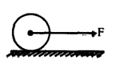
$A$ horizontal force $F$ is applied at the center of a sphere as shown in the figure. The coefficient of friction between the sphere and the ground is $\mu$. What is the maximum value of $F$ if the sphere does not slip?
A
$\frac{5}{2} \mu Mg$
B
$\frac{4}{3} \mu Mg$
C
$\frac{7}{2} \mu Mg$
D
$\frac{9}{4} \mu Mg$
Solution
(C) For linear motion:
$F - f = Ma$ ---$(1)$
For rotational motion about the center of mass:
$\tau = I \alpha$
$f \cdot R = (\frac{2}{5} M R^2) \cdot (\frac{a}{R})$
$f = \frac{2}{5} Ma$ ---$(2)$
From $(2)$,$Ma = \frac{5}{2} f$. Substituting this into $(1)$:
$F - f = \frac{5}{2} f$
$F = \frac{7}{2} f$
For the sphere not to slip,the friction force $f$ must satisfy the condition $f \le \mu N$,where $N = Mg$.
So,$f \le \mu Mg$.
Substituting the maximum value of $f$ $(f_{max} = \mu Mg)$:
$F_{max} = \frac{7}{2} \mu Mg$.
$F - f = Ma$ ---$(1)$
For rotational motion about the center of mass:
$\tau = I \alpha$
$f \cdot R = (\frac{2}{5} M R^2) \cdot (\frac{a}{R})$
$f = \frac{2}{5} Ma$ ---$(2)$
From $(2)$,$Ma = \frac{5}{2} f$. Substituting this into $(1)$:
$F - f = \frac{5}{2} f$
$F = \frac{7}{2} f$
For the sphere not to slip,the friction force $f$ must satisfy the condition $f \le \mu N$,where $N = Mg$.
So,$f \le \mu Mg$.
Substituting the maximum value of $f$ $(f_{max} = \mu Mg)$:
$F_{max} = \frac{7}{2} \mu Mg$.
0 likes
View Solution23
DifficultMCQ
$A$ particle on the outer surface of a wheel,which is initially at rest,is in contact with the ground at point $P$. Find the displacement of this particle when the wheel completes half a rotation in the forward direction. (Radius of the wheel $= 5 \ m$)
A
$5 \ m$
B
$10 \ m$
C
$2.5 \ m$
D
$5 \sqrt{\pi^2 + 4} \ m$
Solution
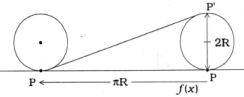
(D) When the wheel completes half a rotation,the particle moves from point $P$ to the topmost point $P'$.
The horizontal distance covered by the center of the wheel is $\pi R$,so the horizontal displacement of the particle is $\Delta x = \pi R$.
The vertical displacement of the particle is the diameter of the wheel,$\Delta y = 2R$.
The total displacement is the vector sum of the horizontal and vertical displacements:
$S = \sqrt{(\Delta x)^2 + (\Delta y)^2} = \sqrt{(\pi R)^2 + (2R)^2} = R \sqrt{\pi^2 + 4}$.
Given $R = 5 \ m$,the displacement is $S = 5 \sqrt{\pi^2 + 4} \ m$.
The horizontal distance covered by the center of the wheel is $\pi R$,so the horizontal displacement of the particle is $\Delta x = \pi R$.
The vertical displacement of the particle is the diameter of the wheel,$\Delta y = 2R$.
The total displacement is the vector sum of the horizontal and vertical displacements:
$S = \sqrt{(\Delta x)^2 + (\Delta y)^2} = \sqrt{(\pi R)^2 + (2R)^2} = R \sqrt{\pi^2 + 4}$.
Given $R = 5 \ m$,the displacement is $S = 5 \sqrt{\pi^2 + 4} \ m$.
0 likes
View Solution24
MediumMCQ
$A$ disc rolls without slipping with a constant velocity. What fraction of its total kinetic energy is in the form of rotational kinetic energy?
A
$1/2$
B
$1/3$
C
$3/2$
D
$2/3$
Solution
(B) The total kinetic energy $(K_{total})$ of a rolling body is the sum of its translational kinetic energy $(K_t)$ and rotational kinetic energy $(K_r)$.
$K_{total} = K_t + K_r = \frac{1}{2}mv^2 + \frac{1}{2}I\omega^2$
For a disc,the moment of inertia about its central axis is $I = \frac{1}{2}mr^2$. Since it rolls without slipping,$v = r\omega$,so $\omega = v/r$.
Substituting these into the rotational kinetic energy formula:
$K_r = \frac{1}{2} (\frac{1}{2}mr^2) (\frac{v}{r})^2 = \frac{1}{4}mv^2$
Now,calculate the total kinetic energy:
$K_{total} = \frac{1}{2}mv^2 + \frac{1}{4}mv^2 = \frac{3}{4}mv^2$
The fraction of total kinetic energy that is rotational is:
$\frac{K_r}{K_{total}} = \frac{\frac{1}{4}mv^2}{\frac{3}{4}mv^2} = \frac{1}{3}$
$K_{total} = K_t + K_r = \frac{1}{2}mv^2 + \frac{1}{2}I\omega^2$
For a disc,the moment of inertia about its central axis is $I = \frac{1}{2}mr^2$. Since it rolls without slipping,$v = r\omega$,so $\omega = v/r$.
Substituting these into the rotational kinetic energy formula:
$K_r = \frac{1}{2} (\frac{1}{2}mr^2) (\frac{v}{r})^2 = \frac{1}{4}mv^2$
Now,calculate the total kinetic energy:
$K_{total} = \frac{1}{2}mv^2 + \frac{1}{4}mv^2 = \frac{3}{4}mv^2$
The fraction of total kinetic energy that is rotational is:
$\frac{K_r}{K_{total}} = \frac{\frac{1}{4}mv^2}{\frac{3}{4}mv^2} = \frac{1}{3}$
0 likes
View Solution25
DifficultMCQ
$A$ sphere rolls without slipping. The radius of gyration about an axis passing through its center of mass is $K$. If the radius of the sphere is $R$,what fraction of the total energy is in the form of rotational kinetic energy?
A
$\frac{K^2 + R^2}{R^2}$
B
$\frac{K^2}{R^2}$
C
$\frac{K^2}{K^2 + R^2}$
D
$\frac{R^2}{K^2 + R^2}$
Solution
(C) The total energy $E$ of a rolling sphere is the sum of its translational kinetic energy and rotational kinetic energy.
$E = K_{trans} + K_{rot} = \frac{1}{2}mv^2 + \frac{1}{2}I\omega^2$
Since the sphere rolls without slipping,$\omega = \frac{v}{R}$ and the moment of inertia $I = mK^2$.
Substituting these into the equation:
$E = \frac{1}{2}mv^2 + \frac{1}{2}(mK^2)\left(\frac{v}{R}\right)^2 = \frac{1}{2}mv^2 \left(1 + \frac{K^2}{R^2}\right) = \frac{1}{2}mv^2 \left(\frac{R^2 + K^2}{R^2}\right)$
Rotational kinetic energy $K_{rot} = \frac{1}{2}I\omega^2 = \frac{1}{2}(mK^2)\left(\frac{v^2}{R^2}\right) = \frac{1}{2}mv^2 \left(\frac{K^2}{R^2}\right)$
The fraction of total energy in the form of rotational kinetic energy is:
$\text{Fraction} = \frac{K_{rot}}{E} = \frac{\frac{1}{2}mv^2 (K^2/R^2)}{\frac{1}{2}mv^2 (R^2 + K^2)/R^2} = \frac{K^2}{K^2 + R^2}$
$E = K_{trans} + K_{rot} = \frac{1}{2}mv^2 + \frac{1}{2}I\omega^2$
Since the sphere rolls without slipping,$\omega = \frac{v}{R}$ and the moment of inertia $I = mK^2$.
Substituting these into the equation:
$E = \frac{1}{2}mv^2 + \frac{1}{2}(mK^2)\left(\frac{v}{R}\right)^2 = \frac{1}{2}mv^2 \left(1 + \frac{K^2}{R^2}\right) = \frac{1}{2}mv^2 \left(\frac{R^2 + K^2}{R^2}\right)$
Rotational kinetic energy $K_{rot} = \frac{1}{2}I\omega^2 = \frac{1}{2}(mK^2)\left(\frac{v^2}{R^2}\right) = \frac{1}{2}mv^2 \left(\frac{K^2}{R^2}\right)$
The fraction of total energy in the form of rotational kinetic energy is:
$\text{Fraction} = \frac{K_{rot}}{E} = \frac{\frac{1}{2}mv^2 (K^2/R^2)}{\frac{1}{2}mv^2 (R^2 + K^2)/R^2} = \frac{K^2}{K^2 + R^2}$
0 likes
View Solution26
DifficultMCQ
Find the displacement of the point of contact with the ground when a ring of radius $R$ completes a half-rotation.
A
$\frac{R}{{\sqrt {{\pi ^2} + 4} }}$
B
$R\sqrt {{\pi ^2} + 4} $
C
$2\pi R$
D
$\pi R$
Solution
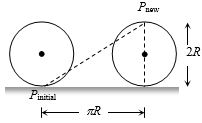
(B) When a ring of radius $R$ completes a half-rotation,the center of the ring moves forward by a distance equal to half the circumference,which is $\pi R$.
The point of contact,which was initially at the bottom,moves to the top of the ring. The vertical displacement of this point is equal to the diameter of the ring,which is $2R$.
The horizontal displacement of the point is $\pi R$.
The total displacement is the vector sum of the horizontal and vertical displacements:
$\text{Displacement} = \sqrt{(\text{Horizontal Displacement})^2 + (\text{Vertical Displacement})^2}$
$\text{Displacement} = \sqrt{(\pi R)^2 + (2R)^2}$
$\text{Displacement} = \sqrt{\pi^2 R^2 + 4R^2}$
$\text{Displacement} = R\sqrt{\pi^2 + 4}$
The point of contact,which was initially at the bottom,moves to the top of the ring. The vertical displacement of this point is equal to the diameter of the ring,which is $2R$.
The horizontal displacement of the point is $\pi R$.
The total displacement is the vector sum of the horizontal and vertical displacements:
$\text{Displacement} = \sqrt{(\text{Horizontal Displacement})^2 + (\text{Vertical Displacement})^2}$
$\text{Displacement} = \sqrt{(\pi R)^2 + (2R)^2}$
$\text{Displacement} = \sqrt{\pi^2 R^2 + 4R^2}$
$\text{Displacement} = R\sqrt{\pi^2 + 4}$
0 likes
View Solution27
DifficultMCQ
$A$ solid cylinder of mass $3 \, kg$ is rolling on a horizontal surface with velocity $4 \, m s^{-1}$. It collides with a horizontal spring of force constant $200 \, N m^{-1}$. The maximum compression produced in the spring will be ............... $m$.
A
$0.5$
B
$0.6$
C
$0.2$
D
$0.7$
Solution
(B) At maximum compression,the solid cylinder will stop momentarily.
According to the law of conservation of mechanical energy:
Loss in kinetic energy of the cylinder = Gain in potential energy of the spring.
The total kinetic energy of a rolling cylinder is $K = \frac{1}{2}mv^2 + \frac{1}{2}I\omega^2$.
For a solid cylinder,$I = \frac{1}{2}mR^2$ and for pure rolling,$\omega = \frac{v}{R}$.
Substituting these,$K = \frac{1}{2}mv^2 + \frac{1}{2}(\frac{1}{2}mR^2)(\frac{v}{R})^2 = \frac{1}{2}mv^2 + \frac{1}{4}mv^2 = \frac{3}{4}mv^2$.
Equating this to the potential energy stored in the spring,$\frac{1}{2}kx^2 = \frac{3}{4}mv^2$.
Solving for $x$: $x^2 = \frac{3mv^2}{2k}$.
Given $m = 3 \, kg$,$v = 4 \, m s^{-1}$,and $k = 200 \, N m^{-1}$.
$x^2 = \frac{3 \times 3 \times (4)^2}{2 \times 200} = \frac{9 \times 16}{400} = \frac{144}{400} = 0.36$.
Therefore,$x = \sqrt{0.36} = 0.6 \, m$.
According to the law of conservation of mechanical energy:
Loss in kinetic energy of the cylinder = Gain in potential energy of the spring.
The total kinetic energy of a rolling cylinder is $K = \frac{1}{2}mv^2 + \frac{1}{2}I\omega^2$.
For a solid cylinder,$I = \frac{1}{2}mR^2$ and for pure rolling,$\omega = \frac{v}{R}$.
Substituting these,$K = \frac{1}{2}mv^2 + \frac{1}{2}(\frac{1}{2}mR^2)(\frac{v}{R})^2 = \frac{1}{2}mv^2 + \frac{1}{4}mv^2 = \frac{3}{4}mv^2$.
Equating this to the potential energy stored in the spring,$\frac{1}{2}kx^2 = \frac{3}{4}mv^2$.
Solving for $x$: $x^2 = \frac{3mv^2}{2k}$.
Given $m = 3 \, kg$,$v = 4 \, m s^{-1}$,and $k = 200 \, N m^{-1}$.
$x^2 = \frac{3 \times 3 \times (4)^2}{2 \times 200} = \frac{9 \times 16}{400} = \frac{144}{400} = 0.36$.
Therefore,$x = \sqrt{0.36} = 0.6 \, m$.
0 likes
View Solution28
MediumMCQ
$A$ solid sphere is in rolling motion. In rolling motion,a body possesses translational kinetic energy $(K_t)$ as well as rotational kinetic energy $(K_r)$ simultaneously. The ratio $K_t : (K_t + K_r)$ for the sphere is
A
$7:10$
B
$5:7$
C
$2:5$
D
$10:7$
Solution
(B) Translational kinetic energy is given by $K_t = \frac{1}{2}mv^2$.
Rotational kinetic energy is given by $K_r = \frac{1}{2}I\omega^2$.
For a solid sphere,the moment of inertia is $I = \frac{2}{5}mr^2$ and the relation between linear and angular velocity is $v = r\omega$,so $\omega = \frac{v}{r}$.
Substituting these into the rotational kinetic energy formula:
$K_r = \frac{1}{2} \left( \frac{2}{5}mr^2 \right) \left( \frac{v}{r} \right)^2 = \frac{1}{5}mv^2$.
The total kinetic energy is $K_{total} = K_t + K_r = \frac{1}{2}mv^2 + \frac{1}{5}mv^2 = \left( \frac{5+2}{10} \right)mv^2 = \frac{7}{10}mv^2$.
The ratio $K_t : (K_t + K_r)$ is $\frac{\frac{1}{2}mv^2}{\frac{7}{10}mv^2} = \frac{1}{2} \times \frac{10}{7} = \frac{5}{7}$.
Rotational kinetic energy is given by $K_r = \frac{1}{2}I\omega^2$.
For a solid sphere,the moment of inertia is $I = \frac{2}{5}mr^2$ and the relation between linear and angular velocity is $v = r\omega$,so $\omega = \frac{v}{r}$.
Substituting these into the rotational kinetic energy formula:
$K_r = \frac{1}{2} \left( \frac{2}{5}mr^2 \right) \left( \frac{v}{r} \right)^2 = \frac{1}{5}mv^2$.
The total kinetic energy is $K_{total} = K_t + K_r = \frac{1}{2}mv^2 + \frac{1}{5}mv^2 = \left( \frac{5+2}{10} \right)mv^2 = \frac{7}{10}mv^2$.
The ratio $K_t : (K_t + K_r)$ is $\frac{\frac{1}{2}mv^2}{\frac{7}{10}mv^2} = \frac{1}{2} \times \frac{10}{7} = \frac{5}{7}$.
1 likes
View Solution29
MediumMCQ
$A$ wheel is rolling along the ground with a speed of $2\ m/s$. The magnitude of the velocity of the points at the extremities of the horizontal diameter of the wheel is equal to:
A
$2\sqrt{10} \, m/s$
B
$2\sqrt{3} \, m/s$
C
$2\sqrt{2} \, m/s$
D
$2 \, m/s$
Solution
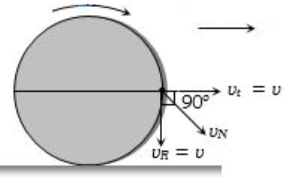
(C) For a wheel rolling on the ground with a translational speed $v = 2 \, m/s$,every point on the wheel has a translational velocity $v_t = v$ in the forward direction.
Additionally,due to rotation about the center of mass,every point on the rim has a tangential velocity $v_R = v$ relative to the center.
At the extremities of the horizontal diameter,the translational velocity $v_t$ is horizontal,and the rotational velocity $v_R$ is vertical (downward at the front point,upward at the back point).
Since these two velocity vectors are perpendicular to each other,the resultant velocity $v_N$ is given by:
$v_N = \sqrt{v_t^2 + v_R^2} = \sqrt{v^2 + v^2} = \sqrt{2}v$
Substituting $v = 2 \, m/s$:
$v_N = 2\sqrt{2} \, m/s$.
Additionally,due to rotation about the center of mass,every point on the rim has a tangential velocity $v_R = v$ relative to the center.
At the extremities of the horizontal diameter,the translational velocity $v_t$ is horizontal,and the rotational velocity $v_R$ is vertical (downward at the front point,upward at the back point).
Since these two velocity vectors are perpendicular to each other,the resultant velocity $v_N$ is given by:
$v_N = \sqrt{v_t^2 + v_R^2} = \sqrt{v^2 + v^2} = \sqrt{2}v$
Substituting $v = 2 \, m/s$:
$v_N = 2\sqrt{2} \, m/s$.
0 likes
View Solution30
MediumMCQ
An object of mass $10 \ kg$ and radius $0.5 \ m$ is rolling without slipping with a velocity of $2 \ m/s$. Its total kinetic energy is $32.8 \ J$. The radius of gyration of the object is .......... $m$.
A
$0.25$
B
$0.2$
C
$0.5$
D
$0.4$
Solution
(D) The total kinetic energy $(K.E.)$ of a body rolling without slipping is given by the sum of its translational and rotational kinetic energies:
$K.E. = \frac{1}{2}mv^2 + \frac{1}{2}I\omega^2$
Since $I = mk^2$ and $\omega = v/R$,where $k$ is the radius of gyration and $R$ is the radius of the object:
$K.E. = \frac{1}{2}mv^2 + \frac{1}{2}(mk^2)(v/R)^2 = \frac{1}{2}mv^2 \left(1 + \frac{k^2}{R^2}\right)$
Given: $m = 10 \ kg$,$R = 0.5 \ m$,$v = 2 \ m/s$,$K.E. = 32.8 \ J$.
Substituting the values:
$32.8 = \frac{1}{2} \times 10 \times (2)^2 \left(1 + \frac{k^2}{(0.5)^2}\right)$
$32.8 = 5 \times 4 \left(1 + \frac{k^2}{0.25}\right)$
$32.8 = 20 \left(1 + 4k^2\right)$
$1.64 = 1 + 4k^2$
$0.64 = 4k^2$
$k^2 = 0.16$
$k = 0.4 \ m$.
$K.E. = \frac{1}{2}mv^2 + \frac{1}{2}I\omega^2$
Since $I = mk^2$ and $\omega = v/R$,where $k$ is the radius of gyration and $R$ is the radius of the object:
$K.E. = \frac{1}{2}mv^2 + \frac{1}{2}(mk^2)(v/R)^2 = \frac{1}{2}mv^2 \left(1 + \frac{k^2}{R^2}\right)$
Given: $m = 10 \ kg$,$R = 0.5 \ m$,$v = 2 \ m/s$,$K.E. = 32.8 \ J$.
Substituting the values:
$32.8 = \frac{1}{2} \times 10 \times (2)^2 \left(1 + \frac{k^2}{(0.5)^2}\right)$
$32.8 = 5 \times 4 \left(1 + \frac{k^2}{0.25}\right)$
$32.8 = 20 \left(1 + 4k^2\right)$
$1.64 = 1 + 4k^2$
$0.64 = 4k^2$
$k^2 = 0.16$
$k = 0.4 \ m$.
0 likes
View Solution31
DifficultMCQ
$A$ solid sphere of radius $10 \ cm$ and mass $500 \ g$ is rolling without slipping with a velocity of $20 \ cm/s$. The total kinetic energy of the sphere is: (in $J$)
A
$0.014$
B
$0.028$
C
$280$
D
$140$
Solution
(A) Given: Mass $m = 500 \ g = 0.5 \ kg$,Radius $R = 10 \ cm = 0.1 \ m$,Velocity $v = 20 \ cm/s = 0.2 \ m/s$.
For a solid sphere rolling without slipping,the moment of inertia about the center of mass is $I = \frac{2}{5}mR^2$.
The total kinetic energy $K_{total}$ is the sum of translational and rotational kinetic energy:
$K_{total} = \frac{1}{2}mv^2 + \frac{1}{2}I\omega^2$.
Since $v = R\omega$,we have $\omega = v/R$.
$K_{total} = \frac{1}{2}mv^2 + \frac{1}{2}(\frac{2}{5}mR^2)(\frac{v}{R})^2 = \frac{1}{2}mv^2(1 + \frac{2}{5}) = \frac{1}{2}mv^2(\frac{7}{5})$.
Substituting the values:
$K_{total} = \frac{1}{2} \times 0.5 \times (0.2)^2 \times 1.4 = 0.25 \times 0.04 \times 1.4 = 0.01 \times 1.4 = 0.014 \ J$.
For a solid sphere rolling without slipping,the moment of inertia about the center of mass is $I = \frac{2}{5}mR^2$.
The total kinetic energy $K_{total}$ is the sum of translational and rotational kinetic energy:
$K_{total} = \frac{1}{2}mv^2 + \frac{1}{2}I\omega^2$.
Since $v = R\omega$,we have $\omega = v/R$.
$K_{total} = \frac{1}{2}mv^2 + \frac{1}{2}(\frac{2}{5}mR^2)(\frac{v}{R})^2 = \frac{1}{2}mv^2(1 + \frac{2}{5}) = \frac{1}{2}mv^2(\frac{7}{5})$.
Substituting the values:
$K_{total} = \frac{1}{2} \times 0.5 \times (0.2)^2 \times 1.4 = 0.25 \times 0.04 \times 1.4 = 0.01 \times 1.4 = 0.014 \ J$.
0 likes
View Solution32
EasyMCQ
$A$ sphere of mass $0.5 \ kg$ and diameter $1 \ m$ is rolling without slipping with a constant velocity of $5 \ m/s$. The ratio of its rotational kinetic energy to its total kinetic energy is:
A
$2/7$
B
$5/7$
C
$2/5$
D
$1/2$
Solution
(A) For a rolling sphere,the moment of inertia about its center of mass is $I = \frac{2}{5}MR^2$.
Total kinetic energy $K_T = K_{translational} + K_{rotational} = \frac{1}{2}Mv^2 + \frac{1}{2}I\omega^2$.
Since it is rolling without slipping,$v = R\omega$,so $\omega = v/R$.
Substituting $I$ and $\omega$ into the rotational kinetic energy formula: $K_R = \frac{1}{2} (\frac{2}{5}MR^2) (\frac{v}{R})^2 = \frac{1}{5}Mv^2$.
Total kinetic energy $K_T = \frac{1}{2}Mv^2 + \frac{1}{5}Mv^2 = \frac{7}{10}Mv^2$.
The ratio of rotational kinetic energy to total kinetic energy is $\frac{K_R}{K_T} = \frac{\frac{1}{5}Mv^2}{\frac{7}{10}Mv^2} = \frac{1}{5} \times \frac{10}{7} = \frac{2}{7}$.
Total kinetic energy $K_T = K_{translational} + K_{rotational} = \frac{1}{2}Mv^2 + \frac{1}{2}I\omega^2$.
Since it is rolling without slipping,$v = R\omega$,so $\omega = v/R$.
Substituting $I$ and $\omega$ into the rotational kinetic energy formula: $K_R = \frac{1}{2} (\frac{2}{5}MR^2) (\frac{v}{R})^2 = \frac{1}{5}Mv^2$.
Total kinetic energy $K_T = \frac{1}{2}Mv^2 + \frac{1}{5}Mv^2 = \frac{7}{10}Mv^2$.
The ratio of rotational kinetic energy to total kinetic energy is $\frac{K_R}{K_T} = \frac{\frac{1}{5}Mv^2}{\frac{7}{10}Mv^2} = \frac{1}{5} \times \frac{10}{7} = \frac{2}{7}$.
0 likes
View Solution33
MediumMCQ
What is the ratio of total kinetic energy to rotational kinetic energy for a rolling disc?
A
$1:1$
B
$2:7$
C
$1:2$
D
$3:1$
Solution
(D) The total kinetic energy $(K_{total})$ of a rolling body is given by $K_{total} = K_{translational} + K_{rotational} = \frac{1}{2}mv^2(1 + \frac{K^2}{R^2})$.
For a disc,the radius of gyration $K$ is given by $K^2 = \frac{1}{2}R^2$,so $\frac{K^2}{R^2} = \frac{1}{2}$.
The rotational kinetic energy is $K_{rot} = \frac{1}{2}I\omega^2 = \frac{1}{2}mv^2(\frac{K^2}{R^2})$.
The ratio of total kinetic energy to rotational kinetic energy is $\frac{K_{total}}{K_{rot}} = \frac{1 + \frac{K^2}{R^2}}{\frac{K^2}{R^2}}$.
Substituting $\frac{K^2}{R^2} = \frac{1}{2}$,we get $\frac{1 + 1/2}{1/2} = \frac{3/2}{1/2} = 3$.
Thus,the ratio is $3:1$.
For a disc,the radius of gyration $K$ is given by $K^2 = \frac{1}{2}R^2$,so $\frac{K^2}{R^2} = \frac{1}{2}$.
The rotational kinetic energy is $K_{rot} = \frac{1}{2}I\omega^2 = \frac{1}{2}mv^2(\frac{K^2}{R^2})$.
The ratio of total kinetic energy to rotational kinetic energy is $\frac{K_{total}}{K_{rot}} = \frac{1 + \frac{K^2}{R^2}}{\frac{K^2}{R^2}}$.
Substituting $\frac{K^2}{R^2} = \frac{1}{2}$,we get $\frac{1 + 1/2}{1/2} = \frac{3/2}{1/2} = 3$.
Thus,the ratio is $3:1$.
0 likes
View Solution34
EasyMCQ
An object is rolling on a horizontal surface without slipping. If its rotational kinetic energy and translational kinetic energy are equal,the object is a:
A
Disc
B
Sphere
C
Cylinder
D
Ring
Solution
(D) The rotational kinetic energy is given by $K_R = \frac{1}{2} I \omega^2 = \frac{1}{2} (Mk^2) (\frac{v^2}{R^2}) = \frac{1}{2} Mv^2 (\frac{k^2}{R^2})$.
The translational kinetic energy is given by $K_T = \frac{1}{2} Mv^2$.
Given that $K_R = K_T$,we have $\frac{1}{2} Mv^2 (\frac{k^2}{R^2}) = \frac{1}{2} Mv^2$.
This simplifies to $\frac{k^2}{R^2} = 1$,which implies $k^2 = R^2$.
For a ring,the moment of inertia is $I = MR^2$,so $k^2 = R^2$.
Therefore,the object is a ring.
The translational kinetic energy is given by $K_T = \frac{1}{2} Mv^2$.
Given that $K_R = K_T$,we have $\frac{1}{2} Mv^2 (\frac{k^2}{R^2}) = \frac{1}{2} Mv^2$.
This simplifies to $\frac{k^2}{R^2} = 1$,which implies $k^2 = R^2$.
For a ring,the moment of inertia is $I = MR^2$,so $k^2 = R^2$.
Therefore,the object is a ring.
0 likes
View Solution35
MediumMCQ
$A$ solid sphere is rolling with a linear velocity $v$. Its total kinetic energy is:
A
$\frac{7}{10}mv^2$
B
$\frac{1}{2}mv^2$
C
$\frac{2}{5}mv^2$
D
$\frac{10}{7}mv^2$
Solution
(A) The total kinetic energy $(K_{total})$ of a rolling body is the sum of its translational kinetic energy $(K_t)$ and rotational kinetic energy $(K_r)$.
$K_{total} = K_t + K_r = \frac{1}{2}mv^2 + \frac{1}{2}I\omega^2$
For a solid sphere,the moment of inertia about its center of mass is $I = \frac{2}{5}mR^2$ and the rolling condition is $v = R\omega$ (or $\omega = v/R$).
Substituting these values:
$K_{total} = \frac{1}{2}mv^2 + \frac{1}{2}(\frac{2}{5}mR^2)(\frac{v}{R})^2$
$K_{total} = \frac{1}{2}mv^2 + \frac{1}{2}(\frac{2}{5}mv^2)$
$K_{total} = \frac{1}{2}mv^2(1 + \frac{2}{5})$
$K_{total} = \frac{1}{2}mv^2(\frac{7}{5}) = \frac{7}{10}mv^2$.
$K_{total} = K_t + K_r = \frac{1}{2}mv^2 + \frac{1}{2}I\omega^2$
For a solid sphere,the moment of inertia about its center of mass is $I = \frac{2}{5}mR^2$ and the rolling condition is $v = R\omega$ (or $\omega = v/R$).
Substituting these values:
$K_{total} = \frac{1}{2}mv^2 + \frac{1}{2}(\frac{2}{5}mR^2)(\frac{v}{R})^2$
$K_{total} = \frac{1}{2}mv^2 + \frac{1}{2}(\frac{2}{5}mv^2)$
$K_{total} = \frac{1}{2}mv^2(1 + \frac{2}{5})$
$K_{total} = \frac{1}{2}mv^2(\frac{7}{5}) = \frac{7}{10}mv^2$.
0 likes
View Solution36
MediumMCQ
$A$ spherical ball is rolling on a table without slipping. What fraction of its total kinetic energy is associated with its rotational motion?
A
$2/5$
B
$2/7$
C
$3/5$
D
$3/7$
Solution
(B) For a solid sphere,the moment of inertia is $I = \frac{2}{5}MR^2$.
The total kinetic energy $K_{total}$ is the sum of translational kinetic energy $K_T$ and rotational kinetic energy $K_R$.
$K_T = \frac{1}{2}Mv^2$ and $K_R = \frac{1}{2}I\omega^2$.
Since the ball rolls without slipping,$v = R\omega$,so $\omega = v/R$.
Substituting $I$ and $\omega$: $K_R = \frac{1}{2} (\frac{2}{5}MR^2) (\frac{v}{R})^2 = \frac{1}{5}Mv^2$.
The total kinetic energy is $K_{total} = K_T + K_R = \frac{1}{2}Mv^2 + \frac{1}{5}Mv^2 = \frac{7}{10}Mv^2$.
The fraction of energy associated with rotational motion is $\frac{K_R}{K_{total}} = \frac{\frac{1}{5}Mv^2}{\frac{7}{10}Mv^2} = \frac{1}{5} \times \frac{10}{7} = \frac{2}{7}$.
The total kinetic energy $K_{total}$ is the sum of translational kinetic energy $K_T$ and rotational kinetic energy $K_R$.
$K_T = \frac{1}{2}Mv^2$ and $K_R = \frac{1}{2}I\omega^2$.
Since the ball rolls without slipping,$v = R\omega$,so $\omega = v/R$.
Substituting $I$ and $\omega$: $K_R = \frac{1}{2} (\frac{2}{5}MR^2) (\frac{v}{R})^2 = \frac{1}{5}Mv^2$.
The total kinetic energy is $K_{total} = K_T + K_R = \frac{1}{2}Mv^2 + \frac{1}{5}Mv^2 = \frac{7}{10}Mv^2$.
The fraction of energy associated with rotational motion is $\frac{K_R}{K_{total}} = \frac{\frac{1}{5}Mv^2}{\frac{7}{10}Mv^2} = \frac{1}{5} \times \frac{10}{7} = \frac{2}{7}$.
0 likes
View Solution37
DifficultMCQ
$A$ solid homogeneous sphere is rolling with sliding on a horizontal rough surface. For this type of motion of the sphere:
A
Total kinetic energy is conserved.
B
Angular momentum about the point of contact with the surface is conserved.
C
Only rotational kinetic energy about the center of mass is conserved.
D
Angular momentum about the center of mass is conserved.
Solution
(B) Since a frictional force acts at the point of contact with the ground,the total kinetic energy will not be conserved.
However,the torque of this frictional force about the point of contact is zero because the force acts exactly at that point.
Therefore,the angular momentum of the sphere about the point of contact remains constant.
Mathematically,$\vec{\tau} = \frac{d\vec{L}}{dt}$. If $\vec{\tau} = 0$,then $\vec{L} = \text{constant}$.
However,the torque of this frictional force about the point of contact is zero because the force acts exactly at that point.
Therefore,the angular momentum of the sphere about the point of contact remains constant.
Mathematically,$\vec{\tau} = \frac{d\vec{L}}{dt}$. If $\vec{\tau} = 0$,then $\vec{L} = \text{constant}$.
0 likes
View Solution38
MediumMCQ
$A$ solid sphere of mass $1 \ kg$ is rolling on a rough table with a linear speed of $1 \ m/s$. Its total kinetic energy is ....... $J$.
A
$1$
B
$0.5$
C
$0.7$
D
$1.4$
Solution
(C) The total kinetic energy $(K_{total})$ of a rolling body is the sum of its translational kinetic energy and rotational kinetic energy.
$K_{total} = K_{trans} + K_{rot} = \frac{1}{2}mv^2 + \frac{1}{2}I\omega^2$
For a solid sphere,the moment of inertia $I = \frac{2}{5}mR^2$ and $\omega = \frac{v}{R}$.
Substituting these values: $K_{total} = \frac{1}{2}mv^2 + \frac{1}{2}(\frac{2}{5}mR^2)(\frac{v}{R})^2 = \frac{1}{2}mv^2(1 + \frac{2}{5}) = \frac{1}{2}mv^2(\frac{7}{5})$.
Given $m = 1 \ kg$ and $v = 1 \ m/s$:
$K_{total} = \frac{1}{2} \times 1 \times (1)^2 \times \frac{7}{5} = \frac{7}{10} = 0.7 \ J$.
$K_{total} = K_{trans} + K_{rot} = \frac{1}{2}mv^2 + \frac{1}{2}I\omega^2$
For a solid sphere,the moment of inertia $I = \frac{2}{5}mR^2$ and $\omega = \frac{v}{R}$.
Substituting these values: $K_{total} = \frac{1}{2}mv^2 + \frac{1}{2}(\frac{2}{5}mR^2)(\frac{v}{R})^2 = \frac{1}{2}mv^2(1 + \frac{2}{5}) = \frac{1}{2}mv^2(\frac{7}{5})$.
Given $m = 1 \ kg$ and $v = 1 \ m/s$:
$K_{total} = \frac{1}{2} \times 1 \times (1)^2 \times \frac{7}{5} = \frac{7}{10} = 0.7 \ J$.
0 likes
View Solution39
MediumMCQ
$A$ hollow sphere of mass $2 \, kg$ and diameter $0.2 \, m$ is rolling on an inclined plane with a velocity of $0.5 \, m/s$. The kinetic energy of the sphere will be .......... $J$.
A
$0.1$
B
$0.3$
C
$0.5$
D
$0.42$
Solution
(D) The total kinetic energy of a rolling body is given by $K = K_{trans} + K_{rot} = \frac{1}{2}mv^2 + \frac{1}{2}I\omega^2$.
For a hollow sphere,the moment of inertia $I = \frac{2}{3}mR^2$ and $\omega = \frac{v}{R}$.
Substituting these,$K = \frac{1}{2}mv^2 + \frac{1}{2}(\frac{2}{3}mR^2)(\frac{v}{R})^2 = \frac{1}{2}mv^2(1 + \frac{2}{3}) = \frac{1}{2}mv^2(\frac{5}{3})$.
Given: $m = 2 \, kg$,$v = 0.5 \, m/s$.
$K = \frac{1}{2} \times 2 \times (0.5)^2 \times \frac{5}{3} = 0.25 \times \frac{5}{3} = 0.4166... \approx 0.42 \, J$.
For a hollow sphere,the moment of inertia $I = \frac{2}{3}mR^2$ and $\omega = \frac{v}{R}$.
Substituting these,$K = \frac{1}{2}mv^2 + \frac{1}{2}(\frac{2}{3}mR^2)(\frac{v}{R})^2 = \frac{1}{2}mv^2(1 + \frac{2}{3}) = \frac{1}{2}mv^2(\frac{5}{3})$.
Given: $m = 2 \, kg$,$v = 0.5 \, m/s$.
$K = \frac{1}{2} \times 2 \times (0.5)^2 \times \frac{5}{3} = 0.25 \times \frac{5}{3} = 0.4166... \approx 0.42 \, J$.
0 likes
View Solution40
EasyMCQ
$A$ circular disc of mass $0.41 \ kg$ and radius $10 \ m$ rolls without slipping with a velocity of $2 \ m/s$. The total kinetic energy of the disc is ....... $J$.
A
$0.41$
B
$1.23$
C
$0.82$
D
$2.4$
Solution
(B) The total kinetic energy $(K_T)$ of a body rolling without slipping is given by the sum of translational and rotational kinetic energy: $K_T = \frac{1}{2}mv^2 + \frac{1}{2}I\omega^2$.
For a circular disc,the moment of inertia $I = \frac{1}{2}mR^2$ and the rolling condition is $v = R\omega$,so $\omega = v/R$.
Substituting these into the formula: $K_T = \frac{1}{2}mv^2 + \frac{1}{2}(\frac{1}{2}mR^2)(\frac{v}{R})^2 = \frac{1}{2}mv^2 + \frac{1}{4}mv^2 = \frac{3}{4}mv^2$.
Given $m = 0.41 \ kg$ and $v = 2 \ m/s$:
$K_T = \frac{3}{4} \times 0.41 \times (2)^2 = \frac{3}{4} \times 0.41 \times 4 = 3 \times 0.41 = 1.23 \ J$.
For a circular disc,the moment of inertia $I = \frac{1}{2}mR^2$ and the rolling condition is $v = R\omega$,so $\omega = v/R$.
Substituting these into the formula: $K_T = \frac{1}{2}mv^2 + \frac{1}{2}(\frac{1}{2}mR^2)(\frac{v}{R})^2 = \frac{1}{2}mv^2 + \frac{1}{4}mv^2 = \frac{3}{4}mv^2$.
Given $m = 0.41 \ kg$ and $v = 2 \ m/s$:
$K_T = \frac{3}{4} \times 0.41 \times (2)^2 = \frac{3}{4} \times 0.41 \times 4 = 3 \times 0.41 = 1.23 \ J$.
0 likes
View Solution41
MediumMCQ
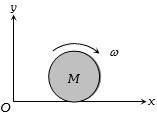
$A$ disc of mass $M$ and radius $R$ is rolling on a horizontal surface with an angular speed $\omega$. The angular momentum of the disc about the origin $O$ is:
A
$\frac{1}{2}M{R^2}\omega$
B
$M{R^2}\omega$
C
$\frac{3}{2}M{R^2}\omega$
D
$2M{R^2}\omega$
Solution
(C) The angular momentum of a rolling body about the point of contact (origin $O$) is the sum of the angular momentum due to linear motion and the angular momentum due to rotation about its center of mass.
$L = L_{\text{linear}} + L_{\text{rotational}}$
$L = MvR + I_c\omega$
Since the disc is rolling without slipping,the linear velocity of the center of mass is $v = R\omega$.
The moment of inertia of a disc about its center of mass is $I_c = \frac{1}{2}MR^2$.
Substituting these values:
$L = M(R\omega)R + (\frac{1}{2}MR^2)\omega$
$L = MR^2\omega + \frac{1}{2}MR^2\omega$
$L = \frac{3}{2}MR^2\omega$
$L = L_{\text{linear}} + L_{\text{rotational}}$
$L = MvR + I_c\omega$
Since the disc is rolling without slipping,the linear velocity of the center of mass is $v = R\omega$.
The moment of inertia of a disc about its center of mass is $I_c = \frac{1}{2}MR^2$.
Substituting these values:
$L = M(R\omega)R + (\frac{1}{2}MR^2)\omega$
$L = MR^2\omega + \frac{1}{2}MR^2\omega$
$L = \frac{3}{2}MR^2\omega$
0 likes
View Solution42
MediumMCQ
$A$ sphere of mass $50 \, g$ and diameter $20 \, cm$ is rolling without slipping with a velocity of $5 \, cm/s$. Its total kinetic energy is:
A
$625 \, erg$
B
$250 \, erg$
C
$875 \, erg$
D
$875 \, J$
Solution
(C) The total kinetic energy $(K_T)$ of a body rolling without slipping is given by $K_T = K_{trans} + K_{rot} = \frac{1}{2}mv^2 + \frac{1}{2}I\omega^2$.
For a solid sphere,the moment of inertia $I = \frac{2}{5}mR^2$ and $\omega = \frac{v}{R}$.
Substituting these,$K_T = \frac{1}{2}mv^2 + \frac{1}{2}(\frac{2}{5}mR^2)(\frac{v}{R})^2 = \frac{1}{2}mv^2(1 + \frac{2}{5}) = \frac{1}{2}mv^2(\frac{7}{5})$.
Given $m = 50 \, g$,$v = 5 \, cm/s$,$K_T = \frac{1}{2} \times 50 \times (5)^2 \times \frac{7}{5} = 25 \times 25 \times 1.4 = 875 \, erg$.
For a solid sphere,the moment of inertia $I = \frac{2}{5}mR^2$ and $\omega = \frac{v}{R}$.
Substituting these,$K_T = \frac{1}{2}mv^2 + \frac{1}{2}(\frac{2}{5}mR^2)(\frac{v}{R})^2 = \frac{1}{2}mv^2(1 + \frac{2}{5}) = \frac{1}{2}mv^2(\frac{7}{5})$.
Given $m = 50 \, g$,$v = 5 \, cm/s$,$K_T = \frac{1}{2} \times 50 \times (5)^2 \times \frac{7}{5} = 25 \times 25 \times 1.4 = 875 \, erg$.
0 likes
View Solution43
DifficultMCQ
$A$ wheel of radius $r$ is rolling on a straight line,with the velocity of its centre being $v$. At a certain instant,the point of contact of the wheel with the ground is $M$ and $N$ is the highest point on the wheel (diametrically opposite to $M$). Which of the following statements is incorrect?
A
The velocity of any point $P$ of the wheel is proportional to $MP$.
B
Points of the wheel moving with velocity greater than $v$ form a larger area of the wheel than points moving with velocity less than $v$.
C
The point of contact $M$ is instantaneously at rest.
D
The velocities of any two parts of the wheel which are equidistant from the centre are equal.
Solution
(D) For a wheel rolling without slipping,the velocity of any point $P$ at a distance $r'$ from the point of contact $M$ is given by $v_P = \omega \cdot MP$,where $\omega = v/r$. Thus,the velocity is proportional to $MP$. This makes statement $A$ correct.
The point of contact $M$ has a velocity of $0$ relative to the ground,so it is instantaneously at rest. This makes statement $C$ correct.
The velocity of a point at distance $d$ from the centre is $v_d = \sqrt{v^2 + (\omega d)^2 + 2v\omega d \cos \theta}$. Since this depends on the angle $\theta$ relative to the vertical,points equidistant from the centre do not necessarily have the same velocity. Thus,statement $D$ is incorrect.
Regarding statement $B$,the points with velocity greater than $v$ are those in the upper half of the wheel,and those with velocity less than $v$ are in the lower half. Since the velocity increases as we move from $M$ to $N$,the distribution is such that statement $B$ is considered correct in the context of rolling motion dynamics.
The point of contact $M$ has a velocity of $0$ relative to the ground,so it is instantaneously at rest. This makes statement $C$ correct.
The velocity of a point at distance $d$ from the centre is $v_d = \sqrt{v^2 + (\omega d)^2 + 2v\omega d \cos \theta}$. Since this depends on the angle $\theta$ relative to the vertical,points equidistant from the centre do not necessarily have the same velocity. Thus,statement $D$ is incorrect.
Regarding statement $B$,the points with velocity greater than $v$ are those in the upper half of the wheel,and those with velocity less than $v$ are in the lower half. Since the velocity increases as we move from $M$ to $N$,the distribution is such that statement $B$ is considered correct in the context of rolling motion dynamics.
0 likes
View Solution44
DifficultMCQ
Two spheres are rolling with the same velocity (for their $C.M.$). Their ratio of kinetic energy is $2:1$ and the ratio of their radii is $2:1$. Their mass ratio will be:
A
$2:1$
B
$4:1$
C
$8:1$
D
$2\sqrt{2}:1$
Solution
(A) The total kinetic energy of a rolling sphere is given by $K = K_{tr} + K_{rot} = \frac{1}{2}mv^2 + \frac{1}{2}I\omega^2$.
Since the moment of inertia of a solid sphere is $I = \frac{2}{5}mr^2$ and $\omega = \frac{v}{r}$,we have:
$K = \frac{1}{2}mv^2 + \frac{1}{2}(\frac{2}{5}mr^2)(\frac{v}{r})^2 = \frac{1}{2}mv^2 + \frac{1}{5}mv^2 = \frac{7}{10}mv^2$.
Given that both spheres have the same velocity $(v_1 = v_2)$,the ratio of their kinetic energies is:
$\frac{K_1}{K_2} = \frac{\frac{7}{10}m_1v_1^2}{\frac{7}{10}m_2v_2^2} = \frac{m_1}{m_2}$.
Given $\frac{K_1}{K_2} = 2:1$,it follows that $\frac{m_1}{m_2} = 2:1$.
The radius ratio is irrelevant in this specific case because the velocity is the same for both spheres.
Since the moment of inertia of a solid sphere is $I = \frac{2}{5}mr^2$ and $\omega = \frac{v}{r}$,we have:
$K = \frac{1}{2}mv^2 + \frac{1}{2}(\frac{2}{5}mr^2)(\frac{v}{r})^2 = \frac{1}{2}mv^2 + \frac{1}{5}mv^2 = \frac{7}{10}mv^2$.
Given that both spheres have the same velocity $(v_1 = v_2)$,the ratio of their kinetic energies is:
$\frac{K_1}{K_2} = \frac{\frac{7}{10}m_1v_1^2}{\frac{7}{10}m_2v_2^2} = \frac{m_1}{m_2}$.
Given $\frac{K_1}{K_2} = 2:1$,it follows that $\frac{m_1}{m_2} = 2:1$.
The radius ratio is irrelevant in this specific case because the velocity is the same for both spheres.
0 likes
View Solution45
DifficultMCQ
Two identical circular loops are moving with the same kinetic energy; one rolls and the other slides. The ratio of their speed is:
A
$2 : 3$
B
$2 : \sqrt{2}$
C
$\sqrt{2} : 2$
D
$\sqrt{5} : \sqrt{3}$
Solution
(C) For a rolling hoop,the total kinetic energy $(KE_{roll})$ is the sum of translational and rotational kinetic energy: $KE_{roll} = \frac{1}{2}mV^2 + \frac{1}{2}I\omega^2$. Since $I = mr^2$ and $\omega = V/r$,we get $KE_{roll} = \frac{1}{2}mV^2 + \frac{1}{2}(mr^2)(V/r)^2 = \frac{1}{2}mV^2 + \frac{1}{2}mV^2 = mV^2$.
For a sliding hoop,the kinetic energy $(KE_{slide})$ is purely translational: $KE_{slide} = \frac{1}{2}mv^2$.
Given that the kinetic energies are equal,we equate them: $mV^2 = \frac{1}{2}mv^2$.
This simplifies to $V^2 = v^2 / 2$,or $V^2 / v^2 = 1 / 2$.
Taking the square root of both sides,the ratio of their speeds is $V / v = \sqrt{1/2} = 1 / \sqrt{2} = \sqrt{2} / 2$.
For a sliding hoop,the kinetic energy $(KE_{slide})$ is purely translational: $KE_{slide} = \frac{1}{2}mv^2$.
Given that the kinetic energies are equal,we equate them: $mV^2 = \frac{1}{2}mv^2$.
This simplifies to $V^2 = v^2 / 2$,or $V^2 / v^2 = 1 / 2$.
Taking the square root of both sides,the ratio of their speeds is $V / v = \sqrt{1/2} = 1 / \sqrt{2} = \sqrt{2} / 2$.
0 likes
View Solution46
AdvancedMCQ
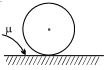
$A$ disc of radius $r$ is rotating about its centre with an angular speed $\omega_0$. It is gently placed on a rough horizontal surface. After what time will it be in pure rolling?
A
$\frac{\omega_0 r}{2\mu g}$
B
$\frac{\omega_0 r}{3\mu g}$
C
$\frac{\omega_0 r}{\mu g}$
D
$\frac{3}{2}\frac{\omega_0 r}{\mu g}$
Solution
(B) The force of friction acting on the disc is $f = \mu mg$.
The linear acceleration of the centre of mass is $a = \frac{f}{m} = \mu g$.
The torque due to friction about the centre is $\tau = f r = \mu mgr$.
The angular deceleration is $\alpha = \frac{\tau}{I} = \frac{\mu mgr}{\frac{1}{2}mr^2} = \frac{2\mu g}{r}$.
At time $t$,the linear velocity is $v = at = \mu gt$.
The angular velocity is $\omega = \omega_0 - \alpha t = \omega_0 - \frac{2\mu g}{r}t$.
For pure rolling,the condition $v = r\omega$ must be satisfied.
Substituting the expressions,we get $\mu gt = r(\omega_0 - \frac{2\mu g}{r}t)$.
$\mu gt = r\omega_0 - 2\mu gt$.
$3\mu gt = r\omega_0$.
$t = \frac{\omega_0 r}{3\mu g}$.
The linear acceleration of the centre of mass is $a = \frac{f}{m} = \mu g$.
The torque due to friction about the centre is $\tau = f r = \mu mgr$.
The angular deceleration is $\alpha = \frac{\tau}{I} = \frac{\mu mgr}{\frac{1}{2}mr^2} = \frac{2\mu g}{r}$.
At time $t$,the linear velocity is $v = at = \mu gt$.
The angular velocity is $\omega = \omega_0 - \alpha t = \omega_0 - \frac{2\mu g}{r}t$.
For pure rolling,the condition $v = r\omega$ must be satisfied.
Substituting the expressions,we get $\mu gt = r(\omega_0 - \frac{2\mu g}{r}t)$.
$\mu gt = r\omega_0 - 2\mu gt$.
$3\mu gt = r\omega_0$.
$t = \frac{\omega_0 r}{3\mu g}$.
0 likes
View Solution47
MediumMCQ
$A$ solid sphere with a velocity (of centre of mass) $v$ and angular velocity $\omega$ is gently placed on a rough horizontal surface. The frictional force on the sphere:
A
must be forward (in direction of $v$)
B
must be backward (opposite to $v$)
C
cannot be zero
D
none of the above
Solution
(D) When a sphere is placed on a rough horizontal surface,the frictional force depends on the condition of rolling.
If the sphere is placed such that the velocity of the point of contact $v_p = v - r\omega = 0$,then the relative velocity between the sphere and the surface is zero.
In this specific case,there is no relative motion between the point of contact and the surface,so the frictional force acting on the sphere is zero.
Since the problem does not specify that $v \neq r\omega$,it is possible for the frictional force to be zero.
Therefore,none of the given statements (which claim the force must be forward,backward,or cannot be zero) are universally true.
If the sphere is placed such that the velocity of the point of contact $v_p = v - r\omega = 0$,then the relative velocity between the sphere and the surface is zero.
In this specific case,there is no relative motion between the point of contact and the surface,so the frictional force acting on the sphere is zero.
Since the problem does not specify that $v \neq r\omega$,it is possible for the frictional force to be zero.
Therefore,none of the given statements (which claim the force must be forward,backward,or cannot be zero) are universally true.
0 likes
View Solution48
EasyMCQ
$A$ solid homogeneous sphere of mass $M$ and radius $r$ is moving on a rough horizontal surface,partly rolling and partly sliding. During this kind of motion of this sphere,
A
total kinetic energy is conserved
B
angular momentum about the centre of mass is conserved
C
only the rotational kinetic energy about the centre of mass is conserved
D
the angular momentum of the sphere about the point of contact with the plane is conserved
Solution
(D) For a sphere moving on a rough horizontal surface,the force of friction acts at the point of contact.
Since the friction force acts at the point of contact,the torque due to friction about the point of contact is zero.
According to the principle of conservation of angular momentum,if the net external torque about a point is zero,the angular momentum about that point remains constant.
Therefore,the angular momentum of the sphere about the point of contact with the plane is conserved.
Since the friction force acts at the point of contact,the torque due to friction about the point of contact is zero.
According to the principle of conservation of angular momentum,if the net external torque about a point is zero,the angular momentum about that point remains constant.
Therefore,the angular momentum of the sphere about the point of contact with the plane is conserved.
0 likes
View Solution49
DifficultMCQ
$A$ uniform solid cylinder of mass $m$ and radius $R$ is set in rotation about its axis with an angular velocity $\omega_0$,then lowered with its lateral surface onto a horizontal plane and released. The coefficient of friction between the cylinder and plane is equal to $\mu$. The time after which the cylinder starts rolling without slipping is
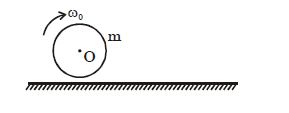
A
$\frac{\omega_0 R}{\mu g}$
B
$\frac{2\omega_0 R}{3\mu g}$
C
$\frac{\omega_0 R}{3\mu g}$
D
$\frac{3\omega_0 R}{4\mu g}$
Solution
(C) When the cylinder is placed on the surface,the friction force $f = \mu mg$ acts in the direction opposite to the velocity of the point of contact.
This friction force provides a linear acceleration $a = \frac{f}{m} = \mu g$ and a retarding angular acceleration $\alpha = \frac{\tau}{I} = \frac{fR}{\frac{1}{2}mR^2} = \frac{2\mu g}{R}$.
At time $t$,the linear velocity is $v = at = \mu gt$.
The angular velocity is $\omega = \omega_0 - \alpha t = \omega_0 - \frac{2\mu g t}{R}$.
Rolling without slipping starts when $v = R\omega$.
Substituting the expressions: $\mu gt = R(\omega_0 - \frac{2\mu gt}{R}) = \omega_0 R - 2\mu gt$.
$3\mu gt = \omega_0 R \Rightarrow t = \frac{\omega_0 R}{3\mu g}$.
This friction force provides a linear acceleration $a = \frac{f}{m} = \mu g$ and a retarding angular acceleration $\alpha = \frac{\tau}{I} = \frac{fR}{\frac{1}{2}mR^2} = \frac{2\mu g}{R}$.
At time $t$,the linear velocity is $v = at = \mu gt$.
The angular velocity is $\omega = \omega_0 - \alpha t = \omega_0 - \frac{2\mu g t}{R}$.
Rolling without slipping starts when $v = R\omega$.
Substituting the expressions: $\mu gt = R(\omega_0 - \frac{2\mu gt}{R}) = \omega_0 R - 2\mu gt$.
$3\mu gt = \omega_0 R \Rightarrow t = \frac{\omega_0 R}{3\mu g}$.
0 likes
View SolutionSystem of Particles and Rotational Motion — Rolling motion on horizontal Surface · Frequently Asked Questions
1Are these System of Particles and Rotational Motion questions useful for JEE and NEET?
Yes. All questions in this section are mapped to JEE Main and NEET exam patterns. Previous year questions from JEE Main, NEET, GUJCET and state-level exams are included with full solutions.
2Can I switch to Hindi or Gujarati for these questions?
Yes. Use the language tabs in the hero section or the sidebar to view the same questions and solutions in English, Hindi or Gujarati.
3How do I generate a question paper from this subtopic?
Use the Vedclass Exam Paper Generator — select the chapter and subtopic, set difficulty, and generate Sets A, B, C, D automatically. First 3 chapters of every subject are free.
Vedclass Products
For Students
Vedclass Test Series
Mock tests in real JEE/NEET style with performance analysis. 5-day free trial.
Start Free TrialFor Teachers
Exam Paper Generator
Generate Set A/B/C/D papers from this chapter in 2 minutes. 3 chapters free.
Try FreeFor Institutes
Online Exam Module
Live online exams with unlimited students, 360° analytics & white-label branding.
See DemoFor Teachers & Institutes
Generate a System of Particles and Rotational Motion Exam Paper in 2 Minutes
Select subtopic & difficulty — Sets A, B, C, D auto-generated with No Repeat logic.
First 3 chapters of every subject are free — no payment required.