
A English
Relation between Torque and Angular acceleration and it's Application Questions in English
Class 11 Physics · System of Particles and Rotational Motion · Relation between Torque and Angular acceleration and it's Application
182+
Questions
English
Language
100%
With Solutions
Showing 49 of 182 questions in English
51
EasyMCQ
If a constant torque acts on an object,then the object:
A
remains in its state of rest or uniform motion along a straight line
B
undergoes linear acceleration
C
undergoes angular acceleration
D
rotates with a constant speed
Solution
(C) According to the rotational analogue of Newton's second law,the torque $\tau$ acting on a rigid body is given by the relation $\tau = I\alpha$,where $I$ is the moment of inertia and $\alpha$ is the angular acceleration.
Since the torque $\tau$ is constant and the moment of inertia $I$ is a property of the body,the angular acceleration $\alpha = \frac{\tau}{I}$ must also be constant.
Therefore,the object undergoes angular acceleration.
Since the torque $\tau$ is constant and the moment of inertia $I$ is a property of the body,the angular acceleration $\alpha = \frac{\tau}{I}$ must also be constant.
Therefore,the object undergoes angular acceleration.
0 likes
View Solution52
DifficultMCQ
$A$ constant torque of $31.4 \, N \cdot m$ is applied to a pivoted wheel. If the angular acceleration of the wheel is $4\pi \, rad/s^2$,then the moment of inertia of the wheel is ....... $kg \cdot m^2$. (in $.5$)
A
$2$
B
$3$
C
$4$
D
$5$
Solution
(A) The relationship between torque $(\tau)$,moment of inertia $(I)$,and angular acceleration $(\alpha)$ is given by the formula: $\tau = I \alpha$.
Rearranging for the moment of inertia,we get: $I = \frac{\tau}{\alpha}$.
Given: $\tau = 31.4 \, N \cdot m$ and $\alpha = 4\pi \, rad/s^2$.
Using $\pi \approx 3.14$,we have $\alpha = 4 \times 3.14 = 12.56 \, rad/s^2$.
Substituting the values: $I = \frac{31.4}{12.56} = 2.5 \, kg \cdot m^2$.
Thus,the moment of inertia is $2.5 \, kg \cdot m^2$.
Rearranging for the moment of inertia,we get: $I = \frac{\tau}{\alpha}$.
Given: $\tau = 31.4 \, N \cdot m$ and $\alpha = 4\pi \, rad/s^2$.
Using $\pi \approx 3.14$,we have $\alpha = 4 \times 3.14 = 12.56 \, rad/s^2$.
Substituting the values: $I = \frac{31.4}{12.56} = 2.5 \, kg \cdot m^2$.
Thus,the moment of inertia is $2.5 \, kg \cdot m^2$.
0 likes
View Solution53
EasyMCQ
If the external torque acting on a system is $ \tau = 0 $, then:
A
$ \omega = 0 $
B
$ \alpha = 0 $
C
$ J = 0 $
D
$ F = 0 $
Solution
(B) The relationship between torque and angular acceleration is given by $ \tau = I \alpha $, where $ I $ is the moment of inertia and $ \alpha $ is the angular acceleration.
Given that the external torque $ \tau = 0 $.
Since the moment of inertia $ I $ of a rigid body cannot be zero, it follows that $ \alpha = 0 $.
Therefore, the angular acceleration of the system is zero.
Given that the external torque $ \tau = 0 $.
Since the moment of inertia $ I $ of a rigid body cannot be zero, it follows that $ \alpha = 0 $.
Therefore, the angular acceleration of the system is zero.
0 likes
View Solution54
MediumMCQ
The engine of a motor vehicle develops a power of $100 \, kW$. If it rotates at a speed of $1800 \, rpm$,the torque exerted by it is ...... $N-m$.
A
$350$
B
$440$
C
$531$
D
$628$
Solution
(C) Given: Power $P = 100 \, kW = 100 \times 10^3 \, W$.
Angular speed $n = 1800 \, rpm = \frac{1800}{60} \, rev/s = 30 \, rev/s$.
The angular velocity $\omega$ is given by $\omega = 2\pi n = 2\pi \times 30 = 60\pi \, rad/s$.
The relationship between power $P$,torque $\tau$,and angular velocity $\omega$ is $P = \tau \omega$.
Therefore,the torque $\tau = \frac{P}{\omega} = \frac{100 \times 10^3}{60\pi} \, N-m$.
Calculating the value: $\tau = \frac{100000}{188.495} \approx 530.5 \, N-m$,which rounds to $531 \, N-m$.
Angular speed $n = 1800 \, rpm = \frac{1800}{60} \, rev/s = 30 \, rev/s$.
The angular velocity $\omega$ is given by $\omega = 2\pi n = 2\pi \times 30 = 60\pi \, rad/s$.
The relationship between power $P$,torque $\tau$,and angular velocity $\omega$ is $P = \tau \omega$.
Therefore,the torque $\tau = \frac{P}{\omega} = \frac{100 \times 10^3}{60\pi} \, N-m$.
Calculating the value: $\tau = \frac{100000}{188.495} \approx 530.5 \, N-m$,which rounds to $531 \, N-m$.
0 likes
View Solution55
MediumMCQ
$A$ constant torque acting on a wheel changes its angular momentum from $A_0$ to $4A_0$ in $4 \ s$. The magnitude of the torque is:
A
$ \frac{3A_0}{4} $
B
$ A_0 $
C
$ 4A_0 $
D
$ 12A_0 $
Solution
(A) The relationship between torque $(\tau)$ and angular momentum $(L)$ is given by Newton's second law for rotation: $\tau = \frac{dL}{dt}$.
Given the change in angular momentum $\Delta L = L_2 - L_1 = 4A_0 - A_0 = 3A_0$.
The time interval is $\Delta t = 4 \ s$.
Therefore,the magnitude of the constant torque is $\tau = \frac{\Delta L}{\Delta t} = \frac{3A_0}{4}$.
Given the change in angular momentum $\Delta L = L_2 - L_1 = 4A_0 - A_0 = 3A_0$.
The time interval is $\Delta t = 4 \ s$.
Therefore,the magnitude of the constant torque is $\tau = \frac{\Delta L}{\Delta t} = \frac{3A_0}{4}$.
0 likes
View Solution56
EasyMCQ
If $I$,$\alpha$,and $\tau$ are the moment of inertia,angular acceleration,and torque of an object,respectively,and the object is rotating about an axis with an angular velocity $\omega$,then:
A
$\tau = I\alpha$
B
$\tau = I\omega$
C
$I = \tau \omega$
D
$\alpha = \tau \omega$
Solution
(A) For a rigid body rotating about a fixed axis,the torque $\tau$ acting on the body is related to its moment of inertia $I$ and angular acceleration $\alpha$ by the equation $\tau = I\alpha$. This is the rotational analogue of Newton's second law of motion,$F = ma$.
0 likes
View Solution57
MediumMCQ
$A$ mass of $10 \ kg$ is attached to one end of a massless rod and rotated in a circle of radius $30 \ cm$ with an angular velocity of $10 \ rad/s$. If the body is brought to rest in $10 \ s$ by applying a brake,the magnitude of the torque applied will be ...... $N-m$.
A
$0.9$
B
$1.2$
C
$2.3$
D
$0.5$
Solution
(A) Given: Mass $m = 10 \ kg$,Radius $r = 30 \ cm = 0.3 \ m$,Initial angular velocity $\omega_1 = 10 \ rad/s$,Final angular velocity $\omega_2 = 0 \ rad/s$,Time $t = 10 \ s$.
First,calculate the angular acceleration $\alpha$:
$\alpha = \frac{\omega_2 - \omega_1}{t} = \frac{0 - 10}{10} = -1 \ rad/s^2$.
The magnitude of angular acceleration is $|\alpha| = 1 \ rad/s^2$.
Next,calculate the moment of inertia $I$ of the mass:
$I = m r^2 = 10 \times (0.3)^2 = 10 \times 0.09 = 0.9 \ kg \cdot m^2$.
Finally,calculate the torque $\tau$:
$\tau = I |\alpha| = 0.9 \times 1 = 0.9 \ N \cdot m$.
First,calculate the angular acceleration $\alpha$:
$\alpha = \frac{\omega_2 - \omega_1}{t} = \frac{0 - 10}{10} = -1 \ rad/s^2$.
The magnitude of angular acceleration is $|\alpha| = 1 \ rad/s^2$.
Next,calculate the moment of inertia $I$ of the mass:
$I = m r^2 = 10 \times (0.3)^2 = 10 \times 0.09 = 0.9 \ kg \cdot m^2$.
Finally,calculate the torque $\tau$:
$\tau = I |\alpha| = 0.9 \times 1 = 0.9 \ N \cdot m$.
0 likes
View Solution58
MediumMCQ
$A$ wheel having a moment of inertia $2 \; kg \cdot m^2$ about its vertical axis rotates at the rate of $60 \; rpm$ about this axis. The torque required to stop the wheel's rotation in one minute is:
A
$ \frac{2\pi}{15} \; N \cdot m $
B
$ \frac{\pi}{12} \; N \cdot m $
C
$ \frac{\pi}{15} \; N \cdot m $
D
$ \frac{\pi}{18} \; N \cdot m $
Solution
(C) Given: Moment of inertia $I = 2 \; kg \cdot m^2$,Initial angular velocity $\omega_i = 60 \; rpm = \frac{60 \times 2\pi}{60} \; rad/s = 2\pi \; rad/s$,Final angular velocity $\omega_f = 0 \; rad/s$,Time $t = 1 \; minute = 60 \; s$.
The angular acceleration $\alpha$ is given by $\alpha = \frac{\omega_f - \omega_i}{t} = \frac{0 - 2\pi}{60} = -\frac{\pi}{30} \; rad/s^2$.
The magnitude of the torque $\tau$ is given by $\tau = |I \alpha| = 2 \times \left| -\frac{\pi}{30} \right| = \frac{2\pi}{30} = \frac{\pi}{15} \; N \cdot m$.
The angular acceleration $\alpha$ is given by $\alpha = \frac{\omega_f - \omega_i}{t} = \frac{0 - 2\pi}{60} = -\frac{\pi}{30} \; rad/s^2$.
The magnitude of the torque $\tau$ is given by $\tau = |I \alpha| = 2 \times \left| -\frac{\pi}{30} \right| = \frac{2\pi}{30} = \frac{\pi}{15} \; N \cdot m$.
0 likes
View Solution59
MediumMCQ
$A$ wheel having a moment of inertia of $5 \times 10^{-3} \ kg \ m^2$ is rotating at a rate of $20 \ rev/s$. The torque required to stop the wheel in $10 \ s$ is $... \times 10^{-2} \ N \ m$. (in $\pi$)
A
$2$
B
$2.5$
C
$4$
D
$4.5$
Solution
(A) Given: Moment of inertia $I = 5 \times 10^{-3} \ kg \ m^2$, initial frequency $n_1 = 20 \ rev/s$, final frequency $n_2 = 0 \ rev/s$, time $t = 10 \ s$.
The angular acceleration $\alpha$ is given by $\alpha = \frac{\omega_2 - \omega_1}{t} = \frac{2\pi(n_2 - n_1)}{t}$.
Substituting the values: $\alpha = \frac{2\pi(0 - 20)}{10} = -4\pi \ rad/s^2$.
The magnitude of torque $\tau$ is given by $\tau = I|\alpha|$.
$\tau = (5 \times 10^{-3}) \times (4\pi) = 20\pi \times 10^{-3} = 2\pi \times 10^{-2} \ N \ m$.
Thus, the required value is $2\pi$.
The angular acceleration $\alpha$ is given by $\alpha = \frac{\omega_2 - \omega_1}{t} = \frac{2\pi(n_2 - n_1)}{t}$.
Substituting the values: $\alpha = \frac{2\pi(0 - 20)}{10} = -4\pi \ rad/s^2$.
The magnitude of torque $\tau$ is given by $\tau = I|\alpha|$.
$\tau = (5 \times 10^{-3}) \times (4\pi) = 20\pi \times 10^{-3} = 2\pi \times 10^{-2} \ N \ m$.
Thus, the required value is $2\pi$.
0 likes
View Solution60
DifficultMCQ
The moment of inertia of a wheel about an axis passing through its center is $200 \, kg \cdot m^2$. $A$ constant torque of $1000 \, N \cdot m$ is applied to rotate the wheel. After $3 \, s$,the angular velocity of the wheel will be ........ $rad/s$.
A
$15$
B
$10$
C
$5$
D
$1$
Solution
(A) Given: Moment of inertia $I = 200 \, kg \cdot m^2$,Torque $\tau = 1000 \, N \cdot m$,Time $t = 3 \, s$,Initial angular velocity $\omega_0 = 0 \, rad/s$.
Using the relation $\tau = I \alpha$,the angular acceleration $\alpha$ is:
$\alpha = \frac{\tau}{I} = \frac{1000}{200} = 5 \, rad/s^2$.
Using the equation of rotational motion $\omega = \omega_0 + \alpha t$:
$\omega = 0 + (5 \times 3) = 15 \, rad/s$.
Using the relation $\tau = I \alpha$,the angular acceleration $\alpha$ is:
$\alpha = \frac{\tau}{I} = \frac{1000}{200} = 5 \, rad/s^2$.
Using the equation of rotational motion $\omega = \omega_0 + \alpha t$:
$\omega = 0 + (5 \times 3) = 15 \, rad/s$.
0 likes
View Solution61
MediumMCQ
What constant force must be applied tangentially at the equator to stop the Earth's rotation in one day?
A
$ 1.3 \times 10^{22} \, N $
B
$ 8.26 \times 10^{28} \, N $
C
$ 1.3 \times 10^{23} \, N $
D
None of the above
Solution
(A) The initial angular velocity of the Earth is $\omega_1 = \frac{2\pi}{T}$ rad/s,where $T = 86400 \, s$. The final angular velocity is $\omega_2 = 0$. The time taken is $t = 86400 \, s$.
The angular acceleration is $\alpha = \frac{\omega_2 - \omega_1}{t} = \frac{0 - \frac{2\pi}{86400}}{86400} = -\frac{2\pi}{(86400)^2} \, rad/s^2$.
The torque required is $\tau = I\alpha$,where $I = \frac{2}{5}MR^2$ is the moment of inertia of the Earth.
The tangential force $F$ is related to torque by $\tau = FR$,so $F = \frac{I\alpha}{R} = \frac{2}{5}MR\alpha$.
Substituting the values: $M = 6 \times 10^{24} \, kg$,$R = 6.4 \times 10^6 \, m$,and $\alpha = \frac{2\pi}{(86400)^2}$.
$F = \frac{2}{5} \times (6 \times 10^{24}) \times (6.4 \times 10^6) \times \frac{2\pi}{(86400)^2} \approx 1.3 \times 10^{22} \, N$.
The angular acceleration is $\alpha = \frac{\omega_2 - \omega_1}{t} = \frac{0 - \frac{2\pi}{86400}}{86400} = -\frac{2\pi}{(86400)^2} \, rad/s^2$.
The torque required is $\tau = I\alpha$,where $I = \frac{2}{5}MR^2$ is the moment of inertia of the Earth.
The tangential force $F$ is related to torque by $\tau = FR$,so $F = \frac{I\alpha}{R} = \frac{2}{5}MR\alpha$.
Substituting the values: $M = 6 \times 10^{24} \, kg$,$R = 6.4 \times 10^6 \, m$,and $\alpha = \frac{2\pi}{(86400)^2}$.
$F = \frac{2}{5} \times (6 \times 10^{24}) \times (6.4 \times 10^6) \times \frac{2\pi}{(86400)^2} \approx 1.3 \times 10^{22} \, N$.
0 likes
View Solution62
EasyMCQ
The angular momentum of a wheel changes from $2L$ to $5L$ in $3$ seconds. The magnitude of the torque acting on the wheel is:
A
$L$
B
$L/2$
C
$L/3$
D
$L/5$
Solution
(A) The torque $\tau$ acting on a body is equal to the rate of change of its angular momentum $L$,given by the formula: $\tau = \frac{dL}{dt}$.
Given:
Initial angular momentum $L_1 = 2L$.
Final angular momentum $L_2 = 5L$.
Time interval $\Delta t = 3 \ s$.
Substituting these values into the formula:
$\tau = \frac{L_2 - L_1}{\Delta t} = \frac{5L - 2L}{3} = \frac{3L}{3} = L$.
Thus,the magnitude of the torque acting on the wheel is $L$.
Given:
Initial angular momentum $L_1 = 2L$.
Final angular momentum $L_2 = 5L$.
Time interval $\Delta t = 3 \ s$.
Substituting these values into the formula:
$\tau = \frac{L_2 - L_1}{\Delta t} = \frac{5L - 2L}{3} = \frac{3L}{3} = L$.
Thus,the magnitude of the torque acting on the wheel is $L$.
0 likes
View Solution63
MediumMCQ
$A$ torque of $30 \, N \cdot m$ is applied for $10 \, s$ on a wheel of mass $5 \, kg$ and moment of inertia $2 \, kg \cdot m^2$. The angular displacement of the wheel in $10 \, s$ will be ....... radians.
A
$750$
B
$1500$
C
$3000$
D
$6000$
Solution
(A) Given: Torque $\tau = 30 \, N \cdot m$,Moment of inertia $I = 2 \, kg \cdot m^2$,Time $t = 10 \, s$,Initial angular velocity $\omega_0 = 0$.
First,calculate the angular acceleration $\alpha$ using the relation $\tau = I\alpha$:
$\alpha = \frac{\tau}{I} = \frac{30}{2} = 15 \, rad/s^2$.
Now,use the kinematic equation for rotational motion to find the angular displacement $\theta$:
$\theta = \omega_0 t + \frac{1}{2} \alpha t^2$.
Substituting the values:
$\theta = 0 \times 10 + \frac{1}{2} \times 15 \times (10)^2 = 0.5 \times 15 \times 100 = 750 \, rad$.
First,calculate the angular acceleration $\alpha$ using the relation $\tau = I\alpha$:
$\alpha = \frac{\tau}{I} = \frac{30}{2} = 15 \, rad/s^2$.
Now,use the kinematic equation for rotational motion to find the angular displacement $\theta$:
$\theta = \omega_0 t + \frac{1}{2} \alpha t^2$.
Substituting the values:
$\theta = 0 \times 10 + \frac{1}{2} \times 15 \times (10)^2 = 0.5 \times 15 \times 100 = 750 \, rad$.
0 likes
View Solution64
EasyMCQ
If a force acts on a body at a point away from the center of mass,then:
A
Linear acceleration changes.
B
Angular acceleration changes.
C
Both change.
D
None of the above.
Solution
(C) When a force acts on a body at a point other than the center of mass,it provides both a net force and a net torque about the center of mass.
According to Newton's second law for linear motion,$F = ma$,the linear acceleration $a$ changes.
According to the rotational analogue of Newton's second law,$\tau = I\alpha$,the torque $\tau$ causes a change in angular acceleration $\alpha$.
Therefore,both linear and angular accelerations change.
According to Newton's second law for linear motion,$F = ma$,the linear acceleration $a$ changes.
According to the rotational analogue of Newton's second law,$\tau = I\alpha$,the torque $\tau$ causes a change in angular acceleration $\alpha$.
Therefore,both linear and angular accelerations change.
0 likes
View Solution65
DifficultMCQ
The moment of inertia of a body about a given axis is $1.2 \ kg \cdot m^2$. Initially,the body is at rest. To produce a rotational kinetic energy of $1500 \ J$,an angular acceleration of $25 \ rad/s^2$ must be applied to the body for a duration of ........ $(s)$.
A
$4$
B
$2$
C
$8$
D
$10$
Solution
(B) The rotational kinetic energy is given by $K = \frac{1}{2} I \omega^2$.
Given $K = 1500 \ J$ and $I = 1.2 \ kg \cdot m^2$,we have:
$1500 = \frac{1}{2} \times 1.2 \times \omega^2$
$1500 = 0.6 \times \omega^2$
$\omega^2 = \frac{1500}{0.6} = 2500$
$\omega = 50 \ rad/s$.
Since the body starts from rest,the initial angular velocity $\omega_0 = 0$.
Using the equation of motion $\omega = \omega_0 + \alpha t$,where $\alpha = 25 \ rad/s^2$:
$50 = 0 + 25 \times t$
$t = \frac{50}{25} = 2 \ s$.
Given $K = 1500 \ J$ and $I = 1.2 \ kg \cdot m^2$,we have:
$1500 = \frac{1}{2} \times 1.2 \times \omega^2$
$1500 = 0.6 \times \omega^2$
$\omega^2 = \frac{1500}{0.6} = 2500$
$\omega = 50 \ rad/s$.
Since the body starts from rest,the initial angular velocity $\omega_0 = 0$.
Using the equation of motion $\omega = \omega_0 + \alpha t$,where $\alpha = 25 \ rad/s^2$:
$50 = 0 + 25 \times t$
$t = \frac{50}{25} = 2 \ s$.
0 likes
View Solution66
EasyMCQ
$A$ wheel with a moment of inertia of $5 \times 10^{-3} \ kg \cdot m^2$ is rotating at a rate of $20 \ rev/s$. The angular deceleration required to bring it to rest in $20 \ s$ is:
A
$\pi \ rad/s^2$
B
$2\pi \ rad/s^2$
C
$4\pi \ rad/s^2$
D
$8\pi \ rad/s^2$
Solution
(B) Given:
Initial frequency $n_1 = 20 \ rev/s$
Final frequency $n_2 = 0 \ rev/s$
Time $t = 20 \ s$
Initial angular velocity $\omega_1 = 2\pi n_1 = 2\pi \times 20 = 40\pi \ rad/s$
Final angular velocity $\omega_2 = 2\pi n_2 = 0 \ rad/s$
Using the equation of motion $\omega_2 = \omega_1 + \alpha t$:
$0 = 40\pi + \alpha(20)$
$\alpha = -\frac{40\pi}{20} = -2\pi \ rad/s^2$
The magnitude of angular deceleration is $2\pi \ rad/s^2$.
Initial frequency $n_1 = 20 \ rev/s$
Final frequency $n_2 = 0 \ rev/s$
Time $t = 20 \ s$
Initial angular velocity $\omega_1 = 2\pi n_1 = 2\pi \times 20 = 40\pi \ rad/s$
Final angular velocity $\omega_2 = 2\pi n_2 = 0 \ rad/s$
Using the equation of motion $\omega_2 = \omega_1 + \alpha t$:
$0 = 40\pi + \alpha(20)$
$\alpha = -\frac{40\pi}{20} = -2\pi \ rad/s^2$
The magnitude of angular deceleration is $2\pi \ rad/s^2$.
0 likes
View Solution67
MediumMCQ
$A$ wheel with a moment of inertia of $5 \times 10^{-3} \ kg \cdot m^2$ is rotating at a rate of $20 \ rev/s$. The torque required to bring it to rest in $10 \ s$ is:
A
$2\pi \times 10^{-2} \ N \cdot m$
B
$2\pi \times 10^{2} \ N \cdot m$
C
$4\pi \times 10^{-2} \ N \cdot m$
D
$4\pi \times 10^{2} \ N \cdot m$
Solution
(A) Given: Moment of inertia $I = 5 \times 10^{-3} \ kg \cdot m^2$,initial frequency $n_1 = 20 \ rev/s$,final frequency $n_2 = 0 \ rev/s$,time $t = 10 \ s$.
Initial angular velocity $\omega_1 = 2\pi n_1 = 2\pi \times 20 = 40\pi \ rad/s$.
Final angular velocity $\omega_2 = 2\pi n_2 = 0 \ rad/s$.
Angular acceleration $\alpha = \frac{\omega_2 - \omega_1}{t} = \frac{0 - 40\pi}{10} = -4\pi \ rad/s^2$.
The magnitude of torque required is $\tau = I|\alpha|$.
$\tau = (5 \times 10^{-3}) \times 4\pi = 20\pi \times 10^{-3} = 2\pi \times 10^{-2} \ N \cdot m$.
Initial angular velocity $\omega_1 = 2\pi n_1 = 2\pi \times 20 = 40\pi \ rad/s$.
Final angular velocity $\omega_2 = 2\pi n_2 = 0 \ rad/s$.
Angular acceleration $\alpha = \frac{\omega_2 - \omega_1}{t} = \frac{0 - 40\pi}{10} = -4\pi \ rad/s^2$.
The magnitude of torque required is $\tau = I|\alpha|$.
$\tau = (5 \times 10^{-3}) \times 4\pi = 20\pi \times 10^{-3} = 2\pi \times 10^{-2} \ N \cdot m$.
0 likes
View Solution68
AdvancedMCQ
$A$ non-uniform rod $OA$ of linear mass density $\lambda = \lambda_0 x$ (where $\lambda_0$ is a constant) is suspended from the ceiling with a hinge joint at $O$ and a light string as shown in the figure. Find the angular acceleration of the rod just after the string is cut.
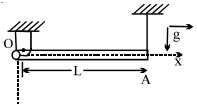
A
$\frac{2g}{L}$
B
$\frac{g}{L}$
C
$\frac{4g}{3L}$
D
None of these
Solution
(C) The center of mass $X_{cm}$ is given by:
$X_{cm} = \frac{\int x dm}{\int dm} = \frac{\int_{0}^{L} x (\lambda_0 x) dx}{\int_{0}^{L} (\lambda_0 x) dx} = \frac{\lambda_0 [x^3/3]_0^L}{\lambda_0 [x^2/2]_0^L} = \frac{L^3/3}{L^2/2} = \frac{2L}{3}$.
The total mass $M$ of the rod is:
$M = \int_{0}^{L} \lambda_0 x dx = \frac{\lambda_0 L^2}{2}$.
The moment of inertia $I$ about the hinge $O$ is:
$I = \int x^2 dm = \int_{0}^{L} x^2 (\lambda_0 x) dx = \lambda_0 \int_{0}^{L} x^3 dx = \frac{\lambda_0 L^4}{4}$.
Just after the string is cut,the torque $\tau$ about the hinge $O$ is due to gravity acting at the center of mass:
$\tau = Mg \times X_{cm} = \left( \frac{\lambda_0 L^2}{2} \right) g \left( \frac{2L}{3} \right) = \frac{\lambda_0 g L^3}{3}$.
Using the relation $\tau = I \alpha$:
$\frac{\lambda_0 g L^3}{3} = \left( \frac{\lambda_0 L^4}{4} \right) \alpha$.
Solving for $\alpha$:
$\alpha = \frac{\lambda_0 g L^3}{3} \times \frac{4}{\lambda_0 L^4} = \frac{4g}{3L}$.
$X_{cm} = \frac{\int x dm}{\int dm} = \frac{\int_{0}^{L} x (\lambda_0 x) dx}{\int_{0}^{L} (\lambda_0 x) dx} = \frac{\lambda_0 [x^3/3]_0^L}{\lambda_0 [x^2/2]_0^L} = \frac{L^3/3}{L^2/2} = \frac{2L}{3}$.
The total mass $M$ of the rod is:
$M = \int_{0}^{L} \lambda_0 x dx = \frac{\lambda_0 L^2}{2}$.
The moment of inertia $I$ about the hinge $O$ is:
$I = \int x^2 dm = \int_{0}^{L} x^2 (\lambda_0 x) dx = \lambda_0 \int_{0}^{L} x^3 dx = \frac{\lambda_0 L^4}{4}$.
Just after the string is cut,the torque $\tau$ about the hinge $O$ is due to gravity acting at the center of mass:
$\tau = Mg \times X_{cm} = \left( \frac{\lambda_0 L^2}{2} \right) g \left( \frac{2L}{3} \right) = \frac{\lambda_0 g L^3}{3}$.
Using the relation $\tau = I \alpha$:
$\frac{\lambda_0 g L^3}{3} = \left( \frac{\lambda_0 L^4}{4} \right) \alpha$.
Solving for $\alpha$:
$\alpha = \frac{\lambda_0 g L^3}{3} \times \frac{4}{\lambda_0 L^4} = \frac{4g}{3L}$.
0 likes
View Solution69
AdvancedMCQ
$A$ uniform rod of length $l$,hinged at the lower end,is free to rotate in the vertical plane. If the rod is held vertically in the beginning and then released,what is the angular acceleration of the rod when it makes an angle of $45^{\circ}$ with the horizontal? (Given: Moment of inertia $I = ml^2/3$)
A
$\frac{3g}{2\sqrt{2}l}$
B
$\frac{6g}{\sqrt{2}l}$
C
$\frac{\sqrt{2}g}{l}$
D
$\frac{2g}{l}$
Solution
(A) The torque $\tau$ acting on the rod about the hinge is given by $\tau = mg \cdot r_{\perp}$,where $r_{\perp}$ is the perpendicular distance from the hinge to the line of action of gravity.
When the rod makes an angle $\theta$ with the horizontal,the angle with the vertical is $(90^{\circ} - \theta)$. The center of mass is at $l/2$ from the hinge.
The perpendicular distance is $r_{\perp} = \frac{l}{2} \cos(90^{\circ} - \theta) = \frac{l}{2} \sin \theta$.
Using the rotational analog of Newton's second law,$\tau = I\alpha$,where $\alpha$ is the angular acceleration.
$mg \left( \frac{l}{2} \sin \theta \right) = I \alpha$.
Given $I = \frac{ml^2}{3}$,we have:
$mg \frac{l}{2} \sin \theta = \left( \frac{ml^2}{3} \right) \alpha$.
Solving for $\alpha$:
$\alpha = \frac{mg \frac{l}{2} \sin \theta}{\frac{ml^2}{3}} = \frac{3g \sin \theta}{2l}$.
For $\theta = 45^{\circ}$,$\sin 45^{\circ} = \frac{1}{\sqrt{2}}$.
$\alpha = \frac{3g}{2l} \cdot \frac{1}{\sqrt{2}} = \frac{3g}{2\sqrt{2}l}$.
When the rod makes an angle $\theta$ with the horizontal,the angle with the vertical is $(90^{\circ} - \theta)$. The center of mass is at $l/2$ from the hinge.
The perpendicular distance is $r_{\perp} = \frac{l}{2} \cos(90^{\circ} - \theta) = \frac{l}{2} \sin \theta$.
Using the rotational analog of Newton's second law,$\tau = I\alpha$,where $\alpha$ is the angular acceleration.
$mg \left( \frac{l}{2} \sin \theta \right) = I \alpha$.
Given $I = \frac{ml^2}{3}$,we have:
$mg \frac{l}{2} \sin \theta = \left( \frac{ml^2}{3} \right) \alpha$.
Solving for $\alpha$:
$\alpha = \frac{mg \frac{l}{2} \sin \theta}{\frac{ml^2}{3}} = \frac{3g \sin \theta}{2l}$.
For $\theta = 45^{\circ}$,$\sin 45^{\circ} = \frac{1}{\sqrt{2}}$.
$\alpha = \frac{3g}{2l} \cdot \frac{1}{\sqrt{2}} = \frac{3g}{2\sqrt{2}l}$.
0 likes
View Solution70
MediumMCQ
$A$ pulley of radius $2 \ m$ is rotated about its axis by a force $F = (20t - 5t^2) \ N$ (where $t$ is measured in seconds) applied tangentially. If the moment of inertia of the pulley about its axis of rotation is $10 \ kg \cdot m^2$,the number of rotations made by the pulley before its direction of motion is reversed is:
A
more than $3$ but less than $6$
B
more than $6$ but less than $9$
C
more than $9$
D
less than $3$
Solution
(A) The torque $\tau$ applied to the pulley is $\tau = F \cdot R = (20t - 5t^2) \cdot 2 = 40t - 10t^2 \ N \cdot m$.
Using $\tau = I \alpha$,we get $\alpha = \frac{\tau}{I} = \frac{40t - 10t^2}{10} = 4t - t^2 \ rad/s^2$.
Since $\alpha = \frac{d\omega}{dt}$,we integrate to find angular velocity $\omega$:
$\omega = \int (4t - t^2) dt = 2t^2 - \frac{t^3}{3}$.
The direction of motion reverses when $\omega = 0$ (at $t > 0$):
$2t^2 - \frac{t^3}{3} = 0 \Rightarrow t^2(2 - \frac{t}{3}) = 0 \Rightarrow t = 6 \ s$.
Now,find the angular displacement $\theta$ by integrating $\omega$ from $t = 0$ to $t = 6$:
$\theta = \int_0^6 (2t^2 - \frac{t^3}{3}) dt = [\frac{2t^3}{3} - \frac{t^4}{12}]_0^6 = \frac{2(216)}{3} - \frac{1296}{12} = 144 - 108 = 36 \ rad$.
The number of rotations $n = \frac{\theta}{2\pi} = \frac{36}{2\pi} = \frac{18}{\pi} \approx \frac{18}{3.14} \approx 5.73$.
Since $5.73$ is between $3$ and $6$,the correct option is $A$.
Using $\tau = I \alpha$,we get $\alpha = \frac{\tau}{I} = \frac{40t - 10t^2}{10} = 4t - t^2 \ rad/s^2$.
Since $\alpha = \frac{d\omega}{dt}$,we integrate to find angular velocity $\omega$:
$\omega = \int (4t - t^2) dt = 2t^2 - \frac{t^3}{3}$.
The direction of motion reverses when $\omega = 0$ (at $t > 0$):
$2t^2 - \frac{t^3}{3} = 0 \Rightarrow t^2(2 - \frac{t}{3}) = 0 \Rightarrow t = 6 \ s$.
Now,find the angular displacement $\theta$ by integrating $\omega$ from $t = 0$ to $t = 6$:
$\theta = \int_0^6 (2t^2 - \frac{t^3}{3}) dt = [\frac{2t^3}{3} - \frac{t^4}{12}]_0^6 = \frac{2(216)}{3} - \frac{1296}{12} = 144 - 108 = 36 \ rad$.
The number of rotations $n = \frac{\theta}{2\pi} = \frac{36}{2\pi} = \frac{18}{\pi} \approx \frac{18}{3.14} \approx 5.73$.
Since $5.73$ is between $3$ and $6$,the correct option is $A$.
0 likes
View Solution71
DifficultMCQ
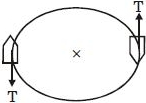
$A$ crew of scientists has built a new space station. The space station is shaped like a wheel of radius $R,$ with essentially all its mass $M$ at the rim. When the crew arrives,the station will be set rotating at a rate that causes an object at the rim to have radial acceleration $g,$ thereby simulating Earth's surface gravity. This is accomplished by two small rockets,each with thrust $T$ newtons,mounted on the station's rim. How long a time $t$ does one need to fire the rockets to achieve the desired condition?
A
$t=\frac{\sqrt{gR^3}M}{2T}$
B
$t=\frac{\sqrt{gR}M}{2T}$
C
$t=\sqrt{\frac{gR}{\pi}}\,\frac{M}{T}$
D
$t=\frac{\sqrt{gR}M}{\pi T}$
Solution
(B) The moment of inertia of the space station about its central axis is $I = MR^2.$
Two rockets,each providing a thrust $T$ at a distance $R$ from the center,create a total torque $\tau = 2TR.$
According to the angular impulse-momentum theorem,the angular impulse equals the change in angular momentum: $\int \tau dt = L_f - L_i.$
Assuming the station starts from rest $(L_i = 0)$,we have $2TRt = I\omega = MR^2\omega.$
To simulate Earth's gravity,the radial acceleration at the rim must be $g,$ so $a_r = \omega^2R = g.$
Solving for angular velocity,we get $\omega = \sqrt{\frac{g}{R}}.$
Substituting $\omega$ into the impulse equation: $2TRt = MR^2 \sqrt{\frac{g}{R}} = M\sqrt{gR^3}.$
Solving for time $t,$ we get $t = \frac{M\sqrt{gR^3}}{2TR} = \frac{M\sqrt{gR}}{2T}.$
Thus,the correct option is $B.$
Two rockets,each providing a thrust $T$ at a distance $R$ from the center,create a total torque $\tau = 2TR.$
According to the angular impulse-momentum theorem,the angular impulse equals the change in angular momentum: $\int \tau dt = L_f - L_i.$
Assuming the station starts from rest $(L_i = 0)$,we have $2TRt = I\omega = MR^2\omega.$
To simulate Earth's gravity,the radial acceleration at the rim must be $g,$ so $a_r = \omega^2R = g.$
Solving for angular velocity,we get $\omega = \sqrt{\frac{g}{R}}.$
Substituting $\omega$ into the impulse equation: $2TRt = MR^2 \sqrt{\frac{g}{R}} = M\sqrt{gR^3}.$
Solving for time $t,$ we get $t = \frac{M\sqrt{gR^3}}{2TR} = \frac{M\sqrt{gR}}{2T}.$
Thus,the correct option is $B.$
0 likes
View Solution72
MediumMCQ
$A$ wheel is rotating about an axis through its centre at $720$ revolutions per minute. It is acted on by a constant torque opposing its motion for $8$ seconds until it comes to rest. The number of revolutions made by the wheel in the $8$ seconds is:
A
$48$
B
$72$
C
$96$
D
$120$
Solution
(A) Initial angular velocity $\omega_0 = 720 \text{ rpm} = \frac{720}{60} \text{ rev/s} = 12 \text{ rev/s}$.
Final angular velocity $\omega = 0 \text{ rev/s}$.
Time taken $t = 8 \text{ s}$.
Since the torque is constant,the angular acceleration is constant,and we can use the average angular velocity formula to find the total displacement (number of revolutions $\theta$):
$\theta = \left( \frac{\omega + \omega_0}{2} \right) \times t$
$\theta = \left( \frac{0 + 12}{2} \right) \times 8$
$\theta = 6 \times 8 = 48 \text{ revolutions}$.
Final angular velocity $\omega = 0 \text{ rev/s}$.
Time taken $t = 8 \text{ s}$.
Since the torque is constant,the angular acceleration is constant,and we can use the average angular velocity formula to find the total displacement (number of revolutions $\theta$):
$\theta = \left( \frac{\omega + \omega_0}{2} \right) \times t$
$\theta = \left( \frac{0 + 12}{2} \right) \times 8$
$\theta = 6 \times 8 = 48 \text{ revolutions}$.
0 likes
View Solution73
DifficultMCQ
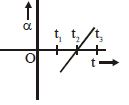
The variation of angular acceleration $\alpha$ of a point on a rigid body rotating about a fixed axis with time $t$ is shown in the figure. What is the sense of rotation of the rod? (Assume clockwise as negative)
A
Clockwise
B
Anti-clockwise
C
Any other than $1$ & $2$
D
Data insufficient
Solution
(D) The angular acceleration $\alpha$ is defined as the rate of change of angular velocity $\omega$ with respect to time $t$,i.e.,$\alpha = \frac{d\omega}{dt}$.
From the given graph,we can determine the change in angular acceleration over time,but we have no information regarding the initial angular velocity $\omega_0$ at $t = 0$.
Since the sense of rotation depends on the sign of the angular velocity $\omega(t) = \omega_0 + \int \alpha dt$,and $\omega_0$ is unknown,it is impossible to determine the direction of rotation (clockwise or anti-clockwise) from the given graph alone.
Therefore,the data provided is insufficient to conclude the sense of rotation.
From the given graph,we can determine the change in angular acceleration over time,but we have no information regarding the initial angular velocity $\omega_0$ at $t = 0$.
Since the sense of rotation depends on the sign of the angular velocity $\omega(t) = \omega_0 + \int \alpha dt$,and $\omega_0$ is unknown,it is impossible to determine the direction of rotation (clockwise or anti-clockwise) from the given graph alone.
Therefore,the data provided is insufficient to conclude the sense of rotation.
0 likes
View Solution74
DifficultMCQ
$A$ billiard ball is hit by a cue at a point distance $h$ above the centre. It acquires a linear velocity $v_0$. Let $m$ be the mass and $r$ be the radius of the ball. The angular velocity acquired by the ball is
A
$\frac{5v_0h}{2r^2}$
B
$\frac{2v_0h}{3r^2}$
C
$\frac{2v_0h}{5r^2}$
D
$\frac{2v_0h}{r^2}$
Solution
(A) The impulse $J$ applied by the cue provides both linear momentum and angular momentum to the ball.
Linear momentum: $J = mv_0$.
Angular impulse about the center of mass: $\tau \Delta t = J \times h = I \omega_0$.
Substituting $J = mv_0$,we get $mv_0h = I \omega_0$.
The moment of inertia of a solid sphere about its center is $I = \frac{2}{5}mr^2$.
Substituting $I$ into the equation: $mv_0h = (\frac{2}{5}mr^2) \omega_0$.
Solving for $\omega_0$: $\omega_0 = \frac{mv_0h}{\frac{2}{5}mr^2} = \frac{5v_0h}{2r^2}$.
Linear momentum: $J = mv_0$.
Angular impulse about the center of mass: $\tau \Delta t = J \times h = I \omega_0$.
Substituting $J = mv_0$,we get $mv_0h = I \omega_0$.
The moment of inertia of a solid sphere about its center is $I = \frac{2}{5}mr^2$.
Substituting $I$ into the equation: $mv_0h = (\frac{2}{5}mr^2) \omega_0$.
Solving for $\omega_0$: $\omega_0 = \frac{mv_0h}{\frac{2}{5}mr^2} = \frac{5v_0h}{2r^2}$.
0 likes
View Solution75
DifficultMCQ
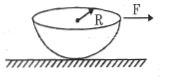
$A$ thin uniform hemispherical bowl of mass $m$ and radius $R$ is lying on a smooth horizontal surface. $A$ horizontal force $F$ is now applied perpendicular to the rim of the bowl (see figure). The instantaneous angular acceleration of the bowl will be
A
$\frac{20F}{3MR}$
B
$\frac{10F}{3MR}$
C
$\frac{40F}{3MR}$
D
$\frac{6F}{5MR}$
Solution
(D) The center of mass $(COM)$ of a thin uniform hemispherical bowl of radius $R$ is at a distance $R/2$ from the center of its circular rim.
When a horizontal force $F$ is applied at the rim,the torque $\tau$ about the $COM$ is given by $\tau = F \cdot (R/2)$.
The moment of inertia $I_{COM}$ of the hemispherical bowl about an axis passing through its $COM$ and parallel to the rim is $I_{COM} = I_{axis} - m(R/2)^2$,where $I_{axis} = (2/3)MR^2$ is the moment of inertia about the axis passing through the center of the rim.
Thus,$I_{COM} = \frac{2}{3}MR^2 - m\left(\frac{R}{2}\right)^2 = \frac{2}{3}MR^2 - \frac{1}{4}MR^2 = \frac{8-3}{12}MR^2 = \frac{5}{12}MR^2$.
Using the relation $\tau = I_{COM} \cdot \alpha$,we have:
$F \cdot \frac{R}{2} = \left(\frac{5}{12}MR^2\right) \alpha$
$\alpha = \frac{F \cdot R / 2}{5/12 \cdot MR^2} = \frac{F \cdot R}{2} \cdot \frac{12}{5MR^2} = \frac{6F}{5MR}$.
When a horizontal force $F$ is applied at the rim,the torque $\tau$ about the $COM$ is given by $\tau = F \cdot (R/2)$.
The moment of inertia $I_{COM}$ of the hemispherical bowl about an axis passing through its $COM$ and parallel to the rim is $I_{COM} = I_{axis} - m(R/2)^2$,where $I_{axis} = (2/3)MR^2$ is the moment of inertia about the axis passing through the center of the rim.
Thus,$I_{COM} = \frac{2}{3}MR^2 - m\left(\frac{R}{2}\right)^2 = \frac{2}{3}MR^2 - \frac{1}{4}MR^2 = \frac{8-3}{12}MR^2 = \frac{5}{12}MR^2$.
Using the relation $\tau = I_{COM} \cdot \alpha$,we have:
$F \cdot \frac{R}{2} = \left(\frac{5}{12}MR^2\right) \alpha$
$\alpha = \frac{F \cdot R / 2}{5/12 \cdot MR^2} = \frac{F \cdot R}{2} \cdot \frac{12}{5MR^2} = \frac{6F}{5MR}$.
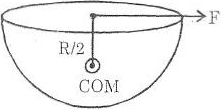
0 likes
View Solution76
DifficultMCQ
$A$ pulley of radius $2 \ m$ is rotated about its axis by a force $F = (20t - 5t^2) \ N$ (where $t$ is measured in seconds) applied tangentially. If the moment of inertia of the pulley about its axis of rotation is $10 \ kg \ m^2$,the number of rotations made by the pulley before its direction of motion is reversed is approximately equal to: (in $.5$)
A
$5$
B
$8$
C
$11$
D
$14$
Solution
(A) The torque $\tau$ is given by $\tau = F \cdot R = I \alpha$.
Given $F = (20t - 5t^2) \ N$,$R = 2 \ m$,and $I = 10 \ kg \ m^2$.
$(20t - 5t^2) \cdot 2 = 10 \alpha \implies \alpha = 4t - t^2$.
Integrating $\alpha$ with respect to time to find angular velocity $\omega$:
$\omega = \int (4t - t^2) dt = 2t^2 - \frac{t^3}{3}$.
Integrating $\omega$ with respect to time to find angular displacement $\theta$:
$\theta = \int (2t^2 - \frac{t^3}{3}) dt = \frac{2t^3}{3} - \frac{t^4}{12}$.
The direction of motion reverses when $\omega = 0$:
$2t^2 - \frac{t^3}{3} = 0 \implies t^2(2 - \frac{t}{3}) = 0 \implies t = 6 \ s$.
Calculating angular displacement at $t = 6 \ s$:
$\theta = \frac{2(6)^3}{3} - \frac{6^4}{12} = \frac{2 \cdot 216}{3} - \frac{1296}{12} = 144 - 108 = 36 \ rad$.
Number of rotations $N = \frac{\theta}{2\pi} = \frac{36}{2\pi} = \frac{18}{\pi} \approx 5.73$.
Given $F = (20t - 5t^2) \ N$,$R = 2 \ m$,and $I = 10 \ kg \ m^2$.
$(20t - 5t^2) \cdot 2 = 10 \alpha \implies \alpha = 4t - t^2$.
Integrating $\alpha$ with respect to time to find angular velocity $\omega$:
$\omega = \int (4t - t^2) dt = 2t^2 - \frac{t^3}{3}$.
Integrating $\omega$ with respect to time to find angular displacement $\theta$:
$\theta = \int (2t^2 - \frac{t^3}{3}) dt = \frac{2t^3}{3} - \frac{t^4}{12}$.
The direction of motion reverses when $\omega = 0$:
$2t^2 - \frac{t^3}{3} = 0 \implies t^2(2 - \frac{t}{3}) = 0 \implies t = 6 \ s$.
Calculating angular displacement at $t = 6 \ s$:
$\theta = \frac{2(6)^3}{3} - \frac{6^4}{12} = \frac{2 \cdot 216}{3} - \frac{1296}{12} = 144 - 108 = 36 \ rad$.
Number of rotations $N = \frac{\theta}{2\pi} = \frac{36}{2\pi} = \frac{18}{\pi} \approx 5.73$.
0 likes
View Solution77
DifficultMCQ
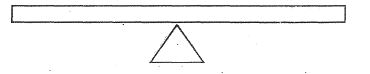
$A$ uniform rod of mass $m$ and length $2l$ is balanced on a triangular prism. Now,a length of $l/2$ is cut from one end of the rod and placed over the shortened part such that the ends meet. The initial angular acceleration is:
A
$\frac{3g}{5l}$
B
$\frac{2g}{3l}$
C
$\frac{3g}{7l}$
D
$\frac{5g}{7l}$
Solution
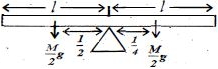
(A) The original rod has mass $m$ and length $2l$. After cutting a length $l/2$ (mass $m/4$),the remaining rod has length $3l/2$ and mass $3m/4$. The cut piece of length $l/2$ is placed on top of the remaining rod. The pivot is at the center of the original rod.
The moment of inertia $I$ about the pivot is:
$I = I_{\text{rod}} + I_{\text{piece}} = \left[ \frac{1}{12} \left( \frac{3m}{4} \right) \left( \frac{3l}{2} \right)^2 + \left( \frac{3m}{4} \right) \left( \frac{l}{4} \right)^2 \right] + \left[ \frac{1}{12} \left( \frac{m}{4} \right) \left( \frac{l}{2} \right)^2 + \left( \frac{m}{4} \right) \left( \frac{l}{4} \right)^2 \right]$
$= \frac{3m}{4} \left( \frac{3l^2}{16} + \frac{l^2}{16} \right) + \frac{m}{4} \left( \frac{l^2}{48} + \frac{l^2}{16} \right) = \frac{3m}{4} \left( \frac{4l^2}{16} \right) + \frac{m}{4} \left( \frac{4l^2}{48} \right) = \frac{3ml^2}{16} + \frac{ml^2}{48} = \frac{9ml^2 + ml^2}{48} = \frac{10ml^2}{48} = \frac{5ml^2}{24}$.
The torque $\tau$ about the pivot is:
$\tau = \left( \frac{3m}{4} \right) g \left( \frac{l}{4} \right) - \left( \frac{m}{4} \right) g \left( \frac{l}{4} \right) = \frac{2mg}{4} \cdot \frac{l}{4} = \frac{mgl}{8}$.
Using $\tau = I\alpha$:
$\frac{mgl}{8} = \left( \frac{5ml^2}{24} \right) \alpha \implies \alpha = \frac{mgl}{8} \cdot \frac{24}{5ml^2} = \frac{3g}{5l}$.
The moment of inertia $I$ about the pivot is:
$I = I_{\text{rod}} + I_{\text{piece}} = \left[ \frac{1}{12} \left( \frac{3m}{4} \right) \left( \frac{3l}{2} \right)^2 + \left( \frac{3m}{4} \right) \left( \frac{l}{4} \right)^2 \right] + \left[ \frac{1}{12} \left( \frac{m}{4} \right) \left( \frac{l}{2} \right)^2 + \left( \frac{m}{4} \right) \left( \frac{l}{4} \right)^2 \right]$
$= \frac{3m}{4} \left( \frac{3l^2}{16} + \frac{l^2}{16} \right) + \frac{m}{4} \left( \frac{l^2}{48} + \frac{l^2}{16} \right) = \frac{3m}{4} \left( \frac{4l^2}{16} \right) + \frac{m}{4} \left( \frac{4l^2}{48} \right) = \frac{3ml^2}{16} + \frac{ml^2}{48} = \frac{9ml^2 + ml^2}{48} = \frac{10ml^2}{48} = \frac{5ml^2}{24}$.
The torque $\tau$ about the pivot is:
$\tau = \left( \frac{3m}{4} \right) g \left( \frac{l}{4} \right) - \left( \frac{m}{4} \right) g \left( \frac{l}{4} \right) = \frac{2mg}{4} \cdot \frac{l}{4} = \frac{mgl}{8}$.
Using $\tau = I\alpha$:
$\frac{mgl}{8} = \left( \frac{5ml^2}{24} \right) \alpha \implies \alpha = \frac{mgl}{8} \cdot \frac{24}{5ml^2} = \frac{3g}{5l}$.
0 likes
View Solution78
MediumMCQ
$A$ torque of $50\, Nm$ acting on a wheel at rest rotates it through $200\, rad$ in $5\, s$. Calculate the angular acceleration produced. ........... $rad\, s^{-2}$.
A
$8$
B
$4$
C
$16$
D
$12$
Solution
(C) Given:
Initial angular velocity,$\omega_{0} = 0\, rad/s$ (since the wheel is at rest).
Angular displacement,$\theta = 200\, rad$.
Time,$t = 5\, s$.
Using the kinematic equation for rotational motion:
$\theta = \omega_{0} t + \frac{1}{2} \alpha t^{2}$
Since $\omega_{0} = 0$,the equation simplifies to:
$\theta = \frac{1}{2} \alpha t^{2}$
Rearranging to solve for angular acceleration $\alpha$:
$\alpha = \frac{2 \theta}{t^{2}}$
Substituting the given values:
$\alpha = \frac{2 \times 200}{(5)^{2}} = \frac{400}{25} = 16\, rad/s^{2}$.
Initial angular velocity,$\omega_{0} = 0\, rad/s$ (since the wheel is at rest).
Angular displacement,$\theta = 200\, rad$.
Time,$t = 5\, s$.
Using the kinematic equation for rotational motion:
$\theta = \omega_{0} t + \frac{1}{2} \alpha t^{2}$
Since $\omega_{0} = 0$,the equation simplifies to:
$\theta = \frac{1}{2} \alpha t^{2}$
Rearranging to solve for angular acceleration $\alpha$:
$\alpha = \frac{2 \theta}{t^{2}}$
Substituting the given values:
$\alpha = \frac{2 \times 200}{(5)^{2}} = \frac{400}{25} = 16\, rad/s^{2}$.
0 likes
View Solution79
DifficultMCQ
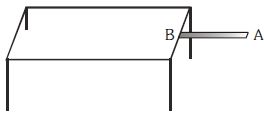
$A$ thin uniform stick of length $l$ and mass $m$ is held horizontally with its end $B$ hinged on the edge of a table. Point $A$ is suddenly released. The acceleration of the centre of mass of the stick at the time of release is:
A
$\frac{3}{4} g$
B
$\frac{3}{7} g$
C
$\frac{2}{7} g$
D
$\frac{1}{7} g$
Solution
(A) The torque $\tau$ about the hinge point $B$ due to gravity acting at the centre of mass (at distance $l/2$ from $B$) is given by $\tau = mg \times \frac{l}{2}$.
Using the rotational form of Newton's second law,$\tau = I\alpha$,where $I$ is the moment of inertia of the stick about the hinge $B$ $(I = \frac{ml^2}{3})$.
Thus,$\alpha = \frac{\tau}{I} = \frac{mg(l/2)}{ml^2/3} = \frac{3g}{2l}$.
The linear acceleration $a$ of the centre of mass is given by $a = \alpha r$,where $r = l/2$ is the distance of the centre of mass from the hinge.
Therefore,$a = \left(\frac{3g}{2l}\right) \times \left(\frac{l}{2}\right) = \frac{3}{4} g$.
Using the rotational form of Newton's second law,$\tau = I\alpha$,where $I$ is the moment of inertia of the stick about the hinge $B$ $(I = \frac{ml^2}{3})$.
Thus,$\alpha = \frac{\tau}{I} = \frac{mg(l/2)}{ml^2/3} = \frac{3g}{2l}$.
The linear acceleration $a$ of the centre of mass is given by $a = \alpha r$,where $r = l/2$ is the distance of the centre of mass from the hinge.
Therefore,$a = \left(\frac{3g}{2l}\right) \times \left(\frac{l}{2}\right) = \frac{3}{4} g$.
0 likes
View Solution80
MediumMCQ
$A$ uniform rod of mass $M$ and length $L$ is hinged at one end as shown in the figure. Initially,the rod is kept horizontal by a massless string. When the string is cut,the angular acceleration of the rod is:
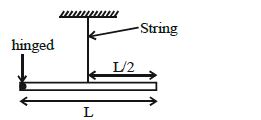
A
$\frac{6g}{L}$
B
$\frac{3g}{2L}$
C
$\frac{3g}{3L}$
D
$\frac{g}{6L}$
Solution
(B) When the string is cut,the only torque acting on the rod about the hinge is due to the gravitational force acting at the center of mass of the rod.
The torque $\tau$ about the hinge is given by $\tau = Mg \cdot \frac{L}{2}$.
The moment of inertia $I$ of a uniform rod of mass $M$ and length $L$ about an axis passing through one end is $I = \frac{ML^2}{3}$.
Using the rotational analogue of Newton's second law,$\tau = I \alpha$,where $\alpha$ is the angular acceleration:
$Mg \cdot \frac{L}{2} = \left( \frac{ML^2}{3} \right) \alpha$
Solving for $\alpha$:
$\alpha = \frac{MgL/2}{ML^2/3} = \frac{3g}{2L}$.
The torque $\tau$ about the hinge is given by $\tau = Mg \cdot \frac{L}{2}$.
The moment of inertia $I$ of a uniform rod of mass $M$ and length $L$ about an axis passing through one end is $I = \frac{ML^2}{3}$.
Using the rotational analogue of Newton's second law,$\tau = I \alpha$,where $\alpha$ is the angular acceleration:
$Mg \cdot \frac{L}{2} = \left( \frac{ML^2}{3} \right) \alpha$
Solving for $\alpha$:
$\alpha = \frac{MgL/2}{ML^2/3} = \frac{3g}{2L}$.
0 likes
View Solution81
MediumMCQ
$A$ rope of negligible mass is wound round a hollow cylinder of mass $3 \, kg$ and radius $40 \, cm$. If the rope is pulled with a force of $30 \, N$,then the angular acceleration produced in the cylinder is ........ $rad \, s^{-2}$.
A
$15$
B
$20$
C
$25$
D
$30$
Solution
(C) Given: Mass of the hollow cylinder $M = 3 \, kg$.
Radius of the hollow cylinder $R = 40 \, cm = 0.4 \, m$.
Force applied $F = 30 \, N$.
The torque $\tau$ produced by the force is given by $\tau = F \times R$.
$\tau = 30 \, N \times 0.4 \, m = 12 \, Nm$.
The moment of inertia $I$ of a hollow cylinder about its central axis is $I = MR^2$.
$I = 3 \, kg \times (0.4 \, m)^2 = 3 \times 0.16 = 0.48 \, kg \, m^2$.
Using the relation $\tau = I \alpha$,where $\alpha$ is the angular acceleration:
$\alpha = \frac{\tau}{I} = \frac{12 \, Nm}{0.48 \, kg \, m^2} = 25 \, rad \, s^{-2}$.
Radius of the hollow cylinder $R = 40 \, cm = 0.4 \, m$.
Force applied $F = 30 \, N$.
The torque $\tau$ produced by the force is given by $\tau = F \times R$.
$\tau = 30 \, N \times 0.4 \, m = 12 \, Nm$.
The moment of inertia $I$ of a hollow cylinder about its central axis is $I = MR^2$.
$I = 3 \, kg \times (0.4 \, m)^2 = 3 \times 0.16 = 0.48 \, kg \, m^2$.
Using the relation $\tau = I \alpha$,where $\alpha$ is the angular acceleration:
$\alpha = \frac{\tau}{I} = \frac{12 \, Nm}{0.48 \, kg \, m^2} = 25 \, rad \, s^{-2}$.
0 likes
View Solution82
MediumMCQ
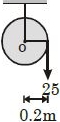
$A$ string is wound around the rim of a mounted flywheel (disc) of mass $20 \, kg$ and radius $20 \, cm$. $A$ steady pull of $25 \, N$ is applied on the cord. Neglecting friction and the mass of the string,the angular acceleration of the wheel in $rad/s^2$ is
A
$50$
B
$25$
C
$12.5$
D
$6.25$
Solution
(C) Given: Mass of the disc $M = 20 \, kg$,Radius $R = 20 \, cm = 0.2 \, m$,Force $F = 25 \, N$.
The torque $\tau$ applied to the flywheel is given by $\tau = F \times R$.
$\tau = 25 \, N \times 0.2 \, m = 5 \, N \cdot m$.
The moment of inertia $I$ of a disc about its central axis is $I = \frac{1}{2} M R^2$.
$I = \frac{1}{2} \times 20 \times (0.2)^2 = 10 \times 0.04 = 0.4 \, kg \cdot m^2$.
Using the rotational analogue of Newton's second law,$\tau = I \alpha$,where $\alpha$ is the angular acceleration:
$5 = 0.4 \times \alpha$.
$\alpha = \frac{5}{0.4} = 12.5 \, rad/s^2$.
The torque $\tau$ applied to the flywheel is given by $\tau = F \times R$.
$\tau = 25 \, N \times 0.2 \, m = 5 \, N \cdot m$.
The moment of inertia $I$ of a disc about its central axis is $I = \frac{1}{2} M R^2$.
$I = \frac{1}{2} \times 20 \times (0.2)^2 = 10 \times 0.04 = 0.4 \, kg \cdot m^2$.
Using the rotational analogue of Newton's second law,$\tau = I \alpha$,where $\alpha$ is the angular acceleration:
$5 = 0.4 \times \alpha$.
$\alpha = \frac{5}{0.4} = 12.5 \, rad/s^2$.
0 likes
View Solution83
MediumMCQ
$A$ flywheel of moment of inertia $0.4 \, kg \, m^2$ and radius $0.2 \, m$ is free to rotate about a central axis. If a string is wrapped around it and it is pulled with a force of $10 \, N$,then the angular velocity after $4 \, s$ will be ......... $rad \, s^{-1}$.
A
$10$
B
$5$
C
$20$
D
$25$
Solution
(C) The torque $\tau$ applied to the flywheel is given by $\tau = F \times r$.
Given $F = 10 \, N$ and $r = 0.2 \, m$,we have $\tau = 10 \times 0.2 = 2 \, N \cdot m$.
From the relation $\tau = I \alpha$,where $I = 0.4 \, kg \cdot m^2$ is the moment of inertia and $\alpha$ is the angular acceleration,we get $\alpha = \frac{\tau}{I} = \frac{2}{0.4} = 5 \, rad \cdot s^{-2}$.
Assuming the flywheel starts from rest $(\omega_1 = 0)$,the angular velocity $\omega_2$ after time $t = 4 \, s$ is given by $\omega_2 = \omega_1 + \alpha t$.
Substituting the values,$\omega_2 = 0 + (5 \times 4) = 20 \, rad \cdot s^{-1}$.
Given $F = 10 \, N$ and $r = 0.2 \, m$,we have $\tau = 10 \times 0.2 = 2 \, N \cdot m$.
From the relation $\tau = I \alpha$,where $I = 0.4 \, kg \cdot m^2$ is the moment of inertia and $\alpha$ is the angular acceleration,we get $\alpha = \frac{\tau}{I} = \frac{2}{0.4} = 5 \, rad \cdot s^{-2}$.
Assuming the flywheel starts from rest $(\omega_1 = 0)$,the angular velocity $\omega_2$ after time $t = 4 \, s$ is given by $\omega_2 = \omega_1 + \alpha t$.
Substituting the values,$\omega_2 = 0 + (5 \times 4) = 20 \, rad \cdot s^{-1}$.
0 likes
View Solution84
MediumMCQ
If $I = 50\,kg-m^2$,then how much torque (in $N-m$) must be applied to stop it in $10\,s$,given its initial angular speed is $20\,rad/s$?
A
$100$
B
$150$
C
$200$
D
$250$
Solution
(A) Given: Moment of inertia $I = 50\,kg-m^2$,initial angular velocity $\omega_i = 20\,rad/s$,final angular velocity $\omega_f = 0\,rad/s$,and time $t = 10\,s$.
The angular acceleration $\alpha$ is given by $\alpha = \frac{\omega_f - \omega_i}{t} = \frac{0 - 20}{10} = -2\,rad/s^2$.
The torque $\tau$ is given by $\tau = I \alpha$.
Substituting the values: $\tau = 50 \times (-2) = -100\,N-m$.
The magnitude of the torque required to stop the object is $100\,N-m$.
The angular acceleration $\alpha$ is given by $\alpha = \frac{\omega_f - \omega_i}{t} = \frac{0 - 20}{10} = -2\,rad/s^2$.
The torque $\tau$ is given by $\tau = I \alpha$.
Substituting the values: $\tau = 50 \times (-2) = -100\,N-m$.
The magnitude of the torque required to stop the object is $100\,N-m$.
0 likes
View Solution85
MediumMCQ
Consider a particle of mass $m$ having linear momentum $\vec{p}$ at position $\vec{r}$ relative to the origin $O$. Let $\vec{L}$ be the angular momentum of the particle with respect to the origin. Which of the following equations correctly relate $\vec{r}, \vec{p}$ and $\vec{L}$?
A
$\frac{d\vec{L}}{dt} + \vec{r} \times \frac{d\vec{p}}{dt} = 0$
B
$\frac{d\vec{L}}{dt} + \frac{d\vec{r}}{dt} \times \vec{p} = 0$
C
$\frac{d\vec{L}}{dt} - \frac{d\vec{r}}{dt} \times \vec{p} = 0$
D
$\frac{d\vec{L}}{dt} - \vec{r} \times \frac{d\vec{p}}{dt} = 0$
Solution
(D) The angular momentum $\vec{L}$ is defined as $\vec{L} = \vec{r} \times \vec{p}$.
Differentiating both sides with respect to time $t$,we get:
$\frac{d\vec{L}}{dt} = \frac{d}{dt}(\vec{r} \times \vec{p})$
Using the product rule for cross products:
$\frac{d\vec{L}}{dt} = \left(\frac{d\vec{r}}{dt} \times \vec{p}\right) + \left(\vec{r} \times \frac{d\vec{p}}{dt}\right)$
Since velocity $\vec{v} = \frac{d\vec{r}}{dt}$ and linear momentum $\vec{p} = m\vec{v}$,the term $\frac{d\vec{r}}{dt} \times \vec{p}$ becomes $\vec{v} \times (m\vec{v}) = 0$ because the cross product of parallel vectors is zero.
Therefore,$\frac{d\vec{L}}{dt} = 0 + \vec{r} \times \frac{d\vec{p}}{dt}$.
Rearranging the terms,we get $\frac{d\vec{L}}{dt} - \vec{r} \times \frac{d\vec{p}}{dt} = 0$.
Differentiating both sides with respect to time $t$,we get:
$\frac{d\vec{L}}{dt} = \frac{d}{dt}(\vec{r} \times \vec{p})$
Using the product rule for cross products:
$\frac{d\vec{L}}{dt} = \left(\frac{d\vec{r}}{dt} \times \vec{p}\right) + \left(\vec{r} \times \frac{d\vec{p}}{dt}\right)$
Since velocity $\vec{v} = \frac{d\vec{r}}{dt}$ and linear momentum $\vec{p} = m\vec{v}$,the term $\frac{d\vec{r}}{dt} \times \vec{p}$ becomes $\vec{v} \times (m\vec{v}) = 0$ because the cross product of parallel vectors is zero.
Therefore,$\frac{d\vec{L}}{dt} = 0 + \vec{r} \times \frac{d\vec{p}}{dt}$.
Rearranging the terms,we get $\frac{d\vec{L}}{dt} - \vec{r} \times \frac{d\vec{p}}{dt} = 0$.
0 likes
View Solution86
EasyMCQ
If $I, \alpha$ and $\tau$ are the moment of inertia,angular acceleration,and torque respectively of a body rotating about an axis with angular velocity $\omega$,then:
A
$\tau = I\alpha$
B
$\tau = I\omega$
C
$I = \tau\omega$
D
$\alpha = \tau\omega$
Solution
(A) The rotational analogue of Newton's second law of motion $(F = ma)$ relates torque,moment of inertia,and angular acceleration.
For a rigid body rotating about a fixed axis,the torque $\tau$ is defined as the product of the moment of inertia $I$ and the angular acceleration $\alpha$.
Mathematically,this is expressed as $\tau = I\alpha$.
Therefore,the correct relation is $\tau = I\alpha$.
For a rigid body rotating about a fixed axis,the torque $\tau$ is defined as the product of the moment of inertia $I$ and the angular acceleration $\alpha$.
Mathematically,this is expressed as $\tau = I\alpha$.
Therefore,the correct relation is $\tau = I\alpha$.
0 likes
View Solution87
DifficultMCQ
In the figure $(a)$,half of the meter scale is made of wood while the other half is made of steel. The wooden part is pivoted at $O$. $A$ force $F$ is applied at the end of the steel part. In figure $(b)$,the steel part is pivoted at $O'$ and the same force $F$ is applied at the wooden end (in a horizontal plane). Which of the following is true?
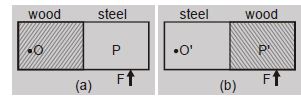
A
more angular acceleration will be produced in $(a)$
B
more angular acceleration will be produced in $(b)$
C
same angular acceleration will be produced in both conditions
D
information is incomplete
Solution
(B) The angular acceleration $\alpha$ is given by the relation $\tau = I \alpha$,where $\tau$ is the torque and $I$ is the moment of inertia. Thus,$\alpha = \frac{\tau}{I}$.
In both cases,the torque $\tau = F \times L$ is the same,where $L$ is the total length of the scale.
Let $m_w$ be the mass of the wooden half and $m_s$ be the mass of the steel half. Since steel is denser than wood,$m_s > m_w$.
In case $(a)$,the pivot is at the center of the wooden part. The moment of inertia $I_a$ is the sum of the moment of inertia of the wooden part about $O$ and the steel part about $O$.
In case $(b)$,the pivot is at the center of the steel part. The moment of inertia $I_b$ is the sum of the moment of inertia of the steel part about $O'$ and the wooden part about $O'$.
Since the heavier mass (steel) is closer to the pivot in case $(b)$,the moment of inertia $I_b$ is less than $I_a$ $(I_b < I_a)$.
Since $\alpha \propto \frac{1}{I}$,a smaller moment of inertia results in a larger angular acceleration. Therefore,more angular acceleration will be produced in $(b)$.
In both cases,the torque $\tau = F \times L$ is the same,where $L$ is the total length of the scale.
Let $m_w$ be the mass of the wooden half and $m_s$ be the mass of the steel half. Since steel is denser than wood,$m_s > m_w$.
In case $(a)$,the pivot is at the center of the wooden part. The moment of inertia $I_a$ is the sum of the moment of inertia of the wooden part about $O$ and the steel part about $O$.
In case $(b)$,the pivot is at the center of the steel part. The moment of inertia $I_b$ is the sum of the moment of inertia of the steel part about $O'$ and the wooden part about $O'$.
Since the heavier mass (steel) is closer to the pivot in case $(b)$,the moment of inertia $I_b$ is less than $I_a$ $(I_b < I_a)$.
Since $\alpha \propto \frac{1}{I}$,a smaller moment of inertia results in a larger angular acceleration. Therefore,more angular acceleration will be produced in $(b)$.
0 likes
View Solution88
MediumMCQ
$A$ wheel has a moment of inertia $5 \times 10^{-3} \, kg \, m^2$ and is making $20 \, rev/sec$. The torque needed to stop it in $10 \, sec$ is $............. \times 10^{-2} \, N-m$. (in $\pi$)
A
$2$
B
$2.5$
C
$4$
D
$4.5$
Solution
(A) Given: Moment of inertia $I = 5 \times 10^{-3} \, kg \, m^2$, initial frequency $n = 20 \, rev/sec$, time $t = 10 \, sec$, final angular velocity $\omega_f = 0$.
Initial angular velocity $\omega_i = 2 \pi n = 2 \pi \times 20 = 40 \pi \, rad/sec$.
Using the equation of rotational motion $\omega_f = \omega_i + \alpha t$, we get $0 = 40 \pi + \alpha \times 10$.
Thus, angular acceleration $\alpha = -4 \pi \, rad/sec^2$.
The magnitude of torque required is $\tau = |I \alpha| = 5 \times 10^{-3} \times 4 \pi = 20 \pi \times 10^{-3} = 2 \pi \times 10^{-2} \, N-m$.
Therefore, the required value is $2 \pi$.
Initial angular velocity $\omega_i = 2 \pi n = 2 \pi \times 20 = 40 \pi \, rad/sec$.
Using the equation of rotational motion $\omega_f = \omega_i + \alpha t$, we get $0 = 40 \pi + \alpha \times 10$.
Thus, angular acceleration $\alpha = -4 \pi \, rad/sec^2$.
The magnitude of torque required is $\tau = |I \alpha| = 5 \times 10^{-3} \times 4 \pi = 20 \pi \times 10^{-3} = 2 \pi \times 10^{-2} \, N-m$.
Therefore, the required value is $2 \pi$.
0 likes
View Solution89
MediumMCQ
$A$ rod of length $50\,cm$ is pivoted at one end. It is raised such that it makes an angle of $30^o$ from the horizontal as shown and released from rest. Its angular speed when it passes through the horizontal (in $rad\,s^{-1}$) will be $(g = 10\,ms^{-2})$.
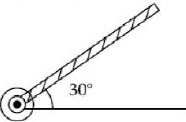
A
$\sqrt{\frac{30}{2}}$
B
$\sqrt{30}$
C
$\sqrt{\frac{20}{2}}$
D
$\frac{\sqrt{30}}{2}$
Solution
(B) Let the length of the rod be $\ell = 0.5\,m$. The center of mass of the rod is at a distance $\frac{\ell}{2}$ from the pivot.
When the rod is at an angle of $30^o$ with the horizontal,the vertical height of the center of mass above the horizontal position is $h = \frac{\ell}{2} \sin(30^o) = \frac{\ell}{2} \times \frac{1}{2} = \frac{\ell}{4}$.
By the law of conservation of mechanical energy,the loss in potential energy equals the gain in rotational kinetic energy:
$mg h = \frac{1}{2} I \omega^2$
Where $I = \frac{m\ell^2}{3}$ is the moment of inertia of the rod about the pivot.
$mg \left( \frac{\ell}{4} \right) = \frac{1}{2} \left( \frac{m\ell^2}{3} \right) \omega^2$
$g \frac{\ell}{4} = \frac{\ell^2}{6} \omega^2$
$\omega^2 = \frac{6g}{4\ell} = \frac{3g}{2\ell}$
Substituting $g = 10\,ms^{-2}$ and $\ell = 0.5\,m$:
$\omega^2 = \frac{3 \times 10}{2 \times 0.5} = \frac{30}{1} = 30$
$\omega = \sqrt{30}\,rad\,s^{-1}$.
When the rod is at an angle of $30^o$ with the horizontal,the vertical height of the center of mass above the horizontal position is $h = \frac{\ell}{2} \sin(30^o) = \frac{\ell}{2} \times \frac{1}{2} = \frac{\ell}{4}$.
By the law of conservation of mechanical energy,the loss in potential energy equals the gain in rotational kinetic energy:
$mg h = \frac{1}{2} I \omega^2$
Where $I = \frac{m\ell^2}{3}$ is the moment of inertia of the rod about the pivot.
$mg \left( \frac{\ell}{4} \right) = \frac{1}{2} \left( \frac{m\ell^2}{3} \right) \omega^2$
$g \frac{\ell}{4} = \frac{\ell^2}{6} \omega^2$
$\omega^2 = \frac{6g}{4\ell} = \frac{3g}{2\ell}$
Substituting $g = 10\,ms^{-2}$ and $\ell = 0.5\,m$:
$\omega^2 = \frac{3 \times 10}{2 \times 0.5} = \frac{30}{1} = 30$
$\omega = \sqrt{30}\,rad\,s^{-1}$.
0 likes
View Solution90
DifficultMCQ
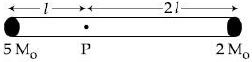
$A$ rigid massless rod of length $3l$ has two masses attached at each end as shown in the figure. The rod is pivoted at point $P$ on the horizontal axis (see figure). When released from the initial horizontal position,its instantaneous angular acceleration will be
A
$\frac{g}{13l}$
B
$\frac{g}{3l}$
C
$\frac{g}{2l}$
D
$\frac{7g}{3l}$
Solution
(A) The net torque $\tau$ about the pivot point $P$ is given by the difference in torques due to the two masses.
$\tau = (5M_0g)(l) - (2M_0g)(2l) = 5M_0gl - 4M_0gl = M_0gl$.
The moment of inertia $I$ about the pivot point $P$ is the sum of the moments of inertia of the two masses.
$I = (5M_0)(l)^2 + (2M_0)(2l)^2 = 5M_0l^2 + 8M_0l^2 = 13M_0l^2$.
The angular acceleration $\alpha$ is given by $\alpha = \frac{\tau}{I}$.
Substituting the values,$\alpha = \frac{M_0gl}{13M_0l^2} = \frac{g}{13l}$.
$\tau = (5M_0g)(l) - (2M_0g)(2l) = 5M_0gl - 4M_0gl = M_0gl$.
The moment of inertia $I$ about the pivot point $P$ is the sum of the moments of inertia of the two masses.
$I = (5M_0)(l)^2 + (2M_0)(2l)^2 = 5M_0l^2 + 8M_0l^2 = 13M_0l^2$.
The angular acceleration $\alpha$ is given by $\alpha = \frac{\tau}{I}$.
Substituting the values,$\alpha = \frac{M_0gl}{13M_0l^2} = \frac{g}{13l}$.
0 likes
View Solution91
DifficultMCQ
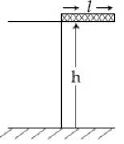
$A$ rectangular solid rod of length $0.3\, m$ is held horizontally,with one of its sides on the edge of a platform of height $5\, m$. When released,it slips off the table in a very short time $\Delta t = 0.01\, s$,remaining essentially horizontal. The angle by which it would rotate when it hits the ground will be (in radians) close to:
A
$0.5$
B
$0.6$
C
$0.02$
D
$0.28$
Solution
(A) The angular impulse is equal to the change in angular momentum.
$\tau \Delta t = \Delta L$
Taking the edge of the table as the pivot point,the torque due to gravity is $\tau = mg \frac{\ell}{2}$.
$mg \frac{\ell}{2} \Delta t = I \omega$
Since the rod rotates about the edge,its moment of inertia is $I = \frac{m\ell^2}{3}$.
$mg \frac{\ell}{2} \Delta t = \frac{m\ell^2}{3} \omega$
$\omega = \frac{3g \Delta t}{2\ell} = \frac{3 \times 10 \times 0.01}{2 \times 0.3} = \frac{0.3}{0.6} = 0.5\, rad/s$
Time taken by the rod to hit the ground is $t = \sqrt{\frac{2h}{g}} = \sqrt{\frac{2 \times 5}{10}} = 1\, s$.
The angle rotated by the rod during this time is $\theta = \omega t = 0.5 \times 1 = 0.5\, radian$.
$\tau \Delta t = \Delta L$
Taking the edge of the table as the pivot point,the torque due to gravity is $\tau = mg \frac{\ell}{2}$.
$mg \frac{\ell}{2} \Delta t = I \omega$
Since the rod rotates about the edge,its moment of inertia is $I = \frac{m\ell^2}{3}$.
$mg \frac{\ell}{2} \Delta t = \frac{m\ell^2}{3} \omega$
$\omega = \frac{3g \Delta t}{2\ell} = \frac{3 \times 10 \times 0.01}{2 \times 0.3} = \frac{0.3}{0.6} = 0.5\, rad/s$
Time taken by the rod to hit the ground is $t = \sqrt{\frac{2h}{g}} = \sqrt{\frac{2 \times 5}{10}} = 1\, s$.
The angle rotated by the rod during this time is $\theta = \omega t = 0.5 \times 1 = 0.5\, radian$.
0 likes
View Solution92
DifficultMCQ
$A$ stationary horizontal disc is free to rotate about its axis. When a torque is applied on it,its kinetic energy as a function of $\theta,$ where $\theta$ is the angle by which it has rotated,is given as $K\theta^2.$ If its moment of inertia is $I,$ then the angular acceleration of the disc is
A
$\frac{K}{I}\theta$
B
$\frac{K}{2I}\theta$
C
$\frac{K}{4I}\theta$
D
$\frac{2K}{I}\theta$
Solution
(D) The rotational kinetic energy of the disc is given by $KE = \frac{1}{2}I\omega^2 = K\theta^2.$
From this,we can express the angular velocity $\omega$ as:
$\omega^2 = \frac{2K\theta^2}{I} \implies \omega = \sqrt{\frac{2K}{I}}\theta \quad \dots(1)$
Angular acceleration $\alpha$ is the rate of change of angular velocity with respect to time:
$\alpha = \frac{d\omega}{dt} = \frac{d}{dt}\left( \sqrt{\frac{2K}{I}}\theta \right) = \sqrt{\frac{2K}{I}} \frac{d\theta}{dt}$
Since $\frac{d\theta}{dt} = \omega,$ we substitute the expression for $\omega$ from equation $(1)$:
$\alpha = \sqrt{\frac{2K}{I}} \left( \sqrt{\frac{2K}{I}}\theta \right)$
$\alpha = \frac{2K}{I}\theta.$
From this,we can express the angular velocity $\omega$ as:
$\omega^2 = \frac{2K\theta^2}{I} \implies \omega = \sqrt{\frac{2K}{I}}\theta \quad \dots(1)$
Angular acceleration $\alpha$ is the rate of change of angular velocity with respect to time:
$\alpha = \frac{d\omega}{dt} = \frac{d}{dt}\left( \sqrt{\frac{2K}{I}}\theta \right) = \sqrt{\frac{2K}{I}} \frac{d\theta}{dt}$
Since $\frac{d\theta}{dt} = \omega,$ we substitute the expression for $\omega$ from equation $(1)$:
$\alpha = \sqrt{\frac{2K}{I}} \left( \sqrt{\frac{2K}{I}}\theta \right)$
$\alpha = \frac{2K}{I}\theta.$
0 likes
View Solution93
MediumMCQ
Moment of inertia of a body about a given axis is $1.5\, kg\, m^2$. Initially,the body is at rest. In order to produce a rotational kinetic energy of $1200\, J$,an angular acceleration of $20\, rad/s^2$ must be applied about the axis of rotation for a duration of ......... $\sec$.
A
$2$
B
$5$
C
$2.5$
D
$3$
Solution
(A) Given: Moment of inertia $I = 1.5\, kg\, m^2$,Rotational kinetic energy $K = 1200\, J$,Angular acceleration $\alpha = 20\, rad/s^2$,Initial angular velocity $\omega_0 = 0$.
Formula for rotational kinetic energy is $K = \frac{1}{2}I\omega^2$.
Substituting the values: $1200 = \frac{1}{2} \times 1.5 \times \omega^2$.
$1200 = 0.75 \times \omega^2 \Rightarrow \omega^2 = \frac{1200}{0.75} = 1600$.
Thus,final angular velocity $\omega = \sqrt{1600} = 40\, rad/s$.
Using the equation of rotational motion: $\omega = \omega_0 + \alpha t$.
$40 = 0 + 20 \times t$.
$t = \frac{40}{20} = 2\, s$.
Formula for rotational kinetic energy is $K = \frac{1}{2}I\omega^2$.
Substituting the values: $1200 = \frac{1}{2} \times 1.5 \times \omega^2$.
$1200 = 0.75 \times \omega^2 \Rightarrow \omega^2 = \frac{1200}{0.75} = 1600$.
Thus,final angular velocity $\omega = \sqrt{1600} = 40\, rad/s$.
Using the equation of rotational motion: $\omega = \omega_0 + \alpha t$.
$40 = 0 + 20 \times t$.
$t = \frac{40}{20} = 2\, s$.
0 likes
View Solution94
MediumMCQ
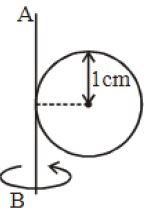
$A$ uniform disc of mass $5\,g$ and radius $1\,cm$ is fixed to a thin stick $AB$ of negligible mass as shown in the figure. The system is initially at rest. The constant torque,that will make the system rotate about $AB$ at $25$ rotations per second in $5\,s$,is close to:
A
$2.0\times 10^{-5}\,Nm$
B
$4.0\times 10^{-6}\,Nm$
C
$1.6\times 10^{-5}\,Nm$
D
$7.9\times 10^{-6}\,Nm$
Solution
(A) Given: Mass $m = 5\,g = 5 \times 10^{-3}\,kg$,Radius $r = 1\,cm = 10^{-2}\,m$,Time $t = 5\,s$,Final frequency $f = 25\,rev/s$.
Angular velocity $\omega = 2\pi f = 2 \times \pi \times 25 = 50\pi\,rad/s$.
The moment of inertia of the disc about the axis $AB$ (tangent to the disc) is given by the parallel axis theorem: $I = I_{cm} + mr^2 = \frac{1}{2}mr^2 + mr^2 = \frac{3}{2}mr^2$.
Using the relation $\tau = I\alpha$,where $\alpha = \frac{\omega}{t}$:
$\tau = I \times \frac{\omega}{t} = \left(\frac{3}{2}mr^2\right) \times \frac{\omega}{t}$.
Substituting the values:
$\tau = \frac{3}{2} \times (5 \times 10^{-3}) \times (10^{-2})^2 \times \frac{50\pi}{5}$.
$\tau = \frac{3}{2} \times 5 \times 10^{-3} \times 10^{-4} \times 10\pi$.
$\tau = 7.5 \times 10^{-7} \times 10\pi = 7.5\pi \times 10^{-6} \approx 23.56 \times 10^{-6} = 2.356 \times 10^{-5}\,Nm$.
Re-evaluating based on the provided options,the closest value is $2.0 \times 10^{-5}\,Nm$.
Angular velocity $\omega = 2\pi f = 2 \times \pi \times 25 = 50\pi\,rad/s$.
The moment of inertia of the disc about the axis $AB$ (tangent to the disc) is given by the parallel axis theorem: $I = I_{cm} + mr^2 = \frac{1}{2}mr^2 + mr^2 = \frac{3}{2}mr^2$.
Using the relation $\tau = I\alpha$,where $\alpha = \frac{\omega}{t}$:
$\tau = I \times \frac{\omega}{t} = \left(\frac{3}{2}mr^2\right) \times \frac{\omega}{t}$.
Substituting the values:
$\tau = \frac{3}{2} \times (5 \times 10^{-3}) \times (10^{-2})^2 \times \frac{50\pi}{5}$.
$\tau = \frac{3}{2} \times 5 \times 10^{-3} \times 10^{-4} \times 10\pi$.
$\tau = 7.5 \times 10^{-7} \times 10\pi = 7.5\pi \times 10^{-6} \approx 23.56 \times 10^{-6} = 2.356 \times 10^{-5}\,Nm$.
Re-evaluating based on the provided options,the closest value is $2.0 \times 10^{-5}\,Nm$.
0 likes
View Solution95
DifficultMCQ
$A$ rigid body rotates about a fixed axis with variable angular velocity equal to $(\alpha - \beta t)$ at time $t,$ where $\alpha$ and $\beta$ are constants. The angle through which it rotates before it comes to rest is
A
$\frac{\alpha^2}{2\beta}$
B
$\frac{\alpha^2 - \beta^2}{2\alpha}$
C
$\frac{\alpha^2 - \beta^2}{2\beta}$
D
$\frac{\alpha(\alpha - \beta)}{2}$
Solution
(A) The angular velocity is given by $\omega(t) = \alpha - \beta t$.
The body comes to rest when $\omega(t) = 0$,which implies $\alpha - \beta t = 0$,so the time taken to come to rest is $t = \frac{\alpha}{\beta}$.
The angular displacement $\theta$ is the integral of angular velocity with respect to time: $\theta = \int_{0}^{t} \omega(t) dt$.
Substituting the expression for $\omega(t)$: $\theta = \int_{0}^{\alpha/\beta} (\alpha - \beta t) dt$.
Integrating,we get $\theta = [\alpha t - \frac{1}{2}\beta t^2]_{0}^{\alpha/\beta}$.
Evaluating at the limits: $\theta = \alpha(\frac{\alpha}{\beta}) - \frac{1}{2}\beta(\frac{\alpha}{\beta})^2 = \frac{\alpha^2}{\beta} - \frac{\alpha^2}{2\beta} = \frac{\alpha^2}{2\beta}$.
The body comes to rest when $\omega(t) = 0$,which implies $\alpha - \beta t = 0$,so the time taken to come to rest is $t = \frac{\alpha}{\beta}$.
The angular displacement $\theta$ is the integral of angular velocity with respect to time: $\theta = \int_{0}^{t} \omega(t) dt$.
Substituting the expression for $\omega(t)$: $\theta = \int_{0}^{\alpha/\beta} (\alpha - \beta t) dt$.
Integrating,we get $\theta = [\alpha t - \frac{1}{2}\beta t^2]_{0}^{\alpha/\beta}$.
Evaluating at the limits: $\theta = \alpha(\frac{\alpha}{\beta}) - \frac{1}{2}\beta(\frac{\alpha}{\beta})^2 = \frac{\alpha^2}{\beta} - \frac{\alpha^2}{2\beta} = \frac{\alpha^2}{2\beta}$.
0 likes
View Solution96
EasyMCQ
The grinding stone of a flour mill is rotating at $600 \, rad/s$. For this, a power of $1.2 \, kW$ is used. The effective torque on the stone in $N-m$ will be:
A
$1$
B
$2$
C
$3$
D
$4$
Solution
(B) The relationship between power $(P)$, torque $(\tau)$, and angular velocity $(\omega)$ is given by the formula: $P = \tau \times \omega$.
Given:
Power $(P) = 1.2 \, kW = 1200 \, W$.
Angular velocity $(\omega) = 600 \, rad/s$.
Substituting the values into the formula:
$1200 = \tau \times 600$.
Solving for torque $(\tau)$:
$\tau = \frac{1200}{600} = 2 \, N-m$.
Therefore, the effective torque on the stone is $2 \, N-m$.
Given:
Power $(P) = 1.2 \, kW = 1200 \, W$.
Angular velocity $(\omega) = 600 \, rad/s$.
Substituting the values into the formula:
$1200 = \tau \times 600$.
Solving for torque $(\tau)$:
$\tau = \frac{1200}{600} = 2 \, N-m$.
Therefore, the effective torque on the stone is $2 \, N-m$.
0 likes
View Solution97
DifficultMCQ
$A$ disc is rotating with an angular velocity $\omega_0$. $A$ constant retarding torque is applied on it to stop the disc. The angular velocity becomes $\frac{\omega_0}{2}$ after $n$ rotations. How many more rotations will it make before coming to rest?
A
$n$
B
$2n$
C
$\frac{n}{2}$
D
$\frac{n}{3}$
Solution
(D) The retarding torque is constant,so the angular retardation $\alpha$ is also constant.
Using the rotational kinematic equation $\omega^2 = \omega_0^2 - 2\alpha\theta$:
For the first $n$ rotations,the angular displacement is $\theta_1 = 2\pi n$. The final angular velocity is $\frac{\omega_0}{2}$.
$\left(\frac{\omega_0}{2}\right)^2 = \omega_0^2 - 2\alpha(2\pi n) \implies \frac{\omega_0^2}{4} = \omega_0^2 - 4\pi n\alpha \implies 4\pi n\alpha = \frac{3\omega_0^2}{4} \implies \alpha = \frac{3\omega_0^2}{16\pi n} \quad ...(i)$
For the next $\theta_2$ rotations (where $\theta_2 = 2\pi n'$),the disc comes to rest $(\omega = 0)$:
$0^2 = \left(\frac{\omega_0}{2}\right)^2 - 2\alpha(2\pi n') \implies 0 = \frac{\omega_0^2}{4} - 4\pi n'\alpha \implies 4\pi n'\alpha = \frac{\omega_0^2}{4} \quad ...(ii)$
Dividing equation $(ii)$ by equation $(i)$:
$\frac{4\pi n'\alpha}{4\pi n\alpha} = \frac{\omega_0^2 / 4}{3\omega_0^2 / 4} \implies \frac{n'}{n} = \frac{1}{3} \implies n' = \frac{n}{3}$.
Thus,the disc will make $\frac{n}{3}$ more rotations before coming to rest.
Using the rotational kinematic equation $\omega^2 = \omega_0^2 - 2\alpha\theta$:
For the first $n$ rotations,the angular displacement is $\theta_1 = 2\pi n$. The final angular velocity is $\frac{\omega_0}{2}$.
$\left(\frac{\omega_0}{2}\right)^2 = \omega_0^2 - 2\alpha(2\pi n) \implies \frac{\omega_0^2}{4} = \omega_0^2 - 4\pi n\alpha \implies 4\pi n\alpha = \frac{3\omega_0^2}{4} \implies \alpha = \frac{3\omega_0^2}{16\pi n} \quad ...(i)$
For the next $\theta_2$ rotations (where $\theta_2 = 2\pi n'$),the disc comes to rest $(\omega = 0)$:
$0^2 = \left(\frac{\omega_0}{2}\right)^2 - 2\alpha(2\pi n') \implies 0 = \frac{\omega_0^2}{4} - 4\pi n'\alpha \implies 4\pi n'\alpha = \frac{\omega_0^2}{4} \quad ...(ii)$
Dividing equation $(ii)$ by equation $(i)$:
$\frac{4\pi n'\alpha}{4\pi n\alpha} = \frac{\omega_0^2 / 4}{3\omega_0^2 / 4} \implies \frac{n'}{n} = \frac{1}{3} \implies n' = \frac{n}{3}$.
Thus,the disc will make $\frac{n}{3}$ more rotations before coming to rest.
0 likes
View Solution98
MediumMCQ
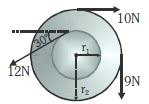
In the following figure,$r_1 = 5 \, cm$ and $r_2 = 30 \, cm$. If the moment of inertia of the wheel is $5100 \, kg \cdot m^2$,then its angular acceleration will be:
A
$10^{-4} \, rad/s^2$
B
$10^{-3} \, rad/s^2$
C
$10^{-2} \, rad/s^2$
D
$10^{-1} \, rad/s^2$
Solution
(B) Given: $r_1 = 0.05 \, m$,$r_2 = 0.30 \, m$,$I = 5100 \, kg \cdot m^2$.
Forces acting on the wheel:
$1$. $A$ force of $10 \, N$ acts tangentially at $r_2$ (clockwise torque).
$2$. $A$ force of $9 \, N$ acts tangentially at $r_2$ (clockwise torque).
$3$. $A$ force of $12 \, N$ acts at $r_1$ at an angle of $30^\circ$ with the horizontal. The perpendicular component is $12 \sin(30^\circ) = 12 \times 0.5 = 6 \, N$ (counter-clockwise torque).
Net torque $\tau_{net} = (10 \times 0.30) + (9 \times 0.30) - (6 \times 0.05) = 3.0 + 2.7 - 0.3 = 5.4 \, N \cdot m$.
Using $\tau_{net} = I \alpha$:
$5.4 = 5100 \times \alpha$
$\alpha = \frac{5.4}{5100} = \frac{54}{51000} \approx 1.058 \times 10^{-3} \, rad/s^2$.
Given the options,the closest value is $10^{-3} \, rad/s^2$.
Forces acting on the wheel:
$1$. $A$ force of $10 \, N$ acts tangentially at $r_2$ (clockwise torque).
$2$. $A$ force of $9 \, N$ acts tangentially at $r_2$ (clockwise torque).
$3$. $A$ force of $12 \, N$ acts at $r_1$ at an angle of $30^\circ$ with the horizontal. The perpendicular component is $12 \sin(30^\circ) = 12 \times 0.5 = 6 \, N$ (counter-clockwise torque).
Net torque $\tau_{net} = (10 \times 0.30) + (9 \times 0.30) - (6 \times 0.05) = 3.0 + 2.7 - 0.3 = 5.4 \, N \cdot m$.
Using $\tau_{net} = I \alpha$:
$5.4 = 5100 \times \alpha$
$\alpha = \frac{5.4}{5100} = \frac{54}{51000} \approx 1.058 \times 10^{-3} \, rad/s^2$.
Given the options,the closest value is $10^{-3} \, rad/s^2$.
0 likes
View Solution99
MediumMCQ
$A$ string is wrapped around the rim of a wheel of moment of inertia $0.20\, kg-m^2$ and radius $20\, cm$. The wheel is free to rotate about its axis and initially the wheel is at rest. The string is now pulled by a force of $20\, N$. The angular velocity of the wheel after $5\, s$ will be ....... $rad/s$.
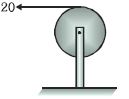
A
$90$
B
$70$
C
$95$
D
$100$
Solution
(D) Given:
Moment of inertia $I = 0.20\, kg-m^2$
Radius $r = 20\, cm = 0.2\, m$
Force $F = 20\, N$
Time $t = 5\, s$
Initial angular velocity $\omega_0 = 0$
The torque applied to the wheel is $\tau = r \times F = 0.2\, m \times 20\, N = 4\, N-m$.
Using the relation $\tau = I \alpha$,the angular acceleration is $\alpha = \frac{\tau}{I} = \frac{4}{0.20} = 20\, rad/s^2$.
Using the equation of motion $\omega = \omega_0 + \alpha t$:
$\omega = 0 + (20)(5) = 100\, rad/s$.
Moment of inertia $I = 0.20\, kg-m^2$
Radius $r = 20\, cm = 0.2\, m$
Force $F = 20\, N$
Time $t = 5\, s$
Initial angular velocity $\omega_0 = 0$
The torque applied to the wheel is $\tau = r \times F = 0.2\, m \times 20\, N = 4\, N-m$.
Using the relation $\tau = I \alpha$,the angular acceleration is $\alpha = \frac{\tau}{I} = \frac{4}{0.20} = 20\, rad/s^2$.
Using the equation of motion $\omega = \omega_0 + \alpha t$:
$\omega = 0 + (20)(5) = 100\, rad/s$.
0 likes
View SolutionSystem of Particles and Rotational Motion — Relation between Torque and Angular acceleration and it's Application · Frequently Asked Questions
1Are these System of Particles and Rotational Motion questions useful for JEE and NEET?
Yes. All questions in this section are mapped to JEE Main and NEET exam patterns. Previous year questions from JEE Main, NEET, GUJCET and state-level exams are included with full solutions.
2Can I switch to Hindi or Gujarati for these questions?
Yes. Use the language tabs in the hero section or the sidebar to view the same questions and solutions in English, Hindi or Gujarati.
3How do I generate a question paper from this subtopic?
Use the Vedclass Exam Paper Generator — select the chapter and subtopic, set difficulty, and generate Sets A, B, C, D automatically. First 3 chapters of every subject are free.
Vedclass Products
For Students
Vedclass Test Series
Mock tests in real JEE/NEET style with performance analysis. 5-day free trial.
Start Free TrialFor Teachers
Exam Paper Generator
Generate Set A/B/C/D papers from this chapter in 2 minutes. 3 chapters free.
Try FreeFor Institutes
Online Exam Module
Live online exams with unlimited students, 360° analytics & white-label branding.
See DemoFor Teachers & Institutes
Generate a System of Particles and Rotational Motion Exam Paper in 2 Minutes
Select subtopic & difficulty — Sets A, B, C, D auto-generated with No Repeat logic.
First 3 chapters of every subject are free — no payment required.