
A English
Relation between Torque and Angular acceleration and it's Application Questions in English
Class 11 Physics · System of Particles and Rotational Motion · Relation between Torque and Angular acceleration and it's Application
182+
Questions
English
Language
100%
With Solutions
Showing 50 of 182 questions in English
101
DifficultMCQ
$A$ wheel having a moment of inertia of $2 \, kg \cdot m^2$ about its vertical axis rotates at the rate of $60 \, rpm$ about the axis. The torque required to stop the wheel's rotation in one minute would be
A
$\frac{\pi}{12} \, N \cdot m$
B
$\frac{\pi}{15} \, N \cdot m$
C
$\frac{\pi}{18} \, N \cdot m$
D
$\frac{2\pi}{15} \, N \cdot m$
Solution
(B) Given: Moment of inertia $I = 2 \, kg \cdot m^2$,initial frequency $n_1 = 60 \, rpm = 1 \, rps$,final frequency $n_2 = 0 \, rps$,and time $t = 1 \, min = 60 \, s$.
The angular velocity is given by $\omega = 2\pi n$.
The torque $\tau$ is given by the rate of change of angular momentum: $\tau = I \alpha = I \frac{\Delta \omega}{t}$.
Substituting the values: $\tau = I \frac{2\pi(n_2 - n_1)}{t}$.
$\tau = 2 \times \frac{2\pi(0 - 1)}{60} = \frac{-4\pi}{60} = -\frac{\pi}{15} \, N \cdot m$.
The magnitude of the torque required to stop the wheel is $\frac{\pi}{15} \, N \cdot m$.
The angular velocity is given by $\omega = 2\pi n$.
The torque $\tau$ is given by the rate of change of angular momentum: $\tau = I \alpha = I \frac{\Delta \omega}{t}$.
Substituting the values: $\tau = I \frac{2\pi(n_2 - n_1)}{t}$.
$\tau = 2 \times \frac{2\pi(0 - 1)}{60} = \frac{-4\pi}{60} = -\frac{\pi}{15} \, N \cdot m$.
The magnitude of the torque required to stop the wheel is $\frac{\pi}{15} \, N \cdot m$.
0 likes
View Solution102
EasyMCQ
To maintain a rotor at a uniform angular speed of $100\, rad\, s^{-1}$,an engine needs to transmit a torque of $100\, Nm$. The power of the engine is
A
$10\, kW$
B
$100\, kW$
C
$10\, mW$
D
$100\, mW$
Solution
(A) The power $P$ delivered by an engine to a rotating body is given by the product of torque $\tau$ and angular velocity $\omega$.
Given:
Torque $\tau = 100\, Nm$
Angular speed $\omega = 100\, rad\, s^{-1}$
Using the formula $P = \tau \omega$:
$P = (100\, Nm) \times (100\, rad\, s^{-1})$
$P = 10,000\, W$
Since $1\, kW = 1,000\, W$,we have:
$P = 10\, kW$.
Given:
Torque $\tau = 100\, Nm$
Angular speed $\omega = 100\, rad\, s^{-1}$
Using the formula $P = \tau \omega$:
$P = (100\, Nm) \times (100\, rad\, s^{-1})$
$P = 10,000\, W$
Since $1\, kW = 1,000\, W$,we have:
$P = 10\, kW$.
0 likes
View Solution103
MediumMCQ
$A$ rope is wound round a hollow cylinder of mass $5\,kg$ and radius $0.5\,m.$ What is the angular acceleration (in $rad/s^2$) of the cylinder if the rope is pulled with a force of $20\,N$?
A
$4$
B
$5$
C
$6$
D
$8$
Solution
(D) The torque $\tau$ applied to the cylinder is given by $\tau = F \times r$,where $F = 20\,N$ and $r = 0.5\,m$.
$\tau = 20 \times 0.5 = 10\,N\cdot m$.
For a hollow cylinder,the moment of inertia $I$ about its central axis is $I = M r^2$,where $M = 5\,kg$ and $r = 0.5\,m$.
$I = 5 \times (0.5)^2 = 5 \times 0.25 = 1.25\,kg\cdot m^2$.
Using the relation $\tau = I \alpha$,where $\alpha$ is the angular acceleration:
$10 = 1.25 \times \alpha$.
$\alpha = \frac{10}{1.25} = 8\,rad/s^2$.
$\tau = 20 \times 0.5 = 10\,N\cdot m$.
For a hollow cylinder,the moment of inertia $I$ about its central axis is $I = M r^2$,where $M = 5\,kg$ and $r = 0.5\,m$.
$I = 5 \times (0.5)^2 = 5 \times 0.25 = 1.25\,kg\cdot m^2$.
Using the relation $\tau = I \alpha$,where $\alpha$ is the angular acceleration:
$10 = 1.25 \times \alpha$.
$\alpha = \frac{10}{1.25} = 8\,rad/s^2$.
0 likes
View Solution104
DifficultMCQ
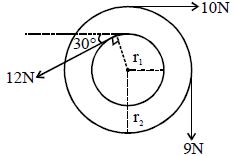
In the following figure,$r_1 = 5\,cm$ and $r_2 = 30\,cm$. If the moment of inertia of the wheel is $1500\,kg\cdot m^2$,then its angular acceleration will be (approximately):
A
$2\times 10^{-4}\,rad/s^2$
B
$3\times 10^{-3}\,rad/s^2$
C
$4\times 10^{-2}\,rad/s^2$
D
$5\times 10^{-1}\,rad/s^2$
Solution
(B) Given: $r_1 = 0.05\,m$,$r_2 = 0.30\,m$,$I = 1500\,kg\cdot m^2$.
The torque $\tau$ is calculated as the sum of torques produced by each force:
$\tau = \tau_{10N} + \tau_{9N} - \tau_{12N}$
$\tau = (10 \times r_2) + (9 \times r_2) - (12 \times r_1 \times \cos(30^\circ))$
$\tau = (10 \times 0.3) + (9 \times 0.3) - (12 \times 0.05 \times \frac{\sqrt{3}}{2})$
$\tau = 3 + 2.7 - (0.6 \times 0.866) = 5.7 - 0.5196 = 5.1804\,N\cdot m$.
Using $\tau = I \alpha$:
$\alpha = \frac{\tau}{I} = \frac{5.1804}{1500} \approx 0.00345\,rad/s^2 \approx 3.45 \times 10^{-3}\,rad/s^2$.
Comparing with the given options,the closest value is $3 \times 10^{-3}\,rad/s^2$.
The torque $\tau$ is calculated as the sum of torques produced by each force:
$\tau = \tau_{10N} + \tau_{9N} - \tau_{12N}$
$\tau = (10 \times r_2) + (9 \times r_2) - (12 \times r_1 \times \cos(30^\circ))$
$\tau = (10 \times 0.3) + (9 \times 0.3) - (12 \times 0.05 \times \frac{\sqrt{3}}{2})$
$\tau = 3 + 2.7 - (0.6 \times 0.866) = 5.7 - 0.5196 = 5.1804\,N\cdot m$.
Using $\tau = I \alpha$:
$\alpha = \frac{\tau}{I} = \frac{5.1804}{1500} \approx 0.00345\,rad/s^2 \approx 3.45 \times 10^{-3}\,rad/s^2$.
Comparing with the given options,the closest value is $3 \times 10^{-3}\,rad/s^2$.
0 likes
View Solution105
MediumMCQ
An air compressor is powered by a $200\,rad\,s^{-1}$ electric motor using a $V-$belt drive. The motor pulley is $8\,cm$ in radius,and the tension in the $V-$belt is $135\,N$ on one side and $45\,N$ on the other. The power of the motor will be ...... $kW$.
A
$1.44$
B
$14.4$
C
$2.88$
D
$28.8$
Solution
(A) The net force acting on the pulley due to the belt tension difference is $F_{net} = T_1 - T_2 = 135\,N - 45\,N = 90\,N$.
The radius of the motor pulley is $r = 8\,cm = 0.08\,m$.
The torque exerted by the motor on the belt is $\tau = F_{net} \times r = 90\,N \times 0.08\,m = 7.2\,Nm$.
The power of the motor is given by $P = \tau \omega$,where $\omega = 200\,rad\,s^{-1}$.
$P = 7.2\,Nm \times 200\,rad\,s^{-1} = 1440\,W$.
Converting to kilowatts,$P = 1440 / 1000 = 1.44\,kW$.
The radius of the motor pulley is $r = 8\,cm = 0.08\,m$.
The torque exerted by the motor on the belt is $\tau = F_{net} \times r = 90\,N \times 0.08\,m = 7.2\,Nm$.
The power of the motor is given by $P = \tau \omega$,where $\omega = 200\,rad\,s^{-1}$.
$P = 7.2\,Nm \times 200\,rad\,s^{-1} = 1440\,W$.
Converting to kilowatts,$P = 1440 / 1000 = 1.44\,kW$.
0 likes
View Solution106
DifficultMCQ
$A$ uniform metre stick of mass $M$ and length $L = 1 \ m$ is hinged at one end and supported in a horizontal direction by a string attached to the other end. What should be the initial angular acceleration of the free end of the stick if the string is cut? (in $rad/s^2$)
A
$\frac{3g}{2L}$
B
$g$
C
$3g$
D
$4g$
Solution
(A) The torque $\tau$ about the hinged end is given by $\tau = Mg \frac{L}{2}$.
The moment of inertia $I$ of a uniform rod of mass $M$ and length $L$ about an axis passing through one end is $I = \frac{ML^2}{3}$.
Using the rotational analogue of Newton's second law,$\tau = I \alpha$,where $\alpha$ is the angular acceleration:
$Mg \frac{L}{2} = \left( \frac{ML^2}{3} \right) \alpha$.
Solving for $\alpha$:
$\alpha = \frac{MgL/2}{ML^2/3} = \frac{3g}{2L}$.
Given the length of the metre stick is $L = 1 \ m$,we substitute $L = 1$:
$\alpha = \frac{3g}{2(1)} = \frac{3}{2} g \ rad/s^2$.
The moment of inertia $I$ of a uniform rod of mass $M$ and length $L$ about an axis passing through one end is $I = \frac{ML^2}{3}$.
Using the rotational analogue of Newton's second law,$\tau = I \alpha$,where $\alpha$ is the angular acceleration:
$Mg \frac{L}{2} = \left( \frac{ML^2}{3} \right) \alpha$.
Solving for $\alpha$:
$\alpha = \frac{MgL/2}{ML^2/3} = \frac{3g}{2L}$.
Given the length of the metre stick is $L = 1 \ m$,we substitute $L = 1$:
$\alpha = \frac{3g}{2(1)} = \frac{3}{2} g \ rad/s^2$.
0 likes
View Solution107
DifficultMCQ
$A$ rod of mass $M$ and length $L$ is placed in a horizontal plane with one end hinged about a vertical axis. $A$ horizontal force of $F = \frac{Mg}{2}$ is applied at a distance $\frac{5L}{6}$ from the hinged end. The angular acceleration of the rod will be:
A
$\frac{4g}{5L}$
B
$\frac{5g}{4L}$
C
$\frac{3g}{4L}$
D
$\frac{4g}{3L}$
Solution
(B) The torque $\tau$ about the hinged end is given by $\tau = F \times r$,where $r = \frac{5L}{6}$.
$\tau = \left( \frac{Mg}{2} \right) \times \left( \frac{5L}{6} \right) = \frac{5MgL}{12}$.
The moment of inertia $I$ of a rod about an axis passing through one end is $I = \frac{ML^2}{3}$.
Using the relation $\tau = I \alpha$,where $\alpha$ is the angular acceleration:
$\alpha = \frac{\tau}{I} = \frac{5MgL}{12} \times \frac{3}{ML^2}$.
$\alpha = \frac{5g}{4L}$.
$\tau = \left( \frac{Mg}{2} \right) \times \left( \frac{5L}{6} \right) = \frac{5MgL}{12}$.
The moment of inertia $I$ of a rod about an axis passing through one end is $I = \frac{ML^2}{3}$.
Using the relation $\tau = I \alpha$,where $\alpha$ is the angular acceleration:
$\alpha = \frac{\tau}{I} = \frac{5MgL}{12} \times \frac{3}{ML^2}$.
$\alpha = \frac{5g}{4L}$.
1 likes
View Solution108
DifficultMCQ
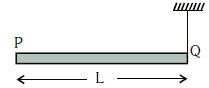
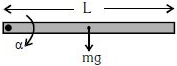
$A$ rod $PQ$ of mass $M$ and length $L$ is hinged at end $P$. The rod is kept horizontal by a massless string tied to point $Q$ as shown in the figure. When the string is cut,the initial angular acceleration of the rod is
A
$\frac{2g}{3L}$
B
$\frac{3g}{2L}$
C
$g/L$
D
$2g/L$
Solution
(B) When the string is cut,the only torque acting on the rod about the hinge $P$ is due to the gravitational force acting at the center of mass of the rod.
The gravitational force $Mg$ acts at a distance of $L/2$ from the hinge $P$.
The torque $\tau$ about the hinge $P$ is given by:
$\tau = Mg \times \frac{L}{2}$
The moment of inertia $I$ of the rod about an axis passing through its end $P$ is:
$I = \frac{ML^2}{3}$
Using the rotational analog of Newton's second law,$\tau = I\alpha$,where $\alpha$ is the angular acceleration:
$Mg \times \frac{L}{2} = \left(\frac{ML^2}{3}\right) \alpha$
Solving for $\alpha$:
$\alpha = \frac{MgL/2}{ML^2/3} = \frac{3g}{2L}$
The gravitational force $Mg$ acts at a distance of $L/2$ from the hinge $P$.
The torque $\tau$ about the hinge $P$ is given by:
$\tau = Mg \times \frac{L}{2}$
The moment of inertia $I$ of the rod about an axis passing through its end $P$ is:
$I = \frac{ML^2}{3}$
Using the rotational analog of Newton's second law,$\tau = I\alpha$,where $\alpha$ is the angular acceleration:
$Mg \times \frac{L}{2} = \left(\frac{ML^2}{3}\right) \alpha$
Solving for $\alpha$:
$\alpha = \frac{MgL/2}{ML^2/3} = \frac{3g}{2L}$
0 likes
View Solution109
MediumMCQ
$A$ constant torque acting on a uniform circular wheel changes its angular momentum from $L_0$ to $4L_0$ in $4 \ s$. The magnitude of this torque is
A
$(3/4)L_0$
B
$L_0$
C
$4L_0$
D
$12L_0$
Solution
(A) The relationship between torque $\tau$ and angular momentum $L$ is given by Newton's second law for rotation: $\tau = \frac{dL}{dt}$.
Given the initial angular momentum $L_i = L_0$ and the final angular momentum $L_f = 4L_0$.
The time interval is $\Delta t = 4 \ s$.
The change in angular momentum is $\Delta L = L_f - L_i = 4L_0 - L_0 = 3L_0$.
Therefore,the magnitude of the constant torque is $\tau = \frac{\Delta L}{\Delta t} = \frac{3L_0}{4}$.
Given the initial angular momentum $L_i = L_0$ and the final angular momentum $L_f = 4L_0$.
The time interval is $\Delta t = 4 \ s$.
The change in angular momentum is $\Delta L = L_f - L_i = 4L_0 - L_0 = 3L_0$.
Therefore,the magnitude of the constant torque is $\tau = \frac{\Delta L}{\Delta t} = \frac{3L_0}{4}$.
0 likes
View Solution110
MediumMCQ
$A$ wheel is rotating about an axis through its centre at $720 \, rpm$. It is acted on by a constant torque opposing its motion for $8 \, s$ to bring it to rest finally. The value of torque (in $N \cdot m$) is (Given $I = \frac{24}{\pi} \, kg \cdot m^2$)
A
$48$
B
$72$
C
$96$
D
$120$
Solution
(B) Initial angular velocity $\omega_1 = 720 \, rpm = \frac{720 \times 2\pi}{60} \, rad/s = 24\pi \, rad/s$.
Final angular velocity $\omega_2 = 0 \, rad/s$.
Time taken $t = 8 \, s$.
Using the equation of rotational motion $\omega_2 = \omega_1 - \alpha t$,where $\alpha$ is the angular retardation:
$0 = 24\pi - \alpha(8) \implies \alpha = \frac{24\pi}{8} = 3\pi \, rad/s^2$.
The magnitude of torque $\tau$ is given by $\tau = I\alpha$.
Given $I = \frac{24}{\pi} \, kg \cdot m^2$,we have:
$\tau = \left(\frac{24}{\pi}\right) \times (3\pi) = 72 \, N \cdot m$.
Final angular velocity $\omega_2 = 0 \, rad/s$.
Time taken $t = 8 \, s$.
Using the equation of rotational motion $\omega_2 = \omega_1 - \alpha t$,where $\alpha$ is the angular retardation:
$0 = 24\pi - \alpha(8) \implies \alpha = \frac{24\pi}{8} = 3\pi \, rad/s^2$.
The magnitude of torque $\tau$ is given by $\tau = I\alpha$.
Given $I = \frac{24}{\pi} \, kg \cdot m^2$,we have:
$\tau = \left(\frac{24}{\pi}\right) \times (3\pi) = 72 \, N \cdot m$.
0 likes
View Solution111
MediumMCQ
At time $t = 0$,a $2\, kg$ particle has position vector $\vec{r} = (4\hat{i} - 2\hat{j})\, m$ relative to the origin. Its velocity is given by $\vec{v} = 2t^2\hat{i}\, m/s$. The torque acting on the particle about the origin at $t = 2\, s$ is ........ $\hat{k}\, N\cdot m$.
A
$32$
B
$-16$
C
$16$
D
$122$
Solution
(A) The torque $\vec{\tau}$ acting on a particle is given by $\vec{\tau} = \vec{r} \times \vec{F} = \vec{r} \times \frac{d\vec{p}}{dt} = \frac{d}{dt}(\vec{r} \times \vec{p}) = \frac{d\vec{L}}{dt}$.
Given mass $m = 2\, kg$,position $\vec{r}(t) = \vec{r}_0 + \int_0^t \vec{v} dt = (4\hat{i} - 2\hat{j}) + \int_0^t (2t^2\hat{i}) dt = (4 + \frac{2}{3}t^3)\hat{i} - 2\hat{j}$.
Velocity $\vec{v}(t) = 2t^2\hat{i}$.
Angular momentum $\vec{L} = \vec{r} \times m\vec{v} = m [((4 + \frac{2}{3}t^3)\hat{i} - 2\hat{j}) \times (2t^2\hat{i})] = 2 [0 - 2\hat{j} \times 2t^2\hat{i}] = 2 [4t^2\hat{k}] = 8t^2\hat{k}$.
Torque $\vec{\tau} = \frac{d\vec{L}}{dt} = \frac{d}{dt}(8t^2\hat{k}) = 16t\hat{k}$.
At $t = 2\, s$,$\vec{\tau} = 16(2)\hat{k} = 32\hat{k}\, N\cdot m$.
Given mass $m = 2\, kg$,position $\vec{r}(t) = \vec{r}_0 + \int_0^t \vec{v} dt = (4\hat{i} - 2\hat{j}) + \int_0^t (2t^2\hat{i}) dt = (4 + \frac{2}{3}t^3)\hat{i} - 2\hat{j}$.
Velocity $\vec{v}(t) = 2t^2\hat{i}$.
Angular momentum $\vec{L} = \vec{r} \times m\vec{v} = m [((4 + \frac{2}{3}t^3)\hat{i} - 2\hat{j}) \times (2t^2\hat{i})] = 2 [0 - 2\hat{j} \times 2t^2\hat{i}] = 2 [4t^2\hat{k}] = 8t^2\hat{k}$.
Torque $\vec{\tau} = \frac{d\vec{L}}{dt} = \frac{d}{dt}(8t^2\hat{k}) = 16t\hat{k}$.
At $t = 2\, s$,$\vec{\tau} = 16(2)\hat{k} = 32\hat{k}\, N\cdot m$.
0 likes
View Solution112
MediumMCQ
$A$ homogeneous disc with a radius $0.2\, m$ and mass $5\, kg$ rotates around an axis passing through its centre. The angular velocity of the rotation of the disc as a function of time is given by the formula $\omega = 2 + 6t$. The tangential force applied to the rim of the disc is ........ $N.$
A
$1$
B
$2$
C
$3$
D
$4$
Solution
(C) Given: Radius $R = 0.2\, m$,Mass $M = 5\, kg$,Angular velocity $\omega = 2 + 6t$.
First,find the angular acceleration $\alpha$ by differentiating $\omega$ with respect to time $t$:
$\alpha = \frac{d\omega}{dt} = \frac{d}{dt}(2 + 6t) = 6\, rad/s^2$.
The moment of inertia $I$ of a disc about its central axis is $I = \frac{1}{2}MR^2$.
$I = \frac{1}{2} \times 5 \times (0.2)^2 = 0.5 \times 5 \times 0.04 = 0.1\, kg \cdot m^2$.
The torque $\tau$ is given by $\tau = I\alpha = 0.1 \times 6 = 0.6\, N \cdot m$.
Since $\tau = F \times R$,the tangential force $F$ is:
$F = \frac{\tau}{R} = \frac{0.6}{0.2} = 3\, N$.
First,find the angular acceleration $\alpha$ by differentiating $\omega$ with respect to time $t$:
$\alpha = \frac{d\omega}{dt} = \frac{d}{dt}(2 + 6t) = 6\, rad/s^2$.
The moment of inertia $I$ of a disc about its central axis is $I = \frac{1}{2}MR^2$.
$I = \frac{1}{2} \times 5 \times (0.2)^2 = 0.5 \times 5 \times 0.04 = 0.1\, kg \cdot m^2$.
The torque $\tau$ is given by $\tau = I\alpha = 0.1 \times 6 = 0.6\, N \cdot m$.
Since $\tau = F \times R$,the tangential force $F$ is:
$F = \frac{\tau}{R} = \frac{0.6}{0.2} = 3\, N$.
0 likes
View Solution113
MediumMCQ
If there is a change of angular momentum from $1\,J\cdot s$ to $5\,J\cdot s$ in $5\,s$,then the torque is:
A
$0.8\,N\cdot m$
B
$0.5\,N\cdot m$
C
$1.0\,N\cdot m$
D
None of these
Solution
(B) The torque $\tau$ is defined as the rate of change of angular momentum $L$ with respect to time $t$,given by the formula: $\tau = \frac{dL}{dt} = \frac{\Delta L}{\Delta t}$.
Given:
Initial angular momentum $L_i = 1\,J\cdot s$
Final angular momentum $L_f = 5\,J\cdot s$
Time interval $\Delta t = 5\,s$
Change in angular momentum $\Delta L = L_f - L_i = 5\,J\cdot s - 1\,J\cdot s = 4\,J\cdot s$.
Substituting the values into the formula:
$\tau = \frac{4\,J\cdot s}{5\,s} = 0.8\,N\cdot m$.
Thus,the torque is $0.8\,N\cdot m$,which is equivalent to $\frac{4}{5}\,N\cdot m$.
Given:
Initial angular momentum $L_i = 1\,J\cdot s$
Final angular momentum $L_f = 5\,J\cdot s$
Time interval $\Delta t = 5\,s$
Change in angular momentum $\Delta L = L_f - L_i = 5\,J\cdot s - 1\,J\cdot s = 4\,J\cdot s$.
Substituting the values into the formula:
$\tau = \frac{4\,J\cdot s}{5\,s} = 0.8\,N\cdot m$.
Thus,the torque is $0.8\,N\cdot m$,which is equivalent to $\frac{4}{5}\,N\cdot m$.
0 likes
View Solution114
EasyMCQ
$A$ constant torque of $31.4 \, Nm$ is exerted on a pivoted wheel. If the angular acceleration of the wheel is $4\pi \, rad/s^2$,then the moment of inertia will be ....... $kg \cdot m^2$.
A
$5.8$
B
$4.5$
C
$5.6$
D
$2.5$
Solution
(D) The relationship between torque $(\tau)$,moment of inertia $(I)$,and angular acceleration $(\alpha)$ is given by the formula: $\tau = I \alpha$.
Given:
Torque $(\tau)$ = $31.4 \, Nm$
Angular acceleration $(\alpha)$ = $4\pi \, rad/s^2$
Using the value of $\pi \approx 3.14$,we have $\alpha = 4 \times 3.14 = 12.56 \, rad/s^2$.
Substituting the values into the formula:
$31.4 = I \times 12.56$
$I = \frac{31.4}{12.56} = 2.5 \, kg \cdot m^2$.
Given:
Torque $(\tau)$ = $31.4 \, Nm$
Angular acceleration $(\alpha)$ = $4\pi \, rad/s^2$
Using the value of $\pi \approx 3.14$,we have $\alpha = 4 \times 3.14 = 12.56 \, rad/s^2$.
Substituting the values into the formula:
$31.4 = I \times 12.56$
$I = \frac{31.4}{12.56} = 2.5 \, kg \cdot m^2$.
0 likes
View Solution115
MediumMCQ
$A$ circular disc rotating with frequency $f_0 = 1.3 \, rev/sec$ comes to a stop in $30 \, seconds$. The approximate angular acceleration is ....... $rad/sec^2$.
A
$+ 0.27$
B
$- 0.27$
C
$+ 0.54$
D
$+ 0.13$
Solution
(B) Given,the initial frequency $f_0 = 1.3 \, rev/sec$. The initial angular velocity is $\omega_0 = 2\pi f_0 = 2\pi \times 1.3 = 2.6\pi \, rad/s$.
Since the disc comes to a stop,the final angular velocity $\omega = 0 \, rad/s$ in time $t = 30 \, s$.
Using the first equation of rotational motion: $\omega = \omega_0 + \alpha t$.
Substituting the values: $0 = 2.6\pi + \alpha \times 30$.
$\alpha = - \frac{2.6\pi}{30} \approx - \frac{2.6 \times 3.14}{30} \approx - 0.27 \, rad/s^2$.
The negative sign indicates retardation,so the magnitude of angular acceleration is approximately $0.27 \, rad/s^2$.
Since the disc comes to a stop,the final angular velocity $\omega = 0 \, rad/s$ in time $t = 30 \, s$.
Using the first equation of rotational motion: $\omega = \omega_0 + \alpha t$.
Substituting the values: $0 = 2.6\pi + \alpha \times 30$.
$\alpha = - \frac{2.6\pi}{30} \approx - \frac{2.6 \times 3.14}{30} \approx - 0.27 \, rad/s^2$.
The negative sign indicates retardation,so the magnitude of angular acceleration is approximately $0.27 \, rad/s^2$.
0 likes
View Solution116
DifficultMCQ
$A$ solid cylinder of mass $2\; kg$ and radius $4\; cm$ is rotating about its axis at the rate of $3\; rpm$. The torque required to stop after $2\pi$ revolutions is
A
$2 \times 10^{-6}\; Nm$
B
$2 \times 10^{-3}\; Nm$
C
$12 \times 10^{-4}\; Nm$
D
$2 \times 10^{6}\; Nm$
Solution
(A) Given: Mass $m = 2\; kg$,Radius $R = 4\; cm = 0.04\; m$,Initial angular velocity $\omega_0 = 3\; rpm = \frac{3 \times 2\pi}{60} = \frac{\pi}{10}\; rad/s$.
Total angular displacement $\theta = 2\pi \text{ revolutions} = 2\pi \times 2\pi = 4\pi^2\; rad$.
Final angular velocity $\omega = 0$.
Using the kinematic equation $\omega^2 = \omega_0^2 - 2\alpha\theta$:
$0 = (\frac{\pi}{10})^2 - 2\alpha(4\pi^2)$
$8\alpha\pi^2 = \frac{\pi^2}{100} \Rightarrow \alpha = \frac{1}{800}\; rad/s^2$.
The moment of inertia of a solid cylinder is $I = \frac{1}{2}mR^2 = \frac{1}{2} \times 2 \times (0.04)^2 = 0.0016\; kg\cdot m^2$.
The torque required is $\tau = I\alpha = 0.0016 \times \frac{1}{800} = 16 \times 10^{-4} \times \frac{1}{8} \times 10^{-2} = 2 \times 10^{-6}\; Nm$.
Total angular displacement $\theta = 2\pi \text{ revolutions} = 2\pi \times 2\pi = 4\pi^2\; rad$.
Final angular velocity $\omega = 0$.
Using the kinematic equation $\omega^2 = \omega_0^2 - 2\alpha\theta$:
$0 = (\frac{\pi}{10})^2 - 2\alpha(4\pi^2)$
$8\alpha\pi^2 = \frac{\pi^2}{100} \Rightarrow \alpha = \frac{1}{800}\; rad/s^2$.
The moment of inertia of a solid cylinder is $I = \frac{1}{2}mR^2 = \frac{1}{2} \times 2 \times (0.04)^2 = 0.0016\; kg\cdot m^2$.
The torque required is $\tau = I\alpha = 0.0016 \times \frac{1}{800} = 16 \times 10^{-4} \times \frac{1}{8} \times 10^{-2} = 2 \times 10^{-6}\; Nm$.
0 likes
View Solution117
MediumMCQ
Torques of equal magnitude are applied to a hollow cylinder and a solid sphere,both having the same mass and radius. The cylinder is free to rotate about its standard axis of symmetry,and the sphere is free to rotate about an axis passing through its centre. Which of the two will acquire a greater angular speed after a given time?
A
The hollow cylinder
B
The solid sphere
C
Both will acquire the same angular speed
D
It depends on the material of the bodies
Solution
(B) Let $m$ and $r$ be the mass and radius of both the hollow cylinder and the solid sphere.
The moment of inertia of the hollow cylinder about its standard axis is $I_{c} = m r^{2}$.
The moment of inertia of the solid sphere about an axis passing through its centre is $I_{s} = \frac{2}{5} m r^{2}$.
We use the relation $\tau = I \alpha$,where $\tau$ is the torque,$I$ is the moment of inertia,and $\alpha$ is the angular acceleration.
Since the applied torque $\tau$ is the same for both,we have $\alpha = \frac{\tau}{I}$.
Thus,$\alpha \propto \frac{1}{I}$.
Since $I_{c} = m r^{2}$ and $I_{s} = 0.4 m r^{2}$,it is clear that $I_{s} < I_{c}$.
Therefore,$\alpha_{s} > \alpha_{c}$.
Using the relation $\omega = \omega_{0} + \alpha t$,for an initial angular velocity $\omega_{0} = 0$,we get $\omega = \alpha t$.
Since $\alpha_{s} > \alpha_{c}$,it follows that $\omega_{s} > \omega_{c}$ for any given time $t$.
Hence,the solid sphere will acquire a greater angular speed.
The moment of inertia of the hollow cylinder about its standard axis is $I_{c} = m r^{2}$.
The moment of inertia of the solid sphere about an axis passing through its centre is $I_{s} = \frac{2}{5} m r^{2}$.
We use the relation $\tau = I \alpha$,where $\tau$ is the torque,$I$ is the moment of inertia,and $\alpha$ is the angular acceleration.
Since the applied torque $\tau$ is the same for both,we have $\alpha = \frac{\tau}{I}$.
Thus,$\alpha \propto \frac{1}{I}$.
Since $I_{c} = m r^{2}$ and $I_{s} = 0.4 m r^{2}$,it is clear that $I_{s} < I_{c}$.
Therefore,$\alpha_{s} > \alpha_{c}$.
Using the relation $\omega = \omega_{0} + \alpha t$,for an initial angular velocity $\omega_{0} = 0$,we get $\omega = \alpha t$.
Since $\alpha_{s} > \alpha_{c}$,it follows that $\omega_{s} > \omega_{c}$ for any given time $t$.
Hence,the solid sphere will acquire a greater angular speed.
0 likes
View Solution118
Medium
$A$ rope of negligible mass is wound round a hollow cylinder of mass $3\; kg$ and radius $40\; cm$. What is the angular acceleration of the cylinder if the rope is pulled with a force of $30\; N$? What is the linear acceleration of the rope? Assume that there is no slipping.
Solution
(A) Mass of the hollow cylinder,$m = 3\; kg$.
Radius of the hollow cylinder,$r = 40\; cm = 0.4\; m$.
Applied force,$F = 30\; N$.
The moment of inertia of the hollow cylinder about its geometric axis is given by $I = m r^2$.
$I = 3 \times (0.4)^2 = 3 \times 0.16 = 0.48\; kg\; m^2$.
Torque,$\tau = F \times r = 30 \times 0.4 = 12\; Nm$.
Using the relation $\tau = I \alpha$,the angular acceleration $\alpha$ is:
$\alpha = \frac{\tau}{I} = \frac{12}{0.48} = 25\; rad\; s^{-2}$.
The linear acceleration $a$ is given by $a = r \alpha$.
$a = 0.4 \times 25 = 10\; m\; s^{-2}$.
Radius of the hollow cylinder,$r = 40\; cm = 0.4\; m$.
Applied force,$F = 30\; N$.
The moment of inertia of the hollow cylinder about its geometric axis is given by $I = m r^2$.
$I = 3 \times (0.4)^2 = 3 \times 0.16 = 0.48\; kg\; m^2$.
Torque,$\tau = F \times r = 30 \times 0.4 = 12\; Nm$.
Using the relation $\tau = I \alpha$,the angular acceleration $\alpha$ is:
$\alpha = \frac{\tau}{I} = \frac{12}{0.48} = 25\; rad\; s^{-2}$.
The linear acceleration $a$ is given by $a = r \alpha$.
$a = 0.4 \times 25 = 10\; m\; s^{-2}$.
0 likes
View Solution119
Medium
Define angular acceleration.
Solution
Angular acceleration is defined as the time rate of change of angular velocity of a rotating body.
It is denoted by the symbol $\alpha$ and is a vector quantity.
The $SI$ unit of angular acceleration is $\text{rad/s}^2$ and its dimensional formula is $[M^0 L^0 T^{-2}]$.
If the axis of rotation is fixed,the direction of the angular velocity vector $\vec{\omega}$ and the angular acceleration vector $\vec{\alpha}$ remains constant. In this specific situation,angular acceleration can be treated as a scalar quantity.
Mathematically,$\alpha = \frac{d\omega}{dt}$. Since angular velocity $\omega = \frac{d\theta}{dt}$,we can express angular acceleration as the second derivative of angular displacement:
$\alpha = \frac{d^2\theta}{dt^2}$.
It is denoted by the symbol $\alpha$ and is a vector quantity.
The $SI$ unit of angular acceleration is $\text{rad/s}^2$ and its dimensional formula is $[M^0 L^0 T^{-2}]$.
If the axis of rotation is fixed,the direction of the angular velocity vector $\vec{\omega}$ and the angular acceleration vector $\vec{\alpha}$ remains constant. In this specific situation,angular acceleration can be treated as a scalar quantity.
Mathematically,$\alpha = \frac{d\omega}{dt}$. Since angular velocity $\omega = \frac{d\theta}{dt}$,we can express angular acceleration as the second derivative of angular displacement:
$\alpha = \frac{d^2\theta}{dt^2}$.
0 likes
View Solution120
Difficult
Obtain the relation between angular momentum of a particle and torque acting on it.
Solution
By definition of angular momentum of a particle,$\vec{l} = \vec{r} \times \vec{p}$.
Differentiating this equation with respect to time $t$,we get $\frac{d\vec{l}}{dt} = \vec{r} \times \frac{d\vec{p}}{dt} + \frac{d\vec{r}}{dt} \times \vec{p}$.
Since $\frac{d\vec{p}}{dt}$ is the rate of change of linear momentum,which equals the force $\vec{F}$,and $\frac{d\vec{r}}{dt} = \vec{v}$,we have $\frac{d\vec{l}}{dt} = \vec{r} \times \vec{F} + \vec{v} \times \vec{p}$.
Because $\vec{v}$ and $\vec{p}$ are in the same direction,their cross product $\vec{v} \times \vec{p} = 0$.
Therefore,$\frac{d\vec{l}}{dt} = \vec{r} \times \vec{F} = \vec{\tau}$.
Thus,the time rate of change of angular momentum is equal to the torque acting on the particle.
Differentiating this equation with respect to time $t$,we get $\frac{d\vec{l}}{dt} = \vec{r} \times \frac{d\vec{p}}{dt} + \frac{d\vec{r}}{dt} \times \vec{p}$.
Since $\frac{d\vec{p}}{dt}$ is the rate of change of linear momentum,which equals the force $\vec{F}$,and $\frac{d\vec{r}}{dt} = \vec{v}$,we have $\frac{d\vec{l}}{dt} = \vec{r} \times \vec{F} + \vec{v} \times \vec{p}$.
Because $\vec{v}$ and $\vec{p}$ are in the same direction,their cross product $\vec{v} \times \vec{p} = 0$.
Therefore,$\frac{d\vec{l}}{dt} = \vec{r} \times \vec{F} = \vec{\tau}$.
Thus,the time rate of change of angular momentum is equal to the torque acting on the particle.
0 likes
View Solution121
EasyMCQ
What is the physical quantity of the time rate of the angular momentum?
A
Force
B
Torque
C
Work
D
Power
Solution
(B) The angular momentum $L$ of a particle is given by $L = r \times p$.
The time rate of change of angular momentum is given by $\frac{dL}{dt}$.
According to Newton's second law for rotation,the torque $\tau$ acting on a system is equal to the time rate of change of angular momentum:
$\tau = \frac{dL}{dt}$.
Therefore,the physical quantity represented by the time rate of change of angular momentum is torque.
The time rate of change of angular momentum is given by $\frac{dL}{dt}$.
According to Newton's second law for rotation,the torque $\tau$ acting on a system is equal to the time rate of change of angular momentum:
$\tau = \frac{dL}{dt}$.
Therefore,the physical quantity represented by the time rate of change of angular momentum is torque.
0 likes
View Solution122
Medium
Write Newton's second law for a system of particles performing rotational motion.
Solution
(N/A) For a system of particles performing rotational motion about a fixed axis,Newton's second law is expressed in terms of torque and angular acceleration.
The relationship is given by the equation: $\tau_{ext} = I \alpha$
Where:
- $\tau_{ext}$ is the net external torque acting on the system about the axis of rotation.
- $I$ is the moment of inertia of the system about the same axis.
- $\alpha$ is the angular acceleration of the system.
This equation is the rotational analogue of Newton's second law for linear motion,$F = ma$.
The relationship is given by the equation: $\tau_{ext} = I \alpha$
Where:
- $\tau_{ext}$ is the net external torque acting on the system about the axis of rotation.
- $I$ is the moment of inertia of the system about the same axis.
- $\alpha$ is the angular acceleration of the system.
This equation is the rotational analogue of Newton's second law for linear motion,$F = ma$.
0 likes
View Solution123
Medium
Obtain the relation between torque and moment of inertia.
Solution
(N/A) The rotational kinetic energy of a rigid body is given by $K = \frac{1}{2} I \omega^{2}$.
The rate at which work is done on the body is equal to the rate at which its kinetic energy increases. The rate of increase of kinetic energy is:
$\frac{dK}{dt} = \frac{d}{dt} \left( \frac{1}{2} I \omega^{2} \right)$
$P = \frac{1}{2} I \frac{d}{dt} (\omega^{2})$
Since $I$ is constant for a rigid body:
$P = \frac{1}{2} I \times 2 \omega \frac{d\omega}{dt}$
$P = I \omega \alpha$,where $\alpha = \frac{d\omega}{dt}$ is the angular acceleration.
We also know that the power delivered by a torque is $P = \tau \omega$.
Equating the two expressions for power:
$\tau \omega = I \omega \alpha$
$\tau = I \alpha$
This equation is the rotational analogue of Newton's second law for linear motion,$F = ma$. Thus,the angular acceleration $\alpha$ is directly proportional to the applied torque $\tau$ and inversely proportional to the moment of inertia $I$ of the body.
The rate at which work is done on the body is equal to the rate at which its kinetic energy increases. The rate of increase of kinetic energy is:
$\frac{dK}{dt} = \frac{d}{dt} \left( \frac{1}{2} I \omega^{2} \right)$
$P = \frac{1}{2} I \frac{d}{dt} (\omega^{2})$
Since $I$ is constant for a rigid body:
$P = \frac{1}{2} I \times 2 \omega \frac{d\omega}{dt}$
$P = I \omega \alpha$,where $\alpha = \frac{d\omega}{dt}$ is the angular acceleration.
We also know that the power delivered by a torque is $P = \tau \omega$.
Equating the two expressions for power:
$\tau \omega = I \omega \alpha$
$\tau = I \alpha$
This equation is the rotational analogue of Newton's second law for linear motion,$F = ma$. Thus,the angular acceleration $\alpha$ is directly proportional to the applied torque $\tau$ and inversely proportional to the moment of inertia $I$ of the body.
0 likes
View Solution124
Medium
Write the Newton's second law for rotational motion about a fixed axis.
Solution
(N/A) For a rigid body rotating about a fixed axis,Newton's second law of motion is expressed in terms of torque and angular acceleration.
It states that the net external torque $\tau_{ext}$ acting on the body about the axis of rotation is equal to the product of the moment of inertia $I$ of the body about that axis and its angular acceleration $\alpha$.
The mathematical expression is: $\tau_{ext} = I \alpha$.
It states that the net external torque $\tau_{ext}$ acting on the body about the axis of rotation is equal to the product of the moment of inertia $I$ of the body about that axis and its angular acceleration $\alpha$.
The mathematical expression is: $\tau_{ext} = I \alpha$.
0 likes
View Solution125
Medium
Obtain $\tau = I\alpha$ from the angular momentum of a rigid body.
Solution
(N/A) The total angular momentum of a rigid body rotating about a fixed axis is given by $\vec{L} = \vec{L}_{z} + \vec{L}_{\perp}$.
Differentiating with respect to time $t$:
$\frac{d\vec{L}}{dt} = \frac{d\vec{L}_{z}}{dt} + \frac{d\vec{L}_{\perp}}{dt}$.
Since the rotation is about a fixed axis,the component of angular momentum perpendicular to the axis $\vec{L}_{\perp}$ remains constant,so $\frac{d\vec{L}_{\perp}}{dt} = 0$.
The rate of change of angular momentum along the axis is equal to the external torque $\vec{\tau}$,so $\frac{d\vec{L}_{z}}{dt} = \vec{\tau}$.
Thus,$\frac{d\vec{L}}{dt} = \vec{\tau}$.
Since $\vec{L}_{z} = I\omega\hat{k}$,where $I$ is the moment of inertia and $\omega$ is the angular velocity:
$\vec{\tau} = \frac{d}{dt}(I\omega\hat{k}) = I\frac{d\omega}{dt}\hat{k}$.
Since $\alpha = \frac{d\omega}{dt}$,we get $\vec{\tau} = I\vec{\alpha}$.
In scalar form,this is $\tau = I\alpha$,which is the rotational analogue of Newton's second law $F = ma$.
Differentiating with respect to time $t$:
$\frac{d\vec{L}}{dt} = \frac{d\vec{L}_{z}}{dt} + \frac{d\vec{L}_{\perp}}{dt}$.
Since the rotation is about a fixed axis,the component of angular momentum perpendicular to the axis $\vec{L}_{\perp}$ remains constant,so $\frac{d\vec{L}_{\perp}}{dt} = 0$.
The rate of change of angular momentum along the axis is equal to the external torque $\vec{\tau}$,so $\frac{d\vec{L}_{z}}{dt} = \vec{\tau}$.
Thus,$\frac{d\vec{L}}{dt} = \vec{\tau}$.
Since $\vec{L}_{z} = I\omega\hat{k}$,where $I$ is the moment of inertia and $\omega$ is the angular velocity:
$\vec{\tau} = \frac{d}{dt}(I\omega\hat{k}) = I\frac{d\omega}{dt}\hat{k}$.
Since $\alpha = \frac{d\omega}{dt}$,we get $\vec{\tau} = I\vec{\alpha}$.
In scalar form,this is $\tau = I\alpha$,which is the rotational analogue of Newton's second law $F = ma$.
0 likes
View Solution126
EasyMCQ
What does the time rate of change of angular momentum represent?
A
Force
B
Torque
C
Work
D
Power
Solution
(B) The time rate of change of angular momentum is equal to the net external torque acting on the system.
Mathematically,this is expressed as:
$\frac{d\vec{L}}{dt} = \vec{\tau}$
where $\vec{L}$ is the angular momentum and $\vec{\tau}$ is the external torque.
Mathematically,this is expressed as:
$\frac{d\vec{L}}{dt} = \vec{\tau}$
where $\vec{L}$ is the angular momentum and $\vec{\tau}$ is the external torque.
0 likes
View Solution127
MediumMCQ
What is the value of the torque acting on an object moving in a circular path with a constant angular speed? Why?
A
Zero
B
Non-zero
C
Infinite
D
Cannot be determined
Solution
(A) The value of the torque is $0$.
Since the object moves with a constant angular speed, the angular acceleration $\alpha = 0$.
As the torque $\vec{\tau} = I\vec{\alpha}$, where $I$ is the moment of inertia, if $\alpha = 0$, then $\vec{\tau} = 0$.
Alternatively, in uniform circular motion, the net force is the centripetal force $\vec{F}_{c}$ directed towards the center.
The torque is defined as $\vec{\tau} = \vec{r} \times \vec{F}$. Since the centripetal force acts along the radius vector (or is anti-parallel to it), the angle $\theta$ between $\vec{r}$ and $\vec{F}$ is $0^{\circ}$ or $180^{\circ}$.
Thus, $|\vec{\tau}| = rF \sin(0^{\circ} \text{ or } 180^{\circ}) = 0$.
Since the object moves with a constant angular speed, the angular acceleration $\alpha = 0$.
As the torque $\vec{\tau} = I\vec{\alpha}$, where $I$ is the moment of inertia, if $\alpha = 0$, then $\vec{\tau} = 0$.
Alternatively, in uniform circular motion, the net force is the centripetal force $\vec{F}_{c}$ directed towards the center.
The torque is defined as $\vec{\tau} = \vec{r} \times \vec{F}$. Since the centripetal force acts along the radius vector (or is anti-parallel to it), the angle $\theta$ between $\vec{r}$ and $\vec{F}$ is $0^{\circ}$ or $180^{\circ}$.
Thus, $|\vec{\tau}| = rF \sin(0^{\circ} \text{ or } 180^{\circ}) = 0$.
0 likes
View Solution128
MediumMCQ
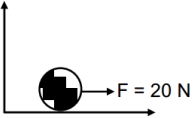
Find the ratio of linear acceleration $(a)$ to angular acceleration $(\alpha)$ of the center of mass $(COM)$ for the given diagram. Given: $m = 2 \, kg$,$r = 10 \, cm = 0.1 \, m$,and force $F = 20 \, N$ applied at the center.
A
$\frac{1}{5}$
B
$\frac{1}{10}$
C
$\frac{1}{15}$
D
$\frac{1}{20}$
Solution
(D) The linear acceleration $(a)$ of the center of mass is given by Newton's second law:
$a = \frac{F}{m} = \frac{20 \, N}{2 \, kg} = 10 \, m/s^2$.
The torque $(\tau)$ about the center of mass is given by $\tau = F \times d$,where $d$ is the perpendicular distance from the center of mass to the line of action of the force. Since the force $F$ is applied at the center of mass,the perpendicular distance $d = 0$.
Therefore,$\tau = F \times 0 = 0$.
Using the relation $\tau = I \alpha$,where $I$ is the moment of inertia and $\alpha$ is the angular acceleration:
$0 = I \alpha \implies \alpha = 0 \, rad/s^2$.
However,if the question implies the force is applied at the edge (tangentially) to cause rotation,then $\tau = F \times r = 20 \times 0.1 = 2 \, N \cdot m$.
Assuming a solid disk,$I = \frac{1}{2} m r^2 = \frac{1}{2} \times 2 \times (0.1)^2 = 0.01 \, kg \cdot m^2$.
Then $\alpha = \frac{\tau}{I} = \frac{2}{0.01} = 200 \, rad/s^2$.
The ratio $\frac{a}{\alpha} = \frac{10}{200} = \frac{1}{20}$.
$a = \frac{F}{m} = \frac{20 \, N}{2 \, kg} = 10 \, m/s^2$.
The torque $(\tau)$ about the center of mass is given by $\tau = F \times d$,where $d$ is the perpendicular distance from the center of mass to the line of action of the force. Since the force $F$ is applied at the center of mass,the perpendicular distance $d = 0$.
Therefore,$\tau = F \times 0 = 0$.
Using the relation $\tau = I \alpha$,where $I$ is the moment of inertia and $\alpha$ is the angular acceleration:
$0 = I \alpha \implies \alpha = 0 \, rad/s^2$.
However,if the question implies the force is applied at the edge (tangentially) to cause rotation,then $\tau = F \times r = 20 \times 0.1 = 2 \, N \cdot m$.
Assuming a solid disk,$I = \frac{1}{2} m r^2 = \frac{1}{2} \times 2 \times (0.1)^2 = 0.01 \, kg \cdot m^2$.
Then $\alpha = \frac{\tau}{I} = \frac{2}{0.01} = 200 \, rad/s^2$.
The ratio $\frac{a}{\alpha} = \frac{10}{200} = \frac{1}{20}$.
0 likes
View Solution129
DifficultMCQ
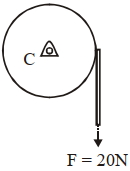
Consider a $20\, kg$ uniform circular disk of radius $0.2\, m$. It is pin supported at its center and is at rest initially. The disk is acted upon by a constant force $F = 20\, N$ through a massless string wrapped around its periphery as shown in the figure. Suppose the disk makes $n$ number of revolutions to attain an angular speed of $50\, rad/s$. The value of $n$,to the nearest integer,is.......... [Given: In one complete revolution,the disk rotates by $6.28\, rad$]
A
$15$
B
$18$
C
$20$
D
$23$
Solution
(C) Given: Mass $m = 20\, kg$,Radius $R = 0.2\, m$,Force $F = 20\, N$,Initial angular speed $\omega_0 = 0$,Final angular speed $\omega = 50\, rad/s$.
The torque $\tau$ applied by the force $F$ is $\tau = F \cdot R$.
The moment of inertia of the disk about its center is $I = \frac{1}{2} mR^2$.
Using $\tau = I\alpha$,the angular acceleration $\alpha$ is:
$\alpha = \frac{F \cdot R}{\frac{1}{2} mR^2} = \frac{2F}{mR} = \frac{2 \times 20}{20 \times 0.2} = \frac{2}{0.2} = 10\, rad/s^2$.
Using the kinematic equation $\omega^2 = \omega_0^2 + 2\alpha\Delta\theta$:
$(50)^2 = 0^2 + 2(10)\Delta\theta$
$2500 = 20\Delta\theta$
$\Delta\theta = 125\, rad$.
Since one revolution corresponds to $2\pi \approx 6.28\, rad$,the number of revolutions $n$ is:
$n = \frac{\Delta\theta}{2\pi} = \frac{125}{6.28} \approx 19.90$.
Rounding to the nearest integer,$n = 20$.
The torque $\tau$ applied by the force $F$ is $\tau = F \cdot R$.
The moment of inertia of the disk about its center is $I = \frac{1}{2} mR^2$.
Using $\tau = I\alpha$,the angular acceleration $\alpha$ is:
$\alpha = \frac{F \cdot R}{\frac{1}{2} mR^2} = \frac{2F}{mR} = \frac{2 \times 20}{20 \times 0.2} = \frac{2}{0.2} = 10\, rad/s^2$.
Using the kinematic equation $\omega^2 = \omega_0^2 + 2\alpha\Delta\theta$:
$(50)^2 = 0^2 + 2(10)\Delta\theta$
$2500 = 20\Delta\theta$
$\Delta\theta = 125\, rad$.
Since one revolution corresponds to $2\pi \approx 6.28\, rad$,the number of revolutions $n$ is:
$n = \frac{\Delta\theta}{2\pi} = \frac{125}{6.28} \approx 19.90$.
Rounding to the nearest integer,$n = 20$.
0 likes
View Solution130
MediumMCQ
$A$ solid disc of radius $20 \, \text{cm}$ and mass $10 \, \text{kg}$ is rotating with an angular velocity of $600 \, \text{rpm}$ about an axis normal to its circular plane and passing through its centre of mass. The retarding torque required to bring the disc to rest in $10 \, \text{s}$ is $x \pi \times 10^{-1} \, \text{Nm}$. Find the value of $x$.
A
$1$
B
$2$
C
$3$
D
$4$
Solution
(D) Given: Radius $R = 20 \, \text{cm} = 0.2 \, \text{m}$,Mass $M = 10 \, \text{kg}$,Initial angular velocity $\omega_i = 600 \, \text{rpm} = \frac{600 \times 2\pi}{60} \, \text{rad/s} = 20\pi \, \text{rad/s}$.
Final angular velocity $\omega_f = 0 \, \text{rad/s}$,Time $\Delta t = 10 \, \text{s}$.
The moment of inertia of the disc is $I = \frac{1}{2}MR^2 = \frac{1}{2} \times 10 \times (0.2)^2 = 5 \times 0.04 = 0.2 \, \text{kg m}^2$.
The torque required is $\tau = \frac{\Delta L}{\Delta t} = \frac{I(\omega_f - \omega_i)}{\Delta t}$.
Magnitude of torque $|\tau| = \frac{0.2 \times (20\pi - 0)}{10} = \frac{4\pi}{10} = 0.4\pi = 4\pi \times 10^{-1} \, \text{Nm}$.
Comparing with $x\pi \times 10^{-1} \, \text{Nm}$,we get $x = 4$.
Final angular velocity $\omega_f = 0 \, \text{rad/s}$,Time $\Delta t = 10 \, \text{s}$.
The moment of inertia of the disc is $I = \frac{1}{2}MR^2 = \frac{1}{2} \times 10 \times (0.2)^2 = 5 \times 0.04 = 0.2 \, \text{kg m}^2$.
The torque required is $\tau = \frac{\Delta L}{\Delta t} = \frac{I(\omega_f - \omega_i)}{\Delta t}$.
Magnitude of torque $|\tau| = \frac{0.2 \times (20\pi - 0)}{10} = \frac{4\pi}{10} = 0.4\pi = 4\pi \times 10^{-1} \, \text{Nm}$.
Comparing with $x\pi \times 10^{-1} \, \text{Nm}$,we get $x = 4$.
0 likes
View Solution131
DifficultMCQ
$A$ pulley of radius $1.5\,m$ is rotated about its axis by a force $F = (12t - 3t^2)\,N$ applied tangentially (where $t$ is measured in seconds). If the moment of inertia of the pulley about its axis of rotation is $4.5\,kg\cdot m^2$,the number of rotations made by the pulley before its direction of motion is reversed will be $\frac{K}{\pi}$. The value of $K$ is $.....$
A
$18$
B
$9$
C
$3$
D
$6$
Solution
(A) The torque applied is $\tau = F \cdot r = (12t - 3t^2) \cdot 1.5 = 18t - 4.5t^2$.
Using $\tau = I\alpha$,we have $18t - 4.5t^2 = 4.5\alpha$,which gives $\alpha = 4t - t^2$.
Since $\alpha = \frac{d\omega}{dt}$,we integrate to find angular velocity: $\omega = \int (4t - t^2) dt = 2t^2 - \frac{t^3}{3}$.
The motion reverses when $\omega = 0$,so $t^2(2 - \frac{t}{3}) = 0$,giving $t = 6\,s$.
The angular displacement $\theta$ is $\int_{0}^{6} (2t^2 - \frac{t^3}{3}) dt = [\frac{2t^3}{3} - \frac{t^4}{12}]_{0}^{6} = \frac{2(216)}{3} - \frac{1296}{12} = 144 - 108 = 36\,rad$.
The number of rotations is $N = \frac{\theta}{2\pi} = \frac{36}{2\pi} = \frac{18}{\pi}$.
Comparing with $\frac{K}{\pi}$,we get $K = 18$.
Using $\tau = I\alpha$,we have $18t - 4.5t^2 = 4.5\alpha$,which gives $\alpha = 4t - t^2$.
Since $\alpha = \frac{d\omega}{dt}$,we integrate to find angular velocity: $\omega = \int (4t - t^2) dt = 2t^2 - \frac{t^3}{3}$.
The motion reverses when $\omega = 0$,so $t^2(2 - \frac{t}{3}) = 0$,giving $t = 6\,s$.
The angular displacement $\theta$ is $\int_{0}^{6} (2t^2 - \frac{t^3}{3}) dt = [\frac{2t^3}{3} - \frac{t^4}{12}]_{0}^{6} = \frac{2(216)}{3} - \frac{1296}{12} = 144 - 108 = 36\,rad$.
The number of rotations is $N = \frac{\theta}{2\pi} = \frac{36}{2\pi} = \frac{18}{\pi}$.
Comparing with $\frac{K}{\pi}$,we get $K = 18$.
0 likes
View Solution132
MediumMCQ
$A$ particle of mass $m$ moves in a circular path of radius $r$,under the action of a force which delivers constant power $P$ and increases its speed. The angular acceleration of the particle at time $t$ is proportional to:
A
$t^{-1/2}$
B
$t^{1/2}$
C
$t^0$
D
$t^{3/2}$
Solution
(A) Given that the power $P$ is constant.
Work done $W = P \cdot t$.
By the work-energy theorem,$W = \Delta K = \frac{1}{2} m v^2$.
Since $v = r \omega$,we have $P t = \frac{1}{2} m (r \omega)^2 = \frac{1}{2} m r^2 \omega^2$.
Thus,$\omega^2 = \frac{2 P t}{m r^2}$,which implies $\omega = \sqrt{\frac{2 P}{m r^2}} \cdot t^{1/2}$.
Angular acceleration $\alpha = \frac{d\omega}{dt} = \frac{d}{dt} \left( \sqrt{\frac{2 P}{m r^2}} \cdot t^{1/2} \right)$.
$\alpha = \sqrt{\frac{2 P}{m r^2}} \cdot \frac{1}{2} t^{-1/2}$.
Therefore,$\alpha \propto t^{-1/2}$ or $\alpha \propto \frac{1}{\sqrt{t}}$.
Work done $W = P \cdot t$.
By the work-energy theorem,$W = \Delta K = \frac{1}{2} m v^2$.
Since $v = r \omega$,we have $P t = \frac{1}{2} m (r \omega)^2 = \frac{1}{2} m r^2 \omega^2$.
Thus,$\omega^2 = \frac{2 P t}{m r^2}$,which implies $\omega = \sqrt{\frac{2 P}{m r^2}} \cdot t^{1/2}$.
Angular acceleration $\alpha = \frac{d\omega}{dt} = \frac{d}{dt} \left( \sqrt{\frac{2 P}{m r^2}} \cdot t^{1/2} \right)$.
$\alpha = \sqrt{\frac{2 P}{m r^2}} \cdot \frac{1}{2} t^{-1/2}$.
Therefore,$\alpha \propto t^{-1/2}$ or $\alpha \propto \frac{1}{\sqrt{t}}$.
0 likes
View Solution133
EasyMCQ
$A$ body rotates about a fixed axis with an angular acceleration of $3 \, rad/s^2$. The angle rotated by it during the time when its angular velocity increases from $10 \, rad/s$ to $20 \, rad/s$ (in radian) is ..........
A
$50$
B
$100$
C
$150$
D
$200$
Solution
(A) Given:
Angular acceleration $\alpha = 3 \, rad/s^2$
Initial angular velocity $\omega_1 = 10 \, rad/s$
Final angular velocity $\omega_2 = 20 \, rad/s$
Using the kinematic equation for rotational motion:
$\omega_2^2 = \omega_1^2 + 2 \alpha \theta$
Substituting the given values:
$(20)^2 = (10)^2 + 2 \times 3 \times \theta$
$400 = 100 + 6 \theta$
$300 = 6 \theta$
$\theta = \frac{300}{6} = 50 \, rad$
Thus,the angle rotated is $50 \, rad$.
Angular acceleration $\alpha = 3 \, rad/s^2$
Initial angular velocity $\omega_1 = 10 \, rad/s$
Final angular velocity $\omega_2 = 20 \, rad/s$
Using the kinematic equation for rotational motion:
$\omega_2^2 = \omega_1^2 + 2 \alpha \theta$
Substituting the given values:
$(20)^2 = (10)^2 + 2 \times 3 \times \theta$
$400 = 100 + 6 \theta$
$300 = 6 \theta$
$\theta = \frac{300}{6} = 50 \, rad$
Thus,the angle rotated is $50 \, rad$.
0 likes
View Solution134
MediumMCQ
$A$ flywheel of moment of inertia $2 \, kg \cdot m^2$ is rotated at a speed of $30 \, rad/s$. $A$ tangential force at the rim stops the wheel in $15 \, s$. The average torque of the force is ........... $N \cdot m$.
A
$4$
B
$2$
C
$8$
D
$1$
Solution
(A) Given:
Moment of inertia,$I = 2 \, kg \cdot m^2$
Initial angular velocity,$\omega_0 = 30 \, rad/s$
Final angular velocity,$\omega_f = 0 \, rad/s$
Time taken to stop,$t = 15 \, s$
Using the equation of rotational motion:
$\omega_f = \omega_0 + \alpha t$
$0 = 30 + \alpha(15)$
$\alpha = -30 / 15 = -2 \, rad/s^2$
The magnitude of angular deceleration is $|\alpha| = 2 \, rad/s^2$.
Average torque is given by:
$\tau = I |\alpha|$
$\tau = 2 \, kg \cdot m^2 \times 2 \, rad/s^2 = 4 \, N \cdot m$.
Moment of inertia,$I = 2 \, kg \cdot m^2$
Initial angular velocity,$\omega_0 = 30 \, rad/s$
Final angular velocity,$\omega_f = 0 \, rad/s$
Time taken to stop,$t = 15 \, s$
Using the equation of rotational motion:
$\omega_f = \omega_0 + \alpha t$
$0 = 30 + \alpha(15)$
$\alpha = -30 / 15 = -2 \, rad/s^2$
The magnitude of angular deceleration is $|\alpha| = 2 \, rad/s^2$.
Average torque is given by:
$\tau = I |\alpha|$
$\tau = 2 \, kg \cdot m^2 \times 2 \, rad/s^2 = 4 \, N \cdot m$.
0 likes
View Solution135
MediumMCQ
$A$ disc of mass $M \ kg$ and radius $R \ m$ is rotating at an angular speed of $\omega \ rad/s$ when the motor is switched off. Neglecting the friction at the axle,the force that must be applied tangentially to the wheel to bring it to rest in time $t$ is ...............
A
$\frac{M R \omega}{2 t}$
B
$\frac{M R \omega}{t}$
C
$\frac{2 M R \omega}{t}$
D
$\frac{M R^2 \omega}{2 t}$
Solution
(A) The moment of inertia of a disc about its central axis is $I = \frac{1}{2} M R^2$.
Using the rotational analogue of Newton's second law,the torque $\tau$ is given by $\tau = I \alpha$,where $\alpha$ is the angular acceleration.
The torque applied by the tangential force $F$ is $\tau = F \times R$.
Equating the two expressions for torque: $F R = \frac{1}{2} M R^2 \alpha$.
Solving for angular acceleration: $\alpha = \frac{2 F}{M R}$.
Since the disc comes to rest from an initial angular speed $\omega$ in time $t$,the magnitude of angular deceleration is $\alpha = \frac{\omega}{t}$.
Substituting $\alpha$ into the equation: $\frac{2 F}{M R} = \frac{\omega}{t}$.
Solving for $F$: $F = \frac{M R \omega}{2 t}$.
Using the rotational analogue of Newton's second law,the torque $\tau$ is given by $\tau = I \alpha$,where $\alpha$ is the angular acceleration.
The torque applied by the tangential force $F$ is $\tau = F \times R$.
Equating the two expressions for torque: $F R = \frac{1}{2} M R^2 \alpha$.
Solving for angular acceleration: $\alpha = \frac{2 F}{M R}$.
Since the disc comes to rest from an initial angular speed $\omega$ in time $t$,the magnitude of angular deceleration is $\alpha = \frac{\omega}{t}$.
Substituting $\alpha$ into the equation: $\frac{2 F}{M R} = \frac{\omega}{t}$.
Solving for $F$: $F = \frac{M R \omega}{2 t}$.
0 likes
View Solution136
MediumMCQ
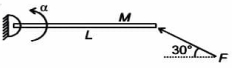
The thin rod shown below has mass $M$ and length $L$. $A$ force $F$ acts at one end as shown,and the rod is free to rotate about the other end in the plane of the force. The initial angular acceleration of the rod is ........
A
$\frac{3 F}{2 M L}$
B
$\frac{2 F}{3 M L}$
C
$\frac{F}{M L}$
D
$\frac{F}{2 M L}$
Solution
(A) The torque $\tau$ acting on the rod about the hinge point is given by $\tau = r_{\perp} F$,where $r_{\perp}$ is the perpendicular distance from the axis of rotation to the line of action of the force.
From the geometry,$r_{\perp} = L \sin 30^{\circ} = L \times \frac{1}{2} = \frac{L}{2}$.
Thus,the initial torque is $\tau = F \times \frac{L}{2} = \frac{FL}{2}$.
The moment of inertia $I$ of a thin rod of mass $M$ and length $L$ about an axis passing through one end is $I = \frac{ML^2}{3}$.
Using the relation $\tau = I \alpha$,the initial angular acceleration $\alpha$ is given by:
$\alpha = \frac{\tau}{I} = \frac{FL/2}{ML^2/3} = \frac{FL}{2} \times \frac{3}{ML^2} = \frac{3F}{2ML}$.
Therefore,the correct option is $A$.
From the geometry,$r_{\perp} = L \sin 30^{\circ} = L \times \frac{1}{2} = \frac{L}{2}$.
Thus,the initial torque is $\tau = F \times \frac{L}{2} = \frac{FL}{2}$.
The moment of inertia $I$ of a thin rod of mass $M$ and length $L$ about an axis passing through one end is $I = \frac{ML^2}{3}$.
Using the relation $\tau = I \alpha$,the initial angular acceleration $\alpha$ is given by:
$\alpha = \frac{\tau}{I} = \frac{FL/2}{ML^2/3} = \frac{FL}{2} \times \frac{3}{ML^2} = \frac{3F}{2ML}$.
Therefore,the correct option is $A$.
0 likes
View Solution137
EasyMCQ
$A$ hollow sphere of mass $1 \,kg$ and radius $10 \,cm$ is free to rotate about its diameter. If a force of $30 \,N$ is applied tangentially to it,its angular acceleration is (in $rad/s^2$):
A
$5000$
B
$450$
C
$50$
D
$5$
Solution
(B) The moment of inertia of a hollow sphere about its diameter is given by $I = \frac{2}{3}MR^2$.
Given: Mass $M = 1 \,kg$,Radius $R = 10 \,cm = 0.1 \,m$,Force $F = 30 \,N$.
The torque applied is $\tau = F \times R$.
Using the relation $\tau = I \alpha$,where $\alpha$ is the angular acceleration:
$F \times R = \left(\frac{2}{3}MR^2\right) \alpha$
$30 \times 0.1 = \left(\frac{2}{3} \times 1 \times (0.1)^2\right) \alpha$
$3 = \left(\frac{2}{3} \times 0.01\right) \alpha$
$3 = \frac{0.02}{3} \alpha$
$\alpha = \frac{3 \times 3}{0.02} = \frac{9}{0.02} = 450 \,rad/s^2$.
Given: Mass $M = 1 \,kg$,Radius $R = 10 \,cm = 0.1 \,m$,Force $F = 30 \,N$.
The torque applied is $\tau = F \times R$.
Using the relation $\tau = I \alpha$,where $\alpha$ is the angular acceleration:
$F \times R = \left(\frac{2}{3}MR^2\right) \alpha$
$30 \times 0.1 = \left(\frac{2}{3} \times 1 \times (0.1)^2\right) \alpha$
$3 = \left(\frac{2}{3} \times 0.01\right) \alpha$
$3 = \frac{0.02}{3} \alpha$
$\alpha = \frac{3 \times 3}{0.02} = \frac{9}{0.02} = 450 \,rad/s^2$.
0 likes
View Solution138
MediumMCQ
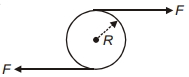
Two equal and opposite forces are applied tangentially to a uniform disc of mass $M$ and radius $R$ as shown in the figure. If the disc is pivoted at its centre and free to rotate in its plane,the angular acceleration of the disc is ............
A
$\frac{F}{M R}$
B
$\frac{2 F}{3 M R}$
C
$\frac{4 F}{M R}$
D
Zero
Solution
(C) The net torque $\tau$ acting on the disc about its centre is the sum of the torques produced by the two forces.
Since both forces are applied tangentially at a distance $R$ from the centre,each force produces a torque of magnitude $\tau_i = F \times R$.
Both forces create a torque in the same rotational direction (counter-clockwise),so the total torque is $\tau_{net} = F R + F R = 2 F R$.
The moment of inertia of a uniform disc of mass $M$ and radius $R$ about an axis passing through its centre and perpendicular to its plane is $I = \frac{1}{2} M R^2$.
Using the rotational analogue of Newton's second law,$\tau_{net} = I \alpha$,where $\alpha$ is the angular acceleration:
$2 F R = (\frac{1}{2} M R^2) \alpha$
Solving for $\alpha$:
$\alpha = \frac{2 F R}{\frac{1}{2} M R^2} = \frac{4 F}{M R}$.
Since both forces are applied tangentially at a distance $R$ from the centre,each force produces a torque of magnitude $\tau_i = F \times R$.
Both forces create a torque in the same rotational direction (counter-clockwise),so the total torque is $\tau_{net} = F R + F R = 2 F R$.
The moment of inertia of a uniform disc of mass $M$ and radius $R$ about an axis passing through its centre and perpendicular to its plane is $I = \frac{1}{2} M R^2$.
Using the rotational analogue of Newton's second law,$\tau_{net} = I \alpha$,where $\alpha$ is the angular acceleration:
$2 F R = (\frac{1}{2} M R^2) \alpha$
Solving for $\alpha$:
$\alpha = \frac{2 F R}{\frac{1}{2} M R^2} = \frac{4 F}{M R}$.
0 likes
View Solution139
EasyMCQ
$A$ wheel having a moment of inertia of $4 \,kg \cdot m^2$ about its symmetrical axis rotates at a rate of $240 \,rpm$ about it. The torque required to stop the rotation of the wheel in one minute is ............ $N \cdot m$.
A
$\frac{5 \pi}{7}$
B
$\frac{8 \pi}{15}$
C
$\frac{2 \pi}{9}$
D
$\frac{3 \pi}{7}$
Solution
(B) Given: Moment of inertia $I = 4 \,kg \cdot m^2$,initial angular velocity $\omega_0 = 240 \,rpm$,time $t = 1 \,min = 60 \,s$,and final angular velocity $\omega = 0 \,rad/s$.
First,convert the angular velocity from $rpm$ to $rad/s$:
$\omega_0 = 240 \times \frac{2 \pi}{60} = 8 \pi \,rad/s$.
Using the equation of rotational motion $\omega = \omega_0 - \alpha t$,where $\alpha$ is the angular deceleration:
$0 = 8 \pi - \alpha(60) \implies \alpha = \frac{8 \pi}{60} = \frac{2 \pi}{15} \,rad/s^2$.
The torque $\tau$ required is given by $\tau = I \alpha$:
$\tau = 4 \times \frac{2 \pi}{15} = \frac{8 \pi}{15} \,N \cdot m$.
First,convert the angular velocity from $rpm$ to $rad/s$:
$\omega_0 = 240 \times \frac{2 \pi}{60} = 8 \pi \,rad/s$.
Using the equation of rotational motion $\omega = \omega_0 - \alpha t$,where $\alpha$ is the angular deceleration:
$0 = 8 \pi - \alpha(60) \implies \alpha = \frac{8 \pi}{60} = \frac{2 \pi}{15} \,rad/s^2$.
The torque $\tau$ required is given by $\tau = I \alpha$:
$\tau = 4 \times \frac{2 \pi}{15} = \frac{8 \pi}{15} \,N \cdot m$.
0 likes
View Solution140
EasyMCQ
$A$ constant torque acting on a uniform circular wheel changes its angular momentum from $A_0$ to $4 A_0$ in $4$ seconds. The magnitude of this torque is ...........
A
$\frac{3 A_0}{4}$
B
$A_0$
C
$4 A_0$
D
$12 A_0$
Solution
(A) The relationship between torque $\tau$ and the rate of change of angular momentum $L$ is given by the equation: $\tau = \frac{\Delta L}{\Delta t}$.
Given the initial angular momentum $L_i = A_0$ and the final angular momentum $L_f = 4 A_0$.
The time interval $\Delta t = 4 \text{ s}$.
Substituting these values into the formula:
$\tau = \frac{4 A_0 - A_0}{4} = \frac{3 A_0}{4}$.
Thus,the magnitude of the torque is $\frac{3 A_0}{4}$.
Given the initial angular momentum $L_i = A_0$ and the final angular momentum $L_f = 4 A_0$.
The time interval $\Delta t = 4 \text{ s}$.
Substituting these values into the formula:
$\tau = \frac{4 A_0 - A_0}{4} = \frac{3 A_0}{4}$.
Thus,the magnitude of the torque is $\frac{3 A_0}{4}$.
0 likes
View Solution141
MediumMCQ
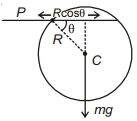
$A$ uniform disc of mass $m$ and radius $R$ is pivoted at point $P$ and is free to rotate in a vertical plane. The centre $C$ of the disc is initially in a horizontal position with $P$ as shown in the figure. If it is released from this position,then its angular acceleration when the line $PC$ is inclined to the horizontal at an angle $\theta$ is ............

A
$\frac{2 g \cos \theta}{3 R}$
B
$\frac{g \sin \theta}{2 R}$
C
$\frac{2 g \sin \theta}{R}$
D
$\frac{2 g \sin \theta}{3 R}$
Solution
(A) The torque $\tau$ acting on the disc about the pivot point $P$ is due to the gravitational force $mg$ acting at the centre of mass $C$.
When the line $PC$ makes an angle $\theta$ with the horizontal,the perpendicular distance from $P$ to the line of action of the gravitational force is $R \cos \theta$.
Therefore,the torque is $\tau = mg(R \cos \theta)$.
The moment of inertia $I$ of the disc about an axis passing through the pivot point $P$ (which is on the rim) is given by the parallel axis theorem: $I = I_{cm} + mR^2 = \frac{1}{2} mR^2 + mR^2 = \frac{3}{2} mR^2$.
Using the relation $\tau = I \alpha$,we have:
$mg(R \cos \theta) = \left( \frac{3}{2} mR^2 \right) \alpha$
Solving for the angular acceleration $\alpha$:
$\alpha = \frac{mgR \cos \theta}{\frac{3}{2} mR^2} = \frac{2g \cos \theta}{3R}$.
When the line $PC$ makes an angle $\theta$ with the horizontal,the perpendicular distance from $P$ to the line of action of the gravitational force is $R \cos \theta$.
Therefore,the torque is $\tau = mg(R \cos \theta)$.
The moment of inertia $I$ of the disc about an axis passing through the pivot point $P$ (which is on the rim) is given by the parallel axis theorem: $I = I_{cm} + mR^2 = \frac{1}{2} mR^2 + mR^2 = \frac{3}{2} mR^2$.
Using the relation $\tau = I \alpha$,we have:
$mg(R \cos \theta) = \left( \frac{3}{2} mR^2 \right) \alpha$
Solving for the angular acceleration $\alpha$:
$\alpha = \frac{mgR \cos \theta}{\frac{3}{2} mR^2} = \frac{2g \cos \theta}{3R}$.
0 likes
View Solution142
DifficultMCQ
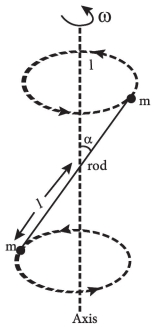
$A$ massless rod of length $2l$ has equal point masses $m$ attached to its two ends as shown in the figure. The rod is rotating about an axis passing through its centre and making an angle $\alpha$ with the axis. The magnitude of the rate of change of angular momentum of the rod,i.e.,$\left|\frac{dL}{dt}\right|$,is equal to:
A
$2ml^3\omega^2\sin\alpha\cos\alpha$
B
$ml^2\omega^2\sin 2\alpha$
C
$ml^2\sin 2\alpha$
D
$m^{1/2}l^{1/2}\omega\sin\alpha\cos\alpha$
Solution
(B) The rate of change of angular momentum is equal to the net torque acting on the system,i.e.,$\left|\frac{dL}{dt}\right| = \tau_{\text{net}}$.
For each mass $m$ at a distance $l$ from the centre,the radius of the circular path is $r = l\sin\alpha$.
The centripetal force acting on each mass is $F = mr\omega^2 = m(l\sin\alpha)\omega^2$.
The torque $\tau$ due to one mass about the centre is $\tau = F \times r_{\perp}$,where $r_{\perp} = l\cos\alpha$ is the perpendicular distance from the axis of rotation to the force vector.
Thus,$\tau = (ml\sin\alpha\omega^2) \times (l\cos\alpha) = ml^2\omega^2\sin\alpha\cos\alpha$.
Since there are two such masses on opposite sides of the centre,the torques produced by them are in the same direction.
Therefore,the net torque is $\tau_{\text{net}} = 2\tau = 2ml^2\omega^2\sin\alpha\cos\alpha$.
Using the trigonometric identity $\sin 2\alpha = 2\sin\alpha\cos\alpha$,we get:
$\tau_{\text{net}} = ml^2\omega^2\sin 2\alpha$.
Hence,$\left|\frac{dL}{dt}\right| = ml^2\omega^2\sin 2\alpha$.
For each mass $m$ at a distance $l$ from the centre,the radius of the circular path is $r = l\sin\alpha$.
The centripetal force acting on each mass is $F = mr\omega^2 = m(l\sin\alpha)\omega^2$.
The torque $\tau$ due to one mass about the centre is $\tau = F \times r_{\perp}$,where $r_{\perp} = l\cos\alpha$ is the perpendicular distance from the axis of rotation to the force vector.
Thus,$\tau = (ml\sin\alpha\omega^2) \times (l\cos\alpha) = ml^2\omega^2\sin\alpha\cos\alpha$.
Since there are two such masses on opposite sides of the centre,the torques produced by them are in the same direction.
Therefore,the net torque is $\tau_{\text{net}} = 2\tau = 2ml^2\omega^2\sin\alpha\cos\alpha$.
Using the trigonometric identity $\sin 2\alpha = 2\sin\alpha\cos\alpha$,we get:
$\tau_{\text{net}} = ml^2\omega^2\sin 2\alpha$.
Hence,$\left|\frac{dL}{dt}\right| = ml^2\omega^2\sin 2\alpha$.
0 likes
View Solution143
MediumMCQ
$A$ light rope is wound around a hollow cylinder of mass $5\,kg$ and radius $70\,cm$. The rope is pulled with a force of $52.5\,N$. The angular acceleration of the cylinder will be.....$rad\,s^{-2}$.
A
$14$
B
$15$
C
$13$
D
$12$
Solution
(B) The torque $\tau$ acting on the cylinder is given by $\tau = F \times R$.
For a hollow cylinder,the moment of inertia $I$ about its central axis is $I = mR^2$.
Using the rotational form of Newton's second law,$\tau = I \alpha$,where $\alpha$ is the angular acceleration.
Substituting the expressions,we get $F \times R = (mR^2) \alpha$.
Simplifying for $\alpha$,we have $\alpha = \frac{F}{mR}$.
Given $F = 52.5\,N$,$m = 5\,kg$,and $R = 70\,cm = 0.7\,m$.
Calculating the value: $\alpha = \frac{52.5}{5 \times 0.7} = \frac{52.5}{3.5} = 15\,rad\,s^{-2}$.
For a hollow cylinder,the moment of inertia $I$ about its central axis is $I = mR^2$.
Using the rotational form of Newton's second law,$\tau = I \alpha$,where $\alpha$ is the angular acceleration.
Substituting the expressions,we get $F \times R = (mR^2) \alpha$.
Simplifying for $\alpha$,we have $\alpha = \frac{F}{mR}$.
Given $F = 52.5\,N$,$m = 5\,kg$,and $R = 70\,cm = 0.7\,m$.
Calculating the value: $\alpha = \frac{52.5}{5 \times 0.7} = \frac{52.5}{3.5} = 15\,rad\,s^{-2}$.
0 likes
View Solution144
MediumMCQ
$A$ string is wrapped around the rim of a wheel of moment of inertia $0.40 \ kg \cdot m^2$ and radius $10 \ cm$. The wheel is free to rotate about its axis. Initially,the wheel is at rest. The string is now pulled by a force of $40 \ N$. The angular velocity of the wheel after $10 \ s$ is $x \ rad/s$,where $x$ is $\qquad$
A
$100$
B
$199$
C
$198$
D
$99$
Solution
(A) Given: Moment of inertia $I = 0.40 \ kg \cdot m^2$,radius $R = 10 \ cm = 0.1 \ m$,force $F = 40 \ N$,time $t = 10 \ s$,initial angular velocity $\omega_0 = 0 \ rad/s$.
The torque $\tau$ applied to the wheel is given by $\tau = F \times R$.
$\tau = 40 \times 0.1 = 4 \ N \cdot m$.
Using the relation $\tau = I \alpha$,where $\alpha$ is the angular acceleration:
$4 = 0.40 \times \alpha \Rightarrow \alpha = \frac{4}{0.40} = 10 \ rad/s^2$.
Using the equation of motion $\omega = \omega_0 + \alpha t$:
$\omega = 0 + (10 \times 10) = 100 \ rad/s$.
Thus,$x = 100$.
The torque $\tau$ applied to the wheel is given by $\tau = F \times R$.
$\tau = 40 \times 0.1 = 4 \ N \cdot m$.
Using the relation $\tau = I \alpha$,where $\alpha$ is the angular acceleration:
$4 = 0.40 \times \alpha \Rightarrow \alpha = \frac{4}{0.40} = 10 \ rad/s^2$.
Using the equation of motion $\omega = \omega_0 + \alpha t$:
$\omega = 0 + (10 \times 10) = 100 \ rad/s$.
Thus,$x = 100$.
0 likes
View Solution145
MediumMCQ
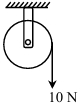
$A$ wheel of radius $0.2 \ m$ rotates freely about its center when a string that is wrapped over its rim is pulled by a force of $10 \ N$ as shown in the figure. The established torque produces an angular acceleration of $2 \ rad/s^2$. The moment of inertia of the wheel is . . . . . . $kg \ m^2$. (Acceleration due to gravity $= 10 \ m/s^2$)
A
$1$
B
$2$
C
$3$
D
$4$
Solution
(A) The torque $\tau$ produced by the force $F$ acting at the rim of the wheel is given by $\tau = F \times R$.
Given: Force $F = 10 \ N$,Radius $R = 0.2 \ m$,and angular acceleration $\alpha = 2 \ rad/s^2$.
The relationship between torque,moment of inertia $I$,and angular acceleration $\alpha$ is $\tau = I \alpha$.
Substituting the values:
$F \times R = I \alpha$
$10 \times 0.2 = I \times 2$
$2 = 2I$
$I = 1 \ kg \ m^2$.
Thus,the moment of inertia of the wheel is $1 \ kg \ m^2$.
Given: Force $F = 10 \ N$,Radius $R = 0.2 \ m$,and angular acceleration $\alpha = 2 \ rad/s^2$.
The relationship between torque,moment of inertia $I$,and angular acceleration $\alpha$ is $\tau = I \alpha$.
Substituting the values:
$F \times R = I \alpha$
$10 \times 0.2 = I \times 2$
$2 = 2I$
$I = 1 \ kg \ m^2$.
Thus,the moment of inertia of the wheel is $1 \ kg \ m^2$.
0 likes
View Solution146
MediumMCQ
Which of the following are correct expressions for torque acting on a body?
$A. \ \vec{\tau}=\vec{ r } \times \vec{ L }$
$B. \ \vec{\tau}=\frac{ d }{ dt }(\vec{ r } \times \vec{ p })$
$C. \ \vec{\tau}=\vec{ r } \times \frac{ d \vec{ p }}{ dt }$
$D. \ \vec{\tau}= I \vec{\alpha}$
$E. \ \vec{\tau}=\vec{ r } \times \vec{ F }$
($\vec{ r }=$ position vector; $\vec{ p }=$ linear momentum;
$\vec{ L }=$ angular momentum; $\vec{\alpha}=$ angular acceleration;
$I=$ moment of inertia; $\vec{ F }=$ force; $t =$ time)
Choose the correct answer from the options given below:
$A. \ \vec{\tau}=\vec{ r } \times \vec{ L }$
$B. \ \vec{\tau}=\frac{ d }{ dt }(\vec{ r } \times \vec{ p })$
$C. \ \vec{\tau}=\vec{ r } \times \frac{ d \vec{ p }}{ dt }$
$D. \ \vec{\tau}= I \vec{\alpha}$
$E. \ \vec{\tau}=\vec{ r } \times \vec{ F }$
($\vec{ r }=$ position vector; $\vec{ p }=$ linear momentum;
$\vec{ L }=$ angular momentum; $\vec{\alpha}=$ angular acceleration;
$I=$ moment of inertia; $\vec{ F }=$ force; $t =$ time)
Choose the correct answer from the options given below:
A
$B, D$ and $E$ Only
B
$C$ and $D$ Only
C
$B, C, D$ and $E$ Only
D
$A, B, D$ and $E$ Only
Solution
(C) The torque $\vec{\tau}$ is defined as the rate of change of angular momentum: $\vec{\tau} = \frac{d\vec{L}}{dt}$.
Since $\vec{L} = \vec{r} \times \vec{p}$,expression $B$ is correct: $\vec{\tau} = \frac{d}{dt}(\vec{r} \times \vec{p})$.
Using the product rule: $\frac{d}{dt}(\vec{r} \times \vec{p}) = (\frac{d\vec{r}}{dt} \times \vec{p}) + (\vec{r} \times \frac{d\vec{p}}{dt})$.
Since $\frac{d\vec{r}}{dt} = \vec{v}$ and $\vec{p} = m\vec{v}$,the term $(\vec{v} \times m\vec{v}) = 0$. Thus,$\vec{\tau} = \vec{r} \times \frac{d\vec{p}}{dt}$,so expression $C$ is correct.
Since $\frac{d\vec{p}}{dt} = \vec{F}$,expression $E$ is correct: $\vec{\tau} = \vec{r} \times \vec{F}$.
For a rigid body rotating about a fixed axis,$\vec{\tau} = I\vec{\alpha}$,so expression $D$ is correct.
Expression $A$ is incorrect as $\vec{\tau} = \frac{d\vec{L}}{dt}$,not $\vec{r} \times \vec{L}$.
Therefore,$B, C, D,$ and $E$ are correct.
Since $\vec{L} = \vec{r} \times \vec{p}$,expression $B$ is correct: $\vec{\tau} = \frac{d}{dt}(\vec{r} \times \vec{p})$.
Using the product rule: $\frac{d}{dt}(\vec{r} \times \vec{p}) = (\frac{d\vec{r}}{dt} \times \vec{p}) + (\vec{r} \times \frac{d\vec{p}}{dt})$.
Since $\frac{d\vec{r}}{dt} = \vec{v}$ and $\vec{p} = m\vec{v}$,the term $(\vec{v} \times m\vec{v}) = 0$. Thus,$\vec{\tau} = \vec{r} \times \frac{d\vec{p}}{dt}$,so expression $C$ is correct.
Since $\frac{d\vec{p}}{dt} = \vec{F}$,expression $E$ is correct: $\vec{\tau} = \vec{r} \times \vec{F}$.
For a rigid body rotating about a fixed axis,$\vec{\tau} = I\vec{\alpha}$,so expression $D$ is correct.
Expression $A$ is incorrect as $\vec{\tau} = \frac{d\vec{L}}{dt}$,not $\vec{r} \times \vec{L}$.
Therefore,$B, C, D,$ and $E$ are correct.
0 likes
View Solution147
MediumMCQ
$A$ thin solid disk of $1 \ kg$ is rotating along its diameter axis at the speed of $1800 \ rpm$. By applying an external torque of $25 \pi \ Nm$ for $40 \ s$,the speed increases to $2100 \ rpm$. The diameter of the disk is . . . . . . $m$.
A
$10$
B
$20$
C
$30$
D
$40$
Solution
(D) Given: Mass $m = 1 \ kg$.
Initial angular velocity $\omega_{i} = 1800 \ rpm = 1800 \times \frac{2 \pi}{60} = 60 \pi \ rad/s$.
Final angular velocity $\omega_{f} = 2100 \ rpm = 2100 \times \frac{2 \pi}{60} = 70 \pi \ rad/s$.
External torque $\tau_{ext} = 25 \pi \ Nm$.
Time $t = 40 \ s$.
Using the equation of rotational motion,$\omega_{f} = \omega_{i} + \alpha t$:
$70 \pi = 60 \pi + \alpha(40) \implies 10 \pi = 40 \alpha \implies \alpha = \frac{\pi}{4} \ rad/s^2$.
For a disk rotating about its diameter,the moment of inertia is $I = \frac{mR^2}{4}$.
Using $\tau = I \alpha$:
$25 \pi = \left( \frac{1 \times R^2}{4} \right) \times \frac{\pi}{4}$.
$25 = \frac{R^2}{16} \implies R^2 = 400 \implies R = 20 \ m$.
The diameter of the disk is $D = 2R = 2 \times 20 = 40 \ m$.
Initial angular velocity $\omega_{i} = 1800 \ rpm = 1800 \times \frac{2 \pi}{60} = 60 \pi \ rad/s$.
Final angular velocity $\omega_{f} = 2100 \ rpm = 2100 \times \frac{2 \pi}{60} = 70 \pi \ rad/s$.
External torque $\tau_{ext} = 25 \pi \ Nm$.
Time $t = 40 \ s$.
Using the equation of rotational motion,$\omega_{f} = \omega_{i} + \alpha t$:
$70 \pi = 60 \pi + \alpha(40) \implies 10 \pi = 40 \alpha \implies \alpha = \frac{\pi}{4} \ rad/s^2$.
For a disk rotating about its diameter,the moment of inertia is $I = \frac{mR^2}{4}$.
Using $\tau = I \alpha$:
$25 \pi = \left( \frac{1 \times R^2}{4} \right) \times \frac{\pi}{4}$.
$25 = \frac{R^2}{16} \implies R^2 = 400 \implies R = 20 \ m$.
The diameter of the disk is $D = 2R = 2 \times 20 = 40 \ m$.
0 likes
View Solution148
MediumMCQ
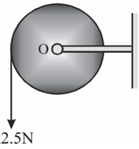
$A$ pulley has the shape of a uniform solid disc of mass $2 \ kg$ and radius $0.5 \ m$. $A$ string is wrapped over its rim and is pulled by a force of $2.5 \ N$. The pulley is free to rotate about its axis. Initially,the pulley is at rest. Find the angular velocity of the pulley just after $10 \ s$. (in $rad/s$)
A
$20$
B
$100$
C
$40$
D
$50$
Solution
(D) The moment of inertia $I$ of a uniform solid disc about its central axis is given by:
$I = \frac{1}{2} mR^2$
Substituting the given values ($m = 2 \ kg$,$R = 0.5 \ m$):
$I = \frac{1}{2} \times 2 \times (0.5)^2 = 0.25 \ kg \cdot m^2$
The torque $\tau$ produced by the force $F = 2.5 \ N$ applied at the rim (radius $R = 0.5 \ m$) is:
$\tau = F \times R = 2.5 \times 0.5 = 1.25 \ N \cdot m$
Using the relation $\tau = I \alpha$,we find the angular acceleration $\alpha$:
$1.25 = 0.25 \times \alpha$
$\alpha = \frac{1.25}{0.25} = 5 \ rad/s^2$
Since the pulley starts from rest $(\omega_0 = 0)$,the angular velocity $\omega$ after $t = 10 \ s$ is:
$\omega = \omega_0 + \alpha t$
$\omega = 0 + 5 \times 10 = 50 \ rad/s$
$I = \frac{1}{2} mR^2$
Substituting the given values ($m = 2 \ kg$,$R = 0.5 \ m$):
$I = \frac{1}{2} \times 2 \times (0.5)^2 = 0.25 \ kg \cdot m^2$
The torque $\tau$ produced by the force $F = 2.5 \ N$ applied at the rim (radius $R = 0.5 \ m$) is:
$\tau = F \times R = 2.5 \times 0.5 = 1.25 \ N \cdot m$
Using the relation $\tau = I \alpha$,we find the angular acceleration $\alpha$:
$1.25 = 0.25 \times \alpha$
$\alpha = \frac{1.25}{0.25} = 5 \ rad/s^2$
Since the pulley starts from rest $(\omega_0 = 0)$,the angular velocity $\omega$ after $t = 10 \ s$ is:
$\omega = \omega_0 + \alpha t$
$\omega = 0 + 5 \times 10 = 50 \ rad/s$
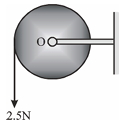
0 likes
View Solution149
DifficultMCQ
When a ceiling fan is switched off,its angular velocity falls to half while it makes $36$ rotations. How many more rotations will it make before coming to rest?
A
$24$
B
$36$
C
$18$
D
$12$
Solution
(D) Using the third equation of rotational motion: $\omega^2 = \omega_0^2 - 2\alpha\theta$.
Initially,the angular velocity becomes $\omega = \frac{\omega_0}{2}$ after $\theta_1 = 36 \times 2\pi$ radians.
Substituting these values: $(\frac{\omega_0}{2})^2 = \omega_0^2 - 2\alpha(36 \times 2\pi)$.
$\frac{\omega_0^2}{4} = \omega_0^2 - 144\pi\alpha$,which gives $144\pi\alpha = \frac{3\omega_0^2}{4}$,so $\alpha = \frac{3\omega_0^2}{576\pi} = \frac{\omega_0^2}{192\pi}$.
Now,for the motion from $\omega = \frac{\omega_0}{2}$ to $\omega = 0$,let the additional rotations be $n$. The angle covered is $\theta_2 = n \times 2\pi$.
Using $0^2 = (\frac{\omega_0}{2})^2 - 2\alpha(n \times 2\pi)$.
$\frac{\omega_0^2}{4} = 2(\frac{\omega_0^2}{192\pi})(n \times 2\pi)$.
$\frac{1}{4} = \frac{4n\pi}{192\pi} = \frac{n}{48}$.
$n = \frac{48}{4} = 12$.
Thus,the fan will make $12$ more rotations before coming to rest.
Initially,the angular velocity becomes $\omega = \frac{\omega_0}{2}$ after $\theta_1 = 36 \times 2\pi$ radians.
Substituting these values: $(\frac{\omega_0}{2})^2 = \omega_0^2 - 2\alpha(36 \times 2\pi)$.
$\frac{\omega_0^2}{4} = \omega_0^2 - 144\pi\alpha$,which gives $144\pi\alpha = \frac{3\omega_0^2}{4}$,so $\alpha = \frac{3\omega_0^2}{576\pi} = \frac{\omega_0^2}{192\pi}$.
Now,for the motion from $\omega = \frac{\omega_0}{2}$ to $\omega = 0$,let the additional rotations be $n$. The angle covered is $\theta_2 = n \times 2\pi$.
Using $0^2 = (\frac{\omega_0}{2})^2 - 2\alpha(n \times 2\pi)$.
$\frac{\omega_0^2}{4} = 2(\frac{\omega_0^2}{192\pi})(n \times 2\pi)$.
$\frac{1}{4} = \frac{4n\pi}{192\pi} = \frac{n}{48}$.
$n = \frac{48}{4} = 12$.
Thus,the fan will make $12$ more rotations before coming to rest.
0 likes
View Solution150
MediumMCQ
Consider a body shown in the figure,consisting of two identical balls,each of mass $M$,connected by a light rigid rod of length $L$. If an impulse $J = MV$ (where $V$ is the linear velocity of a ball) is imparted to the body at one of its ends,what would be its angular velocity?
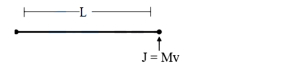
A
$\frac{V}{3L}$
B
$\frac{V}{4L}$
C
$\frac{V}{L}$
D
$\frac{2V}{L}$
Solution
(C) The impulse $J$ applied at one end provides both linear and angular momentum to the system.
$1$. Linear impulse equation: $J = M_{total} v_{cm} \Rightarrow MV = (2M) v_{cm} \Rightarrow v_{cm} = \frac{V}{2}$.
$2$. Angular impulse equation about the center of mass $(COM)$: $J \times r = I_{cm} \omega$.
Here,$r = \frac{L}{2}$ and $I_{cm} = M(\frac{L}{2})^2 + M(\frac{L}{2})^2 = \frac{ML^2}{2}$.
Substituting the values: $(MV) \times \frac{L}{2} = (\frac{ML^2}{2}) \omega$.
Solving for $\omega$: $\frac{MVL}{2} = \frac{ML^2 \omega}{2} \Rightarrow \omega = \frac{V}{L}$.
$1$. Linear impulse equation: $J = M_{total} v_{cm} \Rightarrow MV = (2M) v_{cm} \Rightarrow v_{cm} = \frac{V}{2}$.
$2$. Angular impulse equation about the center of mass $(COM)$: $J \times r = I_{cm} \omega$.
Here,$r = \frac{L}{2}$ and $I_{cm} = M(\frac{L}{2})^2 + M(\frac{L}{2})^2 = \frac{ML^2}{2}$.
Substituting the values: $(MV) \times \frac{L}{2} = (\frac{ML^2}{2}) \omega$.
Solving for $\omega$: $\frac{MVL}{2} = \frac{ML^2 \omega}{2} \Rightarrow \omega = \frac{V}{L}$.
0 likes
View SolutionSystem of Particles and Rotational Motion — Relation between Torque and Angular acceleration and it's Application · Frequently Asked Questions
1Are these System of Particles and Rotational Motion questions useful for JEE and NEET?
Yes. All questions in this section are mapped to JEE Main and NEET exam patterns. Previous year questions from JEE Main, NEET, GUJCET and state-level exams are included with full solutions.
2Can I switch to Hindi or Gujarati for these questions?
Yes. Use the language tabs in the hero section or the sidebar to view the same questions and solutions in English, Hindi or Gujarati.
3How do I generate a question paper from this subtopic?
Use the Vedclass Exam Paper Generator — select the chapter and subtopic, set difficulty, and generate Sets A, B, C, D automatically. First 3 chapters of every subject are free.
Vedclass Products
For Students
Vedclass Test Series
Mock tests in real JEE/NEET style with performance analysis. 5-day free trial.
Start Free TrialFor Teachers
Exam Paper Generator
Generate Set A/B/C/D papers from this chapter in 2 minutes. 3 chapters free.
Try FreeFor Institutes
Online Exam Module
Live online exams with unlimited students, 360° analytics & white-label branding.
See DemoFor Teachers & Institutes
Generate a System of Particles and Rotational Motion Exam Paper in 2 Minutes
Select subtopic & difficulty — Sets A, B, C, D auto-generated with No Repeat logic.
First 3 chapters of every subject are free — no payment required.