
A English
Relation between Torque and Angular acceleration and it's Application Questions in English
Class 11 Physics · System of Particles and Rotational Motion · Relation between Torque and Angular acceleration and it's Application
182+
Questions
English
Language
100%
With Solutions
Showing 48 of 182 questions in English
1
DifficultMCQ
When a ceiling fan is switched off,its angular velocity reduces to $50\%$ while it makes $36$ rotations. How many more rotations will it make before coming to rest? (Assume uniform angular retardation)
A
$18$
B
$12$
C
$36$
D
$48$
Solution
(B) Using the kinematic equation for rotational motion: $\omega^2 = \omega_0^2 - 2\alpha\theta$,where $\theta = 2\pi n$.
For the first $36$ rotations,the angular velocity reduces to half: $\left(\frac{\omega_0}{2}\right)^2 = \omega_0^2 - 2\alpha(2\pi \times 36)$.
$\frac{\omega_0^2}{4} = \omega_0^2 - 144\pi\alpha \implies 144\pi\alpha = \frac{3}{4}\omega_0^2 \implies \alpha = \frac{3\omega_0^2}{576\pi}$.
Now,let the total number of rotations to come to rest be $n'$.
Using $0 = \omega_0^2 - 2\alpha(2\pi n')$,we get $n' = \frac{\omega_0^2}{4\pi\alpha}$.
Substituting $\alpha$: $n' = \frac{\omega_0^2}{4\pi} \times \frac{576\pi}{3\omega_0^2} = \frac{576}{12} = 48$ rotations.
The additional rotations required are $n' - 36 = 48 - 36 = 12$ rotations.
For the first $36$ rotations,the angular velocity reduces to half: $\left(\frac{\omega_0}{2}\right)^2 = \omega_0^2 - 2\alpha(2\pi \times 36)$.
$\frac{\omega_0^2}{4} = \omega_0^2 - 144\pi\alpha \implies 144\pi\alpha = \frac{3}{4}\omega_0^2 \implies \alpha = \frac{3\omega_0^2}{576\pi}$.
Now,let the total number of rotations to come to rest be $n'$.
Using $0 = \omega_0^2 - 2\alpha(2\pi n')$,we get $n' = \frac{\omega_0^2}{4\pi\alpha}$.
Substituting $\alpha$: $n' = \frac{\omega_0^2}{4\pi} \times \frac{576\pi}{3\omega_0^2} = \frac{576}{12} = 48$ rotations.
The additional rotations required are $n' - 36 = 48 - 36 = 12$ rotations.
0 likes
View Solution2
EasyMCQ
$A$ flywheel gains a speed of $540\ r.p.m.$ in $6\ s$. Its angular acceleration will be
A
$3\pi\ rad/s^2$
B
$9\pi\ rad/s^2$
C
$18\pi\ rad/s^2$
D
$54\pi\ rad/s^2$
Solution
(A) The initial angular velocity is $0\ rad/s$ and the final angular velocity is $\omega = 540\ r.p.m.$
First,convert the speed from $r.p.m.$ to $r.p.s.$: $n = \frac{540}{60} = 9\ r.p.s.$
The final angular velocity in $rad/s$ is $\omega = 2\pi n = 2\pi \times 9 = 18\pi\ rad/s$.
The angular acceleration $\alpha$ is given by the formula $\alpha = \frac{\Delta\omega}{\Delta t}$.
Substituting the values: $\alpha = \frac{18\pi\ rad/s}{6\ s} = 3\pi\ rad/s^2$.
First,convert the speed from $r.p.m.$ to $r.p.s.$: $n = \frac{540}{60} = 9\ r.p.s.$
The final angular velocity in $rad/s$ is $\omega = 2\pi n = 2\pi \times 9 = 18\pi\ rad/s$.
The angular acceleration $\alpha$ is given by the formula $\alpha = \frac{\Delta\omega}{\Delta t}$.
Substituting the values: $\alpha = \frac{18\pi\ rad/s}{6\ s} = 3\pi\ rad/s^2$.
0 likes
View Solution3
DifficultMCQ
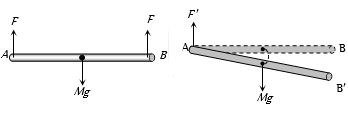
$A$ horizontal heavy uniform bar of weight $W$ is supported at its ends by two men. At the instant one of the men lets go of his end of the rod,the force on the other man's hand changes to:
A
$W$
B
$\frac{W}{2}$
C
$\frac{3W}{4}$
D
$\frac{W}{4}$
Solution
(D) Let the mass of the rod be $M$ and its length be $l$.
Weight of the rod is $W = Mg$.
Initially,for equilibrium,the force $F$ exerted by each man is $F + F = Mg$,so $F = \frac{Mg}{2} = \frac{W}{2}$.
When one man lets go,the rod starts rotating about the other end (let it be $A$) due to the torque provided by its weight acting at the center of mass.
The torque about end $A$ is $\tau = Mg \frac{l}{2}$.
The moment of inertia of the rod about end $A$ is $I = \frac{Ml^2}{3}$.
Using $\tau = I\alpha$,we have $Mg \frac{l}{2} = \left( \frac{Ml^2}{3} \right) \alpha$.
Solving for angular acceleration,$\alpha = \frac{3g}{2l}$.
The linear acceleration of the center of mass is $a = \frac{l}{2} \alpha = \frac{l}{2} \left( \frac{3g}{2l} \right) = \frac{3g}{4}$.
Applying Newton's second law for the center of mass,$Mg - F' = Ma$,where $F'$ is the new force exerted by the remaining man.
$F' = Mg - Ma = Mg - M \left( \frac{3g}{4} \right) = Mg \left( 1 - \frac{3}{4} \right) = \frac{Mg}{4} = \frac{W}{4}$.
Weight of the rod is $W = Mg$.
Initially,for equilibrium,the force $F$ exerted by each man is $F + F = Mg$,so $F = \frac{Mg}{2} = \frac{W}{2}$.
When one man lets go,the rod starts rotating about the other end (let it be $A$) due to the torque provided by its weight acting at the center of mass.
The torque about end $A$ is $\tau = Mg \frac{l}{2}$.
The moment of inertia of the rod about end $A$ is $I = \frac{Ml^2}{3}$.
Using $\tau = I\alpha$,we have $Mg \frac{l}{2} = \left( \frac{Ml^2}{3} \right) \alpha$.
Solving for angular acceleration,$\alpha = \frac{3g}{2l}$.
The linear acceleration of the center of mass is $a = \frac{l}{2} \alpha = \frac{l}{2} \left( \frac{3g}{2l} \right) = \frac{3g}{4}$.
Applying Newton's second law for the center of mass,$Mg - F' = Ma$,where $F'$ is the new force exerted by the remaining man.
$F' = Mg - Ma = Mg - M \left( \frac{3g}{4} \right) = Mg \left( 1 - \frac{3}{4} \right) = \frac{Mg}{4} = \frac{W}{4}$.
0 likes
View Solution4
DifficultMCQ
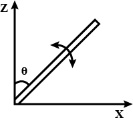
$A$ slender uniform rod of mass $M$ and length $l$ is pivoted at one end so that it can rotate in a vertical plane (see figure). There is negligible friction at the pivot. The rod is released from a position where it makes an angle $\theta$ with the vertical. The angular acceleration of the rod when it makes an angle $\theta$ with the vertical is
A
$\frac{3 g}{2 l} \sin \theta$
B
$\frac{2 g}{3 l} \sin \theta$
C
$\frac{3 g}{2 l} \cos \theta$
D
$\frac{2 g}{2 l} \sin \theta$
Solution
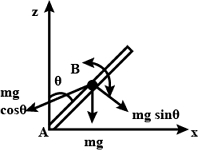
(A) The torque $\tau$ acting on the rod about the pivot point is due to the gravitational force $Mg$ acting at the center of mass of the rod,which is at a distance $l/2$ from the pivot.
When the rod makes an angle $\theta$ with the vertical,the perpendicular distance from the pivot to the line of action of the weight is $(l/2) \sin \theta$.
Therefore,the torque is $\tau = Mg \cdot (l/2) \sin \theta$.
The moment of inertia $I$ of a uniform rod of mass $M$ and length $l$ about an axis passing through one end is $I = \frac{Ml^2}{3}$.
Using the rotational analog of Newton's second law,$\tau = I \alpha$,where $\alpha$ is the angular acceleration:
$Mg \frac{l}{2} \sin \theta = \left( \frac{Ml^2}{3} \right) \alpha$
Solving for $\alpha$:
$\alpha = \frac{Mg (l/2) \sin \theta}{Ml^2 / 3} = \frac{Mg l \sin \theta}{2} \cdot \frac{3}{Ml^2} = \frac{3g \sin \theta}{2l}$.
When the rod makes an angle $\theta$ with the vertical,the perpendicular distance from the pivot to the line of action of the weight is $(l/2) \sin \theta$.
Therefore,the torque is $\tau = Mg \cdot (l/2) \sin \theta$.
The moment of inertia $I$ of a uniform rod of mass $M$ and length $l$ about an axis passing through one end is $I = \frac{Ml^2}{3}$.
Using the rotational analog of Newton's second law,$\tau = I \alpha$,where $\alpha$ is the angular acceleration:
$Mg \frac{l}{2} \sin \theta = \left( \frac{Ml^2}{3} \right) \alpha$
Solving for $\alpha$:
$\alpha = \frac{Mg (l/2) \sin \theta}{Ml^2 / 3} = \frac{Mg l \sin \theta}{2} \cdot \frac{3}{Ml^2} = \frac{3g \sin \theta}{2l}$.
1 likes
View Solution5
EasyMCQ
$A$ body rotating at $20 \ rad/s$ is acted upon by a constant torque providing it a deceleration of $2 \ rad/s^2$. At what time will the body have kinetic energy same as the initial value if the torque continues to act?
A
$20$
B
$40$
C
$5$
D
$10$
Solution
(A) The rotational kinetic energy of a body is given by $K = \frac{1}{2} I \omega^2$,where $I$ is the moment of inertia and $\omega$ is the angular velocity.
For the kinetic energy to be the same as the initial value,the magnitude of the angular velocity must be the same as the initial angular velocity,i.e.,$|\omega| = |\omega_0| = 20 \ rad/s$.
Since the torque provides a constant deceleration,the angular velocity at time $t$ is given by $\omega = \omega_0 - \alpha t$.
We want the final angular velocity to be $\omega = -20 \ rad/s$ (since it is decelerating and we need the same magnitude of kinetic energy).
Substituting the values: $-20 = 20 - 2t$.
Rearranging the equation: $2t = 40$.
Therefore,$t = 20 \ s$.
For the kinetic energy to be the same as the initial value,the magnitude of the angular velocity must be the same as the initial angular velocity,i.e.,$|\omega| = |\omega_0| = 20 \ rad/s$.
Since the torque provides a constant deceleration,the angular velocity at time $t$ is given by $\omega = \omega_0 - \alpha t$.
We want the final angular velocity to be $\omega = -20 \ rad/s$ (since it is decelerating and we need the same magnitude of kinetic energy).
Substituting the values: $-20 = 20 - 2t$.
Rearranging the equation: $2t = 40$.
Therefore,$t = 20 \ s$.
0 likes
View Solution6
MediumMCQ
An automobile engine develops $100 \ kW$ when rotating at a speed of $1800 \ rev/min$. What torque does it deliver in $N-m$?
A
$350$
B
$440$
C
$531$
D
$628$
Solution
(C) The power $P$ delivered by a rotating engine is given by the formula $P = \tau \omega$,where $\tau$ is the torque and $\omega$ is the angular velocity in $rad/s$.
Given: Power $P = 100 \ kW = 100 \times 10^3 \ W$.
Angular speed $n = 1800 \ rev/min = \frac{1800}{60} \ rev/s = 30 \ rev/s$.
Angular velocity $\omega = 2\pi n = 2 \times \pi \times 30 = 60\pi \ rad/s$.
Using the formula $\tau = \frac{P}{\omega}$:
$\tau = \frac{100 \times 10^3}{60\pi} = \frac{100000}{188.496} \approx 530.5 \ N-m$.
Rounding to the nearest whole number,we get $\tau \approx 531 \ N-m$.
Given: Power $P = 100 \ kW = 100 \times 10^3 \ W$.
Angular speed $n = 1800 \ rev/min = \frac{1800}{60} \ rev/s = 30 \ rev/s$.
Angular velocity $\omega = 2\pi n = 2 \times \pi \times 30 = 60\pi \ rad/s$.
Using the formula $\tau = \frac{P}{\omega}$:
$\tau = \frac{100 \times 10^3}{60\pi} = \frac{100000}{188.496} \approx 530.5 \ N-m$.
Rounding to the nearest whole number,we get $\tau \approx 531 \ N-m$.
0 likes
View Solution7
DifficultMCQ
$A$ triangular plate of uniform thickness and density rotates about an axis perpendicular to the plane of the paper. In case $(a)$,the axis passes through point $A$,and in case $(b)$,it passes through point $B$. If an equal force $F$ is applied as shown in the figure,in which case will the angular acceleration be greater?
A
Equal in both cases
B
Greater in case $(a)$
C
Greater in case $(b)$
D
Insufficient information provided
Solution
(C) The torque $\tau$ is defined as $\tau = r \times F$. Since the force $F$ and the perpendicular distance $r$ from the axis of rotation to the line of action of the force are the same in both cases,the torque $\tau$ is equal for both $(a)$ and $(b)$.
Using the relation $\tau = I \alpha$,where $I$ is the moment of inertia and $\alpha$ is the angular acceleration,we have $\alpha = \frac{\tau}{I}$.
Since the torque $\tau$ is constant,the angular acceleration $\alpha$ is inversely proportional to the moment of inertia $I$ $(\alpha \propto \frac{1}{I})$.
In case $(b)$,the axis of rotation is closer to the center of mass compared to case $(a)$,resulting in a smaller moment of inertia $I$. Therefore,the angular acceleration $\alpha$ will be greater in case $(b)$.
Using the relation $\tau = I \alpha$,where $I$ is the moment of inertia and $\alpha$ is the angular acceleration,we have $\alpha = \frac{\tau}{I}$.
Since the torque $\tau$ is constant,the angular acceleration $\alpha$ is inversely proportional to the moment of inertia $I$ $(\alpha \propto \frac{1}{I})$.
In case $(b)$,the axis of rotation is closer to the center of mass compared to case $(a)$,resulting in a smaller moment of inertia $I$. Therefore,the angular acceleration $\alpha$ will be greater in case $(b)$.
0 likes
View Solution8
DifficultMCQ
$A$ thin uniform rod is pivoted at $O$. It rotates in a horizontal plane with a constant angular velocity $\omega$. At $t = 0$,a small insect starts moving from $O$ towards the other end with a constant speed $v$ relative to the rod. It reaches the other end at $t = T$ and stops. The angular velocity $\omega$ of the system remains constant. Which of the following graphs best represents the magnitude of the torque $|\tau|$ at $O$ as a function of time $t$?
A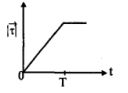
B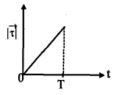
C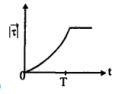
D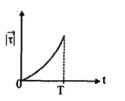
Solution
(B) The torque $\tau$ required to keep the angular velocity $\omega$ constant is given by the rate of change of angular momentum $L$.
$L = I\omega$. Since $\omega$ is constant,$\tau = \frac{dL}{dt} = \omega \frac{dI}{dt}$.
The moment of inertia $I$ of the system (rod + insect) at time $t$ is $I = I_{\text{rod}} + I_{\text{insect}}$.
$I_{\text{insect}} = m r^2$,where $r = vt$ is the distance of the insect from $O$ at time $t$.
So,$I(t) = I_{\text{rod}} + m(vt)^2 = I_{\text{rod}} + mv^2t^2$.
Differentiating with respect to $t$,we get $\frac{dI}{dt} = 2mv^2t$.
Therefore,the torque is $\tau = \omega (2mv^2t) = (2m\omega v^2)t$.
This shows that $\tau$ is directly proportional to $t$ for $0 \le t \le T$.
At $t = T$,the insect stops,so $\frac{dI}{dt} = 0$,and the torque becomes zero.
Thus,the graph should be a straight line passing through the origin for $0 \le t \le T$ and then drop to zero. This corresponds to the shape shown in graph $B$.
$L = I\omega$. Since $\omega$ is constant,$\tau = \frac{dL}{dt} = \omega \frac{dI}{dt}$.
The moment of inertia $I$ of the system (rod + insect) at time $t$ is $I = I_{\text{rod}} + I_{\text{insect}}$.
$I_{\text{insect}} = m r^2$,where $r = vt$ is the distance of the insect from $O$ at time $t$.
So,$I(t) = I_{\text{rod}} + m(vt)^2 = I_{\text{rod}} + mv^2t^2$.
Differentiating with respect to $t$,we get $\frac{dI}{dt} = 2mv^2t$.
Therefore,the torque is $\tau = \omega (2mv^2t) = (2m\omega v^2)t$.
This shows that $\tau$ is directly proportional to $t$ for $0 \le t \le T$.
At $t = T$,the insect stops,so $\frac{dI}{dt} = 0$,and the torque becomes zero.
Thus,the graph should be a straight line passing through the origin for $0 \le t \le T$ and then drop to zero. This corresponds to the shape shown in graph $B$.
0 likes
View Solution9
MediumMCQ
$A$ constant torque is applied to a wheel undergoing uniform circular motion,causing its angular momentum to change from $A_0$ to $4A_0$ in $4 \ s$. The magnitude of this torque is .......
A
$\frac{3A_0}{4}$
B
$A_0$
C
$4A_0$
D
$12A_0$
Solution
(A) The relationship between torque $\vec{\tau}$ and angular momentum $\vec{L}$ is given by Newton's second law for rotation: $\vec{\tau} = \frac{d\vec{L}}{dt}$.
For a constant torque,the magnitude is given by $|\vec{\tau}| = \frac{\Delta L}{\Delta t}$.
Given initial angular momentum $L_1 = A_0$,final angular momentum $L_2 = 4A_0$,and time interval $\Delta t = 4 \ s$.
Substituting these values: $|\vec{\tau}| = \frac{4A_0 - A_0}{4} = \frac{3A_0}{4}$.
For a constant torque,the magnitude is given by $|\vec{\tau}| = \frac{\Delta L}{\Delta t}$.
Given initial angular momentum $L_1 = A_0$,final angular momentum $L_2 = 4A_0$,and time interval $\Delta t = 4 \ s$.
Substituting these values: $|\vec{\tau}| = \frac{4A_0 - A_0}{4} = \frac{3A_0}{4}$.
0 likes
View Solution10
MediumMCQ
The moment of inertia of a body about a given axis is $1.2 \; kg \cdot m^2$. Initially,the body is at rest. In order to produce a rotational kinetic energy of $1500 \; J$,an angular acceleration of $25 \; rad/s^2$ must be applied about that axis for a duration of: (in $; s$)
A
$4$
B
$2$
C
$8$
D
$10$
Solution
(B) Given: Moment of inertia $I = 1.2 \; kg \cdot m^2$,initial angular velocity $\omega_0 = 0$,rotational kinetic energy $K_r = 1500 \; J$,and angular acceleration $\alpha = 25 \; rad/s^2$.
The formula for rotational kinetic energy is $K_r = \frac{1}{2} I \omega^2$.
Substituting the values: $1500 = \frac{1}{2} \times 1.2 \times \omega^2$.
$1500 = 0.6 \times \omega^2 \Rightarrow \omega^2 = \frac{1500}{0.6} = 2500$.
Thus,the final angular velocity $\omega = \sqrt{2500} = 50 \; rad/s$.
Using the kinematic equation for rotation: $\omega = \omega_0 + \alpha t$.
$50 = 0 + 25 \times t$.
$t = \frac{50}{25} = 2 \; s$.
The formula for rotational kinetic energy is $K_r = \frac{1}{2} I \omega^2$.
Substituting the values: $1500 = \frac{1}{2} \times 1.2 \times \omega^2$.
$1500 = 0.6 \times \omega^2 \Rightarrow \omega^2 = \frac{1500}{0.6} = 2500$.
Thus,the final angular velocity $\omega = \sqrt{2500} = 50 \; rad/s$.
Using the kinematic equation for rotation: $\omega = \omega_0 + \alpha t$.
$50 = 0 + 25 \times t$.
$t = \frac{50}{25} = 2 \; s$.
0 likes
View Solution11
DifficultMCQ
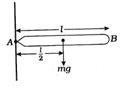
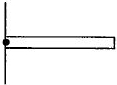
$A$ uniform rod of length $l$ and mass $m$ is pivoted at point $A$. The rod is released from a horizontal position. If the moment of inertia of the rod about point $A$ is $ml^2/3$,then its initial angular acceleration is:
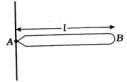
A
$\frac{mg}{2l}$
B
$\frac{3}{2}gl$
C
$\frac{3g}{2l}$
D
$\frac{2g}{3l}$
Solution
(C) The weight of the rod acts at its center of mass,which is at a distance of $l/2$ from the pivot point $A$. This weight creates a torque about point $A$.
The torque $\tau$ is given by:
$\tau = mg \times \frac{l}{2}$
According to Newton's second law for rotation:
$\tau = I\alpha$
Substituting the given moment of inertia $I = \frac{ml^2}{3}$ and the torque:
$mg \times \frac{l}{2} = \left(\frac{ml^2}{3}\right) \alpha$
Solving for the angular acceleration $\alpha$:
$\alpha = \frac{mg \times l/2}{ml^2/3} = \frac{mg \times l}{2} \times \frac{3}{ml^2} = \frac{3g}{2l}$
The torque $\tau$ is given by:
$\tau = mg \times \frac{l}{2}$
According to Newton's second law for rotation:
$\tau = I\alpha$
Substituting the given moment of inertia $I = \frac{ml^2}{3}$ and the torque:
$mg \times \frac{l}{2} = \left(\frac{ml^2}{3}\right) \alpha$
Solving for the angular acceleration $\alpha$:
$\alpha = \frac{mg \times l/2}{ml^2/3} = \frac{mg \times l}{2} \times \frac{3}{ml^2} = \frac{3g}{2l}$
0 likes
View Solution12
MediumMCQ
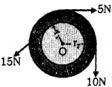
In the given figure,$r_1$ and $r_2$ are $10 \ cm$ and $20 \ cm$ respectively. If the moment of inertia of the wheel is $1500 \ kg \cdot m^2$,find the angular acceleration.
A
$10^{-5} \ rad/s^2$
B
$10^5 \ rad/s^2$
C
$10 \ rad/s^2$
D
$10^{-3} \ rad/s^2$
Solution
(D) The net torque $\tau$ acting on the wheel is the sum of the torques produced by the individual forces. Taking counter-clockwise as positive:
$\tau = (5 \ N \times r_2) + (10 \ N \times r_2) - (15 \ N \times r_1)$
Given $r_1 = 10 \ cm = 0.1 \ m$ and $r_2 = 20 \ cm = 0.2 \ m$,and $I = 1500 \ kg \cdot m^2$.
$\tau = (5 + 10) \times 0.2 - (15 \times 0.1)$
$\tau = (15 \times 0.2) - 1.5 = 3.0 - 1.5 = 1.5 \ N \cdot m$
Using the relation $\tau = I\alpha$:
$\alpha = \frac{\tau}{I} = \frac{1.5}{1500} = \frac{1.5}{1.5 \times 10^3} = 10^{-3} \ rad/s^2$.
$\tau = (5 \ N \times r_2) + (10 \ N \times r_2) - (15 \ N \times r_1)$
Given $r_1 = 10 \ cm = 0.1 \ m$ and $r_2 = 20 \ cm = 0.2 \ m$,and $I = 1500 \ kg \cdot m^2$.
$\tau = (5 + 10) \times 0.2 - (15 \times 0.1)$
$\tau = (15 \times 0.2) - 1.5 = 3.0 - 1.5 = 1.5 \ N \cdot m$
Using the relation $\tau = I\alpha$:
$\alpha = \frac{\tau}{I} = \frac{1.5}{1500} = \frac{1.5}{1.5 \times 10^3} = 10^{-3} \ rad/s^2$.
0 likes
View Solution13
MediumMCQ
$A$ solid disc has a diameter of $0.5 \ m$ and a mass of $16 \ kg$. What torque must be applied to increase its angular velocity from $0$ to $120 \ rpm$ in $8 \ s$?
A
$\frac{\pi^2}{5} \ N \cdot m$
B
$\pi \ N \cdot m$
C
$\frac{\pi}{2} \ N \cdot m$
D
$\frac{\pi}{4} \ N \cdot m$
Solution
(D) The moment of inertia of a solid disc is $I = \frac{1}{2}MR^2$.
Given $M = 16 \ kg$ and $R = \frac{0.5}{2} = 0.25 \ m = \frac{1}{4} \ m$.
$I = \frac{1}{2} \times 16 \times (\frac{1}{4})^2 = 8 \times \frac{1}{16} = 0.5 \ kg \cdot m^2$.
The final angular velocity is $\omega = 120 \ rpm = \frac{120 \times 2\pi}{60} \ rad/s = 4\pi \ rad/s$.
The initial angular velocity is $\omega_0 = 0$.
The angular acceleration is $\alpha = \frac{\omega - \omega_0}{t} = \frac{4\pi - 0}{8} = \frac{\pi}{2} \ rad/s^2$.
The required torque is $\tau = I\alpha$.
$\tau = 0.5 \times \frac{\pi}{2} = \frac{1}{2} \times \frac{\pi}{2} = \frac{\pi}{4} \ N \cdot m$.
Given $M = 16 \ kg$ and $R = \frac{0.5}{2} = 0.25 \ m = \frac{1}{4} \ m$.
$I = \frac{1}{2} \times 16 \times (\frac{1}{4})^2 = 8 \times \frac{1}{16} = 0.5 \ kg \cdot m^2$.
The final angular velocity is $\omega = 120 \ rpm = \frac{120 \times 2\pi}{60} \ rad/s = 4\pi \ rad/s$.
The initial angular velocity is $\omega_0 = 0$.
The angular acceleration is $\alpha = \frac{\omega - \omega_0}{t} = \frac{4\pi - 0}{8} = \frac{\pi}{2} \ rad/s^2$.
The required torque is $\tau = I\alpha$.
$\tau = 0.5 \times \frac{\pi}{2} = \frac{1}{2} \times \frac{\pi}{2} = \frac{\pi}{4} \ N \cdot m$.
0 likes
View Solution14
EasyMCQ
$A$ torque of $10^5 \ N \cdot m$ is applied to a disc of mass $10 \ kg$ and radius of gyration $50 \ m$. What is the value of the angular acceleration in $rad/s^2$?
A
$50$
B
$5$
C
$4$
D
$20$
Solution
(C) The relationship between torque $(\tau)$,moment of inertia $(I)$,and angular acceleration $(\alpha)$ is given by $\tau = I \alpha$.
Given:
Torque $\tau = 10^5 \ N \cdot m$
Mass $m = 10 \ kg$
Radius of gyration $K = 50 \ m$
Moment of inertia $I = mK^2 = 10 \times (50)^2 = 10 \times 2500 = 25000 \ kg \cdot m^2$.
Now,substituting these values into the torque equation:
$10^5 = 25000 \times \alpha$
$\alpha = \frac{100000}{25000} = 4 \ rad/s^2$.
Given:
Torque $\tau = 10^5 \ N \cdot m$
Mass $m = 10 \ kg$
Radius of gyration $K = 50 \ m$
Moment of inertia $I = mK^2 = 10 \times (50)^2 = 10 \times 2500 = 25000 \ kg \cdot m^2$.
Now,substituting these values into the torque equation:
$10^5 = 25000 \times \alpha$
$\alpha = \frac{100000}{25000} = 4 \ rad/s^2$.
0 likes
View Solution15
DifficultMCQ
The instantaneous angular position of a rotating wheel is given by the formula $\theta (t) = 2t^3 - 6t^2$. At what time will the torque on this wheel be zero? $t = \dots \text{s}$
A
$1$
B
$0.5$
C
$0.25$
D
$2$
Solution
(A) The angular position is given by $\theta (t) = 2t^3 - 6t^2$.
The angular velocity $\omega$ is the first derivative of angular position with respect to time:
$\omega = \frac{d\theta}{dt} = 6t^2 - 12t$.
The angular acceleration $\alpha$ is the derivative of angular velocity with respect to time:
$\alpha = \frac{d\omega}{dt} = 12t - 12$.
According to Newton's second law for rotation,torque $\tau = I\alpha$. For the torque to be zero,the angular acceleration $\alpha$ must be zero (assuming the moment of inertia $I \neq 0$).
Setting $\alpha = 0$:
$12t - 12 = 0$
$12t = 12$
$t = 1 \text{ s}$.
The angular velocity $\omega$ is the first derivative of angular position with respect to time:
$\omega = \frac{d\theta}{dt} = 6t^2 - 12t$.
The angular acceleration $\alpha$ is the derivative of angular velocity with respect to time:
$\alpha = \frac{d\omega}{dt} = 12t - 12$.
According to Newton's second law for rotation,torque $\tau = I\alpha$. For the torque to be zero,the angular acceleration $\alpha$ must be zero (assuming the moment of inertia $I \neq 0$).
Setting $\alpha = 0$:
$12t - 12 = 0$
$12t = 12$
$t = 1 \text{ s}$.
0 likes
View Solution16
MediumMCQ
$A$ force of $1 \ N$ is applied at the free edge of a door of width $1.6 \ m$ to open it. If the door is to be opened by applying force at a point $0.4 \ m$ away from the hinges (axis of rotation),then the force required is ...... $N$.
A
$1.2$
B
$3.6$
C
$2.4$
D
$4$
Solution
(D) The torque required to open the door remains constant.
Torque $\tau = r_1 F_1 = r_2 F_2$,where $r$ is the distance from the axis of rotation and $F$ is the applied force.
Given: $r_1 = 1.6 \ m$,$F_1 = 1 \ N$,$r_2 = 0.4 \ m$.
Substituting the values:
$1.6 \times 1 = 0.4 \times F_2$
$F_2 = \frac{1.6}{0.4} = 4 \ N$.
Therefore,the required force is $4 \ N$.
Torque $\tau = r_1 F_1 = r_2 F_2$,where $r$ is the distance from the axis of rotation and $F$ is the applied force.
Given: $r_1 = 1.6 \ m$,$F_1 = 1 \ N$,$r_2 = 0.4 \ m$.
Substituting the values:
$1.6 \times 1 = 0.4 \times F_2$
$F_2 = \frac{1.6}{0.4} = 4 \ N$.
Therefore,the required force is $4 \ N$.
0 likes
View Solution17
MediumMCQ
$A$ torque of $30 \ Nm$ is applied for $15 \ s$ on a stationary wheel of mass $5 \ kg$. The moment of inertia of the wheel is $2 \ kg \ m^2$. The angular displacement of the wheel in $10 \ s$ is ....... $rad$.
A
$750$
B
$1500$
C
$3000$
D
$6000$
Solution
(A) Given: Torque $\tau = 30 \ Nm$,Moment of inertia $I = 2 \ kg \ m^2$,Initial angular velocity $\omega_0 = 0 \ rad/s$,Time $t = 10 \ s$.
Using the relation $\tau = I \alpha$,we find the angular acceleration:
$\alpha = \frac{\tau}{I} = \frac{30}{2} = 15 \ rad/s^2$.
Now,using the kinematic equation for rotational motion:
$\theta = \omega_0 t + \frac{1}{2} \alpha t^2$.
Substituting the values:
$\theta = 0 \times 10 + \frac{1}{2} \times 15 \times (10)^2$.
$\theta = \frac{1}{2} \times 15 \times 100 = 750 \ rad$.
Using the relation $\tau = I \alpha$,we find the angular acceleration:
$\alpha = \frac{\tau}{I} = \frac{30}{2} = 15 \ rad/s^2$.
Now,using the kinematic equation for rotational motion:
$\theta = \omega_0 t + \frac{1}{2} \alpha t^2$.
Substituting the values:
$\theta = 0 \times 10 + \frac{1}{2} \times 15 \times (10)^2$.
$\theta = \frac{1}{2} \times 15 \times 100 = 750 \ rad$.
0 likes
View Solution18
DifficultMCQ
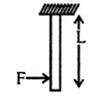
$A$ rod of mass $M$ and length $L$ is placed in a horizontal plane. One of its ends is hinged on a vertical axis. $A$ horizontal force $F = Mg/2$ is applied at a distance of $5L/6$ from the hinged end. What will be the angular acceleration of the rod?
A
$\frac{4g}{5L}$
B
$\frac{5g}{4L}$
C
$\frac{3g}{4L}$
D
$\frac{4g}{3L}$
Solution
(B) The torque $\tau$ acting on the rod about the hinge is given by $\tau = F \times r$,where $r = 5L/6$ is the distance from the hinge.
Given $F = Mg/2$,the torque is $\tau = (Mg/2) \times (5L/6) = 5MgL/12$.
The moment of inertia $I$ of a rod of mass $M$ and length $L$ about an axis passing through one of its ends is $I = ML^2/3$.
Using the rotational analog of Newton's second law,$\tau = I\alpha$,where $\alpha$ is the angular acceleration:
$5MgL/12 = (ML^2/3) \times \alpha$
$\alpha = (5MgL/12) \times (3/ML^2)$
$\alpha = 5g/4L$.
Given $F = Mg/2$,the torque is $\tau = (Mg/2) \times (5L/6) = 5MgL/12$.
The moment of inertia $I$ of a rod of mass $M$ and length $L$ about an axis passing through one of its ends is $I = ML^2/3$.
Using the rotational analog of Newton's second law,$\tau = I\alpha$,where $\alpha$ is the angular acceleration:
$5MgL/12 = (ML^2/3) \times \alpha$
$\alpha = (5MgL/12) \times (3/ML^2)$
$\alpha = 5g/4L$.
0 likes
View Solution19
DifficultMCQ
$A$ wheel is subjected to a torque of $1000 \ N-m$ and rotates with a moment of inertia of $200 \ kg-m^2$ about an axis passing through its center. What will be the angular velocity of the wheel after $3 \ s$?
A
$15$
B
$10$
C
$5$
D
$1$
Solution
(A) Given:
Torque $(\tau)$ = $1000 \ N-m$
Moment of inertia $(I)$ = $200 \ kg-m^2$
Time $(t)$ = $3 \ s$
Initial angular velocity $(\omega_0)$ = $0 \ rad/s$
Step $1$: Calculate angular acceleration $(\alpha)$:
$\alpha = \frac{\tau}{I} = \frac{1000}{200} = 5 \ rad/s^2$
Step $2$: Calculate final angular velocity $(\omega)$:
Using the equation of rotational motion: $\omega = \omega_0 + \alpha t$
$\omega = 0 + (5 \times 3) = 15 \ rad/s$
Torque $(\tau)$ = $1000 \ N-m$
Moment of inertia $(I)$ = $200 \ kg-m^2$
Time $(t)$ = $3 \ s$
Initial angular velocity $(\omega_0)$ = $0 \ rad/s$
Step $1$: Calculate angular acceleration $(\alpha)$:
$\alpha = \frac{\tau}{I} = \frac{1000}{200} = 5 \ rad/s^2$
Step $2$: Calculate final angular velocity $(\omega)$:
Using the equation of rotational motion: $\omega = \omega_0 + \alpha t$
$\omega = 0 + (5 \times 3) = 15 \ rad/s$
0 likes
View Solution20
DifficultMCQ
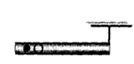
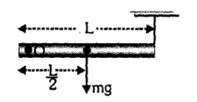
One end of a rod is hinged at $O$. The other end is suspended by a string attached to the ceiling as shown in the figure. If the string is suddenly cut,find the angular acceleration of the rod.
A
$\frac{3g}{2L}$
B
$\frac{g}{2L}$
C
$\frac{2g}{3L}$
D
$\frac{g}{L}$
Solution
(A) When the string is cut,the torque due to the weight of the rod acting at its center of mass about the hinge $O$ causes rotational motion.
The torque $\tau$ is given by $\tau = I\alpha$,where $I$ is the moment of inertia about the hinge $O$ and $\alpha$ is the angular acceleration.
The weight $mg$ acts at the center of mass,which is at a distance of $\frac{L}{2}$ from the hinge $O$.
$\tau = mg \times \frac{L}{2}$
The moment of inertia of a rod of length $L$ and mass $m$ about an axis passing through its end is $I = \frac{mL^2}{3}$.
Equating the torque: $mg \left( \frac{L}{2} \right) = \left( \frac{mL^2}{3} \right) \alpha$
$\frac{g}{2} = \frac{L\alpha}{3}$
$\alpha = \frac{3g}{2L}$
The torque $\tau$ is given by $\tau = I\alpha$,where $I$ is the moment of inertia about the hinge $O$ and $\alpha$ is the angular acceleration.
The weight $mg$ acts at the center of mass,which is at a distance of $\frac{L}{2}$ from the hinge $O$.
$\tau = mg \times \frac{L}{2}$
The moment of inertia of a rod of length $L$ and mass $m$ about an axis passing through its end is $I = \frac{mL^2}{3}$.
Equating the torque: $mg \left( \frac{L}{2} \right) = \left( \frac{mL^2}{3} \right) \alpha$
$\frac{g}{2} = \frac{L\alpha}{3}$
$\alpha = \frac{3g}{2L}$
0 likes
View Solution21
DifficultMCQ
The moment of inertia of a wheel about its vertical axis is $2 \ kg \ m^2$. It is rotating about this axis at a speed of $60 \ rpm$. What torque must be applied to bring the wheel to rest in $1 \ minute$?
A
$\frac{2\pi}{15} \ Nm$
B
$\frac{\pi}{12} \ Nm$
C
$\frac{\pi}{15} \ Nm$
D
$\frac{\pi}{18} \ Nm$
Solution
(C) Given: Moment of inertia $I = 2 \ kg \ m^2$,Initial angular velocity $\omega_0 = 60 \ rpm = \frac{60 \times 2\pi}{60} \ rad/s = 2\pi \ rad/s$,Final angular velocity $\omega = 0 \ rad/s$,Time $t = 1 \ minute = 60 \ s$.
Using the equation of rotational motion: $\omega = \omega_0 + \alpha t$.
Since the wheel comes to rest,$0 = 2\pi + \alpha(60)$,which gives angular acceleration $\alpha = -\frac{2\pi}{60} = -\frac{\pi}{30} \ rad/s^2$.
The magnitude of torque required is $\tau = |I\alpha| = 2 \times \frac{\pi}{30} = \frac{\pi}{15} \ Nm$.
Using the equation of rotational motion: $\omega = \omega_0 + \alpha t$.
Since the wheel comes to rest,$0 = 2\pi + \alpha(60)$,which gives angular acceleration $\alpha = -\frac{2\pi}{60} = -\frac{\pi}{30} \ rad/s^2$.
The magnitude of torque required is $\tau = |I\alpha| = 2 \times \frac{\pi}{30} = \frac{\pi}{15} \ Nm$.
0 likes
View Solution22
MediumMCQ
$A$ constant torque of $400 \ Nm$ acts on a wheel having a moment of inertia of $100 \ kg \ m^2$ about its central axis. The angular velocity acquired in $4 \ s$ is ....... $rad \ s^{-1}$.
A
$12$
B
$16$
C
$20$
D
$24$
Solution
(B) Given:
Torque $\tau = 400 \ Nm$
Moment of inertia $I = 100 \ kg \ m^2$
Time $t = 4 \ s$
Initial angular velocity $\omega_0 = 0 \ rad \ s^{-1}$
Using the relation between torque and angular acceleration:
$\tau = I \alpha$
$400 = 100 \times \alpha$
$\alpha = 4 \ rad \ s^{-2}$
Using the first equation of rotational motion:
$\omega = \omega_0 + \alpha t$
$\omega = 0 + (4 \times 4)$
$\omega = 16 \ rad \ s^{-1}$
Torque $\tau = 400 \ Nm$
Moment of inertia $I = 100 \ kg \ m^2$
Time $t = 4 \ s$
Initial angular velocity $\omega_0 = 0 \ rad \ s^{-1}$
Using the relation between torque and angular acceleration:
$\tau = I \alpha$
$400 = 100 \times \alpha$
$\alpha = 4 \ rad \ s^{-2}$
Using the first equation of rotational motion:
$\omega = \omega_0 + \alpha t$
$\omega = 0 + (4 \times 4)$
$\omega = 16 \ rad \ s^{-1}$
0 likes
View Solution23
MediumMCQ
An automobile engine develops $200 \ hp$ at $6000 \ rpm$. The corresponding torque is ......... $N \cdot m$.
A
$200$
B
$150.20$
C
$237.5$
D
$300$
Solution
(C) Given: Power $P = 200 \ hp$ and angular speed $\omega = 6000 \ rpm$.
First,convert power to Watts: $P = 200 \times 746 \ W = 1.492 \times 10^5 \ W$.
Next,convert angular speed to radians per second: $\omega = 6000 \times \frac{2\pi}{60} \ rad/s = 200\pi \ rad/s \approx 628.32 \ rad/s$.
The relationship between power,torque $(\tau)$,and angular velocity is $P = \tau \omega$.
Therefore,$\tau = \frac{P}{\omega} = \frac{1.492 \times 10^5}{628.32} \approx 237.5 \ N \cdot m$.
First,convert power to Watts: $P = 200 \times 746 \ W = 1.492 \times 10^5 \ W$.
Next,convert angular speed to radians per second: $\omega = 6000 \times \frac{2\pi}{60} \ rad/s = 200\pi \ rad/s \approx 628.32 \ rad/s$.
The relationship between power,torque $(\tau)$,and angular velocity is $P = \tau \omega$.
Therefore,$\tau = \frac{P}{\omega} = \frac{1.492 \times 10^5}{628.32} \approx 237.5 \ N \cdot m$.
0 likes
View Solution24
DifficultMCQ
$A$ wheel having a moment of inertia of $200 \ kg \cdot m^2$ about its axis passing through its center is rotated by a constant torque of $1000 \ N \cdot m$. What will be its angular velocity in $rad/s$ after $3 \ s$?
A
$1$
B
$5$
C
$15$
D
$10$
Solution
(C) Given: Moment of inertia $I = 200 \ kg \cdot m^2$,Torque $\tau = 1000 \ N \cdot m$,Time $t = 3 \ s$,Initial angular velocity $\omega_0 = 0 \ rad/s$.
Using the relation $\tau = I \alpha$,we find the angular acceleration $\alpha$:
$\alpha = \frac{\tau}{I} = \frac{1000}{200} = 5 \ rad/s^2$.
Now,using the first equation of rotational motion $\omega = \omega_0 + \alpha t$:
$\omega = 0 + (5 \times 3) = 15 \ rad/s$.
Thus,the angular velocity after $3 \ s$ is $15 \ rad/s$.
Using the relation $\tau = I \alpha$,we find the angular acceleration $\alpha$:
$\alpha = \frac{\tau}{I} = \frac{1000}{200} = 5 \ rad/s^2$.
Now,using the first equation of rotational motion $\omega = \omega_0 + \alpha t$:
$\omega = 0 + (5 \times 3) = 15 \ rad/s$.
Thus,the angular velocity after $3 \ s$ is $15 \ rad/s$.
0 likes
View Solution25
DifficultMCQ
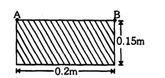
$A$ rectangular plate of mass $20 \ kg$ is suspended from points $A$ and $B$ as shown in the figure. If the pin at $B$ is suddenly removed,find the angular acceleration of the plate in $rad/s^2$.
A
$4.8$
B
$48$
C
$24$
D
$40$
Solution
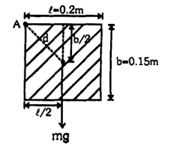
(B) The situation after removing pin $B$ is shown in the figure. Let the length and width be $l = 0.2 \ m$ and $b = 0.15 \ m$ respectively.
When pin $B$ is removed,the plate starts rotating about point $A$.
The torque $\tau$ due to gravity acting at the center of mass is given by:
$\tau = mg \left( \frac{l}{2} \right)$
Using the relation $\tau = I_A \alpha$,where $I_A$ is the moment of inertia about point $A$:
$I_A \alpha = mg \left( \frac{l}{2} \right) \quad \dots(i)$
The moment of inertia of a rectangular plate about its center of mass is $I_{CM} = \frac{M}{12}(l^2 + b^2)$.
Using the parallel axis theorem,$I_A = I_{CM} + Md^2$,where $d$ is the distance from the center of mass to point $A$:
$d^2 = \left( \frac{l}{2} \right)^2 + \left( \frac{b}{2} \right)^2 = \frac{0.2^2}{4} + \frac{0.15^2}{4} = \frac{0.04 + 0.0225}{4} = \frac{0.0625}{4} = 0.015625 \ m^2$
$I_A = \frac{20}{12}(0.2^2 + 0.15^2) + 20(0.015625) = \frac{20}{12}(0.04 + 0.0225) + 0.3125 = \frac{20}{12}(0.0625) + 0.3125 = 0.104167 + 0.3125 = 0.416667 \ kg \cdot m^2$
Now,substitute into equation $(i)$:
$0.416667 \alpha = 20 \times 9.8 \times \left( \frac{0.2}{2} \right)$
$0.416667 \alpha = 196 \times 0.1 = 19.6$
$\alpha = \frac{19.6}{0.416667} \approx 47.04 \ rad/s^2$. Given the options,the intended calculation uses $g = 10 \ m/s^2$:
$0.416667 \alpha = 20 \times 10 \times 0.1 = 20$
$\alpha = \frac{20}{0.416667} = 48 \ rad/s^2$.
When pin $B$ is removed,the plate starts rotating about point $A$.
The torque $\tau$ due to gravity acting at the center of mass is given by:
$\tau = mg \left( \frac{l}{2} \right)$
Using the relation $\tau = I_A \alpha$,where $I_A$ is the moment of inertia about point $A$:
$I_A \alpha = mg \left( \frac{l}{2} \right) \quad \dots(i)$
The moment of inertia of a rectangular plate about its center of mass is $I_{CM} = \frac{M}{12}(l^2 + b^2)$.
Using the parallel axis theorem,$I_A = I_{CM} + Md^2$,where $d$ is the distance from the center of mass to point $A$:
$d^2 = \left( \frac{l}{2} \right)^2 + \left( \frac{b}{2} \right)^2 = \frac{0.2^2}{4} + \frac{0.15^2}{4} = \frac{0.04 + 0.0225}{4} = \frac{0.0625}{4} = 0.015625 \ m^2$
$I_A = \frac{20}{12}(0.2^2 + 0.15^2) + 20(0.015625) = \frac{20}{12}(0.04 + 0.0225) + 0.3125 = \frac{20}{12}(0.0625) + 0.3125 = 0.104167 + 0.3125 = 0.416667 \ kg \cdot m^2$
Now,substitute into equation $(i)$:
$0.416667 \alpha = 20 \times 9.8 \times \left( \frac{0.2}{2} \right)$
$0.416667 \alpha = 196 \times 0.1 = 19.6$
$\alpha = \frac{19.6}{0.416667} \approx 47.04 \ rad/s^2$. Given the options,the intended calculation uses $g = 10 \ m/s^2$:
$0.416667 \alpha = 20 \times 10 \times 0.1 = 20$
$\alpha = \frac{20}{0.416667} = 48 \ rad/s^2$.
0 likes
View Solution26
MediumMCQ
The moment of inertia of a wheel rotating about an axis is $3 \times 10^2 \ kg \ m^2$ and it has a constant angular speed of $4.6 \ rad \ s^{-1}$. If a retarding torque of $6.9 \times 10^2 \ N \ m$ is applied to the wheel,in how many seconds will the wheel come to rest?
A
$1.5$
B
$2$
C
$0.5$
D
$1$
Solution
(B) Given: Moment of inertia $I = 3 \times 10^2 \ kg \ m^2$,Retarding torque $\tau = 6.9 \times 10^2 \ N \ m$,Initial angular speed $\omega_0 = 4.6 \ rad \ s^{-1}$,Final angular speed $\omega = 0 \ rad \ s^{-1}$.
Using the relation $\tau = I \alpha$,we find the angular acceleration $\alpha$:
$\alpha = \frac{\tau}{I} = \frac{6.9 \times 10^2}{3 \times 10^2} = 2.3 \ rad \ s^{-2}$.
Since it is a retarding torque,$\alpha = -2.3 \ rad \ s^{-2}$.
Using the equation of motion $\omega = \omega_0 + \alpha t$:
$0 = 4.6 + (-2.3)t$
$2.3t = 4.6$
$t = \frac{4.6}{2.3} = 2 \ s$.
Thus,the wheel will come to rest in $2 \ s$.
Using the relation $\tau = I \alpha$,we find the angular acceleration $\alpha$:
$\alpha = \frac{\tau}{I} = \frac{6.9 \times 10^2}{3 \times 10^2} = 2.3 \ rad \ s^{-2}$.
Since it is a retarding torque,$\alpha = -2.3 \ rad \ s^{-2}$.
Using the equation of motion $\omega = \omega_0 + \alpha t$:
$0 = 4.6 + (-2.3)t$
$2.3t = 4.6$
$t = \frac{4.6}{2.3} = 2 \ s$.
Thus,the wheel will come to rest in $2 \ s$.
0 likes
View Solution27
MediumMCQ
$A$ wheel of radius $0.4 \ m$ can rotate freely about its axis as shown in the figure. $A$ string is wrapped around its circumference,and a weight of $4 \ kg$ is suspended from it. Due to the torque,an angular acceleration of $8 \ rad \ s^{-2}$ is produced. The moment of inertia of the wheel is = $...... \ kg \ m^2$ $(g = 10 \ ms^{-2})$

A
$2$
B
$1$
C
$4$
D
$8$
Solution
(A) Given: Radius $r = 0.4 \ m$,Angular acceleration $\alpha = 8 \ rad \ s^{-2}$,Mass $m = 4 \ kg$,Acceleration due to gravity $g = 10 \ ms^{-2}$.
The torque $\tau$ produced by the weight is given by $\tau = mgr$.
Also,the torque is related to the moment of inertia $I$ and angular acceleration $\alpha$ by $\tau = I\alpha$.
Equating the two expressions for torque:
$I\alpha = mgr$
$I \times 8 = 4 \times 10 \times 0.4$
$I \times 8 = 16$
$I = \frac{16}{8} = 2 \ kg \ m^2$.
The torque $\tau$ produced by the weight is given by $\tau = mgr$.
Also,the torque is related to the moment of inertia $I$ and angular acceleration $\alpha$ by $\tau = I\alpha$.
Equating the two expressions for torque:
$I\alpha = mgr$
$I \times 8 = 4 \times 10 \times 0.4$
$I \times 8 = 16$
$I = \frac{16}{8} = 2 \ kg \ m^2$.
0 likes
View Solution28
DifficultMCQ
$A$ wheel rotates at $720 \ rpm$ about an axis passing through its center. It is brought to rest by applying a constant torque for $8 \ s$. What is the value of the torque in $Nm$? (Given: $I = \frac{24}{\pi} \ kg \cdot m^2$)
A
$48$
B
$72$
C
$96$
D
$120$
Solution
(B) Initial angular velocity $\omega_0 = 720 \ rpm = \frac{720}{60} \ rps = 12 \ rps$.
Converting to radians per second: $\omega_0 = 2\pi \times 12 = 24\pi \ rad/s$.
Since the wheel is brought to rest,final angular velocity $\omega = 0$.
Using the equation $\omega = \omega_0 - \alpha t$,where $t = 8 \ s$:
$0 = 24\pi - \alpha(8) \implies \alpha = \frac{24\pi}{8} = 3\pi \ rad/s^2$.
The torque $\tau$ is given by $\tau = I\alpha$.
Substituting the given values: $\tau = \left(\frac{24}{\pi}\right) \times (3\pi) = 72 \ Nm$.
Converting to radians per second: $\omega_0 = 2\pi \times 12 = 24\pi \ rad/s$.
Since the wheel is brought to rest,final angular velocity $\omega = 0$.
Using the equation $\omega = \omega_0 - \alpha t$,where $t = 8 \ s$:
$0 = 24\pi - \alpha(8) \implies \alpha = \frac{24\pi}{8} = 3\pi \ rad/s^2$.
The torque $\tau$ is given by $\tau = I\alpha$.
Substituting the given values: $\tau = \left(\frac{24}{\pi}\right) \times (3\pi) = 72 \ Nm$.
0 likes
View Solution29
MediumMCQ
An electric motor is started from rest to produce a torque. It acquires an angular acceleration given by $\alpha = 3t - t^2$. The angular acceleration becomes zero after $2 \ s$. Calculate the angular velocity after $6 \ s$.
A
$\frac{13}{2} \ rad/s$
B
$10 \ rad/s$
C
$\frac{5}{3} \ rad/s$
D
$\frac{10}{3} \ rad/s$
Solution
(D) Given angular acceleration: $\alpha = 3t - t^2$.
Since $\alpha = \frac{d\omega}{dt}$,we have $d\omega = (3t - t^2) dt$.
Integrating from $t = 0$ to $t = 2 \ s$ (the time when acceleration becomes zero):
$\omega = \int_{0}^{2} (3t - t^2) dt = [\frac{3t^2}{2} - \frac{t^3}{3}]_{0}^{2}$.
$\omega = (\frac{3(4)}{2} - \frac{8}{3}) = 6 - \frac{8}{3} = \frac{18 - 8}{3} = \frac{10}{3} \ rad/s$.
Since the angular acceleration is zero for $t > 2 \ s$,the angular velocity remains constant at $\frac{10}{3} \ rad/s$ for all $t \ge 2 \ s$.
Therefore,the angular velocity after $6 \ s$ is $\frac{10}{3} \ rad/s$.
Since $\alpha = \frac{d\omega}{dt}$,we have $d\omega = (3t - t^2) dt$.
Integrating from $t = 0$ to $t = 2 \ s$ (the time when acceleration becomes zero):
$\omega = \int_{0}^{2} (3t - t^2) dt = [\frac{3t^2}{2} - \frac{t^3}{3}]_{0}^{2}$.
$\omega = (\frac{3(4)}{2} - \frac{8}{3}) = 6 - \frac{8}{3} = \frac{18 - 8}{3} = \frac{10}{3} \ rad/s$.
Since the angular acceleration is zero for $t > 2 \ s$,the angular velocity remains constant at $\frac{10}{3} \ rad/s$ for all $t \ge 2 \ s$.
Therefore,the angular velocity after $6 \ s$ is $\frac{10}{3} \ rad/s$.
1 likes
View Solution30
MediumMCQ
$A$ circular disc of radius $2 \ m$ is rotating at $240 \ rpm$. If a torque is applied to the disc, it slows down at a rate of $\pi \ rad/s^2$. How long will it take to stop? How many revolutions will the disc complete before coming to rest?
A
$8 \ s, 16 \ \text{revolutions}$
B
$12 \ s, 24 \ \text{revolutions}$
C
$10 \ s, 8 \ \text{revolutions}$
D
$6 \ s, 12 \ \text{revolutions}$
Solution
(A) Given: Initial angular velocity $\omega_1 = 240 \ rpm = \frac{240 \times 2\pi}{60} \ rad/s = 8\pi \ rad/s$.
Angular deceleration $\alpha = \pi \ rad/s^2$.
Final angular velocity $\omega_2 = 0 \ rad/s$.
Using the equation $\omega_2 = \omega_1 - \alpha t$:
$0 = 8\pi - \pi t \implies t = 8 \ s$.
Using the equation $\omega_2^2 = \omega_1^2 - 2\alpha \theta$:
$0 = (8\pi)^2 - 2(\pi)\theta \implies 64\pi^2 = 2\pi\theta \implies \theta = 32\pi \ rad$.
Number of revolutions $N = \frac{\theta}{2\pi} = \frac{32\pi}{2\pi} = 16 \ \text{revolutions}$.
Angular deceleration $\alpha = \pi \ rad/s^2$.
Final angular velocity $\omega_2 = 0 \ rad/s$.
Using the equation $\omega_2 = \omega_1 - \alpha t$:
$0 = 8\pi - \pi t \implies t = 8 \ s$.
Using the equation $\omega_2^2 = \omega_1^2 - 2\alpha \theta$:
$0 = (8\pi)^2 - 2(\pi)\theta \implies 64\pi^2 = 2\pi\theta \implies \theta = 32\pi \ rad$.
Number of revolutions $N = \frac{\theta}{2\pi} = \frac{32\pi}{2\pi} = 16 \ \text{revolutions}$.
0 likes
View Solution31
DifficultMCQ
The moment of inertia of a wheel about its transverse axis is $2 \ kg \cdot m^2$ and it is rotating at $60 \ rpm$ about that axis. The torque required to stop the wheel in one minute is:
A
$\frac{\pi}{12} \ N \cdot m$
B
$\frac{\pi}{15} \ N \cdot m$
C
$\frac{\pi}{18} \ N \cdot m$
D
$\frac{2\pi}{15} \ N \cdot m$
Solution
(B) Given: Moment of inertia $I = 2 \ kg \cdot m^2$,Initial angular velocity $\omega_0 = 60 \ rpm = \frac{60 \times 2\pi}{60} \ rad/s = 2\pi \ rad/s$,Final angular velocity $\omega = 0$,Time $t = 1 \ minute = 60 \ s$.
Using the equation of rotational motion: $\omega = \omega_0 - \alpha t$.
$0 = 2\pi - \alpha(60) \implies \alpha = \frac{2\pi}{60} = \frac{\pi}{30} \ rad/s^2$.
The torque required is given by $\tau = I\alpha$.
$\tau = 2 \times \frac{\pi}{30} = \frac{\pi}{15} \ N \cdot m$.
Using the equation of rotational motion: $\omega = \omega_0 - \alpha t$.
$0 = 2\pi - \alpha(60) \implies \alpha = \frac{2\pi}{60} = \frac{\pi}{30} \ rad/s^2$.
The torque required is given by $\tau = I\alpha$.
$\tau = 2 \times \frac{\pi}{30} = \frac{\pi}{15} \ N \cdot m$.
0 likes
View Solution32
MediumMCQ
$A$ wheel rotates about its geometric axis at a speed of $60 \ rpm$. If the moment of inertia of the wheel about this axis is $2 \ kg \ m^2$,what torque is required to stop its rotation in one minute?
A
$\frac{2\pi}{15} \ Nm$
B
$\frac{\pi}{12} \ Nm$
C
$\frac{\pi}{15} \ Nm$
D
$\frac{\pi}{28} \ Nm$
Solution
(C) Initial angular velocity $\omega_i = 60 \ rpm = \frac{60 \times 2\pi}{60} = 2\pi \ rad \ s^{-1}$.
Final angular velocity $\omega_f = 0 \ rad \ s^{-1}$.
Time taken $t = 1 \ minute = 60 \ s$.
Moment of inertia $I = 2 \ kg \ m^2$.
The angular acceleration is given by $\alpha = \frac{\omega_f - \omega_i}{t} = \frac{0 - 2\pi}{60} = -\frac{\pi}{30} \ rad \ s^{-2}$.
The required torque is $\tau = I\alpha = 2 \times \left( -\frac{\pi}{30} \right) = -\frac{\pi}{15} \ Nm$.
The magnitude of the torque required is $\frac{\pi}{15} \ Nm$.
Final angular velocity $\omega_f = 0 \ rad \ s^{-1}$.
Time taken $t = 1 \ minute = 60 \ s$.
Moment of inertia $I = 2 \ kg \ m^2$.
The angular acceleration is given by $\alpha = \frac{\omega_f - \omega_i}{t} = \frac{0 - 2\pi}{60} = -\frac{\pi}{30} \ rad \ s^{-2}$.
The required torque is $\tau = I\alpha = 2 \times \left( -\frac{\pi}{30} \right) = -\frac{\pi}{15} \ Nm$.
The magnitude of the torque required is $\frac{\pi}{15} \ Nm$.
0 likes
View Solution33
MediumMCQ
$A$ uniform disc rotates at $10$ revolutions per second. $A$ torque is applied to it, producing an angular acceleration of $5 \text{ rad s}^{-2}$. After $2 \text{ s}$, its angular velocity is ...... $\text{rad s}^{-1}$ and the number of revolutions completed by the disc in $2 \text{ s}$ is ...... .
A
$72.8, 21.59$
B
$52.6, 18.5$
C
$12.6, 4.8$
D
$82.6, 34.6$
Solution
(A) Initial angular velocity $\omega_0 = 10 \text{ rev/s} = 10 \times 2\pi \text{ rad/s} = 20\pi \text{ rad/s} \approx 62.8 \text{ rad/s}$.
Angular acceleration $\alpha = 5 \text{ rad/s}^2$.
Time $t = 2 \text{ s}$.
Final angular velocity $\omega = \omega_0 + \alpha t = 20\pi + (5)(2) = 62.8 + 10 = 72.8 \text{ rad/s}$.
Angular displacement $\theta = \omega_0 t + \frac{1}{2} \alpha t^2 = (20\pi)(2) + \frac{1}{2}(5)(2)^2 = 40\pi + 10 = 125.6 + 10 = 135.6 \text{ rad}$.
Number of revolutions $n = \frac{\theta}{2\pi} = \frac{135.6}{2 \times 3.14} = \frac{135.6}{6.28} \approx 21.59 \text{ revolutions}$.
Angular acceleration $\alpha = 5 \text{ rad/s}^2$.
Time $t = 2 \text{ s}$.
Final angular velocity $\omega = \omega_0 + \alpha t = 20\pi + (5)(2) = 62.8 + 10 = 72.8 \text{ rad/s}$.
Angular displacement $\theta = \omega_0 t + \frac{1}{2} \alpha t^2 = (20\pi)(2) + \frac{1}{2}(5)(2)^2 = 40\pi + 10 = 125.6 + 10 = 135.6 \text{ rad}$.
Number of revolutions $n = \frac{\theta}{2\pi} = \frac{135.6}{2 \times 3.14} = \frac{135.6}{6.28} \approx 21.59 \text{ revolutions}$.
0 likes
View Solution34
DifficultMCQ
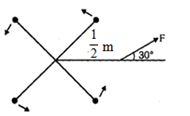
Four masses of $2 \ kg$ each are attached to an axle by spokes of length $1/4 \ m$ as shown in the figure. $A$ force $F = 24 \ N$ is applied at the end of a spoke of length $1/2 \ m$ at an angle of $30^{\circ}$ to produce an angular acceleration $\alpha$. The value of $\alpha$ is ........ $rad/s^2$.
A
$4$
B
$10$
C
$20$
D
$12$
Solution
(D) The torque $\tau$ is given by $\tau = F r \sin \theta = I \alpha$.
Here,the moment of inertia $I$ of the four masses is $I = 4 \times (m r^2) = 4 \times (2 \times (1/4)^2) = 4 \times (2 \times 1/16) = 0.5 \ kg \cdot m^2$.
The torque applied by force $F = 24 \ N$ at a distance $r = 1/2 \ m$ with angle $\theta = 30^{\circ}$ is $\tau = F r \sin 30^{\circ} = 24 \times (1/2) \times (1/2) = 6 \ N \cdot m$.
Using $\tau = I \alpha$,we get $6 = 0.5 \times \alpha$.
Therefore,$\alpha = 6 / 0.5 = 12 \ rad/s^2$.
Here,the moment of inertia $I$ of the four masses is $I = 4 \times (m r^2) = 4 \times (2 \times (1/4)^2) = 4 \times (2 \times 1/16) = 0.5 \ kg \cdot m^2$.
The torque applied by force $F = 24 \ N$ at a distance $r = 1/2 \ m$ with angle $\theta = 30^{\circ}$ is $\tau = F r \sin 30^{\circ} = 24 \times (1/2) \times (1/2) = 6 \ N \cdot m$.
Using $\tau = I \alpha$,we get $6 = 0.5 \times \alpha$.
Therefore,$\alpha = 6 / 0.5 = 12 \ rad/s^2$.
0 likes
View Solution35
MediumMCQ
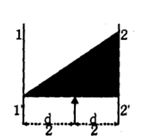
In the given figure,about which axis will the angular acceleration be greater if a force is applied at the midpoint of the triangular frame?
A
$I_{11'} > I_{22'}$
B
$I_{22'} > I_{11'}$
C
$I_{11'} = I_{22'}$
D
None of these
Solution
(B) The torque $\tau$ applied at the midpoint is the same for both axes. The relationship between torque and angular acceleration $\alpha$ is given by $\tau = I\alpha$,where $I$ is the moment of inertia.
Since $\tau$ is constant,$\alpha = \frac{\tau}{I}$. Thus,the axis with the smaller moment of inertia will have a greater angular acceleration.
The moment of inertia $I$ is given by $I = \sum mr^2$. Comparing the distribution of mass relative to the axes $11'$ and $22'$,the mass is distributed further from axis $11'$ than from axis $22'$.
Therefore,$I_{11'} > I_{22'}$.
Since $\alpha$ is inversely proportional to $I$,the angular acceleration will be greater about the axis $22'$ because $I_{22'} < I_{11'}$.
Since $\tau$ is constant,$\alpha = \frac{\tau}{I}$. Thus,the axis with the smaller moment of inertia will have a greater angular acceleration.
The moment of inertia $I$ is given by $I = \sum mr^2$. Comparing the distribution of mass relative to the axes $11'$ and $22'$,the mass is distributed further from axis $11'$ than from axis $22'$.
Therefore,$I_{11'} > I_{22'}$.
Since $\alpha$ is inversely proportional to $I$,the angular acceleration will be greater about the axis $22'$ because $I_{22'} < I_{11'}$.
0 likes
View Solution36
DifficultMCQ
$A$ string is wrapped around the rim of a wheel with a moment of inertia of $0.20 \ kg \cdot m^2$ and a radius of $20 \ cm$. The wheel is free to rotate about its axis and is initially at rest. The string is now pulled with a force of $20 \ N$. What will be the angular velocity of the wheel after $5 \ s$ in $rad/s$?

A
$90$
B
$70$
C
$95$
D
$100$
Solution
(D) Given: Moment of inertia $I = 0.20 \ kg \cdot m^2$,Radius $r = 20 \ cm = 0.2 \ m$,Force $F = 20 \ N$,Time $t = 5 \ s$,Initial angular velocity $\omega_0 = 0$.
The torque $\tau$ applied to the wheel is given by $\tau = F \times r$.
Substituting the values: $\tau = 20 \ N \times 0.2 \ m = 4 \ N \cdot m$.
We know that torque is also related to angular acceleration $\alpha$ by the equation $\tau = I \alpha$.
Therefore,$\alpha = \frac{\tau}{I} = \frac{4 \ N \cdot m}{0.20 \ kg \cdot m^2} = 20 \ rad/s^2$.
Using the equation of motion for rotation: $\omega = \omega_0 + \alpha t$.
Substituting the values: $\omega = 0 + (20 \ rad/s^2) \times (5 \ s) = 100 \ rad/s$.
The torque $\tau$ applied to the wheel is given by $\tau = F \times r$.
Substituting the values: $\tau = 20 \ N \times 0.2 \ m = 4 \ N \cdot m$.
We know that torque is also related to angular acceleration $\alpha$ by the equation $\tau = I \alpha$.
Therefore,$\alpha = \frac{\tau}{I} = \frac{4 \ N \cdot m}{0.20 \ kg \cdot m^2} = 20 \ rad/s^2$.
Using the equation of motion for rotation: $\omega = \omega_0 + \alpha t$.
Substituting the values: $\omega = 0 + (20 \ rad/s^2) \times (5 \ s) = 100 \ rad/s$.
0 likes
View Solution37
MediumMCQ
$A$ pulley of radius $10 \ cm$ has a moment of inertia of $10^{-3} \ kg \ m^2$ about its geometric axis. $A$ time-varying tangential force $F = (0.5t - 0.3t^2) \ N$ is applied to its rim. The pulley is initially at rest. If $t$ is in seconds,what will be the angular acceleration of the pulley at $t = 3 \ s$ in $rad \ s^{-2}$?
A
$840$
B
$420$
C
$42$
D
$4.2$
Solution
(B) The torque $\tau$ is given by $\tau = I\alpha$ and $\tau = R \times F$.
Equating the two,we get $I\alpha = RF$.
$\alpha = \frac{RF}{I}$.
Given $R = 10 \ cm = 0.1 \ m$,$I = 10^{-3} \ kg \ m^2$,and $F = (0.5t - 0.3t^2) \ N$.
$\alpha = \frac{0.1 \times (0.5t - 0.3t^2)}{10^{-3}}$.
At $t = 3 \ s$:
$\alpha = \frac{0.1 \times (0.5(3) - 0.3(3)^2)}{10^{-3}}$
$\alpha = \frac{0.1 \times (1.5 - 2.7)}{10^{-3}}$
$\alpha = \frac{0.1 \times (-1.2)}{10^{-3}} = \frac{-0.12}{10^{-3}} = -120 \ rad \ s^{-2}$.
Note: The magnitude of the angular acceleration is $120 \ rad \ s^{-2}$. Given the options provided,if the force was $F = (0.5t + 0.3t^2)$,the result would be $420 \ rad \ s^{-2}$. Assuming the intended force was $F = (0.5t + 0.3t^2)$,the answer is $420 \ rad \ s^{-2}$.
Equating the two,we get $I\alpha = RF$.
$\alpha = \frac{RF}{I}$.
Given $R = 10 \ cm = 0.1 \ m$,$I = 10^{-3} \ kg \ m^2$,and $F = (0.5t - 0.3t^2) \ N$.
$\alpha = \frac{0.1 \times (0.5t - 0.3t^2)}{10^{-3}}$.
At $t = 3 \ s$:
$\alpha = \frac{0.1 \times (0.5(3) - 0.3(3)^2)}{10^{-3}}$
$\alpha = \frac{0.1 \times (1.5 - 2.7)}{10^{-3}}$
$\alpha = \frac{0.1 \times (-1.2)}{10^{-3}} = \frac{-0.12}{10^{-3}} = -120 \ rad \ s^{-2}$.
Note: The magnitude of the angular acceleration is $120 \ rad \ s^{-2}$. Given the options provided,if the force was $F = (0.5t + 0.3t^2)$,the result would be $420 \ rad \ s^{-2}$. Assuming the intended force was $F = (0.5t + 0.3t^2)$,the answer is $420 \ rad \ s^{-2}$.
0 likes
View Solution38
MediumMCQ
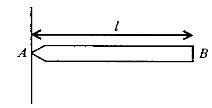
$A$ uniform rod $AB$ of length $l$ and mass $m$ is free to rotate about point $A.$ The rod is released from rest in the horizontal position. Given that the moment of inertia of the rod about $A$ is $ml^2/3$,the initial angular acceleration of the rod will be:
A
$\frac{mgl}{2}$
B
$\frac{3}{2}gl$
C
$\frac{3g}{2l}$
D
$\frac{2g}{3l}$
Solution
(C) The torque $\tau$ about point $A$ is due to the gravitational force acting at the center of mass of the rod,which is at a distance $l/2$ from $A.$
$\tau = mg \times \frac{l}{2} = \frac{mgl}{2}$
Using the relation between torque and angular acceleration,$\tau = I\alpha$,where $I$ is the moment of inertia about $A$ and $\alpha$ is the angular acceleration.
Given $I = \frac{ml^2}{3}$,we have:
$\alpha = \frac{\tau}{I} = \frac{mgl/2}{ml^2/3} = \frac{mgl}{2} \times \frac{3}{ml^2} = \frac{3g}{2l}$
$\tau = mg \times \frac{l}{2} = \frac{mgl}{2}$
Using the relation between torque and angular acceleration,$\tau = I\alpha$,where $I$ is the moment of inertia about $A$ and $\alpha$ is the angular acceleration.
Given $I = \frac{ml^2}{3}$,we have:
$\alpha = \frac{\tau}{I} = \frac{mgl/2}{ml^2/3} = \frac{mgl}{2} \times \frac{3}{ml^2} = \frac{3g}{2l}$
0 likes
View Solution39
MediumMCQ
The instantaneous angular position of a point on a rotating wheel is given by the equation $\theta(t) = 2t^3 - 6t^2$. The torque on the wheel becomes zero at $t = $ ...... $s$.
A
$1$
B
$0.5$
C
$0.25$
D
$2$
Solution
(A) Given: $\theta(t) = 2t^3 - 6t^2$.
First,find the angular velocity $\omega$ by differentiating $\theta$ with respect to time $t$: $\omega = \frac{d\theta}{dt} = 6t^2 - 12t$.
Next,find the angular acceleration $\alpha$ by differentiating $\omega$ with respect to time $t$: $\alpha = \frac{d\omega}{dt} = 12t - 12$.
The torque $\tau$ is given by the relation $\tau = I\alpha$,where $I$ is the moment of inertia.
For the torque to be zero,the angular acceleration $\alpha$ must be zero (assuming $I \neq 0$).
Setting $\alpha = 0$,we get: $12t - 12 = 0$.
Solving for $t$,we find $t = 1 \ s$.
First,find the angular velocity $\omega$ by differentiating $\theta$ with respect to time $t$: $\omega = \frac{d\theta}{dt} = 6t^2 - 12t$.
Next,find the angular acceleration $\alpha$ by differentiating $\omega$ with respect to time $t$: $\alpha = \frac{d\omega}{dt} = 12t - 12$.
The torque $\tau$ is given by the relation $\tau = I\alpha$,where $I$ is the moment of inertia.
For the torque to be zero,the angular acceleration $\alpha$ must be zero (assuming $I \neq 0$).
Setting $\alpha = 0$,we get: $12t - 12 = 0$.
Solving for $t$,we find $t = 1 \ s$.
0 likes
View Solution40
DifficultMCQ
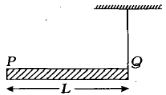
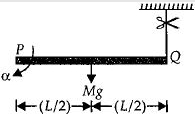
$A$ rod $PQ$ of mass $M$ and length $L$ is hinged at end $P$. The rod is kept horizontal by a massless string tied to point $Q$ as shown in the figure. When the string is cut,the initial angular acceleration of the rod is
A
$\frac{g}{L}$
B
$\frac{2g}{L}$
C
$\frac{2g}{3L}$
D
$\frac{3g}{2L}$
Solution
(D) When the string is cut,the rod will rotate about the hinge point $P$ due to the torque produced by its weight.
Let $\alpha$ be the initial angular acceleration of the rod.
The torque $\tau$ about point $P$ is given by $\tau = I\alpha$,where $I$ is the moment of inertia of the rod about one end.
$I = \frac{ML^2}{3} \quad ...(i)$
Also,the torque due to gravity acting at the center of mass (at distance $L/2$ from $P$) is:
$\tau = Mg \times \frac{L}{2} \quad ...(ii)$
Equating $(i)$ and $(ii)$:
$\frac{ML^2}{3} \alpha = Mg \frac{L}{2}$
$\alpha = \frac{MgL}{2} \times \frac{3}{ML^2}$
$\alpha = \frac{3g}{2L}$
Let $\alpha$ be the initial angular acceleration of the rod.
The torque $\tau$ about point $P$ is given by $\tau = I\alpha$,where $I$ is the moment of inertia of the rod about one end.
$I = \frac{ML^2}{3} \quad ...(i)$
Also,the torque due to gravity acting at the center of mass (at distance $L/2$ from $P$) is:
$\tau = Mg \times \frac{L}{2} \quad ...(ii)$
Equating $(i)$ and $(ii)$:
$\frac{ML^2}{3} \alpha = Mg \frac{L}{2}$
$\alpha = \frac{MgL}{2} \times \frac{3}{ML^2}$
$\alpha = \frac{3g}{2L}$
0 likes
View Solution41
MediumMCQ
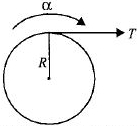
$A$ solid cylinder of mass $50\, kg$ and radius $0.5\, m$ is free to rotate about a horizontal axis. $A$ massless string is wound around the cylinder with one end attached to it and the other hanging freely. The tension in the string required to produce an angular acceleration of $2\, \text{revolutions } s^{-2}$ is ...... $N$.
A
$25$
B
$50$
C
$78.5$
D
$157$
Solution
(D) Given: Mass of the cylinder, $M = 50\, kg$. Radius of the cylinder, $R = 0.5\, m$. Angular acceleration, $\alpha = 2\, \text{rev } s^{-2}$.
Converting angular acceleration to $SI$ units: $\alpha = 2 \times 2\pi\, \text{rad } s^{-2} = 4\pi\, \text{rad } s^{-2}$.
The torque $\tau$ produced by the tension $T$ in the string is $\tau = T \times R$.
The moment of inertia $I$ of a solid cylinder about its central axis is $I = \frac{1}{2}MR^2$.
Using the relation $\tau = I\alpha$, we have $TR = (\frac{1}{2}MR^2)\alpha$.
Solving for tension $T$: $T = \frac{1}{2}MR\alpha$.
Substituting the values: $T = \frac{1}{2} \times 50 \times 0.5 \times 4\pi = 50\pi$.
Using $\pi \approx 3.14$, $T = 50 \times 3.14 = 157\, N$.
Converting angular acceleration to $SI$ units: $\alpha = 2 \times 2\pi\, \text{rad } s^{-2} = 4\pi\, \text{rad } s^{-2}$.
The torque $\tau$ produced by the tension $T$ in the string is $\tau = T \times R$.
The moment of inertia $I$ of a solid cylinder about its central axis is $I = \frac{1}{2}MR^2$.
Using the relation $\tau = I\alpha$, we have $TR = (\frac{1}{2}MR^2)\alpha$.
Solving for tension $T$: $T = \frac{1}{2}MR\alpha$.
Substituting the values: $T = \frac{1}{2} \times 50 \times 0.5 \times 4\pi = 50\pi$.
Using $\pi \approx 3.14$, $T = 50 \times 3.14 = 157\, N$.
0 likes
View Solution42
MediumMCQ
An automobile moves on a road with a speed of $54 \,km h^{-1}.$ The radius of its wheels is $0.45\, m$ and the moment of inertia of the wheel about its axis of rotation is $3\, kg m^2$. If the vehicle is brought to rest in $15\, s,$ the magnitude of average torque transmitted by its brakes to the wheel is .......... $kg \,m^2\, s^{-2}$.
A
$2.86$
B
$6.66$
C
$8.58$
D
$10.86$
Solution
(B) Given:
Speed of the automobile,$v = 54 \,km h^{-1} = 54 \times \frac{5}{18} \,m s^{-1} = 15 \,m s^{-1}$.
Radius of the wheel,$R = 0.45 \,m$.
Moment of inertia of the wheel,$I = 3 \,kg m^2$.
Time taken to stop,$t = 15 \,s$.
The initial angular speed of the wheel is $\omega_i = \frac{v}{R} = \frac{15 \,m s^{-1}}{0.45 \,m} = \frac{1500}{45} \,rad s^{-1} = \frac{100}{3} \,rad s^{-1}$.
The final angular speed is $\omega_f = 0$ (as the vehicle comes to rest).
The angular retardation of the wheel is $\alpha = \frac{\omega_f - \omega_i}{t} = \frac{0 - \frac{100}{3}}{15} = -\frac{100}{45} \,rad s^{-2}$.
The magnitude of the average torque is $\tau = I |\alpha| = 3 \,kg m^2 \times \frac{100}{45} \,rad s^{-2} = \frac{300}{45} \,N m = \frac{20}{3} \,N m \approx 6.66 \,kg m^2 s^{-2}$.
Speed of the automobile,$v = 54 \,km h^{-1} = 54 \times \frac{5}{18} \,m s^{-1} = 15 \,m s^{-1}$.
Radius of the wheel,$R = 0.45 \,m$.
Moment of inertia of the wheel,$I = 3 \,kg m^2$.
Time taken to stop,$t = 15 \,s$.
The initial angular speed of the wheel is $\omega_i = \frac{v}{R} = \frac{15 \,m s^{-1}}{0.45 \,m} = \frac{1500}{45} \,rad s^{-1} = \frac{100}{3} \,rad s^{-1}$.
The final angular speed is $\omega_f = 0$ (as the vehicle comes to rest).
The angular retardation of the wheel is $\alpha = \frac{\omega_f - \omega_i}{t} = \frac{0 - \frac{100}{3}}{15} = -\frac{100}{45} \,rad s^{-2}$.
The magnitude of the average torque is $\tau = I |\alpha| = 3 \,kg m^2 \times \frac{100}{45} \,rad s^{-2} = \frac{300}{45} \,N m = \frac{20}{3} \,N m \approx 6.66 \,kg m^2 s^{-2}$.
0 likes
View Solution43
MediumMCQ
$A$ rope is wound around a hollow cylinder of mass $3\, kg$ and radius $40\, cm.$ What is the angular acceleration (in $rad/s^2$) of the cylinder if the rope is pulled with a force of $30\, N$?
A
$25$
B
$30$
C
$35$
D
$40$
Solution
(A) Given: Mass $m = 3\, kg$,Radius $r = 40\, cm = 0.4\, m$,Force $F = 30\, N$.
The moment of inertia $(I)$ of a hollow cylinder about its central axis is given by $I = mr^2$.
$I = 3\, kg \times (0.4\, m)^2 = 3 \times 0.16 = 0.48\, kg\cdot m^2$.
The torque $(\tau)$ produced by the force is $\tau = rF$.
$\tau = 0.4\, m \times 30\, N = 12\, N\cdot m$.
Using the relation $\tau = I\alpha$,where $\alpha$ is the angular acceleration:
$\alpha = \frac{\tau}{I} = \frac{12\, N\cdot m}{0.48\, kg\cdot m^2}$.
$\alpha = \frac{1200}{48} = 25\, rad/s^2$.
The moment of inertia $(I)$ of a hollow cylinder about its central axis is given by $I = mr^2$.
$I = 3\, kg \times (0.4\, m)^2 = 3 \times 0.16 = 0.48\, kg\cdot m^2$.
The torque $(\tau)$ produced by the force is $\tau = rF$.
$\tau = 0.4\, m \times 30\, N = 12\, N\cdot m$.
Using the relation $\tau = I\alpha$,where $\alpha$ is the angular acceleration:
$\alpha = \frac{\tau}{I} = \frac{12\, N\cdot m}{0.48\, kg\cdot m^2}$.
$\alpha = \frac{1200}{48} = 25\, rad/s^2$.
0 likes
View Solution44
DifficultMCQ
The moment of inertia of a body about a given axis is $2.4 \, kg \cdot m^2$. For what duration of time must an angular acceleration of $5 \, rad/s^2$ be applied about this axis to generate a rotational kinetic energy of $750 \, J$? (in seconds)
A
$6$
B
$5$
C
$4$
D
$3$
Solution
(B) The rotational kinetic energy $K$ is given by $K = \frac{1}{2} I \omega^2$.
Given $K = 750 \, J$ and $I = 2.4 \, kg \cdot m^2$,we have:
$750 = \frac{1}{2} \times 2.4 \times \omega^2$
$750 = 1.2 \times \omega^2$
$\omega^2 = \frac{750}{1.2} = 625$
$\omega = \sqrt{625} = 25 \, rad/s$.
Using the kinematic equation for rotational motion,$\omega = \omega_0 + \alpha t$,where $\omega_0 = 0$ (starting from rest):
$25 = 0 + 5 \times t$
$t = \frac{25}{5} = 5 \, s$.
Given $K = 750 \, J$ and $I = 2.4 \, kg \cdot m^2$,we have:
$750 = \frac{1}{2} \times 2.4 \times \omega^2$
$750 = 1.2 \times \omega^2$
$\omega^2 = \frac{750}{1.2} = 625$
$\omega = \sqrt{625} = 25 \, rad/s$.
Using the kinematic equation for rotational motion,$\omega = \omega_0 + \alpha t$,where $\omega_0 = 0$ (starting from rest):
$25 = 0 + 5 \times t$
$t = \frac{25}{5} = 5 \, s$.
0 likes
View Solution45
EasyMCQ
$A$ constant torque of $1000 \; Nm$ turns a wheel of moment of inertia $200 \; kg \cdot m^2$ about an axis through its centre. The wheel is at rest initially. Its angular velocity after $3 \; s$ is
A
$1 \; rad/s$
B
$5 \; rad/s$
C
$10 \; rad/s$
D
$15 \; rad/s$
Solution
(D) Given: Torque $\tau = 1000 \; Nm$,Moment of inertia $I = 200 \; kg \cdot m^2$,Initial angular velocity $\omega_0 = 0$,Time $t = 3 \; s$.
Using the relation $\tau = I \alpha$,we find the angular acceleration $\alpha$:
$\alpha = \frac{\tau}{I} = \frac{1000}{200} = 5 \; rad/s^2$.
Now,using the first equation of rotational motion $\omega = \omega_0 + \alpha t$:
$\omega = 0 + (5 \; rad/s^2) \times (3 \; s) = 15 \; rad/s$.
Thus,the angular velocity after $3 \; s$ is $15 \; rad/s$.
Using the relation $\tau = I \alpha$,we find the angular acceleration $\alpha$:
$\alpha = \frac{\tau}{I} = \frac{1000}{200} = 5 \; rad/s^2$.
Now,using the first equation of rotational motion $\omega = \omega_0 + \alpha t$:
$\omega = 0 + (5 \; rad/s^2) \times (3 \; s) = 15 \; rad/s$.
Thus,the angular velocity after $3 \; s$ is $15 \; rad/s$.
0 likes
View Solution46
MediumMCQ
$A$ flywheel attains a speed of $540 \, r.p.m.$ in $6 \, s$. Its angular acceleration is:
A
$3\pi \, rad/s^2$
B
$9\pi \, rad/s^2$
C
$18\pi \, rad/s^2$
D
$54\pi \, rad/s^2$
Solution
(A) Given: Final angular velocity $\omega = 540 \, r.p.m. = \frac{540 \times 2\pi}{60} \, rad/s = 18\pi \, rad/s$.
Time taken $t = 6 \, s$.
Initial angular velocity $\omega_0 = 0 \, rad/s$.
Angular acceleration $\alpha = \frac{\omega - \omega_0}{t}$.
$\alpha = \frac{18\pi - 0}{6} = 3\pi \, rad/s^2$.
Time taken $t = 6 \, s$.
Initial angular velocity $\omega_0 = 0 \, rad/s$.
Angular acceleration $\alpha = \frac{\omega - \omega_0}{t}$.
$\alpha = \frac{18\pi - 0}{6} = 3\pi \, rad/s^2$.
0 likes
View Solution47
EasyMCQ
$A$ torque of $50 \ N \cdot m$ causes a wheel to rotate from rest through $200 \ rad$ in $5 \ s$. The value of the angular acceleration produced is ...... $rad/s^2$.
A
$8$
B
$4$
C
$16$
D
$12$
Solution
(C) Given: Torque $\tau = 50 \ N \cdot m$,initial angular velocity $\omega_0 = 0 \ rad/s$,angular displacement $\theta = 200 \ rad$,and time $t = 5 \ s$.
Using the kinematic equation for rotational motion: $\theta = \omega_0 t + \frac{1}{2} \alpha t^2$.
Since the wheel starts from rest,$\omega_0 = 0$.
Substituting the values: $200 = 0 \cdot (5) + \frac{1}{2} \cdot \alpha \cdot (5)^2$.
$200 = \frac{25}{2} \alpha$.
$\alpha = \frac{200 \cdot 2}{25} = 8 \cdot 2 = 16 \ rad/s^2$.
Using the kinematic equation for rotational motion: $\theta = \omega_0 t + \frac{1}{2} \alpha t^2$.
Since the wheel starts from rest,$\omega_0 = 0$.
Substituting the values: $200 = 0 \cdot (5) + \frac{1}{2} \cdot \alpha \cdot (5)^2$.
$200 = \frac{25}{2} \alpha$.
$\alpha = \frac{200 \cdot 2}{25} = 8 \cdot 2 = 16 \ rad/s^2$.
0 likes
View Solution48
EasyMCQ
$A$ wheel is rotating at a rate of $900$ revolutions per minute about its axis. When the power source is cut off,it comes to rest in $1$ minute. The angular retardation of the wheel in $rad/s^2$ is:
A
$\pi /2$
B
$\pi /4$
C
$\pi /6$
D
$\pi /8$
Solution
(A) Given:
Initial angular velocity,$\omega_i = 900 \text{ rpm} = \frac{900 \times 2\pi}{60} \text{ rad/s} = 30\pi \text{ rad/s}$.
Final angular velocity,$\omega_f = 0 \text{ rad/s}$ (since it comes to rest).
Time taken,$t = 1 \text{ minute} = 60 \text{ s}$.
Using the first equation of rotational motion: $\omega_f = \omega_i + \alpha t$.
Substituting the values: $0 = 30\pi + \alpha(60)$.
$\alpha = -\frac{30\pi}{60} = -\frac{\pi}{2} \text{ rad/s}^2$.
The angular retardation is the magnitude of angular acceleration,which is $\frac{\pi}{2} \text{ rad/s}^2$.
Initial angular velocity,$\omega_i = 900 \text{ rpm} = \frac{900 \times 2\pi}{60} \text{ rad/s} = 30\pi \text{ rad/s}$.
Final angular velocity,$\omega_f = 0 \text{ rad/s}$ (since it comes to rest).
Time taken,$t = 1 \text{ minute} = 60 \text{ s}$.
Using the first equation of rotational motion: $\omega_f = \omega_i + \alpha t$.
Substituting the values: $0 = 30\pi + \alpha(60)$.
$\alpha = -\frac{30\pi}{60} = -\frac{\pi}{2} \text{ rad/s}^2$.
The angular retardation is the magnitude of angular acceleration,which is $\frac{\pi}{2} \text{ rad/s}^2$.
0 likes
View SolutionSystem of Particles and Rotational Motion — Relation between Torque and Angular acceleration and it's Application · Frequently Asked Questions
1Are these System of Particles and Rotational Motion questions useful for JEE and NEET?
Yes. All questions in this section are mapped to JEE Main and NEET exam patterns. Previous year questions from JEE Main, NEET, GUJCET and state-level exams are included with full solutions.
2Can I switch to Hindi or Gujarati for these questions?
Yes. Use the language tabs in the hero section or the sidebar to view the same questions and solutions in English, Hindi or Gujarati.
3How do I generate a question paper from this subtopic?
Use the Vedclass Exam Paper Generator — select the chapter and subtopic, set difficulty, and generate Sets A, B, C, D automatically. First 3 chapters of every subject are free.
Vedclass Products
For Students
Vedclass Test Series
Mock tests in real JEE/NEET style with performance analysis. 5-day free trial.
Start Free TrialFor Teachers
Exam Paper Generator
Generate Set A/B/C/D papers from this chapter in 2 minutes. 3 chapters free.
Try FreeFor Institutes
Online Exam Module
Live online exams with unlimited students, 360° analytics & white-label branding.
See DemoFor Teachers & Institutes
Generate a System of Particles and Rotational Motion Exam Paper in 2 Minutes
Select subtopic & difficulty — Sets A, B, C, D auto-generated with No Repeat logic.
First 3 chapters of every subject are free — no payment required.