
A English
Relation between Torque and Angular acceleration and it's Application Questions in English
Class 11 Physics · System of Particles and Rotational Motion · Relation between Torque and Angular acceleration and it's Application
182+
Questions
English
Language
100%
With Solutions
Showing 31 of 182 questions in English
151
MediumMCQ
$A$ disc has mass $M$ and radius $R$. How much tangential force should be applied to the rim of the disc so as to rotate the disc with angular velocity $\omega$ in time $t$?
A
$\frac{M R \omega}{4 t}$
B
$\frac{M R \omega}{2 t}$
C
$\frac{M R \omega}{t}$
D
$M R \omega t$
Solution
(B) The moment of inertia of a disc about its central axis is $I = \frac{1}{2} M R^2$.
Using the rotational analog of Newton's second law,$\tau = I \alpha$,where $\tau$ is the torque and $\alpha$ is the angular acceleration.
The tangential force $F$ applied at the rim provides a torque $\tau = F \times R$.
The angular acceleration is given by $\alpha = \frac{\omega}{t}$.
Substituting these into the torque equation: $F \times R = (\frac{1}{2} M R^2) \times (\frac{\omega}{t})$.
Solving for $F$: $F = \frac{M R \omega}{2 t}$.
Using the rotational analog of Newton's second law,$\tau = I \alpha$,where $\tau$ is the torque and $\alpha$ is the angular acceleration.
The tangential force $F$ applied at the rim provides a torque $\tau = F \times R$.
The angular acceleration is given by $\alpha = \frac{\omega}{t}$.
Substituting these into the torque equation: $F \times R = (\frac{1}{2} M R^2) \times (\frac{\omega}{t})$.
Solving for $F$: $F = \frac{M R \omega}{2 t}$.
0 likes
View Solution152
MediumMCQ
$A$ rigid body rotates about a fixed axis with variable angular velocity $\omega(t) = \alpha - \beta t$ at time $t$,where $\alpha$ and $\beta$ are constants. The angle through which it rotates before it comes to rest is
A
$\frac{\alpha}{\beta}$
B
$\frac{\alpha^2}{\beta}$
C
$\frac{\alpha^2}{2 \beta}$
D
$\frac{\alpha}{2 \beta}$
Solution
(C) Given the angular velocity $\omega(t) = \alpha - \beta t$.
At time $t = 0$,$\omega = \alpha$.
The body comes to rest when $\omega(t) = 0$.
$\alpha - \beta t = 0 \implies t = \frac{\alpha}{\beta}$.
The angular displacement $\theta$ is given by the integral of angular velocity with respect to time:
$\theta = \int_{0}^{t} \omega(t) dt = \int_{0}^{\alpha/\beta} (\alpha - \beta t) dt$.
$\theta = [\alpha t - \frac{1}{2} \beta t^2]_{0}^{\alpha/\beta}$.
Substituting the limits:
$\theta = \alpha(\frac{\alpha}{\beta}) - \frac{1}{2} \beta (\frac{\alpha}{\beta})^2$.
$\theta = \frac{\alpha^2}{\beta} - \frac{1}{2} \frac{\alpha^2}{\beta} = \frac{\alpha^2}{2 \beta}$.
At time $t = 0$,$\omega = \alpha$.
The body comes to rest when $\omega(t) = 0$.
$\alpha - \beta t = 0 \implies t = \frac{\alpha}{\beta}$.
The angular displacement $\theta$ is given by the integral of angular velocity with respect to time:
$\theta = \int_{0}^{t} \omega(t) dt = \int_{0}^{\alpha/\beta} (\alpha - \beta t) dt$.
$\theta = [\alpha t - \frac{1}{2} \beta t^2]_{0}^{\alpha/\beta}$.
Substituting the limits:
$\theta = \alpha(\frac{\alpha}{\beta}) - \frac{1}{2} \beta (\frac{\alpha}{\beta})^2$.
$\theta = \frac{\alpha^2}{\beta} - \frac{1}{2} \frac{\alpha^2}{\beta} = \frac{\alpha^2}{2 \beta}$.
0 likes
View Solution153
DifficultMCQ
$A$ disc of radius $0.4 \,m$ and mass $1 \,kg$ rotates about an axis passing through its center and perpendicular to its plane. The angular acceleration is $10 \,rad \,s^{-2}$. The tangential force applied to the rim of the disc is (in $\,N$)
A
$2$
B
$3$
C
$4$
D
$5$
Solution
(A) Given: Radius $R = 0.4 \,m$,Mass $M = 1 \,kg$,Angular acceleration $\alpha = 10 \,rad \,s^{-2}$.
The moment of inertia of a disc about its central axis is $I = \frac{1}{2} MR^2$.
$I = \frac{1}{2} \times 1 \,kg \times (0.4 \,m)^2 = 0.5 \times 0.16 = 0.08 \,kg \,m^2$.
The torque $\tau$ is given by $\tau = I \alpha$.
$\tau = 0.08 \,kg \,m^2 \times 10 \,rad \,s^{-2} = 0.8 \,N \,m$.
The tangential force $F$ applied at the rim is related to torque by $\tau = F \times R$.
Therefore,$F = \frac{\tau}{R} = \frac{0.8 \,N \,m}{0.4 \,m} = 2 \,N$.
The moment of inertia of a disc about its central axis is $I = \frac{1}{2} MR^2$.
$I = \frac{1}{2} \times 1 \,kg \times (0.4 \,m)^2 = 0.5 \times 0.16 = 0.08 \,kg \,m^2$.
The torque $\tau$ is given by $\tau = I \alpha$.
$\tau = 0.08 \,kg \,m^2 \times 10 \,rad \,s^{-2} = 0.8 \,N \,m$.
The tangential force $F$ applied at the rim is related to torque by $\tau = F \times R$.
Therefore,$F = \frac{\tau}{R} = \frac{0.8 \,N \,m}{0.4 \,m} = 2 \,N$.
0 likes
View Solution154
MediumMCQ
$A$ disc of radius $0.4 \,m$ and mass $1 \,kg$ rotates about an axis passing through its center and perpendicular to its plane. The angular acceleration of the disc is $10 \,rad/s^2$. The tangential force applied to the rim of the disc is (in $\,N$)
A
$4$
B
$1$
C
$2$
D
$8$
Solution
(C) Given: Radius $R = 0.4 \,m$,Mass $M = 1 \,kg$,Angular acceleration $\alpha = 10 \,rad/s^2$.
The moment of inertia $I$ of a disc about an axis passing through its center and perpendicular to its plane is given by $I = \frac{MR^2}{2}$.
Substituting the values: $I = \frac{1 \times (0.4)^2}{2} = \frac{0.16}{2} = 0.08 \,kg \cdot m^2$.
The torque $\tau$ is given by $\tau = I\alpha$. Also,for a tangential force $F$ applied at the rim,$\tau = RF$.
Equating the two: $RF = I\alpha$.
Solving for $F$: $F = \frac{I\alpha}{R} = \frac{0.08 \times 10}{0.4} = \frac{0.8}{0.4} = 2 \,N$.
The moment of inertia $I$ of a disc about an axis passing through its center and perpendicular to its plane is given by $I = \frac{MR^2}{2}$.
Substituting the values: $I = \frac{1 \times (0.4)^2}{2} = \frac{0.16}{2} = 0.08 \,kg \cdot m^2$.
The torque $\tau$ is given by $\tau = I\alpha$. Also,for a tangential force $F$ applied at the rim,$\tau = RF$.
Equating the two: $RF = I\alpha$.
Solving for $F$: $F = \frac{I\alpha}{R} = \frac{0.08 \times 10}{0.4} = \frac{0.8}{0.4} = 2 \,N$.
0 likes
View Solution155
MediumMCQ
$A$ wheel is at rest in a horizontal position. Its moment of inertia about the vertical axis passing through its centre is $I$. $A$ constant torque $\tau$ acts on it for $t$ seconds. The change in rotational kinetic energy is:
A
$\frac{\tau^{2} t^{2}}{2 I}$
B
$\left[\frac{\tau t}{2 I}\right]$
C
$\left[\frac{\tau t}{2 I}\right]^{\frac{1}{2}}$
D
$\left[\frac{\tau t}{2 I}\right]^{2}$
Solution
(A) Given that the wheel is initially at rest,the initial angular velocity $\omega_0 = 0$.
The angular acceleration $\alpha$ produced by a constant torque $\tau$ is given by $\alpha = \frac{\tau}{I}$.
After time $t$,the angular velocity $\omega$ is given by $\omega = \omega_0 + \alpha t = 0 + \left(\frac{\tau}{I}\right)t = \frac{\tau t}{I}$.
The rotational kinetic energy $K$ is given by $K = \frac{1}{2} I \omega^2$.
Substituting the value of $\omega$,we get $K = \frac{1}{2} I \left(\frac{\tau t}{I}\right)^2 = \frac{1}{2} I \cdot \frac{\tau^2 t^2}{I^2} = \frac{\tau^2 t^2}{2 I}$.
The angular acceleration $\alpha$ produced by a constant torque $\tau$ is given by $\alpha = \frac{\tau}{I}$.
After time $t$,the angular velocity $\omega$ is given by $\omega = \omega_0 + \alpha t = 0 + \left(\frac{\tau}{I}\right)t = \frac{\tau t}{I}$.
The rotational kinetic energy $K$ is given by $K = \frac{1}{2} I \omega^2$.
Substituting the value of $\omega$,we get $K = \frac{1}{2} I \left(\frac{\tau t}{I}\right)^2 = \frac{1}{2} I \cdot \frac{\tau^2 t^2}{I^2} = \frac{\tau^2 t^2}{2 I}$.
0 likes
View Solution156
EasyMCQ
$A$ rope is wound around a solid cylinder of mass $1 \,kg$ and radius $0.4 \,m$. What is the angular acceleration of the cylinder, if the rope is pulled with a force of $25 \,N$? (The cylinder is rotating about its own axis.)
A
$50 \,rad/s^2$
B
$125 \,rad/s^2$
C
$10 \,rad/s^2$
D
$1 \,rad/s^2$
Solution
(B) The torque $\tau$ applied by the force $F$ at a distance $r$ from the axis is given by $\tau = F \times r$.
Substituting the values, $\tau = 25 \,N \times 0.4 \,m = 10 \,Nm$.
The moment of inertia $I$ of a solid cylinder about its own axis is $I = \frac{1}{2} M R^2$.
Substituting the values, $I = \frac{1}{2} \times 1 \,kg \times (0.4 \,m)^2 = 0.5 \times 0.16 = 0.08 \,kg \cdot m^2$.
Using the relation $\tau = I \alpha$, the angular acceleration $\alpha$ is $\alpha = \frac{\tau}{I}$.
$\alpha = \frac{10 \,Nm}{0.08 \,kg \cdot m^2} = 125 \,rad/s^2$.
Substituting the values, $\tau = 25 \,N \times 0.4 \,m = 10 \,Nm$.
The moment of inertia $I$ of a solid cylinder about its own axis is $I = \frac{1}{2} M R^2$.
Substituting the values, $I = \frac{1}{2} \times 1 \,kg \times (0.4 \,m)^2 = 0.5 \times 0.16 = 0.08 \,kg \cdot m^2$.
Using the relation $\tau = I \alpha$, the angular acceleration $\alpha$ is $\alpha = \frac{\tau}{I}$.
$\alpha = \frac{10 \,Nm}{0.08 \,kg \cdot m^2} = 125 \,rad/s^2$.
0 likes
View Solution157
DifficultMCQ
$A$ ceiling fan rotates about its own axis with some angular velocity. When the fan is switched off,the angular velocity becomes $\left(\frac{1}{4}\right)^{th}$ of the original in time $t$ and $n$ revolutions are made in that time. The number of revolutions made by the fan during the time interval between switch off and rest is (Angular retardation is uniform):
A
$\frac{4 n}{15}$
B
$\frac{8 n}{15}$
C
$\frac{16 n}{15}$
D
$\frac{32 n}{15}$
Solution
(C) Let the initial angular velocity be $\omega_0$ and uniform angular retardation be $\alpha$.
Using the equation of rotational motion $\omega^2 = \omega_0^2 - 2\alpha\theta$,where $\theta = 2\pi n$.
At time $t$,$\omega = \frac{\omega_0}{4}$.
So,$(\frac{\omega_0}{4})^2 = \omega_0^2 - 2\alpha(2\pi n) \implies \frac{\omega_0^2}{16} = \omega_0^2 - 4\pi n\alpha$.
$4\pi n\alpha = \omega_0^2(1 - \frac{1}{16}) = \frac{15\omega_0^2}{16}$.
Thus,$2\alpha = \frac{15\omega_0^2}{32\pi n}$.
Now,for the fan to come to rest,final angular velocity $\omega_f = 0$.
Let $n'$ be the total revolutions from switch off to rest.
$0^2 = \omega_0^2 - 2\alpha(2\pi n')$.
$2\alpha(2\pi n') = \omega_0^2$.
Substituting $2\alpha$: $(\frac{15\omega_0^2}{32\pi n})(2\pi n') = \omega_0^2$.
$\frac{15n'}{16n} = 1 \implies n' = \frac{16n}{15}$.
Using the equation of rotational motion $\omega^2 = \omega_0^2 - 2\alpha\theta$,where $\theta = 2\pi n$.
At time $t$,$\omega = \frac{\omega_0}{4}$.
So,$(\frac{\omega_0}{4})^2 = \omega_0^2 - 2\alpha(2\pi n) \implies \frac{\omega_0^2}{16} = \omega_0^2 - 4\pi n\alpha$.
$4\pi n\alpha = \omega_0^2(1 - \frac{1}{16}) = \frac{15\omega_0^2}{16}$.
Thus,$2\alpha = \frac{15\omega_0^2}{32\pi n}$.
Now,for the fan to come to rest,final angular velocity $\omega_f = 0$.
Let $n'$ be the total revolutions from switch off to rest.
$0^2 = \omega_0^2 - 2\alpha(2\pi n')$.
$2\alpha(2\pi n') = \omega_0^2$.
Substituting $2\alpha$: $(\frac{15\omega_0^2}{32\pi n})(2\pi n') = \omega_0^2$.
$\frac{15n'}{16n} = 1 \implies n' = \frac{16n}{15}$.
0 likes
View Solution158
MediumMCQ
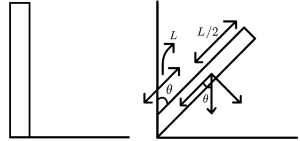
$A$ thin uniform rod of mass $m$ and length $L$ is pivoted at one end so that it can rotate in a vertical plane. The free end is held vertically above the pivot and then released. The angular acceleration of the rod when it makes an angle $\theta$ with the vertical is [consider negligible friction at the pivot] ($g=$ acceleration due to gravity).
A
$\frac{3g \sin \theta}{2L}$
B
$\frac{3g \cos \theta}{2L}$
C
$\frac{2g \sin \theta}{3L}$
D
$\frac{2g \cos \theta}{3L}$
Solution
(A) The rod is pivoted at one end. The moment of inertia of the rod about the pivot is $I = \frac{mL^2}{3}$.
The gravitational force $mg$ acts at the center of mass of the rod,which is at a distance $L/2$ from the pivot.
The torque $\tau$ about the pivot due to gravity is $\tau = mg \cdot (L/2) \sin \theta$.
Using the rotational analog of Newton's second law,$\tau = I \alpha$,where $\alpha$ is the angular acceleration:
$mg \frac{L}{2} \sin \theta = \left( \frac{mL^2}{3} \right) \alpha$
Solving for $\alpha$:
$\alpha = \frac{mg(L/2) \sin \theta}{mL^2/3} = \frac{mgL/2}{mL^2/3} \sin \theta = \frac{3g}{2L} \sin \theta$.
Thus,the angular acceleration is $\frac{3g \sin \theta}{2L}$.
The gravitational force $mg$ acts at the center of mass of the rod,which is at a distance $L/2$ from the pivot.
The torque $\tau$ about the pivot due to gravity is $\tau = mg \cdot (L/2) \sin \theta$.
Using the rotational analog of Newton's second law,$\tau = I \alpha$,where $\alpha$ is the angular acceleration:
$mg \frac{L}{2} \sin \theta = \left( \frac{mL^2}{3} \right) \alpha$
Solving for $\alpha$:
$\alpha = \frac{mg(L/2) \sin \theta}{mL^2/3} = \frac{mgL/2}{mL^2/3} \sin \theta = \frac{3g}{2L} \sin \theta$.
Thus,the angular acceleration is $\frac{3g \sin \theta}{2L}$.
0 likes
View Solution159
MediumMCQ
$A$ disc of mass $25 \ kg$ and radius $0.2 \ m$ is rotating at $240 \ r.p.m.$ $A$ retarding torque brings it to rest in $20 \ s$. If the torque is due to a force applied tangentially on the rim of the disc,then the magnitude of the force is:
A
$\frac{\pi}{2} \ N$
B
$2 \pi \ N$
C
$\pi \ N$
D
$4 \pi \ N$
Solution
(C) Given:
Mass $M = 25 \ kg$,Radius $R = 0.2 \ m$,Initial angular velocity $\omega_0 = 240 \ r.p.m. = 240 \times \frac{2\pi}{60} \ rad/s = 8\pi \ rad/s$.
Final angular velocity $\omega = 0 \ rad/s$,Time $t = 20 \ s$.
The moment of inertia of the disc is $I = \frac{1}{2}MR^2 = \frac{1}{2} \times 25 \times (0.2)^2 = 0.5 \ kg \cdot m^2$.
The angular acceleration $\alpha$ is given by $\alpha = \frac{\omega - \omega_0}{t} = \frac{0 - 8\pi}{20} = -0.4\pi \ rad/s^2$.
The retarding torque is $\tau = I|\alpha| = 0.5 \times 0.4\pi = 0.2\pi \ N \cdot m$.
Since the torque is applied tangentially,$\tau = F \times R$,so $F = \frac{\tau}{R} = \frac{0.2\pi}{0.2} = \pi \ N$.
Mass $M = 25 \ kg$,Radius $R = 0.2 \ m$,Initial angular velocity $\omega_0 = 240 \ r.p.m. = 240 \times \frac{2\pi}{60} \ rad/s = 8\pi \ rad/s$.
Final angular velocity $\omega = 0 \ rad/s$,Time $t = 20 \ s$.
The moment of inertia of the disc is $I = \frac{1}{2}MR^2 = \frac{1}{2} \times 25 \times (0.2)^2 = 0.5 \ kg \cdot m^2$.
The angular acceleration $\alpha$ is given by $\alpha = \frac{\omega - \omega_0}{t} = \frac{0 - 8\pi}{20} = -0.4\pi \ rad/s^2$.
The retarding torque is $\tau = I|\alpha| = 0.5 \times 0.4\pi = 0.2\pi \ N \cdot m$.
Since the torque is applied tangentially,$\tau = F \times R$,so $F = \frac{\tau}{R} = \frac{0.2\pi}{0.2} = \pi \ N$.
0 likes
View Solution160
MediumMCQ
$A$ same torque is applied to a disc and a ring of equal mass and radii. Then:
A
the ring will rotate with greater angular frequency.
B
both will rotate with same angular frequency.
C
the disc will rotate with greater angular frequency.
D
both will rotate with same angular velocity.
Solution
(C) The torque $\tau$ is related to the moment of inertia $I$ and angular acceleration $\alpha$ by the equation $\tau = I\alpha$.
Since the torque $\tau$ is the same for both,the angular acceleration is given by $\alpha = \frac{\tau}{I}$.
The moment of inertia of a ring is $I_{\text{ring}} = MR^2$ and for a disc is $I_{\text{disc}} = \frac{1}{2}MR^2$.
Since $I_{\text{ring}} > I_{\text{disc}}$,the angular acceleration of the disc will be greater than that of the ring $(\alpha_{\text{disc}} > \alpha_{\text{ring}})$.
Consequently,the disc will rotate with a greater angular frequency (or angular velocity) compared to the ring after the same time interval.
Since the torque $\tau$ is the same for both,the angular acceleration is given by $\alpha = \frac{\tau}{I}$.
The moment of inertia of a ring is $I_{\text{ring}} = MR^2$ and for a disc is $I_{\text{disc}} = \frac{1}{2}MR^2$.
Since $I_{\text{ring}} > I_{\text{disc}}$,the angular acceleration of the disc will be greater than that of the ring $(\alpha_{\text{disc}} > \alpha_{\text{ring}})$.
Consequently,the disc will rotate with a greater angular frequency (or angular velocity) compared to the ring after the same time interval.
0 likes
View Solution161
EasyMCQ
The power $(P)$ is supplied to a rotating body having moment of inertia $I$ and angular acceleration $\alpha$. Its instantaneous angular velocity $\omega$ is
A
$P(I \alpha)^{-1}$
B
$P^{-1}(I \alpha)^{-1}$
C
$P \alpha^{-1} I$
D
$PI \alpha$
Solution
(A) Power $(P)$ is defined as the product of torque $(\tau)$ and angular velocity $(\omega)$.
$P = \tau \times \omega$
We know that torque is given by the product of moment of inertia $(I)$ and angular acceleration $(\alpha)$,i.e.,$\tau = I \alpha$.
Substituting this into the power equation:
$P = (I \alpha) \times \omega$
Rearranging the equation to solve for angular velocity $(\omega)$:
$\omega = \frac{P}{I \alpha}$
$\omega = P(I \alpha)^{-1}$
$P = \tau \times \omega$
We know that torque is given by the product of moment of inertia $(I)$ and angular acceleration $(\alpha)$,i.e.,$\tau = I \alpha$.
Substituting this into the power equation:
$P = (I \alpha) \times \omega$
Rearranging the equation to solve for angular velocity $(\omega)$:
$\omega = \frac{P}{I \alpha}$
$\omega = P(I \alpha)^{-1}$
0 likes
View Solution162
DifficultMCQ
$A$ disc of mass $25 \ kg$ and radius $0.2 \ m$ is rotating at $240 \ r.p.m.$ $A$ retarding torque brings it to rest in $20 \ s$. If the torque is due to a force applied tangentially on the rim of the disc,then the magnitude of the force in newton is
A
$2 \pi$
B
$3 \pi$
C
$4 \pi$
D
$\pi$
Solution
(D) The initial angular velocity is $\omega_0 = 240 \ r.p.m. = \frac{240 \times 2\pi}{60} \ rad/s = 8\pi \ rad/s$.
Using the rotational kinematic equation $\omega = \omega_0 - \alpha t$,where the final angular velocity $\omega = 0$ at $t = 20 \ s$:
$0 = 8\pi - \alpha(20) \Rightarrow \alpha = \frac{8\pi}{20} = 0.4\pi \ rad/s^2$.
The torque $\tau$ is given by $\tau = I\alpha$,where $I = \frac{1}{2}MR^2$ for a disc.
Given $M = 25 \ kg$ and $R = 0.2 \ m$,$I = \frac{1}{2} \times 25 \times (0.2)^2 = 0.5 \ kg \cdot m^2$.
The torque is also $\tau = F \cdot R$,where $F$ is the tangential force.
Equating the two expressions for torque: $F \cdot R = I \alpha
\Rightarrow F = \frac{I \alpha}{R} = \frac{0.5 \times 0.4\pi}{0.2} = \frac{0.2\pi}{0.2} = \pi \ N$.
Using the rotational kinematic equation $\omega = \omega_0 - \alpha t$,where the final angular velocity $\omega = 0$ at $t = 20 \ s$:
$0 = 8\pi - \alpha(20) \Rightarrow \alpha = \frac{8\pi}{20} = 0.4\pi \ rad/s^2$.
The torque $\tau$ is given by $\tau = I\alpha$,where $I = \frac{1}{2}MR^2$ for a disc.
Given $M = 25 \ kg$ and $R = 0.2 \ m$,$I = \frac{1}{2} \times 25 \times (0.2)^2 = 0.5 \ kg \cdot m^2$.
The torque is also $\tau = F \cdot R$,where $F$ is the tangential force.
Equating the two expressions for torque: $F \cdot R = I \alpha
\Rightarrow F = \frac{I \alpha}{R} = \frac{0.5 \times 0.4\pi}{0.2} = \frac{0.2\pi}{0.2} = \pi \ N$.
0 likes
View Solution163
MediumMCQ
$A$ disc of mass $10 \ kg$ and radius $0.1 \ m$ is rotating at $120 \ rpm$. $A$ retarding torque brings it to rest in $10 \ s$. If the same torque is due to a force applied tangentially on the rim of the disc, then the magnitude of the force is: (in $\pi \ N$)
A
$0.2$
B
$0.4$
C
$0.8$
D
$0.1$
Solution
(A) Initial angular velocity $\omega_i = 120 \ rpm = \frac{120 \times 2\pi}{60} = 4\pi \ rad/s$.
Final angular velocity $\omega_f = 0 \ rad/s$.
Time taken $t = 10 \ s$.
Angular acceleration $\alpha = \frac{\omega_f - \omega_i}{t} = \frac{0 - 4\pi}{10} = -0.4\pi \ rad/s^2$.
Moment of inertia of the disc $I = \frac{1}{2}MR^2 = \frac{1}{2} \times 10 \times (0.1)^2 = 0.05 \ kg \ m^2$.
Retarding torque $\tau = I|\alpha| = 0.05 \times 0.4\pi = 0.02\pi \ Nm$.
Since $\tau = F \times R$, the force $F = \frac{\tau}{R} = \frac{0.02\pi}{0.1} = 0.2\pi \ N$.
Final angular velocity $\omega_f = 0 \ rad/s$.
Time taken $t = 10 \ s$.
Angular acceleration $\alpha = \frac{\omega_f - \omega_i}{t} = \frac{0 - 4\pi}{10} = -0.4\pi \ rad/s^2$.
Moment of inertia of the disc $I = \frac{1}{2}MR^2 = \frac{1}{2} \times 10 \times (0.1)^2 = 0.05 \ kg \ m^2$.
Retarding torque $\tau = I|\alpha| = 0.05 \times 0.4\pi = 0.02\pi \ Nm$.
Since $\tau = F \times R$, the force $F = \frac{\tau}{R} = \frac{0.02\pi}{0.1} = 0.2\pi \ N$.
0 likes
View Solution164
EasyMCQ
If there is a change of angular momentum from $1 \, J \cdot s$ to $4 \, J \cdot s$ in $4 \, s$, then the torque is
A
$0.75 \, N \cdot m$
B
$0.5 \, N \cdot m$
C
$1.25 \, N \cdot m$
D
$1.5 \, N \cdot m$
Solution
(A) The relationship between torque $\tau$ and the rate of change of angular momentum $L$ is given by Newton's second law for rotation: $\tau = \frac{dL}{dt}$.
Given initial angular momentum $L_1 = 1 \, J \cdot s$ and final angular momentum $L_2 = 4 \, J \cdot s$.
The change in angular momentum is $\Delta L = L_2 - L_1 = 4 - 1 = 3 \, J \cdot s$.
The time interval is $\Delta t = 4 \, s$.
Therefore, the torque is $\tau = \frac{\Delta L}{\Delta t} = \frac{3}{4} = 0.75 \, N \cdot m$.
Given initial angular momentum $L_1 = 1 \, J \cdot s$ and final angular momentum $L_2 = 4 \, J \cdot s$.
The change in angular momentum is $\Delta L = L_2 - L_1 = 4 - 1 = 3 \, J \cdot s$.
The time interval is $\Delta t = 4 \, s$.
Therefore, the torque is $\tau = \frac{\Delta L}{\Delta t} = \frac{3}{4} = 0.75 \, N \cdot m$.
0 likes
View Solution165
EasyMCQ
Which of the following relations is incorrect?
A
Torque $=$ Moment of inertia $\times$ Angular acceleration
B
Torque $=$ Dipole moment $\times$ Magnetic induction
C
Moment of inertia $=$ Torque $\times$ Angular acceleration
D
Linear momentum $=$ Moment of inertia $\times$ Angular velocity
Solution
(C) $1$. Option $A$ is correct: $\tau = I \alpha$,which is the rotational analogue of Newton's second law $(F = ma)$.
$2$. Option $B$ is correct: $\tau = p \times B$ (or $\mu \times B$),representing the torque on a dipole in a magnetic field.
$3$. Option $C$ is incorrect: The correct relation is $I = \frac{\tau}{\alpha}$. The given relation $I = \tau \times \alpha$ is dimensionally and physically wrong.
$4$. Option $D$ is incorrect: The correct relation for angular momentum is $L = I \omega$. Linear momentum is $p = mv$. The relation $p = I \omega$ is physically incorrect.
Note: Since the question asks for the incorrect relation and both $C$ and $D$ are incorrect,$C$ is the most fundamental error in rotational dynamics definitions.
$2$. Option $B$ is correct: $\tau = p \times B$ (or $\mu \times B$),representing the torque on a dipole in a magnetic field.
$3$. Option $C$ is incorrect: The correct relation is $I = \frac{\tau}{\alpha}$. The given relation $I = \tau \times \alpha$ is dimensionally and physically wrong.
$4$. Option $D$ is incorrect: The correct relation for angular momentum is $L = I \omega$. Linear momentum is $p = mv$. The relation $p = I \omega$ is physically incorrect.
Note: Since the question asks for the incorrect relation and both $C$ and $D$ are incorrect,$C$ is the most fundamental error in rotational dynamics definitions.
0 likes
View Solution166
EasyMCQ
The angular speed of a motor wheel is increased from $1200 rpm$ to $3120 rpm$ in $16 s$. The angular acceleration of the motor wheel is
A
$4 \pi rad/s^2$
B
$6 \pi rad/s^2$
C
$8 \pi rad/s^2$
D
$2 \pi rad/s^2$
Solution
(A) Given,initial angular frequency of the wheel,$f_0 = 1200 rpm = \frac{1200}{60} rps = 20 rps$.
Initial angular velocity,$\omega_0 = 2 \pi f_0 = 2 \pi \times 20 = 40 \pi rad/s$.
Final angular frequency,$f = 3120 rpm = \frac{3120}{60} rps = 52 rps$.
Final angular velocity,$\omega = 2 \pi f = 2 \pi \times 52 = 104 \pi rad/s$.
Time taken,$t = 16 s$.
Using the equation of rotational motion,$\omega = \omega_0 + \alpha t$,where $\alpha$ is the angular acceleration.
$\alpha = \frac{\omega - \omega_0}{t} = \frac{104 \pi - 40 \pi}{16} = \frac{64 \pi}{16} = 4 \pi rad/s^2$.
Initial angular velocity,$\omega_0 = 2 \pi f_0 = 2 \pi \times 20 = 40 \pi rad/s$.
Final angular frequency,$f = 3120 rpm = \frac{3120}{60} rps = 52 rps$.
Final angular velocity,$\omega = 2 \pi f = 2 \pi \times 52 = 104 \pi rad/s$.
Time taken,$t = 16 s$.
Using the equation of rotational motion,$\omega = \omega_0 + \alpha t$,where $\alpha$ is the angular acceleration.
$\alpha = \frac{\omega - \omega_0}{t} = \frac{104 \pi - 40 \pi}{16} = \frac{64 \pi}{16} = 4 \pi rad/s^2$.
0 likes
View Solution167
MediumMCQ
$A$ solid sphere of mass $2 \,kg$ and radius $1 \,m$ is free to rotate about an axis passing through its centre. $A$ constant tangential force $F$ is required to rotate the sphere with $10 \,rad/s$ in $2 \,s$ starting from rest. The value of $F$ is . . . . . . (in $\,N$)
A
$2$
B
$4$
C
$8$
D
$10$
Solution
(B) Given: Mass $M = 2 \,kg$, Radius $R = 1 \,m$, Final angular velocity $\omega = 10 \,rad/s$, Time $t = 2 \,s$, Initial angular velocity $\omega_0 = 0$.
First, calculate the angular acceleration $\alpha$ using $\omega = \omega_0 + \alpha t$:
$10 = 0 + \alpha(2) \implies \alpha = 5 \,rad/s^2$.
The moment of inertia $I$ of a solid sphere about its axis is $I = \frac{2}{5}MR^2 = \frac{2}{5}(2)(1)^2 = 0.8 \,kg \cdot m^2$.
The torque $\tau$ is given by $\tau = I\alpha = 0.8 \times 5 = 4 \,N \cdot m$.
Since the force $F$ is applied tangentially, $\tau = F \times R$.
Therefore, $F = \frac{\tau}{R} = \frac{4 \,N \cdot m}{1 \,m} = 4 \,N$.
First, calculate the angular acceleration $\alpha$ using $\omega = \omega_0 + \alpha t$:
$10 = 0 + \alpha(2) \implies \alpha = 5 \,rad/s^2$.
The moment of inertia $I$ of a solid sphere about its axis is $I = \frac{2}{5}MR^2 = \frac{2}{5}(2)(1)^2 = 0.8 \,kg \cdot m^2$.
The torque $\tau$ is given by $\tau = I\alpha = 0.8 \times 5 = 4 \,N \cdot m$.
Since the force $F$ is applied tangentially, $\tau = F \times R$.
Therefore, $F = \frac{\tau}{R} = \frac{4 \,N \cdot m}{1 \,m} = 4 \,N$.
0 likes
View Solution168
MediumMCQ
$A$ flywheel is rotating at a rate of $150 \text{ rev/minute}$. If it slows at a constant retardation of $\pi \text{ rad/s}^2$, then the time required for the wheel to come to rest is (in $\text{ s}$)
A
$2.5$
B
$5$
C
$4$
D
$6$
Solution
(B) Initial angular velocity of the flywheel, $\omega_0 = 150 \text{ rev/minute}$.
Converting to $\text{rad/s}$:
$\omega_0 = \frac{150 \times 2\pi}{60} \text{ rad/s} = 5\pi \text{ rad/s}$.
Final angular velocity when the wheel comes to rest, $\omega = 0 \text{ rad/s}$.
Constant retardation, $\alpha = -\pi \text{ rad/s}^2$ (negative sign indicates slowing down).
Using the first equation of rotational motion, $\omega = \omega_0 + \alpha t$:
$0 = 5\pi + (-\pi)t$.
$t = \frac{5\pi}{\pi} = 5 \text{ s}$.
Converting to $\text{rad/s}$:
$\omega_0 = \frac{150 \times 2\pi}{60} \text{ rad/s} = 5\pi \text{ rad/s}$.
Final angular velocity when the wheel comes to rest, $\omega = 0 \text{ rad/s}$.
Constant retardation, $\alpha = -\pi \text{ rad/s}^2$ (negative sign indicates slowing down).
Using the first equation of rotational motion, $\omega = \omega_0 + \alpha t$:
$0 = 5\pi + (-\pi)t$.
$t = \frac{5\pi}{\pi} = 5 \text{ s}$.
0 likes
View Solution169
MediumMCQ
$A$ circular disc of diameter $0.8 \ m$ and mass $4 \ kg$ is rolling on a smooth horizontal plane. If $2.56 \ N \ m$ torque is acting on the disc,then its angular acceleration is
A
$8 \ rad \ s^{-2}$
B
$4 \ rad \ s^{-2}$
C
$2 \ rad \ s^{-2}$
D
$16 \ rad \ s^{-2}$
Solution
(A) Given: Diameter $D = 0.8 \ m$,so radius $R = 0.4 \ m$. Mass $M = 4 \ kg$. Torque $\tau = 2.56 \ N \ m$.
For a circular disc,the moment of inertia about its central axis is $I = \frac{1}{2} M R^2$.
$I = \frac{1}{2} \times 4 \times (0.4)^2 = 2 \times 0.16 = 0.32 \ kg \ m^2$.
Using the relation $\tau = I \alpha$,where $\alpha$ is the angular acceleration:
$\alpha = \frac{\tau}{I} = \frac{2.56}{0.32}$.
$\alpha = 8 \ rad \ s^{-2}$.
For a circular disc,the moment of inertia about its central axis is $I = \frac{1}{2} M R^2$.
$I = \frac{1}{2} \times 4 \times (0.4)^2 = 2 \times 0.16 = 0.32 \ kg \ m^2$.
Using the relation $\tau = I \alpha$,where $\alpha$ is the angular acceleration:
$\alpha = \frac{\tau}{I} = \frac{2.56}{0.32}$.
$\alpha = 8 \ rad \ s^{-2}$.
0 likes
View Solution170
MediumMCQ
The angular velocity of a body changes from $6 \ rad \ s^{-1}$ to $21 \ rad \ s^{-1}$ in a time of $1.5 \ s$. If the moment of inertia of the body is $100 \ g \ m^2$,then the rate of change of angular momentum of the body is (in $N \ m$)
A
$0.12$
B
$0.6$
C
$1$
D
$0.8$
Solution
(C) The rate of change of angular momentum is equal to the external torque applied,given by $\tau = \frac{dL}{dt}$.
Since $L = I\omega$,we have $\frac{dL}{dt} = I \frac{d\omega}{dt} = I \alpha$.
Given:
Initial angular velocity $\omega_i = 6 \ rad \ s^{-1}$
Final angular velocity $\omega_f = 21 \ rad \ s^{-1}$
Time interval $\Delta t = 1.5 \ s$
Moment of inertia $I = 100 \ g \ m^2 = 0.1 \ kg \ m^2$.
First,calculate the angular acceleration $\alpha = \frac{\omega_f - \omega_i}{\Delta t} = \frac{21 - 6}{1.5} = \frac{15}{1.5} = 10 \ rad \ s^{-2}$.
Now,calculate the rate of change of angular momentum: $\frac{dL}{dt} = I \alpha = 0.1 \ kg \ m^2 \times 10 \ rad \ s^{-2} = 1 \ N \ m$ (or $kg \ m^2 \ s^{-2}$).
Thus,the correct option is $C$.
Since $L = I\omega$,we have $\frac{dL}{dt} = I \frac{d\omega}{dt} = I \alpha$.
Given:
Initial angular velocity $\omega_i = 6 \ rad \ s^{-1}$
Final angular velocity $\omega_f = 21 \ rad \ s^{-1}$
Time interval $\Delta t = 1.5 \ s$
Moment of inertia $I = 100 \ g \ m^2 = 0.1 \ kg \ m^2$.
First,calculate the angular acceleration $\alpha = \frac{\omega_f - \omega_i}{\Delta t} = \frac{21 - 6}{1.5} = \frac{15}{1.5} = 10 \ rad \ s^{-2}$.
Now,calculate the rate of change of angular momentum: $\frac{dL}{dt} = I \alpha = 0.1 \ kg \ m^2 \times 10 \ rad \ s^{-2} = 1 \ N \ m$ (or $kg \ m^2 \ s^{-2}$).
Thus,the correct option is $C$.
0 likes
View Solution171
EasyMCQ
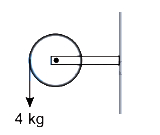
$A$ wheel of radius $0.4 \,m$ can rotate freely about its axis as shown in the figure. $A$ string is wrapped over its rim and a mass of $4 \,kg$ is hung. An angular acceleration of $8 \,rad \,s^{-2}$ is produced in it due to the torque. Then,the moment of inertia of the wheel is $(g = 10 \,m \,s^{-2})$.
A
$2 \,kg \,m^2$
B
$1 \,kg \,m^2$
C
$4 \,kg \,m^2$
D
$8 \,kg \,m^2$
Solution
(A) Given:
Radius of the wheel,$r = 0.4 \,m$
Angular acceleration,$\alpha = 8 \,rad \,s^{-2}$
Mass hung,$m = 4 \,kg$
Acceleration due to gravity,$g = 10 \,m \,s^{-2}$
The torque $\tau$ produced by the weight of the mass hanging from the rim is given by:
$\tau = m \cdot g \cdot r$
Also,the torque is related to the moment of inertia $I$ and angular acceleration $\alpha$ by the equation:
$\tau = I \cdot \alpha$
Equating the two expressions for torque:
$I \cdot \alpha = m \cdot g \cdot r$
Substituting the given values:
$I \cdot 8 = 4 \times 10 \times 0.4$
$I \cdot 8 = 16$
$I = \frac{16}{8} = 2 \,kg \,m^2$
Therefore,the moment of inertia of the wheel is $2 \,kg \,m^2$.
Radius of the wheel,$r = 0.4 \,m$
Angular acceleration,$\alpha = 8 \,rad \,s^{-2}$
Mass hung,$m = 4 \,kg$
Acceleration due to gravity,$g = 10 \,m \,s^{-2}$
The torque $\tau$ produced by the weight of the mass hanging from the rim is given by:
$\tau = m \cdot g \cdot r$
Also,the torque is related to the moment of inertia $I$ and angular acceleration $\alpha$ by the equation:
$\tau = I \cdot \alpha$
Equating the two expressions for torque:
$I \cdot \alpha = m \cdot g \cdot r$
Substituting the given values:
$I \cdot 8 = 4 \times 10 \times 0.4$
$I \cdot 8 = 16$
$I = \frac{16}{8} = 2 \,kg \,m^2$
Therefore,the moment of inertia of the wheel is $2 \,kg \,m^2$.
0 likes
View Solution172
EasyMCQ
$A$ constant torque acting on a uniform circular wheel changes its angular momentum from $A_0$ to $4 \,A_0$ in $4 \,s$. The magnitude of the torque is
A
$\frac{3 \,A_0}{4}$
B
$A_0$
C
$4 \,A_0$
D
$12 \,A_0$
Solution
(A) The relationship between torque $\tau$ and angular momentum $L$ is given by the equation $\tau = \frac{dL}{dt}$.
Given the initial angular momentum $L_i = A_0$ and the final angular momentum $L_f = 4 \,A_0$.
The time interval $\Delta t = 4 \,s$.
The change in angular momentum is $\Delta L = L_f - L_i = 4 \,A_0 - A_0 = 3 \,A_0$.
Therefore, the magnitude of the torque is $\tau = \frac{\Delta L}{\Delta t} = \frac{3 \,A_0}{4}$.
Given the initial angular momentum $L_i = A_0$ and the final angular momentum $L_f = 4 \,A_0$.
The time interval $\Delta t = 4 \,s$.
The change in angular momentum is $\Delta L = L_f - L_i = 4 \,A_0 - A_0 = 3 \,A_0$.
Therefore, the magnitude of the torque is $\tau = \frac{\Delta L}{\Delta t} = \frac{3 \,A_0}{4}$.
0 likes
View Solution173
MediumMCQ
$A$ wheel of mass $20 \,kg$ and radius $30 \,cm$ is rotating at an angular speed of $80 \,rev/min$ when the motor is turned off. Neglecting the friction at the axis, calculate the force that must be applied tangentially to the wheel to bring it to rest in $5 \,rev$. (in $\pi \,N$)
A
$1.06$
B
$2.06$
C
$3.06$
D
$4.06$
Solution
(A) Given: Mass of wheel $m = 20 \,kg$, Radius $R = 30 \,cm = 0.3 \,m$.
Initial angular speed $\omega_0 = 80 \,rpm = \frac{80 \times 2 \pi}{60} = \frac{8 \pi}{3} \,rad/s$.
Angular displacement $\theta = 5 \,rev = 5 \times 2 \pi = 10 \pi \,rad$.
Final angular speed $\omega = 0$.
Using the rotational kinematic equation $\omega^2 = \omega_0^2 + 2 \alpha \theta$, we find angular acceleration $\alpha$:
$\alpha = \frac{\omega^2 - \omega_0^2}{2 \theta} = \frac{0 - (8 \pi / 3)^2}{2 \times 10 \pi} = -\frac{64 \pi^2 / 9}{20 \pi} = -\frac{16 \pi}{45} \,rad/s^2$.
The retarding torque $\tau$ is provided by the tangential force $F$:
$\tau = I \alpha = F R$.
For a disc, $I = \frac{1}{2} m R^2$.
Thus, $F = \frac{I \alpha}{R} = \frac{1}{2} m R \alpha$.
Substituting the values: $F = \frac{1}{2} \times 20 \times 0.3 \times \left| -\frac{16 \pi}{45} \right| = 10 \times 0.3 \times \frac{16 \pi}{45} = 3 \times \frac{16 \pi}{45} = \frac{16 \pi}{15} \approx 1.06 \pi \,N$.
Initial angular speed $\omega_0 = 80 \,rpm = \frac{80 \times 2 \pi}{60} = \frac{8 \pi}{3} \,rad/s$.
Angular displacement $\theta = 5 \,rev = 5 \times 2 \pi = 10 \pi \,rad$.
Final angular speed $\omega = 0$.
Using the rotational kinematic equation $\omega^2 = \omega_0^2 + 2 \alpha \theta$, we find angular acceleration $\alpha$:
$\alpha = \frac{\omega^2 - \omega_0^2}{2 \theta} = \frac{0 - (8 \pi / 3)^2}{2 \times 10 \pi} = -\frac{64 \pi^2 / 9}{20 \pi} = -\frac{16 \pi}{45} \,rad/s^2$.
The retarding torque $\tau$ is provided by the tangential force $F$:
$\tau = I \alpha = F R$.
For a disc, $I = \frac{1}{2} m R^2$.
Thus, $F = \frac{I \alpha}{R} = \frac{1}{2} m R \alpha$.
Substituting the values: $F = \frac{1}{2} \times 20 \times 0.3 \times \left| -\frac{16 \pi}{45} \right| = 10 \times 0.3 \times \frac{16 \pi}{45} = 3 \times \frac{16 \pi}{45} = \frac{16 \pi}{15} \approx 1.06 \pi \,N$.
0 likes
View Solution174
EasyMCQ
If a disc of mass $M$ and radius $R$ rotates with an angular acceleration $a$,the torque acting on the disc is
A
$M R^2 a$
B
$\frac{M R^2 a}{2}$
C
$\frac{2 M R^2 a}{5}$
D
$\frac{M R^2 a}{12}$
Solution
(B) The moment of inertia of a disc about its central axis is given by $I = \frac{1}{2} M R^2$.
Given the angular acceleration is $\alpha = a$.
The torque $\tau$ acting on a rotating body is given by the formula $\tau = I \alpha$.
Substituting the values,we get $\tau = (\frac{1}{2} M R^2) \times a$.
Therefore,the torque acting on the disc is $\tau = \frac{M R^2 a}{2}$.
Given the angular acceleration is $\alpha = a$.
The torque $\tau$ acting on a rotating body is given by the formula $\tau = I \alpha$.
Substituting the values,we get $\tau = (\frac{1}{2} M R^2) \times a$.
Therefore,the torque acting on the disc is $\tau = \frac{M R^2 a}{2}$.
0 likes
View Solution175
MediumMCQ
Moment of inertia of a body about an axis is $4 \,kg-m^2$. The body is initially at rest and a torque of $8 \,N-m$ starts acting on it along the same axis. Work done by the torque in $20 \,s$,in joules,is
A
$40$
B
$640$
C
$2560$
D
$3200$
Solution
(D) Given: Moment of inertia $I = 4 \,kg-m^2$,Torque $\tau = 8 \,N-m$,and time $t = 20 \,s$. The body starts from rest,so initial angular velocity $\omega_0 = 0$.
Using the relation $\tau = I \alpha$,the angular acceleration $\alpha$ is:
$\alpha = \frac{\tau}{I} = \frac{8}{4} = 2 \,rad/s^2$.
The angular displacement $\theta$ in time $t$ is given by:
$\theta = \omega_0 t + \frac{1}{2} \alpha t^2 = 0 + \frac{1}{2} \times 2 \times (20)^2 = 400 \,rad$.
The work done $W$ by the torque is given by:
$W = \tau \theta = 8 \,N-m \times 400 \,rad = 3200 \,J$.
Using the relation $\tau = I \alpha$,the angular acceleration $\alpha$ is:
$\alpha = \frac{\tau}{I} = \frac{8}{4} = 2 \,rad/s^2$.
The angular displacement $\theta$ in time $t$ is given by:
$\theta = \omega_0 t + \frac{1}{2} \alpha t^2 = 0 + \frac{1}{2} \times 2 \times (20)^2 = 400 \,rad$.
The work done $W$ by the torque is given by:
$W = \tau \theta = 8 \,N-m \times 400 \,rad = 3200 \,J$.
0 likes
View Solution176
MediumMCQ
$A$ flywheel of mass $25 \,kg$ has a radius of $0.2 \,m$. It is rotating at $240 \,rpm$. What is the torque necessary to bring it to rest in $20 \,s$?
A
$2 \pi \,Nm$
B
$0.4 \pi \,Nm$
C
$\frac{2}{\pi} \,Nm$
D
$4 \pi \,Nm$
Solution
(B) Given: Mass $M = 25 \,kg$,Radius $R = 0.2 \,m$,Initial angular velocity $\omega_i = 240 \,rpm = \frac{240 \times 2 \pi}{60} \,rad/s = 8 \pi \,rad/s$,Time $t = 20 \,s$,Final angular velocity $\omega_f = 0 \,rad/s$.
First,calculate the angular deceleration $\alpha$:
$\alpha = \frac{\omega_i - \omega_f}{t} = \frac{8 \pi - 0}{20} = \frac{8 \pi}{20} = 0.4 \pi \,rad/s^2$.
Next,calculate the moment of inertia $I$ of the flywheel (assuming it is a disc):
$I = M R^2 = 25 \times (0.2)^2 = 25 \times 0.04 = 1 \,kg \cdot m^2$.
Finally,calculate the torque $\tau$:
$\tau = I \alpha = 1 \times 0.4 \pi = 0.4 \pi \,Nm$.
First,calculate the angular deceleration $\alpha$:
$\alpha = \frac{\omega_i - \omega_f}{t} = \frac{8 \pi - 0}{20} = \frac{8 \pi}{20} = 0.4 \pi \,rad/s^2$.
Next,calculate the moment of inertia $I$ of the flywheel (assuming it is a disc):
$I = M R^2 = 25 \times (0.2)^2 = 25 \times 0.04 = 1 \,kg \cdot m^2$.
Finally,calculate the torque $\tau$:
$\tau = I \alpha = 1 \times 0.4 \pi = 0.4 \pi \,Nm$.
0 likes
View Solution177
MediumMCQ
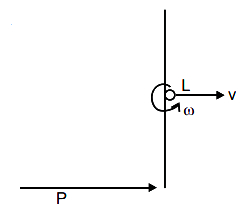
$A$ uniform thin rod of length $L$ and mass $m$ is lying on a smooth horizontal table. $A$ horizontal impulse $P$ is suddenly applied perpendicular to the rod at one end. The total energy of the rod after the impulse is
A
$\frac{P^{2}}{m}$
B
$\frac{7 P^{2}}{8 m}$
C
$\frac{13 P^{2}}{2 m}$
D
$\frac{2 P^{2}}{m}$
Solution
(D) When an impulse $P$ is applied at one end of the rod,the linear momentum of the center of mass is $P = mv$,so the velocity of the center of mass is $v = \frac{P}{m}$.
The angular impulse about the center of mass is $J = P \times \frac{L}{2}$. Since $J = I\omega$,where $I = \frac{mL^2}{12}$ is the moment of inertia about the center of mass,we have $\omega = \frac{P(L/2)}{mL^2/12} = \frac{6P}{mL}$.
The total kinetic energy $K$ is the sum of translational and rotational kinetic energy: $K = K_{trans} + K_{rot} = \frac{1}{2}mv^2 + \frac{1}{2}I\omega^2$.
Substituting the values: $K = \frac{1}{2}m\left(\frac{P}{m}\right)^2 + \frac{1}{2}\left(\frac{mL^2}{12}\right)\left(\frac{6P}{mL}\right)^2$.
$K = \frac{P^2}{2m} + \frac{1}{2}\left(\frac{mL^2}{12}\right)\left(\frac{36P^2}{m^2L^2}\right) = \frac{P^2}{2m} + \frac{3P^2}{2m} = \frac{4P^2}{2m} = \frac{2P^2}{m}$.
The angular impulse about the center of mass is $J = P \times \frac{L}{2}$. Since $J = I\omega$,where $I = \frac{mL^2}{12}$ is the moment of inertia about the center of mass,we have $\omega = \frac{P(L/2)}{mL^2/12} = \frac{6P}{mL}$.
The total kinetic energy $K$ is the sum of translational and rotational kinetic energy: $K = K_{trans} + K_{rot} = \frac{1}{2}mv^2 + \frac{1}{2}I\omega^2$.
Substituting the values: $K = \frac{1}{2}m\left(\frac{P}{m}\right)^2 + \frac{1}{2}\left(\frac{mL^2}{12}\right)\left(\frac{6P}{mL}\right)^2$.
$K = \frac{P^2}{2m} + \frac{1}{2}\left(\frac{mL^2}{12}\right)\left(\frac{36P^2}{m^2L^2}\right) = \frac{P^2}{2m} + \frac{3P^2}{2m} = \frac{4P^2}{2m} = \frac{2P^2}{m}$.
0 likes
View Solution178
DifficultMCQ
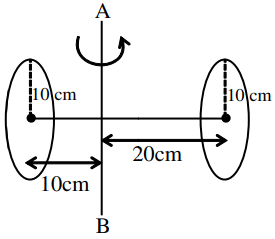
Two circular discs of radius $10 \ \text{cm}$ each are joined at their centres by a rod of length $30 \ \text{cm}$ and mass $600 \ \text{g}$ as shown in the figure. If the mass of each disc is $600 \ \text{g}$ and the applied torque between the two discs is $43 \times 10^{5} \ \text{dyne cm}$,the angular acceleration of the discs about the given axis $AB$ is . . . . . . $\text{rad/s}^{2}$.
A
$22$
B
$11$
C
$100$
D
$27$
Solution
(B) The moment of inertia $I$ of the system about the axis $AB$ is the sum of the moments of inertia of the two discs and the rod.
For each disc,the axis $AB$ is at a distance of $10 \ \text{cm}$ $(R)$ from the centre of the left disc and $20 \ \text{cm}$ $(2R)$ from the centre of the right disc.
Using the parallel axis theorem,$I_{disc} = I_{cm} + md^2$.
For the left disc: $I_1 = \frac{1}{4}mR^2 + mR^2 = \frac{5}{4}mR^2$.
For the right disc: $I_2 = \frac{1}{4}mR^2 + m(2R)^2 = \frac{17}{4}mR^2$.
For the rod of length $L = 3R = 30 \ \text{cm}$,the axis $AB$ passes through a point $10 \ \text{cm}$ from one end. The distance of the centre of the rod from $AB$ is $d = 5 \ \text{cm} = R/2$.
$I_{rod} = I_{cm} + md^2 = \frac{mL^2}{12} + m(R/2)^2 = \frac{m(3R)^2}{12} + \frac{mR^2}{4} = \frac{9mR^2}{12} + \frac{mR^2}{4} = \frac{3mR^2}{4} + \frac{mR^2}{4} = mR^2$.
Total $I = I_1 + I_2 + I_{rod} = \frac{5}{4}mR^2 + \frac{17}{4}mR^2 + mR^2 = \frac{22}{4}mR^2 + mR^2 = 5.5mR^2 + mR^2 = 6.5mR^2$.
Given $m = 600 \ \text{g}$,$R = 10 \ \text{cm}$.
$I = 6.5 \times 600 \times (10)^2 = 6.5 \times 60000 = 390000 \ \text{g cm}^2 = 39 \times 10^4 \ \text{g cm}^2$.
Angular acceleration $\alpha = \frac{\tau}{I} = \frac{43 \times 10^5}{39 \times 10^4} = \frac{430}{39} \approx 11.02 \ \text{rad/s}^2$.
Thus,the angular acceleration is approximately $11 \ \text{rad/s}^2$.
For each disc,the axis $AB$ is at a distance of $10 \ \text{cm}$ $(R)$ from the centre of the left disc and $20 \ \text{cm}$ $(2R)$ from the centre of the right disc.
Using the parallel axis theorem,$I_{disc} = I_{cm} + md^2$.
For the left disc: $I_1 = \frac{1}{4}mR^2 + mR^2 = \frac{5}{4}mR^2$.
For the right disc: $I_2 = \frac{1}{4}mR^2 + m(2R)^2 = \frac{17}{4}mR^2$.
For the rod of length $L = 3R = 30 \ \text{cm}$,the axis $AB$ passes through a point $10 \ \text{cm}$ from one end. The distance of the centre of the rod from $AB$ is $d = 5 \ \text{cm} = R/2$.
$I_{rod} = I_{cm} + md^2 = \frac{mL^2}{12} + m(R/2)^2 = \frac{m(3R)^2}{12} + \frac{mR^2}{4} = \frac{9mR^2}{12} + \frac{mR^2}{4} = \frac{3mR^2}{4} + \frac{mR^2}{4} = mR^2$.
Total $I = I_1 + I_2 + I_{rod} = \frac{5}{4}mR^2 + \frac{17}{4}mR^2 + mR^2 = \frac{22}{4}mR^2 + mR^2 = 5.5mR^2 + mR^2 = 6.5mR^2$.
Given $m = 600 \ \text{g}$,$R = 10 \ \text{cm}$.
$I = 6.5 \times 600 \times (10)^2 = 6.5 \times 60000 = 390000 \ \text{g cm}^2 = 39 \times 10^4 \ \text{g cm}^2$.
Angular acceleration $\alpha = \frac{\tau}{I} = \frac{43 \times 10^5}{39 \times 10^4} = \frac{430}{39} \approx 11.02 \ \text{rad/s}^2$.
Thus,the angular acceleration is approximately $11 \ \text{rad/s}^2$.
0 likes
View Solution179
DifficultMCQ
$A$ thin uniform rod of mass $M$ and length $L$ is pivoted at a height $\frac{L}{3}$ from its lower end as shown in the figure. The rod is allowed to fall from a vertical position and lie horizontally on the table. The angular velocity of this rod when it hits the table top is . . . . . . . ($g$ = gravitational acceleration)
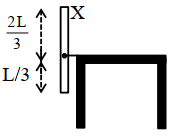
A
$\sqrt{\frac{3}{2} \frac{g}{L}}$
B
$\frac{3}{\sqrt{2}}\sqrt{\frac{g}{L}}$
C
$\frac{1}{\sqrt{2}}\sqrt{\frac{g}{L}}$
D
$\sqrt{\frac{3g}{L}}$
Solution
(D) The rod is pivoted at a distance $\frac{L}{3}$ from the lower end. The center of mass of the rod is at a distance $\frac{L}{2}$ from the lower end.
Initially,the center of mass is at a height $h_i = \frac{L}{2} - \frac{L}{3} = \frac{L}{6}$ above the pivot point.
When the rod hits the table,the center of mass is at the same level as the pivot point,so the final height $h_f = 0$.
The change in potential energy is $\Delta PE = Mg(h_f - h_i) = -Mg\frac{L}{6}$.
By the principle of conservation of energy,the loss in potential energy equals the gain in rotational kinetic energy: $Mg\frac{L}{6} = \frac{1}{2} I \omega^2$.
The moment of inertia $I$ about the pivot point (which is at distance $\frac{L}{3}$ from the end) is calculated using the parallel axis theorem: $I = I_{cm} + M d^2 = \frac{ML^2}{12} + M(\frac{L}{2} - \frac{L}{3})^2 = \frac{ML^2}{12} + M(\frac{L}{6})^2 = \frac{ML^2}{12} + \frac{ML^2}{36} = \frac{3ML^2 + ML^2}{36} = \frac{4ML^2}{36} = \frac{ML^2}{9}$.
Substituting $I$ into the energy equation: $Mg\frac{L}{6} = \frac{1}{2} (\frac{ML^2}{9}) \omega^2$.
$Mg\frac{L}{6} = \frac{ML^2}{18} \omega^2$.
$\omega^2 = \frac{MgL}{6} \cdot \frac{18}{ML^2} = \frac{3g}{L}$.
$\omega = \sqrt{\frac{3g}{L}}$.
Initially,the center of mass is at a height $h_i = \frac{L}{2} - \frac{L}{3} = \frac{L}{6}$ above the pivot point.
When the rod hits the table,the center of mass is at the same level as the pivot point,so the final height $h_f = 0$.
The change in potential energy is $\Delta PE = Mg(h_f - h_i) = -Mg\frac{L}{6}$.
By the principle of conservation of energy,the loss in potential energy equals the gain in rotational kinetic energy: $Mg\frac{L}{6} = \frac{1}{2} I \omega^2$.
The moment of inertia $I$ about the pivot point (which is at distance $\frac{L}{3}$ from the end) is calculated using the parallel axis theorem: $I = I_{cm} + M d^2 = \frac{ML^2}{12} + M(\frac{L}{2} - \frac{L}{3})^2 = \frac{ML^2}{12} + M(\frac{L}{6})^2 = \frac{ML^2}{12} + \frac{ML^2}{36} = \frac{3ML^2 + ML^2}{36} = \frac{4ML^2}{36} = \frac{ML^2}{9}$.
Substituting $I$ into the energy equation: $Mg\frac{L}{6} = \frac{1}{2} (\frac{ML^2}{9}) \omega^2$.
$Mg\frac{L}{6} = \frac{ML^2}{18} \omega^2$.
$\omega^2 = \frac{MgL}{6} \cdot \frac{18}{ML^2} = \frac{3g}{L}$.
$\omega = \sqrt{\frac{3g}{L}}$.
0 likes
View Solution180
MediumMCQ
Two small balls with masses $m$ and $2m$ are attached to both ends of a rigid rod of length $d$ and negligible mass. If the angular momentum of this system is $L$ about an axis $(A)$ passing through its centre of mass and perpendicular to the rod,then the angular velocity of the system about $A$ is:
A
$ \frac{3}{2}\frac{L}{md^{2}} $
B
$ \frac{2L}{md^{2}} $
C
$ \frac{4}{3}\frac{L}{md^{2}} $
D
$ \frac{2L}{5md^{2}} $
Solution
(A) The angular momentum $L$ is given by $L = I\omega$,where $I$ is the moment of inertia and $\omega$ is the angular velocity. Thus,$\omega = \frac{L}{I}$.
First,locate the centre of mass $(CM)$ of the system. Let the mass $m$ be at $x = 0$ and $2m$ be at $x = d$. The position of the $CM$ is $x_{cm} = \frac{m(0) + 2m(d)}{m + 2m} = \frac{2md}{3m} = \frac{2d}{3}$.
The distance of mass $m$ from the $CM$ is $r_1 = \frac{2d}{3}$,and the distance of mass $2m$ from the $CM$ is $r_2 = d - \frac{2d}{3} = \frac{d}{3}$.
The moment of inertia $I$ about the axis passing through the $CM$ is $I = m(r_1)^2 + 2m(r_2)^2 = m(\frac{2d}{3})^2 + 2m(\frac{d}{3})^2$.
$I = m(\frac{4d^2}{9}) + 2m(\frac{d^2}{9}) = \frac{4md^2 + 2md^2}{9} = \frac{6md^2}{9} = \frac{2}{3}md^2$.
Substituting $I$ into the formula for angular velocity: $\omega = \frac{L}{\frac{2}{3}md^2} = \frac{3L}{2md^2}$.
First,locate the centre of mass $(CM)$ of the system. Let the mass $m$ be at $x = 0$ and $2m$ be at $x = d$. The position of the $CM$ is $x_{cm} = \frac{m(0) + 2m(d)}{m + 2m} = \frac{2md}{3m} = \frac{2d}{3}$.
The distance of mass $m$ from the $CM$ is $r_1 = \frac{2d}{3}$,and the distance of mass $2m$ from the $CM$ is $r_2 = d - \frac{2d}{3} = \frac{d}{3}$.
The moment of inertia $I$ about the axis passing through the $CM$ is $I = m(r_1)^2 + 2m(r_2)^2 = m(\frac{2d}{3})^2 + 2m(\frac{d}{3})^2$.
$I = m(\frac{4d^2}{9}) + 2m(\frac{d^2}{9}) = \frac{4md^2 + 2md^2}{9} = \frac{6md^2}{9} = \frac{2}{3}md^2$.
Substituting $I$ into the formula for angular velocity: $\omega = \frac{L}{\frac{2}{3}md^2} = \frac{3L}{2md^2}$.
0 likes
View Solution181
DifficultMCQ
$A$ solid sphere of radius $4\text{ cm}$ and mass $5\text{ kg}$ is rotating (rotation axis is passing through the centre of the sphere) with an angular velocity of $1200\text{ rpm}$. It is brought to rest in $10\text{ s}$ by applying a constant torque. The torque applied and the number of rotations it made before it comes to rest are . . . . . . and . . . . . . respectively.
A
$0.128\pi\text{ Nm}$,$100$
B
$0.0128\pi\text{ Nm}$,$50$
C
$0.128\pi\text{ Nm}$,$50$
D
$0.0128\pi\text{ Nm}$,$100$
Solution
(D) Initial angular velocity $\omega_0 = 1200\text{ rpm} = \frac{1200 \times 2\pi}{60} = 40\pi\text{ rad/s}$.
Angular acceleration $\alpha = \frac{\Delta\omega}{\Delta t} = \frac{0 - 40\pi}{10} = -4\pi\text{ rad/s}^2$.
Moment of inertia of a solid sphere $I = \frac{2}{5}mR^2 = \frac{2}{5} \times 5 \times (0.04\text{ m})^2 = 2 \times 0.0016 = 0.0032\text{ kg m}^2$.
Torque applied $\tau = I|\alpha| = 0.0032 \times 4\pi = 0.0128\pi\text{ Nm}$.
Angular displacement $\theta = \omega_0 t + \frac{1}{2}\alpha t^2 = 40\pi(10) + \frac{1}{2}(-4\pi)(10)^2 = 400\pi - 200\pi = 200\pi\text{ rad}$.
Number of rotations $N = \frac{\theta}{2\pi} = \frac{200\pi}{2\pi} = 100$.
Angular acceleration $\alpha = \frac{\Delta\omega}{\Delta t} = \frac{0 - 40\pi}{10} = -4\pi\text{ rad/s}^2$.
Moment of inertia of a solid sphere $I = \frac{2}{5}mR^2 = \frac{2}{5} \times 5 \times (0.04\text{ m})^2 = 2 \times 0.0016 = 0.0032\text{ kg m}^2$.
Torque applied $\tau = I|\alpha| = 0.0032 \times 4\pi = 0.0128\pi\text{ Nm}$.
Angular displacement $\theta = \omega_0 t + \frac{1}{2}\alpha t^2 = 40\pi(10) + \frac{1}{2}(-4\pi)(10)^2 = 400\pi - 200\pi = 200\pi\text{ rad}$.
Number of rotations $N = \frac{\theta}{2\pi} = \frac{200\pi}{2\pi} = 100$.
0 likes
View SolutionSystem of Particles and Rotational Motion — Relation between Torque and Angular acceleration and it's Application · Frequently Asked Questions
1Are these System of Particles and Rotational Motion questions useful for JEE and NEET?
Yes. All questions in this section are mapped to JEE Main and NEET exam patterns. Previous year questions from JEE Main, NEET, GUJCET and state-level exams are included with full solutions.
2Can I switch to Hindi or Gujarati for these questions?
Yes. Use the language tabs in the hero section or the sidebar to view the same questions and solutions in English, Hindi or Gujarati.
3How do I generate a question paper from this subtopic?
Use the Vedclass Exam Paper Generator — select the chapter and subtopic, set difficulty, and generate Sets A, B, C, D automatically. First 3 chapters of every subject are free.
Vedclass Products
For Students
Vedclass Test Series
Mock tests in real JEE/NEET style with performance analysis. 5-day free trial.
Start Free TrialFor Teachers
Exam Paper Generator
Generate Set A/B/C/D papers from this chapter in 2 minutes. 3 chapters free.
Try FreeFor Institutes
Online Exam Module
Live online exams with unlimited students, 360° analytics & white-label branding.
See DemoFor Teachers & Institutes
Generate a System of Particles and Rotational Motion Exam Paper in 2 Minutes
Select subtopic & difficulty — Sets A, B, C, D auto-generated with No Repeat logic.
First 3 chapters of every subject are free — no payment required.