
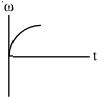
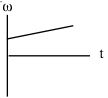
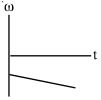
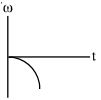
The graphs below show angular velocity $\omega$ as a function of time $t$. In which one is the magnitude of the angular acceleration $\alpha$ constantly decreasing?
- A
- B
- C
- D
Explore More
Similar Questions
$A$ metal sphere of radius $r$ and specific heat $S$ is rotated about an axis passing through its centre at a speed of $n$ rotations per second. It is suddenly stopped and $50 \%$ of its energy is used in increasing its temperature. Then,the rise in temperature of the sphere is
DifficultAP EAMCET 2002
View Solution$A$ stick of length $l$ and mass $M$ lies on a frictionless horizontal surface on which it is free to move in any way. $A$ ball of mass $m$ moving with speed $v$ collides elastically with the stick at one of its ends as shown in the figure. If after the collision the ball comes to rest,what should be the mass of the ball?
Difficult
View SolutionSeven identical circular planar disks,each of mass $M$ and radius $R$,are welded symmetrically as shown. The moment of inertia of the arrangement about the axis normal to the plane and passing through the point $P$ is:
DifficultJEE MAIN 2018
View SolutionThe angular momentum of a particle performing uniform circular motion is $L$. If the kinetic energy of the particle is doubled and the frequency is halved,then the new angular momentum becomes:
Easy
View Solution$A$ ring of mass $M$ and radius $R$ sliding with a velocity $v_0$ suddenly enters a rough surface where the coefficient of friction is $\mu$,as shown in the figure. Choose the correct alternative$(s)$.
Vedclass Products
For Students
Vedclass Test Series
Mock tests in real JEE/NEET style with performance analysis. 5-day free trial.
Start Free TrialFor Teachers
Exam Paper Generator
Generate Set A/B/C/D exam papers from 7.5L+ questions in 2 minutes. 3 chapters free.
Try FreeFor Institutes
Online Exam Module
Live online exams with unlimited students, 360° analytics & white-label branding.
See Demo