
A English
Centre of mass (Point Mass) Questions in English
Class 11 Physics · System of Particles and Rotational Motion · Centre of mass (Point Mass)
237+
Questions
English
Language
100%
With Solutions
Showing 50 of 237 questions in English
101
DifficultMCQ
$A$ thin bar of length $L$ has a mass per unit length $\lambda$ that increases linearly with distance $x$ from one end. If its total mass is $M$ and its mass per unit length at the lighter end $(x=0)$ is $\lambda_0$,then the distance of the centre of mass from the lighter end is:
A
$\frac{L}{2} - \frac{\lambda_0 L^2}{4M}$
B
$\frac{L}{3} + \frac{\lambda_0 L^2}{8M}$
C
$\frac{2L}{3} - \frac{\lambda_0 L^2}{6M}$
D
$\frac{L}{3} + \frac{\lambda_0 L^2}{4M}$
Solution
(C) Let the mass per unit length be $\lambda(x) = \lambda_0 + kx$.
Total mass $M = \int_{0}^{L} (\lambda_0 + kx) dx = \lambda_0 L + \frac{kL^2}{2}$.
From this,$k = \frac{2(M - \lambda_0 L)}{L^2} = \frac{2M}{L^2} - \frac{2\lambda_0}{L}$.
The center of mass $x_{cm}$ is given by $x_{cm} = \frac{1}{M} \int_{0}^{L} x dm = \frac{1}{M} \int_{0}^{L} x (\lambda_0 + kx) dx$.
$x_{cm} = \frac{1}{M} [\frac{\lambda_0 x^2}{2} + \frac{kx^3}{3}]_{0}^{L} = \frac{1}{M} (\frac{\lambda_0 L^2}{2} + \frac{kL^3}{3})$.
Substituting $k = \frac{2M}{L^2} - \frac{2\lambda_0}{L}$ into the equation:
$x_{cm} = \frac{1}{M} [\frac{\lambda_0 L^2}{2} + \frac{L^3}{3} (\frac{2M}{L^2} - \frac{2\lambda_0}{L})] = \frac{1}{M} [\frac{\lambda_0 L^2}{2} + \frac{2ML}{3} - \frac{2\lambda_0 L^2}{3}]$.
$x_{cm} = \frac{2L}{3} + \frac{\lambda_0 L^2}{M} (\frac{1}{2} - \frac{2}{3}) = \frac{2L}{3} - \frac{\lambda_0 L^2}{6M}$.
Total mass $M = \int_{0}^{L} (\lambda_0 + kx) dx = \lambda_0 L + \frac{kL^2}{2}$.
From this,$k = \frac{2(M - \lambda_0 L)}{L^2} = \frac{2M}{L^2} - \frac{2\lambda_0}{L}$.
The center of mass $x_{cm}$ is given by $x_{cm} = \frac{1}{M} \int_{0}^{L} x dm = \frac{1}{M} \int_{0}^{L} x (\lambda_0 + kx) dx$.
$x_{cm} = \frac{1}{M} [\frac{\lambda_0 x^2}{2} + \frac{kx^3}{3}]_{0}^{L} = \frac{1}{M} (\frac{\lambda_0 L^2}{2} + \frac{kL^3}{3})$.
Substituting $k = \frac{2M}{L^2} - \frac{2\lambda_0}{L}$ into the equation:
$x_{cm} = \frac{1}{M} [\frac{\lambda_0 L^2}{2} + \frac{L^3}{3} (\frac{2M}{L^2} - \frac{2\lambda_0}{L})] = \frac{1}{M} [\frac{\lambda_0 L^2}{2} + \frac{2ML}{3} - \frac{2\lambda_0 L^2}{3}]$.
$x_{cm} = \frac{2L}{3} + \frac{\lambda_0 L^2}{M} (\frac{1}{2} - \frac{2}{3}) = \frac{2L}{3} - \frac{\lambda_0 L^2}{6M}$.
0 likes
View Solution102
DifficultMCQ
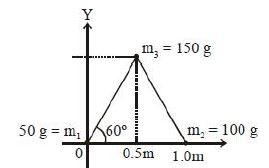
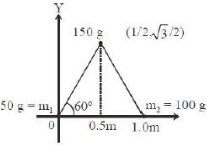
Three particles of masses $50\, g$,$100\, g$,and $150\, g$ are placed at the vertices of an equilateral triangle of side $1\, m$ (as shown in the figure). The $(x, y)$ coordinates of the centre of mass will be
A
$\left( \frac{\sqrt{3}}{7}\,m, \frac{7}{12}\,m \right)$
B
$\left( \frac{7}{12}\,m, \frac{\sqrt{3}}{8}\,m \right)$
C
$\left( \frac{\sqrt{3}}{4}\,m, \frac{5}{12}\,m \right)$
D
$\left( \frac{7}{12}\,m, \frac{\sqrt{3}}{4}\,m \right)$
Solution
(D) The coordinates of the three particles are:
$m_1 = 50\, g$ at $(0, 0)$
$m_2 = 100\, g$ at $(1, 0)$
$m_3 = 150\, g$ at $(0.5, \frac{\sqrt{3}}{2})$
The $x$-coordinate of the center of mass is:
$X_{cm} = \frac{m_1x_1 + m_2x_2 + m_3x_3}{m_1 + m_2 + m_3} = \frac{50(0) + 100(1) + 150(0.5)}{50 + 100 + 150} = \frac{100 + 75}{300} = \frac{175}{300} = \frac{7}{12}\, m$
The $y$-coordinate of the center of mass is:
$Y_{cm} = \frac{m_1y_1 + m_2y_2 + m_3y_3}{m_1 + m_2 + m_3} = \frac{50(0) + 100(0) + 150(\frac{\sqrt{3}}{2})}{300} = \frac{75\sqrt{3}}{300} = \frac{\sqrt{3}}{4}\, m$
Thus,the coordinates of the center of mass are $\left( \frac{7}{12}\,m, \frac{\sqrt{3}}{4}\,m \right)$.
$m_1 = 50\, g$ at $(0, 0)$
$m_2 = 100\, g$ at $(1, 0)$
$m_3 = 150\, g$ at $(0.5, \frac{\sqrt{3}}{2})$
The $x$-coordinate of the center of mass is:
$X_{cm} = \frac{m_1x_1 + m_2x_2 + m_3x_3}{m_1 + m_2 + m_3} = \frac{50(0) + 100(1) + 150(0.5)}{50 + 100 + 150} = \frac{100 + 75}{300} = \frac{175}{300} = \frac{7}{12}\, m$
The $y$-coordinate of the center of mass is:
$Y_{cm} = \frac{m_1y_1 + m_2y_2 + m_3y_3}{m_1 + m_2 + m_3} = \frac{50(0) + 100(0) + 150(\frac{\sqrt{3}}{2})}{300} = \frac{75\sqrt{3}}{300} = \frac{\sqrt{3}}{4}\, m$
Thus,the coordinates of the center of mass are $\left( \frac{7}{12}\,m, \frac{\sqrt{3}}{4}\,m \right)$.
0 likes
View Solution103
MediumMCQ
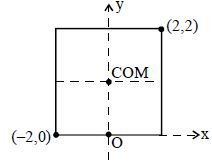
Mass is distributed uniformly over a thin square plate. If two end points of a diagonal are $(-2, 0)$ and $(2, 2)$,what are the coordinates of the centre of mass of the plate?
A
$(2, 1)$
B
$(2, 2)$
C
$(1, 0)$
D
$(0, 1)$
Solution
(D) For a uniform square plate,the centre of mass coincides with the geometric centre of the square.
The geometric centre of a square is the midpoint of its diagonal.
Given the endpoints of the diagonal are $(x_1, y_1) = (-2, 0)$ and $(x_2, y_2) = (2, 2)$.
The coordinates of the midpoint $(x, y)$ are given by:
$x = \frac{x_1 + x_2}{2} = \frac{-2 + 2}{2} = \frac{0}{2} = 0$
$y = \frac{y_1 + y_2}{2} = \frac{0 + 2}{2} = \frac{2}{2} = 1$
Therefore,the coordinates of the centre of mass are $(0, 1)$.
The geometric centre of a square is the midpoint of its diagonal.
Given the endpoints of the diagonal are $(x_1, y_1) = (-2, 0)$ and $(x_2, y_2) = (2, 2)$.
The coordinates of the midpoint $(x, y)$ are given by:
$x = \frac{x_1 + x_2}{2} = \frac{-2 + 2}{2} = \frac{0}{2} = 0$
$y = \frac{y_1 + y_2}{2} = \frac{0 + 2}{2} = \frac{2}{2} = 1$
Therefore,the coordinates of the centre of mass are $(0, 1)$.
0 likes
View Solution104
DifficultMCQ
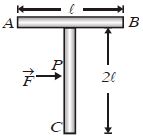
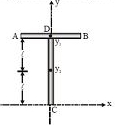
$A$ $T$-shaped object with dimensions shown in the figure is lying on a smooth floor. $A$ force $\vec{F}$ is applied at the point $P$ parallel to $AB$,such that the object has only translational motion without rotation. Find the location of $P$ with respect to $C$.
A
$\frac{4}{3} \ell$
B
$\ell$
C
$\frac{2}{3} \ell$
D
$\frac{3}{2} \ell$
Solution
(A) For pure translational motion,the force must be applied at the center of mass of the body.
Let the mass of the horizontal rod $AB$ be $m$. Since the vertical rod $CD$ has length $2\ell$ and the horizontal rod $AB$ has length $\ell$,assuming uniform density,the mass of rod $CD$ will be $2m$.
Let $y_1$ be the center of mass of rod $AB$ and $y_2$ be the center of mass of rod $CD$.
Taking point $C$ as the origin $(0,0)$:
The center of mass of rod $AB$ is at a distance of $2\ell$ from $C$ along the vertical axis,so $y_1 = 2\ell$.
The center of mass of rod $CD$ is at a distance of $\ell$ from $C$ along the vertical axis,so $y_2 = \ell$.
The position of the center of mass of the system along the vertical axis is given by:
$y_{cm} = \frac{m_1 y_1 + m_2 y_2}{m_1 + m_2}$
Here,$m_1 = m$ (for rod $AB$) and $m_2 = 2m$ (for rod $CD$).
$y_{cm} = \frac{m(2\ell) + (2m)(\ell)}{m + 2m} = \frac{2m\ell + 2m\ell}{3m} = \frac{4m\ell}{3m} = \frac{4}{3}\ell$.
Thus,the force must be applied at a distance of $\frac{4}{3}\ell$ from $C$.
Let the mass of the horizontal rod $AB$ be $m$. Since the vertical rod $CD$ has length $2\ell$ and the horizontal rod $AB$ has length $\ell$,assuming uniform density,the mass of rod $CD$ will be $2m$.
Let $y_1$ be the center of mass of rod $AB$ and $y_2$ be the center of mass of rod $CD$.
Taking point $C$ as the origin $(0,0)$:
The center of mass of rod $AB$ is at a distance of $2\ell$ from $C$ along the vertical axis,so $y_1 = 2\ell$.
The center of mass of rod $CD$ is at a distance of $\ell$ from $C$ along the vertical axis,so $y_2 = \ell$.
The position of the center of mass of the system along the vertical axis is given by:
$y_{cm} = \frac{m_1 y_1 + m_2 y_2}{m_1 + m_2}$
Here,$m_1 = m$ (for rod $AB$) and $m_2 = 2m$ (for rod $CD$).
$y_{cm} = \frac{m(2\ell) + (2m)(\ell)}{m + 2m} = \frac{2m\ell + 2m\ell}{3m} = \frac{4m\ell}{3m} = \frac{4}{3}\ell$.
Thus,the force must be applied at a distance of $\frac{4}{3}\ell$ from $C$.
0 likes
View Solution105
MediumMCQ
Mass is distributed uniformly over a thin rectangular plate,and the positions of two vertices are given by $(1, 3)$ and $(2, -4)$. What is the position of the $3^{rd}$ vertex if the centre of mass of the plate lies at the origin?
A
$(1, -2)$
B
$(-2, 4)$
C
$(-3, 1)$
D
$(1, 2)$
Solution
(C) For a uniform rectangular plate,the centre of mass coincides with the geometric centre of the rectangle. However,the problem asks for the $3^{rd}$ vertex given the centre of mass is at the origin $(0, 0)$.
Assuming the plate is a triangle defined by three vertices $(x_1, y_1)$,$(x_2, y_2)$,and $(x_3, y_3)$,the centre of mass is given by:
$(x_{CM}, y_{CM}) = \left(\frac{x_1 + x_2 + x_3}{3}, \frac{y_1 + y_2 + y_3}{3}\right)$
Given $(x_1, y_1) = (1, 3)$,$(x_2, y_2) = (2, -4)$,and $(x_{CM}, y_{CM}) = (0, 0)$:
$0 = \frac{1 + 2 + x_3}{3} \implies 3 + x_3 = 0 \implies x_3 = -3$
$0 = \frac{3 - 4 + y_3}{3} \implies -1 + y_3 = 0 \implies y_3 = 1$
Therefore,the position of the $3^{rd}$ vertex is $(-3, 1)$.
Assuming the plate is a triangle defined by three vertices $(x_1, y_1)$,$(x_2, y_2)$,and $(x_3, y_3)$,the centre of mass is given by:
$(x_{CM}, y_{CM}) = \left(\frac{x_1 + x_2 + x_3}{3}, \frac{y_1 + y_2 + y_3}{3}\right)$
Given $(x_1, y_1) = (1, 3)$,$(x_2, y_2) = (2, -4)$,and $(x_{CM}, y_{CM}) = (0, 0)$:
$0 = \frac{1 + 2 + x_3}{3} \implies 3 + x_3 = 0 \implies x_3 = -3$
$0 = \frac{3 - 4 + y_3}{3} \implies -1 + y_3 = 0 \implies y_3 = 1$
Therefore,the position of the $3^{rd}$ vertex is $(-3, 1)$.
0 likes
View Solution106
AdvancedMCQ
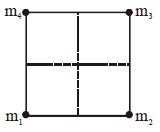
Four particles of masses $m_1 = 2m$,$m_2 = 4m$,$m_3 = m$,and $m_4$ are placed at the four corners of a square. What should be the value of $m_4$ so that the centre of mass of all the four particles is exactly at the centre of the square?
A
$2\,m$
B
$8\,m$
C
$6\,m$
D
None of these
Solution
(D) Let the side length of the square be $2a$. Place the centre of the square at the origin $(0,0)$.
The coordinates of the corners are: $m_1$ at $(-a, -a)$,$m_2$ at $(a, -a)$,$m_3$ at $(a, a)$,and $m_4$ at $(-a, a)$.
The $x$-coordinate of the centre of mass is given by:
$X_{cm} = \frac{m_1(-a) + m_2(a) + m_3(a) + m_4(-a)}{m_1 + m_2 + m_3 + m_4} = 0$
Substituting the given masses:
$2m(-a) + 4m(a) + m(a) + m_4(-a) = 0$
$-2ma + 4ma + ma - m_4a = 0$
$3ma - m_4a = 0 \implies m_4 = 3m$
The $y$-coordinate of the centre of mass is given by:
$Y_{cm} = \frac{m_1(-a) + m_2(-a) + m_3(a) + m_4(a)}{m_1 + m_2 + m_3 + m_4} = 0$
Substituting the given masses:
$2m(-a) + 4m(-a) + m(a) + m_4(a) = 0$
$-2ma - 4ma + ma + m_4a = 0$
$-5ma + m_4a = 0 \implies m_4 = 5m$
Since the required values for $m_4$ to satisfy both $X_{cm}=0$ and $Y_{cm}=0$ are different ($3m$ and $5m$),it is impossible for the centre of mass to be at the centre of the square for any value of $m_4$ given these specific masses $m_1, m_2, m_3$.
The coordinates of the corners are: $m_1$ at $(-a, -a)$,$m_2$ at $(a, -a)$,$m_3$ at $(a, a)$,and $m_4$ at $(-a, a)$.
The $x$-coordinate of the centre of mass is given by:
$X_{cm} = \frac{m_1(-a) + m_2(a) + m_3(a) + m_4(-a)}{m_1 + m_2 + m_3 + m_4} = 0$
Substituting the given masses:
$2m(-a) + 4m(a) + m(a) + m_4(-a) = 0$
$-2ma + 4ma + ma - m_4a = 0$
$3ma - m_4a = 0 \implies m_4 = 3m$
The $y$-coordinate of the centre of mass is given by:
$Y_{cm} = \frac{m_1(-a) + m_2(-a) + m_3(a) + m_4(a)}{m_1 + m_2 + m_3 + m_4} = 0$
Substituting the given masses:
$2m(-a) + 4m(-a) + m(a) + m_4(a) = 0$
$-2ma - 4ma + ma + m_4a = 0$
$-5ma + m_4a = 0 \implies m_4 = 5m$
Since the required values for $m_4$ to satisfy both $X_{cm}=0$ and $Y_{cm}=0$ are different ($3m$ and $5m$),it is impossible for the centre of mass to be at the centre of the square for any value of $m_4$ given these specific masses $m_1, m_2, m_3$.
0 likes
View Solution107
DifficultMCQ
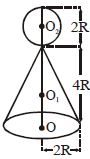
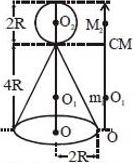
$A$ carpenter has constructed a toy as shown in the adjoining figure. If the density of the material of the sphere is $12$ times that of the cone,the position of the centre of mass of the toy is given by:
A
at a distance of $2R$ from $O$
B
at a distance of $3R$ from $O$
C
at a distance of $4R$ from $O$
D
at a distance of $5R$ from $O$
Solution
(C) Let the density of the cone be $\rho$. Then its mass $m_1$ is given by:
$m_1 = \frac{1}{3} \pi (2R)^2 (4R) \rho = \frac{16}{3} \pi R^3 \rho$
The centre of mass of the cone is at a height $h/4$ from its base,where $h = 4R$. Thus,$y_1 = \frac{4R}{4} = R$ from $O$.
Similarly,the mass of the sphere $m_2$ with radius $R$ and density $12\rho$ is:
$m_2 = \frac{4}{3} \pi R^3 (12\rho) = 16 \pi R^3 \rho = 3 m_1$
The centre of mass of the sphere is at its centre $O_2$. The distance of $O_2$ from $O$ is $y_2 = 4R + R = 5R$.
Taking the line of symmetry as the $y$-axis with the origin at $O$,the centre of mass $Y_{CM}$ of the toy is:
$Y_{CM} = \frac{m_1 y_1 + m_2 y_2}{m_1 + m_2} = \frac{m_1(R) + (3m_1)(5R)}{m_1 + 3m_1} = \frac{16 m_1 R}{4 m_1} = 4R$
Thus,the centre of mass of the toy is at a distance of $4R$ from $O$.
$m_1 = \frac{1}{3} \pi (2R)^2 (4R) \rho = \frac{16}{3} \pi R^3 \rho$
The centre of mass of the cone is at a height $h/4$ from its base,where $h = 4R$. Thus,$y_1 = \frac{4R}{4} = R$ from $O$.
Similarly,the mass of the sphere $m_2$ with radius $R$ and density $12\rho$ is:
$m_2 = \frac{4}{3} \pi R^3 (12\rho) = 16 \pi R^3 \rho = 3 m_1$
The centre of mass of the sphere is at its centre $O_2$. The distance of $O_2$ from $O$ is $y_2 = 4R + R = 5R$.
Taking the line of symmetry as the $y$-axis with the origin at $O$,the centre of mass $Y_{CM}$ of the toy is:
$Y_{CM} = \frac{m_1 y_1 + m_2 y_2}{m_1 + m_2} = \frac{m_1(R) + (3m_1)(5R)}{m_1 + 3m_1} = \frac{16 m_1 R}{4 m_1} = 4R$
Thus,the centre of mass of the toy is at a distance of $4R$ from $O$.
0 likes
View Solution108
DifficultMCQ
$A$ straight rod of length $L$ has one of its ends at the origin and the other at $x = L$. If the mass per unit length of the rod is given by $\lambda = Ax$ (where $A$ is a constant),then where is its center of mass from the origin?
A
$L/3$
B
$L/2$
C
$2L/3$
D
$3L/4$
Solution
(C) The mass per unit length is given by $\lambda = Ax$.
Consider an infinitesimal element of the rod of length $dx$ at a distance $x$ from the origin.
The mass of this element is $dm = \lambda dx = Ax dx$.
The total mass $M$ of the rod is given by the integral of $dm$ from $0$ to $L$:
$M = \int_{0}^{L} Ax dx = A [\frac{x^2}{2}]_{0}^{L} = \frac{AL^2}{2}$.
The position of the center of mass $x_{cm}$ is given by the formula:
$x_{cm} = \frac{1}{M} \int_{0}^{L} x dm$.
Substituting the values:
$x_{cm} = \frac{1}{(AL^2/2)} \int_{0}^{L} x (Ax dx) = \frac{2}{AL^2} \int_{0}^{L} Ax^2 dx$.
$x_{cm} = \frac{2}{AL^2} \cdot A [\frac{x^3}{3}]_{0}^{L} = \frac{2}{L^2} \cdot \frac{L^3}{3} = \frac{2L}{3}$.
Thus,the center of mass is at $2L/3$ from the origin.
Consider an infinitesimal element of the rod of length $dx$ at a distance $x$ from the origin.
The mass of this element is $dm = \lambda dx = Ax dx$.
The total mass $M$ of the rod is given by the integral of $dm$ from $0$ to $L$:
$M = \int_{0}^{L} Ax dx = A [\frac{x^2}{2}]_{0}^{L} = \frac{AL^2}{2}$.
The position of the center of mass $x_{cm}$ is given by the formula:
$x_{cm} = \frac{1}{M} \int_{0}^{L} x dm$.
Substituting the values:
$x_{cm} = \frac{1}{(AL^2/2)} \int_{0}^{L} x (Ax dx) = \frac{2}{AL^2} \int_{0}^{L} Ax^2 dx$.
$x_{cm} = \frac{2}{AL^2} \cdot A [\frac{x^3}{3}]_{0}^{L} = \frac{2}{L^2} \cdot \frac{L^3}{3} = \frac{2L}{3}$.
Thus,the center of mass is at $2L/3$ from the origin.
0 likes
View Solution109
DifficultMCQ
In the $HCl$ molecule,the separation between the nuclei of the two atoms is about $1.27 \, \mathring{A}$ $(1 \, \mathring{A} = 10^{-10} \, m)$. The approximate location of the centre of mass of the molecule from the hydrogen atom,assuming the chlorine atom to be about $35.5$ times as massive as the hydrogen atom,is ....... $\mathring{A}$.
A
$1$
B
$2.5$
C
$1.24$
D
$1.5$
Solution
(C) Let the mass of the hydrogen atom be $m_1 = 1$ unit and the mass of the chlorine atom be $m_2 = 35.5$ units.
Place the hydrogen atom at the origin $(0, 0)$,so its position is $\vec{r}_1 = 0$.
The chlorine atom is at a distance of $1.27 \, \mathring{A}$ along the x-axis,so its position is $\vec{r}_2 = 1.27 \, \hat{i} \, \mathring{A}$.
The position of the centre of mass $\vec{R}$ is given by the formula:
$\vec{R} = \frac{m_1 \vec{r}_1 + m_2 \vec{r}_2}{m_1 + m_2}$
Substituting the values:
$\vec{R} = \frac{1 \times 0 + 35.5 \times 1.27 \hat{i}}{1 + 35.5}$
$\vec{R} = \frac{35.5 \times 1.27}{36.5} \hat{i}$
$\vec{R} \approx 0.9726 \times 1.27 \hat{i} \approx 1.24 \hat{i} \, \mathring{A}$.
Thus,the centre of mass is located at approximately $1.24 \, \mathring{A}$ from the hydrogen atom.
Place the hydrogen atom at the origin $(0, 0)$,so its position is $\vec{r}_1 = 0$.
The chlorine atom is at a distance of $1.27 \, \mathring{A}$ along the x-axis,so its position is $\vec{r}_2 = 1.27 \, \hat{i} \, \mathring{A}$.
The position of the centre of mass $\vec{R}$ is given by the formula:
$\vec{R} = \frac{m_1 \vec{r}_1 + m_2 \vec{r}_2}{m_1 + m_2}$
Substituting the values:
$\vec{R} = \frac{1 \times 0 + 35.5 \times 1.27 \hat{i}}{1 + 35.5}$
$\vec{R} = \frac{35.5 \times 1.27}{36.5} \hat{i}$
$\vec{R} \approx 0.9726 \times 1.27 \hat{i} \approx 1.24 \hat{i} \, \mathring{A}$.
Thus,the centre of mass is located at approximately $1.24 \, \mathring{A}$ from the hydrogen atom.
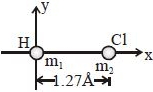
0 likes
View Solution110
DifficultMCQ
Four particles of masses $m_1 = 2m$,$m_2 = 4m$,$m_3 = m$,and $m_4$ are placed at the four corners of a square of side $a$. Let the corners be $(0,0)$,$(a,0)$,$(a,a)$,and $(0,a)$ respectively. What should be the value of $m_4$ so that the centre of mass of the system is at the centre of the square,i.e.,at $(\frac{a}{2}, \frac{a}{2})$?
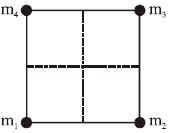
A
$2m$
B
$8m$
C
$6m$
D
None of these
Solution
(D) Let the corners of the square be $A(0,0)$,$B(a,0)$,$C(a,a)$,and $D(0,a)$.
Given masses are $m_1=2m$ at $(0,0)$,$m_2=4m$ at $(a,0)$,$m_3=m$ at $(a,a)$,and $m_4$ at $(0,a)$.
The centre of mass $(X_{cm}, Y_{cm})$ is given by:
$X_{cm} = \frac{m_1x_1 + m_2x_2 + m_3x_3 + m_4x_4}{m_1 + m_2 + m_3 + m_4} = \frac{2m(0) + 4m(a) + m(a) + m_4(0)}{2m + 4m + m + m_4} = \frac{5ma}{7m + m_4}$
For the centre of mass to be at the centre of the square,$X_{cm} = \frac{a}{2}$.
$\frac{5ma}{7m + m_4} = \frac{a}{2} \implies 10m = 7m + m_4 \implies m_4 = 3m$.
Now check for $Y_{cm}$:
$Y_{cm} = \frac{m_1y_1 + m_2y_2 + m_3y_3 + m_4y_4}{m_1 + m_2 + m_3 + m_4} = \frac{2m(0) + 4m(0) + m(a) + m_4(a)}{2m + 4m + m + m_4} = \frac{ma + m_4a}{7m + m_4}$
For $Y_{cm} = \frac{a}{2}$:
$\frac{a(m + m_4)}{7m + m_4} = \frac{a}{2} \implies 2m + 2m_4 = 7m + m_4 \implies m_4 = 5m$.
Since the values of $m_4$ required for $X_{cm}$ and $Y_{cm}$ are different,it is impossible for the centre of mass to be at the centre of the square for any value of $m_4$. Thus,the correct option is $D$.
Given masses are $m_1=2m$ at $(0,0)$,$m_2=4m$ at $(a,0)$,$m_3=m$ at $(a,a)$,and $m_4$ at $(0,a)$.
The centre of mass $(X_{cm}, Y_{cm})$ is given by:
$X_{cm} = \frac{m_1x_1 + m_2x_2 + m_3x_3 + m_4x_4}{m_1 + m_2 + m_3 + m_4} = \frac{2m(0) + 4m(a) + m(a) + m_4(0)}{2m + 4m + m + m_4} = \frac{5ma}{7m + m_4}$
For the centre of mass to be at the centre of the square,$X_{cm} = \frac{a}{2}$.
$\frac{5ma}{7m + m_4} = \frac{a}{2} \implies 10m = 7m + m_4 \implies m_4 = 3m$.
Now check for $Y_{cm}$:
$Y_{cm} = \frac{m_1y_1 + m_2y_2 + m_3y_3 + m_4y_4}{m_1 + m_2 + m_3 + m_4} = \frac{2m(0) + 4m(0) + m(a) + m_4(a)}{2m + 4m + m + m_4} = \frac{ma + m_4a}{7m + m_4}$
For $Y_{cm} = \frac{a}{2}$:
$\frac{a(m + m_4)}{7m + m_4} = \frac{a}{2} \implies 2m + 2m_4 = 7m + m_4 \implies m_4 = 5m$.
Since the values of $m_4$ required for $X_{cm}$ and $Y_{cm}$ are different,it is impossible for the centre of mass to be at the centre of the square for any value of $m_4$. Thus,the correct option is $D$.
0 likes
View Solution111
MediumMCQ
The centre of mass of a body
A
Is always outside the body
B
May lie inside or outside the body
C
Lies inside the body
D
Always lies on the surface of the body
Solution
(B) The $CM$ (centre of mass) of a body is the point where the entire mass of the body is assumed to be concentrated.
It is a geometric property that depends on the distribution of mass.
For a solid object like a sphere,the $CM$ lies inside.
However,for objects like a ring or a semicircular wire,the $CM$ lies outside the material of the body.
Therefore,the centre of mass may lie inside or outside the body.
It is a geometric property that depends on the distribution of mass.
For a solid object like a sphere,the $CM$ lies inside.
However,for objects like a ring or a semicircular wire,the $CM$ lies outside the material of the body.
Therefore,the centre of mass may lie inside or outside the body.
0 likes
View Solution112
MediumMCQ
The centre of mass of two particles lies:
A
on the line perpendicular to the line joining the particles
B
on a point outside the line joining the particles
C
on the line joining the particles
D
none of the above
Solution
(C) The centre of mass $(CM)$ of a system of two particles with masses $m_1$ and $m_2$ located at positions $\vec{r}_1$ and $\vec{r}_2$ is given by the formula:
$\vec{R}_{CM} = \frac{m_1\vec{r}_1 + m_2\vec{r}_2}{m_1 + m_2}$
This formula represents a weighted average of the position vectors of the two particles.
Since $\vec{R}_{CM}$ is a linear combination of $\vec{r}_1$ and $\vec{r}_2$,the position vector of the centre of mass must lie on the straight line segment connecting the two particles.
Therefore,the centre of mass always lies on the line joining the two particles.
$\vec{R}_{CM} = \frac{m_1\vec{r}_1 + m_2\vec{r}_2}{m_1 + m_2}$
This formula represents a weighted average of the position vectors of the two particles.
Since $\vec{R}_{CM}$ is a linear combination of $\vec{r}_1$ and $\vec{r}_2$,the position vector of the centre of mass must lie on the straight line segment connecting the two particles.
Therefore,the centre of mass always lies on the line joining the two particles.
0 likes
View Solution113
DifficultMCQ
$A$ $T$-shaped object of uniform thickness and same material with dimensions shown in the figure,is lying on a smooth floor. $A$ force $\vec F$ is applied at the point $P$ parallel to $AB$,such that the object has only the translation motion without rotation. Find the location of $P$ with respect to $C$.
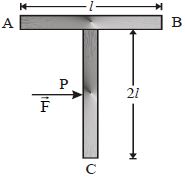
A
$\frac {4l}{3}$
B
$l$
C
$\frac {2l}{3}$
D
$\frac {3l}{2}$
Solution
(A) For an object to undergo pure translational motion,the net force must be applied at its centre of mass $(CM)$.
Let the horizontal bar $AB$ have mass $m$ and the vertical bar have mass $2m$ (since its length is $2l$ compared to $l$ for $AB$).
Let the junction of the two bars be the origin $(0,0)$.
The centre of mass of the horizontal bar is at $(0,0)$.
The centre of mass of the vertical bar is at $(0, -l)$.
The total mass of the object is $M = m + 2m = 3m$.
The $y$-coordinate of the centre of mass is given by:
$Y_{CM} = \frac{m(0) + 2m(-l)}{3m} = \frac{-2ml}{3m} = -\frac{2l}{3}$.
This means the centre of mass is at a distance of $\frac{2l}{3}$ from the junction towards $C$.
Since the total length of the vertical bar is $2l$,the distance of the centre of mass from $C$ is $2l - \frac{2l}{3} = \frac{4l}{3}$.
Let the horizontal bar $AB$ have mass $m$ and the vertical bar have mass $2m$ (since its length is $2l$ compared to $l$ for $AB$).
Let the junction of the two bars be the origin $(0,0)$.
The centre of mass of the horizontal bar is at $(0,0)$.
The centre of mass of the vertical bar is at $(0, -l)$.
The total mass of the object is $M = m + 2m = 3m$.
The $y$-coordinate of the centre of mass is given by:
$Y_{CM} = \frac{m(0) + 2m(-l)}{3m} = \frac{-2ml}{3m} = -\frac{2l}{3}$.
This means the centre of mass is at a distance of $\frac{2l}{3}$ from the junction towards $C$.
Since the total length of the vertical bar is $2l$,the distance of the centre of mass from $C$ is $2l - \frac{2l}{3} = \frac{4l}{3}$.
0 likes
View Solution114
DifficultMCQ
Two particles whose masses are $10\,kg$ and $30\,kg$ and their position vectors are $\hat{i} + \hat{j} + \hat{k}$ and $-\hat{i} - \hat{j} - \hat{k}$ respectively would have the centre of mass at:
A
$-\frac{(\hat{i} + \hat{j} + \hat{k})}{2}$
B
$\frac{(\hat{i} + \hat{j} + \hat{k})}{2}$
C
$-\frac{(\hat{i} + \hat{j} + \hat{k})}{4}$
D
$\frac{(\hat{i} + \hat{j} + \hat{k})}{4}$
Solution
(A) The formula for the position vector of the center of mass is given by: $\vec{r}_{cm} = \frac{m_1\vec{r}_1 + m_2\vec{r}_2}{m_1 + m_2}$.
Given: $m_1 = 10\,kg$,$\vec{r}_1 = \hat{i} + \hat{j} + \hat{k}$.
Given: $m_2 = 30\,kg$,$\vec{r}_2 = -\hat{i} - \hat{j} - \hat{k}$.
Substituting the values:
$\vec{r}_{cm} = \frac{10(\hat{i} + \hat{j} + \hat{k}) + 30(-\hat{i} - \hat{j} - \hat{k})}{10 + 30}$.
$\vec{r}_{cm} = \frac{10(\hat{i} + \hat{j} + \hat{k}) - 30(\hat{i} + \hat{j} + \hat{k})}{40}$.
$\vec{r}_{cm} = \frac{-20(\hat{i} + \hat{j} + \hat{k})}{40}$.
$\vec{r}_{cm} = -\frac{(\hat{i} + \hat{j} + \hat{k})}{2}$.
Therefore,the correct option is $A$.
Given: $m_1 = 10\,kg$,$\vec{r}_1 = \hat{i} + \hat{j} + \hat{k}$.
Given: $m_2 = 30\,kg$,$\vec{r}_2 = -\hat{i} - \hat{j} - \hat{k}$.
Substituting the values:
$\vec{r}_{cm} = \frac{10(\hat{i} + \hat{j} + \hat{k}) + 30(-\hat{i} - \hat{j} - \hat{k})}{10 + 30}$.
$\vec{r}_{cm} = \frac{10(\hat{i} + \hat{j} + \hat{k}) - 30(\hat{i} + \hat{j} + \hat{k})}{40}$.
$\vec{r}_{cm} = \frac{-20(\hat{i} + \hat{j} + \hat{k})}{40}$.
$\vec{r}_{cm} = -\frac{(\hat{i} + \hat{j} + \hat{k})}{2}$.
Therefore,the correct option is $A$.
0 likes
View Solution115
MediumMCQ
The centre of mass of a body:
A
Lies always outside the body
B
May lie within,outside,or on the surface of the body
C
Lies always inside the body
D
Lies always on the surface of the body
Solution
(B) The centre of mass $(COM)$ is a point representing the mean position of the matter in a body or system.
It does not necessarily have to be located within the physical material of the object.
For a solid sphere,the $COM$ lies within the body.
For a hollow object or an $L$-shaped lamina,the $COM$ can lie outside the material of the body.
Therefore,the $COM$ may lie within,outside,or on the surface of the body.
It does not necessarily have to be located within the physical material of the object.
For a solid sphere,the $COM$ lies within the body.
For a hollow object or an $L$-shaped lamina,the $COM$ can lie outside the material of the body.
Therefore,the $COM$ may lie within,outside,or on the surface of the body.
0 likes
View Solution116
DifficultMCQ
Three masses of $2\,kg$,$4\,kg$,and $4\,kg$ are placed at the three points $(1, 0, 0)$,$(1, 1, 0)$,and $(0, 1, 0)$ respectively. The position vector of its center of mass is:
A
$\frac{3}{5}\,\hat{i} + \frac{4}{5}\,\hat{j}$
B
$3\hat{i} + \hat{j}$
C
$\frac{2}{5}\,\hat{i} + \frac{4}{5}\,\hat{j}$
D
$\frac{1}{5}\,\hat{i} + \frac{4}{5}\,\hat{j}$
Solution
(A) Given masses are $m_1 = 2\,kg$,$m_2 = 4\,kg$,and $m_3 = 4\,kg$.
Their position vectors are $\vec{r}_1 = (1, 0, 0) = \hat{i}$,$\vec{r}_2 = (1, 1, 0) = \hat{i} + \hat{j}$,and $\vec{r}_3 = (0, 1, 0) = \hat{j}$.
The center of mass position vector $\vec{r}_{cm}$ is given by $\vec{r}_{cm} = \frac{m_1\vec{r}_1 + m_2\vec{r}_2 + m_3\vec{r}_3}{m_1 + m_2 + m_3}$.
Substituting the values: $\vec{r}_{cm} = \frac{2(\hat{i}) + 4(\hat{i} + \hat{j}) + 4(\hat{j})}{2 + 4 + 4}$.
$\vec{r}_{cm} = \frac{2\hat{i} + 4\hat{i} + 4\hat{j} + 4\hat{j}}{10} = \frac{6\hat{i} + 8\hat{j}}{10}$.
$\vec{r}_{cm} = \frac{6}{10}\hat{i} + \frac{8}{10}\hat{j} = \frac{3}{5}\hat{i} + \frac{4}{5}\hat{j}$.
Their position vectors are $\vec{r}_1 = (1, 0, 0) = \hat{i}$,$\vec{r}_2 = (1, 1, 0) = \hat{i} + \hat{j}$,and $\vec{r}_3 = (0, 1, 0) = \hat{j}$.
The center of mass position vector $\vec{r}_{cm}$ is given by $\vec{r}_{cm} = \frac{m_1\vec{r}_1 + m_2\vec{r}_2 + m_3\vec{r}_3}{m_1 + m_2 + m_3}$.
Substituting the values: $\vec{r}_{cm} = \frac{2(\hat{i}) + 4(\hat{i} + \hat{j}) + 4(\hat{j})}{2 + 4 + 4}$.
$\vec{r}_{cm} = \frac{2\hat{i} + 4\hat{i} + 4\hat{j} + 4\hat{j}}{10} = \frac{6\hat{i} + 8\hat{j}}{10}$.
$\vec{r}_{cm} = \frac{6}{10}\hat{i} + \frac{8}{10}\hat{j} = \frac{3}{5}\hat{i} + \frac{4}{5}\hat{j}$.
0 likes
View Solution117
DifficultMCQ
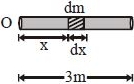
$A$ rod of length $3\, m$ has a mass per unit length directly proportional to the distance $x$ from one of its ends. The center of gravity of the rod from that end will be at ........ $m$.
A
$1.5$
B
$2$
C
$2.5$
D
$3$
Solution
(B) The mass per unit length,i.e.,the linear mass density $\mu$,is given by $\mu \propto x$,which implies $\mu = \lambda x$,where $\lambda$ is a constant.
Consider a small element of length $dx$ at a distance $x$ from the end. The mass of this element is $dm = \mu dx = \lambda x dx$.
The center of mass $x_{cm}$ is calculated as:
$x_{cm} = \frac{\int x dm}{\int dm} = \frac{\int_{0}^{3} x (\lambda x dx)}{\int_{0}^{3} \lambda x dx}$
$x_{cm} = \frac{\int_{0}^{3} x^2 dx}{\int_{0}^{3} x dx} = \frac{[x^3/3]_0^3}{[x^2/2]_0^3}$
$x_{cm} = \frac{27/3}{9/2} = \frac{9}{4.5} = 2\, m$.
Consider a small element of length $dx$ at a distance $x$ from the end. The mass of this element is $dm = \mu dx = \lambda x dx$.
The center of mass $x_{cm}$ is calculated as:
$x_{cm} = \frac{\int x dm}{\int dm} = \frac{\int_{0}^{3} x (\lambda x dx)}{\int_{0}^{3} \lambda x dx}$
$x_{cm} = \frac{\int_{0}^{3} x^2 dx}{\int_{0}^{3} x dx} = \frac{[x^3/3]_0^3}{[x^2/2]_0^3}$
$x_{cm} = \frac{27/3}{9/2} = \frac{9}{4.5} = 2\, m$.
0 likes
View Solution118
DifficultMCQ
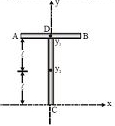
$A$ $T$-shaped object with dimensions shown in the figure is lying on a smooth floor. $A$ force $\vec{F}$ is applied at point $P$ parallel to $AB$,such that the object has only translational motion without rotation. Find the location of $P$ with respect to $C$.
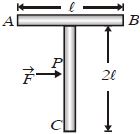
A
$\frac{4}{3}l$
B
$l$
C
$\frac{2}{3}l$
D
$\frac{3}{2}l$
Solution
(A) For pure translational motion,the force must be applied at the center of mass of the body. Therefore,we need to calculate the location of the center of mass of the $T$-shaped object.
Let the mass of rod $AB$ be $m$. Since the rod $CD$ has the same length $2l$ (implied by the geometry of the $T$-shape where $AB$ is length $l$ and $CD$ is length $2l$),let its mass be $2m$ (assuming uniform density).
Let $y_1$ be the center of mass of rod $AB$ and $y_2$ be the center of mass of rod $CD$.
Taking point $C$ as the origin $(0,0)$:
The center of mass of rod $AB$ is at a distance $2l$ from $C$ along the vertical axis,so $\vec{r}_1 = 2l\hat{j}$.
The center of mass of rod $CD$ is at a distance $l$ from $C$ along the vertical axis,so $\vec{r}_2 = l\hat{j}$.
The masses are $m_1 = m$ and $m_2 = 2m$.
The position of the center of mass of the system is given by:
$\vec{r}_{cm} = \frac{m_1\vec{r}_1 + m_2\vec{r}_2}{m_1 + m_2}$
$\vec{r}_{cm} = \frac{m(2l\hat{j}) + (2m)(l\hat{j})}{m + 2m} = \frac{2ml\hat{j} + 2ml\hat{j}}{3m} = \frac{4ml\hat{j}}{3m} = \frac{4}{3}l\hat{j}$.
Thus,the distance of the center of mass from $C$ is $\frac{4}{3}l$.
Let the mass of rod $AB$ be $m$. Since the rod $CD$ has the same length $2l$ (implied by the geometry of the $T$-shape where $AB$ is length $l$ and $CD$ is length $2l$),let its mass be $2m$ (assuming uniform density).
Let $y_1$ be the center of mass of rod $AB$ and $y_2$ be the center of mass of rod $CD$.
Taking point $C$ as the origin $(0,0)$:
The center of mass of rod $AB$ is at a distance $2l$ from $C$ along the vertical axis,so $\vec{r}_1 = 2l\hat{j}$.
The center of mass of rod $CD$ is at a distance $l$ from $C$ along the vertical axis,so $\vec{r}_2 = l\hat{j}$.
The masses are $m_1 = m$ and $m_2 = 2m$.
The position of the center of mass of the system is given by:
$\vec{r}_{cm} = \frac{m_1\vec{r}_1 + m_2\vec{r}_2}{m_1 + m_2}$
$\vec{r}_{cm} = \frac{m(2l\hat{j}) + (2m)(l\hat{j})}{m + 2m} = \frac{2ml\hat{j} + 2ml\hat{j}}{3m} = \frac{4ml\hat{j}}{3m} = \frac{4}{3}l\hat{j}$.
Thus,the distance of the center of mass from $C$ is $\frac{4}{3}l$.
0 likes
View Solution119
MediumMCQ
Two semicircular rings of linear mass densities $\lambda$ and $3\lambda$ and of radius $R$ each are joined to form a complete ring. The distance of the center of mass of the complete ring from its geometrical center is
A
$\frac{2R}{3\pi}$
B
$\frac{R}{\pi}$
C
$\frac{2R}{\pi}$
D
$\frac{R}{3\pi}$
Solution
(B) Let the mass of the semicircular ring with density $\lambda$ be $M_1 = \lambda (\pi R) = M$.
Then,the mass of the semicircular ring with density $3\lambda$ is $M_2 = 3\lambda (\pi R) = 3M$.
The center of mass of a semicircular ring of radius $R$ is at a distance $\frac{2R}{\pi}$ from its center along the axis of symmetry.
Let the geometrical center be at the origin $(0,0)$.
Place the first ring (mass $M$) in the left half,so its center of mass is at $x_1 = -\frac{2R}{\pi}$.
Place the second ring (mass $3M$) in the right half,so its center of mass is at $x_2 = \frac{2R}{\pi}$.
The center of mass of the combined system is $X_{cm} = \frac{M_1 x_1 + M_2 x_2}{M_1 + M_2}$.
$X_{cm} = \frac{M(-\frac{2R}{\pi}) + 3M(\frac{2R}{\pi})}{M + 3M} = \frac{\frac{4MR}{\pi}}{4M} = \frac{R}{\pi}$.
Thus,the distance from the geometrical center is $\frac{R}{\pi}$.
Then,the mass of the semicircular ring with density $3\lambda$ is $M_2 = 3\lambda (\pi R) = 3M$.
The center of mass of a semicircular ring of radius $R$ is at a distance $\frac{2R}{\pi}$ from its center along the axis of symmetry.
Let the geometrical center be at the origin $(0,0)$.
Place the first ring (mass $M$) in the left half,so its center of mass is at $x_1 = -\frac{2R}{\pi}$.
Place the second ring (mass $3M$) in the right half,so its center of mass is at $x_2 = \frac{2R}{\pi}$.
The center of mass of the combined system is $X_{cm} = \frac{M_1 x_1 + M_2 x_2}{M_1 + M_2}$.
$X_{cm} = \frac{M(-\frac{2R}{\pi}) + 3M(\frac{2R}{\pi})}{M + 3M} = \frac{\frac{4MR}{\pi}}{4M} = \frac{R}{\pi}$.
Thus,the distance from the geometrical center is $\frac{R}{\pi}$.
0 likes
View Solution120
MediumMCQ
Center of mass of a system of three particles of masses $1 \, kg, 2 \, kg, 3 \, kg$ is at the point $(1 \, m, 2 \, m, 3 \, m)$ and center of mass of another group of two particles of masses $2 \, kg$ and $3 \, kg$ is at point $(-1 \, m, 3 \, m, -2 \, m)$. Where should a $5 \, kg$ particle be placed so that the center of mass of the system of all these six particles shifts to the center of mass of the first system?
A
$(1 \, m, -3 \, m, 2 \, m)$
B
$(3 \, m, 3 \, m, 2 \, m)$
C
$(-1 \, m, 2 \, m, 3 \, m)$
D
$(3 \, m, 1 \, m, 8 \, m)$
Solution
(D) Let the first system have total mass $M_1 = 1 + 2 + 3 = 6 \, kg$ and center of mass $\vec{R}_1 = (1, 2, 3) \, m$.
Let the second system have total mass $M_2 = 2 + 3 = 5 \, kg$ and center of mass $\vec{R}_2 = (-1, 3, -2) \, m$.
Let the third particle have mass $m_3 = 5 \, kg$ at position $\vec{r} = (x, y, z)$.
The total mass of the system is $M = 6 + 5 + 5 = 16 \, kg$.
The center of mass of the combined system is $\vec{R}_{cm} = \frac{M_1\vec{R}_1 + M_2\vec{R}_2 + m_3\vec{r}}{M}$.
We want $\vec{R}_{cm} = \vec{R}_1 = (1, 2, 3)$.
Substituting the values: $\frac{6(1, 2, 3) + 5(-1, 3, -2) + 5(x, y, z)}{16} = (1, 2, 3)$.
$6(1, 2, 3) + 5(-1, 3, -2) + 5(x, y, z) = 16(1, 2, 3)$.
$(6, 12, 18) + (-5, 15, -10) + 5(x, y, z) = (16, 32, 48)$.
$(1, 27, 8) + 5(x, y, z) = (16, 32, 48)$.
$5(x, y, z) = (16-1, 32-27, 48-8) = (15, 5, 40)$.
$(x, y, z) = (3, 1, 8) \, m$.
Let the second system have total mass $M_2 = 2 + 3 = 5 \, kg$ and center of mass $\vec{R}_2 = (-1, 3, -2) \, m$.
Let the third particle have mass $m_3 = 5 \, kg$ at position $\vec{r} = (x, y, z)$.
The total mass of the system is $M = 6 + 5 + 5 = 16 \, kg$.
The center of mass of the combined system is $\vec{R}_{cm} = \frac{M_1\vec{R}_1 + M_2\vec{R}_2 + m_3\vec{r}}{M}$.
We want $\vec{R}_{cm} = \vec{R}_1 = (1, 2, 3)$.
Substituting the values: $\frac{6(1, 2, 3) + 5(-1, 3, -2) + 5(x, y, z)}{16} = (1, 2, 3)$.
$6(1, 2, 3) + 5(-1, 3, -2) + 5(x, y, z) = 16(1, 2, 3)$.
$(6, 12, 18) + (-5, 15, -10) + 5(x, y, z) = (16, 32, 48)$.
$(1, 27, 8) + 5(x, y, z) = (16, 32, 48)$.
$5(x, y, z) = (16-1, 32-27, 48-8) = (15, 5, 40)$.
$(x, y, z) = (3, 1, 8) \, m$.
0 likes
View Solution121
MediumMCQ
$(a)$ Centre of gravity $(C.G.)$ of a body is the point at which the weight of the body acts.
$(b)$ Centre of mass coincides with the centre of gravity if the earth is assumed to have an infinitely large radius.
$(c)$ To evaluate the gravitational field intensity due to any body at an external point,the entire mass of the body can be considered to be concentrated at its $C.G.$
$(d)$ The radius of gyration of any body rotating about an axis is the length of the perpendicular dropped from the $C.G.$ of the body to the axis of rotation.
Which one of the following pairs of statements is correct?
$(b)$ Centre of mass coincides with the centre of gravity if the earth is assumed to have an infinitely large radius.
$(c)$ To evaluate the gravitational field intensity due to any body at an external point,the entire mass of the body can be considered to be concentrated at its $C.G.$
$(d)$ The radius of gyration of any body rotating about an axis is the length of the perpendicular dropped from the $C.G.$ of the body to the axis of rotation.
Which one of the following pairs of statements is correct?
A
$(a)$ and $(c)$
B
$(a)$ and $(b)$
C
$(b)$ and $(c)$
D
$(c)$ and $(d)$
Solution
(B) The Centre of Gravity $(C.G.)$ is defined as the point where the total gravitational force (weight) of the body acts.
$(b)$ The Centre of Mass $(C.M.)$ and $C.G.$ coincide if the gravitational field is uniform. If the Earth has an infinitely large radius,the gravitational field is uniform,so $(b)$ is correct.
$(c)$ For a spherically symmetric body,the mass can be considered concentrated at the $C.G.$ for external gravitational field calculations. However,this is not true for all arbitrary bodies. In the context of standard physics problems,$(a)$ and $(b)$ are the most fundamentally correct statements regarding definitions.
$(d)$ The radius of gyration $k$ is defined by $I = mk^2$,where $I$ is the moment of inertia. It is not simply the perpendicular distance from the $C.G.$ to the axis.
$(b)$ The Centre of Mass $(C.M.)$ and $C.G.$ coincide if the gravitational field is uniform. If the Earth has an infinitely large radius,the gravitational field is uniform,so $(b)$ is correct.
$(c)$ For a spherically symmetric body,the mass can be considered concentrated at the $C.G.$ for external gravitational field calculations. However,this is not true for all arbitrary bodies. In the context of standard physics problems,$(a)$ and $(b)$ are the most fundamentally correct statements regarding definitions.
$(d)$ The radius of gyration $k$ is defined by $I = mk^2$,where $I$ is the moment of inertia. It is not simply the perpendicular distance from the $C.G.$ to the axis.
0 likes
View Solution122
DifficultMCQ
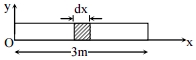
$A$ rod of length $3 \; m$ has a linear mass density that is directly proportional to the distance $x$ from one of its ends. Find the position of its centre of gravity from that end. (in $; m$)
A
$1.5$
B
$2.5$
C
$3$
D
$2$
Solution
(D) Let the linear mass density be $\rho = kx$,where $k$ is a constant.
The mass of a small element of length $dx$ is $dm = \rho \cdot dx = kx \cdot dx$.
The position of the centre of mass $x_{cm}$ is given by the formula:
$x_{cm} = \frac{\int x \cdot dm}{\int dm}$
Substituting the values:
$x_{cm} = \frac{\int_{0}^{3} x(kx \cdot dx)}{\int_{0}^{3} kx \cdot dx} = \frac{\int_{0}^{3} x^2 \cdot dx}{\int_{0}^{3} x \cdot dx}$
Evaluating the integrals:
$x_{cm} = \frac{[x^3/3]_{0}^{3}}{[x^2/2]_{0}^{3}} = \frac{27/3}{9/2} = \frac{9}{4.5} = 2 \; m$.
The mass of a small element of length $dx$ is $dm = \rho \cdot dx = kx \cdot dx$.
The position of the centre of mass $x_{cm}$ is given by the formula:
$x_{cm} = \frac{\int x \cdot dm}{\int dm}$
Substituting the values:
$x_{cm} = \frac{\int_{0}^{3} x(kx \cdot dx)}{\int_{0}^{3} kx \cdot dx} = \frac{\int_{0}^{3} x^2 \cdot dx}{\int_{0}^{3} x \cdot dx}$
Evaluating the integrals:
$x_{cm} = \frac{[x^3/3]_{0}^{3}}{[x^2/2]_{0}^{3}} = \frac{27/3}{9/2} = \frac{9}{4.5} = 2 \; m$.
0 likes
View Solution123
EasyMCQ
$Assertion$ : The position of the centre of mass of a body depends upon the shape and size of the body.
$Reason$ : The centre of mass of a body always lies at the centre of the body.
$Reason$ : The centre of mass of a body always lies at the centre of the body.
A
If both $Assertion$ and $Reason$ are correct and the $Reason$ is a correct explanation of the $Assertion$.
B
If both $Assertion$ and $Reason$ are correct but $Reason$ is not a correct explanation of the $Assertion$.
C
If the $Assertion$ is correct but $Reason$ is incorrect.
D
If both the $Assertion$ and $Reason$ are incorrect.
Solution
(C) The position of the centre of mass of a body depends on the shape,size,and distribution of mass of the body.
Therefore,the $Assertion$ is correct.
The centre of mass of a body does not necessarily lie at the geometric centre of the body. For example,in a non-uniform object,the centre of mass shifts towards the heavier side.
Furthermore,the centre of mass does not even need to lie within the material of the object,such as in the case of a ring or a horseshoe.
Therefore,the $Reason$ is incorrect.
Thus,the correct option is $C$.
Therefore,the $Assertion$ is correct.
The centre of mass of a body does not necessarily lie at the geometric centre of the body. For example,in a non-uniform object,the centre of mass shifts towards the heavier side.
Furthermore,the centre of mass does not even need to lie within the material of the object,such as in the case of a ring or a horseshoe.
Therefore,the $Reason$ is incorrect.
Thus,the correct option is $C$.
0 likes
View Solution124
MediumMCQ
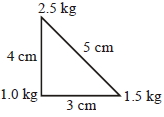
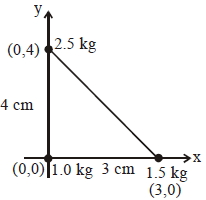
Three point particles of masses $1.0 \; kg$,$1.5 \; kg$,and $2.5 \; kg$ are placed at three corners of a right-angled triangle of sides $4.0 \; cm$,$3.0 \; cm$,and $5.0 \; cm$ as shown in the figure. The center of mass of the system is at a point:
A
$1.5 \; cm$ right and $1.2 \; cm$ above $1 \; kg$ mass
B
$0.9 \; cm$ right and $2.0 \; cm$ above $1 \; kg$ mass
C
$0.6 \; cm$ right and $2.0 \; cm$ above $1 \; kg$ mass
D
$2.0 \; cm$ right and $0.9 \; cm$ above $1 \; kg$ mass
Solution
(B) Let the $1.0 \; kg$ mass be at the origin $(0, 0)$.
The coordinates of the three masses are:
$m_1 = 1.0 \; kg$ at $(0, 0) \; cm$
$m_2 = 1.5 \; kg$ at $(3, 0) \; cm$
$m_3 = 2.5 \; kg$ at $(0, 4) \; cm$
The $x$-coordinate of the center of mass is:
$x_{cm} = \frac{m_1x_1 + m_2x_2 + m_3x_3}{m_1 + m_2 + m_3} = \frac{1.0(0) + 1.5(3) + 2.5(0)}{1.0 + 1.5 + 2.5} = \frac{4.5}{5.0} = 0.9 \; cm$
The $y$-coordinate of the center of mass is:
$y_{cm} = \frac{m_1y_1 + m_2y_2 + m_3y_3}{m_1 + m_2 + m_3} = \frac{1.0(0) + 1.5(0) + 2.5(4)}{1.0 + 1.5 + 2.5} = \frac{10.0}{5.0} = 2.0 \; cm$
Thus,the center of mass is at $0.9 \; cm$ to the right and $2.0 \; cm$ above the $1.0 \; kg$ mass.
The coordinates of the three masses are:
$m_1 = 1.0 \; kg$ at $(0, 0) \; cm$
$m_2 = 1.5 \; kg$ at $(3, 0) \; cm$
$m_3 = 2.5 \; kg$ at $(0, 4) \; cm$
The $x$-coordinate of the center of mass is:
$x_{cm} = \frac{m_1x_1 + m_2x_2 + m_3x_3}{m_1 + m_2 + m_3} = \frac{1.0(0) + 1.5(3) + 2.5(0)}{1.0 + 1.5 + 2.5} = \frac{4.5}{5.0} = 0.9 \; cm$
The $y$-coordinate of the center of mass is:
$y_{cm} = \frac{m_1y_1 + m_2y_2 + m_3y_3}{m_1 + m_2 + m_3} = \frac{1.0(0) + 1.5(0) + 2.5(4)}{1.0 + 1.5 + 2.5} = \frac{10.0}{5.0} = 2.0 \; cm$
Thus,the center of mass is at $0.9 \; cm$ to the right and $2.0 \; cm$ above the $1.0 \; kg$ mass.
0 likes
View Solution125
MediumMCQ
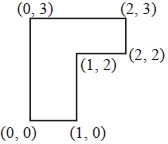
The coordinates of the center of mass of a uniform flag-shaped lamina (thin flat plate) of mass $4 \; kg$ (the coordinates of the same are shown in the figure) are:
A
$(1.25 \; m, 1.50 \; m)$
B
$(1 \; m, 1.75 \; m)$
C
$(0.75 \; m, 0.75 \; m)$
D
$(0.75 \; m, 1.75 \; m)$
Solution
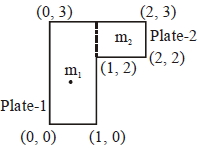
(D) Divide the lamina into two rectangular plates: Plate-$1$ and Plate-$2$.
Plate-$1$ has dimensions $1 \; m \times 3 \; m$,so its area is $A_{1} = 3 \; m^{2}$.
Plate-$2$ has dimensions $1 \; m \times 1 \; m$,so its area is $A_{2} = 1 \; m^{2}$.
Since the lamina is uniform,the mass is proportional to the area. Total area $A = A_{1} + A_{2} = 4 \; m^{2}$.
Given total mass $M = 4 \; kg$,the mass of each part is $m_{1} = 3 \; kg$ and $m_{2} = 1 \; kg$.
The center of mass of Plate-$1$ is at $(x_{1}, y_{1}) = (0.5 \; m, 1.5 \; m)$.
The center of mass of Plate-$2$ is at $(x_{2}, y_{2}) = (1.5 \; m, 2.5 \; m)$.
The $x$-coordinate of the center of mass is $x_{cm} = \frac{m_{1}x_{1} + m_{2}x_{2}}{m_{1} + m_{2}} = \frac{3 \times 0.5 + 1 \times 1.5}{4} = \frac{1.5 + 1.5}{4} = 0.75 \; m$.
The $y$-coordinate of the center of mass is $y_{cm} = \frac{m_{1}y_{1} + m_{2}y_{2}}{m_{1} + m_{2}} = \frac{3 \times 1.5 + 1 \times 2.5}{4} = \frac{4.5 + 2.5}{4} = \frac{7}{4} = 1.75 \; m$.
Thus,the coordinates are $(0.75 \; m, 1.75 \; m)$.
Plate-$1$ has dimensions $1 \; m \times 3 \; m$,so its area is $A_{1} = 3 \; m^{2}$.
Plate-$2$ has dimensions $1 \; m \times 1 \; m$,so its area is $A_{2} = 1 \; m^{2}$.
Since the lamina is uniform,the mass is proportional to the area. Total area $A = A_{1} + A_{2} = 4 \; m^{2}$.
Given total mass $M = 4 \; kg$,the mass of each part is $m_{1} = 3 \; kg$ and $m_{2} = 1 \; kg$.
The center of mass of Plate-$1$ is at $(x_{1}, y_{1}) = (0.5 \; m, 1.5 \; m)$.
The center of mass of Plate-$2$ is at $(x_{2}, y_{2}) = (1.5 \; m, 2.5 \; m)$.
The $x$-coordinate of the center of mass is $x_{cm} = \frac{m_{1}x_{1} + m_{2}x_{2}}{m_{1} + m_{2}} = \frac{3 \times 0.5 + 1 \times 1.5}{4} = \frac{1.5 + 1.5}{4} = 0.75 \; m$.
The $y$-coordinate of the center of mass is $y_{cm} = \frac{m_{1}y_{1} + m_{2}y_{2}}{m_{1} + m_{2}} = \frac{3 \times 1.5 + 1 \times 2.5}{4} = \frac{4.5 + 2.5}{4} = \frac{7}{4} = 1.75 \; m$.
Thus,the coordinates are $(0.75 \; m, 1.75 \; m)$.
0 likes
View Solution126
DifficultMCQ
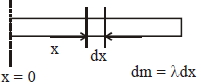
$A$ rod of length $L$ has non-uniform linear mass density given by $\rho(x)=a+b\left(\frac{x}{L}\right)^{2}$,where $a$ and $b$ are constants and $0 \leq x \leq L$. The value of $x$ for the centre of mass of the rod is at
A
$\frac{4}{3}\left(\frac{a+b}{2 a+3 b}\right) L$
B
$\frac{3}{2}\left(\frac{a+b}{2 a+b}\right) L$
C
$\frac{3}{2}\left(\frac{2 a+b}{3 a+b}\right) L$
D
$\frac{3}{4}\left(\frac{2 a+b}{3 a+b}\right) L$
Solution
(D) The centre of mass $x_{cm}$ is given by the formula $x_{cm} = \frac{\int x dm}{\int dm}$.
Given the linear mass density $\rho(x) = \lambda(x) = a + b\left(\frac{x}{L}\right)^2$,the mass element is $dm = \lambda(x) dx = \left(a + \frac{b x^2}{L^2}\right) dx$.
The total mass $M = \int_0^L dm = \int_0^L \left(a + \frac{b x^2}{L^2}\right) dx = \left[ ax + \frac{b x^3}{3 L^2} \right]_0^L = aL + \frac{bL}{3} = L\left(a + \frac{b}{3}\right) = L\left(\frac{3a+b}{3}\right)$.
The moment of mass about the origin is $\int_0^L x dm = \int_0^L x \left(a + \frac{b x^2}{L^2}\right) dx = \int_0^L \left(ax + \frac{b x^3}{L^2}\right) dx = \left[ \frac{a x^2}{2} + \frac{b x^4}{4 L^2} \right]_0^L = \frac{a L^2}{2} + \frac{b L^2}{4} = L^2\left(\frac{2a+b}{4}\right)$.
Therefore,$x_{cm} = \frac{L^2\left(\frac{2a+b}{4}\right)}{L\left(\frac{3a+b}{3}\right)} = \frac{3}{4} \left(\frac{2a+b}{3a+b}\right) L$.
Given the linear mass density $\rho(x) = \lambda(x) = a + b\left(\frac{x}{L}\right)^2$,the mass element is $dm = \lambda(x) dx = \left(a + \frac{b x^2}{L^2}\right) dx$.
The total mass $M = \int_0^L dm = \int_0^L \left(a + \frac{b x^2}{L^2}\right) dx = \left[ ax + \frac{b x^3}{3 L^2} \right]_0^L = aL + \frac{bL}{3} = L\left(a + \frac{b}{3}\right) = L\left(\frac{3a+b}{3}\right)$.
The moment of mass about the origin is $\int_0^L x dm = \int_0^L x \left(a + \frac{b x^2}{L^2}\right) dx = \int_0^L \left(ax + \frac{b x^3}{L^2}\right) dx = \left[ \frac{a x^2}{2} + \frac{b x^4}{4 L^2} \right]_0^L = \frac{a L^2}{2} + \frac{b L^2}{4} = L^2\left(\frac{2a+b}{4}\right)$.
Therefore,$x_{cm} = \frac{L^2\left(\frac{2a+b}{4}\right)}{L\left(\frac{3a+b}{3}\right)} = \frac{3}{4} \left(\frac{2a+b}{3a+b}\right) L$.
0 likes
View Solution127
Medium
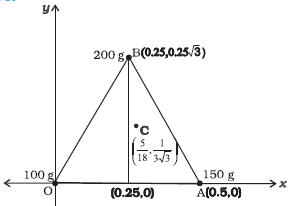
Find the centre of mass of three particles at the vertices of an equilateral triangle. The masses of the particles are $100 \; g$,$150 \; g$,and $200 \; g$ respectively. Each side of the equilateral triangle is $0.5 \; m$ long.
Solution
(N/A) Let the vertices of the equilateral triangle be $O(0,0)$,$A(0.5,0)$,and $B(0.25, 0.25\sqrt{3})$.
The masses are $m_1 = 100 \; g$ at $O$,$m_2 = 150 \; g$ at $A$,and $m_3 = 200 \; g$ at $B$.
The coordinates of the centre of mass $(X, Y)$ are given by:
$X = \frac{m_1 x_1 + m_2 x_2 + m_3 x_3}{m_1 + m_2 + m_3} = \frac{100(0) + 150(0.5) + 200(0.25)}{100 + 150 + 200} = \frac{75 + 50}{450} = \frac{125}{450} = \frac{5}{18} \; m$
$Y = \frac{m_1 y_1 + m_2 y_2 + m_3 y_3}{m_1 + m_2 + m_3} = \frac{100(0) + 150(0) + 200(0.25\sqrt{3})}{450} = \frac{50\sqrt{3}}{450} = \frac{\sqrt{3}}{9} = \frac{1}{3\sqrt{3}} \; m$
Thus,the centre of mass is at $(\frac{5}{18}, \frac{1}{3\sqrt{3}}) \; m$.
The masses are $m_1 = 100 \; g$ at $O$,$m_2 = 150 \; g$ at $A$,and $m_3 = 200 \; g$ at $B$.
The coordinates of the centre of mass $(X, Y)$ are given by:
$X = \frac{m_1 x_1 + m_2 x_2 + m_3 x_3}{m_1 + m_2 + m_3} = \frac{100(0) + 150(0.5) + 200(0.25)}{100 + 150 + 200} = \frac{75 + 50}{450} = \frac{125}{450} = \frac{5}{18} \; m$
$Y = \frac{m_1 y_1 + m_2 y_2 + m_3 y_3}{m_1 + m_2 + m_3} = \frac{100(0) + 150(0) + 200(0.25\sqrt{3})}{450} = \frac{50\sqrt{3}}{450} = \frac{\sqrt{3}}{9} = \frac{1}{3\sqrt{3}} \; m$
Thus,the centre of mass is at $(\frac{5}{18}, \frac{1}{3\sqrt{3}}) \; m$.
0 likes
View Solution128
Easy
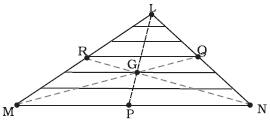
Find the centre of mass of a triangular lamina.
Solution
(N/A) The triangular lamina $(\Delta LMN)$ can be subdivided into narrow strips,each parallel to the base $(MN)$.
By symmetry,each strip has its centre of mass at its midpoint.
If we join the midpoints of all such strips,we obtain the median $LP$.
Therefore,the centre of mass of the entire triangle must lie on the median $LP$.
Similarly,by considering strips parallel to other sides,we can argue that the centre of mass must also lie on the medians $MQ$ and $NR$.
Since the centre of mass lies on all three medians,it must be located at their point of concurrence,which is the centroid $G$ of the triangle.
By symmetry,each strip has its centre of mass at its midpoint.
If we join the midpoints of all such strips,we obtain the median $LP$.
Therefore,the centre of mass of the entire triangle must lie on the median $LP$.
Similarly,by considering strips parallel to other sides,we can argue that the centre of mass must also lie on the medians $MQ$ and $NR$.
Since the centre of mass lies on all three medians,it must be located at their point of concurrence,which is the centroid $G$ of the triangle.
0 likes
View Solution129
Medium
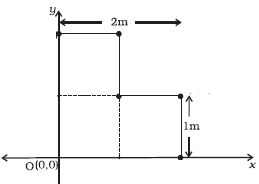
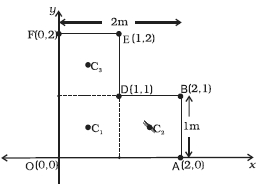
Find the centre of mass of a uniform $L$-shaped lamina (a thin flat plate) with dimensions as shown. The mass of the lamina is $3 \; kg$.
Solution
(N/A) Choosing the $X$ and $Y$ axes as shown in the figure,we have the coordinates of the vertices of the $L$-shaped lamina. We can think of the $L$-shape as consisting of $3$ squares,each of side length $1 \; m$. Since the lamina is uniform,the mass of each square is $1 \; kg$. The centres of mass $C_{1}$,$C_{2}$,and $C_{3}$ of the squares are,by symmetry,their geometric centres. Their coordinates are $(0.5, 0.5) \; m$,$(1.5, 0.5) \; m$,and $(0.5, 1.5) \; m$ respectively. We take the masses of the squares to be concentrated at these points. The centre of mass $(X, Y)$ of the whole $L$-shape is the centre of mass of these mass points.
Hence,
$X = \frac{[1(0.5) + 1(1.5) + 1(0.5)] \; kg \cdot m}{(1 + 1 + 1) \; kg} = \frac{2.5}{3} \; m = \frac{5}{6} \; m$
$Y = \frac{[1(0.5) + 1(0.5) + 1(1.5)] \; kg \cdot m}{(1 + 1 + 1) \; kg} = \frac{2.5}{3} \; m = \frac{5}{6} \; m$
Hence,
$X = \frac{[1(0.5) + 1(1.5) + 1(0.5)] \; kg \cdot m}{(1 + 1 + 1) \; kg} = \frac{2.5}{3} \; m = \frac{5}{6} \; m$
$Y = \frac{[1(0.5) + 1(0.5) + 1(1.5)] \; kg \cdot m}{(1 + 1 + 1) \; kg} = \frac{2.5}{3} \; m = \frac{5}{6} \; m$
0 likes
View Solution130
Medium
Give the location of the centre of mass of a $(i)$ sphere,$(ii)$ cylinder,$(iii)$ ring,and $(iv)$ cube,each of uniform mass density. Does the centre of mass of a body necessarily lie inside the body?
Solution
(N/A) The centre of mass $(C.M.)$ of a body with uniform mass density is located at its geometric centre.
$(i)$ For a sphere,the $C.M.$ is at its geometric centre.
$(ii)$ For a cylinder,the $C.M.$ is at its geometric centre (midpoint of the axis).
$(iii)$ For a ring,the $C.M.$ is at its geometric centre.
$(iv)$ For a cube,the $C.M.$ is at its geometric centre.
No,the centre of mass of a body does not necessarily lie inside the body. For example,in the case of a ring or a hollow sphere,the $C.M.$ lies at the geometric centre,which is in the empty space outside the material of the body.
$(i)$ For a sphere,the $C.M.$ is at its geometric centre.
$(ii)$ For a cylinder,the $C.M.$ is at its geometric centre (midpoint of the axis).
$(iii)$ For a ring,the $C.M.$ is at its geometric centre.
$(iv)$ For a cube,the $C.M.$ is at its geometric centre.
No,the centre of mass of a body does not necessarily lie inside the body. For example,in the case of a ring or a hollow sphere,the $C.M.$ lies at the geometric centre,which is in the empty space outside the material of the body.
0 likes
View Solution131
Medium
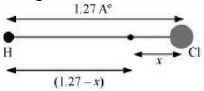
In the $HCl$ molecule,the separation between the nuclei of the two atoms is about $1.27 \; \mathring{A} \; (1 \; \mathring{A} = 10^{-10} \; m)$. Find the approximate location of the center of mass $(CM)$ of the molecule,given that a chlorine atom is about $35.5$ times as massive as a hydrogen atom and nearly all the mass of an atom is concentrated in its nucleus.
Solution
(N/A) Let the position of the $H$ atom be at $x_H = 0$ and the position of the $Cl$ atom be at $x_{Cl} = 1.27 \; \mathring{A}$.
Let $m_H = m$ be the mass of the hydrogen atom.
Then,the mass of the chlorine atom is $m_{Cl} = 35.5 \; m$.
The center of mass $(X_{CM})$ is given by the formula:
$X_{CM} = \frac{m_H x_H + m_{Cl} x_{Cl}}{m_H + m_{Cl}}$
Substituting the values:
$X_{CM} = \frac{m(0) + (35.5 \; m)(1.27 \; \mathring{A})}{m + 35.5 \; m}$
$X_{CM} = \frac{35.5 \; m \times 1.27 \; \mathring{A}}{36.5 \; m}$
$X_{CM} = \frac{35.5 \times 1.27}{36.5} \; \mathring{A} \approx 1.235 \; \mathring{A}$
This distance is measured from the hydrogen atom.
Alternatively,the distance from the chlorine atom is $1.27 \; \mathring{A} - 1.235 \; \mathring{A} = 0.035 \; \mathring{A}$ (approximately $0.037 \; \mathring{A}$ depending on rounding).
Thus,the center of mass is located at approximately $0.037 \; \mathring{A}$ from the chlorine atom.
Let $m_H = m$ be the mass of the hydrogen atom.
Then,the mass of the chlorine atom is $m_{Cl} = 35.5 \; m$.
The center of mass $(X_{CM})$ is given by the formula:
$X_{CM} = \frac{m_H x_H + m_{Cl} x_{Cl}}{m_H + m_{Cl}}$
Substituting the values:
$X_{CM} = \frac{m(0) + (35.5 \; m)(1.27 \; \mathring{A})}{m + 35.5 \; m}$
$X_{CM} = \frac{35.5 \; m \times 1.27 \; \mathring{A}}{36.5 \; m}$
$X_{CM} = \frac{35.5 \times 1.27}{36.5} \; \mathring{A} \approx 1.235 \; \mathring{A}$
This distance is measured from the hydrogen atom.
Alternatively,the distance from the chlorine atom is $1.27 \; \mathring{A} - 1.235 \; \mathring{A} = 0.035 \; \mathring{A}$ (approximately $0.037 \; \mathring{A}$ depending on rounding).
Thus,the center of mass is located at approximately $0.037 \; \mathring{A}$ from the chlorine atom.
0 likes
View Solution132
MediumMCQ
For a system consisting of two objects,when can they be treated as point particles?
A
When the distance between them is very small.
B
When the size of the objects is negligible compared to the distance between them.
C
When the objects are moving with constant velocity.
D
When the objects are at rest.
Solution
(B) An object can be treated as a point particle if the change in its position during motion is much greater than its own size.
For a system of two objects,they can be treated as point particles when the dimensions (size) of the objects are negligible compared to the distance between them.
For a system of two objects,they can be treated as point particles when the dimensions (size) of the objects are negligible compared to the distance between them.
0 likes
View Solution133
EasyMCQ
Is the statement "$A$ particle has point volume" true or false?
A
True
B
False
C
Depends on the frame of reference
D
None of the above
Solution
(B) By definition, a particle is an object that has mass but no dimensions (size).
In physics, we model a particle as a point mass, meaning it occupies a single point in space.
Therefore, a particle has zero volume, not a 'point volume'.
The term 'point volume' is physically meaningless as a point has no volume.
Thus, the statement is false.
In physics, we model a particle as a point mass, meaning it occupies a single point in space.
Therefore, a particle has zero volume, not a 'point volume'.
The term 'point volume' is physically meaningless as a point has no volume.
Thus, the statement is false.
0 likes
View Solution134
Medium
What is a system of particles?
Solution
(N/A) system of particles is defined as a collection of two or more particles that interact with each other or are considered together for the purpose of analyzing their collective motion,center of mass,and dynamics.
0 likes
View Solution135
MediumMCQ
What is the centre of mass?
A
$A$ point where the total volume is concentrated.
B
$A$ point where the entire mass of the body is supposed to be concentrated.
C
$A$ point where the total charge is concentrated.
D
$A$ point where the total energy is concentrated.
Solution
(B) The centre of mass of a body is defined as the unique point where the entire mass of the system or body is considered to be concentrated for the purpose of describing its translational motion.
It is mathematically represented as $\vec{R} = \frac{1}{M} \sum m_i \vec{r}_i$.
It is commonly abbreviated as $C.M.$.
It is mathematically represented as $\vec{R} = \frac{1}{M} \sum m_i \vec{r}_i$.
It is commonly abbreviated as $C.M.$.
0 likes
View Solution136
Medium
Obtain an expression for the position vector of the centre of mass of a system of $n$ particles in one dimension.
Solution
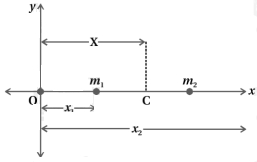
(N/A) Consider a system of two particles of masses $m_1$ and $m_2$ located at positions $x_1$ and $x_2$ respectively from the origin $O$ on the $X$-axis. The centre of mass $C$ of this system is located at a position $X$ given by:
$X = \frac{m_1 x_1 + m_2 x_2}{m_1 + m_2}$
Here,$X$ (also denoted as $r_{cm}$) is the mass-weighted mean of the positions. If the two particles have equal masses $(m_1 = m_2 = m)$,then:
$X = \frac{m x_1 + m x_2}{m + m} = \frac{x_1 + x_2}{2}$
This shows that for two particles of equal mass,the centre of mass lies exactly at the midpoint. For a system of $n$ particles with masses $m_1, m_2, \dots, m_n$ at positions $x_1, x_2, \dots, x_n$ respectively,the position of the centre of mass $X$ is given by the weighted average:
$X = \frac{\sum_{i=1}^{n} m_i x_i}{\sum_{i=1}^{n} m_i}$
Defining the total mass of the system as $M = \sum_{i=1}^{n} m_i$,the expression becomes:
$X = \frac{1}{M} \sum_{i=1}^{n} m_i x_i$
$X = \frac{m_1 x_1 + m_2 x_2}{m_1 + m_2}$
Here,$X$ (also denoted as $r_{cm}$) is the mass-weighted mean of the positions. If the two particles have equal masses $(m_1 = m_2 = m)$,then:
$X = \frac{m x_1 + m x_2}{m + m} = \frac{x_1 + x_2}{2}$
This shows that for two particles of equal mass,the centre of mass lies exactly at the midpoint. For a system of $n$ particles with masses $m_1, m_2, \dots, m_n$ at positions $x_1, x_2, \dots, x_n$ respectively,the position of the centre of mass $X$ is given by the weighted average:
$X = \frac{\sum_{i=1}^{n} m_i x_i}{\sum_{i=1}^{n} m_i}$
Defining the total mass of the system as $M = \sum_{i=1}^{n} m_i$,the expression becomes:
$X = \frac{1}{M} \sum_{i=1}^{n} m_i x_i$
0 likes
View Solution137
Difficult
Obtain an expression for the position vector of the centre of mass of a system of $n$ particles in two dimensions.
Solution
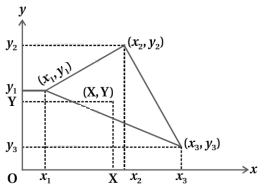
(N/A) For a system of $n$ particles with masses $m_{1}, m_{2}, ..., m_{n}$ located at position vectors $\vec{r}_{1}, \vec{r}_{2}, ..., \vec{r}_{n}$ in a two-dimensional plane,the position vector of the centre of mass $\vec{R}$ is defined as:
$\vec{R} = \frac{\sum_{i=1}^{n} m_{i} \vec{r}_{i}}{\sum_{i=1}^{n} m_{i}}$
In terms of Cartesian coordinates $(x, y)$,where $\vec{r}_{i} = (x_{i}, y_{i})$ and $\vec{R} = (X, Y)$,the components are:
$X = \frac{\sum_{i=1}^{n} m_{i} x_{i}}{\sum_{i=1}^{n} m_{i}}$
$Y = \frac{\sum_{i=1}^{n} m_{i} y_{i}}{\sum_{i=1}^{n} m_{i}}$
Thus,the position vector of the centre of mass is given by $\vec{R} = (X, Y) = \left( \frac{\sum m_{i} x_{i}}{\sum m_{i}}, \frac{\sum m_{i} y_{i}}{\sum m_{i}} \right)$.
$\vec{R} = \frac{\sum_{i=1}^{n} m_{i} \vec{r}_{i}}{\sum_{i=1}^{n} m_{i}}$
In terms of Cartesian coordinates $(x, y)$,where $\vec{r}_{i} = (x_{i}, y_{i})$ and $\vec{R} = (X, Y)$,the components are:
$X = \frac{\sum_{i=1}^{n} m_{i} x_{i}}{\sum_{i=1}^{n} m_{i}}$
$Y = \frac{\sum_{i=1}^{n} m_{i} y_{i}}{\sum_{i=1}^{n} m_{i}}$
Thus,the position vector of the centre of mass is given by $\vec{R} = (X, Y) = \left( \frac{\sum m_{i} x_{i}}{\sum m_{i}}, \frac{\sum m_{i} y_{i}}{\sum m_{i}} \right)$.
0 likes
View Solution138
Difficult
Obtain the general expression for the centre of mass of a system of $n$ distributed particles in three dimensions.
Solution
Suppose the coordinates of $n$ particles of masses $m_{1}, m_{2}, \ldots, m_{n}$ are $(x_{1}, y_{1}, z_{1}), (x_{2}, y_{2}, z_{2}), \ldots, (x_{n}, y_{n}, z_{n})$ respectively.
The position of the centre of mass $(X, Y, Z)$ is given by:
$(X, Y, Z) = \frac{m_{1}(x_{1}, y_{1}, z_{1}) + m_{2}(x_{2}, y_{2}, z_{2}) + \ldots + m_{n}(x_{n}, y_{n}, z_{n})}{m_{1} + m_{2} + \ldots + m_{n}}$
$= \frac{\sum_{i=1}^{n} m_{i}(x_{i}, y_{i}, z_{i})}{\sum_{i=1}^{n} m_{i}}$
This can be expressed in terms of individual coordinates as:
$X = \frac{\sum m_{i} x_{i}}{M}, Y = \frac{\sum m_{i} y_{i}}{M}, Z = \frac{\sum m_{i} z_{i}}{M}$
where $M = \sum m_{i}$ is the total mass of the system.
Using position vectors,if $\vec{r}_{i} = x_{i}\hat{i} + y_{i}\hat{j} + z_{i}\hat{k}$ is the position vector of the $i$-th particle,the position vector of the centre of mass $\vec{R}$ is:
$\vec{R} = \frac{\sum m_{i} \vec{r}_{i}}{M}$
If the origin of the coordinate system is at the centre of mass,then $\sum m_{i} \vec{r}_{i} = 0$.
The position of the centre of mass $(X, Y, Z)$ is given by:
$(X, Y, Z) = \frac{m_{1}(x_{1}, y_{1}, z_{1}) + m_{2}(x_{2}, y_{2}, z_{2}) + \ldots + m_{n}(x_{n}, y_{n}, z_{n})}{m_{1} + m_{2} + \ldots + m_{n}}$
$= \frac{\sum_{i=1}^{n} m_{i}(x_{i}, y_{i}, z_{i})}{\sum_{i=1}^{n} m_{i}}$
This can be expressed in terms of individual coordinates as:
$X = \frac{\sum m_{i} x_{i}}{M}, Y = \frac{\sum m_{i} y_{i}}{M}, Z = \frac{\sum m_{i} z_{i}}{M}$
where $M = \sum m_{i}$ is the total mass of the system.
Using position vectors,if $\vec{r}_{i} = x_{i}\hat{i} + y_{i}\hat{j} + z_{i}\hat{k}$ is the position vector of the $i$-th particle,the position vector of the centre of mass $\vec{R}$ is:
$\vec{R} = \frac{\sum m_{i} \vec{r}_{i}}{M}$
If the origin of the coordinate system is at the centre of mass,then $\sum m_{i} \vec{r}_{i} = 0$.
0 likes
View Solution139
Difficult
For determining the centre of mass of a body,why is a body considered as being composed of multiple small mass elements?
Solution
(N/A) rigid body consists of a large number of particles (atoms or molecules),and the distance between these particles is extremely small. Because the body is continuous,it is mathematically impossible to sum the product of mass and position for every individual atom. Therefore,the body is treated as being composed of $n$ small mass elements $(dm)$,allowing us to use integration to determine the centre of mass: $\vec{R}_{cm} = \frac{1}{M} \int \vec{r} dm$.
0 likes
View Solution140
Medium
Explain the theoretical method for the estimation of the centre of mass of a solid body.
Solution
(N/A) solid body is composed of microscopic particles (molecules,ions,atoms) distributed continuously throughout its volume.
As shown in the figure,consider a solid body divided into small mass elements,each having a mass $dm$ and a position vector $\vec{r} = x \hat{i} + y \hat{j} + z \hat{k}$.
For a system of discrete particles with masses $m_1, m_2, \ldots, m_n$ at position vectors $\vec{r}_1, \vec{r}_2, \ldots, \vec{r}_n$,the position vector of the centre of mass $\vec{R}$ is given by:
$\vec{R} = \frac{\sum_{i=1}^{n} m_i \vec{r}_i}{\sum_{i=1}^{n} m_i}$
For a continuous solid body,we replace the summation with an integral. Let $M$ be the total mass of the body,where $M = \int dm$.
The position vector of the centre of mass is:
$\vec{R} = \frac{1}{M} \int \vec{r} dm$
In terms of Cartesian coordinates $(X, Y, Z)$,this can be expressed as:
$X = \frac{1}{M} \int x dm$
$Y = \frac{1}{M} \int y dm$
$Z = \frac{1}{M} \int z dm$
These equations allow us to calculate the centre of mass for any solid body by integrating over its entire volume.
As shown in the figure,consider a solid body divided into small mass elements,each having a mass $dm$ and a position vector $\vec{r} = x \hat{i} + y \hat{j} + z \hat{k}$.
For a system of discrete particles with masses $m_1, m_2, \ldots, m_n$ at position vectors $\vec{r}_1, \vec{r}_2, \ldots, \vec{r}_n$,the position vector of the centre of mass $\vec{R}$ is given by:
$\vec{R} = \frac{\sum_{i=1}^{n} m_i \vec{r}_i}{\sum_{i=1}^{n} m_i}$
For a continuous solid body,we replace the summation with an integral. Let $M$ be the total mass of the body,where $M = \int dm$.
The position vector of the centre of mass is:
$\vec{R} = \frac{1}{M} \int \vec{r} dm$
In terms of Cartesian coordinates $(X, Y, Z)$,this can be expressed as:
$X = \frac{1}{M} \int x dm$
$Y = \frac{1}{M} \int y dm$
$Z = \frac{1}{M} \int z dm$
These equations allow us to calculate the centre of mass for any solid body by integrating over its entire volume.
0 likes
View Solution141
Difficult
Obtain the position of the centre of mass of a thin rod of uniform density.
Solution
(N/A) homogeneous body is a body with uniformly distributed mass.
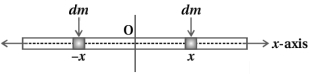
Consider a thin rod of length $L$ and total mass $M$. Let the origin be at one end of the rod,and let the $X$-axis lie along the length of the rod.
The linear mass density $\lambda$ is given by $\lambda = \frac{M}{L}$.
Consider a small element of length $dx$ at a distance $x$ from the origin. The mass of this element is $dm = \lambda dx = \frac{M}{L} dx$.
The position of the centre of mass $X_{cm}$ is given by:
$X_{cm} = \frac{1}{M} \int x dm$
Substituting $dm$:
$X_{cm} = \frac{1}{M} \int_{0}^{L} x \left( \frac{M}{L} \right) dx$
$X_{cm} = \frac{1}{L} \int_{0}^{L} x dx$
$X_{cm} = \frac{1}{L} \left[ \frac{x^2}{2} \right]_{0}^{L}$
$X_{cm} = \frac{1}{L} \left( \frac{L^2}{2} - 0 \right) = \frac{L}{2}$
Thus,the centre of mass of a uniform thin rod is at its geometric centre,which is at a distance of $\frac{L}{2}$ from either end.
Consider a thin rod of length $L$ and total mass $M$. Let the origin be at one end of the rod,and let the $X$-axis lie along the length of the rod.
The linear mass density $\lambda$ is given by $\lambda = \frac{M}{L}$.
Consider a small element of length $dx$ at a distance $x$ from the origin. The mass of this element is $dm = \lambda dx = \frac{M}{L} dx$.
The position of the centre of mass $X_{cm}$ is given by:
$X_{cm} = \frac{1}{M} \int x dm$
Substituting $dm$:
$X_{cm} = \frac{1}{M} \int_{0}^{L} x \left( \frac{M}{L} \right) dx$
$X_{cm} = \frac{1}{L} \int_{0}^{L} x dx$
$X_{cm} = \frac{1}{L} \left[ \frac{x^2}{2} \right]_{0}^{L}$
$X_{cm} = \frac{1}{L} \left( \frac{L^2}{2} - 0 \right) = \frac{L}{2}$
Thus,the centre of mass of a uniform thin rod is at its geometric centre,which is at a distance of $\frac{L}{2}$ from either end.
0 likes
View Solution142
Easy
Define the centre of mass.
Solution
The centre of mass of a system of particles is a unique point where the entire mass of the system can be considered to be concentrated for the purpose of describing its translational motion.
Mathematically,for a system of $n$ particles with masses $m_1, m_2, ..., m_n$ located at position vectors $\vec{r}_1, \vec{r}_2, ..., \vec{r}_n$,the position vector of the centre of mass $\vec{R}$ is given by:
$\vec{R} = \frac{\sum_{i=1}^{n} m_i \vec{r}_i}{\sum_{i=1}^{n} m_i} = \frac{1}{M} \sum_{i=1}^{n} m_i \vec{r}_i$
where $M = \sum m_i$ is the total mass of the system.
Mathematically,for a system of $n$ particles with masses $m_1, m_2, ..., m_n$ located at position vectors $\vec{r}_1, \vec{r}_2, ..., \vec{r}_n$,the position vector of the centre of mass $\vec{R}$ is given by:
$\vec{R} = \frac{\sum_{i=1}^{n} m_i \vec{r}_i}{\sum_{i=1}^{n} m_i} = \frac{1}{M} \sum_{i=1}^{n} m_i \vec{r}_i$
where $M = \sum m_i$ is the total mass of the system.
0 likes
View Solution143
MediumMCQ
Mention the position of the centre of mass of particles of equal mass.
A
At the geometric centre
B
At the position of the heaviest particle
C
At the origin
D
At the position of the lightest particle
Solution
(A) For a system of $n$ particles of equal mass $m$,the position vector of the centre of mass $\vec{R}$ is given by the formula:
$\vec{R} = \frac{\sum_{i=1}^{n} m_i \vec{r}_i}{\sum_{i=1}^{n} m_i}$
Since all masses are equal $(m_1 = m_2 = ... = m_n = m)$,the formula simplifies to:
$\vec{R} = \frac{m \sum_{i=1}^{n} \vec{r}_i}{nm} = \frac{1}{n} \sum_{i=1}^{n} \vec{r}_i$
This expression represents the arithmetic mean of the position vectors of the particles.
Therefore,the centre of mass of particles of equal mass is located at the geometric centre (or the average position) of the system.
$\vec{R} = \frac{\sum_{i=1}^{n} m_i \vec{r}_i}{\sum_{i=1}^{n} m_i}$
Since all masses are equal $(m_1 = m_2 = ... = m_n = m)$,the formula simplifies to:
$\vec{R} = \frac{m \sum_{i=1}^{n} \vec{r}_i}{nm} = \frac{1}{n} \sum_{i=1}^{n} \vec{r}_i$
This expression represents the arithmetic mean of the position vectors of the particles.
Therefore,the centre of mass of particles of equal mass is located at the geometric centre (or the average position) of the system.
0 likes
View Solution144
Easy
Mention the centre of mass of three particles which are not in line but have equal masses.
Solution
(N/A) Let the three particles have equal masses $m_1 = m_2 = m_3 = m$.
Let their position vectors be $\vec{r}_1$,$\vec{r}_2$,and $\vec{r}_3$.
The centre of mass $\vec{R}_{cm}$ is given by the formula:
$\vec{R}_{cm} = \frac{m_1\vec{r}_1 + m_2\vec{r}_2 + m_3\vec{r}_3}{m_1 + m_2 + m_3}$
Since $m_1 = m_2 = m_3 = m$,we can substitute this into the equation:
$\vec{R}_{cm} = \frac{m(\vec{r}_1 + \vec{r}_2 + \vec{r}_3)}{3m} = \frac{\vec{r}_1 + \vec{r}_2 + \vec{r}_3}{3}$
This result shows that the centre of mass of three particles of equal mass is the centroid of the triangle formed by the positions of the three particles.
Let their position vectors be $\vec{r}_1$,$\vec{r}_2$,and $\vec{r}_3$.
The centre of mass $\vec{R}_{cm}$ is given by the formula:
$\vec{R}_{cm} = \frac{m_1\vec{r}_1 + m_2\vec{r}_2 + m_3\vec{r}_3}{m_1 + m_2 + m_3}$
Since $m_1 = m_2 = m_3 = m$,we can substitute this into the equation:
$\vec{R}_{cm} = \frac{m(\vec{r}_1 + \vec{r}_2 + \vec{r}_3)}{3m} = \frac{\vec{r}_1 + \vec{r}_2 + \vec{r}_3}{3}$
This result shows that the centre of mass of three particles of equal mass is the centroid of the triangle formed by the positions of the three particles.
0 likes
View Solution145
Medium
Define the position vector of the centre of mass.
Solution
(N/A) The position vector of the centre of mass $\vec{R}$ for a system of $n$ particles with masses $m_1, m_2, ..., m_n$ located at position vectors $\vec{r}_1, \vec{r}_2, ..., \vec{r}_n$ is defined as the weighted average of the position vectors of all the particles in the system.
Mathematically,it is given by:
$\vec{R} = \frac{\sum_{i=1}^{n} m_i \vec{r}_i}{\sum_{i=1}^{n} m_i} = \frac{m_1 \vec{r}_1 + m_2 \vec{r}_2 + ... + m_n \vec{r}_n}{M}$
where $M = \sum_{i=1}^{n} m_i$ is the total mass of the system.
Mathematically,it is given by:
$\vec{R} = \frac{\sum_{i=1}^{n} m_i \vec{r}_i}{\sum_{i=1}^{n} m_i} = \frac{m_1 \vec{r}_1 + m_2 \vec{r}_2 + ... + m_n \vec{r}_n}{M}$
where $M = \sum_{i=1}^{n} m_i$ is the total mass of the system.
0 likes
View Solution146
Easy
To find the centre of mass of a rigid body,why is it not possible to know $\sum m_i \vec{r}_i$ for all the particles?
Solution
(N/A) rigid body is composed of a continuous distribution of matter,consisting of an effectively infinite number of particles.
Because the number of particles is infinite,it is physically impossible to measure or track the individual mass $m_i$ and position vector $\vec{r}_i$ for every single particle.
Therefore,instead of using a discrete summation $\sum m_i \vec{r}_i$,we use the method of integration $\int \vec{r} \, dm$ to determine the centre of mass for a continuous body.
Because the number of particles is infinite,it is physically impossible to measure or track the individual mass $m_i$ and position vector $\vec{r}_i$ for every single particle.
Therefore,instead of using a discrete summation $\sum m_i \vec{r}_i$,we use the method of integration $\int \vec{r} \, dm$ to determine the centre of mass for a continuous body.
0 likes
View Solution147
Easy
Write the meaning of homogeneous bodies.
Solution
(N/A) homogeneous body is defined as a body whose mass density is uniform throughout its entire volume. This means that at any point within the body,the mass per unit volume remains constant. Mathematically,if $\rho$ is the density,then $\rho = \frac{dm}{dV} = \text{constant}$ for all points inside the body. For such bodies,the center of mass coincides with the geometric center of the body.
0 likes
View Solution148
Medium
Mention the position of the centre of mass of a ring,a disc,and spheres.
Solution
(N/A) The centre of mass of a uniform object is located at its geometric centre due to symmetry.
$1$. For a uniform ring: The centre of mass is at the centre of the ring.
$2$. For a uniform disc: The centre of mass is at the centre of the disc.
$3$. For a uniform solid sphere: The centre of mass is at the centre of the sphere.
$4$. For a uniform hollow sphere: The centre of mass is at the centre of the sphere.
$1$. For a uniform ring: The centre of mass is at the centre of the ring.
$2$. For a uniform disc: The centre of mass is at the centre of the disc.
$3$. For a uniform solid sphere: The centre of mass is at the centre of the sphere.
$4$. For a uniform hollow sphere: The centre of mass is at the centre of the sphere.
0 likes
View Solution149
EasyMCQ
The integral $\int \vec{r} dm = 0$ for a homogeneous body is defined for which point?
A
Center of mass
B
Geometric center
C
Center of gravity
D
Origin
Solution
(A) The position of the center of mass $\vec{R}$ of a system of particles is defined by the equation $\vec{R} = \frac{1}{M} \int \vec{r} dm$,where $M$ is the total mass of the body.
If we choose the origin of our coordinate system to be at the center of mass,then $\vec{R} = 0$.
Substituting this into the definition,we get $0 = \frac{1}{M} \int \vec{r} dm$,which implies $\int \vec{r} dm = 0$.
Therefore,the integral $\int \vec{r} dm$ is zero when the origin is at the center of mass of the body.
If we choose the origin of our coordinate system to be at the center of mass,then $\vec{R} = 0$.
Substituting this into the definition,we get $0 = \frac{1}{M} \int \vec{r} dm$,which implies $\int \vec{r} dm = 0$.
Therefore,the integral $\int \vec{r} dm$ is zero when the origin is at the center of mass of the body.
0 likes
View Solution150
MediumMCQ
What is the position of the centre of mass of symmetrical and homogeneous bodies?
A
At the geometric centre
B
At the edge
C
At the surface
D
Outside the body
Solution
(A) For bodies that are both symmetrical and homogeneous (having uniform mass distribution),the centre of mass coincides with the geometric centre of the body.
This is because the mass is distributed evenly around the geometric centre,causing the net moment of mass to be zero at that point.
This is because the mass is distributed evenly around the geometric centre,causing the net moment of mass to be zero at that point.
0 likes
View SolutionSystem of Particles and Rotational Motion — Centre of mass (Point Mass) · Frequently Asked Questions
1Are these System of Particles and Rotational Motion questions useful for JEE and NEET?
Yes. All questions in this section are mapped to JEE Main and NEET exam patterns. Previous year questions from JEE Main, NEET, GUJCET and state-level exams are included with full solutions.
2Can I switch to Hindi or Gujarati for these questions?
Yes. Use the language tabs in the hero section or the sidebar to view the same questions and solutions in English, Hindi or Gujarati.
3How do I generate a question paper from this subtopic?
Use the Vedclass Exam Paper Generator — select the chapter and subtopic, set difficulty, and generate Sets A, B, C, D automatically. First 3 chapters of every subject are free.
Vedclass Products
For Students
Vedclass Test Series
Mock tests in real JEE/NEET style with performance analysis. 5-day free trial.
Start Free TrialFor Teachers
Exam Paper Generator
Generate Set A/B/C/D papers from this chapter in 2 minutes. 3 chapters free.
Try FreeFor Institutes
Online Exam Module
Live online exams with unlimited students, 360° analytics & white-label branding.
See DemoFor Teachers & Institutes
Generate a System of Particles and Rotational Motion Exam Paper in 2 Minutes
Select subtopic & difficulty — Sets A, B, C, D auto-generated with No Repeat logic.
First 3 chapters of every subject are free — no payment required.