
A English
Velocity of Simple Harmonic Motion Questions in English
Class 11 Physics · Oscillations · Velocity of Simple Harmonic Motion
170+
Questions
English
Language
100%
With Solutions
Showing 49 of 170 questions in English
51
MediumMCQ
If displacement $x$ and velocity $v$ are related as $4v^2 = 16 - x^2$ in a $SHM$,then the time period of the given $SHM$ is (consider $SI$ units).
A
$\pi$
B
$2\pi$
C
$4\pi$
D
$6\pi$
Solution
(C) The given equation is $4v^2 = 16 - x^2$.
Dividing both sides by $16$,we get $\frac{4v^2}{16} + \frac{x^2}{16} = 1$,which simplifies to $\frac{v^2}{4} + \frac{x^2}{16} = 1$.
Comparing this with the standard $SHM$ velocity-displacement relation $\frac{v^2}{(A\omega)^2} + \frac{x^2}{A^2} = 1$,we identify:
$A^2 = 16 \Rightarrow A = 4$ and $(A\omega)^2 = 4 \Rightarrow A\omega = 2$.
Substituting $A = 4$ into $A\omega = 2$,we get $4\omega = 2$,so $\omega = 0.5 \text{ rad/s}$.
The time period $T$ is given by $T = \frac{2\pi}{\omega} = \frac{2\pi}{0.5} = 4\pi \text{ s}$.
Dividing both sides by $16$,we get $\frac{4v^2}{16} + \frac{x^2}{16} = 1$,which simplifies to $\frac{v^2}{4} + \frac{x^2}{16} = 1$.
Comparing this with the standard $SHM$ velocity-displacement relation $\frac{v^2}{(A\omega)^2} + \frac{x^2}{A^2} = 1$,we identify:
$A^2 = 16 \Rightarrow A = 4$ and $(A\omega)^2 = 4 \Rightarrow A\omega = 2$.
Substituting $A = 4$ into $A\omega = 2$,we get $4\omega = 2$,so $\omega = 0.5 \text{ rad/s}$.
The time period $T$ is given by $T = \frac{2\pi}{\omega} = \frac{2\pi}{0.5} = 4\pi \text{ s}$.
0 likes
View Solution52
MediumMCQ
Two simple harmonic motions are represented by equations $y_1 = 4 \sin(10t + \phi)$ and $y_2 = 5 \cos(10t)$. What is the phase difference between their velocities?
A
$\phi$
B
$-\phi$
C
$\phi + \frac{\pi}{2}$
D
$\phi - \frac{\pi}{2}$
Solution
(D) The given equations for displacement are $y_1 = 4 \sin(10t + \phi)$ and $y_2 = 5 \cos(10t)$.
To find the velocity,we differentiate the displacement with respect to time $t$.
For $y_1$,the velocity $v_1 = \frac{dy_1}{dt} = 4 \times 10 \cos(10t + \phi) = 40 \sin(10t + \phi + \frac{\pi}{2})$.
For $y_2$,the velocity $v_2 = \frac{dy_2}{dt} = -5 \times 10 \sin(10t) = 50 \sin(10t + \pi)$.
The phase of velocity $v_1$ is $\theta_1 = 10t + \phi + \frac{\pi}{2}$.
The phase of velocity $v_2$ is $\theta_2 = 10t + \pi$.
The phase difference $\Delta \phi = \theta_1 - \theta_2 = (10t + \phi + \frac{\pi}{2}) - (10t + \pi) = \phi - \frac{\pi}{2}$.
To find the velocity,we differentiate the displacement with respect to time $t$.
For $y_1$,the velocity $v_1 = \frac{dy_1}{dt} = 4 \times 10 \cos(10t + \phi) = 40 \sin(10t + \phi + \frac{\pi}{2})$.
For $y_2$,the velocity $v_2 = \frac{dy_2}{dt} = -5 \times 10 \sin(10t) = 50 \sin(10t + \pi)$.
The phase of velocity $v_1$ is $\theta_1 = 10t + \phi + \frac{\pi}{2}$.
The phase of velocity $v_2$ is $\theta_2 = 10t + \pi$.
The phase difference $\Delta \phi = \theta_1 - \theta_2 = (10t + \phi + \frac{\pi}{2}) - (10t + \pi) = \phi - \frac{\pi}{2}$.
0 likes
View Solution53
MediumMCQ
In an angular $SHM$,the angular amplitude of oscillation is $\pi \, rad$ and the time period is $0.4 \, s$. Calculate its angular velocity at an angular displacement of $\pi/2 \, rad$. (Result in $rad/s$)
A
$34.3$
B
$42.7$
C
$22.3$
D
$50.3$
Solution
(B) The angular frequency $\omega$ is given by $\omega = \frac{2 \pi}{T} = \frac{2 \pi}{0.4} = 5 \pi \, rad/s$.
The angular velocity $\Omega$ at an angular displacement $\theta$ is given by the formula $\Omega = \omega \sqrt{\theta_{0}^{2} - \theta^{2}}$,where $\theta_{0}$ is the angular amplitude.
Given $\theta_{0} = \pi \, rad$ and $\theta = \pi/2 \, rad$:
$\Omega = 5 \pi \sqrt{\pi^{2} - (\pi/2)^{2}}$
$\Omega = 5 \pi \sqrt{\pi^{2} - \frac{\pi^{2}}{4}}$
$\Omega = 5 \pi \sqrt{\frac{3 \pi^{2}}{4}}$
$\Omega = 5 \pi \cdot \frac{\pi \sqrt{3}}{2} = \frac{5 \pi^{2} \sqrt{3}}{2}$.
Using $\pi^{2} \approx 9.87$ and $\sqrt{3} \approx 1.732$:
$\Omega \approx \frac{5 \times 9.87 \times 1.732}{2} \approx 42.76 \, rad/s$.
Thus,the correct option is $42.7 \, rad/s$.
The angular velocity $\Omega$ at an angular displacement $\theta$ is given by the formula $\Omega = \omega \sqrt{\theta_{0}^{2} - \theta^{2}}$,where $\theta_{0}$ is the angular amplitude.
Given $\theta_{0} = \pi \, rad$ and $\theta = \pi/2 \, rad$:
$\Omega = 5 \pi \sqrt{\pi^{2} - (\pi/2)^{2}}$
$\Omega = 5 \pi \sqrt{\pi^{2} - \frac{\pi^{2}}{4}}$
$\Omega = 5 \pi \sqrt{\frac{3 \pi^{2}}{4}}$
$\Omega = 5 \pi \cdot \frac{\pi \sqrt{3}}{2} = \frac{5 \pi^{2} \sqrt{3}}{2}$.
Using $\pi^{2} \approx 9.87$ and $\sqrt{3} \approx 1.732$:
$\Omega \approx \frac{5 \times 9.87 \times 1.732}{2} \approx 42.76 \, rad/s$.
Thus,the correct option is $42.7 \, rad/s$.
0 likes
View Solution54
MediumMCQ
$A$ particle executes simple harmonic motion with an amplitude of $5\, cm$. When the particle is at $4\, cm$ from the mean position,the magnitude of its velocity is equal to the magnitude of its acceleration. Then,its periodic time in seconds is
A
$\frac{4\pi}{3}$
B
$\frac{3}{8}\pi$
C
$\frac{8\pi}{3}$
D
$\frac{7}{3}\pi$
Solution
(C) Given,amplitude $A = 5\, cm$ and displacement $x = 4\, cm$.
The magnitude of velocity in simple harmonic motion is $|v| = \omega \sqrt{A^2 - x^2}$.
The magnitude of acceleration in simple harmonic motion is $|a| = \omega^2 x$.
According to the problem,$|v| = |a|$ at $x = 4\, cm$:
$\omega \sqrt{A^2 - x^2} = \omega^2 x$
Substituting the values:
$\omega \sqrt{5^2 - 4^2} = \omega^2 \times 4$
$\omega \sqrt{25 - 16} = 4\omega^2$
$\omega \times 3 = 4\omega^2$
$\omega = \frac{3}{4}\, rad/s$
The periodic time $T$ is given by $T = \frac{2\pi}{\omega}$:
$T = \frac{2\pi}{3/4} = \frac{8\pi}{3}\, s$.
The magnitude of velocity in simple harmonic motion is $|v| = \omega \sqrt{A^2 - x^2}$.
The magnitude of acceleration in simple harmonic motion is $|a| = \omega^2 x$.
According to the problem,$|v| = |a|$ at $x = 4\, cm$:
$\omega \sqrt{A^2 - x^2} = \omega^2 x$
Substituting the values:
$\omega \sqrt{5^2 - 4^2} = \omega^2 \times 4$
$\omega \sqrt{25 - 16} = 4\omega^2$
$\omega \times 3 = 4\omega^2$
$\omega = \frac{3}{4}\, rad/s$
The periodic time $T$ is given by $T = \frac{2\pi}{\omega}$:
$T = \frac{2\pi}{3/4} = \frac{8\pi}{3}\, s$.
0 likes
View Solution55
MediumMCQ
$A$ particle is performing simple harmonic motion. Which of the following statements are correct?
$(i)$ Its velocity-displacement graph is parabolic in nature.
$(ii)$ Its velocity-time graph is sinusoidal in nature.
$(iii)$ Its velocity-acceleration graph is elliptical in nature.
$(i)$ Its velocity-displacement graph is parabolic in nature.
$(ii)$ Its velocity-time graph is sinusoidal in nature.
$(iii)$ Its velocity-acceleration graph is elliptical in nature.
A
$(i), (ii)$ and $(iii)$
B
$(ii)$ and $(iii)$
C
$(i)$ and $(ii)$
D
$(i)$ and $(iii)$
Solution
(B) For a particle in simple harmonic motion $(SHM)$:
$(i)$ The velocity $v$ as a function of displacement $x$ is given by $v = \omega \sqrt{A^2 - x^2}$. Squaring both sides,$v^2 = \omega^2(A^2 - x^2)$,which represents an ellipse,not a parabola. Thus,$(i)$ is incorrect.
$(ii)$ The velocity as a function of time is $v(t) = A\omega \cos(\omega t)$,which is a sinusoidal function. Thus,$(ii)$ is correct.
$(iii)$ The acceleration is $a(t) = -A\omega^2 \sin(\omega t)$. From $v = A\omega \cos(\omega t)$ and $a = -A\omega^2 \sin(\omega t)$,we have $(v/A\omega)^2 + (a/A\omega^2)^2 = \cos^2(\omega t) + \sin^2(\omega t) = 1$. This is the equation of an ellipse. Thus,$(iii)$ is correct.
Therefore,statements $(ii)$ and $(iii)$ are correct.
$(i)$ The velocity $v$ as a function of displacement $x$ is given by $v = \omega \sqrt{A^2 - x^2}$. Squaring both sides,$v^2 = \omega^2(A^2 - x^2)$,which represents an ellipse,not a parabola. Thus,$(i)$ is incorrect.
$(ii)$ The velocity as a function of time is $v(t) = A\omega \cos(\omega t)$,which is a sinusoidal function. Thus,$(ii)$ is correct.
$(iii)$ The acceleration is $a(t) = -A\omega^2 \sin(\omega t)$. From $v = A\omega \cos(\omega t)$ and $a = -A\omega^2 \sin(\omega t)$,we have $(v/A\omega)^2 + (a/A\omega^2)^2 = \cos^2(\omega t) + \sin^2(\omega t) = 1$. This is the equation of an ellipse. Thus,$(iii)$ is correct.
Therefore,statements $(ii)$ and $(iii)$ are correct.
0 likes
View Solution56
DifficultMCQ
$A$ particle of mass $m$ is performing linear simple harmonic motion. Its equilibrium position is at $x = 0$,the force constant is $K$,and the amplitude of $SHM$ is $A$. The maximum power supplied by the restoring force to the particle during $SHM$ will be:
A
$\frac{K^{3/2} A^2}{\sqrt{m}}$
B
$\frac{2 K^{3/2} A^2}{\sqrt{m}}$
C
$\frac{K^{3/2} A^2}{3\sqrt{m}}$
D
$\frac{K^{3/2} A^2}{2\sqrt{m}}$
Solution
(D) The displacement of a particle in $SHM$ is given by $x(t) = A \sin(\omega t)$,where $\omega = \sqrt{K/m}$.
The velocity of the particle is $v(t) = \frac{dx}{dt} = A\omega \cos(\omega t)$.
The restoring force is $F(t) = -Kx = -KA \sin(\omega t)$.
The power supplied by the restoring force is $P = F \cdot v = (-KA \sin(\omega t)) \cdot (A\omega \cos(\omega t))$.
$P = -KA^2 \omega \sin(\omega t) \cos(\omega t) = -\frac{1}{2} KA^2 \omega \sin(2\omega t)$.
The magnitude of power is $|P| = \frac{1}{2} KA^2 \omega |\sin(2\omega t)|$.
The maximum power occurs when $|\sin(2\omega t)| = 1$,so $P_{max} = \frac{1}{2} KA^2 \omega$.
Substituting $\omega = \sqrt{K/m}$,we get $P_{max} = \frac{1}{2} KA^2 \sqrt{\frac{K}{m}} = \frac{K^{3/2} A^2}{2\sqrt{m}}$.
The velocity of the particle is $v(t) = \frac{dx}{dt} = A\omega \cos(\omega t)$.
The restoring force is $F(t) = -Kx = -KA \sin(\omega t)$.
The power supplied by the restoring force is $P = F \cdot v = (-KA \sin(\omega t)) \cdot (A\omega \cos(\omega t))$.
$P = -KA^2 \omega \sin(\omega t) \cos(\omega t) = -\frac{1}{2} KA^2 \omega \sin(2\omega t)$.
The magnitude of power is $|P| = \frac{1}{2} KA^2 \omega |\sin(2\omega t)|$.
The maximum power occurs when $|\sin(2\omega t)| = 1$,so $P_{max} = \frac{1}{2} KA^2 \omega$.
Substituting $\omega = \sqrt{K/m}$,we get $P_{max} = \frac{1}{2} KA^2 \sqrt{\frac{K}{m}} = \frac{K^{3/2} A^2}{2\sqrt{m}}$.
0 likes
View Solution57
MediumMCQ
Maximum speed of a particle in simple harmonic motion is $v_{max}.$ Then average speed of a particle in one complete oscillation is equal to
A
$\frac{v_{max}}{2}$
B
$\frac{v_{max}}{\pi}$
C
$\frac{\pi v_{max}}{2}$
D
$\frac{2v_{max}}{\pi}$
Solution
(D) The displacement of a particle in simple harmonic motion is $x(t) = A \sin(\omega t)$.
The velocity is $v(t) = \frac{dx}{dt} = A\omega \cos(\omega t)$.
The maximum speed is $v_{max} = A\omega$.
The average speed is defined as the total distance traveled divided by the total time taken.
In one complete oscillation,the particle travels from $x = 0$ to $x = A$,then to $x = -A$,and back to $x = 0$.
The total distance traveled is $d = A + 2A + A = 4A$.
The time taken for one complete oscillation is the time period $T = \frac{2\pi}{\omega}$.
Therefore,the average speed $v_{avg} = \frac{\text{Total Distance}}{\text{Total Time}} = \frac{4A}{T} = \frac{4A}{2\pi/\omega} = \frac{2A\omega}{\pi}$.
Substituting $v_{max} = A\omega$,we get $v_{avg} = \frac{2v_{max}}{\pi}$.
The velocity is $v(t) = \frac{dx}{dt} = A\omega \cos(\omega t)$.
The maximum speed is $v_{max} = A\omega$.
The average speed is defined as the total distance traveled divided by the total time taken.
In one complete oscillation,the particle travels from $x = 0$ to $x = A$,then to $x = -A$,and back to $x = 0$.
The total distance traveled is $d = A + 2A + A = 4A$.
The time taken for one complete oscillation is the time period $T = \frac{2\pi}{\omega}$.
Therefore,the average speed $v_{avg} = \frac{\text{Total Distance}}{\text{Total Time}} = \frac{4A}{T} = \frac{4A}{2\pi/\omega} = \frac{2A\omega}{\pi}$.
Substituting $v_{max} = A\omega$,we get $v_{avg} = \frac{2v_{max}}{\pi}$.
0 likes
View Solution58
DifficultMCQ
Maximum speed of a particle in simple harmonic motion is $v_{max}$. Then,the average speed of a particle in one complete oscillation is equal to:
A
$\frac{v_{max}}{2}$
B
$\frac{v_{max}}{\pi}$
C
$\frac{\pi v_{max}}{2}$
D
$\frac{2v_{max}}{\pi}$
Solution
(D) The maximum speed of a particle in simple harmonic motion is given by $v_{max} = \omega A$,where $\omega$ is the angular frequency and $A$ is the amplitude.
Since $\omega = \frac{2\pi}{T}$,we have $v_{max} = \frac{2\pi A}{T}$,which implies $A = \frac{v_{max} T}{2\pi}$.
In one complete oscillation,the particle travels a total distance of $4A$ in time $T$.
The average speed is defined as the total distance divided by the total time: $\text{Average Speed} = \frac{\text{Total Distance}}{\text{Total Time}} = \frac{4A}{T}$.
Substituting the expression for $A$ into the average speed formula: $\text{Average Speed} = \frac{4}{T} \times \left( \frac{v_{max} T}{2\pi} \right) = \frac{4 v_{max}}{2\pi} = \frac{2v_{max}}{\pi}$.
Since $\omega = \frac{2\pi}{T}$,we have $v_{max} = \frac{2\pi A}{T}$,which implies $A = \frac{v_{max} T}{2\pi}$.
In one complete oscillation,the particle travels a total distance of $4A$ in time $T$.
The average speed is defined as the total distance divided by the total time: $\text{Average Speed} = \frac{\text{Total Distance}}{\text{Total Time}} = \frac{4A}{T}$.
Substituting the expression for $A$ into the average speed formula: $\text{Average Speed} = \frac{4}{T} \times \left( \frac{v_{max} T}{2\pi} \right) = \frac{4 v_{max}}{2\pi} = \frac{2v_{max}}{\pi}$.
0 likes
View Solution59
MediumMCQ
The piston in the cylinder head of a locomotive has a stroke of $6\,m$ (which is twice the amplitude). If the piston is executing simple harmonic motion with an angular frequency of $200\,rad\,min^{-1}$,its maximum speed is .... $m\,s^{-1}$.
A
$5$
B
$10$
C
$15$
D
$20$
Solution
(B) The stroke of the piston is equal to twice the amplitude $(2A)$.
Given,$2A = 6\,m$,so the amplitude $A = 3\,m$.
The angular frequency $\omega = 200\,rad\,min^{-1}$.
To convert the angular frequency into $rad\,s^{-1}$,we divide by $60$:
$\omega = \frac{200}{60} = \frac{10}{3}\,rad\,s^{-1}$.
The maximum speed $(V_{\max})$ of a particle executing simple harmonic motion is given by the formula $V_{\max} = A\omega$.
Substituting the values: $V_{\max} = 3 \times \frac{10}{3} = 10\,m\,s^{-1}$.
Given,$2A = 6\,m$,so the amplitude $A = 3\,m$.
The angular frequency $\omega = 200\,rad\,min^{-1}$.
To convert the angular frequency into $rad\,s^{-1}$,we divide by $60$:
$\omega = \frac{200}{60} = \frac{10}{3}\,rad\,s^{-1}$.
The maximum speed $(V_{\max})$ of a particle executing simple harmonic motion is given by the formula $V_{\max} = A\omega$.
Substituting the values: $V_{\max} = 3 \times \frac{10}{3} = 10\,m\,s^{-1}$.
0 likes
View Solution60
DifficultMCQ
$A$ simple pendulum performs $S.H.M$ about $x = 0$ with an amplitude $A$ and time-period $T$. The speed of the pendulum at $x = \frac{A}{2}$ will be
A
$\frac{A}{T}$
B
$\frac{\sqrt{3} \pi A}{T}$
C
$\frac{\sqrt{3} \pi A}{2T}$
D
$\frac{\sqrt{3} \pi^2 A}{T}$
Solution
(B) The velocity $v$ of a particle performing $S.H.M$ at a displacement $x$ is given by the formula: $v = \omega \sqrt{A^2 - x^2}$.
Given the angular frequency $\omega = \frac{2\pi}{T}$ and the displacement $x = \frac{A}{2}$.
Substituting these values into the velocity formula:
$v = \frac{2\pi}{T} \sqrt{A^2 - (\frac{A}{2})^2}$
$v = \frac{2\pi}{T} \sqrt{A^2 - \frac{A^2}{4}}$
$v = \frac{2\pi}{T} \sqrt{\frac{3A^2}{4}}$
$v = \frac{2\pi}{T} \cdot \frac{\sqrt{3}A}{2}$
$v = \frac{\sqrt{3} \pi A}{T}$.
Given the angular frequency $\omega = \frac{2\pi}{T}$ and the displacement $x = \frac{A}{2}$.
Substituting these values into the velocity formula:
$v = \frac{2\pi}{T} \sqrt{A^2 - (\frac{A}{2})^2}$
$v = \frac{2\pi}{T} \sqrt{A^2 - \frac{A^2}{4}}$
$v = \frac{2\pi}{T} \sqrt{\frac{3A^2}{4}}$
$v = \frac{2\pi}{T} \cdot \frac{\sqrt{3}A}{2}$
$v = \frac{\sqrt{3} \pi A}{T}$.
0 likes
View Solution61
MediumMCQ
The maximum velocity of a body undergoing $S.H.M.$ is $0.2 \ m/s$ and its acceleration at $0.1 \ m$ from the mean position is $0.4 \ m/s^2$. The amplitude of the $S.H.M.$ is .... $m$
A
$0.25$
B
$0.3$
C
$0.1$
D
$1.05$
Solution
(C) The maximum velocity in $S.H.M.$ is given by $V_{\max} = \omega A = 0.2 \ m/s$.
The acceleration in $S.H.M.$ is given by $|a| = \omega^2 x$. Given $a = 0.4 \ m/s^2$ at $x = 0.1 \ m$,we have $0.4 = \omega^2 (0.1)$.
Solving for $\omega^2$: $\omega^2 = \frac{0.4}{0.1} = 4$,which implies $\omega = 2 \ rad/s$.
Substitute $\omega$ into the maximum velocity equation: $2 \times A = 0.2$.
Therefore,the amplitude $A = \frac{0.2}{2} = 0.1 \ m$.
The acceleration in $S.H.M.$ is given by $|a| = \omega^2 x$. Given $a = 0.4 \ m/s^2$ at $x = 0.1 \ m$,we have $0.4 = \omega^2 (0.1)$.
Solving for $\omega^2$: $\omega^2 = \frac{0.4}{0.1} = 4$,which implies $\omega = 2 \ rad/s$.
Substitute $\omega$ into the maximum velocity equation: $2 \times A = 0.2$.
Therefore,the amplitude $A = \frac{0.2}{2} = 0.1 \ m$.
0 likes
View Solution62
DifficultMCQ
The amplitude of an oscillating particle is $A$. When the velocity of the particle is one-third of its maximum velocity,determine the position of the particle.
A
$\frac{A}{3}$
B
$\frac{2\sqrt{2}}{3}A$
C
$\frac{A}{2}$
D
$\frac{\sqrt{3}A}{2}$
Solution
(B) The velocity $V$ of a particle in simple harmonic motion at position $x$ is given by $V = \omega \sqrt{A^2 - x^2}$.
The maximum velocity is $V_{\max} = \omega A$.
According to the problem,$V = \frac{V_{\max}}{3} = \frac{\omega A}{3}$.
Equating the two expressions: $\frac{\omega A}{3} = \omega \sqrt{A^2 - x^2}$.
Dividing both sides by $\omega$: $\frac{A}{3} = \sqrt{A^2 - x^2}$.
Squaring both sides: $\frac{A^2}{9} = A^2 - x^2$.
Rearranging for $x^2$: $x^2 = A^2 - \frac{A^2}{9} = \frac{8A^2}{9}$.
Taking the square root: $x = \sqrt{\frac{8A^2}{9}} = \frac{2\sqrt{2}}{3}A$.
The maximum velocity is $V_{\max} = \omega A$.
According to the problem,$V = \frac{V_{\max}}{3} = \frac{\omega A}{3}$.
Equating the two expressions: $\frac{\omega A}{3} = \omega \sqrt{A^2 - x^2}$.
Dividing both sides by $\omega$: $\frac{A}{3} = \sqrt{A^2 - x^2}$.
Squaring both sides: $\frac{A^2}{9} = A^2 - x^2$.
Rearranging for $x^2$: $x^2 = A^2 - \frac{A^2}{9} = \frac{8A^2}{9}$.
Taking the square root: $x = \sqrt{\frac{8A^2}{9}} = \frac{2\sqrt{2}}{3}A$.
0 likes
View Solution63
MediumMCQ
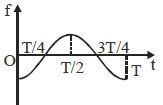
$A$ body is performing simple harmonic motion with amplitude $A$ and time period $T$. The variation of its acceleration $(f)$ with time $(t)$ is shown in the figure. If at time $t$,the velocity of the body is $v$,which of the following graphs correctly represents the variation of velocity $(v)$ with time $(t)$?
A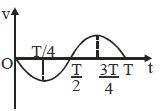
B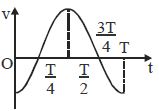
C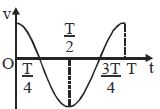
D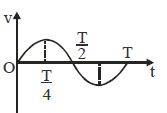
Solution
(A) The acceleration of a particle in simple harmonic motion is given by $f = -\omega^2 x$.
Given the acceleration-time graph,at $t = 0$,$f$ is negative and at its maximum magnitude. This corresponds to the particle being at the positive extreme position $(x = A)$.
The equation for displacement is $x = A \cos(\omega t)$.
The velocity is $v = \frac{dx}{dt} = -A\omega \sin(\omega t)$.
At $t = 0$,$v = 0$.
At $t = T/4$,$v = -A\omega$ (minimum).
At $t = T/2$,$v = 0$.
At $t = 3T/4$,$v = A\omega$ (maximum).
Comparing this with the given options,the graph that starts at $0$ at $t=0$,goes to a negative minimum at $t=T/4$,passes through $0$ at $t=T/2$,and reaches a positive maximum at $t=3T/4$ is Graph $A$.
Given the acceleration-time graph,at $t = 0$,$f$ is negative and at its maximum magnitude. This corresponds to the particle being at the positive extreme position $(x = A)$.
The equation for displacement is $x = A \cos(\omega t)$.
The velocity is $v = \frac{dx}{dt} = -A\omega \sin(\omega t)$.
At $t = 0$,$v = 0$.
At $t = T/4$,$v = -A\omega$ (minimum).
At $t = T/2$,$v = 0$.
At $t = 3T/4$,$v = A\omega$ (maximum).
Comparing this with the given options,the graph that starts at $0$ at $t=0$,goes to a negative minimum at $t=T/4$,passes through $0$ at $t=T/2$,and reaches a positive maximum at $t=3T/4$ is Graph $A$.
0 likes
View Solution64
DifficultMCQ
$A$ particle performs simple harmonic oscillation of period $T$ and the equation of motion is given by $x = a \sin(\omega t + \pi/6)$. After the elapse of what fraction of the time period will the velocity of the particle be equal to half of its maximum velocity?
A
$T/3$
B
$T/12$
C
$T/8$
D
$T/6$
Solution
(B) The equation of motion is $x = a \sin(\omega t + \pi/6)$.
The velocity $v$ is given by the derivative of displacement with respect to time: $v = \frac{dx}{dt} = a\omega \cos(\omega t + \pi/6)$.
The maximum velocity is $v_{max} = a\omega$.
We are given that the velocity is half of its maximum velocity: $v = \frac{1}{2} v_{max} = \frac{a\omega}{2}$.
Equating the two expressions: $a\omega \cos(\omega t + \pi/6) = \frac{a\omega}{2}$,which simplifies to $\cos(\omega t + \pi/6) = 1/2$.
Since $\cos(60^{\circ}) = 1/2$ or $\cos(\pi/3) = 1/2$,we have $\omega t + \pi/6 = \pi/3$.
Substituting $\omega = 2\pi/T$: $(2\pi/T)t + \pi/6 = \pi/3$.
$(2\pi/T)t = \pi/3 - \pi/6 = \pi/6$.
Solving for $t$: $t = (\pi/6) \times (T/2\pi) = T/12$.
The velocity $v$ is given by the derivative of displacement with respect to time: $v = \frac{dx}{dt} = a\omega \cos(\omega t + \pi/6)$.
The maximum velocity is $v_{max} = a\omega$.
We are given that the velocity is half of its maximum velocity: $v = \frac{1}{2} v_{max} = \frac{a\omega}{2}$.
Equating the two expressions: $a\omega \cos(\omega t + \pi/6) = \frac{a\omega}{2}$,which simplifies to $\cos(\omega t + \pi/6) = 1/2$.
Since $\cos(60^{\circ}) = 1/2$ or $\cos(\pi/3) = 1/2$,we have $\omega t + \pi/6 = \pi/3$.
Substituting $\omega = 2\pi/T$: $(2\pi/T)t + \pi/6 = \pi/3$.
$(2\pi/T)t = \pi/3 - \pi/6 = \pi/6$.
Solving for $t$: $t = (\pi/6) \times (T/2\pi) = T/12$.
0 likes
View Solution65
MediumMCQ
The velocity at the mean position of a particle executing $S.H.M.$ is $v$. What is the velocity of the particle at a distance equal to half of the amplitude?
A
$4v$
B
$2v$
C
$\frac{\sqrt{3}}{2}v$
D
$\frac{\sqrt{3}}{4}v$
Solution
(C) The velocity of a particle in $S.H.M.$ at a displacement $x$ is given by $V = \omega \sqrt{a^2 - x^2}$,where $a$ is the amplitude and $\omega$ is the angular frequency.
At the mean position,$x = 0$,so the velocity $v = \omega \sqrt{a^2 - 0^2} = a\omega$.
At a distance equal to half of the amplitude,$x = \frac{a}{2}$.
Substituting this into the velocity formula: $V' = \omega \sqrt{a^2 - (\frac{a}{2})^2} = \omega \sqrt{a^2 - \frac{a^2}{4}} = \omega \sqrt{\frac{3a^2}{4}} = \frac{\sqrt{3}}{2}a\omega$.
Since $v = a\omega$,we have $V' = \frac{\sqrt{3}}{2}v$.
At the mean position,$x = 0$,so the velocity $v = \omega \sqrt{a^2 - 0^2} = a\omega$.
At a distance equal to half of the amplitude,$x = \frac{a}{2}$.
Substituting this into the velocity formula: $V' = \omega \sqrt{a^2 - (\frac{a}{2})^2} = \omega \sqrt{a^2 - \frac{a^2}{4}} = \omega \sqrt{\frac{3a^2}{4}} = \frac{\sqrt{3}}{2}a\omega$.
Since $v = a\omega$,we have $V' = \frac{\sqrt{3}}{2}v$.
0 likes
View Solution66
DifficultMCQ
$A$ particle executes $SHM$. Its velocities are $v_1$ and $v_2$ at displacements $x_1$ and $x_2$ from the mean position,respectively. The frequency of oscillation will be
A
$\frac{1}{2\pi} \left[ \frac{v_1^2 + v_2^2}{x_1^2 + x_2^2} \right]^{1/2}$
B
$\frac{1}{2\pi} \left[ \frac{v_1^2 - v_2^2}{x_2^2 - x_1^2} \right]^{1/2}$
C
$\frac{1}{2\pi} \left[ \frac{x_1^2 + x_2^2}{v_1^2 + v_2^2} \right]^{1/2}$
D
$\frac{1}{2\pi} \left[ \frac{x_2^2 - x_1^2}{v_1^2 - v_2^2} \right]^{1/2}$
Solution
(B) The velocity $v$ of a particle in $SHM$ at displacement $x$ is given by $v = \omega \sqrt{A^2 - x^2}$,where $A$ is the amplitude and $\omega$ is the angular frequency.
Squaring both sides,we get $v^2 = \omega^2(A^2 - x^2) = \omega^2 A^2 - \omega^2 x^2$.
For the given conditions:
$v_1^2 = \omega^2 A^2 - \omega^2 x_1^2$ --- $(1)$
$v_2^2 = \omega^2 A^2 - \omega^2 x_2^2$ --- $(2)$
Subtracting equation $(2)$ from $(1)$:
$v_1^2 - v_2^2 = \omega^2(x_2^2 - x_1^2)$
$\omega^2 = \frac{v_1^2 - v_2^2}{x_2^2 - x_1^2}$
$\omega = \left[ \frac{v_1^2 - v_2^2}{x_2^2 - x_1^2} \right]^{1/2}$
Since frequency $f = \frac{\omega}{2\pi}$,we have:
$f = \frac{1}{2\pi} \left[ \frac{v_1^2 - v_2^2}{x_2^2 - x_1^2} \right]^{1/2}$
Squaring both sides,we get $v^2 = \omega^2(A^2 - x^2) = \omega^2 A^2 - \omega^2 x^2$.
For the given conditions:
$v_1^2 = \omega^2 A^2 - \omega^2 x_1^2$ --- $(1)$
$v_2^2 = \omega^2 A^2 - \omega^2 x_2^2$ --- $(2)$
Subtracting equation $(2)$ from $(1)$:
$v_1^2 - v_2^2 = \omega^2(x_2^2 - x_1^2)$
$\omega^2 = \frac{v_1^2 - v_2^2}{x_2^2 - x_1^2}$
$\omega = \left[ \frac{v_1^2 - v_2^2}{x_2^2 - x_1^2} \right]^{1/2}$
Since frequency $f = \frac{\omega}{2\pi}$,we have:
$f = \frac{1}{2\pi} \left[ \frac{v_1^2 - v_2^2}{x_2^2 - x_1^2} \right]^{1/2}$
0 likes
View Solution67
DifficultMCQ
From the given displacement-time graph of an oscillating particle,find the maximum velocity of the particle.
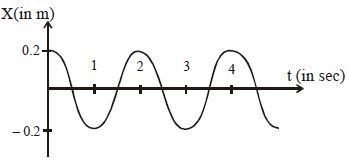
A
$2 \, m/s$
B
$\pi \, m/s$
C
$0.2\pi \, m/s$
D
$\pi/2 \, m/s$
Solution
(C) From the graph,the amplitude $A$ is the maximum displacement from the mean position,which is $A = 0.2 \, m$.
The time period $T$ is the time taken for one complete oscillation. From the graph,one complete cycle starts at $t = 0$ and ends at $t = 2 \, s$,so $T = 2 \, s$.
The angular frequency $\omega$ is given by $\omega = \frac{2\pi}{T} = \frac{2\pi}{2} = \pi \, rad/s$.
The maximum velocity $V_{\max}$ of a particle in simple harmonic motion is given by $V_{\max} = A\omega$.
Substituting the values,$V_{\max} = 0.2 \times \pi = 0.2\pi \, m/s$.
The time period $T$ is the time taken for one complete oscillation. From the graph,one complete cycle starts at $t = 0$ and ends at $t = 2 \, s$,so $T = 2 \, s$.
The angular frequency $\omega$ is given by $\omega = \frac{2\pi}{T} = \frac{2\pi}{2} = \pi \, rad/s$.
The maximum velocity $V_{\max}$ of a particle in simple harmonic motion is given by $V_{\max} = A\omega$.
Substituting the values,$V_{\max} = 0.2 \times \pi = 0.2\pi \, m/s$.
0 likes
View Solution68
MediumMCQ
$A$ particle is performing simple harmonic motion with angular frequency $\omega$ and amplitude $A$. If $a$ is acceleration and $v$ is speed at any instant,then the graph showing the correct variation between $v^2$ and $x^2$ is (where $x$ is displacement):
A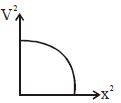
B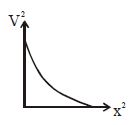
C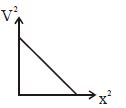
D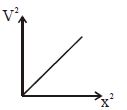
Solution
(C) For a particle performing simple harmonic motion,the speed $v$ at displacement $x$ is given by the formula:
$v^2 = \omega^2(A^2 - x^2)$
Expanding this equation,we get:
$v^2 = \omega^2 A^2 - \omega^2 x^2$
This equation is of the form $y = mx + c$,where $y = v^2$,$x = x^2$,$m = -\omega^2$ (slope),and $c = \omega^2 A^2$ (y-intercept).
Since the slope is negative $(-\omega^2)$,the graph of $v^2$ versus $x^2$ is a straight line with a negative slope and a positive y-intercept.
Therefore,the correct graph is a straight line starting from the y-axis and sloping downwards.
$v^2 = \omega^2(A^2 - x^2)$
Expanding this equation,we get:
$v^2 = \omega^2 A^2 - \omega^2 x^2$
This equation is of the form $y = mx + c$,where $y = v^2$,$x = x^2$,$m = -\omega^2$ (slope),and $c = \omega^2 A^2$ (y-intercept).
Since the slope is negative $(-\omega^2)$,the graph of $v^2$ versus $x^2$ is a straight line with a negative slope and a positive y-intercept.
Therefore,the correct graph is a straight line starting from the y-axis and sloping downwards.
0 likes
View Solution69
EasyMCQ
$Assertion :$ For a particle performing $SHM$,its speed decreases as it goes away from the mean position.
$Reason :$ In $SHM$,the acceleration is always opposite to the velocity of the particle.
$Reason :$ In $SHM$,the acceleration is always opposite to the velocity of the particle.
A
If both Assertion and Reason are correct and the Reason is a correct explanation of the Assertion.
B
If both Assertion and Reason are correct but Reason is not a correct explanation of the Assertion.
C
If the Assertion is correct but Reason is incorrect.
D
If both the Assertion and Reason are incorrect.
Solution
(C) The speed of a particle performing $SHM$ is given by $v = \omega \sqrt{A^2 - x^2}$,where $A$ is the amplitude and $x$ is the displacement from the mean position. As the particle moves away from the mean position,the magnitude of displacement $|x|$ increases,which causes the speed $v$ to decrease. Thus,the Assertion is correct.
The acceleration in $SHM$ is given by $a = -\omega^2 x$. The acceleration is directed towards the mean position. When the particle moves away from the mean position,the velocity is directed away from the mean position,so the acceleration and velocity are in opposite directions (deceleration). However,when the particle moves towards the mean position,the velocity is directed towards the mean position,so the acceleration and velocity are in the same direction (acceleration). Therefore,the Reason is incorrect because the acceleration is not always opposite to the velocity.
The acceleration in $SHM$ is given by $a = -\omega^2 x$. The acceleration is directed towards the mean position. When the particle moves away from the mean position,the velocity is directed away from the mean position,so the acceleration and velocity are in opposite directions (deceleration). However,when the particle moves towards the mean position,the velocity is directed towards the mean position,so the acceleration and velocity are in the same direction (acceleration). Therefore,the Reason is incorrect because the acceleration is not always opposite to the velocity.
0 likes
View Solution70
EasyMCQ
The piston in the cylinder head of a locomotive has a stroke (twice the amplitude) of $1.0 \; m$. If the piston moves with simple harmonic motion with an angular frequency of $200 \; rad/min$,what is its maximum speed in $m/min$?
A
$136$
B
$80$
C
$125$
D
$100$
Solution
(D) The angular frequency of the piston is given as $\omega = 200 \; rad/min$.
The stroke is defined as twice the amplitude $(2A = 1.0 \; m)$.
Therefore,the amplitude $A$ is $A = \frac{1.0 \; m}{2} = 0.5 \; m$.
The maximum speed $(v_{\max})$ of a particle executing simple harmonic motion is given by the formula $v_{\max} = A \omega$.
Substituting the values,we get $v_{\max} = 0.5 \; m \times 200 \; rad/min = 100 \; m/min$.
The stroke is defined as twice the amplitude $(2A = 1.0 \; m)$.
Therefore,the amplitude $A$ is $A = \frac{1.0 \; m}{2} = 0.5 \; m$.
The maximum speed $(v_{\max})$ of a particle executing simple harmonic motion is given by the formula $v_{\max} = A \omega$.
Substituting the values,we get $v_{\max} = 0.5 \; m \times 200 \; rad/min = 100 \; m/min$.
0 likes
View Solution71
Medium
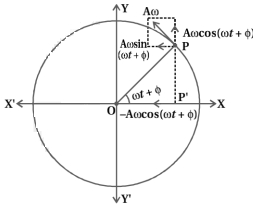
Obtain the velocity of a particle executing simple harmonic motion $(SHM)$ by considering the projection of a particle undergoing uniform circular motion.
Solution
(N/A) The linear velocity of a particle moving in a circular path of radius $A$ with angular speed $\omega$ is given by $v = A \omega$.
The direction of the linear velocity of a particle at time $t$ is along the tangent to the circle at that point.
According to the figure,the linear velocity vector $A \omega$ can be resolved into two mutually perpendicular components. The component along the $X$-axis is $A \omega \sin (\omega t + \phi)$,which represents the velocity of the projection of the particle on the $X$-axis at time $t$.
Since the projection is moving towards the origin (opposite to the positive $X$-axis direction),the velocity is given by:
$v(t) = -A \omega \sin (\omega t + \phi)$
This expression represents the instantaneous velocity of a particle executing $SHM$.
The direction of the linear velocity of a particle at time $t$ is along the tangent to the circle at that point.
According to the figure,the linear velocity vector $A \omega$ can be resolved into two mutually perpendicular components. The component along the $X$-axis is $A \omega \sin (\omega t + \phi)$,which represents the velocity of the projection of the particle on the $X$-axis at time $t$.
Since the projection is moving towards the origin (opposite to the positive $X$-axis direction),the velocity is given by:
$v(t) = -A \omega \sin (\omega t + \phi)$
This expression represents the instantaneous velocity of a particle executing $SHM$.
0 likes
View Solution72
Difficult
Obtain the instantaneous velocity of a particle executing $SHM$.
Solution
(N/A) The instantaneous velocity of an $SHM$ particle is the rate of change of displacement with respect to time.
Suppose the displacement of an $SHM$ particle at time $t$ with amplitude $A$ and angular frequency $\omega$ is given by:
$x(t) = A \cos(\omega t + \phi) \quad \dots (1)$
where $\phi$ is the initial phase.
Differentiating equation $(1)$ with respect to $t$ gives the instantaneous velocity:
$v(t) = \frac{d[x(t)]}{dt} = \frac{d}{dt}[A \cos(\omega t + \phi)]$
$v(t) = -A \omega \sin(\omega t + \phi)$
Since $\sin(\omega t + \phi) = \pm \sqrt{1 - \cos^2(\omega t + \phi)}$,we substitute this into the velocity expression:
$v(t) = -A \omega (\pm \sqrt{1 - \cos^2(\omega t + \phi)})$
$v(t) = \pm \omega \sqrt{A^2 - A^2 \cos^2(\omega t + \phi)}$
Since $x^2 = A^2 \cos^2(\omega t + \phi)$,we get:
$v = \pm \omega \sqrt{A^2 - x^2}$
Special Cases:
$(1)$ At the mean position,$x = 0$:
$v = \pm \omega \sqrt{A^2 - 0} = \pm \omega A$
Thus,the maximum velocity is $v_{\max} = A \omega$.
$(2)$ At the extreme points,$x = \pm A$:
$v = \pm \omega \sqrt{A^2 - A^2} = 0$
Thus,the velocity at the extreme points is zero.
Suppose the displacement of an $SHM$ particle at time $t$ with amplitude $A$ and angular frequency $\omega$ is given by:
$x(t) = A \cos(\omega t + \phi) \quad \dots (1)$
where $\phi$ is the initial phase.
Differentiating equation $(1)$ with respect to $t$ gives the instantaneous velocity:
$v(t) = \frac{d[x(t)]}{dt} = \frac{d}{dt}[A \cos(\omega t + \phi)]$
$v(t) = -A \omega \sin(\omega t + \phi)$
Since $\sin(\omega t + \phi) = \pm \sqrt{1 - \cos^2(\omega t + \phi)}$,we substitute this into the velocity expression:
$v(t) = -A \omega (\pm \sqrt{1 - \cos^2(\omega t + \phi)})$
$v(t) = \pm \omega \sqrt{A^2 - A^2 \cos^2(\omega t + \phi)}$
Since $x^2 = A^2 \cos^2(\omega t + \phi)$,we get:
$v = \pm \omega \sqrt{A^2 - x^2}$
Special Cases:
$(1)$ At the mean position,$x = 0$:
$v = \pm \omega \sqrt{A^2 - 0} = \pm \omega A$
Thus,the maximum velocity is $v_{\max} = A \omega$.
$(2)$ At the extreme points,$x = \pm A$:
$v = \pm \omega \sqrt{A^2 - A^2} = 0$
Thus,the velocity at the extreme points is zero.
0 likes
View Solution73
Easy
Write the formula for the instantaneous velocity of a particle performing $SHM$ along the $X$-axis.
Solution
(N/A) For a particle performing $SHM$ along the $X$-axis,the displacement is given by $x(t) = A \sin(\omega t + \phi)$,where $A$ is the amplitude,$\omega$ is the angular frequency,and $\phi$ is the initial phase constant.
The instantaneous velocity $v(t)$ is the time derivative of the displacement $x(t)$:
$v(t) = \frac{dx}{dt} = \frac{d}{dt} [A \sin(\omega t + \phi)]$
$v(t) = A \omega \cos(\omega t + \phi)$
Alternatively,expressing velocity in terms of displacement $x$:
$v = \pm \omega \sqrt{A^2 - x^2}$
The instantaneous velocity $v(t)$ is the time derivative of the displacement $x(t)$:
$v(t) = \frac{dx}{dt} = \frac{d}{dt} [A \sin(\omega t + \phi)]$
$v(t) = A \omega \cos(\omega t + \phi)$
Alternatively,expressing velocity in terms of displacement $x$:
$v = \pm \omega \sqrt{A^2 - x^2}$
0 likes
View Solution74
MediumMCQ
What is the phase difference between the velocity and displacement of a particle executing $SHM$ (in $^{\circ}$)?
A
$0$
B
$90$
C
$180$
D
$270$
Solution
(B) The displacement of a particle executing $SHM$ is given by $x(t) = A \sin(\omega t + \phi)$.
The velocity of the particle is the time derivative of displacement: $v(t) = \frac{dx}{dt} = A \omega \cos(\omega t + \phi)$.
We can rewrite the velocity expression using the trigonometric identity $\cos(\theta) = \sin(\theta + 90^{\circ})$:
$v(t) = A \omega \sin(\omega t + \phi + 90^{\circ})$.
Comparing the phase of displacement $(\omega t + \phi)$ and velocity $(\omega t + \phi + 90^{\circ})$,the phase difference is $90^{\circ}$ or $\frac{\pi}{2} \text{ radians}$.
The velocity of the particle is the time derivative of displacement: $v(t) = \frac{dx}{dt} = A \omega \cos(\omega t + \phi)$.
We can rewrite the velocity expression using the trigonometric identity $\cos(\theta) = \sin(\theta + 90^{\circ})$:
$v(t) = A \omega \sin(\omega t + \phi + 90^{\circ})$.
Comparing the phase of displacement $(\omega t + \phi)$ and velocity $(\omega t + \phi + 90^{\circ})$,the phase difference is $90^{\circ}$ or $\frac{\pi}{2} \text{ radians}$.
0 likes
View Solution75
DifficultMCQ
Maximum velocity and maximum acceleration of a particle executing $SHM$ are $\beta$ and $\alpha$ respectively. What will be its frequency?
A
$\frac{\alpha}{2 \pi \beta}$
B
$\frac{\beta}{2 \pi \alpha}$
C
$\frac{2 \pi \alpha}{\beta}$
D
$\frac{2 \pi \beta}{\alpha}$
Solution
(A) The maximum velocity of a particle in $SHM$ is given by $v_{\max} = A \omega = \beta$.
The maximum acceleration of a particle in $SHM$ is given by $a_{\max} = A \omega^2 = \alpha$.
Dividing the maximum acceleration by the maximum velocity:
$\frac{a_{\max}}{v_{\max}} = \frac{A \omega^2}{A \omega} = \omega$.
Substituting the given values:
$\frac{\alpha}{\beta} = \omega$.
Since angular frequency $\omega = 2 \pi f$,where $f$ is the frequency:
$\frac{\alpha}{\beta} = 2 \pi f$.
Therefore,the frequency $f$ is:
$f = \frac{\alpha}{2 \pi \beta}$.
The maximum acceleration of a particle in $SHM$ is given by $a_{\max} = A \omega^2 = \alpha$.
Dividing the maximum acceleration by the maximum velocity:
$\frac{a_{\max}}{v_{\max}} = \frac{A \omega^2}{A \omega} = \omega$.
Substituting the given values:
$\frac{\alpha}{\beta} = \omega$.
Since angular frequency $\omega = 2 \pi f$,where $f$ is the frequency:
$\frac{\alpha}{\beta} = 2 \pi f$.
Therefore,the frequency $f$ is:
$f = \frac{\alpha}{2 \pi \beta}$.
0 likes
View Solution76
EasyMCQ
$A$ particle executes simple harmonic motion with a periodic time of $0.05 \, s$ and an amplitude of $4 \, cm$. What is its maximum velocity?
A
$1.6 \pi \, m/s$
B
$0.8 \pi \, m/s$
C
$3.2 \pi \, m/s$
D
$0.4 \pi \, m/s$
Solution
(A) The maximum velocity $v_{\max}$ of a particle in simple harmonic motion is given by the formula $v_{\max} = A \omega$,where $A$ is the amplitude and $\omega$ is the angular frequency.
Given: Amplitude $A = 4 \, cm = 4 \times 10^{-2} \, m$ and Time period $T = 0.05 \, s$.
The angular frequency is $\omega = \frac{2 \pi}{T} = \frac{2 \pi}{0.05} = 40 \pi \, rad/s$.
Substituting these values into the formula:
$v_{\max} = (4 \times 10^{-2} \, m) \times (40 \pi \, rad/s)$
$v_{\max} = 1.6 \pi \, m/s$.
Given: Amplitude $A = 4 \, cm = 4 \times 10^{-2} \, m$ and Time period $T = 0.05 \, s$.
The angular frequency is $\omega = \frac{2 \pi}{T} = \frac{2 \pi}{0.05} = 40 \pi \, rad/s$.
Substituting these values into the formula:
$v_{\max} = (4 \times 10^{-2} \, m) \times (40 \pi \, rad/s)$
$v_{\max} = 1.6 \pi \, m/s$.
0 likes
View Solution77
MediumMCQ
$A$ particle is performing $SHM$ with a path length of $8 \ cm$. If it takes $1 \ s$ to reach from the mean position to the extreme position,what is its velocity at the equilibrium position?
A
$2 \pi \ cm/s$
B
$\pi \ cm/s$
C
$4 \pi \ cm/s$
D
$0.5 \pi \ cm/s$
Solution
(A) The path length (total amplitude range) is $2A = 8 \ cm$.
Therefore,the amplitude $A = 4 \ cm$.
The time taken to travel from the mean position to the extreme position is one-fourth of the time period $T$,which is given as $1 \ s$.
So,$T/4 = 1 \ s$,which implies $T = 4 \ s$.
The velocity at the equilibrium (mean) position is the maximum velocity,given by $v_{\max} = A\omega$.
Substituting $\omega = 2\pi/T$,we get $v_{\max} = A(2\pi/T)$.
$v_{\max} = 4 \times (2\pi / 4) = 2\pi \ cm/s$.
Therefore,the amplitude $A = 4 \ cm$.
The time taken to travel from the mean position to the extreme position is one-fourth of the time period $T$,which is given as $1 \ s$.
So,$T/4 = 1 \ s$,which implies $T = 4 \ s$.
The velocity at the equilibrium (mean) position is the maximum velocity,given by $v_{\max} = A\omega$.
Substituting $\omega = 2\pi/T$,we get $v_{\max} = A(2\pi/T)$.
$v_{\max} = 4 \times (2\pi / 4) = 2\pi \ cm/s$.
0 likes
View Solution78
DifficultMCQ
What is the ratio of maximum acceleration to the maximum velocity of a simple harmonic oscillator?
A
$\omega$
B
$\omega^2$
C
$\frac{1}{\omega}$
D
$\omega^3$
Solution
(A) The maximum acceleration of a simple harmonic oscillator is given by $a_{\max} = A\omega^2$,where $A$ is the amplitude and $\omega$ is the angular frequency.
The maximum velocity of a simple harmonic oscillator is given by $v_{\max} = A\omega$.
Therefore,the ratio of maximum acceleration to maximum velocity is:
$\frac{a_{\max}}{v_{\max}} = \frac{A\omega^2}{A\omega} = \omega$.
The maximum velocity of a simple harmonic oscillator is given by $v_{\max} = A\omega$.
Therefore,the ratio of maximum acceleration to maximum velocity is:
$\frac{a_{\max}}{v_{\max}} = \frac{A\omega^2}{A\omega} = \omega$.
0 likes
View Solution79
EasyMCQ
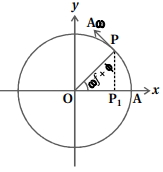
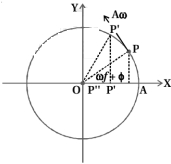
In the figure,what will be the sign of the velocity of the point $P_1$,which is the projection of the velocity of the reference particle $P$? $P$ is moving in a circle of radius $R$ in an anti-clockwise direction.
A
Positive
B
Negative
C
Zero
D
Cannot be determined
Solution
(B) The position of the particle $P$ on the reference circle is given by $x = R \cos(\omega t + \phi)$.
The velocity of the projection point $P_1$ on the $x$-axis is the derivative of its position with respect to time:
$v = \frac{dx}{dt} = -R\omega \sin(\omega t + \phi)$.
As the particle $P$ moves in an anti-clockwise direction in the first quadrant (as shown in the figure),the angle $\theta = (\omega t + \phi)$ is between $0$ and $\pi/2$.
In this range,$\sin(\omega t + \phi)$ is positive.
Therefore,$v = -R\omega \sin(\omega t + \phi)$ will be negative.
Geometrically,as $P$ moves anti-clockwise,its projection $P_1$ moves towards the origin $O$ (i.e.,from right to left),which corresponds to a negative velocity.
The velocity of the projection point $P_1$ on the $x$-axis is the derivative of its position with respect to time:
$v = \frac{dx}{dt} = -R\omega \sin(\omega t + \phi)$.
As the particle $P$ moves in an anti-clockwise direction in the first quadrant (as shown in the figure),the angle $\theta = (\omega t + \phi)$ is between $0$ and $\pi/2$.
In this range,$\sin(\omega t + \phi)$ is positive.
Therefore,$v = -R\omega \sin(\omega t + \phi)$ will be negative.
Geometrically,as $P$ moves anti-clockwise,its projection $P_1$ moves towards the origin $O$ (i.e.,from right to left),which corresponds to a negative velocity.
0 likes
View Solution80
Medium
Show that for a particle executing $SHM$,velocity and displacement have a phase difference of $\frac{\pi}{2}$.
Solution
(N/A) The displacement of a particle executing $SHM$ is given by:
$x = A \cos(\omega t)$,where $A$ is the amplitude.
The phase of displacement is $\theta_{1} = \omega t$.
To find the velocity,we differentiate the displacement with respect to time $t$:
$v = \frac{dx}{dt} = \frac{d}{dt}[A \cos(\omega t)]$
$v = -A\omega \sin(\omega t)$
Using the trigonometric identity $\sin(\theta) = \cos(\frac{\pi}{2} + \theta)$,we can rewrite the velocity as:
$v = A\omega \cos(\omega t + \frac{\pi}{2})$
The phase of velocity is $\theta_{2} = \omega t + \frac{\pi}{2}$.
The phase difference between velocity and displacement is:
$\Delta\theta = \theta_{2} - \theta_{1}$
$\Delta\theta = (\omega t + \frac{\pi}{2}) - \omega t$
$\Delta\theta = \frac{\pi}{2}$
Thus,the velocity leads the displacement by a phase of $\frac{\pi}{2}$.
$x = A \cos(\omega t)$,where $A$ is the amplitude.
The phase of displacement is $\theta_{1} = \omega t$.
To find the velocity,we differentiate the displacement with respect to time $t$:
$v = \frac{dx}{dt} = \frac{d}{dt}[A \cos(\omega t)]$
$v = -A\omega \sin(\omega t)$
Using the trigonometric identity $\sin(\theta) = \cos(\frac{\pi}{2} + \theta)$,we can rewrite the velocity as:
$v = A\omega \cos(\omega t + \frac{\pi}{2})$
The phase of velocity is $\theta_{2} = \omega t + \frac{\pi}{2}$.
The phase difference between velocity and displacement is:
$\Delta\theta = \theta_{2} - \theta_{1}$
$\Delta\theta = (\omega t + \frac{\pi}{2}) - \omega t$
$\Delta\theta = \frac{\pi}{2}$
Thus,the velocity leads the displacement by a phase of $\frac{\pi}{2}$.
0 likes
View Solution81
MediumMCQ
When a particle executes $SHM$,the nature of the graphical representation of velocity as a function of displacement is:
A
circular
B
elliptical
C
parabolic
D
straight line
Solution
(B) For a particle executing $SHM$,the displacement is given by $x = A \sin(\omega t + \phi)$.
Taking the derivative with respect to time,the velocity is $v = \frac{dx}{dt} = \omega A \cos(\omega t + \phi)$.
From the displacement equation,$\sin(\omega t + \phi) = \frac{x}{A}$.
From the velocity equation,$\cos(\omega t + \phi) = \frac{v}{\omega A}$.
Using the identity $\sin^2 \theta + \cos^2 \theta = 1$,we get:
$(\frac{x}{A})^2 + (\frac{v}{\omega A})^2 = 1$.
Rearranging this,we get $\frac{x^2}{A^2} + \frac{v^2}{(\omega A)^2} = 1$.
This is the standard equation of an ellipse,$\frac{x^2}{a^2} + \frac{y^2}{b^2} = 1$,where $a = A$ and $b = \omega A$.
Taking the derivative with respect to time,the velocity is $v = \frac{dx}{dt} = \omega A \cos(\omega t + \phi)$.
From the displacement equation,$\sin(\omega t + \phi) = \frac{x}{A}$.
From the velocity equation,$\cos(\omega t + \phi) = \frac{v}{\omega A}$.
Using the identity $\sin^2 \theta + \cos^2 \theta = 1$,we get:
$(\frac{x}{A})^2 + (\frac{v}{\omega A})^2 = 1$.
Rearranging this,we get $\frac{x^2}{A^2} + \frac{v^2}{(\omega A)^2} = 1$.
This is the standard equation of an ellipse,$\frac{x^2}{a^2} + \frac{y^2}{b^2} = 1$,where $a = A$ and $b = \omega A$.
0 likes
View Solution82
MediumMCQ
$A$ particle executes $S.H.M.$,the graph of velocity as a function of displacement is
A
$A$ circle
B
$A$ parabola
C
An ellipse
D
$A$ helix
Solution
(C) The velocity $v$ of a particle executing $S.H.M.$ at a displacement $x$ is given by the formula: $v = \omega \sqrt{A^2 - x^2}$.
Squaring both sides,we get: $v^2 = \omega^2(A^2 - x^2)$.
Rearranging the terms: $v^2 = \omega^2 A^2 - \omega^2 x^2$,which leads to $v^2 + \omega^2 x^2 = \omega^2 A^2$.
Dividing both sides by $\omega^2 A^2$,we obtain: $\frac{v^2}{(\omega A)^2} + \frac{x^2}{A^2} = 1$.
This equation is in the standard form of an ellipse,$\frac{y^2}{b^2} + \frac{x^2}{a^2} = 1$,where $y$ is velocity and $x$ is displacement.
Therefore,the graph of velocity as a function of displacement is an ellipse.
Squaring both sides,we get: $v^2 = \omega^2(A^2 - x^2)$.
Rearranging the terms: $v^2 = \omega^2 A^2 - \omega^2 x^2$,which leads to $v^2 + \omega^2 x^2 = \omega^2 A^2$.
Dividing both sides by $\omega^2 A^2$,we obtain: $\frac{v^2}{(\omega A)^2} + \frac{x^2}{A^2} = 1$.
This equation is in the standard form of an ellipse,$\frac{y^2}{b^2} + \frac{x^2}{a^2} = 1$,where $y$ is velocity and $x$ is displacement.
Therefore,the graph of velocity as a function of displacement is an ellipse.
0 likes
View Solution83
MediumMCQ
$A$ particle executes $S.H.M.$ with amplitude $a$ and time period $T$. The displacement of the particle when its speed is half of its maximum speed is $\frac{\sqrt{x} a}{2}$. The value of $x$ is $\ldots \ldots \ldots$
A
$1$
B
$5$
C
$2$
D
$3$
Solution
(D) The velocity of a particle in $S.H.M.$ at displacement $y$ is given by $v = \omega \sqrt{a^2 - y^2}$,where $a$ is the amplitude and $\omega$ is the angular frequency.
Maximum speed is $v_{\max} = a\omega$.
Given that the speed $v = \frac{v_{\max}}{2}$,we have $\frac{a\omega}{2} = \omega \sqrt{a^2 - y^2}$.
Squaring both sides: $\frac{a^2}{4} = a^2 - y^2$.
Rearranging for displacement $y$: $y^2 = a^2 - \frac{a^2}{4} = \frac{3a^2}{4}$.
Thus,$y = \frac{\sqrt{3} a}{2}$.
Comparing this with the given expression $\frac{\sqrt{x} a}{2}$,we find $x = 3$.
Maximum speed is $v_{\max} = a\omega$.
Given that the speed $v = \frac{v_{\max}}{2}$,we have $\frac{a\omega}{2} = \omega \sqrt{a^2 - y^2}$.
Squaring both sides: $\frac{a^2}{4} = a^2 - y^2$.
Rearranging for displacement $y$: $y^2 = a^2 - \frac{a^2}{4} = \frac{3a^2}{4}$.
Thus,$y = \frac{\sqrt{3} a}{2}$.
Comparing this with the given expression $\frac{\sqrt{x} a}{2}$,we find $x = 3$.
0 likes
View Solution84
DifficultMCQ
$A$ particle is making simple harmonic motion along the $x$-axis. If at a distance $x_{1}$ and $x_{2}$ from the mean position the velocities of the particle are $v_{1}$ and $v_{2}$ respectively,the time period of its oscillation is given as -
A
$T=2 \pi \sqrt{\frac{x_{2}^{2}+x_{1}^{2}}{v_{1}^{2}+v_{2}^{2}}}$
B
$T=2 \pi \sqrt{\frac{x_{2}^{2}-x_{1}^{2}}{v_{1}^{2}-v_{2}^{2}}}$
C
$T=2 \pi \sqrt{\frac{x_{2}^{2}+x_{1}^{2}}{v_{1}^{2}-v_{2}^{2}}}$
D
$T=\sqrt{\frac{x_{2}^{2}-x_{1}^{2}}{v_{1}^{2}+v_{2}^{2}}}$
Solution
(B) The velocity $v$ of a particle in simple harmonic motion at a displacement $x$ is given by $v^{2} = \omega^{2}(A^{2} - x^{2})$,where $A$ is the amplitude and $\omega$ is the angular frequency.
For the given positions:
$v_{1}^{2} = \omega^{2}(A^{2} - x_{1}^{2}) \implies \frac{v_{1}^{2}}{\omega^{2}} = A^{2} - x_{1}^{2} \implies A^{2} = x_{1}^{2} + \frac{v_{1}^{2}}{\omega^{2}}$
$v_{2}^{2} = \omega^{2}(A^{2} - x_{2}^{2}) \implies \frac{v_{2}^{2}}{\omega^{2}} = A^{2} - x_{2}^{2} \implies A^{2} = x_{2}^{2} + \frac{v_{2}^{2}}{\omega^{2}}$
Equating the two expressions for $A^{2}$:
$x_{1}^{2} + \frac{v_{1}^{2}}{\omega^{2}} = x_{2}^{2} + \frac{v_{2}^{2}}{\omega^{2}}$
$\frac{v_{1}^{2} - v_{2}^{2}}{\omega^{2}} = x_{2}^{2} - x_{1}^{2}$
$\omega^{2} = \frac{v_{1}^{2} - v_{2}^{2}}{x_{2}^{2} - x_{1}^{2}}$
Since $T = \frac{2\pi}{\omega}$,we have $\omega^{2} = \frac{4\pi^{2}}{T^{2}}$.
$\frac{4\pi^{2}}{T^{2}} = \frac{v_{1}^{2} - v_{2}^{2}}{x_{2}^{2} - x_{1}^{2}}$
$T^{2} = 4\pi^{2} \frac{x_{2}^{2} - x_{1}^{2}}{v_{1}^{2} - v_{2}^{2}}$
$T = 2\pi \sqrt{\frac{x_{2}^{2} - x_{1}^{2}}{v_{1}^{2} - v_{2}^{2}}}$
For the given positions:
$v_{1}^{2} = \omega^{2}(A^{2} - x_{1}^{2}) \implies \frac{v_{1}^{2}}{\omega^{2}} = A^{2} - x_{1}^{2} \implies A^{2} = x_{1}^{2} + \frac{v_{1}^{2}}{\omega^{2}}$
$v_{2}^{2} = \omega^{2}(A^{2} - x_{2}^{2}) \implies \frac{v_{2}^{2}}{\omega^{2}} = A^{2} - x_{2}^{2} \implies A^{2} = x_{2}^{2} + \frac{v_{2}^{2}}{\omega^{2}}$
Equating the two expressions for $A^{2}$:
$x_{1}^{2} + \frac{v_{1}^{2}}{\omega^{2}} = x_{2}^{2} + \frac{v_{2}^{2}}{\omega^{2}}$
$\frac{v_{1}^{2} - v_{2}^{2}}{\omega^{2}} = x_{2}^{2} - x_{1}^{2}$
$\omega^{2} = \frac{v_{1}^{2} - v_{2}^{2}}{x_{2}^{2} - x_{1}^{2}}$
Since $T = \frac{2\pi}{\omega}$,we have $\omega^{2} = \frac{4\pi^{2}}{T^{2}}$.
$\frac{4\pi^{2}}{T^{2}} = \frac{v_{1}^{2} - v_{2}^{2}}{x_{2}^{2} - x_{1}^{2}}$
$T^{2} = 4\pi^{2} \frac{x_{2}^{2} - x_{1}^{2}}{v_{1}^{2} - v_{2}^{2}}$
$T = 2\pi \sqrt{\frac{x_{2}^{2} - x_{1}^{2}}{v_{1}^{2} - v_{2}^{2}}}$
0 likes
View Solution85
MediumMCQ
The equation of a particle executing simple harmonic motion is given by $x = \sin \pi (t + 1/3) \, m$. At $t = 1 \, s$,the speed of the particle will be .......... $cm \, s^{-1}$ (Given: $\pi = 3.14$)
A
$0$
B
$157$
C
$272$
D
$314$
Solution
(B) The given equation is $x = \sin \pi (t + 1/3) \, m$.
Expanding the equation,we get $x = \sin (\pi t + \pi/3) \, m$.
The velocity $v$ is the derivative of displacement $x$ with respect to time $t$:
$v = \frac{dx}{dt} = \frac{d}{dt} [\sin (\pi t + \pi/3)] = \pi \cos (\pi t + \pi/3) \, m/s$.
At $t = 1 \, s$:
$v = \pi \cos (\pi(1) + \pi/3) = \pi \cos (4\pi/3) \, m/s$.
Since $\cos (4\pi/3) = \cos (\pi + \pi/3) = -\cos (\pi/3) = -1/2$:
$v = \pi \times (-1/2) = -\pi/2 \, m/s$.
The speed is the magnitude of velocity:
$|v| = |-\pi/2| = \pi/2 \, m/s$.
Converting to $cm/s$ $(1 \, m = 100 \, cm)$:
$|v| = (\pi/2) \times 100 = 50\pi \, cm/s$.
Given $\pi = 3.14$:
$|v| = 50 \times 3.14 = 157 \, cm/s$.
Expanding the equation,we get $x = \sin (\pi t + \pi/3) \, m$.
The velocity $v$ is the derivative of displacement $x$ with respect to time $t$:
$v = \frac{dx}{dt} = \frac{d}{dt} [\sin (\pi t + \pi/3)] = \pi \cos (\pi t + \pi/3) \, m/s$.
At $t = 1 \, s$:
$v = \pi \cos (\pi(1) + \pi/3) = \pi \cos (4\pi/3) \, m/s$.
Since $\cos (4\pi/3) = \cos (\pi + \pi/3) = -\cos (\pi/3) = -1/2$:
$v = \pi \times (-1/2) = -\pi/2 \, m/s$.
The speed is the magnitude of velocity:
$|v| = |-\pi/2| = \pi/2 \, m/s$.
Converting to $cm/s$ $(1 \, m = 100 \, cm)$:
$|v| = (\pi/2) \times 100 = 50\pi \, cm/s$.
Given $\pi = 3.14$:
$|v| = 50 \times 3.14 = 157 \, cm/s$.
0 likes
View Solution86
MediumMCQ
When a particle executes simple harmonic motion,the nature of the graph of velocity as a function of displacement will be:
A
Circular
B
Elliptical
C
Sinusoidal
D
Straight line
Solution
(B) For a particle in $SHM$,its velocity $v$ depends on displacement $x$ as:
$v = \omega \sqrt{A^{2} - x^{2}}$
Where $\omega$ is the angular frequency and $A$ is the amplitude.
Squaring both sides,we get:
$v^{2} = \omega^{2} (A^{2} - x^{2})$
$v^{2} = \omega^{2} A^{2} - \omega^{2} x^{2}$
Rearranging the terms:
$v^{2} + \omega^{2} x^{2} = \omega^{2} A^{2}$
Dividing by $\omega^{2} A^{2}$:
$\frac{v^{2}}{(\omega A)^{2}} + \frac{x^{2}}{A^{2}} = 1$
This equation is of the form $\frac{y^{2}}{b^{2}} + \frac{x^{2}}{a^{2}} = 1$,which represents an ellipse.
Therefore,the graph between velocity $v$ and displacement $x$ is elliptical.
$v = \omega \sqrt{A^{2} - x^{2}}$
Where $\omega$ is the angular frequency and $A$ is the amplitude.
Squaring both sides,we get:
$v^{2} = \omega^{2} (A^{2} - x^{2})$
$v^{2} = \omega^{2} A^{2} - \omega^{2} x^{2}$
Rearranging the terms:
$v^{2} + \omega^{2} x^{2} = \omega^{2} A^{2}$
Dividing by $\omega^{2} A^{2}$:
$\frac{v^{2}}{(\omega A)^{2}} + \frac{x^{2}}{A^{2}} = 1$
This equation is of the form $\frac{y^{2}}{b^{2}} + \frac{x^{2}}{a^{2}} = 1$,which represents an ellipse.
Therefore,the graph between velocity $v$ and displacement $x$ is elliptical.
0 likes
View Solution87
EasyMCQ
$A$ particle of mass $2 \, kg$ executing $SHM$ has an amplitude of $20 \, cm$ and a time period of $1 \, s$. Its maximum speed is ......... $m/s$.
A
$0.314$
B
$0.628$
C
$1.256$
D
$2.512$
Solution
(C) The maximum speed $(V_{\max})$ of a particle executing $SHM$ is given by the formula $V_{\max} = A \omega$,where $A$ is the amplitude and $\omega$ is the angular frequency.
Given:
Amplitude $A = 20 \, cm = 0.2 \, m$
Time period $T = 1 \, s$
The angular frequency is $\omega = \frac{2 \pi}{T} = \frac{2 \pi}{1} = 2 \pi \, rad/s$.
Substituting the values into the formula:
$V_{\max} = A \omega$
$V_{\max} = 0.2 \, m \times 2 \pi \, rad/s$
$V_{\max} = 0.4 \pi \, m/s$
Using $\pi \approx 3.14$:
$V_{\max} = 0.4 \times 3.14 = 1.256 \, m/s$.
Therefore,the correct option is $C$.
Given:
Amplitude $A = 20 \, cm = 0.2 \, m$
Time period $T = 1 \, s$
The angular frequency is $\omega = \frac{2 \pi}{T} = \frac{2 \pi}{1} = 2 \pi \, rad/s$.
Substituting the values into the formula:
$V_{\max} = A \omega$
$V_{\max} = 0.2 \, m \times 2 \pi \, rad/s$
$V_{\max} = 0.4 \pi \, m/s$
Using $\pi \approx 3.14$:
$V_{\max} = 0.4 \times 3.14 = 1.256 \, m/s$.
Therefore,the correct option is $C$.
0 likes
View Solution88
MediumMCQ
$A$ body executing $S.H.M.$ along a straight line has a velocity of $3 \, m/s$ when it is at a distance of $4 \, m$ from its mean position and $4 \, m/s$ when it is at a distance of $3 \, m$ from its mean position. Its angular frequency and amplitude are:
A
$2 \, rad/s$ and $5 \, m$
B
$1 \, rad/s$ and $10 \, m$
C
$2 \, rad/s$ and $10 \, m$
D
$1 \, rad/s$ and $5 \, m$
Solution
(D) The velocity $v$ of a particle in $S.H.M.$ at a displacement $x$ is given by $v = \omega \sqrt{A^2 - x^2}$,where $\omega$ is the angular frequency and $A$ is the amplitude.
Given:
For $x_1 = 4 \, m$,$v_1 = 3 \, m/s$. Thus,$3 = \omega \sqrt{A^2 - 4^2} \implies 9 = \omega^2 (A^2 - 16) \quad (i)$
For $x_2 = 3 \, m$,$v_2 = 4 \, m/s$. Thus,$4 = \omega \sqrt{A^2 - 3^2} \implies 16 = \omega^2 (A^2 - 9) \quad (ii)$
Dividing equation $(i)$ by $(ii)$:
$\frac{9}{16} = \frac{\omega^2 (A^2 - 16)}{\omega^2 (A^2 - 9)} = \frac{A^2 - 16}{A^2 - 9}$
$9(A^2 - 9) = 16(A^2 - 16)$
$9A^2 - 81 = 16A^2 - 256$
$7A^2 = 175 \implies A^2 = 25 \implies A = 5 \, m$
Substituting $A^2 = 25$ into equation $(i)$:
$9 = \omega^2 (25 - 16) = 9\omega^2$
$\omega^2 = 1 \implies \omega = 1 \, rad/s$
Thus,the angular frequency is $1 \, rad/s$ and the amplitude is $5 \, m$.
Given:
For $x_1 = 4 \, m$,$v_1 = 3 \, m/s$. Thus,$3 = \omega \sqrt{A^2 - 4^2} \implies 9 = \omega^2 (A^2 - 16) \quad (i)$
For $x_2 = 3 \, m$,$v_2 = 4 \, m/s$. Thus,$4 = \omega \sqrt{A^2 - 3^2} \implies 16 = \omega^2 (A^2 - 9) \quad (ii)$
Dividing equation $(i)$ by $(ii)$:
$\frac{9}{16} = \frac{\omega^2 (A^2 - 16)}{\omega^2 (A^2 - 9)} = \frac{A^2 - 16}{A^2 - 9}$
$9(A^2 - 9) = 16(A^2 - 16)$
$9A^2 - 81 = 16A^2 - 256$
$7A^2 = 175 \implies A^2 = 25 \implies A = 5 \, m$
Substituting $A^2 = 25$ into equation $(i)$:
$9 = \omega^2 (25 - 16) = 9\omega^2$
$\omega^2 = 1 \implies \omega = 1 \, rad/s$
Thus,the angular frequency is $1 \, rad/s$ and the amplitude is $5 \, m$.
0 likes
View Solution89
MediumMCQ
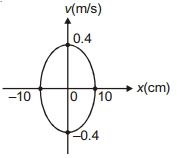
The plot of velocity $(v)$ versus displacement $(x)$ of a particle executing simple harmonic motion is shown in the figure. The time period of oscillation of the particle is .........
A
$\frac{\pi}{2} \, s$
B
$\pi \, s$
C
$2 \pi \, s$
D
$3 \pi \, s$
Solution
(A) From the given graph,the amplitude $(A)$ is the maximum displacement,which is $A = 10 \, cm = 0.1 \, m$.
The maximum velocity $(v_{max})$ is given by $v_{max} = A \omega = 0.4 \, m/s$.
Substituting the value of $A$,we get $0.1 \times \omega = 0.4$,which implies $\omega = 4 \, rad/s$.
The time period $(T)$ of oscillation is given by $T = \frac{2 \pi}{\omega}$.
Substituting $\omega = 4 \, rad/s$,we get $T = \frac{2 \pi}{4} = \frac{\pi}{2} \, s$.
Therefore,the correct option is $(A)$.
The maximum velocity $(v_{max})$ is given by $v_{max} = A \omega = 0.4 \, m/s$.
Substituting the value of $A$,we get $0.1 \times \omega = 0.4$,which implies $\omega = 4 \, rad/s$.
The time period $(T)$ of oscillation is given by $T = \frac{2 \pi}{\omega}$.
Substituting $\omega = 4 \, rad/s$,we get $T = \frac{2 \pi}{4} = \frac{\pi}{2} \, s$.
Therefore,the correct option is $(A)$.
0 likes
View Solution90
EasyMCQ
Two identical pendulums oscillate with a constant phase difference $\frac{\pi}{4}$ and same amplitude. If the maximum velocity of one is $v$,the maximum velocity of the other will be ........
A
$v$
B
$\sqrt{2} v$
C
$2 v$
D
$\frac{v}{\sqrt{2}}$
Solution
(A) The maximum velocity of a simple harmonic oscillator is given by the formula $v_{max} = A\omega$,where $A$ is the amplitude and $\omega$ is the angular frequency.
Since the two pendulums are identical,they have the same mass,length,and angular frequency $\omega$. It is given that they also have the same amplitude $A$.
The phase difference between the two pendulums is constant at $\frac{\pi}{4}$,which implies that their frequencies are identical.
Since $v_{max} = A\omega$ depends only on the amplitude and the angular frequency,and both parameters are identical for both pendulums,the maximum velocity of the second pendulum must also be $v$.
Since the two pendulums are identical,they have the same mass,length,and angular frequency $\omega$. It is given that they also have the same amplitude $A$.
The phase difference between the two pendulums is constant at $\frac{\pi}{4}$,which implies that their frequencies are identical.
Since $v_{max} = A\omega$ depends only on the amplitude and the angular frequency,and both parameters are identical for both pendulums,the maximum velocity of the second pendulum must also be $v$.
0 likes
View Solution91
MediumMCQ
$A$ $1.00 \times 10^{-20} \,kg$ particle is vibrating under simple harmonic motion with a period of $1.00 \times 10^{-5} \,s$ and with a maximum speed of $1.00 \times 10^3 \,m/s$. The maximum displacement of the particle from the mean position is .......... $mm$.
A
$1.59$
B
$1.00$
C
$10$
D
$3.18$
Solution
(A) Given:
Mass $m = 1.00 \times 10^{-20} \,kg$
Period $T = 1.00 \times 10^{-5} \,s$
Maximum speed $v_{max} = A \omega = 1.00 \times 10^3 \,m/s$
Angular frequency $\omega$ is given by:
$\omega = \frac{2\pi}{T} = \frac{2\pi}{1.00 \times 10^{-5}} = 2\pi \times 10^5 \,rad/s$
Using the formula for maximum speed:
$v_{max} = A \omega$
$1.00 \times 10^3 = A \times (2\pi \times 10^5)$
Solving for amplitude $A$:
$A = \frac{1.00 \times 10^3}{2\pi \times 10^5} = \frac{1}{2\pi} \times 10^{-2} \,m$
$A \approx 0.15915 \times 10^{-2} \,m = 1.5915 \times 10^{-3} \,m$
Since $1 \,m = 1000 \,mm$:
$A = 1.5915 \times 10^{-3} \times 10^3 \,mm = 1.5915 \,mm$
Rounding to two decimal places,$A = 1.59 \,mm$.
Mass $m = 1.00 \times 10^{-20} \,kg$
Period $T = 1.00 \times 10^{-5} \,s$
Maximum speed $v_{max} = A \omega = 1.00 \times 10^3 \,m/s$
Angular frequency $\omega$ is given by:
$\omega = \frac{2\pi}{T} = \frac{2\pi}{1.00 \times 10^{-5}} = 2\pi \times 10^5 \,rad/s$
Using the formula for maximum speed:
$v_{max} = A \omega$
$1.00 \times 10^3 = A \times (2\pi \times 10^5)$
Solving for amplitude $A$:
$A = \frac{1.00 \times 10^3}{2\pi \times 10^5} = \frac{1}{2\pi} \times 10^{-2} \,m$
$A \approx 0.15915 \times 10^{-2} \,m = 1.5915 \times 10^{-3} \,m$
Since $1 \,m = 1000 \,mm$:
$A = 1.5915 \times 10^{-3} \times 10^3 \,mm = 1.5915 \,mm$
Rounding to two decimal places,$A = 1.59 \,mm$.
0 likes
View Solution92
MediumMCQ
$A$ particle executes $S.H.M.$ and its position varies with time as $x = A \sin \omega t$. Its average speed during its motion from mean position to mid-point of mean and extreme position is
A
zero
B
$\frac{3 A \omega}{\pi}$
C
$\frac{A \omega}{2 \pi}$
D
$\frac{2 A \omega}{\pi}$
Solution
(B) The particle starts from the mean position $(x = 0)$ at $t = 0$.
At the mean position,the phase $\phi_1 = 0$.
At the mid-point between the mean and extreme position,the displacement is $x = \frac{A}{2}$.
Using the equation $x = A \sin \omega t$,we have $\frac{A}{2} = A \sin(\omega t)$.
This gives $\sin(\omega t) = \frac{1}{2}$,so $\omega t = \frac{\pi}{6}$,which means $t = \frac{\pi}{6 \omega}$.
The total distance traveled is $d = \frac{A}{2} - 0 = \frac{A}{2}$.
Average speed is defined as $\text{Total distance} / \text{Total time}$.
Average speed $= \frac{A/2}{\pi / (6 \omega)} = \frac{A}{2} \times \frac{6 \omega}{\pi} = \frac{3 A \omega}{\pi}$.
At the mean position,the phase $\phi_1 = 0$.
At the mid-point between the mean and extreme position,the displacement is $x = \frac{A}{2}$.
Using the equation $x = A \sin \omega t$,we have $\frac{A}{2} = A \sin(\omega t)$.
This gives $\sin(\omega t) = \frac{1}{2}$,so $\omega t = \frac{\pi}{6}$,which means $t = \frac{\pi}{6 \omega}$.
The total distance traveled is $d = \frac{A}{2} - 0 = \frac{A}{2}$.
Average speed is defined as $\text{Total distance} / \text{Total time}$.
Average speed $= \frac{A/2}{\pi / (6 \omega)} = \frac{A}{2} \times \frac{6 \omega}{\pi} = \frac{3 A \omega}{\pi}$.
0 likes
View Solution93
MediumMCQ
$A$ particle is executing $S.H.M.$ and its velocity $v$ is related to its position $x$ as $v^2 + ax^2 = b$,where $a$ and $b$ are positive constants. The frequency of oscillation of the particle is ..........
A
$\frac{1}{2 \pi} \sqrt{\frac{b}{a}}$
B
$\frac{\sqrt{a}}{2 \pi}$
C
$\frac{\sqrt{b}}{2 \pi}$
D
$\frac{1}{2 \pi} \sqrt{\frac{a}{b}}$
Solution
(B) Given the equation of motion: $v^2 + ax^2 = b$.
Rearranging the equation to isolate $v^2$: $v^2 = b - ax^2$.
Factor out $a$ from the right side: $v^2 = a \left( \frac{b}{a} - x^2 \right)$.
The standard equation for the velocity of a particle in $S.H.M.$ is $v^2 = \omega^2 (A^2 - x^2)$,where $\omega$ is the angular frequency and $A$ is the amplitude.
Comparing the two equations,we get $\omega^2 = a$,which implies $\omega = \sqrt{a}$.
The frequency of oscillation $f$ is given by $f = \frac{\omega}{2 \pi}$.
Substituting the value of $\omega$: $f = \frac{\sqrt{a}}{2 \pi}$.
Rearranging the equation to isolate $v^2$: $v^2 = b - ax^2$.
Factor out $a$ from the right side: $v^2 = a \left( \frac{b}{a} - x^2 \right)$.
The standard equation for the velocity of a particle in $S.H.M.$ is $v^2 = \omega^2 (A^2 - x^2)$,where $\omega$ is the angular frequency and $A$ is the amplitude.
Comparing the two equations,we get $\omega^2 = a$,which implies $\omega = \sqrt{a}$.
The frequency of oscillation $f$ is given by $f = \frac{\omega}{2 \pi}$.
Substituting the value of $\omega$: $f = \frac{\sqrt{a}}{2 \pi}$.
0 likes
View Solution94
MediumMCQ
$A$ particle executes $S.H.M.$ according to the equation $x=10 \cos \left[2 \pi t+\frac{\pi}{2}\right] \, cm$,where $t$ is in seconds. The magnitude of the velocity of the particle at $t=\frac{1}{6} \, s$ will be .............. $cm/s$.
A
$24.7$
B
$20.5$
C
$28.3$
D
$31.4$
Solution
(D) The given equation for displacement is $x = 10 \cos \left(2 \pi t + \frac{\pi}{2}\right)$.
The velocity $v$ is the derivative of displacement with respect to time: $v = \frac{dx}{dt}$.
$v = \frac{d}{dt} \left[10 \cos \left(2 \pi t + \frac{\pi}{2}\right)\right] = -10 \cdot 2 \pi \sin \left(2 \pi t + \frac{\pi}{2}\right)$.
$v = -20 \pi \sin \left(2 \pi t + \frac{\pi}{2}\right)$.
At $t = \frac{1}{6} \, s$,the velocity is:
$v = -20 \pi \sin \left(2 \pi \cdot \frac{1}{6} + \frac{\pi}{2}\right) = -20 \pi \sin \left(\frac{\pi}{3} + \frac{\pi}{2}\right)$.
$v = -20 \pi \sin \left(\frac{5\pi}{6}\right)$.
Since $\sin \left(\frac{5\pi}{6}\right) = \sin \left(150^\circ\right) = \frac{1}{2}$,we have:
$v = -20 \pi \cdot \frac{1}{2} = -10 \pi$.
The magnitude of velocity is $|v| = 10 \pi \approx 10 \cdot 3.14 = 31.4 \, cm/s$.
The velocity $v$ is the derivative of displacement with respect to time: $v = \frac{dx}{dt}$.
$v = \frac{d}{dt} \left[10 \cos \left(2 \pi t + \frac{\pi}{2}\right)\right] = -10 \cdot 2 \pi \sin \left(2 \pi t + \frac{\pi}{2}\right)$.
$v = -20 \pi \sin \left(2 \pi t + \frac{\pi}{2}\right)$.
At $t = \frac{1}{6} \, s$,the velocity is:
$v = -20 \pi \sin \left(2 \pi \cdot \frac{1}{6} + \frac{\pi}{2}\right) = -20 \pi \sin \left(\frac{\pi}{3} + \frac{\pi}{2}\right)$.
$v = -20 \pi \sin \left(\frac{5\pi}{6}\right)$.
Since $\sin \left(\frac{5\pi}{6}\right) = \sin \left(150^\circ\right) = \frac{1}{2}$,we have:
$v = -20 \pi \cdot \frac{1}{2} = -10 \pi$.
The magnitude of velocity is $|v| = 10 \pi \approx 10 \cdot 3.14 = 31.4 \, cm/s$.
0 likes
View Solution95
DifficultMCQ
The velocity vector $v$ and displacement vector $x$ of a particle executing $SHM$ are related as $\frac{v dv}{dx} = -\omega^2 x$ with the initial condition $v = v_0$ at $x = 0$. The velocity $v$,when displacement is $x$,is
A
$v = \sqrt{v_0^2 + \omega^2 x^2}$
B
$v = \sqrt{v_0^2 - \omega^2 x^2}$
C
$v = \sqrt[3]{v_0^3 + \omega^3 x^3}$
D
$v = v_0 - (\omega^3 x^3 e^{x^3})^{1/3}$
Solution
(B) Given the differential equation for $SHM$: $\frac{v dv}{dx} = -\omega^2 x$.
To find the velocity $v$ at displacement $x$,we integrate both sides with respect to their variables:
$\int_{v_0}^{v} v dv = \int_{0}^{x} -\omega^2 x dx$.
Performing the integration:
$\left[ \frac{v^2}{2} \right]_{v_0}^{v} = -\omega^2 \left[ \frac{x^2}{2} \right]_{0}^{x}$.
$\frac{1}{2}(v^2 - v_0^2) = -\frac{\omega^2 x^2}{2}$.
Multiplying by $2$ on both sides:
$v^2 - v_0^2 = -\omega^2 x^2$.
Rearranging for $v$:
$v^2 = v_0^2 - \omega^2 x^2$.
Taking the square root:
$v = \sqrt{v_0^2 - \omega^2 x^2}$.
To find the velocity $v$ at displacement $x$,we integrate both sides with respect to their variables:
$\int_{v_0}^{v} v dv = \int_{0}^{x} -\omega^2 x dx$.
Performing the integration:
$\left[ \frac{v^2}{2} \right]_{v_0}^{v} = -\omega^2 \left[ \frac{x^2}{2} \right]_{0}^{x}$.
$\frac{1}{2}(v^2 - v_0^2) = -\frac{\omega^2 x^2}{2}$.
Multiplying by $2$ on both sides:
$v^2 - v_0^2 = -\omega^2 x^2$.
Rearranging for $v$:
$v^2 = v_0^2 - \omega^2 x^2$.
Taking the square root:
$v = \sqrt{v_0^2 - \omega^2 x^2}$.
0 likes
View Solution96
EasyMCQ
The displacement of a particle executing $SHM$ is given by $y = 0.25 \sin(200t) \ cm$. The maximum speed of the particle is $......... \ cm \ s^{-1}$.
A
$200$
B
$100$
C
$50$
D
$5.25$
Solution
(C) The displacement of the particle is given by the equation: $y = A \sin(\omega t)$,where $A$ is the amplitude and $\omega$ is the angular frequency.
Comparing this with the given equation $y = 0.25 \sin(200t)$:
Amplitude $A = 0.25 \ cm$
Angular frequency $\omega = 200 \ rad \ s^{-1}$
The velocity $v$ of the particle is the time derivative of displacement:
$v = \frac{dy}{dt} = \frac{d}{dt} [0.25 \sin(200t)] = 0.25 \times 200 \cos(200t) = 50 \cos(200t)$
The maximum speed $v_{max}$ occurs when $\cos(200t) = 1$:
$v_{max} = A \omega = 0.25 \times 200 = 50 \ cm \ s^{-1}$.
Comparing this with the given equation $y = 0.25 \sin(200t)$:
Amplitude $A = 0.25 \ cm$
Angular frequency $\omega = 200 \ rad \ s^{-1}$
The velocity $v$ of the particle is the time derivative of displacement:
$v = \frac{dy}{dt} = \frac{d}{dt} [0.25 \sin(200t)] = 0.25 \times 200 \cos(200t) = 50 \cos(200t)$
The maximum speed $v_{max}$ occurs when $\cos(200t) = 1$:
$v_{max} = A \omega = 0.25 \times 200 = 50 \ cm \ s^{-1}$.
0 likes
View Solution97
MediumMCQ
$A$ particle of mass $250\,g$ executes a simple harmonic motion under a periodic force $F = (-25\,x)\,N$. The particle attains a maximum speed of $4\,m/s$ during its oscillation. The amplitude of the motion is $...........\,cm$.
A
$20$
B
$40$
C
$60$
D
$80$
Solution
(B) Given: mass $m = 250\,g = 0.25\,kg$,force $F = -25x$,and maximum speed $v_{max} = 4\,m/s$.
According to Newton's second law,$F = ma$,so $ma = -25x$,which gives $a = -\frac{25}{0.25}x = -100x$.
Comparing this with the standard $SHM$ equation $a = -\omega^2 x$,we get $\omega^2 = 100$,so $\omega = 10\,rad/s$.
The maximum speed in $SHM$ is given by $v_{max} = \omega A$.
Substituting the values: $4 = 10 \times A$.
Therefore,$A = 0.4\,m$.
Converting to centimeters: $A = 0.4 \times 100 = 40\,cm$.
According to Newton's second law,$F = ma$,so $ma = -25x$,which gives $a = -\frac{25}{0.25}x = -100x$.
Comparing this with the standard $SHM$ equation $a = -\omega^2 x$,we get $\omega^2 = 100$,so $\omega = 10\,rad/s$.
The maximum speed in $SHM$ is given by $v_{max} = \omega A$.
Substituting the values: $4 = 10 \times A$.
Therefore,$A = 0.4\,m$.
Converting to centimeters: $A = 0.4 \times 100 = 40\,cm$.
0 likes
View Solution98
MediumMCQ
The velocity of a particle executing $SHM$ varies with displacement $(x)$ as $4v^2 = 50 - x^2$. The time period of oscillations is $\frac{x}{7} \ s$. The value of $x$ is $............$ (Take $\pi = \frac{22}{7}$)
A
$80$
B
$81$
C
$88$
D
$82$
Solution
(C) The given equation is $4v^2 = 50 - x^2$.
Dividing by $4$,we get $v^2 = \frac{50}{4} - \frac{x^2}{4} = 12.5 - \frac{x^2}{4}$.
Comparing this with the standard $SHM$ velocity equation $v^2 = \omega^2(A^2 - x^2)$,we rewrite our equation as $v^2 = \frac{1}{4}(50 - x^2) = \frac{50}{4}(1 - \frac{x^2}{50})$.
Thus,$\omega^2 = \frac{1}{4}$,which gives $\omega = \frac{1}{2} \ rad/s$.
The time period $T$ is given by $T = \frac{2\pi}{\omega} = \frac{2\pi}{1/2} = 4\pi$.
Given $\pi = \frac{22}{7}$,we have $T = 4 \times \frac{22}{7} = \frac{88}{7} \ s$.
Comparing this with the given time period $\frac{x}{7} \ s$,we find $x = 88$.
Dividing by $4$,we get $v^2 = \frac{50}{4} - \frac{x^2}{4} = 12.5 - \frac{x^2}{4}$.
Comparing this with the standard $SHM$ velocity equation $v^2 = \omega^2(A^2 - x^2)$,we rewrite our equation as $v^2 = \frac{1}{4}(50 - x^2) = \frac{50}{4}(1 - \frac{x^2}{50})$.
Thus,$\omega^2 = \frac{1}{4}$,which gives $\omega = \frac{1}{2} \ rad/s$.
The time period $T$ is given by $T = \frac{2\pi}{\omega} = \frac{2\pi}{1/2} = 4\pi$.
Given $\pi = \frac{22}{7}$,we have $T = 4 \times \frac{22}{7} = \frac{88}{7} \ s$.
Comparing this with the given time period $\frac{x}{7} \ s$,we find $x = 88$.
0 likes
View Solution99
DifficultMCQ
$A$ particle executes simple harmonic motion with an amplitude of $4 \ cm$. At the mean position,the velocity of the particle is $10 \ cm/s$. The distance of the particle from the mean position when its speed becomes $5 \ cm/s$ is $\sqrt{\alpha} \ cm$,where $\alpha = $ . . . . . . .
A
$11$
B
$22$
C
$12$
D
$15$
Solution
(C) The velocity of a particle in simple harmonic motion at the mean position is given by $V_{max} = A\omega$.
Given $A = 4 \ cm$ and $V_{max} = 10 \ cm/s$,we have $10 = 4\omega$,which gives $\omega = 2.5 \ rad/s$.
The velocity $V$ at any displacement $x$ from the mean position is given by $V = \omega \sqrt{A^2 - x^2}$.
Substituting the given values: $5 = 2.5 \sqrt{4^2 - x^2}$.
Dividing by $2.5$: $2 = \sqrt{16 - x^2}$.
Squaring both sides: $4 = 16 - x^2$.
Therefore,$x^2 = 12$,which means $x = \sqrt{12} \ cm$.
Comparing this with $\sqrt{\alpha} \ cm$,we get $\alpha = 12$.
Given $A = 4 \ cm$ and $V_{max} = 10 \ cm/s$,we have $10 = 4\omega$,which gives $\omega = 2.5 \ rad/s$.
The velocity $V$ at any displacement $x$ from the mean position is given by $V = \omega \sqrt{A^2 - x^2}$.
Substituting the given values: $5 = 2.5 \sqrt{4^2 - x^2}$.
Dividing by $2.5$: $2 = \sqrt{16 - x^2}$.
Squaring both sides: $4 = 16 - x^2$.
Therefore,$x^2 = 12$,which means $x = \sqrt{12} \ cm$.
Comparing this with $\sqrt{\alpha} \ cm$,we get $\alpha = 12$.
0 likes
View SolutionOscillations — Velocity of Simple Harmonic Motion · Frequently Asked Questions
1Are these Oscillations questions useful for JEE and NEET?
Yes. All questions in this section are mapped to JEE Main and NEET exam patterns. Previous year questions from JEE Main, NEET, GUJCET and state-level exams are included with full solutions.
2Can I switch to Hindi or Gujarati for these questions?
Yes. Use the language tabs in the hero section or the sidebar to view the same questions and solutions in English, Hindi or Gujarati.
3How do I generate a question paper from this subtopic?
Use the Vedclass Exam Paper Generator — select the chapter and subtopic, set difficulty, and generate Sets A, B, C, D automatically. First 3 chapters of every subject are free.
Vedclass Products
For Students
Vedclass Test Series
Mock tests in real JEE/NEET style with performance analysis. 5-day free trial.
Start Free TrialFor Teachers
Exam Paper Generator
Generate Set A/B/C/D papers from this chapter in 2 minutes. 3 chapters free.
Try FreeFor Institutes
Online Exam Module
Live online exams with unlimited students, 360° analytics & white-label branding.
See DemoFor Teachers & Institutes
Generate a Oscillations Exam Paper in 2 Minutes
Select subtopic & difficulty — Sets A, B, C, D auto-generated with No Repeat logic.
First 3 chapters of every subject are free — no payment required.