
A English
Velocity of Simple Harmonic Motion Questions in English
Class 11 Physics · Oscillations · Velocity of Simple Harmonic Motion
170+
Questions
English
Language
100%
With Solutions
Showing 18 of 170 questions in English
151
EasyMCQ
An object is executing simple harmonic motion with an angular frequency $\omega$. If the maximum velocity is $v_{\max}$,then the maximum acceleration of the object is:
A
$\omega^2 v_{\max}$
B
$\omega v_{\max}$
C
$\omega \sqrt{v_{\max}}$
D
$3 \omega v_{\max}$
Solution
(B) In simple harmonic motion $(SHM)$,the maximum velocity of an object is given by:
$v_{\max} = A\omega$
From this,we can express the amplitude $A$ as:
$A = \frac{v_{\max}}{\omega} \quad ...(i)$
where $A$ is the amplitude and $\omega$ is the angular frequency.
The maximum acceleration of an object performing $SHM$ is given by:
$a_{\max} = \omega^2 A$
Substituting the value of $A$ from equation $(i)$ into the expression for $a_{\max}$:
$a_{\max} = \omega^2 \left( \frac{v_{\max}}{\omega} \right)$
$a_{\max} = \omega v_{\max}$
$v_{\max} = A\omega$
From this,we can express the amplitude $A$ as:
$A = \frac{v_{\max}}{\omega} \quad ...(i)$
where $A$ is the amplitude and $\omega$ is the angular frequency.
The maximum acceleration of an object performing $SHM$ is given by:
$a_{\max} = \omega^2 A$
Substituting the value of $A$ from equation $(i)$ into the expression for $a_{\max}$:
$a_{\max} = \omega^2 \left( \frac{v_{\max}}{\omega} \right)$
$a_{\max} = \omega v_{\max}$
0 likes
View Solution152
EasyMCQ
$A$ simple harmonic oscillation is represented by $x = A \cos \left(\omega t + \frac{\pi}{4}\right)$. Its speed is maximum when $t$ equals
A
$\frac{\pi}{2 \omega}$
B
$\frac{\pi}{4 \omega}$
C
$\frac{\pi}{\omega}$
D
$\frac{2 \pi}{\omega}$
Solution
(B) The equation of a particle executing simple harmonic motion is given by $x = A \cos \left(\omega t + \frac{\pi}{4}\right)$.
The velocity $v$ of the particle is the derivative of displacement with respect to time:
$v = \frac{dx}{dt} = \frac{d}{dt} \left[ A \cos \left(\omega t + \frac{\pi}{4}\right) \right] = -A \omega \sin \left(\omega t + \frac{\pi}{4}\right)$.
The speed $|v|$ is maximum when the magnitude of the sine function is $1$,i.e.,$\sin \left(\omega t + \frac{\pi}{4}\right) = -1$ or $1$.
For the first positive time $t$,we consider $\sin \left(\omega t + \frac{\pi}{4}\right) = -1 = \sin \left(\frac{3\pi}{2}\right)$.
Thus,$\omega t + \frac{\pi}{4} = \frac{3\pi}{2} \Rightarrow \omega t = \frac{3\pi}{2} - \frac{\pi}{4} = \frac{5\pi}{4} \Rightarrow t = \frac{5\pi}{4\omega}$.
However,checking the options provided,if we consider the condition for maximum speed magnitude $|v| = A\omega$,we require $\sin^2(\omega t + \pi/4) = 1$.
If we set $\omega t + \pi/4 = \pi/2$,we get $t = \pi/(4\omega)$,which corresponds to the particle passing through the equilibrium position with maximum speed in the negative direction.
The velocity $v$ of the particle is the derivative of displacement with respect to time:
$v = \frac{dx}{dt} = \frac{d}{dt} \left[ A \cos \left(\omega t + \frac{\pi}{4}\right) \right] = -A \omega \sin \left(\omega t + \frac{\pi}{4}\right)$.
The speed $|v|$ is maximum when the magnitude of the sine function is $1$,i.e.,$\sin \left(\omega t + \frac{\pi}{4}\right) = -1$ or $1$.
For the first positive time $t$,we consider $\sin \left(\omega t + \frac{\pi}{4}\right) = -1 = \sin \left(\frac{3\pi}{2}\right)$.
Thus,$\omega t + \frac{\pi}{4} = \frac{3\pi}{2} \Rightarrow \omega t = \frac{3\pi}{2} - \frac{\pi}{4} = \frac{5\pi}{4} \Rightarrow t = \frac{5\pi}{4\omega}$.
However,checking the options provided,if we consider the condition for maximum speed magnitude $|v| = A\omega$,we require $\sin^2(\omega t + \pi/4) = 1$.
If we set $\omega t + \pi/4 = \pi/2$,we get $t = \pi/(4\omega)$,which corresponds to the particle passing through the equilibrium position with maximum speed in the negative direction.
0 likes
View Solution153
EasyMCQ
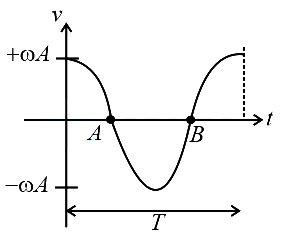
An object undergoing simple harmonic motion takes $0.5 \text{ s}$ to travel from one point of zero velocity to the next such point. The angular frequency of the motion is,
A
$\pi \text{ rad s}^{-1}$
B
$2\pi \text{ rad s}^{-1}$
C
$3\pi \text{ rad s}^{-1}$
D
$\frac{\pi}{2} \text{ rad s}^{-1}$
Solution
(B) In simple harmonic motion $(SHM)$,the velocity of a particle is zero at the extreme positions.
Let the displacement be $x = A \sin(\omega t)$. The velocity is $v = \frac{dx}{dt} = A\omega \cos(\omega t)$.
The velocity is zero when $\cos(\omega t) = 0$,which occurs at $t = \frac{T}{4}, \frac{3T}{4}, \dots$
The time interval between two consecutive points of zero velocity (i.e.,between two extreme positions) is the time taken to travel from one extreme to the other,which is half the time period,$\frac{T}{2}$.
Given,$\frac{T}{2} = 0.5 \text{ s}$.
Therefore,$T = 1 \text{ s}$.
The angular frequency $\omega$ is given by $\omega = \frac{2\pi}{T}$.
Substituting $T = 1 \text{ s}$,we get $\omega = \frac{2\pi}{1} = 2\pi \text{ rad s}^{-1}$.
Let the displacement be $x = A \sin(\omega t)$. The velocity is $v = \frac{dx}{dt} = A\omega \cos(\omega t)$.
The velocity is zero when $\cos(\omega t) = 0$,which occurs at $t = \frac{T}{4}, \frac{3T}{4}, \dots$
The time interval between two consecutive points of zero velocity (i.e.,between two extreme positions) is the time taken to travel from one extreme to the other,which is half the time period,$\frac{T}{2}$.
Given,$\frac{T}{2} = 0.5 \text{ s}$.
Therefore,$T = 1 \text{ s}$.
The angular frequency $\omega$ is given by $\omega = \frac{2\pi}{T}$.
Substituting $T = 1 \text{ s}$,we get $\omega = \frac{2\pi}{1} = 2\pi \text{ rad s}^{-1}$.
0 likes
View Solution154
MediumMCQ
$A$ particle executing simple harmonic motion has a maximum speed of $40 \,ms^{-1}$ and maximum acceleration of $60 \,ms^{-2}$. The period of oscillation is
A
$\frac{4 \pi}{3} \,s$
B
$\frac{\pi}{2} \,s$
C
$2 \pi \,s$
D
$\frac{1}{\pi} \,s$
Solution
(A) Given,maximum speed of $SHM$ is $v_{\max} = A\omega = 40 \,ms^{-1}$ ... $(i)$
Maximum acceleration of $SHM$ is $a_{\max} = A\omega^2 = 60 \,ms^{-2}$ ... (ii)
Dividing Eq. (ii) by Eq. $(i)$,we get:
$\frac{A\omega^2}{A\omega} = \frac{60}{40}$
$\omega = 1.5 \,rad/s = \frac{3}{2} \,rad/s$
We know that the time period $T$ is related to angular frequency $\omega$ by the formula:
$T = \frac{2\pi}{\omega}$
Substituting the value of $\omega$:
$T = \frac{2\pi}{3/2} = \frac{4\pi}{3} \,s$
Hence,the time period of the oscillation is $\frac{4\pi}{3} \,s$.
Maximum acceleration of $SHM$ is $a_{\max} = A\omega^2 = 60 \,ms^{-2}$ ... (ii)
Dividing Eq. (ii) by Eq. $(i)$,we get:
$\frac{A\omega^2}{A\omega} = \frac{60}{40}$
$\omega = 1.5 \,rad/s = \frac{3}{2} \,rad/s$
We know that the time period $T$ is related to angular frequency $\omega$ by the formula:
$T = \frac{2\pi}{\omega}$
Substituting the value of $\omega$:
$T = \frac{2\pi}{3/2} = \frac{4\pi}{3} \,s$
Hence,the time period of the oscillation is $\frac{4\pi}{3} \,s$.
0 likes
View Solution155
EasyMCQ
The maximum velocity of a particle performing simple harmonic motion is $6.28 \text{ cm s}^{-1}$. If the length of its path is $8 \text{ cm}$, then what is its period (in $\text{ s}$)?
A
$2$
B
$4$
C
$3$
D
$1$
Solution
(B) In simple harmonic motion $(SHM)$, the maximum velocity is given by $v_{\text{max}} = \omega a$, where $\omega$ is the angular frequency and $a$ is the amplitude.
Given, $v_{\text{max}} = 6.28 \text{ cm s}^{-1}$.
The length of the path is the total distance covered by the particle in one oscillation, which is equal to $2a$.
So, $2a = 8 \text{ cm}$, which implies $a = 4 \text{ cm}$.
Using the formula $v_{\text{max}} = \omega a$, we have $\omega = \frac{v_{\text{max}}}{a} = \frac{6.28}{4} \text{ rad s}^{-1}$.
Since $\omega = \frac{2\pi}{T}$, we can write $\frac{2\pi}{T} = \frac{6.28}{4}$.
Substituting $\pi \approx 3.14$, we get $\frac{2 \times 3.14}{T} = \frac{6.28}{4}$.
$\frac{6.28}{T} = \frac{6.28}{4}$.
Therefore, $T = 4 \text{ s}$.
Given, $v_{\text{max}} = 6.28 \text{ cm s}^{-1}$.
The length of the path is the total distance covered by the particle in one oscillation, which is equal to $2a$.
So, $2a = 8 \text{ cm}$, which implies $a = 4 \text{ cm}$.
Using the formula $v_{\text{max}} = \omega a$, we have $\omega = \frac{v_{\text{max}}}{a} = \frac{6.28}{4} \text{ rad s}^{-1}$.
Since $\omega = \frac{2\pi}{T}$, we can write $\frac{2\pi}{T} = \frac{6.28}{4}$.
Substituting $\pi \approx 3.14$, we get $\frac{2 \times 3.14}{T} = \frac{6.28}{4}$.
$\frac{6.28}{T} = \frac{6.28}{4}$.
Therefore, $T = 4 \text{ s}$.
0 likes
View Solution156
DifficultMCQ
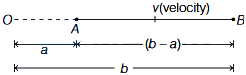
$A$ particle executing $SHM$ along a straight line has zero velocity at points $A$ and $B$ whose distances from $O$ on the same line $OAB$ are $a$ and $b$,respectively. If the velocity at the midpoint between $A$ and $B$ is $v$,then its time period is
A
$\frac{\pi(b+a)}{v}$
B
$\pi\left(\frac{b-a}{v}\right)$
C
$\left(\frac{b+a}{2v}\right)$
D
$\left(\frac{b-a}{2v}\right)$
Solution
(B) The points $A$ and $B$ are the extreme positions of the $SHM$ because the velocity is zero at these points.
The distance between the extreme positions $A$ and $B$ is $L = b - a$.
The amplitude $A_{amp}$ of the $SHM$ is half the distance between the extreme positions:
$A_{amp} = \frac{b - a}{2}$
The equilibrium position (mean position) is at the midpoint of $A$ and $B$,which is at a distance of $\frac{a + b}{2}$ from $O$.
The velocity of a particle in $SHM$ at a displacement $x$ from the mean position is given by $v = \omega \sqrt{A_{amp}^2 - x^2}$.
At the midpoint between $A$ and $B$,the particle is at the mean position,so the displacement $x = 0$.
Thus,the velocity at the midpoint is the maximum velocity $v_{max} = \omega A_{amp}$.
Given $v_{max} = v$,we have $v = \omega \left(\frac{b - a}{2}\right)$.
Solving for angular frequency $\omega$:
$\omega = \frac{2v}{b - a}$
The time period $T$ is given by:
$T = \frac{2\pi}{\omega} = \frac{2\pi}{\left(\frac{2v}{b - a}\right)} = \frac{\pi(b - a)}{v}$
The distance between the extreme positions $A$ and $B$ is $L = b - a$.
The amplitude $A_{amp}$ of the $SHM$ is half the distance between the extreme positions:
$A_{amp} = \frac{b - a}{2}$
The equilibrium position (mean position) is at the midpoint of $A$ and $B$,which is at a distance of $\frac{a + b}{2}$ from $O$.
The velocity of a particle in $SHM$ at a displacement $x$ from the mean position is given by $v = \omega \sqrt{A_{amp}^2 - x^2}$.
At the midpoint between $A$ and $B$,the particle is at the mean position,so the displacement $x = 0$.
Thus,the velocity at the midpoint is the maximum velocity $v_{max} = \omega A_{amp}$.
Given $v_{max} = v$,we have $v = \omega \left(\frac{b - a}{2}\right)$.
Solving for angular frequency $\omega$:
$\omega = \frac{2v}{b - a}$
The time period $T$ is given by:
$T = \frac{2\pi}{\omega} = \frac{2\pi}{\left(\frac{2v}{b - a}\right)} = \frac{\pi(b - a)}{v}$
0 likes
View Solution157
MediumMCQ
$A$ particle is executing simple harmonic motion. If the force acting on the particle at a position is $86.6 \%$ of the maximum force on it,then the ratio of its velocity at that point and its maximum velocity is
A
$1: \sqrt{3}$
B
$1: 2$
C
$\sqrt{3}: 2$
D
$1: 3$
Solution
(B) In simple harmonic motion,the force is given by $F = -kx = -m\omega^2 x$. The maximum force is $F_{max} = m\omega^2 A$.
Given that the force at a position $x$ is $86.6 \%$ of $F_{max}$,we have $F = 0.866 F_{max} = \frac{\sqrt{3}}{2} F_{max}$.
Since $F = m\omega^2 x$ and $F_{max} = m\omega^2 A$,we get $x = \frac{\sqrt{3}}{2} A$.
The velocity of a particle in $SHM$ at position $x$ is $v = \omega \sqrt{A^2 - x^2}$.
Substituting $x = \frac{\sqrt{3}}{2} A$,we get $v = \omega \sqrt{A^2 - (\frac{\sqrt{3}}{2} A)^2} = \omega \sqrt{A^2 - \frac{3}{4} A^2} = \omega \sqrt{\frac{1}{4} A^2} = \frac{1}{2} \omega A$.
The maximum velocity is $v_{max} = \omega A$.
Therefore,the ratio of velocity at that point to the maximum velocity is $\frac{v}{v_{max}} = \frac{\frac{1}{2} \omega A}{\omega A} = \frac{1}{2}$.
Given that the force at a position $x$ is $86.6 \%$ of $F_{max}$,we have $F = 0.866 F_{max} = \frac{\sqrt{3}}{2} F_{max}$.
Since $F = m\omega^2 x$ and $F_{max} = m\omega^2 A$,we get $x = \frac{\sqrt{3}}{2} A$.
The velocity of a particle in $SHM$ at position $x$ is $v = \omega \sqrt{A^2 - x^2}$.
Substituting $x = \frac{\sqrt{3}}{2} A$,we get $v = \omega \sqrt{A^2 - (\frac{\sqrt{3}}{2} A)^2} = \omega \sqrt{A^2 - \frac{3}{4} A^2} = \omega \sqrt{\frac{1}{4} A^2} = \frac{1}{2} \omega A$.
The maximum velocity is $v_{max} = \omega A$.
Therefore,the ratio of velocity at that point to the maximum velocity is $\frac{v}{v_{max}} = \frac{\frac{1}{2} \omega A}{\omega A} = \frac{1}{2}$.
0 likes
View Solution158
MediumMCQ
The force ($F$ in newton) acting on a particle of mass $90 \text{ g}$ executing simple harmonic motion is given by $F + 0.04 \pi^2 y = 0$, where $y$ is the displacement of the particle in meters. If the amplitude of the particle is $\frac{6}{\pi} \text{ m}$, then the maximum velocity of the particle is: (in $\text{ m/s}$)
A
$6$
B
$2$
C
$8$
D
$4$
Solution
(D) The equation of motion for a particle in simple harmonic motion is $F = -ky$. Given $F + 0.04 \pi^2 y = 0$, we have $F = -0.04 \pi^2 y$. Comparing this with $F = -ky$, the force constant $k = 0.04 \pi^2 \text{ N/m}$.
The mass of the particle is $m = 90 \text{ g} = 0.09 \text{ kg}$.
The angular frequency $\omega$ is given by $\omega = \sqrt{\frac{k}{m}} = \sqrt{\frac{0.04 \pi^2}{0.09}} = \sqrt{\frac{4 \pi^2}{9}} = \frac{2 \pi}{3} \text{ rad/s}$.
The amplitude $A = \frac{6}{\pi} \text{ m}$.
The maximum velocity $v_{\text{max}}$ is given by $v_{\text{max}} = A \omega$.
Substituting the values, $v_{\text{max}} = \left( \frac{6}{\pi} \right) \times \left( \frac{2 \pi}{3} \right) = 4 \text{ m/s}$.
The mass of the particle is $m = 90 \text{ g} = 0.09 \text{ kg}$.
The angular frequency $\omega$ is given by $\omega = \sqrt{\frac{k}{m}} = \sqrt{\frac{0.04 \pi^2}{0.09}} = \sqrt{\frac{4 \pi^2}{9}} = \frac{2 \pi}{3} \text{ rad/s}$.
The amplitude $A = \frac{6}{\pi} \text{ m}$.
The maximum velocity $v_{\text{max}}$ is given by $v_{\text{max}} = A \omega$.
Substituting the values, $v_{\text{max}} = \left( \frac{6}{\pi} \right) \times \left( \frac{2 \pi}{3} \right) = 4 \text{ m/s}$.
0 likes
View Solution159
EasyMCQ
$A$ particle performs simple harmonic motion with a time period of $16 \ s$. At a time $t=2 \ s$,the particle passes through the origin and at $t=4 \ s$ its velocity is $4 \ m/s$. The amplitude of the motion is
A
$\frac{32 \pi}{\sqrt{2}}$
B
$\frac{32 \sqrt{2}}{\pi}$
C
$32 \pi$
D
$32$
Solution
(B) The equation of motion for a particle in $SHM$ passing through the origin at $t=2 \ s$ is $x(t) = A \sin(\omega(t - 2))$.
Given $T = 16 \ s$,the angular frequency is $\omega = \frac{2 \pi}{T} = \frac{2 \pi}{16} = \frac{\pi}{8} \ rad/s$.
The velocity is $v(t) = \frac{dx}{dt} = A \omega \cos(\omega(t - 2))$.
At $t = 4 \ s$,$v = 4 \ m/s$:
$4 = A \left(\frac{\pi}{8}\right) \cos\left(\frac{\pi}{8}(4 - 2)\right)$
$4 = A \left(\frac{\pi}{8}\right) \cos\left(\frac{\pi}{4}\right)$
$4 = A \left(\frac{\pi}{8}\right) \left(\frac{1}{\sqrt{2}}\right)$
$A = \frac{4 \times 8 \times \sqrt{2}}{\pi} = \frac{32 \sqrt{2}}{\pi} \ m$.
Given $T = 16 \ s$,the angular frequency is $\omega = \frac{2 \pi}{T} = \frac{2 \pi}{16} = \frac{\pi}{8} \ rad/s$.
The velocity is $v(t) = \frac{dx}{dt} = A \omega \cos(\omega(t - 2))$.
At $t = 4 \ s$,$v = 4 \ m/s$:
$4 = A \left(\frac{\pi}{8}\right) \cos\left(\frac{\pi}{8}(4 - 2)\right)$
$4 = A \left(\frac{\pi}{8}\right) \cos\left(\frac{\pi}{4}\right)$
$4 = A \left(\frac{\pi}{8}\right) \left(\frac{1}{\sqrt{2}}\right)$
$A = \frac{4 \times 8 \times \sqrt{2}}{\pi} = \frac{32 \sqrt{2}}{\pi} \ m$.
0 likes
View Solution160
DifficultMCQ
$A$ particle is executing simple harmonic motion $\text{(S.H.M.).}$ Its acceleration at a distance of $1 \ cm$ from the mean position is $3 \ cm s^{-2}$. If its velocity is $6 \ cm s^{-1}$ when it is at a distance of $2 \ cm$ from its mean position,then the amplitude of $\text{S.H.M.}$ is,
A
$5 \ cm$
B
$4 \ cm$
C
$2 \sqrt{3} \ cm$
D
$3 \sqrt{2} \ cm$
Solution
(B) The acceleration of a particle in $\text{S.H.M.}$ is given by $a = -\omega^2 x$. Taking the magnitude,$|a| = \omega^2 |x|$.
Given $x = 1 \ cm$ and $a = 3 \ cm s^{-2}$,we have $3 = \omega^2 (1)$,which implies $\omega^2 = 3 \ s^{-2}$.
The velocity of a particle in $\text{S.H.M.}$ is given by $v = \omega \sqrt{A^2 - x^2}$.
Given $v = 6 \ cm s^{-1}$ at $x = 2 \ cm$,we substitute the values:
$6 = \sqrt{3} \sqrt{A^2 - 2^2}$.
Squaring both sides:
$36 = 3 (A^2 - 4)$.
Dividing by $3$:
$12 = A^2 - 4$.
$A^2 = 16$.
$A = 4 \ cm$.
Given $x = 1 \ cm$ and $a = 3 \ cm s^{-2}$,we have $3 = \omega^2 (1)$,which implies $\omega^2 = 3 \ s^{-2}$.
The velocity of a particle in $\text{S.H.M.}$ is given by $v = \omega \sqrt{A^2 - x^2}$.
Given $v = 6 \ cm s^{-1}$ at $x = 2 \ cm$,we substitute the values:
$6 = \sqrt{3} \sqrt{A^2 - 2^2}$.
Squaring both sides:
$36 = 3 (A^2 - 4)$.
Dividing by $3$:
$12 = A^2 - 4$.
$A^2 = 16$.
$A = 4 \ cm$.
0 likes
View Solution161
MediumMCQ
$A$ particle is exhibiting simple harmonic motion and has its displacement $x$ and velocity $v$ related as $4v^2 = 25 - x^2$. The time period of the $SHM$ is
A
$\pi \ s$
B
$2\pi \ s$
C
$3\pi \ s$
D
$4\pi \ s$
Solution
(D) Given the equation relating velocity $v$ and displacement $x$ for a particle in simple harmonic motion $(SHM)$:
$4v^2 = 25 - x^2$
Dividing by $4$,we get:
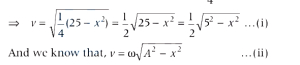
$v^2 = \frac{1}{4}(25 - x^2) = \frac{1}{4}(5^2 - x^2)$
Taking the square root on both sides:
$v = \frac{1}{2}\sqrt{5^2 - x^2} \quad ... (i)$
We know that the standard equation for velocity in $SHM$ is:
$v = \omega\sqrt{A^2 - x^2} \quad ... (ii)$
Comparing equations $(i)$ and $(ii)$,we find:
Angular frequency $\omega = \frac{1}{2} \ rad/s$
Amplitude $A = 5 \ m$
The time period $T$ is given by the formula:
$T = \frac{2\pi}{\omega}$
Substituting the value of $\omega$:
$T = \frac{2\pi}{1/2} = 4\pi \ s$
$4v^2 = 25 - x^2$
Dividing by $4$,we get:
$v^2 = \frac{1}{4}(25 - x^2) = \frac{1}{4}(5^2 - x^2)$
Taking the square root on both sides:
$v = \frac{1}{2}\sqrt{5^2 - x^2} \quad ... (i)$
We know that the standard equation for velocity in $SHM$ is:
$v = \omega\sqrt{A^2 - x^2} \quad ... (ii)$
Comparing equations $(i)$ and $(ii)$,we find:
Angular frequency $\omega = \frac{1}{2} \ rad/s$
Amplitude $A = 5 \ m$
The time period $T$ is given by the formula:
$T = \frac{2\pi}{\omega}$
Substituting the value of $\omega$:
$T = \frac{2\pi}{1/2} = 4\pi \ s$
0 likes
View Solution162
DifficultMCQ
Two particles $P$ and $Q$ start from the origin and execute simple harmonic motion along the $X$-axis with the same amplitude but with periods $3 \ s$ and $6 \ s$,respectively. The ratio of the velocities of $P$ and $Q$ when they meet is
A
$1: 2$
B
$2: 1$
C
$2: 3$
D
$3: 2$
Solution
(B) Let the amplitude be $A$. The angular frequencies are $\omega_1 = \frac{2\pi}{T_1} = \frac{2\pi}{3}$ and $\omega_2 = \frac{2\pi}{T_2} = \frac{2\pi}{6} = \frac{\pi}{3}$.
Since both start from the origin at $t=0$,their displacements are $x_1 = A \sin(\omega_1 t)$ and $x_2 = A \sin(\omega_2 t)$.
When they meet,$x_1 = x_2$,so $\sin(\omega_1 t) = \sin(\omega_2 t)$.
For the first meeting after $t=0$,$\omega_1 t = \pi - \omega_2 t$,which gives $t = \frac{\pi}{\omega_1 + \omega_2} = \frac{\pi}{\frac{2\pi}{3} + \frac{\pi}{3}} = 1 \ s$.
The velocity of a particle in $SHM$ is $v = A\omega \cos(\omega t)$.
The ratio of velocities is $\frac{v_P}{v_Q} = \frac{A\omega_1 \cos(\omega_1 t)}{A\omega_2 \cos(\omega_2 t)} = \frac{(2\pi/3) \cos(2\pi/3 \cdot 1)}{(\pi/3) \cos(\pi/3 \cdot 1)} = \frac{2 \cos(120^\circ)}{\cos(60^\circ)} = \frac{2(-1/2)}{1/2} = -2$.
The magnitude ratio is $2:1$.
Since both start from the origin at $t=0$,their displacements are $x_1 = A \sin(\omega_1 t)$ and $x_2 = A \sin(\omega_2 t)$.
When they meet,$x_1 = x_2$,so $\sin(\omega_1 t) = \sin(\omega_2 t)$.
For the first meeting after $t=0$,$\omega_1 t = \pi - \omega_2 t$,which gives $t = \frac{\pi}{\omega_1 + \omega_2} = \frac{\pi}{\frac{2\pi}{3} + \frac{\pi}{3}} = 1 \ s$.
The velocity of a particle in $SHM$ is $v = A\omega \cos(\omega t)$.
The ratio of velocities is $\frac{v_P}{v_Q} = \frac{A\omega_1 \cos(\omega_1 t)}{A\omega_2 \cos(\omega_2 t)} = \frac{(2\pi/3) \cos(2\pi/3 \cdot 1)}{(\pi/3) \cos(\pi/3 \cdot 1)} = \frac{2 \cos(120^\circ)}{\cos(60^\circ)} = \frac{2(-1/2)}{1/2} = -2$.
The magnitude ratio is $2:1$.
0 likes
View Solution163
EasyMCQ
$A$ particle is executing simple harmonic motion in one-dimension. If the amplitude of oscillations is $0.2 \,cm$ and if its velocity at the mean position is $5 \,m/s$, then the angular frequency of the oscillation is
A
$1000 \,rad/s$
B
$1500 \,rad/s$
C
$2000 \,rad/s$
D
$2500 \,rad/s$
Solution
(D) Given, amplitude, $A = 0.2 \,cm = 2 \times 10^{-3} \,m$.
Velocity at the mean position in simple harmonic motion is the maximum velocity, $v_{\text{max}} = 5 \,m/s$.
We know that the maximum velocity is given by the formula, $v_{\text{max}} = A \omega$.
Therefore, the angular frequency $\omega$ is given by, $\omega = \frac{v_{\text{max}}}{A}$.
Substituting the values, $\omega = \frac{5}{2 \times 10^{-3}} = 2.5 \times 10^3 = 2500 \,rad/s$.
Velocity at the mean position in simple harmonic motion is the maximum velocity, $v_{\text{max}} = 5 \,m/s$.
We know that the maximum velocity is given by the formula, $v_{\text{max}} = A \omega$.
Therefore, the angular frequency $\omega$ is given by, $\omega = \frac{v_{\text{max}}}{A}$.
Substituting the values, $\omega = \frac{5}{2 \times 10^{-3}} = 2.5 \times 10^3 = 2500 \,rad/s$.
0 likes
View Solution164
DifficultMCQ
The time period of a particle in simple harmonic motion is $8 \ s$. At $t=0$,it is at the mean position. The ratio of the distances travelled by it in the first and second seconds is
A
$\frac{1}{2}$
B
$\frac{1}{\sqrt{2}}$
C
$\frac{1}{\sqrt{2}-1}$
D
$\frac{1}{\sqrt{3}}$
Solution
(C) The equation for the position of a particle in simple harmonic motion starting from the mean position is $y(t) = A \sin(\omega t)$,where $\omega = \frac{2\pi}{T} = \frac{2\pi}{8} = \frac{\pi}{4} \ rad/s$.
The distance travelled in the first second ($t=0$ to $t=1$) is $y_1 = A \sin(\frac{\pi}{4} \times 1) = A \times \frac{1}{\sqrt{2}} = \frac{A}{\sqrt{2}}$.
The position at $t=2$ seconds is $y(2) = A \sin(\frac{\pi}{4} \times 2) = A \sin(\frac{\pi}{2}) = A$.
The distance travelled in the second second ($t=1$ to $t=2$) is $y_2 = y(2) - y(1) = A - \frac{A}{\sqrt{2}} = A(1 - \frac{1}{\sqrt{2}})$.
The ratio of the distances is $\frac{y_1}{y_2} = \frac{A/\sqrt{2}}{A(1 - 1/\sqrt{2})} = \frac{1/\sqrt{2}}{(\sqrt{2}-1)/\sqrt{2}} = \frac{1}{\sqrt{2}-1}$.
The distance travelled in the first second ($t=0$ to $t=1$) is $y_1 = A \sin(\frac{\pi}{4} \times 1) = A \times \frac{1}{\sqrt{2}} = \frac{A}{\sqrt{2}}$.
The position at $t=2$ seconds is $y(2) = A \sin(\frac{\pi}{4} \times 2) = A \sin(\frac{\pi}{2}) = A$.
The distance travelled in the second second ($t=1$ to $t=2$) is $y_2 = y(2) - y(1) = A - \frac{A}{\sqrt{2}} = A(1 - \frac{1}{\sqrt{2}})$.
The ratio of the distances is $\frac{y_1}{y_2} = \frac{A/\sqrt{2}}{A(1 - 1/\sqrt{2})} = \frac{1/\sqrt{2}}{(\sqrt{2}-1)/\sqrt{2}} = \frac{1}{\sqrt{2}-1}$.
0 likes
View Solution165
MediumMCQ
In case of a simple harmonic motion,if the velocity is plotted along the $X$-axis and the displacement (from the equilibrium position) is plotted along the $Y$-axis,the resultant curve is an ellipse with the ratio:
Major axis (along $X$) $= 20 \pi \times$ Minor axis (along $Y$).
What is the frequency of the simple harmonic motion?
Major axis (along $X$) $= 20 \pi \times$ Minor axis (along $Y$).
What is the frequency of the simple harmonic motion?
A
$100 \ Hz$
B
$20 \ Hz$
C
$10 \ Hz$
D
$\frac{1}{10} \ Hz$
Solution
(C) For a simple harmonic motion,the displacement is given by $y = A \sin(\omega t)$ and velocity is $v = \frac{dy}{dt} = A \omega \cos(\omega t)$.
Rearranging these,we get $\frac{y}{A} = \sin(\omega t)$ and $\frac{v}{A \omega} = \cos(\omega t)$.
Squaring and adding,we get $\frac{v^2}{(A \omega)^2} + \frac{y^2}{A^2} = 1$,which represents an ellipse.
The major axis along the $X$-axis (velocity) is $2A \omega$ and the minor axis along the $Y$-axis (displacement) is $2A$.
The ratio of the major axis to the minor axis is $\frac{2A \omega}{2A} = \omega$.
Given that the ratio is $20 \pi$,we have $\omega = 20 \pi$.
Since $\omega = 2 \pi f$,we have $2 \pi f = 20 \pi$.
Therefore,$f = 10 \ Hz$.
Rearranging these,we get $\frac{y}{A} = \sin(\omega t)$ and $\frac{v}{A \omega} = \cos(\omega t)$.
Squaring and adding,we get $\frac{v^2}{(A \omega)^2} + \frac{y^2}{A^2} = 1$,which represents an ellipse.
The major axis along the $X$-axis (velocity) is $2A \omega$ and the minor axis along the $Y$-axis (displacement) is $2A$.
The ratio of the major axis to the minor axis is $\frac{2A \omega}{2A} = \omega$.
Given that the ratio is $20 \pi$,we have $\omega = 20 \pi$.
Since $\omega = 2 \pi f$,we have $2 \pi f = 20 \pi$.
Therefore,$f = 10 \ Hz$.
0 likes
View Solution166
MediumMCQ
The velocity of a particle executing a simple harmonic motion is $13 \ m/s$,when its distance from the equilibrium position $(Q)$ is $3 \ m$ and its velocity is $12 \ m/s$,when it is $5 \ m$ away from $Q$. The frequency of the simple harmonic motion is
A
$\frac{5 \pi}{8}$
B
$\frac{5}{8 \pi}$
C
$\frac{8 \pi}{5}$
D
$\frac{8}{5 \pi}$
Solution
(B) The speed of a particle executing simple harmonic motion is given by $v = \omega \sqrt{a^2 - x^2}$,where $a$ is the amplitude,$\omega$ is the angular frequency,and $x$ is the displacement from the equilibrium position.
Squaring both sides,we get $v^2 = \omega^2 (a^2 - x^2)$.
For the two given cases:
$v_1^2 = \omega^2 (a^2 - x_1^2) \implies 13^2 = \omega^2 (a^2 - 3^2) \implies 169 = \omega^2 (a^2 - 9) \quad (1)$
$v_2^2 = \omega^2 (a^2 - x_2^2) \implies 12^2 = \omega^2 (a^2 - 5^2) \implies 144 = \omega^2 (a^2 - 25) \quad (2)$
Subtracting equation $(2)$ from $(1)$:
$169 - 144 = \omega^2 (a^2 - 9 - a^2 + 25)$
$25 = \omega^2 (16)$
$\omega^2 = \frac{25}{16} \implies \omega = \frac{5}{4} \ rad/s$.
The frequency $f$ is related to angular frequency by $\omega = 2 \pi f$.
Therefore,$f = \frac{\omega}{2 \pi} = \frac{5/4}{2 \pi} = \frac{5}{8 \pi} \ Hz$.
Squaring both sides,we get $v^2 = \omega^2 (a^2 - x^2)$.
For the two given cases:
$v_1^2 = \omega^2 (a^2 - x_1^2) \implies 13^2 = \omega^2 (a^2 - 3^2) \implies 169 = \omega^2 (a^2 - 9) \quad (1)$
$v_2^2 = \omega^2 (a^2 - x_2^2) \implies 12^2 = \omega^2 (a^2 - 5^2) \implies 144 = \omega^2 (a^2 - 25) \quad (2)$
Subtracting equation $(2)$ from $(1)$:
$169 - 144 = \omega^2 (a^2 - 9 - a^2 + 25)$
$25 = \omega^2 (16)$
$\omega^2 = \frac{25}{16} \implies \omega = \frac{5}{4} \ rad/s$.
The frequency $f$ is related to angular frequency by $\omega = 2 \pi f$.
Therefore,$f = \frac{\omega}{2 \pi} = \frac{5/4}{2 \pi} = \frac{5}{8 \pi} \ Hz$.
0 likes
View Solution167
MediumMCQ
The kinetic energy of a simple harmonic oscillator is oscillating with an angular frequency of $176 \ rad/s$. The frequency of this simple harmonic oscillator is . . . . . . $Hz$. $\left[\text{take } \pi=\frac{22}{7}\right]$
A
$14$
B
$88$
C
$28$
D
$176$
Solution
(A) The angular frequency of the kinetic energy oscillation is given as $\omega_k = 176 \ rad/s$.
For a simple harmonic oscillator,the kinetic energy $K = \frac{1}{2} m v^2 = \frac{1}{2} m \omega^2 A^2 \sin^2(\omega t + \phi)$.
Using the identity $\sin^2 \theta = \frac{1 - \cos(2\theta)}{2}$,we get $K = \frac{1}{4} m \omega^2 A^2 (1 - \cos(2\omega t + 2\phi))$.
This shows that the kinetic energy oscillates with an angular frequency $\omega_k = 2\omega$,where $\omega$ is the angular frequency of the oscillator.
Given $\omega_k = 176 \ rad/s$,we have $2\omega = 176 \ rad/s$,which implies $\omega = 88 \ rad/s$.
The frequency of the oscillator is $f = \frac{\omega}{2\pi} = \frac{88}{2 \times (22/7)} = \frac{88 \times 7}{44} = 2 \times 7 = 14 \ Hz$.
For a simple harmonic oscillator,the kinetic energy $K = \frac{1}{2} m v^2 = \frac{1}{2} m \omega^2 A^2 \sin^2(\omega t + \phi)$.
Using the identity $\sin^2 \theta = \frac{1 - \cos(2\theta)}{2}$,we get $K = \frac{1}{4} m \omega^2 A^2 (1 - \cos(2\omega t + 2\phi))$.
This shows that the kinetic energy oscillates with an angular frequency $\omega_k = 2\omega$,where $\omega$ is the angular frequency of the oscillator.
Given $\omega_k = 176 \ rad/s$,we have $2\omega = 176 \ rad/s$,which implies $\omega = 88 \ rad/s$.
The frequency of the oscillator is $f = \frac{\omega}{2\pi} = \frac{88}{2 \times (22/7)} = \frac{88 \times 7}{44} = 2 \times 7 = 14 \ Hz$.
0 likes
View Solution168
DifficultMCQ
The velocity of a particle executing simple harmonic motion along the $x$-axis is described by the equation $v^2 = 50 - x^2$,where $x$ represents displacement. If the time period of the motion is $\frac{x}{7} \ \text{s}$,the value of $x$ is . . . . . . .
A
$44$
B
$22$
C
$11$
D
$5$
Solution
(A) The standard equation for velocity in simple harmonic motion $(SHM)$ is $v^2 = \omega^2 (A^2 - x^2)$,where $\omega$ is the angular frequency and $A$ is the amplitude.
Given the equation $v^2 = 50 - x^2$,we can rewrite it as $v^2 = 1(50 - x^2)$.
Comparing this with the standard equation,we get $\omega^2 = 1$,which implies $\omega = 1 \ \text{rad/s}$.
The time period $T$ is given by $T = \frac{2\pi}{\omega} = \frac{2\pi}{1} = 2\pi \ \text{s}$.
Using the approximation $\pi \approx \frac{22}{7}$,we get $T = 2 \times \frac{22}{7} = \frac{44}{7} \ \text{s}$.
According to the problem,$T = \frac{x}{7} \ \text{s}$.
Equating the two expressions for $T$: $\frac{x}{7} = \frac{44}{7}$.
Therefore,$x = 44$.
Given the equation $v^2 = 50 - x^2$,we can rewrite it as $v^2 = 1(50 - x^2)$.
Comparing this with the standard equation,we get $\omega^2 = 1$,which implies $\omega = 1 \ \text{rad/s}$.
The time period $T$ is given by $T = \frac{2\pi}{\omega} = \frac{2\pi}{1} = 2\pi \ \text{s}$.
Using the approximation $\pi \approx \frac{22}{7}$,we get $T = 2 \times \frac{22}{7} = \frac{44}{7} \ \text{s}$.
According to the problem,$T = \frac{x}{7} \ \text{s}$.
Equating the two expressions for $T$: $\frac{x}{7} = \frac{44}{7}$.
Therefore,$x = 44$.
0 likes
View SolutionOscillations — Velocity of Simple Harmonic Motion · Frequently Asked Questions
1Are these Oscillations questions useful for JEE and NEET?
Yes. All questions in this section are mapped to JEE Main and NEET exam patterns. Previous year questions from JEE Main, NEET, GUJCET and state-level exams are included with full solutions.
2Can I switch to Hindi or Gujarati for these questions?
Yes. Use the language tabs in the hero section or the sidebar to view the same questions and solutions in English, Hindi or Gujarati.
3How do I generate a question paper from this subtopic?
Use the Vedclass Exam Paper Generator — select the chapter and subtopic, set difficulty, and generate Sets A, B, C, D automatically. First 3 chapters of every subject are free.
Vedclass Products
For Students
Vedclass Test Series
Mock tests in real JEE/NEET style with performance analysis. 5-day free trial.
Start Free TrialFor Teachers
Exam Paper Generator
Generate Set A/B/C/D papers from this chapter in 2 minutes. 3 chapters free.
Try FreeFor Institutes
Online Exam Module
Live online exams with unlimited students, 360° analytics & white-label branding.
See DemoFor Teachers & Institutes
Generate a Oscillations Exam Paper in 2 Minutes
Select subtopic & difficulty — Sets A, B, C, D auto-generated with No Repeat logic.
First 3 chapters of every subject are free — no payment required.