
A English
Static and Limiting Friction and Minimum Force Required to Move Questions in English
Class 11 Physics · Newton's Laws of Motion and Friction · Static and Limiting Friction and Minimum Force Required to Move
97+
Questions
English
Language
100%
With Solutions
Showing 46 of 97 questions in English
51
Difficult
How does static friction oppose motion? On which factors does the value of the coefficient of friction depend?
Solution
(N/A) Static friction opposes motion by acting as a self-adjusting force that prevents the initiation of relative motion between two surfaces in contact. It acts in a direction opposite to the applied force that tends to cause motion.
The coefficient of friction $(\mu)$ depends on the following factors:
$1$. The nature of the materials of the two surfaces in contact (e.g.,wood on wood,rubber on concrete).
$2$. The condition of the surfaces,such as their roughness or smoothness (degree of polish).
$3$. The presence of lubricants or contaminants between the surfaces.
The coefficient of friction $(\mu)$ depends on the following factors:
$1$. The nature of the materials of the two surfaces in contact (e.g.,wood on wood,rubber on concrete).
$2$. The condition of the surfaces,such as their roughness or smoothness (degree of polish).
$3$. The presence of lubricants or contaminants between the surfaces.
0 likes
View Solution52
Easy
Write the unit of the coefficient of static friction.
Solution
(NONE) The coefficient of static friction,denoted by $\mu_s$,is defined by the relation $f_s = \mu_s N$,where $f_s$ is the static frictional force and $N$ is the normal force.
Rearranging this formula,we get $\mu_s = \frac{f_s}{N}$.
Since both $f_s$ and $N$ are forces,they are measured in Newtons $(N)$.
Therefore,the unit of $\mu_s$ is $\frac{N}{N} = 1$.
This means the coefficient of static friction is a dimensionless quantity and has no unit.
Rearranging this formula,we get $\mu_s = \frac{f_s}{N}$.
Since both $f_s$ and $N$ are forces,they are measured in Newtons $(N)$.
Therefore,the unit of $\mu_s$ is $\frac{N}{N} = 1$.
This means the coefficient of static friction is a dimensionless quantity and has no unit.
0 likes
View Solution53
EasyMCQ
Impending relative motion is opposed by which type of friction?
A
Static friction
B
Kinetic friction
C
Rolling friction
D
Fluid friction
Solution
(A) Static friction is the force that opposes the initiation of motion between two surfaces in contact. When an external force is applied to an object but it does not yet move,the friction acting between the surfaces is known as static friction. Specifically,the maximum value of static friction,which occurs just before the object begins to slide,is called limiting friction. Since the question refers to 'impending' relative motion (motion that is about to occur),it is opposed by static friction.
0 likes
View Solution54
MediumMCQ
For a given mass,how does rolling friction compare to static friction and kinetic friction?
A
Rolling friction is much smaller than both static and kinetic friction.
B
Rolling friction is equal to static friction but smaller than kinetic friction.
C
Rolling friction is greater than both static and kinetic friction.
D
Rolling friction is equal to kinetic friction but smaller than static friction.
Solution
(A) Friction is a resistive force that opposes relative motion between surfaces in contact.
Static friction $(f_s)$ is the force that prevents the initiation of motion and is generally the largest among the three types of friction.
Kinetic friction $(f_k)$ acts when an object is sliding over a surface and is typically less than the maximum static friction.
Rolling friction $(f_r)$ occurs when an object rolls over a surface. Due to the minimal area of contact and reduced deformation of surfaces,rolling friction is significantly smaller than both static and kinetic friction.
Therefore,the order of magnitude is $f_s > f_k > f_r$.
Static friction $(f_s)$ is the force that prevents the initiation of motion and is generally the largest among the three types of friction.
Kinetic friction $(f_k)$ acts when an object is sliding over a surface and is typically less than the maximum static friction.
Rolling friction $(f_r)$ occurs when an object rolls over a surface. Due to the minimal area of contact and reduced deformation of surfaces,rolling friction is significantly smaller than both static and kinetic friction.
Therefore,the order of magnitude is $f_s > f_k > f_r$.
0 likes
View Solution55
EasyMCQ
If the mass of an object is doubled,what will be the effect on the coefficient of friction?
A
It will be doubled.
B
It will be halved.
C
It will remain unchanged.
D
It will become four times.
Solution
(C) The coefficient of friction $(\mu)$ will remain unchanged.
The coefficient of friction is a property of the materials in contact and the nature of the surfaces (roughness/smoothness).
It does not depend on the mass of the object or the area of contact. Therefore,changing the mass of the object has no effect on the coefficient of friction.
The coefficient of friction is a property of the materials in contact and the nature of the surfaces (roughness/smoothness).
It does not depend on the mass of the object or the area of contact. Therefore,changing the mass of the object has no effect on the coefficient of friction.
0 likes
View Solution56
MediumMCQ
If the coefficient of friction is $\sqrt{3}$,what is the angle of friction between the two surfaces in contact (in $^{\circ}$)?
A
$30$
B
$45$
C
$60$
D
$90$
Solution
(C) The coefficient of friction $\mu$ is related to the angle of friction $\theta$ by the formula $\mu = \tan \theta$.
Given that $\mu = \sqrt{3}$.
Substituting the value,we get $\sqrt{3} = \tan \theta$.
Therefore,$\theta = \tan^{-1}(\sqrt{3})$.
Since $\tan 60^{\circ} = \sqrt{3}$,the angle of friction is $\theta = 60^{\circ}$.
Given that $\mu = \sqrt{3}$.
Substituting the value,we get $\sqrt{3} = \tan \theta$.
Therefore,$\theta = \tan^{-1}(\sqrt{3})$.
Since $\tan 60^{\circ} = \sqrt{3}$,the angle of friction is $\theta = 60^{\circ}$.
0 likes
View Solution57
MediumMCQ
$A$ wooden block of mass $10\,kg$ is placed on a rough horizontal surface. $A$ force of $49\,N$ is required to pull it. Find the coefficient of friction and the angle of friction.
A
$\mu = 0.5, \theta = 26^{\circ} 34^{\prime}$
B
$\mu = 0.4, \theta = 20^{\circ} 34^{\prime}$
C
$\mu = 0.6, \theta = 30^{\circ} 34^{\prime}$
D
$\mu = 0.5, \theta = 45^{\circ}$
Solution
(A) Given: Mass $m = 10\,kg$,Force $f = 49\,N$,Acceleration due to gravity $g = 9.8\,m/s^2$.
The normal force $N = mg = 10 \times 9.8 = 98\,N$.
The coefficient of friction $\mu$ is given by $\mu = \frac{f}{N}$.
Substituting the values: $\mu = \frac{49}{98} = 0.5$.
The angle of friction $\theta$ is related to the coefficient of friction by $\tan \theta = \mu$.
Therefore,$\tan \theta = 0.5$.
$\theta = \tan^{-1}(0.5) \approx 26^{\circ} 34^{\prime}$.
The normal force $N = mg = 10 \times 9.8 = 98\,N$.
The coefficient of friction $\mu$ is given by $\mu = \frac{f}{N}$.
Substituting the values: $\mu = \frac{49}{98} = 0.5$.
The angle of friction $\theta$ is related to the coefficient of friction by $\tan \theta = \mu$.
Therefore,$\tan \theta = 0.5$.
$\theta = \tan^{-1}(0.5) \approx 26^{\circ} 34^{\prime}$.
0 likes
View Solution58
EasyMCQ
What can be inferred from the relation $f_S \leqslant \mu_S N$?
A
The object is in motion.
B
The object is at rest or on the verge of motion.
C
The object is accelerating.
D
The object is moving with constant velocity.
Solution
(B) The relation $f_S \leqslant \mu_S N$ represents the condition for static friction.
Here,$f_S$ is the static friction force,$\mu_S$ is the coefficient of static friction,and $N$ is the normal force.
This inequality implies that the applied force is not sufficient to overcome the maximum possible static friction (limiting friction).
Therefore,the object remains at rest or is in a state of impending motion.
Here,$f_S$ is the static friction force,$\mu_S$ is the coefficient of static friction,and $N$ is the normal force.
This inequality implies that the applied force is not sufficient to overcome the maximum possible static friction (limiting friction).
Therefore,the object remains at rest or is in a state of impending motion.
0 likes
View Solution59
Medium
Is it possible to jump off a perfectly smooth surface? Why?
Solution
(N/A) No,it is not possible to jump off a perfectly smooth surface.
According to Newton's $3^{rd}$ Law of Motion,for every action,there is an equal and opposite reaction.
To jump,one must exert a force on the surface (action),and the surface must exert an equal and opposite force back on the person (reaction).
$A$ perfectly smooth surface (frictionless) cannot provide the necessary horizontal or static frictional force required to generate the reaction force needed for a jump.
According to Newton's $3^{rd}$ Law of Motion,for every action,there is an equal and opposite reaction.
To jump,one must exert a force on the surface (action),and the surface must exert an equal and opposite force back on the person (reaction).
$A$ perfectly smooth surface (frictionless) cannot provide the necessary horizontal or static frictional force required to generate the reaction force needed for a jump.
0 likes
View Solution60
Medium
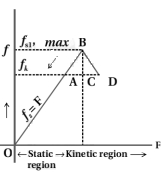
$A$ block placed on a rough horizontal surface is pulled by a horizontal force $F$. Let $f$ be the force applied by the rough surface on the block. Plot a graph of $f$ versus $F$.
Solution
(N/A) The graph of frictional force $f$ versus applied force $F$ is shown in the figure.
$1$. The part $OB$ of the graph represents the static friction region. In this region,the frictional force is a self-adjusting force,meaning $f = F$. The slope of this line is $1$.
$2$. Point $B$ represents the limiting friction,which is the maximum value of static friction $(f_{s,max})$.
$3$. Once the applied force exceeds the limiting friction,the block starts moving. The region $CD$ represents kinetic friction $(f_k)$. Kinetic friction is generally constant and slightly less than the maximum static friction.
$1$. The part $OB$ of the graph represents the static friction region. In this region,the frictional force is a self-adjusting force,meaning $f = F$. The slope of this line is $1$.
$2$. Point $B$ represents the limiting friction,which is the maximum value of static friction $(f_{s,max})$.
$3$. Once the applied force exceeds the limiting friction,the block starts moving. The region $CD$ represents kinetic friction $(f_k)$. Kinetic friction is generally constant and slightly less than the maximum static friction.
0 likes
View Solution61
Medium
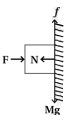
$A$ block of mass $M$ is held against a rough vertical wall by pressing it with a finger. If the coefficient of friction between the block and the wall is $\mu$ and the acceleration due to gravity is $g$,calculate the minimum force required to be applied by the finger to hold the block against the wall.
Solution
(D) Given:
Mass of the block $= M$
Coefficient of friction between the block and the wall $= \mu$
Let $F$ be the force applied by the finger to hold the block against the wall.
The forces acting on the block are:
$1$. Weight $Mg$ acting vertically downwards.
$2$. Applied force $F$ acting horizontally towards the wall.
$3$. Normal reaction $N$ from the wall acting horizontally away from the wall.
$4$. Frictional force $f$ acting vertically upwards to oppose the downward motion.
For the block to be in equilibrium:
Vertical direction: $f = Mg$
Horizontal direction: $F = N$
We know that the maximum frictional force is $f = \mu N$.
Substituting $N = F$,we get $f = \mu F$.
To hold the block,the frictional force must balance the weight:
$\mu F = Mg$
$F = \frac{Mg}{\mu}$
Mass of the block $= M$
Coefficient of friction between the block and the wall $= \mu$
Let $F$ be the force applied by the finger to hold the block against the wall.
The forces acting on the block are:
$1$. Weight $Mg$ acting vertically downwards.
$2$. Applied force $F$ acting horizontally towards the wall.
$3$. Normal reaction $N$ from the wall acting horizontally away from the wall.
$4$. Frictional force $f$ acting vertically upwards to oppose the downward motion.
For the block to be in equilibrium:
Vertical direction: $f = Mg$
Horizontal direction: $F = N$
We know that the maximum frictional force is $f = \mu N$.
Substituting $N = F$,we get $f = \mu F$.
To hold the block,the frictional force must balance the weight:
$\mu F = Mg$
$F = \frac{Mg}{\mu}$
0 likes
View Solution62
EasyMCQ
Which of the following forces does not depend on the velocity: the frictional force between the contact surfaces of two solids or the viscous force?
A
Frictional force
B
Viscous force
C
Both depend on velocity
D
Neither depends on velocity
Solution
(A) The frictional force between the contact surfaces of two solids is independent of the relative velocity of the surfaces,provided the velocity is not extremely high.
In contrast,the viscous force (fluid friction) is directly dependent on the velocity gradient and the velocity of the fluid layers.
Therefore,the frictional force between two solids does not depend on velocity.
In contrast,the viscous force (fluid friction) is directly dependent on the velocity gradient and the velocity of the fluid layers.
Therefore,the frictional force between two solids does not depend on velocity.
0 likes
View Solution63
EasyMCQ
Why is the coefficient of static friction considered a property of the surfaces in contact?
A
It depends on the normal force applied.
B
It depends on the nature of the materials and the roughness of the surfaces in contact.
C
It depends on the area of contact between the surfaces.
D
It depends on the velocity of the object.
Solution
(B) The coefficient of static friction,denoted by $\mu_s$,is a dimensionless constant that characterizes the interaction between two surfaces in contact.
It is determined by the nature of the materials (e.g.,wood on wood,rubber on concrete) and the degree of roughness or smoothness of the surfaces.
Since $\mu_s$ is independent of the normal force $(N)$ and the apparent area of contact,it is strictly a property of the materials and their surface conditions.
Therefore,it is considered a material-specific property rather than a variable dependent on external forces or motion.
It is determined by the nature of the materials (e.g.,wood on wood,rubber on concrete) and the degree of roughness or smoothness of the surfaces.
Since $\mu_s$ is independent of the normal force $(N)$ and the apparent area of contact,it is strictly a property of the materials and their surface conditions.
Therefore,it is considered a material-specific property rather than a variable dependent on external forces or motion.
0 likes
View Solution64
MediumMCQ
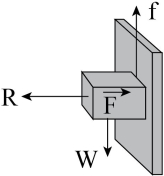
$A$ block of weight $W$ is held against a vertical wall by applying a horizontal force $F$. The minimum value of $F$ needed to hold the block is $[\mu < 1]$.
A
Less than $W$
B
Equal to $W$
C
Greater than $W$
D
Data is insufficient
Solution
(C) The figure shows the free body diagram of the block.
For the block to be held in equilibrium against the vertical wall,the upward frictional force $f$ must balance the downward weight $W$ of the block.
$f = W$
Since the frictional force $f$ is given by $f = \mu R$,where $R$ is the normal reaction force exerted by the wall on the block,and in this case,the normal reaction $R$ is equal to the applied horizontal force $F$ $(R = F)$:
$\mu F = W$
Solving for $F$:
$F = \frac{W}{\mu}$
Given that $\mu < 1$,it follows that $\frac{1}{\mu} > 1$.
Therefore,$F = \frac{W}{\mu} > W$.
Thus,the minimum force $F$ required to hold the block is greater than its weight $W$.
For the block to be held in equilibrium against the vertical wall,the upward frictional force $f$ must balance the downward weight $W$ of the block.
$f = W$
Since the frictional force $f$ is given by $f = \mu R$,where $R$ is the normal reaction force exerted by the wall on the block,and in this case,the normal reaction $R$ is equal to the applied horizontal force $F$ $(R = F)$:
$\mu F = W$
Solving for $F$:
$F = \frac{W}{\mu}$
Given that $\mu < 1$,it follows that $\frac{1}{\mu} > 1$.
Therefore,$F = \frac{W}{\mu} > W$.
Thus,the minimum force $F$ required to hold the block is greater than its weight $W$.
0 likes
View Solution65
DifficultMCQ
$A$ body of mass $1 \, kg$ rests on a horizontal floor with which it has a coefficient of static friction $\frac{1}{\sqrt{3}}$. It is desired to make the body move by applying the minimum possible force $F \, N$. The value of $F$ will be (Nearest Integer). [Take $g = 10 \, m s^{-2}$]

A
$15$
B
$7$
C
$5$
D
$10$
Solution
(C) For the body to move,the applied force $F$ must overcome the limiting friction $f_L = \mu N$.
Resolving the forces:
Horizontal component: $F \cos \theta = f_L = \mu N$
Vertical component: $F \sin \theta + N = mg \Rightarrow N = mg - F \sin \theta$
Substituting $N$ into the friction equation:
$F \cos \theta = \mu (mg - F \sin \theta)$
$F (\cos \theta + \mu \sin \theta) = \mu mg$
$F = \frac{\mu mg}{\cos \theta + \mu \sin \theta}$
To minimize $F$,we maximize the denominator $D = \cos \theta + \mu \sin \theta$. The maximum value of $a \cos \theta + b \sin \theta$ is $\sqrt{a^2 + b^2}$.
Here,$a = 1$ and $b = \mu = \frac{1}{\sqrt{3}}$.
$D_{\max} = \sqrt{1^2 + (\frac{1}{\sqrt{3}})^2} = \sqrt{1 + \frac{1}{3}} = \sqrt{\frac{4}{3}} = \frac{2}{\sqrt{3}}$.
Thus,$F_{\min} = \frac{\mu mg}{D_{\max}} = \frac{(\frac{1}{\sqrt{3}}) \times 1 \times 10}{\frac{2}{\sqrt{3}}} = \frac{10}{2} = 5 \, N$.
Resolving the forces:
Horizontal component: $F \cos \theta = f_L = \mu N$
Vertical component: $F \sin \theta + N = mg \Rightarrow N = mg - F \sin \theta$
Substituting $N$ into the friction equation:
$F \cos \theta = \mu (mg - F \sin \theta)$
$F (\cos \theta + \mu \sin \theta) = \mu mg$
$F = \frac{\mu mg}{\cos \theta + \mu \sin \theta}$
To minimize $F$,we maximize the denominator $D = \cos \theta + \mu \sin \theta$. The maximum value of $a \cos \theta + b \sin \theta$ is $\sqrt{a^2 + b^2}$.
Here,$a = 1$ and $b = \mu = \frac{1}{\sqrt{3}}$.
$D_{\max} = \sqrt{1^2 + (\frac{1}{\sqrt{3}})^2} = \sqrt{1 + \frac{1}{3}} = \sqrt{\frac{4}{3}} = \frac{2}{\sqrt{3}}$.
Thus,$F_{\min} = \frac{\mu mg}{D_{\max}} = \frac{(\frac{1}{\sqrt{3}}) \times 1 \times 10}{\frac{2}{\sqrt{3}}} = \frac{10}{2} = 5 \, N$.
0 likes
View Solution66
MediumMCQ
The coefficient of static friction between a wooden block of mass $0.5\, kg$ and a vertical rough wall is $0.2$. The magnitude of the horizontal force that should be applied on the block to keep it adhered to the wall will be $N$ $\left[ g = 10\, m/s^2 \right]$.
A
$25$
B
$30$
C
$10$
D
$20$
Solution
(A) The Free Body Diagram $(FBD)$ of the block is shown in the diagram.
Since the block is at rest,the forces must be balanced.
Vertical direction: The frictional force $f_r$ balances the weight $mg$.
$f_r - mg = 0 \Rightarrow f_r = mg$ $........(1)$
Horizontal direction: The applied force $F$ is balanced by the normal reaction $N$ from the wall.
$F - N = 0 \Rightarrow N = F$ $..........(2)$
We know that the frictional force $f_r \leq \mu N$.
In the limiting case,to keep the block from sliding down:
$f_r = \mu N$
Substituting $f_r = mg$ and $N = F$ into the equation:
$mg = \mu F$
$F = \frac{mg}{\mu}$
Given $m = 0.5\, kg$,$g = 10\, m/s^2$,and $\mu = 0.2$:
$F = \frac{0.5 \times 10}{0.2} = \frac{5}{0.2} = 25\, N$.
Since the block is at rest,the forces must be balanced.
Vertical direction: The frictional force $f_r$ balances the weight $mg$.
$f_r - mg = 0 \Rightarrow f_r = mg$ $........(1)$
Horizontal direction: The applied force $F$ is balanced by the normal reaction $N$ from the wall.
$F - N = 0 \Rightarrow N = F$ $..........(2)$
We know that the frictional force $f_r \leq \mu N$.
In the limiting case,to keep the block from sliding down:
$f_r = \mu N$
Substituting $f_r = mg$ and $N = F$ into the equation:
$mg = \mu F$
$F = \frac{mg}{\mu}$
Given $m = 0.5\, kg$,$g = 10\, m/s^2$,and $\mu = 0.2$:
$F = \frac{0.5 \times 10}{0.2} = \frac{5}{0.2} = 25\, N$.

0 likes
View Solution67
DifficultMCQ
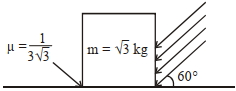
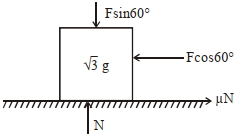
As shown in the figure,a block of mass $\sqrt{3} \text{ kg}$ is kept on a horizontal rough surface with a coefficient of friction $\mu = \frac{1}{3 \sqrt{3}}$. $A$ force $F$ is applied on the vertical face of the block at an angle of $60^{\circ}$ with the horizontal. The minimum force $F$ required to just move the block is $3x$. Find the value of $3x$.
$\left[ g = 10 \text{ m/s}^2; \sin 60^{\circ} = \frac{\sqrt{3}}{2}; \cos 60^{\circ} = \frac{1}{2} \right]$
$\left[ g = 10 \text{ m/s}^2; \sin 60^{\circ} = \frac{\sqrt{3}}{2}; \cos 60^{\circ} = \frac{1}{2} \right]$
A
$20$
B
$10$
C
$40$
D
$25$
Solution
(B) Let the applied force be $F$. The horizontal component of the force is $F \cos 60^{\circ}$ and the vertical component is $F \sin 60^{\circ}$.
The normal reaction $N$ on the block from the surface is given by balancing vertical forces:
$N = mg + F \sin 60^{\circ}$
Given $m = \sqrt{3} \text{ kg}$ and $g = 10 \text{ m/s}^2$,so $mg = 10\sqrt{3} \text{ N}$.
$N = 10\sqrt{3} + F \left( \frac{\sqrt{3}}{2} \right)$
The limiting friction force is $f_L = \mu N = \frac{1}{3\sqrt{3}} \left( 10\sqrt{3} + \frac{F\sqrt{3}}{2} \right) = \frac{10}{3} + \frac{F}{6}$.
For the block to just move,the horizontal component of the applied force must equal the limiting friction:
$F \cos 60^{\circ} = f_L$
$F \left( \frac{1}{2} \right) = \frac{10}{3} + \frac{F}{6}$
Multiply by $6$ to simplify:
$3F = 20 + F$
$2F = 20 \Rightarrow F = 10 \text{ N}$.
The question asks for the value of $3x$,where $F = 3x$.
$3x = 10$.
The normal reaction $N$ on the block from the surface is given by balancing vertical forces:
$N = mg + F \sin 60^{\circ}$
Given $m = \sqrt{3} \text{ kg}$ and $g = 10 \text{ m/s}^2$,so $mg = 10\sqrt{3} \text{ N}$.
$N = 10\sqrt{3} + F \left( \frac{\sqrt{3}}{2} \right)$
The limiting friction force is $f_L = \mu N = \frac{1}{3\sqrt{3}} \left( 10\sqrt{3} + \frac{F\sqrt{3}}{2} \right) = \frac{10}{3} + \frac{F}{6}$.
For the block to just move,the horizontal component of the applied force must equal the limiting friction:
$F \cos 60^{\circ} = f_L$
$F \left( \frac{1}{2} \right) = \frac{10}{3} + \frac{F}{6}$
Multiply by $6$ to simplify:
$3F = 20 + F$
$2F = 20 \Rightarrow F = 10 \text{ N}$.
The question asks for the value of $3x$,where $F = 3x$.
$3x = 10$.
0 likes
View Solution68
MediumMCQ
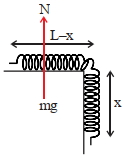
$A$ uniform chain of $6 \, m$ length is placed on a table such that a part of its length is hanging over the edge of the table. The system is at rest. The coefficient of static friction between the chain and the surface of the table is $0.5$. The maximum length of the chain hanging from the table is.......$m.$
A
$25$
B
$12$
C
$9$
D
$2$
Solution
(D) Let the total length of the chain be $L = 6 \, m$ and the length of the chain hanging over the edge be $x$. The length of the chain on the table is $(L - x)$.
Let $\lambda$ be the mass per unit length of the chain.
The mass of the chain on the table is $M_{table} = \lambda(L - x)$,and the mass of the hanging part is $M_{hanging} = \lambda x$.
The normal force $N$ exerted by the table on the chain is $N = M_{table} g = \lambda(L - x)g$.
The maximum static frictional force is $f_{s,max} = \mu_s N = \mu_s \lambda(L - x)g$.
For the system to be at rest,the hanging weight must be balanced by the maximum static friction:
$f_{s,max} = M_{hanging} g$
$\mu_s \lambda(L - x)g = \lambda x g$
$\mu_s(L - x) = x$
Given $\mu_s = 0.5$ and $L = 6 \, m$:
$0.5(6 - x) = x$
$3 - 0.5x = x$
$3 = 1.5x$
$x = \frac{3}{1.5} = 2 \, m$.
Thus,the maximum length of the chain hanging from the table is $2 \, m$.
Let $\lambda$ be the mass per unit length of the chain.
The mass of the chain on the table is $M_{table} = \lambda(L - x)$,and the mass of the hanging part is $M_{hanging} = \lambda x$.
The normal force $N$ exerted by the table on the chain is $N = M_{table} g = \lambda(L - x)g$.
The maximum static frictional force is $f_{s,max} = \mu_s N = \mu_s \lambda(L - x)g$.
For the system to be at rest,the hanging weight must be balanced by the maximum static friction:
$f_{s,max} = M_{hanging} g$
$\mu_s \lambda(L - x)g = \lambda x g$
$\mu_s(L - x) = x$
Given $\mu_s = 0.5$ and $L = 6 \, m$:
$0.5(6 - x) = x$
$3 - 0.5x = x$
$3 = 1.5x$
$x = \frac{3}{1.5} = 2 \, m$.
Thus,the maximum length of the chain hanging from the table is $2 \, m$.
0 likes
View Solution69
MediumMCQ
$A$ block of mass $M$ rests on a rough horizontal table. $A$ steadily increasing horizontal force is applied such that the block starts to slide on the table without toppling. The force is continued even after sliding has started. Assume the coefficients of static and kinetic friction between the table and the block to be equal. The correct representation of the variation of the frictional force $f$,exerted by the table on the block with time $t$ is given by
A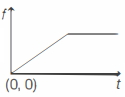
B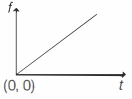
C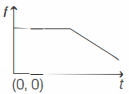
D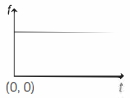
Solution
(A) The force of friction is self-adjusting. When an applied force is increased,the static friction first increases linearly with the applied force (and thus with time $t$,as the force is steadily increasing) until it reaches a maximum value called the limiting friction.
Once the applied force exceeds the limiting friction,the block begins to slide.
Since the coefficients of static and kinetic friction are assumed to be equal,the kinetic friction remains constant at the value of the limiting friction.
Therefore,the frictional force $f$ increases linearly with time $t$ until the block starts to slide,after which it remains constant. This behavior is correctly represented by the graph in option $A$.
Once the applied force exceeds the limiting friction,the block begins to slide.
Since the coefficients of static and kinetic friction are assumed to be equal,the kinetic friction remains constant at the value of the limiting friction.
Therefore,the frictional force $f$ increases linearly with time $t$ until the block starts to slide,after which it remains constant. This behavior is correctly represented by the graph in option $A$.
0 likes
View Solution70
EasyMCQ
Static friction between two surfaces:
A
Prevents the relative motion between them.
B
Acts opposite to the direction of motion.
C
Acts in the opposite direction of the applied force.
D
Both $(a)$ and $(c)$.
Solution
(D) Static friction is a self-adjusting force that acts between two surfaces in contact when there is a tendency for relative motion but no actual motion has occurred yet.
Its primary function is to oppose the tendency of relative motion,thereby preventing the relative motion between the two surfaces.
Since it opposes the tendency of motion caused by an external force,it acts in the direction opposite to the applied force.
Therefore,both $(a)$ and $(c)$ are correct descriptions of static friction.
Its primary function is to oppose the tendency of relative motion,thereby preventing the relative motion between the two surfaces.
Since it opposes the tendency of motion caused by an external force,it acts in the direction opposite to the applied force.
Therefore,both $(a)$ and $(c)$ are correct descriptions of static friction.
0 likes
View Solution71
EasyMCQ
The limiting value of static friction between two contact surfaces is ...........
A
Proportional to the normal force between the surfaces in contact.
B
Independent of the apparent area of contact.
C
Dependent on the microscopic area of contact.
D
All of these.
Solution
(D) The limiting value of static friction $(f_{s,max})$ is defined by the relation $f_{s,max} = \mu_s N$,where $\mu_s$ is the coefficient of static friction and $N$ is the normal force.
$1$. Since $f_{s,max} \propto N$,it is proportional to the normal force between the surfaces in contact.
$2$. Experimental observations show that friction is independent of the apparent area of contact as long as the normal force remains constant.
$3$. At a microscopic level,the actual area of contact is much smaller than the apparent area and depends on the surface roughness and deformation,which influences the value of $\mu_s$.
Therefore,all the given statements are correct.
$1$. Since $f_{s,max} \propto N$,it is proportional to the normal force between the surfaces in contact.
$2$. Experimental observations show that friction is independent of the apparent area of contact as long as the normal force remains constant.
$3$. At a microscopic level,the actual area of contact is much smaller than the apparent area and depends on the surface roughness and deformation,which influences the value of $\mu_s$.
Therefore,all the given statements are correct.
0 likes
View Solution72
EasyMCQ
Which of the following is self-adjusting in nature?
A
Rolling frictional force
B
Static frictional force
C
Kinetic frictional force
D
All of these
Solution
(B) The correct answer is $(B)$.
Static friction is the frictional force that acts between two surfaces in contact when there is no relative motion between them.
When an external force is applied to an object at rest,the static frictional force adjusts itself to be exactly equal and opposite to the applied force,preventing the object from moving.
If the applied force increases,the static frictional force also increases proportionally to maintain equilibrium,up to a maximum value known as limiting friction.
Because it changes its magnitude in response to the applied force to maintain the state of rest,it is known as a self-adjusting force.
Static friction is the frictional force that acts between two surfaces in contact when there is no relative motion between them.
When an external force is applied to an object at rest,the static frictional force adjusts itself to be exactly equal and opposite to the applied force,preventing the object from moving.
If the applied force increases,the static frictional force also increases proportionally to maintain equilibrium,up to a maximum value known as limiting friction.
Because it changes its magnitude in response to the applied force to maintain the state of rest,it is known as a self-adjusting force.
0 likes
View Solution73
EasyMCQ
The maximum force of friction is called:
A
Limiting friction
B
Static friction
C
Sliding friction
D
Rolling friction
Solution
(A) The force of friction that acts between two surfaces when one body is just on the verge of moving over the other is known as limiting friction.
It is the maximum value of static friction that can act between the two surfaces.
Once the applied force exceeds this limiting friction,the body starts moving,and kinetic friction comes into play.
Therefore,the maximum force of friction is called limiting friction.
It is the maximum value of static friction that can act between the two surfaces.
Once the applied force exceeds this limiting friction,the body starts moving,and kinetic friction comes into play.
Therefore,the maximum force of friction is called limiting friction.
0 likes
View Solution74
DifficultMCQ
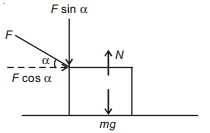
If a pushing force making an angle $\alpha$ with the horizontal is applied on a block of mass $m$ placed on a horizontal table and the angle of friction is $\beta$,then the minimum magnitude of the force required to move the block is
A
$\frac{m g \sin \beta}{\cos (\alpha-\beta)}$
B
$\frac{m g \sin \beta}{\cos (\alpha+\beta)}$
C
$\frac{m g \sin \beta}{\sin (\alpha+\beta)}$
D
$\frac{m g \cos \beta}{\cos (\alpha-\beta)}$
Solution
(B) The angle of friction is $\beta$,so the coefficient of friction is $\mu = \tan \beta$.
When a pushing force $F$ is applied at an angle $\alpha$ with the horizontal,the normal force $N$ is given by balancing the vertical forces:
$N = m g + F \sin \alpha$
To just move the block,the horizontal component of the force must equal the limiting friction:
$F \cos \alpha = \mu N$
Substituting $\mu = \tan \beta$ and $N = m g + F \sin \alpha$:
$F \cos \alpha = \tan \beta (m g + F \sin \alpha)$
$F \cos \alpha = \frac{\sin \beta}{\cos \beta} (m g + F \sin \alpha)$
$F \cos \alpha \cos \beta = m g \sin \beta + F \sin \alpha \sin \beta$
$F (\cos \alpha \cos \beta - \sin \alpha \sin \beta) = m g \sin \beta$
Using the trigonometric identity $\cos (A + B) = \cos A \cos B - \sin A \sin B$:
$F \cos (\alpha + \beta) = m g \sin \beta$
$F = \frac{m g \sin \beta}{\cos (\alpha + \beta)}$
When a pushing force $F$ is applied at an angle $\alpha$ with the horizontal,the normal force $N$ is given by balancing the vertical forces:
$N = m g + F \sin \alpha$
To just move the block,the horizontal component of the force must equal the limiting friction:
$F \cos \alpha = \mu N$
Substituting $\mu = \tan \beta$ and $N = m g + F \sin \alpha$:
$F \cos \alpha = \tan \beta (m g + F \sin \alpha)$
$F \cos \alpha = \frac{\sin \beta}{\cos \beta} (m g + F \sin \alpha)$
$F \cos \alpha \cos \beta = m g \sin \beta + F \sin \alpha \sin \beta$
$F (\cos \alpha \cos \beta - \sin \alpha \sin \beta) = m g \sin \beta$
Using the trigonometric identity $\cos (A + B) = \cos A \cos B - \sin A \sin B$:
$F \cos (\alpha + \beta) = m g \sin \beta$
$F = \frac{m g \sin \beta}{\cos (\alpha + \beta)}$
0 likes
View Solution75
MediumMCQ
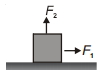
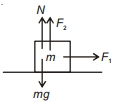
In the figure shown,a horizontal force $F_1$ is applied on a block,but the block does not slide. Then,as the magnitude of the vertical force $F_2$ is increased from zero,the block begins to slide. Which of the following statements is correct?
A
The magnitude of the normal reaction on the block increases.
B
The static frictional force acting on the block increases.
C
The maximum value of the static frictional force decreases.
D
All of these.
Solution
(C) For the block in vertical equilibrium,the forces are the normal reaction $N$ (upwards),the vertical force $F_2$ (upwards),and the weight $mg$ (downwards).
$N + F_2 = mg$
$N = mg - F_2$
As the magnitude of the vertical force $F_2$ increases,the normal reaction $N$ decreases.
The maximum value of static friction (limiting friction) is given by $f_{max} = \mu_s N = \mu_s(mg - F_2)$.
As $F_2$ increases,the normal reaction $N$ decreases,which in turn causes the maximum value of static friction $f_{max}$ to decrease.
When $f_{max}$ becomes equal to the applied horizontal force $F_1$,the block begins to slide. Therefore,the correct statement is that the maximum value of the static frictional force decreases.
$N + F_2 = mg$
$N = mg - F_2$
As the magnitude of the vertical force $F_2$ increases,the normal reaction $N$ decreases.
The maximum value of static friction (limiting friction) is given by $f_{max} = \mu_s N = \mu_s(mg - F_2)$.
As $F_2$ increases,the normal reaction $N$ decreases,which in turn causes the maximum value of static friction $f_{max}$ to decrease.
When $f_{max}$ becomes equal to the applied horizontal force $F_1$,the block begins to slide. Therefore,the correct statement is that the maximum value of the static frictional force decreases.
0 likes
View Solution76
MediumMCQ
Which of the following is a self-adjusting force?
A
Sliding friction
B
Dynamic friction
C
Static friction
D
Limiting friction
Solution
(C) Static friction is known as a self-adjusting force because it changes its magnitude to match the applied external force,up to a certain maximum limit,to keep the object at rest.
As the applied force increases,the static friction force also increases proportionally to oppose the motion,ensuring the net force remains zero until the object begins to slide.
As the applied force increases,the static friction force also increases proportionally to oppose the motion,ensuring the net force remains zero until the object begins to slide.
0 likes
View Solution77
MediumMCQ
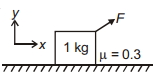
$A$ force $\vec{F}=\hat{i}+4 \hat{j} \, N$ acts on the block of mass $1 \, kg$ shown in the figure. The coefficient of friction between the block and the surface is $\mu = 0.3$. The force of friction acting on the block is (Take $g = 10 \, m/s^2$)
A
$-\hat{i} \, N$
B
$-18 \hat{i} \, N$
C
$-2.4 \hat{i} \, N$
D
$-3 \hat{i} \, N$
Solution
(A) $1$. First,calculate the normal force $N$ acting on the block. The vertical forces are the normal force $N$ (upward),the weight $mg$ (downward),and the $y$-component of the applied force $F_y = 4 \, N$ (upward).
$2$. Equilibrium in the vertical direction: $N + F_y = mg \implies N + 4 = (1)(10) \implies N = 6 \, N$.
$3$. Calculate the limiting friction $f_L = \mu N = 0.3 \times 6 = 1.8 \, N$.
$4$. The horizontal component of the applied force is $F_x = 1 \, N$.
$5$. Since the applied horizontal force $F_x = 1 \, N$ is less than the limiting friction $f_L = 1.8 \, N$,the block remains at rest.
$6$. For a block at rest,the static friction force exactly balances the applied horizontal force. Therefore,the friction force $f = -F_x = -1 \hat{i} \, N$.
$2$. Equilibrium in the vertical direction: $N + F_y = mg \implies N + 4 = (1)(10) \implies N = 6 \, N$.
$3$. Calculate the limiting friction $f_L = \mu N = 0.3 \times 6 = 1.8 \, N$.
$4$. The horizontal component of the applied force is $F_x = 1 \, N$.
$5$. Since the applied horizontal force $F_x = 1 \, N$ is less than the limiting friction $f_L = 1.8 \, N$,the block remains at rest.
$6$. For a block at rest,the static friction force exactly balances the applied horizontal force. Therefore,the friction force $f = -F_x = -1 \hat{i} \, N$.
0 likes
View Solution78
EasyMCQ
Calculate the maximum acceleration (in $m s^{-2}$) of a moving car so that a body lying on the floor of the car remains stationary. The coefficient of static friction between the body and the floor is $0.15$ $(g = 10 m s^{-2})$.
A
$50$
B
$1.2$
C
$150$
D
$1.5$
Solution
(D) To keep the body stationary relative to the car,the pseudo force acting on the body must be balanced by the static frictional force.
Let $m$ be the mass of the body and $a_{\max}$ be the maximum acceleration of the car.
The pseudo force acting on the body is $F_p = m a_{\max}$.
The maximum static frictional force is $f_{L} = \mu N = \mu mg$,where $\mu = 0.15$ is the coefficient of static friction.
For the body to remain stationary,the pseudo force must not exceed the maximum static friction:
$m a_{\max} \leq \mu mg$
$a_{\max} \leq \mu g$
Substituting the given values:
$a_{\max} = 0.15 \times 10 = 1.5 \, m s^{-2}$.
Let $m$ be the mass of the body and $a_{\max}$ be the maximum acceleration of the car.
The pseudo force acting on the body is $F_p = m a_{\max}$.
The maximum static frictional force is $f_{L} = \mu N = \mu mg$,where $\mu = 0.15$ is the coefficient of static friction.
For the body to remain stationary,the pseudo force must not exceed the maximum static friction:
$m a_{\max} \leq \mu mg$
$a_{\max} \leq \mu g$
Substituting the given values:
$a_{\max} = 0.15 \times 10 = 1.5 \, m s^{-2}$.
0 likes
View Solution79
MediumMCQ
Given below are two statements:
$Statement$ $(I)$: The limiting force of static friction depends on the area of contact and is independent of materials.
$Statement$ $(II)$: The limiting force of kinetic friction is independent of the area of contact and depends on materials.
In the light of the above statements,choose the most appropriate answer from the options given below:
$Statement$ $(I)$: The limiting force of static friction depends on the area of contact and is independent of materials.
$Statement$ $(II)$: The limiting force of kinetic friction is independent of the area of contact and depends on materials.
In the light of the above statements,choose the most appropriate answer from the options given below:
A
$Statement$ $I$ is correct but $Statement$ $II$ is incorrect
B
$Statement$ $I$ is incorrect but $Statement$ $II$ is correct
C
Both $Statement$ $I$ and $Statement$ $II$ are incorrect
D
Both $Statement$ $I$ and $Statement$ $II$ are correct
Solution
(B) The laws of friction state that the force of friction is generally independent of the area of contact for a given normal force.
$Statement$ $(I)$ is incorrect because the limiting force of static friction is independent of the area of contact and depends on the nature of the materials in contact.
$Statement$ $(II)$ is correct because the force of kinetic friction is independent of the area of contact and depends on the nature of the materials in contact.
Therefore,$Statement$ $I$ is incorrect and $Statement$ $II$ is correct.
$Statement$ $(I)$ is incorrect because the limiting force of static friction is independent of the area of contact and depends on the nature of the materials in contact.
$Statement$ $(II)$ is correct because the force of kinetic friction is independent of the area of contact and depends on the nature of the materials in contact.
Therefore,$Statement$ $I$ is incorrect and $Statement$ $II$ is correct.
1 likes
View Solution80
MediumMCQ
$A$ block of mass $4 \text{ kg}$ is placed on a horizontal surface having coefficients of static and kinetic friction as $0.5$ and $0.4$ respectively. If a force of $4 \text{ N}$ is applied parallel to the horizontal surface, then the force of friction acting on the body will be $\left[g = 10 \text{ m/s}^2\right]$ (in $\text{ N}$)
A
$16$
B
$20$
C
$8$
D
$4$
Solution
(D) Given: Mass $m = 4 \text{ kg}$, coefficient of static friction $\mu_s = 0.5$, coefficient of kinetic friction $\mu_k = 0.4$, applied force $F = 4 \text{ N}$, and acceleration due to gravity $g = 10 \text{ m/s}^2$.
First, calculate the maximum static friction (limiting friction) $f_{s, \text{max}} = \mu_s N$, where $N = mg = 4 \times 10 = 40 \text{ N}$.
$f_{s, \text{max}} = 0.5 \times 40 = 20 \text{ N}$.
Since the applied force $F = 4 \text{ N}$ is less than the limiting friction $f_{s, \text{max}} = 20 \text{ N}$, the block will remain at rest.
According to the laws of static friction, if the applied force is less than the limiting friction, the static friction force $f_s$ is equal to the applied force $F$.
Therefore, $f_s = F = 4 \text{ N}$.
First, calculate the maximum static friction (limiting friction) $f_{s, \text{max}} = \mu_s N$, where $N = mg = 4 \times 10 = 40 \text{ N}$.
$f_{s, \text{max}} = 0.5 \times 40 = 20 \text{ N}$.
Since the applied force $F = 4 \text{ N}$ is less than the limiting friction $f_{s, \text{max}} = 20 \text{ N}$, the block will remain at rest.
According to the laws of static friction, if the applied force is less than the limiting friction, the static friction force $f_s$ is equal to the applied force $F$.
Therefore, $f_s = F = 4 \text{ N}$.
0 likes
View Solution81
MediumMCQ
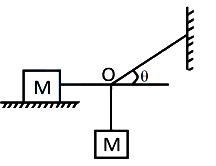
$A$ wooden block of mass $M$ lies on a rough floor. Another wooden block of the same mass is hanging from the point $O$ through strings as shown in the figure. To achieve equilibrium,the coefficient of static friction between the block on the floor and the floor itself is:
A
$\mu=\cot \theta$
B
$\mu=\sin \theta$
C
$\mu=\tan \theta$
D
$\mu=\cos \theta$
Solution
(A) Let $T_1$ be the tension in the horizontal string and $T_2$ be the tension in the inclined string at angle $\theta$.
For the hanging block of mass $M$,the vertical equilibrium gives $T_2 \sin \theta = Mg$ ... $(i)$.
For the point $O$,the horizontal equilibrium gives $T_1 = T_2 \cos \theta$ ... (ii).
For the block on the floor,the horizontal force is $T_1$ and the limiting friction is $f_s = \mu N = \mu Mg$.
For equilibrium,$T_1 = f_s = \mu Mg$ ... (iii).
From (ii) and (iii),$T_2 \cos \theta = \mu Mg$ ... (iv).
Dividing $(i)$ by (iv),we get $\frac{T_2 \sin \theta}{T_2 \cos \theta} = \frac{Mg}{\mu Mg}$.
Therefore,$\tan \theta = \frac{1}{\mu}$,which implies $\mu = \cot \theta$.
For the hanging block of mass $M$,the vertical equilibrium gives $T_2 \sin \theta = Mg$ ... $(i)$.
For the point $O$,the horizontal equilibrium gives $T_1 = T_2 \cos \theta$ ... (ii).
For the block on the floor,the horizontal force is $T_1$ and the limiting friction is $f_s = \mu N = \mu Mg$.
For equilibrium,$T_1 = f_s = \mu Mg$ ... (iii).
From (ii) and (iii),$T_2 \cos \theta = \mu Mg$ ... (iv).
Dividing $(i)$ by (iv),we get $\frac{T_2 \sin \theta}{T_2 \cos \theta} = \frac{Mg}{\mu Mg}$.
Therefore,$\tan \theta = \frac{1}{\mu}$,which implies $\mu = \cot \theta$.
0 likes
View Solution82
MediumMCQ
What is the maximum acceleration of a train such that a $50 \ kg$ box lying on its floor remains stationary (in $m \ s^{-2}$)? (Given: Coefficient of static friction between the box and the train's floor is $0.3$ and $g = 10 \ m \ s^{-2}$)
A
$5.0$
B
$3.0$
C
$1.5$
D
$15$
Solution
(B) Given,mass of the box $m = 50 \ kg$,coefficient of static friction $\mu = 0.3$,and acceleration due to gravity $g = 10 \ m \ s^{-2}$.
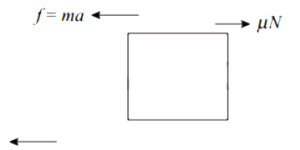
When the train accelerates with acceleration $a$,a pseudo force $F_p = ma$ acts on the box in the direction opposite to the acceleration of the train.
For the box to remain stationary on the floor of the train,the frictional force $f$ must balance this pseudo force.
The maximum frictional force (limiting friction) is given by $f_{max} = \mu N$,where $N = mg$ is the normal reaction.
Thus,for the box to remain stationary,we must have $ma \leq \mu mg$.
The maximum acceleration $a_{max}$ is given by $a_{max} = \mu g$.
Substituting the values,$a_{max} = 0.3 \times 10 = 3.0 \ m \ s^{-2}$.
Therefore,the maximum acceleration of the train is $3.0 \ m \ s^{-2}$.
When the train accelerates with acceleration $a$,a pseudo force $F_p = ma$ acts on the box in the direction opposite to the acceleration of the train.
For the box to remain stationary on the floor of the train,the frictional force $f$ must balance this pseudo force.
The maximum frictional force (limiting friction) is given by $f_{max} = \mu N$,where $N = mg$ is the normal reaction.
Thus,for the box to remain stationary,we must have $ma \leq \mu mg$.
The maximum acceleration $a_{max}$ is given by $a_{max} = \mu g$.
Substituting the values,$a_{max} = 0.3 \times 10 = 3.0 \ m \ s^{-2}$.
Therefore,the maximum acceleration of the train is $3.0 \ m \ s^{-2}$.
0 likes
View Solution83
MediumMCQ
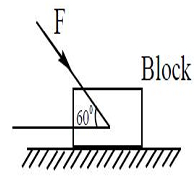
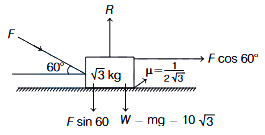
As shown in the figure,a force $F$ is applied on a block of mass $\sqrt{3} \ kg$ placed on a rough horizontal surface. The maximum value of $F$ for the block not to move is (Coefficient of static friction between the block and the surface is $\mu = \frac{1}{2 \sqrt{3}}$ and acceleration due to gravity $g = 10 \ m \ s^{-2}$). (in $N$)
A
$5$
B
$10$
C
$15$
D
$20$
Solution
(D) The forces acting on the block are:
$1$. Weight $mg$ acting downwards.
$2$. Applied force $F$ at an angle of $60^{\circ}$ with the horizontal,acting downwards.
$3$. Normal reaction $N$ acting upwards.
$4$. Frictional force $f$ acting horizontally.
Resolving the force $F$ into components:
Horizontal component: $F \cos 60^{\circ} = \frac{F}{2}$
Vertical component: $F \sin 60^{\circ} = \frac{F \sqrt{3}}{2}$
For vertical equilibrium:
$N = mg + F \sin 60^{\circ} = \sqrt{3} \times 10 + \frac{F \sqrt{3}}{2} = 10\sqrt{3} + \frac{F \sqrt{3}}{2}$
The limiting friction is $f_{max} = \mu N = \frac{1}{2\sqrt{3}} \times (10\sqrt{3} + \frac{F \sqrt{3}}{2}) = 5 + \frac{F}{4}$
For the block not to move,the horizontal component of the applied force must be less than or equal to the limiting friction:
$F \cos 60^{\circ} \le f_{max}$
$\frac{F}{2} \le 5 + \frac{F}{4}$
$\frac{F}{2} - \frac{F}{4} \le 5$
$\frac{F}{4} \le 5$
$F \le 20 \ N$
Thus,the maximum value of $F$ for the block not to move is $20 \ N$.
$1$. Weight $mg$ acting downwards.
$2$. Applied force $F$ at an angle of $60^{\circ}$ with the horizontal,acting downwards.
$3$. Normal reaction $N$ acting upwards.
$4$. Frictional force $f$ acting horizontally.
Resolving the force $F$ into components:
Horizontal component: $F \cos 60^{\circ} = \frac{F}{2}$
Vertical component: $F \sin 60^{\circ} = \frac{F \sqrt{3}}{2}$
For vertical equilibrium:
$N = mg + F \sin 60^{\circ} = \sqrt{3} \times 10 + \frac{F \sqrt{3}}{2} = 10\sqrt{3} + \frac{F \sqrt{3}}{2}$
The limiting friction is $f_{max} = \mu N = \frac{1}{2\sqrt{3}} \times (10\sqrt{3} + \frac{F \sqrt{3}}{2}) = 5 + \frac{F}{4}$
For the block not to move,the horizontal component of the applied force must be less than or equal to the limiting friction:
$F \cos 60^{\circ} \le f_{max}$
$\frac{F}{2} \le 5 + \frac{F}{4}$
$\frac{F}{2} - \frac{F}{4} \le 5$
$\frac{F}{4} \le 5$
$F \le 20 \ N$
Thus,the maximum value of $F$ for the block not to move is $20 \ N$.
0 likes
View Solution84
DifficultMCQ
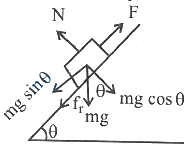
$A$ body of mass $2 \,kg$ is on an inclined plane of inclination $30^{\circ}$ and the coefficient of friction is $\frac{1}{\sqrt{3}}$. The minimum force required to move the body up the inclined plane is (Acceleration due to gravity $g = 10 \,ms^{-2}$) (in $\,N$)
A
$5.77$
B
$10$
C
$20$
D
$15$
Solution
(C) Given:
Mass of the body,$m = 2 \,kg$
Angle of inclination,$\theta = 30^{\circ}$
Coefficient of friction,$\mu = \frac{1}{\sqrt{3}}$
Acceleration due to gravity,$g = 10 \,ms^{-2}$
To move the body up the inclined plane,the applied force $F$ must overcome both the component of gravitational force acting down the plane $(mg \sin \theta)$ and the limiting frictional force $(f_r)$ acting down the plane.
The normal force $N$ acting on the body is $N = mg \cos \theta$.
The limiting frictional force is $f_r = \mu N = \mu mg \cos \theta$.
The minimum force $F$ required is:
$F = mg \sin \theta + f_r$
$F = mg \sin \theta + \mu mg \cos \theta$
$F = mg (\sin \theta + \mu \cos \theta)$
Substituting the values:
$F = 2 \times 10 \times (\sin 30^{\circ} + \frac{1}{\sqrt{3}} \cos 30^{\circ})$
$F = 20 \times (\frac{1}{2} + \frac{1}{\sqrt{3}} \times \frac{\sqrt{3}}{2})$
$F = 20 \times (\frac{1}{2} + \frac{1}{2})$
$F = 20 \times 1 = 20 \,N$
Mass of the body,$m = 2 \,kg$
Angle of inclination,$\theta = 30^{\circ}$
Coefficient of friction,$\mu = \frac{1}{\sqrt{3}}$
Acceleration due to gravity,$g = 10 \,ms^{-2}$
To move the body up the inclined plane,the applied force $F$ must overcome both the component of gravitational force acting down the plane $(mg \sin \theta)$ and the limiting frictional force $(f_r)$ acting down the plane.
The normal force $N$ acting on the body is $N = mg \cos \theta$.
The limiting frictional force is $f_r = \mu N = \mu mg \cos \theta$.
The minimum force $F$ required is:
$F = mg \sin \theta + f_r$
$F = mg \sin \theta + \mu mg \cos \theta$
$F = mg (\sin \theta + \mu \cos \theta)$
Substituting the values:
$F = 2 \times 10 \times (\sin 30^{\circ} + \frac{1}{\sqrt{3}} \cos 30^{\circ})$
$F = 20 \times (\frac{1}{2} + \frac{1}{\sqrt{3}} \times \frac{\sqrt{3}}{2})$
$F = 20 \times (\frac{1}{2} + \frac{1}{2})$
$F = 20 \times 1 = 20 \,N$
0 likes
View Solution85
MediumMCQ
The coefficient of friction between an object and a surface,if we need to move an object of weight $150 \ N$ on a horizontal surface with a force of $75 \ N$,is
A
$0.8$
B
$0.5$
C
$0.7$
D
$0.9$
Solution
(B) The weight of the object is $W = mg = 150 \ N$.
To move the object on a horizontal surface,the applied force $F$ must be at least equal to the limiting friction force $f_l$.
The limiting friction force is given by $f_l = \mu N$,where $\mu$ is the coefficient of friction and $N$ is the normal reaction.
For a horizontal surface,the normal reaction $N$ is equal to the weight of the object,so $N = mg = 150 \ N$.
Given that the force required to move the object is $F = 75 \ N$,we have:
$F = \mu N$
$75 = \mu \times 150$
$\mu = \frac{75}{150} = 0.5$.
Thus,the coefficient of friction is $0.5$.
To move the object on a horizontal surface,the applied force $F$ must be at least equal to the limiting friction force $f_l$.
The limiting friction force is given by $f_l = \mu N$,where $\mu$ is the coefficient of friction and $N$ is the normal reaction.
For a horizontal surface,the normal reaction $N$ is equal to the weight of the object,so $N = mg = 150 \ N$.
Given that the force required to move the object is $F = 75 \ N$,we have:
$F = \mu N$
$75 = \mu \times 150$
$\mu = \frac{75}{150} = 0.5$.
Thus,the coefficient of friction is $0.5$.
0 likes
View Solution86
EasyMCQ
Which of the following is true about the coefficient of static friction $(\mu_s)$ and the coefficient of kinetic friction $(\mu_k)$?
A
$\mu_s$ is always equal to $\mu_k$
B
$\mu_s$ is always greater than $\mu_k$
C
$\mu_s$ is always less than $\mu_k$
D
Depending upon applications,$\mu_s$ can be greater,less,or equal to $\mu_k$
Solution
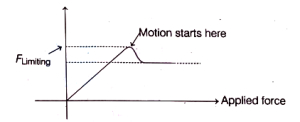
(B) The graph of friction versus applied force shows that the maximum value of static friction (limiting friction) is greater than the kinetic friction acting during motion.
Since the limiting friction is given by $f_{s,max} = \mu_s N$ and kinetic friction is $f_k = \mu_k N$,where $N$ is the normal force.
From the graph,$f_{s,max} > f_k$.
Therefore,$\mu_s N > \mu_k N$,which implies $\mu_s > \mu_k$.
Since the limiting friction is given by $f_{s,max} = \mu_s N$ and kinetic friction is $f_k = \mu_k N$,where $N$ is the normal force.
From the graph,$f_{s,max} > f_k$.
Therefore,$\mu_s N > \mu_k N$,which implies $\mu_s > \mu_k$.
0 likes
View Solution87
EasyMCQ
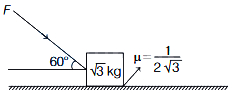
The maximum value of the applied force $F$ such that the block as shown in the arrangement does not move is (Acceleration due to gravity, $g=10 \,ms^{-2}$) (in $\,N$)
A
$20$
B
$15$
C
$25$
D
$10$
Solution
(A) For the block to remain at rest, the horizontal component of the applied force must be equal to the limiting friction force.
From the free body diagram, the normal reaction $R$ is given by $R = mg + F \sin 60^{\circ}$.
Given $m = \sqrt{3} \,kg$, $g = 10 \,ms^{-2}$, and $\mu = \frac{1}{2\sqrt{3}}$.
$R = \sqrt{3} \times 10 + F \sin 60^{\circ} = 10\sqrt{3} + F \frac{\sqrt{3}}{2}$.
The limiting friction force is $f = \mu R = \frac{1}{2\sqrt{3}} \left( 10\sqrt{3} + F \frac{\sqrt{3}}{2} \right) = \frac{10}{2} + \frac{F}{4} = 5 + \frac{F}{4}$.
The horizontal component of the applied force is $F \cos 60^{\circ} = F \times \frac{1}{2} = \frac{F}{2}$.
Equating the horizontal force to the limiting friction for the maximum value of $F$:
$\frac{F}{2} = 5 + \frac{F}{4}$
$\frac{F}{2} - \frac{F}{4} = 5$
$\frac{F}{4} = 5$
$F = 20 \,N$.
From the free body diagram, the normal reaction $R$ is given by $R = mg + F \sin 60^{\circ}$.
Given $m = \sqrt{3} \,kg$, $g = 10 \,ms^{-2}$, and $\mu = \frac{1}{2\sqrt{3}}$.
$R = \sqrt{3} \times 10 + F \sin 60^{\circ} = 10\sqrt{3} + F \frac{\sqrt{3}}{2}$.
The limiting friction force is $f = \mu R = \frac{1}{2\sqrt{3}} \left( 10\sqrt{3} + F \frac{\sqrt{3}}{2} \right) = \frac{10}{2} + \frac{F}{4} = 5 + \frac{F}{4}$.
The horizontal component of the applied force is $F \cos 60^{\circ} = F \times \frac{1}{2} = \frac{F}{2}$.
Equating the horizontal force to the limiting friction for the maximum value of $F$:
$\frac{F}{2} = 5 + \frac{F}{4}$
$\frac{F}{2} - \frac{F}{4} = 5$
$\frac{F}{4} = 5$
$F = 20 \,N$.
0 likes
View Solution88
DifficultMCQ
$A$ body of mass $5 \,kg$ is placed on a rough horizontal surface of coefficient of static friction $\frac{1}{3}$. The least pulling force to be applied on the body at an angle $45^{\circ}$ with the horizontal to slide it,is . . . . . . $\left(g=10 \,ms^{-2}\right)$
A
$25 \sqrt{2} \,N$
B
$\frac{25}{\sqrt{2}} \,N$
C
$50 \sqrt{2} \,N$
D
$\frac{75}{\sqrt{2}} \,N$
Solution
(B) Let the mass of the body be $m = 5 \,kg$,the angle of pulling force be $\theta = 45^{\circ}$,and the coefficient of static friction be $\mu = \frac{1}{3}$.
Let $F$ be the applied force. The components of $F$ are $F \cos \theta$ (horizontal) and $F \sin \theta$ (vertical upward).
The normal reaction $N$ is given by $N = mg - F \sin \theta$.
The limiting friction is $f_L = \mu N = \mu(mg - F \sin \theta)$.
For the body to slide,the horizontal component of the force must be equal to the limiting friction: $F \cos \theta = \mu(mg - F \sin \theta)$.
Rearranging for $F$: $F(\cos \theta + \mu \sin \theta) = \mu mg$.
$F = \frac{\mu mg}{\cos \theta + \mu \sin \theta}$.
Substituting the values: $F = \frac{(1/3) \times 5 \times 10}{\cos 45^{\circ} + (1/3) \sin 45^{\circ}} = \frac{50/3}{\frac{1}{\sqrt{2}} + \frac{1}{3\sqrt{2}}} = \frac{50/3}{\frac{3+1}{3\sqrt{2}}} = \frac{50}{3} \times \frac{3\sqrt{2}}{4} = \frac{50\sqrt{2}}{4} = \frac{25\sqrt{2}}{2} = \frac{25}{\sqrt{2}} \,N$.
Let $F$ be the applied force. The components of $F$ are $F \cos \theta$ (horizontal) and $F \sin \theta$ (vertical upward).
The normal reaction $N$ is given by $N = mg - F \sin \theta$.
The limiting friction is $f_L = \mu N = \mu(mg - F \sin \theta)$.
For the body to slide,the horizontal component of the force must be equal to the limiting friction: $F \cos \theta = \mu(mg - F \sin \theta)$.
Rearranging for $F$: $F(\cos \theta + \mu \sin \theta) = \mu mg$.
$F = \frac{\mu mg}{\cos \theta + \mu \sin \theta}$.
Substituting the values: $F = \frac{(1/3) \times 5 \times 10}{\cos 45^{\circ} + (1/3) \sin 45^{\circ}} = \frac{50/3}{\frac{1}{\sqrt{2}} + \frac{1}{3\sqrt{2}}} = \frac{50/3}{\frac{3+1}{3\sqrt{2}}} = \frac{50}{3} \times \frac{3\sqrt{2}}{4} = \frac{50\sqrt{2}}{4} = \frac{25\sqrt{2}}{2} = \frac{25}{\sqrt{2}} \,N$.
0 likes
View Solution89
DifficultMCQ
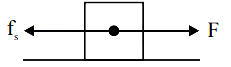
$A$ horizontal force just sufficient to move a body of mass $4 \,kg$ lying on a rough horizontal surface is applied on it. The coefficients of static and kinetic friction are $0.8$ and $0.6$ respectively. If the force continues to act even after the body has started moving, the acceleration of the body is (take $g=10 \,ms^{-2}$). (in $\,ms^{-2}$)
A
$6$
B
$8$
C
$2$
D
$4$
Solution
(C) The force $F$ required to just move the body is equal to the limiting static friction force $f_s$.
$f_s = \mu_s N = \mu_s mg$
Given $\mu_s = 0.8$, $m = 4 \,kg$, and $g = 10 \,ms^{-2}$.
$F = 0.8 \times 4 \times 10 = 32 \,N$.
Once the body starts moving, the kinetic friction force $f_k$ acts on it.
$f_k = \mu_k N = \mu_k mg$
Given $\mu_k = 0.6$.
$f_k = 0.6 \times 4 \times 10 = 24 \,N$.
The net force acting on the body is $F_{net} = F - f_k$.
$F_{net} = 32 - 24 = 8 \,N$.
Using Newton's second law, $F_{net} = ma$.
$8 = 4 \times a$.
$a = 2 \,ms^{-2}$.
$f_s = \mu_s N = \mu_s mg$
Given $\mu_s = 0.8$, $m = 4 \,kg$, and $g = 10 \,ms^{-2}$.
$F = 0.8 \times 4 \times 10 = 32 \,N$.
Once the body starts moving, the kinetic friction force $f_k$ acts on it.
$f_k = \mu_k N = \mu_k mg$
Given $\mu_k = 0.6$.
$f_k = 0.6 \times 4 \times 10 = 24 \,N$.
The net force acting on the body is $F_{net} = F - f_k$.
$F_{net} = 32 - 24 = 8 \,N$.
Using Newton's second law, $F_{net} = ma$.
$8 = 4 \times a$.
$a = 2 \,ms^{-2}$.
0 likes
View Solution90
EasyMCQ
$A$ person initially at rest starts walking towards the east without slipping or skidding. What is the type of friction acting on the person from the ground,and in which direction does the frictional force act?
A
Static friction,towards west
B
Static friction,towards east
C
Kinetic friction,towards west
D
Kinetic friction,towards east
Solution
(B) When a person walks,they push the ground backward (towards the $West$) with their foot at the point of contact.
According to Newton's $3^{rd}$ law of motion,the ground exerts an equal and opposite force on the person's foot in the forward direction (towards the $East$).
Since the foot does not slip relative to the ground during the act of walking,the friction involved is static friction.
Therefore,static friction acts on the person in the direction of motion,which is towards the $East$.
Thus,the correct option is $B$.
According to Newton's $3^{rd}$ law of motion,the ground exerts an equal and opposite force on the person's foot in the forward direction (towards the $East$).
Since the foot does not slip relative to the ground during the act of walking,the friction involved is static friction.
Therefore,static friction acts on the person in the direction of motion,which is towards the $East$.
Thus,the correct option is $B$.
0 likes
View Solution91
EasyMCQ
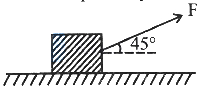
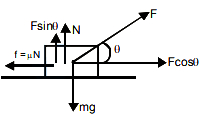
$A$ body of weight $50 \,N$ is placed on a horizontal surface as shown in the figure. The minimum force required to move the body is $28.28 \,N$. The frictional force and the normal reaction are respectively.
A
$10 \,N, 15 \,N$
B
$20 \,N, 30 \,N$
C
$2 \,N, 3 \,N$
D
$5 \,N, 6 \,N$
Solution
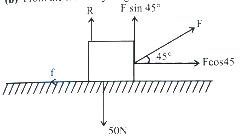
(B) From the free body diagram, the forces acting on the body are resolved into horizontal and vertical components.
For the body to be on the verge of moving, the horizontal component of the applied force must balance the frictional force $(f)$:
$f = F \cos 45^{\circ}$
$f = 28.28 \times \frac{1}{\sqrt{2}} = 28.28 \times 0.707 = 20 \,N$
The vertical forces must be in equilibrium, so the normal reaction $(R)$ plus the vertical component of the applied force must equal the weight of the body $(W = 50 \,N)$:
$R + F \sin 45^{\circ} = 50$
$R = 50 - 28.28 \sin 45^{\circ}$
$R = 50 - 28.28 \times \frac{1}{\sqrt{2}} = 50 - 20 = 30 \,N$
Thus, the frictional force is $20 \,N$ and the normal reaction is $30 \,N$.
For the body to be on the verge of moving, the horizontal component of the applied force must balance the frictional force $(f)$:
$f = F \cos 45^{\circ}$
$f = 28.28 \times \frac{1}{\sqrt{2}} = 28.28 \times 0.707 = 20 \,N$
The vertical forces must be in equilibrium, so the normal reaction $(R)$ plus the vertical component of the applied force must equal the weight of the body $(W = 50 \,N)$:
$R + F \sin 45^{\circ} = 50$
$R = 50 - 28.28 \sin 45^{\circ}$
$R = 50 - 28.28 \times \frac{1}{\sqrt{2}} = 50 - 20 = 30 \,N$
Thus, the frictional force is $20 \,N$ and the normal reaction is $30 \,N$.
0 likes
View Solution92
MediumMCQ
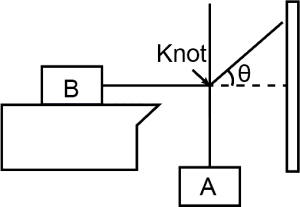
Block $B$ lying on a table weighs $W$. The coefficient of static friction between the block and the table is $\mu$. Assume that the cord between $B$ and the knot is horizontal. The maximum weight of the block $A$ for which the system will be stationary is
A
$\frac{W \tan \theta}{\mu}$
B
$\mu W \tan \theta$
C
$\mu W \sqrt{1+\tan ^{2} \theta}$
D
$\mu W \sin \theta$
Solution
(B) Let the weight of block $A$ be $W^{\prime}$.
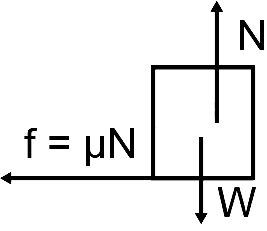
For the system to be in equilibrium,the tension $T_1$ in the horizontal cord connected to block $B$ must be equal to the limiting friction force,so $T_1 = \mu W$.
Now,consider the equilibrium of the knot. Let $T_2$ be the tension in the cord inclined at an angle $\theta$ to the horizontal,and $T_3$ be the tension in the vertical cord connected to block $A$. Thus,$T_3 = W^{\prime}$.
Resolving the forces at the knot:
Horizontal component: $T_2 \cos \theta = T_1 = \mu W$
Vertical component: $T_2 \sin \theta = T_3 = W^{\prime}$
Dividing the two equations:
$\frac{T_2 \sin \theta}{T_2 \cos \theta} = \frac{W^{\prime}}{\mu W}$
$\tan \theta = \frac{W^{\prime}}{\mu W}$
$W^{\prime} = \mu W \tan \theta$
For the system to be in equilibrium,the tension $T_1$ in the horizontal cord connected to block $B$ must be equal to the limiting friction force,so $T_1 = \mu W$.
Now,consider the equilibrium of the knot. Let $T_2$ be the tension in the cord inclined at an angle $\theta$ to the horizontal,and $T_3$ be the tension in the vertical cord connected to block $A$. Thus,$T_3 = W^{\prime}$.
Resolving the forces at the knot:
Horizontal component: $T_2 \cos \theta = T_1 = \mu W$
Vertical component: $T_2 \sin \theta = T_3 = W^{\prime}$
Dividing the two equations:
$\frac{T_2 \sin \theta}{T_2 \cos \theta} = \frac{W^{\prime}}{\mu W}$
$\tan \theta = \frac{W^{\prime}}{\mu W}$
$W^{\prime} = \mu W \tan \theta$
0 likes
View Solution93
DifficultMCQ
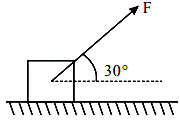
As shown in the figure,a block of mass $10 \ kg$ lying on a horizontal surface is pulled by a force $F$ acting at an angle $30^{\circ}$ with the horizontal. For $\mu_{s} = 0.25$,the block will just start to move for the value of $F$: [Given $g = 10 \ ms^{-2}$] (in $N$)
A
$25.2$
B
$20$
C
$33.3$
D
$33.7$
Solution
(A) For the block to just start moving,the horizontal component of the applied force $F$ must be equal to the limiting friction force.
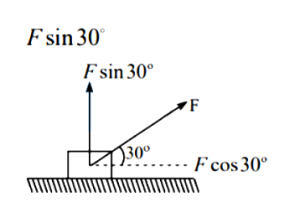
$1$. Resolve the force $F$ into components:
Horizontal component: $F_{x} = F \cos 30^{\circ}$
Vertical component: $F_{y} = F \sin 30^{\circ}$
$2$. Determine the normal reaction $N$:
The vertical forces acting on the block are the weight $mg$ downwards,the normal reaction $N$ upwards,and the vertical component of the applied force $F \sin 30^{\circ}$ upwards.
$N + F \sin 30^{\circ} = mg$
$N = mg - F \sin 30^{\circ}$
Given $m = 10 \ kg$ and $g = 10 \ ms^{-2}$,so $mg = 100 \ N$.
$N = 100 - F \sin 30^{\circ} = 100 - 0.5F$
$3$. Apply the condition for motion:
The limiting friction is $f_{L} = \mu_{s} N$.
The block starts to move when $F \cos 30^{\circ} = \mu_{s} N$.
$F \cos 30^{\circ} = 0.25(100 - 0.5F)$
$F \frac{\sqrt{3}}{2} = 25 - 0.125F$
$F(0.866 + 0.125) = 25$
$F(0.991) = 25$
$F = \frac{25}{0.991} \approx 25.22 \ N$
Thus,the block will just start to move for $F \approx 25.2 \ N$.
$1$. Resolve the force $F$ into components:
Horizontal component: $F_{x} = F \cos 30^{\circ}$
Vertical component: $F_{y} = F \sin 30^{\circ}$
$2$. Determine the normal reaction $N$:
The vertical forces acting on the block are the weight $mg$ downwards,the normal reaction $N$ upwards,and the vertical component of the applied force $F \sin 30^{\circ}$ upwards.
$N + F \sin 30^{\circ} = mg$
$N = mg - F \sin 30^{\circ}$
Given $m = 10 \ kg$ and $g = 10 \ ms^{-2}$,so $mg = 100 \ N$.
$N = 100 - F \sin 30^{\circ} = 100 - 0.5F$
$3$. Apply the condition for motion:
The limiting friction is $f_{L} = \mu_{s} N$.
The block starts to move when $F \cos 30^{\circ} = \mu_{s} N$.
$F \cos 30^{\circ} = 0.25(100 - 0.5F)$
$F \frac{\sqrt{3}}{2} = 25 - 0.125F$
$F(0.866 + 0.125) = 25$
$F(0.991) = 25$
$F = \frac{25}{0.991} \approx 25.22 \ N$
Thus,the block will just start to move for $F \approx 25.2 \ N$.
0 likes
View Solution94
MediumMCQ
$A$ box of mass $2 kg$ is placed on the roof of a car. The box would remain stationary until the car attains a maximum acceleration. The coefficient of static friction between the box and the roof of the car is $0.2$ and $g=10 ms^{-2}$. This maximum acceleration of the car,for the box to remain stationary,is: (in $ms^{-2}$)
A
$8$
B
$6$
C
$4$
D
$2$
Solution
(D) Given: Mass of the box $m = 2 kg$,coefficient of static friction $\mu = 0.2$,and acceleration due to gravity $g = 10 ms^{-2}$.
For the box to remain stationary on the roof of the car,the pseudo-force acting on the box must be balanced by the static frictional force.
The maximum static frictional force is given by $f_{max} = \mu N = \mu mg$.
The force required to accelerate the box with the car is $F = ma$.
Equating the two,we get $ma = \mu mg$.
Therefore,$a = \mu g$.
Substituting the values: $a = 0.2 \times 10 = 2 ms^{-2}$.
Thus,the maximum acceleration of the car is $2 ms^{-2}$.
For the box to remain stationary on the roof of the car,the pseudo-force acting on the box must be balanced by the static frictional force.
The maximum static frictional force is given by $f_{max} = \mu N = \mu mg$.
The force required to accelerate the box with the car is $F = ma$.
Equating the two,we get $ma = \mu mg$.
Therefore,$a = \mu g$.
Substituting the values: $a = 0.2 \times 10 = 2 ms^{-2}$.
Thus,the maximum acceleration of the car is $2 ms^{-2}$.
0 likes
View Solution95
DifficultMCQ
$A$ block of mass $m$ rests on a horizontal table with a coefficient of static friction $\mu$. What minimum force must be applied on the block to drag it on the table?
A
$\frac{\mu}{\sqrt{1+\mu^{2}}} mg$
B
$\frac{\mu-1}{\mu+1} mg$
C
$\frac{\mu}{\sqrt{1-\mu^{2}}} mg$
D
$\mu mg$
Solution
(A) Let a force $F$ be applied at an angle $\theta$ with the horizontal.
Resolving the forces,the vertical equilibrium gives: $N + F \sin \theta = mg$,so $N = mg - F \sin \theta$.
The horizontal force required to overcome friction is: $F \cos \theta = f_s = \mu N$.
Substituting $N$: $F \cos \theta = \mu (mg - F \sin \theta)$.
Rearranging for $F$: $F (\cos \theta + \mu \sin \theta) = \mu mg$,which gives $F = \frac{\mu mg}{\cos \theta + \mu \sin \theta}$.
To find the minimum force $F$,we maximize the denominator $D = \cos \theta + \mu \sin \theta$.
Setting the derivative with respect to $\theta$ to zero: $\frac{dD}{d\theta} = -\sin \theta + \mu \cos \theta = 0$.
This implies $\tan \theta = \mu$.
Using the identity $\cos \theta + \mu \sin \theta = \sqrt{1+\mu^2} \sin(\theta + \alpha)$ where $\tan \alpha = 1/\mu$,or simply substituting $\sin \theta = \frac{\mu}{\sqrt{1+\mu^2}}$ and $\cos \theta = \frac{1}{\sqrt{1+\mu^2}}$ into the expression for $F$:
$F_{\min} = \frac{\mu mg}{\frac{1}{\sqrt{1+\mu^2}} + \mu \frac{\mu}{\sqrt{1+\mu^2}}} = \frac{\mu mg}{\frac{1+\mu^2}{\sqrt{1+\mu^2}}} = \frac{\mu mg}{\sqrt{1+\mu^2}}$.
Resolving the forces,the vertical equilibrium gives: $N + F \sin \theta = mg$,so $N = mg - F \sin \theta$.
The horizontal force required to overcome friction is: $F \cos \theta = f_s = \mu N$.
Substituting $N$: $F \cos \theta = \mu (mg - F \sin \theta)$.
Rearranging for $F$: $F (\cos \theta + \mu \sin \theta) = \mu mg$,which gives $F = \frac{\mu mg}{\cos \theta + \mu \sin \theta}$.
To find the minimum force $F$,we maximize the denominator $D = \cos \theta + \mu \sin \theta$.
Setting the derivative with respect to $\theta$ to zero: $\frac{dD}{d\theta} = -\sin \theta + \mu \cos \theta = 0$.
This implies $\tan \theta = \mu$.
Using the identity $\cos \theta + \mu \sin \theta = \sqrt{1+\mu^2} \sin(\theta + \alpha)$ where $\tan \alpha = 1/\mu$,or simply substituting $\sin \theta = \frac{\mu}{\sqrt{1+\mu^2}}$ and $\cos \theta = \frac{1}{\sqrt{1+\mu^2}}$ into the expression for $F$:
$F_{\min} = \frac{\mu mg}{\frac{1}{\sqrt{1+\mu^2}} + \mu \frac{\mu}{\sqrt{1+\mu^2}}} = \frac{\mu mg}{\frac{1+\mu^2}{\sqrt{1+\mu^2}}} = \frac{\mu mg}{\sqrt{1+\mu^2}}$.
0 likes
View Solution96
MediumMCQ
$A$ box of mass $15 \text{ kg}$ is kept on the floor of a stationary trolley. The coefficient of static friction between the box and the trolley is $0.12$. Keeping the box in a stationary state over the trolley,the maximum acceleration with which the trolley can be moved horizontally in $\text{m s}^{-2}$ is: $(g = 10 \text{m s}^{-2})$
A
$1.8$
B
$1.2$
C
$1.5$
D
$2.1$
Solution
(B) The limiting frictional force $f_s$ provides the necessary force for the box to accelerate along with the trolley.
For the box to remain stationary relative to the trolley,the pseudo force acting on the box must be balanced by the static frictional force.
The condition for the box to remain stationary on the trolley is: $ma \le f_{s, \text{max}}$.
Since $f_{s, \text{max}} = \mu N = \mu mg$,we have $ma \le \mu mg$.
This simplifies to $a \le \mu g$.
Given $\mu = 0.12$ and $g = 10 \text{m s}^{-2}$,the maximum acceleration $a_{\text{max}} = \mu g = 0.12 \times 10 = 1.2 \text{m s}^{-2}$.
Therefore,the maximum acceleration with which the trolley can be moved is $1.2 \text{m s}^{-2}$.
For the box to remain stationary relative to the trolley,the pseudo force acting on the box must be balanced by the static frictional force.
The condition for the box to remain stationary on the trolley is: $ma \le f_{s, \text{max}}$.
Since $f_{s, \text{max}} = \mu N = \mu mg$,we have $ma \le \mu mg$.
This simplifies to $a \le \mu g$.
Given $\mu = 0.12$ and $g = 10 \text{m s}^{-2}$,the maximum acceleration $a_{\text{max}} = \mu g = 0.12 \times 10 = 1.2 \text{m s}^{-2}$.
Therefore,the maximum acceleration with which the trolley can be moved is $1.2 \text{m s}^{-2}$.
0 likes
View SolutionNewton's Laws of Motion and Friction — Static and Limiting Friction and Minimum Force Required to Move · Frequently Asked Questions
1Are these Newton's Laws of Motion and Friction questions useful for JEE and NEET?
Yes. All questions in this section are mapped to JEE Main and NEET exam patterns. Previous year questions from JEE Main, NEET, GUJCET and state-level exams are included with full solutions.
2Can I switch to Hindi or Gujarati for these questions?
Yes. Use the language tabs in the hero section or the sidebar to view the same questions and solutions in English, Hindi or Gujarati.
3How do I generate a question paper from this subtopic?
Use the Vedclass Exam Paper Generator — select the chapter and subtopic, set difficulty, and generate Sets A, B, C, D automatically. First 3 chapters of every subject are free.
Vedclass Products
For Students
Vedclass Test Series
Mock tests in real JEE/NEET style with performance analysis. 5-day free trial.
Start Free TrialFor Teachers
Exam Paper Generator
Generate Set A/B/C/D papers from this chapter in 2 minutes. 3 chapters free.
Try FreeFor Institutes
Online Exam Module
Live online exams with unlimited students, 360° analytics & white-label branding.
See DemoFor Teachers & Institutes
Generate a Newton's Laws of Motion and Friction Exam Paper in 2 Minutes
Select subtopic & difficulty — Sets A, B, C, D auto-generated with No Repeat logic.
First 3 chapters of every subject are free — no payment required.