
Class 11PhysicsNewton's Laws of Motion and FrictionStatic and Limiting Friction and Minimum Force Required to Move
Medium$A$ block of mass $M$ rests on a rough horizontal table. $A$ steadily increasing horizontal force is applied such that the block starts to slide on the table without toppling. The force is continued even after sliding has started. Assume the coefficients of static and kinetic friction between the table and the block to be equal. The correct representation of the variation of the frictional force $f$,exerted by the table on the block with time $t$ is given by
- A
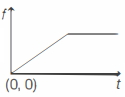
- B
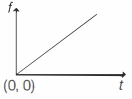
- C
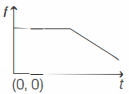
- D
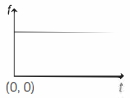
Explore More
Similar Questions
If ${\mu _s}$,${\mu _k}$,and ${\mu _r}$ are coefficients of static friction,sliding (kinetic) friction,and rolling friction respectively,then:
Easy
View SolutionThe coefficient of static friction between a wooden block of mass $0.5\, kg$ and a vertical rough wall is $0.2$. The magnitude of the horizontal force that should be applied on the block to keep it adhered to the wall will be $N$ $\left[ g = 10\, m/s^2 \right]$.
The maximum static frictional force is
Easy
View Solution$A$ heavy box is to be dragged along a rough horizontal floor. Person $A$ pushes it at an angle of $30^\circ$ from the horizontal and requires a minimum force $F_A$. Person $B$ pulls the box at an angle of $60^\circ$ from the horizontal and needs a minimum force $F_B$. If the coefficient of friction between the box and the floor is $\mu = \frac{\sqrt{3}}{5}$,find the ratio $\frac{F_A}{F_B}$.
DifficultJEE MAIN 2014
View SolutionFor a given mass,how does rolling friction compare to static friction and kinetic friction?
Medium
View SolutionVedclass Products
For Students
Vedclass Test Series
Mock tests in real JEE/NEET style with performance analysis. 5-day free trial.
Start Free TrialFor Teachers
Exam Paper Generator
Generate Set A/B/C/D exam papers from 7.5L+ questions in 2 minutes. 3 chapters free.
Try FreeFor Institutes
Online Exam Module
Live online exams with unlimited students, 360° analytics & white-label branding.
See Demo