
A English
Circular motion with Friction Questions in English
Class 11 Physics · Newton's Laws of Motion and Friction · Circular motion with Friction
124+
Questions
English
Language
100%
With Solutions
Showing 50 of 124 questions in English
51
EasyMCQ
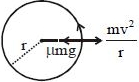
For a body moving in a circular path,what is the condition for no skidding if $\mu$ is the coefficient of friction?
A
$\frac{mv^2}{r} \leq \mu mg$
B
$\frac{mv^2}{r} \geq \mu mg$
C
$\frac{v}{r} = \mu g$
D
$\frac{mv^2}{r} = \mu mg$
Solution
(A) For a body of mass $m$ moving in a horizontal circular path of radius $r$ with speed $v$,the centripetal force required is $F_c = \frac{mv^2}{r}$.
This centripetal force is provided by the static friction force $f_s$ acting between the body and the surface.
The maximum value of static friction is $f_{s,max} = \mu N = \mu mg$.
For the body to move in a circular path without skidding,the required centripetal force must be less than or equal to the maximum available static friction.
Therefore,the condition for no skidding is $\frac{mv^2}{r} \leq \mu mg$.
This centripetal force is provided by the static friction force $f_s$ acting between the body and the surface.
The maximum value of static friction is $f_{s,max} = \mu N = \mu mg$.
For the body to move in a circular path without skidding,the required centripetal force must be less than or equal to the maximum available static friction.
Therefore,the condition for no skidding is $\frac{mv^2}{r} \leq \mu mg$.
0 likes
View Solution52
DifficultMCQ
$A$ car is crossing a turn at a speed of $10\,m/s$. If the coefficient of friction is $0.5$,then the minimum radius of the turn will be ........ $m$.
A
$5$
B
$10$
C
$15$
D
$20$
Solution
(D) For a car to safely negotiate a turn on a flat road,the centripetal force is provided by the static friction force.
$F_c = F_f$
$\frac{mv^2}{r} = \mu mg$
$\frac{v^2}{r} = \mu g$
Rearranging for the radius $r$:
$r = \frac{v^2}{\mu g}$
Given $v = 10\,m/s$,$\mu = 0.5$,and taking $g = 10\,m/s^2$:
$r = \frac{10^2}{0.5 \times 10} = \frac{100}{5} = 20\,m$.
Thus,the minimum radius of the turn is $20\,m$.
$F_c = F_f$
$\frac{mv^2}{r} = \mu mg$
$\frac{v^2}{r} = \mu g$
Rearranging for the radius $r$:
$r = \frac{v^2}{\mu g}$
Given $v = 10\,m/s$,$\mu = 0.5$,and taking $g = 10\,m/s^2$:
$r = \frac{10^2}{0.5 \times 10} = \frac{100}{5} = 20\,m$.
Thus,the minimum radius of the turn is $20\,m$.
0 likes
View Solution53
MediumMCQ
$A$ car has to move on a level turn of radius $450\,m.$ If the coefficient of static friction between the tyre and the road is $\mu = 0.2,$ find the maximum speed the car can take without skidding in $m/s.$
A
$20$
B
$30$
C
$9.39$
D
$25$
Solution
(B) For a car moving on a level circular road,the centripetal force required for turning is provided by the static friction between the tyres and the road.
The condition for the car not to skid is that the required centripetal force must be less than or equal to the maximum static frictional force.
$F_{c} \leq f_{s,max}$
$\frac{mv^{2}}{R} \leq \mu mg$
$v^{2} \leq \mu gR$
$v_{max} = \sqrt{\mu gR}$
Given: $\mu = 0.2,$ $R = 450\,m,$ and taking $g = 10\,m/s^{2}.$
$v_{max} = \sqrt{0.2 \times 10 \times 450}$
$v_{max} = \sqrt{2 \times 450}$
$v_{max} = \sqrt{900}$
$v_{max} = 30\,m/s.$
The condition for the car not to skid is that the required centripetal force must be less than or equal to the maximum static frictional force.
$F_{c} \leq f_{s,max}$
$\frac{mv^{2}}{R} \leq \mu mg$
$v^{2} \leq \mu gR$
$v_{max} = \sqrt{\mu gR}$
Given: $\mu = 0.2,$ $R = 450\,m,$ and taking $g = 10\,m/s^{2}.$
$v_{max} = \sqrt{0.2 \times 10 \times 450}$
$v_{max} = \sqrt{2 \times 450}$
$v_{max} = \sqrt{900}$
$v_{max} = 30\,m/s.$
0 likes
View Solution54
MediumMCQ
$A$ motorcyclist of mass $m$ is to negotiate a curve of radius $r$ with a speed $v$. The minimum value of the coefficient of friction so that the negotiation may take place safely is
A
$v^2rg$
B
$\frac{v^2}{gr}$
C
$\frac{gr}{v^2}$
D
$\frac{g}{v^2r}$
Solution
(B) For a motorcyclist to negotiate a curve of radius $r$ with speed $v$ safely,the centripetal force required is provided by the static frictional force between the tires and the road.
The required centripetal force is given by $F_c = \frac{mv^2}{r}$.
The maximum available frictional force is $f_{max} = \mu N = \mu mg$,where $\mu$ is the coefficient of friction and $N = mg$ is the normal force.
For safe negotiation,the frictional force must be at least equal to the required centripetal force:
$f_{max} \geq F_c$
$\mu mg \geq \frac{mv^2}{r}$
$\mu \geq \frac{v^2}{gr}$
Therefore,the minimum value of the coefficient of friction is $\mu_{min} = \frac{v^2}{gr}$.
The required centripetal force is given by $F_c = \frac{mv^2}{r}$.
The maximum available frictional force is $f_{max} = \mu N = \mu mg$,where $\mu$ is the coefficient of friction and $N = mg$ is the normal force.
For safe negotiation,the frictional force must be at least equal to the required centripetal force:
$f_{max} \geq F_c$
$\mu mg \geq \frac{mv^2}{r}$
$\mu \geq \frac{v^2}{gr}$
Therefore,the minimum value of the coefficient of friction is $\mu_{min} = \frac{v^2}{gr}$.
0 likes
View Solution55
MediumMCQ
$A$ coin placed on a rotating table just slips if it is placed at a distance $4r$ from the centre. On doubling the angular velocity of the table,the coin will just slip when at a distance from the centre equal to
A
$4r$
B
$2r$
C
$r$
D
$\frac{r}{4}$
Solution
(C) The coin placed on the rotating table slips when the centripetal force $mr\omega^2$ is greater than or equal to the maximum static frictional force $f_{max} = \mu mg$.
The condition for the coin to just slip is given by:
$mr\omega^2 = \mu mg$
This simplifies to:
$r = \frac{\mu g}{\omega^2}$
From this relation,we can see that $r \propto \frac{1}{\omega^2}$.
Let the initial distance be $r_1 = 4r$ at angular velocity $\omega_1 = \omega$.
Let the new distance be $r_2$ at angular velocity $\omega_2 = 2\omega$.
Using the proportionality $r_1 \omega_1^2 = r_2 \omega_2^2$:
$(4r)(\omega)^2 = r_2 (2\omega)^2$
$4r \cdot \omega^2 = r_2 \cdot 4\omega^2$
$r_2 = r$
Thus,the coin will just slip when it is at a distance $r$ from the centre.
The condition for the coin to just slip is given by:
$mr\omega^2 = \mu mg$
This simplifies to:
$r = \frac{\mu g}{\omega^2}$
From this relation,we can see that $r \propto \frac{1}{\omega^2}$.
Let the initial distance be $r_1 = 4r$ at angular velocity $\omega_1 = \omega$.
Let the new distance be $r_2$ at angular velocity $\omega_2 = 2\omega$.
Using the proportionality $r_1 \omega_1^2 = r_2 \omega_2^2$:
$(4r)(\omega)^2 = r_2 (2\omega)^2$
$4r \cdot \omega^2 = r_2 \cdot 4\omega^2$
$r_2 = r$
Thus,the coin will just slip when it is at a distance $r$ from the centre.
0 likes
View Solution56
DifficultMCQ
The maximum velocity (in $m/s$) with which a car driver must traverse a flat curve of radius $150\, m$ and coefficient of friction $0.6$ to avoid skidding is ........ $m/s$.
A
$60$
B
$30$
C
$15$
D
$25$
Solution
(B) To avoid skidding on a flat circular curve,the centripetal force required is provided by the static friction force.
$f_{L} \geq \frac{mv^{2}}{r}$
For maximum speed $(v_{\max})$,the limiting friction is equal to the centripetal force:
$f_{L} = \frac{mv_{\max}^{2}}{r}$
Since $f_{L} = \mu mg$,we have:
$\mu mg = \frac{mv_{\max}^{2}}{r}$
$v_{\max} = \sqrt{\mu rg}$
Given $\mu = 0.6$,$r = 150\, m$,and taking $g = 10\, m/s^2$:
$v_{\max} = \sqrt{0.6 \times 150 \times 10}$
$v_{\max} = \sqrt{900}$
$v_{\max} = 30\, m/s$.
$f_{L} \geq \frac{mv^{2}}{r}$
For maximum speed $(v_{\max})$,the limiting friction is equal to the centripetal force:
$f_{L} = \frac{mv_{\max}^{2}}{r}$
Since $f_{L} = \mu mg$,we have:
$\mu mg = \frac{mv_{\max}^{2}}{r}$
$v_{\max} = \sqrt{\mu rg}$
Given $\mu = 0.6$,$r = 150\, m$,and taking $g = 10\, m/s^2$:
$v_{\max} = \sqrt{0.6 \times 150 \times 10}$
$v_{\max} = \sqrt{900}$
$v_{\max} = 30\, m/s$.
0 likes
View Solution57
MediumMCQ
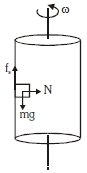
$A$ block of mass $10\; kg$ is in contact with the inner wall of a hollow cylindrical drum of radius $1\; m$. The coefficient of friction between the block and the inner wall of the cylinder is $0.1$. The minimum angular velocity needed for the cylinder to keep the block stationary when the cylinder is vertical and rotating about its axis will be: ......$rad/s$ $(g = 10\; m/s^2)$
A
$\sqrt{10}$
B
$\frac{10}{2\pi}$
C
$10$
D
$10\pi$
Solution
(C) For the block to remain stationary,the upward frictional force must balance the downward gravitational force.
$f_s = mg$
The normal force $N$ provided by the wall acts as the centripetal force for the block's circular motion:
$N = mr\omega^2$
The maximum static frictional force is given by:
$f_{L} = \mu N = \mu mr\omega^2$
For the block to stay in equilibrium,the frictional force must be at least equal to the weight:
$f_{L} \geq mg$
$\mu mr\omega^2 \geq mg$
Solving for $\omega$:
$\omega^2 \geq \frac{g}{\mu r}$
$\omega \geq \sqrt{\frac{g}{\mu r}}$
Substituting the given values ($g = 10\; m/s^2$,$\mu = 0.1$,$r = 1\; m$):
$\omega_{\min} = \sqrt{\frac{10}{0.1 \times 1}} = \sqrt{\frac{10}{0.1}} = \sqrt{100} = 10\; rad/s$
$f_s = mg$
The normal force $N$ provided by the wall acts as the centripetal force for the block's circular motion:
$N = mr\omega^2$
The maximum static frictional force is given by:
$f_{L} = \mu N = \mu mr\omega^2$
For the block to stay in equilibrium,the frictional force must be at least equal to the weight:
$f_{L} \geq mg$
$\mu mr\omega^2 \geq mg$
Solving for $\omega$:
$\omega^2 \geq \frac{g}{\mu r}$
$\omega \geq \sqrt{\frac{g}{\mu r}}$
Substituting the given values ($g = 10\; m/s^2$,$\mu = 0.1$,$r = 1\; m$):
$\omega_{\min} = \sqrt{\frac{10}{0.1 \times 1}} = \sqrt{\frac{10}{0.1}} = \sqrt{100} = 10\; rad/s$
0 likes
View Solution58
EasyMCQ
$A$ cyclist speeding at $18 \; km/h$ on a level road takes a sharp circular turn of radius $3 \; m$ without reducing the speed. The coefficient of static friction between the tyres and the road is $0.1$. Will the cyclist slip while taking the turn?
A
Yes,the cyclist will slip.
B
No,the cyclist will not slip.
C
The cyclist will move in a straight line.
D
The cyclist will stop.
Solution
(A) On an unbanked road,the frictional force provides the necessary centripetal force for circular motion. The condition for the cyclist not to slip is $v^{2} \leq \mu_{s} R g$.
Given: $v = 18 \; km/h = 18 \times \frac{5}{18} = 5 \; m/s$,$R = 3 \; m$,$\mu_{s} = 0.1$,and $g = 9.8 \; m/s^{2}$.
Calculating the maximum allowed speed squared: $\mu_{s} R g = 0.1 \times 3 \times 9.8 = 2.94 \; m^{2}/s^{2}$.
Calculating the actual speed squared: $v^{2} = (5)^{2} = 25 \; m^{2}/s^{2}$.
Since $v^{2} > \mu_{s} R g$ $(25 > 2.94)$,the frictional force is insufficient to provide the required centripetal force. Therefore,the cyclist will slip.
Given: $v = 18 \; km/h = 18 \times \frac{5}{18} = 5 \; m/s$,$R = 3 \; m$,$\mu_{s} = 0.1$,and $g = 9.8 \; m/s^{2}$.
Calculating the maximum allowed speed squared: $\mu_{s} R g = 0.1 \times 3 \times 9.8 = 2.94 \; m^{2}/s^{2}$.
Calculating the actual speed squared: $v^{2} = (5)^{2} = 25 \; m^{2}/s^{2}$.
Since $v^{2} > \mu_{s} R g$ $(25 > 2.94)$,the frictional force is insufficient to provide the required centripetal force. Therefore,the cyclist will slip.
0 likes
View Solution59
Medium
$A$ circular racetrack of radius $300 \; m$ is banked at an angle of $15^{\circ}$. If the coefficient of friction between the wheels of a race-car and the road is $0.2$,what is the
$(a)$ optimum speed of the racecar to avoid wear and tear on its tyres,and
$(b)$ maximum permissible speed to avoid slipping?
$(a)$ optimum speed of the racecar to avoid wear and tear on its tyres,and
$(b)$ maximum permissible speed to avoid slipping?
Solution
(A) On a banked road,the horizontal component of the normal force and the frictional force contribute to provide the centripetal force required to keep the car moving on a circular turn without slipping.
$(a)$ At the optimum speed,the horizontal component of the normal reaction is sufficient to provide the necessary centripetal force,and the frictional force is not required. The optimum speed $v_{o}$ is given by the formula:
$v_{o} = \sqrt{R g \tan \theta}$
Given $R = 300 \; m$,$\theta = 15^{\circ}$,and $g = 9.8 \; m/s^{2}$:
$v_{o} = \sqrt{300 \times 9.8 \times \tan(15^{\circ})} = \sqrt{2940 \times 0.2679} \approx \sqrt{787.6} \approx 28.1 \; m/s$.
$(b)$ The maximum permissible speed $v_{\max}$ to avoid slipping is given by the formula:
$v_{\max} = \sqrt{R g \left( \frac{\mu_{s} + \tan \theta}{1 - \mu_{s} \tan \theta} \right)}$
Given $\mu_{s} = 0.2$:
$v_{\max} = \sqrt{300 \times 9.8 \times \left( \frac{0.2 + 0.2679}{1 - (0.2 \times 0.2679)} \right)} = \sqrt{2940 \times \left( \frac{0.4679}{0.9464} \right)} \approx \sqrt{2940 \times 0.4944} \approx \sqrt{1453.5} \approx 38.1 \; m/s$.
$(a)$ At the optimum speed,the horizontal component of the normal reaction is sufficient to provide the necessary centripetal force,and the frictional force is not required. The optimum speed $v_{o}$ is given by the formula:
$v_{o} = \sqrt{R g \tan \theta}$
Given $R = 300 \; m$,$\theta = 15^{\circ}$,and $g = 9.8 \; m/s^{2}$:
$v_{o} = \sqrt{300 \times 9.8 \times \tan(15^{\circ})} = \sqrt{2940 \times 0.2679} \approx \sqrt{787.6} \approx 28.1 \; m/s$.
$(b)$ The maximum permissible speed $v_{\max}$ to avoid slipping is given by the formula:
$v_{\max} = \sqrt{R g \left( \frac{\mu_{s} + \tan \theta}{1 - \mu_{s} \tan \theta} \right)}$
Given $\mu_{s} = 0.2$:
$v_{\max} = \sqrt{300 \times 9.8 \times \left( \frac{0.2 + 0.2679}{1 - (0.2 \times 0.2679)} \right)} = \sqrt{2940 \times \left( \frac{0.4679}{0.9464} \right)} \approx \sqrt{2940 \times 0.4944} \approx \sqrt{1453.5} \approx 38.1 \; m/s$.
0 likes
View Solution60
MediumMCQ
$A$ stone of mass $0.25 \; kg$ tied to the end of a string is whirled round in a circle of radius $1.5 \; m$ with a speed of $40 \; rev./min$ in a horizontal plane. What is the tension in the string? What is the maximum speed in $m/s$ with which the stone can be whirled around if the string can withstand a maximum tension of $200 \; N$ (in $; m/s$)?
A
$34.64$
B
$42.26$
C
$26.5$
D
$12.26$
Solution
(A) Mass of the stone,$m = 0.25 \; kg$.
Radius of the circle,$r = 1.5 \; m$.
Frequency of revolution,$n = \frac{40}{60} = \frac{2}{3} \; rps$.
Angular velocity,$\omega = 2 \pi n = 2 \times 3.1416 \times \frac{2}{3} \approx 4.189 \; rad/s$.
The centripetal force is provided by the tension $T$ in the string: $T = m r \omega^2$.
$T = 0.25 \times 1.5 \times (4.189)^2 \approx 6.58 \; N$.
For the maximum speed,$T_{\max} = 200 \; N$.
Using $T_{\max} = \frac{m v_{\max}^2}{r}$,we get $v_{\max} = \sqrt{\frac{T_{\max} \times r}{m}}$.
$v_{\max} = \sqrt{\frac{200 \times 1.5}{0.25}} = \sqrt{1200} \approx 34.64 \; m/s$.
Radius of the circle,$r = 1.5 \; m$.
Frequency of revolution,$n = \frac{40}{60} = \frac{2}{3} \; rps$.
Angular velocity,$\omega = 2 \pi n = 2 \times 3.1416 \times \frac{2}{3} \approx 4.189 \; rad/s$.
The centripetal force is provided by the tension $T$ in the string: $T = m r \omega^2$.
$T = 0.25 \times 1.5 \times (4.189)^2 \approx 6.58 \; N$.
For the maximum speed,$T_{\max} = 200 \; N$.
Using $T_{\max} = \frac{m v_{\max}^2}{r}$,we get $v_{\max} = \sqrt{\frac{T_{\max} \times r}{m}}$.
$v_{\max} = \sqrt{\frac{200 \times 1.5}{0.25}} = \sqrt{1200} \approx 34.64 \; m/s$.
0 likes
View Solution61
Easy
$A$ train runs along an unbanked circular track of radius $30 \; m$ at a speed of $54 \; km/h$. The mass of the train is $10^{6} \; kg$. What provides the centripetal force required for this purpose - the engine or the rails? What is the angle of banking required to prevent wearing out of the rail?
Solution
(D) Radius of the circular track,$r = 30 \; m$.
Speed of the train,$v = 54 \; km/h = 54 \times \frac{5}{18} \; m/s = 15 \; m/s$.
Mass of the train,$m = 10^{6} \; kg$.
The centripetal force is provided by the lateral thrust exerted by the rails on the wheels of the train. According to Newton's third law of motion,the wheels exert an equal and opposite force on the rails,which causes wear and tear.
The angle of banking $\theta$ required to prevent wear and tear is given by the relation:
$\tan \theta = \frac{v^{2}}{rg}$
Substituting the values:
$\tan \theta = \frac{(15)^{2}}{30 \times 9.8} = \frac{225}{294} \approx 0.765$
$\theta = \tan^{-1}(0.765) \approx 37.4^{\circ}$.
(Note: Using $g = 10 \; m/s^{2}$,$\tan \theta = \frac{225}{300} = 0.75$,so $\theta = \tan^{-1}(0.75) \approx 36.87^{\circ}$).
Speed of the train,$v = 54 \; km/h = 54 \times \frac{5}{18} \; m/s = 15 \; m/s$.
Mass of the train,$m = 10^{6} \; kg$.
The centripetal force is provided by the lateral thrust exerted by the rails on the wheels of the train. According to Newton's third law of motion,the wheels exert an equal and opposite force on the rails,which causes wear and tear.
The angle of banking $\theta$ required to prevent wear and tear is given by the relation:
$\tan \theta = \frac{v^{2}}{rg}$
Substituting the values:
$\tan \theta = \frac{(15)^{2}}{30 \times 9.8} = \frac{225}{294} \approx 0.765$
$\theta = \tan^{-1}(0.765) \approx 37.4^{\circ}$.
(Note: Using $g = 10 \; m/s^{2}$,$\tan \theta = \frac{225}{300} = 0.75$,so $\theta = \tan^{-1}(0.75) \approx 36.87^{\circ}$).
0 likes
View Solution62
DifficultMCQ
$A$ disc revolves with a speed of $33 \frac{1}{3} \; rev/min$,and has a radius of $15 \; cm$. Two coins are placed at $4 \; cm$ and $14 \; cm$ away from the centre of the record. If the coefficient of friction between the coins and the record is $0.15$,which of the coins will revolve with the record?
A
Both coins
B
Only the coin at $4 \; cm$
C
Only the coin at $14 \; cm$
D
None of the coins
Solution
(B) For a coin to revolve with the disc,the frictional force must be greater than or equal to the required centripetal force: $\mu mg \geq mr\omega^2$,or $\mu g \geq r\omega^2$.
Given:
Frequency $\nu = 33 \frac{1}{3} \; rev/min = \frac{100}{3 \times 60} = \frac{5}{9} \; rev/s$.
Angular velocity $\omega = 2\pi\nu = 2 \times \pi \times \frac{5}{9} = \frac{10\pi}{9} \approx 3.49 \; rad/s$.
Maximum acceleration provided by friction $a_{max} = \mu g = 0.15 \times 10 = 1.5 \; m/s^2$.
For the coin at $r_1 = 4 \; cm = 0.04 \; m$:
Required centripetal acceleration $a_1 = r_1\omega^2 = 0.04 \times (3.49)^2 \approx 0.49 \; m/s^2$.
Since $a_1 < a_{max}$ $(0.49 < 1.5)$,the coin at $4 \; cm$ will revolve with the disc.
For the coin at $r_2 = 14 \; cm = 0.14 \; m$:
Required centripetal acceleration $a_2 = r_2\omega^2 = 0.14 \times (3.49)^2 \approx 1.70 \; m/s^2$.
Since $a_2 > a_{max}$ $(1.70 > 1.5)$,the coin at $14 \; cm$ will slip.
Given:
Frequency $\nu = 33 \frac{1}{3} \; rev/min = \frac{100}{3 \times 60} = \frac{5}{9} \; rev/s$.
Angular velocity $\omega = 2\pi\nu = 2 \times \pi \times \frac{5}{9} = \frac{10\pi}{9} \approx 3.49 \; rad/s$.
Maximum acceleration provided by friction $a_{max} = \mu g = 0.15 \times 10 = 1.5 \; m/s^2$.
For the coin at $r_1 = 4 \; cm = 0.04 \; m$:
Required centripetal acceleration $a_1 = r_1\omega^2 = 0.04 \times (3.49)^2 \approx 0.49 \; m/s^2$.
Since $a_1 < a_{max}$ $(0.49 < 1.5)$,the coin at $4 \; cm$ will revolve with the disc.
For the coin at $r_2 = 14 \; cm = 0.14 \; m$:
Required centripetal acceleration $a_2 = r_2\omega^2 = 0.14 \times (3.49)^2 \approx 1.70 \; m/s^2$.
Since $a_2 > a_{max}$ $(1.70 > 1.5)$,the coin at $14 \; cm$ will slip.
0 likes
View Solution63
MediumMCQ
$A$ $70 \; kg$ man stands in contact against the inner wall of a hollow cylindrical drum of radius $3 \; m$ rotating about its vertical axis. The coefficient of friction between the wall and his clothing is $0.15$. What is the minimum rotational speed (in $rad/s$) of the cylinder to enable the man to remain stuck to the wall (without falling) when the floor is suddenly removed? (Take $g = 10 \; m/s^2$)
A
$1.41$
B
$2.63$
C
$4.71$
D
$3.41$
Solution
(C) Mass of the man,$m = 70 \; kg$.
Radius of the drum,$r = 3 \; m$.
Coefficient of friction,$\mu = 0.15$.
Acceleration due to gravity,$g = 10 \; m/s^2$.
For the man to remain stuck to the wall,the frictional force $f$ must balance the weight of the man,$mg$.
$f = \mu F_N = mg$,where $F_N$ is the normal force provided by the wall.
The normal force provides the necessary centripetal force: $F_N = mr\omega^2$.
Substituting $F_N$ into the friction equation: $\mu(mr\omega^2) = mg$.
Simplifying for angular velocity $\omega$: $\omega^2 = \frac{g}{\mu r}$.
$\omega = \sqrt{\frac{g}{\mu r}} = \sqrt{\frac{10}{0.15 \times 3}} = \sqrt{\frac{10}{0.45}} = \sqrt{22.22} \approx 4.71 \; rad/s$.
Radius of the drum,$r = 3 \; m$.
Coefficient of friction,$\mu = 0.15$.
Acceleration due to gravity,$g = 10 \; m/s^2$.
For the man to remain stuck to the wall,the frictional force $f$ must balance the weight of the man,$mg$.
$f = \mu F_N = mg$,where $F_N$ is the normal force provided by the wall.
The normal force provides the necessary centripetal force: $F_N = mr\omega^2$.
Substituting $F_N$ into the friction equation: $\mu(mr\omega^2) = mg$.
Simplifying for angular velocity $\omega$: $\omega^2 = \frac{g}{\mu r}$.
$\omega = \sqrt{\frac{g}{\mu r}} = \sqrt{\frac{10}{0.15 \times 3}} = \sqrt{\frac{10}{0.45}} = \sqrt{22.22} \approx 4.71 \; rad/s$.
0 likes
View Solution64
Medium
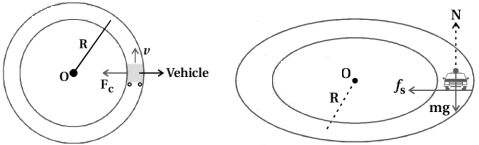
Obtain the formula for the maximum safe speed $(v_{max})$ of a vehicle on a level curved road.
Solution
(N/A) Consider a vehicle of mass $m$ moving on a level curved road of radius $R$. The forces acting on the vehicle are:
$(1)$ The gravitational force $(mg)$ acting downwards.
$(2)$ The normal reaction force $(N)$ acting upwards from the road surface. Since there is no vertical motion,$N = mg$.
$(3)$ The static frictional force $(f_s)$ acting towards the center of the circular path,which provides the necessary centripetal force.
For safe turning,the required centripetal force must be provided by the static friction:
$\frac{mv^2}{R} \leq f_s$
Since the maximum value of static friction is $f_{s,max} = \mu_s N = \mu_s mg$,we have:
$\frac{mv_{max}^2}{R} = \mu_s mg$
Solving for $v_{max}$:
$v_{max}^2 = \mu_s Rg$
$v_{max} = \sqrt{\mu_s Rg}$
Where $\mu_s$ is the coefficient of static friction between the tyres and the road surface.
$(1)$ The gravitational force $(mg)$ acting downwards.
$(2)$ The normal reaction force $(N)$ acting upwards from the road surface. Since there is no vertical motion,$N = mg$.
$(3)$ The static frictional force $(f_s)$ acting towards the center of the circular path,which provides the necessary centripetal force.
For safe turning,the required centripetal force must be provided by the static friction:
$\frac{mv^2}{R} \leq f_s$
Since the maximum value of static friction is $f_{s,max} = \mu_s N = \mu_s mg$,we have:
$\frac{mv_{max}^2}{R} = \mu_s mg$
Solving for $v_{max}$:
$v_{max}^2 = \mu_s Rg$
$v_{max} = \sqrt{\mu_s Rg}$
Where $\mu_s$ is the coefficient of static friction between the tyres and the road surface.
0 likes
View Solution65
Difficult
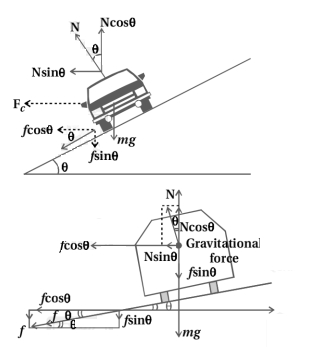
For a vehicle moving on a banked curved road,using a free body diagram $(FBD)$,obtain the formula for the maximum safe speed $(v_{max})$.
Solution
(N/A) For a vehicle of mass $m$ moving on a banked road with angle $\theta$ and radius $R$,the forces acting are the normal force $N$,the gravitational force $mg$,and the maximum static friction $f_s = \mu_s N$.
Resolving forces vertically:
$N \cos \theta = mg + f_s \sin \theta$
$N \cos \theta = mg + \mu_s N \sin \theta$
$N(\cos \theta - \mu_s \sin \theta) = mg$ --- $(1)$
Resolving forces horizontally (providing centripetal force):
$N \sin \theta + f_s \cos \theta = \frac{mv_{max}^2}{R}$
$N \sin \theta + \mu_s N \cos \theta = \frac{mv_{max}^2}{R}$
$N(\sin \theta + \mu_s \cos \theta) = \frac{mv_{max}^2}{R}$ --- $(2)$
Dividing $(2)$ by $(1)$:
$\frac{\sin \theta + \mu_s \cos \theta}{\cos \theta - \mu_s \sin \theta} = \frac{v_{max}^2}{Rg}$
Dividing numerator and denominator by $\cos \theta$:
$\frac{\tan \theta + \mu_s}{1 - \mu_s \tan \theta} = \frac{v_{max}^2}{Rg}$
Thus,$v_{max} = \sqrt{Rg \left( \frac{\mu_s + \tan \theta}{1 - \mu_s \tan \theta} \right)}$.
Resolving forces vertically:
$N \cos \theta = mg + f_s \sin \theta$
$N \cos \theta = mg + \mu_s N \sin \theta$
$N(\cos \theta - \mu_s \sin \theta) = mg$ --- $(1)$
Resolving forces horizontally (providing centripetal force):
$N \sin \theta + f_s \cos \theta = \frac{mv_{max}^2}{R}$
$N \sin \theta + \mu_s N \cos \theta = \frac{mv_{max}^2}{R}$
$N(\sin \theta + \mu_s \cos \theta) = \frac{mv_{max}^2}{R}$ --- $(2)$
Dividing $(2)$ by $(1)$:
$\frac{\sin \theta + \mu_s \cos \theta}{\cos \theta - \mu_s \sin \theta} = \frac{v_{max}^2}{Rg}$
Dividing numerator and denominator by $\cos \theta$:
$\frac{\tan \theta + \mu_s}{1 - \mu_s \tan \theta} = \frac{v_{max}^2}{Rg}$
Thus,$v_{max} = \sqrt{Rg \left( \frac{\mu_s + \tan \theta}{1 - \mu_s \tan \theta} \right)}$.
0 likes
View Solution66
EasyMCQ
How is centripetal force provided during motion on a level circular path?
A
By the gravitational force between the vehicle and the Earth.
B
By the static frictional force between the tires of the vehicle and the road surface.
C
By the normal reaction force exerted by the road.
D
By the air resistance acting on the vehicle.
Solution
(B) When a vehicle moves on a level circular path,it requires a centripetal force to maintain its circular motion.
This necessary centripetal force is provided by the static frictional force acting between the tires of the vehicle and the surface of the road.
The frictional force acts towards the center of the circular path,thus satisfying the requirement for centripetal force $(F_c = \frac{mv^2}{r})$.
If the required centripetal force exceeds the maximum available static friction $(f_{s,max} = \mu_s N)$,the vehicle will skid.
This necessary centripetal force is provided by the static frictional force acting between the tires of the vehicle and the surface of the road.
The frictional force acts towards the center of the circular path,thus satisfying the requirement for centripetal force $(F_c = \frac{mv^2}{r})$.
If the required centripetal force exceeds the maximum available static friction $(f_{s,max} = \mu_s N)$,the vehicle will skid.
0 likes
View Solution67
MediumMCQ
On which road do we get maximum speed: a circular road with a slope (banked road) or a level circular road?
A
Level circular road
B
Circular road with slope (banked road)
C
Both provide the same speed
D
Depends on the vehicle type
Solution
(B) The maximum safe speed on a level circular road is given by $v_{max} = \sqrt{\mu R g}$,where $\mu$ is the coefficient of friction,$R$ is the radius,and $g$ is the acceleration due to gravity.
On a banked road (circular road with slope $\theta$),the maximum speed is given by $v_{max} = \sqrt{Rg \left( \frac{\mu + \tan \theta}{1 - \mu \tan \theta} \right)}$.
Since $\tan \theta > 0$,the term $\left( \frac{\mu + \tan \theta}{1 - \mu \tan \theta} \right)$ is greater than $\mu$.
Therefore,a circular road with a slope (banked road) allows for a higher maximum speed compared to a level circular road.
On a banked road (circular road with slope $\theta$),the maximum speed is given by $v_{max} = \sqrt{Rg \left( \frac{\mu + \tan \theta}{1 - \mu \tan \theta} \right)}$.
Since $\tan \theta > 0$,the term $\left( \frac{\mu + \tan \theta}{1 - \mu \tan \theta} \right)$ is greater than $\mu$.
Therefore,a circular road with a slope (banked road) allows for a higher maximum speed compared to a level circular road.
0 likes
View Solution68
MediumMCQ
How is centripetal force provided while taking a turn on a level circular track?
A
By the force of gravity
B
By the normal reaction
C
By the force of static friction
D
By the engine power
Solution
(C) When a vehicle takes a turn on a level circular track,it tends to skid outwards due to inertia.
To prevent this,the force of static friction between the tires and the road surface acts towards the center of the circular path.
This static friction provides the necessary centripetal force required for circular motion.
The condition for safe turning is $f_s \leq \mu_s N$,where $f_s$ is the static friction,$\mu_s$ is the coefficient of static friction,and $N$ is the normal reaction.
Thus,the correct option is $C$.
To prevent this,the force of static friction between the tires and the road surface acts towards the center of the circular path.
This static friction provides the necessary centripetal force required for circular motion.
The condition for safe turning is $f_s \leq \mu_s N$,where $f_s$ is the static friction,$\mu_s$ is the coefficient of static friction,and $N$ is the normal reaction.
Thus,the correct option is $C$.
0 likes
View Solution69
EasyMCQ
Write the formula for the maximum safe speed of a vehicle moving on a flat curved road of radius $r$.
A
$v = \sqrt{\mu_s r g}$
B
$v = \sqrt{\frac{r g}{\mu_s}}$
C
$v = \mu_s r g$
D
$v = \sqrt{\mu_s r^2 g}$
Solution
(A) For a vehicle moving on a flat curved road,the centripetal force required for circular motion is provided by the static friction force between the tires and the road.
Let $m$ be the mass of the vehicle,$v$ be its velocity,$r$ be the radius of the curve,and $\mu_s$ be the coefficient of static friction.
The required centripetal force is $F_c = \frac{mv^2}{r}$.
The maximum available static friction force is $f_{s,max} = \mu_s N = \mu_s mg$.
For safe turning,the centripetal force must be less than or equal to the maximum static friction force: $\frac{mv^2}{r} \leq \mu_s mg$.
Solving for $v$,we get $v^2 \leq \mu_s rg$,which gives the maximum safe speed as $v_{max} = \sqrt{\mu_s rg}$.
Let $m$ be the mass of the vehicle,$v$ be its velocity,$r$ be the radius of the curve,and $\mu_s$ be the coefficient of static friction.
The required centripetal force is $F_c = \frac{mv^2}{r}$.
The maximum available static friction force is $f_{s,max} = \mu_s N = \mu_s mg$.
For safe turning,the centripetal force must be less than or equal to the maximum static friction force: $\frac{mv^2}{r} \leq \mu_s mg$.
Solving for $v$,we get $v^2 \leq \mu_s rg$,which gives the maximum safe speed as $v_{max} = \sqrt{\mu_s rg}$.
0 likes
View Solution70
MediumMCQ
Is the maximum safe speed of a vehicle on a banked curved road higher or lower than on a flat curved road?
A
Higher
B
Lower
C
Equal
D
Cannot be determined
Solution
(A) The maximum safe speed on a flat curved road is given by $v_{max} = \sqrt{\mu_s rg}$,where $\mu_s$ is the coefficient of static friction.
On a banked road with banking angle $\theta$,the maximum safe speed is given by $v_{max} = \sqrt{rg \tan \theta}$ (ignoring friction).
Even with friction,banking provides an additional centripetal force component,allowing for a higher speed compared to a flat road where the vehicle relies solely on friction.
Therefore,the maximum safe speed on a banked curved road is higher than on a flat curved road.
On a banked road with banking angle $\theta$,the maximum safe speed is given by $v_{max} = \sqrt{rg \tan \theta}$ (ignoring friction).
Even with friction,banking provides an additional centripetal force component,allowing for a higher speed compared to a flat road where the vehicle relies solely on friction.
Therefore,the maximum safe speed on a banked curved road is higher than on a flat curved road.
0 likes
View Solution71
EasyMCQ
What is the wear and tear on the tires of a vehicle moving at the optimum speed on a banked curved road?
A
Maximum
B
Minimum
C
Zero
D
Constant
Solution
(B) When a vehicle moves at the optimum speed (also known as the safe speed) on a banked road,the necessary centripetal force is provided entirely by the horizontal component of the normal reaction force.
In this condition,there is no requirement for frictional force between the tires and the road surface to provide the centripetal force.
Since the frictional force is zero,the wear and tear on the tires is minimum.
In this condition,there is no requirement for frictional force between the tires and the road surface to provide the centripetal force.
Since the frictional force is zero,the wear and tear on the tires is minimum.
0 likes
View Solution72
DifficultMCQ
For a banked curved road,if the velocity of the vehicle $v < v_0$ (where $v_0$ is the optimum speed),what is the direction of the frictional force?
A
Upwards along the incline
B
Downwards along the incline
C
Horizontal towards the center
D
Horizontal away from the center
Solution
(A) The optimum speed $v_0$ on a banked road is given by $v_0 = \sqrt{rg \tan \theta}$.
When the vehicle moves at a speed $v < v_0$,it has a tendency to slide down the incline due to the component of gravity being greater than the required centripetal force provided by the normal reaction.
To prevent this downward sliding,the static frictional force acts upwards along the incline.
When the vehicle moves at a speed $v < v_0$,it has a tendency to slide down the incline due to the component of gravity being greater than the required centripetal force provided by the normal reaction.
To prevent this downward sliding,the static frictional force acts upwards along the incline.
0 likes
View Solution73
EasyMCQ
The radius of a horizontal curved road is $20 \ m$ and the coefficient of friction between the road and the vehicle's tires is $0.25$. What is the safe speed of the vehicle on this road (in $m/s$)? $(g = 9.8 \ m/s^2)$
A
$5$
B
$7$
C
$10$
D
$14$
Solution
(B) The maximum safe speed $v$ of a vehicle on a horizontal curved road is given by the formula $v = \sqrt{\mu r g}$.
Given:
Coefficient of friction $\mu = 0.25$
Radius of the curve $r = 20 \ m$
Acceleration due to gravity $g = 9.8 \ m/s^2$
Substituting the values:
$v = \sqrt{0.25 \times 20 \times 9.8}$
$v = \sqrt{5 \times 9.8}$
$v = \sqrt{49}$
$v = 7 \ m/s$.
Thus,the safe speed of the vehicle is $7 \ m/s$.
Given:
Coefficient of friction $\mu = 0.25$
Radius of the curve $r = 20 \ m$
Acceleration due to gravity $g = 9.8 \ m/s^2$
Substituting the values:
$v = \sqrt{0.25 \times 20 \times 9.8}$
$v = \sqrt{5 \times 9.8}$
$v = \sqrt{49}$
$v = 7 \ m/s$.
Thus,the safe speed of the vehicle is $7 \ m/s$.
0 likes
View Solution74
DifficultMCQ
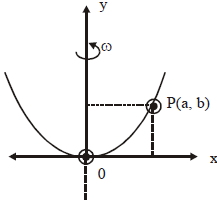
$A$ bead of mass $m$ stays at point $P(a, b)$ on a wire bent in the shape of a parabola $y = 4Cx^2$ and rotating with angular speed $\omega$ (see figure). The value of $\omega$ is (neglect friction).
A
$\sqrt{\frac{2gC}{ab}}$
B
$2\sqrt{2gC}$
C
$\sqrt{\frac{2g}{C}}$
D
$2\sqrt{gC}$
Solution
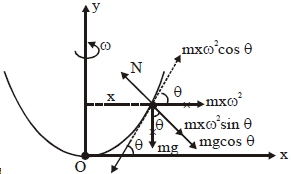
(B) In the rotating frame of reference,the forces acting on the bead are the gravitational force $mg$ (downwards),the centrifugal force $m x \omega^2$ (outwards),and the normal reaction $N$ from the wire.
For the bead to remain stationary at point $P(a, b)$,the net force along the tangent to the parabola must be zero.
The slope of the parabola $y = 4Cx^2$ is given by $\frac{dy}{dx} = 8Cx$.
At point $P(a, b)$,the slope is $\tan \theta = 8Ca$,where $\theta$ is the angle the tangent makes with the horizontal.
Resolving forces along the tangent,we have $m x \omega^2 \cos \theta = mg \sin \theta$.
This simplifies to $x \omega^2 = g \tan \theta$.
Substituting $x = a$ and $\tan \theta = 8Ca$,we get $a \omega^2 = g(8Ca)$.
Thus,$\omega^2 = 8gC$,which gives $\omega = \sqrt{8gC} = 2\sqrt{2gC}$.
For the bead to remain stationary at point $P(a, b)$,the net force along the tangent to the parabola must be zero.
The slope of the parabola $y = 4Cx^2$ is given by $\frac{dy}{dx} = 8Cx$.
At point $P(a, b)$,the slope is $\tan \theta = 8Ca$,where $\theta$ is the angle the tangent makes with the horizontal.
Resolving forces along the tangent,we have $m x \omega^2 \cos \theta = mg \sin \theta$.
This simplifies to $x \omega^2 = g \tan \theta$.
Substituting $x = a$ and $\tan \theta = 8Ca$,we get $a \omega^2 = g(8Ca)$.
Thus,$\omega^2 = 8gC$,which gives $\omega = \sqrt{8gC} = 2\sqrt{2gC}$.
0 likes
View Solution75
MediumMCQ
$A$ disc of radius $5\, m$ is rotating with an angular frequency of $10\, rad/s$. $A$ block of mass $2\, kg$ is to be placed on the disc. If the coefficient of friction between the disc and the block is $\mu_s = 0.4$,find the maximum distance from the axis where the block can be placed without sliding (in $cm$).
A
$2$
B
$3$
C
$4$
D
$6$
Solution
(C) For the block to remain stationary on the rotating disc,the centripetal force must be provided by the static friction force.
Let $m$ be the mass of the block,$\omega$ be the angular frequency,and $x$ be the distance from the axis.
The condition for no sliding is: $f_s \leq \mu_s N$.
Since $N = mg$ and $f_s = m\omega^2 x$,we have $m\omega^2 x \leq \mu_s mg$.
Thus,$x \leq \frac{\mu_s g}{\omega^2}$.
Given $\mu_s = 0.4$,$g = 10\, m/s^2$,and $\omega = 10\, rad/s$:
$x = \frac{0.4 \times 10}{10^2} = \frac{4}{100}\, m$.
Converting to centimeters: $x = 0.04\, m \times 100 = 4\, cm$.
Let $m$ be the mass of the block,$\omega$ be the angular frequency,and $x$ be the distance from the axis.
The condition for no sliding is: $f_s \leq \mu_s N$.
Since $N = mg$ and $f_s = m\omega^2 x$,we have $m\omega^2 x \leq \mu_s mg$.
Thus,$x \leq \frac{\mu_s g}{\omega^2}$.
Given $\mu_s = 0.4$,$g = 10\, m/s^2$,and $\omega = 10\, rad/s$:
$x = \frac{0.4 \times 10}{10^2} = \frac{4}{100}\, m$.
Converting to centimeters: $x = 0.04\, m \times 100 = 4\, cm$.
0 likes
View Solution76
DifficultMCQ
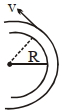
$A$ modern grand-prix racing car of mass $m$ is travelling on a flat track in a circular arc of radius $R$ with a speed $v$. If the coefficient of static friction between the tyres and the track is $\mu_{s},$ then the magnitude of negative lift $F_{L}$ acting downwards on the car is (Assume forces on the four tyres are identical and $g =$ acceleration due to gravity)
A
$m \left(\frac{v^{2}}{\mu_{s} R} - g\right)$
B
$m \left(\frac{v^{2}}{\mu_{s} R} + g\right)$
C
$m \left(g - \frac{v^{2}}{\mu_{s} R}\right)$
D
$-m\left(g + \frac{v^{2}}{\mu_{s} R}\right)$
Solution
(A) For a car moving in a circular path on a flat track,the centripetal force is provided by the static friction force $f_{s}$.
The maximum static friction force is given by $f_{s,max} = \mu_{s} N$,where $N$ is the normal force.
The centripetal force required is $F_{c} = \frac{mv^{2}}{R}$.
Thus,$\mu_{s} N = \frac{mv^{2}}{R}$,which gives $N = \frac{mv^{2}}{\mu_{s} R}$.
The normal force $N$ on the car is the sum of its weight $mg$ and the downward negative lift force $F_{L}$ (aerodynamic downforce).
Therefore,$N = mg + F_{L}$.
Substituting the expression for $N$,we get $\frac{mv^{2}}{\mu_{s} R} = mg + F_{L}$.
Solving for $F_{L}$,we get $F_{L} = \frac{mv^{2}}{\mu_{s} R} - mg = m \left(\frac{v^{2}}{\mu_{s} R} - g\right)$.
The maximum static friction force is given by $f_{s,max} = \mu_{s} N$,where $N$ is the normal force.
The centripetal force required is $F_{c} = \frac{mv^{2}}{R}$.
Thus,$\mu_{s} N = \frac{mv^{2}}{R}$,which gives $N = \frac{mv^{2}}{\mu_{s} R}$.
The normal force $N$ on the car is the sum of its weight $mg$ and the downward negative lift force $F_{L}$ (aerodynamic downforce).
Therefore,$N = mg + F_{L}$.
Substituting the expression for $N$,we get $\frac{mv^{2}}{\mu_{s} R} = mg + F_{L}$.
Solving for $F_{L}$,we get $F_{L} = \frac{mv^{2}}{\mu_{s} R} - mg = m \left(\frac{v^{2}}{\mu_{s} R} - g\right)$.
0 likes
View Solution77
DifficultMCQ
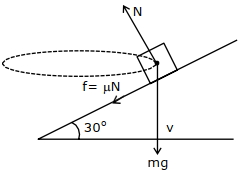
The normal reaction $N$ for a vehicle of $800 \, kg$ mass,negotiating a turn on a $30^{\circ}$ banked road at maximum possible speed without skidding is $... \times 10^{3} \, kg \cdot m/s^{2}$. [Given $\cos 30^{\circ} = 0.87, \mu_{s} = 0.2$]
A
$12.4$
B
$7.2$
C
$6.96$
D
$10.2$
Solution
(D) At maximum speed $V_{\max}$,the frictional force $f$ acts downwards along the incline and is limiting in nature,so $f = \mu N$.
Resolving forces in the vertical direction:
$N \cos 30^{\circ} - mg - f \sin 30^{\circ} = 0$
Substituting $f = \mu N$:
$N \cos 30^{\circ} - mg - \mu N \sin 30^{\circ} = 0$
$N (\cos 30^{\circ} - \mu \sin 30^{\circ}) = mg$
Given $m = 800 \, kg$,$g = 10 \, m/s^{2}$,$\cos 30^{\circ} = 0.87$,$\sin 30^{\circ} = 0.5$,and $\mu = 0.2$:
$N (0.87 - 0.2 \times 0.5) = 800 \times 10$
$N (0.87 - 0.1) = 8000$
$N (0.77) = 8000$
$N = \frac{8000}{0.77} \approx 10389.6 \, N \approx 10.4 \times 10^{3} \, N$.
Note: Based on the provided options and the calculation method in the prompt,the closest value is $10.2 \times 10^{3} \, N$.
Resolving forces in the vertical direction:
$N \cos 30^{\circ} - mg - f \sin 30^{\circ} = 0$
Substituting $f = \mu N$:
$N \cos 30^{\circ} - mg - \mu N \sin 30^{\circ} = 0$
$N (\cos 30^{\circ} - \mu \sin 30^{\circ}) = mg$
Given $m = 800 \, kg$,$g = 10 \, m/s^{2}$,$\cos 30^{\circ} = 0.87$,$\sin 30^{\circ} = 0.5$,and $\mu = 0.2$:
$N (0.87 - 0.2 \times 0.5) = 800 \times 10$
$N (0.87 - 0.1) = 8000$
$N (0.77) = 8000$
$N = \frac{8000}{0.77} \approx 10389.6 \, N \approx 10.4 \times 10^{3} \, N$.
Note: Based on the provided options and the calculation method in the prompt,the closest value is $10.2 \times 10^{3} \, N$.
0 likes
View Solution78
MediumMCQ
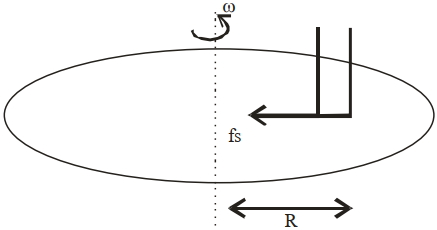
$A$ disc with a flat small bottom beaker placed on it at a distance $R$ from its center is revolving about an axis passing through the center and perpendicular to its plane with an angular velocity $\omega$. The coefficient of static friction between the bottom of the beaker and the surface of the disc is $\mu$. The beaker will revolve with the disc if
A
$R \leq \frac{\mu g}{2 \omega^{2}}$
B
$R \leq \frac{\mu g}{\omega^{2}}$
C
$R \geq \frac{\mu g}{2 \omega^{2}}$
D
$R \geq \frac{\mu g}{\omega^{2}}$
Solution
(B) For the beaker to revolve with the disc without slipping,the necessary centripetal force must be provided by the static friction force.
The required centripetal force is $F_{c} = m \omega^{2} R$,where $m$ is the mass of the beaker.
The maximum available static friction force is $f_{s,max} = \mu N = \mu mg$,where $N = mg$ is the normal force.
For the beaker to move in a circular path with the disc,the static friction must be greater than or equal to the required centripetal force:
$f_{s} \leq f_{s,max}$
Substituting the expressions:
$m \omega^{2} R \leq \mu mg$
Dividing both sides by $m \omega^{2}$:
$R \leq \frac{\mu g}{\omega^{2}}$
The required centripetal force is $F_{c} = m \omega^{2} R$,where $m$ is the mass of the beaker.
The maximum available static friction force is $f_{s,max} = \mu N = \mu mg$,where $N = mg$ is the normal force.
For the beaker to move in a circular path with the disc,the static friction must be greater than or equal to the required centripetal force:
$f_{s} \leq f_{s,max}$
Substituting the expressions:
$m \omega^{2} R \leq \mu mg$
Dividing both sides by $m \omega^{2}$:
$R \leq \frac{\mu g}{\omega^{2}}$
1 likes
View Solution79
MediumMCQ
$A$ curve on a level road has a radius of $75 \, m$. The maximum speed of a car turning this curved road can be $30 \, m/s$ without skidding. If the radius of the curved road is changed to $48 \, m$ and the coefficient of friction between the tyres and the road remains the same,then the maximum allowed speed would be ......... $m/s$.
A
$24$
B
$22$
C
$26$
D
$28$
Solution
(A) The maximum speed $v$ of a car on a level curved road is given by the formula $v = \sqrt{\mu Rg}$,where $\mu$ is the coefficient of friction,$R$ is the radius of the curve,and $g$ is the acceleration due to gravity.
Since $\mu$ and $g$ are constant,we have $v \propto \sqrt{R}$.
Therefore,the ratio of the speeds is $\frac{v_2}{v_1} = \sqrt{\frac{R_2}{R_1}}$.
Given $v_1 = 30 \, m/s$,$R_1 = 75 \, m$,and $R_2 = 48 \, m$.
Substituting these values: $\frac{v_2}{30} = \sqrt{\frac{48}{75}}$.
Simplifying the fraction inside the square root: $\frac{48}{75} = \frac{16}{25}$.
So,$\frac{v_2}{30} = \sqrt{\frac{16}{25}} = \frac{4}{5}$.
$v_2 = 30 \times \frac{4}{5} = 6 \times 4 = 24 \, m/s$.
Since $\mu$ and $g$ are constant,we have $v \propto \sqrt{R}$.
Therefore,the ratio of the speeds is $\frac{v_2}{v_1} = \sqrt{\frac{R_2}{R_1}}$.
Given $v_1 = 30 \, m/s$,$R_1 = 75 \, m$,and $R_2 = 48 \, m$.
Substituting these values: $\frac{v_2}{30} = \sqrt{\frac{48}{75}}$.
Simplifying the fraction inside the square root: $\frac{48}{75} = \frac{16}{25}$.
So,$\frac{v_2}{30} = \sqrt{\frac{16}{25}} = \frac{4}{5}$.
$v_2 = 30 \times \frac{4}{5} = 6 \times 4 = 24 \, m/s$.
0 likes
View Solution80
AdvancedMCQ
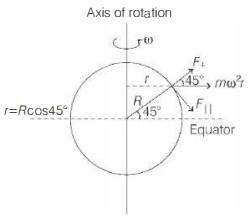
$A$ plank is resting on a horizontal ground in the northern hemisphere of the earth at a $45^{\circ}$ latitude. Let the angular speed of the earth be $\omega$ and its radius $r_e$. The magnitude of the frictional force on the plank will be
A
$m r_e \omega^2$
B
$\frac{m r_e \omega^2}{\sqrt{2}}$
C
$\frac{m r_e \omega^2}{2}$
D
zero
Solution
(C) The plank is resting on the Earth's surface,which is rotating about its axis with angular velocity $\omega$. The plank undergoes circular motion with radius $r = r_e \cos 45^{\circ}$.
The centripetal force required for this circular motion is $F_c = m \omega^2 r = m \omega^2 (r_e \cos 45^{\circ})$.
This centripetal force acts towards the axis of rotation. The horizontal ground at latitude $45^{\circ}$ is inclined at an angle of $45^{\circ}$ with the axis of rotation. The component of the centripetal force acting parallel to the ground provides the necessary frictional force to keep the plank at rest relative to the ground.
$f = F_c \sin 45^{\circ} = (m \omega^2 r_e \cos 45^{\circ}) \sin 45^{\circ}$
Since $\sin 45^{\circ} = \cos 45^{\circ} = \frac{1}{\sqrt{2}}$,we have:
$f = m \omega^2 r_e \left(\frac{1}{\sqrt{2}}\right) \left(\frac{1}{\sqrt{2}}\right) = \frac{m r_e \omega^2}{2}$
The centripetal force required for this circular motion is $F_c = m \omega^2 r = m \omega^2 (r_e \cos 45^{\circ})$.
This centripetal force acts towards the axis of rotation. The horizontal ground at latitude $45^{\circ}$ is inclined at an angle of $45^{\circ}$ with the axis of rotation. The component of the centripetal force acting parallel to the ground provides the necessary frictional force to keep the plank at rest relative to the ground.
$f = F_c \sin 45^{\circ} = (m \omega^2 r_e \cos 45^{\circ}) \sin 45^{\circ}$
Since $\sin 45^{\circ} = \cos 45^{\circ} = \frac{1}{\sqrt{2}}$,we have:
$f = m \omega^2 r_e \left(\frac{1}{\sqrt{2}}\right) \left(\frac{1}{\sqrt{2}}\right) = \frac{m r_e \omega^2}{2}$
0 likes
View Solution81
DifficultMCQ
$A$ vehicle is moving with speed $v$ on a curved road of radius $r$. The coefficient of friction between the vehicle and the road is $\mu$. The angle $\theta$ of banking needed is given by
A
$\tan \theta=\frac{v^2-\mu r g}{v^2-r g}$
B
$\tan \theta=\frac{v^2-\mu r g}{v^2+\mu r g}$
C
$\tan \theta=\frac{v^2-\mu r g}{r g+\mu v^2}$
D
$\tan \theta=\frac{\mu r g-v^2}{r g+\mu v^2}$
Solution
(C) On a banked road with friction,the forces acting on the vehicle are the normal reaction $R$,the frictional force $f = \mu R$,the weight $mg$,and the centripetal force $\frac{mv^2}{r}$.
Resolving forces in the horizontal and vertical directions:
Horizontal: $R \sin \theta + f \cos \theta = \frac{mv^2}{r}$
Vertical: $R \cos \theta - f \sin \theta = mg$
Dividing the horizontal equation by the vertical equation:
$\frac{R \sin \theta + \mu R \cos \theta}{R \cos \theta - \mu R \sin \theta} = \frac{mv^2/r}{mg}$
$\frac{\sin \theta + \mu \cos \theta}{\cos \theta - \mu \sin \theta} = \frac{v^2}{rg}$
Dividing numerator and denominator by $\cos \theta$:
$\frac{\tan \theta + \mu}{1 - \mu \tan \theta} = \frac{v^2}{rg}$
Cross-multiplying:
$rg(\tan \theta + \mu) = v^2(1 - \mu \tan \theta)$
$rg \tan \theta + \mu rg = v^2 - \mu v^2 \tan \theta$
$\tan \theta(rg + \mu v^2) = v^2 - \mu rg$
$\tan \theta = \frac{v^2 - \mu rg}{rg + \mu v^2}$
Resolving forces in the horizontal and vertical directions:
Horizontal: $R \sin \theta + f \cos \theta = \frac{mv^2}{r}$
Vertical: $R \cos \theta - f \sin \theta = mg$
Dividing the horizontal equation by the vertical equation:
$\frac{R \sin \theta + \mu R \cos \theta}{R \cos \theta - \mu R \sin \theta} = \frac{mv^2/r}{mg}$
$\frac{\sin \theta + \mu \cos \theta}{\cos \theta - \mu \sin \theta} = \frac{v^2}{rg}$
Dividing numerator and denominator by $\cos \theta$:
$\frac{\tan \theta + \mu}{1 - \mu \tan \theta} = \frac{v^2}{rg}$
Cross-multiplying:
$rg(\tan \theta + \mu) = v^2(1 - \mu \tan \theta)$
$rg \tan \theta + \mu rg = v^2 - \mu v^2 \tan \theta$
$\tan \theta(rg + \mu v^2) = v^2 - \mu rg$
$\tan \theta = \frac{v^2 - \mu rg}{rg + \mu v^2}$
0 likes
View Solution82
MediumMCQ
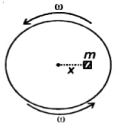
$A$ block of mass $m$ is kept on a horizontal turntable at a distance $x$ from the center. If the coefficient of friction between the block and the surface of the turntable is $\mu$,what is the maximum angular speed of the table so that the block does not slip?
A
$\sqrt{\frac{\mu g}{x^2}}$
B
$\sqrt{\frac{\mu g}{x}}$
C
$\sqrt{\frac{\mu g}{2x}}$
D
$\sqrt{\frac{\mu x^2}{g}}$
Solution
(B) For the block not to slip,the required centripetal force must be provided by the static friction force.
The condition for the block not to slip is:
$f_{s} \leq \mu N$
Here,the centripetal force is $F_{c} = m \omega^2 x$.
The normal force $N$ on the horizontal surface is $N = mg$.
Therefore,the maximum static friction force is $f_{s,max} = \mu mg$.
Equating the centripetal force to the maximum static friction force:
$m \omega^2 x = \mu mg$
Dividing both sides by $mx$:
$\omega^2 = \frac{\mu g}{x}$
Taking the square root of both sides,we get the maximum angular speed:
$\omega = \sqrt{\frac{\mu g}{x}}$
The condition for the block not to slip is:
$f_{s} \leq \mu N$
Here,the centripetal force is $F_{c} = m \omega^2 x$.
The normal force $N$ on the horizontal surface is $N = mg$.
Therefore,the maximum static friction force is $f_{s,max} = \mu mg$.
Equating the centripetal force to the maximum static friction force:
$m \omega^2 x = \mu mg$
Dividing both sides by $mx$:
$\omega^2 = \frac{\mu g}{x}$
Taking the square root of both sides,we get the maximum angular speed:
$\omega = \sqrt{\frac{\mu g}{x}}$
0 likes
View Solution83
EasyMCQ
$A$ cyclist riding a bicycle at a speed of $14 \sqrt{3} \, m/s$ takes a turn around a circular road of radius $20 \sqrt{3} \, m$ without skidding. What is his inclination to the vertical (in $^{\circ}$)?
A
$30$
B
$45$
C
$60$
D
$75$
Solution
(C) For a cyclist taking a turn on a circular road,the angle of inclination $\theta$ with the vertical is given by the formula: $\tan \theta = \frac{v^2}{rg}$.
Given values are: speed $v = 14 \sqrt{3} \, m/s$,radius $r = 20 \sqrt{3} \, m$,and acceleration due to gravity $g \approx 10 \, m/s^2$.
Substituting these values into the formula:
$\tan \theta = \frac{(14 \sqrt{3})^2}{20 \sqrt{3} \times 10} = \frac{196 \times 3}{200 \sqrt{3}} = \frac{588}{200 \sqrt{3}} = \frac{2.94}{\sqrt{3}} \approx \sqrt{3}$.
Since $\tan \theta = \sqrt{3}$,we find that $\theta = 60^{\circ}$.
Given values are: speed $v = 14 \sqrt{3} \, m/s$,radius $r = 20 \sqrt{3} \, m$,and acceleration due to gravity $g \approx 10 \, m/s^2$.
Substituting these values into the formula:
$\tan \theta = \frac{(14 \sqrt{3})^2}{20 \sqrt{3} \times 10} = \frac{196 \times 3}{200 \sqrt{3}} = \frac{588}{200 \sqrt{3}} = \frac{2.94}{\sqrt{3}} \approx \sqrt{3}$.
Since $\tan \theta = \sqrt{3}$,we find that $\theta = 60^{\circ}$.
0 likes
View Solution84
EasyMCQ
$A$ car is moving on a horizontal circular track of radius $0.2 \, km$ with a constant speed. If the coefficient of friction between the tyres of the car and the road is $0.45$,then the maximum safe speed of the car is ........ $m/s$. [Take $g = 10 \, m/s^2$]
A
$15$
B
$30$
C
$20$
D
$40$
Solution
(B) For a car moving on a horizontal circular track,the centripetal force is provided by the static friction between the tyres and the road.
For safe turning without skidding,the condition is: $F_c \leq f_{max}$.
$\frac{mv^2}{r} \leq \mu mg$.
Thus,the maximum speed $v_{max} = \sqrt{\mu rg}$.
Given: $\mu = 0.45$,$r = 0.2 \, km = 200 \, m$,and $g = 10 \, m/s^2$.
Substituting the values:
$v_{max} = \sqrt{0.45 \times 200 \times 10}$.
$v_{max} = \sqrt{0.45 \times 2000} = \sqrt{900}$.
$v_{max} = 30 \, m/s$.
Therefore,the correct option is $B$.
For safe turning without skidding,the condition is: $F_c \leq f_{max}$.
$\frac{mv^2}{r} \leq \mu mg$.
Thus,the maximum speed $v_{max} = \sqrt{\mu rg}$.
Given: $\mu = 0.45$,$r = 0.2 \, km = 200 \, m$,and $g = 10 \, m/s^2$.
Substituting the values:
$v_{max} = \sqrt{0.45 \times 200 \times 10}$.
$v_{max} = \sqrt{0.45 \times 2000} = \sqrt{900}$.
$v_{max} = 30 \, m/s$.
Therefore,the correct option is $B$.
1 likes
View Solution85
EasyMCQ
$A$ boy is sitting on the horizontal platform of a joy wheel at a distance of $5 \, m$ from the center. The wheel begins to rotate and when the angular speed exceeds $1 \, rad/s$,the boy just slips. Find the coefficient of friction between the boy and the wheel. (Take $g = 10 \, m/s^2$)
A
$0.5$
B
$0.32$
C
$0.71$
D
$0.2$
Solution
(A) The boy is in circular motion on the platform. The necessary centripetal force is provided by the static friction force between the boy and the platform.
For the boy to just slip,the maximum static friction must equal the required centripetal force:
$f_{max} = F_c$
$\mu N = m \omega^2 r$
Since the platform is horizontal,the normal force $N = mg$.
Substituting this into the equation:
$\mu mg = m \omega^2 r$
$\mu = \frac{\omega^2 r}{g}$
Given values: $\omega = 1 \, rad/s$,$r = 5 \, m$,and $g = 10 \, m/s^2$.
$\mu = \frac{(1)^2 \times 5}{10} = \frac{5}{10} = 0.5$
Therefore,the coefficient of friction is $0.5$.
For the boy to just slip,the maximum static friction must equal the required centripetal force:
$f_{max} = F_c$
$\mu N = m \omega^2 r$
Since the platform is horizontal,the normal force $N = mg$.
Substituting this into the equation:
$\mu mg = m \omega^2 r$
$\mu = \frac{\omega^2 r}{g}$
Given values: $\omega = 1 \, rad/s$,$r = 5 \, m$,and $g = 10 \, m/s^2$.
$\mu = \frac{(1)^2 \times 5}{10} = \frac{5}{10} = 0.5$
Therefore,the coefficient of friction is $0.5$.
0 likes
View Solution86
EasyMCQ
$A$ car is moving on a horizontal circular road of radius $0.1 \, km$ with constant speed. If the coefficient of friction between the tyres of the car and the road is $0.4$,then the speed of the car may be ......... $m/s$ $(g = 10 \, m/s^2)$.
A
$5$
B
$10$
C
$20$
D
All of these
Solution
(D) The maximum speed $v_{\text{max}}$ for a car on a horizontal circular road is given by the condition that the centripetal force is provided by the static friction: $\frac{mv^2}{r} \leq \mu mg$.
Thus,$v^2 \leq \mu rg$.
Given: radius $r = 0.1 \, km = 100 \, m$,coefficient of friction $\mu = 0.4$,and $g = 10 \, m/s^2$.
Calculating the maximum speed: $v_{\text{max}} = \sqrt{\mu rg} = \sqrt{0.4 \times 100 \times 10} = \sqrt{400} = 20 \, m/s$.
Since the car can move at any speed less than or equal to the maximum speed without skidding,the speed can be any value $v \leq 20 \, m/s$.
Therefore,$5 \, m/s$,$10 \, m/s$,and $20 \, m/s$ are all possible speeds.
Hence,the correct option is $D$.
Thus,$v^2 \leq \mu rg$.
Given: radius $r = 0.1 \, km = 100 \, m$,coefficient of friction $\mu = 0.4$,and $g = 10 \, m/s^2$.
Calculating the maximum speed: $v_{\text{max}} = \sqrt{\mu rg} = \sqrt{0.4 \times 100 \times 10} = \sqrt{400} = 20 \, m/s$.
Since the car can move at any speed less than or equal to the maximum speed without skidding,the speed can be any value $v \leq 20 \, m/s$.
Therefore,$5 \, m/s$,$10 \, m/s$,and $20 \, m/s$ are all possible speeds.
Hence,the correct option is $D$.
0 likes
View Solution87
DifficultMCQ
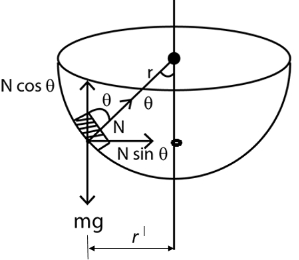
$A$ hemispherical bowl of radius $r$ is rotating about its vertical axis of symmetry. $A$ small block kept in the bowl rotates with the bowl without slipping on its surface. If the surface of the bowl is smooth and the angle made by the radius through the block with the vertical is $\theta$,then find the angular speed $\omega$ at which the bowl is rotating.
A
$\omega=\sqrt{rg \sin \theta}$
B
$\omega=\sqrt{\frac{g}{r \cos \theta}}$
C
$\omega=\sqrt{\frac{gr}{\cos \theta}}$
D
$\omega=\sqrt{\frac{gr}{\tan \theta}}$
Solution
(B) Step $1$: Identify the forces acting on the block. The forces are the gravitational force $mg$ acting downwards and the normal reaction force $N$ acting perpendicular to the surface of the bowl towards the center of the sphere.
Step $2$: Resolve the forces into vertical and horizontal components. The angle between the normal force $N$ and the vertical axis is $\theta$.
Vertical equilibrium: $N \cos \theta = mg$ (Equation $1$)
Horizontal component provides the centripetal force: $N \sin \theta = m \omega^2 R$,where $R$ is the radius of the circular path of the block. From the geometry of the bowl,$R = r \sin \theta$.
So,$N \sin \theta = m \omega^2 (r \sin \theta)$ (Equation $2$)
Step $3$: Solve the equations. Divide Equation $2$ by Equation $1$:
$\frac{N \sin \theta}{N \cos \theta} = \frac{m \omega^2 r \sin \theta}{mg}$
$\tan \theta = \frac{\omega^2 r \sin \theta}{g}$
$\frac{\sin \theta}{\cos \theta} = \frac{\omega^2 r \sin \theta}{g}$
$\frac{1}{\cos \theta} = \frac{\omega^2 r}{g}$
$\omega^2 = \frac{g}{r \cos \theta}$
$\omega = \sqrt{\frac{g}{r \cos \theta}}$
Step $2$: Resolve the forces into vertical and horizontal components. The angle between the normal force $N$ and the vertical axis is $\theta$.
Vertical equilibrium: $N \cos \theta = mg$ (Equation $1$)
Horizontal component provides the centripetal force: $N \sin \theta = m \omega^2 R$,where $R$ is the radius of the circular path of the block. From the geometry of the bowl,$R = r \sin \theta$.
So,$N \sin \theta = m \omega^2 (r \sin \theta)$ (Equation $2$)
Step $3$: Solve the equations. Divide Equation $2$ by Equation $1$:
$\frac{N \sin \theta}{N \cos \theta} = \frac{m \omega^2 r \sin \theta}{mg}$
$\tan \theta = \frac{\omega^2 r \sin \theta}{g}$
$\frac{\sin \theta}{\cos \theta} = \frac{\omega^2 r \sin \theta}{g}$
$\frac{1}{\cos \theta} = \frac{\omega^2 r}{g}$
$\omega^2 = \frac{g}{r \cos \theta}$
$\omega = \sqrt{\frac{g}{r \cos \theta}}$
0 likes
View Solution88
MediumMCQ
$A$ car is moving on a horizontal curved road with radius $50\,m$. The approximate maximum speed of the car will be $............\,ms^{-1}$,if the coefficient of friction between the tyres and the road is $0.34$. [Take $g = 10\,ms^{-2}$]
A
$3.4$
B
$22.4$
C
$13$
D
$17$
Solution
(C) For a car moving on a horizontal curved road,the centripetal force required for turning is provided by the static friction between the tyres and the road.
The condition for safe turning without skidding is given by $f_s \leq \mu N$,where $N = mg$.
The maximum speed $v_{\max}$ is achieved when the frictional force is at its maximum value:
$\frac{mv_{\max}^2}{r} = \mu mg$
Simplifying for $v_{\max}$:
$v_{\max} = \sqrt{\mu rg}$
Given values are $\mu = 0.34$,$r = 50\,m$,and $g = 10\,ms^{-2}$.
Substituting these values:
$v_{\max} = \sqrt{0.34 \times 50 \times 10}$
$v_{\max} = \sqrt{0.34 \times 500}$
$v_{\max} = \sqrt{170}$
$v_{\max} \approx 13.038\,ms^{-1}$
Therefore,the approximate maximum speed is $13\,ms^{-1}$.
The condition for safe turning without skidding is given by $f_s \leq \mu N$,where $N = mg$.
The maximum speed $v_{\max}$ is achieved when the frictional force is at its maximum value:
$\frac{mv_{\max}^2}{r} = \mu mg$
Simplifying for $v_{\max}$:
$v_{\max} = \sqrt{\mu rg}$
Given values are $\mu = 0.34$,$r = 50\,m$,and $g = 10\,ms^{-2}$.
Substituting these values:
$v_{\max} = \sqrt{0.34 \times 50 \times 10}$
$v_{\max} = \sqrt{0.34 \times 500}$
$v_{\max} = \sqrt{170}$
$v_{\max} \approx 13.038\,ms^{-1}$
Therefore,the approximate maximum speed is $13\,ms^{-1}$.
0 likes
View Solution89
DifficultMCQ
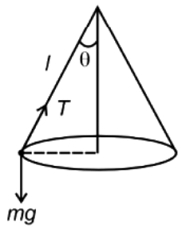
$A$ stone of mass $1\,kg$ is tied to the end of a massless string of length $1\,m$. If the breaking tension of the string is $400\,N$,then the maximum linear velocity the stone can have without breaking the string,while rotating in a horizontal plane,is $.......\,ms^{-1}$.
A
$20$
B
$40$
C
$400$
D
$10$
Solution
(A) For a stone rotating in a horizontal circle (conical pendulum),the forces acting on the stone are the tension $T$ in the string and the gravitational force $mg$.
Resolving the tension $T$ into components:
Vertical component: $T \cos \theta = mg$ $(1)$
Horizontal component providing centripetal force: $T \sin \theta = \frac{mv^2}{r}$,where $r = l \sin \theta$ is the radius of the circular path.
So,$T \sin \theta = \frac{mv^2}{l \sin \theta}$ $(2)$
From $(1)$,$\cos \theta = \frac{mg}{T} = \frac{1 \times 10}{400} = 0.025$.
Since $\sin^2 \theta + \cos^2 \theta = 1$,we have $\sin^2 \theta = 1 - (0.025)^2 = 1 - 0.000625 = 0.999375$.
From $(2)$,$v^2 = \frac{T l \sin^2 \theta}{m} = \frac{400 \times 1 \times 0.999375}{1} = 399.75$.
Taking the square root,$v = \sqrt{399.75} \approx 19.99 \approx 20\,ms^{-1}$.
Resolving the tension $T$ into components:
Vertical component: $T \cos \theta = mg$ $(1)$
Horizontal component providing centripetal force: $T \sin \theta = \frac{mv^2}{r}$,where $r = l \sin \theta$ is the radius of the circular path.
So,$T \sin \theta = \frac{mv^2}{l \sin \theta}$ $(2)$
From $(1)$,$\cos \theta = \frac{mg}{T} = \frac{1 \times 10}{400} = 0.025$.
Since $\sin^2 \theta + \cos^2 \theta = 1$,we have $\sin^2 \theta = 1 - (0.025)^2 = 1 - 0.000625 = 0.999375$.
From $(2)$,$v^2 = \frac{T l \sin^2 \theta}{m} = \frac{400 \times 1 \times 0.999375}{1} = 399.75$.
Taking the square root,$v = \sqrt{399.75} \approx 19.99 \approx 20\,ms^{-1}$.
2 likes
View Solution90
MediumMCQ
$A$ coin placed on a rotating table just slips when it is placed at a distance of $1\,cm$ from the center. If the angular velocity of the table is halved,it will just slip when placed at a distance of $............\,cm$ from the center.
A
$2$
B
$1$
C
$8$
D
$4$
Solution
(D) The condition for the coin to just slip on a rotating table is that the required centripetal force is provided by the maximum static friction force.
$f_{s,max} = m \omega^2 R$
Since $f_{s,max} = \mu mg$,we have:
$\mu mg = m \omega^2 R$
$R = \frac{\mu g}{\omega^2}$
This shows that the distance $R$ is inversely proportional to the square of the angular velocity,i.e.,$R \propto \frac{1}{\omega^2}$.
Given initial conditions: $R_1 = 1\,cm$ and $\omega_1 = \omega$.
New conditions: $\omega_2 = \frac{\omega}{2}$ and $R_2 = ?$.
Using the proportionality: $\frac{R_2}{R_1} = \left( \frac{\omega_1}{\omega_2} \right)^2$
$\frac{R_2}{1} = \left( \frac{\omega}{\omega/2} \right)^2 = (2)^2 = 4$
$R_2 = 4\,cm$.
Therefore,the coin will just slip when placed at a distance of $4\,cm$ from the center.
$f_{s,max} = m \omega^2 R$
Since $f_{s,max} = \mu mg$,we have:
$\mu mg = m \omega^2 R$
$R = \frac{\mu g}{\omega^2}$
This shows that the distance $R$ is inversely proportional to the square of the angular velocity,i.e.,$R \propto \frac{1}{\omega^2}$.
Given initial conditions: $R_1 = 1\,cm$ and $\omega_1 = \omega$.
New conditions: $\omega_2 = \frac{\omega}{2}$ and $R_2 = ?$.
Using the proportionality: $\frac{R_2}{R_1} = \left( \frac{\omega_1}{\omega_2} \right)^2$
$\frac{R_2}{1} = \left( \frac{\omega}{\omega/2} \right)^2 = (2)^2 = 4$
$R_2 = 4\,cm$.
Therefore,the coin will just slip when placed at a distance of $4\,cm$ from the center.
0 likes
View Solution91
DifficultMCQ
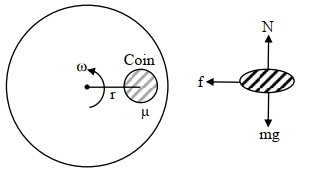
$A$ coin is placed on a disc. The coefficient of friction between the coin and the disc is $\mu$. If the distance of the coin from the center of the disc is $r$,the maximum angular velocity which can be given to the disc,so that the coin does not slip away,is:
A
$\frac{\mu g}{r}$
B
$\sqrt{\frac{r}{\mu g}}$
C
$\sqrt{\frac{\mu g}{r}}$
D
$\frac{\mu}{\sqrt{rg}}$
Solution
(C) For the coin to remain on the disc without slipping,the centripetal force required for circular motion must be provided by the static frictional force.
The normal force acting on the coin is $N = mg$.
The maximum static frictional force available is $f_{max} = \mu N = \mu mg$.
The required centripetal force for the coin moving in a circle of radius $r$ with angular velocity $\omega$ is $F_c = m \omega^2 r$.
For the coin not to slip,the centripetal force must be less than or equal to the maximum static friction:
$m \omega^2 r \leq \mu mg$
Solving for $\omega$:
$\omega^2 \leq \frac{\mu g}{r}$
Therefore,the maximum angular velocity is $\omega_{max} = \sqrt{\frac{\mu g}{r}}$.
The normal force acting on the coin is $N = mg$.
The maximum static frictional force available is $f_{max} = \mu N = \mu mg$.
The required centripetal force for the coin moving in a circle of radius $r$ with angular velocity $\omega$ is $F_c = m \omega^2 r$.
For the coin not to slip,the centripetal force must be less than or equal to the maximum static friction:
$m \omega^2 r \leq \mu mg$
Solving for $\omega$:
$\omega^2 \leq \frac{\mu g}{r}$
Therefore,the maximum angular velocity is $\omega_{max} = \sqrt{\frac{\mu g}{r}}$.
2 likes
View Solution92
DifficultMCQ
$A$ car of $800 \,kg$ is taking a turn on a banked road of radius $300 \,m$ and angle of banking $30^{\circ}$. If the coefficient of static friction is $0.2$, then the maximum speed with which the car can negotiate the turn safely is: $(g=10 \,m/s^2, \sqrt{3}=1.73)$ (in $\,m/s$)
A
$70.4$
B
$51.4$
C
$264$
D
$102.8$
Solution
(B) Given: Mass $m = 800 \,kg$, Radius $r = 300 \,m$, Angle of banking $\theta = 30^{\circ}$, Coefficient of static friction $\mu = 0.2$, Acceleration due to gravity $g = 10 \,m/s^2$.
The formula for the maximum safe speed on a banked road with friction is given by:
$V_{\max} = \sqrt{rg \left[ \frac{\tan \theta + \mu}{1 - \mu \tan \theta} \right]}$
Substitute the values:
$V_{\max} = \sqrt{300 \times 10 \times \left[ \frac{\tan 30^{\circ} + 0.2}{1 - 0.2 \times \tan 30^{\circ}} \right]}$
Since $\tan 30^{\circ} = \frac{1}{\sqrt{3}} \approx \frac{1}{1.73} \approx 0.577$
$V_{\max} = \sqrt{3000 \times \left[ \frac{0.577 + 0.2}{1 - 0.2 \times 0.577} \right]}$
$V_{\max} = \sqrt{3000 \times \left[ \frac{0.777}{0.8846} \right]}$
$V_{\max} = \sqrt{3000 \times 0.8783} \approx \sqrt{2635} \approx 51.33 \,m/s$
Rounding to the nearest value, $V_{\max} \approx 51.4 \,m/s$.
The formula for the maximum safe speed on a banked road with friction is given by:
$V_{\max} = \sqrt{rg \left[ \frac{\tan \theta + \mu}{1 - \mu \tan \theta} \right]}$
Substitute the values:
$V_{\max} = \sqrt{300 \times 10 \times \left[ \frac{\tan 30^{\circ} + 0.2}{1 - 0.2 \times \tan 30^{\circ}} \right]}$
Since $\tan 30^{\circ} = \frac{1}{\sqrt{3}} \approx \frac{1}{1.73} \approx 0.577$
$V_{\max} = \sqrt{3000 \times \left[ \frac{0.577 + 0.2}{1 - 0.2 \times 0.577} \right]}$
$V_{\max} = \sqrt{3000 \times \left[ \frac{0.777}{0.8846} \right]}$
$V_{\max} = \sqrt{3000 \times 0.8783} \approx \sqrt{2635} \approx 51.33 \,m/s$
Rounding to the nearest value, $V_{\max} \approx 51.4 \,m/s$.
0 likes
View Solution93
DifficultMCQ
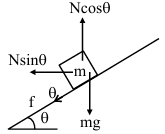
$A$ car of mass $m$ moves on a banked road having radius $r$ and banking angle $\theta$. To avoid slipping from the banked road,the maximum permissible speed of the car is $v_0$. The coefficient of friction $\mu$ between the wheels of the car and the banked road is:
A
$\mu=\frac{v_0^2+r g \tan \theta}{r g-v_0^2 \tan \theta}$
B
$\mu=\frac{v_0^2+r g \tan \theta}{r g+v_0^2 \tan \theta}$
C
$\mu=\frac{v_0^2-r g \tan \theta}{r g+v_0^2 \tan \theta}$
D
$\mu=\frac{v_0^2-r g \tan \theta}{r g-v_0^2 \tan \theta}$
Solution
(C) For a car moving at maximum speed $v_0$ on a banked road,the forces acting on it are the normal force $N$,gravity $mg$,and the maximum static friction $f = \mu N$ acting down the incline to prevent slipping outwards.
Resolving forces horizontally and vertically:
$N \sin \theta + f \cos \theta = \frac{m v_0^2}{r}$
$N \cos \theta - f \sin \theta = m g$
Substituting $f = \mu N$ into the equations:
$N(\sin \theta + \mu \cos \theta) = \frac{m v_0^2}{r}$
$N(\cos \theta - \mu \sin \theta) = m g$
Dividing the two equations:
$\frac{\sin \theta + \mu \cos \theta}{\cos \theta - \mu \sin \theta} = \frac{v_0^2}{r g}$
Cross-multiplying:
$r g \sin \theta + \mu r g \cos \theta = v_0^2 \cos \theta - \mu v_0^2 \sin \theta$
Rearranging terms to solve for $\mu$:
$\mu(r g \cos \theta + v_0^2 \sin \theta) = v_0^2 \cos \theta - r g \sin \theta$
Dividing by $\cos \theta$:
$\mu(r g + v_0^2 \tan \theta) = v_0^2 - r g \tan \theta$
$\mu = \frac{v_0^2 - r g \tan \theta}{r g + v_0^2 \tan \theta}$
Resolving forces horizontally and vertically:
$N \sin \theta + f \cos \theta = \frac{m v_0^2}{r}$
$N \cos \theta - f \sin \theta = m g$
Substituting $f = \mu N$ into the equations:
$N(\sin \theta + \mu \cos \theta) = \frac{m v_0^2}{r}$
$N(\cos \theta - \mu \sin \theta) = m g$
Dividing the two equations:
$\frac{\sin \theta + \mu \cos \theta}{\cos \theta - \mu \sin \theta} = \frac{v_0^2}{r g}$
Cross-multiplying:
$r g \sin \theta + \mu r g \cos \theta = v_0^2 \cos \theta - \mu v_0^2 \sin \theta$
Rearranging terms to solve for $\mu$:
$\mu(r g \cos \theta + v_0^2 \sin \theta) = v_0^2 \cos \theta - r g \sin \theta$
Dividing by $\cos \theta$:
$\mu(r g + v_0^2 \tan \theta) = v_0^2 - r g \tan \theta$
$\mu = \frac{v_0^2 - r g \tan \theta}{r g + v_0^2 \tan \theta}$
0 likes
View Solution94
MediumMCQ
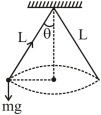
$A$ string just breaks under a load of $50 \ kg$. $A$ mass of $1 \ kg$ is attached to one end of this string $10 \ m$ long and is rotated in a horizontal circle. Calculate the greatest number of revolutions that the mass can make in one second without breaking the string. (Take $g = 10 \ m/s^2$)
A
$\frac{2 \pi}{\sqrt{50}} \text{ rps}$
B
$\frac{\sqrt{50}}{2 \pi} \text{ rps}$
C
$\frac{\sqrt{55}}{2 \pi} \text{ rps}$
D
$\frac{\sqrt{60}}{2 \pi} \text{ rps}$
Solution
(B) The maximum tension the string can withstand is $T_{\max} = mg = 50 \times 10 = 500 \ N$.
For a mass $m$ rotating in a horizontal circle of radius $r$ with angular velocity $\omega$,the tension $T$ is given by $T = m \omega^2 r$.
In this case,the length of the string $L = 10 \ m$ acts as the radius $r$ (assuming the string remains horizontal for the maximum speed case).
Substituting $\omega = 2 \pi n$,where $n$ is the frequency in revolutions per second (rps):
$T_{\max} = m (2 \pi n_{\max})^2 L$
$500 = 1 \times (2 \pi n_{\max})^2 \times 10$
$50 = (2 \pi n_{\max})^2$
$2 \pi n_{\max} = \sqrt{50}$
$n_{\max} = \frac{\sqrt{50}}{2 \pi} \text{ rps}$.
For a mass $m$ rotating in a horizontal circle of radius $r$ with angular velocity $\omega$,the tension $T$ is given by $T = m \omega^2 r$.
In this case,the length of the string $L = 10 \ m$ acts as the radius $r$ (assuming the string remains horizontal for the maximum speed case).
Substituting $\omega = 2 \pi n$,where $n$ is the frequency in revolutions per second (rps):
$T_{\max} = m (2 \pi n_{\max})^2 L$
$500 = 1 \times (2 \pi n_{\max})^2 \times 10$
$50 = (2 \pi n_{\max})^2$
$2 \pi n_{\max} = \sqrt{50}$
$n_{\max} = \frac{\sqrt{50}}{2 \pi} \text{ rps}$.
0 likes
View Solution95
MediumMCQ
$A$ motorcyclist has to rotate in horizontal circles inside the cylindrical wall of inner radius '$R$' metre. If the coefficient of friction between the wall and the tyres is '$\mu_{s}$',then the minimum speed required is ($g=$ acceleration due to gravity).
A
$\sqrt{\mu_{s} Rg}$
B
$\sqrt{\frac{Rg}{\mu_{s}}}$
C
$\sqrt{\frac{\mu_{s}}{Rg}}$
D
$\sqrt{\frac{R^2 g}{\mu_{s}}}$
Solution
(B) For a motorcyclist moving in a horizontal circle inside a cylindrical wall,the forces acting on the motorcyclist are:
$1$. The weight $(mg)$ acting downwards.
$2$. The normal reaction $(N)$ from the wall acting towards the center of the circle,which provides the necessary centripetal force: $N = \frac{mv^2}{R}$.
$3$. The frictional force $(f)$ acting upwards to balance the weight: $f = mg$.
For the motorcyclist not to slip downwards,the frictional force must be less than or equal to the limiting friction: $f \leq \mu_{s} N$.
Substituting the values: $mg \leq \mu_{s} \left( \frac{mv^2}{R} \right)$.
$g \leq \frac{\mu_{s} v^2}{R}$.
$v^2 \geq \frac{Rg}{\mu_{s}}$.
Therefore,the minimum speed required is $v_{min} = \sqrt{\frac{Rg}{\mu_{s}}}$.
$1$. The weight $(mg)$ acting downwards.
$2$. The normal reaction $(N)$ from the wall acting towards the center of the circle,which provides the necessary centripetal force: $N = \frac{mv^2}{R}$.
$3$. The frictional force $(f)$ acting upwards to balance the weight: $f = mg$.
For the motorcyclist not to slip downwards,the frictional force must be less than or equal to the limiting friction: $f \leq \mu_{s} N$.
Substituting the values: $mg \leq \mu_{s} \left( \frac{mv^2}{R} \right)$.
$g \leq \frac{\mu_{s} v^2}{R}$.
$v^2 \geq \frac{Rg}{\mu_{s}}$.
Therefore,the minimum speed required is $v_{min} = \sqrt{\frac{Rg}{\mu_{s}}}$.
0 likes
View Solution96
MediumMCQ
On a dry road,the maximum speed of a vehicle along a circular path is $V$. When the road becomes wet,the maximum speed becomes $\frac{V}{2}$. If the coefficient of friction of the dry road is $\mu$,then the coefficient of friction of the wet road is:
A
$\frac{2 \mu}{3}$
B
$\frac{\mu}{4}$
C
$\frac{\mu}{3}$
D
$\frac{3 \mu}{4}$
Solution
(B) The maximum safe speed $V$ of a vehicle on a circular road of radius $r$ is given by $V = \sqrt{\mu rg}$,where $\mu$ is the coefficient of friction.
For the dry road: $V = \sqrt{\mu rg}$ $(i)$
For the wet road,let the new coefficient of friction be $\mu^{\prime}$. The new speed is $\frac{V}{2} = \sqrt{\mu^{\prime} rg}$ (ii)
Dividing equation $(i)$ by equation (ii):
$\frac{V}{V/2} = \frac{\sqrt{\mu rg}}{\sqrt{\mu^{\prime} rg}}$
$2 = \sqrt{\frac{\mu}{\mu^{\prime}}}$
Squaring both sides:
$4 = \frac{\mu}{\mu^{\prime}}$
$\therefore \mu^{\prime} = \frac{\mu}{4}$
For the dry road: $V = \sqrt{\mu rg}$ $(i)$
For the wet road,let the new coefficient of friction be $\mu^{\prime}$. The new speed is $\frac{V}{2} = \sqrt{\mu^{\prime} rg}$ (ii)
Dividing equation $(i)$ by equation (ii):
$\frac{V}{V/2} = \frac{\sqrt{\mu rg}}{\sqrt{\mu^{\prime} rg}}$
$2 = \sqrt{\frac{\mu}{\mu^{\prime}}}$
Squaring both sides:
$4 = \frac{\mu}{\mu^{\prime}}$
$\therefore \mu^{\prime} = \frac{\mu}{4}$
0 likes
View Solution97
MediumMCQ
$A$ motorcyclist rides in a horizontal circle about a central vertical axis inside a cylindrical chamber of radius $r$. If the coefficient of friction between the tyres and the inner surface of the chamber is $\mu$,what is the minimum speed of the motorcyclist to prevent him from skidding? ($g$ = acceleration due to gravity)
A
$\sqrt{\frac{\mu g}{r}}$
B
$\sqrt{\frac{r \mu}{g}}$
C
$\sqrt{\frac{g}{r \mu}}$
D
$\sqrt{\frac{r g}{\mu}}$
Solution
(D) For a motorcyclist moving in a horizontal circle inside a cylindrical wall,the forces acting on the motorcyclist are:
$1$. The weight $(mg)$ acting downwards.
$2$. The normal force $(N)$ acting horizontally towards the center,which provides the necessary centripetal force: $N = \frac{mv^2}{r}$.
$3$. The frictional force $(f)$ acting upwards,which balances the weight to prevent skidding: $f = mg$.
For the motorcyclist not to skid,the frictional force must be less than or equal to the limiting friction: $f \le \mu N$.
Substituting the values: $mg \le \mu \left(\frac{mv^2}{r}\right)$.
$g \le \frac{\mu v^2}{r}$.
$v^2 \ge \frac{rg}{\mu}$.
Therefore,the minimum speed is $v_{min} = \sqrt{\frac{rg}{\mu}}$.
$1$. The weight $(mg)$ acting downwards.
$2$. The normal force $(N)$ acting horizontally towards the center,which provides the necessary centripetal force: $N = \frac{mv^2}{r}$.
$3$. The frictional force $(f)$ acting upwards,which balances the weight to prevent skidding: $f = mg$.
For the motorcyclist not to skid,the frictional force must be less than or equal to the limiting friction: $f \le \mu N$.
Substituting the values: $mg \le \mu \left(\frac{mv^2}{r}\right)$.
$g \le \frac{\mu v^2}{r}$.
$v^2 \ge \frac{rg}{\mu}$.
Therefore,the minimum speed is $v_{min} = \sqrt{\frac{rg}{\mu}}$.
0 likes
View Solution98
DifficultMCQ
$A$ child starts running from rest along a circular track of radius $r$ with constant tangential acceleration $a$. After time $t$,the child feels that the shoes have started slipping on the ground. What is the coefficient of friction $\mu$ between the shoes and the ground? $[g = \text{acceleration due to gravity}]$
A
$\frac{[a^{2} t^{2}+a^{4} r^{4}]}{r g}$
B
$\frac{[a^{4} t^{4}+a^{2} r^{2}]}{r g}$
C
$\frac{[a^{4} t^{4}+a^{2} r^{2}]^{1/2}}{g r}$
D
$\frac{[a^{4} t^{4}+a^{2} r^{2}]^{1/2}}{r g}$
Solution
(C) The child starts from rest with constant tangential acceleration $a$. After time $t$,the tangential velocity is $v = at$.
The radial (centripetal) acceleration is $a_r = \frac{v^2}{r} = \frac{(at)^2}{r} = \frac{a^2 t^2}{r}$.
The total acceleration $a_{net}$ experienced by the child is the vector sum of tangential and radial accelerations: $a_{net} = \sqrt{a_t^2 + a_r^2} = \sqrt{a^2 + \left(\frac{a^2 t^2}{r}\right)^2} = \sqrt{a^2 + \frac{a^4 t^4}{r^2}}$.
Slipping starts when the required frictional force equals the limiting friction,i.e.,$F_{net} = m a_{net} = \mu m g$.
Thus,$\mu g = \sqrt{a^2 + \frac{a^4 t^4}{r^2}} = \sqrt{\frac{a^2 r^2 + a^4 t^4}{r^2}} = \frac{1}{r} \sqrt{a^2 r^2 + a^4 t^4}$.
Therefore,$\mu = \frac{[a^4 t^4 + a^2 r^2]^{1/2}}{r g}$.
The radial (centripetal) acceleration is $a_r = \frac{v^2}{r} = \frac{(at)^2}{r} = \frac{a^2 t^2}{r}$.
The total acceleration $a_{net}$ experienced by the child is the vector sum of tangential and radial accelerations: $a_{net} = \sqrt{a_t^2 + a_r^2} = \sqrt{a^2 + \left(\frac{a^2 t^2}{r}\right)^2} = \sqrt{a^2 + \frac{a^4 t^4}{r^2}}$.
Slipping starts when the required frictional force equals the limiting friction,i.e.,$F_{net} = m a_{net} = \mu m g$.
Thus,$\mu g = \sqrt{a^2 + \frac{a^4 t^4}{r^2}} = \sqrt{\frac{a^2 r^2 + a^4 t^4}{r^2}} = \frac{1}{r} \sqrt{a^2 r^2 + a^4 t^4}$.
Therefore,$\mu = \frac{[a^4 t^4 + a^2 r^2]^{1/2}}{r g}$.
0 likes
View Solution99
MediumMCQ
$A$ car is driven on a banked road of radius of curvature $20 \ m$ with maximum safe speed. In order to increase its safe speed by $20 \%$,without changing the angle of banking,the increase in the radius of curvature will be (Assume friction is same on the road). (in $m$)
A
$28.8$
B
$14.4$
C
$8.8$
D
$4.8$
Solution
(C) The maximum safe speed $v$ on a banked road is given by the formula $v = \sqrt{rg(\tan \theta + \mu) / (1 - \mu \tan \theta)}$.
Assuming the friction coefficient $\mu$ and banking angle $\theta$ remain constant,the speed $v$ is directly proportional to the square root of the radius $r$,i.e.,$v \propto \sqrt{r}$.
Let the initial radius be $r_1 = 20 \ m$ and initial speed be $v_1$. The new speed is $v_2 = v_1 + 0.20v_1 = 1.2v_1$.
Since $v \propto \sqrt{r}$,we have $v_2 / v_1 = \sqrt{r_2 / r_1}$.
Substituting the values: $1.2 = \sqrt{r_2 / 20}$.
Squaring both sides: $1.44 = r_2 / 20$.
$r_2 = 1.44 \times 20 = 28.8 \ m$.
The increase in the radius of curvature is $\Delta r = r_2 - r_1 = 28.8 \ m - 20 \ m = 8.8 \ m$.
Assuming the friction coefficient $\mu$ and banking angle $\theta$ remain constant,the speed $v$ is directly proportional to the square root of the radius $r$,i.e.,$v \propto \sqrt{r}$.
Let the initial radius be $r_1 = 20 \ m$ and initial speed be $v_1$. The new speed is $v_2 = v_1 + 0.20v_1 = 1.2v_1$.
Since $v \propto \sqrt{r}$,we have $v_2 / v_1 = \sqrt{r_2 / r_1}$.
Substituting the values: $1.2 = \sqrt{r_2 / 20}$.
Squaring both sides: $1.44 = r_2 / 20$.
$r_2 = 1.44 \times 20 = 28.8 \ m$.
The increase in the radius of curvature is $\Delta r = r_2 - r_1 = 28.8 \ m - 20 \ m = 8.8 \ m$.
0 likes
View Solution100
MediumMCQ
The radius of a curved road is $R$,and the width of the road is $b$. The outer edge of the road is raised by $h$ with respect to the inner edge so that a car with velocity $V$ can pass safely over it. The value of $h$ is ($g =$ acceleration due to gravity).
A
$\frac{V^2 b}{R g}$
B
$\frac{V}{Rgb}$
C
$\frac{V^2 R}{g}$
D
$\frac{V^2 b}{g}$
Solution
(A) For a car to safely negotiate a curved road of radius $R$ with velocity $V$,the road is banked at an angle $\theta$.
From the theory of banking of roads,the condition for safe turning is $\tan \theta = \frac{V^2}{Rg}$.
For a small angle $\theta$,$\tan \theta \approx \sin \theta = \frac{h}{b}$,where $h$ is the height of the outer edge and $b$ is the width of the road.
Equating the two expressions for $\tan \theta$,we get $\frac{h}{b} = \frac{V^2}{Rg}$.
Therefore,the value of $h$ is $h = \frac{V^2 b}{Rg}$.
From the theory of banking of roads,the condition for safe turning is $\tan \theta = \frac{V^2}{Rg}$.
For a small angle $\theta$,$\tan \theta \approx \sin \theta = \frac{h}{b}$,where $h$ is the height of the outer edge and $b$ is the width of the road.
Equating the two expressions for $\tan \theta$,we get $\frac{h}{b} = \frac{V^2}{Rg}$.
Therefore,the value of $h$ is $h = \frac{V^2 b}{Rg}$.
0 likes
View SolutionNewton's Laws of Motion and Friction — Circular motion with Friction · Frequently Asked Questions
1Are these Newton's Laws of Motion and Friction questions useful for JEE and NEET?
Yes. All questions in this section are mapped to JEE Main and NEET exam patterns. Previous year questions from JEE Main, NEET, GUJCET and state-level exams are included with full solutions.
2Can I switch to Hindi or Gujarati for these questions?
Yes. Use the language tabs in the hero section or the sidebar to view the same questions and solutions in English, Hindi or Gujarati.
3How do I generate a question paper from this subtopic?
Use the Vedclass Exam Paper Generator — select the chapter and subtopic, set difficulty, and generate Sets A, B, C, D automatically. First 3 chapters of every subject are free.
Vedclass Products
For Students
Vedclass Test Series
Mock tests in real JEE/NEET style with performance analysis. 5-day free trial.
Start Free TrialFor Teachers
Exam Paper Generator
Generate Set A/B/C/D papers from this chapter in 2 minutes. 3 chapters free.
Try FreeFor Institutes
Online Exam Module
Live online exams with unlimited students, 360° analytics & white-label branding.
See DemoFor Teachers & Institutes
Generate a Newton's Laws of Motion and Friction Exam Paper in 2 Minutes
Select subtopic & difficulty — Sets A, B, C, D auto-generated with No Repeat logic.
First 3 chapters of every subject are free — no payment required.