
A English
Surface Tension Questions in English
Class 11 Physics · Fluid Mechanics and Surface Tension · Surface Tension
130+
Questions
English
Language
100%
With Solutions
Showing 49 of 130 questions in English
51
MediumMCQ
The shape of a liquid drop becomes spherical due to
A
Surface tension
B
Density
C
Viscosity
D
Temperature
Solution
(A) For a given volume of a liquid,a sphere has the minimum surface area compared to any other shape.
Surface energy of a liquid drop is given by the product of surface tension and surface area $(E = T \times A)$.
To remain in a state of stable equilibrium,a system always tries to minimize its potential energy. Since the volume is fixed,minimizing the surface area minimizes the surface energy.
Therefore,the liquid drop naturally acquires a spherical shape to minimize its surface area,which is a direct consequence of the property of surface tension.
Surface energy of a liquid drop is given by the product of surface tension and surface area $(E = T \times A)$.
To remain in a state of stable equilibrium,a system always tries to minimize its potential energy. Since the volume is fixed,minimizing the surface area minimizes the surface energy.
Therefore,the liquid drop naturally acquires a spherical shape to minimize its surface area,which is a direct consequence of the property of surface tension.
0 likes
View Solution52
MediumMCQ
The length of a needle floating on the surface of water is $1.5\,cm$. The force in addition to its weight required to lift the needle from the water surface will be...... $N$ (surface tension of water $= 7.5\,N/cm$).
A
$22.5$
B
$2.25$
C
$0.25$
D
$225$
Solution
(A) When a needle is floating on the surface of water,the surface tension acts along the length of the needle on both sides.
The total length of contact is $L_{total} = 2 \times L = 2 \times 1.5\,cm = 3.0\,cm$.
The force required to lift the needle,in addition to its weight,is given by the formula $F = T \times L_{total}$,where $T$ is the surface tension.
Given $T = 7.5\,N/cm$ and $L_{total} = 3.0\,cm$.
$F = 7.5\,N/cm \times 3.0\,cm = 22.5\,N$.
The total length of contact is $L_{total} = 2 \times L = 2 \times 1.5\,cm = 3.0\,cm$.
The force required to lift the needle,in addition to its weight,is given by the formula $F = T \times L_{total}$,where $T$ is the surface tension.
Given $T = 7.5\,N/cm$ and $L_{total} = 3.0\,cm$.
$F = 7.5\,N/cm \times 3.0\,cm = 22.5\,N$.
0 likes
View Solution53
MediumMCQ
The rain drops are in spherical shape due to
A
surface tension
B
viscosity
C
residual pressure
D
thrust on drop
Solution
(A) The surface of a liquid tends to contract to occupy the minimum possible surface area for a given volume,a property known as surface tension.
For a given volume,a sphere has the minimum surface area compared to any other geometric shape.
Therefore,due to surface tension,rain drops naturally attain a spherical shape to minimize their surface energy.
For a given volume,a sphere has the minimum surface area compared to any other geometric shape.
Therefore,due to surface tension,rain drops naturally attain a spherical shape to minimize their surface energy.
0 likes
View Solution54
DifficultMCQ
If the work done in increasing the size of a soap film from $10\, cm \times 6\, cm$ to $60\, cm \times 11\, cm$ is $2 \times 10^{-4}\, J$,what is the surface tension?
A
$2 \times 10^{-8}\, N/m$
B
$2 \times 10^{-2}\, N/m$
C
$2 \times 10^{-4}\, N/m$
D
None of these
Solution
(D) soap film has two surfaces,so the work done $W$ is given by $W = 2 \times T \times \Delta A$,where $T$ is the surface tension and $\Delta A$ is the change in area.
Initial area $A_1 = 10\, cm \times 6\, cm = 60\, cm^2 = 60 \times 10^{-4}\, m^2$.
Final area $A_2 = 60\, cm \times 11\, cm = 660\, cm^2 = 660 \times 10^{-4}\, m^2$.
Change in area $\Delta A = A_2 - A_1 = (660 - 60) \times 10^{-4}\, m^2 = 600 \times 10^{-4}\, m^2 = 6 \times 10^{-2}\, m^2$.
Given $W = 2 \times 10^{-4}\, J$.
Substituting the values: $2 \times 10^{-4} = 2 \times T \times (6 \times 10^{-2})$.
$T = \frac{2 \times 10^{-4}}{2 \times 6 \times 10^{-2}} = \frac{1}{6} \times 10^{-2} = 0.166 \times 10^{-2} = 1.66 \times 10^{-3}\, N/m$.
Since this value is not among the options,the correct answer is $D$.
Initial area $A_1 = 10\, cm \times 6\, cm = 60\, cm^2 = 60 \times 10^{-4}\, m^2$.
Final area $A_2 = 60\, cm \times 11\, cm = 660\, cm^2 = 660 \times 10^{-4}\, m^2$.
Change in area $\Delta A = A_2 - A_1 = (660 - 60) \times 10^{-4}\, m^2 = 600 \times 10^{-4}\, m^2 = 6 \times 10^{-2}\, m^2$.
Given $W = 2 \times 10^{-4}\, J$.
Substituting the values: $2 \times 10^{-4} = 2 \times T \times (6 \times 10^{-2})$.
$T = \frac{2 \times 10^{-4}}{2 \times 6 \times 10^{-2}} = \frac{1}{6} \times 10^{-2} = 0.166 \times 10^{-2} = 1.66 \times 10^{-3}\, N/m$.
Since this value is not among the options,the correct answer is $D$.
0 likes
View Solution55
DifficultMCQ
Work of $3.0 \times 10^{-4} \, J$ is required to be done in increasing the size of a soap film from $10 \, cm \times 6 \, cm$ to $10 \, cm \times 11 \, cm$. The surface tension of the film is
A
$5 \times 10^{-2} \, N/m$
B
$3 \times 10^{-2} \, N/m$
C
$1.5 \times 10^{-2} \, N/m$
D
$1.2 \times 10^{-2} \, N/m$
Solution
(B) The initial area of the soap film is $A_1 = 10 \, cm \times 6 \, cm = 60 \, cm^2$.
The final area of the soap film is $A_2 = 10 \, cm \times 11 \, cm = 110 \, cm^2$.
The increase in area is $\Delta A = A_2 - A_1 = 110 \, cm^2 - 60 \, cm^2 = 50 \, cm^2$.
$A$ soap film has two surfaces,so the total increase in surface area is $\Delta A_{total} = 2 \times 50 \, cm^2 = 100 \, cm^2$.
Converting this to $SI$ units: $\Delta A_{total} = 100 \times 10^{-4} \, m^2 = 10^{-2} \, m^2$.
The work done is given by $W = T \times \Delta A_{total}$,where $T$ is the surface tension.
Therefore,$T = \frac{W}{\Delta A_{total}} = \frac{3.0 \times 10^{-4} \, J}{10^{-2} \, m^2} = 3.0 \times 10^{-2} \, N/m$.
The final area of the soap film is $A_2 = 10 \, cm \times 11 \, cm = 110 \, cm^2$.
The increase in area is $\Delta A = A_2 - A_1 = 110 \, cm^2 - 60 \, cm^2 = 50 \, cm^2$.
$A$ soap film has two surfaces,so the total increase in surface area is $\Delta A_{total} = 2 \times 50 \, cm^2 = 100 \, cm^2$.
Converting this to $SI$ units: $\Delta A_{total} = 100 \times 10^{-4} \, m^2 = 10^{-2} \, m^2$.
The work done is given by $W = T \times \Delta A_{total}$,where $T$ is the surface tension.
Therefore,$T = \frac{W}{\Delta A_{total}} = \frac{3.0 \times 10^{-4} \, J}{10^{-2} \, m^2} = 3.0 \times 10^{-2} \, N/m$.
0 likes
View Solution56
DifficultMCQ
$A$ ring is cut from a platinum tube with an internal diameter of $8.5\, cm$ and an external diameter of $8.7\, cm$. It is supported horizontally from the pan of a balance so that it comes in contact with the water in a glass vessel. If an extra $3.97\, g$ weight is required to pull it away from the water,the surface tension of water is ......... $dyne\, cm^{-1}$.
A
$72$
B
$70.80$
C
$63.35$
D
$60$
Solution
(A) When a ring is pulled from the surface of a liquid,the surface tension acts on both the inner and outer circumferences of the ring.
Total length of contact $L = 2\pi r_1 + 2\pi r_2 = \pi(D_1 + D_2)$,where $D_1$ and $D_2$ are the internal and external diameters.
Given: $D_1 = 8.5\, cm$,$D_2 = 8.7\, cm$,and mass $m = 3.97\, g$.
The force required to pull the ring is $F = mg = L \times \sigma$,where $\sigma$ is the surface tension.
$F = \pi(D_1 + D_2) \times \sigma = mg$.
Substituting the values: $\pi(8.5 + 8.7) \times \sigma = 3.97 \times 980$.
$\pi(17.2) \times \sigma = 3890.6$.
$\sigma = \frac{3890.6}{3.14159 \times 17.2} \approx 72\, dyne\, cm^{-1}$.
Total length of contact $L = 2\pi r_1 + 2\pi r_2 = \pi(D_1 + D_2)$,where $D_1$ and $D_2$ are the internal and external diameters.
Given: $D_1 = 8.5\, cm$,$D_2 = 8.7\, cm$,and mass $m = 3.97\, g$.
The force required to pull the ring is $F = mg = L \times \sigma$,where $\sigma$ is the surface tension.
$F = \pi(D_1 + D_2) \times \sigma = mg$.
Substituting the values: $\pi(8.5 + 8.7) \times \sigma = 3.97 \times 980$.
$\pi(17.2) \times \sigma = 3890.6$.
$\sigma = \frac{3890.6}{3.14159 \times 17.2} \approx 72\, dyne\, cm^{-1}$.
0 likes
View Solution57
EasyMCQ
$Assertion :$ $A$ large force is required to draw apart two glass plates enclosing a thin water film.
$Reason :$ Water acts as a glue and sticks the two glass plates together.
$Reason :$ Water acts as a glue and sticks the two glass plates together.
A
If both $Assertion$ and $Reason$ are correct and the $Reason$ is a correct explanation of the $Assertion$.
B
If both $Assertion$ and $Reason$ are correct but $Reason$ is not a correct explanation of the $Assertion$.
C
If the $Assertion$ is correct but $Reason$ is incorrect.
D
If both the $Assertion$ and $Reason$ are incorrect.
Solution
(C) The $Assertion$ is correct. When a thin film of water is placed between two glass plates,a large force is required to separate them.
This is primarily due to the surface tension of water and the adhesive forces between the water molecules and the glass surface.
The pressure inside the thin water film becomes less than the atmospheric pressure due to the concave meniscus formed at the edges,creating a pressure difference that holds the plates together.
The $Reason$ is incorrect because water does not act as a 'glue' in the chemical sense; rather,the phenomenon is explained by the physics of surface tension and capillary action,not by the adhesive properties of glue.
This is primarily due to the surface tension of water and the adhesive forces between the water molecules and the glass surface.
The pressure inside the thin water film becomes less than the atmospheric pressure due to the concave meniscus formed at the edges,creating a pressure difference that holds the plates together.
The $Reason$ is incorrect because water does not act as a 'glue' in the chemical sense; rather,the phenomenon is explained by the physics of surface tension and capillary action,not by the adhesive properties of glue.
0 likes
View Solution58
DifficultMCQ
$A$ small spherical droplet of density $d$ is floating exactly half immersed in a liquid of density $\rho$ and surface tension $T$. The radius of the droplet is (take note that the surface tension applies an upward force on the droplet).
A
$r=\sqrt{\frac{2 T}{3(d+\rho) g}}$
B
$r=\sqrt{\frac{3 T}{(2 d-\rho) g}}$
C
$r=\sqrt{\frac{T}{(d-\rho) g}}$
D
$r=\sqrt{\frac{T}{(d+\rho) g}}$
Solution
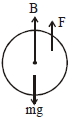
(B) For the droplet to be in equilibrium,the total upward force must equal the downward force.
The forces acting on the droplet are:
$1$. Buoyant force $(B)$: $B = V_{\text{immersed}} \rho g = (\frac{1}{2} \cdot \frac{4}{3} \pi r^3) \rho g = \frac{2}{3} \pi r^3 \rho g$
$2$. Surface tension force $(F)$: $F = T \cdot (2 \pi r)$
$3$. Weight of the droplet $(mg)$: $mg = (V_{\text{total}} d) g = (\frac{4}{3} \pi r^3) d g$
Equating the forces: $B + F = mg$
$\frac{2}{3} \pi r^3 \rho g + 2 \pi r T = \frac{4}{3} \pi r^3 d g$
Divide by $\pi r$:
$\frac{2}{3} r^2 \rho g + 2 T = \frac{4}{3} r^2 d g$
Rearranging to solve for $r^2$:
$2 T = \frac{4}{3} r^2 d g - \frac{2}{3} r^2 \rho g$
$2 T = \frac{2}{3} r^2 g (2d - \rho)$
$T = \frac{1}{3} r^2 g (2d - \rho)$
$r^2 = \frac{3 T}{(2d - \rho) g}$
$r = \sqrt{\frac{3 T}{(2d - \rho) g}}$
The forces acting on the droplet are:
$1$. Buoyant force $(B)$: $B = V_{\text{immersed}} \rho g = (\frac{1}{2} \cdot \frac{4}{3} \pi r^3) \rho g = \frac{2}{3} \pi r^3 \rho g$
$2$. Surface tension force $(F)$: $F = T \cdot (2 \pi r)$
$3$. Weight of the droplet $(mg)$: $mg = (V_{\text{total}} d) g = (\frac{4}{3} \pi r^3) d g$
Equating the forces: $B + F = mg$
$\frac{2}{3} \pi r^3 \rho g + 2 \pi r T = \frac{4}{3} \pi r^3 d g$
Divide by $\pi r$:
$\frac{2}{3} r^2 \rho g + 2 T = \frac{4}{3} r^2 d g$
Rearranging to solve for $r^2$:
$2 T = \frac{4}{3} r^2 d g - \frac{2}{3} r^2 \rho g$
$2 T = \frac{2}{3} r^2 g (2d - \rho)$
$T = \frac{1}{3} r^2 g (2d - \rho)$
$r^2 = \frac{3 T}{(2d - \rho) g}$
$r = \sqrt{\frac{3 T}{(2d - \rho) g}}$
0 likes
View Solution59
MediumMCQ
$A$ $U$-shaped wire is dipped in a soap solution and removed. The thin soap film formed between the wire and the light slider supports a weight of $1.5 \times 10^{-2} \; N$ (which includes the small weight of the slider). The length of the slider is $30 \; cm$. What is the surface tension of the film?
A
$6.32 \times 10^{-3} \; N m^{-1}$
B
$5.25 \times 10^{-4} \; N m^{-1}$
C
$6.8 \times 10^{-3} \; N m^{-1}$
D
$2.5 \times 10^{-2} \; N m^{-1}$
Solution
(D) The weight supported by the soap film is $W = 1.5 \times 10^{-2} \; N$.
The length of the slider is $l = 30 \; cm = 0.3 \; m$.
$A$ soap film has two free surfaces,so the force due to surface tension acts on both sides.
Therefore,the total length of the film in contact with the slider is $L = 2l = 2 \times 0.3 = 0.6 \; m$.
The surface tension $S$ is given by the formula $S = \frac{W}{2l}$.
Substituting the values: $S = \frac{1.5 \times 10^{-2}}{0.6} = 2.5 \times 10^{-2} \; N m^{-1}$.
Thus,the surface tension of the film is $2.5 \times 10^{-2} \; N m^{-1}$.
The length of the slider is $l = 30 \; cm = 0.3 \; m$.
$A$ soap film has two free surfaces,so the force due to surface tension acts on both sides.
Therefore,the total length of the film in contact with the slider is $L = 2l = 2 \times 0.3 = 0.6 \; m$.
The surface tension $S$ is given by the formula $S = \frac{W}{2l}$.
Substituting the values: $S = \frac{1.5 \times 10^{-2}}{0.6} = 2.5 \times 10^{-2} \; N m^{-1}$.
Thus,the surface tension of the film is $2.5 \times 10^{-2} \; N m^{-1}$.
0 likes
View Solution60
Medium
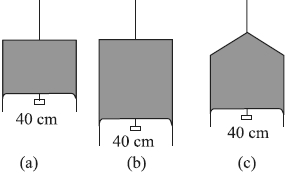
Figure $(a)$ shows a thin liquid film supporting a small weight $= 4.5 \times 10^{-2} \, N$. What is the weight supported by a film of the same liquid at the same temperature in Figure $(b)$ and $(c)$? Explain your answer physically.
Solution
(A) Consider case $(a)$:
The length of the liquid film supported by the weight is $l = 40 \, cm = 0.4 \, m$.
The weight supported by the film is $W = 4.5 \times 10^{-2} \, N$.
$A$ liquid film has two free surfaces. Therefore,the force due to surface tension $(S)$ acts along both surfaces.
Surface tension $S = \frac{W}{2l} = \frac{4.5 \times 10^{-2}}{2 \times 0.4} = 5.625 \times 10^{-2} \, N \, m^{-1}$.
In all three figures,the liquid is the same and the temperature is constant. Hence,the surface tension remains the same for all cases.
Since the length of the film $(l = 0.4 \, m)$ is the same in all cases,the force supported by the film,which is $W = 2Sl$,remains constant.
Therefore,the weight supported in each case $(b)$ and $(c)$ is $4.5 \times 10^{-2} \, N$.
The length of the liquid film supported by the weight is $l = 40 \, cm = 0.4 \, m$.
The weight supported by the film is $W = 4.5 \times 10^{-2} \, N$.
$A$ liquid film has two free surfaces. Therefore,the force due to surface tension $(S)$ acts along both surfaces.
Surface tension $S = \frac{W}{2l} = \frac{4.5 \times 10^{-2}}{2 \times 0.4} = 5.625 \times 10^{-2} \, N \, m^{-1}$.
In all three figures,the liquid is the same and the temperature is constant. Hence,the surface tension remains the same for all cases.
Since the length of the film $(l = 0.4 \, m)$ is the same in all cases,the force supported by the film,which is $W = 2Sl$,remains constant.
Therefore,the weight supported in each case $(b)$ and $(c)$ is $4.5 \times 10^{-2} \, N$.
0 likes
View Solution61
Medium
In the case of the surface of one fluid in contact with another fluid or a solid surface,what does the surface tension/surface energy depend on? Explain with an illustration.
Solution
(N/A) The surface tension or surface energy at the interface between two materials depends on the nature of the materials on both sides of the interface.
$(i)$ If the molecules of the two materials attract each other,the potential energy of the interface is reduced,leading to lower surface energy.
$(ii)$ If the molecules of the two materials repel each other,the potential energy of the interface is increased,leading to higher surface energy.
Therefore,surface energy is essentially the energy of the interface between two materials and is a property that depends on the interaction between both substances.
$(i)$ If the molecules of the two materials attract each other,the potential energy of the interface is reduced,leading to lower surface energy.
$(ii)$ If the molecules of the two materials repel each other,the potential energy of the interface is increased,leading to higher surface energy.
Therefore,surface energy is essentially the energy of the interface between two materials and is a property that depends on the interaction between both substances.
0 likes
View Solution62
Easy
Define surface tension and provide its formula in the context of $(i)$ intermolecular forces,$(ii)$ potential energy,and $(iii)$ work done.
Solution
(N/A) Surface tension is a property of the liquid surface that allows it to resist an external force,due to the cohesive nature of its molecules.
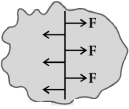
$(i)$ In terms of intermolecular forces: Surface tension is defined as the force per unit length acting on an imaginary line drawn on the free surface of a liquid,perpendicular to the line and parallel to the surface. If $F$ is the force acting on a line of length $l$,then surface tension $S$ is given by:
$S = \frac{F}{l} \left( \frac{\text{N}}{\text{m}} \right)$
$(ii)$ In terms of potential energy: Surface tension is defined as the potential energy stored per unit area of the free surface of a liquid. If $E$ is the potential energy and $A$ is the area,then:
$S = \frac{E}{A} \left( \frac{\text{J}}{\text{m}^2} = \frac{\text{N} \cdot \text{m}}{\text{m}^2} = \frac{\text{N}}{\text{m}} \right)$
$(iii)$ In terms of work done: Surface tension is defined as the work done per unit increase in the surface area of a liquid. If $W$ is the work done to increase the area by $\Delta A$,then:
$S = \frac{W}{\Delta A} \left( \frac{\text{J}}{\text{m}^2} = \frac{\text{N}}{\text{m}} \right)$
$(i)$ In terms of intermolecular forces: Surface tension is defined as the force per unit length acting on an imaginary line drawn on the free surface of a liquid,perpendicular to the line and parallel to the surface. If $F$ is the force acting on a line of length $l$,then surface tension $S$ is given by:
$S = \frac{F}{l} \left( \frac{\text{N}}{\text{m}} \right)$
$(ii)$ In terms of potential energy: Surface tension is defined as the potential energy stored per unit area of the free surface of a liquid. If $E$ is the potential energy and $A$ is the area,then:
$S = \frac{E}{A} \left( \frac{\text{J}}{\text{m}^2} = \frac{\text{N} \cdot \text{m}}{\text{m}^2} = \frac{\text{N}}{\text{m}} \right)$
$(iii)$ In terms of work done: Surface tension is defined as the work done per unit increase in the surface area of a liquid. If $W$ is the work done to increase the area by $\Delta A$,then:
$S = \frac{W}{\Delta A} \left( \frac{\text{J}}{\text{m}^2} = \frac{\text{N}}{\text{m}} \right)$
0 likes
View Solution63
Medium
On what does the value of surface tension depend? Explain.
Solution
The value of surface tension depends primarily on the temperature of the liquid.
As the temperature increases, the kinetic energy of the molecules increases, which weakens the intermolecular forces of attraction. Consequently, the surface tension of a liquid decreases as the temperature rises.
At the critical temperature, the distinction between the liquid and vapor phases disappears, and the surface tension becomes zero.
Surface tension is also influenced by the presence of impurities (solutes) in the liquid. Solutes that decrease the cohesive forces between liquid molecules reduce surface tension, while those that increase cohesive forces raise it.
Below is a table showing the surface tension of various liquids at specific temperatures:
As the temperature increases, the kinetic energy of the molecules increases, which weakens the intermolecular forces of attraction. Consequently, the surface tension of a liquid decreases as the temperature rises.
At the critical temperature, the distinction between the liquid and vapor phases disappears, and the surface tension becomes zero.
Surface tension is also influenced by the presence of impurities (solutes) in the liquid. Solutes that decrease the cohesive forces between liquid molecules reduce surface tension, while those that increase cohesive forces raise it.
Below is a table showing the surface tension of various liquids at specific temperatures:
| Liquid | Temp. $(^{\circ}C)$ | Surface tension $(N/m)$ | Heat of vaporization $(kJ/mol)$ |
| Helium | $-270$ | $0.000239$ | $0.115$ |
| Oxygen | $-183$ | $0.0132$ | $7.1$ |
| Ethanol | $20$ | $0.0227$ | $40.6$ |
| Water | $20$ | $0.0727$ | $44.16$ |
| Mercury | $20$ | $0.4355$ | $63.2$ |
0 likes
View Solution64
Medium
Describe a simple experiment for the measurement of the surface tension of a liquid.
Solution
(N/A) fluid will stick to a solid surface if the surface energy between the fluid and the solid is smaller than the sum of the surface energies between the solid-air and fluid-air interfaces.
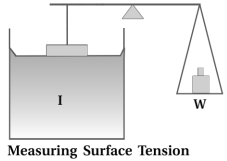
Measuring Surface Tension:
$1$. $A$ flat vertical glass plate,suspended from one arm of a balance,is positioned such that its lower horizontal edge just touches the surface of the liquid in a vessel.
$2$. The plate is initially balanced by weights on the other side of the balance.
$3$. The vessel is raised slightly until the liquid just touches the glass plate. The surface tension of the liquid exerts a downward force on the plate.
$4$. Additional weights are added to the other side of the balance until the plate just clears the liquid surface.
$5$. Suppose the additional weight required is $W = mg$,where $m$ is the additional mass and $g$ is the acceleration due to gravity.
$6$. The surface tension $S_{la}$ of the liquid-air interface is given by $S_{la} = \frac{W}{2l} = \frac{mg}{2l}$,where $l$ is the length of the plate edge. The factor of $2$ appears because the liquid acts on both sides of the plate.
$7$. By substituting the values of $m$,$g$,and $l$,the surface tension $S_{la}$ can be determined.
Measuring Surface Tension:
$1$. $A$ flat vertical glass plate,suspended from one arm of a balance,is positioned such that its lower horizontal edge just touches the surface of the liquid in a vessel.
$2$. The plate is initially balanced by weights on the other side of the balance.
$3$. The vessel is raised slightly until the liquid just touches the glass plate. The surface tension of the liquid exerts a downward force on the plate.
$4$. Additional weights are added to the other side of the balance until the plate just clears the liquid surface.
$5$. Suppose the additional weight required is $W = mg$,where $m$ is the additional mass and $g$ is the acceleration due to gravity.
$6$. The surface tension $S_{la}$ of the liquid-air interface is given by $S_{la} = \frac{W}{2l} = \frac{mg}{2l}$,where $l$ is the length of the plate edge. The factor of $2$ appears because the liquid acts on both sides of the plate.
$7$. By substituting the values of $m$,$g$,and $l$,the surface tension $S_{la}$ can be determined.
0 likes
View Solution65
Medium
Why are small drops of liquid spherical in shape?
Solution
(N/A) liquid-air interface possesses surface energy. For a given volume,the surface with the minimum energy is the one with the least surface area.
$A$ sphere possesses this property,as the surface area of a sphere is the minimum for a given volume.
Hence,if gravity and other external forces (such as air resistance) are negligible,liquid drops tend to be spherical to minimize their surface energy.
Furthermore,the cohesive forces between the liquid molecules are stronger than the adhesive forces between the liquid and air molecules,which helps the drop maintain its spherical shape.
$A$ sphere possesses this property,as the surface area of a sphere is the minimum for a given volume.
Hence,if gravity and other external forces (such as air resistance) are negligible,liquid drops tend to be spherical to minimize their surface energy.
Furthermore,the cohesive forces between the liquid molecules are stronger than the adhesive forces between the liquid and air molecules,which helps the drop maintain its spherical shape.
0 likes
View Solution66
Medium
Why are clothes easily washed by soap or detergent?
Solution
(N/A) The addition of soap or detergent to water reduces the angle of contact. Dirt particles are trapped within the fabric fibers. The molecules of detergent are hairpin-shaped,with one end attracted to water (hydrophilic) and the other end attracted to molecules of grease,oil,or wax (hydrophobic/dirt). This structure forms water-oil interfaces,which drastically reduces the surface tension of the water. As a result,the water can penetrate the fabric more effectively and lift the dirt away,allowing clothes to be washed easily.
Conversely,a waterproofing agent is added to fabrics to increase the angle of contact between water and the fibers,preventing water from wetting the material.
Conversely,a waterproofing agent is added to fabrics to increase the angle of contact between water and the fibers,preventing water from wetting the material.
0 likes
View Solution67
MediumMCQ
What tendency do molecules on the surface of a liquid possess?
A
To minimize their surface area
B
To maximize their surface area
C
To remain in equilibrium
D
To move randomly
Solution
(A) Molecules on the surface of a liquid experience a net inward force because they are attracted by the molecules inside the bulk of the liquid but have no molecules above them to balance this force.
This inward pull causes the surface to contract,leading to a tendency to minimize the surface area for a given volume.
This phenomenon is the fundamental cause of surface tension.
This inward pull causes the surface to contract,leading to a tendency to minimize the surface area for a given volume.
This phenomenon is the fundamental cause of surface tension.
0 likes
View Solution68
EasyMCQ
The free surface of a liquid has a tendency to contract. This property is called ...... .
A
Viscosity
B
Surface tension
C
Elasticity
D
Capillarity
Solution
(B) The free surface of a liquid behaves like a stretched elastic membrane. Due to the cohesive forces between the molecules of the liquid,the molecules at the surface experience a net inward force. This causes the surface to minimize its area,which is a property known as $Surface \ tension$.
0 likes
View Solution69
Easy
Define surface tension with its formula in the context of intermolecular forces.
Solution
(N/A) Surface tension is a property of the surface of a liquid that allows it to resist an external force,due to the cohesive nature of its molecules.
In the context of intermolecular forces,molecules at the surface experience a net inward force because they are attracted only by molecules below them,whereas molecules in the bulk are attracted equally in all directions.
This inward pull causes the surface to behave like a stretched elastic membrane.
Surface tension $(S)$ is defined as the force $(F)$ acting per unit length $(l)$ on an imaginary line drawn on the liquid surface:
$S = \frac{F}{l}$
The $SI$ unit of surface tension is $N/m$ or $J/m^2$.
In the context of intermolecular forces,molecules at the surface experience a net inward force because they are attracted only by molecules below them,whereas molecules in the bulk are attracted equally in all directions.
This inward pull causes the surface to behave like a stretched elastic membrane.
Surface tension $(S)$ is defined as the force $(F)$ acting per unit length $(l)$ on an imaginary line drawn on the liquid surface:
$S = \frac{F}{l}$
The $SI$ unit of surface tension is $N/m$ or $J/m^2$.
0 likes
View Solution70
Easy
Give two practical illustrations of surface tension.
Solution
(N/A) Surface tension is a property of liquids where the surface acts like a stretched elastic membrane. Two practical illustrations are:
$1$. Raindrops are spherical: Due to surface tension,the surface area of a liquid drop tends to be minimum for a given volume. For a given volume,a sphere has the minimum surface area,hence raindrops are spherical.
$2$. Cleaning action of detergents: Detergents reduce the surface tension of water,allowing it to penetrate into the pores of fabrics and effectively remove dirt and grease.
$1$. Raindrops are spherical: Due to surface tension,the surface area of a liquid drop tends to be minimum for a given volume. For a given volume,a sphere has the minimum surface area,hence raindrops are spherical.
$2$. Cleaning action of detergents: Detergents reduce the surface tension of water,allowing it to penetrate into the pores of fabrics and effectively remove dirt and grease.
0 likes
View Solution71
Medium
Write two units of surface tension and give the dimensional formula of surface tension.
Solution
(N/A) Surface tension $(T)$ is defined as the force per unit length acting on the surface of a liquid. Mathematically,$T = F/L$.
$1$. Units of surface tension:
- In the $SI$ system,the unit is Newton per meter $(N/m)$.
- Another common unit is Joule per square meter $(J/m^2)$.
$2$. Dimensional formula:
- The dimension of force $(F)$ is $[M^1 L^1 T^{-2}]$.
- The dimension of length $(L)$ is $[L^1]$.
- Therefore,the dimensional formula for surface tension is $[M^1 L^1 T^{-2}] / [L^1] = [M^1 L^0 T^{-2}]$.
$1$. Units of surface tension:
- In the $SI$ system,the unit is Newton per meter $(N/m)$.
- Another common unit is Joule per square meter $(J/m^2)$.
$2$. Dimensional formula:
- The dimension of force $(F)$ is $[M^1 L^1 T^{-2}]$.
- The dimension of length $(L)$ is $[L^1]$.
- Therefore,the dimensional formula for surface tension is $[M^1 L^1 T^{-2}] / [L^1] = [M^1 L^0 T^{-2}]$.
0 likes
View Solution72
Medium
On what factors does the value of surface tension depend? Explain.
Solution
(N/A) Surface tension is a property of a liquid that arises due to the cohesive forces between its molecules. The value of surface tension depends on the following factors:
$1$. Nature of the liquid: Different liquids have different cohesive forces between their molecules. For example,mercury has a higher surface tension than water.
$2$. Temperature: The surface tension of a liquid generally decreases as the temperature increases. This is because an increase in temperature increases the kinetic energy of the molecules,which weakens the cohesive forces.
$3$. Impurities: The presence of impurities can either increase or decrease the surface tension. Highly soluble substances (like salt) increase surface tension,while sparingly soluble substances (like soap or detergents) decrease it.
$1$. Nature of the liquid: Different liquids have different cohesive forces between their molecules. For example,mercury has a higher surface tension than water.
$2$. Temperature: The surface tension of a liquid generally decreases as the temperature increases. This is because an increase in temperature increases the kinetic energy of the molecules,which weakens the cohesive forces.
$3$. Impurities: The presence of impurities can either increase or decrease the surface tension. Highly soluble substances (like salt) increase surface tension,while sparingly soluble substances (like soap or detergents) decrease it.
0 likes
View Solution73
EasyMCQ
What is the effect of increasing temperature on surface tension?
A
It increases.
B
It decreases.
C
It remains constant.
D
It first increases then decreases.
Solution
(B) Surface tension is defined as the force per unit length acting on the surface of a liquid.
It arises due to the cohesive forces between the molecules of the liquid.
As the temperature of a liquid increases,the kinetic energy of the molecules increases,which weakens the intermolecular cohesive forces.
Since surface tension is directly related to the strength of these cohesive forces,an increase in temperature leads to a decrease in surface tension.
Therefore,the correct answer is that surface tension decreases with an increase in temperature.
It arises due to the cohesive forces between the molecules of the liquid.
As the temperature of a liquid increases,the kinetic energy of the molecules increases,which weakens the intermolecular cohesive forces.
Since surface tension is directly related to the strength of these cohesive forces,an increase in temperature leads to a decrease in surface tension.
Therefore,the correct answer is that surface tension decreases with an increase in temperature.
0 likes
View Solution74
MediumMCQ
Why does the free surface of a liquid tend to contract?
A
Due to gravitational force
B
Due to surface tension
C
Due to viscosity
D
Due to atmospheric pressure
Solution
(B) The molecules on the surface of a liquid experience a net inward force directed towards the bulk of the liquid.
This results in a higher potential energy for surface molecules compared to those in the interior.
Since every physical system tends to minimize its potential energy to achieve a state of stable equilibrium,the surface area of the liquid tends to decrease.
This phenomenon is known as surface tension,which causes the free surface of the liquid to contract and occupy the minimum possible surface area.
This results in a higher potential energy for surface molecules compared to those in the interior.
Since every physical system tends to minimize its potential energy to achieve a state of stable equilibrium,the surface area of the liquid tends to decrease.
This phenomenon is known as surface tension,which causes the free surface of the liquid to contract and occupy the minimum possible surface area.
0 likes
View Solution75
Medium
Give a reason why some insects are able to walk on the water surface.
Solution
(N/A) The surface of a liquid behaves like a stretched elastic membrane due to the property of surface tension,which causes the surface to minimize its area. This surface tension provides an upward force that supports the weight of small insects,allowing them to walk on the water surface without sinking.
0 likes
View Solution76
Medium
Why is the surface tension of antiseptics kept low? Explain.
Solution
(N/A) The surface tension of antiseptics is kept low so that they can spread easily over the surface of cuts or wounds.
By reducing the surface tension,the liquid antiseptic achieves a smaller contact angle,allowing it to cover a larger surface area of the affected tissue.
This increased spreading capability ensures that the antiseptic reaches all parts of the wound,effectively killing bacteria and promoting faster healing.
By reducing the surface tension,the liquid antiseptic achieves a smaller contact angle,allowing it to cover a larger surface area of the affected tissue.
This increased spreading capability ensures that the antiseptic reaches all parts of the wound,effectively killing bacteria and promoting faster healing.
0 likes
View Solution77
Medium
Explain why is hot soup more tasty than the colder one?
Solution
(N/A) The surface tension of a liquid decreases as its temperature increases.
Because the hot soup has lower surface tension,it spreads more easily over a larger surface area of the tongue.
This allows the soup to come into contact with a greater number of taste buds,which enhances the perception of its flavor,making it taste better than cold soup.
Because the hot soup has lower surface tension,it spreads more easily over a larger surface area of the tongue.
This allows the soup to come into contact with a greater number of taste buds,which enhances the perception of its flavor,making it taste better than cold soup.
0 likes
View Solution78
Easy
It is better to wash clothes in hot water than in cold water. Explain.
Solution
(N/A) The surface tension of a liquid decreases as its temperature increases. When water is heated,its surface tension decreases,which allows the water to penetrate more effectively into the fine pores and fibers of the clothes. This increased wetting ability helps in loosening and removing dirt and grease particles more efficiently compared to cold water. Therefore,washing clothes in hot water is more effective.
0 likes
View Solution79
Medium
Detergents are added to water for removing dirt from clothes. Explain.
Solution
(N/A) When detergents are added to water,the surface tension of the water decreases,which allows the water to wet the clothes more effectively. Detergent molecules are hairpin-shaped,consisting of a hydrophilic head and a hydrophobic tail. The hydrophobic tails attach to the dirt (oil/grease),while the hydrophilic heads remain in the water. This process helps to emulsify the dirt,lifting it away from the fabric surface and allowing it to be washed away easily.
0 likes
View Solution80
EasyMCQ
Why do colours and lubricating oil have less surface tension?
A
To increase their viscosity
B
To spread easily on the surface
C
To reduce their density
D
To increase their boiling point
Solution
(B) Surface tension is the property of a liquid surface that allows it to resist an external force,caused by the cohesion of the liquid molecules.
Colours (paints) and lubricating oils are designed to have lower surface tension so that they can spread uniformly and easily over a surface to form a thin,continuous layer or film.
If the surface tension were high,these substances would form droplets instead of spreading,which would defeat their purpose of coating or lubricating.
Colours (paints) and lubricating oils are designed to have lower surface tension so that they can spread uniformly and easily over a surface to form a thin,continuous layer or film.
If the surface tension were high,these substances would form droplets instead of spreading,which would defeat their purpose of coating or lubricating.
0 likes
View Solution81
EasyMCQ
Arrange the following liquids in increasing order of surface tension: Water,Mercury,Soap solution.
A
Soap solution < Water < Mercury
B
Water < Soap solution < Mercury
C
Mercury < Water < Soap solution
D
Soap solution < Mercury < Water
Solution
(A) The surface tension of a liquid depends on the cohesive forces between its molecules.
$1$. Soap solution: Adding soap reduces the surface tension of water,so it has the lowest surface tension among the three.
$2$. Water: Pure water has a relatively high surface tension due to strong hydrogen bonding.
$3$. Mercury: Mercury is a liquid metal with very strong metallic bonds,resulting in the highest surface tension among these substances.
Therefore,the increasing order is: Soap solution < Water < Mercury.
$1$. Soap solution: Adding soap reduces the surface tension of water,so it has the lowest surface tension among the three.
$2$. Water: Pure water has a relatively high surface tension due to strong hydrogen bonding.
$3$. Mercury: Mercury is a liquid metal with very strong metallic bonds,resulting in the highest surface tension among these substances.
Therefore,the increasing order is: Soap solution < Water < Mercury.
0 likes
View Solution82
Medium
Is surface tension a vector or scalar? Explain.
Solution
(N/A) Surface tension is a scalar quantity.
Surface tension $= \frac{\text{Work}}{\text{Area of surface}}$.
The amount of work done in increasing the unit area of a liquid surface is called surface tension.
Since work is a scalar quantity and area is a scalar quantity,their ratio,which defines surface tension,is also a scalar quantity.
Surface tension $= \frac{\text{Work}}{\text{Area of surface}}$.
The amount of work done in increasing the unit area of a liquid surface is called surface tension.
Since work is a scalar quantity and area is a scalar quantity,their ratio,which defines surface tension,is also a scalar quantity.
0 likes
View Solution83
Difficult
If a drop of liquid breaks into smaller droplets,it results in the lowering of the temperature of the droplets. Let a drop of radius $R$ break into $N$ small droplets,each of radius $r$. Estimate the drop in temperature.
Solution
(N/A) The volume of the liquid remains constant during the process.
Volume of large drop = $N \times$ Volume of small drop
$\frac{4}{3} \pi R^3 = N \times \frac{4}{3} \pi r^3 \implies R^3 = N r^3 \implies N = \frac{R^3}{r^3}$.
The change in surface area $\Delta A$ is given by the final surface area minus the initial surface area:
$\Delta A = N(4 \pi r^2) - 4 \pi R^2 = 4 \pi (N r^2 - R^2)$.
Since $N = R^3/r^3$,we have $\Delta A = 4 \pi (\frac{R^3}{r^3} r^2 - R^2) = 4 \pi R^2 (\frac{R}{r} - 1)$.
The energy released due to the increase in surface area is $E = S \Delta A = 4 \pi S R^2 (\frac{R}{r} - 1)$,where $S$ is the surface tension.
This energy is absorbed from the internal energy of the liquid,causing a temperature drop $\Delta \theta$.
$E = m C \Delta \theta$,where $m = \rho V = \rho (\frac{4}{3} \pi R^3)$ and $C$ is the specific heat capacity.
Equating the energy: $4 \pi S R^2 (\frac{R}{r} - 1) = \rho (\frac{4}{3} \pi R^3) C \Delta \theta$.
Solving for $\Delta \theta$: $\Delta \theta = \frac{3 S}{\rho C R} (\frac{R}{r} - 1) = \frac{3 S}{\rho C} (\frac{1}{r} - \frac{1}{R})$.
Volume of large drop = $N \times$ Volume of small drop
$\frac{4}{3} \pi R^3 = N \times \frac{4}{3} \pi r^3 \implies R^3 = N r^3 \implies N = \frac{R^3}{r^3}$.
The change in surface area $\Delta A$ is given by the final surface area minus the initial surface area:
$\Delta A = N(4 \pi r^2) - 4 \pi R^2 = 4 \pi (N r^2 - R^2)$.
Since $N = R^3/r^3$,we have $\Delta A = 4 \pi (\frac{R^3}{r^3} r^2 - R^2) = 4 \pi R^2 (\frac{R}{r} - 1)$.
The energy released due to the increase in surface area is $E = S \Delta A = 4 \pi S R^2 (\frac{R}{r} - 1)$,where $S$ is the surface tension.
This energy is absorbed from the internal energy of the liquid,causing a temperature drop $\Delta \theta$.
$E = m C \Delta \theta$,where $m = \rho V = \rho (\frac{4}{3} \pi R^3)$ and $C$ is the specific heat capacity.
Equating the energy: $4 \pi S R^2 (\frac{R}{r} - 1) = \rho (\frac{4}{3} \pi R^3) C \Delta \theta$.
Solving for $\Delta \theta$: $\Delta \theta = \frac{3 S}{\rho C R} (\frac{R}{r} - 1) = \frac{3 S}{\rho C} (\frac{1}{r} - \frac{1}{R})$.
0 likes
View Solution84
Medium
Surface tension is exhibited by liquids due to the force of attraction between the molecules of the liquid. The surface tension decreases with an increase in temperature and vanishes at the boiling point. Given that the latent heat of vaporization for water $L_v = 540 \text{ kcal/kg}$,the mechanical equivalent of heat $J = 4.2 \text{ J/cal}$,density of water $\rho_w = 10^3 \text{ kg/m}^3$,Avogadro's number $N_A = 6.0 \times 10^{26} \text{ molecules/kmol}$,and the molecular weight of water $M_A = 18 \text{ kg/kmol}$.
$(a)$ Estimate the energy required for one molecule of water to evaporate.
$(b)$ Show that the intermolecular distance for water is $d = \left( \frac{M_A}{N_A \rho_w} \right)^{1/3}$ and find its value.
$(c)$ $1 \text{ g}$ of water in the vapour state at $1 \text{ atm}$ occupies $1601 \text{ cm}^3$. Estimate the intermolecular distance at the boiling point in the vapour state.
$(d)$ During vaporisation,a molecule overcomes a force $F$,assumed constant,to go from an intermolecular distance $d$ to $d'$. Estimate the value of $F$.
$(e)$ Calculate $\frac{F}{d}$,which is a measure of the surface tension.
$(a)$ Estimate the energy required for one molecule of water to evaporate.
$(b)$ Show that the intermolecular distance for water is $d = \left( \frac{M_A}{N_A \rho_w} \right)^{1/3}$ and find its value.
$(c)$ $1 \text{ g}$ of water in the vapour state at $1 \text{ atm}$ occupies $1601 \text{ cm}^3$. Estimate the intermolecular distance at the boiling point in the vapour state.
$(d)$ During vaporisation,a molecule overcomes a force $F$,assumed constant,to go from an intermolecular distance $d$ to $d'$. Estimate the value of $F$.
$(e)$ Calculate $\frac{F}{d}$,which is a measure of the surface tension.
Solution
(N/A) Energy per molecule $U = \frac{M_A L_v}{N_A} = \frac{18 \text{ kg/kmol} \times 540 \times 10^3 \text{ cal/kg} \times 4.2 \text{ J/cal}}{6.0 \times 10^{26} \text{ molecules/kmol}} = 6.8 \times 10^{-20} \text{ J}$.
$(b)$ Volume of $N_A$ molecules is $\frac{M_A}{\rho_w}$. Volume per molecule is $d^3 = \frac{M_A}{N_A \rho_w}$. Thus $d = (\frac{18}{6 \times 10^{26} \times 10^3})^{1/3} \approx 3.1 \times 10^{-10} \text{ m}$.
$(c)$ Volume per molecule in vapour $d'^3 = \frac{V}{N} = \frac{1601 \times 10^{-6} \text{ m}^3}{N_A / 18000} \approx 3.0 \times 10^{-9} \text{ m}$.
$(d)$ Work done $F(d' - d) = U$. Since $d' \gg d$,$F \approx \frac{U}{d'} = \frac{6.8 \times 10^{-20}}{3.0 \times 10^{-9}} \approx 2.3 \times 10^{-11} \text{ N}$.
$(e)$ $\frac{F}{d} = \frac{2.3 \times 10^{-11}}{3.1 \times 10^{-10}} \approx 0.074 \text{ N/m}$.
$(b)$ Volume of $N_A$ molecules is $\frac{M_A}{\rho_w}$. Volume per molecule is $d^3 = \frac{M_A}{N_A \rho_w}$. Thus $d = (\frac{18}{6 \times 10^{26} \times 10^3})^{1/3} \approx 3.1 \times 10^{-10} \text{ m}$.
$(c)$ Volume per molecule in vapour $d'^3 = \frac{V}{N} = \frac{1601 \times 10^{-6} \text{ m}^3}{N_A / 18000} \approx 3.0 \times 10^{-9} \text{ m}$.
$(d)$ Work done $F(d' - d) = U$. Since $d' \gg d$,$F \approx \frac{U}{d'} = \frac{6.8 \times 10^{-20}}{3.0 \times 10^{-9}} \approx 2.3 \times 10^{-11} \text{ N}$.
$(e)$ $\frac{F}{d} = \frac{2.3 \times 10^{-11}}{3.1 \times 10^{-10}} \approx 0.074 \text{ N/m}$.
0 likes
View Solution85
DifficultMCQ
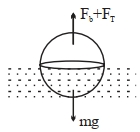
$A$ drop of liquid of density $\rho$ is floating half-immersed in a liquid of density $\sigma$ and surface tension $T = 7.5 \times 10^{-4} \, N \, cm^{-1}$. The radius of the drop in $cm$ will be: (Take: $g = 10 \, m/s^2$)
A
$\frac{15}{\sqrt{2\rho - \sigma}}$
B
$\frac{15}{\sqrt{\rho - \sigma}}$
C
$\frac{3}{2\sqrt{\rho - \sigma}}$
D
$\frac{3}{20\sqrt{2\rho - \sigma}}$
Solution
(A) For the drop to be in equilibrium,the upward forces (buoyant force and surface tension force) must balance the downward force (weight of the drop).
Let $R$ be the radius of the drop. The volume of the drop is $V = \frac{4}{3}\pi R^3$.
Buoyant force $F_b = \text{Volume immersed} \times \sigma \times g = \frac{V}{2} \sigma g = \frac{2}{3}\pi R^3 \sigma g$.
Surface tension force $F_T = T \times (2\pi R) = 2\pi RT$.
Weight of the drop $W = mg = V \rho g = \frac{4}{3}\pi R^3 \rho g$.
Equating forces: $F_b + F_T = W$
$\frac{2}{3}\pi R^3 \sigma g + 2\pi RT = \frac{4}{3}\pi R^3 \rho g$
$2\pi RT = \frac{4}{3}\pi R^3 \rho g - \frac{2}{3}\pi R^3 \sigma g = \frac{2}{3}\pi R^3 g (2\rho - \sigma)$
$T = \frac{R^2 g (2\rho - \sigma)}{3} \Rightarrow R^2 = \frac{3T}{g(2\rho - \sigma)}$
Given $T = 7.5 \times 10^{-4} \, N/cm = 7.5 \times 10^{-2} \, N/m$ and $g = 10 \, m/s^2$:
$R = \sqrt{\frac{3 \times 7.5 \times 10^{-2}}{10(2\rho - \sigma)}} = \sqrt{\frac{22.5 \times 10^{-2}}{10(2\rho - \sigma)}} = \sqrt{\frac{2.25 \times 10^{-2}}{2\rho - \sigma}} = \frac{0.15}{\sqrt{2\rho - \sigma}} \, m$
Converting to $cm$ $(1 \, m = 100 \, cm)$:
$R = \frac{0.15 \times 100}{\sqrt{2\rho - \sigma}} \, cm = \frac{15}{\sqrt{2\rho - \sigma}} \, cm$.
Let $R$ be the radius of the drop. The volume of the drop is $V = \frac{4}{3}\pi R^3$.
Buoyant force $F_b = \text{Volume immersed} \times \sigma \times g = \frac{V}{2} \sigma g = \frac{2}{3}\pi R^3 \sigma g$.
Surface tension force $F_T = T \times (2\pi R) = 2\pi RT$.
Weight of the drop $W = mg = V \rho g = \frac{4}{3}\pi R^3 \rho g$.
Equating forces: $F_b + F_T = W$
$\frac{2}{3}\pi R^3 \sigma g + 2\pi RT = \frac{4}{3}\pi R^3 \rho g$
$2\pi RT = \frac{4}{3}\pi R^3 \rho g - \frac{2}{3}\pi R^3 \sigma g = \frac{2}{3}\pi R^3 g (2\rho - \sigma)$
$T = \frac{R^2 g (2\rho - \sigma)}{3} \Rightarrow R^2 = \frac{3T}{g(2\rho - \sigma)}$
Given $T = 7.5 \times 10^{-4} \, N/cm = 7.5 \times 10^{-2} \, N/m$ and $g = 10 \, m/s^2$:
$R = \sqrt{\frac{3 \times 7.5 \times 10^{-2}}{10(2\rho - \sigma)}} = \sqrt{\frac{22.5 \times 10^{-2}}{10(2\rho - \sigma)}} = \sqrt{\frac{2.25 \times 10^{-2}}{2\rho - \sigma}} = \frac{0.15}{\sqrt{2\rho - \sigma}} \, m$
Converting to $cm$ $(1 \, m = 100 \, cm)$:
$R = \frac{0.15 \times 100}{\sqrt{2\rho - \sigma}} \, cm = \frac{15}{\sqrt{2\rho - \sigma}} \, cm$.
0 likes
View Solution86
AdvancedMCQ
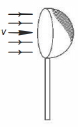
Air (density $\rho$) is being blown on a soap film (surface tension $T$) by a pipe of radius $R$ with its opening right next to the film. The film is deformed and a bubble detaches from the film when the shape of the deformed surface is a hemisphere. Given that the dynamic pressure on the film due to the air blown at speed $v$ is $\frac{1}{2} \rho v^{2}$,the speed at which the bubble is formed is:
A
$\frac{T}{\sqrt{\rho R}}$
B
$\sqrt{\frac{2 T}{\rho R}}$
C
$\sqrt{\frac{4 T}{\rho R}}$
D
$\sqrt{\frac{8 T}{\rho R}}$
Solution
(D) The bubble detaches from the film when the force exerted by the dynamic pressure exceeds the force due to surface tension along the circumference of the pipe.
The force due to dynamic pressure is given by $F_{\text{dynamic}} = P_{\text{dynamic}} \times A = (\frac{1}{2} \rho v^2) \times (\pi R^2)$.
The force due to surface tension acts along the circumference of the pipe. Since a soap film has two surfaces,the total surface tension force is $F_{\text{surface tension}} = 2 \times (T \times 2 \pi R) = 4 \pi R T$.
For the bubble to detach,the dynamic force must be at least equal to the surface tension force:
$\frac{1}{2} \rho v^2 \times \pi R^2 = 4 \pi R T$
Simplifying the equation:
$\frac{1}{2} \rho v^2 R = 4 T$
$v^2 = \frac{8 T}{\rho R}$
$v = \sqrt{\frac{8 T}{\rho R}}$
Thus,the minimum speed at which the bubble is formed is $v = \sqrt{\frac{8 T}{\rho R}}$.
The force due to dynamic pressure is given by $F_{\text{dynamic}} = P_{\text{dynamic}} \times A = (\frac{1}{2} \rho v^2) \times (\pi R^2)$.
The force due to surface tension acts along the circumference of the pipe. Since a soap film has two surfaces,the total surface tension force is $F_{\text{surface tension}} = 2 \times (T \times 2 \pi R) = 4 \pi R T$.
For the bubble to detach,the dynamic force must be at least equal to the surface tension force:
$\frac{1}{2} \rho v^2 \times \pi R^2 = 4 \pi R T$
Simplifying the equation:
$\frac{1}{2} \rho v^2 R = 4 T$
$v^2 = \frac{8 T}{\rho R}$
$v = \sqrt{\frac{8 T}{\rho R}}$
Thus,the minimum speed at which the bubble is formed is $v = \sqrt{\frac{8 T}{\rho R}}$.
0 likes
View Solution87
MediumMCQ
Consider a bowl filled with water on which some black pepper powder has been sprinkled uniformly. Now,a drop of liquid soap is added at the centre of the surface of water. The picture of the surface immediately after this will look like:
A
B
C
D
Solution
(C) When a drop of liquid soap is added to the water surface,it acts as a surfactant and significantly reduces the surface tension of the water at that point.
Because the surface tension of the surrounding water remains higher,the water surface experiences a net force pulling it outward from the center towards the edges of the bowl.
As the water surface moves outward,it carries the black pepper powder particles along with it,causing the powder to be pushed towards the circumference of the bowl,leaving the center clear.
Therefore,the correct representation is option $C$.
Because the surface tension of the surrounding water remains higher,the water surface experiences a net force pulling it outward from the center towards the edges of the bowl.
As the water surface moves outward,it carries the black pepper powder particles along with it,causing the powder to be pushed towards the circumference of the bowl,leaving the center clear.
Therefore,the correct representation is option $C$.
0 likes
View Solution88
EasyMCQ
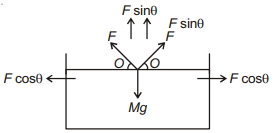
An iron needle slowly placed on the surface of water floats because
A
It displaces water more than its weight
B
The density of material of needle is less than that of water
C
Of surface tension
D
Of its shape
Solution
(C) The correct option is $C$.
When an iron needle is placed gently on the surface of water,it does not sink because the surface tension of the water acts as a membrane.
The surface tension force $F$ acts along the contact line of the needle with the water surface. The vertical component of this force,$2F \sin \theta$,acts upwards and balances the weight of the needle $mg$,where $\theta$ is the angle of contact.
Thus,in equilibrium: $2F \sin \theta = mg$.
When an iron needle is placed gently on the surface of water,it does not sink because the surface tension of the water acts as a membrane.
The surface tension force $F$ acts along the contact line of the needle with the water surface. The vertical component of this force,$2F \sin \theta$,acts upwards and balances the weight of the needle $mg$,where $\theta$ is the angle of contact.
Thus,in equilibrium: $2F \sin \theta = mg$.
0 likes
View Solution89
MediumMCQ
$A$ massless inextensible string in the form of a loop is placed on a horizontal film of soap solution of surface tension $T$. If the film is pierced inside the loop and it converts into a circular loop of diameter $d$,then the tension produced in the string is ..........
A
$Td$
B
$\pi T d$
C
$\pi d^2 T$
D
$\frac{\pi d^2 T}{4}$
Solution
(A) Consider a small element of the string of length $\Delta l$ subtending an angle $2\theta$ at the center of the circular loop.
The force due to surface tension $S$ acting on the string is $F_s = 2 \times S \times \Delta l$,where the factor of $2$ accounts for the two surfaces of the soap film.
For a small angle $2\theta$,the length $\Delta l = r(2\theta)$,where $r$ is the radius of the loop.
The radial component of the tension $T_{str}$ in the string provides the necessary centripetal force to balance the surface tension force.
$2 T_{str} \sin \theta = 2 S \Delta l$
Since $\theta$ is very small,$\sin \theta \approx \theta$ and $\Delta l = 2r\theta$.
$2 T_{str} \theta = 2 S (2r\theta)$
$T_{str} = 2Sr$
Since $d = 2r$,we have $T_{str} = S d$.
Given the surface tension is $T$,the tension in the string is $T_{str} = Td$.
The force due to surface tension $S$ acting on the string is $F_s = 2 \times S \times \Delta l$,where the factor of $2$ accounts for the two surfaces of the soap film.
For a small angle $2\theta$,the length $\Delta l = r(2\theta)$,where $r$ is the radius of the loop.
The radial component of the tension $T_{str}$ in the string provides the necessary centripetal force to balance the surface tension force.
$2 T_{str} \sin \theta = 2 S \Delta l$
Since $\theta$ is very small,$\sin \theta \approx \theta$ and $\Delta l = 2r\theta$.
$2 T_{str} \theta = 2 S (2r\theta)$
$T_{str} = 2Sr$
Since $d = 2r$,we have $T_{str} = S d$.
Given the surface tension is $T$,the tension in the string is $T_{str} = Td$.
0 likes
View Solution90
MediumMCQ
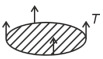
$A$ thin flat circular disc of radius $4.5 \,cm$ is placed gently over the surface of water. If the surface tension of water is $0.07 \,N \,m^{-1}$, then the excess force required to take it away from the surface is
A
$198 \,N$
B
$1.98 \,mN$
C
$99 \,N$
D
$19.8 \,mN$
Solution
(D) The excess force required to pull a circular disc of radius $R$ from the surface of a liquid with surface tension $T$ is given by the force due to surface tension acting along the circumference of the disc.
Excess force $F = T \times (2 \pi R)$
Given:
Radius $R = 4.5 \,cm = 4.5 \times 10^{-2} \,m$
Surface tension $T = 0.07 \,N \,m^{-1}$
Substituting the values:
$F = 0.07 \times 2 \times 3.14 \times 4.5 \times 10^{-2}$
$F = 0.07 \times 28.26 \times 10^{-2}$
$F = 1.9782 \times 10^{-2} \,N$
$F \approx 19.8 \times 10^{-3} \,N$
$F = 19.8 \,mN$
Excess force $F = T \times (2 \pi R)$
Given:
Radius $R = 4.5 \,cm = 4.5 \times 10^{-2} \,m$
Surface tension $T = 0.07 \,N \,m^{-1}$
Substituting the values:
$F = 0.07 \times 2 \times 3.14 \times 4.5 \times 10^{-2}$
$F = 0.07 \times 28.26 \times 10^{-2}$
$F = 1.9782 \times 10^{-2} \,N$
$F \approx 19.8 \times 10^{-3} \,N$
$F = 19.8 \,mN$
0 likes
View Solution91
AdvancedMCQ
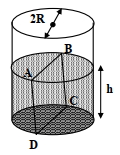
Water is filled up to a height $h$ in a beaker of radius $R$ as shown in the figure. The density of water is $\rho$,the surface tension of water is $T$ and the atmospheric pressure is $P_0$. Consider a vertical section $ABCD$ of the water column through a diameter of the beaker. The force on water on one side of this section by water on the other side of this section has magnitude
A
$\left|2 P_0 Rh+\pi R^2 \rho gh-2 RT\right|$
B
$\left|2 P_0 Rh+R \rho gh^2-2 RT\right|$
C
$\left|P_0 \pi R^2+R \rho g h^2-2 RT\right|$
D
$\left|P_0 \pi R^2+R \rho g h^2+2 RT\right|$
Solution
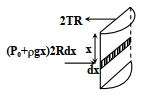
(B) Consider a vertical rectangular strip of height $dx$ at a depth $x$ from the free surface of the water. The width of this strip is the diameter of the beaker,which is $2R$.
The pressure at depth $x$ is $P(x) = P_0 + \rho g x$.
The force exerted by the pressure on this strip is $dF_p = P(x) \cdot (2R) dx = (P_0 + \rho g x) 2R dx$.
Integrating this from $x = 0$ to $x = h$,the total force due to pressure is $F_p = \int_0^h (P_0 + \rho g x) 2R dx = 2R [P_0 x + \frac{1}{2} \rho g x^2]_0^h = 2 P_0 R h + R \rho g h^2$.
Additionally,there is a force due to surface tension acting along the top edge of the section. The length of the section at the surface is $2R$,so the force due to surface tension is $F_T = T \cdot (2R) = 2RT$.
Since the surface tension force acts in the opposite direction to the pressure force,the net magnitude of the force is $F = |F_p - F_T| = |2 P_0 R h + R \rho g h^2 - 2 RT|$.
The pressure at depth $x$ is $P(x) = P_0 + \rho g x$.
The force exerted by the pressure on this strip is $dF_p = P(x) \cdot (2R) dx = (P_0 + \rho g x) 2R dx$.
Integrating this from $x = 0$ to $x = h$,the total force due to pressure is $F_p = \int_0^h (P_0 + \rho g x) 2R dx = 2R [P_0 x + \frac{1}{2} \rho g x^2]_0^h = 2 P_0 R h + R \rho g h^2$.
Additionally,there is a force due to surface tension acting along the top edge of the section. The length of the section at the surface is $2R$,so the force due to surface tension is $F_T = T \cdot (2R) = 2RT$.
Since the surface tension force acts in the opposite direction to the pressure force,the net magnitude of the force is $F = |F_p - F_T| = |2 P_0 R h + R \rho g h^2 - 2 RT|$.
0 likes
View Solution92
AdvancedMCQ
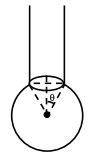
When liquid medicine of density $\rho$ is to be put in the eye, it is done with the help of a dropper. As the bulb on the top of the dropper is pressed, a drop forms at the opening of the dropper. We wish to estimate the size of the drop. We first assume that the drop formed at the opening is spherical because that requires a minimum increase in its surface energy. To determine the size, we calculate the net vertical force due to the surface tension $T$ when the radius of the drop is $R$. When the force becomes smaller than the weight of the drop, the drop gets detached from the dropper.
$1.$ If the radius of the opening of the dropper is $r$, the vertical force due to the surface tension on the drop of radius $R$ (assuming $r \ll R$) is
$(A)$ $2 \pi r T$ $(B)$ $2 \pi R T$ $(C)$ $\frac{2 \pi r^2 T}{R}$ $(D)$ $\frac{2 \pi R^2 T}{r}$
$2.$ If $r=5 \times 10^{-4} \, m, \rho=10^3 \, kg \, m^{-3}, g=10 \, m/s^2, T=0.11 \, Nm^{-1}$, the radius of the drop when it detaches from the dropper is approximately
$(A)$ $1.4 \times 10^{-3} \, m$ $(B)$ $3.3 \times 10^{-3} \, m$
$(C)$ $2.0 \times 10^{-3} \, m$ $(D)$ $4.1 \times 10^{-3} \, m$
$3.$ After the drop detaches, its surface energy is
$(A)$ $1.4 \times 10^{-6} \, J$ $(B)$ $2.7 \times 10^{-6} \, J$
$(C)$ $5.4 \times 10^{-6} \, J$ $(D)$ $8.1 \times 10^{-6} \, J$
Give the answer for questions $1, 2$ and $3.$
$1.$ If the radius of the opening of the dropper is $r$, the vertical force due to the surface tension on the drop of radius $R$ (assuming $r \ll R$) is
$(A)$ $2 \pi r T$ $(B)$ $2 \pi R T$ $(C)$ $\frac{2 \pi r^2 T}{R}$ $(D)$ $\frac{2 \pi R^2 T}{r}$
$2.$ If $r=5 \times 10^{-4} \, m, \rho=10^3 \, kg \, m^{-3}, g=10 \, m/s^2, T=0.11 \, Nm^{-1}$, the radius of the drop when it detaches from the dropper is approximately
$(A)$ $1.4 \times 10^{-3} \, m$ $(B)$ $3.3 \times 10^{-3} \, m$
$(C)$ $2.0 \times 10^{-3} \, m$ $(D)$ $4.1 \times 10^{-3} \, m$
$3.$ After the drop detaches, its surface energy is
$(A)$ $1.4 \times 10^{-6} \, J$ $(B)$ $2.7 \times 10^{-6} \, J$
$(C)$ $5.4 \times 10^{-6} \, J$ $(D)$ $8.1 \times 10^{-6} \, J$
Give the answer for questions $1, 2$ and $3.$
A
$(C, A, B)$
B
$(A, B, C)$
C
$(A, D, A)$
D
$(D, B, B)$
Solution
(A) $1.$ The vertical force due to surface tension is $F = T \cdot (2 \pi r) \cdot \sin \theta$. Since $r \ll R$, $\sin \theta \approx \frac{r}{R}$. Thus, $F = 2 \pi r T \cdot \frac{r}{R} = \frac{2 \pi r^2 T}{R}$. Correct option is $(C)$.
$2.$ At detachment, $F = mg$. So, $\frac{2 \pi r^2 T}{R} = \frac{4}{3} \pi R^3 \rho g$. Rearranging gives $R^4 = \frac{3 r^2 T}{2 \rho g} = \frac{3 \times (5 \times 10^{-4})^2 \times 0.11}{2 \times 10^3 \times 10} = \frac{3 \times 25 \times 10^{-8} \times 0.11}{2 \times 10^4} = 4.125 \times 10^{-12} \, m^4$. Taking the fourth root, $R \approx 1.42 \times 10^{-3} \, m$. Correct option is $(A)$.
$3.$ Surface energy $U = T \times (\text{Surface Area}) = T \times (4 \pi R^2) = 0.11 \times 4 \times 3.14 \times (1.42 \times 10^{-3})^2 \approx 2.78 \times 10^{-6} \, J$. Correct option is $(B)$.
$2.$ At detachment, $F = mg$. So, $\frac{2 \pi r^2 T}{R} = \frac{4}{3} \pi R^3 \rho g$. Rearranging gives $R^4 = \frac{3 r^2 T}{2 \rho g} = \frac{3 \times (5 \times 10^{-4})^2 \times 0.11}{2 \times 10^3 \times 10} = \frac{3 \times 25 \times 10^{-8} \times 0.11}{2 \times 10^4} = 4.125 \times 10^{-12} \, m^4$. Taking the fourth root, $R \approx 1.42 \times 10^{-3} \, m$. Correct option is $(A)$.
$3.$ Surface energy $U = T \times (\text{Surface Area}) = T \times (4 \pi R^2) = 0.11 \times 4 \times 3.14 \times (1.42 \times 10^{-3})^2 \approx 2.78 \times 10^{-6} \, J$. Correct option is $(B)$.
0 likes
View Solution93
AdvancedMCQ
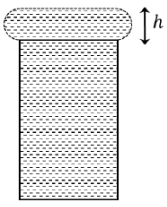
When water is filled carefully in a glass,one can fill it to a height $h$ above the rim of the glass due to the surface tension of water. To calculate $h$ just before water starts flowing,model the shape of the water above the rim as a disc of thickness $h$ having semicircular edges,as shown schematically in the figure. When the pressure of water at the bottom of this disc exceeds what can be withstood due to the surface tension,the water surface breaks near the rim and water starts flowing from there. If the density of water,its surface tension and the acceleration due to gravity are $10^3 \ kg \ m^{-3}$,$0.07 \ N \ m^{-1}$ and $10 \ m \ s^{-2}$,respectively,the value of $h$ (in $mm$) is:
A
$3.60$
B
$3.65$
C
$3.70$
D
$3.75$
Solution
(D) The pressure at the bottom of the water disc due to its weight is given by $P = \rho g h$.
This pressure is balanced by the excess pressure due to surface tension at the curved surface,given by the Young-Laplace equation: $P = T \left(\frac{1}{R_1} + \frac{1}{R_2}\right)$.
Here,$R_1$ is the radius of the glass (which is very large compared to the thickness $h$) and $R_2$ is the radius of the semicircular edge,which is $h/2$.
Since $R_1 \gg R_2$,we have $\frac{1}{R_1} \approx 0$.
Thus,the pressure balance equation becomes $\rho g h = T \left(0 + \frac{1}{h/2}\right) = \frac{2T}{h}$.
Rearranging for $h$,we get $h^2 = \frac{2T}{\rho g}$.
Substituting the given values: $h = \sqrt{\frac{2 \times 0.07}{10^3 \times 10}} = \sqrt{\frac{0.14}{10^4}} = \sqrt{14 \times 10^{-6}} \ m$.
$h = \sqrt{14} \times 10^{-3} \ m \approx 3.741 \times 10^{-3} \ m$.
Converting to $mm$,$h \approx 3.741 \ mm$,which is closest to $3.75 \ mm$.
This pressure is balanced by the excess pressure due to surface tension at the curved surface,given by the Young-Laplace equation: $P = T \left(\frac{1}{R_1} + \frac{1}{R_2}\right)$.
Here,$R_1$ is the radius of the glass (which is very large compared to the thickness $h$) and $R_2$ is the radius of the semicircular edge,which is $h/2$.
Since $R_1 \gg R_2$,we have $\frac{1}{R_1} \approx 0$.
Thus,the pressure balance equation becomes $\rho g h = T \left(0 + \frac{1}{h/2}\right) = \frac{2T}{h}$.
Rearranging for $h$,we get $h^2 = \frac{2T}{\rho g}$.
Substituting the given values: $h = \sqrt{\frac{2 \times 0.07}{10^3 \times 10}} = \sqrt{\frac{0.14}{10^4}} = \sqrt{14 \times 10^{-6}} \ m$.
$h = \sqrt{14} \times 10^{-3} \ m \approx 3.741 \times 10^{-3} \ m$.
Converting to $mm$,$h \approx 3.741 \ mm$,which is closest to $3.75 \ mm$.
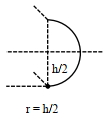
0 likes
View Solution94
DifficultMCQ
Consider a water tank shown in the figure. It has one wall at $x=L$ and can be taken to be very wide in the $z$ direction. When filled with a liquid of surface tension $S$ and density $\rho$,the liquid surface makes an angle $\theta_0 \left(\theta_0 \ll 1\right)$ with the $x$-axis at $x=L$. If $y(x)$ is the height of the surface,then the equation for $y(x)$ is:
(Take $\theta(x) \approx \sin \theta(x) \approx \tan \theta(x) = \frac{dy}{dx}$,where $g$ is the acceleration due to gravity.)
(Take $\theta(x) \approx \sin \theta(x) \approx \tan \theta(x) = \frac{dy}{dx}$,where $g$ is the acceleration due to gravity.)
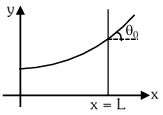
A
$\frac{d^2 y}{dx^2} = \frac{\rho g}{S} x$
B
$\frac{d^2 y}{dx^2} = \frac{\rho g}{S} y$
C
$\frac{d^2 y}{dx^2} = \sqrt{\frac{\rho g}{S}}$
D
$\frac{dy}{dx} = \sqrt{\frac{\rho g}{S}} x$
Solution
(B) The pressure difference across a curved liquid surface is given by the Young-Laplace equation: $\Delta P = S \left(\frac{1}{R_1} + \frac{1}{R_2}\right)$.
Since the tank is very wide in the $z$ direction,the radius of curvature in that direction is infinite $(R_2 \to \infty)$.
Thus,the pressure difference is $\Delta P = \frac{S}{R}$,where $R$ is the radius of curvature in the $xy$-plane.
For a small angle $\theta$,the radius of curvature is given by $R \approx \frac{1}{d^2y/dx^2}$.
Therefore,$\Delta P = S \frac{d^2y}{dx^2}$.
At a depth $y$ below the surface,the pressure difference due to the liquid column is $\Delta P = \rho g y$.
Equating the two expressions for pressure difference: $\rho g y = S \frac{d^2y}{dx^2}$.
Rearranging gives the differential equation: $\frac{d^2y}{dx^2} = \frac{\rho g}{S} y$.
Since the tank is very wide in the $z$ direction,the radius of curvature in that direction is infinite $(R_2 \to \infty)$.
Thus,the pressure difference is $\Delta P = \frac{S}{R}$,where $R$ is the radius of curvature in the $xy$-plane.
For a small angle $\theta$,the radius of curvature is given by $R \approx \frac{1}{d^2y/dx^2}$.
Therefore,$\Delta P = S \frac{d^2y}{dx^2}$.
At a depth $y$ below the surface,the pressure difference due to the liquid column is $\Delta P = \rho g y$.
Equating the two expressions for pressure difference: $\rho g y = S \frac{d^2y}{dx^2}$.
Rearranging gives the differential equation: $\frac{d^2y}{dx^2} = \frac{\rho g}{S} y$.
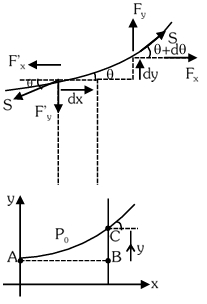
0 likes
View Solution95
DifficultMCQ
$n$ number of liquid drops each of radius $r$ coalesce to form a single drop of radius $R$. The energy released in the process is converted into the kinetic energy of the big drop so formed. The speed of the big drop is [$T = \text{surface tension of liquid}, \rho = \text{density of liquid}$.]
A
$\sqrt{\frac{T}{\rho}\left[\frac{1}{r}-\frac{1}{R}\right]}$
B
$\sqrt{\frac{2T}{\rho}\left[\frac{1}{r}-\frac{1}{R}\right]}$
C
$\sqrt{\frac{4T}{\rho}\left[\frac{1}{r}-\frac{1}{R}\right]}$
D
$\sqrt{\frac{6T}{\rho}\left[\frac{1}{r}-\frac{1}{R}\right]}$
Solution
(D) Conservation of volume: $\frac{4}{3} \pi R^3 = n \times \frac{4}{3} \pi r^3 \implies R^3 = n r^3$.
Energy released due to decrease in surface area: $\Delta U = T \times (n \times 4 \pi r^2 - 4 \pi R^2)$.
Since $n = \frac{R^3}{r^3}$, we have $\Delta U = 4 \pi T \left( \frac{R^3}{r} - R^2 \right) = 4 \pi T R^3 \left( \frac{1}{r} - \frac{1}{R} \right)$.
This energy is converted into kinetic energy $(K.E.)$ of the big drop: $K.E. = \frac{1}{2} M v^2$, where $M = \rho \times \frac{4}{3} \pi R^3$.
Equating energy: $\frac{1}{2} (\rho \times \frac{4}{3} \pi R^3) v^2 = 4 \pi T R^3 \left( \frac{1}{r} - \frac{1}{R} \right)$.
Simplifying: $\frac{2}{3} \rho \pi R^3 v^2 = 4 \pi T R^3 \left( \frac{1}{r} - \frac{1}{R} \right)$.
$v^2 = \frac{4 \pi T R^3 \times 3}{2 \pi \rho R^3} \left( \frac{1}{r} - \frac{1}{R} \right) = \frac{6 T}{\rho} \left( \frac{1}{r} - \frac{1}{R} \right)$.
Therefore, $v = \sqrt{\frac{6 T}{\rho} \left( \frac{1}{r} - \frac{1}{R} \right)}$.
Energy released due to decrease in surface area: $\Delta U = T \times (n \times 4 \pi r^2 - 4 \pi R^2)$.
Since $n = \frac{R^3}{r^3}$, we have $\Delta U = 4 \pi T \left( \frac{R^3}{r} - R^2 \right) = 4 \pi T R^3 \left( \frac{1}{r} - \frac{1}{R} \right)$.
This energy is converted into kinetic energy $(K.E.)$ of the big drop: $K.E. = \frac{1}{2} M v^2$, where $M = \rho \times \frac{4}{3} \pi R^3$.
Equating energy: $\frac{1}{2} (\rho \times \frac{4}{3} \pi R^3) v^2 = 4 \pi T R^3 \left( \frac{1}{r} - \frac{1}{R} \right)$.
Simplifying: $\frac{2}{3} \rho \pi R^3 v^2 = 4 \pi T R^3 \left( \frac{1}{r} - \frac{1}{R} \right)$.
$v^2 = \frac{4 \pi T R^3 \times 3}{2 \pi \rho R^3} \left( \frac{1}{r} - \frac{1}{R} \right) = \frac{6 T}{\rho} \left( \frac{1}{r} - \frac{1}{R} \right)$.
Therefore, $v = \sqrt{\frac{6 T}{\rho} \left( \frac{1}{r} - \frac{1}{R} \right)}$.
0 likes
View Solution96
MediumMCQ
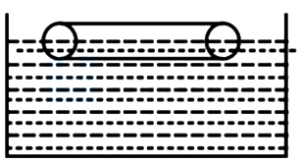
$A$ metal wire of density $\rho$ floats on the water surface horizontally. If it is not to sink in water,then the maximum radius of the wire is ($T$ = surface tension of water,$g$ = gravitational acceleration).
A
$\frac{\pi \rho g}{T}$
B
$\frac{T}{\pi \rho g}$
C
$\sqrt{\frac{2T}{\pi \rho g}}$
D
$\sqrt{\frac{\pi \rho g}{T}}$
Solution
(C) The correct option is $C$.
For a wire of length $L$ and radius $r$ floating on the water surface,the downward force due to gravity is $F_g = mg = (\text{density} \times \text{volume}) \times g = \rho (\pi r^2 L) g$.
The upward force due to surface tension acts along the two sides of the wire along its length $L$. Thus,the total upward force is $F_T = 2TL$.
For the wire to float without sinking,the upward force must balance the downward force:
$2TL = \rho \pi r^2 L g$
$2T = \rho \pi r^2 g$
$r^2 = \frac{2T}{\pi \rho g}$
$r = \sqrt{\frac{2T}{\pi \rho g}}$
We neglect the buoyancy force as it is negligible compared to the surface tension force for a thin wire.
For a wire of length $L$ and radius $r$ floating on the water surface,the downward force due to gravity is $F_g = mg = (\text{density} \times \text{volume}) \times g = \rho (\pi r^2 L) g$.
The upward force due to surface tension acts along the two sides of the wire along its length $L$. Thus,the total upward force is $F_T = 2TL$.
For the wire to float without sinking,the upward force must balance the downward force:
$2TL = \rho \pi r^2 L g$
$2T = \rho \pi r^2 g$
$r^2 = \frac{2T}{\pi \rho g}$
$r = \sqrt{\frac{2T}{\pi \rho g}}$
We neglect the buoyancy force as it is negligible compared to the surface tension force for a thin wire.
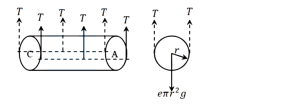
0 likes
View Solution97
DifficultMCQ
$A$ thin metal wire of density $\rho$ floats on the water surface horizontally. If it is $\text{NOT}$ to sink in water,then the maximum radius of the wire is proportional to $(T = \text{surface tension of water}, g = \text{gravitational acceleration})$.
A
$\sqrt{\frac{2 T}{\pi \rho g}}$
B
$\sqrt{\frac{\pi \rho g}{T}}$
C
$\frac{T}{\pi \rho g}$
D
$\frac{\pi \rho g}{T}$
Solution
(A) For the wire to float,the downward gravitational force must be balanced by the upward force due to surface tension.
The gravitational force (weight) acting on the wire is $W = mg = (\text{volume} \times \rho) g = (\pi r^2 l) \rho g$,where $r$ is the radius and $l$ is the length of the wire.
The surface tension force acts along the two sides of the wire on the water surface,so the upward force is $F_s = 2Tl$.
Equating the forces for the limiting case of floating: $Mg = 2Tl$.
Substituting the values: $(\pi r^2 l) \rho g = 2Tl$.
Canceling $l$ from both sides: $\pi r^2 \rho g = 2T$.
Solving for $r$: $r^2 = \frac{2T}{\pi \rho g}$,which gives $r = \sqrt{\frac{2T}{\pi \rho g}}$.
Thus,the maximum radius is proportional to $\sqrt{\frac{2T}{\pi \rho g}}$.
The gravitational force (weight) acting on the wire is $W = mg = (\text{volume} \times \rho) g = (\pi r^2 l) \rho g$,where $r$ is the radius and $l$ is the length of the wire.
The surface tension force acts along the two sides of the wire on the water surface,so the upward force is $F_s = 2Tl$.
Equating the forces for the limiting case of floating: $Mg = 2Tl$.
Substituting the values: $(\pi r^2 l) \rho g = 2Tl$.
Canceling $l$ from both sides: $\pi r^2 \rho g = 2T$.
Solving for $r$: $r^2 = \frac{2T}{\pi \rho g}$,which gives $r = \sqrt{\frac{2T}{\pi \rho g}}$.
Thus,the maximum radius is proportional to $\sqrt{\frac{2T}{\pi \rho g}}$.
0 likes
View Solution98
EasyMCQ
$A$ rectangular film of liquid is expanded from $(5 \text{ cm} \times 4 \text{ cm})$ to $(7 \text{ cm} \times 8 \text{ cm})$. If the work done is $3 \times 10^{-4} \text{ J}$,the surface tension of the liquid is (nearly):
A
$0.4 \text{ N/m}$
B
$0.04 \text{ N/m}$
C
$0.4 \text{ dyne/cm}$
D
$4.0 \text{ N/m}$
Solution
(B) The work done $(W)$ in increasing the area of a liquid film is given by $W = T \times \Delta A \times 2$,where $T$ is the surface tension and the factor of $2$ accounts for the two surfaces of the film.
Initial area $A_1 = 5 \text{ cm} \times 4 \text{ cm} = 20 \text{ cm}^2 = 20 \times 10^{-4} \text{ m}^2$.
Final area $A_2 = 7 \text{ cm} \times 8 \text{ cm} = 56 \text{ cm}^2 = 56 \times 10^{-4} \text{ m}^2$.
Change in area $\Delta A = A_2 - A_1 = (56 - 20) \times 10^{-4} \text{ m}^2 = 36 \times 10^{-4} \text{ m}^2$.
Given $W = 3 \times 10^{-4} \text{ J}$.
Substituting the values: $3 \times 10^{-4} = T \times (36 \times 10^{-4}) \times 2$.
$3 = T \times 72$.
$T = 3 / 72 = 1 / 24 \approx 0.0416 \text{ N/m}$.
Rounding to the nearest option,$T \approx 0.04 \text{ N/m}$.
Initial area $A_1 = 5 \text{ cm} \times 4 \text{ cm} = 20 \text{ cm}^2 = 20 \times 10^{-4} \text{ m}^2$.
Final area $A_2 = 7 \text{ cm} \times 8 \text{ cm} = 56 \text{ cm}^2 = 56 \times 10^{-4} \text{ m}^2$.
Change in area $\Delta A = A_2 - A_1 = (56 - 20) \times 10^{-4} \text{ m}^2 = 36 \times 10^{-4} \text{ m}^2$.
Given $W = 3 \times 10^{-4} \text{ J}$.
Substituting the values: $3 \times 10^{-4} = T \times (36 \times 10^{-4}) \times 2$.
$3 = T \times 72$.
$T = 3 / 72 = 1 / 24 \approx 0.0416 \text{ N/m}$.
Rounding to the nearest option,$T \approx 0.04 \text{ N/m}$.
0 likes
View Solution99
EasyMCQ
$A$ disc of paper of radius $R$ has a hole of radius $r$. It is floating on a liquid of surface tension $T$. The force of surface tension on the disc is
A
$2 \pi T(R-r)$
B
$2 \pi T(R+r)$
C
$3 \pi T R$
D
$4 \pi T(R+r)$
Solution
(B) The surface tension force $F$ acting on a body is given by the formula $F = T \times L$,where $T$ is the surface tension and $L$ is the total length of the boundary in contact with the liquid.
For a disc of radius $R$ with a hole of radius $r$ floating on a liquid,the liquid is in contact with both the outer circumference and the inner circumference of the hole.
The outer circumference is $L_1 = 2 \pi R$.
The inner circumference is $L_2 = 2 \pi r$.
The total length of the boundary in contact with the liquid is $L = L_1 + L_2 = 2 \pi R + 2 \pi r = 2 \pi (R + r)$.
Therefore,the total force of surface tension is $F = T \times 2 \pi (R + r) = 2 \pi T (R + r)$.
For a disc of radius $R$ with a hole of radius $r$ floating on a liquid,the liquid is in contact with both the outer circumference and the inner circumference of the hole.
The outer circumference is $L_1 = 2 \pi R$.
The inner circumference is $L_2 = 2 \pi r$.
The total length of the boundary in contact with the liquid is $L = L_1 + L_2 = 2 \pi R + 2 \pi r = 2 \pi (R + r)$.
Therefore,the total force of surface tension is $F = T \times 2 \pi (R + r) = 2 \pi T (R + r)$.
0 likes
View SolutionFluid Mechanics and Surface Tension — Surface Tension · Frequently Asked Questions
1Are these Fluid Mechanics and Surface Tension questions useful for JEE and NEET?
Yes. All questions in this section are mapped to JEE Main and NEET exam patterns. Previous year questions from JEE Main, NEET, GUJCET and state-level exams are included with full solutions.
2Can I switch to Hindi or Gujarati for these questions?
Yes. Use the language tabs in the hero section or the sidebar to view the same questions and solutions in English, Hindi or Gujarati.
3How do I generate a question paper from this subtopic?
Use the Vedclass Exam Paper Generator — select the chapter and subtopic, set difficulty, and generate Sets A, B, C, D automatically. First 3 chapters of every subject are free.
Vedclass Products
For Students
Vedclass Test Series
Mock tests in real JEE/NEET style with performance analysis. 5-day free trial.
Start Free TrialFor Teachers
Exam Paper Generator
Generate Set A/B/C/D papers from this chapter in 2 minutes. 3 chapters free.
Try FreeFor Institutes
Online Exam Module
Live online exams with unlimited students, 360° analytics & white-label branding.
See DemoFor Teachers & Institutes
Generate a Fluid Mechanics and Surface Tension Exam Paper in 2 Minutes
Select subtopic & difficulty — Sets A, B, C, D auto-generated with No Repeat logic.
First 3 chapters of every subject are free — no payment required.