
A English
Excess Pressure and coalesce of Bubble and drop Questions in English
Class 11 Physics · Fluid Mechanics and Surface Tension · Excess Pressure and coalesce of Bubble and drop
246+
Questions
English
Language
100%
With Solutions
Showing 50 of 246 questions in English
101
DifficultMCQ
The excess pressure inside the first soap bubble is three times that inside the second bubble. Then,the ratio of the volume of the first to the second bubble will be:
A
$1 : 27$
B
$3 : 1$
C
$1 : 3$
D
$1 : 9$
Solution
(A) The excess pressure inside a soap bubble of radius $r$ is given by $p = \frac{4T}{r}$,where $T$ is the surface tension.
For the first bubble,$p_1 = \frac{4T}{r_1}$.
For the second bubble,$p_2 = \frac{4T}{r_2}$.
Given that $p_1 = 3p_2$,we have $\frac{4T}{r_1} = 3 \times \frac{4T}{r_2}$.
This simplifies to $\frac{1}{r_1} = \frac{3}{r_2}$,which implies $\frac{r_1}{r_2} = \frac{1}{3}$.
The volume of a spherical bubble is $V = \frac{4}{3}\pi r^3$.
The ratio of the volumes is $\frac{V_1}{V_2} = \frac{\frac{4}{3}\pi r_1^3}{\frac{4}{3}\pi r_2^3} = \left(\frac{r_1}{r_2}\right)^3$.
Substituting the ratio of radii,we get $\frac{V_1}{V_2} = \left(\frac{1}{3}\right)^3 = \frac{1}{27}$.
For the first bubble,$p_1 = \frac{4T}{r_1}$.
For the second bubble,$p_2 = \frac{4T}{r_2}$.
Given that $p_1 = 3p_2$,we have $\frac{4T}{r_1} = 3 \times \frac{4T}{r_2}$.
This simplifies to $\frac{1}{r_1} = \frac{3}{r_2}$,which implies $\frac{r_1}{r_2} = \frac{1}{3}$.
The volume of a spherical bubble is $V = \frac{4}{3}\pi r^3$.
The ratio of the volumes is $\frac{V_1}{V_2} = \frac{\frac{4}{3}\pi r_1^3}{\frac{4}{3}\pi r_2^3} = \left(\frac{r_1}{r_2}\right)^3$.
Substituting the ratio of radii,we get $\frac{V_1}{V_2} = \left(\frac{1}{3}\right)^3 = \frac{1}{27}$.
0 likes
View Solution102
DifficultMCQ
$A$ spherical drop of water has a radius of $1\, mm$. If the surface tension of water is $70 \times 10^{-3} \, N/m$,then the difference of pressure between the inside and outside of the spherical drop is:
A
$140 \, N/m^2$
B
$40 \, N/m$
C
$35 \, N/m^2$
D
None of these
Solution
(A) The excess pressure inside a spherical liquid drop is given by the formula:
$\Delta p = \frac{2T}{r}$
Given:
Surface tension,$T = 70 \times 10^{-3} \, N/m$
Radius,$r = 1 \, mm = 1 \times 10^{-3} \, m$
Substituting the values into the formula:
$\Delta p = \frac{2 \times (70 \times 10^{-3})}{1 \times 10^{-3}}$
$\Delta p = 2 \times 70$
$\Delta p = 140 \, N/m^2$
$\Delta p = \frac{2T}{r}$
Given:
Surface tension,$T = 70 \times 10^{-3} \, N/m$
Radius,$r = 1 \, mm = 1 \times 10^{-3} \, m$
Substituting the values into the formula:
$\Delta p = \frac{2 \times (70 \times 10^{-3})}{1 \times 10^{-3}}$
$\Delta p = 2 \times 70$
$\Delta p = 140 \, N/m^2$

0 likes
View Solution103
DifficultMCQ
$A$ soap bubble in vacuum has a radius $3 \, cm$ and another soap bubble in vacuum has radius $4 \, cm$. If two bubbles coalesce under isothermal conditions,then the radius of the new bubble will be .............. $cm$.
A
$7$
B
$5$
C
$4.5$
D
$2.3$
Solution
(B) Let $r_{1} = 3 \, cm$ and $r_{2} = 4 \, cm$ be the radii of the two soap bubbles. Let $r$ be the radius of the new bubble formed after coalescence.
Since the process is isothermal,the number of moles of air remains constant. The pressure inside a soap bubble of radius $R$ is given by $P = P_{atm} + \frac{4T}{R}$. In a vacuum,$P_{atm} = 0$,so $P = \frac{4T}{R}$.
Using the ideal gas law $PV = nRT$,for a constant temperature,$PV$ is constant.
For the two bubbles: $P_{1}V_{1} + P_{2}V_{2} = PV$.
Substituting $P = \frac{4T}{R}$ and $V = \frac{4}{3}\pi R^{3}$:
$(\frac{4T}{r_{1}})(\frac{4}{3}\pi r_{1}^{3}) + (\frac{4T}{r_{2}})(\frac{4}{3}\pi r_{2}^{3}) = (\frac{4T}{r})(\frac{4}{3}\pi r^{3})$.
This simplifies to $r_{1}^{2} + r_{2}^{2} = r^{2}$.
Substituting the values: $3^{2} + 4^{2} = r^{2} \Rightarrow 9 + 16 = r^{2} \Rightarrow r^{2} = 25$.
Thus,$r = 5 \, cm$.
Since the process is isothermal,the number of moles of air remains constant. The pressure inside a soap bubble of radius $R$ is given by $P = P_{atm} + \frac{4T}{R}$. In a vacuum,$P_{atm} = 0$,so $P = \frac{4T}{R}$.
Using the ideal gas law $PV = nRT$,for a constant temperature,$PV$ is constant.
For the two bubbles: $P_{1}V_{1} + P_{2}V_{2} = PV$.
Substituting $P = \frac{4T}{R}$ and $V = \frac{4}{3}\pi R^{3}$:
$(\frac{4T}{r_{1}})(\frac{4}{3}\pi r_{1}^{3}) + (\frac{4T}{r_{2}})(\frac{4}{3}\pi r_{2}^{3}) = (\frac{4T}{r})(\frac{4}{3}\pi r^{3})$.
This simplifies to $r_{1}^{2} + r_{2}^{2} = r^{2}$.
Substituting the values: $3^{2} + 4^{2} = r^{2} \Rightarrow 9 + 16 = r^{2} \Rightarrow r^{2} = 25$.
Thus,$r = 5 \, cm$.
0 likes
View Solution104
MediumMCQ
The excess pressure inside a soap bubble is twice the excess pressure inside a second soap bubble. The volume of the first bubble is $n$ times the volume of the second,where $n$ is:
A
$0.125$
B
$0.250$
C
$1$
D
$2$
Solution
(A) The excess pressure inside a soap bubble of radius $r$ is given by $\Delta P = \frac{4T}{r}$,where $T$ is the surface tension.
Let the radii of the two bubbles be $r_1$ and $r_2$ respectively.
Given that the excess pressure in the first bubble is twice that of the second:
$\frac{4T}{r_1} = 2 \times \frac{4T}{r_2}$
This simplifies to $r_2 = 2r_1$.
The volume of a spherical bubble is $V = \frac{4}{3}\pi r^3$.
Given $V_1 = n \times V_2$,we have:
$\frac{4}{3}\pi r_1^3 = n \times \frac{4}{3}\pi r_2^3$
Substituting $r_2 = 2r_1$:
$r_1^3 = n \times (2r_1)^3$
$r_1^3 = n \times 8r_1^3$
$n = \frac{1}{8} = 0.125$.
Let the radii of the two bubbles be $r_1$ and $r_2$ respectively.
Given that the excess pressure in the first bubble is twice that of the second:
$\frac{4T}{r_1} = 2 \times \frac{4T}{r_2}$
This simplifies to $r_2 = 2r_1$.
The volume of a spherical bubble is $V = \frac{4}{3}\pi r^3$.
Given $V_1 = n \times V_2$,we have:
$\frac{4}{3}\pi r_1^3 = n \times \frac{4}{3}\pi r_2^3$
Substituting $r_2 = 2r_1$:
$r_1^3 = n \times (2r_1)^3$
$r_1^3 = n \times 8r_1^3$
$n = \frac{1}{8} = 0.125$.
0 likes
View Solution105
EasyMCQ
$Assertion :$ Smaller drops of liquid resist deforming forces better than the larger drops.
$Reason :$ Excess pressure inside a drop is directly proportional to its surface area.
$Reason :$ Excess pressure inside a drop is directly proportional to its surface area.
A
If both Assertion and Reason are correct and the Reason is a correct explanation of the Assertion.
B
If the Assertion is correct but Reason is incorrect.
C
If both Assertion and Reason are correct but Reason is not a correct explanation of the Assertion.
D
If both the Assertion and Reason are incorrect.
Solution
(B) The excess pressure inside a liquid drop is given by the formula $P = \frac{2T}{r}$,where $T$ is the surface tension and $r$ is the radius of the drop.
From this relation,it is clear that the excess pressure $P$ is inversely proportional to the radius $r$ $(P \propto \frac{1}{r})$.
As the radius $r$ decreases,the excess pressure $P$ increases.
Therefore,smaller drops have a higher excess pressure,which makes them more stable and better able to resist deforming forces.
Since the excess pressure is inversely proportional to the radius and not directly proportional to the surface area,the Reason is incorrect.
Thus,the Assertion is correct,but the Reason is incorrect.
From this relation,it is clear that the excess pressure $P$ is inversely proportional to the radius $r$ $(P \propto \frac{1}{r})$.
As the radius $r$ decreases,the excess pressure $P$ increases.
Therefore,smaller drops have a higher excess pressure,which makes them more stable and better able to resist deforming forces.
Since the excess pressure is inversely proportional to the radius and not directly proportional to the surface area,the Reason is incorrect.
Thus,the Assertion is correct,but the Reason is incorrect.
0 likes
View Solution106
EasyMCQ
$Assertion :$ $A$ bubble comes from the bottom of a lake to the top.
$Reason :$ Its radius increases.
$Reason :$ Its radius increases.
A
If both $Assertion$ and $Reason$ are correct and the $Reason$ is a correct explanation of the $Assertion$.
B
If both $Assertion$ and $Reason$ are correct but $Reason$ is not a correct explanation of the $Assertion$.
C
If the $Assertion$ is correct but $Reason$ is incorrect.
D
If both the $Assertion$ and $Reason$ are incorrect.
Solution
(A) The pressure at the bottom of a lake is higher than the pressure at the surface due to the weight of the water column above it $(P = P_{atm} + \rho gh)$.
As the air bubble rises from the bottom to the top,it moves from a region of higher pressure to a region of lower pressure.
According to Boyle's Law,for a fixed amount of gas at a constant temperature,$PV = \text{constant}$.
Since the pressure $P$ decreases as the bubble rises,the volume $V$ of the bubble must increase.
Since the volume of a spherical bubble is $V = \frac{4}{3}\pi r^3$,an increase in volume implies an increase in the radius $r$.
Therefore,both the $Assertion$ and $Reason$ are correct,and the $Reason$ is the correct explanation for the $Assertion$.
As the air bubble rises from the bottom to the top,it moves from a region of higher pressure to a region of lower pressure.
According to Boyle's Law,for a fixed amount of gas at a constant temperature,$PV = \text{constant}$.
Since the pressure $P$ decreases as the bubble rises,the volume $V$ of the bubble must increase.
Since the volume of a spherical bubble is $V = \frac{4}{3}\pi r^3$,an increase in volume implies an increase in the radius $r$.
Therefore,both the $Assertion$ and $Reason$ are correct,and the $Reason$ is the correct explanation for the $Assertion$.
0 likes
View Solution107
DifficultMCQ
$A$ soap bubble,having a radius of $1\; mm$,is blown from a detergent solution having a surface tension of $2.5 \times 10^{-2}\; N/m$. The pressure inside the bubble is equal to the pressure at a point $Z_{0}$ below the free surface of water in a container. Taking $g=10\; m/s^{2}$ and the density of water $\rho = 10^{3}\; kg/m^{3}$,the value of $Z_{0}$ is......$cm$.
A
$100$
B
$10$
C
$1$
D
$0.5$
Solution
(C) The pressure inside a soap bubble is given by $P = P_{0} + \frac{4T}{R}$,where $P_{0}$ is the atmospheric pressure,$T$ is the surface tension,and $R$ is the radius of the bubble.
The pressure at a depth $Z_{0}$ below the free surface of water is given by $P = P_{0} + \rho g Z_{0}$.
Equating the two pressures: $P_{0} + \rho g Z_{0} = P_{0} + \frac{4T}{R}$.
Simplifying,we get $\rho g Z_{0} = \frac{4T}{R}$.
Solving for $Z_{0}$: $Z_{0} = \frac{4T}{\rho g R}$.
Substituting the given values: $T = 2.5 \times 10^{-2}\; N/m$,$R = 1\; mm = 10^{-3}\; m$,$\rho = 10^{3}\; kg/m^{3}$,and $g = 10\; m/s^{2}$.
$Z_{0} = \frac{4 \times 2.5 \times 10^{-2}}{10^{3} \times 10 \times 10^{-3}} = \frac{10^{-1}}{10} = 10^{-2}\; m$.
Converting to centimeters: $Z_{0} = 10^{-2} \times 100\; cm = 1\; cm$.
The pressure at a depth $Z_{0}$ below the free surface of water is given by $P = P_{0} + \rho g Z_{0}$.
Equating the two pressures: $P_{0} + \rho g Z_{0} = P_{0} + \frac{4T}{R}$.
Simplifying,we get $\rho g Z_{0} = \frac{4T}{R}$.
Solving for $Z_{0}$: $Z_{0} = \frac{4T}{\rho g R}$.
Substituting the given values: $T = 2.5 \times 10^{-2}\; N/m$,$R = 1\; mm = 10^{-3}\; m$,$\rho = 10^{3}\; kg/m^{3}$,and $g = 10\; m/s^{2}$.
$Z_{0} = \frac{4 \times 2.5 \times 10^{-2}}{10^{3} \times 10 \times 10^{-3}} = \frac{10^{-1}}{10} = 10^{-2}\; m$.
Converting to centimeters: $Z_{0} = 10^{-2} \times 100\; cm = 1\; cm$.
0 likes
View Solution108
Medium
The lower end of a capillary tube of diameter $2.00 \; mm$ is dipped $8.00 \; cm$ below the surface of water in a beaker. What is the pressure required in the tube in order to blow a hemispherical bubble at its end in water? The surface tension of water at the temperature of the experiment is $7.30 \times 10^{-2} \; N m^{-1}$. Atmospheric pressure $= 1.01 \times 10^{5} \; Pa$,density of water $= 1000 \; kg m^{-3}$,$g = 9.80 \; m s^{-2}$. Also,calculate the excess pressure.
Solution
(N/A) The excess pressure in a bubble of gas in a liquid is given by $P_{ex} = 2S/r$,where $S$ is the surface tension of the liquid-gas interface.
Here,the diameter of the capillary tube is $d = 2.00 \; mm = 2.00 \times 10^{-3} \; m$,so the radius of the hemispherical bubble is $r = d/2 = 1.00 \times 10^{-3} \; m$.
The excess pressure is $P_{ex} = 2S/r = (2 \times 7.30 \times 10^{-2} \; N m^{-1}) / (1.00 \times 10^{-3} \; m) = 146 \; Pa$.
The pressure outside the bubble at a depth $h = 8.00 \; cm = 0.08 \; m$ is $P_o = P_{atm} + h \rho g$.
$P_o = 1.01 \times 10^5 \; Pa + (0.08 \; m \times 1000 \; kg m^{-3} \times 9.80 \; m s^{-2}) = 1.01 \times 10^5 \; Pa + 784 \; Pa = 101784 \; Pa$.
The total pressure required inside the tube is $P_i = P_o + P_{ex} = 101784 \; Pa + 146 \; Pa = 101930 \; Pa = 1.0193 \times 10^5 \; Pa$.
Here,the diameter of the capillary tube is $d = 2.00 \; mm = 2.00 \times 10^{-3} \; m$,so the radius of the hemispherical bubble is $r = d/2 = 1.00 \times 10^{-3} \; m$.
The excess pressure is $P_{ex} = 2S/r = (2 \times 7.30 \times 10^{-2} \; N m^{-1}) / (1.00 \times 10^{-3} \; m) = 146 \; Pa$.
The pressure outside the bubble at a depth $h = 8.00 \; cm = 0.08 \; m$ is $P_o = P_{atm} + h \rho g$.
$P_o = 1.01 \times 10^5 \; Pa + (0.08 \; m \times 1000 \; kg m^{-3} \times 9.80 \; m s^{-2}) = 1.01 \times 10^5 \; Pa + 784 \; Pa = 101784 \; Pa$.
The total pressure required inside the tube is $P_i = P_o + P_{ex} = 101784 \; Pa + 146 \; Pa = 101930 \; Pa = 1.0193 \times 10^5 \; Pa$.
0 likes
View Solution109
Easy
What is the pressure inside the drop of mercury of radius $3.00 \; mm$ at room temperature? Surface tension of mercury at that temperature $(20 \; ^{\circ}C)$ is $4.65 \times 10^{-1} \; N m^{-1}$. The atmospheric pressure is $1.01 \times 10^{5} \; Pa$. Also,calculate the excess pressure inside the drop.
Solution
(N/A) Given:
Radius of the mercury drop,$r = 3.00 \; mm = 3.00 \times 10^{-3} \; m$
Surface tension of mercury,$S = 4.65 \times 10^{-1} \; N m^{-1}$
Atmospheric pressure,$P_{0} = 1.01 \times 10^{5} \; Pa$
$1$. Excess pressure inside the drop:
The excess pressure inside a liquid drop is given by $\Delta P = \frac{2S}{r}$.
$\Delta P = \frac{2 \times 4.65 \times 10^{-1}}{3.00 \times 10^{-3}} = \frac{0.93}{3.00 \times 10^{-3}} = 0.31 \times 10^{3} = 310 \; Pa$.
$2$. Total pressure inside the drop:
The total pressure inside the drop is the sum of the atmospheric pressure and the excess pressure.
$P_{total} = P_{0} + \Delta P$
$P_{total} = 1.01 \times 10^{5} \; Pa + 310 \; Pa$
$P_{total} = 101000 \; Pa + 310 \; Pa = 101310 \; Pa = 1.0131 \times 10^{5} \; Pa$.
Radius of the mercury drop,$r = 3.00 \; mm = 3.00 \times 10^{-3} \; m$
Surface tension of mercury,$S = 4.65 \times 10^{-1} \; N m^{-1}$
Atmospheric pressure,$P_{0} = 1.01 \times 10^{5} \; Pa$
$1$. Excess pressure inside the drop:
The excess pressure inside a liquid drop is given by $\Delta P = \frac{2S}{r}$.
$\Delta P = \frac{2 \times 4.65 \times 10^{-1}}{3.00 \times 10^{-3}} = \frac{0.93}{3.00 \times 10^{-3}} = 0.31 \times 10^{3} = 310 \; Pa$.
$2$. Total pressure inside the drop:
The total pressure inside the drop is the sum of the atmospheric pressure and the excess pressure.
$P_{total} = P_{0} + \Delta P$
$P_{total} = 1.01 \times 10^{5} \; Pa + 310 \; Pa$
$P_{total} = 101000 \; Pa + 310 \; Pa = 101310 \; Pa = 1.0131 \times 10^{5} \; Pa$.
0 likes
View Solution110
Medium
What is the excess pressure inside a bubble of soap solution of radius $5.00 \; mm$,given that the surface tension of soap solution at the temperature $(20 \; ^{\circ}C)$ is $2.50 \times 10^{-2} \; N m^{-1}$? If an air bubble of the same dimension were formed at a depth of $40.0 \; cm$ inside a container containing the soap solution (of relative density $1.20$),what would be the pressure inside the bubble? ($1$ atmospheric pressure is $1.01 \times 10^{5} \; Pa$).
Solution
(A) Excess pressure inside the soap bubble is given by $P = \frac{4S}{r}$.
Given $S = 2.50 \times 10^{-2} \; N m^{-1}$ and $r = 5.00 \times 10^{-3} \; m$.
$P = \frac{4 \times 2.50 \times 10^{-2}}{5.00 \times 10^{-3}} = 20 \; Pa$.
For an air bubble at depth $h = 0.40 \; m$,the excess pressure is $P' = \frac{2S}{r} = \frac{2 \times 2.50 \times 10^{-2}}{5.00 \times 10^{-3}} = 10 \; Pa$.
The total pressure inside the air bubble is $P_{total} = P_{atm} + h\rho g + P'$.
Here $\rho = 1.20 \times 1000 = 1200 \; kg/m^3$ and $g = 9.8 \; m/s^2$.
$P_{total} = 1.01 \times 10^5 + (0.40 \times 1200 \times 9.8) + 10$.
$P_{total} = 101000 + 4704 + 10 = 105714 \; Pa \approx 1.06 \times 10^5 \; Pa$.
Given $S = 2.50 \times 10^{-2} \; N m^{-1}$ and $r = 5.00 \times 10^{-3} \; m$.
$P = \frac{4 \times 2.50 \times 10^{-2}}{5.00 \times 10^{-3}} = 20 \; Pa$.
For an air bubble at depth $h = 0.40 \; m$,the excess pressure is $P' = \frac{2S}{r} = \frac{2 \times 2.50 \times 10^{-2}}{5.00 \times 10^{-3}} = 10 \; Pa$.
The total pressure inside the air bubble is $P_{total} = P_{atm} + h\rho g + P'$.
Here $\rho = 1.20 \times 1000 = 1200 \; kg/m^3$ and $g = 9.8 \; m/s^2$.
$P_{total} = 1.01 \times 10^5 + (0.40 \times 1200 \times 9.8) + 10$.
$P_{total} = 101000 + 4704 + 10 = 105714 \; Pa \approx 1.06 \times 10^5 \; Pa$.
0 likes
View Solution111
Difficult
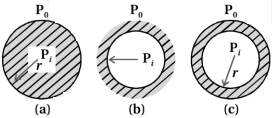
Derive the formula for the excess of pressure (pressure difference) inside a liquid drop and a soap bubble.
Solution
(N/A) Consider a liquid drop of radius $r$ with internal pressure $P_i$ and external pressure $P_o$. The excess pressure is $\Delta P = P_i - P_o$.
$1$. For a liquid drop:
The surface area is $A = 4\pi r^2$. If the radius increases by $\Delta r$,the change in area is $\Delta A = 8\pi r \Delta r$. The work done against surface tension $S$ is $W = S \Delta A = S(8\pi r \Delta r)$.
This work is done by the excess pressure: $W = (P_i - P_o) \Delta V = (P_i - P_o) (4\pi r^2 \Delta r)$.
Equating the two: $(P_i - P_o) (4\pi r^2 \Delta r) = S(8\pi r \Delta r) \implies P_i - P_o = \frac{2S}{r}$.
$2$. For a soap bubble:
$A$ soap bubble has two free surfaces (inner and outer). Thus,the work done is $W = 2 \times S \Delta A = 2S(8\pi r \Delta r)$.
Equating the work: $(P_i - P_o) (4\pi r^2 \Delta r) = 16\pi r S \Delta r \implies P_i - P_o = \frac{4S}{r}$.
$1$. For a liquid drop:
The surface area is $A = 4\pi r^2$. If the radius increases by $\Delta r$,the change in area is $\Delta A = 8\pi r \Delta r$. The work done against surface tension $S$ is $W = S \Delta A = S(8\pi r \Delta r)$.
This work is done by the excess pressure: $W = (P_i - P_o) \Delta V = (P_i - P_o) (4\pi r^2 \Delta r)$.
Equating the two: $(P_i - P_o) (4\pi r^2 \Delta r) = S(8\pi r \Delta r) \implies P_i - P_o = \frac{2S}{r}$.
$2$. For a soap bubble:
$A$ soap bubble has two free surfaces (inner and outer). Thus,the work done is $W = 2 \times S \Delta A = 2S(8\pi r \Delta r)$.
Equating the work: $(P_i - P_o) (4\pi r^2 \Delta r) = 16\pi r S \Delta r \implies P_i - P_o = \frac{4S}{r}$.
0 likes
View Solution112
Medium
Fill in the blanks:
$(i)$ $A$ bubble in water has .......... free surface.
$(ii)$ $A$ bubble in air has .......... free surface.
$(iii)$ $A$ rain drop has .......... free surface.
$(i)$ $A$ bubble in water has .......... free surface.
$(ii)$ $A$ bubble in air has .......... free surface.
$(iii)$ $A$ rain drop has .......... free surface.
Solution
(A) $(i)$ $A$ bubble in water has only one free surface (the inner surface is in contact with air,but the outer surface is in contact with water).
$(ii)$ $A$ bubble in air has two free surfaces (one inner surface and one outer surface,both in contact with air).
$(iii)$ $A$ rain drop has one free surface (the outer surface is in contact with air,while the inner part is liquid).
$(ii)$ $A$ bubble in air has two free surfaces (one inner surface and one outer surface,both in contact with air).
$(iii)$ $A$ rain drop has one free surface (the outer surface is in contact with air,while the inner part is liquid).
0 likes
View Solution113
Easy
Write the equation of excess pressure (pressure difference) for a bubble in air and a bubble in water.
Solution
(N/A) $1$. For a bubble in air (soap bubble): $A$ soap bubble has two surfaces in contact with air (inner and outer). The excess pressure $\Delta P$ is given by $\Delta P = \frac{4T}{R}$,where $T$ is the surface tension and $R$ is the radius of the bubble.
$2$. For a bubble in water (air bubble in liquid): An air bubble in water has only one surface in contact with the liquid. The excess pressure $\Delta P$ is given by $\Delta P = \frac{2T}{R}$,where $T$ is the surface tension of the liquid and $R$ is the radius of the bubble.
$2$. For a bubble in water (air bubble in liquid): An air bubble in water has only one surface in contact with the liquid. The excess pressure $\Delta P$ is given by $\Delta P = \frac{2T}{R}$,where $T$ is the surface tension of the liquid and $R$ is the radius of the bubble.
0 likes
View Solution114
Medium
Write the equation of excess pressure for a liquid drop.
Solution
(N/A) For a liquid drop,there is only one free surface. The excess pressure $P$ inside a liquid drop of radius $R$ and surface tension $T$ is given by the formula:
$P = \frac{2T}{R}$
where:
$P$ is the excess pressure,
$T$ is the surface tension of the liquid,
$R$ is the radius of the liquid drop.
$P = \frac{2T}{R}$
where:
$P$ is the excess pressure,
$T$ is the surface tension of the liquid,
$R$ is the radius of the liquid drop.
0 likes
View Solution115
EasyMCQ
Formation of bubbles is in Column-$I$ and the pressure difference between them is given in Column-$II$. Match them appropriately.
| Column-$I$ | Column-$II$ |
| $(a)$ Liquid drop in air | $(i)$ $\frac{4T}{R}$ |
| $(b)$ Bubble of liquid in air | $(ii)$ $\frac{2T}{R}$ |
| $(iii)$ $\frac{2R}{T}$ |
A
$(a-ii), (b-iii)$
B
$(a-ii), (b-i)$
C
$(a-iii), (b-ii)$
D
$(a-i), (b-ii)$
Solution
(B) The excess pressure inside a liquid drop of radius $R$ and surface tension $T$ is given by $\Delta P = \frac{2T}{R}$.
The excess pressure inside a soap bubble (or a bubble of liquid in air) of radius $R$ and surface tension $T$ is given by $\Delta P = \frac{4T}{R}$,because it has two free surfaces.
Therefore,$(a)$ matches with $(ii)$ and $(b)$ matches with $(i)$.
The correct option is $(b)$.
The excess pressure inside a soap bubble (or a bubble of liquid in air) of radius $R$ and surface tension $T$ is given by $\Delta P = \frac{4T}{R}$,because it has two free surfaces.
Therefore,$(a)$ matches with $(ii)$ and $(b)$ matches with $(i)$.
The correct option is $(b)$.
0 likes
View Solution116
Difficult
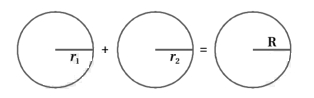
Two mercury droplets of radii $0.1 \ cm$ and $0.2 \ cm$ coalesce into one single drop. What amount of energy is released? The surface tension of mercury is $T = 435.5 \times 10^{-3} \ N \ m^{-1}$.
Solution
(N/A) Given radii: $r_1 = 0.1 \ cm = 10^{-3} \ m$ and $r_2 = 0.2 \ cm = 2 \times 10^{-3} \ m$.
Surface tension $T = 435.5 \times 10^{-3} \ N \ m^{-1}$.
Let the radius of the larger drop be $R$.
Since the volume remains conserved: $\frac{4}{3} \pi R^3 = \frac{4}{3} \pi r_1^3 + \frac{4}{3} \pi r_2^3$.
$R^3 = r_1^3 + r_2^3 = (0.1)^3 + (0.2)^3 = 0.001 + 0.008 = 0.009 \ cm^3$.
$R = (0.009)^{1/3} \approx 0.208 \ cm = 2.08 \times 10^{-3} \ m$.
Energy released $\Delta E = T \times \Delta A = T \times (A_{initial} - A_{final})$.
$A_{initial} = 4 \pi (r_1^2 + r_2^2) = 4 \pi (0.01 + 0.04) \times 10^{-4} = 4 \pi (0.05) \times 10^{-4} = 0.2 \pi \times 10^{-4} \ m^2$.
$A_{final} = 4 \pi R^2 = 4 \pi (0.208 \times 10^{-2})^2 = 4 \pi (0.04326) \times 10^{-4} \approx 0.173 \pi \times 10^{-4} \ m^2$.
$\Delta A = (0.2 - 0.173) \pi \times 10^{-4} = 0.027 \pi \times 10^{-4} \ m^2$.
$\Delta E = 435.5 \times 10^{-3} \times 0.027 \times 3.14 \times 10^{-4} \approx 3.69 \times 10^{-6} \ J$.
Surface tension $T = 435.5 \times 10^{-3} \ N \ m^{-1}$.
Let the radius of the larger drop be $R$.
Since the volume remains conserved: $\frac{4}{3} \pi R^3 = \frac{4}{3} \pi r_1^3 + \frac{4}{3} \pi r_2^3$.
$R^3 = r_1^3 + r_2^3 = (0.1)^3 + (0.2)^3 = 0.001 + 0.008 = 0.009 \ cm^3$.
$R = (0.009)^{1/3} \approx 0.208 \ cm = 2.08 \times 10^{-3} \ m$.
Energy released $\Delta E = T \times \Delta A = T \times (A_{initial} - A_{final})$.
$A_{initial} = 4 \pi (r_1^2 + r_2^2) = 4 \pi (0.01 + 0.04) \times 10^{-4} = 4 \pi (0.05) \times 10^{-4} = 0.2 \pi \times 10^{-4} \ m^2$.
$A_{final} = 4 \pi R^2 = 4 \pi (0.208 \times 10^{-2})^2 = 4 \pi (0.04326) \times 10^{-4} \approx 0.173 \pi \times 10^{-4} \ m^2$.
$\Delta A = (0.2 - 0.173) \pi \times 10^{-4} = 0.027 \pi \times 10^{-4} \ m^2$.
$\Delta E = 435.5 \times 10^{-3} \times 0.027 \times 3.14 \times 10^{-4} \approx 3.69 \times 10^{-6} \ J$.
0 likes
View Solution117
Medium
The surface tension and vapour pressure of water at $20^{\circ} C$ are $7.28 \times 10^{-2} \, N/m$ and $2.33 \times 10^{3} \, Pa$ respectively. What is the radius of the smallest spherical water droplet which can form without evaporating at $20^{\circ} C$?
Solution
(D) Given:
Surface tension of water $S = 7.28 \times 10^{-2} \, N/m$
Vapour pressure $P = 2.33 \times 10^{3} \, Pa$
The drop will remain stable without evaporating if the excess pressure inside the drop is equal to the vapour pressure.
The excess pressure inside a spherical droplet is given by $\Delta P = \frac{2S}{R}$.
Setting the excess pressure equal to the vapour pressure:
$P = \frac{2S}{R}$
Rearranging for the radius $R$:
$R = \frac{2S}{P}$
Substituting the values:
$R = \frac{2 \times 7.28 \times 10^{-2}}{2.33 \times 10^{3}}$
$R = \frac{14.56 \times 10^{-2}}{2.33 \times 10^{3}}$
$R \approx 6.25 \times 10^{-5} \, m$
Surface tension of water $S = 7.28 \times 10^{-2} \, N/m$
Vapour pressure $P = 2.33 \times 10^{3} \, Pa$
The drop will remain stable without evaporating if the excess pressure inside the drop is equal to the vapour pressure.
The excess pressure inside a spherical droplet is given by $\Delta P = \frac{2S}{R}$.
Setting the excess pressure equal to the vapour pressure:
$P = \frac{2S}{R}$
Rearranging for the radius $R$:
$R = \frac{2S}{P}$
Substituting the values:
$R = \frac{2 \times 7.28 \times 10^{-2}}{2.33 \times 10^{3}}$
$R = \frac{14.56 \times 10^{-2}}{2.33 \times 10^{3}}$
$R \approx 6.25 \times 10^{-5} \, m$
0 likes
View Solution118
Difficult
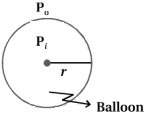
$A$ hot air balloon is a sphere of radius $8 \ m$. The air inside is at a temperature of $60^{\circ} \ C$. How large a mass can the balloon lift when the outside temperature is $20^{\circ} \ C$? Assume air is an ideal gas,$R = 8.314 \ J \ mol^{-1} \ K^{-1}$,$1 \ atm = 1.013 \times 10^5 \ Pa$,and the membrane tension is $S = 5 \ N/m$.

Solution
(N/A) The pressure inside the balloon is $P_i$ and the outside pressure is $P_0$. The excess pressure is given by $P_i - P_0 = \frac{2S}{r}$,where $S = 5 \ N/m$ and $r = 8 \ m$.
$P_i - P_0 = \frac{2 \times 5}{8} = 1.25 \ Pa$.
Given $P_0 = 1.013 \times 10^5 \ Pa$,so $P_i = P_0 + 1.25 \ Pa \approx 1.013 \times 10^5 \ Pa$.
The volume of the balloon is $V = \frac{4}{3} \pi r^3 = \frac{4}{3} \pi (8)^3 \approx 2144.66 \ m^3$.
Using the ideal gas law $PV = nRT = \frac{m}{M} RT$,the mass of air is $m = \frac{PVM}{RT}$.
The molar mass of air is $M \approx 29 \times 10^{-3} \ kg/mol$.
Mass of displaced air $M_0 = \frac{P_0 V M}{R T_0} = \frac{1.013 \times 10^5 \times 2144.66 \times 29 \times 10^{-3}}{8.314 \times (273 + 20)} \approx 2577 \ kg$.
Mass of air inside $M_i = \frac{P_i V M}{R T_i} = \frac{1.013 \times 10^5 \times 2144.66 \times 29 \times 10^{-3}}{8.314 \times (273 + 60)} \approx 2345 \ kg$.
The lifting capacity is $M_{lift} = M_0 - M_i = 2577 - 2345 = 232 \ kg$.
$P_i - P_0 = \frac{2 \times 5}{8} = 1.25 \ Pa$.
Given $P_0 = 1.013 \times 10^5 \ Pa$,so $P_i = P_0 + 1.25 \ Pa \approx 1.013 \times 10^5 \ Pa$.
The volume of the balloon is $V = \frac{4}{3} \pi r^3 = \frac{4}{3} \pi (8)^3 \approx 2144.66 \ m^3$.
Using the ideal gas law $PV = nRT = \frac{m}{M} RT$,the mass of air is $m = \frac{PVM}{RT}$.
The molar mass of air is $M \approx 29 \times 10^{-3} \ kg/mol$.
Mass of displaced air $M_0 = \frac{P_0 V M}{R T_0} = \frac{1.013 \times 10^5 \times 2144.66 \times 29 \times 10^{-3}}{8.314 \times (273 + 20)} \approx 2577 \ kg$.
Mass of air inside $M_i = \frac{P_i V M}{R T_i} = \frac{1.013 \times 10^5 \times 2144.66 \times 29 \times 10^{-3}}{8.314 \times (273 + 60)} \approx 2345 \ kg$.
The lifting capacity is $M_{lift} = M_0 - M_i = 2577 - 2345 = 232 \ kg$.
0 likes
View Solution119
MediumMCQ
Pressure inside two soap bubbles are $1.01$ and $1.02$ atmosphere, respectively. The ratio of their volumes is (in $ : 1$)
A
$8$
B
$0.8$
C
$2$
D
$4$
Solution
(A) The excess pressure inside a soap bubble of radius $R$ is given by $\Delta P = P_{in} - P_{out} = \frac{4T}{R}$.
Assuming the atmospheric pressure $P_{atm} = 1 \text{ atm}$, the excess pressures are:
$\Delta P_1 = 1.01 - 1 = 0.01 \text{ atm} = \frac{4T}{R_1} \quad \dots(1)$
$\Delta P_2 = 1.02 - 1 = 0.02 \text{ atm} = \frac{4T}{R_2} \quad \dots(2)$
Dividing equation $(1)$ by $(2)$:
$\frac{0.01}{0.02} = \frac{R_2}{R_1} \implies \frac{1}{2} = \frac{R_2}{R_1} \implies R_1 = 2R_2$.
The ratio of the volumes $V_1$ and $V_2$ is:
$\frac{V_1}{V_2} = \frac{\frac{4}{3}\pi R_1^3}{\frac{4}{3}\pi R_2^3} = \left(\frac{R_1}{R_2}\right)^3 = (2)^3 = 8$.
Thus, the ratio is $8 : 1$.
Assuming the atmospheric pressure $P_{atm} = 1 \text{ atm}$, the excess pressures are:
$\Delta P_1 = 1.01 - 1 = 0.01 \text{ atm} = \frac{4T}{R_1} \quad \dots(1)$
$\Delta P_2 = 1.02 - 1 = 0.02 \text{ atm} = \frac{4T}{R_2} \quad \dots(2)$
Dividing equation $(1)$ by $(2)$:
$\frac{0.01}{0.02} = \frac{R_2}{R_1} \implies \frac{1}{2} = \frac{R_2}{R_1} \implies R_1 = 2R_2$.
The ratio of the volumes $V_1$ and $V_2$ is:
$\frac{V_1}{V_2} = \frac{\frac{4}{3}\pi R_1^3}{\frac{4}{3}\pi R_2^3} = \left(\frac{R_1}{R_2}\right)^3 = (2)^3 = 8$.
Thus, the ratio is $8 : 1$.
0 likes
View Solution120
DifficultMCQ
When two soap bubbles of radii $a$ and $b$ $(b > a)$ coalesce,the radius of curvature of the common surface is:
A
$\frac{ab}{b-a}$
B
$\frac{a+b}{ab}$
C
$\frac{b-a}{ab}$
D
$\frac{ab}{a+b}$
Solution
(A) Let $P_1$ and $P_2$ be the excess pressures inside the soap bubbles of radii $a$ and $b$ respectively.
The excess pressure inside a soap bubble is given by $P = \frac{4T}{r}$,where $T$ is the surface tension.
For the two bubbles,$P_1 = \frac{4T}{a}$ and $P_2 = \frac{4T}{b}$.
When they coalesce,they form a common interface with radius of curvature $r$.
The pressure difference across this common interface is $\Delta P = P_1 - P_2$ (since $a < b$,$P_1 > P_2$).
Thus,$\frac{4T}{r} = \frac{4T}{a} - \frac{4T}{b}$.
Dividing by $4T$,we get $\frac{1}{r} = \frac{1}{a} - \frac{1}{b}$.
$\frac{1}{r} = \frac{b-a}{ab}$.
Therefore,$r = \frac{ab}{b-a}$.
The excess pressure inside a soap bubble is given by $P = \frac{4T}{r}$,where $T$ is the surface tension.
For the two bubbles,$P_1 = \frac{4T}{a}$ and $P_2 = \frac{4T}{b}$.
When they coalesce,they form a common interface with radius of curvature $r$.
The pressure difference across this common interface is $\Delta P = P_1 - P_2$ (since $a < b$,$P_1 > P_2$).
Thus,$\frac{4T}{r} = \frac{4T}{a} - \frac{4T}{b}$.
Dividing by $4T$,we get $\frac{1}{r} = \frac{1}{a} - \frac{1}{b}$.
$\frac{1}{r} = \frac{b-a}{ab}$.
Therefore,$r = \frac{ab}{b-a}$.
0 likes
View Solution121
DifficultMCQ
$A$ large number of water drops,each of radius $r$,combine to form a single drop of radius $R$. If the surface tension is $T$ and the mechanical equivalent of heat is $J$,the rise in heat energy per unit volume will be:
A
$\frac{2 T }{ J }\left(\frac{1}{ r }-\frac{1}{ R }\right)$
B
$\frac{2 T }{ rJ }$
C
$\frac{3 T }{ rJ }$
D
$\frac{3 T }{ J }\left(\frac{1}{ r }-\frac{1}{ R }\right)$
Solution
(D) Let $n$ be the number of small drops of radius $r$ that combine to form a large drop of radius $R$.
By conservation of volume: $n \times \frac{4}{3} \pi r^3 = \frac{4}{3} \pi R^3$,which implies $n = \frac{R^3}{r^3}$.
The change in surface area is $\Delta A = n(4 \pi r^2) - 4 \pi R^2$.
Substituting $n = \frac{R^3}{r^3}$,we get $\Delta A = \frac{R^3}{r^3}(4 \pi r^2) - 4 \pi R^2 = 4 \pi R^2 (\frac{R}{r} - 1)$ (This is the decrease in area).
The energy released is $\Delta U = T \times \Delta A = T(n 4 \pi r^2 - 4 \pi R^2) = 4 \pi T (n r^2 - R^2)$.
The heat energy produced is $Q = \frac{\Delta U}{J} = \frac{4 \pi T (n r^2 - R^2)}{J}$.
The volume of the large drop is $V = \frac{4}{3} \pi R^3$.
The rise in heat energy per unit volume is $\frac{Q}{V} = \frac{4 \pi T (n r^2 - R^2) / J}{4/3 \pi R^3} = \frac{3T}{J} (\frac{n r^2}{R^3} - \frac{R^2}{R^3})$.
Since $n r^3 = R^3$,we have $\frac{n r^2}{R^3} = \frac{1}{r}$.
Thus,the rise in heat energy per unit volume is $\frac{3T}{J} (\frac{1}{r} - \frac{1}{R})$.
By conservation of volume: $n \times \frac{4}{3} \pi r^3 = \frac{4}{3} \pi R^3$,which implies $n = \frac{R^3}{r^3}$.
The change in surface area is $\Delta A = n(4 \pi r^2) - 4 \pi R^2$.
Substituting $n = \frac{R^3}{r^3}$,we get $\Delta A = \frac{R^3}{r^3}(4 \pi r^2) - 4 \pi R^2 = 4 \pi R^2 (\frac{R}{r} - 1)$ (This is the decrease in area).
The energy released is $\Delta U = T \times \Delta A = T(n 4 \pi r^2 - 4 \pi R^2) = 4 \pi T (n r^2 - R^2)$.
The heat energy produced is $Q = \frac{\Delta U}{J} = \frac{4 \pi T (n r^2 - R^2)}{J}$.
The volume of the large drop is $V = \frac{4}{3} \pi R^3$.
The rise in heat energy per unit volume is $\frac{Q}{V} = \frac{4 \pi T (n r^2 - R^2) / J}{4/3 \pi R^3} = \frac{3T}{J} (\frac{n r^2}{R^3} - \frac{R^2}{R^3})$.
Since $n r^3 = R^3$,we have $\frac{n r^2}{R^3} = \frac{1}{r}$.
Thus,the rise in heat energy per unit volume is $\frac{3T}{J} (\frac{1}{r} - \frac{1}{R})$.
1 likes
View Solution122
DifficultMCQ
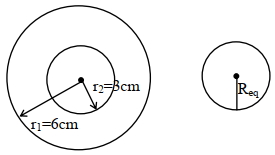
$A$ soap bubble of radius $3 \, cm$ is formed inside another soap bubble of radius $6 \, cm$. The radius of an equivalent soap bubble which has the same excess pressure as inside the smaller bubble with respect to the atmospheric pressure is .......... $cm$.
A
$5$
B
$4$
C
$2$
D
$3$
Solution
(C) The excess pressure inside a soap bubble of radius $r$ is given by $\Delta P = \frac{4S}{r}$,where $S$ is the surface tension.
For a soap bubble of radius $r_2 = 3 \, cm$ formed inside a soap bubble of radius $r_1 = 6 \, cm$,the pressure inside the smaller bubble relative to the atmospheric pressure is the sum of the excess pressure due to the smaller bubble and the excess pressure due to the larger bubble.
$\Delta P_{total} = \frac{4S}{r_2} + \frac{4S}{r_1}$
We want to find the radius $R_{eq}$ of an equivalent single soap bubble such that its excess pressure equals $\Delta P_{total}$:
$\frac{4S}{R_{eq}} = \frac{4S}{r_2} + \frac{4S}{r_1}$
Dividing both sides by $4S$:
$\frac{1}{R_{eq}} = \frac{1}{r_2} + \frac{1}{r_1}$
Substituting the given values $r_1 = 6 \, cm$ and $r_2 = 3 \, cm$:
$\frac{1}{R_{eq}} = \frac{1}{3} + \frac{1}{6} = \frac{2+1}{6} = \frac{3}{6} = \frac{1}{2}$
Therefore,$R_{eq} = 2 \, cm$.
For a soap bubble of radius $r_2 = 3 \, cm$ formed inside a soap bubble of radius $r_1 = 6 \, cm$,the pressure inside the smaller bubble relative to the atmospheric pressure is the sum of the excess pressure due to the smaller bubble and the excess pressure due to the larger bubble.
$\Delta P_{total} = \frac{4S}{r_2} + \frac{4S}{r_1}$
We want to find the radius $R_{eq}$ of an equivalent single soap bubble such that its excess pressure equals $\Delta P_{total}$:
$\frac{4S}{R_{eq}} = \frac{4S}{r_2} + \frac{4S}{r_1}$
Dividing both sides by $4S$:
$\frac{1}{R_{eq}} = \frac{1}{r_2} + \frac{1}{r_1}$
Substituting the given values $r_1 = 6 \, cm$ and $r_2 = 3 \, cm$:
$\frac{1}{R_{eq}} = \frac{1}{3} + \frac{1}{6} = \frac{2+1}{6} = \frac{3}{6} = \frac{1}{2}$
Therefore,$R_{eq} = 2 \, cm$.
0 likes
View Solution123
DifficultMCQ
Two spherical soap bubbles of radii $r_{1}$ and $r_{2}$ in vacuum combine under isothermal conditions. The resulting bubble has a radius equal to -
A
$\frac{r_{1} r_{2}}{r_{1}+r_{2}}$
B
$\sqrt{r_{1}^{2}+r_{2}^{2}}$
C
$\sqrt{r_{1} r_{2}}$
D
$\frac{r_{1}+r_{2}}{2}$
Solution
(B) When two soap bubbles combine in a vacuum under isothermal conditions,the total number of moles of gas remains conserved.
Using the ideal gas law $PV = nRT$,and since the temperature $T$ is constant,we have $n = \frac{PV}{RT}$.
Conservation of moles: $n_1 + n_2 = n_3 \Rightarrow P_1 V_1 + P_2 V_2 = P_3 V_3$.
The excess pressure inside a soap bubble is given by $P = \frac{4S}{r}$,where $S$ is the surface tension.
The volume of a spherical bubble is $V = \frac{4}{3} \pi r^3$.
Substituting these into the conservation equation:
$\left(\frac{4S}{r_1}\right) \left(\frac{4}{3} \pi r_1^3\right) + \left(\frac{4S}{r_2}\right) \left(\frac{4}{3} \pi r_2^3\right) = \left(\frac{4S}{r_3}\right) \left(\frac{4}{3} \pi r_3^3\right)$.
Simplifying the equation:
$16 \pi S \left(\frac{r_1^2}{3} + \frac{r_2^2}{3}\right) = 16 \pi S \left(\frac{r_3^2}{3}\right)$.
Therefore,$r_1^2 + r_2^2 = r_3^2$,which gives $r_3 = \sqrt{r_1^2 + r_2^2}$.
Using the ideal gas law $PV = nRT$,and since the temperature $T$ is constant,we have $n = \frac{PV}{RT}$.
Conservation of moles: $n_1 + n_2 = n_3 \Rightarrow P_1 V_1 + P_2 V_2 = P_3 V_3$.
The excess pressure inside a soap bubble is given by $P = \frac{4S}{r}$,where $S$ is the surface tension.
The volume of a spherical bubble is $V = \frac{4}{3} \pi r^3$.
Substituting these into the conservation equation:
$\left(\frac{4S}{r_1}\right) \left(\frac{4}{3} \pi r_1^3\right) + \left(\frac{4S}{r_2}\right) \left(\frac{4}{3} \pi r_2^3\right) = \left(\frac{4S}{r_3}\right) \left(\frac{4}{3} \pi r_3^3\right)$.
Simplifying the equation:
$16 \pi S \left(\frac{r_1^2}{3} + \frac{r_2^2}{3}\right) = 16 \pi S \left(\frac{r_3^2}{3}\right)$.
Therefore,$r_1^2 + r_2^2 = r_3^2$,which gives $r_3 = \sqrt{r_1^2 + r_2^2}$.
0 likes
View Solution124
EasyMCQ
If a soap bubble expands, the pressure inside the bubble:
A
increases
B
remains the same
C
is equal to the atmospheric pressure
D
decreases
Solution
(D) The excess pressure inside a soap bubble is given by the formula $P_{in} = P_{0} + \frac{4T}{R}$, where $P_{0}$ is the atmospheric pressure, $T$ is the surface tension, and $R$ is the radius of the bubble.
As the soap bubble expands, its radius $R$ increases.
Since the term $\frac{4T}{R}$ is inversely proportional to $R$, as $R$ increases, the value of $\frac{4T}{R}$ decreases.
Therefore, the total pressure inside the bubble $P_{in}$ decreases.
As the soap bubble expands, its radius $R$ increases.
Since the term $\frac{4T}{R}$ is inversely proportional to $R$, as $R$ increases, the value of $\frac{4T}{R}$ decreases.
Therefore, the total pressure inside the bubble $P_{in}$ decreases.
0 likes
View Solution125
DifficultMCQ
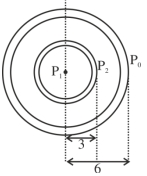
$A$ spherical soap bubble of radius $3\,cm$ is formed inside another spherical soap bubble of radius $6\,cm$. If the internal pressure of the smaller bubble of radius $3\,cm$ in the above system is equal to the internal pressure of another single soap bubble of radius $r\,cm$,then the value of $r$ is:
A
$4$
B
$6$
C
$8$
D
$2$
Solution
(D) Let $P_0$ be the atmospheric pressure,$P_2$ be the pressure in the region between the two bubbles,and $P_1$ be the pressure inside the smaller bubble.
For the outer bubble of radius $R_2 = 6\,cm$,the excess pressure is $P_2 - P_0 = \frac{4T}{R_2} = \frac{4T}{6}$.
For the inner bubble of radius $R_1 = 3\,cm$,the excess pressure is $P_1 - P_2 = \frac{4T}{R_1} = \frac{4T}{3}$.
Adding these two equations,we get the total excess pressure inside the smaller bubble relative to the atmosphere:
$P_1 - P_0 = (P_1 - P_2) + (P_2 - P_0) = \frac{4T}{3} + \frac{4T}{6} = \frac{8T + 4T}{6} = \frac{12T}{6} = 2T$.
For a single soap bubble of radius $r$,the excess pressure is $P_{excess} = \frac{4T}{r}$.
Equating the two,we have $\frac{4T}{r} = 2T$,which gives $r = \frac{4}{2} = 2\,cm$.
For the outer bubble of radius $R_2 = 6\,cm$,the excess pressure is $P_2 - P_0 = \frac{4T}{R_2} = \frac{4T}{6}$.
For the inner bubble of radius $R_1 = 3\,cm$,the excess pressure is $P_1 - P_2 = \frac{4T}{R_1} = \frac{4T}{3}$.
Adding these two equations,we get the total excess pressure inside the smaller bubble relative to the atmosphere:
$P_1 - P_0 = (P_1 - P_2) + (P_2 - P_0) = \frac{4T}{3} + \frac{4T}{6} = \frac{8T + 4T}{6} = \frac{12T}{6} = 2T$.
For a single soap bubble of radius $r$,the excess pressure is $P_{excess} = \frac{4T}{r}$.
Equating the two,we have $\frac{4T}{r} = 2T$,which gives $r = \frac{4}{2} = 2\,cm$.
0 likes
View Solution126
MediumMCQ
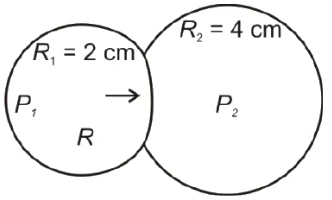
Two soap bubbles of radii $2 \, cm$ and $4 \, cm$ join to form a double bubble in air. The radius of curvature of the interface is .......... $cm$.
A
$2 \sqrt{5}$
B
$2$
C
$4$
D
$2 \sqrt{3}$
Solution
(C) Let $P_0$ be the atmospheric pressure. The excess pressure inside a soap bubble of radius $R$ is given by $\Delta P = \frac{4T}{R}$.
For the two bubbles with radii $R_1 = 2 \, cm$ and $R_2 = 4 \, cm$,the pressures inside them are:
$P_1 = P_0 + \frac{4T}{R_1}$
$P_2 = P_0 + \frac{4T}{R_2}$
The pressure difference across the common interface is $\Delta P_{int} = P_1 - P_2 = \frac{4T}{R_1} - \frac{4T}{R_2}$.
If $R$ is the radius of curvature of the interface,then $\Delta P_{int} = \frac{4T}{R}$.
Equating the two expressions:
$\frac{4T}{R} = 4T \left( \frac{1}{R_1} - \frac{1}{R_2} \right)$
$\frac{1}{R} = \frac{1}{R_1} - \frac{1}{R_2} = \frac{1}{2} - \frac{1}{4} = \frac{2-1}{4} = \frac{1}{4}$
Therefore,$R = 4 \, cm$.
For the two bubbles with radii $R_1 = 2 \, cm$ and $R_2 = 4 \, cm$,the pressures inside them are:
$P_1 = P_0 + \frac{4T}{R_1}$
$P_2 = P_0 + \frac{4T}{R_2}$
The pressure difference across the common interface is $\Delta P_{int} = P_1 - P_2 = \frac{4T}{R_1} - \frac{4T}{R_2}$.
If $R$ is the radius of curvature of the interface,then $\Delta P_{int} = \frac{4T}{R}$.
Equating the two expressions:
$\frac{4T}{R} = 4T \left( \frac{1}{R_1} - \frac{1}{R_2} \right)$
$\frac{1}{R} = \frac{1}{R_1} - \frac{1}{R_2} = \frac{1}{2} - \frac{1}{4} = \frac{2-1}{4} = \frac{1}{4}$
Therefore,$R = 4 \, cm$.
0 likes
View Solution127
MediumMCQ
The excess pressure in a soap bubble is double that in another one. The ratio of their volumes is .............
A
$1: 2$
B
$1: 8$
C
$1: 4$
D
$1: 1$
Solution
(B) The excess pressure $\Delta P$ in a soap bubble of radius $R$ is given by $\Delta P = \frac{4S}{R}$,where $S$ is the surface tension.
Let the excess pressure in the first bubble be $P_1 = P$ and its radius be $R_1 = R$.
Then,$P = \frac{4S}{R}$.
Let the excess pressure in the second bubble be $P_2 = 2P$ and its radius be $R_2 = x$.
Then,$2P = \frac{4S}{x}$.
Substituting the value of $P$ from the first equation into the second:
$2 \left( \frac{4S}{R} \right) = \frac{4S}{x}$
$\Rightarrow \frac{2}{R} = \frac{1}{x}$
$\Rightarrow x = \frac{R}{2}$.
The volume $V$ of a spherical bubble is given by $V = \frac{4}{3} \pi R^3$.
Therefore,the ratio of their volumes is:
$\frac{V_1}{V_2} = \frac{\frac{4}{3} \pi R_1^3}{\frac{4}{3} \pi R_2^3} = \left( \frac{R_1}{R_2} \right)^3 = \left( \frac{R}{R/2} \right)^3 = (2)^3 = 8$.
Wait,the question asks for the ratio of the first to the second. If $P_1 = P$ and $P_2 = 2P$,then $R_1 = R$ and $R_2 = R/2$. The ratio of volumes $V_1 : V_2 = R_1^3 : R_2^3 = R^3 : (R/2)^3 = 1 : 1/8 = 8 : 1$.
However,if the question implies the ratio of the smaller to the larger,it is $1:8$. Given the options,the ratio is $1:8$.
Let the excess pressure in the first bubble be $P_1 = P$ and its radius be $R_1 = R$.
Then,$P = \frac{4S}{R}$.
Let the excess pressure in the second bubble be $P_2 = 2P$ and its radius be $R_2 = x$.
Then,$2P = \frac{4S}{x}$.
Substituting the value of $P$ from the first equation into the second:
$2 \left( \frac{4S}{R} \right) = \frac{4S}{x}$
$\Rightarrow \frac{2}{R} = \frac{1}{x}$
$\Rightarrow x = \frac{R}{2}$.
The volume $V$ of a spherical bubble is given by $V = \frac{4}{3} \pi R^3$.
Therefore,the ratio of their volumes is:
$\frac{V_1}{V_2} = \frac{\frac{4}{3} \pi R_1^3}{\frac{4}{3} \pi R_2^3} = \left( \frac{R_1}{R_2} \right)^3 = \left( \frac{R}{R/2} \right)^3 = (2)^3 = 8$.
Wait,the question asks for the ratio of the first to the second. If $P_1 = P$ and $P_2 = 2P$,then $R_1 = R$ and $R_2 = R/2$. The ratio of volumes $V_1 : V_2 = R_1^3 : R_2^3 = R^3 : (R/2)^3 = 1 : 1/8 = 8 : 1$.
However,if the question implies the ratio of the smaller to the larger,it is $1:8$. Given the options,the ratio is $1:8$.
0 likes
View Solution128
MediumMCQ
The work done to break a spherical drop of radius $R$ into $n$ drops of equal size is proportional to .............
A
$n^{-2/3} - 1$
B
$n^{-1/3} - 1$
C
$n^{1/3} - 1$
D
$n^{4/3} - 1$
Solution
(C) The volume of the liquid remains constant during the process.
Let $R$ be the radius of the large drop and $r$ be the radius of each of the $n$ small drops.
Volume of large drop = $n \times$ Volume of small drop
$\frac{4}{3} \pi R^3 = n \times \frac{4}{3} \pi r^3$
$R^3 = n r^3 \implies r = \frac{R}{n^{1/3}}$
The work done $W$ is equal to the increase in surface energy:
$W = S \times \Delta A = S \times (A_{final} - A_{initial})$
$W = S \times (n \times 4 \pi r^2 - 4 \pi R^2)$
Substitute $r = R n^{-1/3}$:
$W = S \times 4 \pi (n \times (R n^{-1/3})^2 - R^2)$
$W = S \times 4 \pi R^2 (n \times n^{-2/3} - 1)$
$W = 4 \pi R^2 S (n^{1/3} - 1)$
Since $4 \pi R^2 S$ is constant,the work done is proportional to $(n^{1/3} - 1)$.
Let $R$ be the radius of the large drop and $r$ be the radius of each of the $n$ small drops.
Volume of large drop = $n \times$ Volume of small drop
$\frac{4}{3} \pi R^3 = n \times \frac{4}{3} \pi r^3$
$R^3 = n r^3 \implies r = \frac{R}{n^{1/3}}$
The work done $W$ is equal to the increase in surface energy:
$W = S \times \Delta A = S \times (A_{final} - A_{initial})$
$W = S \times (n \times 4 \pi r^2 - 4 \pi R^2)$
Substitute $r = R n^{-1/3}$:
$W = S \times 4 \pi (n \times (R n^{-1/3})^2 - R^2)$
$W = S \times 4 \pi R^2 (n \times n^{-2/3} - 1)$
$W = 4 \pi R^2 S (n^{1/3} - 1)$
Since $4 \pi R^2 S$ is constant,the work done is proportional to $(n^{1/3} - 1)$.
0 likes
View Solution129
DifficultMCQ
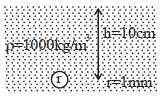
There is an air bubble of radius $1.0\,mm$ in a liquid of surface tension $0.075\,N\,m^{-1}$ and density $1000\,kg\,m^{-3}$ at a depth of $10\,cm$ below the free surface. The amount by which the pressure inside the bubble is greater than the atmospheric pressure is $....Pa \left( g = 10\,m\,s^{-2} \right)$
A
$1150$
B
$1151$
C
$1152$
D
$1153$
Solution
(A) The pressure inside an air bubble at a depth $h$ in a liquid is given by the formula:
$P = P_0 + h \rho g + \frac{2T}{r}$
where $P_0$ is the atmospheric pressure,$h$ is the depth,$\rho$ is the density of the liquid,$g$ is the acceleration due to gravity,$T$ is the surface tension,and $r$ is the radius of the bubble.
We need to find the excess pressure inside the bubble over the atmospheric pressure,which is $P - P_0 = h \rho g + \frac{2T}{r}$.
Given values:
$h = 10\,cm = 0.1\,m$
$\rho = 1000\,kg\,m^{-3}$
$g = 10\,m\,s^{-2}$
$T = 0.075\,N\,m^{-1}$
$r = 1.0\,mm = 10^{-3}\,m$
Substituting these values into the equation:
$P - P_0 = (0.1 \times 1000 \times 10) + \frac{2 \times 0.075}{10^{-3}}$
$P - P_0 = 1000 + \frac{0.15}{10^{-3}}$
$P - P_0 = 1000 + 150 = 1150\,Pa$.
$P = P_0 + h \rho g + \frac{2T}{r}$
where $P_0$ is the atmospheric pressure,$h$ is the depth,$\rho$ is the density of the liquid,$g$ is the acceleration due to gravity,$T$ is the surface tension,and $r$ is the radius of the bubble.
We need to find the excess pressure inside the bubble over the atmospheric pressure,which is $P - P_0 = h \rho g + \frac{2T}{r}$.
Given values:
$h = 10\,cm = 0.1\,m$
$\rho = 1000\,kg\,m^{-3}$
$g = 10\,m\,s^{-2}$
$T = 0.075\,N\,m^{-1}$
$r = 1.0\,mm = 10^{-3}\,m$
Substituting these values into the equation:
$P - P_0 = (0.1 \times 1000 \times 10) + \frac{2 \times 0.075}{10^{-3}}$
$P - P_0 = 1000 + \frac{0.15}{10^{-3}}$
$P - P_0 = 1000 + 150 = 1150\,Pa$.
0 likes
View Solution130
DifficultMCQ
$A$ big drop is formed by coalescing $1000$ small identical drops of water. If $E_1$ be the total surface energy of $1000$ small drops of water and $E_2$ be the surface energy of the single big drop of water,then the ratio $E_1 : E_2$ is $x : 1$,where $x = . . . . . . $.
A
$10$
B
$100$
C
$1000$
D
$1$
Solution
(A) Let $r$ be the radius of each small drop and $R$ be the radius of the big drop.
Since the volume remains conserved during the coalescence of $1000$ small drops into one big drop:
$1000 \times (\frac{4}{3} \pi r^3) = \frac{4}{3} \pi R^3$
$R^3 = 1000 r^3 \implies R = 10r$.
Surface energy $E$ is given by $E = S \times A$,where $S$ is surface tension and $A$ is the surface area.
Total surface energy of $1000$ small drops: $E_1 = 1000 \times (4 \pi r^2 \times S) = 4000 \pi r^2 S$.
Surface energy of the big drop: $E_2 = 4 \pi R^2 S = 4 \pi (10r)^2 S = 400 \pi r^2 S$.
The ratio $E_1 : E_2 = \frac{4000 \pi r^2 S}{400 \pi r^2 S} = \frac{10}{1}$.
Therefore,$x = 10$.
Since the volume remains conserved during the coalescence of $1000$ small drops into one big drop:
$1000 \times (\frac{4}{3} \pi r^3) = \frac{4}{3} \pi R^3$
$R^3 = 1000 r^3 \implies R = 10r$.
Surface energy $E$ is given by $E = S \times A$,where $S$ is surface tension and $A$ is the surface area.
Total surface energy of $1000$ small drops: $E_1 = 1000 \times (4 \pi r^2 \times S) = 4000 \pi r^2 S$.
Surface energy of the big drop: $E_2 = 4 \pi R^2 S = 4 \pi (10r)^2 S = 400 \pi r^2 S$.
The ratio $E_1 : E_2 = \frac{4000 \pi r^2 S}{400 \pi r^2 S} = \frac{10}{1}$.
Therefore,$x = 10$.
0 likes
View Solution131
DifficultMCQ
$A$ big drop is formed by coalescing $1000$ small droplets of water. The surface energy will become :
A
$100$ times
B
$10$ times
C
$\frac{1}{100}$ th
D
$\frac{1}{10}$ th
Solution
(D) Let the radius of each small droplet be $r$ and the radius of the big drop be $R$.
Since the volume remains conserved,the volume of the big drop equals the sum of the volumes of $1000$ small droplets:
$\frac{4}{3} \pi R^3 = 1000 \times \frac{4}{3} \pi r^3$
$R^3 = 1000 r^3$
$R = 10r$
The initial surface energy $U_i$ of $1000$ small droplets is:
$U_i = 1000 \times (4 \pi r^2 S)$,where $S$ is the surface tension.
The final surface energy $U_f$ of the big drop is:
$U_f = 4 \pi R^2 S$
Substituting $R = 10r$:
$U_f = 4 \pi (10r)^2 S = 100 \times (4 \pi r^2 S)$
Comparing $U_f$ and $U_i$:
$U_f = \frac{100 \times (4 \pi r^2 S)}{1000 \times (4 \pi r^2 S)} U_i$
$U_f = \frac{1}{10} U_i$
Thus,the surface energy becomes $\frac{1}{10}$ th of the initial value.
Since the volume remains conserved,the volume of the big drop equals the sum of the volumes of $1000$ small droplets:
$\frac{4}{3} \pi R^3 = 1000 \times \frac{4}{3} \pi r^3$
$R^3 = 1000 r^3$
$R = 10r$
The initial surface energy $U_i$ of $1000$ small droplets is:
$U_i = 1000 \times (4 \pi r^2 S)$,where $S$ is the surface tension.
The final surface energy $U_f$ of the big drop is:
$U_f = 4 \pi R^2 S$
Substituting $R = 10r$:
$U_f = 4 \pi (10r)^2 S = 100 \times (4 \pi r^2 S)$
Comparing $U_f$ and $U_i$:
$U_f = \frac{100 \times (4 \pi r^2 S)}{1000 \times (4 \pi r^2 S)} U_i$
$U_f = \frac{1}{10} U_i$
Thus,the surface energy becomes $\frac{1}{10}$ th of the initial value.
0 likes
View Solution132
DifficultMCQ
Pressure inside a soap bubble is greater than the pressure outside by an amount: (given: $R =$ Radius of bubble,$S =$ Surface tension of bubble)
A
$\frac{4 S}{R}$
B
$\frac{4 R}{S}$
C
$\frac{S}{R}$
D
$\frac{2 S}{R}$
Solution
(A) soap bubble has two liquid-air surfaces: one on the inside and one on the outside.
For a single spherical surface,the excess pressure is given by $\Delta P = \frac{2 S}{R}$.
Since a soap bubble has two surfaces,the total excess pressure is $\Delta P = 2 \times \left( \frac{2 S}{R} \right)$.
Therefore,the pressure inside the soap bubble is greater than the pressure outside by $\Delta P = \frac{4 S}{R}$.
For a single spherical surface,the excess pressure is given by $\Delta P = \frac{2 S}{R}$.
Since a soap bubble has two surfaces,the total excess pressure is $\Delta P = 2 \times \left( \frac{2 S}{R} \right)$.
Therefore,the pressure inside the soap bubble is greater than the pressure outside by $\Delta P = \frac{4 S}{R}$.
0 likes
View Solution133
DifficultMCQ
$A$ liquid column of height $0.04 \,cm$ balances excess pressure of a soap bubble of a certain radius. If the density of the liquid is $8 \times 10^3 \,kg \,m^{-3}$ and the surface tension of the soap solution is $0.28 \,N \,m^{-1}$, then the diameter of the soap bubble is . . . . . . $cm$.
$(g = 10 \,m \,s^{-2})$
$(g = 10 \,m \,s^{-2})$
A
$8$
B
$7$
C
$6$
D
$9$
Solution
(B) The excess pressure inside a soap bubble is given by $\Delta P = \frac{4S}{R}$, where $S$ is the surface tension and $R$ is the radius of the bubble.
This pressure is balanced by the hydrostatic pressure of the liquid column: $\Delta P = \rho g h$.
Equating the two: $\rho g h = \frac{4S}{R}$.
Given: $\rho = 8 \times 10^3 \,kg \,m^{-3}$, $g = 10 \,m \,s^{-2}$, $h = 0.04 \,cm = 4 \times 10^{-4} \,m$, and $S = 0.28 \,N \,m^{-1}$.
Substituting the values: $(8 \times 10^3) \times 10 \times (4 \times 10^{-4}) = \frac{4 \times 0.28}{R}$.
$32 = \frac{1.12}{R}$.
$R = \frac{1.12}{32} \,m = 0.035 \,m = 3.5 \,cm$.
The diameter $D = 2R = 2 \times 3.5 \,cm = 7 \,cm$.
This pressure is balanced by the hydrostatic pressure of the liquid column: $\Delta P = \rho g h$.
Equating the two: $\rho g h = \frac{4S}{R}$.
Given: $\rho = 8 \times 10^3 \,kg \,m^{-3}$, $g = 10 \,m \,s^{-2}$, $h = 0.04 \,cm = 4 \times 10^{-4} \,m$, and $S = 0.28 \,N \,m^{-1}$.
Substituting the values: $(8 \times 10^3) \times 10 \times (4 \times 10^{-4}) = \frac{4 \times 0.28}{R}$.
$32 = \frac{1.12}{R}$.
$R = \frac{1.12}{32} \,m = 0.035 \,m = 3.5 \,cm$.
The diameter $D = 2R = 2 \times 3.5 \,cm = 7 \,cm$.
0 likes
View Solution134
DifficultMCQ
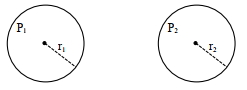
The excess pressure inside a soap bubble is thrice the excess pressure inside a second soap bubble. The ratio between the volume of the first and the second bubble is:
A
$1: 9$
B
$1: 3$
C
$1: 81$
D
$1: 27$
Solution
(D) The excess pressure inside a soap bubble of radius $r$ is given by $\Delta P = \frac{4T}{r}$,where $T$ is the surface tension.
Let the radii of the two soap bubbles be $r_1$ and $r_2$ respectively.
The excess pressure in the first bubble is $\Delta P_1 = \frac{4T}{r_1}$ and in the second bubble is $\Delta P_2 = \frac{4T}{r_2}$.
According to the problem,$\Delta P_1 = 3 \Delta P_2$.
Substituting the expressions,we get $\frac{4T}{r_1} = 3 \left( \frac{4T}{r_2} \right)$.
This simplifies to $\frac{1}{r_1} = \frac{3}{r_2}$,which means $r_2 = 3r_1$.
The volume of a spherical bubble is $V = \frac{4}{3} \pi r^3$.
The ratio of the volumes is $\frac{V_1}{V_2} = \frac{\frac{4}{3} \pi r_1^3}{\frac{4}{3} \pi r_2^3} = \left( \frac{r_1}{r_2} \right)^3$.
Substituting $r_2 = 3r_1$,we get $\frac{V_1}{V_2} = \left( \frac{r_1}{3r_1} \right)^3 = \left( \frac{1}{3} \right)^3 = \frac{1}{27}$.
Thus,the ratio is $1: 27$.
Let the radii of the two soap bubbles be $r_1$ and $r_2$ respectively.
The excess pressure in the first bubble is $\Delta P_1 = \frac{4T}{r_1}$ and in the second bubble is $\Delta P_2 = \frac{4T}{r_2}$.
According to the problem,$\Delta P_1 = 3 \Delta P_2$.
Substituting the expressions,we get $\frac{4T}{r_1} = 3 \left( \frac{4T}{r_2} \right)$.
This simplifies to $\frac{1}{r_1} = \frac{3}{r_2}$,which means $r_2 = 3r_1$.
The volume of a spherical bubble is $V = \frac{4}{3} \pi r^3$.
The ratio of the volumes is $\frac{V_1}{V_2} = \frac{\frac{4}{3} \pi r_1^3}{\frac{4}{3} \pi r_2^3} = \left( \frac{r_1}{r_2} \right)^3$.
Substituting $r_2 = 3r_1$,we get $\frac{V_1}{V_2} = \left( \frac{r_1}{3r_1} \right)^3 = \left( \frac{1}{3} \right)^3 = \frac{1}{27}$.
Thus,the ratio is $1: 27$.
0 likes
View Solution135
AdvancedMCQ
$A$ glass tube of uniform internal radius has a valve separating two identical ends. Initially,the valve is in a tightly closed position. End $1$ has a hemispherical soap bubble of radius $r$. End $2$ has a soap bubble with a radius of curvature $R$ $(R > r)$ as shown in the figure. Just after opening the valve,
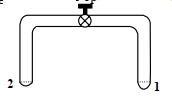
A
air from end $1$ flows towards end $2$. No change in the volume of the soap bubbles.
B
air from end $1$ flows towards end $2$. Volume of the soap bubble at end $1$ decreases.
C
no change occurs.
D
air from end $2$ flows towards end $1$. Volume of the soap bubble at end $1$ increases.
Solution
(B) The excess pressure inside a soap bubble of radius $r$ is given by $\Delta P = \frac{4T}{r}$,where $T$ is the surface tension.
Let $P_0$ be the atmospheric pressure.
The pressure inside the bubble at end $1$ (radius $r$) is $P_1 = P_0 + \frac{4T}{r}$.
The pressure inside the bubble at end $2$ (radius $R$) is $P_2 = P_0 + \frac{4T}{R}$.
Given that $R > r$,it follows that $\frac{4T}{R} < \frac{4T}{r}$.
Therefore,$P_2 < P_1$.
Since air flows from a region of higher pressure to a region of lower pressure,air will flow from end $1$ to end $2$.
As air leaves the bubble at end $1$,its volume decreases.
Let $P_0$ be the atmospheric pressure.
The pressure inside the bubble at end $1$ (radius $r$) is $P_1 = P_0 + \frac{4T}{r}$.
The pressure inside the bubble at end $2$ (radius $R$) is $P_2 = P_0 + \frac{4T}{R}$.
Given that $R > r$,it follows that $\frac{4T}{R} < \frac{4T}{r}$.
Therefore,$P_2 < P_1$.
Since air flows from a region of higher pressure to a region of lower pressure,air will flow from end $1$ to end $2$.
As air leaves the bubble at end $1$,its volume decreases.
0 likes
View Solution136
DifficultMCQ
Two soap bubbles $A$ and $B$ are kept in a closed chamber where the air is maintained at pressure $8 \ N/m^2$. The radii of bubbles $A$ and $B$ are $2 \ cm$ and $4 \ cm$,respectively. The surface tension of the soap solution is $0.04 \ N/m$. Find the ratio $n_B / n_A$,where $n_A$ and $n_B$ are the number of moles of air in bubbles $A$ and $B$,respectively. [Neglect the effect of gravity.]
A
$4$
B
$6$
C
$7$
D
$8$
Solution
(B) The pressure inside a soap bubble is given by $P = P_0 + \frac{4T}{r}$,where $P_0 = 8 \ N/m^2$ is the external pressure,$T = 0.04 \ N/m$ is the surface tension,and $r$ is the radius.
For bubble $A$ $(r_A = 0.02 \ m)$: $P_A = 8 + \frac{4 \times 0.04}{0.02} = 8 + 8 = 16 \ N/m^2$.
For bubble $B$ $(r_B = 0.04 \ m)$: $P_B = 8 + \frac{4 \times 0.04}{0.04} = 8 + 4 = 12 \ N/m^2$.
Using the ideal gas law $PV = nRT$,and assuming temperature $T$ is constant,$n = \frac{PV}{RT}$.
For bubble $A$: $n_A = \frac{P_A V_A}{RT} = \frac{16 \times \frac{4}{3} \pi (0.02)^3}{RT}$.
For bubble $B$: $n_B = \frac{P_B V_B}{RT} = \frac{12 \times \frac{4}{3} \pi (0.04)^3}{RT}$.
Taking the ratio $\frac{n_B}{n_A} = \frac{12 \times (0.04)^3}{16 \times (0.02)^3} = \frac{12}{16} \times (2)^3 = \frac{3}{4} \times 8 = 6$.
For bubble $A$ $(r_A = 0.02 \ m)$: $P_A = 8 + \frac{4 \times 0.04}{0.02} = 8 + 8 = 16 \ N/m^2$.
For bubble $B$ $(r_B = 0.04 \ m)$: $P_B = 8 + \frac{4 \times 0.04}{0.04} = 8 + 4 = 12 \ N/m^2$.
Using the ideal gas law $PV = nRT$,and assuming temperature $T$ is constant,$n = \frac{PV}{RT}$.
For bubble $A$: $n_A = \frac{P_A V_A}{RT} = \frac{16 \times \frac{4}{3} \pi (0.02)^3}{RT}$.
For bubble $B$: $n_B = \frac{P_B V_B}{RT} = \frac{12 \times \frac{4}{3} \pi (0.04)^3}{RT}$.
Taking the ratio $\frac{n_B}{n_A} = \frac{12 \times (0.04)^3}{16 \times (0.02)^3} = \frac{12}{16} \times (2)^3 = \frac{3}{4} \times 8 = 6$.
0 likes
View Solution137
AdvancedMCQ
$A$ bubble has surface tension $S$. The ideal gas inside the bubble has a ratio of specific heats $\gamma = \frac{5}{3}$. The bubble is exposed to the atmosphere and it always retains its spherical shape. When the atmospheric pressure is $P_{a1}$,the radius of the bubble is $r_1$ and the temperature of the enclosed gas is $T_1$. When the atmospheric pressure is $P_{a2}$,the radius of the bubble and the temperature of the enclosed gas are $r_2$ and $T_2$,respectively.
Which of the following statement$(s)$ is(are) correct?
$(A)$ If the surface of the bubble is a perfect heat insulator,then $\left(\frac{r_1}{r_2}\right)^5 = \frac{P_{a2} + \frac{4S}{r_2}}{P_{a1} + \frac{4S}{r_1}}$
$(B)$ If the surface of the bubble is a perfect heat insulator,then the total internal energy of the bubble including its surface energy does not change with the external atmospheric pressure.
$(C)$ If the surface of the bubble is a perfect heat conductor and the change in atmospheric temperature is negligible,then $\left(\frac{r_1}{r_2}\right)^3 = \frac{P_{a2} + \frac{4S}{r_2}}{P_{a1} + \frac{4S}{r_1}}$
$(D)$ If the surface of the bubble is a perfect heat insulator,then $\left(\frac{T_2}{T_1}\right)^{\frac{5}{2}} = \frac{P_{a2} + \frac{4S}{r_2}}{P_{a1} + \frac{4S}{r_1}}$
Which of the following statement$(s)$ is(are) correct?
$(A)$ If the surface of the bubble is a perfect heat insulator,then $\left(\frac{r_1}{r_2}\right)^5 = \frac{P_{a2} + \frac{4S}{r_2}}{P_{a1} + \frac{4S}{r_1}}$
$(B)$ If the surface of the bubble is a perfect heat insulator,then the total internal energy of the bubble including its surface energy does not change with the external atmospheric pressure.
$(C)$ If the surface of the bubble is a perfect heat conductor and the change in atmospheric temperature is negligible,then $\left(\frac{r_1}{r_2}\right)^3 = \frac{P_{a2} + \frac{4S}{r_2}}{P_{a1} + \frac{4S}{r_1}}$
$(D)$ If the surface of the bubble is a perfect heat insulator,then $\left(\frac{T_2}{T_1}\right)^{\frac{5}{2}} = \frac{P_{a2} + \frac{4S}{r_2}}{P_{a1} + \frac{4S}{r_1}}$
A
$A, B$
B
$A, C$
C
$C, D$
D
$B, D$
Solution
(D) For a spherical bubble,the pressure inside is $P_{gas} = P_a + \frac{4S}{r}$.
If the surface is a perfect heat insulator,the process is adiabatic: $PV^{\gamma} = \text{constant}$.
Since $V = \frac{4}{3}\pi r^3$,we have $\left(P_a + \frac{4S}{r}\right) (r^3)^{5/3} = \text{constant}$,which implies $\left(P_a + \frac{4S}{r}\right) r^5 = \text{constant}$.
Thus,$\left(P_{a1} + \frac{4S}{r_1}\right) r_1^5 = \left(P_{a2} + \frac{4S}{r_2}\right) r_2^5$,or $\left(\frac{r_1}{r_2}\right)^5 = \frac{P_{a2} + \frac{4S}{r_2}}{P_{a1} + \frac{4S}{r_1}}$. So,$(A)$ is correct.
For an adiabatic process,$P^{1-\gamma} T^{\gamma} = \text{constant}$.
Substituting $P = P_a + \frac{4S}{r}$ and $\gamma = 5/3$,we get $\left(P_a + \frac{4S}{r}\right)^{-2/3} T^{5/3} = \text{constant}$.
This leads to $\left(\frac{T_2}{T_1}\right)^{5/3} = \left(\frac{P_{a2} + \frac{4S}{r_2}}{P_{a1} + \frac{4S}{r_1}}\right)^{2/3}$,which simplifies to $\left(\frac{T_2}{T_1}\right)^{5/2} = \frac{P_{a2} + \frac{4S}{r_2}}{P_{a1} + \frac{4S}{r_1}}$. So,$(D)$ is correct.
If the surface is a perfect heat conductor and temperature is constant,$PV = \text{constant}$,so $\left(P_{a1} + \frac{4S}{r_1}\right) r_1^3 = \left(P_{a2} + \frac{4S}{r_2}\right) r_2^3$,which contradicts $(C)$.
Therefore,$(A)$ and $(D)$ are correct.
If the surface is a perfect heat insulator,the process is adiabatic: $PV^{\gamma} = \text{constant}$.
Since $V = \frac{4}{3}\pi r^3$,we have $\left(P_a + \frac{4S}{r}\right) (r^3)^{5/3} = \text{constant}$,which implies $\left(P_a + \frac{4S}{r}\right) r^5 = \text{constant}$.
Thus,$\left(P_{a1} + \frac{4S}{r_1}\right) r_1^5 = \left(P_{a2} + \frac{4S}{r_2}\right) r_2^5$,or $\left(\frac{r_1}{r_2}\right)^5 = \frac{P_{a2} + \frac{4S}{r_2}}{P_{a1} + \frac{4S}{r_1}}$. So,$(A)$ is correct.
For an adiabatic process,$P^{1-\gamma} T^{\gamma} = \text{constant}$.
Substituting $P = P_a + \frac{4S}{r}$ and $\gamma = 5/3$,we get $\left(P_a + \frac{4S}{r}\right)^{-2/3} T^{5/3} = \text{constant}$.
This leads to $\left(\frac{T_2}{T_1}\right)^{5/3} = \left(\frac{P_{a2} + \frac{4S}{r_2}}{P_{a1} + \frac{4S}{r_1}}\right)^{2/3}$,which simplifies to $\left(\frac{T_2}{T_1}\right)^{5/2} = \frac{P_{a2} + \frac{4S}{r_2}}{P_{a1} + \frac{4S}{r_1}}$. So,$(D)$ is correct.
If the surface is a perfect heat conductor and temperature is constant,$PV = \text{constant}$,so $\left(P_{a1} + \frac{4S}{r_1}\right) r_1^3 = \left(P_{a2} + \frac{4S}{r_2}\right) r_2^3$,which contradicts $(C)$.
Therefore,$(A)$ and $(D)$ are correct.

0 likes
View Solution138
AdvancedMCQ
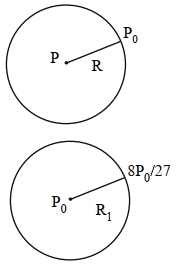
$A$ spherical soap bubble inside an air chamber at pressure $P_0 = 10^5 \ Pa$ has a certain radius $R$ such that the excess pressure inside the bubble is $\Delta P = 144 \ Pa$. Now,the chamber pressure is reduced to $8P_0 / 27$ so that the bubble radius and its excess pressure change. In this process,all temperatures remain unchanged. Assume air to be an ideal gas and the excess pressure $\Delta P$ in both cases to be much smaller than the chamber pressure. The new excess pressure $\Delta P'$ in $Pa$ is:
A
$89$
B
$90$
C
$96$
D
$80$
Solution
(C) For a spherical soap bubble,the excess pressure is given by $\Delta P = \frac{4T}{R}$.
In the first case,the total pressure inside the bubble is $P = P_0 + \Delta P = P_0 + \frac{4T}{R}$.
Since $\Delta P \ll P_0$,we can approximate the internal pressure as $P \approx P_0$.
In the second case,the chamber pressure is $P_0' = \frac{8P_0}{27}$. The new radius is $R_1$ and the new excess pressure is $\Delta P_1 = \frac{4T}{R_1}$.
The total pressure inside the bubble is $P_1 = P_0' + \Delta P_1 = \frac{8P_0}{27} + \frac{4T}{R_1} \approx \frac{8P_0}{27}$.
Since the temperature remains constant,we apply Boyle's Law: $PV = P_1 V_1$.
Substituting the volumes $V = \frac{4}{3}\pi R^3$ and $V_1 = \frac{4}{3}\pi R_1^3$:
$P_0 \cdot R^3 = P_0' \cdot R_1^3$
$P_0 \cdot R^3 = \left(\frac{8P_0}{27}\right) R_1^3$
$R^3 = \frac{8}{27} R_1^3 \implies R = \frac{2}{3} R_1 \implies R_1 = \frac{3}{2} R$.
Now,the new excess pressure is $\Delta P_1 = \frac{4T}{R_1} = \frac{4T}{(3/2)R} = \frac{2}{3} \left(\frac{4T}{R}\right)$.
Given $\Delta P = \frac{4T}{R} = 144 \ Pa$,we get $\Delta P_1 = \frac{2}{3} \times 144 = 96 \ Pa$.
In the first case,the total pressure inside the bubble is $P = P_0 + \Delta P = P_0 + \frac{4T}{R}$.
Since $\Delta P \ll P_0$,we can approximate the internal pressure as $P \approx P_0$.
In the second case,the chamber pressure is $P_0' = \frac{8P_0}{27}$. The new radius is $R_1$ and the new excess pressure is $\Delta P_1 = \frac{4T}{R_1}$.
The total pressure inside the bubble is $P_1 = P_0' + \Delta P_1 = \frac{8P_0}{27} + \frac{4T}{R_1} \approx \frac{8P_0}{27}$.
Since the temperature remains constant,we apply Boyle's Law: $PV = P_1 V_1$.
Substituting the volumes $V = \frac{4}{3}\pi R^3$ and $V_1 = \frac{4}{3}\pi R_1^3$:
$P_0 \cdot R^3 = P_0' \cdot R_1^3$
$P_0 \cdot R^3 = \left(\frac{8P_0}{27}\right) R_1^3$
$R^3 = \frac{8}{27} R_1^3 \implies R = \frac{2}{3} R_1 \implies R_1 = \frac{3}{2} R$.
Now,the new excess pressure is $\Delta P_1 = \frac{4T}{R_1} = \frac{4T}{(3/2)R} = \frac{2}{3} \left(\frac{4T}{R}\right)$.
Given $\Delta P = \frac{4T}{R} = 144 \ Pa$,we get $\Delta P_1 = \frac{2}{3} \times 144 = 96 \ Pa$.
0 likes
View Solution139
MediumMCQ
Two soap bubbles of radius $2 \ cm$ and $4 \ cm$,respectively,are in contact with each other. The radius of curvature of the common surface,in $cm$,is . . . . . . .
A
$4$
B
$3$
C
$2$
D
$1$
Solution
(A) The excess pressure inside a soap bubble of radius $r$ is given by $P = \frac{4T}{r}$,where $T$ is the surface tension.
Let $r_1 = 2 \ cm$ and $r_2 = 4 \ cm$ be the radii of the two bubbles.
The pressure inside the first bubble is $P_1 = P_0 + \frac{4T}{r_1}$ and inside the second bubble is $P_2 = P_0 + \frac{4T}{r_2}$,where $P_0$ is the atmospheric pressure.
The pressure difference across the common interface is $\Delta P = P_1 - P_2 = 4T \left( \frac{1}{r_1} - \frac{1}{r_2} \right)$.
For the common surface with radius of curvature $R$,the pressure difference is also given by $\Delta P = \frac{4T}{R}$.
Equating the two expressions: $\frac{4T}{R} = 4T \left( \frac{1}{r_1} - \frac{1}{r_2} \right)$.
Therefore,$\frac{1}{R} = \frac{1}{r_1} - \frac{1}{r_2} = \frac{r_2 - r_1}{r_1 r_2}$.
$R = \frac{r_1 r_2}{r_2 - r_1} = \frac{2 \times 4}{4 - 2} = \frac{8}{2} = 4 \ cm$.
Let $r_1 = 2 \ cm$ and $r_2 = 4 \ cm$ be the radii of the two bubbles.
The pressure inside the first bubble is $P_1 = P_0 + \frac{4T}{r_1}$ and inside the second bubble is $P_2 = P_0 + \frac{4T}{r_2}$,where $P_0$ is the atmospheric pressure.
The pressure difference across the common interface is $\Delta P = P_1 - P_2 = 4T \left( \frac{1}{r_1} - \frac{1}{r_2} \right)$.
For the common surface with radius of curvature $R$,the pressure difference is also given by $\Delta P = \frac{4T}{R}$.
Equating the two expressions: $\frac{4T}{R} = 4T \left( \frac{1}{r_1} - \frac{1}{r_2} \right)$.
Therefore,$\frac{1}{R} = \frac{1}{r_1} - \frac{1}{r_2} = \frac{r_2 - r_1}{r_1 r_2}$.
$R = \frac{r_1 r_2}{r_2 - r_1} = \frac{2 \times 4}{4 - 2} = \frac{8}{2} = 4 \ cm$.
0 likes
View Solution140
MediumMCQ
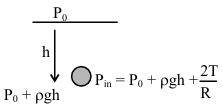
An air bubble of radius $1.0 \ mm$ is observed at a depth of $20 \ cm$ below the free surface of a liquid having surface tension $0.095 \ J/m^2$ and density $10^3 \ kg/m^3$. The difference between pressure inside the bubble and atmospheric pressure is . . . . . . $N/m^2$. (Take $g = 10 \ m/s^2$)
A
$2190$
B
$2250$
C
$2363$
D
$2456$
Solution
(A) The pressure inside an air bubble at a depth $h$ is given by $P_{in} = P_0 + \rho gh + \frac{2T}{R}$.
Here,$P_0$ is the atmospheric pressure,$\rho$ is the density of the liquid,$g$ is the acceleration due to gravity,$h$ is the depth,$T$ is the surface tension,and $R$ is the radius of the bubble.
The difference between the pressure inside the bubble and the atmospheric pressure is $\Delta P = P_{in} - P_0 = \rho gh + \frac{2T}{R}$.
Given values: $\rho = 10^3 \ kg/m^3$,$g = 10 \ m/s^2$,$h = 20 \ cm = 0.2 \ m$,$T = 0.095 \ J/m^2$,and $R = 1.0 \ mm = 10^{-3} \ m$.
Substituting these values:
$\Delta P = (10^3 \times 10 \times 0.2) + \frac{2 \times 0.095}{10^{-3}}$
$\Delta P = 2000 + \frac{0.19}{10^{-3}}$
$\Delta P = 2000 + 190 = 2190 \ N/m^2$.
Here,$P_0$ is the atmospheric pressure,$\rho$ is the density of the liquid,$g$ is the acceleration due to gravity,$h$ is the depth,$T$ is the surface tension,and $R$ is the radius of the bubble.
The difference between the pressure inside the bubble and the atmospheric pressure is $\Delta P = P_{in} - P_0 = \rho gh + \frac{2T}{R}$.
Given values: $\rho = 10^3 \ kg/m^3$,$g = 10 \ m/s^2$,$h = 20 \ cm = 0.2 \ m$,$T = 0.095 \ J/m^2$,and $R = 1.0 \ mm = 10^{-3} \ m$.
Substituting these values:
$\Delta P = (10^3 \times 10 \times 0.2) + \frac{2 \times 0.095}{10^{-3}}$
$\Delta P = 2000 + \frac{0.19}{10^{-3}}$
$\Delta P = 2000 + 190 = 2190 \ N/m^2$.
0 likes
View Solution141
DifficultMCQ
An air bubble of radius $0.1 \ cm$ lies at a depth of $20 \ cm$ below the free surface of a liquid of density $1000 \ kg/m^3$. If the pressure inside the bubble is $2100 \ N/m^2$ greater than the atmospheric pressure,then the surface tension of the liquid in $SI$ unit is (use $g=10 \ m/s^2$)
A
$0.02$
B
$0.1$
C
$0.25$
D
$0.05$
Solution
(D) Let $T$ be the surface tension of the liquid.
The pressure inside an air bubble at a depth $h$ is given by $P_{\text{in}} = P_0 + \rho gh + \frac{2T}{R}$.
Given that the pressure inside the bubble is $2100 \ N/m^2$ greater than the atmospheric pressure $(P_0)$,we have $P_{\text{in}} - P_0 = 2100 \ N/m^2$.
Substituting the given values: $R = 0.1 \ cm = 10^{-3} \ m$,$h = 20 \ cm = 0.2 \ m$,$\rho = 1000 \ kg/m^3$,and $g = 10 \ m/s^2$.
$2100 = \rho gh + \frac{2T}{R}$
$2100 = (1000 \times 10 \times 0.2) + \frac{2T}{10^{-3}}$
$2100 = 2000 + \frac{2T}{10^{-3}}$
$100 = \frac{2T}{10^{-3}}$
$2T = 100 \times 10^{-3} = 0.1$
$T = 0.05 \ N/m$.
The pressure inside an air bubble at a depth $h$ is given by $P_{\text{in}} = P_0 + \rho gh + \frac{2T}{R}$.
Given that the pressure inside the bubble is $2100 \ N/m^2$ greater than the atmospheric pressure $(P_0)$,we have $P_{\text{in}} - P_0 = 2100 \ N/m^2$.
Substituting the given values: $R = 0.1 \ cm = 10^{-3} \ m$,$h = 20 \ cm = 0.2 \ m$,$\rho = 1000 \ kg/m^3$,and $g = 10 \ m/s^2$.
$2100 = \rho gh + \frac{2T}{R}$
$2100 = (1000 \times 10 \times 0.2) + \frac{2T}{10^{-3}}$
$2100 = 2000 + \frac{2T}{10^{-3}}$
$100 = \frac{2T}{10^{-3}}$
$2T = 100 \times 10^{-3} = 0.1$
$T = 0.05 \ N/m$.
0 likes
View Solution142
MediumMCQ
Two water drops each of radius $r$ coalesce to form a bigger drop. If $T$ is the surface tension,the surface energy released in this process is
A
$4 \pi r^2 T[2-2^{2/3}]$
B
$4 \pi r^2 T[2-2^{1/3}]$
C
$4 \pi r^2 T[1+\sqrt{2}]$
D
$4 \pi r^2 T[\sqrt{2}-1]$
Solution
(A) Let the radius of the bigger drop be $R$. Since the volume is conserved,the volume of the bigger drop equals the sum of the volumes of the two smaller drops: $2 \times (\frac{4}{3} \pi r^3) = \frac{4}{3} \pi R^3$.
This simplifies to $R^3 = 2r^3$,or $R = 2^{1/3} r$.
The initial surface energy of the two drops is $U_i = 2 \times (4 \pi r^2 T) = 8 \pi r^2 T$.
The final surface energy of the bigger drop is $U_f = 4 \pi R^2 T = 4 \pi (2^{1/3} r)^2 T = 4 \pi r^2 T (2^{2/3})$.
The energy released is $\Delta U = U_i - U_f = 8 \pi r^2 T - 4 \pi r^2 T (2^{2/3}) = 4 \pi r^2 T (2 - 2^{2/3})$.
This simplifies to $R^3 = 2r^3$,or $R = 2^{1/3} r$.
The initial surface energy of the two drops is $U_i = 2 \times (4 \pi r^2 T) = 8 \pi r^2 T$.
The final surface energy of the bigger drop is $U_f = 4 \pi R^2 T = 4 \pi (2^{1/3} r)^2 T = 4 \pi r^2 T (2^{2/3})$.
The energy released is $\Delta U = U_i - U_f = 8 \pi r^2 T - 4 \pi r^2 T (2^{2/3}) = 4 \pi r^2 T (2 - 2^{2/3})$.
0 likes
View Solution143
MediumMCQ
The excess pressure inside a soap bubble $A$ in air is half the excess pressure inside another soap bubble $B$ in air. If the volume of the bubble $A$ is $n$ times the volume of the bubble $B$,then the value of $n$ is . . . . . . .
A
$5$
B
$8$
C
$7$
D
$3$
Solution
(B) The excess pressure $\Delta P$ inside a soap bubble of radius $R$ and surface tension $T$ is given by $\Delta P = \frac{4T}{R}$.
Given that the excess pressure in bubble $A$ is half that of bubble $B$,we have $\Delta P_A = \frac{1}{2} \Delta P_B$.
Substituting the formula,we get $\frac{4T}{R_A} = \frac{1}{2} \left( \frac{4T}{R_B} \right)$.
This simplifies to $\frac{1}{R_A} = \frac{1}{2R_B}$,which implies $R_A = 2R_B$.
The volume of a spherical bubble is $V = \frac{4}{3} \pi R^3$.
Therefore,the ratio of the volumes is $\frac{V_A}{V_B} = \left( \frac{R_A}{R_B} \right)^3 = (2)^3 = 8$.
Since $V_A = n V_B$,we find that $n = 8$.
Given that the excess pressure in bubble $A$ is half that of bubble $B$,we have $\Delta P_A = \frac{1}{2} \Delta P_B$.
Substituting the formula,we get $\frac{4T}{R_A} = \frac{1}{2} \left( \frac{4T}{R_B} \right)$.
This simplifies to $\frac{1}{R_A} = \frac{1}{2R_B}$,which implies $R_A = 2R_B$.
The volume of a spherical bubble is $V = \frac{4}{3} \pi R^3$.
Therefore,the ratio of the volumes is $\frac{V_A}{V_B} = \left( \frac{R_A}{R_B} \right)^3 = (2)^3 = 8$.
Since $V_A = n V_B$,we find that $n = 8$.
0 likes
View Solution144
MediumMCQ
Pressure inside two soap bubbles are $1.02 \ atm$ and $1.05 \ atm$ respectively. The ratio of their surface area is
A
$\frac{125}{8}$
B
$\frac{25}{4}$
C
$\frac{5}{2}$
D
$\frac{2}{5}$
Solution
(B) The excess pressure inside a soap bubble is given by $P_{ex} = P_{in} - P_0 = \frac{4T}{r}$,where $P_0$ is the atmospheric pressure $(1 \ atm)$.
For the first bubble: $P_{ex1} = 1.02 - 1 = 0.02 \ atm$.
For the second bubble: $P_{ex2} = 1.05 - 1 = 0.05 \ atm$.
Since $P_{ex} \propto \frac{1}{r}$,we have $\frac{P_{ex1}}{P_{ex2}} = \frac{r_2}{r_1} = \frac{0.02}{0.05} = \frac{2}{5}$.
Therefore,$\frac{r_1}{r_2} = \frac{5}{2}$.
The ratio of their surface areas is $\frac{A_1}{A_2} = \frac{4\pi r_1^2}{4\pi r_2^2} = \left(\frac{r_1}{r_2}\right)^2 = \left(\frac{5}{2}\right)^2 = \frac{25}{4}$.
For the first bubble: $P_{ex1} = 1.02 - 1 = 0.02 \ atm$.
For the second bubble: $P_{ex2} = 1.05 - 1 = 0.05 \ atm$.
Since $P_{ex} \propto \frac{1}{r}$,we have $\frac{P_{ex1}}{P_{ex2}} = \frac{r_2}{r_1} = \frac{0.02}{0.05} = \frac{2}{5}$.
Therefore,$\frac{r_1}{r_2} = \frac{5}{2}$.
The ratio of their surface areas is $\frac{A_1}{A_2} = \frac{4\pi r_1^2}{4\pi r_2^2} = \left(\frac{r_1}{r_2}\right)^2 = \left(\frac{5}{2}\right)^2 = \frac{25}{4}$.
0 likes
View Solution145
MediumMCQ
What should be the diameter of a soap bubble,in order that the excess pressure inside it is $25.6 \ Nm^{-2}$ (in $cm$)? [surface tension of soap solution $= 3.2 \times 10^{-2} \ Nm^{-1}$]
A
$2$
B
$1.5$
C
$1$
D
$0.5$
Solution
(C) The formula for excess pressure inside a soap bubble is given by $P = \frac{4T}{R}$,where $T$ is the surface tension and $R$ is the radius of the bubble.
Given values are $P = 25.6 \ Nm^{-2}$ and $T = 3.2 \times 10^{-2} \ Nm^{-1}$.
Rearranging the formula to solve for the radius $R$:
$R = \frac{4T}{P}$
Substituting the values:
$R = \frac{4 \times 3.2 \times 10^{-2}}{25.6}$
$R = \frac{12.8 \times 10^{-2}}{25.6} = 0.5 \times 10^{-2} \ m = 0.5 \ cm$.
The diameter $D$ is twice the radius:
$D = 2R = 2 \times 0.5 \ cm = 1 \ cm$.
Given values are $P = 25.6 \ Nm^{-2}$ and $T = 3.2 \times 10^{-2} \ Nm^{-1}$.
Rearranging the formula to solve for the radius $R$:
$R = \frac{4T}{P}$
Substituting the values:
$R = \frac{4 \times 3.2 \times 10^{-2}}{25.6}$
$R = \frac{12.8 \times 10^{-2}}{25.6} = 0.5 \times 10^{-2} \ m = 0.5 \ cm$.
The diameter $D$ is twice the radius:
$D = 2R = 2 \times 0.5 \ cm = 1 \ cm$.
0 likes
View Solution146
DifficultMCQ
When a large bubble rises from the bottom of a water lake to its surface,its radius doubles. If the atmospheric pressure is equal to the pressure of a water column of height $H$,then the depth of the lake will be
A
$2H$
B
$H$
C
$7H$
D
$4H$
Solution
(C) Let the radius of the bubble at the bottom be $r_1$ and at the surface be $r_2$. Given $r_2 = 2r_1$.
Since the volume of a spherical bubble $V = \frac{4}{3}\pi r^3$,we have $V \propto r^3$.
Thus,$\frac{V_2}{V_1} = \left(\frac{r_2}{r_1}\right)^3 = (2)^3 = 8$,which implies $V_2 = 8V_1$.
According to Boyle's law,for a constant temperature,$P_1V_1 = P_2V_2$,where $P_1$ is the pressure at the bottom and $P_2$ is the atmospheric pressure at the surface.
Given $P_2 = P_H$ (pressure due to water column of height $H$),so $P_2 = \rho g H$.
The pressure at depth $d$ is $P_1 = P_2 + \rho g d = \rho g H + \rho g d$.
Substituting these into Boyle's law: $(\rho g H + \rho g d) V_1 = (\rho g H)(8V_1)$.
Dividing both sides by $\rho g V_1$,we get $H + d = 8H$.
Therefore,$d = 7H$.
Since the volume of a spherical bubble $V = \frac{4}{3}\pi r^3$,we have $V \propto r^3$.
Thus,$\frac{V_2}{V_1} = \left(\frac{r_2}{r_1}\right)^3 = (2)^3 = 8$,which implies $V_2 = 8V_1$.
According to Boyle's law,for a constant temperature,$P_1V_1 = P_2V_2$,where $P_1$ is the pressure at the bottom and $P_2$ is the atmospheric pressure at the surface.
Given $P_2 = P_H$ (pressure due to water column of height $H$),so $P_2 = \rho g H$.
The pressure at depth $d$ is $P_1 = P_2 + \rho g d = \rho g H + \rho g d$.
Substituting these into Boyle's law: $(\rho g H + \rho g d) V_1 = (\rho g H)(8V_1)$.
Dividing both sides by $\rho g V_1$,we get $H + d = 8H$.
Therefore,$d = 7H$.
0 likes
View Solution147
MediumMCQ
When a big drop of water is formed from $n$ small drops of water,the energy loss is $3E$,where $E$ is the energy of the bigger drop. The radius of the bigger drop is $R$ and that of the smaller drop is $r$. Then the value of $n$ is:
A
$8$
B
$27$
C
$64$
D
$125$
Solution
(C) Let $S$ be the surface tension of water.
The energy of the bigger drop is $E = S \cdot 4\pi R^2$.
The energy of $n$ small drops is $n \cdot S \cdot 4\pi r^2$.
The energy loss is $\Delta U = n(S \cdot 4\pi r^2) - S \cdot 4\pi R^2 = 3E$.
Substituting $E = S \cdot 4\pi R^2$,we get $n(S \cdot 4\pi r^2) - S \cdot 4\pi R^2 = 3(S \cdot 4\pi R^2)$.
$n(S \cdot 4\pi r^2) = 4(S \cdot 4\pi R^2) \implies n r^2 = 4R^2$.
Since the volume is conserved,$\frac{4}{3}\pi R^3 = n \cdot \frac{4}{3}\pi r^3$,so $R^3 = nr^3$,which means $n = (R/r)^3$.
Substituting $n$ in $nr^2 = 4R^2$: $(R/r)^3 \cdot r^2 = 4R^2 \implies R^3/r = 4R^2 \implies R/r = 4$.
Thus,$n = (4)^3 = 64$.
The energy of the bigger drop is $E = S \cdot 4\pi R^2$.
The energy of $n$ small drops is $n \cdot S \cdot 4\pi r^2$.
The energy loss is $\Delta U = n(S \cdot 4\pi r^2) - S \cdot 4\pi R^2 = 3E$.
Substituting $E = S \cdot 4\pi R^2$,we get $n(S \cdot 4\pi r^2) - S \cdot 4\pi R^2 = 3(S \cdot 4\pi R^2)$.
$n(S \cdot 4\pi r^2) = 4(S \cdot 4\pi R^2) \implies n r^2 = 4R^2$.
Since the volume is conserved,$\frac{4}{3}\pi R^3 = n \cdot \frac{4}{3}\pi r^3$,so $R^3 = nr^3$,which means $n = (R/r)^3$.
Substituting $n$ in $nr^2 = 4R^2$: $(R/r)^3 \cdot r^2 = 4R^2 \implies R^3/r = 4R^2 \implies R/r = 4$.
Thus,$n = (4)^3 = 64$.
0 likes
View Solution148
MediumMCQ
$A$ water drop of $0.01 \ cm^3$ is squeezed between two glass plates and spreads into an area of $10 \ cm^2$. If the surface tension of water is $70 \ dyne/cm$,then the normal force required to separate the glass plates from each other will be: (in $N$)
A
$12$
B
$14$
C
$16$
D
$28$
Solution
(B) Given: Volume of water drop $V = 0.01 \ cm^3$,Area $A = 10 \ cm^2$,Surface tension $T = 70 \ dyne/cm$.
When a drop is squeezed between two plates,it forms a thin film of thickness $t = V/A = 0.01 / 10 = 0.001 \ cm$.
The pressure difference between the inside and outside of the film is given by $\Delta P = 2T / t$ (since there are two surfaces of the film in contact with air).
$\Delta P = 2 \times 70 / 0.001 = 140,000 \ dyne/cm^2$.
The force required to separate the plates is $F = \Delta P \times A$.
$F = 140,000 \times 10 = 1,400,000 \ dyne$.
Since $1 \ N = 10^5 \ dyne$,$F = 1,400,000 / 10^5 = 14 \ N$.
When a drop is squeezed between two plates,it forms a thin film of thickness $t = V/A = 0.01 / 10 = 0.001 \ cm$.
The pressure difference between the inside and outside of the film is given by $\Delta P = 2T / t$ (since there are two surfaces of the film in contact with air).
$\Delta P = 2 \times 70 / 0.001 = 140,000 \ dyne/cm^2$.
The force required to separate the plates is $F = \Delta P \times A$.
$F = 140,000 \times 10 = 1,400,000 \ dyne$.
Since $1 \ N = 10^5 \ dyne$,$F = 1,400,000 / 10^5 = 14 \ N$.
0 likes
View Solution149
EasyMCQ
Pure water rises through a height $h$ in a capillary tube of internal radius $r$. Surface tension of water is $T$. The pressure difference between the water level in the container and the lowest point of the concave meniscus is
A
$\frac{r}{T}$
B
$\frac{T}{r}$
C
$\frac{2T}{r}$
D
$\frac{r}{2T}$
Solution
(C) The pressure difference between the water level in the container and the lowest point of the concave meniscus is given by the excess pressure formula for a spherical meniscus in a capillary tube.
For a capillary tube of radius $r$ and surface tension $T$,the excess pressure $\Delta P$ at the concave meniscus is given by $\Delta P = \frac{2T}{r}$.
This pressure difference is also equal to the hydrostatic pressure exerted by the column of water of height $h$,which is $\Delta P = h \rho g$,where $\rho$ is the density of water and $g$ is the acceleration due to gravity.
Thus,the pressure difference is $\frac{2T}{r}$.
For a capillary tube of radius $r$ and surface tension $T$,the excess pressure $\Delta P$ at the concave meniscus is given by $\Delta P = \frac{2T}{r}$.
This pressure difference is also equal to the hydrostatic pressure exerted by the column of water of height $h$,which is $\Delta P = h \rho g$,where $\rho$ is the density of water and $g$ is the acceleration due to gravity.
Thus,the pressure difference is $\frac{2T}{r}$.
0 likes
View Solution150
MediumMCQ
$A$ liquid drop of volume $V$ is placed on the surface of a glass plate. Then,another glass plate is placed on it such that the liquid forms a thin layer of area $A$ between the surfaces of the two plates. To separate the plates,a force $F$ has to be applied normal to the surfaces. The surface tension of the liquid is
A
$\frac{FV}{2A}$
B
$\frac{FV}{2A^2}$
C
$\frac{FV}{A^2}$
D
$\frac{F}{VA}$
Solution
(B) Let the thickness of the liquid layer be $t$. Since the volume $V$ is constant,we have $V = A \times t$,so $t = \frac{V}{A}$.
The pressure inside the liquid layer is less than the atmospheric pressure due to the concave meniscus formed at the edges. The pressure difference (excess pressure) is given by $\Delta P = \frac{2T}{r}$,where $r$ is the radius of curvature. For a thin layer of thickness $t$,the radius of curvature $r = \frac{t}{2}$.
Thus,$\Delta P = \frac{2T}{t/2} = \frac{4T}{t}$.
The force required to separate the plates is $F = \Delta P \times A = \frac{4T}{t} \times A$.
Substituting $t = \frac{V}{A}$,we get $F = \frac{4T}{(V/A)} \times A = \frac{4TA^2}{V}$.
However,in many standard physics problems of this type,the force is calculated as $F = \frac{2TA^2}{V}$ assuming a single meniscus or specific boundary conditions. Given the options,we rearrange for $T$: $T = \frac{FV}{2A^2}$.
The pressure inside the liquid layer is less than the atmospheric pressure due to the concave meniscus formed at the edges. The pressure difference (excess pressure) is given by $\Delta P = \frac{2T}{r}$,where $r$ is the radius of curvature. For a thin layer of thickness $t$,the radius of curvature $r = \frac{t}{2}$.
Thus,$\Delta P = \frac{2T}{t/2} = \frac{4T}{t}$.
The force required to separate the plates is $F = \Delta P \times A = \frac{4T}{t} \times A$.
Substituting $t = \frac{V}{A}$,we get $F = \frac{4T}{(V/A)} \times A = \frac{4TA^2}{V}$.
However,in many standard physics problems of this type,the force is calculated as $F = \frac{2TA^2}{V}$ assuming a single meniscus or specific boundary conditions. Given the options,we rearrange for $T$: $T = \frac{FV}{2A^2}$.
0 likes
View SolutionFluid Mechanics and Surface Tension — Excess Pressure and coalesce of Bubble and drop · Frequently Asked Questions
1Are these Fluid Mechanics and Surface Tension questions useful for JEE and NEET?
Yes. All questions in this section are mapped to JEE Main and NEET exam patterns. Previous year questions from JEE Main, NEET, GUJCET and state-level exams are included with full solutions.
2Can I switch to Hindi or Gujarati for these questions?
Yes. Use the language tabs in the hero section or the sidebar to view the same questions and solutions in English, Hindi or Gujarati.
3How do I generate a question paper from this subtopic?
Use the Vedclass Exam Paper Generator — select the chapter and subtopic, set difficulty, and generate Sets A, B, C, D automatically. First 3 chapters of every subject are free.
Vedclass Products
For Students
Vedclass Test Series
Mock tests in real JEE/NEET style with performance analysis. 5-day free trial.
Start Free TrialFor Teachers
Exam Paper Generator
Generate Set A/B/C/D papers from this chapter in 2 minutes. 3 chapters free.
Try FreeFor Institutes
Online Exam Module
Live online exams with unlimited students, 360° analytics & white-label branding.
See DemoFor Teachers & Institutes
Generate a Fluid Mechanics and Surface Tension Exam Paper in 2 Minutes
Select subtopic & difficulty — Sets A, B, C, D auto-generated with No Repeat logic.
First 3 chapters of every subject are free — no payment required.