
A English
Horizontal Projectile Motion Questions in English
Class 11 Physics · 3-2.Motion in Plane · Horizontal Projectile Motion
492+
Questions
English
Language
100%
With Solutions
Showing 50 of 492 questions in English
201
DifficultMCQ
$A$ ball is thrown at an angle $\theta$ and another ball is thrown at an angle $(90^\circ - \theta)$ with the horizontal from the same point with the same speed $40\,m/s$. The second ball reaches $50\,m$ higher than the first ball. Find their individual heights.
A
$15\,m, 65\,m$
B
$25\,m, 75\,m$
C
$10\,m, 60\,m$
D
$20\,m, 70\,m$
Solution
(A) The maximum height of a projectile is given by $H = \frac{u^2 \sin^2 \theta}{2g}$.
For the first ball,$H_1 = \frac{u^2 \sin^2 \theta}{2g}$.
For the second ball,$H_2 = \frac{u^2 \sin^2(90^\circ - \theta)}{2g} = \frac{u^2 \cos^2 \theta}{2g}$.
Given $u = 40\,m/s$ and $g = 10\,m/s^2$,we have $H_1 = \frac{1600 \sin^2 \theta}{20} = 80 \sin^2 \theta$ and $H_2 = 80 \cos^2 \theta$.
Given $H_2 - H_1 = 50\,m$,so $80(\cos^2 \theta - \sin^2 \theta) = 50$.
Using $\cos^2 \theta - \sin^2 \theta = \cos(2\theta)$,we get $80 \cos(2\theta) = 50$,so $\cos(2\theta) = \frac{5}{8} = 0.625$.
Since $\cos(2\theta) = 1 - 2\sin^2 \theta$,then $2\sin^2 \theta = 1 - 0.625 = 0.375$,so $\sin^2 \theta = 0.1875$.
Thus,$H_1 = 80 \times 0.1875 = 15\,m$.
Then $H_2 = H_1 + 50 = 15 + 50 = 65\,m$.
For the first ball,$H_1 = \frac{u^2 \sin^2 \theta}{2g}$.
For the second ball,$H_2 = \frac{u^2 \sin^2(90^\circ - \theta)}{2g} = \frac{u^2 \cos^2 \theta}{2g}$.
Given $u = 40\,m/s$ and $g = 10\,m/s^2$,we have $H_1 = \frac{1600 \sin^2 \theta}{20} = 80 \sin^2 \theta$ and $H_2 = 80 \cos^2 \theta$.
Given $H_2 - H_1 = 50\,m$,so $80(\cos^2 \theta - \sin^2 \theta) = 50$.
Using $\cos^2 \theta - \sin^2 \theta = \cos(2\theta)$,we get $80 \cos(2\theta) = 50$,so $\cos(2\theta) = \frac{5}{8} = 0.625$.
Since $\cos(2\theta) = 1 - 2\sin^2 \theta$,then $2\sin^2 \theta = 1 - 0.625 = 0.375$,so $\sin^2 \theta = 0.1875$.
Thus,$H_1 = 80 \times 0.1875 = 15\,m$.
Then $H_2 = H_1 + 50 = 15 + 50 = 65\,m$.
0 likes
View Solution202
MediumMCQ
$A$ body is projected at an angle $\theta$ with the horizontal. Another body is projected with the same speed at an angle $\theta$ with the vertical. The ratio of their maximum heights is:
A
$1 : 1$
B
$\tan^2 \theta : 1$
C
$1 : \cot \theta$
D
None of these
Solution
(B) The maximum height $H$ of a projectile is given by the formula $H = \frac{u^2 \sin^2 \alpha}{2g}$,where $u$ is the initial speed and $\alpha$ is the angle of projection with the horizontal.
For the first body,the angle with the horizontal is $\alpha_1 = \theta$. Thus,$H_1 = \frac{u^2 \sin^2 \theta}{2g}$.
For the second body,the angle with the vertical is $\theta$,which means the angle with the horizontal is $\alpha_2 = 90^\circ - \theta$. Thus,$H_2 = \frac{u^2 \sin^2(90^\circ - \theta)}{2g} = \frac{u^2 \cos^2 \theta}{2g}$.
The ratio of the maximum heights is $\frac{H_1}{H_2} = \frac{u^2 \sin^2 \theta / 2g}{u^2 \cos^2 \theta / 2g} = \frac{\sin^2 \theta}{\cos^2 \theta} = \tan^2 \theta$.
Therefore,the ratio is $\tan^2 \theta : 1$.
For the first body,the angle with the horizontal is $\alpha_1 = \theta$. Thus,$H_1 = \frac{u^2 \sin^2 \theta}{2g}$.
For the second body,the angle with the vertical is $\theta$,which means the angle with the horizontal is $\alpha_2 = 90^\circ - \theta$. Thus,$H_2 = \frac{u^2 \sin^2(90^\circ - \theta)}{2g} = \frac{u^2 \cos^2 \theta}{2g}$.
The ratio of the maximum heights is $\frac{H_1}{H_2} = \frac{u^2 \sin^2 \theta / 2g}{u^2 \cos^2 \theta / 2g} = \frac{\sin^2 \theta}{\cos^2 \theta} = \tan^2 \theta$.
Therefore,the ratio is $\tan^2 \theta : 1$.
0 likes
View Solution203
DifficultMCQ
If the instantaneous velocity of a particle projected as shown in the figure is given by $v = a \hat{i} + (b - ct) \hat{j}$,where $a, b$,and $c$ are positive constants,the range on the horizontal plane will be
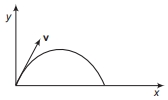
A
$2ab / c$
B
$ab / c$
C
$ac / b$
D
$a / 2bc$
Solution
(A) The instantaneous velocity is given by $v = a \hat{i} + (b - ct) \hat{j}$.
Comparing this with the standard projectile motion equations $v_x = u_x$ and $v_y = u_y - gt$,we get:
Initial horizontal velocity,$u_x = a$
Initial vertical velocity,$u_y = b$
Acceleration due to gravity,$g = c$
For a projectile,the time of flight $T$ is the time when the vertical displacement is zero,or when $v_y$ changes from $b$ to $-b$. Setting $v_y = 0$ at the peak,$b - ct = 0 \implies t = b/c$. Thus,the total time of flight $T = 2t = 2b/c$.
The horizontal range $R$ is given by $R = u_x \times T$.
Substituting the values,$R = a \times (2b/c) = 2ab/c$.
Comparing this with the standard projectile motion equations $v_x = u_x$ and $v_y = u_y - gt$,we get:
Initial horizontal velocity,$u_x = a$
Initial vertical velocity,$u_y = b$
Acceleration due to gravity,$g = c$
For a projectile,the time of flight $T$ is the time when the vertical displacement is zero,or when $v_y$ changes from $b$ to $-b$. Setting $v_y = 0$ at the peak,$b - ct = 0 \implies t = b/c$. Thus,the total time of flight $T = 2t = 2b/c$.
The horizontal range $R$ is given by $R = u_x \times T$.
Substituting the values,$R = a \times (2b/c) = 2ab/c$.
0 likes
View Solution204
DifficultMCQ
$A$ ball is thrown from the ground to clear a wall $3 \, m$ high at a distance of $6 \, m$ and falls $18 \, m$ away from the wall. The angle of projection of the ball is:
A
$\tan^{-1}\left(\frac{3}{2}\right)$
B
$\tan^{-1}\left(\frac{2}{3}\right)$
C
$\tan^{-1}\left(\frac{1}{2}\right)$
D
$\tan^{-1}\left(\frac{3}{4}\right)$
Solution
(B) The total horizontal range $R$ is the distance from the point of projection to the point where the ball falls. Given the wall is at $x = 6 \, m$ and the ball falls $18 \, m$ beyond the wall,the total range is $R = 6 + 18 = 24 \, m$.
The equation of the trajectory is given by $y = x \tan \theta \left(1 - \frac{x}{R}\right)$.
Here,$y = 3 \, m$ at $x = 6 \, m$,and $R = 24 \, m$.
Substituting these values into the equation:
$3 = 6 \tan \theta \left(1 - \frac{6}{24}\right)$
$3 = 6 \tan \theta \left(1 - \frac{1}{4}\right)$
$3 = 6 \tan \theta \left(\frac{3}{4}\right)$
$3 = \frac{18}{4} \tan \theta$
$3 = 4.5 \tan \theta$
$\tan \theta = \frac{3}{4.5} = \frac{30}{45} = \frac{2}{3}$
Therefore,$\theta = \tan^{-1}\left(\frac{2}{3}\right)$.
The equation of the trajectory is given by $y = x \tan \theta \left(1 - \frac{x}{R}\right)$.
Here,$y = 3 \, m$ at $x = 6 \, m$,and $R = 24 \, m$.
Substituting these values into the equation:
$3 = 6 \tan \theta \left(1 - \frac{6}{24}\right)$
$3 = 6 \tan \theta \left(1 - \frac{1}{4}\right)$
$3 = 6 \tan \theta \left(\frac{3}{4}\right)$
$3 = \frac{18}{4} \tan \theta$
$3 = 4.5 \tan \theta$
$\tan \theta = \frac{3}{4.5} = \frac{30}{45} = \frac{2}{3}$
Therefore,$\theta = \tan^{-1}\left(\frac{2}{3}\right)$.
0 likes
View Solution205
MediumMCQ
$A$ ball thrown by one player reaches the other in $2 \, s$. The maximum height attained by the ball above the point of projection will be about .......... $m$.
A
$2.5$
B
$5$
C
$7.5$
D
$10$
Solution
(B) The time of flight $T$ for a projectile is given by $T = \frac{2 u \sin \theta}{g}$.
Given $T = 2 \, s$,we have $2 = \frac{2 u \sin \theta}{g}$,which simplifies to $u \sin \theta = g$.
The maximum height $H$ attained by the projectile is given by $H = \frac{u^2 \sin^2 \theta}{2g}$.
Substituting $u \sin \theta = g$ into the equation for $H$,we get $H = \frac{(g)^2}{2g} = \frac{g}{2}$.
Taking $g = 10 \, m/s^2$,we find $H = \frac{10}{2} = 5 \, m$.
Given $T = 2 \, s$,we have $2 = \frac{2 u \sin \theta}{g}$,which simplifies to $u \sin \theta = g$.
The maximum height $H$ attained by the projectile is given by $H = \frac{u^2 \sin^2 \theta}{2g}$.
Substituting $u \sin \theta = g$ into the equation for $H$,we get $H = \frac{(g)^2}{2g} = \frac{g}{2}$.
Taking $g = 10 \, m/s^2$,we find $H = \frac{10}{2} = 5 \, m$.
0 likes
View Solution206
MediumMCQ
The horizontal range and maximum height attained by a projectile are $R$ and $H$,respectively. If a constant horizontal acceleration $a=g/4$ is imparted to the projectile due to wind,then its horizontal range and maximum height will be
A
$(R+H), \frac{H}{2}$
B
$(R+\frac{H}{2}), 2H$
C
$(R+2H), H$
D
$(R+H), H$
Solution
(D) The vertical motion of the projectile is independent of the horizontal motion. Since the vertical acceleration remains $-g$,the maximum height $H$ remains unchanged.
For the horizontal range,the initial range is $R = u_x T$,where $T = \frac{2 u_y}{g}$ is the time of flight.
The new horizontal range $R^{\prime}$ with horizontal acceleration $a_x = \frac{g}{4}$ is given by:
$R^{\prime} = u_x T + \frac{1}{2} a_x T^2$
Substituting $R = u_x T$ and $T^2 = \frac{4 u_y^2}{g^2}$:
$R^{\prime} = R + \frac{1}{2} \left(\frac{g}{4}\right) \left(\frac{4 u_y^2}{g^2}\right)$
Since $H = \frac{u_y^2}{2g}$,we have $u_y^2 = 2gH$. Substituting this:
$R^{\prime} = R + \frac{g}{8} \left(\frac{4(2gH)}{g^2}\right) = R + \frac{g}{8} \left(\frac{8gH}{g^2}\right) = R + H$
Thus,the new range is $(R+H)$ and the height is $H$.
For the horizontal range,the initial range is $R = u_x T$,where $T = \frac{2 u_y}{g}$ is the time of flight.
The new horizontal range $R^{\prime}$ with horizontal acceleration $a_x = \frac{g}{4}$ is given by:
$R^{\prime} = u_x T + \frac{1}{2} a_x T^2$
Substituting $R = u_x T$ and $T^2 = \frac{4 u_y^2}{g^2}$:
$R^{\prime} = R + \frac{1}{2} \left(\frac{g}{4}\right) \left(\frac{4 u_y^2}{g^2}\right)$
Since $H = \frac{u_y^2}{2g}$,we have $u_y^2 = 2gH$. Substituting this:
$R^{\prime} = R + \frac{g}{8} \left(\frac{4(2gH)}{g^2}\right) = R + \frac{g}{8} \left(\frac{8gH}{g^2}\right) = R + H$
Thus,the new range is $(R+H)$ and the height is $H$.
0 likes
View Solution207
DifficultMCQ
$A$ projectile is thrown with velocity $u$ making an angle $\theta$ with the vertical. It just crosses the tops of two poles each of height $h$ after $1\,s$ and $3\,s$,respectively. The maximum height of the projectile is ............ $m$.
A
$9.8$
B
$19.6$
C
$39.2$
D
$4.9$
Solution
(B) Let the vertical component of velocity be $v_y = u \cos \theta$ (since the angle is with the vertical).
The equation for vertical displacement is $h = v_y t - \frac{1}{2} g t^2$.
For the two poles at times $t_1 = 1\,s$ and $t_2 = 3\,s$:
$h = v_y(1) - \frac{1}{2} g(1)^2$ ... $(1)$
$h = v_y(3) - \frac{1}{2} g(3)^2$ ... $(2)$
Equating $(1)$ and $(2)$: $v_y - 0.5g = 3v_y - 4.5g$.
$2v_y = 4g \implies v_y = 2g = 2 \times 9.8 = 19.6\,m/s$.
Now,find $h$ using $(1)$: $h = 19.6(1) - 4.9(1)^2 = 14.7\,m$.
However,the question asks for the maximum height $H_{max}$ relative to the launch point.
$H_{max} = \frac{v_y^2}{2g} = \frac{(19.6)^2}{2 \times 9.8} = \frac{19.6 \times 19.6}{19.6} = 19.6\,m$.
The equation for vertical displacement is $h = v_y t - \frac{1}{2} g t^2$.
For the two poles at times $t_1 = 1\,s$ and $t_2 = 3\,s$:
$h = v_y(1) - \frac{1}{2} g(1)^2$ ... $(1)$
$h = v_y(3) - \frac{1}{2} g(3)^2$ ... $(2)$
Equating $(1)$ and $(2)$: $v_y - 0.5g = 3v_y - 4.5g$.
$2v_y = 4g \implies v_y = 2g = 2 \times 9.8 = 19.6\,m/s$.
Now,find $h$ using $(1)$: $h = 19.6(1) - 4.9(1)^2 = 14.7\,m$.
However,the question asks for the maximum height $H_{max}$ relative to the launch point.
$H_{max} = \frac{v_y^2}{2g} = \frac{(19.6)^2}{2 \times 9.8} = \frac{19.6 \times 19.6}{19.6} = 19.6\,m$.
0 likes
View Solution208
MediumMCQ
The horizontal range is four times the maximum height attained by a projectile. The angle of projection is .......... $^o$
A
$90$
B
$60$
C
$45$
D
$30$
Solution
(C) Given that the horizontal range $R$ is four times the maximum height $H$,i.e.,$R = 4H$.
The formula for horizontal range is $R = \frac{U^2 \sin(2\theta)}{g} = \frac{2U^2 \sin\theta \cos\theta}{g}$.
The formula for maximum height is $H = \frac{U^2 \sin^2\theta}{2g}$.
Substituting these into the given condition: $\frac{2U^2 \sin\theta \cos\theta}{g} = 4 \times \frac{U^2 \sin^2\theta}{2g}$.
Simplifying the equation: $2 \sin\theta \cos\theta = 2 \sin^2\theta$.
Dividing both sides by $2 \sin\theta$ (assuming $\sin\theta \neq 0$): $\cos\theta = \sin\theta$.
Therefore,$\tan\theta = 1$,which implies $\theta = 45^{\circ}$.
The formula for horizontal range is $R = \frac{U^2 \sin(2\theta)}{g} = \frac{2U^2 \sin\theta \cos\theta}{g}$.
The formula for maximum height is $H = \frac{U^2 \sin^2\theta}{2g}$.
Substituting these into the given condition: $\frac{2U^2 \sin\theta \cos\theta}{g} = 4 \times \frac{U^2 \sin^2\theta}{2g}$.
Simplifying the equation: $2 \sin\theta \cos\theta = 2 \sin^2\theta$.
Dividing both sides by $2 \sin\theta$ (assuming $\sin\theta \neq 0$): $\cos\theta = \sin\theta$.
Therefore,$\tan\theta = 1$,which implies $\theta = 45^{\circ}$.
0 likes
View Solution209
DifficultMCQ
$A$ projectile is thrown in the upward direction making an angle of $60^{\circ}$ with the horizontal direction with a velocity of $150\, ms^{-1}$. Then the time after which its inclination with the horizontal is $45^{\circ}$ is
A
$15(\sqrt{3} - 1)\,s$
B
$15(\sqrt{3} + 1)\,s$
C
$7.5(\sqrt{3} - 1)\,s$
D
$7.5(\sqrt{3} + 1)\,s$
Solution
(C) The horizontal component of velocity remains constant throughout the motion.
$u_x = u \cos 60^{\circ} = 150 \times \frac{1}{2} = 75\, ms^{-1}$.
Let the velocity at time $t$ be $v$. At this time,the angle with the horizontal is $45^{\circ}$.
The horizontal component of velocity at time $t$ is $v_x = v \cos 45^{\circ}$.
Since $v_x = u_x$,we have $v \cos 45^{\circ} = 75$,so $v = \frac{75}{\cos 45^{\circ}} = 75\sqrt{2}\, ms^{-1}$.
The vertical component of velocity at time $t$ is $v_y = v \sin 45^{\circ} = 75\sqrt{2} \times \frac{1}{\sqrt{2}} = 75\, ms^{-1}$.
Using the equation $v_y = u_y - gt$,where $u_y = u \sin 60^{\circ} = 150 \times \frac{\sqrt{3}}{2} = 75\sqrt{3}\, ms^{-1}$:
$75 = 75\sqrt{3} - 10t$.
$10t = 75(\sqrt{3} - 1)$.
$t = 7.5(\sqrt{3} - 1)\,s$.
$u_x = u \cos 60^{\circ} = 150 \times \frac{1}{2} = 75\, ms^{-1}$.
Let the velocity at time $t$ be $v$. At this time,the angle with the horizontal is $45^{\circ}$.
The horizontal component of velocity at time $t$ is $v_x = v \cos 45^{\circ}$.
Since $v_x = u_x$,we have $v \cos 45^{\circ} = 75$,so $v = \frac{75}{\cos 45^{\circ}} = 75\sqrt{2}\, ms^{-1}$.
The vertical component of velocity at time $t$ is $v_y = v \sin 45^{\circ} = 75\sqrt{2} \times \frac{1}{\sqrt{2}} = 75\, ms^{-1}$.
Using the equation $v_y = u_y - gt$,where $u_y = u \sin 60^{\circ} = 150 \times \frac{\sqrt{3}}{2} = 75\sqrt{3}\, ms^{-1}$:
$75 = 75\sqrt{3} - 10t$.
$10t = 75(\sqrt{3} - 1)$.
$t = 7.5(\sqrt{3} - 1)\,s$.
0 likes
View Solution210
MediumMCQ
For a projectile,the ratio of the maximum height reached to the square of the time of flight is:
A
$5 : 4$
B
$5 : 2$
C
$5 : 1$
D
$10 : 1$
Solution
(A) The time of flight $T$ is given by $T = \frac{2u \sin \theta}{g}$.
The maximum height $H$ is given by $H = \frac{u^2 \sin^2 \theta}{2g}$.
We need to find the ratio $\frac{H}{T^2}$.
$\frac{H}{T^2} = \frac{\frac{u^2 \sin^2 \theta}{2g}}{(\frac{2u \sin \theta}{g})^2} = \frac{u^2 \sin^2 \theta}{2g} \times \frac{g^2}{4u^2 \sin^2 \theta}$.
Simplifying the expression,we get $\frac{H}{T^2} = \frac{g}{8}$.
Taking $g = 10 \ m/s^2$,the ratio is $\frac{10}{8} = \frac{5}{4}$.
The maximum height $H$ is given by $H = \frac{u^2 \sin^2 \theta}{2g}$.
We need to find the ratio $\frac{H}{T^2}$.
$\frac{H}{T^2} = \frac{\frac{u^2 \sin^2 \theta}{2g}}{(\frac{2u \sin \theta}{g})^2} = \frac{u^2 \sin^2 \theta}{2g} \times \frac{g^2}{4u^2 \sin^2 \theta}$.
Simplifying the expression,we get $\frac{H}{T^2} = \frac{g}{8}$.
Taking $g = 10 \ m/s^2$,the ratio is $\frac{10}{8} = \frac{5}{4}$.
0 likes
View Solution211
MediumMCQ
$A$ particle is projected horizontally from a tower with velocity $10\,m/s$. Taking $g=10\,m/s^2$,match the following two columns at time $t=1\,s$.
| Column $I$ | Column $II$ |
| $(A)$ Horizontal component of velocity | $(p)$ $5$ $SI$ unit |
| $(B)$ Vertical component of velocity | $(q)$ $10$ $SI$ unit |
| $(C)$ Horizontal displacement | $(r)$ $15$ $SI$ unit |
| $(D)$ Vertical displacement | $(s)$ $20$ $SI$ unit |
A
$(A \rightarrow q, B \rightarrow q, C \rightarrow q, D \rightarrow p)$
B
$(A \rightarrow q, B \rightarrow r, C \rightarrow q, D \rightarrow p)$
C
$(A \rightarrow q, B \rightarrow s, C \rightarrow q, D \rightarrow p)$
D
$(A \rightarrow s, B \rightarrow q, C \rightarrow q, D \rightarrow p)$
Solution
(A) Given:
Initial horizontal velocity $u_x = 10\,m/s$.
Initial vertical velocity $u_y = 0\,m/s$.
Acceleration due to gravity $g = 10\,m/s^2$.
Time $t = 1\,s$.
$(A)$ Horizontal component of velocity $(v_x)$: In projectile motion,horizontal velocity remains constant. So,$v_x = u_x = 10\,m/s$. Matches with $(q)$.
$(B)$ Vertical component of velocity $(v_y)$: Using $v_y = u_y + g_y t$,where $g_y = g = 10\,m/s^2$. So,$v_y = 0 + 10(1) = 10\,m/s$. Matches with $(q)$.
$(C)$ Horizontal displacement $(x)$: $x = u_x t = 10(1) = 10\,m$. Matches with $(q)$.
$(D)$ Vertical displacement $(y)$: $y = u_y t + \frac{1}{2} g t^2 = 0(1) + \frac{1}{2}(10)(1)^2 = 5\,m$. Matches with $(p)$.
Therefore,the correct matching is $(A \rightarrow q, B \rightarrow q, C \rightarrow q, D \rightarrow p)$.
Initial horizontal velocity $u_x = 10\,m/s$.
Initial vertical velocity $u_y = 0\,m/s$.
Acceleration due to gravity $g = 10\,m/s^2$.
Time $t = 1\,s$.
$(A)$ Horizontal component of velocity $(v_x)$: In projectile motion,horizontal velocity remains constant. So,$v_x = u_x = 10\,m/s$. Matches with $(q)$.
$(B)$ Vertical component of velocity $(v_y)$: Using $v_y = u_y + g_y t$,where $g_y = g = 10\,m/s^2$. So,$v_y = 0 + 10(1) = 10\,m/s$. Matches with $(q)$.
$(C)$ Horizontal displacement $(x)$: $x = u_x t = 10(1) = 10\,m$. Matches with $(q)$.
$(D)$ Vertical displacement $(y)$: $y = u_y t + \frac{1}{2} g t^2 = 0(1) + \frac{1}{2}(10)(1)^2 = 5\,m$. Matches with $(p)$.
Therefore,the correct matching is $(A \rightarrow q, B \rightarrow q, C \rightarrow q, D \rightarrow p)$.
0 likes
View Solution212
MediumMCQ
$A$ boy throws a ball upwards with velocity $v_0 = 20\, m/s$. The wind imparts a horizontal acceleration of $4\, m/s^2$ to the ball. The angle $\theta$ from the vertical at which the ball must be thrown so that the ball returns to the boy's hand is $(g = 10\, m/s^2)$
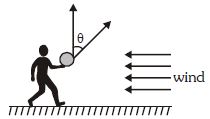
A
$tan^{-1} (1.2)$
B
$tan^{-1} (0.2)$
C
$tan^{-1} (2)$
D
$tan^{-1} (0.4)$
Solution
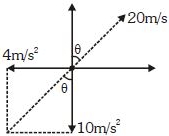
(D) For the ball to return to the boy's hand,the net displacement of the ball must be zero. This implies that the path of the ball must be a straight line relative to the boy.
This is possible only if the initial velocity vector and the net acceleration vector are collinear (acting along the same line).
Let the initial velocity be $\vec{v}_0$ at an angle $\theta$ with the vertical.
The horizontal component of acceleration is $a_x = 4\, m/s^2$ and the vertical component is $a_y = g = 10\, m/s^2$ (downwards).
The net acceleration vector $\vec{a}$ makes an angle $\alpha$ with the vertical,where $\tan \alpha = \frac{a_x}{a_y} = \frac{4}{10} = 0.4$.
Since the initial velocity must be in the same direction as the acceleration for the ball to return to the starting point,the angle $\theta$ with the vertical must be equal to $\alpha$.
Therefore,$\theta = \tan^{-1} (0.4)$.
This is possible only if the initial velocity vector and the net acceleration vector are collinear (acting along the same line).
Let the initial velocity be $\vec{v}_0$ at an angle $\theta$ with the vertical.
The horizontal component of acceleration is $a_x = 4\, m/s^2$ and the vertical component is $a_y = g = 10\, m/s^2$ (downwards).
The net acceleration vector $\vec{a}$ makes an angle $\alpha$ with the vertical,where $\tan \alpha = \frac{a_x}{a_y} = \frac{4}{10} = 0.4$.
Since the initial velocity must be in the same direction as the acceleration for the ball to return to the starting point,the angle $\theta$ with the vertical must be equal to $\alpha$.
Therefore,$\theta = \tan^{-1} (0.4)$.
0 likes
View Solution213
DifficultMCQ
The angular momentum of a projectile projected at an angle $\theta$ with the horizontal with speed $u$ about the point of projection when it is at the highest point of its trajectory is
A
$\frac{mu \sin \theta}{g}$
B
$\frac{mu^3 \cos \theta \sin 2\theta}{2g}$
C
$\frac{mu^3 \sin \theta \sin 2\theta}{2g}$
D
$\frac{mu^3 \sin \theta \sin 2\theta}{4g}$
Solution
(D) The angular momentum $L$ about the point of projection is given by $L = m(\vec{r} \times \vec{v})$.
At the highest point, the velocity is $v = u \cos \theta$ (horizontal direction).
The perpendicular distance from the point of projection to the velocity vector is the maximum height $H_{\max} = \frac{u^2 \sin^2 \theta}{2g}$.
Thus, $L = m(u \cos \theta) \times H_{\max}$.
Substituting $H_{\max}$, we get $L = m(u \cos \theta) \left( \frac{u^2 \sin^2 \theta}{2g} \right) = \frac{m u^3 \cos \theta \sin^2 \theta}{2g}$.
Using the identity $\sin 2\theta = 2 \sin \theta \cos \theta$, we can write $\cos \theta \sin \theta = \frac{\sin 2\theta}{2}$.
Substituting this into the expression: $L = \frac{m u^3 \sin \theta}{2g} \left( \frac{\sin 2\theta}{2} \right) = \frac{m u^3 \sin \theta \sin 2\theta}{4g}$.
At the highest point, the velocity is $v = u \cos \theta$ (horizontal direction).
The perpendicular distance from the point of projection to the velocity vector is the maximum height $H_{\max} = \frac{u^2 \sin^2 \theta}{2g}$.
Thus, $L = m(u \cos \theta) \times H_{\max}$.
Substituting $H_{\max}$, we get $L = m(u \cos \theta) \left( \frac{u^2 \sin^2 \theta}{2g} \right) = \frac{m u^3 \cos \theta \sin^2 \theta}{2g}$.
Using the identity $\sin 2\theta = 2 \sin \theta \cos \theta$, we can write $\cos \theta \sin \theta = \frac{\sin 2\theta}{2}$.
Substituting this into the expression: $L = \frac{m u^3 \sin \theta}{2g} \left( \frac{\sin 2\theta}{2} \right) = \frac{m u^3 \sin \theta \sin 2\theta}{4g}$.
0 likes
View Solution214
MediumMCQ
If $R$ and $H$ represent the horizontal range and the maximum height achieved by a projectile,then which of the following relations exists?
A
$\frac{H}{R} = 4 \cot \theta$
B
$\frac{R}{H} = 4 \cot \theta$
C
$\frac{H}{R} = 4 \tan \theta$
D
$\frac{R}{H} = 4 \tan \theta$
Solution
(B) The horizontal range $R$ of a projectile is given by: $R = \frac{u^2 \sin 2\theta}{g} = \frac{2u^2 \sin \theta \cos \theta}{g}$.
The maximum height $H$ of a projectile is given by: $H = \frac{u^2 \sin^2 \theta}{2g}$.
Dividing $H$ by $R$:
$\frac{H}{R} = \frac{u^2 \sin^2 \theta}{2g} \times \frac{g}{2u^2 \sin \theta \cos \theta}$.
Simplifying the expression:
$\frac{H}{R} = \frac{\sin \theta}{4 \cos \theta} = \frac{1}{4} \tan \theta$.
Therefore,$\frac{R}{H} = \frac{4}{\tan \theta} = 4 \cot \theta$.
The maximum height $H$ of a projectile is given by: $H = \frac{u^2 \sin^2 \theta}{2g}$.
Dividing $H$ by $R$:
$\frac{H}{R} = \frac{u^2 \sin^2 \theta}{2g} \times \frac{g}{2u^2 \sin \theta \cos \theta}$.
Simplifying the expression:
$\frac{H}{R} = \frac{\sin \theta}{4 \cos \theta} = \frac{1}{4} \tan \theta$.
Therefore,$\frac{R}{H} = \frac{4}{\tan \theta} = 4 \cot \theta$.
0 likes
View Solution215
MediumMCQ
For a given angle of the projectile,if the initial velocity is doubled,the range of the projectile becomes:
A
Half
B
One-fourth
C
Two times
D
Four times
Solution
(D) The formula for the horizontal range $R$ of a projectile is given by:
$R = \frac{u^2 \sin(2\theta)}{g}$
where $u$ is the initial velocity,$\theta$ is the angle of projection,and $g$ is the acceleration due to gravity.
If the initial velocity is doubled,the new velocity $u' = 2u$.
The new range $R'$ is:
$R' = \frac{(2u)^2 \sin(2\theta)}{g} = \frac{4u^2 \sin(2\theta)}{g}$
$R' = 4 \times \left( \frac{u^2 \sin(2\theta)}{g} \right) = 4R$
Therefore,the range becomes four times the original range.
$R = \frac{u^2 \sin(2\theta)}{g}$
where $u$ is the initial velocity,$\theta$ is the angle of projection,and $g$ is the acceleration due to gravity.
If the initial velocity is doubled,the new velocity $u' = 2u$.
The new range $R'$ is:
$R' = \frac{(2u)^2 \sin(2\theta)}{g} = \frac{4u^2 \sin(2\theta)}{g}$
$R' = 4 \times \left( \frac{u^2 \sin(2\theta)}{g} \right) = 4R$
Therefore,the range becomes four times the original range.
0 likes
View Solution216
MediumMCQ
If we can throw a ball up to a maximum height $H$,the maximum horizontal distance to which we can throw it is
A
$2H$
B
$\sqrt{2}H$
C
$H$
D
$\frac{H}{2}$
Solution
(A) The maximum height $H$ attained by a projectile thrown with initial velocity $u$ at an angle $\theta = 90^{\circ}$ is given by:
$H = \frac{u^2}{2g}$
From this,we can express the square of the initial velocity as:
$u^2 = 2gH$
For maximum horizontal range $R_{\max}$,the projectile must be thrown at an angle $\theta = 45^{\circ}$. The formula for maximum horizontal range is:
$R_{\max} = \frac{u^2}{g}$
Substituting the value of $u^2$ from the height equation:
$R_{\max} = \frac{2gH}{g} = 2H$
Therefore,the maximum horizontal distance is $2H$.
$H = \frac{u^2}{2g}$
From this,we can express the square of the initial velocity as:
$u^2 = 2gH$
For maximum horizontal range $R_{\max}$,the projectile must be thrown at an angle $\theta = 45^{\circ}$. The formula for maximum horizontal range is:
$R_{\max} = \frac{u^2}{g}$
Substituting the value of $u^2$ from the height equation:
$R_{\max} = \frac{2gH}{g} = 2H$
Therefore,the maximum horizontal distance is $2H$.
0 likes
View Solution217
DifficultMCQ
$A$ projectile can have the same range for two angles of projection. If $h_1$ and $h_2$ are the maximum heights when the range in the two cases is $R$,then the relation between $R$,$h_1$,and $h_2$ is:
A
$R = 4\sqrt{h_1 h_2}$
B
$R = 2\sqrt{h_1 h_2}$
C
$R = \sqrt{h_1 h_2}$
D
None of these
Solution
(A) The maximum height $h$ for a projectile is given by $h = \frac{u^2 \sin^2 \theta}{2g}$.
For two angles of projection $\theta$ and $(90^\circ - \theta)$,the range $R$ is the same,given by $R = \frac{u^2 \sin 2\theta}{g}$.
Let $h_1 = \frac{u^2 \sin^2 \theta}{2g}$ and $h_2 = \frac{u^2 \sin^2(90^\circ - \theta)}{2g} = \frac{u^2 \cos^2 \theta}{2g}$.
Multiplying $h_1$ and $h_2$:
$h_1 h_2 = \left( \frac{u^2 \sin^2 \theta}{2g} \right) \left( \frac{u^2 \cos^2 \theta}{2g} \right) = \frac{u^4 \sin^2 \theta \cos^2 \theta}{4g^2}$.
Since $R = \frac{u^2 (2 \sin \theta \cos \theta)}{g}$,we have $R^2 = \frac{u^4 (4 \sin^2 \theta \cos^2 \theta)}{g^2}$.
Thus,$h_1 h_2 = \frac{u^4 \sin^2 \theta \cos^2 \theta}{4g^2} = \frac{R^2}{16}$.
Therefore,$R^2 = 16 h_1 h_2$,which implies $R = 4 \sqrt{h_1 h_2}$.
For two angles of projection $\theta$ and $(90^\circ - \theta)$,the range $R$ is the same,given by $R = \frac{u^2 \sin 2\theta}{g}$.
Let $h_1 = \frac{u^2 \sin^2 \theta}{2g}$ and $h_2 = \frac{u^2 \sin^2(90^\circ - \theta)}{2g} = \frac{u^2 \cos^2 \theta}{2g}$.
Multiplying $h_1$ and $h_2$:
$h_1 h_2 = \left( \frac{u^2 \sin^2 \theta}{2g} \right) \left( \frac{u^2 \cos^2 \theta}{2g} \right) = \frac{u^4 \sin^2 \theta \cos^2 \theta}{4g^2}$.
Since $R = \frac{u^2 (2 \sin \theta \cos \theta)}{g}$,we have $R^2 = \frac{u^4 (4 \sin^2 \theta \cos^2 \theta)}{g^2}$.
Thus,$h_1 h_2 = \frac{u^4 \sin^2 \theta \cos^2 \theta}{4g^2} = \frac{R^2}{16}$.
Therefore,$R^2 = 16 h_1 h_2$,which implies $R = 4 \sqrt{h_1 h_2}$.
0 likes
View Solution218
EasyMCQ
$A$ bomb is released from a horizontal flying aeroplane. The trajectory of the bomb is
A
a parabola
B
a straight line
C
a circle
D
a hyperbola
Solution
(A) When a bomb is released from a horizontally flying aeroplane,it possesses the same horizontal velocity as the aeroplane at the moment of release.
Due to gravity,it experiences a constant downward acceleration $(g)$.
The horizontal motion is uniform (constant velocity),while the vertical motion is uniformly accelerated.
The combination of these two independent motions results in a path that is a parabola.
Due to gravity,it experiences a constant downward acceleration $(g)$.
The horizontal motion is uniform (constant velocity),while the vertical motion is uniformly accelerated.
The combination of these two independent motions results in a path that is a parabola.
0 likes
View Solution219
MediumMCQ
Two projectiles are fired from the same point with the same speed at angles of projection $60^\circ$ and $30^\circ$ respectively. Which one of the following is true?
A
Their maximum height will be same
B
Their range will be same
C
Their landing velocity will be same
D
Their time of flight will be same
Solution
(B) The horizontal range $R$ of a projectile is given by the formula $R = \frac{u^2 \sin(2\theta)}{g}$,where $u$ is the initial speed and $\theta$ is the angle of projection.
For the first projectile: $\theta_1 = 60^\circ$. Thus,$R_1 = \frac{u^2 \sin(2 \times 60^\circ)}{g} = \frac{u^2 \sin(120^\circ)}{g} = \frac{u^2 \sin(60^\circ)}{g} = \frac{u^2 \sqrt{3}}{2g}$.
For the second projectile: $\theta_2 = 30^\circ$. Thus,$R_2 = \frac{u^2 \sin(2 \times 30^\circ)}{g} = \frac{u^2 \sin(60^\circ)}{g} = \frac{u^2 \sqrt{3}}{2g}$.
Since $\sin(2 \times 60^\circ) = \sin(120^\circ) = \sin(60^\circ) = \sin(2 \times 30^\circ)$,the ranges are equal when the sum of the angles is $90^\circ$ (complementary angles). Therefore,their range will be same.
For the first projectile: $\theta_1 = 60^\circ$. Thus,$R_1 = \frac{u^2 \sin(2 \times 60^\circ)}{g} = \frac{u^2 \sin(120^\circ)}{g} = \frac{u^2 \sin(60^\circ)}{g} = \frac{u^2 \sqrt{3}}{2g}$.
For the second projectile: $\theta_2 = 30^\circ$. Thus,$R_2 = \frac{u^2 \sin(2 \times 30^\circ)}{g} = \frac{u^2 \sin(60^\circ)}{g} = \frac{u^2 \sqrt{3}}{2g}$.
Since $\sin(2 \times 60^\circ) = \sin(120^\circ) = \sin(60^\circ) = \sin(2 \times 30^\circ)$,the ranges are equal when the sum of the angles is $90^\circ$ (complementary angles). Therefore,their range will be same.
0 likes
View Solution220
DifficultMCQ
$A$ ball is thrown from a point with a speed $v_0$ at an elevation angle of $\theta$. From the same point and at the same instant,a person starts running with a constant speed $\frac{v_0}{2}$ to catch the ball. Will the person be able to catch the ball? If yes,what should be the angle of projection $\theta$?
A
No
B
Yes,$30^o$
C
Yes,$60^o$
D
Yes,$45^o$
Solution
(C) For the person to catch the ball,the horizontal component of the ball's velocity must be equal to the constant speed of the person.
This ensures that the ball remains directly above the person throughout the flight,meaning the ball's motion relative to the person is purely vertical.
Equating the horizontal velocity of the ball to the speed of the person:
$v_0 \cos \theta = \frac{v_0}{2}$
Dividing both sides by $v_0$:
$\cos \theta = \frac{1}{2}$
Therefore,$\theta = \cos^{-1}(\frac{1}{2}) = 60^o$.
Thus,the person will be able to catch the ball if the angle of projection is $60^o$.
This ensures that the ball remains directly above the person throughout the flight,meaning the ball's motion relative to the person is purely vertical.
Equating the horizontal velocity of the ball to the speed of the person:
$v_0 \cos \theta = \frac{v_0}{2}$
Dividing both sides by $v_0$:
$\cos \theta = \frac{1}{2}$
Therefore,$\theta = \cos^{-1}(\frac{1}{2}) = 60^o$.
Thus,the person will be able to catch the ball if the angle of projection is $60^o$.
0 likes
View Solution221
MediumMCQ
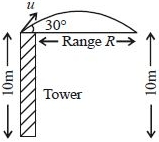
$A$ boy playing on the roof of a $10\, m$ high building throws a ball with a speed of $10\, m/s$ at an angle of $30^o$ with the horizontal. How far from the throwing point will the ball be at the height of $10\, m$ from the ground? $\left[ g = 10\, m/s^2, \sin 30^o = \frac{1}{2}, \cos 30^o = \frac{\sqrt{3}}{2} \right]$
A
$5\sqrt{5}$
B
$6$
C
$3$
D
$5\sqrt{3}$
Solution
(D) The boy throws the ball from the roof of a building of height $10\, m$. We need to find the horizontal distance from the throwing point when the ball is at a height of $10\, m$ from the ground.
Since the ball is thrown from a height of $10\, m$ and we are looking for the distance when it is again at a height of $10\, m$,this corresponds to the horizontal range of the projectile on a horizontal plane passing through the point of projection.
The formula for the horizontal range $R$ is given by:
$R = \frac{u^2 \sin(2\theta)}{g}$
Given:
Initial speed $u = 10\, m/s$
Angle of projection $\theta = 30^o$
Acceleration due to gravity $g = 10\, m/s^2$
Substituting the values:
$R = \frac{(10)^2 \sin(2 \times 30^o)}{10} = \frac{100 \times \sin(60^o)}{10} = 10 \times \frac{\sqrt{3}}{2} = 5\sqrt{3}\, m$
Thus,the ball will be at a distance of $5\sqrt{3}\, m$ from the throwing point.
Since the ball is thrown from a height of $10\, m$ and we are looking for the distance when it is again at a height of $10\, m$,this corresponds to the horizontal range of the projectile on a horizontal plane passing through the point of projection.
The formula for the horizontal range $R$ is given by:
$R = \frac{u^2 \sin(2\theta)}{g}$
Given:
Initial speed $u = 10\, m/s$
Angle of projection $\theta = 30^o$
Acceleration due to gravity $g = 10\, m/s^2$
Substituting the values:
$R = \frac{(10)^2 \sin(2 \times 30^o)}{10} = \frac{100 \times \sin(60^o)}{10} = 10 \times \frac{\sqrt{3}}{2} = 5\sqrt{3}\, m$
Thus,the ball will be at a distance of $5\sqrt{3}\, m$ from the throwing point.
0 likes
View Solution222
MediumMCQ
Two bullets are fired horizontally and simultaneously towards each other from the rooftops of two buildings $100 \; m$ apart and of the same height of $200 \; m$ with the same velocity of $25 \; m/s$. When and where will the two bullets collide? $(g = 10 \; m/s^2)$
A
after $2 \; s$ at a height of $180 \; m$
B
after $2 \; s$ at a height of $20 \; m$
C
after $4 \; s$ at a height of $120 \; m$
D
they will not collide
Solution
(A) The horizontal distance between the two buildings is $d = 100 \; m$. The bullets are fired towards each other with a horizontal velocity $v = 25 \; m/s$ each.
The relative horizontal velocity is $v_{rel} = v_1 + v_2 = 25 + 25 = 50 \; m/s$.
The time taken for the bullets to collide is $t = \frac{d}{v_{rel}} = \frac{100}{50} = 2 \; s$.
In this time,both bullets fall vertically due to gravity. The vertical displacement $s_y$ is given by $s_y = -\frac{1}{2} gt^2$.
Substituting the values: $s_y = -\frac{1}{2} \times 10 \times (2)^2 = -5 \times 4 = -20 \; m$.
The height of the collision from the ground is $H_{collision} = H_{initial} + s_y = 200 - 20 = 180 \; m$.
Thus,the bullets collide after $2 \; s$ at a height of $180 \; m$.
The relative horizontal velocity is $v_{rel} = v_1 + v_2 = 25 + 25 = 50 \; m/s$.
The time taken for the bullets to collide is $t = \frac{d}{v_{rel}} = \frac{100}{50} = 2 \; s$.
In this time,both bullets fall vertically due to gravity. The vertical displacement $s_y$ is given by $s_y = -\frac{1}{2} gt^2$.
Substituting the values: $s_y = -\frac{1}{2} \times 10 \times (2)^2 = -5 \times 4 = -20 \; m$.
The height of the collision from the ground is $H_{collision} = H_{initial} + s_y = 200 - 20 = 180 \; m$.
Thus,the bullets collide after $2 \; s$ at a height of $180 \; m$.
3 likes
View Solution223
Medium
Galileo,in his book $Two \text{ } new \text{ } sciences$,stated that "for elevations which exceed or fall short of $45^{\circ}$ by equal amounts,the ranges are equal". Prove this statement.
Solution
(N/A) The horizontal range $R$ of a projectile launched with initial velocity $v_{o}$ at an angle $\theta_{o}$ is given by the formula:
$R = \frac{v_{o}^{2} \sin(2\theta_{o})}{g}$
Consider two angles of projection,$\theta_{1} = 45^{\circ} + \alpha$ and $\theta_{2} = 45^{\circ} - \alpha$,where $\alpha$ is the equal amount by which they exceed or fall short of $45^{\circ}$.
For $\theta_{1} = 45^{\circ} + \alpha$,the range $R_{1}$ is:
$R_{1} = \frac{v_{o}^{2} \sin(2(45^{\circ} + \alpha))}{g} = \frac{v_{o}^{2} \sin(90^{\circ} + 2\alpha)}{g} = \frac{v_{o}^{2} \cos(2\alpha)}{g}$
For $\theta_{2} = 45^{\circ} - \alpha$,the range $R_{2}$ is:
$R_{2} = \frac{v_{o}^{2} \sin(2(45^{\circ} - \alpha))}{g} = \frac{v_{o}^{2} \sin(90^{\circ} - 2\alpha)}{g} = \frac{v_{o}^{2} \cos(2\alpha)}{g}$
Since $R_{1} = R_{2}$,it is proven that for elevations which exceed or fall short of $45^{\circ}$ by equal amounts,the ranges are equal.
$R = \frac{v_{o}^{2} \sin(2\theta_{o})}{g}$
Consider two angles of projection,$\theta_{1} = 45^{\circ} + \alpha$ and $\theta_{2} = 45^{\circ} - \alpha$,where $\alpha$ is the equal amount by which they exceed or fall short of $45^{\circ}$.
For $\theta_{1} = 45^{\circ} + \alpha$,the range $R_{1}$ is:
$R_{1} = \frac{v_{o}^{2} \sin(2(45^{\circ} + \alpha))}{g} = \frac{v_{o}^{2} \sin(90^{\circ} + 2\alpha)}{g} = \frac{v_{o}^{2} \cos(2\alpha)}{g}$
For $\theta_{2} = 45^{\circ} - \alpha$,the range $R_{2}$ is:
$R_{2} = \frac{v_{o}^{2} \sin(2(45^{\circ} - \alpha))}{g} = \frac{v_{o}^{2} \sin(90^{\circ} - 2\alpha)}{g} = \frac{v_{o}^{2} \cos(2\alpha)}{g}$
Since $R_{1} = R_{2}$,it is proven that for elevations which exceed or fall short of $45^{\circ}$ by equal amounts,the ranges are equal.
0 likes
View Solution224
Medium
$A$ cricket ball is thrown at a speed of $28 \; m/s$ in a direction $30^{\circ}$ above the horizontal. Calculate:
$(a)$ the maximum height,
$(b)$ the time taken by the ball to return to the same level,and
$(c)$ the distance from the thrower to the point where the ball returns to the same level.
$(a)$ the maximum height,
$(b)$ the time taken by the ball to return to the same level,and
$(c)$ the distance from the thrower to the point where the ball returns to the same level.
Solution
(N/A) The maximum height is given by $h_{m} = \frac{(v_{0} \sin \theta_{0})^{2}}{2g} = \frac{(28 \sin 30^{\circ})^{2}}{2 \times 9.8} = \frac{14 \times 14}{19.6} = 10.0 \; m$.
$(b)$ The time taken to return to the same level (time of flight) is $T_{f} = \frac{2 v_{0} \sin \theta_{0}}{g} = \frac{2 \times 28 \times \sin 30^{\circ}}{9.8} = \frac{28}{9.8} \approx 2.86 \; s$ (rounded to $2.9 \; s$).
$(c)$ The horizontal range is $R = \frac{v_{0}^{2} \sin 2\theta_{0}}{g} = \frac{28^{2} \times \sin 60^{\circ}}{9.8} = \frac{784 \times 0.866}{9.8} \approx 69.28 \; m$ (rounded to $69 \; m$).
$(b)$ The time taken to return to the same level (time of flight) is $T_{f} = \frac{2 v_{0} \sin \theta_{0}}{g} = \frac{2 \times 28 \times \sin 30^{\circ}}{9.8} = \frac{28}{9.8} \approx 2.86 \; s$ (rounded to $2.9 \; s$).
$(c)$ The horizontal range is $R = \frac{v_{0}^{2} \sin 2\theta_{0}}{g} = \frac{28^{2} \times \sin 60^{\circ}}{9.8} = \frac{784 \times 0.866}{9.8} \approx 69.28 \; m$ (rounded to $69 \; m$).
0 likes
View Solution225
MediumMCQ
The ceiling of a long hall is $25\; m$ high. What is the maximum horizontal distance that a ball thrown with a speed of $40\; m/s$ can go without hitting the ceiling of the hall (in $; m$)?
A
$150.53$
B
$140.53$
C
$160.53$
D
$130.53$
Solution
(A) Given: Speed of the ball,$u = 40\; m/s$. Maximum height,$h = 25\; m$. Acceleration due to gravity,$g = 9.8\; m/s^2$.
In projectile motion,the maximum height reached by a body projected at an angle $\theta$ is given by the relation:
$h = \frac{u^2 \sin^2 \theta}{2g}$
Substituting the values:
$25 = \frac{(40)^2 \sin^2 \theta}{2 \times 9.8}$
$25 = \frac{1600 \sin^2 \theta}{19.6}$
$\sin^2 \theta = \frac{25 \times 19.6}{1600} = 0.30625$
$\sin \theta = \sqrt{0.30625} = 0.5534$
$\theta = \sin^{-1}(0.5534) = 33.60^{\circ}$
The horizontal range $R$ is given by:
$R = \frac{u^2 \sin(2\theta)}{g}$
$R = \frac{(40)^2 \sin(2 \times 33.60^{\circ})}{9.8}$
$R = \frac{1600 \times \sin(67.2^{\circ})}{9.8}$
$R = \frac{1600 \times 0.9219}{9.8} \approx 150.53\; m$.
In projectile motion,the maximum height reached by a body projected at an angle $\theta$ is given by the relation:
$h = \frac{u^2 \sin^2 \theta}{2g}$
Substituting the values:
$25 = \frac{(40)^2 \sin^2 \theta}{2 \times 9.8}$
$25 = \frac{1600 \sin^2 \theta}{19.6}$
$\sin^2 \theta = \frac{25 \times 19.6}{1600} = 0.30625$
$\sin \theta = \sqrt{0.30625} = 0.5534$
$\theta = \sin^{-1}(0.5534) = 33.60^{\circ}$
The horizontal range $R$ is given by:
$R = \frac{u^2 \sin(2\theta)}{g}$
$R = \frac{(40)^2 \sin(2 \times 33.60^{\circ})}{9.8}$
$R = \frac{1600 \times \sin(67.2^{\circ})}{9.8}$
$R = \frac{1600 \times 0.9219}{9.8} \approx 150.53\; m$.
0 likes
View Solution226
MediumMCQ
$A$ cricketer can throw a ball to a maximum horizontal distance of $100 \; m$. How much high above (in $m$) the ground can the cricketer throw the same ball?
A
$40$
B
$50$
C
$60$
D
$100$
Solution
(B) The maximum horizontal range $R$ is given by $R = \frac{u^2}{g}$,where $u$ is the initial velocity and $g$ is the acceleration due to gravity. Given $R = 100 \; m$,we have $\frac{u^2}{g} = 100 \; m$.
To achieve the maximum vertical height $H$,the ball must be thrown vertically upward at an angle of $90^{\circ}$.
The formula for maximum vertical height is $H = \frac{u^2}{2g}$.
Substituting the value of $\frac{u^2}{g} = 100 \; m$ into the height formula:
$H = \frac{1}{2} \times \left( \frac{u^2}{g} \right) = \frac{1}{2} \times 100 \; m = 50 \; m$.
Thus,the cricketer can throw the ball to a maximum height of $50 \; m$.
To achieve the maximum vertical height $H$,the ball must be thrown vertically upward at an angle of $90^{\circ}$.
The formula for maximum vertical height is $H = \frac{u^2}{2g}$.
Substituting the value of $\frac{u^2}{g} = 100 \; m$ into the height formula:
$H = \frac{1}{2} \times \left( \frac{u^2}{g} \right) = \frac{1}{2} \times 100 \; m = 50 \; m$.
Thus,the cricketer can throw the ball to a maximum height of $50 \; m$.
0 likes
View Solution227
Medium
$A$ bob of mass $0.1\; kg$ hung from the ceiling of a room by a string $2\; m$ long is set into oscillation. The speed of the bob at its mean position is $1\; m s^{-1}$. What is the trajectory of the bob if the string is cut when the bob is
$(a)$ at one of its extreme positions,
$(b)$ at its mean position.
$(a)$ at one of its extreme positions,
$(b)$ at its mean position.
Solution
(N/A) At the extreme position,the velocity of the bob is zero. If the string is cut at this moment,the bob will fall vertically downward under the influence of gravity. The trajectory is a straight line.
$(b)$ At the mean position,the velocity of the bob is $1\; m s^{-1}$ in the horizontal direction. If the string is cut at this moment,the bob will have an initial horizontal velocity and will be subject to gravity. Therefore,it will follow a parabolic trajectory.
$(b)$ At the mean position,the velocity of the bob is $1\; m s^{-1}$ in the horizontal direction. If the string is cut at this moment,the bob will have an initial horizontal velocity and will be subject to gravity. Therefore,it will follow a parabolic trajectory.
0 likes
View Solution228
Medium
What do you mean by projectile motion and projectile particle? Find the value of the position of a projectile particle at any instant of time.
Solution
(N/A) Projectile Motion: When an object is thrown into the Earth's gravitational field,it moves with a constant horizontal velocity and a constant vertical acceleration. Such a two-dimensional motion is called projectile motion,and the object is called a projectile.
For example,when we kick a football,it performs projectile motion if air resistance is neglected.
$A$ projectile has motion along a horizontal path with uniform velocity $(a_x = 0)$.
$A$ projectile has motion along a vertical path under gravity with uniform acceleration equal to $g$ $(a_y = -g)$.
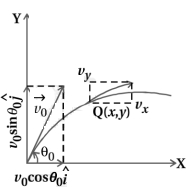
Suppose the projectile is launched with velocity $\vec{v}_0$ at an angle $\theta_0$ with the $X$-axis. The acceleration is $\vec{a} = -g \hat{j}$.
The initial velocity components are:
$v_{0x} = v_0 \cos \theta_0$
$v_{0y} = v_0 \sin \theta_0$
Using the kinematic equation $r = r_0 + v_0 t + \frac{1}{2} a t^2$:
For the $X$-coordinate:
$x(t) = x_0 + v_{0x} t + \frac{1}{2} a_x t^2 = 0 + (v_0 \cos \theta_0) t + 0 = v_0 \cos \theta_0 t$
For the $Y$-coordinate:
$y(t) = y_0 + v_{0y} t + \frac{1}{2} a_y t^2 = 0 + (v_0 \sin \theta_0) t - \frac{1}{2} g t^2 = v_0 \sin \theta_0 t - \frac{1}{2} g t^2$
Thus,the position of the particle at any instant $t$ is given by the coordinates $(x(t), y(t)) = (v_0 \cos \theta_0 t, v_0 \sin \theta_0 t - \frac{1}{2} g t^2)$.
For example,when we kick a football,it performs projectile motion if air resistance is neglected.
$A$ projectile has motion along a horizontal path with uniform velocity $(a_x = 0)$.
$A$ projectile has motion along a vertical path under gravity with uniform acceleration equal to $g$ $(a_y = -g)$.
Suppose the projectile is launched with velocity $\vec{v}_0$ at an angle $\theta_0$ with the $X$-axis. The acceleration is $\vec{a} = -g \hat{j}$.
The initial velocity components are:
$v_{0x} = v_0 \cos \theta_0$
$v_{0y} = v_0 \sin \theta_0$
Using the kinematic equation $r = r_0 + v_0 t + \frac{1}{2} a t^2$:
For the $X$-coordinate:
$x(t) = x_0 + v_{0x} t + \frac{1}{2} a_x t^2 = 0 + (v_0 \cos \theta_0) t + 0 = v_0 \cos \theta_0 t$
For the $Y$-coordinate:
$y(t) = y_0 + v_{0y} t + \frac{1}{2} a_y t^2 = 0 + (v_0 \sin \theta_0) t - \frac{1}{2} g t^2 = v_0 \sin \theta_0 t - \frac{1}{2} g t^2$
Thus,the position of the particle at any instant $t$ is given by the coordinates $(x(t), y(t)) = (v_0 \cos \theta_0 t, v_0 \sin \theta_0 t - \frac{1}{2} g t^2)$.
0 likes
View Solution229
Difficult
Define a projectile and derive the equation of its trajectory: $y = (\tan \theta_0)x - \frac{g}{2(v_0 \cos \theta_0)^2}x^2$.
Solution
(N/A) Definition: An object projected into the air,which then moves under the influence of gravity alone,is called a projectile,and its motion is called projectile motion.
Derivation:
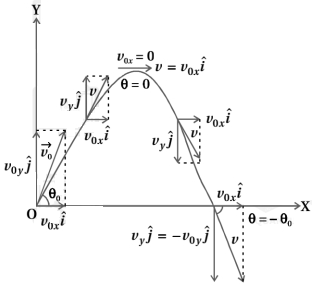
Let an object be projected with an initial velocity $v_0$ at an angle $\theta_0$ with the horizontal. The components of initial velocity are $v_{0x} = v_0 \cos \theta_0$ and $v_{0y} = v_0 \sin \theta_0$.
The horizontal position at time $t$ is given by:
$x = (v_0 \cos \theta_0)t \implies t = \frac{x}{v_0 \cos \theta_0} \quad \dots(1)$
The vertical position at time $t$ is given by:
$y = (v_0 \sin \theta_0)t - \frac{1}{2}gt^2 \quad \dots(2)$
Substituting the value of $t$ from equation $(1)$ into equation $(2)$:
$y = (v_0 \sin \theta_0) \left( \frac{x}{v_0 \cos \theta_0} \right) - \frac{1}{2}g \left( \frac{x}{v_0 \cos \theta_0} \right)^2$
Simplifying the expression:
$y = x \tan \theta_0 - \frac{g}{2(v_0 \cos \theta_0)^2}x^2$
This is the equation of the trajectory of a projectile.
Derivation:
Let an object be projected with an initial velocity $v_0$ at an angle $\theta_0$ with the horizontal. The components of initial velocity are $v_{0x} = v_0 \cos \theta_0$ and $v_{0y} = v_0 \sin \theta_0$.
The horizontal position at time $t$ is given by:
$x = (v_0 \cos \theta_0)t \implies t = \frac{x}{v_0 \cos \theta_0} \quad \dots(1)$
The vertical position at time $t$ is given by:
$y = (v_0 \sin \theta_0)t - \frac{1}{2}gt^2 \quad \dots(2)$
Substituting the value of $t$ from equation $(1)$ into equation $(2)$:
$y = (v_0 \sin \theta_0) \left( \frac{x}{v_0 \cos \theta_0} \right) - \frac{1}{2}g \left( \frac{x}{v_0 \cos \theta_0} \right)^2$
Simplifying the expression:
$y = x \tan \theta_0 - \frac{g}{2(v_0 \cos \theta_0)^2}x^2$
This is the equation of the trajectory of a projectile.
0 likes
View Solution230
Difficult
Derive the formula for the range of a projectile $(R)$. Derive the formula for the maximum range of a projectile.
Solution
(N/A) The range $(R)$ is defined as the horizontal distance traveled by a projectile from its initial position $(x=0, y=0)$ to the final position $(x=R, y=0)$ where it returns to the same horizontal level.
At any instant of time $t$,the horizontal position is given by $x = (v_0 \cos \theta_0) t$.
At the time of flight $t_F$,the horizontal distance is $R = (v_0 \cos \theta_0) t_F$.
Since the time of flight is $t_F = \frac{2 v_0 \sin \theta_0}{g}$,we substitute this into the range equation:
$R = (v_0 \cos \theta_0) \left( \frac{2 v_0 \sin \theta_0}{g} \right)$
$R = \frac{v_0^2 (2 \sin \theta_0 \cos \theta_0)}{g}$
Using the trigonometric identity $\sin 2\theta_0 = 2 \sin \theta_0 \cos \theta_0$,we get:
$R = \frac{v_0^2 \sin 2\theta_0}{g}$
For maximum range $(R_{\max})$,the value of $\sin 2\theta_0$ must be maximum,which is $1$.
$\sin 2\theta_0 = 1 \implies 2\theta_0 = 90^\circ \implies \theta_0 = 45^\circ$.
Substituting $\sin 2\theta_0 = 1$ into the range formula:
$R_{\max} = \frac{v_0^2}{g}$.
At any instant of time $t$,the horizontal position is given by $x = (v_0 \cos \theta_0) t$.
At the time of flight $t_F$,the horizontal distance is $R = (v_0 \cos \theta_0) t_F$.
Since the time of flight is $t_F = \frac{2 v_0 \sin \theta_0}{g}$,we substitute this into the range equation:
$R = (v_0 \cos \theta_0) \left( \frac{2 v_0 \sin \theta_0}{g} \right)$
$R = \frac{v_0^2 (2 \sin \theta_0 \cos \theta_0)}{g}$
Using the trigonometric identity $\sin 2\theta_0 = 2 \sin \theta_0 \cos \theta_0$,we get:
$R = \frac{v_0^2 \sin 2\theta_0}{g}$
For maximum range $(R_{\max})$,the value of $\sin 2\theta_0$ must be maximum,which is $1$.
$\sin 2\theta_0 = 1 \implies 2\theta_0 = 90^\circ \implies \theta_0 = 45^\circ$.
Substituting $\sin 2\theta_0 = 1$ into the range formula:
$R_{\max} = \frac{v_0^2}{g}$.
0 likes
View Solution231
Medium
Define projectile motion and projectile particle.
Solution
(N/A) Projectile motion is the form of motion experienced by an object or particle (a projectile) that is projected near the Earth's surface and moves along a curved path under the action of gravity only. The path followed by a projectile is called its trajectory.
$A$ projectile particle is any object that is given an initial velocity and then allowed to move in space under the influence of gravity alone. Examples include a ball thrown in the air,a bullet fired from a gun,or a javelin thrown by an athlete.
$A$ projectile particle is any object that is given an initial velocity and then allowed to move in space under the influence of gravity alone. Examples include a ball thrown in the air,a bullet fired from a gun,or a javelin thrown by an athlete.
0 likes
View Solution232
Medium
What is the range of a projectile? Also,provide the velocity of the projectile at its maximum height.
Solution
(N/A) The range $R$ of a projectile is given by the formula: $R = \frac{v_{0}^2 \sin(2\theta_{0})}{g}$,where $v_{0}$ is the initial velocity,$\theta_{0}$ is the angle of projection,and $g$ is the acceleration due to gravity.
At the maximum height,the vertical component of the velocity becomes zero $(v_{y} = 0)$.
Therefore,the velocity of the projectile at the maximum height is equal to its horizontal component: $v = v_{x} = v_{0} \cos \theta_{0}$.
At the maximum height,the vertical component of the velocity becomes zero $(v_{y} = 0)$.
Therefore,the velocity of the projectile at the maximum height is equal to its horizontal component: $v = v_{x} = v_{0} \cos \theta_{0}$.
0 likes
View Solution233
EasyMCQ
At what angle should a particle be projected to cover the maximum range (in $^{\circ}$)?
A
$30$
B
$45$
C
$60$
D
$90$
Solution
(B) The horizontal range $R$ of a projectile is given by the formula: $R = \frac{u^2 \sin(2\theta)}{g}$,where $u$ is the initial velocity,$\theta$ is the angle of projection,and $g$ is the acceleration due to gravity.
To maximize the range $R$,the value of $\sin(2\theta)$ must be maximum.
The maximum value of $\sin(2\theta)$ is $1$,which occurs when $2\theta = 90^{\circ}$.
Therefore,$\theta = 45^{\circ}$.
Thus,a particle should be projected at an angle of $45^{\circ}$ to cover the maximum range.
To maximize the range $R$,the value of $\sin(2\theta)$ must be maximum.
The maximum value of $\sin(2\theta)$ is $1$,which occurs when $2\theta = 90^{\circ}$.
Therefore,$\theta = 45^{\circ}$.
Thus,a particle should be projected at an angle of $45^{\circ}$ to cover the maximum range.
1 likes
View Solution234
Medium
On which factors does the value of the range of a projectile depend? On which factors does the maximum value of the range depend?
Solution
(N/A) The horizontal range $R$ of a projectile launched with initial velocity $u$ at an angle $\theta$ with the horizontal is given by the formula: $R = \frac{u^2 \sin(2\theta)}{g}$.
$1$. The value of the range $R$ depends on:
- The initial velocity $(u)$: $R$ is directly proportional to the square of the initial velocity $(u^2)$.
- The angle of projection $(\theta)$: $R$ depends on the sine of twice the angle of projection $(\sin(2\theta))$.
- The acceleration due to gravity $(g)$: $R$ is inversely proportional to the acceleration due to gravity $(g)$.
$2$. The maximum value of the range $(R_{max})$ depends on:
- The initial velocity $(u)$: $R_{max} = \frac{u^2}{g}$. Thus,it depends on the square of the initial velocity $(u^2)$.
- The acceleration due to gravity $(g)$: $R_{max}$ is inversely proportional to $g$.
$1$. The value of the range $R$ depends on:
- The initial velocity $(u)$: $R$ is directly proportional to the square of the initial velocity $(u^2)$.
- The angle of projection $(\theta)$: $R$ depends on the sine of twice the angle of projection $(\sin(2\theta))$.
- The acceleration due to gravity $(g)$: $R$ is inversely proportional to the acceleration due to gravity $(g)$.
$2$. The maximum value of the range $(R_{max})$ depends on:
- The initial velocity $(u)$: $R_{max} = \frac{u^2}{g}$. Thus,it depends on the square of the initial velocity $(u^2)$.
- The acceleration due to gravity $(g)$: $R_{max}$ is inversely proportional to $g$.
1 likes
View Solution235
EasyMCQ
What is the angle between the velocity and acceleration of a projectile at its maximum height (in $°$)?
A
$0$
B
$45$
C
$90$
D
$180$
Solution
(C) At the maximum height of a projectile,the vertical component of velocity $(v_y)$ becomes $0$,while the horizontal component $(v_x)$ remains constant $(u \cos \theta)$.
Thus,the resultant velocity vector is purely horizontal.
The acceleration of a projectile is always the acceleration due to gravity $(g)$,which acts vertically downwards.
Since the velocity is horizontal and the acceleration is vertical,the angle between them is $90^{\circ}$.
Thus,the resultant velocity vector is purely horizontal.
The acceleration of a projectile is always the acceleration due to gravity $(g)$,which acts vertically downwards.
Since the velocity is horizontal and the acceleration is vertical,the angle between them is $90^{\circ}$.
0 likes
View Solution236
EasyMCQ
$A$ ball is dropped from a high tower,and another ball is thrown horizontally from the same position. Which ball will reach the ground first?
A
The ball dropped vertically.
B
The ball thrown horizontally.
C
Both balls will reach the ground at the same time.
D
It depends on the mass of the balls.
Solution
(C) Both balls will reach the ground at the same time.
Since both balls are released from the same height $h$ and their initial vertical velocity components are zero $(u_y = 0)$,the time taken to reach the ground is determined by the vertical motion equation: $h = \frac{1}{2}gt^2$.
Solving for $t$,we get $t = \sqrt{\frac{2h}{g}}$.
Since $h$ and $g$ are the same for both,the time $t$ is identical for both balls.
Since both balls are released from the same height $h$ and their initial vertical velocity components are zero $(u_y = 0)$,the time taken to reach the ground is determined by the vertical motion equation: $h = \frac{1}{2}gt^2$.
Solving for $t$,we get $t = \sqrt{\frac{2h}{g}}$.
Since $h$ and $g$ are the same for both,the time $t$ is identical for both balls.
0 likes
View Solution237
EasyMCQ
At which points of its trajectory will a projectile have minimum and maximum speed?
A
Minimum at the point of projection,Maximum at the highest point
B
Minimum at the highest point,Maximum at the point of projection and the point of impact
C
Minimum at the point of impact,Maximum at the highest point
D
Speed remains constant throughout the trajectory
Solution
(B) $(i)$ $A$ projectile has its minimum speed at the highest point of its trajectory,where the vertical component of velocity becomes zero and only the horizontal component $u_x = u \cos \theta$ remains.
$(ii)$ The speed is maximum at the point of projection and at the point where the projectile hits the ground,as the vertical component of velocity is at its maximum magnitude at these points.
$(ii)$ The speed is maximum at the point of projection and at the point where the projectile hits the ground,as the vertical component of velocity is at its maximum magnitude at these points.
0 likes
View Solution238
EasyMCQ
$A$ projectile is projected in such a way that it achieves maximum range for a given velocity. Find the velocity of the projectile at its maximum height.
A
$v_0 / 2$
B
$v_0 / \sqrt{2}$
C
$v_0 / \sqrt{3}$
D
$v_0 / 4$
Solution
(B) For a projectile to achieve maximum range,the angle of projection must be $\theta = 45^{\circ}$.
At the maximum height,the vertical component of velocity becomes zero,and the projectile only possesses the horizontal component of velocity.
The horizontal component of velocity is given by $v_x = v_0 \cos \theta$.
Substituting $\theta = 45^{\circ}$,we get $v_x = v_0 \cos 45^{\circ}$.
Since $\cos 45^{\circ} = 1 / \sqrt{2}$,the velocity at maximum height is $v = v_0 / \sqrt{2}$.
At the maximum height,the vertical component of velocity becomes zero,and the projectile only possesses the horizontal component of velocity.
The horizontal component of velocity is given by $v_x = v_0 \cos \theta$.
Substituting $\theta = 45^{\circ}$,we get $v_x = v_0 \cos 45^{\circ}$.
Since $\cos 45^{\circ} = 1 / \sqrt{2}$,the velocity at maximum height is $v = v_0 / \sqrt{2}$.
0 likes
View Solution239
MediumMCQ
The horizontal range $(R)$ of a projectile is $n$ times its maximum height $(H)$. Find the angle of projection $(\theta_0)$.
A
$\theta_0 = \tan^{-1}(n)$
B
$\theta_0 = \tan^{-1}(4/n)$
C
$\theta_0 = \tan^{-1}(n/4)$
D
$\theta_0 = \tan^{-1}(4n)$
Solution
(B) The horizontal range of a projectile is given by $R = \frac{v_0^2 \sin(2\theta_0)}{g}$.
The maximum height of a projectile is given by $H = \frac{v_0^2 \sin^2(\theta_0)}{2g}$.
Given that $R = nH$,we substitute the formulas:
$\frac{v_0^2 (2 \sin \theta_0 \cos \theta_0)}{g} = n \left( \frac{v_0^2 \sin^2 \theta_0}{2g} \right)$.
Canceling common terms $v_0^2$,$g$,and $\sin \theta_0$ from both sides:
$2 \cos \theta_0 = n \left( \frac{\sin \theta_0}{2} \right)$.
Rearranging to solve for $\tan \theta_0$:
$\frac{\sin \theta_0}{\cos \theta_0} = \frac{4}{n}$.
Therefore,$\tan \theta_0 = \frac{4}{n}$,which implies $\theta_0 = \tan^{-1}(\frac{4}{n})$.
The maximum height of a projectile is given by $H = \frac{v_0^2 \sin^2(\theta_0)}{2g}$.
Given that $R = nH$,we substitute the formulas:
$\frac{v_0^2 (2 \sin \theta_0 \cos \theta_0)}{g} = n \left( \frac{v_0^2 \sin^2 \theta_0}{2g} \right)$.
Canceling common terms $v_0^2$,$g$,and $\sin \theta_0$ from both sides:
$2 \cos \theta_0 = n \left( \frac{\sin \theta_0}{2} \right)$.
Rearranging to solve for $\tan \theta_0$:
$\frac{\sin \theta_0}{\cos \theta_0} = \frac{4}{n}$.
Therefore,$\tan \theta_0 = \frac{4}{n}$,which implies $\theta_0 = \tan^{-1}(\frac{4}{n})$.
0 likes
View Solution240
DifficultMCQ
$A$ person can throw a stone to a maximum height of $h$. Determine the maximum horizontal range of the stone in terms of $h$.
A
$h$
B
$2h$
C
$3h$
D
$4h$
Solution
(B) The maximum height $H$ attained by a projectile is given by $H = \frac{v_0^2 \sin^2 \theta}{2g}$.
For maximum height,$\theta = 90^\circ$,so $\sin \theta = 1$.
Thus,$H_{\text{max}} = \frac{v_0^2}{2g} = h$.
From this,we get $v_0^2 = 2gh$.
The horizontal range $R$ is given by $R = \frac{v_0^2 \sin(2\theta)}{g}$.
For maximum horizontal range,$\theta = 45^\circ$,so $\sin(2\theta) = \sin(90^\circ) = 1$.
Thus,$R_{\text{max}} = \frac{v_0^2}{g}$.
Substituting $v_0^2 = 2gh$ into the equation for $R_{\text{max}}$,we get $R_{\text{max}} = \frac{2gh}{g} = 2h$.
For maximum height,$\theta = 90^\circ$,so $\sin \theta = 1$.
Thus,$H_{\text{max}} = \frac{v_0^2}{2g} = h$.
From this,we get $v_0^2 = 2gh$.
The horizontal range $R$ is given by $R = \frac{v_0^2 \sin(2\theta)}{g}$.
For maximum horizontal range,$\theta = 45^\circ$,so $\sin(2\theta) = \sin(90^\circ) = 1$.
Thus,$R_{\text{max}} = \frac{v_0^2}{g}$.
Substituting $v_0^2 = 2gh$ into the equation for $R_{\text{max}}$,we get $R_{\text{max}} = \frac{2gh}{g} = 2h$.
0 likes
View Solution241
MediumMCQ
Two bodies are projected at angles $\theta$ and $(90^\circ - \theta)$ with the same initial velocity. Find the ratio of their times of flight.
A
$\tan \theta : 1$
B
$\tan^2 \theta : 1$
C
$\cot \theta : 1$
D
$1 : 1$
Solution
(A) The time of flight $T$ for a projectile is given by the formula $T = \frac{2 v_0 \sin \theta}{g}$.
For the first body projected at angle $\theta$,the time of flight is $T_1 = \frac{2 v_0 \sin \theta}{g}$.
For the second body projected at angle $(90^\circ - \theta)$,the time of flight is $T_2 = \frac{2 v_0 \sin(90^\circ - \theta)}{g} = \frac{2 v_0 \cos \theta}{g}$.
The ratio of their times of flight is $\frac{T_1}{T_2} = \frac{\frac{2 v_0 \sin \theta}{g}}{\frac{2 v_0 \cos \theta}{g}} = \frac{\sin \theta}{\cos \theta} = \tan \theta$.
Thus,the ratio is $\tan \theta : 1$.
For the first body projected at angle $\theta$,the time of flight is $T_1 = \frac{2 v_0 \sin \theta}{g}$.
For the second body projected at angle $(90^\circ - \theta)$,the time of flight is $T_2 = \frac{2 v_0 \sin(90^\circ - \theta)}{g} = \frac{2 v_0 \cos \theta}{g}$.
The ratio of their times of flight is $\frac{T_1}{T_2} = \frac{\frac{2 v_0 \sin \theta}{g}}{\frac{2 v_0 \cos \theta}{g}} = \frac{\sin \theta}{\cos \theta} = \tan \theta$.
Thus,the ratio is $\tan \theta : 1$.
0 likes
View Solution242
MediumMCQ
$A$ projectile has a range of $1.5 \ km$ when projected at an angle of $15^{\circ}$. Find the range of the projectile when it is projected at an angle of $45^{\circ}$ with the same velocity. (in $km$)
A
$1.5$
B
$3.0$
C
$4.5$
D
$6.0$
Solution
(B) The formula for the horizontal range $R$ of a projectile is given by $R = \frac{v_{0}^{2} \sin(2\theta)}{g}$.
For the first case,$\theta_{1} = 15^{\circ}$ and $R_{1} = 1.5 \ km$.
$1.5 = \frac{v_{0}^{2} \sin(2 \times 15^{\circ})}{g} = \frac{v_{0}^{2} \sin(30^{\circ})}{g} = \frac{v_{0}^{2}}{2g}$.
Thus,$\frac{v_{0}^{2}}{g} = 1.5 \times 2 = 3.0 \ km$.
For the second case,$\theta_{2} = 45^{\circ}$.
The range $R_{2} = \frac{v_{0}^{2} \sin(2 \times 45^{\circ})}{g} = \frac{v_{0}^{2} \sin(90^{\circ})}{g} = \frac{v_{0}^{2}}{g}$.
Substituting the value of $\frac{v_{0}^{2}}{g}$ from the first case,we get $R_{2} = 3.0 \ km$.
For the first case,$\theta_{1} = 15^{\circ}$ and $R_{1} = 1.5 \ km$.
$1.5 = \frac{v_{0}^{2} \sin(2 \times 15^{\circ})}{g} = \frac{v_{0}^{2} \sin(30^{\circ})}{g} = \frac{v_{0}^{2}}{2g}$.
Thus,$\frac{v_{0}^{2}}{g} = 1.5 \times 2 = 3.0 \ km$.
For the second case,$\theta_{2} = 45^{\circ}$.
The range $R_{2} = \frac{v_{0}^{2} \sin(2 \times 45^{\circ})}{g} = \frac{v_{0}^{2} \sin(90^{\circ})}{g} = \frac{v_{0}^{2}}{g}$.
Substituting the value of $\frac{v_{0}^{2}}{g}$ from the first case,we get $R_{2} = 3.0 \ km$.
0 likes
View Solution243
Medium
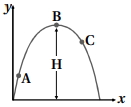
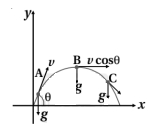
$A$ particle is projected in air at some angle to the horizontal and moves along a parabola as shown in the figure,where $x$ and $y$ indicate horizontal and vertical directions,respectively. The diagram shows the direction of velocity and acceleration at points $A$,$B$,and $C$.
Solution
(N/A) $v_{x} = \text{Horizontal component of velocity} = v \cos \theta = \text{constant}$
$v_{y} = \text{Vertical component of velocity} = v \sin \theta$
Velocity is always tangential to the curve in the direction of motion,and acceleration is always vertically downward and equal to $g$.
$v_{y} = \text{Vertical component of velocity} = v \sin \theta$
Velocity is always tangential to the curve in the direction of motion,and acceleration is always vertically downward and equal to $g$.
0 likes
View Solution244
Easy
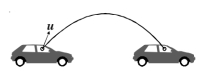
$A$ boy travelling in an open car moving on a levelled road with constant speed tosses a ball vertically up in the air and catches it back. Sketch the motion of the ball as observed by a boy standing on the footpath. Give an explanation to support your diagram.
Solution
(N/A) The path of the ball as observed by a person standing on the footpath is parabolic.
When the ball is tossed,it possesses two components of velocity: a vertical component $(u_y)$ due to the toss and a horizontal component $(u_x)$ equal to the constant velocity of the car.
Since there is no horizontal acceleration acting on the ball,the horizontal velocity remains constant throughout the flight.
Simultaneously,the ball is under the influence of gravity,which causes a constant downward acceleration $(g)$.
The combination of uniform horizontal motion and uniformly accelerated vertical motion results in a parabolic trajectory for the ball relative to the stationary observer on the footpath.
When the ball is tossed,it possesses two components of velocity: a vertical component $(u_y)$ due to the toss and a horizontal component $(u_x)$ equal to the constant velocity of the car.
Since there is no horizontal acceleration acting on the ball,the horizontal velocity remains constant throughout the flight.
Simultaneously,the ball is under the influence of gravity,which causes a constant downward acceleration $(g)$.
The combination of uniform horizontal motion and uniformly accelerated vertical motion results in a parabolic trajectory for the ball relative to the stationary observer on the footpath.
0 likes
View Solution245
Difficult
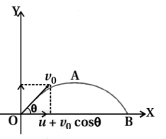
$A$ cricket fielder can throw a cricket ball with a speed $v_{0}$. If he throws the ball while running with speed $u$ at an angle $\theta$ to the horizontal,find:
$(a)$ The effective angle to the horizontal at which the ball is projected in the air as seen by a spectator.
$(b)$ The time of flight.
$(c)$ The horizontal range from the point of projection at which the ball will land.
$(d)$ The angle $\theta$ at which he should throw the ball to maximize the horizontal range found in $(c)$.
$(e)$ How does $\theta$ for maximum range change if $u > v_{0}$,$u = v_{0}$,and $u < v_{0}$?
$(f)$ How does $\theta$ in $(e)$ compare with that for $u = 0$ (i.e.,$45^{\circ}$)?
$(a)$ The effective angle to the horizontal at which the ball is projected in the air as seen by a spectator.
$(b)$ The time of flight.
$(c)$ The horizontal range from the point of projection at which the ball will land.
$(d)$ The angle $\theta$ at which he should throw the ball to maximize the horizontal range found in $(c)$.
$(e)$ How does $\theta$ for maximum range change if $u > v_{0}$,$u = v_{0}$,and $u < v_{0}$?
$(f)$ How does $\theta$ in $(e)$ compare with that for $u = 0$ (i.e.,$45^{\circ}$)?
Solution
(D) Let the velocity of the fielder be $\vec{u} = u\hat{i}$ and the velocity of the ball relative to the fielder be $\vec{v}_{rel} = v_{0}\cos\theta\hat{i} + v_{0}\sin\theta\hat{j}$.
$(a)$ The velocity of the ball relative to the ground is $\vec{v} = (u + v_{0}\cos\theta)\hat{i} + (v_{0}\sin\theta)\hat{j}$. The effective angle $\alpha$ is given by $\tan\alpha = \frac{v_{0}\sin\theta}{u + v_{0}\cos\theta}$,so $\alpha = \tan^{-1}\left(\frac{v_{0}\sin\theta}{u + v_{0}\cos\theta}\right)$.
$(b)$ The vertical component of velocity is $v_{y} = v_{0}\sin\theta$. The time of flight $T$ is given by $T = \frac{2v_{y}}{g} = \frac{2v_{0}\sin\theta}{g}$.
$(c)$ The horizontal range $R$ is $R = v_{x}T = (u + v_{0}\cos\theta)\left(\frac{2v_{0}\sin\theta}{g}\right) = \frac{2uv_{0}\sin\theta + v_{0}^{2}\sin(2\theta)}{g}$.
$(d)$ To maximize $R$,set $\frac{dR}{d\theta} = 0$: $\frac{d}{d\theta}\left[\frac{2uv_{0}\sin\theta + v_{0}^{2}\sin(2\theta)}{g}\right] = 0 \Rightarrow 2uv_{0}\cos\theta + 2v_{0}^{2}\cos(2\theta) = 0 \Rightarrow v_{0}\cos(2\theta) = -u\cos\theta$.
$(e)$ Solving $v_{0}(2\cos^{2}\theta - 1) = -u\cos\theta$,we get $2v_{0}\cos^{2}\theta + u\cos\theta - v_{0} = 0$. Using the quadratic formula for $\cos\theta$: $\cos\theta = \frac{-u + \sqrt{u^{2} + 8v_{0}^{2}}}{4v_{0}}$. As $u$ increases,$\cos\theta$ decreases,meaning $\theta$ increases.
$(f)$ For $u=0$,$\theta = 45^{\circ}$. If $u > 0$,$\theta < 45^{\circ}$ to compensate for the added horizontal velocity $u$.
$(a)$ The velocity of the ball relative to the ground is $\vec{v} = (u + v_{0}\cos\theta)\hat{i} + (v_{0}\sin\theta)\hat{j}$. The effective angle $\alpha$ is given by $\tan\alpha = \frac{v_{0}\sin\theta}{u + v_{0}\cos\theta}$,so $\alpha = \tan^{-1}\left(\frac{v_{0}\sin\theta}{u + v_{0}\cos\theta}\right)$.
$(b)$ The vertical component of velocity is $v_{y} = v_{0}\sin\theta$. The time of flight $T$ is given by $T = \frac{2v_{y}}{g} = \frac{2v_{0}\sin\theta}{g}$.
$(c)$ The horizontal range $R$ is $R = v_{x}T = (u + v_{0}\cos\theta)\left(\frac{2v_{0}\sin\theta}{g}\right) = \frac{2uv_{0}\sin\theta + v_{0}^{2}\sin(2\theta)}{g}$.
$(d)$ To maximize $R$,set $\frac{dR}{d\theta} = 0$: $\frac{d}{d\theta}\left[\frac{2uv_{0}\sin\theta + v_{0}^{2}\sin(2\theta)}{g}\right] = 0 \Rightarrow 2uv_{0}\cos\theta + 2v_{0}^{2}\cos(2\theta) = 0 \Rightarrow v_{0}\cos(2\theta) = -u\cos\theta$.
$(e)$ Solving $v_{0}(2\cos^{2}\theta - 1) = -u\cos\theta$,we get $2v_{0}\cos^{2}\theta + u\cos\theta - v_{0} = 0$. Using the quadratic formula for $\cos\theta$: $\cos\theta = \frac{-u + \sqrt{u^{2} + 8v_{0}^{2}}}{4v_{0}}$. As $u$ increases,$\cos\theta$ decreases,meaning $\theta$ increases.
$(f)$ For $u=0$,$\theta = 45^{\circ}$. If $u > 0$,$\theta < 45^{\circ}$ to compensate for the added horizontal velocity $u$.
0 likes
View Solution246
Easy
Match Column-$I$ with Column-$II$.
| Column-$I$ | Column-$II$ |
|---|---|
| $(1)$ Vertical component of velocity is zero | $(a)$ Tangent to the parabolic path |
| $(2)$ Linear velocity | $(b)$ Maximum height point of the projectile trajectory |
Solution
(A) At the maximum height of a projectile's trajectory,the vertical component of velocity $(v_y)$ becomes zero. Thus,$(1)$ matches with $(b)$.
The linear velocity vector at any point on the trajectory is always directed tangent to the parabolic path. Thus,$(2)$ matches with $(a)$.
Therefore,the correct matching is $(1-b, 2-a)$.
The linear velocity vector at any point on the trajectory is always directed tangent to the parabolic path. Thus,$(2)$ matches with $(a)$.
Therefore,the correct matching is $(1-b, 2-a)$.
0 likes
View Solution247
Medium
Match Column-$I$ with Column-$II$.
| Column-$I$ | Column-$II$ |
| $(1)$ Angle of projection for a projectile launched horizontally with constant speed | $(a)$ $0$ |
| $(2)$ Horizontal component of acceleration for a projectile launched horizontally with constant speed | $(b)$ $0^o$ |
Solution
(A) For a projectile launched horizontally,the initial velocity vector is parallel to the ground,so the angle of projection $\theta = 0^o$. Thus,$(1)$ matches with $(b)$.
In projectile motion,the only acceleration acting on the object is the acceleration due to gravity $(g)$,which acts vertically downwards. Therefore,the horizontal component of acceleration is $0$. Thus,$(2)$ matches with $(a)$.
The correct matching is $(1-b, 2-a)$.
In projectile motion,the only acceleration acting on the object is the acceleration due to gravity $(g)$,which acts vertically downwards. Therefore,the horizontal component of acceleration is $0$. Thus,$(2)$ matches with $(a)$.
The correct matching is $(1-b, 2-a)$.
0 likes
View Solution248
MediumMCQ
The velocity of projection of a body is increased by $2 \%$. Other factors remaining unchanged,what will be the percentage change in the maximum height attained? (in $\%$)
A
$1$
B
$2$
C
$4$
D
$8$
Solution
(C) The formula for the maximum height $(h)$ attained by a projectile is given by:
$h = \frac{u^2 \sin^2 \theta}{2g}$
Since the angle of projection $(\theta)$ and acceleration due to gravity $(g)$ remain unchanged,the maximum height is directly proportional to the square of the initial velocity $(u)$:
$h \propto u^2$
Using the concept of relative error or percentage change for a power function:
$\frac{\Delta h}{h} \times 100 = 2 \times \left( \frac{\Delta u}{u} \times 100 \right)$
Given that the percentage change in velocity is $\frac{\Delta u}{u} \times 100 = 2 \%$,we substitute this into the equation:
$\frac{\Delta h}{h} \times 100 = 2 \times 2 \% = 4 \%$
Therefore,the percentage change in the maximum height attained is $4 \%$.
$h = \frac{u^2 \sin^2 \theta}{2g}$
Since the angle of projection $(\theta)$ and acceleration due to gravity $(g)$ remain unchanged,the maximum height is directly proportional to the square of the initial velocity $(u)$:
$h \propto u^2$
Using the concept of relative error or percentage change for a power function:
$\frac{\Delta h}{h} \times 100 = 2 \times \left( \frac{\Delta u}{u} \times 100 \right)$
Given that the percentage change in velocity is $\frac{\Delta u}{u} \times 100 = 2 \%$,we substitute this into the equation:
$\frac{\Delta h}{h} \times 100 = 2 \times 2 \% = 4 \%$
Therefore,the percentage change in the maximum height attained is $4 \%$.
0 likes
View Solution249
DifficultMCQ
The trajectory of a projectile in a vertical plane is $y = \alpha x - \beta x^2$,where $\alpha$ and $\beta$ are constants and $x$ and $y$ are respectively the horizontal and vertical distances of the projectile from the point of projection. The angle of projection $\theta$ and the maximum height attained $H$ are respectively given by:
A
$\tan^{-1} \alpha, \frac{\alpha^2}{4\beta}$
B
$\tan^{-1} \beta, \frac{\alpha^2}{2\beta}$
C
$\tan^{-1} \alpha, \frac{4\alpha^2}{\beta}$
D
$\tan^{-1}(\frac{\beta}{\alpha}), \frac{\alpha^2}{\beta}$
Solution
(A) The given equation of the trajectory is $y = \alpha x - \beta x^2$.
Comparing this with the standard equation of a projectile trajectory: $y = x \tan \theta - \frac{gx^2}{2u^2 \cos^2 \theta}$.
By comparing the coefficients of $x$,we get $\tan \theta = \alpha$,which implies $\theta = \tan^{-1} \alpha$.
By comparing the coefficients of $x^2$,we get $\beta = \frac{g}{2u^2 \cos^2 \theta}$.
Rearranging for $u^2$,we find $u^2 = \frac{g}{2\beta \cos^2 \theta}$.
The formula for maximum height is $H = \frac{u^2 \sin^2 \theta}{2g}$.
Substituting $u^2$ into the formula: $H = \frac{g}{2\beta \cos^2 \theta} \cdot \frac{\sin^2 \theta}{2g} = \frac{\tan^2 \theta}{4\beta}$.
Since $\tan \theta = \alpha$,we have $H = \frac{\alpha^2}{4\beta}$.
Comparing this with the standard equation of a projectile trajectory: $y = x \tan \theta - \frac{gx^2}{2u^2 \cos^2 \theta}$.
By comparing the coefficients of $x$,we get $\tan \theta = \alpha$,which implies $\theta = \tan^{-1} \alpha$.
By comparing the coefficients of $x^2$,we get $\beta = \frac{g}{2u^2 \cos^2 \theta}$.
Rearranging for $u^2$,we find $u^2 = \frac{g}{2\beta \cos^2 \theta}$.
The formula for maximum height is $H = \frac{u^2 \sin^2 \theta}{2g}$.
Substituting $u^2$ into the formula: $H = \frac{g}{2\beta \cos^2 \theta} \cdot \frac{\sin^2 \theta}{2g} = \frac{\tan^2 \theta}{4\beta}$.
Since $\tan \theta = \alpha$,we have $H = \frac{\alpha^2}{4\beta}$.
0 likes
View Solution250
MediumMCQ
$A$ player kicks a football with an initial speed of $25\, ms^{-1}$ at an angle of $45^{\circ}$ from the ground. What are the maximum height and the time taken by the football to reach the highest point during motion? (Take $g = 10\, ms^{-2}$)
A
$h_{max} = 10\, m, T = 2.5\, s$
B
$h_{max} = 15.625\, m, T = 3.54\, s$
C
$h_{max} = 15.625\, m, T = 1.77\, s$
D
$h_{max} = 3.54\, m, T = 0.125\, s$
Solution
(C) The formula for maximum height is $H = \frac{u^2 \sin^2 \theta}{2g}$.
Substituting the values: $H = \frac{(25)^2 \cdot (\sin 45^{\circ})^2}{2 \times 10} = \frac{625 \times 0.5}{20} = \frac{312.5}{20} = 15.625\, m$.
The formula for time taken to reach the highest point is $T = \frac{u \sin \theta}{g}$.
Substituting the values: $T = \frac{25 \times \sin 45^{\circ}}{10} = \frac{25 \times 0.707}{10} = 2.5 \times 0.707 = 1.7675\, s \approx 1.77\, s$.
Substituting the values: $H = \frac{(25)^2 \cdot (\sin 45^{\circ})^2}{2 \times 10} = \frac{625 \times 0.5}{20} = \frac{312.5}{20} = 15.625\, m$.
The formula for time taken to reach the highest point is $T = \frac{u \sin \theta}{g}$.
Substituting the values: $T = \frac{25 \times \sin 45^{\circ}}{10} = \frac{25 \times 0.707}{10} = 2.5 \times 0.707 = 1.7675\, s \approx 1.77\, s$.
0 likes
View Solution3-2.Motion in Plane — Horizontal Projectile Motion · Frequently Asked Questions
1Are these 3-2.Motion in Plane questions useful for JEE and NEET?
Yes. All questions in this section are mapped to JEE Main and NEET exam patterns. Previous year questions from JEE Main, NEET, GUJCET and state-level exams are included with full solutions.
2Can I switch to Hindi or Gujarati for these questions?
Yes. Use the language tabs in the hero section or the sidebar to view the same questions and solutions in English, Hindi or Gujarati.
3How do I generate a question paper from this subtopic?
Use the Vedclass Exam Paper Generator — select the chapter and subtopic, set difficulty, and generate Sets A, B, C, D automatically. First 3 chapters of every subject are free.
Vedclass Products
For Students
Vedclass Test Series
Mock tests in real JEE/NEET style with performance analysis. 5-day free trial.
Start Free TrialFor Teachers
Exam Paper Generator
Generate Set A/B/C/D papers from this chapter in 2 minutes. 3 chapters free.
Try FreeFor Institutes
Online Exam Module
Live online exams with unlimited students, 360° analytics & white-label branding.
See DemoFor Teachers & Institutes
Generate a 3-2.Motion in Plane Exam Paper in 2 Minutes
Select subtopic & difficulty — Sets A, B, C, D auto-generated with No Repeat logic.
First 3 chapters of every subject are free — no payment required.