
A English
Thermal Expansion for Solid Questions in English
Class 11 Physics · 10-1.Thermometry, Thermal Expansion and Calorimetry · Thermal Expansion for Solid
231+
Questions
English
Language
100%
With Solutions
Showing 50 of 231 questions in English
101
MediumMCQ
$A$ cylindrical metal rod of length $L_0$ is shaped into a ring with a small gap as shown. On heating the system,
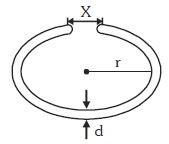
A
$x$ decreases,$r$ and $d$ increase
B
$x$ and $r$ increase,$d$ decreases
C
$x$,$r$ and $d$ all increase
D
Data insufficient to arrive at a conclusion
Solution
(C) When an isotropic solid is heated,it undergoes thermal expansion in all dimensions. This expansion is similar to a photographic enlargement,where every linear dimension of the object increases.
$1$. The radius $r$ of the ring increases due to linear expansion.
$2$. The gap width $x$ also increases because the entire circumference of the ring expands,and the gap behaves like a segment of the circumference.
$3$. The thickness $d$ of the rod increases because the material itself expands in all directions.
Therefore,$x$,$r$,and $d$ all increase.
$1$. The radius $r$ of the ring increases due to linear expansion.
$2$. The gap width $x$ also increases because the entire circumference of the ring expands,and the gap behaves like a segment of the circumference.
$3$. The thickness $d$ of the rod increases because the material itself expands in all directions.
Therefore,$x$,$r$,and $d$ all increase.
0 likes
View Solution102
DifficultMCQ
When the temperature of a rod increases from $t$ to $(t + \Delta t)$,its moment of inertia increases from $I$ to $(I + \Delta I)$. If $\alpha$ is the coefficient of linear expansion of the rod,then the value of $(\frac{\Delta I}{I})$ is
A
$2\alpha \Delta t$
B
$\alpha \Delta t$
C
$\frac{\alpha \Delta t}{2}$
D
$\frac{\Delta t}{\alpha}$
Solution
(A) The moment of inertia of a rod about an axis passing through its center and perpendicular to its length is given by:
$I = \frac{1}{12} ML^2$ --- $(i)$
where $M$ is the mass and $L$ is the length of the rod.
Since the mass $M$ remains constant during thermal expansion,we differentiate the expression with respect to $L$:
$\Delta I = \frac{1}{12} M (2L \Delta L) = 2 (\frac{1}{12} ML^2) \frac{\Delta L}{L} = 2I \frac{\Delta L}{L}$ --- $(ii)$
Dividing equation $(ii)$ by equation $(i)$,we get:
$\frac{\Delta I}{I} = 2 \frac{\Delta L}{L}$ --- $(iii)$
We know that the change in length due to thermal expansion is given by $\Delta L = L \alpha \Delta t$,which implies:
$\frac{\Delta L}{L} = \alpha \Delta t$
Substituting this into equation $(iii)$,we get:
$\frac{\Delta I}{I} = 2 \alpha \Delta t$
$I = \frac{1}{12} ML^2$ --- $(i)$
where $M$ is the mass and $L$ is the length of the rod.
Since the mass $M$ remains constant during thermal expansion,we differentiate the expression with respect to $L$:
$\Delta I = \frac{1}{12} M (2L \Delta L) = 2 (\frac{1}{12} ML^2) \frac{\Delta L}{L} = 2I \frac{\Delta L}{L}$ --- $(ii)$
Dividing equation $(ii)$ by equation $(i)$,we get:
$\frac{\Delta I}{I} = 2 \frac{\Delta L}{L}$ --- $(iii)$
We know that the change in length due to thermal expansion is given by $\Delta L = L \alpha \Delta t$,which implies:
$\frac{\Delta L}{L} = \alpha \Delta t$
Substituting this into equation $(iii)$,we get:
$\frac{\Delta I}{I} = 2 \alpha \Delta t$
0 likes
View Solution103
MediumMCQ
If a bimetallic strip is heated, it will
A
Bend towards the metal with lower linear thermal expansion coefficient
B
Bend towards the metal with higher linear thermal expansion coefficient
C
Not bend at all
D
None
Solution
(A) bimetallic strip consists of two metal strips with different coefficients of linear thermal expansion $(\alpha)$ fastened together.
When the strip is heated, the metal with the higher coefficient of linear thermal expansion $(\alpha)$ expands more than the metal with the lower coefficient.
Because the two metals are bonded together, the strip must bend to accommodate the difference in lengths.
The side with the higher expansion coefficient becomes the outer arc, and the side with the lower expansion coefficient becomes the inner arc.
Therefore, the strip bends towards the metal with the lower linear thermal expansion coefficient.
When the strip is heated, the metal with the higher coefficient of linear thermal expansion $(\alpha)$ expands more than the metal with the lower coefficient.
Because the two metals are bonded together, the strip must bend to accommodate the difference in lengths.
The side with the higher expansion coefficient becomes the outer arc, and the side with the lower expansion coefficient becomes the inner arc.
Therefore, the strip bends towards the metal with the lower linear thermal expansion coefficient.
0 likes
View Solution104
MediumMCQ
$A$ bimetallic strip consists of metals $X$ and $Y$. It is mounted rigidly at the base as shown. The metal $X$ has a higher coefficient of linear expansion compared to that for metal $Y$. When the bimetallic strip is placed in a cold bath:
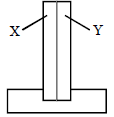
A
It will bend towards the right
B
It will bend towards the left
C
It will not bend but shrink
D
It will neither bend nor shrink
Solution
(B) The coefficient of linear expansion $\alpha$ determines how much a material changes its length with temperature change,given by $\Delta L = L_0 \alpha \Delta T$.
Since the coefficient of linear expansion of metal $X$ is greater than that of metal $Y$ $(\alpha_X > \alpha_Y)$,metal $X$ will contract more than metal $Y$ when the temperature decreases (cooling).
Because metal $X$ is on the left side and it contracts more than metal $Y$,the strip will bend towards the side that contracts more.
Therefore,the bimetallic strip will bend towards the left.
Since the coefficient of linear expansion of metal $X$ is greater than that of metal $Y$ $(\alpha_X > \alpha_Y)$,metal $X$ will contract more than metal $Y$ when the temperature decreases (cooling).
Because metal $X$ is on the left side and it contracts more than metal $Y$,the strip will bend towards the side that contracts more.
Therefore,the bimetallic strip will bend towards the left.
0 likes
View Solution105
MediumMCQ
$A$ crystal has a coefficient of linear expansion $13 \times 10^{-7} \ K^{-1}$ in one direction and $231 \times 10^{-7} \ K^{-1}$ in every direction at right angles to it. Then the cubical coefficient of expansion is:
A
$475 \times 10^{-7} \ K^{-1}$
B
$244 \times 10^{-7} \ K^{-1}$
C
$462 \times 10^{-7} \ K^{-1}$
D
$257 \times 10^{-7} \ K^{-1}$
Solution
(A) The coefficient of cubical expansion $\gamma$ for an anisotropic solid is given by the sum of the coefficients of linear expansion along three mutually perpendicular axes.
Given:
$\alpha_1 = 13 \times 10^{-7} \ K^{-1}$
$\alpha_2 = 231 \times 10^{-7} \ K^{-1}$
$\alpha_3 = 231 \times 10^{-7} \ K^{-1}$
Formula:
$\gamma = \alpha_1 + \alpha_2 + \alpha_3$
Calculation:
$\gamma = (13 + 231 + 231) \times 10^{-7} \ K^{-1}$
$\gamma = 475 \times 10^{-7} \ K^{-1}$
Given:
$\alpha_1 = 13 \times 10^{-7} \ K^{-1}$
$\alpha_2 = 231 \times 10^{-7} \ K^{-1}$
$\alpha_3 = 231 \times 10^{-7} \ K^{-1}$
Formula:
$\gamma = \alpha_1 + \alpha_2 + \alpha_3$
Calculation:
$\gamma = (13 + 231 + 231) \times 10^{-7} \ K^{-1}$
$\gamma = 475 \times 10^{-7} \ K^{-1}$
0 likes
View Solution106
MediumMCQ
$A$ copper rod of $88\; cm$ and an aluminum rod of unknown length have their increase in length independent of increase in temperature. The length of the aluminum rod is....$cm$.
$(\alpha_{Cu} = 1.7 \times 10^{-5}\; K^{-1}$ and $\alpha_{Al} = 2.2 \times 10^{-5}\; K^{-1})$
$(\alpha_{Cu} = 1.7 \times 10^{-5}\; K^{-1}$ and $\alpha_{Al} = 2.2 \times 10^{-5}\; K^{-1})$
A
$6.8$
B
$113.9$
C
$88$
D
$68$
Solution
(D) The problem states that the increase in length for both rods is independent of the increase in temperature,which implies that the change in length $(\Delta \ell)$ for both rods must be equal for any given change in temperature $(\Delta T)$.
Given:
$\ell_{Cu} = 88\; cm$
$\alpha_{Cu} = 1.7 \times 10^{-5}\; K^{-1}$
$\alpha_{Al} = 2.2 \times 10^{-5}\; K^{-1}$
The formula for thermal expansion is $\Delta \ell = \ell \alpha \Delta T$.
Since $(\Delta \ell)_{Cu} = (\Delta \ell)_{Al}$,we have:
$\ell_{Cu} \alpha_{Cu} \Delta T = \ell_{Al} \alpha_{Al} \Delta T$
Canceling $\Delta T$ from both sides:
$\ell_{Cu} \alpha_{Cu} = \ell_{Al} \alpha_{Al}$
Substituting the values:
$88 \times 1.7 \times 10^{-5} = \ell_{Al} \times 2.2 \times 10^{-5}$
Solving for $\ell_{Al}$:
$\ell_{Al} = \frac{88 \times 1.7}{2.2}$
$\ell_{Al} = 40 \times 1.7 = 68\; cm$.
Given:
$\ell_{Cu} = 88\; cm$
$\alpha_{Cu} = 1.7 \times 10^{-5}\; K^{-1}$
$\alpha_{Al} = 2.2 \times 10^{-5}\; K^{-1}$
The formula for thermal expansion is $\Delta \ell = \ell \alpha \Delta T$.
Since $(\Delta \ell)_{Cu} = (\Delta \ell)_{Al}$,we have:
$\ell_{Cu} \alpha_{Cu} \Delta T = \ell_{Al} \alpha_{Al} \Delta T$
Canceling $\Delta T$ from both sides:
$\ell_{Cu} \alpha_{Cu} = \ell_{Al} \alpha_{Al}$
Substituting the values:
$88 \times 1.7 \times 10^{-5} = \ell_{Al} \times 2.2 \times 10^{-5}$
Solving for $\ell_{Al}$:
$\ell_{Al} = \frac{88 \times 1.7}{2.2}$
$\ell_{Al} = 40 \times 1.7 = 68\; cm$.
0 likes
View Solution107
MediumMCQ
$A$ non-isotropic solid metal cube has coefficients of linear expansion as:
$5 \times 10^{-5} /^{\circ} C$ along the $x$-axis and $5 \times 10^{-6} /^{\circ} C$ along the $y$ and the $z$-axis. If the coefficient of volume expansion of the solid is $C \times 10^{-6} /^{\circ} C$,then the value of $C$ is:
$5 \times 10^{-5} /^{\circ} C$ along the $x$-axis and $5 \times 10^{-6} /^{\circ} C$ along the $y$ and the $z$-axis. If the coefficient of volume expansion of the solid is $C \times 10^{-6} /^{\circ} C$,then the value of $C$ is:
A
$55$
B
$63$
C
$67$
D
$60$
Solution
(D) For a non-isotropic solid,the coefficient of volume expansion $\gamma$ is the sum of the coefficients of linear expansion along the three mutually perpendicular axes:
$\gamma = \alpha_{x} + \alpha_{y} + \alpha_{z}$
Given:
$\alpha_{x} = 5 \times 10^{-5} /^{\circ} C = 50 \times 10^{-6} /^{\circ} C$
$\alpha_{y} = 5 \times 10^{-6} /^{\circ} C$
$\alpha_{z} = 5 \times 10^{-6} /^{\circ} C$
Substituting these values into the formula:
$\gamma = (50 \times 10^{-6} + 5 \times 10^{-6} + 5 \times 10^{-6}) /^{\circ} C$
$\gamma = (50 + 5 + 5) \times 10^{-6} /^{\circ} C$
$\gamma = 60 \times 10^{-6} /^{\circ} C$
Comparing this with the given form $C \times 10^{-6} /^{\circ} C$,we get $C = 60$.
$\gamma = \alpha_{x} + \alpha_{y} + \alpha_{z}$
Given:
$\alpha_{x} = 5 \times 10^{-5} /^{\circ} C = 50 \times 10^{-6} /^{\circ} C$
$\alpha_{y} = 5 \times 10^{-6} /^{\circ} C$
$\alpha_{z} = 5 \times 10^{-6} /^{\circ} C$
Substituting these values into the formula:
$\gamma = (50 \times 10^{-6} + 5 \times 10^{-6} + 5 \times 10^{-6}) /^{\circ} C$
$\gamma = (50 + 5 + 5) \times 10^{-6} /^{\circ} C$
$\gamma = 60 \times 10^{-6} /^{\circ} C$
Comparing this with the given form $C \times 10^{-6} /^{\circ} C$,we get $C = 60$.
1 likes
View Solution108
Easy
Show that the coefficient of area expansion,$(\Delta A / A) / \Delta T,$ of a rectangular sheet of a solid is twice its linear expansivity,$\alpha_{l}$.
Solution
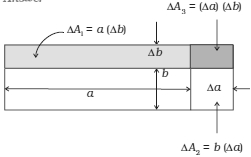
(N/A) Consider a rectangular sheet of a solid material of length $a$ and breadth $b$. When the temperature increases by $\Delta T$,the length $a$ increases by $\Delta a = \alpha_{l} a \Delta T$ and the breadth $b$ increases by $\Delta b = \alpha_{l} b \Delta T$.
The increase in area $\Delta A$ is given by the sum of the three shaded regions in the diagram:
$\Delta A = \Delta A_{1} + \Delta A_{2} + \Delta A_{3}$
$\Delta A = a \Delta b + b \Delta a + (\Delta a)(\Delta b)$
Substituting the expressions for $\Delta a$ and $\Delta b$:
$\Delta A = a(\alpha_{l} b \Delta T) + b(\alpha_{l} a \Delta T) + (\alpha_{l} a \Delta T)(\alpha_{l} b \Delta T)$
$\Delta A = 2 \alpha_{l} ab \Delta T + \alpha_{l}^{2} ab (\Delta T)^{2}$
Since $A = ab$,we have:
$\Delta A = 2 \alpha_{l} A \Delta T + \alpha_{l}^{2} A (\Delta T)^{2}$
$\Delta A = \alpha_{l} A \Delta T (2 + \alpha_{l} \Delta T)$
Dividing by $A \Delta T$:
$\frac{\Delta A}{A \Delta T} = \alpha_{l} (2 + \alpha_{l} \Delta T)$
Since $\alpha_{l}$ is very small (typically $\approx 10^{-5} \text{ K}^{-1}$),the term $\alpha_{l} \Delta T$ is negligible compared to $2$. Therefore:
$\frac{\Delta A}{A \Delta T} \approx 2 \alpha_{l}$
The increase in area $\Delta A$ is given by the sum of the three shaded regions in the diagram:
$\Delta A = \Delta A_{1} + \Delta A_{2} + \Delta A_{3}$
$\Delta A = a \Delta b + b \Delta a + (\Delta a)(\Delta b)$
Substituting the expressions for $\Delta a$ and $\Delta b$:
$\Delta A = a(\alpha_{l} b \Delta T) + b(\alpha_{l} a \Delta T) + (\alpha_{l} a \Delta T)(\alpha_{l} b \Delta T)$
$\Delta A = 2 \alpha_{l} ab \Delta T + \alpha_{l}^{2} ab (\Delta T)^{2}$
Since $A = ab$,we have:
$\Delta A = 2 \alpha_{l} A \Delta T + \alpha_{l}^{2} A (\Delta T)^{2}$
$\Delta A = \alpha_{l} A \Delta T (2 + \alpha_{l} \Delta T)$
Dividing by $A \Delta T$:
$\frac{\Delta A}{A \Delta T} = \alpha_{l} (2 + \alpha_{l} \Delta T)$
Since $\alpha_{l}$ is very small (typically $\approx 10^{-5} \text{ K}^{-1}$),the term $\alpha_{l} \Delta T$ is negligible compared to $2$. Therefore:
$\frac{\Delta A}{A \Delta T} \approx 2 \alpha_{l}$
0 likes
View Solution109
EasyMCQ
$A$ blacksmith fixes an iron ring on the rim of the wooden wheel of a horse cart. The diameter of the rim and the iron ring are $5.243\; m$ and $5.231\; m$,respectively at $27^{\circ}C$. To what temperature (in $^{\circ}C$) should the ring be heated so as to fit the rim of the wheel? (Given: coefficient of linear expansion of iron $\alpha = 1.20 \times 10^{-5} K^{-1}$)
A
$186$
B
$218$
C
$293$
D
$312$
Solution
(B) Given:
Initial temperature $T_{1} = 27^{\circ}C$
Initial length (diameter) of the iron ring $L_{T1} = 5.231\; m$
Final length (diameter) required $L_{T2} = 5.243\; m$
Coefficient of linear expansion $\alpha = 1.20 \times 10^{-5} K^{-1}$
Using the formula for linear expansion:
$L_{T2} = L_{T1} [1 + \alpha(T_{2} - T_{1})]$
Substituting the values:
$5.243 = 5.231 [1 + 1.20 \times 10^{-5} (T_{2} - 27)]$
Divide by $5.231$:
$1.002294 = 1 + 1.20 \times 10^{-5} (T_{2} - 27)$
$0.002294 = 1.20 \times 10^{-5} (T_{2} - 27)$
$T_{2} - 27 = \frac{0.002294}{1.20 \times 10^{-5}}$
$T_{2} - 27 \approx 191.17$
$T_{2} \approx 191.17 + 27 = 218.17^{\circ}C$
Rounding to the nearest integer,the temperature is $218^{\circ}C$.
Initial temperature $T_{1} = 27^{\circ}C$
Initial length (diameter) of the iron ring $L_{T1} = 5.231\; m$
Final length (diameter) required $L_{T2} = 5.243\; m$
Coefficient of linear expansion $\alpha = 1.20 \times 10^{-5} K^{-1}$
Using the formula for linear expansion:
$L_{T2} = L_{T1} [1 + \alpha(T_{2} - T_{1})]$
Substituting the values:
$5.243 = 5.231 [1 + 1.20 \times 10^{-5} (T_{2} - 27)]$
Divide by $5.231$:
$1.002294 = 1 + 1.20 \times 10^{-5} (T_{2} - 27)$
$0.002294 = 1.20 \times 10^{-5} (T_{2} - 27)$
$T_{2} - 27 = \frac{0.002294}{1.20 \times 10^{-5}}$
$T_{2} - 27 \approx 191.17$
$T_{2} \approx 191.17 + 27 = 218.17^{\circ}C$
Rounding to the nearest integer,the temperature is $218^{\circ}C$.
0 likes
View Solution110
Medium
$A$ steel tape $1 \; m$ long is correctly calibrated for a temperature of $27.0 \; ^{\circ}C$. The length of a steel rod measured by this tape is found to be $63.0 \; cm$ on a hot day when the temperature is $45.0 \; ^{\circ}C$. What is the actual length of the steel rod on that day? What is the length of the same steel rod on a day when the temperature is $27.0 \; ^{\circ}C$? (Coefficient of linear expansion of steel $\alpha = 1.20 \times 10^{-5} \; K^{-1}$)
Solution
(N/A) The length of the steel tape at $T = 27.0 \; ^{\circ}C$ is $l = 100 \; cm$.
At $T_1 = 45.0 \; ^{\circ}C$,the length of the tape $l'$ increases due to thermal expansion:
$l' = l(1 + \alpha \Delta T) = 100 \times [1 + 1.20 \times 10^{-5} \times (45.0 - 27.0)]$
$l' = 100 \times [1 + 1.20 \times 10^{-5} \times 18] = 100 \times [1 + 0.000216] = 100.0216 \; cm$.
The measured length of the rod is $63.0 \; cm$ using the expanded tape. The actual length $l_2$ at $45.0 \; ^{\circ}C$ is:
$l_2 = \frac{l'}{l} \times 63.0 = \frac{100.0216}{100} \times 63.0 = 63.0136 \; cm$.
To find the length at $27.0 \; ^{\circ}C$,we use $l_2 = l_0(1 + \alpha \Delta T)$:
$63.0136 = l_0(1 + 1.20 \times 10^{-5} \times 18) = l_0(1.000216)$
$l_0 = \frac{63.0136}{1.000216} \approx 63.0 \; cm$.
At $T_1 = 45.0 \; ^{\circ}C$,the length of the tape $l'$ increases due to thermal expansion:
$l' = l(1 + \alpha \Delta T) = 100 \times [1 + 1.20 \times 10^{-5} \times (45.0 - 27.0)]$
$l' = 100 \times [1 + 1.20 \times 10^{-5} \times 18] = 100 \times [1 + 0.000216] = 100.0216 \; cm$.
The measured length of the rod is $63.0 \; cm$ using the expanded tape. The actual length $l_2$ at $45.0 \; ^{\circ}C$ is:
$l_2 = \frac{l'}{l} \times 63.0 = \frac{100.0216}{100} \times 63.0 = 63.0136 \; cm$.
To find the length at $27.0 \; ^{\circ}C$,we use $l_2 = l_0(1 + \alpha \Delta T)$:
$63.0136 = l_0(1 + 1.20 \times 10^{-5} \times 18) = l_0(1.000216)$
$l_0 = \frac{63.0136}{1.000216} \approx 63.0 \; cm$.
0 likes
View Solution111
MediumMCQ
$A$ large steel wheel is to be fitted onto a shaft of the same material. At $27^{\circ}C$,the outer diameter of the shaft is $8.70\;cm$ and the diameter of the central hole in the wheel is $8.69\;cm$. The shaft is cooled using 'dry ice'. At what temperature (in $^{\circ}C$) of the shaft does the wheel slip on the shaft? Assume the coefficient of linear expansion of the steel to be constant over the required temperature range: $\alpha_{steel} = 1.20 \times 10^{-5}\;K^{-1}$.
A
$42$
B
$-42$
C
$-69$
D
$69$
Solution
(C) Initial temperature $T = 27^{\circ}C = 300\;K$.
Initial diameter of the shaft $d_1 = 8.70\;cm$.
Diameter of the hole in the wheel $d_2 = 8.69\;cm$.
Coefficient of linear expansion $\alpha = 1.20 \times 10^{-5}\;K^{-1}$.
The wheel will slip on the shaft when the diameter of the shaft becomes equal to the diameter of the hole,i.e.,$d_2 = 8.69\;cm$.
The change in diameter is $\Delta d = d_2 - d_1 = 8.69 - 8.70 = -0.01\;cm$.
Using the formula for linear expansion $\Delta d = d_1 \alpha \Delta T$,where $\Delta T = T_f - T_i$:
$-0.01 = 8.70 \times (1.20 \times 10^{-5}) \times (T_f - 300)$.
$T_f - 300 = \frac{-0.01}{8.70 \times 1.20 \times 10^{-5}} = \frac{-0.01}{0.0001044} \approx -95.78\;K$.
$T_f = 300 - 95.78 = 204.22\;K$.
Converting to Celsius: $T_f(^{\circ}C) = 204.22 - 273.15 \approx -68.93^{\circ}C$.
Rounding to the nearest integer,the temperature is $-69^{\circ}C$.
Initial diameter of the shaft $d_1 = 8.70\;cm$.
Diameter of the hole in the wheel $d_2 = 8.69\;cm$.
Coefficient of linear expansion $\alpha = 1.20 \times 10^{-5}\;K^{-1}$.
The wheel will slip on the shaft when the diameter of the shaft becomes equal to the diameter of the hole,i.e.,$d_2 = 8.69\;cm$.
The change in diameter is $\Delta d = d_2 - d_1 = 8.69 - 8.70 = -0.01\;cm$.
Using the formula for linear expansion $\Delta d = d_1 \alpha \Delta T$,where $\Delta T = T_f - T_i$:
$-0.01 = 8.70 \times (1.20 \times 10^{-5}) \times (T_f - 300)$.
$T_f - 300 = \frac{-0.01}{8.70 \times 1.20 \times 10^{-5}} = \frac{-0.01}{0.0001044} \approx -95.78\;K$.
$T_f = 300 - 95.78 = 204.22\;K$.
Converting to Celsius: $T_f(^{\circ}C) = 204.22 - 273.15 \approx -68.93^{\circ}C$.
Rounding to the nearest integer,the temperature is $-69^{\circ}C$.
0 likes
View Solution112
MediumMCQ
$A$ hole is drilled in a copper sheet. The diameter of the hole is $4.24 \; cm$ at $27.0 \; ^{\circ}C$. What is the change in the diameter of the hole when the sheet is heated to $227 \; ^{\circ}C$? (Coefficient of linear expansion of copper $\alpha = 1.70 \times 10^{-5} \; K^{-1}$)
A
$3.21 \times 10^{-3} \; cm$
B
$8.96 \times 10^{-1} \; cm$
C
$4.98 \times 10^{-2} \; cm$
D
$1.44 \times 10^{-2} \; cm$
Solution
(D) Initial temperature $T_{1} = 27.0 \; ^{\circ}C$.
Initial diameter $d_{1} = 4.24 \; cm$.
Final temperature $T_{2} = 227 \; ^{\circ}C$.
Change in temperature $\Delta T = T_{2} - T_{1} = 227 - 27 = 200 \; K$.
Coefficient of linear expansion $\alpha = 1.70 \times 10^{-5} \; K^{-1}$.
Thermal expansion of a hole in a material follows the same rule as the expansion of a solid disc of the same material.
The change in diameter $\Delta d$ is given by the formula $\Delta d = d_{1} \alpha \Delta T$.
Substituting the values:
$\Delta d = 4.24 \times (1.70 \times 10^{-5}) \times 200$.
$\Delta d = 4.24 \times 3.40 \times 10^{-3}$.
$\Delta d = 14.416 \times 10^{-3} \; cm$.
$\Delta d = 1.4416 \times 10^{-2} \; cm \approx 1.44 \times 10^{-2} \; cm$.
Initial diameter $d_{1} = 4.24 \; cm$.
Final temperature $T_{2} = 227 \; ^{\circ}C$.
Change in temperature $\Delta T = T_{2} - T_{1} = 227 - 27 = 200 \; K$.
Coefficient of linear expansion $\alpha = 1.70 \times 10^{-5} \; K^{-1}$.
Thermal expansion of a hole in a material follows the same rule as the expansion of a solid disc of the same material.
The change in diameter $\Delta d$ is given by the formula $\Delta d = d_{1} \alpha \Delta T$.
Substituting the values:
$\Delta d = 4.24 \times (1.70 \times 10^{-5}) \times 200$.
$\Delta d = 4.24 \times 3.40 \times 10^{-3}$.
$\Delta d = 14.416 \times 10^{-3} \; cm$.
$\Delta d = 1.4416 \times 10^{-2} \; cm \approx 1.44 \times 10^{-2} \; cm$.
0 likes
View Solution113
Medium
$A$ brass rod of length $50\; cm$ and diameter $3.0\; mm$ is joined to a steel rod of the same length and diameter. What is the change in length of the combined rod at $250\; ^{\circ}C$,if the original lengths are at $40.0\; ^{\circ}C$? Is there a 'thermal stress' developed at the junction? The ends of the rod are free to expand. (Coefficient of linear expansion of brass $= 2.0 \times 10^{-5}\; K^{-1}$,steel $= 1.2 \times 10^{-5}\; K^{-1}$)
Solution
(N/A) Initial temperature,$T_{1} = 40.0\; ^{\circ}C$
Final temperature,$T_{2} = 250\; ^{\circ}C$
Change in temperature,$\Delta T = T_{2} - T_{1} = 210\; ^{\circ}C$
Length of each rod,$l = 50\; cm$
Coefficient of linear expansion of brass,$\alpha_{b} = 2.0 \times 10^{-5}\; K^{-1}$
Coefficient of linear expansion of steel,$\alpha_{s} = 1.2 \times 10^{-5}\; K^{-1}$
Change in length of brass rod,$\Delta l_{b} = l \alpha_{b} \Delta T = 50 \times (2.0 \times 10^{-5}) \times 210 = 0.21\; cm$
Change in length of steel rod,$\Delta l_{s} = l \alpha_{s} \Delta T = 50 \times (1.2 \times 10^{-5}) \times 210 = 0.126\; cm$
Total change in length of the combined rod,$\Delta l = \Delta l_{b} + \Delta l_{s} = 0.21 + 0.126 = 0.336\; cm$
Since the ends of the rod are free to expand,there is no constraint on the expansion,and therefore no 'thermal stress' is developed at the junction.
Final temperature,$T_{2} = 250\; ^{\circ}C$
Change in temperature,$\Delta T = T_{2} - T_{1} = 210\; ^{\circ}C$
Length of each rod,$l = 50\; cm$
Coefficient of linear expansion of brass,$\alpha_{b} = 2.0 \times 10^{-5}\; K^{-1}$
Coefficient of linear expansion of steel,$\alpha_{s} = 1.2 \times 10^{-5}\; K^{-1}$
Change in length of brass rod,$\Delta l_{b} = l \alpha_{b} \Delta T = 50 \times (2.0 \times 10^{-5}) \times 210 = 0.21\; cm$
Change in length of steel rod,$\Delta l_{s} = l \alpha_{s} \Delta T = 50 \times (1.2 \times 10^{-5}) \times 210 = 0.126\; cm$
Total change in length of the combined rod,$\Delta l = \Delta l_{b} + \Delta l_{s} = 0.21 + 0.126 = 0.336\; cm$
Since the ends of the rod are free to expand,there is no constraint on the expansion,and therefore no 'thermal stress' is developed at the junction.
0 likes
View Solution114
Difficult
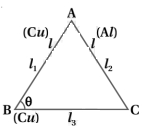
An equilateral triangle $ABC$ is formed by two copper rods $AB$ and $BC$ and one aluminium rod $AC$. The system is heated such that the temperature of each rod increases by $\Delta T$. Find the change in the angle $\angle ABC$. (Coefficient of linear expansion for copper is $\alpha_1$ and for aluminium is $\alpha_2$).
Solution
(N/A) Let the lengths of the sides be $AB = l_1$,$BC = l_3$,and $AC = l_2$. Initially,$l_1 = l_2 = l_3 = l$.
Using the law of cosines for $\angle ABC = \theta$:
$\cos \theta = \frac{l_1^2 + l_3^2 - l_2^2}{2 l_1 l_3}$
$2 l_1 l_3 \cos \theta = l_1^2 + l_3^2 - l_2^2$
Taking the differential of both sides:
$2(l_3 dl_1 + l_1 dl_3) \cos \theta - 2 l_1 l_3 \sin \theta d\theta = 2 l_1 dl_1 + 2 l_3 dl_3 - 2 l_2 dl_2$
Since $AB$ and $BC$ are copper $(\alpha_1)$ and $AC$ is aluminium $(\alpha_2)$:
$dl_1 = l_1 \alpha_1 \Delta T$,$dl_3 = l_3 \alpha_1 \Delta T$,$dl_2 = l_2 \alpha_2 \Delta T$
Substituting these into the equation and using $l_1 = l_2 = l_3 = l$ and $\theta = 60^\circ$:
$2(l^2 \alpha_1 \Delta T + l^2 \alpha_1 \Delta T) \cos 60^\circ - 2 l^2 \sin 60^\circ d\theta = 2 l^2 \alpha_1 \Delta T + 2 l^2 \alpha_1 \Delta T - 2 l^2 \alpha_2 \Delta T$
$4 l^2 \alpha_1 \Delta T (1/2) - 2 l^2 (\sqrt{3}/2) d\theta = 4 l^2 \alpha_1 \Delta T - 2 l^2 \alpha_2 \Delta T$
$2 l^2 \alpha_1 \Delta T - \sqrt{3} l^2 d\theta = 4 l^2 \alpha_1 \Delta T - 2 l^2 \alpha_2 \Delta T$
$-\sqrt{3} d\theta = 2 l^2 \alpha_1 \Delta T - 2 l^2 \alpha_2 \Delta T$
$d\theta = \frac{2(\alpha_2 - \alpha_1) \Delta T}{\sqrt{3}}$
Using the law of cosines for $\angle ABC = \theta$:
$\cos \theta = \frac{l_1^2 + l_3^2 - l_2^2}{2 l_1 l_3}$
$2 l_1 l_3 \cos \theta = l_1^2 + l_3^2 - l_2^2$
Taking the differential of both sides:
$2(l_3 dl_1 + l_1 dl_3) \cos \theta - 2 l_1 l_3 \sin \theta d\theta = 2 l_1 dl_1 + 2 l_3 dl_3 - 2 l_2 dl_2$
Since $AB$ and $BC$ are copper $(\alpha_1)$ and $AC$ is aluminium $(\alpha_2)$:
$dl_1 = l_1 \alpha_1 \Delta T$,$dl_3 = l_3 \alpha_1 \Delta T$,$dl_2 = l_2 \alpha_2 \Delta T$
Substituting these into the equation and using $l_1 = l_2 = l_3 = l$ and $\theta = 60^\circ$:
$2(l^2 \alpha_1 \Delta T + l^2 \alpha_1 \Delta T) \cos 60^\circ - 2 l^2 \sin 60^\circ d\theta = 2 l^2 \alpha_1 \Delta T + 2 l^2 \alpha_1 \Delta T - 2 l^2 \alpha_2 \Delta T$
$4 l^2 \alpha_1 \Delta T (1/2) - 2 l^2 (\sqrt{3}/2) d\theta = 4 l^2 \alpha_1 \Delta T - 2 l^2 \alpha_2 \Delta T$
$2 l^2 \alpha_1 \Delta T - \sqrt{3} l^2 d\theta = 4 l^2 \alpha_1 \Delta T - 2 l^2 \alpha_2 \Delta T$
$-\sqrt{3} d\theta = 2 l^2 \alpha_1 \Delta T - 2 l^2 \alpha_2 \Delta T$
$d\theta = \frac{2(\alpha_2 - \alpha_1) \Delta T}{\sqrt{3}}$
0 likes
View Solution115
Medium
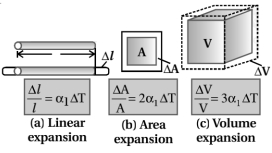
What is thermal expansion? Write only its types.
Solution
(N/A) Thermal expansion is the phenomenon where the dimensions of a body increase due to an increase in its temperature. When a substance is heated,its particles gain kinetic energy and vibrate more vigorously,leading to an increase in the average separation between them,which results in macroscopic expansion.
There are three types of thermal expansion:
$(a)$ Linear expansion: The expansion in the length of a solid is called linear expansion.
$(b)$ Area expansion: The expansion in the surface area of a solid is called area expansion.
$(c)$ Volume expansion: The expansion in the volume of a solid or fluid is called volume expansion.
These are illustrated as follows:
$(a)$ Linear expansion: $\frac{\Delta l}{l} = \alpha_l \Delta T$
$(b)$ Area expansion: $\frac{\Delta A}{A} = 2\alpha_l \Delta T$
$(c)$ Volume expansion: $\frac{\Delta V}{V} = 3\alpha_l \Delta T$
There are three types of thermal expansion:
$(a)$ Linear expansion: The expansion in the length of a solid is called linear expansion.
$(b)$ Area expansion: The expansion in the surface area of a solid is called area expansion.
$(c)$ Volume expansion: The expansion in the volume of a solid or fluid is called volume expansion.
These are illustrated as follows:
$(a)$ Linear expansion: $\frac{\Delta l}{l} = \alpha_l \Delta T$
$(b)$ Area expansion: $\frac{\Delta A}{A} = 2\alpha_l \Delta T$
$(c)$ Volume expansion: $\frac{\Delta V}{V} = 3\alpha_l \Delta T$
0 likes
View Solution116
Medium
Explain linear expansion. Write its unit.
Solution
Linear expansion refers to the increase in the length of a solid material when its temperature is increased.
The increase in length $(\Delta l)$ is directly proportional to the original length $(l)$ and the change in temperature $(\Delta T)$.
$\Delta l \propto l$ and $\Delta l \propto \Delta T$
Combining these,we get $\Delta l \propto l \Delta T$.
$\frac{\Delta l}{l} = \alpha_{l} \Delta T$,where $\alpha_{l}$ is the coefficient of linear expansion.
Rearranging,$\Delta l = \alpha_{l} l \Delta T$.
The coefficient $\alpha_{l}$ is a characteristic property of the material and depends on the type of material.
The unit of $\alpha_{l}$ is $(^{\circ}C)^{-1}$ or $K^{-1}$.
If $l_{1}$ is the initial length at temperature $T_{1}$ and $l_{2}$ is the final length at temperature $T_{2}$,then:
$l_{2} - l_{1} = \alpha_{l} l_{1} (T_{2} - T_{1})$
$l_{2} = l_{1} [1 + \alpha_{l} (T_{2} - T_{1})]$
The increase in length $(\Delta l)$ is directly proportional to the original length $(l)$ and the change in temperature $(\Delta T)$.
$\Delta l \propto l$ and $\Delta l \propto \Delta T$
Combining these,we get $\Delta l \propto l \Delta T$.
$\frac{\Delta l}{l} = \alpha_{l} \Delta T$,where $\alpha_{l}$ is the coefficient of linear expansion.
Rearranging,$\Delta l = \alpha_{l} l \Delta T$.
The coefficient $\alpha_{l}$ is a characteristic property of the material and depends on the type of material.
The unit of $\alpha_{l}$ is $(^{\circ}C)^{-1}$ or $K^{-1}$.
If $l_{1}$ is the initial length at temperature $T_{1}$ and $l_{2}$ is the final length at temperature $T_{2}$,then:
$l_{2} - l_{1} = \alpha_{l} l_{1} (T_{2} - T_{1})$
$l_{2} = l_{1} [1 + \alpha_{l} (T_{2} - T_{1})]$
0 likes
View Solution117
Medium
Obtain the relation between the coefficient of volume expansion $(\alpha_V)$ and the coefficient of linear expansion $(\alpha_l)$.
Solution
(A) Consider a cube of side length $l$. When its temperature is increased by $\Delta T$,it expands equally in all dimensions.
From the volume formula,$V = l^3$.
The change in volume is given by $\Delta V = (l + \Delta l)^3 - l^3$.
Expanding this,we get $\Delta V = l^3 + 3l^2 \Delta l + 3l(\Delta l)^2 + (\Delta l)^3 - l^3$.
Since $\Delta l$ is very small,$(\Delta l)^2$ and $(\Delta l)^3$ are negligible. Thus,$\Delta V \approx 3l^2 \Delta l$ ... $(1)$.
From the definition of linear expansion,$\Delta l = \alpha_l l \Delta T$ ... $(2)$.
Substituting equation $(2)$ into equation $(1)$:
$\Delta V = 3l^2 (\alpha_l l \Delta T) = 3l^3 \alpha_l \Delta T$.
Since $V = l^3$,we have $\Delta V = 3 V \alpha_l \Delta T$ ... $(3)$.
Comparing equation $(3)$ with the general equation for volume expansion,$\Delta V = \alpha_V V \Delta T$,we get:
$\alpha_V = 3 \alpha_l$.
From the volume formula,$V = l^3$.
The change in volume is given by $\Delta V = (l + \Delta l)^3 - l^3$.
Expanding this,we get $\Delta V = l^3 + 3l^2 \Delta l + 3l(\Delta l)^2 + (\Delta l)^3 - l^3$.
Since $\Delta l$ is very small,$(\Delta l)^2$ and $(\Delta l)^3$ are negligible. Thus,$\Delta V \approx 3l^2 \Delta l$ ... $(1)$.
From the definition of linear expansion,$\Delta l = \alpha_l l \Delta T$ ... $(2)$.
Substituting equation $(2)$ into equation $(1)$:
$\Delta V = 3l^2 (\alpha_l l \Delta T) = 3l^3 \alpha_l \Delta T$.
Since $V = l^3$,we have $\Delta V = 3 V \alpha_l \Delta T$ ... $(3)$.
Comparing equation $(3)$ with the general equation for volume expansion,$\Delta V = \alpha_V V \Delta T$,we get:
$\alpha_V = 3 \alpha_l$.
0 likes
View Solution118
MediumMCQ
What will happen if a rod is tied with fixed supports rigidly at both ends and its temperature is increased?
A
The rod will expand freely.
B
The rod will experience compressive stress and may bend.
C
The rod will experience tensile stress.
D
The length of the rod will remain constant without any stress.
Solution
(B) When a rod is fixed rigidly at both ends,it cannot expand freely upon heating.
As the temperature increases,the rod attempts to expand by $\Delta l = l \alpha \Delta T$. Since the supports are rigid,they exert an inward force on the rod,preventing this expansion.
This constraint results in the development of compressive strain and,consequently,thermal stress within the material. The thermal stress is given by $\sigma = Y \alpha \Delta T$.
If the internal compressive force exceeds the structural limit of the rod or its supports,the rod may buckle or bend.
For example,if a steel rod of cross-sectional area $40 \text{ cm}^2$ is constrained,a temperature change of $10^{\circ}C$ produces a compressive strain of $\epsilon = \alpha \Delta T = 1.2 \times 10^{-5} \times 10 = 1.2 \times 10^{-4}$.
The resulting force $F = Y A \epsilon = (2 \times 10^{11} \text{ Pa}) \times (40 \times 10^{-4} \text{ m}^2) \times (1.2 \times 10^{-4}) = 96,000 \text{ N}$,which is sufficient to cause bending or buckling in many structures.
As the temperature increases,the rod attempts to expand by $\Delta l = l \alpha \Delta T$. Since the supports are rigid,they exert an inward force on the rod,preventing this expansion.
This constraint results in the development of compressive strain and,consequently,thermal stress within the material. The thermal stress is given by $\sigma = Y \alpha \Delta T$.
If the internal compressive force exceeds the structural limit of the rod or its supports,the rod may buckle or bend.
For example,if a steel rod of cross-sectional area $40 \text{ cm}^2$ is constrained,a temperature change of $10^{\circ}C$ produces a compressive strain of $\epsilon = \alpha \Delta T = 1.2 \times 10^{-5} \times 10 = 1.2 \times 10^{-4}$.
The resulting force $F = Y A \epsilon = (2 \times 10^{11} \text{ Pa}) \times (40 \times 10^{-4} \text{ m}^2) \times (1.2 \times 10^{-4}) = 96,000 \text{ N}$,which is sufficient to cause bending or buckling in many structures.
0 likes
View Solution119
Medium
What is areal expansion? Give the definition and unit of the coefficient of areal expansion.
Solution
(N/A) Areal expansion (or superficial expansion) is the increase in the surface area of a solid body due to an increase in its temperature.
Definition of coefficient of areal expansion $(\beta)$: It is defined as the fractional change in area per unit change in temperature.
Mathematically,$\beta = \frac{\Delta A}{A_0 \Delta T}$,where $\Delta A$ is the change in area,$A_0$ is the initial area,and $\Delta T$ is the change in temperature.
Unit: The $SI$ unit of the coefficient of areal expansion is $\text{K}^{-1}$ or $^\circ\text{C}^{-1}$.
Definition of coefficient of areal expansion $(\beta)$: It is defined as the fractional change in area per unit change in temperature.
Mathematically,$\beta = \frac{\Delta A}{A_0 \Delta T}$,where $\Delta A$ is the change in area,$A_0$ is the initial area,and $\Delta T$ is the change in temperature.
Unit: The $SI$ unit of the coefficient of areal expansion is $\text{K}^{-1}$ or $^\circ\text{C}^{-1}$.
0 likes
View Solution120
MediumMCQ
On what value does the coefficient of linear expansion $\alpha_l$ depend? Write its unit.
A
Material of the rod,$K^{-1}$
B
Length of the rod,$K^{-1}$
C
Temperature change,$K$
D
Area of the rod,$m^2$
Solution
(A) The coefficient of linear expansion $\alpha_l$ is defined by the relation $\Delta L = L_0 \alpha_l \Delta T$,where $\Delta L$ is the change in length,$L_0$ is the original length,and $\Delta T$ is the change in temperature.
From this,$\alpha_l = \frac{\Delta L}{L_0 \Delta T}$.
$\alpha_l$ depends solely on the nature of the material of the substance.
Its $SI$ unit is per Kelvin $(K^{-1})$ or per degree Celsius $(^{\circ}C^{-1})$.
From this,$\alpha_l = \frac{\Delta L}{L_0 \Delta T}$.
$\alpha_l$ depends solely on the nature of the material of the substance.
Its $SI$ unit is per Kelvin $(K^{-1})$ or per degree Celsius $(^{\circ}C^{-1})$.
0 likes
View Solution121
Medium
Write the relation between the coefficient of linear expansion $(\alpha_l)$,coefficient of area expansion $(\alpha_A)$,and coefficient of volume expansion $(\alpha_V)$.
Solution
(N/A) The coefficient of linear expansion $(\alpha_l)$ is defined as the fractional change in length per unit change in temperature.
The coefficient of area expansion $(\alpha_A)$ is defined as the fractional change in area per unit change in temperature,which is approximately $2\alpha_l$.
The coefficient of volume expansion $(\alpha_V)$ is defined as the fractional change in volume per unit change in temperature,which is approximately $3\alpha_l$.
Therefore,the relationship between them is given by the ratio: $\alpha_l : \alpha_A : \alpha_V = 1 : 2 : 3$.
The coefficient of area expansion $(\alpha_A)$ is defined as the fractional change in area per unit change in temperature,which is approximately $2\alpha_l$.
The coefficient of volume expansion $(\alpha_V)$ is defined as the fractional change in volume per unit change in temperature,which is approximately $3\alpha_l$.
Therefore,the relationship between them is given by the ratio: $\alpha_l : \alpha_A : \alpha_V = 1 : 2 : 3$.
0 likes
View Solution122
MediumMCQ
Draw the graph of the coefficient of volume expansion $(\alpha_V)$ versus temperature $(T)$ for a solid.
A
$A$ straight line passing through the origin.
B
$A$ horizontal line parallel to the temperature axis.
C
$A$ curve that increases with temperature.
D
$A$ curve that decreases with temperature.
Solution
(C) The coefficient of volume expansion $(\alpha_V)$ for a solid is defined as the fractional change in volume per unit change in temperature,i.e.,$\alpha_V = \frac{1}{V} \frac{dV}{dT}$.
For most solids,$\alpha_V$ is not constant but depends on temperature.
At very low temperatures (near $0 \ K$),$\alpha_V$ is very small and increases with temperature.
As the temperature increases,$\alpha_V$ rises and eventually approaches a constant value at high temperatures.
Therefore,the graph of $\alpha_V$ versus $T$ is a curve that starts from a low value and increases,eventually becoming nearly constant at high temperatures.
For most solids,$\alpha_V$ is not constant but depends on temperature.
At very low temperatures (near $0 \ K$),$\alpha_V$ is very small and increases with temperature.
As the temperature increases,$\alpha_V$ rises and eventually approaches a constant value at high temperatures.
Therefore,the graph of $\alpha_V$ versus $T$ is a curve that starts from a low value and increases,eventually becoming nearly constant at high temperatures.
0 likes
View Solution123
Medium
Write the relation between the coefficient of linear expansion and the coefficient of volume expansion.
Solution
(N/A) Let a solid cube have a side length $L$ at temperature $T$. The initial volume is $V = L^3$.
When the temperature increases by $\Delta T$,the new length becomes $L' = L(1 + \alpha \Delta T)$,where $\alpha$ is the coefficient of linear expansion.
The new volume $V'$ is given by $V' = (L')^3 = [L(1 + \alpha \Delta T)]^3$.
Using the binomial expansion $(1 + x)^n \approx 1 + nx$ for small $x$,we get $V' \approx L^3(1 + 3\alpha \Delta T) = V(1 + 3\alpha \Delta T)$.
The coefficient of volume expansion $\gamma$ is defined by the relation $V' = V(1 + \gamma \Delta T)$.
Comparing the two expressions,we find that $\gamma = 3\alpha$.
When the temperature increases by $\Delta T$,the new length becomes $L' = L(1 + \alpha \Delta T)$,where $\alpha$ is the coefficient of linear expansion.
The new volume $V'$ is given by $V' = (L')^3 = [L(1 + \alpha \Delta T)]^3$.
Using the binomial expansion $(1 + x)^n \approx 1 + nx$ for small $x$,we get $V' \approx L^3(1 + 3\alpha \Delta T) = V(1 + 3\alpha \Delta T)$.
The coefficient of volume expansion $\gamma$ is defined by the relation $V' = V(1 + \gamma \Delta T)$.
Comparing the two expressions,we find that $\gamma = 3\alpha$.
0 likes
View Solution124
EasyMCQ
Why does the density of solid substances change with an increase in temperature?
A
Mass increases,volume remains constant.
B
Mass remains constant,volume increases due to thermal expansion.
C
Mass decreases,volume remains constant.
D
Mass remains constant,volume decreases due to thermal contraction.
Solution
(B) The density $\rho$ of a substance is defined as the ratio of its mass $m$ to its volume $V$,given by the formula $\rho = \frac{m}{V}$.
When the temperature of a solid substance increases,its atoms vibrate with greater amplitude,causing the average distance between them to increase. This phenomenon is known as thermal expansion.
As a result of thermal expansion,the volume $V$ of the solid increases.
Since the mass $m$ of the substance remains constant during this process,the increase in volume $V$ leads to a decrease in density $\rho$ because $\rho$ is inversely proportional to $V$.
When the temperature of a solid substance increases,its atoms vibrate with greater amplitude,causing the average distance between them to increase. This phenomenon is known as thermal expansion.
As a result of thermal expansion,the volume $V$ of the solid increases.
Since the mass $m$ of the substance remains constant during this process,the increase in volume $V$ leads to a decrease in density $\rho$ because $\rho$ is inversely proportional to $V$.
0 likes
View Solution125
MediumMCQ
On what does the value of the coefficient of linear expansion depend?
A
Only on the material of the rod.
B
Only on the initial length of the rod.
C
On the nature of the material and the temperature range.
D
On the shape of the rod.
Solution
(C) The coefficient of linear expansion,denoted by $\alpha$,is a property that characterizes how a material changes its length with temperature.
It depends primarily on the nature of the material (the atomic structure and bonding) and the temperature range over which the expansion is measured.
While it is often treated as a constant for small temperature changes,it is technically a function of temperature.
It depends primarily on the nature of the material (the atomic structure and bonding) and the temperature range over which the expansion is measured.
While it is often treated as a constant for small temperature changes,it is technically a function of temperature.
0 likes
View Solution126
Medium
$A$ student records the initial length $l$,change in temperature $\Delta T$ and change in length $\Delta l$ of a rod as follows:
If the first observation is correct,what can you say about observations $(2)$,$(3)$ and $(4)$?
| $S$.No. | $l (m)$ | $\Delta T (^{\circ}C)$ | $\Delta l (m)$ |
|---|---|---|---|
| $(1)$ | $2$ | $10$ | $4 \times 10^{-4}$ |
| $(2)$ | $1$ | $10$ | $4 \times 10^{-4}$ |
| $(3)$ | $2$ | $20$ | $2 \times 10^{-4}$ |
| $(4)$ | $3$ | $10$ | $6 \times 10^{-4}$ |
If the first observation is correct,what can you say about observations $(2)$,$(3)$ and $(4)$?
Solution
(N/A) The formula for linear thermal expansion is $\Delta l = \alpha l \Delta T$,where $\alpha$ is the coefficient of linear expansion.
From the first observation:
$\alpha = \frac{\Delta l}{l \Delta T} = \frac{4 \times 10^{-4}}{2 \times 10} = 2 \times 10^{-5} \, ^{\circ}C^{-1}$.
Now,we check the other observations using $\alpha = 2 \times 10^{-5} \, ^{\circ}C^{-1}$:
For observation $(2)$:
$\Delta l = \alpha l \Delta T = (2 \times 10^{-5}) \times 1 \times 10 = 2 \times 10^{-4} \, m$.
Since the recorded value is $4 \times 10^{-4} \, m$,observation $(2)$ is incorrect.
For observation $(3)$:
$\Delta l = \alpha l \Delta T = (2 \times 10^{-5}) \times 2 \times 20 = 8 \times 10^{-4} \, m$.
Since the recorded value is $2 \times 10^{-4} \, m$,observation $(3)$ is incorrect.
For observation $(4)$:
$\Delta l = \alpha l \Delta T = (2 \times 10^{-5}) \times 3 \times 10 = 6 \times 10^{-4} \, m$.
Since the recorded value is $6 \times 10^{-4} \, m$,observation $(4)$ is correct.
From the first observation:
$\alpha = \frac{\Delta l}{l \Delta T} = \frac{4 \times 10^{-4}}{2 \times 10} = 2 \times 10^{-5} \, ^{\circ}C^{-1}$.
Now,we check the other observations using $\alpha = 2 \times 10^{-5} \, ^{\circ}C^{-1}$:
For observation $(2)$:
$\Delta l = \alpha l \Delta T = (2 \times 10^{-5}) \times 1 \times 10 = 2 \times 10^{-4} \, m$.
Since the recorded value is $4 \times 10^{-4} \, m$,observation $(2)$ is incorrect.
For observation $(3)$:
$\Delta l = \alpha l \Delta T = (2 \times 10^{-5}) \times 2 \times 20 = 8 \times 10^{-4} \, m$.
Since the recorded value is $2 \times 10^{-4} \, m$,observation $(3)$ is incorrect.
For observation $(4)$:
$\Delta l = \alpha l \Delta T = (2 \times 10^{-5}) \times 3 \times 10 = 6 \times 10^{-4} \, m$.
Since the recorded value is $6 \times 10^{-4} \, m$,observation $(4)$ is correct.
0 likes
View Solution127
Difficult
We would like to prepare a scale whose length does not change with temperature. It is proposed to prepare a unit scale of this type whose length remains,say $10 \ cm$. We can use a bimetallic strip made of brass and iron each of different length whose length (both components) would change in such a way that the difference between their lengths remains constant. If $\alpha_{\text{iron}} = 1.2 \times 10^{-5} \ K^{-1}$ and $\alpha_{\text{brass}} = 1.8 \times 10^{-5} \ K^{-1}$,what should be the length of each strip?
Solution
(N/A) Let $l_{\text{iron}}$ and $l_{\text{brass}}$ be the lengths of the iron and brass strips respectively.
According to the problem,the difference in their lengths must remain constant at $10 \ cm$ for any temperature change $\Delta T$.
So,$l_{\text{iron}} - l_{\text{brass}} = 10 \ cm \ldots (1)$
When temperature changes by $\Delta T$,the new lengths are $l_{\text{iron}}' = l_{\text{iron}}(1 + \alpha_{\text{iron}} \Delta T)$ and $l_{\text{brass}}' = l_{\text{brass}}(1 + \alpha_{\text{brass}} \Delta T)$.
For the difference to be constant,$l_{\text{iron}}' - l_{\text{brass}}' = l_{\text{iron}} - l_{\text{brass}}$.
This implies $l_{\text{iron}} \alpha_{\text{iron}} \Delta T = l_{\text{brass}} \alpha_{\text{brass}} \Delta T$.
Therefore,$l_{\text{iron}} \alpha_{\text{iron}} = l_{\text{brass}} \alpha_{\text{brass}}$.
$\frac{l_{\text{iron}}}{l_{\text{brass}}} = \frac{\alpha_{\text{brass}}}{\alpha_{\text{iron}}} = \frac{1.8 \times 10^{-5}}{1.2 \times 10^{-5}} = \frac{3}{2}$.
So,$l_{\text{iron}} = 1.5 \ l_{\text{brass}}$.
Substituting this into equation $(1)$:
$1.5 \ l_{\text{brass}} - l_{\text{brass}} = 10 \ cm$.
$0.5 \ l_{\text{brass}} = 10 \ cm \implies l_{\text{brass}} = 20 \ cm$.
Then,$l_{\text{iron}} = 1.5 \times 20 \ cm = 30 \ cm$.
Thus,the lengths should be $30 \ cm$ for iron and $20 \ cm$ for brass.
According to the problem,the difference in their lengths must remain constant at $10 \ cm$ for any temperature change $\Delta T$.
So,$l_{\text{iron}} - l_{\text{brass}} = 10 \ cm \ldots (1)$
When temperature changes by $\Delta T$,the new lengths are $l_{\text{iron}}' = l_{\text{iron}}(1 + \alpha_{\text{iron}} \Delta T)$ and $l_{\text{brass}}' = l_{\text{brass}}(1 + \alpha_{\text{brass}} \Delta T)$.
For the difference to be constant,$l_{\text{iron}}' - l_{\text{brass}}' = l_{\text{iron}} - l_{\text{brass}}$.
This implies $l_{\text{iron}} \alpha_{\text{iron}} \Delta T = l_{\text{brass}} \alpha_{\text{brass}} \Delta T$.
Therefore,$l_{\text{iron}} \alpha_{\text{iron}} = l_{\text{brass}} \alpha_{\text{brass}}$.
$\frac{l_{\text{iron}}}{l_{\text{brass}}} = \frac{\alpha_{\text{brass}}}{\alpha_{\text{iron}}} = \frac{1.8 \times 10^{-5}}{1.2 \times 10^{-5}} = \frac{3}{2}$.
So,$l_{\text{iron}} = 1.5 \ l_{\text{brass}}$.
Substituting this into equation $(1)$:
$1.5 \ l_{\text{brass}} - l_{\text{brass}} = 10 \ cm$.
$0.5 \ l_{\text{brass}} = 10 \ cm \implies l_{\text{brass}} = 20 \ cm$.
Then,$l_{\text{iron}} = 1.5 \times 20 \ cm = 30 \ cm$.
Thus,the lengths should be $30 \ cm$ for iron and $20 \ cm$ for brass.
0 likes
View Solution128
Difficult
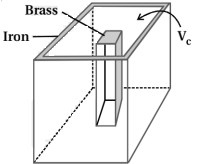
We would like to make a vessel whose volume does not change with temperature. We can use brass and iron $\left( {{\gamma _{{\text{brass}}}} = 6 \times {{10}^{ - 5}}/K} \right.$ and $\left. {{\gamma _{{\text{iron}}}} = 3.55 \times {{10}^{ - 5}}/K} \right)$ to create a volume of $100 \, cc$. How can you achieve this?
Solution
(N/A) Let $V_{i,0}$ and $V_{b,0}$ be the volumes of iron and brass at $0^{\circ} C$ respectively.
Let $V_i$ and $V_b$ be the volumes of iron and brass at temperature $\Delta T^{\circ} C$ respectively.
Let $\gamma_i$ and $\gamma_b$ be the coefficients of volume expansion for iron and brass respectively.
The net volume of the vessel is $V_c = V_i - V_b = 100 \, cc$.
For the volume to remain constant with temperature,the change in volume must be zero:
$\Delta V_c = \Delta V_i - \Delta V_b = 0$
$V_{i,0} \gamma_i \Delta T - V_{b,0} \gamma_b \Delta T = 0$
$V_{i,0} \gamma_i = V_{b,0} \gamma_b$
$\frac{V_{i,0}}{V_{b,0}} = \frac{\gamma_b}{\gamma_i} = \frac{6 \times 10^{-5}}{3.55 \times 10^{-5}} = \frac{6}{3.55} \approx 1.69$
Given $V_{i,0} - V_{b,0} = 100 \, cc$,we substitute $V_{i,0} = \frac{6}{3.55} V_{b,0}$:
$\left( \frac{6}{3.55} - 1 \right) V_{b,0} = 100$
$\left( \frac{6 - 3.55}{3.55} \right) V_{b,0} = 100$
$\frac{2.45}{3.55} V_{b,0} = 100$
$V_{b,0} = \frac{355}{2.45} \approx 144.9 \, cc$
$V_{i,0} = 100 + 144.9 = 244.9 \, cc$.
Let $V_i$ and $V_b$ be the volumes of iron and brass at temperature $\Delta T^{\circ} C$ respectively.
Let $\gamma_i$ and $\gamma_b$ be the coefficients of volume expansion for iron and brass respectively.
The net volume of the vessel is $V_c = V_i - V_b = 100 \, cc$.
For the volume to remain constant with temperature,the change in volume must be zero:
$\Delta V_c = \Delta V_i - \Delta V_b = 0$
$V_{i,0} \gamma_i \Delta T - V_{b,0} \gamma_b \Delta T = 0$
$V_{i,0} \gamma_i = V_{b,0} \gamma_b$
$\frac{V_{i,0}}{V_{b,0}} = \frac{\gamma_b}{\gamma_i} = \frac{6 \times 10^{-5}}{3.55 \times 10^{-5}} = \frac{6}{3.55} \approx 1.69$
Given $V_{i,0} - V_{b,0} = 100 \, cc$,we substitute $V_{i,0} = \frac{6}{3.55} V_{b,0}$:
$\left( \frac{6}{3.55} - 1 \right) V_{b,0} = 100$
$\left( \frac{6 - 3.55}{3.55} \right) V_{b,0} = 100$
$\frac{2.45}{3.55} V_{b,0} = 100$
$V_{b,0} = \frac{355}{2.45} \approx 144.9 \, cc$
$V_{i,0} = 100 + 144.9 = 244.9 \, cc$.
0 likes
View Solution129
Difficult
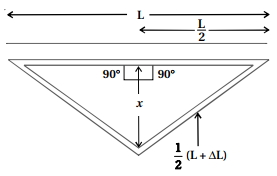
$A$ rail track made of steel having length $10\,m$ is clamped on a railway line at its two ends as shown in the figure. On a summer day,due to a rise in temperature by $20\,^oC$,it is deformed as shown in the figure. Find $x$ (displacement of the centre) if $\alpha_{steel} = 1.2 \times 10^{-5} \,^oC^{-1}$.
Solution
(N/A) By using the Pythagoras theorem for the given right-angled triangle:
$\left(\frac{L+\Delta L}{2}\right)^{2} = \left(\frac{L}{2}\right)^{2} + x^{2}$
$x = \sqrt{\left(\frac{L+\Delta L}{2}\right)^{2} - \left(\frac{L}{2}\right)^{2}}$
$x = \frac{1}{2} \sqrt{(L+\Delta L)^{2} - L^{2}}$
$x = \frac{1}{2} \sqrt{L^{2} + 2L\Delta L + (\Delta L)^{2} - L^{2}}$
$x = \frac{1}{2} \sqrt{2L\Delta L + (\Delta L)^{2}}$
Since $\Delta L$ is very small,$(\Delta L)^{2}$ can be neglected.
$x \approx \frac{1}{2} \sqrt{2L\Delta L}$
Given $\Delta L = L \alpha \Delta T$,we substitute this into the equation:
$x = \frac{1}{2} \sqrt{2L(L \alpha \Delta T)} = \frac{L}{2} \sqrt{2 \alpha \Delta T}$
Substituting the values $L = 10\,m$,$\alpha = 1.2 \times 10^{-5} \,^oC^{-1}$,and $\Delta T = 20\,^oC$:
$x = \frac{10}{2} \sqrt{2 \times 1.2 \times 10^{-5} \times 20}$
$x = 5 \sqrt{48 \times 10^{-5}} = 5 \sqrt{4.8 \times 10^{-4}}$
$x = 5 \times 2.19 \times 10^{-2} \approx 0.1095\,m \approx 11\,cm$.
$\left(\frac{L+\Delta L}{2}\right)^{2} = \left(\frac{L}{2}\right)^{2} + x^{2}$
$x = \sqrt{\left(\frac{L+\Delta L}{2}\right)^{2} - \left(\frac{L}{2}\right)^{2}}$
$x = \frac{1}{2} \sqrt{(L+\Delta L)^{2} - L^{2}}$
$x = \frac{1}{2} \sqrt{L^{2} + 2L\Delta L + (\Delta L)^{2} - L^{2}}$
$x = \frac{1}{2} \sqrt{2L\Delta L + (\Delta L)^{2}}$
Since $\Delta L$ is very small,$(\Delta L)^{2}$ can be neglected.
$x \approx \frac{1}{2} \sqrt{2L\Delta L}$
Given $\Delta L = L \alpha \Delta T$,we substitute this into the equation:
$x = \frac{1}{2} \sqrt{2L(L \alpha \Delta T)} = \frac{L}{2} \sqrt{2 \alpha \Delta T}$
Substituting the values $L = 10\,m$,$\alpha = 1.2 \times 10^{-5} \,^oC^{-1}$,and $\Delta T = 20\,^oC$:
$x = \frac{10}{2} \sqrt{2 \times 1.2 \times 10^{-5} \times 20}$
$x = 5 \sqrt{48 \times 10^{-5}} = 5 \sqrt{4.8 \times 10^{-4}}$
$x = 5 \times 2.19 \times 10^{-2} \approx 0.1095\,m \approx 11\,cm$.
0 likes
View Solution130
Medium
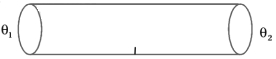
$A$ thin rod having length $L_0$ at $0\,^{\circ}C$ and coefficient of linear expansion $\alpha$ has its two ends maintained at temperatures $\theta_1$ and $\theta_2$,respectively. Find its new length.
Solution
(N/A) In thermal steady state,the temperature gradient along the rod is constant. The temperature varies linearly from $\theta_1$ to $\theta_2$. The average temperature of the rod is $\theta_{avg} = \frac{\theta_1 + \theta_2}{2}$.
The change in length $\Delta L$ is given by $\Delta L = L_0 \alpha \Delta T$,where $\Delta T$ is the change in temperature from the reference temperature $(0\,^{\circ}C)$.
Thus,the new length $L$ is:
$L = L_0(1 + \alpha \theta_{avg})$
$L = L_0 \left( 1 + \alpha \left( \frac{\theta_1 + \theta_2}{2} \right) \right)$
The change in length $\Delta L$ is given by $\Delta L = L_0 \alpha \Delta T$,where $\Delta T$ is the change in temperature from the reference temperature $(0\,^{\circ}C)$.
Thus,the new length $L$ is:
$L = L_0(1 + \alpha \theta_{avg})$
$L = L_0 \left( 1 + \alpha \left( \frac{\theta_1 + \theta_2}{2} \right) \right)$
0 likes
View Solution131
DifficultMCQ
When the temperature of a metal wire is increased from $0^{\circ} \,C$ to $10^{\circ} \,C$,its length increases by $0.02 \%$. The percentage change in its mass density will be closest to: (in $\%$)
A
$0.008$
B
$0.06$
C
$0.8$
D
$2.3$
Solution
(B) Given that the fractional change in length is $\frac{\Delta L}{L} = 0.02 \% = 2 \times 10^{-4}$.
Since $\Delta L = L \alpha \Delta T$,we have $\alpha \Delta T = 2 \times 10^{-4}$.
The volume $V$ of the wire is $V = A \times L$,where $A$ is the cross-sectional area.
The density $\rho$ is given by $\rho = \frac{M}{V} = \frac{M}{AL}$.
Taking the logarithmic derivative,we get $\frac{\Delta \rho}{\rho} = - (\frac{\Delta A}{A} + \frac{\Delta L}{L})$.
Since $\frac{\Delta A}{A} = 2 \alpha \Delta T$ and $\frac{\Delta L}{L} = \alpha \Delta T$,the fractional change in density is $\frac{\Delta \rho}{\rho} = -(2 \alpha \Delta T + \alpha \Delta T) = -3 \alpha \Delta T$.
Substituting $\alpha \Delta T = 0.02 \%$,we get $\frac{\Delta \rho}{\rho} = -3 \times 0.02 \% = -0.06 \%$.
The magnitude of the percentage change is $0.06 \%$.
Since $\Delta L = L \alpha \Delta T$,we have $\alpha \Delta T = 2 \times 10^{-4}$.
The volume $V$ of the wire is $V = A \times L$,where $A$ is the cross-sectional area.
The density $\rho$ is given by $\rho = \frac{M}{V} = \frac{M}{AL}$.
Taking the logarithmic derivative,we get $\frac{\Delta \rho}{\rho} = - (\frac{\Delta A}{A} + \frac{\Delta L}{L})$.
Since $\frac{\Delta A}{A} = 2 \alpha \Delta T$ and $\frac{\Delta L}{L} = \alpha \Delta T$,the fractional change in density is $\frac{\Delta \rho}{\rho} = -(2 \alpha \Delta T + \alpha \Delta T) = -3 \alpha \Delta T$.
Substituting $\alpha \Delta T = 0.02 \%$,we get $\frac{\Delta \rho}{\rho} = -3 \times 0.02 \% = -0.06 \%$.
The magnitude of the percentage change is $0.06 \%$.
1 likes
View Solution132
DifficultMCQ
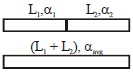
Two different wires having lengths $L_{1}$ and $L_{2}$ and respective temperature coefficients of linear expansion $\alpha_{1}$ and $\alpha_{2}$ are joined end-to-end. Then the effective temperature coefficient of linear expansion is
A
$4 \frac{\alpha_{1} \alpha_{2}}{\alpha_{1}+\alpha_{2}} \frac{L_{2} L_{1}}{(L_{2}+L_{1})^{2}}$
B
$2 \sqrt{\alpha_{1} \alpha_{2}}$
C
$\frac{\alpha_{1}+\alpha_{2}}{2}$
D
$\frac{\alpha_{1} L_{1}+\alpha_{2} L_{2}}{L_{1}+L_{2}}$
Solution
(D) At temperature $T$,the total length is $L = L_{1} + L_{2}$.
When the temperature increases to $T + \Delta T$,the new lengths are:
$L_{1}' = L_{1}(1 + \alpha_{1} \Delta T)$
$L_{2}' = L_{2}(1 + \alpha_{2} \Delta T)$
The total new length $L_{eq}'$ is the sum of the individual new lengths:
$L_{eq}' = L_{1}' + L_{2}' = L_{1}(1 + \alpha_{1} \Delta T) + L_{2}(1 + \alpha_{2} \Delta T)$
$L_{eq}' = L_{1} + L_{1} \alpha_{1} \Delta T + L_{2} + L_{2} \alpha_{2} \Delta T$
$L_{eq}' = (L_{1} + L_{2}) + (L_{1} \alpha_{1} + L_{2} \alpha_{2}) \Delta T$
For the equivalent system with effective coefficient $\alpha_{avg}$,the new length is:
$L_{eq}' = (L_{1} + L_{2})(1 + \alpha_{avg} \Delta T) = (L_{1} + L_{2}) + (L_{1} + L_{2}) \alpha_{avg} \Delta T$
Equating the two expressions for $L_{eq}'$:
$(L_{1} + L_{2}) \alpha_{avg} \Delta T = (L_{1} \alpha_{1} + L_{2} \alpha_{2}) \Delta T$
$\alpha_{avg} = \frac{L_{1} \alpha_{1} + L_{2} \alpha_{2}}{L_{1} + L_{2}}$
When the temperature increases to $T + \Delta T$,the new lengths are:
$L_{1}' = L_{1}(1 + \alpha_{1} \Delta T)$
$L_{2}' = L_{2}(1 + \alpha_{2} \Delta T)$
The total new length $L_{eq}'$ is the sum of the individual new lengths:
$L_{eq}' = L_{1}' + L_{2}' = L_{1}(1 + \alpha_{1} \Delta T) + L_{2}(1 + \alpha_{2} \Delta T)$
$L_{eq}' = L_{1} + L_{1} \alpha_{1} \Delta T + L_{2} + L_{2} \alpha_{2} \Delta T$
$L_{eq}' = (L_{1} + L_{2}) + (L_{1} \alpha_{1} + L_{2} \alpha_{2}) \Delta T$
For the equivalent system with effective coefficient $\alpha_{avg}$,the new length is:
$L_{eq}' = (L_{1} + L_{2})(1 + \alpha_{avg} \Delta T) = (L_{1} + L_{2}) + (L_{1} + L_{2}) \alpha_{avg} \Delta T$
Equating the two expressions for $L_{eq}'$:
$(L_{1} + L_{2}) \alpha_{avg} \Delta T = (L_{1} \alpha_{1} + L_{2} \alpha_{2}) \Delta T$
$\alpha_{avg} = \frac{L_{1} \alpha_{1} + L_{2} \alpha_{2}}{L_{1} + L_{2}}$
0 likes
View Solution133
MediumMCQ
The coefficient of apparent expansion of mercury in a glass vessel is $153 \times 10^{-6} /{ }^{\circ} C$ and in a steel vessel is $144 \times 10^{-6} /{ }^{\circ} C$. If $\alpha$ for steel is $12 \times 10^{-6} /{ }^{\circ} C$, then the coefficient of linear expansion $\alpha$ for glass is:
A
$9 \times 10^{-6} /{ }^{\circ} C$
B
$6 \times 10^{-6} /{ }^{\circ} C$
C
$36 \times 10^{-6} /{ }^{\circ} C$
D
$27 \times 10^{-6} /{ }^{\circ} C$
Solution
(A) The real coefficient of volume expansion of mercury $(\gamma_{\text{real}})$ is constant regardless of the vessel used.
The relationship between real expansion, apparent expansion, and vessel expansion is given by:
$\gamma_{\text{real}} = \gamma_{\text{app}} + \gamma_{\text{vessel}}$
Since $\gamma_{\text{real}}$ is the same for both cases:
$(\gamma_{\text{app}} + \gamma_{\text{vessel}})_{\text{glass}} = (\gamma_{\text{app}} + \gamma_{\text{vessel}})_{\text{steel}}$
We know that the volume expansion coefficient of a solid is $\gamma_{\text{vessel}} = 3\alpha$.
For steel:
$\gamma_{\text{vessel, steel}} = 3 \times (12 \times 10^{-6} /{ }^{\circ} C) = 36 \times 10^{-6} /{ }^{\circ} C$
Substituting the values into the equation:
$153 \times 10^{-6} + \gamma_{\text{vessel, glass}} = 144 \times 10^{-6} + 36 \times 10^{-6}$
$153 \times 10^{-6} + \gamma_{\text{vessel, glass}} = 180 \times 10^{-6}$
$\gamma_{\text{vessel, glass}} = (180 - 153) \times 10^{-6} = 27 \times 10^{-6} /{ }^{\circ} C$
Since $\gamma_{\text{vessel, glass}} = 3\alpha_{\text{glass}}$:
$3\alpha_{\text{glass}} = 27 \times 10^{-6} /{ }^{\circ} C$
$\alpha_{\text{glass}} = 9 \times 10^{-6} /{ }^{\circ} C$
The relationship between real expansion, apparent expansion, and vessel expansion is given by:
$\gamma_{\text{real}} = \gamma_{\text{app}} + \gamma_{\text{vessel}}$
Since $\gamma_{\text{real}}$ is the same for both cases:
$(\gamma_{\text{app}} + \gamma_{\text{vessel}})_{\text{glass}} = (\gamma_{\text{app}} + \gamma_{\text{vessel}})_{\text{steel}}$
We know that the volume expansion coefficient of a solid is $\gamma_{\text{vessel}} = 3\alpha$.
For steel:
$\gamma_{\text{vessel, steel}} = 3 \times (12 \times 10^{-6} /{ }^{\circ} C) = 36 \times 10^{-6} /{ }^{\circ} C$
Substituting the values into the equation:
$153 \times 10^{-6} + \gamma_{\text{vessel, glass}} = 144 \times 10^{-6} + 36 \times 10^{-6}$
$153 \times 10^{-6} + \gamma_{\text{vessel, glass}} = 180 \times 10^{-6}$
$\gamma_{\text{vessel, glass}} = (180 - 153) \times 10^{-6} = 27 \times 10^{-6} /{ }^{\circ} C$
Since $\gamma_{\text{vessel, glass}} = 3\alpha_{\text{glass}}$:
$3\alpha_{\text{glass}} = 27 \times 10^{-6} /{ }^{\circ} C$
$\alpha_{\text{glass}} = 9 \times 10^{-6} /{ }^{\circ} C$
0 likes
View Solution134
MediumMCQ
$A$ silver rod of $100 \; cm$ at $0^{\circ} C$ is heated to $100^{\circ} C$. Its length increases by $0.19 \; cm$. The coefficient of cubical expansion of the silver rod is:
A
$5.7 \times 10^{-5} /{ }^{\circ} C$
B
$0.63 \times 10^{-5} /{ }^{\circ} C$
C
$1.9 \times 10^{-5} /{ }^{\circ} C$
D
$16.1 \times 10^{-5} /{ }^{\circ} C$
Solution
(A) First,we calculate the coefficient of linear expansion $(\alpha)$:
$\alpha = \frac{\Delta L}{L_{0} \Delta \theta}$
$\alpha = \frac{0.19 \; cm}{100 \; cm \times (100^{\circ} C - 0^{\circ} C)}$
$\alpha = \frac{0.19}{100 \times 100} = \frac{0.19}{10000} = 1.9 \times 10^{-5} /{ }^{\circ} C$
The coefficient of cubical expansion $(\gamma)$ is related to the coefficient of linear expansion by the formula $\gamma = 3\alpha$.
$\gamma = 3 \times (1.9 \times 10^{-5} /{ }^{\circ} C)$
$\gamma = 5.7 \times 10^{-5} /{ }^{\circ} C$
$\alpha = \frac{\Delta L}{L_{0} \Delta \theta}$
$\alpha = \frac{0.19 \; cm}{100 \; cm \times (100^{\circ} C - 0^{\circ} C)}$
$\alpha = \frac{0.19}{100 \times 100} = \frac{0.19}{10000} = 1.9 \times 10^{-5} /{ }^{\circ} C$
The coefficient of cubical expansion $(\gamma)$ is related to the coefficient of linear expansion by the formula $\gamma = 3\alpha$.
$\gamma = 3 \times (1.9 \times 10^{-5} /{ }^{\circ} C)$
$\gamma = 5.7 \times 10^{-5} /{ }^{\circ} C$
0 likes
View Solution135
DifficultMCQ
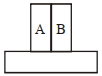
$A$ bimetallic strip consists of metals $A$ and $B$. It is mounted rigidly as shown. The metal $A$ has a higher coefficient of linear expansion compared to that of metal $B$. When the bimetallic strip is placed in a cold bath,it will:
A
Bend towards the right
B
Not bend but shrink
C
Neither bend nor shrink
D
Bend towards the left
Solution
(D) The change in length of a metal strip is given by $\Delta L = L \alpha \Delta T$,where $\alpha$ is the coefficient of linear expansion and $\Delta T$ is the change in temperature.
Since the strip is placed in a cold bath,the temperature decreases,so $\Delta T$ is negative,meaning both metals will contract.
Given that $\alpha_{A} > \alpha_{B}$,the contraction in metal $A$ will be greater than the contraction in metal $B$ (i.e.,$|\Delta L_{A}| > |\Delta L_{B}|$).
Since metal $A$ is on the left and it contracts more than metal $B$,the strip will bend towards the side that contracts more,which is the left side.
Since the strip is placed in a cold bath,the temperature decreases,so $\Delta T$ is negative,meaning both metals will contract.
Given that $\alpha_{A} > \alpha_{B}$,the contraction in metal $A$ will be greater than the contraction in metal $B$ (i.e.,$|\Delta L_{A}| > |\Delta L_{B}|$).
Since metal $A$ is on the left and it contracts more than metal $B$,the strip will bend towards the side that contracts more,which is the left side.

0 likes
View Solution136
MediumMCQ
Each side of a cubic metal box is $a$ at room temperature $T$. The coefficient of linear expansion of the metal sheet is $\alpha$. The metal box is heated uniformly by a small temperature $\Delta T$,so that its new temperature is $T + \Delta T$. Calculate the increase in the volume of the metal box.
A
$3 a^{3} \alpha \Delta T$
B
$4 a^{3} \alpha \Delta T$
C
$4 \pi a^{3} \alpha \Delta T$
D
$\frac{4}{3} \pi a^{3} \alpha \Delta T$
Solution
(A) The initial volume of the cubic box is $V = a^{3}$.
The coefficient of volume expansion $\gamma$ is related to the coefficient of linear expansion $\alpha$ by the relation $\gamma = 3\alpha$.
The change in volume $\Delta V$ for a temperature change $\Delta T$ is given by the formula $\Delta V = V \gamma \Delta T$.
Substituting the values of $V$ and $\gamma$ into the formula,we get:
$\Delta V = a^{3} \times (3\alpha) \times \Delta T$.
Therefore,the increase in the volume of the metal box is $\Delta V = 3 a^{3} \alpha \Delta T$.
The coefficient of volume expansion $\gamma$ is related to the coefficient of linear expansion $\alpha$ by the relation $\gamma = 3\alpha$.
The change in volume $\Delta V$ for a temperature change $\Delta T$ is given by the formula $\Delta V = V \gamma \Delta T$.
Substituting the values of $V$ and $\gamma$ into the formula,we get:
$\Delta V = a^{3} \times (3\alpha) \times \Delta T$.
Therefore,the increase in the volume of the metal box is $\Delta V = 3 a^{3} \alpha \Delta T$.
0 likes
View Solution137
MediumMCQ
Given below are two statements: one is labelled as Assertion $A$ and the other is labelled as Reason $R$.
Assertion $A$: When a rod lying freely is heated,no thermal stress is developed in it.
Reason $R$: On heating,the length of the rod increases.
In the light of the above statements,choose the correct answer from the options given below:
Assertion $A$: When a rod lying freely is heated,no thermal stress is developed in it.
Reason $R$: On heating,the length of the rod increases.
In the light of the above statements,choose the correct answer from the options given below:
A
Both $A$ and $R$ are true but $R$ is $NOT$ the correct explanation of $A$.
B
$A$ is false but $R$ is true.
C
$A$ is true but $R$ is false.
D
Both $A$ and $R$ are true and $R$ is the correct explanation of $A$.
Solution
(A) Assertion $A$ is true: When a rod is heated freely,it expands without any external constraint. Since there is no constraint to prevent expansion,no internal restoring force or thermal stress is generated.
Reason $R$ is true: Thermal expansion causes the length of the rod to increase upon heating,which is a physical fact.
However,Reason $R$ does not explain why no thermal stress is developed. The absence of thermal stress is due to the lack of external constraints (freedom to expand),not simply because the length increases. Therefore,both $A$ and $R$ are true,but $R$ is not the correct explanation of $A$.
Reason $R$ is true: Thermal expansion causes the length of the rod to increase upon heating,which is a physical fact.
However,Reason $R$ does not explain why no thermal stress is developed. The absence of thermal stress is due to the lack of external constraints (freedom to expand),not simply because the length increases. Therefore,both $A$ and $R$ are true,but $R$ is not the correct explanation of $A$.
0 likes
View Solution138
MediumMCQ
The area of cross-section of a railway track is $0.01\, m^2$. The temperature variation is $10^{\circ}C$. The coefficient of linear expansion of the material of the track is $10^{-5} /^{\circ}C$. The energy stored per meter in the track is ...... $J/m$. (Young's modulus of the material of the track is $10^{11}\, Nm^{-2}$)
A
$4$
B
$5$
C
$6$
D
$7$
Solution
(B) The elastic potential energy stored per unit volume is given by $u = \frac{1}{2} \times \text{Young's Modulus} \times (\text{strain})^2$.
Since the track is constrained,the thermal strain is $\text{strain} = \alpha \Delta T$.
Given $\alpha = 10^{-5} /^{\circ}C$ and $\Delta T = 10^{\circ}C$,the strain is $\text{strain} = 10^{-5} \times 10 = 10^{-4}$.
The energy stored per unit length is $U = u \times \text{Area} = \frac{1}{2} Y (\text{strain})^2 \times A$.
Substituting the values: $U = \frac{1}{2} \times 10^{11} \times (10^{-4})^2 \times 0.01$.
$U = 0.5 \times 10^{11} \times 10^{-8} \times 10^{-2} = 0.5 \times 10^1 = 5\, J/m$.
Since the track is constrained,the thermal strain is $\text{strain} = \alpha \Delta T$.
Given $\alpha = 10^{-5} /^{\circ}C$ and $\Delta T = 10^{\circ}C$,the strain is $\text{strain} = 10^{-5} \times 10 = 10^{-4}$.
The energy stored per unit length is $U = u \times \text{Area} = \frac{1}{2} Y (\text{strain})^2 \times A$.
Substituting the values: $U = \frac{1}{2} \times 10^{11} \times (10^{-4})^2 \times 0.01$.
$U = 0.5 \times 10^{11} \times 10^{-8} \times 10^{-2} = 0.5 \times 10^1 = 5\, J/m$.
0 likes
View Solution139
MediumMCQ
$A$ solid metallic cube having a total surface area of $24 \; m^{2}$ is uniformly heated. If its temperature is increased by $10 \; ^{\circ}C$,calculate the increase in volume of the cube. (Given: $\alpha = 5.0 \times 10^{-4} \; ^{\circ}C^{-1}$)
A
$2.4 \times 10^{6} \; cm^{3}$
B
$1.2 \times 10^{5} \; cm^{3}$
C
$6.0 \times 10^{4} \; cm^{3}$
D
$4.8 \times 10^{5} \; cm^{3}$
Solution
(B) The increase in volume is given by $\Delta V = \gamma V_{0} \Delta T$.
Since $\gamma = 3\alpha$,we have $\Delta V = (3\alpha) V_{0} \Delta T$.
The total surface area of a cube is $6a^{2}$,where $a$ is the side length.
Given $6a^{2} = 24 \; m^{2}$,so $a^{2} = 4 \; m^{2}$,which means $a = 2 \; m$.
The initial volume $V_{0} = a^{3} = (2)^{3} = 8 \; m^{3}$.
Substituting the values: $\Delta V = (3 \times 5.0 \times 10^{-4} \; ^{\circ}C^{-1}) \times (8 \; m^{3}) \times (10 \; ^{\circ}C)$.
$\Delta V = 15 \times 10^{-4} \times 80 = 1200 \times 10^{-4} = 0.12 \; m^{3}$.
Since $1 \; m^{3} = 10^{6} \; cm^{3}$,then $\Delta V = 0.12 \times 10^{6} \; cm^{3} = 1.2 \times 10^{5} \; cm^{3}$.
Since $\gamma = 3\alpha$,we have $\Delta V = (3\alpha) V_{0} \Delta T$.
The total surface area of a cube is $6a^{2}$,where $a$ is the side length.
Given $6a^{2} = 24 \; m^{2}$,so $a^{2} = 4 \; m^{2}$,which means $a = 2 \; m$.
The initial volume $V_{0} = a^{3} = (2)^{3} = 8 \; m^{3}$.
Substituting the values: $\Delta V = (3 \times 5.0 \times 10^{-4} \; ^{\circ}C^{-1}) \times (8 \; m^{3}) \times (10 \; ^{\circ}C)$.
$\Delta V = 15 \times 10^{-4} \times 80 = 1200 \times 10^{-4} = 0.12 \; m^{3}$.
Since $1 \; m^{3} = 10^{6} \; cm^{3}$,then $\Delta V = 0.12 \times 10^{6} \; cm^{3} = 1.2 \times 10^{5} \; cm^{3}$.
0 likes
View Solution140
MediumMCQ
At what temperature (in $ ^{\circ} C$) should a gold ring of diameter $6.230 \,cm$ be heated so that it can be fitted on a wooden bangle of diameter $6.241 \,cm$ (in $.7$)? Both diameters were measured at room temperature $(27^{\circ} C)$. (Given: coefficient of linear thermal expansion of gold $\alpha_{L}=1.4 \times 10^{-5} \,K ^{-1}$)
A
$125$
B
$91$
C
$425$
D
$152$
Solution
(D) The change in length (diameter) required is $\Delta L = L_2 - L_1 = 6.241 \,cm - 6.230 \,cm = 0.011 \,cm$.
The formula for linear thermal expansion is $\Delta L = L_1 \alpha_L \Delta T$,where $\Delta T = T_f - T_i$.
Substituting the given values: $0.011 = 6.230 \times (1.4 \times 10^{-5}) \times (T_f - 27)$.
Solving for $\Delta T$: $\Delta T = \frac{0.011}{6.230 \times 1.4 \times 10^{-5}} = \frac{0.011 \times 10^5}{8.722} \approx 126.11^{\circ} C$.
Therefore,the final temperature $T_f = 27 + 126.11 = 153.11^{\circ} C$.
Comparing with the given options,the closest value is $152.7^{\circ} C$.
The formula for linear thermal expansion is $\Delta L = L_1 \alpha_L \Delta T$,where $\Delta T = T_f - T_i$.
Substituting the given values: $0.011 = 6.230 \times (1.4 \times 10^{-5}) \times (T_f - 27)$.
Solving for $\Delta T$: $\Delta T = \frac{0.011}{6.230 \times 1.4 \times 10^{-5}} = \frac{0.011 \times 10^5}{8.722} \approx 126.11^{\circ} C$.
Therefore,the final temperature $T_f = 27 + 126.11 = 153.11^{\circ} C$.
Comparing with the given options,the closest value is $152.7^{\circ} C$.
0 likes
View Solution141
DifficultMCQ
$A$ unit scale is to be prepared whose length does not change with temperature and remains $20\,cm$,using a bimetallic strip made of brass and iron each of different length. The length of both components would change in such a way that the difference between their lengths remains constant. If the length of brass is $40\,cm$,what is the length of iron in $cm$?
($\alpha_{\text{iron}} = 1.2 \times 10^{-5} K^{-1}$ and $\alpha_{\text{brass}} = 1.8 \times 10^{-5} K^{-1}$)
($\alpha_{\text{iron}} = 1.2 \times 10^{-5} K^{-1}$ and $\alpha_{\text{brass}} = 1.8 \times 10^{-5} K^{-1}$)
A
$59$
B
$6$
C
$60$
D
$600$
Solution
(C) Let $\ell_{B}$ be the length of brass and $\ell_{i}$ be the length of iron.
The condition is that the difference between their lengths remains constant with temperature change $\Delta T$:
$\ell_{B}(1 + \alpha_{B} \Delta T) - \ell_{i}(1 + \alpha_{i} \Delta T) = \ell_{B} - \ell_{i}$
Expanding the terms:
$\ell_{B} + \ell_{B} \alpha_{B} \Delta T - \ell_{i} - \ell_{i} \alpha_{i} \Delta T = \ell_{B} - \ell_{i}$
This simplifies to:
$\ell_{B} \alpha_{B} \Delta T = \ell_{i} \alpha_{i} \Delta T$
Dividing by $\Delta T$:
$\ell_{B} \alpha_{B} = \ell_{i} \alpha_{i}$
Given $\ell_{B} = 40\,cm$,$\alpha_{B} = 1.8 \times 10^{-5} K^{-1}$,and $\alpha_{i} = 1.2 \times 10^{-5} K^{-1}$:
$40 \times 1.8 \times 10^{-5} = \ell_{i} \times 1.2 \times 10^{-5}$
Solving for $\ell_{i}$:
$\ell_{i} = \frac{40 \times 1.8}{1.2} = \frac{40 \times 3}{2} = 60\,cm$.
The condition is that the difference between their lengths remains constant with temperature change $\Delta T$:
$\ell_{B}(1 + \alpha_{B} \Delta T) - \ell_{i}(1 + \alpha_{i} \Delta T) = \ell_{B} - \ell_{i}$
Expanding the terms:
$\ell_{B} + \ell_{B} \alpha_{B} \Delta T - \ell_{i} - \ell_{i} \alpha_{i} \Delta T = \ell_{B} - \ell_{i}$
This simplifies to:
$\ell_{B} \alpha_{B} \Delta T = \ell_{i} \alpha_{i} \Delta T$
Dividing by $\Delta T$:
$\ell_{B} \alpha_{B} = \ell_{i} \alpha_{i}$
Given $\ell_{B} = 40\,cm$,$\alpha_{B} = 1.8 \times 10^{-5} K^{-1}$,and $\alpha_{i} = 1.2 \times 10^{-5} K^{-1}$:
$40 \times 1.8 \times 10^{-5} = \ell_{i} \times 1.2 \times 10^{-5}$
Solving for $\ell_{i}$:
$\ell_{i} = \frac{40 \times 1.8}{1.2} = \frac{40 \times 3}{2} = 60\,cm$.
0 likes
View Solution142
AdvancedMCQ
Thermal expansion of a solid is due to the
A
symmetric characteristic of the interatomic potential energy curve of the solid
B
asymmetric characteristic of the interatomic potential energy curve of the solid
C
double well nature of the interatomic potential energy curve of the solid
D
rotational motion of the atoms of the solid
Solution
(B) The potential energy $U$ of two atoms in a solid as a function of their separation $r$ is represented by an asymmetric curve.
As the temperature of the solid increases,the vibrational energy of the atoms increases.
Due to the asymmetry of the potential energy curve,the atoms vibrate with larger amplitudes at higher energies.
Because the curve is steeper for $r < r_0$ (where $r_0$ is the equilibrium separation) and shallower for $r > r_0$,the mean separation between the atoms increases as the total energy increases.
This increase in the mean separation of atoms manifests as the macroscopic thermal expansion of the solid.
As the temperature of the solid increases,the vibrational energy of the atoms increases.
Due to the asymmetry of the potential energy curve,the atoms vibrate with larger amplitudes at higher energies.
Because the curve is steeper for $r < r_0$ (where $r_0$ is the equilibrium separation) and shallower for $r > r_0$,the mean separation between the atoms increases as the total energy increases.
This increase in the mean separation of atoms manifests as the macroscopic thermal expansion of the solid.
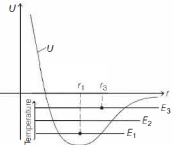
0 likes
View Solution143
DifficultMCQ
$A$ solid expands upon heating because
A
the potential energy of interaction between atoms in the solid is asymmetric about the equilibrium positions of atoms
B
the frequency of vibration of the atoms increases
C
the heating generates a thermal gradient between opposite sides
D
a fluid called the caloric flows into the interatomic spacing of the solid during heating thereby expanding it
Solution
(A) The correct answer is $(A)$.
The potential energy $U$ versus interatomic separation $r$ plot for two atoms in a solid is asymmetric about the equilibrium position.
As the temperature increases,the total energy of the atoms increases $(E_3 > E_2 > E_1)$.
Due to the asymmetry of the potential energy curve,the mean separation between the atoms increases as the energy increases $(r_3 > r_2 > r_1)$.
Consequently,crystalline solids generally expand upon heating.
The potential energy $U$ versus interatomic separation $r$ plot for two atoms in a solid is asymmetric about the equilibrium position.
As the temperature increases,the total energy of the atoms increases $(E_3 > E_2 > E_1)$.
Due to the asymmetry of the potential energy curve,the mean separation between the atoms increases as the energy increases $(r_3 > r_2 > r_1)$.
Consequently,crystalline solids generally expand upon heating.
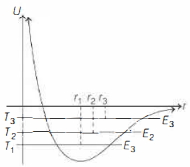
0 likes
View Solution144
MediumMCQ
$A$ circular metallic ring of radius $R$ has a small gap of width $d$. The coefficient of thermal expansion of the metal is $\alpha$. If we increase the temperature of the ring by an amount $\Delta T$,then the width of the gap:
A
will increase by an amount $d \alpha \Delta T$
B
will not change
C
will increase by an amount $(2 \pi R - d) \alpha \Delta T$
D
will decrease by an amount $d \alpha \Delta T$
Solution
(A) The thermal expansion of a solid with a hole or a gap behaves as if the hole or gap were made of the same material as the solid.
When the temperature of the ring increases by $\Delta T$,every linear dimension of the ring,including the gap width $d$,expands according to the linear expansion formula $\Delta L = L \alpha \Delta T$.
Therefore,the change in the width of the gap is given by $\Delta d = d \alpha \Delta T$.
Since $\Delta T > 0$,the width of the gap increases by $d \alpha \Delta T$.
When the temperature of the ring increases by $\Delta T$,every linear dimension of the ring,including the gap width $d$,expands according to the linear expansion formula $\Delta L = L \alpha \Delta T$.
Therefore,the change in the width of the gap is given by $\Delta d = d \alpha \Delta T$.
Since $\Delta T > 0$,the width of the gap increases by $d \alpha \Delta T$.
0 likes
View Solution145
MediumMCQ
The temperature of a metal coin is increased by $100^{\circ} C$ and its diameter increases by $0.15 \%$. Its area increases by nearly (in $\%$)
A
$0.15$
B
$0.30$
C
$0.60$
D
$0.0225$
Solution
(B) The area $A$ of a circular coin is given by $A = \pi r^2$,where $r$ is the radius.
Since the diameter $D = 2r$,the percentage change in diameter is the same as the percentage change in radius: $\frac{\Delta D}{D} \times 100 = \frac{\Delta r}{r} \times 100 = 0.15 \%$.
The area is $A = \pi r^2$. Using the concept of relative error (or differentials),the fractional change in area is given by $\frac{\Delta A}{A} = 2 \frac{\Delta r}{r}$.
To find the percentage increase in area:
$\frac{\Delta A}{A} \times 100 = 2 \times (\frac{\Delta r}{r} \times 100)$
$= 2 \times 0.15 \% = 0.30 \%$.
Since the diameter $D = 2r$,the percentage change in diameter is the same as the percentage change in radius: $\frac{\Delta D}{D} \times 100 = \frac{\Delta r}{r} \times 100 = 0.15 \%$.
The area is $A = \pi r^2$. Using the concept of relative error (or differentials),the fractional change in area is given by $\frac{\Delta A}{A} = 2 \frac{\Delta r}{r}$.
To find the percentage increase in area:
$\frac{\Delta A}{A} \times 100 = 2 \times (\frac{\Delta r}{r} \times 100)$
$= 2 \times 0.15 \% = 0.30 \%$.
0 likes
View Solution146
MediumMCQ
Solids expand on heating because ................
A
Kinetic energy of atom increases
B
Potential energy of atom increases
C
Total energy of atom increases
D
The potential energy curve is asymmetric about the equilibrium distance between neighbouring atoms
Solution
(D)
The expansion of solids can be well understood by the potential energy curve for two adjacent atoms in a crystalline solid as a function of their internuclear separation $(r)$.
At ordinary temperature: Each molecule of the solid vibrates about its equilibrium position $P_1$ between $A$ and $B$,where $r_0$ is the equilibrium distance from another molecule.
At high temperature: The amplitude of vibration increases (from $C \leftrightarrow D$ to $E \leftrightarrow F$).
Due to the asymmetry of the potential energy curve,the average equilibrium positions ($P_2$ and $P_3$) of the molecules are displaced outward. Hence,the average distance from other molecules increases $(r_2 > r_1 > r_0)$.
Thus,on raising the temperature,the average equilibrium distance between the molecules increases,and the solid as a whole expands.
The expansion of solids can be well understood by the potential energy curve for two adjacent atoms in a crystalline solid as a function of their internuclear separation $(r)$.
At ordinary temperature: Each molecule of the solid vibrates about its equilibrium position $P_1$ between $A$ and $B$,where $r_0$ is the equilibrium distance from another molecule.
At high temperature: The amplitude of vibration increases (from $C \leftrightarrow D$ to $E \leftrightarrow F$).
Due to the asymmetry of the potential energy curve,the average equilibrium positions ($P_2$ and $P_3$) of the molecules are displaced outward. Hence,the average distance from other molecules increases $(r_2 > r_1 > r_0)$.
Thus,on raising the temperature,the average equilibrium distance between the molecules increases,and the solid as a whole expands.
0 likes
View Solution147
EasyMCQ
$A$ hole is drilled in a copper sheet. The diameter of the hole is $4.24 \,cm$ at $27.0^{\circ} C$. What is the diameter of the hole when it is heated to $35^{\circ} C$?
A
Less than $4.24 \,cm$
B
Equal to $4.24 \,cm$
C
More than $4.24 \,cm$
D
Data insufficient
Solution
(C) When a solid containing a hole is heated,the material expands in all directions,including the material surrounding the hole.
This results in the hole expanding as if the entire sheet were made of the same material.
Mathematically,the change in diameter is given by $\Delta D = D \alpha \Delta T$,where $\alpha$ is the coefficient of linear expansion for copper.
Since $\Delta T = 35^{\circ} C - 27.0^{\circ} C = 8.0^{\circ} C$ is positive,the diameter $D$ will increase.
Therefore,the new diameter will be more than $4.24 \,cm$.
This results in the hole expanding as if the entire sheet were made of the same material.
Mathematically,the change in diameter is given by $\Delta D = D \alpha \Delta T$,where $\alpha$ is the coefficient of linear expansion for copper.
Since $\Delta T = 35^{\circ} C - 27.0^{\circ} C = 8.0^{\circ} C$ is positive,the diameter $D$ will increase.
Therefore,the new diameter will be more than $4.24 \,cm$.
0 likes
View Solution148
EasyMCQ
On heating a uniform metallic cylinder, its length increases by $3 \%$. The area of cross-section of its base will increase by ........... $\%$
A
$1.5$
B
$3$
C
$9$
D
$6$
Solution
(D) Let the initial length be $L$ and the initial radius be $r$. The initial area of the cross-section is $A = \pi r^2$.
When the cylinder is heated, the length increases by $3 \%$, so the new length is $L' = L(1 + 0.03)$.
Since the material is uniform, the linear expansion coefficient $\alpha$ is constant. The change in length is $\Delta L = L \alpha \Delta T$, where $\Delta L / L = 0.03$.
The area of the cross-section depends on the radius $r$. The change in radius is $\Delta r = r \alpha \Delta T$.
The new area is $A' = \pi (r + \Delta r)^2 = \pi (r^2 + 2r \Delta r + (\Delta r)^2)$.
Neglecting the higher-order term $(\Delta r)^2$, we get $A' \approx \pi r^2 + 2 \pi r \Delta r = A + 2A (\Delta r / r)$.
The fractional change in area is $\Delta A / A = 2 (\Delta r / r) = 2 \alpha \Delta T$.
Since $\Delta L / L = \alpha \Delta T = 0.03$, we have $\Delta A / A = 2 \times 0.03 = 0.06$.
Thus, the area of the cross-section increases by $6 \%$.
When the cylinder is heated, the length increases by $3 \%$, so the new length is $L' = L(1 + 0.03)$.
Since the material is uniform, the linear expansion coefficient $\alpha$ is constant. The change in length is $\Delta L = L \alpha \Delta T$, where $\Delta L / L = 0.03$.
The area of the cross-section depends on the radius $r$. The change in radius is $\Delta r = r \alpha \Delta T$.
The new area is $A' = \pi (r + \Delta r)^2 = \pi (r^2 + 2r \Delta r + (\Delta r)^2)$.
Neglecting the higher-order term $(\Delta r)^2$, we get $A' \approx \pi r^2 + 2 \pi r \Delta r = A + 2A (\Delta r / r)$.
The fractional change in area is $\Delta A / A = 2 (\Delta r / r) = 2 \alpha \Delta T$.
Since $\Delta L / L = \alpha \Delta T = 0.03$, we have $\Delta A / A = 2 \times 0.03 = 0.06$.
Thus, the area of the cross-section increases by $6 \%$.
0 likes
View Solution149
EasyMCQ
$A$ circular metallic disc of radius $R$ has a small circular cavity of radius $r$ as shown in the figure. On heating the system:
A
$R$ increases and $r$ decreases
B
$R$ decreases and $r$ increases
C
Both $R$ and $r$ increase
D
Both $R$ and $r$ decrease
Solution
(C) When a metallic object is heated,it undergoes thermal expansion. The expansion of a solid is similar to a photographic enlargement,meaning that all linear dimensions of the object increase proportionally.
For a circular disc with a cavity,the material expands in all directions. The outer radius $R$ increases because the circumference expands. Similarly,the inner radius $r$ also increases because the material surrounding the cavity expands outward,effectively pushing the boundary of the cavity further away from the center.
Therefore,both $R$ and $r$ increase upon heating.
For a circular disc with a cavity,the material expands in all directions. The outer radius $R$ increases because the circumference expands. Similarly,the inner radius $r$ also increases because the material surrounding the cavity expands outward,effectively pushing the boundary of the cavity further away from the center.
Therefore,both $R$ and $r$ increase upon heating.
0 likes
View Solution150
MediumMCQ
$A$ uniform copper rod of length $50 \,cm$ and diameter $3.0 \,mm$ is kept on a frictionless horizontal surface at $20^{\circ} C$. The coefficient of linear expansion of copper is $2.0 \times 10^{-5} \,K^{-1}$ and Young's modulus is $1.2 \times 10^{11} \,N/m^2$. The copper rod is heated to $100^{\circ} C$. The tension developed in the copper rod is .......... $\times 10^3 \,N$.
A
$12$
B
$36$
C
$18$
D
$0$
Solution
(D) The rod is placed on a frictionless horizontal surface and is not constrained or fixed at its ends.
When the temperature of the rod is increased,it undergoes thermal expansion.
Since there are no external constraints (like walls) to prevent this expansion,the rod expands freely.
Because the rod expands freely without any resistance,no thermal stress is developed within the material.
Consequently,the tension (or compressive force) developed in the copper rod is $0 \,N$.
When the temperature of the rod is increased,it undergoes thermal expansion.
Since there are no external constraints (like walls) to prevent this expansion,the rod expands freely.
Because the rod expands freely without any resistance,no thermal stress is developed within the material.
Consequently,the tension (or compressive force) developed in the copper rod is $0 \,N$.
0 likes
View Solution10-1.Thermometry, Thermal Expansion and Calorimetry — Thermal Expansion for Solid · Frequently Asked Questions
1Are these 10-1.Thermometry, Thermal Expansion and Calorimetry questions useful for JEE and NEET?
Yes. All questions in this section are mapped to JEE Main and NEET exam patterns. Previous year questions from JEE Main, NEET, GUJCET and state-level exams are included with full solutions.
2Can I switch to Hindi or Gujarati for these questions?
Yes. Use the language tabs in the hero section or the sidebar to view the same questions and solutions in English, Hindi or Gujarati.
3How do I generate a question paper from this subtopic?
Use the Vedclass Exam Paper Generator — select the chapter and subtopic, set difficulty, and generate Sets A, B, C, D automatically. First 3 chapters of every subject are free.
Vedclass Products
For Students
Vedclass Test Series
Mock tests in real JEE/NEET style with performance analysis. 5-day free trial.
Start Free TrialFor Teachers
Exam Paper Generator
Generate Set A/B/C/D papers from this chapter in 2 minutes. 3 chapters free.
Try FreeFor Institutes
Online Exam Module
Live online exams with unlimited students, 360° analytics & white-label branding.
See DemoFor Teachers & Institutes
Generate a 10-1.Thermometry, Thermal Expansion and Calorimetry Exam Paper in 2 Minutes
Select subtopic & difficulty — Sets A, B, C, D auto-generated with No Repeat logic.
First 3 chapters of every subject are free — no payment required.