
A English
Thermal Expansion for Solid Questions in English
Class 11 Physics · 10-1.Thermometry, Thermal Expansion and Calorimetry · Thermal Expansion for Solid
231+
Questions
English
Language
100%
With Solutions
Showing 26 of 231 questions in English
201
DifficultMCQ
$A$ clock pendulum made of invar has a period of $0.5 \, s$ at $20^{\circ} C$. If the clock is used in a climate where the temperature averages to $30^{\circ} C$, how much time does the clock lose in each oscillation? (For invar, $\alpha = 9 \times 10^{-7} /{ }^{\circ} C$, $g = \text{constant}$)
A
$2.25 \times 10^{-6} \, s$
B
$2.5 \times 10^{-7} \, s$
C
$5 \times 10^{-7} \, s$
D
$1.125 \times 10^{-6} \, s$
Solution
(A) The time period of a simple pendulum is given by $T = 2 \pi \sqrt{\frac{l}{g}}$.
Taking the logarithmic derivative, we get $\frac{dT}{T} = \frac{1}{2} \frac{dl}{l}$.
Since the linear expansion is given by $\frac{dl}{l} = \alpha \Delta \theta$, we substitute this into the equation:
$\frac{dT}{T} = \frac{1}{2} \alpha \Delta \theta$.
Given $\alpha = 9 \times 10^{-7} /{ }^{\circ} C$ and $\Delta \theta = (30 - 20) = 10^{\circ} C$,
$\frac{dT}{T} = \frac{1}{2} \times 9 \times 10^{-7} \times 10 = 4.5 \times 10^{-6}$.
The loss in time per oscillation is $dT = T \times (4.5 \times 10^{-6})$.
Substituting $T = 0.5 \, s$, we get $dT = 0.5 \times 4.5 \times 10^{-6} = 2.25 \times 10^{-6} \, s$.
Taking the logarithmic derivative, we get $\frac{dT}{T} = \frac{1}{2} \frac{dl}{l}$.
Since the linear expansion is given by $\frac{dl}{l} = \alpha \Delta \theta$, we substitute this into the equation:
$\frac{dT}{T} = \frac{1}{2} \alpha \Delta \theta$.
Given $\alpha = 9 \times 10^{-7} /{ }^{\circ} C$ and $\Delta \theta = (30 - 20) = 10^{\circ} C$,
$\frac{dT}{T} = \frac{1}{2} \times 9 \times 10^{-7} \times 10 = 4.5 \times 10^{-6}$.
The loss in time per oscillation is $dT = T \times (4.5 \times 10^{-6})$.
Substituting $T = 0.5 \, s$, we get $dT = 0.5 \times 4.5 \times 10^{-6} = 2.25 \times 10^{-6} \, s$.
0 likes
View Solution202
MediumMCQ
$A$ uniform metal rod of length $L$ and mass $M$ is rotating about an axis passing through one of the ends and perpendicular to the rod with angular speed $\omega$. If the temperature increases by $t^{\circ} C$,then the change in its angular velocity is proportional to which of the following? (Coefficient of linear expansion of rod $= \alpha$)
A
$\sqrt{\omega}$
B
$\omega$
C
$\omega^2$
D
$\frac{1}{\omega}$
Solution
(B) The angular momentum $J$ of the rod remains constant because no external torque acts on the system.
$J = I \omega = \text{constant}$.
Initially,the moment of inertia is $I_1 = \frac{1}{3} M L^2$ and angular velocity is $\omega_1 = \omega$.
When the temperature increases by $t^{\circ} C$,the length of the rod becomes $L' = L(1 + \alpha t)$.
The new moment of inertia is $I_2 = \frac{1}{3} M (L')^2 = \frac{1}{3} M L^2 (1 + \alpha t)^2 = I_1 (1 + \alpha t)^2$.
From conservation of angular momentum,$I_1 \omega_1 = I_2 \omega_2$.
$\omega_2 = \omega_1 \left( \frac{I_1}{I_2} \right) = \omega \left( \frac{I_1}{I_1(1 + \alpha t)^2} \right) = \omega (1 + \alpha t)^{-2}$.
Using binomial approximation for small $\alpha t$,$\omega_2 \approx \omega (1 - 2 \alpha t)$.
The change in angular velocity is $\Delta \omega = \omega_2 - \omega_1 = \omega (1 - 2 \alpha t) - \omega = -2 \omega \alpha t$.
Thus,the magnitude of the change in angular velocity $|\Delta \omega|$ is proportional to $\omega$.
$J = I \omega = \text{constant}$.
Initially,the moment of inertia is $I_1 = \frac{1}{3} M L^2$ and angular velocity is $\omega_1 = \omega$.
When the temperature increases by $t^{\circ} C$,the length of the rod becomes $L' = L(1 + \alpha t)$.
The new moment of inertia is $I_2 = \frac{1}{3} M (L')^2 = \frac{1}{3} M L^2 (1 + \alpha t)^2 = I_1 (1 + \alpha t)^2$.
From conservation of angular momentum,$I_1 \omega_1 = I_2 \omega_2$.
$\omega_2 = \omega_1 \left( \frac{I_1}{I_2} \right) = \omega \left( \frac{I_1}{I_1(1 + \alpha t)^2} \right) = \omega (1 + \alpha t)^{-2}$.
Using binomial approximation for small $\alpha t$,$\omega_2 \approx \omega (1 - 2 \alpha t)$.
The change in angular velocity is $\Delta \omega = \omega_2 - \omega_1 = \omega (1 - 2 \alpha t) - \omega = -2 \omega \alpha t$.
Thus,the magnitude of the change in angular velocity $|\Delta \omega|$ is proportional to $\omega$.
0 likes
View Solution203
DifficultMCQ
$A$ circular copper ring at $30^{\circ} C$ has a hole with an area of $9.98 \ cm^2$. It is made to slip onto a steel rod of cross-sectional area of $10 \ cm^2$,by raising the temperature of both the ring and the rod simultaneously by an amount $\Delta T$. If the coefficients of linear expansion of copper and steel are $17 \times 10^{-6} /{ }^{\circ} C$ and $11 \times 10^{-6} /{ }^{\circ} C$ respectively,then the minimum value of $\Delta T$ should be: (in $^{\circ} C$)
A
$167.6$
B
$133.3$
C
$83.3$
D
$249.9$
Solution
(A) Let $A_c$ be the area of the copper ring and $A_s$ be the area of the steel rod at temperature $T_0 = 30^{\circ} C$.
Given: $A_c = 9.98 \ cm^2$,$A_s = 10 \ cm^2$.
Coefficients of linear expansion: $\alpha_c = 17 \times 10^{-6} /{ }^{\circ} C$,$\alpha_s = 11 \times 10^{-6} /{ }^{\circ} C$.
Coefficients of area expansion: $\beta_c = 2\alpha_c = 34 \times 10^{-6} /{ }^{\circ} C$,$\beta_s = 2\alpha_s = 22 \times 10^{-6} /{ }^{\circ} C$.
For the ring to slip onto the rod,the area of the ring must be equal to or greater than the area of the rod at the new temperature $T = T_0 + \Delta T$.
$A_c(1 + \beta_c \Delta T) = A_s(1 + \beta_s \Delta T)$
$9.98(1 + 34 \times 10^{-6} \Delta T) = 10(1 + 22 \times 10^{-6} \Delta T)$
$9.98 + 9.98 \times 34 \times 10^{-6} \Delta T = 10 + 10 \times 22 \times 10^{-6} \Delta T$
$(339.32 - 220) \times 10^{-6} \Delta T = 10 - 9.98$
$119.32 \times 10^{-6} \Delta T = 0.02$
$\Delta T = \frac{0.02}{119.32 \times 10^{-6}} \approx 167.6^{\circ} C$.
Given: $A_c = 9.98 \ cm^2$,$A_s = 10 \ cm^2$.
Coefficients of linear expansion: $\alpha_c = 17 \times 10^{-6} /{ }^{\circ} C$,$\alpha_s = 11 \times 10^{-6} /{ }^{\circ} C$.
Coefficients of area expansion: $\beta_c = 2\alpha_c = 34 \times 10^{-6} /{ }^{\circ} C$,$\beta_s = 2\alpha_s = 22 \times 10^{-6} /{ }^{\circ} C$.
For the ring to slip onto the rod,the area of the ring must be equal to or greater than the area of the rod at the new temperature $T = T_0 + \Delta T$.
$A_c(1 + \beta_c \Delta T) = A_s(1 + \beta_s \Delta T)$
$9.98(1 + 34 \times 10^{-6} \Delta T) = 10(1 + 22 \times 10^{-6} \Delta T)$
$9.98 + 9.98 \times 34 \times 10^{-6} \Delta T = 10 + 10 \times 22 \times 10^{-6} \Delta T$
$(339.32 - 220) \times 10^{-6} \Delta T = 10 - 9.98$
$119.32 \times 10^{-6} \Delta T = 0.02$
$\Delta T = \frac{0.02}{119.32 \times 10^{-6}} \approx 167.6^{\circ} C$.
0 likes
View Solution204
EasyMCQ
To increase the length of a metal rod by $0.4 \%$,the temperature of the rod is to be increased by (Coefficient of linear expansion of the metal $= 20 \times 10^{-6} \ {}^{\circ}C^{-1}$) (in $K$)
A
$373$
B
$473$
C
$200$
D
$100$
Solution
(C) The formula for linear expansion is given by $\Delta L = L \alpha \Delta T$,where $\Delta L$ is the change in length,$L$ is the original length,$\alpha$ is the coefficient of linear expansion,and $\Delta T$ is the change in temperature.
Given that the length increases by $0.4 \%$,we have $\frac{\Delta L}{L} = 0.4 \% = \frac{0.4}{100} = 0.004$.
The coefficient of linear expansion is $\alpha = 20 \times 10^{-6} \ {}^{\circ}C^{-1}$.
Substituting these values into the formula $\frac{\Delta L}{L} = \alpha \Delta T$:
$0.004 = (20 \times 10^{-6}) \Delta T$.
Solving for $\Delta T$:
$\Delta T = \frac{0.004}{20 \times 10^{-6}} = \frac{4 \times 10^{-3}}{20 \times 10^{-6}} = \frac{1}{5} \times 10^3 = 0.2 \times 1000 = 200 \ {}^{\circ}C$.
Since the change in temperature in Celsius is equal to the change in temperature in Kelvin,$\Delta T = 200 \ K$.
Given that the length increases by $0.4 \%$,we have $\frac{\Delta L}{L} = 0.4 \% = \frac{0.4}{100} = 0.004$.
The coefficient of linear expansion is $\alpha = 20 \times 10^{-6} \ {}^{\circ}C^{-1}$.
Substituting these values into the formula $\frac{\Delta L}{L} = \alpha \Delta T$:
$0.004 = (20 \times 10^{-6}) \Delta T$.
Solving for $\Delta T$:
$\Delta T = \frac{0.004}{20 \times 10^{-6}} = \frac{4 \times 10^{-3}}{20 \times 10^{-6}} = \frac{1}{5} \times 10^3 = 0.2 \times 1000 = 200 \ {}^{\circ}C$.
Since the change in temperature in Celsius is equal to the change in temperature in Kelvin,$\Delta T = 200 \ K$.
0 likes
View Solution205
MediumMCQ
$A$ metal metre scale that is accurate up to $0.5 \ mm$ is made at a temperature of $25^{\circ} C$. The range of temperatures within which it can be used is (Coefficient of linear expansion of the metal $= 10^{-5} /{ }^{\circ} C$)
A
$+25^{\circ} C$ to $+75^{\circ} C$
B
$+25^{\circ} C$ to $+50^{\circ} C$
C
$-25^{\circ} C$ to $+75^{\circ} C$
D
$0^{\circ} C$ to $+50^{\circ} C$
Solution
(C) The length of the metal scale is $L = 1 \ m = 1000 \ mm$. The maximum allowed error in length is $\Delta L = 0.5 \ mm$. The coefficient of linear expansion is $\alpha = 10^{-5} /{ }^{\circ} C$. The change in length due to temperature change $\Delta T$ is given by $\Delta L = L \alpha \Delta T$. Substituting the values: $0.5 = 1000 \times 10^{-5} \times \Delta T$. This simplifies to $0.5 = 10^{-2} \times \Delta T$,which gives $\Delta T = 0.5 / 10^{-2} = 50^{\circ} C$. Since the scale is calibrated at $25^{\circ} C$,the temperature range is $25^{\circ} C \pm 50^{\circ} C$. Thus,the range is from $25 - 50 = -25^{\circ} C$ to $25 + 50 = 75^{\circ} C$.
0 likes
View Solution206
MediumMCQ
Two rods of same area of cross-section have lengths $L$ and $2 \,L$ and coefficients of linear expansion $2 \alpha$ and $\alpha$ respectively. If they are welded to form a composite rod of length $3 \,L$,then the coefficient of linear expansion of the composite rod is
A
$\frac{3 \alpha}{2}$
B
$3 \alpha$
C
$\frac{3 \alpha}{4}$
D
$\frac{4 \alpha}{3}$
Solution
(D) Change in length of the first rod is given by $\Delta \ell_1 = L(2 \alpha) \Delta T = 2 \,L \alpha \Delta T$.
Change in length of the second rod is given by $\Delta \ell_2 = (2 \,L)(\alpha)(\Delta T) = 2 \,L \alpha \Delta T$.
Total change in length of the composite rod is $\Delta l = \Delta l_1 + \Delta l_2 = 2 \,L \alpha \Delta T + 2 \,L \alpha \Delta T = 4 \,L \alpha \Delta T$.
For the composite rod of length $3 \,L$,the change in length is $\Delta l = (3 \,L) \alpha_C \Delta T$.
Equating the two expressions for $\Delta l$: $4 \,L \alpha \Delta T = 3 \,L \alpha_C \Delta T$.
Solving for $\alpha_C$,we get $\alpha_C = \frac{4 \alpha}{3}$.
Change in length of the second rod is given by $\Delta \ell_2 = (2 \,L)(\alpha)(\Delta T) = 2 \,L \alpha \Delta T$.
Total change in length of the composite rod is $\Delta l = \Delta l_1 + \Delta l_2 = 2 \,L \alpha \Delta T + 2 \,L \alpha \Delta T = 4 \,L \alpha \Delta T$.
For the composite rod of length $3 \,L$,the change in length is $\Delta l = (3 \,L) \alpha_C \Delta T$.
Equating the two expressions for $\Delta l$: $4 \,L \alpha \Delta T = 3 \,L \alpha_C \Delta T$.
Solving for $\alpha_C$,we get $\alpha_C = \frac{4 \alpha}{3}$.
0 likes
View Solution207
MediumMCQ
The length of a metal rod at $30^{\circ} C$ is $30 \ cm$. If its temperature is raised to $105^{\circ} C$,its length is increased by $0.027 \ cm$. Then the coefficient of linear expansion of the metal is
A
$12 \times 10^{-4} /{ }^{\circ} C$
B
$12 \times 10^{-5} /{ }^{\circ} C$
C
$12 \times 10^{-6} /{ }^{\circ} C$
D
$12 \times 10^{-7} /{ }^{\circ} C$
Solution
(C) The formula for the coefficient of linear expansion $\alpha$ is given by:
$\alpha = \frac{\Delta L}{L \Delta T}$
Given:
Initial length $L = 30 \ cm$
Change in length $\Delta L = 0.027 \ cm$
Initial temperature $T_1 = 30^{\circ} C$
Final temperature $T_2 = 105^{\circ} C$
Change in temperature $\Delta T = T_2 - T_1 = 105^{\circ} C - 30^{\circ} C = 75^{\circ} C$
Substituting the values into the formula:
$\alpha = \frac{0.027}{30 \times 75}$
$\alpha = \frac{0.027}{2250}$
$\alpha = 0.000012 /{ }^{\circ} C$
$\alpha = 12 \times 10^{-6} /{ }^{\circ} C$
$\alpha = \frac{\Delta L}{L \Delta T}$
Given:
Initial length $L = 30 \ cm$
Change in length $\Delta L = 0.027 \ cm$
Initial temperature $T_1 = 30^{\circ} C$
Final temperature $T_2 = 105^{\circ} C$
Change in temperature $\Delta T = T_2 - T_1 = 105^{\circ} C - 30^{\circ} C = 75^{\circ} C$
Substituting the values into the formula:
$\alpha = \frac{0.027}{30 \times 75}$
$\alpha = \frac{0.027}{2250}$
$\alpha = 0.000012 /{ }^{\circ} C$
$\alpha = 12 \times 10^{-6} /{ }^{\circ} C$
0 likes
View Solution208
MediumMCQ
$A$ blacksmith fixes a circular iron frame on the wooden wheel of a bullock cart. The diameters of the wooden wheel and the circular iron frame are $5.012 \ m$ and $5 \ m$ respectively at $27^{\circ} C$. The temperature (in $^{\circ} C$) to which the iron ring must be heated so as to fit the wooden wheel is (Coefficient of linear expansion of iron $= 1.2 \times 10^{-5} \ ^{\circ} C^{-1}$).
A
$200$
B
$227$
C
$254$
D
$300$
Solution
(B) The diameter of the iron ring $d_i = 5 \ m$ at $T_1 = 27^{\circ} C$.
The diameter of the wooden wheel $d_w = 5.012 \ m$.
We need the iron ring to expand to a diameter of $5.012 \ m$.
Using the formula for linear expansion: $d_w = d_i(1 + \alpha \Delta T)$.
$\Delta T = \frac{d_w - d_i}{d_i \alpha} = \frac{5.012 - 5}{5 \times 1.2 \times 10^{-5}} = \frac{0.012}{6 \times 10^{-5}} = \frac{1.2 \times 10^{-2}}{6 \times 10^{-5}} = 0.2 \times 10^3 = 200^{\circ} C$.
The final temperature $T_2 = T_1 + \Delta T = 27^{\circ} C + 200^{\circ} C = 227^{\circ} C$.
The diameter of the wooden wheel $d_w = 5.012 \ m$.
We need the iron ring to expand to a diameter of $5.012 \ m$.
Using the formula for linear expansion: $d_w = d_i(1 + \alpha \Delta T)$.
$\Delta T = \frac{d_w - d_i}{d_i \alpha} = \frac{5.012 - 5}{5 \times 1.2 \times 10^{-5}} = \frac{0.012}{6 \times 10^{-5}} = \frac{1.2 \times 10^{-2}}{6 \times 10^{-5}} = 0.2 \times 10^3 = 200^{\circ} C$.
The final temperature $T_2 = T_1 + \Delta T = 27^{\circ} C + 200^{\circ} C = 227^{\circ} C$.
0 likes
View Solution209
MediumMCQ
Find the ratio of the length of a steel rod and a copper rod if the steel rod is $4 \ cm$ longer than the copper rod at any temperature. $[$The coefficients of linear expansion for steel and copper are $1.1 \times 10^{-5} /^{\circ} C$ and $1.7 \times 10^{-5} /^{\circ} C$ respectively$]$
A
$17/11$
B
$11/17$
C
$11/4$
D
$17/4$
Solution
(A) Let $L_s$ and $L_c$ be the lengths of the steel and copper rods at a certain temperature. The difference in their lengths is given as $L_s - L_c = 4 \ cm$,which remains constant at any temperature.
This implies that the change in length of both rods due to a change in temperature $\Delta T$ must be equal.
Therefore,$\Delta L_s = \Delta L_c$.
Using the formula for linear expansion $\Delta L = \alpha L \Delta T$,we get $\alpha_s L_s \Delta T = \alpha_c L_c \Delta T$.
Canceling $\Delta T$ from both sides,we have $\alpha_s L_s = \alpha_c L_c$.
Substituting the given values: $(1.1 \times 10^{-5}) L_s = (1.7 \times 10^{-5}) L_c$.
Thus,the ratio $\frac{L_s}{L_c} = \frac{1.7 \times 10^{-5}}{1.1 \times 10^{-5}} = \frac{17}{11}$.
This implies that the change in length of both rods due to a change in temperature $\Delta T$ must be equal.
Therefore,$\Delta L_s = \Delta L_c$.
Using the formula for linear expansion $\Delta L = \alpha L \Delta T$,we get $\alpha_s L_s \Delta T = \alpha_c L_c \Delta T$.
Canceling $\Delta T$ from both sides,we have $\alpha_s L_s = \alpha_c L_c$.
Substituting the given values: $(1.1 \times 10^{-5}) L_s = (1.7 \times 10^{-5}) L_c$.
Thus,the ratio $\frac{L_s}{L_c} = \frac{1.7 \times 10^{-5}}{1.1 \times 10^{-5}} = \frac{17}{11}$.
0 likes
View Solution210
EasyMCQ
$A$ hole of diameter $5 \ cm$ is drilled in a metal sheet at $30^{\circ} C$. The coefficient of linear expansion of the metal is $2 \times 10^{-5} K^{-1}$. The diameter of the hole when the temperature is raised to $230^{\circ} C$ is equal to: (in $cm$)
A
$5.01$
B
$5.02$
C
$5.03$
D
$5.04$
Solution
(B) The change in temperature is $\Delta T = 230^{\circ} C - 30^{\circ} C = 200^{\circ} C$.
When a metal sheet with a hole is heated,the hole expands just as if it were a solid piece of the same material.
The formula for linear expansion is $L = L_0(1 + \alpha \Delta T)$.
Substituting the given values: $L = 5 \times (1 + 2 \times 10^{-5} \times 200)$.
$L = 5 \times (1 + 400 \times 10^{-5}) = 5 \times (1 + 0.004) = 5 \times 1.004 = 5.02 \ cm$.
When a metal sheet with a hole is heated,the hole expands just as if it were a solid piece of the same material.
The formula for linear expansion is $L = L_0(1 + \alpha \Delta T)$.
Substituting the given values: $L = 5 \times (1 + 2 \times 10^{-5} \times 200)$.
$L = 5 \times (1 + 400 \times 10^{-5}) = 5 \times (1 + 0.004) = 5 \times 1.004 = 5.02 \ cm$.
0 likes
View Solution211
EasyMCQ
Two metal rods $A$ and $B$ each of length $50 \ cm$ and diameter $4.0 \ mm$ are joined together at temperature $30^{\circ} C$. What is the change in length of the combined rod at $230^{\circ} C$ (in $mm$)? [Given linear expansion coefficients of rods $A$ and $B$ are respectively,$2.0 \times 10^{-5} /^{\circ} C$ and $1.0 \times 10^{-5} /^{\circ} C$]
A
$4$
B
$2$
C
$3$
D
$1$
Solution
(C) The change in length of the combined rod is the sum of the changes in lengths of the individual rods.
$\Delta l = \Delta l_A + \Delta l_B$
Using the formula for linear expansion $\Delta l = l \alpha \Delta T$,where $l = 0.5 \ m$,$\Delta T = 230^{\circ} C - 30^{\circ} C = 200^{\circ} C$,$\alpha_A = 2.0 \times 10^{-5} /^{\circ} C$,and $\alpha_B = 1.0 \times 10^{-5} /^{\circ} C$:
$\Delta l = (l_A \alpha_A \Delta T) + (l_B \alpha_B \Delta T)$
$\Delta l = l \Delta T (\alpha_A + \alpha_B)$
$\Delta l = 0.5 \times 200 \times (2.0 \times 10^{-5} + 1.0 \times 10^{-5})$
$\Delta l = 100 \times (3.0 \times 10^{-5})$
$\Delta l = 3.0 \times 10^{-3} \ m = 3 \ mm$
Therefore,the change in length is $3 \ mm$.
$\Delta l = \Delta l_A + \Delta l_B$
Using the formula for linear expansion $\Delta l = l \alpha \Delta T$,where $l = 0.5 \ m$,$\Delta T = 230^{\circ} C - 30^{\circ} C = 200^{\circ} C$,$\alpha_A = 2.0 \times 10^{-5} /^{\circ} C$,and $\alpha_B = 1.0 \times 10^{-5} /^{\circ} C$:
$\Delta l = (l_A \alpha_A \Delta T) + (l_B \alpha_B \Delta T)$
$\Delta l = l \Delta T (\alpha_A + \alpha_B)$
$\Delta l = 0.5 \times 200 \times (2.0 \times 10^{-5} + 1.0 \times 10^{-5})$
$\Delta l = 100 \times (3.0 \times 10^{-5})$
$\Delta l = 3.0 \times 10^{-3} \ m = 3 \ mm$
Therefore,the change in length is $3 \ mm$.
0 likes
View Solution212
EasyMCQ
$A$ metal ball initially at a pressure of $10^5 \ Pa$ is heated from $20^{\circ} C$ to $127^{\circ} C$ while keeping its volume constant. The coefficient of linear expansion of the metal is $10^{-5} \ {^{\circ} C}^{-1}$ and the bulk modulus of the metal is $2 \times 10^{11} \ N \ m^{-2}$. The final pressure inside the ball becomes:
A
$2 \times 10^8 \ Pa$
B
$6 \times 10^8 \ Pa$
C
$1 \times 10^9 \ Pa$
D
$4 \times 10^8 \ Pa$
Solution
(B) The metal ball tends to expand due to heating,but since its volume is kept constant,thermal stress is developed within the material.
The bulk modulus $B$ is defined as $B = \frac{\Delta P}{\Delta V / V}$,where $\Delta P$ is the change in pressure.
The fractional change in volume due to thermal expansion is given by $\frac{\Delta V}{V} = \gamma \Delta T$,where $\gamma$ is the coefficient of volume expansion and $\Delta T$ is the change in temperature.
For a solid,$\gamma = 3\alpha$,where $\alpha$ is the coefficient of linear expansion.
Given: $\alpha = 10^{-5} \ {^{\circ} C}^{-1}$,$\Delta T = 127^{\circ} C - 20^{\circ} C = 107^{\circ} C$,and $B = 2 \times 10^{11} \ N \ m^{-2}$.
Substituting these into the formula for pressure change: $\Delta P = B \times (3\alpha \Delta T)$.
$\Delta P = (2 \times 10^{11}) \times (3 \times 10^{-5} \times 107) = 6 \times 10^6 \times 107 = 6.42 \times 10^8 \ Pa$.
The final pressure $P_f = P_i + \Delta P = 10^5 \ Pa + 6.42 \times 10^8 \ Pa \approx 6.42 \times 10^8 \ Pa$.
Rounding to the nearest given option,the pressure becomes approximately $6 \times 10^8 \ Pa$.
The bulk modulus $B$ is defined as $B = \frac{\Delta P}{\Delta V / V}$,where $\Delta P$ is the change in pressure.
The fractional change in volume due to thermal expansion is given by $\frac{\Delta V}{V} = \gamma \Delta T$,where $\gamma$ is the coefficient of volume expansion and $\Delta T$ is the change in temperature.
For a solid,$\gamma = 3\alpha$,where $\alpha$ is the coefficient of linear expansion.
Given: $\alpha = 10^{-5} \ {^{\circ} C}^{-1}$,$\Delta T = 127^{\circ} C - 20^{\circ} C = 107^{\circ} C$,and $B = 2 \times 10^{11} \ N \ m^{-2}$.
Substituting these into the formula for pressure change: $\Delta P = B \times (3\alpha \Delta T)$.
$\Delta P = (2 \times 10^{11}) \times (3 \times 10^{-5} \times 107) = 6 \times 10^6 \times 107 = 6.42 \times 10^8 \ Pa$.
The final pressure $P_f = P_i + \Delta P = 10^5 \ Pa + 6.42 \times 10^8 \ Pa \approx 6.42 \times 10^8 \ Pa$.
Rounding to the nearest given option,the pressure becomes approximately $6 \times 10^8 \ Pa$.
0 likes
View Solution213
MediumMCQ
The moment of inertia $I$ of a uniform rod about a perpendicular bisector increases to $I+\Delta I$,if the temperature is increased slightly by $\Delta T$. If the coefficient of linear expansion is $\alpha$,then $\frac{\Delta I}{I}$ is (Assume $\frac{\Delta T}{T} \ll 1$)
A
$\alpha \Delta T$
B
$2 \alpha \Delta T$
C
$3 \alpha \Delta T$
D
$4 \alpha \Delta T$
Solution
(B) The initial moment of inertia $I$ of a uniform rod of mass $M$ and length $L$ about its perpendicular bisector is given by:
$I = \frac{1}{12} ML^2$
When the temperature is increased by $\Delta T$,the length of the rod increases to $L' = L + \Delta L$,where $\Delta L = L \alpha \Delta T$. The mass $M$ remains constant.
The new moment of inertia $I' = I + \Delta I$ is:
$I + \Delta I = \frac{1}{12} M(L + \Delta L)^2$
$I + \Delta I = \frac{1}{12} ML^2 \left(1 + \frac{\Delta L}{L}\right)^2$
Since $I = \frac{1}{12} ML^2$,we have:
$I + \Delta I = I \left(1 + \frac{\Delta L}{L}\right)^2$
Using the binomial approximation $(1+x)^n \approx 1+nx$ for $x \ll 1$:
$I + \Delta I \approx I \left(1 + 2 \frac{\Delta L}{L}\right)$
$I + \Delta I \approx I + 2I \frac{\Delta L}{L}$
$\Delta I = 2I \frac{\Delta L}{L}$
Substituting $\frac{\Delta L}{L} = \alpha \Delta T$:
$\Delta I = 2I \alpha \Delta T$
Therefore,$\frac{\Delta I}{I} = 2 \alpha \Delta T$.
$I = \frac{1}{12} ML^2$
When the temperature is increased by $\Delta T$,the length of the rod increases to $L' = L + \Delta L$,where $\Delta L = L \alpha \Delta T$. The mass $M$ remains constant.
The new moment of inertia $I' = I + \Delta I$ is:
$I + \Delta I = \frac{1}{12} M(L + \Delta L)^2$
$I + \Delta I = \frac{1}{12} ML^2 \left(1 + \frac{\Delta L}{L}\right)^2$
Since $I = \frac{1}{12} ML^2$,we have:
$I + \Delta I = I \left(1 + \frac{\Delta L}{L}\right)^2$
Using the binomial approximation $(1+x)^n \approx 1+nx$ for $x \ll 1$:
$I + \Delta I \approx I \left(1 + 2 \frac{\Delta L}{L}\right)$
$I + \Delta I \approx I + 2I \frac{\Delta L}{L}$
$\Delta I = 2I \frac{\Delta L}{L}$
Substituting $\frac{\Delta L}{L} = \alpha \Delta T$:
$\Delta I = 2I \alpha \Delta T$
Therefore,$\frac{\Delta I}{I} = 2 \alpha \Delta T$.

0 likes
View Solution214
EasyMCQ
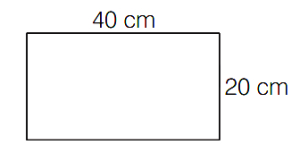
$A$ sheet of steel at $20^{\circ} C$ has dimensions as shown in the figure. If the coefficient of linear expansion for steel is $10^{-5} {^{\circ} C}^{-1}$, what is the change in the area at $60^{\circ} C$ (in $\text{ cm}^2$)?
A
$0.84$
B
$0.64$
C
$0.24$
D
$0.14$
Solution
(B) Given:
Initial temperature $t_1 = 20^{\circ} C$
Final temperature $t_2 = 60^{\circ} C$
Change in temperature $\Delta T = t_2 - t_1 = 60^{\circ} C - 20^{\circ} C = 40^{\circ} C$
Coefficient of linear expansion $\alpha = 10^{-5} {^{\circ} C}^{-1}$
Initial dimensions are $40 \text{ cm} \times 20 \text{ cm}$.
Initial area $A = 40 \text{ cm} \times 20 \text{ cm} = 800 \text{ cm}^2$.
The coefficient of area expansion is $\beta = 2\alpha$.
The change in area $\Delta A$ is given by the formula:
$\Delta A = A \beta \Delta T = A (2\alpha) \Delta T$
Substituting the values:
$\Delta A = 800 \text{ cm}^2 \times (2 \times 10^{-5} {^{\circ} C}^{-1}) \times 40^{\circ} C$
$\Delta A = 800 \times 2 \times 10^{-5} \times 40 \text{ cm}^2$
$\Delta A = 64000 \times 10^{-5} \text{ cm}^2$
$\Delta A = 0.64 \text{ cm}^2$.
Initial temperature $t_1 = 20^{\circ} C$
Final temperature $t_2 = 60^{\circ} C$
Change in temperature $\Delta T = t_2 - t_1 = 60^{\circ} C - 20^{\circ} C = 40^{\circ} C$
Coefficient of linear expansion $\alpha = 10^{-5} {^{\circ} C}^{-1}$
Initial dimensions are $40 \text{ cm} \times 20 \text{ cm}$.
Initial area $A = 40 \text{ cm} \times 20 \text{ cm} = 800 \text{ cm}^2$.
The coefficient of area expansion is $\beta = 2\alpha$.
The change in area $\Delta A$ is given by the formula:
$\Delta A = A \beta \Delta T = A (2\alpha) \Delta T$
Substituting the values:
$\Delta A = 800 \text{ cm}^2 \times (2 \times 10^{-5} {^{\circ} C}^{-1}) \times 40^{\circ} C$
$\Delta A = 800 \times 2 \times 10^{-5} \times 40 \text{ cm}^2$
$\Delta A = 64000 \times 10^{-5} \text{ cm}^2$
$\Delta A = 0.64 \text{ cm}^2$.
0 likes
View Solution215
EasyMCQ
The area of a circular copper coin increases by $0.4 \%$ when its temperature is raised by $100^{\circ} C$. The coefficient of linear expansion of the coin is:
A
$1 \times 10^{-5} /^{\circ} C$
B
$2 \times 10^{-5} /^{\circ} C$
C
$3 \times 10^{-5} /^{\circ} C$
D
$4 \times 10^{-5} /^{\circ} C$
Solution
(B) Given,the area of a circular copper coin increases by $0.4 \%$.
This means,$\frac{\Delta A}{A} = 0.004$.
The increase in temperature is $\Delta T = 100^{\circ} C$.
We know that the coefficient of areal expansion $\beta$ is defined as $\beta = \frac{\Delta A}{A \cdot \Delta T}$.
Substituting the values,we get $\beta = \frac{0.004}{100} = 4 \times 10^{-5} /^{\circ} C$.
The relationship between the coefficient of areal expansion $\beta$ and the coefficient of linear expansion $\alpha$ is $\beta = 2\alpha$.
Therefore,$\alpha = \frac{\beta}{2} = \frac{4 \times 10^{-5}}{2} /^{\circ} C = 2 \times 10^{-5} /^{\circ} C$.
This means,$\frac{\Delta A}{A} = 0.004$.
The increase in temperature is $\Delta T = 100^{\circ} C$.
We know that the coefficient of areal expansion $\beta$ is defined as $\beta = \frac{\Delta A}{A \cdot \Delta T}$.
Substituting the values,we get $\beta = \frac{0.004}{100} = 4 \times 10^{-5} /^{\circ} C$.
The relationship between the coefficient of areal expansion $\beta$ and the coefficient of linear expansion $\alpha$ is $\beta = 2\alpha$.
Therefore,$\alpha = \frac{\beta}{2} = \frac{4 \times 10^{-5}}{2} /^{\circ} C = 2 \times 10^{-5} /^{\circ} C$.
0 likes
View Solution216
MediumMCQ
$A$ meter scale made of steel reads accurately at $25^{\circ} C$. Suppose in an experiment an accuracy of $0.06 \,mm$ in $1 \,m$ is required, the range of temperature in which the experiment can be performed with this meter scale is (Coefficient of linear expansion of steel is $11 \times 10^{-6} /{ }^{\circ} C$)
A
$19^{\circ} C$ to $31^{\circ} C$
B
$25^{\circ} C$ to $32^{\circ} C$
C
$18^{\circ} C$ to $25^{\circ} C$
D
$18^{\circ} C$ to $32^{\circ} C$
Solution
$(A)$ Given: Coefficient of linear expansion of steel, $\alpha = 11 \times 10^{-6} /{ }^{\circ} C$.
Required accuracy $\Delta l = 0.06 \,mm = 6 \times 10^{-5} \,m$ for a length $l = 1 \,m$.
We know the formula for linear expansion: $\Delta l = l \alpha \Delta t$.
Rearranging for the temperature change: $\Delta t = \frac{\Delta l}{l \alpha}$.
Substituting the values: $\Delta t = \frac{6 \times 10^{-5}}{1 \times 11 \times 10^{-6}} = \frac{60}{11} \approx 5.45^{\circ} C$.
Since the scale is accurate at $25^{\circ} C$, the allowed temperature range is $25^{\circ} C \pm 5.45^{\circ} C$.
This gives a range from $19.55^{\circ} C$ to $30.45^{\circ} C$.
Rounding to the nearest integer values provided in the options, the range is approximately $19^{\circ} C$ to $31^{\circ} C$.
Thus, option $A$ is correct.
Required accuracy $\Delta l = 0.06 \,mm = 6 \times 10^{-5} \,m$ for a length $l = 1 \,m$.
We know the formula for linear expansion: $\Delta l = l \alpha \Delta t$.
Rearranging for the temperature change: $\Delta t = \frac{\Delta l}{l \alpha}$.
Substituting the values: $\Delta t = \frac{6 \times 10^{-5}}{1 \times 11 \times 10^{-6}} = \frac{60}{11} \approx 5.45^{\circ} C$.
Since the scale is accurate at $25^{\circ} C$, the allowed temperature range is $25^{\circ} C \pm 5.45^{\circ} C$.
This gives a range from $19.55^{\circ} C$ to $30.45^{\circ} C$.
Rounding to the nearest integer values provided in the options, the range is approximately $19^{\circ} C$ to $31^{\circ} C$.
Thus, option $A$ is correct.
0 likes
View Solution217
DifficultMCQ
When the temperature of a body increases from $T$ to $T+\Delta T$,its moment of inertia increases from $I$ to $I+\Delta I$. If $\alpha$ is the coefficient of linear expansion of the material of the body,then $\frac{\Delta I}{I}$ is (neglect higher orders of $\alpha$ ).
A
$\alpha \Delta T$
B
$2 \alpha \Delta T$
C
$\frac{\Delta T}{\alpha}$
D
$\frac{2 \alpha}{\Delta T}$
Solution
(B) The moment of inertia $I$ of a body is given by $I = Mk^2$,where $M$ is the mass and $k$ is the radius of gyration.
Since $M$ is constant,we have $I \propto k^2$.
Taking the natural logarithm on both sides: $\ln I = \ln M + 2 \ln k$.
Differentiating both sides: $\frac{dI}{I} = 2 \frac{dk}{k}$.
For thermal expansion,the change in length (or any linear dimension like $k$) is given by $\Delta k = k \alpha \Delta T$,which implies $\frac{\Delta k}{k} = \alpha \Delta T$.
Substituting this into the expression for $\frac{\Delta I}{I}$:
$\frac{\Delta I}{I} = 2 \alpha \Delta T$.
Since $M$ is constant,we have $I \propto k^2$.
Taking the natural logarithm on both sides: $\ln I = \ln M + 2 \ln k$.
Differentiating both sides: $\frac{dI}{I} = 2 \frac{dk}{k}$.
For thermal expansion,the change in length (or any linear dimension like $k$) is given by $\Delta k = k \alpha \Delta T$,which implies $\frac{\Delta k}{k} = \alpha \Delta T$.
Substituting this into the expression for $\frac{\Delta I}{I}$:
$\frac{\Delta I}{I} = 2 \alpha \Delta T$.
0 likes
View Solution218
DifficultMCQ
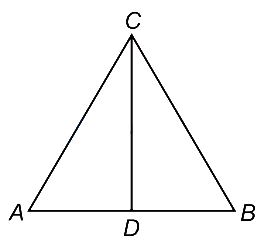
Three rods of equal lengths are joined to form an equilateral triangle $ABC$. $D$ is the mid-point of $AB$. The coefficient of linear expansion is $\alpha_1$ for the material of rod $AB$ and $\alpha_2$ for the material of rods $AC$ and $BC$. If the distance $DC$ remains constant for small changes in temperature,then:
A
$\alpha_1 = 2\alpha_2$
B
$\alpha_1 = 4\alpha_2$
C
$\alpha_1 = 8\alpha_2$
D
$\alpha_1 = \alpha_2$
Solution
(B) Let the initial length of each rod be $l$. In the equilateral triangle $ABC$,the length of the altitude $DC$ is given by:
$DC^2 = AC^2 - AD^2 = l^2 - (l/2)^2 = 3l^2/4$.
After a small change in temperature $\Delta t$,the new lengths are $l' = l(1 + \alpha \Delta t)$.
For rod $AC$,the new length is $l_{AC}' = l(1 + \alpha_2 \Delta t)$.
For segment $AD$,the new length is $l_{AD}' = (l/2)(1 + \alpha_1 \Delta t)$.
Since $DC$ remains constant,$DC^2 = (l_{AC}')^2 - (l_{AD}')^2$.
$3l^2/4 = [l(1 + \alpha_2 \Delta t)]^2 - [(l/2)(1 + \alpha_1 \Delta t)]^2$.
$3l^2/4 = l^2(1 + 2\alpha_2 \Delta t + \alpha_2^2 \Delta t^2) - (l^2/4)(1 + 2\alpha_1 \Delta t + \alpha_1^2 \Delta t^2)$.
Neglecting higher-order terms $\alpha^2 \Delta t^2$ and simplifying:
$3l^2/4 = l^2 + 2l^2 \alpha_2 \Delta t - l^2/4 - (l^2/4)(2\alpha_1 \Delta t)$.
$3l^2/4 = 3l^2/4 + 2l^2 \alpha_2 \Delta t - (l^2/2)\alpha_1 \Delta t$.
$0 = 2l^2 \alpha_2 \Delta t - (l^2/2)\alpha_1 \Delta t$.
$2\alpha_2 = \alpha_1/2 \implies \alpha_1 = 4\alpha_2$.
$DC^2 = AC^2 - AD^2 = l^2 - (l/2)^2 = 3l^2/4$.
After a small change in temperature $\Delta t$,the new lengths are $l' = l(1 + \alpha \Delta t)$.
For rod $AC$,the new length is $l_{AC}' = l(1 + \alpha_2 \Delta t)$.
For segment $AD$,the new length is $l_{AD}' = (l/2)(1 + \alpha_1 \Delta t)$.
Since $DC$ remains constant,$DC^2 = (l_{AC}')^2 - (l_{AD}')^2$.
$3l^2/4 = [l(1 + \alpha_2 \Delta t)]^2 - [(l/2)(1 + \alpha_1 \Delta t)]^2$.
$3l^2/4 = l^2(1 + 2\alpha_2 \Delta t + \alpha_2^2 \Delta t^2) - (l^2/4)(1 + 2\alpha_1 \Delta t + \alpha_1^2 \Delta t^2)$.
Neglecting higher-order terms $\alpha^2 \Delta t^2$ and simplifying:
$3l^2/4 = l^2 + 2l^2 \alpha_2 \Delta t - l^2/4 - (l^2/4)(2\alpha_1 \Delta t)$.
$3l^2/4 = 3l^2/4 + 2l^2 \alpha_2 \Delta t - (l^2/2)\alpha_1 \Delta t$.
$0 = 2l^2 \alpha_2 \Delta t - (l^2/2)\alpha_1 \Delta t$.
$2\alpha_2 = \alpha_1/2 \implies \alpha_1 = 4\alpha_2$.
0 likes
View Solution219
MediumMCQ
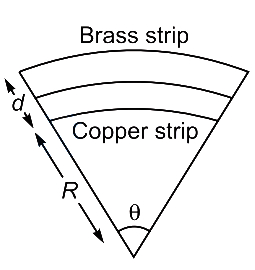
$A$ bimetallic strip is formed out of two identical strips,one of copper and the other of brass. The coefficients of linear expansion of the two metals are $\alpha_C$ and $\alpha_B$. On heating,the temperature of the strip increases by $\Delta T$ and the strip bends to form an arc of radius $R$. Then $R$ is proportional to
A
$\Delta T$
B
$\frac{1}{\Delta T}$
C
$\sqrt{\Delta T}$
D
$\frac{1}{\sqrt{\Delta T}}$
Solution
(B) Let $L_0$ be the initial length of each strip before heating. After heating,the lengths of the brass and copper strips are given by:
$L_B = L_0(1 + \alpha_B \Delta T) = (R + d)\theta$
$L_C = L_0(1 + \alpha_C \Delta T) = R\theta$
Dividing the two equations,we get:
$\frac{R + d}{R} = \frac{1 + \alpha_B \Delta T}{1 + \alpha_C \Delta T}$
$1 + \frac{d}{R} = \frac{1 + \alpha_B \Delta T}{1 + \alpha_C \Delta T}$
$\frac{d}{R} = \frac{1 + \alpha_B \Delta T}{1 + \alpha_C \Delta T} - 1 = \frac{1 + \alpha_B \Delta T - 1 - \alpha_C \Delta T}{1 + \alpha_C \Delta T} = \frac{(\alpha_B - \alpha_C) \Delta T}{1 + \alpha_C \Delta T}$
Since $\alpha \Delta T \ll 1$,we can approximate $1 + \alpha_C \Delta T \approx 1$. Thus:
$R \approx \frac{d}{(\alpha_B - \alpha_C) \Delta T}$
Therefore,$R \propto \frac{1}{\Delta T}$.
$L_B = L_0(1 + \alpha_B \Delta T) = (R + d)\theta$
$L_C = L_0(1 + \alpha_C \Delta T) = R\theta$
Dividing the two equations,we get:
$\frac{R + d}{R} = \frac{1 + \alpha_B \Delta T}{1 + \alpha_C \Delta T}$
$1 + \frac{d}{R} = \frac{1 + \alpha_B \Delta T}{1 + \alpha_C \Delta T}$
$\frac{d}{R} = \frac{1 + \alpha_B \Delta T}{1 + \alpha_C \Delta T} - 1 = \frac{1 + \alpha_B \Delta T - 1 - \alpha_C \Delta T}{1 + \alpha_C \Delta T} = \frac{(\alpha_B - \alpha_C) \Delta T}{1 + \alpha_C \Delta T}$
Since $\alpha \Delta T \ll 1$,we can approximate $1 + \alpha_C \Delta T \approx 1$. Thus:
$R \approx \frac{d}{(\alpha_B - \alpha_C) \Delta T}$
Therefore,$R \propto \frac{1}{\Delta T}$.
0 likes
View Solution220
DifficultMCQ
$A$ clock which keeps correct time at $20^{\circ} C$,is subjected to $40^{\circ} C$. If the coefficient of linear expansion of the pendulum is $12 \times 10^{-6} /{ }^{\circ} C$,how much time will it gain or lose per day?
A
$10.3 ~s/\text{day}$
B
$20.6 ~s/\text{day}$
C
$5 ~s/\text{day}$
D
$20 ~min/\text{day}$
Solution
(A) The time period of a simple pendulum is given by $T = 2\pi \sqrt{\frac{l}{g}}$.
Taking the fractional change,we have $\frac{\Delta T}{T} = \frac{1}{2} \frac{\Delta l}{l} = \frac{1}{2} \alpha \Delta \theta$.
Given $\alpha = 12 \times 10^{-6} /{ }^{\circ} C$ and $\Delta \theta = 40^{\circ} C - 20^{\circ} C = 20^{\circ} C$.
Substituting the values: $\frac{\Delta T}{T} = \frac{1}{2} \times 12 \times 10^{-6} \times 20 = 120 \times 10^{-6} = 1.2 \times 10^{-4}$.
The time lost or gained in a day $(T = 86400 ~s)$ is $\Delta T = T \times \frac{\Delta T}{T} = 86400 \times 1.2 \times 10^{-4} \approx 10.368 ~s$.
Since the temperature increases,the length of the pendulum increases,the time period increases,and the clock loses time.
Taking the fractional change,we have $\frac{\Delta T}{T} = \frac{1}{2} \frac{\Delta l}{l} = \frac{1}{2} \alpha \Delta \theta$.
Given $\alpha = 12 \times 10^{-6} /{ }^{\circ} C$ and $\Delta \theta = 40^{\circ} C - 20^{\circ} C = 20^{\circ} C$.
Substituting the values: $\frac{\Delta T}{T} = \frac{1}{2} \times 12 \times 10^{-6} \times 20 = 120 \times 10^{-6} = 1.2 \times 10^{-4}$.
The time lost or gained in a day $(T = 86400 ~s)$ is $\Delta T = T \times \frac{\Delta T}{T} = 86400 \times 1.2 \times 10^{-4} \approx 10.368 ~s$.
Since the temperature increases,the length of the pendulum increases,the time period increases,and the clock loses time.
0 likes
View Solution221
MediumMCQ
$A$ steel rod at $25^{\circ} C$ is observed to be $1 \ m$ long when measured by another metal scale which is correct at $0^{\circ} C$. The exact length of the steel rod at $0^{\circ} C$ is $(\alpha_{\text{steel}} = 12 \times 10^{-6} \ ^{\circ} C^{-1}, \alpha_{\text{metal}} = 20 \times 10^{-6} \ ^{\circ} C^{-1})$. (in $m$)
A
$1.00002$
B
$1.0002$
C
$0.998$
D
$0.9998$
Solution
(B) Let $L_s$ be the length of the steel rod at $25^{\circ} C$ as measured by the metal scale. The scale is calibrated at $0^{\circ} C$,so at $25^{\circ} C$,its length expands. The length of $1 \ m$ on the scale at $25^{\circ} C$ corresponds to an actual length $L_{actual} = 1(1 + \alpha_{\text{metal}} \Delta T) = 1(1 + 20 \times 10^{-6} \times 25) = 1 + 0.0005 = 1.0005 \ m$.
Now,this is the actual length of the steel rod at $25^{\circ} C$. Let $L_0$ be the length of the steel rod at $0^{\circ} C$.
Using the thermal expansion formula for the steel rod: $L_{actual} = L_0(1 + \alpha_{\text{steel}} \Delta T)$.
$1.0005 = L_0(1 + 12 \times 10^{-6} \times 25)$.
$1.0005 = L_0(1 + 0.0003) = L_0(1.0003)$.
$L_0 = \frac{1.0005}{1.0003} \approx 1.0001999 \ m \approx 1.0002 \ m$.
Now,this is the actual length of the steel rod at $25^{\circ} C$. Let $L_0$ be the length of the steel rod at $0^{\circ} C$.
Using the thermal expansion formula for the steel rod: $L_{actual} = L_0(1 + \alpha_{\text{steel}} \Delta T)$.
$1.0005 = L_0(1 + 12 \times 10^{-6} \times 25)$.
$1.0005 = L_0(1 + 0.0003) = L_0(1.0003)$.
$L_0 = \frac{1.0005}{1.0003} \approx 1.0001999 \ m \approx 1.0002 \ m$.
0 likes
View Solution222
MediumMCQ
The ratio of linear expansivity to the coefficient of superficial expansion of a rectangular sheet of a solid is
A
$2$
B
$0.5$
C
$1$
D
$1.5$
Solution
(B) Let the length of the sides of a square sheet be $L$. The area of the sheet is $A = L^2$.
When the temperature increases by $\Delta T$,the new length becomes $L' = L(1 + \alpha \Delta T)$,where $\alpha$ is the coefficient of linear expansion.
The new area becomes $A' = (L')^2 = L^2(1 + \alpha \Delta T)^2$.
Expanding this,we get $A' = A(1 + 2\alpha \Delta T + \alpha^2 \Delta T^2)$.
Since $\alpha$ is very small,$\alpha^2$ is negligible,so $A' \approx A(1 + 2\alpha \Delta T)$.
The coefficient of superficial expansion $\beta$ is defined by the relation $A' = A(1 + \beta \Delta T)$.
Comparing the two expressions,we find $\beta = 2\alpha$.
Therefore,the ratio of linear expansivity $(\alpha)$ to the coefficient of superficial expansion $(\beta)$ is $\frac{\alpha}{\beta} = \frac{\alpha}{2\alpha} = 0.5$.
When the temperature increases by $\Delta T$,the new length becomes $L' = L(1 + \alpha \Delta T)$,where $\alpha$ is the coefficient of linear expansion.
The new area becomes $A' = (L')^2 = L^2(1 + \alpha \Delta T)^2$.
Expanding this,we get $A' = A(1 + 2\alpha \Delta T + \alpha^2 \Delta T^2)$.
Since $\alpha$ is very small,$\alpha^2$ is negligible,so $A' \approx A(1 + 2\alpha \Delta T)$.
The coefficient of superficial expansion $\beta$ is defined by the relation $A' = A(1 + \beta \Delta T)$.
Comparing the two expressions,we find $\beta = 2\alpha$.
Therefore,the ratio of linear expansivity $(\alpha)$ to the coefficient of superficial expansion $(\beta)$ is $\frac{\alpha}{\beta} = \frac{\alpha}{2\alpha} = 0.5$.
0 likes
View Solution223
EasyMCQ
$A$ uniform rod of length $L$ pivoted at one end $P$ is freely rotated in a horizontal plane with an angular velocity $\omega$ about a vertical axis passing through $P$. If the temperature of the system is increased by $\Delta T$, the angular velocity becomes $\frac{\omega}{2}$. If the coefficient of linear expansion of the rod is $\alpha$ (where $\alpha \ll 1$), then $\Delta T$ will be:
A
$\frac{1}{\alpha}$
B
$\frac{1}{2 \alpha}$
C
$\frac{1}{4 \alpha}$
D
$\alpha$
Solution
(B) Since the rod is rotating freely, the angular momentum $L$ is conserved.
$L = I \omega = \text{constant}$.
Initial moment of inertia $I = \frac{mL^2}{3}$.
After the temperature increase, the new length is $L' = L(1 + \alpha \Delta T)$.
The new moment of inertia is $I' = \frac{m(L')^2}{3} = \frac{m L^2 (1 + \alpha \Delta T)^2}{3} = I(1 + \alpha \Delta T)^2$.
Using conservation of angular momentum: $I \omega = I' \omega'$.
Given $\omega' = \frac{\omega}{2}$, we have $I \omega = I(1 + \alpha \Delta T)^2 \frac{\omega}{2}$.
$1 = \frac{(1 + \alpha \Delta T)^2}{2} \implies (1 + \alpha \Delta T)^2 = 2$.
Taking the square root: $1 + \alpha \Delta T = \sqrt{2}$.
Since $\alpha \ll 1$, we use the binomial approximation $(1 + x)^n \approx 1 + nx$.
$1 + 2 \alpha \Delta T \approx 2$.
$2 \alpha \Delta T = 1$.
$\Delta T = \frac{1}{2 \alpha}$.
$L = I \omega = \text{constant}$.
Initial moment of inertia $I = \frac{mL^2}{3}$.
After the temperature increase, the new length is $L' = L(1 + \alpha \Delta T)$.
The new moment of inertia is $I' = \frac{m(L')^2}{3} = \frac{m L^2 (1 + \alpha \Delta T)^2}{3} = I(1 + \alpha \Delta T)^2$.
Using conservation of angular momentum: $I \omega = I' \omega'$.
Given $\omega' = \frac{\omega}{2}$, we have $I \omega = I(1 + \alpha \Delta T)^2 \frac{\omega}{2}$.
$1 = \frac{(1 + \alpha \Delta T)^2}{2} \implies (1 + \alpha \Delta T)^2 = 2$.
Taking the square root: $1 + \alpha \Delta T = \sqrt{2}$.
Since $\alpha \ll 1$, we use the binomial approximation $(1 + x)^n \approx 1 + nx$.
$1 + 2 \alpha \Delta T \approx 2$.
$2 \alpha \Delta T = 1$.
$\Delta T = \frac{1}{2 \alpha}$.
0 likes
View Solution224
MediumMCQ
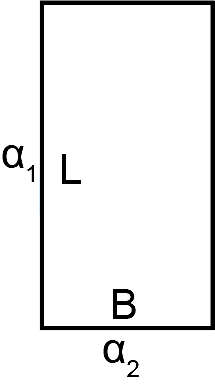
$A$ solid rectangular sheet has two different coefficients of linear expansion $\alpha_{1}$ and $\alpha_{2}$ along its length and breadth respectively. The coefficient of surface expansion is (for $\alpha_{1} \Delta t \ll 1, \alpha_{2} \Delta t \ll 1$):
A
$\frac{\alpha_{1}+\alpha_{2}}{2}$
B
$2(\alpha_{1}+\alpha_{2})$
C
$\frac{4 \alpha_{1} \alpha_{2}}{\alpha_{1}+\alpha_{2}}$
D
$\alpha_{1}+\alpha_{2}$
Solution
(D) Let the initial length be $L_{0}$ and initial breadth be $B_{0}$. The initial area is $S_{0} = L_{0} B_{0}$.
When the temperature increases by $\Delta t$,the new length $L_{t}$ and new breadth $B_{t}$ are given by:
$L_{t} = L_{0}(1 + \alpha_{1} \Delta t)$
$B_{t} = B_{0}(1 + \alpha_{2} \Delta t)$
The new area $S_{t}$ is:
$S_{t} = L_{t} \times B_{t} = L_{0}(1 + \alpha_{1} \Delta t) \times B_{0}(1 + \alpha_{2} \Delta t)$
$S_{t} = L_{0} B_{0} (1 + \alpha_{1} \Delta t + \alpha_{2} \Delta t + \alpha_{1} \alpha_{2} (\Delta t)^{2})$
Since $\alpha_{1} \Delta t \ll 1$ and $\alpha_{2} \Delta t \ll 1$,the term $\alpha_{1} \alpha_{2} (\Delta t)^{2}$ is negligible.
$S_{t} \approx S_{0} (1 + (\alpha_{1} + \alpha_{2}) \Delta t)$
Comparing this with the standard formula for surface expansion $S_{t} = S_{0} (1 + \beta \Delta t)$,where $\beta$ is the coefficient of surface expansion:
$\beta = \alpha_{1} + \alpha_{2}$
When the temperature increases by $\Delta t$,the new length $L_{t}$ and new breadth $B_{t}$ are given by:
$L_{t} = L_{0}(1 + \alpha_{1} \Delta t)$
$B_{t} = B_{0}(1 + \alpha_{2} \Delta t)$
The new area $S_{t}$ is:
$S_{t} = L_{t} \times B_{t} = L_{0}(1 + \alpha_{1} \Delta t) \times B_{0}(1 + \alpha_{2} \Delta t)$
$S_{t} = L_{0} B_{0} (1 + \alpha_{1} \Delta t + \alpha_{2} \Delta t + \alpha_{1} \alpha_{2} (\Delta t)^{2})$
Since $\alpha_{1} \Delta t \ll 1$ and $\alpha_{2} \Delta t \ll 1$,the term $\alpha_{1} \alpha_{2} (\Delta t)^{2}$ is negligible.
$S_{t} \approx S_{0} (1 + (\alpha_{1} + \alpha_{2}) \Delta t)$
Comparing this with the standard formula for surface expansion $S_{t} = S_{0} (1 + \beta \Delta t)$,where $\beta$ is the coefficient of surface expansion:
$\beta = \alpha_{1} + \alpha_{2}$
0 likes
View Solution225
DifficultMCQ
An aluminium and steel rod having same lengths and cross-sections are joined to make a total length of $120 \ cm$ at $30^{\circ} C$. The coefficients of linear expansion of aluminium and steel are $24 \times 10^{-6} /{ }^{\circ} C$ and $1.2 \times 10^{-5} /{ }^{\circ} C$,respectively. The length of this composite rod when its temperature is raised to $100^{\circ} C$,is . . . . . . $cm$. (in $cm$)
A
$120.20$
B
$120.15$
C
$120.03$
D
$120.06$
Solution
(B) Given: Total length $L = 120 \ cm$ at $30^{\circ} C$. Since they have the same length,$\ell_0 = 60 \ cm$ for each rod.
Change in temperature $\Delta T = 100^{\circ} C - 30^{\circ} C = 70^{\circ} C$.
Coefficient of linear expansion for aluminium $\alpha_A = 24 \times 10^{-6} /{ }^{\circ} C$.
Coefficient of linear expansion for steel $\alpha_S = 1.2 \times 10^{-5} /{ }^{\circ} C = 12 \times 10^{-6} /{ }^{\circ} C$.
The final length of the composite rod is the sum of the final lengths of the individual rods:
$\ell_{\text{final}} = \ell_0(1 + \alpha_A \Delta T) + \ell_0(1 + \alpha_S \Delta T)$
$\ell_{\text{final}} = \ell_0 [2 + (\alpha_A + \alpha_S) \Delta T]$
$\ell_{\text{final}} = 60 [2 + (24 \times 10^{-6} + 12 \times 10^{-6}) \times 70]$
$\ell_{\text{final}} = 60 [2 + (36 \times 10^{-6}) \times 70]$
$\ell_{\text{final}} = 60 [2 + 0.00252] = 120 + 0.1512 = 120.1512 \ cm$.
Rounding to two decimal places,the length is $120.15 \ cm$.
Change in temperature $\Delta T = 100^{\circ} C - 30^{\circ} C = 70^{\circ} C$.
Coefficient of linear expansion for aluminium $\alpha_A = 24 \times 10^{-6} /{ }^{\circ} C$.
Coefficient of linear expansion for steel $\alpha_S = 1.2 \times 10^{-5} /{ }^{\circ} C = 12 \times 10^{-6} /{ }^{\circ} C$.
The final length of the composite rod is the sum of the final lengths of the individual rods:
$\ell_{\text{final}} = \ell_0(1 + \alpha_A \Delta T) + \ell_0(1 + \alpha_S \Delta T)$
$\ell_{\text{final}} = \ell_0 [2 + (\alpha_A + \alpha_S) \Delta T]$
$\ell_{\text{final}} = 60 [2 + (24 \times 10^{-6} + 12 \times 10^{-6}) \times 70]$
$\ell_{\text{final}} = 60 [2 + (36 \times 10^{-6}) \times 70]$
$\ell_{\text{final}} = 60 [2 + 0.00252] = 120 + 0.1512 = 120.1512 \ cm$.
Rounding to two decimal places,the length is $120.15 \ cm$.
0 likes
View Solution226
DifficultMCQ
The temperature of a metal strip having coefficient of linear expansion $\alpha$ is increased from $T_1$ to $T_2$ resulting in an increase of its length by $\Delta L_1$. The temperature is further increased from $T_2$ to $T_3$ such that the increase in its length is $\Delta L_2$. Given $T_3 + T_1 = 2T_2$ and $T_2 - T_1 = \Delta T$,the value of $\Delta L_2$ is . . . . . . .
A
$\Delta L_1[1 + 2\alpha^2(\Delta T)^2]$
B
$\Delta L_1[1 + \alpha^2(\Delta T)^2]$
C
$\Delta L_1[1 + 2\alpha \Delta T]$
D
$\Delta L_1[1 + \alpha \Delta T]$
Solution
(D) Let the initial length at temperature $T_1$ be $L_0$.
For the first temperature change from $T_1$ to $T_2$,the increase in length is $\Delta L_1 = L_0 \alpha (T_2 - T_1) = L_0 \alpha \Delta T$.
The length of the strip at temperature $T_2$ is $L_2 = L_0 + \Delta L_1 = L_0(1 + \alpha \Delta T)$.
For the second temperature change from $T_2$ to $T_3$,the increase in length is $\Delta L_2 = L_2 \alpha (T_3 - T_2)$.
Given $T_3 + T_1 = 2T_2$,we can write $T_3 - T_2 = T_2 - T_1 = \Delta T$.
Substituting $L_2$ and $(T_3 - T_2)$ into the expression for $\Delta L_2$:
$\Delta L_2 = [L_0(1 + \alpha \Delta T)] \alpha \Delta T = (L_0 \alpha \Delta T)(1 + \alpha \Delta T)$.
Since $\Delta L_1 = L_0 \alpha \Delta T$,we get $\Delta L_2 = \Delta L_1(1 + \alpha \Delta T)$.
For the first temperature change from $T_1$ to $T_2$,the increase in length is $\Delta L_1 = L_0 \alpha (T_2 - T_1) = L_0 \alpha \Delta T$.
The length of the strip at temperature $T_2$ is $L_2 = L_0 + \Delta L_1 = L_0(1 + \alpha \Delta T)$.
For the second temperature change from $T_2$ to $T_3$,the increase in length is $\Delta L_2 = L_2 \alpha (T_3 - T_2)$.
Given $T_3 + T_1 = 2T_2$,we can write $T_3 - T_2 = T_2 - T_1 = \Delta T$.
Substituting $L_2$ and $(T_3 - T_2)$ into the expression for $\Delta L_2$:
$\Delta L_2 = [L_0(1 + \alpha \Delta T)] \alpha \Delta T = (L_0 \alpha \Delta T)(1 + \alpha \Delta T)$.
Since $\Delta L_1 = L_0 \alpha \Delta T$,we get $\Delta L_2 = \Delta L_1(1 + \alpha \Delta T)$.
0 likes
View Solution10-1.Thermometry, Thermal Expansion and Calorimetry — Thermal Expansion for Solid · Frequently Asked Questions
1Are these 10-1.Thermometry, Thermal Expansion and Calorimetry questions useful for JEE and NEET?
Yes. All questions in this section are mapped to JEE Main and NEET exam patterns. Previous year questions from JEE Main, NEET, GUJCET and state-level exams are included with full solutions.
2Can I switch to Hindi or Gujarati for these questions?
Yes. Use the language tabs in the hero section or the sidebar to view the same questions and solutions in English, Hindi or Gujarati.
3How do I generate a question paper from this subtopic?
Use the Vedclass Exam Paper Generator — select the chapter and subtopic, set difficulty, and generate Sets A, B, C, D automatically. First 3 chapters of every subject are free.
Vedclass Products
For Students
Vedclass Test Series
Mock tests in real JEE/NEET style with performance analysis. 5-day free trial.
Start Free TrialFor Teachers
Exam Paper Generator
Generate Set A/B/C/D papers from this chapter in 2 minutes. 3 chapters free.
Try FreeFor Institutes
Online Exam Module
Live online exams with unlimited students, 360° analytics & white-label branding.
See DemoFor Teachers & Institutes
Generate a 10-1.Thermometry, Thermal Expansion and Calorimetry Exam Paper in 2 Minutes
Select subtopic & difficulty — Sets A, B, C, D auto-generated with No Repeat logic.
First 3 chapters of every subject are free — no payment required.