
A English
Thermal Expansion for Solid Questions in English
Class 11 Physics · 10-1.Thermometry, Thermal Expansion and Calorimetry · Thermal Expansion for Solid
231+
Questions
English
Language
100%
With Solutions
Showing 49 of 231 questions in English
51
DifficultMCQ
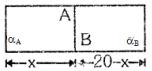
$A$ metal rod of length $20 \, cm$ expands by $0.075 \, cm$ when its temperature is raised from $0 \, ^\circ C$ to $100 \, ^\circ C$. Another rod $B$ of a different metal of the same length expands by $0.045 \, cm$ for the same rise in temperature. $A$ third rod of the same length is composed of two metals $A$ and $B$ joined together. This composite rod expands by $0.060 \, cm$ for the same temperature difference. The length of the portion of metal $A$ is ..... $cm$.
A
$20$
B
$10$
C
$15$
D
$18$
Solution
(B) The formula for linear expansion is $\Delta L = L_0 \alpha \Delta \theta$.
For rod $A$: $0.075 = 20 \times \alpha_A \times 100 \implies \alpha_A = \frac{0.075}{2000} = 3.75 \times 10^{-5} \, ^\circ C^{-1}$.
For rod $B$: $0.045 = 20 \times \alpha_B \times 100 \implies \alpha_B = \frac{0.045}{2000} = 2.25 \times 10^{-5} \, ^\circ C^{-1}$.
Let the length of metal $A$ be $x$ and the length of metal $B$ be $(20 - x)$.
The total expansion of the composite rod is the sum of the expansions of its parts:
$0.060 = (x \alpha_A \Delta \theta) + ((20 - x) \alpha_B \Delta \theta)$
$0.060 = [x(3.75 \times 10^{-5}) + (20 - x)(2.25 \times 10^{-5})] \times 100$
$0.060 = [3.75x + 45 - 2.25x] \times 10^{-3}$
$60 = 1.5x + 45$
$1.5x = 15$
$x = 10 \, cm$.
For rod $A$: $0.075 = 20 \times \alpha_A \times 100 \implies \alpha_A = \frac{0.075}{2000} = 3.75 \times 10^{-5} \, ^\circ C^{-1}$.
For rod $B$: $0.045 = 20 \times \alpha_B \times 100 \implies \alpha_B = \frac{0.045}{2000} = 2.25 \times 10^{-5} \, ^\circ C^{-1}$.
Let the length of metal $A$ be $x$ and the length of metal $B$ be $(20 - x)$.
The total expansion of the composite rod is the sum of the expansions of its parts:
$0.060 = (x \alpha_A \Delta \theta) + ((20 - x) \alpha_B \Delta \theta)$
$0.060 = [x(3.75 \times 10^{-5}) + (20 - x)(2.25 \times 10^{-5})] \times 100$
$0.060 = [3.75x + 45 - 2.25x] \times 10^{-3}$
$60 = 1.5x + 45$
$1.5x = 15$
$x = 10 \, cm$.
0 likes
View Solution52
DifficultMCQ
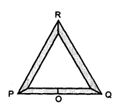
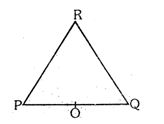
Three rods of length $\ell$ each are joined to form an equilateral triangle $PQR$. $O$ is the midpoint of $PQ$. For a small change in temperature,the distance $OR$ remains constant. If the coefficient of linear expansion for $PR$ and $RQ$ is $\alpha_2$ and for $PQ$ is $\alpha_1$,then:
A
$\alpha_2 = 3\alpha_1$
B
$\alpha_1 = 4\alpha_2$
C
$\alpha_1 = 3\alpha_2$
D
$\alpha_2 = 4\alpha_1$
Solution
(B) Let the length of each rod be $\ell$. In an equilateral triangle $PQR$,the height $OR$ is given by $OR^2 = PR^2 - PO^2 = \ell^2 - (\ell/2)^2 = 3\ell^2/4$.
After a temperature change $\Delta t$,the new lengths are $\ell' = \ell(1 + \alpha \Delta t)$.
Let $PR' = \ell(1 + \alpha_2 \Delta t)$ and $PQ' = \ell(1 + \alpha_1 \Delta t)$.
The new midpoint $O'$ divides $PQ'$ into two segments of length $PO' = \frac{\ell(1 + \alpha_1 \Delta t)}{2}$.
Since $OR$ remains constant,$OR^2 = (PR')^2 - (PO')^2$.
$\frac{3\ell^2}{4} = [\ell(1 + \alpha_2 \Delta t)]^2 - [\frac{\ell}{2}(1 + \alpha_1 \Delta t)]^2$.
$\frac{3\ell^2}{4} = \ell^2(1 + 2\alpha_2 \Delta t + \alpha_2^2 \Delta t^2) - \frac{\ell^2}{4}(1 + 2\alpha_1 \Delta t + \alpha_1^2 \Delta t^2)$.
Neglecting higher-order terms like $\Delta t^2$,we get:
$\frac{3\ell^2}{4} = \ell^2 + 2\ell^2 \alpha_2 \Delta t - \frac{\ell^2}{4} - \frac{2\ell^2 \alpha_1 \Delta t}{4}$.
$\frac{3\ell^2}{4} = \frac{3\ell^2}{4} + 2\ell^2 \alpha_2 \Delta t - \frac{\ell^2 \alpha_1 \Delta t}{2}$.
$0 = 2\alpha_2 \Delta t - \frac{\alpha_1 \Delta t}{2}$.
$2\alpha_2 = \frac{\alpha_1}{2} \implies \alpha_1 = 4\alpha_2$.
After a temperature change $\Delta t$,the new lengths are $\ell' = \ell(1 + \alpha \Delta t)$.
Let $PR' = \ell(1 + \alpha_2 \Delta t)$ and $PQ' = \ell(1 + \alpha_1 \Delta t)$.
The new midpoint $O'$ divides $PQ'$ into two segments of length $PO' = \frac{\ell(1 + \alpha_1 \Delta t)}{2}$.
Since $OR$ remains constant,$OR^2 = (PR')^2 - (PO')^2$.
$\frac{3\ell^2}{4} = [\ell(1 + \alpha_2 \Delta t)]^2 - [\frac{\ell}{2}(1 + \alpha_1 \Delta t)]^2$.
$\frac{3\ell^2}{4} = \ell^2(1 + 2\alpha_2 \Delta t + \alpha_2^2 \Delta t^2) - \frac{\ell^2}{4}(1 + 2\alpha_1 \Delta t + \alpha_1^2 \Delta t^2)$.
Neglecting higher-order terms like $\Delta t^2$,we get:
$\frac{3\ell^2}{4} = \ell^2 + 2\ell^2 \alpha_2 \Delta t - \frac{\ell^2}{4} - \frac{2\ell^2 \alpha_1 \Delta t}{4}$.
$\frac{3\ell^2}{4} = \frac{3\ell^2}{4} + 2\ell^2 \alpha_2 \Delta t - \frac{\ell^2 \alpha_1 \Delta t}{2}$.
$0 = 2\alpha_2 \Delta t - \frac{\alpha_1 \Delta t}{2}$.
$2\alpha_2 = \frac{\alpha_1}{2} \implies \alpha_1 = 4\alpha_2$.
0 likes
View Solution53
DifficultMCQ
$A$ crystal has a linear expansion coefficient of $\alpha_1$ in one direction and $\alpha_2$ in all directions perpendicular to it. What will be the volume expansion coefficient of the crystal?
A
$\alpha_1 + \alpha_2$
B
$2\alpha_1 + \alpha_2$
C
$\alpha_1 + 2\alpha_2$
D
None of these
Solution
(C) Let the dimensions of the crystal be $L_0 \times L_0 \times L_0$. The initial volume is $V_0 = L_0^3$.
When the temperature increases by $\Delta \theta$,the new dimensions become $L_1 = L_0(1 + \alpha_1 \Delta \theta)$ and $L_2 = L_0(1 + \alpha_2 \Delta \theta)$ (for the two perpendicular directions).
The new volume $V$ is given by $V = L_1 \times L_2 \times L_2 = L_0(1 + \alpha_1 \Delta \theta) \times L_0(1 + \alpha_2 \Delta \theta) \times L_0(1 + \alpha_2 \Delta \theta)$.
$V = L_0^3(1 + \alpha_1 \Delta \theta)(1 + \alpha_2 \Delta \theta)^2$.
Using the binomial approximation $(1 + x)^n \approx 1 + nx$ for small $\alpha \Delta \theta$,we get:
$V \approx V_0(1 + \alpha_1 \Delta \theta)(1 + 2\alpha_2 \Delta \theta)$.
$V \approx V_0(1 + \alpha_1 \Delta \theta + 2\alpha_2 \Delta \theta + 2\alpha_1 \alpha_2 (\Delta \theta)^2)$.
Neglecting the higher-order term $(\Delta \theta)^2$,we have $V \approx V_0(1 + (\alpha_1 + 2\alpha_2) \Delta \theta)$.
Comparing this with the standard volume expansion formula $V = V_0(1 + \gamma \Delta \theta)$,we find the volume expansion coefficient $\gamma = \alpha_1 + 2\alpha_2$.
When the temperature increases by $\Delta \theta$,the new dimensions become $L_1 = L_0(1 + \alpha_1 \Delta \theta)$ and $L_2 = L_0(1 + \alpha_2 \Delta \theta)$ (for the two perpendicular directions).
The new volume $V$ is given by $V = L_1 \times L_2 \times L_2 = L_0(1 + \alpha_1 \Delta \theta) \times L_0(1 + \alpha_2 \Delta \theta) \times L_0(1 + \alpha_2 \Delta \theta)$.
$V = L_0^3(1 + \alpha_1 \Delta \theta)(1 + \alpha_2 \Delta \theta)^2$.
Using the binomial approximation $(1 + x)^n \approx 1 + nx$ for small $\alpha \Delta \theta$,we get:
$V \approx V_0(1 + \alpha_1 \Delta \theta)(1 + 2\alpha_2 \Delta \theta)$.
$V \approx V_0(1 + \alpha_1 \Delta \theta + 2\alpha_2 \Delta \theta + 2\alpha_1 \alpha_2 (\Delta \theta)^2)$.
Neglecting the higher-order term $(\Delta \theta)^2$,we have $V \approx V_0(1 + (\alpha_1 + 2\alpha_2) \Delta \theta)$.
Comparing this with the standard volume expansion formula $V = V_0(1 + \gamma \Delta \theta)$,we find the volume expansion coefficient $\gamma = \alpha_1 + 2\alpha_2$.
0 likes
View Solution54
EasyMCQ
When a copper sphere is heated,in which of the following will the maximum percentage change be observed?
A
Radius
B
Area
C
Volume
D
None of the above
Solution
(C) Let the fractional change in radius be $\frac{\Delta r}{r} = X$.
The fractional change in area $A = 4 \pi r^2$ is given by $\frac{\Delta A}{A} = 2 \frac{\Delta r}{r} = 2X$.
The fractional change in volume $V = \frac{4}{3} \pi r^3$ is given by $\frac{\Delta V}{V} = 3 \frac{\Delta r}{r} = 3X$.
Comparing the percentage changes,$3X > 2X > X$. Therefore,the maximum percentage change is observed in the volume.
The fractional change in area $A = 4 \pi r^2$ is given by $\frac{\Delta A}{A} = 2 \frac{\Delta r}{r} = 2X$.
The fractional change in volume $V = \frac{4}{3} \pi r^3$ is given by $\frac{\Delta V}{V} = 3 \frac{\Delta r}{r} = 3X$.
Comparing the percentage changes,$3X > 2X > X$. Therefore,the maximum percentage change is observed in the volume.
0 likes
View Solution55
EasyMCQ
$A$ thin copper wire of length $l$ meters is heated by $10^{\circ}C$,resulting in a $2\%$ increase in its length. If a square copper sheet of side $l$ meters is heated by the same $10^{\circ}C$,what is the percentage change in its area?
A
$4$
B
$8$
C
$16$
D
None of these
Solution
(A) Let the initial length be $l$. The change in length is given as $\Delta l / l = 2\% = 0.02$.
For a square of side $l$,the area is $A = l^2$.
The relative change in area is given by the formula $\Delta A / A = 2(\Delta l / l)$.
Substituting the given value: $\Delta A / A = 2 \times 2\% = 4\%$.
Therefore,the percentage increase in the area of the square copper sheet is $4\%$.
For a square of side $l$,the area is $A = l^2$.
The relative change in area is given by the formula $\Delta A / A = 2(\Delta l / l)$.
Substituting the given value: $\Delta A / A = 2 \times 2\% = 4\%$.
Therefore,the percentage increase in the area of the square copper sheet is $4\%$.
0 likes
View Solution56
MediumMCQ
The linear expansion coefficients of brass and steel wires are $\alpha_1$ and $\alpha_2$ respectively,and their lengths at $0^\circ C$ are $L_1$ and $L_2$. If the difference $(L_2 - L_1)$ remains constant at any temperature,then:
A
$\alpha_1 L_2 = \alpha_2 L_1$
B
$\alpha_1 L_2^2 = \alpha_2 L_1^2$
C
$\alpha_1^2 L_1 = \alpha_2^2 L_2$
D
$\alpha_1 L_1 = \alpha_2 L_2$
Solution
(D) Let the lengths at temperature $\Delta \theta$ be $L_1'$ and $L_2'$.
$L_1' = L_1(1 + \alpha_1 \Delta \theta)$ and $L_2' = L_2(1 + \alpha_2 \Delta \theta)$.
The difference is $D = L_2' - L_1' = (L_2 - L_1) + (L_2 \alpha_2 - L_1 \alpha_1) \Delta \theta$.
For the difference to be constant at any temperature,the coefficient of $\Delta \theta$ must be zero.
Therefore,$L_2 \alpha_2 - L_1 \alpha_1 = 0$.
This implies $L_1 \alpha_1 = L_2 \alpha_2$.
$L_1' = L_1(1 + \alpha_1 \Delta \theta)$ and $L_2' = L_2(1 + \alpha_2 \Delta \theta)$.
The difference is $D = L_2' - L_1' = (L_2 - L_1) + (L_2 \alpha_2 - L_1 \alpha_1) \Delta \theta$.
For the difference to be constant at any temperature,the coefficient of $\Delta \theta$ must be zero.
Therefore,$L_2 \alpha_2 - L_1 \alpha_1 = 0$.
This implies $L_1 \alpha_1 = L_2 \alpha_2$.
0 likes
View Solution57
MediumMCQ
The difference in length between an iron rod and a copper rod is $10 \ cm$ at all temperatures. If ${\alpha _{Fe}} = 11 \times {10^{ - 6}} \, ^\circ C^{ - 1}$ and ${\alpha _{Cu}} = 17 \times {10^{ - 6}} \, ^\circ C^{ - 1}$,what are their lengths respectively?
A
$28.3 \ cm, 18.3 \ cm$
B
$23.8 \ cm, 13.8 \ cm$
C
$23.9 \ cm, 13.9 \ cm$
D
$27.5 \ cm, 17.5 \ cm$
Solution
(A) Given that the difference in length is constant at all temperatures,the change in length for both rods must be equal for any change in temperature $\Delta T$.
Let $L_{Fe}$ and $L_{Cu}$ be the lengths of the iron and copper rods respectively.
We are given $L_{Fe} - L_{Cu} = 10 \ cm$ ..... $(i)$
Since the difference is constant,$\Delta L_{Fe} = \Delta L_{Cu}$.
Using the formula for linear expansion $\Delta L = L \alpha \Delta T$,we get:
$L_{Fe} \alpha_{Fe} \Delta T = L_{Cu} \alpha_{Cu} \Delta T$
$L_{Fe} \alpha_{Fe} = L_{Cu} \alpha_{Cu}$
$\frac{L_{Fe}}{L_{Cu}} = \frac{\alpha_{Cu}}{\alpha_{Fe}} = \frac{17 \times 10^{-6}}{11 \times 10^{-6}} = \frac{17}{11}$ ..... $(ii)$
From $(i)$,$L_{Fe} = L_{Cu} + 10$.
Substituting this into $(ii)$:
$\frac{L_{Cu} + 10}{L_{Cu}} = \frac{17}{11}$
$11(L_{Cu} + 10) = 17 L_{Cu}$
$11 L_{Cu} + 110 = 17 L_{Cu}$
$6 L_{Cu} = 110$
$L_{Cu} = \frac{110}{6} \approx 18.33 \ cm$
$L_{Fe} = 18.33 + 10 = 28.33 \ cm$.
Thus,the lengths are approximately $28.3 \ cm$ and $18.3 \ cm$.
Let $L_{Fe}$ and $L_{Cu}$ be the lengths of the iron and copper rods respectively.
We are given $L_{Fe} - L_{Cu} = 10 \ cm$ ..... $(i)$
Since the difference is constant,$\Delta L_{Fe} = \Delta L_{Cu}$.
Using the formula for linear expansion $\Delta L = L \alpha \Delta T$,we get:
$L_{Fe} \alpha_{Fe} \Delta T = L_{Cu} \alpha_{Cu} \Delta T$
$L_{Fe} \alpha_{Fe} = L_{Cu} \alpha_{Cu}$
$\frac{L_{Fe}}{L_{Cu}} = \frac{\alpha_{Cu}}{\alpha_{Fe}} = \frac{17 \times 10^{-6}}{11 \times 10^{-6}} = \frac{17}{11}$ ..... $(ii)$
From $(i)$,$L_{Fe} = L_{Cu} + 10$.
Substituting this into $(ii)$:
$\frac{L_{Cu} + 10}{L_{Cu}} = \frac{17}{11}$
$11(L_{Cu} + 10) = 17 L_{Cu}$
$11 L_{Cu} + 110 = 17 L_{Cu}$
$6 L_{Cu} = 110$
$L_{Cu} = \frac{110}{6} \approx 18.33 \ cm$
$L_{Fe} = 18.33 + 10 = 28.33 \ cm$.
Thus,the lengths are approximately $28.3 \ cm$ and $18.3 \ cm$.
0 likes
View Solution58
DifficultMCQ
$A$ $50 \ cm$ iron rod is connected to a $100 \ cm$ aluminum rod at $20^{\circ}C$. If $\alpha_{Fe} = 12 \times 10^{-6} {^{\circ}C}^{-1}$ and $\alpha_{Al} = 24 \times 10^{-6} {^{\circ}C}^{-1}$,what is the effective coefficient of linear expansion of the system?
A
$36 \times 10^{-6} {^{\circ}C}^{-1}$
B
$12 \times 10^{-6} {^{\circ}C}^{-1}$
C
$20 \times 10^{-6} {^{\circ}C}^{-1}$
D
$48 \times 10^{-6} {^{\circ}C}^{-1}$
Solution
(C) The total length of the system at $20^{\circ}C$ is $L = 50 \ cm + 100 \ cm = 150 \ cm$.
Let the temperature change be $\Delta T = 100^{\circ}C - 20^{\circ}C = 80^{\circ}C$.
The new length of the iron rod at $100^{\circ}C$ is $L_{Fe}' = 50(1 + \alpha_{Fe} \Delta T) = 50(1 + 12 \times 10^{-6} \times 80) = 50(1 + 0.00096) = 50.048 \ cm$.
The new length of the aluminum rod at $100^{\circ}C$ is $L_{Al}' = 100(1 + \alpha_{Al} \Delta T) = 100(1 + 24 \times 10^{-6} \times 80) = 100(1 + 0.00192) = 100.192 \ cm$.
The total length at $100^{\circ}C$ is $L' = 50.048 + 100.192 = 150.24 \ cm$.
The change in length is $\Delta L = L' - L = 150.24 - 150 = 0.24 \ cm$.
The effective coefficient of linear expansion $\alpha_{eff}$ is given by $\Delta L = L \alpha_{eff} \Delta T$.
$\alpha_{eff} = \frac{\Delta L}{L \Delta T} = \frac{0.24}{150 \times 80} = \frac{0.24}{12000} = 20 \times 10^{-6} {^{\circ}C}^{-1}$.
Let the temperature change be $\Delta T = 100^{\circ}C - 20^{\circ}C = 80^{\circ}C$.
The new length of the iron rod at $100^{\circ}C$ is $L_{Fe}' = 50(1 + \alpha_{Fe} \Delta T) = 50(1 + 12 \times 10^{-6} \times 80) = 50(1 + 0.00096) = 50.048 \ cm$.
The new length of the aluminum rod at $100^{\circ}C$ is $L_{Al}' = 100(1 + \alpha_{Al} \Delta T) = 100(1 + 24 \times 10^{-6} \times 80) = 100(1 + 0.00192) = 100.192 \ cm$.
The total length at $100^{\circ}C$ is $L' = 50.048 + 100.192 = 150.24 \ cm$.
The change in length is $\Delta L = L' - L = 150.24 - 150 = 0.24 \ cm$.
The effective coefficient of linear expansion $\alpha_{eff}$ is given by $\Delta L = L \alpha_{eff} \Delta T$.
$\alpha_{eff} = \frac{\Delta L}{L \Delta T} = \frac{0.24}{150 \times 80} = \frac{0.24}{12000} = 20 \times 10^{-6} {^{\circ}C}^{-1}$.
0 likes
View Solution59
MediumMCQ
Brass and lead rods of length $80 \ cm$ are connected in parallel at $0^{\circ}C$. If they are heated to $100^{\circ}C$,what will be the difference in length between their ends in $mm$? (Given: $\alpha_{brass} = 18 \times 10^{-6} \ ^{\circ}C^{-1}$ and $\alpha_{lead} = 28 \times 10^{-6} \ ^{\circ}C^{-1}$)
A
$0.2$
B
$0.8$
C
$1.4$
D
$1.6$
Solution
(B) The change in length of a rod due to thermal expansion is given by $\Delta L = L \alpha \Delta T$.
For the brass rod:
$\Delta L_{brass} = L \alpha_{brass} \Delta T = 80 \ cm \times (18 \times 10^{-6} \ ^{\circ}C^{-1}) \times (100^{\circ}C - 0^{\circ}C) = 80 \times 18 \times 10^{-4} \ cm = 0.144 \ cm = 1.44 \ mm$.
For the lead rod:
$\Delta L_{lead} = L \alpha_{lead} \Delta T = 80 \ cm \times (28 \times 10^{-6} \ ^{\circ}C^{-1}) \times (100^{\circ}C - 0^{\circ}C) = 80 \times 28 \times 10^{-4} \ cm = 0.224 \ cm = 2.24 \ mm$.
The difference in length between their ends is $\Delta L_{lead} - \Delta L_{brass} = 2.24 \ mm - 1.44 \ mm = 0.8 \ mm$.
For the brass rod:
$\Delta L_{brass} = L \alpha_{brass} \Delta T = 80 \ cm \times (18 \times 10^{-6} \ ^{\circ}C^{-1}) \times (100^{\circ}C - 0^{\circ}C) = 80 \times 18 \times 10^{-4} \ cm = 0.144 \ cm = 1.44 \ mm$.
For the lead rod:
$\Delta L_{lead} = L \alpha_{lead} \Delta T = 80 \ cm \times (28 \times 10^{-6} \ ^{\circ}C^{-1}) \times (100^{\circ}C - 0^{\circ}C) = 80 \times 28 \times 10^{-4} \ cm = 0.224 \ cm = 2.24 \ mm$.
The difference in length between their ends is $\Delta L_{lead} - \Delta L_{brass} = 2.24 \ mm - 1.44 \ mm = 0.8 \ mm$.
0 likes
View Solution60
DifficultMCQ
$A$ sphere floats on a liquid whose volume does not change with temperature. At temperatures $t_1$ and $t_2$,the fractions $f_1$ and $f_2$ of the sphere are submerged in the liquid,respectively. What is the coefficient of volume expansion of the sphere?
A
$\frac{f_1 - f_2}{f_2 t_1 - f_1 t_2}$
B
$\frac{f_1 - f_2}{f_1 t_1 - f_2 t_2}$
C
$\frac{f_1 + f_2}{f_2 t_1 + f_1 t_2}$
D
$\frac{f_1 + f_2}{f_1 t_1 + f_2 t_2}$
Solution
(B) Let $V$ be the volume of the sphere and $\rho_L$ be the density of the liquid. Since the sphere floats,the weight of the sphere equals the weight of the displaced liquid.
$Mg = V_{submerged} \rho_L g$
$V_{sphere}(t) \rho_S(t) g = f V_{sphere}(t) \rho_L g$
Since the liquid density $\rho_L$ is constant,$\rho_S(t) = f \rho_L$.
As the sphere expands,its density changes as $\rho_S(t) = \frac{\rho_0}{1 + \gamma t}$,where $\gamma$ is the coefficient of volume expansion.
Thus,$f_1 = \frac{\rho_S(t_1)}{\rho_L} = \frac{\rho_0}{\rho_L(1 + \gamma t_1)}$ and $f_2 = \frac{\rho_S(t_2)}{\rho_L} = \frac{\rho_0}{\rho_L(1 + \gamma t_2)}$.
Taking the ratio: $\frac{f_1}{f_2} = \frac{1 + \gamma t_2}{1 + \gamma t_1}$.
$f_1(1 + \gamma t_1) = f_2(1 + \gamma t_2)$
$f_1 + f_1 \gamma t_1 = f_2 + f_2 \gamma t_2$
$\gamma (f_1 t_1 - f_2 t_2) = f_2 - f_1$
$\gamma = \frac{f_2 - f_1}{f_1 t_1 - f_2 t_2} = \frac{f_1 - f_2}{f_2 t_2 - f_1 t_1}$.
Wait,re-evaluating the ratio: $f_1(1 + \gamma t_2) = f_2(1 + \gamma t_1)$ is incorrect. The correct relation is $f_1(1 + \gamma t_1) = C$ (constant).
Actually,$V(t) = V_0(1 + \gamma t)$. The submerged volume $V_{sub} = f V(t)$.
Since $V_{sub} \rho_L = M$ (constant),$f V_0(1 + \gamma t) \rho_L = M$.
So $f_1(1 + \gamma t_1) = f_2(1 + \gamma t_2)$.
$f_1 + f_1 \gamma t_1 = f_2 + f_2 \gamma t_2$
$\gamma (f_1 t_1 - f_2 t_2) = f_2 - f_1$
$\gamma = \frac{f_2 - f_1}{f_1 t_1 - f_2 t_2} = \frac{f_1 - f_2}{f_2 t_2 - f_1 t_1}$.
$Mg = V_{submerged} \rho_L g$
$V_{sphere}(t) \rho_S(t) g = f V_{sphere}(t) \rho_L g$
Since the liquid density $\rho_L$ is constant,$\rho_S(t) = f \rho_L$.
As the sphere expands,its density changes as $\rho_S(t) = \frac{\rho_0}{1 + \gamma t}$,where $\gamma$ is the coefficient of volume expansion.
Thus,$f_1 = \frac{\rho_S(t_1)}{\rho_L} = \frac{\rho_0}{\rho_L(1 + \gamma t_1)}$ and $f_2 = \frac{\rho_S(t_2)}{\rho_L} = \frac{\rho_0}{\rho_L(1 + \gamma t_2)}$.
Taking the ratio: $\frac{f_1}{f_2} = \frac{1 + \gamma t_2}{1 + \gamma t_1}$.
$f_1(1 + \gamma t_1) = f_2(1 + \gamma t_2)$
$f_1 + f_1 \gamma t_1 = f_2 + f_2 \gamma t_2$
$\gamma (f_1 t_1 - f_2 t_2) = f_2 - f_1$
$\gamma = \frac{f_2 - f_1}{f_1 t_1 - f_2 t_2} = \frac{f_1 - f_2}{f_2 t_2 - f_1 t_1}$.
Wait,re-evaluating the ratio: $f_1(1 + \gamma t_2) = f_2(1 + \gamma t_1)$ is incorrect. The correct relation is $f_1(1 + \gamma t_1) = C$ (constant).
Actually,$V(t) = V_0(1 + \gamma t)$. The submerged volume $V_{sub} = f V(t)$.
Since $V_{sub} \rho_L = M$ (constant),$f V_0(1 + \gamma t) \rho_L = M$.
So $f_1(1 + \gamma t_1) = f_2(1 + \gamma t_2)$.
$f_1 + f_1 \gamma t_1 = f_2 + f_2 \gamma t_2$
$\gamma (f_1 t_1 - f_2 t_2) = f_2 - f_1$
$\gamma = \frac{f_2 - f_1}{f_1 t_1 - f_2 t_2} = \frac{f_1 - f_2}{f_2 t_2 - f_1 t_1}$.
0 likes
View Solution61
DifficultMCQ
$A$ pendulum clock shows the correct time at $20\,^oC$. The coefficient of linear expansion of the pendulum material is $12 \times 10^{-6}\,^oC^{-1}$. How much time in $sec/day$ will it lose at $40\,^oC$?
A
$10.3$
B
$20.6$
C
$5.0$
D
$23.0$
Solution
(A) The time period of a pendulum is given by $T = 2\pi \sqrt{\frac{L}{g}}$.
Taking the derivative,the fractional change in time period is $\frac{\Delta T}{T} = \frac{1}{2} \frac{\Delta L}{L} = \frac{1}{2} \alpha \Delta \theta$.
Given $\alpha = 12 \times 10^{-6}\,^oC^{-1}$ and $\Delta \theta = (40 - 20) = 20\,^oC$.
Substituting the values: $\frac{\Delta T}{T} = \frac{1}{2} \times 12 \times 10^{-6} \times 20 = 120 \times 10^{-6} = 1.2 \times 10^{-4}$.
The time lost per day is $\Delta T = \frac{\Delta T}{T} \times T_{day}$,where $T_{day} = 86400\,sec$.
$\Delta T = 1.2 \times 10^{-4} \times 86400 = 10.368\,sec/day \approx 10.3\,sec/day$.
Taking the derivative,the fractional change in time period is $\frac{\Delta T}{T} = \frac{1}{2} \frac{\Delta L}{L} = \frac{1}{2} \alpha \Delta \theta$.
Given $\alpha = 12 \times 10^{-6}\,^oC^{-1}$ and $\Delta \theta = (40 - 20) = 20\,^oC$.
Substituting the values: $\frac{\Delta T}{T} = \frac{1}{2} \times 12 \times 10^{-6} \times 20 = 120 \times 10^{-6} = 1.2 \times 10^{-4}$.
The time lost per day is $\Delta T = \frac{\Delta T}{T} \times T_{day}$,where $T_{day} = 86400\,sec$.
$\Delta T = 1.2 \times 10^{-4} \times 86400 = 10.368\,sec/day \approx 10.3\,sec/day$.
0 likes
View Solution62
MediumMCQ
Coefficient of linear expansion of brass and steel rods are $\alpha_1$ and $\alpha_2$. Lengths of brass and steel rods are $l_1$ and $l_2$ respectively. If $(l_2 - l_1)$ is maintained same at all temperatures,which one of the following relations holds good?
A
$\alpha_1 l_2^2 = \alpha_2 l_1^2$
B
$\alpha_1^2 l_2 = \alpha_2^2 l_1$
C
$\alpha_1 l_1 = \alpha_2 l_2$
D
$\alpha_1 l_2 = \alpha_2 l_1$
Solution
(C) Let the lengths of the brass and steel rods at temperature $T$ be $L_1$ and $L_2$ respectively.
After a change in temperature $\Delta T$,the new lengths are:
$L_1' = l_1(1 + \alpha_1 \Delta T)$
$L_2' = l_2(1 + \alpha_2 \Delta T)$
Given that the difference $(L_2' - L_1')$ remains constant and equal to $(l_2 - l_1)$ at all temperatures:
$L_2' - L_1' = l_2 - l_1$
$l_2(1 + \alpha_2 \Delta T) - l_1(1 + \alpha_1 \Delta T) = l_2 - l_1$
$l_2 + l_2 \alpha_2 \Delta T - l_1 - l_1 \alpha_1 \Delta T = l_2 - l_1$
$(l_2 - l_1) + \Delta T(l_2 \alpha_2 - l_1 \alpha_1) = l_2 - l_1$
For this to hold for any $\Delta T$,the coefficient of $\Delta T$ must be zero:
$l_2 \alpha_2 - l_1 \alpha_1 = 0$
$\alpha_1 l_1 = \alpha_2 l_2$
After a change in temperature $\Delta T$,the new lengths are:
$L_1' = l_1(1 + \alpha_1 \Delta T)$
$L_2' = l_2(1 + \alpha_2 \Delta T)$
Given that the difference $(L_2' - L_1')$ remains constant and equal to $(l_2 - l_1)$ at all temperatures:
$L_2' - L_1' = l_2 - l_1$
$l_2(1 + \alpha_2 \Delta T) - l_1(1 + \alpha_1 \Delta T) = l_2 - l_1$
$l_2 + l_2 \alpha_2 \Delta T - l_1 - l_1 \alpha_1 \Delta T = l_2 - l_1$
$(l_2 - l_1) + \Delta T(l_2 \alpha_2 - l_1 \alpha_1) = l_2 - l_1$
For this to hold for any $\Delta T$,the coefficient of $\Delta T$ must be zero:
$l_2 \alpha_2 - l_1 \alpha_1 = 0$
$\alpha_1 l_1 = \alpha_2 l_2$
0 likes
View Solution63
EasyMCQ
Two wires $A$ and $B$ of the same length,same area of cross-section,and having the same Young's modulus are heated to the same temperature range. If the coefficient of linear expansion of wire $A$ is $3/2$ times that of wire $B$,what is the ratio of the thermal forces produced in the two wires?
A
$2/3$
B
$9/4$
C
$4/9$
D
$3/2$
Solution
(D) The thermal force $F$ produced in a wire when it is prevented from expanding due to a temperature change $\Delta \theta$ is given by the formula:
$F = YA\alpha \Delta \theta$
where $Y$ is Young's modulus,$A$ is the area of cross-section,$\alpha$ is the coefficient of linear expansion,and $\Delta \theta$ is the change in temperature.
Given that $Y$,$A$,and $\Delta \theta$ are the same for both wires $A$ and $B$,the force $F$ is directly proportional to the coefficient of linear expansion $\alpha$:
$F \propto \alpha$
Therefore,the ratio of the forces is:
$\frac{F_A}{F_B} = \frac{\alpha_A}{\alpha_B}$
Given that $\alpha_A = \frac{3}{2} \alpha_B$,we have:
$\frac{F_A}{F_B} = \frac{3}{2}$
Thus,the ratio of the forces produced in the two wires is $3/2$.
$F = YA\alpha \Delta \theta$
where $Y$ is Young's modulus,$A$ is the area of cross-section,$\alpha$ is the coefficient of linear expansion,and $\Delta \theta$ is the change in temperature.
Given that $Y$,$A$,and $\Delta \theta$ are the same for both wires $A$ and $B$,the force $F$ is directly proportional to the coefficient of linear expansion $\alpha$:
$F \propto \alpha$
Therefore,the ratio of the forces is:
$\frac{F_A}{F_B} = \frac{\alpha_A}{\alpha_B}$
Given that $\alpha_A = \frac{3}{2} \alpha_B$,we have:
$\frac{F_A}{F_B} = \frac{3}{2}$
Thus,the ratio of the forces produced in the two wires is $3/2$.
0 likes
View Solution64
EasyMCQ
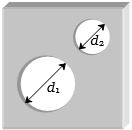
Two holes of unequal diameters $d_1$ and $d_2$ $(d_1 > d_2)$ are cut in a metal sheet. If the sheet is heated,what happens to the diameters?
A
Both $d_1$ and $d_2$ will decrease.
B
Both $d_1$ and $d_2$ will increase.
C
$d_1$ will increase,$d_2$ will decrease.
D
$d_1$ will decrease,$d_2$ will increase.
Solution
(B) When a metal sheet is heated,it undergoes thermal expansion. The expansion of a hole in a solid is similar to the expansion of the material itself.
According to the principle of thermal expansion,the distance between any two points on the sheet increases as the temperature increases.
Since the diameter of a hole is defined by the distance between two points on its circumference,this distance also increases.
Therefore,the diameters of both holes,$d_1$ and $d_2$,will increase upon heating. This phenomenon is analogous to a photographic enlargement where every part of the image scales up.
According to the principle of thermal expansion,the distance between any two points on the sheet increases as the temperature increases.
Since the diameter of a hole is defined by the distance between two points on its circumference,this distance also increases.
Therefore,the diameters of both holes,$d_1$ and $d_2$,will increase upon heating. This phenomenon is analogous to a photographic enlargement where every part of the image scales up.
0 likes
View Solution65
DifficultMCQ
$A$ rod of length $20 \, cm$ is made of metal $A$. It expands by $0.075 \, cm$ when its temperature is raised from $0^{\circ}C$ to $100^{\circ}C$. Another rod of a different metal $B$ having the same length expands by $0.045 \, cm$ for the same change in temperature. $A$ third rod of the same length is composed of two parts,one of metal $A$ and the other of metal $B$. This rod expands by $0.06 \, cm$ for the same change in temperature. The portion made of metal $A$ has the length ............. $cm$.
A
$20$
B
$10$
C
$15$
D
$18$
Solution
(B) Let $l_1$ be the length of the portion of metal $A$ and $l_2$ be the length of the portion of metal $B$.
Since the total length is $20 \, cm$,we have $l_1 + l_2 = 20 \, cm$.
For a given change in temperature,the change in length $\Delta l$ is proportional to the initial length $l$. Thus,$\Delta l = \alpha \cdot l \cdot \Delta T$.
For metal $A$,$\Delta l_A = 0.075 \, cm$ for $l = 20 \, cm$,so the expansion coefficient factor is $k_A = \frac{0.075}{20} = 0.00375$.
For metal $B$,$\Delta l_B = 0.045 \, cm$ for $l = 20 \, cm$,so the expansion coefficient factor is $k_B = \frac{0.045}{20} = 0.00225$.
The total expansion of the composite rod is $\Delta l_{total} = k_A l_1 + k_B l_2 = 0.06 \, cm$.
Substituting $l_2 = 20 - l_1$:
$0.00375 l_1 + 0.00225(20 - l_1) = 0.06$
$0.00375 l_1 + 0.045 - 0.00225 l_1 = 0.06$
$0.0015 l_1 = 0.015$
$l_1 = \frac{0.015}{0.0015} = 10 \, cm$.
Since the total length is $20 \, cm$,we have $l_1 + l_2 = 20 \, cm$.
For a given change in temperature,the change in length $\Delta l$ is proportional to the initial length $l$. Thus,$\Delta l = \alpha \cdot l \cdot \Delta T$.
For metal $A$,$\Delta l_A = 0.075 \, cm$ for $l = 20 \, cm$,so the expansion coefficient factor is $k_A = \frac{0.075}{20} = 0.00375$.
For metal $B$,$\Delta l_B = 0.045 \, cm$ for $l = 20 \, cm$,so the expansion coefficient factor is $k_B = \frac{0.045}{20} = 0.00225$.
The total expansion of the composite rod is $\Delta l_{total} = k_A l_1 + k_B l_2 = 0.06 \, cm$.
Substituting $l_2 = 20 - l_1$:
$0.00375 l_1 + 0.00225(20 - l_1) = 0.06$
$0.00375 l_1 + 0.045 - 0.00225 l_1 = 0.06$
$0.0015 l_1 = 0.015$
$l_1 = \frac{0.015}{0.0015} = 10 \, cm$.
0 likes
View Solution66
AdvancedMCQ
The volume of the bulb of a mercury thermometer at $0^\circ C$ is $V_0$ and the cross-section of the capillary is $A_0$. The coefficient of linear expansion of glass is $a_g$ per $^\circ C$ and the coefficient of cubical expansion of mercury is $\gamma_m$ per $^\circ C$. If the mercury just fills the bulb at $0^\circ C$,what is the length of the mercury column in the capillary at $T^\circ C$?
A
$\frac{V_0 T (\gamma_m - 3a_g)}{A_0 (1 + 2a_g T)}$
B
$\frac{V_0 T (\gamma_m - 3a_g)}{A_0 (1 + 3a_g T)}$
C
$\frac{V_0 T (\gamma_m + 2a_g)}{A_0 (1 + 3a_g T)}$
D
$\frac{V_0 T (\gamma_m + 3a_g)}{A_0 (1 + 2a_g T)}$
Solution
(A) The volume of mercury at $T^\circ C$ is $V_m = V_0(1 + \gamma_m T)$.
The volume of the glass bulb at $T^\circ C$ is $V_g = V_0(1 + 3a_g T)$.
The volume of mercury that overflows into the capillary is $\Delta V = V_m - V_g = V_0(\gamma_m - 3a_g)T$.
The cross-sectional area of the capillary at $T^\circ C$ is $A = A_0(1 + 2a_g T)$.
Let $h$ be the length of the mercury column in the capillary. Then,$\Delta V = A \times h$.
Therefore,$h = \frac{\Delta V}{A} = \frac{V_0 T (\gamma_m - 3a_g)}{A_0 (1 + 2a_g T)}$.
The volume of the glass bulb at $T^\circ C$ is $V_g = V_0(1 + 3a_g T)$.
The volume of mercury that overflows into the capillary is $\Delta V = V_m - V_g = V_0(\gamma_m - 3a_g)T$.
The cross-sectional area of the capillary at $T^\circ C$ is $A = A_0(1 + 2a_g T)$.
Let $h$ be the length of the mercury column in the capillary. Then,$\Delta V = A \times h$.
Therefore,$h = \frac{\Delta V}{A} = \frac{V_0 T (\gamma_m - 3a_g)}{A_0 (1 + 2a_g T)}$.
0 likes
View Solution67
DifficultMCQ
$A$ rod of length $2 \ m$ at $0^\circ C$ has a linear expansion coefficient $\alpha = (3x + 2) \times 10^{-6} \ ^\circ C^{-1}$,where $x$ is the distance (in $cm$) from one end of the rod. Find the length of the rod at $20^\circ C$ in meters.
A
$2.12$
B
$3.24$
C
$2.01$
D
$3.12$
Solution
(C) The length of the rod is $L = 2 \ m = 200 \ cm$. The coefficient of linear expansion is $\alpha(x) = (3x + 2) \times 10^{-6} \ ^\circ C^{-1}$.
For a small element $dx$ at distance $x$,the change in length $dL$ for a temperature change $\Delta T = 20^\circ C$ is given by $dL = \alpha(x) \cdot dx \cdot \Delta T$.
Integrating this from $x = 0$ to $x = 200 \ cm$:
$\Delta L = \int_{0}^{200} (3x + 2) \times 10^{-6} \cdot 20 \cdot dx$
$\Delta L = 20 \times 10^{-6} \int_{0}^{200} (3x + 2) \cdot dx$
$\Delta L = 20 \times 10^{-6} [\frac{3x^2}{2} + 2x]_{0}^{200}$
$\Delta L = 20 \times 10^{-6} [\frac{3(200)^2}{2} + 2(200)]$
$\Delta L = 20 \times 10^{-6} [60000 + 400] = 20 \times 10^{-6} \times 60400 = 1.208 \ cm$.
Since $1.208 \ cm = 0.01208 \ m$,the new length is $L' = L + \Delta L = 2 + 0.01208 = 2.01208 \ m \approx 2.01 \ m$.
For a small element $dx$ at distance $x$,the change in length $dL$ for a temperature change $\Delta T = 20^\circ C$ is given by $dL = \alpha(x) \cdot dx \cdot \Delta T$.
Integrating this from $x = 0$ to $x = 200 \ cm$:
$\Delta L = \int_{0}^{200} (3x + 2) \times 10^{-6} \cdot 20 \cdot dx$
$\Delta L = 20 \times 10^{-6} \int_{0}^{200} (3x + 2) \cdot dx$
$\Delta L = 20 \times 10^{-6} [\frac{3x^2}{2} + 2x]_{0}^{200}$
$\Delta L = 20 \times 10^{-6} [\frac{3(200)^2}{2} + 2(200)]$
$\Delta L = 20 \times 10^{-6} [60000 + 400] = 20 \times 10^{-6} \times 60400 = 1.208 \ cm$.
Since $1.208 \ cm = 0.01208 \ m$,the new length is $L' = L + \Delta L = 2 + 0.01208 = 2.01208 \ m \approx 2.01 \ m$.
0 likes
View Solution68
MediumMCQ
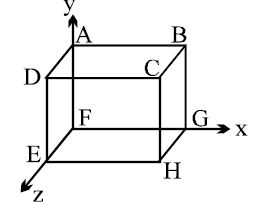
$A$ cuboid $ABCDEFGH$ is anisotropic with $\alpha_x = 1 \times 10^{-5} /^{\circ}C$,$\alpha_y = 2 \times 10^{-5} /^{\circ}C$,$\alpha_z = 3 \times 10^{-5} /^{\circ}C$. The coefficient of superficial expansion of the faces can be:
A
$\beta_{ABCD} = 5 \times 10^{-5} /^{\circ}C$
B
$\beta_{BCGH} = 4 \times 10^{-5} /^{\circ}C$
C
$\beta_{CDEH} = 3 \times 10^{-5} /^{\circ}C$
D
$\beta_{EFGH} = 2 \times 10^{-5} /^{\circ}C$
Solution
(C) For an anisotropic material,the coefficient of superficial expansion $\beta$ for a face is the sum of the linear expansion coefficients along the two axes defining that face.
Given: $\alpha_x = 1 \times 10^{-5} /^{\circ}C$,$\alpha_y = 2 \times 10^{-5} /^{\circ}C$,$\alpha_z = 3 \times 10^{-5} /^{\circ}C$.
From the figure,face $CDEH$ lies in the $xy$-plane (assuming $D$ is at origin or aligned with axes as per standard orientation).
Specifically,face $CDEH$ is defined by the $x$ and $y$ axes.
Therefore,$\beta_{CDEH} = \alpha_x + \alpha_y = (1 + 2) \times 10^{-5} /^{\circ}C = 3 \times 10^{-5} /^{\circ}C$.
Thus,option $C$ is correct.
Given: $\alpha_x = 1 \times 10^{-5} /^{\circ}C$,$\alpha_y = 2 \times 10^{-5} /^{\circ}C$,$\alpha_z = 3 \times 10^{-5} /^{\circ}C$.
From the figure,face $CDEH$ lies in the $xy$-plane (assuming $D$ is at origin or aligned with axes as per standard orientation).
Specifically,face $CDEH$ is defined by the $x$ and $y$ axes.
Therefore,$\beta_{CDEH} = \alpha_x + \alpha_y = (1 + 2) \times 10^{-5} /^{\circ}C = 3 \times 10^{-5} /^{\circ}C$.
Thus,option $C$ is correct.
0 likes
View Solution69
AdvancedMCQ
$A$ thin copper wire of length $L$ increases in length by $1\%$ when heated from temperature $T_1$ to $T_2$. What is the percentage change in area when a thin copper plate having dimensions $2L \times L$ is heated from $T_1$ to $T_2$?
A
$1$
B
$2$
C
$3$
D
$4$
Solution
(B) Let the coefficient of linear expansion be $\alpha$. The fractional change in length is given by $\frac{\Delta L}{L} = \alpha \Delta T = 1\% = 0.01$.
The area of the copper plate is $A = 2L \times L = 2L^2$.
The coefficient of area expansion is $\beta = 2\alpha$.
The fractional change in area is given by $\frac{\Delta A}{A} = \beta \Delta T = 2\alpha \Delta T$.
Substituting the value of $\alpha \Delta T = 0.01$:
$\frac{\Delta A}{A} = 2 \times (0.01) = 0.02$.
To find the percentage change in area:
$\frac{\Delta A}{A} \times 100 = 0.02 \times 100 = 2\%$.
The area of the copper plate is $A = 2L \times L = 2L^2$.
The coefficient of area expansion is $\beta = 2\alpha$.
The fractional change in area is given by $\frac{\Delta A}{A} = \beta \Delta T = 2\alpha \Delta T$.
Substituting the value of $\alpha \Delta T = 0.01$:
$\frac{\Delta A}{A} = 2 \times (0.01) = 0.02$.
To find the percentage change in area:
$\frac{\Delta A}{A} \times 100 = 0.02 \times 100 = 2\%$.
0 likes
View Solution70
AdvancedMCQ
If two rods of length $L$ and $2L$ having coefficients of linear expansion $\alpha$ and $2\alpha$ respectively are connected so that the total length becomes $3L$,the average coefficient of linear expansion of the composite rod equals:
A
$\frac{3}{2}\alpha$
B
$\frac{5}{2}\alpha$
C
$\frac{5}{3}\alpha$
D
None of these
Solution
(C) The initial length of the combination is $L + 2L = 3L$.
The change in length of the first rod is $\Delta L_1 = L \alpha \Delta t$.
The change in length of the second rod is $\Delta L_2 = (2L)(2\alpha) \Delta t = 4L \alpha \Delta t$.
The total change in length of the composite rod is $\Delta L_{total} = \Delta L_1 + \Delta L_2 = L \alpha \Delta t + 4L \alpha \Delta t = 5L \alpha \Delta t$.
The average coefficient of linear expansion $\alpha_{avg}$ is defined by the relation $\Delta L_{total} = L_{total} \alpha_{avg} \Delta t$.
Substituting the values,we get $5L \alpha \Delta t = (3L) \alpha_{avg} \Delta t$.
Solving for $\alpha_{avg}$,we get $\alpha_{avg} = \frac{5L \alpha \Delta t}{3L \Delta t} = \frac{5}{3}\alpha$.
The change in length of the first rod is $\Delta L_1 = L \alpha \Delta t$.
The change in length of the second rod is $\Delta L_2 = (2L)(2\alpha) \Delta t = 4L \alpha \Delta t$.
The total change in length of the composite rod is $\Delta L_{total} = \Delta L_1 + \Delta L_2 = L \alpha \Delta t + 4L \alpha \Delta t = 5L \alpha \Delta t$.
The average coefficient of linear expansion $\alpha_{avg}$ is defined by the relation $\Delta L_{total} = L_{total} \alpha_{avg} \Delta t$.
Substituting the values,we get $5L \alpha \Delta t = (3L) \alpha_{avg} \Delta t$.
Solving for $\alpha_{avg}$,we get $\alpha_{avg} = \frac{5L \alpha \Delta t}{3L \Delta t} = \frac{5}{3}\alpha$.
0 likes
View Solution71
MediumMCQ
$A$ glass flask contains some mercury at room temperature. It is found that at different temperatures the volume of air inside the flask remains the same. If the volume of mercury in the flask is $300 \, cm^3$,then the volume of the flask is ........ $cm^3$. (Given that the coefficient of volume expansion of mercury is $\gamma_{Hg} = 1.8 \times 10^{-4} (^{\circ}C)^{-1}$ and the coefficient of linear expansion of glass is $\alpha_{glass} = 9 \times 10^{-6} (^{\circ}C)^{-1}$)
A
$4500$
B
$450$
C
$2000$
D
$6000$
Solution
(C) Let $V_m$ be the volume of mercury and $V_f$ be the volume of the glass flask.
Since the volume of air inside the flask remains constant at different temperatures,the change in the volume of mercury must be equal to the change in the volume of the flask.
$\Delta V_m = \Delta V_f$
$\gamma_m V_m \Delta T = \gamma_f V_f \Delta T$
$\gamma_m V_m = \gamma_f V_f$
We know that the coefficient of volume expansion of the flask $\gamma_f = 3 \alpha_{glass}$.
Given $\gamma_m = 1.8 \times 10^{-4} (^{\circ}C)^{-1}$,$\alpha_{glass} = 9 \times 10^{-6} (^{\circ}C)^{-1}$,and $V_m = 300 \, cm^3$.
Substituting the values:
$1.8 \times 10^{-4} \times 300 = 3 \times (9 \times 10^{-6}) \times V_f$
$5.4 \times 10^{-2} = 2.7 \times 10^{-5} \times V_f$
$V_f = \frac{5.4 \times 10^{-2}}{2.7 \times 10^{-5}} = 2 \times 10^3 = 2000 \, cm^3$.
Since the volume of air inside the flask remains constant at different temperatures,the change in the volume of mercury must be equal to the change in the volume of the flask.
$\Delta V_m = \Delta V_f$
$\gamma_m V_m \Delta T = \gamma_f V_f \Delta T$
$\gamma_m V_m = \gamma_f V_f$
We know that the coefficient of volume expansion of the flask $\gamma_f = 3 \alpha_{glass}$.
Given $\gamma_m = 1.8 \times 10^{-4} (^{\circ}C)^{-1}$,$\alpha_{glass} = 9 \times 10^{-6} (^{\circ}C)^{-1}$,and $V_m = 300 \, cm^3$.
Substituting the values:
$1.8 \times 10^{-4} \times 300 = 3 \times (9 \times 10^{-6}) \times V_f$
$5.4 \times 10^{-2} = 2.7 \times 10^{-5} \times V_f$
$V_f = \frac{5.4 \times 10^{-2}}{2.7 \times 10^{-5}} = 2 \times 10^3 = 2000 \, cm^3$.
0 likes
View Solution72
DifficultMCQ
$A$ pendulum clock loses $12\;s$ a day if the temperature is $40^{\circ}C$ and gains $4\;s$ a day if the temperature is $20^{\circ}C$. The temperature at which the clock will show correct time,and the coefficient of linear expansion $(\alpha)$ of the metal of the pendulum shaft are respectively:
A
$30^{\circ}C, \alpha = 1.85 \times 10^{-3}/^{\circ}C$
B
$55^{\circ}C, \alpha = 1.85 \times 10^{-2}/^{\circ}C$
C
$25^{\circ}C, \alpha = 1.85 \times 10^{-5}/^{\circ}C$
D
$60^{\circ}C, \alpha = 1.85 \times 10^{-4}/^{\circ}C$
Solution
(C) The time period of a pendulum is given by $T = 2\pi \sqrt{\frac{\ell}{g}}$. The fractional change in time period is $\frac{\Delta T}{T} = \frac{1}{2} \alpha \Delta \theta$.
For a day,$T = 24 \times 3600 \; s$.
When the clock loses $12\;s$ at $40^{\circ}C$ (where $\theta$ is the correct temperature): $\frac{12}{T} = \frac{1}{2} \alpha (40 - \theta) \quad ...(1)$
When the clock gains $4\;s$ at $20^{\circ}C$: $\frac{4}{T} = \frac{1}{2} \alpha (\theta - 20) \quad ...(2)$
Dividing equation $(1)$ by $(2)$: $\frac{12}{4} = \frac{40 - \theta}{\theta - 20} \implies 3(\theta - 20) = 40 - \theta \implies 3\theta - 60 = 40 - \theta \implies 4\theta = 100 \implies \theta = 25^{\circ}C$.
Substituting $\theta = 25^{\circ}C$ in equation $(2)$: $\frac{4}{24 \times 3600} = \frac{1}{2} \alpha (25 - 20) \implies \frac{4}{86400} = \frac{1}{2} \alpha (5) \implies \alpha = \frac{8}{86400 \times 5} = \frac{8}{432000} \approx 1.85 \times 10^{-5}/^{\circ}C$.
For a day,$T = 24 \times 3600 \; s$.
When the clock loses $12\;s$ at $40^{\circ}C$ (where $\theta$ is the correct temperature): $\frac{12}{T} = \frac{1}{2} \alpha (40 - \theta) \quad ...(1)$
When the clock gains $4\;s$ at $20^{\circ}C$: $\frac{4}{T} = \frac{1}{2} \alpha (\theta - 20) \quad ...(2)$
Dividing equation $(1)$ by $(2)$: $\frac{12}{4} = \frac{40 - \theta}{\theta - 20} \implies 3(\theta - 20) = 40 - \theta \implies 3\theta - 60 = 40 - \theta \implies 4\theta = 100 \implies \theta = 25^{\circ}C$.
Substituting $\theta = 25^{\circ}C$ in equation $(2)$: $\frac{4}{24 \times 3600} = \frac{1}{2} \alpha (25 - 20) \implies \frac{4}{86400} = \frac{1}{2} \alpha (5) \implies \alpha = \frac{8}{86400 \times 5} = \frac{8}{432000} \approx 1.85 \times 10^{-5}/^{\circ}C$.
0 likes
View Solution73
MediumMCQ
$A$ surveyor's $30$-$m$ steel tape is correct at some temperature. On a hot day,the tape has expanded to $30.01$ $m$. On that day,the tape indicates a distance of $15.52$ $m$ between two points. The true distance between these points is: (in $m$)
A
$15.515$
B
$15.520$
C
$15.525$
D
$15.500$
Solution
(C) Let the nominal length of the tape be $L_0 = 30$ $m$ and the expanded length be $L = 30.01$ $m$.
The ratio of the true length to the measured length is equal to the ratio of the actual length of the tape to its nominal length.
Let $d_{true}$ be the true distance and $d_{measured} = 15.52$ $m$ be the measured distance.
Using the principle of proportionality: $\frac{d_{true}}{d_{measured}} = \frac{L}{L_0}$.
$d_{true} = d_{measured} \times \frac{L}{L_0} = 15.52 \times \frac{30.01}{30}$.
$d_{true} = 15.52 \times (1 + \frac{0.01}{30}) = 15.52 + 15.52 \times 0.000333...$
$d_{true} = 15.52 + 0.00517... \approx 15.525$ $m$.
The ratio of the true length to the measured length is equal to the ratio of the actual length of the tape to its nominal length.
Let $d_{true}$ be the true distance and $d_{measured} = 15.52$ $m$ be the measured distance.
Using the principle of proportionality: $\frac{d_{true}}{d_{measured}} = \frac{L}{L_0}$.
$d_{true} = d_{measured} \times \frac{L}{L_0} = 15.52 \times \frac{30.01}{30}$.
$d_{true} = 15.52 \times (1 + \frac{0.01}{30}) = 15.52 + 15.52 \times 0.000333...$
$d_{true} = 15.52 + 0.00517... \approx 15.525$ $m$.
0 likes
View Solution74
DifficultMCQ
What must be the lengths of steel and copper rods at $0^o C$ for the difference in their lengths to be $10\,cm$ at any common temperature? $(\alpha_{steel}=1.2 \times 10^{-5} \;^o C^{-1})$ and $(\alpha_{copper} = 1.8 \times 10^{-5} \;^o C^{-1})$
A
$30\, cm$ for steel and $20\,cm$ for copper
B
$20\,cm$ for steel and $30\,cm$ for copper
C
$40\,cm$ for steel and $30\,cm$ for copper
D
$30\,cm$ for steel and $40\,cm$ for copper
Solution
(A) Let $L_S$ and $L_C$ be the lengths of steel and copper rods at $0^o C$.
At any temperature $T$,the lengths are $L_S(1 + \alpha_S T)$ and $L_C(1 + \alpha_C T)$.
The difference in lengths is given as $10\,cm$ at any temperature $T$,so:
$L_S(1 + \alpha_S T) - L_C(1 + \alpha_C T) = 10$
$(L_S - L_C) + (L_S \alpha_S - L_C \alpha_C)T = 10$
For this to be independent of $T$,the coefficient of $T$ must be zero:
$L_S \alpha_S - L_C \alpha_C = 0 \Rightarrow L_S \alpha_S = L_C \alpha_C$
$L_S (1.2 \times 10^{-5}) = L_C (1.8 \times 10^{-5})$
$L_S / L_C = 1.8 / 1.2 = 3 / 2$
Also,from the first equation,$L_S - L_C = 10$.
Substituting $L_S = 1.5 L_C$ into $L_S - L_C = 10$:
$1.5 L_C - L_C = 10 \Rightarrow 0.5 L_C = 10 \Rightarrow L_C = 20\,cm$.
Then $L_S = 1.5 \times 20 = 30\,cm$.
At any temperature $T$,the lengths are $L_S(1 + \alpha_S T)$ and $L_C(1 + \alpha_C T)$.
The difference in lengths is given as $10\,cm$ at any temperature $T$,so:
$L_S(1 + \alpha_S T) - L_C(1 + \alpha_C T) = 10$
$(L_S - L_C) + (L_S \alpha_S - L_C \alpha_C)T = 10$
For this to be independent of $T$,the coefficient of $T$ must be zero:
$L_S \alpha_S - L_C \alpha_C = 0 \Rightarrow L_S \alpha_S = L_C \alpha_C$
$L_S (1.2 \times 10^{-5}) = L_C (1.8 \times 10^{-5})$
$L_S / L_C = 1.8 / 1.2 = 3 / 2$
Also,from the first equation,$L_S - L_C = 10$.
Substituting $L_S = 1.5 L_C$ into $L_S - L_C = 10$:
$1.5 L_C - L_C = 10 \Rightarrow 0.5 L_C = 10 \Rightarrow L_C = 20\,cm$.
Then $L_S = 1.5 \times 20 = 30\,cm$.
0 likes
View Solution75
MediumMCQ
$A$ composite rod made up of two rods $AB$ and $BC$ are joined at $B$. The rods are of equal length at room temperature and have equal masses. The coefficient of linear expansion $\alpha$ of $AB$ is more than that of $BC$. The composite rod is suspended horizontally by means of a thread at $B$. When the rod is heated:
A
It remains horizontal
B
It tilts down on the side of $AB$
C
It tilts down on the side of $BC$
D
Its centre of mass does not move
Solution
(B) Let the length of each rod be $L$ and mass be $M$. The rods are joined at $B$. The center of mass of rod $AB$ is at a distance $L/2$ from $B$,and the center of mass of rod $BC$ is at a distance $L/2$ from $B$.
When the rod is heated,the length of each rod increases according to the formula $\Delta L = L \alpha \Delta T$.
Since $\alpha_{AB} > \alpha_{BC}$,the rod $AB$ expands more than the rod $BC$.
Let the new lengths be $L_{AB}' = L(1 + \alpha_{AB} \Delta T)$ and $L_{BC}' = L(1 + \alpha_{BC} \Delta T)$.
The new center of mass of rod $AB$ is at $L_{AB}'/2$ from $B$,and the new center of mass of rod $BC$ is at $L_{BC}'/2$ from $B$.
Since $L_{AB}' > L_{BC}'$,the center of mass of rod $AB$ shifts further away from $B$ compared to the center of mass of rod $BC$.
Because the rod is suspended at $B$,the torque due to the weight of rod $AB$ is $\tau_{AB} = M g (L_{AB}'/2)$ and the torque due to the weight of rod $BC$ is $\tau_{BC} = M g (L_{BC}'/2)$.
Since $L_{AB}' > L_{BC}'$,the torque on the side of $AB$ is greater than the torque on the side of $BC$.
Therefore,the rod tilts down on the side of $AB$.
When the rod is heated,the length of each rod increases according to the formula $\Delta L = L \alpha \Delta T$.
Since $\alpha_{AB} > \alpha_{BC}$,the rod $AB$ expands more than the rod $BC$.
Let the new lengths be $L_{AB}' = L(1 + \alpha_{AB} \Delta T)$ and $L_{BC}' = L(1 + \alpha_{BC} \Delta T)$.
The new center of mass of rod $AB$ is at $L_{AB}'/2$ from $B$,and the new center of mass of rod $BC$ is at $L_{BC}'/2$ from $B$.
Since $L_{AB}' > L_{BC}'$,the center of mass of rod $AB$ shifts further away from $B$ compared to the center of mass of rod $BC$.
Because the rod is suspended at $B$,the torque due to the weight of rod $AB$ is $\tau_{AB} = M g (L_{AB}'/2)$ and the torque due to the weight of rod $BC$ is $\tau_{BC} = M g (L_{BC}'/2)$.
Since $L_{AB}' > L_{BC}'$,the torque on the side of $AB$ is greater than the torque on the side of $BC$.
Therefore,the rod tilts down on the side of $AB$.
0 likes
View Solution76
DifficultMCQ
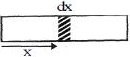
$A$ rod of length $10 \, m$ at $0 \, ^oC$ has a linear expansion coefficient $\alpha = (2x^2 + 1) \times 10^{-6} \, ^oC^{-1}$,where $x$ is the distance from one end of the rod. The length of the rod at $10 \, ^oC$ is: (in $, m$)
A
$11.067$
B
$10.067$
C
$10.0068$
D
$11.0068$
Solution
(C) The change in length of a small element $dx$ is given by $d(\Delta L) = \alpha \cdot dx \cdot \Delta T$.
Here,$\Delta T = 10 \, ^oC - 0 \, ^oC = 10 \, ^oC$.
The total change in length $\Delta L$ is the integral of $d(\Delta L)$ from $x = 0$ to $x = 10 \, m$:
$\Delta L = \int_{0}^{10} (2x^2 + 1) \times 10^{-6} \times 10 \, dx$
$\Delta L = 10^{-5} \int_{0}^{10} (2x^2 + 1) \, dx$
$\Delta L = 10^{-5} \left[ \frac{2x^3}{3} + x \right]_{0}^{10}$
$\Delta L = 10^{-5} \left( \frac{2(1000)}{3} + 10 \right) = 10^{-5} \left( \frac{2000}{3} + 10 \right) = 10^{-5} \left( 666.67 + 10 \right) = 10^{-5} \times 676.67 = 0.0067667 \, m$.
The final length $L' = L + \Delta L = 10 + 0.0067667 = 10.0067667 \, m \approx 10.0068 \, m$.
Here,$\Delta T = 10 \, ^oC - 0 \, ^oC = 10 \, ^oC$.
The total change in length $\Delta L$ is the integral of $d(\Delta L)$ from $x = 0$ to $x = 10 \, m$:
$\Delta L = \int_{0}^{10} (2x^2 + 1) \times 10^{-6} \times 10 \, dx$
$\Delta L = 10^{-5} \int_{0}^{10} (2x^2 + 1) \, dx$
$\Delta L = 10^{-5} \left[ \frac{2x^3}{3} + x \right]_{0}^{10}$
$\Delta L = 10^{-5} \left( \frac{2(1000)}{3} + 10 \right) = 10^{-5} \left( \frac{2000}{3} + 10 \right) = 10^{-5} \left( 666.67 + 10 \right) = 10^{-5} \times 676.67 = 0.0067667 \, m$.
The final length $L' = L + \Delta L = 10 + 0.0067667 = 10.0067667 \, m \approx 10.0068 \, m$.
0 likes
View Solution77
EasyMCQ
The coefficient of linear expansion depends on
A
The original length of the rod
B
The specific heat of the material of rod
C
The change in temperature of the rod
D
The nature of the metal
Solution
(D) The coefficient of linear expansion,denoted by $\alpha$,is defined by the relation $\Delta L = L_0 \alpha \Delta T$,where $\Delta L$ is the change in length,$L_0$ is the original length,and $\Delta T$ is the change in temperature.
Rearranging this,we get $\alpha = \frac{\Delta L}{L_0 \Delta T}$.
Although the formula involves $L_0$ and $\Delta T$,the coefficient $\alpha$ is a characteristic property of the material itself.
It represents how much a unit length of a specific material expands per unit degree rise in temperature.
Therefore,$\alpha$ depends only on the nature of the material (the metal) and is independent of the dimensions of the rod or the magnitude of the temperature change.
Rearranging this,we get $\alpha = \frac{\Delta L}{L_0 \Delta T}$.
Although the formula involves $L_0$ and $\Delta T$,the coefficient $\alpha$ is a characteristic property of the material itself.
It represents how much a unit length of a specific material expands per unit degree rise in temperature.
Therefore,$\alpha$ depends only on the nature of the material (the metal) and is independent of the dimensions of the rod or the magnitude of the temperature change.
0 likes
View Solution78
MediumMCQ
If a bimetallic strip is heated,it will:
A
Bend towards the metal with lower thermal expansion coefficient.
B
Bend towards the metal with higher thermal expansion coefficient.
C
Not bend at all.
D
Twist itself into a helix.
Solution
(A) When a material is heated,it expands in length by an amount proportional to $\alpha \Delta T$,where $\alpha$ is the coefficient of linear thermal expansion and $\Delta T$ is the change in temperature.
The metal with the higher coefficient of linear thermal expansion $(\alpha)$ will expand more than the metal with the lower coefficient for the same temperature change.
Because the two metals are bonded together,the one that expands more will form the outer arc of the curve,while the one that expands less will form the inner arc.
Therefore,the bimetallic strip will bend towards the metal with the lower thermal expansion coefficient.
The metal with the higher coefficient of linear thermal expansion $(\alpha)$ will expand more than the metal with the lower coefficient for the same temperature change.
Because the two metals are bonded together,the one that expands more will form the outer arc of the curve,while the one that expands less will form the inner arc.
Therefore,the bimetallic strip will bend towards the metal with the lower thermal expansion coefficient.
0 likes
View Solution79
EasyMCQ
The scale on a steel metre stick is calibrated at $20^{\circ}C$. The error in the reading of $50 \, cm$ at $30^{\circ}C$ is: (take linear expansion coefficient of steel $\alpha = 1.0 \times 10^{-5} / ^{\circ}C$)
A
$10^{-3} \, cm$
B
$2 \times 10^{-3} \, cm$
C
$5 \times 10^{-3} \, cm$
D
$10^{-2} \, cm$
Solution
(C) The formula for linear expansion is given by $\Delta L = L_0 \alpha \Delta T$.
Here,$L_0 = 50 \, cm$ is the initial length at the calibration temperature.
$\alpha = 1.0 \times 10^{-5} / ^{\circ}C$ is the coefficient of linear expansion for steel.
$\Delta T = T_f - T_i = 30^{\circ}C - 20^{\circ}C = 10^{\circ}C$ is the change in temperature.
Substituting these values into the formula:
$\Delta L = (50 \, cm) \times (1.0 \times 10^{-5} / ^{\circ}C) \times (10^{\circ}C)$
$\Delta L = 500 \times 10^{-5} \, cm$
$\Delta L = 5 \times 10^{-3} \, cm$.
Therefore,the error in the reading is $5 \times 10^{-3} \, cm$.
Here,$L_0 = 50 \, cm$ is the initial length at the calibration temperature.
$\alpha = 1.0 \times 10^{-5} / ^{\circ}C$ is the coefficient of linear expansion for steel.
$\Delta T = T_f - T_i = 30^{\circ}C - 20^{\circ}C = 10^{\circ}C$ is the change in temperature.
Substituting these values into the formula:
$\Delta L = (50 \, cm) \times (1.0 \times 10^{-5} / ^{\circ}C) \times (10^{\circ}C)$
$\Delta L = 500 \times 10^{-5} \, cm$
$\Delta L = 5 \times 10^{-3} \, cm$.
Therefore,the error in the reading is $5 \times 10^{-3} \, cm$.
0 likes
View Solution80
DifficultMCQ
If the volume of a block of metal changes by $0.12\%$ when it is heated through $20^{\circ}C$,the coefficient of linear expansion (in per $^{\circ}C^{-1}$) of the metal is :-
A
$10^{-5}$
B
$2 \times 10^{-5}$
C
$3 \times 10^{-5}$
D
$5 \times 10^{-5}$
Solution
(B) The coefficient of volume expansion $\gamma$ is defined by the relation $\frac{\Delta V}{V} = \gamma \Delta T$.
Given $\frac{\Delta V}{V} = 0.12\% = 0.0012$ and $\Delta T = 20^{\circ}C$.
Substituting the values,we get $\gamma = \frac{\Delta V}{V \Delta T} = \frac{0.0012}{20} = 6 \times 10^{-5} /^{\circ}C$.
The relationship between the coefficient of linear expansion $\alpha$ and the coefficient of volume expansion $\gamma$ is $\alpha = \frac{\gamma}{3}$.
Therefore,$\alpha = \frac{6 \times 10^{-5}}{3} = 2 \times 10^{-5} /^{\circ}C$.
Given $\frac{\Delta V}{V} = 0.12\% = 0.0012$ and $\Delta T = 20^{\circ}C$.
Substituting the values,we get $\gamma = \frac{\Delta V}{V \Delta T} = \frac{0.0012}{20} = 6 \times 10^{-5} /^{\circ}C$.
The relationship between the coefficient of linear expansion $\alpha$ and the coefficient of volume expansion $\gamma$ is $\alpha = \frac{\gamma}{3}$.
Therefore,$\alpha = \frac{6 \times 10^{-5}}{3} = 2 \times 10^{-5} /^{\circ}C$.
0 likes
View Solution81
DifficultMCQ
Two rods,one made of aluminium and the other made of steel,having initial lengths $l_1$ and $l_2$ respectively,are connected together to form a single rod of length $(l_1 + l_2)$. The coefficients of linear expansion for aluminium and steel are $\alpha_1$ and $\alpha_2$ respectively. If the length of each rod increases by the same amount when their temperature is raised by $t^oC$,then the ratio $l_1/(l_1 + l_2)$ is:
A
$\frac{\alpha_1}{\alpha_2}$
B
$\frac{\alpha_2}{\alpha_1}$
C
$\frac{\alpha_2}{(\alpha_1 + \alpha_2)}$
D
$\frac{\alpha_1}{(\alpha_1 + \alpha_2)}$
Solution
(C) The change in length $\Delta L$ for a rod of initial length $L_0$ due to a temperature change $\Delta T$ is given by $\Delta L = L_0 \alpha \Delta T$.
Given that the increase in length for both rods is the same,we have:
$\Delta L_1 = \Delta L_2$
$l_1 \alpha_1 t = l_2 \alpha_2 t$
Dividing both sides by $t$ (assuming $t \neq 0$):
$l_1 \alpha_1 = l_2 \alpha_2$
From this,we can express $l_2$ in terms of $l_1$:
$l_2 = l_1 \frac{\alpha_1}{\alpha_2}$
We want to find the ratio $\frac{l_1}{l_1 + l_2}$. Substituting $l_2$ into the expression:
$\frac{l_1}{l_1 + l_1 \frac{\alpha_1}{\alpha_2}} = \frac{l_1}{l_1 (1 + \frac{\alpha_1}{\alpha_2})} = \frac{1}{\frac{\alpha_2 + \alpha_1}{\alpha_2}} = \frac{\alpha_2}{\alpha_1 + \alpha_2}$
Given that the increase in length for both rods is the same,we have:
$\Delta L_1 = \Delta L_2$
$l_1 \alpha_1 t = l_2 \alpha_2 t$
Dividing both sides by $t$ (assuming $t \neq 0$):
$l_1 \alpha_1 = l_2 \alpha_2$
From this,we can express $l_2$ in terms of $l_1$:
$l_2 = l_1 \frac{\alpha_1}{\alpha_2}$
We want to find the ratio $\frac{l_1}{l_1 + l_2}$. Substituting $l_2$ into the expression:
$\frac{l_1}{l_1 + l_1 \frac{\alpha_1}{\alpha_2}} = \frac{l_1}{l_1 (1 + \frac{\alpha_1}{\alpha_2})} = \frac{1}{\frac{\alpha_2 + \alpha_1}{\alpha_2}} = \frac{\alpha_2}{\alpha_1 + \alpha_2}$
0 likes
View Solution82
DifficultMCQ
If the volume of a block of metal changes by $0.12\%$ when it is heated through $20\,^{\circ}C$,the coefficient of linear expansion (in $^{\circ}C^{-1}$) of the metal is
A
$10^{-5}$
B
$2 \times 10^{-5}$
C
$3 \times 10^{-5}$
D
$5 \times 10^{-5}$
Solution
(B) The coefficient of volume expansion $\gamma$ is defined as $\gamma = \frac{1}{V} \frac{\Delta V}{\Delta T}$.
Given,the fractional change in volume $\frac{\Delta V}{V} = 0.12\% = \frac{0.12}{100} = 1.2 \times 10^{-3}$.
The change in temperature $\Delta T = 20\,^{\circ}C$.
Substituting these values,$\gamma = \frac{1.2 \times 10^{-3}}{20} = 0.06 \times 10^{-3} = 6 \times 10^{-5}\,^{\circ}C^{-1}$.
The relationship between the coefficient of linear expansion $\alpha$ and the coefficient of volume expansion $\gamma$ is $\gamma = 3\alpha$.
Therefore,$\alpha = \frac{\gamma}{3} = \frac{6 \times 10^{-5}}{3} = 2 \times 10^{-5}\,^{\circ}C^{-1}$.
Given,the fractional change in volume $\frac{\Delta V}{V} = 0.12\% = \frac{0.12}{100} = 1.2 \times 10^{-3}$.
The change in temperature $\Delta T = 20\,^{\circ}C$.
Substituting these values,$\gamma = \frac{1.2 \times 10^{-3}}{20} = 0.06 \times 10^{-3} = 6 \times 10^{-5}\,^{\circ}C^{-1}$.
The relationship between the coefficient of linear expansion $\alpha$ and the coefficient of volume expansion $\gamma$ is $\gamma = 3\alpha$.
Therefore,$\alpha = \frac{\gamma}{3} = \frac{6 \times 10^{-5}}{3} = 2 \times 10^{-5}\,^{\circ}C^{-1}$.
0 likes
View Solution83
DifficultMCQ
$A$ pendulum clock keeps correct time at $0\,^{\circ}C$. The thermal coefficient of linear expansion of the material of the pendulum is $\alpha$. If the temperature rises to $t\,^{\circ}C$,then the clock loses per day by (in seconds):
A
$\alpha t$
B
$\frac{1}{2}\alpha t$
C
$\alpha t \times 86400$
D
$\frac{1}{2}\alpha t \times 86400$
Solution
(D) The time period of a simple pendulum is given by $T = 2\pi \sqrt{\frac{L}{g}}$.
Taking the derivative,the fractional change in time period is $\frac{\Delta T}{T} = \frac{1}{2} \frac{\Delta L}{L}$.
Since $\Delta L = L \alpha \Delta t$,we have $\frac{\Delta L}{L} = \alpha \Delta t$.
Therefore,the fractional change in time is $\frac{\Delta T}{T} = \frac{1}{2} \alpha t$.
This represents the time lost per unit time.
To find the time lost per day,we multiply by the total number of seconds in a day,which is $24 \times 60 \times 60 = 86400 \, s$.
Thus,the time loss per day is $\Delta T_{day} = \frac{1}{2} \alpha t \times 86400$ seconds.
Taking the derivative,the fractional change in time period is $\frac{\Delta T}{T} = \frac{1}{2} \frac{\Delta L}{L}$.
Since $\Delta L = L \alpha \Delta t$,we have $\frac{\Delta L}{L} = \alpha \Delta t$.
Therefore,the fractional change in time is $\frac{\Delta T}{T} = \frac{1}{2} \alpha t$.
This represents the time lost per unit time.
To find the time lost per day,we multiply by the total number of seconds in a day,which is $24 \times 60 \times 60 = 86400 \, s$.
Thus,the time loss per day is $\Delta T_{day} = \frac{1}{2} \alpha t \times 86400$ seconds.
0 likes
View Solution84
EasyMCQ
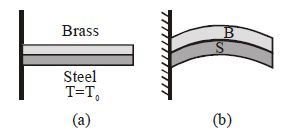
In the figure, which strip, brass or steel, has a higher coefficient of linear expansion?
A
brass strip
B
steel strip
C
both strips have the same coefficient of linear expansion
D
cannot be decided from the given data
Solution
(A) When a bimetallic strip is heated, it bends such that the metal with the higher coefficient of linear expansion $(\alpha)$ forms the outer (convex) side of the curve.
In the given figure, the brass strip $(B)$ is on the outer side of the curve, while the steel strip $(S)$ is on the inner (concave) side.
Therefore, the brass strip has a higher coefficient of linear expansion than the steel strip.
In the given figure, the brass strip $(B)$ is on the outer side of the curve, while the steel strip $(S)$ is on the inner (concave) side.
Therefore, the brass strip has a higher coefficient of linear expansion than the steel strip.
0 likes
View Solution85
MediumMCQ
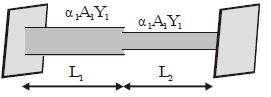
Two rods are joined between fixed supports as shown in the figure. The condition for no change in the total length of the system with an increase in temperature is given by:
($\alpha_1, \alpha_2$ = linear expansion coefficients,$A_1, A_2$ = cross-sectional areas of rods,$Y_1, Y_2$ = Young's moduli)
($\alpha_1, \alpha_2$ = linear expansion coefficients,$A_1, A_2$ = cross-sectional areas of rods,$Y_1, Y_2$ = Young's moduli)
A
$\frac{A_1}{A_2} = \frac{\alpha_1 Y_1}{\alpha_2 Y_2}$
B
$\frac{A_1}{A_2} = \frac{L_1 \alpha_1 Y_1}{L_2 \alpha_2 Y_2}$
C
$\frac{A_1}{A_2} = \frac{L_2 \alpha_2 Y_2}{L_1 \alpha_1 Y_1}$
D
$\frac{A_1}{A_2} = \frac{\alpha_2 Y_2}{\alpha_1 Y_1}$
Solution
(D) When the temperature increases by $\Delta T$,the rods tend to expand. Since they are fixed between rigid supports,they experience a compressive force $F$. For the total length to remain unchanged,the sum of the thermal expansion and the compression due to the force must be zero for each rod,or more simply,the force $F$ generated in both rods must be equal.
The thermal expansion is $\Delta L_{thermal} = L \alpha \Delta T$.
The compression due to force $F$ is $\Delta L_{comp} = \frac{F L}{A Y}$.
For the total length to remain constant,the net change in length must be zero: $\Delta L_{thermal} - \Delta L_{comp} = 0$,which implies $F = A Y \alpha \Delta T$.
Since the rods are in series,the force $F$ is the same in both rods:
$F_1 = F_2$
$A_1 Y_1 \alpha_1 \Delta T = A_2 Y_2 \alpha_2 \Delta T$
$\frac{A_1}{A_2} = \frac{\alpha_2 Y_2}{\alpha_1 Y_1}$
The thermal expansion is $\Delta L_{thermal} = L \alpha \Delta T$.
The compression due to force $F$ is $\Delta L_{comp} = \frac{F L}{A Y}$.
For the total length to remain constant,the net change in length must be zero: $\Delta L_{thermal} - \Delta L_{comp} = 0$,which implies $F = A Y \alpha \Delta T$.
Since the rods are in series,the force $F$ is the same in both rods:
$F_1 = F_2$
$A_1 Y_1 \alpha_1 \Delta T = A_2 Y_2 \alpha_2 \Delta T$
$\frac{A_1}{A_2} = \frac{\alpha_2 Y_2}{\alpha_1 Y_1}$
0 likes
View Solution86
MediumMCQ
The gap between any two rails, each of length $l$ laid on a railway track, is equal to $x$ at $27\,^{\circ}C$. When the temperature rises to $40\,^{\circ}C$, the gap closes up. If the coefficient of linear expansion of the material of the rail is $\alpha$, the length $l$ of a rail at $27\,^{\circ}C$ is:
A
$\frac{x}{26\alpha}$
B
$\frac{x}{13\alpha}$
C
$\frac{2x}{13\alpha}$
D
$\frac{2x}{14\alpha}$
Solution
(B) The change in temperature is $\Delta T = 40\,^{\circ}C - 27\,^{\circ}C = 13\,^{\circ}C$.
The thermal expansion of a rail is given by $\Delta l = l \alpha \Delta T$.
For the gap of width $x$ to close up, the expansion of the rail must equal the gap width, so $\Delta l = x$.
Substituting the values, we get $x = l \alpha (13)$.
Solving for $l$, we find $l = \frac{x}{13\alpha}$.
The thermal expansion of a rail is given by $\Delta l = l \alpha \Delta T$.
For the gap of width $x$ to close up, the expansion of the rail must equal the gap width, so $\Delta l = x$.
Substituting the values, we get $x = l \alpha (13)$.
Solving for $l$, we find $l = \frac{x}{13\alpha}$.
0 likes
View Solution87
DifficultMCQ
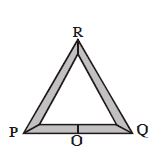
Three rods of equal length $l$ are joined to form an equilateral triangle $PQR.$ $O$ is the midpoint of $PQ.$ The distance $OR$ remains the same for a small change in temperature. The coefficient of linear expansion for $PR$ and $RQ$ is the same,i.e.,$\alpha_2,$ but that for $PQ$ is $\alpha_1.$ Then:
A
$\alpha_2 = 3\alpha_1$
B
$\alpha_2 = 4\alpha_1$
C
$\alpha_1 = 3\alpha_2$
D
$\alpha_1 = 4\alpha_2$
Solution
(D) In the equilateral triangle $PQR,$ the height $OR$ is given by the Pythagorean theorem in $\triangle OPR$ as:
$(OR)^2 = (PR)^2 - (OP)^2$
Since $OP = l/2,$ we have $(OR)^2 = l^2 - (l/2)^2 = 3l^2/4.$
When the temperature changes by $\Delta t,$ the lengths change as $l' = l(1 + \alpha \Delta t).$
Let $l_1 = l(1 + \alpha_1 \Delta t)$ be the new length of $PQ,$ so $OP' = \frac{l}{2}(1 + \alpha_1 \Delta t).$
Let $l_2 = l(1 + \alpha_2 \Delta t)$ be the new length of $PR,$ so $PR' = l(1 + \alpha_2 \Delta t).$
Since $OR$ remains constant,$(OR)^2 = (PR')^2 - (OP')^2.$
Equating the initial and final values of $(OR)^2$:
$l^2 - (l/2)^2 = [l(1 + \alpha_2 \Delta t)]^2 - [\frac{l}{2}(1 + \alpha_1 \Delta t)]^2$
$l^2 - \frac{l^2}{4} = l^2(1 + 2\alpha_2 \Delta t + \alpha_2^2 \Delta t^2) - \frac{l^2}{4}(1 + 2\alpha_1 \Delta t + \alpha_1^2 \Delta t^2)$
Neglecting higher-order terms like $\alpha^2 \Delta t^2$:
$l^2 - \frac{l^2}{4} = l^2 + 2l^2 \alpha_2 \Delta t - \frac{l^2}{4} - \frac{l^2}{2} \alpha_1 \Delta t$
$0 = 2l^2 \alpha_2 \Delta t - \frac{l^2}{2} \alpha_1 \Delta t$
$2 \alpha_2 = \frac{1}{2} \alpha_1 \implies \alpha_1 = 4 \alpha_2.$
$(OR)^2 = (PR)^2 - (OP)^2$
Since $OP = l/2,$ we have $(OR)^2 = l^2 - (l/2)^2 = 3l^2/4.$
When the temperature changes by $\Delta t,$ the lengths change as $l' = l(1 + \alpha \Delta t).$
Let $l_1 = l(1 + \alpha_1 \Delta t)$ be the new length of $PQ,$ so $OP' = \frac{l}{2}(1 + \alpha_1 \Delta t).$
Let $l_2 = l(1 + \alpha_2 \Delta t)$ be the new length of $PR,$ so $PR' = l(1 + \alpha_2 \Delta t).$
Since $OR$ remains constant,$(OR)^2 = (PR')^2 - (OP')^2.$
Equating the initial and final values of $(OR)^2$:
$l^2 - (l/2)^2 = [l(1 + \alpha_2 \Delta t)]^2 - [\frac{l}{2}(1 + \alpha_1 \Delta t)]^2$
$l^2 - \frac{l^2}{4} = l^2(1 + 2\alpha_2 \Delta t + \alpha_2^2 \Delta t^2) - \frac{l^2}{4}(1 + 2\alpha_1 \Delta t + \alpha_1^2 \Delta t^2)$
Neglecting higher-order terms like $\alpha^2 \Delta t^2$:
$l^2 - \frac{l^2}{4} = l^2 + 2l^2 \alpha_2 \Delta t - \frac{l^2}{4} - \frac{l^2}{2} \alpha_1 \Delta t$
$0 = 2l^2 \alpha_2 \Delta t - \frac{l^2}{2} \alpha_1 \Delta t$
$2 \alpha_2 = \frac{1}{2} \alpha_1 \implies \alpha_1 = 4 \alpha_2.$
0 likes
View Solution88
MediumMCQ
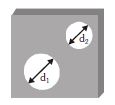
Two holes of unequal diameters $d_1$ and $d_2$ $(d_1 > d_2)$ are cut in a metal sheet. If the sheet is heated,then:
A
both $d_1$ and $d_2$ will decrease
B
both $d_1$ and $d_2$ will increase
C
$d_1$ will increase,$d_2$ will decrease
D
$d_1$ will decrease,$d_2$ will increase
Solution
(B) When a metal sheet is heated,it undergoes thermal expansion.
For an isotropic solid,the expansion is similar to a photographic enlargement,meaning every part of the object,including the holes,expands in the same proportion.
Therefore,the distance between any two points on the sheet increases,which implies that the diameters of the holes ($d_1$ and $d_2$) will also increase.
For an isotropic solid,the expansion is similar to a photographic enlargement,meaning every part of the object,including the holes,expands in the same proportion.
Therefore,the distance between any two points on the sheet increases,which implies that the diameters of the holes ($d_1$ and $d_2$) will also increase.
0 likes
View Solution89
EasyMCQ
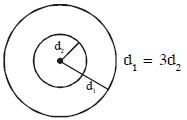
$A$ circular disc with a hole is shown in the figure. On heating,if the outer diameter $d_1$ increases by $0.3\%$,then the inner diameter $d_2$ will
A
Decrease by $0.1\%$
B
Decrease by $0.3\%$
C
Increase by $0.1\%$
D
Increase by $0.3\%$
Solution
(D) Thermal expansion of a solid object is similar to a photographic enlargement. When a solid object is heated,all its linear dimensions (lengths,diameters,radii) increase by the same percentage.
Given that the outer diameter $d_1$ increases by $0.3\%$,the change in length is given by $\Delta d_1 = \alpha d_1 \Delta T$,where $\alpha$ is the coefficient of linear expansion.
Since the inner diameter $d_2$ is also a linear dimension of the same material,it will also expand according to the same coefficient of linear expansion $\alpha$.
Therefore,the percentage change in $d_2$ will be the same as the percentage change in $d_1$.
Thus,$d_2$ will also increase by $0.3\%$.
Given that the outer diameter $d_1$ increases by $0.3\%$,the change in length is given by $\Delta d_1 = \alpha d_1 \Delta T$,where $\alpha$ is the coefficient of linear expansion.
Since the inner diameter $d_2$ is also a linear dimension of the same material,it will also expand according to the same coefficient of linear expansion $\alpha$.
Therefore,the percentage change in $d_2$ will be the same as the percentage change in $d_1$.
Thus,$d_2$ will also increase by $0.3\%$.
0 likes
View Solution90
DifficultMCQ
$A$ simple pendulum made of a bob of mass $m$ and a metallic wire of negligible mass has a time period $2 \ s$ at $T = 0 \ ^oC$. If the temperature of the wire is increased and the corresponding change in its time period is plotted against its temperature,the resulting graph is a line of slope $S$. If the coefficient of linear expansion of the metal is $\alpha$,then the value of $S$ is:
A
$\frac{\alpha}{2}$
B
$2\alpha$
C
$\alpha$
D
$\frac{1}{\alpha}$
Solution
(C) The time period of a simple pendulum is given by $T = 2\pi \sqrt{\frac{L}{g}}$.
Taking the natural logarithm on both sides: $\ln T = \ln(2\pi) + \frac{1}{2} \ln L - \frac{1}{2} \ln g$.
Differentiating with respect to temperature $\theta$: $\frac{1}{T} \frac{dT}{d\theta} = \frac{1}{2L} \frac{dL}{d\theta}$.
Since $\frac{dL}{d\theta} = L\alpha$,we have $\frac{1}{T} \frac{dT}{d\theta} = \frac{1}{2L} (L\alpha) = \frac{\alpha}{2}$.
Therefore,the slope $S = \frac{dT}{d\theta} = \frac{T\alpha}{2}$.
Given $T = 2 \ s$,we get $S = \frac{2\alpha}{2} = \alpha$.
Taking the natural logarithm on both sides: $\ln T = \ln(2\pi) + \frac{1}{2} \ln L - \frac{1}{2} \ln g$.
Differentiating with respect to temperature $\theta$: $\frac{1}{T} \frac{dT}{d\theta} = \frac{1}{2L} \frac{dL}{d\theta}$.
Since $\frac{dL}{d\theta} = L\alpha$,we have $\frac{1}{T} \frac{dT}{d\theta} = \frac{1}{2L} (L\alpha) = \frac{\alpha}{2}$.
Therefore,the slope $S = \frac{dT}{d\theta} = \frac{T\alpha}{2}$.
Given $T = 2 \ s$,we get $S = \frac{2\alpha}{2} = \alpha$.
0 likes
View Solution91
MediumMCQ
Two rods $A$ and $B$ of identical dimensions are at temperature $30\,^{\circ}C$. If $A$ is heated up to $180\,^{\circ}C$ and $B$ up to $T\,^{\circ}C$,then the new lengths are the same. If the ratio of the coefficients of linear expansion of $A$ and $B$ is $4:3$,then the value of $T$ is........$^{\circ}C$.
A
$230$
B
$270$
C
$200$
D
$250$
Solution
(A) Let the initial length of both rods be $L_0$ and the initial temperature be $T_i = 30\,^{\circ}C$.
The final length of a rod is given by $L = L_0(1 + \alpha \Delta T)$,where $\alpha$ is the coefficient of linear expansion and $\Delta T$ is the change in temperature.
Since the final lengths are equal,we have:
$L_0(1 + \alpha_A \Delta T_A) = L_0(1 + \alpha_B \Delta T_B)$
This simplifies to:
$\alpha_A \Delta T_A = \alpha_B \Delta T_B$
Given $\frac{\alpha_A}{\alpha_B} = \frac{4}{3}$,$\Delta T_A = 180 - 30 = 150\,^{\circ}C$,and $\Delta T_B = T - 30$.
Substituting the values:
$\frac{4}{3} = \frac{T - 30}{150}$
$T - 30 = \frac{4}{3} \times 150$
$T - 30 = 4 \times 50 = 200$
$T = 200 + 30 = 230\,^{\circ}C$.
The final length of a rod is given by $L = L_0(1 + \alpha \Delta T)$,where $\alpha$ is the coefficient of linear expansion and $\Delta T$ is the change in temperature.
Since the final lengths are equal,we have:
$L_0(1 + \alpha_A \Delta T_A) = L_0(1 + \alpha_B \Delta T_B)$
This simplifies to:
$\alpha_A \Delta T_A = \alpha_B \Delta T_B$
Given $\frac{\alpha_A}{\alpha_B} = \frac{4}{3}$,$\Delta T_A = 180 - 30 = 150\,^{\circ}C$,and $\Delta T_B = T - 30$.
Substituting the values:
$\frac{4}{3} = \frac{T - 30}{150}$
$T - 30 = \frac{4}{3} \times 150$
$T - 30 = 4 \times 50 = 200$
$T = 200 + 30 = 230\,^{\circ}C$.
0 likes
View Solution92
MediumMCQ
Two marks on a glass rod $10 \ cm$ apart are found to increase their distance by $0.08 \ mm$ when the rod is heated from $0 \ ^\circ C$ to $100 \ ^\circ C$. $A$ flask made of the same glass as that of the rod measures a volume $1000 \ cc$ at $0 \ ^\circ C$. The volume it measures at $100 \ ^\circ C$ in $cc$ is:
A
$1002.4$
B
$1004.2$
C
$1006.4$
D
$1008.2$
Solution
(A) The linear expansion formula is $\Delta L = L_0 \alpha \Delta T$.
Given $\Delta L = 0.08 \ mm = 0.008 \ cm$,$L_0 = 10 \ cm$,and $\Delta T = 100 \ ^\circ C - 0 \ ^\circ C = 100 \ ^\circ C$.
Substituting these values: $0.008 = 10 \times \alpha \times 100$.
Thus,$\alpha = \frac{0.008}{1000} = 8 \times 10^{-6} / ^\circ C$.
The coefficient of volume expansion $\gamma$ is related to the linear expansion coefficient $\alpha$ by $\gamma = 3\alpha$.
So,$\gamma = 3 \times 8 \times 10^{-6} = 24 \times 10^{-6} / ^\circ C$.
The volume at temperature $T$ is given by $V_T = V_0(1 + \gamma \Delta T)$.
$V_{100} = 1000(1 + 24 \times 10^{-6} \times 100) = 1000(1 + 24 \times 10^{-4}) = 1000(1 + 0.0024) = 1000(1.0024) = 1002.4 \ cc$.
Given $\Delta L = 0.08 \ mm = 0.008 \ cm$,$L_0 = 10 \ cm$,and $\Delta T = 100 \ ^\circ C - 0 \ ^\circ C = 100 \ ^\circ C$.
Substituting these values: $0.008 = 10 \times \alpha \times 100$.
Thus,$\alpha = \frac{0.008}{1000} = 8 \times 10^{-6} / ^\circ C$.
The coefficient of volume expansion $\gamma$ is related to the linear expansion coefficient $\alpha$ by $\gamma = 3\alpha$.
So,$\gamma = 3 \times 8 \times 10^{-6} = 24 \times 10^{-6} / ^\circ C$.
The volume at temperature $T$ is given by $V_T = V_0(1 + \gamma \Delta T)$.
$V_{100} = 1000(1 + 24 \times 10^{-6} \times 100) = 1000(1 + 24 \times 10^{-4}) = 1000(1 + 0.0024) = 1000(1.0024) = 1002.4 \ cc$.
0 likes
View Solution93
MediumMCQ
The rods of length $L_1$ and $L_2$ are made of materials whose coefficients of linear expansion are $\alpha_1$ and $\alpha_2$ respectively. If the difference between the two lengths is independent of temperature,then:
A
$\frac{L_1}{L_2} = \frac{\alpha_1}{\alpha_2}$
B
$\frac{L_1}{L_2} = \frac{\alpha_2}{\alpha_1}$
C
$L_1^2 \alpha_1 = L_2^2 \alpha_2$
D
$\alpha_1^2 L_1 = \alpha_2^2 L_2$
Solution
(B) Let the lengths of the rods at temperature $T$ be $L_1$ and $L_2$.
At a temperature $T + \Delta T$,the new lengths are $L_1' = L_1(1 + \alpha_1 \Delta T)$ and $L_2' = L_2(1 + \alpha_2 \Delta T)$.
The difference between the lengths is independent of temperature,so $L_1' - L_2' = L_1 - L_2$.
Substituting the expressions: $L_1(1 + \alpha_1 \Delta T) - L_2(1 + \alpha_2 \Delta T) = L_1 - L_2$.
Expanding this,we get $L_1 + L_1 \alpha_1 \Delta T - L_2 - L_2 \alpha_2 \Delta T = L_1 - L_2$.
Subtracting $(L_1 - L_2)$ from both sides,we get $L_1 \alpha_1 \Delta T = L_2 \alpha_2 \Delta T$.
Since $\Delta T \neq 0$,we have $L_1 \alpha_1 = L_2 \alpha_2$.
Therefore,$\frac{L_1}{L_2} = \frac{\alpha_2}{\alpha_1}$.
At a temperature $T + \Delta T$,the new lengths are $L_1' = L_1(1 + \alpha_1 \Delta T)$ and $L_2' = L_2(1 + \alpha_2 \Delta T)$.
The difference between the lengths is independent of temperature,so $L_1' - L_2' = L_1 - L_2$.
Substituting the expressions: $L_1(1 + \alpha_1 \Delta T) - L_2(1 + \alpha_2 \Delta T) = L_1 - L_2$.
Expanding this,we get $L_1 + L_1 \alpha_1 \Delta T - L_2 - L_2 \alpha_2 \Delta T = L_1 - L_2$.
Subtracting $(L_1 - L_2)$ from both sides,we get $L_1 \alpha_1 \Delta T = L_2 \alpha_2 \Delta T$.
Since $\Delta T \neq 0$,we have $L_1 \alpha_1 = L_2 \alpha_2$.
Therefore,$\frac{L_1}{L_2} = \frac{\alpha_2}{\alpha_1}$.
0 likes
View Solution94
DifficultMCQ
$A$ steel tape measures the length of a copper rod as $90 \ cm$ when both are at $10 \ ^oC$. What length (in $cm$) would the tape read for the length of the rod when both are at $30 \ ^oC$? $[\alpha_{st} = 1.2 \times 10^{-5} / ^oC$ and $\alpha_{cu} = 1.7 \times 10^{-5} / ^oC]$
A
$89$
B
$90.21$
C
$89.80$
D
$90.01$
Solution
(D) Let $L_0 = 90 \ cm$ be the initial length at $T_1 = 10 \ ^oC$. The change in temperature is $\Delta T = 30 - 10 = 20 \ ^oC$.
The actual length of the copper rod at $30 \ ^oC$ is $L_{cu} = L_0(1 + \alpha_{cu} \Delta T) = 90(1 + 1.7 \times 10^{-5} \times 20) = 90(1 + 3.4 \times 10^{-4}) = 90.0306 \ cm$.
The steel tape also expands. The length of each $1 \ cm$ division on the tape at $30 \ ^oC$ becomes $L'_{st} = 1(1 + \alpha_{st} \Delta T) = 1(1 + 1.2 \times 10^{-5} \times 20) = 1(1 + 2.4 \times 10^{-4}) = 1.00024 \ cm$.
The reading on the tape is the ratio of the actual length of the rod to the length of one division on the tape: $\text{Reading} = \frac{L_{cu}}{L'_{st}} = \frac{90(1 + 3.4 \times 10^{-4})}{1 + 2.4 \times 10^{-4}} \approx 90(1 + 3.4 \times 10^{-4})(1 - 2.4 \times 10^{-4}) \approx 90(1 + 1.0 \times 10^{-4}) = 90.009 \ cm \approx 90.01 \ cm$.
The actual length of the copper rod at $30 \ ^oC$ is $L_{cu} = L_0(1 + \alpha_{cu} \Delta T) = 90(1 + 1.7 \times 10^{-5} \times 20) = 90(1 + 3.4 \times 10^{-4}) = 90.0306 \ cm$.
The steel tape also expands. The length of each $1 \ cm$ division on the tape at $30 \ ^oC$ becomes $L'_{st} = 1(1 + \alpha_{st} \Delta T) = 1(1 + 1.2 \times 10^{-5} \times 20) = 1(1 + 2.4 \times 10^{-4}) = 1.00024 \ cm$.
The reading on the tape is the ratio of the actual length of the rod to the length of one division on the tape: $\text{Reading} = \frac{L_{cu}}{L'_{st}} = \frac{90(1 + 3.4 \times 10^{-4})}{1 + 2.4 \times 10^{-4}} \approx 90(1 + 3.4 \times 10^{-4})(1 - 2.4 \times 10^{-4}) \approx 90(1 + 1.0 \times 10^{-4}) = 90.009 \ cm \approx 90.01 \ cm$.
0 likes
View Solution95
DifficultMCQ
$A$ copper rod of length $l_1$ and an iron rod of length $l_2$ are always maintained at the same common temperature $T$. If the difference $(l_2 - l_1)$ is $15\,cm$ and is independent of the value of $T$,then $l_1$ and $l_2$ have the values (given the linear coefficients of expansion for copper and iron are $\alpha_c = 2.0 \times 10^{-6}\,^{\circ}C^{-1}$ and $\alpha_i = 1.0 \times 10^{-6}\,^{\circ}C^{-1}$ respectively).
A
$l_1 = 15\,cm, l_2 = 30\,cm$
B
$l_1 = 30\,cm, l_2 = 15\,cm$
C
$l_1 = 10\,cm, l_2 = 25\,cm$
D
$l_1 = 25\,cm, l_2 = 10\,cm$
Solution
(A) Let the lengths of the copper and iron rods at $0^{\circ}C$ be $L_{c0}$ and $L_{i0}$ respectively.
The lengths at temperature $T$ are given by $l_1 = L_{c0}(1 + \alpha_c T)$ and $l_2 = L_{i0}(1 + \alpha_i T)$.
The difference is $l_2 - l_1 = L_{i0} - L_{c0} + (L_{i0}\alpha_i - L_{c0}\alpha_c)T$.
For the difference to be independent of $T$,the coefficient of $T$ must be zero:
$L_{i0}\alpha_i - L_{c0}\alpha_c = 0 \implies L_{i0}\alpha_i = L_{c0}\alpha_c$.
Given $\alpha_c = 2.0 \times 10^{-6}\,^{\circ}C^{-1}$ and $\alpha_i = 1.0 \times 10^{-6}\,^{\circ}C^{-1}$,we have $L_{i0}(1.0 \times 10^{-6}) = L_{c0}(2.0 \times 10^{-6})$,so $L_{i0} = 2L_{c0}$.
We are given $l_2 - l_1 = 15\,cm$,which implies $L_{i0} - L_{c0} = 15\,cm$.
Substituting $L_{i0} = 2L_{c0}$,we get $2L_{c0} - L_{c0} = 15\,cm$,so $L_{c0} = 15\,cm$ and $L_{i0} = 30\,cm$.
Since the difference is constant,$l_1 = L_{c0} = 15\,cm$ and $l_2 = L_{i0} = 30\,cm$.
The lengths at temperature $T$ are given by $l_1 = L_{c0}(1 + \alpha_c T)$ and $l_2 = L_{i0}(1 + \alpha_i T)$.
The difference is $l_2 - l_1 = L_{i0} - L_{c0} + (L_{i0}\alpha_i - L_{c0}\alpha_c)T$.
For the difference to be independent of $T$,the coefficient of $T$ must be zero:
$L_{i0}\alpha_i - L_{c0}\alpha_c = 0 \implies L_{i0}\alpha_i = L_{c0}\alpha_c$.
Given $\alpha_c = 2.0 \times 10^{-6}\,^{\circ}C^{-1}$ and $\alpha_i = 1.0 \times 10^{-6}\,^{\circ}C^{-1}$,we have $L_{i0}(1.0 \times 10^{-6}) = L_{c0}(2.0 \times 10^{-6})$,so $L_{i0} = 2L_{c0}$.
We are given $l_2 - l_1 = 15\,cm$,which implies $L_{i0} - L_{c0} = 15\,cm$.
Substituting $L_{i0} = 2L_{c0}$,we get $2L_{c0} - L_{c0} = 15\,cm$,so $L_{c0} = 15\,cm$ and $L_{i0} = 30\,cm$.
Since the difference is constant,$l_1 = L_{c0} = 15\,cm$ and $l_2 = L_{i0} = 30\,cm$.
0 likes
View Solution96
DifficultMCQ
$A$ clock which keeps correct time at $20\,^{\circ}C$ has a pendulum rod made of brass. How many seconds will it gain or lose per day when the temperature falls to $0\,^{\circ}C$? $(\alpha = 18 \times 10^{-6}/^{\circ}C)$
A
$15.55$
B
$155.5$
C
$25.55$
D
$18.55$
Solution
(A) The time period of a simple pendulum is given by $T = 2\pi \sqrt{\frac{L}{g}}$.
When the temperature decreases,the length $L$ of the pendulum rod decreases due to thermal contraction.
Since $T \propto \sqrt{L}$,the time period $T$ decreases,which means the clock runs faster and gains time.
The fractional change in time period is given by $\frac{\Delta T}{T} = \frac{1}{2} \alpha \Delta \theta$.
The time gained per day is $\Delta t = \frac{1}{2} \alpha \Delta \theta \times t$,where $t$ is the total number of seconds in a day.
Given: $\alpha = 18 \times 10^{-6}/^{\circ}C$,$\Delta \theta = 20^{\circ}C - 0^{\circ}C = 20^{\circ}C$,and $t = 24 \times 3600 \, s = 86400 \, s$.
Substituting the values: $\Delta t = \frac{1}{2} \times (18 \times 10^{-6}) \times 20 \times 86400$.
$\Delta t = 180 \times 10^{-6} \times 86400 = 0.18 \times 86.4 = 15.552 \, s$.
Thus,the clock gains approximately $15.55 \, s$ per day.
When the temperature decreases,the length $L$ of the pendulum rod decreases due to thermal contraction.
Since $T \propto \sqrt{L}$,the time period $T$ decreases,which means the clock runs faster and gains time.
The fractional change in time period is given by $\frac{\Delta T}{T} = \frac{1}{2} \alpha \Delta \theta$.
The time gained per day is $\Delta t = \frac{1}{2} \alpha \Delta \theta \times t$,where $t$ is the total number of seconds in a day.
Given: $\alpha = 18 \times 10^{-6}/^{\circ}C$,$\Delta \theta = 20^{\circ}C - 0^{\circ}C = 20^{\circ}C$,and $t = 24 \times 3600 \, s = 86400 \, s$.
Substituting the values: $\Delta t = \frac{1}{2} \times (18 \times 10^{-6}) \times 20 \times 86400$.
$\Delta t = 180 \times 10^{-6} \times 86400 = 0.18 \times 86.4 = 15.552 \, s$.
Thus,the clock gains approximately $15.55 \, s$ per day.
0 likes
View Solution97
DifficultMCQ
The volume of a metal sphere increases by $0.15\%$ when its temperature is raised by $24\,^{\circ}C$. The coefficient of linear expansion of the metal is:
A
$2.5 \times 10^{-5} /^{\circ}C$
B
$2.0 \times 10^{-5} /^{\circ}C$
C
$-1.5 \times 10^{-5} /^{\circ}C$
D
$1.2 \times 10^{-5} /^{\circ}C$
Solution
(B) The coefficient of volume expansion $\gamma$ is related to the change in volume by the formula: $\frac{\Delta V}{V} = \gamma \Delta T$.
Given that the volume increases by $0.15\%$,we have $\frac{\Delta V}{V} = \frac{0.15}{100} = 0.0015$.
The change in temperature is $\Delta T = 24\,^{\circ}C$.
Substituting these values,we get $\gamma = \frac{\Delta V}{V \Delta T} = \frac{0.15}{100 \times 24} = \frac{0.0015}{24} = 6.25 \times 10^{-5} /^{\circ}C$.
For a solid,the coefficient of volume expansion $\gamma$ is related to the coefficient of linear expansion $\alpha$ by the relation $\gamma = 3\alpha$.
Therefore,$\alpha = \frac{\gamma}{3} = \frac{6.25 \times 10^{-5}}{3} \approx 2.08 \times 10^{-5} /^{\circ}C$.
Rounding to the nearest provided option,we get $\alpha = 2.0 \times 10^{-5} /^{\circ}C$.
Given that the volume increases by $0.15\%$,we have $\frac{\Delta V}{V} = \frac{0.15}{100} = 0.0015$.
The change in temperature is $\Delta T = 24\,^{\circ}C$.
Substituting these values,we get $\gamma = \frac{\Delta V}{V \Delta T} = \frac{0.15}{100 \times 24} = \frac{0.0015}{24} = 6.25 \times 10^{-5} /^{\circ}C$.
For a solid,the coefficient of volume expansion $\gamma$ is related to the coefficient of linear expansion $\alpha$ by the relation $\gamma = 3\alpha$.
Therefore,$\alpha = \frac{\gamma}{3} = \frac{6.25 \times 10^{-5}}{3} \approx 2.08 \times 10^{-5} /^{\circ}C$.
Rounding to the nearest provided option,we get $\alpha = 2.0 \times 10^{-5} /^{\circ}C$.
0 likes
View Solution98
MediumMCQ
Suppose there is a hole in a copper plate. On heating the plate,the diameter of the hole will:
A
always increase
B
always decrease
C
always remain the same
D
none of these
Solution
(A) When a solid containing a hole is heated,the material expands in all directions. The expansion of the material follows the same rules as if the hole were filled with the same material. Since the atoms move further apart due to thermal expansion,the linear dimensions of the object,including the diameter of the hole,increase. Therefore,the diameter of the hole will always increase.
0 likes
View Solution99
MediumMCQ
Two large holes are cut in a metal sheet. If this sheet is heated,what happens to the distances $AB$ and $BC$ as shown in the figure?
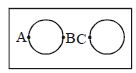
A
both will increase
B
both will decrease
C
$AB$ increases,$BC$ decreases
D
$AB$ decreases,$BC$ increases
Solution
(A) When a metal sheet with holes is heated,the material expands as if the entire sheet were solid. The expansion of the material follows the same laws as the expansion of a solid body. Therefore,the distance between any two points on the sheet increases upon heating. Since $A$,$B$,and $C$ are points on the metal sheet,the distances $AB$ (the diameter of the hole) and $BC$ (the distance between the two holes) will both increase due to thermal expansion.
0 likes
View Solution10-1.Thermometry, Thermal Expansion and Calorimetry — Thermal Expansion for Solid · Frequently Asked Questions
1Are these 10-1.Thermometry, Thermal Expansion and Calorimetry questions useful for JEE and NEET?
Yes. All questions in this section are mapped to JEE Main and NEET exam patterns. Previous year questions from JEE Main, NEET, GUJCET and state-level exams are included with full solutions.
2Can I switch to Hindi or Gujarati for these questions?
Yes. Use the language tabs in the hero section or the sidebar to view the same questions and solutions in English, Hindi or Gujarati.
3How do I generate a question paper from this subtopic?
Use the Vedclass Exam Paper Generator — select the chapter and subtopic, set difficulty, and generate Sets A, B, C, D automatically. First 3 chapters of every subject are free.
Vedclass Products
For Students
Vedclass Test Series
Mock tests in real JEE/NEET style with performance analysis. 5-day free trial.
Start Free TrialFor Teachers
Exam Paper Generator
Generate Set A/B/C/D papers from this chapter in 2 minutes. 3 chapters free.
Try FreeFor Institutes
Online Exam Module
Live online exams with unlimited students, 360° analytics & white-label branding.
See DemoFor Teachers & Institutes
Generate a 10-1.Thermometry, Thermal Expansion and Calorimetry Exam Paper in 2 Minutes
Select subtopic & difficulty — Sets A, B, C, D auto-generated with No Repeat logic.
First 3 chapters of every subject are free — no payment required.