
A English
Real gases and Vander waal’s equation Questions in English
Class 11 Chemistry · States of Matter · Real gases and Vander waal’s equation
266+
Questions
English
Language
100%
With Solutions
Showing 50 of 266 questions in English
151
MediumMCQ
Which of the following gas samples shows real gas behavior?
A
$16 \ g$ of $O_2$ at $STP$ occupies $11.2 \ L$
B
$1 \ g$ of $H_2$ in a $0.5 \ L$ flask exerts a pressure of $24.63 \ atm$ at $300 \ K$
C
$1 \ mol$ of $NH_3$ at $300 \ K$ and $1 \ atm$ occupies a volume of $22.4 \ L$
D
$5.6 \ L$ of $CO_2$ at $STP$ is equal to $11 \ g$
Solution
(C) To determine which gas shows real behavior,we check if it follows the ideal gas equation $PV = nRT$.
For option $A$: $n = \frac{16}{32} = 0.5 \ mol$. At $STP$,$V = n \times 22.4 \ L = 0.5 \times 22.4 = 11.2 \ L$. This follows ideal behavior.
For option $B$: $n = \frac{1}{2} = 0.5 \ mol$. Using $PV = nRT$,$P = \frac{nRT}{V} = \frac{0.5 \times 0.0821 \times 300}{0.5} = 24.63 \ atm$. This follows ideal behavior.
For option $C$: $n = 1 \ mol$,$T = 300 \ K$,$P = 1 \ atm$. Ideal volume $V = \frac{nRT}{P} = \frac{1 \times 0.0821 \times 300}{1} = 24.63 \ L$. The given volume is $22.4 \ L$,which deviates from the ideal volume at $300 \ K$. Thus,$NH_3$ shows real behavior.
For option $D$: $n = \frac{5.6}{22.4} = 0.25 \ mol$. Mass $= 0.25 \times 44 = 11 \ g$. This follows ideal behavior.
For option $A$: $n = \frac{16}{32} = 0.5 \ mol$. At $STP$,$V = n \times 22.4 \ L = 0.5 \times 22.4 = 11.2 \ L$. This follows ideal behavior.
For option $B$: $n = \frac{1}{2} = 0.5 \ mol$. Using $PV = nRT$,$P = \frac{nRT}{V} = \frac{0.5 \times 0.0821 \times 300}{0.5} = 24.63 \ atm$. This follows ideal behavior.
For option $C$: $n = 1 \ mol$,$T = 300 \ K$,$P = 1 \ atm$. Ideal volume $V = \frac{nRT}{P} = \frac{1 \times 0.0821 \times 300}{1} = 24.63 \ L$. The given volume is $22.4 \ L$,which deviates from the ideal volume at $300 \ K$. Thus,$NH_3$ shows real behavior.
For option $D$: $n = \frac{5.6}{22.4} = 0.25 \ mol$. Mass $= 0.25 \times 44 = 11 \ g$. This follows ideal behavior.
0 likes
View Solution152
MediumMCQ
For a gas,the deviation from ideal behavior is maximum at:
A
$0\,^oC$ and $1.0\, atm$
B
$100\,^oC$ and $2.0\, atm$
C
$-13\,^oC$ and $1.0\, atm$
D
$-13\,^oC$ and $2.0\, atm$
Solution
(D) Real gases deviate from ideal behavior under conditions of high pressure and low temperature.
This is because at low temperatures,the kinetic energy of gas molecules decreases,making intermolecular forces significant.
At high pressures,the volume occupied by the gas molecules becomes significant compared to the total volume of the container.
Comparing the given options,the condition with the lowest temperature and highest pressure will show the maximum deviation.
Comparing $-13\,^oC$ and $2.0\, atm$ with other options,it is the lowest temperature and highest pressure combination.
Therefore,the deviation is maximum at $-13\,^oC$ and $2.0\, atm$.
This is because at low temperatures,the kinetic energy of gas molecules decreases,making intermolecular forces significant.
At high pressures,the volume occupied by the gas molecules becomes significant compared to the total volume of the container.
Comparing the given options,the condition with the lowest temperature and highest pressure will show the maximum deviation.
Comparing $-13\,^oC$ and $2.0\, atm$ with other options,it is the lowest temperature and highest pressure combination.
Therefore,the deviation is maximum at $-13\,^oC$ and $2.0\, atm$.
0 likes
View Solution153
MediumMCQ
When $He$ gas is expanded into a vacuum,a heating effect is observed. What is the reason for this?
A
$He$ is an ideal gas
B
$He$ is an inert gas
C
The inversion temperature of $He$ is very low
D
The boiling point of $He$ is very low
0 likes
View Solution154
EasyMCQ
Van der Waal's equation $\left[ p + \frac{a}{V^2} \right] (V - b) = nRT$ is applicable for
A
Ideal gas
B
Non-ideal gas
C
Both $(a)$ and $(b)$
D
None of these
Solution
(B) The Van der Waal's equation is a modified version of the ideal gas equation that accounts for the finite volume of gas molecules and the intermolecular forces of attraction.
It is specifically designed to describe the behavior of real (non-ideal) gases.
It is specifically designed to describe the behavior of real (non-ideal) gases.
0 likes
View Solution155
EasyMCQ
Which equation shows the correct form of the Berthelot equation?
A
$\left( P + \frac{a}{T(V + C)^2} \right)(V - b) = RT$
B
$\left( P + \frac{a}{T(V - C)^2} \right)(V - b) = RT$
C
$\left( P + \frac{a}{TV^2} \right)(V - b) = RT$
D
$\left( P + \frac{a}{TV^2} \right)(V + b) = RT$
Solution
(C) The Berthelot equation is given by $\left( P + \frac{a}{TV^2} \right)(V - b) = RT$.
In this equation,the volume correction $(V - b)$ is the same as in the van der Waals equation.
However,the pressure correction term is modified to $\frac{a}{TV^2}$ instead of $\frac{a}{V^2}$ to account for the temperature dependence of the attractive forces.
In this equation,the volume correction $(V - b)$ is the same as in the van der Waals equation.
However,the pressure correction term is modified to $\frac{a}{TV^2}$ instead of $\frac{a}{V^2}$ to account for the temperature dependence of the attractive forces.
0 likes
View Solution156
MediumMCQ
Dominance of strong repulsive forces among the molecules of the gas ($Z =$ compressibility factor)
A
Depends on $Z$ and indicated by $Z = 1$
B
Depends on $Z$ and indicated by $Z > 1$
C
Depends on $Z$ and indicated by $Z < 1$
D
Is independent of $Z$
Solution
(B) The compressibility factor is defined as $Z = \frac{PV}{nRT}$.
When repulsive forces are dominant,the molecules push each other away,which makes the gas occupy a larger volume than expected for an ideal gas at the same pressure.
Consequently,the product $PV$ becomes greater than $nRT$.
Therefore,the value of $Z$ becomes greater than $1$ $(Z > 1)$.
When repulsive forces are dominant,the molecules push each other away,which makes the gas occupy a larger volume than expected for an ideal gas at the same pressure.
Consequently,the product $PV$ becomes greater than $nRT$.
Therefore,the value of $Z$ becomes greater than $1$ $(Z > 1)$.
0 likes
View Solution157
EasyMCQ
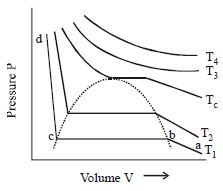
In a $P$ versus $V$ graph,the horizontal line is found in which region?
A
Gas
B
Liquid
C
Equilibrium between gas and liquid
D
Supercritical temperature
Solution
(C) Generally,most real gases show the same type of isotherm. The segment $ab$ represents the gaseous state. The line $bc$,which is a horizontal line,shows the equilibrium between liquid and vapour. The pressure corresponding to the line $bc$ is known as the vapour pressure of the liquid. The line $cd$ represents the liquid state.
0 likes
View Solution158
AdvancedMCQ
The inversion temperature $T_i \, (K)$ of hydrogen is (given van der Waal's constants $a$ and $b$ are $0.244 \, atm \, L^2 \, mol^{-2}$ and $0.027 \, L \, mol^{-1}$ respectively).
A
$440$
B
$220$
C
$110$
D
$330$
Solution
(B) The inversion temperature $(T_i)$ is the temperature below which a gas cools upon Joule-Thomson expansion.
It is calculated using the formula: $T_i = \frac{2a}{bR}$.
Given:
$a = 0.244 \, atm \, L^2 \, mol^{-2}$
$b = 0.027 \, L \, mol^{-1}$
$R = 0.0821 \, L \, atm \, K^{-1} \, mol^{-1}$
Substituting these values into the formula:
$T_i = \frac{2 \times 0.244}{0.027 \times 0.0821} \approx \frac{0.488}{0.0022167} \approx 220.15 \, K$.
Rounding to the nearest integer,we get $220 \, K$.
It is calculated using the formula: $T_i = \frac{2a}{bR}$.
Given:
$a = 0.244 \, atm \, L^2 \, mol^{-2}$
$b = 0.027 \, L \, mol^{-1}$
$R = 0.0821 \, L \, atm \, K^{-1} \, mol^{-1}$
Substituting these values into the formula:
$T_i = \frac{2 \times 0.244}{0.027 \times 0.0821} \approx \frac{0.488}{0.0022167} \approx 220.15 \, K$.
Rounding to the nearest integer,we get $220 \, K$.
0 likes
View Solution159
MediumMCQ
Assertion : Compressibility factor for hydrogen varies with pressure with positive slope at all pressures.
Reason : Even at low pressure,repulsive forces dominate hydrogen gas.
Reason : Even at low pressure,repulsive forces dominate hydrogen gas.
A
If both Assertion and Reason are correct and the Reason is a correct explanation of the Assertion.
B
If both Assertion and Reason are correct but Reason is not a correct explanation of the Assertion.
C
If the Assertion is correct but Reason is incorrect.
D
If both the Assertion and Reason are incorrect.
Solution
(A) For hydrogen gas $(H_2)$,the compressibility factor $Z$ is defined as $Z = \frac{PV}{nRT}$.
For $H_2$,$Z$ is always greater than $1$ at all pressures,and it increases linearly with pressure.
This indicates that the gas is more difficult to compress than an ideal gas,which is due to the dominance of repulsive forces between the molecules even at low pressures.
Therefore,both the Assertion and the Reason are correct,and the Reason correctly explains the Assertion.
For $H_2$,$Z$ is always greater than $1$ at all pressures,and it increases linearly with pressure.
This indicates that the gas is more difficult to compress than an ideal gas,which is due to the dominance of repulsive forces between the molecules even at low pressures.
Therefore,both the Assertion and the Reason are correct,and the Reason correctly explains the Assertion.
0 likes
View Solution160
EasyMCQ
Assertion : Greater the value of van der Waal's constant $a$,greater is the liquefaction of gas.
Reason : $a$ indirectly measures the magnitude of attractive forces between the molecules.
Reason : $a$ indirectly measures the magnitude of attractive forces between the molecules.
A
If both Assertion and Reason are correct and the Reason is a correct explanation of the Assertion.
B
If both Assertion and Reason are correct but Reason is not a correct explanation of the Assertion.
C
If the Assertion is correct but Reason is incorrect.
D
If both the Assertion and Reason are incorrect.
Solution
(A) The van der Waal's constant $a$ represents the magnitude of intermolecular attractive forces in a gas.
Higher values of $a$ indicate stronger attractive forces between gas molecules,which makes it easier for the gas to be liquefied.
In the van der Waal's equation,the pressure correction term is $\frac{an^2}{V^2}$,where $a$ accounts for these attractive forces.
Therefore,both the assertion and the reason are correct,and the reason is the correct explanation of the assertion.
Higher values of $a$ indicate stronger attractive forces between gas molecules,which makes it easier for the gas to be liquefied.
In the van der Waal's equation,the pressure correction term is $\frac{an^2}{V^2}$,where $a$ accounts for these attractive forces.
Therefore,both the assertion and the reason are correct,and the reason is the correct explanation of the assertion.
0 likes
View Solution161
MediumMCQ
Assertion : Compressibility factor $(Z)$ for non-ideal gases can be greater than $1$.
Reason : Non-ideal gases always exert higher pressure than expected.
Reason : Non-ideal gases always exert higher pressure than expected.
A
If both Assertion and Reason are correct and the Reason is a correct explanation of the Assertion.
B
If both Assertion and Reason are correct but Reason is not a correct explanation of the Assertion.
C
If the Assertion is correct but Reason is incorrect.
D
If both the Assertion and Reason are incorrect.
Solution
(C) The compressibility factor $(Z)$ is defined as $Z = \frac{PV}{nRT}$. For non-ideal gases,$Z$ can be greater than $1$ (when repulsive forces dominate) or less than $1$ (when attractive forces dominate). Therefore,the Assertion is correct.
Non-ideal gases do not always exert higher pressure than expected. Due to intermolecular attractive forces,the pressure exerted by a real gas is generally lower than the pressure predicted by the ideal gas law $(P_{real} < P_{ideal})$. Thus,the Reason is incorrect.
Non-ideal gases do not always exert higher pressure than expected. Due to intermolecular attractive forces,the pressure exerted by a real gas is generally lower than the pressure predicted by the ideal gas law $(P_{real} < P_{ideal})$. Thus,the Reason is incorrect.
0 likes
View Solution162
MediumMCQ
$A$ gas at $350 \; K$ and $15 \; bar$ has a molar volume $20$ percent smaller than that for an ideal gas under the same conditions. The correct option about the gas and its compressibility factor $(Z)$ is
A
$Z > 1$ and attractive forces are dominant
B
$Z > 1$ and repulsive forces are dominant
C
$Z < 1$ and attractive forces are dominant
D
$Z < 1$ and repulsive forces are dominant
Solution
(C) The compressibility factor $Z$ is defined as the ratio of the molar volume of a real gas $(V_{m})_{real}$ to the molar volume of an ideal gas $(V_{m})_{ideal}$ at the same temperature and pressure: $Z = \frac{(V_{m})_{real}}{(V_{m})_{ideal}}$.
Given that $(V_{m})_{real}$ is $20$ percent smaller than $(V_{m})_{ideal}$,we have $(V_{m})_{real} = 0.8 \times (V_{m})_{ideal}$.
Therefore,$Z = \frac{0.8 \times (V_{m})_{ideal}}{(V_{m})_{ideal}} = 0.8$.
Since $Z < 1$,the gas shows negative deviation from ideal behavior,which indicates that attractive intermolecular forces are dominant.
Given that $(V_{m})_{real}$ is $20$ percent smaller than $(V_{m})_{ideal}$,we have $(V_{m})_{real} = 0.8 \times (V_{m})_{ideal}$.
Therefore,$Z = \frac{0.8 \times (V_{m})_{ideal}}{(V_{m})_{ideal}} = 0.8$.
Since $Z < 1$,the gas shows negative deviation from ideal behavior,which indicates that attractive intermolecular forces are dominant.
0 likes
View Solution163
AdvancedMCQ
Given van der Waals constant $a$ for $NH_{3}$,$H_{2}$,$O_{2}$ and $CO_{2}$ are respectively $4.17$,$0.244$,$1.36$ and $3.59$,which one of the following gases is most easily liquefied?
A
$NH_{3}$
B
$H_{2}$
C
$O_{2}$
D
$CO_{2}$
Solution
(A) The ease of liquefaction of a gas is directly proportional to the magnitude of the van der Waals constant $a$,which represents the intermolecular forces of attraction.
Greater value of $a$ implies stronger intermolecular forces,leading to a higher critical temperature $(T_{C})$.
Comparing the given values: $a(NH_{3}) = 4.17$,$a(H_{2}) = 0.244$,$a(O_{2}) = 1.36$,and $a(CO_{2}) = 3.59$.
Since $NH_{3}$ has the highest value of $a$ $(4.17)$,it has the strongest intermolecular forces and is the most easily liquefied gas among the given options.
Greater value of $a$ implies stronger intermolecular forces,leading to a higher critical temperature $(T_{C})$.
Comparing the given values: $a(NH_{3}) = 4.17$,$a(H_{2}) = 0.244$,$a(O_{2}) = 1.36$,and $a(CO_{2}) = 3.59$.
Since $NH_{3}$ has the highest value of $a$ $(4.17)$,it has the strongest intermolecular forces and is the most easily liquefied gas among the given options.
0 likes
View Solution164
EasyMCQ
The correction factor '$a$' in the van der Waals equation for real gases corresponds to:
A
density of the gas molecules
B
volume of the gas molecules
C
electric field present between the gas molecules
D
forces of attraction between the gas molecules
Solution
(D) The van der Waals equation for real gases is given by $(P + \frac{an^2}{V^2})(V - nb) = nRT$.
In this equation,the term $\frac{an^2}{V^2}$ represents the pressure correction.
The constant '$a$' is a measure of the magnitude of the intermolecular forces of attraction between the gas molecules.
In this equation,the term $\frac{an^2}{V^2}$ represents the pressure correction.
The constant '$a$' is a measure of the magnitude of the intermolecular forces of attraction between the gas molecules.
0 likes
View Solution165
MediumMCQ
Explain the effect of high pressure and low temperature on the validity of Boyle's law.
A
Boyle's law is followed perfectly.
B
Boyle's law shows significant deviations.
C
Boyle's law is only applicable at high pressure.
D
Boyle's law is only applicable at low temperature.
Solution
(B) Boyle's law states that for a fixed amount of an ideal gas at constant temperature,the pressure is inversely proportional to its volume $(P \propto \frac{1}{V})$.
High Pressure: At high pressure,the intermolecular forces of attraction become significant,and the volume of gas molecules is no longer negligible compared to the total volume. Consequently,real gases deviate from ideal behavior,and the $P$ vs $\frac{1}{V}$ plot is not a straight line.
Low Temperature: At low temperatures,the kinetic energy of gas molecules decreases,making intermolecular forces more effective. This causes the gas to deviate from ideal behavior,and Boyle's law is not followed strictly.
High Pressure: At high pressure,the intermolecular forces of attraction become significant,and the volume of gas molecules is no longer negligible compared to the total volume. Consequently,real gases deviate from ideal behavior,and the $P$ vs $\frac{1}{V}$ plot is not a straight line.
Low Temperature: At low temperatures,the kinetic energy of gas molecules decreases,making intermolecular forces more effective. This causes the gas to deviate from ideal behavior,and Boyle's law is not followed strictly.
0 likes
View Solution166
Difficult
"Real gases do not follow Boyle's Law,Charles's Law,and Avogadro's Law perfectly under all conditions." Explain.
Solution
(A) Explanation using $pV$ vs $p$ graph according to Boyle's Law: Theoretically,$pV = nRT$. If we plot a graph of $pV$ vs $p$ at a constant temperature $(T)$,we should get a straight line parallel to the $X$-axis because,according to Boyle's Law,$pV$ is constant for a given amount of ideal gas.
In reality,the $pV$ vs $p$ graph is not a straight line. Experimental data for real gases at constant temperature shows significant deviation from ideal behavior.
Graph Type-$1$: For gases like $H_2$ and $He$,the $pV$ value increases continuously with an increase in pressure $(p)$.
Graph Type-$2$: For real gases like $CO$ and $CH_4$,the curve first shows a negative deviation from ideal behavior,meaning $pV$ values decrease as pressure increases.
- The $pV$ values reach a minimum value depending on the nature of the gas (maximum negative deviation). After this point,increasing the pressure causes the $pV$ value to increase,crossing the ideal gas line where the deviation becomes zero.
- Further increase in pressure leads to a continuous positive deviation.
Thus,it is concluded that "Real gases do not follow the ideal gas equation perfectly under all conditions."
In reality,the $pV$ vs $p$ graph is not a straight line. Experimental data for real gases at constant temperature shows significant deviation from ideal behavior.
Graph Type-$1$: For gases like $H_2$ and $He$,the $pV$ value increases continuously with an increase in pressure $(p)$.
Graph Type-$2$: For real gases like $CO$ and $CH_4$,the curve first shows a negative deviation from ideal behavior,meaning $pV$ values decrease as pressure increases.
- The $pV$ values reach a minimum value depending on the nature of the gas (maximum negative deviation). After this point,increasing the pressure causes the $pV$ value to increase,crossing the ideal gas line where the deviation becomes zero.
- Further increase in pressure leads to a continuous positive deviation.
Thus,it is concluded that "Real gases do not follow the ideal gas equation perfectly under all conditions."
0 likes
View Solution167
Difficult
Real gases show deviation from ideal behavior. Explain with examples.
Solution
(N/A) According to Boyle's Law,explanation of the graph of $pV \rightarrow p$ (constant temperature): The theoretical value is $pV = nRT$. At constant temperature and all pressures,a line parallel to the $X$-axis is obtained for the graph $pV \rightarrow p$ for an ideal gas.
But for real gases,the graph $pV \rightarrow p$ is not a straight line. As shown in the graph at constant temperature:
This graph is not a straight line for a real gas and shows deviation from ideal gas behavior. Moreover,it is not parallel to the $X$-axis as it is for an ideal gas.
Graph Type-$I$: The graphs for Dihydrogen $(H_2)$ and Helium $(He)$ are straight lines,and $pV$ increases with increasing pressure.
Graph Type-$II$: The real gases Carbon monoxide $(CO)$ and Methane $(CH_4)$ show a different type of curve.
$\rightarrow$ According to the curve,$CO$ and $CH_4$ show negative deviation from ideal gas behavior. The value of $pV$ decreases with an increase in pressure,reaches a minimum value,and after that,the value of $pV$ increases with increasing pressure,intercepting the ideal gas line where the deviation becomes zero.
$\Rightarrow$ For some gases,the value of $pV$ increases with increasing pressure,and a continuously positive deviation is observed.
So,real gases do not follow the ideal gas equation under all conditions.
$(B)$ According to Boyle's Law,explanation of the deviation in the graph of $p \rightarrow V$ ($T$ constant):
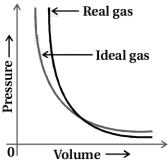
The graph of $p \rightarrow V$ for a real gas shows deviation from the ideal gas behavior. The $p \rightarrow V$ curve is given in the image,which shows the deviation of a real gas from the ideal gas curve.
But for real gases,the graph $pV \rightarrow p$ is not a straight line. As shown in the graph at constant temperature:
This graph is not a straight line for a real gas and shows deviation from ideal gas behavior. Moreover,it is not parallel to the $X$-axis as it is for an ideal gas.
Graph Type-$I$: The graphs for Dihydrogen $(H_2)$ and Helium $(He)$ are straight lines,and $pV$ increases with increasing pressure.
Graph Type-$II$: The real gases Carbon monoxide $(CO)$ and Methane $(CH_4)$ show a different type of curve.
$\rightarrow$ According to the curve,$CO$ and $CH_4$ show negative deviation from ideal gas behavior. The value of $pV$ decreases with an increase in pressure,reaches a minimum value,and after that,the value of $pV$ increases with increasing pressure,intercepting the ideal gas line where the deviation becomes zero.
$\Rightarrow$ For some gases,the value of $pV$ increases with increasing pressure,and a continuously positive deviation is observed.
So,real gases do not follow the ideal gas equation under all conditions.
$(B)$ According to Boyle's Law,explanation of the deviation in the graph of $p \rightarrow V$ ($T$ constant):
The graph of $p \rightarrow V$ for a real gas shows deviation from the ideal gas behavior. The $p \rightarrow V$ curve is given in the image,which shows the deviation of a real gas from the ideal gas curve.
0 likes
View Solution168
Difficult
Explain: Why do real gases show deviation from ideal gas behavior?
Solution
(N/A) Real gases deviate from ideal behavior because two fundamental assumptions of the kinetic molecular theory are not strictly valid for real gases:
$1$. The assumption that there is no force of attraction between gas molecules is incorrect. If this were true,gases would never liquefy. The fact that gases liquefy upon cooling and compression indicates that intermolecular forces of attraction exist.
$2$. The assumption that the volume of gas molecules is negligible compared to the total volume of the gas is incorrect. At high pressures,the volume occupied by the molecules themselves becomes significant relative to the total volume,leading to deviations from the ideal gas law $(PV = nRT)$.
$1$. The assumption that there is no force of attraction between gas molecules is incorrect. If this were true,gases would never liquefy. The fact that gases liquefy upon cooling and compression indicates that intermolecular forces of attraction exist.
$2$. The assumption that the volume of gas molecules is negligible compared to the total volume of the gas is incorrect. At high pressures,the volume occupied by the molecules themselves becomes significant relative to the total volume,leading to deviations from the ideal gas law $(PV = nRT)$.
0 likes
View Solution169
Difficult
Derive the van der Waals equation.
Solution
(N/A) The ideal gas equation $PV = nRT$ assumes that gas molecules are point masses with no intermolecular forces. Real gases deviate from this behavior due to molecular interactions and finite molecular volume.
$1$. Correction in Pressure: Real gas molecules experience intermolecular attractive forces. When a molecule approaches the wall of the container,it is pulled back by other molecules,reducing the impact force. The observed pressure $p$ is less than the ideal pressure $p_{ideal}$. The correction term is proportional to the square of the density,$\frac{n^2}{V^2}$. Thus,$p_{ideal} = p + \frac{an^2}{V^2}$,where $a$ is the van der Waals constant representing the magnitude of attractive forces.
$2$. Correction in Volume: Real gas molecules occupy a finite volume. The effective volume available for movement is $V - nb$,where $b$ is the excluded volume per mole,representing the volume occupied by the molecules themselves.
Substituting these into the ideal gas equation $p_{ideal} V_{ideal} = nRT$:
$(p + \frac{an^2}{V^2})(V - nb) = nRT$.
$1$. Correction in Pressure: Real gas molecules experience intermolecular attractive forces. When a molecule approaches the wall of the container,it is pulled back by other molecules,reducing the impact force. The observed pressure $p$ is less than the ideal pressure $p_{ideal}$. The correction term is proportional to the square of the density,$\frac{n^2}{V^2}$. Thus,$p_{ideal} = p + \frac{an^2}{V^2}$,where $a$ is the van der Waals constant representing the magnitude of attractive forces.
$2$. Correction in Volume: Real gas molecules occupy a finite volume. The effective volume available for movement is $V - nb$,where $b$ is the excluded volume per mole,representing the volume occupied by the molecules themselves.
Substituting these into the ideal gas equation $p_{ideal} V_{ideal} = nRT$:
$(p + \frac{an^2}{V^2})(V - nb) = nRT$.
0 likes
View Solution170
Difficult
Explain real gases showing deviations from ideal gas with correction of pressure and volume and derive van der Waals equation.
Solution
(N/A) Real gases deviate from ideal behavior at high pressure and low temperature. The ideal gas equation $PV = nRT$ is based on two assumptions of the kinetic theory of gases which do not hold true for real gases:
$1.$ The volume occupied by gas molecules is negligible compared to the total volume of the gas.
$2.$ There are no forces of attraction between gas molecules.
Van der Waals introduced corrections for these:
Volume Correction: The effective volume available for the movement of molecules is $(V - nb)$,where $b$ is the excluded volume per mole.
Pressure Correction: The observed pressure $P$ is less than the ideal pressure due to intermolecular attraction. $P_{\text{ideal}} = P + \frac{an^2}{V^2}$,where $a$ is the attraction constant.
Substituting these into the ideal gas law $PV = nRT$,we get the van der Waals equation:
$(P + \frac{an^2}{V^2})(V - nb) = nRT$.
$1.$ The volume occupied by gas molecules is negligible compared to the total volume of the gas.
$2.$ There are no forces of attraction between gas molecules.
Van der Waals introduced corrections for these:
Volume Correction: The effective volume available for the movement of molecules is $(V - nb)$,where $b$ is the excluded volume per mole.
Pressure Correction: The observed pressure $P$ is less than the ideal pressure due to intermolecular attraction. $P_{\text{ideal}} = P + \frac{an^2}{V^2}$,where $a$ is the attraction constant.
Substituting these into the ideal gas law $PV = nRT$,we get the van der Waals equation:
$(P + \frac{an^2}{V^2})(V - nb) = nRT$.
0 likes
View Solution171
MediumMCQ
Under which conditions do intermolecular forces become effective?
A
High temperature and low pressure
B
Low temperature and high pressure
C
High temperature and high pressure
D
Low temperature and low pressure
Solution
(B) Intermolecular forces become significant at low temperatures and high pressures.
$1$. At high pressure,the molecules are brought closer together,making the attractive forces between them significant,which leads to a pressure correction term $\frac{a n^{2}}{V^{2}}$.
$2$. At very low temperatures,the kinetic energy of the molecules is low. As the molecules move with low average speed,they can be captured by one another due to attractive forces,causing the gas to deviate from ideal behavior.
$1$. At high pressure,the molecules are brought closer together,making the attractive forces between them significant,which leads to a pressure correction term $\frac{a n^{2}}{V^{2}}$.
$2$. At very low temperatures,the kinetic energy of the molecules is low. As the molecules move with low average speed,they can be captured by one another due to attractive forces,causing the gas to deviate from ideal behavior.
0 likes
View Solution172
MediumMCQ
Under which conditions does a real gas show maximum deviation from ideal gas behavior?
A
High temperature and low pressure
B
Low temperature and high pressure
C
High temperature and high pressure
D
Low temperature and low pressure
Solution
(B) Real gases deviate from ideal behavior because they do not follow the assumptions of the Kinetic Molecular Theory,specifically that there are no intermolecular forces and that gas molecules have negligible volume.
$1$. At high pressure,the volume of gas molecules becomes significant compared to the total volume,and repulsive forces dominate.
$2$. At low temperature,the kinetic energy of molecules decreases,making intermolecular attractive forces significant.
Therefore,the maximum deviation from ideal gas behavior occurs at $Low \text{ } temperature$ and $High \text{ } pressure$.
$1$. At high pressure,the volume of gas molecules becomes significant compared to the total volume,and repulsive forces dominate.
$2$. At low temperature,the kinetic energy of molecules decreases,making intermolecular attractive forces significant.
Therefore,the maximum deviation from ideal gas behavior occurs at $Low \text{ } temperature$ and $High \text{ } pressure$.
0 likes
View Solution173
Medium
Explain the compressibility factor $(Z)$.
Solution
(N/A) The compressibility factor $(Z)$ is defined as the ratio of the product of pressure $(p)$ and molar volume $(V_m)$ to the product of the gas constant $(R)$ and temperature $(T)$. It measures the deviation of a real gas from ideal gas behavior.
$Z = \frac{pV_m}{RT} = \frac{pV}{nRT}$
$(i)$ For an ideal gas,$Z = 1$ at all temperatures and pressures,as it follows the equation $pV = nRT$.
$(ii)$ For real gases,$Z \neq 1$.
- If $Z > 1$,the gas shows positive deviation,meaning it is less compressible than an ideal gas (e.g.,$H_2$ and $He$ at all pressures).
- If $Z < 1$,the gas shows negative deviation,meaning it is more compressible than an ideal gas (e.g.,$CH_4$ and $CO_2$ at moderate pressures).
At very low pressures,all real gases approach ideal behavior,and $Z$ approaches $1$.
$Z = \frac{pV_m}{RT} = \frac{pV}{nRT}$
$(i)$ For an ideal gas,$Z = 1$ at all temperatures and pressures,as it follows the equation $pV = nRT$.
$(ii)$ For real gases,$Z \neq 1$.
- If $Z > 1$,the gas shows positive deviation,meaning it is less compressible than an ideal gas (e.g.,$H_2$ and $He$ at all pressures).
- If $Z < 1$,the gas shows negative deviation,meaning it is more compressible than an ideal gas (e.g.,$CH_4$ and $CO_2$ at moderate pressures).
At very low pressures,all real gases approach ideal behavior,and $Z$ approaches $1$.
0 likes
View Solution174
Medium
What is compressibility factor $(Z)$? Explain $(i)$ deviation factor $(Z = 1)$,$(ii)$ $Z > 1$,$(iii)$ $Z < 1$,$(iv)$ deviation graph,and $(v)$ the relation between molar volume and $Z$.
Solution
(A) Compressibility factor $(Z)$ is defined as the ratio of the product of pressure and volume to the product of the number of moles,gas constant,and temperature: $Z = \frac{pV}{nRT}$.
$(i)$ For an ideal gas,$Z = 1$ at all temperatures and pressures,as it follows the equation $pV = nRT$. On a $Z$ vs $p$ graph,this is represented by a horizontal line parallel to the pressure axis.
$(ii)$ $Z > 1$ (Positive deviation): This occurs at high pressures where real gases are less compressible than ideal gases. Gases like $H_2$ and $He$ show $Z > 1$ at all pressures because intermolecular forces are negligible compared to the volume occupied by molecules.
$(iii)$ $Z < 1$ (Negative deviation): This occurs at intermediate pressures where attractive forces dominate,making the gas more compressible than an ideal gas. Gases like $CH_4$ and $CO_2$ show this behavior at lower pressures.
$(iv)$ The deviation graph plots $Z$ on the $y$-axis against $p$ on the $x$-axis. The ideal gas line is a horizontal line at $Z = 1$. Real gases show curves that deviate from this line depending on pressure and temperature.
$(v)$ The relation between molar volume and $Z$ is given by $Z = \frac{V_{real}}{V_{ideal}}$,where $V_{real}$ is the actual molar volume and $V_{ideal} = \frac{RT}{p}$ is the molar volume of an ideal gas at the same temperature and pressure.
$(i)$ For an ideal gas,$Z = 1$ at all temperatures and pressures,as it follows the equation $pV = nRT$. On a $Z$ vs $p$ graph,this is represented by a horizontal line parallel to the pressure axis.
$(ii)$ $Z > 1$ (Positive deviation): This occurs at high pressures where real gases are less compressible than ideal gases. Gases like $H_2$ and $He$ show $Z > 1$ at all pressures because intermolecular forces are negligible compared to the volume occupied by molecules.
$(iii)$ $Z < 1$ (Negative deviation): This occurs at intermediate pressures where attractive forces dominate,making the gas more compressible than an ideal gas. Gases like $CH_4$ and $CO_2$ show this behavior at lower pressures.
$(iv)$ The deviation graph plots $Z$ on the $y$-axis against $p$ on the $x$-axis. The ideal gas line is a horizontal line at $Z = 1$. Real gases show curves that deviate from this line depending on pressure and temperature.
$(v)$ The relation between molar volume and $Z$ is given by $Z = \frac{V_{real}}{V_{ideal}}$,where $V_{real}$ is the actual molar volume and $V_{ideal} = \frac{RT}{p}$ is the molar volume of an ideal gas at the same temperature and pressure.
0 likes
View Solution175
Medium
Give the difference between an Ideal Gas and a Real Gas.
Solution
(N/A)
| Ideal Gas | Real Gas |
| $(i)$ Follows gas laws under all conditions. | $(i)$ Does not follow gas laws under all conditions. |
| $(ii)$ Follows the ideal gas equation,$pV = nRT$. | $(ii)$ Follows the van der Waals equation,$(p + \frac{an^2}{V^2})(V - nb) = nRT$. |
| $(iii)$ Compressibility factor is $Z = 1$. | $(iii)$ Compressibility factor is not $1$ $(Z \neq 1)$. |
| $(iv)$ Intermolecular forces are assumed to be zero. | $(iv)$ Intermolecular forces are significant and not zero. |
0 likes
View Solution176
Difficult
Explain the conditions under which a real gas exhibits ideal gas behaviour.
Solution
(N/A) Real gases exhibit ideal behaviour when the intermolecular forces are practically negligible.
$1$. $A$ gas behaves ideally when the compressibility factor $Z = 1$.
$2$. When the volume of the gas is significantly larger than the volume of the gas molecules,the gas behaves ideally.
$3$. Real gases approach ideal behaviour at low pressure and high temperature.
$4$. Under these conditions,the gas follows the ideal gas equation: $PV = nRT$ or $V_{\text{ideal}} = \frac{nRT}{P}$.
$5$. These conditions vary depending on the nature of the gas.
$1$. $A$ gas behaves ideally when the compressibility factor $Z = 1$.
$2$. When the volume of the gas is significantly larger than the volume of the gas molecules,the gas behaves ideally.
$3$. Real gases approach ideal behaviour at low pressure and high temperature.
$4$. Under these conditions,the gas follows the ideal gas equation: $PV = nRT$ or $V_{\text{ideal}} = \frac{nRT}{P}$.
$5$. These conditions vary depending on the nature of the gas.
0 likes
View Solution177
Medium
What is Boyle's temperature? Give its relation with the value of $Z$.
Solution
(N/A) Boyle temperature $(T_B)$: The temperature at which a real gas obeys the ideal gas law over an appreciable range of pressure is called Boyle temperature or Boyle point.
Boyle point of a gas depends upon its nature.
At the Boyle temperature,the compressibility factor $Z$ is equal to $1$ for a range of pressure,meaning the gas behaves ideally.
Below the Boyle temperature,real gases first show a decrease in the $Z$ value with increasing pressure,reaching a minimum value where attractive forces dominate.
Above the Boyle temperature,the $Z$ value is always greater than $1$ $(Z > 1)$ because repulsive forces dominate.
Boyle point of a gas depends upon its nature.
At the Boyle temperature,the compressibility factor $Z$ is equal to $1$ for a range of pressure,meaning the gas behaves ideally.
Below the Boyle temperature,real gases first show a decrease in the $Z$ value with increasing pressure,reaching a minimum value where attractive forces dominate.
Above the Boyle temperature,the $Z$ value is always greater than $1$ $(Z > 1)$ because repulsive forces dominate.
0 likes
View Solution178
Medium
Explain the physical significance of van der Waals parameters.
Solution
(N/A) The van der Waals equation is given by $(P + \frac{an^2}{V^2})(V - nb) = nRT$.
$1$. The constant '$a$' represents the magnitude of intermolecular attractive forces between gas molecules. $A$ higher value of '$a$' indicates stronger intermolecular forces,which leads to greater deviation from ideal gas behavior.
$2$. The constant '$b$' is known as the excluded volume or co-volume. It represents the effective volume occupied by the gas molecules themselves. It accounts for the fact that real gas molecules are not point masses and have a finite size. $A$ higher value of '$b$' indicates larger molecular size.
$1$. The constant '$a$' represents the magnitude of intermolecular attractive forces between gas molecules. $A$ higher value of '$a$' indicates stronger intermolecular forces,which leads to greater deviation from ideal gas behavior.
$2$. The constant '$b$' is known as the excluded volume or co-volume. It represents the effective volume occupied by the gas molecules themselves. It accounts for the fact that real gas molecules are not point masses and have a finite size. $A$ higher value of '$b$' indicates larger molecular size.
0 likes
View Solution179
MediumMCQ
$A$ gas that follows Boyle's law,Charle's law and Avogadro's law is called an ideal gas. Under what conditions does a real gas behave ideally?
A
High pressure and low temperature
B
Low pressure and high temperature
C
High pressure and high temperature
D
Low pressure and low temperature
Solution
(B) real gas behaves like an ideal gas when the intermolecular forces of attraction are negligible and the volume occupied by the gas molecules is negligible compared to the total volume of the gas.
These conditions are achieved at $Low \ Pressure$ and $High \ Temperature$.
At $Low \ Pressure$,the molecules are far apart,reducing intermolecular interactions.
At $High \ Temperature$,the kinetic energy of the molecules is high,which overcomes the intermolecular forces of attraction.
These conditions are achieved at $Low \ Pressure$ and $High \ Temperature$.
At $Low \ Pressure$,the molecules are far apart,reducing intermolecular interactions.
At $High \ Temperature$,the kinetic energy of the molecules is high,which overcomes the intermolecular forces of attraction.
0 likes
View Solution180
Medium
One of the assumptions of the kinetic theory of gases is that there is no force of attraction between the molecules of a gas. State and explain the evidence that shows that this assumption is not applicable for real gases.
Solution
(N/A) The kinetic theory of gases assumes that gas molecules do not exert any force of attraction on each other. However,this assumption fails for real gases because they can be liquefied by cooling and applying high pressure.
If there were no intermolecular forces of attraction,it would be impossible to liquefy a gas,as the molecules would not come together to form a liquid phase. The existence of intermolecular forces,such as van der Waals forces or hydrogen bonding (e.g.,in $HF$),allows molecules to aggregate,leading to liquefaction.
Evidence: The process of liquefaction of gases like $NH_3$,$CO_2$,and $Cl_2$ under high pressure and low temperature provides direct evidence that intermolecular forces of attraction exist in real gases.
If there were no intermolecular forces of attraction,it would be impossible to liquefy a gas,as the molecules would not come together to form a liquid phase. The existence of intermolecular forces,such as van der Waals forces or hydrogen bonding (e.g.,in $HF$),allows molecules to aggregate,leading to liquefaction.
Evidence: The process of liquefaction of gases like $NH_3$,$CO_2$,and $Cl_2$ under high pressure and low temperature provides direct evidence that intermolecular forces of attraction exist in real gases.
0 likes
View Solution181
Medium
Compressibility factor,$Z$,of a gas is given as $Z = \frac{pV}{nRT}$.
$(i)$ What is the value of $Z$ for an ideal gas?
$(ii)$ For a real gas,what will be the effect on the value of $Z$ above Boyle's temperature?
$(i)$ What is the value of $Z$ for an ideal gas?
$(ii)$ For a real gas,what will be the effect on the value of $Z$ above Boyle's temperature?
Solution
(N/A) $(i)$ For an ideal gas,the compressibility factor is $Z = 1$.
$(ii)$ Above Boyle's temperature,real gases show positive deviation from ideal behavior.
Therefore,for real gases above Boyle's temperature,$Z > 1$.
$(ii)$ Above Boyle's temperature,real gases show positive deviation from ideal behavior.
Therefore,for real gases above Boyle's temperature,$Z > 1$.
0 likes
View Solution182
Difficult
For real gases,the relation between $p$,$V$,and $T$ is given by the van der Waals equation:
$(p + \frac{an^2}{V^2})(V - nb) = nRT$
Where $a$ and $b$ are van der Waals constants,$nb$ is approximately equal to the total volume of the molecules of a gas,and $a$ is the measure of the magnitude of intermolecular attraction.
$(i)$ Arrange the following gases in the increasing order of $b$. Give reason: $O_2, CO_2, H_2, He$
$(ii)$ Arrange the following gases in the decreasing order of magnitude of $a$. Give reason: $CH_4, O_2, H_2$
$(p + \frac{an^2}{V^2})(V - nb) = nRT$
Where $a$ and $b$ are van der Waals constants,$nb$ is approximately equal to the total volume of the molecules of a gas,and $a$ is the measure of the magnitude of intermolecular attraction.
$(i)$ Arrange the following gases in the increasing order of $b$. Give reason: $O_2, CO_2, H_2, He$
$(ii)$ Arrange the following gases in the decreasing order of magnitude of $a$. Give reason: $CH_4, O_2, H_2$
Solution
(A) $(i)$ The van der Waals constant $b$ represents the excluded volume per mole,which is related to the size of the gas molecules. Larger molecules occupy more volume. Thus,the order of increasing $b$ is $H_2 < He < O_2 < CO_2$.
$(ii)$ The van der Waals constant $a$ is a measure of the magnitude of intermolecular attraction. Larger molecules with larger electron clouds exhibit stronger London dispersion forces. Thus,the order of decreasing magnitude of $a$ is $CH_4 > O_2 > H_2$.
$(ii)$ The van der Waals constant $a$ is a measure of the magnitude of intermolecular attraction. Larger molecules with larger electron clouds exhibit stronger London dispersion forces. Thus,the order of decreasing magnitude of $a$ is $CH_4 > O_2 > H_2$.
0 likes
View Solution183
Difficult
The relation between pressure exerted by an ideal gas $(P_{ideal})$ and observed pressure $(P_{real})$ is given by the equation
$P_{ideal} = P_{real} + \frac{an^2}{V^2}$
$(i)$ If pressure is taken in $N \ m^{-2}$,number of moles in $mol$,and volume in $m^3$,calculate the unit of $a$.
$(ii)$ What will be the unit of $a$ when pressure is in atmosphere and volume in $dm^3$?
$P_{ideal} = P_{real} + \frac{an^2}{V^2}$
$(i)$ If pressure is taken in $N \ m^{-2}$,number of moles in $mol$,and volume in $m^3$,calculate the unit of $a$.
$(ii)$ What will be the unit of $a$ when pressure is in atmosphere and volume in $dm^3$?
Solution
(N/A) Given the equation: $P_{ideal} = P_{real} + \frac{an^2}{V^2}$
$(i)$ Rearranging for $a$: $a = \frac{(P_{ideal} - P_{real}) \cdot V^2}{n^2}$
Since the term $\frac{an^2}{V^2}$ must have the same units as pressure $(P)$:
Units of $a = \frac{\text{Units of } P \cdot (\text{Units of } V)^2}{(\text{Units of } n)^2}$
Given $P = N \ m^{-2}$,$V = m^3$,and $n = mol$:
Units of $a = \frac{N \ m^{-2} \cdot (m^3)^2}{(mol)^2} = N \ m^4 \ mol^{-2}$
$(ii)$ Given $P = atm$,$V = dm^3$,and $n = mol$:
Units of $a = \frac{atm \cdot (dm^3)^2}{(mol)^2} = atm \ dm^6 \ mol^{-2}$
$(i)$ Rearranging for $a$: $a = \frac{(P_{ideal} - P_{real}) \cdot V^2}{n^2}$
Since the term $\frac{an^2}{V^2}$ must have the same units as pressure $(P)$:
Units of $a = \frac{\text{Units of } P \cdot (\text{Units of } V)^2}{(\text{Units of } n)^2}$
Given $P = N \ m^{-2}$,$V = m^3$,and $n = mol$:
Units of $a = \frac{N \ m^{-2} \cdot (m^3)^2}{(mol)^2} = N \ m^4 \ mol^{-2}$
$(ii)$ Given $P = atm$,$V = dm^3$,and $n = mol$:
Units of $a = \frac{atm \cdot (dm^3)^2}{(mol)^2} = atm \ dm^6 \ mol^{-2}$
0 likes
View Solution184
Medium
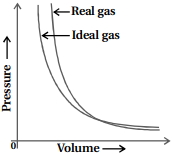
Pressure versus volume graph for a real gas and an ideal gas are shown in the figure. Answer the following questions on the basis of this graph:
$(i)$ Interpret the behaviour of real gas with respect to ideal gas at low pressure.
$(ii)$ Interpret the behaviour of real gas with respect to ideal gas at high pressure.
$(iii)$ Mark the pressure and volume by drawing a line at the point where real gas behaves as an ideal gas.
$(i)$ Interpret the behaviour of real gas with respect to ideal gas at low pressure.
$(ii)$ Interpret the behaviour of real gas with respect to ideal gas at high pressure.
$(iii)$ Mark the pressure and volume by drawing a line at the point where real gas behaves as an ideal gas.
Solution
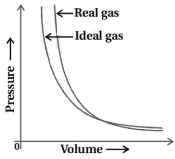
(N/A) $(i)$ The real gas shows very small deviation from ideal behaviour at low pressure because the two curves almost coincide at low pressure.
$(ii)$ The real gas shows large deviations from ideal behaviour at high pressure as the curves are far apart.
$(iii)$ At the point where both the curves intersect each other,the real gas behaves as an ideal gas. At this specific pressure and volume,the compressibility factor $Z$ is equal to $1$.
$(ii)$ The real gas shows large deviations from ideal behaviour at high pressure as the curves are far apart.
$(iii)$ At the point where both the curves intersect each other,the real gas behaves as an ideal gas. At this specific pressure and volume,the compressibility factor $Z$ is equal to $1$.
0 likes
View Solution185
EasyMCQ
When does the graph of $p \propto \frac{1}{V}$ not result in a straight line?
A
At very high pressure
B
At very low pressure
C
At constant temperature
D
At constant volume
Solution
(A) According to Boyle's Law,$pV = k$ at constant temperature for a fixed amount of gas.
However,real gases deviate from ideal behavior at very high pressures.
At very high pressures,the intermolecular forces and the volume occupied by gas molecules become significant,causing the graph of $p$ versus $\frac{1}{V}$ to deviate from a straight line.
However,real gases deviate from ideal behavior at very high pressures.
At very high pressures,the intermolecular forces and the volume occupied by gas molecules become significant,causing the graph of $p$ versus $\frac{1}{V}$ to deviate from a straight line.
0 likes
View Solution186
MediumMCQ
Under what conditions do real gases behave as ideal gases?
A
High pressure and low temperature
B
Low pressure and high temperature
C
High pressure and high temperature
D
Low pressure and low temperature
Solution
(B) Real gases behave as ideal gases under conditions of $Low \ pressure$ and $High \ temperature$.
At these conditions,the intermolecular forces of attraction become negligible and the volume occupied by the gas molecules is negligible compared to the total volume of the gas.
At these conditions,the intermolecular forces of attraction become negligible and the volume occupied by the gas molecules is negligible compared to the total volume of the gas.
0 likes
View Solution187
EasyMCQ
What is the value of $Z$ for an ideal gas and a real gas?
A
$Z = 1$ for ideal gas,$Z \neq 1$ for real gas
B
$Z = 0$ for ideal gas,$Z = 1$ for real gas
C
$Z = 1$ for real gas,$Z \neq 1$ for ideal gas
D
$Z = 0$ for ideal gas,$Z \neq 0$ for real gas
Solution
(A) The compressibility factor $Z$ is defined as $Z = \frac{PV}{nRT}$.
For an ideal gas,the equation of state is $PV = nRT$,therefore $Z = 1$.
For a real gas,the intermolecular forces and molecular volume cause deviations from ideal behavior,so $Z \neq 1$.
For an ideal gas,the equation of state is $PV = nRT$,therefore $Z = 1$.
For a real gas,the intermolecular forces and molecular volume cause deviations from ideal behavior,so $Z \neq 1$.
0 likes
View Solution188
MediumMCQ
What is the difference in the pressure-volume $(P-V)$ graph (at constant $T$) for a real gas and an ideal gas?
A
The real gas curve is always above the ideal gas curve.
B
The real gas curve is always below the ideal gas curve.
C
The real gas curve coincides with the ideal gas curve at all pressures.
D
The real gas curve deviates from the ideal gas curve due to intermolecular forces and molecular volume.
Solution
(D) For an ideal gas,the product $PV$ is constant at a constant temperature $(T)$,resulting in a rectangular hyperbola.
For a real gas,deviations occur due to intermolecular forces of attraction and the finite volume of gas molecules.
At low pressures,attractive forces dominate,making the volume smaller than expected for an ideal gas.
At high pressures,the finite volume of molecules dominates,making the volume larger than expected.
Therefore,the real gas curve deviates from the ideal gas curve.
For a real gas,deviations occur due to intermolecular forces of attraction and the finite volume of gas molecules.
At low pressures,attractive forces dominate,making the volume smaller than expected for an ideal gas.
At high pressures,the finite volume of molecules dominates,making the volume larger than expected.
Therefore,the real gas curve deviates from the ideal gas curve.
0 likes
View Solution189
EasyMCQ
For a real gas,what do negative and positive deviations in the $pV$ vs $p$ plot at constant temperature signify?
A
Negative deviation: $Z < 1$,Positive deviation: $Z > 1$
B
Negative deviation: $Z > 1$,Positive deviation: $Z < 1$
C
Negative deviation: $Z = 1$,Positive deviation: $Z = 0$
D
Negative deviation: $Z = 0$,Positive deviation: $Z = 1$
Solution
(A) The compressibility factor is defined as $Z = \frac{pV}{nRT}$.
For an ideal gas,$Z = 1$,and the plot of $pV$ vs $p$ is a horizontal line.
Negative deviation occurs when the curve lies below the ideal gas line,indicating $Z < 1$,which is primarily due to attractive forces between gas molecules.
Positive deviation occurs when the curve lies above the ideal gas line,indicating $Z > 1$,which is primarily due to the volume occupied by gas molecules becoming significant at high pressures.
For an ideal gas,$Z = 1$,and the plot of $pV$ vs $p$ is a horizontal line.
Negative deviation occurs when the curve lies below the ideal gas line,indicating $Z < 1$,which is primarily due to attractive forces between gas molecules.
Positive deviation occurs when the curve lies above the ideal gas line,indicating $Z > 1$,which is primarily due to the volume occupied by gas molecules becoming significant at high pressures.
0 likes
View Solution190
EasyMCQ
In the given $pV \to V$ graph for gases at constant temperature,what kind of deviation will be observed for $H_2, He, CO, CH_4$?
A
$H_2$ and $He$ show positive deviation,while $CO$ and $CH_4$ show negative deviation at low pressure and positive deviation at high pressure.
B
$H_2$ and $He$ show negative deviation,while $CO$ and $CH_4$ show positive deviation at all pressures.
C
All gases show positive deviation at all pressures.
D
All gases show negative deviation at all pressures.
Solution
(A) For real gases,the compressibility factor $Z = \frac{pV}{nRT}$.
$H_2$ and $He$ have very weak intermolecular forces,so the $Z$ value is always greater than $1$,showing positive deviation.
$CO$ and $CH_4$ have significant intermolecular forces,so at low pressure,the attractive forces dominate ($Z < 1$,negative deviation),and at high pressure,the volume of gas molecules dominates ($Z > 1$,positive deviation).
$H_2$ and $He$ have very weak intermolecular forces,so the $Z$ value is always greater than $1$,showing positive deviation.
$CO$ and $CH_4$ have significant intermolecular forces,so at low pressure,the attractive forces dominate ($Z < 1$,negative deviation),and at high pressure,the volume of gas molecules dominates ($Z > 1$,positive deviation).
0 likes
View Solution191
MediumMCQ
Why do real gases deviate from ideal behavior in the $pV$ vs $p$ and $p$ vs $V$ graphs at specific temperatures?
A
Due to the absence of intermolecular forces.
B
Due to the finite size of gas molecules and intermolecular interactions.
C
Because gas molecules are point masses.
D
Because collisions are perfectly elastic at all temperatures.
Solution
(B) The deviation from ideal behavior occurs because the assumptions of the Kinetic Molecular Theory of gases are not perfectly valid for real gases.
$1$. The assumption that there are no intermolecular forces of attraction is incorrect; in reality,gas molecules experience intermolecular forces (attraction and repulsion).
$2$. The assumption that the volume occupied by gas molecules is negligible compared to the total volume of the gas is incorrect; at high pressure and low temperature,the molecular volume becomes significant,leading to deviations.
$1$. The assumption that there are no intermolecular forces of attraction is incorrect; in reality,gas molecules experience intermolecular forces (attraction and repulsion).
$2$. The assumption that the volume occupied by gas molecules is negligible compared to the total volume of the gas is incorrect; at high pressure and low temperature,the molecular volume becomes significant,leading to deviations.
0 likes
View Solution192
EasyMCQ
What are the corrections made to the pressure and volume of real gases compared to ideal gases?
A
Pressure correction = $an^2/V^2$,Volume correction = $nb$
B
Pressure correction = $nb$,Volume correction = $an^2/V^2$
C
Pressure correction = $n^2/aV^2$,Volume correction = $b/n$
D
Pressure correction = $a/V^2$,Volume correction = $n/b$
Solution
(A) According to the van der Waals equation for real gases,the pressure correction term is $P_{corr} = \frac{an^2}{V^2}$.
The volume correction term is $V_{corr} = nb$.
Thus,the corrected pressure is $(P + \frac{an^2}{V^2})$ and the corrected volume is $(V - nb)$.
The volume correction term is $V_{corr} = nb$.
Thus,the corrected pressure is $(P + \frac{an^2}{V^2})$ and the corrected volume is $(V - nb)$.
0 likes
View Solution193
Easy
What are the ideal pressure and volume of a real gas?
Solution
(N/A) The ideal pressure of a real gas is given by: $P_{\text{ideal}} = P_{\text{observed}} + \frac{an^2}{V^2}$.
The ideal volume of a real gas is given by: $V_{\text{ideal}} = V_{\text{observed}} - nb$.
The ideal volume of a real gas is given by: $V_{\text{ideal}} = V_{\text{observed}} - nb$.
0 likes
View Solution194
Easy
Write the van der Waals equation.
Solution
(N/A) The van der Waals equation for $n$ moles of a real gas is given by: $\left(p + \frac{an^2}{V^2}\right)(V - nb) = nRT$,where $p$ is the pressure,$V$ is the volume,$T$ is the temperature,$R$ is the universal gas constant,and $a$ and $b$ are the van der Waals constants.
0 likes
View Solution195
EasyMCQ
What is the compressibility factor $(Z)$ for the deviation of real gases from ideal behavior?
A
$Z = 1$
B
$Z = \frac{pV}{nRT}$
C
$Z = \frac{nRT}{pV}$
D
$Z = \frac{p}{V}$
Solution
(B) The compressibility factor $(Z)$ is defined as the ratio of the actual molar volume of a gas to the molar volume of an ideal gas at the same temperature and pressure.
Mathematically,it is expressed as $Z = \frac{pV}{nRT}$.
For an ideal gas,$Z = 1$ at all temperatures and pressures.
Mathematically,it is expressed as $Z = \frac{pV}{nRT}$.
For an ideal gas,$Z = 1$ at all temperatures and pressures.
0 likes
View Solution196
Easy
What is meant by Boyle temperature and Boyle point?
Solution
(N/A) The temperature at which a real gas obeys the ideal gas laws over an appreciable range of pressure is called the Boyle temperature or Boyle point.
0 likes
View Solution197
EasyMCQ
What happens to a real gas at high pressure and low temperature?
A
It behaves like an ideal gas.
B
It shows deviation from ideal behavior.
C
It liquefies immediately.
D
It follows Boyle's Law perfectly.
Solution
(B) Real gases show deviation from ideal behavior at high pressure and low temperature.
$(i)$ At high pressure,the intermolecular forces become significant,and the volume of gas molecules is no longer negligible compared to the total volume. The pressure correction term $\frac{an^2}{V^2}$ accounts for these intermolecular attractions.
$(ii)$ At low temperature,the kinetic energy of the molecules decreases,leading to increased intermolecular attractions and a reduction in the effective volume available for movement,represented by the correction factor $nb$.
$(i)$ At high pressure,the intermolecular forces become significant,and the volume of gas molecules is no longer negligible compared to the total volume. The pressure correction term $\frac{an^2}{V^2}$ accounts for these intermolecular attractions.
$(ii)$ At low temperature,the kinetic energy of the molecules decreases,leading to increased intermolecular attractions and a reduction in the effective volume available for movement,represented by the correction factor $nb$.
0 likes
View Solution198
EasyMCQ
What are the values of $Z$ for $CO_2, CH_4$,and $O_2$ at $200 \ bar$ and $900 \ bar$ pressure?
A
$Z < 1$ at $200 \ bar$ and $Z > 1$ at $900 \ bar$
B
$Z > 1$ at $200 \ bar$ and $Z < 1$ at $900 \ bar$
C
$Z < 1$ at both pressures
D
$Z > 1$ at both pressures
Solution
(A) At a moderate pressure of $200 \ bar$,the compressibility factor $Z$ for these gases is less than $1$ $(Z < 1)$,indicating negative deviation from ideal behavior.
At a very high pressure of $900 \ bar$,the compressibility factor $Z$ becomes greater than $1$ $(Z > 1)$,indicating positive deviation due to the dominance of repulsive forces.
At a very high pressure of $900 \ bar$,the compressibility factor $Z$ becomes greater than $1$ $(Z > 1)$,indicating positive deviation due to the dominance of repulsive forces.
0 likes
View Solution199
EasyMCQ
Define the compressibility factor $(Z)$ in terms of the molar volume of a gas.
A
$Z = \frac{V_{m, real}}{V_{m, ideal}}$
B
$Z = \frac{V_{m, ideal}}{V_{m, real}}$
C
$Z = V_{m, real} \times V_{m, ideal}$
D
$Z = V_{m, real} + V_{m, ideal}$
Solution
(A) The compressibility factor $(Z)$ is defined as the ratio of the actual molar volume of a real gas $(V_{m, real})$ to the molar volume of an ideal gas $(V_{m, ideal})$ at the same temperature and pressure.
Mathematically,it is expressed as:
$Z = \frac{V_{m, real}}{V_{m, ideal}}$
For an ideal gas,$Z = 1$,whereas for real gases,$Z \neq 1$.
Mathematically,it is expressed as:
$Z = \frac{V_{m, real}}{V_{m, ideal}}$
For an ideal gas,$Z = 1$,whereas for real gases,$Z \neq 1$.
0 likes
View Solution200
EasyMCQ
Between $NH_3$ and $N_2$,which one has a higher value of $(i) \ a$ and which one has a higher value of $(ii) \ b$? (Where $a$ and $b$ are van der Waals constants.)
A
$NH_3$ has higher $a$ and $N_2$ has higher $b$
B
$N_2$ has higher $a$ and $NH_3$ has higher $b$
C
$NH_3$ has higher $a$ and $NH_3$ has higher $b$
D
$N_2$ has higher $a$ and $N_2$ has higher $b$
Solution
(A) $(i)$ $NH_3$ has a higher value of $a$ because it is a polar molecule with strong intermolecular hydrogen bonding,leading to greater attractive forces.
$(ii)$ $N_2$ has a higher value of $b$ because it has a larger molecular size compared to $NH_3$,resulting in a larger excluded volume.
$(ii)$ $N_2$ has a higher value of $b$ because it has a larger molecular size compared to $NH_3$,resulting in a larger excluded volume.
0 likes
View SolutionStates of Matter — Real gases and Vander waal’s equation · Frequently Asked Questions
1Are these States of Matter questions useful for JEE and NEET?
Yes. All questions in this section are mapped to JEE Main and NEET exam patterns. Previous year questions from JEE Main, NEET, GUJCET and state-level exams are included with full solutions.
2Can I switch to Hindi or Gujarati for these questions?
Yes. Use the language tabs in the hero section or the sidebar to view the same questions and solutions in English, Hindi or Gujarati.
3How do I generate a question paper from this subtopic?
Use the Vedclass Exam Paper Generator — select the chapter and subtopic, set difficulty, and generate Sets A, B, C, D automatically. First 3 chapters of every subject are free.
Vedclass Products
For Students
Vedclass Test Series
Mock tests in real JEE/NEET style with performance analysis. 5-day free trial.
Start Free TrialFor Teachers
Exam Paper Generator
Generate Set A/B/C/D papers from this chapter in 2 minutes. 3 chapters free.
Try FreeFor Institutes
Online Exam Module
Live online exams with unlimited students, 360° analytics & white-label branding.
See DemoFor Teachers & Institutes
Generate a States of Matter Exam Paper in 2 Minutes
Select subtopic & difficulty — Sets A, B, C, D auto-generated with No Repeat logic.
First 3 chapters of every subject are free — no payment required.