
A English
Real gases and Vander waal’s equation Questions in English
Class 11 Chemistry · States of Matter · Real gases and Vander waal’s equation
266+
Questions
English
Language
100%
With Solutions
Showing 50 of 266 questions in English
201
MediumMCQ
What are the values of $V_C$,$P_C$,and $T_C$ in terms of van der Waals constants $a$ and $b$?
A
$V_C = 3b, P_C = \frac{a}{27b^2}, T_C = \frac{8a}{27Rb}$
B
$V_C = b, P_C = \frac{a}{27b^2}, T_C = \frac{8a}{27Rb}$
C
$V_C = 3b, P_C = \frac{a}{27b}, T_C = \frac{8a}{27Rb}$
D
$V_C = 3b, P_C = \frac{a}{27b^2}, T_C = \frac{8a}{27R}$
Solution
(A) The critical constants for a gas obeying the van der Waals equation are derived as follows:
$V_C = 3b$
$P_C = \frac{a}{27b^2}$
$T_C = \frac{8a}{27Rb}$
$V_C = 3b$
$P_C = \frac{a}{27b^2}$
$T_C = \frac{8a}{27Rb}$
0 likes
View Solution202
EasyMCQ
What is the Boyle temperature?
A
$T_b = \frac{a}{Rb}$
B
$T_b = \frac{Rb}{a}$
C
$T_b = \frac{a^2}{Rb}$
D
$T_b = \frac{a}{Rb^2}$
Solution
(A) The Boyle temperature $(T_b)$ is the temperature at which a real gas obeys the ideal gas law over an appreciable range of pressure.
It is defined by the relation $T_b = \frac{a}{Rb}$,where $a$ and $b$ are van der Waals constants and $R$ is the universal gas constant.
It is defined by the relation $T_b = \frac{a}{Rb}$,where $a$ and $b$ are van der Waals constants and $R$ is the universal gas constant.
0 likes
View Solution203
EasyMCQ
Under which conditions do real gases deviate most from ideal gas behavior?
A
High pressure and high temperature
B
Low pressure and low temperature
C
High pressure and low temperature
D
Low pressure and high temperature
Solution
(C) Real gases deviate from ideal behavior because of intermolecular forces and the finite volume of gas molecules.
These deviations become significant when the pressure is high (making the volume of molecules significant compared to the total volume) and the temperature is low (reducing kinetic energy,making intermolecular forces significant).
Therefore,real gases deviate most from ideal behavior at $High \ Pressure$ and $Low \ Temperature$.
These deviations become significant when the pressure is high (making the volume of molecules significant compared to the total volume) and the temperature is low (reducing kinetic energy,making intermolecular forces significant).
Therefore,real gases deviate most from ideal behavior at $High \ Pressure$ and $Low \ Temperature$.
0 likes
View Solution204
EasyMCQ
If the compressibility factor $Z < 1$ at $STP$,what will be the molar volume?
A
$> 22.4 \ L$
B
$< 22.4 \ L$
C
$= 22.4 \ L$
D
$= 44.8 \ L$
Solution
(B) The compressibility factor is defined as $Z = \frac{PV_m}{RT}$.
At $STP$,the molar volume of an ideal gas is $V_{ideal} = 22.4 \ L$.
Since $Z = \frac{V_{real}}{V_{ideal}}$,if $Z < 1$,then $V_{real} < V_{ideal}$.
Therefore,the molar volume will be less than $22.4 \ L$.
At $STP$,the molar volume of an ideal gas is $V_{ideal} = 22.4 \ L$.
Since $Z = \frac{V_{real}}{V_{ideal}}$,if $Z < 1$,then $V_{real} < V_{ideal}$.
Therefore,the molar volume will be less than $22.4 \ L$.
0 likes
View Solution205
MediumMCQ
Consider the van der Waals constants,$a$ and $b$,for the following gases:
Which gas is expected to have the highest critical temperature?
| Gas | $Ar$ | $Ne$ | $Kr$ | $Xe$ |
|---|---|---|---|---|
| $a / (atm \ dm^6 \ mol^{-2})$ | $1.3$ | $0.2$ | $5.1$ | $4.1$ |
| $b / (10^{-2} \ dm^3 \ mol^{-1})$ | $3.2$ | $1.7$ | $1.0$ | $5.0$ |
Which gas is expected to have the highest critical temperature?
A
$Kr$
B
$Ne$
C
$Xe$
D
$Ar$
Solution
(A) The critical temperature $(T_c)$ of a gas is given by the formula: $T_c = \frac{8a}{27Rb}$.
To find the gas with the highest $T_c$,we need to calculate the ratio $(a / b)$ for each gas:
For $Ar$: $1.3 / 3.2 \approx 0.406$
For $Ne$: $0.2 / 1.7 \approx 0.117$
For $Kr$: $5.1 / 1.0 = 5.1$
For $Xe$: $4.1 / 5.0 = 0.82$
Comparing these values,the ratio $(a / b)$ is highest for $Kr$.
Therefore,$Kr$ is expected to have the highest critical temperature.
To find the gas with the highest $T_c$,we need to calculate the ratio $(a / b)$ for each gas:
For $Ar$: $1.3 / 3.2 \approx 0.406$
For $Ne$: $0.2 / 1.7 \approx 0.117$
For $Kr$: $5.1 / 1.0 = 5.1$
For $Xe$: $4.1 / 5.0 = 0.82$
Comparing these values,the ratio $(a / b)$ is highest for $Kr$.
Therefore,$Kr$ is expected to have the highest critical temperature.
0 likes
View Solution206
MediumMCQ
The graph between $P$ and $V$ below the critical temperature is:
A
B
C
D
Solution
(D) Below the critical temperature $(T_c)$,the isotherms show a distinct region where the gas and liquid phases coexist. In this region,the pressure remains constant as the volume decreases during the condensation process. This results in a characteristic horizontal or nearly horizontal segment in the $P-V$ isotherm,as shown in the provided figure (option $D$).
0 likes
View Solution207
Easy
$A$ certain gas obeys $P(V_{m}-b)=RT$. The value of $(\frac{\partial Z}{\partial P})_{T}$ is $\frac{xb}{RT}$. The value of $x$ is .... .
(Integer answer) ($Z$: compressibility factor)
(Integer answer) ($Z$: compressibility factor)
Solution
(C) The compressibility factor $Z$ is defined as $Z = \frac{PV_{m}}{RT}$.
Given the equation of state: $P(V_{m}-b) = RT$,we can write $PV_{m} - Pb = RT$.
Dividing by $RT$,we get $\frac{PV_{m}}{RT} - \frac{Pb}{RT} = 1$,which simplifies to $Z - \frac{Pb}{RT} = 1$,or $Z = 1 + \frac{Pb}{RT}$.
Now,we differentiate $Z$ with respect to $P$ at constant temperature $T$: $(\frac{\partial Z}{\partial P})_{T} = \frac{\partial}{\partial P}(1 + \frac{Pb}{RT}) = 0 + \frac{b}{RT} = \frac{1 \times b}{RT}$.
Comparing this with the given expression $\frac{xb}{RT}$,we find that $x = 1$.
Given the equation of state: $P(V_{m}-b) = RT$,we can write $PV_{m} - Pb = RT$.
Dividing by $RT$,we get $\frac{PV_{m}}{RT} - \frac{Pb}{RT} = 1$,which simplifies to $Z - \frac{Pb}{RT} = 1$,or $Z = 1 + \frac{Pb}{RT}$.
Now,we differentiate $Z$ with respect to $P$ at constant temperature $T$: $(\frac{\partial Z}{\partial P})_{T} = \frac{\partial}{\partial P}(1 + \frac{Pb}{RT}) = 0 + \frac{b}{RT} = \frac{1 \times b}{RT}$.
Comparing this with the given expression $\frac{xb}{RT}$,we find that $x = 1$.
0 likes
View Solution208
EasyMCQ
The unit of the van der Waals gas equation parameter $a$ in $(P + \frac{an^{2}}{V^{2}})(V - nb) = nRT$ is :
A
$kg \, m \, s^{-2}$
B
$dm^{3} \, mol^{-1}$
C
$kg \, m \, s^{-1}$
D
$atm \, dm^{6} \, mol^{-2}$
Solution
(D) In the van der Waals equation $(P + \frac{an^{2}}{V^{2}})(V - nb) = nRT$,the term $\frac{an^{2}}{V^{2}}$ is added to pressure $P$.
According to the principle of dimensional homogeneity,only quantities with the same units can be added.
Therefore,the unit of $\frac{an^{2}}{V^{2}}$ must be the same as the unit of pressure ($atm$ or $bar$ or $Pa$).
$\frac{an^{2}}{V^{2}} = \text{Pressure} \Rightarrow a = \text{Pressure} \times \frac{V^{2}}{n^{2}}$.
Substituting the units: $a = atm \times \frac{(dm^{3})^{2}}{(mol)^{2}} = atm \, dm^{6} \, mol^{-2}$.
According to the principle of dimensional homogeneity,only quantities with the same units can be added.
Therefore,the unit of $\frac{an^{2}}{V^{2}}$ must be the same as the unit of pressure ($atm$ or $bar$ or $Pa$).
$\frac{an^{2}}{V^{2}} = \text{Pressure} \Rightarrow a = \text{Pressure} \times \frac{V^{2}}{n^{2}}$.
Substituting the units: $a = atm \times \frac{(dm^{3})^{2}}{(mol)^{2}} = atm \, dm^{6} \, mol^{-2}$.
0 likes
View Solution209
EasyMCQ
For a real gas at $25^{\circ} C$ temperature and high pressure $(99 \ bar)$,the value of the compressibility factor is $2$. The value of the Van der Waals constant '$b$' is $\times 10^{-2} \ L \ mol^{-1}$. (Nearest integer) (Given $R = 0.083 \ L \ bar \ K^{-1} \ mol^{-1}$)
A
$25$
B
$24$
C
$23$
D
$22$
Solution
(A) For a real gas under high pressure,the compressibility factor $Z$ is given by the equation: $Z = 1 + \frac{Pb}{RT}$.
Given $Z = 2$,$P = 99 \ bar$,$T = 25 + 273 = 298 \ K$,and $R = 0.083 \ L \ bar \ K^{-1} \ mol^{-1}$.
Substituting the values: $2 = 1 + \frac{99 \times b}{0.083 \times 298}$.
$1 = \frac{99 \times b}{24.734}$.
$b = \frac{24.734}{99} \approx 0.2498 \ L \ mol^{-1}$.
$b \approx 0.25 \ L \ mol^{-1} = 25 \times 10^{-2} \ L \ mol^{-1}$.
Thus,the nearest integer value is $25$.
Given $Z = 2$,$P = 99 \ bar$,$T = 25 + 273 = 298 \ K$,and $R = 0.083 \ L \ bar \ K^{-1} \ mol^{-1}$.
Substituting the values: $2 = 1 + \frac{99 \times b}{0.083 \times 298}$.
$1 = \frac{99 \times b}{24.734}$.
$b = \frac{24.734}{99} \approx 0.2498 \ L \ mol^{-1}$.
$b \approx 0.25 \ L \ mol^{-1} = 25 \times 10^{-2} \ L \ mol^{-1}$.
Thus,the nearest integer value is $25$.
0 likes
View Solution210
MediumMCQ
The pressure $(p)$ and volume $(V)$ isotherm of a van der Waals' gas,at the temperature at which it undergoes gas to liquid transition,is correctly represented by
A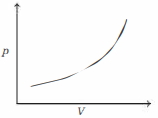
B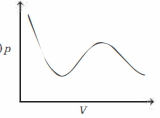
C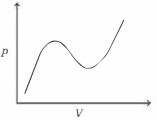
D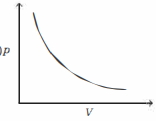
Solution
(B) The van der Waals' equation of state for a real gas is given by $(p + \frac{an^2}{V^2})(V - nb) = nRT$.
For a fixed amount of gas at a constant temperature,the $p-V$ isotherm below the critical temperature exhibits a characteristic '$S$' shape,which represents the region of gas-liquid coexistence.
In this region,the pressure remains constant as the volume changes during the phase transition.
The curve shown in option $(b)$ correctly depicts this behavior,showing the characteristic inflection point and the region of phase transition for a van der Waals' gas.
For a fixed amount of gas at a constant temperature,the $p-V$ isotherm below the critical temperature exhibits a characteristic '$S$' shape,which represents the region of gas-liquid coexistence.
In this region,the pressure remains constant as the volume changes during the phase transition.
The curve shown in option $(b)$ correctly depicts this behavior,showing the characteristic inflection point and the region of phase transition for a van der Waals' gas.
0 likes
View Solution211
MediumMCQ
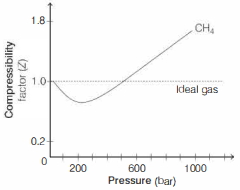
In the following compressibility factor $(Z)$ versus pressure graph at $300 \, K$,the compressibility of $CH_{4}$ at pressure $< 200 \, bar$ deviates from ideal behaviour because
A
the molar volume of $CH_{4}$ is less than its molar volume in the ideal state
B
the molar volume of $CH_{4}$ is same as that in its ideal state
C
intermolecular interactions between $CH_{4}$ molecules decrease
D
the molar volume of $CH_{4}$ is more than its molar volume in the ideal state
Solution
(A) The compressibility factor is defined as $Z = \frac{p V}{n R T}$.
For an ideal gas,$Z = 1$ at all temperatures and pressures.
For a real gas,$Z = \frac{p V_{real}}{n R T} \quad (i)$.
If the gas shows ideal behaviour,then $V_{ideal} = \frac{n R T}{p}$,which implies $\frac{p}{n R T} = \frac{1}{V_{ideal}} \quad (ii)$.
Substituting $(ii)$ into $(i)$,we get $Z = \frac{V_{real}}{V_{ideal}}$.
Considering molar volume,$Z = \frac{(V_{m})_{real}}{(V_{m})_{ideal}}$.
From the given graph,$Z < 1$ at pressure $< 200 \, bar$.
Therefore,$\frac{(V_{m})_{real}}{(V_{m})_{ideal}} < 1$,which implies $(V_{m})_{CH_{4}, real} < (V_{m})_{CH_{4}, ideal}$.
For an ideal gas,$Z = 1$ at all temperatures and pressures.
For a real gas,$Z = \frac{p V_{real}}{n R T} \quad (i)$.
If the gas shows ideal behaviour,then $V_{ideal} = \frac{n R T}{p}$,which implies $\frac{p}{n R T} = \frac{1}{V_{ideal}} \quad (ii)$.
Substituting $(ii)$ into $(i)$,we get $Z = \frac{V_{real}}{V_{ideal}}$.
Considering molar volume,$Z = \frac{(V_{m})_{real}}{(V_{m})_{ideal}}$.
From the given graph,$Z < 1$ at pressure $< 200 \, bar$.
Therefore,$\frac{(V_{m})_{real}}{(V_{m})_{ideal}} < 1$,which implies $(V_{m})_{CH_{4}, real} < (V_{m})_{CH_{4}, ideal}$.
0 likes
View Solution212
MediumMCQ
For one mole of a van der Waals' gas,the compressibility factor $Z = (pV/RT)$ at a fixed volume will certainly decrease,if
[Given : $a$ and $b$ are standard parameters for van der Waals' gas]
[Given : $a$ and $b$ are standard parameters for van der Waals' gas]
A
$b$ increases and $a$ decreases at constant temperature
B
$b$ decreases and $a$ increases at constant temperature
C
temperature increases at constant $a$ and $b$ values
D
$b$ increases at constant $a$ and temperature
Solution
(B) The van der Waals' equation for $n = 1$ mole is $(p + a/V^2)(V - b) = RT$.
Rearranging for the compressibility factor $Z = (pV/RT)$,we get $Z = (V/(V - b)) - (a/(RTV))$.
To decrease $Z$ at a fixed volume $V$,the term $(V/(V - b))$ should decrease and the term $(a/(RTV))$ should increase.
$1$. For $(V/(V - b))$ to decrease,the denominator $(V - b)$ must increase,which means $b$ must decrease.
$2$. For $(a/(RTV))$ to increase,$a$ must increase (at constant $T$ and $V$).
Therefore,$Z$ decreases if $b$ decreases and $a$ increases at constant temperature.
Rearranging for the compressibility factor $Z = (pV/RT)$,we get $Z = (V/(V - b)) - (a/(RTV))$.
To decrease $Z$ at a fixed volume $V$,the term $(V/(V - b))$ should decrease and the term $(a/(RTV))$ should increase.
$1$. For $(V/(V - b))$ to decrease,the denominator $(V - b)$ must increase,which means $b$ must decrease.
$2$. For $(a/(RTV))$ to increase,$a$ must increase (at constant $T$ and $V$).
Therefore,$Z$ decreases if $b$ decreases and $a$ increases at constant temperature.
0 likes
View Solution213
DifficultMCQ
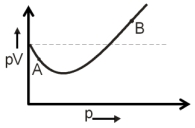
For $1 \ mol$ of gas,the plot of $pV$ vs $p$ is shown below. $p$ is the pressure and $V$ is the volume of the gas. What is the value of compressibility factor at point $A$?
A
$1 - \frac{a}{RTV}$
B
$1 + \frac{b}{V}$
C
$1 - \frac{b}{V}$
D
$1 + \frac{a}{RTV}$
Solution
(A) For $1$ mole of a real gas,the van der Waals equation is $(P + \frac{a}{V_m^2})(V_m - b) = RT$.
At low pressure,the attractive forces are dominant,so $Z < 1$.
The compressibility factor $Z$ is given by $Z = \frac{PV_m}{RT}$.
For low pressure,the approximate form of the van der Waals equation is $Z = 1 - \frac{a}{V_mRT}$.
At point $A$,which lies in the region where $Z < 1$ (below the ideal gas line),the compressibility factor is $1 - \frac{a}{V_mRT}$ (or $1 - \frac{a}{RTV}$).
At low pressure,the attractive forces are dominant,so $Z < 1$.
The compressibility factor $Z$ is given by $Z = \frac{PV_m}{RT}$.
For low pressure,the approximate form of the van der Waals equation is $Z = 1 - \frac{a}{V_mRT}$.
At point $A$,which lies in the region where $Z < 1$ (below the ideal gas line),the compressibility factor is $1 - \frac{a}{V_mRT}$ (or $1 - \frac{a}{RTV}$).
0 likes
View Solution214
MediumMCQ
Arrange the following gases in increasing order of van der Waals constant '$a$':
$A$. $Ar$; $B$. $CH_4$; $C$. $H_2O$; $D$. $C_6H_6$
Choose the correct option from the following:
$A$. $Ar$; $B$. $CH_4$; $C$. $H_2O$; $D$. $C_6H_6$
Choose the correct option from the following:
A
$A < B < C < D$
B
$C < D < B < A$
C
$A < B < D < C$
D
$D < C < B < A$
Solution
(A) The van der Waals constant '$a$' represents the magnitude of intermolecular forces of attraction in a gas.
It is directly proportional to the molecular size and surface area of the gas molecules.
The values for '$a$' (in $\text{bar L}^2 \text{mol}^{-2}$) are:
$(i)$ $Ar = 1.34$
$(ii)$ $CH_4 = 2.25$
$(iii)$ $H_2O = 5.46$
$(iv)$ $C_6H_6 = 18.57$
Comparing these values,the increasing order is $Ar < CH_4 < H_2O < C_6H_6$,which corresponds to $A < B < C < D$.
It is directly proportional to the molecular size and surface area of the gas molecules.
The values for '$a$' (in $\text{bar L}^2 \text{mol}^{-2}$) are:
$(i)$ $Ar = 1.34$
$(ii)$ $CH_4 = 2.25$
$(iii)$ $H_2O = 5.46$
$(iv)$ $C_6H_6 = 18.57$
Comparing these values,the increasing order is $Ar < CH_4 < H_2O < C_6H_6$,which corresponds to $A < B < C < D$.
0 likes
View Solution215
MediumMCQ
$A$ certain quantity of real gas occupies a volume of $0.15 \ dm^3$ at $100 \ atm$ and $500 \ K$ when its compressibility factor is $1.07$. Its volume at $300 \ atm$ and $300 \ K$ (when its compressibility factor is $1.4$) is $........ \times 10^{-4} \ dm^3$ (Nearest integer).
A
$391$
B
$393$
C
$392$
D
$394$
Solution
(B) The compressibility factor $Z$ is defined as $Z = \frac{PV}{nRT}$,which implies $n = \frac{PV}{ZRT}$.
Since the amount of gas $n$ remains constant,we have $\frac{P_1 V_1}{Z_1 T_1} = \frac{P_2 V_2}{Z_2 T_2}$.
Given values: $P_1 = 100 \ atm$,$V_1 = 0.15 \ dm^3$,$T_1 = 500 \ K$,$Z_1 = 1.07$.
$P_2 = 300 \ atm$,$T_2 = 300 \ K$,$Z_2 = 1.4$.
Substituting these values into the equation:
$\frac{100 \times 0.15}{1.07 \times 500} = \frac{300 \times V_2}{1.4 \times 300}$
$V_2 = \frac{100 \times 0.15 \times 1.4 \times 300}{1.07 \times 500 \times 300}$
$V_2 = \frac{15 \times 1.4}{1.07 \times 500} = \frac{21}{535} \approx 0.03925 \ dm^3$.
Converting to $10^{-4} \ dm^3$ units: $0.03925 \times 10^4 \times 10^{-4} = 392.5 \times 10^{-4} \ dm^3$.
Rounding to the nearest integer,we get $393 \times 10^{-4} \ dm^3$.
Since the amount of gas $n$ remains constant,we have $\frac{P_1 V_1}{Z_1 T_1} = \frac{P_2 V_2}{Z_2 T_2}$.
Given values: $P_1 = 100 \ atm$,$V_1 = 0.15 \ dm^3$,$T_1 = 500 \ K$,$Z_1 = 1.07$.
$P_2 = 300 \ atm$,$T_2 = 300 \ K$,$Z_2 = 1.4$.
Substituting these values into the equation:
$\frac{100 \times 0.15}{1.07 \times 500} = \frac{300 \times V_2}{1.4 \times 300}$
$V_2 = \frac{100 \times 0.15 \times 1.4 \times 300}{1.07 \times 500 \times 300}$
$V_2 = \frac{15 \times 1.4}{1.07 \times 500} = \frac{21}{535} \approx 0.03925 \ dm^3$.
Converting to $10^{-4} \ dm^3$ units: $0.03925 \times 10^4 \times 10^{-4} = 392.5 \times 10^{-4} \ dm^3$.
Rounding to the nearest integer,we get $393 \times 10^{-4} \ dm^3$.
0 likes
View Solution216
AdvancedMCQ
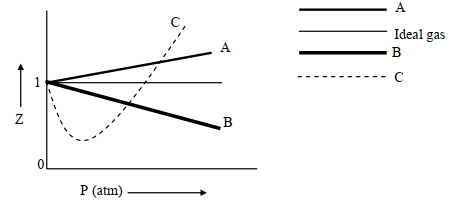
The given graph represents the variation of $Z$ (compressibility factor = $\frac{PV}{nRT}$) versus $P$,for three real gases $A, B$ and $C$. Identify the only incorrect statement.
A
For the gas $A, a=0$ and its dependence on $P$ is linear at all pressure.
B
For the gas $B, b=0$ and its dependence on $P$ is linear at all pressure.
C
For the gas $C$,which is a typical real gas for which neither $a$ nor $b=0$. By knowing the minima and the point of intersection with $Z=1$,$a$ and $b$ can be calculated.
D
At high pressure,the slope is positive for all real gases.
Solution
(D) The compressibility factor $Z$ for a van der Waals gas is given by $Z = 1 + \frac{(b - a/RT)P}{RT}$ at low pressure.
If $a=0$,$Z = 1 + \frac{bP}{RT}$,which is a linear equation with a positive slope (Gas $A$).
If $b=0$,$Z = 1 - \frac{a}{RT^2}P$,which is a linear equation with a negative slope (Gas $B$).
Gas $C$ represents a typical real gas where both $a$ and $b$ are non-zero,showing a curve with a minimum.
Statement $D$ is incorrect because at high pressure,$Z = 1 + \frac{Pb}{RT}$,which is linear with a positive slope,but the graph for gas $B$ shows a negative slope at all pressures,contradicting the statement that the slope is positive for all real gases at high pressure.
If $a=0$,$Z = 1 + \frac{bP}{RT}$,which is a linear equation with a positive slope (Gas $A$).
If $b=0$,$Z = 1 - \frac{a}{RT^2}P$,which is a linear equation with a negative slope (Gas $B$).
Gas $C$ represents a typical real gas where both $a$ and $b$ are non-zero,showing a curve with a minimum.
Statement $D$ is incorrect because at high pressure,$Z = 1 + \frac{Pb}{RT}$,which is linear with a positive slope,but the graph for gas $B$ shows a negative slope at all pressures,contradicting the statement that the slope is positive for all real gases at high pressure.
0 likes
View Solution217
AdvancedMCQ
$A$ gas described by van der Waal's equation:
A
$A, C, D$
B
$D, C, B$
C
$A, D, B$
D
$B, C, D$
Solution
(A) The van der Waal's equation is given by $\left(P + \frac{n^2 a}{V^2}\right)(V - nb) = nRT$.
$A$. At large molar volumes $(V \to \infty)$,the terms $\frac{n^2 a}{V^2}$ and $nb$ become negligible,so the equation reduces to $PV = nRT$,behaving like an ideal gas. This is correct.
$B$. At large pressures,the volume $V$ is small,and the correction terms become significant,so it deviates from ideal behavior. This is incorrect.
$C$. The constants $a$ (intermolecular forces) and $b$ (excluded volume) are characteristic of the specific gas and are independent of temperature. This is correct.
$D$. Since $P = \frac{nRT}{V-nb} - \frac{n^2 a}{V^2}$,the pressure $P$ of a real gas is lower than the ideal pressure $P_{ideal} = \frac{nRT}{V}$ due to the attractive force term $\frac{n^2 a}{V^2}$. This is correct.
$A$. At large molar volumes $(V \to \infty)$,the terms $\frac{n^2 a}{V^2}$ and $nb$ become negligible,so the equation reduces to $PV = nRT$,behaving like an ideal gas. This is correct.
$B$. At large pressures,the volume $V$ is small,and the correction terms become significant,so it deviates from ideal behavior. This is incorrect.
$C$. The constants $a$ (intermolecular forces) and $b$ (excluded volume) are characteristic of the specific gas and are independent of temperature. This is correct.
$D$. Since $P = \frac{nRT}{V-nb} - \frac{n^2 a}{V^2}$,the pressure $P$ of a real gas is lower than the ideal pressure $P_{ideal} = \frac{nRT}{V}$ due to the attractive force term $\frac{n^2 a}{V^2}$. This is correct.
0 likes
View Solution218
DifficultMCQ
The term that corrects for the attractive forces present in a real gas in the van der Waals equation is
A
$nb$
B
$\frac{an^2}{V^2}$
C
$-\frac{an^2}{V^2}$
D
$-nb$
Solution
(B) The van der Waals equation for $n$ moles of a real gas is given by:
$(P + \frac{an^2}{V^2})(V - nb) = nRT$
In this equation,the term $\frac{an^2}{V^2}$ is added to the measured pressure $P$ to account for the intermolecular attractive forces between gas molecules.
Thus,$\frac{an^2}{V^2}$ is the correction term for attractive forces.
$(P + \frac{an^2}{V^2})(V - nb) = nRT$
In this equation,the term $\frac{an^2}{V^2}$ is added to the measured pressure $P$ to account for the intermolecular attractive forces between gas molecules.
Thus,$\frac{an^2}{V^2}$ is the correction term for attractive forces.
0 likes
View Solution219
AdvancedMCQ
$A$ gas has a compressibility factor of $0.5$ and a molar volume of $0.4 \ dm^3 \ mol^{-1}$ at a temperature of $800 \ K$ and pressure $x \ atm$. If it shows ideal gas behaviour at the same temperature and pressure,the molar volume will be $y \ dm^3 \ mol^{-1}$. The value of $x / y$ is . . . . . .
[Use: Gas constant,$R = 8 \times 10^{-2} \ L \ atm \ K^{-1} \ mol^{-1}$ ]
[Use: Gas constant,$R = 8 \times 10^{-2} \ L \ atm \ K^{-1} \ mol^{-1}$ ]
A
$300$
B
$500$
C
$100$
D
$200$
Solution
(C) For the given gas: $Z = 0.5$,$V_m = 0.4 \ dm^3 \ mol^{-1}$,$T = 800 \ K$,$P = x \ atm$.
The compressibility factor is given by $Z = \frac{P V_m}{R T}$.
Substituting the values: $0.5 = \frac{x \times 0.4}{0.08 \times 800}$.
$0.5 = \frac{0.4x}{64}$ $\Rightarrow 0.4x = 32$ $\Rightarrow x = 80 \ atm$.
For ideal gas behavior at the same $T$ and $P$,$PV_m = RT$.
$y = V_m = \frac{RT}{P} = \frac{0.08 \times 800}{80} = 0.8 \ dm^3 \ mol^{-1}$.
Therefore,the value of $\frac{x}{y} = \frac{80}{0.8} = 100$.
The compressibility factor is given by $Z = \frac{P V_m}{R T}$.
Substituting the values: $0.5 = \frac{x \times 0.4}{0.08 \times 800}$.
$0.5 = \frac{0.4x}{64}$ $\Rightarrow 0.4x = 32$ $\Rightarrow x = 80 \ atm$.
For ideal gas behavior at the same $T$ and $P$,$PV_m = RT$.
$y = V_m = \frac{RT}{P} = \frac{0.08 \times 800}{80} = 0.8 \ dm^3 \ mol^{-1}$.
Therefore,the value of $\frac{x}{y} = \frac{80}{0.8} = 100$.
0 likes
View Solution220
AdvancedMCQ
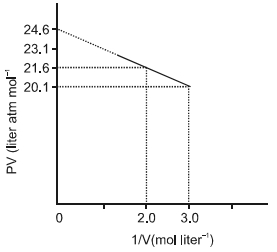
For one mole of a van der Waals gas when $b=0$ and $T=300 \ K$,the $PV$ vs. $1/V$ plot is shown below. The value of the van der Waals constant $a$ (in $\text{atm} \cdot \text{liter}^2 \cdot \text{mol}^{-2}$) is:
A
$1.0$
B
$4.5$
C
$1.5$
D
$3.0$
Solution
(C) The van der Waals equation for $1 \ \text{mole}$ of gas is $(P + \frac{a}{V^2})(V - b) = RT$.
Given $b = 0$,the equation simplifies to $(P + \frac{a}{V^2})V = RT$.
Expanding this,we get $PV + \frac{a}{V} = RT$,which can be rearranged as $PV = RT - a(\frac{1}{V})$.
Comparing this with the equation of a straight line $y = mx + c$,where $y = PV$,$x = \frac{1}{V}$,$m = -a$,and $c = RT$.
The slope of the line is $m = \frac{y_2 - y_1}{x_2 - x_1} = \frac{20.1 - 21.6}{3.0 - 2.0} = \frac{-1.5}{1.0} = -1.5$.
Since the slope $m = -a$,we have $-a = -1.5$,which gives $a = 1.5 \ \text{atm} \cdot \text{liter}^2 \cdot \text{mol}^{-2}$.
Given $b = 0$,the equation simplifies to $(P + \frac{a}{V^2})V = RT$.
Expanding this,we get $PV + \frac{a}{V} = RT$,which can be rearranged as $PV = RT - a(\frac{1}{V})$.
Comparing this with the equation of a straight line $y = mx + c$,where $y = PV$,$x = \frac{1}{V}$,$m = -a$,and $c = RT$.
The slope of the line is $m = \frac{y_2 - y_1}{x_2 - x_1} = \frac{20.1 - 21.6}{3.0 - 2.0} = \frac{-1.5}{1.0} = -1.5$.
Since the slope $m = -a$,we have $-a = -1.5$,which gives $a = 1.5 \ \text{atm} \cdot \text{liter}^2 \cdot \text{mol}^{-2}$.
0 likes
View Solution221
AdvancedMCQ
One mole of a monoatomic real gas satisfies the equation $p(V-b)=RT$ where $b$ is a constant. The relationship of interatomic potential $V(r)$ and interatomic distance $r$ for the gas is given by
A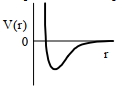
B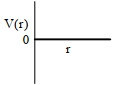
C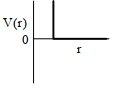
D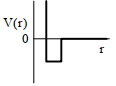
Solution
(C) The given equation is $p(V-b) = RT$. This is a simplified form of the van der Waals equation where the attractive force constant $a$ is assumed to be $0$ $(a = 0)$.
This implies that there are no long-range attractive forces between the gas particles.
However,the constant $b$ represents the excluded volume,which accounts for the finite size of the gas particles and the short-range repulsive forces.
For $r < d$ (where $d$ is the hard-sphere diameter),the potential energy $V(r)$ becomes infinite due to strong repulsion.
For $r \geq d$,since $a = 0$,there is no attraction,so the potential energy $V(r)$ remains $0$.
This corresponds to a hard-sphere potential model,which is represented by a graph that is $0$ for $r > d$ and rises vertically to infinity at $r = d$.
This implies that there are no long-range attractive forces between the gas particles.
However,the constant $b$ represents the excluded volume,which accounts for the finite size of the gas particles and the short-range repulsive forces.
For $r < d$ (where $d$ is the hard-sphere diameter),the potential energy $V(r)$ becomes infinite due to strong repulsion.
For $r \geq d$,since $a = 0$,there is no attraction,so the potential energy $V(r)$ remains $0$.
This corresponds to a hard-sphere potential model,which is represented by a graph that is $0$ for $r > d$ and rises vertically to infinity at $r = d$.
0 likes
View Solution222
MediumMCQ
If the compressibility factor $(Z)$ of a real gas is $1.05$ at $STP$,what is the molar volume of the real gas (in $dm^3$)?
A
$22.40$
B
$21.33$
C
$23.52$
D
$24.50$
Solution
(C) The compressibility factor $(Z)$ is defined as the ratio of the molar volume of a real gas $(V_m)$ to the molar volume of an ideal gas $(V_{ideal})$ at the same temperature and pressure.
$Z = \frac{V_m}{V_{ideal}}$
At $STP$,the molar volume of an ideal gas $(V_{ideal})$ is $22.40 \ dm^3 \ mol^{-1}$.
Given $Z = 1.05$,we can calculate the molar volume of the real gas $(V_m)$ as:
$V_m = Z \times V_{ideal}$
$V_m = 1.05 \times 22.40 \ dm^3 \ mol^{-1}$
$V_m = 23.52 \ dm^3 \ mol^{-1}$
$Z = \frac{V_m}{V_{ideal}}$
At $STP$,the molar volume of an ideal gas $(V_{ideal})$ is $22.40 \ dm^3 \ mol^{-1}$.
Given $Z = 1.05$,we can calculate the molar volume of the real gas $(V_m)$ as:
$V_m = Z \times V_{ideal}$
$V_m = 1.05 \times 22.40 \ dm^3 \ mol^{-1}$
$V_m = 23.52 \ dm^3 \ mol^{-1}$
0 likes
View Solution223
EasyMCQ
Which of the following formulas is used to calculate the compressibility factor?
A
$Z = \frac{PVT}{R}$
B
$Z = \frac{nRT}{PV}$
C
$Z = \frac{PV}{nRT}$
D
$Z = \left(\frac{PV}{RT}\right) \times n$
Solution
(C) The compressibility factor,denoted by $Z$,is defined as the ratio of the actual molar volume of a gas to the molar volume of an ideal gas at the same temperature and pressure.
For $n$ moles of a gas,the ideal gas equation is $PV = nRT$.
Therefore,the compressibility factor is given by the ratio $Z = \frac{PV}{nRT}$.
Thus,option $C$ is the correct formula.
For $n$ moles of a gas,the ideal gas equation is $PV = nRT$.
Therefore,the compressibility factor is given by the ratio $Z = \frac{PV}{nRT}$.
Thus,option $C$ is the correct formula.
0 likes
View Solution224
MediumMCQ
What is the volume of $1 \ mole$ of a real gas at $STP$ $(V_{ideal} = 22.4 \ dm^3)$,if the compressibility factor of the real gas is $1.1$ at $STP$ (in $dm^3$)?
A
$22.40$
B
$23.64$
C
$24.64$
D
$23.50$
Solution
(C) The compressibility factor $Z$ is defined as the ratio of the volume of a real gas $(V_{real})$ to the volume of an ideal gas $(V_{ideal})$ at the same temperature and pressure.
$Z = \frac{V_{real}}{V_{ideal}}$
Given $Z = 1.1$ and $V_{ideal} = 22.4 \ dm^3$ at $STP$.
$V_{real} = Z \times V_{ideal} = 1.1 \times 22.4 \ dm^3 = 24.64 \ dm^3$.
$Z = \frac{V_{real}}{V_{ideal}}$
Given $Z = 1.1$ and $V_{ideal} = 22.4 \ dm^3$ at $STP$.
$V_{real} = Z \times V_{ideal} = 1.1 \times 22.4 \ dm^3 = 24.64 \ dm^3$.
0 likes
View Solution225
EasyMCQ
Which of the following formulae is used to determine the compressibility factor $(Z)$ for the measurement of deviation from ideal behavior?
A
$Z = \frac{nRT}{PV}$
B
$Z = \frac{PV}{nRT}$
C
$Z = \frac{nRT}{V}$
D
$Z = \frac{nRT}{P}$
Solution
(B) The compressibility factor $(Z)$ is defined as the ratio of the actual molar volume of a gas $(V_m)$ to the molar volume of an ideal gas $(V_{ideal})$ at the same temperature and pressure.
For an ideal gas,the equation of state is $PV = nRT$. Thus,$V_{ideal} = \frac{nRT}{P}$.
The compressibility factor is given by the formula $Z = \frac{PV}{nRT}$.
For an ideal gas,$Z = 1$. For real gases,$Z \neq 1$,which indicates the deviation from ideal behavior.
For an ideal gas,the equation of state is $PV = nRT$. Thus,$V_{ideal} = \frac{nRT}{P}$.
The compressibility factor is given by the formula $Z = \frac{PV}{nRT}$.
For an ideal gas,$Z = 1$. For real gases,$Z \neq 1$,which indicates the deviation from ideal behavior.
0 likes
View Solution226
EasyMCQ
The pressure of real gases is less than that of ideal gas because of:
A
Intermolecular attraction
B
Finite size of particles
C
Increase in the number of collisions
D
Increase in the kinetic energy of the molecules
Solution
(A) The force of attraction in real gases tends to show slightly lower pressure as compared to ideal gases.
$p_{ideal} = p_{real} + \frac{a n^2}{V^2}$ or $p_{real} = p_{ideal} - \frac{a n^2}{V^2}$
Here,'$a$' is the constant which measures the magnitude of attractive forces among the molecules of gas,'$n$' is the number of moles present,and '$V$' is the volume of the gas.
$p_{ideal} = p_{real} + \frac{a n^2}{V^2}$ or $p_{real} = p_{ideal} - \frac{a n^2}{V^2}$
Here,'$a$' is the constant which measures the magnitude of attractive forces among the molecules of gas,'$n$' is the number of moles present,and '$V$' is the volume of the gas.
0 likes
View Solution227
EasyMCQ
Identify the wrong relation for real gases :
A
$Z = \frac{V_{ideal}}{V_{real}}$
B
$p_{ideal} = p_{real} + \frac{an^2}{V^2}$
C
$V_{real} = V_{ideal} - nb$
D
$(p + \frac{a}{V^2})(V - b) = RT$
Solution
(A) The wrong relation for real gases is given in option $A$.
The compressibility factor $Z$ is defined as the ratio of the molar volume of a real gas to the molar volume of an ideal gas at the same temperature and pressure.
Therefore,the correct form is $Z = \frac{V_{real}}{V_{ideal}}$.
Option $B$ represents the pressure correction term in the van der Waals equation.
Option $C$ represents the volume correction term where $V_{real} = V_{ideal} + nb$ is generally used for the excluded volume correction,but in the context of the van der Waals equation $(p + \frac{an^2}{V^2})(V - nb) = nRT$,the relation $V_{real} = V_{ideal} + nb$ is standard.
Option $D$ is the van der Waals equation for $1 \text{ mole}$ of gas.
The compressibility factor $Z$ is defined as the ratio of the molar volume of a real gas to the molar volume of an ideal gas at the same temperature and pressure.
Therefore,the correct form is $Z = \frac{V_{real}}{V_{ideal}}$.
Option $B$ represents the pressure correction term in the van der Waals equation.
Option $C$ represents the volume correction term where $V_{real} = V_{ideal} + nb$ is generally used for the excluded volume correction,but in the context of the van der Waals equation $(p + \frac{an^2}{V^2})(V - nb) = nRT$,the relation $V_{real} = V_{ideal} + nb$ is standard.
Option $D$ is the van der Waals equation for $1 \text{ mole}$ of gas.
0 likes
View Solution228
MediumMCQ
$A$ gas deviates from ideal behaviour at a high pressure because its molecules
A
attract one another
B
show the Tyndall effect
C
have kinetic energy
D
are bound by covalent bonds
Solution
(A) At high pressure,the volume of the gas is decreased significantly,which brings the molecules closer to each other.
Due to this proximity,the intermolecular attractive forces become significant.
Consequently,the gas deviates from ideal behaviour as the assumption of negligible intermolecular forces in the kinetic molecular theory of gases no longer holds true.
Due to this proximity,the intermolecular attractive forces become significant.
Consequently,the gas deviates from ideal behaviour as the assumption of negligible intermolecular forces in the kinetic molecular theory of gases no longer holds true.
0 likes
View Solution229
EasyMCQ
At $300 \ K$,the compressibility factor of $1 \ mole$ of a gas is $1.1$. Its pressure is $2.706 \ atm$. What is its volume in $L$? (Given $R=0.082 \ L \ atm \ mol^{-1} \ K^{-1}$).
A
$1$
B
$10$
C
$100$
D
$0.1$
Solution
(B) The compressibility factor $Z$ is defined as $Z = \frac{PV}{nRT}$.
Given values are $Z = 1.1$,$n = 1 \ mol$,$T = 300 \ K$,$P = 2.706 \ atm$,and $R = 0.082 \ L \ atm \ mol^{-1} \ K^{-1}$.
Rearranging the formula for volume $V$: $V = \frac{ZnRT}{P}$.
Substituting the values: $V = \frac{1.1 \times 1 \times 0.082 \times 300}{2.706}$.
$V = \frac{27.06}{2.706} = 10 \ L$.
Given values are $Z = 1.1$,$n = 1 \ mol$,$T = 300 \ K$,$P = 2.706 \ atm$,and $R = 0.082 \ L \ atm \ mol^{-1} \ K^{-1}$.
Rearranging the formula for volume $V$: $V = \frac{ZnRT}{P}$.
Substituting the values: $V = \frac{1.1 \times 1 \times 0.082 \times 300}{2.706}$.
$V = \frac{27.06}{2.706} = 10 \ L$.
0 likes
View Solution230
MediumMCQ
The following data is obtained for one mole of a gas. The gas deviates from ideal behavior in the pressure (in bar) range:
| $P \text{ (bar)}$ | $\frac{PV}{RT}$ |
|---|---|
| $1$ | $1$ |
| $2$ | $1$ |
| $3$ | $1$ |
| $3.1$ | $1.2$ |
| $3.5$ | $1.4$ |
| $4.0$ | $1.5$ |
A
$1$ to $3$
B
$2$ to $4$
C
$3.1$ to $4.0$
D
$1$ to $4$
Solution
(C) For an ideal gas,the compressibility factor $Z = \frac{PV}{RT} = 1$.
From the given data table,we observe that for pressure values $P = 1, 2, \text{ and } 3 \text{ bar}$,the value of $Z = 1$,which indicates ideal behavior.
However,for pressure values ranging from $3.1 \text{ bar}$ to $4.0 \text{ bar}$,the value of $Z$ is greater than $1$ $(1.2, 1.4, 1.5)$,which indicates a deviation from ideal behavior.
Therefore,the gas deviates from ideal behavior in the pressure range $3.1 \text{ to } 4.0 \text{ bar}$.
From the given data table,we observe that for pressure values $P = 1, 2, \text{ and } 3 \text{ bar}$,the value of $Z = 1$,which indicates ideal behavior.
However,for pressure values ranging from $3.1 \text{ bar}$ to $4.0 \text{ bar}$,the value of $Z$ is greater than $1$ $(1.2, 1.4, 1.5)$,which indicates a deviation from ideal behavior.
Therefore,the gas deviates from ideal behavior in the pressure range $3.1 \text{ to } 4.0 \text{ bar}$.
0 likes
View Solution231
EasyMCQ
Identify the conditions at which the van der Waals equation of state changes to the ideal gas equation.
A
High temperature and high pressure
B
Low temperature and high pressure
C
High temperature and low pressure
D
Low temperature and low pressure
Solution
(C) The van der Waals equation is given by $(P + \frac{an^2}{V^2})(V - nb) = nRT$.
For $1 \ mol$ of gas,this becomes $(P + \frac{a}{V^2})(V - b) = RT$.
At high temperature,the kinetic energy of gas molecules is very high,making the intermolecular forces of attraction (represented by the constant $a$) negligible.
At low pressure,the volume $V$ is very large,making the volume occupied by gas molecules (represented by the constant $b$) negligible compared to the total volume.
Under these conditions,$(P + 0)(V - 0) = RT$,which simplifies to $PV = RT$,the ideal gas equation.
For $1 \ mol$ of gas,this becomes $(P + \frac{a}{V^2})(V - b) = RT$.
At high temperature,the kinetic energy of gas molecules is very high,making the intermolecular forces of attraction (represented by the constant $a$) negligible.
At low pressure,the volume $V$ is very large,making the volume occupied by gas molecules (represented by the constant $b$) negligible compared to the total volume.
Under these conditions,$(P + 0)(V - 0) = RT$,which simplifies to $PV = RT$,the ideal gas equation.
0 likes
View Solution232
EasyMCQ
The correct equation for one mole of a real gas is ($a, b$ are constants)
A
$(p + \frac{a}{V^2})(V - b) = RT$
B
$(p - \frac{a}{V^2})(V - b) = RT$
C
$(p + \frac{a}{V^2})(V + b) = RT$
D
$(p + \frac{a}{V})(V - b) = RT$
Solution
(A) The van der Waals equation for $n$ moles of a real gas is given by $(p + \frac{an^2}{V^2})(V - nb) = nRT$.
For $1 \text{ mole}$ of a real gas,we substitute $n = 1$ into the equation.
This results in $(p + \frac{a}{V^2})(V - b) = RT$.
For $1 \text{ mole}$ of a real gas,we substitute $n = 1$ into the equation.
This results in $(p + \frac{a}{V^2})(V - b) = RT$.
0 likes
View Solution233
EasyMCQ
Identify the correct graph for an ideal gas ($y$-axis $= Z$; $x$-axis $= p$).
A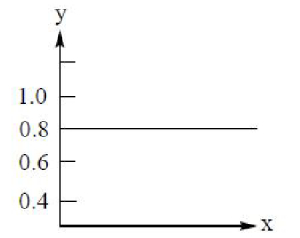
B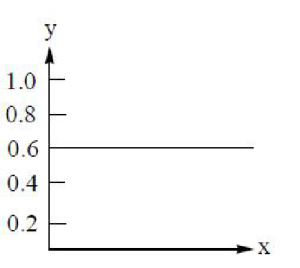
C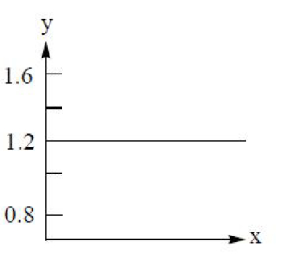
D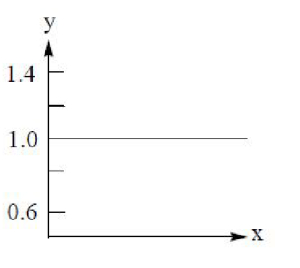
Solution
(D) For an ideal gas,the compressibility factor $Z$ is defined as $Z = \frac{pV}{nRT}$.
For an ideal gas,$pV = nRT$,therefore $Z = 1$ for all values of pressure $p$.
Thus,the graph of $Z$ versus $p$ for an ideal gas is a horizontal straight line at $Z = 1.0$.
For an ideal gas,$pV = nRT$,therefore $Z = 1$ for all values of pressure $p$.
Thus,the graph of $Z$ versus $p$ for an ideal gas is a horizontal straight line at $Z = 1.0$.
0 likes
View Solution234
MediumMCQ
At $300 \ K$,one mole of a gas present in a $10 \ L$ flask exerted a pressure of $2.706 \ atm$. What is its compressibility factor $(Z)$? (Given $R=0.082 \ L \ atm \ mol^{-1} \ K^{-1}$).
A
$1.0$
B
$1.5$
C
$0.91$
D
$1.1$
Solution
(D) The compressibility factor $(Z)$ is defined as $Z = \frac{PV}{nRT}$.
Given values are $P = 2.706 \ atm$,$V = 10 \ L$,$n = 1 \ mol$,$T = 300 \ K$,and $R = 0.082 \ L \ atm \ mol^{-1} \ K^{-1}$.
Substituting these values into the formula:
$Z = \frac{2.706 \times 10}{1 \times 0.082 \times 300}$
$Z = \frac{27.06}{24.6}$
$Z = 1.1$.
Given values are $P = 2.706 \ atm$,$V = 10 \ L$,$n = 1 \ mol$,$T = 300 \ K$,and $R = 0.082 \ L \ atm \ mol^{-1} \ K^{-1}$.
Substituting these values into the formula:
$Z = \frac{2.706 \times 10}{1 \times 0.082 \times 300}$
$Z = \frac{27.06}{24.6}$
$Z = 1.1$.
0 likes
View Solution235
EasyMCQ
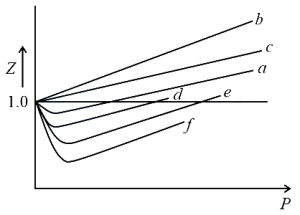
Among the gases $a$,$b$,$c$,$d$,$e$ and $f$,the gases that show only positive deviation from ideal behavior at all pressures in the graph are
A
$a$,$b$,$c$ only
B
$b$,$c$ only
C
$d$,$e$ only
D
$d$,$e$,$f$ only
Solution
(A) In the graph of compressibility factor $Z$ versus pressure $P$,a positive deviation from ideal behavior occurs when $Z > 1$.
This indicates that the gas is less compressible than an ideal gas.
From the given graph,the curves for gases $a$,$b$,and $c$ lie entirely above the line $Z = 1$ for all pressures.
Therefore,gases $a$,$b$,and $c$ show only positive deviation from ideal behavior.
This indicates that the gas is less compressible than an ideal gas.
From the given graph,the curves for gases $a$,$b$,and $c$ lie entirely above the line $Z = 1$ for all pressures.
Therefore,gases $a$,$b$,and $c$ show only positive deviation from ideal behavior.
0 likes
View Solution236
MediumMCQ
Identify the correct variation of pressure $(p)$ and volume $(V)$ of a real gas $(A)$ and an ideal gas $(B)$ at constant temperature. ($y = p$; $x = V$)
A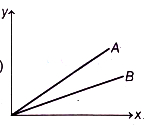
B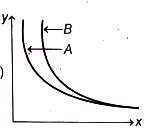
C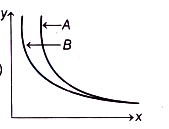
D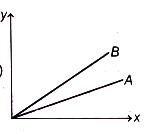
Solution
(C) The ideal gas equation is $pV = nRT$. At constant temperature,$p = \frac{nRT}{V}$,which represents a rectangular hyperbola $(p \propto \frac{1}{V})$.
For a real gas,the behavior deviates from the ideal gas law due to intermolecular forces and finite molecular volume.
At high pressures,the volume of a real gas is greater than that of an ideal gas because of the excluded volume effect ($V_{real} > V_{ideal}$ for a given $p$).
Therefore,for a fixed pressure,the curve for the real gas $(A)$ lies above the curve for the ideal gas $(B)$ in the $p$ vs $V$ plot.
This corresponds to the plot shown in option $C$.
For a real gas,the behavior deviates from the ideal gas law due to intermolecular forces and finite molecular volume.
At high pressures,the volume of a real gas is greater than that of an ideal gas because of the excluded volume effect ($V_{real} > V_{ideal}$ for a given $p$).
Therefore,for a fixed pressure,the curve for the real gas $(A)$ lies above the curve for the ideal gas $(B)$ in the $p$ vs $V$ plot.
This corresponds to the plot shown in option $C$.
0 likes
View Solution237
MediumMCQ
Among the following,the maximum deviation from ideal gas behavior is expected from
A
$He_{(g)}$
B
$CH_{4(g)}$
C
$NH_{3(g)}$
D
$H_{2(g)}$
Solution
(C) The deviation from ideal gas behavior is primarily determined by the magnitude of intermolecular forces and the molecular size,represented by the van der Waals constants $a$ and $b$.
$NH_3$ molecules exhibit strong intermolecular forces due to hydrogen bonding,which is significantly stronger than the London dispersion forces present in $He$,$CH_4$,and $H_2$.
Because $NH_3$ has the highest attractive forces (highest $a$ value) among the given options,it deviates the most from ideal gas behavior under the same conditions of temperature and pressure.
$NH_3$ molecules exhibit strong intermolecular forces due to hydrogen bonding,which is significantly stronger than the London dispersion forces present in $He$,$CH_4$,and $H_2$.
Because $NH_3$ has the highest attractive forces (highest $a$ value) among the given options,it deviates the most from ideal gas behavior under the same conditions of temperature and pressure.
0 likes
View Solution238
MediumMCQ
Which among the following statements is/are incorrect regarding real gases?
$(i)$ Their compressibility factor is never equal to unity $(Z \neq 1)$.
$(ii)$ The deviations from ideal behavior are less at low pressures and high temperatures.
$(iii)$ Intermolecular forces among gas molecules are equal to zero.
$(iv)$ They obey Van der Waals equation,$PV = nRT$.
$(i)$ Their compressibility factor is never equal to unity $(Z \neq 1)$.
$(ii)$ The deviations from ideal behavior are less at low pressures and high temperatures.
$(iii)$ Intermolecular forces among gas molecules are equal to zero.
$(iv)$ They obey Van der Waals equation,$PV = nRT$.
A
$(i), (ii), (iv)$ only
B
$(ii), (iv)$ only
C
$(ii)$ only
D
$(iii), (iv)$ only
Solution
(D) Statement $(i)$ is incorrect because for real gases,$Z$ can be equal to $1$ at specific conditions (Boyle temperature).
Statement $(ii)$ is correct because real gases behave ideally at low pressure and high temperature.
Statement $(iii)$ is incorrect because real gases possess intermolecular forces of attraction.
Statement $(iv)$ is incorrect because real gases obey the Van der Waals equation,$\left(P + \frac{an^2}{V^2}\right)(V - nb) = nRT$,not the ideal gas equation $PV = nRT$.
Therefore,statements $(i), (iii),$ and $(iv)$ are incorrect. However,based on the provided options,$(iii)$ and $(iv)$ are clearly incorrect.
Statement $(ii)$ is correct because real gases behave ideally at low pressure and high temperature.
Statement $(iii)$ is incorrect because real gases possess intermolecular forces of attraction.
Statement $(iv)$ is incorrect because real gases obey the Van der Waals equation,$\left(P + \frac{an^2}{V^2}\right)(V - nb) = nRT$,not the ideal gas equation $PV = nRT$.
Therefore,statements $(i), (iii),$ and $(iv)$ are incorrect. However,based on the provided options,$(iii)$ and $(iv)$ are clearly incorrect.
0 likes
View Solution239
EasyMCQ
$A$ gas deviates most from ideal behavior when it is subjected to
A
low temperature and high pressure
B
high temperature and low pressure
C
high temperature and high pressure
D
low temperature and low pressure
Solution
(A) Real gases deviate from ideal behavior because of the intermolecular forces and the finite volume of gas molecules.
At $high$ $pressure$,the volume of gas molecules becomes significant compared to the total volume.
At $low$ $temperature$,the kinetic energy of molecules decreases,allowing intermolecular forces (van der Waals forces) to become significant.
Therefore,a gas deviates most from ideal behavior under conditions of $low$ $temperature$ and $high$ $pressure$.
At $high$ $pressure$,the volume of gas molecules becomes significant compared to the total volume.
At $low$ $temperature$,the kinetic energy of molecules decreases,allowing intermolecular forces (van der Waals forces) to become significant.
Therefore,a gas deviates most from ideal behavior under conditions of $low$ $temperature$ and $high$ $pressure$.
0 likes
View Solution240
EasyMCQ
$A$ real gas would be most likely to obey the ideal gas laws at
A
low temperature and low pressure
B
high temperature and low pressure
C
high temperature and high pressure
D
low temperature and high pressure
Solution
(B) Real gases exhibit ideal gas behavior at high temperature and low pressure.
Under these conditions,the volume $V$ is very large,and the correction terms in the van der Waals equation,specifically $\frac{a}{V^2}$ and $b$,become negligible.
Consequently,the van der Waals equation,$(p + \frac{an^2}{V^2})(V - nb) = nRT$,simplifies to the ideal gas equation,$pV = nRT$.
Under these conditions,the volume $V$ is very large,and the correction terms in the van der Waals equation,specifically $\frac{a}{V^2}$ and $b$,become negligible.
Consequently,the van der Waals equation,$(p + \frac{an^2}{V^2})(V - nb) = nRT$,simplifies to the ideal gas equation,$pV = nRT$.
0 likes
View Solution241
MediumMCQ
Real gases deviate from ideal behaviour because the molecules
A
Show Brownian movement
B
Contain covalent bond
C
Are colorless
D
Attract each other
Solution
(D) The kinetic molecular theory of gases assumes that there are no intermolecular forces of attraction between gas molecules and that the volume of the gas molecules is negligible compared to the total volume of the gas.
Real gases deviate from ideal behavior primarily because these two assumptions are not strictly true.
Specifically,real gas molecules possess a finite volume and exert intermolecular forces of attraction on each other,which causes them to deviate from the ideal gas law $(PV = nRT)$.
Real gases deviate from ideal behavior primarily because these two assumptions are not strictly true.
Specifically,real gas molecules possess a finite volume and exert intermolecular forces of attraction on each other,which causes them to deviate from the ideal gas law $(PV = nRT)$.
0 likes
View Solution242
EasyMCQ
Which gas among the following is the easiest to liquify?
A
$SO_2$
B
$N_2$
C
$NH_3$
D
$CO_2$
Solution
(A) The ease of liquefaction of a gas depends on the magnitude of intermolecular forces of attraction,which is represented by the van der Waals' constant '$a$'.
Greater the value of '$a$',stronger are the intermolecular forces,and easier it is to liquefy the gas.
Among the given gases,$SO_2$ has the highest value of '$a$' due to its polar nature and strong dipole-dipole interactions.
Additionally,$SO_2$ has a high critical temperature,making it the easiest to liquefy under moderate conditions.
Greater the value of '$a$',stronger are the intermolecular forces,and easier it is to liquefy the gas.
Among the given gases,$SO_2$ has the highest value of '$a$' due to its polar nature and strong dipole-dipole interactions.
Additionally,$SO_2$ has a high critical temperature,making it the easiest to liquefy under moderate conditions.
0 likes
View Solution243
EasyMCQ
Among the following,van der Waals' constant $a$ would be maximum for
A
$H_2$
B
$O_2$
C
$CH_4$
D
$NH_3$
Solution
(D) The van der Waals' constant $a$ represents the magnitude of intermolecular attractive forces in a gas.
Greater intermolecular attraction leads to a higher value of $a$.
Among the given options,$NH_3$ molecules exhibit strong hydrogen bonding in addition to dipole-dipole interactions.
$H_2$,$O_2$,and $CH_4$ only exhibit weaker London dispersion forces.
Therefore,$NH_3$ has the strongest intermolecular forces and the highest value of $a$.
Greater intermolecular attraction leads to a higher value of $a$.
Among the given options,$NH_3$ molecules exhibit strong hydrogen bonding in addition to dipole-dipole interactions.
$H_2$,$O_2$,and $CH_4$ only exhibit weaker London dispersion forces.
Therefore,$NH_3$ has the strongest intermolecular forces and the highest value of $a$.
0 likes
View Solution244
DifficultMCQ
When helium gas is allowed to expand into vacuum,a heating effect is observed. The reason for this is (assume $He$ as a non-ideal gas):
A
$He$ is an inert gas
B
The inversion temperature of helium is very high
C
The inversion temperature of helium is very low
D
$He$ has the lowest boiling point.
Solution
(C) The Joule-Thomson effect describes the temperature change of a real gas as it is forced through a valve or porous plug while kept insulated so that no heat is exchanged with the environment.
For most gases,expansion results in cooling because work is done to overcome intermolecular forces.
However,for gases like $H_2$ and $He$,the inversion temperature is very low (for $He$,it is approximately $40 \ K$).
If the gas temperature is above its inversion temperature during expansion,it exhibits a heating effect instead of cooling.
Since the inversion temperature of $He$ is very low,it shows a heating effect under standard conditions.
For most gases,expansion results in cooling because work is done to overcome intermolecular forces.
However,for gases like $H_2$ and $He$,the inversion temperature is very low (for $He$,it is approximately $40 \ K$).
If the gas temperature is above its inversion temperature during expansion,it exhibits a heating effect instead of cooling.
Since the inversion temperature of $He$ is very low,it shows a heating effect under standard conditions.
0 likes
View Solution245
EasyMCQ
Gases deviate from ideal behaviour at high pressures because the gas molecules
A
attract each other
B
repel each other
C
show Brownian motion
D
obey Tyndall effect
Solution
(A) Real gases deviate from ideal behaviour because they possess intermolecular forces of attraction and have a finite volume.
At high pressures,the molecules are closer to each other,making the intermolecular forces of attraction significant.
These attractive forces pull the molecules inward,reducing the frequency and force of collisions with the container walls,which causes the observed pressure to be lower than the ideal pressure.
At high pressures,the molecules are closer to each other,making the intermolecular forces of attraction significant.
These attractive forces pull the molecules inward,reducing the frequency and force of collisions with the container walls,which causes the observed pressure to be lower than the ideal pressure.
0 likes
View Solution246
MediumMCQ
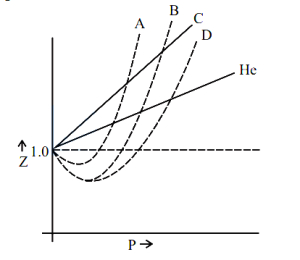
$A$ plot of the compressibility factor $(z)$ vs $P$ is shown below for $H_2, He, N_2, CO_2$ and $SO_2$. Identify the plot for $CO_2$ gas.
A
$A$
B
$B$
C
$C$
D
$D$
Solution
(B) The compressibility factor $z$ is defined as $z = \frac{PV}{nRT}$.
For real gases,the deviation from ideal behavior depends on the magnitude of intermolecular attractive forces.
$CO_2$ is a gas with relatively strong intermolecular forces compared to $H_2, He,$ and $N_2$,leading to a more significant negative deviation $(z < 1)$ at low pressures.
Among the given curves,the curve that shows the deepest dip below the ideal line $(z = 1)$ corresponds to the gas with the strongest attractive forces.
Therefore,curve $A$ represents $SO_2$,curve $B$ represents $CO_2$,curve $C$ represents $N_2$,and curve $D$ represents $H_2$ (which shows $z > 1$ due to dominant repulsive forces).
Thus,the plot for $CO_2$ gas is $B$.
For real gases,the deviation from ideal behavior depends on the magnitude of intermolecular attractive forces.
$CO_2$ is a gas with relatively strong intermolecular forces compared to $H_2, He,$ and $N_2$,leading to a more significant negative deviation $(z < 1)$ at low pressures.
Among the given curves,the curve that shows the deepest dip below the ideal line $(z = 1)$ corresponds to the gas with the strongest attractive forces.
Therefore,curve $A$ represents $SO_2$,curve $B$ represents $CO_2$,curve $C$ represents $N_2$,and curve $D$ represents $H_2$ (which shows $z > 1$ due to dominant repulsive forces).
Thus,the plot for $CO_2$ gas is $B$.
0 likes
View Solution247
EasyMCQ
The compressibility factor $(z)$ is lower for $NH_3$ and $CO_2$ gases than that of $N_2$ gas,because
A
van der Waals constants $'a'$ of $CO_2$ and $NH_3$ are greater than that of $N_2$
B
van der Waals constants $'a'$ of $CO_2$ and $NH_3$ are less than that of $N_2$
C
$'a' (NH_3) > 'a' (N_2)$ but $'a' (CO_2) < 'a' (N_2)$
D
$'a' (NH_3) < 'a' (N_2)$ but $'a' (CO_2) > 'a' (N_2)$
Solution
(A) The compressibility factor $(z)$ is defined as $z = PV/nRT$.
For real gases,the deviation from ideal behavior is primarily due to intermolecular forces of attraction,represented by the van der Waals constant $'a'$.
$A$ higher value of $'a'$ indicates stronger intermolecular forces of attraction.
Stronger attractive forces lead to a greater negative deviation from ideal behavior,resulting in a lower compressibility factor $(z < 1)$.
Since $NH_3$ and $CO_2$ are polar or more easily liquefiable than $N_2$,they have larger values of the constant $'a'$ compared to $N_2$.
Therefore,the compressibility factor is lower for $NH_3$ and $CO_2$ than for $N_2$.
For real gases,the deviation from ideal behavior is primarily due to intermolecular forces of attraction,represented by the van der Waals constant $'a'$.
$A$ higher value of $'a'$ indicates stronger intermolecular forces of attraction.
Stronger attractive forces lead to a greater negative deviation from ideal behavior,resulting in a lower compressibility factor $(z < 1)$.
Since $NH_3$ and $CO_2$ are polar or more easily liquefiable than $N_2$,they have larger values of the constant $'a'$ compared to $N_2$.
Therefore,the compressibility factor is lower for $NH_3$ and $CO_2$ than for $N_2$.
0 likes
View Solution248
EasyMCQ
The compressibility factor of a real gas at high pressure is
A
$1$
B
$1+\frac{RT}{Pb}$
C
$1-\frac{RT}{Pb}$
D
$1+\frac{Pb}{RT}$
Solution
(D) For a real gas,the van der Waals equation is $(P + \frac{an^2}{V^2})(V - nb) = nRT$.
For $1 \ mol$ of gas,this becomes $(P + \frac{a}{V^2})(V - b) = RT$.
At high pressure,the volume $V$ is small,so the term $\frac{a}{V^2}$ is negligible compared to $P$.
The equation simplifies to $P(V - b) = RT$.
$PV - Pb = RT$.
Dividing by $RT$,we get $\frac{PV}{RT} - \frac{Pb}{RT} = 1$.
Since the compressibility factor $Z = \frac{PV}{RT}$,we have $Z - \frac{Pb}{RT} = 1$.
Therefore,$Z = 1 + \frac{Pb}{RT}$.
For $1 \ mol$ of gas,this becomes $(P + \frac{a}{V^2})(V - b) = RT$.
At high pressure,the volume $V$ is small,so the term $\frac{a}{V^2}$ is negligible compared to $P$.
The equation simplifies to $P(V - b) = RT$.
$PV - Pb = RT$.
Dividing by $RT$,we get $\frac{PV}{RT} - \frac{Pb}{RT} = 1$.
Since the compressibility factor $Z = \frac{PV}{RT}$,we have $Z - \frac{Pb}{RT} = 1$.
Therefore,$Z = 1 + \frac{Pb}{RT}$.
0 likes
View Solution249
MediumMCQ
Which of the following gases has the maximum van der Waal's constant '$a$'?
A
$H_2$
B
$He$
C
$CO_2$
D
$NH_3$
Solution
(D) The van der Waal's constant '$a$' is a measure of the magnitude of attractive forces between gas molecules.
Larger molecules or those with stronger intermolecular forces (like dipole-dipole interactions or hydrogen bonding) exhibit higher values of '$a$'.
Among the given options,$NH_3$ is a polar molecule capable of forming hydrogen bonds,which results in stronger intermolecular attractions compared to $H_2$,$He$,and $CO_2$.
Therefore,$NH_3$ has the maximum value of '$a$'.
Larger molecules or those with stronger intermolecular forces (like dipole-dipole interactions or hydrogen bonding) exhibit higher values of '$a$'.
Among the given options,$NH_3$ is a polar molecule capable of forming hydrogen bonds,which results in stronger intermolecular attractions compared to $H_2$,$He$,and $CO_2$.
Therefore,$NH_3$ has the maximum value of '$a$'.
0 likes
View Solution250
MediumMCQ
$1 \ mol$ of a real gas is kept at a high pressure of $100 \ bar$ at $300 \ K$. If the van der Waals constant $b$ is $0.005 \ L \ mol^{-1}$,what are the values of the compressibility factor $Z$ of the gas and the $\%$ deviation of volume from ideality?
| $Z$ | $\%$ Deviation |
A
$1.10 \quad 10$
B
$1.2 \quad 20$
C
$1.02 \quad 2$
D
$1.2 \quad 15$
Solution
(C) For a real gas at high pressure,the van der Waals equation is $P(V - nb) = nRT$.
Given: $n = 1 \ mol$,$T = 300 \ K$,$P = 100 \ bar$,$b = 0.005 \ L \ mol^{-1}$,$R = 0.08314 \ bar \ L \ K^{-1} \ mol^{-1}$.
Substituting the values: $100(V - 0.005) = 1 \times 0.08314 \times 300$.
$100(V - 0.005) = 24.942$.
$V - 0.005 = 0.24942$.
$V_{real} = 0.25442 \ L$.
The ideal volume is $V_{ideal} = \frac{nRT}{P} = \frac{1 \times 0.08314 \times 300}{100} = 0.24942 \ L$.
Compressibility factor $Z = \frac{PV_{real}}{nRT} = \frac{100 \times 0.25442}{1 \times 0.08314 \times 300} = \frac{25.442}{24.942} \approx 1.02$.
$\%$ Deviation of volume $= \frac{V_{real} - V_{ideal}}{V_{real}} \times 100 = \frac{0.25442 - 0.24942}{0.25442} \times 100 = \frac{0.005}{0.25442} \times 100 \approx 1.96 \% \approx 2 \%$.
Thus,the values are $Z = 1.02$ and $\%$ deviation $= 2$.
Given: $n = 1 \ mol$,$T = 300 \ K$,$P = 100 \ bar$,$b = 0.005 \ L \ mol^{-1}$,$R = 0.08314 \ bar \ L \ K^{-1} \ mol^{-1}$.
Substituting the values: $100(V - 0.005) = 1 \times 0.08314 \times 300$.
$100(V - 0.005) = 24.942$.
$V - 0.005 = 0.24942$.
$V_{real} = 0.25442 \ L$.
The ideal volume is $V_{ideal} = \frac{nRT}{P} = \frac{1 \times 0.08314 \times 300}{100} = 0.24942 \ L$.
Compressibility factor $Z = \frac{PV_{real}}{nRT} = \frac{100 \times 0.25442}{1 \times 0.08314 \times 300} = \frac{25.442}{24.942} \approx 1.02$.
$\%$ Deviation of volume $= \frac{V_{real} - V_{ideal}}{V_{real}} \times 100 = \frac{0.25442 - 0.24942}{0.25442} \times 100 = \frac{0.005}{0.25442} \times 100 \approx 1.96 \% \approx 2 \%$.
Thus,the values are $Z = 1.02$ and $\%$ deviation $= 2$.
0 likes
View SolutionStates of Matter — Real gases and Vander waal’s equation · Frequently Asked Questions
1Are these States of Matter questions useful for JEE and NEET?
Yes. All questions in this section are mapped to JEE Main and NEET exam patterns. Previous year questions from JEE Main, NEET, GUJCET and state-level exams are included with full solutions.
2Can I switch to Hindi or Gujarati for these questions?
Yes. Use the language tabs in the hero section or the sidebar to view the same questions and solutions in English, Hindi or Gujarati.
3How do I generate a question paper from this subtopic?
Use the Vedclass Exam Paper Generator — select the chapter and subtopic, set difficulty, and generate Sets A, B, C, D automatically. First 3 chapters of every subject are free.
Vedclass Products
For Students
Vedclass Test Series
Mock tests in real JEE/NEET style with performance analysis. 5-day free trial.
Start Free TrialFor Teachers
Exam Paper Generator
Generate Set A/B/C/D papers from this chapter in 2 minutes. 3 chapters free.
Try FreeFor Institutes
Online Exam Module
Live online exams with unlimited students, 360° analytics & white-label branding.
See DemoFor Teachers & Institutes
Generate a States of Matter Exam Paper in 2 Minutes
Select subtopic & difficulty — Sets A, B, C, D auto-generated with No Repeat logic.
First 3 chapters of every subject are free — no payment required.