
A English
Real gases and Vander waal’s equation Questions in English
Class 11 Chemistry · States of Matter · Real gases and Vander waal’s equation
266+
Questions
English
Language
100%
With Solutions
Showing 15 of 266 questions in English
251
EasyMCQ
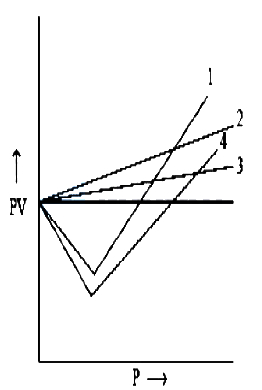
The figure represents $PV$ vs $P$ relation for $CO$,$CH_4$,$H_2$ and $He$ gases under identical conditions. Which curve,shown in the figure,represents $He$ gas?
A
$1$
B
$2$
C
$3$
D
$4$
Solution
(A) For real gases,the deviation from ideal behavior is described by the compressibility factor $Z = PV/nRT$.
For gases with weak intermolecular forces like $H_2$ and $He$,the repulsive forces dominate even at low pressures,causing $PV$ to increase continuously with pressure.
Among $H_2$ and $He$,$He$ has weaker intermolecular forces and a smaller molecular size,leading to a steeper slope in the $PV$ vs $P$ plot.
In the given graph,curves $1$ and $2$ show a continuous increase in $PV$ with $P$. Curve $1$ has a steeper slope than curve $2$.
Therefore,curve $1$ represents $He$ and curve $2$ represents $H_2$.
For gases with weak intermolecular forces like $H_2$ and $He$,the repulsive forces dominate even at low pressures,causing $PV$ to increase continuously with pressure.
Among $H_2$ and $He$,$He$ has weaker intermolecular forces and a smaller molecular size,leading to a steeper slope in the $PV$ vs $P$ plot.
In the given graph,curves $1$ and $2$ show a continuous increase in $PV$ with $P$. Curve $1$ has a steeper slope than curve $2$.
Therefore,curve $1$ represents $He$ and curve $2$ represents $H_2$.
0 likes
View Solution252
EasyMCQ
Which of the following indicates a plot of compressibility factor $(Z)$ $vs$ $p$ at room temperature for helium?
A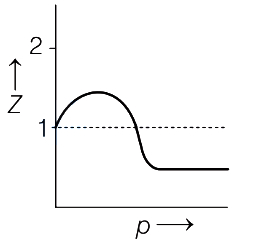
B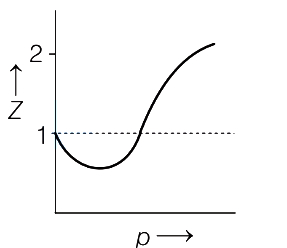
C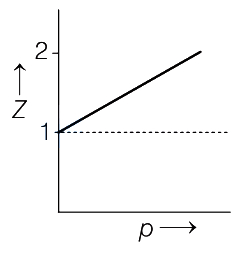
D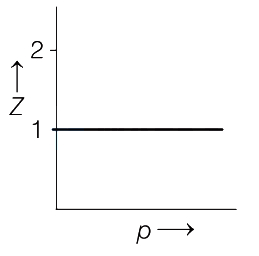
Solution
(C) The compressibility factor $Z$ is defined as $Z = \frac{pV}{nRT}$.
For real gases,$Z$ deviates from $1$.
Helium $(He)$ is a light,noble gas with very weak intermolecular forces of attraction. For such gases,the volume correction term $(nb)$ dominates over the attractive force term $(a/V^2)$ even at moderate pressures.
Therefore,for helium,$Z$ is always greater than $1$ $(Z > 1)$ and increases linearly with an increase in pressure $p$.
This corresponds to a graph that starts at $Z=1$ and shows a positive slope as $p$ increases.
For real gases,$Z$ deviates from $1$.
Helium $(He)$ is a light,noble gas with very weak intermolecular forces of attraction. For such gases,the volume correction term $(nb)$ dominates over the attractive force term $(a/V^2)$ even at moderate pressures.
Therefore,for helium,$Z$ is always greater than $1$ $(Z > 1)$ and increases linearly with an increase in pressure $p$.
This corresponds to a graph that starts at $Z=1$ and shows a positive slope as $p$ increases.
0 likes
View Solution253
MediumMCQ
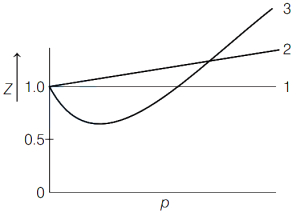
Which of the curves $(Z \ vs \ p)$ will be followed by a real gas?
A
Pathway $3$ only
B
Pathways $2$ and $3$ only
C
Pathways $1$ and $2$ only
D
Pathway $2$ only
Solution
(B) The compressibility factor $Z$ is defined as $Z = \frac{pV}{nRT}$.
For an ideal gas,$Z = 1$ at all pressures,which corresponds to curve $1$.
Real gases deviate from ideal behavior.
At low pressures,attractive forces dominate,leading to $Z < 1$ (negative deviation),as seen in curve $3$.
At high pressures,repulsive forces dominate,leading to $Z > 1$ (positive deviation),as seen in curves $2$ and $3$.
Therefore,curves $2$ and $3$ represent the behavior of real gases at different conditions of temperature and pressure.
For an ideal gas,$Z = 1$ at all pressures,which corresponds to curve $1$.
Real gases deviate from ideal behavior.
At low pressures,attractive forces dominate,leading to $Z < 1$ (negative deviation),as seen in curve $3$.
At high pressures,repulsive forces dominate,leading to $Z > 1$ (positive deviation),as seen in curves $2$ and $3$.
Therefore,curves $2$ and $3$ represent the behavior of real gases at different conditions of temperature and pressure.
0 likes
View Solution254
MediumMCQ
The compressibility factor $Z = \frac{pV}{nRT}$ for hydrogen gas at $273 \ K$ and $1 \ atm$ pressure is
A
zero
B
one
C
greater than one
D
between zero and one
Solution
(C) At $NTP$ condition $(p = 1 \ atm, T = 273 \ K)$:
For $1 \ mol$ of $H_2$ gas,the molar volume is slightly greater than the ideal gas volume of $22.4 \ L \ mol^{-1}$ due to repulsive forces.
Using the formula $Z = \frac{pV}{nRT}$,where $R = 0.0821 \ L \ atm \ K^{-1} \ mol^{-1}$.
For hydrogen gas at $273 \ K$ and $1 \ atm$,the value of $Z$ is approximately $1.0006$.
Since $Z > 1$,the compressibility factor for hydrogen gas under these conditions is greater than one.
For $1 \ mol$ of $H_2$ gas,the molar volume is slightly greater than the ideal gas volume of $22.4 \ L \ mol^{-1}$ due to repulsive forces.
Using the formula $Z = \frac{pV}{nRT}$,where $R = 0.0821 \ L \ atm \ K^{-1} \ mol^{-1}$.
For hydrogen gas at $273 \ K$ and $1 \ atm$,the value of $Z$ is approximately $1.0006$.
Since $Z > 1$,the compressibility factor for hydrogen gas under these conditions is greater than one.
0 likes
View Solution255
MediumMCQ
What is the correction term in the pressure for real gas in comparison to the ideal gas?
A
$a n^2 / V^2$
B
$a V^2 / n^2$
C
$a n^2 / V^2$
D
$a n^2 / V - n b$
Solution
(C) According to the van der Waals equation for real gases,the pressure correction term is added to the observed pressure to account for intermolecular forces.
The corrected pressure is given by $P_{ideal} = P_{observed} + \frac{a n^2}{V^2}$.
Therefore,the correction term for pressure is $\frac{a n^2}{V^2}$.
Thus,option $(C)$ is the correct answer.
The corrected pressure is given by $P_{ideal} = P_{observed} + \frac{a n^2}{V^2}$.
Therefore,the correction term for pressure is $\frac{a n^2}{V^2}$.
Thus,option $(C)$ is the correct answer.
0 likes
View Solution256
DifficultMCQ
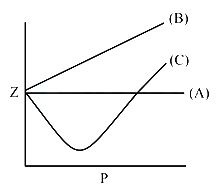
The variation of the compressibility factor $(Z)$ with pressure $(P$ in $bar)$ for some gases is shown in the figure below. Identify the gases $(A)$,$(B)$,and $(C)$.
A
Real Gas,$N_2, CO_2$
B
Ideal Gas,$H_2, CO_2$
C
Ideal Gas,$CO_2, H_2$
D
Real Gas,$H_2, CO_2$
Solution
(B) The compressibility factor $(Z)$ is defined as $Z = \frac{PV_m}{RT}$.
For an ideal gas,$Z = 1$ at all pressures,which corresponds to the horizontal line $(A)$.
Real gases show deviations from ideal behavior.
For gases like $H_2$ and $He$,the intermolecular forces are weak,and the volume effect dominates,leading to $Z > 1$ at all pressures,as shown by curve $(B)$.
For easily liquefiable gases like $CO_2$,the attractive forces dominate at low pressures $(Z < 1)$,while the volume effect dominates at high pressures $(Z > 1)$,resulting in the characteristic dip shown by curve $(C)$.
Therefore,$(A)$ is an ideal gas,$(B)$ is $H_2$,and $(C)$ is $CO_2$.
For an ideal gas,$Z = 1$ at all pressures,which corresponds to the horizontal line $(A)$.
Real gases show deviations from ideal behavior.
For gases like $H_2$ and $He$,the intermolecular forces are weak,and the volume effect dominates,leading to $Z > 1$ at all pressures,as shown by curve $(B)$.
For easily liquefiable gases like $CO_2$,the attractive forces dominate at low pressures $(Z < 1)$,while the volume effect dominates at high pressures $(Z > 1)$,resulting in the characteristic dip shown by curve $(C)$.
Therefore,$(A)$ is an ideal gas,$(B)$ is $H_2$,and $(C)$ is $CO_2$.
0 likes
View Solution257
EasyMCQ
The van der Waals' equation for $0.5 \ mol$ of a gas is
A
$\left(p+\frac{a}{4 V^2}\right)\left(V-0.5 b\right)=0.5 R T$
B
$\left(p+\frac{a}{4 V^2}\right)(2 V-b)=R T$
C
$\left(p+\frac{a}{4 V^2}\right)(V-2 b)=0.5 R T$
D
$\left(p+\frac{a}{4 V^2}\right)(V-b)=0.5 R T$
Solution
(B) The van der Waals' equation for $n$ moles of a gas is given by $\left(p+\frac{a n^2}{V^2}\right)(V-n b)=n R T$.
Given $n = 0.5 \ mol$,we substitute this into the equation:
$\left(p+\frac{a(0.5)^2}{V^2}\right)(V-0.5 b) = 0.5 R T$
$\left(p+\frac{a}{4 V^2}\right)(V-0.5 b) = 0.5 R T$
Multiplying both sides by $2$,we get:
$\left(p+\frac{a}{4 V^2}\right)(2V-b) = R T$.
Thus,option $B$ is correct.
Given $n = 0.5 \ mol$,we substitute this into the equation:
$\left(p+\frac{a(0.5)^2}{V^2}\right)(V-0.5 b) = 0.5 R T$
$\left(p+\frac{a}{4 V^2}\right)(V-0.5 b) = 0.5 R T$
Multiplying both sides by $2$,we get:
$\left(p+\frac{a}{4 V^2}\right)(2V-b) = R T$.
Thus,option $B$ is correct.
0 likes
View Solution258
EasyMCQ
Which of the following represents the Van der Waals equation for $n$ moles of a gas?
A
$\left(P+\frac{a}{V^2}\right)(V-b)=nRT$
B
$P(V-b)=nRT$
C
$\left(P+\frac{a}{V^2}\right)V=nRT$
D
$PV+\frac{an^2}{V}-\frac{abn^3}{V^2}-Pnb=nRT$
Solution
(D) The Van der Waals equation is a modified form of the ideal gas equation that accounts for the non-ideal behavior of real gases.
For $n$ moles of a real gas,the equation is given by:
$\left(P+\frac{an^2}{V^2}\right)(V-nb)=nRT$
Expanding this expression:
$P(V-nb) + \left(\frac{an^2}{V^2}\right)(V-nb) = nRT$
$PV - Pnb + \frac{an^2}{V} - \frac{an^2b}{V^2} = nRT$
Rearranging the terms,we get:
$PV + \frac{an^2}{V} - \frac{an^2b}{V^2} - Pnb = nRT$
Thus,option $D$ represents the expanded form of the Van der Waals equation.
For $n$ moles of a real gas,the equation is given by:
$\left(P+\frac{an^2}{V^2}\right)(V-nb)=nRT$
Expanding this expression:
$P(V-nb) + \left(\frac{an^2}{V^2}\right)(V-nb) = nRT$
$PV - Pnb + \frac{an^2}{V} - \frac{an^2b}{V^2} = nRT$
Rearranging the terms,we get:
$PV + \frac{an^2}{V} - \frac{an^2b}{V^2} - Pnb = nRT$
Thus,option $D$ represents the expanded form of the Van der Waals equation.
0 likes
View Solution259
MediumMCQ
Under which one of the following conditions do real gases approach the ideal gas behaviour?
A
Low temperature and high pressure
B
High temperature and high pressure
C
High temperature and low pressure
D
Low temperature and low pressure
Solution
(C) Real gases deviate from ideal behaviour due to intermolecular forces and the finite volume of gas molecules.
At high temperature,the kinetic energy of gas molecules is high,making intermolecular forces negligible.
At low pressure,the volume occupied by the gas molecules becomes negligible compared to the total volume of the container.
Therefore,real gases approach ideal gas behaviour under conditions of high temperature and low pressure.
At high temperature,the kinetic energy of gas molecules is high,making intermolecular forces negligible.
At low pressure,the volume occupied by the gas molecules becomes negligible compared to the total volume of the container.
Therefore,real gases approach ideal gas behaviour under conditions of high temperature and low pressure.
0 likes
View Solution260
MediumMCQ
Which one of the following represents Boyle's temperature of a gas?
A
The temperature at which an ideal gas obeys Boyle's law.
B
The temperature at which the compressibility factor is less than $1$ for a real gas.
C
The temperature at which a gas obeys ideal gas law over an appreciable range of pressure.
D
The temperature at which the compressibility factor deviates from $1$ for an ideal gas.
Solution
(C) Boyle's temperature $(T_B)$ is defined as the temperature at which a real gas behaves like an ideal gas over an appreciable range of pressure.
At this temperature,the second virial coefficient of the real gas becomes zero,and the gas follows the ideal gas equation $PV = nRT$ for a significant pressure range.
At this temperature,the second virial coefficient of the real gas becomes zero,and the gas follows the ideal gas equation $PV = nRT$ for a significant pressure range.
0 likes
View Solution261
EasyMCQ
The compressibility factor for a van der Waal gas at high pressure is
A
$1+\frac{RT}{Pb}$
B
$1+\frac{Pb}{RT}$
C
$1-\frac{Pb}{RT}$
D
$1$
Solution
(B) For $1 \ mol$ of a van der Waal gas,the equation is $(P+\frac{a}{V^2})(V-b)=RT$.
At high pressure,the term $\frac{a}{V^2}$ is negligible compared to $P$,so $P+\frac{a}{V^2} \approx P$.
Substituting this into the equation,we get $P(V-b)=RT$.
Expanding this gives $PV-Pb=RT$,which rearranges to $PV=RT+Pb$.
The compressibility factor $z$ is defined as $z=\frac{PV}{RT}$.
Dividing the equation $PV=RT+Pb$ by $RT$,we get $z=\frac{RT}{RT}+\frac{Pb}{RT}$.
Therefore,$z=1+\frac{Pb}{RT}$.
At high pressure,the term $\frac{a}{V^2}$ is negligible compared to $P$,so $P+\frac{a}{V^2} \approx P$.
Substituting this into the equation,we get $P(V-b)=RT$.
Expanding this gives $PV-Pb=RT$,which rearranges to $PV=RT+Pb$.
The compressibility factor $z$ is defined as $z=\frac{PV}{RT}$.
Dividing the equation $PV=RT+Pb$ by $RT$,we get $z=\frac{RT}{RT}+\frac{Pb}{RT}$.
Therefore,$z=1+\frac{Pb}{RT}$.
0 likes
View Solution262
MediumMCQ
For a van der Waals' gas,the term $\left(\frac{a b}{V^{2}}\right)$ represents some
A
pressure
B
energy
C
critical density
D
molar mass
Solution
(B) The dimensions of the term $\left(\frac{a b}{V^{2}}\right)$ can be analyzed as follows:
In the van der Waals' equation,the term $\left(\frac{a}{V^{2}}\right)$ has the dimensions of pressure $(P)$.
Therefore,$\left(\frac{a}{V^{2}}\right) \times b = \text{Pressure} \times \text{Volume}$.
Since $\text{Pressure} = \frac{\text{Force}}{\text{Area}}$,we have $\text{Pressure} \times \text{Volume} = \frac{\text{Force}}{\text{Area}} \times \text{Volume} = \frac{MLT^{-2}}{L^{2}} \times L^{3} = ML^{2} T^{-2}$.
This dimension $(ML^{2} T^{-2})$ corresponds to energy (joule).
Thus,the term $\left(\frac{a b}{V^{2}}\right)$ represents energy.
In the van der Waals' equation,the term $\left(\frac{a}{V^{2}}\right)$ has the dimensions of pressure $(P)$.
Therefore,$\left(\frac{a}{V^{2}}\right) \times b = \text{Pressure} \times \text{Volume}$.
Since $\text{Pressure} = \frac{\text{Force}}{\text{Area}}$,we have $\text{Pressure} \times \text{Volume} = \frac{\text{Force}}{\text{Area}} \times \text{Volume} = \frac{MLT^{-2}}{L^{2}} \times L^{3} = ML^{2} T^{-2}$.
This dimension $(ML^{2} T^{-2})$ corresponds to energy (joule).
Thus,the term $\left(\frac{a b}{V^{2}}\right)$ represents energy.
0 likes
View Solution263
MediumMCQ
The compressibility factor $(Z)$ of one mole of a van der Waals' gas of negligible '$a$' value is
A
$1$
B
$\frac{b p}{R T}$
C
$1+\frac{b p}{R T}$
D
$1-\frac{b p}{R T}$
Solution
(C) The van der Waals' equation for $1$ mole of gas is $(p+\frac{a}{V^2})(V-b) = RT$.
Since '$a$' is negligible,the equation simplifies to $p(V-b) = RT$.
Expanding this,we get $pV - pb = RT$.
Dividing both sides by $RT$,we get $\frac{pV}{RT} - \frac{pb}{RT} = 1$.
Since the compressibility factor $Z = \frac{pV}{RT}$,the equation becomes $Z - \frac{pb}{RT} = 1$.
Therefore,$Z = 1 + \frac{pb}{RT}$.
Since '$a$' is negligible,the equation simplifies to $p(V-b) = RT$.
Expanding this,we get $pV - pb = RT$.
Dividing both sides by $RT$,we get $\frac{pV}{RT} - \frac{pb}{RT} = 1$.
Since the compressibility factor $Z = \frac{pV}{RT}$,the equation becomes $Z - \frac{pb}{RT} = 1$.
Therefore,$Z = 1 + \frac{pb}{RT}$.
0 likes
View Solution264
EasyMCQ
$A$ van der Waals' gas may behave ideally when
A
the volume is very low
B
the temperature is very high
C
the pressure is very low
D
the temperature,pressure and volume all are very high
Solution
(C) The van der Waals' equation for $n$ moles of a gas is $(P + \frac{an^2}{V^2})(V - nb) = nRT$.
At very low pressure,the volume $V$ is very large,making the term $\frac{a}{V^2}$ negligible.
Also,the volume $V$ is much larger than the excluded volume $b$,so $(V - b) \approx V$.
Thus,the equation reduces to $PV = RT$,which is the ideal gas equation.
Therefore,a van der Waals' gas behaves ideally at very low pressure.
At very low pressure,the volume $V$ is very large,making the term $\frac{a}{V^2}$ negligible.
Also,the volume $V$ is much larger than the excluded volume $b$,so $(V - b) \approx V$.
Thus,the equation reduces to $PV = RT$,which is the ideal gas equation.
Therefore,a van der Waals' gas behaves ideally at very low pressure.
0 likes
View Solution265
EasyMCQ
Four gases $P, Q, R$ and $S$ have almost same values of $b$ but their $a$ values ($a, b$ are van der Waals' constants) are in the order $Q < R < S < P$. At a particular temperature among the four gases,the most liquefiable one is
A
$P$
B
$Q$
C
$R$
D
$S$
Solution
(A) The van der Waals constant $a$ represents the magnitude of intermolecular attractive forces in a gas.
Higher the value of $a$,stronger are the intermolecular forces,and consequently,the gas is more easily liquefiable.
Given the order of $a$ values is $Q < R < S < P$,the gas $P$ has the highest value of $a$.
Therefore,$P$ is the most liquefiable gas among the given options.
Higher the value of $a$,stronger are the intermolecular forces,and consequently,the gas is more easily liquefiable.
Given the order of $a$ values is $Q < R < S < P$,the gas $P$ has the highest value of $a$.
Therefore,$P$ is the most liquefiable gas among the given options.
0 likes
View SolutionStates of Matter — Real gases and Vander waal’s equation · Frequently Asked Questions
1Are these States of Matter questions useful for JEE and NEET?
Yes. All questions in this section are mapped to JEE Main and NEET exam patterns. Previous year questions from JEE Main, NEET, GUJCET and state-level exams are included with full solutions.
2Can I switch to Hindi or Gujarati for these questions?
Yes. Use the language tabs in the hero section or the sidebar to view the same questions and solutions in English, Hindi or Gujarati.
3How do I generate a question paper from this subtopic?
Use the Vedclass Exam Paper Generator — select the chapter and subtopic, set difficulty, and generate Sets A, B, C, D automatically. First 3 chapters of every subject are free.
Vedclass Products
For Students
Vedclass Test Series
Mock tests in real JEE/NEET style with performance analysis. 5-day free trial.
Start Free TrialFor Teachers
Exam Paper Generator
Generate Set A/B/C/D papers from this chapter in 2 minutes. 3 chapters free.
Try FreeFor Institutes
Online Exam Module
Live online exams with unlimited students, 360° analytics & white-label branding.
See DemoFor Teachers & Institutes
Generate a States of Matter Exam Paper in 2 Minutes
Select subtopic & difficulty — Sets A, B, C, D auto-generated with No Repeat logic.
First 3 chapters of every subject are free — no payment required.