
A English
Critical state and Liquefaction of gases Questions in English
Class 11 Chemistry · States of Matter · Critical state and Liquefaction of gases
79+
Questions
English
Language
100%
With Solutions
Showing 50 of 79 questions in English
1
MediumMCQ
The temperature and pressure at which ice,liquid water,and water vapour can exist together are:
A
$0\,^\circ C, 1\, atm$
B
$2\,^\circ C, 4.7\, atm$
C
$0.01\,^\circ C, 4.58\, mm \, Hg$
D
$-2\,^\circ C, 4.7\, mm \, Hg$
Solution
(C) The point at which all three phases of water (ice,liquid water,and water vapour) coexist in equilibrium is known as the triple point of water.
This occurs at a temperature of $0.01\,^\circ C$ $(273.16\, K)$ and a pressure of $4.58\, mm \, Hg$ $(611.657\, Pa)$.
This occurs at a temperature of $0.01\,^\circ C$ $(273.16\, K)$ and a pressure of $4.58\, mm \, Hg$ $(611.657\, Pa)$.
0 likes
View Solution2
MediumMCQ
Which set of conditions represents the easiest way to liquefy a gas?
A
Low temperature and high pressure
B
High temperature and low pressure
C
Low temperature and low pressure
D
High temperature and high pressure
Solution
(A) Liquefaction of a gas occurs when intermolecular forces become significant enough to hold molecules together in a liquid state.
Low temperature decreases the kinetic energy of gaseous molecules,bringing them closer together.
High pressure forces the molecules into a smaller volume,further decreasing the intermolecular distance.
Therefore,the combination of low temperature and high pressure is the most effective condition for liquefaction.
Low temperature decreases the kinetic energy of gaseous molecules,bringing them closer together.
High pressure forces the molecules into a smaller volume,further decreasing the intermolecular distance.
Therefore,the combination of low temperature and high pressure is the most effective condition for liquefaction.
0 likes
View Solution3
MediumMCQ
However great the pressure,a gas cannot be liquefied above its
A
Boyle temperature
B
Inversion temperature
C
Critical temperature
D
Room temperature
Solution
(C) The critical temperature $(T_c)$ of a gas is the temperature above which it cannot be liquefied,no matter how much pressure is applied.
Above this temperature,the substance exists only as a gas and cannot be converted into a liquid state by compression.
Above this temperature,the substance exists only as a gas and cannot be converted into a liquid state by compression.
0 likes
View Solution4
EasyMCQ
$A$ gas can be liquefied:
A
Above its critical temperature
B
At its critical temperature
C
Below its critical temperature
D
At any temperature
Solution
(C) The temperature below which a gas can be liquefied by the application of pressure alone is called the critical temperature $(T_c)$.
Therefore,a gas can be liquefied only when its temperature is below its critical temperature.
Therefore,a gas can be liquefied only when its temperature is below its critical temperature.
0 likes
View Solution5
MediumMCQ
Which of the following statements is correct regarding the critical temperature $(T_c)$?
A
It is the highest temperature at which liquid and vapour can coexist.
B
Beyond the critical temperature,there is no distinction between the two phases and a gas cannot be liquefied by compression.
C
At the critical temperature $(T_c)$,the surface tension of the system is zero.
D
All of the above.
Solution
(D) The critical temperature $(T_c)$ is defined as the temperature above which a gas cannot be liquefied,regardless of the pressure applied.
At this temperature,the density of the liquid phase becomes equal to the density of the vapour phase,meaning the meniscus between the two phases disappears.
Consequently,the surface tension of the system becomes zero at the critical temperature.
Therefore,all the given statements are correct.
At this temperature,the density of the liquid phase becomes equal to the density of the vapour phase,meaning the meniscus between the two phases disappears.
Consequently,the surface tension of the system becomes zero at the critical temperature.
Therefore,all the given statements are correct.
0 likes
View Solution6
EasyMCQ
Which of the following conditions is most favorable for the liquefaction of a gas?
A
Low temperature and high pressure
B
High temperature and low pressure
C
Low temperature and low pressure
D
High temperature and high pressure
Solution
(A) Liquefaction of a gas occurs when the intermolecular forces become strong enough to hold the molecules together in a liquid state.
Decreasing the temperature reduces the kinetic energy of the gas molecules,allowing them to come closer.
Increasing the pressure forces the molecules into a smaller volume,further decreasing the intermolecular distance.
Therefore,$Low \ temperature$ and $High \ pressure$ are the most favorable conditions for liquefaction.
Decreasing the temperature reduces the kinetic energy of the gas molecules,allowing them to come closer.
Increasing the pressure forces the molecules into a smaller volume,further decreasing the intermolecular distance.
Therefore,$Low \ temperature$ and $High \ pressure$ are the most favorable conditions for liquefaction.
0 likes
View Solution7
EasyMCQ
Gases can be liquefied by:
A
Cooling
B
Increasing pressure
C
Both $(A)$ and $(B)$
D
None of these
Solution
(C) The liquefaction of gases is achieved by reducing the temperature (cooling) and increasing the pressure.
By cooling,the kinetic energy of gas molecules decreases,and by increasing pressure,the molecules are brought closer together,leading to the formation of liquid state.
Therefore,both cooling and increasing pressure are required.
By cooling,the kinetic energy of gas molecules decreases,and by increasing pressure,the molecules are brought closer together,leading to the formation of liquid state.
Therefore,both cooling and increasing pressure are required.
0 likes
View Solution8
AdvancedMCQ
For gases $W, X, Y$ and $Z$,the van der Waals constants are given below. Which gas has the highest critical temperature?
| Gas | $a$ (atm $L^2$ mol$^{-2}$) | $b$ ($L$ mol$^{-1}$) |
|---|---|---|
| $W$ | $4.0$ | $0.027$ |
| $X$ | $8.0$ | $0.030$ |
| $Y$ | $6.0$ | $0.032$ |
| $Z$ | $12.0$ | $0.027$ |
A
$W$
B
$X$
C
$Y$
D
$Z$
Solution
(D) The critical temperature $(T_c)$ is given by the formula: $T_c = \frac{8a}{27Rb}$.
Since $T_c \propto \frac{a}{b}$,we calculate the ratio $\frac{a}{b}$ for each gas:
For $W$: $\frac{4.0}{0.027} \approx 148.15$
For $X$: $\frac{8.0}{0.030} \approx 266.67$
For $Y$: $\frac{6.0}{0.032} = 187.5$
For $Z$: $\frac{12.0}{0.027} \approx 444.44$
Since gas $Z$ has the highest ratio of $\frac{a}{b}$,it has the highest critical temperature.
Since $T_c \propto \frac{a}{b}$,we calculate the ratio $\frac{a}{b}$ for each gas:
For $W$: $\frac{4.0}{0.027} \approx 148.15$
For $X$: $\frac{8.0}{0.030} \approx 266.67$
For $Y$: $\frac{6.0}{0.032} = 187.5$
For $Z$: $\frac{12.0}{0.027} \approx 444.44$
Since gas $Z$ has the highest ratio of $\frac{a}{b}$,it has the highest critical temperature.
0 likes
View Solution9
MediumMCQ
At what point does surface tension vanish?
A
Boiling point
B
Critical point
C
Condensation point
D
Triple point
Solution
(B) At the $Critical \ point$,the density of the liquid and vapor phases becomes identical,and the interface between them disappears. Consequently,the surface tension becomes zero.
0 likes
View Solution10
EasyMCQ
Under what conditions will an ideal gas,which follows the kinetic gas equation,undergo liquefaction?
A
Its temperature is higher than the critical temperature.
B
Its pressure is higher than the critical pressure but the temperature is lower than the critical temperature.
C
Its pressure is higher than the critical pressure.
D
It cannot be liquefied at any value of $P$ and $T$.
Solution
(D) An ideal gas cannot be liquefied because it assumes the absence of intermolecular forces of attraction.
Since liquefaction requires the presence of intermolecular forces to bring gas molecules together,an ideal gas,by definition,does not possess these forces and therefore cannot be liquefied under any conditions of $P$ and $T$.
Since liquefaction requires the presence of intermolecular forces to bring gas molecules together,an ideal gas,by definition,does not possess these forces and therefore cannot be liquefied under any conditions of $P$ and $T$.
0 likes
View Solution11
EasyMCQ
What is the temperature below which a gas cannot exist as a gas (i.e.,it liquefies) called?
A
Inversion temperature
B
Critical temperature
C
Neutral temperature
D
Curie point
Solution
(B) The temperature above which a gas cannot be liquefied by pressure alone is called the $Critical \ temperature$ $(T_c)$. Below this temperature,the gas can be liquefied by applying sufficient pressure.
0 likes
View Solution12
EasyMCQ
Under which of the following conditions can a gas be liquefied?
A
Above its critical temperature
B
At its critical temperature
C
Below its critical temperature
D
At any temperature
Solution
(C) gas can be liquefied by applying pressure when its temperature is below its critical temperature $(T_c)$.
Above the critical temperature,a gas cannot be liquefied by pressure alone.
Above the critical temperature,a gas cannot be liquefied by pressure alone.
0 likes
View Solution13
DifficultMCQ
Which of the following statements is incorrect?
A
It is not possible to compress a gas at a temperature lower than $T_c$.
B
At temperatures lower than $T_c$,molecules are close enough that attractive forces become effective,leading to condensation.
C
Condensation is not possible above $T_c$.
D
At temperatures higher than $T_c$,the kinetic energy of gas molecules is high,and the attraction between them decreases.
Solution
(A) The critical temperature $(T_c)$ is the temperature above which a gas cannot be liquefied by pressure alone. Therefore,it is possible to compress and liquefy a gas at temperatures below $T_c$. Statement $A$ is incorrect because it claims it is impossible to compress a gas below $T_c$,whereas it is actually the condition required for liquefaction.
0 likes
View Solution14
EasyMCQ
An ideal gas cannot be liquefied because ........
A
Its critical temperature is always greater than $0^o C$.
B
Its molecules are relatively very small.
C
It solidifies before liquefaction.
D
The intermolecular forces of attraction between their molecules are negligible.
Solution
(D) In an ideal gas,there are no intermolecular forces of attraction present between the molecules.
Liquefaction of a gas requires the presence of intermolecular forces to bring molecules together to form a liquid phase.
Since ideal gases lack these forces,they cannot be liquefied.
Liquefaction of a gas requires the presence of intermolecular forces to bring molecules together to form a liquid phase.
Since ideal gases lack these forces,they cannot be liquefied.
0 likes
View Solution15
EasyMCQ
Which are the most favorable conditions for the liquefaction of a gas?
A
High temperature and low pressure
B
Low temperature and high pressure
C
High temperature and high pressure
D
Low temperature and low pressure
Solution
(B) At low temperature and high pressure,the intermolecular forces of attraction increase,which facilitates the liquefaction of gases. $Liquefaction$ of a gas is typically carried out at a temperature below its $Critical \ Temperature$.
0 likes
View Solution16
MediumMCQ
Critical constants for a real gas are given as:
$T_C = 180 \ K$; $V_C = 0.123 \ L \ mol^{-1}$
$P_C = 45 \ atm$; $R = 0.082 \ L \ atm \ mol^{-1} \ K^{-1}$
Which of the following statements is correct for this real gas?
$T_C = 180 \ K$; $V_C = 0.123 \ L \ mol^{-1}$
$P_C = 45 \ atm$; $R = 0.082 \ L \ atm \ mol^{-1} \ K^{-1}$
Which of the following statements is correct for this real gas?
A
The volume of a single gas molecule is $\left( \frac{0.123 \times 10^{-3}}{3 \times 6.023 \times 10^{23}} \right) \text{cc}$
B
$b = 3 \times 0.123 \ L \ mol^{-1}$
C
The Boyle temperature is less than $180 \ K$
D
The gas cannot be liquefied at $200 \ K$
Solution
(D) For a van der Waals gas,the critical constants are related to the parameters $a$ and $b$ as follows:
$V_C = 3b \implies b = \frac{V_C}{3} = \frac{0.123}{3} = 0.041 \ L \ mol^{-1}$. Thus,option $B$ is incorrect.
The volume of a single molecule is related to the excluded volume $b$ by $b = 4 \times N_A \times V_{molecule}$. Therefore,$V_{molecule} = \frac{b}{4 \times N_A} = \frac{0.123}{3 \times 4 \times 6.023 \times 10^{23}} \ L$. Converting to $cc$ $(1 \ L = 1000 \ cc)$,we get $V_{molecule} = \frac{0.123 \times 1000}{12 \times 6.023 \times 10^{23}} \ cc$. Thus,option $A$ is incorrect.
The Boyle temperature $T_B$ is given by $T_B = \frac{a}{Rb}$. Since $T_C = \frac{8a}{27Rb}$,we have $T_B = \frac{27}{8} T_C = 3.375 \times 180 \ K = 607.5 \ K$. Since $T_B > T_C$,option $C$ is incorrect.
By definition,a gas cannot be liquefied above its critical temperature $T_C$. Since $T_C = 180 \ K$,the gas cannot be liquefied at $200 \ K$. Thus,option $D$ is correct.
$V_C = 3b \implies b = \frac{V_C}{3} = \frac{0.123}{3} = 0.041 \ L \ mol^{-1}$. Thus,option $B$ is incorrect.
The volume of a single molecule is related to the excluded volume $b$ by $b = 4 \times N_A \times V_{molecule}$. Therefore,$V_{molecule} = \frac{b}{4 \times N_A} = \frac{0.123}{3 \times 4 \times 6.023 \times 10^{23}} \ L$. Converting to $cc$ $(1 \ L = 1000 \ cc)$,we get $V_{molecule} = \frac{0.123 \times 1000}{12 \times 6.023 \times 10^{23}} \ cc$. Thus,option $A$ is incorrect.
The Boyle temperature $T_B$ is given by $T_B = \frac{a}{Rb}$. Since $T_C = \frac{8a}{27Rb}$,we have $T_B = \frac{27}{8} T_C = 3.375 \times 180 \ K = 607.5 \ K$. Since $T_B > T_C$,option $C$ is incorrect.
By definition,a gas cannot be liquefied above its critical temperature $T_C$. Since $T_C = 180 \ K$,the gas cannot be liquefied at $200 \ K$. Thus,option $D$ is correct.
0 likes
View Solution17
MediumMCQ
The critical temperatures $(T_C)$ of some gases are given below:
Based on the above data,what is the order of liquefaction of these gases? Start writing the order from the gas that liquefies first.
| Gases | $H_2, He, O_2$ |
| $T_C \ (K)$ | $33.2, 5.3, 154.3$ |
Based on the above data,what is the order of liquefaction of these gases? Start writing the order from the gas that liquefies first.
A
$H_2, He, O_2$
B
$He, O_2, H_2$
C
$O_2, He, H_2$
D
$O_2, H_2, He$
Solution
(D) The ease of liquefaction of a gas is directly proportional to its critical temperature $(T_C)$.
Higher the critical temperature,easier it is to liquefy the gas.
Given critical temperatures:
$T_C(O_2) = 154.3 \ K$
$T_C(H_2) = 33.2 \ K$
$T_C(He) = 5.3 \ K$
Comparing the values: $154.3 > 33.2 > 5.3$.
Therefore,the order of liquefaction (from easiest to hardest) is $O_2 > H_2 > He$.
Higher the critical temperature,easier it is to liquefy the gas.
Given critical temperatures:
$T_C(O_2) = 154.3 \ K$
$T_C(H_2) = 33.2 \ K$
$T_C(He) = 5.3 \ K$
Comparing the values: $154.3 > 33.2 > 5.3$.
Therefore,the order of liquefaction (from easiest to hardest) is $O_2 > H_2 > He$.
0 likes
View Solution18
MediumMCQ
Identify the incorrect statement regarding the properties of liquids and vapors.
A
Boiling does not occur when a liquid is heated in a closed vessel.
B
If a liquid is in equilibrium with its vapor,increasing the temperature decreases the density of the vapor.
C
At the critical temperature,the density of the liquid and vapor phases becomes the same.
D
At the critical temperature,the liquid passes into the gaseous state imperceptibly and continuously.
Solution
(B) Option $B$ is incorrect. When a liquid is in equilibrium with its vapor in a closed vessel,increasing the temperature increases the kinetic energy of the molecules,causing more liquid to evaporate. This leads to an increase in the number of vapor molecules per unit volume,thereby increasing the density of the vapor,not decreasing it.
0 likes
View Solution19
MediumMCQ
$A$ real gas cannot be liquefied in which of the following conditions?
A
$T < T_C, P > P_C$
B
$T < T_C, P < P_C$
C
$T = T_C, P > P_C$
D
$T > T_C, P > P_C$
Solution
(D) gas can be liquefied only if its temperature is below its critical temperature $(T_C)$.
If the temperature of the gas is above the critical temperature $(T > T_C)$,it cannot be liquefied by the application of pressure alone,no matter how high the pressure is.
Therefore,under the condition $T > T_C, P > P_C$,the gas remains in the gaseous state.
If the temperature of the gas is above the critical temperature $(T > T_C)$,it cannot be liquefied by the application of pressure alone,no matter how high the pressure is.
Therefore,under the condition $T > T_C, P > P_C$,the gas remains in the gaseous state.
0 likes
View Solution20
EasyMCQ
What are the most favourable conditions to liquefy a gas?
A
High temperature and high pressure
B
Low temperature and high pressure
C
Low temperature and low pressure
D
High temperature and low pressure
Solution
(B) Gases can be liquefied at low temperature and high pressure.
This is because,at low temperature,the kinetic energy of the molecules of the gases is minimum,and high pressure increases the intermolecular forces of attraction between the molecules.
This is because,at low temperature,the kinetic energy of the molecules of the gases is minimum,and high pressure increases the intermolecular forces of attraction between the molecules.
0 likes
View Solution21
DifficultMCQ
Which intermolecular force is most responsible for allowing $Xe$ gas to liquefy?
A
Instantaneous dipole-induced dipole
B
Ion-dipole
C
Ionic
D
Dipole-dipole
Solution
(A) The noble gas $Xe$ is non-polar and consists of individual atoms.
For non-polar species,the only intermolecular forces present are London dispersion forces,also known as instantaneous dipole-induced dipole forces.
These weak forces are responsible for the liquefaction of $Xe$ gas at low temperatures.
For non-polar species,the only intermolecular forces present are London dispersion forces,also known as instantaneous dipole-induced dipole forces.
These weak forces are responsible for the liquefaction of $Xe$ gas at low temperatures.
0 likes
View Solution22
MediumMCQ
At which of the following conditions can a gas be liquefied? ($T_c$ and $P_c$ are critical temperature and pressure.)
A
$T = T_c$ and $P < P_c$
B
$T < T_c$ and $P > P_c$
C
$T > T_c$ and $P < P_c$
D
$T < T_c$ and $P < P_c$
Solution
(B) gas can be liquefied if its temperature is below its critical temperature $(T < T_c)$.
Once the temperature is below $T_c$,the gas can be liquefied by applying sufficient pressure $(P > P_c)$.
Option $(b)$ represents the condition where $T < T_c$ and $P > P_c$,which is the standard condition for liquefaction of a gas.
Once the temperature is below $T_c$,the gas can be liquefied by applying sufficient pressure $(P > P_c)$.
Option $(b)$ represents the condition where $T < T_c$ and $P > P_c$,which is the standard condition for liquefaction of a gas.
0 likes
View Solution23
MediumMCQ
Gases possess characteristic critical temperature which depends upon the magnitude of intermolecular forces between the particles. Following are the critical temperatures of some gases:
From the above data,what would be the order of liquefaction of these gases? Start writing the order from the gas liquefying first.
| $Gases$ | $Critical \ temperature \ in \ Kelvin$ |
| $P$ | $33.2$ |
| $Q$ | $5.3$ |
| $R$ | $154.3$ |
| $S$ | $126$ |
From the above data,what would be the order of liquefaction of these gases? Start writing the order from the gas liquefying first.
A
$P, Q, R, S$
B
$Q, R, P, S$
C
$R, S, P, Q$
D
$S, R, Q, P$
Solution
(C) The ease of liquefaction of a gas is directly proportional to its critical temperature $(T_c)$.
Higher the critical temperature,stronger are the intermolecular forces of attraction,and easier it is to liquefy the gas.
Comparing the given critical temperatures:
$R (154.3 \ K) > S (126 \ K) > P (33.2 \ K) > Q (5.3 \ K)$.
Therefore,the order of liquefaction (from easiest to hardest) is $R, S, P, Q$.
Higher the critical temperature,stronger are the intermolecular forces of attraction,and easier it is to liquefy the gas.
Comparing the given critical temperatures:
$R (154.3 \ K) > S (126 \ K) > P (33.2 \ K) > Q (5.3 \ K)$.
Therefore,the order of liquefaction (from easiest to hardest) is $R, S, P, Q$.
0 likes
View Solution24
EasyMCQ
Ice,water,and steam coexist in equilibrium at which of the following conditions?
A
At all temperatures
B
At all pressures
C
At all temperatures and pressures
D
At the triple point
Solution
(D) The triple point of a substance is the temperature and pressure at which the three phases of that substance (solid,liquid,and gas) coexist in thermodynamic equilibrium. For water,this occurs at a temperature of $273.16 \ K$ $(0.01 \ ^\circ C)$ and a pressure of $611.657 \ Pa$ $(0.006037 \ atm)$.
0 likes
View Solution25
MediumMCQ
Under what conditions can an ideal gas,which follows the kinetic gas equation,be liquefied?
A
When its temperature is above the critical temperature.
B
When its pressure is above the critical pressure.
C
When its pressure is above the critical pressure but its temperature is below the critical temperature.
D
It cannot be liquefied for any value of $P$ and $T$.
Solution
(D) An ideal gas is defined as a gas that obeys the gas laws at all temperatures and pressures and does not possess intermolecular forces of attraction.
Liquefaction of a gas requires the presence of intermolecular forces to bring molecules together to form a liquid phase.
Since an ideal gas lacks these forces,it cannot be liquefied under any conditions of temperature $(T)$ or pressure $(P)$.
Liquefaction of a gas requires the presence of intermolecular forces to bring molecules together to form a liquid phase.
Since an ideal gas lacks these forces,it cannot be liquefied under any conditions of temperature $(T)$ or pressure $(P)$.
0 likes
View Solution26
EasyMCQ
The temperature below which a gas cannot exist is called ...............
A
Inversion temperature
B
Critical temperature
C
Neutral temperature
D
Curie point
Solution
(B) The $Critical \ temperature$ $(T_c)$ of a gas is defined as the temperature above which a gas cannot be liquefied,no matter how much pressure is applied. Conversely,it is the temperature below which a gas can be liquefied by the application of pressure alone. Therefore,the temperature below which a gas cannot exist in the gaseous state (as it would condense) is related to the $Critical \ temperature$.
0 likes
View Solution27
MediumMCQ
Liquefaction of a gas can occur $....................$
A
At a temperature higher than its critical temperature
B
At its critical temperature
C
At a temperature lower than its critical temperature
D
At any temperature
Solution
(C) The critical temperature $(T_c)$ of a gas is defined as the temperature above which a gas cannot be liquefied,no matter how much pressure is applied. $ \newline $ Therefore,for a gas to be liquefied,it must be cooled to a temperature below its critical temperature $(T < T_c)$. $ \newline $ Thus,the correct option is $C$.
0 likes
View Solution28
MediumMCQ
Which of the following statements is incorrect?
A
It is not possible to compress a gas at a temperature lower than $T_C$.
B
At temperatures lower than $T_C$,molecules are close enough for intermolecular forces to act,leading to condensation.
C
Condensation does not occur at temperatures higher than $T_C$.
D
At temperatures higher than $T_C$,the kinetic energy of molecules is high,and the attraction between them decreases.
Solution
(A) The critical temperature $(T_C)$ is defined as the temperature above which a gas cannot be liquefied,no matter how much pressure is applied.
At temperatures below $T_C$,the gas can be liquefied by applying pressure because the intermolecular forces are strong enough to hold the molecules together upon compression.
Therefore,the statement that it is not possible to compress a gas at a temperature lower than $T_C$ is incorrect,as compression is actually the method used to liquefy gases below $T_C$.
At temperatures below $T_C$,the gas can be liquefied by applying pressure because the intermolecular forces are strong enough to hold the molecules together upon compression.
Therefore,the statement that it is not possible to compress a gas at a temperature lower than $T_C$ is incorrect,as compression is actually the method used to liquefy gases below $T_C$.
0 likes
View Solution29
EasyMCQ
An ideal gas cannot be liquefied because ......
A
Its critical temperature is always greater than $0\,^\circ C$
B
Its molecules are relatively small in size
C
They solidify before liquefaction
D
The intermolecular forces of attraction between its molecules are negligible
Solution
(D) An ideal gas is defined as a gas where there are no intermolecular forces of attraction between the molecules.
Liquefaction of a gas occurs when intermolecular forces become strong enough to hold the molecules together in the liquid state.
Since an ideal gas assumes zero intermolecular forces,it is impossible to overcome the kinetic energy of the molecules to bring them into a liquid state,regardless of the pressure or temperature applied.
Liquefaction of a gas occurs when intermolecular forces become strong enough to hold the molecules together in the liquid state.
Since an ideal gas assumes zero intermolecular forces,it is impossible to overcome the kinetic energy of the molecules to bring them into a liquid state,regardless of the pressure or temperature applied.
0 likes
View Solution30
MediumMCQ
Gases possess characteristic critical temperature which depends upon the magnitude of intermolecular forces between the particles. Following are the critical temperatures of some gases.
From the above data,what would be the decreasing order of liquefaction of these gases?
| $Gases$ | $H_2$ | $He$ | $O_2$ | $N_2$ |
| $Critical \ temperature \ (K)$ | $33.2$ | $5.3$ | $154.3$ | $126$ |
From the above data,what would be the decreasing order of liquefaction of these gases?
A
$H_2 > He > O_2 > N_2$
B
$He > O_2 > H_2 > N_2$
C
$N_2 > O_2 > H_2 > He$
D
$O_2 > N_2 > H_2 > He$
Solution
(D) The ease of liquefaction of a gas is directly proportional to its critical temperature $(T_c)$. Higher critical temperature indicates stronger intermolecular forces,making it easier to liquefy the gas.
The given critical temperatures are:
$O_2: 154.3 \ K$
$N_2: 126 \ K$
$H_2: 33.2 \ K$
$He: 5.3 \ K$
Therefore,the decreasing order of liquefaction is $O_2 > N_2 > H_2 > He$.
The given critical temperatures are:
$O_2: 154.3 \ K$
$N_2: 126 \ K$
$H_2: 33.2 \ K$
$He: 5.3 \ K$
Therefore,the decreasing order of liquefaction is $O_2 > N_2 > H_2 > He$.
0 likes
View Solution31
MediumMCQ
Which of the following gases has the highest critical temperature?
A
$He_{(g)}$
B
$Ne_{(g)}$
C
$N_{2(g)}$
D
$SO_{2(g)}$
Solution
(D) The critical temperature $(T_c)$ of a gas is directly proportional to the strength of the intermolecular forces of attraction.
Stronger intermolecular forces (such as dipole-dipole interactions or higher van der Waals forces) lead to a higher critical temperature.
Among the given gases,$SO_{2(g)}$ is a polar molecule with significant dipole-dipole interactions and a higher molecular weight compared to $He$,$Ne$,and $N_2$.
Therefore,$SO_{2(g)}$ has the highest critical temperature.
Stronger intermolecular forces (such as dipole-dipole interactions or higher van der Waals forces) lead to a higher critical temperature.
Among the given gases,$SO_{2(g)}$ is a polar molecule with significant dipole-dipole interactions and a higher molecular weight compared to $He$,$Ne$,and $N_2$.
Therefore,$SO_{2(g)}$ has the highest critical temperature.
0 likes
View Solution32
MediumMCQ
Critical temperatures for $A$,$B$,$C$ and $D$ gases are $25\,^{\circ}C$,$10\,^{\circ}C$,$-80\,^{\circ}C$ and $15\,^{\circ}C$ respectively. Which gas will be liquefied more easily?
A
$A$
B
$B$
C
$C$
D
$D$
Solution
(A) The critical temperature $(T_C)$ of a gas is defined as the temperature above which a gas cannot be liquefied,regardless of the pressure applied.
It is given by the relation $T_C = \frac{8a}{27Rb}$,which implies $T_C \propto a$,where $a$ is the van der Waals constant representing the magnitude of intermolecular forces of attraction.
$A$ higher critical temperature indicates stronger intermolecular forces,making the gas easier to liquefy.
Comparing the given values: $A = 25\,^{\circ}C$,$B = 10\,^{\circ}C$,$C = -80\,^{\circ}C$,and $D = 15\,^{\circ}C$.
Since gas $A$ has the highest critical temperature $(25\,^{\circ}C)$,it will be liquefied most easily.
It is given by the relation $T_C = \frac{8a}{27Rb}$,which implies $T_C \propto a$,where $a$ is the van der Waals constant representing the magnitude of intermolecular forces of attraction.
$A$ higher critical temperature indicates stronger intermolecular forces,making the gas easier to liquefy.
Comparing the given values: $A = 25\,^{\circ}C$,$B = 10\,^{\circ}C$,$C = -80\,^{\circ}C$,and $D = 15\,^{\circ}C$.
Since gas $A$ has the highest critical temperature $(25\,^{\circ}C)$,it will be liquefied most easily.
0 likes
View Solution33
MediumMCQ
Amongst the following statements,the correct one is
A
The gas can not be compressed below the critical temperature.
B
Below critical temperature,thermal motion of the molecules is slow enough for the intermolecular forces to come into play leading to condensation of the gas.
C
At critical temperature liquid and gaseous phase can be distinguished.
D
An ideal gas has a characteristic critical temperature.
Solution
(B) Critical temperature $(T_C)$ is the maximum temperature at which a gas can be liquefied by the application of pressure alone.
Below the critical temperature,the thermal motion of the molecules is slow enough for the intermolecular forces to come into play,leading to the condensation of the gas.
At the critical temperature,the liquid and gaseous phases become indistinguishable.
Ideal gases do not have a characteristic critical temperature because they lack intermolecular forces of attraction.
Therefore,the correct statement is that below the critical temperature,thermal motion of the molecules is slow enough for the intermolecular forces to come into play leading to condensation of the gas.
Below the critical temperature,the thermal motion of the molecules is slow enough for the intermolecular forces to come into play,leading to the condensation of the gas.
At the critical temperature,the liquid and gaseous phases become indistinguishable.
Ideal gases do not have a characteristic critical temperature because they lack intermolecular forces of attraction.
Therefore,the correct statement is that below the critical temperature,thermal motion of the molecules is slow enough for the intermolecular forces to come into play leading to condensation of the gas.
0 likes
View Solution34
EasyMCQ
The gas with the highest critical temperature is
A
$H_2$
B
$He$
C
$N_2$
D
$CO_2$
Solution
(D) The critical temperature $(T_c)$ of a gas depends on the magnitude of intermolecular forces of attraction.
$CO_2$ has the highest critical temperature among the given options,which is $304.2 \ K$,due to stronger van der Waals forces compared to $H_2$,$He$,and $N_2$.
$CO_2$ has the highest critical temperature among the given options,which is $304.2 \ K$,due to stronger van der Waals forces compared to $H_2$,$He$,and $N_2$.
0 likes
View Solution35
MediumMCQ
Assertion : Gases do not liquefy above their critical temperature,even on applying high pressure.
Reason : Above critical temperature,the molecular speed is high and intermolecular attractions cannot hold the molecules together because they escape because of high speed.
Reason : Above critical temperature,the molecular speed is high and intermolecular attractions cannot hold the molecules together because they escape because of high speed.
A
If both Assertion and Reason are correct and the Reason is a correct explanation of the Assertion.
B
If both Assertion and Reason are correct but Reason is not a correct explanation of the Assertion.
C
If the Assertion is correct but Reason is incorrect.
D
If both the Assertion and Reason are incorrect.
Solution
(A) The critical temperature $(T_c)$ of a gas is the temperature above which it cannot be liquefied,no matter how much pressure is applied.
This is because,above $T_c$,the kinetic energy of the gas molecules is so high that the intermolecular forces of attraction are insufficient to hold the molecules together in the liquid state.
Therefore,both the Assertion and the Reason are correct,and the Reason is the correct explanation of the Assertion.
This is because,above $T_c$,the kinetic energy of the gas molecules is so high that the intermolecular forces of attraction are insufficient to hold the molecules together in the liquid state.
Therefore,both the Assertion and the Reason are correct,and the Reason is the correct explanation of the Assertion.
0 likes
View Solution36
MediumMCQ
Assertion : At critical temperature,liquid passes into gaseous state imperceptibly and continuously.
Reason : The density of liquid and gaseous phase is equal at critical temperature.
Reason : The density of liquid and gaseous phase is equal at critical temperature.
A
If both Assertion and Reason are correct and the Reason is a correct explanation of the Assertion.
B
If both Assertion and Reason are correct but Reason is not a correct explanation of the Assertion.
C
If the Assertion is correct but Reason is incorrect.
D
If both the Assertion and Reason are incorrect.
Solution
(A) At the critical temperature $(T_c)$,the distinction between the liquid and gaseous phases disappears.
This is because the density of the liquid phase becomes equal to the density of the gaseous phase at this temperature.
Consequently,the liquid passes into the gaseous state imperceptibly and continuously,meaning there is no phase boundary.
Both the Assertion and the Reason are correct,and the Reason correctly explains why the transition occurs in this manner.
This is because the density of the liquid phase becomes equal to the density of the gaseous phase at this temperature.
Consequently,the liquid passes into the gaseous state imperceptibly and continuously,meaning there is no phase boundary.
Both the Assertion and the Reason are correct,and the Reason correctly explains why the transition occurs in this manner.
0 likes
View Solution37
MediumMCQ
The liquified gas that is used in dry cleaning along with a suitable detergent is
A
Water gas
B
$CO$
C
$NO_2$
D
$CO_2$
Solution
(D) Liquid $CO_2$ is used as a solvent in dry cleaning because it is environmentally friendly and effective at dissolving grease and stains when combined with a suitable detergent. This process is known as supercritical fluid extraction or liquid $CO_2$ cleaning.
0 likes
View Solution38
EasyMCQ
Gases possess characteristic critical temperature which depends upon the magnitude of intermolecular forces between the gas particles. Critical temperatures of ammonia and carbon dioxide are $405.5 \ K$ and $304.10 \ K$ respectively. Which of these gases will liquefy first when you start cooling from $500 \ K$ to their critical temperature?
A
Ammonia
B
Carbon dioxide
C
Both will liquefy at the same time
D
None of these
Solution
(A) The critical temperature $(T_c)$ is the temperature above which a gas cannot be liquefied,no matter how much pressure is applied.
When cooling a gas from $500 \ K$,the gas that reaches its critical temperature first will start to liquefy.
Since the critical temperature of ammonia $(405.5 \ K)$ is higher than that of carbon dioxide $(304.10 \ K)$,ammonia will reach its critical temperature first during the cooling process.
Therefore,ammonia will liquefy first.
When cooling a gas from $500 \ K$,the gas that reaches its critical temperature first will start to liquefy.
Since the critical temperature of ammonia $(405.5 \ K)$ is higher than that of carbon dioxide $(304.10 \ K)$,ammonia will reach its critical temperature first during the cooling process.
Therefore,ammonia will liquefy first.
0 likes
View Solution39
Easy
Critical temperature for carbon dioxide and methane are $31.1^{\circ} C$ and $-81.9^{\circ} C$ respectively. Which of these has stronger intermolecular forces and why?
Solution
(A) The critical temperature of a gas is a measure of the strength of intermolecular forces of attraction.
Higher critical temperature indicates that the gas can be liquefied more easily,which implies stronger intermolecular forces of attraction.
Since the critical temperature of $CO_2$ $(31.1^{\circ} C)$ is higher than that of $CH_4$ $(-81.9^{\circ} C)$,$CO_2$ has stronger intermolecular forces of attraction.
Higher critical temperature indicates that the gas can be liquefied more easily,which implies stronger intermolecular forces of attraction.
Since the critical temperature of $CO_2$ $(31.1^{\circ} C)$ is higher than that of $CH_4$ $(-81.9^{\circ} C)$,$CO_2$ has stronger intermolecular forces of attraction.
0 likes
View Solution40
Medium
Explain the liquefaction of gases with the help of an isothermal graph.
Solution
(N/A) The first complete data on the pressure-volume-temperature relations of a substance in both gaseous and liquid states was obtained by Thomas Andrews for $CO_2$.
From the analysis of the Andrews isotherms:
$(i)$ At high temperatures,isotherms resemble those of an ideal gas,and the gas cannot be liquefied even at very high pressures.
$(ii)$ As the temperature is lowered,the shape of the curve changes,and the data shows a significant deviation from ideal behavior.
$(iii)$ Explanation of $T_C$ (Critical Temperature),$P_C$ (Critical Pressure),and $V_C$ (Critical Volume): At $30.98^{\circ}C$,$CO_2$ remains a gas up to $73 \ atm$ pressure (Point $E$ in the figure). At $73 \ atm$ pressure,liquid $CO_2$ appears for the first time. This point $E$ represents the critical state where the distinction between liquid and gas disappears.
From the analysis of the Andrews isotherms:
$(i)$ At high temperatures,isotherms resemble those of an ideal gas,and the gas cannot be liquefied even at very high pressures.
$(ii)$ As the temperature is lowered,the shape of the curve changes,and the data shows a significant deviation from ideal behavior.
$(iii)$ Explanation of $T_C$ (Critical Temperature),$P_C$ (Critical Pressure),and $V_C$ (Critical Volume): At $30.98^{\circ}C$,$CO_2$ remains a gas up to $73 \ atm$ pressure (Point $E$ in the figure). At $73 \ atm$ pressure,liquid $CO_2$ appears for the first time. This point $E$ represents the critical state where the distinction between liquid and gas disappears.
0 likes
View Solution41
Medium
Explain the liquefaction of $CO_2$ gas using the Thomas Andrews plot,including the effects of temperature and pressure,and define the critical constants.
Solution
(N/A) Thomas Andrews obtained the first complete data on the pressure-volume-temperature relationships of a substance in both gaseous and liquid states using $CO_2$.
Key observations from the Andrews isotherms:
$(i)$ At high temperatures (e.g.,$50^{\circ}C$),the isotherms resemble those of an ideal gas,and the gas cannot be liquefied regardless of the pressure applied.
$(ii)$ As the temperature is lowered,the shape of the curve changes,showing significant deviation from ideal behavior. $A$ horizontal portion appears,representing the coexistence of liquid and gas phases.
$(iii)$ Critical Constants $(T_C, P_C, V_C)$: Point $E$ represents the critical state. At $30.98^{\circ}C$ $(T_C)$,$CO_2$ remains a gas up to $73 \ atm$ $(P_C)$. At this pressure,liquid $CO_2$ appears for the first time. The volume at this point is the critical volume $(V_C)$.
Key observations from the Andrews isotherms:
$(i)$ At high temperatures (e.g.,$50^{\circ}C$),the isotherms resemble those of an ideal gas,and the gas cannot be liquefied regardless of the pressure applied.
$(ii)$ As the temperature is lowered,the shape of the curve changes,showing significant deviation from ideal behavior. $A$ horizontal portion appears,representing the coexistence of liquid and gas phases.
$(iii)$ Critical Constants $(T_C, P_C, V_C)$: Point $E$ represents the critical state. At $30.98^{\circ}C$ $(T_C)$,$CO_2$ remains a gas up to $73 \ atm$ $(P_C)$. At this pressure,liquid $CO_2$ appears for the first time. The volume at this point is the critical volume $(V_C)$.
0 likes
View Solution42
Medium
Explain the liquefaction of real gases and permanent gases.
Solution
(N/A) Liquefaction of Real Gases: All real gases,upon isothermal compression,exhibit behavior similar to $CO_2$. To liquefy a gas,it must be cooled below its critical temperature $(T_c)$. The critical temperature is defined as the highest temperature at which a gas can be liquefied by pressure alone.
Liquefaction of Permanent Gases: Permanent gases (gases that show continuous positive deviation in the compressibility factor $Z$) require both significant cooling and high compression. Compression brings molecules into close proximity,while cooling reduces their kinetic energy. Consequently,intermolecular forces become strong enough to hold the molecules together,leading to liquefaction.
Liquefaction of Permanent Gases: Permanent gases (gases that show continuous positive deviation in the compressibility factor $Z$) require both significant cooling and high compression. Compression brings molecules into close proximity,while cooling reduces their kinetic energy. Consequently,intermolecular forces become strong enough to hold the molecules together,leading to liquefaction.
0 likes
View Solution43
Medium
Explain how liquefaction can occur in different steps within the same phase using an example.
Solution
(N/A) Liquefaction of a gas can occur without passing through the two-phase (liquid + gas) region if the process is carried out above the critical temperature. This is demonstrated using the $CO_2$ isotherm diagram:
Step-$i$ (Point $A$ to Point $F$): We move from point $A$ to $F$ by increasing the temperature at constant volume,which also increases the pressure.
Step-$ii$ (Point $F$ to Point $G$): We compress the gas at a constant temperature along the isotherm (above the critical temperature,e.g.,$31.1^{\circ}C$). The pressure increases as the volume decreases.
Step-$iii$ (Point $G$ to Point $D$): We move vertically down from $G$ to $D$ by lowering the temperature. As we cross the critical isotherm,the substance transitions into the liquid state without ever entering the heterogeneous two-phase region.
In this series of changes,the substance remains in a single phase throughout the process.
Step-$i$ (Point $A$ to Point $F$): We move from point $A$ to $F$ by increasing the temperature at constant volume,which also increases the pressure.
Step-$ii$ (Point $F$ to Point $G$): We compress the gas at a constant temperature along the isotherm (above the critical temperature,e.g.,$31.1^{\circ}C$). The pressure increases as the volume decreases.
Step-$iii$ (Point $G$ to Point $D$): We move vertically down from $G$ to $D$ by lowering the temperature. As we cross the critical isotherm,the substance transitions into the liquid state without ever entering the heterogeneous two-phase region.
In this series of changes,the substance remains in a single phase throughout the process.
0 likes
View Solution44
Difficult
Explain the relationship between the fluid state,liquid-gas state,critical temperature,and the vapour form of substances.
Solution
(N/A) There is a continuity between the gaseous and liquid states. The term 'fluid' is used for either a liquid or a gas to recognize this continuity. Thus,a liquid can be viewed as a very dense gas.
$(i)$ $A$ liquid and gas can be distinguished only when the fluid is below its critical temperature and $(ii)$ its pressure and volume lie under the dome.
In that situation,liquid and gas are in equilibrium,and a surface separating the two phases is visible. In the absence of this surface,there is no fundamental way of distinguishing between the two states.
At the critical temperature,a liquid passes into the gaseous state imperceptibly and continuously; the surface separating the two phases disappears.
Substance Vapour: $A$ gas below its critical temperature can be liquefied by applying pressure and is called the 'vapour' of the substance. For example,carbon dioxide gas below its critical temperature is called carbon dioxide vapour.
Critical temperature and pressure of some substances:
$(i)$ $A$ liquid and gas can be distinguished only when the fluid is below its critical temperature and $(ii)$ its pressure and volume lie under the dome.
In that situation,liquid and gas are in equilibrium,and a surface separating the two phases is visible. In the absence of this surface,there is no fundamental way of distinguishing between the two states.
At the critical temperature,a liquid passes into the gaseous state imperceptibly and continuously; the surface separating the two phases disappears.
Substance Vapour: $A$ gas below its critical temperature can be liquefied by applying pressure and is called the 'vapour' of the substance. For example,carbon dioxide gas below its critical temperature is called carbon dioxide vapour.
Critical temperature and pressure of some substances:
| Substance | $T_{C} / K$ | $p_{C} / bar$ | $V_{C} / dm^{3} mol^{-1}$ |
|---|---|---|---|
| $H_{2}$ | $33.2$ | $12.97$ | $0.0650$ |
| $He$ | $5.3$ | $2.29$ | $0.0577$ |
| $N_{2}$ | $126.0$ | $33.9$ | $0.0900$ |
| $O_{2}$ | $154.3$ | $50.4$ | $0.0744$ |
| $CO_{2}$ | $304.10$ | $73.9$ | $0.0956$ |
| $H_{2}O$ | $647.1$ | $220.6$ | $0.0450$ |
| $NH_{3}$ | $405.5$ | $113.0$ | $0.0723$ |
0 likes
View Solution45
MediumMCQ
The critical temperatures for carbon dioxide $(CO_2)$ and methane $(CH_4)$ are $31.1 \, ^\circ C$ and $-81.9 \, ^\circ C$ respectively. Which of the following statements is correct regarding their liquefaction?
A
Carbon dioxide is easier to liquefy than methane.
B
Methane is easier to liquefy than carbon dioxide.
C
Both gases have the same ease of liquefaction.
D
Neither gas can be liquefied.
Solution
(A) The critical temperature $(T_c)$ of a gas is a measure of the strength of intermolecular forces of attraction. Higher $T_c$ indicates stronger intermolecular forces,making the gas easier to liquefy.
For $CO_2$,$T_c = 31.1 \, ^\circ C$,and for $CH_4$,$T_c = -81.9 \, ^\circ C$.
Since $31.1 \, ^\circ C > -81.9 \, ^\circ C$,the intermolecular forces in $CO_2$ are stronger than in $CH_4$.
Therefore,$CO_2$ can be liquefied more easily than $CH_4$ at a given temperature.
For $CO_2$,$T_c = 31.1 \, ^\circ C$,and for $CH_4$,$T_c = -81.9 \, ^\circ C$.
Since $31.1 \, ^\circ C > -81.9 \, ^\circ C$,the intermolecular forces in $CO_2$ are stronger than in $CH_4$.
Therefore,$CO_2$ can be liquefied more easily than $CH_4$ at a given temperature.
0 likes
View Solution46
EasyMCQ
At what pressure does $SO_2$ gas liquefy at room temperature?
A
$1 \text{ atm}$
B
$2 \text{ atm}$
C
$3 \text{ atm}$
D
$4 \text{ atm}$
Solution
(B) $SO_2$ gas can be liquefied at room temperature by applying a pressure of approximately $2 \text{ atm}$.
This is because $SO_2$ has a relatively high critical temperature $(430 \text{ K})$,allowing it to be easily liquefied under moderate pressure.
This is because $SO_2$ has a relatively high critical temperature $(430 \text{ K})$,allowing it to be easily liquefied under moderate pressure.
0 likes
View Solution47
Medium
Two different gases $A$ and $B$ are filled in separate containers of equal capacity under the same conditions of temperature and pressure. On increasing the pressure slightly,gas $A$ liquefies,but gas $B$ does not liquefy even on applying high pressure until it is cooled. Explain this phenomenon.
Solution
(N/A) The temperature above which a gas cannot be liquefied,no matter how much pressure is applied,is called the critical temperature $(T_c)$.
Gas $A$ liquefies upon a slight increase in pressure,which indicates that its temperature is already below its critical temperature $(T < T_c)$.
Gas $B$ does not liquefy even under high pressure unless it is cooled,which indicates that its temperature is currently above its critical temperature $(T > T_c)$. Cooling the gas brings its temperature below the critical temperature,allowing it to be liquefied by pressure.
Gas $A$ liquefies upon a slight increase in pressure,which indicates that its temperature is already below its critical temperature $(T < T_c)$.
Gas $B$ does not liquefy even under high pressure unless it is cooled,which indicates that its temperature is currently above its critical temperature $(T > T_c)$. Cooling the gas brings its temperature below the critical temperature,allowing it to be liquefied by pressure.
0 likes
View Solution48
Medium
One of the assumptions of the kinetic theory of gases states that "there is no force of attraction between the molecules of a gas." How far is this statement correct? Is it possible to liquefy an ideal gas? Explain.
Solution
(N/A) This statement is correct only for an ideal gas. It is impossible to liquefy an ideal gas because there are no intermolecular forces of attraction between the molecules of an ideal gas. Liquefaction requires the presence of intermolecular forces to bring molecules closer together to form a liquid phase.
0 likes
View Solution49
EasyMCQ
The critical temperature $(T_c)$ and critical pressure $(P_c)$ of $CO_2$ are $30.98\,^{\circ}C$ and $73\,atm$ respectively. Can $CO_{2(g)}$ be liquefied at $32\,^{\circ}C$ and $80\,atm$ pressure?
A
Yes,it can be liquefied.
B
No,it cannot be liquefied.
C
It depends on the volume.
D
It will sublime.
Solution
(B) The critical temperature $(T_c)$ of $CO_2$ is $30.98\,^{\circ}C$.
Above the critical temperature,a gas cannot be liquefied by the application of pressure alone,regardless of how high the pressure is.
Since $32\,^{\circ}C > 30.98\,^{\circ}C$,$CO_2$ exists as a supercritical fluid at this temperature and cannot be liquefied by increasing the pressure to $80\,atm$.
Above the critical temperature,a gas cannot be liquefied by the application of pressure alone,regardless of how high the pressure is.
Since $32\,^{\circ}C > 30.98\,^{\circ}C$,$CO_2$ exists as a supercritical fluid at this temperature and cannot be liquefied by increasing the pressure to $80\,atm$.
0 likes
View Solution50
Difficult
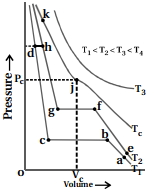
Isotherms of carbon dioxide at various temperatures are represented in the figure. Answer the following questions based on this figure.
$(i)$ In which state will $CO_2$ exist between the points $a$ and $b$ at temperature $T_1$?
$(ii)$ At what point will $CO_2$ start liquefying when temperature is $T_1$?
$(iii)$ At what point will $CO_2$ be completely liquefied when temperature is $T_2$?
$(iv)$ Will condensation take place when the temperature is $T_3$?
$(v)$ What portion of the isotherm at $T_1$ represents liquid and gaseous $CO_2$ at equilibrium?
$(i)$ In which state will $CO_2$ exist between the points $a$ and $b$ at temperature $T_1$?
$(ii)$ At what point will $CO_2$ start liquefying when temperature is $T_1$?
$(iii)$ At what point will $CO_2$ be completely liquefied when temperature is $T_2$?
$(iv)$ Will condensation take place when the temperature is $T_3$?
$(v)$ What portion of the isotherm at $T_1$ represents liquid and gaseous $CO_2$ at equilibrium?
Solution
(A) $(i)$ At temperature $T_1$,between points $a$ and $b$,$CO_2$ exists in the gaseous state.
$(ii)$ At point $b$,the isotherm becomes horizontal,indicating the start of the phase transition where $CO_2$ begins to liquefy.
$(iii)$ At temperature $T_2$,the $CO_2$ is completely liquefied at point $g$.
$(iv)$ Condensation will not take place at temperature $T_3$ because $T_3$ is greater than the critical temperature $(T_c)$.
$(v)$ The portion of the isotherm at $T_1$ between points $b$ and $c$ represents the equilibrium between liquid and gaseous $CO_2$.
$(ii)$ At point $b$,the isotherm becomes horizontal,indicating the start of the phase transition where $CO_2$ begins to liquefy.
$(iii)$ At temperature $T_2$,the $CO_2$ is completely liquefied at point $g$.
$(iv)$ Condensation will not take place at temperature $T_3$ because $T_3$ is greater than the critical temperature $(T_c)$.
$(v)$ The portion of the isotherm at $T_1$ between points $b$ and $c$ represents the equilibrium between liquid and gaseous $CO_2$.
0 likes
View SolutionStates of Matter — Critical state and Liquefaction of gases · Frequently Asked Questions
1Are these States of Matter questions useful for JEE and NEET?
Yes. All questions in this section are mapped to JEE Main and NEET exam patterns. Previous year questions from JEE Main, NEET, GUJCET and state-level exams are included with full solutions.
2Can I switch to Hindi or Gujarati for these questions?
Yes. Use the language tabs in the hero section or the sidebar to view the same questions and solutions in English, Hindi or Gujarati.
3How do I generate a question paper from this subtopic?
Use the Vedclass Exam Paper Generator — select the chapter and subtopic, set difficulty, and generate Sets A, B, C, D automatically. First 3 chapters of every subject are free.
Vedclass Products
For Students
Vedclass Test Series
Mock tests in real JEE/NEET style with performance analysis. 5-day free trial.
Start Free TrialFor Teachers
Exam Paper Generator
Generate Set A/B/C/D papers from this chapter in 2 minutes. 3 chapters free.
Try FreeFor Institutes
Online Exam Module
Live online exams with unlimited students, 360° analytics & white-label branding.
See DemoFor Teachers & Institutes
Generate a States of Matter Exam Paper in 2 Minutes
Select subtopic & difficulty — Sets A, B, C, D auto-generated with No Repeat logic.
First 3 chapters of every subject are free — no payment required.