
A English
Real gases and Vander waal’s equation Questions in English
Class 11 Chemistry · States of Matter · Real gases and Vander waal’s equation
266+
Questions
English
Language
100%
With Solutions
Showing 48 of 266 questions in English
1
DifficultMCQ
In a mole of water vapour at $STP$,the volume actually occupied or taken by the molecules (i.e.,Avogadro's No. $\times$ Volume of one molecule) is
A
Zero
B
Less than $1\%$ of $22.4 \,L$
C
About $10\%$ of the volume of container
D
$1\%$ to $2\%$ of $22.4 \,L$
Solution
(B) The density of liquid water is $1 \,g/cc$. Therefore,$1 \,mol$ of water $(18 \,g)$ occupies an actual volume of $18 \,cc$.
At $STP$,$1 \,mol$ of water vapour occupies a total volume of $22400 \,cc$ $(22.4 \,L)$.
The percentage of volume actually occupied by the molecules is calculated as: $\frac{18 \,cc}{22400 \,cc} \times 100 \approx 0.08\%$.
Since $0.08\% < 1\%$,the correct option is $(B)$.
At $STP$,$1 \,mol$ of water vapour occupies a total volume of $22400 \,cc$ $(22.4 \,L)$.
The percentage of volume actually occupied by the molecules is calculated as: $\frac{18 \,cc}{22400 \,cc} \times 100 \approx 0.08\%$.
Since $0.08\% < 1\%$,the correct option is $(B)$.
0 likes
View Solution2
MediumMCQ
The compressibility factor $(Z)$ of a gas is less than unity at $STP$. Therefore:
A
$V_m > 22.4 \ L$
B
$V_m < 22.4 \ L$
C
$V_m = 22.4 \ L$
D
$V_m = 44.8 \ L$
Solution
(B) The compressibility factor is defined as $Z = \frac{PV_m}{RT}$.
Given that $Z < 1$ at $STP$,where $P = 1 \ atm$ and $T = 273 \ K$.
For an ideal gas,$V_{ideal} = \frac{RT}{P} = \frac{0.0821 \times 273}{1} \approx 22.4 \ L$.
Since $Z = \frac{V_{real}}{V_{ideal}} < 1$,it follows that $V_{real} < V_{ideal}$.
Therefore,$V_m < 22.4 \ L$.
Given that $Z < 1$ at $STP$,where $P = 1 \ atm$ and $T = 273 \ K$.
For an ideal gas,$V_{ideal} = \frac{RT}{P} = \frac{0.0821 \times 273}{1} \approx 22.4 \ L$.
Since $Z = \frac{V_{real}}{V_{ideal}} < 1$,it follows that $V_{real} < V_{ideal}$.
Therefore,$V_m < 22.4 \ L$.
0 likes
View Solution3
EasyMCQ
If the inversion temperature of a gas is $-80\,^{\circ}C$,then it will produce cooling under the Joule-Thomson effect at ............... $K$.
A
$298$
B
$273$
C
$193$
D
$173$
Solution
(D) The inversion temperature $(T_i)$ is given as $-80\,^{\circ}C$.
Converting this to Kelvin: $T_i = -80 + 273 = 193\,K$.
According to the Joule-Thomson effect,a gas produces cooling only when its temperature is below its inversion temperature $(T < T_i)$.
Among the given options,only $173\,K$ is less than $193\,K$.
Therefore,the gas will produce cooling at $173\,K$.
Converting this to Kelvin: $T_i = -80 + 273 = 193\,K$.
According to the Joule-Thomson effect,a gas produces cooling only when its temperature is below its inversion temperature $(T < T_i)$.
Among the given options,only $173\,K$ is less than $193\,K$.
Therefore,the gas will produce cooling at $173\,K$.
0 likes
View Solution4
DifficultMCQ
What is the pressure of $2 \, mol$ of $NH_3$ at $27 \, ^oC$ when its volume is $5 \, L$ using the van der Waals equation (in $, atm$)? ($a = 4.17 \, L^2 \, bar \, mol^{-2}$,$b = 0.03711 \, L \, mol^{-1}$)
A
$10.33$
B
$9.33$
C
$9.74$
D
$9.2$
Solution
(B) The van der Waals equation is given by: $\left( P + \frac{n^2 a}{V^2} \right) (V - nb) = nRT$
Given: $n = 2 \, mol$,$V = 5 \, L$,$T = 27 + 273 = 300 \, K$,$a = 4.17$,$b = 0.03711$,$R = 0.0821 \, L \, atm \, K^{-1} \, mol^{-1}$.
Substituting the values: $\left( P + \frac{2^2 \times 4.17}{5^2} \right) (5 - 2 \times 0.03711) = 2 \times 0.0821 \times 300$
$\left( P + \frac{16.68}{25} \right) (5 - 0.07422) = 49.26$
$(P + 0.6672) \times 4.92578 = 49.26$
$P + 0.6672 = \frac{49.26}{4.92578} \approx 10.00$
$P = 10.00 - 0.6672 = 9.3328 \, atm \approx 9.33 \, atm$.
Given: $n = 2 \, mol$,$V = 5 \, L$,$T = 27 + 273 = 300 \, K$,$a = 4.17$,$b = 0.03711$,$R = 0.0821 \, L \, atm \, K^{-1} \, mol^{-1}$.
Substituting the values: $\left( P + \frac{2^2 \times 4.17}{5^2} \right) (5 - 2 \times 0.03711) = 2 \times 0.0821 \times 300$
$\left( P + \frac{16.68}{25} \right) (5 - 0.07422) = 49.26$
$(P + 0.6672) \times 4.92578 = 49.26$
$P + 0.6672 = \frac{49.26}{4.92578} \approx 10.00$
$P = 10.00 - 0.6672 = 9.3328 \, atm \approx 9.33 \, atm$.
0 likes
View Solution5
EasyMCQ
The $Van \text{ der } Waals$ equation explains the behaviour of
A
Ideal gases
B
Real gases
C
Vapour
D
Non-real gases
Solution
(B) The $Van \text{ der } Waals$ equation is given by $(P + \frac{an^2}{V^2})(V - nb) = nRT$. This equation is specifically derived to account for the deviations of real gases from ideal gas behaviour by considering molecular volume and intermolecular forces. Therefore,it explains the behaviour of $Real \text{ gases}$.
0 likes
View Solution6
EasyMCQ
Gases deviate from the ideal gas behaviour because their molecules
A
Possess negligible volume
B
Have forces of attraction between them
C
Are polyatomic
D
Are not attracted to one another
Solution
(B) Because molecules of real gases have intermolecular forces of attraction,the effective impact on the wall of the container is diminished.
The pressure of a real gas is reduced by a $\frac{a}{V^2}$ factor; hence,the behaviour of a real gas deviates from ideal behaviour.
The pressure of a real gas is reduced by a $\frac{a}{V^2}$ factor; hence,the behaviour of a real gas deviates from ideal behaviour.
0 likes
View Solution7
EasyMCQ
In Van der Waals equation of state for a non-ideal gas,the term that accounts for intermolecular forces is
A
$(V - b)$
B
$(RT)^{-1}$
C
$\left( P + \frac{a}{V^2} \right)$
D
$RT$
Solution
(C) The Van der Waals equation for a non-ideal gas is given by $\left( P + \frac{a}{V^2} \right)(V - b) = RT$.
In this equation,the term $\left( P + \frac{a}{V^2} \right)$ accounts for the pressure correction due to intermolecular forces of attraction between gas molecules.
The term $\frac{a}{V^2}$ represents the reduction in pressure caused by these attractive forces,where $a$ is the Van der Waals constant representing the magnitude of intermolecular attraction.
In this equation,the term $\left( P + \frac{a}{V^2} \right)$ accounts for the pressure correction due to intermolecular forces of attraction between gas molecules.
The term $\frac{a}{V^2}$ represents the reduction in pressure caused by these attractive forces,where $a$ is the Van der Waals constant representing the magnitude of intermolecular attraction.
0 likes
View Solution8
EasyMCQ
Van der Waals equation of state is obeyed by real gases. For $n$ moles of a real gas,the expression will be
A
$\left( \frac{P}{n} + \frac{na}{V^2} \right) \left( \frac{V}{n-b} \right) = RT$
B
$\left( P + \frac{a}{V^2} \right) (V - b) = nRT$
C
$\left( P + \frac{na}{V^2} \right) (nV - b) = nRT$
D
$\left( P + \frac{n^2 a}{V^2} \right) (V - nb) = nRT$
Solution
(D) The Van der Waals equation for $1$ mole of a real gas is given by $\left( P + \frac{a}{V_m^2} \right) (V_m - b) = RT$,where $V_m$ is the molar volume $(V_m = V/n)$.
Substituting $V_m = V/n$ into the equation:
$\left( P + \frac{a}{(V/n)^2} \right) (V/n - b) = RT$
$\left( P + \frac{n^2 a}{V^2} \right) \left( \frac{V - nb}{n} \right) = RT$
Multiplying both sides by $n$ gives the expression for $n$ moles:
$\left( P + \frac{n^2 a}{V^2} \right) (V - nb) = nRT$
Substituting $V_m = V/n$ into the equation:
$\left( P + \frac{a}{(V/n)^2} \right) (V/n - b) = RT$
$\left( P + \frac{n^2 a}{V^2} \right) \left( \frac{V - nb}{n} \right) = RT$
Multiplying both sides by $n$ gives the expression for $n$ moles:
$\left( P + \frac{n^2 a}{V^2} \right) (V - nb) = nRT$
0 likes
View Solution9
EasyMCQ
Any gas shows maximum deviation from ideal gas behavior at
A
$0\,^{\circ}C$ and $1 \ \text{atm}$ pressure
B
$100\,^{\circ}C$ and $2 \ \text{atm}$ pressure
C
$-100\,^{\circ}C$ and $5 \ \text{atm}$ pressure
D
$500\,^{\circ}C$ and $1 \ \text{atm}$ pressure
Solution
(C) Real gases behave like ideal gases at high temperature and low pressure.
Maximum deviation from ideal behavior is observed under conditions of low temperature and high pressure.
Comparing the given options,$-100\,^{\circ}C$ and $5 \ \text{atm}$ represents the lowest temperature and highest pressure combination,leading to the maximum deviation.
Maximum deviation from ideal behavior is observed under conditions of low temperature and high pressure.
Comparing the given options,$-100\,^{\circ}C$ and $5 \ \text{atm}$ represents the lowest temperature and highest pressure combination,leading to the maximum deviation.
0 likes
View Solution10
EasyMCQ
The temperature at which the second virial coefficient of a real gas is zero is called:
A
Critical temperature
B
Eutectic point
C
Boiling point
D
Boyle's temperature
Solution
(D) The temperature at which the second virial coefficient of a real gas is zero is called Boyle's temperature.
It is the temperature at which a real gas obeys Boyle's law over an appreciable range of pressure.
It is given by the expression $T_{B} = \frac{a}{bR}$,where $a$ and $b$ are the van der Waals constants.
Boyle's temperature of a gas is always higher than its critical temperature.
It is the temperature at which a real gas obeys Boyle's law over an appreciable range of pressure.
It is given by the expression $T_{B} = \frac{a}{bR}$,where $a$ and $b$ are the van der Waals constants.
Boyle's temperature of a gas is always higher than its critical temperature.
0 likes
View Solution11
EasyMCQ
When is deviation more in the behaviour of a gas from the ideal gas equation $PV = nRT$?
A
At high temperature and low pressure
B
At low temperature and high pressure
C
At high temperature and high pressure
D
At low temperature and low pressure
Solution
(B) An ideal gas is defined as a system in which there are no intermolecular or interatomic forces.
Any real system approaches ideal gas behaviour in the limit where the pressure is extremely low and the temperature is high enough to overcome attractive intermolecular forces.
$PV = nRT$
Here,$n$ is the number of moles of gas.
The ideal gas equation describes the state of an ideal gas.
At low temperature and high pressure,gases deviate more from ideal behaviour because as pressure increases,the force of attraction between molecules increases and the molecules come closer together,making the volume of the gas particles significant compared to the total volume.
Any real system approaches ideal gas behaviour in the limit where the pressure is extremely low and the temperature is high enough to overcome attractive intermolecular forces.
$PV = nRT$
Here,$n$ is the number of moles of gas.
The ideal gas equation describes the state of an ideal gas.
At low temperature and high pressure,gases deviate more from ideal behaviour because as pressure increases,the force of attraction between molecules increases and the molecules come closer together,making the volume of the gas particles significant compared to the total volume.
0 likes
View Solution12
MediumMCQ
Van der Waals constants '$a$' and '$b$' are related with..... respectively.
A
Attractive force and bond energy of molecules
B
Volume and repulsive force of molecules
C
Shape and repulsive forces of molecules
D
Attractive force and volume of the molecules
Solution
(D) In the Van der Waals equation,$(P + \frac{an^2}{V^2})(V - nb) = nRT$,the constant '$a$' represents the magnitude of the attractive forces between gas molecules.
The constant '$b$' represents the excluded volume or the effective volume occupied by the gas molecules.
The constant '$b$' represents the excluded volume or the effective volume occupied by the gas molecules.
0 likes
View Solution13
EasyMCQ
Gas deviates from ideal gas nature because molecules
A
Are colourless
B
Attract each other
C
Contain covalent bond
D
Show Brownian movement
Solution
(B) There are mainly $2$ reasons for the deviation of gases from ideal behavior: finite size of molecules and attractive forces between the molecules.
The finite size of molecules accounts for the factor '$b$' in the $Van \ der \ Waals$ equation,and the attractive forces between the molecules account for the factor '$a$' in the $Van \ der \ Waals$ equation.
The finite size of molecules accounts for the factor '$b$' in the $Van \ der \ Waals$ equation,and the attractive forces between the molecules account for the factor '$a$' in the $Van \ der \ Waals$ equation.
0 likes
View Solution14
EasyMCQ
The Van der Waals equation reduces itself to the ideal gas equation at
A
High pressure and low temperature
B
Low pressure and low temperature
C
Low pressure and high temperature
D
High pressure and high temperature
Solution
(C) The Van der Waals equation is given by,
$(P + \frac{a}{V^2})(V - b) = RT$
At low pressure,the volume $V$ is very large,so the correction factor $b$ can be neglected compared to $V$.
At high temperature,the kinetic energy of molecules is high,making the attractive forces represented by the term $\frac{a}{V^2}$ negligible.
Under these conditions of low pressure and high temperature,the equation simplifies to $PV = RT$,which is the ideal gas equation.
$(P + \frac{a}{V^2})(V - b) = RT$
At low pressure,the volume $V$ is very large,so the correction factor $b$ can be neglected compared to $V$.
At high temperature,the kinetic energy of molecules is high,making the attractive forces represented by the term $\frac{a}{V^2}$ negligible.
Under these conditions of low pressure and high temperature,the equation simplifies to $PV = RT$,which is the ideal gas equation.
0 likes
View Solution15
MediumMCQ
$A$ gas is said to behave like an ideal gas when the relation $PV/T = \text{constant}$. When do you expect a real gas to behave like an ideal gas?
A
When the temperature is low
B
When both the temperature and pressure are low
C
When both the temperature and pressure are high
D
When the temperature is high and pressure is low
Solution
(D) The ideal gas equation is $PV = nRT$.
Real gases approach ideal behavior under conditions of high temperature and low pressure,where the intermolecular forces are negligible and the volume of the gas particles is insignificant compared to the total volume of the container.
Real gases approach ideal behavior under conditions of high temperature and low pressure,where the intermolecular forces are negligible and the volume of the gas particles is insignificant compared to the total volume of the container.
0 likes
View Solution16
EasyMCQ
$A$ real gas most closely approaches the behaviour of an ideal gas at
A
$15 \, atm$ and $200 \, K$
B
$1 \, atm$ and $273 \, K$
C
$0.5 \, atm$ and $500 \, K$
D
$15 \, atm$ and $500 \, K$
Solution
(C) An ideal gas is a hypothetical gas whose pressure,volume,and temperature behaviour is described by the ideal gas equation.
Real gases deviate from ideal behaviour due to the finite volume of gas particles and the existence of intermolecular forces.
Real gases approach ideal behaviour under conditions of low pressure and high temperature.
At low pressure,the volume of gas particles becomes negligible compared to the total volume.
At high temperature,the kinetic energy of the particles is high enough to overcome the intermolecular forces of attraction.
Comparing the given options,$0.5 \, atm$ (lowest pressure) and $500 \, K$ (highest temperature) provide the conditions where the real gas behaves most like an ideal gas.
Real gases deviate from ideal behaviour due to the finite volume of gas particles and the existence of intermolecular forces.
Real gases approach ideal behaviour under conditions of low pressure and high temperature.
At low pressure,the volume of gas particles becomes negligible compared to the total volume.
At high temperature,the kinetic energy of the particles is high enough to overcome the intermolecular forces of attraction.
Comparing the given options,$0.5 \, atm$ (lowest pressure) and $500 \, K$ (highest temperature) provide the conditions where the real gas behaves most like an ideal gas.
0 likes
View Solution17
MediumMCQ
At low pressure,the Van der Waals equation is reduced to:
A
$Z = \frac{PV_m}{RT} = 1 - \frac{a}{V_m RT}$
B
$Z = \frac{PV_m}{RT} = 1 + \frac{Pb}{RT}$
C
$PV_m = RT$
D
$Z = \frac{PV_m}{RT} = 1 - \frac{a}{RT}$
Solution
(A) The Van der Waals equation for $1 \ mol$ of gas is: $(P + \frac{a}{V_m^2})(V_m - b) = RT$.
At low pressure,$V_m$ is very large,so $b$ is negligible compared to $V_m$ $(V_m - b \approx V_m)$.
The equation becomes: $(P + \frac{a}{V_m^2})V_m = RT$.
Expanding this: $PV_m + \frac{a}{V_m} = RT$.
Dividing by $RT$: $\frac{PV_m}{RT} + \frac{a}{V_m RT} = 1$.
Therefore,the compressibility factor $Z = \frac{PV_m}{RT} = 1 - \frac{a}{V_m RT}$.
At low pressure,$V_m$ is very large,so $b$ is negligible compared to $V_m$ $(V_m - b \approx V_m)$.
The equation becomes: $(P + \frac{a}{V_m^2})V_m = RT$.
Expanding this: $PV_m + \frac{a}{V_m} = RT$.
Dividing by $RT$: $\frac{PV_m}{RT} + \frac{a}{V_m RT} = 1$.
Therefore,the compressibility factor $Z = \frac{PV_m}{RT} = 1 - \frac{a}{V_m RT}$.
0 likes
View Solution18
MediumMCQ
At high temperature and low pressure,the Vander Waal's equation is reduced to
A
$(p + \frac{a}{V_m^2})(V_m) = RT$
B
$p V_m = RT$
C
$p (V_m - b) = RT$
D
$(p + \frac{a}{V_m^2})(V_m - b) = RT$
Solution
(B) The Vander Waal's equation for $1$ mole of gas is $(p + \frac{a}{V_m^2})(V_m - b) = RT$.
At high temperature and low pressure,the volume of the gas $V_m$ is very large,so $V_m \gg b$,which means $(V_m - b) \approx V_m$.
Also,at low pressure,the term $\frac{a}{V_m^2}$ becomes negligible compared to $p$.
Substituting these approximations into the equation,we get $p V_m = RT$,which is the ideal gas equation.
At high temperature and low pressure,the volume of the gas $V_m$ is very large,so $V_m \gg b$,which means $(V_m - b) \approx V_m$.
Also,at low pressure,the term $\frac{a}{V_m^2}$ becomes negligible compared to $p$.
Substituting these approximations into the equation,we get $p V_m = RT$,which is the ideal gas equation.
0 likes
View Solution19
MediumMCQ
When helium is allowed to expand into vacuum,a heating effect is observed. The reason for this is that
A
Helium is an ideal gas
B
Helium is an inert gas
C
The inversion temperature of helium is very low
D
The boiling point of helium is the lowest among the elements
Solution
(C) Helium behaves as a non-ideal gas.
When helium gas is allowed to expand into a vacuum,a heating effect is observed.
This occurs because the inversion temperature $(T_i)$ of helium is very low (approximately $-240 \ ^\circ C$ or $33 \ K$).
For most gases,the Joule-Thomson expansion results in a cooling effect because the work done during adiabatic expansion is at the cost of internal energy.
However,for gases like $H_2$ and $He$,the temperature of the gas is above their respective inversion temperatures at room temperature,leading to a heating effect upon expansion.
When helium gas is allowed to expand into a vacuum,a heating effect is observed.
This occurs because the inversion temperature $(T_i)$ of helium is very low (approximately $-240 \ ^\circ C$ or $33 \ K$).
For most gases,the Joule-Thomson expansion results in a cooling effect because the work done during adiabatic expansion is at the cost of internal energy.
However,for gases like $H_2$ and $He$,the temperature of the gas is above their respective inversion temperatures at room temperature,leading to a heating effect upon expansion.
0 likes
View Solution20
MediumMCQ
In $Vander$ $Waal$'s equation of state for gases,the constant '$b$' is a measure of
A
Volume occupied by the molecules
B
Intermolecular attraction
C
Intermolecular repulsions
D
Intermolecular collisions per unit volume
Solution
(A) The correct option is $A$. In $Vander$ $Waal$'s equation,$(P + \frac{an^2}{V^2})(V - nb) = nRT$,the constant '$b$' is known as the co-volume or excluded volume. It represents the effective volume occupied by the gas molecules themselves.
0 likes
View Solution21
MediumMCQ
Pressure exerted by $1 \, mole$ of methane in a $0.25 \, L$ container at $300 \, K$ using van der Waals equation is ............... $atm$ (given $a = 2.253 \, atm \, L^2 \, mol^{-2}, b = 0.0428 \, L \, mol^{-1}$):
A
$82.82$
B
$152.51$
C
$190.52$
D
$70.52$
Solution
(A) The van der Waals equation is $(P + \frac{n^2a}{V^2})(V - nb) = nRT$.
Given: $n = 1 \, mol$,$V = 0.25 \, L$,$T = 300 \, K$,$a = 2.253 \, atm \, L^2 \, mol^{-2}$,$b = 0.0428 \, L \, mol^{-1}$,and $R = 0.0821 \, L \, atm \, K^{-1} \, mol^{-1}$.
Substituting the values: $(P + \frac{1^2 \times 2.253}{0.25^2})(0.25 - 1 \times 0.0428) = 1 \times 0.0821 \times 300$.
$(P + \frac{2.253}{0.0625})(0.2072) = 24.63$.
$(P + 36.048)(0.2072) = 24.63$.
$P + 36.048 = \frac{24.63}{0.2072} \approx 118.87$.
$P = 118.87 - 36.048 = 82.822 \, atm$.
Given: $n = 1 \, mol$,$V = 0.25 \, L$,$T = 300 \, K$,$a = 2.253 \, atm \, L^2 \, mol^{-2}$,$b = 0.0428 \, L \, mol^{-1}$,and $R = 0.0821 \, L \, atm \, K^{-1} \, mol^{-1}$.
Substituting the values: $(P + \frac{1^2 \times 2.253}{0.25^2})(0.25 - 1 \times 0.0428) = 1 \times 0.0821 \times 300$.
$(P + \frac{2.253}{0.0625})(0.2072) = 24.63$.
$(P + 36.048)(0.2072) = 24.63$.
$P + 36.048 = \frac{24.63}{0.2072} \approx 118.87$.
$P = 118.87 - 36.048 = 82.822 \, atm$.
0 likes
View Solution22
MediumMCQ
The Van der Waals parameters for gases $W$,$X$,$Y$,and $Z$ are given below. Which one of these gases has the highest critical temperature?
| $Gas$ | $a \ (atm \ L^2 \ mol^{-2})$ | $b \ (L \ mol^{-1})$ |
| $W$ | $4.0$ | $0.027$ |
| $X$ | $8.0$ | $0.030$ |
| $Y$ | $6.0$ | $0.032$ |
| $Z$ | $12.0$ | $0.027$ |
A
$W$
B
$X$
C
$Y$
D
$Z$
Solution
(D) The critical temperature $(T_c)$ of a gas is given by the formula: $T_c = \frac{8a}{27Rb}$.
From the formula,$T_c$ is directly proportional to $a$ and inversely proportional to $b$ $(T_c \propto \frac{a}{b})$.
Calculating the ratio $\frac{a}{b}$ for each gas:
For $W$: $\frac{4.0}{0.027} \approx 148.15$
For $X$: $\frac{8.0}{0.030} \approx 266.67$
For $Y$: $\frac{6.0}{0.032} = 187.5$
For $Z$: $\frac{12.0}{0.027} \approx 444.44$
Since gas $Z$ has the highest ratio of $\frac{a}{b}$,it has the highest critical temperature.
From the formula,$T_c$ is directly proportional to $a$ and inversely proportional to $b$ $(T_c \propto \frac{a}{b})$.
Calculating the ratio $\frac{a}{b}$ for each gas:
For $W$: $\frac{4.0}{0.027} \approx 148.15$
For $X$: $\frac{8.0}{0.030} \approx 266.67$
For $Y$: $\frac{6.0}{0.032} = 187.5$
For $Z$: $\frac{12.0}{0.027} \approx 444.44$
Since gas $Z$ has the highest ratio of $\frac{a}{b}$,it has the highest critical temperature.
0 likes
View Solution23
MediumMCQ
The Van der Waals constant '$a$' for the gases $O_2$,$N_2$,$NH_3$ and $CH_4$ are $1.3$,$1.390$,$4.170$ and $2.253 \ L^2 \ atm \ mol^{-2}$ respectively. The gas which can be most easily liquefied is
A
$O_2$
B
$N_2$
C
$NH_3$
D
$CH_4$
Solution
(C) The Van der Waals constant '$a$' is a measure of the magnitude of the attractive forces between the gas molecules.
Greater the value of '$a$',stronger are the intermolecular forces of attraction.
Stronger intermolecular forces make it easier for a gas to be liquefied.
Comparing the given values: $a(NH_3) = 4.170 > a(CH_4) = 2.253 > a(N_2) = 1.390 > a(O_2) = 1.3$.
Since $NH_3$ has the highest value of '$a$',it can be most easily liquefied.
Greater the value of '$a$',stronger are the intermolecular forces of attraction.
Stronger intermolecular forces make it easier for a gas to be liquefied.
Comparing the given values: $a(NH_3) = 4.170 > a(CH_4) = 2.253 > a(N_2) = 1.390 > a(O_2) = 1.3$.
Since $NH_3$ has the highest value of '$a$',it can be most easily liquefied.
0 likes
View Solution24
MediumMCQ
Which of the given sets of temperature and pressure will cause a gas to exhibit the greatest deviation from ideal gas behavior?
A
$100 \ ^oC$ and $4 \ atm$
B
$100 \ ^oC$ and $2 \ atm$
C
$-100 \ ^oC$ and $4 \ atm$
D
$0 \ ^oC$ and $2 \ atm$
Solution
(C) Real gases deviate from ideal gas behavior under conditions of low temperature and high pressure.
Comparing the given options,the condition with the lowest temperature $(-100 \ ^oC)$ and the highest pressure $(4 \ atm)$ will result in the greatest deviation from ideal gas behavior.
Therefore,the correct option is $C$.
Comparing the given options,the condition with the lowest temperature $(-100 \ ^oC)$ and the highest pressure $(4 \ atm)$ will result in the greatest deviation from ideal gas behavior.
Therefore,the correct option is $C$.
0 likes
View Solution25
MediumMCQ
The compressibility factor of a gas is less than $1$ at $STP$. Its molar volume $V_m$ will be
A
$V_m > 22.4 \ L$
B
$V_m < 22.4 \ L$
C
$V_m = 22.4 \ L$
D
None
Solution
(B) The compressibility factor $Z$ is defined as $Z = \frac{V_{m, \text{real}}}{V_{m, \text{ideal}}}$.
Given that $Z < 1$,it implies that $V_{m, \text{real}} < V_{m, \text{ideal}}$.
At $STP$,the molar volume of an ideal gas $V_{m, \text{ideal}}$ is $22.4 \ L$.
Therefore,for a gas with $Z < 1$,the molar volume $V_m$ will be less than $22.4 \ L$.
Given that $Z < 1$,it implies that $V_{m, \text{real}} < V_{m, \text{ideal}}$.
At $STP$,the molar volume of an ideal gas $V_{m, \text{ideal}}$ is $22.4 \ L$.
Therefore,for a gas with $Z < 1$,the molar volume $V_m$ will be less than $22.4 \ L$.
0 likes
View Solution26
EasyMCQ
The cooling in a refrigerator is due to
A
Reaction of the refrigerator gas
B
Expansion of ice
C
The expansion of the gas in the refrigerator
D
The work of the compressor
Solution
(C) The cooling in a refrigerator is based on the $Joule-Thomson$ effect.
When a compressed gas is allowed to expand suddenly through a nozzle or a small orifice,it undergoes cooling.
This principle is utilized in the cooling cycle of a refrigerator.
When a compressed gas is allowed to expand suddenly through a nozzle or a small orifice,it undergoes cooling.
This principle is utilized in the cooling cycle of a refrigerator.
0 likes
View Solution27
EasyMCQ
The Van der Waals constants '$a$' and '$b$' are related to which of the following respectively?
A
Attractive forces and bond energy of molecules
B
Volume and repulsive forces of molecules
C
Shape and repulsive forces of molecules
D
Attractive forces and volume of molecules
Solution
(D) In the Van der Waals equation,the constant '$a$' represents the magnitude of the attractive forces between gas molecules,while the constant '$b$' represents the excluded volume occupied by the gas molecules.
0 likes
View Solution28
EasyMCQ
Under which conditions does the $van \ der \ Waals$ equation reduce to the ideal gas equation?
A
High temperature and low temperature
B
Low pressure and low temperature
C
Low pressure and high temperature
D
High pressure and high temperature
Solution
(C) The $van \ der \ Waals$ equation for $n$ moles of a gas is given by: $(P + \frac{an^2}{V^2})(V - nb) = nRT$.
For $1$ mole of gas,it is $(P + \frac{a}{V_m^2})(V_m - b) = RT$.
At low pressure,the volume $V_m$ is very large,so $b$ becomes negligible compared to $V_m$.
At high temperature,the pressure $P$ is significant compared to the internal pressure term $\frac{a}{V_m^2}$,making $\frac{a}{V_m^2}$ negligible.
Thus,the equation reduces to $PV_m = RT$,which is the ideal gas equation.
For $1$ mole of gas,it is $(P + \frac{a}{V_m^2})(V_m - b) = RT$.
At low pressure,the volume $V_m$ is very large,so $b$ becomes negligible compared to $V_m$.
At high temperature,the pressure $P$ is significant compared to the internal pressure term $\frac{a}{V_m^2}$,making $\frac{a}{V_m^2}$ negligible.
Thus,the equation reduces to $PV_m = RT$,which is the ideal gas equation.
0 likes
View Solution29
EasyMCQ
What will the van der Waals equation be at high temperature and low pressure?
A
$pV_m = RT$
B
$(p + \frac{a}{V_m^2})(V_m) = RT$
C
$p(V_m - b) = RT$
D
$(p + \frac{a}{V_m^2})(V_m - b) = RT$
Solution
(A) The van der Waals equation for $1 \ mol$ of a gas is given by $(p + \frac{a}{V_m^2})(V_m - b) = RT$.
At high temperature,the kinetic energy of gas molecules is very high,making the effect of intermolecular forces $(a/V_m^2)$ negligible.
At low pressure,the volume of the gas $(V_m)$ is very large,making the excluded volume $(b)$ negligible compared to $V_m$.
Under these conditions,the equation reduces to $pV_m = RT$,which is the ideal gas equation.
At high temperature,the kinetic energy of gas molecules is very high,making the effect of intermolecular forces $(a/V_m^2)$ negligible.
At low pressure,the volume of the gas $(V_m)$ is very large,making the excluded volume $(b)$ negligible compared to $V_m$.
Under these conditions,the equation reduces to $pV_m = RT$,which is the ideal gas equation.
0 likes
View Solution30
EasyMCQ
$A$ $Van \ der \ Waals$ real gas acts as an ideal gas under which of the following conditions?
A
High temperature and low pressure
B
Low temperature and high pressure
C
High temperature and high pressure
D
Low temperature and low pressure
Solution
(A) real gas behaves like an ideal gas when the intermolecular forces are negligible and the volume occupied by the gas molecules is negligible compared to the total volume of the gas.
This occurs at $High \ Temperature$ and $Low \ Pressure$.
This occurs at $High \ Temperature$ and $Low \ Pressure$.
0 likes
View Solution31
EasyMCQ
For a non-ideal gas,identify the term in the van der Waals equation that represents the intermolecular forces.
A
$RT$
B
$V - b$
C
$\left( P + \frac{a}{V^2} \right)$
D
$[RT]^{-1}$
Solution
(C) The van der Waals equation for $n$ moles of a real gas is given by: $\left( P + \frac{an^2}{V^2} \right)(V - nb) = nRT$.
For $1$ mole of gas $(n=1)$,the equation becomes: $\left( P + \frac{a}{V^2} \right)(V - b) = RT$.
In this equation,the term $\frac{a}{V^2}$ accounts for the intermolecular forces of attraction between gas molecules.
Therefore,the term representing intermolecular forces is $\left( P + \frac{a}{V^2} \right)$.
For $1$ mole of gas $(n=1)$,the equation becomes: $\left( P + \frac{a}{V^2} \right)(V - b) = RT$.
In this equation,the term $\frac{a}{V^2}$ accounts for the intermolecular forces of attraction between gas molecules.
Therefore,the term representing intermolecular forces is $\left( P + \frac{a}{V^2} \right)$.
0 likes
View Solution32
MediumMCQ
The van der Waals equation of state for a real gas is given. For $n$ moles of a real gas,the equation can be expressed as:
A
$\left( {\frac{P}{n} + \frac{{na}}{{{V^2}}}} \right)\left( {\frac{V}{{n - b}}} \right) = RT$
B
$\left( {P + \frac{a}{{{V^2}}}} \right)(V - b) = nRT$
C
$\left( {P + \frac{{na}}{{{V^2}}}} \right)(nV - b) = nRT$
D
$\left( {P + \frac{{{n^2}a}}{{{V^2}}}} \right)(V - nb) = nRT$
Solution
(D) The van der Waals equation for $n$ moles of a real gas is derived by correcting the pressure and volume terms of the ideal gas equation.
Pressure correction: $P_{ideal} = P_{real} + \frac{an^2}{V^2}$
Volume correction: $V_{ideal} = V_{real} - nb$
Substituting these into the ideal gas equation $PV = nRT$,we get:
$\left( {P + \frac{{{n^2}a}}{{{V^2}}}} \right)(V - nb) = nRT$
Pressure correction: $P_{ideal} = P_{real} + \frac{an^2}{V^2}$
Volume correction: $V_{ideal} = V_{real} - nb$
Substituting these into the ideal gas equation $PV = nRT$,we get:
$\left( {P + \frac{{{n^2}a}}{{{V^2}}}} \right)(V - nb) = nRT$
0 likes
View Solution33
EasyMCQ
The unit of the Van der Waals constant '$a$' is .......
A
$atm\,L^2\,mol^{-2}$
B
$atm\,L^{-2}\,mol^{-2}$
C
$atm\,L\,mol^{-1}$
D
$atm\,mol\,L^{-1}$
Solution
(A) The Van der Waals equation for real gases is given by: $(P + \frac{an^2}{V^2})(V - nb) = nRT$.
From the term $\frac{an^2}{V^2}$,which is added to pressure $(P)$,the units of $\frac{an^2}{V^2}$ must be the same as the units of pressure $(atm)$.
Therefore,$unit(a) = unit(P) \times \frac{unit(V)^2}{unit(n)^2}$.
Substituting the units: $unit(a) = atm \times \frac{L^2}{mol^2} = atm\,L^2\,mol^{-2}$.
From the term $\frac{an^2}{V^2}$,which is added to pressure $(P)$,the units of $\frac{an^2}{V^2}$ must be the same as the units of pressure $(atm)$.
Therefore,$unit(a) = unit(P) \times \frac{unit(V)^2}{unit(n)^2}$.
Substituting the units: $unit(a) = atm \times \frac{L^2}{mol^2} = atm\,L^2\,mol^{-2}$.
0 likes
View Solution34
EasyMCQ
At high pressure,the van der Waals equation for a real gas reduces to:
A
$PV = RT + Pb$
B
$PV = RT + \frac{a}{V}$
C
$PV = RT + Pb$
D
$PV = RT - \frac{a}{V^2}$
Solution
(C) The van der Waals equation for $n$ moles of a gas is: $(P + \frac{an^2}{V^2})(V - nb) = nRT$.
For $1$ mole of gas $(n=1)$,the equation becomes: $(P + \frac{a}{V^2})(V - b) = RT$.
Expanding this,we get: $PV - Pb + \frac{a}{V} - \frac{ab}{V^2} = RT$.
At high pressure,the volume $V$ is very small,so the term $\frac{a}{V}$ is negligible compared to $P$. Also,the term $\frac{ab}{V^2}$ is very small and can be neglected.
Thus,the equation simplifies to: $PV - Pb = RT$,which rearranges to $PV = RT + Pb$.
For $1$ mole of gas $(n=1)$,the equation becomes: $(P + \frac{a}{V^2})(V - b) = RT$.
Expanding this,we get: $PV - Pb + \frac{a}{V} - \frac{ab}{V^2} = RT$.
At high pressure,the volume $V$ is very small,so the term $\frac{a}{V}$ is negligible compared to $P$. Also,the term $\frac{ab}{V^2}$ is very small and can be neglected.
Thus,the equation simplifies to: $PV - Pb = RT$,which rearranges to $PV = RT + Pb$.
0 likes
View Solution35
EasyMCQ
At $S.T.P.$,if the compressibility factor $(Z)$ of a gas is less than $1$,then which of the following is true?
A
$V_m > 22.4 \, L$
B
$V_m < 22.4 \, L$
C
$V_m = 22.4 \, L$
D
$V_m = 44.8 \, L$
Solution
(B) The compressibility factor is defined as $Z = \frac{PV_m}{RT}$.
At $S.T.P.$,$P = 1 \, bar$ and $T = 273.15 \, K$,the molar volume of an ideal gas is $V_{ideal} = 22.4 \, L$.
Given $Z < 1$,we have $\frac{PV_m}{RT} < 1$,which implies $V_m < \frac{RT}{P}$.
Since $\frac{RT}{P} = 22.4 \, L$ at $S.T.P.$,it follows that $V_m < 22.4 \, L$.
At $S.T.P.$,$P = 1 \, bar$ and $T = 273.15 \, K$,the molar volume of an ideal gas is $V_{ideal} = 22.4 \, L$.
Given $Z < 1$,we have $\frac{PV_m}{RT} < 1$,which implies $V_m < \frac{RT}{P}$.
Since $\frac{RT}{P} = 22.4 \, L$ at $S.T.P.$,it follows that $V_m < 22.4 \, L$.
0 likes
View Solution36
EasyMCQ
$A$ gas behaves as an ideal gas under which of the following conditions?
A
Low temperature and low pressure
B
Low temperature and high pressure
C
High temperature and low pressure
D
High temperature and high pressure
Solution
(C) Real gases deviate from ideal behavior due to intermolecular forces and the finite volume of gas molecules.
At $High \ temperature$,the kinetic energy of molecules is high,making intermolecular forces negligible.
At $Low \ pressure$,the volume occupied by the gas molecules becomes negligible compared to the total volume of the container.
Therefore,a real gas approaches ideal behavior at $High \ temperature$ and $Low \ pressure$.
At $High \ temperature$,the kinetic energy of molecules is high,making intermolecular forces negligible.
At $Low \ pressure$,the volume occupied by the gas molecules becomes negligible compared to the total volume of the container.
Therefore,a real gas approaches ideal behavior at $High \ temperature$ and $Low \ pressure$.
0 likes
View Solution37
MediumMCQ
The deviation from the ideal gas equation $PV = nRT$ is maximum under which of the following conditions?
A
High temperature and low pressure
B
Low temperature and high pressure
C
High temperature and high pressure
D
Low temperature and low pressure
Solution
(B) Real gases deviate from ideal behavior because of intermolecular forces and the finite volume of gas molecules.
These deviations become significant when the gas molecules are close together and moving slowly.
This occurs at $Low \ temperature$ (where kinetic energy is low) and $High \ pressure$ (where molecules are compressed into a smaller volume).
Therefore,the deviation from the ideal gas equation $PV = nRT$ is maximum at $Low \ temperature$ and $High \ pressure$.
These deviations become significant when the gas molecules are close together and moving slowly.
This occurs at $Low \ temperature$ (where kinetic energy is low) and $High \ pressure$ (where molecules are compressed into a smaller volume).
Therefore,the deviation from the ideal gas equation $PV = nRT$ is maximum at $Low \ temperature$ and $High \ pressure$.
0 likes
View Solution38
EasyMCQ
The pressure of a real gas is less than the pressure of an ideal gas because of .....
A
Increase in the number of collisions.
B
Definite shape of molecules.
C
Increase in $K.E.$ of molecules.
D
Intermolecular forces of attraction.
Solution
(D) In an ideal gas,it is assumed that there are no intermolecular forces of attraction between the gas molecules.
However,in real gases,there exist intermolecular forces of attraction.
When a molecule approaches the wall of the container to exert pressure,it is pulled back by the other molecules in the bulk due to these attractive forces.
As a result,the molecule hits the wall with less force than it would have in the absence of these attractions.
Therefore,the observed pressure of a real gas is lower than the pressure of an ideal gas.
However,in real gases,there exist intermolecular forces of attraction.
When a molecule approaches the wall of the container to exert pressure,it is pulled back by the other molecules in the bulk due to these attractive forces.
As a result,the molecule hits the wall with less force than it would have in the absence of these attractions.
Therefore,the observed pressure of a real gas is lower than the pressure of an ideal gas.
0 likes
View Solution39
EasyMCQ
In the $Vander$ $Waals$ equation,the constant $'b'$ is a measure of $......$.
A
Intermolecular repulsion
B
Intermolecular attraction
C
Volume occupied by molecules
D
Intermolecular collisions per unit volume
Solution
(C) In the $Vander$ $Waals$ equation,$(P + \frac{an^2}{V^2})(V - nb) = nRT$,the constant $'b'$ is known as the co-volume or excluded volume.
It represents the effective volume occupied by the gas molecules themselves.
It represents the effective volume occupied by the gas molecules themselves.
0 likes
View Solution40
EasyMCQ
The values of the van der Waals constant $a$ for gases $O_2, N_2, NH_3$,and $CH_4$ are $1.360, 1.390, 4.170$,and $2.253 \ L^2 \ atm \ mol^{-2}$ respectively. Which gas can be liquefied most easily?
A
$O_2$
B
$N_2$
C
$NH_3$
D
$CH_4$
Solution
(C) The van der Waals constant $a$ represents the magnitude of intermolecular attractive forces between gas molecules.
Greater the value of $a$,stronger are the intermolecular forces of attraction.
Stronger intermolecular forces facilitate easier liquefaction of the gas.
Comparing the given values: $a(NH_3) = 4.170 > a(CH_4) = 2.253 > a(N_2) = 1.390 > a(O_2) = 1.360$.
Therefore,$NH_3$ has the highest value of $a$ and can be liquefied most easily.
Greater the value of $a$,stronger are the intermolecular forces of attraction.
Stronger intermolecular forces facilitate easier liquefaction of the gas.
Comparing the given values: $a(NH_3) = 4.170 > a(CH_4) = 2.253 > a(N_2) = 1.390 > a(O_2) = 1.360$.
Therefore,$NH_3$ has the highest value of $a$ and can be liquefied most easily.
0 likes
View Solution41
EasyMCQ
In the van der Waals equation,which term indicates the presence of attractive forces in a gas?
A
$nb$
B
$\frac{an^2}{V^2}$
C
$-\frac{an^2}{V^2}$
D
$-nb$
Solution
(B) The van der Waals equation for $n$ moles of a real gas is given by: $(P + \frac{an^2}{V^2})(V - nb) = nRT$.
In this equation,the term $\frac{an^2}{V^2}$ represents the pressure correction due to the intermolecular attractive forces between gas molecules.
Therefore,the term indicating the presence of attractive forces is $\frac{an^2}{V^2}$.
In this equation,the term $\frac{an^2}{V^2}$ represents the pressure correction due to the intermolecular attractive forces between gas molecules.
Therefore,the term indicating the presence of attractive forces is $\frac{an^2}{V^2}$.
0 likes
View Solution42
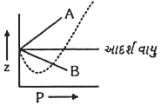
DifficultMCQ
Which of the following statements is false based on the provided graph of compressibility factor $Z$ versus pressure $P$?
A
For gas $A$,$a = 0$,and $Z$ increases linearly with $P$.
B
For gas $B$,$b = 0$,and $Z$ decreases linearly with $P$.
C
The dashed curve represents a real gas where $a \neq 0$ and $b \neq 0$. The minimum point and the point where $Z = 1$ can be used to calculate $a$ and $b$.
D
The dashed curve represents an ideal gas where $a = 0$ and $b = 0$.
Solution
(D) The compressibility factor $Z$ is defined as $Z = \frac{PV}{nRT}$.
For a van der Waals gas,the equation is $(P + \frac{an^2}{V^2})(V - nb) = nRT$.
At low pressure,$Z \approx 1 - \frac{a}{RTV}P$,which explains the initial decrease in $Z$ for real gases (where $a > 0$).
At high pressure,$Z \approx 1 + \frac{Pb}{RT}$,which explains the increase in $Z$ for real gases (where $b > 0$).
Gas $A$ shows $Z > 1$ for all $P$,implying $a = 0$ and $b > 0$.
Gas $B$ shows $Z < 1$ for all $P$,implying $a > 0$ and $b = 0$.
The dashed curve represents a typical real gas where both $a$ and $b$ are non-zero.
Therefore,the statement that the dashed curve represents an ideal gas is false.
For a van der Waals gas,the equation is $(P + \frac{an^2}{V^2})(V - nb) = nRT$.
At low pressure,$Z \approx 1 - \frac{a}{RTV}P$,which explains the initial decrease in $Z$ for real gases (where $a > 0$).
At high pressure,$Z \approx 1 + \frac{Pb}{RT}$,which explains the increase in $Z$ for real gases (where $b > 0$).
Gas $A$ shows $Z > 1$ for all $P$,implying $a = 0$ and $b > 0$.
Gas $B$ shows $Z < 1$ for all $P$,implying $a > 0$ and $b = 0$.
The dashed curve represents a typical real gas where both $a$ and $b$ are non-zero.
Therefore,the statement that the dashed curve represents an ideal gas is false.
0 likes
View Solution43
EasyMCQ
When does a real gas behave like an ideal gas?
A
Low temperature and low pressure
B
High temperature and high pressure
C
Low temperature and high pressure
D
High temperature and low pressure
Solution
(D) real gas behaves like an ideal gas under conditions of $High \ temperature$ and $Low \ pressure$.
At high temperatures,the kinetic energy of the gas molecules is high,making the intermolecular forces of attraction negligible.
At low pressures,the volume occupied by the gas molecules is negligible compared to the total volume of the container,satisfying the assumptions of the kinetic molecular theory of gases.
At high temperatures,the kinetic energy of the gas molecules is high,making the intermolecular forces of attraction negligible.
At low pressures,the volume occupied by the gas molecules is negligible compared to the total volume of the container,satisfying the assumptions of the kinetic molecular theory of gases.
0 likes
View Solution44
DifficultMCQ
Match the Van der Waals constant $a$ (in $L^2 \cdot bar \cdot mol^{-2}$) for the following gases:
| Gas | $a$ value |
|---|---|
| $1. C_6H_{6(g)}$ | $a. 0.217$ |
| $2. C_6H_5CH_{3(g)}$ | $b. 5.464$ |
| $3. Ne_{(g)}$ | $c. 18.000$ |
| $4. H_2O_{(g)}$ | $d. 24.060$ |
A
$1-a, 2-d, 3-c, 4-b$
B
$1-d, 2-a, 3-b, 4-c$
C
$1-c, 2-d, 3-a, 4-b$
D
$1-b, 2-c, 3-a, 4-d$
Solution
(C) The Van der Waals constant $a$ represents the magnitude of intermolecular attractive forces.
Larger and more complex molecules have stronger intermolecular forces,leading to higher $a$ values.
Comparing the given gases:
$1. C_6H_6$ (Benzene) has $a \approx 18.000$.
$2. C_6H_5CH_3$ (Toluene) is larger than benzene,so it has the highest $a \approx 24.060$.
$3. Ne$ (Neon) is a noble gas with weak dispersion forces,so it has the lowest $a \approx 0.217$.
$4. H_2O$ (Water) has hydrogen bonding,giving $a \approx 5.464$.
Thus,the correct matching is: $1-c, 2-d, 3-a, 4-b$.
Larger and more complex molecules have stronger intermolecular forces,leading to higher $a$ values.
Comparing the given gases:
$1. C_6H_6$ (Benzene) has $a \approx 18.000$.
$2. C_6H_5CH_3$ (Toluene) is larger than benzene,so it has the highest $a \approx 24.060$.
$3. Ne$ (Neon) is a noble gas with weak dispersion forces,so it has the lowest $a \approx 0.217$.
$4. H_2O$ (Water) has hydrogen bonding,giving $a \approx 5.464$.
Thus,the correct matching is: $1-c, 2-d, 3-a, 4-b$.
0 likes
View Solution45
EasyMCQ
Under which of the following conditions does a real gas behave most like an ideal gas?
A
$15 \ atm$ and $200 \ K$
B
$1 \ atm$ and $273 \ K$
C
$0.5 \ atm$ and $500 \ K$
D
$15 \ atm$ and $500 \ K$
Solution
(C) Real gases behave most like ideal gases at low pressure and high temperature.
Comparing the given conditions,the condition with the lowest pressure $(0.5 \ atm)$ and the highest temperature $(500 \ K)$ will show the most ideal behavior.
Comparing the given conditions,the condition with the lowest pressure $(0.5 \ atm)$ and the highest temperature $(500 \ K)$ will show the most ideal behavior.
0 likes
View Solution46
EasyMCQ
For which of the following is the van der Waals equation valid?
A
Ideal gas
B
Real gas
C
Gaseous substance
D
None of the above
Solution
(B) The van der Waals equation is valid for $Real \ gases$.
It is essentially a modified form of the ideal gas equation,$(P + \frac{an^2}{V^2})(V - nb) = nRT$,which accounts for intermolecular forces and the finite volume of gas molecules.
It is essentially a modified form of the ideal gas equation,$(P + \frac{an^2}{V^2})(V - nb) = nRT$,which accounts for intermolecular forces and the finite volume of gas molecules.
0 likes
View Solution47
MediumMCQ
Consider the following gases and their corresponding $ 'a'$ values given in parentheses: $CH_4 (2.25), N_2 (1.35), O_2 (1.36)$,and $CO (1.46)$. Which of these gases will be the most difficult to liquefy?
A
$CH_4$
B
$N_2$
C
$O_2$
D
$CO$
Solution
(B) The constant $ 'a'$ in the van der Waals equation represents the magnitude of intermolecular attractive forces.
Greater the value of $ 'a'$,stronger are the intermolecular forces,which makes the gas easier to liquefy.
Conversely,a smaller value of $ 'a'$ indicates weaker intermolecular forces,making the gas more difficult to liquefy.
Comparing the given values: $N_2 (1.35) < O_2 (1.36) < CO (1.46) < CH_4 (2.25)$.
Since $N_2$ has the lowest value of $ 'a'$,it has the weakest intermolecular forces and will be the most difficult to liquefy.
Greater the value of $ 'a'$,stronger are the intermolecular forces,which makes the gas easier to liquefy.
Conversely,a smaller value of $ 'a'$ indicates weaker intermolecular forces,making the gas more difficult to liquefy.
Comparing the given values: $N_2 (1.35) < O_2 (1.36) < CO (1.46) < CH_4 (2.25)$.
Since $N_2$ has the lowest value of $ 'a'$,it has the weakest intermolecular forces and will be the most difficult to liquefy.
0 likes
View Solution48
DifficultMCQ
Consider the equation $Z = \frac{pV}{RT}$. Which of the following statements is correct?
A
When $Z = 1$,real gases are easily compressible.
B
When $Z > 1$,real gases are more compressible than ideal gases.
C
When $Z > 1$,real gases are difficult to compress.
D
When $Z = 1$,real gases are difficult to compress.
Solution
(C) The compressibility factor $Z$ is defined as $Z = \frac{pV}{nRT}$.
When $Z > 1$,the repulsive forces dominate,making the gas less compressible than an ideal gas.
Therefore,it is difficult to compress the gas compared to an ideal gas.
When $Z > 1$,the repulsive forces dominate,making the gas less compressible than an ideal gas.
Therefore,it is difficult to compress the gas compared to an ideal gas.
0 likes
View SolutionStates of Matter — Real gases and Vander waal’s equation · Frequently Asked Questions
1Are these States of Matter questions useful for JEE and NEET?
Yes. All questions in this section are mapped to JEE Main and NEET exam patterns. Previous year questions from JEE Main, NEET, GUJCET and state-level exams are included with full solutions.
2Can I switch to Hindi or Gujarati for these questions?
Yes. Use the language tabs in the hero section or the sidebar to view the same questions and solutions in English, Hindi or Gujarati.
3How do I generate a question paper from this subtopic?
Use the Vedclass Exam Paper Generator — select the chapter and subtopic, set difficulty, and generate Sets A, B, C, D automatically. First 3 chapters of every subject are free.
Vedclass Products
For Students
Vedclass Test Series
Mock tests in real JEE/NEET style with performance analysis. 5-day free trial.
Start Free TrialFor Teachers
Exam Paper Generator
Generate Set A/B/C/D papers from this chapter in 2 minutes. 3 chapters free.
Try FreeFor Institutes
Online Exam Module
Live online exams with unlimited students, 360° analytics & white-label branding.
See DemoFor Teachers & Institutes
Generate a States of Matter Exam Paper in 2 Minutes
Select subtopic & difficulty — Sets A, B, C, D auto-generated with No Repeat logic.
First 3 chapters of every subject are free — no payment required.