
A English
Real gases and Vander waal’s equation Questions in English
Class 11 Chemistry · States of Matter · Real gases and Vander waal’s equation
266+
Questions
English
Language
100%
With Solutions
Showing 50 of 266 questions in English
51
EasyMCQ
Gases deviate from ideal gas behavior because the molecules $...$
A
are colorless.
B
attract each other.
C
have covalent bonds.
D
show Brownian motion.
Solution
(B) According to the kinetic molecular theory of gases,one of the assumptions is that there are no intermolecular forces of attraction between gas molecules. However,in real gases,these forces are not negligible,which causes the deviation from ideal behavior.
0 likes
View Solution52
DifficultMCQ
The pressure exerted by $5 \, mol$ of a real gas in a $1 \, L$ container at $47 \, ^oC$ is ............. $atm$. $\left( a = 3.592 \, atm \, L^2 \, mol^{-2}, b = 0.0427 \, L \, mol^{-1} \right)$
A
$149$
B
$77.2$
C
$47.4$
D
$18.4$
Solution
(B) Using the van der Waals equation: $\left( P + \frac{an^2}{V^2} \right) (V - nb) = nRT$
Given: $a = 3.592 \, atm \, L^2 \, mol^{-2}$,$b = 0.0427 \, L \, mol^{-1}$,$V = 1 \, L$,$n = 5 \, mol$,$T = 273 + 47 = 320 \, K$,$R = 0.0821 \, L \, atm \, K^{-1} \, mol^{-1}$
Substituting the values: $\left( P + \frac{3.592 \times 5^2}{1^2} \right) (1 - 5 \times 0.0427) = 5 \times 0.0821 \times 320$
$\left( P + 89.8 \right) (1 - 0.2135) = 131.36$
$(P + 89.8) (0.7865) = 131.36$
$P + 89.8 = \frac{131.36}{0.7865} \approx 167.02$
$P = 167.02 - 89.8 = 77.22 \, atm$
Thus,the pressure is approximately $77.2 \, atm$.
Given: $a = 3.592 \, atm \, L^2 \, mol^{-2}$,$b = 0.0427 \, L \, mol^{-1}$,$V = 1 \, L$,$n = 5 \, mol$,$T = 273 + 47 = 320 \, K$,$R = 0.0821 \, L \, atm \, K^{-1} \, mol^{-1}$
Substituting the values: $\left( P + \frac{3.592 \times 5^2}{1^2} \right) (1 - 5 \times 0.0427) = 5 \times 0.0821 \times 320$
$\left( P + 89.8 \right) (1 - 0.2135) = 131.36$
$(P + 89.8) (0.7865) = 131.36$
$P + 89.8 = \frac{131.36}{0.7865} \approx 167.02$
$P = 167.02 - 89.8 = 77.22 \, atm$
Thus,the pressure is approximately $77.2 \, atm$.
0 likes
View Solution53
MediumMCQ
At $300 \, K$ temperature and $40 \, atm$ pressure,if one mole of $CO_2$ occupies $0.4 \, L$,then it is:
A
Less compressible.
B
More compressible.
C
Ideal.
D
Does not have a definite compressibility.
Solution
(B) The compressibility factor,$Z = \frac{PV}{nRT}$.
Substituting the given values: $Z = \frac{40 \times 0.4}{1 \times 0.0821 \times 300} = 0.65$.
Since $Z < 1$,the gas is more compressible than expected for ideal behavior.
Substituting the given values: $Z = \frac{40 \times 0.4}{1 \times 0.0821 \times 300} = 0.65$.
Since $Z < 1$,the gas is more compressible than expected for ideal behavior.
0 likes
View Solution54
MediumMCQ
What kind of deviation will $2 \, mol$ of $N_2$ gas show in a $50 \, L$ container at $STP$?
A
Positive deviation
B
Negative deviation
C
Ideal gas behavior
D
First positive and then negative deviation
Solution
(A) The compressibility factor is given by $Z = \frac{PV}{nRT}$.
At $STP$,$P = 1 \, atm$,$T = 273 \, K$,$V = 50 \, L$,and $n = 2 \, mol$.
Using $R = 0.0821 \, L \, atm \, K^{-1} \, mol^{-1}$:
$Z = \frac{1 \times 50}{2 \times 273 \times 0.0821} \approx \frac{50}{44.8266} \approx 1.115$.
Since $Z > 1$,the gas shows positive deviation from ideal gas behavior.
At $STP$,$P = 1 \, atm$,$T = 273 \, K$,$V = 50 \, L$,and $n = 2 \, mol$.
Using $R = 0.0821 \, L \, atm \, K^{-1} \, mol^{-1}$:
$Z = \frac{1 \times 50}{2 \times 273 \times 0.0821} \approx \frac{50}{44.8266} \approx 1.115$.
Since $Z > 1$,the gas shows positive deviation from ideal gas behavior.
0 likes
View Solution55
EasyMCQ
For which of the following gases is the value of the van der Waals constant $'a'$ expected to be the highest?
A
$He$
B
$H_2$
C
$NH_3$
D
$O_2$
Solution
(C) The van der Waals constant $'a'$ is a measure of the magnitude of intermolecular forces of attraction between gas molecules.
$NH_3$ is a polar molecule and exhibits strong intermolecular hydrogen bonding.
Due to these strong attractive forces,the value of $'a'$ is highest for $NH_3$ among the given options.
$NH_3$ is a polar molecule and exhibits strong intermolecular hydrogen bonding.
Due to these strong attractive forces,the value of $'a'$ is highest for $NH_3$ among the given options.
0 likes
View Solution56
MediumMCQ
Which of the following relations between the van der Waals constant $b$ and the radius of a spherical molecule $r$ is correct?
A
$b = \left[ \frac{4}{3}\pi r^3 \right] N_A$
B
$b = \left[ \frac{4}{3}\pi r^3 \right]$
C
$b = 4 \left[ \frac{4}{3}\pi r^3 \right] N_A$
D
$b = 2 \left[ \frac{4}{3}\pi r^3 \right] N_A$
Solution
(C) The van der Waals constant $b$ represents the excluded volume per mole of gas molecules.
For a spherical molecule of radius $r$,the volume of one molecule is $V = \frac{4}{3}\pi r^3$.
The excluded volume for a pair of molecules is the volume of a sphere with radius $2r$,which is $\frac{4}{3}\pi (2r)^3 = 8 \times \frac{4}{3}\pi r^3$.
The excluded volume per molecule is half of this,i.e.,$4 \times \frac{4}{3}\pi r^3$.
Therefore,for $1 \ \text{mole}$ of gas ($N_A$ molecules),the constant $b$ is given by $b = 4 \times \left( \frac{4}{3}\pi r^3 \right) N_A$.
For a spherical molecule of radius $r$,the volume of one molecule is $V = \frac{4}{3}\pi r^3$.
The excluded volume for a pair of molecules is the volume of a sphere with radius $2r$,which is $\frac{4}{3}\pi (2r)^3 = 8 \times \frac{4}{3}\pi r^3$.
The excluded volume per molecule is half of this,i.e.,$4 \times \frac{4}{3}\pi r^3$.
Therefore,for $1 \ \text{mole}$ of gas ($N_A$ molecules),the constant $b$ is given by $b = 4 \times \left( \frac{4}{3}\pi r^3 \right) N_A$.
0 likes
View Solution57
EasyMCQ
In the van der Waals equation for real gases,which of the following terms represents the correction for intermolecular forces?
A
$V_m - b$
B
$P + \frac{a}{V_m^2}$
C
$RT$
D
$\frac{1}{RT}$
Solution
(B) The van der Waals equation for $n$ moles of a real gas is given by $(P + \frac{an^2}{V^2})(V - nb) = nRT$.
For $1$ mole of gas,it is $(P + \frac{a}{V_m^2})(V_m - b) = RT$.
Here,the term $\frac{a}{V_m^2}$ represents the pressure correction factor,which accounts for the intermolecular forces of attraction between gas molecules.
Therefore,the term representing intermolecular forces is $P + \frac{a}{V_m^2}$.
For $1$ mole of gas,it is $(P + \frac{a}{V_m^2})(V_m - b) = RT$.
Here,the term $\frac{a}{V_m^2}$ represents the pressure correction factor,which accounts for the intermolecular forces of attraction between gas molecules.
Therefore,the term representing intermolecular forces is $P + \frac{a}{V_m^2}$.
0 likes
View Solution58
MediumMCQ
At very low pressure,if the molar volume of $CO_2$ is constant,its compressibility factor is ..........
A
Increases with increase in temperature.
B
Decreases with increase in temperature.
C
Remains constant with change in temperature.
D
Is equal to $1$.
Solution
(D) According to the van der Waals equation: $\left( P + \frac{a}{V^2} \right) (V - b) = RT$.
At very low pressure,the volume $V$ is very large.
Therefore,the term $\frac{a}{V^2}$ becomes negligible and can be ignored.
Similarly,the volume correction term $b$ is negligible compared to $V$.
Thus,the equation simplifies to $PV = RT$.
This implies that at very low pressure,a real gas behaves like an ideal gas.
Therefore,the compressibility factor $Z = \frac{PV}{RT} = 1$.
At very low pressure,the volume $V$ is very large.
Therefore,the term $\frac{a}{V^2}$ becomes negligible and can be ignored.
Similarly,the volume correction term $b$ is negligible compared to $V$.
Thus,the equation simplifies to $PV = RT$.
This implies that at very low pressure,a real gas behaves like an ideal gas.
Therefore,the compressibility factor $Z = \frac{PV}{RT} = 1$.
0 likes
View Solution59
MediumMCQ
If the compressibility factor $(Z)$ of a gas at $STP$ is greater than $1$,then what will be the value of its molar volume $(V_m)$?
A
Equal to $22.4 \, dm^3$
B
Depends on its molecular size
C
Greater than $22.4 \, dm^3$
D
Less than $22.4 \, dm^3$
Solution
(C) The compressibility factor is defined as $Z = \frac{V_{real}}{V_{ideal}}$.
Since $Z > 1$,it implies that $V_{real} > V_{ideal}$.
At $STP$,the molar volume of an ideal gas is $V_{ideal} = 22.4 \, dm^3$.
Therefore,for a gas with $Z > 1$,the real molar volume $V_m$ must be greater than $22.4 \, dm^3$.
Since $Z > 1$,it implies that $V_{real} > V_{ideal}$.
At $STP$,the molar volume of an ideal gas is $V_{ideal} = 22.4 \, dm^3$.
Therefore,for a gas with $Z > 1$,the real molar volume $V_m$ must be greater than $22.4 \, dm^3$.
0 likes
View Solution60
DifficultMCQ
The compressibility factor $(Z)$ of a gas at moderate pressure is:
A
Increases with an increase in temperature.
B
Decreases with an increase in temperature.
C
Remains constant with a change in temperature.
D
Is always greater than $1$.
Solution
(A) At moderate pressure,the volume $V$ is small enough that the term $\frac{a}{V^2}$ cannot be neglected,but the volume correction '$b$' can be neglected compared to $V$.
The van der Waals equation becomes: $(P + \frac{a}{V^2})V = RT$.
Expanding this: $PV + \frac{a}{V} = RT$,which simplifies to $PV = RT - \frac{a}{V}$.
Dividing by $RT$: $\frac{PV}{RT} = 1 - \frac{a}{RTV}$,so $Z = 1 - \frac{a}{RTV}$.
Since $Z = 1 - \frac{a}{RTV}$,as temperature $T$ increases,the term $\frac{a}{RTV}$ decreases,causing $Z$ to increase towards $1$.
The van der Waals equation becomes: $(P + \frac{a}{V^2})V = RT$.
Expanding this: $PV + \frac{a}{V} = RT$,which simplifies to $PV = RT - \frac{a}{V}$.
Dividing by $RT$: $\frac{PV}{RT} = 1 - \frac{a}{RTV}$,so $Z = 1 - \frac{a}{RTV}$.
Since $Z = 1 - \frac{a}{RTV}$,as temperature $T$ increases,the term $\frac{a}{RTV}$ decreases,causing $Z$ to increase towards $1$.
0 likes
View Solution61
DifficultMCQ
What is the compressibility factor of a gas at high pressure?
A
Increases with increase in temperature.
B
Decreases with increase in temperature.
C
Remains constant with change in temperature.
D
Is less than one.
Solution
(B) At high pressure,the volume $V$ is very small. The term $\frac{a}{V^2}$ becomes large,but compared to high pressure $P$,it can be neglected. Thus,the van der Waals equation modifies as follows:
$P(V - b) = RT$
$PV = RT + Pb$
$\frac{PV}{RT} = 1 + \frac{Pb}{RT}$
$Z = 1 + \frac{Pb}{RT}$
Since $Z > 1$,the compressibility factor is greater than one and it decreases as the temperature increases.
$P(V - b) = RT$
$PV = RT + Pb$
$\frac{PV}{RT} = 1 + \frac{Pb}{RT}$
$Z = 1 + \frac{Pb}{RT}$
Since $Z > 1$,the compressibility factor is greater than one and it decreases as the temperature increases.
0 likes
View Solution62
EasyMCQ
In the van der Waals equation for gases,what does the constant $b$ represent?
A
Intermolecular repulsions
B
Intermolecular collisions per unit volume
C
Volume occupied by the molecules
D
Intermolecular attractions
Solution
(C) The van der Waals equation is $(P + \frac{an^2}{V^2})(V - nb) = nRT$.
In this equation,the constant $a$ represents the magnitude of intermolecular forces of attraction,while the constant $b$ represents the excluded volume or the volume occupied by the gas molecules themselves.
In this equation,the constant $a$ represents the magnitude of intermolecular forces of attraction,while the constant $b$ represents the excluded volume or the volume occupied by the gas molecules themselves.
0 likes
View Solution63
DifficultMCQ
What is the reason for the deviation of pressure from ideal behavior?
A
Molecular interactions between molecules and $\frac{PV}{nRT} > 1$
B
Molecular interactions between molecules and $\frac{PV}{nRT} < 1$
C
Negligible volume of molecules and $\frac{PV}{nRT} > 1$
D
Negligible volume of molecules and $\frac{PV}{nRT} < 1$
0 likes
View Solution64
EasyMCQ
Which of the following represents the $Van \ der \ Waals$ equation for $n$ moles of a real gas?
A
$nRT = \left( P + \frac{a}{V^2} \right) (V - b)$
B
$nRT = \left( P - \frac{a}{V^2} \right) (V - b)$
C
$nRT = \left( P + \frac{a}{V^2} \right) (V + b)$
D
$nRT = \left( P + \frac{n^2a}{V^2} \right) (V - nb)$
Solution
(D) The $Van \ der \ Waals$ equation for $n$ moles of a real gas is given by: $\left( P + \frac{n^2a}{V^2} \right) (V - nb) = nRT$.
Here,$P$ is the pressure,$V$ is the volume,$n$ is the number of moles,$R$ is the universal gas constant,$T$ is the temperature,and $a$ and $b$ are $Van \ der \ Waals$ constants.
Here,$P$ is the pressure,$V$ is the volume,$n$ is the number of moles,$R$ is the universal gas constant,$T$ is the temperature,and $a$ and $b$ are $Van \ der \ Waals$ constants.
0 likes
View Solution65
MediumMCQ
At a temperature of $27\,^{\circ}C$,if the volume of $2\, \text{moles}$ of $NH_3$ gas is $5\, L$ according to the van der Waals equation,what will be its pressure in $atm$? ($a = 4.17$,$b = 0.03711$)
A
$10.33$
B
$9.333$
C
$9.74$
D
$9.2$
Solution
(B) The van der Waals equation is given by: $\left( P + \frac{n^2 a}{V^2} \right) (V - nb) = nRT$
Given: $n = 2\, \text{mol}$,$V = 5\, L$,$a = 4.17$,$b = 0.03711$,$R = 0.0821\, L\, atm\, K^{-1}\, mol^{-1}$,$T = 27 + 273 = 300\, K$.
Substituting the values: $\left( P + \frac{2^2 \times 4.17}{5^2} \right) (5 - 2 \times 0.03711) = 2 \times 0.0821 \times 300$
$\left( P + \frac{16.68}{25} \right) (5 - 0.07422) = 49.26$
$(P + 0.6672) \times 4.92578 = 49.26$
$P + 0.6672 = \frac{49.26}{4.92578} \approx 10.00$
$P = 10.00 - 0.6672 = 9.3328\, atm \approx 9.333\, atm$.
Given: $n = 2\, \text{mol}$,$V = 5\, L$,$a = 4.17$,$b = 0.03711$,$R = 0.0821\, L\, atm\, K^{-1}\, mol^{-1}$,$T = 27 + 273 = 300\, K$.
Substituting the values: $\left( P + \frac{2^2 \times 4.17}{5^2} \right) (5 - 2 \times 0.03711) = 2 \times 0.0821 \times 300$
$\left( P + \frac{16.68}{25} \right) (5 - 0.07422) = 49.26$
$(P + 0.6672) \times 4.92578 = 49.26$
$P + 0.6672 = \frac{49.26}{4.92578} \approx 10.00$
$P = 10.00 - 0.6672 = 9.3328\, atm \approx 9.333\, atm$.
0 likes
View Solution66
EasyMCQ
$A$ gas such as carbon monoxide would be most likely to obey the ideal gas law at
A
low temperatures and high pressures
B
high temperatures and high pressures
C
low temperatures and low pressures
D
high temperatures and low pressures
Solution
(D) Real gases deviate from ideal behavior due to intermolecular forces and finite molecular volume. These deviations are minimized at $high \ temperatures$ and $low \ pressures$,where the gas particles are far apart and have high kinetic energy,causing them to behave most like an ideal gas.
0 likes
View Solution67
MediumMCQ
Maximum deviation from ideal gas behavior is expected from which of the following gases?
A
$CH_{4(g)}$
B
$NH_{3(g)}$
C
$H_{2(g)}$
D
$N_{2(g)}$
Solution
(B) The deviation from ideal gas behavior is primarily determined by the magnitude of intermolecular forces of attraction.
$NH_{3}$ is a polar molecule and exhibits strong dipole-dipole interactions,whereas $CH_{4}$,$H_{2}$,and $N_{2}$ are non-polar and exhibit only weak London dispersion forces.
Therefore,$NH_{3}$ shows the maximum deviation from ideal gas behavior.
$NH_{3}$ is a polar molecule and exhibits strong dipole-dipole interactions,whereas $CH_{4}$,$H_{2}$,and $N_{2}$ are non-polar and exhibit only weak London dispersion forces.
Therefore,$NH_{3}$ shows the maximum deviation from ideal gas behavior.
0 likes
View Solution68
DifficultMCQ
For real gases,the van der Waals equation is written as $\left( p + \frac{a n^2}{V^2} \right) (V - nb) = nRT$,where $a$ and $b$ are van der Waals constants. Two sets of gases are:
$(I)$ $O_2, CO_2, H_2, He$
$(II)$ $CH_4, O_2, H_2$
The gases given in set-$I$ are arranged in increasing order of $b$,and the gases given in set-$II$ are arranged in decreasing order of $a$. Select the correct order from the following:
$(I)$ $O_2, CO_2, H_2, He$
$(II)$ $CH_4, O_2, H_2$
The gases given in set-$I$ are arranged in increasing order of $b$,and the gases given in set-$II$ are arranged in decreasing order of $a$. Select the correct order from the following:
A
$I. He < H_2 < O_2 < CO_2$; $II. CH_4 > O_2 > H_2$
B
$I. O_2 < He < H_2 < CO_2$; $II. H_2 > O_2 > CH_4$
C
$I. H_2 < He < O_2 < CO_2$; $II. CH_4 > O_2 > H_2$
D
$I. H_2 < O_2 < He < CO_2$; $II. O_2 > CH_4 > H_2$
Solution
(A) The constant $b$ represents the excluded volume,which increases with the size of the molecule. The order of $b$ for set-$I$ is: $H_2 (0.0266) < He (0.0237)$ (Note: $He$ is smaller than $H_2$,so $He < H_2$) $< O_2 (0.0318) < CO_2 (0.0427)$. Thus,$I. He < H_2 < O_2 < CO_2$.
The constant $a$ represents the magnitude of intermolecular forces. Larger molecules with more electrons have stronger van der Waals forces. The order of $a$ for set-$II$ is: $CH_4 (2.25) > O_2 (1.36) > H_2 (0.244)$. Thus,$II. CH_4 > O_2 > H_2$.
The constant $a$ represents the magnitude of intermolecular forces. Larger molecules with more electrons have stronger van der Waals forces. The order of $a$ for set-$II$ is: $CH_4 (2.25) > O_2 (1.36) > H_2 (0.244)$. Thus,$II. CH_4 > O_2 > H_2$.
0 likes
View Solution69
MediumMCQ
$a$ and $b$ are van der Waals constants for gases. Chlorine is more easily liquefied than ethane because
A
$a$ and $b$ for $Cl_2 > a$ and $b$ for $C_2H_6$
B
$a$ and $b$ for $Cl_2 < a$ and $b$ for $C_2H_6$
C
$a$ for $Cl_2 < a$ for $C_2H_6$ but $b$ for $Cl_2 > b$ for $C_2H_6$
D
$a$ for $Cl_2 > a$ for $C_2H_6$ but $b$ for $Cl_2 < b$ for $C_2H_6$
Solution
(D) The value of $a$ is a measure of the magnitude of the attractive forces between the molecules of the gas. Greater the value of $a$,larger is the attractive inter-molecular force between the gas molecules.
The value of $b$ is related to the effective size of the gas molecules. It is also termed as excluded volume.
The gases with higher value of $a$ and lower value of $b$ are more liquefiable. Since $Cl_2$ is more easily liquefied than $C_2H_6$,$a$ for $Cl_2$ must be greater than $a$ for $C_2H_6$,and $b$ for $Cl_2$ must be less than $b$ for $C_2H_6$.
The value of $b$ is related to the effective size of the gas molecules. It is also termed as excluded volume.
The gases with higher value of $a$ and lower value of $b$ are more liquefiable. Since $Cl_2$ is more easily liquefied than $C_2H_6$,$a$ for $Cl_2$ must be greater than $a$ for $C_2H_6$,and $b$ for $Cl_2$ must be less than $b$ for $C_2H_6$.
0 likes
View Solution70
MediumMCQ
The compressibility factor for a real gas at high pressure is $:$
A
$1+ \frac{RT}{Pb}$
B
$1$
C
$1+ \frac{Pb}{RT}$
D
$1- \frac{Pb}{RT}$
Solution
(C) The van der Waals equation for a real gas is $(P + \frac{a}{V^2})(V - b) = RT$.
At high pressure,the term $\frac{a}{V^2}$ is very small compared to $P$ and can be neglected.
Thus,the equation simplifies to $P(V - b) = RT$.
Expanding this,we get $PV - Pb = RT$.
Rearranging the terms,$PV = RT + Pb$.
Dividing both sides by $RT$,we get $\frac{PV}{RT} = 1 + \frac{Pb}{RT}$.
Since the compressibility factor $Z = \frac{PV}{RT}$,we have $Z = 1 + \frac{Pb}{RT}$.
Therefore,at high pressure,$Z > 1$.
At high pressure,the term $\frac{a}{V^2}$ is very small compared to $P$ and can be neglected.
Thus,the equation simplifies to $P(V - b) = RT$.
Expanding this,we get $PV - Pb = RT$.
Rearranging the terms,$PV = RT + Pb$.
Dividing both sides by $RT$,we get $\frac{PV}{RT} = 1 + \frac{Pb}{RT}$.
Since the compressibility factor $Z = \frac{PV}{RT}$,we have $Z = 1 + \frac{Pb}{RT}$.
Therefore,at high pressure,$Z > 1$.
0 likes
View Solution71
MediumMCQ
If $Z$ is a compressibility factor,the van der Waals equation at low pressure can be written as:
A
$Z=1+ \frac{RT}{pb}$
B
$Z=1 - \frac{a}{VRT}$
C
$Z=1- \frac{pb}{RT}$
D
$Z=1+ \frac{pb}{RT}$
Solution
(B) The van der Waals equation for $1 \ mol$ of a gas is given by:
$(P + \frac{a}{V^2})(V - b) = RT$
At low pressure,the volume $V$ is very large,so $V >> b$. Therefore,the term $(V - b)$ can be approximated as $V$.
The equation simplifies to:
$(P + \frac{a}{V^2})V = RT$
Expanding the equation:
$PV + \frac{a}{V} = RT$
Rearranging to solve for $PV$:
$PV = RT - \frac{a}{V}$
Dividing both sides by $RT$ to express in terms of the compressibility factor $Z = \frac{PV}{RT}$:
$\frac{PV}{RT} = 1 - \frac{a}{VRT}$
Thus,$Z = 1 - \frac{a}{VRT}$.
$(P + \frac{a}{V^2})(V - b) = RT$
At low pressure,the volume $V$ is very large,so $V >> b$. Therefore,the term $(V - b)$ can be approximated as $V$.
The equation simplifies to:
$(P + \frac{a}{V^2})V = RT$
Expanding the equation:
$PV + \frac{a}{V} = RT$
Rearranging to solve for $PV$:
$PV = RT - \frac{a}{V}$
Dividing both sides by $RT$ to express in terms of the compressibility factor $Z = \frac{PV}{RT}$:
$\frac{PV}{RT} = 1 - \frac{a}{VRT}$
Thus,$Z = 1 - \frac{a}{VRT}$.
0 likes
View Solution72
EasyMCQ
Positive deviation from ideal behaviour is due to the fact that
A
Molecular attractions play dominant role
B
Molecular volume plays dominant role
C
Vander Waal constant $a$ dominates over $b$
D
Molecular attractions cancel the effect of molecular volume
Solution
(B) The compressibility factor $Z$ for a real gas is given by the van der Waals equation.
Positive deviation $(Z > 1)$ occurs when the repulsive forces or the finite volume of gas molecules become significant.
In the van der Waals equation $(P + \frac{an^2}{V^2})(V - nb) = nRT$,the constant $b$ represents the excluded volume of the gas molecules.
When the pressure is high,the volume of the gas molecules $(nb)$ becomes significant relative to the total volume $V$,leading to $Z > 1$.
Therefore,the molecular volume plays a dominant role in causing positive deviation.
Positive deviation $(Z > 1)$ occurs when the repulsive forces or the finite volume of gas molecules become significant.
In the van der Waals equation $(P + \frac{an^2}{V^2})(V - nb) = nRT$,the constant $b$ represents the excluded volume of the gas molecules.
When the pressure is high,the volume of the gas molecules $(nb)$ becomes significant relative to the total volume $V$,leading to $Z > 1$.
Therefore,the molecular volume plays a dominant role in causing positive deviation.
0 likes
View Solution73
MediumMCQ
$CH_4$ gas is behaving non-ideally. The compressibility factor for the gas is $1.5$ at $2 \ atm$ and $400 \ K$. Calculate the molar volume for the gas in $litre$. [Given $R = 0.08 \ L \ atm \ K^{-1} \ mol^{-1}$]
A
$24$
B
$16$
C
$48$
D
$8$
Solution
(A) The compressibility factor $Z$ is defined as $Z = \frac{PV_m}{RT}$,where $V_m$ is the molar volume.
Rearranging for $V_m$,we get $V_m = \frac{ZRT}{P}$.
Given values: $Z = 1.5$,$P = 2 \ atm$,$T = 400 \ K$,and $R = 0.08 \ L \ atm \ K^{-1} \ mol^{-1}$.
Substituting the values: $V_m = \frac{1.5 \times 0.08 \times 400}{2}$.
$V_m = \frac{1.5 \times 32}{2} = 1.5 \times 16 = 24 \ L$.
Rearranging for $V_m$,we get $V_m = \frac{ZRT}{P}$.
Given values: $Z = 1.5$,$P = 2 \ atm$,$T = 400 \ K$,and $R = 0.08 \ L \ atm \ K^{-1} \ mol^{-1}$.
Substituting the values: $V_m = \frac{1.5 \times 0.08 \times 400}{2}$.
$V_m = \frac{1.5 \times 32}{2} = 1.5 \times 16 = 24 \ L$.
0 likes
View Solution74
MediumMCQ
The values of van der Waals' constant '$a$' for gases $O_2, N_2, NH_3$,and $CH_4$ are $1.360, 1.390, 4.170$,and $2.253 \ L^2 \ atm \ mol^{-2}$ respectively. The gas which can be most easily liquefied is
A
$O_2$
B
$N_2$
C
$NH_3$
D
$CH_4$
Solution
(C) The van der Waals' constant '$a$' is a measure of the magnitude of intermolecular attractive forces in a gas.
Greater the value of '$a$',stronger are the intermolecular forces.
Stronger intermolecular forces make it easier for a gas to be liquefied.
Comparing the given values: $O_2 (1.360) < N_2 (1.390) < CH_4 (2.253) < NH_3 (4.170)$.
Since $NH_3$ has the highest value of '$a$',it can be most easily liquefied.
Greater the value of '$a$',stronger are the intermolecular forces.
Stronger intermolecular forces make it easier for a gas to be liquefied.
Comparing the given values: $O_2 (1.360) < N_2 (1.390) < CH_4 (2.253) < NH_3 (4.170)$.
Since $NH_3$ has the highest value of '$a$',it can be most easily liquefied.
0 likes
View Solution75
MediumMCQ
The density of a gas $A$ at $1 \ atm$ and $750 \ K$ is $0.3 \ g/L$. If the molar mass of $A$ is $27 \ g/mol$,then choose the correct statement -
A
$A$ behaves ideally
B
$A$ behaves non-ideally with positive deviation
C
$A$ behaves non-ideally with negative deviation
D
$A$ can be liquefied by applying pressure at $750 \ K$.
Solution
(B) The molar volume $V_m$ is calculated as $V_m = \frac{\text{Molar mass}}{\text{density}} = \frac{27}{0.3} = 90 \ L/mol$.
The compressibility factor $Z$ is given by $Z = \frac{P V_m}{R T}$.
Using $R = 0.0821 \ L \ atm \ K^{-1} \ mol^{-1}$,we get $Z = \frac{1 \times 90}{0.0821 \times 750} \approx 1.46$.
Since $Z > 1$,the gas $A$ shows positive deviation from ideal behavior.
The compressibility factor $Z$ is given by $Z = \frac{P V_m}{R T}$.
Using $R = 0.0821 \ L \ atm \ K^{-1} \ mol^{-1}$,we get $Z = \frac{1 \times 90}{0.0821 \times 750} \approx 1.46$.
Since $Z > 1$,the gas $A$ shows positive deviation from ideal behavior.
0 likes
View Solution76
MediumMCQ
Van der Waals's equation of state is obeyed by real gases. For $n$ moles of a real gas,the expression will be :-
A
$\left( \frac{P}{n} + \frac{na}{V^2} \right) \left( \frac{V}{n - b} \right) = RT$
B
$\left( P + \frac{a}{V^2} \right) (V - b) = nRT$
C
$\left( P + \frac{na}{V^2} \right) (nV - b) = nRT$
D
$\left( P + \frac{n^2 a}{V^2} \right) (V - nb) = nRT$
Solution
(D) The Van der Waals equation for $n$ moles of a real gas is derived by correcting the ideal gas equation $PV = nRT$ for intermolecular forces and molecular volume.
The pressure correction term is $\frac{n^2 a}{V^2}$ and the volume correction term is $nb$.
Substituting these into the ideal gas equation,we get:
$\left( P + \frac{n^2 a}{V^2} \right) (V - nb) = nRT$
Where:
$P$ = pressure of the gas
$V$ = volume of the gas
$n$ = number of moles
$a$ and $b$ = Van der Waals constants
$R$ = universal gas constant
$T$ = temperature
The pressure correction term is $\frac{n^2 a}{V^2}$ and the volume correction term is $nb$.
Substituting these into the ideal gas equation,we get:
$\left( P + \frac{n^2 a}{V^2} \right) (V - nb) = nRT$
Where:
$P$ = pressure of the gas
$V$ = volume of the gas
$n$ = number of moles
$a$ and $b$ = Van der Waals constants
$R$ = universal gas constant
$T$ = temperature
0 likes
View Solution77
MediumMCQ
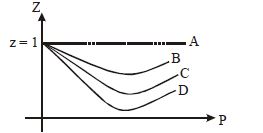
The $Z$ vs $P$ graph for four gases is given below at the same temperature.
Which of the gases will have the highest value of critical temperature $(T_c)$?
Which of the gases will have the highest value of critical temperature $(T_c)$?
A
$D$
B
$C$
C
$B$
D
$A$
Solution
(A) The compressibility factor $Z$ is defined as $Z = \frac{PV}{nRT}$.
For real gases,the deviation from ideal behavior is represented by the dip in the $Z$ vs $P$ curve.
$A$ greater dip indicates stronger intermolecular forces of attraction.
Stronger intermolecular forces of attraction correspond to a higher critical temperature $(T_c)$,as it is easier to liquefy the gas.
In the given graph,the curve for gas $D$ shows the maximum deviation (the deepest dip) from the ideal behavior $(Z=1)$.
Therefore,gas $D$ has the strongest intermolecular forces and the highest critical temperature.
For real gases,the deviation from ideal behavior is represented by the dip in the $Z$ vs $P$ curve.
$A$ greater dip indicates stronger intermolecular forces of attraction.
Stronger intermolecular forces of attraction correspond to a higher critical temperature $(T_c)$,as it is easier to liquefy the gas.
In the given graph,the curve for gas $D$ shows the maximum deviation (the deepest dip) from the ideal behavior $(Z=1)$.
Therefore,gas $D$ has the strongest intermolecular forces and the highest critical temperature.
0 likes
View Solution78
MediumMCQ
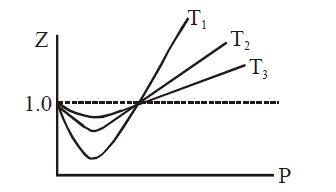
For $NH_3$ gas,the $Z$ vs pressure $(P)$ curve at different temperatures is shown. What is the correct order of temperatures? (Given $T_B$ = Boyle temperature)
A
$T_1 = T_2 = T_3 < T_B$
B
$T_1 < T_2 < T_3 < T_B$
C
$T_1 > T_2 > T_3 > T_B$
D
$T_B < T_1 < T_2 < T_3$
Solution
(B) The compressibility factor $Z$ is given by $Z = \frac{PV_m}{RT}$.
For real gases,at low pressure,the attractive forces dominate,and $Z < 1$. As temperature increases,the gas behaves more ideally,and the dip in the $Z$ vs $P$ curve decreases.
From the graph,the depth of the dip represents the deviation from ideal behavior. The curve with the deepest dip corresponds to the lowest temperature,and the curve with the shallowest dip corresponds to the highest temperature.
Thus,the order of temperatures is $T_1 < T_2 < T_3$.
Since all these curves show a dip below $Z = 1.0$ at low pressures,all these temperatures are below the Boyle temperature $(T_B)$.
Therefore,the correct order is $T_1 < T_2 < T_3 < T_B$.
For real gases,at low pressure,the attractive forces dominate,and $Z < 1$. As temperature increases,the gas behaves more ideally,and the dip in the $Z$ vs $P$ curve decreases.
From the graph,the depth of the dip represents the deviation from ideal behavior. The curve with the deepest dip corresponds to the lowest temperature,and the curve with the shallowest dip corresponds to the highest temperature.
Thus,the order of temperatures is $T_1 < T_2 < T_3$.
Since all these curves show a dip below $Z = 1.0$ at low pressures,all these temperatures are below the Boyle temperature $(T_B)$.
Therefore,the correct order is $T_1 < T_2 < T_3 < T_B$.
0 likes
View Solution79
DifficultMCQ
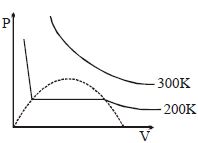
The $P$ vs $V$ graph is plotted for $1$ $mole$ of a hypothetical gas. Based on the given isotherms at $200 \ K$ and $300 \ K$,determine the range of $\frac{a}{b}$ for this gas in $atm-L \ mole^{-1}$. [Given: $R = 0.08 \ atm-L \ mole^{-1} \ K^{-1}$]
A
$54 < \frac{a}{b} < 81$
B
$27 < \frac{a}{b} < 42$
C
$40 < \frac{a}{b} < 65$
D
$13.5 < \frac{a}{b} < 40.5$
Solution
(A) For a real gas,the critical temperature is given by $T_c = \frac{8a}{27Rb}$.
From the graph,the isotherm at $200 \ K$ shows a horizontal portion,indicating that $200 \ K$ is below the critical temperature $(T_c > 200 \ K)$.
The isotherm at $300 \ K$ does not show a horizontal portion,indicating that $300 \ K$ is above the critical temperature $(T_c < 300 \ K)$.
Thus,$200 < T_c < 300$.
Substituting $T_c = \frac{8a}{27Rb}$,we get $200 < \frac{8a}{27Rb} < 300$.
Rearranging for $\frac{a}{b}$,we have $\frac{200 \times 27 \times R}{8} < \frac{a}{b} < \frac{300 \times 27 \times R}{8}$.
Using $R = 0.08$,we get $\frac{200 \times 27 \times 0.08}{8} < \frac{a}{b} < \frac{300 \times 27 \times 0.08}{8}$.
$25 \times 27 \times 0.08 < \frac{a}{b} < 37.5 \times 27 \times 0.08$.
$54 < \frac{a}{b} < 81$.
From the graph,the isotherm at $200 \ K$ shows a horizontal portion,indicating that $200 \ K$ is below the critical temperature $(T_c > 200 \ K)$.
The isotherm at $300 \ K$ does not show a horizontal portion,indicating that $300 \ K$ is above the critical temperature $(T_c < 300 \ K)$.
Thus,$200 < T_c < 300$.
Substituting $T_c = \frac{8a}{27Rb}$,we get $200 < \frac{8a}{27Rb} < 300$.
Rearranging for $\frac{a}{b}$,we have $\frac{200 \times 27 \times R}{8} < \frac{a}{b} < \frac{300 \times 27 \times R}{8}$.
Using $R = 0.08$,we get $\frac{200 \times 27 \times 0.08}{8} < \frac{a}{b} < \frac{300 \times 27 \times 0.08}{8}$.
$25 \times 27 \times 0.08 < \frac{a}{b} < 37.5 \times 27 \times 0.08$.
$54 < \frac{a}{b} < 81$.
0 likes
View Solution80
MediumMCQ
For $1$ mol of a real gas kept at constant temperature $T$,the graph of $PV$ vs $P$ intersects the $PV$ axis at $20$. Hence,the temperature $T$ is ($R$ = universal gas constant).
A
$\frac{20}{R}$
B
$\frac{2}{R}$
C
$\frac{1}{10R}$
D
$\frac{1}{20R}$
Solution
(A) For $1$ mol of an ideal gas,the equation is $PV = nRT$. Since $n = 1$,we have $PV = RT$.
At the $PV$ axis,the pressure $P$ approaches $0$. For a real gas,as $P \to 0$,the gas behaves ideally.
Therefore,the intercept on the $PV$ axis is given by $\lim_{P \to 0} PV = nRT$.
Given the intercept is $20$,we have $20 = (1) \times R \times T$.
Solving for $T$,we get $T = \frac{20}{R}$.
At the $PV$ axis,the pressure $P$ approaches $0$. For a real gas,as $P \to 0$,the gas behaves ideally.
Therefore,the intercept on the $PV$ axis is given by $\lim_{P \to 0} PV = nRT$.
Given the intercept is $20$,we have $20 = (1) \times R \times T$.
Solving for $T$,we get $T = \frac{20}{R}$.
0 likes
View Solution81
MediumMCQ
The correct increasing order of the value of van der Waals's constant $a$ for $CH_4, O_2$ and $H_2$ gases is
A
$H_2 < O_2 < CH_4$
B
$H_2 < CH_4 < O_2$
C
$CH_4 < O_2 < H_2$
D
$O_2 < CH_4 < H_2$
Solution
(A) The van der Waals constant $a$ represents the magnitude of attractive forces between gas molecules. Larger molecules or those with higher polarizability generally have higher values of $a$.
From the provided table:
For $H_2$,$a = 0.244 \ \text{atm L}^2 \text{mol}^{-2}$
For $O_2$,$a = 1.36 \ \text{atm L}^2 \text{mol}^{-2}$
For $CH_4$,$a = 2.25 \ \text{atm L}^2 \text{mol}^{-2}$
Comparing these values,the increasing order is $0.244 < 1.36 < 2.25$,which corresponds to $H_2 < O_2 < CH_4$.
From the provided table:
For $H_2$,$a = 0.244 \ \text{atm L}^2 \text{mol}^{-2}$
For $O_2$,$a = 1.36 \ \text{atm L}^2 \text{mol}^{-2}$
For $CH_4$,$a = 2.25 \ \text{atm L}^2 \text{mol}^{-2}$
Comparing these values,the increasing order is $0.244 < 1.36 < 2.25$,which corresponds to $H_2 < O_2 < CH_4$.
0 likes
View Solution82
MediumMCQ
Excluded volume $(v)$ per molecule is related to the van der Waals constant $'b'$ in the following way:
A
$v = b$
B
$v = \frac{b}{N_{A}}$
C
$v = \frac{b}{4N_{A}}$
D
$v = bN_{A}$
Solution
(C) The van der Waals constant $b$ represents the excluded volume per mole of gas molecules.
The excluded volume for a pair of molecules is $4 \times \text{volume of one molecule}$.
For $1 \ \text{mole}$ of gas,$b = N_{A} \times (2 \times \text{excluded volume per molecule}) = N_{A} \times 2 \times (4 \times \frac{4}{3} \pi r^{3}) / 2 = 4 \times N_{A} \times \text{volume of one molecule}$.
Since the volume of one molecule is $v = \frac{4}{3} \pi r^{3}$,we have $b = 4 N_{A} v$.
Therefore,the excluded volume per molecule is $v = \frac{b}{4 N_{A}}$.
The excluded volume for a pair of molecules is $4 \times \text{volume of one molecule}$.
For $1 \ \text{mole}$ of gas,$b = N_{A} \times (2 \times \text{excluded volume per molecule}) = N_{A} \times 2 \times (4 \times \frac{4}{3} \pi r^{3}) / 2 = 4 \times N_{A} \times \text{volume of one molecule}$.
Since the volume of one molecule is $v = \frac{4}{3} \pi r^{3}$,we have $b = 4 N_{A} v$.
Therefore,the excluded volume per molecule is $v = \frac{b}{4 N_{A}}$.
0 likes
View Solution83
MediumMCQ
The van der Waals constants for $HCl$ gas are $a = 3.6 \ atm \ L^2 \ mol^{-2}$ and $b = 40 \ mL \ mol^{-1}$. The critical temperature of the gas is : ............. $K$ [ $R = 0.08 \ atm \ L \ K^{-1} \ mol^{-1}$ ]
A
$666.66$
B
$333.33$
C
$999.99$
D
$1200$
Solution
(B) The formula for the critical temperature $(T_c)$ of a gas is given by:
$T_c = \frac{8a}{27Rb}$
Given:
$a = 3.6 \ atm \ L^2 \ mol^{-2}$
$b = 40 \ mL \ mol^{-1} = 0.04 \ L \ mol^{-1}$
$R = 0.08 \ atm \ L \ K^{-1} \ mol^{-1}$
Substituting the values:
$T_c = \frac{8 \times 3.6}{27 \times 0.08 \times 0.04}$
$T_c = \frac{28.8}{27 \times 0.0032}$
$T_c = \frac{28.8}{0.0864}$
$T_c = 333.33 \ K$
$T_c = \frac{8a}{27Rb}$
Given:
$a = 3.6 \ atm \ L^2 \ mol^{-2}$
$b = 40 \ mL \ mol^{-1} = 0.04 \ L \ mol^{-1}$
$R = 0.08 \ atm \ L \ K^{-1} \ mol^{-1}$
Substituting the values:
$T_c = \frac{8 \times 3.6}{27 \times 0.08 \times 0.04}$
$T_c = \frac{28.8}{27 \times 0.0032}$
$T_c = \frac{28.8}{0.0864}$
$T_c = 333.33 \ K$
0 likes
View Solution84
MediumMCQ
The pressure of a van der Waals gas is less than the pressure of an ideal gas because of
A
Infinitesimal size of molecules
B
The collisions with the wall become inelastic
C
Intermolecular attraction
D
Molecular movement is more random
Solution
(C) The ideal gas law assumes that there are no intermolecular forces of attraction or repulsion between gas molecules.
However,real gases (van der Waals gases) exhibit intermolecular forces of attraction,known as van der Waals forces.
These attractive forces pull the molecules inward,away from the walls of the container.
Consequently,the molecules strike the container walls with less force than they would in the absence of these attractions.
Therefore,the observed pressure of a real gas is lower than the pressure predicted for an ideal gas.
However,real gases (van der Waals gases) exhibit intermolecular forces of attraction,known as van der Waals forces.
These attractive forces pull the molecules inward,away from the walls of the container.
Consequently,the molecules strike the container walls with less force than they would in the absence of these attractions.
Therefore,the observed pressure of a real gas is lower than the pressure predicted for an ideal gas.
0 likes
View Solution85
MediumMCQ
Statement $-1$: The compressibility factor at the critical point is the same for different gases following van der Waal's equation.
Statement $-2$: The compressibility factor is independent of pressure at the critical temperature.
Statement $-2$: The compressibility factor is independent of pressure at the critical temperature.
A
Statement $-1$ is true,Statement $-2$ is true and Statement $-2$ is the correct explanation for Statement $-1$.
B
Statement $-1$ is true,Statement $-2$ is true and Statement $-2$ is $NOT$ the correct explanation for Statement $-1$.
C
Statement $-1$ is true,Statement $-2$ is false.
D
Statement $-1$ is false,Statement $-2$ is true.
Solution
(C) For a gas following van der Waal's equation,the compressibility factor at the critical point is given by $Z_c = \frac{P_c V_c}{R T_c} = \frac{(\frac{a}{27b^2}) (3b)}{R (\frac{8a}{27Rb})} = \frac{3}{8} = 0.375$. This value is a constant for all gases obeying the van der Waal's equation. Thus,Statement $-1$ is true.
At the critical temperature $(T_c)$,the compressibility factor $Z = \frac{P V_m}{R T_c}$ is not constant; it varies with pressure $P$ as the molar volume $V_m$ changes with pressure along the isotherm at $T_c$. Thus,Statement $-2$ is false.
At the critical temperature $(T_c)$,the compressibility factor $Z = \frac{P V_m}{R T_c}$ is not constant; it varies with pressure $P$ as the molar volume $V_m$ changes with pressure along the isotherm at $T_c$. Thus,Statement $-2$ is false.
0 likes
View Solution86
DifficultMCQ
For a real gas (molar mass $= 60 \, g/mol$),if the density at the critical point is $0.80 \, g/cm^3$ and its critical temperature $T_c = \frac{4 \times 10^5}{821} \, K$,then the van der Waals constant $a$ (in $atm \, L^2 \, mol^{-2}$) is:
A
$0.337$
B
$3.37$
C
$1.68$
D
$0.025$
Solution
(B) The critical molar volume $V_c$ is calculated as: $V_c = \frac{\text{Molar mass}}{\text{Density}} = \frac{60 \, g/mol}{0.80 \, g/cm^3} = 75 \, cm^3/mol = 0.075 \, L/mol$.
For a van der Waals gas,the critical volume is related to the constant $b$ by: $V_c = 3b$.
Therefore,$b = \frac{V_c}{3} = \frac{0.075}{3} = 0.025 \, L/mol$.
The critical temperature $T_c$ is given by: $T_c = \frac{8a}{27Rb}$.
Given $T_c = \frac{4 \times 10^5}{821} \, K$ and $R = 0.0821 \, L \, atm \, K^{-1} \, mol^{-1}$,we substitute the values:
$\frac{4 \times 10^5}{821} = \frac{8 \times a}{27 \times 0.0821 \times 0.025}$.
Since $821 = 10^4 \times 0.0821$,we simplify:
$\frac{4 \times 10^5}{10^4 \times 0.0821} = \frac{8 \times a}{27 \times 0.0821 \times 0.025}$.
$40 = \frac{8a}{27 \times 0.025} \Rightarrow 40 = \frac{8a}{0.675}$.
$a = \frac{40 \times 0.675}{8} = 5 \times 0.675 = 3.375 \, atm \, L^2 \, mol^{-2}$.
For a van der Waals gas,the critical volume is related to the constant $b$ by: $V_c = 3b$.
Therefore,$b = \frac{V_c}{3} = \frac{0.075}{3} = 0.025 \, L/mol$.
The critical temperature $T_c$ is given by: $T_c = \frac{8a}{27Rb}$.
Given $T_c = \frac{4 \times 10^5}{821} \, K$ and $R = 0.0821 \, L \, atm \, K^{-1} \, mol^{-1}$,we substitute the values:
$\frac{4 \times 10^5}{821} = \frac{8 \times a}{27 \times 0.0821 \times 0.025}$.
Since $821 = 10^4 \times 0.0821$,we simplify:
$\frac{4 \times 10^5}{10^4 \times 0.0821} = \frac{8 \times a}{27 \times 0.0821 \times 0.025}$.
$40 = \frac{8a}{27 \times 0.025} \Rightarrow 40 = \frac{8a}{0.675}$.
$a = \frac{40 \times 0.675}{8} = 5 \times 0.675 = 3.375 \, atm \, L^2 \, mol^{-2}$.
0 likes
View Solution87
MediumMCQ
If $Z$ is the compressibility factor,then for $1 \, \text{mole}$ of a real gas,the van der Waals equation at low pressure can be written as:
A
$Z = 1 - \frac{Pb}{RT}$
B
$Z = 1 + \frac{Pb}{RT}$
C
$Z = 1 + \frac{RT}{Pb}$
D
$Z = 1 - \frac{a}{VRT}$
Solution
(D) The van der Waals equation for $n \, \text{moles}$ of a gas is $\left(P + \frac{n^2 a}{V^2}\right)(V - nb) = nRT$.
For $1 \, \text{mole}$ $(n=1)$,the equation is $\left(P + \frac{a}{V^2}\right)(V - b) = RT$.
Expanding this,we get $PV - Pb + \frac{a}{V} - \frac{ab}{V^2} = RT$.
At low pressure,the volume $V$ is very large,so the terms $\frac{b}{V}$ and $\frac{ab}{V^2}$ are negligible.
The equation simplifies to $PV + \frac{a}{V} = RT$.
Dividing the entire equation by $RT$,we get $\frac{PV}{RT} + \frac{a}{VRT} = 1$.
Since the compressibility factor $Z = \frac{PV}{RT}$,we can write $Z + \frac{a}{VRT} = 1$.
Therefore,$Z = 1 - \frac{a}{VRT}$.
For $1 \, \text{mole}$ $(n=1)$,the equation is $\left(P + \frac{a}{V^2}\right)(V - b) = RT$.
Expanding this,we get $PV - Pb + \frac{a}{V} - \frac{ab}{V^2} = RT$.
At low pressure,the volume $V$ is very large,so the terms $\frac{b}{V}$ and $\frac{ab}{V^2}$ are negligible.
The equation simplifies to $PV + \frac{a}{V} = RT$.
Dividing the entire equation by $RT$,we get $\frac{PV}{RT} + \frac{a}{VRT} = 1$.
Since the compressibility factor $Z = \frac{PV}{RT}$,we can write $Z + \frac{a}{VRT} = 1$.
Therefore,$Z = 1 - \frac{a}{VRT}$.
0 likes
View Solution88
MediumMCQ
What is the unit of the Van der Waals constant $a$?
A
$L \cdot mol^{-1}$
B
$atm \cdot L^2 \cdot mol^{-2}$
C
$atm \cdot L \cdot mol^{-1}$
D
$mol^2 \cdot atm \cdot L^{-2}$
Solution
(B) The Van der Waals equation is $(P + \frac{an^2}{V^2})(V - nb) = nRT$.
From the pressure correction term,we have $P = \frac{an^2}{V^2}$.
Rearranging for $a$,we get $a = \frac{P \cdot V^2}{n^2}$.
Substituting the units: $P$ is in $atm$,$V$ is in $L$,and $n$ is in $mol$.
Therefore,the unit of $a$ is $\frac{atm \cdot L^2}{mol^2}$ or $atm \cdot L^2 \cdot mol^{-2}$.
From the pressure correction term,we have $P = \frac{an^2}{V^2}$.
Rearranging for $a$,we get $a = \frac{P \cdot V^2}{n^2}$.
Substituting the units: $P$ is in $atm$,$V$ is in $L$,and $n$ is in $mol$.
Therefore,the unit of $a$ is $\frac{atm \cdot L^2}{mol^2}$ or $atm \cdot L^2 \cdot mol^{-2}$.
0 likes
View Solution89
MediumMCQ
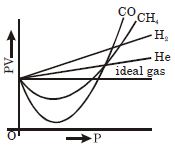
Consider the following figure. Which of the following gases show negative as well as positive deviation from the ideal gas behaviour?
A
$H_2$ and $CH_4$
B
$CO$ and $He$
C
$CO$ and $CH_4$
D
$H_2, He$ and $CH_4$
Solution
(C) Based on the provided graph of $PV$ versus $P$:
$1$. Gases like $H_2$ and $He$ show only positive deviation from ideal gas behavior at all pressures.
$2$. Gases like $CO$ and $CH_4$ show negative deviation (where $PV < nRT$) at low pressures and positive deviation (where $PV > nRT$) at high pressures.
$3$. Therefore,$CO$ and $CH_4$ exhibit both types of deviations.
$1$. Gases like $H_2$ and $He$ show only positive deviation from ideal gas behavior at all pressures.
$2$. Gases like $CO$ and $CH_4$ show negative deviation (where $PV < nRT$) at low pressures and positive deviation (where $PV > nRT$) at high pressures.
$3$. Therefore,$CO$ and $CH_4$ exhibit both types of deviations.
0 likes
View Solution90
MediumMCQ
For a real gas,the ratio $\frac{T_{C} \text{ (Critical temperature)}}{P_{C} \text{ (Critical pressure)}}$ is equal to:
A
$\frac{8R}{b}$
B
$\frac{8b}{R}$
C
$\frac{8}{bR}$
D
$\frac{R}{8b}$
Solution
(B) The critical temperature $T_{C}$ is given by $\frac{8a}{27bR}$.
The critical pressure $P_{C}$ is given by $\frac{a}{27b^{2}}$.
Therefore,the ratio $\frac{T_{C}}{P_{C}} = \frac{\frac{8a}{27bR}}{\frac{a}{27b^{2}}}$.
Simplifying this expression: $\frac{8a}{27bR} \times \frac{27b^{2}}{a} = \frac{8b}{R}$.
The critical pressure $P_{C}$ is given by $\frac{a}{27b^{2}}$.
Therefore,the ratio $\frac{T_{C}}{P_{C}} = \frac{\frac{8a}{27bR}}{\frac{a}{27b^{2}}}$.
Simplifying this expression: $\frac{8a}{27bR} \times \frac{27b^{2}}{a} = \frac{8b}{R}$.
0 likes
View Solution91
EasyMCQ
The compressibility factor for a real gas at high pressure is :-
A
$1$
B
$1 + \frac{Pb}{RT}$
C
$1 - \frac{Pb}{RT}$
D
$1 + \frac{RT}{Pb}$
Solution
(B) The Van der Waals equation for a real gas is $(P + \frac{a}{V^2})(V - b) = RT$.
At high pressure,the term $\frac{a}{V^2}$ is very small compared to $P$ and can be neglected.
Thus,the equation simplifies to $P(V - b) = RT$.
Expanding this,we get $PV - Pb = RT$.
Dividing both sides by $RT$,we get $\frac{PV}{RT} - \frac{Pb}{RT} = 1$.
Since the compressibility factor $Z = \frac{PV}{RT}$,we have $Z - \frac{Pb}{RT} = 1$.
Therefore,$Z = 1 + \frac{Pb}{RT}$.
Hence,the correct option is $B$.
At high pressure,the term $\frac{a}{V^2}$ is very small compared to $P$ and can be neglected.
Thus,the equation simplifies to $P(V - b) = RT$.
Expanding this,we get $PV - Pb = RT$.
Dividing both sides by $RT$,we get $\frac{PV}{RT} - \frac{Pb}{RT} = 1$.
Since the compressibility factor $Z = \frac{PV}{RT}$,we have $Z - \frac{Pb}{RT} = 1$.
Therefore,$Z = 1 + \frac{Pb}{RT}$.
Hence,the correct option is $B$.
0 likes
View Solution92
EasyMCQ
Which of the following can be most easily liquefied? (Value of $a$ for $NH_3 = 4.17, CO_2 = 3.59, SO_2 = 6.71, Cl_2 = 6.49$)
A
$NH_3$
B
$Cl_2$
C
$SO_2$
D
$CO_2$
Solution
(C) According to the van der Waals equation,the constant '$a$' represents the magnitude of intermolecular forces of attraction in a gas.
Greater the value of '$a$',stronger are the intermolecular forces of attraction.
Stronger intermolecular forces make it easier for a gas to be liquefied.
Comparing the given values:
$SO_2 = 6.71$
$Cl_2 = 6.49$
$NH_3 = 4.17$
$CO_2 = 3.59$
Since $SO_2$ has the highest value of '$a$',it can be most easily liquefied.
Greater the value of '$a$',stronger are the intermolecular forces of attraction.
Stronger intermolecular forces make it easier for a gas to be liquefied.
Comparing the given values:
$SO_2 = 6.71$
$Cl_2 = 6.49$
$NH_3 = 4.17$
$CO_2 = 3.59$
Since $SO_2$ has the highest value of '$a$',it can be most easily liquefied.
0 likes
View Solution93
MediumMCQ
Calculate the compressibility factor $Z$ for $CO_2$,if one mole of it occupies $0.4 \ L$ at $300 \ K$ and $40 \ atm$. Also,comment on the result.
A
$0.40, \ CO_2$ is more compressible than ideal gas
B
$0.64, \ CO_2$ is more compressible than ideal gas
C
$0.55, \ CO_2$ is less compressible than ideal gas
D
$0.62, \ CO_2$ is less compressible than ideal gas
Solution
(B) The compressibility factor $Z$ is given by the formula $Z = \frac{PV}{nRT}$.
Given:
$P = 40 \ atm$
$V = 0.4 \ L$
$n = 1 \ mole$
$R = 0.0821 \ L \ atm \ K^{-1} \ mol^{-1}$ (using $0.08$ for calculation as per context)
$T = 300 \ K$
Substituting the values:
$Z = \frac{40 \times 0.4}{1 \times 0.08 \times 300}$
$Z = \frac{16}{24} = 0.666... \approx 0.64$ (based on provided options).
Since $Z < 1$,the gas is more compressible than an ideal gas,indicating that attractive forces are dominant.
Given:
$P = 40 \ atm$
$V = 0.4 \ L$
$n = 1 \ mole$
$R = 0.0821 \ L \ atm \ K^{-1} \ mol^{-1}$ (using $0.08$ for calculation as per context)
$T = 300 \ K$
Substituting the values:
$Z = \frac{40 \times 0.4}{1 \times 0.08 \times 300}$
$Z = \frac{16}{24} = 0.666... \approx 0.64$ (based on provided options).
Since $Z < 1$,the gas is more compressible than an ideal gas,indicating that attractive forces are dominant.
0 likes
View Solution94
EasyMCQ
Which intermolecular force is most responsible for the liquefaction of inert gases?
A
Ionic
B
Instantaneous dipole-induced dipole
C
Dipole-dipole
D
Ion-dipole
Solution
(B) Inert gases are monoatomic and non-polar in nature.
Since they lack permanent dipoles,the only attractive forces present between their atoms are weak London dispersion forces,also known as instantaneous dipole-induced dipole forces.
These forces arise due to the temporary fluctuation in electron density,which creates a temporary dipole that induces a dipole in the neighboring atom.
Therefore,these forces are responsible for the liquefaction of inert gases at very low temperatures.
Since they lack permanent dipoles,the only attractive forces present between their atoms are weak London dispersion forces,also known as instantaneous dipole-induced dipole forces.
These forces arise due to the temporary fluctuation in electron density,which creates a temporary dipole that induces a dipole in the neighboring atom.
Therefore,these forces are responsible for the liquefaction of inert gases at very low temperatures.
0 likes
View Solution95
MediumMCQ
At relatively high pressure,the van der Waals equation reduces to
A
$PV = RT - a/V$
B
$PV = RT + Pb$
C
$PV = RT$
D
$PV = RT - a/V^2$
Solution
(B) The van der Waals equation for $1 \ mol$ of gas is: $(P + a/V^2)(V - b) = RT$.
At high pressure,the volume $V$ is small,making the term $a/V^2$ negligible compared to $P$.
Thus,$(P + a/V^2) \approx P$.
The equation simplifies to: $P(V - b) = RT$.
Expanding this,we get: $PV - Pb = RT$.
Rearranging gives: $PV = RT + Pb$.
At high pressure,the volume $V$ is small,making the term $a/V^2$ negligible compared to $P$.
Thus,$(P + a/V^2) \approx P$.
The equation simplifies to: $P(V - b) = RT$.
Expanding this,we get: $PV - Pb = RT$.
Rearranging gives: $PV = RT + Pb$.
0 likes
View Solution96
EasyMCQ
Which statement is correct regarding a real gas?
A
Real gas always follows the ideal gas equation.
B
The pressure of a real gas is always more than that of an ideal gas.
C
Real gas behaves as an ideal gas at high pressure and low temperature.
D
Real gas is more or less compressible than an ideal gas.
Solution
(D) Real gases deviate from ideal behavior due to intermolecular forces and the finite volume of gas molecules.
Depending on the conditions of temperature and pressure,the compressibility factor $Z = \frac{PV}{nRT}$ can be greater than $1$ or less than $1$.
Therefore,a real gas is more or less compressible than an ideal gas.
Depending on the conditions of temperature and pressure,the compressibility factor $Z = \frac{PV}{nRT}$ can be greater than $1$ or less than $1$.
Therefore,a real gas is more or less compressible than an ideal gas.
0 likes
View Solution97
MediumMCQ
For real gases,the relation between $P$,$V$ and $T$ is given by the van der Waals equation,$(P + \frac{an^2}{V^2})(V - nb) = nRT$. For the following gases $CH_4, CO_2, O_2, H_2$,which gas will have $(i)$ highest value of $'a'$ $(ii)$ lowest value of $'b'$?
A
$(i) CO_2, (ii) H_2$
B
$(i) CH_4, (ii) O_2$
C
$(i) H_2, (ii) CO_2$
D
$(i) O_2, (ii) H_2$
Solution
(A) $(i)$ The van der Waals constant $'a'$ represents the magnitude of intermolecular forces of attraction. Larger molecules with more electrons exhibit stronger van der Waals forces. Comparing the given gases,$CO_2$ has the highest molecular mass and number of electrons,thus it has the highest value of $'a'$.
$(ii)$ The van der Waals constant $'b'$ represents the excluded volume,which is proportional to the size of the gas molecules. Among the given gases,$H_2$ is the smallest molecule,therefore it has the lowest value of $'b'$.
Thus,the correct answer is $(i) CO_2, (ii) H_2$.
$(ii)$ The van der Waals constant $'b'$ represents the excluded volume,which is proportional to the size of the gas molecules. Among the given gases,$H_2$ is the smallest molecule,therefore it has the lowest value of $'b'$.
Thus,the correct answer is $(i) CO_2, (ii) H_2$.
0 likes
View Solution98
EasyMCQ
The units of constant $a$ in the Van der Waals equation are:
A
$dm^6 \, atm \, mol^{-2}$
B
$dm^3 \, atm \, mol^{-1}$
C
$dm \, atm \, mol^{-1}$
D
$atm \, mol^{-1}$
Solution
(A) The Van der Waals equation for $n$ moles of a gas is given by: $(P + \frac{n^2 a}{V^2})(V - nb) = nRT$.
According to the principle of dimensional homogeneity,the term $\frac{n^2 a}{V^2}$ must have the same units as pressure $(P)$.
Therefore,the unit of $\frac{n^2 a}{V^2} = \text{unit of } P = atm$.
Substituting the units: $\frac{(mol)^2 \cdot a}{(L)^2} = atm$.
Rearranging for $a$: $a = atm \cdot L^2 \cdot mol^{-2}$.
Since $1 \, L = 1 \, dm^3$,then $L^2 = (dm^3)^2 = dm^6$.
Thus,the unit of $a$ is $dm^6 \, atm \, mol^{-2}$.
According to the principle of dimensional homogeneity,the term $\frac{n^2 a}{V^2}$ must have the same units as pressure $(P)$.
Therefore,the unit of $\frac{n^2 a}{V^2} = \text{unit of } P = atm$.
Substituting the units: $\frac{(mol)^2 \cdot a}{(L)^2} = atm$.
Rearranging for $a$: $a = atm \cdot L^2 \cdot mol^{-2}$.
Since $1 \, L = 1 \, dm^3$,then $L^2 = (dm^3)^2 = dm^6$.
Thus,the unit of $a$ is $dm^6 \, atm \, mol^{-2}$.
0 likes
View Solution99
MediumMCQ
If the compressibility factor $(Z)$ is greater than unity,then which of the following is true for the molar volume $(V_m)$ of a gas at $NTP$?
A
$V_m = 22.4 \ L \ (at \ NTP)$
B
$V_m > 22.4 \ L \ (at \ NTP)$
C
$V_m < 22.4 \ L \ (at \ NTP)$
D
$V_m = 11.2 \ L \ (at \ NTP)$
Solution
(B) The compressibility factor is defined as $Z = \frac{PV_m}{RT}$.
For an ideal gas,$Z = 1$ and $V_m = 22.4 \ L$ at $NTP$.
If $Z > 1$,the gas shows positive deviation from ideal behavior,meaning the repulsive forces are dominant.
Consequently,the molar volume $V_m$ is greater than the ideal molar volume,i.e.,$V_m > 22.4 \ L$ at $NTP$.
For an ideal gas,$Z = 1$ and $V_m = 22.4 \ L$ at $NTP$.
If $Z > 1$,the gas shows positive deviation from ideal behavior,meaning the repulsive forces are dominant.
Consequently,the molar volume $V_m$ is greater than the ideal molar volume,i.e.,$V_m > 22.4 \ L$ at $NTP$.
0 likes
View Solution100
EasyMCQ
In the van der Waals equation,which of the following will have the highest value of '$a$'?
A
$H_2$
B
$Ne$
C
$NH_3$
D
$He$
Solution
(C) The van der Waals constant '$a$' represents the magnitude of intermolecular forces of attraction in a gas.
As the intermolecular forces of attraction increase,the value of '$a$' increases.
Among the given options,$NH_3$ is a polar molecule capable of forming hydrogen bonds,which results in significantly stronger intermolecular forces compared to the non-polar gases $H_2$,$Ne$,and $He$.
Therefore,$NH_3$ has the highest value of '$a$'.
As the intermolecular forces of attraction increase,the value of '$a$' increases.
Among the given options,$NH_3$ is a polar molecule capable of forming hydrogen bonds,which results in significantly stronger intermolecular forces compared to the non-polar gases $H_2$,$Ne$,and $He$.
Therefore,$NH_3$ has the highest value of '$a$'.
0 likes
View SolutionStates of Matter — Real gases and Vander waal’s equation · Frequently Asked Questions
1Are these States of Matter questions useful for JEE and NEET?
Yes. All questions in this section are mapped to JEE Main and NEET exam patterns. Previous year questions from JEE Main, NEET, GUJCET and state-level exams are included with full solutions.
2Can I switch to Hindi or Gujarati for these questions?
Yes. Use the language tabs in the hero section or the sidebar to view the same questions and solutions in English, Hindi or Gujarati.
3How do I generate a question paper from this subtopic?
Use the Vedclass Exam Paper Generator — select the chapter and subtopic, set difficulty, and generate Sets A, B, C, D automatically. First 3 chapters of every subject are free.
Vedclass Products
For Students
Vedclass Test Series
Mock tests in real JEE/NEET style with performance analysis. 5-day free trial.
Start Free TrialFor Teachers
Exam Paper Generator
Generate Set A/B/C/D papers from this chapter in 2 minutes. 3 chapters free.
Try FreeFor Institutes
Online Exam Module
Live online exams with unlimited students, 360° analytics & white-label branding.
See DemoFor Teachers & Institutes
Generate a States of Matter Exam Paper in 2 Minutes
Select subtopic & difficulty — Sets A, B, C, D auto-generated with No Repeat logic.
First 3 chapters of every subject are free — no payment required.