
A English
Aromatic hydrocarbon Questions in English
Class 11 Chemistry · Hydrocarbons · Aromatic hydrocarbon
872+
Questions
English
Language
100%
With Solutions
Showing 50 of 872 questions in English
301
MediumMCQ
The reaction of benzene with $CO$ and $HCl$ in the presence of anhydrous $AlCl_3$ gives :
A
Chlorobenzene
B
Toluene
C
Benzyl chloride
D
Benzaldehyde
Solution
(D) The reaction of benzene with $CO$ and $HCl$ in the presence of anhydrous $AlCl_3$ (or $CuCl$) is known as the $Gattermann-Koch$ reaction.
This reaction is used to introduce a formyl group $(-CHO)$ into the benzene ring.
The overall reaction is: $C_6H_6 + CO + HCl \xrightarrow{anhydrous \ AlCl_3 / CuCl} C_6H_5CHO$.
Therefore,the product formed is benzaldehyde.
This reaction is used to introduce a formyl group $(-CHO)$ into the benzene ring.
The overall reaction is: $C_6H_6 + CO + HCl \xrightarrow{anhydrous \ AlCl_3 / CuCl} C_6H_5CHO$.
Therefore,the product formed is benzaldehyde.
0 likes
View Solution302
MediumMCQ
The number of benzylic hydrogen atoms in ethylbenzene is :
A
$3$
B
$5$
C
$2$
D
$7$
Solution
(C) The structure of ethylbenzene is $C_6H_5-CH_2-CH_3$.
Benzylic hydrogen atoms are the hydrogen atoms attached to the carbon atom that is directly bonded to the benzene ring.
In ethylbenzene,the carbon atom of the ethyl group attached to the benzene ring is the benzylic carbon.
This carbon is bonded to two hydrogen atoms.
Therefore,the number of benzylic hydrogen atoms is $2$.
Benzylic hydrogen atoms are the hydrogen atoms attached to the carbon atom that is directly bonded to the benzene ring.
In ethylbenzene,the carbon atom of the ethyl group attached to the benzene ring is the benzylic carbon.
This carbon is bonded to two hydrogen atoms.
Therefore,the number of benzylic hydrogen atoms is $2$.
0 likes
View Solution303
MediumMCQ
Benzene $+ 3H_2 \xrightarrow{Ni, \text{high temp.}} \text{high pressure} \, (A).$
Which of the following can be isolated as the product of this reaction?
Which of the following can be isolated as the product of this reaction?
A
Cyclohexane
B
Cyclohexene
C
$1,4-$Cyclohexadiene
D
$1,3-$Cyclohexadiene
Solution
(A) The reaction of benzene with hydrogen in the presence of a nickel catalyst at high temperature and high pressure is a catalytic hydrogenation reaction.
Benzene is an aromatic compound,and the hydrogenation of its three double bonds leads to the formation of a saturated six-membered ring.
The reaction is as follows:
$C_6H_6 + 3H_2 \xrightarrow{Ni, \Delta, P} C_6H_{12}$
Here,$C_6H_6$ is benzene and $C_6H_{12}$ is cyclohexane.
Therefore,the product $(A)$ is cyclohexane.
Benzene is an aromatic compound,and the hydrogenation of its three double bonds leads to the formation of a saturated six-membered ring.
The reaction is as follows:
$C_6H_6 + 3H_2 \xrightarrow{Ni, \Delta, P} C_6H_{12}$
Here,$C_6H_6$ is benzene and $C_6H_{12}$ is cyclohexane.
Therefore,the product $(A)$ is cyclohexane.
0 likes
View Solution304
MediumMCQ
Which of the following is/are produced when a mixture of benzene vapour and oxygen is passed over $V_2O_5$ catalyst at $775\, K$?
A
Oxalic acid
B
Glyoxal
C
Fumaric acid
D
Maleic anhydride
Solution
(D) The catalytic oxidation of benzene is an industrial process used to produce maleic anhydride.
When a mixture of benzene vapour and oxygen is passed over a $V_2O_5$ catalyst at $775\, K$,benzene undergoes controlled oxidation to form maleic anhydride.
The chemical reaction is: $2C_6H_6 + 9O_2 \xrightarrow{V_2O_5, 775\, K} 2C_4H_2O_3 + 4CO_2 + 4H_2O$.
When a mixture of benzene vapour and oxygen is passed over a $V_2O_5$ catalyst at $775\, K$,benzene undergoes controlled oxidation to form maleic anhydride.
The chemical reaction is: $2C_6H_6 + 9O_2 \xrightarrow{V_2O_5, 775\, K} 2C_4H_2O_3 + 4CO_2 + 4H_2O$.
0 likes
View Solution305
MediumMCQ
The number of $\pi$ electrons in the following molecule is:

A
$2$
B
$4$
C
$5$
D
$6$
Solution
(D) The given molecule is pyrrole.
In pyrrole,there are two double bonds,which contribute $2 \times 2 = 4$ $\pi$ electrons.
The nitrogen atom has a lone pair of electrons that participates in resonance to make the ring aromatic.
Thus,the lone pair on the nitrogen atom also contributes $2$ $\pi$ electrons.
Total number of $\pi$ electrons = $4$ (from double bonds) + $2$ (from lone pair) = $6$ $\pi$ electrons.
In pyrrole,there are two double bonds,which contribute $2 \times 2 = 4$ $\pi$ electrons.
The nitrogen atom has a lone pair of electrons that participates in resonance to make the ring aromatic.
Thus,the lone pair on the nitrogen atom also contributes $2$ $\pi$ electrons.
Total number of $\pi$ electrons = $4$ (from double bonds) + $2$ (from lone pair) = $6$ $\pi$ electrons.
0 likes
View Solution306
MediumMCQ
Which of the following is not an aromatic compound?
A
Thiophene
B
$1,3-$Cyclohexadiene
C
Tropylium cation
D
Furan
Solution
(B) To determine if a compound is aromatic,it must follow $H$ückel's rule: it must be cyclic,planar,fully conjugated,and have $(4n+2) \pi$ electrons.
$A$. Thiophene: Cyclic,planar,fully conjugated,and has $6 \pi$ electrons ($4$ from double bonds + $2$ from lone pair on $S$). It is aromatic.
$B$. $1,3$-Cyclohexadiene: It is cyclic and planar,but it is not fully conjugated (the $sp^3$ carbons interrupt the conjugation). It has $4 \pi$ electrons. It is not aromatic.
$C$. Tropylium cation: Cyclic,planar,fully conjugated,and has $6 \pi$ electrons. It is aromatic.
$D$. Furan: Cyclic,planar,fully conjugated,and has $6 \pi$ electrons ($4$ from double bonds + $2$ from lone pair on $O$). It is aromatic.
Therefore,$1,3$-Cyclohexadiene is not an aromatic compound.
$A$. Thiophene: Cyclic,planar,fully conjugated,and has $6 \pi$ electrons ($4$ from double bonds + $2$ from lone pair on $S$). It is aromatic.
$B$. $1,3$-Cyclohexadiene: It is cyclic and planar,but it is not fully conjugated (the $sp^3$ carbons interrupt the conjugation). It has $4 \pi$ electrons. It is not aromatic.
$C$. Tropylium cation: Cyclic,planar,fully conjugated,and has $6 \pi$ electrons. It is aromatic.
$D$. Furan: Cyclic,planar,fully conjugated,and has $6 \pi$ electrons ($4$ from double bonds + $2$ from lone pair on $O$). It is aromatic.
Therefore,$1,3$-Cyclohexadiene is not an aromatic compound.
0 likes
View Solution307
MediumMCQ
Which of the following will undergo sulphonation at the fastest rate?
A
tert-butylbenzene
B
toluene
C
ethylbenzene
D
isopropylbenzene
Solution
(B) Sulphonation is an electrophilic aromatic substitution reaction. The rate of this reaction depends on the electron density of the benzene ring. Alkyl groups are electron-donating groups ($+I$ effect and hyperconjugation) that increase the electron density of the ring,thereby activating it towards electrophilic substitution.
The activating power of alkyl groups follows the order: $CH_3- > CH_3CH_2- > (CH_3)_2CH- > (CH_3)_3C-$.
This is because the primary alkyl group (methyl) has the most effective hyperconjugation and the least steric hindrance compared to the bulky tertiary alkyl group (tert-butyl). Therefore,toluene $(CH_3-C_6H_5)$ will undergo sulphonation at the fastest rate.
The activating power of alkyl groups follows the order: $CH_3- > CH_3CH_2- > (CH_3)_2CH- > (CH_3)_3C-$.
This is because the primary alkyl group (methyl) has the most effective hyperconjugation and the least steric hindrance compared to the bulky tertiary alkyl group (tert-butyl). Therefore,toluene $(CH_3-C_6H_5)$ will undergo sulphonation at the fastest rate.
0 likes
View Solution308
MediumMCQ
Which of the following is most reactive towards sulphonation?
A
$m$-Xylene
B
$o$-Xylene
C
Toluene
D
$p$-Xylene
Solution
(A) Sulphonation is an electrophilic aromatic substitution reaction. The rate of this reaction depends on the electron density of the aromatic ring.
Electron-donating groups (like alkyl groups) increase the electron density of the ring,making it more reactive towards electrophiles.
$m$-Xylene has two methyl groups at the $1$ and $3$ positions. These groups are meta-directing relative to each other and reinforce the activation of the ring at the $4$-position.
In $m$-xylene,the two methyl groups provide a greater inductive effect and hyperconjugation compared to toluene (one methyl group) and $o$-/$p$-xylene (where steric hindrance and electronic effects are less favorable for the specific electrophilic attack).
Therefore,$m$-xylene is the most reactive among the given options.
Electron-donating groups (like alkyl groups) increase the electron density of the ring,making it more reactive towards electrophiles.
$m$-Xylene has two methyl groups at the $1$ and $3$ positions. These groups are meta-directing relative to each other and reinforce the activation of the ring at the $4$-position.
In $m$-xylene,the two methyl groups provide a greater inductive effect and hyperconjugation compared to toluene (one methyl group) and $o$-/$p$-xylene (where steric hindrance and electronic effects are less favorable for the specific electrophilic attack).
Therefore,$m$-xylene is the most reactive among the given options.
0 likes
View Solution309
MediumMCQ
Which of the following undergoes sulphonation at the fastest rate?
A
$C_6H_5NO_2$
B
$C_6H_5CH_2NO_2$
C
$C_6H_5CH_2CH_2NO_2$
D
$C_6H_6$
Solution
(D) Sulphonation is an electrophilic aromatic substitution reaction. The rate of this reaction depends on the electron density of the benzene ring. Electron-donating groups increase the electron density and thus increase the rate of reaction,while electron-withdrawing groups decrease the electron density and decrease the rate of reaction.
$1$. $C_6H_5NO_2$: The $-NO_2$ group is a strong electron-withdrawing group ($-I$ and $-M$ effect),which strongly deactivates the benzene ring.
$2$. $C_6H_5CH_2NO_2$: The $-CH_2NO_2$ group is electron-withdrawing due to the $-I$ effect of the $-NO_2$ group,which deactivates the ring.
$3$. $C_6H_5CH_2CH_2NO_2$: The $-CH_2CH_2NO_2$ group is also electron-withdrawing due to the $-I$ effect of the $-NO_2$ group,but the effect is weaker than in the previous cases because the $-NO_2$ group is further from the ring.
$4$. $C_6H_6$ (Benzene): Benzene has no substituent attached to it. Compared to the other substituted benzenes where the substituents are electron-withdrawing,benzene has a higher electron density in the ring.
Therefore,$C_6H_6$ undergoes sulphonation at the fastest rate among the given options.
$1$. $C_6H_5NO_2$: The $-NO_2$ group is a strong electron-withdrawing group ($-I$ and $-M$ effect),which strongly deactivates the benzene ring.
$2$. $C_6H_5CH_2NO_2$: The $-CH_2NO_2$ group is electron-withdrawing due to the $-I$ effect of the $-NO_2$ group,which deactivates the ring.
$3$. $C_6H_5CH_2CH_2NO_2$: The $-CH_2CH_2NO_2$ group is also electron-withdrawing due to the $-I$ effect of the $-NO_2$ group,but the effect is weaker than in the previous cases because the $-NO_2$ group is further from the ring.
$4$. $C_6H_6$ (Benzene): Benzene has no substituent attached to it. Compared to the other substituted benzenes where the substituents are electron-withdrawing,benzene has a higher electron density in the ring.
Therefore,$C_6H_6$ undergoes sulphonation at the fastest rate among the given options.
0 likes
View Solution310
MediumMCQ
Ring nitration of dimethylbenzene results in the formation of only one nitro dimethylbenzene. The dimethylbenzene is
A
$1,2-$Dimethylbenzene
B
$1,3-$Dimethylbenzene
C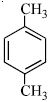
$1,4-$Dimethylbenzene
D
None of these
Solution
(C) The nitration of dimethylbenzene (xylene) depends on the symmetry of the molecule and the directing effects of the two methyl groups.
$1$. $1,2-$Dimethylbenzene ($o-$xylene): The two methyl groups are at positions $1$ and $2$. Nitration can occur at positions $3$ or $4$,leading to two different isomers.
$2$. $1,3-$Dimethylbenzene ($m-$xylene): The methyl groups are at positions $1$ and $3$. Nitration can occur at positions $2, 4,$ or $5$,leading to multiple isomers.
$3$. $1,4-$Dimethylbenzene ($p-$xylene): The methyl groups are at positions $1$ and $4$. Due to the high symmetry of the $p-$xylene molecule,all four available ring positions ($2, 3, 5,$ and $6$) are equivalent. Therefore,nitration at any of these positions results in the formation of only one product,$2-$nitro-$1,4-$dimethylbenzene.
$1$. $1,2-$Dimethylbenzene ($o-$xylene): The two methyl groups are at positions $1$ and $2$. Nitration can occur at positions $3$ or $4$,leading to two different isomers.
$2$. $1,3-$Dimethylbenzene ($m-$xylene): The methyl groups are at positions $1$ and $3$. Nitration can occur at positions $2, 4,$ or $5$,leading to multiple isomers.
$3$. $1,4-$Dimethylbenzene ($p-$xylene): The methyl groups are at positions $1$ and $4$. Due to the high symmetry of the $p-$xylene molecule,all four available ring positions ($2, 3, 5,$ and $6$) are equivalent. Therefore,nitration at any of these positions results in the formation of only one product,$2-$nitro-$1,4-$dimethylbenzene.
0 likes
View Solution311
MediumMCQ
If $p$-methoxytoluene is nitrated,the major product is:
A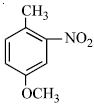
B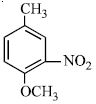
C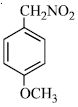
D
No reaction
Solution
(B) In $p$-methoxytoluene,there are two substituents on the benzene ring: a methyl group $(-CH_3)$ and a methoxy group $(-OCH_3)$.
Both groups are ortho/para directing.
The methoxy group $(-OCH_3)$ is a much stronger activating group than the methyl group $(-CH_3)$ due to the resonance effect ($+R$ effect) of the oxygen lone pair.
Therefore,the electrophilic substitution (nitration) will be directed by the $-OCH_3$ group.
The positions ortho to the $-OCH_3$ group are positions $2$ and $6$ relative to the methoxy group,which are also ortho to the methyl group.
Since both ortho positions are equivalent,nitration occurs at one of these positions to form $2$-nitro-$4$-methoxytoluene (or $3$-nitro-$4$-methylanisole).
Comparing the options,the structure in option $B$ represents the nitration ortho to the methoxy group.
Both groups are ortho/para directing.
The methoxy group $(-OCH_3)$ is a much stronger activating group than the methyl group $(-CH_3)$ due to the resonance effect ($+R$ effect) of the oxygen lone pair.
Therefore,the electrophilic substitution (nitration) will be directed by the $-OCH_3$ group.
The positions ortho to the $-OCH_3$ group are positions $2$ and $6$ relative to the methoxy group,which are also ortho to the methyl group.
Since both ortho positions are equivalent,nitration occurs at one of these positions to form $2$-nitro-$4$-methoxytoluene (or $3$-nitro-$4$-methylanisole).
Comparing the options,the structure in option $B$ represents the nitration ortho to the methoxy group.
0 likes
View Solution312
MediumMCQ
An aromatic compound of molecular formula $C_6H_4Br_2$ was nitrated,and three isomers of formula $C_6H_3Br_2NO_2$ were obtained. The original compound is:
A
$o$-dibromobenzene
B
$m$-dibromobenzene
C
$p$-dibromobenzene
D
None of these
Solution
(A) The number of isomers formed upon nitration depends on the number of non-equivalent positions available in the benzene ring for electrophilic substitution.
For $o$-dibromobenzene ($1,2$-dibromobenzene),there are $3$ non-equivalent positions available for nitration,yielding $3$ isomers.
For $m$-dibromobenzene ($1,3$-dibromobenzene),there are $4$ non-equivalent positions available,yielding $4$ isomers.
For $p$-dibromobenzene ($1,4$-dibromobenzene),there is only $1$ non-equivalent position available,yielding $1$ isomer.
Since the question states that $3$ isomers were obtained,the original compound must be $o$-dibromobenzene.
For $o$-dibromobenzene ($1,2$-dibromobenzene),there are $3$ non-equivalent positions available for nitration,yielding $3$ isomers.
For $m$-dibromobenzene ($1,3$-dibromobenzene),there are $4$ non-equivalent positions available,yielding $4$ isomers.
For $p$-dibromobenzene ($1,4$-dibromobenzene),there is only $1$ non-equivalent position available,yielding $1$ isomer.
Since the question states that $3$ isomers were obtained,the original compound must be $o$-dibromobenzene.
0 likes
View Solution313
MediumMCQ
The number of disubstituted products of benzene is
A
$2$
B
$3$
C
$4$
D
$5$
Solution
(B) When two hydrogen atoms in a benzene ring $(C_6H_6)$ are replaced by two substituents,three distinct isomers are formed based on the relative positions of the substituents.
These positions are known as:
$1.$ Ortho $(o-)$ position: $1,2-$ substitution.
$2.$ Meta $(m-)$ position: $1,3-$ substitution.
$3.$ Para $(p-)$ position: $1,4-$ substitution.
Therefore,there are $3$ possible disubstituted products of benzene.
These positions are known as:
$1.$ Ortho $(o-)$ position: $1,2-$ substitution.
$2.$ Meta $(m-)$ position: $1,3-$ substitution.
$3.$ Para $(p-)$ position: $1,4-$ substitution.
Therefore,there are $3$ possible disubstituted products of benzene.
0 likes
View Solution314
MediumMCQ
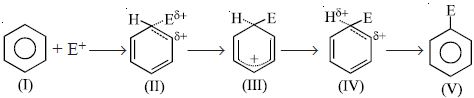
Which of the following species is expected to have maximum enthalpy in an electrophilic aromatic substitution reaction?
A
Species $(II)$
B
Species $(III)$
C
Species $(IV)$
D
Species $(V)$
Solution
(B) In an electrophilic aromatic substitution reaction,the reaction proceeds through the formation of a carbocation intermediate,also known as the arenium ion or sigma complex.
This intermediate is represented by species $(III)$ in the given reaction mechanism.
The formation of this intermediate involves the loss of aromaticity of the benzene ring,which makes it highly unstable and high in energy compared to the reactants and the final product.
Therefore,the arenium ion (species $(III)$) has the maximum enthalpy (potential energy) among the species shown in the reaction coordinate diagram.
This intermediate is represented by species $(III)$ in the given reaction mechanism.
The formation of this intermediate involves the loss of aromaticity of the benzene ring,which makes it highly unstable and high in energy compared to the reactants and the final product.
Therefore,the arenium ion (species $(III)$) has the maximum enthalpy (potential energy) among the species shown in the reaction coordinate diagram.
0 likes
View Solution315
MediumMCQ
For the electrophilic substitution reaction involving nitration,which of the following sequences regarding the rate of reaction is true?
A
$k_{C_6H_6} = k_{C_6D_6} = k_{C_6T_6}$
B
$k_{C_6H_6} < k_{C_6D_6} < k_{C_6T_6}$
C
$k_{C_6H_6} > k_{C_6D_6} > k_{C_6T_6}$
D
$k_{C_6H_6} > k_{C_6D_6} < k_{C_6T_6}$
Solution
(A) In electrophilic aromatic substitution,the rate-determining step is the formation of the sigma complex (arenium ion) by the attack of the electrophile on the aromatic ring.
Since the $C-H$ (or $C-D$ or $C-T$) bond is not broken in the rate-determining step,there is no primary kinetic isotope effect.
Therefore,the rates of nitration for benzene $(C_6H_6)$,hexadeuterobenzene $(C_6D_6)$,and hexatritiobenzene $(C_6T_6)$ are equal.
Thus,$k_{C_6H_6} = k_{C_6D_6} = k_{C_6T_6}$.
Since the $C-H$ (or $C-D$ or $C-T$) bond is not broken in the rate-determining step,there is no primary kinetic isotope effect.
Therefore,the rates of nitration for benzene $(C_6H_6)$,hexadeuterobenzene $(C_6D_6)$,and hexatritiobenzene $(C_6T_6)$ are equal.
Thus,$k_{C_6H_6} = k_{C_6D_6} = k_{C_6T_6}$.
0 likes
View Solution316
MediumMCQ
For the electrophilic substitution reaction involving sulphonation,which of the following sequences regarding the rate of reaction is true?
A
$k_{C_6H_6} > k_{C_6D_6} > k_{C_6T_6}$
B
$k_{C_6H_6} < k_{C_6D_6} < k_{C_6T_6}$
C
$k_{C_6H_6} = k_{C_6D_6} = k_{C_6T_6}$
D
$k_{C_6H_6} > k_{C_6D_6} < k_{C_6T_6}$
Solution
(A) In electrophilic aromatic substitution,the rate-determining step for sulphonation is the removal of the proton (or deuteron/triton) from the sigma complex intermediate.
Since the $C-H$ bond is weaker than the $C-D$ bond,and the $C-D$ bond is weaker than the $C-T$ bond due to the primary kinetic isotope effect,the reaction rate is fastest for benzene $(C_6H_6)$ and slowest for tritiated benzene $(C_6T_6)$.
Therefore,the correct order is $k_{C_6H_6} > k_{C_6D_6} > k_{C_6T_6}$.
Since the $C-H$ bond is weaker than the $C-D$ bond,and the $C-D$ bond is weaker than the $C-T$ bond due to the primary kinetic isotope effect,the reaction rate is fastest for benzene $(C_6H_6)$ and slowest for tritiated benzene $(C_6T_6)$.
Therefore,the correct order is $k_{C_6H_6} > k_{C_6D_6} > k_{C_6T_6}$.
0 likes
View Solution317
DifficultMCQ
Which of the following compounds is aromatic?
A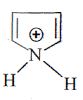
B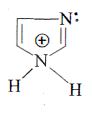
C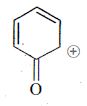
D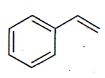
Solution
(B) compound is aromatic if it follows $H$ückel's rule: it must be cyclic,planar,fully conjugated,and contain $(4n+2) \pi$ electrons,where $n$ is an integer $(0, 1, 2, ...)$.
$1$. Option $A$: This is the pyrrolium cation. It has $4 \pi$ electrons (from two double bonds). It is anti-aromatic.
$2$. Option $B$: This is an imidazolium-like cation. The nitrogen atom with the lone pair participates in the aromatic sextet. The ring has $6 \pi$ electrons ($4$ from two double bonds and $2$ from the lone pair on the nitrogen atom). It is planar and cyclic. Thus,it is aromatic.
$3$. Option $C$: This is a pyrylium-like cation. It is not fully conjugated in a way that satisfies the $(4n+2)$ rule for the entire ring system.
$4$. Option $D$: Styrene is a benzene derivative. While the benzene ring is aromatic,the question asks for the compound as a whole. However,in the context of these specific choices,the imidazolium-type cation $(B)$ is a classic example of a heterocyclic aromatic system.
$1$. Option $A$: This is the pyrrolium cation. It has $4 \pi$ electrons (from two double bonds). It is anti-aromatic.
$2$. Option $B$: This is an imidazolium-like cation. The nitrogen atom with the lone pair participates in the aromatic sextet. The ring has $6 \pi$ electrons ($4$ from two double bonds and $2$ from the lone pair on the nitrogen atom). It is planar and cyclic. Thus,it is aromatic.
$3$. Option $C$: This is a pyrylium-like cation. It is not fully conjugated in a way that satisfies the $(4n+2)$ rule for the entire ring system.
$4$. Option $D$: Styrene is a benzene derivative. While the benzene ring is aromatic,the question asks for the compound as a whole. However,in the context of these specific choices,the imidazolium-type cation $(B)$ is a classic example of a heterocyclic aromatic system.
0 likes
View Solution318
DifficultMCQ
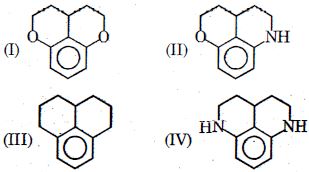
For the given compounds,what is the decreasing order of the rate of electrophilic aromatic substitution?
A
$I > II > III > IV$
B
$III > IV > II > I$
C
$IV > II > I > III$
D
$IV > I > II > III$
Solution
(C) The rate of electrophilic aromatic substitution depends on the electron density of the benzene ring. Electron-donating groups (EDGs) increase the electron density and thus increase the rate of substitution.
In the given compounds:
- Compound $(IV)$ has two $-NH$ groups,which are strong electron-donating groups due to the resonance effect ($+R$ effect) of the lone pair on nitrogen.
- Compound $(II)$ has one $-NH$ group and one $-O$ group. The $-NH$ group is a stronger electron donor than the $-O$ group.
- Compound $(I)$ has two $-O$ groups,which are electron-donating but less effective than $-NH$ groups.
- Compound $(III)$ has only alkyl groups,which are weak electron donors via the inductive effect ($+I$ effect).
Therefore,the electron-donating ability follows the order: two $-NH$ groups $(IV)$ > one $-NH$ and one $-O$ group $(II)$ > two $-O$ groups $(I)$ > alkyl groups $(III)$.
Thus,the decreasing order of the rate of electrophilic aromatic substitution is $IV > II > I > III$.
In the given compounds:
- Compound $(IV)$ has two $-NH$ groups,which are strong electron-donating groups due to the resonance effect ($+R$ effect) of the lone pair on nitrogen.
- Compound $(II)$ has one $-NH$ group and one $-O$ group. The $-NH$ group is a stronger electron donor than the $-O$ group.
- Compound $(I)$ has two $-O$ groups,which are electron-donating but less effective than $-NH$ groups.
- Compound $(III)$ has only alkyl groups,which are weak electron donors via the inductive effect ($+I$ effect).
Therefore,the electron-donating ability follows the order: two $-NH$ groups $(IV)$ > one $-NH$ and one $-O$ group $(II)$ > two $-O$ groups $(I)$ > alkyl groups $(III)$.
Thus,the decreasing order of the rate of electrophilic aromatic substitution is $IV > II > I > III$.
0 likes
View Solution319
MediumMCQ
In the given reaction,$C_6H_6 + HNO_3 \xrightarrow{H_2SO_4} C_6H_5NO_2 + H_2O$,$HNO_3$ acts as:
A
Acid
B
Base
C
Electrophile
D
Catalyst
Solution
(B) In the nitration of benzene,$H_2SO_4$ acts as a strong acid and $HNO_3$ acts as a base.
The reaction between them is:
$H_2SO_4 + HO-NO_2 \rightleftharpoons H_2SO_4^- + H_2O^+-NO_2$
The $H_2O^+-NO_2$ then loses water to form the nitronium ion $(NO_2^+)$,which is the electrophile.
The reaction between them is:
$H_2SO_4 + HO-NO_2 \rightleftharpoons H_2SO_4^- + H_2O^+-NO_2$
The $H_2O^+-NO_2$ then loses water to form the nitronium ion $(NO_2^+)$,which is the electrophile.
0 likes
View Solution320
AdvancedMCQ
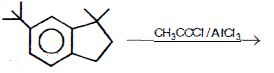
The major product of the reaction is
A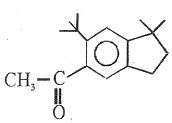
B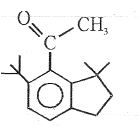
C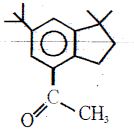
D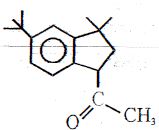
Solution
(A) The reaction is a Friedel-Crafts acylation of a substituted benzene ring. The substrate is $1,1,3$-trimethylindane (or a similar derivative). The incoming electrophile is the acetyl cation,$CH_3CO^+$,generated from $CH_3COCl$ and $AlCl_3$. The substitution occurs at the position that is most activated and least sterically hindered. In the given structure,the position ortho to the alkyl group on the benzene ring is the most favorable site for electrophilic aromatic substitution due to the activating effect of the alkyl groups and the relative lack of steric hindrance compared to other positions. Therefore,the acetyl group attaches to the carbon atom that is ortho to the $tert$-butyl group and meta to the other alkyl group,which corresponds to the structure shown in option $A$.
0 likes
View Solution321
DifficultMCQ
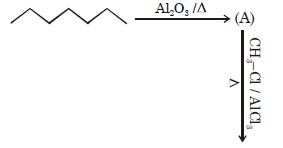
The major product of the reaction shown below is:
A
$1,2-$dimethylbenzene
B
$1,4-$dimethylbenzene
C
$1,3-$dimethylbenzene
D
Ethylbenzene
Solution
(B) The starting material is $n$-hexane $(CH_3-CH_2-CH_2-CH_2-CH_2-CH_3)$.
When $n$-hexane is heated with $Al_2O_3$ (aromatization/dehydrocyclization),it forms benzene.
Reaction: $C_6H_{14} \xrightarrow{Al_2O_3 / \Delta} C_6H_6$ (Benzene).
Thus,$(A)$ is benzene.
Next,the reaction of benzene with $CH_3Cl$ in the presence of $AlCl_3$ is a Friedel-Crafts alkylation.
Reaction: $C_6H_6 + CH_3Cl \xrightarrow{AlCl_3} C_6H_5-CH_3$ (Toluene).
However,looking at the options provided,there seems to be a mismatch in the reaction sequence or the product structure. If the starting material was $n$-heptane,it would form toluene,and further alkylation would yield xylenes. Given the options,the question likely implies the formation of a dimethylbenzene derivative. Assuming the starting material is $n$-heptane,the aromatization yields toluene,and subsequent Friedel-Crafts alkylation with $CH_3Cl$ yields a mixture of $o$-,$m$-,and $p$-xylenes,with the $p$-isomer ($1$,$4$-dimethylbenzene) often being the major product due to steric factors.
When $n$-hexane is heated with $Al_2O_3$ (aromatization/dehydrocyclization),it forms benzene.
Reaction: $C_6H_{14} \xrightarrow{Al_2O_3 / \Delta} C_6H_6$ (Benzene).
Thus,$(A)$ is benzene.
Next,the reaction of benzene with $CH_3Cl$ in the presence of $AlCl_3$ is a Friedel-Crafts alkylation.
Reaction: $C_6H_6 + CH_3Cl \xrightarrow{AlCl_3} C_6H_5-CH_3$ (Toluene).
However,looking at the options provided,there seems to be a mismatch in the reaction sequence or the product structure. If the starting material was $n$-heptane,it would form toluene,and further alkylation would yield xylenes. Given the options,the question likely implies the formation of a dimethylbenzene derivative. Assuming the starting material is $n$-heptane,the aromatization yields toluene,and subsequent Friedel-Crafts alkylation with $CH_3Cl$ yields a mixture of $o$-,$m$-,and $p$-xylenes,with the $p$-isomer ($1$,$4$-dimethylbenzene) often being the major product due to steric factors.
0 likes
View Solution322
AdvancedMCQ
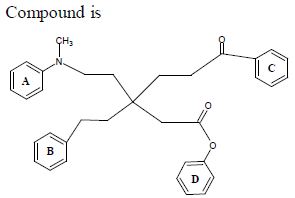
The following compound has four aromatic rings marked as $A$,$B$,$C$ and $D$. Rank them in terms of increasing reactivity towards electrophilic aromatic substitution?
A
$C < D < A < B$
B
$C < B < D < A$
C
$C < B < A < D$
D
$B < C < D < A$
Solution
(B) The reactivity of an aromatic ring towards electrophilic aromatic substitution $(EAS)$ depends on the nature of the substituents attached to it. Electron-donating groups $(EDG)$ increase reactivity,while electron-withdrawing groups $(EWG)$ decrease it.
$1$. Ring $A$ is attached to an $-N(CH_3)-$ group,which is a strongly activating group due to the strong $+M$ effect of the nitrogen lone pair.
$2$. Ring $B$ is attached to an alkyl chain,which acts as a weakly activating group due to the $+I$ effect and hyperconjugation.
$3$. Ring $C$ is attached to a carbonyl group $(-C=O)$,which is a strongly deactivating group due to the $-M$ and $-I$ effects.
$4$. Ring $D$ is attached to an oxygen atom of an ester group $(-O-C=O-)$,which acts as a moderately activating group due to the $+M$ effect of the oxygen lone pair,although it is also electron-withdrawing by the $-I$ effect.
Comparing these,the order of reactivity is $C$ (deactivated) $< B$ (weakly activated) $< D$ (moderately activated) $< A$ (strongly activated). Thus,the correct order is $C < B < D < A$.
$1$. Ring $A$ is attached to an $-N(CH_3)-$ group,which is a strongly activating group due to the strong $+M$ effect of the nitrogen lone pair.
$2$. Ring $B$ is attached to an alkyl chain,which acts as a weakly activating group due to the $+I$ effect and hyperconjugation.
$3$. Ring $C$ is attached to a carbonyl group $(-C=O)$,which is a strongly deactivating group due to the $-M$ and $-I$ effects.
$4$. Ring $D$ is attached to an oxygen atom of an ester group $(-O-C=O-)$,which acts as a moderately activating group due to the $+M$ effect of the oxygen lone pair,although it is also electron-withdrawing by the $-I$ effect.
Comparing these,the order of reactivity is $C$ (deactivated) $< B$ (weakly activated) $< D$ (moderately activated) $< A$ (strongly activated). Thus,the correct order is $C < B < D < A$.
0 likes
View Solution323
DifficultMCQ
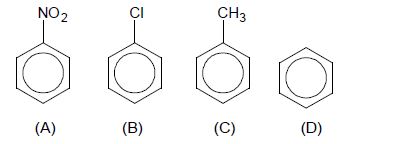
The correct order of the rate of $EAS$ (electrophilic aromatic substitution) for the given compounds is:
A
$C > D > B > A$
B
$C > D > A > B$
C
$A > B > C > D$
D
$C > B > A > D$
Solution
(A) The rate of $EAS$ depends on the electron density of the benzene ring. Electron-donating groups increase the rate,while electron-withdrawing groups decrease it.
$1$. $-CH_3$ (in $C$) is an electron-donating group ($+I$ and hyperconjugation),which activates the ring.
$2$. Benzene $(D)$ has no substituent.
$3$. $-Cl$ (in $B$) is a deactivating group due to its strong $-I$ effect,although it is ortho/para directing.
$4$. $-NO_2$ (in $A$) is a strongly deactivating group due to its strong $-I$ and $-M$ effects.
Therefore,the order of reactivity is $C$ (activated) $> D$ (benzene) $> B$ (weakly deactivated) $> A$ (strongly deactivated).
The correct order is $C > D > B > A$.
$1$. $-CH_3$ (in $C$) is an electron-donating group ($+I$ and hyperconjugation),which activates the ring.
$2$. Benzene $(D)$ has no substituent.
$3$. $-Cl$ (in $B$) is a deactivating group due to its strong $-I$ effect,although it is ortho/para directing.
$4$. $-NO_2$ (in $A$) is a strongly deactivating group due to its strong $-I$ and $-M$ effects.
Therefore,the order of reactivity is $C$ (activated) $> D$ (benzene) $> B$ (weakly deactivated) $> A$ (strongly deactivated).
The correct order is $C > D > B > A$.
0 likes
View Solution324
MediumMCQ
Which of the following is nonaromatic in nature?
A
Pyrrole cation $(C_4H_6N^+)$
B
Benzene $(C_6H_6)$
C
Cyclopentadienyl cation $(C_5H_5^+)$
D
Cyclopropenyl cation $(C_3H_3^+)$
Solution
(A) To determine the aromaticity of a compound,we use $H$ückel's rule,which states that a planar,cyclic,fully conjugated system with $(4n+2) \pi$ electrons is aromatic.
$A$. Pyrrole cation $(C_4H_6N^+)$: The nitrogen atom is $sp^3$ hybridized because it is bonded to four atoms (two carbons and two hydrogens). Since it is not $sp^2$ hybridized,the ring is not fully conjugated and thus it is nonaromatic.
$B$. Benzene $(C_6H_6)$: It is a planar,cyclic,fully conjugated system with $6 \pi$ electrons $(n=1)$,so it is aromatic.
$C$. Cyclopentadienyl cation $(C_5H_5^+)$: It is a planar,cyclic,fully conjugated system with $4 \pi$ electrons ($n=1$ in $4n$ rule),so it is antiaromatic.
$D$. Cyclopropenyl cation $(C_3H_3^+)$: It is a planar,cyclic,fully conjugated system with $2 \pi$ electrons $(n=0)$,so it is aromatic.
Therefore,the pyrrole cation is nonaromatic.
$A$. Pyrrole cation $(C_4H_6N^+)$: The nitrogen atom is $sp^3$ hybridized because it is bonded to four atoms (two carbons and two hydrogens). Since it is not $sp^2$ hybridized,the ring is not fully conjugated and thus it is nonaromatic.
$B$. Benzene $(C_6H_6)$: It is a planar,cyclic,fully conjugated system with $6 \pi$ electrons $(n=1)$,so it is aromatic.
$C$. Cyclopentadienyl cation $(C_5H_5^+)$: It is a planar,cyclic,fully conjugated system with $4 \pi$ electrons ($n=1$ in $4n$ rule),so it is antiaromatic.
$D$. Cyclopropenyl cation $(C_3H_3^+)$: It is a planar,cyclic,fully conjugated system with $2 \pi$ electrons $(n=0)$,so it is aromatic.
Therefore,the pyrrole cation is nonaromatic.
0 likes
View Solution325
MediumMCQ
Which of the following represents $H$ückel's rule for aromaticity?
A
$(4n+2) \pi$ electrons
B
$(4n) \pi$ electrons
C
$(4n+1) \pi$ electrons
D
$(2n+2) \pi$ electrons
Solution
(A) $H$ückel's rule states that for a planar,cyclic,conjugated system to be aromatic,it must contain $(4n+2) \pi$ electrons,where $n$ is an integer $(n = 0, 1, 2, ...)$.
Thus,the correct representation is $(4n+2) \pi$ electrons.
Thus,the correct representation is $(4n+2) \pi$ electrons.
0 likes
View Solution326
DifficultMCQ
Which of the following is most reactive toward electrophilic aromatic substitution reaction?
A
$Anisole$
B
$Benzene$
C
$Nitrobenzene$
D
$Chlorobenzene$
Solution
(A) The reactivity toward electrophilic aromatic substitution is determined by the electron density on the benzene ring.
Groups that donate electrons to the ring increase its electron density,making it more reactive toward electrophiles.
$Anisole$ $(C_6H_5OCH_3)$ contains a methoxy group $(-OCH_3)$,which is a strong electron-donating group due to the resonance effect ($+R$ effect).
$Benzene$ has no substituent.
$Nitrobenzene$ $(C_6H_5NO_2)$ contains a nitro group $(-NO_2)$,which is a strong electron-withdrawing group ($-I$ and $-R$ effects).
$Chlorobenzene$ $(C_6H_5Cl)$ contains a chlorine atom,which is deactivating due to its strong inductive effect ($-I$ effect) despite its resonance donation ($+R$ effect).
Therefore,$Anisole$ is the most reactive among the given options.
Groups that donate electrons to the ring increase its electron density,making it more reactive toward electrophiles.
$Anisole$ $(C_6H_5OCH_3)$ contains a methoxy group $(-OCH_3)$,which is a strong electron-donating group due to the resonance effect ($+R$ effect).
$Benzene$ has no substituent.
$Nitrobenzene$ $(C_6H_5NO_2)$ contains a nitro group $(-NO_2)$,which is a strong electron-withdrawing group ($-I$ and $-R$ effects).
$Chlorobenzene$ $(C_6H_5Cl)$ contains a chlorine atom,which is deactivating due to its strong inductive effect ($-I$ effect) despite its resonance donation ($+R$ effect).
Therefore,$Anisole$ is the most reactive among the given options.
0 likes
View Solution327
DifficultMCQ
Which of the following benzene rings is most reactive towards an electrophile $(E^{\oplus})$?
A
Phenol $(C_6H_5OH)$
B
Nitrobenzene $(C_6H_5NO_2)$
C
Benzaldehyde $(C_6H_5CHO)$
D
Toluene $(C_6H_5CH_3)$
Solution
(A) The reactivity of a benzene ring towards electrophilic aromatic substitution depends on the electron density of the ring. Groups that donate electron density to the ring (activating groups) increase its reactivity,while groups that withdraw electron density (deactivating groups) decrease its reactivity.
$1$. The $-OH$ group in phenol is a strong activating group due to its $+M$ (mesomeric) effect,which significantly increases the electron density on the benzene ring.
$2$. The $-CH_3$ group in toluene is a weakly activating group due to the $+I$ (inductive) effect and hyperconjugation.
$3$. The $-NO_2$ group in nitrobenzene is a strongly deactivating group due to its $-M$ and $-I$ effects.
$4$. The $-CHO$ group in benzaldehyde is a deactivating group due to its $-M$ and $-I$ effects.
Since the $-OH$ group is the strongest activating group among the given options,phenol is the most reactive towards an electrophile.
$1$. The $-OH$ group in phenol is a strong activating group due to its $+M$ (mesomeric) effect,which significantly increases the electron density on the benzene ring.
$2$. The $-CH_3$ group in toluene is a weakly activating group due to the $+I$ (inductive) effect and hyperconjugation.
$3$. The $-NO_2$ group in nitrobenzene is a strongly deactivating group due to its $-M$ and $-I$ effects.
$4$. The $-CHO$ group in benzaldehyde is a deactivating group due to its $-M$ and $-I$ effects.
Since the $-OH$ group is the strongest activating group among the given options,phenol is the most reactive towards an electrophile.
0 likes
View Solution328
MediumMCQ
Identify the compound which is homocyclic,aromatic,and unsaturated?
A
Cyclohexane
B
Benzene
C
Tetrahydropyran
D
$1,3-$Butadiene
Solution
(B) compound is defined as homocyclic if its ring consists only of carbon atoms. It is aromatic if it follows $H$ückel's rule ($4n+2$ $\pi$ electrons) and is planar/cyclic. It is unsaturated if it contains double or triple bonds.
$A$. Cyclohexane $(C_6H_{12})$ is homocyclic and saturated (no double bonds).
$B$. Benzene $(C_6H_6)$ is homocyclic (only carbon atoms in the ring),aromatic (follows $H$ückel's rule with $6$ $\pi$ electrons),and unsaturated (contains three double bonds).
$C$. Tetrahydropyran is a heterocyclic compound because it contains an oxygen atom in the ring.
$D$. $1,3-$Butadiene is an open-chain (acyclic) unsaturated hydrocarbon,not a cyclic compound.
Therefore,the correct answer is Benzene.
$A$. Cyclohexane $(C_6H_{12})$ is homocyclic and saturated (no double bonds).
$B$. Benzene $(C_6H_6)$ is homocyclic (only carbon atoms in the ring),aromatic (follows $H$ückel's rule with $6$ $\pi$ electrons),and unsaturated (contains three double bonds).
$C$. Tetrahydropyran is a heterocyclic compound because it contains an oxygen atom in the ring.
$D$. $1,3-$Butadiene is an open-chain (acyclic) unsaturated hydrocarbon,not a cyclic compound.
Therefore,the correct answer is Benzene.
0 likes
View Solution329
DifficultMCQ
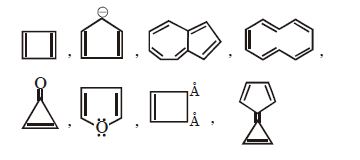
Determine the number of aromatic species among the given compounds:
A
$6$
B
$7$
C
$4$
D
$5$
Solution
(D) To determine if a compound is aromatic,it must satisfy $H$ückel's rule ($4n+2$ $\pi$ electrons),be planar,and have a continuous cyclic conjugation.
$1$. Cyclobutadiene: $4$ $\pi$ electrons (anti-aromatic).
$2$. Cyclopentadienyl anion: $6$ $\pi$ electrons (aromatic).
$3$. Azulene: $10$ $\pi$ electrons (aromatic).
$4$. Cyclooctatetraene: Non-planar,$8$ $\pi$ electrons (non-aromatic).
$5$. Cyclopropenone: $2$ $\pi$ electrons (aromatic).
$6$. Furan: $6$ $\pi$ electrons (aromatic).
$7$. Cyclobutene: Not fully conjugated (non-aromatic).
$8$. Fulvene derivative: $6$ $\pi$ electrons (aromatic).
The aromatic compounds are: Cyclopentadienyl anion,Azulene,Cyclopropenone,Furan,and the Fulvene derivative.
Total number of aromatic species = $5$.
$1$. Cyclobutadiene: $4$ $\pi$ electrons (anti-aromatic).
$2$. Cyclopentadienyl anion: $6$ $\pi$ electrons (aromatic).
$3$. Azulene: $10$ $\pi$ electrons (aromatic).
$4$. Cyclooctatetraene: Non-planar,$8$ $\pi$ electrons (non-aromatic).
$5$. Cyclopropenone: $2$ $\pi$ electrons (aromatic).
$6$. Furan: $6$ $\pi$ electrons (aromatic).
$7$. Cyclobutene: Not fully conjugated (non-aromatic).
$8$. Fulvene derivative: $6$ $\pi$ electrons (aromatic).
The aromatic compounds are: Cyclopentadienyl anion,Azulene,Cyclopropenone,Furan,and the Fulvene derivative.
Total number of aromatic species = $5$.
0 likes
View Solution330
DifficultMCQ
Identify the number of aromatic compounds from the following structures:
$(I)$ Cyclopentadiene
$(II)$ Cyclooctatetraene
$(III)$ Borazine $(B_3N_3H_6)$
$(IV)$ $1,4-$diboracyclohexa$-2,5-$diene
$(I)$ Cyclopentadiene
$(II)$ Cyclooctatetraene
$(III)$ Borazine $(B_3N_3H_6)$
$(IV)$ $1,4-$diboracyclohexa$-2,5-$diene
A
$1$
B
$4$
C
$3$
D
$2$
Solution
(A) To be aromatic,a compound must follow $H$ückel's rule ($4n+2$ $\pi$ electrons),be planar,cyclic,and fully conjugated.
$(I)$ Cyclopentadiene: It is non-aromatic because it has an $sp^3$ hybridized carbon atom.
$(II)$ Cyclooctatetraene: It is non-aromatic (tub-shaped,non-planar) and has $8$ $\pi$ electrons (anti-aromatic if planar,but it is non-planar).
$(III)$ Borazine $(B_3N_3H_6)$: It is isoelectronic with benzene,planar,cyclic,and has $6$ $\pi$ electrons. It is aromatic.
$(IV)$ $1,4-$diboracyclohexa$-2,5-$diene: It has $4$ $\pi$ electrons and is not fully conjugated in a way that satisfies $H$ückel's rule for aromaticity.
Thus,only structure $(III)$ is aromatic.
The correct option is $A$.
$(I)$ Cyclopentadiene: It is non-aromatic because it has an $sp^3$ hybridized carbon atom.
$(II)$ Cyclooctatetraene: It is non-aromatic (tub-shaped,non-planar) and has $8$ $\pi$ electrons (anti-aromatic if planar,but it is non-planar).
$(III)$ Borazine $(B_3N_3H_6)$: It is isoelectronic with benzene,planar,cyclic,and has $6$ $\pi$ electrons. It is aromatic.
$(IV)$ $1,4-$diboracyclohexa$-2,5-$diene: It has $4$ $\pi$ electrons and is not fully conjugated in a way that satisfies $H$ückel's rule for aromaticity.
Thus,only structure $(III)$ is aromatic.
The correct option is $A$.
0 likes
View Solution331
DifficultMCQ
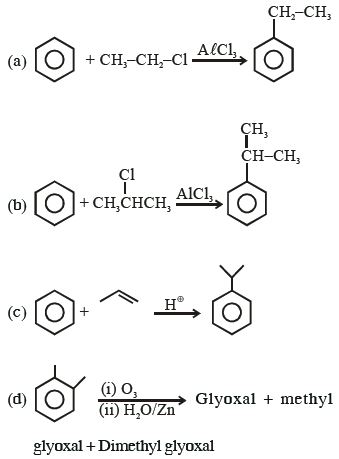
Correctly matched products are
A
$b, c$
B
$b, c, d$
C
$a, b, c, d$
D
$a, b, d$
Solution
(C) Friedel-Crafts alkylation of benzene with ethyl chloride gives ethylbenzene. This is correct.
$(b)$ Friedel-Crafts alkylation of benzene with isopropyl chloride gives isopropylbenzene (cumene). This is correct.
$(c)$ Electrophilic addition of propene to benzene in the presence of $H^+$ gives isopropylbenzene. This is correct.
$(d)$ Ozonolysis of $o$-xylene ($1,2$-dimethylbenzene) yields glyoxal,methylglyoxal,and dimethylglyoxal. This is correct.
Therefore,all the given reactions are correctly matched.
$(b)$ Friedel-Crafts alkylation of benzene with isopropyl chloride gives isopropylbenzene (cumene). This is correct.
$(c)$ Electrophilic addition of propene to benzene in the presence of $H^+$ gives isopropylbenzene. This is correct.
$(d)$ Ozonolysis of $o$-xylene ($1,2$-dimethylbenzene) yields glyoxal,methylglyoxal,and dimethylglyoxal. This is correct.
Therefore,all the given reactions are correctly matched.
0 likes
View Solution332
MediumMCQ
Which of the following products is formed when $n-$heptane is passed over $(Al_2O_3 + Cr_2O_3)$ catalyst at $773\ K$?
A
Benzene
B
Toluene
C
Polyheptane
D
Cycloheptane
Solution
(B) The process of converting an alkane with $6$ or more carbon atoms into an aromatic hydrocarbon by heating it with a catalyst like $Cr_2O_3$,$V_2O_5$,or $Mo_2O_3$ supported over $Al_2O_3$ at high temperature and pressure is known as aromatization or reforming.
When $n-$heptane $(C_7H_{16})$ is passed over $(Al_2O_3 + Cr_2O_3)$ catalyst at $773\ K$,it undergoes cyclization and dehydrogenation to form toluene $(C_6H_5CH_3)$.
When $n-$heptane $(C_7H_{16})$ is passed over $(Al_2O_3 + Cr_2O_3)$ catalyst at $773\ K$,it undergoes cyclization and dehydrogenation to form toluene $(C_6H_5CH_3)$.
0 likes
View Solution333
DifficultMCQ
Identify the polynuclear aromatic compounds that are aromatic from the given structures:
$(i)$ Naphthalene
(ii) Anthracene
(iii) Phenanthrene
$(i)$ Naphthalene
(ii) Anthracene
(iii) Phenanthrene
A
$(i)$ and $(ii)$
B
$(ii)$ and $(iii)$
C
$(i)$,$(ii)$ and $(iii)$
D
$(i)$ and $(iii)$
Solution
(C) For any compound to be aromatic,all carbon atoms must be $sp^2$ hybridized,the molecule must be planar,and it must follow $H$ückel's rule.
$H$ückel's Rule $\Rightarrow 4n + 2 = \text{number of delocalized } \pi\text{-electrons } (n = 0, 1, 2, 3, \dots)$
$(i)$ Naphthalene: $10 \pi\text{-electrons}$ $\Rightarrow 4n + 2 = 10$ $\Rightarrow n = 2$ (Aromatic)
$(ii)$ Anthracene: $14 \pi\text{-electrons}$ $\Rightarrow 4n + 2 = 14$ $\Rightarrow n = 3$ (Aromatic)
$(iii)$ Phenanthrene: $14 \pi\text{-electrons}$ $\Rightarrow 4n + 2 = 14$ $\Rightarrow n = 3$ (Aromatic)
All three compounds are planar,have $sp^2$ hybridized carbon atoms,and follow $H$ückel's rule.
Therefore,all are aromatic compounds.
Hence,the correct answer is option $C$.
$H$ückel's Rule $\Rightarrow 4n + 2 = \text{number of delocalized } \pi\text{-electrons } (n = 0, 1, 2, 3, \dots)$
$(i)$ Naphthalene: $10 \pi\text{-electrons}$ $\Rightarrow 4n + 2 = 10$ $\Rightarrow n = 2$ (Aromatic)
$(ii)$ Anthracene: $14 \pi\text{-electrons}$ $\Rightarrow 4n + 2 = 14$ $\Rightarrow n = 3$ (Aromatic)
$(iii)$ Phenanthrene: $14 \pi\text{-electrons}$ $\Rightarrow 4n + 2 = 14$ $\Rightarrow n = 3$ (Aromatic)
All three compounds are planar,have $sp^2$ hybridized carbon atoms,and follow $H$ückel's rule.
Therefore,all are aromatic compounds.
Hence,the correct answer is option $C$.
0 likes
View Solution334
MediumMCQ
Calculate the sum of $\alpha$-hydrogen atoms in the given structures $(i)$ and $(ii)$:
$(i)$ $1,3$-dimethylbenzene
(ii) $1,3$-diethylbenzene
Sum $= (i) + (ii) = ?$
$(i)$ $1,3$-dimethylbenzene
(ii) $1,3$-diethylbenzene
Sum $= (i) + (ii) = ?$
A
$8$
B
$9$
C
$10$
D
$11$
Solution
(C) In structure $(i)$,which is $1,3$-dimethylbenzene,there are two methyl groups attached to the benzene ring. Each methyl group is attached to an $sp^2$ hybridized carbon of the ring,making the carbon of the methyl group an $\alpha$-carbon. Each methyl group has $3$ $\alpha$-hydrogens. Thus,total $\alpha$-hydrogens $= 3 + 3 = 6$.
In structure $(ii)$,which is $1,3$-diethylbenzene,there are two ethyl groups attached to the benzene ring. The carbon of the ethyl group directly attached to the benzene ring is the $\alpha$-carbon. Each $\alpha$-carbon in an ethyl group has $2$ $\alpha$-hydrogens. Thus,total $\alpha$-hydrogens $= 2 + 2 = 4$.
The sum of $\alpha$-hydrogens $= 6 + 4 = 10$.
In structure $(ii)$,which is $1,3$-diethylbenzene,there are two ethyl groups attached to the benzene ring. The carbon of the ethyl group directly attached to the benzene ring is the $\alpha$-carbon. Each $\alpha$-carbon in an ethyl group has $2$ $\alpha$-hydrogens. Thus,total $\alpha$-hydrogens $= 2 + 2 = 4$.
The sum of $\alpha$-hydrogens $= 6 + 4 = 10$.
0 likes
View Solution335
DifficultMCQ
Among the following compounds,the order of decreasing reactivity towards electrophilic substitution is:
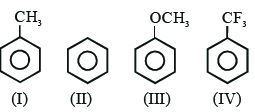
A
$III > I > II > IV$
B
$III > I > IV > II$
C
$II > I > III > IV$
D
$II > I > IV > III$
Solution
(A) The reactivity towards electrophilic substitution $(ESR)$ depends on the electron density in the benzene ring.
Electron donating groups $(EDG)$ increase the electron density and thus increase reactivity,while electron withdrawing groups $(EWG)$ decrease the electron density and decrease reactivity.
- $(III)$ Anisole $(-OCH_3)$: The $-OCH_3$ group is a strong $EDG$ due to its $+M$ effect.
- $(I)$ Toluene $(-CH_3)$: The $-CH_3$ group is a weak $EDG$ due to $+I$ and hyperconjugation effects.
- $(II)$ Benzene: This is the reference compound with no substituents.
- $(IV)$ Trifluoromethylbenzene $(-CF_3)$: The $-CF_3$ group is a strong $EWG$ due to its $-I$ effect.
Therefore,the order of reactivity is: $(III) > (I) > (II) > (IV)$.
Electron donating groups $(EDG)$ increase the electron density and thus increase reactivity,while electron withdrawing groups $(EWG)$ decrease the electron density and decrease reactivity.
- $(III)$ Anisole $(-OCH_3)$: The $-OCH_3$ group is a strong $EDG$ due to its $+M$ effect.
- $(I)$ Toluene $(-CH_3)$: The $-CH_3$ group is a weak $EDG$ due to $+I$ and hyperconjugation effects.
- $(II)$ Benzene: This is the reference compound with no substituents.
- $(IV)$ Trifluoromethylbenzene $(-CF_3)$: The $-CF_3$ group is a strong $EWG$ due to its $-I$ effect.
Therefore,the order of reactivity is: $(III) > (I) > (II) > (IV)$.
0 likes
View Solution336
MediumMCQ
Complete the following reactions and identify $A, B, C$ respectively:
$(i)$ $\text{Phenol} + A \xrightarrow{\text{distill}} \text{Benzene}$
(ii) $\text{Benzenesulfonic acid} + B \xrightarrow{150-200^{\circ}C, \text{HCl, high pressure}} \text{Benzene}$
(iii) $\text{Chlorobenzene} \xrightarrow{C, \text{NaOH}} \text{Benzene}$
$(i)$ $\text{Phenol} + A \xrightarrow{\text{distill}} \text{Benzene}$
(ii) $\text{Benzenesulfonic acid} + B \xrightarrow{150-200^{\circ}C, \text{HCl, high pressure}} \text{Benzene}$
(iii) $\text{Chlorobenzene} \xrightarrow{C, \text{NaOH}} \text{Benzene}$
A
$A = Ni, B = H_2O \ (\text{liquid}), C = H_2O$
B
$A = Zn, B = H_2O \ (\text{steam}), C = H_2 \ (Ni-Al \ \text{alloy})$
C
$A = Mg, B = H_2O \ (\text{liquid}), C = HCl$
D
$A = Zn, B = H_2O \ (\text{boiling}), C = SnCl_2$
Solution
(B) The reactions are as follows:
$(i)$ Phenol reacts with zinc dust $(Zn)$ upon distillation to form benzene: $C_6H_5OH + Zn \rightarrow C_6H_6 + ZnO$. Thus,$A = Zn$.
(ii) Benzenesulfonic acid undergoes desulfonation with superheated steam $(H_2O)$ at $150-200^{\circ}C$ in the presence of $HCl$ to form benzene: $C_6H_5SO_3H + H_2O \rightarrow C_6H_6 + H_2SO_4$. Thus,$B = H_2O \ (\text{steam})$.
(iii) Chlorobenzene undergoes catalytic hydrogenation using $H_2$ gas in the presence of $Ni-Al$ alloy (Raney nickel type catalyst) to form benzene: $C_6H_5Cl + H_2 \xrightarrow{Ni-Al} C_6H_6 + HCl$. Thus,$C = H_2 \ (Ni-Al \ \text{alloy})$.
Therefore,the correct option is $B$.
$(i)$ Phenol reacts with zinc dust $(Zn)$ upon distillation to form benzene: $C_6H_5OH + Zn \rightarrow C_6H_6 + ZnO$. Thus,$A = Zn$.
(ii) Benzenesulfonic acid undergoes desulfonation with superheated steam $(H_2O)$ at $150-200^{\circ}C$ in the presence of $HCl$ to form benzene: $C_6H_5SO_3H + H_2O \rightarrow C_6H_6 + H_2SO_4$. Thus,$B = H_2O \ (\text{steam})$.
(iii) Chlorobenzene undergoes catalytic hydrogenation using $H_2$ gas in the presence of $Ni-Al$ alloy (Raney nickel type catalyst) to form benzene: $C_6H_5Cl + H_2 \xrightarrow{Ni-Al} C_6H_6 + HCl$. Thus,$C = H_2 \ (Ni-Al \ \text{alloy})$.
Therefore,the correct option is $B$.
0 likes
View Solution337
MediumMCQ
In the reaction of benzene with dichloromethane $(CH_2Cl_2)$ in the presence of anhydrous $AlCl_3$,the intermediate product '$A$' is:
A
Benzyl chloride $(C_6H_5CH_2Cl)$
B
Benzal chloride $(C_6H_5CHCl_2)$
C
Diphenylmethane $(C_6H_5CH_2C_6H_5)$
D
Benzene $(C_6H_6)$
Solution
(A) The reaction of benzene with dichloromethane $(CH_2Cl_2)$ in the presence of anhydrous $AlCl_3$ is a Friedel-Crafts alkylation reaction.
First,benzene reacts with $CH_2Cl_2$ to form benzyl chloride $(C_6H_5CH_2Cl)$ as the intermediate product '$A$'.
Then,this intermediate '$A$' (benzyl chloride) reacts with another molecule of benzene in the presence of $AlCl_3$ to form diphenylmethane as the final product.
Therefore,the intermediate '$A$' is benzyl chloride.
First,benzene reacts with $CH_2Cl_2$ to form benzyl chloride $(C_6H_5CH_2Cl)$ as the intermediate product '$A$'.
Then,this intermediate '$A$' (benzyl chloride) reacts with another molecule of benzene in the presence of $AlCl_3$ to form diphenylmethane as the final product.
Therefore,the intermediate '$A$' is benzyl chloride.
0 likes
View Solution338
DifficultMCQ
The electrophile,$E^{+}$,attacks the benzene ring to generate the intermediate $\sigma$-complex. Which $\sigma$-complex is of lowest energy?
A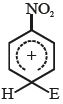
B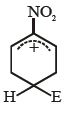
C
D
Solution
(C) In nitrobenzene,the $-NO_2$ group is a strong electron-withdrawing group ($-I$ and $-M$ effect).
When an electrophile $E^{+}$ attacks the benzene ring,the positive charge in the $\sigma$-complex is delocalized over the ring.
For ortho and para attacks,one of the resonance structures places the positive charge directly on the carbon atom attached to the electron-withdrawing $-NO_2$ group,which is highly destabilizing.
For meta attack,the positive charge is never placed on the carbon atom attached to the $-NO_2$ group.
Therefore,the $\sigma$-complex formed by meta attack is the most stable (lowest energy) among the three,which explains why the $-NO_2$ group is meta-directing in electrophilic substitution reactions $(ESR)$.
When an electrophile $E^{+}$ attacks the benzene ring,the positive charge in the $\sigma$-complex is delocalized over the ring.
For ortho and para attacks,one of the resonance structures places the positive charge directly on the carbon atom attached to the electron-withdrawing $-NO_2$ group,which is highly destabilizing.
For meta attack,the positive charge is never placed on the carbon atom attached to the $-NO_2$ group.
Therefore,the $\sigma$-complex formed by meta attack is the most stable (lowest energy) among the three,which explains why the $-NO_2$ group is meta-directing in electrophilic substitution reactions $(ESR)$.
0 likes
View Solution339
MediumMCQ
The product of the following reaction is:
A
B
C
D
Solution
(B) The reaction involves the protonation of the exocyclic double bond of $1$-methylenecyclohexa-$2,5$-diene.
This leads to the formation of a resonance-stabilized carbocation intermediate.
Subsequent loss of a proton $(H^+)$ from the $sp^3$ hybridized carbon results in the formation of the aromatic compound,toluene $(C_6H_5CH_3)$.
This leads to the formation of a resonance-stabilized carbocation intermediate.
Subsequent loss of a proton $(H^+)$ from the $sp^3$ hybridized carbon results in the formation of the aromatic compound,toluene $(C_6H_5CH_3)$.
0 likes
View Solution340
DifficultMCQ
What will be the product $(A)$ in the following reaction?
$1,4-\text{dibromocyclohexa-1,4-diene} + 2Na \rightarrow (A)$
$1,4-\text{dibromocyclohexa-1,4-diene} + 2Na \rightarrow (A)$
A
$A$ bicyclic compound
B
Benzene
C
Cyclohexene
D
Cyclohexadiene
Solution
(B) The reaction involves the treatment of $1,4-\text{dibromocyclohexa-1,4-diene}$ with $2Na$.
Sodium $(Na)$ acts as a reducing agent,removing the two bromine atoms.
This process results in the formation of two radical centers at the $1$ and $4$ positions.
These radicals then undergo rearrangement to form a fully conjugated aromatic system,which is benzene $(C_6H_6)$.
Sodium $(Na)$ acts as a reducing agent,removing the two bromine atoms.
This process results in the formation of two radical centers at the $1$ and $4$ positions.
These radicals then undergo rearrangement to form a fully conjugated aromatic system,which is benzene $(C_6H_6)$.
0 likes
View Solution341
MediumMCQ
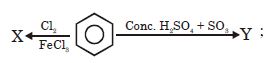
In the reaction,
$X$ and $Y$ respectively are :-
$X$ and $Y$ respectively are :-
A
$C_6H_5Cl$ and $C_6H_5SO_3H$
B
$C_6H_5Cl$ and $C_6H_5OH$
C
$C_6H_4Cl_2$ and $C_6H_5SO_2$
D
$C_6H_5Cl$ and $C_6H_5CHO$
Solution
(A) The reaction of benzene with $Cl_2$ in the presence of a Lewis acid like $FeCl_3$ is an electrophilic aromatic substitution reaction (chlorination),which yields chlorobenzene $(C_6H_5Cl)$ as product $X$.
The reaction of benzene with concentrated $H_2SO_4$ and $SO_3$ (fuming sulfuric acid or oleum) is an electrophilic aromatic substitution reaction (sulfonation),which yields benzenesulfonic acid $(C_6H_5SO_3H)$ as product $Y$.
Therefore,$X = C_6H_5Cl$ and $Y = C_6H_5SO_3H$.
The reaction of benzene with concentrated $H_2SO_4$ and $SO_3$ (fuming sulfuric acid or oleum) is an electrophilic aromatic substitution reaction (sulfonation),which yields benzenesulfonic acid $(C_6H_5SO_3H)$ as product $Y$.
Therefore,$X = C_6H_5Cl$ and $Y = C_6H_5SO_3H$.
0 likes
View Solution342
MediumMCQ
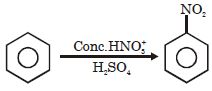
In the nitration of benzene,concentrated $HNO_3$ acts as a:
A
Bronsted base
B
Catalyst
C
Bronsted acid
D
Reducing agent
Solution
(A) In the nitration of benzene,the reaction between concentrated $HNO_3$ and concentrated $H_2SO_4$ occurs as follows:
$HNO_3 + H_2SO_4 \rightleftharpoons H_2NO_3^+ + HSO_4^-$
$H_2NO_3^+ \rightleftharpoons H_2O + NO_2^+$
Here,$HNO_3$ accepts a proton $(H^+)$ from $H_2SO_4$ to form $H_2NO_3^+$. According to the Bronsted-Lowry theory,a substance that accepts a proton acts as a Bronsted base.
$HNO_3 + H_2SO_4 \rightleftharpoons H_2NO_3^+ + HSO_4^-$
$H_2NO_3^+ \rightleftharpoons H_2O + NO_2^+$
Here,$HNO_3$ accepts a proton $(H^+)$ from $H_2SO_4$ to form $H_2NO_3^+$. According to the Bronsted-Lowry theory,a substance that accepts a proton acts as a Bronsted base.
0 likes
View Solution343
MediumMCQ
Which of the following compounds would exhibit aromatic character?
A
Cyclopentadienyl cation
B
Cycloheptatrienyl cation
C
Pyrazine
D
Cyclooctatetraene
Solution
(B) For a compound to be aromatic,it must follow $H$ückel's rule,which states that the compound must be cyclic,planar,fully conjugated,and contain $(4n + 2) \pi$ electrons,where $n$ is an integer $(n = 0, 1, 2, ...)$.
$A$. Cyclopentadienyl cation: It has $4 \pi$ electrons. It is anti-aromatic.
$B$. Cycloheptatrienyl cation (Tropylium ion): It is cyclic,planar,fully conjugated,and has $6 \pi$ electrons $(n = 1)$. Thus,it is aromatic.
$C$. Pyrazine: It is a heterocyclic aromatic compound with $6 \pi$ electrons.
$D$. Cyclooctatetraene: It is non-planar (tub-shaped) and has $8 \pi$ electrons. It is non-aromatic.
Note: Both $B$ and $C$ are aromatic. However,in the context of typical multiple-choice questions of this type,the tropylium cation is a classic example of an aromatic ion.
$A$. Cyclopentadienyl cation: It has $4 \pi$ electrons. It is anti-aromatic.
$B$. Cycloheptatrienyl cation (Tropylium ion): It is cyclic,planar,fully conjugated,and has $6 \pi$ electrons $(n = 1)$. Thus,it is aromatic.
$C$. Pyrazine: It is a heterocyclic aromatic compound with $6 \pi$ electrons.
$D$. Cyclooctatetraene: It is non-planar (tub-shaped) and has $8 \pi$ electrons. It is non-aromatic.
Note: Both $B$ and $C$ are aromatic. However,in the context of typical multiple-choice questions of this type,the tropylium cation is a classic example of an aromatic ion.
0 likes
View Solution344
DifficultMCQ
Predict the major product of the reaction of $1$-ethyl-$3$-methylbenzene with $KMnO_4$ in an acidic medium under heating.
A
$m$-ethylbenzoic acid
B
benzene-$1,3$-dicarboxylic acid
C
$3$-ethylbenzoic acid
D
$3$-methylbenzoic acid
Solution
(B) The reaction involves the oxidation of alkyl groups attached to a benzene ring using $KMnO_4$ in an acidic medium under heating.
Any alkyl group attached to the benzene ring,provided it has at least one benzylic hydrogen atom,is oxidized to a carboxylic acid group $(-COOH)$.
In the given reactant,$1$-ethyl-$3$-methylbenzene,both the ethyl group $(-CH_2CH_3)$ and the methyl group $(-CH_3)$ have benzylic hydrogen atoms.
Therefore,both groups are oxidized to $-COOH$ groups,resulting in benzene-$1,3$-dicarboxylic acid (isophthalic acid).
Any alkyl group attached to the benzene ring,provided it has at least one benzylic hydrogen atom,is oxidized to a carboxylic acid group $(-COOH)$.
In the given reactant,$1$-ethyl-$3$-methylbenzene,both the ethyl group $(-CH_2CH_3)$ and the methyl group $(-CH_3)$ have benzylic hydrogen atoms.
Therefore,both groups are oxidized to $-COOH$ groups,resulting in benzene-$1,3$-dicarboxylic acid (isophthalic acid).
0 likes
View Solution345
MediumMCQ
Give the decreasing order of reactivity for the $ESR$ (Electrophilic Substitution Reaction) for the following compounds:
$(1)$ Benzene
$(2)$ Toluene
$(3)$ Chlorobenzene
$(4)$ Nitrobenzene
$(1)$ Benzene
$(2)$ Toluene
$(3)$ Chlorobenzene
$(4)$ Nitrobenzene
A
$2 > 1 > 3 > 4$
B
$1 > 2 > 3 > 4$
C
$4 > 2 > 3 > 1$
D
$2 > 3 > 1 > 4$
Solution
(A) The reactivity of benzene derivatives towards $ESR$ depends on the electron density of the ring.
Electron-donating groups $(EDG)$ increase electron density and reactivity,while electron-withdrawing groups $(EWG)$ decrease it.
$(1)$ Benzene: Reference compound.
$(2)$ Toluene: Contains a $-CH_3$ group,which is an $EDG$ due to $+I$ and hyperconjugation effects,increasing reactivity.
$(3)$ Chlorobenzene: Contains a $-Cl$ group,which is deactivating due to its strong $-I$ effect,although it is ortho/para directing.
$(4)$ Nitrobenzene: Contains a $-NO_2$ group,which is a strong $EWG$ due to $-I$ and $-M$ effects,significantly decreasing reactivity.
Therefore,the order of reactivity is: $Toluene (2) > Benzene (1) > Chlorobenzene (3) > Nitrobenzene (4)$.
Electron-donating groups $(EDG)$ increase electron density and reactivity,while electron-withdrawing groups $(EWG)$ decrease it.
$(1)$ Benzene: Reference compound.
$(2)$ Toluene: Contains a $-CH_3$ group,which is an $EDG$ due to $+I$ and hyperconjugation effects,increasing reactivity.
$(3)$ Chlorobenzene: Contains a $-Cl$ group,which is deactivating due to its strong $-I$ effect,although it is ortho/para directing.
$(4)$ Nitrobenzene: Contains a $-NO_2$ group,which is a strong $EWG$ due to $-I$ and $-M$ effects,significantly decreasing reactivity.
Therefore,the order of reactivity is: $Toluene (2) > Benzene (1) > Chlorobenzene (3) > Nitrobenzene (4)$.
0 likes
View Solution346
MediumMCQ
The order of decreasing reactivity towards an electrophilic reagent,for the following would be:
$a$. Benzene
$b$. Toluene
$c$. Chlorobenzene
$d$. Phenol
$a$. Benzene
$b$. Toluene
$c$. Chlorobenzene
$d$. Phenol
A
$d > b > a > c$
B
$a > b > c > d$
C
$b > d > a > c$
D
$d > c > b > a$
Solution
(A) The reactivity of an aromatic ring towards an electrophilic substitution reaction depends on the electron density of the ring.
$1$. Phenol $(d)$: The $-OH$ group is a strongly activating group due to its strong $+M$ (mesomeric) effect,which significantly increases the electron density on the ring.
$2$. Toluene $(b)$: The $-CH_3$ group is an activating group due to $+I$ (inductive) effect and hyperconjugation,which increases the electron density on the ring,but less than the $-OH$ group.
$3$. Benzene $(a)$: This is the reference compound with no substituents.
$4$. Chlorobenzene $(c)$: The $-Cl$ group is a deactivating group due to its strong $-I$ effect,which outweighs its $+M$ effect,thereby decreasing the electron density on the ring.
Therefore,the order of decreasing reactivity is $d > b > a > c$.
$1$. Phenol $(d)$: The $-OH$ group is a strongly activating group due to its strong $+M$ (mesomeric) effect,which significantly increases the electron density on the ring.
$2$. Toluene $(b)$: The $-CH_3$ group is an activating group due to $+I$ (inductive) effect and hyperconjugation,which increases the electron density on the ring,but less than the $-OH$ group.
$3$. Benzene $(a)$: This is the reference compound with no substituents.
$4$. Chlorobenzene $(c)$: The $-Cl$ group is a deactivating group due to its strong $-I$ effect,which outweighs its $+M$ effect,thereby decreasing the electron density on the ring.
Therefore,the order of decreasing reactivity is $d > b > a > c$.
0 likes
View Solution347
AdvancedMCQ
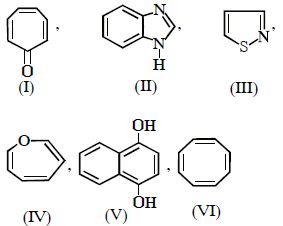
Which of the following are aromatic in character?
A
$I, II, III, IV, V$
B
$I, II, V$
C
$I, II, III, V$
D
$I, IV, VI$
Solution
(C) To determine aromaticity,a compound must be cyclic,planar,fully conjugated,and follow $H$ückel's rule ($4n+2$ $\pi$ electrons).
$(I)$ Tropone: It is aromatic because the oxygen atom pulls electrons,creating a $6$ $\pi$ electron system in the seven-membered ring.
$(II)$ Benzimidazole: It is a bicyclic aromatic compound with $10$ $\pi$ electrons.
$(III)$ Isothiazole: It is a five-membered heterocyclic aromatic compound with $6$ $\pi$ electrons.
$(IV)$ $2H$-Pyran: It is non-aromatic because the $sp^3$ hybridized carbon atom breaks the conjugation.
$(V)$ $1,4$-Naphthohydroquinone (or $1,4$-dihydroxynaphthalene): The naphthalene core is aromatic ($10$ $\pi$ electrons).
$(VI)$ Cyclooctatetraene: It is non-aromatic (tub-shaped,non-planar) with $8$ $\pi$ electrons.
Thus,compounds $(I, II, III, V)$ are aromatic.
$(I)$ Tropone: It is aromatic because the oxygen atom pulls electrons,creating a $6$ $\pi$ electron system in the seven-membered ring.
$(II)$ Benzimidazole: It is a bicyclic aromatic compound with $10$ $\pi$ electrons.
$(III)$ Isothiazole: It is a five-membered heterocyclic aromatic compound with $6$ $\pi$ electrons.
$(IV)$ $2H$-Pyran: It is non-aromatic because the $sp^3$ hybridized carbon atom breaks the conjugation.
$(V)$ $1,4$-Naphthohydroquinone (or $1,4$-dihydroxynaphthalene): The naphthalene core is aromatic ($10$ $\pi$ electrons).
$(VI)$ Cyclooctatetraene: It is non-aromatic (tub-shaped,non-planar) with $8$ $\pi$ electrons.
Thus,compounds $(I, II, III, V)$ are aromatic.
0 likes
View Solution348
MediumMCQ
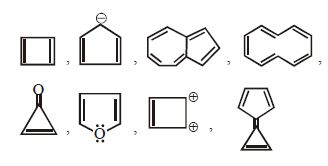
Determine the number of aromatic compounds in the given set of compounds.
A
$6$
B
$7$
C
$4$
D
$5$
Solution
(D) To identify aromatic compounds,we apply $H$ückel's rule: the compound must be cyclic,planar,fully conjugated,and contain $(4n+2) \pi$ electrons.
$1$. Cyclobutadiene: $4 \pi$ electrons (anti-aromatic).
$2$. Cyclopentadienyl anion: $6 \pi$ electrons (aromatic).
$3$. Azulene: $10 \pi$ electrons (aromatic).
$4$. Cyclooctatetraene: Non-planar,$8 \pi$ electrons (non-aromatic).
$5$. Cyclopropenone: $2 \pi$ electrons in the ring (aromatic).
$6$. Furan: $6 \pi$ electrons (aromatic).
$7$. Cyclobutadiene dication: $2 \pi$ electrons (aromatic).
$8$. Fulvalene derivative: Not fully conjugated across the system (non-aromatic).
The aromatic compounds are: Cyclopentadienyl anion,Azulene,Cyclopropenone,Furan,and Cyclobutadiene dication.
Total number of aromatic compounds = $5$.
$1$. Cyclobutadiene: $4 \pi$ electrons (anti-aromatic).
$2$. Cyclopentadienyl anion: $6 \pi$ electrons (aromatic).
$3$. Azulene: $10 \pi$ electrons (aromatic).
$4$. Cyclooctatetraene: Non-planar,$8 \pi$ electrons (non-aromatic).
$5$. Cyclopropenone: $2 \pi$ electrons in the ring (aromatic).
$6$. Furan: $6 \pi$ electrons (aromatic).
$7$. Cyclobutadiene dication: $2 \pi$ electrons (aromatic).
$8$. Fulvalene derivative: Not fully conjugated across the system (non-aromatic).
The aromatic compounds are: Cyclopentadienyl anion,Azulene,Cyclopropenone,Furan,and Cyclobutadiene dication.
Total number of aromatic compounds = $5$.
0 likes
View Solution349
AdvancedMCQ
Find the products $(C)$ and $(E)$ in the following reaction sequences:
$n$-propyl bromide $\xrightarrow{Na} (A)$ $\xrightarrow[Al_2O_3/773 \ K]{CrO_3} (B)$ $\xrightarrow[500 \ K]{Cl_2/UV} (C)$
$n$-propyl bromide $\xrightarrow{Na} (A)$ $\xrightarrow[Al_2O_3/773 \ K]{CrO_3} (B)$ $\xrightarrow{CH_3Cl/AlCl_3} (D)$ $\xrightarrow{Cl_2/hv} (E)$
$n$-propyl bromide $\xrightarrow{Na} (A)$ $\xrightarrow[Al_2O_3/773 \ K]{CrO_3} (B)$ $\xrightarrow[500 \ K]{Cl_2/UV} (C)$
$n$-propyl bromide $\xrightarrow{Na} (A)$ $\xrightarrow[Al_2O_3/773 \ K]{CrO_3} (B)$ $\xrightarrow{CH_3Cl/AlCl_3} (D)$ $\xrightarrow{Cl_2/hv} (E)$
A
Hexachlorobenzene,Benzyl chloride
B
Benzene hexachloride,$o$-chlorobenzene
C
Benzene hexachloride,Benzylidyne trichloride
D
Hexachlorobenzene,$m$-chlorobenzene
Solution
(C) $1$. Wurtz reaction of $n$-propyl bromide $(CH_3CH_2CH_2Br)$ with $Na$ gives $n$-hexane $(A)$: $2CH_3CH_2CH_2Br + 2Na \rightarrow CH_3CH_2CH_2CH_2CH_2CH_3 + 2NaBr$.
$2$. Aromatization of $n$-hexane over $Cr_2O_3/Al_2O_3$ at $773 \ K$ gives benzene $(B)$: $C_6H_{14} \rightarrow C_6H_6 + 4H_2$.
$3$. Benzene $(B)$ reacts with $Cl_2$ in the presence of $UV$ light (addition reaction) to form benzene hexachloride $(C)$: $C_6H_6 + 3Cl_2 \xrightarrow{UV} C_6H_6Cl_6$.
$4$. Benzene $(B)$ undergoes Friedel-Crafts alkylation with $CH_3Cl/AlCl_3$ to form toluene $(D)$: $C_6H_6 + CH_3Cl \xrightarrow{AlCl_3} C_6H_5CH_3 + HCl$.
$5$. Toluene $(D)$ reacts with $Cl_2/hv$ (free radical substitution) to form benzylidyne trichloride $(E)$: $C_6H_5CH_3 + 3Cl_2 \xrightarrow{hv} C_6H_5CCl_3 + 3HCl$.
$2$. Aromatization of $n$-hexane over $Cr_2O_3/Al_2O_3$ at $773 \ K$ gives benzene $(B)$: $C_6H_{14} \rightarrow C_6H_6 + 4H_2$.
$3$. Benzene $(B)$ reacts with $Cl_2$ in the presence of $UV$ light (addition reaction) to form benzene hexachloride $(C)$: $C_6H_6 + 3Cl_2 \xrightarrow{UV} C_6H_6Cl_6$.
$4$. Benzene $(B)$ undergoes Friedel-Crafts alkylation with $CH_3Cl/AlCl_3$ to form toluene $(D)$: $C_6H_6 + CH_3Cl \xrightarrow{AlCl_3} C_6H_5CH_3 + HCl$.
$5$. Toluene $(D)$ reacts with $Cl_2/hv$ (free radical substitution) to form benzylidyne trichloride $(E)$: $C_6H_5CH_3 + 3Cl_2 \xrightarrow{hv} C_6H_5CCl_3 + 3HCl$.
0 likes
View Solution350
DifficultMCQ
Which of the following can give $ESR$ (Electrophilic Substitution Reaction) at the fastest rate?
A
$Toluene$ (Methylbenzene)
B
$Benzaldehyde$
C
$Chlorobenzene$
D
$N,N-Dimethylaniline$
Solution
(D) $ESR$ (Electrophilic Substitution Reaction) rate depends on the electron density of the benzene ring. Groups that donate electrons to the ring via resonance ($+R$ effect) or induction ($+I$ effect) increase the electron density,making the ring more reactive towards electrophiles.
$1$. $N,N-Dimethylaniline$ ($-N(CH_3)_2$ group): The nitrogen atom has a lone pair of electrons which it donates to the benzene ring via strong $+R$ effect. This significantly increases the electron density on the ring,making it the most reactive.
$2$. $Toluene$ ($-CH_3$ group): The methyl group donates electrons via hyperconjugation and $+I$ effect,which is weaker than the $+R$ effect of the $-N(CH_3)_2$ group.
$3$. $Chlorobenzene$ ($-Cl$ group): The chlorine atom has a $-I$ effect (electron-withdrawing) which dominates over its $+R$ effect,making the ring less reactive than benzene.
$4$. $Benzaldehyde$ ($-CHO$ group): The aldehyde group is a strong electron-withdrawing group ($-R$ and $-I$ effects),which significantly decreases the electron density on the ring,making it the least reactive.
Therefore,$N,N-Dimethylaniline$ gives $ESR$ at the fastest rate.
$1$. $N,N-Dimethylaniline$ ($-N(CH_3)_2$ group): The nitrogen atom has a lone pair of electrons which it donates to the benzene ring via strong $+R$ effect. This significantly increases the electron density on the ring,making it the most reactive.
$2$. $Toluene$ ($-CH_3$ group): The methyl group donates electrons via hyperconjugation and $+I$ effect,which is weaker than the $+R$ effect of the $-N(CH_3)_2$ group.
$3$. $Chlorobenzene$ ($-Cl$ group): The chlorine atom has a $-I$ effect (electron-withdrawing) which dominates over its $+R$ effect,making the ring less reactive than benzene.
$4$. $Benzaldehyde$ ($-CHO$ group): The aldehyde group is a strong electron-withdrawing group ($-R$ and $-I$ effects),which significantly decreases the electron density on the ring,making it the least reactive.
Therefore,$N,N-Dimethylaniline$ gives $ESR$ at the fastest rate.
0 likes
View SolutionHydrocarbons — Aromatic hydrocarbon · Frequently Asked Questions
1Are these Hydrocarbons questions useful for JEE and NEET?
Yes. All questions in this section are mapped to JEE Main and NEET exam patterns. Previous year questions from JEE Main, NEET, GUJCET and state-level exams are included with full solutions.
2Can I switch to Hindi or Gujarati for these questions?
Yes. Use the language tabs in the hero section or the sidebar to view the same questions and solutions in English, Hindi or Gujarati.
3How do I generate a question paper from this subtopic?
Use the Vedclass Exam Paper Generator — select the chapter and subtopic, set difficulty, and generate Sets A, B, C, D automatically. First 3 chapters of every subject are free.
Vedclass Products
For Students
Vedclass Test Series
Mock tests in real JEE/NEET style with performance analysis. 5-day free trial.
Start Free TrialFor Teachers
Exam Paper Generator
Generate Set A/B/C/D papers from this chapter in 2 minutes. 3 chapters free.
Try FreeFor Institutes
Online Exam Module
Live online exams with unlimited students, 360° analytics & white-label branding.
See DemoFor Teachers & Institutes
Generate a Hydrocarbons Exam Paper in 2 Minutes
Select subtopic & difficulty — Sets A, B, C, D auto-generated with No Repeat logic.
First 3 chapters of every subject are free — no payment required.