
A English
Aromatic hydrocarbon Questions in English
Class 11 Chemistry · Hydrocarbons · Aromatic hydrocarbon
872+
Questions
English
Language
100%
With Solutions
Showing 50 of 872 questions in English
201
EasyMCQ
Aromatic hydrocarbons mostly exhibit .......
A
Electrophilic addition reactions
B
Nucleophilic addition reactions
C
Nucleophilic substitution reactions
D
Electrophilic substitution reactions
Solution
(D) Aromatic hydrocarbons,such as benzene,possess a stable delocalized $\pi$-electron cloud. Due to this stability,they resist addition reactions that would destroy the aromaticity. Instead,they undergo electrophilic substitution reactions where an electrophile replaces a hydrogen atom,maintaining the aromatic ring structure.
0 likes
View Solution202
MediumMCQ
Which product is obtained when benzene is heated with chlorine in the presence of sunlight?
A
$C_6H_5CCl_3$
B
$C_6H_5CHCl_2$
C
$C_6H_5CH_2Cl$
D
$C_6H_6Cl_6$
Solution
(D) When benzene $(C_6H_6)$ reacts with chlorine $(Cl_2)$ in the presence of sunlight (ultraviolet light),an addition reaction occurs.
This reaction is a free radical addition reaction.
Three molecules of chlorine add across the three double bonds of the benzene ring.
The product formed is benzene hexachloride $(C_6H_6Cl_6)$,also known as $BHC$ or $Gammexane$.
This reaction is a free radical addition reaction.
Three molecules of chlorine add across the three double bonds of the benzene ring.
The product formed is benzene hexachloride $(C_6H_6Cl_6)$,also known as $BHC$ or $Gammexane$.
0 likes
View Solution203
EasyMCQ
The condition required for an aromatic ring is that it must contain $... \pi-$ electrons.
A
$(4 + 2)n$
B
$(4n + 2)$
C
$(3 + 4n)$
D
None of these
Solution
(B) According to $H$ückel's rule,for a compound to be aromatic,it must be planar,cyclic,fully conjugated,and contain $(4n + 2) \pi-$ electrons,where $n$ is an integer $(n = 0, 1, 2, ...)$.
0 likes
View Solution204
EasyMCQ
In benzene,the $1,3$ position is known as what?
A
Meta
B
Para
C
Ortho
D
Odd position
Solution
(A) In a benzene ring,the relative positions of substituents are named based on their distance from the primary functional group at position $1$.
- The $1,2$ position is called $ortho$.
- The $1,3$ position is called $meta$.
- The $1,4$ position is called $para$.
Therefore,the $1,3$ position is known as $meta$.
- The $1,2$ position is called $ortho$.
- The $1,3$ position is called $meta$.
- The $1,4$ position is called $para$.
Therefore,the $1,3$ position is known as $meta$.
0 likes
View Solution205
MediumMCQ
Which compound is formed when benzene is boiled with concentrated $HCl$?
A
$m$-Dichlorobenzene
B
Chlorobenzene
C
Gammexane
D
None of these
Solution
(D) Benzene is an aromatic hydrocarbon that is chemically stable due to resonance. It does not undergo addition reactions with concentrated $HCl$ under normal boiling conditions. Electrophilic substitution of benzene with $HCl$ does not occur because $HCl$ is not a strong enough electrophile to attack the benzene ring. Therefore,no reaction takes place.
0 likes
View Solution206
DifficultMCQ
The product obtained by the reaction of benzene with concentrated $HNO_3$ and concentrated $H_2SO_4$ at $353$ to $363 \, K$ is....
A
Nitrobenzene
B
$m$-Dinitrobenzene
C
$p$-Dinitrobenzene
D
$o$-Dinitrobenzene
Solution
(B) When benzene reacts with a nitrating mixture (concentrated $HNO_3$ + concentrated $H_2SO_4$) at $323-333 \, K$,it forms nitrobenzene.
However,when nitrobenzene is further treated with the same nitrating mixture at a higher temperature of $353-363 \, K$,the $-NO_2$ group (which is a meta-directing group) directs the incoming second $-NO_2$ group to the meta position.
Thus,the final product is $m$-dinitrobenzene.
However,when nitrobenzene is further treated with the same nitrating mixture at a higher temperature of $353-363 \, K$,the $-NO_2$ group (which is a meta-directing group) directs the incoming second $-NO_2$ group to the meta position.
Thus,the final product is $m$-dinitrobenzene.
0 likes
View Solution207
MediumMCQ
Benzene can react with..........
A
$Br_2$ water
B
$HNO_3$
C
$H_2O$
D
$CH_3OH$
Solution
(B) Benzene is an aromatic compound that undergoes electrophilic substitution reactions rather than addition reactions.
$1$. $Br_2$ water does not react with benzene because it requires a Lewis acid catalyst (like $FeBr_3$) to undergo electrophilic substitution.
$2$. Benzene reacts with concentrated $HNO_3$ in the presence of concentrated $H_2SO_4$ (nitrating mixture) to form nitrobenzene via electrophilic substitution.
$3$. $H_2O$ and $CH_3OH$ do not react with benzene under normal conditions.
$1$. $Br_2$ water does not react with benzene because it requires a Lewis acid catalyst (like $FeBr_3$) to undergo electrophilic substitution.
$2$. Benzene reacts with concentrated $HNO_3$ in the presence of concentrated $H_2SO_4$ (nitrating mixture) to form nitrobenzene via electrophilic substitution.
$3$. $H_2O$ and $CH_3OH$ do not react with benzene under normal conditions.
0 likes
View Solution208
MediumMCQ
Which of the following groups,when attached to a benzene ring,acts as a deactivating meta-directing group?
A
Methyl group
B
Amino group
C
Nitro group
D
Hydroxy group
Solution
(C) Groups that are electron-withdrawing by inductive or resonance effects decrease the electron density of the benzene ring,making it less reactive towards electrophilic substitution (deactivating). These groups direct the incoming electrophile to the meta position. The $-NO_2$ group is a strong electron-withdrawing group and is a classic example of a deactivating meta-directing group.
0 likes
View Solution209
MediumMCQ
In which of the following compounds are all $C-C$ bond lengths equal?
A
$2$-Butene
B
Benzene
C
$1$-Butene
D
$1$-Propyne
Solution
(B) The correct answer is $B$.
In $Benzene$ $(C_6H_6)$,all $C-C$ bonds are equivalent due to resonance.
Due to the delocalization of $\pi$-electrons,the $C-C$ bond length in benzene is intermediate between a single bond $(1.54 \mathring{A})$ and a double bond $(1.34 \ \mathring{A})$,which is $1.39 \ \mathring{A} $.
In other options like $2$-butene,$1$-butene,and $1$-propyne,there are distinct single and double bonds with different bond lengths.
In $Benzene$ $(C_6H_6)$,all $C-C$ bonds are equivalent due to resonance.
Due to the delocalization of $\pi$-electrons,the $C-C$ bond length in benzene is intermediate between a single bond $(1.54 \mathring{A})$ and a double bond $(1.34 \ \mathring{A})$,which is $1.39 \ \mathring{A} $.
In other options like $2$-butene,$1$-butene,and $1$-propyne,there are distinct single and double bonds with different bond lengths.
0 likes
View Solution210
MediumMCQ
How is benzene obtained?
A
By the combination of three acetylene molecules
B
By the mixture of three $C_2H_2$ molecules
C
By the polymerization of three $C_2H_2$ molecules
D
Three $C_2H_2$ molecules
Solution
(C) Benzene is obtained by the cyclic polymerization of acetylene $(C_2H_2)$.
When acetylene gas is passed through a red-hot iron tube at $873 \ K$,it undergoes cyclic polymerization to form benzene $(C_6H_6)$.
The reaction is: $3C_2H_2 \xrightarrow{873 \ K, \text{Fe tube}} C_6H_6$.
When acetylene gas is passed through a red-hot iron tube at $873 \ K$,it undergoes cyclic polymerization to form benzene $(C_6H_6)$.
The reaction is: $3C_2H_2 \xrightarrow{873 \ K, \text{Fe tube}} C_6H_6$.
0 likes
View Solution211
EasyMCQ
Among the following compounds,the one that undergoes sulfonation most easily is .......
A
Benzene
B
Nitrobenzene
C
Toluene
D
Chlorobenzene
Solution
(C) Sulfonation is an electrophilic aromatic substitution reaction. The rate of this reaction depends on the electron density of the benzene ring.
Groups that donate electrons to the ring (activating groups) increase the electron density and make the ring more reactive towards electrophiles.
In $Toluene$ $(C_6H_5CH_3)$,the methyl group $(CH_3)$ is an electron-donating group due to the $+I$ effect and hyperconjugation,which activates the benzene ring.
$Nitrobenzene$ $(C_6H_5NO_2)$ has a strongly electron-withdrawing group $(-NO_2)$,which deactivates the ring.
$Chlorobenzene$ $(C_6H_5Cl)$ has a halogen atom which is deactivating due to the $-I$ effect.
$Benzene$ has no substituent.
Therefore,$Toluene$ is the most reactive towards electrophilic substitution among the given options.
Groups that donate electrons to the ring (activating groups) increase the electron density and make the ring more reactive towards electrophiles.
In $Toluene$ $(C_6H_5CH_3)$,the methyl group $(CH_3)$ is an electron-donating group due to the $+I$ effect and hyperconjugation,which activates the benzene ring.
$Nitrobenzene$ $(C_6H_5NO_2)$ has a strongly electron-withdrawing group $(-NO_2)$,which deactivates the ring.
$Chlorobenzene$ $(C_6H_5Cl)$ has a halogen atom which is deactivating due to the $-I$ effect.
$Benzene$ has no substituent.
Therefore,$Toluene$ is the most reactive towards electrophilic substitution among the given options.
0 likes
View Solution212
MediumMCQ
What is the product obtained when $n$-hexane is passed over a heated catalyst (chromium oxide supported on alumina) at $750 \ K$?
A
Cyclohexane
B
$1, 3$-Hexadiene
C
$1, 5$-Hexadiene
D
Benzene
Solution
(D) The process described is known as aromatization or catalytic reforming.
When $n$-hexane is heated to $750 \ K$ in the presence of a catalyst like $Cr_2O_3$ supported on $Al_2O_3$,it undergoes cyclization and dehydrogenation.
This reaction converts the straight-chain alkane ($n$-hexane) into an aromatic compound,specifically benzene.
The chemical equation is: $C_6H_{14} \xrightarrow{Cr_2O_3/Al_2O_3, 750 \ K} C_6H_6 + 4H_2$.
When $n$-hexane is heated to $750 \ K$ in the presence of a catalyst like $Cr_2O_3$ supported on $Al_2O_3$,it undergoes cyclization and dehydrogenation.
This reaction converts the straight-chain alkane ($n$-hexane) into an aromatic compound,specifically benzene.
The chemical equation is: $C_6H_{14} \xrightarrow{Cr_2O_3/Al_2O_3, 750 \ K} C_6H_6 + 4H_2$.
0 likes
View Solution213
MediumMCQ
What is the product formed when benzene reacts with isobutylene in the presence of sulfuric acid?
A
Isobutylbenzene
B
tert-Butylbenzene
C
$n$-Butylbenzene
D
No reaction
Solution
(B) The reaction between benzene and isobutylene $(CH_2=C(CH_3)_2)$ in the presence of an acid catalyst like $H_2SO_4$ is a Friedel-Crafts alkylation reaction.
In this reaction,the alkene is protonated to form a stable carbocation.
Isobutylene reacts with $H^+$ to form a tert-butyl carbocation $((CH_3)_3C^+)$.
This stable carbocation then undergoes electrophilic aromatic substitution with benzene to form tert-butylbenzene.
In this reaction,the alkene is protonated to form a stable carbocation.
Isobutylene reacts with $H^+$ to form a tert-butyl carbocation $((CH_3)_3C^+)$.
This stable carbocation then undergoes electrophilic aromatic substitution with benzene to form tert-butylbenzene.
0 likes
View Solution214
MediumMCQ
Benzene shows which of the following reactions?
A
Substitution
B
Addition
C
Oxidation
D
All of the above
Solution
(D) Benzene $(C_6H_6)$ is an aromatic compound that undergoes electrophilic substitution reactions (e.g.,nitration,halogenation) as its characteristic reaction.
Under specific conditions,it can also undergo addition reactions (e.g.,hydrogenation to cyclohexane or addition of chlorine in the presence of $UV$ light).
It can also undergo oxidation reactions (e.g.,combustion or catalytic oxidation to maleic anhydride).
Therefore,benzene exhibits all three types of reactions.
Under specific conditions,it can also undergo addition reactions (e.g.,hydrogenation to cyclohexane or addition of chlorine in the presence of $UV$ light).
It can also undergo oxidation reactions (e.g.,combustion or catalytic oxidation to maleic anhydride).
Therefore,benzene exhibits all three types of reactions.
0 likes
View Solution215
EasyMCQ
When benzene is chlorinated in the presence of $FeCl_3$,the electrophile is .......
A
$Cl$
B
$FeCl_3$
C
$Cl^{+}$
D
$Cl^{-}$
Solution
(C) In the chlorination of benzene,$FeCl_3$ acts as a Lewis acid catalyst.
It reacts with $Cl_2$ to generate the electrophile $Cl^{+}$ as follows:
$Cl_2 + FeCl_3 \rightarrow Cl^{+} + [FeCl_4]^{-}$
Thus,the electrophile attacking the benzene ring is $Cl^{+}$.
It reacts with $Cl_2$ to generate the electrophile $Cl^{+}$ as follows:
$Cl_2 + FeCl_3 \rightarrow Cl^{+} + [FeCl_4]^{-}$
Thus,the electrophile attacking the benzene ring is $Cl^{+}$.
0 likes
View Solution216
EasyMCQ
Which of the following is most reactive towards electrophilic nitration?
A
Benzene
B
Toluene
C
Benzoic acid
D
Nitrobenzene
Solution
(B) Electrophilic nitration is an electrophilic aromatic substitution reaction. The reactivity of the benzene ring towards electrophiles depends on the electron density of the ring.
Electron-donating groups $(EDG)$ increase the electron density and activate the ring,while electron-withdrawing groups $(EWG)$ decrease the electron density and deactivate the ring.
$1$. $Toluene$ $(C_6H_5CH_3)$: The methyl group is an electron-donating group due to the $+I$ effect and hyperconjugation,which activates the ring.
$2$. $Benzene$ $(C_6H_6)$: Has no substituent.
$3$. $Benzoic acid$ $(C_6H_5COOH)$: The $-COOH$ group is strongly electron-withdrawing,deactivating the ring.
$4$. $Nitrobenzene$ $(C_6H_5NO_2)$: The $-NO_2$ group is a very strong electron-withdrawing group,strongly deactivating the ring.
Therefore,$Toluene$ is the most reactive towards electrophilic nitration.
Electron-donating groups $(EDG)$ increase the electron density and activate the ring,while electron-withdrawing groups $(EWG)$ decrease the electron density and deactivate the ring.
$1$. $Toluene$ $(C_6H_5CH_3)$: The methyl group is an electron-donating group due to the $+I$ effect and hyperconjugation,which activates the ring.
$2$. $Benzene$ $(C_6H_6)$: Has no substituent.
$3$. $Benzoic acid$ $(C_6H_5COOH)$: The $-COOH$ group is strongly electron-withdrawing,deactivating the ring.
$4$. $Nitrobenzene$ $(C_6H_5NO_2)$: The $-NO_2$ group is a very strong electron-withdrawing group,strongly deactivating the ring.
Therefore,$Toluene$ is the most reactive towards electrophilic nitration.
0 likes
View Solution217
MediumMCQ
The reaction ${C_6}{H_6} + C{H_3}Cl \xrightarrow{\text{anhydrous } AlCl_3} {C_6}{H_5}C{H_3} + HCl$ is an example of which of the following?
A
Friedel-Crafts reaction
B
Kolbe reaction
C
Wurtz reaction
D
Grignard reaction
Solution
(A) The given reaction is the alkylation of benzene using methyl chloride in the presence of an anhydrous Lewis acid catalyst,$AlCl_3$.
This specific type of electrophilic aromatic substitution is known as the Friedel-Crafts alkylation reaction.
This specific type of electrophilic aromatic substitution is known as the Friedel-Crafts alkylation reaction.
0 likes
View Solution218
MediumMCQ
Which of the following is aromatic?
A
Cyclopentadienyl cation
B
Cyclobutadiene
C
Cycloheptatriene
D
Cycloheptatrienyl cation
Solution
(D) For a compound to be aromatic,it must follow $H$ückel's rule ($4n+2$ $\pi$ electrons),be planar,and have a continuous cyclic conjugation.
$(A)$ Cyclopentadienyl cation has $4$ $\pi$ electrons ($4n$ system),so it is anti-aromatic.
$(B)$ Cyclobutadiene has $4$ $\pi$ electrons ($4n$ system),so it is anti-aromatic.
$(C)$ Cycloheptatriene is non-planar due to the $sp^3$ hybridized carbon atom,so it is non-aromatic.
$(D)$ Cycloheptatrienyl cation (tropylium ion) has $6$ $\pi$ electrons ($4n+2$ where $n=1$),is planar,and fully conjugated,making it aromatic.
$(A)$ Cyclopentadienyl cation has $4$ $\pi$ electrons ($4n$ system),so it is anti-aromatic.
$(B)$ Cyclobutadiene has $4$ $\pi$ electrons ($4n$ system),so it is anti-aromatic.
$(C)$ Cycloheptatriene is non-planar due to the $sp^3$ hybridized carbon atom,so it is non-aromatic.
$(D)$ Cycloheptatrienyl cation (tropylium ion) has $6$ $\pi$ electrons ($4n+2$ where $n=1$),is planar,and fully conjugated,making it aromatic.
0 likes
View Solution219
MediumMCQ
Which compound contains delocalized electrons?
A
Benzene
B
Cyclohexane
C
$CH_4$
D
$C_2H_6$
Solution
(A) Delocalized electrons are found in systems with conjugated $\pi$-bonds,typically in aromatic compounds.
Benzene $(C_6H_6)$ consists of a planar ring with alternating double bonds,allowing the $\pi$-electrons to be delocalized over the entire ring structure.
Cyclohexane,methane $(CH_4)$,and ethane $(C_2H_6)$ contain only single $\sigma$-bonds,which do not support delocalization.
Benzene $(C_6H_6)$ consists of a planar ring with alternating double bonds,allowing the $\pi$-electrons to be delocalized over the entire ring structure.
Cyclohexane,methane $(CH_4)$,and ethane $(C_2H_6)$ contain only single $\sigma$-bonds,which do not support delocalization.
0 likes
View Solution220
EasyMCQ
In $FCR$ (Friedel-Crafts Reaction),toluene can be prepared by which of the following?
A
$C_6H_6 + CH_3Cl$
B
$C_6H_5Cl + CH_4$
C
$C_6H_6 + CH_2Cl_2$
D
$C_6H_6 + CH_3COCl$
Solution
(A) Friedel-Crafts alkylation involves the reaction of benzene with an alkyl halide in the presence of an anhydrous Lewis acid catalyst like $AlCl_3$.
To prepare toluene $(C_6H_5CH_3)$,benzene $(C_6H_6)$ reacts with methyl chloride $(CH_3Cl)$.
The reaction is: $C_6H_6 + CH_3Cl \xrightarrow{anhydrous \ AlCl_3} C_6H_5CH_3 + HCl$.
Therefore,the correct option is $A$.
To prepare toluene $(C_6H_5CH_3)$,benzene $(C_6H_6)$ reacts with methyl chloride $(CH_3Cl)$.
The reaction is: $C_6H_6 + CH_3Cl \xrightarrow{anhydrous \ AlCl_3} C_6H_5CH_3 + HCl$.
Therefore,the correct option is $A$.
0 likes
View Solution221
EasyMCQ
The electrophile used in the sulfonation of benzene is..........
A
$SO_2$
B
$SO_3$
C
$SO_4^{2-}$
D
$HSO_3^-$
Solution
(B) The sulfonation of benzene is carried out using concentrated sulfuric acid $(H_2SO_4)$ or fuming sulfuric acid ($H_2SO_4 + SO_3$,known as oleum).
In this reaction,sulfur trioxide $(SO_3)$ acts as the electrophile.
$SO_3$ is a neutral electrophile because the sulfur atom is electron-deficient due to the high electronegativity of the three oxygen atoms bonded to it.
Therefore,the correct option is $B$.
In this reaction,sulfur trioxide $(SO_3)$ acts as the electrophile.
$SO_3$ is a neutral electrophile because the sulfur atom is electron-deficient due to the high electronegativity of the three oxygen atoms bonded to it.
Therefore,the correct option is $B$.
0 likes
View Solution222
EasyMCQ
Which of the following compounds is planar in shape?
A
Methane
B
Acetylene
C
Benzene
D
Isobutane
Solution
(C) molecule is planar if all its atoms lie in the same plane.
$1$. $CH_4$ (Methane) has $sp^3$ hybridization and a tetrahedral geometry.
$2$. $C_2H_2$ (Acetylene) has $sp$ hybridization and a linear geometry.
$3$. $C_6H_6$ (Benzene) has $sp^2$ hybridization for all carbon atoms,resulting in a planar hexagonal structure.
$4$. $CH_3CH(CH_3)_2$ (Isobutane) has $sp^3$ hybridized carbon atoms,resulting in a non-planar,branched structure.
Therefore,$Benzene$ is the planar compound.
$1$. $CH_4$ (Methane) has $sp^3$ hybridization and a tetrahedral geometry.
$2$. $C_2H_2$ (Acetylene) has $sp$ hybridization and a linear geometry.
$3$. $C_6H_6$ (Benzene) has $sp^2$ hybridization for all carbon atoms,resulting in a planar hexagonal structure.
$4$. $CH_3CH(CH_3)_2$ (Isobutane) has $sp^3$ hybridized carbon atoms,resulting in a non-planar,branched structure.
Therefore,$Benzene$ is the planar compound.
0 likes
View Solution223
MediumMCQ
$A$ hydrocarbon does not decolorize alkaline $KMnO_4$ solution and does not give a precipitate with ammoniacal silver nitrate. This hydrocarbon is .......
A
Benzene
B
Acetylene
C
Propyne
D
But$-1-$yne
Solution
(A) $1$. Alkaline $KMnO_4$ (Baeyer's reagent) is used to test for unsaturation (alkenes and alkynes). It gets decolorized by compounds containing double or triple bonds.
$2$. Ammoniacal silver nitrate (Tollens' reagent) reacts with terminal alkynes (alkynes with a hydrogen atom on the triple-bonded carbon) to form a white precipitate of silver acetylide.
$3$. Benzene $(C_6H_6)$ is an aromatic hydrocarbon. It is stable and does not react with Baeyer's reagent under normal conditions,nor does it have acidic terminal hydrogen to react with Tollens' reagent.
$4$. Acetylene $(C_2H_2)$,Propyne $(CH_3C\equiv CH)$,and But$-1-$yne $(CH_3CH_2C\equiv CH)$ are all terminal alkynes; they would decolorize $KMnO_4$ and react with ammoniacal silver nitrate.
$5$. Therefore,the correct answer is Benzene.
$2$. Ammoniacal silver nitrate (Tollens' reagent) reacts with terminal alkynes (alkynes with a hydrogen atom on the triple-bonded carbon) to form a white precipitate of silver acetylide.
$3$. Benzene $(C_6H_6)$ is an aromatic hydrocarbon. It is stable and does not react with Baeyer's reagent under normal conditions,nor does it have acidic terminal hydrogen to react with Tollens' reagent.
$4$. Acetylene $(C_2H_2)$,Propyne $(CH_3C\equiv CH)$,and But$-1-$yne $(CH_3CH_2C\equiv CH)$ are all terminal alkynes; they would decolorize $KMnO_4$ and react with ammoniacal silver nitrate.
$5$. Therefore,the correct answer is Benzene.
0 likes
View Solution224
MediumMCQ
The product obtained by the hydrogenation of $1 \ mol$ of benzene with $3 \ mol$ of $H_2$ in the presence of a $Ni$ catalyst at high temperature is...
A
Hexane
B
Cycloheptane
C
Hexene
D
Cyclohexane
Solution
(D) Benzene $(C_6H_6)$ contains three double bonds in its ring structure.
When $1 \ mol$ of benzene is treated with $3 \ mol$ of $H_2$ in the presence of a $Ni$ catalyst at high temperature,all three double bonds undergo hydrogenation.
The reaction is: $C_6H_6 + 3H_2 \xrightarrow{Ni, \Delta} C_6H_{12}$.
The product formed is cyclohexane.
When $1 \ mol$ of benzene is treated with $3 \ mol$ of $H_2$ in the presence of a $Ni$ catalyst at high temperature,all three double bonds undergo hydrogenation.
The reaction is: $C_6H_6 + 3H_2 \xrightarrow{Ni, \Delta} C_6H_{12}$.
The product formed is cyclohexane.
0 likes
View Solution225
MediumMCQ
The $C - C$ bond length in benzene is ...... $\mathring{A}$.
A
$1.54$
B
$1.39$
C
$1.22$
D
$1.21$
Solution
(B) In benzene $(C_6H_6)$,all $C - C$ bonds are equivalent due to resonance.
The bond order of each $C - C$ bond is $1.5$.
The bond length is intermediate between a single bond $(1.54 \ \mathring{A})$ and a double bond $(1.34 \ \mathring{A})$.
The experimentally determined $C - C$ bond length in benzene is $1.39 \ \mathring{A}$.
The bond order of each $C - C$ bond is $1.5$.
The bond length is intermediate between a single bond $(1.54 \ \mathring{A})$ and a double bond $(1.34 \ \mathring{A})$.
The experimentally determined $C - C$ bond length in benzene is $1.39 \ \mathring{A}$.
0 likes
View Solution226
DifficultMCQ
Which of the following is most reactive towards nitration?
A
Benzene
B
Toluene
C
Isopropylbenzene
D
Ethylbenzene
Solution
(B) Nitration is an electrophilic aromatic substitution reaction. The reactivity of the benzene ring towards electrophilic substitution depends on the electron-donating power of the substituent attached to the ring. The $-CH_3$ group in toluene exhibits the strongest $+I$ (inductive) effect and hyperconjugation among the given alkyl groups,which increases the electron density in the benzene ring the most,making it the most reactive towards nitration.
0 likes
View Solution227
MediumMCQ
Toluene contains:
A
$6 \sigma$ and $3\pi$ bonds
B
$9\sigma$ and $3\pi$ bonds
C
$9\sigma$ and $6\pi$ bonds
D
$15\sigma$ and $3\pi$ bonds
Solution
(D) The chemical formula of toluene is $C_6H_5CH_3$.
In the benzene ring $(C_6H_5-)$,there are $6$ $C-C$ bonds ($3$ single and $3$ double) and $5$ $C-H$ bonds.
In the methyl group $(-CH_3)$,there is $1$ $C-C$ bond and $3$ $C-H$ bonds.
Total $\sigma$ bonds = $6$ ($C-C$ in ring) + $5$ ($C-H$ in ring) + $1$ ($C-C$ methyl) + $3$ ($C-H$ methyl) = $15$ $\sigma$ bonds.
Total $\pi$ bonds = $3$ $\pi$ bonds (from the benzene ring).
Therefore,toluene contains $15\sigma$ and $3\pi$ bonds.
In the benzene ring $(C_6H_5-)$,there are $6$ $C-C$ bonds ($3$ single and $3$ double) and $5$ $C-H$ bonds.
In the methyl group $(-CH_3)$,there is $1$ $C-C$ bond and $3$ $C-H$ bonds.
Total $\sigma$ bonds = $6$ ($C-C$ in ring) + $5$ ($C-H$ in ring) + $1$ ($C-C$ methyl) + $3$ ($C-H$ methyl) = $15$ $\sigma$ bonds.
Total $\pi$ bonds = $3$ $\pi$ bonds (from the benzene ring).
Therefore,toluene contains $15\sigma$ and $3\pi$ bonds.
0 likes
View Solution228
MediumMCQ
What is the correct order of reactivity towards electrophilic substitution for the compounds: Aniline $(I)$,Benzene $(II)$,and Nitrobenzene $(III)$?
A
$III > II > I$
B
$II > III > I$
C
$I < II > III$
D
$I > II > III$
Solution
(D) The reactivity towards electrophilic substitution reaction $(ESR)$ depends on the electron density in the benzene ring.
Aniline $(I)$ has an $-NH_2$ group,which is a strong electron-donating group ($+M$ effect),increasing electron density and making it highly reactive.
Benzene $(II)$ has no substituent,serving as the reference.
Nitrobenzene $(III)$ has a $-NO_2$ group,which is a strong electron-withdrawing group ($-M$ effect),decreasing electron density and making it the least reactive.
Therefore,the correct order of reactivity is $I > II > III$.
Aniline $(I)$ has an $-NH_2$ group,which is a strong electron-donating group ($+M$ effect),increasing electron density and making it highly reactive.
Benzene $(II)$ has no substituent,serving as the reference.
Nitrobenzene $(III)$ has a $-NO_2$ group,which is a strong electron-withdrawing group ($-M$ effect),decreasing electron density and making it the least reactive.
Therefore,the correct order of reactivity is $I > II > III$.
0 likes
View Solution229
MediumMCQ
What is the total number of benzene derivatives with the molecular formula $C_6H_3Cl_3$?
A
$2$
B
$3$
C
$4$
D
$5$
Solution
(B) The molecular formula $C_6H_3Cl_3$ represents a trichlorobenzene derivative.
There are three possible structural isomers for trichlorobenzene based on the relative positions of the chlorine atoms on the benzene ring:
$1$. $1,2,3$-trichlorobenzene (vicinal isomer)
$2$. $1,2,4$-trichlorobenzene (asymmetric isomer)
$3$. $1,3,5$-trichlorobenzene (symmetric isomer)
Thus,the total number of isomers is $3$.
There are three possible structural isomers for trichlorobenzene based on the relative positions of the chlorine atoms on the benzene ring:
$1$. $1,2,3$-trichlorobenzene (vicinal isomer)
$2$. $1,2,4$-trichlorobenzene (asymmetric isomer)
$3$. $1,3,5$-trichlorobenzene (symmetric isomer)
Thus,the total number of isomers is $3$.
0 likes
View Solution230
MediumMCQ
What is the decreasing order of reactivity towards electrophilic substitution for the following compounds?
$(1)$ Benzene,$(2)$ Toluene,$(3)$ Chlorobenzene,$(4)$ Phenol
$(1)$ Benzene,$(2)$ Toluene,$(3)$ Chlorobenzene,$(4)$ Phenol
A
$2 < 4 < 1 < 3$
B
$4 < 3 < 2 < 1$
C
$3 < 1 < 2 < 4$
D
$4 < 2 < 1 < 3$
Solution
(C) The reactivity of benzene derivatives towards electrophilic substitution depends on the electron density of the ring.
Electron-donating groups $(EDG)$ increase electron density and reactivity,while electron-withdrawing groups $(EWG)$ decrease it.
- $(4)$ Phenol: The $-OH$ group is a strong activating group due to its $+M$ effect.
- $(2)$ Toluene: The $-CH_3$ group is a weakly activating group due to $+I$ and hyperconjugation effects.
- $(1)$ Benzene: The reference compound.
- $(3)$ Chlorobenzene: The $-Cl$ group is deactivating due to its strong $-I$ effect,although it is ortho/para directing.
The order of reactivity is: $\text{Phenol} > \text{Toluene} > \text{Benzene} > \text{Chlorobenzene}$.
Thus,the decreasing order is $(4) > (2) > (1) > (3)$.
Electron-donating groups $(EDG)$ increase electron density and reactivity,while electron-withdrawing groups $(EWG)$ decrease it.
- $(4)$ Phenol: The $-OH$ group is a strong activating group due to its $+M$ effect.
- $(2)$ Toluene: The $-CH_3$ group is a weakly activating group due to $+I$ and hyperconjugation effects.
- $(1)$ Benzene: The reference compound.
- $(3)$ Chlorobenzene: The $-Cl$ group is deactivating due to its strong $-I$ effect,although it is ortho/para directing.
The order of reactivity is: $\text{Phenol} > \text{Toluene} > \text{Benzene} > \text{Chlorobenzene}$.
Thus,the decreasing order is $(4) > (2) > (1) > (3)$.
0 likes
View Solution231
MediumMCQ
What is the correct order of decreasing reactivity for the monobromination of the following compounds?
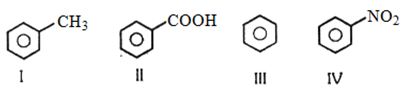
A
$I > III > II > IV$
B
$II > III > IV > I$
C
$I > II > III > IV$
D
$III > I > II > IV$
Solution
(A) The reactivity of aromatic compounds towards electrophilic aromatic substitution (like monobromination) depends on the electron density of the benzene ring.
Electron-donating groups $(EDG)$ increase the electron density and reactivity,while electron-withdrawing groups $(EWG)$ decrease it.
$I$: Toluene ($-CH_3$ group is an $EDG$,activates the ring).
$III$: Benzene (reference compound).
$II$: Benzoic acid ($-COOH$ group is a strong $EWG$,deactivates the ring).
$IV$: Nitrobenzene ($-NO_2$ group is a very strong $EWG$,strongly deactivates the ring).
Therefore,the order of reactivity is $I > III > II > IV$.
Electron-donating groups $(EDG)$ increase the electron density and reactivity,while electron-withdrawing groups $(EWG)$ decrease it.
$I$: Toluene ($-CH_3$ group is an $EDG$,activates the ring).
$III$: Benzene (reference compound).
$II$: Benzoic acid ($-COOH$ group is a strong $EWG$,deactivates the ring).
$IV$: Nitrobenzene ($-NO_2$ group is a very strong $EWG$,strongly deactivates the ring).
Therefore,the order of reactivity is $I > III > II > IV$.
0 likes
View Solution232
DifficultMCQ
The electrophile $NO_2^+$ reacts with which of the following compounds? In which case will $NO_2^+$ attack at the meta position?
$(I)$ $C_6H_5-CCl_3$
$(II)$ $C_6H_5-NO_2$
$(III)$ $C_6H_5-CHO$
$(IV)$ $C_6H_5-O^-$
$(I)$ $C_6H_5-CCl_3$
$(II)$ $C_6H_5-NO_2$
$(III)$ $C_6H_5-CHO$
$(IV)$ $C_6H_5-O^-$
A
$I$ and $II$
B
$I, II$ and $III$
C
$II$ and $IV$
D
$I$ only
Solution
(B) The electrophile $NO_2^+$ undergoes electrophilic aromatic substitution.
Groups that are electron-withdrawing ($-I$ and/or $-M$ effect) deactivate the benzene ring and direct the incoming electrophile to the meta position.
$(I)$ $-CCl_3$ is electron-withdrawing due to the $-I$ effect.
$(II)$ $-NO_2$ is electron-withdrawing due to both $-I$ and $-M$ effects.
$(III)$ $-CHO$ is electron-withdrawing due to both $-I$ and $-M$ effects.
$(IV)$ $-O^-$ is a strongly electron-donating group due to the $+M$ effect,which activates the ring and directs to the ortho/para positions.
Therefore,compounds $(I), (II),$ and $(III)$ are meta-directing.
Groups that are electron-withdrawing ($-I$ and/or $-M$ effect) deactivate the benzene ring and direct the incoming electrophile to the meta position.
$(I)$ $-CCl_3$ is electron-withdrawing due to the $-I$ effect.
$(II)$ $-NO_2$ is electron-withdrawing due to both $-I$ and $-M$ effects.
$(III)$ $-CHO$ is electron-withdrawing due to both $-I$ and $-M$ effects.
$(IV)$ $-O^-$ is a strongly electron-donating group due to the $+M$ effect,which activates the ring and directs to the ortho/para positions.
Therefore,compounds $(I), (II),$ and $(III)$ are meta-directing.
0 likes
View Solution233
EasyMCQ
Aromatic molecules do not possess which of the following?
A
$4n \pi$ electrons
B
$(4n + 2)\pi$ electrons
C
Planarity
D
Cyclic structure
Solution
(A) According to $H$ückel's rule,for a molecule to be aromatic,it must satisfy the following conditions:
$1$. It must be cyclic.
$2$. It must be planar.
$3$. It must have a complete delocalization of $\pi$-electrons in the ring.
$4$. It must contain $(4n + 2)\pi$ electrons,where $n$ is an integer $(n = 0, 1, 2, ...)$.
Molecules containing $4n\pi$ electrons are generally anti-aromatic. Therefore,aromatic molecules do not possess $4n\pi$ electrons.
$1$. It must be cyclic.
$2$. It must be planar.
$3$. It must have a complete delocalization of $\pi$-electrons in the ring.
$4$. It must contain $(4n + 2)\pi$ electrons,where $n$ is an integer $(n = 0, 1, 2, ...)$.
Molecules containing $4n\pi$ electrons are generally anti-aromatic. Therefore,aromatic molecules do not possess $4n\pi$ electrons.
0 likes
View Solution234
MediumMCQ
Which of the following has the most stable enol form?
A
Cyclohexanone $\rightleftharpoons$ Cyclohex$-1-$en$-1-$ol
B
Cyclohex$-2-$en$-1-$one $\rightleftharpoons$ Cyclohexa$-1,3-$dien$-1-$ol
C
Cyclohexane$-1,3-$dione $\rightleftharpoons$ $3-$hydroxycyclohex$-2-$en$-1-$one
D
Cyclohexa$-2,5-$dien$-1-$one $\rightleftharpoons$ Phenol
Solution
(D) The stability of the enol form is primarily determined by aromaticity. In option $D$,the keto form is cyclohexa$-2,5-$dien$-1-$one,and its enol form is phenol. Phenol is highly stable due to its aromatic nature (following $H$ückel's rule with $6\pi$ electrons). Therefore,the equilibrium strongly favors the enol form (phenol) in this case,making it the most stable enol form among the given options.
0 likes
View Solution235
EasyMCQ
In which of the following are all carbon-carbon bond lengths equal?
A
$1-$Butene
B
Benzene
C
$2-$Butene
D
Propyne
Solution
(B) In $C_6H_6$ (Benzene),all carbon-carbon bond lengths are equal due to resonance. The $\pi$-electrons are delocalized over the entire ring,resulting in a bond order of $1.5$ for all $C-C$ bonds.
0 likes
View Solution236
MediumMCQ
For the electrophilic aromatic substitution reaction on the benzene ring,the substituents are $-CH_3$,$-CH_2Cl$,$-CHCl_2$,and $-CCl_3$. What is the increasing order of reactivity towards electrophilic substitution?
A
$-CCl_3 < -CHCl_2 < -CH_2Cl < -CH_3$
B
$-CH_3 < -CH_2Cl < -CHCl_2 < -CCl_3$
C
$-CCl_3 < -CH_2Cl < -CHCl_2 < -CH_3$
D
$-CH_3 < -CHCl_2 < -CH_2Cl < -CCl_3$
Solution
(A) Electrophilic aromatic substitution is facilitated by electron-donating groups and inhibited by electron-withdrawing groups.
$-CH_3$ is an electron-donating group due to the $+I$ effect and hyperconjugation,which activates the ring.
Chlorine atoms are highly electronegative and exert a $-I$ effect. As the number of chlorine atoms increases,the electron-withdrawing effect increases,making the ring more deactivated.
The order of electron-withdrawing strength is $-CH_2Cl < -CHCl_2 < -CCl_3$.
Therefore,the reactivity towards electrophilic substitution decreases as the number of chlorine atoms increases.
The correct increasing order of reactivity is $-CCl_3 < -CHCl_2 < -CH_2Cl < -CH_3$.
$-CH_3$ is an electron-donating group due to the $+I$ effect and hyperconjugation,which activates the ring.
Chlorine atoms are highly electronegative and exert a $-I$ effect. As the number of chlorine atoms increases,the electron-withdrawing effect increases,making the ring more deactivated.
The order of electron-withdrawing strength is $-CH_2Cl < -CHCl_2 < -CCl_3$.
Therefore,the reactivity towards electrophilic substitution decreases as the number of chlorine atoms increases.
The correct increasing order of reactivity is $-CCl_3 < -CHCl_2 < -CH_2Cl < -CH_3$.
0 likes
View Solution237
EasyMCQ
What is the ratio of sigma $(\sigma)$ and pi $(\pi)$ bonds in toluene?
A
$6 : 3$
B
$9 : 6$
C
$15 : 3$
D
$12 : 3$
Solution
(C) The chemical formula of toluene is $C_6H_5CH_3$.
In the benzene ring,there are $6$ $C-C$ sigma bonds and $5$ $C-H$ sigma bonds.
The side chain $CH_3$ group has $1$ $C-C$ sigma bond and $3$ $C-H$ sigma bonds.
Total sigma $(\sigma)$ bonds = $6 (\text{ring } C-C) + 5 (\text{ring } C-H) + 1 (\text{side chain } C-C) + 3 (\text{side chain } C-H) = 15$.
There are $3$ pi $(\pi)$ bonds in the benzene ring.
Therefore,the ratio of sigma $(\sigma)$ to pi $(\pi)$ bonds is $15 : 3$.
In the benzene ring,there are $6$ $C-C$ sigma bonds and $5$ $C-H$ sigma bonds.
The side chain $CH_3$ group has $1$ $C-C$ sigma bond and $3$ $C-H$ sigma bonds.
Total sigma $(\sigma)$ bonds = $6 (\text{ring } C-C) + 5 (\text{ring } C-H) + 1 (\text{side chain } C-C) + 3 (\text{side chain } C-H) = 15$.
There are $3$ pi $(\pi)$ bonds in the benzene ring.
Therefore,the ratio of sigma $(\sigma)$ to pi $(\pi)$ bonds is $15 : 3$.
0 likes
View Solution238
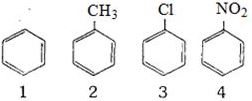
MediumMCQ
What is the correct order of reactivity towards electrophilic substitution reaction for the following compounds?
A
$1 > 2 > 3 > 4$
B
$4 > 3 > 2 > 1$
C
$2 > 1 > 3 > 4$
D
$2 > 3 > 1 > 4$
Solution
(C) The reactivity of benzene derivatives towards electrophilic substitution depends on the nature of the substituent group attached to the benzene ring.
Electron-donating groups $(EDG)$ increase the electron density of the ring,making it more reactive,while electron-withdrawing groups $(EWG)$ decrease the electron density,making it less reactive.
$1$. Benzene $(1)$: Reference compound.
$2$. Toluene $(2)$: The $-CH_3$ group is an electron-donating group due to the $+I$ effect and hyperconjugation,which increases the reactivity compared to benzene.
$3$. Chlorobenzene $(3)$: The $-Cl$ group is deactivating due to its strong $-I$ effect,although it is ortho/para directing due to resonance ($+M$ effect). Overall,it is less reactive than benzene.
$4$. Nitrobenzene $(4)$: The $-NO_2$ group is a strong electron-withdrawing group due to both $-I$ and $-M$ effects,significantly reducing the electron density of the ring and making it the least reactive.
Therefore,the correct order of reactivity is $2 > 1 > 3 > 4$.
Electron-donating groups $(EDG)$ increase the electron density of the ring,making it more reactive,while electron-withdrawing groups $(EWG)$ decrease the electron density,making it less reactive.
$1$. Benzene $(1)$: Reference compound.
$2$. Toluene $(2)$: The $-CH_3$ group is an electron-donating group due to the $+I$ effect and hyperconjugation,which increases the reactivity compared to benzene.
$3$. Chlorobenzene $(3)$: The $-Cl$ group is deactivating due to its strong $-I$ effect,although it is ortho/para directing due to resonance ($+M$ effect). Overall,it is less reactive than benzene.
$4$. Nitrobenzene $(4)$: The $-NO_2$ group is a strong electron-withdrawing group due to both $-I$ and $-M$ effects,significantly reducing the electron density of the ring and making it the least reactive.
Therefore,the correct order of reactivity is $2 > 1 > 3 > 4$.
0 likes
View Solution239
MediumMCQ
What is the total number of benzene derivatives with the molecular formula $C_7H_8O$?
A
$3$
B
$4$
C
$5$
D
$6$
Solution
(C) The molecular formula $C_7H_8O$ corresponds to a degree of unsaturation of $4$,which is consistent with a benzene ring ($4$ degrees of unsaturation).
Possible isomers are:
$1$. $o$-Cresol (ortho-methylphenol)
$2$. $m$-Cresol (meta-methylphenol)
$3$. $p$-Cresol (para-methylphenol)
$4$. Benzyl alcohol $(C_6H_5CH_2OH)$
$5$. Anisole (methoxybenzene,$C_6H_5OCH_3$)
Thus,there are $5$ possible benzene derivatives.
Possible isomers are:
$1$. $o$-Cresol (ortho-methylphenol)
$2$. $m$-Cresol (meta-methylphenol)
$3$. $p$-Cresol (para-methylphenol)
$4$. Benzyl alcohol $(C_6H_5CH_2OH)$
$5$. Anisole (methoxybenzene,$C_6H_5OCH_3$)
Thus,there are $5$ possible benzene derivatives.
0 likes
View Solution240
EasyMCQ
The structural formula of $3,4$-benzpyrene is ...... .
A
Five fused benzene rings
B
Four fused benzene rings
C
Six fused benzene rings
D
Three fused benzene rings
Solution
(A) $3,4$-benzpyrene is a polycyclic aromatic hydrocarbon $(PAH)$ with the chemical formula $C_{20}H_{12}$.
It consists of five fused benzene rings.
It is a well-known carcinogen found in cigarette smoke and coal tar.
It consists of five fused benzene rings.
It is a well-known carcinogen found in cigarette smoke and coal tar.
0 likes
View Solution241
MediumMCQ
The molecular formula of $3,4$-benzpyrene is ...... .
A
$C_{10}H_{12}$
B
$C_{20}H_{12}$
C
$C_{12}H_{20}$
D
$C_{12}H_{10}$
Solution
(B) $3,4$-benzpyrene is a polycyclic aromatic hydrocarbon $(PAH)$ with the chemical formula $C_{20}H_{12}$.
It is a well-known carcinogen found in cigarette smoke and coal tar.
It is a well-known carcinogen found in cigarette smoke and coal tar.
0 likes
View Solution242
EasyMCQ
$3,4$-Benzpyrene is a .....
A
Nitrogen oxide
B
Hydrocarbon
C
Carbon oxide
D
Sulfur oxide
Solution
(B) $3,4$-Benzpyrene is a polycyclic aromatic hydrocarbon $(PAH)$.
It is a well-known carcinogen found in cigarette smoke and coal tar.
Since it consists only of carbon and hydrogen atoms,it is classified as a hydrocarbon.
It is a well-known carcinogen found in cigarette smoke and coal tar.
Since it consists only of carbon and hydrogen atoms,it is classified as a hydrocarbon.
0 likes
View Solution243
EasyMCQ
Which of the following is a carcinogen?
A
Benzene
B
Benzopyrene
C
Both Benzene and Benzopyrene
D
None of these
Solution
(C) Both $Benzene$ $(C_6H_6)$ and $Benzopyrene$ are well-known carcinogens. $Benzene$ is a known human carcinogen,and $Benzopyrene$ is a polycyclic aromatic hydrocarbon found in tobacco smoke and coal tar,which is also highly carcinogenic. Therefore,the correct answer is $C$.
0 likes
View Solution244
MediumMCQ
What is the product obtained from the reductive ozonolysis of benzene?
A
Acetone
B
Maleic anhydride
C
Phthalic acid
D
Glyoxal
Solution
(D) Reductive ozonolysis of benzene involves the reaction of benzene with $3O_3$ to form a benzene triozonide intermediate.
This intermediate is then treated with $Zn/H_2O$ (reductive conditions) to undergo cleavage.
The reaction results in the formation of three molecules of glyoxal $(CHO-CHO)$ and $3ZnO$ as a byproduct.
Therefore,the correct product is glyoxal.
This intermediate is then treated with $Zn/H_2O$ (reductive conditions) to undergo cleavage.
The reaction results in the formation of three molecules of glyoxal $(CHO-CHO)$ and $3ZnO$ as a byproduct.
Therefore,the correct product is glyoxal.
0 likes
View Solution245
MediumMCQ
Which one of these is not compatible with arenes?
A
Greater stability
B
Delocalisation of $\pi$-electrons
C
Electrophilic additions
D
Resonance
Solution
(C) In arenes,electrophilic substitution reactions take place,and they do not typically undergo electrophilic addition reactions.
Benzene is a resonance hybrid of two structures,and its greater stability is due to the delocalization of $\pi$-electrons.
Benzene is a resonance hybrid of two structures,and its greater stability is due to the delocalization of $\pi$-electrons.
0 likes
View Solution246
MediumMCQ
In the reaction $C_6H_5CH_3$ $\xrightarrow{\text{Oxidation}} A$ $\xrightarrow{NaOH} B$ $\xrightarrow{\text{Sodalime}} C$. Then $C$ is
A
$C_6H_6$
B
$C_6H_5OH$
C
$C_6H_5COONa$
D
$C_6H_5ONa$
Solution
(A) Step $1$: Oxidation of toluene $(C_6H_5CH_3)$ gives benzoic acid $(C_6H_5COOH)$ as product $A$.
Step $2$: Reaction of benzoic acid with $NaOH$ gives sodium benzoate $(C_6H_5COONa)$ as product $B$.
Step $3$: Decarboxylation of sodium benzoate with sodalime $(NaOH/CaO)$ gives benzene $(C_6H_6)$ as product $C$.
Therefore,the final product $C$ is $C_6H_6$.
Step $2$: Reaction of benzoic acid with $NaOH$ gives sodium benzoate $(C_6H_5COONa)$ as product $B$.
Step $3$: Decarboxylation of sodium benzoate with sodalime $(NaOH/CaO)$ gives benzene $(C_6H_6)$ as product $C$.
Therefore,the final product $C$ is $C_6H_6$.
0 likes
View Solution247
MediumMCQ
Which of the following will be easily nitrated?
A
$C_6H_5CH_3$
B
$C_6H_5Cl$
C
$CH_3NO_2$
D
$C_6H_5NO_2$
Solution
(A) The presence of an electron-releasing group (e.g.,$-CH_3$,$-OH$,$-NH_2$) increases the electron density in the benzene ring,which makes the electrophilic aromatic substitution (nitration) easier.
In $C_6H_5CH_3$,the $-CH_3$ group is an electron-releasing group due to the $+I$ effect and hyperconjugation.
In contrast,$-Cl$ is deactivating due to the $-I$ effect,and $-NO_2$ is strongly deactivating due to both $-I$ and $-M$ effects.
Therefore,$C_6H_5CH_3$ will be nitrated most easily.
In $C_6H_5CH_3$,the $-CH_3$ group is an electron-releasing group due to the $+I$ effect and hyperconjugation.
In contrast,$-Cl$ is deactivating due to the $-I$ effect,and $-NO_2$ is strongly deactivating due to both $-I$ and $-M$ effects.
Therefore,$C_6H_5CH_3$ will be nitrated most easily.
0 likes
View Solution248
MediumMCQ
Benzene hexachloride is prepared from benzene and chlorine in the presence of sunlight by:
A
Substitution reaction
B
Elimination reaction
C
Addition reaction
D
Rearrangement
Solution
(C) When benzene reacts with chlorine in the presence of sunlight (ultraviolet light),three molecules of $Cl_2$ add across the double bonds of the benzene ring to form benzene hexachloride $(C_6H_6Cl_6)$,also known as $BHC$ or $Gammexane$.
This process is an example of an electrophilic addition reaction where the aromaticity of the benzene ring is lost.
This process is an example of an electrophilic addition reaction where the aromaticity of the benzene ring is lost.
0 likes
View Solution249
MediumMCQ
$ArH + R - C(=O) - Cl \xrightarrow{\text{Lewis acid}} Ar - C(=O) - R + HCl$ is an example of
A
Friedel-Craft's alkylation
B
Friedel-Craft's acylation
C
Cannizzaro reaction
D
Claisen condensation
Solution
(B) The given reaction is: $ArH + R - CO - Cl \xrightarrow{\text{anhyd. } AlCl_3} Ar - CO - R + HCl$.
In this reaction,an acyl group $(R-CO-)$ is introduced into the aromatic ring $(ArH)$ in the presence of a Lewis acid catalyst like anhydrous $AlCl_3$.
This is a characteristic example of Friedel-Craft's acylation.
In this reaction,an acyl group $(R-CO-)$ is introduced into the aromatic ring $(ArH)$ in the presence of a Lewis acid catalyst like anhydrous $AlCl_3$.
This is a characteristic example of Friedel-Craft's acylation.
0 likes
View Solution250
DifficultMCQ
The enthalpy of hydrogenation of cyclohexene is $-119.5 \ kJ \ mol^{-1}.$ If resonance energy of benzene is $-150.4 \ kJ \ mol^{-1},$ its enthalpy of hydrogenation would be $...... \ kJ \ mol^{-1}.$
A
$-358.5$
B
$-508.9$
C
$-208.1$
D
$-269.9$
Solution
(B) The enthalpy of hydrogenation of cyclohexene is $-119.5 \ kJ \ mol^{-1},$ which corresponds to the hydrogenation of one $C=C$ double bond.
Benzene contains three $C=C$ double bonds. Therefore,the calculated enthalpy of hydrogenation for benzene (assuming no resonance) is:
$\Delta H_{Cal} = 3 \times (-119.5 \ kJ \ mol^{-1}) = -358.5 \ kJ \ mol^{-1}.$
Resonance energy is defined as the difference between the experimental enthalpy of hydrogenation and the calculated enthalpy of hydrogenation:
$\text{Resonance Energy} = \Delta H_{Exp} - \Delta H_{Cal}.$
Given that the resonance energy is $-150.4 \ kJ \ mol^{-1},$ we have:
$-150.4 = \Delta H_{Exp} - (-358.5).$
Solving for $\Delta H_{Exp}:$
$\Delta H_{Exp} = -150.4 - 358.5 = -508.9 \ kJ \ mol^{-1}.$
Benzene contains three $C=C$ double bonds. Therefore,the calculated enthalpy of hydrogenation for benzene (assuming no resonance) is:
$\Delta H_{Cal} = 3 \times (-119.5 \ kJ \ mol^{-1}) = -358.5 \ kJ \ mol^{-1}.$
Resonance energy is defined as the difference between the experimental enthalpy of hydrogenation and the calculated enthalpy of hydrogenation:
$\text{Resonance Energy} = \Delta H_{Exp} - \Delta H_{Cal}.$
Given that the resonance energy is $-150.4 \ kJ \ mol^{-1},$ we have:
$-150.4 = \Delta H_{Exp} - (-358.5).$
Solving for $\Delta H_{Exp}:$
$\Delta H_{Exp} = -150.4 - 358.5 = -508.9 \ kJ \ mol^{-1}.$
0 likes
View SolutionHydrocarbons — Aromatic hydrocarbon · Frequently Asked Questions
1Are these Hydrocarbons questions useful for JEE and NEET?
Yes. All questions in this section are mapped to JEE Main and NEET exam patterns. Previous year questions from JEE Main, NEET, GUJCET and state-level exams are included with full solutions.
2Can I switch to Hindi or Gujarati for these questions?
Yes. Use the language tabs in the hero section or the sidebar to view the same questions and solutions in English, Hindi or Gujarati.
3How do I generate a question paper from this subtopic?
Use the Vedclass Exam Paper Generator — select the chapter and subtopic, set difficulty, and generate Sets A, B, C, D automatically. First 3 chapters of every subject are free.
Vedclass Products
For Students
Vedclass Test Series
Mock tests in real JEE/NEET style with performance analysis. 5-day free trial.
Start Free TrialFor Teachers
Exam Paper Generator
Generate Set A/B/C/D papers from this chapter in 2 minutes. 3 chapters free.
Try FreeFor Institutes
Online Exam Module
Live online exams with unlimited students, 360° analytics & white-label branding.
See DemoFor Teachers & Institutes
Generate a Hydrocarbons Exam Paper in 2 Minutes
Select subtopic & difficulty — Sets A, B, C, D auto-generated with No Repeat logic.
First 3 chapters of every subject are free — no payment required.