
A English
Aromatic hydrocarbon Questions in English
Class 11 Chemistry · Hydrocarbons · Aromatic hydrocarbon
872+
Questions
English
Language
100%
With Solutions
Showing 50 of 872 questions in English
351
MediumMCQ
Which of the following reactions is correct?
A
$n-hexane \xrightarrow[\Delta]{Cr_2O_3+Al_2O_3} \text{cyclohexane}$
B
$3CH \equiv CH \xrightarrow[\text{Red hot}]{\text{Fe tube}} \text{benzene}$
C
$but-2-ene \xrightarrow[\Delta]{H_2/Ni} \text{butane}$
D
$CH_3-C \equiv C-CH_3 \xrightarrow[Pd(OOCCH_3)_2]{H_2/Pd-CaCO_3} \text{cis-but-2-ene}$
Solution
(B) Let's analyze each reaction:
$A$. $n-hexane \xrightarrow[\Delta]{Cr_2O_3+Al_2O_3} \text{benzene} + 4H_2$. The product shown in the image is cyclohexane,which is incorrect. The correct product is benzene.
$B$. $3CH \equiv CH \xrightarrow[\text{Red hot}]{\text{Fe tube}} C_6H_6$ (benzene). This is a standard cyclotrimerization reaction of ethyne,which is correct.
$C$. $but-2-ene \xrightarrow[\Delta]{H_2/Ni} \text{butane}$. While the reaction is chemically possible,the image shows a specific skeletal structure. However,option $B$ is a classic,textbook-defined reaction.
$D$. $CH_3-C \equiv C-CH_3 \xrightarrow[Pd(OOCCH_3)_2]{H_2/Pd-CaCO_3} \text{cis-but-2-ene}$. This is the Lindlar reduction of an internal alkyne to a cis-alkene,which is also correct.
Given the context of standard chemistry questions,$B$ is the most fundamental reaction taught in this topic.
$A$. $n-hexane \xrightarrow[\Delta]{Cr_2O_3+Al_2O_3} \text{benzene} + 4H_2$. The product shown in the image is cyclohexane,which is incorrect. The correct product is benzene.
$B$. $3CH \equiv CH \xrightarrow[\text{Red hot}]{\text{Fe tube}} C_6H_6$ (benzene). This is a standard cyclotrimerization reaction of ethyne,which is correct.
$C$. $but-2-ene \xrightarrow[\Delta]{H_2/Ni} \text{butane}$. While the reaction is chemically possible,the image shows a specific skeletal structure. However,option $B$ is a classic,textbook-defined reaction.
$D$. $CH_3-C \equiv C-CH_3 \xrightarrow[Pd(OOCCH_3)_2]{H_2/Pd-CaCO_3} \text{cis-but-2-ene}$. This is the Lindlar reduction of an internal alkyne to a cis-alkene,which is also correct.
Given the context of standard chemistry questions,$B$ is the most fundamental reaction taught in this topic.
0 likes
View Solution352
MediumMCQ
Which of the following is a heterocyclic aromatic compound?
A
Phenol
B
Pyridine
C
Nitrobenzene
D
Benzene
Solution
(B) heterocyclic aromatic compound is a cyclic compound that contains at least one atom other than carbon (such as $N$,$O$,or $S$) within the ring structure and follows $H$ückel's rule for aromaticity.
$A$. Phenol $(C_6H_5OH)$ is a carbocyclic aromatic compound.
$B$. Pyridine $(C_5H_5N)$ is a heterocyclic aromatic compound because it contains a nitrogen atom in the six-membered aromatic ring.
$C$. Nitrobenzene $(C_6H_5NO_2)$ is a carbocyclic aromatic compound.
$D$. Benzene $(C_6H_6)$ is a carbocyclic aromatic compound.
Therefore,the correct option is $B$.
$A$. Phenol $(C_6H_5OH)$ is a carbocyclic aromatic compound.
$B$. Pyridine $(C_5H_5N)$ is a heterocyclic aromatic compound because it contains a nitrogen atom in the six-membered aromatic ring.
$C$. Nitrobenzene $(C_6H_5NO_2)$ is a carbocyclic aromatic compound.
$D$. Benzene $(C_6H_6)$ is a carbocyclic aromatic compound.
Therefore,the correct option is $B$.
0 likes
View Solution353
MediumMCQ
Which of the following is correct regarding the nitration of benzene?
A
$NO_2^{\oplus}$ is obtained as an electrophile.
B
$H_2SO_4$ acts as a catalyst for the reaction.
C
The reaction does not show a kinetic isotopic effect.
D
All of the above.
0 likes
View Solution354
MediumMCQ
$Benzene$ $\xrightarrow[{{H_2}S{O_4}}]{{HN{O_3}}}(A)$ $\xrightarrow[{FeC{l_3}}]{{C{l_2}}}(B)$
The major product $(B)$ is
The major product $(B)$ is
A
Nitrobenzene with a chlorine atom at the ortho position
B
Nitrobenzene with a chlorine atom at the meta position
C
Nitrobenzene with a chlorine atom at the para position
D
Nitrobenzene with four chlorine atoms
Solution
(B) $1$. The reaction of benzene with a mixture of concentrated $HN{O_3}$ and $H_2SO_4$ (nitrating mixture) undergoes electrophilic aromatic substitution to form nitrobenzene $(A)$.
$2$. The nitro group $(-NO_2)$ is a strongly deactivating group and is meta-directing for further electrophilic substitution reactions.
$3$. When nitrobenzene $(A)$ reacts with $Cl_2$ in the presence of a Lewis acid catalyst like $FeCl_3$,the chlorine atom is directed to the meta position.
$4$. Therefore,the major product $(B)$ is $m$-chloronitrobenzene.
$2$. The nitro group $(-NO_2)$ is a strongly deactivating group and is meta-directing for further electrophilic substitution reactions.
$3$. When nitrobenzene $(A)$ reacts with $Cl_2$ in the presence of a Lewis acid catalyst like $FeCl_3$,the chlorine atom is directed to the meta position.
$4$. Therefore,the major product $(B)$ is $m$-chloronitrobenzene.
0 likes
View Solution355
MediumMCQ
Predict the major product of the following reaction:
Benzene + Acetic anhydride $\xrightarrow{AlCl_3}$ ?
Benzene + Acetic anhydride $\xrightarrow{AlCl_3}$ ?
A
Acetophenone
B
Toluene
C
Benzophenone
D
None of these
Solution
(A) The reaction between benzene and acetic anhydride in the presence of anhydrous $AlCl_3$ is a Friedel-Crafts acylation reaction.
Step $I$: The Lewis acid $AlCl_3$ coordinates with the oxygen atom of acetic anhydride,leading to the formation of an acylium ion $(CH_3-C^+=O)$ and an acetate-aluminum complex.
Step $II$: The electrophilic acylium ion attacks the benzene ring via Electrophilic Aromatic Substitution $(ESR)$ to form acetophenone $(C_6H_5COCH_3)$.
Step $I$: The Lewis acid $AlCl_3$ coordinates with the oxygen atom of acetic anhydride,leading to the formation of an acylium ion $(CH_3-C^+=O)$ and an acetate-aluminum complex.
Step $II$: The electrophilic acylium ion attacks the benzene ring via Electrophilic Aromatic Substitution $(ESR)$ to form acetophenone $(C_6H_5COCH_3)$.
0 likes
View Solution356
EasyMCQ
Carbon-Carbon bond length in benzene is $.....$ $\mathring{A}$
A
$1.20$ and $1.37$
B
$1.39$
C
$1.39$ and $1.20$
D
$1.20$
Solution
(B) In benzene,due to resonance,all $C-C$ bonds are equivalent and possess partial double bond character.
Therefore,the carbon-carbon bond length in benzene is $1.39 \mathring{A}$.
Therefore,the carbon-carbon bond length in benzene is $1.39 \mathring{A}$.
0 likes
View Solution357
DifficultMCQ
Rank the following compounds in decreasing order of reactivity towards Electrophilic Aromatic Substitution $(EAS)$ reaction:
$(a)$ $Toluene$
$(b)$ $Nitrobenzene$
$(c)$ $Benzene$
$(d)$ $Chlorobenzene$
$(a)$ $Toluene$
$(b)$ $Nitrobenzene$
$(c)$ $Benzene$
$(d)$ $Chlorobenzene$
A
$a > c > d > b$
B
$d > c > b > a$
C
$c > a > d > b$
D
$a > c > b > d$
Solution
(A) The reactivity of aromatic compounds towards Electrophilic Aromatic Substitution $(EAS)$ depends on the electron density of the benzene ring.
$1$. $Toluene$ ($-CH_3$ group): The methyl group is electron-donating via $+I$ and hyperconjugation effects,which increases the electron density on the ring,making it more reactive than benzene.
$2$. $Benzene$: This is the reference compound.
$3$. $Chlorobenzene$ ($-Cl$ group): The chlorine atom is electron-withdrawing via the inductive effect $(-I)$,which decreases the electron density on the ring,although it is ortho/para directing due to resonance $(+M)$. It is less reactive than benzene.
$4$. $Nitrobenzene$ ($-NO_2$ group): The nitro group is strongly electron-withdrawing via both $-I$ and $-M$ effects,significantly decreasing the electron density on the ring,making it the least reactive.
Therefore,the decreasing order of reactivity is: $Toluene (a) > Benzene (c) > Chlorobenzene (d) > Nitrobenzene (b)$.
$1$. $Toluene$ ($-CH_3$ group): The methyl group is electron-donating via $+I$ and hyperconjugation effects,which increases the electron density on the ring,making it more reactive than benzene.
$2$. $Benzene$: This is the reference compound.
$3$. $Chlorobenzene$ ($-Cl$ group): The chlorine atom is electron-withdrawing via the inductive effect $(-I)$,which decreases the electron density on the ring,although it is ortho/para directing due to resonance $(+M)$. It is less reactive than benzene.
$4$. $Nitrobenzene$ ($-NO_2$ group): The nitro group is strongly electron-withdrawing via both $-I$ and $-M$ effects,significantly decreasing the electron density on the ring,making it the least reactive.
Therefore,the decreasing order of reactivity is: $Toluene (a) > Benzene (c) > Chlorobenzene (d) > Nitrobenzene (b)$.
0 likes
View Solution358
DifficultMCQ
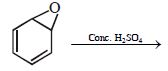
What is the major product of the following reaction?
A
$4-$hydroxycyclohexa$-2,5-$dien$-1-$one
B
cyclohexa$-2,5-$diene$-1,4-$dione
C
$2-$hydroxycyclohexa$-2,4-$dien$-1-$one
D
phenol
Solution
(D) The starting material is benzene oxide (an epoxide of benzene). In the presence of an acid catalyst like $Conc. \ H_2SO_4$,the epoxide ring undergoes acid-catalyzed ring opening followed by tautomerization. The oxygen atom is protonated,and the ring opens to form a carbocation intermediate which then rearranges to form the more stable aromatic phenol. However,in the context of this specific reaction pathway for benzene oxide,it isomerizes to phenol.
0 likes
View Solution359
DifficultMCQ
Identify the final product $C$ in the following reaction sequence:
$1,3-\text{cyclohexadiene}$ $\xrightarrow{NBS} A$ $\xrightarrow{Aq. NaOH} B$ $\xrightarrow{Con. H_2SO_4, \Delta} C$
$1,3-\text{cyclohexadiene}$ $\xrightarrow{NBS} A$ $\xrightarrow{Aq. NaOH} B$ $\xrightarrow{Con. H_2SO_4, \Delta} C$
A
Cyclohexene
B
Benzene
C
$1,4-$cyclohexadiene
D
Cyclohexane
Solution
(B) $1$. The reaction of $1,3-\text{cyclohexadiene}$ with $NBS$ ($N$-Bromosuccinimide) is an allylic bromination. It introduces a bromine atom at the allylic position,forming $3-\text{bromocyclohexene}$ (Compound $A$).
$2$. The reaction of $3-\text{bromocyclohexene}$ with aqueous $NaOH$ is a nucleophilic substitution reaction ($S_N2$ or $S_N1$),where the $-Br$ group is replaced by an $-OH$ group,forming $3-\text{cyclohexenol}$ (Compound $B$).
$3$. The reaction of $3-\text{cyclohexenol}$ with concentrated $H_2SO_4$ at high temperature $(\Delta)$ is an acid-catalyzed dehydration reaction. This removes the $-OH$ group and a hydrogen atom from the adjacent carbon to form a double bond,resulting in the formation of $1,3-\text{cyclohexadiene}$ (which is the starting material) or,through rearrangement/conjugation,it can lead to the formation of benzene if conditions allow for further dehydrogenation. However,in standard textbook problems of this type,the dehydration of $3-\text{cyclohexenol}$ typically yields $1,3-\text{cyclohexadiene}$. Looking at the options provided,the most stable aromatic product that can be formed via further elimination/dehydrogenation is benzene. Given the options,$B$ (Benzene) is the intended product.
$2$. The reaction of $3-\text{bromocyclohexene}$ with aqueous $NaOH$ is a nucleophilic substitution reaction ($S_N2$ or $S_N1$),where the $-Br$ group is replaced by an $-OH$ group,forming $3-\text{cyclohexenol}$ (Compound $B$).
$3$. The reaction of $3-\text{cyclohexenol}$ with concentrated $H_2SO_4$ at high temperature $(\Delta)$ is an acid-catalyzed dehydration reaction. This removes the $-OH$ group and a hydrogen atom from the adjacent carbon to form a double bond,resulting in the formation of $1,3-\text{cyclohexadiene}$ (which is the starting material) or,through rearrangement/conjugation,it can lead to the formation of benzene if conditions allow for further dehydrogenation. However,in standard textbook problems of this type,the dehydration of $3-\text{cyclohexenol}$ typically yields $1,3-\text{cyclohexadiene}$. Looking at the options provided,the most stable aromatic product that can be formed via further elimination/dehydrogenation is benzene. Given the options,$B$ (Benzene) is the intended product.
0 likes
View Solution360
DifficultMCQ
The major product $X$ is:

A
sec-butylbenzene
B
tert-butylbenzene
C
n-butylbenzene
D
None of these
Solution
(A) The reaction of benzene with $n$-butyl chloride in the presence of anhydrous $AlCl_3$ is a Friedel-Crafts alkylation reaction.
In this reaction,the primary carbocation formed initially $(CH_3-CH_2-CH_2-CH_2^+)$ undergoes a $1,2$-hydride shift to form a more stable secondary carbocation $(CH_3-CH_2-CH^+-CH_3)$.
This secondary carbocation then attacks the benzene ring to form $sec$-butylbenzene as the major product due to the rearrangement of the alkyl group.
In this reaction,the primary carbocation formed initially $(CH_3-CH_2-CH_2-CH_2^+)$ undergoes a $1,2$-hydride shift to form a more stable secondary carbocation $(CH_3-CH_2-CH^+-CH_3)$.
This secondary carbocation then attacks the benzene ring to form $sec$-butylbenzene as the major product due to the rearrangement of the alkyl group.
0 likes
View Solution361
MediumMCQ
The increasing order of the following compounds for electrophilic substitution reaction is:
$(I)$ Toluene
$(II)$ Benzene
$(III)$ Benzoic acid
$(I)$ Toluene
$(II)$ Benzene
$(III)$ Benzoic acid
A
$III < II < I$
B
$I < II < III$
C
$II < III < I$
D
$I < III < II$
Solution
(A) The reactivity of benzene rings towards electrophilic substitution depends on the nature of the substituent attached to the ring.
Electron-donating groups (activating groups) increase the electron density on the benzene ring,making it more reactive towards electrophiles.
Electron-withdrawing groups (deactivating groups) decrease the electron density on the benzene ring,making it less reactive.
In the given compounds:
$(I)$ Toluene ($-CH_3$ group) has an electron-donating group (+$I$ and hyperconjugation effect),which activates the ring.
$(II)$ Benzene has no substituent.
$(III)$ Benzoic acid ($-COOH$ group) has an electron-withdrawing group (-$I$ and -$M$ effect),which deactivates the ring.
Therefore,the reactivity order is: $Toluene (I) > Benzene (II) > Benzoic acid (III)$.
The increasing order is $III < II < I$.
Electron-donating groups (activating groups) increase the electron density on the benzene ring,making it more reactive towards electrophiles.
Electron-withdrawing groups (deactivating groups) decrease the electron density on the benzene ring,making it less reactive.
In the given compounds:
$(I)$ Toluene ($-CH_3$ group) has an electron-donating group (+$I$ and hyperconjugation effect),which activates the ring.
$(II)$ Benzene has no substituent.
$(III)$ Benzoic acid ($-COOH$ group) has an electron-withdrawing group (-$I$ and -$M$ effect),which deactivates the ring.
Therefore,the reactivity order is: $Toluene (I) > Benzene (II) > Benzoic acid (III)$.
The increasing order is $III < II < I$.
0 likes
View Solution362
MediumMCQ
$\xrightarrow[{hv}]{{NBS}}$ Product ;
Which product will not likely to form?
Which product will not likely to form?
A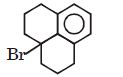
B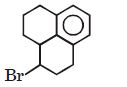
C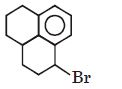
D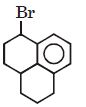
Solution
(A) $NBS$ ($N$-Bromosuccinimide) is a reagent used for allylic or benzylic bromination via a free radical mechanism.
In the given structure,the carbon atom at the bridgehead position (the carbon shared by the two non-aromatic rings) is a tertiary carbon,but it is not allylic or benzylic.
Substitution at the bridgehead carbon is highly unfavorable due to the strain involved in forming a planar radical intermediate at that position (Bredt's rule).
Therefore,the product shown in option $A$ (where $Br$ is attached to the bridgehead carbon) is the least likely to form.
In the given structure,the carbon atom at the bridgehead position (the carbon shared by the two non-aromatic rings) is a tertiary carbon,but it is not allylic or benzylic.
Substitution at the bridgehead carbon is highly unfavorable due to the strain involved in forming a planar radical intermediate at that position (Bredt's rule).
Therefore,the product shown in option $A$ (where $Br$ is attached to the bridgehead carbon) is the least likely to form.
0 likes
View Solution363
DifficultMCQ
$2 \text{ Benzene} \xrightarrow[{AlCl_3}]{{CH_2Cl_2}} \text{ Product}$
A
Benzyl chloride
B
Diphenylmethane
C
$1,1-$Diphenylethane
D
Triphenylmethane
Solution
(B) The reaction of $2$ moles of benzene with dichloromethane $(CH_2Cl_2)$ in the presence of a Lewis acid catalyst like $AlCl_3$ is a Friedel-Crafts alkylation reaction.
In this reaction,the $CH_2Cl_2$ acts as an alkylating agent.
First,one chlorine atom is replaced by a phenyl group to form benzyl chloride $(C_6H_5CH_2Cl)$.
Then,the second chlorine atom is replaced by another phenyl group to form diphenylmethane $(C_6H_5CH_2C_6H_5)$.
The overall reaction is:
$2 C_6H_6 + CH_2Cl_2 \xrightarrow{AlCl_3} C_6H_5CH_2C_6H_5 + 2 HCl$
Thus,the product is diphenylmethane.
In this reaction,the $CH_2Cl_2$ acts as an alkylating agent.
First,one chlorine atom is replaced by a phenyl group to form benzyl chloride $(C_6H_5CH_2Cl)$.
Then,the second chlorine atom is replaced by another phenyl group to form diphenylmethane $(C_6H_5CH_2C_6H_5)$.
The overall reaction is:
$2 C_6H_6 + CH_2Cl_2 \xrightarrow{AlCl_3} C_6H_5CH_2C_6H_5 + 2 HCl$
Thus,the product is diphenylmethane.
0 likes
View Solution364
DifficultMCQ
Which of the following compounds has two different $C-C$ bond lengths?
A
Benzene
B
Cyclooctatetraene
C
Cyclopropenyl cation
D
$CH_2=CH-CH_2^{\oplus}$
Solution
(B) Cyclooctatetraene $(C_8H_8)$ is a non-planar molecule that adopts a 'tub' shape to avoid anti-aromaticity. Due to this non-planar geometry,the conjugation is interrupted,and it possesses alternating single and double bonds,resulting in two different $C-C$ bond lengths. In contrast,benzene,the cyclopropenyl cation,and the allyl cation $(CH_2=CH-CH_2^{\oplus})$ exhibit resonance,which leads to delocalization of electrons and equalized $C-C$ bond lengths.
0 likes
View Solution365
MediumMCQ
Which of the following Friedel-Crafts reactions is incorrectly written?
A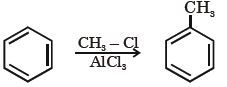
B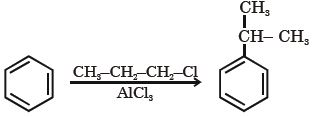
C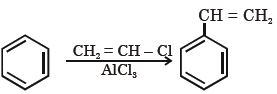
D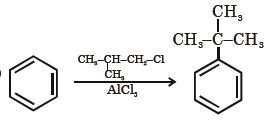
Solution
(C) Friedel-Crafts alkylation involves the reaction of an aromatic ring with an alkyl halide in the presence of a Lewis acid catalyst like $AlCl_3$.
$A$: This is a standard methylation of benzene,which is correct.
$B$: The reaction of benzene with $n$-propyl chloride $(CH_3CH_2CH_2Cl)$ undergoes rearrangement of the propyl carbocation to a more stable isopropyl carbocation,leading to the formation of isopropylbenzene. This is correct.
$C$: Vinyl halides $(CH_2=CHCl)$ do not undergo Friedel-Crafts alkylation because the $C-Cl$ bond has partial double bond character due to resonance,making it very difficult to form the vinyl carbocation. Therefore,this reaction is incorrectly written.
$D$: The reaction of benzene with isobutyl chloride $(CH_3CH(CH_3)CH_2Cl)$ involves the rearrangement of the primary carbocation to a more stable tertiary carbocation,resulting in the formation of tert-butylbenzene. This is correct.
$A$: This is a standard methylation of benzene,which is correct.
$B$: The reaction of benzene with $n$-propyl chloride $(CH_3CH_2CH_2Cl)$ undergoes rearrangement of the propyl carbocation to a more stable isopropyl carbocation,leading to the formation of isopropylbenzene. This is correct.
$C$: Vinyl halides $(CH_2=CHCl)$ do not undergo Friedel-Crafts alkylation because the $C-Cl$ bond has partial double bond character due to resonance,making it very difficult to form the vinyl carbocation. Therefore,this reaction is incorrectly written.
$D$: The reaction of benzene with isobutyl chloride $(CH_3CH(CH_3)CH_2Cl)$ involves the rearrangement of the primary carbocation to a more stable tertiary carbocation,resulting in the formation of tert-butylbenzene. This is correct.
0 likes
View Solution366
DifficultMCQ
What is the major product $X$ in the following reaction?
$\text{Benzene} + CH_3CH_2CH_2Cl \xrightarrow{AlCl_3} (X)$
$\text{Benzene} + CH_3CH_2CH_2Cl \xrightarrow{AlCl_3} (X)$
A
Phenyl acetate
B
$2-$Chloroacetophenone
C
$3-$Chloroacetophenone
D
$4-$Chloroacetophenone
0 likes
View Solution367
MediumMCQ
Which of the following is anti-aromatic?
A
Cyclobutadiene
B
Benzene
C
Cyclopentadienyl anion
D
Cycloheptatrienyl cation
Solution
(A) compound is anti-aromatic if it follows these criteria:
$1$. It is cyclic and planar.
$2$. It is fully conjugated.
$3$. It contains $4n$ $\pi$-electrons (where $n = 1, 2, 3, ...$).
- Cyclobutadiene $(C_4H_4)$ is cyclic,planar,fully conjugated,and has $4$ $\pi$-electrons ($4n$ where $n=1$). Thus,it is anti-aromatic.
- Benzene is aromatic ($6$ $\pi$-electrons).
- Cyclopentadienyl anion is aromatic ($6$ $\pi$-electrons).
- Cycloheptatrienyl cation is aromatic ($6$ $\pi$-electrons).
$1$. It is cyclic and planar.
$2$. It is fully conjugated.
$3$. It contains $4n$ $\pi$-electrons (where $n = 1, 2, 3, ...$).
- Cyclobutadiene $(C_4H_4)$ is cyclic,planar,fully conjugated,and has $4$ $\pi$-electrons ($4n$ where $n=1$). Thus,it is anti-aromatic.
- Benzene is aromatic ($6$ $\pi$-electrons).
- Cyclopentadienyl anion is aromatic ($6$ $\pi$-electrons).
- Cycloheptatrienyl cation is aromatic ($6$ $\pi$-electrons).
0 likes
View Solution368
Medium
Which of the following are aromatic species?
$(A)$ Cyclohexa$-2,4-$dienyl cation
$(B)$ Naphthalene
$(C)$ Tropone (Cycloheptatrienone)
$(D)$ Cyclohexa$-1,3-$diene
$(A)$ Cyclohexa$-2,4-$dienyl cation
$(B)$ Naphthalene
$(C)$ Tropone (Cycloheptatrienone)
$(D)$ Cyclohexa$-1,3-$diene
Solution
(B) To determine aromaticity,a species must follow $H$ückel's rule ($4n+2$ $\pi$ electrons),be planar,and have a fully conjugated system.
$(A)$ Cyclohexa$-2,4-$dienyl cation: This species has $4$ $\pi$ electrons. It is not fully conjugated because of the $sp^3$ carbon atom. It is non-aromatic.
$(B)$ Naphthalene: This is a polycyclic aromatic hydrocarbon with $10$ $\pi$ electrons ($n=2$ in $4n+2$). It is planar and fully conjugated. It is aromatic.
$(C)$ Tropone: The oxygen atom is more electronegative than carbon,pulling electron density towards itself,which creates a resonance structure with a tropylium cation ($7$ carbons,$6$ $\pi$ electrons). This makes it aromatic.
$(D)$ Cyclohexa$-1,3-$diene: This has $4$ $\pi$ electrons and is not fully conjugated due to $sp^3$ carbons. It is non-aromatic.
Therefore,only $B$ and $C$ are aromatic species.
$(A)$ Cyclohexa$-2,4-$dienyl cation: This species has $4$ $\pi$ electrons. It is not fully conjugated because of the $sp^3$ carbon atom. It is non-aromatic.
$(B)$ Naphthalene: This is a polycyclic aromatic hydrocarbon with $10$ $\pi$ electrons ($n=2$ in $4n+2$). It is planar and fully conjugated. It is aromatic.
$(C)$ Tropone: The oxygen atom is more electronegative than carbon,pulling electron density towards itself,which creates a resonance structure with a tropylium cation ($7$ carbons,$6$ $\pi$ electrons). This makes it aromatic.
$(D)$ Cyclohexa$-1,3-$diene: This has $4$ $\pi$ electrons and is not fully conjugated due to $sp^3$ carbons. It is non-aromatic.
Therefore,only $B$ and $C$ are aromatic species.
0 likes
View Solution369
MediumMCQ
Arrange the following compounds in the increasing order of their reactivity towards electrophilic aromatic substitution:
$(I)$ Benzene
$(II)$ Toluene $(C_6H_5CH_3)$
$(III)$ Anisole $(C_6H_5OCH_3)$
$(IV)$ Benzaldehyde $(C_6H_5CHO)$
$(I)$ Benzene
$(II)$ Toluene $(C_6H_5CH_3)$
$(III)$ Anisole $(C_6H_5OCH_3)$
$(IV)$ Benzaldehyde $(C_6H_5CHO)$
A
$IV < I < II < III$
B
$III < I < II < IV$
C
$I < IV < III < II$
D
$II < III < I < IV$
Solution
(A) The reactivity of aromatic compounds towards electrophilic substitution depends on the electron density in the benzene ring.
Electron-donating groups $(EDG)$ increase the electron density and reactivity,while electron-withdrawing groups $(EWG)$ decrease it.
$(I)$ Benzene: Reference compound.
$(II)$ Toluene: The $-CH_3$ group is an electron-donating group due to the $+I$ effect and hyperconjugation,making it more reactive than benzene.
$(III)$ Anisole: The $-OCH_3$ group is a strong electron-donating group due to the $+M$ (mesomeric) effect,making it the most reactive.
$(IV)$ Benzaldehyde: The $-CHO$ group is a strong electron-withdrawing group due to the $-M$ effect,making it the least reactive.
Thus,the increasing order of reactivity is: $(IV) < (I) < (II) < (III)$.
Electron-donating groups $(EDG)$ increase the electron density and reactivity,while electron-withdrawing groups $(EWG)$ decrease it.
$(I)$ Benzene: Reference compound.
$(II)$ Toluene: The $-CH_3$ group is an electron-donating group due to the $+I$ effect and hyperconjugation,making it more reactive than benzene.
$(III)$ Anisole: The $-OCH_3$ group is a strong electron-donating group due to the $+M$ (mesomeric) effect,making it the most reactive.
$(IV)$ Benzaldehyde: The $-CHO$ group is a strong electron-withdrawing group due to the $-M$ effect,making it the least reactive.
Thus,the increasing order of reactivity is: $(IV) < (I) < (II) < (III)$.
0 likes
View Solution370
DifficultMCQ
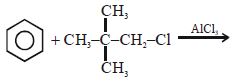
The major product of the reaction is:
A
tert-butylbenzene
B
neopentylbenzene
C
$1,1-$dimethyl$-2-$phenylethane
D
isobutylbenzene
Solution
(C) The reaction is a Friedel-Crafts alkylation of benzene with neopentyl chloride $(CH_3-C(CH_3)_2-CH_2-Cl)$ in the presence of a Lewis acid catalyst $(AlCl_3)$.
$1$. The initial carbocation formed is the primary neopentyl carbocation $(CH_3-C(CH_3)_2-CH_2^+)$.
$2$. Primary carbocations are unstable and undergo a $1,2-$methyl shift to form a more stable tertiary carbocation $(CH_3-C^+(CH_3)-CH_2-CH_3)$.
$3$. This stable tertiary carbocation then undergoes electrophilic aromatic substitution with benzene to form the major product,which is $2-$methyl$-2-$phenylbutane (also known as tert-pentylbenzene or $1,1-$dimethyl$-2-$phenylethane structure).
$4$. Looking at the options,the structure corresponding to the rearranged product is $1,1-$dimethyl$-2-$phenylethane (or $2-$methyl$-2-$phenylbutane).
$1$. The initial carbocation formed is the primary neopentyl carbocation $(CH_3-C(CH_3)_2-CH_2^+)$.
$2$. Primary carbocations are unstable and undergo a $1,2-$methyl shift to form a more stable tertiary carbocation $(CH_3-C^+(CH_3)-CH_2-CH_3)$.
$3$. This stable tertiary carbocation then undergoes electrophilic aromatic substitution with benzene to form the major product,which is $2-$methyl$-2-$phenylbutane (also known as tert-pentylbenzene or $1,1-$dimethyl$-2-$phenylethane structure).
$4$. Looking at the options,the structure corresponding to the rearranged product is $1,1-$dimethyl$-2-$phenylethane (or $2-$methyl$-2-$phenylbutane).
0 likes
View Solution371
DifficultMCQ
Which of the following sets contains only aromatic compounds?
A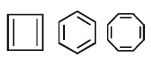
B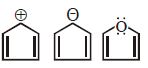
C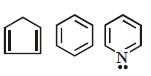
D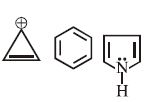
Solution
(D) compound is aromatic if it follows $H$ückel's rule: it must be cyclic,planar,fully conjugated,and have $(4n+2) \pi$ electrons,where $n = 0, 1, 2, ...$
Let's analyze the options:
$A$: Cyclobutadiene ($4 \pi$ electrons,anti-aromatic),Benzene (aromatic),Cyclooctatetraene ($8 \pi$ electrons,non-aromatic).
$B$: Cyclopentadienyl cation ($4 \pi$ electrons,anti-aromatic),Cyclopentadienyl anion ($6 \pi$ electrons,aromatic),Furan ($6 \pi$ electrons,aromatic).
$C$: Cyclopentadiene (non-aromatic,$sp^3$ carbon),Benzene (aromatic),Pyridine (aromatic).
$D$: Cyclopropenyl cation ($2 \pi$ electrons,$n=0$,aromatic),Benzene ($6 \pi$ electrons,$n=1$,aromatic),Pyrrole ($6 \pi$ electrons,$n=1$,aromatic).
Thus,all compounds in set $D$ are aromatic.
Let's analyze the options:
$A$: Cyclobutadiene ($4 \pi$ electrons,anti-aromatic),Benzene (aromatic),Cyclooctatetraene ($8 \pi$ electrons,non-aromatic).
$B$: Cyclopentadienyl cation ($4 \pi$ electrons,anti-aromatic),Cyclopentadienyl anion ($6 \pi$ electrons,aromatic),Furan ($6 \pi$ electrons,aromatic).
$C$: Cyclopentadiene (non-aromatic,$sp^3$ carbon),Benzene (aromatic),Pyridine (aromatic).
$D$: Cyclopropenyl cation ($2 \pi$ electrons,$n=0$,aromatic),Benzene ($6 \pi$ electrons,$n=1$,aromatic),Pyrrole ($6 \pi$ electrons,$n=1$,aromatic).
Thus,all compounds in set $D$ are aromatic.
0 likes
View Solution372
DifficultMCQ
Which compound possesses the highest dipole moment?
A
naphthalene
B
phenanthrene
C
anthracene
D
azulene
Solution
(D) The correct answer is $(D)$.
Azulene is a non-benzenoid aromatic hydrocarbon consisting of a five-membered ring fused to a seven-membered ring.
Due to the electron transfer from the seven-membered ring to the five-membered ring,the molecule acquires a dipolar structure where the five-membered ring becomes negatively charged (aromatic $6\pi$-electron system) and the seven-membered ring becomes positively charged (aromatic $6\pi$-electron system).
This significant charge separation results in a high dipole moment of approximately $1.0 \ D$.
In contrast,naphthalene,anthracene,and phenanthrene are benzenoid hydrocarbons with zero or negligible dipole moments due to their symmetric structures.
Azulene is a non-benzenoid aromatic hydrocarbon consisting of a five-membered ring fused to a seven-membered ring.
Due to the electron transfer from the seven-membered ring to the five-membered ring,the molecule acquires a dipolar structure where the five-membered ring becomes negatively charged (aromatic $6\pi$-electron system) and the seven-membered ring becomes positively charged (aromatic $6\pi$-electron system).
This significant charge separation results in a high dipole moment of approximately $1.0 \ D$.
In contrast,naphthalene,anthracene,and phenanthrene are benzenoid hydrocarbons with zero or negligible dipole moments due to their symmetric structures.
0 likes
View Solution373
DifficultMCQ
The relation between the activation energies $(E_1, E_2, E_3)$ of the following reactions is:

A
$E_1 > E_2 > E_3$
B
$E_2 > E_1 > E_3$
C
$E_3 > E_2 > E_1$
D
$E_1 > E_3 > E_2$
Solution
(D) The hydrogenation of benzene to cyclohexane occurs in three steps.
$1$. The first step involves the addition of $H_2$ to benzene to form $1,3-$cyclohexadiene. This step requires the loss of the aromatic resonance energy of benzene,which is a very high energy barrier. Thus,$E_1$ is the highest activation energy.
$2$. The subsequent steps involve the hydrogenation of cyclohexadiene to cyclohexene $(E_2)$ and then to cyclohexane $(E_3)$. These steps involve the hydrogenation of isolated double bonds,which have much lower activation energies compared to the destruction of aromaticity.
$3$. Since the first step is the rate-determining step due to the loss of aromaticity,$E_1$ is significantly larger than $E_2$ and $E_3$.
$4$. Comparing $E_2$ and $E_3$,the hydrogenation of the conjugated diene system in cyclohexadiene $(E_2)$ is generally faster than the hydrogenation of the isolated double bond in cyclohexene $(E_3)$,meaning $E_2 < E_3$.
Therefore,the correct order is $E_1 > E_3 > E_2$.
$1$. The first step involves the addition of $H_2$ to benzene to form $1,3-$cyclohexadiene. This step requires the loss of the aromatic resonance energy of benzene,which is a very high energy barrier. Thus,$E_1$ is the highest activation energy.
$2$. The subsequent steps involve the hydrogenation of cyclohexadiene to cyclohexene $(E_2)$ and then to cyclohexane $(E_3)$. These steps involve the hydrogenation of isolated double bonds,which have much lower activation energies compared to the destruction of aromaticity.
$3$. Since the first step is the rate-determining step due to the loss of aromaticity,$E_1$ is significantly larger than $E_2$ and $E_3$.
$4$. Comparing $E_2$ and $E_3$,the hydrogenation of the conjugated diene system in cyclohexadiene $(E_2)$ is generally faster than the hydrogenation of the isolated double bond in cyclohexene $(E_3)$,meaning $E_2 < E_3$.
Therefore,the correct order is $E_1 > E_3 > E_2$.
0 likes
View Solution374
MediumMCQ
Among the xylenes,which is thermodynamically most stable?
A
$o$-Xylene
B
$m$-Xylene
C
$p$-Xylene
D
All are equally stable
Solution
(C) The thermodynamic stability of xylenes is determined by the heat of combustion and steric hindrance.
$p$-Xylene is the most stable isomer because it has the least steric hindrance between the two methyl groups compared to $o$-xylene and $m$-xylene.
Additionally,the symmetry of $p$-xylene contributes to its higher stability in the crystal lattice.
$p$-Xylene is the most stable isomer because it has the least steric hindrance between the two methyl groups compared to $o$-xylene and $m$-xylene.
Additionally,the symmetry of $p$-xylene contributes to its higher stability in the crystal lattice.
0 likes
View Solution375
AdvancedMCQ
$x =$ Number of aromatic compounds obtained when the above compound undergoes complete acidic hydrolysis.
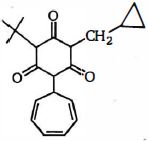
A
$1$
B
$2$
C
$3$
D
$4$
Solution
(B) Upon complete acidic hydrolysis,the given compound breaks down into the following species:
$1$. $tert$-butyl cation
$2$. Cyclopropylmethyl cation
$3$. Tropylium cation (cycloheptatrienyl cation),which is aromatic.
$4$. Cyclohexane$-1,3,5-$trione,which undergoes tautomerization to form benzene$-1,3,5-$triol (phloroglucinol),which is aromatic.
Thus,there are $2$ aromatic compounds obtained: the tropylium cation and benzene$-1,3,5-$triol.
Therefore,$x = 2$.
$1$. $tert$-butyl cation
$2$. Cyclopropylmethyl cation
$3$. Tropylium cation (cycloheptatrienyl cation),which is aromatic.
$4$. Cyclohexane$-1,3,5-$trione,which undergoes tautomerization to form benzene$-1,3,5-$triol (phloroglucinol),which is aromatic.
Thus,there are $2$ aromatic compounds obtained: the tropylium cation and benzene$-1,3,5-$triol.
Therefore,$x = 2$.
0 likes
View Solution376
MediumMCQ
The reaction sequence is as follows:
$1,4-dibromocyclohex-2-ene$ $\xrightarrow[{2 \, molar \, equivalent}]{{(CH_3)_2NH}} (A)$ $\xrightarrow{{BaO}} (B)$ $\xrightarrow[{ (2 \, molar \, equivalent) }]{{CH_3I}} (C)$ $\xrightarrow{{Ag_2O \, / \, H_2O}} (D) + 2(CH_3)_3N$
Identify the end product $(D)$ in the given sequence.
$1,4-dibromocyclohex-2-ene$ $\xrightarrow[{2 \, molar \, equivalent}]{{(CH_3)_2NH}} (A)$ $\xrightarrow{{BaO}} (B)$ $\xrightarrow[{ (2 \, molar \, equivalent) }]{{CH_3I}} (C)$ $\xrightarrow{{Ag_2O \, / \, H_2O}} (D) + 2(CH_3)_3N$
Identify the end product $(D)$ in the given sequence.
A
$1,4-$cyclohexadiene
B
$1,3-$cyclohexadiene
C
Benzene
D
p-Cresol
Solution
(C) Step $1$: $1,4-dibromocyclohex-2-ene$ reacts with $2 \, molar \, equivalents$ of dimethylamine $(CH_3)_2NH$ via $S_N2$ substitution to form $1,4-bis(dimethylamino)cyclohex-2-ene$ $(A)$.
Step $2$: Treatment with $BaO$ (a base) does not significantly alter the structure in this context,or it acts as a mild base to ensure the amine is free.
Step $3$: Reaction with $2 \, molar \, equivalents$ of $CH_3I$ performs exhaustive methylation of the two tertiary amine groups to form a bis-quaternary ammonium salt $(C)$.
Step $4$: Treatment with $Ag_2O / H_2O$ (Hofmann elimination conditions) leads to the elimination of the two trimethylamine groups,resulting in the formation of $1,3,5-cyclohexatriene$ (benzene) $(D)$ as the final product.
Step $2$: Treatment with $BaO$ (a base) does not significantly alter the structure in this context,or it acts as a mild base to ensure the amine is free.
Step $3$: Reaction with $2 \, molar \, equivalents$ of $CH_3I$ performs exhaustive methylation of the two tertiary amine groups to form a bis-quaternary ammonium salt $(C)$.
Step $4$: Treatment with $Ag_2O / H_2O$ (Hofmann elimination conditions) leads to the elimination of the two trimethylamine groups,resulting in the formation of $1,3,5-cyclohexatriene$ (benzene) $(D)$ as the final product.
0 likes
View Solution377
DifficultMCQ
Product $(A)$ is
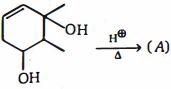
A
$1,3-$dimethylbenzene
B
$1,2-$dimethylbenzene
C
ethylbenzene
D
$1,4-$dimethylbenzene
Solution
(B) The given reaction is an acid-catalyzed dehydration of a diol.
$1$. The starting material is $5,6$-dimethylcyclohex-$2$-ene-$1,5$-diol.
$2$. In the presence of $H^{\oplus}$ and heat,the hydroxyl groups are protonated and eliminated as water molecules.
$3$. This process leads to the formation of a fully conjugated aromatic ring system.
$4$. The resulting product is $1,2$-dimethylbenzene (also known as $o$-xylene).
$1$. The starting material is $5,6$-dimethylcyclohex-$2$-ene-$1,5$-diol.
$2$. In the presence of $H^{\oplus}$ and heat,the hydroxyl groups are protonated and eliminated as water molecules.
$3$. This process leads to the formation of a fully conjugated aromatic ring system.
$4$. The resulting product is $1,2$-dimethylbenzene (also known as $o$-xylene).
0 likes
View Solution378
MediumMCQ
Which of the following products cannot be obtained in the ozonolysis of $o$-xylene?
A
$CHO-CHO$
B
$CH_3-CO-CHO$
C
$CH_3-CO-CO-CH_3$
D
$CH_3-CO-CO-CHO$
Solution
(D) $o$-xylene is a resonance hybrid of two Kekulé structures.
Ozonolysis of these structures yields glyoxal $(CHO-CHO)$,methylglyoxal $(CH_3-CO-CHO)$,and dimethylglyoxal $(CH_3-CO-CO-CH_3)$.
The product $CH_3-CO-CO-CHO$ cannot be formed because the benzene ring breaks into three $2$-carbon fragments during ozonolysis.
Ozonolysis of these structures yields glyoxal $(CHO-CHO)$,methylglyoxal $(CH_3-CO-CHO)$,and dimethylglyoxal $(CH_3-CO-CO-CH_3)$.
The product $CH_3-CO-CO-CHO$ cannot be formed because the benzene ring breaks into three $2$-carbon fragments during ozonolysis.
0 likes
View Solution379
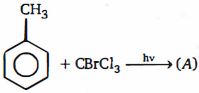
MediumMCQ
(no ring substitution) Product $(A)$ is
A
$Ph-CH_2-Cl$
B
$Ph-CH_2-Br$
C
$Ph-CH_2-CCl_3$
D
$Ph-CH_2-CBrCl_2$
Solution
(B) The reaction involves a free radical mechanism initiated by light $(hv)$.
$CBrCl_3$ undergoes homolytic fission to produce radicals. Since the $C-Br$ bond is weaker than the $C-Cl$ bond,the $C-Br$ bond breaks preferentially:
$CBrCl_3 \xrightarrow{hv} Br^{\bullet} + {}^{\bullet}CCl_3$
The ${}^{\bullet}CCl_3$ radical then abstracts a hydrogen atom from the methyl group of toluene $(PhCH_3)$ to form a benzyl radical $(PhCH_2^{\bullet})$:
$PhCH_3 + {}^{\bullet}CCl_3 \rightarrow PhCH_2^{\bullet} + CHCl_3$
The benzyl radical then reacts with $CBrCl_3$ to form the product $(A)$ and regenerate the ${}^{\bullet}CCl_3$ radical:
$PhCH_2^{\bullet} + CBrCl_3 \rightarrow PhCH_2Br + {}^{\bullet}CCl_3$
Thus,the major product $(A)$ is benzyl bromide $(Ph-CH_2-Br)$.
$CBrCl_3$ undergoes homolytic fission to produce radicals. Since the $C-Br$ bond is weaker than the $C-Cl$ bond,the $C-Br$ bond breaks preferentially:
$CBrCl_3 \xrightarrow{hv} Br^{\bullet} + {}^{\bullet}CCl_3$
The ${}^{\bullet}CCl_3$ radical then abstracts a hydrogen atom from the methyl group of toluene $(PhCH_3)$ to form a benzyl radical $(PhCH_2^{\bullet})$:
$PhCH_3 + {}^{\bullet}CCl_3 \rightarrow PhCH_2^{\bullet} + CHCl_3$
The benzyl radical then reacts with $CBrCl_3$ to form the product $(A)$ and regenerate the ${}^{\bullet}CCl_3$ radical:
$PhCH_2^{\bullet} + CBrCl_3 \rightarrow PhCH_2Br + {}^{\bullet}CCl_3$
Thus,the major product $(A)$ is benzyl bromide $(Ph-CH_2-Br)$.
0 likes
View Solution380
MediumMCQ
The products $P$ and $Q$ in the following sequence of reactions are:
$p$-Methylanisole $\xrightarrow{Li, EtOH, NH_3(l)} P$ $\xrightarrow[(ii) -78^{\circ}C, Me_2S]{(i) O_3 (1 \text{ equiv.})} Q$
$p$-Methylanisole $\xrightarrow{Li, EtOH, NH_3(l)} P$ $\xrightarrow[(ii) -78^{\circ}C, Me_2S]{(i) O_3 (1 \text{ equiv.})} Q$
A
$P$ = $1-$methoxy$-4-$methylcyclohexa$-1,4-$diene,$Q$ = $5-$oxohexanal
B
$P$ = $1-$methoxy$-4-$methylcyclohexa$-1,4-$diene,$Q$ = $4-$oxopentanal
C
$P$ = $1-$methoxy$-4-$methylcyclohexa$-1,3-$diene,$Q$ = $5-$oxohexanal
D
$P$ = $1-$methoxy$-4-$methylcyclohexa$-1,4-$diene,$Q$ = $6-$oxoheptanal
Solution
(A) $1$. The first step is a Birch reduction of $p$-methylanisole. The electron-donating $-OCH_3$ group directs the reduction to give $1$-methoxy-$4$-methylcyclohexa-$1,4$-diene as product $P$.
$2$. The second step is ozonolysis of $P$ with $1$ equivalent of $O_3$. The more electron-rich double bond (the one conjugated with the $-OCH_3$ group) reacts with $O_3$.
$3$. Cleavage of the $C1=C2$ double bond in $1$-methoxy-$4$-methylcyclohexa-$1,4$-diene yields a dicarbonyl compound. Specifically,the $C1$ becomes a ketone (as part of an ester/enol ether derivative) and $C2$ becomes an aldehyde. The resulting structure is $5$-oxohexanal.
$2$. The second step is ozonolysis of $P$ with $1$ equivalent of $O_3$. The more electron-rich double bond (the one conjugated with the $-OCH_3$ group) reacts with $O_3$.
$3$. Cleavage of the $C1=C2$ double bond in $1$-methoxy-$4$-methylcyclohexa-$1,4$-diene yields a dicarbonyl compound. Specifically,the $C1$ becomes a ketone (as part of an ester/enol ether derivative) and $C2$ becomes an aldehyde. The resulting structure is $5$-oxohexanal.
0 likes
View Solution381
MediumMCQ
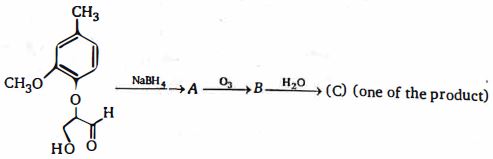
Identify the product $(C)$ from the given reaction sequence.
A
$CH_3-C(=O)-C(=O)-O-CH_3$
B
$CH_2(OH)-CH(OH)-CH_2(OH)$
C
$CHO-CH(OH)-CH_2(OH)$
D
$CHO-CH(OH)-CHO$
Solution
(B) $1$. The starting material is an aromatic ether with a side chain containing an aldehyde and a hydroxyl group.
$2$. Treatment with $NaBH_4$ reduces the aldehyde group to a primary alcohol,forming compound $(A)$,which is $4-methyl-2-methoxyphenoxy-1,2-propanediol$.
$3$. Ozonolysis of the aromatic ring followed by oxidative workup breaks the aromatic system.
$4$. The cleavage of the substituted benzene ring results in several fragments,including glycerol $(CH_2(OH)-CH(OH)-CH_2(OH))$ as one of the products $(C)$.
$2$. Treatment with $NaBH_4$ reduces the aldehyde group to a primary alcohol,forming compound $(A)$,which is $4-methyl-2-methoxyphenoxy-1,2-propanediol$.
$3$. Ozonolysis of the aromatic ring followed by oxidative workup breaks the aromatic system.
$4$. The cleavage of the substituted benzene ring results in several fragments,including glycerol $(CH_2(OH)-CH(OH)-CH_2(OH))$ as one of the products $(C)$.
0 likes
View Solution382
MediumMCQ
Product $(Y)$ of the above reaction is

A
B
C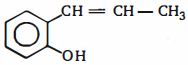
D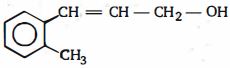
Solution
(C) The reaction starts with salicylaldehyde ($2$-hydroxybenzaldehyde). In the presence of a base $(HO^\ominus)$,the phenolic $-OH$ group is deprotonated to form a phenoxide ion $(X)$.
Next,the phenoxide ion acts as a nucleophile and attacks the vinyl phosphonium salt $(CH_2=CH-PPh_3Br^\ominus)$ via a Michael addition,forming an intermediate where the phenoxide oxygen is bonded to the terminal carbon of the vinyl group.
This intermediate then undergoes an intramolecular Wittig reaction. The ylide carbon (which is now attached to the phenoxide oxygen) attacks the carbonyl carbon of the aldehyde group.
This leads to the formation of a cyclic oxaphosphetane intermediate,which subsequently collapses to eliminate triphenylphosphine oxide $(O=PPh_3)$ and forms the cyclic product,$2H$-chromene.
Next,the phenoxide ion acts as a nucleophile and attacks the vinyl phosphonium salt $(CH_2=CH-PPh_3Br^\ominus)$ via a Michael addition,forming an intermediate where the phenoxide oxygen is bonded to the terminal carbon of the vinyl group.
This intermediate then undergoes an intramolecular Wittig reaction. The ylide carbon (which is now attached to the phenoxide oxygen) attacks the carbonyl carbon of the aldehyde group.
This leads to the formation of a cyclic oxaphosphetane intermediate,which subsequently collapses to eliminate triphenylphosphine oxide $(O=PPh_3)$ and forms the cyclic product,$2H$-chromene.
0 likes
View Solution383
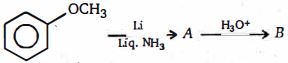
MediumMCQ
Product $(B)$ in the above reaction is
A
Cyclohexanone
B
Cyclohex$-2-$en$-1-$one
C
$3-$Methoxyphenol
D
$4-$Methoxyphenol
Solution
(B) The reaction of anisole with $Li/Liq. NH_3$ (Birch reduction) produces $1-$methoxy$-1,4-$cyclohexadiene.
Upon treatment with $H_3O^+$,the enol ether undergoes hydrolysis to form an enol,which tautomerizes to the more stable conjugated ketone,cyclohex$-2-$en$-1-$one.
Upon treatment with $H_3O^+$,the enol ether undergoes hydrolysis to form an enol,which tautomerizes to the more stable conjugated ketone,cyclohex$-2-$en$-1-$one.
0 likes
View Solution384
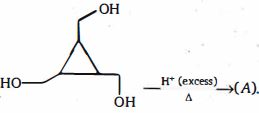
MediumMCQ
The product $(A)$ is:
A
$1,3,5-$trimethylenecyclohexane
B
$1,3,5-$trimethylenecyclopropane
C
$1,3,5-$trimethylbenzene
D
$1,2,4-$trimethylenecyclobutane
Solution
(C) The starting material is $1,2,3$-tris(hydroxymethyl)cyclopropane.
Upon treatment with excess $H^+$ and heating,the primary alcohol groups are protonated to form $-OH_2^+$,which are good leaving groups.
Loss of water molecules generates carbocations at the side chains.
The cyclopropane ring undergoes ring expansion to relieve ring strain,eventually leading to the formation of a stable aromatic ring.
The final product is $1,3,5$-trimethylbenzene (mesitylene).
Upon treatment with excess $H^+$ and heating,the primary alcohol groups are protonated to form $-OH_2^+$,which are good leaving groups.
Loss of water molecules generates carbocations at the side chains.
The cyclopropane ring undergoes ring expansion to relieve ring strain,eventually leading to the formation of a stable aromatic ring.
The final product is $1,3,5$-trimethylbenzene (mesitylene).
0 likes
View Solution385
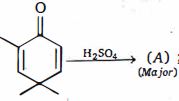
MediumMCQ
The product $(A)$ is:
A
$2,3,4-$trimethylphenol
B
$2,3,5-$trimethylphenol
C
$2,4,5-$trimethylphenol
D
$2,4,6-$trimethylphenol
Solution
(B) The reaction involves the acid-catalyzed rearrangement of a dienone to a phenol.
$1$. Protonation of the carbonyl oxygen occurs to form a resonance-stabilized carbocation.
$2$. $A$ $1,2$-methyl shift occurs to relieve steric strain and lead to a more stable aromatic system.
$3$. The rearrangement leads to the formation of $2,3,5$-trimethylphenol as the major product,as it minimizes steric repulsion between the methyl groups compared to other isomers.
$1$. Protonation of the carbonyl oxygen occurs to form a resonance-stabilized carbocation.
$2$. $A$ $1,2$-methyl shift occurs to relieve steric strain and lead to a more stable aromatic system.
$3$. The rearrangement leads to the formation of $2,3,5$-trimethylphenol as the major product,as it minimizes steric repulsion between the methyl groups compared to other isomers.
0 likes
View Solution386
MediumMCQ
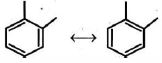
What is the ratio of glyoxal to pyrualdehyde obtained in the ozonolysis of $o-xylene$ as shown in the reaction below?
$o-Xylene$ $\xrightarrow[{(2) Zn}]{{(1) O_3}} CHO-CHO \text{ (Glyoxal)} + CH_3CO-COCH_3 \text{ (2,3-Butanedione)} + CH_3CO-CHO \text{ (Pyrualdehyde)}$
$o-Xylene$ $\xrightarrow[{(2) Zn}]{{(1) O_3}} CHO-CHO \text{ (Glyoxal)} + CH_3CO-COCH_3 \text{ (2,3-Butanedione)} + CH_3CO-CHO \text{ (Pyrualdehyde)}$

A
$1 : 3$
B
$3 : 1$
C
$3 : 2$
D
$2 : 3$
Solution
(C) $o-Xylene$ exists as a resonance hybrid of two Kekul\text{é} structures.
$1.$ In the first structure,there is a double bond between the two methyl-substituted carbons. Ozonolysis of this structure yields $1$ mole of $2,3-butanedione$ $(CH_3CO-COCH_3)$ and $2$ moles of glyoxal $(CHO-CHO)$.
$2.$ In the second structure,there is a single bond between the two methyl-substituted carbons. Ozonolysis of this structure yields $2$ moles of pyrualdehyde $(CH_3CO-CHO)$ and $1$ mole of glyoxal $(CHO-CHO)$.
By considering both structures equally,the total moles produced are:
Total Glyoxal = $2 + 1 = 3$
Total Pyrualdehyde = $2$
Total $2,3-Butanedione$ = $1$
Therefore,the ratio of glyoxal to pyrualdehyde is $3 : 2$.
$1.$ In the first structure,there is a double bond between the two methyl-substituted carbons. Ozonolysis of this structure yields $1$ mole of $2,3-butanedione$ $(CH_3CO-COCH_3)$ and $2$ moles of glyoxal $(CHO-CHO)$.
$2.$ In the second structure,there is a single bond between the two methyl-substituted carbons. Ozonolysis of this structure yields $2$ moles of pyrualdehyde $(CH_3CO-CHO)$ and $1$ mole of glyoxal $(CHO-CHO)$.
By considering both structures equally,the total moles produced are:
Total Glyoxal = $2 + 1 = 3$
Total Pyrualdehyde = $2$
Total $2,3-Butanedione$ = $1$
Therefore,the ratio of glyoxal to pyrualdehyde is $3 : 2$.
0 likes
View Solution387
MediumMCQ
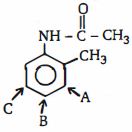
Identify the position where electrophilic aromatic substitution $(EAS)$ is most favourable.
A
$A$
B
$B$
C
$C$
D
$A$ and $C$
Solution
(B) The molecule contains an acetamido group $(-NHCOCH_3)$ and a methyl group $(-CH_3)$ attached to the benzene ring.
Both groups are ortho/para directing.
The $-NHCOCH_3$ group is a stronger activating group due to the $+M$ effect of the nitrogen lone pair compared to the $+I$ and hyperconjugation effect of the $-CH_3$ group.
Therefore,the substitution is primarily directed by the $-NHCOCH_3$ group.
Position $A$ is ortho to the $-NHCOCH_3$ group but is sterically hindered by the adjacent $-CH_3$ group.
Position $C$ is ortho to the $-NHCOCH_3$ group and is less sterically hindered.
Position $B$ is para to the $-NHCOCH_3$ group.
Generally,para-substitution is preferred over ortho-substitution due to lower steric hindrance.
Thus,position $B$ is the most favourable site for $EAS$.
Both groups are ortho/para directing.
The $-NHCOCH_3$ group is a stronger activating group due to the $+M$ effect of the nitrogen lone pair compared to the $+I$ and hyperconjugation effect of the $-CH_3$ group.
Therefore,the substitution is primarily directed by the $-NHCOCH_3$ group.
Position $A$ is ortho to the $-NHCOCH_3$ group but is sterically hindered by the adjacent $-CH_3$ group.
Position $C$ is ortho to the $-NHCOCH_3$ group and is less sterically hindered.
Position $B$ is para to the $-NHCOCH_3$ group.
Generally,para-substitution is preferred over ortho-substitution due to lower steric hindrance.
Thus,position $B$ is the most favourable site for $EAS$.
0 likes
View Solution388
MediumMCQ
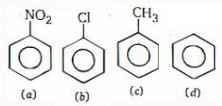
The correct order of the rate of $EAS$ (electrophilic aromatic substitution) for the following compounds is:
A
$c > d > b > a$
B
$c > d > a > b$
C
$a > b > c > d$
D
$d > c > b > a$
Solution
(A) The rate of electrophilic aromatic substitution $(EAS)$ is directly proportional to the electron density in the benzene ring.
Groups that donate electrons (via $+I$ or $+M$ effects) increase the rate,while groups that withdraw electrons (via $-I$ or $-M$ effects) decrease the rate.
$(a)$ Nitrobenzene $(-NO_2)$: Strong electron-withdrawing group ($-M$ and $-I$ effects),strongly deactivates the ring.
$(b)$ Chlorobenzene $(-Cl)$: Electron-withdrawing group ($-I$ effect dominates over $+M$ effect),deactivates the ring.
$(c)$ Toluene $(-CH_3)$: Electron-donating group ($+I$ and hyperconjugation),activates the ring.
$(d)$ Benzene: Reference compound.
Therefore,the order of reactivity is: Toluene $(c)$ > Benzene $(d)$ > Chlorobenzene $(b)$ > Nitrobenzene $(a)$.
The correct order is $c > d > b > a$.
Groups that donate electrons (via $+I$ or $+M$ effects) increase the rate,while groups that withdraw electrons (via $-I$ or $-M$ effects) decrease the rate.
$(a)$ Nitrobenzene $(-NO_2)$: Strong electron-withdrawing group ($-M$ and $-I$ effects),strongly deactivates the ring.
$(b)$ Chlorobenzene $(-Cl)$: Electron-withdrawing group ($-I$ effect dominates over $+M$ effect),deactivates the ring.
$(c)$ Toluene $(-CH_3)$: Electron-donating group ($+I$ and hyperconjugation),activates the ring.
$(d)$ Benzene: Reference compound.
Therefore,the order of reactivity is: Toluene $(c)$ > Benzene $(d)$ > Chlorobenzene $(b)$ > Nitrobenzene $(a)$.
The correct order is $c > d > b > a$.
0 likes
View Solution389
MediumMCQ
Which of the following has the lowest heat of combustion?
A
B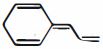
C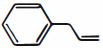
D
Solution
(C) The heat of combustion is inversely proportional to the stability of the compound.
Among the given options,option $C$ represents ethylbenzene,which contains a benzene ring.
Aromatic compounds like benzene derivatives are highly stable due to resonance,which results in a lower heat of combustion compared to non-aromatic or less stable unsaturated hydrocarbons.
Among the given options,option $C$ represents ethylbenzene,which contains a benzene ring.
Aromatic compounds like benzene derivatives are highly stable due to resonance,which results in a lower heat of combustion compared to non-aromatic or less stable unsaturated hydrocarbons.
0 likes
View Solution390
MediumMCQ
How many benzylic hydrogens are present in the hydrocarbon shown below?

A
$3$
B
$4$
C
$5$
D
$6$
Solution
(B) The structure shown is acenaphthene.
Benzylic hydrogens are those attached to a carbon atom that is directly bonded to an aromatic ring.
In acenaphthene,the two carbons of the ethylene bridge are bonded to the naphthalene ring system.
Each of these two carbons is bonded to two hydrogen atoms,and there is one additional hydrogen on the bridgehead carbons if we consider the specific structure of acenaphthene.
However,in the standard representation of this molecule,there are $4$ hydrogens on the $CH_2-CH_2$ bridge and $1$ hydrogen on each of the two bridgehead carbons,but only the $4$ hydrogens on the $CH_2$ groups are typically classified as benzylic.
Wait,re-evaluating the structure: The structure is acenaphthene. The $CH_2-CH_2$ bridge has $4$ hydrogens. The bridgehead carbons are part of the aromatic system and do not have hydrogens. Thus,there are $4$ benzylic hydrogens.
Benzylic hydrogens are those attached to a carbon atom that is directly bonded to an aromatic ring.
In acenaphthene,the two carbons of the ethylene bridge are bonded to the naphthalene ring system.
Each of these two carbons is bonded to two hydrogen atoms,and there is one additional hydrogen on the bridgehead carbons if we consider the specific structure of acenaphthene.
However,in the standard representation of this molecule,there are $4$ hydrogens on the $CH_2-CH_2$ bridge and $1$ hydrogen on each of the two bridgehead carbons,but only the $4$ hydrogens on the $CH_2$ groups are typically classified as benzylic.
Wait,re-evaluating the structure: The structure is acenaphthene. The $CH_2-CH_2$ bridge has $4$ hydrogens. The bridgehead carbons are part of the aromatic system and do not have hydrogens. Thus,there are $4$ benzylic hydrogens.
0 likes
View Solution391
MediumMCQ
The major product formed in the reaction is:
$Isopropylbenzene + HNO_3 \xrightarrow{conc. H_2SO_4} ?$
$Isopropylbenzene + HNO_3 \xrightarrow{conc. H_2SO_4} ?$
A
$1-$isopropyl$-2-$nitrobenzene
B
$1-$isopropyl$-4-$nitrobenzene
C
$1-$isopropyl$-3-$nitrobenzene
D
$1-$nitro$-4-$isopropylbenzene
Solution
(B) The reaction is an electrophilic aromatic substitution (nitration) of isopropylbenzene (cumene).
The isopropyl group $(-CH(CH_3)_2)$ is an ortho/para-directing group due to the $+I$ effect and hyperconjugation.
However,the para-position is sterically less hindered compared to the ortho-position.
Therefore,the major product formed is the para-substituted product,which is $1$-isopropyl-$4$-nitrobenzene.
The isopropyl group $(-CH(CH_3)_2)$ is an ortho/para-directing group due to the $+I$ effect and hyperconjugation.
However,the para-position is sterically less hindered compared to the ortho-position.
Therefore,the major product formed is the para-substituted product,which is $1$-isopropyl-$4$-nitrobenzene.
0 likes
View Solution392
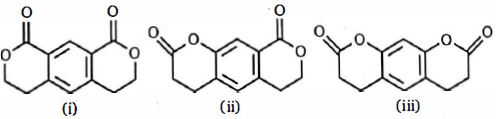
DifficultMCQ
The increasing order of the rate of reaction with $HNO_3 / H_2SO_4$ is:
A
$iii < ii < i$
B
$ii < iii < i$
C
$i < iii < ii$
D
$i < ii < iii$
Solution
(D) The reaction with $HNO_3 / H_2SO_4$ is an electrophilic aromatic substitution (nitration). The rate of this reaction depends on the electron density of the benzene ring.
Electron-donating groups $(D)$ increase the electron density and thus increase the rate of reaction,while electron-withdrawing groups $(W)$ decrease the electron density and decrease the rate of reaction.
In the given structures:
$(i)$ has two electron-withdrawing groups $(W=2, D=2)$.
(ii) has one electron-withdrawing group and three electron-donating groups $(W=1, D=3)$.
(iii) has four electron-donating groups $(W=0, D=4)$.
Since the rate of electrophilic substitution increases with an increase in the number of electron-donating groups,the order of reactivity is $(i) < (ii) < (iii)$.
Electron-donating groups $(D)$ increase the electron density and thus increase the rate of reaction,while electron-withdrawing groups $(W)$ decrease the electron density and decrease the rate of reaction.
In the given structures:
$(i)$ has two electron-withdrawing groups $(W=2, D=2)$.
(ii) has one electron-withdrawing group and three electron-donating groups $(W=1, D=3)$.
(iii) has four electron-donating groups $(W=0, D=4)$.
Since the rate of electrophilic substitution increases with an increase in the number of electron-donating groups,the order of reactivity is $(i) < (ii) < (iii)$.
0 likes
View Solution393
AdvancedMCQ
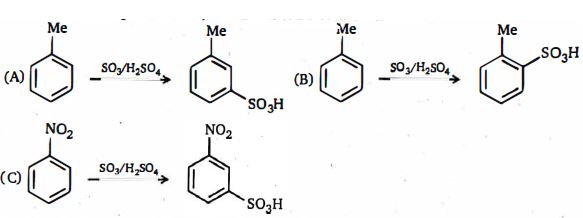
Rank the following reactions $A$,$B$,and $C$ in order of increasing rate.
A
$C < A < B$
B
$B < A < C$
C
$A < B < C$
D
$C < B < A$
Solution
(A) The rate of electrophilic aromatic substitution depends on the stability of the intermediate $\sigma$-complex (arenium ion).
Electron-donating groups (like $-CH_3$) increase the rate by stabilizing the $\sigma$-complex,while electron-withdrawing groups (like $-NO_2$) decrease the rate by destabilizing it.
In reaction $B$,the $-CH_3$ group is at the ortho position,which provides strong inductive and hyperconjugative stabilization to the $\sigma$-complex.
In reaction $A$,the $-CH_3$ group is at the meta position,providing only inductive stabilization.
In reaction $C$,the $-NO_2$ group is a strong electron-withdrawing group,which significantly destabilizes the $\sigma$-complex.
Therefore,the stability order of the $\sigma$-complexes is $B > A > C$,which is also the order of the reaction rates.
The order of increasing rate is $C < A < B$.
Electron-donating groups (like $-CH_3$) increase the rate by stabilizing the $\sigma$-complex,while electron-withdrawing groups (like $-NO_2$) decrease the rate by destabilizing it.
In reaction $B$,the $-CH_3$ group is at the ortho position,which provides strong inductive and hyperconjugative stabilization to the $\sigma$-complex.
In reaction $A$,the $-CH_3$ group is at the meta position,providing only inductive stabilization.
In reaction $C$,the $-NO_2$ group is a strong electron-withdrawing group,which significantly destabilizes the $\sigma$-complex.
Therefore,the stability order of the $\sigma$-complexes is $B > A > C$,which is also the order of the reaction rates.
The order of increasing rate is $C < A < B$.
0 likes
View Solution394
MediumMCQ
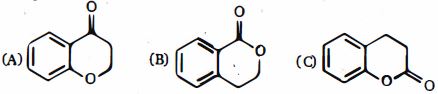
Rank the following compounds in order of increasing rate of reaction towards Electrophilic Aromatic Substitution $(EAS)$ with bromine in the presence of $FeBr_3$.
A
$B < A < C$
B
$B < C < A$
C
$A < B < C$
D
$A < C < B$
Solution
(B) The rate of $EAS$ depends on the electron density of the benzene ring. Electron-donating groups increase the rate,while electron-withdrawing groups decrease it.
In compound $(A)$,the oxygen atom is directly attached to the benzene ring,providing electron density via the $+M$ effect,which activates the ring.
In compound $(B)$,the carbonyl group $(C=O)$ is directly attached to the benzene ring,which exerts a strong $-M$ effect,deactivating the ring.
In compound $(C)$,the oxygen atom is attached to the benzene ring,but the carbonyl group is further away. However,the oxygen atom still provides electron density via the $+M$ effect. Comparing $(A)$ and $(C)$,$(A)$ has a more direct activation effect from the oxygen atom compared to the ester-like linkage in $(C)$.
Thus,the order of reactivity is $B < C < A$.
In compound $(A)$,the oxygen atom is directly attached to the benzene ring,providing electron density via the $+M$ effect,which activates the ring.
In compound $(B)$,the carbonyl group $(C=O)$ is directly attached to the benzene ring,which exerts a strong $-M$ effect,deactivating the ring.
In compound $(C)$,the oxygen atom is attached to the benzene ring,but the carbonyl group is further away. However,the oxygen atom still provides electron density via the $+M$ effect. Comparing $(A)$ and $(C)$,$(A)$ has a more direct activation effect from the oxygen atom compared to the ester-like linkage in $(C)$.
Thus,the order of reactivity is $B < C < A$.
0 likes
View Solution395
MediumMCQ
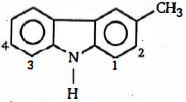
Identify the position where $E.A.S.$ (Electrophilic Aromatic Substitution) can take place in the given molecule.
A
$1$
B
$2$
C
$3$
D
$4$
Solution
(A) The molecule is $2$-methylcarbazole.
Electrophilic aromatic substitution $(E.A.S.)$ occurs preferentially on the more electron-rich ring.
The nitrogen atom donates electron density via resonance to both rings.
However,the ring on the right has a methyl group $(-CH_3)$,which is an electron-donating group ($+I$ effect and hyperconjugation).
Therefore,the right ring is more activated than the left ring.
Within the right ring,the positions ortho and para to the nitrogen atom are the most reactive.
Position $1$ is ortho to the nitrogen atom and is highly activated.
Thus,$E.A.S.$ takes place at position $1$.
Electrophilic aromatic substitution $(E.A.S.)$ occurs preferentially on the more electron-rich ring.
The nitrogen atom donates electron density via resonance to both rings.
However,the ring on the right has a methyl group $(-CH_3)$,which is an electron-donating group ($+I$ effect and hyperconjugation).
Therefore,the right ring is more activated than the left ring.
Within the right ring,the positions ortho and para to the nitrogen atom are the most reactive.
Position $1$ is ortho to the nitrogen atom and is highly activated.
Thus,$E.A.S.$ takes place at position $1$.
0 likes
View Solution396
AdvancedMCQ
The product $(B)$ in the above reaction is:

A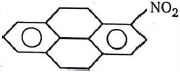
B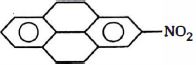
C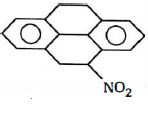
D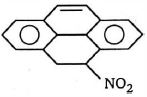
Solution
(A) The starting material is a derivative of $1,2-diphenylethane$ or a similar bridged system.
Treatment with $H^+/\Delta$ leads to an intramolecular cyclization (Friedel-Crafts type alkylation/acylation or similar) to form a polycyclic aromatic hydrocarbon $(A)$.
Subsequent treatment with $HNO_3/\Delta$ (nitration) occurs on the aromatic ring.
Based on the structure of the intermediate $(A)$ (which is likely $9,10-dihydrophenanthrene$ or a similar fused system),the nitration occurs at the most reactive position on the aromatic ring to give the product $(B)$ as shown in option $(A)$.
Treatment with $H^+/\Delta$ leads to an intramolecular cyclization (Friedel-Crafts type alkylation/acylation or similar) to form a polycyclic aromatic hydrocarbon $(A)$.
Subsequent treatment with $HNO_3/\Delta$ (nitration) occurs on the aromatic ring.
Based on the structure of the intermediate $(A)$ (which is likely $9,10-dihydrophenanthrene$ or a similar fused system),the nitration occurs at the most reactive position on the aromatic ring to give the product $(B)$ as shown in option $(A)$.
0 likes
View Solution397
MediumMCQ
The decreasing order of the rate of electrophilic aromatic substitution is:

A
$a > b > c > d$
B
$a > c > b > d$
C
$b > a > c > d$
D
$b > c > a > d$
Solution
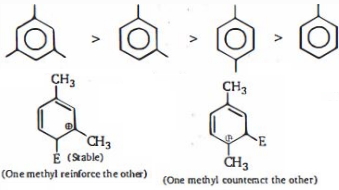
(A) The rate of electrophilic aromatic substitution depends on the electron density of the benzene ring. Methyl groups are electron-donating by inductive and hyperconjugation effects,which increase the electron density of the ring.
$(a)$ $1,3,5-$trimethylbenzene (mesitylene) has three methyl groups.
$(b)$ $m-$xylene has two methyl groups.
$(c)$ $p-$xylene has two methyl groups.
$(d)$ Toluene has one methyl group.
Comparing $(b)$ and $(c)$,$m-$xylene is more reactive than $p-$xylene because the intermediate carbocation (arenium ion) formed in $m-$xylene is more stable due to the reinforcing effect of the two methyl groups at the ortho and para positions relative to the site of attack. Thus,the order is $a > b > c > d$.
$(a)$ $1,3,5-$trimethylbenzene (mesitylene) has three methyl groups.
$(b)$ $m-$xylene has two methyl groups.
$(c)$ $p-$xylene has two methyl groups.
$(d)$ Toluene has one methyl group.
Comparing $(b)$ and $(c)$,$m-$xylene is more reactive than $p-$xylene because the intermediate carbocation (arenium ion) formed in $m-$xylene is more stable due to the reinforcing effect of the two methyl groups at the ortho and para positions relative to the site of attack. Thus,the order is $a > b > c > d$.
0 likes
View Solution398
DifficultMCQ
Arrange the following in increasing order of rate of Nitration:
$(a)$ Benzene
$(b)$ Toluene
$(c)$ Hexadeuterobenzene $(C_6D_6)$
$(d)$ Nitrobenzene
$(e)$ Chlorobenzene
$(a)$ Benzene
$(b)$ Toluene
$(c)$ Hexadeuterobenzene $(C_6D_6)$
$(d)$ Nitrobenzene
$(e)$ Chlorobenzene
A
$b < c < a < d < e$
B
$d < e < a = c < b$
C
$d < a = c < e < b$
D
$a < c < b < e < d$
Solution
(B) The rate of electrophilic aromatic substitution (nitration) depends on the electron density of the benzene ring. Substituents that increase electron density (activating groups) increase the rate,while those that decrease electron density (deactivating groups) decrease the rate.
$1$. $PhNO_2$ $(d)$: The $-NO_2$ group is strongly deactivating due to $-I$ and $-R$ effects.
$2$. $PhCl$ $(e)$: The $-Cl$ group is deactivating due to $-I > +R$ effects.
$3$. $PhH$ $(a)$ and $C_6D_6$ $(c)$: These are the reference compounds. Since the rate-determining step is the formation of the sigma complex (arenium ion),the removal of the proton (or deuteron) is fast. Therefore,no primary kinetic isotope effect is observed,and the rates for $PhH$ and $C_6D_6$ are equal.
$4$. $PhMe$ $(b)$: The $-CH_3$ group is activating due to $+I$ and hyperconjugation effects.
Thus,the order of increasing rate of nitration is: $PhNO_2 < PhCl < PhH = C_6D_6 < PhMe$,which corresponds to $d < e < a = c < b$.
$1$. $PhNO_2$ $(d)$: The $-NO_2$ group is strongly deactivating due to $-I$ and $-R$ effects.
$2$. $PhCl$ $(e)$: The $-Cl$ group is deactivating due to $-I > +R$ effects.
$3$. $PhH$ $(a)$ and $C_6D_6$ $(c)$: These are the reference compounds. Since the rate-determining step is the formation of the sigma complex (arenium ion),the removal of the proton (or deuteron) is fast. Therefore,no primary kinetic isotope effect is observed,and the rates for $PhH$ and $C_6D_6$ are equal.
$4$. $PhMe$ $(b)$: The $-CH_3$ group is activating due to $+I$ and hyperconjugation effects.
Thus,the order of increasing rate of nitration is: $PhNO_2 < PhCl < PhH = C_6D_6 < PhMe$,which corresponds to $d < e < a = c < b$.
0 likes
View Solution399
DifficultMCQ
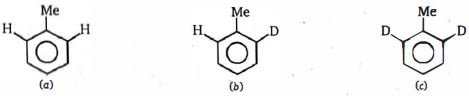
The rate of nitration will be
A
$a > b > c$
B
$a > c > b$
C
$a = b = c$
D
$c > a > b$
Solution
(C) The rate-determining step in electrophilic aromatic substitution (nitration) is the formation of the $\sigma$-complex (arenium ion) by the attack of the nitronium ion $(NO_2^+)$ on the aromatic ring.
Since the $C-H$ or $C-D$ bond fission occurs after the rate-determining step,there is no primary kinetic isotope effect observed.
The methyl group $(Me)$ exerts the same steric effect in all three substrates,and the attacking electrophile is identical.
Therefore,the rates of nitration for all three substrates $(a, b, c)$ are the same.
Since the $C-H$ or $C-D$ bond fission occurs after the rate-determining step,there is no primary kinetic isotope effect observed.
The methyl group $(Me)$ exerts the same steric effect in all three substrates,and the attacking electrophile is identical.
Therefore,the rates of nitration for all three substrates $(a, b, c)$ are the same.
0 likes
View Solution400
AdvancedMCQ
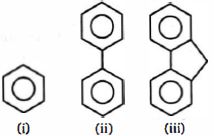
Arrange the following in decreasing order of the rate of electrophilic aromatic substitution:
A
$i > ii > iii$
B
$iii > ii > i$
C
$iii > i > ii$
D
$i > iii > ii$
Solution
(B) The rate of electrophilic aromatic substitution depends on the electron density of the aromatic ring. Higher electron density makes the ring more reactive towards electrophiles.
$(i)$ Benzene: It is the reference compound with no substituents.
$(ii)$ Biphenyl: One phenyl ring acts as a $+R$ (resonance donating) group to the other. However,due to steric hindrance between the ortho-hydrogens of the two rings,they are not perfectly coplanar,which reduces the effectiveness of the resonance effect.
$(iii)$ Fluorene: The two benzene rings are locked in a coplanar conformation by the methylene bridge. This allows for maximum resonance stabilization and electron donation between the rings,making it the most reactive among the three.
Therefore,the decreasing order of reactivity is: $iii > ii > i$.
$(i)$ Benzene: It is the reference compound with no substituents.
$(ii)$ Biphenyl: One phenyl ring acts as a $+R$ (resonance donating) group to the other. However,due to steric hindrance between the ortho-hydrogens of the two rings,they are not perfectly coplanar,which reduces the effectiveness of the resonance effect.
$(iii)$ Fluorene: The two benzene rings are locked in a coplanar conformation by the methylene bridge. This allows for maximum resonance stabilization and electron donation between the rings,making it the most reactive among the three.
Therefore,the decreasing order of reactivity is: $iii > ii > i$.
0 likes
View SolutionHydrocarbons — Aromatic hydrocarbon · Frequently Asked Questions
1Are these Hydrocarbons questions useful for JEE and NEET?
Yes. All questions in this section are mapped to JEE Main and NEET exam patterns. Previous year questions from JEE Main, NEET, GUJCET and state-level exams are included with full solutions.
2Can I switch to Hindi or Gujarati for these questions?
Yes. Use the language tabs in the hero section or the sidebar to view the same questions and solutions in English, Hindi or Gujarati.
3How do I generate a question paper from this subtopic?
Use the Vedclass Exam Paper Generator — select the chapter and subtopic, set difficulty, and generate Sets A, B, C, D automatically. First 3 chapters of every subject are free.
Vedclass Products
For Students
Vedclass Test Series
Mock tests in real JEE/NEET style with performance analysis. 5-day free trial.
Start Free TrialFor Teachers
Exam Paper Generator
Generate Set A/B/C/D papers from this chapter in 2 minutes. 3 chapters free.
Try FreeFor Institutes
Online Exam Module
Live online exams with unlimited students, 360° analytics & white-label branding.
See DemoFor Teachers & Institutes
Generate a Hydrocarbons Exam Paper in 2 Minutes
Select subtopic & difficulty — Sets A, B, C, D auto-generated with No Repeat logic.
First 3 chapters of every subject are free — no payment required.