
A English
Alkyne Questions in English
Class 11 Chemistry · Hydrocarbons · Alkyne
545+
Questions
English
Language
100%
With Solutions
Showing 49 of 545 questions in English
451
MediumMCQ
Which of the following is Lindlar catalyst?
A
$Zinc$ chloride and $HCl$
B
Cold dilute solution of $KMnO_4$
C
$Sodium$ and liquid $NH_3$
D
Partially deactivated palladised charcoal
Solution
(D) Partially deactivated palladised charcoal $(H_2 / Pd / CaCO_3)$ is known as Lindlar catalyst.
It is used for the partial hydrogenation of alkynes to cis-alkenes.
It is used for the partial hydrogenation of alkynes to cis-alkenes.
0 likes
View Solution452
MediumMCQ
An unsaturated hydrocarbon $X$ on ozonolysis gives $A$. Compound $A$ when warmed with ammoniacal silver nitrate forms a bright silver mirror along the sides of the test tube. The unsaturated hydrocarbon $X$ is ..... .
A
$CH_3-C(CH_3)=C(CH_3)-CH_3$
B
$CH_3-C(CH_3)=C(CH_2)_2$
C
$CH_3-CH_2-C \equiv CH$
D
$CH_3-C \equiv C-CH_3$
Solution
(C) The reaction of an unsaturated hydrocarbon $X$ with ozone (ozonolysis) produces compound $A$.
Compound $A$ gives a positive Tollen's test (forms a silver mirror with ammoniacal silver nitrate),which indicates that $A$ is an aldehyde or formic acid $(HCOOH)$.
Let us analyze the options:
$(A)$ $CH_3-C(CH_3)=C(CH_3)-CH_3$ on ozonolysis gives $CH_3-CO-CH_3$ (acetone),which does not give Tollen's test.
$(B)$ $CH_3-C(CH_3)=C(CH_2)_2$ on ozonolysis gives $CH_3-CO-CH_3$ and cyclobutanone,neither of which gives Tollen's test.
$(C)$ $CH_3-CH_2-C \equiv CH$ on ozonolysis gives $CH_3-CH_2-COOH$ and $HCOOH$. Formic acid $(HCOOH)$ gives a positive Tollen's test.
$(D)$ $CH_3-C \equiv C-CH_3$ on ozonolysis gives $2CH_3-COOH$ (acetic acid),which does not give Tollen's test.
Therefore,the correct hydrocarbon is $CH_3-CH_2-C \equiv CH$.
Compound $A$ gives a positive Tollen's test (forms a silver mirror with ammoniacal silver nitrate),which indicates that $A$ is an aldehyde or formic acid $(HCOOH)$.
Let us analyze the options:
$(A)$ $CH_3-C(CH_3)=C(CH_3)-CH_3$ on ozonolysis gives $CH_3-CO-CH_3$ (acetone),which does not give Tollen's test.
$(B)$ $CH_3-C(CH_3)=C(CH_2)_2$ on ozonolysis gives $CH_3-CO-CH_3$ and cyclobutanone,neither of which gives Tollen's test.
$(C)$ $CH_3-CH_2-C \equiv CH$ on ozonolysis gives $CH_3-CH_2-COOH$ and $HCOOH$. Formic acid $(HCOOH)$ gives a positive Tollen's test.
$(D)$ $CH_3-C \equiv C-CH_3$ on ozonolysis gives $2CH_3-COOH$ (acetic acid),which does not give Tollen's test.
Therefore,the correct hydrocarbon is $CH_3-CH_2-C \equiv CH$.
0 likes
View Solution453
MediumMCQ
Which one of the following carbonyl compounds cannot be prepared by addition of water on an alkyne in the presence of $HgSO_4$ and $H_2SO_4$?
A
$CH_3-CHO$
B
Cyclohexyl methyl ketone
C
$CH_3-CH_2-CHO$
D
$CH_3-CO-CH_2CH_3$
Solution
(C) The hydration of alkynes in the presence of $HgSO_4$ and $H_2SO_4$ follows Markovnikov's rule.
$1$. $HC \equiv CH + H_2O \xrightarrow{HgSO_4, H_2SO_4} CH_2=CH(OH) \rightleftharpoons CH_3-CHO$ (Ethanal).
$2$. Cyclohexylacetylene + $H_2O \xrightarrow{HgSO_4, H_2SO_4} \text{Cyclohexyl methyl ketone}$.
$3$. $CH_3-C \equiv CH + H_2O \xrightarrow{HgSO_4, H_2SO_4} CH_3-C(OH)=CH_2 \rightleftharpoons CH_3-CO-CH_3$ (Propanone).
$4$. $CH_3-C \equiv C-CH_3 + H_2O \xrightarrow{HgSO_4, H_2SO_4} CH_3-C(OH)=CH-CH_3 \rightleftharpoons CH_3-CO-CH_2-CH_3$ (Butan$-2-$one).
$CH_3-CH_2-CHO$ (Propanal) is an aldehyde that cannot be formed by the hydration of any alkyne because the hydration of terminal alkynes (other than ethyne) always yields a ketone due to the formation of a more stable secondary enol intermediate.
$1$. $HC \equiv CH + H_2O \xrightarrow{HgSO_4, H_2SO_4} CH_2=CH(OH) \rightleftharpoons CH_3-CHO$ (Ethanal).
$2$. Cyclohexylacetylene + $H_2O \xrightarrow{HgSO_4, H_2SO_4} \text{Cyclohexyl methyl ketone}$.
$3$. $CH_3-C \equiv CH + H_2O \xrightarrow{HgSO_4, H_2SO_4} CH_3-C(OH)=CH_2 \rightleftharpoons CH_3-CO-CH_3$ (Propanone).
$4$. $CH_3-C \equiv C-CH_3 + H_2O \xrightarrow{HgSO_4, H_2SO_4} CH_3-C(OH)=CH-CH_3 \rightleftharpoons CH_3-CO-CH_2-CH_3$ (Butan$-2-$one).
$CH_3-CH_2-CHO$ (Propanal) is an aldehyde that cannot be formed by the hydration of any alkyne because the hydration of terminal alkynes (other than ethyne) always yields a ketone due to the formation of a more stable secondary enol intermediate.
0 likes
View Solution454
MediumMCQ
Metallic sodium does not react normally with:
A
$tert-$butyl alcohol
B
But$-2-$yne
C
Ethyne
D
gaseous ammonia
Solution
(B) Metallic sodium reacts with compounds containing acidic hydrogen atoms.
$tert-$butyl alcohol ($CH_3)_3COH$ has an acidic hydroxyl hydrogen.
Ethyne $(HC \equiv CH)$ has acidic terminal hydrogen atoms.
Gaseous ammonia $(NH_3)$ reacts with sodium to form sodamide $(NaNH_2)$.
$But-2-yne$ $(CH_3-C \equiv C-CH_3)$ does not have any acidic hydrogen atoms attached to the triply bonded carbons,therefore it does not react with metallic sodium.
$tert-$butyl alcohol ($CH_3)_3COH$ has an acidic hydroxyl hydrogen.
Ethyne $(HC \equiv CH)$ has acidic terminal hydrogen atoms.
Gaseous ammonia $(NH_3)$ reacts with sodium to form sodamide $(NaNH_2)$.
$But-2-yne$ $(CH_3-C \equiv C-CH_3)$ does not have any acidic hydrogen atoms attached to the triply bonded carbons,therefore it does not react with metallic sodium.
0 likes
View Solution455
MediumMCQ
The number of sigma $(\sigma)$ bonds in the molecule $CH_3-CH_2-CH_2-C \equiv CH$ is $......$
A
$10$
B
$11$
C
$12$
D
$13$
Solution
(C) The structure of the molecule is $CH_3-CH_2-CH_2-C \equiv CH$.
To find the number of $\sigma$ bonds,we count all single bonds and one bond from each multiple bond.
- $C-H$ bonds: $3$ (in $CH_3$) + $2$ (in $CH_2$) + $2$ (in $CH_2$) + $1$ (in $CH$) = $8$ $\sigma$ bonds.
- $C-C$ bonds: $1$ $(C-C)$ + $1$ $(C-C)$ + $1$ $(C-C)$ = $3$ $\sigma$ bonds.
- $C \equiv C$ bond: $1$ $\sigma$ bond.
Total $\sigma$ bonds = $8 + 3 + 1 = 12$.
To find the number of $\sigma$ bonds,we count all single bonds and one bond from each multiple bond.
- $C-H$ bonds: $3$ (in $CH_3$) + $2$ (in $CH_2$) + $2$ (in $CH_2$) + $1$ (in $CH$) = $8$ $\sigma$ bonds.
- $C-C$ bonds: $1$ $(C-C)$ + $1$ $(C-C)$ + $1$ $(C-C)$ = $3$ $\sigma$ bonds.
- $C \equiv C$ bond: $1$ $\sigma$ bond.
Total $\sigma$ bonds = $8 + 3 + 1 = 12$.
0 likes
View Solution456
MediumMCQ
The major product in the following reaction is
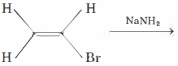
A
$H-C \equiv C-H$
B
$CH_2=CH-NH_2$
C
$H_2N-CH_2-CH_2-NH_2$
D
$CH_3-NH_2$
Solution
(A) The reaction of vinyl bromide $(CH_2=CHBr)$ with a strong base like $NaNH_2$ is a dehydrohalogenation reaction.
$NaNH_2$ is a very strong base that abstracts a proton from the vinyl bromide,leading to the elimination of $HBr$ and the formation of the triple bond in acetylene $(HC \equiv CH)$.
The reaction is:
$CH_2=CHBr + NaNH_2 \rightarrow HC \equiv CH + NaBr + NH_3$
Thus,the major product is acetylene $(HC \equiv CH)$.
$NaNH_2$ is a very strong base that abstracts a proton from the vinyl bromide,leading to the elimination of $HBr$ and the formation of the triple bond in acetylene $(HC \equiv CH)$.
The reaction is:
$CH_2=CHBr + NaNH_2 \rightarrow HC \equiv CH + NaBr + NH_3$
Thus,the major product is acetylene $(HC \equiv CH)$.
0 likes
View Solution457
MediumMCQ
The final major product obtained in the following sequence of reaction is
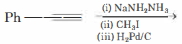
A
$Ph-CH=CH-CH_3$ (cis-isomer)
B
$Ph-C(CH_3)=CH_2$
C
$Ph-CH=CH_2$
D
$Ph-CH_2-CH_2-CH_3$
Solution
(A) The reaction sequence is as follows:
$1$. The terminal alkyne $Ph-C \equiv CH$ reacts with $NaNH_2$ in $NH_3$ to form the acetylide ion $Ph-C \equiv C^- Na^+$.
$2$. This nucleophilic acetylide ion undergoes an $S_N2$ reaction with $CH_3I$ to form the substituted alkyne $Ph-C \equiv C-CH_3$.
$3$. The catalytic hydrogenation of the internal alkyne $Ph-C \equiv C-CH_3$ using $H_2$ and $Pd/C$ (Lindlar's catalyst is not specified,but $Pd/C$ typically reduces alkynes to alkenes) results in the formation of the cis-alkene,$Ph-CH=CH-CH_3$.
$1$. The terminal alkyne $Ph-C \equiv CH$ reacts with $NaNH_2$ in $NH_3$ to form the acetylide ion $Ph-C \equiv C^- Na^+$.
$2$. This nucleophilic acetylide ion undergoes an $S_N2$ reaction with $CH_3I$ to form the substituted alkyne $Ph-C \equiv C-CH_3$.
$3$. The catalytic hydrogenation of the internal alkyne $Ph-C \equiv C-CH_3$ using $H_2$ and $Pd/C$ (Lindlar's catalyst is not specified,but $Pd/C$ typically reduces alkynes to alkenes) results in the formation of the cis-alkene,$Ph-CH=CH-CH_3$.
0 likes
View Solution458
AdvancedMCQ
$A$ hydrocarbon $X$ with molecular formula $C_4H_6$ decolourises bromine water and forms a white precipitate in ethanolic $AgNO_3$ solution. Treatment of $X$ with $HgCl_2$ in aqueous $H_2SO_4$ produces a compound,which gives a yellow precipitate when treated with $I_2$ and $NaOH$. The structure of $X$ is
A
$CH_2=CH-CH=CH_2$
B
$CH_2=C=CH-CH_3$
C
$CH_3-C \equiv C-CH_3$
D
$CH_3-CH_2-C \equiv CH$
Solution
(D) The hydrocarbon $(X)$ is but$-1-$yne $(CH_3-CH_2-C \equiv CH)$.
$1$. It decolourises bromine water due to the presence of a triple bond.
$2$. It forms a white precipitate with ethanolic $AgNO_3$ (Tollens' reagent) because it is a terminal alkyne,which has an acidic hydrogen.
$3$. Treatment of but$-1-$yne with $HgCl_2$ in aqueous $H_2SO_4$ (hydration) produces butan$-2-$one $(CH_3-CH_2-CO-CH_3)$.
$4$. Butan$-2-$one contains a methyl ketone group $(CH_3-CO-)$,which gives a positive iodoform test (yellow precipitate of $CHI_3$) when treated with $I_2$ and $NaOH$.
$1$. It decolourises bromine water due to the presence of a triple bond.
$2$. It forms a white precipitate with ethanolic $AgNO_3$ (Tollens' reagent) because it is a terminal alkyne,which has an acidic hydrogen.
$3$. Treatment of but$-1-$yne with $HgCl_2$ in aqueous $H_2SO_4$ (hydration) produces butan$-2-$one $(CH_3-CH_2-CO-CH_3)$.
$4$. Butan$-2-$one contains a methyl ketone group $(CH_3-CO-)$,which gives a positive iodoform test (yellow precipitate of $CHI_3$) when treated with $I_2$ and $NaOH$.
0 likes
View Solution459
MediumMCQ
The major product of the following reaction is:
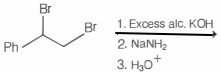
A
$Ph-C \equiv CH$
B
C
D
Solution
(A) The reaction proceeds in three steps:
$1$. Treatment of $1,2-dibromo-1-phenylethane$ with excess alcoholic $KOH$ leads to dehydrohalogenation,forming $bromostyrene$ $(Ph-CH=CHBr)$.
$2$. Further treatment with $NaNH_2$ (a strong base) causes another dehydrohalogenation to form the acetylide intermediate $(Ph-C \equiv C^- Na^+)$.
$3$. Finally,protonation with $H_3O^+$ yields the terminal alkyne,$phenylacetylene$ $(Ph-C \equiv CH)$.
$1$. Treatment of $1,2-dibromo-1-phenylethane$ with excess alcoholic $KOH$ leads to dehydrohalogenation,forming $bromostyrene$ $(Ph-CH=CHBr)$.
$2$. Further treatment with $NaNH_2$ (a strong base) causes another dehydrohalogenation to form the acetylide intermediate $(Ph-C \equiv C^- Na^+)$.
$3$. Finally,protonation with $H_3O^+$ yields the terminal alkyne,$phenylacetylene$ $(Ph-C \equiv CH)$.
0 likes
View Solution460
DifficultMCQ
An organic compound $X$ with molecular formula $C_6H_{10}$,when treated with $HBr$,forms a $gem$-dibromide. The compound $X$ upon warming with $HgSO_4$ and dil. $H_2SO_4$,produces a ketone,which gives a positive iodoform test. The compound $X$ is
A
hex$-1-$yne
B
hex$-2-$yne
C
$3,3-$dimethylbut$-1-$yne
D
hex$-3-$yne
Solution
(A) The molecular formula $C_6H_{10}$ corresponds to the general formula $C_nH_{2n-2}$,indicating an alkyne.
Treatment with $HBr$ to form a $gem$-dibromide indicates that the alkyne is a terminal alkyne (Markownikoff addition).
Acid-catalyzed hydration of a terminal alkyne using $HgSO_4$ and dil. $H_2SO_4$ produces a methyl ketone.
$A$ methyl ketone $(CH_3CO-R)$ gives a positive iodoform test.
Among the options,hex$-1-$yne $(CH_3CH_2CH_2CH_2C \equiv CH)$ is a terminal alkyne.
Upon hydration,it forms hexan$-2-$one $(CH_3CH_2CH_2CH_2COCH_3)$,which is a methyl ketone and gives a positive iodoform test.
Therefore,the compound $X$ is hex$-1-$yne.
Treatment with $HBr$ to form a $gem$-dibromide indicates that the alkyne is a terminal alkyne (Markownikoff addition).
Acid-catalyzed hydration of a terminal alkyne using $HgSO_4$ and dil. $H_2SO_4$ produces a methyl ketone.
$A$ methyl ketone $(CH_3CO-R)$ gives a positive iodoform test.
Among the options,hex$-1-$yne $(CH_3CH_2CH_2CH_2C \equiv CH)$ is a terminal alkyne.
Upon hydration,it forms hexan$-2-$one $(CH_3CH_2CH_2CH_2COCH_3)$,which is a methyl ketone and gives a positive iodoform test.
Therefore,the compound $X$ is hex$-1-$yne.
0 likes
View Solution461
DifficultMCQ
In the reaction,$H_3C-C\equiv C-H$ $\xrightarrow[2. x]{1. NaNH_2, \Delta}$ $\xrightarrow{3. y} H_3C-CH=CH-CH_3$ (trans form),$x$ and $y$,respectively are
A
$x= CH_3OH$; $y= Pd/BaSO_4$,quinoline,$H_2$
B
$x= CH_3I$; $y= Pd/BaSO_4$,quinoline,$H_2$
C
$x= CH_3I$; $y= Na$ in liq. $NH_3$
D
$x= CH_3OH$; $y= Na$ in liq. $NH_3$
Solution
(C) The reaction sequence is as follows:
$1$. Propyne $(CH_3C\equiv CH)$ reacts with $NaNH_2$ to form the sodium salt of propyne $(CH_3C\equiv C^-Na^+)$.
$2$. This salt reacts with methyl iodide $(CH_3I)$ as reagent $x$ to perform an $S_N2$ reaction,yielding but$-2-$yne $(CH_3C\equiv CCH_3)$.
$3$. But$-2-$yne is then reduced to trans-but$-2-$ene using sodium in liquid ammonia $(Na/liq. NH_3)$ as reagent $y$ (Birch reduction).
Thus,$x= CH_3I$ and $y= Na/liq. NH_3$.
$1$. Propyne $(CH_3C\equiv CH)$ reacts with $NaNH_2$ to form the sodium salt of propyne $(CH_3C\equiv C^-Na^+)$.
$2$. This salt reacts with methyl iodide $(CH_3I)$ as reagent $x$ to perform an $S_N2$ reaction,yielding but$-2-$yne $(CH_3C\equiv CCH_3)$.
$3$. But$-2-$yne is then reduced to trans-but$-2-$ene using sodium in liquid ammonia $(Na/liq. NH_3)$ as reagent $y$ (Birch reduction).
Thus,$x= CH_3I$ and $y= Na/liq. NH_3$.
0 likes
View Solution462
MediumMCQ
The major product formed in the oxidation of acetylene by alkaline $KMnO_4$ is:
A
ethanol
B
acetic acid
C
formic acid
D
oxalic acid
Solution
(D) The oxidation of acetylene $(HC \equiv CH)$ with alkaline $KMnO_4$ proceeds through the formation of glyoxal $(CHO-CHO)$ as an intermediate.
Further oxidation of glyoxal leads to the formation of oxalic acid $(HOOC-COOH)$ as the major product.
The reaction is:
$HC \equiv CH + 2[O]$ $\xrightarrow{Alk. KMnO_4} CHO-CHO$ $\xrightarrow{2[O]} HOOC-COOH$
Therefore,the correct option is $(D)$.
Further oxidation of glyoxal leads to the formation of oxalic acid $(HOOC-COOH)$ as the major product.
The reaction is:
$HC \equiv CH + 2[O]$ $\xrightarrow{Alk. KMnO_4} CHO-CHO$ $\xrightarrow{2[O]} HOOC-COOH$
Therefore,the correct option is $(D)$.
0 likes
View Solution463
DifficultMCQ
$2,3$-dibromobutane can be converted to $2$-butyne in a two-step reaction using:
A
$(i) \ HCl$ and $(ii) \ NaH$
B
$(i) \ \text{alc. } KOH$ and $(ii) \ NaNH_2$
C
$(i) \ Na$ and $(ii) \ NaOH$
D
$(i) \ Br_2$ and $(ii) \ NaH$
Solution
(B)
For the conversion of $2,3$-dibromobutane to $2$-butyne,the following steps are used:
Step $1$: Dehydrohalogenation of $2,3$-dibromobutane using alcoholic $KOH$ yields $2$-bromobut-$2$-ene.
$CH_3-CH(Br)-CH(Br)-CH_3 \xrightarrow{\text{alc. } KOH} CH_3-C(Br)=CH-CH_3 + HBr$
Step $2$: Further dehydrohalogenation of $2$-bromobut-$2$-ene using a strong base like $NaNH_2$ yields $2$-butyne.
$CH_3-C(Br)=CH-CH_3 \xrightarrow{NaNH_2} CH_3-C \equiv C-CH_3 + NaBr + NH_3$
For the conversion of $2,3$-dibromobutane to $2$-butyne,the following steps are used:
Step $1$: Dehydrohalogenation of $2,3$-dibromobutane using alcoholic $KOH$ yields $2$-bromobut-$2$-ene.
$CH_3-CH(Br)-CH(Br)-CH_3 \xrightarrow{\text{alc. } KOH} CH_3-C(Br)=CH-CH_3 + HBr$
Step $2$: Further dehydrohalogenation of $2$-bromobut-$2$-ene using a strong base like $NaNH_2$ yields $2$-butyne.
$CH_3-C(Br)=CH-CH_3 \xrightarrow{NaNH_2} CH_3-C \equiv C-CH_3 + NaBr + NH_3$
0 likes
View Solution464
MediumMCQ
The major product in the following reaction is $H_3C-C\equiv CH + HBr$ (excess)
A
$H_3C-C(Br)=CH_2$
B
$H_3C-C(Br)_2-CH_3$
C
$H_3C-CH(Br)-CH_2Br$
D
$H_3C-CH_2-CH(Br)_2$
Solution
(B) The reaction is an electrophilic addition of $HBr$ to propyne $(H_3C-C\equiv CH)$.
Step $1$: The first molecule of $HBr$ adds to the triple bond following Markownikoff's rule,where the electrophile $H^+$ attaches to the terminal carbon to form a more stable secondary carbocation $(H_3C-C^+=CH_2)$. The bromide ion $(Br^-)$ then attacks the carbocation to form $2-$bromopropene $(H_3C-C(Br)=CH_2)$.
Step $2$: The second molecule of $HBr$ adds to the double bond of $2-$bromopropene,again following Markownikoff's rule. The $H^+$ adds to the terminal carbon $(CH_2)$ to form a more stable carbocation $(H_3C-C^+(Br)-CH_3)$,which is stabilized by the resonance effect of the bromine atom. The $Br^-$ then attacks this carbocation to yield $2,2-$dibromopropane $(H_3C-C(Br)_2-CH_3)$ as the major product.
Step $1$: The first molecule of $HBr$ adds to the triple bond following Markownikoff's rule,where the electrophile $H^+$ attaches to the terminal carbon to form a more stable secondary carbocation $(H_3C-C^+=CH_2)$. The bromide ion $(Br^-)$ then attacks the carbocation to form $2-$bromopropene $(H_3C-C(Br)=CH_2)$.
Step $2$: The second molecule of $HBr$ adds to the double bond of $2-$bromopropene,again following Markownikoff's rule. The $H^+$ adds to the terminal carbon $(CH_2)$ to form a more stable carbocation $(H_3C-C^+(Br)-CH_3)$,which is stabilized by the resonance effect of the bromine atom. The $Br^-$ then attacks this carbocation to yield $2,2-$dibromopropane $(H_3C-C(Br)_2-CH_3)$ as the major product.
0 likes
View Solution465
MediumMCQ
When calcium carbide is added to water,the gas that is evolved is
A
carbon dioxide
B
hydrogen
C
acetylene
D
methane
Solution
(C) .
When calcium carbide is added to water,acetylene gas is evolved.
The reaction is as follows:
$\underset{\text{(Calcium Carbide)}}{CaC_2} + 2H_2O$ $\longrightarrow Ca(OH)_2 + \underset{\text{(Acetylene)}}{CH \equiv CH}$
When calcium carbide is added to water,acetylene gas is evolved.
The reaction is as follows:
$\underset{\text{(Calcium Carbide)}}{CaC_2} + 2H_2O$ $\longrightarrow Ca(OH)_2 + \underset{\text{(Acetylene)}}{CH \equiv CH}$
0 likes
View Solution466
MediumMCQ
Choose the correct set of reagents for the following conversion:
$trans-(Ph-CH=CH-CH_3) \rightarrow cis-(Ph-CH=CH-CH_3)$
$trans-(Ph-CH=CH-CH_3) \rightarrow cis-(Ph-CH=CH-CH_3)$
A
$Br_2, \text{alc. } KOH, NaNH_2, Na(Liq. NH_3)$
B
$Br_2, \text{alc. } KOH, NaNH_2, H_2, \text{Lindlar Catalyst}$
C
$Br_2, \text{aq. } KOH, NaNH_2, H_2, \text{Lindlar Catalyst}$
D
$Br_2, \text{aq. } KOH, NaNH_2, Na(Liq. NH_3)$
Solution
(B) $1$. First,the $trans$-alkene reacts with $Br_2$ to form a vicinal dibromide: $Ph-CH(Br)-CH(Br)-CH_3$.
$2$. Next,dehydrohalogenation occurs using $alc. KOH$ followed by $NaNH_2$ to remove two moles of $HBr$,resulting in the formation of an alkyne: $Ph-C \equiv C-CH_3$.
$3$. Finally,the partial hydrogenation of the alkyne to a $cis$-alkene is achieved using $H_2$ with $Lindlar \text{ } Catalyst$ (a poisoned $Pd$ catalyst).
$4$. Therefore,the correct sequence is $Br_2, \text{alc. } KOH, NaNH_2, H_2, \text{Lindlar Catalyst}$.
$2$. Next,dehydrohalogenation occurs using $alc. KOH$ followed by $NaNH_2$ to remove two moles of $HBr$,resulting in the formation of an alkyne: $Ph-C \equiv C-CH_3$.
$3$. Finally,the partial hydrogenation of the alkyne to a $cis$-alkene is achieved using $H_2$ with $Lindlar \text{ } Catalyst$ (a poisoned $Pd$ catalyst).
$4$. Therefore,the correct sequence is $Br_2, \text{alc. } KOH, NaNH_2, H_2, \text{Lindlar Catalyst}$.
0 likes
View Solution467
DifficultMCQ
In the following reaction,compound $A$ is formed,which reacts with $B$ to give product $C$. Identify $A$ and $B$.

A
$A = CH_3-C \equiv C^- Na^+, B = CH_3-CH_2-CH(Br)-CH_3$
B
$A = CH_3-C \equiv C^- Na^+, B = CH_3-CH_2-CH_2-Br$
C
$A = CH_3-CH=CH_2, B = CH_3-CH_2-CH_2-Br$
D
$A = CH_3-C \equiv C^- Na^+, B = CH_3-CH_2-CH_3$
Solution
(B) The reaction is: $CH_3-C \equiv CH + Na \rightarrow CH_3-C \equiv C^- Na^+ (A) + \frac{1}{2} H_2$.
Compound $A$ is sodium prop$-1-$ynide $(CH_3-C \equiv C^- Na^+)$.
Compound $C$ is $CH_3-C \equiv C-CH_2-CH(CH_3)_2$ (based on the structure provided in the image).
For this product to form,$B$ must be $2$-bromobutane $(CH_3-CH_2-CH(Br)-CH_3)$ or a similar alkyl halide that provides the branched chain.
However,looking at the provided image structure $CH_3-C \equiv C-CH_2-CH_2-CH(CH_3)$,the reaction is an $S_N2$ substitution.
Given the options,$A$ is $CH_3-C \equiv C^- Na^+$. The structure of $C$ in the image corresponds to $CH_3-C \equiv C-CH_2-CH_2-CH_3$ if we assume the branch is a typo in the image or $B$ is $1$-bromobutane. Based on standard textbook problems,$B$ is $CH_3-CH_2-CH_2-Br$.
Compound $A$ is sodium prop$-1-$ynide $(CH_3-C \equiv C^- Na^+)$.
Compound $C$ is $CH_3-C \equiv C-CH_2-CH(CH_3)_2$ (based on the structure provided in the image).
For this product to form,$B$ must be $2$-bromobutane $(CH_3-CH_2-CH(Br)-CH_3)$ or a similar alkyl halide that provides the branched chain.
However,looking at the provided image structure $CH_3-C \equiv C-CH_2-CH_2-CH(CH_3)$,the reaction is an $S_N2$ substitution.
Given the options,$A$ is $CH_3-C \equiv C^- Na^+$. The structure of $C$ in the image corresponds to $CH_3-C \equiv C-CH_2-CH_2-CH_3$ if we assume the branch is a typo in the image or $B$ is $1$-bromobutane. Based on standard textbook problems,$B$ is $CH_3-CH_2-CH_2-Br$.
0 likes
View Solution468
DifficultMCQ
In the given reactions,identify $A$ and $B$.
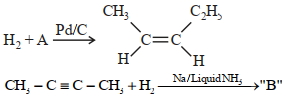
A
$A$: $2$-Pentyne,$B$: trans-$2$-butene
B
$A$: $n$-Pentane,$B$: trans-$2$-butene
C
$A$: $2$-Pentyne,$B$: Cis-$2$-butene
D
$A$: $n$-Pentane,$B$: Cis-$2$-butene
Solution
(A) $1$. The first reaction is the catalytic hydrogenation of an alkyne using $Pd/C$ (Lindlar's catalyst is typically poisoned,but $Pd/C$ generally reduces alkynes to alkenes). The product shown is a cis-alkene,specifically $cis$-$3$-methylpent-$2$-ene (or similar structure based on the image). Looking at the reactant $A$ in the image,it is $CH_3-C\equiv C-C_2H_5$,which is $2$-pentyne.
$2$. The second reaction is the Birch reduction of an internal alkyne ($CH_3-C\equiv C-CH_3$,which is but-$2$-yne) using $Na/\text{liquid } NH_3$. This reaction is stereospecific and yields the trans-alkene,which is trans-$2$-butene.
$3$. Therefore,$A$ is $2$-pentyne and $B$ is trans-$2$-butene.
$2$. The second reaction is the Birch reduction of an internal alkyne ($CH_3-C\equiv C-CH_3$,which is but-$2$-yne) using $Na/\text{liquid } NH_3$. This reaction is stereospecific and yields the trans-alkene,which is trans-$2$-butene.
$3$. Therefore,$A$ is $2$-pentyne and $B$ is trans-$2$-butene.
0 likes
View Solution469
MediumMCQ
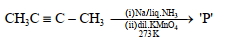
The major product of the following reaction is $P$. Number of oxygen atoms present in product $P$ is $. . . . . . . . . . . (nearest integer)$.
A
$1$
B
$2$
C
$5$
D
$7$
Solution
(B) The reaction proceeds in two steps:
$1$. The reduction of but-$2$-yne $(CH_3-C \equiv C-CH_3)$ with $Na/liq. NH_3$ (Birch reduction) gives trans-but-$2$-ene $(CH_3-CH=CH-CH_3)$.
$2$. The subsequent reaction with cold dilute alkaline $KMnO_4$ (Baeyer's reagent) performs syn-hydroxylation of the alkene to form butane-$2,3$-diol $(CH_3-CH(OH)-CH(OH)-CH_3)$.
$3$. The product $P$ is butane-$2,3$-diol,which contains $2$ oxygen atoms.
$1$. The reduction of but-$2$-yne $(CH_3-C \equiv C-CH_3)$ with $Na/liq. NH_3$ (Birch reduction) gives trans-but-$2$-ene $(CH_3-CH=CH-CH_3)$.
$2$. The subsequent reaction with cold dilute alkaline $KMnO_4$ (Baeyer's reagent) performs syn-hydroxylation of the alkene to form butane-$2,3$-diol $(CH_3-CH(OH)-CH(OH)-CH_3)$.
$3$. The product $P$ is butane-$2,3$-diol,which contains $2$ oxygen atoms.
0 likes
View Solution470
MediumMCQ
The incorrect statement regarding ethyne is
A
The $C-C$ bond in ethyne is shorter than that in ethene
B
Both carbons are $sp$ hybridised
C
Ethyne is linear
D
The carbon-carbon bond in ethyne is weaker than that in ethene
Solution
(D) In ethyne $(HC \equiv CH)$,the carbon-carbon bond is a triple bond,which is shorter and stronger than the double bond in ethene $(CH_2=CH_2)$.
Ethyne is a linear molecule where both carbon atoms are $sp$ hybridised.
Therefore,the statement that the carbon-carbon bond in ethyne is weaker than that in ethene is incorrect.
Ethyne is a linear molecule where both carbon atoms are $sp$ hybridised.
Therefore,the statement that the carbon-carbon bond in ethyne is weaker than that in ethene is incorrect.
0 likes
View Solution471
DifficultMCQ
The reagent$(s)$ for the following conversion is/are:
$Br-CH_2-CH_2-Br \xrightarrow{?} HC \equiv CH$
$Br-CH_2-CH_2-Br \xrightarrow{?} HC \equiv CH$
A
alcoholic $KOH$
B
alcoholic $KOH$ followed by $NaNH_2$
C
aqueous $KOH$ followed by $NaNH_2$
D
$Zn / CH_3OH$
Solution
(B) The conversion of $1,2-dibromoethane$ to ethyne involves dehydrohalogenation.
First,treatment with alcoholic $KOH$ removes one molecule of $HBr$ to form vinyl bromide $(CH_2=CHBr)$.
Second,because the $C-Br$ bond in vinyl bromide has partial double bond character due to resonance,it is less reactive towards elimination. Therefore,a stronger base like $NaNH_2$ (sodamide) is required to remove the second molecule of $HBr$ to yield ethyne $(HC \equiv CH)$.
Thus,the correct sequence is alcoholic $KOH$ followed by $NaNH_2$.
First,treatment with alcoholic $KOH$ removes one molecule of $HBr$ to form vinyl bromide $(CH_2=CHBr)$.
Second,because the $C-Br$ bond in vinyl bromide has partial double bond character due to resonance,it is less reactive towards elimination. Therefore,a stronger base like $NaNH_2$ (sodamide) is required to remove the second molecule of $HBr$ to yield ethyne $(HC \equiv CH)$.
Thus,the correct sequence is alcoholic $KOH$ followed by $NaNH_2$.
0 likes
View Solution472
AdvancedMCQ
The synthesis of $3-$octyne is achieved by adding a bromoalkane into a mixture of sodium amide and an alkyne. The bromoalkane and alkyne respectively are
A
$BrCH_2CH_2CH_2CH_2CH_3$ and $CH_3CH_2C \equiv CH$
B
$BrCH_2CH_2CH_3$ and $CH_3CH_2CH_2C \equiv CH$
C
$BrCH_2CH_2CH_2CH_2CH_3$ and $CH_3C \equiv CH$
D
$BrCH_2CH_2CH_2CH_3$ and $CH_3CH_2C \equiv CH$
Solution
(D) The synthesis of $3-$octyne $(CH_3CH_2C \equiv CCH_2CH_2CH_2CH_3)$ involves the alkylation of an acetylide ion.
First,$1-$butyne $(CH_3CH_2C \equiv CH)$ reacts with sodium amide $(NaNH_2)$ to form the sodium butynide nucleophile: $CH_3CH_2C \equiv CH + NaNH_2 \rightarrow CH_3CH_2C \equiv C^{-}Na^{+} + NH_3$.
Next,this nucleophile performs an $S_N2$ reaction with $1-$bromobutane $(CH_3CH_2CH_2CH_2Br)$: $CH_3CH_2C \equiv C^{-}Na^{+} + CH_3CH_2CH_2CH_2Br \rightarrow CH_3CH_2C \equiv CCH_2CH_2CH_2CH_3 + NaBr$.
Thus,the required reagents are $1-$bromobutane and $1-$butyne.
First,$1-$butyne $(CH_3CH_2C \equiv CH)$ reacts with sodium amide $(NaNH_2)$ to form the sodium butynide nucleophile: $CH_3CH_2C \equiv CH + NaNH_2 \rightarrow CH_3CH_2C \equiv C^{-}Na^{+} + NH_3$.
Next,this nucleophile performs an $S_N2$ reaction with $1-$bromobutane $(CH_3CH_2CH_2CH_2Br)$: $CH_3CH_2C \equiv C^{-}Na^{+} + CH_3CH_2CH_2CH_2Br \rightarrow CH_3CH_2C \equiv CCH_2CH_2CH_2CH_3 + NaBr$.
Thus,the required reagents are $1-$bromobutane and $1-$butyne.
0 likes
View Solution473
DifficultMCQ
An acyclic hydrocarbon $P$ with molecular formula $C_6H_{10}$ produces acetone as the only organic product through the following reaction sequence,where $Q$ is an intermediate organic compound:
$P (C_6H_{10})$ $\xrightarrow[(ii) NaBH_4/ethanol, (iii) dil. acid]{(i) dil. H_2SO_4/HgSO_4} Q$ $\xrightarrow[(ii) O_3, (iii) Zn/H_2O]{(i) conc. H_2SO_4 (catalytic amount), (-H_2O)} 2 CH_3COCH_3$
$1.$ The structure of compound $P$ is:
$(A)$ $CH_3CH_2CH_2CH_2-C \equiv C-H$
$(B)$ $H_3CH_2C-C \equiv C-CH_2CH_3$
$(C)$ $(CH_3)_2CH-C \equiv C-CH_3$
$(D)$ $(CH_3)_2CH-C \equiv C-H$
$2.$ The structure of compound $Q$ is:
$(A)$ $(CH_3)_2CH-CH(OH)-CH_2CH_3$
$(B)$ $(CH_3)_2CH-CH(OH)-CH_3$
$(C)$ $(CH_3)_2CH-CH_2CH(OH)CH_3$
$(D)$ $CH_3CH_2CH_2CH(OH)CH_2CH_3$
Identify the correct options for $1$ and $2$.
$P (C_6H_{10})$ $\xrightarrow[(ii) NaBH_4/ethanol, (iii) dil. acid]{(i) dil. H_2SO_4/HgSO_4} Q$ $\xrightarrow[(ii) O_3, (iii) Zn/H_2O]{(i) conc. H_2SO_4 (catalytic amount), (-H_2O)} 2 CH_3COCH_3$
$1.$ The structure of compound $P$ is:
$(A)$ $CH_3CH_2CH_2CH_2-C \equiv C-H$
$(B)$ $H_3CH_2C-C \equiv C-CH_2CH_3$
$(C)$ $(CH_3)_2CH-C \equiv C-CH_3$
$(D)$ $(CH_3)_2CH-C \equiv C-H$
$2.$ The structure of compound $Q$ is:
$(A)$ $(CH_3)_2CH-CH(OH)-CH_2CH_3$
$(B)$ $(CH_3)_2CH-CH(OH)-CH_3$
$(C)$ $(CH_3)_2CH-CH_2CH(OH)CH_3$
$(D)$ $CH_3CH_2CH_2CH(OH)CH_2CH_3$
Identify the correct options for $1$ and $2$.
A
$(B, D)$
B
$(D, B)$
C
$(A, D)$
D
$(C, D)$
Solution
(B) Step $1$: Analyze the final product. The final product is $2$ moles of acetone $(CH_3COCH_3)$. This implies that the intermediate $Q$ must be $2,3$-dimethylbut-$2$-ene,which upon ozonolysis gives $2$ moles of acetone.
Step $2$: Analyze the conversion of $Q$ to acetone. $Q$ undergoes acid-catalyzed dehydration followed by ozonolysis. $2,3$-dimethylbut-$2$-ene is formed by the dehydration of $2,3$-dimethylbutan-$2$-ol. Thus,$Q$ is $(CH_3)_2CH-CH(OH)-CH_3$ (Option $B$).
Step $3$: Analyze the formation of $Q$ from $P$. $P$ $(C_6H_{10})$ reacts with $dil. H_2SO_4/HgSO_4$ to form a ketone,which is then reduced by $NaBH_4$ to an alcohol $Q$. For $Q$ to be $2,3$-dimethylbutan-$2$-ol,the ketone must be $3,3$-dimethylbutan-$2$-one. This ketone is formed from the hydration of $3,3$-dimethylbut-$1$-yne $(P)$. Thus,$P$ is $(CH_3)_2CH-C \equiv C-H$ (Option $D$).
Therefore,$P$ is $D$ and $Q$ is $B$.
Step $2$: Analyze the conversion of $Q$ to acetone. $Q$ undergoes acid-catalyzed dehydration followed by ozonolysis. $2,3$-dimethylbut-$2$-ene is formed by the dehydration of $2,3$-dimethylbutan-$2$-ol. Thus,$Q$ is $(CH_3)_2CH-CH(OH)-CH_3$ (Option $B$).
Step $3$: Analyze the formation of $Q$ from $P$. $P$ $(C_6H_{10})$ reacts with $dil. H_2SO_4/HgSO_4$ to form a ketone,which is then reduced by $NaBH_4$ to an alcohol $Q$. For $Q$ to be $2,3$-dimethylbutan-$2$-ol,the ketone must be $3,3$-dimethylbutan-$2$-one. This ketone is formed from the hydration of $3,3$-dimethylbut-$1$-yne $(P)$. Thus,$P$ is $(CH_3)_2CH-C \equiv C-H$ (Option $D$).
Therefore,$P$ is $D$ and $Q$ is $B$.
0 likes
View Solution474
AdvancedMCQ
Consider the following transformations of a compound $P$ $(C_9H_{12})$:
$(i)$ $P \xrightarrow{NaNH_2, C_6H_5COCH_3, H_3O^+/\Delta} R$ (Optically active)
(ii) $P \xrightarrow{Pt/H_2} \text{propylcyclohexane}$
(iii) $P \xrightarrow{X, KMnO_4/H_2SO_4/\Delta} Q$ ($C_8H_{12}O_6$,Optically active acid)
Choose the correct option$(s)$:
$(A)$ $P$ is $3-$cyclohexylprop$-1-$yne
$(B)$ $X$ is $Pd-C/\text{quinoline}/H_2$
$(C)$ $P$ is $1-$cyclohexylprop$-2-$yne
$(D)$ $R$ is $1-$cyclohexyl$-4-$phenylbut$-3-$yn$-2-$ol
$(i)$ $P \xrightarrow{NaNH_2, C_6H_5COCH_3, H_3O^+/\Delta} R$ (Optically active)
(ii) $P \xrightarrow{Pt/H_2} \text{propylcyclohexane}$
(iii) $P \xrightarrow{X, KMnO_4/H_2SO_4/\Delta} Q$ ($C_8H_{12}O_6$,Optically active acid)
Choose the correct option$(s)$:
$(A)$ $P$ is $3-$cyclohexylprop$-1-$yne
$(B)$ $X$ is $Pd-C/\text{quinoline}/H_2$
$(C)$ $P$ is $1-$cyclohexylprop$-2-$yne
$(D)$ $R$ is $1-$cyclohexyl$-4-$phenylbut$-3-$yn$-2-$ol
A
$B, C$
B
$A, C$
C
$A, D$
D
$A, B$
Solution
(D) $1$. Compound $P$ $(C_9H_{12})$ on hydrogenation with $Pt/H_2$ gives propylcyclohexane,indicating $P$ has a cyclohexyl ring and a propyl chain with a triple bond.
$2$. The reaction with $NaNH_2$ followed by $C_6H_5COCH_3$ and $H_3O^+/\Delta$ confirms $P$ is a terminal alkyne,specifically $3-$cyclohexylprop$-1-$yne.
$3$. $X$ is a reagent that partially reduces the alkyne to an alkene,which is $Pd-C/\text{quinoline}/H_2$ (Lindlar's catalyst).
$4$. Oxidation of the resulting alkene with $KMnO_4/H_2SO_4/\Delta$ yields the optically active acid $Q$.
$5$. Thus,$P$ is $3-$cyclohexylprop$-1-$yne (Option $A$) and $X$ is $Pd-C/\text{quinoline}/H_2$ (Option $B$).
$6$. Therefore,the correct options are $A$ and $B$.
$2$. The reaction with $NaNH_2$ followed by $C_6H_5COCH_3$ and $H_3O^+/\Delta$ confirms $P$ is a terminal alkyne,specifically $3-$cyclohexylprop$-1-$yne.
$3$. $X$ is a reagent that partially reduces the alkyne to an alkene,which is $Pd-C/\text{quinoline}/H_2$ (Lindlar's catalyst).
$4$. Oxidation of the resulting alkene with $KMnO_4/H_2SO_4/\Delta$ yields the optically active acid $Q$.
$5$. Thus,$P$ is $3-$cyclohexylprop$-1-$yne (Option $A$) and $X$ is $Pd-C/\text{quinoline}/H_2$ (Option $B$).
$6$. Therefore,the correct options are $A$ and $B$.
0 likes
View Solution475
EasyMCQ
The major product formed in the following reaction is

A
B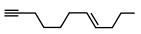
C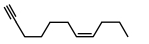
D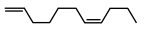
Solution
(B) The reaction involves the reduction of an internal alkyne to a trans-alkene using sodium in liquid ammonia $(Na/liq. NH_3)$.
This is a dissolving metal reduction,which is stereoselective for the formation of the trans-isomer.
The terminal alkyne group remains unaffected by this reagent under these conditions.
Therefore,the internal alkyne is reduced to a trans-alkene while the terminal alkyne remains unchanged.
This is a dissolving metal reduction,which is stereoselective for the formation of the trans-isomer.
The terminal alkyne group remains unaffected by this reagent under these conditions.
Therefore,the internal alkyne is reduced to a trans-alkene while the terminal alkyne remains unchanged.
0 likes
View Solution476
AdvancedMCQ
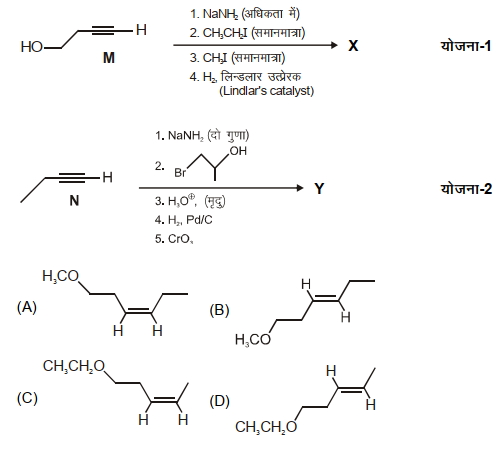
Schemes $1$ and $2$ describe the sequential transformation of alkynes $M$ and $N$. Consider only the major products formed in each step for both the schemes.
$1.$ The product $X$ is:
$2.$ The correct statement with respect to product $Y$ is:
$(A)$ It gives a positive Tollens test and is a functional isomer of $X$.
$(B)$ It gives a positive Tollens test and is a geometrical isomer of $X$.
$(C)$ It gives a positive iodoform test and is a functional isomer of $X$.
$(D)$ It gives a positive iodoform test and is a geometrical isomer of $X$.
$1.$ The product $X$ is:
$2.$ The correct statement with respect to product $Y$ is:
$(A)$ It gives a positive Tollens test and is a functional isomer of $X$.
$(B)$ It gives a positive Tollens test and is a geometrical isomer of $X$.
$(C)$ It gives a positive iodoform test and is a functional isomer of $X$.
$(D)$ It gives a positive iodoform test and is a geometrical isomer of $X$.
A
$(A, C)$
B
$(B, D)$
C
$(B, C)$
D
$(A, D)$
Solution
(C) $1.$ In Scheme $1$,$HO-CH_2-CH_2-C \equiv CH$ reacts with $NaNH_2$ to form the alkoxide-acetylide dianion. Subsequent reaction with $CH_3CH_2I$ alkylates the terminal alkyne,and $CH_3I$ methylates the hydroxyl group. Finally,$H_2$ with Lindlar catalyst performs syn-hydrogenation of the alkyne to a cis-alkene,yielding $X$ as $(Z)-1-methoxyhex-3-ene$.
$2.$ In Scheme $2$,$CH_3CH_2-C \equiv CH$ reacts with $NaNH_2$ to form the acetylide,which reacts with $2-bromopropan-1-ol$. After acidic workup,hydrogenation,and oxidation with $CrO_3$,the product $Y$ is $heptan-2-one$ $(CH_3-CO-CH_2-CH_2-CH_2-CH_3)$.
$Y$ $(heptan-2-one)$ contains a methyl ketone group,so it gives a positive iodoform test. $X$ is an ether,while $Y$ is a ketone; they are functional isomers. Thus,the correct options are $1 \rightarrow B$ and $2 \rightarrow C$.
$2.$ In Scheme $2$,$CH_3CH_2-C \equiv CH$ reacts with $NaNH_2$ to form the acetylide,which reacts with $2-bromopropan-1-ol$. After acidic workup,hydrogenation,and oxidation with $CrO_3$,the product $Y$ is $heptan-2-one$ $(CH_3-CO-CH_2-CH_2-CH_2-CH_3)$.
$Y$ $(heptan-2-one)$ contains a methyl ketone group,so it gives a positive iodoform test. $X$ is an ether,while $Y$ is a ketone; they are functional isomers. Thus,the correct options are $1 \rightarrow B$ and $2 \rightarrow C$.
0 likes
View Solution477
DifficultMCQ
Given below are two statements:
Statement $I$: One mole of propyne reacts with excess of sodium to liberate half a mole of $H_2$ gas.
Statement $II$: Four $g$ of propyne reacts with $NaNH_2$ to liberate $NH_3$ gas which occupies $224 \ mL$ at $STP$.
In the light of the above statements,choose the most appropriate answer from the options given below:
Statement $I$: One mole of propyne reacts with excess of sodium to liberate half a mole of $H_2$ gas.
Statement $II$: Four $g$ of propyne reacts with $NaNH_2$ to liberate $NH_3$ gas which occupies $224 \ mL$ at $STP$.
In the light of the above statements,choose the most appropriate answer from the options given below:
A
Statement $I$ is correct but Statement $II$ is incorrect.
B
Both Statement $I$ and Statement $II$ are incorrect.
C
Statement $I$ is incorrect but Statement $II$ is correct.
D
Both Statement $I$ and Statement $II$ are correct.
Solution
(A) Statement $I$: Propyne $(CH_3-C \equiv CH)$ has an acidic hydrogen atom attached to the $sp$ hybridized carbon. It reacts with sodium metal as follows:
$CH_3-C \equiv CH + Na \rightarrow CH_3-C \equiv C^- Na^+ + \frac{1}{2} H_2 \uparrow$
Thus,$1 \ mole$ of propyne liberates $0.5 \ mole$ of $H_2$ gas. Statement $I$ is correct.
Statement $II$: Molar mass of propyne $(C_3H_4)$ is $40 \ g/mol$.
Moles of propyne = $\frac{4 \ g}{40 \ g/mol} = 0.1 \ mole$.
The reaction with $NaNH_2$ is:
$CH_3-C \equiv CH + NaNH_2 \rightarrow CH_3-C \equiv C^- Na^+ + NH_3 \uparrow$
$0.1 \ mole$ of propyne will liberate $0.1 \ mole$ of $NH_3$ gas.
Volume of $NH_3$ at $STP$ = $0.1 \ mole \times 22400 \ mL/mol = 2240 \ mL$.
The statement says $224 \ mL$,which is incorrect. Therefore,Statement $II$ is incorrect.
$CH_3-C \equiv CH + Na \rightarrow CH_3-C \equiv C^- Na^+ + \frac{1}{2} H_2 \uparrow$
Thus,$1 \ mole$ of propyne liberates $0.5 \ mole$ of $H_2$ gas. Statement $I$ is correct.
Statement $II$: Molar mass of propyne $(C_3H_4)$ is $40 \ g/mol$.
Moles of propyne = $\frac{4 \ g}{40 \ g/mol} = 0.1 \ mole$.
The reaction with $NaNH_2$ is:
$CH_3-C \equiv CH + NaNH_2 \rightarrow CH_3-C \equiv C^- Na^+ + NH_3 \uparrow$
$0.1 \ mole$ of propyne will liberate $0.1 \ mole$ of $NH_3$ gas.
Volume of $NH_3$ at $STP$ = $0.1 \ mole \times 22400 \ mL/mol = 2240 \ mL$.
The statement says $224 \ mL$,which is incorrect. Therefore,Statement $II$ is incorrect.
0 likes
View Solution478
MediumMCQ
Identify the structure of the final product $(D)$ in the following sequence of reactions:
$Ph-CO-CH_3$ $\xrightarrow{PCl_5, \Delta} A$ $\xrightarrow{3 \text{ eq. } NaNH_2/NH_3} B$ $\xrightarrow{\text{Acidify}} C$ $\xrightarrow{1. B_2H_6, 2. H_2O_2/OH^-} D$
Total number of $sp^2$ hybridised carbon atoms in product $D$ is:
$Ph-CO-CH_3$ $\xrightarrow{PCl_5, \Delta} A$ $\xrightarrow{3 \text{ eq. } NaNH_2/NH_3} B$ $\xrightarrow{\text{Acidify}} C$ $\xrightarrow{1. B_2H_6, 2. H_2O_2/OH^-} D$
Total number of $sp^2$ hybridised carbon atoms in product $D$ is:
A
$7$
B
$17$
C
$27$
D
$37$
Solution
(A) Step $1$: $Ph-CO-CH_3$ reacts with $PCl_5$ to form $Ph-CCl_2-CH_3$ $(A)$.
Step $2$: $A$ reacts with $3 \text{ eq. } NaNH_2/NH_3$ to undergo dehydrohalogenation to form the acetylide ion $Ph-C \equiv C^- Na^+$ $(B)$.
Step $3$: Acidification of $B$ gives phenylacetylene $Ph-C \equiv CH$ $(C)$.
Step $4$: Hydroboration-oxidation of $C$ $(1. B_2H_6, 2. H_2O_2/OH^-)$ gives an enol $Ph-CH=CH-OH$,which tautomerises to phenylacetaldehyde $Ph-CH_2-CHO$ $(D)$.
Product $D$ is $Ph-CH_2-CHO$.
The phenyl ring contains $6$ $sp^2$ carbon atoms,and the carbonyl carbon in the aldehyde group is also $sp^2$ hybridised.
Total $sp^2$ carbon atoms $= 6 + 1 = 7$.
Step $2$: $A$ reacts with $3 \text{ eq. } NaNH_2/NH_3$ to undergo dehydrohalogenation to form the acetylide ion $Ph-C \equiv C^- Na^+$ $(B)$.
Step $3$: Acidification of $B$ gives phenylacetylene $Ph-C \equiv CH$ $(C)$.
Step $4$: Hydroboration-oxidation of $C$ $(1. B_2H_6, 2. H_2O_2/OH^-)$ gives an enol $Ph-CH=CH-OH$,which tautomerises to phenylacetaldehyde $Ph-CH_2-CHO$ $(D)$.
Product $D$ is $Ph-CH_2-CHO$.
The phenyl ring contains $6$ $sp^2$ carbon atoms,and the carbonyl carbon in the aldehyde group is also $sp^2$ hybridised.
Total $sp^2$ carbon atoms $= 6 + 1 = 7$.
0 likes
View Solution479
DifficultMCQ
$C_2H_2$ $\xrightarrow{\text{dil. } H_2SO_4, HgSO_4} A$ $\xrightarrow{[O]} B$ $\xrightarrow{NaOH} C$ $\xrightarrow{NaOH/CaO} D$
$[D]$ is -
$[D]$ is -
A
$CH_4$
B
$CH_3-CH_3$
C
$C_2H_6$
D
$C_4H_{10}$
Solution
(A) The reaction sequence is as follows:
$1$. $C_2H_2$ (acetylene) undergoes hydration in the presence of $\text{dil. } H_2SO_4$ and $HgSO_4$ to form $A$,which is acetaldehyde $(CH_3CHO)$.
$2$. Acetaldehyde $(A)$ on oxidation $([O])$ gives $B$,which is acetic acid $(CH_3COOH)$.
$3$. Acetic acid $(B)$ reacts with $NaOH$ to form $C$,which is sodium acetate $(CH_3COONa)$.
$4$. Sodium acetate $(C)$ undergoes decarboxylation with soda lime $(NaOH/CaO)$ to form $D$,which is methane $(CH_4)$.
$1$. $C_2H_2$ (acetylene) undergoes hydration in the presence of $\text{dil. } H_2SO_4$ and $HgSO_4$ to form $A$,which is acetaldehyde $(CH_3CHO)$.
$2$. Acetaldehyde $(A)$ on oxidation $([O])$ gives $B$,which is acetic acid $(CH_3COOH)$.
$3$. Acetic acid $(B)$ reacts with $NaOH$ to form $C$,which is sodium acetate $(CH_3COONa)$.
$4$. Sodium acetate $(C)$ undergoes decarboxylation with soda lime $(NaOH/CaO)$ to form $D$,which is methane $(CH_4)$.
0 likes
View Solution480
MediumMCQ
Identify the reagent used for the following conversion: $CH_3-C \equiv C-CH_3 \longrightarrow \text{cis-but-2-ene}$
A
$H_2 / \text{Lindlar catalyst}$
B
$H_2 / Ni, 300^{\circ}C$
C
$H_2 / Pt$
D
$Na / \text{liquid } NH_3$
Solution
(A) The conversion of an internal alkyne $(CH_3-C \equiv C-CH_3)$ to a $cis$-alkene is a stereoselective reduction.
Lindlar catalyst ($H_2$ / $Pd$ poisoned with $CaCO_3$ or $BaSO_4$ and quinoline) is used for the syn-addition of hydrogen to alkynes,which yields the $cis$-isomer.
$Na$ / liquid $NH_3$ (Birch reduction) is used for the anti-addition of hydrogen to alkynes,which yields the $trans$-isomer.
Therefore,the correct reagent is $H_2$ / Lindlar catalyst.
Lindlar catalyst ($H_2$ / $Pd$ poisoned with $CaCO_3$ or $BaSO_4$ and quinoline) is used for the syn-addition of hydrogen to alkynes,which yields the $cis$-isomer.
$Na$ / liquid $NH_3$ (Birch reduction) is used for the anti-addition of hydrogen to alkynes,which yields the $trans$-isomer.
Therefore,the correct reagent is $H_2$ / Lindlar catalyst.
0 likes
View Solution481
MediumMCQ
In the following reaction:
$C_2H_2$ $\xrightarrow[HgSO_4 / H_2SO_4]{H_2O} (x)$ $\xrightarrow{\text{Tautomerisation}} CH_3-CHO$
$(x)$ is $:-$
$C_2H_2$ $\xrightarrow[HgSO_4 / H_2SO_4]{H_2O} (x)$ $\xrightarrow{\text{Tautomerisation}} CH_3-CHO$
$(x)$ is $:-$
A
$CH_3-CH_2-OH$
B
$CH_3-O-CH_3$
C
$CH_3-CH_2-CHO$
D
$CH_2=CH-OH$
Solution
(D) The reaction of acetylene $(C_2H_2)$ with water in the presence of $HgSO_4$ and $H_2SO_4$ is an electrophilic addition reaction.
First,water adds across the triple bond to form an unstable intermediate called vinyl alcohol $(CH_2=CH-OH)$.
This intermediate $(x)$ undergoes rapid tautomerization to form the more stable aldehyde,acetaldehyde $(CH_3-CHO)$.
Therefore,$(x)$ is $CH_2=CH-OH$.
First,water adds across the triple bond to form an unstable intermediate called vinyl alcohol $(CH_2=CH-OH)$.
This intermediate $(x)$ undergoes rapid tautomerization to form the more stable aldehyde,acetaldehyde $(CH_3-CHO)$.
Therefore,$(x)$ is $CH_2=CH-OH$.
0 likes
View Solution482
MediumMCQ
$CH \equiv CH$ $\xrightarrow{HCl \text{ (Excess)}} A$ $\xrightarrow{\text{Hydrolysis}, \Delta} B$ $\xrightarrow{\text{Reduction}, Na-Hg / H_2O} C$
Compound $C$ is
Compound $C$ is
A
ethanal
B
propenal
C
ethanol
D
$2-$methyl butan$-1-$ol
Solution
(C) Step $1$: Reaction of ethyne with excess $HCl$ gives $1,1-$dichloroethane $(A)$.
$CH \equiv CH + 2HCl \rightarrow CH_3-CHCl_2 (A)$
Step $2$: Hydrolysis of $1,1-$dichloroethane $(A)$ followed by heating gives ethanal $(B)$.
$CH_3-CHCl_2 + H_2O \xrightarrow{\Delta} CH_3CHO (B) + 2HCl$
Step $3$: Reduction of ethanal $(B)$ with $Na-Hg / H_2O$ gives ethanol $(C)$.
$CH_3CHO + 2[H] \xrightarrow{Na-Hg / H_2O} CH_3CH_2OH (C)$
Thus,compound $C$ is ethanol.
$CH \equiv CH + 2HCl \rightarrow CH_3-CHCl_2 (A)$
Step $2$: Hydrolysis of $1,1-$dichloroethane $(A)$ followed by heating gives ethanal $(B)$.
$CH_3-CHCl_2 + H_2O \xrightarrow{\Delta} CH_3CHO (B) + 2HCl$
Step $3$: Reduction of ethanal $(B)$ with $Na-Hg / H_2O$ gives ethanol $(C)$.
$CH_3CHO + 2[H] \xrightarrow{Na-Hg / H_2O} CH_3CH_2OH (C)$
Thus,compound $C$ is ethanol.
0 likes
View Solution483
EasyMCQ
In which of the following molecules,$2$ $\pi$ bonds are present?
A
$C_{2}H_{6}$
B
$C_{2}H_{4}$
C
$C_{2}H_{2}$
D
$C_{3}H_{6}$
Solution
(C) $I$. $CH_{3}-CH_{3}$ $(C_{2}H_{6})$: Contains only $\sigma$ bonds. (No $\pi$ bond)
$II$. $CH_{2}=CH_{2}$ $(C_{2}H_{4})$: Contains $1$ $\sigma$ bond and $1$ $\pi$ bond between carbons.
$III$. $CH \equiv CH$ $(C_{2}H_{2})$: Contains $1$ $\sigma$ bond and $2$ $\pi$ bonds between carbons.
$IV$. $CH_{3}-CH=CH_{2}$ $(C_{3}H_{6})$: Contains $1$ $\pi$ bond in the $C=C$ double bond.
$II$. $CH_{2}=CH_{2}$ $(C_{2}H_{4})$: Contains $1$ $\sigma$ bond and $1$ $\pi$ bond between carbons.
$III$. $CH \equiv CH$ $(C_{2}H_{2})$: Contains $1$ $\sigma$ bond and $2$ $\pi$ bonds between carbons.
$IV$. $CH_{3}-CH=CH_{2}$ $(C_{3}H_{6})$: Contains $1$ $\pi$ bond in the $C=C$ double bond.
0 likes
View Solution484
MediumMCQ
Ethylidene dichloride is obtained by the reaction of excess of $HCl$ with
A
ethylene
B
acetylene
C
propene
D
methane
Solution
(B) The reaction of acetylene $(CH \equiv CH)$ with excess of $HCl$ proceeds in two steps following Markovnikov's rule:
$1$. $CH \equiv CH + HCl \rightarrow CH_2 = CHCl$ (Vinyl chloride)
$2$. $CH_2 = CHCl + HCl \rightarrow CH_3CHCl_2$ (Ethylidene dichloride)
Thus,ethylidene dichloride is obtained from acetylene.
$1$. $CH \equiv CH + HCl \rightarrow CH_2 = CHCl$ (Vinyl chloride)
$2$. $CH_2 = CHCl + HCl \rightarrow CH_3CHCl_2$ (Ethylidene dichloride)
Thus,ethylidene dichloride is obtained from acetylene.
0 likes
View Solution485
EasyMCQ
Which of the following reagents is used to convert a $C \equiv C$ triple bond to a $C=C$ double bond to give the $Cis$ isomer of an alkene?
A
$ZnCl_2 / HCl$
B
$Pd-C / \text{quinoline}$
C
$Na / \text{liquid } NH_3$
D
$Na / Hg \text{ in } H_2O$
Solution
(B) The reduction of an alkyne to a $Cis$-alkene is achieved by catalytic hydrogenation using Lindlar's catalyst.
Lindlar's catalyst consists of palladium deposited on calcium carbonate $(Pd-CaCO_3)$ or barium sulfate $(Pd-BaSO_4)$,which is partially poisoned with quinoline or lead acetate.
This specific reagent prevents the complete hydrogenation of the alkyne to an alkane and stereoselectively yields the $Cis$ isomer.
Therefore,the correct reagent is $Pd-C / \text{quinoline}$ (often referred to as Lindlar's catalyst).
Lindlar's catalyst consists of palladium deposited on calcium carbonate $(Pd-CaCO_3)$ or barium sulfate $(Pd-BaSO_4)$,which is partially poisoned with quinoline or lead acetate.
This specific reagent prevents the complete hydrogenation of the alkyne to an alkane and stereoselectively yields the $Cis$ isomer.
Therefore,the correct reagent is $Pd-C / \text{quinoline}$ (often referred to as Lindlar's catalyst).
0 likes
View Solution486
EasyMCQ
Which of the following catalyst/reagent is used to convert $C \equiv C$ triple bond to $C = C$ double bond to form $cis$ isomer of alkene?
A
$Na / \text{liquid } NH_3$
B
$Pd-C, \text{ quinoline}$
C
$ZnCl_2 / HCl$
D
$Na / Hg \text{ in } H_2O$
Solution
(B) The reduction of an alkyne to a $cis$-alkene is achieved using Lindlar's catalyst,which consists of $Pd$ supported on $CaCO_3$ or $BaSO_4$ and poisoned with quinoline or lead acetate. This process is known as partial hydrogenation. Therefore,the correct reagent is $Pd-C, \text{ quinoline}$.
0 likes
View Solution487
MediumMCQ
Identify product $B$ in the following sequence of reactions.
$1,2-\text{Dibromoethane}$ $\xrightarrow[\text{alc. } KOH]{\Delta} A$ $\xrightarrow{NaNH_2} B$
$1,2-\text{Dibromoethane}$ $\xrightarrow[\text{alc. } KOH]{\Delta} A$ $\xrightarrow{NaNH_2} B$
A
Bromoethane
B
Bromoethene
C
Ethene
D
Ethyne
Solution
(D) Step $1$: $1,2-\text{Dibromoethane}$ $(BrCH_2-CH_2Br)$ reacts with alcoholic $KOH$ (dehydrohalogenation) to form $A$,which is $Bromoethene$ $(CH_2=CHBr)$.
Step $2$: $Bromoethene$ $(CH_2=CHBr)$ reacts with $NaNH_2$ (sodamide),a strong base,to undergo further dehydrohalogenation to form $B$,which is $Ethyne$ $(HC \equiv CH)$.
Step $2$: $Bromoethene$ $(CH_2=CHBr)$ reacts with $NaNH_2$ (sodamide),a strong base,to undergo further dehydrohalogenation to form $B$,which is $Ethyne$ $(HC \equiv CH)$.
0 likes
View Solution488
MediumMCQ
Identify $A$ in the following reaction.
$A$ $\xrightarrow{\text{Lithium amide}} \text{Ethynyl lithium}$ $\xrightarrow{\text{Bromoethane}} \text{but-}1\text{-yne}$
$A$ $\xrightarrow{\text{Lithium amide}} \text{Ethynyl lithium}$ $\xrightarrow{\text{Bromoethane}} \text{but-}1\text{-yne}$
A
Ethene
B
Ethyne
C
but-$1$-ene
D
but-$2$-ene
Solution
(B) The reaction sequence is as follows:
$1$. $A$ reacts with lithium amide $(LiNH_2)$ to form ethynyl lithium $(HC \equiv CLi)$. This indicates that $A$ must be ethyne $(HC \equiv CH)$,as terminal alkynes react with strong bases like lithium amide to form acetylides.
$2$. Ethynyl lithium $(HC \equiv CLi)$ then reacts with bromoethane $(CH_3CH_2Br)$ via an $S_N2$ reaction to form but-$1$-yne $(HC \equiv C-CH_2CH_3)$.
Therefore,$A$ is ethyne.
$1$. $A$ reacts with lithium amide $(LiNH_2)$ to form ethynyl lithium $(HC \equiv CLi)$. This indicates that $A$ must be ethyne $(HC \equiv CH)$,as terminal alkynes react with strong bases like lithium amide to form acetylides.
$2$. Ethynyl lithium $(HC \equiv CLi)$ then reacts with bromoethane $(CH_3CH_2Br)$ via an $S_N2$ reaction to form but-$1$-yne $(HC \equiv C-CH_2CH_3)$.
Therefore,$A$ is ethyne.
0 likes
View Solution489
MediumMCQ
Which one of the following compounds will react with methyl magnesium iodide?
A
$CH_3-CH_2-CH_2-CH_2-CH_3$
B
$CH_3-CH=CH-CH=CH_2$
C
$CH_3-C \equiv C-CH_2CH_3$
D
$CH_3CH_2CH_2C \equiv CH$
Solution
(D) Grignard reagents like methyl magnesium iodide $(CH_3MgI)$ act as strong bases and react with compounds containing acidic hydrogen atoms.
Terminal alkynes,which have a hydrogen atom attached to a triply bonded carbon atom $(R-C \equiv C-H)$,possess acidic hydrogen.
Among the given options,$CH_3CH_2CH_2C \equiv CH$ is a terminal alkyne.
The reaction is:
$CH_3CH_2CH_2C \equiv CH + CH_3MgI \rightarrow CH_3CH_2CH_2C \equiv CMgI + CH_4 \uparrow$
Therefore,option $(D)$ is correct.
Terminal alkynes,which have a hydrogen atom attached to a triply bonded carbon atom $(R-C \equiv C-H)$,possess acidic hydrogen.
Among the given options,$CH_3CH_2CH_2C \equiv CH$ is a terminal alkyne.
The reaction is:
$CH_3CH_2CH_2C \equiv CH + CH_3MgI \rightarrow CH_3CH_2CH_2C \equiv CMgI + CH_4 \uparrow$
Therefore,option $(D)$ is correct.
0 likes
View Solution490
EasyMCQ
Identify the alkyne formed by the reaction of calcium carbide with water.
A
Ethyne
B
Propyne
C
But-$1$-yne
D
But-$2$-yne
Solution
(A) The reaction of calcium carbide $(CaC_2)$ with water $(H_2O)$ is a standard laboratory method for the preparation of ethyne $(C_2H_2)$.
The chemical equation for this reaction is:
$CaC_2 + 2H_2O \rightarrow Ca(OH)_2 + C_2H_2$
Thus,the alkyne formed is ethyne.
The chemical equation for this reaction is:
$CaC_2 + 2H_2O \rightarrow Ca(OH)_2 + C_2H_2$
Thus,the alkyne formed is ethyne.
0 likes
View Solution491
MediumMCQ
Identify '$Q$' in the following sequence of reactions :
$\text{Cyclohexyl-CO-CH}_3$ $\xrightarrow{PCl_5} P$ $\xrightarrow{\text{NaNH}_2 \text{ (excess)}} Q$
$\text{Cyclohexyl-CO-CH}_3$ $\xrightarrow{PCl_5} P$ $\xrightarrow{\text{NaNH}_2 \text{ (excess)}} Q$
A
Cyclohexyl-$CH=CH_2$
B
Cyclohexyl-$CH=CH_2$ (with double bond at different position)
C
Cyclohexyl-$C\equiv CH$
D
Cyclohexanone
Solution
(C) The reaction sequence is as follows:
$1$. The reaction of a ketone with $PCl_5$ replaces the carbonyl oxygen with two chlorine atoms,forming a gem-dichloride: $\text{Cyclohexyl-CO-CH}_3 + PCl_5 \rightarrow \text{Cyclohexyl-CCl}_2\text{-CH}_3 (P) + POCl_3$.
$2$. The treatment of the gem-dichloride $(P)$ with excess $\text{NaNH}_2$ (a strong base) leads to double dehydrohalogenation,resulting in the formation of an alkyne: $\text{Cyclohexyl-CCl}_2\text{-CH}_3 + \text{excess NaNH}_2$ $\rightarrow \text{Cyclohexyl-C}\equiv\text{CH} (Q) + 2\text{NaCl} + 2\text{NH}_3$.
Therefore,the final product $Q$ is cyclohexylacetylene,which corresponds to option $C$.
$1$. The reaction of a ketone with $PCl_5$ replaces the carbonyl oxygen with two chlorine atoms,forming a gem-dichloride: $\text{Cyclohexyl-CO-CH}_3 + PCl_5 \rightarrow \text{Cyclohexyl-CCl}_2\text{-CH}_3 (P) + POCl_3$.
$2$. The treatment of the gem-dichloride $(P)$ with excess $\text{NaNH}_2$ (a strong base) leads to double dehydrohalogenation,resulting in the formation of an alkyne: $\text{Cyclohexyl-CCl}_2\text{-CH}_3 + \text{excess NaNH}_2$ $\rightarrow \text{Cyclohexyl-C}\equiv\text{CH} (Q) + 2\text{NaCl} + 2\text{NH}_3$.
Therefore,the final product $Q$ is cyclohexylacetylene,which corresponds to option $C$.
0 likes
View Solution492
EasyMCQ
Number of possible alkynes with formula $C_{5}H_{8}$ is
A
$2$
B
$3$
C
$4$
D
$5$
Solution
(B) The general formula for alkynes is $C_{n}H_{2n-2}$. For $n=5$,the formula is $C_{5}H_{8}$.
There are three possible isomeric alkynes for this formula:
$(I)$ $CH \equiv C-CH_{2}-CH_{2}-CH_{3}$ (Pent-$1$-yne)
$(II)$ $CH_{3}-C \equiv C-CH_{2}-CH_{3}$ (Pent-$2$-yne)
$(III)$ $CH \equiv C-CH(CH_{3})_{2}$ ($3$-Methylbut-$1$-yne)
Thus,the total number of possible alkynes is $3$.
There are three possible isomeric alkynes for this formula:
$(I)$ $CH \equiv C-CH_{2}-CH_{2}-CH_{3}$ (Pent-$1$-yne)
$(II)$ $CH_{3}-C \equiv C-CH_{2}-CH_{3}$ (Pent-$2$-yne)
$(III)$ $CH \equiv C-CH(CH_{3})_{2}$ ($3$-Methylbut-$1$-yne)
Thus,the total number of possible alkynes is $3$.
0 likes
View Solution493
MediumMCQ
But$-1-$yne on reaction with dil. $H_2SO_4$ in the presence of $Hg^{2+}$ ions at $333 \ K$ gives:
A
Butan$-2-$one
B
Butanal
C
But$-3-$en$-2-$one
D
But$-3-$enal
Solution
(A) The hydration of alkynes in the presence of $Hg^{2+}$ and $H_2SO_4$ follows Markovnikov's rule. The reaction proceeds as follows:
$CH_3-CH_2-C \equiv CH + H_2O \xrightarrow{Hg^{2+}, H_2SO_4, 333 \ K} [CH_3-CH_2-C(OH)=CH_2]$
This enol intermediate undergoes tautomerization to form a stable ketone:
$[CH_3-CH_2-C(OH)=CH_2] \rightleftharpoons CH_3-CH_2-CO-CH_3$ (Butan$-2-$one).
$CH_3-CH_2-C \equiv CH + H_2O \xrightarrow{Hg^{2+}, H_2SO_4, 333 \ K} [CH_3-CH_2-C(OH)=CH_2]$
This enol intermediate undergoes tautomerization to form a stable ketone:
$[CH_3-CH_2-C(OH)=CH_2] \rightleftharpoons CH_3-CH_2-CO-CH_3$ (Butan$-2-$one).
0 likes
View Solution494
EasyMCQ
$2-$butyne is reduced to $trans-but-2-ene$ using:
A
$H_2 \mid Pd-C$
B
$Zn$ in dil. $HCl$
C
$H_2 \mid Ni$
D
$Na$ in liq. $NH_3$
Solution
(D)
The reduction of an alkyne to a $trans-alkene$ is achieved using dissolving metal reduction,such as $Na$ in liquid $NH_3$ (Birch reduction).
The reaction is:
$CH_3-C \equiv C-CH_3 \xrightarrow{Na \mid liq. NH_3} trans-CH_3-CH=CH-CH_3$
The reduction of an alkyne to a $trans-alkene$ is achieved using dissolving metal reduction,such as $Na$ in liquid $NH_3$ (Birch reduction).
The reaction is:
$CH_3-C \equiv C-CH_3 \xrightarrow{Na \mid liq. NH_3} trans-CH_3-CH=CH-CH_3$
0 likes
View Solution495
MediumMCQ
The reagent '$X$' used for the following reaction is:
$R-C \equiv C-R' + H_2 \xrightarrow{X} \text{cis-alkene}$
$R-C \equiv C-R' + H_2 \xrightarrow{X} \text{cis-alkene}$
A
$Ni$
B
$Pd/C$ (Lindlar's catalyst)
C
$LiAlH_4$
D
$Na/\text{liquid } NH_3$
Solution
(B) The given reaction shows the partial hydrogenation of an alkyne to a $cis$-alkene.
Lindlar's catalyst,which is partially deactivated palladised charcoal $(Pd/C)$ poisoned with quinoline or sulfur,is used for this purpose.
Therefore,the reagent '$X$' is $Pd/C$ (Lindlar's catalyst).
Lindlar's catalyst,which is partially deactivated palladised charcoal $(Pd/C)$ poisoned with quinoline or sulfur,is used for this purpose.
Therefore,the reagent '$X$' is $Pd/C$ (Lindlar's catalyst).
0 likes
View Solution496
EasyMCQ
The reagent used to convert an alkyne to an alkene is:
A
$Zn / HCl$
B
$Sn / HCl$
C
$Zn(Hg) / HCl$
D
$H_{2} / Pd-CaCO_{3}$ (Lindlar's catalyst)
Solution
(D) Alkynes are converted into cis-alkenes by partial hydrogenation using Lindlar's catalyst,which is $H_{2}$ gas in the presence of $Pd$ supported on $CaCO_{3}$ and poisoned with lead or quinoline. The reaction is represented as:
$R-C \equiv C-R \xrightarrow{H_{2} / Pd-CaCO_{3}} R-CH=CH-R$ (cis-alkene).
$R-C \equiv C-R \xrightarrow{H_{2} / Pd-CaCO_{3}} R-CH=CH-R$ (cis-alkene).
0 likes
View Solution497
DifficultMCQ
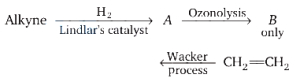
Identify the alkyne in the following sequence of reactions:
A
$H_3C-C \equiv C-CH_3$
B
$H_3C-CH_2-C \equiv CH$
C
$H_2C=CH-C \equiv CH$
D
$HC \equiv C-CH_2-C \equiv CH$
Solution
(A) The reaction sequence is: $\text{Alkyne}$ $\xrightarrow{H_2, \text{Lindlar's catalyst}} A$ $\xrightarrow{\text{Ozonolysis}} B \text{ (only)}$.
In the Wacker process,ethene $(CH_2=CH_2)$ is oxidized to acetaldehyde $(CH_3CHO)$,which is $B$.
Since ozonolysis of alkene $A$ yields $B$ $(CH_3CHO)$ only,$A$ must be $CH_3CH=CHCH_3$ (but$-2-$ene).
Lindlar's catalyst reduces an alkyne to a $cis$-alkene.
Therefore,the starting alkyne must be $CH_3-C \equiv C-CH_3$ (but$-2-$yne).
In the Wacker process,ethene $(CH_2=CH_2)$ is oxidized to acetaldehyde $(CH_3CHO)$,which is $B$.
Since ozonolysis of alkene $A$ yields $B$ $(CH_3CHO)$ only,$A$ must be $CH_3CH=CHCH_3$ (but$-2-$ene).
Lindlar's catalyst reduces an alkyne to a $cis$-alkene.
Therefore,the starting alkyne must be $CH_3-C \equiv C-CH_3$ (but$-2-$yne).
0 likes
View Solution498
EasyMCQ
The trend in acidic behaviour of the following hydrocarbons is:
$a: HC \equiv CH$
$b: CH_2 = CH_2$
$c: CH_3 - CH_3$
$d: CH_3 - C \equiv CH$
$a: HC \equiv CH$
$b: CH_2 = CH_2$
$c: CH_3 - CH_3$
$d: CH_3 - C \equiv CH$
A
$c > d > a > b$
B
$d > a > b > c$
C
$a > d > b > c$
D
$b > a > d > c$
Solution
(C) The acidic character of hydrocarbons depends on the percentage of $s$-character in the $C-H$ bond. Higher $s$-character leads to higher electronegativity of the carbon atom,making the $C-H$ bond more polar and the hydrogen more acidic.
$1$. $a: HC \equiv CH$ ($sp$ hybridized,$50\% \ s$-character)
$2$. $d: CH_3 - C \equiv CH$ ($sp$ hybridized terminal alkyne,$50\% \ s$-character,but the $+I$ effect of the methyl group decreases acidity compared to $a$)
$3$. $b: CH_2 = CH_2$ ($sp^2$ hybridized,$33.3\% \ s$-character)
$4$. $c: CH_3 - CH_3$ ($sp^3$ hybridized,$25\% \ s$-character)
Therefore,the order of acidity is $a > d > b > c$.
$1$. $a: HC \equiv CH$ ($sp$ hybridized,$50\% \ s$-character)
$2$. $d: CH_3 - C \equiv CH$ ($sp$ hybridized terminal alkyne,$50\% \ s$-character,but the $+I$ effect of the methyl group decreases acidity compared to $a$)
$3$. $b: CH_2 = CH_2$ ($sp^2$ hybridized,$33.3\% \ s$-character)
$4$. $c: CH_3 - CH_3$ ($sp^3$ hybridized,$25\% \ s$-character)
Therefore,the order of acidity is $a > d > b > c$.
0 likes
View Solution499
DifficultMCQ
Which of the following reactions is not correct?
A
$CH_2Br-CH_2Br \xrightarrow{Zn} CH_2=CH_2$
B
$CH_3-C \equiv C-CH_3 \xrightarrow{H_2, Pd/BaSO_4} cis-CH_3-CH=CH-CH_3$
C
$CH_3-C \equiv CH \xrightarrow{Hg^{2+}, H^+} CH_3-CO-CH_3$
D
$Ph-CH_2-Br \xrightarrow{Na, \text{dry ether}} Ph-CH_2-CH_2-Ph$
Solution
(C) Let us analyze each reaction:
$(A)$ $CH_2Br-CH_2Br + Zn \rightarrow CH_2=CH_2 + ZnBr_2$. This is a correct dehalogenation reaction.
$(B)$ $CH_3-C \equiv C-CH_3 + H_2 \xrightarrow{Pd/BaSO_4} cis-CH_3-CH=CH-CH_3$. This is a correct Lindlar's catalyst reduction.
$(C)$ $CH_3-C \equiv CH + H_2O \xrightarrow{Hg^{2+}, H^+} CH_3-CO-CH_3$ (acetone). The given product $CH_3-CH_2-CHO$ (propanal) is incorrect. Hydration of propyne yields acetone.
$(D)$ $2Ph-CH_2-Br + 2Na \xrightarrow{\text{dry ether}} Ph-CH_2-CH_2-Ph + 2NaBr$. This is a correct Wurtz reaction.
Therefore,option $(C)$ is the incorrect reaction.
$(A)$ $CH_2Br-CH_2Br + Zn \rightarrow CH_2=CH_2 + ZnBr_2$. This is a correct dehalogenation reaction.
$(B)$ $CH_3-C \equiv C-CH_3 + H_2 \xrightarrow{Pd/BaSO_4} cis-CH_3-CH=CH-CH_3$. This is a correct Lindlar's catalyst reduction.
$(C)$ $CH_3-C \equiv CH + H_2O \xrightarrow{Hg^{2+}, H^+} CH_3-CO-CH_3$ (acetone). The given product $CH_3-CH_2-CHO$ (propanal) is incorrect. Hydration of propyne yields acetone.
$(D)$ $2Ph-CH_2-Br + 2Na \xrightarrow{\text{dry ether}} Ph-CH_2-CH_2-Ph + 2NaBr$. This is a correct Wurtz reaction.
Therefore,option $(C)$ is the incorrect reaction.
0 likes
View SolutionHydrocarbons — Alkyne · Frequently Asked Questions
1Are these Hydrocarbons questions useful for JEE and NEET?
Yes. All questions in this section are mapped to JEE Main and NEET exam patterns. Previous year questions from JEE Main, NEET, GUJCET and state-level exams are included with full solutions.
2Can I switch to Hindi or Gujarati for these questions?
Yes. Use the language tabs in the hero section or the sidebar to view the same questions and solutions in English, Hindi or Gujarati.
3How do I generate a question paper from this subtopic?
Use the Vedclass Exam Paper Generator — select the chapter and subtopic, set difficulty, and generate Sets A, B, C, D automatically. First 3 chapters of every subject are free.
Vedclass Products
For Students
Vedclass Test Series
Mock tests in real JEE/NEET style with performance analysis. 5-day free trial.
Start Free TrialFor Teachers
Exam Paper Generator
Generate Set A/B/C/D papers from this chapter in 2 minutes. 3 chapters free.
Try FreeFor Institutes
Online Exam Module
Live online exams with unlimited students, 360° analytics & white-label branding.
See DemoFor Teachers & Institutes
Generate a Hydrocarbons Exam Paper in 2 Minutes
Select subtopic & difficulty — Sets A, B, C, D auto-generated with No Repeat logic.
First 3 chapters of every subject are free — no payment required.