
A English
Alkyne Questions in English
Class 11 Chemistry · Hydrocarbons · Alkyne
545+
Questions
English
Language
100%
With Solutions
Showing 50 of 545 questions in English
401
DifficultMCQ
When $1,2-$dibromopropane is treated with $X$ moles of $NaNH_2$,the resulting compound reacts with ethyl bromide to form pentyne. What is the value of $X$?
A
$4$
B
$3$
C
$2$
D
$1$
Solution
(B) $1$. The reaction of $1,2-$dibromopropane $(CH_3-CHBr-CH_2Br)$ with $NaNH_2$ (a strong base) leads to dehydrohalogenation.
$2$. Two moles of $NaNH_2$ are required to remove two molecules of $HBr$ from the vicinal dihalide to form propyne $(CH_3-C \equiv CH)$.
$3$. Propyne then reacts with another mole of $NaNH_2$ to form sodium propynide $(CH_3-C \equiv C^- Na^+)$.
$4$. Sodium propynide reacts with ethyl bromide $(CH_3CH_2Br)$ via an $S_N2$ mechanism to form pentyne $(CH_3-C \equiv C-CH_2CH_3)$.
$5$. Total moles of $NaNH_2$ used = $2$ (for dehydrohalogenation) + $1$ (for deprotonation) = $3$ moles.
$6$. Thus,$X = 3$.
$2$. Two moles of $NaNH_2$ are required to remove two molecules of $HBr$ from the vicinal dihalide to form propyne $(CH_3-C \equiv CH)$.
$3$. Propyne then reacts with another mole of $NaNH_2$ to form sodium propynide $(CH_3-C \equiv C^- Na^+)$.
$4$. Sodium propynide reacts with ethyl bromide $(CH_3CH_2Br)$ via an $S_N2$ mechanism to form pentyne $(CH_3-C \equiv C-CH_2CH_3)$.
$5$. Total moles of $NaNH_2$ used = $2$ (for dehydrohalogenation) + $1$ (for deprotonation) = $3$ moles.
$6$. Thus,$X = 3$.
0 likes
View Solution402
DifficultMCQ
$CH_3CH_2CH_2I$ $\xrightarrow{alc. KOH} A$ $\xrightarrow{Br_2} B$ $\xrightarrow{NaNH_2 / NH_3} C$. In this reaction,$C$ is:
A
Alkene
B
Alkanol
C
Alkyne
D
Alkyl amine
Solution
(C) $1$. The reaction of $CH_3CH_2CH_2I$ with $alc. KOH$ (dehydrohalogenation) yields propene $(A = CH_3CH=CH_2)$.
$2$. The reaction of propene with $Br_2$ (electrophilic addition) yields $1,2$-dibromopropane $(B = CH_3CH(Br)CH_2Br)$.
$3$. The reaction of $1,2$-dibromopropane with $NaNH_2$ in liquid $NH_3$ (double dehydrohalogenation) yields propyne $(C = CH_3C \equiv CH)$.
$4$. Thus,$C$ is an alkyne.
$2$. The reaction of propene with $Br_2$ (electrophilic addition) yields $1,2$-dibromopropane $(B = CH_3CH(Br)CH_2Br)$.
$3$. The reaction of $1,2$-dibromopropane with $NaNH_2$ in liquid $NH_3$ (double dehydrohalogenation) yields propyne $(C = CH_3C \equiv CH)$.
$4$. Thus,$C$ is an alkyne.
0 likes
View Solution403
DifficultMCQ
$CH_3C \equiv C^-Na^+ + (CH_3)_2CH-Cl \to$ What will be the product of this reaction?
A
$4-$methyl$-2-$pentyne
B
Propyne
C
Propyne and propene
D
None of the above
Solution
(C) The reaction involves a strong nucleophile,the acetylide ion $(CH_3C \equiv C^-)$,and a secondary alkyl halide,isopropyl chloride $((CH_3)_2CH-Cl)$.
Since the nucleophile is a strong base and the substrate is a secondary alkyl halide,the reaction will primarily undergo an $E2$ elimination reaction rather than an $S_N2$ substitution.
The acetylide ion acts as a base,abstracting a proton from the $\beta$-carbon of the isopropyl chloride,leading to the formation of propene $(CH_3-CH=CH_2)$,propyne $(CH_3-C \equiv CH)$,and sodium chloride $(NaCl)$.
Therefore,the major products are propene and propyne.
Since the nucleophile is a strong base and the substrate is a secondary alkyl halide,the reaction will primarily undergo an $E2$ elimination reaction rather than an $S_N2$ substitution.
The acetylide ion acts as a base,abstracting a proton from the $\beta$-carbon of the isopropyl chloride,leading to the formation of propene $(CH_3-CH=CH_2)$,propyne $(CH_3-C \equiv CH)$,and sodium chloride $(NaCl)$.
Therefore,the major products are propene and propyne.
0 likes
View Solution404
DifficultMCQ
The reaction of $1,1,2,2$-tetrabromoethane with alcoholic zinc gives $..........$.
A
Ethyl bromide
B
Ethane
C
Ethene
D
Ethyne
Solution
(D) The reaction of $1,1,2,2$-tetrabromoethane $(CHBr_2-CHBr_2)$ with alcoholic zinc $(Zn)$ involves the dehalogenation process.
When $1,1,2,2$-tetrabromoethane is heated with zinc dust in an alcoholic medium,it undergoes debromination to form ethyne $(CH \equiv CH)$.
The reaction is: $CHBr_2-CHBr_2 + 2Zn \rightarrow CH \equiv CH + 2ZnBr_2$.
When $1,1,2,2$-tetrabromoethane is heated with zinc dust in an alcoholic medium,it undergoes debromination to form ethyne $(CH \equiv CH)$.
The reaction is: $CHBr_2-CHBr_2 + 2Zn \rightarrow CH \equiv CH + 2ZnBr_2$.
0 likes
View Solution405
MediumMCQ
When $23 \ g$ of $Na$ reacts with $1 \ mole$ of propyne,how many moles of $H_2$ gas will be released?
A
$1$
B
$0.5$
C
$1.5$
D
$2$
Solution
(B) The reaction between propyne and sodium is given by:
$CH_3-C\equiv CH + Na \longrightarrow CH_3-C\equiv C^{-}Na^{+} + 0.5 \ H_2$
Given that $23 \ g$ of $Na$ is equal to $1 \ mole$ $(n = \frac{23 \ g}{23 \ g/mol} = 1 \ mole)$.
According to the stoichiometry of the reaction,$1 \ mole$ of $Na$ reacts with $1 \ mole$ of propyne to produce $0.5 \ mole$ of $H_2$ gas.
$CH_3-C\equiv CH + Na \longrightarrow CH_3-C\equiv C^{-}Na^{+} + 0.5 \ H_2$
Given that $23 \ g$ of $Na$ is equal to $1 \ mole$ $(n = \frac{23 \ g}{23 \ g/mol} = 1 \ mole)$.
According to the stoichiometry of the reaction,$1 \ mole$ of $Na$ reacts with $1 \ mole$ of propyne to produce $0.5 \ mole$ of $H_2$ gas.
0 likes
View Solution406
EasyMCQ
What is obtained when calcium carbide reacts with heavy water?
A
$C_2D_2$
B
$CaD_2$
C
$Ca_2D_2O$
D
$CD_2$
Solution
(A) The reaction of calcium carbide $(CaC_2)$ with heavy water $(D_2O)$ is analogous to its reaction with water $(H_2O)$.
$CaC_2 + 2D_2O \rightarrow Ca(OD)_2 + C_2D_2$
In this reaction,calcium carbide reacts with heavy water to produce calcium deuteroxide $(Ca(OD)_2)$ and deuteroacetylene $(C_2D_2)$.
$CaC_2 + 2D_2O \rightarrow Ca(OD)_2 + C_2D_2$
In this reaction,calcium carbide reacts with heavy water to produce calcium deuteroxide $(Ca(OD)_2)$ and deuteroacetylene $(C_2D_2)$.
0 likes
View Solution407
EasyMCQ
Which of the following metal carbides gives propyne on hydrolysis?
A
$Be_2C$
B
$CaC_2$
C
$Al_4C_3$
D
$Mg_2C_3$
0 likes
View Solution408
DifficultMCQ
Identify $Z$ in the following sequence:
${C_3}{H_7}OH$ $\xrightarrow{conc. \ H_2SO_4} X$ $\xrightarrow{Br_2} Y$ $\xrightarrow[alc. \ KOH]{high \ level} Z$
${C_3}{H_7}OH$ $\xrightarrow{conc. \ H_2SO_4} X$ $\xrightarrow{Br_2} Y$ $\xrightarrow[alc. \ KOH]{high \ level} Z$
A
$CH_3-CH(NH_2)-CH_2(NH_2)$
B
$CH_3-CH(OH)-CH_2(OH)$
C
$CH_3-C(OH)=CH_2$
D
$CH_3-C \equiv CH$
Solution
(D) $1$. Dehydration of propan$-1-$ol $({C_3}{H_7}OH)$ with conc. ${H_2}{SO_4}$ gives propene $(X = CH_3-CH=CH_2)$.
$2$. Addition of ${Br_2}$ to propene gives $1,2-$dibromopropane $(Y = CH_3-CH(Br)-CH_2Br)$.
$3$. Dehydrohalogenation of $1,2-$dibromopropane with excess alcoholic $KOH$ leads to the formation of propyne $(Z = CH_3-C \equiv CH)$.
$2$. Addition of ${Br_2}$ to propene gives $1,2-$dibromopropane $(Y = CH_3-CH(Br)-CH_2Br)$.
$3$. Dehydrohalogenation of $1,2-$dibromopropane with excess alcoholic $KOH$ leads to the formation of propyne $(Z = CH_3-C \equiv CH)$.
0 likes
View Solution409
DifficultMCQ
$1-$Butyne can be distinguished most easily from $2-$butyne by
A
bromine water
B
ozonolysis
C
Tollen's reagent
D
$KMnO_4$ solution
Solution
(C) $1-$Butyne is a terminal alkyne $(CH_3CH_2C\equiv CH)$,which contains an acidic hydrogen atom attached to the $sp$ hybridized carbon.
Tollen's reagent (ammoniacal silver nitrate) reacts with terminal alkynes to form a white precipitate of silver alkynide,whereas $2-$butyne $(CH_3C\equiv CCH_3)$ is an internal alkyne and does not react with Tollen's reagent.
The reaction is:
$CH_3CH_2C\equiv CH + [Ag(NH_3)_2]^+ + OH^- \to CH_3CH_2C\equiv CAg \downarrow (\text{white ppt.}) + 2NH_3 + H_2O$
Tollen's reagent (ammoniacal silver nitrate) reacts with terminal alkynes to form a white precipitate of silver alkynide,whereas $2-$butyne $(CH_3C\equiv CCH_3)$ is an internal alkyne and does not react with Tollen's reagent.
The reaction is:
$CH_3CH_2C\equiv CH + [Ag(NH_3)_2]^+ + OH^- \to CH_3CH_2C\equiv CAg \downarrow (\text{white ppt.}) + 2NH_3 + H_2O$
0 likes
View Solution410
DifficultMCQ
Predict the nature of $P$ in the following reaction:
$CH_3-C\equiv C-CH_3 \xrightarrow[heat]{NaNH_2 / \text{inert solvent}} P$
$CH_3-C\equiv C-CH_3 \xrightarrow[heat]{NaNH_2 / \text{inert solvent}} P$
A
$CH_2=CH-CH=CH_2$
B
$CH_2=C=CH-CH_3$
C
$CH_3-CH_2-C\equiv CH$
D
No reaction
Solution
(C) When non-terminal alkynes are heated with $NaNH_2$ in an inert solvent,the triple bond undergoes isomerization to form the more stable terminal alkyne.
The reaction proceeds as follows:
$CH_3-C\equiv C-CH_3 \xrightarrow[heat]{NaNH_2} CH_3-CH_2-C\equiv CH$
Thus,the product $P$ is $CH_3-CH_2-C\equiv CH$.
The reaction proceeds as follows:
$CH_3-C\equiv C-CH_3 \xrightarrow[heat]{NaNH_2} CH_3-CH_2-C\equiv CH$
Thus,the product $P$ is $CH_3-CH_2-C\equiv CH$.
0 likes
View Solution411
MediumMCQ
Which is the most suitable reagent among the following to distinguish compound $(3)$ from the rest of the compounds?
$1. CH_3-C \equiv C-CH_3$
$2. CH_3-CH_2-CH_2-CH_3$
$3. CH_3-CH_2-C \equiv CH$
$4. CH_3-CH=CH_2$
$1. CH_3-C \equiv C-CH_3$
$2. CH_3-CH_2-CH_2-CH_3$
$3. CH_3-CH_2-C \equiv CH$
$4. CH_3-CH=CH_2$
A
Bromine in carbon tetrachloride
B
Bromine in acetic acid
C
Alkaline $KMnO_4$
D
Ammoniacal silver nitrate
Solution
(D) $Br_2$ in $CCl_4$ $(a)$,$Br_2$ in $CH_3COOH$ $(b)$,and alkaline $KMnO_4$ $(c)$ will react with all unsaturated compounds,i.e.,$1, 3,$ and $4$.
Ammoniacal $AgNO_3$ $(d)$ (Tollens' reagent) reacts specifically with terminal alkynes to form a white precipitate.
Compound $(3)$ $(CH_3-CH_2-C \equiv CH)$ is a terminal alkyne,whereas $1$ is an internal alkyne,$2$ is an alkane,and $4$ is an alkene.
Therefore,compound $(3)$ can be distinguished from $1, 2,$ and $4$ using ammoniacal $AgNO_3$.
Ammoniacal $AgNO_3$ $(d)$ (Tollens' reagent) reacts specifically with terminal alkynes to form a white precipitate.
Compound $(3)$ $(CH_3-CH_2-C \equiv CH)$ is a terminal alkyne,whereas $1$ is an internal alkyne,$2$ is an alkane,and $4$ is an alkene.
Therefore,compound $(3)$ can be distinguished from $1, 2,$ and $4$ using ammoniacal $AgNO_3$.
0 likes
View Solution412
MediumMCQ
Assertion : Acetylene on reacting with sodamide gives sodium acetylide and ammonia.
Reason : $sp$ hybridised carbon atoms of acetylene are considerably electronegative.
Reason : $sp$ hybridised carbon atoms of acetylene are considerably electronegative.
A
If both Assertion and Reason are correct and the Reason is a correct explanation of the Assertion.
B
If both Assertion and Reason are correct but Reason is not a correct explanation of the Assertion.
C
If the Assertion is correct but Reason is incorrect.
D
If both the Assertion and Reason are incorrect.
Solution
(A) Acetylene reacts with sodamide $(NaNH_2)$ to form sodium acetylide and ammonia.
$CH\equiv CH + NaNH_2 \rightarrow HC\equiv C^{-}Na^{+} + NH_3$
This reaction occurs because the $sp$ hybridized carbon atoms in acetylene have $50\%$ $s$-character.
Due to the high $s$-character,the electrons are held more tightly by the nucleus,making the carbon atom significantly electronegative.
This increased electronegativity makes the terminal hydrogen atom acidic,allowing it to be replaced by the sodium ion from the sodamide.
Therefore,both the Assertion and the Reason are correct,and the Reason is the correct explanation of the Assertion.
$CH\equiv CH + NaNH_2 \rightarrow HC\equiv C^{-}Na^{+} + NH_3$
This reaction occurs because the $sp$ hybridized carbon atoms in acetylene have $50\%$ $s$-character.
Due to the high $s$-character,the electrons are held more tightly by the nucleus,making the carbon atom significantly electronegative.
This increased electronegativity makes the terminal hydrogen atom acidic,allowing it to be replaced by the sodium ion from the sodamide.
Therefore,both the Assertion and the Reason are correct,and the Reason is the correct explanation of the Assertion.
0 likes
View Solution413
MediumMCQ
Assertion : Acetylene on treatment with alkaline $KMnO_4$ produces acetaldehyde.
Reason : Alkaline $KMnO_4$ is a reducing agent.
Reason : Alkaline $KMnO_4$ is a reducing agent.
A
If both Assertion and Reason are correct and the Reason is a correct explanation of the Assertion.
B
If both Assertion and Reason are correct but Reason is not a correct explanation of the Assertion.
C
If the Assertion is correct but Reason is incorrect.
D
If both the Assertion and Reason are incorrect.
Solution
(D) Both the Assertion and the Reason are false.
$KMnO_4$ is a strong oxidising agent,not a reducing agent.
Acetylene $(CH \equiv CH)$ on treatment with alkaline $KMnO_4$ undergoes oxidation to produce oxalic acid ($COOH-COOH$ or $(COOH)_2$):
$CH \equiv CH + 4[O] \xrightarrow{\text{Alk. } KMnO_4} COOH-COOH$.
$KMnO_4$ is a strong oxidising agent,not a reducing agent.
Acetylene $(CH \equiv CH)$ on treatment with alkaline $KMnO_4$ undergoes oxidation to produce oxalic acid ($COOH-COOH$ or $(COOH)_2$):
$CH \equiv CH + 4[O] \xrightarrow{\text{Alk. } KMnO_4} COOH-COOH$.
0 likes
View Solution414
MediumMCQ
The most suitable reagent for the following conversion is:
$H_3C-C \equiv C-CH_3 \rightarrow \text{cis-2-butene}$
$H_3C-C \equiv C-CH_3 \rightarrow \text{cis-2-butene}$
A
$Na / \text{liquid } NH_3$
B
$H_2, Pd / C, \text{quinoline}$
C
$Zn / HCl$
D
$Hg^{2+} / H^{+}, H_2O$
Solution
(B) The conversion of an internal alkyne (but$-2-$yne) to a $cis$-alkene (cis$-2-$butene) requires a partial reduction that involves $syn$-addition of hydrogen.
This is achieved using Lindlar's catalyst,which is $Pd$ supported on $CaCO_3$ or $BaSO_4$ poisoned with quinoline or lead acetate $(H_2, Pd / C, \text{quinoline})$.
$Na / \text{liquid } NH_3$ (Birch reduction) would result in the $trans$-alkene.
Therefore,the correct reagent is $H_2, Pd / C, \text{quinoline}$.
This is achieved using Lindlar's catalyst,which is $Pd$ supported on $CaCO_3$ or $BaSO_4$ poisoned with quinoline or lead acetate $(H_2, Pd / C, \text{quinoline})$.
$Na / \text{liquid } NH_3$ (Birch reduction) would result in the $trans$-alkene.
Therefore,the correct reagent is $H_2, Pd / C, \text{quinoline}$.
0 likes
View Solution415
Medium
Write structures of different isomers corresponding to the $5^{th}$ member of alkyne series. Also write $IUPAC$ names of all the isomers. What type of isomerism is exhibited by different pairs of isomers?
Solution
(N/A) The $5^{th}$ member of the alkyne series follows the general formula $C_nH_{2n-2}$. For $n=6$,the molecular formula is $C_6H_{10}$.
The possible isomers are:
$(a)$ $HC\equiv C-CH_2-CH_2-CH_2-CH_3$: $Hex-1-yne$
$(b)$ $CH_3-C\equiv C-CH_2-CH_2-CH_3$: $Hex-2-yne$
$(c)$ $CH_3-CH_2-C\equiv C-CH_2-CH_3$: $Hex-3-yne$
$(d)$ $HC\equiv C-CH(CH_3)-CH_2-CH_3$: $3-Methylpent-1-yne$
$(e)$ $HC\equiv C-CH_2-CH(CH_3)-CH_3$: $4-Methylpent-1-yne$
$(f)$ $CH_3-C\equiv C-CH(CH_3)-CH_3$: $4-Methylpent-2-yne$
$(g)$ $HC\equiv C-C(CH_3)_2-CH_3$: $3,3-Dimethylbut-1-yne$
These isomers exhibit position isomerism (due to the change in the position of the triple bond) and chain isomerism (due to the difference in the carbon chain structure).
The possible isomers are:
$(a)$ $HC\equiv C-CH_2-CH_2-CH_2-CH_3$: $Hex-1-yne$
$(b)$ $CH_3-C\equiv C-CH_2-CH_2-CH_3$: $Hex-2-yne$
$(c)$ $CH_3-CH_2-C\equiv C-CH_2-CH_3$: $Hex-3-yne$
$(d)$ $HC\equiv C-CH(CH_3)-CH_2-CH_3$: $3-Methylpent-1-yne$
$(e)$ $HC\equiv C-CH_2-CH(CH_3)-CH_3$: $4-Methylpent-1-yne$
$(f)$ $CH_3-C\equiv C-CH(CH_3)-CH_3$: $4-Methylpent-2-yne$
$(g)$ $HC\equiv C-C(CH_3)_2-CH_3$: $3,3-Dimethylbut-1-yne$
These isomers exhibit position isomerism (due to the change in the position of the triple bond) and chain isomerism (due to the difference in the carbon chain structure).
0 likes
View Solution416
EasyMCQ
What will be obtained by the reaction of calcium carbide with heavy water? Give its chemical equation.
A
$Ca(OH)_{2}$ and $C_{2}H_{2}$
B
$Ca(OD)_{2}$ and $C_{2}D_{2}$
C
$Ca(OD)_{2}$ and $C_{2}H_{2}$
D
$Ca(OH)_{2}$ and $C_{2}D_{2}$
Solution
(B) Calcium carbide $(CaC_{2})$ reacts with heavy water $(D_{2}O)$ to produce calcium deuteroxide $(Ca(OD)_{2})$ and deuteroacetylene $(C_{2}D_{2})$.
The chemical equation is:
$CaC_{2} + 2D_{2}O \rightarrow Ca(OD)_{2} + C_{2}D_{2}$
The chemical equation is:
$CaC_{2} + 2D_{2}O \rightarrow Ca(OD)_{2} + C_{2}D_{2}$
0 likes
View Solution417
Medium
Complete the following reactions:
$(1)$ $CH \equiv CH + 2H_2 \xrightarrow[523-573 \ K]{Ni} ?$
$(2)$ $CH_3-C \equiv CH + 2H_2 \xrightarrow[or \ Ni, \Delta]{Pd \ or \ Pt} ?$
$(1)$ $CH \equiv CH + 2H_2 \xrightarrow[523-573 \ K]{Ni} ?$
$(2)$ $CH_3-C \equiv CH + 2H_2 \xrightarrow[or \ Ni, \Delta]{Pd \ or \ Pt} ?$
Solution
(N/A) The reaction involves the catalytic hydrogenation of alkynes to alkanes using hydrogen gas in the presence of a metal catalyst like $Ni$,$Pd$,or $Pt$.
$(1)$ $CH \equiv CH + 2H_2 \xrightarrow[523-573 \ K]{Ni} CH_3-CH_3$ (Ethane)
$(2)$ $CH_3-C \equiv CH + 2H_2 \xrightarrow[or \ Ni, \Delta]{Pd \ or \ Pt} CH_3-CH_2-CH_3$ (Propane)
$(1)$ $CH \equiv CH + 2H_2 \xrightarrow[523-573 \ K]{Ni} CH_3-CH_3$ (Ethane)
$(2)$ $CH_3-C \equiv CH + 2H_2 \xrightarrow[or \ Ni, \Delta]{Pd \ or \ Pt} CH_3-CH_2-CH_3$ (Propane)
0 likes
View Solution418
Medium
Provide the primary information about alkynes.
Solution
(N/A) Alkynes are unsaturated hydrocarbons.
They contain at least $1$ triple bond between two carbon atoms $(C \equiv C)$.
The general formula for alkynes is $C_{n}H_{2n-2}$.
The first member of the alkyne series is ethyne,which is popularly known as acetylene.
Acetylene is used for arc welding in the form of an oxyacetylene flame,obtained by mixing acetylene with oxygen gas.
Alkynes serve as starting materials for the synthesis of a large number of organic compounds.
They contain at least $1$ triple bond between two carbon atoms $(C \equiv C)$.
The general formula for alkynes is $C_{n}H_{2n-2}$.
The first member of the alkyne series is ethyne,which is popularly known as acetylene.
Acetylene is used for arc welding in the form of an oxyacetylene flame,obtained by mixing acetylene with oxygen gas.
Alkynes serve as starting materials for the synthesis of a large number of organic compounds.
0 likes
View Solution419
Medium
Give the structure,formula and names of $2$ to $4$ carbon alkynes.
Solution
(N/A) The structures,formulas,and names of alkynes with $2$ to $4$ carbon atoms are given in the table below:
| Number of Carbon Atoms | Formula | Structure | $IUPAC$ Name | Common Name |
|---|---|---|---|---|
| $2$ | $C_2H_2$ | $H-C \equiv C-H$ | Ethyne | Acetylene |
| $3$ | $C_3H_4$ | $CH_3-C \equiv CH$ | Propyne | Methylacetylene |
| $4$ | $C_4H_6$ | $(i) CH_3CH_2-C \equiv CH$ | But-$1$-yne | Ethylacetylene |
| $4$ | $C_4H_6$ | $(ii) CH_3-C \equiv C-CH_3$ | But-$2$-yne | Dimethylacetylene |
0 likes
View Solution420
Medium
Give a brief description of the structure of ethyne (acetylene).
Solution
(N/A) The molecular formula of ethyne is $C_{2}H_{2}$. It is the first member of the alkyne series.
In ethyne,both carbon atoms undergo $sp$ hybridization. Each carbon atom possesses two non-hybridized $2p$ orbitals ($2p_{x}$ and $2p_{y}$).
The two $sp$ hybrid orbitals are linear,and they are perpendicular to the $2p_{x}$ and $2p_{y}$ orbitals.
Bond formation in ethyne:
$1$. Carbon-carbon sigma $(\sigma)$ bond: This is formed by the head-on overlapping of one $sp$ hybrid orbital from each of the two carbon atoms.
$2$. Carbon-hydrogen sigma $(\sigma)$ bond: The remaining $sp$ hybrid orbital of each carbon atom overlaps with the $1s$ orbital of a hydrogen atom along the internuclear axis,forming two $C-H$ sigma bonds.
$3$. Pi $(\pi)$ bonds: Each carbon atom has two unhybridized $p$-orbitals ($2p_{x}$ and $2p_{y}$) that are perpendicular to each other and to the molecular axis. These orbitals undergo lateral overlapping to form two $\pi$-bonds between the carbon atoms.
The $H-C-C$ bond angle is $180^{\circ}$,resulting in a linear geometry: $H-C\equiv C-H$.
In ethyne,both carbon atoms undergo $sp$ hybridization. Each carbon atom possesses two non-hybridized $2p$ orbitals ($2p_{x}$ and $2p_{y}$).
The two $sp$ hybrid orbitals are linear,and they are perpendicular to the $2p_{x}$ and $2p_{y}$ orbitals.
Bond formation in ethyne:
$1$. Carbon-carbon sigma $(\sigma)$ bond: This is formed by the head-on overlapping of one $sp$ hybrid orbital from each of the two carbon atoms.
$2$. Carbon-hydrogen sigma $(\sigma)$ bond: The remaining $sp$ hybrid orbital of each carbon atom overlaps with the $1s$ orbital of a hydrogen atom along the internuclear axis,forming two $C-H$ sigma bonds.
$3$. Pi $(\pi)$ bonds: Each carbon atom has two unhybridized $p$-orbitals ($2p_{x}$ and $2p_{y}$) that are perpendicular to each other and to the molecular axis. These orbitals undergo lateral overlapping to form two $\pi$-bonds between the carbon atoms.
The $H-C-C$ bond angle is $180^{\circ}$,resulting in a linear geometry: $H-C\equiv C-H$.
0 likes
View Solution421
Medium
Give the industrial preparation method of ethyne.
Solution
(N/A) $(i)$ Quick lime is obtained by heating limestone:
$CaCO_{3(s)} \xrightarrow{\Delta} CaO_{(s)} + CO_{2(g)}$
$(ii)$ Calcium oxide is heated with coke to obtain calcium carbide:
$CaO_{(s)} + 3C_{(s)} \xrightarrow{\Delta} CaC_{2(s)} + CO_{(g)}$
$(iii)$ Calcium carbide reacts with water to produce ethyne:
$CaC_{2(s)} + 2H_{2}O_{(l)} \longrightarrow Ca(OH)_{2(aq)} + C_{2}H_{2(g)}$
This is the standard industrial process for the production of ethyne.
$CaCO_{3(s)} \xrightarrow{\Delta} CaO_{(s)} + CO_{2(g)}$
$(ii)$ Calcium oxide is heated with coke to obtain calcium carbide:
$CaO_{(s)} + 3C_{(s)} \xrightarrow{\Delta} CaC_{2(s)} + CO_{(g)}$
$(iii)$ Calcium carbide reacts with water to produce ethyne:
$CaC_{2(s)} + 2H_{2}O_{(l)} \longrightarrow Ca(OH)_{2(aq)} + C_{2}H_{2(g)}$
This is the standard industrial process for the production of ethyne.
0 likes
View Solution422
Medium
Give the method of preparation of ethyne (acetylene) from vicinal dihalides.
Solution
(N/A) Vicinal dihalides are compounds in which two halogen atoms are attached to adjacent carbon atoms.
When vicinal dihalides are treated with alcoholic potassium hydroxide $(KOH)$,they undergo dehydrohalogenation to form vinyl halides,which then react with sodamide $(NaNH_2)$ to form ethyne.
The reaction is as follows:
$CH_2Br-CH_2Br + 2KOH (\text{alc.}) \longrightarrow CH \equiv CH + 2KBr + 2H_2O$
Alternatively,using $NaNH_2$ in liquid ammonia:
$CH_2Br-CH_2Br \xrightarrow{NaNH_2 / liq. NH_3} CH \equiv CH$
When vicinal dihalides are treated with alcoholic potassium hydroxide $(KOH)$,they undergo dehydrohalogenation to form vinyl halides,which then react with sodamide $(NaNH_2)$ to form ethyne.
The reaction is as follows:
$CH_2Br-CH_2Br + 2KOH (\text{alc.}) \longrightarrow CH \equiv CH + 2KBr + 2H_2O$
Alternatively,using $NaNH_2$ in liquid ammonia:
$CH_2Br-CH_2Br \xrightarrow{NaNH_2 / liq. NH_3} CH \equiv CH$
0 likes
View Solution423
Medium
Give the main product of the following reactions:
$(i)$ $1,1,2,2-$tetrabromopropane + zinc powder in methanol.
$(ii)$ Reaction occurring on passing hydrogen gas through carbon electrodes at high temperature in an electric arc.
$(i)$ $1,1,2,2-$tetrabromopropane + zinc powder in methanol.
$(ii)$ Reaction occurring on passing hydrogen gas through carbon electrodes at high temperature in an electric arc.
Solution
(N/A) $(i)$ The reaction of $1,1,2,2-$tetrabromopropane with zinc powder in methanol is a dehalogenation reaction that produces propyne:
$CH_3CBr_2CHBr_2 + 2Zn \rightarrow CH_3C \equiv CH + 2ZnBr_2$
$(ii)$ The reaction of hydrogen gas with carbon in an electric arc at high temperature $(3270 \ K)$ produces ethyne (acetylene):
$2C + H_2 \xrightarrow{\text{Electric arc}, 3270 \ K} HC \equiv CH$
$CH_3CBr_2CHBr_2 + 2Zn \rightarrow CH_3C \equiv CH + 2ZnBr_2$
$(ii)$ The reaction of hydrogen gas with carbon in an electric arc at high temperature $(3270 \ K)$ produces ethyne (acetylene):
$2C + H_2 \xrightarrow{\text{Electric arc}, 3270 \ K} HC \equiv CH$
0 likes
View Solution424
Medium
Describe the physical properties of alkynes.
Solution
(N/A) The physical properties of alkynes follow trends similar to those of alkanes and alkenes.
$1$. Physical State: The first three members $(C_2H_2, C_3H_4, C_4H_6)$ are gases. The next eight members ($C_5H_8$ to $C_{12}H_{22}$) are liquids,and higher members are solids.
$2$. Colour and Odour: All alkynes are colourless. Ethyne has a characteristic odour,while other members are generally odourless.
$3$. Solubility: Alkynes are weakly polar. They are lighter than water and immiscible with water,but they are soluble in organic solvents like ether,carbon tetrachloride $(CCl_4)$,and benzene $(C_6H_6)$.
$4$. Boiling and Melting Points: Boiling points,melting points,and densities increase with an increase in molar mass. For similar molecular weights,the boiling point order is: $CH_3-CH_3 < CH_2=CH_2 < CH \equiv CH$.
$1$. Physical State: The first three members $(C_2H_2, C_3H_4, C_4H_6)$ are gases. The next eight members ($C_5H_8$ to $C_{12}H_{22}$) are liquids,and higher members are solids.
$2$. Colour and Odour: All alkynes are colourless. Ethyne has a characteristic odour,while other members are generally odourless.
$3$. Solubility: Alkynes are weakly polar. They are lighter than water and immiscible with water,but they are soluble in organic solvents like ether,carbon tetrachloride $(CCl_4)$,and benzene $(C_6H_6)$.
$4$. Boiling and Melting Points: Boiling points,melting points,and densities increase with an increase in molar mass. For similar molecular weights,the boiling point order is: $CH_3-CH_3 < CH_2=CH_2 < CH \equiv CH$.
0 likes
View Solution425
Easy
Give a brief note on the acidic nature of alkynes.
Solution
(N/A) The $s$-orbital is closer to the nucleus than the $p$-orbital,so electronegativity increases as the $s$-character increases. The order of electronegativity is: $sp > sp^2 > sp^3$.
Due to this,the $sp$ hybridized carbon in an alkyne attracts the bonded electron pair most strongly towards itself. Consequently,the hydrogen atom attached directly to the $sp$ carbon is more acidic than the hydrogen atoms in alkanes or alkenes.
Acidic strength order: $\equiv C-H > =C-H > -C-H$.
Only the hydrogen atom attached to the triply bonded carbon of a terminal alkyne (like $HC \equiv CH$,$CH_3 C \equiv CH$,$CH_3 CH_2 C \equiv CH$) is acidic. In $R-C \equiv C-H$,only the terminal $H$ is acidic. In $R-C \equiv C-R$,there is no acidic hydrogen.
Chemical reactions showing the acidic nature of terminal alkynes:
Ethyne reacts with strong bases like sodium metal at high temperatures or sodamide $(NaNH_2)$ to form ethynide (acetylide) products.
$1$. Reaction with sodium metal:
$HC \equiv CH + Na \xrightarrow{475 \ K} HC \equiv C^- Na^+ + \frac{1}{2} H_2$ (Eq. $i$)
$2$. Reaction with sodamide:
$HC \equiv CH + NaNH_2 \xrightarrow{NH_3} HC \equiv CNa + NH_3$ (Eq. $ii$)
$HC \equiv CH + 2NaNH_2 \xrightarrow{NH_3} Na^+C^- \equiv C^-Na^+ + 2NH_3$ (Eq. $iii$)
Due to this,the $sp$ hybridized carbon in an alkyne attracts the bonded electron pair most strongly towards itself. Consequently,the hydrogen atom attached directly to the $sp$ carbon is more acidic than the hydrogen atoms in alkanes or alkenes.
Acidic strength order: $\equiv C-H > =C-H > -C-H$.
Only the hydrogen atom attached to the triply bonded carbon of a terminal alkyne (like $HC \equiv CH$,$CH_3 C \equiv CH$,$CH_3 CH_2 C \equiv CH$) is acidic. In $R-C \equiv C-H$,only the terminal $H$ is acidic. In $R-C \equiv C-R$,there is no acidic hydrogen.
Chemical reactions showing the acidic nature of terminal alkynes:
Ethyne reacts with strong bases like sodium metal at high temperatures or sodamide $(NaNH_2)$ to form ethynide (acetylide) products.
$1$. Reaction with sodium metal:
$HC \equiv CH + Na \xrightarrow{475 \ K} HC \equiv C^- Na^+ + \frac{1}{2} H_2$ (Eq. $i$)
$2$. Reaction with sodamide:
$HC \equiv CH + NaNH_2 \xrightarrow{NH_3} HC \equiv CNa + NH_3$ (Eq. $ii$)
$HC \equiv CH + 2NaNH_2 \xrightarrow{NH_3} Na^+C^- \equiv C^-Na^+ + 2NH_3$ (Eq. $iii$)
0 likes
View Solution426
Easy
Explain the acidic nature of ethyne.
Solution
(N/A) The $s$-orbital is closer to the nucleus and more electronegative than the $p$-orbital. Therefore,the electronegativity of carbon increases as the percentage of $s$-character increases.
The order of electronegativity is: $sp \text{ } C > sp^{2} \text{ } C > sp^{3} \text{ } C$.
Due to this,the $sp$-hybridized carbon in ethyne $(HC \equiv CH)$ attracts the shared pair of electrons of the $C-H$ bond towards itself more strongly than $sp^{2}$ or $sp^{3}$ hybridized carbons.
This makes the hydrogen atom attached to the $sp$-hybridized carbon acidic in nature.
$50\% \text{ } s$-character in $sp$ carbon makes the $C-H$ bond polar,allowing the $H$ to be released as a proton $(H^{+})$ in the presence of strong bases.
Chemical reactions showing the acidic nature of ethyne:
$1$. Reaction with sodium metal:
$HC \equiv CH + Na \xrightarrow{475 \ K} HC \equiv C^{-}Na^{+} + \frac{1}{2} H_{2}$
$2$. Reaction with sodamide $(NaNH_{2})$:
$HC \equiv CH + NaNH_{2} \xrightarrow{liq. NH_{3}} HC \equiv CNa + NH_{3}$
$HC \equiv CH + 2NaNH_{2} \xrightarrow{liq. NH_{3}} Na^{+}C^{-} \equiv C^{-}Na^{+} + 2NH_{3}$
Thus,terminal alkynes exhibit weak acidic character.
The order of electronegativity is: $sp \text{ } C > sp^{2} \text{ } C > sp^{3} \text{ } C$.
Due to this,the $sp$-hybridized carbon in ethyne $(HC \equiv CH)$ attracts the shared pair of electrons of the $C-H$ bond towards itself more strongly than $sp^{2}$ or $sp^{3}$ hybridized carbons.
This makes the hydrogen atom attached to the $sp$-hybridized carbon acidic in nature.
$50\% \text{ } s$-character in $sp$ carbon makes the $C-H$ bond polar,allowing the $H$ to be released as a proton $(H^{+})$ in the presence of strong bases.
Chemical reactions showing the acidic nature of ethyne:
$1$. Reaction with sodium metal:
$HC \equiv CH + Na \xrightarrow{475 \ K} HC \equiv C^{-}Na^{+} + \frac{1}{2} H_{2}$
$2$. Reaction with sodamide $(NaNH_{2})$:
$HC \equiv CH + NaNH_{2} \xrightarrow{liq. NH_{3}} HC \equiv CNa + NH_{3}$
$HC \equiv CH + 2NaNH_{2} \xrightarrow{liq. NH_{3}} Na^{+}C^{-} \equiv C^{-}Na^{+} + 2NH_{3}$
Thus,terminal alkynes exhibit weak acidic character.
0 likes
View Solution427
Medium
Explain: 'Hydrogen attached to a carbon having a triple bond is acidic in nature.' Also,write an appropriate reaction for it.
Solution
(N/A) The $s$-orbital is closer to the nucleus than the $p$-orbital,so electronegativity increases as the $s$-character increases. The order of electronegativity is: $sp \ C > sp^{2} \ C > sp^{3} \ C$.
Due to this,the $sp$ hybridized carbon attracts the bonded electron pair more strongly towards itself. Consequently,the hydrogen atom attached directly to the $sp$ hybridized carbon becomes more acidic compared to the hydrogen atoms in alkanes and alkenes.
The acidity order is: $HC \equiv CH > H_{2}C=CH_{2} > CH_{3}-CH_{3}$.
Only the hydrogen atom attached to the triply bonded carbon in terminal alkynes (e.g.,$HC \equiv CH$,$CH_{3}C \equiv CH$) is acidic. In $R-C \equiv C-H$,only the terminal $H$ is acidic. In $R-C \equiv C-R$,no acidic $H$ is present.
Chemical reactions showing the acidic nature of terminal alkynes:
$1$. Reaction with sodium metal:
$HC \equiv CH + Na \xrightarrow{475 \ K} HC \equiv C^{-}Na^{+} + \frac{1}{2} H_{2}$
$2$. Reaction with sodamide $(NaNH_{2})$:
$HC \equiv CH + NaNH_{2} \xrightarrow{NH_{3}} HC \equiv CNa + NH_{3}$
$3$. Reaction with excess sodamide:
$HC \equiv CH + 2NaNH_{2} \xrightarrow{NH_{3}} Na^{+}C^{-} \equiv C^{-}Na^{+} + 2NH_{3}$
Due to this,the $sp$ hybridized carbon attracts the bonded electron pair more strongly towards itself. Consequently,the hydrogen atom attached directly to the $sp$ hybridized carbon becomes more acidic compared to the hydrogen atoms in alkanes and alkenes.
The acidity order is: $HC \equiv CH > H_{2}C=CH_{2} > CH_{3}-CH_{3}$.
Only the hydrogen atom attached to the triply bonded carbon in terminal alkynes (e.g.,$HC \equiv CH$,$CH_{3}C \equiv CH$) is acidic. In $R-C \equiv C-H$,only the terminal $H$ is acidic. In $R-C \equiv C-R$,no acidic $H$ is present.
Chemical reactions showing the acidic nature of terminal alkynes:
$1$. Reaction with sodium metal:
$HC \equiv CH + Na \xrightarrow{475 \ K} HC \equiv C^{-}Na^{+} + \frac{1}{2} H_{2}$
$2$. Reaction with sodamide $(NaNH_{2})$:
$HC \equiv CH + NaNH_{2} \xrightarrow{NH_{3}} HC \equiv CNa + NH_{3}$
$3$. Reaction with excess sodamide:
$HC \equiv CH + 2NaNH_{2} \xrightarrow{NH_{3}} Na^{+}C^{-} \equiv C^{-}Na^{+} + 2NH_{3}$
0 likes
View Solution428
Medium
Explain: "Why do alkyne compounds undergo electrophilic addition reactions?"
Solution
(N/A) In alkyne compounds,the triple bond between two carbon atoms consists of one $\sigma$ bond and two $\pi$ bonds. The $\pi$ electron cloud is loosely held and is located above and below the plane of the carbon atoms,making it easily accessible to electrophiles.
Because the $\pi$ electrons are relatively far from the nuclei,they are less tightly bound and are highly susceptible to attack by electrophiles (electron-seeking species).
When an electrophile approaches,the $\pi$ bond breaks,and the electrophile forms a new bond with one of the carbon atoms,resulting in the formation of a carbocation intermediate (e.g.,a vinylic cation). Subsequently,a nucleophile attacks the carbocation to form the final addition product.
Therefore,alkynes readily undergo electrophilic addition reactions,such as hydrogenation with $H_{2}$,halogenation with $X_{2}$,hydrohalogenation with $HX$,and hydration with $H_{2}O$.
Because the $\pi$ electrons are relatively far from the nuclei,they are less tightly bound and are highly susceptible to attack by electrophiles (electron-seeking species).
When an electrophile approaches,the $\pi$ bond breaks,and the electrophile forms a new bond with one of the carbon atoms,resulting in the formation of a carbocation intermediate (e.g.,a vinylic cation). Subsequently,a nucleophile attacks the carbocation to form the final addition product.
Therefore,alkynes readily undergo electrophilic addition reactions,such as hydrogenation with $H_{2}$,halogenation with $X_{2}$,hydrohalogenation with $HX$,and hydration with $H_{2}O$.
0 likes
View Solution429
Medium
Give the hydrogenation and halogenation reactions of alkynes.
Solution
(N/A) Hydrogenation of alkyne: Alkynes react with dihydrogen in the presence of catalysts like $Pt$,$Pd$,or $Ni$ to form alkanes.
$CH_3-C \equiv CH + H_2$ $\xrightarrow{Pt/Pd/Ni/\Delta} [CH_3CH=CH_2]$ $\xrightarrow{H_2} CH_3-CH_2-CH_3$ (Propane)
$(b)$ Halogenation of alkyne: Alkynes react with halogens (like $Br_2$ in $CCl_4$) to form tetrahaloalkanes. The discharge of the reddish-orange color of bromine solution serves as a test for unsaturation.
$CH_3-C \equiv CH + Br_2$ $\xrightarrow{CCl_4} [CH_3CBr=CHBr]$ $\xrightarrow{Br_2} CH_3CBr_2-CHBr_2$ ($1$,$1$,$2$,$2$-Tetrabromopropane)
Rate of reaction: $Cl_2 > Br_2 > I_2$
$CH_3-C \equiv CH + H_2$ $\xrightarrow{Pt/Pd/Ni/\Delta} [CH_3CH=CH_2]$ $\xrightarrow{H_2} CH_3-CH_2-CH_3$ (Propane)
$(b)$ Halogenation of alkyne: Alkynes react with halogens (like $Br_2$ in $CCl_4$) to form tetrahaloalkanes. The discharge of the reddish-orange color of bromine solution serves as a test for unsaturation.
$CH_3-C \equiv CH + Br_2$ $\xrightarrow{CCl_4} [CH_3CBr=CHBr]$ $\xrightarrow{Br_2} CH_3CBr_2-CHBr_2$ ($1$,$1$,$2$,$2$-Tetrabromopropane)
Rate of reaction: $Cl_2 > Br_2 > I_2$
0 likes
View Solution430
Medium
Give reactions that show the hydrohalogenation and hydration of alkynes. Write a note on the addition of hydrogen halides and water to alkynes.
Solution
(N/A) Hydrohalogenation of alkynes: Alkynes undergo electrophilic addition reactions with hydrogen halides ($HCl$,$HBr$,$HI$). Two molecules of hydrogen halide add to the alkyne to form a gem-dihalide,where both halogen atoms are attached to the same carbon atom.
$(b)$ Hydration of alkynes: Hydration involves the addition of water $(H_{2}O)$ in the presence of a catalyst (e.g.,$HgSO_{4}/H_{2}SO_{4}$). The reaction proceeds via electrophilic addition. First,the electrophilic $H^{+}$ from $H_{2}O$ adds to the triple bond according to Markovnikov's rule to form a stable carbocation. Subsequently,the $OH^{-}$ ion adds to form an enol (alkenol),which then undergoes tautomerization (isomerization) to form a stable aldehyde or ketone containing the $>C=O$ group.
$(b)$ Hydration of alkynes: Hydration involves the addition of water $(H_{2}O)$ in the presence of a catalyst (e.g.,$HgSO_{4}/H_{2}SO_{4}$). The reaction proceeds via electrophilic addition. First,the electrophilic $H^{+}$ from $H_{2}O$ adds to the triple bond according to Markovnikov's rule to form a stable carbocation. Subsequently,the $OH^{-}$ ion adds to form an enol (alkenol),which then undergoes tautomerization (isomerization) to form a stable aldehyde or ketone containing the $>C=O$ group.
0 likes
View Solution431
Medium
Explain the polymerization of alkynes. Or,give the types of polymerization of alkynes and provide a note on each.
Solution
(N/A) large number of alkyne molecules combine with each other to form a giant molecule,which is called the polymerization of alkynes.
There are mainly two types of alkyne polymerization: linear polymerization and cyclic polymerization.
$(a)$ Linear polymerization of alkynes: Under suitable conditions,linear polymerization of ethyne takes place to produce polyacetylene or polyethyne,which is a high molecular weight polyene containing repeating units of $[CH=CH-CH=CH]$ and can be represented as $+CH=CH-CH=CH-_{n}$. Under special conditions,this polymer conducts electricity. Thin films of polyacetylene can be used as electrodes in batteries. These films are good conductors,lighter,and cheaper than metal conductors.
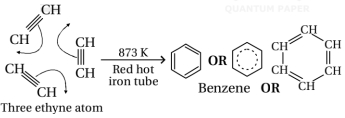
$(b)$ Cyclic polymerization: Ethyne,upon passing through a red-hot iron tube at $873 \ K$,undergoes cyclic polymerization. Three molecules polymerize to form benzene,which is the starting molecule for the preparation of derivatives of benzene,dyes,drugs,and a large number of other organic compounds. This is the best route for converting aliphatic to aromatic compounds.
There are mainly two types of alkyne polymerization: linear polymerization and cyclic polymerization.
$(a)$ Linear polymerization of alkynes: Under suitable conditions,linear polymerization of ethyne takes place to produce polyacetylene or polyethyne,which is a high molecular weight polyene containing repeating units of $[CH=CH-CH=CH]$ and can be represented as $+CH=CH-CH=CH-_{n}$. Under special conditions,this polymer conducts electricity. Thin films of polyacetylene can be used as electrodes in batteries. These films are good conductors,lighter,and cheaper than metal conductors.
$(b)$ Cyclic polymerization: Ethyne,upon passing through a red-hot iron tube at $873 \ K$,undergoes cyclic polymerization. Three molecules polymerize to form benzene,which is the starting molecule for the preparation of derivatives of benzene,dyes,drugs,and a large number of other organic compounds. This is the best route for converting aliphatic to aromatic compounds.
0 likes
View Solution432
Medium
Write the following reactions:
$(1)$ Ethyne $+$ $(Cl_2 \text{ or } Br_2)$
$(2)$ Hydration reaction of but$-1-$yne.
$(1)$ Ethyne $+$ $(Cl_2 \text{ or } Br_2)$
$(2)$ Hydration reaction of but$-1-$yne.
Solution
(N/A) $(i)$ Reaction of ethyne with chlorine in the presence of water:
$HC \equiv CH$ $\xrightarrow{Cl^+ - OH^- (Cl_2 + H_2O)} CHOH = CHCl$ $\xrightarrow{Cl^+ - OH^-} [CH(OH)_2 - CHCl_2]$ $\xrightarrow{-H_2O} CHCl_2CHO$ ($2,2-$dichloroethanal).
$(ii)$ Hydration of but$-1-$yne:
$CH_3CH_2C \equiv CH$ $\xrightarrow{+H_2O, Hg^{2+}, \text{dil. } H_2SO_4} CH_3CH_2C(OH) = CH_2 \rightleftharpoons CH_3CH_2COCH_3$ (butanone).
$HC \equiv CH$ $\xrightarrow{Cl^+ - OH^- (Cl_2 + H_2O)} CHOH = CHCl$ $\xrightarrow{Cl^+ - OH^-} [CH(OH)_2 - CHCl_2]$ $\xrightarrow{-H_2O} CHCl_2CHO$ ($2,2-$dichloroethanal).
$(ii)$ Hydration of but$-1-$yne:
$CH_3CH_2C \equiv CH$ $\xrightarrow{+H_2O, Hg^{2+}, \text{dil. } H_2SO_4} CH_3CH_2C(OH) = CH_2 \rightleftharpoons CH_3CH_2COCH_3$ (butanone).
0 likes
View Solution433
Difficult
Write the following reactions:
$(1)$ Reaction of acetylene with $HCN$.
$(2)$ Hydrogenation of ethyne in the presence of Lindlar catalyst $(Pd, BaSO_4)$.
$(1)$ Reaction of acetylene with $HCN$.
$(2)$ Hydrogenation of ethyne in the presence of Lindlar catalyst $(Pd, BaSO_4)$.
Solution
(N/A) $(1)$ Reaction of acetylene with $HCN$:
$HC \equiv CH + HCN \xrightarrow{Ba(CN)_2} CH_2 = CHCN$ (Acrylonitrile or Vinyl cyanide)
$(2)$ Hydrogenation of ethyne in the presence of Lindlar catalyst:
$HC \equiv CH + H_2 \xrightarrow{Pd, BaSO_4} CH_2 = CH_2$ (Ethene)
$HC \equiv CH + HCN \xrightarrow{Ba(CN)_2} CH_2 = CHCN$ (Acrylonitrile or Vinyl cyanide)
$(2)$ Hydrogenation of ethyne in the presence of Lindlar catalyst:
$HC \equiv CH + H_2 \xrightarrow{Pd, BaSO_4} CH_2 = CH_2$ (Ethene)
0 likes
View Solution434
Medium
Write the following reactions:
$1$. Complete combustion of ethyne in the presence of air.
$2$. Reaction of propyne with alkaline $KMnO_4$.
$1$. Complete combustion of ethyne in the presence of air.
$2$. Reaction of propyne with alkaline $KMnO_4$.
Solution
(N/A) $1$. Complete combustion of ethyne:
$HC \equiv CH + \frac{5}{2} O_2 \rightarrow 2CO_2 + H_2O + 1300 \ kJ$
$2$. Reaction of propyne with alkaline $KMnO_4$:
At $300 \ K$:
$CH_3C \equiv CH \xrightarrow{KMnO_4, Na_2CO_3, H_2O, 300 \ K} CH_3COCOOH$ (Pyruvic acid)
At $380 \ K$:
$CH_3C \equiv CH \xrightarrow{KMnO_4, Na_2CO_3, 380 \ K} CH_3COOH + CO_2$
$HC \equiv CH + \frac{5}{2} O_2 \rightarrow 2CO_2 + H_2O + 1300 \ kJ$
$2$. Reaction of propyne with alkaline $KMnO_4$:
At $300 \ K$:
$CH_3C \equiv CH \xrightarrow{KMnO_4, Na_2CO_3, H_2O, 300 \ K} CH_3COCOOH$ (Pyruvic acid)
At $380 \ K$:
$CH_3C \equiv CH \xrightarrow{KMnO_4, Na_2CO_3, 380 \ K} CH_3COOH + CO_2$
0 likes
View Solution435
Medium
Write the following reaction:
$1$. Ozonolysis of ethyne.
$1$. Ozonolysis of ethyne.
Solution
(N/A) The ozonolysis of ethyne $(CH \equiv CH)$ involves the addition of ozone $(O_3)$ to form an ozonide intermediate,which upon reductive cleavage with zinc $(Zn)$ and water $(H_2O)$ yields glyoxal $(CHO-CHO)$.
The reaction is as follows:
$CH \equiv CH$ $\xrightarrow{+ O_3} \text{Ozonide}$ $\xrightarrow{Zn, H_2O, -ZnO} CHO-CHO$ (Glyoxal)
The reaction is as follows:
$CH \equiv CH$ $\xrightarrow{+ O_3} \text{Ozonide}$ $\xrightarrow{Zn, H_2O, -ZnO} CHO-CHO$ (Glyoxal)
0 likes
View Solution436
Medium
Discuss the types of reactions given by alkynes.
Solution
(N/A) Alkynes undergo the following types of reactions:
$(a)$ Acidic character: Terminal alkynes react with strong bases due to the acidic nature of the terminal hydrogen atom.
$(b)$ Electrophilic addition reactions: Alkynes undergo electrophilic addition with reagents such as $(i)$ $H_{2}$,$(ii)$ $X_{2}$,$(iii)$ $HX$,$(iv)$ $H_{2}O$,$(v)$ $HOX$,$(vi)$ $CH_{3}COOH$,and $(vii)$ $HCN$.
$(c)$ Polymerization reactions: These include $(i)$ Linear polymerization and $(ii)$ Cyclic polymerization.
$(d)$ Oxidation reactions: These include $(i)$ Baeyer's reagent test,$(ii)$ reaction with alkaline $KMnO_{4}$ at high temperatures,$(iii)$ Ozonolysis,and $(iv)$ complete combustion in air.
$(a)$ Acidic character: Terminal alkynes react with strong bases due to the acidic nature of the terminal hydrogen atom.
$(b)$ Electrophilic addition reactions: Alkynes undergo electrophilic addition with reagents such as $(i)$ $H_{2}$,$(ii)$ $X_{2}$,$(iii)$ $HX$,$(iv)$ $H_{2}O$,$(v)$ $HOX$,$(vi)$ $CH_{3}COOH$,and $(vii)$ $HCN$.
$(c)$ Polymerization reactions: These include $(i)$ Linear polymerization and $(ii)$ Cyclic polymerization.
$(d)$ Oxidation reactions: These include $(i)$ Baeyer's reagent test,$(ii)$ reaction with alkaline $KMnO_{4}$ at high temperatures,$(iii)$ Ozonolysis,and $(iv)$ complete combustion in air.
0 likes
View Solution437
Difficult
Provide the chemical reactions for the following conversions:
$(1)$ Propyne from ethyne
$(2)$ $2-$butyne and $1-$butyne from ethyne
$(1)$ Propyne from ethyne
$(2)$ $2-$butyne and $1-$butyne from ethyne
Solution
(N/A) $(1)$ Synthesis of propyne from ethyne:
$HC \equiv CH$ $\xrightarrow{NaNH_2 / NH_3(l)} HC \equiv C^- Na^+$ $\xrightarrow{+CH_3Cl} HC \equiv C-CH_3$ (Propyne)
$(2)$ Synthesis of $1-$butyne and $2-$butyne from ethyne:
$HC \equiv CH$ $\xrightarrow{NaNH_2} HC \equiv C^- Na^+$ $\xrightarrow{+CH_3CH_2Cl} HC \equiv C-CH_2CH_3$ ($1-$butyne)
$HC \equiv CH$ $\xrightarrow{2NaNH_2} Na^+ - C \equiv C^- Na^+$ $\xrightarrow{+2CH_3Cl} CH_3-C \equiv C-CH_3$ ($2-$butyne)
$HC \equiv CH$ $\xrightarrow{NaNH_2 / NH_3(l)} HC \equiv C^- Na^+$ $\xrightarrow{+CH_3Cl} HC \equiv C-CH_3$ (Propyne)
$(2)$ Synthesis of $1-$butyne and $2-$butyne from ethyne:
$HC \equiv CH$ $\xrightarrow{NaNH_2} HC \equiv C^- Na^+$ $\xrightarrow{+CH_3CH_2Cl} HC \equiv C-CH_2CH_3$ ($1-$butyne)
$HC \equiv CH$ $\xrightarrow{2NaNH_2} Na^+ - C \equiv C^- Na^+$ $\xrightarrow{+2CH_3Cl} CH_3-C \equiv C-CH_3$ ($2-$butyne)
0 likes
View Solution438
Medium
Give chemical reactions for the following conversions:
$1$. $2-$bromobutane from $2-$butyne
$2$. $2-$propanol and $1-$propanol from propyne
$1$. $2-$bromobutane from $2-$butyne
$2$. $2-$propanol and $1-$propanol from propyne
Solution
(N/A) $1$. Conversion of $2-$butyne to $2-$bromobutane:
$CH_3-C \equiv C-CH_3$ $\xrightarrow{Pd/C, H_2} CH_3-CH=CH-CH_3$ $\xrightarrow{HBr} CH_3-CH_2-CH(Br)-CH_3$
$2$. Conversion of propyne to $1-$propanol and $2-$propanol:
$CH_3-C \equiv CH \xrightarrow{Pd, H_2} CH_3-CH=CH_2$
$(i)$ For $1-$propanol (Hydroboration-oxidation):
$CH_3-CH=CH_2 \xrightarrow[(ii) H_2O_2, OH^-]{(i) BH_3, THF} CH_3-CH_2-CH_2OH$
(ii) For $2-$propanol (Acid-catalyzed hydration):
$CH_3-CH=CH_2 \xrightarrow{Conc. H_2SO_4, H_2O} CH_3-CH(OH)-CH_3$
$CH_3-C \equiv C-CH_3$ $\xrightarrow{Pd/C, H_2} CH_3-CH=CH-CH_3$ $\xrightarrow{HBr} CH_3-CH_2-CH(Br)-CH_3$
$2$. Conversion of propyne to $1-$propanol and $2-$propanol:
$CH_3-C \equiv CH \xrightarrow{Pd, H_2} CH_3-CH=CH_2$
$(i)$ For $1-$propanol (Hydroboration-oxidation):
$CH_3-CH=CH_2 \xrightarrow[(ii) H_2O_2, OH^-]{(i) BH_3, THF} CH_3-CH_2-CH_2OH$
(ii) For $2-$propanol (Acid-catalyzed hydration):
$CH_3-CH=CH_2 \xrightarrow{Conc. H_2SO_4, H_2O} CH_3-CH(OH)-CH_3$
0 likes
View Solution439
MediumMCQ
An inorganic metal oxide $(A)$ heated with carbon gives compound $(B)$,which on reaction with water gives ethyne. What are the compounds $(A)$ and $(B)$?
A
$A = CaO, B = CaC_2$
B
$A = CaC_2, B = CaO$
C
$A = CO, B = CaO$
D
$A = CO_2, B = CaO$
Solution
(A) The reaction sequence is as follows:
$CaO + 3C \rightarrow CaC_2 + CO$
(Here,$A = CaO$,$B = CaC_2$)
$CaC_2 + 2H_2O \rightarrow Ca(OH)_2 + C_2H_2$ (Ethyne)
Thus,the compound $(A)$ is calcium oxide $(CaO)$ and compound $(B)$ is calcium carbide $(CaC_2)$.
$CaO + 3C \rightarrow CaC_2 + CO$
(Here,$A = CaO$,$B = CaC_2$)
$CaC_2 + 2H_2O \rightarrow Ca(OH)_2 + C_2H_2$ (Ethyne)
Thus,the compound $(A)$ is calcium oxide $(CaO)$ and compound $(B)$ is calcium carbide $(CaC_2)$.
0 likes
View Solution440
MediumMCQ
Two compounds with molecular formula $C_4H_6$ are available. If one of the compounds can react with soda amide $(NaNH_2)$ while the second cannot react with it,identify these two organic compounds.
A
$But-1-yne$ and $But-2-yne$
B
$But-1-ene$ and $But-2-ene$
C
$Butane$ and $Isobutane$
D
$1,3-Butadiene$ and $1,2-Butadiene$
Solution
(A) The molecular formula $C_4H_6$ corresponds to the general formula $C_nH_{2n-2}$,which indicates the presence of an alkyne or a diene.
Terminal alkynes (alkynes with a hydrogen atom attached to the $sp$ hybridized carbon) are acidic and react with strong bases like soda amide $(NaNH_2)$ to form sodium acetylides.
$CH_3-CH_2-C \equiv CH$ $(But-1-yne)$ is a terminal alkyne,so it reacts with $NaNH_2$:
$CH_3-CH_2-C \equiv CH + NaNH_2 \rightarrow CH_3-CH_2-C \equiv CNa + NH_3$
$CH_3-C \equiv C-CH_3$ $(But-2-yne)$ is a non-terminal (internal) alkyne. It lacks an acidic hydrogen on the $sp$ carbon,so it does not react with $NaNH_2$.
Therefore,the two compounds are $But-1-yne$ and $But-2-yne$.
Terminal alkynes (alkynes with a hydrogen atom attached to the $sp$ hybridized carbon) are acidic and react with strong bases like soda amide $(NaNH_2)$ to form sodium acetylides.
$CH_3-CH_2-C \equiv CH$ $(But-1-yne)$ is a terminal alkyne,so it reacts with $NaNH_2$:
$CH_3-CH_2-C \equiv CH + NaNH_2 \rightarrow CH_3-CH_2-C \equiv CNa + NH_3$
$CH_3-C \equiv C-CH_3$ $(But-2-yne)$ is a non-terminal (internal) alkyne. It lacks an acidic hydrogen on the $sp$ carbon,so it does not react with $NaNH_2$.
Therefore,the two compounds are $But-1-yne$ and $But-2-yne$.
0 likes
View Solution441
Difficult
An unknown compound $X$ is an unsaturated hydrocarbon. It reacts with $HgSO_4$ and $H_2SO_4$ to give compound $(B)$. Compound $(B)$ on oxidation gives compound $(C)$. Compound $(C)$ on reaction with $NaOH$ and soda lime gives methane. Identify $A$ (which is $X$),$B$,and $C$ by providing the chemical reactions.
Solution
(N/A) The reaction sequence is as follows:
$1$. $HC \equiv CH$ (Ethyne,$A$) reacts with $HgSO_4 / H_2SO_4$ to form $CH_3CHO$ (Ethanal,$B$).
$2$. $CH_3CHO$ (Ethanal,$B$) on oxidation (using $KMnO_4$) gives $CH_3COOH$ (Ethanoic acid,$C$).
$3$. $CH_3COOH$ (Ethanoic acid,$C$) reacts with $NaOH$ to form $CH_3COONa$ (Sodium ethanoate),which on heating with soda lime $(NaOH + CaO)$ gives $CH_4$ (Methane).
Thus,$A = HC \equiv CH$ (Ethyne),$B = CH_3CHO$ (Ethanal),and $C = CH_3COOH$ (Ethanoic acid).
$1$. $HC \equiv CH$ (Ethyne,$A$) reacts with $HgSO_4 / H_2SO_4$ to form $CH_3CHO$ (Ethanal,$B$).
$2$. $CH_3CHO$ (Ethanal,$B$) on oxidation (using $KMnO_4$) gives $CH_3COOH$ (Ethanoic acid,$C$).
$3$. $CH_3COOH$ (Ethanoic acid,$C$) reacts with $NaOH$ to form $CH_3COONa$ (Sodium ethanoate),which on heating with soda lime $(NaOH + CaO)$ gives $CH_4$ (Methane).
Thus,$A = HC \equiv CH$ (Ethyne),$B = CH_3CHO$ (Ethanal),and $C = CH_3COOH$ (Ethanoic acid).
0 likes
View Solution442
MediumMCQ
Give the reaction for the cyclization of ethyne,or the reaction for passing ethyne through a red-hot iron tube.
A
$3C_2H_2 \xrightarrow{Red \ hot \ Fe \ tube, 873K} C_6H_6$
B
$2C_2H_2 \xrightarrow{Red \ hot \ Fe \ tube, 873K} C_4H_4$
C
$3C_2H_2 \xrightarrow{Red \ hot \ Fe \ tube, 873K} C_6H_6 + 3H_2$
D
$C_2H_2 \xrightarrow{Red \ hot \ Fe \ tube, 873K} C_2H_4$
Solution
(A) When ethyne $(C_2H_2)$ is passed through a red-hot iron tube at $873 \ K$,it undergoes cyclic polymerization.
Three molecules of ethyne condense to form benzene $(C_6H_6)$.
The chemical equation is: $3C_2H_2 \xrightarrow{Red \ hot \ Fe \ tube, 873K} C_6H_6$.
Three molecules of ethyne condense to form benzene $(C_6H_6)$.
The chemical equation is: $3C_2H_2 \xrightarrow{Red \ hot \ Fe \ tube, 873K} C_6H_6$.
0 likes
View Solution443
Easy
What is Lindlar's catalyst? Write its uses.
Solution
(N/A) Lindlar's catalyst is a form of partially deactivated palladium catalyst. It consists of palladium deposited on calcium carbonate $(CaCO_3)$ or barium sulfate $(BaSO_4)$,which is then poisoned with lead acetate or quinoline.
Its primary use is the partial hydrogenation of alkynes to form $cis$-alkenes. This reaction is stereoselective,ensuring the addition of hydrogen occurs on the same side of the triple bond.
Its primary use is the partial hydrogenation of alkynes to form $cis$-alkenes. This reaction is stereoselective,ensuring the addition of hydrogen occurs on the same side of the triple bond.
0 likes
View Solution444
DifficultMCQ
Which reactant is used to prepare trans alkene from alkyne?
A
$Na/NH_3(l)$
B
$H_2/Pd-BaSO_4$
C
$H_2/Ni$
D
$NaBH_4$
Solution
(A) The reduction of an alkyne to a $trans$-alkene is achieved using dissolving metal reduction.
Sodium $(Na)$ metal in liquid ammonia $(NH_3)$ is the specific reagent used for this transformation,known as Birch reduction or dissolving metal reduction.
This reaction proceeds via a radical anion intermediate,which favors the formation of the more stable $trans$-isomer.
Sodium $(Na)$ metal in liquid ammonia $(NH_3)$ is the specific reagent used for this transformation,known as Birch reduction or dissolving metal reduction.
This reaction proceeds via a radical anion intermediate,which favors the formation of the more stable $trans$-isomer.
0 likes
View Solution445
MediumMCQ
Which reactants are used to prepare $cis$ and $trans$ alkenes from alkynes?
A
Lindlar catalyst for $cis$ and $Na/NH_3$ for $trans$
B
Na/NH_3 for $cis$ and Lindlar catalyst for $trans$
C
Pd/$C$ for $cis$ and $H_2/Ni$ for $trans$
D
Only $H_2/Pd$ is used for both
Solution
(A) $(i)$ For making $cis$-alkene,$Lindlar$ catalyst (partially poisoned palladium on charcoal,$Pd/CaCO_3$ or $Pd/BaSO_4$) is used in the presence of $H_2$.
$(ii)$ For making $trans$-alkene,the alkyne is treated with $Na$ metal in the presence of liquid $NH_3$ (Birch reduction).
$(ii)$ For making $trans$-alkene,the alkyne is treated with $Na$ metal in the presence of liquid $NH_3$ (Birch reduction).
0 likes
View Solution446
Medium
Which of the following compounds do not react with $NaNH_2$? Why?
$CH_3-C \equiv C-CH_3, CH_3-CH_2-C \equiv CH, C_2H_5-C \equiv C-C_2H_5, HC \equiv CH, CH_3-CH=CH_2, CH_2=CH-C \equiv CH$
$CH_3-C \equiv C-CH_3, CH_3-CH_2-C \equiv CH, C_2H_5-C \equiv C-C_2H_5, HC \equiv CH, CH_3-CH=CH_2, CH_2=CH-C \equiv CH$
Solution
(A, C, E) $NaNH_2$ is a strong base that reacts with terminal alkynes (alkynes containing an acidic hydrogen atom,i.e.,$R-C \equiv CH$) to form acetylides.
$1$. $CH_3-C \equiv C-CH_3$ (Internal alkyne,no acidic hydrogen)
$2$. $C_2H_5-C \equiv C-C_2H_5$ (Internal alkyne,no acidic hydrogen)
$3$. $CH_3-CH=CH_2$ (Alkene,no acidic hydrogen)
These compounds do not react with $NaNH_2$ because they lack the terminal $-C \equiv CH$ group,which possesses the necessary acidic proton.
$1$. $CH_3-C \equiv C-CH_3$ (Internal alkyne,no acidic hydrogen)
$2$. $C_2H_5-C \equiv C-C_2H_5$ (Internal alkyne,no acidic hydrogen)
$3$. $CH_3-CH=CH_2$ (Alkene,no acidic hydrogen)
These compounds do not react with $NaNH_2$ because they lack the terminal $-C \equiv CH$ group,which possesses the necessary acidic proton.
0 likes
View Solution447
DifficultMCQ
The major product obtained from the following reaction is

A
$O_2N-C_6H_4-CH_2-CO-C_6H_4-OH$
B
$O_2N-C_6H_4-CO-CH_2-C_6H_4-OCH_3$
C
$O_2N-C_6H_4-CH_2-CO-C_6H_4-OCH_3$
D
$O_2N-C_6H_4-CO-CH_2-C_6H_4-OH$
Solution
(C) The reaction of an internal alkyne with $H_2O$ in the presence of $Hg^{2+}/H^+$ is a hydration reaction.
For an unsymmetrical internal alkyne,the regioselectivity is determined by the stability of the intermediate carbocation formed during the electrophilic attack of $Hg^{2+}$.
The $Hg^{2+}$ ion coordinates with the triple bond to form a mercurinium ion.
Water attacks the carbon that can better stabilize the positive charge in the transition state.
The $-OCH_3$ group is electron-donating (via resonance),which stabilizes the positive charge on the adjacent carbon atom more effectively than the electron-withdrawing $-NO_2$ group.
Therefore,the water molecule attacks the carbon atom closer to the $p-methoxyphenyl$ group,leading to the formation of the ketone $O_2N-C_6H_4-CH_2-CO-C_6H_4-OCH_3$.
For an unsymmetrical internal alkyne,the regioselectivity is determined by the stability of the intermediate carbocation formed during the electrophilic attack of $Hg^{2+}$.
The $Hg^{2+}$ ion coordinates with the triple bond to form a mercurinium ion.
Water attacks the carbon that can better stabilize the positive charge in the transition state.
The $-OCH_3$ group is electron-donating (via resonance),which stabilizes the positive charge on the adjacent carbon atom more effectively than the electron-withdrawing $-NO_2$ group.
Therefore,the water molecule attacks the carbon atom closer to the $p-methoxyphenyl$ group,leading to the formation of the ketone $O_2N-C_6H_4-CH_2-CO-C_6H_4-OCH_3$.
0 likes
View Solution448
DifficultMCQ
Identify the structures of $P$ and $Q$ in the following reaction sequence:

A
$P$ = $CH_3O-C_6H_4-C(OH)=CH-C_6H_4-CH_3$,$Q$ = $CH_3O-C_6H_4-C(=O)-CH(Br)-C_6H_4-CH_3$
B
$P$ = $CH_3O-C_6H_4-C(=O)-CH_2-C_6H_4-CH_3$,$Q$ = $CH_3O-C_6H_4-C(=O)-CH_2-C_6H_4-CH_2Br$
C
$P$ = $CH_3O-C_6H_4-C(=O)-CH_2-C_6H_4-CH_3$,$Q$ = $CH_3O-C_6H_4-C(=O)-CH_2-C_6H_3(Br)-CH_3$
D
$P$ = $CH_3O-C_6H_4-C(=O)-CH_2-C_6H_5$,$Q$ = $CH_3O-C_6H_4-C(=O)-CH(Br)-C_6H_5$
Solution
(C) The reaction of an alkyne with $H_2O/H^+/Hg^{2+}$ follows Markovnikov's addition to form an enol,which undergoes keto-enol tautomerization to form a ketone $(P)$.
$P$ is $CH_3O-C_6H_4-C(=O)-CH_2-C_6H_4-CH_3$.
Next,the reaction with $Br_2/FeBr_3$ is an electrophilic aromatic substitution $(EAS)$. The $-C(=O)CH_2Ar$ group is deactivating and meta-directing,while the $-OCH_3$ group is strongly activating and ortho/para-directing. The $-CH_3$ group is weakly activating and ortho/para-directing. The electrophilic substitution will occur on the ring containing the $-CH_3$ group,specifically at the position ortho to the $-CH_3$ group,as it is more activated than the ring with the deactivating carbonyl group. Thus,$Q$ is $CH_3O-C_6H_4-C(=O)-CH_2-C_6H_3(Br)-CH_3$.
$P$ is $CH_3O-C_6H_4-C(=O)-CH_2-C_6H_4-CH_3$.
Next,the reaction with $Br_2/FeBr_3$ is an electrophilic aromatic substitution $(EAS)$. The $-C(=O)CH_2Ar$ group is deactivating and meta-directing,while the $-OCH_3$ group is strongly activating and ortho/para-directing. The $-CH_3$ group is weakly activating and ortho/para-directing. The electrophilic substitution will occur on the ring containing the $-CH_3$ group,specifically at the position ortho to the $-CH_3$ group,as it is more activated than the ring with the deactivating carbonyl group. Thus,$Q$ is $CH_3O-C_6H_4-C(=O)-CH_2-C_6H_3(Br)-CH_3$.
0 likes
View Solution449
MediumMCQ
$Ph-CH_2-CH=CH-CH_3$ $\xrightarrow[(ii) \text{ Alc. KOH}]{(i) \text{ } Br_2}$ ?
A
$Ph-CH=CH-CH=CH_2$
B
$Ph-CH_2-CH(OH)-CH(OH)-CH_3$
C
$Ph-CH_2-C \equiv C-CH_3$
D
$Ph-C \equiv C-CH_2-CH_3$
Solution
(C) Step $1$: The reaction of an alkene with $Br_2$ (bromination) results in the formation of a vicinal dibromide.
$Ph-CH_2-CH=CH-CH_3 + Br_2 \rightarrow Ph-CH_2-CH(Br)-CH(Br)-CH_3$
Step $2$: Treatment of the vicinal dibromide with alcoholic $KOH$ (a strong base) leads to dehydrohalogenation via an $E2$ mechanism,resulting in the formation of an alkyne.
$Ph-CH_2-CH(Br)-CH(Br)-CH_3 \xrightarrow{\text{Alc. KOH}} Ph-CH_2-C \equiv C-CH_3 + 2HBr$
Thus,the final product is $Ph-CH_2-C \equiv C-CH_3$.
$Ph-CH_2-CH=CH-CH_3 + Br_2 \rightarrow Ph-CH_2-CH(Br)-CH(Br)-CH_3$
Step $2$: Treatment of the vicinal dibromide with alcoholic $KOH$ (a strong base) leads to dehydrohalogenation via an $E2$ mechanism,resulting in the formation of an alkyne.
$Ph-CH_2-CH(Br)-CH(Br)-CH_3 \xrightarrow{\text{Alc. KOH}} Ph-CH_2-C \equiv C-CH_3 + 2HBr$
Thus,the final product is $Ph-CH_2-C \equiv C-CH_3$.
0 likes
View Solution450
MediumMCQ
$CH_{3}-C \equiv CH$ $\xrightarrow{2 HBr}$ $\xrightarrow{H_{2}O} \text{Product}$. The product is:
A
$CH_{3}-CH(OH)-CH_{3}$
B
$CH_{3}-C(=O)-CH_{3}$
C
$CH_{3}-CH_{2}-CHO$
D
$CH_{3}-CH(OH)-CH_{2}OH$
Solution
(B) The reaction proceeds as follows:
$1$. Addition of $2 \text{ moles}$ of $HBr$ to propyne $(CH_{3}-C \equiv CH)$ follows Markovnikov's rule,resulting in the formation of a geminal dibromide: $CH_{3}-C(Br)_{2}-CH_{3}$.
$2$. Hydrolysis of the geminal dibromide with $H_{2}O$ replaces the bromine atoms with hydroxyl groups,forming a geminal diol (gem-diol): $CH_{3}-C(OH)_{2}-CH_{3}$.
$3$. Gem-diols are unstable and lose a molecule of water to form a ketone: $CH_{3}-C(OH)_{2}-CH_{3} \rightarrow CH_{3}-C(=O)-CH_{3} + H_{2}O$.
Therefore,the final product is acetone $(CH_{3}-C(=O)-CH_{3})$.
$1$. Addition of $2 \text{ moles}$ of $HBr$ to propyne $(CH_{3}-C \equiv CH)$ follows Markovnikov's rule,resulting in the formation of a geminal dibromide: $CH_{3}-C(Br)_{2}-CH_{3}$.
$2$. Hydrolysis of the geminal dibromide with $H_{2}O$ replaces the bromine atoms with hydroxyl groups,forming a geminal diol (gem-diol): $CH_{3}-C(OH)_{2}-CH_{3}$.
$3$. Gem-diols are unstable and lose a molecule of water to form a ketone: $CH_{3}-C(OH)_{2}-CH_{3} \rightarrow CH_{3}-C(=O)-CH_{3} + H_{2}O$.
Therefore,the final product is acetone $(CH_{3}-C(=O)-CH_{3})$.
0 likes
View SolutionHydrocarbons — Alkyne · Frequently Asked Questions
1Are these Hydrocarbons questions useful for JEE and NEET?
Yes. All questions in this section are mapped to JEE Main and NEET exam patterns. Previous year questions from JEE Main, NEET, GUJCET and state-level exams are included with full solutions.
2Can I switch to Hindi or Gujarati for these questions?
Yes. Use the language tabs in the hero section or the sidebar to view the same questions and solutions in English, Hindi or Gujarati.
3How do I generate a question paper from this subtopic?
Use the Vedclass Exam Paper Generator — select the chapter and subtopic, set difficulty, and generate Sets A, B, C, D automatically. First 3 chapters of every subject are free.
Vedclass Products
For Students
Vedclass Test Series
Mock tests in real JEE/NEET style with performance analysis. 5-day free trial.
Start Free TrialFor Teachers
Exam Paper Generator
Generate Set A/B/C/D papers from this chapter in 2 minutes. 3 chapters free.
Try FreeFor Institutes
Online Exam Module
Live online exams with unlimited students, 360° analytics & white-label branding.
See DemoFor Teachers & Institutes
Generate a Hydrocarbons Exam Paper in 2 Minutes
Select subtopic & difficulty — Sets A, B, C, D auto-generated with No Repeat logic.
First 3 chapters of every subject are free — no payment required.