
A English
Alkyne Questions in English
Class 11 Chemistry · Hydrocarbons · Alkyne
545+
Questions
English
Language
100%
With Solutions
Showing 41 of 545 questions in English
501
EasyMCQ
The aqueous solution of an organic compound '$A$' on electrolysis liberates acetylene and $CO_2$ at the anode. '$A$' is:
A
potassium acetate
B
potassium succinate
C
potassium citrate
D
potassium maleate
Solution
(D) The electrolysis of the aqueous solution of potassium salts of dicarboxylic acids is known as the Kolbe's electrolytic synthesis.
For the preparation of acetylene $(C_2H_2)$,potassium maleate or potassium fumarate is used.
The reaction is as follows:
$CHCOOK=CHCOOK + 2H_2O \xrightarrow{\text{electrolysis}} CH \equiv CH + 2CO_2 + 2KOH + H_2$
At the anode,acetylene and $CO_2$ are liberated.
Therefore,the compound '$A$' is potassium maleate.
For the preparation of acetylene $(C_2H_2)$,potassium maleate or potassium fumarate is used.
The reaction is as follows:
$CHCOOK=CHCOOK + 2H_2O \xrightarrow{\text{electrolysis}} CH \equiv CH + 2CO_2 + 2KOH + H_2$
At the anode,acetylene and $CO_2$ are liberated.
Therefore,the compound '$A$' is potassium maleate.
0 likes
View Solution502
MediumMCQ
The product formed when a hydrocarbon '$X$' of molecular formula $C_6H_{10}$ is reacted with sodamide is subjected to ozonolysis,followed by hydrolysis with $Zn / H_2O_2$,and upon further oxidation gave two carboxylic acids,of which one is optically active. The hydrocarbon '$X$' is
A
$Hex-1-yne$
B
$Hex-3-yne$
C
$3-Methylpent-1-yne$
D
$3,3-Dimethylbut-1-yne$
Solution
(C) The hydrocarbon '$X$' reacts with sodamide $(NaNH_2)$,which indicates that '$X$' is a terminal alkyne.
Ozonolysis of a terminal alkyne followed by oxidative workup ($O_3$ followed by $Zn/H_2O_2$ or $H_2O_2$) leads to the cleavage of the triple bond to form a carboxylic acid and formic acid $(HCOOH)$.
For one of the products to be optically active,the carboxylic acid formed from the alkyl group must contain a chiral center.
Starting with $3-Methylpent-1-yne$ $(CH_3CH_2CH(CH_3)C \equiv CH)$:
$CH_3CH_2CH(CH_3)C \equiv CH \xrightarrow{O_3, H_2O_2} CH_3CH_2CH(CH_3)COOH + HCOOH$.
$2-Methylbutanoic acid$ $(CH_3CH_2CH(CH_3)COOH)$ contains a chiral carbon at the $C-2$ position,making it optically active.
Ozonolysis of a terminal alkyne followed by oxidative workup ($O_3$ followed by $Zn/H_2O_2$ or $H_2O_2$) leads to the cleavage of the triple bond to form a carboxylic acid and formic acid $(HCOOH)$.
For one of the products to be optically active,the carboxylic acid formed from the alkyl group must contain a chiral center.
Starting with $3-Methylpent-1-yne$ $(CH_3CH_2CH(CH_3)C \equiv CH)$:
$CH_3CH_2CH(CH_3)C \equiv CH \xrightarrow{O_3, H_2O_2} CH_3CH_2CH(CH_3)COOH + HCOOH$.
$2-Methylbutanoic acid$ $(CH_3CH_2CH(CH_3)COOH)$ contains a chiral carbon at the $C-2$ position,making it optically active.
0 likes
View Solution503
MediumMCQ
The correct order of acidic nature of the following alkynes is:
$I$. $HC \equiv CH$
$II$. $CH_3-C \equiv C-CH_3$
$III$. $CH_3-C \equiv CH$
$I$. $HC \equiv CH$
$II$. $CH_3-C \equiv C-CH_3$
$III$. $CH_3-C \equiv CH$
A
$I < III < II$
B
$II < III < I$
C
$III < II < I$
D
$II < I < III$
Solution
(B) The acidity of alkynes depends on the stability of the conjugate base formed after the removal of the acidic proton.
Terminal alkynes ($I$ and $III$) have an acidic hydrogen atom attached to an $sp$-hybridized carbon,whereas internal alkynes $(II)$ do not have any acidic hydrogen.
Compound $(II)$ $(CH_3-C \equiv C-CH_3)$ has no acidic hydrogen,so it is the least acidic.
Between $(I)$ $(HC \equiv CH)$ and $(III)$ $(CH_3-C \equiv CH)$,the methyl group in $(III)$ exerts a $(+I)$ effect,which destabilizes the conjugate base (alkynide ion).
Therefore,the stability of the conjugate base follows the order: $HC \equiv C^- > CH_3-C \equiv C^-$.
Thus,the correct order of acidity is: $II < III < I$.
Terminal alkynes ($I$ and $III$) have an acidic hydrogen atom attached to an $sp$-hybridized carbon,whereas internal alkynes $(II)$ do not have any acidic hydrogen.
Compound $(II)$ $(CH_3-C \equiv C-CH_3)$ has no acidic hydrogen,so it is the least acidic.
Between $(I)$ $(HC \equiv CH)$ and $(III)$ $(CH_3-C \equiv CH)$,the methyl group in $(III)$ exerts a $(+I)$ effect,which destabilizes the conjugate base (alkynide ion).
Therefore,the stability of the conjugate base follows the order: $HC \equiv C^- > CH_3-C \equiv C^-$.
Thus,the correct order of acidity is: $II < III < I$.
0 likes
View Solution504
MediumMCQ
The gaseous mixture used for welding of metals is
A
$C_2H_4, O_2$
B
$C_4H_{10}, O_2$
C
$C_2H_2, N_2$
D
$C_2H_2, O_2$
Solution
(D) The mixture of acetylene $(C_2H_2)$ and oxygen $(O_2)$ is used for oxy-acetylene welding.
This mixture produces a flame with a very high temperature,which is sufficient for cutting and welding metals effectively.
This mixture produces a flame with a very high temperature,which is sufficient for cutting and welding metals effectively.
0 likes
View Solution505
MediumMCQ
Which reaction among the following will yield $2,2-$dibromopropane?
A
$CH_3-C \equiv CH + 2 HBr \longrightarrow$
B
$CH_3-CH=CHBr + HBr \longrightarrow$
C
$CH \equiv CH + 2 HBr \longrightarrow$
D
$CH_3-CH=CH_2 + HBr \longrightarrow$
Solution
(A) The reaction of propyne $(CH_3-C \equiv CH)$ with two equivalents of hydrogen bromide $(HBr)$ follows Markovnikov's rule.
In the first step,$HBr$ adds to the triple bond to form $2-$bromopropene $(CH_3-C(Br)=CH_2)$.
In the second step,another molecule of $HBr$ adds to the double bond,again following Markovnikov's rule,to form $2,2-$dibromopropane $(CH_3-C(Br)_2-CH_3)$.
Therefore,the reaction $CH_3-C \equiv CH + 2 HBr \longrightarrow CH_3-C(Br)_2-CH_3$ is the correct one.
In the first step,$HBr$ adds to the triple bond to form $2-$bromopropene $(CH_3-C(Br)=CH_2)$.
In the second step,another molecule of $HBr$ adds to the double bond,again following Markovnikov's rule,to form $2,2-$dibromopropane $(CH_3-C(Br)_2-CH_3)$.
Therefore,the reaction $CH_3-C \equiv CH + 2 HBr \longrightarrow CH_3-C(Br)_2-CH_3$ is the correct one.
0 likes
View Solution506
MediumMCQ
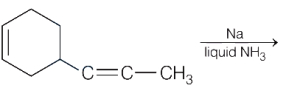
The product formed in the above reaction is
A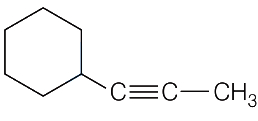
B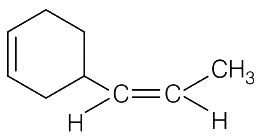
C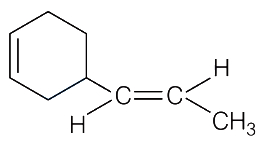
D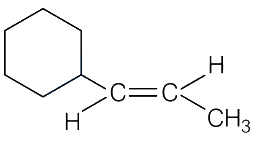
Solution
(D) The reaction of an alkyne with sodium in liquid ammonia $(Na/Liq. NH_3)$ is known as Birch reduction,which results in the stereoselective anti-addition of hydrogen to the triple bond to form a $trans$-alkene. The double bond present in the cyclohexene ring remains unaffected under these conditions. Therefore,the product is a $trans$-alkene. Thus,option $(D)$ is correct.
0 likes
View Solution507
EasyMCQ
Propyne reacts with excess $HBr$ to form the compound $Z$. The structure of $Z$ is:
A
$CH_2(Br)CH_2CH_2Br$
B
$CH_3CH_2CHBr_2$
C
$CH_3CH(Br)CH_2Br$
D
$CH_3CBr_2CH_3$
Solution
(D) The reaction of propyne $(CH_3-C \equiv CH)$ with excess $HBr$ follows Markovnikov's rule.
In the first step,$HBr$ adds across the triple bond to form $2-$bromopropene $(CH_3-C(Br)=CH_2)$.
In the second step,another molecule of $HBr$ adds to the alkene following Markovnikov's rule,where the hydrogen atom attaches to the carbon with more hydrogens and the bromine atom attaches to the more substituted carbon.
This results in the formation of $2,2-$dibromopropane $(CH_3-CBr_2-CH_3)$.
In the first step,$HBr$ adds across the triple bond to form $2-$bromopropene $(CH_3-C(Br)=CH_2)$.
In the second step,another molecule of $HBr$ adds to the alkene following Markovnikov's rule,where the hydrogen atom attaches to the carbon with more hydrogens and the bromine atom attaches to the more substituted carbon.
This results in the formation of $2,2-$dibromopropane $(CH_3-CBr_2-CH_3)$.
0 likes
View Solution508
EasyMCQ
What are $X$ and $Y$ respectively in the following reactions?
$X + 2D_2O \rightarrow C_2D_2 + P$
$Y + 12D_2O \rightarrow 3CD_4 + Q$
$X + 2D_2O \rightarrow C_2D_2 + P$
$Y + 12D_2O \rightarrow 3CD_4 + Q$
A
$AlCl_3, CaCl_2$
B
$Be_2C, Al_4C_3$
C
$Al_4C_3, CaC_2$
D
$CaC_2, Al_4C_3$
Solution
(D) $C_2D_2$ is deuteroacetylene and $CD_4$ is deuteromethane. These compounds are prepared by the deuterolysis of specific carbides.
$CaC_2$ is a calcium acetylide which reacts with $D_2O$ to produce $C_2D_2$ (deuteroacetylene).
$CaC_2 + 2D_2O \rightarrow C_2D_2 + Ca(OD)_2$
$Al_4C_3$ is an aluminum methanide which reacts with $D_2O$ to produce $CD_4$ (deuteromethane).
$Al_4C_3 + 12D_2O \rightarrow 3CD_4 + 4Al(OD)_3$
Thus,$X = CaC_2$ and $Y = Al_4C_3$.
$CaC_2$ is a calcium acetylide which reacts with $D_2O$ to produce $C_2D_2$ (deuteroacetylene).
$CaC_2 + 2D_2O \rightarrow C_2D_2 + Ca(OD)_2$
$Al_4C_3$ is an aluminum methanide which reacts with $D_2O$ to produce $CD_4$ (deuteromethane).
$Al_4C_3 + 12D_2O \rightarrow 3CD_4 + 4Al(OD)_3$
Thus,$X = CaC_2$ and $Y = Al_4C_3$.
0 likes
View Solution509
MediumMCQ
Calcium carbide $+ D_2 O \longrightarrow \underline{X} + Ca(OD)_2$.
The hybridisation of carbon atom$(s)$ in $X$ is:
The hybridisation of carbon atom$(s)$ in $X$ is:
A
$sp^2$
B
$sp$
C
$sp^3$
D
$dsp^2$
Solution
(B) The chemical reaction is: $CaC_2 + 2 D_2 O \longrightarrow C_2 D_2 + Ca(OD)_2$.
Here,$X$ is $C_2 D_2$ (deuteroacetylene).
The structure of $C_2 D_2$ is $D-C \equiv C-D$.
Since each carbon atom is bonded to one deuterium atom by a single bond and to the other carbon atom by a triple bond,each carbon atom is $sp$ hybridized.
Here,$X$ is $C_2 D_2$ (deuteroacetylene).
The structure of $C_2 D_2$ is $D-C \equiv C-D$.
Since each carbon atom is bonded to one deuterium atom by a single bond and to the other carbon atom by a triple bond,each carbon atom is $sp$ hybridized.
0 likes
View Solution510
MediumMCQ
What is the major product '$C$' in the following sequence of reactions?
$CH_3CHBr_2$ $\xrightarrow[\text{(ii) } NaNH_2]{\text{(i) alcohol } / KOH} A$ $\xrightarrow[\text{333 } K]{Hg^{2+}, H_2O} B \rightleftharpoons C$
$CH_3CHBr_2$ $\xrightarrow[\text{(ii) } NaNH_2]{\text{(i) alcohol } / KOH} A$ $\xrightarrow[\text{333 } K]{Hg^{2+}, H_2O} B \rightleftharpoons C$
A
Vinyl alcohol
B
Acetone
C
Propen$-2-$ol
D
Acetaldehyde
Solution
(D) $1$. The reaction of $CH_3CHBr_2$ with alcoholic $KOH$ followed by $NaNH_2$ leads to the formation of acetylene $(HC \equiv CH)$,which is represented as $A$ in the reaction sequence.
$2$. The hydration of acetylene in the presence of $Hg^{2+}$ and $H_2O$ at $333 \ K$ yields vinyl alcohol $(CH_2=CH-OH)$ as an intermediate $(B)$.
$3$. Vinyl alcohol is unstable and undergoes tautomerization to form the more stable keto form,which is acetaldehyde $(CH_3CHO)$,represented as $C$.
$2$. The hydration of acetylene in the presence of $Hg^{2+}$ and $H_2O$ at $333 \ K$ yields vinyl alcohol $(CH_2=CH-OH)$ as an intermediate $(B)$.
$3$. Vinyl alcohol is unstable and undergoes tautomerization to form the more stable keto form,which is acetaldehyde $(CH_3CHO)$,represented as $C$.
0 likes
View Solution511
MediumMCQ
$C_3H_4 + H_2O \xrightarrow[333 \ K]{Hg^{2+} / H^{+}} [X] \rightleftharpoons{\text{Tautomerisation}} Y$
$X$ and $Y$ are respectively
$X$ and $Y$ are respectively
A
unsaturated alcohol,aldehyde
B
saturated alcohol,ketone
C
unsaturated alcohol,ketone
D
saturated alcohol,aldehyde
Solution
(C) The reaction of propyne $(C_3H_4)$ with water in the presence of $Hg^{2+} / H^{+}$ at $333 \ K$ is an electrophilic addition reaction.
First,the hydration of the alkyne leads to the formation of an unstable enol intermediate,$[X]$,which is prop$-1-$en$-2-$ol (an unsaturated alcohol).
This enol $[X]$ then undergoes tautomerisation to form a more stable keto form,$[Y]$,which is propanone (a ketone).
Therefore,$[X]$ is an unsaturated alcohol and $[Y]$ is a ketone.
First,the hydration of the alkyne leads to the formation of an unstable enol intermediate,$[X]$,which is prop$-1-$en$-2-$ol (an unsaturated alcohol).
This enol $[X]$ then undergoes tautomerisation to form a more stable keto form,$[Y]$,which is propanone (a ketone).
Therefore,$[X]$ is an unsaturated alcohol and $[Y]$ is a ketone.
0 likes
View Solution512
DifficultMCQ
Identify the alkyne in the following sequence of reactions:
Alkyne $\xrightarrow{\text{H}_2, \text{Lindlar's catalyst}} A$ $\xrightarrow{\text{Ozonolysis}} B \text{ (only)}$
Given that $B$ is obtained from $\text{CH}_2=\text{CH}_2$ via the Wacker process.
Alkyne $\xrightarrow{\text{H}_2, \text{Lindlar's catalyst}} A$ $\xrightarrow{\text{Ozonolysis}} B \text{ (only)}$
Given that $B$ is obtained from $\text{CH}_2=\text{CH}_2$ via the Wacker process.
A
$H_3C-C \equiv C-CH_3$
B
$H_3C-CH_2-C \equiv CH$
C
$H_2C=CH-C \equiv CH$
D
$HC \equiv C-CH_2-C \equiv CH$
Solution
(A) $1$. The Wacker process converts ethene $(\text{CH}_2=\text{CH}_2)$ to ethanal $(\text{CH}_3\text{CHO})$,so $B$ is $\text{CH}_3\text{CHO}$.
$2$. Ozonolysis of an alkene $A$ yields $B$ (ethanal). Since $A \xrightarrow{\text{O}_3} 2 \text{CH}_3\text{CHO}$,$A$ must be but$-2-$ene $(\text{CH}_3\text{CH}=\text{CHCH}_3)$.
$3$. The alkyne is reduced to $A$ (cis-but$-2-$ene) using Lindlar's catalyst. Therefore,the starting alkyne is but$-2-$yne $(\text{CH}_3\text{C} \equiv \text{CCH}_3)$.
$2$. Ozonolysis of an alkene $A$ yields $B$ (ethanal). Since $A \xrightarrow{\text{O}_3} 2 \text{CH}_3\text{CHO}$,$A$ must be but$-2-$ene $(\text{CH}_3\text{CH}=\text{CHCH}_3)$.
$3$. The alkyne is reduced to $A$ (cis-but$-2-$ene) using Lindlar's catalyst. Therefore,the starting alkyne is but$-2-$yne $(\text{CH}_3\text{C} \equiv \text{CCH}_3)$.
0 likes
View Solution513
MediumMCQ
The reagent used for converting acetylene to oxalic acid is
A
$HgSO_4 / \text{aqueous } H_2SO_4$
B
$HgSO_4 / CH_3COOH$
C
$KMnO_4 / KOH, 25^{\circ}C$
D
$Cr_2O_3 / H_2SO_4$
Solution
(C) Acetylene $(HC \equiv CH)$ undergoes oxidation in the presence of alkaline potassium permanganate $(KMnO_4 / KOH)$ at $25^{\circ}C$ to form oxalic acid $(HOOC-COOH)$.
The reaction is represented as:
$HC \equiv CH + 4[O] \xrightarrow{KMnO_4 / KOH, 25^{\circ}C} HOOC-COOH$
The reaction is represented as:
$HC \equiv CH + 4[O] \xrightarrow{KMnO_4 / KOH, 25^{\circ}C} HOOC-COOH$
0 likes
View Solution514
MediumMCQ
The correct order of acidity of the following compounds is
| $I. CH_3-C \equiv CH$ |
| $II. F_3C-C \equiv CH$ |
| $III. CH_3-C \equiv C-CH_3$ |
| $IV. CH_3-CH=CH-CH_3$ |
A
$I > II > III > IV$
B
$I > III > II > IV$
C
$II > III > I > IV$
D
$II > I > III > IV$
Solution
(D) Acidity depends on the stability of the conjugate base formed after the removal of a proton. The stability of the conjugate base is increased by electron-withdrawing groups ($-I$ effect) and decreased by electron-donating groups ($+I$ effect).
$1$. In compound $II$,the $F_3C-$ group exerts a strong $-I$ effect,making it the most acidic.
$2$. In compound $I$,the terminal alkyne hydrogen is acidic due to the $sp$ hybridized carbon.
$3$. Compound $III$ is an internal alkyne with no acidic protons (no $C-H$ bond on the triple-bonded carbons),but if we consider the acidity of the $CH_3$ protons,they are less acidic than terminal alkynes.
$4$. Compound $IV$ is an alkene,which is the least acidic among the given options.
Thus,the correct order of acidity is $II > I > III > IV$.
$1$. In compound $II$,the $F_3C-$ group exerts a strong $-I$ effect,making it the most acidic.
$2$. In compound $I$,the terminal alkyne hydrogen is acidic due to the $sp$ hybridized carbon.
$3$. Compound $III$ is an internal alkyne with no acidic protons (no $C-H$ bond on the triple-bonded carbons),but if we consider the acidity of the $CH_3$ protons,they are less acidic than terminal alkynes.
$4$. Compound $IV$ is an alkene,which is the least acidic among the given options.
Thus,the correct order of acidity is $II > I > III > IV$.
0 likes
View Solution515
MediumMCQ
For a molecular formula of $C_6H_{10}$ of an alkyne series,the number of possible branched isomers is
A
$2$
B
$3$
C
$4$
D
$5$
Solution
(C) The molecular formula $C_6H_{10}$ corresponds to an alkyne with $6$ carbon atoms. The branched isomers are those that do not have a straight chain of $6$ carbons. The possible branched isomers are:
$1$. $3-\text{methyl}-1-\text{pentyne}$ $(CH_3-CH_2-CH(CH_3)-C \equiv CH)$
$2$. $4-\text{methyl}-1-\text{pentyne}$ $(CH_3-CH(CH_3)-CH_2-C \equiv CH)$
$3$. $3-\text{methyl}-2-\text{pentyne}$ $(CH_3-CH_2-C(CH_3)-C \equiv C-CH_3)$
$4$. $3,3-\text{dimethyl}-1-\text{butyne}$ $((CH_3)_2C(C \equiv CH)-CH_3)$
Thus,there are $4$ possible branched isomers.
$1$. $3-\text{methyl}-1-\text{pentyne}$ $(CH_3-CH_2-CH(CH_3)-C \equiv CH)$
$2$. $4-\text{methyl}-1-\text{pentyne}$ $(CH_3-CH(CH_3)-CH_2-C \equiv CH)$
$3$. $3-\text{methyl}-2-\text{pentyne}$ $(CH_3-CH_2-C(CH_3)-C \equiv C-CH_3)$
$4$. $3,3-\text{dimethyl}-1-\text{butyne}$ $((CH_3)_2C(C \equiv CH)-CH_3)$
Thus,there are $4$ possible branched isomers.
0 likes
View Solution516
MediumMCQ
The following reaction is an example of a ....... reaction: $CH_2Br-CH_2Br + 2KOH (alc.) \xrightarrow{\Delta} CH \equiv CH + 2KBr + 2H_2O$
A
addition
B
dehydrobromination
C
substitution
D
debromination
Solution
(B) The given reaction is the reaction of ethylene dibromide with alcoholic $KOH$ to form acetylene.
In this reaction,two molecules of $HBr$ are removed from the vicinal dihalide,which is known as dehydrobromination (a type of dehydrohalogenation).
In this reaction,two molecules of $HBr$ are removed from the vicinal dihalide,which is known as dehydrobromination (a type of dehydrohalogenation).
0 likes
View Solution517
EasyMCQ
The major products $P$ and $Q$ in the following reactions,respectively,are:
$H_3C-C \equiv C-CH_2CH_3 \xrightarrow{H_2, \text{Lindlar's Catalyst}} P$
$H_3C-C \equiv C-CH_2CH_3 \xrightarrow{Na/\text{liquid } NH_3} Q$
$H_3C-C \equiv C-CH_2CH_3 \xrightarrow{H_2, \text{Lindlar's Catalyst}} P$
$H_3C-C \equiv C-CH_2CH_3 \xrightarrow{Na/\text{liquid } NH_3} Q$
A
Alkene (cis) Alkene (cis)
B
Alkane Alkene (trans)
C
Alkene (cis) Alkene (trans)
D
Alkene (trans) Alkene (trans)
Solution
(C) $1$. The reaction of an alkyne with $H_2$ in the presence of Lindlar's catalyst (poisoned $Pd/CaCO_3$) is a syn-addition,which yields a (cis)-alkene as the major product $P$.
$2$. The reaction of an alkyne with $Na$ in liquid $NH_3$ (Birch reduction) is an anti-addition,which yields a (trans)-alkene as the major product $Q$.
$3$. Therefore,$P$ is (cis)-alkene and $Q$ is (trans)-alkene.
$2$. The reaction of an alkyne with $Na$ in liquid $NH_3$ (Birch reduction) is an anti-addition,which yields a (trans)-alkene as the major product $Q$.
$3$. Therefore,$P$ is (cis)-alkene and $Q$ is (trans)-alkene.
0 likes
View Solution518
EasyMCQ
Aqueous solution of an organic compound,'$A$' on electrolysis liberates acetylene and $CO_2$ at anode. '$A$' is
A
potassium acetate
B
potassium succinate
C
potassium citrate
D
potassium maleate
Solution
(D) The electrolysis of aqueous solutions of salts of dicarboxylic acids is known as Kolbe's electrolysis.
For the preparation of acetylene $(C_2H_2)$,potassium maleate or potassium fumarate is used.
The reaction is as follows:
$CHCOOK=CHCOOK + 2H_2O \xrightarrow{\text{electrolysis}} CH \equiv CH + 2CO_2 + 2KOH + H_2$
At the anode,acetylene and $CO_2$ are liberated.
Therefore,'$A$' is potassium maleate.
For the preparation of acetylene $(C_2H_2)$,potassium maleate or potassium fumarate is used.
The reaction is as follows:
$CHCOOK=CHCOOK + 2H_2O \xrightarrow{\text{electrolysis}} CH \equiv CH + 2CO_2 + 2KOH + H_2$
At the anode,acetylene and $CO_2$ are liberated.
Therefore,'$A$' is potassium maleate.
0 likes
View Solution519
MediumMCQ
What are $X$ and $Y$ respectively in the following reaction?
$Z$-product $\stackrel{Y}{\longleftarrow} 2$-butyne $\stackrel{X}{\longrightarrow} E$-product
$Z$-product $\stackrel{Y}{\longleftarrow} 2$-butyne $\stackrel{X}{\longrightarrow} E$-product
A
$Na / NH_3$ (liq.) and $Pd / BaSO_4 + H_2$
B
$Ni / 140^{\circ} C$ and $Pd / BaSO_4 + H_2$
C
$Ni / 140^{\circ} C$ and $Na / NH_3$ (liq.)
D
$Pd / BaSO_4 + H_2$ and $Na / NH_3$ (liq.)
Solution
(A) The reduction of $2$-butyne with $Na / NH_3$ (liq.) (Birch reduction) yields the $E$-product (trans$-2-$butene) due to anti-addition of hydrogen.
Conversely,the catalytic hydrogenation of $2$-butyne using Lindlar's catalyst $(Pd / BaSO_4 + H_2)$ yields the $Z$-product (cis$-2-$butene) due to syn-addition of hydrogen.
Given the reaction scheme:
$Z$-product $\stackrel{Y}{\longleftarrow} 2$-butyne $\stackrel{X}{\longrightarrow} E$-product
$X$ must be $Na / NH_3$ (liq.) and $Y$ must be $Pd / BaSO_4 + H_2$.
Conversely,the catalytic hydrogenation of $2$-butyne using Lindlar's catalyst $(Pd / BaSO_4 + H_2)$ yields the $Z$-product (cis$-2-$butene) due to syn-addition of hydrogen.
Given the reaction scheme:
$Z$-product $\stackrel{Y}{\longleftarrow} 2$-butyne $\stackrel{X}{\longrightarrow} E$-product
$X$ must be $Na / NH_3$ (liq.) and $Y$ must be $Pd / BaSO_4 + H_2$.
0 likes
View Solution520
MediumMCQ
An alkyne has the molecular formula $C_6H_{10}$. The number of $1$-alkyne isomers (excluding stereoisomers) possible for it is
A
$2$
B
$5$
C
$3$
D
$4$
Solution
(D) The general formula for an alkyne is $C_nH_{2n-2}$. For $C_6H_{10}$,$n=6$.
$1$-alkynes have the triple bond at the terminal position,represented as $R-C \equiv CH$.
For a $6$-carbon chain,the possible structures for $1$-alkynes are:
$1$. $CH_3-CH_2-CH_2-CH_2-C \equiv CH$ $(hex-1-yne)$
$2$. $CH_3-CH_2-CH(CH_3)-C \equiv CH$ $(3-methylpent-1-yne)$
$3$. $CH_3-CH(CH_3)-CH_2-C \equiv CH$ $(4-methylpent-1-yne)$
$4$. $(CH_3)_3C-C \equiv CH$ $(3,3-dimethylbut-1-yne)$
Thus,there are $4$ possible isomers for $1$-alkyne.
$1$-alkynes have the triple bond at the terminal position,represented as $R-C \equiv CH$.
For a $6$-carbon chain,the possible structures for $1$-alkynes are:
$1$. $CH_3-CH_2-CH_2-CH_2-C \equiv CH$ $(hex-1-yne)$
$2$. $CH_3-CH_2-CH(CH_3)-C \equiv CH$ $(3-methylpent-1-yne)$
$3$. $CH_3-CH(CH_3)-CH_2-C \equiv CH$ $(4-methylpent-1-yne)$
$4$. $(CH_3)_3C-C \equiv CH$ $(3,3-dimethylbut-1-yne)$
Thus,there are $4$ possible isomers for $1$-alkyne.
0 likes
View Solution521
MediumMCQ
For the alkyne with formula $C_6H_{10}$,the number of alkynes with acidic hydrogens is $x$ and the number of alkynes with no acidic hydrogens is $y$. $x$ and $y$ are respectively:
A
$2, 5$
B
$3, 4$
C
$4, 3$
D
$5, 2$
Solution
(C) An alkyne has acidic hydrogen if it is a terminal alkyne (triple bond at the end of the chain,$R-C \equiv CH$).
For the formula $C_6H_{10}$,the possible isomers are:
$1$. $Hex-1-yne$ $(CH_3CH_2CH_2CH_2C \equiv CH)$ - Terminal (Acidic)
$2$. $3-Methylpent-1-yne$ $(CH_3CH_2CH(CH_3)C \equiv CH)$ - Terminal (Acidic)
$3$. $4-Methylpent-1-yne$ $(CH_3CH(CH_3)CH_2C \equiv CH)$ - Terminal (Acidic)
$4$. $3,3-Dimethylbut-1-yne$ $((CH_3)_3CC \equiv CH)$ - Terminal (Acidic)
These $4$ isomers are terminal alkynes,so $x = 4$.
Non-terminal (internal) alkynes have no acidic hydrogens:
$1$. $Hex-2-yne$ $(CH_3CH_2CH_2C \equiv CCH_3)$
$2$. $Hex-3-yne$ $(CH_3CH_2C \equiv CCH_2CH_3)$
$3$. $4-Methylpent-2-yne$ $(CH_3CH(CH_3)C \equiv CCH_3)$
These $3$ isomers are internal alkynes,so $y = 3$.
Thus,$x = 4$ and $y = 3$.
For the formula $C_6H_{10}$,the possible isomers are:
$1$. $Hex-1-yne$ $(CH_3CH_2CH_2CH_2C \equiv CH)$ - Terminal (Acidic)
$2$. $3-Methylpent-1-yne$ $(CH_3CH_2CH(CH_3)C \equiv CH)$ - Terminal (Acidic)
$3$. $4-Methylpent-1-yne$ $(CH_3CH(CH_3)CH_2C \equiv CH)$ - Terminal (Acidic)
$4$. $3,3-Dimethylbut-1-yne$ $((CH_3)_3CC \equiv CH)$ - Terminal (Acidic)
These $4$ isomers are terminal alkynes,so $x = 4$.
Non-terminal (internal) alkynes have no acidic hydrogens:
$1$. $Hex-2-yne$ $(CH_3CH_2CH_2C \equiv CCH_3)$
$2$. $Hex-3-yne$ $(CH_3CH_2C \equiv CCH_2CH_3)$
$3$. $4-Methylpent-2-yne$ $(CH_3CH(CH_3)C \equiv CCH_3)$
These $3$ isomers are internal alkynes,so $y = 3$.
Thus,$x = 4$ and $y = 3$.
0 likes
View Solution522
MediumMCQ
Identify the compound $(Z)$ in the following reaction sequence: $CH_3-CH(Br)-CH_2Br$ $\xrightarrow{alc. KOH, \Delta}$ $\xrightarrow{NaNH_2}$ $\xrightarrow{H_2O, Hg^{2+}, H^+} (Z)$
A
Propanal
B
Propanone
C
Propanoic acid
D
Propanamide
Solution
(B) The starting material is $1,2-dibromopropane$ $(CH_3-CH(Br)-CH_2Br)$.
Step $1$: Treatment with $alc. KOH$ followed by $NaNH_2$ causes dehydrohalogenation to form propyne $(CH_3-C \equiv CH)$.
Step $2$: Hydration of propyne in the presence of $Hg^{2+}$ and $H^+$ (Kucherov's reaction) follows Markovnikov's rule.
Step $3$: The addition of water to the triple bond forms an enol intermediate $(CH_3-C(OH)=CH_2)$,which tautomerizes to form propanone $(CH_3-CO-CH_3)$.
Step $1$: Treatment with $alc. KOH$ followed by $NaNH_2$ causes dehydrohalogenation to form propyne $(CH_3-C \equiv CH)$.
Step $2$: Hydration of propyne in the presence of $Hg^{2+}$ and $H^+$ (Kucherov's reaction) follows Markovnikov's rule.
Step $3$: The addition of water to the triple bond forms an enol intermediate $(CH_3-C(OH)=CH_2)$,which tautomerizes to form propanone $(CH_3-CO-CH_3)$.
0 likes
View Solution523
MediumMCQ
When propyne is passed through a red hot iron tube at $873 \ K$,the reaction gives a product having the molecular formula of:
A
$C_7H_8$
B
$C_9H_{12}$
C
$C_8H_{10}$
D
$C_6H_6$
Solution
(B) When propyne $(CH_3-C \equiv CH)$ is passed through a red hot iron tube at $873 \ K$,it undergoes cyclic trimerization to form an aromatic compound called mesitylene ($1,3,5$-trimethylbenzene).
The reaction is as follows:
$3CH_3-C \equiv CH \xrightarrow{\text{Red hot Fe, } 873 \ K} C_9H_{12}$ (Mesitylene).
The molecular formula of mesitylene is $C_9H_{12}$.
The reaction is as follows:
$3CH_3-C \equiv CH \xrightarrow{\text{Red hot Fe, } 873 \ K} C_9H_{12}$ (Mesitylene).
The molecular formula of mesitylene is $C_9H_{12}$.
0 likes
View Solution524
MediumMCQ
Hex$-1-$yne on reaction with $Br_2$ (excess)/ $CCl_4$,gives
A
$1,1,3,3-$Tetrabromohexane
B
$2,2,3,3-$Tetrabromohexane
C
$1,1,1,2-$Tetrabromohexane
D
$1,1,2,2-$Tetrabromohexane
Solution
(D) The reaction of an alkyne with excess $Br_2$ in $CCl_4$ is an electrophilic addition reaction.
During this process,both $\pi$-bonds of the triple bond are broken,and four new $\sigma$-bonds are formed with bromine atoms.
For hex$-1-$yne $(CH_3(CH_2)_3C \equiv CH)$,the addition occurs at the $C-1$ and $C-2$ positions.
The final product is $1,1,2,2-$tetrabromohexane.
$CH_3(CH_2)_3C \equiv CH + 2Br_2 \xrightarrow{CCl_4} CH_3(CH_2)_3C(Br)_2-CH(Br)_2$
During this process,both $\pi$-bonds of the triple bond are broken,and four new $\sigma$-bonds are formed with bromine atoms.
For hex$-1-$yne $(CH_3(CH_2)_3C \equiv CH)$,the addition occurs at the $C-1$ and $C-2$ positions.
The final product is $1,1,2,2-$tetrabromohexane.
$CH_3(CH_2)_3C \equiv CH + 2Br_2 \xrightarrow{CCl_4} CH_3(CH_2)_3C(Br)_2-CH(Br)_2$
0 likes
View Solution525
EasyMCQ
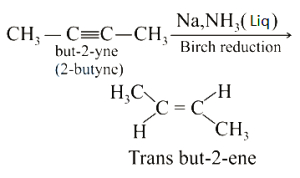
The major product formed in the following reaction is $CH_3-C \equiv C-CH_3 + Na \xrightarrow{liquid \ NH_3}$
A
$trans-but-2-ene$
B
$cis-but-2-ene$
C
$but-1-ene$
D
$2-methylpropene$
Solution
(A) The reaction of an internal alkyne with an alkali metal (like $Na$ or $Li$) in liquid $NH_3$ is known as a dissolving metal reduction or Birch-type reduction of alkynes.
This reaction proceeds via a radical anion intermediate and stereoselectively yields the $trans$-alkene as the major product due to the greater stability of the $trans$-vinyl radical intermediate.
Therefore,the reduction of $but-2-yne$ $(CH_3-C \equiv C-CH_3)$ with $Na/liquid \ NH_3$ produces $trans-but-2-ene$.
This reaction proceeds via a radical anion intermediate and stereoselectively yields the $trans$-alkene as the major product due to the greater stability of the $trans$-vinyl radical intermediate.
Therefore,the reduction of $but-2-yne$ $(CH_3-C \equiv C-CH_3)$ with $Na/liquid \ NH_3$ produces $trans-but-2-ene$.
0 likes
View Solution526
EasyMCQ
$2-$pentyne on reaction with sodium in liquid ammonia produces compound $A$. What is $A$?
A
$n-$pentane
B
$1-$pentyne
C
cis$-2-$pentene
D
trans$-2-$pentene
Solution
(D) The reaction of an internal alkyne like $2-$pentyne with sodium in liquid ammonia $(Na/Liq. NH_3)$ is a Birch reduction,which stereoselectively produces a $trans-$alkene.
$CH_3-C \equiv C-CH_2-CH_3 \xrightarrow{Na/Liq. NH_3} CH_3-CH=CH-CH_2-CH_3$ (trans$-2-$pentene).
Therefore,compound $A$ is trans$-2-$pentene.
$CH_3-C \equiv C-CH_2-CH_3 \xrightarrow{Na/Liq. NH_3} CH_3-CH=CH-CH_2-CH_3$ (trans$-2-$pentene).
Therefore,compound $A$ is trans$-2-$pentene.
0 likes
View Solution527
MediumMCQ
The product $Z$ of the following reaction is
$CH_3-C \equiv CH \xrightarrow{2 HBr} Z$
$CH_3-C \equiv CH \xrightarrow{2 HBr} Z$
A
$CH_3-CH_2-CHBr_2$
B
$CH_3-CHBr-CH_2Br$
C
$CH_3-CBr_2-CH_3$
D
$Br-CH_2-CH_2-CH_2Br$
Solution
(C) The reaction of propyne $(CH_3-C \equiv CH)$ with $2$ equivalents of $HBr$ proceeds via Markovnikov's addition.
In the first step,$HBr$ adds to the triple bond to form $CH_3-CBr=CH_2$ ($2$-bromopropene).
In the second step,another molecule of $HBr$ adds to the double bond following Markovnikov's rule,where the hydrogen atom attaches to the carbon with more hydrogens,resulting in the geminal dihalide $CH_3-CBr_2-CH_3$ ($2$,$2$-dibromopropane).
In the first step,$HBr$ adds to the triple bond to form $CH_3-CBr=CH_2$ ($2$-bromopropene).
In the second step,another molecule of $HBr$ adds to the double bond following Markovnikov's rule,where the hydrogen atom attaches to the carbon with more hydrogens,resulting in the geminal dihalide $CH_3-CBr_2-CH_3$ ($2$,$2$-dibromopropane).
0 likes
View Solution528
EasyMCQ
$CaC_2 + 2D_2O \longrightarrow$ "$P$" $+ Ca(OD)_2$
In the above reaction,the product "$P$" is:
In the above reaction,the product "$P$" is:
A
$C_2H_2$
B
$C_2H_4$
C
$CD_4$
D
$C_2D_2$
Solution
(D) The reaction of calcium carbide $(CaC_2)$ with heavy water $(D_2O)$ is an acid-base type reaction where the carbide ion $(C_2^{2-})$ reacts with $D^+$ ions from $D_2O$.
$CaC_2 + 2D_2O \rightarrow Ca(OD)_2 + C_2D_2$
Thus,the product "$P$" is $C_2D_2$ (deuteroacetylene).
$CaC_2 + 2D_2O \rightarrow Ca(OD)_2 + C_2D_2$
Thus,the product "$P$" is $C_2D_2$ (deuteroacetylene).
0 likes
View Solution529
MediumMCQ
When calcium carbide is reacted with heavy water,which of the following product$(s)$ will be formed?
$I$. $CD_4$
$II$. $C_2D_2$
$III$. $Ca(OD)_2$
$IV$. $Ca_2 \cdot D_2O$
$I$. $CD_4$
$II$. $C_2D_2$
$III$. $Ca(OD)_2$
$IV$. $Ca_2 \cdot D_2O$
A
$I$ and $IV$
B
$II$ and $III$
C
$I$,$II$ and $III$
D
$I$,$II$,$III$ and $IV$
Solution
(B) Calcium carbide $(CaC_2)$ is an ionic carbide containing the acetylide ion $[C \equiv C]^{2-}$.
When it reacts with heavy water $(D_2O)$,it undergoes hydrolysis to form deuterated acetylene and calcium deuteroxide.
The chemical reaction is:
$CaC_2 + 2D_2O \rightarrow C_2D_2 + Ca(OD)_2$
From the reaction,the products formed are $C_2D_2$ (labeled as $II$) and $Ca(OD)_2$ (labeled as $III$).
When it reacts with heavy water $(D_2O)$,it undergoes hydrolysis to form deuterated acetylene and calcium deuteroxide.
The chemical reaction is:
$CaC_2 + 2D_2O \rightarrow C_2D_2 + Ca(OD)_2$
From the reaction,the products formed are $C_2D_2$ (labeled as $II$) and $Ca(OD)_2$ (labeled as $III$).
0 likes
View Solution530
MediumMCQ
$[P]$ $\xrightarrow{Br_{2}} C_{2}H_{4}Br_{2}$ $\xrightarrow{NaNH_{2}/NH_{3}} [Q]$
$[Q]$ $\xrightarrow{20 \% H_{2}SO_{4}, Hg^{2+}, \Delta} [R]$ $\xrightarrow{Zn-Hg/HCl} [S]$
The species $[P], [Q], [R]$ and $[S]$ respectively are:
$[Q]$ $\xrightarrow{20 \% H_{2}SO_{4}, Hg^{2+}, \Delta} [R]$ $\xrightarrow{Zn-Hg/HCl} [S]$
The species $[P], [Q], [R]$ and $[S]$ respectively are:
A
ethene,ethyne,ethanal,ethane
B
ethane,ethyne,ethanal,ethene
C
ethene,ethyne,ethanal,ethanol
D
ethyne,ethane,ethene,ethanal
Solution
(A) The given reaction sequence is:
$1$. $[P]$ is ethene $(CH_{2}=CH_{2})$. Reaction with $Br_{2}$ gives $1,2-dibromoethane$ $(CH_{2}Br-CH_{2}Br)$.
$2$. $1,2-dibromoethane$ reacts with $NaNH_{2}/NH_{3}$ (dehydrohalogenation) to form ethyne $(HC \equiv CH)$ as $[Q]$.
$3$. Ethyne $[Q]$ reacts with $20 \% H_{2}SO_{4}$ and $Hg^{2+}$ (Kucherov reaction) to form ethanal $(CH_{3}CHO)$ as $[R]$.
$4$. Ethanal $[R]$ undergoes Clemmensen reduction $(Zn-Hg/HCl)$ to form ethane $(CH_{3}CH_{3})$ as $[S]$.
Thus,$[P]$ = ethene,$[Q]$ = ethyne,$[R]$ = ethanal,$[S]$ = ethane.
$1$. $[P]$ is ethene $(CH_{2}=CH_{2})$. Reaction with $Br_{2}$ gives $1,2-dibromoethane$ $(CH_{2}Br-CH_{2}Br)$.
$2$. $1,2-dibromoethane$ reacts with $NaNH_{2}/NH_{3}$ (dehydrohalogenation) to form ethyne $(HC \equiv CH)$ as $[Q]$.
$3$. Ethyne $[Q]$ reacts with $20 \% H_{2}SO_{4}$ and $Hg^{2+}$ (Kucherov reaction) to form ethanal $(CH_{3}CHO)$ as $[R]$.
$4$. Ethanal $[R]$ undergoes Clemmensen reduction $(Zn-Hg/HCl)$ to form ethane $(CH_{3}CH_{3})$ as $[S]$.
Thus,$[P]$ = ethene,$[Q]$ = ethyne,$[R]$ = ethanal,$[S]$ = ethane.
0 likes
View Solution531
MediumMCQ
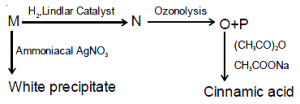
Identify the structure of $M$ based on the following reaction scheme:
A
$Ph-C \equiv CH$
B
$Ph-C \equiv C-CH_3$
C
$H_3C-C \equiv CH$
D
$H_3C-C \equiv C-CH_3$
Solution
(A) $1$. Compound $M$ reacts with ammoniacal $AgNO_3$ to give a white precipitate,which indicates that $M$ is a terminal alkyne $(R-C \equiv CH)$.
$2$. $M$ undergoes hydrogenation with $H_2$ and Lindlar catalyst to form $N$,which is an alkene.
$3$. $N$ undergoes ozonolysis to give $O$ and $P$. $O$ (benzaldehyde,$Ph-CHO$) reacts with $(CH_3CO)_2O$ and $CH_3COONa$ (Perkin's condensation) to form cinnamic acid $(Ph-CH=CH-COOH)$.
$4$. Based on the reaction sequence,$M$ must be phenylacetylene $(Ph-C \equiv CH)$.
$5$. $Ph-C \equiv CH + H_2 \xrightarrow{Lindlar} Ph-CH=CH_2$ $(N)$.
$6$. $Ph-CH=CH_2 \xrightarrow{O_3} Ph-CHO$ $(O)$ + $HCHO$ $(P)$.
$7$. Thus,$M$ is $Ph-C \equiv CH$.
$2$. $M$ undergoes hydrogenation with $H_2$ and Lindlar catalyst to form $N$,which is an alkene.
$3$. $N$ undergoes ozonolysis to give $O$ and $P$. $O$ (benzaldehyde,$Ph-CHO$) reacts with $(CH_3CO)_2O$ and $CH_3COONa$ (Perkin's condensation) to form cinnamic acid $(Ph-CH=CH-COOH)$.
$4$. Based on the reaction sequence,$M$ must be phenylacetylene $(Ph-C \equiv CH)$.
$5$. $Ph-C \equiv CH + H_2 \xrightarrow{Lindlar} Ph-CH=CH_2$ $(N)$.
$6$. $Ph-CH=CH_2 \xrightarrow{O_3} Ph-CHO$ $(O)$ + $HCHO$ $(P)$.
$7$. Thus,$M$ is $Ph-C \equiv CH$.
0 likes
View Solution532
EasyMCQ
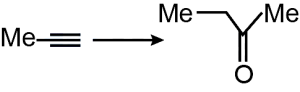
The reagents to carry out the following conversion are:
A
$HgSO_{4} / dil. \ H_{2}SO_{4}$
B
$BH_{3} ; H_{2}O_{2} / NaOH$
C
$OsO_{4} ; HIO_{4}$
D
$NaNH_{2} / CH_{3}I ; HgSO_{4} / dil. \ H_{2}SO_{4}$
Solution
(D) The starting material is $but-2-yne$ (or $CH_{3}-C \equiv C-CH_{3}$),but the image shows $prop-1-yne$ $(CH_{3}-C \equiv CH)$ being converted to $butan-2-one$ $(CH_{3}-CO-CH_{2}-CH_{3})$.
Step $1$: $CH_{3}-C \equiv CH + NaNH_{2} \rightarrow CH_{3}-C \equiv C^-Na^+ + NH_{3}$.
Step $2$: $CH_{3}-C \equiv C^-Na^+ + CH_{3}I \rightarrow CH_{3}-C \equiv C-CH_{3} + NaI$.
Step $3$: $CH_{3}-C \equiv C-CH_{3} + H_{2}O \xrightarrow{HgSO_{4} / dil. H_{2}SO_{4}} CH_{3}-C(OH)=CH-CH_{3}$ (enol form).
Step $4$: The enol form undergoes tautomerization to form $CH_{3}-CO-CH_{2}-CH_{3}$ $(butan-2-one)$.
Thus,the correct set of reagents is $NaNH_{2} / CH_{3}I ; HgSO_{4} / dil. \ H_{2}SO_{4}$.
Step $1$: $CH_{3}-C \equiv CH + NaNH_{2} \rightarrow CH_{3}-C \equiv C^-Na^+ + NH_{3}$.
Step $2$: $CH_{3}-C \equiv C^-Na^+ + CH_{3}I \rightarrow CH_{3}-C \equiv C-CH_{3} + NaI$.
Step $3$: $CH_{3}-C \equiv C-CH_{3} + H_{2}O \xrightarrow{HgSO_{4} / dil. H_{2}SO_{4}} CH_{3}-C(OH)=CH-CH_{3}$ (enol form).
Step $4$: The enol form undergoes tautomerization to form $CH_{3}-CO-CH_{2}-CH_{3}$ $(butan-2-one)$.
Thus,the correct set of reagents is $NaNH_{2} / CH_{3}I ; HgSO_{4} / dil. \ H_{2}SO_{4}$.
0 likes
View Solution533
DifficultMCQ
Identify $X$ in the following sequence of reactions.
$CH_3-CH(Br)-CH(Br)-CH_2-CH_2-CH_3 \xrightarrow[(ii) Na \text{ in liquid } NH_3]{(i) NaNH_2} X$
$CH_3-CH(Br)-CH(Br)-CH_2-CH_2-CH_3 \xrightarrow[(ii) Na \text{ in liquid } NH_3]{(i) NaNH_2} X$
A
$CH_3-CH(Br)-CH(NH_2)-CH_2-CH_2-CH_3$
B
$CH_3-CH=C(H)-CH_2-CH_2-CH_3$ (trans-isomer)
C
$CH_3-CH=C(H)-CH_2-CH_2-CH_3$ (cis-isomer)
D
$CH_3-CH(NH_2)-CH(NH_2)-CH_2-CH_2-CH_3$
Solution
(B) The reaction sequence involves the dehydrohalogenation of a vicinal dibromide using $NaNH_2$ to form an alkyne. The first step with $NaNH_2$ removes two molecules of $HBr$ to produce $hex-2-yne$ $(CH_3-C \equiv C-CH_2-CH_2-CH_3)$.
The second step involves the reduction of the alkyne using $Na$ in liquid $NH_3$ (Birch reduction),which stereoselectively reduces the internal alkyne to a $trans-alkene$.
Therefore,the final product $X$ is $trans-hex-2-ene$.
The second step involves the reduction of the alkyne using $Na$ in liquid $NH_3$ (Birch reduction),which stereoselectively reduces the internal alkyne to a $trans-alkene$.
Therefore,the final product $X$ is $trans-hex-2-ene$.
0 likes
View Solution534
EasyMCQ
$CH_{3}C \equiv CMgBr$ can be prepared by the reaction of:
A
$CH_{3}C=CBr$ with $MgBr_{2}$
B
$CH_{3}C \equiv CH$ with $MgBr_{2}$
C
$CH_{3}C \equiv CH$ with $KBr$ and $Mg$ metal
D
$CH_{3}C \equiv CH$ with $CH_{3}MgBr$
Solution
(D) $CH_{3}C \equiv CMgBr$ is a Grignard reagent derived from a terminal alkyne.
It can be prepared by the acid-base reaction between propyne $(CH_{3}C \equiv CH)$ and methylmagnesium bromide $(CH_{3}MgBr)$.
The terminal hydrogen of the alkyne is acidic and reacts with the basic Grignard reagent to form the alkynyl magnesium bromide and methane gas.
The chemical equation is:
$CH_{3}C \equiv CH + CH_{3}MgBr \longrightarrow CH_{3}C \equiv CMgBr + CH_{4}$
It can be prepared by the acid-base reaction between propyne $(CH_{3}C \equiv CH)$ and methylmagnesium bromide $(CH_{3}MgBr)$.
The terminal hydrogen of the alkyne is acidic and reacts with the basic Grignard reagent to form the alkynyl magnesium bromide and methane gas.
The chemical equation is:
$CH_{3}C \equiv CH + CH_{3}MgBr \longrightarrow CH_{3}C \equiv CMgBr + CH_{4}$
0 likes
View Solution535
EasyMCQ
The isomerisation of $1-$butyne to $2-$butyne can be achieved by treatment with
A
hydrochloric acid
B
ammoniacal silver nitrate
C
ammoniacal cuprous chloride
D
ethanolic potassium hydroxide
Solution
(D) The isomerisation of $1-$butyne $(CH_3-CH_2-C \equiv CH)$ to $2-$butyne $(CH_3-C \equiv C-CH_3)$ is a base-catalyzed reaction.
When $1-$butyne is treated with ethanolic $KOH$ at high temperatures,it undergoes base-catalyzed isomerisation to form the more stable internal alkyne,$2-$butyne.
The reaction is as follows:
$CH_3-CH_2-C \equiv CH \xrightarrow{\text{ethanolic } KOH, \Delta} CH_3-C \equiv C-CH_3$
When $1-$butyne is treated with ethanolic $KOH$ at high temperatures,it undergoes base-catalyzed isomerisation to form the more stable internal alkyne,$2-$butyne.
The reaction is as follows:
$CH_3-CH_2-C \equiv CH \xrightarrow{\text{ethanolic } KOH, \Delta} CH_3-C \equiv C-CH_3$
0 likes
View Solution536
EasyMCQ
Ethene can be separated from acetylene by passing the mixture through :
A
fuming $H_2SO_4$
B
pyrogallol
C
ammoniacal $Cu_2Cl_2$
D
Charcoal powder
Solution
(C) Acetylene $(HC \equiv CH)$ is a terminal alkyne with acidic hydrogen atoms.
When passed through ammoniacal cuprous chloride $(Cu_2Cl_2)$,it forms a red precipitate of copper$(I)$ acetylide:
$HC \equiv CH + Cu_2Cl_2 \rightarrow CuC \equiv CCu \downarrow (\text{red ppt}) + 2HCl$.
Ethene $(CH_2=CH_2)$ does not react with ammoniacal $Cu_2Cl_2$ and passes through unchanged.
Therefore,the mixture can be separated using ammoniacal $Cu_2Cl_2$.
When passed through ammoniacal cuprous chloride $(Cu_2Cl_2)$,it forms a red precipitate of copper$(I)$ acetylide:
$HC \equiv CH + Cu_2Cl_2 \rightarrow CuC \equiv CCu \downarrow (\text{red ppt}) + 2HCl$.
Ethene $(CH_2=CH_2)$ does not react with ammoniacal $Cu_2Cl_2$ and passes through unchanged.
Therefore,the mixture can be separated using ammoniacal $Cu_2Cl_2$.
0 likes
View Solution537
EasyMCQ
Cyclo$[18]$ carbon is an allotrope of carbon with molecular formula $C_{18}$. It is a ring of $18$ carbon atoms,connected by alternating single and triple bonds. The total number of triple bonds present in this cyclocarbon is:
A
$9$
B
$10$
C
$12$
D
$6$
Solution
(A) Cyclo$[18]$ carbon $(C_{18})$ is a cyclic allotrope of carbon consisting of $18$ carbon atoms.
In this structure,the carbon atoms are connected by alternating single and triple bonds.
Since there are $18$ carbon atoms in the ring,and each triple bond involves two carbon atoms while each single bond connects two adjacent triple-bonded units,the structure consists of $9$ triple bonds and $9$ single bonds.
Therefore,the total number of triple bonds is $9$.
In this structure,the carbon atoms are connected by alternating single and triple bonds.
Since there are $18$ carbon atoms in the ring,and each triple bond involves two carbon atoms while each single bond connects two adjacent triple-bonded units,the structure consists of $9$ triple bonds and $9$ single bonds.
Therefore,the total number of triple bonds is $9$.
0 likes
View Solution538
EasyMCQ
The number of $\sigma$ and $\pi$ bonds between two carbon atoms in calcium carbide are
A
one $\sigma, 1 \pi$
B
one $\sigma, 2 \pi$
C
two $\sigma, 1 \pi$
D
one $\sigma, 1 \frac{1}{2} \pi$
Solution
(B) Calcium carbide is calcium acetylide,$CaC_2$,with the structure $[Ca]^{2+} [:C \equiv C:]^{2-}$.
In the acetylide ion $[:C \equiv C:]^{2-}$,there is a triple bond between the two carbon atoms.
$A$ triple bond consists of one sigma $(\sigma)$ bond and two pi $(\pi)$ bonds.
Therefore,the correct option is $B$.
In the acetylide ion $[:C \equiv C:]^{2-}$,there is a triple bond between the two carbon atoms.
$A$ triple bond consists of one sigma $(\sigma)$ bond and two pi $(\pi)$ bonds.
Therefore,the correct option is $B$.
0 likes
View Solution539
DifficultMCQ
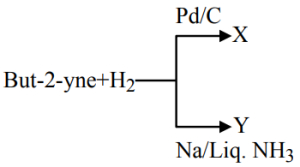
$But-2-yne$ and hydrogen (one mole each) are separately treated with $(i)$ $Pd / C$ and $(ii)$ $Na / \text{liq. } NH_3$ to give the products $X$ and $Y$ respectively. Identify the incorrect statements.
$A$. $X$ and $Y$ are stereoisomers.
$B$. Dipole moment of $X$ is zero.
$C$. Boiling point of $X$ is higher than $Y$.
$D$. $X$ and $Y$ react with $O_3 / Zn + H_2O$ to give different products.
Choose the correct answer from the options given below:
$A$. $X$ and $Y$ are stereoisomers.
$B$. Dipole moment of $X$ is zero.
$C$. Boiling point of $X$ is higher than $Y$.
$D$. $X$ and $Y$ react with $O_3 / Zn + H_2O$ to give different products.
Choose the correct answer from the options given below:
A
$B$ and $C$ only
B
$B$ and $D$ only
C
$A$ and $B$ only
D
$A$ and $C$ only
Solution
(B) The hydrogenation of $But-2-yne$ with $Pd/C$ (Lindlar's catalyst or similar) gives $cis-But-2-ene$ $(X)$.
The reduction of $But-2-yne$ with $Na / \text{liq. } NH_3$ (Birch reduction) gives $trans-But-2-ene$ $(Y)$.
$A$. $X$ and $Y$ are geometric isomers (stereoisomers). This statement is correct.
$B$. $X$ $(cis-But-2-ene)$ has a non-zero dipole moment due to the polarity of the $C-CH_3$ bonds. $Y$ $(trans-But-2-ene)$ has a dipole moment of zero. Thus,statement $B$ is incorrect.
$C$. $cis-But-2-ene$ $(X)$ is more polar than $trans-But-2-ene$ $(Y)$,so $X$ has a higher boiling point than $Y$. This statement is correct.
$D$. Both $X$ and $Y$ are isomers of $But-2-ene$. Ozonolysis of both $cis-But-2-ene$ and $trans-But-2-ene$ yields the same product,$acetaldehyde$ $(CH_3CHO)$. Thus,statement $D$ is incorrect.
The incorrect statements are $B$ and $D$.
The reduction of $But-2-yne$ with $Na / \text{liq. } NH_3$ (Birch reduction) gives $trans-But-2-ene$ $(Y)$.
$A$. $X$ and $Y$ are geometric isomers (stereoisomers). This statement is correct.
$B$. $X$ $(cis-But-2-ene)$ has a non-zero dipole moment due to the polarity of the $C-CH_3$ bonds. $Y$ $(trans-But-2-ene)$ has a dipole moment of zero. Thus,statement $B$ is incorrect.
$C$. $cis-But-2-ene$ $(X)$ is more polar than $trans-But-2-ene$ $(Y)$,so $X$ has a higher boiling point than $Y$. This statement is correct.
$D$. Both $X$ and $Y$ are isomers of $But-2-ene$. Ozonolysis of both $cis-But-2-ene$ and $trans-But-2-ene$ yields the same product,$acetaldehyde$ $(CH_3CHO)$. Thus,statement $D$ is incorrect.
The incorrect statements are $B$ and $D$.
0 likes
View Solution540
DifficultMCQ
Consider the following reaction sequence:
$CH_3CH_2CH_2CH(Br)CH_2Br + 2NaNH_2 \rightarrow X$
$X \xrightarrow[(ii) (CH_3)_2CHBr]{(i) NaNH_2} Y$
The product $Y$ formed is:
$CH_3CH_2CH_2CH(Br)CH_2Br + 2NaNH_2 \rightarrow X$
$X \xrightarrow[(ii) (CH_3)_2CHBr]{(i) NaNH_2} Y$
The product $Y$ formed is:
A
$2-$methylhex$-2-$yne
B
$5-$methylhex$-2-$yne
C
$2-$methylhex$-3-$yne
D
$5-$methylhex$-3-$yne
Solution
(B) Step $1$: Dehydrohalogenation of $1,2-$dibromopentane with $2NaNH_2$ gives pent$-1-$yne $(X = CH_3CH_2CH_2C \equiv CH)$.
Step $2$: Treatment of pent$-1-$yne with $NaNH_2$ forms the sodium acetylide salt $(CH_3CH_2CH_2C \equiv C^-Na^+)$.
Step $3$: The acetylide ion acts as a nucleophile and attacks isopropyl bromide $((CH_3)_2CHBr)$ via an $S_N2$ mechanism.
$CH_3CH_2CH_2C \equiv C^- + (CH_3)_2CHBr \rightarrow CH_3CH_2CH_2C \equiv C-CH(CH_3)_2$.
The resulting product is $5-$methylhex$-2-$yne.
Step $2$: Treatment of pent$-1-$yne with $NaNH_2$ forms the sodium acetylide salt $(CH_3CH_2CH_2C \equiv C^-Na^+)$.
Step $3$: The acetylide ion acts as a nucleophile and attacks isopropyl bromide $((CH_3)_2CHBr)$ via an $S_N2$ mechanism.
$CH_3CH_2CH_2C \equiv C^- + (CH_3)_2CHBr \rightarrow CH_3CH_2CH_2C \equiv C-CH(CH_3)_2$.
The resulting product is $5-$methylhex$-2-$yne.
0 likes
View Solution541
DifficultMCQ
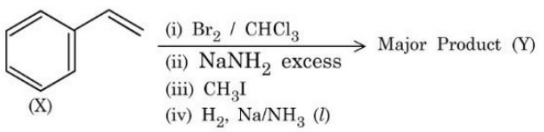
Compound $(X)$ [styrene] is subjected to the following sequence of reactions: $(i)$ $Br_2/CHCl_3$,$(ii)$ $NaNH_2$ (excess),$(iii)$ $CH_3I$,$(iv)$ $H_2, Na/NH_3(l)$,giving Major Product $(Y)$. The molar mass of the major product $(Y)$ formed is . . . . . . $\text{g mol}^{-1}$. (Given molar mass in $\text{g mol}^{-1}$: $C:12, H:1$)
A
$90$
B
$118$
C
$160$
D
$125$
Solution
(B) $1$. Styrene $(C_6H_5CH=CH_2)$ reacts with $Br_2/CHCl_3$ to form styrene dibromide $(C_6H_5CH(Br)CH_2Br)$.
$2$. Treatment with excess $NaNH_2$ causes dehydrohalogenation to form phenylacetylene $(C_6H_5C\equiv CH)$.
$3$. Reaction with $CH_3I$ (after deprotonation by $NaNH_2$) yields $1$-phenylprop-$1$-yne $(C_6H_5C\equiv CCH_3)$.
$4$. Reduction with $H_2, Na/NH_3(l)$ (Birch-like reduction of alkyne) yields $(E)$-$1$-phenylprop-$1$-ene $(C_6H_5CH=CHCH_3)$.
$5$. The molecular formula of the product $(Y)$ is $C_9H_{10}$.
$6$. Molar mass $= (9 \times 12) + (10 \times 1) = 108 + 10 = 118 \text{ g mol}^{-1}$.
$2$. Treatment with excess $NaNH_2$ causes dehydrohalogenation to form phenylacetylene $(C_6H_5C\equiv CH)$.
$3$. Reaction with $CH_3I$ (after deprotonation by $NaNH_2$) yields $1$-phenylprop-$1$-yne $(C_6H_5C\equiv CCH_3)$.
$4$. Reduction with $H_2, Na/NH_3(l)$ (Birch-like reduction of alkyne) yields $(E)$-$1$-phenylprop-$1$-ene $(C_6H_5CH=CHCH_3)$.
$5$. The molecular formula of the product $(Y)$ is $C_9H_{10}$.
$6$. Molar mass $= (9 \times 12) + (10 \times 1) = 108 + 10 = 118 \text{ g mol}^{-1}$.
0 likes
View SolutionHydrocarbons — Alkyne · Frequently Asked Questions
1Are these Hydrocarbons questions useful for JEE and NEET?
Yes. All questions in this section are mapped to JEE Main and NEET exam patterns. Previous year questions from JEE Main, NEET, GUJCET and state-level exams are included with full solutions.
2Can I switch to Hindi or Gujarati for these questions?
Yes. Use the language tabs in the hero section or the sidebar to view the same questions and solutions in English, Hindi or Gujarati.
3How do I generate a question paper from this subtopic?
Use the Vedclass Exam Paper Generator — select the chapter and subtopic, set difficulty, and generate Sets A, B, C, D automatically. First 3 chapters of every subject are free.
Vedclass Products
For Students
Vedclass Test Series
Mock tests in real JEE/NEET style with performance analysis. 5-day free trial.
Start Free TrialFor Teachers
Exam Paper Generator
Generate Set A/B/C/D papers from this chapter in 2 minutes. 3 chapters free.
Try FreeFor Institutes
Online Exam Module
Live online exams with unlimited students, 360° analytics & white-label branding.
See DemoFor Teachers & Institutes
Generate a Hydrocarbons Exam Paper in 2 Minutes
Select subtopic & difficulty — Sets A, B, C, D auto-generated with No Repeat logic.
First 3 chapters of every subject are free — no payment required.