
A English
Alkyne Questions in English
Class 11 Chemistry · Hydrocarbons · Alkyne
545+
Questions
English
Language
100%
With Solutions
Showing 50 of 545 questions in English
351
MediumMCQ
$Alkyne \xrightarrow[{Hg^{2+}}]{{H^+/H_2O}} \text{ketone}$
Which of the following alkynes cannot give a ketone?
Which of the following alkynes cannot give a ketone?
A
$CH_3-C \equiv C-CH_3$
B
$CH_3-C \equiv CH$
C
$HC \equiv CH$
D
$CH_3-C \equiv C-CH_2CH_3$
Solution
(C) The hydration of alkynes in the presence of $Hg^{2+}$ and $H^+/H_2O$ (Kuccherov reaction) follows Markovnikov's addition of water to the triple bond.
$1$. For terminal alkynes like $CH_3-C \equiv CH$,the reaction yields a ketone $(CH_3-CO-CH_3)$.
$2$. For internal alkynes like $CH_3-C \equiv C-CH_3$ or $CH_3-C \equiv C-CH_2CH_3$,the reaction yields ketones.
$3$. For ethyne $(HC \equiv CH)$,the hydration product is ethenol $(CH_2=CH-OH)$,which tautomerizes to form ethanal $(CH_3-CHO)$,an aldehyde,not a ketone.
Therefore,$HC \equiv CH$ cannot give a ketone.
$1$. For terminal alkynes like $CH_3-C \equiv CH$,the reaction yields a ketone $(CH_3-CO-CH_3)$.
$2$. For internal alkynes like $CH_3-C \equiv C-CH_3$ or $CH_3-C \equiv C-CH_2CH_3$,the reaction yields ketones.
$3$. For ethyne $(HC \equiv CH)$,the hydration product is ethenol $(CH_2=CH-OH)$,which tautomerizes to form ethanal $(CH_3-CHO)$,an aldehyde,not a ketone.
Therefore,$HC \equiv CH$ cannot give a ketone.
0 likes
View Solution352
MediumMCQ
Propene and propyne can be distinguished by
A
$Br_2/CCl_4$
B
Baeyer's Reagent
C
$AgNO_3 + NH_4OH$
D
$O_3$
Solution
(C) Propene $(CH_3-CH=CH_2)$ is an alkene and does not react with ammoniacal silver nitrate $(AgNO_3 + NH_4OH)$.
Propyne $(CH_3-C \equiv CH)$ is a terminal alkyne with an acidic hydrogen atom.
It reacts with ammoniacal silver nitrate to form a white precipitate of silver propynide $(CH_3-C \equiv C^- Ag^+)$.
Therefore,$AgNO_3 + NH_4OH$ (Tollens' reagent) is used to distinguish between terminal alkynes and alkenes.
Propyne $(CH_3-C \equiv CH)$ is a terminal alkyne with an acidic hydrogen atom.
It reacts with ammoniacal silver nitrate to form a white precipitate of silver propynide $(CH_3-C \equiv C^- Ag^+)$.
Therefore,$AgNO_3 + NH_4OH$ (Tollens' reagent) is used to distinguish between terminal alkynes and alkenes.
0 likes
View Solution353
DifficultMCQ
What is the major product of the following reaction?
$Cyclohexyl-C \equiv CH \xrightarrow{HOCl \text{ (excess)}} \text{major product}$
$Cyclohexyl-C \equiv CH \xrightarrow{HOCl \text{ (excess)}} \text{major product}$
A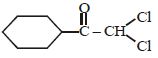
B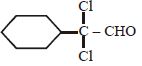
C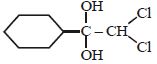
D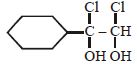
Solution
(A) The reaction of an alkyne with excess $HOCl$ proceeds through electrophilic addition.
First,$HOCl$ adds across the triple bond to form a chlorohydrin intermediate.
Since $HOCl$ is in excess,the addition occurs twice at the same carbon atom (following Markovnikov's rule,where the $OH$ group attaches to the more substituted carbon).
This results in a geminal diol intermediate,which is unstable and undergoes dehydration to form a ketone.
The final product is $Cyclohexyl-C(=O)-CHCl_2$.
First,$HOCl$ adds across the triple bond to form a chlorohydrin intermediate.
Since $HOCl$ is in excess,the addition occurs twice at the same carbon atom (following Markovnikov's rule,where the $OH$ group attaches to the more substituted carbon).
This results in a geminal diol intermediate,which is unstable and undergoes dehydration to form a ketone.
The final product is $Cyclohexyl-C(=O)-CHCl_2$.
0 likes
View Solution354
DifficultMCQ
Hydrogenation of $2-$Butyne in the presence of Lindlar's catalyst gives
A
$Cis-2-$Butene
B
$Trans-2-$Butene
C
Butane
D
$1-$Butene
Solution
(A) Lindlar's catalyst is a poisoned palladium catalyst ($Pd/CaCO_3$ or $Pd/BaSO_4$ poisoned with quinoline or sulfur).
It performs the partial hydrogenation of alkynes to alkenes.
The reaction is stereospecific and yields the $cis-$alkene.
The reaction is:
$CH_3-C \equiv C-CH_3 + H_2 \xrightarrow{Pd/CaCO_3} cis-CH_3-CH=CH-CH_3$
Thus,the hydrogenation of $2-$Butyne with Lindlar's catalyst produces $cis-2-$Butene.
It performs the partial hydrogenation of alkynes to alkenes.
The reaction is stereospecific and yields the $cis-$alkene.
The reaction is:
$CH_3-C \equiv C-CH_3 + H_2 \xrightarrow{Pd/CaCO_3} cis-CH_3-CH=CH-CH_3$
Thus,the hydrogenation of $2-$Butyne with Lindlar's catalyst produces $cis-2-$Butene.
0 likes
View Solution355
MediumMCQ
Which of the following reactions does not give an alkyne?
A
$CH_3-CH_2-CHCl-CH_2Cl \xrightarrow[(ii)NaNH_2]{(i)Alc. KOH} CH_3-CH_2-C \equiv CH$
B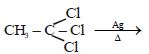
C
$CH_3-CH_2-CHCl-CH_2Cl \xrightarrow[\Delta]{Zn} CH_3-CH_2-CH=CH_2$
D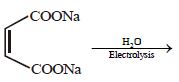
Solution
(C) Let us analyze each reaction:
$(A)$ Dehydrohalogenation of vicinal dihalides with $Alc. KOH$ followed by $NaNH_2$ gives an alkyne.
$(B)$ Reaction of $CH_3-CCl_3$ with $Ag$ powder is not a standard method to produce $CH_3-C \equiv C-CH_3$. The reaction of $CH_3-CCl_3$ with $Ag$ typically leads to coupling products or other derivatives,not an alkyne.
$(C)$ Dehalogenation of vicinal dihalides with $Zn$ dust in alcohol gives an alkene $(CH_3-CH_2-CH=CH_2)$,not an alkyne.
$(D)$ Kolbe's electrolysis of sodium maleate or fumarate gives ethyne $(HC \equiv CH)$.
Note: Both $(B)$ and $(C)$ do not produce an alkyne. However,in the context of standard textbook problems,$(C)$ is the most direct example of a reaction producing an alkene instead of an alkyne from a vicinal dihalide.
$(A)$ Dehydrohalogenation of vicinal dihalides with $Alc. KOH$ followed by $NaNH_2$ gives an alkyne.
$(B)$ Reaction of $CH_3-CCl_3$ with $Ag$ powder is not a standard method to produce $CH_3-C \equiv C-CH_3$. The reaction of $CH_3-CCl_3$ with $Ag$ typically leads to coupling products or other derivatives,not an alkyne.
$(C)$ Dehalogenation of vicinal dihalides with $Zn$ dust in alcohol gives an alkene $(CH_3-CH_2-CH=CH_2)$,not an alkyne.
$(D)$ Kolbe's electrolysis of sodium maleate or fumarate gives ethyne $(HC \equiv CH)$.
Note: Both $(B)$ and $(C)$ do not produce an alkyne. However,in the context of standard textbook problems,$(C)$ is the most direct example of a reaction producing an alkene instead of an alkyne from a vicinal dihalide.
0 likes
View Solution356
DifficultMCQ
$Ph-CH=CH-Ph$ $\xrightarrow[CCl_4]{Cl_2} X$ $\xrightarrow{2NaNH_2} Y$ $\xrightarrow[BaSO_4]{H_2+Pd} Z$. Product $Z$ is
A
B
C
$Ph-C(Ph)=CH_2$
D
$Ph-C \equiv C-Ph$
Solution
(B) The reaction sequence is as follows:
$1.$ Chlorination of stilbene: $Ph-CH=CH-Ph + Cl_2 \xrightarrow{CCl_4} Ph-CHCl-CHCl-Ph$ $(X)$
$2.$ Double dehydrohalogenation: $Ph-CHCl-CHCl-Ph + 2NaNH_2 \rightarrow Ph-C \equiv C-Ph$ $(Y)$
$3.$ Partial hydrogenation: $Ph-C \equiv C-Ph + H_2 \xrightarrow{Pd/BaSO_4} \text{cis}-Ph-CH=CH-Ph$ $(Z)$.
Lindlar's catalyst $(Pd/BaSO_4)$ performs syn-addition of hydrogen to alkynes,yielding cis-alkenes. The structure of cis-stilbene corresponds to option $B$.
$1.$ Chlorination of stilbene: $Ph-CH=CH-Ph + Cl_2 \xrightarrow{CCl_4} Ph-CHCl-CHCl-Ph$ $(X)$
$2.$ Double dehydrohalogenation: $Ph-CHCl-CHCl-Ph + 2NaNH_2 \rightarrow Ph-C \equiv C-Ph$ $(Y)$
$3.$ Partial hydrogenation: $Ph-C \equiv C-Ph + H_2 \xrightarrow{Pd/BaSO_4} \text{cis}-Ph-CH=CH-Ph$ $(Z)$.
Lindlar's catalyst $(Pd/BaSO_4)$ performs syn-addition of hydrogen to alkynes,yielding cis-alkenes. The structure of cis-stilbene corresponds to option $B$.
0 likes
View Solution357
DifficultMCQ
The compound $X \ (C_5H_8)$ reacts with ammoniacal $AgNO_3$ to give a white precipitate and reacts with excess of $KMnO_4$ to give the acid,$(CH_3)_2CHCOOH$. Therefore,$X$ is:
A
$CH_2=CH-CH=CH-CH_3$
B
$CH_3-(CH_2)_2-C \equiv CH$
C
$(CH_3)_2CH-C \equiv CH$
D
$(CH_3)_2C=C=CH_2$
Solution
(C) $1$. The formation of a white precipitate with ammoniacal $AgNO_3$ indicates that $X$ is a terminal alkyne $(R-C \equiv CH)$.
$2$. The reaction with excess $KMnO_4$ (oxidative cleavage) yields $(CH_3)_2CHCOOH$ (isobutyric acid).
$3$. The structure of the acid $(CH_3)_2CHCOOH$ contains $4$ carbon atoms. Since the original compound $X$ has $5$ carbon atoms,the terminal alkyne must be $(CH_3)_2CH-C \equiv CH$.
$4$. Oxidative cleavage of $(CH_3)_2CH-C \equiv CH$ breaks the triple bond to form $(CH_3)_2CHCOOH$ and $CO_2$.
$2$. The reaction with excess $KMnO_4$ (oxidative cleavage) yields $(CH_3)_2CHCOOH$ (isobutyric acid).
$3$. The structure of the acid $(CH_3)_2CHCOOH$ contains $4$ carbon atoms. Since the original compound $X$ has $5$ carbon atoms,the terminal alkyne must be $(CH_3)_2CH-C \equiv CH$.
$4$. Oxidative cleavage of $(CH_3)_2CH-C \equiv CH$ breaks the triple bond to form $(CH_3)_2CHCOOH$ and $CO_2$.
0 likes
View Solution358
DifficultMCQ
$CH_3-CH_2-CH(Cl)_2$ $\xrightarrow[{[Excess]}]{{NaNH_2}} P$ $\xrightarrow{{CH_3Cl}} Q$,$Q$ will be
A
$CH_3-CH_2-C \equiv CH$
B
$CH_3-CH_2-C \equiv C-CH_3$
C
$CH_3-CH_2-CH_2-CH_2-Cl$
D
$CH_2=CH-CH=CH_2$
Solution
(B) The starting material is $1,1$-dichlorobutane,$CH_3-CH_2-CH(Cl)_2$.
Treatment with excess $NaNH_2$ (a strong base) causes dehydrohalogenation to form an alkyne.
$CH_3-CH_2-CH(Cl)_2 \xrightarrow{NaNH_2} CH_3-CH_2-C \equiv CH$ (Compound $P$,$1$-butyne).
$1$-butyne has an acidic terminal hydrogen.
$CH_3-CH_2-C \equiv CH \xrightarrow{NaNH_2} CH_3-CH_2-C \equiv C^- Na^+$.
Reaction with $CH_3Cl$ (an alkyl halide) leads to nucleophilic substitution (alkylation).
$CH_3-CH_2-C \equiv C^- + CH_3Cl \rightarrow CH_3-CH_2-C \equiv C-CH_3 + Cl^-$.
Thus,$Q$ is $CH_3-CH_2-C \equiv C-CH_3$ ($2$-pentyne).
Treatment with excess $NaNH_2$ (a strong base) causes dehydrohalogenation to form an alkyne.
$CH_3-CH_2-CH(Cl)_2 \xrightarrow{NaNH_2} CH_3-CH_2-C \equiv CH$ (Compound $P$,$1$-butyne).
$1$-butyne has an acidic terminal hydrogen.
$CH_3-CH_2-C \equiv CH \xrightarrow{NaNH_2} CH_3-CH_2-C \equiv C^- Na^+$.
Reaction with $CH_3Cl$ (an alkyl halide) leads to nucleophilic substitution (alkylation).
$CH_3-CH_2-C \equiv C^- + CH_3Cl \rightarrow CH_3-CH_2-C \equiv C-CH_3 + Cl^-$.
Thus,$Q$ is $CH_3-CH_2-C \equiv C-CH_3$ ($2$-pentyne).
0 likes
View Solution359
MediumMCQ
$C_2H_2$ $\xrightarrow[1\% HgSO_4]{dil. H_2SO_4} A$ $\xrightarrow{[O]} B$ $\xrightarrow{NaOH} C$ $\xrightarrow{NaOH/CaO} D$,$[D]$ is:
A
$CH_4$
B
$CH_3-CH_3$
C
$C_3H_8$
D
$C_4H_{10}$
Solution
(A) $1.$ Hydration of ethyne: $HC \equiv CH + H_2O \xrightarrow{dil. H_2SO_4, HgSO_4} CH_3CHO$ (Ethanal,$A$)
$2.$ Oxidation: $CH_3CHO \xrightarrow{[O]} CH_3COOH$ (Ethanoic acid,$B$)
$3.$ Neutralization: $CH_3COOH + NaOH \rightarrow CH_3COONa$ (Sodium ethanoate,$C$)
$4.$ Decarboxylation: $CH_3COONa + NaOH \xrightarrow{CaO, \Delta} CH_4$ (Methane,$D$) + $Na_2CO_3$.
Therefore,$[D]$ is $CH_4$.
$2.$ Oxidation: $CH_3CHO \xrightarrow{[O]} CH_3COOH$ (Ethanoic acid,$B$)
$3.$ Neutralization: $CH_3COOH + NaOH \rightarrow CH_3COONa$ (Sodium ethanoate,$C$)
$4.$ Decarboxylation: $CH_3COONa + NaOH \xrightarrow{CaO, \Delta} CH_4$ (Methane,$D$) + $Na_2CO_3$.
Therefore,$[D]$ is $CH_4$.
0 likes
View Solution360
MediumMCQ
$CH_3 - C \equiv C - CH_3 \xrightarrow[CH_3COOH]{BH_3, THF} \text{Major product}$
A
$CH_3 - CH_2 - C(=O) - CH_3$
B
$CH_3 - CH_2 - CH_2 - CHO$
C
$\text{trans}-2-\text{butene}$
D
$\text{cis}-2-\text{butene}$
Solution
(D) The reaction of an internal alkyne with $BH_3$ in $THF$ followed by treatment with acetic acid $(CH_3COOH)$ is a stereoselective reduction process.
$1$. Hydroboration of $2$-butyne $(CH_3 - C \equiv C - CH_3)$ with $BH_3$ involves $syn$-addition to form a vinyl borane.
$2$. Subsequent protonolysis with $CH_3COOH$ replaces the boron group with a hydrogen atom, retaining the $syn$ stereochemistry.
This sequence converts the alkyne into a $cis$-alkene. Therefore, the major product is $\text{cis}-2-\text{butene}$.
$1$. Hydroboration of $2$-butyne $(CH_3 - C \equiv C - CH_3)$ with $BH_3$ involves $syn$-addition to form a vinyl borane.
$2$. Subsequent protonolysis with $CH_3COOH$ replaces the boron group with a hydrogen atom, retaining the $syn$ stereochemistry.
This sequence converts the alkyne into a $cis$-alkene. Therefore, the major product is $\text{cis}-2-\text{butene}$.
0 likes
View Solution361
MediumMCQ
Which of the following reagents is used to distinguish propene and propyne?
A
$Br_2, CCl_4$
B
Dil. $KMnO_4 / OH^{\Theta}$
C
Conc. $H_2SO_4$
D
$AgNO_3$ in $NH_4OH$
Solution
(D) Propene and propyne can be distinguished by using the Ammoniacal silver nitrate test (Tollens' reagent).
Propyne $(CH_3-C \equiv CH)$ contains a terminal acidic hydrogen atom.
This acidic hydrogen reacts with Ammoniacal silver nitrate ($AgNO_3$ in $NH_4OH$) to form a white precipitate of silver propynide $(CH_3-C \equiv C-Ag)$.
Propene $(CH_3-CH=CH_2)$ does not contain an acidic hydrogen and therefore does not react with Ammoniacal silver nitrate to form a precipitate.
Propyne $(CH_3-C \equiv CH)$ contains a terminal acidic hydrogen atom.
This acidic hydrogen reacts with Ammoniacal silver nitrate ($AgNO_3$ in $NH_4OH$) to form a white precipitate of silver propynide $(CH_3-C \equiv C-Ag)$.
Propene $(CH_3-CH=CH_2)$ does not contain an acidic hydrogen and therefore does not react with Ammoniacal silver nitrate to form a precipitate.
0 likes
View Solution362
MediumMCQ
$CH_3-C \equiv C-CH_3$ $\xrightarrow[(1) \ O_3]{(2) \ H_2O} X$ $\xrightarrow[\Delta]{NaOH + CaO} Y$; $Y$ is
A
$CH_3-CH_2-CH_3$
B
$CH_3-CH_3$
C
$CH_4$
D
$CH_3-COONa$
Solution
(C) Step $1$: The ozonolysis of $CH_3-C \equiv C-CH_3$ (but$-2-$yne) followed by hydrolysis yields acetic acid $(CH_3COOH)$ as the product $X$.
$CH_3-C \equiv C-CH_3 \xrightarrow{O_3, H_2O} 2CH_3COOH$.
Step $2$: The reaction of $CH_3COOH$ with soda lime $(NaOH + CaO)$ is a decarboxylation reaction.
$CH_3COOH + NaOH \rightarrow CH_3COONa + H_2O$.
$CH_3COONa + NaOH \xrightarrow{CaO, \Delta} CH_4 + Na_2CO_3$.
Thus,the final product $Y$ is methane $(CH_4)$.
$CH_3-C \equiv C-CH_3 \xrightarrow{O_3, H_2O} 2CH_3COOH$.
Step $2$: The reaction of $CH_3COOH$ with soda lime $(NaOH + CaO)$ is a decarboxylation reaction.
$CH_3COOH + NaOH \rightarrow CH_3COONa + H_2O$.
$CH_3COONa + NaOH \xrightarrow{CaO, \Delta} CH_4 + Na_2CO_3$.
Thus,the final product $Y$ is methane $(CH_4)$.
0 likes
View Solution363
DifficultMCQ
The reaction $Ph-C \equiv CH \xrightarrow[{(2)\,H_2O_2/OH^{-}}]{{(1)\,BH_3.THF}}$ Product; the product is
A
$Ph-CHO$
B
$Ph-CO-CH_3$
C
$Ph-CH_2-CHO$
D
$Ph-CH_2-CO-CH_3$
Solution
(C) The reaction of a terminal alkyne with $BH_3.THF$ followed by oxidation with $H_2O_2/OH^-$ is a hydroboration-oxidation reaction.
This reaction follows anti-Markovnikov addition of water across the triple bond.
For a terminal alkyne like $Ph-C \equiv CH$,the initial product is an enol,$Ph-CH=CH-OH$.
This enol tautomerizes to form an aldehyde.
Therefore,the final product is $Ph-CH_2-CHO$ (phenylacetaldehyde).
This reaction follows anti-Markovnikov addition of water across the triple bond.
For a terminal alkyne like $Ph-C \equiv CH$,the initial product is an enol,$Ph-CH=CH-OH$.
This enol tautomerizes to form an aldehyde.
Therefore,the final product is $Ph-CH_2-CHO$ (phenylacetaldehyde).
0 likes
View Solution364
MediumMCQ
$CH \equiv CH + CO + H_2O \xrightarrow{Ni(CO)_4} \text{Product}$. For this reaction,which statement is false?
A
The product of reaction is an $\alpha, \beta$-unsaturated acid.
B
The reaction involves addition of hydrogen and a carboxylic group at the $\pi$ bond.
C
The product name in this reaction is acrylic acid.
D
The product reacts with ethyl alcohol to give ethyl butanoate.
Solution
(D) The given reaction is the Reppe carbonylation of acetylene: $CH \equiv CH + CO + H_2O \xrightarrow{Ni(CO)_4} CH_2 = CH - COOH$.
The product formed is acrylic acid $(CH_2 = CH - COOH)$.
Statement $A$ is true: Acrylic acid is an $\alpha, \beta$-unsaturated acid.
Statement $B$ is true: The reaction involves the addition of $H$ and $COOH$ across the triple bond.
Statement $C$ is true: The product is indeed acrylic acid.
Statement $D$ is false: Acrylic acid $(CH_2 = CH - COOH)$ reacts with ethyl alcohol $(C_2H_5OH)$ to form ethyl acrylate $(CH_2 = CH - COOC_2H_5)$,not ethyl butanoate.
The product formed is acrylic acid $(CH_2 = CH - COOH)$.
Statement $A$ is true: Acrylic acid is an $\alpha, \beta$-unsaturated acid.
Statement $B$ is true: The reaction involves the addition of $H$ and $COOH$ across the triple bond.
Statement $C$ is true: The product is indeed acrylic acid.
Statement $D$ is false: Acrylic acid $(CH_2 = CH - COOH)$ reacts with ethyl alcohol $(C_2H_5OH)$ to form ethyl acrylate $(CH_2 = CH - COOC_2H_5)$,not ethyl butanoate.
0 likes
View Solution365
MediumMCQ
Two moles of $HBr$ are added to $CH_3-C \equiv CH$ in the presence of peroxide to give:
A
$CH_3-CH_2-CHBr_2$
B
$CH_3-CH(Br)-CH_2Br$
C
$CH_3-CBr_2-CH_3$
D
$CH_3-CH_2Br-CHBr_2$
Solution
(A) The addition of $HBr$ to alkynes in the presence of peroxide follows the anti-Markovnikov rule.
First,$CH_3-C \equiv CH + HBr \xrightarrow{\text{peroxide}} CH_3-CH=CHBr$ ($1$-bromopropene).
Second,the addition of another mole of $HBr$ to $CH_3-CH=CHBr$ in the presence of peroxide follows the anti-Markovnikov rule again,leading to the terminal dibromide.
$CH_3-CH=CHBr + HBr \xrightarrow{\text{peroxide}} CH_3-CH_2-CHBr_2$ ($1$,$1$-dibromopropane).
Therefore,the final product is $CH_3-CH_2-CHBr_2$.
First,$CH_3-C \equiv CH + HBr \xrightarrow{\text{peroxide}} CH_3-CH=CHBr$ ($1$-bromopropene).
Second,the addition of another mole of $HBr$ to $CH_3-CH=CHBr$ in the presence of peroxide follows the anti-Markovnikov rule again,leading to the terminal dibromide.
$CH_3-CH=CHBr + HBr \xrightarrow{\text{peroxide}} CH_3-CH_2-CHBr_2$ ($1$,$1$-dibromopropane).
Therefore,the final product is $CH_3-CH_2-CHBr_2$.
0 likes
View Solution366
DifficultMCQ
In the reaction
$R - C \equiv C - R \xrightarrow{Pd + CaCO_3} B$
$R - C \equiv C - R \xrightarrow{Na + liq. NH_3} A$
$A$ and $B$ are geometrical isomers. Then:
$R - C \equiv C - R \xrightarrow{Pd + CaCO_3} B$
$R - C \equiv C - R \xrightarrow{Na + liq. NH_3} A$
$A$ and $B$ are geometrical isomers. Then:
A
$A$ is cis and $B$ is trans
B
$A$ is trans and $B$ is cis
C
$A$ and $B$ are cis
D
$A$ and $B$ are trans
Solution
(B) The reduction of an alkyne with $Na$ in liquid $NH_3$ (Birch reduction) proceeds via anti-addition of hydrogen,resulting in the formation of a $trans$-alkene $(A)$.
The reduction of an alkyne with $H_2$ in the presence of Lindlar's catalyst ($Pd + CaCO_3$ or $Pd + BaSO_4$) proceeds via syn-addition of hydrogen,resulting in the formation of a $cis$-alkene $(B)$.
The reduction of an alkyne with $H_2$ in the presence of Lindlar's catalyst ($Pd + CaCO_3$ or $Pd + BaSO_4$) proceeds via syn-addition of hydrogen,resulting in the formation of a $cis$-alkene $(B)$.
0 likes
View Solution367
DifficultMCQ
In the given reactions,find the sum of $(x + y)$.
$(1)$ $Ph-C(Br)_2-CH_3$ $\xrightarrow{xNaNH_2} (A)$ $\xrightarrow{CH_3I} Ph-C \equiv C-CH_3$
$(2)$ $CH_3-CH_2-C(Br)_2-CH_3 \xrightarrow{yNaNH_2} CH_3-C \equiv C-CH_3$
Find the value of $(x + y)$.
$(1)$ $Ph-C(Br)_2-CH_3$ $\xrightarrow{xNaNH_2} (A)$ $\xrightarrow{CH_3I} Ph-C \equiv C-CH_3$
$(2)$ $CH_3-CH_2-C(Br)_2-CH_3 \xrightarrow{yNaNH_2} CH_3-C \equiv C-CH_3$
Find the value of $(x + y)$.
A
$2$
B
$4$
C
$5$
D
$6$
Solution
(B) For reaction $(1)$: The starting material is a gem-dibromide $Ph-C(Br)_2-CH_3$. Treatment with $NaNH_2$ (a strong base) causes dehydrohalogenation to form an alkyne. Two equivalents of $NaNH_2$ are required to remove two molecules of $HBr$ to form the terminal alkyne $Ph-C \equiv CH$ (which is $(A)$). Thus,$x = 2$.
For reaction $(2)$: The starting material is $CH_3-CH_2-C(Br)_2-CH_3$. Treatment with $NaNH_2$ causes dehydrohalogenation to form the internal alkyne $CH_3-C \equiv C-CH_3$. Two equivalents of $NaNH_2$ are required to remove two molecules of $HBr$. Thus,$y = 2$.
The sum $(x + y) = 2 + 2 = 4$.
For reaction $(2)$: The starting material is $CH_3-CH_2-C(Br)_2-CH_3$. Treatment with $NaNH_2$ causes dehydrohalogenation to form the internal alkyne $CH_3-C \equiv C-CH_3$. Two equivalents of $NaNH_2$ are required to remove two molecules of $HBr$. Thus,$y = 2$.
The sum $(x + y) = 2 + 2 = 4$.
0 likes
View Solution368
MediumMCQ
$CH_3-C \equiv CH \xrightarrow[(ii) H_2O_2/OH^{\Theta}]{(i) BH_3-THF} (P)$
$CH_3-C \equiv CH \xrightarrow[(ii) NaBH_4]{(i) Hg(OAc)_2/H_2O} (Q)$
Choose the correct option
$CH_3-C \equiv CH \xrightarrow[(ii) NaBH_4]{(i) Hg(OAc)_2/H_2O} (Q)$
Choose the correct option
A
$(P)$ and $(Q)$ are identical in nature
B
$(P)$ and $(Q)$ are geometrical isomers
C
$(P)$ and $(Q)$ are position isomers
D
$(P)$ and $(Q)$ are functional isomers
Solution
(D) $1$. The first reaction is hydroboration-oxidation of propyne: $CH_3-C \equiv CH + BH_3-THF \rightarrow CH_3-CH=CH-BH_2$. Subsequent oxidation with $H_2O_2/OH^{\Theta}$ yields the enol $CH_3-CH=CH-OH$,which tautomerizes to propanal,$CH_3-CH_2-CHO$ $(P)$.
$2$. The second reaction is oxymercuration-demercuration of propyne: $CH_3-C \equiv CH + Hg(OAc)_2/H_2O \rightarrow CH_3-C(OH)=CH-HgOAc$. Reduction with $NaBH_4$ yields the enol $CH_3-C(OH)=CH_2$,which tautomerizes to acetone (propanone),$CH_3-CO-CH_3$ $(Q)$.
$3$. $(P)$ is an aldehyde and $(Q)$ is a ketone. Both have the molecular formula $C_3H_6O$.
$4$. Since they have the same molecular formula but different functional groups,$(P)$ and $(Q)$ are functional isomers.
$2$. The second reaction is oxymercuration-demercuration of propyne: $CH_3-C \equiv CH + Hg(OAc)_2/H_2O \rightarrow CH_3-C(OH)=CH-HgOAc$. Reduction with $NaBH_4$ yields the enol $CH_3-C(OH)=CH_2$,which tautomerizes to acetone (propanone),$CH_3-CO-CH_3$ $(Q)$.
$3$. $(P)$ is an aldehyde and $(Q)$ is a ketone. Both have the molecular formula $C_3H_6O$.
$4$. Since they have the same molecular formula but different functional groups,$(P)$ and $(Q)$ are functional isomers.
0 likes
View Solution369
MediumMCQ
Which of the following reactions forms an aldehyde as a product?
A
$CH \equiv CH \xrightarrow[333 \ K]{Hg^{+2}/H_3O^{\oplus}}$
B
$CH_3 - C \equiv CH \xrightarrow[333 \ K]{Hg^{+2}/H_3O^{\oplus}}$
C
$CH_3 - C \equiv C - CH_3 \xrightarrow[333 \ K]{Hg^{+2}/H_3O^{\oplus}}$
D
$A$ and $B$ both
Solution
(A) The hydration of alkynes in the presence of $Hg^{+2}/H_3O^{\oplus}$ follows Markovnikov's addition of water to form an enol,which then tautomerizes to a carbonyl compound.
$1$. For $CH \equiv CH$ (ethyne),the product is $CH_3CHO$ (acetaldehyde),which is an aldehyde.
$2$. For $CH_3 - C \equiv CH$ (propyne),the product is $CH_3 - CO - CH_3$ (acetone),which is a ketone.
$3$. For $CH_3 - C \equiv C - CH_3$ (but$-2-$yne),the product is $CH_3 - CO - CH_2 - CH_3$ (butanone),which is a ketone.
Therefore,only reaction $A$ produces an aldehyde.
$1$. For $CH \equiv CH$ (ethyne),the product is $CH_3CHO$ (acetaldehyde),which is an aldehyde.
$2$. For $CH_3 - C \equiv CH$ (propyne),the product is $CH_3 - CO - CH_3$ (acetone),which is a ketone.
$3$. For $CH_3 - C \equiv C - CH_3$ (but$-2-$yne),the product is $CH_3 - CO - CH_2 - CH_3$ (butanone),which is a ketone.
Therefore,only reaction $A$ produces an aldehyde.
0 likes
View Solution370
MediumMCQ
$But-1-yne$ and $But-2-yne$ can be distinguished by
A
$(AgNO_3 + NH_4OH)$
B
$Br_2|CCl_4$
C
Baeyer's reagent
D
$HCl$
Solution
(A) $But-1-yne$ $(CH_3CH_2C \equiv CH)$ is a terminal alkyne with an acidic hydrogen atom attached to the $sp$ hybridized carbon.
Terminal alkynes react with ammoniacal silver nitrate ($AgNO_3 + NH_4OH$,also known as Tollen's reagent) to form a white precipitate of silver acetylide $(CH_3CH_2C \equiv CAg)$.
$But-2-yne$ $(CH_3C \equiv CCH_3)$ is a non-terminal alkyne and does not have an acidic hydrogen atom,so it does not react with ammoniacal silver nitrate.
Therefore,$(AgNO_3 + NH_4OH)$ is used to distinguish between them.
Terminal alkynes react with ammoniacal silver nitrate ($AgNO_3 + NH_4OH$,also known as Tollen's reagent) to form a white precipitate of silver acetylide $(CH_3CH_2C \equiv CAg)$.
$But-2-yne$ $(CH_3C \equiv CCH_3)$ is a non-terminal alkyne and does not have an acidic hydrogen atom,so it does not react with ammoniacal silver nitrate.
Therefore,$(AgNO_3 + NH_4OH)$ is used to distinguish between them.
0 likes
View Solution371
MediumMCQ
The electrolysis of aqueous potassium maleate gives which of the following products?
A
$CH \equiv CH$
B
$H^{-}C \equiv C^{-}H$
C
$CH_2=CH_2$
D
$CH_3-CH=CH-CH_3$
Solution
(A) The electrolysis of aqueous potassium maleate (cis-butenedioate) is an example of the Kolbe electrolysis reaction.
During electrolysis,the maleate ion undergoes decarboxylation at the anode to form an alkyne.
The reaction is as follows:
$cis-KOOC-CH=CH-COOK \xrightarrow{electrolysis} HC \equiv CH + 2CO_2 + H_2 + 2KOH$.
Thus,the product formed is acetylene $(CH \equiv CH)$.
During electrolysis,the maleate ion undergoes decarboxylation at the anode to form an alkyne.
The reaction is as follows:
$cis-KOOC-CH=CH-COOK \xrightarrow{electrolysis} HC \equiv CH + 2CO_2 + H_2 + 2KOH$.
Thus,the product formed is acetylene $(CH \equiv CH)$.
0 likes
View Solution372
MediumMCQ
The reaction sequence is as follows:
$CH(COOK)=CH(COOK)_{(aq)}$ $\xrightarrow{\text{electrolysis}} X$ $\xrightarrow[Hg^{2+}]{dil. H_2SO_4} Y$; $Y$ is
$CH(COOK)=CH(COOK)_{(aq)}$ $\xrightarrow{\text{electrolysis}} X$ $\xrightarrow[Hg^{2+}]{dil. H_2SO_4} Y$; $Y$ is
A
$CH_3-CH=O$
B
$CH_3-CH_2-OH$
C
$CH_3-CH_2-CH=O$
D
$CH_3-CH_2-CH_2-OH$
Solution
(A) $1$. The electrolysis of an aqueous solution of potassium maleate (or fumarate) is a Kolbe electrolysis reaction.
$2$. The reaction is: $CH(COOK)=CH(COOK) + 2H_2O \xrightarrow{\text{electrolysis}} CH \equiv CH + 2CO_2 + H_2 + 2KOH$.
$3$. Thus,$X$ is acetylene $(CH \equiv CH)$.
$4$. The hydration of acetylene in the presence of $Hg^{2+}$ and $dil. H_2SO_4$ (Kucherov reaction) yields acetaldehyde $(CH_3CHO)$.
$5$. The reaction is: $CH \equiv CH + H_2O$ $\xrightarrow{Hg^{2+}/H_2SO_4} [CH_2=CH-OH]$ $\rightarrow CH_3-CH=O$.
$6$. Therefore,$Y$ is $CH_3-CH=O$.
$2$. The reaction is: $CH(COOK)=CH(COOK) + 2H_2O \xrightarrow{\text{electrolysis}} CH \equiv CH + 2CO_2 + H_2 + 2KOH$.
$3$. Thus,$X$ is acetylene $(CH \equiv CH)$.
$4$. The hydration of acetylene in the presence of $Hg^{2+}$ and $dil. H_2SO_4$ (Kucherov reaction) yields acetaldehyde $(CH_3CHO)$.
$5$. The reaction is: $CH \equiv CH + H_2O$ $\xrightarrow{Hg^{2+}/H_2SO_4} [CH_2=CH-OH]$ $\rightarrow CH_3-CH=O$.
$6$. Therefore,$Y$ is $CH_3-CH=O$.
0 likes
View Solution373
DifficultMCQ
In the given reaction $x$ is:
$CH_3 - C \equiv CH$ $\xrightarrow{Excess\ HCl} (A)$ $\xrightarrow{H_2O/OH^{-}} (x)$
$CH_3 - C \equiv CH$ $\xrightarrow{Excess\ HCl} (A)$ $\xrightarrow{H_2O/OH^{-}} (x)$
A
$CH_3 - C(Cl)_2 - CH_3$
B
$CH_3 - CH(Cl) - CH_2 - Cl$
C
$CH_3 - C(=O) - CH_3$
D
$CH_3 - CH_2 - CHO$
Solution
(C) The reaction proceeds as follows:
$CH_3 - C \equiv CH$ $\xrightarrow{Excess\ HCl} CH_3 - C(Cl)_2 - CH_3 (A)$ $\xrightarrow{H_2O/OH^{-}} [CH_3 - C(OH)_2 - CH_3]$ $\xrightarrow{-H_2O} CH_3 - C(=O) - CH_3 (x)$
The addition of $HCl$ to propyne follows Markovnikov's rule to form $2,2-$dichloropropane $(A)$. Hydrolysis of this geminal dihalide produces an unstable geminal diol,which undergoes dehydration to form acetone $(x)$.
$CH_3 - C \equiv CH$ $\xrightarrow{Excess\ HCl} CH_3 - C(Cl)_2 - CH_3 (A)$ $\xrightarrow{H_2O/OH^{-}} [CH_3 - C(OH)_2 - CH_3]$ $\xrightarrow{-H_2O} CH_3 - C(=O) - CH_3 (x)$
The addition of $HCl$ to propyne follows Markovnikov's rule to form $2,2-$dichloropropane $(A)$. Hydrolysis of this geminal dihalide produces an unstable geminal diol,which undergoes dehydration to form acetone $(x)$.
0 likes
View Solution374
MediumMCQ
$2-$Butyne reacts with $Na$ in liquid $NH_3$ to form:
A
$1-$Butene
B
$Cis-2-$butene
C
$trans-2-$butene
D
$n-$Butane
Solution
(C) The reaction of an internal alkyne like $2-$butyne with sodium metal $(Na)$ in liquid ammonia $(NH_3)$ is a dissolving metal reduction.
This reaction proceeds via a radical anion intermediate and results in the anti-addition of hydrogen atoms across the triple bond.
Consequently,the product formed is the $trans-$isomer of the corresponding alkene.
$CH_3-C \equiv C-CH_3 \xrightarrow{Na/Liq. NH_3} trans-CH_3-CH=CH-CH_3$
This reaction proceeds via a radical anion intermediate and results in the anti-addition of hydrogen atoms across the triple bond.
Consequently,the product formed is the $trans-$isomer of the corresponding alkene.
$CH_3-C \equiv C-CH_3 \xrightarrow{Na/Liq. NH_3} trans-CH_3-CH=CH-CH_3$
0 likes
View Solution375
MediumMCQ
When $CH_3CH_2CH_2CHCl_2$ is treated with $2 \ g$ equivalent of $NaNH_2$,the product formed is:
A
$CH_3CH_2C \equiv CH$
B
$CH_3CH_2CH=CH_2$
C
$CH_3CH_2CH_2CH(NH_2)_2$
D
$CH_3CH_2CH_2CH(Cl)(NH_2)$
Solution
(A) The reaction of a gem-dichloride $(CH_3CH_2CH_2CHCl_2)$ with a strong base like $NaNH_2$ ($2 \ g$ equivalent) undergoes dehydrohalogenation.
First,one molecule of $HCl$ is eliminated to form a vinyl chloride intermediate $(CH_3CH_2CH=CHCl)$.
Then,the second molecule of $HCl$ is eliminated to form the terminal alkyne,$CH_3CH_2C \equiv CH$ (but$-1-$yne).
First,one molecule of $HCl$ is eliminated to form a vinyl chloride intermediate $(CH_3CH_2CH=CHCl)$.
Then,the second molecule of $HCl$ is eliminated to form the terminal alkyne,$CH_3CH_2C \equiv CH$ (but$-1-$yne).
0 likes
View Solution376
EasyMCQ
What is the product formed when calcium carbide reacts with heavy water?
A
$CaD_2$
B
$Ca_2D_2O$
C
$C_2D_2$
D
$CD_2$
Solution
(C) Calcium carbide $(CaC_2)$ reacts with heavy water $(D_2O)$ to produce deuteroacetylene $(C_2D_2)$ and calcium deuteroxide $(Ca(OD)_2)$.
The balanced chemical equation is:
$CaC_2 + 2D_2O \longrightarrow C_2D_2 + Ca(OD)_2$
The balanced chemical equation is:
$CaC_2 + 2D_2O \longrightarrow C_2D_2 + Ca(OD)_2$
0 likes
View Solution377
MediumMCQ
$CH_3-CH_2-CH_2-C \equiv CH \xrightarrow[\text{Excess}]{HCl} ?$
A
$CH_3-CH_2-CH_2-CH_2-CHCl_2$
B
$CH_3-CH_2-CH_2-CCl_2-CH_3$
C
$CH_3-CHCl-CH_2-CH_2-CH_2-Cl$
D
$CH_3-CH_2-CCl_2-CH_2-CH_3$
Solution
(B) The reaction of $pent-1-yne$ with excess $HCl$ follows Markovnikov's rule.
In the first step,$HCl$ adds to the triple bond to form a geminal-like intermediate,but specifically,the $Cl$ atom attaches to the more substituted carbon (the $C-2$ position).
$CH_3-CH_2-CH_2-C \equiv CH + HCl \rightarrow CH_3-CH_2-CH_2-CCl=CH_2$
In the second step,another molecule of $HCl$ adds to the double bond,again following Markovnikov's rule,resulting in the formation of a geminal dichloride at the $C-2$ position.
$CH_3-CH_2-CH_2-CCl=CH_2 + HCl \rightarrow CH_3-CH_2-CH_2-CCl_2-CH_3$.
In the first step,$HCl$ adds to the triple bond to form a geminal-like intermediate,but specifically,the $Cl$ atom attaches to the more substituted carbon (the $C-2$ position).
$CH_3-CH_2-CH_2-C \equiv CH + HCl \rightarrow CH_3-CH_2-CH_2-CCl=CH_2$
In the second step,another molecule of $HCl$ adds to the double bond,again following Markovnikov's rule,resulting in the formation of a geminal dichloride at the $C-2$ position.
$CH_3-CH_2-CH_2-CCl=CH_2 + HCl \rightarrow CH_3-CH_2-CH_2-CCl_2-CH_3$.
0 likes
View Solution378
MediumMCQ
The reaction $R-C \equiv C-R \xrightarrow{H_2 / \text{Lindlar's catalyst}}$ gives the major product as ..............
A
cis-alkene
B
trans-alkene
C
alkane
D
none of these
Solution
(A) The reaction of an alkyne with $H_2$ in the presence of Lindlar's catalyst (poisoned $Pd/CaCO_3$) is a stereoselective reduction.
This reaction specifically produces a $cis$-alkene as the major product because the hydrogen atoms are added to the same side of the triple bond (syn-addition).
This reaction specifically produces a $cis$-alkene as the major product because the hydrogen atoms are added to the same side of the triple bond (syn-addition).
0 likes
View Solution379
MediumMCQ
Which series of reagents can be used to convert acetylene into higher alkynes?
A
$NaNH_2, R - X$
B
$R - Mg - X, R - X$
C
Both of these
D
None of these
Solution
(C) Acetylene $(HC \equiv CH)$ is acidic in nature due to the $sp$ hybridized carbon atoms.
$1$. Treatment with $NaNH_2$ (a strong base) removes the acidic proton to form sodium acetylide $(HC \equiv C^- Na^+)$,which then reacts with an alkyl halide $(R - X)$ via an $S_N2$ mechanism to form a higher alkyne $(HC \equiv C - R)$.
$2$. Alternatively,treatment with a Grignard reagent $(R - Mg - X)$ also removes the acidic proton to form the acetylide,which subsequently reacts with an alkyl halide $(R - X)$ to yield a higher alkyne.
Therefore,both methods are effective for the synthesis of higher alkynes.
$1$. Treatment with $NaNH_2$ (a strong base) removes the acidic proton to form sodium acetylide $(HC \equiv C^- Na^+)$,which then reacts with an alkyl halide $(R - X)$ via an $S_N2$ mechanism to form a higher alkyne $(HC \equiv C - R)$.
$2$. Alternatively,treatment with a Grignard reagent $(R - Mg - X)$ also removes the acidic proton to form the acetylide,which subsequently reacts with an alkyl halide $(R - X)$ to yield a higher alkyne.
Therefore,both methods are effective for the synthesis of higher alkynes.
0 likes
View Solution380
DifficultMCQ
Acetylenyl hydrocarbons are acidic because ..
A
The electron density of the $C-H$ sigma bond in acetylene is closer to the carbon atom,which has $50\%$ $s-$character.
B
Each carbon atom in acetylene has one hydrogen atom.
C
Acetylene contains the minimum possible number of hydrogen atoms.
D
Acetylene is an alkyne with the molecular formula $C_nH_{2n+2}$.
Solution
(A) The acidity of terminal alkynes like acetylene $(HC \equiv CH)$ is due to the $sp$ hybridization of the carbon atom.
In $sp$ hybridization,the carbon atom has $50\%$ $s-$character.
Due to higher $s-$character,the electrons in the $C-H$ sigma bond are held more strongly by the carbon atom,making the hydrogen atom more acidic and easily removable as a proton $(H^+)$.
In $sp$ hybridization,the carbon atom has $50\%$ $s-$character.
Due to higher $s-$character,the electrons in the $C-H$ sigma bond are held more strongly by the carbon atom,making the hydrogen atom more acidic and easily removable as a proton $(H^+)$.
0 likes
View Solution381
MediumMCQ
The final product of the following reaction is .......
$CaO + 3C$ $\xrightarrow{\text{Heat}} A$ $\xrightarrow{H_2O} B$ $\xrightarrow{H_2SO_4, Hg^{2+}} C$
$CaO + 3C$ $\xrightarrow{\text{Heat}} A$ $\xrightarrow{H_2O} B$ $\xrightarrow{H_2SO_4, Hg^{2+}} C$
A
Ethanol
B
Ethyl hydrogen sulphate
C
Acetaldehyde
D
Ethylene glycol
Solution
(C) Step $1$: $CaO + 3C \xrightarrow{\text{Heat}} CaC_2 (A) + CO$
Step $2$: $CaC_2 + 2H_2O \rightarrow Ca(OH)_2 + C_2H_2 (B) \text{ (Acetylene)}$
Step $3$: $C_2H_2 + H_2O \xrightarrow{H_2SO_4, Hg^{2+}} CH_3CHO (C) \text{ (Acetaldehyde)}$
Thus,the final product $C$ is Acetaldehyde.
Step $2$: $CaC_2 + 2H_2O \rightarrow Ca(OH)_2 + C_2H_2 (B) \text{ (Acetylene)}$
Step $3$: $C_2H_2 + H_2O \xrightarrow{H_2SO_4, Hg^{2+}} CH_3CHO (C) \text{ (Acetaldehyde)}$
Thus,the final product $C$ is Acetaldehyde.
0 likes
View Solution382
DifficultMCQ
The reaction of silver powder with chloroform produces $....$.
A
$CH_4$
B
$C_2H_2$
C
$C_2H_4$
D
$C_2H_6$
Solution
(B) When chloroform $(CHCl_3)$ is heated with silver powder $(Ag)$,it undergoes a dehalogenation reaction to form ethyne $(C_2H_2)$.
The balanced chemical equation is:
$2CHCl_3 + 6Ag \rightarrow C_2H_2 + 6AgCl$
The balanced chemical equation is:
$2CHCl_3 + 6Ag \rightarrow C_2H_2 + 6AgCl$
0 likes
View Solution383
DifficultMCQ
$CH_3-C \equiv C-CH_3$ $\xrightarrow{NaNH_2}$ $X$. What is $X$?
A
$CH_3CH_2CH_2CH_3$
B
$CH_3CH_2C \equiv CH$
C
$(CH_3)_2C = CH_2$
D
No reaction
Solution
(D) The reactant $CH_3-C \equiv C-CH_3$ is an internal alkyne (but$-2-$yne).
$NaNH_2$ is a strong base,but it requires an acidic terminal hydrogen (alkyne hydrogen) to perform deprotonation or isomerization.
Since but$-2-$yne does not have any terminal acidic hydrogen atoms,it does not react with $NaNH_2$ under standard conditions.
Therefore,no reaction occurs.
$NaNH_2$ is a strong base,but it requires an acidic terminal hydrogen (alkyne hydrogen) to perform deprotonation or isomerization.
Since but$-2-$yne does not have any terminal acidic hydrogen atoms,it does not react with $NaNH_2$ under standard conditions.
Therefore,no reaction occurs.
0 likes
View Solution384
DifficultMCQ
Oxidation of propyne with $SeO_2$ gives ....
A
$CHO-CHO$
B
$CH_3CH_2CHO$
C
$CH_3COCHO$
D
$OHC-CH_2CHO$
Solution
(C) The oxidation of alkynes with selenium dioxide $(SeO_2)$ typically occurs at the allylic or propargylic position.
For propyne $(CH_3-C \equiv CH)$,the oxidation occurs at the methyl group adjacent to the triple bond.
The reaction converts the terminal methyl group into a carbonyl group,resulting in the formation of methylglyoxal $(CH_3COCHO)$.
For propyne $(CH_3-C \equiv CH)$,the oxidation occurs at the methyl group adjacent to the triple bond.
The reaction converts the terminal methyl group into a carbonyl group,resulting in the formation of methylglyoxal $(CH_3COCHO)$.
0 likes
View Solution385
DifficultMCQ
The ozonolysis $(O_3, H_2O)$ of $(CH_3)_2CH-C \equiv C-CH_3$ gives:
A
$(CH_3)_2CHCOOH + CH_3COOH$
B
$(CH_3)_2CHCHO + CH_3CHO$
C
$(CH_3)_2CHCHO + CH_3COOH$
D
None of these
Solution
(A) Ozonolysis of an alkyne with $O_3$ followed by hydrolysis $(H_2O)$ results in the cleavage of the triple bond to form diketones or carboxylic acids depending on the conditions. For internal alkynes,the triple bond is cleaved to form two carboxylic acids.
The reaction is: $(CH_3)_2CH-C \equiv C-CH_3 + O_3 / H_2O \rightarrow (CH_3)_2CHCOOH + CH_3COOH$.
Thus,the products are isobutyric acid and acetic acid.
The reaction is: $(CH_3)_2CH-C \equiv C-CH_3 + O_3 / H_2O \rightarrow (CH_3)_2CHCOOH + CH_3COOH$.
Thus,the products are isobutyric acid and acetic acid.
0 likes
View Solution386
DifficultMCQ
Acetylene gives which of the following reactions?
A
White ppt. with ammoniacal $AgNO_3$ and red ppt. with ammoniacal $Cu(NO_3)_2$
B
White ppt. with ammoniacal $AgNO_3$ and red ppt. with ammoniacal $Cu_2Cl_2$
C
White ppt. with both
D
Red ppt. with both
Solution
(B) Acetylene $(HC \equiv CH)$ is a terminal alkyne with acidic hydrogen atoms.
It reacts with ammoniacal silver nitrate $(AgNO_3)$ to form a white precipitate of silver acetylide $(AgC \equiv CAg)$.
It reacts with ammoniacal cuprous chloride $(Cu_2Cl_2)$ to form a red precipitate of copper$(I)$ acetylide $(CuC \equiv CCu)$.
It reacts with ammoniacal silver nitrate $(AgNO_3)$ to form a white precipitate of silver acetylide $(AgC \equiv CAg)$.
It reacts with ammoniacal cuprous chloride $(Cu_2Cl_2)$ to form a red precipitate of copper$(I)$ acetylide $(CuC \equiv CCu)$.
0 likes
View Solution387
DifficultMCQ
The reagent used in the reaction $R-CH_2-CCl_2-R \xrightarrow{\text{Reagent}} R-C \equiv C-R$ is .............
A
$NaNH_2$
B
$HCl / H_2O$
C
$KOH$ in $C_2H_5OH$
D
$Zn$ / alcohol
Solution
(C) The given reaction is a dehydrohalogenation reaction where two molecules of $HCl$ are removed from a gem-dihalide to form an alkyne.
$R-CH_2-CCl_2-R$ undergoes elimination in the presence of a strong base like alcoholic $KOH$ or $NaNH_2$.
However,for the conversion of a gem-dihalide to an alkyne,alcoholic $KOH$ is the standard reagent used to facilitate double dehydrohalogenation.
Thus,the correct reagent is $KOH$ in $C_2H_5OH$.
$R-CH_2-CCl_2-R$ undergoes elimination in the presence of a strong base like alcoholic $KOH$ or $NaNH_2$.
However,for the conversion of a gem-dihalide to an alkyne,alcoholic $KOH$ is the standard reagent used to facilitate double dehydrohalogenation.
Thus,the correct reagent is $KOH$ in $C_2H_5OH$.
0 likes
View Solution388
MediumMCQ
The reaction of $1,1,2,2$-tetrabromoethane with zinc dust produces .............
A
Ethyl bromide
B
Ethane
C
Ethene
D
Ethyne
Solution
(D) The reaction of $1,1,2,2$-tetrabromoethane $(CHBr_2-CHBr_2)$ with zinc dust $(Zn)$ is a dehalogenation reaction.
When $1,1,2,2$-tetrabromoethane is heated with zinc dust in an alcoholic solution,it undergoes debromination to form ethyne $(C_2H_2)$.
The reaction is: $CHBr_2-CHBr_2 + 2Zn \rightarrow CH \equiv CH + 2ZnBr_2$.
When $1,1,2,2$-tetrabromoethane is heated with zinc dust in an alcoholic solution,it undergoes debromination to form ethyne $(C_2H_2)$.
The reaction is: $CHBr_2-CHBr_2 + 2Zn \rightarrow CH \equiv CH + 2ZnBr_2$.
0 likes
View Solution389
DifficultMCQ
Which of the following compounds reacts with $[Ag(NH_3)_2]^+$ and gives $(CH_3)_3C-COOH$ upon oxidation with alkaline $KMnO_4$?
A
$CH_3CH_2CH_2C \equiv C-CH_3$
B
$(CH_3)_2CH-CH_2C \equiv CH$
C
$(CH_3)_3C-C \equiv CH$
D
$(CH_3)_3C-C \equiv C-CH_3$
Solution
(C) $1$. The compound must react with $[Ag(NH_3)_2]^+$ (Tollens' reagent),which indicates it is a terminal alkyne $(R-C \equiv CH)$.
$2$. Upon oxidation with alkaline $KMnO_4$,a terminal alkyne undergoes oxidative cleavage of the triple bond to form a carboxylic acid $(R-COOH)$ and $CO_2$.
$3$. The product given is $(CH_3)_3C-COOH$ (pivalic acid). This implies the starting terminal alkyne must be $(CH_3)_3C-C \equiv CH$.
$4$. The reaction is: $(CH_3)_3C-C \equiv CH + [O] \xrightarrow{alkaline \ KMnO_4} (CH_3)_3C-COOH + CO_2$.
$2$. Upon oxidation with alkaline $KMnO_4$,a terminal alkyne undergoes oxidative cleavage of the triple bond to form a carboxylic acid $(R-COOH)$ and $CO_2$.
$3$. The product given is $(CH_3)_3C-COOH$ (pivalic acid). This implies the starting terminal alkyne must be $(CH_3)_3C-C \equiv CH$.
$4$. The reaction is: $(CH_3)_3C-C \equiv CH + [O] \xrightarrow{alkaline \ KMnO_4} (CH_3)_3C-COOH + CO_2$.
0 likes
View Solution390
MediumMCQ
The reaction of $2-$pentyne with dilute $H_2SO_4$ and $HgSO_4$ yields...............
A
$1-$pentanol
B
$2-$pentanol
C
$2-$pentanone
D
$3-$pentanone
Solution
(C) The hydration of alkynes in the presence of dilute $H_2SO_4$ and $HgSO_4$ follows Markovnikov's addition.
For a symmetrical alkyne like $CH_3-CH_2-C \equiv C-CH_3$ ($2-$pentyne),the addition of water across the triple bond results in an enol intermediate.
$CH_3-CH_2-C \equiv C-CH_3 + H_2O \xrightarrow{Hg^{2+}, H^+} CH_3-CH_2-C(OH)=CH-CH_3$ (enol).
This enol undergoes tautomerization to form a mixture of ketones.
Specifically,the oxygen can attach to either $C-2$ or $C-3$ of the pentane chain.
Thus,the reaction yields a mixture of $2-$pentanone $(CH_3-CO-CH_2-CH_2-CH_3)$ and $3-$pentanone $(CH_3-CH_2-CO-CH_2-CH_3)$.
For a symmetrical alkyne like $CH_3-CH_2-C \equiv C-CH_3$ ($2-$pentyne),the addition of water across the triple bond results in an enol intermediate.
$CH_3-CH_2-C \equiv C-CH_3 + H_2O \xrightarrow{Hg^{2+}, H^+} CH_3-CH_2-C(OH)=CH-CH_3$ (enol).
This enol undergoes tautomerization to form a mixture of ketones.
Specifically,the oxygen can attach to either $C-2$ or $C-3$ of the pentane chain.
Thus,the reaction yields a mixture of $2-$pentanone $(CH_3-CO-CH_2-CH_2-CH_3)$ and $3-$pentanone $(CH_3-CH_2-CO-CH_2-CH_3)$.
0 likes
View Solution391
DifficultMCQ
The products of the reaction $CH_3 - C \equiv C - CH_2CH_3 \xrightarrow[(ii) \text{ Hydrolysis}]{(i) O_3}$ are .....
A
$CH_3CHO + CH_3CH_2CHO$
B
$CH_3COOH + CH_3COCH_3$
C
$CH_3COOH + CH_3CH_2COOH$
D
$CH_3COOH + CH_2O$
Solution
(C) Ozonolysis of an internal alkyne followed by hydrolysis results in the cleavage of the triple bond to form two carboxylic acid molecules.
For the given alkyne $CH_3 - C \equiv C - CH_2CH_3$ (pent$-2-$yne):
Step $1$: The triple bond is cleaved.
Step $2$: The carbon atoms of the triple bond are oxidized to carboxylic acid groups.
$CH_3 - C \equiv C - CH_2CH_3 \rightarrow CH_3COOH + CH_3CH_2COOH$.
Thus,the products are acetic acid $(CH_3COOH)$ and propanoic acid $(CH_3CH_2COOH)$.
For the given alkyne $CH_3 - C \equiv C - CH_2CH_3$ (pent$-2-$yne):
Step $1$: The triple bond is cleaved.
Step $2$: The carbon atoms of the triple bond are oxidized to carboxylic acid groups.
$CH_3 - C \equiv C - CH_2CH_3 \rightarrow CH_3COOH + CH_3CH_2COOH$.
Thus,the products are acetic acid $(CH_3COOH)$ and propanoic acid $(CH_3CH_2COOH)$.
0 likes
View Solution392
MediumMCQ
The catalyst required for the dimerization of acetylene to form chloroprene is ....
A
$HgSO_4 + H_2SO_4$
B
$Cu_2Cl_2$
C
$Cu_2Cl_2 + NH_4Cl$
D
$Cu_2Cl_2 + NH_4OH$
Solution
(C) The synthesis of chloroprene $(2-chloro-1,3-butadiene)$ involves the dimerization of acetylene $(HC \equiv CH)$ to form vinyl acetylene $(CH_2=CH-C \equiv CH)$.
This reaction is catalyzed by a mixture of cuprous chloride $(Cu_2Cl_2)$ and ammonium chloride $(NH_4Cl)$.
Subsequently,vinyl acetylene reacts with hydrogen chloride $(HCl)$ in the presence of cuprous chloride to yield chloroprene.
This reaction is catalyzed by a mixture of cuprous chloride $(Cu_2Cl_2)$ and ammonium chloride $(NH_4Cl)$.
Subsequently,vinyl acetylene reacts with hydrogen chloride $(HCl)$ in the presence of cuprous chloride to yield chloroprene.
0 likes
View Solution393
MediumMCQ
Which of the following reagents is most suitable to distinguish compound $(3)$ from the others?
$(1) \ CH_3-C \equiv C-CH_3$
$(2) \ CH_3CH_2CH_2CH_3$
$(3) \ CH_3CH_2C \equiv CH$
$(4) \ CH_3CH=CH_2$
$(1) \ CH_3-C \equiv C-CH_3$
$(2) \ CH_3CH_2CH_2CH_3$
$(3) \ CH_3CH_2C \equiv CH$
$(4) \ CH_3CH=CH_2$
A
Bromine in carbon tetrachloride
B
Bromine in acetic acid solution
C
Alkaline $KMnO_4$
D
Ammoniacal silver nitrate
Solution
(D) Compound $(3)$ is a terminal alkyne $(CH_3CH_2C \equiv CH)$.
Terminal alkynes contain an acidic hydrogen atom attached to the $sp$-hybridized carbon.
Ammoniacal silver nitrate $(Tollens' \ reagent)$ reacts with terminal alkynes to form a white precipitate of silver acetylide $(CH_3CH_2C \equiv CAg)$.
Compounds $(1)$,$(2)$,and $(4)$ do not have acidic hydrogen atoms and therefore do not react with ammoniacal silver nitrate.
Thus,ammoniacal silver nitrate is the most suitable reagent to distinguish compound $(3)$ from the others.
Terminal alkynes contain an acidic hydrogen atom attached to the $sp$-hybridized carbon.
Ammoniacal silver nitrate $(Tollens' \ reagent)$ reacts with terminal alkynes to form a white precipitate of silver acetylide $(CH_3CH_2C \equiv CAg)$.
Compounds $(1)$,$(2)$,and $(4)$ do not have acidic hydrogen atoms and therefore do not react with ammoniacal silver nitrate.
Thus,ammoniacal silver nitrate is the most suitable reagent to distinguish compound $(3)$ from the others.
0 likes
View Solution394
DifficultMCQ
What will be $X$ in the following reaction?
${C_2}{H_2} \xrightarrow[{HgSO_4 / H_2SO_4, 60^{\circ}C}]{{H_2O}} X \rightleftharpoons CH_3CHO$
${C_2}{H_2} \xrightarrow[{HgSO_4 / H_2SO_4, 60^{\circ}C}]{{H_2O}} X \rightleftharpoons CH_3CHO$
A
$CH_3CH_2OH$
B
$CH_3 - O - CH_3$
C
$CH_3CH_2CHO$
D
$CH_2 = CH - OH$
Solution
(D) The reaction of ethyne $({C_2}{H_2})$ with water in the presence of $HgSO_4$ and $H_2SO_4$ is a hydration reaction.
First,the addition of water to the triple bond occurs to form an unstable enol intermediate,which is $CH_2 = CH - OH$ (vinyl alcohol).
This enol intermediate undergoes tautomerization to form the more stable carbonyl compound,acetaldehyde $(CH_3CHO)$.
Therefore,$X$ is $CH_2 = CH - OH$.
First,the addition of water to the triple bond occurs to form an unstable enol intermediate,which is $CH_2 = CH - OH$ (vinyl alcohol).
This enol intermediate undergoes tautomerization to form the more stable carbonyl compound,acetaldehyde $(CH_3CHO)$.
Therefore,$X$ is $CH_2 = CH - OH$.
0 likes
View Solution395
DifficultMCQ
What will be $Y$ in the following reaction?
$C_2H_2$ $\xrightarrow{O_3} X$ $\xrightarrow{Zn/CH_3COOH} Y$
$C_2H_2$ $\xrightarrow{O_3} X$ $\xrightarrow{Zn/CH_3COOH} Y$
A
$HCOOH$
B
$CH_3COOH$
C
$CHO-CHO$
D
$CH_3-CH_3$
Solution
(C) The reaction of ethyne $(C_2H_2)$ with ozone $(O_3)$ followed by reductive workup with $Zn/CH_3COOH$ is an ozonolysis reaction.
$1$. $C_2H_2 + O_3 \rightarrow$ Ozonide intermediate $(X)$.
$2$. The ozonide of ethyne on reductive cleavage with $Zn/CH_3COOH$ yields glyoxal $(CHO-CHO)$.
Therefore,the product $Y$ is $CHO-CHO$.
$1$. $C_2H_2 + O_3 \rightarrow$ Ozonide intermediate $(X)$.
$2$. The ozonide of ethyne on reductive cleavage with $Zn/CH_3COOH$ yields glyoxal $(CHO-CHO)$.
Therefore,the product $Y$ is $CHO-CHO$.
0 likes
View Solution396
MediumMCQ
Acetylene shows ........... in its reaction with silver nitrate.
A
Oxidizing property
B
Reducing property
C
Basic property
D
Acidic property
Solution
(D) Acetylene $(HC \equiv CH)$ contains terminal hydrogen atoms attached to $sp$-hybridized carbon atoms. Due to the high $s$-character $(50\%)$ in $sp$-hybridized carbon,the $C-H$ bond is polar,making the hydrogen atom acidic. When acetylene reacts with ammoniacal silver nitrate $(Tollens' \text{ reagent})$,it forms a white precipitate of silver acetylide $(Ag-C \equiv C-Ag)$. This reaction is a characteristic test for terminal alkynes and confirms their acidic nature.
0 likes
View Solution397
MediumMCQ
The reaction of acetylene with acetic acid in the presence of $Hg^{2+}$ at room temperature yields ....
A
Ethyl acetate
B
Acetaldehyde
C
Vinyl acetate
D
Methyl acetate
Solution
(C) The reaction of acetylene $(HC \equiv CH)$ with acetic acid $(CH_3COOH)$ in the presence of $Hg^{2+}$ catalyst is an addition reaction.
This reaction proceeds as follows:
$HC \equiv CH + CH_3COOH \xrightarrow{Hg^{2+}} CH_2=CH-O-CO-CH_3$
The product formed is vinyl acetate $(CH_2=CH-O-CO-CH_3)$.
This reaction proceeds as follows:
$HC \equiv CH + CH_3COOH \xrightarrow{Hg^{2+}} CH_2=CH-O-CO-CH_3$
The product formed is vinyl acetate $(CH_2=CH-O-CO-CH_3)$.
0 likes
View Solution398
MediumMCQ
The reaction of $2-$butyne with $HgSO_4/H_2SO_4$ yields.............
A
$1-$Butanol
B
$2-$Butanone
C
$2-$Butanol
D
Butanoic acid
Solution
(B) The hydration of alkynes in the presence of $HgSO_4$ and $H_2SO_4$ follows Markovnikov's rule.
For a symmetrical alkyne like $CH_3-C \equiv C-CH_3$ ($2-$butyne),the addition of water results in the formation of an enol intermediate,which tautomerizes to a ketone.
$CH_3-C \equiv C-CH_3 + H_2O \xrightarrow{HgSO_4/H_2SO_4} CH_3-C(OH)=CH-CH_3 \rightleftharpoons CH_3-CO-CH_2-CH_3$.
The final product is $2-$butanone.
For a symmetrical alkyne like $CH_3-C \equiv C-CH_3$ ($2-$butyne),the addition of water results in the formation of an enol intermediate,which tautomerizes to a ketone.
$CH_3-C \equiv C-CH_3 + H_2O \xrightarrow{HgSO_4/H_2SO_4} CH_3-C(OH)=CH-CH_3 \rightleftharpoons CH_3-CO-CH_2-CH_3$.
The final product is $2-$butanone.
0 likes
View Solution399
DifficultMCQ
One mole of $1, 2-$dibromopropane is reacted with $x$ moles of $NaNH_2$ followed by treatment with ethyl bromide to yield a pentyne. What is the value of $x$?
A
$1$
B
$2$
C
$3$
D
$4$
Solution
(C) The reaction of $1, 2-$dibromopropane $(CH_3-CHBr-CH_2Br)$ with $NaNH_2$ (a strong base) leads to dehydrohalogenation to form propyne $(CH_3-C \equiv CH)$.
This process requires $2$ moles of $NaNH_2$ to remove two molecules of $HBr$.
The resulting propyne is then treated with a base to form the sodium propynide $(CH_3-C \equiv C^-Na^+)$,which requires an additional $1$ mole of $NaNH_2$.
Finally,the sodium propynide reacts with ethyl bromide $(CH_3CH_2Br)$ via an $S_N2$ mechanism to form pentyne $(CH_3-C \equiv C-CH_2CH_3)$.
Total moles of $NaNH_2$ required: $2$ (for dehydrohalogenation) $+ 1$ (for deprotonation) $= 3$ moles.
This process requires $2$ moles of $NaNH_2$ to remove two molecules of $HBr$.
The resulting propyne is then treated with a base to form the sodium propynide $(CH_3-C \equiv C^-Na^+)$,which requires an additional $1$ mole of $NaNH_2$.
Finally,the sodium propynide reacts with ethyl bromide $(CH_3CH_2Br)$ via an $S_N2$ mechanism to form pentyne $(CH_3-C \equiv C-CH_2CH_3)$.
Total moles of $NaNH_2$ required: $2$ (for dehydrohalogenation) $+ 1$ (for deprotonation) $= 3$ moles.
0 likes
View Solution400
DifficultMCQ
The reaction of $1,2-$dibromoethane with alcoholic $KOH$ yields product $X$. What is the hybridization of the carbon atoms in $X$?
A
$sp^2, sp^2$
B
$sp, sp$
C
$sp^3, sp^2$
D
$sp^3, sp^3$
Solution
(B) The reaction of $1,2-$dibromoethane $(BrCH_2-CH_2Br)$ with alcoholic $KOH$ is a dehydrohalogenation reaction.
This reaction proceeds via two successive elimination steps to form ethyne $(HC \equiv CH)$ as the final product $X$.
In ethyne $(HC \equiv CH)$,each carbon atom is bonded to one hydrogen atom and triple-bonded to the other carbon atom.
Since each carbon atom is involved in one triple bond and one single bond,the hybridization of each carbon atom is $sp$.
This reaction proceeds via two successive elimination steps to form ethyne $(HC \equiv CH)$ as the final product $X$.
In ethyne $(HC \equiv CH)$,each carbon atom is bonded to one hydrogen atom and triple-bonded to the other carbon atom.
Since each carbon atom is involved in one triple bond and one single bond,the hybridization of each carbon atom is $sp$.
0 likes
View SolutionHydrocarbons — Alkyne · Frequently Asked Questions
1Are these Hydrocarbons questions useful for JEE and NEET?
Yes. All questions in this section are mapped to JEE Main and NEET exam patterns. Previous year questions from JEE Main, NEET, GUJCET and state-level exams are included with full solutions.
2Can I switch to Hindi or Gujarati for these questions?
Yes. Use the language tabs in the hero section or the sidebar to view the same questions and solutions in English, Hindi or Gujarati.
3How do I generate a question paper from this subtopic?
Use the Vedclass Exam Paper Generator — select the chapter and subtopic, set difficulty, and generate Sets A, B, C, D automatically. First 3 chapters of every subject are free.
Vedclass Products
For Students
Vedclass Test Series
Mock tests in real JEE/NEET style with performance analysis. 5-day free trial.
Start Free TrialFor Teachers
Exam Paper Generator
Generate Set A/B/C/D papers from this chapter in 2 minutes. 3 chapters free.
Try FreeFor Institutes
Online Exam Module
Live online exams with unlimited students, 360° analytics & white-label branding.
See DemoFor Teachers & Institutes
Generate a Hydrocarbons Exam Paper in 2 Minutes
Select subtopic & difficulty — Sets A, B, C, D auto-generated with No Repeat logic.
First 3 chapters of every subject are free — no payment required.