
A English
Reactive Intermediates Questions in English
Class 11 Chemistry · 8-4.Organic Chemistry : Reaction mechanism · Reactive Intermediates
280+
Questions
English
Language
100%
With Solutions
Showing 30 of 280 questions in English
251
EasyMCQ
Which one of the following is an electrophilic intermediate in the reaction of benzene with $CH_3Cl$ in the presence of anhydrous $AlCl_3$?
A
$Cl^{-}$
B
$CH_3^{-}$
C
$CH_3^{+}$
D
Phenyl carbocation
Solution
(C) The reaction of benzene with $CH_3Cl$ in the presence of anhydrous $AlCl_3$ is a Friedel-Crafts alkylation reaction.
In the first step,the Lewis acid $AlCl_3$ reacts with $CH_3Cl$ to generate the electrophile,which is the methyl carbocation $(CH_3^{+})$.
The reaction is as follows:
$CH_3Cl + AlCl_3 \rightarrow CH_3^{+} + [AlCl_4]^{-}$
Thus,$CH_3^{+}$ is the electrophilic intermediate formed during the reaction.
In the first step,the Lewis acid $AlCl_3$ reacts with $CH_3Cl$ to generate the electrophile,which is the methyl carbocation $(CH_3^{+})$.
The reaction is as follows:
$CH_3Cl + AlCl_3 \rightarrow CH_3^{+} + [AlCl_4]^{-}$
Thus,$CH_3^{+}$ is the electrophilic intermediate formed during the reaction.
0 likes
View Solution252
MediumMCQ
Carbocation as an intermediate is likely to be formed in the reaction:
A
$Acetone + HCN \xrightarrow{-OH} \text{acetone cyanohydrin}$
B
$Hexane \xrightarrow{\text{anhy. } AlCl_3 / HCl} \text{isomerization}$
C
$Propene + Cl_2 \xrightarrow{hv} 2-\text{chloropropane}$
D
$Ethyl bromide + \text{aq. } KOH \xrightarrow{\Delta} \text{ethyl alcohol}$
Solution
(B) In the reaction $Hexane \xrightarrow{\text{anhy. } AlCl_3 / HCl}$,the isomerization of $n$-hexane to branched alkanes occurs via a carbocation intermediate.
Option $A$ is a nucleophilic addition reaction.
Option $C$ is a free radical substitution reaction.
Option $D$ is a nucleophilic substitution reaction ($S_N2$ mechanism for primary halides).
Therefore,the correct option is $B$.
Option $A$ is a nucleophilic addition reaction.
Option $C$ is a free radical substitution reaction.
Option $D$ is a nucleophilic substitution reaction ($S_N2$ mechanism for primary halides).
Therefore,the correct option is $B$.
0 likes
View Solution253
EasyMCQ
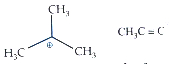
The hybridization of the positively charged carbon and the negatively charged carbon in the following structures are respectively:
A
$sp^2, sp$
B
$sp^2, sp^2$
C
$sp^3, sp^3$
D
$sp^3, sp^2$
Solution
(D) The positively charged carbon (carbocation) is bonded to three other atoms and has no lone pairs. The number of hybrid orbitals = $3 \text{ (bond pairs)} + 0 \text{ (lone pairs)} = 3$,which corresponds to $sp^2$ hybridization.
The negatively charged carbon (carbanion) is bonded to three other atoms and has one lone pair. The number of hybrid orbitals = $3 \text{ (bond pairs)} + 1 \text{ (lone pair)} = 4$,which corresponds to $sp^3$ hybridization.
Therefore,the hybridization is $sp^2$ and $sp^3$ respectively.
The negatively charged carbon (carbanion) is bonded to three other atoms and has one lone pair. The number of hybrid orbitals = $3 \text{ (bond pairs)} + 1 \text{ (lone pair)} = 4$,which corresponds to $sp^3$ hybridization.
Therefore,the hybridization is $sp^2$ and $sp^3$ respectively.
0 likes
View Solution254
MediumMCQ
Arrange the following free radicals in the correct order of their stability:
$(i)$ $CH_2=\dot{C}H$
$(ii)$ $\dot{C}H_3$
$(iii)$ $CH_3-\dot{C}H-CH_3$
$(iv)$ $(CH_3)_3\dot{C}$
$(i)$ $CH_2=\dot{C}H$
$(ii)$ $\dot{C}H_3$
$(iii)$ $CH_3-\dot{C}H-CH_3$
$(iv)$ $(CH_3)_3\dot{C}$
A
$i > ii > iii > iv$
B
$iv > iii > ii > i$
C
$i < ii < iii < iv$
D
$iv > iii > i > ii$
Solution
(B) The stability of alkyl free radicals is determined by the number of alkyl groups attached to the radical carbon,which provide stability through the inductive effect and hyperconjugation.
$3^{\circ}$ free radicals are the most stable,followed by $2^{\circ}$,$1^{\circ}$,and methyl radicals.
Vinyl free radicals $(CH_2=\dot{C}H)$ are significantly less stable because the unpaired electron is in an $sp^2$ hybridized orbital,which has more $s$-character and is more electronegative.
Thus,the stability order is: $(CH_3)_3\dot{C} (3^{\circ}) > CH_3-\dot{C}H-CH_3 (2^{\circ}) > \dot{C}H_3 (1^{\circ}) > CH_2=\dot{C}H$ (vinyl).
The correct order is $iv > iii > ii > i$.
$3^{\circ}$ free radicals are the most stable,followed by $2^{\circ}$,$1^{\circ}$,and methyl radicals.
Vinyl free radicals $(CH_2=\dot{C}H)$ are significantly less stable because the unpaired electron is in an $sp^2$ hybridized orbital,which has more $s$-character and is more electronegative.
Thus,the stability order is: $(CH_3)_3\dot{C} (3^{\circ}) > CH_3-\dot{C}H-CH_3 (2^{\circ}) > \dot{C}H_3 (1^{\circ}) > CH_2=\dot{C}H$ (vinyl).
The correct order is $iv > iii > ii > i$.
0 likes
View Solution255
EasyMCQ
The correct order of increasing stabilities of the following carbocations is:
$(i)$ Allyl carbocation
$(ii)$ Ethyl carbocation
$(iii)$ Benzyl carbocation
$(iv)$ Isobutyl carbocation
$(i)$ Allyl carbocation
$(ii)$ Ethyl carbocation
$(iii)$ Benzyl carbocation
$(iv)$ Isobutyl carbocation
A
$iv < ii < i < iii$
B
$iv < ii < iii < i$
C
$ii < iv < i < iii$
D
$ii < iv < iii < i$
Solution
(A) The stability of carbocations is determined by factors such as resonance,hyperconjugation,and the inductive effect.
$1$. Benzyl carbocation $(iii)$ is the most stable due to extensive delocalization of the positive charge through resonance with the benzene ring.
$2$. Allyl carbocation $(i)$ is stable due to delocalization of the positive charge through resonance with the adjacent $\pi$-bond.
$3$. Ethyl carbocation $(ii)$ is a primary $(1^{\circ})$ carbocation,which is stabilized by hyperconjugation from three $\alpha$-hydrogens.
$4$. Isobutyl carbocation $(iv)$ is also a primary $(1^{\circ})$ carbocation. Although it has a branched alkyl group,the positive charge is on the primary carbon,and it is less stable than the ethyl carbocation due to steric hindrance and electronic factors compared to the simpler ethyl system.
Comparing the stability: Benzyl $(iii)$ > Allyl $(i)$ > Ethyl $(ii)$ > Isobutyl $(iv)$.
Therefore,the increasing order of stability is $iv < ii < i < iii$.
$1$. Benzyl carbocation $(iii)$ is the most stable due to extensive delocalization of the positive charge through resonance with the benzene ring.
$2$. Allyl carbocation $(i)$ is stable due to delocalization of the positive charge through resonance with the adjacent $\pi$-bond.
$3$. Ethyl carbocation $(ii)$ is a primary $(1^{\circ})$ carbocation,which is stabilized by hyperconjugation from three $\alpha$-hydrogens.
$4$. Isobutyl carbocation $(iv)$ is also a primary $(1^{\circ})$ carbocation. Although it has a branched alkyl group,the positive charge is on the primary carbon,and it is less stable than the ethyl carbocation due to steric hindrance and electronic factors compared to the simpler ethyl system.
Comparing the stability: Benzyl $(iii)$ > Allyl $(i)$ > Ethyl $(ii)$ > Isobutyl $(iv)$.
Therefore,the increasing order of stability is $iv < ii < i < iii$.
0 likes
View Solution256
EasyMCQ
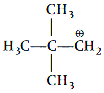
Which of the following is the most stable form for the given structure after rearrangement?
A
$CH_3-CH(CH_3)-CH_2^{\oplus}$
B
$CH_3-CH(CH_3)-CH_2-CH_3$
C
$CH_3-C^{\oplus}(CH_3)-CH_2-CH_3$
D
$CH_3-CH_2-CH_2-CH_2^{\oplus}$
Solution
(C) The given structure is a primary carbocation: $CH_3-C(CH_3)_2-CH_2^{\oplus}$.
Carbocations undergo rearrangement to form more stable carbocations (tertiary > secondary > primary).
$A$ $1,2$-hydride shift occurs from the adjacent carbon to the positively charged carbon.
This results in the formation of a tertiary carbocation: $CH_3-C^{\oplus}(CH_3)-CH_2-CH_3$.
This tertiary carbocation is more stable due to hyperconjugation and inductive effects.
Carbocations undergo rearrangement to form more stable carbocations (tertiary > secondary > primary).
$A$ $1,2$-hydride shift occurs from the adjacent carbon to the positively charged carbon.
This results in the formation of a tertiary carbocation: $CH_3-C^{\oplus}(CH_3)-CH_2-CH_3$.
This tertiary carbocation is more stable due to hyperconjugation and inductive effects.
0 likes
View Solution257
EasyMCQ
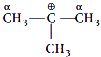
Arrange the following carbocations in the increasing order of stability with respect to their labels:
| Label | Carbocation |
| $1$ | $CH_3-CH^+-CH_3$ |
| $2$ | $CH_3^+$ |
| $3$ | $(CH_3)_3C^+$ |
| $4$ | $CH_3-CH_2^+$ |
A
$2 < 4 < 1 < 3$
B
$1 < 2 < 3 < 4$
C
$4 < 3 < 2 < 1$
D
$2 < 4 < 3 < 1$
Solution
(A) The stability of carbocations increases with the number of electron-donating alkyl groups due to the $+I$ effect and hyperconjugation. The order of stability is $3^\circ > 2^\circ > 1^\circ > \text{methyl}$.
$3$: $(CH_3)_3C^+$ ($3^\circ$ carbocation)
$1$: $CH_3-CH^+-CH_3$ ($2^\circ$ carbocation)
$4$: $CH_3-CH_2^+$ ($1^\circ$ carbocation)
$2$: $CH_3^+$ (Methyl carbocation)
Thus,the increasing order of stability is $2 < 4 < 1 < 3$.
$3$: $(CH_3)_3C^+$ ($3^\circ$ carbocation)
$1$: $CH_3-CH^+-CH_3$ ($2^\circ$ carbocation)
$4$: $CH_3-CH_2^+$ ($1^\circ$ carbocation)
$2$: $CH_3^+$ (Methyl carbocation)
Thus,the increasing order of stability is $2 < 4 < 1 < 3$.
0 likes
View Solution258
MediumMCQ
Identify the most stable carbocation from the following:
A
Cyclohexyl cation
B
Cyclohex$-2-$en$-1-$yl cation
C
$1-$methyl$-2-$phenylcyclohex$-2-$en$-1-$yl cation
D
($3$-phenylcyclohexyl)methyl cation
Solution
(C) The stability of a carbocation is determined by factors such as resonance,hyperconjugation,and inductive effects.
$A$: Cyclohexyl cation is a secondary carbocation with no resonance stabilization.
$B$: Cyclohex$-2-$en$-1-$yl cation is an allylic carbocation,which is stabilized by resonance with the adjacent double bond.
$C$: $1-$methyl$-2-$phenylcyclohex$-2-$en$-1-$yl cation is a tertiary allylic carbocation. It is stabilized by resonance with the adjacent double bond and the phenyl group,as well as by the inductive effect of the methyl group. This extensive delocalization of the positive charge makes it the most stable among the given options.
$D$: ($3$-phenylcyclohexyl)methyl cation is a primary carbocation,which is generally the least stable.
Therefore,the most stable carbocation is the one in option $C$.
$A$: Cyclohexyl cation is a secondary carbocation with no resonance stabilization.
$B$: Cyclohex$-2-$en$-1-$yl cation is an allylic carbocation,which is stabilized by resonance with the adjacent double bond.
$C$: $1-$methyl$-2-$phenylcyclohex$-2-$en$-1-$yl cation is a tertiary allylic carbocation. It is stabilized by resonance with the adjacent double bond and the phenyl group,as well as by the inductive effect of the methyl group. This extensive delocalization of the positive charge makes it the most stable among the given options.
$D$: ($3$-phenylcyclohexyl)methyl cation is a primary carbocation,which is generally the least stable.
Therefore,the most stable carbocation is the one in option $C$.
0 likes
View Solution259
EasyMCQ
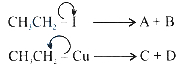
The species $A$,$B$,$C$,$D$ formed in the following bond cleavages respectively are:
A
$CH_3CH_2^{+}, I^{-}, CH_3CH_2^{-}, Cu^{+}$
B
$CH_3CH_2^{+}, I^{-}, CH_3CH_2^{+}, Cu^{-}$
C
$CH_3CH_2^{-}, I^{+}, CH_3CH_2^{+}, Cu^{-}$
D
$CH_3CH_2^{-}, I^{+}, CH_3CH_2^{-}, Cu^{+}$
Solution
(A) In the first reaction,$CH_3CH_2-I \rightarrow A + B$,the bond breaks heterolytically such that the bonding electron pair moves to the more electronegative iodine atom. This results in the formation of an ethyl carbocation $(A = CH_3CH_2^{+})$ and an iodide ion $(B = I^{-})$.
In the second reaction,$CH_3CH_2-Cu \rightarrow C + D$,the bond breaks heterolytically such that the bonding electron pair moves to the carbon atom because carbon is more electronegative than copper. This results in the formation of an ethyl carbanion $(C = CH_3CH_2^{-})$ and a copper cation $(D = Cu^{+})$.
In the second reaction,$CH_3CH_2-Cu \rightarrow C + D$,the bond breaks heterolytically such that the bonding electron pair moves to the carbon atom because carbon is more electronegative than copper. This results in the formation of an ethyl carbanion $(C = CH_3CH_2^{-})$ and a copper cation $(D = Cu^{+})$.
0 likes
View Solution260
MediumMCQ
Which of the following species is a radical?
A
$CO_2$
B
$NO$
C
$NO_2^{-}$
D
$CN^{-}$
Solution
(B) free radical is a species that contains an odd number of electrons,making it paramagnetic and highly reactive.
In $NO$,the total number of valence electrons is $5$ (from $N$) $+ 6$ (from $O$) $= 11$,which is an odd number.
In $CO_2$,the total number of valence electrons is $4$ (from $C$) $+ 2 \times 6$ (from $O$) $= 16$ (even).
In $NO_2^{-}$,the total number of valence electrons is $5$ (from $N$) $+ 2 \times 6$ (from $O$) $+ 1$ (negative charge) $= 18$ (even).
In $CN^{-}$,the total number of valence electrons is $4$ (from $C$) $+ 5$ (from $N$) $+ 1$ (negative charge) $= 10$ (even).
Therefore,$NO$ is the radical.
In $NO$,the total number of valence electrons is $5$ (from $N$) $+ 6$ (from $O$) $= 11$,which is an odd number.
In $CO_2$,the total number of valence electrons is $4$ (from $C$) $+ 2 \times 6$ (from $O$) $= 16$ (even).
In $NO_2^{-}$,the total number of valence electrons is $5$ (from $N$) $+ 2 \times 6$ (from $O$) $+ 1$ (negative charge) $= 18$ (even).
In $CN^{-}$,the total number of valence electrons is $4$ (from $C$) $+ 5$ (from $N$) $+ 1$ (negative charge) $= 10$ (even).
Therefore,$NO$ is the radical.
0 likes
View Solution261
EasyMCQ
Consider the following carbocations:
$I. C_6H_5CH_2^+$
$II. CH_2=CH^+$
$III. CH_3-CH^+(CH_3)$
$IV. CH_3-CH_2^+$
$V. HC \equiv C^+$
Arrange the above carbocations in the order of decreasing stability.
$I. C_6H_5CH_2^+$
$II. CH_2=CH^+$
$III. CH_3-CH^+(CH_3)$
$IV. CH_3-CH_2^+$
$V. HC \equiv C^+$
Arrange the above carbocations in the order of decreasing stability.
A
$I > III > IV > II > V$
B
$V > II > IV > III > I$
C
$V > II > III > I > IV$
D
$II > III > IV > V > I$
Solution
(A) The stability of carbocations is determined by resonance,hyperconjugation,and inductive effects.
$I$ $(C_6H_5CH_2^+)$ is a benzylic carbocation,which is highly stabilized by resonance with the phenyl ring.
$III$ $(CH_3-CH^+(CH_3))$ is a secondary $(2^{\circ})$ carbocation,stabilized by hyperconjugation and inductive effects of two methyl groups.
$IV$ $(CH_3-CH_2^+)$ is a primary $(1^{\circ})$ carbocation,stabilized by hyperconjugation and inductive effects of one methyl group.
$II$ $(CH_2=CH^+)$ is a vinylic carbocation,and $V$ $(HC \equiv C^+)$ is an acetylenic carbocation. Both have the positive charge on an $sp^2$ and $sp$ hybridized carbon,respectively. Higher $s$-character increases electronegativity,making the positive charge less stable.
Since $sp$ hybridization ($50\% \ s$-character) is more electronegative than $sp^2$ hybridization ($33.3\% \ s$-character),$V$ is less stable than $II$.
Thus,the decreasing order of stability is $I > III > IV > II > V$.
$I$ $(C_6H_5CH_2^+)$ is a benzylic carbocation,which is highly stabilized by resonance with the phenyl ring.
$III$ $(CH_3-CH^+(CH_3))$ is a secondary $(2^{\circ})$ carbocation,stabilized by hyperconjugation and inductive effects of two methyl groups.
$IV$ $(CH_3-CH_2^+)$ is a primary $(1^{\circ})$ carbocation,stabilized by hyperconjugation and inductive effects of one methyl group.
$II$ $(CH_2=CH^+)$ is a vinylic carbocation,and $V$ $(HC \equiv C^+)$ is an acetylenic carbocation. Both have the positive charge on an $sp^2$ and $sp$ hybridized carbon,respectively. Higher $s$-character increases electronegativity,making the positive charge less stable.
Since $sp$ hybridization ($50\% \ s$-character) is more electronegative than $sp^2$ hybridization ($33.3\% \ s$-character),$V$ is less stable than $II$.
Thus,the decreasing order of stability is $I > III > IV > II > V$.
0 likes
View Solution262
EasyMCQ
Which one of the carbanions is the least stable?
A
$^{\ominus}CH_2-NO_2$
B
$^{\ominus}CH_2-CHO$
C
$^{\ominus}CH_2-CH_3$
D
$^{\ominus}CH_3$
Solution
(C) The stability of carbanions is determined by the electron-withdrawing or electron-donating nature of the groups attached to the negatively charged carbon.
Electron-withdrawing groups ($-NO_2$,$-CHO$) stabilize the carbanion by dispersing the negative charge.
Electron-donating groups $(-CH_3)$ destabilize the carbanion by increasing the electron density on the negatively charged carbon.
Comparing the given options:
$1$. $^{\ominus}CH_2-NO_2$: $-NO_2$ is a strong electron-withdrawing group ($-I$ and $-M$ effect).
$2$. $^{\ominus}CH_2-CHO$: $-CHO$ is an electron-withdrawing group ($-I$ and $-M$ effect).
$3$. $^{\ominus}CH_2-CH_3$: $-CH_3$ is an electron-donating group ($+I$ effect).
$4$. $^{\ominus}CH_3$: This is a methyl carbanion with no additional alkyl groups.
Between $^{\ominus}CH_2-CH_3$ and $^{\ominus}CH_3$,the ethyl carbanion $(^{\ominus}CH_2-CH_3)$ is less stable due to the $+I$ effect of the additional methyl group,which increases electron density on the anionic center.
Electron-withdrawing groups ($-NO_2$,$-CHO$) stabilize the carbanion by dispersing the negative charge.
Electron-donating groups $(-CH_3)$ destabilize the carbanion by increasing the electron density on the negatively charged carbon.
Comparing the given options:
$1$. $^{\ominus}CH_2-NO_2$: $-NO_2$ is a strong electron-withdrawing group ($-I$ and $-M$ effect).
$2$. $^{\ominus}CH_2-CHO$: $-CHO$ is an electron-withdrawing group ($-I$ and $-M$ effect).
$3$. $^{\ominus}CH_2-CH_3$: $-CH_3$ is an electron-donating group ($+I$ effect).
$4$. $^{\ominus}CH_3$: This is a methyl carbanion with no additional alkyl groups.
Between $^{\ominus}CH_2-CH_3$ and $^{\ominus}CH_3$,the ethyl carbanion $(^{\ominus}CH_2-CH_3)$ is less stable due to the $+I$ effect of the additional methyl group,which increases electron density on the anionic center.
0 likes
View Solution263
MediumMCQ
Which of the following is the least stable carbocation?
A
$CH_3-\stackrel{\oplus}{C}H_2$
B
$CH_2=\stackrel{\oplus}{C}H$
C
$CH_2=CH-CH_2^{\oplus}$
D
$C_6H_5-\stackrel{\oplus}{C}H_2$
Solution
(B) The stability of carbocations is determined by factors like resonance,hyperconjugation,and inductive effects.
$1$. $CH_3-\stackrel{\oplus}{C}H_2$ (Ethyl carbocation) is stabilized by hyperconjugation.
$2$. $CH_2=\stackrel{\oplus}{C}H$ (Vinyl carbocation) has the positive charge on an $sp$-hybridized carbon atom. Since $sp$ carbons are more electronegative,they hold the positive charge very poorly,making it highly unstable.
$3$. $CH_2=CH-CH_2^{\oplus}$ (Allyl carbocation) is stabilized by resonance.
$4$. $C_6H_5-\stackrel{\oplus}{C}H_2$ (Benzyl carbocation) is stabilized by resonance with the benzene ring.
Therefore,the vinyl carbocation is the least stable.
$1$. $CH_3-\stackrel{\oplus}{C}H_2$ (Ethyl carbocation) is stabilized by hyperconjugation.
$2$. $CH_2=\stackrel{\oplus}{C}H$ (Vinyl carbocation) has the positive charge on an $sp$-hybridized carbon atom. Since $sp$ carbons are more electronegative,they hold the positive charge very poorly,making it highly unstable.
$3$. $CH_2=CH-CH_2^{\oplus}$ (Allyl carbocation) is stabilized by resonance.
$4$. $C_6H_5-\stackrel{\oplus}{C}H_2$ (Benzyl carbocation) is stabilized by resonance with the benzene ring.
Therefore,the vinyl carbocation is the least stable.
0 likes
View Solution264
MediumMCQ
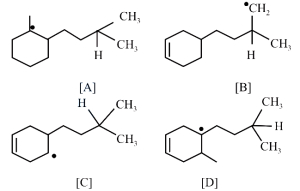
For the following radicals,the correct order of their stability is
A
$[A] < [B] < [C] < [D]$
B
$[D] < [C] < [B] > [A]$
C
$[B] < [C] < [D] < [A]$
D
$[B] < [C] < [A] < [D]$
Solution
(C) The stability of free radicals is directly proportional to the number of $\alpha$-hydrogen atoms (hyperconjugation).
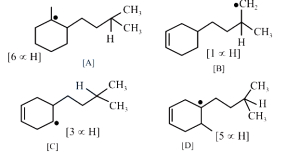
Counting the $\alpha$-hydrogens for each radical:
$[A]$ has $6 \ \alpha-H$.
$[B]$ has $1 \ \alpha-H$.
$[C]$ has $3 \ \alpha-H$.
$[D]$ has $5 \ \alpha-H$.
Comparing the number of $\alpha$-hydrogens: $1 < 3 < 5 < 6$.
Therefore,the correct order of stability is $[B] < [C] < [D] < [A]$.
Counting the $\alpha$-hydrogens for each radical:
$[A]$ has $6 \ \alpha-H$.
$[B]$ has $1 \ \alpha-H$.
$[C]$ has $3 \ \alpha-H$.
$[D]$ has $5 \ \alpha-H$.
Comparing the number of $\alpha$-hydrogens: $1 < 3 < 5 < 6$.
Therefore,the correct order of stability is $[B] < [C] < [D] < [A]$.
0 likes
View Solution265
EasyMCQ
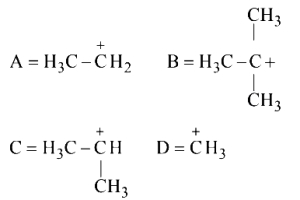
Which of the following carbocations lacks hyperconjugative stability?
A
$A = CH_3CH_2^+$
B
$B = (CH_3)_3C^+$
C
$C = (CH_3)_2CH^+$
D
$D = CH_3^+$
Solution
(C) Hyperconjugative stability in carbocations is provided by the presence of $\alpha-H$ atoms attached to the carbon atom adjacent to the positively charged carbon.
$A = CH_3CH_2^+$ has $3$ $\alpha-H$ atoms.
$B = (CH_3)_3C^+$ has $9$ $\alpha-H$ atoms.
$C = (CH_3)_2CH^+$ has $6$ $\alpha-H$ atoms.
$D = CH_3^+$ has $0$ $\alpha-H$ atoms.
Since $D$ has no $\alpha-H$ atoms,it lacks hyperconjugative stability.
$A = CH_3CH_2^+$ has $3$ $\alpha-H$ atoms.
$B = (CH_3)_3C^+$ has $9$ $\alpha-H$ atoms.
$C = (CH_3)_2CH^+$ has $6$ $\alpha-H$ atoms.
$D = CH_3^+$ has $0$ $\alpha-H$ atoms.
Since $D$ has no $\alpha-H$ atoms,it lacks hyperconjugative stability.
0 likes
View Solution266
MediumMCQ
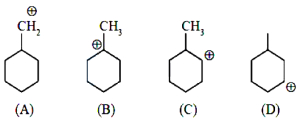
The decreasing order of stability of the given carbocations is
A
$A$
B
$B$
C
$C$
D
$D$
Solution
(D) The stability of carbocations is determined by the number of alpha-hydrogens available for hyperconjugation.
$(A)$ is a primary carbocation with $1$ alpha-hydrogen.
$(B)$ is a tertiary carbocation with $7$ alpha-hydrogens.
$(C)$ is a secondary carbocation with $3$ alpha-hydrogens.
$(D)$ is a secondary carbocation with $4$ alpha-hydrogens.
Thus,the decreasing order of stability is $(B) > (D) > (C) > (A)$.
$(A)$ is a primary carbocation with $1$ alpha-hydrogen.
$(B)$ is a tertiary carbocation with $7$ alpha-hydrogens.
$(C)$ is a secondary carbocation with $3$ alpha-hydrogens.
$(D)$ is a secondary carbocation with $4$ alpha-hydrogens.
Thus,the decreasing order of stability is $(B) > (D) > (C) > (A)$.
0 likes
View Solution267
MediumMCQ
The correct order of the relative stability of the following carbanions is:
$I$. $HC \equiv C^{-}$
$II$. $CH_2=CH-CH_2^{-}$
$III$. $H_2C=CH^{-}$
$IV$. $(C_6H_5)_2CH^{-}$
$I$. $HC \equiv C^{-}$
$II$. $CH_2=CH-CH_2^{-}$
$III$. $H_2C=CH^{-}$
$IV$. $(C_6H_5)_2CH^{-}$
A
$I > IV > II > III$
B
$III > IV > I > II$
C
$IV > II > I > III$
D
$IV > I > II > III$
Solution
(C) The stability of carbanions is determined by factors such as resonance,hybridization,and inductive effects.
$IV$. $(C_6H_5)_2CH^{-}$: This carbanion is highly stable due to extensive resonance with two phenyl rings and the delocalization of the negative charge.
$II$. $CH_2=CH-CH_2^{-}$: This is an allylic carbanion,which is stabilized by resonance (conjugation of the negative charge with the double bond).
$I$. $HC \equiv C^{-}$: This is an $sp$-hybridized carbanion. The higher $s$-character $(50\%)$ makes the carbon more electronegative,thus stabilizing the negative charge.
$III$. $H_2C=CH^{-}$: This is an $sp^2$-hybridized carbanion. It has less $s$-character $(33.3\%)$ compared to the $sp$-hybridized carbanion,making it less stable than $I$.
Comparing these,the order of stability is $IV > II > I > III$.
$IV$. $(C_6H_5)_2CH^{-}$: This carbanion is highly stable due to extensive resonance with two phenyl rings and the delocalization of the negative charge.
$II$. $CH_2=CH-CH_2^{-}$: This is an allylic carbanion,which is stabilized by resonance (conjugation of the negative charge with the double bond).
$I$. $HC \equiv C^{-}$: This is an $sp$-hybridized carbanion. The higher $s$-character $(50\%)$ makes the carbon more electronegative,thus stabilizing the negative charge.
$III$. $H_2C=CH^{-}$: This is an $sp^2$-hybridized carbanion. It has less $s$-character $(33.3\%)$ compared to the $sp$-hybridized carbanion,making it less stable than $I$.
Comparing these,the order of stability is $IV > II > I > III$.
0 likes
View Solution268
DifficultMCQ
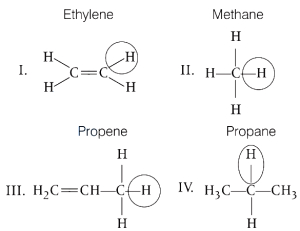
The order of circled $C-H$ bond dissociation energy in the following compounds is:
A
$II > I > IV > III$
B
$IV > III > I > II$
C
$I > II > IV > III$
D
$I > IV > II > III$
Solution
(C) The bond dissociation energy $(BDE)$ of a $C-H$ bond is inversely proportional to the stability of the free radical formed after homolytic cleavage of that bond.
$1.$ Ethylene $(I)$: The radical formed is a vinyl radical $(CH_2=CH^{\bullet})$,where the unpaired electron is in an $sp^2$ orbital. This is highly unstable.
$2.$ Methane $(II)$: The radical formed is a methyl radical $(CH_3^{\bullet})$.
$3.$ Propene $(III)$: The radical formed is an allyl radical $(CH_2=CH-CH_2^{\bullet})$,which is resonance stabilized and thus the most stable.
$4.$ Propane $(IV)$: The radical formed is an isopropyl radical $((CH_3)_2CH^{\bullet})$,which is stabilized by hyperconjugation.
Stability order of radicals: Allyl $(III)$ > Isopropyl $(IV)$ > Methyl $(II)$ > Vinyl $(I)$.
Since $BDE \propto \frac{1}{\text{Stability of radical}}$,the order of $BDE$ is: $I > II > IV > III$.
$1.$ Ethylene $(I)$: The radical formed is a vinyl radical $(CH_2=CH^{\bullet})$,where the unpaired electron is in an $sp^2$ orbital. This is highly unstable.
$2.$ Methane $(II)$: The radical formed is a methyl radical $(CH_3^{\bullet})$.
$3.$ Propene $(III)$: The radical formed is an allyl radical $(CH_2=CH-CH_2^{\bullet})$,which is resonance stabilized and thus the most stable.
$4.$ Propane $(IV)$: The radical formed is an isopropyl radical $((CH_3)_2CH^{\bullet})$,which is stabilized by hyperconjugation.
Stability order of radicals: Allyl $(III)$ > Isopropyl $(IV)$ > Methyl $(II)$ > Vinyl $(I)$.
Since $BDE \propto \frac{1}{\text{Stability of radical}}$,the order of $BDE$ is: $I > II > IV > III$.
0 likes
View Solution269
EasyMCQ
Match the following columns and select the correct option.
| List-$I$ (Carbocation) | List-$II$ (Type) |
|---|---|
| $A$. $CH_3-C^{+}(CH_3)-CH_3$ | $I$. Secondary carbocation |
| $B$. $CH_3-C^{+}H-CH_3$ | $II$. Methyl carbocation |
| $C$. $CH_3-CH_2^+$ | $III$. Primary carbocation |
| $D$. $CH_3^+$ | $IV$. Tertiary carbocation |
A
$IV, III, II, I$
B
$IV, I, III, II$
C
$I, II, III, IV$
D
$II, I, IV, III$
Solution
(B) In the given matching:
$A$. $CH_3-C^{+}(CH_3)-CH_3$ is a tertiary $(3^\circ)$ carbocation because the positive charge is on a carbon bonded to three other carbons. So,$A-IV$.
$B$. $CH_3-C^{+}H-CH_3$ is a secondary $(2^\circ)$ carbocation because the positive charge is on a carbon bonded to two other carbons. So,$B-I$.
$C$. $CH_3-CH_2^+$ is a primary $(1^\circ)$ carbocation because the positive charge is on a carbon bonded to one other carbon. So,$C-III$.
$D$. $CH_3^+$ is a methyl carbocation. So,$D-II$.
The correct sequence is $A-IV, B-I, C-III, D-II$.
$A$. $CH_3-C^{+}(CH_3)-CH_3$ is a tertiary $(3^\circ)$ carbocation because the positive charge is on a carbon bonded to three other carbons. So,$A-IV$.
$B$. $CH_3-C^{+}H-CH_3$ is a secondary $(2^\circ)$ carbocation because the positive charge is on a carbon bonded to two other carbons. So,$B-I$.
$C$. $CH_3-CH_2^+$ is a primary $(1^\circ)$ carbocation because the positive charge is on a carbon bonded to one other carbon. So,$C-III$.
$D$. $CH_3^+$ is a methyl carbocation. So,$D-II$.
The correct sequence is $A-IV, B-I, C-III, D-II$.
0 likes
View Solution270
MediumMCQ
In the following species,the one which is likely to be the intermediate during benzoin condensation of benzaldehyde is
A
$Ph-C\equiv O^+$
B
$Ph-C^+(OH)(CN)$
C
$Ph-C^-(OH)(CN)$
D
$Ph-C^-=O$
Solution
(C) The benzoin condensation involves the reaction of two molecules of benzaldehyde in the presence of a cyanide ion $(CN^-)$ catalyst to form benzoin.
The mechanism begins with the nucleophilic attack of $CN^-$ on the carbonyl carbon of benzaldehyde.
This is followed by a proton transfer (tautomerization) to form a carbanion intermediate,which is stabilized by the electron-withdrawing $CN$ group and the phenyl ring.
The structure of this key intermediate is $Ph-C^-(OH)(CN)$.
This carbanion then attacks another molecule of benzaldehyde to continue the reaction,eventually leading to the formation of benzoin after the elimination of the $CN^-$ catalyst.
The mechanism begins with the nucleophilic attack of $CN^-$ on the carbonyl carbon of benzaldehyde.
This is followed by a proton transfer (tautomerization) to form a carbanion intermediate,which is stabilized by the electron-withdrawing $CN$ group and the phenyl ring.
The structure of this key intermediate is $Ph-C^-(OH)(CN)$.
This carbanion then attacks another molecule of benzaldehyde to continue the reaction,eventually leading to the formation of benzoin after the elimination of the $CN^-$ catalyst.
0 likes
View Solution271
MediumMCQ
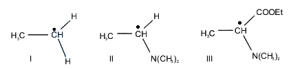
The correct order of relative stability for the given free radicals is:
A
$I < II < III$
B
$I < III < II$
C
$III < II < I$
D
$II < I < III$
Solution
(B) The stability of free radicals is determined by the resonance and inductive effects of the attached groups.
$I$ is an ethyl radical $(CH_3CH_2^{\bullet})$,which is stabilized by hyperconjugation.
$II$ is a radical with an amino group $(N(CH_3)_2)$ attached to the radical carbon. The lone pair on the nitrogen atom provides resonance stabilization through the $+M$ effect,which is very effective for radical stabilization.
$III$ has both an amino group $(N(CH_3)_2)$ and an ester group $(COOEt)$ attached to the radical carbon. While the amino group provides strong resonance stabilization,the ester group is electron-withdrawing ($-I$ and $-M$ effects),which destabilizes the radical compared to $II$.
Therefore,the stability order is $III < II < I$ is incorrect based on the provided options; the correct order is $I < II < III$ is also not quite right as $II$ is more stable than $I$ due to resonance. Comparing $II$ and $III$,$II$ is more stable than $III$ because the electron-withdrawing ester group in $III$ reduces the electron density on the radical carbon. Thus,the order is $I < III < II$.
$I$ is an ethyl radical $(CH_3CH_2^{\bullet})$,which is stabilized by hyperconjugation.
$II$ is a radical with an amino group $(N(CH_3)_2)$ attached to the radical carbon. The lone pair on the nitrogen atom provides resonance stabilization through the $+M$ effect,which is very effective for radical stabilization.
$III$ has both an amino group $(N(CH_3)_2)$ and an ester group $(COOEt)$ attached to the radical carbon. While the amino group provides strong resonance stabilization,the ester group is electron-withdrawing ($-I$ and $-M$ effects),which destabilizes the radical compared to $II$.
Therefore,the stability order is $III < II < I$ is incorrect based on the provided options; the correct order is $I < II < III$ is also not quite right as $II$ is more stable than $I$ due to resonance. Comparing $II$ and $III$,$II$ is more stable than $III$ because the electron-withdrawing ester group in $III$ reduces the electron density on the radical carbon. Thus,the order is $I < III < II$.
0 likes
View Solution272
EasyMCQ
For the following carbocations,the correct order of stability is:
$I: ^+CH_2-COCH_3$
$II: ^+CH_2-OCH_3$
$III: ^+CH_2-CH_3$
$I: ^+CH_2-COCH_3$
$II: ^+CH_2-OCH_3$
$III: ^+CH_2-CH_3$
A
$III < I < II$
B
$I < II < III$
C
$II < I < III$
D
$I < III < II$
Solution
(D) The stability of carbocations is determined by electronic effects:
$1$. In $II$ $(^+CH_2-OCH_3)$,the oxygen atom has lone pairs that can donate electron density through resonance ($+M$ effect),completing the octet of the carbon atom,making it the most stable.
$2$. In $III$ $(^+CH_2-CH_3)$,the ethyl group provides stability through hyperconjugation and the inductive effect ($+I$ effect) of the methyl group.
$3$. In $I$ $(^+CH_2-COCH_3)$,the carbonyl group $(-C=O)$ is a strong electron-withdrawing group ($-I$ and $-M$ effect),which destabilizes the positive charge,making it the least stable.
Therefore,the order of stability is $I < III < II$.
$1$. In $II$ $(^+CH_2-OCH_3)$,the oxygen atom has lone pairs that can donate electron density through resonance ($+M$ effect),completing the octet of the carbon atom,making it the most stable.
$2$. In $III$ $(^+CH_2-CH_3)$,the ethyl group provides stability through hyperconjugation and the inductive effect ($+I$ effect) of the methyl group.
$3$. In $I$ $(^+CH_2-COCH_3)$,the carbonyl group $(-C=O)$ is a strong electron-withdrawing group ($-I$ and $-M$ effect),which destabilizes the positive charge,making it the least stable.
Therefore,the order of stability is $I < III < II$.
0 likes
View Solution273
EasyMCQ
The reaction of methyltrichloroacetate $(Cl_{3}CCO_{2}Me)$ with sodium methoxide $(NaOMe)$ generates
A
carbocation
B
carbene
C
carbanion
D
carbon radical
Solution
(B) The reaction of methyltrichloroacetate $(Cl_{3}CCO_{2}Me)$ with sodium methoxide $(NaOMe)$ involves the nucleophilic attack of the methoxide ion $(^-OMe)$ on the carbonyl carbon of the ester.
This leads to the formation of a tetrahedral intermediate,which then collapses to eliminate the trichloromethyl carbanion $(^-CCl_{3})$.
The trichloromethyl carbanion $(^-CCl_{3})$ is unstable and subsequently loses a chloride ion $(Cl^-)$ to generate dichlorocarbene $(:CCl_{2})$.
Therefore,the final reactive intermediate generated in this process is a carbene.
This leads to the formation of a tetrahedral intermediate,which then collapses to eliminate the trichloromethyl carbanion $(^-CCl_{3})$.
The trichloromethyl carbanion $(^-CCl_{3})$ is unstable and subsequently loses a chloride ion $(Cl^-)$ to generate dichlorocarbene $(:CCl_{2})$.
Therefore,the final reactive intermediate generated in this process is a carbene.
0 likes
View Solution274
EasyMCQ
Among the following carbocations:
$(I)$ $Ph_{2}\stackrel{+}{C} CH_{2} Me$
$(II)$ $Ph CH_{2} CH_{2} \stackrel{+}{C} HPh$
$(III)$ $Ph_{2} CH \stackrel{+}{C} HMe$
$(IV)$ $Ph_{2} C(Me) \stackrel{+}{C} H_{2}$
The order of stability is:
$(I)$ $Ph_{2}\stackrel{+}{C} CH_{2} Me$
$(II)$ $Ph CH_{2} CH_{2} \stackrel{+}{C} HPh$
$(III)$ $Ph_{2} CH \stackrel{+}{C} HMe$
$(IV)$ $Ph_{2} C(Me) \stackrel{+}{C} H_{2}$
The order of stability is:
A
$IV > II > I > III$
B
$I > II > III > IV$
C
$II > I > IV > III$
D
$I > IV > III > II$
Solution
(B) The stability of carbocations is determined by resonance and inductive effects.
$(I)$ $Ph_{2}\stackrel{+}{C} CH_{2} Me$ is a $3^{\circ}$ benzylic carbocation stabilized by two phenyl rings.
$(II)$ $Ph CH_{2} CH_{2} \stackrel{+}{C} HPh$ is a $2^{\circ}$ benzylic carbocation stabilized by one phenyl ring.
$(III)$ $Ph_{2} CH \stackrel{+}{C} HMe$ is a $2^{\circ}$ carbocation with two phenyl groups attached to the adjacent carbon,providing some inductive stabilization.
$(IV)$ $Ph_{2} C(Me) \stackrel{+}{C} H_{2}$ is a $1^{\circ}$ carbocation.
Comparing these,the resonance stabilization from phenyl rings is the dominant factor. The order of stability is $(I)$ > $(II)$ > $(III)$ > $(IV)$.
$(I)$ $Ph_{2}\stackrel{+}{C} CH_{2} Me$ is a $3^{\circ}$ benzylic carbocation stabilized by two phenyl rings.
$(II)$ $Ph CH_{2} CH_{2} \stackrel{+}{C} HPh$ is a $2^{\circ}$ benzylic carbocation stabilized by one phenyl ring.
$(III)$ $Ph_{2} CH \stackrel{+}{C} HMe$ is a $2^{\circ}$ carbocation with two phenyl groups attached to the adjacent carbon,providing some inductive stabilization.
$(IV)$ $Ph_{2} C(Me) \stackrel{+}{C} H_{2}$ is a $1^{\circ}$ carbocation.
Comparing these,the resonance stabilization from phenyl rings is the dominant factor. The order of stability is $(I)$ > $(II)$ > $(III)$ > $(IV)$.
0 likes
View Solution275
MediumMCQ
The correct stability order of the following carbocations is:
$I$. $H_2C^+-CH=CH-CH_3$
$II$. $H_2C^+-CH=CH-BMe_2$
$III$. $H_2C^+-CH=CH-NMe_2$
$IV$. $H_2C^+-CH=CH-OMe$
$I$. $H_2C^+-CH=CH-CH_3$
$II$. $H_2C^+-CH=CH-BMe_2$
$III$. $H_2C^+-CH=CH-NMe_2$
$IV$. $H_2C^+-CH=CH-OMe$
A
$II > I > III > IV$
B
$III > I > II > IV$
C
$III > IV > I > II$
D
$IV > III > II > I$
Solution
(C) The stability of carbocations is determined by the electron-donating or electron-withdrawing nature of the substituents attached to the conjugated system.
$1$. In $III$ and $IV$,the groups $-NMe_2$ and $-OMe$ show a strong $+R$ (resonance) effect,which stabilizes the carbocation significantly.
$2$. Since nitrogen is less electronegative than oxygen,the lone pair on $N$ is more easily donated,making $-NMe_2$ a stronger $+R$ group than $-OMe$. Thus,$III > IV$.
$3$. In $I$,the $-CH_3$ group shows a weak $+I$ (inductive) effect and hyperconjugation,providing moderate stability.
$4$. In $II$,the $-BMe_2$ group has an empty $p$-orbital and shows a $-R$ effect,which destabilizes the carbocation.
$5$. Therefore,the correct stability order is $III > IV > I > II$.
$1$. In $III$ and $IV$,the groups $-NMe_2$ and $-OMe$ show a strong $+R$ (resonance) effect,which stabilizes the carbocation significantly.
$2$. Since nitrogen is less electronegative than oxygen,the lone pair on $N$ is more easily donated,making $-NMe_2$ a stronger $+R$ group than $-OMe$. Thus,$III > IV$.
$3$. In $I$,the $-CH_3$ group shows a weak $+I$ (inductive) effect and hyperconjugation,providing moderate stability.
$4$. In $II$,the $-BMe_2$ group has an empty $p$-orbital and shows a $-R$ effect,which destabilizes the carbocation.
$5$. Therefore,the correct stability order is $III > IV > I > II$.
0 likes
View Solution276
MediumMCQ
Which of the following carbocations will be most stable?
A
$Ph_3C^{+}$
B
$CH_3-CH_2^{+}$
C
$(CH_3)_2CH^{+}$
D
$CH_2=CH-CH_2^{+}$
Solution
(A) The stability of carbocations is determined by factors such as resonance,hyperconjugation,and inductive effect.
$Ph_3C^{+}$ (triphenylmethyl carbocation) is the most stable among the given options because the positive charge on the central carbon atom is delocalized over three phenyl rings through resonance.
This extensive delocalization provides significant stabilization compared to the other carbocations,which are stabilized only by hyperconjugation or simple resonance.
$Ph_3C^{+}$ (triphenylmethyl carbocation) is the most stable among the given options because the positive charge on the central carbon atom is delocalized over three phenyl rings through resonance.
This extensive delocalization provides significant stabilization compared to the other carbocations,which are stabilized only by hyperconjugation or simple resonance.
0 likes
View Solution277
EasyMCQ
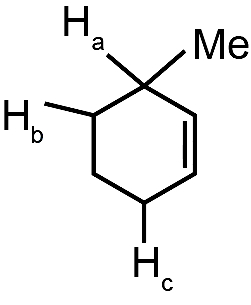
The order of decreasing ease of abstraction of hydrogen atoms in the following molecule is:
A
$H_{a} > H_{b} > H_{c}$
B
$H_{a} > H_{c} > H_{b}$
C
$H_{b} > H_{a} > H_{c}$
D
$H_{c} > H_{b} > H_{a}$
Solution
(B) The ease of abstraction of a hydrogen atom depends on the stability of the resulting radical or carbocation intermediate.
Abstraction of $H_{a}$ leads to a $3^{\circ}$ allylic radical/carbocation,which is highly stable due to resonance and hyperconjugation.
Abstraction of $H_{c}$ leads to a $2^{\circ}$ allylic radical/carbocation,which is less stable than the $3^{\circ}$ allylic species.
Abstraction of $H_{b}$ leads to a $2^{\circ}$ non-allylic radical/carbocation,which is the least stable among the three.
Therefore,the order of decreasing ease of abstraction is $H_{a} > H_{c} > H_{b}$.
Abstraction of $H_{a}$ leads to a $3^{\circ}$ allylic radical/carbocation,which is highly stable due to resonance and hyperconjugation.
Abstraction of $H_{c}$ leads to a $2^{\circ}$ allylic radical/carbocation,which is less stable than the $3^{\circ}$ allylic species.
Abstraction of $H_{b}$ leads to a $2^{\circ}$ non-allylic radical/carbocation,which is the least stable among the three.
Therefore,the order of decreasing ease of abstraction is $H_{a} > H_{c} > H_{b}$.
0 likes
View Solution278
DifficultMCQ
Given below are two statements:
Statement $I$: $(CH_3)_3C^{+}$ is more stable than $CH_3^{+}$ as nine hyperconjugation interactions are possible in $(CH_3)_3C^{+}$.
Statement $II$: $CH_3^{+}$ is less stable than $(CH_3)_3C^{+}$ as only three hyperconjugation interactions are possible in $CH_3^{+}$.
In the light of the above statements,choose the correct answer from the options given below.
Statement $I$: $(CH_3)_3C^{+}$ is more stable than $CH_3^{+}$ as nine hyperconjugation interactions are possible in $(CH_3)_3C^{+}$.
Statement $II$: $CH_3^{+}$ is less stable than $(CH_3)_3C^{+}$ as only three hyperconjugation interactions are possible in $CH_3^{+}$.
In the light of the above statements,choose the correct answer from the options given below.
A
Statement $I$ is true but Statement $II$ is false
B
Both Statement $I$ and Statement $II$ are true
C
Both Statement $I$ and Statement $II$ are false
D
Statement $I$ is false but Statement $II$ is true
Solution
(A) Statement $I$ is true: The tert-butyl carbocation $(CH_3)_3C^{+}$ has $9$ $\alpha$-hydrogens,which allows for $9$ hyperconjugation structures,making it highly stable.
Statement $II$ is true: The methyl carbocation $CH_3^{+}$ has $0$ $\alpha$-hydrogens,meaning it has $0$ hyperconjugation interactions. The statement claims $CH_3^{+}$ is less stable than $(CH_3)_3C^{+}$ because only three hyperconjugation interactions are possible in $CH_3^{+}$,which is factually incorrect regarding the number of interactions,but the conclusion that $CH_3^{+}$ is less stable is correct. However,in the context of standard chemistry questions,if the reasoning provided in the statement is incorrect,the statement is considered false. Wait,let's re-evaluate: $CH_3^{+}$ has $0$ hyperconjugation interactions. The statement says it has $3$. Therefore,Statement $II$ is false.
Thus,Statement $I$ is true and Statement $II$ is false.
Statement $II$ is true: The methyl carbocation $CH_3^{+}$ has $0$ $\alpha$-hydrogens,meaning it has $0$ hyperconjugation interactions. The statement claims $CH_3^{+}$ is less stable than $(CH_3)_3C^{+}$ because only three hyperconjugation interactions are possible in $CH_3^{+}$,which is factually incorrect regarding the number of interactions,but the conclusion that $CH_3^{+}$ is less stable is correct. However,in the context of standard chemistry questions,if the reasoning provided in the statement is incorrect,the statement is considered false. Wait,let's re-evaluate: $CH_3^{+}$ has $0$ hyperconjugation interactions. The statement says it has $3$. Therefore,Statement $II$ is false.
Thus,Statement $I$ is true and Statement $II$ is false.
0 likes
View Solution279
DifficultMCQ
The correct order of stability for the following carbanions is:
$CH_2=CH^{-}, CH_3-CH_2^{-}, CH\equiv C^{-}$
$CH_2=CH^{-}, CH_3-CH_2^{-}, CH\equiv C^{-}$
A
$CH_3-CH_2^{-} > CH_2=CH^{-} > CH\equiv C^{-}$
B
$CH_2=CH^{-} > CH\equiv C^{-} > CH_3-CH_2^{-}$
C
$CH\equiv C^{-} > CH_2=CH^{-} > CH_3-CH_2^{-}$
D
$CH\equiv C^{-} > CH_3-CH_2^{-} > CH_2=CH^{-}$
Solution
(C) The stability of a carbanion is directly proportional to the percentage of $s$-character in the hybrid orbital of the carbon atom bearing the negative charge.
$1$. In $CH\equiv C^{-}$,the carbon is $sp$ hybridized ($50\% \ s$-character).
$2$. In $CH_2=CH^{-}$,the carbon is $sp^2$ hybridized ($33.3\% \ s$-character).
$3$. In $CH_3-CH_2^{-}$,the carbon is $sp^3$ hybridized ($25\% \ s$-character).
Higher $s$-character means the electrons are held closer to the nucleus,increasing stability.
Therefore,the correct order of stability is: $CH\equiv C^{-} > CH_2=CH^{-} > CH_3-CH_2^{-}$.
$1$. In $CH\equiv C^{-}$,the carbon is $sp$ hybridized ($50\% \ s$-character).
$2$. In $CH_2=CH^{-}$,the carbon is $sp^2$ hybridized ($33.3\% \ s$-character).
$3$. In $CH_3-CH_2^{-}$,the carbon is $sp^3$ hybridized ($25\% \ s$-character).
Higher $s$-character means the electrons are held closer to the nucleus,increasing stability.
Therefore,the correct order of stability is: $CH\equiv C^{-} > CH_2=CH^{-} > CH_3-CH_2^{-}$.
0 likes
View Solution280
DifficultMCQ
Arrange the following carbanions in the decreasing order of stability:
$I. \ p-Br-C_6H_4-CH_2^-$
$II. \ C_6H_5-CH_2^-$
$III. \ p-CH_3O-C_6H_4-CH_2^-$
$IV. \ p-CHO-C_6H_4-CH_2^-$
$V. \ p-CH_3-C_6H_4-CH_2^-$
Choose the correct answer from the options given below:
$I. \ p-Br-C_6H_4-CH_2^-$
$II. \ C_6H_5-CH_2^-$
$III. \ p-CH_3O-C_6H_4-CH_2^-$
$IV. \ p-CHO-C_6H_4-CH_2^-$
$V. \ p-CH_3-C_6H_4-CH_2^-$
Choose the correct answer from the options given below:
A
$I > II > IV > V > III$
B
$I > IV > II > V > III$
C
$IV > I > II > V > III$
D
$IV > II > I > III > V$
Solution
(C) The stability of a carbanion is increased by electron-withdrawing groups $(EWG)$ and decreased by electron-donating groups $(EDG)$.
$IV$ $(p-CHO)$: $-CHO$ is a strong $EWG$ ($-M$ effect),providing maximum stability.
$I$ $(p-Br)$: $-Br$ is an $EWG$ ($-I$ effect),providing stability.
$II$ $(C_6H_5-CH_2^-)$: Reference structure.
$V$ $(p-CH_3)$: $-CH_3$ is an $EDG$ ($+I$ and hyperconjugation),decreasing stability.
$III$ $(p-CH_3O)$: $-OCH_3$ is a strong $EDG$ ($+M$ effect),providing minimum stability.
Thus,the decreasing order of stability is $IV > I > II > V > III$.
$IV$ $(p-CHO)$: $-CHO$ is a strong $EWG$ ($-M$ effect),providing maximum stability.
$I$ $(p-Br)$: $-Br$ is an $EWG$ ($-I$ effect),providing stability.
$II$ $(C_6H_5-CH_2^-)$: Reference structure.
$V$ $(p-CH_3)$: $-CH_3$ is an $EDG$ ($+I$ and hyperconjugation),decreasing stability.
$III$ $(p-CH_3O)$: $-OCH_3$ is a strong $EDG$ ($+M$ effect),providing minimum stability.
Thus,the decreasing order of stability is $IV > I > II > V > III$.
0 likes
View Solution8-4.Organic Chemistry : Reaction mechanism — Reactive Intermediates · Frequently Asked Questions
1Are these 8-4.Organic Chemistry : Reaction mechanism questions useful for JEE and NEET?
Yes. All questions in this section are mapped to JEE Main and NEET exam patterns. Previous year questions from JEE Main, NEET, GUJCET and state-level exams are included with full solutions.
2Can I switch to Hindi or Gujarati for these questions?
Yes. Use the language tabs in the hero section or the sidebar to view the same questions and solutions in English, Hindi or Gujarati.
3How do I generate a question paper from this subtopic?
Use the Vedclass Exam Paper Generator — select the chapter and subtopic, set difficulty, and generate Sets A, B, C, D automatically. First 3 chapters of every subject are free.
Vedclass Products
For Students
Vedclass Test Series
Mock tests in real JEE/NEET style with performance analysis. 5-day free trial.
Start Free TrialFor Teachers
Exam Paper Generator
Generate Set A/B/C/D papers from this chapter in 2 minutes. 3 chapters free.
Try FreeFor Institutes
Online Exam Module
Live online exams with unlimited students, 360° analytics & white-label branding.
See DemoFor Teachers & Institutes
Generate a 8-4.Organic Chemistry : Reaction mechanism Exam Paper in 2 Minutes
Select subtopic & difficulty — Sets A, B, C, D auto-generated with No Repeat logic.
First 3 chapters of every subject are free — no payment required.