
A English
Bonding and hybridisation in organic compounds Questions in English
Class 11 Chemistry · 8-1.Organic Chemistry : Classification and Nomenclature of Organic compounds · Bonding and hybridisation in organic compounds
97+
Questions
English
Language
100%
With Solutions
Showing 46 of 97 questions in English
51
MediumMCQ
Select the response that correctly identifies the number of carbon atoms of each type of hybridization in the compound given below:
$H_2C=C=CH-CHO$
(Order: $sp^3 - sp^2 - sp$)
$H_2C=C=CH-CHO$
(Order: $sp^3 - sp^2 - sp$)
A
$2-2-0$
B
$1-3-0$
C
$0-3-1$
D
$1-2-1$
Solution
(C) The structure of the compound is $H_2C=C=CH-CHO$.
$1$. The terminal $CH_2$ carbon is bonded to two hydrogens and one double bond,so it is $sp^2$ hybridized.
$2$. The central carbon in the allene system $(C=C=C)$ is bonded to two double bonds,so it is $sp$ hybridized.
$3$. The $CH$ carbon is bonded to one hydrogen,one double bond,and one single bond,so it is $sp^2$ hybridized.
$4$. The carbonyl carbon $(CHO)$ is bonded to one hydrogen and one double bond,so it is $sp^2$ hybridized.
Total count:
$sp^3$ carbons: $0$
$sp^2$ carbons: $3$
$sp$ carbons: $1$
Therefore,the correct sequence is $0-3-1$.
$1$. The terminal $CH_2$ carbon is bonded to two hydrogens and one double bond,so it is $sp^2$ hybridized.
$2$. The central carbon in the allene system $(C=C=C)$ is bonded to two double bonds,so it is $sp$ hybridized.
$3$. The $CH$ carbon is bonded to one hydrogen,one double bond,and one single bond,so it is $sp^2$ hybridized.
$4$. The carbonyl carbon $(CHO)$ is bonded to one hydrogen and one double bond,so it is $sp^2$ hybridized.
Total count:
$sp^3$ carbons: $0$
$sp^2$ carbons: $3$
$sp$ carbons: $1$
Therefore,the correct sequence is $0-3-1$.
0 likes
View Solution52
DifficultMCQ
Consider a positively charged $C_2H_3$ species in which the positively charged carbon is $sp$-hybridized,the uncharged carbon is $sp^2$-hybridized and an empty $p$-orbital is perpendicular to the $\pi$ system. What is the best description of this cation?
A
vinyl
B
allenyl
C
alkyl
D
allyl
Solution
(A) The species described is $CH_2=C^+H$.
In this structure,the positively charged carbon is bonded to one hydrogen and one carbon atom via a double bond,resulting in $sp$ hybridization.
The uncharged carbon is $sp^2$ hybridized.
This specific cation is known as the vinyl cation.
In this structure,the positively charged carbon is bonded to one hydrogen and one carbon atom via a double bond,resulting in $sp$ hybridization.
The uncharged carbon is $sp^2$ hybridized.
This specific cation is known as the vinyl cation.
0 likes
View Solution53
MediumMCQ
The compound buta-$1,2-$diene has
A
only $sp-$ hybridized carbon atom
B
only $sp^2-$ hybridized carbon atom
C
both $sp-$ and $sp^2-$ hybridized carbon atoms
D
$sp-, sp^2-$ and $sp^3-$ hybridized carbon atoms
Solution
(D) The structure of buta-$1,2-$diene is $CH_2=C=CH-CH_3$.
Analyzing the hybridization of each carbon atom:
$CH_2$ is $sp^2$ hybridized.
The central $C$ atom is $sp$ hybridized.
The $CH$ group is $sp^2$ hybridized.
The $CH_3$ group is $sp^3$ hybridized.
Therefore,the compound contains $sp-, sp^2-,$ and $sp^3-$ hybridized carbon atoms.
Analyzing the hybridization of each carbon atom:
$CH_2$ is $sp^2$ hybridized.
The central $C$ atom is $sp$ hybridized.
The $CH$ group is $sp^2$ hybridized.
The $CH_3$ group is $sp^3$ hybridized.
Therefore,the compound contains $sp-, sp^2-,$ and $sp^3-$ hybridized carbon atoms.
0 likes
View Solution54
MediumMCQ
Number of $sp$ hybridised carbon atoms in the given compound $CH_2=CH-C\equiv C-CH_2-CN$ is:
A
$1$
B
$2$
C
$3$
D
$4$
Solution
(C) To determine the hybridisation of carbon atoms,we count the number of sigma bonds and lone pairs (if any) attached to each carbon atom.
$1$. $CH_2=CH-C\equiv C-CH_2-CN$
$2$. The structure is $H_2C=CH-C\equiv C-CH_2-C\equiv N$.
$3$. Carbon atoms involved in a triple bond ($C\equiv C$ or $C\equiv N$) are $sp$ hybridised.
$4$. In the given molecule,the carbons in the $C\equiv C$ group are $sp$ hybridised ($2$ carbons).
$5$. The carbon in the $CN$ group is also $sp$ hybridised ($1$ carbon).
$6$. Total number of $sp$ hybridised carbon atoms = $2 + 1 = 3$.
$1$. $CH_2=CH-C\equiv C-CH_2-CN$
$2$. The structure is $H_2C=CH-C\equiv C-CH_2-C\equiv N$.
$3$. Carbon atoms involved in a triple bond ($C\equiv C$ or $C\equiv N$) are $sp$ hybridised.
$4$. In the given molecule,the carbons in the $C\equiv C$ group are $sp$ hybridised ($2$ carbons).
$5$. The carbon in the $CN$ group is also $sp$ hybridised ($1$ carbon).
$6$. Total number of $sp$ hybridised carbon atoms = $2 + 1 = 3$.
0 likes
View Solution55
MediumMCQ
$CH_3-CH_2-CH=CH_2$ has hybridisation
A
$sp^3, sp^3, sp^2, sp^2$
B
$sp^3, sp^3, sp^2, sp$
C
$sp^3, sp^3, sp^2, sp^2$
D
$sp^3, sp^2, sp^2, sp$
Solution
(A) The given molecule is $CH_3-CH_2-CH=CH_2$.
$1$. The first carbon $(CH_3)$ is bonded to three hydrogens and one carbon via single bonds,so it is $sp^3$ hybridized.
$2$. The second carbon $(-CH_2-)$ is bonded to two hydrogens and two carbons via single bonds,so it is $sp^3$ hybridized.
$3$. The third carbon $(-CH=)$ is bonded to one hydrogen and one carbon via a double bond,so it is $sp^2$ hybridized.
$4$. The fourth carbon $(=CH_2)$ is bonded to two hydrogens via single bonds and one carbon via a double bond,so it is $sp^2$ hybridized.
Thus,the hybridization sequence is $sp^3, sp^3, sp^2, sp^2$.
$1$. The first carbon $(CH_3)$ is bonded to three hydrogens and one carbon via single bonds,so it is $sp^3$ hybridized.
$2$. The second carbon $(-CH_2-)$ is bonded to two hydrogens and two carbons via single bonds,so it is $sp^3$ hybridized.
$3$. The third carbon $(-CH=)$ is bonded to one hydrogen and one carbon via a double bond,so it is $sp^2$ hybridized.
$4$. The fourth carbon $(=CH_2)$ is bonded to two hydrogens via single bonds and one carbon via a double bond,so it is $sp^2$ hybridized.
Thus,the hybridization sequence is $sp^3, sp^3, sp^2, sp^2$.
0 likes
View Solution56
DifficultMCQ
In the molecule $HC^{1} \equiv C^{2} - CH^{3} = CH^{4} - CH_{3}^{5}$,which carbon atom exhibits the lowest electronegativity?
A
Fifth
B
Third
C
First
D
Second
Solution
(A) The electronegativity of a carbon atom depends on its hybridization state.
The electronegativity order is $sp > sp^{2} > sp^{3}$.
Carbon $1$ $(C^{1})$ is $sp$ hybridized.
Carbon $2$ $(C^{2})$ is $sp$ hybridized.
Carbon $3$ $(C^{3})$ is $sp^{2}$ hybridized.
Carbon $4$ $(C^{4})$ is $sp^{2}$ hybridized.
Carbon $5$ $(C^{5})$ is $sp^{3}$ hybridized.
Since $sp^{3}$ hybridized carbon has the lowest s-character $(25\%)$,it exhibits the lowest electronegativity.
Therefore,the fifth carbon atom $(C^{5})$ has the lowest electronegativity.
The electronegativity order is $sp > sp^{2} > sp^{3}$.
Carbon $1$ $(C^{1})$ is $sp$ hybridized.
Carbon $2$ $(C^{2})$ is $sp$ hybridized.
Carbon $3$ $(C^{3})$ is $sp^{2}$ hybridized.
Carbon $4$ $(C^{4})$ is $sp^{2}$ hybridized.
Carbon $5$ $(C^{5})$ is $sp^{3}$ hybridized.
Since $sp^{3}$ hybridized carbon has the lowest s-character $(25\%)$,it exhibits the lowest electronegativity.
Therefore,the fifth carbon atom $(C^{5})$ has the lowest electronegativity.
0 likes
View Solution57
EasyMCQ
The hybridization of carbon involved in the $C_2-C_3$ single bond in the molecule $CH \equiv C-CH=CH_2$ is
A
$sp^3-sp^2$
B
$sp^3-sp^3$
C
$sp-sp^2$
D
$sp^2-sp^2$
Solution
(C) The structure of the molecule is $CH_1 \equiv C_2 - C_3H = C_4H_2$.
$C_1$ is $sp$ hybridized.
$C_2$ is $sp$ hybridized because it is attached to a triple bond.
$C_3$ is $sp^2$ hybridized because it is attached to a double bond.
$C_4$ is $sp^2$ hybridized.
The bond between $C_2$ and $C_3$ involves the overlap of an $sp$ orbital from $C_2$ and an $sp^2$ orbital from $C_3$.
Therefore,the hybridization of the $C_2-C_3$ bond is $sp-sp^2$.
$C_1$ is $sp$ hybridized.
$C_2$ is $sp$ hybridized because it is attached to a triple bond.
$C_3$ is $sp^2$ hybridized because it is attached to a double bond.
$C_4$ is $sp^2$ hybridized.
The bond between $C_2$ and $C_3$ involves the overlap of an $sp$ orbital from $C_2$ and an $sp^2$ orbital from $C_3$.
Therefore,the hybridization of the $C_2-C_3$ bond is $sp-sp^2$.
0 likes
View Solution58
MediumMCQ
Number of $sp$ hybridised carbon atoms in the given compound is:
$CH_2 = CH - C \equiv C - CH_2 - CN$
$CH_2 = CH - C \equiv C - CH_2 - CN$
A
$1$
B
$2$
C
$3$
D
$4$
Solution
(C) To determine the hybridisation of carbon atoms,we count the number of sigma bonds and lone pairs (if any) attached to each carbon atom.
$1$. The structure is $CH_2 = CH - C \equiv C - CH_2 - C \equiv N$.
$2$. Let's analyze each carbon atom:
- $CH_2$ (terminal): $sp^2$ hybridised ($3$ sigma bonds).
- $CH$ (second carbon): $sp^2$ hybridised ($3$ sigma bonds).
- $C$ (third carbon): $sp$ hybridised ($2$ sigma bonds,one triple bond).
- $C$ (fourth carbon): $sp$ hybridised ($2$ sigma bonds,one triple bond).
- $CH_2$ (fifth carbon): $sp^3$ hybridised ($4$ sigma bonds).
- $CN$ (cyanide carbon): $sp$ hybridised ($2$ sigma bonds,one triple bond).
$3$. The carbon atoms with $sp$ hybridisation are the third,fourth,and the carbon in the cyano group $(-CN)$.
$4$. Therefore,there are $3$ $sp$ hybridised carbon atoms in the given compound.
$1$. The structure is $CH_2 = CH - C \equiv C - CH_2 - C \equiv N$.
$2$. Let's analyze each carbon atom:
- $CH_2$ (terminal): $sp^2$ hybridised ($3$ sigma bonds).
- $CH$ (second carbon): $sp^2$ hybridised ($3$ sigma bonds).
- $C$ (third carbon): $sp$ hybridised ($2$ sigma bonds,one triple bond).
- $C$ (fourth carbon): $sp$ hybridised ($2$ sigma bonds,one triple bond).
- $CH_2$ (fifth carbon): $sp^3$ hybridised ($4$ sigma bonds).
- $CN$ (cyanide carbon): $sp$ hybridised ($2$ sigma bonds,one triple bond).
$3$. The carbon atoms with $sp$ hybridisation are the third,fourth,and the carbon in the cyano group $(-CN)$.
$4$. Therefore,there are $3$ $sp$ hybridised carbon atoms in the given compound.
0 likes
View Solution59
MediumMCQ
$sp^2$ carbon is not present in
A
Acetonitrile
B
Glycine
C
Tartaric acid
D
Formic acid
Solution
(A) To determine the hybridization of carbon atoms,we analyze the bonding in each molecule:
$1$. Acetonitrile $(CH_3CN)$: The carbon in the methyl group is $sp^3$ hybridized,but the carbon in the nitrile group $(-CN)$ is $sp$ hybridized. Wait,the question asks where $sp^2$ carbon is $NOT$ present.
$2$. Glycine $(NH_2-CH_2-COOH)$: The carbon in the carboxylic acid group $(-COOH)$ is $sp^2$ hybridized.
$3$. Tartaric acid $(HOOC-CH(OH)-CH(OH)-COOH)$: The carbons in the two carboxylic acid groups are $sp^2$ hybridized.
$4$. Formic acid $(HCOOH)$: The carbon in the carboxylic acid group is $sp^2$ hybridized.
Re-evaluating the options: Acetonitrile contains $sp^3$ and $sp$ hybridized carbons. Glycine contains $sp^3$ and $sp^2$ hybridized carbons. Tartaric acid contains $sp^3$ and $sp^2$ hybridized carbons. Formic acid contains only an $sp^2$ hybridized carbon.
Actually,in Acetonitrile $(CH_3-C \equiv N)$,the methyl carbon is $sp^3$ and the nitrile carbon is $sp$. Thus,$sp^2$ carbon is absent in Acetonitrile.
$1$. Acetonitrile $(CH_3CN)$: The carbon in the methyl group is $sp^3$ hybridized,but the carbon in the nitrile group $(-CN)$ is $sp$ hybridized. Wait,the question asks where $sp^2$ carbon is $NOT$ present.
$2$. Glycine $(NH_2-CH_2-COOH)$: The carbon in the carboxylic acid group $(-COOH)$ is $sp^2$ hybridized.
$3$. Tartaric acid $(HOOC-CH(OH)-CH(OH)-COOH)$: The carbons in the two carboxylic acid groups are $sp^2$ hybridized.
$4$. Formic acid $(HCOOH)$: The carbon in the carboxylic acid group is $sp^2$ hybridized.
Re-evaluating the options: Acetonitrile contains $sp^3$ and $sp$ hybridized carbons. Glycine contains $sp^3$ and $sp^2$ hybridized carbons. Tartaric acid contains $sp^3$ and $sp^2$ hybridized carbons. Formic acid contains only an $sp^2$ hybridized carbon.
Actually,in Acetonitrile $(CH_3-C \equiv N)$,the methyl carbon is $sp^3$ and the nitrile carbon is $sp$. Thus,$sp^2$ carbon is absent in Acetonitrile.
0 likes
View Solution60
EasyMCQ
Which of the following represents the given mode of hybridisation $sp^2-sp^2-sp-sp$ from left to right?
A
$H_2C=CH-C\equiv N$
B
$HC\equiv C-C\equiv CH$
C
$H_2C=C=C=CH_2$
D
$CH_3-CH=CH-CH_3$
Solution
(A) To determine the hybridisation of carbon atoms,we count the number of sigma bonds and lone pairs attached to each carbon atom:
$1$. $sp^3$ hybridisation: $4$ sigma bonds (tetrahedral geometry).
$2$. $sp^2$ hybridisation: $3$ sigma bonds (trigonal planar geometry).
$3$. $sp$ hybridisation: $2$ sigma bonds (linear geometry).
Let's analyze option $A$: $H_2C=CH-C\equiv N$
- The first carbon $(CH_2=)$ has $3$ sigma bonds $\rightarrow sp^2$.
- The second carbon $(-CH-)$ has $3$ sigma bonds $\rightarrow sp^2$.
- The third carbon $(-C\equiv)$ has $2$ sigma bonds $\rightarrow sp$.
- The nitrogen atom is attached to the third carbon with a triple bond,and the carbon itself is $sp$ hybridised. The nitrogen atom in $C\equiv N$ is also $sp$ hybridised due to the triple bond and one lone pair.
Thus,the sequence $sp^2-sp^2-sp-sp$ corresponds to $H_2C=CH-C\equiv N$.
$1$. $sp^3$ hybridisation: $4$ sigma bonds (tetrahedral geometry).
$2$. $sp^2$ hybridisation: $3$ sigma bonds (trigonal planar geometry).
$3$. $sp$ hybridisation: $2$ sigma bonds (linear geometry).
Let's analyze option $A$: $H_2C=CH-C\equiv N$
- The first carbon $(CH_2=)$ has $3$ sigma bonds $\rightarrow sp^2$.
- The second carbon $(-CH-)$ has $3$ sigma bonds $\rightarrow sp^2$.
- The third carbon $(-C\equiv)$ has $2$ sigma bonds $\rightarrow sp$.
- The nitrogen atom is attached to the third carbon with a triple bond,and the carbon itself is $sp$ hybridised. The nitrogen atom in $C\equiv N$ is also $sp$ hybridised due to the triple bond and one lone pair.
Thus,the sequence $sp^2-sp^2-sp-sp$ corresponds to $H_2C=CH-C\equiv N$.
0 likes
View Solution61
EasyMCQ
Which of the following molecules represents the order of hybridisation $sp^2, sp^2, sp, sp$ from left to right for the carbon atoms?
A
$HC \equiv C-C \equiv CH$
B
$CH_{2}=CH-C \equiv CH$
C
$CH_{2}=CH-CH=CH_{2}$
D
$CH_{3}-CH=CH-CH_{3}$
Solution
(B) The correct molecule is $CH_{2}=CH-C \equiv CH$.
$1$. The first carbon $(CH_{2}=)$ is bonded to two hydrogens and one carbon via a double bond,so it has $3$ sigma bonds and $0$ lone pairs,resulting in $sp^2$ hybridisation.
$2$. The second carbon $(-CH-)$ is bonded to one hydrogen,one carbon via a double bond,and one carbon via a single bond,resulting in $sp^2$ hybridisation.
$3$. The third carbon $(-C \equiv)$ is bonded to one carbon via a single bond and one carbon via a triple bond,resulting in $sp$ hybridisation.
$4$. The fourth carbon $(\equiv CH)$ is bonded to one carbon via a triple bond and one hydrogen,resulting in $sp$ hybridisation.
Thus,the order is $sp^2, sp^2, sp, sp$.
$1$. The first carbon $(CH_{2}=)$ is bonded to two hydrogens and one carbon via a double bond,so it has $3$ sigma bonds and $0$ lone pairs,resulting in $sp^2$ hybridisation.
$2$. The second carbon $(-CH-)$ is bonded to one hydrogen,one carbon via a double bond,and one carbon via a single bond,resulting in $sp^2$ hybridisation.
$3$. The third carbon $(-C \equiv)$ is bonded to one carbon via a single bond and one carbon via a triple bond,resulting in $sp$ hybridisation.
$4$. The fourth carbon $(\equiv CH)$ is bonded to one carbon via a triple bond and one hydrogen,resulting in $sp$ hybridisation.
Thus,the order is $sp^2, sp^2, sp, sp$.
0 likes
View Solution62
Medium
What is the type of hybridisation of each carbon atom in the following compounds?
$(a)$ $CH_{3}Cl$
$(b)$ $(CH_{3})_{2}CO$
$(c)$ $CH_{3}CN$
$(d)$ $HCONH_{2}$
$(e)$ $CH_{3}CH=CHCN$
$(a)$ $CH_{3}Cl$
$(b)$ $(CH_{3})_{2}CO$
$(c)$ $CH_{3}CN$
$(d)$ $HCONH_{2}$
$(e)$ $CH_{3}CH=CHCN$
Solution
(N/A) In $CH_{3}Cl$, the carbon atom is bonded to four atoms (three $H$ and one $Cl$) with single bonds, so it is $sp^{3}$ hybridised.
$(b)$ In $(CH_{3})_{2}CO$, the two methyl carbons are $sp^{3}$ hybridised, and the carbonyl carbon $(C=O)$ is $sp^{2}$ hybridised.
$(c)$ In $CH_{3}CN$, the methyl carbon is $sp^{3}$ hybridised, and the nitrile carbon $(C \equiv N)$ is $sp$ hybridised.
$(d)$ In $HCONH_{2}$, the carbonyl carbon is $sp^{2}$ hybridised.
$(e)$ In $CH_{3}CH=CHCN$, the carbons are $sp^{3}$, $sp^{2}$, $sp^{2}$, and $sp$ hybridised respectively.
$(b)$ In $(CH_{3})_{2}CO$, the two methyl carbons are $sp^{3}$ hybridised, and the carbonyl carbon $(C=O)$ is $sp^{2}$ hybridised.
$(c)$ In $CH_{3}CN$, the methyl carbon is $sp^{3}$ hybridised, and the nitrile carbon $(C \equiv N)$ is $sp$ hybridised.
$(d)$ In $HCONH_{2}$, the carbonyl carbon is $sp^{2}$ hybridised.
$(e)$ In $CH_{3}CH=CHCN$, the carbons are $sp^{3}$, $sp^{2}$, $sp^{2}$, and $sp$ hybridised respectively.
0 likes
View Solution63
Medium
What are the hybridisation states of each carbon atom in the following compounds?
$CH_2=C=O, \quad CH_3-CH=CH_2, \quad (CH_3)_2CO, \quad CH_2=CH-CN, \quad C_6H_6$
$CH_2=C=O, \quad CH_3-CH=CH_2, \quad (CH_3)_2CO, \quad CH_2=CH-CN, \quad C_6H_6$
Solution
(N/A) $(i)$ $CH_2=C=O$: The terminal $CH_2$ carbon is $sp^2$ hybridised,and the central $C$ is $sp$ hybridised.
$(ii)$ $CH_3-CH=CH_2$: The $CH_3$ carbon is $sp^3$ hybridised,while the $CH$ and $CH_2$ carbons are $sp^2$ hybridised.
$(iii)$ $(CH_3)_2CO$: Both $CH_3$ carbons are $sp^3$ hybridised,and the carbonyl $C=O$ carbon is $sp^2$ hybridised.
$(iv)$ $CH_2=CH-CN$: The $CH_2$ and $CH$ carbons are $sp^2$ hybridised,and the $CN$ carbon is $sp$ hybridised.
$(v)$ $C_6H_6$: All $6$ carbon atoms in the benzene ring are $sp^2$ hybridised.
$(ii)$ $CH_3-CH=CH_2$: The $CH_3$ carbon is $sp^3$ hybridised,while the $CH$ and $CH_2$ carbons are $sp^2$ hybridised.
$(iii)$ $(CH_3)_2CO$: Both $CH_3$ carbons are $sp^3$ hybridised,and the carbonyl $C=O$ carbon is $sp^2$ hybridised.
$(iv)$ $CH_2=CH-CN$: The $CH_2$ and $CH$ carbons are $sp^2$ hybridised,and the $CN$ carbon is $sp$ hybridised.
$(v)$ $C_6H_6$: All $6$ carbon atoms in the benzene ring are $sp^2$ hybridised.
0 likes
View Solution64
EasyMCQ
In the organic compound $CH_2=CH-CH_2-CH_2-C\equiv CH$,the pair of hybridized orbitals involved in the formation of the $C_2-C_3$ bond is:
A
$sp-sp^2$
B
$sp^2-sp^3$
C
$sp^3-sp^3$
D
$sp-sp^3$
Solution
(D) The structure of the compound is $\overset{6}{C}H_2 = \overset{5}{C}H - \overset{4}{C}H_2 - \overset{3}{C}H_2 - \overset{2}{C} \equiv \overset{1}{C}H$.
Assigning hybridization to each carbon atom:
$C_1$ is $sp$ hybridized.
$C_2$ is $sp$ hybridized.
$C_3$ is $sp^3$ hybridized.
$C_4$ is $sp^3$ hybridized.
$C_5$ is $sp^2$ hybridized.
$C_6$ is $sp^2$ hybridized.
The $C_2-C_3$ bond is formed by the overlap of an $sp$ hybridized orbital of $C_2$ and an $sp^3$ hybridized orbital of $C_3$.
Therefore,the pair of hybridized orbitals is $sp-sp^3$.
Assigning hybridization to each carbon atom:
$C_1$ is $sp$ hybridized.
$C_2$ is $sp$ hybridized.
$C_3$ is $sp^3$ hybridized.
$C_4$ is $sp^3$ hybridized.
$C_5$ is $sp^2$ hybridized.
$C_6$ is $sp^2$ hybridized.
The $C_2-C_3$ bond is formed by the overlap of an $sp$ hybridized orbital of $C_2$ and an $sp^3$ hybridized orbital of $C_3$.
Therefore,the pair of hybridized orbitals is $sp-sp^3$.
0 likes
View Solution65
Medium
Describe the shapes of carbon compounds and the effects of hybridization of carbon atoms.
Solution
(N/A) The knowledge of fundamental concepts of molecular structure helps in understanding and predicting the properties of organic compounds.
The tetravalence of carbon and the formation of covalent bonds are explained in terms of its electronic configuration and the hybridization of $s$ and $p$-orbitals.
As the $s$-character increases $(sp^3$ $\rightarrow sp^2$ $\rightarrow sp)$:
$1$. Electronegativity of carbon increases.
$2$. Bond length between carbon atoms decreases.
$3$. Bond enthalpy (strength) increases.
The tetravalence of carbon and the formation of covalent bonds are explained in terms of its electronic configuration and the hybridization of $s$ and $p$-orbitals.
| Property | $CH_4$ (Methane) | $C_2H_6$ (Ethane) | $C_2H_4$ (Ethene) | $C_2H_2$ (Ethyne) |
|---|---|---|---|---|
| Hybridization | $sp^3$ | $sp^3$ | $sp^2$ | $sp$ |
| Shape | Tetrahedral | Tetrahedral | Trigonal planar | Linear |
| Bond angle | $109.5^{\circ}$ | $109.5^{\circ}$ | $120^{\circ}$ | $180^{\circ}$ |
| $s$-character | $25\%$ | $25\%$ | $33.3\%$ | $50\%$ |
As the $s$-character increases $(sp^3$ $\rightarrow sp^2$ $\rightarrow sp)$:
$1$. Electronegativity of carbon increases.
$2$. Bond length between carbon atoms decreases.
$3$. Bond enthalpy (strength) increases.
0 likes
View Solution66
EasyMCQ
In an organic compound,what is the effect of the hybridization of carbon on bond length and bond enthalpy?
A
Higher $s$-character leads to longer bond length and higher bond enthalpy.
B
Higher $s$-character leads to shorter bond length and higher bond enthalpy.
C
Higher $s$-character leads to shorter bond length and lower bond enthalpy.
D
Higher $s$-character leads to longer bond length and lower bond enthalpy.
Solution
(B) The hybridization of carbon atoms significantly influences the properties of the $C-H$ or $C-C$ bonds.
$(I)$ As the $s$-character in a hybrid orbital increases (e.g.,$sp > sp^2 > sp^3$),the hybrid orbital becomes closer to the nucleus.
$(II)$ This results in a shorter bond length because the electrons are held more tightly by the nucleus.
$(III)$ Consequently,the bond becomes stronger,leading to a higher bond enthalpy.
$(IV)$ Additionally,the electronegativity of the carbon atom increases with higher $s$-character.
$(I)$ As the $s$-character in a hybrid orbital increases (e.g.,$sp > sp^2 > sp^3$),the hybrid orbital becomes closer to the nucleus.
$(II)$ This results in a shorter bond length because the electrons are held more tightly by the nucleus.
$(III)$ Consequently,the bond becomes stronger,leading to a higher bond enthalpy.
$(IV)$ Additionally,the electronegativity of the carbon atom increases with higher $s$-character.
0 likes
View Solution67
Medium
Determine the hybridization of the carbon atoms in the following compounds:
$(a)$ $N \equiv C-CH=CH_2$
$(b)$ $HC \equiv C-CH=CH_2$ (Identify the carbon atoms of the single bond $C-C$)
$(c)$ $HC \equiv C-C \equiv CH$
$(d)$ $H_2C=C=C=CH_2$
$(e)$ Buta$-1,3-$diene (as shown in the figure)
$(a)$ $N \equiv C-CH=CH_2$
$(b)$ $HC \equiv C-CH=CH_2$ (Identify the carbon atoms of the single bond $C-C$)
$(c)$ $HC \equiv C-C \equiv CH$
$(d)$ $H_2C=C=C=CH_2$
$(e)$ Buta$-1,3-$diene (as shown in the figure)

Solution
(N/A) In $N \equiv C-CH=CH_2$,the carbon atoms are $sp, sp^2, sp^2$ hybridized respectively.
$(b)$ In $HC \equiv C-CH=CH_2$,the carbon atoms involved in the single bond $C-C$ are $sp$ and $sp^2$ hybridized.
$(c)$ In $HC \equiv C-C \equiv CH$,all four carbon atoms are $sp$ hybridized.
$(d)$ In $H_2C=C=C=CH_2$,the terminal carbons are $sp^2$ hybridized and the two central carbons are $sp$ hybridized.
$(e)$ In buta$-1,3-$diene $(CH_2=CH-CH=CH_2)$,all four carbon atoms are $sp^2$ hybridized.
$(b)$ In $HC \equiv C-CH=CH_2$,the carbon atoms involved in the single bond $C-C$ are $sp$ and $sp^2$ hybridized.
$(c)$ In $HC \equiv C-C \equiv CH$,all four carbon atoms are $sp$ hybridized.
$(d)$ In $H_2C=C=C=CH_2$,the terminal carbons are $sp^2$ hybridized and the two central carbons are $sp$ hybridized.
$(e)$ In buta$-1,3-$diene $(CH_2=CH-CH=CH_2)$,all four carbon atoms are $sp^2$ hybridized.
0 likes
View Solution68
Medium
What are the methods for the three-dimensional representation of organic molecules?
Solution
(N/A) The three-dimensional representation of organic molecules can be achieved using the following methods:
$(a)$ Dashed-wedge formula.
$(b)$ Molecular models:
$(i)$ Framework model
$(ii)$ Ball-and-stick model
$(iii)$ Space-filling model.
$(a)$ Dashed-wedge formula.
$(b)$ Molecular models:
$(i)$ Framework model
$(ii)$ Ball-and-stick model
$(iii)$ Space-filling model.
0 likes
View Solution69
MediumMCQ
Arrange the following compounds in decreasing order of acidity: $H_{2}O, ROH, HC \equiv CH$
A
$H_{2}O > ROH > HC \equiv CH$
B
$H_{2}O > HC \equiv CH > ROH$
C
$HC \equiv CH > H_{2}O > ROH$
D
$ROH > H_{2}O > HC \equiv CH$
Solution
(B) The correct order of acidity is: $H_{2}O > ROH > HC \equiv CH$.
$1$. $H_{2}O$: The oxygen atom is highly electronegative,making the $O-H$ bond highly polar and the resulting hydroxide ion $(OH^-)$ relatively stable.
$2$. $ROH$: The alkyl group $(R)$ is electron-donating ($+I$ effect),which destabilizes the alkoxide ion $(RO^-)$ formed after the loss of a proton,making alcohols less acidic than water.
$3$. $HC \equiv CH$: The terminal hydrogen is attached to an $sp$-hybridized carbon. Although $sp$-carbon is more electronegative than $sp^3$ or $sp^2$ carbons,it is still less electronegative than oxygen. Therefore,ethyne is the least acidic among the three.
$1$. $H_{2}O$: The oxygen atom is highly electronegative,making the $O-H$ bond highly polar and the resulting hydroxide ion $(OH^-)$ relatively stable.
$2$. $ROH$: The alkyl group $(R)$ is electron-donating ($+I$ effect),which destabilizes the alkoxide ion $(RO^-)$ formed after the loss of a proton,making alcohols less acidic than water.
$3$. $HC \equiv CH$: The terminal hydrogen is attached to an $sp$-hybridized carbon. Although $sp$-carbon is more electronegative than $sp^3$ or $sp^2$ carbons,it is still less electronegative than oxygen. Therefore,ethyne is the least acidic among the three.
0 likes
View Solution70
Difficult
$(a)$ Discuss the concept of hybridization. What are its different types in a carbon atom.
$(b)$ What is the type of hybridization of carbon atoms marked with a star in the following structures:
$(a)$ $\overset{*}{C}H_2 = CH - C(=O)OH$
$(b)$ $CH_3 - \overset{*}{C}H_2 - OH$
$(c)$ $CH_3 - CH_2 - \overset{*}{C}H = O$
$(d)$ $\overset{*}{C}H_3 - CH = CH - CH_3$
$(e)$ $CH_3 - \overset{*}{C} \equiv CH$
$(b)$ What is the type of hybridization of carbon atoms marked with a star in the following structures:
$(a)$ $\overset{*}{C}H_2 = CH - C(=O)OH$
$(b)$ $CH_3 - \overset{*}{C}H_2 - OH$
$(c)$ $CH_3 - CH_2 - \overset{*}{C}H = O$
$(d)$ $\overset{*}{C}H_3 - CH = CH - CH_3$
$(e)$ $CH_3 - \overset{*}{C} \equiv CH$
Solution
(A) Hybridization: The process of intermixing of atomic orbitals of slightly different energy to produce an equal number of new hybrid orbitals of equivalent energy and identical shape.
Types of hybridization in carbon:
$1.$ $sp^3$ hybridization: Carbon is bonded to $4$ other atoms by single bonds (tetrahedral geometry).
$2.$ $sp^2$ hybridization: Carbon is bonded to $3$ other atoms,with one double bond (trigonal planar geometry).
$3.$ $sp$ hybridization: Carbon is bonded to $2$ other atoms,with one triple bond or two double bonds (linear geometry).
Identification of hybridization for starred carbons:
$(a)$ $\overset{*}{C}H_2 = CH - C(=O)OH$: The starred carbon is bonded to $2$ hydrogens and $1$ carbon via a double bond. It has $3$ sigma bonds. Hybridization: $sp^2$.
$(b)$ $CH_3 - \overset{*}{C}H_2 - OH$: The starred carbon is bonded to $2$ hydrogens,$1$ carbon,and $1$ oxygen. It has $4$ sigma bonds. Hybridization: $sp^3$.
$(c)$ $CH_3 - CH_2 - \overset{*}{C}H = O$: The starred carbon is bonded to $1$ hydrogen,$1$ carbon,and $1$ oxygen via a double bond. It has $3$ sigma bonds. Hybridization: $sp^2$.
$(d)$ $\overset{*}{C}H_3 - CH = CH - CH_3$: The starred carbon is bonded to $3$ hydrogens and $1$ carbon via single bonds. It has $4$ sigma bonds. Hybridization: $sp^3$.
$(e)$ $CH_3 - \overset{*}{C} \equiv CH$: The starred carbon is bonded to $1$ carbon via a single bond and $1$ carbon via a triple bond. It has $2$ sigma bonds. Hybridization: $sp$.
Types of hybridization in carbon:
$1.$ $sp^3$ hybridization: Carbon is bonded to $4$ other atoms by single bonds (tetrahedral geometry).
$2.$ $sp^2$ hybridization: Carbon is bonded to $3$ other atoms,with one double bond (trigonal planar geometry).
$3.$ $sp$ hybridization: Carbon is bonded to $2$ other atoms,with one triple bond or two double bonds (linear geometry).
Identification of hybridization for starred carbons:
$(a)$ $\overset{*}{C}H_2 = CH - C(=O)OH$: The starred carbon is bonded to $2$ hydrogens and $1$ carbon via a double bond. It has $3$ sigma bonds. Hybridization: $sp^2$.
$(b)$ $CH_3 - \overset{*}{C}H_2 - OH$: The starred carbon is bonded to $2$ hydrogens,$1$ carbon,and $1$ oxygen. It has $4$ sigma bonds. Hybridization: $sp^3$.
$(c)$ $CH_3 - CH_2 - \overset{*}{C}H = O$: The starred carbon is bonded to $1$ hydrogen,$1$ carbon,and $1$ oxygen via a double bond. It has $3$ sigma bonds. Hybridization: $sp^2$.
$(d)$ $\overset{*}{C}H_3 - CH = CH - CH_3$: The starred carbon is bonded to $3$ hydrogens and $1$ carbon via single bonds. It has $4$ sigma bonds. Hybridization: $sp^3$.
$(e)$ $CH_3 - \overset{*}{C} \equiv CH$: The starred carbon is bonded to $1$ carbon via a single bond and $1$ carbon via a triple bond. It has $2$ sigma bonds. Hybridization: $sp$.
0 likes
View Solution71
Medium
How is the hybridization of carbon in an organic compound determined based on its structure? Explain.
Solution
(N/A) $sp^{3}$ hybridized carbon: If the carbon atom is bonded to four other atoms by single bonds (all $\sigma$-bonds).
$sp^{2}$ hybridized carbon: If the carbon atom is bonded to three other atoms and has one $\pi$-bond.
$sp$ hybridized carbon: If the carbon atom is bonded to two other atoms and has two $\pi$-bonds.
$sp^{2}$ hybridized carbon: If the carbon atom is bonded to three other atoms and has one $\pi$-bond.
$sp$ hybridized carbon: If the carbon atom is bonded to two other atoms and has two $\pi$-bonds.
0 likes
View Solution72
Medium
Explain how the electronegativity of carbon atoms is related to their state of hybridization in an organic compound.
Solution
(N/A) The electronegativity of a carbon atom depends on the percentage of '$s$' character in its hybrid orbitals. The '$s$' orbital is spherical and closer to the nucleus,making it more strongly attracted to the nucleus than the '$p$' orbital.
As the percentage of '$s$' character increases,the hybrid orbital becomes more electronegative. The relationship is summarized in the following table:
| Hybridization | $s : p$ ratio | $\% \ s$ character | Electronegativity |
| :--- | :--- | :--- | :--- |
| $sp$ | $1:1$ | $50\%$ | Highest |
| $sp^2$ | $1:2$ | $33.3\%$ | Intermediate |
| $sp^3$ | $1:3$ | $25\%$ | Lowest |
Thus,the electronegativity of carbon follows the order: $sp > sp^2 > sp^3$.
As the percentage of '$s$' character increases,the hybrid orbital becomes more electronegative. The relationship is summarized in the following table:
| Hybridization | $s : p$ ratio | $\% \ s$ character | Electronegativity |
| :--- | :--- | :--- | :--- |
| $sp$ | $1:1$ | $50\%$ | Highest |
| $sp^2$ | $1:2$ | $33.3\%$ | Intermediate |
| $sp^3$ | $1:3$ | $25\%$ | Lowest |
Thus,the electronegativity of carbon follows the order: $sp > sp^2 > sp^3$.
0 likes
View Solution73
MediumMCQ
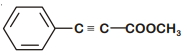
How many $(i)$ $sp^{2}$ hybridised carbon atoms and $(ii)$ $\pi$ bonds are present in the following compound?
A
$8, 5$
B
$7, 5$
C
$8, 6$
D
$7, 6$
Solution
(D) The structure of the compound is methyl phenylpropiolate,$C_6H_5-C \equiv C-COOCH_3$.
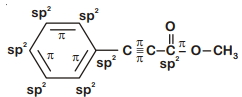
$(i)$ The $sp^{2}$ hybridised carbon atoms are the $6$ carbon atoms of the benzene ring and the $1$ carbonyl carbon atom $(C=O)$. Total $sp^{2}$ hybridised carbon atoms = $6 + 1 = 7$.
$(ii)$ The $\pi$ bonds are: $3$ from the benzene ring,$2$ from the triple bond $(C \equiv C)$,and $1$ from the carbonyl group $(C=O)$. Total $\pi$ bonds = $3 + 2 + 1 = 6$.
$(i)$ The $sp^{2}$ hybridised carbon atoms are the $6$ carbon atoms of the benzene ring and the $1$ carbonyl carbon atom $(C=O)$. Total $sp^{2}$ hybridised carbon atoms = $6 + 1 = 7$.
$(ii)$ The $\pi$ bonds are: $3$ from the benzene ring,$2$ from the triple bond $(C \equiv C)$,and $1$ from the carbonyl group $(C=O)$. Total $\pi$ bonds = $3 + 2 + 1 = 6$.
0 likes
View Solution74
MediumMCQ
The total number of $C-C$ sigma $(\sigma)$ bonds in mesityl oxide $(C_6H_{10}O)$ is $......$. (Round off to the nearest integer).
A
$5$
B
$6$
C
$7$
D
$8$
Solution
(A) The structure of mesityl oxide is $(CH_3)_2C=CH-CO-CH_3$.
Expanding the structure to identify $C-C$ sigma bonds:
$H_3C-C(CH_3)=CH-C(=O)-CH_3$.
The $C-C$ sigma bonds are:
$1$. $C_1-C_2$ (between $CH_3$ and $C$)
$2$. $C_2-C_3$ (between $C$ and $CH_3$)
$3$. $C_2-C_4$ (between $C$ and $CH$)
$4$. $C_4-C_5$ (between $CH$ and $C=O$)
$5$. $C_5-C_6$ (between $C=O$ and $CH_3$)
Total number of $C-C$ sigma bonds = $5$.
Expanding the structure to identify $C-C$ sigma bonds:
$H_3C-C(CH_3)=CH-C(=O)-CH_3$.
The $C-C$ sigma bonds are:
$1$. $C_1-C_2$ (between $CH_3$ and $C$)
$2$. $C_2-C_3$ (between $C$ and $CH_3$)
$3$. $C_2-C_4$ (between $C$ and $CH$)
$4$. $C_4-C_5$ (between $CH$ and $C=O$)
$5$. $C_5-C_6$ (between $C=O$ and $CH_3$)
Total number of $C-C$ sigma bonds = $5$.
0 likes
View Solution75
MediumMCQ
In the molecule $CH_2=C=CH-CH_3$ (where the atoms are numbered $1, 2, 3,$ and $4$ respectively),the hybridization of carbon $1, 2, 3,$ and $4$ are:
A
$sp^2, sp, sp^2, sp^3$
B
$sp^2, sp^2, sp^2, sp^3$
C
$sp^2, sp^2, sp, sp^3$
D
$sp^2, sp^3, sp^2, sp^3$
Solution
(A) In the molecule $CH_2=C=CH-CH_3$:
Carbon-$1$ $(CH_2=)$: It is bonded to two $H$ atoms and one $C$ atom via a double bond. It has $3$ sigma bonds and $0$ lone pairs,so it is $sp^2$ hybridized.
Carbon-$2$ $(=C=)$: It is bonded to two $C$ atoms via double bonds. It has $2$ sigma bonds and $0$ lone pairs,so it is $sp$ hybridized.
Carbon-$3$ $(=CH-)$: It is bonded to one $C$ atom via a double bond,one $C$ atom via a single bond,and one $H$ atom. It has $3$ sigma bonds and $0$ lone pairs,so it is $sp^2$ hybridized.
Carbon-$4$ $(-CH_3)$: It is bonded to one $C$ atom and three $H$ atoms via single bonds. It has $4$ sigma bonds and $0$ lone pairs,so it is $sp^3$ hybridized.
Thus,the hybridization of carbon $1, 2, 3,$ and $4$ is $sp^2, sp, sp^2, sp^3$.
Carbon-$1$ $(CH_2=)$: It is bonded to two $H$ atoms and one $C$ atom via a double bond. It has $3$ sigma bonds and $0$ lone pairs,so it is $sp^2$ hybridized.
Carbon-$2$ $(=C=)$: It is bonded to two $C$ atoms via double bonds. It has $2$ sigma bonds and $0$ lone pairs,so it is $sp$ hybridized.
Carbon-$3$ $(=CH-)$: It is bonded to one $C$ atom via a double bond,one $C$ atom via a single bond,and one $H$ atom. It has $3$ sigma bonds and $0$ lone pairs,so it is $sp^2$ hybridized.
Carbon-$4$ $(-CH_3)$: It is bonded to one $C$ atom and three $H$ atoms via single bonds. It has $4$ sigma bonds and $0$ lone pairs,so it is $sp^3$ hybridized.
Thus,the hybridization of carbon $1, 2, 3,$ and $4$ is $sp^2, sp, sp^2, sp^3$.
0 likes
View Solution76
MediumMCQ
The number of $sp^{3}$ hybridised carbons in an acyclic neutral compound with molecular formula $C_{4}H_{5}N$ is.
A
$0$ or $1$
B
$2$
C
$3$
D
$4$
Solution
(A) The degree of unsaturation $(DU)$ for $C_{4}H_{5}N$ is calculated as:
$DU = C + 1 - \frac{H - N}{2} = 4 + 1 - \frac{5 - 1}{2} = 5 - 2 = 3$.
$A$ possible acyclic structure with $DU = 3$ is $CH_{2}=C=CH-CH=NH$.
In this structure,all carbon atoms are either $sp$ or $sp^{2}$ hybridised.
Specifically,the carbons are $sp^{2}$,$sp$,$sp^{2}$,and $sp^{2}$ hybridised respectively.
Therefore,the number of $sp^{3}$ hybridised carbons is $0$.
$DU = C + 1 - \frac{H - N}{2} = 4 + 1 - \frac{5 - 1}{2} = 5 - 2 = 3$.
$A$ possible acyclic structure with $DU = 3$ is $CH_{2}=C=CH-CH=NH$.
In this structure,all carbon atoms are either $sp$ or $sp^{2}$ hybridised.
Specifically,the carbons are $sp^{2}$,$sp$,$sp^{2}$,and $sp^{2}$ hybridised respectively.
Therefore,the number of $sp^{3}$ hybridised carbons is $0$.
0 likes
View Solution77
MediumMCQ
The compounds containing $sp$-hybridised carbon atom are:
$(I)$ $H_3C-N(CH_3)-CHO$
$(II)$ Pyridine
$(III)$ $H_3C-CN$
$(IV)$ $H_2C=C=CH-CH_3$
$(I)$ $H_3C-N(CH_3)-CHO$
$(II)$ Pyridine
$(III)$ $H_3C-CN$
$(IV)$ $H_2C=C=CH-CH_3$
A
$I$ and $II$
B
$III$ and $IV$
C
$II$ and $III$
D
$I$ and $IV$
Solution
(B) To determine the hybridisation of carbon atoms,we count the number of sigma bonds and lone pairs (if any) around the carbon atom.
$(I)$ $N,N$-Dimethylformamide: All carbon atoms are $sp^3$ or $sp^2$ hybridised.
$(II)$ Pyridine: All carbon atoms are $sp^2$ hybridised.
$(III)$ Acetonitrile $(CH_3CN)$: The carbon atom in the cyano group $(-CN)$ is bonded to nitrogen by a triple bond. It has two sigma bonds and no lone pairs,so it is $sp$ hybridised.
$(IV)$ Buta$-1,2-$diene $(H_2C=C=CH-CH_3)$: The central carbon atom is bonded to two other carbon atoms by double bonds. It has two sigma bonds and no lone pairs,so it is $sp$ hybridised.
Thus,compounds $(III)$ and $(IV)$ contain $sp$-hybridised carbon atoms.
$(I)$ $N,N$-Dimethylformamide: All carbon atoms are $sp^3$ or $sp^2$ hybridised.
$(II)$ Pyridine: All carbon atoms are $sp^2$ hybridised.
$(III)$ Acetonitrile $(CH_3CN)$: The carbon atom in the cyano group $(-CN)$ is bonded to nitrogen by a triple bond. It has two sigma bonds and no lone pairs,so it is $sp$ hybridised.
$(IV)$ Buta$-1,2-$diene $(H_2C=C=CH-CH_3)$: The central carbon atom is bonded to two other carbon atoms by double bonds. It has two sigma bonds and no lone pairs,so it is $sp$ hybridised.
Thus,compounds $(III)$ and $(IV)$ contain $sp$-hybridised carbon atoms.
0 likes
View Solution78
MediumMCQ
The number of $sp^2$-hybridised carbon atoms in $HC\equiv C-CH_2-CO-CH_2-CH=CH_2$ is
A
$3$
B
$5$
C
$4$
D
$6$
Solution
(A) The given structure is $HC\equiv C-CH_2-C(=O)-CH_2-CH=CH_2$.
To determine the hybridisation of carbon atoms,we count the number of sigma bonds and lone pairs (if any) around each carbon atom:
$1$. $HC\equiv C-$: Both carbons are $sp$-hybridised (two sigma bonds).
$2$. $-CH_2-$: Both $CH_2$ groups are $sp^3$-hybridised (four sigma bonds).
$3$. $-C(=O)-$: The carbonyl carbon is $sp^2$-hybridised (three sigma bonds).
$4$. $-CH=CH_2$: Both carbons are $sp^2$-hybridised (three sigma bonds each).
Counting the $sp^2$-hybridised carbons: one from the carbonyl group and two from the terminal alkene group,total = $1 + 2 = 3$.
Therefore,the number of $sp^2$-hybridised carbon atoms is $3$.
To determine the hybridisation of carbon atoms,we count the number of sigma bonds and lone pairs (if any) around each carbon atom:
$1$. $HC\equiv C-$: Both carbons are $sp$-hybridised (two sigma bonds).
$2$. $-CH_2-$: Both $CH_2$ groups are $sp^3$-hybridised (four sigma bonds).
$3$. $-C(=O)-$: The carbonyl carbon is $sp^2$-hybridised (three sigma bonds).
$4$. $-CH=CH_2$: Both carbons are $sp^2$-hybridised (three sigma bonds each).
Counting the $sp^2$-hybridised carbons: one from the carbonyl group and two from the terminal alkene group,total = $1 + 2 = 3$.
Therefore,the number of $sp^2$-hybridised carbon atoms is $3$.
0 likes
View Solution79
MediumMCQ
What is the hybridization shown by $C_1$ and $C_2$ carbons,respectively in the given compound? $OHC-CH=CH-CH_2-COOCH_3$
A
$sp^2$ and $sp^3$
B
$sp^2$ and $sp^2$
C
$sp^3$ and $sp^2$
D
$sp^3$ and $sp^3$
Solution
(A) The structure of the compound is $OHC-CH=CH-CH_2-COOCH_3$.
Numbering the carbons as indicated in the structure:
$C_1$ is the carbonyl carbon of the ester group $(-COOCH_3)$,which is bonded to one oxygen by a double bond and two other groups by single bonds. It has $3$ sigma bonds and $0$ lone pairs,so it is $sp^2$ hybridized.
$C_2$ is the methylene carbon $(-CH_2-)$ bonded to four atoms by single bonds. It has $4$ sigma bonds and $0$ lone pairs,so it is $sp^3$ hybridized.
Therefore,$C_1$ is $sp^2$ and $C_2$ is $sp^3$ hybridized.
Numbering the carbons as indicated in the structure:
$C_1$ is the carbonyl carbon of the ester group $(-COOCH_3)$,which is bonded to one oxygen by a double bond and two other groups by single bonds. It has $3$ sigma bonds and $0$ lone pairs,so it is $sp^2$ hybridized.
$C_2$ is the methylene carbon $(-CH_2-)$ bonded to four atoms by single bonds. It has $4$ sigma bonds and $0$ lone pairs,so it is $sp^3$ hybridized.
Therefore,$C_1$ is $sp^2$ and $C_2$ is $sp^3$ hybridized.
0 likes
View Solution80
DifficultMCQ
The ascending acidity order of the following $H$ atoms is:
$A: HC \equiv C-H$
$B: H_2C=CH-H$
$C: (CH_3)_3C-H$
$D: CH_3-CH_2-H$
$A: HC \equiv C-H$
$B: H_2C=CH-H$
$C: (CH_3)_3C-H$
$D: CH_3-CH_2-H$
A
$C < D < B < A$
B
$A < B < C < D$
C
$A < B < D < C$
D
$D < C < B < A$
Solution
(A) The acidity of $H$ atoms depends on the stability of the conjugate base formed after the removal of the proton $(H^+)$.
$1$. The conjugate bases are:
$A: HC \equiv C^-$
$B: H_2C=CH^-$
$C: (CH_3)_3C^-$
$D: CH_3-CH_2^-$
$2$. Stability of conjugate base is determined by the hybridization of the carbon atom bearing the negative charge:
- In $A$,$C$ is $sp$ hybridized ($50\% \ s$-character).
- In $B$,$C$ is $sp^2$ hybridized ($33.3\% \ s$-character).
- In $D$,$C$ is $sp^3$ hybridized ($25\% \ s$-character).
- In $C$,$C$ is $sp^3$ hybridized,but it is destabilized by the $+I$ effect of three $CH_3$ groups.
$3$. Higher $s$-character leads to higher electronegativity and greater stability of the negative charge. Thus,the stability order is $A > B > D > C$.
$4$. Since acidic strength is directly proportional to the stability of the conjugate base,the acidity order is $A > B > D > C$. The ascending order is $C < D < B < A$.
$1$. The conjugate bases are:
$A: HC \equiv C^-$
$B: H_2C=CH^-$
$C: (CH_3)_3C^-$
$D: CH_3-CH_2^-$
$2$. Stability of conjugate base is determined by the hybridization of the carbon atom bearing the negative charge:
- In $A$,$C$ is $sp$ hybridized ($50\% \ s$-character).
- In $B$,$C$ is $sp^2$ hybridized ($33.3\% \ s$-character).
- In $D$,$C$ is $sp^3$ hybridized ($25\% \ s$-character).
- In $C$,$C$ is $sp^3$ hybridized,but it is destabilized by the $+I$ effect of three $CH_3$ groups.
$3$. Higher $s$-character leads to higher electronegativity and greater stability of the negative charge. Thus,the stability order is $A > B > D > C$.
$4$. Since acidic strength is directly proportional to the stability of the conjugate base,the acidity order is $A > B > D > C$. The ascending order is $C < D < B < A$.
0 likes
View Solution81
DifficultMCQ
Amongst the given options,the compound$(s)$ in which all the atoms are in one plane in all the possible conformations (if any),is (are):
$(A)$ $CH_2=CH-CH=CH_2$
$(B)$ $HC\equiv C-CH=CH_2$
$(C)$ $H_2C=C=O$
$(D)$ $H_2C=C=CH_2$
$(A)$ $CH_2=CH-CH=CH_2$
$(B)$ $HC\equiv C-CH=CH_2$
$(C)$ $H_2C=C=O$
$(D)$ $H_2C=C=CH_2$
A
$(B,D)$
B
$(A,D)$
C
$(B,C)$
D
$(A,C)$
Solution
(C) To determine if all atoms lie in one plane,we analyze the hybridization and geometry of each molecule:
$(A)$ $CH_2=CH-CH=CH_2$ ($1,3$-butadiene): Due to rotation around the central $C-C$ single bond,it can exist in $s$-cis and $s$-trans conformations. While the $s$-cis form is planar,the molecule can rotate,and not all conformations are necessarily planar.
$(B)$ $HC\equiv C-CH=CH_2$ (but$-1-$en$-3-$yne): The $HC\equiv C-$ group is linear ($sp$-hybridized). The $-CH=CH_2$ group is planar ($sp^2$-hybridized). Since the linear group is attached to the planar group,the entire molecule remains planar.
$(C)$ $H_2C=C=O$ (ketene): The central carbon is $sp$-hybridized,but the terminal $CH_2$ group is $sp^2$-hybridized. The two $H$-atoms on the $CH_2$ group lie in the same plane as the $C=C=O$ backbone.
$(D)$ $H_2C=C=CH_2$ (allene): The central carbon is $sp$-hybridized. The two terminal $CH_2$ groups lie in perpendicular planes to each other,making the molecule non-planar.
Thus,in compounds $(B)$ and $(C)$,all atoms lie in the same plane.
$(A)$ $CH_2=CH-CH=CH_2$ ($1,3$-butadiene): Due to rotation around the central $C-C$ single bond,it can exist in $s$-cis and $s$-trans conformations. While the $s$-cis form is planar,the molecule can rotate,and not all conformations are necessarily planar.
$(B)$ $HC\equiv C-CH=CH_2$ (but$-1-$en$-3-$yne): The $HC\equiv C-$ group is linear ($sp$-hybridized). The $-CH=CH_2$ group is planar ($sp^2$-hybridized). Since the linear group is attached to the planar group,the entire molecule remains planar.
$(C)$ $H_2C=C=O$ (ketene): The central carbon is $sp$-hybridized,but the terminal $CH_2$ group is $sp^2$-hybridized. The two $H$-atoms on the $CH_2$ group lie in the same plane as the $C=C=O$ backbone.
$(D)$ $H_2C=C=CH_2$ (allene): The central carbon is $sp$-hybridized. The two terminal $CH_2$ groups lie in perpendicular planes to each other,making the molecule non-planar.
Thus,in compounds $(B)$ and $(C)$,all atoms lie in the same plane.
0 likes
View Solution82
DifficultMCQ
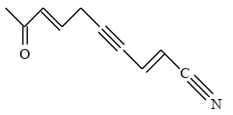
In the given structure,the number of $sp$ and $sp^{2}$ hybridized carbon atoms present respectively are:
A
$4$ and $5$
B
$3$ and $5$
C
$4$ and $6$
D
$3$ and $6$
Solution
(A) To determine the hybridization of carbon atoms,we count the number of sigma bonds and lone pairs (if any) attached to each carbon atom.
$1$. $sp$ hybridized carbon: Carbon atom involved in two sigma bonds and two pi bonds (e.g.,triple bond or two double bonds).
$2$. $sp^{2}$ hybridized carbon: Carbon atom involved in three sigma bonds and one pi bond (e.g.,double bond).
In the given structure:
- The carbon atoms in the triple bond (alkyne) and the nitrile group $(-C \equiv N)$ are $sp$ hybridized. There are $4$ such carbon atoms.
- The carbon atoms in the double bonds (alkene) and the carbonyl group $(C=O)$ are $sp^{2}$ hybridized. There are $5$ such carbon atoms.
Therefore,the number of $sp$ and $sp^{2}$ hybridized carbon atoms are $4$ and $5$ respectively.
$1$. $sp$ hybridized carbon: Carbon atom involved in two sigma bonds and two pi bonds (e.g.,triple bond or two double bonds).
$2$. $sp^{2}$ hybridized carbon: Carbon atom involved in three sigma bonds and one pi bond (e.g.,double bond).
In the given structure:
- The carbon atoms in the triple bond (alkyne) and the nitrile group $(-C \equiv N)$ are $sp$ hybridized. There are $4$ such carbon atoms.
- The carbon atoms in the double bonds (alkene) and the carbonyl group $(C=O)$ are $sp^{2}$ hybridized. There are $5$ such carbon atoms.
Therefore,the number of $sp$ and $sp^{2}$ hybridized carbon atoms are $4$ and $5$ respectively.
0 likes
View Solution83
MediumMCQ
In $3, 3-$dimethylhex$-1-$ene$-4-$yne,there are $......... sp^3, ......... sp^2$ and $........ sp$ hybridised carbon atoms respectively $:$
A
$4, 2, 2$
B
$3, 3, 2$
C
$2, 4, 2$
D
$2, 2, 4$
Solution
(A) The structure of $3, 3-$dimethylhex$-1-$ene$-4-$yne is $CH_3-C \equiv C-C(CH_3)_2-CH=CH_2$.
Counting the hybridization of each carbon atom:
$1.$ $CH_3$ (terminal) is $sp^3$.
$2.$ $C \equiv C$ carbons are both $sp$.
$3.$ $C$ at position $3$ is $sp^3$.
$4.$ Two $CH_3$ groups at position $3$ are $sp^3$.
$5.$ $CH$ at position $2$ is $sp^2$.
$6.$ $CH_2$ at position $1$ is $sp^2$.
Total counts:
$sp^3$ carbons: $4$ (terminal $CH_3$,two $CH_3$ at position $3$,and the quaternary $C$ at position $3$).
$sp^2$ carbons: $2$ (at positions $1$ and $2$).
$sp$ carbons: $2$ (at positions $4$ and $5$).
Thus,the number of $sp^3, sp^2, sp$ hybridized carbon atoms are $4, 2, 2$ respectively.
Counting the hybridization of each carbon atom:
$1.$ $CH_3$ (terminal) is $sp^3$.
$2.$ $C \equiv C$ carbons are both $sp$.
$3.$ $C$ at position $3$ is $sp^3$.
$4.$ Two $CH_3$ groups at position $3$ are $sp^3$.
$5.$ $CH$ at position $2$ is $sp^2$.
$6.$ $CH_2$ at position $1$ is $sp^2$.
Total counts:
$sp^3$ carbons: $4$ (terminal $CH_3$,two $CH_3$ at position $3$,and the quaternary $C$ at position $3$).
$sp^2$ carbons: $2$ (at positions $1$ and $2$).
$sp$ carbons: $2$ (at positions $4$ and $5$).
Thus,the number of $sp^3, sp^2, sp$ hybridized carbon atoms are $4, 2, 2$ respectively.
0 likes
View Solution84
EasyMCQ
What is the number of $sp^3$ hybrid carbon atoms in $HO(CH_2)_3CH(CH_3)CH(CH_3)_2$?
A
Five
B
Two
C
Eight
D
Four
Solution
(C) The given molecule is $HO-CH_2-CH_2-CH_2-CH(CH_3)-CH(CH_3)_2$.
Expanding the structure: $HO-CH_2-CH_2-CH_2-CH(CH_3)-CH(CH_3)_2$.
All carbon atoms in this molecule are bonded to four other atoms via single bonds,meaning they are all $sp^3$ hybridized.
Counting the carbon atoms: $3$ (from $(CH_2)_3$) + $1$ (from $CH$) + $1$ (from $CH_3$) + $1$ (from $CH$) + $2$ (from $(CH_3)_2$) = $8$ carbon atoms.
Therefore,there are $8$ $sp^3$ hybridized carbon atoms.
Expanding the structure: $HO-CH_2-CH_2-CH_2-CH(CH_3)-CH(CH_3)_2$.
All carbon atoms in this molecule are bonded to four other atoms via single bonds,meaning they are all $sp^3$ hybridized.
Counting the carbon atoms: $3$ (from $(CH_2)_3$) + $1$ (from $CH$) + $1$ (from $CH_3$) + $1$ (from $CH$) + $2$ (from $(CH_3)_2$) = $8$ carbon atoms.
Therefore,there are $8$ $sp^3$ hybridized carbon atoms.
0 likes
View Solution85
EasyMCQ
Which among the following possesses a $sp$ carbon in its structure?
A
$CH_2=CCl-CH=CHBr$
B
$CBr_4$
C
$CH_2=C=CH_2$
D
$C_6H_5-CCl_3$
Solution
(C) To determine the hybridization of carbon atoms,we count the number of sigma bonds and lone pairs attached to the carbon atom.
In $CH_2=C=CH_2$ (allene),the central carbon atom is bonded to two other carbon atoms via two double bonds.
Each double bond consists of one sigma bond and one pi bond.
Thus,the central carbon atom forms $2$ sigma bonds and $0$ lone pairs.
Since the steric number is $2$,the hybridization is $sp$.
In $CH_2=C=CH_2$ (allene),the central carbon atom is bonded to two other carbon atoms via two double bonds.
Each double bond consists of one sigma bond and one pi bond.
Thus,the central carbon atom forms $2$ sigma bonds and $0$ lone pairs.
Since the steric number is $2$,the hybridization is $sp$.
0 likes
View Solution86
EasyMCQ
Which of the following compounds do not have $sp^3$ carbon atom$(s)$?
$I$. Acetone
$II$. Acetic acid
$III$. Buta-$1,3$-diene
$IV$. Propyne
$V$. Naphthalene
$I$. Acetone
$II$. Acetic acid
$III$. Buta-$1,3$-diene
$IV$. Propyne
$V$. Naphthalene
A
$I, II$ only
B
$II, III$ only
C
$IV, V$ only
D
$III, V$ only
Solution
(D) Let us analyze the hybridization of carbon atoms in each compound:
$I$. Acetone $(CH_3COCH_3)$: Contains $sp^3$ hybridized methyl carbons.
$II$. Acetic acid $(CH_3COOH)$: Contains an $sp^3$ hybridized methyl carbon.
$III$. Buta-$1,3$-diene $(CH_2=CH-CH=CH_2)$: All four carbon atoms are $sp^2$ hybridized. No $sp^3$ carbon.
$IV$. Propyne $(CH_3-C\equiv CH)$: Contains an $sp^3$ hybridized methyl carbon.
$V$. Naphthalene $(C_{10}H_8)$: All ten carbon atoms are part of the aromatic system and are $sp^2$ hybridized. No $sp^3$ carbon.
Thus,compounds $III$ and $V$ do not contain any $sp^3$ hybridized carbon atoms.
$I$. Acetone $(CH_3COCH_3)$: Contains $sp^3$ hybridized methyl carbons.
$II$. Acetic acid $(CH_3COOH)$: Contains an $sp^3$ hybridized methyl carbon.
$III$. Buta-$1,3$-diene $(CH_2=CH-CH=CH_2)$: All four carbon atoms are $sp^2$ hybridized. No $sp^3$ carbon.
$IV$. Propyne $(CH_3-C\equiv CH)$: Contains an $sp^3$ hybridized methyl carbon.
$V$. Naphthalene $(C_{10}H_8)$: All ten carbon atoms are part of the aromatic system and are $sp^2$ hybridized. No $sp^3$ carbon.
Thus,compounds $III$ and $V$ do not contain any $sp^3$ hybridized carbon atoms.
0 likes
View Solution87
MediumMCQ
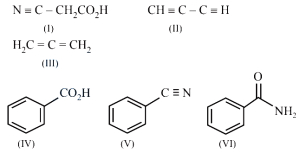
From the following compounds,the ones which contain both $sp$ and $sp^2$ hybridized carbons are:
A
$I$,$II$ and $III$
B
$II$,$III$ and $IV$
C
$I$,$III$ and $VI$
D
$I$,$III$ and $V$
Solution
(D) To identify compounds containing both $sp$ and $sp^2$ hybridized carbons,we analyze each structure:
$(I)$ $N \equiv C-CH_2-COOH$: The carbon in the cyano group $(-CN)$ is $sp$ hybridized,and the carbonyl carbon in $-COOH$ is $sp^2$ hybridized. Thus,it contains both.
$(II)$ $HC \equiv C-C \equiv CH$: All carbons are $sp$ hybridized.
$(III)$ $H_2C=C=CH_2$: The terminal carbons are $sp^2$ hybridized,and the central carbon is $sp$ hybridized. Thus,it contains both.
$(IV)$ Benzoic acid $(C_6H_5COOH)$: The benzene ring carbons and the carbonyl carbon are $sp^2$ hybridized. No $sp$ hybridized carbon is present.
$(V)$ Benzonitrile $(C_6H_5CN)$: The benzene ring carbons are $sp^2$ hybridized,and the cyano carbon is $sp$ hybridized. Thus,it contains both.
$(VI)$ Benzamide $(C_6H_5CONH_2)$: All carbons are $sp^2$ hybridized.
Therefore,compounds $(I)$,$(III)$,and $(V)$ contain both $sp$ and $sp^2$ hybridized carbons.
$(I)$ $N \equiv C-CH_2-COOH$: The carbon in the cyano group $(-CN)$ is $sp$ hybridized,and the carbonyl carbon in $-COOH$ is $sp^2$ hybridized. Thus,it contains both.
$(II)$ $HC \equiv C-C \equiv CH$: All carbons are $sp$ hybridized.
$(III)$ $H_2C=C=CH_2$: The terminal carbons are $sp^2$ hybridized,and the central carbon is $sp$ hybridized. Thus,it contains both.
$(IV)$ Benzoic acid $(C_6H_5COOH)$: The benzene ring carbons and the carbonyl carbon are $sp^2$ hybridized. No $sp$ hybridized carbon is present.
$(V)$ Benzonitrile $(C_6H_5CN)$: The benzene ring carbons are $sp^2$ hybridized,and the cyano carbon is $sp$ hybridized. Thus,it contains both.
$(VI)$ Benzamide $(C_6H_5CONH_2)$: All carbons are $sp^2$ hybridized.
Therefore,compounds $(I)$,$(III)$,and $(V)$ contain both $sp$ and $sp^2$ hybridized carbons.
0 likes
View Solution88
MediumMCQ
The number of $sp$ and $sp^2$ hybridized carbon atoms in Hepta$-1, 3-$dien$-5-$yne,respectively,are
A
$2, 4$
B
$4, 3$
C
$2, 2$
D
$2, 5$
Solution
(A) The structure of Hepta$-1, 3-$dien$-5-$yne is: $CH_2=CH-CH=CH-C\equiv C-CH_3$.
Counting the hybridization of each carbon atom:
$C_1$: $sp^2$ (one double bond)
$C_2$: $sp^2$ (one double bond)
$C_3$: $sp^2$ (one double bond)
$C_4$: $sp^2$ (one double bond)
$C_5$: $sp$ (one triple bond)
$C_6$: $sp$ (one triple bond)
$C_7$: $sp^3$ (all single bonds)
Thus,there are $2$ $sp$ hybridized carbons $(C_5, C_6)$ and $4$ $sp^2$ hybridized carbons $(C_1, C_2, C_3, C_4)$.
Counting the hybridization of each carbon atom:
$C_1$: $sp^2$ (one double bond)
$C_2$: $sp^2$ (one double bond)
$C_3$: $sp^2$ (one double bond)
$C_4$: $sp^2$ (one double bond)
$C_5$: $sp$ (one triple bond)
$C_6$: $sp$ (one triple bond)
$C_7$: $sp^3$ (all single bonds)
Thus,there are $2$ $sp$ hybridized carbons $(C_5, C_6)$ and $4$ $sp^2$ hybridized carbons $(C_1, C_2, C_3, C_4)$.
0 likes
View Solution89
EasyMCQ
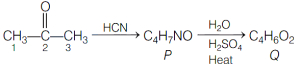
The hybridisations of carbon-$2$ in $P$ and $Q$ are respectively:
A
$sp^3, sp^2$
B
$sp^2, sp^2$
C
$sp^3, sp$
D
$sp^3, sp^3$
Solution
(A) In the given reaction,the starting material is acetone $(CH_3COCH_3)$.
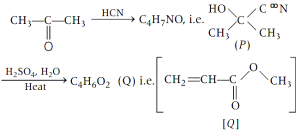
When acetone reacts with $HCN$,it forms a cyanohydrin $(P)$,which is $2$-hydroxy-$2$-methylpropanenitrile. The central carbon (carbon-$2$) in $(P)$ is bonded to four atoms $(-OH, -CN, -CH_3, -CH_3)$ via single bonds,so it is $sp^3$ hybridized.
When $(P)$ is treated with $H_2SO_4$ and $H_2O$ under heating,it undergoes dehydration and hydrolysis to form methyl methacrylate $(Q)$,which is $CH_2=C(CH_3)COOCH_3$. The carbon-$2$ in $(Q)$ is part of a double bond $(C=C)$,so it is $sp^2$ hybridized.
Therefore,the hybridizations are $sp^3$ and $sp^2$ respectively.
When acetone reacts with $HCN$,it forms a cyanohydrin $(P)$,which is $2$-hydroxy-$2$-methylpropanenitrile. The central carbon (carbon-$2$) in $(P)$ is bonded to four atoms $(-OH, -CN, -CH_3, -CH_3)$ via single bonds,so it is $sp^3$ hybridized.
When $(P)$ is treated with $H_2SO_4$ and $H_2O$ under heating,it undergoes dehydration and hydrolysis to form methyl methacrylate $(Q)$,which is $CH_2=C(CH_3)COOCH_3$. The carbon-$2$ in $(Q)$ is part of a double bond $(C=C)$,so it is $sp^2$ hybridized.
Therefore,the hybridizations are $sp^3$ and $sp^2$ respectively.
0 likes
View Solution90
EasyMCQ
The hybridisation of each carbon in the following compound respectively is:
$CH_3-C(=O)-CH_2-CN$
$CH_3-C(=O)-CH_2-CN$
A
$sp^3, sp^2, sp^3, sp$
B
$sp^3, sp^3, sp^2, sp$
C
$sp^3, sp, sp^3, sp^2$
D
$sp^3, sp^2, sp, sp^3$
Solution
(A) The structure of the compound is $CH_3-C(=O)-CH_2-C \equiv N$.
Let us label the carbons as follows:
$(i) CH_3-$,$(ii) -C(=O)-$,$(iii) -CH_2-$,$(iv) -CN$.
$1$. The carbon in the methyl group $(CH_3)$ is bonded to four atoms (three $H$ and one $C$),so it is $sp^3$ hybridised.
$2$. The carbonyl carbon $(C=O)$ is bonded to three atoms (one $C$ of $CH_3$,one $O$,and one $C$ of $CH_2$),so it is $sp^2$ hybridised.
$3$. The methylene carbon $(CH_2)$ is bonded to four atoms (two $H$,one $C$ of $C=O$,and one $C$ of $CN$),so it is $sp^3$ hybridised.
$4$. The cyano carbon $(CN)$ is bonded to two atoms (one $C$ of $CH_2$ and one $N$),so it is $sp$ hybridised.
Thus,the hybridisation of carbons $(i), (ii), (iii),$ and $(iv)$ is $sp^3, sp^2, sp^3, sp$ respectively.
Let us label the carbons as follows:
$(i) CH_3-$,$(ii) -C(=O)-$,$(iii) -CH_2-$,$(iv) -CN$.
$1$. The carbon in the methyl group $(CH_3)$ is bonded to four atoms (three $H$ and one $C$),so it is $sp^3$ hybridised.
$2$. The carbonyl carbon $(C=O)$ is bonded to three atoms (one $C$ of $CH_3$,one $O$,and one $C$ of $CH_2$),so it is $sp^2$ hybridised.
$3$. The methylene carbon $(CH_2)$ is bonded to four atoms (two $H$,one $C$ of $C=O$,and one $C$ of $CN$),so it is $sp^3$ hybridised.
$4$. The cyano carbon $(CN)$ is bonded to two atoms (one $C$ of $CH_2$ and one $N$),so it is $sp$ hybridised.
Thus,the hybridisation of carbons $(i), (ii), (iii),$ and $(iv)$ is $sp^3, sp^2, sp^3, sp$ respectively.
0 likes
View Solution91
EasyMCQ
Match the following lists:
| List-$I$ | List-$II$ |
| $A$. Ethane | $1$. $2 \ sp$ carbons |
| $B$. Ethylene | $2$. $6 \ sp^2$ carbons |
| $C$. Acetylene | $3$. $2 \ sp^3$ carbons |
| $D$. Benzene | $4$. $2 \ sp^2$ carbons |
| $5$. $1 \ sp$ and $1 \ sp^2$ carbons |
A
$A-3, B-4, C-1, D-2$
B
$A-4, B-5, C-3, D-2$
C
$A-3, B-1, C-2, D-5$
D
$A-2, B-3, C-4, D-5$
Solution
(A) The hybridization of carbon atoms in the given molecules is as follows:
$A$. Ethane $(CH_3-CH_3)$: Both carbon atoms are $sp^3$ hybridized. Thus,$A-3$.
$B$. Ethylene $(CH_2=CH_2)$: Both carbon atoms are $sp^2$ hybridized. Thus,$B-4$.
$C$. Acetylene $(CH \equiv CH)$: Both carbon atoms are $sp$ hybridized. Thus,$C-1$.
$D$. Benzene $(C_6H_6)$: All six carbon atoms in the ring are $sp^2$ hybridized. Thus,$D-2$.
Therefore,the correct matching is $A-3, B-4, C-1, D-2$.
$A$. Ethane $(CH_3-CH_3)$: Both carbon atoms are $sp^3$ hybridized. Thus,$A-3$.
$B$. Ethylene $(CH_2=CH_2)$: Both carbon atoms are $sp^2$ hybridized. Thus,$B-4$.
$C$. Acetylene $(CH \equiv CH)$: Both carbon atoms are $sp$ hybridized. Thus,$C-1$.
$D$. Benzene $(C_6H_6)$: All six carbon atoms in the ring are $sp^2$ hybridized. Thus,$D-2$.
Therefore,the correct matching is $A-3, B-4, C-1, D-2$.
0 likes
View Solution92
EasyMCQ
In $but-2-ene$,which one of the following statements is true?
A
$C_1-C_2$ bond is a $sp^3-sp^3$ $\sigma$-bond
B
$C_2-C_3$ bond is a $sp^3-sp^2$ $\sigma$-bond
C
$C_1-C_2$ bond is a $sp^3-sp^2$ $\sigma$-bond
D
$C_1-C_2$ bond is a $sp^2-sp^2$ $\sigma$-bond
Solution
(C) The structure of $but-2-ene$ is $CH_3-CH=CH-CH_3$.
In this molecule:
$C_1$ is $sp^3$ hybridized (attached to $3$ $H$ atoms and $C_2$).
$C_2$ is $sp^2$ hybridized (attached to $H$,$C_1$,and double-bonded to $C_3$).
$C_3$ is $sp^2$ hybridized.
$C_4$ is $sp^3$ hybridized.
Therefore,the $C_1-C_2$ bond is formed by the overlap of $sp^3$ orbital of $C_1$ and $sp^2$ orbital of $C_2$,making it a $sp^3-sp^2$ $\sigma$-bond.
In this molecule:
$C_1$ is $sp^3$ hybridized (attached to $3$ $H$ atoms and $C_2$).
$C_2$ is $sp^2$ hybridized (attached to $H$,$C_1$,and double-bonded to $C_3$).
$C_3$ is $sp^2$ hybridized.
$C_4$ is $sp^3$ hybridized.
Therefore,the $C_1-C_2$ bond is formed by the overlap of $sp^3$ orbital of $C_1$ and $sp^2$ orbital of $C_2$,making it a $sp^3-sp^2$ $\sigma$-bond.
0 likes
View Solution93
EasyMCQ
The hybridisation of the negatively charged carbon atoms in $(1)$ and $(2)$ are:
$(1)$ $CH_3^-$
$(2)$ $H_2C^- - CHO - CH_3$
$(1)$ $CH_3^-$
$(2)$ $H_2C^- - CHO - CH_3$
A
$sp^2$ and $sp^3$
B
$sp^3$ and $sp^2$
C
both $sp^2$
D
None of the above
Solution
(B) In structure $(1)$,the carbon atom in $CH_3^-$ is bonded to $3$ hydrogen atoms and has $1$ lone pair. The steric number is $3 + 1 = 4$,which corresponds to $sp^3$ hybridisation.
In structure $(2)$,the carbon atom in $H_2C^-$ is adjacent to a carbonyl group $(C=O)$. The negative charge is delocalised through resonance with the carbonyl group,making the carbon atom $sp^2$ hybridised to allow for the overlap of the $p$-orbital with the $\pi$-system.
In structure $(2)$,the carbon atom in $H_2C^-$ is adjacent to a carbonyl group $(C=O)$. The negative charge is delocalised through resonance with the carbonyl group,making the carbon atom $sp^2$ hybridised to allow for the overlap of the $p$-orbital with the $\pi$-system.
0 likes
View Solution94
MediumMCQ
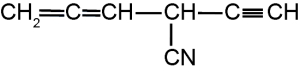
In the following compound,the number of $sp$-hybridised carbons is:
A
$2$
B
$3$
C
$4$
D
$5$
Solution
(C) To determine the number of $sp$-hybridised carbon atoms,we look for carbons involved in two double bonds (allene type) or one triple bond.
$1$. The central carbon in the $CH_2=C=CH-$ group is $sp$-hybridised.
$2$. The carbon in the $-C\equiv CH$ group is $sp$-hybridised.
$3$. The terminal carbon in the $-C\equiv CH$ group is $sp$-hybridised.
$4$. The carbon in the $-C\equiv N$ group is $sp$-hybridised.
Thus,there are $4$ $sp$-hybridised carbon atoms in the given structure.
$1$. The central carbon in the $CH_2=C=CH-$ group is $sp$-hybridised.
$2$. The carbon in the $-C\equiv CH$ group is $sp$-hybridised.
$3$. The terminal carbon in the $-C\equiv CH$ group is $sp$-hybridised.
$4$. The carbon in the $-C\equiv N$ group is $sp$-hybridised.
Thus,there are $4$ $sp$-hybridised carbon atoms in the given structure.
0 likes
View Solution95
EasyMCQ
The hybridization of $C_2$ and $C_3$ in $CH_3-CH=C=CH-CH_3$ is
A
$sp, sp^3$
B
$sp^2, sp$
C
$sp^2, sp^2$
D
$sp, sp$
Solution
(B) The structure of the given molecule is $CH_3-CH=C=CH-CH_3$.
To determine the hybridization,we count the number of sigma bonds and lone pairs around the carbon atom.
For $C_2$: It is bonded to one $H$ atom,one $CH_3$ group (single bond),and one $C_3$ atom (double bond). It has $3$ sigma bonds and $0$ lone pairs,so it is $sp^2$ hybridized.
For $C_3$: It is bonded to $C_2$ (double bond) and $C_4$ (double bond). It has $2$ sigma bonds and $0$ lone pairs,so it is $sp$ hybridized.
Therefore,the hybridization of $C_2$ and $C_3$ is $sp^2$ and $sp$ respectively.
To determine the hybridization,we count the number of sigma bonds and lone pairs around the carbon atom.
For $C_2$: It is bonded to one $H$ atom,one $CH_3$ group (single bond),and one $C_3$ atom (double bond). It has $3$ sigma bonds and $0$ lone pairs,so it is $sp^2$ hybridized.
For $C_3$: It is bonded to $C_2$ (double bond) and $C_4$ (double bond). It has $2$ sigma bonds and $0$ lone pairs,so it is $sp$ hybridized.
Therefore,the hybridization of $C_2$ and $C_3$ is $sp^2$ and $sp$ respectively.
0 likes
View Solution96
EasyMCQ
In the compound $HC \equiv C-CH=CH_2$,the hybridization of $C-2$ and $C-3$ carbons are respectively:
A
$sp^3 \& sp^3$
B
$sp^2 \& sp^3$
C
$sp^2 \& sp$
D
$sp^3 \& sp$
Solution
(C) The structure of the compound is $H-C(4) \equiv C(3)-C(2)H=C(1)H_2$.
For $C-2$: It is bonded to one $H$ atom,one $C-3$ atom (via a single bond),and one $C-1$ atom (via a double bond). The number of sigma bonds is $3$ and there are no lone pairs,so the hybridization is $sp^2$.
For $C-3$: It is bonded to one $C-4$ atom (via a triple bond) and one $C-2$ atom (via a single bond). The number of sigma bonds is $2$ and there are no lone pairs,so the hybridization is $sp$.
Therefore,the hybridization of $C-2$ and $C-3$ are $sp^2$ and $sp$ respectively.
For $C-2$: It is bonded to one $H$ atom,one $C-3$ atom (via a single bond),and one $C-1$ atom (via a double bond). The number of sigma bonds is $3$ and there are no lone pairs,so the hybridization is $sp^2$.
For $C-3$: It is bonded to one $C-4$ atom (via a triple bond) and one $C-2$ atom (via a single bond). The number of sigma bonds is $2$ and there are no lone pairs,so the hybridization is $sp$.
Therefore,the hybridization of $C-2$ and $C-3$ are $sp^2$ and $sp$ respectively.
0 likes
View Solution8-1.Organic Chemistry : Classification and Nomenclature of Organic compounds — Bonding and hybridisation in organic compounds · Frequently Asked Questions
1Are these 8-1.Organic Chemistry : Classification and Nomenclature of Organic compounds questions useful for JEE and NEET?
Yes. All questions in this section are mapped to JEE Main and NEET exam patterns. Previous year questions from JEE Main, NEET, GUJCET and state-level exams are included with full solutions.
2Can I switch to Hindi or Gujarati for these questions?
Yes. Use the language tabs in the hero section or the sidebar to view the same questions and solutions in English, Hindi or Gujarati.
3How do I generate a question paper from this subtopic?
Use the Vedclass Exam Paper Generator — select the chapter and subtopic, set difficulty, and generate Sets A, B, C, D automatically. First 3 chapters of every subject are free.
Vedclass Products
For Students
Vedclass Test Series
Mock tests in real JEE/NEET style with performance analysis. 5-day free trial.
Start Free TrialFor Teachers
Exam Paper Generator
Generate Set A/B/C/D papers from this chapter in 2 minutes. 3 chapters free.
Try FreeFor Institutes
Online Exam Module
Live online exams with unlimited students, 360° analytics & white-label branding.
See DemoFor Teachers & Institutes
Generate a 8-1.Organic Chemistry : Classification and Nomenclature of Organic compounds Exam Paper in 2 Minutes
Select subtopic & difficulty — Sets A, B, C, D auto-generated with No Repeat logic.
First 3 chapters of every subject are free — no payment required.