
A English
Carbohydrates Questions in English
Class 11 Biology · Biomolecules · Carbohydrates
423+
Questions
English
Language
100%
With Solutions
Showing 50 of 423 questions in English
351
EasyMCQ
The sugar present in honey is:
A
Sucrose
B
Glucose
C
Fructose
D
Maltose
Solution
(C) Honey is a natural substance produced by honey bees from the nectar of flowers. The nectar primarily contains sucrose,which is broken down by the enzymes in the bee's saliva into simple sugars,mainly glucose and fructose. Fructose is the most abundant sugar found in honey,making it sweeter than sucrose.
0 likes
View Solution352
MediumMCQ
Consider the following reagents:
$I$. $Br_2$ water
$II$. Tollen's reagent
$III$. Fehling's solution
Which of these can be used to distinguish between an aldose and a ketose?
$I$. $Br_2$ water
$II$. Tollen's reagent
$III$. Fehling's solution
Which of these can be used to distinguish between an aldose and a ketose?
A
$I, II$ and $III$
B
$II$ and $III$
C
$I$ only
D
$II$ only
Solution
(C) Aldoses contain an aldehyde group $(-CHO)$,while ketoses contain a ketone group $(>C=O)$.
$Br_2$ water is a mild oxidizing agent that oxidizes the aldehyde group of an aldose to a carboxylic acid (gluconic acid) but does not oxidize ketoses.
Therefore,$Br_2$ water can distinguish between aldoses and ketoses.
Tollen's reagent and Fehling's solution are oxidizing agents that react with both aldoses and ketoses (due to the tautomerization of ketoses into aldoses in alkaline medium),so they cannot distinguish between them.
Thus,only $I$ is the correct reagent.
$Br_2$ water is a mild oxidizing agent that oxidizes the aldehyde group of an aldose to a carboxylic acid (gluconic acid) but does not oxidize ketoses.
Therefore,$Br_2$ water can distinguish between aldoses and ketoses.
Tollen's reagent and Fehling's solution are oxidizing agents that react with both aldoses and ketoses (due to the tautomerization of ketoses into aldoses in alkaline medium),so they cannot distinguish between them.
Thus,only $I$ is the correct reagent.
0 likes
View Solution353
EasyMCQ
Artificial sweetener used in soft drinks is:
A
Glucose
B
Fructose
C
Cellulose
D
Aspartame
Solution
(D) Aspartame is a common artificial sweetener used in soft drinks and cold foods because it is unstable at cooking temperatures.
It is approximately $160$ times sweeter than sucrose (table sugar).
It is approximately $160$ times sweeter than sucrose (table sugar).
0 likes
View Solution354
EasyMCQ
Cellulose is a linear polymer of:
A
$\alpha$-glucose
B
$\beta$-glucose
C
$\alpha$-fructose
D
None of these
Solution
(B) Cellulose is a polysaccharide consisting of a linear chain of several hundred to many thousands of $\beta$-glucose units.
These units are linked together by $\beta(1 \rightarrow 4)$-glycosidic bonds.
Unlike starch,which contains $\alpha$-glucose,cellulose provides structural support to plant cell walls due to its linear,rigid structure.
These units are linked together by $\beta(1 \rightarrow 4)$-glycosidic bonds.
Unlike starch,which contains $\alpha$-glucose,cellulose provides structural support to plant cell walls due to its linear,rigid structure.
0 likes
View Solution355
MediumMCQ
Iodine test is shown by
A
Glucose
B
Starch
C
Glycogen
D
Polypeptide
Solution
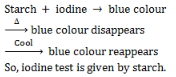
(B) The iodine test is a chemical test used to detect the presence of starch.
Starch is a polysaccharide that forms a helical structure,which can trap iodine molecules $(I_2)$ within its coils to form a starch-iodine complex.
This complex produces a characteristic deep blue color.
When the solution is heated,the helical structure of starch unwinds,releasing the iodine molecules,and the blue color disappears.
Upon cooling,the starch molecules re-form their helical structure,trapping the iodine again,and the blue color reappears.
Therefore,starch gives a positive iodine test.
Starch is a polysaccharide that forms a helical structure,which can trap iodine molecules $(I_2)$ within its coils to form a starch-iodine complex.
This complex produces a characteristic deep blue color.
When the solution is heated,the helical structure of starch unwinds,releasing the iodine molecules,and the blue color disappears.
Upon cooling,the starch molecules re-form their helical structure,trapping the iodine again,and the blue color reappears.
Therefore,starch gives a positive iodine test.
0 likes
View Solution356
EasyMCQ
Glucose cannot be classified as:
A
$A$ hexose
B
$A$ carbohydrate
C
An oligosaccharide
D
An aldose
Solution
(C) Glucose is a $6$-carbon sugar,hence it is a hexose.
It is a type of carbohydrate.
It contains an aldehyde group,so it is an aldose.
Glucose is a monosaccharide,not an oligosaccharide.
Oligosaccharides are carbohydrates that yield $2$ to $10$ monosaccharide units upon hydrolysis,whereas glucose cannot be further hydrolyzed into simpler sugars.
It is a type of carbohydrate.
It contains an aldehyde group,so it is an aldose.
Glucose is a monosaccharide,not an oligosaccharide.
Oligosaccharides are carbohydrates that yield $2$ to $10$ monosaccharide units upon hydrolysis,whereas glucose cannot be further hydrolyzed into simpler sugars.
0 likes
View Solution357
EasyMCQ
Fructose is prepared commercially by the hydrolysis of $...$,a polysaccharide which occurs in dahlia tubers and Jerusalem artichokes.
A
Inulin
B
Cellulose
C
Lactose
D
None of these
Solution
(A) Inulin is a naturally occurring polysaccharide found in the roots and tubers of various plants,such as dahlia tubers and Jerusalem artichokes.
It is a polymer composed of fructose units linked by $\beta-(2,1)$ glycosidic bonds.
Commercially,fructose is produced by the hydrolysis of inulin,which breaks the polymer down into its constituent fructose monomers.
It is a polymer composed of fructose units linked by $\beta-(2,1)$ glycosidic bonds.
Commercially,fructose is produced by the hydrolysis of inulin,which breaks the polymer down into its constituent fructose monomers.
0 likes
View Solution358
MediumMCQ
Sugars are characterized by the preparation of osazone derivatives. Which sugars have identical osazones?
A
Glucose and lactose
B
Glucose and fructose
C
Glucose and arabinose
D
Glucose and maltose
Solution
(B) Sugars like glucose,fructose,and mannose form identical osazones when treated with excess phenylhydrazine. This occurs because the structural differences between these sugars exist only at the $C-1$ and $C-2$ positions. During the formation of osazone,these two carbon atoms are involved in the reaction,resulting in the same phenylosazone structure for all three sugars.
0 likes
View Solution359
MediumMCQ
Which one of the following is an example of a non-reducing sugar?
A
Sucrose
B
Lactose
C
Maltose
D
Cellobiose
Solution
(A) Sugars that cannot reduce Fehling's solution and Tollen's reagent are known as non-reducing sugars.
In these sugars,the glycosidic bond is formed between the anomeric carbons of the two monosaccharide units,meaning no free aldehyde or ketone group is available.
Sucrose is a disaccharide formed by the linkage of glucose and fructose through their anomeric carbons,making it a non-reducing sugar.
In contrast,lactose,maltose,and cellobiose are reducing sugars because they possess a free hemiacetal group.
In these sugars,the glycosidic bond is formed between the anomeric carbons of the two monosaccharide units,meaning no free aldehyde or ketone group is available.
Sucrose is a disaccharide formed by the linkage of glucose and fructose through their anomeric carbons,making it a non-reducing sugar.
In contrast,lactose,maltose,and cellobiose are reducing sugars because they possess a free hemiacetal group.
0 likes
View Solution360
EasyMCQ
Which of the following is the first member of monosaccharides?
A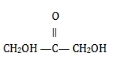
CH2OH-$CO$-CH2OH
B
$CH_{2}OH-CHOH-CHO$
C
$CH_{2}OH-CHOH-CHOH-CHO$
D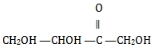
CH2OH-$CHOH$-$CO$-CH2OH
Solution
(B) Monosaccharides are the simplest carbohydrates that cannot be hydrolyzed into smaller carbohydrate units. The simplest monosaccharides are trioses (three-carbon sugars). Glyceraldehyde $(CH_{2}OH-CHOH-CHO)$ is an aldotriose and is considered the first member of the monosaccharide family.
0 likes
View Solution361
EasyMCQ
Which is not a reducing sugar?
A
Glucose
B
Fructose
C
Mannose
D
Sucrose
Solution
(D) Sugars that do not reduce Tollen's reagent,Fehling's solution,or Benedict's solution are known as non-reducing sugars.
In sucrose,the glycosidic linkage is formed between the $C1$ of glucose and the $C2$ of fructose.
Since both anomeric carbons are involved in the glycosidic bond,there is no free aldehyde or ketone group available to act as a reducing agent.
Therefore,sucrose is a non-reducing sugar.
In sucrose,the glycosidic linkage is formed between the $C1$ of glucose and the $C2$ of fructose.
Since both anomeric carbons are involved in the glycosidic bond,there is no free aldehyde or ketone group available to act as a reducing agent.
Therefore,sucrose is a non-reducing sugar.
0 likes
View Solution362
MediumMCQ
Animal starch is the name given for:
A
Glycogen
B
Lactogen
C
Cellulose
D
None of these
Solution
(A) Animal starch is the common name for glycogen.
Glycogen is a multi-branched polysaccharide of glucose that serves as a form of energy storage in animals,fungi,and bacteria.
It is primarily synthesized and stored in the liver and muscle cells of animals.
Glycogen is a multi-branched polysaccharide of glucose that serves as a form of energy storage in animals,fungi,and bacteria.
It is primarily synthesized and stored in the liver and muscle cells of animals.
0 likes
View Solution363
EasyMCQ
Dextrins $(C_{6}H_{10}O_{5})_{n}$ are used in:
A
Making adhesive
B
Confectionery
C
Sizing paper
D
All of these
Solution
(D) Dextrins are low molecular weight carbohydrates produced by the hydrolysis of starch. They are widely used in various industries.
$1$. They serve as a base for adhesives due to their sticky nature.
$2$. They are used in the confectionery industry for glazing and thickening.
$3$. They are used in the paper industry for sizing,which improves the surface quality of the paper.
Therefore,all the given options are correct uses of dextrins.
$1$. They serve as a base for adhesives due to their sticky nature.
$2$. They are used in the confectionery industry for glazing and thickening.
$3$. They are used in the paper industry for sizing,which improves the surface quality of the paper.
Therefore,all the given options are correct uses of dextrins.
0 likes
View Solution364
EasyMCQ
Aqueous solution of carbohydrate with $2$ drops of alcoholic solution of $\alpha$-naphthol and $H_{2}SO_{4}$ gives a ring at the junction. The colour of the ring is:
A
Yellow
B
Green
C
Violet
D
Red
Solution
(C) The test described is the $Molisch$ test,which is a sensitive chemical test for the presence of carbohydrates.
When an aqueous solution of a carbohydrate is treated with an alcoholic solution of $\alpha$-naphthol followed by the addition of concentrated $H_{2}SO_{4}$ along the sides of the test tube,a purple or violet-coloured ring is formed at the junction of the two layers.
This reaction occurs because the acid dehydrates the carbohydrate to form furfural or its derivatives,which then react with $\alpha$-naphthol to produce the characteristic violet-coloured complex.
When an aqueous solution of a carbohydrate is treated with an alcoholic solution of $\alpha$-naphthol followed by the addition of concentrated $H_{2}SO_{4}$ along the sides of the test tube,a purple or violet-coloured ring is formed at the junction of the two layers.
This reaction occurs because the acid dehydrates the carbohydrate to form furfural or its derivatives,which then react with $\alpha$-naphthol to produce the characteristic violet-coloured complex.
0 likes
View Solution365
MediumMCQ
Glucose contains in addition to an aldehyde group:
A
One secondary $OH$ and four primary $OH$ groups
B
One primary $OH$ and four secondary $OH$ groups
C
Two primary $OH$ and three secondary $OH$ groups
D
Three primary $OH$ and two secondary $OH$ groups
Solution
(B) The chemical formula of glucose is $C_6H_{12}O_6$.
Its open-chain structure is $CHO-(CHOH)_4-CH_2OH$.
In this structure,there is one aldehyde group $(-CHO)$ at the $C-1$ position.
The carbon at the $C-6$ position is attached to a primary hydroxyl group $(-CH_2OH)$,meaning it is a primary $OH$ group.
The carbons at positions $C-2, C-3, C-4$,and $C-5$ are each attached to one hydroxyl group $(-OH)$,and these are secondary $OH$ groups.
Therefore,glucose contains one primary $OH$ group and four secondary $OH$ groups.
Its open-chain structure is $CHO-(CHOH)_4-CH_2OH$.
In this structure,there is one aldehyde group $(-CHO)$ at the $C-1$ position.
The carbon at the $C-6$ position is attached to a primary hydroxyl group $(-CH_2OH)$,meaning it is a primary $OH$ group.
The carbons at positions $C-2, C-3, C-4$,and $C-5$ are each attached to one hydroxyl group $(-OH)$,and these are secondary $OH$ groups.
Therefore,glucose contains one primary $OH$ group and four secondary $OH$ groups.
0 likes
View Solution366
MediumMCQ
The two functional groups present in a typical carbohydrate are
A
$-OH$ and $-COOH$
B
$-CHO$ and $-COOH$
C
$-C=O$ and $-OH$
D
$-OH$ and $-CHO$
Solution
(D) Carbohydrates are defined as optically active polyhydroxy aldehydes or polyhydroxy ketones.
$1$. In polyhydroxy aldehydes (aldoses),the functional groups present are the hydroxyl group $(-OH)$ and the aldehyde group $(-CHO)$.
$2$. In polyhydroxy ketones (ketoses),the functional groups present are the hydroxyl group $(-OH)$ and the ketone group $(-C=O)$.
Since carbohydrates are characterized by the presence of multiple hydroxyl groups along with either an aldehyde or a ketone group,the most fundamental functional groups present in a typical carbohydrate are the hydroxyl group $(-OH)$ and the carbonyl group (either $-CHO$ or $-C=O$). Given the options,$-OH$ and $-CHO$ (or $-C=O$) represent the core functional components.
$1$. In polyhydroxy aldehydes (aldoses),the functional groups present are the hydroxyl group $(-OH)$ and the aldehyde group $(-CHO)$.
$2$. In polyhydroxy ketones (ketoses),the functional groups present are the hydroxyl group $(-OH)$ and the ketone group $(-C=O)$.
Since carbohydrates are characterized by the presence of multiple hydroxyl groups along with either an aldehyde or a ketone group,the most fundamental functional groups present in a typical carbohydrate are the hydroxyl group $(-OH)$ and the carbonyl group (either $-CHO$ or $-C=O$). Given the options,$-OH$ and $-CHO$ (or $-C=O$) represent the core functional components.
0 likes
View Solution367
EasyMCQ
Cane sugar on hydrolysis yields:
A
Glucose and maltose
B
Glucose and lactose
C
Glucose and fructose
D
Only glucose
Solution
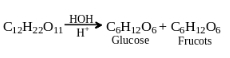
(C) Cane sugar (sucrose) is a disaccharide with the molecular formula $C_{12}H_{22}O_{11}$.
Upon acid-catalyzed hydrolysis, it breaks down into two monosaccharide units: glucose and fructose.
The chemical reaction is represented as: $C_{12}H_{22}O_{11} + H_2O \xrightarrow{H^+} C_6H_{12}O_6 (\text{Glucose}) + C_6H_{12}O_6 (\text{Fructose})$.
This process is also known as the inversion of cane sugar because the resulting mixture is levorotatory.
Upon acid-catalyzed hydrolysis, it breaks down into two monosaccharide units: glucose and fructose.
The chemical reaction is represented as: $C_{12}H_{22}O_{11} + H_2O \xrightarrow{H^+} C_6H_{12}O_6 (\text{Glucose}) + C_6H_{12}O_6 (\text{Fructose})$.
This process is also known as the inversion of cane sugar because the resulting mixture is levorotatory.
0 likes
View Solution368
EasyMCQ
Which material is used for making rayon (artificial silk)?
A
Starch
B
Cellulose
C
Terephthalic acid
D
Adipic acid
Solution
(B) Rayon,also known as artificial silk,is a regenerated fiber.
It is produced by processing natural polymers,specifically $Cellulose$,which is obtained from wood pulp or cotton linters.
The $Cellulose$ is chemically treated to form a viscous solution,which is then extruded through spinnerets to create fibers.
It is produced by processing natural polymers,specifically $Cellulose$,which is obtained from wood pulp or cotton linters.
The $Cellulose$ is chemically treated to form a viscous solution,which is then extruded through spinnerets to create fibers.
0 likes
View Solution369
MediumMCQ
Glucose and mannose are:
A
Epimers
B
Anomers
C
Ketohexoses
D
Disaccharides
Solution
(A) Glucose and mannose are epimers because they differ in configuration only at the $C_{2}$ carbon atom. In glucose,the $-OH$ group at $C_{2}$ is on the right,whereas in mannose,the $-OH$ group at $C_{2}$ is on the left.
0 likes
View Solution370
EasyMCQ
Cellophane is made from:
A
Cellulose
B
Phenol
C
Gum
D
Petroleum
Solution
(A) Cellophane is a thin,transparent sheet of regenerated cellulose. It is produced by treating cellulose fibres with chemicals,making it a semipermeable membrane often used in laboratory experiments and packaging.
0 likes
View Solution371
MediumMCQ
Which statement about ribose is incorrect?
A
$A$ polyhydroxy compound
B
An aldehyde sugar
C
Has six carbon atoms
D
Exhibits optical activity
Solution
(C) Ribose is a pentose sugar,which means it contains $5$ carbon atoms,not $6$. Therefore,the statement that it has $6$ carbon atoms is incorrect. It is a polyhydroxy aldehyde (aldopentose) and exhibits optical activity due to the presence of chiral carbon atoms.
1 likes
View Solution372
MediumMCQ
When glucose reacts with bromine water,the major product is:
A
Gluconic acid
B
Saccharic acid
C
Sorbitol
D
Galactose
Solution
(A) Bromine water ($Br_2$ water) is a mild oxidizing agent.
When glucose $(CHO(CHOH)_4CH_2OH)$ reacts with bromine water,the aldehyde group $(-CHO)$ is selectively oxidized to a carboxylic acid group $(-COOH)$ while the secondary alcoholic groups remain unaffected.
This reaction results in the formation of gluconic acid $(COOH(CHOH)_4CH_2OH)$.
When glucose $(CHO(CHOH)_4CH_2OH)$ reacts with bromine water,the aldehyde group $(-CHO)$ is selectively oxidized to a carboxylic acid group $(-COOH)$ while the secondary alcoholic groups remain unaffected.
This reaction results in the formation of gluconic acid $(COOH(CHOH)_4CH_2OH)$.
0 likes
View Solution373
MediumMCQ
The number of asymmetric carbon atoms in the glucose molecule is:
A
$1$
B
$2$
C
$4$
D
$6$
Solution
(C) The chemical formula for glucose is $CH_2OH-(CHOH)_4-CHO$.
In the open-chain structure of glucose,there are $6$ carbon atoms in total.
The carbon atom at position $1$ is part of the aldehyde group $(-CHO)$,and the carbon atom at position $6$ is part of the primary alcohol group $(-CH_2OH)$.
The carbon atoms at positions $2, 3, 4,$ and $5$ are each bonded to four different groups ($-H, -OH, -CHO/CH_2OH,$ and the rest of the carbon chain).
Therefore,these $4$ carbon atoms are asymmetric (chiral) centers.
Thus,the total number of asymmetric carbon atoms in a glucose molecule is $4$.
In the open-chain structure of glucose,there are $6$ carbon atoms in total.
The carbon atom at position $1$ is part of the aldehyde group $(-CHO)$,and the carbon atom at position $6$ is part of the primary alcohol group $(-CH_2OH)$.
The carbon atoms at positions $2, 3, 4,$ and $5$ are each bonded to four different groups ($-H, -OH, -CHO/CH_2OH,$ and the rest of the carbon chain).
Therefore,these $4$ carbon atoms are asymmetric (chiral) centers.
Thus,the total number of asymmetric carbon atoms in a glucose molecule is $4$.
0 likes
View Solution374
MediumMCQ
Which of the following is used to identify glucose?
A
Neutral ferric chloride
B
$CHCl_{3} + KOH$ (alcoholic)
C
Ammoniacal $AgNO_{3}$
D
$C_{2}H_{5}ONa$
Solution
(C) Glucose is a reducing sugar because it contains a free aldehyde group.
Ammoniacal $AgNO_{3}$ is known as Tollens' reagent.
When glucose reacts with Tollens' reagent,the aldehyde group is oxidized to a carboxylate group,and silver ions are reduced to metallic silver,forming a characteristic 'silver mirror' on the inner walls of the test tube.
Therefore,ammoniacal $AgNO_{3}$ is used to identify glucose.
Ammoniacal $AgNO_{3}$ is known as Tollens' reagent.
When glucose reacts with Tollens' reagent,the aldehyde group is oxidized to a carboxylate group,and silver ions are reduced to metallic silver,forming a characteristic 'silver mirror' on the inner walls of the test tube.
Therefore,ammoniacal $AgNO_{3}$ is used to identify glucose.
0 likes
View Solution375
MediumMCQ
Glucose and fructose are:
A
Chain isomers
B
Position isomers
C
Functional isomers
D
Optical isomers
Solution
(C) Glucose and fructose have the same molecular formula $C_{6}H_{12}O_{6}$.
Glucose contains an aldehyde group $(-CHO)$,while fructose contains a ketone group $(>CO)$.
Since they have the same molecular formula but different functional groups,they are classified as functional isomers.
Glucose contains an aldehyde group $(-CHO)$,while fructose contains a ketone group $(>CO)$.
Since they have the same molecular formula but different functional groups,they are classified as functional isomers.

0 likes
View Solution376
MediumMCQ
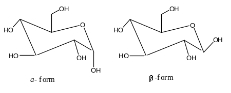
The term anomers of glucose refers to
A
Isomers of glucose that differ in configurations at carbons one and four ($C-1$ and $C-4$)
B
$A$ mixture of $(D)$-glucose and $(L)$-glucose
C
Enantiomers of glucose
D
Isomers of glucose that differ in configuration at carbon one $(C-1)$
Solution
(D) Anomers of glucose are cyclic diastereomers (epimers) that differ in configuration only at the anomeric carbon,which is $C-1$ in glucose.
These exist in two forms,$\alpha$-$D$-glucose and $\beta$-$D$-glucose,depending on the orientation of the hydroxyl $(-OH)$ group at the $C-1$ position.
These exist in two forms,$\alpha$-$D$-glucose and $\beta$-$D$-glucose,depending on the orientation of the hydroxyl $(-OH)$ group at the $C-1$ position.
0 likes
View Solution377
MediumMCQ
Fructose or ketohexose contains:
A
$5$ $OH$ groups
B
$3$ secondary alcoholic groups
C
$2$ primary alcoholic groups and one keto group
D
All of the above
Solution
(D) The chemical formula of fructose is $CH_2OH \cdot CO \cdot (CHOH)_3 \cdot CH_2OH$.
$1$. It contains $5$ hydroxyl $(-OH)$ groups.
$2$. It contains $3$ secondary alcoholic groups $(-CHOH-)$ and $2$ primary alcoholic groups $(-CH_2OH)$.
$3$. It contains one keto group $(>C=O)$ at the $C-2$ position.
Therefore,all the given statements are correct.
$1$. It contains $5$ hydroxyl $(-OH)$ groups.
$2$. It contains $3$ secondary alcoholic groups $(-CHOH-)$ and $2$ primary alcoholic groups $(-CH_2OH)$.
$3$. It contains one keto group $(>C=O)$ at the $C-2$ position.
Therefore,all the given statements are correct.
0 likes
View Solution378
MediumMCQ
In aqueous solution, glucose exists as:
A
Only in open chain form
B
Only in pyranose form
C
Only in furanose forms
D
In all three forms in equilibrium
Solution
(D) In an aqueous solution, glucose exists in an equilibrium mixture of its cyclic forms and a small amount of the open-chain form.
Specifically, it exists as an equilibrium between $\alpha-D$-glucose $(approx 36 \%)$, $\beta-D$-glucose $(approx 64 \%)$, and a very small fraction of the open-chain form $(approx 0.02 \%)$.
These forms are interconvertible through a process called mutarotation.
Specifically, it exists as an equilibrium between $\alpha-D$-glucose $(approx 36 \%)$, $\beta-D$-glucose $(approx 64 \%)$, and a very small fraction of the open-chain form $(approx 0.02 \%)$.
These forms are interconvertible through a process called mutarotation.
0 likes
View Solution379
EasyMCQ
The colour of the precipitate formed when a reducing sugar is heated with Fehling's solution is:
A
Brown
B
Red
C
Blue
D
Green
Solution
(B) When a reducing sugar is heated with Fehling's solution,the $Cu^{2+}$ ions in the solution are reduced to $Cu^{+}$ ions.
This reaction results in the formation of cuprous oxide $(Cu_{2}O)$,which appears as a reddish-brown or brick-red precipitate.
Therefore,the correct colour of the precipitate is red.
This reaction results in the formation of cuprous oxide $(Cu_{2}O)$,which appears as a reddish-brown or brick-red precipitate.
Therefore,the correct colour of the precipitate is red.
0 likes
View Solution380
MediumMCQ
Glucose gives a silver mirror with ammoniacal silver nitrate because it has:
A
Aldehyde group
B
Ester group
C
Ketone group
D
Alcoholic silver nitrate
Solution
(A) Glucose gives a silver mirror test (Tollens' test) with ammoniacal silver nitrate because of the presence of the $-CHO$ group (aldehyde group) in its open-chain structure.
The reaction is as follows:
$CH_2OH(CHOH)_4CHO + Ag_2O \rightarrow CH_2OH(CHOH)_4COOH + 2Ag \downarrow$ (silver mirror)
Here,the aldehyde group is oxidized to a carboxylic acid group,and silver ions are reduced to metallic silver,forming the silver mirror.
The reaction is as follows:
$CH_2OH(CHOH)_4CHO + Ag_2O \rightarrow CH_2OH(CHOH)_4COOH + 2Ag \downarrow$ (silver mirror)
Here,the aldehyde group is oxidized to a carboxylic acid group,and silver ions are reduced to metallic silver,forming the silver mirror.

0 likes
View Solution381
MediumMCQ
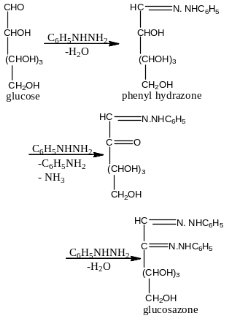
$A$ glucose molecule reacts with '$X$' number of molecules of phenylhydrazine to yield osazone. The value of '$X$' is
A
Four
B
One
C
Two
D
Three
Solution
(D) The formation of osazone from glucose involves the reaction with three molecules of phenylhydrazine $(C_6H_5NHNH_2)$.
$1$. The first molecule of phenylhydrazine reacts with the aldehyde group of glucose to form glucose phenylhydrazone,releasing water $(H_2O)$.
$2$. The second molecule of phenylhydrazine acts as an oxidizing agent,oxidizing the $C-2$ hydroxyl group to a carbonyl group,while itself being reduced to aniline $(C_6H_5NH_2)$ and ammonia $(NH_3)$.
$3$. The third molecule of phenylhydrazine reacts with the newly formed carbonyl group at $C-2$ to form the final osazone product,releasing another molecule of water $(H_2O)$.
Thus,a total of three molecules of phenylhydrazine are required.
$1$. The first molecule of phenylhydrazine reacts with the aldehyde group of glucose to form glucose phenylhydrazone,releasing water $(H_2O)$.
$2$. The second molecule of phenylhydrazine acts as an oxidizing agent,oxidizing the $C-2$ hydroxyl group to a carbonyl group,while itself being reduced to aniline $(C_6H_5NH_2)$ and ammonia $(NH_3)$.
$3$. The third molecule of phenylhydrazine reacts with the newly formed carbonyl group at $C-2$ to form the final osazone product,releasing another molecule of water $(H_2O)$.
Thus,a total of three molecules of phenylhydrazine are required.
0 likes
View Solution382
MediumMCQ
The number of asymmetric carbon atoms in fructose is:
A
$2$
B
$3$
C
$4$
D
$5$
Solution
(B) The structure of fructose is $CH_2OH-CO-(CHOH)_3-CH_2OH$.
An asymmetric carbon atom (chiral center) is a carbon atom bonded to four different groups.
In the fructose molecule,the carbons at positions $3$,$4$,and $5$ are asymmetric carbons.
Therefore,the total number of asymmetric carbon atoms in fructose is $3$.
An asymmetric carbon atom (chiral center) is a carbon atom bonded to four different groups.
In the fructose molecule,the carbons at positions $3$,$4$,and $5$ are asymmetric carbons.
Therefore,the total number of asymmetric carbon atoms in fructose is $3$.
0 likes
View Solution383
MediumMCQ
The two forms of $D$-glucopyranose obtained from the solution of $D$-glucose are called
A
Isomers
B
Anomers
C
Epimers
D
Enantiomers
Solution
(B) The two forms of $D$-glucopyranose are $\alpha-D-(+)$-glucopyranose and $\beta-D-(+)$-glucopyranose.
These two forms differ in configuration only at the $C-1$ carbon atom,which is the anomeric carbon.
Such stereoisomers that differ in configuration specifically at the anomeric carbon are known as anomers.
These two forms differ in configuration only at the $C-1$ carbon atom,which is the anomeric carbon.
Such stereoisomers that differ in configuration specifically at the anomeric carbon are known as anomers.
0 likes
View Solution384
EasyMCQ
Raffinose is
A
Trisaccharide
B
Disaccharide
C
Monosaccharide
D
Polysaccharide
Solution
(A) Raffinose is a trisaccharide. It yields three molecules of monosaccharides upon hydrolysis.
$C_{18}H_{32}O_{16} + 2H_{2}O \xrightarrow{H^{+}} \text{glucose} + \text{fructose} + \text{galactose}$
$C_{18}H_{32}O_{16} + 2H_{2}O \xrightarrow{H^{+}} \text{glucose} + \text{fructose} + \text{galactose}$
0 likes
View Solution385
MediumMCQ
The number of possible stereoisomers of glucose is:
A
$10$
B
$14$
C
$16$
D
$20$
Solution
(C) Glucose is an aldohexose with the chemical formula $C_6H_{12}O_6$.
It contains $4$ chiral (asymmetric) carbon atoms.
The number of stereoisomers for a molecule with $n$ chiral centers is given by the formula $2^n$.
Here,$n = 4$.
Therefore,the total number of stereoisomers = $2^4 = 16$.
It contains $4$ chiral (asymmetric) carbon atoms.
The number of stereoisomers for a molecule with $n$ chiral centers is given by the formula $2^n$.
Here,$n = 4$.
Therefore,the total number of stereoisomers = $2^4 = 16$.
0 likes
View Solution386
MediumMCQ
Glucose gives many reactions of aldehyde because:
A
It is hydrolysed to acetaldehyde
B
It is a polyhydroxy ketone
C
It is a cyclic aldehyde
D
It is a hemiacetal in equilibrium with its aldehyde form in solution
Solution
(D) Glucose $(C_6H_{12}O_6)$ is an aldohexose,meaning it contains an aldehyde group $(-CHO)$ in its open-chain structure.
In an aqueous solution,glucose exists in an equilibrium between its cyclic hemiacetal form and its open-chain aldehyde form.
Although the concentration of the open-chain form is very low,it is sufficient to react with reagents like Tollens' reagent or Fehling's solution,which are characteristic of the aldehyde group.
Therefore,glucose exhibits many reactions typical of aldehydes due to this dynamic equilibrium.
In an aqueous solution,glucose exists in an equilibrium between its cyclic hemiacetal form and its open-chain aldehyde form.
Although the concentration of the open-chain form is very low,it is sufficient to react with reagents like Tollens' reagent or Fehling's solution,which are characteristic of the aldehyde group.
Therefore,glucose exhibits many reactions typical of aldehydes due to this dynamic equilibrium.
0 likes
View Solution387
MediumMCQ
Glucose and cane sugar (sucrose) can be distinguished by:
A
Fehling's solution
B
Baeyer's reagent
C
Molisch test
D
Iodine solution
Solution
(A) Glucose is a reducing sugar because it contains a free aldehyde group,which allows it to reduce Fehling's solution to a red precipitate of cuprous oxide $(Cu_2O)$.
Cane sugar (sucrose) is a non-reducing sugar because its glycosidic linkage involves the anomeric carbons of both glucose and fructose,leaving no free aldehyde or ketone group.
Therefore,Fehling's solution can distinguish between glucose and sucrose.
Cane sugar (sucrose) is a non-reducing sugar because its glycosidic linkage involves the anomeric carbons of both glucose and fructose,leaving no free aldehyde or ketone group.
Therefore,Fehling's solution can distinguish between glucose and sucrose.
0 likes
View Solution388
MediumMCQ
Which molecule possesses the general formula of carbohydrates,but is not a carbohydrate?
A
Glyceraldehyde
B
Arabinose
C
Acetic acid
D
All of these
Solution
(C) The general formula for carbohydrates is $C_n(H_2O)_n$.
Acetic acid has the chemical formula $CH_3COOH$,which can be written as $C_2(H_2O)_2$.
Although it fits the general formula,it is a carboxylic acid and not a carbohydrate because it does not contain polyhydroxy aldehyde or ketone groups.
Acetic acid has the chemical formula $CH_3COOH$,which can be written as $C_2(H_2O)_2$.
Although it fits the general formula,it is a carboxylic acid and not a carbohydrate because it does not contain polyhydroxy aldehyde or ketone groups.
0 likes
View Solution389
MediumMCQ
How can you say that glucose is a cyclic compound?
A
Glucose undergoes Tollen's reaction
B
Glucose reacts with phenyl hydrazine
C
Glucose fails to react with sodium hydrogen sulphite
D
Glucose reacts with nitric acid
Solution
(C) Despite having an aldehyde group,glucose does not give the $2,4-DNP$ test or Schiff's test.
Furthermore,it does not form a hydrogen sulphite addition product with $NaHSO_3$.
These observations indicate that the aldehyde group is not free but is involved in the formation of a hemiacetal structure,confirming that glucose exists as a cyclic compound.
Furthermore,it does not form a hydrogen sulphite addition product with $NaHSO_3$.
These observations indicate that the aldehyde group is not free but is involved in the formation of a hemiacetal structure,confirming that glucose exists as a cyclic compound.
0 likes
View Solution390
EasyMCQ
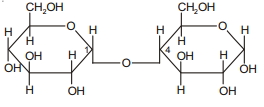
In maltose,a glycosidic bond is formed between:
A
Carbon $1$ of one glucose molecule and carbon $4$ of second glucose molecule
B
Carbon $2$ of one glucose molecule and carbon $3$ of second glucose molecule
C
Carbon $3$ of one glucose molecule and carbon $4$ of second glucose molecule
D
Carbon $1$ of one glucose molecule and carbon $6$ of second glucose molecule
Solution
(A) Maltose is a disaccharide composed of two $\alpha$-$D$-glucose units.
These two glucose units are linked together by an $\alpha(1 \rightarrow 4)$ glycosidic bond.
This means the bond is formed between the anomeric carbon (Carbon $1$) of the first glucose molecule and the Carbon $4$ of the second glucose molecule.
Therefore,the correct option is $A$.
These two glucose units are linked together by an $\alpha(1 \rightarrow 4)$ glycosidic bond.
This means the bond is formed between the anomeric carbon (Carbon $1$) of the first glucose molecule and the Carbon $4$ of the second glucose molecule.
Therefore,the correct option is $A$.
0 likes
View Solution391
MediumMCQ
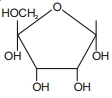
The given structure represents a monosaccharide known as
A
Ribose
B
Glucose
C
Fructose
D
Raffinose
Solution
(A) The provided image shows a five-membered ring structure (furanose ring) with five carbon atoms in total (a pentose sugar).
Ribose is a classic example of a pentose sugar $(C_5H_{10}O_5)$ commonly found in $RNA$.
Glucose and Fructose are hexose sugars $(C_6H_{12}O_6)$,which typically form six-membered rings (pyranose) or five-membered rings with different substituents.
Raffinose is a trisaccharide,not a monosaccharide.
Therefore,the structure represents Ribose.
Ribose is a classic example of a pentose sugar $(C_5H_{10}O_5)$ commonly found in $RNA$.
Glucose and Fructose are hexose sugars $(C_6H_{12}O_6)$,which typically form six-membered rings (pyranose) or five-membered rings with different substituents.
Raffinose is a trisaccharide,not a monosaccharide.
Therefore,the structure represents Ribose.
0 likes
View Solution392
MediumMCQ
Chitin present in the exoskeletons of arthropods is
A
Protein
B
Polysaccharide
C
Lipid
D
Derived monosaccharide
Solution
(B) Chitin is a complex structural polysaccharide found in the exoskeletons of arthropods and the cell walls of fungi.
It is a polymer of $N$-acetylglucosamine,which is a nitrogen-containing derivative of glucose.
Since it consists of long chains of these repeating units linked by $\beta-1,4$-glycosidic bonds,it is classified as a polysaccharide.
It is a polymer of $N$-acetylglucosamine,which is a nitrogen-containing derivative of glucose.
Since it consists of long chains of these repeating units linked by $\beta-1,4$-glycosidic bonds,it is classified as a polysaccharide.
0 likes
View Solution393
MediumMCQ
Adenosine Triphosphate $(ATP)$ liberates high energy by the breakdown of which bond?
A
Glycosidic bond
B
Hydrogen bond
C
Phosphate bond
D
Both $(a)$ and $(c)$
Solution
(C) Adenosine Triphosphate $(ATP)$ consists of an adenosine molecule bonded to three phosphate groups. The high energy released during cellular processes is primarily due to the hydrolysis of the phosphoanhydride bonds (a type of phosphate bond) between the phosphate groups. When the terminal phosphate group is removed, $ATP$ is converted into Adenosine Diphosphate $(ADP)$ and inorganic phosphate $(Pi)$, releasing a significant amount of energy: $ATP + H_2O \rightarrow ADP + Pi + \text{Energy}$.
0 likes
View Solution394
MediumMCQ
Which of the following is the correct sequence of carbohydrates in the order of increasing complexity of chemical structure?
A
Sucrose,starch,oligosaccharide,maltose,triose
B
Triose,maltose,sucrose,oligosaccharide,starch
C
Triose,glucose,maltose,oligosaccharide,starch
D
Oligosaccharide,triose,starch,sucrose,maltose
Solution
(C) The complexity of carbohydrates increases based on the number of monosaccharide units they contain:
$1$. Triose: $A$ simple sugar containing $3$ carbon atoms (monosaccharide).
$2$. Glucose: $A$ simple sugar containing $6$ carbon atoms (monosaccharide).
$3$. Maltose: $A$ disaccharide composed of $2$ glucose units.
$4$. Oligosaccharide: Carbohydrates containing $2-10$ monosaccharide units.
$5$. Starch: $A$ polysaccharide consisting of a long chain of glucose units.
Therefore,the correct sequence of increasing complexity is: Triose,Glucose,Maltose,Oligosaccharide,Starch.
$1$. Triose: $A$ simple sugar containing $3$ carbon atoms (monosaccharide).
$2$. Glucose: $A$ simple sugar containing $6$ carbon atoms (monosaccharide).
$3$. Maltose: $A$ disaccharide composed of $2$ glucose units.
$4$. Oligosaccharide: Carbohydrates containing $2-10$ monosaccharide units.
$5$. Starch: $A$ polysaccharide consisting of a long chain of glucose units.
Therefore,the correct sequence of increasing complexity is: Triose,Glucose,Maltose,Oligosaccharide,Starch.
0 likes
View Solution395
MediumMCQ
$A$ dehydration reaction links two glucose molecules to produce maltose. If the formula for glucose is $C_{6}H_{12}O_{6}$,then what is the formula for maltose?
A
$C_{12}H_{21}O_{12}$
B
$C_{12}H_{22}O_{11}$
C
$C_{12}H_{24}O_{11}$
D
$C_{12}H_{20}O_{10}$
Solution
(B) dehydration reaction (also known as a condensation reaction) involves the removal of a water molecule $(H_{2}O)$ when two monosaccharides join to form a disaccharide.
When two glucose molecules $(C_{6}H_{12}O_{6})$ combine,the reaction is:
$C_{6}H_{12}O_{6} + C_{6}H_{12}O_{6} \rightarrow C_{12}H_{24}O_{12} - H_{2}O$
Subtracting the atoms of water ($2$ Hydrogen and $1$ Oxygen) from the sum of the two glucose molecules $(C_{12}H_{24}O_{12})$:
$C_{12}H_{24-2}O_{12-1} = C_{12}H_{22}O_{11}$
Therefore,the formula for maltose is $C_{12}H_{22}O_{11}$.
When two glucose molecules $(C_{6}H_{12}O_{6})$ combine,the reaction is:
$C_{6}H_{12}O_{6} + C_{6}H_{12}O_{6} \rightarrow C_{12}H_{24}O_{12} - H_{2}O$
Subtracting the atoms of water ($2$ Hydrogen and $1$ Oxygen) from the sum of the two glucose molecules $(C_{12}H_{24}O_{12})$:
$C_{12}H_{24-2}O_{12-1} = C_{12}H_{22}O_{11}$
Therefore,the formula for maltose is $C_{12}H_{22}O_{11}$.
0 likes
View Solution396
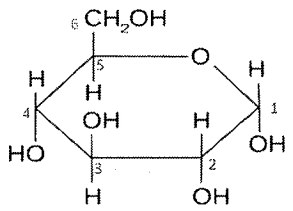
MediumMCQ
Identify the given structure.
A
$\alpha$-Glucose
B
$\beta$-Glucose
C
$\alpha$-Galactose
D
$\beta$-Galactose
Solution
(A) $1$. In the given structure,observe the position of the $-OH$ group at the $C-1$ (anomeric) carbon and the $C-4$ carbon.
$2$. At the $C-1$ position,the $-OH$ group is pointing downwards,which indicates an $\alpha$-anomer.
$3$. At the $C-4$ position,the $-OH$ group is pointing downwards,which is characteristic of glucose. (In galactose,the $-OH$ group at $C-4$ points upwards).
$4$. Therefore,the structure represents $\alpha$-glucose.
$2$. At the $C-1$ position,the $-OH$ group is pointing downwards,which indicates an $\alpha$-anomer.
$3$. At the $C-4$ position,the $-OH$ group is pointing downwards,which is characteristic of glucose. (In galactose,the $-OH$ group at $C-4$ points upwards).
$4$. Therefore,the structure represents $\alpha$-glucose.
0 likes
View Solution397
MediumMCQ
Match the following columns:
| Column-$I$ | Column-$II$ |
|---|---|
| $P$. Starch $+ I_2$ | $I$. Blue color |
| $Q$. Glycogen $+ I_2$ | $II$. Red color |
| $R$. Cellulose $+ I_2$ | $III$. No color |
A
$(P-III), (Q-I), (R-II)$
B
$(P-II), (Q-I), (R-III)$
C
$(P-I), (Q-II), (R-III)$
D
$(P-III), (Q-II), (R-I)$
Solution
(C) The iodine test is used to detect the presence of polysaccharides.
$1$. Starch forms a helical structure that traps $I_2$ molecules,resulting in a deep blue color $(P-I)$.
$2$. Glycogen has a highly branched structure that reacts with $I_2$ to produce a reddish-brown or red color $(Q-II)$.
$3$. Cellulose does not form the necessary helical structure to trap $I_2$ molecules,so it does not give a color with iodine $(R-III)$.
Therefore,the correct matching is $(P-I), (Q-II), (R-III)$.
$1$. Starch forms a helical structure that traps $I_2$ molecules,resulting in a deep blue color $(P-I)$.
$2$. Glycogen has a highly branched structure that reacts with $I_2$ to produce a reddish-brown or red color $(Q-II)$.
$3$. Cellulose does not form the necessary helical structure to trap $I_2$ molecules,so it does not give a color with iodine $(R-III)$.
Therefore,the correct matching is $(P-I), (Q-II), (R-III)$.
0 likes
View Solution398
MediumMCQ
In animals,food is stored as $..............$,and in plants,food is stored as $..............$.
A
Starch,Glycogen
B
Glycogen,Starch
C
Glycogen,Cellulose
D
Cellulose,Glycogen
Solution
(B) In animals,carbohydrates are stored in the form of $Glycogen$,which is a branched polysaccharide often referred to as 'animal starch'.
In plants,carbohydrates are primarily stored in the form of $Starch$,which consists of two components: $Amylose$ and $Amylopectin$.
Therefore,the correct sequence is $Glycogen$ for animals and $Starch$ for plants.
In plants,carbohydrates are primarily stored in the form of $Starch$,which consists of two components: $Amylose$ and $Amylopectin$.
Therefore,the correct sequence is $Glycogen$ for animals and $Starch$ for plants.
0 likes
View Solution399
MediumMCQ
Match the following columns:
| Column-$I$ | Column-$II$ |
|---|---|
| $P$. Chitin | $I$. $\alpha$-glucose |
| $Q$. Starch,Glycogen | $II$. $\beta$-glucose |
| $R$. Cellulose | $III$. $N$-acetyl glucosamine |
| $S$. Inulin | $IV$. Fructose |
A
$(P-IV), (Q-I), (R-II), (S-III)$
B
$(P-IV), (Q-II), (R-I), (S-III)$
C
$(P-III), (Q-II), (R-I), (S-IV)$
D
$(P-III), (Q-I), (R-II), (S-IV)$
Solution
(D) The correct matches are as follows:
$P$. Chitin is a homopolymer of $N$-acetyl glucosamine $(III)$.
$Q$. Starch and glycogen are storage polysaccharides made up of $\alpha$-glucose units $(I)$.
$R$. Cellulose is a structural polysaccharide made up of $\beta$-glucose units $(II)$.
$S$. Inulin is a polymer of fructose $(IV)$.
Therefore,the correct matching is $(P-III), (Q-I), (R-II), (S-IV)$.
$P$. Chitin is a homopolymer of $N$-acetyl glucosamine $(III)$.
$Q$. Starch and glycogen are storage polysaccharides made up of $\alpha$-glucose units $(I)$.
$R$. Cellulose is a structural polysaccharide made up of $\beta$-glucose units $(II)$.
$S$. Inulin is a polymer of fructose $(IV)$.
Therefore,the correct matching is $(P-III), (Q-I), (R-II), (S-IV)$.
0 likes
View Solution400
MediumMCQ
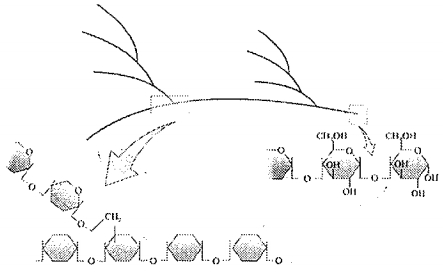
Identify the structure shown in the image.
A
Starch
B
Glycogen
C
Cellulose
D
Chitin
Solution
(B) The image shows a highly branched polysaccharide structure.
Glycogen is a storage polysaccharide in animals and is characterized by a highly branched structure,similar to amylopectin but with more frequent branching points.
Starch consists of amylose (unbranched) and amylopectin (branched,but less than glycogen).
Cellulose is a linear,unbranched polymer of glucose.
Chitin is a structural polysaccharide found in the exoskeleton of arthropods and fungal cell walls,which is also linear.
Therefore,the highly branched structure depicted is glycogen.
Glycogen is a storage polysaccharide in animals and is characterized by a highly branched structure,similar to amylopectin but with more frequent branching points.
Starch consists of amylose (unbranched) and amylopectin (branched,but less than glycogen).
Cellulose is a linear,unbranched polymer of glucose.
Chitin is a structural polysaccharide found in the exoskeleton of arthropods and fungal cell walls,which is also linear.
Therefore,the highly branched structure depicted is glycogen.
0 likes
View SolutionBiomolecules — Carbohydrates · Frequently Asked Questions
1Are these Biomolecules questions useful for JEE and NEET?
Yes. All questions in this section are mapped to JEE Main and NEET exam patterns. Previous year questions from JEE Main, NEET, GUJCET and state-level exams are included with full solutions.
2Can I switch to Hindi or Gujarati for these questions?
Yes. Use the language tabs in the hero section or the sidebar to view the same questions and solutions in English, Hindi or Gujarati.
3How do I generate a question paper from this subtopic?
Use the Vedclass Exam Paper Generator — select the chapter and subtopic, set difficulty, and generate Sets A, B, C, D automatically. First 3 chapters of every subject are free.
Vedclass Products
For Students
Vedclass Test Series
Mock tests in real JEE/NEET style with performance analysis. 5-day free trial.
Start Free TrialFor Teachers
Exam Paper Generator
Generate Set A/B/C/D papers from this chapter in 2 minutes. 3 chapters free.
Try FreeFor Institutes
Online Exam Module
Live online exams with unlimited students, 360° analytics & white-label branding.
See DemoFor Teachers & Institutes
Generate a Biomolecules Exam Paper in 2 Minutes
Select subtopic & difficulty — Sets A, B, C, D auto-generated with No Repeat logic.
First 3 chapters of every subject are free — no payment required.