
A English
Carbohydrates Questions in English
Class 11 Biology · Biomolecules · Carbohydrates
423+
Questions
English
Language
100%
With Solutions
Showing 49 of 423 questions in English
301
EasyMCQ
Identify the pentose sugar.
A
Galactose
B
Dihydroxy acetone
C
Ribulose
D
Hexose
Solution
(C) pentose sugar is a monosaccharide containing $5$ carbon atoms.
$Ribulose$ is a ketopentose sugar with the chemical formula $C_5H_{10}O_5$.
$Galactose$ is a hexose sugar ($6$ carbons).
$Dihydroxy$ $acetone$ is a triose sugar ($3$ carbons).
$Hexose$ is a general term for a $6$-carbon sugar,not a specific pentose sugar.
$Ribulose$ is a ketopentose sugar with the chemical formula $C_5H_{10}O_5$.
$Galactose$ is a hexose sugar ($6$ carbons).
$Dihydroxy$ $acetone$ is a triose sugar ($3$ carbons).
$Hexose$ is a general term for a $6$-carbon sugar,not a specific pentose sugar.
0 likes
View Solution302
EasyMCQ
Which type of sugar is glyceraldehyde?
A
Pentose
B
Hexose
C
Triose
D
Nonose
Solution
(C) Glyceraldehyde is a simple sugar with the chemical formula $C_3H_6O_3$.
It contains $3$ carbon atoms in its structure.
Sugars are classified based on the number of carbon atoms they contain.
$A$ sugar with $3$ carbon atoms is known as a triose sugar.
Therefore,glyceraldehyde is a triose.
It contains $3$ carbon atoms in its structure.
Sugars are classified based on the number of carbon atoms they contain.
$A$ sugar with $3$ carbon atoms is known as a triose sugar.
Therefore,glyceraldehyde is a triose.
0 likes
View Solution303
MediumMCQ
Which substance is used in your uniform cloth?
A
Starch
B
Cellulose
C
Chitin
D
Insulin
Solution
(B) Uniform cloth is primarily made of cotton, which is a natural fiber.
Cotton is composed of $90\%$ cellulose, which is a polysaccharide consisting of a linear chain of several hundred to many thousands of $\beta(1 \rightarrow 4)$ linked $D$-glucose units.
Cellulose provides structural support to plant cell walls and is the main component used in the manufacturing of cotton textiles.
Cotton is composed of $90\%$ cellulose, which is a polysaccharide consisting of a linear chain of several hundred to many thousands of $\beta(1 \rightarrow 4)$ linked $D$-glucose units.
Cellulose provides structural support to plant cell walls and is the main component used in the manufacturing of cotton textiles.
0 likes
View Solution304
MediumMCQ
In which form is sugar stored in our body?
A
Glucose,monosaccharides
B
Sucrose,disaccharides
C
Glycogen,polysaccharide
D
Fatty acid and glycerol
Solution
(C) In the human body,excess glucose is converted into a complex carbohydrate called $Glycogen$ for storage.
$Glycogen$ is a $polysaccharide$ that serves as the primary form of energy storage in animals,primarily stored in the liver and skeletal muscles.
It can be rapidly broken down back into glucose when the body requires energy.
$Glycogen$ is a $polysaccharide$ that serves as the primary form of energy storage in animals,primarily stored in the liver and skeletal muscles.
It can be rapidly broken down back into glucose when the body requires energy.
0 likes
View Solution305
MediumMCQ
Which of the following is not a carbohydrate?
A
Starch
B
Glycogen
C
Wax
D
Glucose
Solution
(C) Carbohydrates are polyhydroxy aldehydes or ketones or substances that yield these on hydrolysis. They include sugars,starch,and glycogen.
$A$. Starch is a polysaccharide (carbohydrate).
$B$. Glycogen is a polysaccharide (carbohydrate).
$C$. Wax is a type of lipid (ester of long-chain fatty acids and long-chain alcohols),not a carbohydrate.
$D$. Glucose is a monosaccharide (carbohydrate).
Therefore,wax is not a carbohydrate.
$A$. Starch is a polysaccharide (carbohydrate).
$B$. Glycogen is a polysaccharide (carbohydrate).
$C$. Wax is a type of lipid (ester of long-chain fatty acids and long-chain alcohols),not a carbohydrate.
$D$. Glucose is a monosaccharide (carbohydrate).
Therefore,wax is not a carbohydrate.
0 likes
View Solution306
MediumMCQ
Which of the following is not made up of cellulose?
A
Plant cell wall
B
Paper
C
Cotton fibre
D
Inulin
Solution
(D) Cellulose is a polysaccharide composed of glucose units and is the primary structural component of plant cell walls,paper,and cotton fibres.
Inulin is a polymer of fructose,not glucose,and is a fructan (polysaccharide of fructose) found in the roots or tubers of certain plants like Dahlia. Therefore,it is not made up of cellulose.
Inulin is a polymer of fructose,not glucose,and is a fructan (polysaccharide of fructose) found in the roots or tubers of certain plants like Dahlia. Therefore,it is not made up of cellulose.
0 likes
View Solution307
MediumMCQ
Identify the monosaccharides from the following list:
$a$. Glycine,$b$. Cellulose,$c$. Glycogen,$d$. Ribose,$e$. Galactose,$f$. Lactose,$g$. Maltose.
$a$. Glycine,$b$. Cellulose,$c$. Glycogen,$d$. Ribose,$e$. Galactose,$f$. Lactose,$g$. Maltose.
A
$6$
B
$5$
C
$2$
D
$4$
Solution
(C) To identify the monosaccharides,let us analyze each item:
$a$. Glycine: It is an amino acid,not a carbohydrate.
$b$. Cellulose: It is a polysaccharide.
$c$. Glycogen: It is a polysaccharide.
$d$. Ribose: It is a monosaccharide (pentose sugar).
$e$. Galactose: It is a monosaccharide (hexose sugar).
$f$. Lactose: It is a disaccharide.
$g$. Maltose: It is a disaccharide.
Therefore,the monosaccharides in the list are Ribose $(d)$ and Galactose $(e)$.
The total count of monosaccharides is $2$.
$a$. Glycine: It is an amino acid,not a carbohydrate.
$b$. Cellulose: It is a polysaccharide.
$c$. Glycogen: It is a polysaccharide.
$d$. Ribose: It is a monosaccharide (pentose sugar).
$e$. Galactose: It is a monosaccharide (hexose sugar).
$f$. Lactose: It is a disaccharide.
$g$. Maltose: It is a disaccharide.
Therefore,the monosaccharides in the list are Ribose $(d)$ and Galactose $(e)$.
The total count of monosaccharides is $2$.
0 likes
View Solution308
MediumMCQ
Which of the following is a carbohydrate?
A
Alanine
B
Glycine
C
Lecithin
D
Inulin
Solution
(D) $1$. $Alanine$ and $Glycine$ are amino acids,which are the building blocks of proteins.
$2$. $Lecithin$ is a phospholipid,which is a type of lipid.
$3$. $Inulin$ is a polymer of fructose,which is a polysaccharide and therefore a carbohydrate.
$4$. Thus,$Inulin$ is the correct answer.
$2$. $Lecithin$ is a phospholipid,which is a type of lipid.
$3$. $Inulin$ is a polymer of fructose,which is a polysaccharide and therefore a carbohydrate.
$4$. Thus,$Inulin$ is the correct answer.
0 likes
View Solution309
MediumMCQ
The most abundant biomolecules on Earth,carbohydrates,are produced by:
A
All bacteria,fungi,and green plants
B
Fungi,algae,and green plant cells
C
Some bacteria,algae,and green plant cells
D
Viruses,fungi,and bacteria
Solution
(C) Carbohydrates are the most abundant biomolecules on Earth. They are primarily produced through the process of photosynthesis.
Photosynthesis is carried out by organisms that possess chlorophyll or similar pigments,such as green plants,algae,and certain photosynthetic bacteria (like cyanobacteria).
Fungi and viruses do not perform photosynthesis and therefore do not produce carbohydrates in this manner.
Thus,the correct group consists of some bacteria (photosynthetic),algae,and green plant cells.
Photosynthesis is carried out by organisms that possess chlorophyll or similar pigments,such as green plants,algae,and certain photosynthetic bacteria (like cyanobacteria).
Fungi and viruses do not perform photosynthesis and therefore do not produce carbohydrates in this manner.
Thus,the correct group consists of some bacteria (photosynthetic),algae,and green plant cells.
0 likes
View Solution310
EasyMCQ
Glycogen is a polymer of ......... .
A
Galactose
B
Glucose
C
Fructose
D
Sucrose
Solution
(B) Glycogen is a polysaccharide that serves as the primary form of energy storage in animals and fungi.
It is a branched polymer composed of repeating units of $D-glucose$ linked by $\alpha-1,4-glycosidic$ bonds in the linear chains and $\alpha-1,6-glycosidic$ bonds at the branching points.
Therefore,the correct answer is $Glucose$.
It is a branched polymer composed of repeating units of $D-glucose$ linked by $\alpha-1,4-glycosidic$ bonds in the linear chains and $\alpha-1,6-glycosidic$ bonds at the branching points.
Therefore,the correct answer is $Glucose$.
0 likes
View Solution311
MediumMCQ
Which polysaccharide is synthesized and stored in liver cells?
A
Lactose
B
Galactose
C
Arabinose
D
Glycogen
Solution
(D) Glycogen is a multi-branched polysaccharide of glucose that serves as a form of energy storage in animals,fungi,and bacteria. In humans,it is primarily synthesized and stored in the liver and muscle cells. When the body requires energy,the liver breaks down glycogen into glucose and releases it into the bloodstream. Lactose,galactose,and arabinose are not polysaccharides stored in the liver.
0 likes
View Solution312
MediumMCQ
Which of the following groups contains only polysaccharides?
A
Starch,Glycogen,Cellulose
B
Sucrose,Maltose,Glucose
C
Glucose,Fructose,Lactose
D
Galactose,Starch,Sucrose
Solution
(A) Polysaccharides are complex carbohydrates formed by the polymerization of many monosaccharide units.
$1$. Starch is a storage polysaccharide in plants.
$2$. Glycogen is a storage polysaccharide in animals.
$3$. Cellulose is a structural polysaccharide found in plant cell walls.
Sucrose,maltose,and lactose are disaccharides,while glucose,fructose,and galactose are monosaccharides.
Therefore,the correct group is Starch,Glycogen,and Cellulose.
$1$. Starch is a storage polysaccharide in plants.
$2$. Glycogen is a storage polysaccharide in animals.
$3$. Cellulose is a structural polysaccharide found in plant cell walls.
Sucrose,maltose,and lactose are disaccharides,while glucose,fructose,and galactose are monosaccharides.
Therefore,the correct group is Starch,Glycogen,and Cellulose.
0 likes
View Solution313
MediumMCQ
What is the primary component of the plant cell wall,cellulose,made of?
A
Unbranched chain of glucose molecules linked by $\alpha-1, 4$ glycosidic bonds.
B
Branched chain of glucose molecules linked by $\beta-1, 4$ glycosidic bonds and $\alpha-1, 6$ glycosidic bonds at branching points.
C
Unbranched chain of glucose molecules linked by $\beta-1, 4$ glycosidic bonds.
D
Branched chain of glucose molecules linked by $\alpha-1, 6$ glycosidic bonds.
Solution
(C) Cellulose is a polysaccharide consisting of a linear,unbranched chain of several hundred to many thousands of $\beta-D$-glucose units.
These glucose units are linked together by $\beta-1, 4$-glycosidic bonds.
Unlike starch (which contains $\alpha$-linkages),the $\beta$-linkages in cellulose result in a straight,rigid,and fibrous structure that provides structural support to plant cell walls.
These glucose units are linked together by $\beta-1, 4$-glycosidic bonds.
Unlike starch (which contains $\alpha$-linkages),the $\beta$-linkages in cellulose result in a straight,rigid,and fibrous structure that provides structural support to plant cell walls.
0 likes
View Solution314
EasyMCQ
Lactose is composed of which of the following?
A
Glucose + Glucose
B
Glucose + Fructose
C
Fructose + Galactose
D
Glucose + Galactose
Solution
(D) Lactose is a disaccharide sugar that is commonly found in milk.
It is formed by the condensation reaction between two monosaccharide units.
The two monosaccharide units that make up lactose are $Glucose$ and $Galactose$.
These are linked together by a $\beta-1,4-glycosidic$ bond.
Therefore,the correct option is $D$.
It is formed by the condensation reaction between two monosaccharide units.
The two monosaccharide units that make up lactose are $Glucose$ and $Galactose$.
These are linked together by a $\beta-1,4-glycosidic$ bond.
Therefore,the correct option is $D$.
0 likes
View Solution315
MediumMCQ
In plants,inulin and pectin are .............. .
A
Stored substances
B
Waste products
C
Excretory products
D
Insect-attracting substances
Solution
(A) Inulin is a polysaccharide,specifically a fructan,which is stored in the roots or tubers of certain plants like Dahlia as a reserve food material. Pectin is a structural polysaccharide found in the primary cell walls of terrestrial plants. Both are considered stored substances or reserve materials in the context of plant physiology.
0 likes
View Solution316
MediumMCQ
Which is the most abundant organic compound on Earth?
A
Protein
B
Cellulose
C
Lipid
D
Steroid
Solution
(B) Cellulose is a polysaccharide consisting of a linear chain of several hundred to many thousands of $\beta(1\rightarrow4)$ linked $D$-glucose units.
It is the structural component of the primary cell wall of green plants,many forms of algae,and the oomycetes.
Because it is the main component of plant cell walls,which make up the vast majority of biomass on Earth,cellulose is considered the most abundant organic compound in the biosphere.
It is the structural component of the primary cell wall of green plants,many forms of algae,and the oomycetes.
Because it is the main component of plant cell walls,which make up the vast majority of biomass on Earth,cellulose is considered the most abundant organic compound in the biosphere.
0 likes
View Solution317
EasyMCQ
The macromolecule chitin is a $-$
A
Simple polysaccharide
B
Nitrogen-containing polysaccharide
C
Phosphorus-containing polysaccharide
D
Sulfur-containing polysaccharide
Solution
(B) Chitin is a complex structural polysaccharide found in the exoskeleton of arthropods and the cell walls of fungi.
Chemically,it is a polymer of $N$-acetylglucosamine,which is a derivative of glucose.
Because it contains an amino group (specifically an acetylated amino group) in its monomeric units,it is classified as a nitrogen-containing polysaccharide.
Chemically,it is a polymer of $N$-acetylglucosamine,which is a derivative of glucose.
Because it contains an amino group (specifically an acetylated amino group) in its monomeric units,it is classified as a nitrogen-containing polysaccharide.
0 likes
View Solution318
MediumMCQ
Which of the following is an example of a non-reducing carbohydrate?
A
Maltose
B
Sucrose
C
Lactose
D
Ribose-$5$-phosphate
Solution
(B) non-reducing sugar is a carbohydrate that cannot act as a reducing agent because it lacks a free aldehyde or ketone group.
In disaccharides like maltose and lactose,the glycosidic bond involves the anomeric carbon of one sugar,but the other sugar still has a free anomeric carbon,making them reducing sugars.
In sucrose,the glycosidic bond is formed between the anomeric carbons of both glucose and fructose ($C_1$ of glucose and $C_2$ of fructose).
Since both anomeric carbons are involved in the bond,there is no free aldehyde or ketone group available,making sucrose a non-reducing sugar.
In disaccharides like maltose and lactose,the glycosidic bond involves the anomeric carbon of one sugar,but the other sugar still has a free anomeric carbon,making them reducing sugars.
In sucrose,the glycosidic bond is formed between the anomeric carbons of both glucose and fructose ($C_1$ of glucose and $C_2$ of fructose).
Since both anomeric carbons are involved in the bond,there is no free aldehyde or ketone group available,making sucrose a non-reducing sugar.
0 likes
View Solution319
EasyMCQ
The exoskeleton of arthropods is composed of chitin,which is a polymer of:
A
Lipoglycan
B
Keratin sulfate and chondroitin sulfate
C
$D$-glucosamine
D
$N$-acetylglucosamine
Solution
(D) Chitin is a structural polysaccharide found in the exoskeleton of arthropods and the cell walls of fungi. It is a linear polymer consisting of $N$-acetylglucosamine (a derivative of glucose) units linked by $\beta-(1,4)$-glycosidic bonds. Therefore,it is a polymer of $N$-acetylglucosamine.
0 likes
View Solution320
MediumMCQ
Carbohydrates are commonly stored as starch in plant storage organs. Which of the following five properties $(A-E)$ make starch useful as a storage material?
$(a)$ Easily translocated
$(b)$ Chemically non-reactive
$(c)$ Easily digested by animals
$(d)$ Osmotically inactive
$(e)$ Synthesized during photosynthesis
Useful properties:
$(a)$ Easily translocated
$(b)$ Chemically non-reactive
$(c)$ Easily digested by animals
$(d)$ Osmotically inactive
$(e)$ Synthesized during photosynthesis
Useful properties:
A
$b$ and $c$
B
$b$ and $d$
C
$a, c$ and $e$
D
$a$ and $e$
Solution
(B) Starch is an ideal storage polysaccharide in plants due to the following reasons:
$1$. It is chemically non-reactive,which prevents it from interfering with the metabolic processes of the cell.
$2$. It is osmotically inactive because it is a large,insoluble molecule. This prevents it from affecting the water potential of the cell,unlike simple sugars like glucose.
Therefore,properties $(b)$ and $(d)$ make starch an efficient storage material.
$1$. It is chemically non-reactive,which prevents it from interfering with the metabolic processes of the cell.
$2$. It is osmotically inactive because it is a large,insoluble molecule. This prevents it from affecting the water potential of the cell,unlike simple sugars like glucose.
Therefore,properties $(b)$ and $(d)$ make starch an efficient storage material.
0 likes
View Solution321
EasyMCQ
The two functional groups characteristic of sugars are
A
carbonyl and hydroxyl
B
hydroxyl and methyl
C
carbonyl and phosphate
D
carbonyl and methyl
Solution
(A) Sugars (carbohydrates) are polyhydroxy aldehydes or polyhydroxy ketones.
This means they contain multiple hydroxyl $(-OH)$ groups and a single carbonyl $(C=O)$ group (either an aldehyde or a ketone group).
Therefore,the two functional groups characteristic of sugars are carbonyl and hydroxyl.
This means they contain multiple hydroxyl $(-OH)$ groups and a single carbonyl $(C=O)$ group (either an aldehyde or a ketone group).
Therefore,the two functional groups characteristic of sugars are carbonyl and hydroxyl.
0 likes
View Solution322
EasyMCQ
Which of the following contains a $\beta-1,4$ linkage?
A
Maltose
B
Sucrose
C
Lactose
D
Fructose
Solution
(C) Lactose,also known as milk sugar,is found exclusively in milk and contains a $\beta-1,4$ glycosidic linkage.
It is a disaccharide formed by the condensation reaction between a molecule of galactose and a molecule of glucose.
It is a disaccharide formed by the condensation reaction between a molecule of galactose and a molecule of glucose.
0 likes
View Solution323
MediumMCQ
Which one of the following statements regarding starch and cellulose is not correct?
A
Both of them are of plant origin
B
Both of them are polymers
C
Both of them give colour with iodine.
D
Both of them are made up of glucose molecules
Solution
(C) Starch is the reserve food material in plant cells,whereas cellulose is the most important structural component of the cell wall of plants.
Both starch and cellulose are polymers of glucose.
Starch is a branched polymer of $\alpha-D$-glucose units linked by $\alpha-1,4$-glycosidic bonds (and $\alpha-1,6$-glycosidic bonds at branching points).
Cellulose is a linear polymer of $\beta-D$-glucose units connected through $\beta-1,4$-glycosidic bonds.
Unlike starch,cellulose is insoluble in ordinary solvents and does not give any colour with iodine.
Both starch and cellulose are polymers of glucose.
Starch is a branched polymer of $\alpha-D$-glucose units linked by $\alpha-1,4$-glycosidic bonds (and $\alpha-1,6$-glycosidic bonds at branching points).
Cellulose is a linear polymer of $\beta-D$-glucose units connected through $\beta-1,4$-glycosidic bonds.
Unlike starch,cellulose is insoluble in ordinary solvents and does not give any colour with iodine.
0 likes
View Solution324
MediumMCQ
Which one of the following is a non-reducing carbohydrate?
A
Maltose
B
Sucrose
C
Lactose
D
Ribose $5$-phosphate
Solution
(B) carbohydrate is considered non-reducing if it lacks a free aldehyde or ketone group capable of acting as a reducing agent.
In $Sucrose$,the glycosidic linkage is formed between the $C1$ of glucose and the $C2$ of fructose.
Since both the anomeric carbons are involved in the glycosidic bond,there is no free aldehyde or keto group available.
Therefore,$Sucrose$ is a non-reducing sugar,whereas $Maltose$,$Lactose$,and $Ribose$ $5$-phosphate contain free anomeric carbons and are reducing sugars.
In $Sucrose$,the glycosidic linkage is formed between the $C1$ of glucose and the $C2$ of fructose.
Since both the anomeric carbons are involved in the glycosidic bond,there is no free aldehyde or keto group available.
Therefore,$Sucrose$ is a non-reducing sugar,whereas $Maltose$,$Lactose$,and $Ribose$ $5$-phosphate contain free anomeric carbons and are reducing sugars.
0 likes
View Solution325
MediumMCQ
Assertion : Glycosidic bonds are formed by dehydration.
Reason : In polysaccharides,individual monosaccharides are linked by glycosidic bonds.
Reason : In polysaccharides,individual monosaccharides are linked by glycosidic bonds.
A
If both Assertion and Reason are correct and the Reason is a correct explanation of the Assertion.
B
If both Assertion and Reason are correct but Reason is not a correct explanation of the Assertion.
C
If the Assertion is correct but Reason is incorrect.
D
If both the Assertion and Reason are incorrect.
Solution
(A) glycosidic bond is a type of covalent bond that joins a carbohydrate molecule to another group,which may or may not be another carbohydrate.
These bonds are formed by a dehydration reaction (also known as a condensation reaction),where a water molecule is removed during the linkage of two monosaccharides.
In polysaccharides,individual monosaccharides are linked by these glycosidic bonds to form long chains.
Since the formation of the bond involves the process of dehydration,the Reason correctly explains the Assertion.
These bonds are formed by a dehydration reaction (also known as a condensation reaction),where a water molecule is removed during the linkage of two monosaccharides.
In polysaccharides,individual monosaccharides are linked by these glycosidic bonds to form long chains.
Since the formation of the bond involves the process of dehydration,the Reason correctly explains the Assertion.
0 likes
View Solution326
Medium
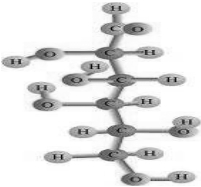
Can you attempt building models of biomolecules using commercially available atomic models (Ball and Stick models)?
Solution
(N/A) Ball and stick models are $3-D$ molecular models that can be used to describe the structure of biomolecules.
In a ball and stick model,the atoms are represented as balls,whereas the bonds that hold the atoms together are represented by sticks. Double and triple bonds are represented by springs that form curved connections between the balls. The size and color of various atoms are different and are depicted by the relative size and color of the balls.
It is the most fundamental and common model for representing biomolecular structures.
In the provided ball and stick model of $D$-glucose,the oxygen atoms are represented by red balls,hydrogen atoms by blue balls,while carbon atoms are represented by grey balls.
In a ball and stick model,the atoms are represented as balls,whereas the bonds that hold the atoms together are represented by sticks. Double and triple bonds are represented by springs that form curved connections between the balls. The size and color of various atoms are different and are depicted by the relative size and color of the balls.
It is the most fundamental and common model for representing biomolecular structures.
In the provided ball and stick model of $D$-glucose,the oxygen atoms are represented by red balls,hydrogen atoms by blue balls,while carbon atoms are represented by grey balls.
0 likes
View Solution327
Medium
What are gums made of? Is Fevicol different?
Solution
(N/A) Gums are hetero-polysaccharides. They are composed of two or more different types of monosaccharides.
On the other hand,Fevicol is a synthetic adhesive made of polyvinyl alcohol $(PVA)$. It is a polymer,but it is not a polysaccharide.
On the other hand,Fevicol is a synthetic adhesive made of polyvinyl alcohol $(PVA)$. It is a polymer,but it is not a polysaccharide.
0 likes
View Solution328
Advanced
Find out how much cellulose is made by all the plants in the biosphere and compare it with how much paper is manufactured by man,and hence determine the annual consumption of plant material by man. What a loss of vegetation!
Solution
(N/A) Approximately $100$ billion tonnes of cellulose are produced annually by all plants in the biosphere. It is estimated that it takes approximately $17$ full-grown trees to manufacture one ton of paper. Trees are also extensively used to fulfill other human requirements such as timber,food,medicines,and fuel. Due to these diverse and widespread uses,it is difficult to calculate the exact annual consumption of plant material by man,but it represents a significant loss of vegetation.
0 likes
View Solution329
Easy
Give information regarding the structural organization and functions of polysaccharides.
Solution
(N/A) $\rightarrow$ The acid-insoluble pellet also contains polysaccharides (carbohydrates) as another class of macromolecules.
$\rightarrow$ Polysaccharides are long chains of sugars. They are threads (literally a cotton thread) containing different monosaccharides as building blocks.
$\rightarrow$ Cellulose is a polymeric polysaccharide consisting of only one type of monosaccharide, i.e., glucose. Cellulose is a homopolymer.
$\rightarrow$ Starch is a variant of cellulose but is present as a storehouse of energy in plant tissues.
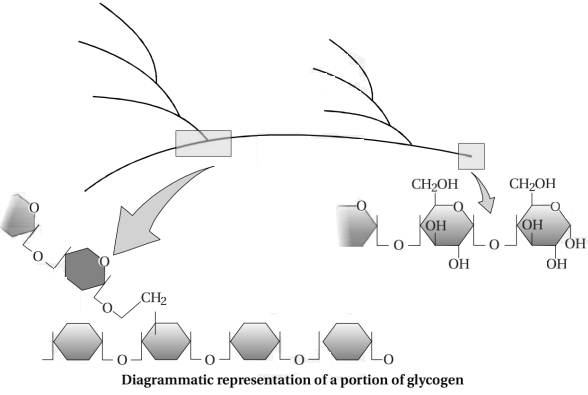
$\rightarrow$ Animals have another polysaccharide called glycogen.
$\rightarrow$ Inulin is a polymer of fructose.
$\rightarrow$ In a polysaccharide chain (e.g., glycogen), the right end is called the reducing end, and the left end is called the non-reducing end.
$\rightarrow$ Starch forms helical secondary structures. Starch can hold $I_2$ molecules in the helical portion. The starch-$I_2$ complex is blue in colour.
$\rightarrow$ Cellulose does not contain complex helices and hence cannot hold $I_2$.
$\rightarrow$ Plant cell walls are made of cellulose. Paper made from plant pulp and cotton fibre is cellulosic.
$\rightarrow$ There are more complex polysaccharides in nature. They have amino-sugars and chemically modified sugars (e.g., glucosamine, $N$-acetyl galactosamine, etc.) as building blocks.
$\rightarrow$ Exoskeletons of arthropods have a complex polysaccharide called chitin. These complex polysaccharides are heteropolymers.
$\rightarrow$ Polysaccharides are long chains of sugars. They are threads (literally a cotton thread) containing different monosaccharides as building blocks.
$\rightarrow$ Cellulose is a polymeric polysaccharide consisting of only one type of monosaccharide, i.e., glucose. Cellulose is a homopolymer.
$\rightarrow$ Starch is a variant of cellulose but is present as a storehouse of energy in plant tissues.
$\rightarrow$ Animals have another polysaccharide called glycogen.
$\rightarrow$ Inulin is a polymer of fructose.
$\rightarrow$ In a polysaccharide chain (e.g., glycogen), the right end is called the reducing end, and the left end is called the non-reducing end.
$\rightarrow$ Starch forms helical secondary structures. Starch can hold $I_2$ molecules in the helical portion. The starch-$I_2$ complex is blue in colour.
$\rightarrow$ Cellulose does not contain complex helices and hence cannot hold $I_2$.
$\rightarrow$ Plant cell walls are made of cellulose. Paper made from plant pulp and cotton fibre is cellulosic.
$\rightarrow$ There are more complex polysaccharides in nature. They have amino-sugars and chemically modified sugars (e.g., glucosamine, $N$-acetyl galactosamine, etc.) as building blocks.
$\rightarrow$ Exoskeletons of arthropods have a complex polysaccharide called chitin. These complex polysaccharides are heteropolymers.
0 likes
View Solution330
Easy
Define the following terms:
$(i)$ Glycosidic bond
$(ii)$ Phosphodiester bond
$(i)$ Glycosidic bond
$(ii)$ Phosphodiester bond
Solution
(N/A) $(i)$ $A$ glycosidic bond is a type of covalent bond that joins a carbohydrate (sugar) molecule to another group,which may or may not be another carbohydrate. It is formed by a dehydration synthesis reaction between two monosaccharides,where a water molecule is removed.
$(ii)$ $A$ phosphodiester bond occurs in nucleic acids ($DNA$ and $RNA$). It links the $3'$ carbon atom of one sugar molecule to the $5'$ carbon atom of the sugar molecule of the succeeding nucleotide via a phosphate group. Since there is an ester bond on both sides of the phosphate group,it is termed a phosphodiester bond.
$(ii)$ $A$ phosphodiester bond occurs in nucleic acids ($DNA$ and $RNA$). It links the $3'$ carbon atom of one sugar molecule to the $5'$ carbon atom of the sugar molecule of the succeeding nucleotide via a phosphate group. Since there is an ester bond on both sides of the phosphate group,it is termed a phosphodiester bond.
0 likes
View Solution331
MediumMCQ
Complete the following analogy:
Protein : Peptide bond :: Polysaccharide : ....... .
Protein : Peptide bond :: Polysaccharide : ....... .
A
Phosphodiester bond
B
Glycosidic bond
C
Hydrogen bond
D
Ionic bond
Solution
(B) In proteins,amino acids are linked together by peptide bonds.
Similarly,in polysaccharides,individual monosaccharide units are linked together by glycosidic bonds.
Therefore,the correct answer is the glycosidic bond.
Similarly,in polysaccharides,individual monosaccharide units are linked together by glycosidic bonds.
Therefore,the correct answer is the glycosidic bond.
0 likes
View Solution332
MediumMCQ
Which color is produced when starch reacts with iodine?
A
Blue-black
B
Red
C
Yellow
D
Green
Solution
(A) Starch is a polysaccharide composed of amylose and amylopectin.
When iodine solution ($I_2$ in $KI$) is added to starch,the iodine molecules get trapped within the helical structure of the amylose component.
This complex formation results in a characteristic deep blue-black color.
Therefore,the correct color produced is blue-black.
When iodine solution ($I_2$ in $KI$) is added to starch,the iodine molecules get trapped within the helical structure of the amylose component.
This complex formation results in a characteristic deep blue-black color.
Therefore,the correct color produced is blue-black.
0 likes
View Solution333
Easy
Starch,cellulose,glycogen,and chitin are polysaccharides. Match these with the following sources and write the correct pair for each:
$(a)$ Cotton fibre
$(b)$ Exoskeleton of cockroach
$(c)$ Liver
$(d)$ Peeled potato
$(a)$ Cotton fibre
$(b)$ Exoskeleton of cockroach
$(c)$ Liver
$(d)$ Peeled potato
Solution
(A) Cotton fibre consists of cellulose,which is a structural polysaccharide found in plant cell walls.
$(b)$ The exoskeleton of a cockroach is composed of chitin,a nitrogen-containing polysaccharide.
$(c)$ Liver stores glucose in the form of glycogen,which is known as animal starch.
$(d)$ Peeled potato is a rich source of starch,which is the primary storage polysaccharide in plants.
$(b)$ The exoskeleton of a cockroach is composed of chitin,a nitrogen-containing polysaccharide.
$(c)$ Liver stores glucose in the form of glycogen,which is known as animal starch.
$(d)$ Peeled potato is a rich source of starch,which is the primary storage polysaccharide in plants.
0 likes
View Solution334
EasyMCQ
Identify the chemical compounds represented by the following formulas:
$(1)$ $C_6H_{12}O_6$
$(2)$ $C_2H_5OH$
$(1)$ $C_6H_{12}O_6$
$(2)$ $C_2H_5OH$
A
$(1)$ Glucose,$(2)$ Ethanol
B
$(1)$ Fructose,$(2)$ Methanol
C
$(1)$ Sucrose,$(2)$ Ethanol
D
$(1)$ Glucose,$(2)$ Acetic acid
Solution
(A) $(1)$ The formula $C_6H_{12}O_6$ represents Glucose,which is a simple sugar and the primary substrate for cellular respiration.
$(2)$ The formula $C_2H_5OH$ represents Ethanol,which is a product of alcoholic fermentation in yeast.
$(2)$ The formula $C_2H_5OH$ represents Ethanol,which is a product of alcoholic fermentation in yeast.
0 likes
View Solution335
EasyMCQ
Which of the following is $NOT$ an essential micronutrient in the diet?
A
Iron
B
Vitamin $A$
C
Iodine
D
Glucose
Solution
(D) Micronutrients are nutrients required by the body in small quantities,including vitamins and minerals (e.g.,Iron,Iodine).
Glucose is a simple sugar and a carbohydrate,which is classified as a macronutrient because the body requires it in large amounts to provide energy.
Therefore,Glucose is not a micronutrient.
Glucose is a simple sugar and a carbohydrate,which is classified as a macronutrient because the body requires it in large amounts to provide energy.
Therefore,Glucose is not a micronutrient.
0 likes
View Solution336
MediumMCQ
Amylopectin is:
A
insoluble in $H_{2}O$ and has $\alpha-1,4$ and $\alpha-1,6$ glycosidic bonds
B
soluble in $H_{2}O$ and has $\alpha-1,4$ and $\alpha-1,6$ glycosidic bonds
C
soluble in $H_{2}O$ and has $\alpha-1,6$ glycosidic bonds
D
soluble in $H_{2}O$ and has $\alpha-1,4$ glycosidic bonds
Solution
(A) Amylopectin is a major component of starch,which is a branched-chain polysaccharide.
It consists of a long chain of glucose units linked by $\alpha-1,4$ glycosidic bonds,with branches occurring at intervals due to $\alpha-1,6$ glycosidic bonds.
Due to its highly branched and complex structure,amylopectin is insoluble in water.
Therefore,the correct description is that it is insoluble in $H_{2}O$ and contains both $\alpha-1,4$ and $\alpha-1,6$ glycosidic bonds.
It consists of a long chain of glucose units linked by $\alpha-1,4$ glycosidic bonds,with branches occurring at intervals due to $\alpha-1,6$ glycosidic bonds.
Due to its highly branched and complex structure,amylopectin is insoluble in water.
Therefore,the correct description is that it is insoluble in $H_{2}O$ and contains both $\alpha-1,4$ and $\alpha-1,6$ glycosidic bonds.
0 likes
View Solution337
MediumMCQ
Glucose on reacting with Benedict's solution may give the following precipitates except:
A
Violet precipitate
B
Orange red precipitate
C
Brick red precipitate
D
Green/yellow precipitate
Solution
(A) Benedict's solution is a chemical reagent used to test for the presence of reducing sugars like glucose.
When glucose reacts with Benedict's solution,it reduces the copper$(II)$ ions $(Cu^{2+})$ to copper$(I)$ oxide $(Cu_2O)$.
The color of the precipitate depends on the concentration of the reducing sugar present.
- $A$ green precipitate indicates a low concentration of reducing sugar.
- $A$ yellow to orange precipitate indicates a moderate concentration.
- $A$ brick-red precipitate indicates a high concentration of reducing sugar.
- $A$ violet precipitate is not formed in this reaction; it is characteristic of the Biuret test for proteins.
When glucose reacts with Benedict's solution,it reduces the copper$(II)$ ions $(Cu^{2+})$ to copper$(I)$ oxide $(Cu_2O)$.
The color of the precipitate depends on the concentration of the reducing sugar present.
- $A$ green precipitate indicates a low concentration of reducing sugar.
- $A$ yellow to orange precipitate indicates a moderate concentration.
- $A$ brick-red precipitate indicates a high concentration of reducing sugar.
- $A$ violet precipitate is not formed in this reaction; it is characteristic of the Biuret test for proteins.
0 likes
View Solution338
EasyMCQ
Which of the following linkage is found in sucrose?
A
$1-2$ glycosidic linkage
B
$1-4$ glycosidic linkage
C
$1-3$ glycosidic linkage
D
$1-1$ glycosidic linkage
Solution
(A) Sucrose is a disaccharide composed of two monosaccharides: glucose and fructose.
In sucrose,the glycosidic bond is formed between the $C-1$ of $\alpha$-$D$-glucose and the $C-2$ of $\beta$-$D$-fructose.
This specific linkage is known as an $\alpha, \beta-1,2$-glycosidic linkage.
In sucrose,the glycosidic bond is formed between the $C-1$ of $\alpha$-$D$-glucose and the $C-2$ of $\beta$-$D$-fructose.
This specific linkage is known as an $\alpha, \beta-1,2$-glycosidic linkage.
0 likes
View Solution339
MediumMCQ
Polysaccharides can be tested by
A
Iodine
B
$HCl$
C
$KCl$
D
$KNO_3$
Solution
(A) Iodine test is a common chemical test used to detect the presence of starch,which is a polysaccharide. When iodine solution ($I_2$ in $KI$) is added to a sample containing starch,it forms a blue-black complex. This test is specific for starch and helps differentiate it from monosaccharides,disaccharides,and other non-starchy polysaccharides.
0 likes
View Solution340
EasyMCQ
Chitin is a
A
Lipid
B
Protein
C
Polysaccharide
D
Sphingomyelin
Solution
(C) Chitin is a complex carbohydrate known as a polysaccharide. It is a polymer of $N$-acetylglucosamine units linked by $\beta-1,4$-glycosidic bonds. It serves as a structural component in the cell walls of fungi and the exoskeletons of arthropods.
0 likes
View Solution341
EasyMCQ
Lactose on hydrolysis yields:
A
Two glucose molecules
B
Two galactose molecules
C
$A$ galactose and fructose molecule
D
$A$ galactose and a glucose molecule
Solution
(D) Lactose is a disaccharide composed of two monosaccharide units: galactose and glucose.
Upon hydrolysis,the glycosidic bond between these two units is broken,resulting in one molecule of galactose and one molecule of glucose.
Upon hydrolysis,the glycosidic bond between these two units is broken,resulting in one molecule of galactose and one molecule of glucose.
0 likes
View Solution342
MediumMCQ
Glycogen on hydrolysis gives:
A
Starch
B
Amylopectin
C
Amylose
D
Glucose
Solution
(D) Glycogen is a polysaccharide that acts as the storage form of glucose in animals.
Upon complete hydrolysis,glycogen breaks down into its monomeric units,which are glucose molecules.
Upon complete hydrolysis,glycogen breaks down into its monomeric units,which are glucose molecules.
0 likes
View Solution343
EasyMCQ
$A$ carbohydrate is treated with $\alpha$-naphthol and conc. $H_{2}SO_{4}$. What colour will be formed at the junction of two liquids?
A
Blood-red
B
Violet
C
Brown
D
Orange
Solution
(B) This is the Molisch test,which is a sensitive chemical test for the presence of carbohydrates.
In this procedure,the carbohydrate solution is mixed with an alcoholic solution of $\alpha$-naphthol.
Then,concentrated $H_{2}SO_{4}$ is added slowly along the sides of the test tube.
The concentrated acid dehydrates the carbohydrates to form furfural or its derivatives.
These derivatives react with $\alpha$-naphthol to produce a purple or violet-coloured ring at the junction of the two liquid layers.
In this procedure,the carbohydrate solution is mixed with an alcoholic solution of $\alpha$-naphthol.
Then,concentrated $H_{2}SO_{4}$ is added slowly along the sides of the test tube.
The concentrated acid dehydrates the carbohydrates to form furfural or its derivatives.
These derivatives react with $\alpha$-naphthol to produce a purple or violet-coloured ring at the junction of the two liquid layers.
0 likes
View Solution344
EasyMCQ
The sweetest carbohydrate is
A
Sucrose
B
Glucose
C
Fructose
D
Lactose
Solution
(C) Fructose is a naturally occurring monosaccharide found in many fruits and is known as fruit sugar.
It is the sweetest among all naturally occurring carbohydrates.
Its sweetness is approximately $1.7$ times that of sucrose (table sugar).
It is the sweetest among all naturally occurring carbohydrates.
Its sweetness is approximately $1.7$ times that of sucrose (table sugar).
0 likes
View Solution345
EasyMCQ
Which of the following carbohydrates is synthesized by nature on the largest scale?
A
Glucose
B
Fructose
C
Lactose
D
Cellulose
Solution
(D) Cellulose is a polysaccharide consisting of a linear chain of several hundred to many thousands of $\beta(1 \rightarrow 4)$ linked $D$-glucose units. It is the structural component of the primary cell wall of green plants,many forms of algae,and the oomycetes. Because it is the main structural component of all plant cell walls,it is the most abundant organic compound on Earth,synthesized by nature on the largest scale.
0 likes
View Solution346
EasyMCQ
Which of the following is insoluble in water?
A
Glucose
B
Cellulose
C
Fructose
D
Sucrose
Solution
(B) Cellulose is a complex polysaccharide composed of a long chain of $\beta$-glucose units linked by $\beta-1,4$-glycosidic bonds.
Due to its high molecular weight and the extensive hydrogen bonding between its chains,it forms a rigid,fibrous structure that is insoluble in water.
In contrast,glucose,fructose,and sucrose are simple sugars (monosaccharides or disaccharides) that are highly soluble in water.
Due to its high molecular weight and the extensive hydrogen bonding between its chains,it forms a rigid,fibrous structure that is insoluble in water.
In contrast,glucose,fructose,and sucrose are simple sugars (monosaccharides or disaccharides) that are highly soluble in water.
0 likes
View Solution347
MediumMCQ
Cellulose,starch and glycogen are the polysaccharides having $.......$ monosaccharide unit:
A
Glucose
B
Ribose
C
Fructose
D
Pentose
Solution
(A) Cellulose,starch,and glycogen are all complex carbohydrates known as polysaccharides.
These are polymers composed of repeating units of the monosaccharide $D-glucose$.
Therefore,they all share the same fundamental monosaccharide unit,which is glucose.
These are polymers composed of repeating units of the monosaccharide $D-glucose$.
Therefore,they all share the same fundamental monosaccharide unit,which is glucose.
0 likes
View Solution348
MediumMCQ
Glycogen is:
A
Monosaccharide
B
Disaccharide
C
Trisaccharide
D
Polysaccharide
Solution
(D) Glycogen is a complex carbohydrate known as a polysaccharide.
It is a branched polymer composed of many glucose monomeric units linked together.
It serves as the primary storage form of glucose in animals and fungi.
It is a branched polymer composed of many glucose monomeric units linked together.
It serves as the primary storage form of glucose in animals and fungi.
0 likes
View Solution349
MediumMCQ
Which of the following statements is false?
A
Glucose is a disaccharide.
B
Starch is a polysaccharide.
C
Glucose and fructose are not anomers.
D
Invert sugar consists of glucose and fructose.
Solution
(A) Glucose is a monosaccharide,not a disaccharide. Therefore,statement $A$ is false.
Starch is a complex carbohydrate known as a polysaccharide.
Glucose and fructose are structural isomers,not anomers.
Invert sugar is an equimolar mixture of glucose and fructose obtained by the hydrolysis of sucrose.
Starch is a complex carbohydrate known as a polysaccharide.
Glucose and fructose are structural isomers,not anomers.
Invert sugar is an equimolar mixture of glucose and fructose obtained by the hydrolysis of sucrose.
0 likes
View SolutionBiomolecules — Carbohydrates · Frequently Asked Questions
1Are these Biomolecules questions useful for JEE and NEET?
Yes. All questions in this section are mapped to JEE Main and NEET exam patterns. Previous year questions from JEE Main, NEET, GUJCET and state-level exams are included with full solutions.
2Can I switch to Hindi or Gujarati for these questions?
Yes. Use the language tabs in the hero section or the sidebar to view the same questions and solutions in English, Hindi or Gujarati.
3How do I generate a question paper from this subtopic?
Use the Vedclass Exam Paper Generator — select the chapter and subtopic, set difficulty, and generate Sets A, B, C, D automatically. First 3 chapters of every subject are free.
Vedclass Products
For Students
Vedclass Test Series
Mock tests in real JEE/NEET style with performance analysis. 5-day free trial.
Start Free TrialFor Teachers
Exam Paper Generator
Generate Set A/B/C/D papers from this chapter in 2 minutes. 3 chapters free.
Try FreeFor Institutes
Online Exam Module
Live online exams with unlimited students, 360° analytics & white-label branding.
See DemoFor Teachers & Institutes
Generate a Biomolecules Exam Paper in 2 Minutes
Select subtopic & difficulty — Sets A, B, C, D auto-generated with No Repeat logic.
First 3 chapters of every subject are free — no payment required.