
A English
Carbohydrates Questions in English
Class 11 Biology · Biomolecules · Carbohydrates
423+
Questions
English
Language
100%
With Solutions
Showing 23 of 423 questions in English
401
MediumMCQ
$A$ glycosidic bond is $NOT$ found in $...........$.
A
Monosaccharides
B
Disaccharides
C
Oligosaccharides
D
Polysaccharides
Solution
(A) glycosidic bond is a type of covalent bond that joins a carbohydrate (sugar) molecule to another group,which may or may not be another carbohydrate.
Monosaccharides are the simplest form of carbohydrates and consist of a single sugar unit (e.g.,glucose,fructose).
Since they consist of only one unit,they do not contain any glycosidic bonds.
Disaccharides,oligosaccharides,and polysaccharides are formed by the linkage of two or more monosaccharide units through glycosidic bonds.
Therefore,the correct answer is $A$.
Monosaccharides are the simplest form of carbohydrates and consist of a single sugar unit (e.g.,glucose,fructose).
Since they consist of only one unit,they do not contain any glycosidic bonds.
Disaccharides,oligosaccharides,and polysaccharides are formed by the linkage of two or more monosaccharide units through glycosidic bonds.
Therefore,the correct answer is $A$.
0 likes
View Solution402
MediumMCQ
The concentration of glucose in the blood of a healthy individual is $......$.
A
$4.5-5.0 \mu M$
B
$3.5-4.0 \mu M$
C
$4.5-5.0 \text{ mM}$
D
$3.5-4.0 \text{ mM}$
Solution
(C) In a healthy individual,the concentration of glucose in the blood is maintained within a narrow range.
According to the $NCERT$ textbook for Class $11$ Biology (Chapter $9$: Biomolecules),the concentration of glucose in the blood of a healthy person is $4.5-5.0 \text{ mM}$.
This concentration is crucial for maintaining metabolic homeostasis in the body.
According to the $NCERT$ textbook for Class $11$ Biology (Chapter $9$: Biomolecules),the concentration of glucose in the blood of a healthy person is $4.5-5.0 \text{ mM}$.
This concentration is crucial for maintaining metabolic homeostasis in the body.
0 likes
View Solution403
EasyMCQ
Sucrose is a $.......$.
A
Monosaccharide
B
Disaccharide
C
Oligosaccharide
D
Polysaccharide
Solution
(B) Sucrose is a disaccharide formed by the condensation of one molecule of glucose and one molecule of fructose.
It is a non-reducing sugar and is the primary form in which carbohydrates are translocated through the phloem in plants.
It is a non-reducing sugar and is the primary form in which carbohydrates are translocated through the phloem in plants.
0 likes
View Solution404
EasyMCQ
What is the color produced when starch reacts with $I_2$?
A
Blue color
B
Red color
C
Green color
D
Colorless
Solution
(A) Starch is a polysaccharide composed of amylose and amylopectin. When starch reacts with iodine $(I_2)$, the iodine molecules get trapped within the helical structure of the amylose component. This complex formation results in a characteristic deep blue or blue-black color. Therefore, the reaction is: $\text{Starch} + I_2 \rightarrow \text{Blue-black complex}$.
0 likes
View Solution405
EasyMCQ
Identify the disaccharides formed by the combination of the following monosaccharides:
Glucose + Glucose $\rightarrow P$
Glucose + Galactose $\rightarrow Q$
Glucose + Fructose $\rightarrow R$
Glucose + Glucose $\rightarrow P$
Glucose + Galactose $\rightarrow Q$
Glucose + Fructose $\rightarrow R$
A
Maltose,Sucrose,Lactose
B
Maltose,Lactose,Sucrose
C
Sucrose,Lactose,Maltose
D
Lactose,Sucrose,Maltose
Solution
(B) The formation of disaccharides from monosaccharides is as follows:
$1$. Glucose + Glucose $\rightarrow$ Maltose $(P)$
$2$. Glucose + Galactose $\rightarrow$ Lactose $(Q)$
$3$. Glucose + Fructose $\rightarrow$ Sucrose $(R)$
Therefore,the correct sequence is $P = \text{Maltose}$,$Q = \text{Lactose}$,and $R = \text{Sucrose}$.
$1$. Glucose + Glucose $\rightarrow$ Maltose $(P)$
$2$. Glucose + Galactose $\rightarrow$ Lactose $(Q)$
$3$. Glucose + Fructose $\rightarrow$ Sucrose $(R)$
Therefore,the correct sequence is $P = \text{Maltose}$,$Q = \text{Lactose}$,and $R = \text{Sucrose}$.
0 likes
View Solution406
MediumMCQ
Cellulose does not form a blue color with iodine because:
A
It breaks down when iodine reacts with it
B
It is a disaccharide
C
It is a helical molecule
D
It does not contain complex helices and hence cannot hold iodine molecules
Solution
(D) Option $D$ is the correct answer.
Cellulose is a linear polysaccharide consisting of a long chain of glucose units linked by $\beta-1, 4$-glycosidic bonds.
Unlike starch,which contains amylose (a helical structure that traps iodine molecules to produce a blue color),cellulose does not form complex helical structures.
Because it lacks these complex helices,it cannot hold iodine molecules,and therefore,it does not produce a blue color with iodine.
Cellulose is a linear polysaccharide consisting of a long chain of glucose units linked by $\beta-1, 4$-glycosidic bonds.
Unlike starch,which contains amylose (a helical structure that traps iodine molecules to produce a blue color),cellulose does not form complex helical structures.
Because it lacks these complex helices,it cannot hold iodine molecules,and therefore,it does not produce a blue color with iodine.
0 likes
View Solution407
EasyMCQ
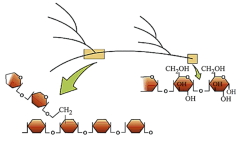
Which one is not correct for the given structure of glycogen?
A
There is only one reducing end.
B
Total six $\alpha 1-6$ glycosidic bonds are present.
C
$\alpha 1-6$ glycosidic bond is more than $\alpha 1-4$ glycosidic bond.
D
Each branch ends with a non-reducing end.
Solution
(C) Glycogen is a highly branched polysaccharide of glucose.
$1$. It has only one reducing end (at the start of the chain) and many non-reducing ends (at the end of each branch).
$2$. The structure contains $\alpha 1-4$ glycosidic bonds in the linear chains and $\alpha 1-6$ glycosidic bonds at the branching points.
$3$. In glycogen,the number of $\alpha 1-4$ glycosidic bonds is significantly higher than the number of $\alpha 1-6$ glycosidic bonds because branching occurs only every $8-12$ glucose units.
$4$. Therefore,the statement that '$\alpha 1-6$ glycosidic bond is more than $\alpha 1-4$ glycosidic bond' is incorrect.
$1$. It has only one reducing end (at the start of the chain) and many non-reducing ends (at the end of each branch).
$2$. The structure contains $\alpha 1-4$ glycosidic bonds in the linear chains and $\alpha 1-6$ glycosidic bonds at the branching points.
$3$. In glycogen,the number of $\alpha 1-4$ glycosidic bonds is significantly higher than the number of $\alpha 1-6$ glycosidic bonds because branching occurs only every $8-12$ glucose units.
$4$. Therefore,the statement that '$\alpha 1-6$ glycosidic bond is more than $\alpha 1-4$ glycosidic bond' is incorrect.
0 likes
View Solution408
MediumMCQ
Cellulose,a polymeric polysaccharide,is made up of repeated units of:
A
Glucose
B
Fructose
C
Inulin
D
Chitin
Solution
(A) Cellulose is a linear,fibrous polysaccharide found in the cell walls of plants.
It is a homopolymer,meaning it is composed of only one type of monomeric unit.
The monomeric unit of cellulose is $D$-glucose,which are linked together by $\beta-1, 4$-glycosidic bonds.
Therefore,the correct answer is Glucose.
It is a homopolymer,meaning it is composed of only one type of monomeric unit.
The monomeric unit of cellulose is $D$-glucose,which are linked together by $\beta-1, 4$-glycosidic bonds.
Therefore,the correct answer is Glucose.
0 likes
View Solution409
MediumMCQ
Assertion: Cellulose does not give $I_2$ test.
Reason: Cellulose does not contain complex helices.
Reason: Cellulose does not contain complex helices.
A
Both Assertion & Reason are True & the Reason is a correct explanation of the Assertion.
B
Both Assertion & Reason are True but Reason is not a correct explanation of the Assertion.
C
Assertion is True but the Reason is False.
D
Both Assertion & Reason are False.
Solution
(A) The iodine test ($I_2$ test) is used to detect the presence of starch. Starch consists of amylose and amylopectin. Amylose is a helical molecule that can hold $I_2$ molecules in its helical structure,producing a blue-black color.
Cellulose is a linear polymer of $\beta$-$D$-glucose units linked by $\beta(1 \rightarrow 4)$ glycosidic bonds. Due to its linear structure,it does not form complex helices like starch.
Because it lacks these helices,cellulose cannot trap $I_2$ molecules and therefore does not give a positive iodine test.
Thus,both the Assertion and the Reason are true,and the Reason correctly explains why cellulose does not give the $I_2$ test.
Cellulose is a linear polymer of $\beta$-$D$-glucose units linked by $\beta(1 \rightarrow 4)$ glycosidic bonds. Due to its linear structure,it does not form complex helices like starch.
Because it lacks these helices,cellulose cannot trap $I_2$ molecules and therefore does not give a positive iodine test.
Thus,both the Assertion and the Reason are true,and the Reason correctly explains why cellulose does not give the $I_2$ test.
0 likes
View Solution410
EasyMCQ
Select the correct option indicating the products of the following reaction:
Lactose $\xrightarrow{\text{Lactase}}$ $\square$ + $\square$
Lactose $\xrightarrow{\text{Lactase}}$ $\square$ + $\square$
A
Glucose and Fructose
B
Glucose and Galactose
C
Galactose and Fructose
D
Glucose and Glucose
Solution
(B) Lactose is a disaccharide composed of two monosaccharide units: glucose and galactose.
The enzyme lactase catalyzes the hydrolysis of lactose into its constituent monosaccharides.
The reaction is represented as: $\text{Lactose} + \text{H}_2\text{O} \xrightarrow{\text{Lactase}} \text{Glucose} + \text{Galactose}$.
Therefore,the correct products are glucose and galactose.
The enzyme lactase catalyzes the hydrolysis of lactose into its constituent monosaccharides.
The reaction is represented as: $\text{Lactose} + \text{H}_2\text{O} \xrightarrow{\text{Lactase}} \text{Glucose} + \text{Galactose}$.
Therefore,the correct products are glucose and galactose.
0 likes
View Solution411
EasyMCQ
Given below are two statements.
Statement $I$ - Lactose on hydrolysis converts into glucose and galactose.
Statement $II$ - Galactose also plays the same role as glucose in respiration.
In the light of the above statements,select the correct option given below:
Statement $I$ - Lactose on hydrolysis converts into glucose and galactose.
Statement $II$ - Galactose also plays the same role as glucose in respiration.
In the light of the above statements,select the correct option given below:
A
Both statement $I$ and statement $II$ are correct.
B
Both statement $I$ and statement $II$ are incorrect.
C
Statement $I$ is correct but statement $II$ is incorrect.
D
Statement $I$ is incorrect but statement $II$ is correct.
Solution
(C) Statement $I$ is correct because lactose is a disaccharide composed of glucose and galactose,which yields these two monosaccharides upon hydrolysis.
Statement $II$ is incorrect because,although galactose can be converted into glucose-$6$-phosphate to enter the glycolytic pathway,it does not play the exact same role as glucose directly in respiration. Glucose is the primary respiratory substrate that enters glycolysis directly,whereas galactose requires additional enzymatic conversion steps before it can be utilized in cellular respiration.
Statement $II$ is incorrect because,although galactose can be converted into glucose-$6$-phosphate to enter the glycolytic pathway,it does not play the exact same role as glucose directly in respiration. Glucose is the primary respiratory substrate that enters glycolysis directly,whereas galactose requires additional enzymatic conversion steps before it can be utilized in cellular respiration.
0 likes
View Solution412
EasyMCQ
Two monosaccharides are held together by . . . . . . bond.
A
disulphide
B
phosphodiester
C
hydrogen
D
glycosidic
Solution
(D) Two monosaccharides are linked together by a covalent bond known as a glycosidic bond.
This bond is formed by a dehydration synthesis reaction,where a water molecule is removed between the hydroxyl groups of the two monosaccharides.
This linkage is characteristic of disaccharides and polysaccharides.
This bond is formed by a dehydration synthesis reaction,where a water molecule is removed between the hydroxyl groups of the two monosaccharides.
This linkage is characteristic of disaccharides and polysaccharides.
0 likes
View Solution413
EasyMCQ
Storage of food in the animal body is in the form of
A
glycogen
B
cellulose
C
starch
D
starch and cellulose
Solution
(A) In animals,the primary storage form of carbohydrates is $Glycogen$.
$Glycogen$ is a highly branched polymer of glucose,which is stored mainly in the liver and muscles to be used as an energy reserve.
$Starch$ is the storage form of carbohydrates in plants,while $Cellulose$ is a structural polysaccharide found in plant cell walls.
Therefore,the correct option is $A$.
$Glycogen$ is a highly branched polymer of glucose,which is stored mainly in the liver and muscles to be used as an energy reserve.
$Starch$ is the storage form of carbohydrates in plants,while $Cellulose$ is a structural polysaccharide found in plant cell walls.
Therefore,the correct option is $A$.
0 likes
View Solution414
EasyMCQ
Which one of the following cannot be hydrolysed further into smaller molecules?
A
Starch
B
Sucrose
C
Fructose
D
Glycogen
Solution
(C) Carbohydrates are classified based on their hydrolysis products.
$Starch$ and $Glycogen$ are polysaccharides, which yield many monosaccharide units upon hydrolysis.
$Sucrose$ is a disaccharide, which upon hydrolysis yields two monosaccharide units (glucose and fructose).
$Fructose$ is a monosaccharide, which is the simplest form of carbohydrate and cannot be further hydrolysed into smaller sugar molecules.
$Starch$ and $Glycogen$ are polysaccharides, which yield many monosaccharide units upon hydrolysis.
$Sucrose$ is a disaccharide, which upon hydrolysis yields two monosaccharide units (glucose and fructose).
$Fructose$ is a monosaccharide, which is the simplest form of carbohydrate and cannot be further hydrolysed into smaller sugar molecules.
0 likes
View Solution415
EasyMCQ
Match Column-$I$ with Column-$II$:
| Column-$I$ | Column-$II$ |
| $I$. Glucose | $a$. Reserve food in plants |
| $II$. Fructose | $b$. Component of cell wall |
| $III$. Cellulose | $c$. Fuel of living cell |
| $IV$. Starch | $d$. Fruit sugar |
A
$I-d, II-c, III-b, IV-a$
B
$I-c, II-d, III-b, IV-a$
C
$I-c, II-a, III-d, IV-b$
D
$I-c, II-d, III-a, IV-b$
Solution
(B) The correct matches are as follows:
$I$. Glucose is the primary respiratory substrate and acts as the fuel of the living cell $(I-c)$.
$II$. Fructose is commonly known as fruit sugar $(II-d)$.
$III$. Cellulose is a structural polysaccharide and a major component of the plant cell wall $(III-b)$.
$IV$. Starch is the primary storage polysaccharide (reserve food) in plants $(IV-a)$.
Therefore,the correct matching is $I-c, II-d, III-b, IV-a$.
$I$. Glucose is the primary respiratory substrate and acts as the fuel of the living cell $(I-c)$.
$II$. Fructose is commonly known as fruit sugar $(II-d)$.
$III$. Cellulose is a structural polysaccharide and a major component of the plant cell wall $(III-b)$.
$IV$. Starch is the primary storage polysaccharide (reserve food) in plants $(IV-a)$.
Therefore,the correct matching is $I-c, II-d, III-b, IV-a$.
0 likes
View Solution416
EasyMCQ
Which one of the following is an example of cane sugar?
A
Maltose
B
Glucose
C
Fructose
D
Sucrose
Solution
(D) Cane sugar is the common name for sucrose.
Sucrose is a disaccharide composed of one molecule of glucose and one molecule of fructose linked by a glycosidic bond.
It is extracted primarily from sugarcane and sugar beets.
Therefore,the correct option is $D$.
Sucrose is a disaccharide composed of one molecule of glucose and one molecule of fructose linked by a glycosidic bond.
It is extracted primarily from sugarcane and sugar beets.
Therefore,the correct option is $D$.
0 likes
View Solution417
EasyMCQ
Carbohydrate molecules are characterized by any one of the following groups $EXCEPT$:
A
Aldehyde $(CHO)$
B
Carboxyl $(COOH)$
C
Ketone ($C$=$O$)
D
Hydroxyl $(OH)$
Solution
(B) Carbohydrates are polyhydroxy aldehydes or polyhydroxy ketones.
This means they contain multiple hydroxyl $(OH)$ groups along with either an aldehyde $(CHO)$ or a ketone ($C$=$O$) functional group.
Carboxyl $(COOH)$ groups are characteristic of organic acids,such as fatty acids,and are not a defining feature of carbohydrate molecules.
This means they contain multiple hydroxyl $(OH)$ groups along with either an aldehyde $(CHO)$ or a ketone ($C$=$O$) functional group.
Carboxyl $(COOH)$ groups are characteristic of organic acids,such as fatty acids,and are not a defining feature of carbohydrate molecules.
0 likes
View Solution418
EasyMCQ
Disaccharides are formed from two monosaccharides by the process of . . . . . . .
A
Polymerization
B
Hybridization
C
Hydrogenation
D
Condensation
Solution
(D) Disaccharides are carbohydrates formed when two monosaccharides are joined together by a glycosidic bond.
This process involves the removal of a water molecule $(H_2O)$,which is known as a condensation reaction or dehydration synthesis.
For example,the formation of sucrose from glucose and fructose involves the elimination of one water molecule.
This process involves the removal of a water molecule $(H_2O)$,which is known as a condensation reaction or dehydration synthesis.
For example,the formation of sucrose from glucose and fructose involves the elimination of one water molecule.
0 likes
View Solution419
EasyMCQ
Which one of the following is generally applicable to polysaccharides?
A
Crystalline,insoluble,tasteless
B
Amorphous,soluble,sweet
C
Crystalline,soluble,sweet
D
Amorphous,insoluble,tasteless
Solution
(D) Mono- and disaccharides are crystalline,sweet in taste,and soluble in water.
In contrast,polysaccharides such as starch,glycogen,and cellulose are complex carbohydrates that are not sweet.
They are characterized by being amorphous (lacking a defined crystalline structure) and are generally insoluble in water.
In contrast,polysaccharides such as starch,glycogen,and cellulose are complex carbohydrates that are not sweet.
They are characterized by being amorphous (lacking a defined crystalline structure) and are generally insoluble in water.
0 likes
View Solution420
EasyMCQ
Which one of the following sugars does $NOT$ have the same empirical formula as that of a carbohydrate?
A
Maltose
B
Galactose
C
Digitoxose
D
Glycogen
Solution
(C) The general empirical formula for most carbohydrates is $(CH_2O)_n$.
Galactose $(C_6H_{12}O_6)$ follows this formula where $n=6$.
Maltose $(C_{12}H_{22}O_{11})$ is a disaccharide formed by two glucose units minus a water molecule,and it closely approximates the ratio.
Glycogen is a polysaccharide of glucose,also following the $(CH_2O)_n$ ratio.
Digitoxose is a deoxy sugar with the chemical formula $C_6H_{12}O_4$. Because it lacks an oxygen atom compared to standard hexoses,it does not fit the $(CH_2O)_n$ empirical formula.
Galactose $(C_6H_{12}O_6)$ follows this formula where $n=6$.
Maltose $(C_{12}H_{22}O_{11})$ is a disaccharide formed by two glucose units minus a water molecule,and it closely approximates the ratio.
Glycogen is a polysaccharide of glucose,also following the $(CH_2O)_n$ ratio.
Digitoxose is a deoxy sugar with the chemical formula $C_6H_{12}O_4$. Because it lacks an oxygen atom compared to standard hexoses,it does not fit the $(CH_2O)_n$ empirical formula.
0 likes
View Solution421
EasyMCQ
The type of polysaccharide present in a cotton fibre is:
A
Cellulose
B
Starch
C
Glycogen
D
Inulin
Solution
(A) . Cellulose.
Cellulose is a fibrous homopolysaccharide that forms the structural element of the cell wall in all plants,some fungi,and protists.
It is the primary component of cotton fibre,which is nearly pure cellulose.
Cellulose is a fibrous homopolysaccharide that forms the structural element of the cell wall in all plants,some fungi,and protists.
It is the primary component of cotton fibre,which is nearly pure cellulose.
0 likes
View Solution422
EasyMCQ
In a polysaccharide,the number of monosaccharides are linked by:
A
peptide bond
B
phosphoester bond
C
glycosidic bond
D
hydrogen bond
Solution
(C) The correct answer is $C$.
In a polysaccharide,individual monosaccharide units are linked together by a glycosidic bond.
This bond is formed through a dehydration synthesis reaction between the hydroxyl group of one monosaccharide and the carbon atom of an adjacent monosaccharide.
In a polysaccharide,individual monosaccharide units are linked together by a glycosidic bond.
This bond is formed through a dehydration synthesis reaction between the hydroxyl group of one monosaccharide and the carbon atom of an adjacent monosaccharide.
0 likes
View Solution423
EasyMCQ
The sugar present in milk is
A
fructose
B
sucrose
C
glucose
D
lactose
Solution
(D) The correct answer is $D$.
Lactose is a disaccharide sugar composed of two monosaccharide units: $D$-glucose and $D$-galactose.
It is naturally found in milk and dairy products,acting as a primary source of energy for infants and young mammals.
Lactose is a disaccharide sugar composed of two monosaccharide units: $D$-glucose and $D$-galactose.
It is naturally found in milk and dairy products,acting as a primary source of energy for infants and young mammals.
0 likes
View SolutionBiomolecules — Carbohydrates · Frequently Asked Questions
1Are these Biomolecules questions useful for JEE and NEET?
Yes. All questions in this section are mapped to JEE Main and NEET exam patterns. Previous year questions from JEE Main, NEET, GUJCET and state-level exams are included with full solutions.
2Can I switch to Hindi or Gujarati for these questions?
Yes. Use the language tabs in the hero section or the sidebar to view the same questions and solutions in English, Hindi or Gujarati.
3How do I generate a question paper from this subtopic?
Use the Vedclass Exam Paper Generator — select the chapter and subtopic, set difficulty, and generate Sets A, B, C, D automatically. First 3 chapters of every subject are free.
Vedclass Products
For Students
Vedclass Test Series
Mock tests in real JEE/NEET style with performance analysis. 5-day free trial.
Start Free TrialFor Teachers
Exam Paper Generator
Generate Set A/B/C/D papers from this chapter in 2 minutes. 3 chapters free.
Try FreeFor Institutes
Online Exam Module
Live online exams with unlimited students, 360° analytics & white-label branding.
See DemoFor Teachers & Institutes
Generate a Biomolecules Exam Paper in 2 Minutes
Select subtopic & difficulty — Sets A, B, C, D auto-generated with No Repeat logic.
First 3 chapters of every subject are free — no payment required.