
A English
Nucleic acids Questions in English
Class 11 Biology · Biomolecules · Nucleic acids
210+
Questions
English
Language
100%
With Solutions
Showing 48 of 210 questions in English
1
MediumMCQ
The largest physical and chemical molecules in biological systems are:
A
Carbohydrates
B
Lipids
C
Proteins
D
Nucleic acids
Solution
(D) Nucleic acids,specifically $DNA$ and $RNA$,are the largest macromolecules found in living organisms. $DNA$ molecules can reach extremely high molecular weights,often consisting of millions of base pairs,making them significantly larger than typical proteins,carbohydrates,or lipids.
0 likes
View Solution2
MediumMCQ
Which of the following is a ribose (but not deoxyribose) nucleotide?
A
Cytosine — pentose sugar — phosphate
B
Guanine — pentose sugar — phosphate
C
Thymine — pentose sugar — phosphate
D
Uracil — pentose sugar — phosphate
Solution
(D) nucleotide consists of a nitrogenous base,a pentose sugar,and a phosphate group.
Ribose sugar is present in $RNA$ nucleotides,while deoxyribose sugar is present in $DNA$ nucleotides.
$RNA$ contains the nitrogenous bases Adenine,Guanine,Cytosine,and Uracil.
$DNA$ contains the nitrogenous bases Adenine,Guanine,Cytosine,and Thymine.
Thymine is specific to $DNA$ (deoxyribose),whereas Uracil is specific to $RNA$ (ribose).
Therefore,a nucleotide containing Uracil must contain ribose sugar.
Ribose sugar is present in $RNA$ nucleotides,while deoxyribose sugar is present in $DNA$ nucleotides.
$RNA$ contains the nitrogenous bases Adenine,Guanine,Cytosine,and Uracil.
$DNA$ contains the nitrogenous bases Adenine,Guanine,Cytosine,and Thymine.
Thymine is specific to $DNA$ (deoxyribose),whereas Uracil is specific to $RNA$ (ribose).
Therefore,a nucleotide containing Uracil must contain ribose sugar.
0 likes
View Solution3
MediumMCQ
Hydrolysis of nucleic acid yields:
A
Only sugar
B
Phosphoric acid only
C
Nitrogenous base only
D
All the above
Solution
(D) Nucleic acids are polymers of nucleotides.
Each nucleotide consists of three components: a pentose sugar,a phosphoric acid group,and a nitrogenous base.
Therefore,complete hydrolysis of nucleic acids yields all three components: sugar,phosphoric acid,and nitrogenous bases.
Thus,the correct option is $D$.
Each nucleotide consists of three components: a pentose sugar,a phosphoric acid group,and a nitrogenous base.
Therefore,complete hydrolysis of nucleic acids yields all three components: sugar,phosphoric acid,and nitrogenous bases.
Thus,the correct option is $D$.
0 likes
View Solution4
MediumMCQ
Which of the following is a purine?
A
Prokaryotes
B
Guanine
C
Thymine
D
Uracil
Solution
(B) Nitrogenous bases are classified into two types: purines and pyrimidines.
Purines are double-ring structures,which include Adenine $(A)$ and Guanine $(G)$.
Pyrimidines are single-ring structures,which include Cytosine $(C)$,Thymine $(T)$,and Uracil $(U)$.
Therefore,Guanine is a purine.
Purines are double-ring structures,which include Adenine $(A)$ and Guanine $(G)$.
Pyrimidines are single-ring structures,which include Cytosine $(C)$,Thymine $(T)$,and Uracil $(U)$.
Therefore,Guanine is a purine.
0 likes
View Solution5
EasyMCQ
$ATP$ stands for:
A
Adenosine $D$-ribose triphosphate
B
Adenosine $L$-ribose triphosphate
C
Adenine $D$-ribose triphosphate
D
Adenine $L$-ribose triphosphate
Solution
(A) $ATP$ stands for Adenosine Triphosphate. It is a nucleotide consisting of an adenine base,a $D$-ribose sugar,and three phosphate groups. The sugar component in $ATP$ is always the $D$-isomer of ribose,which is the naturally occurring form in biological systems.
0 likes
View Solution6
EasyMCQ
$ATP$ is
A
Nucleotide
B
Nucleoside
C
Nucleic acid
D
Hormone
Solution
(A) $ATP$ stands for Adenosine Triphosphate. It consists of an adenine base,a ribose sugar,and three phosphate groups. Since it is composed of a nitrogenous base,a pentose sugar,and phosphate groups,it is classified as a nucleotide.
0 likes
View Solution7
MediumMCQ
Thymine is a
A
Enzyme
B
Vitamin
C
Pyrimidine
D
Purine
Solution
(C) Nucleic acids consist of nitrogenous bases,which are classified into two types: Purines and Pyrimidines.
Purines include Adenine $(A)$ and Guanine $(G)$.
Pyrimidines include Cytosine $(C)$,Thymine $(T)$,and Uracil $(U)$.
Therefore,Thymine is a Pyrimidine.
Purines include Adenine $(A)$ and Guanine $(G)$.
Pyrimidines include Cytosine $(C)$,Thymine $(T)$,and Uracil $(U)$.
Therefore,Thymine is a Pyrimidine.
0 likes
View Solution8
MediumMCQ
Pyrimidines are
A
Single ring compounds
B
Double ring compounds
C
Three ring compounds
D
None of the above
Solution
(A) Pyrimidines are heterocyclic aromatic organic compounds similar to benzene and pyridine,containing two nitrogen atoms at positions $1$ and $3$ of the six-membered ring.
They consist of a single six-membered ring structure.
In contrast,purines are double-ring compounds consisting of a pyrimidine ring fused to an imidazole ring.
Therefore,pyrimidines are single-ring compounds.
They consist of a single six-membered ring structure.
In contrast,purines are double-ring compounds consisting of a pyrimidine ring fused to an imidazole ring.
Therefore,pyrimidines are single-ring compounds.
0 likes
View Solution9
MediumMCQ
Nucleic acids were discovered by
A
Watson and Crick
B
Khorana
C
Wilkins
D
Miescher
Solution
(D) Nucleic acids were first identified by Friedrich Miescher in $1869$. He isolated them from the nuclei of pus cells and named the substance 'nuclein'.
0 likes
View Solution10
MediumMCQ
The pentose sugar present in nucleic acids is:
A
Ribulose
B
Ribose
C
Raffinose
D
Xylulose
Solution
(B) Nucleic acids are of two types: $DNA$ (Deoxyribonucleic acid) and $RNA$ (Ribonucleic acid).
$DNA$ contains $2$-deoxyribose sugar,while $RNA$ contains ribose sugar.
Both are pentose sugars (five-carbon sugars).
Among the given options,ribose is the pentose sugar found in $RNA$ molecules.
$DNA$ contains $2$-deoxyribose sugar,while $RNA$ contains ribose sugar.
Both are pentose sugars (five-carbon sugars).
Among the given options,ribose is the pentose sugar found in $RNA$ molecules.
0 likes
View Solution11
MediumMCQ
Purines are
A
Single ring compounds
B
Double ring compounds
C
Straight chain compounds
D
None of the above
Solution
(B) Purines are heterocyclic aromatic organic compounds that consist of a pyrimidine ring fused to an imidazole ring.
This structure results in a double-ring system.
Examples of purines include adenine and guanine,which are nitrogenous bases found in nucleic acids ($DNA$ and $RNA$).
This structure results in a double-ring system.
Examples of purines include adenine and guanine,which are nitrogenous bases found in nucleic acids ($DNA$ and $RNA$).
0 likes
View Solution12
EasyMCQ
Ultraviolet light absorbed by nucleic acid is (in $, \text{nm}$)
A
$26$
B
$75$
C
$260$
D
$1500$
Solution
(C) Nucleic acids,which include $DNA$ and $RNA$,contain nitrogenous bases (purines and pyrimidines) that possess conjugated double bonds.
These structures allow nucleic acids to absorb ultraviolet $(UV)$ light efficiently.
The maximum absorbance for nucleic acids occurs at a wavelength of approximately $260\, \text{nm}$.
This property is widely used in laboratory settings to quantify the concentration of $DNA$ or $RNA$ in a sample using a spectrophotometer.
These structures allow nucleic acids to absorb ultraviolet $(UV)$ light efficiently.
The maximum absorbance for nucleic acids occurs at a wavelength of approximately $260\, \text{nm}$.
This property is widely used in laboratory settings to quantify the concentration of $DNA$ or $RNA$ in a sample using a spectrophotometer.
0 likes
View Solution13
MediumMCQ
Five nitrogen atoms are present in the ring of
A
Uracil
B
Guanine
C
Cytosine
D
Thymine
Solution
(B) The nitrogenous bases are classified into two types: purines and pyrimidines.
Purines (Adenine and Guanine) consist of a double-ring structure containing four nitrogen atoms in the rings.
However,Guanine specifically has an additional nitrogen atom in its amino group or side chain,but the question asks for the ring structure. Actually,looking at the molecular structure of Guanine $(C_5H_5N_5O)$,it contains five nitrogen atoms in total,with four nitrogen atoms forming part of the fused heterocyclic ring system (a pyrimidine ring fused to an imidazole ring).
Uracil,Cytosine,and Thymine are pyrimidines,which contain only two nitrogen atoms in their single-ring structure.
Therefore,Guanine is the correct answer as it contains five nitrogen atoms.
Purines (Adenine and Guanine) consist of a double-ring structure containing four nitrogen atoms in the rings.
However,Guanine specifically has an additional nitrogen atom in its amino group or side chain,but the question asks for the ring structure. Actually,looking at the molecular structure of Guanine $(C_5H_5N_5O)$,it contains five nitrogen atoms in total,with four nitrogen atoms forming part of the fused heterocyclic ring system (a pyrimidine ring fused to an imidazole ring).
Uracil,Cytosine,and Thymine are pyrimidines,which contain only two nitrogen atoms in their single-ring structure.
Therefore,Guanine is the correct answer as it contains five nitrogen atoms.
0 likes
View Solution14
MediumMCQ
$A$ nucleoside differs from a nucleotide in not having
A
Phosphate
B
Sugar
C
Phosphate and sugar
D
Nitrogen base
Solution
(A) nucleic acid is a polymer of nucleotides,which are composed of a nitrogenous base,a pentose sugar,and a phosphoric acid group.
When a nucleotide lacks the phosphoric acid group,it is referred to as a nucleoside.
Therefore,a nucleoside consists only of a nitrogenous base and a sugar molecule.
Thus,the correct option is $A$.
When a nucleotide lacks the phosphoric acid group,it is referred to as a nucleoside.
Therefore,a nucleoside consists only of a nitrogenous base and a sugar molecule.
Thus,the correct option is $A$.
0 likes
View Solution15
MediumMCQ
How many types of nucleotides are commonly found in nucleic acids?
A
One
B
Two
C
Three
D
Four
Solution
(D) In nucleic acids, there are four types of nucleotides commonly found in each type of nucleic acid ($DNA$ and $RNA$).
For $DNA$, the four nucleotides are:
$(i)$ Deoxycytidylic acid (deoxycytidylate)
(ii) Deoxythymidylic acid (deoxythymidylate)
(iii) Deoxyadenylic acid (deoxyadenylate)
(iv) Deoxyguanylic acid (deoxyguanylate)
For $RNA$, the four nucleotides are:
$(i)$ Cytidylic acid (cytidylate)
(ii) Uridylic acid (uridylate)
(iii) Adenylic acid (adenylate)
(iv) Guanylic acid (guanylate)
Therefore, the correct answer is $Four$.
For $DNA$, the four nucleotides are:
$(i)$ Deoxycytidylic acid (deoxycytidylate)
(ii) Deoxythymidylic acid (deoxythymidylate)
(iii) Deoxyadenylic acid (deoxyadenylate)
(iv) Deoxyguanylic acid (deoxyguanylate)
For $RNA$, the four nucleotides are:
$(i)$ Cytidylic acid (cytidylate)
(ii) Uridylic acid (uridylate)
(iii) Adenylic acid (adenylate)
(iv) Guanylic acid (guanylate)
Therefore, the correct answer is $Four$.
0 likes
View Solution16
MediumMCQ
$A$ nucleoside is made up of:
A
Sugar only
B
Phosphate only
C
Sugar and phosphate
D
Sugar and base
Solution
(D) nucleoside is a chemical compound consisting of a nitrogenous base linked to a pentose sugar (either ribose or deoxyribose) via a glycosidic bond.
When a phosphate group is added to a nucleoside,it becomes a nucleotide.
Therefore,a nucleoside consists of a sugar and a nitrogenous base.
When a phosphate group is added to a nucleoside,it becomes a nucleotide.
Therefore,a nucleoside consists of a sugar and a nitrogenous base.
0 likes
View Solution17
MediumMCQ
Which one of the following is widely distributed in a cell?
A
$DNA$
B
$RNA$
C
Chloroplast
D
Chromoplast
Solution
(B) $RNA$ is widely distributed in a cell because it is found in the nucleus (as part of the nucleolus),in the cytoplasm,and as a component of ribosomes. In contrast,$DNA$ is primarily restricted to the nucleus,mitochondria,and chloroplasts. Chloroplasts and chromoplasts are specific organelles with limited distribution.
0 likes
View Solution18
EasyMCQ
Phosphorus is a structural element in
A
Fat
B
Starch
C
Nucleotide
D
Carbohydrate
Solution
(C) Phosphorus is a key structural component of nucleotides.
Each nucleotide consists of three components: a nitrogenous base,a pentose sugar (ribose or deoxyribose),and a phosphate group.
The phosphate group is linked to the sugar via a phosphodiester bond,which is essential for the structure of $DNA$ and $RNA$.
Each nucleotide consists of three components: a nitrogenous base,a pentose sugar (ribose or deoxyribose),and a phosphate group.
The phosphate group is linked to the sugar via a phosphodiester bond,which is essential for the structure of $DNA$ and $RNA$.
0 likes
View Solution19
MediumMCQ
The high-energy bonds of $ATP$ are between
A
$C-C$
B
$C-O$
C
$C-N$
D
$O-P$
Solution
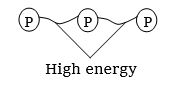
(D) $ATP$ (Adenosine Triphosphate) consists of an adenine base,a ribose sugar,and three phosphate groups.
The high-energy bonds in $ATP$ are the phosphoanhydride bonds that link the phosphate groups together.
These bonds are specifically located between the oxygen atom of one phosphate group and the phosphorus atom of the adjacent phosphate group ($O-P$ bonds).
Therefore,the high-energy bonds are $O-P$ bonds.
The high-energy bonds in $ATP$ are the phosphoanhydride bonds that link the phosphate groups together.
These bonds are specifically located between the oxygen atom of one phosphate group and the phosphorus atom of the adjacent phosphate group ($O-P$ bonds).
Therefore,the high-energy bonds are $O-P$ bonds.
0 likes
View Solution20
MediumMCQ
An $ATP$ molecule is structurally most similar to a molecule of
A
$RNA$ molecule
B
$DNA$ molecule
C
Amino acid
D
Fatty acid
Solution
(A) $ATP$ (Adenosine Triphosphate) is a nucleotide derivative.
It consists of an adenine nitrogenous base,a ribose sugar,and three phosphate groups.
Since $RNA$ is composed of ribonucleotides (which also contain ribose sugar and nitrogenous bases),$ATP$ is structurally most similar to a monomeric unit of $RNA$.
It consists of an adenine nitrogenous base,a ribose sugar,and three phosphate groups.
Since $RNA$ is composed of ribonucleotides (which also contain ribose sugar and nitrogenous bases),$ATP$ is structurally most similar to a monomeric unit of $RNA$.
0 likes
View Solution21
MediumMCQ
The element absent in $RNA$ is
A
Nitrogen
B
Sulfur
C
Oxygen
D
Hydrogen
Solution
(B) $RNA$ (Ribonucleic acid) is a polymer composed of nucleotides. Each nucleotide consists of a nitrogenous base,a ribose sugar,and a phosphate group.
$1$. The chemical formula of the ribose sugar is $C_5H_{10}O_5$,which contains Carbon,Hydrogen,and Oxygen.
$2$. The nitrogenous bases (Adenine,Guanine,Cytosine,Uracil) contain Carbon,Hydrogen,Nitrogen,and Oxygen.
$3$. The phosphate group $(PO_4^{3-})$ contains Phosphorus and Oxygen.
Sulfur is not a constituent element of the nucleotides that make up $RNA$.
$1$. The chemical formula of the ribose sugar is $C_5H_{10}O_5$,which contains Carbon,Hydrogen,and Oxygen.
$2$. The nitrogenous bases (Adenine,Guanine,Cytosine,Uracil) contain Carbon,Hydrogen,Nitrogen,and Oxygen.
$3$. The phosphate group $(PO_4^{3-})$ contains Phosphorus and Oxygen.
Sulfur is not a constituent element of the nucleotides that make up $RNA$.
0 likes
View Solution22
MediumMCQ
Uridine monophosphate is found in
A
Centrosome
B
Lysosome
C
Cell wall
D
$RNA$
Solution
(D) Uridine monophosphate $(UMP)$ is a nucleotide consisting of the nitrogenous base uracil,the sugar ribose,and a phosphate group.
Since uracil is a nitrogenous base specific to $RNA$ and not $DNA$,uridine monophosphate is a fundamental component of $RNA$ molecules.
Therefore,the correct option is $D$.
Since uracil is a nitrogenous base specific to $RNA$ and not $DNA$,uridine monophosphate is a fundamental component of $RNA$ molecules.
Therefore,the correct option is $D$.
0 likes
View Solution23
MediumMCQ
$A$ nucleoside differs from a nucleotide in not having:
A
Phosphate
B
Sugar
C
Nitrogen base
D
Phosphate and sugar
Solution
(A) nucleoside consists of a nitrogenous base and a pentose sugar.
In contrast,a nucleotide consists of a nitrogenous base,a pentose sugar,and a phosphate group.
Therefore,a nucleoside differs from a nucleotide by the absence of a phosphate group.
In contrast,a nucleotide consists of a nitrogenous base,a pentose sugar,and a phosphate group.
Therefore,a nucleoside differs from a nucleotide by the absence of a phosphate group.
0 likes
View Solution24
MediumMCQ
Phosphorus is present in
A
Protein
B
$DNA$
C
$RNA$
D
Both $DNA$ and $RNA$
Solution
(D) Phosphorus is a fundamental component of nucleic acids ($DNA$ and $RNA$).
It exists in the form of a phosphate group $(PO_4^{3-})$ which links the sugar molecules of the nucleotide backbone via phosphodiester bonds.
Proteins generally do not contain phosphorus unless they are phosphorylated (e.g.,phosphoproteins),but it is a structural requirement for all $DNA$ and $RNA$ molecules.
Therefore,both $DNA$ and $RNA$ contain phosphorus.
It exists in the form of a phosphate group $(PO_4^{3-})$ which links the sugar molecules of the nucleotide backbone via phosphodiester bonds.
Proteins generally do not contain phosphorus unless they are phosphorylated (e.g.,phosphoproteins),but it is a structural requirement for all $DNA$ and $RNA$ molecules.
Therefore,both $DNA$ and $RNA$ contain phosphorus.
0 likes
View Solution25
MediumMCQ
Nucleotides are building blocks of nucleic acids. Each nucleotide is a composite molecule formed by:
A
$(Base-sugar-phosphate)_n$
B
Base-sugar-$OH$
C
Base-sugar-phosphate
D
Sugar-phosphate
Solution
(C) Nucleotides are the fundamental building blocks or monomeric units of nucleic acids ($DNA$ and $RNA$).
Each nucleotide consists of three distinct components:
$1$. $A$ nitrogenous base (Purines or Pyrimidines).
$2$. $A$ pentose sugar (Ribose or Deoxyribose).
$3$. $A$ phosphate group (derived from phosphoric acid).
Therefore,the correct composition is Base-sugar-phosphate.
Each nucleotide consists of three distinct components:
$1$. $A$ nitrogenous base (Purines or Pyrimidines).
$2$. $A$ pentose sugar (Ribose or Deoxyribose).
$3$. $A$ phosphate group (derived from phosphoric acid).
Therefore,the correct composition is Base-sugar-phosphate.
0 likes
View Solution26
MediumMCQ
The unit of nucleic acid is
A
Nucleotide
B
Nucleoside
C
Nucleic acid
D
All
Solution
(A) The correct answer is $A$.
Nucleic acids ($DNA$ and $RNA$) are polymers of nucleotides.
$A$ nucleotide consists of three components: a nitrogenous base (purine or pyrimidine),a pentose sugar (ribose or deoxyribose),and a phosphate group.
$A$ nucleoside consists only of a nitrogenous base and a pentose sugar,lacking the phosphate group.
Therefore,the repeating structural unit of a nucleic acid is a nucleotide.
Nucleic acids ($DNA$ and $RNA$) are polymers of nucleotides.
$A$ nucleotide consists of three components: a nitrogenous base (purine or pyrimidine),a pentose sugar (ribose or deoxyribose),and a phosphate group.
$A$ nucleoside consists only of a nitrogenous base and a pentose sugar,lacking the phosphate group.
Therefore,the repeating structural unit of a nucleic acid is a nucleotide.
0 likes
View Solution27
EasyMCQ
Which one of the following is considered the "Secret of life"?
A
Fatty acids
B
Amino acids
C
Proteins
D
Nucleic acid
Solution
(D) Nucleic acids ($DNA$ and $RNA$) are considered the "Secret of life" because they store and transmit the genetic information required for the development, functioning, growth, and reproduction of all living organisms.
They act as the blueprint for life, directing the synthesis of proteins which carry out the essential biological processes.
They act as the blueprint for life, directing the synthesis of proteins which carry out the essential biological processes.
0 likes
View Solution28
EasyMCQ
$A.T.P.$ is a/an...
A
Hormone.
B
Protein.
C
Enzyme that catalyzes oxidation.
D
Molecule containing high-energy bonds.
Solution
(D) $A.T.P.$ stands for Adenosine Triphosphate.
It is a nucleotide consisting of an adenine base,a ribose sugar,and three phosphate groups.
The bonds between the phosphate groups are high-energy phosphoanhydride bonds.
When these bonds are hydrolyzed,a significant amount of energy is released,which is used by the cell for various metabolic activities.
Therefore,$A.T.P.$ is known as the energy currency of the cell because it stores energy in its high-energy phosphate bonds.
It is a nucleotide consisting of an adenine base,a ribose sugar,and three phosphate groups.
The bonds between the phosphate groups are high-energy phosphoanhydride bonds.
When these bonds are hydrolyzed,a significant amount of energy is released,which is used by the cell for various metabolic activities.
Therefore,$A.T.P.$ is known as the energy currency of the cell because it stores energy in its high-energy phosphate bonds.
0 likes
View Solution29
MediumMCQ
$A$ nitrogenous base,a pentose sugar,and a phosphate group together form a structure known as .......
A
Nucleoside
B
Polypeptide
C
Nucleotide
D
Amino acid
Solution
(C) $Nucleotide$ is the basic structural unit of nucleic acids ($DNA$ and $RNA$).
It consists of three components:
$1$. $A$ nitrogenous base (purine or pyrimidine).
$2$. $A$ pentose sugar (ribose or deoxyribose).
$3$. $A$ phosphate group.
When a nitrogenous base is linked to a pentose sugar,it forms a $Nucleoside$. When a phosphate group is added to this $Nucleoside$,it becomes a $Nucleotide$.
It consists of three components:
$1$. $A$ nitrogenous base (purine or pyrimidine).
$2$. $A$ pentose sugar (ribose or deoxyribose).
$3$. $A$ phosphate group.
When a nitrogenous base is linked to a pentose sugar,it forms a $Nucleoside$. When a phosphate group is added to this $Nucleoside$,it becomes a $Nucleotide$.
0 likes
View Solution30
EasyMCQ
$ATP$ is a .............
A
Nucleotide
B
Nucleoside
C
Nucleic acid
D
Vitamin
Solution
(A) $ATP$ stands for Adenosine Triphosphate. It consists of an adenine base,a ribose sugar,and three phosphate groups. Since it is a nitrogenous base attached to a sugar and phosphate groups,it is classified as a nucleotide.
0 likes
View Solution31
EasyMCQ
Nucleic acids are polymers of $........$.
A
Amino acids
B
Pentose sugars
C
Nucleosides
D
Nucleotides
Solution
(D) Nucleic acids ($DNA$ and $RNA$) are macromolecules formed by the polymerization of repeating units called nucleotides.
Each nucleotide consists of three components: a nitrogenous base,a pentose sugar (ribose or deoxyribose),and a phosphate group.
Therefore,nucleic acids are polymers of nucleotides.
Each nucleotide consists of three components: a nitrogenous base,a pentose sugar (ribose or deoxyribose),and a phosphate group.
Therefore,nucleic acids are polymers of nucleotides.
0 likes
View Solution32
MediumMCQ
Which of the following pairs of nitrogenous bases of nucleic acids is incorrectly matched with its category?
A
Guanine,Adenine - Purines
B
Adenine,Thymine - Purines
C
Thymine,Uracil - Pyrimidines
D
Uracil,Cytosine - Pyrimidines
Solution
(B) Nitrogenous bases in nucleic acids are classified into two categories: Purines and Pyrimidines.
$1$. Purines are double-ring structures,which include Adenine $(A)$ and Guanine $(G)$.
$2$. Pyrimidines are single-ring structures,which include Cytosine $(C)$,Thymine $(T)$,and Uracil $(U)$.
In option $B$,Adenine is a Purine,but Thymine is a Pyrimidine. Therefore,the pair 'Adenine,Thymine - Purines' is incorrectly matched.
$1$. Purines are double-ring structures,which include Adenine $(A)$ and Guanine $(G)$.
$2$. Pyrimidines are single-ring structures,which include Cytosine $(C)$,Thymine $(T)$,and Uracil $(U)$.
In option $B$,Adenine is a Purine,but Thymine is a Pyrimidine. Therefore,the pair 'Adenine,Thymine - Purines' is incorrectly matched.
0 likes
View Solution33
EasyMCQ
Which of the following is a purine?
A
Adenine
B
Guanine
C
Thymine
D
Uracil
Solution
(A, B) Nucleic acids contain nitrogenous bases which are classified into two types: purines and pyrimidines.
Purines are double-ring structures,which include Adenine $(A)$ and Guanine $(G)$.
Pyrimidines are single-ring structures,which include Cytosine $(C)$,Thymine $(T)$,and Uracil $(U)$.
In the given options,both Adenine and Guanine are purines. However,since the question asks to identify a purine and both $A$ and $B$ are correct,typically in such multiple-choice questions,we select the most appropriate one or note that both are purines. Given the standard structure,both Adenine and Guanine are purines.
Purines are double-ring structures,which include Adenine $(A)$ and Guanine $(G)$.
Pyrimidines are single-ring structures,which include Cytosine $(C)$,Thymine $(T)$,and Uracil $(U)$.
In the given options,both Adenine and Guanine are purines. However,since the question asks to identify a purine and both $A$ and $B$ are correct,typically in such multiple-choice questions,we select the most appropriate one or note that both are purines. Given the standard structure,both Adenine and Guanine are purines.
0 likes
View Solution34
MediumMCQ
$DNA$ is a .........
A
Biomacromolecule
B
Acidic in nature
C
Polymer of nucleotides
D
All of the above
Solution
(D) $DNA$ $(Deoxyribonucleic \text{ acid})$ is a type of nucleic acid.
$1$. It is a large molecule with a high molecular weight, hence it is classified as a biomacromolecule.
$2$. Due to the presence of phosphate groups in its backbone, it exhibits acidic properties.
$3$. Structurally, it is a long chain (polymer) consisting of repeating units called nucleotides.
Therefore, all the given statements are correct.
$1$. It is a large molecule with a high molecular weight, hence it is classified as a biomacromolecule.
$2$. Due to the presence of phosphate groups in its backbone, it exhibits acidic properties.
$3$. Structurally, it is a long chain (polymer) consisting of repeating units called nucleotides.
Therefore, all the given statements are correct.
0 likes
View Solution35
MediumMCQ
Which of the following bonds is not associated with nucleic acids?
A
$H$-bond
B
Ester bond
C
Glycosidic bond
D
Peptide bond
Solution
(D) Nucleic acids ($DNA$ and $RNA$) are polymers of nucleotides.
Each nucleotide consists of a nitrogenous base, a pentose sugar, and a phosphate group.
$1$. $H$-bonds are present between the nitrogenous bases of the two strands in $DNA$ (e.g., $A=T$, $G \equiv C$).
$2$. Glycosidic bonds (specifically $N$-glycosidic linkages) connect the nitrogenous base to the pentose sugar.
$3$. Ester bonds (specifically phosphodiester bonds) connect the phosphate group to the sugar molecule.
$4$. Peptide bonds are characteristic of proteins, which are polymers of amino acids, and are not found in nucleic acids.
Each nucleotide consists of a nitrogenous base, a pentose sugar, and a phosphate group.
$1$. $H$-bonds are present between the nitrogenous bases of the two strands in $DNA$ (e.g., $A=T$, $G \equiv C$).
$2$. Glycosidic bonds (specifically $N$-glycosidic linkages) connect the nitrogenous base to the pentose sugar.
$3$. Ester bonds (specifically phosphodiester bonds) connect the phosphate group to the sugar molecule.
$4$. Peptide bonds are characteristic of proteins, which are polymers of amino acids, and are not found in nucleic acids.
0 likes
View Solution36
MediumMCQ
How many types of nitrogenous bases are found in nucleic acids?
A
Three
B
Four
C
Five
D
Eight
Solution
(C) Nucleic acids ($DNA$ and $RNA$) contain five main types of nitrogenous bases.
These are categorized into two groups:
$1$. Purines: Adenine $(A)$ and Guanine $(G)$.
$2$. Pyrimidines: Cytosine $(C)$,Thymine $(T)$,and Uracil $(U)$.
$DNA$ contains $A, G, C,$ and $T$,while $RNA$ contains $A, G, C,$ and $U$.
Therefore,there are $5$ distinct types of nitrogenous bases found in nucleic acids.
These are categorized into two groups:
$1$. Purines: Adenine $(A)$ and Guanine $(G)$.
$2$. Pyrimidines: Cytosine $(C)$,Thymine $(T)$,and Uracil $(U)$.
$DNA$ contains $A, G, C,$ and $T$,while $RNA$ contains $A, G, C,$ and $U$.
Therefore,there are $5$ distinct types of nitrogenous bases found in nucleic acids.
0 likes
View Solution37
MediumMCQ
Thymine or methylated uracil is present in nucleic acids. It should be .......
A
$DNA$
B
$RNA$
C
$DNA$ or $RNA$
D
Bacteria of $RNA$
Solution
(A) Nucleic acids are of two types: $DNA$ (Deoxyribonucleic acid) and $RNA$ (Ribonucleic acid).
In $DNA$,the nitrogenous bases are Adenine,Guanine,Cytosine,and Thymine.
Thymine is chemically known as $5$-methyluracil.
$RNA$ contains Uracil instead of Thymine.
Therefore,Thymine (methylated uracil) is specifically found in $DNA$.
In $DNA$,the nitrogenous bases are Adenine,Guanine,Cytosine,and Thymine.
Thymine is chemically known as $5$-methyluracil.
$RNA$ contains Uracil instead of Thymine.
Therefore,Thymine (methylated uracil) is specifically found in $DNA$.
0 likes
View Solution38
EasyMCQ
Which of the following is found only in $RNA$ and not in $DNA$?
A
Adenine
B
Thymine
C
Guanine
D
Uracil
Solution
(D) Nucleic acids are composed of nitrogenous bases,pentose sugars,and phosphate groups.
In $DNA$,the four nitrogenous bases are Adenine $(A)$,Guanine $(G)$,Cytosine $(C)$,and Thymine $(T)$.
In $RNA$,the four nitrogenous bases are Adenine $(A)$,Guanine $(G)$,Cytosine $(C)$,and Uracil $(U)$.
Thymine is present in $DNA$ but is replaced by Uracil in $RNA$.
Therefore,Uracil is the nitrogenous base found exclusively in $RNA$.
In $DNA$,the four nitrogenous bases are Adenine $(A)$,Guanine $(G)$,Cytosine $(C)$,and Thymine $(T)$.
In $RNA$,the four nitrogenous bases are Adenine $(A)$,Guanine $(G)$,Cytosine $(C)$,and Uracil $(U)$.
Thymine is present in $DNA$ but is replaced by Uracil in $RNA$.
Therefore,Uracil is the nitrogenous base found exclusively in $RNA$.
0 likes
View Solution39
MediumMCQ
Nucleic acids are found in:
A
Nucleus
B
Cytoplasm
C
Nucleus and cytoplasm
D
Nucleus and ribosomes
Solution
(C) Nucleic acids,specifically $DNA$ and $RNA$,are essential biomolecules.
$DNA$ is primarily located within the nucleus of eukaryotic cells,while $RNA$ is found in both the nucleus and the cytoplasm.
Additionally,$RNA$ is a key component of ribosomes.
Therefore,nucleic acids are present in both the nucleus and the cytoplasm of the cell.
$DNA$ is primarily located within the nucleus of eukaryotic cells,while $RNA$ is found in both the nucleus and the cytoplasm.
Additionally,$RNA$ is a key component of ribosomes.
Therefore,nucleic acids are present in both the nucleus and the cytoplasm of the cell.
0 likes
View Solution40
MediumMCQ
$A$ nucleoside is composed of:
A
$A$ polymer of nucleic acid
B
Phosphoric acid + base
C
Phosphoric acid + base + sugar
D
Sugar + base
Solution
(D) nucleoside is formed by the combination of a nitrogenous base and a pentose sugar.
When a phosphate group is added to a nucleoside,it forms a nucleotide.
Therefore,the composition of a nucleoside is $Sugar + Base$.
When a phosphate group is added to a nucleoside,it forms a nucleotide.
Therefore,the composition of a nucleoside is $Sugar + Base$.
0 likes
View Solution41
MediumMCQ
Nucleotides are the structural components of nucleic acids. Each nucleotide forms a composite molecule consisting of:
A
Base - Sugar - $OH$
B
Base - Sugar - Phosphate
C
Sugar - Phosphate
D
Base - Sugar - Phosphate group
Solution
(B) nucleotide is the basic building block of nucleic acids ($DNA$ and $RNA$).
Each nucleotide consists of three distinct chemical components:
$1$. $A$ nitrogenous base (purine or pyrimidine).
$2$. $A$ pentose sugar (ribose in $RNA$ or deoxyribose in $DNA$).
$3$. $A$ phosphate group.
These three components are linked together to form a single nucleotide unit. Therefore,the correct composition is Base - Sugar - Phosphate.
Each nucleotide consists of three distinct chemical components:
$1$. $A$ nitrogenous base (purine or pyrimidine).
$2$. $A$ pentose sugar (ribose in $RNA$ or deoxyribose in $DNA$).
$3$. $A$ phosphate group.
These three components are linked together to form a single nucleotide unit. Therefore,the correct composition is Base - Sugar - Phosphate.
0 likes
View Solution42
MediumMCQ
The unit of nucleic acid is .....
A
Phosphoric acid
B
Nitrogen base
C
Pentose sugar
D
Nucleotides
Solution
(D) Nucleic acids,such as $DNA$ and $RNA$,are polymers of nucleotides.
Each nucleotide consists of three components: a nitrogenous base,a pentose sugar (ribose or deoxyribose),and a phosphate group.
Therefore,the fundamental repeating unit of a nucleic acid is the nucleotide.
Each nucleotide consists of three components: a nitrogenous base,a pentose sugar (ribose or deoxyribose),and a phosphate group.
Therefore,the fundamental repeating unit of a nucleic acid is the nucleotide.
0 likes
View Solution43
MediumMCQ
$A$ nucleoside differs from a nucleotide due to the absence of which of the following?
A
Phosphate
B
Sugar
C
Phosphate and sugar
D
Nitrogenous base
Solution
(A) nucleoside consists of a nitrogenous base linked to a pentose sugar.
$A$ nucleotide is formed when a phosphate group is added to a nucleoside.
Therefore,the fundamental difference between a nucleoside and a nucleotide is the presence of a phosphate group in the nucleotide,which is absent in the nucleoside.
$A$ nucleotide is formed when a phosphate group is added to a nucleoside.
Therefore,the fundamental difference between a nucleoside and a nucleotide is the presence of a phosphate group in the nucleotide,which is absent in the nucleoside.
0 likes
View Solution44
EasyMCQ
The basic unit of a nucleic acid is .......
A
Nucleotide
B
Nucleoside
C
Nucleic acid
D
All of the above
Solution
(A) Nucleic acids ($DNA$ and $RNA$) are polymers of nucleotides.
Each nucleotide consists of three components: a nitrogenous base,a pentose sugar (ribose or deoxyribose),and a phosphate group.
$A$ nucleoside consists only of a nitrogenous base and a pentose sugar,lacking the phosphate group.
Therefore,the fundamental repeating unit that polymerizes to form nucleic acids is the nucleotide.
Each nucleotide consists of three components: a nitrogenous base,a pentose sugar (ribose or deoxyribose),and a phosphate group.
$A$ nucleoside consists only of a nitrogenous base and a pentose sugar,lacking the phosphate group.
Therefore,the fundamental repeating unit that polymerizes to form nucleic acids is the nucleotide.
0 likes
View Solution45
MediumMCQ
$A$ nucleotide is composed of:
A
Nitrogenous base,pentose sugar,and phosphoric acid
B
Nitrogen,hexose sugar,and phosphoric acid
C
Nitrogenous base and pentose sugar
D
Nitrogenous base,triose sugar,and phosphoric acid
Solution
(A) nucleotide is the basic structural unit of nucleic acids ($DNA$ and $RNA$).
It consists of three essential components:
$1$. $A$ nitrogenous base (purine or pyrimidine).
$2$. $A$ pentose sugar (ribose in $RNA$ or deoxyribose in $DNA$).
$3$. $A$ phosphate group (derived from phosphoric acid).
When a nitrogenous base is linked to a pentose sugar,it is called a nucleoside. When a phosphate group is added to a nucleoside,it forms a nucleotide.
It consists of three essential components:
$1$. $A$ nitrogenous base (purine or pyrimidine).
$2$. $A$ pentose sugar (ribose in $RNA$ or deoxyribose in $DNA$).
$3$. $A$ phosphate group (derived from phosphoric acid).
When a nitrogenous base is linked to a pentose sugar,it is called a nucleoside. When a phosphate group is added to a nucleoside,it forms a nucleotide.
0 likes
View Solution46
MediumMCQ
High-energy nucleotides are nucleotides containing .......
A
High molecular weight
B
More than one phosphate group
C
More than one nitrogenous base
D
More than one sugar residue
Solution
(B) High-energy nucleotides,such as $ATP$ (Adenosine triphosphate),$GTP$ (Guanosine triphosphate),etc.,are characterized by the presence of multiple phosphate groups attached to the sugar moiety.
These phosphate groups are linked by high-energy phosphoanhydride bonds.
When these bonds are hydrolyzed,a significant amount of energy is released,which is used to drive various cellular processes.
Therefore,the defining feature of high-energy nucleotides is the presence of more than one phosphate group.
These phosphate groups are linked by high-energy phosphoanhydride bonds.
When these bonds are hydrolyzed,a significant amount of energy is released,which is used to drive various cellular processes.
Therefore,the defining feature of high-energy nucleotides is the presence of more than one phosphate group.
0 likes
View Solution47
EasyMCQ
Nucleic acids are polymers of $......$.
A
Nucleotides
B
Nucleosides
C
Amino acids
D
Nitrogen bases
Solution
(A) Nucleic acids,such as $DNA$ and $RNA$,are long-chain macromolecules known as polynucleotides.
These are formed by the polymerization of repeating units called nucleotides.
$A$ single nucleotide consists of three components: a nitrogenous base,a pentose sugar (ribose or deoxyribose),and a phosphate group.
Therefore,nucleic acids are polymers of nucleotides.
These are formed by the polymerization of repeating units called nucleotides.
$A$ single nucleotide consists of three components: a nitrogenous base,a pentose sugar (ribose or deoxyribose),and a phosphate group.
Therefore,nucleic acids are polymers of nucleotides.
0 likes
View Solution48
MediumMCQ
The bond between the phosphate and sugar in a nucleotide is........
A
$H$-bond
B
Phosphodiester bond
C
Covalent bond
D
Sulphide bond
Solution
(C) In a nucleotide,the phosphate group is linked to the $5'$-carbon of the sugar (pentose sugar) through a covalent bond known as an ester bond.
Specifically,when a phosphate group connects to the sugar,it forms a phosphoester linkage.
Since the question asks for the bond between phosphate and sugar in a single nucleotide,it is a covalent phosphoester bond.
Among the given options,'Covalent bond' is the most accurate description of the linkage between the phosphate and the sugar moiety.
Specifically,when a phosphate group connects to the sugar,it forms a phosphoester linkage.
Since the question asks for the bond between phosphate and sugar in a single nucleotide,it is a covalent phosphoester bond.
Among the given options,'Covalent bond' is the most accurate description of the linkage between the phosphate and the sugar moiety.
0 likes
View SolutionBiomolecules — Nucleic acids · Frequently Asked Questions
1Are these Biomolecules questions useful for JEE and NEET?
Yes. All questions in this section are mapped to JEE Main and NEET exam patterns. Previous year questions from JEE Main, NEET, GUJCET and state-level exams are included with full solutions.
2Can I switch to Hindi or Gujarati for these questions?
Yes. Use the language tabs in the hero section or the sidebar to view the same questions and solutions in English, Hindi or Gujarati.
3How do I generate a question paper from this subtopic?
Use the Vedclass Exam Paper Generator — select the chapter and subtopic, set difficulty, and generate Sets A, B, C, D automatically. First 3 chapters of every subject are free.
Vedclass Products
For Students
Vedclass Test Series
Mock tests in real JEE/NEET style with performance analysis. 5-day free trial.
Start Free TrialFor Teachers
Exam Paper Generator
Generate Set A/B/C/D papers from this chapter in 2 minutes. 3 chapters free.
Try FreeFor Institutes
Online Exam Module
Live online exams with unlimited students, 360° analytics & white-label branding.
See DemoFor Teachers & Institutes
Generate a Biomolecules Exam Paper in 2 Minutes
Select subtopic & difficulty — Sets A, B, C, D auto-generated with No Repeat logic.
First 3 chapters of every subject are free — no payment required.