
A English
Classification and factors affecting enzyme Questions in English
Class 11 Biology · Biomolecules · Classification and factors affecting enzyme
49+
Questions
English
Language
100%
With Solutions
Showing 48 of 49 questions in English
1
MediumMCQ
Non-competitive inhibitors alter:
A
Structure of enzyme
B
Structure of active site
C
Velocity of enzymatic reaction
D
All the above
Solution
(D) Non-competitive inhibitors bind to an allosteric site on the enzyme,which is distinct from the active site.
This binding induces a conformational change in the enzyme's overall structure.
Because the enzyme's shape changes,the active site is also altered,making it less effective or unable to bind the substrate.
Consequently,the overall velocity of the enzymatic reaction decreases because the number of functional enzyme molecules is reduced.
Therefore,all the mentioned factors are affected.
This binding induces a conformational change in the enzyme's overall structure.
Because the enzyme's shape changes,the active site is also altered,making it less effective or unable to bind the substrate.
Consequently,the overall velocity of the enzymatic reaction decreases because the number of functional enzyme molecules is reduced.
Therefore,all the mentioned factors are affected.
0 likes
View Solution2
MediumMCQ
Basically how many types of enzymes have been recognised by the International Union of Biochemistry?
A
$4$
B
$5$
C
$6$
D
$8$
Solution
(C) The International Union of Biochemistry $(IUB)$ has classified enzymes into $6$ major classes based on the type of reaction they catalyze.
These classes are:
$1$. Oxidoreductases/Dehydrogenases
$2$. Transferases
$3$. Hydrolases
$4$. Lyases
$5$. Isomerases
$6$. Ligases
Therefore,the correct answer is $6$.
These classes are:
$1$. Oxidoreductases/Dehydrogenases
$2$. Transferases
$3$. Hydrolases
$4$. Lyases
$5$. Isomerases
$6$. Ligases
Therefore,the correct answer is $6$.
0 likes
View Solution3
MediumMCQ
In the modern system of nomenclature,which one of the following enzymes occupies the $1^{st}$ position?
A
Oxidoreductases
B
Transferases
C
Hydrolases
D
Ligases
Solution
(A) According to the International Union of Biochemistry and Molecular Biology $(IUBMB)$,enzymes are classified into $6$ main classes based on the type of reaction they catalyze.
These classes are numbered $1$ to $6$ as follows:
$1$. Oxidoreductases: Enzymes that catalyze oxidation-reduction reactions.
$2$. Transferases: Enzymes that catalyze the transfer of a group.
$3$. Hydrolases: Enzymes that catalyze the hydrolysis of bonds.
$4$. Lyases: Enzymes that catalyze the removal of groups from substrates by mechanisms other than hydrolysis.
$5$. Isomerases: Enzymes that catalyze the interconversion of isomers.
$6$. Ligases: Enzymes that catalyze the linking together of two compounds.
Therefore,the $1^{st}$ position is occupied by Oxidoreductases.
These classes are numbered $1$ to $6$ as follows:
$1$. Oxidoreductases: Enzymes that catalyze oxidation-reduction reactions.
$2$. Transferases: Enzymes that catalyze the transfer of a group.
$3$. Hydrolases: Enzymes that catalyze the hydrolysis of bonds.
$4$. Lyases: Enzymes that catalyze the removal of groups from substrates by mechanisms other than hydrolysis.
$5$. Isomerases: Enzymes that catalyze the interconversion of isomers.
$6$. Ligases: Enzymes that catalyze the linking together of two compounds.
Therefore,the $1^{st}$ position is occupied by Oxidoreductases.
0 likes
View Solution4
EasyMCQ
Fumarase enzyme belongs to which class?
A
Oxidoreductases
B
Carboxylases
C
Transferases
D
Lyases
Solution
(D) The enzyme Fumarase belongs to the class $Lyases$.
$Lyases$ are enzymes that catalyze the removal of groups from substrates by mechanisms other than hydrolysis,leaving double bonds.
Fumarase catalyzes the reversible hydration/dehydration of fumarate to malate,which is a characteristic reaction of the $Lyase$ class.
$Lyases$ are enzymes that catalyze the removal of groups from substrates by mechanisms other than hydrolysis,leaving double bonds.
Fumarase catalyzes the reversible hydration/dehydration of fumarate to malate,which is a characteristic reaction of the $Lyase$ class.
0 likes
View Solution5
MediumMCQ
The enzyme phosphoglucomutase belongs to which of the following classes?
A
Oxidoreductases
B
Lipases
C
Carboxylases
D
Isomerases
Solution
(D) Enzymes are classified into six main classes based on the type of reaction they catalyze.
Phosphoglucomutase catalyzes the interconversion of glucose-$1$-phosphate to glucose-$6$-phosphate.
This reaction involves the shifting of a phosphate group within the same molecule,which is a type of isomerization.
Therefore,phosphoglucomutase is classified as an isomerase.
Phosphoglucomutase catalyzes the interconversion of glucose-$1$-phosphate to glucose-$6$-phosphate.
This reaction involves the shifting of a phosphate group within the same molecule,which is a type of isomerization.
Therefore,phosphoglucomutase is classified as an isomerase.
0 likes
View Solution6
MediumMCQ
As temperature changes from $3^o \,C$ to $45^o \,C$,the rate of enzyme activity will
A
Decrease and then increase
B
Increase and then decrease
C
Increase only
D
Decrease only
Solution
(B) Enzyme activity is highly dependent on temperature.
At low temperatures $(3^o \,C)$,enzymes are inactive.
As the temperature increases,the kinetic energy of the molecules increases,leading to more frequent collisions between the enzyme and substrate,which increases the rate of reaction.
This continues until the optimum temperature is reached.
Beyond the optimum temperature,the heat causes the denaturation of the enzyme's protein structure,leading to a loss of catalytic activity.
Therefore,as the temperature rises from $3^o \,C$ to $45^o \,C$,the rate of enzyme activity initially increases and then decreases.
At low temperatures $(3^o \,C)$,enzymes are inactive.
As the temperature increases,the kinetic energy of the molecules increases,leading to more frequent collisions between the enzyme and substrate,which increases the rate of reaction.
This continues until the optimum temperature is reached.
Beyond the optimum temperature,the heat causes the denaturation of the enzyme's protein structure,leading to a loss of catalytic activity.
Therefore,as the temperature rises from $3^o \,C$ to $45^o \,C$,the rate of enzyme activity initially increases and then decreases.
0 likes
View Solution7
EasyMCQ
In most plant cells,most enzymes have their optimum activity at: (in $^\circ C$)
A
$20$
B
$25$
C
$30$
D
$35$
Solution
(C) Enzymes are biological catalysts that are highly sensitive to temperature.
Most enzymes in plant cells function optimally within a specific temperature range,typically between $25^\circ C$ and $35^\circ C$.
However,in the context of standard biological studies and general plant physiology,$30^\circ C$ is widely accepted as the optimum temperature for the majority of plant enzymes to exhibit their maximum catalytic activity.
Temperatures significantly above this range can lead to the denaturation of the protein structure,while temperatures below this range result in reduced kinetic energy and slower reaction rates.
Most enzymes in plant cells function optimally within a specific temperature range,typically between $25^\circ C$ and $35^\circ C$.
However,in the context of standard biological studies and general plant physiology,$30^\circ C$ is widely accepted as the optimum temperature for the majority of plant enzymes to exhibit their maximum catalytic activity.
Temperatures significantly above this range can lead to the denaturation of the protein structure,while temperatures below this range result in reduced kinetic energy and slower reaction rates.
0 likes
View Solution8
MediumMCQ
At a temperature just below the freezing point,the enzyme:
A
Is slightly activated
B
Is destroyed
C
Is inactivated
D
Is unaffected
Solution
(C) Enzymes are proteins that function optimally within a specific temperature range. At temperatures significantly below the freezing point,the kinetic energy of the molecules decreases,causing the enzyme to become inactive. However,this inactivation is typically reversible,meaning the enzyme is not destroyed or denatured; it simply stops functioning until the temperature rises again.
0 likes
View Solution9
MediumMCQ
Which of the following ions are toxic to enzymatic activity?
A
$Mn^{2+}$
B
$K^+$
C
$Na^+$
D
$Hg^{2+}$
Solution
(D) Enzymatic activity is highly sensitive to the presence of specific metal ions. Heavy metal ions,such as mercury $(Hg^{2+})$,lead $(Pb^{2+})$,and cadmium $(Cd^{2+})$,act as non-competitive inhibitors. They bind to the sulfhydryl $(-SH)$ groups of amino acid residues in the enzyme's active site or elsewhere,causing conformational changes that denature the enzyme or block the active site,thereby rendering the enzyme inactive and toxic to the biological system.
0 likes
View Solution10
MediumMCQ
Enzymes are destroyed at:
A
Very low temperature
B
During chemical reaction
C
Very high temperature
D
Below freezing point
Solution
(C) Enzymes are proteinaceous substances that act as biological catalysts. They are highly sensitive to temperature. At very high temperatures,the hydrogen bonds and other stabilizing interactions within the protein structure break,leading to the loss of the enzyme's three-dimensional shape. This process is known as denaturation,which renders the enzyme inactive or 'destroyed'.
0 likes
View Solution11
MediumMCQ
Enzymes are sensitive to
A
Rainfall
B
Light
C
$pH$
D
Wind velocity
Solution
(C) $pH$ sensitivity: Enzymes are active at a specific $pH$. For example,some enzymes are active in an acidic medium,while others are active in an alkaline medium. This dependence of enzyme activity on $pH$ is known as $pH$ sensitivity.
0 likes
View Solution12
MediumMCQ
Enzymes have a very narrow optima for
A
Light
B
Temperature
C
$pH$
D
Humidity
Solution
(C) Each enzyme operates within a narrow range of $pH$.
It is most effective at a particular point of this range which is called optimum $pH$.
It is most effective at a particular point of this range which is called optimum $pH$.
0 likes
View Solution13
MediumMCQ
Below freezing point,digestive enzymes are:
A
Inactivated
B
Activated
C
Destroyed
D
Unaffected
Solution
(A) Enzymes are proteinaceous biocatalysts that function optimally at a specific temperature range.
At temperatures below the freezing point,the kinetic energy of the molecules decreases significantly,which slows down or halts the molecular collisions required for enzymatic activity.
However,this process is reversible; the enzymes are not destroyed (denatured) by cold,but rather they become temporarily inactive.
Once the temperature is raised back to the optimal range,the enzymes regain their functional activity.
At temperatures below the freezing point,the kinetic energy of the molecules decreases significantly,which slows down or halts the molecular collisions required for enzymatic activity.
However,this process is reversible; the enzymes are not destroyed (denatured) by cold,but rather they become temporarily inactive.
Once the temperature is raised back to the optimal range,the enzymes regain their functional activity.
0 likes
View Solution14
MediumMCQ
At temperatures below the freezing point,an enzyme is .........
A
Ineffective
B
Inactive
C
Slightly inactive
D
Dead
Solution
(B) Enzymes are proteins that function as biological catalysts. Their activity is highly dependent on temperature. At low temperatures,specifically below the freezing point,the kinetic energy of the molecules is extremely low,which prevents the enzyme-substrate complex from forming. However,this state is reversible. The enzyme is not destroyed or denatured; it simply becomes $Inactive$. Once the temperature is raised back to the optimal range,the enzyme regains its catalytic activity.
0 likes
View Solution15
EasyMCQ
Enzymes are sensitive to .....
A
Cold
B
Cell wall
C
Heat
D
Pressure
Solution
(C) Enzymes are biological catalysts that are primarily proteinaceous in nature.
Because they are proteins,their structure is highly dependent on temperature.
High temperatures (heat) cause the denaturation of the protein structure,which destroys the active site of the enzyme and renders it inactive.
Therefore,enzymes are highly sensitive to heat.
Because they are proteins,their structure is highly dependent on temperature.
High temperatures (heat) cause the denaturation of the protein structure,which destroys the active site of the enzyme and renders it inactive.
Therefore,enzymes are highly sensitive to heat.
0 likes
View Solution16
MediumMCQ
At high temperatures,enzymes become .........
A
denatured
B
ineffective
C
inactive
D
dead
Solution
(A) Enzymes are proteins that function optimally within a specific temperature range.
When the temperature increases significantly beyond this optimal range,the weak bonds (such as hydrogen bonds) that maintain the enzyme's three-dimensional structure break.
This process is known as denaturation.
As a result,the active site of the enzyme loses its specific shape,rendering the enzyme unable to bind to its substrate and thus losing its catalytic activity.
When the temperature increases significantly beyond this optimal range,the weak bonds (such as hydrogen bonds) that maintain the enzyme's three-dimensional structure break.
This process is known as denaturation.
As a result,the active site of the enzyme loses its specific shape,rendering the enzyme unable to bind to its substrate and thus losing its catalytic activity.
0 likes
View Solution17
EasyMCQ
Enzymes show the least amount of adaptation for which of the following?
A
Light
B
Temperature
C
$pH$
D
Humidity
Solution
(A) Enzymes are biological catalysts that are highly sensitive to their environment.
They show significant adaptation and sensitivity to factors like $Temperature$ and $pH$,as these directly affect the protein structure (tertiary structure) and the active site of the enzyme.
$Light$ is generally not a direct factor that influences the catalytic activity of most enzymes in the same way $pH$ or $Temperature$ does.
Therefore,enzymes show the least amount of adaptation for $Light$.
They show significant adaptation and sensitivity to factors like $Temperature$ and $pH$,as these directly affect the protein structure (tertiary structure) and the active site of the enzyme.
$Light$ is generally not a direct factor that influences the catalytic activity of most enzymes in the same way $pH$ or $Temperature$ does.
Therefore,enzymes show the least amount of adaptation for $Light$.
0 likes
View Solution18
EasyMCQ
Enzymes are active at ...... temperature.
A
$10 - 15 ^\circ C$
B
$15 - 25 ^\circ C$
C
$25 - 40 ^\circ C$
D
$30 - 60 ^\circ C$
Solution
(C) Enzymes are biological catalysts that are highly specific to temperature.
Most enzymes in the human body and many other organisms function optimally within a moderate temperature range,typically between $25 ^\circ C$ and $40 ^\circ C$.
At temperatures below this range,enzyme activity is low due to reduced kinetic energy.
At temperatures significantly above this range,enzymes undergo denaturation,where their three-dimensional structure is disrupted,leading to a loss of catalytic activity.
Most enzymes in the human body and many other organisms function optimally within a moderate temperature range,typically between $25 ^\circ C$ and $40 ^\circ C$.
At temperatures below this range,enzyme activity is low due to reduced kinetic energy.
At temperatures significantly above this range,enzymes undergo denaturation,where their three-dimensional structure is disrupted,leading to a loss of catalytic activity.
0 likes
View Solution19
EasyMCQ
At which temperature do enzymes lose their native conformation?
A
Low
B
High
C
Very low
D
All of the above
Solution
(B) Enzymes are proteins that function optimally within a specific temperature range.
At high temperatures,the thermal energy causes the weak non-covalent bonds (such as hydrogen bonds and hydrophobic interactions) that maintain the protein's tertiary structure to break.
This process is known as denaturation,where the enzyme loses its native three-dimensional conformation and,consequently,its catalytic activity.
At high temperatures,the thermal energy causes the weak non-covalent bonds (such as hydrogen bonds and hydrophobic interactions) that maintain the protein's tertiary structure to break.
This process is known as denaturation,where the enzyme loses its native three-dimensional conformation and,consequently,its catalytic activity.
0 likes
View Solution20
MediumMCQ
Under which conditions do metabolic reactions generally occur at a slower rate?
A
Low temperature and high atmospheric pressure
B
High temperature and low atmospheric pressure
C
Low temperature and low atmospheric pressure
D
High temperature and high atmospheric pressure
Solution
(A) Metabolic reactions are enzyme-catalyzed reactions. Enzymes are proteins that are highly sensitive to temperature and $pH$.
At low temperatures,the kinetic energy of molecules is reduced,which decreases the frequency of collisions between enzymes and substrates,leading to a slower rate of reaction.
High atmospheric pressure can also affect the structural conformation of enzymes and the solubility of gases,often hindering the optimal functioning of metabolic pathways.
Therefore,low temperature and high atmospheric pressure are conditions that generally slow down metabolic processes.
At low temperatures,the kinetic energy of molecules is reduced,which decreases the frequency of collisions between enzymes and substrates,leading to a slower rate of reaction.
High atmospheric pressure can also affect the structural conformation of enzymes and the solubility of gases,often hindering the optimal functioning of metabolic pathways.
Therefore,low temperature and high atmospheric pressure are conditions that generally slow down metabolic processes.
0 likes
View Solution21
EasyMCQ
What is an enzyme that catalyzes hydrolysis called?
A
Reductase
B
Oxidase
C
Hydrolase
D
Hydroxylase
Solution
(C) Enzymes are classified into different groups based on the type of reaction they catalyze.
$Hydrolases$ are the class of enzymes that catalyze the hydrolysis of various bonds such as $C-O$,$C-N$,$C-C$,and $P-N$ bonds.
Hydrolysis is a chemical process in which a molecule of water is added to a substance,resulting in the breaking of chemical bonds.
Therefore,the enzyme that catalyzes hydrolysis is known as a $Hydrolase$.
$Hydrolases$ are the class of enzymes that catalyze the hydrolysis of various bonds such as $C-O$,$C-N$,$C-C$,and $P-N$ bonds.
Hydrolysis is a chemical process in which a molecule of water is added to a substance,resulting in the breaking of chemical bonds.
Therefore,the enzyme that catalyzes hydrolysis is known as a $Hydrolase$.
0 likes
View Solution22
MediumMCQ
Which enzyme is associated with oxidation and reduction reactions in a cell?
A
Oxidoreductases
B
Transferases
C
Hydrolases
D
Lyases
Solution
(A) Enzymes are classified into different groups based on the type of reactions they catalyze.
$1$. Oxidoreductases/Dehydrogenases: These enzymes catalyze oxidoreduction between two substrates $S$ and $S'$ by transferring electrons or hydrogen atoms.
$2$. Transferases: These enzymes catalyze the transfer of a group $G$ (other than hydrogen) between a pair of substrates.
$3$. Hydrolases: These enzymes catalyze the hydrolysis of ester,ether,peptide,or $C$-$C$ bonds.
$4$. Lyases: These enzymes catalyze the removal of groups from substrates by mechanisms other than hydrolysis,leaving double bonds.
Therefore,the enzyme associated with oxidation and reduction reactions is Oxidoreductase.
$1$. Oxidoreductases/Dehydrogenases: These enzymes catalyze oxidoreduction between two substrates $S$ and $S'$ by transferring electrons or hydrogen atoms.
$2$. Transferases: These enzymes catalyze the transfer of a group $G$ (other than hydrogen) between a pair of substrates.
$3$. Hydrolases: These enzymes catalyze the hydrolysis of ester,ether,peptide,or $C$-$C$ bonds.
$4$. Lyases: These enzymes catalyze the removal of groups from substrates by mechanisms other than hydrolysis,leaving double bonds.
Therefore,the enzyme associated with oxidation and reduction reactions is Oxidoreductase.
0 likes
View Solution23
EasyMCQ
Which enzyme catalyzes the transfer of a group from one substrate to another?
A
Oxidoreductases
B
Transferases
C
Hydrolases
D
Lyases
Solution
(B) Enzymes are classified into six classes based on the type of reaction they catalyze.
$1$. Oxidoreductases catalyze oxidation-reduction reactions.
$2$. Transferases catalyze the transfer of a group (other than hydrogen) between a pair of substrates.
$3$. Hydrolases catalyze the hydrolysis of ester,ether,peptide,or glycosidic bonds.
$4$. Lyases catalyze the removal of groups from substrates by mechanisms other than hydrolysis,leaving double bonds.
Therefore,the enzyme that catalyzes the transfer of a group from one substrate to another is known as Transferases.
$1$. Oxidoreductases catalyze oxidation-reduction reactions.
$2$. Transferases catalyze the transfer of a group (other than hydrogen) between a pair of substrates.
$3$. Hydrolases catalyze the hydrolysis of ester,ether,peptide,or glycosidic bonds.
$4$. Lyases catalyze the removal of groups from substrates by mechanisms other than hydrolysis,leaving double bonds.
Therefore,the enzyme that catalyzes the transfer of a group from one substrate to another is known as Transferases.
0 likes
View Solution24
EasyMCQ
Which enzymes are responsible for changing the arrangement of atoms in substrate molecules?
A
Ligases
B
Synthetases
C
Isomerases
D
Lyases
Solution
(C) Enzymes are classified based on the type of reactions they catalyze.
$1$. $Isomerases$ are enzymes that catalyze the interconversion of isomers, meaning they change the arrangement of atoms within a molecule without changing its molecular formula.
$2$. $Ligases$ catalyze the joining of two molecules.
$3$. $Lyases$ catalyze the removal of groups from substrates by mechanisms other than hydrolysis, leaving double bonds.
$4$. $Synthetases$ are a subclass of ligases that catalyze the synthesis of a molecule using energy from $ATP$.
$1$. $Isomerases$ are enzymes that catalyze the interconversion of isomers, meaning they change the arrangement of atoms within a molecule without changing its molecular formula.
$2$. $Ligases$ catalyze the joining of two molecules.
$3$. $Lyases$ catalyze the removal of groups from substrates by mechanisms other than hydrolysis, leaving double bonds.
$4$. $Synthetases$ are a subclass of ligases that catalyze the synthesis of a molecule using energy from $ATP$.
0 likes
View Solution25
MediumMCQ
Match the following Column-$I$ with Column-$II$ and select the correct option.
| Column-$I$ | Column-$II$ |
| $(A)$ Transferases | $(i)$ $H_4P_2O_7$ related reactions |
| $(B)$ Lyases | $(ii)$ Hexokinase |
| $(C)$ Isomerases | $(iii)$ Cytochrome oxidase |
| $(D)$ Ligases | $(iv)$ Aldolase |
| $(E)$ Oxidoreductases | $(v)$ Glucose-$6$-phosphate $\rightarrow$ Fructose-$6$-phosphate |
A
$A-ii, B-iv, C-v, D-i, E-iii$
B
$A-i, B-ii, C-iii, D-iv, E-v$
C
$A-v, B-iv, C-iii, D-ii, E-i$
D
$A-iii, B-iv, C-v, D-i, E-ii$
Solution
(A) Transferases catalyze the transfer of a specific group (other than hydrogen) between a pair of substrates. Hexokinase $(ii)$ is a classic example that transfers a phosphate group from $ATP$ to glucose.
$(B)$ Lyases catalyze the removal of groups from substrates by mechanisms other than hydrolysis,leaving double bonds. Aldolase $(iv)$ is an enzyme that splits fructose-$1,6$-bisphosphate into two triose phosphates.
$(C)$ Isomerases catalyze the interconversion of optical,geometric,or positional isomers. The conversion of Glucose-$6$-phosphate to Fructose-$6$-phosphate $(v)$ is catalyzed by phosphoglucose isomerase.
$(D)$ Ligases catalyze the linking together of two compounds,often involving the hydrolysis of $ATP$. Reactions involving pyrophosphate $(H_4P_2O_7)$ $(i)$ are often associated with ligase activity.
$(E)$ Oxidoreductases catalyze oxidation-reduction reactions between two substrates. Cytochrome oxidase $(iii)$ is a well-known enzyme in this class.
$(B)$ Lyases catalyze the removal of groups from substrates by mechanisms other than hydrolysis,leaving double bonds. Aldolase $(iv)$ is an enzyme that splits fructose-$1,6$-bisphosphate into two triose phosphates.
$(C)$ Isomerases catalyze the interconversion of optical,geometric,or positional isomers. The conversion of Glucose-$6$-phosphate to Fructose-$6$-phosphate $(v)$ is catalyzed by phosphoglucose isomerase.
$(D)$ Ligases catalyze the linking together of two compounds,often involving the hydrolysis of $ATP$. Reactions involving pyrophosphate $(H_4P_2O_7)$ $(i)$ are often associated with ligase activity.
$(E)$ Oxidoreductases catalyze oxidation-reduction reactions between two substrates. Cytochrome oxidase $(iii)$ is a well-known enzyme in this class.
0 likes
View Solution26
MediumMCQ
Select the correct match for $X$ and $Y$:
| Column $X$ | Column $Y$ |
| $(1)$ Transferases | $(P)$ Maltase |
| $(2)$ Hydrolases | $(Q)$ Hexokinase |
| $(3)$ Lyases | $(R)$ Fructose isomerase |
| $(4)$ Isomerases | $(S)$ Aldolase |
A
$(1-Q), (2-P), (3-S), (4-R)$
B
$(1-Q), (2-S), (3-R), (4-P)$
C
$(1-S), (2-R), (3-P), (4-Q)$
D
$(1-Q), (2-P), (3-R), (4-S)$
Solution
(A) The classification of enzymes is based on the type of reaction they catalyze:
$1$. Transferases catalyze the transfer of a group between two substrates, e.g., Hexokinase transfers a phosphate group from $ATP$ to glucose.
$2$. Hydrolases catalyze the hydrolysis of ester, ether, peptide, or glycosidic bonds, e.g., Maltase hydrolyzes maltose into glucose.
$3$. Lyases catalyze the removal of groups from substrates by mechanisms other than hydrolysis, leaving double bonds, e.g., Aldolase splits fructose-$1,6$-bisphosphate into glyceraldehyde-$3$-phosphate and dihydroxyacetone phosphate.
$4$. Isomerases catalyze the interconversion of optical, geometric, or positional isomers, e.g., Fructose isomerase (or phosphoglucose isomerase) converts glucose-$6$-phosphate to fructose-$6$-phosphate.
Therefore, the correct matching is: $(1-Q), (2-P), (3-S), (4-R)$.
$1$. Transferases catalyze the transfer of a group between two substrates, e.g., Hexokinase transfers a phosphate group from $ATP$ to glucose.
$2$. Hydrolases catalyze the hydrolysis of ester, ether, peptide, or glycosidic bonds, e.g., Maltase hydrolyzes maltose into glucose.
$3$. Lyases catalyze the removal of groups from substrates by mechanisms other than hydrolysis, leaving double bonds, e.g., Aldolase splits fructose-$1,6$-bisphosphate into glyceraldehyde-$3$-phosphate and dihydroxyacetone phosphate.
$4$. Isomerases catalyze the interconversion of optical, geometric, or positional isomers, e.g., Fructose isomerase (or phosphoglucose isomerase) converts glucose-$6$-phosphate to fructose-$6$-phosphate.
Therefore, the correct matching is: $(1-Q), (2-P), (3-S), (4-R)$.
0 likes
View Solution27
MediumMCQ
Select the correct match for $X$ and $Y$:
| Column $X$ | Column $Y$ |
| $(1)$ Aldolase | $(P)$ Hydrolases |
| $(2)$ Hexokinase | $(Q)$ Ligases |
| $(3)$ Succinic dehydrogenase | $(R)$ Lyases |
| $(4)$ Fructose isomerase | $(S)$ Oxidoreductases |
| $(5)$ Lactase | $(T)$ Transferases |
| $(6)$ Acetyl $CoA$ synthetase | $(U)$ Isomerases |
A
$(1-R), (2-T), (3-S), (4-U), (5-P), (6-Q)$
B
$(1-R), (2-S), (3-T), (4-U), (5-P), (6-Q)$
C
$(1-R), (2-S), (3-T), (4-P), (5-U), (6-Q)$
D
$(1-R), (2-S), (3-T), (4-P), (5-Q), (6-U)$
Solution
(A) The classification of enzymes is based on the type of reaction they catalyze:
$(1)$ Aldolase is a lyase that catalyzes the cleavage of $C-C$ bonds $(R)$.
$(2)$ Hexokinase is a transferase that transfers a phosphate group $(T)$.
$(3)$ Succinic dehydrogenase is an oxidoreductase that removes hydrogen atoms $(S)$.
$(4)$ Fructose isomerase is an isomerase that catalyzes structural rearrangements $(U)$.
$(5)$ Lactase is a hydrolase that breaks down lactose using water $(P)$.
$(6)$ Acetyl $CoA$ synthetase is a ligase that joins two molecules using $ATP$ $(Q)$.
Therefore, the correct sequence is $(1-R), (2-T), (3-S), (4-U), (5-P), (6-Q)$.
$(1)$ Aldolase is a lyase that catalyzes the cleavage of $C-C$ bonds $(R)$.
$(2)$ Hexokinase is a transferase that transfers a phosphate group $(T)$.
$(3)$ Succinic dehydrogenase is an oxidoreductase that removes hydrogen atoms $(S)$.
$(4)$ Fructose isomerase is an isomerase that catalyzes structural rearrangements $(U)$.
$(5)$ Lactase is a hydrolase that breaks down lactose using water $(P)$.
$(6)$ Acetyl $CoA$ synthetase is a ligase that joins two molecules using $ATP$ $(Q)$.
Therefore, the correct sequence is $(1-R), (2-T), (3-S), (4-U), (5-P), (6-Q)$.
0 likes
View Solution28
MediumMCQ
Statement $x$: Enzymes are active within a specific temperature range.
Statement $y$: Enzymes are destroyed at low temperatures.
Statement $y$: Enzymes are destroyed at low temperatures.
A
Both Statement $x$ and Statement $y$ are correct.
B
Both Statement $x$ and Statement $y$ are incorrect.
C
Statement $x$ is correct and Statement $y$ is incorrect.
D
Statement $x$ is incorrect and Statement $y$ is correct.
Solution
(C) Statement $x$ is correct because enzymes are biocatalysts that function optimally within a narrow temperature range,known as the optimum temperature.
Statement $y$ is incorrect because low temperatures do not destroy (denature) enzymes; they only temporarily inactivate them by reducing their kinetic energy.
High temperatures,however,cause denaturation (destruction) of the enzyme's tertiary structure,rendering it permanently inactive.
Statement $y$ is incorrect because low temperatures do not destroy (denature) enzymes; they only temporarily inactivate them by reducing their kinetic energy.
High temperatures,however,cause denaturation (destruction) of the enzyme's tertiary structure,rendering it permanently inactive.
0 likes
View Solution29
MediumMCQ
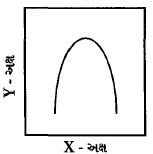
The curve given below shows enzymatic activity in relation to three conditions ($pH$,temperature and substrate concentration). What do the two axes ($x$ and $y$) represent?
A
$x$-axis: enzymatic activity,$y$-axis: $pH$
B
$x$-axis: temperature,$y$-axis: enzyme activity
C
$x$-axis: substrate concentration,$y$-axis: enzymatic activity
D
$x$-axis: enzymatic activity,$y$-axis: temperature
Solution
(B) The correct answer is $B$.
Enzymes generally function within a narrow range of temperature and $pH$.
Each enzyme exhibits its maximum activity at a specific temperature and $pH$,known as the optimum temperature and optimum $pH$,respectively.
Enzymatic activity declines both below and above these optimum values.
In such graphical representations,the $x$-axis typically represents the independent variable (such as temperature or $pH$),while the $y$-axis represents the dependent variable (enzyme activity).
Enzymes generally function within a narrow range of temperature and $pH$.
Each enzyme exhibits its maximum activity at a specific temperature and $pH$,known as the optimum temperature and optimum $pH$,respectively.
Enzymatic activity declines both below and above these optimum values.
In such graphical representations,the $x$-axis typically represents the independent variable (such as temperature or $pH$),while the $y$-axis represents the dependent variable (enzyme activity).
0 likes
View Solution30
MediumMCQ
$A$ - Activity of an enzyme can be affected by a change in environmental conditions.
$R$ - These factors regulate the activity of the enzyme.
$R$ - These factors regulate the activity of the enzyme.
A
$A$ and $R$ are both true.
B
$A$ and $R$ are both false.
C
$A$ is true and $R$ is false.
D
$A$ is false and $R$ is true.
Solution
(A) Assertion $(A)$ is true because enzyme activity is highly sensitive to environmental factors such as temperature,$pH$,substrate concentration,and the presence of inhibitors.
Reason $(R)$ is true because these specific environmental factors directly influence the conformational structure of the enzyme,thereby regulating its catalytic activity.
Since $R$ correctly explains why $A$ occurs,both statements are true.
Reason $(R)$ is true because these specific environmental factors directly influence the conformational structure of the enzyme,thereby regulating its catalytic activity.
Since $R$ correctly explains why $A$ occurs,both statements are true.
0 likes
View Solution31
MediumMCQ
Delete the odd one out among the factors affecting enzyme activity.
A
Temperature
B
$pH$
C
Concentration of substrate
D
Water
Solution
(D) The activity of an enzyme is sensitive to various physical and chemical factors.
$1$. $Temperature$: Enzymes show highest activity at an optimum temperature.
$2$. $pH$: Enzymes show highest activity at an optimum $pH$.
$3$. $Concentration of substrate$: The velocity of enzymatic reaction increases with an increase in substrate concentration up to a saturation point.
$4$. $Water$: While water is essential for life, it is not considered a direct regulatory factor for enzyme activity in the same manner as temperature, $pH$, or substrate concentration.
Therefore, $Water$ is the odd one out.
$1$. $Temperature$: Enzymes show highest activity at an optimum temperature.
$2$. $pH$: Enzymes show highest activity at an optimum $pH$.
$3$. $Concentration of substrate$: The velocity of enzymatic reaction increases with an increase in substrate concentration up to a saturation point.
$4$. $Water$: While water is essential for life, it is not considered a direct regulatory factor for enzyme activity in the same manner as temperature, $pH$, or substrate concentration.
Therefore, $Water$ is the odd one out.
0 likes
View Solution32
MediumMCQ
The activity of an enzyme is sensitive to the presence of specific chemicals,which is called:
A
Apoenzyme
B
Co-enzyme
C
Prosthetic group
D
Inhibitor
Solution
(D) The activity of an enzyme is sensitive to the presence of specific chemicals that bind to the enzyme and decrease its rate of reaction. These chemicals are known as inhibitors. When the inhibitor closely resembles the substrate in its molecular structure and inhibits the activity of the enzyme,it is known as competitive inhibition. Therefore,the correct answer is $D$.
0 likes
View Solution33
MediumMCQ
The given graphical representation relates to enzyme activity under three conditions ($pH$,temperature,and substrate concentration). What do the given axes $X$ and $Y$ represent?
$X$-axis $-$ $Y$-axis
$X$-axis $-$ $Y$-axis
A
Enzyme activity $-$ $pH$
B
Temperature $-$ Enzyme activity
C
Substrate concentration $-$ Enzyme activity
D
Enzyme activity $-$ Temperature
Solution
(A) The graph shows a bell-shaped curve,which is characteristic of the effect of $pH$ or temperature on enzyme activity.
Enzyme activity increases with an increase in $pH$ or temperature up to an optimum point and then decreases as the enzyme gets denatured.
In contrast,the effect of substrate concentration on enzyme activity typically shows a hyperbolic curve,where activity increases and then plateaus (reaches $V_{max}$).
Looking at the options,both $A$ and $D$ represent bell-shaped curves (Enzyme activity vs $pH$ or Temperature).
However,in standard textbook representations,$pH$ is often plotted on the $X$-axis and enzyme activity on the $Y$-axis for this specific bell-shaped curve pattern.
Therefore,$X$-axis represents $pH$ and $Y$-axis represents enzyme activity.
Enzyme activity increases with an increase in $pH$ or temperature up to an optimum point and then decreases as the enzyme gets denatured.
In contrast,the effect of substrate concentration on enzyme activity typically shows a hyperbolic curve,where activity increases and then plateaus (reaches $V_{max}$).
Looking at the options,both $A$ and $D$ represent bell-shaped curves (Enzyme activity vs $pH$ or Temperature).
However,in standard textbook representations,$pH$ is often plotted on the $X$-axis and enzyme activity on the $Y$-axis for this specific bell-shaped curve pattern.
Therefore,$X$-axis represents $pH$ and $Y$-axis represents enzyme activity.
0 likes
View Solution34
MediumMCQ
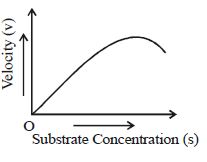
The given graph shows the effect of substrate concentration on the rate of reaction of the enzyme green-gram-phosphatase. What does the graph indicate?
A
The rate of enzyme reaction is directly proportional to the substrate concentration.
B
Presence of an enzyme inhibitor in the reaction mixture.
C
Formation of an enzyme-substrate complex.
D
At higher substrate-concentration the $pH$ increases.
Solution
(B) In a typical enzyme-catalyzed reaction,the velocity increases with substrate concentration until it reaches a maximum $(V_{max})$ and then plateaus.
However,the provided graph shows that after reaching a certain point,the reaction velocity decreases as the substrate concentration increases.
This decline in reaction rate at higher substrate concentrations is a characteristic indicator of the presence of an enzyme inhibitor in the reaction mixture,which interferes with the enzyme's activity.
However,the provided graph shows that after reaching a certain point,the reaction velocity decreases as the substrate concentration increases.
This decline in reaction rate at higher substrate concentrations is a characteristic indicator of the presence of an enzyme inhibitor in the reaction mixture,which interferes with the enzyme's activity.
0 likes
View Solution35
Easy
Discuss the factors affecting enzyme activities.
Solution
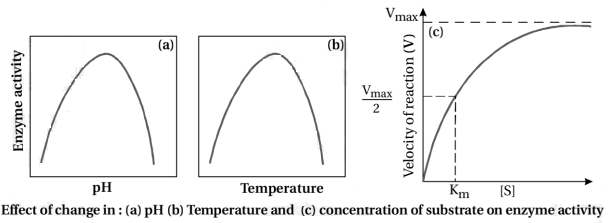
(N/A) The factors affecting enzyme activity include temperature,$pH$,changes in substrate concentration,or the binding of specific chemicals that regulate activity.
$(1)$ Temperature and $pH$: Each enzyme shows its highest activity at a particular temperature and $pH$,known as the optimum temperature and optimum $pH$.
Activity declines both below and above these optimum values.
Low temperature preserves the enzyme in a temporarily inactive state,whereas high temperature destroys enzymatic activity because proteins are denatured by heat.
$(2)$ Concentration of substrate: With an increase in substrate concentration,the velocity of the enzymatic reaction rises at first. The reaction ultimately reaches a maximum velocity $(V_{\max})$ which is not exceeded by any further rise in substrate concentration. This occurs because the enzyme molecules are fewer than the substrate molecules,and after saturation,there are no free enzyme molecules to bind with additional substrate molecules.
$(3)$ Specific chemicals: The activity of an enzyme is also sensitive to the presence of specific chemicals that bind to the enzyme.
When the binding of a chemical shuts off enzyme activity,the process is called inhibition,and the chemical is called an inhibitor.
When the inhibitor closely resembles the substrate in its molecular structure,it is known as a competitive inhibitor. Due to structural similarity,the inhibitor competes with the substrate for the substrate-binding site of the enzyme. As a result,the substrate cannot bind,and enzyme action declines. For example,the inhibition of succinic dehydrogenase by malonate,which closely resembles the succinate structure. Such competitive inhibitors are often used in the control of bacterial pathogens.
$(1)$ Temperature and $pH$: Each enzyme shows its highest activity at a particular temperature and $pH$,known as the optimum temperature and optimum $pH$.
Activity declines both below and above these optimum values.
Low temperature preserves the enzyme in a temporarily inactive state,whereas high temperature destroys enzymatic activity because proteins are denatured by heat.
$(2)$ Concentration of substrate: With an increase in substrate concentration,the velocity of the enzymatic reaction rises at first. The reaction ultimately reaches a maximum velocity $(V_{\max})$ which is not exceeded by any further rise in substrate concentration. This occurs because the enzyme molecules are fewer than the substrate molecules,and after saturation,there are no free enzyme molecules to bind with additional substrate molecules.
$(3)$ Specific chemicals: The activity of an enzyme is also sensitive to the presence of specific chemicals that bind to the enzyme.
When the binding of a chemical shuts off enzyme activity,the process is called inhibition,and the chemical is called an inhibitor.
When the inhibitor closely resembles the substrate in its molecular structure,it is known as a competitive inhibitor. Due to structural similarity,the inhibitor competes with the substrate for the substrate-binding site of the enzyme. As a result,the substrate cannot bind,and enzyme action declines. For example,the inhibition of succinic dehydrogenase by malonate,which closely resembles the succinate structure. Such competitive inhibitors are often used in the control of bacterial pathogens.
0 likes
View Solution36
Easy
How is the naming of enzymes done? Describe the types of enzymes with examples.
Solution
(A) $\rightarrow$ Thousands of enzymes have been discovered,isolated,and studied.
$\rightarrow$ Most of these enzymes have been classified into different groups based on the type of reactions they catalyse.
$\rightarrow$ Enzymes are divided into $6$ classes,each with $4-13$ subclasses,and named accordingly by a four-digit number.
$(1)$ Oxidoreductases/dehydrogenases: Enzymes which catalyse oxidoreduction between two substrates $S$ and $S'$ e.g.,$S$ reduced $+ S'$ oxidised $\longrightarrow S$ oxidised $+ S'$ reduced.
$(2)$ Transferases: Enzymes catalysing a transfer of a group $G$ (other than hydrogen) between a pair of substrate $S$ and $S'$ e.g.,$S-G + S' \longrightarrow S + S'-G$.
$(3)$ Hydrolases: Enzymes catalysing the hydrolysis of ester,ether,peptide,glycosidic,$C-C$,$C$-halide,or $P-N$ bonds.
$(4)$ Lyases: Enzymes that catalyse the removal of groups from substrates by mechanisms other than hydrolysis,leaving double bonds,e.g.,$X-Y$ removal from $C-C$ to form $C=C$.
$(5)$ Isomerases: Includes all enzymes catalysing the inter-conversion of optical,geometric,or positional isomers.
$(6)$ Ligases: Enzymes catalysing the linking together of $2$ compounds,e.g.,enzymes which catalyse the joining of $C-O, C-S, C-N, P-O$ etc. bonds.
$\rightarrow$ Most of these enzymes have been classified into different groups based on the type of reactions they catalyse.
$\rightarrow$ Enzymes are divided into $6$ classes,each with $4-13$ subclasses,and named accordingly by a four-digit number.
$(1)$ Oxidoreductases/dehydrogenases: Enzymes which catalyse oxidoreduction between two substrates $S$ and $S'$ e.g.,$S$ reduced $+ S'$ oxidised $\longrightarrow S$ oxidised $+ S'$ reduced.
$(2)$ Transferases: Enzymes catalysing a transfer of a group $G$ (other than hydrogen) between a pair of substrate $S$ and $S'$ e.g.,$S-G + S' \longrightarrow S + S'-G$.
$(3)$ Hydrolases: Enzymes catalysing the hydrolysis of ester,ether,peptide,glycosidic,$C-C$,$C$-halide,or $P-N$ bonds.
$(4)$ Lyases: Enzymes that catalyse the removal of groups from substrates by mechanisms other than hydrolysis,leaving double bonds,e.g.,$X-Y$ removal from $C-C$ to form $C=C$.
$(5)$ Isomerases: Includes all enzymes catalysing the inter-conversion of optical,geometric,or positional isomers.
$(6)$ Ligases: Enzymes catalysing the linking together of $2$ compounds,e.g.,enzymes which catalyse the joining of $C-O, C-S, C-N, P-O$ etc. bonds.
0 likes
View Solution37
EasyMCQ
What is the effect of temperature and pH on the activity of an enzyme?
A
Enzymes are unaffected by temperature and pH.
B
Enzymes show maximum activity at an optimum temperature and pH.
C
High temperature increases enzyme activity indefinitely.
D
Low temperature permanently destroys enzyme activity.
Solution
(B) $\rightarrow$ Each enzyme shows its highest activity at a particular temperature and $pH$,which are called the optimum temperature and optimum $pH$.
$\rightarrow$ Enzyme activity declines both below and above these optimum values.
$\rightarrow$ Low temperature preserves the enzyme in a temporarily inactive state,whereas high temperature destroys enzymatic activity because proteins are denatured by heat.
$\rightarrow$ Enzyme activity declines both below and above these optimum values.
$\rightarrow$ Low temperature preserves the enzyme in a temporarily inactive state,whereas high temperature destroys enzymatic activity because proteins are denatured by heat.
0 likes
View Solution38
Easy
What is the effect of substrate concentration on the rate of reaction?
Solution
(N/A) The effect of substrate concentration on the rate of reaction is as follows:
$1$. Initially,as the substrate concentration increases,the velocity of the enzymatic reaction increases.
$2$. The reaction eventually reaches a maximum velocity,denoted as $V_{\max}$.
$3$. Beyond this point,any further increase in substrate concentration does not increase the reaction rate.
$4$. This occurs because,at high concentrations,all available enzyme active sites are occupied by substrate molecules,leading to saturation. There are no free enzyme molecules left to bind with additional substrate molecules.
$1$. Initially,as the substrate concentration increases,the velocity of the enzymatic reaction increases.
$2$. The reaction eventually reaches a maximum velocity,denoted as $V_{\max}$.
$3$. Beyond this point,any further increase in substrate concentration does not increase the reaction rate.
$4$. This occurs because,at high concentrations,all available enzyme active sites are occupied by substrate molecules,leading to saturation. There are no free enzyme molecules left to bind with additional substrate molecules.
0 likes
View Solution39
Easy
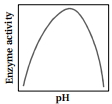
Enzymes are proteins. Proteins are long chains of amino acids linked to each other by peptide bonds. Amino acids have many functional groups in their structure. Many of these functional groups are ionisable. As they are weak acids and bases in chemical nature,this ionisation is influenced by the $pH$ of the solution. For many enzymes,activity is influenced by the surrounding $pH$. This is depicted in the curve below. Explain briefly.
Solution
(N/A) The curve shows that enzyme activity is dependent on the $pH$ of the surrounding medium.
$1$. Enzymes exhibit maximum activity at a specific $pH$ value,known as the optimum $pH$.
$2$. As the $pH$ moves away from this optimum value (either towards more acidic or more basic conditions),the ionisation state of the amino acid residues in the enzyme's active site changes.
$3$. This alteration in the ionisation state affects the enzyme's tertiary structure and the binding of the substrate to the active site,leading to a decrease in catalytic activity.
$4$. Extreme $pH$ values can cause denaturation of the enzyme,resulting in a complete loss of activity.
$1$. Enzymes exhibit maximum activity at a specific $pH$ value,known as the optimum $pH$.
$2$. As the $pH$ moves away from this optimum value (either towards more acidic or more basic conditions),the ionisation state of the amino acid residues in the enzyme's active site changes.
$3$. This alteration in the ionisation state affects the enzyme's tertiary structure and the binding of the substrate to the active site,leading to a decrease in catalytic activity.
$4$. Extreme $pH$ values can cause denaturation of the enzyme,resulting in a complete loss of activity.
0 likes
View Solution40
Medium
What are the different classes of enzymes? Explain any two with the type of reactions they catalyse.
Solution
(N/A) $\Rightarrow$ Thousands of enzymes have been discovered, isolated, and studied.
$\Rightarrow$ Most of these enzymes have been classified into $6$ different groups based on the type of reactions they catalyse.
$\Rightarrow$ Enzymes are divided into $6$ classes, each with $4-13$ subclasses, and named accordingly by a four-digit number.
$(1)$ Oxidoreductases/dehydrogenases: Enzymes which catalyse oxidoreduction between two substrates $S$ and $S'$ e.g., $S \text{ reduced} + S' \text{ oxidised} \longrightarrow S \text{ oxidised} + S' \text{ reduced}$.
$(2)$ Transferases: Enzymes catalysing a transfer of a group, $G$ (other than hydrogen), between a pair of substrates $S$ and $S'$ e.g., $S-G + S' \longrightarrow S + S'-G$.
$(3)$ Hydrolases: Enzymes catalysing the hydrolysis of ester, ether, peptide, glycosidic, $C-C$, $C$-halide, or $P-N$ bonds.
$(4)$ Lyases: Enzymes that catalyse the removal of groups from substrates by mechanisms other than hydrolysis, leaving double bonds.
$(5)$ Isomerases: Includes all enzymes catalysing the inter-conversion of optical, geometric, or positional isomers.
$(6)$ Ligases: Enzymes catalysing the linking together of $2$ compounds, e.g., enzymes which catalyse the joining of $C-O$, $C-S$, $C-N$, $P-O$ etc. bonds.
$\Rightarrow$ Most of these enzymes have been classified into $6$ different groups based on the type of reactions they catalyse.
$\Rightarrow$ Enzymes are divided into $6$ classes, each with $4-13$ subclasses, and named accordingly by a four-digit number.
$(1)$ Oxidoreductases/dehydrogenases: Enzymes which catalyse oxidoreduction between two substrates $S$ and $S'$ e.g., $S \text{ reduced} + S' \text{ oxidised} \longrightarrow S \text{ oxidised} + S' \text{ reduced}$.
$(2)$ Transferases: Enzymes catalysing a transfer of a group, $G$ (other than hydrogen), between a pair of substrates $S$ and $S'$ e.g., $S-G + S' \longrightarrow S + S'-G$.
$(3)$ Hydrolases: Enzymes catalysing the hydrolysis of ester, ether, peptide, glycosidic, $C-C$, $C$-halide, or $P-N$ bonds.
$(4)$ Lyases: Enzymes that catalyse the removal of groups from substrates by mechanisms other than hydrolysis, leaving double bonds.
$(5)$ Isomerases: Includes all enzymes catalysing the inter-conversion of optical, geometric, or positional isomers.
$(6)$ Ligases: Enzymes catalysing the linking together of $2$ compounds, e.g., enzymes which catalyse the joining of $C-O$, $C-S$, $C-N$, $P-O$ etc. bonds.
0 likes
View Solution41
MediumMCQ
Read the following statements:
$(a)$ Low temperature preserves the enzyme.
$(b)$ Enzyme activity increases above optimum temperature.
$(c)$ Enzyme gets denatured at high temperature.
$(d)$ Competitive inhibitor competes with the product formed.
Which of the following statements are true?
$(a)$ Low temperature preserves the enzyme.
$(b)$ Enzyme activity increases above optimum temperature.
$(c)$ Enzyme gets denatured at high temperature.
$(d)$ Competitive inhibitor competes with the product formed.
Which of the following statements are true?
A
$(a)$ and $(c)$
B
$(b)$ and $(d)$
C
$(c)$ and $(d)$
D
$(a)$ and $(b)$
Solution
(A) Statement is true: Low temperature temporarily inactivates enzymes but preserves them.
$(b)$ Statement is false: Enzyme activity decreases above the optimum temperature due to denaturation.
$(c)$ Statement is true: High temperatures break the hydrogen bonds and other interactions,causing the enzyme to denature.
$(d)$ Statement is false: Competitive inhibitors compete with the substrate for the active site of the enzyme,not with the product formed.
Therefore,statements $(a)$ and $(c)$ are true.
$(b)$ Statement is false: Enzyme activity decreases above the optimum temperature due to denaturation.
$(c)$ Statement is true: High temperatures break the hydrogen bonds and other interactions,causing the enzyme to denature.
$(d)$ Statement is false: Competitive inhibitors compete with the substrate for the active site of the enzyme,not with the product formed.
Therefore,statements $(a)$ and $(c)$ are true.
0 likes
View Solution42
MediumMCQ
According to the generally accepted rule,the rate of reaction doubles or halves for every $.........^{\circ}C$ change in temperature.
A
$5$
B
$10$
C
$15$
D
$20$
Solution
(B) Enzymes are proteins that act as biological catalysts. The activity of enzymes is highly sensitive to temperature. According to the general rule of thumb in biochemistry,the rate of an enzymatic reaction increases by a factor of $2$ (doubles) or decreases by a factor of $0.5$ (halves) for every $10^{\circ}C$ change in temperature. This is often referred to as the $Q_{10}$ temperature coefficient.
0 likes
View Solution43
MediumMCQ
Select the incorrect statement regarding the given graph.
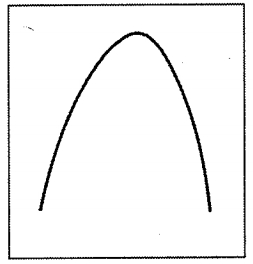
A
$X$-axis: $pH$,$Y$-axis: Enzyme activity
B
$X$-axis: Substrate concentration,$Y$-axis: Velocity of reaction
C
$X$-axis: Temperature,$Y$-axis: Enzyme activity
D
All of the above
Solution
(B) The provided graph shows a bell-shaped curve,which is characteristic of the effect of $pH$ and temperature on enzyme activity.
$1$. Enzyme activity increases with an increase in $pH$ or temperature up to an optimum value and then decreases as the enzyme gets denatured.
$2$. However,the effect of substrate concentration on the velocity of an enzymatic reaction follows a hyperbolic curve (Michaelis-Menten kinetics),not a bell-shaped curve.
$3$. Therefore,the statement in option $B$ is incorrect as it does not represent the given bell-shaped graph.
$1$. Enzyme activity increases with an increase in $pH$ or temperature up to an optimum value and then decreases as the enzyme gets denatured.
$2$. However,the effect of substrate concentration on the velocity of an enzymatic reaction follows a hyperbolic curve (Michaelis-Menten kinetics),not a bell-shaped curve.
$3$. Therefore,the statement in option $B$ is incorrect as it does not represent the given bell-shaped graph.
0 likes
View Solution44
MediumMCQ
Which of the following processes are affected by temperature?
A
Enzyme kinetics
B
Metabolism
C
Physiological functions
D
All of the above
Solution
(D) Temperature is a critical abiotic factor that significantly influences biological systems.
$1$. Enzyme kinetics: Enzymes are proteins that act as biological catalysts. Their activity is highly temperature-dependent,as extreme temperatures can denature the protein structure,rendering them inactive.
$2$. Metabolism: Since metabolic pathways are governed by enzyme-catalyzed reactions,temperature directly affects the rate of metabolism in organisms.
$3$. Physiological functions: Various physiological processes such as respiration,digestion,and reproduction are influenced by the ambient temperature of the environment.
Therefore,all the listed processes are affected by temperature.
$1$. Enzyme kinetics: Enzymes are proteins that act as biological catalysts. Their activity is highly temperature-dependent,as extreme temperatures can denature the protein structure,rendering them inactive.
$2$. Metabolism: Since metabolic pathways are governed by enzyme-catalyzed reactions,temperature directly affects the rate of metabolism in organisms.
$3$. Physiological functions: Various physiological processes such as respiration,digestion,and reproduction are influenced by the ambient temperature of the environment.
Therefore,all the listed processes are affected by temperature.
0 likes
View Solution45
EasyMCQ
In homeotherms,the enzymatic reaction occurs best at . . . . . . °$C$.
A
$25$
B
$27$
C
$35$
D
$37$
Solution
(D) Homeotherms are organisms that maintain a stable internal body temperature regardless of the external environment. In humans and most other homeotherms,the optimal temperature for enzymatic reactions is approximately $37$ °$C$. This temperature ensures that enzymes maintain their proper tertiary structure and catalytic efficiency for metabolic processes.
0 likes
View Solution46
EasyMCQ
Most of the enzymes work at an optimum temperature between . . . . . . .
A
$60^{\circ}C$ and $70^{\circ}C$
B
$20^{\circ}C$ and $35^{\circ}C$
C
$40^{\circ}C$ and $50^{\circ}C$
D
$35^{\circ}C$ and $45^{\circ}C$
Solution
(D) Enzymes are biocatalysts that are highly sensitive to temperature.
Most enzymes in the human body and many other organisms function optimally within a specific temperature range,typically between $35^{\circ}C$ and $45^{\circ}C$.
At temperatures below this range,enzyme activity is low due to reduced kinetic energy.
At temperatures significantly above this range,the protein structure of the enzyme undergoes denaturation,leading to a loss of catalytic activity.
Therefore,the correct range for optimum enzyme activity is $35^{\circ}C$ to $45^{\circ}C$.
Most enzymes in the human body and many other organisms function optimally within a specific temperature range,typically between $35^{\circ}C$ and $45^{\circ}C$.
At temperatures below this range,enzyme activity is low due to reduced kinetic energy.
At temperatures significantly above this range,the protein structure of the enzyme undergoes denaturation,leading to a loss of catalytic activity.
Therefore,the correct range for optimum enzyme activity is $35^{\circ}C$ to $45^{\circ}C$.
0 likes
View Solution47
EasyMCQ
The rate of enzyme reactions rises with the increase in substrate concentration. But it does $NOT$ increase beyond a certain concentration because . . . . . . .
A
The enzymes undergo denaturation.
B
Free enzyme molecules to bind with substrate are not available.
C
The substrate molecules are available.
D
The reaction has to maintain a minimum velocity
Solution
(B) The rate of an enzymatic reaction increases with an increase in substrate concentration because more enzyme active sites are occupied by substrate molecules.
However,once all the active sites of the enzyme molecules are saturated with substrate molecules,the reaction rate reaches its maximum velocity $(V_{max})$.
Beyond this point,adding more substrate does not increase the reaction rate because there are no free enzyme molecules available to bind with the additional substrate molecules.
Therefore,the correct reason is that free enzyme molecules to bind with substrate are not available.
However,once all the active sites of the enzyme molecules are saturated with substrate molecules,the reaction rate reaches its maximum velocity $(V_{max})$.
Beyond this point,adding more substrate does not increase the reaction rate because there are no free enzyme molecules available to bind with the additional substrate molecules.
Therefore,the correct reason is that free enzyme molecules to bind with substrate are not available.
0 likes
View Solution48
EasyMCQ
What is the role of a competitive inhibitor during enzyme action?
A
It enhances enzyme action.
B
It declines the enzyme action.
C
It alters the active site of the enzyme and prevents the binding of substrate.
D
It inhibits the breaking of chemical bonds of the substrate.
Solution
(B) It declines the enzyme action.
When the inhibitor closely resembles the substrate in its molecular structure and inhibits the activity of the enzyme,it is known as a competitive inhibitor.
Because the inhibitor competes with the substrate for the active site,the substrate cannot bind effectively.
As a result,the overall rate of enzyme action declines.
An example is the inhibition of succinic dehydrogenase by malonate,which closely resembles the substrate succinate in structure.
When the inhibitor closely resembles the substrate in its molecular structure and inhibits the activity of the enzyme,it is known as a competitive inhibitor.
Because the inhibitor competes with the substrate for the active site,the substrate cannot bind effectively.
As a result,the overall rate of enzyme action declines.
An example is the inhibition of succinic dehydrogenase by malonate,which closely resembles the substrate succinate in structure.
0 likes
View SolutionBiomolecules — Classification and factors affecting enzyme · Frequently Asked Questions
1Are these Biomolecules questions useful for JEE and NEET?
Yes. All questions in this section are mapped to JEE Main and NEET exam patterns. Previous year questions from JEE Main, NEET, GUJCET and state-level exams are included with full solutions.
2Can I switch to Hindi or Gujarati for these questions?
Yes. Use the language tabs in the hero section or the sidebar to view the same questions and solutions in English, Hindi or Gujarati.
3How do I generate a question paper from this subtopic?
Use the Vedclass Exam Paper Generator — select the chapter and subtopic, set difficulty, and generate Sets A, B, C, D automatically. First 3 chapters of every subject are free.
Vedclass Products
For Students
Vedclass Test Series
Mock tests in real JEE/NEET style with performance analysis. 5-day free trial.
Start Free TrialFor Teachers
Exam Paper Generator
Generate Set A/B/C/D papers from this chapter in 2 minutes. 3 chapters free.
Try FreeFor Institutes
Online Exam Module
Live online exams with unlimited students, 360° analytics & white-label branding.
See DemoFor Teachers & Institutes
Generate a Biomolecules Exam Paper in 2 Minutes
Select subtopic & difficulty — Sets A, B, C, D auto-generated with No Repeat logic.
First 3 chapters of every subject are free — no payment required.