
A English
Carbohydrates Questions in English
Class 11 Biology · Biomolecules · Carbohydrates
423+
Questions
English
Language
100%
With Solutions
Showing 50 of 423 questions in English
251
MediumMCQ
Statement $P$ : Disaccharides can undergo hydrolysis by boiling with dilute acids or by reacting with appropriate enzymes.
Statement $Q$ : The result of hydrolysis is the release of their constituent monosaccharide units.
Statement $Q$ : The result of hydrolysis is the release of their constituent monosaccharide units.
A
Both statement $P$ and $Q$ are incorrect.
B
Both statement $P$ and $Q$ are correct.
C
Statement $P$ is correct and statement $Q$ is incorrect.
D
Statement $P$ is incorrect and statement $Q$ is correct.
Solution
(B) Disaccharides are carbohydrates that yield two molecules of monosaccharides upon hydrolysis.
This process can be catalyzed by dilute acids or specific enzymes (e.g.,sucrase,maltase).
Therefore,statement $P$ is correct.
Upon hydrolysis,the glycosidic bond linking the two monosaccharide units is broken,releasing the constituent monosaccharides.
Therefore,statement $Q$ is also correct.
This process can be catalyzed by dilute acids or specific enzymes (e.g.,sucrase,maltase).
Therefore,statement $P$ is correct.
Upon hydrolysis,the glycosidic bond linking the two monosaccharide units is broken,releasing the constituent monosaccharides.
Therefore,statement $Q$ is also correct.
0 likes
View Solution252
MediumMCQ
Statement $P$: The general formula of carbohydrates is $C_n(H_2O)_n$ or $C_n(H_2O)_m$.
Statement $Q$: In the structure of monosaccharides,the values of $n$ and $m$ are equal.
Statement $Q$: In the structure of monosaccharides,the values of $n$ and $m$ are equal.
A
Statement $P$ and $Q$ are both true and Statement $Q$ is the correct explanation of Statement $P$.
B
Statement $P$ and $Q$ are both true,but Statement $Q$ is not the correct explanation of Statement $P$.
C
Statement $P$ and $Q$ are both false.
D
Statement $P$ is true and Statement $Q$ is false.
Solution
(A) Statement $P$ is true because the general formula for carbohydrates is indeed represented as $C_n(H_2O)_n$ or $C_n(H_2O)_m$,where $n$ and $m$ are integers.
Statement $Q$ is true because for monosaccharides (simple sugars),the ratio of hydrogen to oxygen atoms is $2:1$,which is the same as in water. Thus,for monosaccharides,the formula simplifies to $C_n(H_2O)_n$,meaning $n = m$.
Since both statements are correct and the equality of $n$ and $m$ explains why the general formula can be written as $C_n(H_2O)_n$,Statement $Q$ is the correct explanation for Statement $P$.
Statement $Q$ is true because for monosaccharides (simple sugars),the ratio of hydrogen to oxygen atoms is $2:1$,which is the same as in water. Thus,for monosaccharides,the formula simplifies to $C_n(H_2O)_n$,meaning $n = m$.
Since both statements are correct and the equality of $n$ and $m$ explains why the general formula can be written as $C_n(H_2O)_n$,Statement $Q$ is the correct explanation for Statement $P$.
0 likes
View Solution253
EasyMCQ
Statement $X$: Starch is the stored food in plants.
Statement $Y$: Glucose is the stored food in animals.
Statement $Y$: Glucose is the stored food in animals.
A
Both Statement $X$ and $Y$ are incorrect.
B
Statement $X$ is correct and Statement $Y$ is incorrect.
C
Both Statement $X$ and $Y$ are correct.
D
Statement $Y$ is correct and Statement $X$ is incorrect.
Solution
(B) Statement $X$ is correct because starch is the primary storage polysaccharide in plants.
Statement $Y$ is incorrect because glucose is not the stored food in animals; instead,animals store food in the form of glycogen.
Therefore,Statement $X$ is correct and Statement $Y$ is incorrect.
Statement $Y$ is incorrect because glucose is not the stored food in animals; instead,animals store food in the form of glycogen.
Therefore,Statement $X$ is correct and Statement $Y$ is incorrect.
0 likes
View Solution254
MediumMCQ
Which organic biomolecule is represented by the structural formula shown in the given figure?

A
Starch
B
Cellulose
C
Suberin
D
Glycogen
Solution
(B) The structural formula shows a linear chain of glucose units linked by $\beta-1,4$-glycosidic bonds.
In this structure,every alternate glucose unit is inverted (rotated by $180^{\circ}$),which is a characteristic feature of cellulose.
Starch and glycogen consist of $\alpha$-glucose units with $\alpha-1,4$ and $\alpha-1,6$ linkages,whereas cellulose is a polymer of $\beta$-glucose.
Therefore,the given structure represents cellulose.
In this structure,every alternate glucose unit is inverted (rotated by $180^{\circ}$),which is a characteristic feature of cellulose.
Starch and glycogen consist of $\alpha$-glucose units with $\alpha-1,4$ and $\alpha-1,6$ linkages,whereas cellulose is a polymer of $\beta$-glucose.
Therefore,the given structure represents cellulose.
0 likes
View Solution255
MediumMCQ
What type of glycosidic bond is observed in the structural formula shown in the given figure?

A
$\beta\ 1-4$
B
$\alpha\ 1-5$
C
$\beta\ 1-6$
D
$\alpha\ 1-6$
Solution
(A) The provided figure represents a chain of glucose units linked together.
By observing the linkage between the carbon atoms of adjacent glucose rings,we can see that the bond connects the $C-1$ position of one glucose unit to the $C-4$ position of the next glucose unit.
The orientation of the $-OH$ group at the $C-1$ position is in the $\beta$ configuration (pointing upwards relative to the ring plane).
Therefore,the linkage is a $\beta\ 1-4$ glycosidic bond,which is characteristic of cellulose.
By observing the linkage between the carbon atoms of adjacent glucose rings,we can see that the bond connects the $C-1$ position of one glucose unit to the $C-4$ position of the next glucose unit.
The orientation of the $-OH$ group at the $C-1$ position is in the $\beta$ configuration (pointing upwards relative to the ring plane).
Therefore,the linkage is a $\beta\ 1-4$ glycosidic bond,which is characteristic of cellulose.
0 likes
View Solution256
MediumMCQ
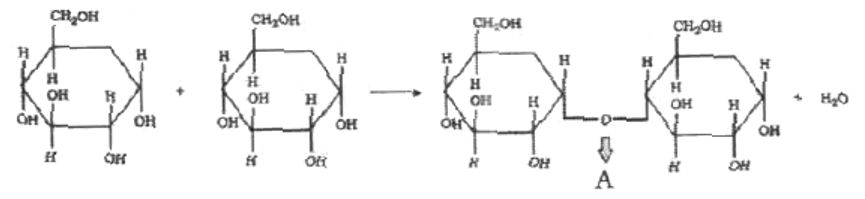
Which biological molecule is represented by the given structural formula?
A
Lactose
B
Sucrose
C
Maltose
D
Starch
Solution
(C) The given structural formula shows the condensation reaction between two glucose molecules to form a disaccharide.
Specifically, it depicts the formation of maltose from two $\alpha$-$D$-glucose units.
The bond labeled '$A$' is an $\alpha$-$1,4$-glycosidic bond.
Lactose is formed from glucose and galactose, while sucrose is formed from glucose and fructose.
Starch is a polysaccharide, not a disaccharide.
Specifically, it depicts the formation of maltose from two $\alpha$-$D$-glucose units.
The bond labeled '$A$' is an $\alpha$-$1,4$-glycosidic bond.
Lactose is formed from glucose and galactose, while sucrose is formed from glucose and fructose.
Starch is a polysaccharide, not a disaccharide.
0 likes
View Solution257
MediumMCQ
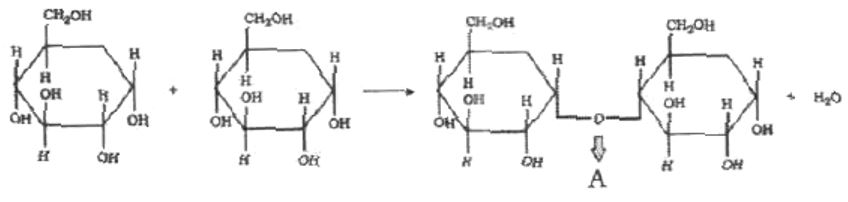
In the given structural formula,what does $A$ indicate?
A
Peptide bond
B
Glycosidic bond
C
Covalent bond
D
Ionic bond
Solution
(B) The provided image shows the condensation reaction between two monosaccharide units (glucose molecules) to form a disaccharide.
In this reaction,a water molecule $(H_2O)$ is released,and the two sugar units are linked together by an oxygen atom.
This specific linkage between two monosaccharide units is known as a glycosidic bond.
Therefore,$A$ indicates a glycosidic bond.
In this reaction,a water molecule $(H_2O)$ is released,and the two sugar units are linked together by an oxygen atom.
This specific linkage between two monosaccharide units is known as a glycosidic bond.
Therefore,$A$ indicates a glycosidic bond.
0 likes
View Solution258
MediumMCQ
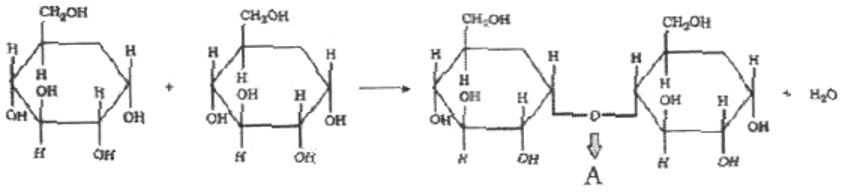
In the given structural formula,what does $A$ indicate?
A
$\alpha\ 1-6$
B
$\alpha\ 1-5$
C
$\alpha\ 1-4$
D
$\beta\ 1-5$
Solution
(C) The reaction shows the condensation of two glucose molecules to form a disaccharide (maltose).
In the first glucose molecule,the hydroxyl group $(-OH)$ is at the $C-1$ position,and in the second glucose molecule,the hydroxyl group is at the $C-4$ position.
The bond formed between the $C-1$ of the first glucose and the $C-4$ of the second glucose is known as an $\alpha\ 1-4$ glycosidic bond.
Therefore,$A$ indicates an $\alpha\ 1-4$ glycosidic linkage.
In the first glucose molecule,the hydroxyl group $(-OH)$ is at the $C-1$ position,and in the second glucose molecule,the hydroxyl group is at the $C-4$ position.
The bond formed between the $C-1$ of the first glucose and the $C-4$ of the second glucose is known as an $\alpha\ 1-4$ glycosidic bond.
Therefore,$A$ indicates an $\alpha\ 1-4$ glycosidic linkage.
0 likes
View Solution259
MediumMCQ
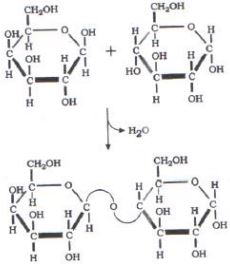
Identify the biological molecule formed in the given structural reaction.
A
Sucrose
B
Maltose
C
Lactose
D
Galactose
Solution
(B) The reaction shows the condensation of two glucose molecules to form a disaccharide.
Specifically,it depicts the formation of a glycosidic bond between two $\alpha$-$D$-glucose units.
The condensation of two glucose molecules results in the formation of maltose and the release of one water molecule $(H_2O)$.
Therefore,the product formed is maltose.
Specifically,it depicts the formation of a glycosidic bond between two $\alpha$-$D$-glucose units.
The condensation of two glucose molecules results in the formation of maltose and the release of one water molecule $(H_2O)$.
Therefore,the product formed is maltose.
0 likes
View Solution260
MediumMCQ
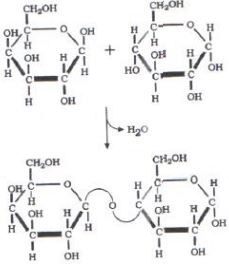
Which hexose sugars are involved in the given structural formula?
A
Ribose
B
Glucose
C
Galactose
D
Both $(B)$ and $(C)$
Solution
(D) The given structural formula represents the formation of lactose.
Lactose is a disaccharide formed by the condensation reaction between one molecule of glucose and one molecule of galactose.
In the reaction,a water molecule $(H_2O)$ is released,and a glycosidic bond is formed between the two hexose sugar units.
Therefore,both glucose and galactose are involved in the structure.
Lactose is a disaccharide formed by the condensation reaction between one molecule of glucose and one molecule of galactose.
In the reaction,a water molecule $(H_2O)$ is released,and a glycosidic bond is formed between the two hexose sugar units.
Therefore,both glucose and galactose are involved in the structure.
0 likes
View Solution261
MediumMCQ
Match the following columns correctly and select the correct option:
| Column-$I$ | Column-$II$ |
| $(1)$ $C_n(H_2O)_m$ | $(a)$ Monosaccharide |
| $(2)$ $C_n(H_2O)_{n-1}$ | $(b)$ Polysaccharide |
| $(3)$ $C_n(H_2O)_n$ | $(c)$ Carbohydrate |
| $(4)$ $n(C_5H_{10}O_5)$ | $(d)$ Disaccharide |
A
$1-b, 2-c, 3-d, 4-a$
B
$1-a, 2-d, 3-c, 4-b$
C
$1-d, 2-c, 3-a, 4-b$
D
$1-c, 2-d, 3-a, 4-b$
Solution
(D) The correct matching is as follows:
$(1)$ $C_n(H_2O)_m$ represents the general formula for Carbohydrates $(c)$.
$(2)$ $C_n(H_2O)_{n-1}$ represents the general formula for Disaccharides $(d)$, where $n$ is the number of carbon atoms.
$(3)$ $C_n(H_2O)_n$ represents the general formula for Monosaccharides $(a)$, such as glucose $(C_6H_{12}O_6)$.
$(4)$ $n(C_5H_{10}O_5)$ represents the general formula for Polysaccharides $(b)$, which are polymers of monosaccharide units.
Therefore, the correct sequence is $(1-c, 2-d, 3-a, 4-b)$.
$(1)$ $C_n(H_2O)_m$ represents the general formula for Carbohydrates $(c)$.
$(2)$ $C_n(H_2O)_{n-1}$ represents the general formula for Disaccharides $(d)$, where $n$ is the number of carbon atoms.
$(3)$ $C_n(H_2O)_n$ represents the general formula for Monosaccharides $(a)$, such as glucose $(C_6H_{12}O_6)$.
$(4)$ $n(C_5H_{10}O_5)$ represents the general formula for Polysaccharides $(b)$, which are polymers of monosaccharide units.
Therefore, the correct sequence is $(1-c, 2-d, 3-a, 4-b)$.
0 likes
View Solution262
MediumMCQ
The chemical bond represented by $-C-O-C-$ is known as:
A
Peptide bond
B
Glycosidic bond
C
Ester bond
D
Covalent bond
Solution
(B) The $-C-O-C-$ linkage is formed when two monosaccharides are joined together by a dehydration reaction (removal of a water molecule).
This specific type of ether linkage between two sugar molecules is known as a glycosidic bond.
Peptide bonds are found in proteins $(-CO-NH-)$,while ester bonds are typically found in lipids and nucleic acids.
This specific type of ether linkage between two sugar molecules is known as a glycosidic bond.
Peptide bonds are found in proteins $(-CO-NH-)$,while ester bonds are typically found in lipids and nucleic acids.
0 likes
View Solution263
MediumMCQ
In the reaction $Glucose + Fructose \xrightarrow{X} Sucrose$,what type of reaction does '$X$' represent?
A
Hydrolysis
B
Dehydration
C
Hydration
D
Hydrogenation
Solution
(B) The formation of $Sucrose$ from $Glucose$ and $Fructose$ is a condensation reaction.
In this process,a molecule of water $(H_2O)$ is removed from the two monosaccharides to form a glycosidic bond.
This removal of a water molecule is known as dehydration or a dehydration synthesis reaction.
Therefore,'$X$' represents dehydration.
In this process,a molecule of water $(H_2O)$ is removed from the two monosaccharides to form a glycosidic bond.
This removal of a water molecule is known as dehydration or a dehydration synthesis reaction.
Therefore,'$X$' represents dehydration.
0 likes
View Solution264
MediumMCQ
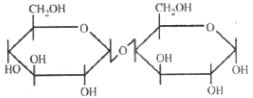
What type of glycosidic bond is observed in the following structure?
A
$1, 2$ glycosidic bond
B
$1, 4$ glycosidic bond
C
$1, 6$ glycosidic bond
D
$6, 1$ glycosidic bond
Solution
(B) The provided structure represents a disaccharide where two glucose units are linked together.
In this structure,the glycosidic bond is formed between the carbon-$1$ of the first glucose molecule and the carbon-$4$ of the second glucose molecule.
This type of linkage is known as a $1, 4$-glycosidic bond.
Therefore,the correct option is $B$.
In this structure,the glycosidic bond is formed between the carbon-$1$ of the first glucose molecule and the carbon-$4$ of the second glucose molecule.
This type of linkage is known as a $1, 4$-glycosidic bond.
Therefore,the correct option is $B$.
0 likes
View Solution265
MediumMCQ
Select the correct option by matching the biological importance of carbohydrates given in the table below:
| $(A)$ | $(B)$ |
| $(1)$ Starch | $(a)$ Common sugar used in respiration |
| $(2)$ Glycogen | $(b)$ Sugar present in the structure of $ATP$ |
| $(3)$ Ribose | $(c)$ Sugar stored in liver and muscles |
| $(4)$ Glucose | $(d)$ Sugar stored as starch granules |
A
$(1-b), (2-a), (3-d), (4-c)$
B
$(1-d), (2-c), (3-b), (4-a)$
C
$(1-a), (2-b), (3-c), (4-d)$
D
$(1-d), (2-c), (3-a), (4-b)$
Solution
(B) The correct matching is as follows:
$(1)$ Starch is the primary storage polysaccharide in plants, stored as starch granules, so $(1-d)$.
$(2)$ Glycogen is the storage polysaccharide in animals, primarily stored in the liver and muscles, so $(2-c)$.
$(3)$ Ribose is a pentose sugar that is a structural component of nucleotides like $ATP$, $RNA$, etc., so $(3-b)$.
$(4)$ Glucose is the most common monosaccharide used as a primary fuel source in cellular respiration, so $(4-a)$.
Therefore, the correct sequence is $(1-d), (2-c), (3-b), (4-a)$.
$(1)$ Starch is the primary storage polysaccharide in plants, stored as starch granules, so $(1-d)$.
$(2)$ Glycogen is the storage polysaccharide in animals, primarily stored in the liver and muscles, so $(2-c)$.
$(3)$ Ribose is a pentose sugar that is a structural component of nucleotides like $ATP$, $RNA$, etc., so $(3-b)$.
$(4)$ Glucose is the most common monosaccharide used as a primary fuel source in cellular respiration, so $(4-a)$.
Therefore, the correct sequence is $(1-d), (2-c), (3-b), (4-a)$.
0 likes
View Solution266
MediumMCQ
Which macromolecule is used in large quantities in our daily activities?
A
Carbohydrates
B
Lipids
C
Nucleic acids
D
Proteins
Solution
(A) Carbohydrates are the primary source of energy for the human body. In our daily activities,we consume carbohydrates (such as starch,glucose,and sucrose) in the largest quantities compared to other macromolecules like proteins,lipids,or nucleic acids to meet our metabolic energy requirements.
0 likes
View Solution267
MediumMCQ
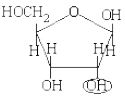
Identify the structure shown in the image.
A
Ribose sugar
B
Thymine
C
Deoxyribose sugar
D
Uracil
Solution
(A) The structure shown is a pentose sugar.
Specifically,it is a ribose sugar because it has a hydroxyl group $(-OH)$ attached to the $2'$ carbon atom.
In deoxyribose sugar,the $2'$ carbon atom has only a hydrogen atom $(-H)$ instead of a hydroxyl group $(-OH)$.
Therefore,the given structure is ribose sugar.
Specifically,it is a ribose sugar because it has a hydroxyl group $(-OH)$ attached to the $2'$ carbon atom.
In deoxyribose sugar,the $2'$ carbon atom has only a hydrogen atom $(-H)$ instead of a hydroxyl group $(-OH)$.
Therefore,the given structure is ribose sugar.
0 likes
View Solution268
MediumMCQ
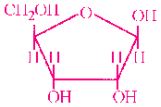
The given structure represents which of the following sugars?
A
Deoxyribose sugar
B
Galactose
C
Ribose sugar
D
Glucose
Solution
(C) The provided structure is a five-membered ring (furanose ring) containing an oxygen atom.
By examining the hydroxyl $(-OH)$ groups attached to the carbon atoms,we can identify the sugar.
Specifically,there are $-OH$ groups at both the $C-2$ and $C-3$ positions of the pentose ring.
This specific arrangement of hydroxyl groups is characteristic of ribose sugar.
Deoxyribose would lack the $-OH$ group at the $C-2$ position.
Glucose and galactose are hexose sugars (six-membered rings),which do not match this structure.
Therefore,the correct answer is Ribose sugar.
By examining the hydroxyl $(-OH)$ groups attached to the carbon atoms,we can identify the sugar.
Specifically,there are $-OH$ groups at both the $C-2$ and $C-3$ positions of the pentose ring.
This specific arrangement of hydroxyl groups is characteristic of ribose sugar.
Deoxyribose would lack the $-OH$ group at the $C-2$ position.
Glucose and galactose are hexose sugars (six-membered rings),which do not match this structure.
Therefore,the correct answer is Ribose sugar.
0 likes
View Solution269
MediumMCQ
What is the name of the bond formed between the adenosine and the first phosphate group in $ATP$?
A
Nitrophosphate bond
B
Adenophosphate bond
C
Phosphoester bond
D
Phosphodiester bond
Solution
(C) $ATP$ (Adenosine Triphosphate) consists of an adenosine molecule (adenine + ribose sugar) linked to three phosphate groups.
The first phosphate group is attached to the $5'$ carbon of the ribose sugar via a phosphoester bond.
The subsequent two phosphate groups are linked to each other by high-energy phosphoanhydride bonds.
Therefore,the bond between the adenosine (specifically the ribose sugar) and the first phosphate group is a phosphoester bond.
The first phosphate group is attached to the $5'$ carbon of the ribose sugar via a phosphoester bond.
The subsequent two phosphate groups are linked to each other by high-energy phosphoanhydride bonds.
Therefore,the bond between the adenosine (specifically the ribose sugar) and the first phosphate group is a phosphoester bond.
0 likes
View Solution270
EasyMCQ
Which of the following undergoes hydrolysis to yield $Glucose$ and $Galactose$ as products?
A
$Fructose$
B
$Lactose$
C
$Maltose$
D
$Glycogen$
Solution
(B) $Lactose$, also known as milk sugar, is a disaccharide composed of two monosaccharide units: $Glucose$ and $Galactose$.
Upon hydrolysis in the presence of the enzyme $Lactase$, the glycosidic bond between these two units is broken, resulting in the production of one molecule of $Glucose$ and one molecule of $Galactose$.
$Lactose + H_2O \xrightarrow{Lactase} Glucose + Galactose$.
Upon hydrolysis in the presence of the enzyme $Lactase$, the glycosidic bond between these two units is broken, resulting in the production of one molecule of $Glucose$ and one molecule of $Galactose$.
$Lactose + H_2O \xrightarrow{Lactase} Glucose + Galactose$.
0 likes
View Solution271
EasyMCQ
The products obtained from the hydrolysis of lactose are:
A
Glucose + Glucose
B
Glucose + Fructose
C
Glucose + Galactose
D
Glucose + Maltose
Solution
(C) Lactose is a disaccharide found in milk.
It consists of two monosaccharide units: $D$-glucose and $D$-galactose.
Upon hydrolysis,the glycosidic bond between these two units is broken,yielding one molecule of glucose and one molecule of galactose.
The reaction is: $\text{Lactose} + H_2O \xrightarrow{\text{Lactase}} \text{Glucose} + \text{Galactose}$.
It consists of two monosaccharide units: $D$-glucose and $D$-galactose.
Upon hydrolysis,the glycosidic bond between these two units is broken,yielding one molecule of glucose and one molecule of galactose.
The reaction is: $\text{Lactose} + H_2O \xrightarrow{\text{Lactase}} \text{Glucose} + \text{Galactose}$.
0 likes
View Solution272
EasyMCQ
What is obtained from the hydrolysis of maltose?
A
Glucose + Fructose
B
Glucose + Glucose
C
Glucose + Galactose
D
Galactose + Lactose
Solution
(B) Maltose is a disaccharide composed of two glucose units linked by an $\alpha-1,4$-glycosidic bond.
Upon hydrolysis,catalyzed by the enzyme maltase or by dilute acids,maltose breaks down into its constituent monosaccharides.
The chemical reaction is: $\text{C}_{12}\text{H}_{22}\text{O}_{11} + \text{H}_2\text{O} \xrightarrow{\text{Maltase}} 2\text{C}_6\text{H}_{12}\text{O}_6$ (Glucose + Glucose).
Therefore,the hydrolysis of maltose yields two molecules of glucose.
Upon hydrolysis,catalyzed by the enzyme maltase or by dilute acids,maltose breaks down into its constituent monosaccharides.
The chemical reaction is: $\text{C}_{12}\text{H}_{22}\text{O}_{11} + \text{H}_2\text{O} \xrightarrow{\text{Maltase}} 2\text{C}_6\text{H}_{12}\text{O}_6$ (Glucose + Glucose).
Therefore,the hydrolysis of maltose yields two molecules of glucose.
0 likes
View Solution273
MediumMCQ
Which of the following is not a high-energy compound?
A
Creatine phosphate
B
$GTP$
C
$ATP$
D
$AMP$
Solution
(D) High-energy compounds are those that release a large amount of free energy upon hydrolysis,typically due to the presence of phosphoanhydride bonds.
$ATP$ (Adenosine triphosphate) and $GTP$ (Guanosine triphosphate) contain two high-energy phosphoanhydride bonds.
Creatine phosphate is a well-known high-energy storage molecule in muscle cells.
$AMP$ (Adenosine monophosphate) contains only one phosphate group attached to the ribose sugar via a phosphoester bond,which is a low-energy bond. Therefore,$AMP$ is not considered a high-energy compound.
$ATP$ (Adenosine triphosphate) and $GTP$ (Guanosine triphosphate) contain two high-energy phosphoanhydride bonds.
Creatine phosphate is a well-known high-energy storage molecule in muscle cells.
$AMP$ (Adenosine monophosphate) contains only one phosphate group attached to the ribose sugar via a phosphoester bond,which is a low-energy bond. Therefore,$AMP$ is not considered a high-energy compound.
0 likes
View Solution274
MediumMCQ
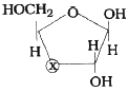
The structural formula of $C_5H_{10}O_5$ is given. Select the correct group for the position marked '$X$' from the given options.
A
$\begin{matrix}H\\| \\OH \end{matrix}$
B
$\begin{matrix}H\\| \\H \end{matrix}$
C
$\begin{matrix}{NH_2}\\| \\H \end{matrix}$
D
$\begin{matrix}OH\\| \\OH \end{matrix}$
Solution
(A) The given structure represents a pentose sugar,specifically ribose.
In a ribose molecule,the carbon at the $2'$ position (marked as '$X$') is bonded to a hydrogen atom $(H)$ and a hydroxyl group $(OH)$.
Looking at the provided structure,the $X$ position corresponds to the $2'$ carbon of the ribose ring.
Therefore,the group attached at this position is a hydrogen atom above and a hydroxyl group below,which matches option $A$.
In a ribose molecule,the carbon at the $2'$ position (marked as '$X$') is bonded to a hydrogen atom $(H)$ and a hydroxyl group $(OH)$.
Looking at the provided structure,the $X$ position corresponds to the $2'$ carbon of the ribose ring.
Therefore,the group attached at this position is a hydrogen atom above and a hydroxyl group below,which matches option $A$.
0 likes
View Solution275
MediumMCQ
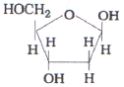
Which sugar is represented by the structural formula shown below?
A
Ribose
B
Deoxyribose
C
Ribulose
D
Galactose
Solution
(B) The given structural formula represents a pentose sugar in its cyclic form.
By observing the carbon atoms,we can see that at the $2'$ position,there is a hydrogen atom $(H)$ instead of a hydroxyl group $(-OH)$.
Ribose has an $-OH$ group at the $2'$ position,whereas deoxyribose lacks an oxygen atom at this position,hence the name 'deoxy'.
Therefore,the structure shown is $2-$deoxyribose.
By observing the carbon atoms,we can see that at the $2'$ position,there is a hydrogen atom $(H)$ instead of a hydroxyl group $(-OH)$.
Ribose has an $-OH$ group at the $2'$ position,whereas deoxyribose lacks an oxygen atom at this position,hence the name 'deoxy'.
Therefore,the structure shown is $2-$deoxyribose.
0 likes
View Solution276
MediumMCQ
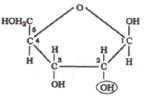
The given figure represents the structural formula of which of the following?
A
Ribulose
B
Ribose sugar
C
Deoxyribose sugar
D
Glucose
Solution
(B) The given structure is a pentose sugar (a $5$-carbon sugar) in its cyclic form.
By observing the $2^{nd}$ carbon atom $(C_2)$,we can see an $-OH$ group attached to it.
In $Deoxyribose$ sugar,the $2^{nd}$ carbon atom has only a hydrogen atom $(-H)$ attached,lacking the oxygen atom.
Since the $2^{nd}$ carbon in this figure has an $-OH$ group,it is a $Ribose$ sugar.
Therefore,the correct option is $B$.
By observing the $2^{nd}$ carbon atom $(C_2)$,we can see an $-OH$ group attached to it.
In $Deoxyribose$ sugar,the $2^{nd}$ carbon atom has only a hydrogen atom $(-H)$ attached,lacking the oxygen atom.
Since the $2^{nd}$ carbon in this figure has an $-OH$ group,it is a $Ribose$ sugar.
Therefore,the correct option is $B$.
0 likes
View Solution277
MediumMCQ
The chitinous exoskeleton of arthropods is formed by the polymerisation of
A
$N$-acetyl glucosamine
B
lipoglycans
C
keratin sulphate and chondroitin sulphate
D
$D$-glucosamine
Solution
(A) The correct answer is $A$.
Chitin is a structural polysaccharide that forms the exoskeleton of arthropods.
It is a complex carbohydrate (a nitrogen-containing polysaccharide) in which $N$-acetyl glucosamine monomers are linked together by $(1, 4)$ $\beta$-glycosidic linkages.
This chitinous exoskeleton provides structural strength,protection,and elasticity to the bodies of arthropods.
Chitin is a structural polysaccharide that forms the exoskeleton of arthropods.
It is a complex carbohydrate (a nitrogen-containing polysaccharide) in which $N$-acetyl glucosamine monomers are linked together by $(1, 4)$ $\beta$-glycosidic linkages.
This chitinous exoskeleton provides structural strength,protection,and elasticity to the bodies of arthropods.
0 likes
View Solution278
MediumMCQ
Carbohydrates are commonly found as starch in plant storage organs. Which of the following five properties of starch $(1-5)$ make it useful as a storage material?
$(1)$ Easily translocated
$(2)$ Chemically non-reactive
$(3)$ Easily digested by animals
$(4)$ Osmotically inactive
$(5)$ Synthesized during photosynthesis
The useful properties are:
$(1)$ Easily translocated
$(2)$ Chemically non-reactive
$(3)$ Easily digested by animals
$(4)$ Osmotically inactive
$(5)$ Synthesized during photosynthesis
The useful properties are:
A
$(1)$,$(3)$ and $(5)$
B
$(1)$ and $(5)$
C
$(2)$ and $(3)$
D
$(2)$ and $(4)$
Solution
(D) Starch is the major storage carbohydrate in plants.
For a substance to be an ideal storage material,it should be chemically stable (non-reactive) and should not affect the water potential of the cell (osmotically inactive).
$(2)$ Chemically non-reactive: Starch is a large,complex polysaccharide that does not interfere with the metabolic activities of the cell.
$(4)$ Osmotically inactive: Being a large,insoluble molecule,it does not dissolve in the cell sap,thus it does not affect the osmotic pressure of the cell.
Therefore,properties $(2)$ and $(4)$ make starch an ideal storage material.
Thus,the correct option is $(D)$.
For a substance to be an ideal storage material,it should be chemically stable (non-reactive) and should not affect the water potential of the cell (osmotically inactive).
$(2)$ Chemically non-reactive: Starch is a large,complex polysaccharide that does not interfere with the metabolic activities of the cell.
$(4)$ Osmotically inactive: Being a large,insoluble molecule,it does not dissolve in the cell sap,thus it does not affect the osmotic pressure of the cell.
Therefore,properties $(2)$ and $(4)$ make starch an ideal storage material.
Thus,the correct option is $(D)$.
0 likes
View Solution279
MediumMCQ
Glycosidic bond is present in
A
Starch
B
Protein
C
Lipid
D
All correct
Solution
(A) glycosidic bond is a type of covalent bond that joins a carbohydrate (sugar) molecule to another group,which may or may not be another carbohydrate.
Starch is a polysaccharide composed of glucose units linked together by $\alpha-1,4$ and $\alpha-1,6$ glycosidic bonds.
Proteins are composed of amino acids linked by peptide bonds.
Lipids (specifically triglycerides) are composed of fatty acids and glycerol linked by ester bonds.
Therefore,the glycosidic bond is characteristic of carbohydrates like starch.
Starch is a polysaccharide composed of glucose units linked together by $\alpha-1,4$ and $\alpha-1,6$ glycosidic bonds.
Proteins are composed of amino acids linked by peptide bonds.
Lipids (specifically triglycerides) are composed of fatty acids and glycerol linked by ester bonds.
Therefore,the glycosidic bond is characteristic of carbohydrates like starch.
0 likes
View Solution280
EasyMCQ
Fructose is a
A
Keto triose sugar
B
Aldo pentose sugar
C
Aldo triose sugar
D
Keto hexose sugar
Solution
(D) Fructose is a monosaccharide with the chemical formula $C_6H_{12}O_6$.
It contains a ketone functional group,making it a ketose.
Since it contains $6$ carbon atoms,it is classified as a hexose.
Therefore,fructose is a keto hexose sugar.
It contains a ketone functional group,making it a ketose.
Since it contains $6$ carbon atoms,it is classified as a hexose.
Therefore,fructose is a keto hexose sugar.
0 likes
View Solution281
MediumMCQ
Which of the following is a simple form of carbohydrates?
A
Glucose
B
Galactose
C
Ribose
D
All of the above
Solution
(D) Carbohydrates are classified into monosaccharides,disaccharides,and polysaccharides based on their complexity.
Monosaccharides are the simplest form of carbohydrates,which cannot be further hydrolyzed into smaller sugar units.
Glucose,Galactose,and Ribose are all examples of monosaccharides.
Therefore,all the given options are correct.
Monosaccharides are the simplest form of carbohydrates,which cannot be further hydrolyzed into smaller sugar units.
Glucose,Galactose,and Ribose are all examples of monosaccharides.
Therefore,all the given options are correct.
0 likes
View Solution282
EasyMCQ
Which of the following is a ketohexose sugar?
A
Glucose
B
Galactose
C
Fructose
D
Ribose
Solution
(C) ketohexose is a monosaccharide containing six carbon atoms and a ketone functional group.
Glucose and Galactose are aldohexoses,meaning they contain six carbon atoms and an aldehyde functional group.
Ribose is an aldopentose,containing five carbon atoms and an aldehyde functional group.
Fructose is a ketohexose,as it contains six carbon atoms and a ketone group at the $C-2$ position.
Therefore,the correct option is $C$.
Glucose and Galactose are aldohexoses,meaning they contain six carbon atoms and an aldehyde functional group.
Ribose is an aldopentose,containing five carbon atoms and an aldehyde functional group.
Fructose is a ketohexose,as it contains six carbon atoms and a ketone group at the $C-2$ position.
Therefore,the correct option is $C$.
0 likes
View Solution283
MediumMCQ
The starch-$I_2$ complex is.......
A
Brown
B
Green
C
Yellow
D
Blue
Solution
(D) Starch is a polysaccharide that consists of two components: amylose and amylopectin.
Amylose is a helical molecule that can trap iodine molecules $(I_2)$ within its structure.
When starch reacts with iodine,it forms a characteristic blue-colored complex.
This reaction is commonly used as a diagnostic test for the presence of starch in biological samples.
Amylose is a helical molecule that can trap iodine molecules $(I_2)$ within its structure.
When starch reacts with iodine,it forms a characteristic blue-colored complex.
This reaction is commonly used as a diagnostic test for the presence of starch in biological samples.
0 likes
View Solution284
MediumMCQ
Identify the odd one out from the given carbohydrates.
A
Sucrose
B
Lactose
C
Maltose
D
Cellulose
Solution
(D) Sucrose,Lactose,and Maltose are disaccharides,which are composed of two monosaccharide units linked together.
Cellulose is a polysaccharide,which is a complex carbohydrate composed of a long chain of many monosaccharide units (specifically glucose).
Therefore,Cellulose is the odd one out.
Cellulose is a polysaccharide,which is a complex carbohydrate composed of a long chain of many monosaccharide units (specifically glucose).
Therefore,Cellulose is the odd one out.
0 likes
View Solution285
MediumMCQ
Cotton fibres are
A
Cellulose
B
Protein
C
Nucleic acid
D
Lipid
Solution
(A) Cotton fibres are primarily composed of cellulose.
Cellulose is a polysaccharide consisting of a linear chain of several hundred to many thousands of $\beta(1 \rightarrow 4)$ linked $D$-glucose units.
It is the most abundant organic compound in the plant kingdom and provides structural support to the cell walls of plants.
Cellulose is a polysaccharide consisting of a linear chain of several hundred to many thousands of $\beta(1 \rightarrow 4)$ linked $D$-glucose units.
It is the most abundant organic compound in the plant kingdom and provides structural support to the cell walls of plants.
0 likes
View Solution286
EasyMCQ
Chitin is........
A
Polysaccharide
B
Monosaccharide
C
Polypeptide
D
Disaccharide
Solution
(A) Chitin is a complex carbohydrate,specifically a structural polysaccharide.
It is a polymer of $N$-acetylglucosamine units.
It is found in the cell walls of fungi and the exoskeletons of arthropods like insects and crustaceans.
Therefore,it is classified as a polysaccharide.
It is a polymer of $N$-acetylglucosamine units.
It is found in the cell walls of fungi and the exoskeletons of arthropods like insects and crustaceans.
Therefore,it is classified as a polysaccharide.
0 likes
View Solution287
EasyMCQ
Ribose sugar is .......
A
Aldo hexose sugar.
B
Aldo pentose sugar.
C
Keto hexose sugar.
D
Keto pentose sugar.
Solution
(B) Ribose is a monosaccharide with $5$ carbon atoms,which classifies it as a pentose sugar.
It contains an aldehyde functional group at the $C-1$ position,which classifies it as an aldose.
Therefore,ribose is an aldo pentose sugar.
It contains an aldehyde functional group at the $C-1$ position,which classifies it as an aldose.
Therefore,ribose is an aldo pentose sugar.
0 likes
View Solution288
MediumMCQ
Identify the biological importance of carbohydrates from the following statements:
$1$. In the structure of cell wall.
$2$. As a food storage substance.
$3$. In protein synthesis.
$4$. As enzymes.
$5$. In the structure of $DNA$.
$1$. In the structure of cell wall.
$2$. As a food storage substance.
$3$. In protein synthesis.
$4$. As enzymes.
$5$. In the structure of $DNA$.
A
$3, 4, 5$
B
$1, 2, 3$
C
$1, 2, 5$
D
$2, 3, 5$
Solution
(C) The biological importance of carbohydrates includes:
$1$. Structural components: Cellulose is a major carbohydrate found in the cell wall of plants.
$2$. Food storage: Starch in plants and glycogen in animals serve as primary energy storage molecules.
$5$. Nucleic acid structure: Ribose and deoxyribose sugars are essential components of $RNA$ and $DNA$ respectively.
Statements $3$ (protein synthesis) and $4$ (enzymes) are primarily functions of proteins,not carbohydrates.
Therefore,the correct statements are $1, 2,$ and $5$.
$1$. Structural components: Cellulose is a major carbohydrate found in the cell wall of plants.
$2$. Food storage: Starch in plants and glycogen in animals serve as primary energy storage molecules.
$5$. Nucleic acid structure: Ribose and deoxyribose sugars are essential components of $RNA$ and $DNA$ respectively.
Statements $3$ (protein synthesis) and $4$ (enzymes) are primarily functions of proteins,not carbohydrates.
Therefore,the correct statements are $1, 2,$ and $5$.
0 likes
View Solution289
MediumMCQ
Which of the following possess reducing and non-reducing ends?
A
$DNA$
B
$RNA$
C
$Protein$
D
$Glycogen$
Solution
(D) Polysaccharide like $Glycogen$ is a polymer of glucose.
In a polysaccharide chain, the end is called the reducing end and the end is called the non-reducing end.
$Glycogen$ is a branched polymer where each branch has one non-reducing end, while the main chain has one reducing end.
$DNA$, $RNA$, and $Proteins$ do not follow this specific nomenclature of reducing and non-reducing ends in the same context as carbohydrates.
In a polysaccharide chain, the end is called the reducing end and the end is called the non-reducing end.
$Glycogen$ is a branched polymer where each branch has one non-reducing end, while the main chain has one reducing end.
$DNA$, $RNA$, and $Proteins$ do not follow this specific nomenclature of reducing and non-reducing ends in the same context as carbohydrates.
0 likes
View Solution290
EasyMCQ
In a polysaccharide,the individual monosaccharides are linked by a
A
Glycosidic bond
B
Peptide bond
C
Ester bond
D
Phosphodiester bond
Solution
(A) In a polysaccharide,individual monosaccharide units are linked together by a glycosidic bond.
This bond is formed by a dehydration reaction (removal of a water molecule) between two carbon atoms of adjacent monosaccharides.
Peptide bonds link amino acids in proteins,ester bonds are found in lipids,and phosphodiester bonds link nucleotides in nucleic acids.
This bond is formed by a dehydration reaction (removal of a water molecule) between two carbon atoms of adjacent monosaccharides.
Peptide bonds link amino acids in proteins,ester bonds are found in lipids,and phosphodiester bonds link nucleotides in nucleic acids.
0 likes
View Solution291
EasyMCQ
The repeating unit of glycogen is
A
Starch
B
mannose
C
Aldohexose
D
Ketohexose
Solution
(C) Glycogen is a polysaccharide that serves as a form of energy storage in animals and fungi.
It is a branched polymer composed of glucose units.
Glucose is a type of sugar that belongs to the category of aldohexoses because it contains an aldehyde group and six carbon atoms.
Therefore,the repeating unit of glycogen is glucose,which is an aldohexose.
It is a branched polymer composed of glucose units.
Glucose is a type of sugar that belongs to the category of aldohexoses because it contains an aldehyde group and six carbon atoms.
Therefore,the repeating unit of glycogen is glucose,which is an aldohexose.
0 likes
View Solution292
EasyMCQ
Which of the following statements is true about glucose?
A
It is an aldohexose
B
It is not present in ring form
C
Glucose is not a monosaccharide
D
None of the above
Solution
(A) Glucose $(C_6H_{12}O_6)$ is a simple sugar classified as an aldohexose because it contains an aldehyde group $(-CHO)$ and six carbon atoms.
Glucose exists in both open-chain and cyclic (ring) forms in aqueous solutions.
It is a fundamental monosaccharide and serves as the primary energy source for living organisms.
Therefore,the statement that it is an aldohexose is correct.
Glucose exists in both open-chain and cyclic (ring) forms in aqueous solutions.
It is a fundamental monosaccharide and serves as the primary energy source for living organisms.
Therefore,the statement that it is an aldohexose is correct.
0 likes
View Solution293
MediumMCQ
Choose the correct pair.
A
Nitrogen base - alanine
B
Polysaccharide - glycogen
C
Amino acid - trypsin
D
Enzyme - insulin
Solution
(B) The correct pair is $Polysaccharide - glycogen$.
$1$. $Alanine$ is an amino acid,not a nitrogen base.
$2$. $Glycogen$ is a polymer of glucose and is classified as a polysaccharide.
$3$. $Trypsin$ is an enzyme (protein),not an amino acid.
$4$. $Insulin$ is a hormone (protein),not an enzyme.
$1$. $Alanine$ is an amino acid,not a nitrogen base.
$2$. $Glycogen$ is a polymer of glucose and is classified as a polysaccharide.
$3$. $Trypsin$ is an enzyme (protein),not an amino acid.
$4$. $Insulin$ is a hormone (protein),not an enzyme.
0 likes
View Solution294
EasyMCQ
Fructose is a....
A
Triose sugar
B
Pentose sugar
C
Hexose sugar
D
Diose sugar
Solution
(C) Fructose is a simple monosaccharide found in many foods and is one of the three dietary monosaccharides,along with glucose and galactose,that are absorbed directly into the blood during digestion.
It has the chemical formula $C_6H_{12}O_6$.
Since it contains $6$ carbon atoms,it is classified as a hexose sugar.
It has the chemical formula $C_6H_{12}O_6$.
Since it contains $6$ carbon atoms,it is classified as a hexose sugar.
0 likes
View Solution295
MediumMCQ
Which of the following is a triose monosaccharide?
A
Ribose
B
Ribulose
C
Glucose
D
Glyceraldehyde
Solution
(D) Monosaccharides are classified based on the number of carbon atoms they contain.
Trioses are monosaccharides that contain $3$ carbon atoms.
$A$. Ribose is a pentose sugar ($5$ carbons).
$B$. Ribulose is a pentose sugar ($5$ carbons).
$C$. Glucose is a hexose sugar ($6$ carbons).
$D$. Glyceraldehyde is a triose sugar ($3$ carbons).
Therefore,the correct answer is $D$.
Trioses are monosaccharides that contain $3$ carbon atoms.
$A$. Ribose is a pentose sugar ($5$ carbons).
$B$. Ribulose is a pentose sugar ($5$ carbons).
$C$. Glucose is a hexose sugar ($6$ carbons).
$D$. Glyceraldehyde is a triose sugar ($3$ carbons).
Therefore,the correct answer is $D$.
0 likes
View Solution296
EasyMCQ
What is gained due to hydrolysis of maltose?
A
Glucose + galactose
B
Fructose + glucose
C
Galactose + fructose
D
Glucose + glucose
Solution
(D) Maltose is a disaccharide composed of two glucose units linked by an $\alpha-1,4$-glycosidic bond.
Upon hydrolysis,the glycosidic bond is broken by the addition of a water molecule.
This reaction results in the formation of two molecules of glucose.
Therefore,the hydrolysis of maltose yields $Glucose + Glucose$.
Upon hydrolysis,the glycosidic bond is broken by the addition of a water molecule.
This reaction results in the formation of two molecules of glucose.
Therefore,the hydrolysis of maltose yields $Glucose + Glucose$.
0 likes
View Solution297
MediumMCQ
$A$ - Cellulose is a heteropolymer.
$R$ - Cellulose is made up of only one type of amino acid.
$R$ - Cellulose is made up of only one type of amino acid.
A
$A$ and $R$ are correct.
B
$A$ and $R$ are incorrect.
C
$A$ is correct and $R$ is incorrect.
D
$A$ is incorrect and $R$ is correct.
Solution
(B) Cellulose is a polysaccharide,which is a homopolymer of glucose units. Therefore,statement $A$ is incorrect because it is a homopolymer,not a heteropolymer.
Statement $R$ is also incorrect because cellulose is a carbohydrate (sugar),not a protein,and it is composed of glucose monomers,not amino acids.
Statement $R$ is also incorrect because cellulose is a carbohydrate (sugar),not a protein,and it is composed of glucose monomers,not amino acids.
0 likes
View Solution298
MediumMCQ
Bond found in cellulose
A
Ester bond
B
Peptide bond
C
Glycosidic bond
D
Disulphide bond
Solution
(C) Cellulose is a polysaccharide composed of a linear chain of several hundred to many thousands of $\beta(1 \rightarrow 4)$ linked $D$-glucose units.
These glucose units are joined together by $\beta-1,4$-glycosidic bonds.
Therefore,the bond found in cellulose is a glycosidic bond.
These glucose units are joined together by $\beta-1,4$-glycosidic bonds.
Therefore,the bond found in cellulose is a glycosidic bond.
0 likes
View Solution299
MediumMCQ
Which of the following is a monosaccharide?
A
Sucrose
B
Starch
C
Glycogen
D
Glyceraldehyde
Solution
(D) monosaccharide is the simplest form of carbohydrate that cannot be further hydrolyzed into smaller sugar units.
$Sucrose$ is a disaccharide composed of glucose and fructose.
$Starch$ and $Glycogen$ are polysaccharides (polymers of glucose).
$Glyceraldehyde$ is a triose sugar, which is a type of monosaccharide.
$Sucrose$ is a disaccharide composed of glucose and fructose.
$Starch$ and $Glycogen$ are polysaccharides (polymers of glucose).
$Glyceraldehyde$ is a triose sugar, which is a type of monosaccharide.
0 likes
View Solution300
MediumMCQ
Glycogen is a.........
A
Polymer of amino acid
B
Polymer of fatty acid
C
Unsaturated fat
D
Polymer of glucose
Solution
(D) Glycogen is a polysaccharide,which is a complex carbohydrate.
It serves as the primary storage form of glucose in animals and fungi.
Structurally,it consists of a branched chain of glucose units linked by $\alpha-1,4$ and $\alpha-1,6$ glycosidic bonds.
Therefore,it is a polymer of glucose.
It serves as the primary storage form of glucose in animals and fungi.
Structurally,it consists of a branched chain of glucose units linked by $\alpha-1,4$ and $\alpha-1,6$ glycosidic bonds.
Therefore,it is a polymer of glucose.
1 likes
View SolutionBiomolecules — Carbohydrates · Frequently Asked Questions
1Are these Biomolecules questions useful for JEE and NEET?
Yes. All questions in this section are mapped to JEE Main and NEET exam patterns. Previous year questions from JEE Main, NEET, GUJCET and state-level exams are included with full solutions.
2Can I switch to Hindi or Gujarati for these questions?
Yes. Use the language tabs in the hero section or the sidebar to view the same questions and solutions in English, Hindi or Gujarati.
3How do I generate a question paper from this subtopic?
Use the Vedclass Exam Paper Generator — select the chapter and subtopic, set difficulty, and generate Sets A, B, C, D automatically. First 3 chapters of every subject are free.
Vedclass Products
For Students
Vedclass Test Series
Mock tests in real JEE/NEET style with performance analysis. 5-day free trial.
Start Free TrialFor Teachers
Exam Paper Generator
Generate Set A/B/C/D papers from this chapter in 2 minutes. 3 chapters free.
Try FreeFor Institutes
Online Exam Module
Live online exams with unlimited students, 360° analytics & white-label branding.
See DemoFor Teachers & Institutes
Generate a Biomolecules Exam Paper in 2 Minutes
Select subtopic & difficulty — Sets A, B, C, D auto-generated with No Repeat logic.
First 3 chapters of every subject are free — no payment required.