
PhysicsQ51–114 of 164 questions
Page 2 of 2 · English
51
PhysicsMediumMCQTS EAMCET · 2024
$A$ hollow cylinder and a solid cylinder,initially at rest at the top of an inclined plane,are rolling down without slipping. If the time taken by the hollow cylinder to reach the bottom of the inclined plane is $2 \ s$,the time taken by the solid cylinder to reach the bottom of the inclined plane is: (in $s$)
A
$2$
B
$1.414$
C
$1$
D
$1.732$
Solution
(D) For an object rolling down an inclined plane of length $l$ and angle $\theta$,the acceleration is given by $a = \frac{g \sin \theta}{1 + K^2/R^2}$.
Using the equation of motion $s = ut + \frac{1}{2}at^2$ with $u=0$ and $s=l$,we get $l = \frac{1}{2} \left( \frac{g \sin \theta}{1 + K^2/R^2} \right) t^2$.
Thus,$t = \sqrt{\frac{2l(1 + K^2/R^2)}{g \sin \theta}}$,which implies $t \propto \sqrt{1 + K^2/R^2}$.
For a hollow cylinder,the radius of gyration $K^2 = R^2$,so $K^2/R^2 = 1$. Thus,$t_1 \propto \sqrt{1 + 1} = \sqrt{2}$.
For a solid cylinder,the radius of gyration $K^2 = R^2/2$,so $K^2/R^2 = 1/2$. Thus,$t_2 \propto \sqrt{1 + 1/2} = \sqrt{3/2}$.
Taking the ratio,$\frac{t_2}{t_1} = \frac{\sqrt{3/2}}{\sqrt{2}} = \sqrt{\frac{3}{4}} = \frac{\sqrt{3}}{2}$.
Given $t_1 = 2 \ s$,we have $t_2 = \frac{\sqrt{3}}{2} \times 2 = \sqrt{3} \approx 1.732 \ s$.
Using the equation of motion $s = ut + \frac{1}{2}at^2$ with $u=0$ and $s=l$,we get $l = \frac{1}{2} \left( \frac{g \sin \theta}{1 + K^2/R^2} \right) t^2$.
Thus,$t = \sqrt{\frac{2l(1 + K^2/R^2)}{g \sin \theta}}$,which implies $t \propto \sqrt{1 + K^2/R^2}$.
For a hollow cylinder,the radius of gyration $K^2 = R^2$,so $K^2/R^2 = 1$. Thus,$t_1 \propto \sqrt{1 + 1} = \sqrt{2}$.
For a solid cylinder,the radius of gyration $K^2 = R^2/2$,so $K^2/R^2 = 1/2$. Thus,$t_2 \propto \sqrt{1 + 1/2} = \sqrt{3/2}$.
Taking the ratio,$\frac{t_2}{t_1} = \frac{\sqrt{3/2}}{\sqrt{2}} = \sqrt{\frac{3}{4}} = \frac{\sqrt{3}}{2}$.
Given $t_1 = 2 \ s$,we have $t_2 = \frac{\sqrt{3}}{2} \times 2 = \sqrt{3} \approx 1.732 \ s$.
0 likesView Solution
52
PhysicsDifficultMCQTS EAMCET · 2024
The temperatures of equal masses of three different liquids $A, B$ and $C$ are $15^{\circ} C, 24^{\circ} C$ and $30^{\circ} C$ respectively. The resultant temperature when liquids $A$ and $B$ are mixed is $20^{\circ} C$ and when liquids $B$ and $C$ are mixed is $26^{\circ} C$. Then the ratio of specific heat capacities of the liquids $A, B$ and $C$ is
A
$5: 8: 10$
B
$8: 10: 5$
C
$5: 10: 8$
D
$8: 5: 10$
Solution
(B) For equal masses $m$,the final temperature $T_{mix}$ of a mixture of two liquids with specific heats $C_1, C_2$ and initial temperatures $T_1, T_2$ is given by $T_{mix} = \frac{T_1 C_1 + T_2 C_2}{C_1 + C_2}$.
For liquids $A$ and $B$:
$20 = \frac{15 C_A + 24 C_B}{C_A + C_B} \Rightarrow 20 C_A + 20 C_B = 15 C_A + 24 C_B \Rightarrow 5 C_A = 4 C_B \Rightarrow C_A = \frac{4}{5} C_B$.
For liquids $B$ and $C$:
$26 = \frac{24 C_B + 30 C_C}{C_B + C_C} \Rightarrow 26 C_B + 26 C_C = 24 C_B + 30 C_C \Rightarrow 2 C_B = 4 C_C \Rightarrow C_B = 2 C_C$.
Expressing all in terms of $C_C$:
$C_B = 2 C_C$
$C_A = \frac{4}{5} (2 C_C) = \frac{8}{5} C_C$
Thus,$C_A : C_B : C_C = \frac{8}{5} C_C : 2 C_C : C_C = 8 : 10 : 5$.
For liquids $A$ and $B$:
$20 = \frac{15 C_A + 24 C_B}{C_A + C_B} \Rightarrow 20 C_A + 20 C_B = 15 C_A + 24 C_B \Rightarrow 5 C_A = 4 C_B \Rightarrow C_A = \frac{4}{5} C_B$.
For liquids $B$ and $C$:
$26 = \frac{24 C_B + 30 C_C}{C_B + C_C} \Rightarrow 26 C_B + 26 C_C = 24 C_B + 30 C_C \Rightarrow 2 C_B = 4 C_C \Rightarrow C_B = 2 C_C$.
Expressing all in terms of $C_C$:
$C_B = 2 C_C$
$C_A = \frac{4}{5} (2 C_C) = \frac{8}{5} C_C$
Thus,$C_A : C_B : C_C = \frac{8}{5} C_C : 2 C_C : C_C = 8 : 10 : 5$.
0 likesView Solution
53
PhysicsEasyMCQTS EAMCET · 2024
When $54 \ g$ of ice at $-20^{\circ} C$ is mixed with $25 \ g$ of steam at $100^{\circ} C$,then the final mixture at thermal equilibrium contains
A
$20 \ g$ water at $1.00^{\circ} C$
B
$73 \ g$ water at $100^{\circ} C$ and $6 \ g$ steam at $100^{\circ} C$
C
$8 \ g$ steam at $100^{\circ} C$ and $12 \ g$ water at $0^{\circ} C$
D
$20 \ g$ water at $50^{\circ} C$
Solution
(B) Given: $m_{\text{ice}} = 54 \ g$,$T_{\text{ice}} = -20^{\circ} C$,$m_{\text{steam}} = 25 \ g$,$T_{\text{steam}} = 100^{\circ} C$.
Heat required to bring ice to $0^{\circ} C$: $Q_1 = m_{\text{ice}} \cdot c_{\text{ice}} \cdot \Delta T = 54 \times 2.1 \times 20 = 2268 \ J$.
Heat required to melt the ice at $0^{\circ} C$: $Q_2 = m_{\text{ice}} \cdot L_f = 54 \times 334 = 18036 \ J$.
Total heat required to convert ice at $-20^{\circ} C$ to water at $0^{\circ} C$: $Q_{\text{total}} = Q_1 + Q_2 = 2268 + 18036 = 20304 \ J$.
Heat released by condensing $25 \ g$ of steam at $100^{\circ} C$ to water at $100^{\circ} C$: $Q_{\text{condense}} = m_{\text{steam}} \cdot L_v = 25 \times 2260 = 56500 \ J$.
Since $Q_{\text{condense}} > Q_{\text{total}}$,all ice melts and the water temperature rises to $100^{\circ} C$.
Heat required to raise the temperature of $54 \ g$ of water from $0^{\circ} C$ to $100^{\circ} C$: $Q_3 = m_{\text{ice}} \cdot c_{\text{water}} \cdot \Delta T = 54 \times 4.2 \times 100 = 22680 \ J$.
Remaining heat available for condensation: $Q_{\text{rem}} = Q_{\text{condense}} - (Q_{\text{total}} + Q_3) = 56500 - (20304 + 22680) = 56500 - 42984 = 13516 \ J$.
Mass of steam condensed by this remaining heat: $m_{\text{condensed}} = Q_{\text{rem}} / L_v = 13516 / 2260 \approx 6 \ g$.
Final mass of water = $54 \ g$ (melted ice) + $(25 - 6) \ g$ (condensed steam) = $73 \ g$.
Final mass of steam = $6 \ g$ (remaining steam).
Thus,the mixture contains $73 \ g$ of water and $6 \ g$ of steam at $100^{\circ} C$.
Heat required to bring ice to $0^{\circ} C$: $Q_1 = m_{\text{ice}} \cdot c_{\text{ice}} \cdot \Delta T = 54 \times 2.1 \times 20 = 2268 \ J$.
Heat required to melt the ice at $0^{\circ} C$: $Q_2 = m_{\text{ice}} \cdot L_f = 54 \times 334 = 18036 \ J$.
Total heat required to convert ice at $-20^{\circ} C$ to water at $0^{\circ} C$: $Q_{\text{total}} = Q_1 + Q_2 = 2268 + 18036 = 20304 \ J$.
Heat released by condensing $25 \ g$ of steam at $100^{\circ} C$ to water at $100^{\circ} C$: $Q_{\text{condense}} = m_{\text{steam}} \cdot L_v = 25 \times 2260 = 56500 \ J$.
Since $Q_{\text{condense}} > Q_{\text{total}}$,all ice melts and the water temperature rises to $100^{\circ} C$.
Heat required to raise the temperature of $54 \ g$ of water from $0^{\circ} C$ to $100^{\circ} C$: $Q_3 = m_{\text{ice}} \cdot c_{\text{water}} \cdot \Delta T = 54 \times 4.2 \times 100 = 22680 \ J$.
Remaining heat available for condensation: $Q_{\text{rem}} = Q_{\text{condense}} - (Q_{\text{total}} + Q_3) = 56500 - (20304 + 22680) = 56500 - 42984 = 13516 \ J$.
Mass of steam condensed by this remaining heat: $m_{\text{condensed}} = Q_{\text{rem}} / L_v = 13516 / 2260 \approx 6 \ g$.
Final mass of water = $54 \ g$ (melted ice) + $(25 - 6) \ g$ (condensed steam) = $73 \ g$.
Final mass of steam = $6 \ g$ (remaining steam).
Thus,the mixture contains $73 \ g$ of water and $6 \ g$ of steam at $100^{\circ} C$.
0 likesView Solution
54
PhysicsDifficultMCQTS EAMCET · 2024
$37 \ g$ of ice at $0^{\circ} C$ temperature is mixed with $74 \ g$ of water at $70^{\circ} C$ temperature. The resultant temperature is (Specific heat capacity of water $= 1 \ cal \ g^{-1} {}^{\circ} C^{-1}$ and latent heat of fusion of ice $= 80 \ cal \ g^{-1}$) (in $^{\circ} C$)
A
$45$
B
$70$
C
$20$
D
$35$
Solution
(C) By the principle of calorimetry,Heat lost by water $=$ Heat gained by ice.
Let $T$ be the final equilibrium temperature.
Heat lost by $74 \ g$ of water $= m_w c_w (T_i - T) = 74 \times 1 \times (70 - T)$.
Heat gained by $37 \ g$ of ice to melt at $0^{\circ} C = m_i L_f = 37 \times 80$.
Heat gained by $37 \ g$ of melted water to reach temperature $T = m_i c_w (T - 0) = 37 \times 1 \times T$.
Equating the heat lost and gained:
$74(70 - T) = 37 \times 80 + 37T$.
Dividing by $37$:
$2(70 - T) = 80 + T$.
$140 - 2T = 80 + T$.
$3T = 60$.
$T = 20^{\circ} C$.
Let $T$ be the final equilibrium temperature.
Heat lost by $74 \ g$ of water $= m_w c_w (T_i - T) = 74 \times 1 \times (70 - T)$.
Heat gained by $37 \ g$ of ice to melt at $0^{\circ} C = m_i L_f = 37 \times 80$.
Heat gained by $37 \ g$ of melted water to reach temperature $T = m_i c_w (T - 0) = 37 \times 1 \times T$.
Equating the heat lost and gained:
$74(70 - T) = 37 \times 80 + 37T$.
Dividing by $37$:
$2(70 - T) = 80 + T$.
$140 - 2T = 80 + T$.
$3T = 60$.
$T = 20^{\circ} C$.
0 likesView Solution
55
PhysicsMediumMCQTS EAMCET · 2024
Steam of mass $60 \ g$ at a temperature $100^{\circ} C$ is mixed with water of mass $360 \ g$ at a temperature $40^{\circ} C$. The ratio of the masses of steam and water in equilibrium is (Latent heat of steam is $540 \ cal \ g^{-1}$ and specific heat capacity of water is $1 \ cal \ g^{-1} {}^{\circ} C^{-1}$)
A
$1: 20$
B
$1: 10$
C
$1: 5$
D
$1: 3$
Solution
(A) For water,$m_1 = 360 \ g$,$T_1 = 40^{\circ} C$,$T_f = 100^{\circ} C$.
Heat required by water to reach $100^{\circ} C$ is $H_1 = m_1 C_w (T_f - T_1) = 360 \times 1 \times (100 - 40) = 21600 \ cal$.
At equilibrium,heat released by steam condensing at $100^{\circ} C$ equals the heat required by water.
Let $m'$ be the mass of steam that condenses. $m' \times L = H_1 \implies m' \times 540 = 21600 \implies m' = 40 \ g$.
Remaining mass of steam $m_s = 60 - 40 = 20 \ g$.
Total mass of water $m_w = 360 + 40 = 400 \ g$.
The ratio of masses of steam to water is $m_s : m_w = 20 : 400 = 1 : 20$.
Heat required by water to reach $100^{\circ} C$ is $H_1 = m_1 C_w (T_f - T_1) = 360 \times 1 \times (100 - 40) = 21600 \ cal$.
At equilibrium,heat released by steam condensing at $100^{\circ} C$ equals the heat required by water.
Let $m'$ be the mass of steam that condenses. $m' \times L = H_1 \implies m' \times 540 = 21600 \implies m' = 40 \ g$.
Remaining mass of steam $m_s = 60 - 40 = 20 \ g$.
Total mass of water $m_w = 360 + 40 = 400 \ g$.
The ratio of masses of steam to water is $m_s : m_w = 20 : 400 = 1 : 20$.
0 likesView Solution
56
PhysicsEasyMCQTS EAMCET · 2024
$37 \ g$ of ice at $0^{\circ} C$ is mixed with $74 \ g$ of water at $70^{\circ} C$. What is the resultant temperature (in $^{\circ} C$)? (Specific heat capacity of water $= 1 \ cal \ g^{-1} {}^{\circ} C^{-1}$ and latent heat of fusion of ice $= 80 \ cal \ g^{-1}$)
A
$45$
B
$70$
C
$20$
D
$35$
Solution
(C) According to the principle of calorimetry,Heat lost by hot body = Heat gained by cold body.
Let the final temperature be $T$.
Heat lost by $74 \ g$ of water at $70^{\circ} C$ to reach temperature $T$ is $Q_{lost} = m_w c_w (70 - T) = 74 \times 1 \times (70 - T)$.
Heat gained by $37 \ g$ of ice at $0^{\circ} C$ to melt and reach temperature $T$ is $Q_{gained} = m_i L_f + m_i c_w (T - 0) = 37 \times 80 + 37 \times 1 \times T$.
Equating the two: $74(70 - T) = 2960 + 37T$.
$5180 - 74T = 2960 + 37T$.
$111T = 2220$.
$T = 20^{\circ} C$.
Let the final temperature be $T$.
Heat lost by $74 \ g$ of water at $70^{\circ} C$ to reach temperature $T$ is $Q_{lost} = m_w c_w (70 - T) = 74 \times 1 \times (70 - T)$.
Heat gained by $37 \ g$ of ice at $0^{\circ} C$ to melt and reach temperature $T$ is $Q_{gained} = m_i L_f + m_i c_w (T - 0) = 37 \times 80 + 37 \times 1 \times T$.
Equating the two: $74(70 - T) = 2960 + 37T$.
$5180 - 74T = 2960 + 37T$.
$111T = 2220$.
$T = 20^{\circ} C$.
0 likesView Solution
57
PhysicsEasyMCQTS EAMCET · 2024
The thickness of a uniform rectangular metal plate is $5 \ mm$ and the area of each surface is $5 \ cm^2$. In steady state,the temperature difference between the two surfaces of the plate is $14^{\circ} C$. If the heat flowing through the plate in one second from one surface to the other surface is $42 \ J$,then the thermal conductivity of the metal is
A
$90 \ W \ m^{-1} \ K^{-1}$
B
$30 \ W \ m^{-1} \ K^{-1}$
C
$45 \ W \ m^{-1} \ K^{-1}$
D
$60 \ W \ m^{-1} \ K^{-1}$
Solution
(B) Given: Thickness $\Delta x = 5 \ mm = 5 \times 10^{-3} \ m$,Area $A = 5 \ cm^2 = 5 \times 10^{-4} \ m^2$,Temperature difference $\Delta T = 14^{\circ} C$,Heat flow rate $Q = 42 \ J/s = 42 \ W$.
The formula for heat conduction in steady state is $Q = \frac{K A \Delta T}{\Delta x}$.
Rearranging for thermal conductivity $K$: $K = \frac{Q \Delta x}{A \Delta T}$.
Substituting the values: $K = \frac{42 \times 5 \times 10^{-3}}{5 \times 10^{-4} \times 14}$.
Simplifying the expression: $K = \frac{42 \times 10^{-3}}{10^{-4} \times 14} = \frac{3 \times 10^{-3}}{10^{-4}} = 3 \times 10 = 30 \ W \ m^{-1} \ K^{-1}$.
The formula for heat conduction in steady state is $Q = \frac{K A \Delta T}{\Delta x}$.
Rearranging for thermal conductivity $K$: $K = \frac{Q \Delta x}{A \Delta T}$.
Substituting the values: $K = \frac{42 \times 5 \times 10^{-3}}{5 \times 10^{-4} \times 14}$.
Simplifying the expression: $K = \frac{42 \times 10^{-3}}{10^{-4} \times 14} = \frac{3 \times 10^{-3}}{10^{-4}} = 3 \times 10 = 30 \ W \ m^{-1} \ K^{-1}$.
0 likesView Solution
58
PhysicsEasyMCQTS EAMCET · 2024
$A$ solid sphere at a temperature $T \ K$ is cut into two hemispheres. The ratio of energies radiated by one hemisphere to the whole sphere per second is
A
$1: 1$
B
$1: 2$
C
$3: 4$
D
$1: 4$
Solution
(C) According to Stefan-Boltzmann law,the energy radiated per second $E$ is proportional to the surface area $A$ of the body,assuming temperature $T$ and emissivity $e$ remain constant.
$E = e \sigma A T^4 \implies E \propto A$
For a solid sphere of radius $r$,the surface area is $A_{sphere} = 4 \pi r^2$.
When the sphere is cut into two hemispheres,each hemisphere has a curved surface area of $2 \pi r^2$ and a flat circular base of area $\pi r^2$.
Therefore,the total surface area of one hemisphere is $A_{hemisphere} = 2 \pi r^2 + \pi r^2 = 3 \pi r^2$.
The ratio of energy radiated by one hemisphere to the whole sphere is $\frac{E_{hemisphere}}{E_{sphere}} = \frac{A_{hemisphere}}{A_{sphere}} = \frac{3 \pi r^2}{4 \pi r^2} = \frac{3}{4}$.
$E = e \sigma A T^4 \implies E \propto A$
For a solid sphere of radius $r$,the surface area is $A_{sphere} = 4 \pi r^2$.
When the sphere is cut into two hemispheres,each hemisphere has a curved surface area of $2 \pi r^2$ and a flat circular base of area $\pi r^2$.
Therefore,the total surface area of one hemisphere is $A_{hemisphere} = 2 \pi r^2 + \pi r^2 = 3 \pi r^2$.
The ratio of energy radiated by one hemisphere to the whole sphere is $\frac{E_{hemisphere}}{E_{sphere}} = \frac{A_{hemisphere}}{A_{sphere}} = \frac{3 \pi r^2}{4 \pi r^2} = \frac{3}{4}$.
0 likesView Solution
59
PhysicsMediumMCQTS EAMCET · 2024
The temperature difference between the ends of two cylindrical rods $A$ and $B$ of the same material is $2: 3$. In steady state,the ratio of the rates of flow of heat through the rods $A$ and $B$ is $5: 9$. If the radii of the rods $A$ and $B$ are in the ratio $1: 2$,then the ratio of lengths of the rods $A$ and $B$ is
A
$2: 7$
B
$3: 7$
C
$2: 5$
D
$3: 10$
Solution
(D) The rate of heat flow $H$ through a cylindrical rod is given by $H = \frac{kA \Delta \theta}{\ell}$,where $k$ is thermal conductivity,$A = \pi r^2$ is the cross-sectional area,$\Delta \theta$ is the temperature difference,and $\ell$ is the length.
Since the material is the same,$k_A = k_B$.
Given: $\frac{\Delta \theta_A}{\Delta \theta_B} = \frac{2}{3}$,$\frac{H_A}{H_B} = \frac{5}{9}$,and $\frac{r_A}{r_B} = \frac{1}{2}$.
Using the formula $\frac{H_A}{H_B} = \left( \frac{r_A}{r_B} \right)^2 \left( \frac{\Delta \theta_A}{\Delta \theta_B} \right) \left( \frac{\ell_B}{\ell_A} \right)$:
$\frac{5}{9} = \left( \frac{1}{2} \right)^2 \left( \frac{2}{3} \right) \left( \frac{\ell_B}{\ell_A} \right)$
$\frac{5}{9} = \left( \frac{1}{4} \right) \left( \frac{2}{3} \right) \left( \frac{\ell_B}{\ell_A} \right)$
$\frac{5}{9} = \frac{2}{12} \left( \frac{\ell_B}{\ell_A} \right) = \frac{1}{6} \left( \frac{\ell_B}{\ell_A} \right)$
$\frac{\ell_B}{\ell_A} = \frac{5}{9} \times 6 = \frac{30}{9} = \frac{10}{3}$
Therefore,$\frac{\ell_A}{\ell_B} = \frac{3}{10}$.
Since the material is the same,$k_A = k_B$.
Given: $\frac{\Delta \theta_A}{\Delta \theta_B} = \frac{2}{3}$,$\frac{H_A}{H_B} = \frac{5}{9}$,and $\frac{r_A}{r_B} = \frac{1}{2}$.
Using the formula $\frac{H_A}{H_B} = \left( \frac{r_A}{r_B} \right)^2 \left( \frac{\Delta \theta_A}{\Delta \theta_B} \right) \left( \frac{\ell_B}{\ell_A} \right)$:
$\frac{5}{9} = \left( \frac{1}{2} \right)^2 \left( \frac{2}{3} \right) \left( \frac{\ell_B}{\ell_A} \right)$
$\frac{5}{9} = \left( \frac{1}{4} \right) \left( \frac{2}{3} \right) \left( \frac{\ell_B}{\ell_A} \right)$
$\frac{5}{9} = \frac{2}{12} \left( \frac{\ell_B}{\ell_A} \right) = \frac{1}{6} \left( \frac{\ell_B}{\ell_A} \right)$
$\frac{\ell_B}{\ell_A} = \frac{5}{9} \times 6 = \frac{30}{9} = \frac{10}{3}$
Therefore,$\frac{\ell_A}{\ell_B} = \frac{3}{10}$.
0 likesView Solution
60
PhysicsEasyMCQTS EAMCET · 2024
The temperature on a Fahrenheit temperature scale that is twice the temperature on a Celsius temperature scale is: (in $^{\circ} F$)
A
$160$
B
$240$
C
$320$
D
$480$
Solution
(C) The relationship between Fahrenheit $(F)$ and Celsius $(C)$ temperature scales is given by the formula: $F = \frac{9}{5} C + 32$.
According to the problem,the temperature on the Fahrenheit scale is twice the temperature on the Celsius scale,so $F = 2C$,which implies $C = \frac{F}{2}$.
Substituting this into the formula: $F = \frac{9}{5} \left( \frac{F}{2} \right) + 32$.
$F = \frac{9F}{10} + 32$.
Multiplying the entire equation by $10$: $10F = 9F + 320$.
$10F - 9F = 320$.
Therefore,$F = 320^{\circ} F$.
According to the problem,the temperature on the Fahrenheit scale is twice the temperature on the Celsius scale,so $F = 2C$,which implies $C = \frac{F}{2}$.
Substituting this into the formula: $F = \frac{9}{5} \left( \frac{F}{2} \right) + 32$.
$F = \frac{9F}{10} + 32$.
Multiplying the entire equation by $10$: $10F = 9F + 320$.
$10F - 9F = 320$.
Therefore,$F = 320^{\circ} F$.
0 likesView Solution
61
PhysicsEasyMCQTS EAMCET · 2024
The total internal energy of $4$ moles of a diatomic gas at a temperature of $27^{\circ} C$ is (Universal gas constant $R = 8.31 \ J \ mol^{-1} \ K^{-1}$) (in $kJ$)
A
$13.47$
B
$4.98$
C
$24.93$
D
$14.96$
Solution
(C) The formula for the total internal energy $U$ of an ideal gas is given by $U = n \frac{f}{2} R T$.
For a diatomic gas,the degrees of freedom $f = 5$.
Given: number of moles $n = 4$,temperature $T = 27^{\circ} C = 27 + 273 = 300 \ K$,and $R = 8.31 \ J \ mol^{-1} \ K^{-1}$.
Substituting these values into the formula:
$U = 4 \times \frac{5}{2} \times 8.31 \times 300$
$U = 2 \times 5 \times 8.31 \times 300$
$U = 10 \times 2493 = 24930 \ J$
$U = 24.93 \ kJ$.
For a diatomic gas,the degrees of freedom $f = 5$.
Given: number of moles $n = 4$,temperature $T = 27^{\circ} C = 27 + 273 = 300 \ K$,and $R = 8.31 \ J \ mol^{-1} \ K^{-1}$.
Substituting these values into the formula:
$U = 4 \times \frac{5}{2} \times 8.31 \times 300$
$U = 2 \times 5 \times 8.31 \times 300$
$U = 10 \times 2493 = 24930 \ J$
$U = 24.93 \ kJ$.
0 likesView Solution
62
PhysicsDifficultMCQTS EAMCET · 2024
When $Q_1$ amount of heat is supplied to a monatomic gas,the work done by the gas is $W$. When $Q_2$ amount of heat is supplied to a diatomic gas,the work done by the gas is $2W$. Then $Q_1: Q_2=$
A
$2: 3$
B
$3: 5$
C
$5: 7$
D
$5: 14$
Solution
(D) At constant pressure,$W = P \Delta V = nR \Delta T$,which implies $W \propto \Delta T$.
Given $W_1 = W$ and $W_2 = 2W$,we have $\frac{(\Delta T)_2}{(\Delta T)_1} = \frac{W_2}{W_1} = 2$,so $(\Delta T)_2 = 2(\Delta T)_1$.
For a monatomic gas,the degrees of freedom $f_1 = 3$. The heat supplied is $Q_1 = \Delta U_1 + W_1 = \frac{f_1}{2} nR(\Delta T)_1 + nR(\Delta T)_1 = (\frac{3}{2} + 1) nR(\Delta T)_1 = \frac{5}{2} nR(\Delta T)_1$.
For a diatomic gas,the degrees of freedom $f_2 = 5$. The heat supplied is $Q_2 = \Delta U_2 + W_2 = \frac{f_2}{2} nR(\Delta T)_2 + 2W = \frac{5}{2} nR(2(\Delta T)_1) + 2nR(\Delta T)_1 = (5 + 2) nR(\Delta T)_1 = 7nR(\Delta T)_1$.
Therefore,the ratio is $\frac{Q_1}{Q_2} = \frac{\frac{5}{2} nR(\Delta T)_1}{7nR(\Delta T)_1} = \frac{5}{14}$.
Thus,$Q_1 : Q_2 = 5 : 14$.
Given $W_1 = W$ and $W_2 = 2W$,we have $\frac{(\Delta T)_2}{(\Delta T)_1} = \frac{W_2}{W_1} = 2$,so $(\Delta T)_2 = 2(\Delta T)_1$.
For a monatomic gas,the degrees of freedom $f_1 = 3$. The heat supplied is $Q_1 = \Delta U_1 + W_1 = \frac{f_1}{2} nR(\Delta T)_1 + nR(\Delta T)_1 = (\frac{3}{2} + 1) nR(\Delta T)_1 = \frac{5}{2} nR(\Delta T)_1$.
For a diatomic gas,the degrees of freedom $f_2 = 5$. The heat supplied is $Q_2 = \Delta U_2 + W_2 = \frac{f_2}{2} nR(\Delta T)_2 + 2W = \frac{5}{2} nR(2(\Delta T)_1) + 2nR(\Delta T)_1 = (5 + 2) nR(\Delta T)_1 = 7nR(\Delta T)_1$.
Therefore,the ratio is $\frac{Q_1}{Q_2} = \frac{\frac{5}{2} nR(\Delta T)_1}{7nR(\Delta T)_1} = \frac{5}{14}$.
Thus,$Q_1 : Q_2 = 5 : 14$.
0 likesView Solution
63
PhysicsMediumMCQTS EAMCET · 2024
The efficiency of a reversible heat engine working between two temperatures is $50 \%$. The coefficient of performance of a refrigerator working between the same two temperatures but in reverse direction is
A
$1$
B
$2$
C
$3$
D
$4$
Solution
(A) The efficiency of a reversible heat engine is given by $\eta = 1 - \frac{T_2}{T_1} = 0.5$.
From this,we find $\frac{T_2}{T_1} = 1 - 0.5 = 0.5$.
The coefficient of performance $(COP)$ of a refrigerator working between the same temperatures is given by $\beta = \frac{T_2}{T_1 - T_2}$.
Dividing the numerator and denominator by $T_1$,we get $\beta = \frac{T_2/T_1}{1 - T_2/T_1}$.
Substituting the value $\frac{T_2}{T_1} = 0.5$,we get $\beta = \frac{0.5}{1 - 0.5} = \frac{0.5}{0.5} = 1$.
From this,we find $\frac{T_2}{T_1} = 1 - 0.5 = 0.5$.
The coefficient of performance $(COP)$ of a refrigerator working between the same temperatures is given by $\beta = \frac{T_2}{T_1 - T_2}$.
Dividing the numerator and denominator by $T_1$,we get $\beta = \frac{T_2/T_1}{1 - T_2/T_1}$.
Substituting the value $\frac{T_2}{T_1} = 0.5$,we get $\beta = \frac{0.5}{1 - 0.5} = \frac{0.5}{0.5} = 1$.
0 likesView Solution
64
PhysicsMediumMCQTS EAMCET · 2024
If $dQ$,$dU$,and $dW$ are heat energy absorbed,change in internal energy,and external work done respectively by a diatomic gas at constant pressure,then the ratio $dW: dU: dQ$ is:
A
$5: 3: 2$
B
$7: 5: 2$
C
$4: 3: 1$
D
$2: 5: 7$
Solution
(D) For a diatomic gas at constant pressure:
$1$. The work done is $dW = P dV = nR dT$.
$2$. The change in internal energy is $dU = n C_v dT$. For a diatomic gas,the molar heat capacity at constant volume is $C_v = \frac{5}{2} R$,so $dU = n \left( \frac{5}{2} R \right) dT$.
$3$. The heat absorbed is $dQ = n C_p dT$. For a diatomic gas,the molar heat capacity at constant pressure is $C_p = \frac{7}{2} R$,so $dQ = n \left( \frac{7}{2} R \right) dT$.
$4$. The ratio $dW : dU : dQ$ is:
$dW : dU : dQ = nR dT : n \left( \frac{5}{2} R \right) dT : n \left( \frac{7}{2} R \right) dT$
Dividing by $nR dT$,we get:
$1 : \frac{5}{2} : \frac{7}{2}$
Multiplying by $2$ to simplify:
$2 : 5 : 7$.
$1$. The work done is $dW = P dV = nR dT$.
$2$. The change in internal energy is $dU = n C_v dT$. For a diatomic gas,the molar heat capacity at constant volume is $C_v = \frac{5}{2} R$,so $dU = n \left( \frac{5}{2} R \right) dT$.
$3$. The heat absorbed is $dQ = n C_p dT$. For a diatomic gas,the molar heat capacity at constant pressure is $C_p = \frac{7}{2} R$,so $dQ = n \left( \frac{7}{2} R \right) dT$.
$4$. The ratio $dW : dU : dQ$ is:
$dW : dU : dQ = nR dT : n \left( \frac{5}{2} R \right) dT : n \left( \frac{7}{2} R \right) dT$
Dividing by $nR dT$,we get:
$1 : \frac{5}{2} : \frac{7}{2}$
Multiplying by $2$ to simplify:
$2 : 5 : 7$.
0 likesView Solution
65
PhysicsEasyMCQTS EAMCET · 2024
The ratio of the specific heat capacities of a gas is $1.5$. When the gas undergoes an adiabatic process,its volume is doubled and its pressure becomes $P_1$. When the gas undergoes an isothermal process,its volume is doubled and its pressure becomes $P_2$. If $P_1 = P_2$,what is the ratio of the initial pressures of the gas when it undergoes adiabatic and isothermal processes?
A
$\sqrt{3}: \sqrt{2}$
B
$1: 1$
C
$\sqrt{3}: 1$
D
$\sqrt{2}: 1$
Solution
(D) Given,the ratio of specific heat capacities $\gamma = 1.5 = 3/2$.
For an adiabatic process,$P_i V_i^\gamma = P_f V_f^\gamma$. Given $V_f = 2V_i$ and $P_f = P_1$,we have $P_{i,ad} V_i^{1.5} = P_1 (2V_i)^{1.5}$.
Thus,$P_{i,ad} = P_1 (2)^{1.5} = P_1 (2\sqrt{2})$.
For an isothermal process,$P_i V_i = P_f V_f$. Given $V_f = 2V_i$ and $P_f = P_2$,we have $P_{i,iso} V_i = P_2 (2V_i)$.
Thus,$P_{i,iso} = 2P_2$.
Given $P_1 = P_2$,the ratio of initial pressures is $\frac{P_{i,ad}}{P_{i,iso}} = \frac{P_1 (2\sqrt{2})}{2P_1} = \frac{2\sqrt{2}}{2} = \sqrt{2} : 1$.
For an adiabatic process,$P_i V_i^\gamma = P_f V_f^\gamma$. Given $V_f = 2V_i$ and $P_f = P_1$,we have $P_{i,ad} V_i^{1.5} = P_1 (2V_i)^{1.5}$.
Thus,$P_{i,ad} = P_1 (2)^{1.5} = P_1 (2\sqrt{2})$.
For an isothermal process,$P_i V_i = P_f V_f$. Given $V_f = 2V_i$ and $P_f = P_2$,we have $P_{i,iso} V_i = P_2 (2V_i)$.
Thus,$P_{i,iso} = 2P_2$.
Given $P_1 = P_2$,the ratio of initial pressures is $\frac{P_{i,ad}}{P_{i,iso}} = \frac{P_1 (2\sqrt{2})}{2P_1} = \frac{2\sqrt{2}}{2} = \sqrt{2} : 1$.
0 likesView Solution
66
PhysicsEasyMCQTS EAMCET · 2024
The equation of motion of a damped oscillator is given by $m \frac{d^2 x}{d t^2}+b \frac{d x}{d t}+k x=0$. The dimensional formula of $\frac{b}{\sqrt{k m}}$ is
A
$[M^0 L^0 T^0]$
B
$[M^0 L^1 T^{-2}]$
C
$[M^1 L^1 T^{-2}]$
D
$[M^1 L^2 T^{-2}]$
Solution
(A) The given equation is $m \frac{d^2 x}{dt^2} + b \frac{dx}{dt} + kx = 0$.
According to the principle of homogeneity of dimensions,each term in the equation must have the same dimensions.
Thus,the dimensions of $m \frac{d^2 x}{dt^2}$,$b \frac{dx}{dt}$,and $kx$ are equal.
Equating the dimensions of $b \frac{dx}{dt}$ and $kx$:
$[b] [v] = [k] [x] \implies [b] = [k] [x] / [v] = [k] [x] / ([x] / [t]) = [k] [t]$.
Therefore,$[b] = [k] [T]$.
Now,consider the expression $\frac{b}{\sqrt{km}}$.
Substituting $[b] = [k] [T]$ into the expression:
$\frac{[b]}{\sqrt{[k][m]}} = \frac{[k][T]}{\sqrt{[k][m]}}$.
Since $k = F/x = ma/x$,the dimensions of $k$ are $[M T^{-2}]$.
Also,the angular frequency of a damped oscillator is related to $\omega = \sqrt{k/m}$,so $\sqrt{k/m}$ has dimensions of $[T^{-1}]$.
Alternatively,using $[b] = [k] [T]$:
$\frac{b}{\sqrt{km}} = \frac{k T}{\sqrt{km}} = \sqrt{\frac{k}{m}} T = [T^{-1}] [T] = [M^0 L^0 T^0]$.
According to the principle of homogeneity of dimensions,each term in the equation must have the same dimensions.
Thus,the dimensions of $m \frac{d^2 x}{dt^2}$,$b \frac{dx}{dt}$,and $kx$ are equal.
Equating the dimensions of $b \frac{dx}{dt}$ and $kx$:
$[b] [v] = [k] [x] \implies [b] = [k] [x] / [v] = [k] [x] / ([x] / [t]) = [k] [t]$.
Therefore,$[b] = [k] [T]$.
Now,consider the expression $\frac{b}{\sqrt{km}}$.
Substituting $[b] = [k] [T]$ into the expression:
$\frac{[b]}{\sqrt{[k][m]}} = \frac{[k][T]}{\sqrt{[k][m]}}$.
Since $k = F/x = ma/x$,the dimensions of $k$ are $[M T^{-2}]$.
Also,the angular frequency of a damped oscillator is related to $\omega = \sqrt{k/m}$,so $\sqrt{k/m}$ has dimensions of $[T^{-1}]$.
Alternatively,using $[b] = [k] [T]$:
$\frac{b}{\sqrt{km}} = \frac{k T}{\sqrt{km}} = \sqrt{\frac{k}{m}} T = [T^{-1}] [T] = [M^0 L^0 T^0]$.
0 likesView Solution
67
PhysicsEasyMCQTS EAMCET · 2024
The related effort to derive the properties of a bigger,more complex system from the properties and interactions of its constituent simpler parts is:
A
Unification
B
Reductionism
C
Classical approach
D
Quantum approach
Solution
(B) Reductionism is the scientific approach that attempts to explain a complex system by breaking it down into its fundamental,simpler components and understanding the interactions between them. By studying these constituent parts,one can derive the macroscopic properties of the larger system.
0 likesView Solution
68
PhysicsEasyMCQTS EAMCET · 2024
Which of the following statements regarding the nature of physical laws is $NOT$ correct?
A
All conserved quantities are necessarily scalars.
B
The laws of nature do not change with time.
C
The laws of nature are the same everywhere in the universe.
D
The law of gravitation is the same both on the moon and the earth.
Solution
(A) Physical laws are based on conservation principles. Conserved quantities can be scalars (like energy,mass,or charge) or vectors (like linear momentum or angular momentum). Therefore,the statement that all conserved quantities are necessarily scalars is incorrect.
0 likesView Solution
69
PhysicsDifficultMCQTS EAMCET · 2024
The speed of a transverse wave in a stretched string '$A$' is '$v$'. Another string '$B$' of the same length and same radius is subjected to the same tension. If the density of the material of the string '$B$' is $2\%$ more than that of '$A$',then the speed of the transverse wave in string '$B$' is
A
$\sqrt{1.04} v$
B
$\sqrt{1.02} v$
C
$\frac{v}{\sqrt{1.04}}$
D
$\frac{v}{\sqrt{1.02}}$
Solution
(D) The speed of a transverse wave in a stretched string is given by the formula $v = \sqrt{\frac{T}{\mu}}$,where $T$ is the tension and $\mu$ is the linear mass density.
Since $\mu = \text{Area} \times \text{density} = (\pi r^2) \rho$,the speed becomes $v = \sqrt{\frac{T}{\pi r^2 \rho}}$.
Given that the tension $T$ and radius $r$ are the same for both strings,we have $v \propto \frac{1}{\sqrt{\rho}}$.
Let $\rho_A = \rho$. Then $\rho_B = \rho + 0.02\rho = 1.02\rho$.
The speed in string '$B$' is $v_B = \sqrt{\frac{T}{\pi r^2 (1.02\rho)}} = \frac{1}{\sqrt{1.02}} \sqrt{\frac{T}{\pi r^2 \rho}}$.
Therefore,$v_B = \frac{v}{\sqrt{1.02}}$.
Since $\mu = \text{Area} \times \text{density} = (\pi r^2) \rho$,the speed becomes $v = \sqrt{\frac{T}{\pi r^2 \rho}}$.
Given that the tension $T$ and radius $r$ are the same for both strings,we have $v \propto \frac{1}{\sqrt{\rho}}$.
Let $\rho_A = \rho$. Then $\rho_B = \rho + 0.02\rho = 1.02\rho$.
The speed in string '$B$' is $v_B = \sqrt{\frac{T}{\pi r^2 (1.02\rho)}} = \frac{1}{\sqrt{1.02}} \sqrt{\frac{T}{\pi r^2 \rho}}$.
Therefore,$v_B = \frac{v}{\sqrt{1.02}}$.
0 likesView Solution
70
PhysicsEasyMCQTS EAMCET · 2024
If three sources of sound of frequencies $(n-1)$,$n$,and $(n+1)$ are vibrated together,the number of beats produced and heard per second respectively are
A
$4$ and $2$
B
$4$ and $4$
C
$2$ and $2$
D
$2$ and $4$
Solution
(C) Given frequencies are $f_1 = n-1$,$f_2 = n$,and $f_3 = n+1$.
Beats are produced due to the difference in frequencies of the sound sources.
The number of beats produced per second is determined by the difference between the maximum and minimum frequencies present in the system.
$\text{Beats produced} = f_{\text{max}} - f_{\text{min}} = (n+1) - (n-1) = 2 \text{ beats/sec}$.
Since all three sources are vibrating together,the interference pattern results in a beat frequency of $2 \text{ Hz}$.
Therefore,the number of beats produced is $2$ and the number of beats heard is also $2$.
Thus,the correct option is $C$.
Beats are produced due to the difference in frequencies of the sound sources.
The number of beats produced per second is determined by the difference between the maximum and minimum frequencies present in the system.
$\text{Beats produced} = f_{\text{max}} - f_{\text{min}} = (n+1) - (n-1) = 2 \text{ beats/sec}$.
Since all three sources are vibrating together,the interference pattern results in a beat frequency of $2 \text{ Hz}$.
Therefore,the number of beats produced is $2$ and the number of beats heard is also $2$.
Thus,the correct option is $C$.
0 likesView Solution
71
PhysicsMediumMCQTS EAMCET · 2024
The displacement equations of sound waves produced by two sources are given by $y_1 = 5 \sin(400 \pi t)$ and $y_2 = 8 \sin(408 \pi t)$,where $t$ is time in seconds. If the waves are produced simultaneously,the number of beats produced per minute is
A
$4$
B
$8$
C
$120$
D
$240$
Solution
(D) Given equations are $y_1 = 5 \sin(400 \pi t)$ and $y_2 = 8 \sin(408 \pi t)$.
Comparing these with the standard equation $y = A \sin(\omega t)$,we get angular frequencies $\omega_1 = 400 \pi \text{ rad/s}$ and $\omega_2 = 408 \pi \text{ rad/s}$.
The frequencies $f_1$ and $f_2$ are given by $f = \frac{\omega}{2 \pi}$.
$f_1 = \frac{400 \pi}{2 \pi} = 200 \text{ Hz}$ and $f_2 = \frac{408 \pi}{2 \pi} = 204 \text{ Hz}$.
The beat frequency is $|f_2 - f_1| = |204 - 200| = 4 \text{ beats per second}$.
To find the number of beats per minute,we multiply by $60$:
$\text{Beats per minute} = 4 \times 60 = 240 \text{ beats/min}$.
Comparing these with the standard equation $y = A \sin(\omega t)$,we get angular frequencies $\omega_1 = 400 \pi \text{ rad/s}$ and $\omega_2 = 408 \pi \text{ rad/s}$.
The frequencies $f_1$ and $f_2$ are given by $f = \frac{\omega}{2 \pi}$.
$f_1 = \frac{400 \pi}{2 \pi} = 200 \text{ Hz}$ and $f_2 = \frac{408 \pi}{2 \pi} = 204 \text{ Hz}$.
The beat frequency is $|f_2 - f_1| = |204 - 200| = 4 \text{ beats per second}$.
To find the number of beats per minute,we multiply by $60$:
$\text{Beats per minute} = 4 \times 60 = 240 \text{ beats/min}$.
0 likesView Solution
72
PhysicsMediumMCQTS EAMCET · 2024
$A$ car travelling at a speed of $54 \ km/h$ towards a wall sounds a horn of frequency $400 \ Hz$. The difference in the frequencies of two sounds,one received directly from the car and the other reflected from the wall,noticed by a person standing between the car and the wall is (speed of sound in air is $335 \ m/s$):
A
$35.9 \ Hz$
B
$20 \ Hz$
C
$70 \ Hz$
D
$35.9 \ Hz$ (Wait,let's calculate: $v_s = 54 \ km/h = 15 \ m/s$,$v = 335 \ m/s$,$f = 400 \ Hz$. Direct sound frequency $f_1 = f = 400 \ Hz$. Reflected sound frequency $f_2 = f \times \frac{v}{v - v_s} = 400 \times \frac{335}{335 - 15} = 400 \times \frac{335}{320} = 418.75 \ Hz$. Difference $= 418.75 - 400 = 18.75 \ Hz$. Since $18.75 \ Hz$ is not in options,let's re-evaluate. If the observer is between the car and wall,the direct sound is $f_1 = f \times \frac{v}{v - v_s}$ and reflected is $f_2 = f \times \frac{v}{v - v_s}$. The difference is zero. Wait,the observer is stationary. Direct sound $f_1 = f \times \frac{v}{v - v_s}$. Reflected sound $f_2 = f \times \frac{v}{v - v_s}$. The difference is $0$. Let's re-read: 'person standing between the car and the wall'. The car is moving towards the wall. The person hears direct sound from the car (source moving towards observer) and reflected sound from the wall (wall acts as a source moving towards observer). Both frequencies are the same. Difference is Zero.
Solution
(D) The speed of the car is $v_s = 54 \ km/h = 54 \times \frac{5}{18} = 15 \ m/s$.
The person is standing between the car and the wall.
The frequency of the sound received directly from the car (source moving towards stationary observer) is $f_1 = f \left( \frac{v}{v - v_s} \right)$.
The frequency of the sound reflected from the wall is equivalent to the sound coming from an image of the car moving towards the observer at the same speed $v_s$. Thus,$f_2 = f \left( \frac{v}{v - v_s} \right)$.
Since $f_1 = f_2$,the difference in frequencies is $f_2 - f_1 = 0 \ Hz$.
The person is standing between the car and the wall.
The frequency of the sound received directly from the car (source moving towards stationary observer) is $f_1 = f \left( \frac{v}{v - v_s} \right)$.
The frequency of the sound reflected from the wall is equivalent to the sound coming from an image of the car moving towards the observer at the same speed $v_s$. Thus,$f_2 = f \left( \frac{v}{v - v_s} \right)$.
Since $f_1 = f_2$,the difference in frequencies is $f_2 - f_1 = 0 \ Hz$.
0 likesView Solution
73
PhysicsMediumMCQTS EAMCET · 2024
$A$ boy standing on a platform observes the frequency of a train horn as it passes by. The change in the frequency noticed as the train approaches and recedes him with a velocity of $108 \text{ km/h}$ is (speed of sound in air $= 330 \text{ m/s}$) (in $\%$)
A
$18.33$
B
$16.67$
C
$21.27$
D
$15.23$
Solution
(A) Using Doppler's effect formula:
$1$) Frequency when the train approaches: $f_{\text{app}} = f_0 \times \frac{v}{v - v_s}$
$2$) Frequency when the train recedes: $f_{\text{rec}} = f_0 \times \frac{v}{v + v_s}$
Given: $v = 330 \text{ m/s}$,$v_s = 108 \text{ km/h} = 108 \times \frac{5}{18} = 30 \text{ m/s}$.
The difference in frequency is $\Delta f = f_{\text{app}} - f_{\text{rec}} = f_0 \left( \frac{v}{v - v_s} - \frac{v}{v + v_s} \right)$.
$\Delta f = f_0 \left( \frac{v(v + v_s) - v(v - v_s)}{v^2 - v_s^2} \right) = f_0 \left( \frac{2 v v_s}{v^2 - v_s^2} \right)$.
Percentage change = $\frac{\Delta f}{f_0} \times 100 = \left( \frac{2 v v_s}{v^2 - v_s^2} \right) \times 100$.
Substituting the values: $\frac{2 \times 330 \times 30}{330^2 - 30^2} \times 100 = \frac{19800}{108900 - 900} \times 100 = \frac{19800}{108000} \times 100 = \frac{11}{60} \times 100 \approx 18.33 \%$.
$1$) Frequency when the train approaches: $f_{\text{app}} = f_0 \times \frac{v}{v - v_s}$
$2$) Frequency when the train recedes: $f_{\text{rec}} = f_0 \times \frac{v}{v + v_s}$
Given: $v = 330 \text{ m/s}$,$v_s = 108 \text{ km/h} = 108 \times \frac{5}{18} = 30 \text{ m/s}$.
The difference in frequency is $\Delta f = f_{\text{app}} - f_{\text{rec}} = f_0 \left( \frac{v}{v - v_s} - \frac{v}{v + v_s} \right)$.
$\Delta f = f_0 \left( \frac{v(v + v_s) - v(v - v_s)}{v^2 - v_s^2} \right) = f_0 \left( \frac{2 v v_s}{v^2 - v_s^2} \right)$.
Percentage change = $\frac{\Delta f}{f_0} \times 100 = \left( \frac{2 v v_s}{v^2 - v_s^2} \right) \times 100$.
Substituting the values: $\frac{2 \times 330 \times 30}{330^2 - 30^2} \times 100 = \frac{19800}{108900 - 900} \times 100 = \frac{19800}{108000} \times 100 = \frac{11}{60} \times 100 \approx 18.33 \%$.
0 likesView Solution
74
PhysicsMediumMCQTS EAMCET · 2024
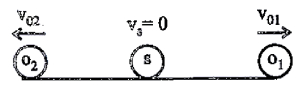
$A$ source at rest emits sound waves of frequency $102 \ Hz$. Two observers are moving away from the source of sound in opposite directions,each with a speed of $10 \%$ of the speed of sound. The ratio of the frequencies of sound heard by the observers is
A
$9: 11$
B
$1: 1$
C
$7: 9$
D
$2: 3$
Solution
(B) Let $v$ be the speed of sound and $f = 102 \ Hz$ be the frequency of the source.
Since the source is at rest $(v_s = 0)$,the frequency $f'$ heard by an observer moving away from the source with speed $v_o$ is given by the Doppler effect formula: $f' = f \left( \frac{v - v_o}{v} \right)$.
Given that both observers move away from the source with speed $v_o = 10 \% \text{ of } v = \frac{v}{10}$,the frequency heard by observer $1$ is:
$f_1 = f \left( \frac{v - v/10}{v} \right) = f \left( \frac{0.9v}{v} \right) = 0.9f$.
Similarly,the frequency heard by observer $2$ is:
$f_2 = f \left( \frac{v - v/10}{v} \right) = f \left( \frac{0.9v}{v} \right) = 0.9f$.
Therefore,the ratio of the frequencies heard by the observers is:
$\frac{f_1}{f_2} = \frac{0.9f}{0.9f} = 1: 1$.
Since the source is at rest $(v_s = 0)$,the frequency $f'$ heard by an observer moving away from the source with speed $v_o$ is given by the Doppler effect formula: $f' = f \left( \frac{v - v_o}{v} \right)$.
Given that both observers move away from the source with speed $v_o = 10 \% \text{ of } v = \frac{v}{10}$,the frequency heard by observer $1$ is:
$f_1 = f \left( \frac{v - v/10}{v} \right) = f \left( \frac{0.9v}{v} \right) = 0.9f$.
Similarly,the frequency heard by observer $2$ is:
$f_2 = f \left( \frac{v - v/10}{v} \right) = f \left( \frac{0.9v}{v} \right) = 0.9f$.
Therefore,the ratio of the frequencies heard by the observers is:
$\frac{f_1}{f_2} = \frac{0.9f}{0.9f} = 1: 1$.
0 likesView Solution
75
PhysicsEasyMCQTS EAMCET · 2024
The difference between the fundamental frequencies of an open pipe and a closed pipe of the same length is $100 \ Hz$. The difference between the frequencies of the second harmonic of the open pipe and the third harmonic of the closed pipe is: (in $Hz$)
A
$100$
B
$150$
C
$200$
D
$250$
Solution
(A) Let $v$ be the speed of sound and $l$ be the length of the pipes.
For an open organ pipe,the fundamental frequency is $f_{o} = \frac{v}{2l}$.
For a closed organ pipe,the fundamental frequency is $f_{c} = \frac{v}{4l}$.
Given that the difference between these fundamental frequencies is $100 \ Hz$:
$f_{o} - f_{c} = 100 \ Hz \implies \frac{v}{2l} - \frac{v}{4l} = 100 \ Hz \implies \frac{v}{4l} = 100 \ Hz$.
The second harmonic of the open pipe is $f_{2,o} = 2 \times f_{o} = 2 \times \frac{v}{2l} = \frac{v}{l}$.
The third harmonic of the closed pipe is $f_{3,c} = 3 \times f_{c} = 3 \times \frac{v}{4l} = \frac{3v}{4l}$.
The difference between these frequencies is:
$f_{2,o} - f_{3,c} = \frac{v}{l} - \frac{3v}{4l} = \frac{4v - 3v}{4l} = \frac{v}{4l}$.
Since $\frac{v}{4l} = 100 \ Hz$,the required difference is $100 \ Hz$.
For an open organ pipe,the fundamental frequency is $f_{o} = \frac{v}{2l}$.
For a closed organ pipe,the fundamental frequency is $f_{c} = \frac{v}{4l}$.
Given that the difference between these fundamental frequencies is $100 \ Hz$:
$f_{o} - f_{c} = 100 \ Hz \implies \frac{v}{2l} - \frac{v}{4l} = 100 \ Hz \implies \frac{v}{4l} = 100 \ Hz$.
The second harmonic of the open pipe is $f_{2,o} = 2 \times f_{o} = 2 \times \frac{v}{2l} = \frac{v}{l}$.
The third harmonic of the closed pipe is $f_{3,c} = 3 \times f_{c} = 3 \times \frac{v}{4l} = \frac{3v}{4l}$.
The difference between these frequencies is:
$f_{2,o} - f_{3,c} = \frac{v}{l} - \frac{3v}{4l} = \frac{4v - 3v}{4l} = \frac{v}{4l}$.
Since $\frac{v}{4l} = 100 \ Hz$,the required difference is $100 \ Hz$.
0 likesView Solution
76
PhysicsEasyMCQTS EAMCET · 2024
The path difference between two particles of a sound wave is $50 \ cm$ and the phase difference between them is $1.8 \pi$. If the speed of sound in air is $340 \ ms^{-1}$,the frequency of the sound wave is (in $Hz$)
A
$672$
B
$306$
C
$612$
D
$340$
Solution
(C) Given: Path difference $\Delta x = 50 \ cm = 0.5 \ m$,Phase difference $\Delta \phi = 1.8 \pi$,Speed of sound $v = 340 \ ms^{-1}$.
We know the relation between path difference and phase difference is $\Delta x = \frac{\lambda}{2 \pi} \cdot \Delta \phi$.
Substituting the values: $0.5 = \frac{\lambda}{2 \pi} \times 1.8 \pi$.
$0.5 = \lambda \times 0.9 \Rightarrow \lambda = \frac{0.5}{0.9} = \frac{5}{9} \ m$.
The frequency $f$ is given by $f = \frac{v}{\lambda}$.
$f = \frac{340}{5/9} = \frac{340 \times 9}{5} = 68 \times 9 = 612 \ Hz$.
We know the relation between path difference and phase difference is $\Delta x = \frac{\lambda}{2 \pi} \cdot \Delta \phi$.
Substituting the values: $0.5 = \frac{\lambda}{2 \pi} \times 1.8 \pi$.
$0.5 = \lambda \times 0.9 \Rightarrow \lambda = \frac{0.5}{0.9} = \frac{5}{9} \ m$.
The frequency $f$ is given by $f = \frac{v}{\lambda}$.
$f = \frac{340}{5/9} = \frac{340 \times 9}{5} = 68 \times 9 = 612 \ Hz$.
0 likesView Solution
77
PhysicsMediumMCQTS EAMCET · 2024
An aircraft executes a horizontal loop of radius $9 \ km$ at a constant speed of $540 \ kmh^{-1}$. The wings of the aircraft are banked at an angle of (Acceleration due to gravity $g = 10 \ ms^{-2}$)
A
$\operatorname{cosec}^{-1}(4)$
B
$\cot^{-1}(4)$
C
$\tan^{-1}(4)$
D
$\sec^{-1}(4)$
Solution
(B) Given: Radius $r = 9 \ km = 9000 \ m$,Speed $v = 540 \ kmh^{-1} = 540 \times \frac{5}{18} = 150 \ ms^{-1}$,Acceleration due to gravity $g = 10 \ ms^{-2}$.
For a banked aircraft in a horizontal loop,the banking angle $\theta$ is given by the relation: $\tan \theta = \frac{v^2}{rg}$.
Substituting the values: $\tan \theta = \frac{150 \times 150}{9000 \times 10} = \frac{22500}{90000} = \frac{1}{4}$.
Therefore,$\theta = \tan^{-1}(0.25) = \cot^{-1}(4)$.
For a banked aircraft in a horizontal loop,the banking angle $\theta$ is given by the relation: $\tan \theta = \frac{v^2}{rg}$.
Substituting the values: $\tan \theta = \frac{150 \times 150}{9000 \times 10} = \frac{22500}{90000} = \frac{1}{4}$.
Therefore,$\theta = \tan^{-1}(0.25) = \cot^{-1}(4)$.
0 likesView Solution
78
PhysicsMediumMCQTS EAMCET · 2024
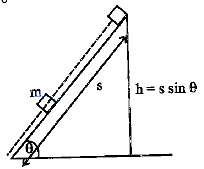
$A$ block of mass '$m$' with an initial kinetic energy '$E$' moves up an inclined plane of inclination '$\theta$'. If '$\mu$' is the coefficient of friction between the plane and the body,the work done against friction before coming to rest is
A
$\mu E \cos \theta$
B
$\frac{\mu E \cos \theta}{\sin \theta-\mu \cos \theta}$
C
$\frac{E \mu \cos \theta}{\cos \theta+\sin \theta}$
D
$\frac{\mu E \cos \theta}{\sin \theta+\mu \cos \theta}$
Solution
(D) Let the body slide up to a distance '$s$' before coming to rest.
The height reached is $h = s \sin \theta$.
According to the work-energy theorem,the total work done by all forces equals the change in kinetic energy:
$W_{friction} + W_{gravity} = K_f - K_i$
$-\mu mg \cos \theta \cdot s - mg \sin \theta \cdot s = 0 - E$
$\mu mgs \cos \theta + mgs \sin \theta = E$
$s(mg(\mu \cos \theta + \sin \theta)) = E$
$s = \frac{E}{mg(\mu \cos \theta + \sin \theta)}$
The work done against friction is $W_{against\ friction} = |W_{friction}| = \mu mg \cos \theta \cdot s$.
Substituting the value of '$s$':
$W_{against\ friction} = \mu mg \cos \theta \cdot \left( \frac{E}{mg(\mu \cos \theta + \sin \theta)} \right)$
$W_{against\ friction} = \frac{\mu E \cos \theta}{\sin \theta + \mu \cos \theta}$
The height reached is $h = s \sin \theta$.
According to the work-energy theorem,the total work done by all forces equals the change in kinetic energy:
$W_{friction} + W_{gravity} = K_f - K_i$
$-\mu mg \cos \theta \cdot s - mg \sin \theta \cdot s = 0 - E$
$\mu mgs \cos \theta + mgs \sin \theta = E$
$s(mg(\mu \cos \theta + \sin \theta)) = E$
$s = \frac{E}{mg(\mu \cos \theta + \sin \theta)}$
The work done against friction is $W_{against\ friction} = |W_{friction}| = \mu mg \cos \theta \cdot s$.
Substituting the value of '$s$':
$W_{against\ friction} = \mu mg \cos \theta \cdot \left( \frac{E}{mg(\mu \cos \theta + \sin \theta)} \right)$
$W_{against\ friction} = \frac{\mu E \cos \theta}{\sin \theta + \mu \cos \theta}$
0 likesView Solution
79
PhysicsEasyMCQTS EAMCET · 2024
The kinetic energy of a body of mass $4 \ kg$ moving with a velocity of $(2 \hat{i}-4 \hat{j}-\hat{k}) \ ms^{-1}$ is (in $J$)
A
$84$
B
$63$
C
$42$
D
$21$
Solution
(C) Given: Mass $m = 4 \ kg$. Velocity vector $\vec{v} = (2 \hat{i} - 4 \hat{j} - \hat{k}) \ ms^{-1}$.
First,calculate the magnitude of the velocity $v = |\vec{v}| = \sqrt{(2)^2 + (-4)^2 + (-1)^2}$.
$v = \sqrt{4 + 16 + 1} = \sqrt{21} \ ms^{-1}$.
The kinetic energy $K.E.$ is given by the formula $K.E. = \frac{1}{2} mv^2$.
Substituting the values: $K.E. = \frac{1}{2} \times 4 \times (\sqrt{21})^2$.
$K.E. = 2 \times 21 = 42 \ J$.
First,calculate the magnitude of the velocity $v = |\vec{v}| = \sqrt{(2)^2 + (-4)^2 + (-1)^2}$.
$v = \sqrt{4 + 16 + 1} = \sqrt{21} \ ms^{-1}$.
The kinetic energy $K.E.$ is given by the formula $K.E. = \frac{1}{2} mv^2$.
Substituting the values: $K.E. = \frac{1}{2} \times 4 \times (\sqrt{21})^2$.
$K.E. = 2 \times 21 = 42 \ J$.
0 likesView Solution
80
PhysicsEasyMCQTS EAMCET · 2024
$A$ body thrown vertically upwards from the ground reaches a maximum height $h$. The ratio of the kinetic and potential energies of the body at a height $40 \%$ of $h$ from the ground is
A
$2: 3$
B
$3: 2$
C
$1: 1$
D
$4: 9$
Solution
(B) Let the mass of the body be $m$ and the initial velocity be $u$. At maximum height $h$,the total energy is $E = mgh$.
At a height $y = 0.4h$ from the ground,the potential energy is $PE = mgy = mg(0.4h) = 0.4mgh$.
According to the law of conservation of energy,the total energy remains constant.
Therefore,$KE + PE = E$.
$KE = E - PE = mgh - 0.4mgh = 0.6mgh$.
The ratio of kinetic energy to potential energy is $\frac{KE}{PE} = \frac{0.6mgh}{0.4mgh} = \frac{0.6}{0.4} = \frac{3}{2}$.
Thus,the ratio is $3: 2$.
At a height $y = 0.4h$ from the ground,the potential energy is $PE = mgy = mg(0.4h) = 0.4mgh$.
According to the law of conservation of energy,the total energy remains constant.
Therefore,$KE + PE = E$.
$KE = E - PE = mgh - 0.4mgh = 0.6mgh$.
The ratio of kinetic energy to potential energy is $\frac{KE}{PE} = \frac{0.6mgh}{0.4mgh} = \frac{0.6}{0.4} = \frac{3}{2}$.
Thus,the ratio is $3: 2$.
0 likesView Solution
81
PhysicsEasyMCQTS EAMCET · 2024
$A$ circular coil carrying a current of $2.5 \ A$ is free to rotate about an axis in its plane perpendicular to an external magnetic field. When the coil is made to oscillate,the time period of oscillation is $T$. If the current through the coil is $10 \ A$,the time period of oscillation is:
A
$\frac{T}{2}$
B
$T$
C
$2T$
D
$\frac{T}{4}$
Solution
(A) The time period of oscillation of a current-carrying coil in an external magnetic field is given by $T = 2\pi \sqrt{\frac{I_{moment}}{MB}}$,where $I_{moment}$ is the moment of inertia and $M$ is the magnetic dipole moment.
Since the magnetic dipole moment $M = NIA$,where $N$ is the number of turns,$I$ is the current,and $A$ is the area,we have $M \propto I$.
Therefore,$T \propto \frac{1}{\sqrt{M}} \propto \frac{1}{\sqrt{I}}$.
Given $I_1 = 2.5 \ A$ and $I_2 = 10 \ A$,we have:
$\frac{T_2}{T_1} = \sqrt{\frac{I_1}{I_2}} = \sqrt{\frac{2.5}{10}} = \sqrt{\frac{1}{4}} = \frac{1}{2}$.
Thus,$T_2 = \frac{T_1}{2} = \frac{T}{2}$.
Since the magnetic dipole moment $M = NIA$,where $N$ is the number of turns,$I$ is the current,and $A$ is the area,we have $M \propto I$.
Therefore,$T \propto \frac{1}{\sqrt{M}} \propto \frac{1}{\sqrt{I}}$.
Given $I_1 = 2.5 \ A$ and $I_2 = 10 \ A$,we have:
$\frac{T_2}{T_1} = \sqrt{\frac{I_1}{I_2}} = \sqrt{\frac{2.5}{10}} = \sqrt{\frac{1}{4}} = \frac{1}{2}$.
Thus,$T_2 = \frac{T_1}{2} = \frac{T}{2}$.
0 likesView Solution
82
PhysicsMediumMCQTS EAMCET · 2024
$A$ short bar magnet placed in a uniform magnetic field making an angle with the field experiences a torque. If the angle made by the magnet with the field is changed from $30^{\circ}$ to $45^{\circ}$,the torque of the magnet
A
increases by $50 \%$
B
decreases by $50 \%$
C
decreases by $41.4 \%$
D
increases by $41.4 \%$
Solution
(D) The torque $\tau$ on a bar magnet in a uniform magnetic field $B$ is given by the formula $\tau = MB \sin \theta$,where $M$ is the magnetic dipole moment and $\theta$ is the angle between the magnetic moment and the magnetic field.
Initial torque $\tau_1 = MB \sin 30^{\circ} = MB \times 0.5$.
Final torque $\tau_2 = MB \sin 45^{\circ} = MB \times \frac{1}{\sqrt{2}} \approx MB \times 0.707$.
The ratio of the torques is $\frac{\tau_2}{\tau_1} = \frac{\sin 45^{\circ}}{\sin 30^{\circ}} = \frac{1/\sqrt{2}}{1/2} = \sqrt{2} \approx 1.414$.
Therefore,$\tau_2 = 1.414 \tau_1$.
The percentage increase in torque is given by $\frac{\tau_2 - \tau_1}{\tau_1} \times 100 = (1.414 - 1) \times 100 = 41.4 \%$.
Thus,the torque increases by $41.4 \%$.
Initial torque $\tau_1 = MB \sin 30^{\circ} = MB \times 0.5$.
Final torque $\tau_2 = MB \sin 45^{\circ} = MB \times \frac{1}{\sqrt{2}} \approx MB \times 0.707$.
The ratio of the torques is $\frac{\tau_2}{\tau_1} = \frac{\sin 45^{\circ}}{\sin 30^{\circ}} = \frac{1/\sqrt{2}}{1/2} = \sqrt{2} \approx 1.414$.
Therefore,$\tau_2 = 1.414 \tau_1$.
The percentage increase in torque is given by $\frac{\tau_2 - \tau_1}{\tau_1} \times 100 = (1.414 - 1) \times 100 = 41.4 \%$.
Thus,the torque increases by $41.4 \%$.
0 likesView Solution
83
PhysicsEasyMCQTS EAMCET · 2024
An $\alpha$-particle of energy $E$ is liberated during the decay of a nucleus of mass number $236$. The total energy released in this process is
A
$58 E$
B
$59 E$
C
$\frac{58 E}{59}$
D
$\frac{59 E}{58}$
Solution
(D) In the decay of a nucleus with mass number $A = 236$,the $\alpha$-particle $(m_{\alpha} = 4)$ and the daughter nucleus $(m_d = 232)$ are produced.
Given the kinetic energy of the $\alpha$-particle is $(KE)_{\alpha} = E$.
Since the total momentum is conserved,the magnitudes of the momenta of the $\alpha$-particle and the daughter nucleus are equal: $P_{\alpha} = P_d = P$.
The kinetic energy is given by $KE = \frac{P^2}{2m}$,which implies $KE \propto \frac{1}{m}$.
Therefore,the ratio of kinetic energies is $\frac{(KE)_d}{(KE)_{\alpha}} = \frac{m_{\alpha}}{m_d} = \frac{4}{232} = \frac{1}{58}$.
Thus,$(KE)_d = \frac{E}{58}$.
The total energy released $(Q)$ is the sum of the kinetic energies of the products: $Q = (KE)_{\alpha} + (KE)_d = E + \frac{E}{58} = \frac{59 E}{58}$.
Given the kinetic energy of the $\alpha$-particle is $(KE)_{\alpha} = E$.
Since the total momentum is conserved,the magnitudes of the momenta of the $\alpha$-particle and the daughter nucleus are equal: $P_{\alpha} = P_d = P$.
The kinetic energy is given by $KE = \frac{P^2}{2m}$,which implies $KE \propto \frac{1}{m}$.
Therefore,the ratio of kinetic energies is $\frac{(KE)_d}{(KE)_{\alpha}} = \frac{m_{\alpha}}{m_d} = \frac{4}{232} = \frac{1}{58}$.
Thus,$(KE)_d = \frac{E}{58}$.
The total energy released $(Q)$ is the sum of the kinetic energies of the products: $Q = (KE)_{\alpha} + (KE)_d = E + \frac{E}{58} = \frac{59 E}{58}$.
0 likesView Solution
84
PhysicsMediumMCQTS EAMCET · 2024
The energy released by the fission of one uranium nucleus is $200 \text{ MeV}$. The number of fissions per second required to produce $128 \text{ W}$ power is:
A
$6 \times 10^{12}$
B
$2 \times 10^{12}$
C
$8 \times 10^{12}$
D
$4 \times 10^{12}$
Solution
(D) Energy released per fission $E = 200 \text{ MeV} = 200 \times 10^6 \times 1.6 \times 10^{-19} \text{ J} = 3.2 \times 10^{-11} \text{ J}$.
Power $P = 128 \text{ W} = 128 \text{ J/s}$.
Let $n$ be the number of fissions per second.
Then,$P = n \times E$.
$n = \frac{P}{E} = \frac{128}{3.2 \times 10^{-11}}$.
$n = \frac{1280}{3.2} \times 10^{10} = 400 \times 10^{10} = 4 \times 10^{12} \text{ fissions/s}$.
Power $P = 128 \text{ W} = 128 \text{ J/s}$.
Let $n$ be the number of fissions per second.
Then,$P = n \times E$.
$n = \frac{P}{E} = \frac{128}{3.2 \times 10^{-11}}$.
$n = \frac{1280}{3.2} \times 10^{10} = 400 \times 10^{10} = 4 \times 10^{12} \text{ fissions/s}$.
0 likesView Solution
85
PhysicsEasyMCQTS EAMCET · 2024
The operation of a nuclear reactor is said to be critical when the value of the neutron multiplication factor $K$ is:
A
$K=0$
B
$K > 1$
C
$K=1$
D
$0 < K < 1$
Solution
(C) The neutron multiplication factor $K$ (also denoted as $k$) is defined as the ratio of the number of neutrons produced in a given generation to the number of neutrons produced in the preceding generation.
When $K = 1$,the rate of neutron production is equal to the rate of neutron loss,meaning the chain reaction is self-sustaining at a constant power level.
This state is known as the critical state of a nuclear reactor.
If $K < 1$,the reactor is subcritical,and the chain reaction dies out.
If $K > 1$,the reactor is supercritical,and the power level increases exponentially.
When $K = 1$,the rate of neutron production is equal to the rate of neutron loss,meaning the chain reaction is self-sustaining at a constant power level.
This state is known as the critical state of a nuclear reactor.
If $K < 1$,the reactor is subcritical,and the chain reaction dies out.
If $K > 1$,the reactor is supercritical,and the power level increases exponentially.
0 likesView Solution
86
PhysicsMediumMCQTS EAMCET · 2024
An element consists of a mixture of three isotopes $A$,$B$,and $C$ of masses $m_1$,$m_2$,and $m_3$ respectively. If the relative abundances of the three isotopes $A$,$B$,and $C$ are in the ratio $2:3:5$,the average mass of the element is:
A
$0.2 m_1 + 0.3 m_2 + 0.5 m_3$
B
$2 m_1 + 3 m_2 + 5 m_3$
C
$0.4 m_1 + 0.6 m_2 + m_3$
D
$4 m_1 + 6 m_2 + 10 m_3$
Solution
(A) The average mass of an element is calculated by taking the weighted average of the masses of its isotopes based on their relative abundances.
Given the ratio of abundances is $2:3:5$,the total parts are $2 + 3 + 5 = 10$.
The fractional abundances are:
For isotope $A$: $2/10 = 0.2$
For isotope $B$: $3/10 = 0.3$
For isotope $C$: $5/10 = 0.5$
The average mass is given by the formula: $\text{Average Mass} = (\text{fraction}_A \times m_1) + (\text{fraction}_B \times m_2) + (\text{fraction}_C \times m_3)$.
Substituting the values: $\text{Average Mass} = 0.2 m_1 + 0.3 m_2 + 0.5 m_3$.
Given the ratio of abundances is $2:3:5$,the total parts are $2 + 3 + 5 = 10$.
The fractional abundances are:
For isotope $A$: $2/10 = 0.2$
For isotope $B$: $3/10 = 0.3$
For isotope $C$: $5/10 = 0.5$
The average mass is given by the formula: $\text{Average Mass} = (\text{fraction}_A \times m_1) + (\text{fraction}_B \times m_2) + (\text{fraction}_C \times m_3)$.
Substituting the values: $\text{Average Mass} = 0.2 m_1 + 0.3 m_2 + 0.5 m_3$.
0 likesView Solution
87
PhysicsEasyMCQTS EAMCET · 2024
The half-life of a radioactive substance is $12 \text{ minutes}$. The time gap between $28 \%$ decay and $82 \%$ decay of the radioactive substance is
A
$6 \text{ minutes}$
B
$18 \text{ minutes}$
C
$12 \text{ minutes}$
D
$24 \text{ minutes}$
Solution
(D) Given half-life $T_{1/2} = 12 \text{ minutes}$.
At $28 \%$ decay, the remaining amount is $100 - 28 = 72 \%$.
At $82 \%$ decay, the remaining amount is $100 - 82 = 18 \%$.
We know that the amount of radioactive substance reduces to half in one half-life period.
Starting from $72 \%$, after one half-life $(12 \text{ minutes})$, the amount becomes $72 / 2 = 36 \%$.
After another half-life $(12 \text{ minutes})$, the amount becomes $36 / 2 = 18 \%$.
Therefore, the total time gap is $12 + 12 = 24 \text{ minutes}$.
At $28 \%$ decay, the remaining amount is $100 - 28 = 72 \%$.
At $82 \%$ decay, the remaining amount is $100 - 82 = 18 \%$.
We know that the amount of radioactive substance reduces to half in one half-life period.
Starting from $72 \%$, after one half-life $(12 \text{ minutes})$, the amount becomes $72 / 2 = 36 \%$.
After another half-life $(12 \text{ minutes})$, the amount becomes $36 / 2 = 18 \%$.
Therefore, the total time gap is $12 + 12 = 24 \text{ minutes}$.
0 likesView Solution
88
PhysicsEasyMCQTS EAMCET · 2024
The half-lives of two radioactive materials $A$ and $B$ are $T$ and $2T$ respectively. If the ratio of the initial masses of the materials $A$ and $B$ is $8:1$,then the time after which the ratio of the masses of the materials $A$ and $B$ becomes $4:1$ is
A
$2T$
B
$4T$
C
$T$
D
$8T$
Solution
(A) The mass of a radioactive substance remaining after time $t$ is given by $M = M_0 (1/2)^{t/T_{1/2}}$,where $M_0$ is the initial mass and $T_{1/2}$ is the half-life.
For material $A$: $M_A = M_{0A} (1/2)^{t/T}$.
For material $B$: $M_B = M_{0B} (1/2)^{t/2T}$.
Given the ratio of initial masses $M_{0A} / M_{0B} = 8/1$ and the ratio of remaining masses $M_A / M_B = 4/1$.
Therefore,$\frac{M_A}{M_B} = \frac{M_{0A}}{M_{0B}} \cdot \frac{(1/2)^{t/T}}{(1/2)^{t/2T}} = 4/1$.
Substituting the values: $8 \cdot (1/2)^{t/T - t/2T} = 4$.
$8 \cdot (1/2)^{t/2T} = 4$.
$(1/2)^{t/2T} = 4/8 = 1/2$.
$(1/2)^{t/2T} = (1/2)^1$.
Comparing the exponents,$t/2T = 1$,which gives $t = 2T$.
For material $A$: $M_A = M_{0A} (1/2)^{t/T}$.
For material $B$: $M_B = M_{0B} (1/2)^{t/2T}$.
Given the ratio of initial masses $M_{0A} / M_{0B} = 8/1$ and the ratio of remaining masses $M_A / M_B = 4/1$.
Therefore,$\frac{M_A}{M_B} = \frac{M_{0A}}{M_{0B}} \cdot \frac{(1/2)^{t/T}}{(1/2)^{t/2T}} = 4/1$.
Substituting the values: $8 \cdot (1/2)^{t/T - t/2T} = 4$.
$8 \cdot (1/2)^{t/2T} = 4$.
$(1/2)^{t/2T} = 4/8 = 1/2$.
$(1/2)^{t/2T} = (1/2)^1$.
Comparing the exponents,$t/2T = 1$,which gives $t = 2T$.
0 likesView Solution
89
PhysicsEasyMCQTS EAMCET · 2024
The $A_{92}U^{238}$ nucleus decays to a $Pb^{214}_{82}$ nucleus. The number of $\alpha$ and $\beta^{-}$ particles emitted are:
A
$6$ and $2$
B
$3$ and $3$
C
$2$ and $6$
D
$3$ and $4$
Solution
(A) Let the number of $\alpha$-particles emitted be $n_{\alpha}$ and the number of $\beta^{-}$-particles emitted be $n_{\beta}$.
For the mass number: $238 = 214 + 4n_{\alpha} \implies 4n_{\alpha} = 24 \implies n_{\alpha} = 6$.
For the atomic number: $92 = 82 + 2n_{\alpha} - 1n_{\beta}$.
Substituting $n_{\alpha} = 6$: $92 = 82 + 2(6) - n_{\beta} \implies 92 = 82 + 12 - n_{\beta} \implies 92 = 94 - n_{\beta} \implies n_{\beta} = 2$.
Thus,the number of $\alpha$-particles is $6$ and the number of $\beta^{-}$-particles is $2$.
For the mass number: $238 = 214 + 4n_{\alpha} \implies 4n_{\alpha} = 24 \implies n_{\alpha} = 6$.
For the atomic number: $92 = 82 + 2n_{\alpha} - 1n_{\beta}$.
Substituting $n_{\alpha} = 6$: $92 = 82 + 2(6) - n_{\beta} \implies 92 = 82 + 12 - n_{\beta} \implies 92 = 94 - n_{\beta} \implies n_{\beta} = 2$.
Thus,the number of $\alpha$-particles is $6$ and the number of $\beta^{-}$-particles is $2$.
0 likesView Solution
90
PhysicsEasyMCQTS EAMCET · 2024
After the decay of a single $\beta$ particle,the parent and daughter nuclei are
A
isotopes
B
isobars
C
isomers
D
isotones
Solution
(B) The $\beta$-decay of a nucleus is represented as:
${ }_{Z}^{A} X \longrightarrow{ }_{Z+1}^{A} Y+{ }_{-1}^{0} e + \bar{\nu}$
In this process,the mass number $A$ remains constant,while the atomic number $Z$ increases by $1$.
Since the mass number $A$ is the same for both the parent nucleus $X$ and the daughter nucleus $Y$,they are isobars.
Therefore,the correct option is $B$.
${ }_{Z}^{A} X \longrightarrow{ }_{Z+1}^{A} Y+{ }_{-1}^{0} e + \bar{\nu}$
In this process,the mass number $A$ remains constant,while the atomic number $Z$ increases by $1$.
Since the mass number $A$ is the same for both the parent nucleus $X$ and the daughter nucleus $Y$,they are isobars.
Therefore,the correct option is $B$.
0 likesView Solution
91
PhysicsDifficultMCQTS EAMCET · 2024
$A$ circular coil carrying a current of $2.5 \ A$ is free to rotate about an axis in its plane perpendicular to an external magnetic field. When the coil is made to oscillate,the time period of oscillation is $T$. If the current through the coil is $10 \ A$,the time period of oscillation is
A
$\frac{T}{2}$
B
$T$
C
$2T$
D
$\frac{T}{4}$
Solution
(A) The time period of oscillation of a current-carrying coil in an external magnetic field is given by $T = 2\pi \sqrt{\frac{I}{MB}}$,where $I$ is the moment of inertia,$M$ is the magnetic dipole moment,and $B$ is the magnetic field.
Since $M = NIA$ (where $N$ is the number of turns,$I_{curr}$ is the current,and $A$ is the area),we have $M \propto I_{curr}$.
Therefore,$T \propto \frac{1}{\sqrt{M}} \propto \frac{1}{\sqrt{I_{curr}}}$.
Given $I_{curr1} = 2.5 \ A$ and $I_{curr2} = 10 \ A$,we have $\frac{T_2}{T_1} = \sqrt{\frac{I_{curr1}}{I_{curr2}}} = \sqrt{\frac{2.5}{10}} = \sqrt{\frac{1}{4}} = \frac{1}{2}$.
Thus,$T_2 = \frac{T_1}{2} = \frac{T}{2}$.
Since $M = NIA$ (where $N$ is the number of turns,$I_{curr}$ is the current,and $A$ is the area),we have $M \propto I_{curr}$.
Therefore,$T \propto \frac{1}{\sqrt{M}} \propto \frac{1}{\sqrt{I_{curr}}}$.
Given $I_{curr1} = 2.5 \ A$ and $I_{curr2} = 10 \ A$,we have $\frac{T_2}{T_1} = \sqrt{\frac{I_{curr1}}{I_{curr2}}} = \sqrt{\frac{2.5}{10}} = \sqrt{\frac{1}{4}} = \frac{1}{2}$.
Thus,$T_2 = \frac{T_1}{2} = \frac{T}{2}$.
0 likesView Solution
92
PhysicsMediumMCQTS EAMCET · 2024
For a combination of two convex lenses of focal lengths $f_1$ and $f_2$ to act as a glass slab,the distance of separation between them is
A
$f_1+f_2$
B
$f_1 \sim f_2$
C
$\frac{f_1+f_2}{2}$
D
$\frac{f_1 \sim f_2}{2}$
Solution
(A) For a glass slab,the equivalent focal length $F$ is $\infty$.
For two thin lenses of focal lengths $f_1$ and $f_2$ separated by a distance $d$,the equivalent focal length $F$ is given by the formula:
$\frac{1}{F} = \frac{1}{f_1} + \frac{1}{f_2} - \frac{d}{f_1 f_2}$
Since the combination acts as a glass slab,we set $F = \infty$,which implies $\frac{1}{F} = 0$.
Substituting this into the formula:
$0 = \frac{1}{f_1} + \frac{1}{f_2} - \frac{d}{f_1 f_2}$
$0 = \frac{f_2 + f_1}{f_1 f_2} - \frac{d}{f_1 f_2}$
$\frac{d}{f_1 f_2} = \frac{f_1 + f_2}{f_1 f_2}$
$d = f_1 + f_2$
Thus,the distance of separation between the lenses must be $f_1 + f_2$.
For two thin lenses of focal lengths $f_1$ and $f_2$ separated by a distance $d$,the equivalent focal length $F$ is given by the formula:
$\frac{1}{F} = \frac{1}{f_1} + \frac{1}{f_2} - \frac{d}{f_1 f_2}$
Since the combination acts as a glass slab,we set $F = \infty$,which implies $\frac{1}{F} = 0$.
Substituting this into the formula:
$0 = \frac{1}{f_1} + \frac{1}{f_2} - \frac{d}{f_1 f_2}$
$0 = \frac{f_2 + f_1}{f_1 f_2} - \frac{d}{f_1 f_2}$
$\frac{d}{f_1 f_2} = \frac{f_1 + f_2}{f_1 f_2}$
$d = f_1 + f_2$
Thus,the distance of separation between the lenses must be $f_1 + f_2$.
0 likesView Solution
93
PhysicsEasyMCQTS EAMCET · 2024
If you are using eyeglasses of power $2 D$,what is your near point (in $cm$)?
A
$25$
B
$50$
C
$43$
D
$32$
Solution
(B) Given,power of the lens $P = 2 \ D$.
The focal length of the lens is $f = \frac{1}{P} = \frac{100}{2} = 50 \ cm$.
For a person with a near point defect (hypermetropia),the lens forms an image of an object placed at the standard near point $(u = -25 \ cm)$ at the person's actual near point $(v)$.
Using the lens formula: $\frac{1}{f} = \frac{1}{v} - \frac{1}{u}$.
Substituting the values: $\frac{1}{50} = \frac{1}{v} - \frac{1}{-25}$.
$\frac{1}{50} = \frac{1}{v} + \frac{1}{25}$.
$\frac{1}{v} = \frac{1}{50} - \frac{1}{25} = \frac{1 - 2}{50} = -\frac{1}{50}$.
Therefore,$v = -50 \ cm$.
The magnitude of the near point is $50 \ cm$.
The focal length of the lens is $f = \frac{1}{P} = \frac{100}{2} = 50 \ cm$.
For a person with a near point defect (hypermetropia),the lens forms an image of an object placed at the standard near point $(u = -25 \ cm)$ at the person's actual near point $(v)$.
Using the lens formula: $\frac{1}{f} = \frac{1}{v} - \frac{1}{u}$.
Substituting the values: $\frac{1}{50} = \frac{1}{v} - \frac{1}{-25}$.
$\frac{1}{50} = \frac{1}{v} + \frac{1}{25}$.
$\frac{1}{v} = \frac{1}{50} - \frac{1}{25} = \frac{1 - 2}{50} = -\frac{1}{50}$.
Therefore,$v = -50 \ cm$.
The magnitude of the near point is $50 \ cm$.
0 likesView Solution
94
PhysicsDifficultMCQTS EAMCET · 2024
The power of a thin convex lens placed in air is $+4 \ D$. The refractive index of the material of the convex lens is $\frac{3}{2}$. If this convex lens is immersed in a liquid of refractive index $\frac{5}{3}$,then
A
it behaves like a convex lens of focal length $75 \ cm$
B
it behaves like a convex lens of focal length $125 \ cm$
C
it behaves like a concave lens of focal length $125 \ cm$
D
it behaves like a concave lens of focal length $75 \ cm$
Solution
(C) For a thin convex lens,$P = +4 \ D$,$\mu_{\ell} = \frac{3}{2}$,$\mu_m = \frac{5}{3}$.
Since $P = \frac{1}{f_a}$,we have $f_a = \frac{1}{4} \ m = 25 \ cm$.
In air,the lens maker's formula is $\frac{1}{f_a} = (\mu_{\ell} - 1) \left(\frac{1}{R_1} - \frac{1}{R_2}\right)$ ... $(i)$.
In a liquid medium,the focal length $f_m$ is given by $\frac{1}{f_m} = \left(\frac{\mu_{\ell}}{\mu_m} - 1\right) \left(\frac{1}{R_1} - \frac{1}{R_2}\right)$ ... (ii).
Dividing equation (ii) by $(i)$,we get $\frac{f_a}{f_m} = \frac{(\mu_{\ell} - 1)}{(\frac{\mu_{\ell}}{\mu_m} - 1)}$.
Substituting the values: $\frac{f_a}{f_m} = \frac{(\frac{3}{2} - 1)}{(\frac{3/2}{5/3} - 1)} = \frac{1/2}{(9/10 - 1)} = \frac{1/2}{-1/10} = -5$.
Therefore,$f_m = -5 \times f_a = -5 \times 25 \ cm = -125 \ cm$.
The negative sign indicates that the lens behaves like a concave lens with a focal length of $125 \ cm$.
Since $P = \frac{1}{f_a}$,we have $f_a = \frac{1}{4} \ m = 25 \ cm$.
In air,the lens maker's formula is $\frac{1}{f_a} = (\mu_{\ell} - 1) \left(\frac{1}{R_1} - \frac{1}{R_2}\right)$ ... $(i)$.
In a liquid medium,the focal length $f_m$ is given by $\frac{1}{f_m} = \left(\frac{\mu_{\ell}}{\mu_m} - 1\right) \left(\frac{1}{R_1} - \frac{1}{R_2}\right)$ ... (ii).
Dividing equation (ii) by $(i)$,we get $\frac{f_a}{f_m} = \frac{(\mu_{\ell} - 1)}{(\frac{\mu_{\ell}}{\mu_m} - 1)}$.
Substituting the values: $\frac{f_a}{f_m} = \frac{(\frac{3}{2} - 1)}{(\frac{3/2}{5/3} - 1)} = \frac{1/2}{(9/10 - 1)} = \frac{1/2}{-1/10} = -5$.
Therefore,$f_m = -5 \times f_a = -5 \times 25 \ cm = -125 \ cm$.
The negative sign indicates that the lens behaves like a concave lens with a focal length of $125 \ cm$.
0 likesView Solution
95
PhysicsEasyMCQTS EAMCET · 2024
$A$ thin plano-convex lens of focal length $73.5 \ cm$ has a circular aperture of diameter $8.4 \ cm$. If the refractive index of the material of the lens is $\frac{5}{3}$,then the thickness of the lens is nearly
A
$2.4 \ cm$
B
$2.4 \ mm$
C
$1.8 \ mm$
D
$1.8 \ cm$
Solution
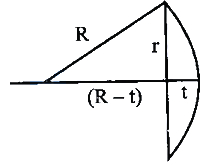
(C) For a plano-convex lens,the radius of curvature $R$ is related to the aperture radius $r$ and the thickness $t$ by the geometry: $R^2 = r^2 + (R-t)^2$. Since $t$ is very small,$R^2 = r^2 + R^2 - 2Rt + t^2 \approx r^2 + R^2 - 2Rt$,which simplifies to $R = \frac{r^2}{2t}$.
Using the Lens Maker's Formula: $\frac{1}{f} = (n-1) \left(\frac{1}{R_1} - \frac{1}{R_2}\right)$. For a plano-convex lens,$R_1 = R$ and $R_2 = \infty$,so $\frac{1}{f} = (n-1) \frac{1}{R}$,which gives $R = f(n-1)$.
Equating the two expressions for $R$: $f(n-1) = \frac{r^2}{2t}$.
Given $f = 73.5 \ cm$,$n = \frac{5}{3}$,and diameter $d = 8.4 \ cm$,so $r = \frac{d}{2} = 4.2 \ cm$.
Substituting the values: $73.5 \times \left(\frac{5}{3} - 1\right) = \frac{(4.2)^2}{2t}$.
$73.5 \times \frac{2}{3} = \frac{17.64}{2t} \Rightarrow 49 = \frac{8.82}{t}$.
$t = \frac{8.82}{49} \ cm = 0.18 \ cm = 1.8 \ mm$.
Using the Lens Maker's Formula: $\frac{1}{f} = (n-1) \left(\frac{1}{R_1} - \frac{1}{R_2}\right)$. For a plano-convex lens,$R_1 = R$ and $R_2 = \infty$,so $\frac{1}{f} = (n-1) \frac{1}{R}$,which gives $R = f(n-1)$.
Equating the two expressions for $R$: $f(n-1) = \frac{r^2}{2t}$.
Given $f = 73.5 \ cm$,$n = \frac{5}{3}$,and diameter $d = 8.4 \ cm$,so $r = \frac{d}{2} = 4.2 \ cm$.
Substituting the values: $73.5 \times \left(\frac{5}{3} - 1\right) = \frac{(4.2)^2}{2t}$.
$73.5 \times \frac{2}{3} = \frac{17.64}{2t} \Rightarrow 49 = \frac{8.82}{t}$.
$t = \frac{8.82}{49} \ cm = 0.18 \ cm = 1.8 \ mm$.
0 likesView Solution
96
PhysicsEasyMCQTS EAMCET · 2024
When an object of height $12 \ cm$ is placed at a distance from a convex lens,an image of height $18 \ cm$ is formed on a screen. Without changing the positions of the object and the screen,if the lens is moved towards the screen,another clear image is formed on the screen. The height of this image is (in $cm$)
A
$4$
B
$6$
C
$8$
D
$10$
Solution
(C) For a convex lens,the displacement method states that for a fixed distance between the object and the screen,there are two positions of the lens where a sharp image is formed on the screen.
Let $h_0$ be the height of the object,$h_1$ be the height of the first image,and $h_2$ be the height of the second image.
The relationship between these heights is given by the formula $h_0 = \sqrt{h_1 \times h_2}$.
Given: $h_0 = 12 \ cm$ and $h_1 = 18 \ cm$.
Substituting the values into the formula:
$12 = \sqrt{18 \times h_2}$
Squaring both sides:
$144 = 18 \times h_2$
$h_2 = \frac{144}{18} = 8 \ cm$.
Therefore,the height of the second image is $8 \ cm$.
Let $h_0$ be the height of the object,$h_1$ be the height of the first image,and $h_2$ be the height of the second image.
The relationship between these heights is given by the formula $h_0 = \sqrt{h_1 \times h_2}$.
Given: $h_0 = 12 \ cm$ and $h_1 = 18 \ cm$.
Substituting the values into the formula:
$12 = \sqrt{18 \times h_2}$
Squaring both sides:
$144 = 18 \times h_2$
$h_2 = \frac{144}{18} = 8 \ cm$.
Therefore,the height of the second image is $8 \ cm$.
0 likesView Solution
97
PhysicsMediumMCQTS EAMCET · 2024
The diameter of the objective of a telescope is $3.6 \ m$. The limit of resolution of the telescope for a light of wavelength $540 \ nm$ is
A
$1.22 \times 10^{-7} \ rad$
B
$1.83 \times 10^{-7} \ rad$
C
$0.61 \times 10^{-7} \ rad$
D
$3.76 \times 10^{-7} \ rad$
Solution
(B) Given:
Diameter of the objective,$d = 3.6 \ m$
Wavelength of light,$\lambda = 540 \ nm = 540 \times 10^{-9} \ m$
The limit of resolution $(d\theta)$ of a telescope is given by the formula:
$d\theta = \frac{1.22 \lambda}{d}$
Substituting the values:
$d\theta = \frac{1.22 \times 540 \times 10^{-9} \ m}{3.6 \ m}$
$d\theta = \frac{658.8 \times 10^{-9}}{3.6} \ rad$
$d\theta = 183 \times 10^{-9} \ rad$
$d\theta = 1.83 \times 10^{-7} \ rad$
Diameter of the objective,$d = 3.6 \ m$
Wavelength of light,$\lambda = 540 \ nm = 540 \times 10^{-9} \ m$
The limit of resolution $(d\theta)$ of a telescope is given by the formula:
$d\theta = \frac{1.22 \lambda}{d}$
Substituting the values:
$d\theta = \frac{1.22 \times 540 \times 10^{-9} \ m}{3.6 \ m}$
$d\theta = \frac{658.8 \times 10^{-9}}{3.6} \ rad$
$d\theta = 183 \times 10^{-9} \ rad$
$d\theta = 1.83 \times 10^{-7} \ rad$
0 likesView Solution
98
PhysicsEasyMCQTS EAMCET · 2024
If a ray of light passes through an equilateral prism such that the angle of incidence and the angle of emergence are both equal to $70 \%$ of the angle of the prism,then the angle of deviation is (in $^{\circ}$)
A
$36$
B
$18$
C
$42$
D
$24$
Solution
(D) For a prism,the relationship between the angles is given by $A + \delta = i + e$,where $A$ is the angle of the prism,$\delta$ is the angle of deviation,$i$ is the angle of incidence,and $e$ is the angle of emergence.
Given that the prism is equilateral,the angle of the prism $A = 60^{\circ}$.
The angle of incidence $i$ and the angle of emergence $e$ are both equal to $70 \%$ of the angle of the prism.
Therefore,$i = e = 0.70 \times 60^{\circ} = 42^{\circ}$.
Substituting these values into the formula $A + \delta = i + e$:
$60^{\circ} + \delta = 42^{\circ} + 42^{\circ}$
$60^{\circ} + \delta = 84^{\circ}$
$\delta = 84^{\circ} - 60^{\circ} = 24^{\circ}$.
Thus,the angle of deviation is $24^{\circ}$.
Given that the prism is equilateral,the angle of the prism $A = 60^{\circ}$.
The angle of incidence $i$ and the angle of emergence $e$ are both equal to $70 \%$ of the angle of the prism.
Therefore,$i = e = 0.70 \times 60^{\circ} = 42^{\circ}$.
Substituting these values into the formula $A + \delta = i + e$:
$60^{\circ} + \delta = 42^{\circ} + 42^{\circ}$
$60^{\circ} + \delta = 84^{\circ}$
$\delta = 84^{\circ} - 60^{\circ} = 24^{\circ}$.
Thus,the angle of deviation is $24^{\circ}$.
0 likesView Solution
99
PhysicsEasyMCQTS EAMCET · 2024
$A$ small-angled prism is made of a material of refractive index $\frac{3}{2}$. The ratio of the angles of minimum deviation when the prism is placed in air and in water of refractive index $\frac{4}{3}$ is:
A
$4: 1$
B
$3: 4$
C
$2: 3$
D
$1: 3$
Solution
(A) For a thin prism,the angle of minimum deviation $\delta$ is given by the formula $\delta = A(\mu - 1)$,where $A$ is the prism angle and $\mu$ is the refractive index of the prism material relative to the surrounding medium.
$1$. When the prism is in air:
The refractive index of the prism with respect to air is $\mu_1 = \frac{3}{2}$.
Therefore,the angle of minimum deviation is $\delta_1 = A(\frac{3}{2} - 1) = A(\frac{1}{2}) = \frac{A}{2}$.
$2$. When the prism is in water:
The refractive index of water is $\mu_w = \frac{4}{3}$. The refractive index of the prism with respect to water is $\mu_2 = \frac{\mu_g}{\mu_w} = \frac{3/2}{4/3} = \frac{9}{8}$.
Therefore,the angle of minimum deviation is $\delta_2 = A(\frac{9}{8} - 1) = A(\frac{1}{8}) = \frac{A}{8}$.
$3$. The ratio of the angles of minimum deviation is:
$\frac{\delta_1}{\delta_2} = \frac{A/2}{A/8} = \frac{8}{2} = \frac{4}{1}$.
Thus,the ratio is $4: 1$.
$1$. When the prism is in air:
The refractive index of the prism with respect to air is $\mu_1 = \frac{3}{2}$.
Therefore,the angle of minimum deviation is $\delta_1 = A(\frac{3}{2} - 1) = A(\frac{1}{2}) = \frac{A}{2}$.
$2$. When the prism is in water:
The refractive index of water is $\mu_w = \frac{4}{3}$. The refractive index of the prism with respect to water is $\mu_2 = \frac{\mu_g}{\mu_w} = \frac{3/2}{4/3} = \frac{9}{8}$.
Therefore,the angle of minimum deviation is $\delta_2 = A(\frac{9}{8} - 1) = A(\frac{1}{8}) = \frac{A}{8}$.
$3$. The ratio of the angles of minimum deviation is:
$\frac{\delta_1}{\delta_2} = \frac{A/2}{A/8} = \frac{8}{2} = \frac{4}{1}$.
Thus,the ratio is $4: 1$.
0 likesView Solution
100
PhysicsEasyMCQTS EAMCET · 2024
The refractive index of the material of a small-angled prism is $1.6$. If the angle of minimum deviation is $4.2^{\circ}$,the angle of the prism is: (in $^{\circ}$)
A
$4.2$
B
$7$
C
$4.8$
D
$9$
Solution
(B) Given: Refractive index $\mu = 1.6$,Angle of minimum deviation $\delta_m = 4.2^{\circ}$.
For a small-angled prism,the relationship between the angle of deviation $\delta$,refractive index $\mu$,and prism angle $A$ is given by the formula: $\delta = (\mu - 1)A$.
Substituting the given values into the formula:
$4.2^{\circ} = (1.6 - 1)A$
$4.2^{\circ} = (0.6)A$
$A = \frac{4.2^{\circ}}{0.6} = 7^{\circ}$.
Therefore,the angle of the prism is $7^{\circ}$.
For a small-angled prism,the relationship between the angle of deviation $\delta$,refractive index $\mu$,and prism angle $A$ is given by the formula: $\delta = (\mu - 1)A$.
Substituting the given values into the formula:
$4.2^{\circ} = (1.6 - 1)A$
$4.2^{\circ} = (0.6)A$
$A = \frac{4.2^{\circ}}{0.6} = 7^{\circ}$.
Therefore,the angle of the prism is $7^{\circ}$.
0 likesView Solution
101
PhysicsEasyMCQTS EAMCET · 2024
$A$ Zener diode with a Zener voltage of $30 \text{ V}$ is connected in a circuit as shown in the figure. The maximum current through the Zener diode is: (in $\text{ mA}$)
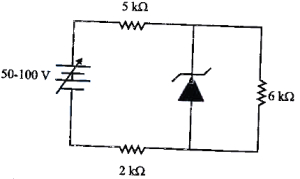
A
$5$
B
$14$
C
$9$
D
$7$
Solution
(A) Step $1$: Current through Load Resistor $(I_L)$
Since the Zener diode regulates the voltage at $30 \text{ V}$,the voltage across the load resistor $(R_L = 6 \text{ k}\Omega)$ will also be $30 \text{ V}$.
The current through the load resistor,$I_L$,is:
$I_L = \frac{V_Z}{R_L} = \frac{30 \text{ V}}{6 \text{ k}\Omega} = 5 \text{ mA}$
Step $2$: Total Current in the Circuit $(I_{\text{total}})$
The total current supplied by the source,$I_{\text{total}}$,is given by:
$I_{\text{total}} = \frac{V_{\text{in}} - V_Z}{R_{\text{total}}}$
where $R_{\text{total}} = 5 \text{ k}\Omega + 2 \text{ k}\Omega = 7 \text{ k}\Omega$.
For maximum $I_{\text{total}}$,we use the maximum input voltage $V_{\text{in}} = 100 \text{ V}$:
$I_{\text{total}} = \frac{100 \text{ V} - 30 \text{ V}}{7 \text{ k}\Omega} = \frac{70 \text{ V}}{7 \text{ k}\Omega} = 10 \text{ mA}$
Step $3$: Maximum Zener Diode Current $(I_{Z \max})$
The Zener diode current $I_Z$ is the difference between the total current and the load current:
$I_{Z \max} = I_{\text{total}} - I_L = 10 \text{ mA} - 5 \text{ mA} = 5 \text{ mA}$
Final Answer:
The maximum current through the Zener diode is $5 \text{ mA}$.
Since the Zener diode regulates the voltage at $30 \text{ V}$,the voltage across the load resistor $(R_L = 6 \text{ k}\Omega)$ will also be $30 \text{ V}$.
The current through the load resistor,$I_L$,is:
$I_L = \frac{V_Z}{R_L} = \frac{30 \text{ V}}{6 \text{ k}\Omega} = 5 \text{ mA}$
Step $2$: Total Current in the Circuit $(I_{\text{total}})$
The total current supplied by the source,$I_{\text{total}}$,is given by:
$I_{\text{total}} = \frac{V_{\text{in}} - V_Z}{R_{\text{total}}}$
where $R_{\text{total}} = 5 \text{ k}\Omega + 2 \text{ k}\Omega = 7 \text{ k}\Omega$.
For maximum $I_{\text{total}}$,we use the maximum input voltage $V_{\text{in}} = 100 \text{ V}$:
$I_{\text{total}} = \frac{100 \text{ V} - 30 \text{ V}}{7 \text{ k}\Omega} = \frac{70 \text{ V}}{7 \text{ k}\Omega} = 10 \text{ mA}$
Step $3$: Maximum Zener Diode Current $(I_{Z \max})$
The Zener diode current $I_Z$ is the difference between the total current and the load current:
$I_{Z \max} = I_{\text{total}} - I_L = 10 \text{ mA} - 5 \text{ mA} = 5 \text{ mA}$
Final Answer:
The maximum current through the Zener diode is $5 \text{ mA}$.
0 likesView Solution
102
PhysicsEasyMCQTS EAMCET · 2024
The region in the output voltage versus input voltage graph where a transistor can be used as an amplifier is
A
active region
B
cut off region
C
saturation region
D
passive region
Solution
(A) transistor operates as an amplifier in its active region.
In the active region,the emitter-base junction is forward-biased and the collector-base junction is reverse-biased.
This configuration allows the transistor to provide current and voltage gain,making it suitable for amplification purposes.
In contrast,the cut-off region acts as an open switch ($OFF$ state),and the saturation region acts as a closed switch ($ON$ state).
In the active region,the emitter-base junction is forward-biased and the collector-base junction is reverse-biased.
This configuration allows the transistor to provide current and voltage gain,making it suitable for amplification purposes.
In contrast,the cut-off region acts as an open switch ($OFF$ state),and the saturation region acts as a closed switch ($ON$ state).
0 likesView Solution
103
PhysicsDifficultMCQTS EAMCET · 2024
The voltage gain of a transistor in common emitter configuration is $160$. The resistances in base and collector sides of the circuit are $1 \text{ k}\Omega$ and $4 \text{ k}\Omega$ respectively. If the change in base current is $100 \mu A$, then the change in output current is:
A
$4 \text{ mA}$
B
$4 \mu A$
C
$40 \text{ mA}$
D
$40 \mu A$
Solution
(A) For a transistor in common emitter configuration, the voltage gain $A_V$ is given by the product of current gain $\beta$ and resistance gain $R_C/R_B$.
$A_V = \beta \times \frac{R_C}{R_B}$
Given: $A_V = 160$, $R_B = 1 \text{ k}\Omega$, $R_C = 4 \text{ k}\Omega$, and $\Delta I_B = 100 \mu A$.
We know that $\beta = \frac{\Delta I_C}{\Delta I_B}$.
Substituting this into the voltage gain formula:
$A_V = \left(\frac{\Delta I_C}{\Delta I_B}\right) \times \frac{R_C}{R_B}$
$160 = \left(\frac{\Delta I_C}{100 \times 10^{-6} \text{ A}}\right) \times \left(\frac{4 \text{ k}\Omega}{1 \text{ k}\Omega}\right)$
$160 = \left(\frac{\Delta I_C}{100 \times 10^{-6}}\right) \times 4$
$40 = \frac{\Delta I_C}{100 \times 10^{-6}}$
$\Delta I_C = 40 \times 100 \times 10^{-6} \text{ A} = 4000 \times 10^{-6} \text{ A} = 4 \times 10^{-3} \text{ A} = 4 \text{ mA}$.
Thus, the change in output current is $4 \text{ mA}$.
$A_V = \beta \times \frac{R_C}{R_B}$
Given: $A_V = 160$, $R_B = 1 \text{ k}\Omega$, $R_C = 4 \text{ k}\Omega$, and $\Delta I_B = 100 \mu A$.
We know that $\beta = \frac{\Delta I_C}{\Delta I_B}$.
Substituting this into the voltage gain formula:
$A_V = \left(\frac{\Delta I_C}{\Delta I_B}\right) \times \frac{R_C}{R_B}$
$160 = \left(\frac{\Delta I_C}{100 \times 10^{-6} \text{ A}}\right) \times \left(\frac{4 \text{ k}\Omega}{1 \text{ k}\Omega}\right)$
$160 = \left(\frac{\Delta I_C}{100 \times 10^{-6}}\right) \times 4$
$40 = \frac{\Delta I_C}{100 \times 10^{-6}}$
$\Delta I_C = 40 \times 100 \times 10^{-6} \text{ A} = 4000 \times 10^{-6} \text{ A} = 4 \times 10^{-3} \text{ A} = 4 \text{ mA}$.
Thus, the change in output current is $4 \text{ mA}$.
0 likesView Solution
104
PhysicsEasyMCQTS EAMCET · 2024
Three logic gates are connected as shown in the figure. If the inputs are $A = 1$ and $B = 1$,then the values of $y_1$ and $y_2$ respectively are
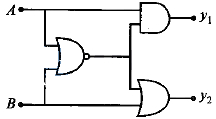
A
$0, 0$
B
$0, 1$
C
$1, 0$
D
$1, 1$
Solution
(B) The circuit consists of a $NOR$ gate followed by an $AND$ gate and an $OR$ gate.
Let the output of the $NOR$ gate be $C = \overline{A + B}$.
Given $A = 1$ and $B = 1$,the output of the $NOR$ gate is $C = \overline{1 + 1} = \overline{1} = 0$.
The output $y_1$ is the output of an $AND$ gate with inputs $A$ and $C$. Thus,$y_1 = A \cdot C = 1 \cdot 0 = 0$.
The output $y_2$ is the output of an $OR$ gate with inputs $B$ and $C$. Thus,$y_2 = B + C = 1 + 0 = 1$.
Therefore,the values are $y_1 = 0$ and $y_2 = 1$.
Let the output of the $NOR$ gate be $C = \overline{A + B}$.
Given $A = 1$ and $B = 1$,the output of the $NOR$ gate is $C = \overline{1 + 1} = \overline{1} = 0$.
The output $y_1$ is the output of an $AND$ gate with inputs $A$ and $C$. Thus,$y_1 = A \cdot C = 1 \cdot 0 = 0$.
The output $y_2$ is the output of an $OR$ gate with inputs $B$ and $C$. Thus,$y_2 = B + C = 1 + 0 = 1$.
Therefore,the values are $y_1 = 0$ and $y_2 = 1$.
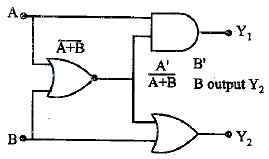
0 likesView Solution
105
PhysicsEasyMCQTS EAMCET · 2024
Two logic gates are connected as shown in the figure. If the inputs are $A=1$ and $B=0$,then the values of $y_1$ and $y_2$ respectively are
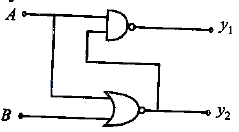
A
$1$,$1$
B
$1$,$0$
C
$0$,$1$
D
$0$,$0$
Solution
(B) The circuit consists of a $NOR$ gate and a $NAND$ gate.
$1$. The inputs to the $NOR$ gate are $A=1$ and $B=0$. The output of the $NOR$ gate is $y_2 = \overline{A+B} = \overline{1+0} = \overline{1} = 0$.
$2$. The inputs to the $NAND$ gate are $A=1$ and the output of the $NOR$ gate $y_2=0$. The output of the $NAND$ gate is $y_1 = \overline{A \cdot y_2} = \overline{1 \cdot 0} = \overline{0} = 1$.
Therefore,the values are $y_1=1$ and $y_2=0$.
$1$. The inputs to the $NOR$ gate are $A=1$ and $B=0$. The output of the $NOR$ gate is $y_2 = \overline{A+B} = \overline{1+0} = \overline{1} = 0$.
$2$. The inputs to the $NAND$ gate are $A=1$ and the output of the $NOR$ gate $y_2=0$. The output of the $NAND$ gate is $y_1 = \overline{A \cdot y_2} = \overline{1 \cdot 0} = \overline{0} = 1$.
Therefore,the values are $y_1=1$ and $y_2=0$.
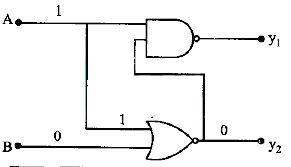
0 likesView Solution
106
PhysicsMediumMCQTS EAMCET · 2024
Normally,a capacitor is connected across the output terminals of a rectifier to
A
convert $AC$ to $DC$
B
convert $DC$ to $AC$
C
get a varying $DC$ output
D
get a steady $DC$ output
Solution
(D) rectifier converts $AC$ into pulsating $DC$. To remove the ripples and obtain a smooth or steady $DC$ output,a capacitor is connected in parallel across the output terminals. The capacitor acts as a filter by charging during the peak of the pulse and discharging during the valley,thereby smoothing out the voltage fluctuations.
0 likesView Solution
107
PhysicsEasyMCQTS EAMCET · 2024
Normally,a capacitor is connected across the output terminals of a rectifier to
A
convert $AC$ to $DC$
B
convert $DC$ to $AC$
C
to get a varying $DC$ output
D
to get a steady $DC$ output
Solution
(D) rectifier converts $AC$ into a pulsating $DC$. To obtain a steady $DC$ output,a filter circuit is used. $A$ capacitor connected in parallel to the output terminals acts as a filter because it charges during the peak of the pulsating $DC$ and discharges when the voltage drops,thereby smoothing the output and providing a steady $DC$ voltage.
0 likesView Solution
108
PhysicsMediumMCQTS EAMCET · 2024
The concentration of electrons in an intrinsic semiconductor is $6 \times 10^{15} \,m^{-3}$. On doping with an impurity, the electron concentration increases to $4 \times 10^{22} \,m^{-3}$. In thermal equilibrium, the concentration of the holes in the doped semiconductor is:
A
$18 \times 10^{-8} \,m^{-3}$
B
$1.5 \times 10^{-7} \,m^{-3}$
C
$9 \times 10^8 \,m^{-3}$
D
$\frac{2}{3} \times 10^7 \,m^{-3}$
Solution
(C) For an intrinsic semiconductor, the law of mass action states that $n_i^2 = n_e n_h$, where $n_i$ is the intrinsic carrier concentration, $n_e$ is the electron concentration, and $n_h$ is the hole concentration.
Given $n_i = 6 \times 10^{15} \,m^{-3}$ and the doped electron concentration $n_e = 4 \times 10^{22} \,m^{-3}$.
Substituting these values into the formula:
$(6 \times 10^{15})^2 = (4 \times 10^{22}) \times n_h$
$36 \times 10^{30} = 4 \times 10^{22} \times n_h$
$n_h = \frac{36 \times 10^{30}}{4 \times 10^{22}}$
$n_h = 9 \times 10^8 \,m^{-3}$.
Given $n_i = 6 \times 10^{15} \,m^{-3}$ and the doped electron concentration $n_e = 4 \times 10^{22} \,m^{-3}$.
Substituting these values into the formula:
$(6 \times 10^{15})^2 = (4 \times 10^{22}) \times n_h$
$36 \times 10^{30} = 4 \times 10^{22} \times n_h$
$n_h = \frac{36 \times 10^{30}}{4 \times 10^{22}}$
$n_h = 9 \times 10^8 \,m^{-3}$.
0 likesView Solution
109
PhysicsEasyMCQTS EAMCET · 2024
In an $n$-type semiconductor,electrons are majority charge carriers and holes are minority charge carriers. The charge of an $n$-type semiconductor is
A
negative
B
positive
C
neutral
D
depends on the dopant
Solution
(C) An $n$-type semiconductor is formed by doping an intrinsic semiconductor with pentavalent atoms. Although the number of free electrons exceeds the number of holes,the total number of negative charges (electrons) is exactly balanced by the total number of positive charges (protons in the nuclei and the ionized donor atoms). Therefore,the net charge of an $n$-type semiconductor is zero,making it electrically neutral.
0 likesView Solution
110
PhysicsMediumMCQTS EAMCET · 2024
The Brewster angle for air to glass transition of light is (Refractive index of glass $= 1.5$).
A
$\sin ^{-1}\left(\frac{3}{2}\right)$
B
$\cos ^{-1}\left(\frac{3}{2}\right)$
C
$\tan ^{-1}\left(\frac{3}{2}\right)$
D
$\cos ^{-1}\left(\frac{2}{3}\right)$
Solution
(C) Brewster's law states that the Brewster angle $i_p$ is related to the refractive index $\mu$ of the medium by the formula: $i_p = \tan ^{-1}(\mu)$.
Given that the refractive index of glass is $\mu = 1.5$.
Substituting the value of $\mu$ into the formula,we get $i_p = \tan ^{-1}(1.5)$.
Since $1.5 = \frac{3}{2}$,the Brewster angle is $i_p = \tan ^{-1}\left(\frac{3}{2}\right)$.
Given that the refractive index of glass is $\mu = 1.5$.
Substituting the value of $\mu$ into the formula,we get $i_p = \tan ^{-1}(1.5)$.
Since $1.5 = \frac{3}{2}$,the Brewster angle is $i_p = \tan ^{-1}\left(\frac{3}{2}\right)$.
0 likesView Solution
111
PhysicsDifficultMCQTS EAMCET · 2024
The efficiency of a bulb of power $60 \ W$ is $16 \%$. The peak value of the electric field produced by the electromagnetic radiation from the bulb at a distance of $2 \ m$ from the bulb is $\left(\frac{1}{4 \pi \epsilon_0}=9 \times 10^9 \ Nm^2 C^{-2}\right)$ (in $Vm^{-1}$)
A
$24$
B
$16$
C
$9$
D
$12$
Solution
(D) Given: Power of the bulb $P = 60 \ W$,Efficiency $\eta = 16 \% = 0.16$,Distance $r = 2 \ m$.
First,calculate the intensity of the electromagnetic radiation emitted by the bulb at distance $r$:
The power radiated as electromagnetic waves is $P_{rad} = \eta \times P = 0.16 \times 60 = 9.6 \ W$.
The intensity $I$ at distance $r$ is given by $I = \frac{P_{rad}}{4 \pi r^2} = \frac{9.6}{4 \pi (2)^2} = \frac{9.6}{16 \pi} = \frac{0.6}{\pi} \ W/m^2$.
The intensity of an electromagnetic wave is also related to the peak electric field $E_0$ by $I = \frac{1}{2} c \epsilon_0 E_0^2$.
Equating the two expressions for intensity: $\frac{0.6}{\pi} = \frac{1}{2} c \epsilon_0 E_0^2$.
We know that $c = \frac{1}{\sqrt{\mu_0 \epsilon_0}}$ and $\frac{1}{4 \pi \epsilon_0} = 9 \times 10^9$,so $\epsilon_0 = \frac{1}{36 \pi \times 10^9}$.
Using $c = 3 \times 10^8 \ m/s$,we have $E_0^2 = \frac{2 \times I}{c \epsilon_0} = \frac{2 \times 0.6 / \pi}{3 \times 10^8 \times (1 / (36 \pi \times 10^9))}$.
$E_0^2 = \frac{1.2}{\pi} \times \frac{36 \pi \times 10^9}{3 \times 10^8} = 1.2 \times 12 \times 10 = 144$.
Therefore,$E_0 = \sqrt{144} = 12 \ Vm^{-1}$.
First,calculate the intensity of the electromagnetic radiation emitted by the bulb at distance $r$:
The power radiated as electromagnetic waves is $P_{rad} = \eta \times P = 0.16 \times 60 = 9.6 \ W$.
The intensity $I$ at distance $r$ is given by $I = \frac{P_{rad}}{4 \pi r^2} = \frac{9.6}{4 \pi (2)^2} = \frac{9.6}{16 \pi} = \frac{0.6}{\pi} \ W/m^2$.
The intensity of an electromagnetic wave is also related to the peak electric field $E_0$ by $I = \frac{1}{2} c \epsilon_0 E_0^2$.
Equating the two expressions for intensity: $\frac{0.6}{\pi} = \frac{1}{2} c \epsilon_0 E_0^2$.
We know that $c = \frac{1}{\sqrt{\mu_0 \epsilon_0}}$ and $\frac{1}{4 \pi \epsilon_0} = 9 \times 10^9$,so $\epsilon_0 = \frac{1}{36 \pi \times 10^9}$.
Using $c = 3 \times 10^8 \ m/s$,we have $E_0^2 = \frac{2 \times I}{c \epsilon_0} = \frac{2 \times 0.6 / \pi}{3 \times 10^8 \times (1 / (36 \pi \times 10^9))}$.
$E_0^2 = \frac{1.2}{\pi} \times \frac{36 \pi \times 10^9}{3 \times 10^8} = 1.2 \times 12 \times 10 = 144$.
Therefore,$E_0 = \sqrt{144} = 12 \ Vm^{-1}$.
0 likesView Solution
112
PhysicsMediumMCQTS EAMCET · 2024
Young's double slit experiment is performed with monochromatic light of wavelength $6000 \ Å$. If the intensity of light at a point on the screen where the path difference is $2000 \ Å$ is $I_1$ and the intensity of light at a point on the screen where the path difference is $1000 \ Å$ is $I_2$,then $I_1: I_2=$
A
$1: 3$
B
$2: 1$
C
$1: 1$
D
$4: 5$
Solution
(A) The intensity of light in a double slit experiment is given by $I = I_0 \cos^2(\phi/2)$,where $\phi$ is the phase difference.
Alternatively,using the formula $I = I_{max} \cos^2(\frac{\pi \Delta x}{\lambda})$,where $\Delta x$ is the path difference.
For the first point,$\Delta x_1 = 2000 \ Å$ and $\lambda = 6000 \ Å$.
Phase difference $\phi_1 = \frac{2\pi}{\lambda} \Delta x_1 = \frac{2\pi}{6000} \times 2000 = \frac{2\pi}{3} = 120^{\circ}$.
Intensity $I_1 = I_{max} \cos^2(\frac{120^{\circ}}{2}) = I_{max} \cos^2(60^{\circ}) = I_{max} (1/2)^2 = I_{max}/4$.
For the second point,$\Delta x_2 = 1000 \ Å$.
Phase difference $\phi_2 = \frac{2\pi}{\lambda} \Delta x_2 = \frac{2\pi}{6000} \times 1000 = \frac{\pi}{3} = 60^{\circ}$.
Intensity $I_2 = I_{max} \cos^2(\frac{60^{\circ}}{2}) = I_{max} \cos^2(30^{\circ}) = I_{max} (\sqrt{3}/2)^2 = 3I_{max}/4$.
Therefore,the ratio $\frac{I_1}{I_2} = \frac{I_{max}/4}{3I_{max}/4} = \frac{1}{3}$.
Thus,$I_1: I_2 = 1: 3$.
Alternatively,using the formula $I = I_{max} \cos^2(\frac{\pi \Delta x}{\lambda})$,where $\Delta x$ is the path difference.
For the first point,$\Delta x_1 = 2000 \ Å$ and $\lambda = 6000 \ Å$.
Phase difference $\phi_1 = \frac{2\pi}{\lambda} \Delta x_1 = \frac{2\pi}{6000} \times 2000 = \frac{2\pi}{3} = 120^{\circ}$.
Intensity $I_1 = I_{max} \cos^2(\frac{120^{\circ}}{2}) = I_{max} \cos^2(60^{\circ}) = I_{max} (1/2)^2 = I_{max}/4$.
For the second point,$\Delta x_2 = 1000 \ Å$.
Phase difference $\phi_2 = \frac{2\pi}{\lambda} \Delta x_2 = \frac{2\pi}{6000} \times 1000 = \frac{\pi}{3} = 60^{\circ}$.
Intensity $I_2 = I_{max} \cos^2(\frac{60^{\circ}}{2}) = I_{max} \cos^2(30^{\circ}) = I_{max} (\sqrt{3}/2)^2 = 3I_{max}/4$.
Therefore,the ratio $\frac{I_1}{I_2} = \frac{I_{max}/4}{3I_{max}/4} = \frac{1}{3}$.
Thus,$I_1: I_2 = 1: 3$.
0 likesView Solution
113
PhysicsDifficultMCQTS EAMCET · 2024
In Young's double slit experiment,the intensity of light at a point on the screen where the path difference becomes $\lambda$ is $I$. The intensity at a point on the screen where the path difference becomes $\frac{\lambda}{3}$ is:
A
$\frac{I}{4}$
B
$\frac{I}{3}$
C
$\frac{2 I}{3}$
D
$3 I$
Solution
(A) The intensity in an interference pattern is given by $I_{res} = I_{max} \cos^2(\frac{\phi}{2})$,where $\phi$ is the phase difference.
For a path difference $\Delta x = \lambda$,the phase difference is $\phi_1 = \frac{2\pi}{\lambda} \cdot \lambda = 2\pi$.
The intensity is $I = I_{max} \cos^2(\frac{2\pi}{2}) = I_{max} \cos^2(\pi) = I_{max}(1)^2 = I_{max}$.
For a path difference $\Delta x = \frac{\lambda}{3}$,the phase difference is $\phi_2 = \frac{2\pi}{\lambda} \cdot \frac{\lambda}{3} = \frac{2\pi}{3}$.
The intensity at this point is $I' = I_{max} \cos^2(\frac{\phi_2}{2}) = I_{max} \cos^2(\frac{2\pi/3}{2}) = I_{max} \cos^2(\frac{\pi}{3})$.
Since $\cos(\frac{\pi}{3}) = \frac{1}{2}$,we have $I' = I_{max} (\frac{1}{2})^2 = \frac{I_{max}}{4}$.
Since $I_{max} = I$,the intensity is $\frac{I}{4}$.
For a path difference $\Delta x = \lambda$,the phase difference is $\phi_1 = \frac{2\pi}{\lambda} \cdot \lambda = 2\pi$.
The intensity is $I = I_{max} \cos^2(\frac{2\pi}{2}) = I_{max} \cos^2(\pi) = I_{max}(1)^2 = I_{max}$.
For a path difference $\Delta x = \frac{\lambda}{3}$,the phase difference is $\phi_2 = \frac{2\pi}{\lambda} \cdot \frac{\lambda}{3} = \frac{2\pi}{3}$.
The intensity at this point is $I' = I_{max} \cos^2(\frac{\phi_2}{2}) = I_{max} \cos^2(\frac{2\pi/3}{2}) = I_{max} \cos^2(\frac{\pi}{3})$.
Since $\cos(\frac{\pi}{3}) = \frac{1}{2}$,we have $I' = I_{max} (\frac{1}{2})^2 = \frac{I_{max}}{4}$.
Since $I_{max} = I$,the intensity is $\frac{I}{4}$.
0 likesView Solution
114
PhysicsDifficultMCQTS EAMCET · 2024
$A$ proton and an $\alpha$-particle are both accelerated from rest in a uniform electric field. The ratio of work done by the electric field on the proton and the $\alpha$-particle in a given time is
A
$1: 1$
B
$1: 2$
C
$1: 4$
D
$4: 1$
Solution
(A) The acceleration of a charged particle in a uniform electric field $E$ is given by $a = \frac{qE}{m}$.
Since the particles start from rest $(u = 0)$,the velocity after time $t$ is $v = at = \left(\frac{qE}{m}\right)t$.
According to the work-energy theorem,the work done $W$ by the electric field is equal to the change in kinetic energy $\Delta K$:
$W = \Delta K = \frac{1}{2}mv^2$.
Substituting the expression for $v$:
$W = \frac{1}{2}m\left(\frac{qEt}{m}\right)^2 = \frac{q^2 E^2 t^2}{2m}$.
Since $E$ and $t$ are the same for both particles,$W \propto \frac{q^2}{m}$.
For a proton,$q_p = e$ and $m_p = m$. For an $\alpha$-particle,$q_\alpha = 2e$ and $m_\alpha = 4m$.
Therefore,the ratio is:
$\frac{W_p}{W_\alpha} = \left(\frac{q_p}{q_\alpha}\right)^2 \left(\frac{m_\alpha}{m_p}\right) = \left(\frac{e}{2e}\right)^2 \left(\frac{4m}{m}\right) = \left(\frac{1}{4}\right) \times 4 = 1: 1$.
Since the particles start from rest $(u = 0)$,the velocity after time $t$ is $v = at = \left(\frac{qE}{m}\right)t$.
According to the work-energy theorem,the work done $W$ by the electric field is equal to the change in kinetic energy $\Delta K$:
$W = \Delta K = \frac{1}{2}mv^2$.
Substituting the expression for $v$:
$W = \frac{1}{2}m\left(\frac{qEt}{m}\right)^2 = \frac{q^2 E^2 t^2}{2m}$.
Since $E$ and $t$ are the same for both particles,$W \propto \frac{q^2}{m}$.
For a proton,$q_p = e$ and $m_p = m$. For an $\alpha$-particle,$q_\alpha = 2e$ and $m_\alpha = 4m$.
Therefore,the ratio is:
$\frac{W_p}{W_\alpha} = \left(\frac{q_p}{q_\alpha}\right)^2 \left(\frac{m_\alpha}{m_p}\right) = \left(\frac{e}{2e}\right)^2 \left(\frac{4m}{m}\right) = \left(\frac{1}{4}\right) \times 4 = 1: 1$.
0 likesView Solution
Vedclass Products
For Students
Vedclass Test Series
Mock tests in real TS EAMCET style covering Physics with performance analysis. 5-day free trial.
Start Free TrialFor Teachers
Exam Paper Generator
Generate Set A/B/C/D Physics papers from 7.5L+ questions in 2 minutes. 3 chapters free.
Try FreeFor Institutes
Online Exam Module
Run live TS EAMCET mock exams with unlimited students, 360° analytics & white-label branding.
See DemoFrequently Asked Questions
How many Physics questions are in TS EAMCET 2024?
There are 164 Physics questions from the TS EAMCET 2024 paper on Vedclass, each with a detailed step-by-step solution in English.
Are TS EAMCET 2024 Physics solutions available in English?
Yes. All solutions on this page are in English. You can also switch to English or Hindi using the language buttons above the questions.
Can I practice TS EAMCET 2024 Physics as a timed test?
Yes. Use the Vedclass Test Series to attempt a full TS EAMCET mock test covering Physics with time limits and instant score analysis.
Can teachers create Physics papers from TS EAMCET previous year questions?
Yes. The Vedclass Exam Paper Generator lets teachers mix TS EAMCET Physics questions and generate Set A/B/C/D papers in minutes.
For Teachers & Institutes
Build a Custom Physics Paper
Pick TS EAMCET 2024 Physics questions, set difficulty, and generate Set A/B/C/D in 2 minutes.