
PhysicsQ101–141 of 241 questions
Page 3 of 3 · English
101
PhysicsEasyMCQTS EAMCET · 2023
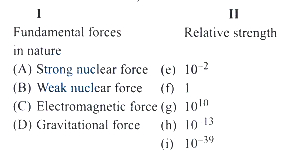
Match the following. (Take the relative strength of the strongest fundamental forces in nature as $1$)
A
$A-f, B-i, C-e, D-h$
B
$A-f, B-h, C-e, D-g$
C
$A-f, B-h, C-e, D-i$
D
$A-f, B-e, C-h, D-i$
Solution
(C) The relative strengths of the four fundamental forces in nature are as follows:
$1$. Strong nuclear force: Relative strength = $1$
$2$. Electromagnetic force: Relative strength = $10^{-2}$
$3$. Weak nuclear force: Relative strength = $10^{-13}$
$4$. Gravitational force: Relative strength = $10^{-39}$
Comparing these with the given options:
$(A)$ Strong nuclear force matches with $(f)$ $1$.
$(B)$ Weak nuclear force matches with $(h)$ $10^{-13}$.
$(C)$ Electromagnetic force matches with $(e)$ $10^{-2}$.
$(D)$ Gravitational force matches with $(i)$ $10^{-39}$.
Therefore,the correct matching is $A-f, B-h, C-e, D-i$.
$1$. Strong nuclear force: Relative strength = $1$
$2$. Electromagnetic force: Relative strength = $10^{-2}$
$3$. Weak nuclear force: Relative strength = $10^{-13}$
$4$. Gravitational force: Relative strength = $10^{-39}$
Comparing these with the given options:
$(A)$ Strong nuclear force matches with $(f)$ $1$.
$(B)$ Weak nuclear force matches with $(h)$ $10^{-13}$.
$(C)$ Electromagnetic force matches with $(e)$ $10^{-2}$.
$(D)$ Gravitational force matches with $(i)$ $10^{-39}$.
Therefore,the correct matching is $A-f, B-h, C-e, D-i$.
0 likesView Solution
102
PhysicsEasyMCQTS EAMCET · 2023
Among the following statements,the correct statement for a wave is
A
Transverse waves cannot propagate through all media
B
Longitudinal waves can propagate through solids only
C
Transverse waves can propagate through solids
D
Longitudinal waves can propagate through vacuum
Solution
(C) Transverse waves require a medium with shear modulus to propagate,which is why they can propagate through solids and on the surface of liquids. They cannot propagate through gases or the interior of liquids. Longitudinal waves can propagate through all states of matter (solids,liquids,and gases) but cannot propagate through a vacuum. Therefore,the statement that transverse waves can propagate through solids is correct.
0 likesView Solution
103
PhysicsDifficultMCQTS EAMCET · 2023
$A$ tuning fork $A$ of frequency $250 \,Hz$ and another tuning fork $B$ of frequency $x$ produce $5$ beats per second when vibrated together. If the fork $B$ is waxed and vibrated together with $A$, then $3$ beats per second are produced. Then $x=$ (in $\,Hz$)
A
$255$
B
$245$
C
$247$
D
$253$
Solution
(A) Given: Frequency of tuning fork $A$ $(f_A)$ = $250 \,Hz$. Frequency of tuning fork $B$ $(f_B)$ = $x \,Hz$.
Initially, the beat frequency is $5 \,Hz$, so $|f_A - f_B| = 5$.
This implies $250 - x = 5$ or $x - 250 = 5$, giving $x = 245 \,Hz$ or $x = 255 \,Hz$.
When tuning fork $B$ is waxed, its frequency decreases $(f_B' < f_B)$.
After waxing, the new beat frequency is $3 \,Hz$.
If $x = 255 \,Hz$, then $f_B$ decreases towards $250 \,Hz$, so the beat frequency would increase from $5$ to a higher value or pass through $0$ and then increase. This does not match the observation of $3 \,Hz$.
If $x = 245 \,Hz$, then $f_B$ decreases further away from $250 \,Hz$ (e.g., to $244 \,Hz$), which would increase the beat frequency to $6 \,Hz$. However, if we consider the frequency of $B$ was $245 \,Hz$ and it was slightly loaded, the beat frequency decreases from $5$ to $3$ only if the frequency of $B$ was originally $255 \,Hz$ and it decreased to $253 \,Hz$ ($255 - 253 = 2$ - incorrect) or if $x = 245 \,Hz$ and the beat frequency changed. Let's re-evaluate: If $x = 255 \,Hz$, loading $B$ makes $f_B$ approach $250 \,Hz$, decreasing the beat frequency. Thus, $x = 255 \,Hz$ is the correct value.
Initially, the beat frequency is $5 \,Hz$, so $|f_A - f_B| = 5$.
This implies $250 - x = 5$ or $x - 250 = 5$, giving $x = 245 \,Hz$ or $x = 255 \,Hz$.
When tuning fork $B$ is waxed, its frequency decreases $(f_B' < f_B)$.
After waxing, the new beat frequency is $3 \,Hz$.
If $x = 255 \,Hz$, then $f_B$ decreases towards $250 \,Hz$, so the beat frequency would increase from $5$ to a higher value or pass through $0$ and then increase. This does not match the observation of $3 \,Hz$.
If $x = 245 \,Hz$, then $f_B$ decreases further away from $250 \,Hz$ (e.g., to $244 \,Hz$), which would increase the beat frequency to $6 \,Hz$. However, if we consider the frequency of $B$ was $245 \,Hz$ and it was slightly loaded, the beat frequency decreases from $5$ to $3$ only if the frequency of $B$ was originally $255 \,Hz$ and it decreased to $253 \,Hz$ ($255 - 253 = 2$ - incorrect) or if $x = 245 \,Hz$ and the beat frequency changed. Let's re-evaluate: If $x = 255 \,Hz$, loading $B$ makes $f_B$ approach $250 \,Hz$, decreasing the beat frequency. Thus, $x = 255 \,Hz$ is the correct value.
0 likesView Solution
104
PhysicsEasyMCQTS EAMCET · 2023
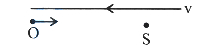
An observer moves towards a stationary source of sound with a speed $\frac{1}{5}$th that of sound. The frequency of the sound emitted by the source is $f$. The apparent frequency recorded by the observer is
A
$1.2 f$
B
$f$
C
$0.8 f$
D
$2 f$
Solution
(A) Let the speed of sound be $v$. The observer moves towards the stationary source with a speed $v_0 = \frac{v}{5}$.
According to the Doppler effect,when an observer moves towards a stationary source,the apparent frequency $f'$ is given by:
$f' = f \left( \frac{v + v_0}{v} \right)$
Substituting the given values:
$f' = f \left( \frac{v + \frac{v}{5}}{v} \right)$
$f' = f \left( \frac{\frac{6v}{5}}{v} \right)$
$f' = f \left( \frac{6}{5} \right) = 1.2 f$
Therefore,the apparent frequency recorded by the observer is $1.2 f$.
According to the Doppler effect,when an observer moves towards a stationary source,the apparent frequency $f'$ is given by:
$f' = f \left( \frac{v + v_0}{v} \right)$
Substituting the given values:
$f' = f \left( \frac{v + \frac{v}{5}}{v} \right)$
$f' = f \left( \frac{\frac{6v}{5}}{v} \right)$
$f' = f \left( \frac{6}{5} \right) = 1.2 f$
Therefore,the apparent frequency recorded by the observer is $1.2 f$.
0 likesView Solution
105
PhysicsMediumMCQTS EAMCET · 2023
An observer moves towards a stationary source of sound,with a speed of one-fifth of the speed of sound. The apparent increase in the frequency heard by the observer is (in $\%$)
A
$16.67$
B
$2$
C
$25$
D
$20$
Solution
(D) According to the Doppler effect,the observed frequency $f^{\prime}$ is given by $f^{\prime} = f_0 \left( \frac{v + v_0}{v - v_s} \right)$.
Here,$v$ is the speed of sound,$v_0$ is the speed of the observer,and $v_s$ is the speed of the source.
Given that the source is stationary,$v_s = 0$.
The observer moves towards the source with a speed $v_0 = \frac{v}{5}$.
Substituting these values into the formula: $f^{\prime} = f_0 \left( \frac{v + v/5}{v} \right) = f_0 \left( \frac{6v/5}{v} \right) = 1.2 f_0$.
The fractional increase in frequency is $\frac{f^{\prime} - f_0}{f_0} = \frac{1.2 f_0 - f_0}{f_0} = 0.2$.
To express this as a percentage: $0.2 \times 100 \% = 20 \%$.
Here,$v$ is the speed of sound,$v_0$ is the speed of the observer,and $v_s$ is the speed of the source.
Given that the source is stationary,$v_s = 0$.
The observer moves towards the source with a speed $v_0 = \frac{v}{5}$.
Substituting these values into the formula: $f^{\prime} = f_0 \left( \frac{v + v/5}{v} \right) = f_0 \left( \frac{6v/5}{v} \right) = 1.2 f_0$.
The fractional increase in frequency is $\frac{f^{\prime} - f_0}{f_0} = \frac{1.2 f_0 - f_0}{f_0} = 0.2$.
To express this as a percentage: $0.2 \times 100 \% = 20 \%$.
0 likesView Solution
106
PhysicsMediumMCQTS EAMCET · 2023
$A$ source and an observer move away from each other with the same velocity of $10 \,ms^{-1}$ with respect to the ground. If the observer finds the frequency of sound coming from the source as $1980 \,Hz$, then the actual frequency of the source is (speed of sound in air $= 340 \,ms^{-1}$). (in $\,Hz$)
A
$1950$
B
$2100$
C
$2132$
D
$2486$
Solution
(B) According to the Doppler effect formula for a source and observer moving away from each other:
$f' = f_0 \left( \frac{v - v_o}{v + v_s} \right)$
Here, the observed frequency $f' = 1980 \,Hz$.
The speed of sound in air $v = 340 \,ms^{-1}$.
The velocity of the observer $v_o = 10 \,ms^{-1}$ (moving away, so negative sign in numerator).
The velocity of the source $v_s = 10 \,ms^{-1}$ (moving away, so positive sign in denominator).
Substituting the values:
$1980 = f_0 \left( \frac{340 - 10}{340 + 10} \right)$
$1980 = f_0 \left( \frac{330}{350} \right)$
$f_0 = 1980 \times \frac{350}{330}$
$f_0 = 1980 \times \frac{35}{33}$
$f_0 = 60 \times 35 = 2100 \,Hz$.
$f' = f_0 \left( \frac{v - v_o}{v + v_s} \right)$
Here, the observed frequency $f' = 1980 \,Hz$.
The speed of sound in air $v = 340 \,ms^{-1}$.
The velocity of the observer $v_o = 10 \,ms^{-1}$ (moving away, so negative sign in numerator).
The velocity of the source $v_s = 10 \,ms^{-1}$ (moving away, so positive sign in denominator).
Substituting the values:
$1980 = f_0 \left( \frac{340 - 10}{340 + 10} \right)$
$1980 = f_0 \left( \frac{330}{350} \right)$
$f_0 = 1980 \times \frac{350}{330}$
$f_0 = 1980 \times \frac{35}{33}$
$f_0 = 60 \times 35 = 2100 \,Hz$.
0 likesView Solution
107
PhysicsMediumMCQTS EAMCET · 2023
If the seventh harmonic of a closed organ pipe is in unison with the fourth harmonic of an open organ pipe,then the ratio of the length of the closed pipe to that of the open pipe is:
A
$4: 7$
B
$7: 4$
C
$8: 7$
D
$7: 8$
Solution
(D) For a closed organ pipe,the frequency of the $n^{th}$ harmonic is given by $f_c = \frac{nv}{4L_c}$. For the $7^{th}$ harmonic,$n = 7$,so $f_c = \frac{7v}{4L_c}$.
For an open organ pipe,the frequency of the $n^{th}$ harmonic is given by $f_o = \frac{nv}{2L_o}$. For the $4^{th}$ harmonic,$n = 4$,so $f_o = \frac{4v}{2L_o}$.
Given that the two frequencies are in unison,$f_c = f_o$.
Therefore,$\frac{7v}{4L_c} = \frac{4v}{2L_o}$.
Simplifying the equation: $\frac{7}{4L_c} = \frac{2}{L_o}$.
Rearranging for the ratio of lengths: $\frac{L_c}{L_o} = \frac{7}{4 \times 2} = \frac{7}{8}$.
For an open organ pipe,the frequency of the $n^{th}$ harmonic is given by $f_o = \frac{nv}{2L_o}$. For the $4^{th}$ harmonic,$n = 4$,so $f_o = \frac{4v}{2L_o}$.
Given that the two frequencies are in unison,$f_c = f_o$.
Therefore,$\frac{7v}{4L_c} = \frac{4v}{2L_o}$.
Simplifying the equation: $\frac{7}{4L_c} = \frac{2}{L_o}$.
Rearranging for the ratio of lengths: $\frac{L_c}{L_o} = \frac{7}{4 \times 2} = \frac{7}{8}$.
0 likesView Solution
108
PhysicsDifficultMCQTS EAMCET · 2023
$A$ wave is given by the equation $y=(0.02) \sin (\pi x - 8 \pi t)$. The velocity of the wave is (where $y$ and $x$ are in meters and $t$ is in seconds). (in $m/s$)
A
$16$
B
$2$
C
$8$
D
$18$
Solution
(C) The given equation of the wave is $y = 0.02 \sin(\pi x - 8 \pi t)$.
Comparing this with the standard wave equation $y = A \sin(kx - \omega t)$:
Here,the angular wave number $k = \pi \ m^{-1}$ and the angular frequency $\omega = 8 \pi \ rad/s$.
The velocity of the wave $v$ is given by the formula $v = \frac{\omega}{k}$.
Substituting the values,we get $v = \frac{8 \pi}{\pi} = 8 \ m/s$.
Comparing this with the standard wave equation $y = A \sin(kx - \omega t)$:
Here,the angular wave number $k = \pi \ m^{-1}$ and the angular frequency $\omega = 8 \pi \ rad/s$.
The velocity of the wave $v$ is given by the formula $v = \frac{\omega}{k}$.
Substituting the values,we get $v = \frac{8 \pi}{\pi} = 8 \ m/s$.
0 likesView Solution
109
PhysicsDifficultMCQTS EAMCET · 2023
$A$ wave is given by $y=5 \times 10^{-3} \sin \left(12.5 \pi x - \frac{\pi}{2} t\right)$. Then its wavelength and time period are respectively ($y$ and $x$ are in metres and $t$ is in seconds).
A
$0.16 \ m, 4 \ s$
B
$0.16 \ m, 1 \ s$
C
$0.04 \ m, 2 \ s$
D
$0.04 \ m, 4 \ s$
Solution
(A) The given wave equation is $y = 5 \times 10^{-3} \sin \left(12.5 \pi x - \frac{\pi}{2} t\right)$.
Comparing this with the standard wave equation $y = A \sin(kx - \omega t)$,we get:
Wave number $k = 12.5 \pi$ and angular frequency $\omega = \frac{\pi}{2}$.
We know that $k = \frac{2 \pi}{\lambda}$,so $\lambda = \frac{2 \pi}{k} = \frac{2 \pi}{12.5 \pi} = \frac{2}{12.5} = 0.16 \ m$.
We also know that $\omega = \frac{2 \pi}{T}$,so $T = \frac{2 \pi}{\omega} = \frac{2 \pi}{\pi / 2} = 4 \ s$.
Therefore,the wavelength is $0.16 \ m$ and the time period is $4 \ s$.
Comparing this with the standard wave equation $y = A \sin(kx - \omega t)$,we get:
Wave number $k = 12.5 \pi$ and angular frequency $\omega = \frac{\pi}{2}$.
We know that $k = \frac{2 \pi}{\lambda}$,so $\lambda = \frac{2 \pi}{k} = \frac{2 \pi}{12.5 \pi} = \frac{2}{12.5} = 0.16 \ m$.
We also know that $\omega = \frac{2 \pi}{T}$,so $T = \frac{2 \pi}{\omega} = \frac{2 \pi}{\pi / 2} = 4 \ s$.
Therefore,the wavelength is $0.16 \ m$ and the time period is $4 \ s$.
0 likesView Solution
110
PhysicsMediumMCQTS EAMCET · 2023
One end of a string is tied to the ceiling of a lift and a load is attached at the bottom end of the string. When the lift is moving upwards with an acceleration of $2.1 \,ms^{-2}$, the speed of the transverse wave at the lower end of the string is $88 \,ms^{-1}$. If the lift moves downwards with an acceleration of $1.9 \,ms^{-2}$, the speed of the transverse wave at the lower end of the string is (take $g=10 \,ms^{-2}$): (in $\,ms^{-1}$)
A
$88$
B
$102$
C
$119$
D
$72$
Solution
(D) The speed of a transverse wave in a string is given by $v = \sqrt{\frac{T}{\mu}}$, where $T$ is the tension and $\mu$ is the mass per unit length.
At the lower end of the string, the tension $T$ is provided by the load of mass $M$. Let the mass of the string be $m$ and its length be $L$. The tension at the lower end is $T = Mg$.
When the lift accelerates upwards with $a_1 = 2.1 \,ms^{-2}$, the effective acceleration is $g_{eff1} = g + a_1 = 10 + 2.1 = 12.1 \,ms^{-2}$. The tension is $T_1 = M(g + a_1)$.
The wave speed is $v_1 = \sqrt{\frac{M(g+a_1)}{\mu}} = 88 \,ms^{-1}$.
When the lift accelerates downwards with $a_2 = 1.9 \,ms^{-2}$, the effective acceleration is $g_{eff2} = g - a_2 = 10 - 1.9 = 8.1 \,ms^{-2}$. The tension is $T_2 = M(g - a_2)$.
The wave speed is $v_2 = \sqrt{\frac{M(g-a_2)}{\mu}}$.
Taking the ratio: $\frac{v_2}{v_1} = \sqrt{\frac{g-a_2}{g+a_1}} = \sqrt{\frac{8.1}{12.1}} = \sqrt{\frac{81}{121}} = \frac{9}{11}$.
Therefore, $v_2 = v_1 \times \frac{9}{11} = 88 \times \frac{9}{11} = 8 \times 9 = 72 \,ms^{-1}$.
At the lower end of the string, the tension $T$ is provided by the load of mass $M$. Let the mass of the string be $m$ and its length be $L$. The tension at the lower end is $T = Mg$.
When the lift accelerates upwards with $a_1 = 2.1 \,ms^{-2}$, the effective acceleration is $g_{eff1} = g + a_1 = 10 + 2.1 = 12.1 \,ms^{-2}$. The tension is $T_1 = M(g + a_1)$.
The wave speed is $v_1 = \sqrt{\frac{M(g+a_1)}{\mu}} = 88 \,ms^{-1}$.
When the lift accelerates downwards with $a_2 = 1.9 \,ms^{-2}$, the effective acceleration is $g_{eff2} = g - a_2 = 10 - 1.9 = 8.1 \,ms^{-2}$. The tension is $T_2 = M(g - a_2)$.
The wave speed is $v_2 = \sqrt{\frac{M(g-a_2)}{\mu}}$.
Taking the ratio: $\frac{v_2}{v_1} = \sqrt{\frac{g-a_2}{g+a_1}} = \sqrt{\frac{8.1}{12.1}} = \sqrt{\frac{81}{121}} = \frac{9}{11}$.
Therefore, $v_2 = v_1 \times \frac{9}{11} = 88 \times \frac{9}{11} = 8 \times 9 = 72 \,ms^{-1}$.
0 likesView Solution
111
PhysicsDifficultMCQTS EAMCET · 2023
$A$ sound source is tied to one end of a string of length $50 \ cm$ and is rotated with an angular speed of $40 \ rad \ s^{-1}$ in a horizontal plane. The ratio of the maximum and minimum frequencies of the sound heard by an observer standing at a distance of $10 \ m$ from the fixed end of the string is (speed of sound in air $= 340 \ m \ s^{-1}$).
A
$2: 1$
B
$4: 3$
C
$6: 5$
D
$9: 8$
Solution
(D) Given: Angular speed $\omega = 40 \ rad \ s^{-1}$,radius $r = 50 \ cm = 0.5 \ m$.
The linear speed of the source is $v_s = r \omega = 0.5 \times 40 = 20 \ m \ s^{-1}$.
The Doppler effect formula for maximum frequency (when the source moves towards the observer) is $n_{\max} = n \left( \frac{v}{v - v_s} \right)$.
The Doppler effect formula for minimum frequency (when the source moves away from the observer) is $n_{\min} = n \left( \frac{v}{v + v_s} \right)$.
The ratio of maximum to minimum frequency is $\frac{n_{\max}}{n_{\min}} = \frac{v + v_s}{v - v_s}$.
Substituting the values $v = 340 \ m \ s^{-1}$ and $v_s = 20 \ m \ s^{-1}$:
$\frac{n_{\max}}{n_{\min}} = \frac{340 + 20}{340 - 20} = \frac{360}{320} = \frac{9}{8}$.
Thus,the ratio is $9: 8$.
The linear speed of the source is $v_s = r \omega = 0.5 \times 40 = 20 \ m \ s^{-1}$.
The Doppler effect formula for maximum frequency (when the source moves towards the observer) is $n_{\max} = n \left( \frac{v}{v - v_s} \right)$.
The Doppler effect formula for minimum frequency (when the source moves away from the observer) is $n_{\min} = n \left( \frac{v}{v + v_s} \right)$.
The ratio of maximum to minimum frequency is $\frac{n_{\max}}{n_{\min}} = \frac{v + v_s}{v - v_s}$.
Substituting the values $v = 340 \ m \ s^{-1}$ and $v_s = 20 \ m \ s^{-1}$:
$\frac{n_{\max}}{n_{\min}} = \frac{340 + 20}{340 - 20} = \frac{360}{320} = \frac{9}{8}$.
Thus,the ratio is $9: 8$.
0 likesView Solution
112
PhysicsMediumMCQTS EAMCET · 2023
Two bodies of masses $1 \,g$ and $4 \,g$ are moving with equal kinetic energies. The ratio of the magnitudes of their linear momenta is
A
$4:1$
B
$\sqrt{2}:1$
C
$1:2$
D
$1:16$
Solution
(C) Given: Masses $m_1 = 1 \,g$ and $m_2 = 4 \,g$. Kinetic energies are equal, $K_1 = K_2$.
We know the relation between kinetic energy $K$ and linear momentum $p$ is $K = \frac{p^2}{2m}$, which implies $p = \sqrt{2mK}$.
Since $K_1 = K_2$, the ratio of momenta is $\frac{p_1}{p_2} = \frac{\sqrt{2m_1K_1}}{\sqrt{2m_2K_2}} = \sqrt{\frac{m_1}{m_2}}$.
Substituting the values: $\frac{p_1}{p_2} = \sqrt{\frac{1}{4}} = \frac{1}{2}$.
Thus, the ratio of their linear momenta is $1:2$.
We know the relation between kinetic energy $K$ and linear momentum $p$ is $K = \frac{p^2}{2m}$, which implies $p = \sqrt{2mK}$.
Since $K_1 = K_2$, the ratio of momenta is $\frac{p_1}{p_2} = \frac{\sqrt{2m_1K_1}}{\sqrt{2m_2K_2}} = \sqrt{\frac{m_1}{m_2}}$.
Substituting the values: $\frac{p_1}{p_2} = \sqrt{\frac{1}{4}} = \frac{1}{2}$.
Thus, the ratio of their linear momenta is $1:2$.
0 likesView Solution
113
PhysicsEasyMCQTS EAMCET · 2023
$A$ bomb of mass $16 \,kg$ explodes into two pieces of masses $4 \,kg$ and $12 \,kg$. The velocity of the $12 \,kg$ mass is $4 \,ms^{-1}$. The kinetic energy of the second piece (the $4 \,kg$ piece) is: (in $\,J$)
A
$144$
B
$192$
C
$96$
D
$288$
Solution
(D) Let the mass of the first piece be $m_1 = 4 \,kg$ and its velocity be $v_1$.
Let the mass of the second piece be $m_2 = 12 \,kg$ and its velocity be $v_2 = 4 \,ms^{-1}$.
According to the law of conservation of linear momentum, the initial momentum of the bomb is zero (assuming it was at rest).
Therefore, $m_1 v_1 + m_2 v_2 = 0$.
Taking magnitudes, $m_1 v_1 = m_2 v_2$.
$4 \times v_1 = 12 \times 4$.
$v_1 = 12 \,ms^{-1}$.
The kinetic energy of the $4 \,kg$ piece is $KE_1 = \frac{1}{2} m_1 v_1^2$.
$KE_1 = \frac{1}{2} \times 4 \times (12)^2 = 2 \times 144 = 288 \,J$.
Let the mass of the second piece be $m_2 = 12 \,kg$ and its velocity be $v_2 = 4 \,ms^{-1}$.
According to the law of conservation of linear momentum, the initial momentum of the bomb is zero (assuming it was at rest).
Therefore, $m_1 v_1 + m_2 v_2 = 0$.
Taking magnitudes, $m_1 v_1 = m_2 v_2$.
$4 \times v_1 = 12 \times 4$.
$v_1 = 12 \,ms^{-1}$.
The kinetic energy of the $4 \,kg$ piece is $KE_1 = \frac{1}{2} m_1 v_1^2$.
$KE_1 = \frac{1}{2} \times 4 \times (12)^2 = 2 \times 144 = 288 \,J$.
0 likesView Solution
114
PhysicsMediumMCQTS EAMCET · 2023
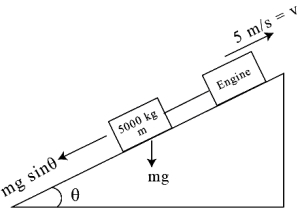
An engine is dragging a mass of $5000 \ kg$ with a velocity of $5 \ ms^{-1}$ along a smooth inclined plane of inclination $1$ in $50$. Then the power of the engine is (in $kW$)
A
$5$
B
$2.5$
C
$10$
D
$25$
Solution
(A) The engine is moving a mass up an inclined plane at a constant velocity. The force required to move the mass up the plane must balance the component of the gravitational force acting down the plane.
Force $F = mg \sin \theta$.
Given that the inclination is $1$ in $50$,we have $\sin \theta = 1/50$.
Taking $g = 10 \ ms^{-2}$,the force is $F = 5000 \times 10 \times (1/50) = 1000 \ N$.
The power $P$ is given by $P = F \times v$,where $v = 5 \ ms^{-1}$.
$P = 1000 \ N \times 5 \ ms^{-1} = 5000 \ W = 5 \ kW$.
Force $F = mg \sin \theta$.
Given that the inclination is $1$ in $50$,we have $\sin \theta = 1/50$.
Taking $g = 10 \ ms^{-2}$,the force is $F = 5000 \times 10 \times (1/50) = 1000 \ N$.
The power $P$ is given by $P = F \times v$,where $v = 5 \ ms^{-1}$.
$P = 1000 \ N \times 5 \ ms^{-1} = 5000 \ W = 5 \ kW$.
0 likesView Solution
115
PhysicsMediumMCQTS EAMCET · 2023
The displacement $s$ of a body of mass $3 \,kg$ under the action of a force is given by $s = \frac{t^3}{3}$,where $s$ is in metres and $t$ is in seconds. The work done by the force in the first two seconds is (in $\,J$)
A
$32$
B
$3.8$
C
$5.2$
D
$24$
Solution
(D) Given: Mass $m = 3 \,kg$,displacement $s = \frac{t^3}{3}$.
Velocity $v = \frac{ds}{dt} = \frac{d}{dt}(\frac{t^3}{3}) = t^2$.
Acceleration $a = \frac{dv}{dt} = \frac{d}{dt}(t^2) = 2t$.
Force $F = ma = 3 \times 2t = 6t$.
Work done $W = \int F \cdot ds = \int_0^2 F \cdot v dt = \int_0^2 (6t)(t^2) dt$.
$W = \int_0^2 6t^3 dt = 6 \left[ \frac{t^4}{4} \right]_0^2$.
$W = 6 \times \frac{16}{4} = 6 \times 4 = 24 \,J$.
Velocity $v = \frac{ds}{dt} = \frac{d}{dt}(\frac{t^3}{3}) = t^2$.
Acceleration $a = \frac{dv}{dt} = \frac{d}{dt}(t^2) = 2t$.
Force $F = ma = 3 \times 2t = 6t$.
Work done $W = \int F \cdot ds = \int_0^2 F \cdot v dt = \int_0^2 (6t)(t^2) dt$.
$W = \int_0^2 6t^3 dt = 6 \left[ \frac{t^4}{4} \right]_0^2$.
$W = 6 \times \frac{16}{4} = 6 \times 4 = 24 \,J$.
0 likesView Solution
116
PhysicsMediumMCQTS EAMCET · 2023
If the work done in blowing a soap bubble of radius $R$ is $W$, then the work done in blowing a soap bubble of radius $2R$ is: (in $W$)
A
$6$
B
$12$
C
$4$
D
$2$
Solution
(C) The work done in blowing a soap bubble is equal to the surface energy stored in the bubble.
Since a soap bubble has two surfaces (inner and outer), the work done $W$ is given by:
$W = T \times \Delta A = T \times 2 \times (4 \pi R^2) = 8 \pi R^2 T$
From this expression, we can see that $W \propto R^2$.
Let $W_1$ be the work done for radius $R$, so $W_1 = W$.
Let $W_2$ be the work done for radius $2R$.
Then, $\frac{W_2}{W_1} = \frac{(2R)^2}{R^2} = \frac{4R^2}{R^2} = 4$.
Therefore, $W_2 = 4W$.
Since a soap bubble has two surfaces (inner and outer), the work done $W$ is given by:
$W = T \times \Delta A = T \times 2 \times (4 \pi R^2) = 8 \pi R^2 T$
From this expression, we can see that $W \propto R^2$.
Let $W_1$ be the work done for radius $R$, so $W_1 = W$.
Let $W_2$ be the work done for radius $2R$.
Then, $\frac{W_2}{W_1} = \frac{(2R)^2}{R^2} = \frac{4R^2}{R^2} = 4$.
Therefore, $W_2 = 4W$.
0 likesView Solution
117
PhysicsEasyMCQTS EAMCET · 2023
$A$ body of mass $3 \text{ kg}$ is moving under the action of a force which causes a displacement of $\left(\frac{t^3}{3}\right) \text{ m}$, where '$t$' is time in seconds. The work done by the force in the first $2 \text{ seconds}$ is: (in $\text{ J}$)
A
$2$
B
$3.8$
C
$5.2$
D
$24$
Solution
(D) Given: Mass $m = 3 \text{ kg}$, Displacement $x = \frac{t^3}{3} \text{ m}$.
First, find the velocity $v$ by differentiating displacement with respect to time:
$v = \frac{dx}{dt} = \frac{d}{dt}\left(\frac{t^3}{3}\right) = t^2 \text{ m/s}$.
At $t = 0$, $v_i = 0^2 = 0 \text{ m/s}$.
At $t = 2 \text{ s}$, $v_f = 2^2 = 4 \text{ m/s}$.
According to the Work-Energy Theorem, the work done $W$ is equal to the change in kinetic energy:
$W = \Delta KE = KE_f - KE_i = \frac{1}{2}mv_f^2 - \frac{1}{2}mv_i^2$.
Substituting the values:
$W = \frac{1}{2} \times 3 \times (4)^2 - \frac{1}{2} \times 3 \times (0)^2 = \frac{1}{2} \times 3 \times 16 = 24 \text{ J}$.
First, find the velocity $v$ by differentiating displacement with respect to time:
$v = \frac{dx}{dt} = \frac{d}{dt}\left(\frac{t^3}{3}\right) = t^2 \text{ m/s}$.
At $t = 0$, $v_i = 0^2 = 0 \text{ m/s}$.
At $t = 2 \text{ s}$, $v_f = 2^2 = 4 \text{ m/s}$.
According to the Work-Energy Theorem, the work done $W$ is equal to the change in kinetic energy:
$W = \Delta KE = KE_f - KE_i = \frac{1}{2}mv_f^2 - \frac{1}{2}mv_i^2$.
Substituting the values:
$W = \frac{1}{2} \times 3 \times (4)^2 - \frac{1}{2} \times 3 \times (0)^2 = \frac{1}{2} \times 3 \times 16 = 24 \text{ J}$.
0 likesView Solution
118
PhysicsEasyMCQTS EAMCET · 2023
$A$ body is moved along a straight line by an engine which delivers a constant power. The distance moved by the body in time $t$ is proportional to:
A
$t^{1/2}$
B
$t^{3/4}$
C
$t^{3/2}$
D
$t^2$
Solution
(C) Power $P$ is given by $P = Fv$, where $F$ is force and $v$ is velocity.
Since $P$ is constant, $Fv = \text{constant}$.
Using Newton's second law, $F = ma$, so $(ma)v = \text{constant}$.
Since $a = \frac{dv}{dt}$ and $v = \frac{ds}{dt}$, we have $m \left(\frac{dv}{dt}\right)v = P$.
$mv \, dv = P \, dt$.
Integrating both sides: $\int mv \, dv = \int P \, dt \implies \frac{1}{2}mv^2 = Pt$.
Thus, $v^2 \propto t$, which means $v \propto t^{1/2}$.
Since $v = \frac{ds}{dt}$, we have $\frac{ds}{dt} \propto t^{1/2}$.
Integrating with respect to time: $s \propto \int t^{1/2} \, dt$.
$s \propto t^{3/2}$.
Since $P$ is constant, $Fv = \text{constant}$.
Using Newton's second law, $F = ma$, so $(ma)v = \text{constant}$.
Since $a = \frac{dv}{dt}$ and $v = \frac{ds}{dt}$, we have $m \left(\frac{dv}{dt}\right)v = P$.
$mv \, dv = P \, dt$.
Integrating both sides: $\int mv \, dv = \int P \, dt \implies \frac{1}{2}mv^2 = Pt$.
Thus, $v^2 \propto t$, which means $v \propto t^{1/2}$.
Since $v = \frac{ds}{dt}$, we have $\frac{ds}{dt} \propto t^{1/2}$.
Integrating with respect to time: $s \propto \int t^{1/2} \, dt$.
$s \propto t^{3/2}$.
0 likesView Solution
119
PhysicsEasyMCQTS EAMCET · 2023
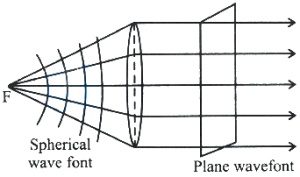
$A$ point source of light is placed at the focus of a concave mirror. Consider only paraxial rays. The shapes of the wavefronts of incident and reflected lights respectively are
A
spherical,spherical
B
spherical,planar
C
spherical,cylindrical
D
planar,spherical
Solution
(B) $1$. $A$ point source of light emits light in all directions,forming spherical wavefronts as the light propagates outward.
$2$. When these spherical wavefronts strike a concave mirror,the rays are reflected parallel to the principal axis (for paraxial rays).
$3$. $A$ set of parallel rays corresponds to a plane wavefront.
$4$. Therefore,the incident wavefront is spherical,and the reflected wavefront is planar.
$2$. When these spherical wavefronts strike a concave mirror,the rays are reflected parallel to the principal axis (for paraxial rays).
$3$. $A$ set of parallel rays corresponds to a plane wavefront.
$4$. Therefore,the incident wavefront is spherical,and the reflected wavefront is planar.
0 likesView Solution
120
PhysicsEasyMCQTS EAMCET · 2023
The focal lengths of the objective and the eyepiece of a compound microscope are $2 \,cm$ and $3 \,cm$ respectively, and the distance between them is $15 \,cm$. The final image formed by the eyepiece is at infinity. The distances of the object and the image produced by the objective lens from the objective lens are respectively:
A
$2.4 \,cm, 12 \,cm$
B
$2.4 \,cm, 15 \,cm$
C
$2.3 \,cm, 12 \,cm$
D
$2.3 \,cm, 3 \,cm$
Solution
(A) Given: Focal length of objective $f_o = 2 \,cm$, focal length of eyepiece $f_e = 3 \,cm$, and distance between lenses $L = 15 \,cm$.
Since the final image is formed at infinity, the image formed by the objective lens must lie at the principal focus of the eyepiece.
Therefore, the image distance from the eyepiece is $v_e = f_e = 3 \,cm$.
The image distance from the objective lens is $v_o = L - f_e = 15 \,cm - 3 \,cm = 12 \,cm$.
Using the lens formula for the objective lens: $\frac{1}{f_o} = \frac{1}{v_o} - \frac{1}{u_o}$
Substituting the values: $\frac{1}{2} = \frac{1}{12} - \frac{1}{u_o}$
$\frac{1}{u_o} = \frac{1}{12} - \frac{1}{2} = \frac{1 - 6}{12} = -\frac{5}{12}$
$u_o = -\frac{12}{5} = -2.4 \,cm$.
The magnitude of the object distance is $2.4 \,cm$ and the image distance is $12 \,cm$.
Since the final image is formed at infinity, the image formed by the objective lens must lie at the principal focus of the eyepiece.
Therefore, the image distance from the eyepiece is $v_e = f_e = 3 \,cm$.
The image distance from the objective lens is $v_o = L - f_e = 15 \,cm - 3 \,cm = 12 \,cm$.
Using the lens formula for the objective lens: $\frac{1}{f_o} = \frac{1}{v_o} - \frac{1}{u_o}$
Substituting the values: $\frac{1}{2} = \frac{1}{12} - \frac{1}{u_o}$
$\frac{1}{u_o} = \frac{1}{12} - \frac{1}{2} = \frac{1 - 6}{12} = -\frac{5}{12}$
$u_o = -\frac{12}{5} = -2.4 \,cm$.
The magnitude of the object distance is $2.4 \,cm$ and the image distance is $12 \,cm$.
0 likesView Solution
121
PhysicsMediumMCQTS EAMCET · 2023
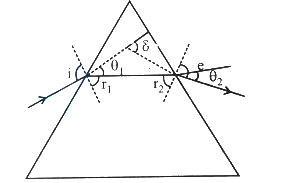
The angles of incidence and emergence of a light ray passing through a prism of angle $A$ are $i$ and $e$ respectively. The total deviation produced by the prism is
A
$i+e+A$
B
$i+e-A$
C
$i+e-2A$
D
$i+e+2A$
Solution
(B) For a light ray passing through a prism,the angle of deviation $\delta$ at the first surface is $\theta_1 = i - r_1$ and at the second surface is $\theta_2 = e - r_2$.
The total deviation $\delta$ is the sum of deviations at both surfaces:
$\delta = \theta_1 + \theta_2$
$\delta = (i - r_1) + (e - r_2)$
$\delta = (i + e) - (r_1 + r_2)$
Since the prism angle $A = r_1 + r_2$,we substitute this into the equation:
$\delta = i + e - A$
The total deviation $\delta$ is the sum of deviations at both surfaces:
$\delta = \theta_1 + \theta_2$
$\delta = (i - r_1) + (e - r_2)$
$\delta = (i + e) - (r_1 + r_2)$
Since the prism angle $A = r_1 + r_2$,we substitute this into the equation:
$\delta = i + e - A$
0 likesView Solution
122
PhysicsMediumMCQTS EAMCET · 2023
Refractive index of a medium is $\mu$. If the angle of incidence is twice that of the angle of refraction,then the angle of incidence is
A
$2 \cos ^{-1}\left(\frac{\mu}{2}\right)$
B
$\cos ^{-1}\left(\frac{\mu}{2}\right)$
C
$2 \sin ^{-1}\left(\frac{\mu}{2}\right)$
D
$\sin ^{-1}(\mu)$
Solution
(A) Given,angle of incidence $i = 2r$,where $r$ is the angle of refraction.
According to Snell's law,$\mu_1 \sin i = \mu_2 \sin r$.
Assuming the light travels from air $(\mu_1 = 1)$ to a medium with refractive index $\mu_2 = \mu$,we have:
$1 \cdot \sin(2r) = \mu \sin r$
Using the trigonometric identity $\sin(2r) = 2 \sin r \cos r$,we get:
$2 \sin r \cos r = \mu \sin r$
Since $\sin r \neq 0$,we can divide both sides by $\sin r$:
$2 \cos r = \mu \implies \cos r = \frac{\mu}{2}$
Thus,$r = \cos^{-1}\left(\frac{\mu}{2}\right)$.
Since $i = 2r$,the angle of incidence is $i = 2 \cos^{-1}\left(\frac{\mu}{2}\right)$.
According to Snell's law,$\mu_1 \sin i = \mu_2 \sin r$.
Assuming the light travels from air $(\mu_1 = 1)$ to a medium with refractive index $\mu_2 = \mu$,we have:
$1 \cdot \sin(2r) = \mu \sin r$
Using the trigonometric identity $\sin(2r) = 2 \sin r \cos r$,we get:
$2 \sin r \cos r = \mu \sin r$
Since $\sin r \neq 0$,we can divide both sides by $\sin r$:
$2 \cos r = \mu \implies \cos r = \frac{\mu}{2}$
Thus,$r = \cos^{-1}\left(\frac{\mu}{2}\right)$.
Since $i = 2r$,the angle of incidence is $i = 2 \cos^{-1}\left(\frac{\mu}{2}\right)$.
0 likesView Solution
123
PhysicsMediumMCQTS EAMCET · 2023
The built-in potential of a $p-n$ junction diode is $0.7 \,V$. If the diode is forward biased and the applied voltage is $0.3 \,V$, the effective barrier height is (in $\,V$)
A
$0.7$
B
$0.3$
C
$0.4$
D
$1$
Solution
(C) The built-in potential (barrier potential) of a $p-n$ junction diode is denoted by $V_B = 0.7 \,V$.
When a $p-n$ junction diode is forward biased with an external voltage $V_f$, the effective barrier height (or effective potential barrier) decreases.
The formula for the effective barrier height $V_{eff}$ is given by $V_{eff} = V_B - V_f$.
Given $V_B = 0.7 \,V$ and $V_f = 0.3 \,V$.
Substituting the values, we get $V_{eff} = 0.7 \,V - 0.3 \,V = 0.4 \,V$.
Therefore, the effective barrier height is $0.4 \,V$.
When a $p-n$ junction diode is forward biased with an external voltage $V_f$, the effective barrier height (or effective potential barrier) decreases.
The formula for the effective barrier height $V_{eff}$ is given by $V_{eff} = V_B - V_f$.
Given $V_B = 0.7 \,V$ and $V_f = 0.3 \,V$.
Substituting the values, we get $V_{eff} = 0.7 \,V - 0.3 \,V = 0.4 \,V$.
Therefore, the effective barrier height is $0.4 \,V$.
0 likesView Solution
124
PhysicsMediumMCQTS EAMCET · 2023
In a transistor,the base current is $10 \mu A$ and the emitter current is $1 \text{ mA}$. Then,the collector current is: (in $\mu A$)
A
$990$
B
$100$
C
$1010$
D
$90$
Solution
(A) Given: Base current,$i_B = 10 \mu A$.
Emitter current,$i_E = 1 \text{ mA} = 1000 \mu A$.
According to the fundamental relation for a transistor,the emitter current is the sum of the base current and the collector current: $i_E = i_B + i_C$.
Rearranging the formula to find the collector current: $i_C = i_E - i_B$.
Substituting the values: $i_C = 1000 \mu A - 10 \mu A = 990 \mu A$.
Emitter current,$i_E = 1 \text{ mA} = 1000 \mu A$.
According to the fundamental relation for a transistor,the emitter current is the sum of the base current and the collector current: $i_E = i_B + i_C$.
Rearranging the formula to find the collector current: $i_C = i_E - i_B$.
Substituting the values: $i_C = 1000 \mu A - 10 \mu A = 990 \mu A$.
0 likesView Solution
125
PhysicsEasyMCQTS EAMCET · 2023
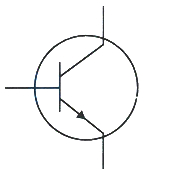
The symbol given below represents:
A
$A$ $p-n-p$ transistor
B
An $n-p-n$ transistor
C
$A$ $p-n$ junction diode
D
An inductor
Solution
(B) In the circuit symbol of a transistor,the arrow on the emitter terminal indicates the direction of conventional current flow.
For an $n-p-n$ transistor,the current flows from the base to the emitter,so the arrow on the emitter points outwards.
For a $p-n-p$ transistor,the current flows from the emitter to the base,so the arrow on the emitter points inwards.
In the given symbol,the arrow on the emitter is pointing outwards,which confirms that it is an $n-p-n$ transistor.
For an $n-p-n$ transistor,the current flows from the base to the emitter,so the arrow on the emitter points outwards.
For a $p-n-p$ transistor,the current flows from the emitter to the base,so the arrow on the emitter points inwards.
In the given symbol,the arrow on the emitter is pointing outwards,which confirms that it is an $n-p-n$ transistor.
0 likesView Solution
126
PhysicsEasyMCQTS EAMCET · 2023
If the output of a $NAND$ gate is given as input to a $NOT$ gate, the resultant gate is
A
$AND$
B
$OR$
C
$NOR$
D
$NOT$
Solution
(A) $NAND$ gate performs the operation $Y = \overline{A \cdot B}$.
When this output is fed into a $NOT$ gate, the final output becomes $Y' = \overline{Y} = \overline{(\overline{A \cdot B})}$.
By the law of double negation, $\overline{(\overline{X})} = X$. Therefore, $Y' = A \cdot B$.
This is the Boolean expression for an $AND$ gate.
When this output is fed into a $NOT$ gate, the final output becomes $Y' = \overline{Y} = \overline{(\overline{A \cdot B})}$.
By the law of double negation, $\overline{(\overline{X})} = X$. Therefore, $Y' = A \cdot B$.
This is the Boolean expression for an $AND$ gate.
| Input $(A, B)$ | $NAND$ Output $(\overline{A \cdot B})$ | $NOT$ Output $(A \cdot B)$ |
|---|---|---|
| $0, 0$ | $1$ | $0$ |
| $0, 1$ | $1$ | $0$ |
| $1, 0$ | $1$ | $0$ |
| $1, 1$ | $0$ | $1$ |
0 likesView Solution
127
PhysicsMediumMCQTS EAMCET · 2023
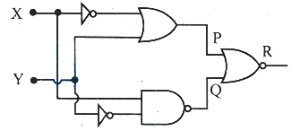
In the logic circuit given below,if $X=1$ and $Y=1$,then the values of $P, Q$ and $R$ are:
A
$P=1, Q=1, R=0$
B
$P=0, Q=1, R=0$
C
$P=1, Q=0, R=1$
D
$P=1, Q=1, R=1$
Solution
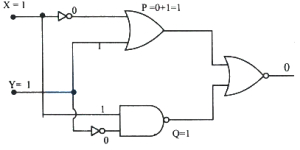
(A) Given inputs are $X=1$ and $Y=1$.
$1$. The input $X$ passes through a $NOT$ gate,so the input to the $OR$ gate is $\bar{X} = 0$.
$2$. The input $Y$ is directly connected to the $OR$ gate,so the input is $1$.
$3$. The output $P$ of the $OR$ gate is $P = \bar{X} + Y = 0 + 1 = 1$.
$4$. The input $X$ is directly connected to the $NAND$ gate,so the input is $1$.
$5$. The input $Y$ passes through a $NOT$ gate,so the input to the $NAND$ gate is $\bar{Y} = 0$.
$6$. The output $Q$ of the $NAND$ gate is $Q = \overline{X \cdot \bar{Y}} = \overline{1 \cdot 0} = \overline{0} = 1$.
$7$. Finally,$P$ and $Q$ are inputs to a $NOR$ gate to give output $R$.
$8$. $R = \overline{P + Q} = \overline{1 + 1} = \overline{1} = 0$.
Thus,$P=1, Q=1, R=0$.
$1$. The input $X$ passes through a $NOT$ gate,so the input to the $OR$ gate is $\bar{X} = 0$.
$2$. The input $Y$ is directly connected to the $OR$ gate,so the input is $1$.
$3$. The output $P$ of the $OR$ gate is $P = \bar{X} + Y = 0 + 1 = 1$.
$4$. The input $X$ is directly connected to the $NAND$ gate,so the input is $1$.
$5$. The input $Y$ passes through a $NOT$ gate,so the input to the $NAND$ gate is $\bar{Y} = 0$.
$6$. The output $Q$ of the $NAND$ gate is $Q = \overline{X \cdot \bar{Y}} = \overline{1 \cdot 0} = \overline{0} = 1$.
$7$. Finally,$P$ and $Q$ are inputs to a $NOR$ gate to give output $R$.
$8$. $R = \overline{P + Q} = \overline{1 + 1} = \overline{1} = 0$.
Thus,$P=1, Q=1, R=0$.
0 likesView Solution
128
PhysicsDifficultMCQTS EAMCET · 2023
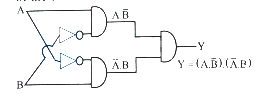
$5$ logic gates are connected as shown in the figure. If $A$ and $B$ are the inputs, $Y$ is the output, then the truth table of the circuit is:
A
| $A, B$ | $Y$ |
| $0, 0$ | $0$ |
| $1, 0$ | $0$ |
| $0, 1$ | $0$ |
| $1, 1$ | $0$ |
B
| $A, B$ | $Y$ |
| $0, 0$ | $1$ |
| $1, 0$ | $0$ |
| $0, 1$ | $0$ |
| $1, 1$ | $1$ |
C
| $A, B$ | $Y$ |
| $0, 0$ | $0$ |
| $1, 0$ | $1$ |
| $0, 1$ | $1$ |
| $1, 1$ | $1$ |
D
| $A, B$ | $Y$ |
| $0, 0$ | $1$ |
| $1, 0$ | $1$ |
| $0, 1$ | $1$ |
| $1, 1$ | $1$ |
Solution
(A) The circuit consists of two $NOT$ gates, two $AND$ gates, and one final $AND$ gate.
The inputs to the first $AND$ gate are $A$ and $\overline{B}$, so its output is $A \cdot \overline{B}$.
The inputs to the second $AND$ gate are $\overline{A}$ and $B$, so its output is $\overline{A} \cdot B$.
The final output $Y$ is the $AND$ operation of these two outputs: $Y = (A \cdot \overline{B}) \cdot (\overline{A} \cdot B)$.
Using the associative and commutative properties of Boolean algebra: $Y = A \cdot \overline{A} \cdot B \cdot \overline{B}$.
Since $A \cdot \overline{A} = 0$ and $B \cdot \overline{B} = 0$, the output $Y = 0 \cdot 0 = 0$ for all input combinations.
Therefore, the output $Y$ is always $0$.
The inputs to the first $AND$ gate are $A$ and $\overline{B}$, so its output is $A \cdot \overline{B}$.
The inputs to the second $AND$ gate are $\overline{A}$ and $B$, so its output is $\overline{A} \cdot B$.
The final output $Y$ is the $AND$ operation of these two outputs: $Y = (A \cdot \overline{B}) \cdot (\overline{A} \cdot B)$.
Using the associative and commutative properties of Boolean algebra: $Y = A \cdot \overline{A} \cdot B \cdot \overline{B}$.
Since $A \cdot \overline{A} = 0$ and $B \cdot \overline{B} = 0$, the output $Y = 0 \cdot 0 = 0$ for all input combinations.
Therefore, the output $Y$ is always $0$.
0 likesView Solution
129
PhysicsEasyMCQTS EAMCET · 2023
When a semiconductor is doped with donor impurity,
A
the hole concentration decreases and electron concentration increases
B
the hole concentration increases and electron concentration decreases
C
both hole concentration and electron concentration increase
D
both hole concentration and electron concentration decrease
Solution
(A) donor impurity atom provides an extra electron to the semiconductor lattice.
When a donor impurity is added,the number of free electrons in the conduction band increases significantly.
According to the law of mass action,$n_e \cdot n_h = n_i^2$,where $n_e$ is the electron concentration,$n_h$ is the hole concentration,and $n_i$ is the intrinsic carrier concentration.
Since $n_e$ increases,the hole concentration $n_h$ must decrease to maintain the product $n_i^2$ as a constant at a given temperature.
Therefore,the electron concentration increases and the hole concentration decreases.
Thus,option $A$ is the correct answer.
When a donor impurity is added,the number of free electrons in the conduction band increases significantly.
According to the law of mass action,$n_e \cdot n_h = n_i^2$,where $n_e$ is the electron concentration,$n_h$ is the hole concentration,and $n_i$ is the intrinsic carrier concentration.
Since $n_e$ increases,the hole concentration $n_h$ must decrease to maintain the product $n_i^2$ as a constant at a given temperature.
Therefore,the electron concentration increases and the hole concentration decreases.
Thus,option $A$ is the correct answer.
0 likesView Solution
130
PhysicsMediumMCQTS EAMCET · 2023
If the ratio of electron and hole currents in a semiconductor is $\frac{7}{4}$ and the ratio of drift velocities of electrons and holes is $\frac{5}{4}$,then the ratio of concentrations of electrons and holes will be
A
$5: 7$
B
$7: 5$
C
$5: 9$
D
$9: 5$
Solution
(B) The current in a semiconductor is given by the formula $I = n e A v_d$,where $n$ is the charge carrier concentration,$e$ is the elementary charge,$A$ is the cross-sectional area,and $v_d$ is the drift velocity.
For electrons and holes,the currents are $I_e = n_e e A v_e$ and $I_h = n_h e A v_h$.
The ratio of currents is given by $\frac{I_e}{I_h} = \frac{n_e e A v_e}{n_h e A v_h} = \frac{n_e v_e}{n_h v_h} = \frac{7}{4}$.
We are given the ratio of drift velocities as $\frac{v_e}{v_h} = \frac{5}{4}$.
Substituting this into the ratio equation: $\frac{n_e}{n_h} \times \frac{5}{4} = \frac{7}{4}$.
Solving for the ratio of concentrations: $\frac{n_e}{n_h} = \frac{7}{4} \times \frac{4}{5} = \frac{7}{5}$.
Therefore,the ratio of concentrations of electrons and holes is $7: 5$.
For electrons and holes,the currents are $I_e = n_e e A v_e$ and $I_h = n_h e A v_h$.
The ratio of currents is given by $\frac{I_e}{I_h} = \frac{n_e e A v_e}{n_h e A v_h} = \frac{n_e v_e}{n_h v_h} = \frac{7}{4}$.
We are given the ratio of drift velocities as $\frac{v_e}{v_h} = \frac{5}{4}$.
Substituting this into the ratio equation: $\frac{n_e}{n_h} \times \frac{5}{4} = \frac{7}{4}$.
Solving for the ratio of concentrations: $\frac{n_e}{n_h} = \frac{7}{4} \times \frac{4}{5} = \frac{7}{5}$.
Therefore,the ratio of concentrations of electrons and holes is $7: 5$.
0 likesView Solution
131
PhysicsEasyMCQTS EAMCET · 2023
When an $n$-type semiconductor is heated,
A
number of electrons increases while that of holes decreases
B
number of holes increases while that of electrons decreases
C
number of holes and electrons do not change
D
number of holes and electrons increases equally
Solution
(D) When an $n$-type semiconductor is heated,the thermal energy provides enough energy to break covalent bonds in the crystal lattice.
This process generates electron-hole pairs.
Since each electron-hole pair consists of one free electron and one hole,the number of electrons and the number of holes increase by the same amount.
Therefore,the number of holes and electrons increases equally.
This process generates electron-hole pairs.
Since each electron-hole pair consists of one free electron and one hole,the number of electrons and the number of holes increase by the same amount.
Therefore,the number of holes and electrons increases equally.
0 likesView Solution
132
PhysicsEasyMCQTS EAMCET · 2023
Which of the following statements is true about LEDs?
A
High operational voltage
B
Warm-up time is required
C
Bandwidth of light is $4000 \ Å - 7000 \ Å$
D
Fast on-off switching
Solution
(D) An $LED$ (Light Emitting Diode) is a $p-n$ junction diode that emits light when forward biased.
Key characteristics of LEDs include:
$1$. They operate at low voltages compared to incandescent bulbs.
$2$. They do not require any warm-up time.
$3$. They have very fast on-off switching capabilities,making them ideal for high-speed communication and display technologies.
$4$. The bandwidth of light emitted is typically narrow,not $4000 \ Å - 7000 \ Å$ (which covers the entire visible spectrum).
Therefore,the correct statement is that they have fast on-off switching.
Key characteristics of LEDs include:
$1$. They operate at low voltages compared to incandescent bulbs.
$2$. They do not require any warm-up time.
$3$. They have very fast on-off switching capabilities,making them ideal for high-speed communication and display technologies.
$4$. The bandwidth of light emitted is typically narrow,not $4000 \ Å - 7000 \ Å$ (which covers the entire visible spectrum).
Therefore,the correct statement is that they have fast on-off switching.
0 likesView Solution
133
PhysicsMediumMCQTS EAMCET · 2023
Photodiodes are mostly operated in reverse biased condition because
A
Fractional change in minority carriers produces higher forward current
B
Fractional change in majority carriers produces higher reverse current
C
Fractional change in minority carriers produces higher reverse current
D
Fractional change in majority carriers produces higher forward current
Solution
(C) In a photodiode,the reverse saturation current is primarily due to the flow of minority charge carriers. When light is incident on the photodiode,it generates electron-hole pairs,which increases the number of minority charge carriers. Because the initial number of minority carriers is very small,even a small amount of incident light causes a significant fractional change in their concentration. This leads to a noticeable change in the reverse current,making the photodiode highly sensitive to light. In contrast,in forward bias,the current is dominated by majority carriers,which are already present in large numbers,making the fractional change due to incident light negligible.
0 likesView Solution
134
PhysicsMediumMCQTS EAMCET · 2023
Consider two black bodies $A$ and $B$ having equal surface areas. On the surface of $A$,$n$ photons of frequency $f$ are incident perpendicularly in a time $t$. On the surface of $B$,$2n$ photons of frequency $3f$ are incident perpendicularly in a time $4t$. The ratio of average intensity of radiation on surface $A$ to that on surface $B$ is
A
$2: 3$
B
$3: 2$
C
$1: 12$
D
$1: 24$
Solution
(A) Intensity of radiation is defined as the energy incident per unit area per unit time: $I = \frac{E}{A \cdot t}$.
For a photon of frequency $f$,the energy is $E = hf$. Thus,the total energy incident is $E_{total} = N \cdot hf$.
For surface $A$: $I_A = \frac{n \cdot hf}{A \cdot t}$.
For surface $B$: $I_B = \frac{(2n) \cdot h(3f)}{A \cdot (4t)} = \frac{6nhf}{4At} = \frac{3nhf}{2At}$.
Taking the ratio: $\frac{I_A}{I_B} = \frac{nhf}{At} \cdot \frac{2At}{3nhf} = \frac{2}{3}$.
Therefore,the ratio is $2: 3$.
For a photon of frequency $f$,the energy is $E = hf$. Thus,the total energy incident is $E_{total} = N \cdot hf$.
For surface $A$: $I_A = \frac{n \cdot hf}{A \cdot t}$.
For surface $B$: $I_B = \frac{(2n) \cdot h(3f)}{A \cdot (4t)} = \frac{6nhf}{4At} = \frac{3nhf}{2At}$.
Taking the ratio: $\frac{I_A}{I_B} = \frac{nhf}{At} \cdot \frac{2At}{3nhf} = \frac{2}{3}$.
Therefore,the ratio is $2: 3$.
0 likesView Solution
135
PhysicsEasyMCQTS EAMCET · 2023
The ratio of the relative strengths of the gravitational force and the electromagnetic force between two charged particles is
A
$10^{-11}$
B
$10^{-39}$
C
$10^{-37}$
D
$10^{-41}$
Solution
(C) The relative strength of the gravitational force between two protons is approximately $10^{-39}$ times the strength of the electromagnetic force between them.
Therefore,the ratio of the gravitational force to the electromagnetic force is $10^{-39} / 10^{-2} = 10^{-37}$.
Thus,the correct option is $C$.
Therefore,the ratio of the gravitational force to the electromagnetic force is $10^{-39} / 10^{-2} = 10^{-37}$.
Thus,the correct option is $C$.
0 likesView Solution
136
PhysicsMediumMCQTS EAMCET · 2023
The ratio of the relative strengths of strong and weak nuclear forces is
A
$10^{13}$
B
$10^{26}$
C
$10^{39}$
D
$10^{11}$
Solution
(A) The relative strength of the strong nuclear force is approximately $1$.
The relative strength of the weak nuclear force is approximately $10^{-13}$.
Therefore,the ratio of the relative strengths of strong and weak nuclear forces is given by:
Ratio $= \frac{\text{Strong nuclear force}}{\text{Weak nuclear force}} = \frac{1}{10^{-13}} = 10^{13}$.
The relative strength of the weak nuclear force is approximately $10^{-13}$.
Therefore,the ratio of the relative strengths of strong and weak nuclear forces is given by:
Ratio $= \frac{\text{Strong nuclear force}}{\text{Weak nuclear force}} = \frac{1}{10^{-13}} = 10^{13}$.
0 likesView Solution
137
PhysicsMediumMCQTS EAMCET · 2023
If the slit width is $2 \, mm$ and the wavelength of light used is $4000 \, Å$, then the Fresnel distance is nearly:
A
$2 \, mm$
B
$10 \, m$
C
$20 \, km$
D
$2 \, \mu m$
Solution
(B) The formula for Fresnel distance $(Z_F)$ is given by $Z_F = \frac{a^2}{\lambda}$, where $a$ is the slit width and $\lambda$ is the wavelength of light.
Given:
Slit width $a = 2 \, mm = 2 \times 10^{-3} \, m$
Wavelength $\lambda = 4000 \, Å = 4 \times 10^{-7} \, m$
Substituting these values into the formula:
$Z_F = \frac{(2 \times 10^{-3})^2}{4 \times 10^{-7}}$
$Z_F = \frac{4 \times 10^{-6}}{4 \times 10^{-7}}$
$Z_F = 10 \, m$
Therefore, the Fresnel distance is $10 \, m$.
Given:
Slit width $a = 2 \, mm = 2 \times 10^{-3} \, m$
Wavelength $\lambda = 4000 \, Å = 4 \times 10^{-7} \, m$
Substituting these values into the formula:
$Z_F = \frac{(2 \times 10^{-3})^2}{4 \times 10^{-7}}$
$Z_F = \frac{4 \times 10^{-6}}{4 \times 10^{-7}}$
$Z_F = 10 \, m$
Therefore, the Fresnel distance is $10 \, m$.
0 likesView Solution
138
PhysicsMediumMCQTS EAMCET · 2023
In a single slit diffraction,the slit is illuminated with light of wavelength $6000 \text{ Å}$. If the slit were illuminated by a light of wavelength $\lambda$ the angular width of the central maximum decreases by $30 \%$. Then $\lambda$ is (in $\text{ Å}$)
A
$6000$
B
$4200$
C
$3000$
D
$1800$
Solution
(B) The angular width of the central maximum in single slit diffraction is given by $\theta = \frac{2\lambda}{a}$,where $a$ is the slit width.
Thus,$\theta \propto \lambda$.
Let the initial wavelength be $\lambda_1 = 6000 \text{ Å}$ and the initial angular width be $\theta_1 = \theta$.
Then $\theta_1 = k \lambda_1$ $(i)$
When the wavelength is changed to $\lambda_2 = \lambda$,the angular width decreases by $30 \%$.
So,$\theta_2 = \theta_1 - 0.30 \theta_1 = 0.70 \theta_1$.
Since $\theta_2 = k \lambda_2$,we have $0.70 \theta_1 = k \lambda_2$ (ii)
Dividing equation (ii) by equation $(i)$:
$\frac{k \lambda_2}{k \lambda_1} = \frac{0.70 \theta_1}{\theta_1}$
$\frac{\lambda_2}{6000 \text{ Å}} = 0.70$
$\lambda_2 = 0.70 \times 6000 \text{ Å} = 4200 \text{ Å}$.
Thus,$\theta \propto \lambda$.
Let the initial wavelength be $\lambda_1 = 6000 \text{ Å}$ and the initial angular width be $\theta_1 = \theta$.
Then $\theta_1 = k \lambda_1$ $(i)$
When the wavelength is changed to $\lambda_2 = \lambda$,the angular width decreases by $30 \%$.
So,$\theta_2 = \theta_1 - 0.30 \theta_1 = 0.70 \theta_1$.
Since $\theta_2 = k \lambda_2$,we have $0.70 \theta_1 = k \lambda_2$ (ii)
Dividing equation (ii) by equation $(i)$:
$\frac{k \lambda_2}{k \lambda_1} = \frac{0.70 \theta_1}{\theta_1}$
$\frac{\lambda_2}{6000 \text{ Å}} = 0.70$
$\lambda_2 = 0.70 \times 6000 \text{ Å} = 4200 \text{ Å}$.

0 likesView Solution
139
PhysicsDifficultMCQTS EAMCET · 2023
When Young's double slit experiment is performed in air,the $Y$-coordinates of central maxima and $10^{\text{th}}$ maxima are $2 \text{ cm}$ and $5 \text{ cm}$ respectively. If the apparatus is immersed in a liquid of refractive index $1.5$,the corresponding $Y$-coordinates will be
A
$2 \text{ cm}, 7.5 \text{ cm}$
B
$3 \text{ cm}, 6 \text{ cm}$
C
$2 \text{ cm}, 4 \text{ cm}$
D
$\frac{4}{3} \text{ cm}, \frac{10}{3} \text{ cm}$
Solution
(C) In $YDSE$,the position of the $n^{\text{th}}$ maxima is given by $y_n = \frac{n \lambda D}{d} + y_0$,where $y_0$ is the position of the central maxima.
Given in air: $y_0 = 2 \text{ cm}$ and $y_{10} = 5 \text{ cm}$.
The fringe width $\beta = y_{10} - y_0 = 5 \text{ cm} - 2 \text{ cm} = 3 \text{ cm}$.
We know $\beta = \frac{\lambda D}{d}$. Thus,$\frac{\lambda D}{d} = 3 \text{ cm}$.
When the apparatus is immersed in a liquid of refractive index $\mu = 1.5$,the wavelength becomes $\lambda' = \frac{\lambda}{\mu}$.
The new fringe width $\beta' = \frac{\lambda' D}{d} = \frac{\lambda D}{\mu d} = \frac{\beta}{\mu} = \frac{3 \text{ cm}}{1.5} = 2 \text{ cm}$.
The central maxima position $y_0'$ remains unchanged because it is independent of the wavelength,so $y_0' = 2 \text{ cm}$.
The new position of the $10^{\text{th}}$ maxima is $y_{10}' = y_0' + 10 \beta' = 2 \text{ cm} + 10 \times \frac{3 \text{ cm}}{10 \times 1.5} = 2 \text{ cm} + 2 \text{ cm} = 4 \text{ cm}$.
Alternatively,$y_{10}' = y_0 + 10 \beta' = 2 \text{ cm} + 10 \times (0.2 \text{ cm}) = 4 \text{ cm}$.
Given in air: $y_0 = 2 \text{ cm}$ and $y_{10} = 5 \text{ cm}$.
The fringe width $\beta = y_{10} - y_0 = 5 \text{ cm} - 2 \text{ cm} = 3 \text{ cm}$.
We know $\beta = \frac{\lambda D}{d}$. Thus,$\frac{\lambda D}{d} = 3 \text{ cm}$.
When the apparatus is immersed in a liquid of refractive index $\mu = 1.5$,the wavelength becomes $\lambda' = \frac{\lambda}{\mu}$.
The new fringe width $\beta' = \frac{\lambda' D}{d} = \frac{\lambda D}{\mu d} = \frac{\beta}{\mu} = \frac{3 \text{ cm}}{1.5} = 2 \text{ cm}$.
The central maxima position $y_0'$ remains unchanged because it is independent of the wavelength,so $y_0' = 2 \text{ cm}$.
The new position of the $10^{\text{th}}$ maxima is $y_{10}' = y_0' + 10 \beta' = 2 \text{ cm} + 10 \times \frac{3 \text{ cm}}{10 \times 1.5} = 2 \text{ cm} + 2 \text{ cm} = 4 \text{ cm}$.
Alternatively,$y_{10}' = y_0 + 10 \beta' = 2 \text{ cm} + 10 \times (0.2 \text{ cm}) = 4 \text{ cm}$.
0 likesView Solution
140
PhysicsEasyMCQTS EAMCET · 2023
Two slits are made one millimetre apart and the screen is placed one metre away from the slits. The fringe width when light of wavelength $500 \,nm$ is used is
A
$5 \,m$
B
$0.5 \,mm$
C
$0.5 \,m$
D
$5 \,cm$
Solution
(B) The separation between the two slits is $d = 1 \,mm = 10^{-3} \,m$.
The distance between the screen and the slits is $D = 1 \,m$.
The wavelength of the light used is $\lambda = 500 \,nm = 500 \times 10^{-9} \,m$.
The formula for fringe width $\beta$ is given by $\beta = \frac{D \lambda}{d}$.
Substituting the given values:
$\beta = \frac{1 \times 500 \times 10^{-9}}{10^{-3}} = 500 \times 10^{-6} \,m = 0.5 \times 10^{-3} \,m = 0.5 \,mm$.
The distance between the screen and the slits is $D = 1 \,m$.
The wavelength of the light used is $\lambda = 500 \,nm = 500 \times 10^{-9} \,m$.
The formula for fringe width $\beta$ is given by $\beta = \frac{D \lambda}{d}$.
Substituting the given values:
$\beta = \frac{1 \times 500 \times 10^{-9}}{10^{-3}} = 500 \times 10^{-6} \,m = 0.5 \times 10^{-3} \,m = 0.5 \,mm$.
0 likesView Solution
141
PhysicsMediumMCQTS EAMCET · 2023
Two slits separated by a distance of $1 \,mm$ are illuminated with light of wavelength $6.5 \times 10^{-7} \,m$. The interference fringes are observed on a screen placed at $1 \,m$ from the slits. The distance between the third dark fringe and the fifth bright fringe is equal to (in $\,mm$)
A
$0.655$
B
$1.625$
C
$3.125$
D
$4.785$
Solution
(B) Given: Distance between slits $d = 1 \,mm = 10^{-3} \,m$, wavelength $\lambda = 6.5 \times 10^{-7} \,m$, distance of screen $D = 1 \,m$.
For the $n^{th}$ dark fringe, the position is given by $y_n = (n - 0.5) \frac{\lambda D}{d}$.
For the $3^{rd}$ dark fringe $(n=3)$: $y_3 = (3 - 0.5) \frac{6.5 \times 10^{-7} \times 1}{10^{-3}} = 2.5 \times 6.5 \times 10^{-4} = 16.25 \times 10^{-4} \,m$.
For the $n^{th}$ bright fringe, the position is given by $y_n = \frac{n \lambda D}{d}$.
For the $5^{th}$ bright fringe $(n=5)$: $y_5 = \frac{5 \times 6.5 \times 10^{-7} \times 1}{10^{-3}} = 32.5 \times 10^{-4} \,m$.
The distance between the $3^{rd}$ dark fringe and the $5^{th}$ bright fringe is $\Delta y = y_5 - y_3 = 32.5 \times 10^{-4} - 16.25 \times 10^{-4} = 16.25 \times 10^{-4} \,m = 1.625 \,mm$.
For the $n^{th}$ dark fringe, the position is given by $y_n = (n - 0.5) \frac{\lambda D}{d}$.
For the $3^{rd}$ dark fringe $(n=3)$: $y_3 = (3 - 0.5) \frac{6.5 \times 10^{-7} \times 1}{10^{-3}} = 2.5 \times 6.5 \times 10^{-4} = 16.25 \times 10^{-4} \,m$.
For the $n^{th}$ bright fringe, the position is given by $y_n = \frac{n \lambda D}{d}$.
For the $5^{th}$ bright fringe $(n=5)$: $y_5 = \frac{5 \times 6.5 \times 10^{-7} \times 1}{10^{-3}} = 32.5 \times 10^{-4} \,m$.
The distance between the $3^{rd}$ dark fringe and the $5^{th}$ bright fringe is $\Delta y = y_5 - y_3 = 32.5 \times 10^{-4} - 16.25 \times 10^{-4} = 16.25 \times 10^{-4} \,m = 1.625 \,mm$.
0 likesView Solution
Vedclass Products
For Students
Vedclass Test Series
Mock tests in real TS EAMCET style covering Physics with performance analysis. 5-day free trial.
Start Free TrialFor Teachers
Exam Paper Generator
Generate Set A/B/C/D Physics papers from 7.5L+ questions in 2 minutes. 3 chapters free.
Try FreeFor Institutes
Online Exam Module
Run live TS EAMCET mock exams with unlimited students, 360° analytics & white-label branding.
See DemoFrequently Asked Questions
How many Physics questions are in TS EAMCET 2023?
There are 241 Physics questions from the TS EAMCET 2023 paper on Vedclass, each with a detailed step-by-step solution in English.
Are TS EAMCET 2023 Physics solutions available in English?
Yes. All solutions on this page are in English. You can also switch to English or Hindi using the language buttons above the questions.
Can I practice TS EAMCET 2023 Physics as a timed test?
Yes. Use the Vedclass Test Series to attempt a full TS EAMCET mock test covering Physics with time limits and instant score analysis.
Can teachers create Physics papers from TS EAMCET previous year questions?
Yes. The Vedclass Exam Paper Generator lets teachers mix TS EAMCET Physics questions and generate Set A/B/C/D papers in minutes.
For Teachers & Institutes
Build a Custom Physics Paper
Pick TS EAMCET 2023 Physics questions, set difficulty, and generate Set A/B/C/D in 2 minutes.