
ChemistryQ1–44 of 44 questions
Page 1 of 1 · English
1
ChemistryMCQTS EAMCET · 2015
If the number of diagonals of a regular polygon is $35$,then the number of sides of the polygon is
A
$12$
B
$9$
C
$10$
D
$11$
Solution
(C) The number of diagonals in a polygon with $n$ sides is given by the formula $\frac{n(n-3)}{2}$.
Given that the number of diagonals is $35$,we have:
$\frac{n(n-3)}{2} = 35$
$n(n-3) = 70$
$n^2 - 3n - 70 = 0$
$(n-10)(n+7) = 0$
Since $n$ must be a positive integer,we take $n = 10$.
Thus,the number of sides of the polygon is $10$.
Given that the number of diagonals is $35$,we have:
$\frac{n(n-3)}{2} = 35$
$n(n-3) = 70$
$n^2 - 3n - 70 = 0$
$(n-10)(n+7) = 0$
Since $n$ must be a positive integer,we take $n = 10$.
Thus,the number of sides of the polygon is $10$.
0 likesView Solution
2
ChemistryMCQTS EAMCET · 2015
The combined equation of the diagonals of the square formed by the two pairs of straight lines given by $xy+4x-3y-12=0$ and $xy-3x+4y-12=0$ is
A
$x^2-2xy+y^2+x-y=0$
B
$x^2+2xy+y^2+x+y=0$
C
$x^2-y^2+x+y=0$
D
$x^2-y^2+x-y=0$
Solution
(D) The first pair of lines is $xy+4x-3y-12=0$,which factors as $(x-3)(y+4)=0$. This represents the lines $x=3$ and $y=-4$.
The second pair of lines is $xy-3x+4y-12=0$,which factors as $(x+4)(y-3)=0$. This represents the lines $x=-4$ and $y=3$.
The four lines forming the square are $x=3, x=-4, y=-4, y=3$.
The vertices of the square are $(3,3), (3,-4), (-4,-4), (-4,3)$.
The diagonals connect $(3,3)$ to $(-4,-4)$ and $(3,-4)$ to $(-4,3)$.
The equation of the diagonal passing through $(3,3)$ and $(-4,-4)$ is $y-3 = \frac{-4-3}{-4-3}(x-3)$,which simplifies to $y-3 = x-3$,or $x-y=0$.
The equation of the diagonal passing through $(3,-4)$ and $(-4,3)$ is $y-(-4) = \frac{3-(-4)}{-4-3}(x-3)$,which simplifies to $y+4 = -1(x-3)$,or $x+y+1=0$.
The combined equation is $(x-y)(x+y+1) = 0$,which is $x^2-y^2+x-y=0$.
The second pair of lines is $xy-3x+4y-12=0$,which factors as $(x+4)(y-3)=0$. This represents the lines $x=-4$ and $y=3$.
The four lines forming the square are $x=3, x=-4, y=-4, y=3$.
The vertices of the square are $(3,3), (3,-4), (-4,-4), (-4,3)$.
The diagonals connect $(3,3)$ to $(-4,-4)$ and $(3,-4)$ to $(-4,3)$.
The equation of the diagonal passing through $(3,3)$ and $(-4,-4)$ is $y-3 = \frac{-4-3}{-4-3}(x-3)$,which simplifies to $y-3 = x-3$,or $x-y=0$.
The equation of the diagonal passing through $(3,-4)$ and $(-4,3)$ is $y-(-4) = \frac{3-(-4)}{-4-3}(x-3)$,which simplifies to $y+4 = -1(x-3)$,or $x+y+1=0$.
The combined equation is $(x-y)(x+y+1) = 0$,which is $x^2-y^2+x-y=0$.
0 likesView Solution
3
ChemistryMediumMCQTS EAMCET · 2015
Number of bonding electron pairs and number of lone pairs of electrons in $ClF_3$,$SF_4$,$BrF_5$ respectively are
A
$3,2 ; 4,2 ; 5,2$
B
$3,1 ; 4,1 ; 5,2$
C
$3,1 ; 4,2 ; 5,1$
D
$3,2 ; 4,1 ; 5,1$
Solution
(D) To determine the number of bonding electron pairs and lone pairs,we look at the central atom of each molecule:
$1$. In $ClF_3$: The central atom $Cl$ is bonded to $3$ $F$ atoms (bonding pairs = $3$) and has $2$ lone pairs on the $Cl$ atom (lone pairs = $2$).
$2$. In $SF_4$: The central atom $S$ is bonded to $4$ $F$ atoms (bonding pairs = $4$) and has $1$ lone pair on the $S$ atom (lone pairs = $1$).
$3$. In $BrF_5$: The central atom $Br$ is bonded to $5$ $F$ atoms (bonding pairs = $5$) and has $1$ lone pair on the $Br$ atom (lone pairs = $1$).
Thus,the number of bonding pairs and lone pairs are $3,2$; $4,1$; and $5,1$ respectively.
$1$. In $ClF_3$: The central atom $Cl$ is bonded to $3$ $F$ atoms (bonding pairs = $3$) and has $2$ lone pairs on the $Cl$ atom (lone pairs = $2$).
$2$. In $SF_4$: The central atom $S$ is bonded to $4$ $F$ atoms (bonding pairs = $4$) and has $1$ lone pair on the $S$ atom (lone pairs = $1$).
$3$. In $BrF_5$: The central atom $Br$ is bonded to $5$ $F$ atoms (bonding pairs = $5$) and has $1$ lone pair on the $Br$ atom (lone pairs = $1$).
Thus,the number of bonding pairs and lone pairs are $3,2$; $4,1$; and $5,1$ respectively.
0 likesView Solution
4
ChemistryEasyMCQTS EAMCET · 2015
What is the bond order of $N_2$?
A
$3$
B
$4$
C
$2$
D
$1$
Solution
(A) The electronic configuration of $N_2$ ($14$ electrons) is: $\sigma 1s^2, \sigma^* 1s^2, \sigma 2s^2, \sigma^* 2s^2, \pi 2p_x^2 = \pi 2p_y^2, \sigma 2p_z^2$.
Bond order is calculated as: $\text{Bond order} = \frac{N_b - N_a}{2} = \frac{10 - 4}{2} = 3$.
Bond order is calculated as: $\text{Bond order} = \frac{N_b - N_a}{2} = \frac{10 - 4}{2} = 3$.
0 likesView Solution
5
ChemistryEasyMCQTS EAMCET · 2015
When one mole of $A$ and one mole of $B$ were heated in a one-litre flask at $T \ K$,$0.5 \ mole$ of $C$ was formed at equilibrium for the reaction $A + B \rightleftharpoons C + D$. The equilibrium constant,$K_C$,is:
A
$0.25$
B
$0.5$
C
$1$
D
$2$
Solution
(C) The reaction is $A + B \rightleftharpoons C + D$.
Given that at equilibrium,the number of moles of $C$ formed is $x = 0.5 \ mol$.
Therefore,the moles of $A$ and $B$ remaining are $(1 - 0.5) = 0.5 \ mol$ each,and the moles of $D$ formed are $0.5 \ mol$.
Since the volume of the flask is $1 \ L$,the concentrations are equal to the number of moles.
$K_C = \frac{[C][D]}{[A][B]} = \frac{0.5 \times 0.5}{0.5 \times 0.5} = 1$.
| Species | $A$ | $B$ | $C$ | $D$ |
| Initial moles | $1$ | $1$ | $0$ | $0$ |
| Moles at equilibrium | $(1-x)$ | $(1-x)$ | $x$ | $x$ |
Given that at equilibrium,the number of moles of $C$ formed is $x = 0.5 \ mol$.
Therefore,the moles of $A$ and $B$ remaining are $(1 - 0.5) = 0.5 \ mol$ each,and the moles of $D$ formed are $0.5 \ mol$.
Since the volume of the flask is $1 \ L$,the concentrations are equal to the number of moles.
$K_C = \frac{[C][D]}{[A][B]} = \frac{0.5 \times 0.5}{0.5 \times 0.5} = 1$.
0 likesView Solution
6
ChemistryEasyMCQTS EAMCET · 2015
The equation used to represent the electron gain enthalpy is
A
$X_{(g)} + e^{-} \longrightarrow X^{-}_{(g)}$
B
$X_{(s)} + e^{-} \longrightarrow X^{-}_{(g)}$
C
$X_{(g)} \longrightarrow X^{+}_{(g)} + e^{-}$
D
$X_{(s)} \longrightarrow X^{+}_{(g)} + e^{-}$
Solution
(A) Electron gain enthalpy $\left(\Delta_{eg} H\right)$ is defined as the enthalpy change when an electron is added to a neutral gaseous atom in its ground state to form a negative ion (anion).
The process is represented by the equation: $X_{(g)} + e^{-} \longrightarrow X^{-}_{(g)}$.
Option $A$ correctly represents this process.
The process is represented by the equation: $X_{(g)} + e^{-} \longrightarrow X^{-}_{(g)}$.
Option $A$ correctly represents this process.
0 likesView Solution
7
ChemistryEasyMCQTS EAMCET · 2015
In municipal sewage,$BOD$ values (in $ppm$) are
A
$1-5$
B
$100-4000$
C
$50-90$
D
$20-40$
Solution
(B) The amount of oxygen required by bacteria to break down the organic matter present in a certain volume of a sample of water is called biochemical oxygen demand $(BOD)$.
The amount of $BOD$ in the water is a measure of the amount of organic material in water in terms of how much oxygen will be required to break it down biologically.
Clean water has a $BOD$ value of less than $5 \ ppm$,whereas highly polluted water,such as municipal sewage,has a $BOD$ value of more than $100 \ ppm$.
The amount of $BOD$ in the water is a measure of the amount of organic material in water in terms of how much oxygen will be required to break it down biologically.
Clean water has a $BOD$ value of less than $5 \ ppm$,whereas highly polluted water,such as municipal sewage,has a $BOD$ value of more than $100 \ ppm$.
0 likesView Solution
8
ChemistryEasyMCQTS EAMCET · 2015
The two bonds $N=O$ and $N-O$ in $CH_3NO_2$ have the same bond length due to:
A
inductive effect
B
hyperconjugation
C
electromeric effect
D
resonance effect
Solution
(D) In nitromethane $(CH_3NO_2)$,the nitro group $(NO_2)$ exhibits resonance.
Due to the delocalization of $\pi$-electrons between the nitrogen and the two oxygen atoms,the two $N-O$ bonds acquire partial double bond character.
As a result,both $N-O$ bonds become equivalent in length,which is intermediate between a single bond and a double bond.
This phenomenon is known as the resonance effect.
Due to the delocalization of $\pi$-electrons between the nitrogen and the two oxygen atoms,the two $N-O$ bonds acquire partial double bond character.
As a result,both $N-O$ bonds become equivalent in length,which is intermediate between a single bond and a double bond.
This phenomenon is known as the resonance effect.
0 likesView Solution
9
ChemistryMediumMCQTS EAMCET · 2015
White metal is an alloy of
A
$Na$ and $Mg$
B
$Na$ and $Pb$
C
$Li$ and $Mg$
D
$Li$ and $Pb$
Solution
(D) White metal is an alloy of $Li$ and $Pb$.
0 likesView Solution
10
ChemistryMediumMCQTS EAMCET · 2015
Assertion $(A)$: Reaction of but$-1-$ene with $HBr$ gives $1-$bromobutane as major product.
Reason $(R)$: Addition of hydrogen halides to alkenes proceeds according to Markownikoff's rule.
The correct answer is
Reason $(R)$: Addition of hydrogen halides to alkenes proceeds according to Markownikoff's rule.
The correct answer is
A
$A$ and $R$ are correct and $R$ is the correct explanation of $A$
B
$A$ and $R$ are correct but $R$ is not the correct explanation of $A$
C
$A$ is correct but $R$ is not correct
D
$A$ is not correct but $R$ is correct
Solution
(D) According to Markownikoff's rule,the addition of reagents such as $HX$ to unsymmetrical alkenes occurs in such a way that the negative part of the adding molecule attaches to the carbon atom of the double bond which carries the lesser number of hydrogen atoms.
For the reaction of but$-1-$ene $(CH_3CH_2CH=CH_2)$ with $HBr$,the major product is $2-$bromobutane $(CH_3CH_2CH(Br)CH_3)$,not $1-$bromobutane $(CH_3CH_2CH_2CH_2Br)$.
Therefore,the assertion $(A)$ is incorrect because it states $1-$bromobutane is the major product.
The reason $(R)$ is correct as it correctly states the rule governing the addition of hydrogen halides to alkenes.
Thus,$A$ is incorrect and $R$ is correct.
For the reaction of but$-1-$ene $(CH_3CH_2CH=CH_2)$ with $HBr$,the major product is $2-$bromobutane $(CH_3CH_2CH(Br)CH_3)$,not $1-$bromobutane $(CH_3CH_2CH_2CH_2Br)$.
Therefore,the assertion $(A)$ is incorrect because it states $1-$bromobutane is the major product.
The reason $(R)$ is correct as it correctly states the rule governing the addition of hydrogen halides to alkenes.
Thus,$A$ is incorrect and $R$ is correct.
0 likesView Solution
11
ChemistryEasyMCQTS EAMCET · 2015
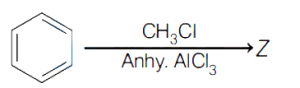
The product $(Z)$ of the following reaction is
A
Chlorobenzene
B
Toluene
C
$2-$Chlorotoluene
D
$1,2-$Dichlorobenzene
Solution
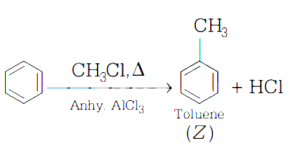
(B) The given reaction is a Friedel-Crafts alkylation reaction. In this reaction,benzene reacts with methyl chloride $(CH_3Cl)$ in the presence of anhydrous aluminum chloride $(Anhy. AlCl_3)$ as a Lewis acid catalyst to form toluene $(C_6H_5CH_3)$ as the product $(Z)$.
The reaction is:
$C_6H_6 + CH_3Cl \xrightarrow{Anhy. AlCl_3} C_6H_5CH_3 + HCl$
Thus,the product $(Z)$ is toluene.
The reaction is:
$C_6H_6 + CH_3Cl \xrightarrow{Anhy. AlCl_3} C_6H_5CH_3 + HCl$
Thus,the product $(Z)$ is toluene.
0 likesView Solution
12
ChemistryEasyMCQTS EAMCET · 2015
Which one of the following is not a method to remove permanent hardness of water?
A
Clark's method
B
Calgon's method
C
Ion-exchange method
D
Synthetic resins method
Solution
(A) Clark's method is used to remove temporary hardness of water.
In this method,a calculated amount of lime $(Ca(OH)_2)$ is added to hard water,which precipitates out the dissolved bicarbonates as carbonates.
Permanent hardness is removed by methods such as Calgon's method,Ion-exchange method,and Synthetic resins method.
In this method,a calculated amount of lime $(Ca(OH)_2)$ is added to hard water,which precipitates out the dissolved bicarbonates as carbonates.
Permanent hardness is removed by methods such as Calgon's method,Ion-exchange method,and Synthetic resins method.
0 likesView Solution
13
ChemistryMediumMCQTS EAMCET · 2015
The buffer system which helps to maintain the $pH$ of blood between $7.26$ to $7.42$ is:
A
$H_2CO_3 / HCO_3^{-}$
B
$NH_4OH / NH_4Cl$
C
$CH_3COOH / CH_3COO^{-}$
D
$CH_3COONH_4$
Solution
(A) $H_2CO_3$ is a weak acid and dissociates in the following step:
$H_2CO_3{_{\text{(aq)}}} + H_2O_{\text{(l)}} \rightleftharpoons HCO_3^{-}{_{\text{(aq)}}} + H_3O^{+}{_{\text{(aq)}}}$
The $H_2CO_3 / HCO_3^{-}$ buffer system is the primary mechanism that helps to maintain the $pH$ of human blood within the physiological range of $7.26$ to $7.42$.
$H_2CO_3{_{\text{(aq)}}} + H_2O_{\text{(l)}} \rightleftharpoons HCO_3^{-}{_{\text{(aq)}}} + H_3O^{+}{_{\text{(aq)}}}$
The $H_2CO_3 / HCO_3^{-}$ buffer system is the primary mechanism that helps to maintain the $pH$ of human blood within the physiological range of $7.26$ to $7.42$.
0 likesView Solution
14
ChemistryMediumMCQTS EAMCET · 2015
If the solubility of $Ca_3(PO_4)_2$ in water is $x \ mol \ L^{-1}$,its solubility product in $mol^5 \ L^{-5}$ is (in $x^5$)
A
$6$
B
$36$
C
$64$
D
$108$
Solution
(D) The dissociation of $Ca_3(PO_4)_2$ is given by: $Ca_3(PO_4)_2 \rightleftharpoons 3 Ca^{2+} + 2 PO_4^{3-}$
If the solubility is $x \ mol \ L^{-1}$,then the concentration of $Ca^{2+}$ is $3x \ mol \ L^{-1}$ and the concentration of $PO_4^{3-}$ is $2x \ mol \ L^{-1}$.
The solubility product $K_{sp}$ is defined as: $K_{sp} = [Ca^{2+}]^3 [PO_4^{3-}]^2$
Substituting the values: $K_{sp} = (3x)^3 (2x)^2 = (27x^3) (4x^2) = 108x^5$.
If the solubility is $x \ mol \ L^{-1}$,then the concentration of $Ca^{2+}$ is $3x \ mol \ L^{-1}$ and the concentration of $PO_4^{3-}$ is $2x \ mol \ L^{-1}$.
The solubility product $K_{sp}$ is defined as: $K_{sp} = [Ca^{2+}]^3 [PO_4^{3-}]^2$
Substituting the values: $K_{sp} = (3x)^3 (2x)^2 = (27x^3) (4x^2) = 108x^5$.
0 likesView Solution
15
ChemistryEasyMCQTS EAMCET · 2015
An example of a covalent solid is
A
$MgO$
B
$Mg$
C
$SiC$
D
$CaF_2$
Solution
(C) Silicon carbide $(SiC)$ is a covalent solid (also known as a network solid).
In this structure,silicon and carbon atoms are linked by covalent bonds in a three-dimensional network.
$MgO$ is an ionic solid,$Mg$ is a metallic solid,and $CaF_2$ is an ionic solid.
In this structure,silicon and carbon atoms are linked by covalent bonds in a three-dimensional network.
$MgO$ is an ionic solid,$Mg$ is a metallic solid,and $CaF_2$ is an ionic solid.
0 likesView Solution
16
ChemistryEasyMCQTS EAMCET · 2015
Ammonia on reaction with chlorine forms an explosive $NCl_3$. What is the mole ratio of $NH_3$ and $Cl_2$ required for this reaction?
A
$8: 3$
B
$1: 1$
C
$1: 3$
D
$10: 1$
Solution
(C) The balanced chemical equation for the reaction of ammonia with excess chlorine is:
$NH_3 + 3Cl_2 \longrightarrow NCl_3 + 3HCl$
From the stoichiometry of the balanced equation,$1 \text{ mole of } NH_3$ reacts with $3 \text{ moles of } Cl_2$.
Therefore,the mole ratio of $NH_3$ to $Cl_2$ is $1: 3$.
$NH_3 + 3Cl_2 \longrightarrow NCl_3 + 3HCl$
From the stoichiometry of the balanced equation,$1 \text{ mole of } NH_3$ reacts with $3 \text{ moles of } Cl_2$.
Therefore,the mole ratio of $NH_3$ to $Cl_2$ is $1: 3$.
0 likesView Solution
17
ChemistryMediumMCQTS EAMCET · 2015
Which one of the following elements does not form triiodide on reacting with iodine?
A
$B$
B
$Tl$
C
$Al$
D
$Ga$
Solution
(B) Boron $(B)$ is a non-metal and does not form a stable triiodide $(BI_3)$ under standard conditions due to its small size and high ionization energy,although $BI_3$ can be synthesized under specific conditions. However,in the context of group $13$ elements and the inert pair effect,$Tl$ (Thallium) is the most distinct. $Tl$ prefers the $+1$ oxidation state over the $+3$ state due to the inert pair effect,making $TlI_3$ highly unstable and it readily decomposes into $TlI$ and $I_2$. Thus,$Tl$ does not form a stable triiodide.
0 likesView Solution
18
ChemistryDifficultMCQTS EAMCET · 2015
An organic compound containing $C$,$H$,and $O$ has $13.13 \% H$,$52.14 \% C$,and $34.73 \% O$. Its molar mass is $46.068 \ g/mol$. What are its empirical and molecular formulae?
A
$C_2H_6O, C_4H_{12}O_2$
B
$CH_3O, C_2H_6O_2$
C
$C_2H_6O, C_2H_6O$
D
$C_2H_6O_2, C_3H_9O_4$
Solution
(C) To determine the empirical formula,we calculate the molar ratio of the elements:
$C: \frac{52.14}{12} = 4.345 \implies \frac{4.345}{2.17} \approx 2$
$H: \frac{13.13}{1} = 13.13 \implies \frac{13.13}{2.17} \approx 6$
$O: \frac{34.73}{16} = 2.17 \implies \frac{2.17}{2.17} = 1$
Thus,the empirical formula is $C_2H_6O$.
Empirical formula mass $= 2(12) + 6(1) + 1(16) = 24 + 6 + 16 = 46 \ g/mol$.
Given molar mass $= 46.068 \ g/mol$.
$n = \frac{\text{Molar mass}}{\text{Empirical formula mass}} = \frac{46.068}{46} \approx 1$.
Therefore,the molecular formula is $(C_2H_6O)_1 = C_2H_6O$.
$C: \frac{52.14}{12} = 4.345 \implies \frac{4.345}{2.17} \approx 2$
$H: \frac{13.13}{1} = 13.13 \implies \frac{13.13}{2.17} \approx 6$
$O: \frac{34.73}{16} = 2.17 \implies \frac{2.17}{2.17} = 1$
Thus,the empirical formula is $C_2H_6O$.
Empirical formula mass $= 2(12) + 6(1) + 1(16) = 24 + 6 + 16 = 46 \ g/mol$.
Given molar mass $= 46.068 \ g/mol$.
$n = \frac{\text{Molar mass}}{\text{Empirical formula mass}} = \frac{46.068}{46} \approx 1$.
Therefore,the molecular formula is $(C_2H_6O)_1 = C_2H_6O$.
0 likesView Solution
19
ChemistryMediumMCQTS EAMCET · 2015
What is the weight (in $g$) of $Na_2CO_3$ (molar mass $= 106$) present in $250 \ mL$ of its $0.2 \ M$ solution?
A
$0.53$
B
$5.3$
C
$1.06$
D
$10.6$
Solution
(B) The formula for molarity is: $M = \frac{\text{Weight of solute (g)}}{\text{Molar mass (g/mol)}} \times \frac{1000}{\text{Volume of solution (mL)}}$
Given: $M = 0.2 \ M$,$\text{Molar mass} = 106 \ g/mol$,$\text{Volume} = 250 \ mL$.
Substituting the values: $0.2 = \frac{\text{Weight}}{106} \times \frac{1000}{250}$
$0.2 = \frac{\text{Weight}}{106} \times 4$
$\text{Weight} = \frac{0.2 \times 106}{4} = \frac{21.2}{4} = 5.3 \ g$.
Given: $M = 0.2 \ M$,$\text{Molar mass} = 106 \ g/mol$,$\text{Volume} = 250 \ mL$.
Substituting the values: $0.2 = \frac{\text{Weight}}{106} \times \frac{1000}{250}$
$0.2 = \frac{\text{Weight}}{106} \times 4$
$\text{Weight} = \frac{0.2 \times 106}{4} = \frac{21.2}{4} = 5.3 \ g$.
0 likesView Solution
20
ChemistryEasyMCQTS EAMCET · 2015
According to the significant figure convention,the result obtained by adding $12.11$,$18.0$,and $1.012$ is:
A
$31.12$
B
$31.1$
C
$31$
D
$31.122$
Solution
(B) The sum of the given numbers is $12.11 + 18.0 + 1.012 = 31.122$.
According to the rules for significant figures in addition or subtraction,the final result should be reported to the same number of decimal places as the term with the fewest decimal places.
Here,$18.0$ has the fewest decimal places (one decimal place).
Therefore,the result should be rounded to one decimal place,which is $31.1$.
According to the rules for significant figures in addition or subtraction,the final result should be reported to the same number of decimal places as the term with the fewest decimal places.
Here,$18.0$ has the fewest decimal places (one decimal place).
Therefore,the result should be rounded to one decimal place,which is $31.1$.
0 likesView Solution
21
ChemistryMediumMCQTS EAMCET · 2015
Match the following items in List-$I$ with the appropriate items in List-$II$:
| List-$I$ | List-$II$ |
|---|---|
| $(A)$ Viscosity | $(I)$ Critical temperature |
| $(B)$ Ideal gas behaviour | $(II)$ Isobars |
| $(C)$ Liquefaction of gases | $(III)$ Compressibility factor |
| $(D)$ Charles' law | $(IV)$ $kg \ s^{-2}$ |
| $(V)$ $kg \ m^{-1} \ s^{-1}$ |
A
$A-IV, B-III, C-I, D-II$
B
$A-V, B-III, C-I, D-II$
C
$A-V, B-III, C-II, D-I$
D
$A-IV, B-III, C-II, D-I$
Solution
(B) The correct matches are as follows:
$(A)$ Viscosity: The $SI$ unit of viscosity is $kg \ m^{-1} \ s^{-1}$ $(V)$.
$(B)$ Ideal gas behaviour: It is described by the compressibility factor $(Z = PV/nRT)$,which is $1$ for ideal gases $(III)$.
$(C)$ Liquefaction of gases: This is related to the critical temperature $(T_c)$ of a gas $(I)$.
$(D)$ Charles' law: It describes the relationship between volume and temperature at constant pressure,represented by isobars on a graph $(II)$.
Therefore,the correct matching is $A-V, B-III, C-I, D-II$.
$(A)$ Viscosity: The $SI$ unit of viscosity is $kg \ m^{-1} \ s^{-1}$ $(V)$.
$(B)$ Ideal gas behaviour: It is described by the compressibility factor $(Z = PV/nRT)$,which is $1$ for ideal gases $(III)$.
$(C)$ Liquefaction of gases: This is related to the critical temperature $(T_c)$ of a gas $(I)$.
$(D)$ Charles' law: It describes the relationship between volume and temperature at constant pressure,represented by isobars on a graph $(II)$.
Therefore,the correct matching is $A-V, B-III, C-I, D-II$.
0 likesView Solution
22
ChemistryEasyMCQTS EAMCET · 2015
The most probable speed of $O_2$ molecules at $T \ K$ is
A
$\sqrt{\frac{R T}{4 \pi}}$
B
$\sqrt{\frac{R T}{16 \pi}}$
C
$\sqrt{\frac{R T}{16}}$
D
$\sqrt{\frac{3 R T}{32}}$
Solution
(C) The formula for the most probable speed $(v_{mp})$ is given by $v_{mp} = \sqrt{\frac{2 R T}{M}}$.
For $O_2$ gas,the molar mass $M = 32 \ g \ mol^{-1}$.
Substituting the value of $M$ into the formula: $v_{mp} = \sqrt{\frac{2 R T}{32}}$.
Simplifying the expression,we get $v_{mp} = \sqrt{\frac{R T}{16}}$.
For $O_2$ gas,the molar mass $M = 32 \ g \ mol^{-1}$.
Substituting the value of $M$ into the formula: $v_{mp} = \sqrt{\frac{2 R T}{32}}$.
Simplifying the expression,we get $v_{mp} = \sqrt{\frac{R T}{16}}$.
0 likesView Solution
23
ChemistryMediumMCQTS EAMCET · 2015
The radiation with maximum frequency is
A
$X$-rays
B
radio waves
C
$UV$ rays
D
$IR$ rays
Solution
(A) Based on the electromagnetic spectrum,the frequency ranges are as follows:
| Name | Frequency (in $Hz$) |
| :--- | :--- |
| $X$-rays | $10^{17}$ to $10^{21}$ |
| Radiowaves | $10^{5}$ to $10^{8}$ |
| $UV$ rays | $10^{15}$ to $10^{16}$ |
| $IR$ rays | $10^{12}$ to $10^{13}$ |
Comparing the given ranges,$X$-rays have the highest frequency range ($10^{17}$ to $10^{21} \ Hz$).
Therefore,the correct option is $A$.
| Name | Frequency (in $Hz$) |
| :--- | :--- |
| $X$-rays | $10^{17}$ to $10^{21}$ |
| Radiowaves | $10^{5}$ to $10^{8}$ |
| $UV$ rays | $10^{15}$ to $10^{16}$ |
| $IR$ rays | $10^{12}$ to $10^{13}$ |
Comparing the given ranges,$X$-rays have the highest frequency range ($10^{17}$ to $10^{21} \ Hz$).
Therefore,the correct option is $A$.
0 likesView Solution
24
ChemistryEasyMCQTS EAMCET · 2015
The number of radial nodes present in $3p$ orbital is
A
$0$
B
$1$
C
$2$
D
$3$
Solution
(B) The formula for calculating the number of radial nodes is given by: $\text{Radial nodes} = n - l - 1$.
For the $3p$ orbital,the principal quantum number $n = 3$ and the azimuthal quantum number $l = 1$.
Substituting these values into the formula: $\text{Radial nodes} = 3 - 1 - 1 = 1$.
For the $3p$ orbital,the principal quantum number $n = 3$ and the azimuthal quantum number $l = 1$.
Substituting these values into the formula: $\text{Radial nodes} = 3 - 1 - 1 = 1$.
0 likesView Solution
25
ChemistryMediumMCQTS EAMCET · 2015
An element in $+2$ oxidation state has $24$ electrons. The atomic number of the element and the number of unpaired electrons in it respectively are
A
$24$ and $4$
B
$26$ and $4$
C
$24$ and $2$
D
$26$ and $5$
Solution
(B) The electronic configuration of an element with atomic number $Z$ in $+2$ oxidation state is equivalent to an atom with $Z-2$ electrons.
Given $Z-2 = 24$,the atomic number $Z = 26$. The element is $Fe$.
The ground state electronic configuration of $Fe$ $(Z=26)$ is $[Ar] 3d^6 4s^2$.
The configuration of $Fe^{2+}$ is $[Ar] 3d^6$.
In the $3d^6$ configuration,the electrons are distributed in $5$ orbitals of $d$-subshell according to Hund's rule: $d_{xy}^2, d_{yz}^1, d_{zx}^1, d_{x^2-y^2}^1, d_{z^2}^1$.
Thus,there are $4$ unpaired electrons.
Given $Z-2 = 24$,the atomic number $Z = 26$. The element is $Fe$.
The ground state electronic configuration of $Fe$ $(Z=26)$ is $[Ar] 3d^6 4s^2$.
The configuration of $Fe^{2+}$ is $[Ar] 3d^6$.
In the $3d^6$ configuration,the electrons are distributed in $5$ orbitals of $d$-subshell according to Hund's rule: $d_{xy}^2, d_{yz}^1, d_{zx}^1, d_{x^2-y^2}^1, d_{z^2}^1$.
Thus,there are $4$ unpaired electrons.
0 likesView Solution
26
ChemistryEasyMCQTS EAMCET · 2015
Which one of the following is not a state function?
A
Internal energy
B
Work
C
Entropy
D
Free energy
Solution
(B) state function is a property of a system that depends only on its initial and final states,not on the path taken to reach that state.
Internal energy $(U)$,entropy $(S)$,and free energy $(G)$ are examples of state functions.
Work $(w)$ depends on the path followed by the system during a process,therefore it is a path function.
Internal energy $(U)$,entropy $(S)$,and free energy $(G)$ are examples of state functions.
Work $(w)$ depends on the path followed by the system during a process,therefore it is a path function.
0 likesView Solution
27
ChemistryDifficultMCQTS EAMCET · 2015
Which of the following represents the structure of sulphapyridine?
A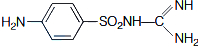
B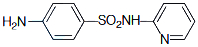
C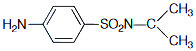
D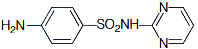
Solution
(B) Sulphapyridine is a well-known sulphonamide antibiotic. Its chemical structure consists of a $p$-aminobenzenesulphonamide group attached to a pyridine ring at the nitrogen atom of the sulphonamide group. The correct structure is represented by option $B$.
0 likesView Solution
28
ChemistryEasyMCQTS EAMCET · 2015
Which intermediate is formed in the Reimer-Tiemann reaction?
A
Aldehyde
B
Carbocation
C
Carbanion
D
Substituted benzal chloride
Solution
(D) In the Reimer-Tiemann reaction,phenol is treated with chloroform $(CHCl_3)$ in the presence of aqueous sodium hydroxide $(NaOH)$.
This reaction proceeds via the formation of a dichlorocarbene $(:CCl_2)$ intermediate,which attacks the phenoxide ion to form a substituted benzal chloride intermediate.
This intermediate is subsequently hydrolyzed to form salicylaldehyde.
Therefore,the intermediate formed is a substituted benzal chloride.
This reaction proceeds via the formation of a dichlorocarbene $(:CCl_2)$ intermediate,which attacks the phenoxide ion to form a substituted benzal chloride intermediate.
This intermediate is subsequently hydrolyzed to form salicylaldehyde.
Therefore,the intermediate formed is a substituted benzal chloride.
0 likesView Solution
29
ChemistryDifficultMCQTS EAMCET · 2015
The major product $(Z)$ of the following chemical reaction is
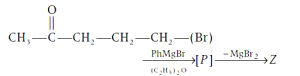
A
$CH_3-C(OH)(Ph)-CH_2-CH_2-CH_3$
B
$CH_3-C(OH)(Ph)-CH_2-CH_2-CH_2Br$
C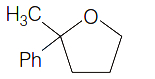
$A$ cyclic ether with a five-membered ring containing a phenyl group and a methyl group at the same carbon.
D
$CH_3-C(=O)-CH_2-CH_2-CH_2-Ph$
Solution
(C) The reaction involves the nucleophilic addition of the Grignard reagent,$PhMgBr$,to the carbonyl group of $5$-bromo-$2$-pentanone.
$1$. The phenyl group $(Ph^-)$ attacks the electrophilic carbonyl carbon of the ketone to form an intermediate alkoxide,$CH_3-C(OMgBr)(Ph)-CH_2-CH_2-CH_2Br$ (labeled as $P$).
$2$. The alkoxide oxygen then performs an intramolecular nucleophilic substitution $(S_N2)$ on the carbon bearing the bromine atom,displacing the bromide ion and forming a five-membered cyclic ether ring.
$3$. This results in the formation of $2$-methyl-$2$-phenyltetrahydrofuran as the major product $(Z)$.
$1$. The phenyl group $(Ph^-)$ attacks the electrophilic carbonyl carbon of the ketone to form an intermediate alkoxide,$CH_3-C(OMgBr)(Ph)-CH_2-CH_2-CH_2Br$ (labeled as $P$).
$2$. The alkoxide oxygen then performs an intramolecular nucleophilic substitution $(S_N2)$ on the carbon bearing the bromine atom,displacing the bromide ion and forming a five-membered cyclic ether ring.
$3$. This results in the formation of $2$-methyl-$2$-phenyltetrahydrofuran as the major product $(Z)$.
0 likesView Solution
30
ChemistryEasyMCQTS EAMCET · 2015
$H_3CCONH_2 + Br_2 + 4NaOH \longrightarrow Y + Na_2CO_3 + 2NaBr + 2H_2O$
What is $Y$ in the above reaction?
What is $Y$ in the above reaction?
A
$H_3CCH_2NH_2$
B
$H_3CNH_2$
C
$H_3CCOBr$
D
$HCONH_2$
Solution
(B) The given reaction is the Hofmann bromamide degradation reaction.
In this reaction,a primary amide $(RCONH_2)$ reacts with bromine $(Br_2)$ and a strong base ($NaOH$ or $KOH$) to form a primary amine $(RNH_2)$ with one carbon atom less than the original amide.
The balanced chemical equation is:
$H_3CCONH_2 + Br_2 + 4NaOH \longrightarrow CH_3NH_2 + Na_2CO_3 + 2NaBr + 2H_2O$
Comparing this with the given reaction,$Y$ is $CH_3NH_2$ (methylamine),which corresponds to option $B$.
In this reaction,a primary amide $(RCONH_2)$ reacts with bromine $(Br_2)$ and a strong base ($NaOH$ or $KOH$) to form a primary amine $(RNH_2)$ with one carbon atom less than the original amide.
The balanced chemical equation is:
$H_3CCONH_2 + Br_2 + 4NaOH \longrightarrow CH_3NH_2 + Na_2CO_3 + 2NaBr + 2H_2O$
Comparing this with the given reaction,$Y$ is $CH_3NH_2$ (methylamine),which corresponds to option $B$.
0 likesView Solution
31
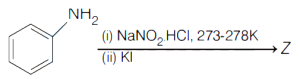
ChemistryMediumMCQTS EAMCET · 2015
Identify $Z$ in the following reaction:
A
Nitrobenzene
B
Chlorobenzene
C
Iodobenzene
D
$2-$Iodoaniline
Solution
(C) The reaction of aniline with $NaNO_2/HCl$ at $273-278 \ K$ produces benzene diazonium chloride.
When benzene diazonium chloride is treated with $KI$,it undergoes a substitution reaction to form iodobenzene as the final product $Z$.
When benzene diazonium chloride is treated with $KI$,it undergoes a substitution reaction to form iodobenzene as the final product $Z$.
0 likesView Solution
32
ChemistryDifficultMCQTS EAMCET · 2015
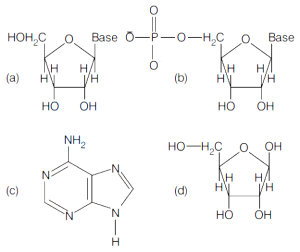
Identify the nucleoside from the following:
A
$(a)$
B
$(b)$
C
$(c)$
D
$(d)$
Solution
(A) nucleoside is formed by the attachment of a nitrogenous base to the $1^{\prime}$ position of a pentose sugar.
Structure $(a)$ represents a pentose sugar attached to a nitrogenous base,which is the definition of a nucleoside.
Structure $(b)$ represents a nucleotide (nucleoside + phosphate group).
Structure $(c)$ represents a nitrogenous base (adenine).
Structure $(d)$ represents a pentose sugar (ribose).
Structure $(a)$ represents a pentose sugar attached to a nitrogenous base,which is the definition of a nucleoside.
Structure $(b)$ represents a nucleotide (nucleoside + phosphate group).
Structure $(c)$ represents a nitrogenous base (adenine).
Structure $(d)$ represents a pentose sugar (ribose).
0 likesView Solution
33
ChemistryDifficultMCQTS EAMCET · 2015
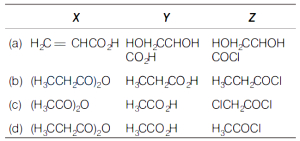
$CH_3CH_2COOH$ $\xrightarrow{P_2O_5}$ $X$ $\xrightarrow{H_2O}$ $Y$ $\xrightarrow{SOCl_2}$ $Z$
Identify $X$,$Y$ and $Z$.
Identify $X$,$Y$ and $Z$.
A
| $X$ | $Y$ | $Z$ |
|---|---|---|
| $H_2C=CHCO_2H$ | $HOH_2CCHOHCO_2H$ | $HOH_2CCHOHCOCl$ |
B
| $X$ | $Y$ | $Z$ |
|---|---|---|
| $(CH_3CH_2CO)_2O$ | $CH_3CH_2CO_2H$ | $CH_3CH_2COCl$ |
C
| $X$ | $Y$ | $Z$ |
|---|---|---|
| $(CH_3CO)_2O$ | $CH_3CO_2H$ | $ClCH_2COCl$ |
D
| $X$ | $Y$ | $Z$ |
|---|---|---|
| $(CH_3CH_2CO)_2O$ | $CH_3CO_2H$ | $CH_3COCl$ |
Solution
(B) $1$. The reaction of propanoic acid $(CH_3CH_2COOH)$ with $P_2O_5$ (a dehydrating agent) leads to the formation of propanoic anhydride,which is $X = (CH_3CH_2CO)_2O$.
$2$. The hydrolysis of propanoic anhydride $(X)$ with $H_2O$ regenerates propanoic acid,which is $Y = CH_3CH_2COOH$.
$3$. The reaction of propanoic acid $(Y)$ with $SOCl_2$ (thionyl chloride) converts the carboxylic acid group into an acid chloride,resulting in propanoyl chloride,which is $Z = CH_3CH_2COCl$.
$4$. Therefore,the correct sequence is $X = (CH_3CH_2CO)_2O$,$Y = CH_3CH_2COOH$,and $Z = CH_3CH_2COCl$.
$2$. The hydrolysis of propanoic anhydride $(X)$ with $H_2O$ regenerates propanoic acid,which is $Y = CH_3CH_2COOH$.
$3$. The reaction of propanoic acid $(Y)$ with $SOCl_2$ (thionyl chloride) converts the carboxylic acid group into an acid chloride,resulting in propanoyl chloride,which is $Z = CH_3CH_2COCl$.
$4$. Therefore,the correct sequence is $X = (CH_3CH_2CO)_2O$,$Y = CH_3CH_2COOH$,and $Z = CH_3CH_2COCl$.
0 likesView Solution
34
ChemistryEasyMCQTS EAMCET · 2015
For the reaction,$5Br^-{_{\text{(aq)}}} + BrO_3^-{_{\text{(aq)}}} + 6H^+{_{\text{(aq)}}} \rightarrow 3Br_{2\text{(aq)}} + 3H_2O_{\text{(l)}}$,if $-\frac{\Delta[Br^{-}]}{\Delta t} = 0.05 \ mol \ L^{-1} \ min^{-1}$,then the value of $-\frac{\Delta[BrO_3^{-}]}{\Delta t}$ in $mol \ L^{-1} \ min^{-1}$ is:
A
$0.005$
B
$0.05$
C
$0.5$
D
$0.01$
Solution
(D) For the given reaction: $5Br^-{_{\text{(aq)}}} + BrO_3^-{_{\text{(aq)}}} + 6H^+{_{\text{(aq)}}} \rightarrow 3Br_{2\text{(aq)}} + 3H_2O_{\text{(l)}}$
The rate of reaction is expressed as:
$Rate = -\frac{1}{5} \frac{\Delta[Br^{-}]}{\Delta t} = -\frac{\Delta[BrO_3^{-}]}{\Delta t} = -\frac{1}{6} \frac{\Delta[H^{+}]}{\Delta t} = \frac{1}{3} \frac{\Delta[Br_2]}{\Delta t}$
Given that $-\frac{\Delta[Br^{-}]}{\Delta t} = 0.05 \ mol \ L^{-1} \ min^{-1}$.
Equating the rates:
$-\frac{1}{5} \frac{\Delta[Br^{-}]}{\Delta t} = -\frac{\Delta[BrO_3^{-}]}{\Delta t}$
Substituting the given value:
$-\frac{\Delta[BrO_3^{-}]}{\Delta t} = \frac{1}{5} \times 0.05 = 0.01 \ mol \ L^{-1} \ min^{-1}$.
The rate of reaction is expressed as:
$Rate = -\frac{1}{5} \frac{\Delta[Br^{-}]}{\Delta t} = -\frac{\Delta[BrO_3^{-}]}{\Delta t} = -\frac{1}{6} \frac{\Delta[H^{+}]}{\Delta t} = \frac{1}{3} \frac{\Delta[Br_2]}{\Delta t}$
Given that $-\frac{\Delta[Br^{-}]}{\Delta t} = 0.05 \ mol \ L^{-1} \ min^{-1}$.
Equating the rates:
$-\frac{1}{5} \frac{\Delta[Br^{-}]}{\Delta t} = -\frac{\Delta[BrO_3^{-}]}{\Delta t}$
Substituting the given value:
$-\frac{\Delta[BrO_3^{-}]}{\Delta t} = \frac{1}{5} \times 0.05 = 0.01 \ mol \ L^{-1} \ min^{-1}$.
0 likesView Solution
35
ChemistryEasyMCQTS EAMCET · 2015
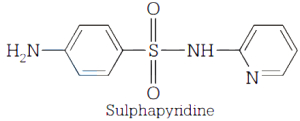
Which one of the following is the correct structure of sulphapyridine?
A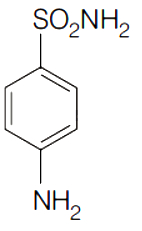
B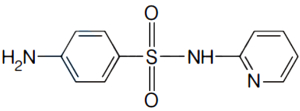
C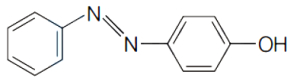
D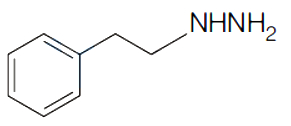
Solution
(B) Sulphapyridine is a sulfonamide antibiotic. Its chemical structure consists of a benzene ring substituted with an amino group $(-NH_2)$ at the para position and a sulfonamide group $(-SO_2NH-)$ attached to a pyridine ring. The correct structure is shown in option $B$.
0 likesView Solution
36
ChemistryMediumMCQTS EAMCET · 2015
The increasing order of field strength of ligands is:
A
$Cl^{-} < H_2O < NH_3 < CO < CN^{-}$
B
$Cl^{-} < H_2O < NH_3 < CN^{-} < CO$
C
$Cl^{-} < CO < CN^{-} < H_2O < NH_3$
D
$CN^{-} < CO < NH_3 < Cl^{-} < H_2O$
Solution
(B) The field strength of ligands is determined by the spectrochemical series.
According to the spectrochemical series,the order of increasing field strength for the given ligands is:
$Cl^{-} < H_2O < NH_3 < CN^{-} < CO$.
Thus,option $B$ is the correct answer.
According to the spectrochemical series,the order of increasing field strength for the given ligands is:
$Cl^{-} < H_2O < NH_3 < CN^{-} < CO$.
Thus,option $B$ is the correct answer.
0 likesView Solution
37
ChemistryEasyMCQTS EAMCET · 2015
German silver contains which of the following metals?
A
$Cu, Zn$
B
$Fe, Zn$
C
$Zn, Fe, Ni$
D
$Cu, Zn, Ni$
Solution
(D) German silver (nickel silver) is an alloy of copper,zinc,and nickel,often in the proportions $5:2:2$.
It is commonly used in the manufacturing of cheap jewellery,cutlery,and electrical components.
It is commonly used in the manufacturing of cheap jewellery,cutlery,and electrical components.
0 likesView Solution
38
ChemistryMediumMCQTS EAMCET · 2015
Which one of the following lanthanide ions does not exhibit paramagnetism?
A
$Lu^{3+}$
B
$Ce^{3+}$
C
$Eu^{3+}$
D
$Yb^{3+}$
Solution
(A) Generally,paramagnetism is shown by lanthanoid ions. The paramagnetism arises due to the presence of unpaired electrons in the $f$-orbital.
$Lu^{3+}$ has the electronic configuration $[Xe] 4f^{14}$.
Since all $14$ electrons are paired in the $4f$ subshell,$Lu^{3+}$ does not have any unpaired electrons.
Therefore,it is diamagnetic and does not exhibit paramagnetism.
$Lu^{3+}$ has the electronic configuration $[Xe] 4f^{14}$.
Since all $14$ electrons are paired in the $4f$ subshell,$Lu^{3+}$ does not have any unpaired electrons.
Therefore,it is diamagnetic and does not exhibit paramagnetism.
0 likesView Solution
39
ChemistryDifficultMCQTS EAMCET · 2015
$A$ lead storage battery is discharged. During the charging of this battery,the reaction that occurs at the anode is:
A
$PbSO_{4(s)} + 2e^- \rightarrow Pb_{(s)} + SO_{4(aq)}^{2-}$
B
$PbSO_{4(s)} + 2H_2O_{(l)} \rightarrow PbO_{2(s)} + SO_{4(aq)}^{2-} + 4H_{(aq)}^+ + 2e^-$
C
$PbSO_{4(s)} \rightarrow Pb_{(aq)}^{2+} + SO_{4(aq)}^{2-}$
D
$PbSO_{4(s)} + 2H_2O_{(l)} + 2e^- \rightarrow PbO_{2(s)} + SO_{4(aq)}^{2-} + 2H_{(aq)}^+$
Solution
(B) During the charging of a lead storage battery,the cell functions as an electrolytic cell.
The reactions occurring are the reverse of those during discharge.
At the anode,oxidation occurs where lead sulfate $(PbSO_4)$ is converted back into lead dioxide $(PbO_2)$.
The anode reaction is:
$PbSO_{4(s)} + 2H_2O_{(l)} \rightarrow PbO_{2(s)} + SO_{4(aq)}^{2-} + 4H_{(aq)}^+ + 2e^-$
The reactions occurring are the reverse of those during discharge.
At the anode,oxidation occurs where lead sulfate $(PbSO_4)$ is converted back into lead dioxide $(PbO_2)$.
The anode reaction is:
$PbSO_{4(s)} + 2H_2O_{(l)} \rightarrow PbO_{2(s)} + SO_{4(aq)}^{2-} + 4H_{(aq)}^+ + 2e^-$
0 likesView Solution
40
ChemistryMediumMCQTS EAMCET · 2015
Which one of the following is an acetal?
A
$R-CH(OR')_2$
B
$R-CH(OH)(OR')$
C
$R_2C(OH)(OR')$
D
$R-CH(OH)(OR')$
Solution
(A) An acetal is an organic compound formed by the reaction of an aldehyde with two equivalents of an alcohol in the presence of an acid catalyst. The general structure of an acetal is $R-CH(OR')_2$,where a single carbon atom is bonded to two alkoxy groups $(-OR')$,one hydrogen atom,and one alkyl group $(R)$.
0 likesView Solution
41
ChemistryEasyMCQTS EAMCET · 2015
The key step in the manufacturing of $H_2SO_4$ by contact process is
A
absorption of $SO_3$ in $H_2SO_4$ to give oleum
B
dilution of oleum with water
C
burning of sulphur in air to generate $SO_2$
D
catalytic oxidation of $SO_2$ with $O_2$ to give $SO_3$
Solution
(D) The catalytic oxidation of $SO_2$ with $O_2$ to give $SO_3$ is the key step in the manufacturing of sulphuric acid by the contact process.
$2SO_{2(g)} + O_{2(g)} \xrightarrow{V_2O_5} 2SO_{3(g)};$
$\Delta_{r}H^{\circ} = -196 \ kJ \ mol^{-1}$
$2SO_{2(g)} + O_{2(g)} \xrightarrow{V_2O_5} 2SO_{3(g)};$
$\Delta_{r}H^{\circ} = -196 \ kJ \ mol^{-1}$
0 likesView Solution
42
ChemistryMediumMCQTS EAMCET · 2015
Identify the condensation homopolymer from the following:
A
Bakelite: $[-CH_2-C_6H_3(OH)-CH_2-C_6H_3(OH)-]_n$
B
Terylene: $[-O-CH_2-CH_2-O-CO-C_6H_4-CO-]_n$
C
Nylon-$6$: $[-CO-(CH_2)_5-NH-]_n$
D
Nylon-$6,6$: $[-NH-(CH_2)_6-NH-CO-(CH_2)_4-CO-]_n$
Solution
(C) condensation polymer is formed by the repeated condensation reaction between two different bi-functional or tri-functional monomeric units,usually with the elimination of small molecules like $H_2O$,$HCl$,etc.
$1$. Bakelite is a cross-linked condensation polymer formed from phenol and formaldehyde.
$2$. Terylene is a condensation copolymer formed from ethylene glycol and terephthalic acid.
$3$. Nylon-$6$ is a condensation homopolymer formed by the ring-opening polymerization of caprolactam,which involves the elimination of water during the initial step of hydrolysis,and it is a homopolymer because it is made from a single type of monomer (caprolactam).
$4$. Nylon-$6,6$ is a condensation copolymer formed from hexamethylenediamine and adipic acid.
Therefore,Nylon-$6$ is the correct condensation homopolymer.
$1$. Bakelite is a cross-linked condensation polymer formed from phenol and formaldehyde.
$2$. Terylene is a condensation copolymer formed from ethylene glycol and terephthalic acid.
$3$. Nylon-$6$ is a condensation homopolymer formed by the ring-opening polymerization of caprolactam,which involves the elimination of water during the initial step of hydrolysis,and it is a homopolymer because it is made from a single type of monomer (caprolactam).
$4$. Nylon-$6,6$ is a condensation copolymer formed from hexamethylenediamine and adipic acid.
Therefore,Nylon-$6$ is the correct condensation homopolymer.
0 likesView Solution
43
ChemistryMediumMCQTS EAMCET · 2015
An aqueous dilute solution containing non-volatile solute boils at $100.52^{\circ} C$. What is the molality of the solution (in $m$)? ($K_b = 0.52 \ K \ kg \ mol^{-1}$,boiling temperature of water $= 100^{\circ} C$)
A
$0.1$
B
$0.01$
C
$0.001$
D
$1.0$
Solution
(D) The elevation in boiling point is given by the formula: $\Delta T_b = K_b \cdot m$.
Here,$\Delta T_b = T_b - T_b^{\circ}$.
Given: $T_b = 100.52^{\circ} C$,$T_b^{\circ} = 100^{\circ} C$,and $K_b = 0.52 \ K \ kg \ mol^{-1}$.
Calculating the elevation: $\Delta T_b = 100.52 - 100 = 0.52 \ K$.
Substituting the values into the formula: $0.52 = 0.52 \times m$.
Therefore,$m = \frac{0.52}{0.52} = 1.0 \ m$.
Here,$\Delta T_b = T_b - T_b^{\circ}$.
Given: $T_b = 100.52^{\circ} C$,$T_b^{\circ} = 100^{\circ} C$,and $K_b = 0.52 \ K \ kg \ mol^{-1}$.
Calculating the elevation: $\Delta T_b = 100.52 - 100 = 0.52 \ K$.
Substituting the values into the formula: $0.52 = 0.52 \times m$.
Therefore,$m = \frac{0.52}{0.52} = 1.0 \ m$.
0 likesView Solution
44
ChemistryEasyMCQTS EAMCET · 2015
Which one of the following is used in the hardening of leather?
A
Light sensitive silver bromide in gelatin
B
Sodium lauryl sulphate
C
Alum
D
Tannin
Solution
(D) Animal leather is colloidal in nature and consists of positively charged particles.
When it is soaked in tannin,which is a negatively charged colloid,mutual coagulation occurs.
This process leads to the hardening of the leather,a process known as tanning.
When it is soaked in tannin,which is a negatively charged colloid,mutual coagulation occurs.
This process leads to the hardening of the leather,a process known as tanning.
0 likesView Solution
Vedclass Products
For Students
Vedclass Test Series
Mock tests in real TS EAMCET style covering Chemistry with performance analysis. 5-day free trial.
Start Free TrialFor Teachers
Exam Paper Generator
Generate Set A/B/C/D Chemistry papers from 7.5L+ questions in 2 minutes. 3 chapters free.
Try FreeFor Institutes
Online Exam Module
Run live TS EAMCET mock exams with unlimited students, 360° analytics & white-label branding.
See DemoFrequently Asked Questions
How many Chemistry questions are in TS EAMCET 2015?
There are 44 Chemistry questions from the TS EAMCET 2015 paper on Vedclass, each with a detailed step-by-step solution in English.
Are TS EAMCET 2015 Chemistry solutions available in English?
Yes. All solutions on this page are in English. You can also switch to English or Hindi using the language buttons above the questions.
Can I practice TS EAMCET 2015 Chemistry as a timed test?
Yes. Use the Vedclass Test Series to attempt a full TS EAMCET mock test covering Chemistry with time limits and instant score analysis.
Can teachers create Chemistry papers from TS EAMCET previous year questions?
Yes. The Vedclass Exam Paper Generator lets teachers mix TS EAMCET Chemistry questions and generate Set A/B/C/D papers in minutes.
For Teachers & Institutes
Build a Custom Chemistry Paper
Pick TS EAMCET 2015 Chemistry questions, set difficulty, and generate Set A/B/C/D in 2 minutes.