
ChemistryQ1–88 of 194 questions
Page 1 of 4 · English
1
ChemistryMCQTS EAMCET · 2013
The products formed in the reaction of phenol with $Br_2$ dissolved in $CS_2$ at $0^{\circ} C$ are
A
$o$-bromo,$m$-bromo and $p$-bromophenols
B
$o$-bromo and $p$-bromophenols
C
$2,4,6$-tribromo and $2,3,6$-tribromophenols
D
$2,4$-dibromo and $2,6$-dibromophenols
Solution
(B) When phenol reacts with $Br_2$ in the presence of a non-polar solvent like $CS_2$ at low temperature $(0^{\circ} C)$,the reaction is limited to mono-substitution.
This occurs because the non-polar solvent does not facilitate the ionization of phenol into the highly reactive phenoxide ion,which is responsible for poly-substitution in polar solvents like water.
Therefore,the major products formed are $o$-bromophenol and $p$-bromophenol.
This occurs because the non-polar solvent does not facilitate the ionization of phenol into the highly reactive phenoxide ion,which is responsible for poly-substitution in polar solvents like water.
Therefore,the major products formed are $o$-bromophenol and $p$-bromophenol.
0 likesView Solution
2
ChemistryMCQTS EAMCET · 2013
$A$ series $LCR$ circuit is connected across a source of alternating $emf$ of changing frequency and resonates at frequency $f_0$. Keeping capacitance constant,if the inductance $(L)$ is increased by $\sqrt{3}$ times and resistance $(R)$ is increased by $1.4$ times,the resonant frequency now is
A
$3^{1/4} f_0$
B
$\sqrt{3} f_0$
C
$(\sqrt{3}-1)^{1/4} f_0$
D
$\left(\frac{1}{3}\right)^{1/4} f_0$
Solution
(D) The resonant frequency $f$ of a series $LCR$ circuit is given by the formula:
$f = \frac{1}{2 \pi \sqrt{LC}}$
From this expression,we can see that the resonant frequency is inversely proportional to the square root of the inductance $L$ when the capacitance $C$ is kept constant:
$f \propto \frac{1}{\sqrt{L}}$
Let the initial resonant frequency be $f_0$ with inductance $L$. The new resonant frequency $f'$ with new inductance $L' = \sqrt{3} L$ is:
$\frac{f'}{f_0} = \sqrt{\frac{L}{L'}} = \sqrt{\frac{L}{\sqrt{3} L}} = \sqrt{\frac{1}{\sqrt{3}}} = \left(\frac{1}{3^{1/2}}\right)^{1/2} = \left(\frac{1}{3}\right)^{1/4}$
Therefore,the new resonant frequency is $f' = \left(\frac{1}{3}\right)^{1/4} f_0$.
Note that the change in resistance $R$ does not affect the resonant frequency of an $LCR$ circuit.
$f = \frac{1}{2 \pi \sqrt{LC}}$
From this expression,we can see that the resonant frequency is inversely proportional to the square root of the inductance $L$ when the capacitance $C$ is kept constant:
$f \propto \frac{1}{\sqrt{L}}$
Let the initial resonant frequency be $f_0$ with inductance $L$. The new resonant frequency $f'$ with new inductance $L' = \sqrt{3} L$ is:
$\frac{f'}{f_0} = \sqrt{\frac{L}{L'}} = \sqrt{\frac{L}{\sqrt{3} L}} = \sqrt{\frac{1}{\sqrt{3}}} = \left(\frac{1}{3^{1/2}}\right)^{1/2} = \left(\frac{1}{3}\right)^{1/4}$
Therefore,the new resonant frequency is $f' = \left(\frac{1}{3}\right)^{1/4} f_0$.
Note that the change in resistance $R$ does not affect the resonant frequency of an $LCR$ circuit.
0 likesView Solution
3
ChemistryMCQTS EAMCET · 2013
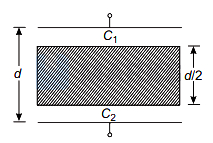
Two metal plates each of area $A$ form a parallel plate capacitor with air in between the plates. The distance between the plates is $d$. $A$ metal plate of thickness $d/2$ and of same area $A$ is inserted between the plates to form two capacitors of capacitances $C_1$ and $C_2$ as shown in the figure. If the effective capacitance of the two capacitors is $C^{\prime}$ and the capacitance of the capacitor initially is $C$,then $C^{\prime}/C$ is
A
$4$
B
$2$
C
$6$
D
$1$
Solution
(B) The initial capacitance of the parallel plate capacitor with air as the medium is given by $C = \frac{\varepsilon_0 A}{d}$.
When a metal plate of thickness $t = d/2$ is inserted between the plates,the effective distance between the plates becomes $d_{eff} = d - t = d - d/2 = d/2$.
Since the inserted plate is a metal,it acts as a short circuit across the region it occupies. The effective capacitance $C^{\prime}$ of the system is equivalent to a parallel plate capacitor with an air gap of $d/2$.
Thus,$C^{\prime} = \frac{\varepsilon_0 A}{d - d/2} = \frac{\varepsilon_0 A}{d/2} = \frac{2 \varepsilon_0 A}{d}$.
Comparing this with the initial capacitance $C$,we get $C^{\prime} = 2C$.
Therefore,the ratio $\frac{C^{\prime}}{C} = 2$.
When a metal plate of thickness $t = d/2$ is inserted between the plates,the effective distance between the plates becomes $d_{eff} = d - t = d - d/2 = d/2$.
Since the inserted plate is a metal,it acts as a short circuit across the region it occupies. The effective capacitance $C^{\prime}$ of the system is equivalent to a parallel plate capacitor with an air gap of $d/2$.
Thus,$C^{\prime} = \frac{\varepsilon_0 A}{d - d/2} = \frac{\varepsilon_0 A}{d/2} = \frac{2 \varepsilon_0 A}{d}$.
Comparing this with the initial capacitance $C$,we get $C^{\prime} = 2C$.
Therefore,the ratio $\frac{C^{\prime}}{C} = 2$.
0 likesView Solution
4
ChemistryMCQTS EAMCET · 2013
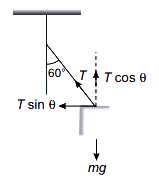
$A$ mass of $2.9 \ kg$ is suspended from a string of length $50 \ cm$ and is at rest. Another body of mass $100 \ g$,which is moving horizontally with a velocity of $150 \ m/s$,strikes and sticks to it. Subsequently,when the string makes an angle of $60^{\circ}$ with the vertical,the tension in the string is $(g=10 \ m/s^2)$. (in $N$)
A
$145$
B
$135$
C
$125$
D
$90$
Solution
(B) Let $M = 2.9 \ kg$ and $m = 0.1 \ kg$. The combined mass is $M' = M + m = 3.0 \ kg$.
Using the law of conservation of momentum for the collision:
$m v = (M + m) V$
$0.1 \times 150 = 3.0 \times V$
$V = 5 \ m/s$ (velocity of the combined mass just after collision).
Now,using the law of conservation of energy between the lowest point and the point where the string makes an angle $\theta = 60^{\circ}$:
$\frac{1}{2} M' V^2 = \frac{1}{2} M' v_{\theta}^2 + M' g l(1 - \cos \theta)$
$v_{\theta}^2 = V^2 - 2gl(1 - \cos 60^{\circ})$
$v_{\theta}^2 = 5^2 - 2 \times 10 \times 0.5 \times (1 - 0.5) = 25 - 5 = 20 \ m^2/s^2$.
The tension $T$ in the string at angle $\theta$ is given by:
$T - M' g \cos \theta = \frac{M' v_{\theta}^2}{l}$
$T = M' g \cos \theta + \frac{M' v_{\theta}^2}{l}$
$T = 3.0 \times 10 \times \cos 60^{\circ} + \frac{3.0 \times 20}{0.5}$
$T = 30 \times 0.5 + 120 = 15 + 120 = 135 \ N$.
Using the law of conservation of momentum for the collision:
$m v = (M + m) V$
$0.1 \times 150 = 3.0 \times V$
$V = 5 \ m/s$ (velocity of the combined mass just after collision).
Now,using the law of conservation of energy between the lowest point and the point where the string makes an angle $\theta = 60^{\circ}$:
$\frac{1}{2} M' V^2 = \frac{1}{2} M' v_{\theta}^2 + M' g l(1 - \cos \theta)$
$v_{\theta}^2 = V^2 - 2gl(1 - \cos 60^{\circ})$
$v_{\theta}^2 = 5^2 - 2 \times 10 \times 0.5 \times (1 - 0.5) = 25 - 5 = 20 \ m^2/s^2$.
The tension $T$ in the string at angle $\theta$ is given by:
$T - M' g \cos \theta = \frac{M' v_{\theta}^2}{l}$
$T = M' g \cos \theta + \frac{M' v_{\theta}^2}{l}$
$T = 3.0 \times 10 \times \cos 60^{\circ} + \frac{3.0 \times 20}{0.5}$
$T = 30 \times 0.5 + 120 = 15 + 120 = 135 \ N$.
0 likesView Solution
5
ChemistryMCQTS EAMCET · 2013
Two bodies of mass $4 ~kg$ and $5 ~kg$ are moving along east and north directions with velocities $5 ~m/s$ and $3 ~m/s$ respectively. The magnitude of the velocity of the centre of mass of the system is
A
$\frac{25}{9} ~m/s$
B
$\frac{9}{25} ~m/s$
C
$\frac{41}{9} ~m/s$
D
$\frac{16}{9} ~m/s$
Solution
(A) The velocity of the centre of mass is given by the formula:
$v_{CM} = \frac{m_1 v_1 + m_2 v_2}{m_1 + m_2}$
Given: $m_1 = 4 ~kg$,$m_2 = 5 ~kg$.
Velocity $v_1$ is along the east direction (let this be $\hat{i}$): $v_1 = 5 \hat{i} ~m/s$.
Velocity $v_2$ is along the north direction (let this be $\hat{j}$): $v_2 = 3 \hat{j} ~m/s$.
Substituting the values:
$v_{CM} = \frac{4(5 \hat{i}) + 5(3 \hat{j})}{4 + 5}$
$v_{CM} = \frac{20 \hat{i} + 15 \hat{j}}{9} = \frac{20}{9} \hat{i} + \frac{15}{9} \hat{j}$
The magnitude of the velocity of the centre of mass is:
$|v_{CM}| = \sqrt{\left(\frac{20}{9}\right)^2 + \left(\frac{15}{9}\right)^2}$
$|v_{CM}| = \sqrt{\frac{400 + 225}{81}} = \sqrt{\frac{625}{81}}$
$|v_{CM}| = \frac{25}{9} ~m/s$
$v_{CM} = \frac{m_1 v_1 + m_2 v_2}{m_1 + m_2}$
Given: $m_1 = 4 ~kg$,$m_2 = 5 ~kg$.
Velocity $v_1$ is along the east direction (let this be $\hat{i}$): $v_1 = 5 \hat{i} ~m/s$.
Velocity $v_2$ is along the north direction (let this be $\hat{j}$): $v_2 = 3 \hat{j} ~m/s$.
Substituting the values:
$v_{CM} = \frac{4(5 \hat{i}) + 5(3 \hat{j})}{4 + 5}$
$v_{CM} = \frac{20 \hat{i} + 15 \hat{j}}{9} = \frac{20}{9} \hat{i} + \frac{15}{9} \hat{j}$
The magnitude of the velocity of the centre of mass is:
$|v_{CM}| = \sqrt{\left(\frac{20}{9}\right)^2 + \left(\frac{15}{9}\right)^2}$
$|v_{CM}| = \sqrt{\frac{400 + 225}{81}} = \sqrt{\frac{625}{81}}$
$|v_{CM}| = \frac{25}{9} ~m/s$
0 likesView Solution
6
ChemistryMediumTS EAMCET · 2013
Identify the correct set from the following table:
| Molecule | Hybridisation of central atom | Shape |
|---|---|---|
| $(a)$ $PCl_5$ | $dsp^3$ | square pyramidal |
| $(b)$ $[Ni(CN)_4]^{2-}$ | $sp^3$ | tetrahedral |
| $(c)$ $SF_6$ | $sp^3d^2$ | octahedral |
| $(d)$ $IF_3$ | $dsp^3$ | pyramidal |
Solution
(C) Let us analyze each molecule:
$1$. $PCl_5$: The central atom $P$ has $5$ bond pairs and $0$ lone pairs. The hybridisation is $sp^3d$ and the shape is trigonal bipyramidal.
$2$. $[Ni(CN)_4]^{2-}$: $Ni^{2+}$ has $d^8$ configuration. $CN^-$ is a strong field ligand,causing pairing of electrons. The hybridisation is $dsp^2$ and the shape is square planar.
$3$. $SF_6$: The central atom $S$ has $6$ bond pairs and $0$ lone pairs. The hybridisation is $sp^3d^2$ and the shape is octahedral. This is correct.
$4$. $IF_3$: The central atom $I$ has $3$ bond pairs and $2$ lone pairs. The hybridisation is $sp^3d$ and the shape is bent $T$-shaped.
Therefore,the correct set is $(c)$.
$1$. $PCl_5$: The central atom $P$ has $5$ bond pairs and $0$ lone pairs. The hybridisation is $sp^3d$ and the shape is trigonal bipyramidal.
$2$. $[Ni(CN)_4]^{2-}$: $Ni^{2+}$ has $d^8$ configuration. $CN^-$ is a strong field ligand,causing pairing of electrons. The hybridisation is $dsp^2$ and the shape is square planar.
$3$. $SF_6$: The central atom $S$ has $6$ bond pairs and $0$ lone pairs. The hybridisation is $sp^3d^2$ and the shape is octahedral. This is correct.
$4$. $IF_3$: The central atom $I$ has $3$ bond pairs and $2$ lone pairs. The hybridisation is $sp^3d$ and the shape is bent $T$-shaped.
Therefore,the correct set is $(c)$.
0 likesView Solution
7
ChemistryMCQTS EAMCET · 2013
Which one of the following plots is correct for a first order reaction?
A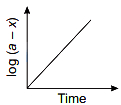
B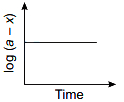
C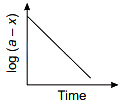
D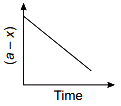
Solution
(C) The integrated rate equation for a first order reaction is given by:
$k = \frac{2.303}{t} \log \frac{a}{(a-x)}$
Rearranging this equation:
$\frac{kt}{2.303} = \log a - \log (a-x)$
$\log (a-x) = -\frac{k}{2.303} t + \log a$
This equation is in the form of a straight line $y = mx + c$,where $y = \log (a-x)$,$x = t$,slope $m = -\frac{k}{2.303}$,and intercept $c = \log a$.
Therefore,a plot of $\log (a-x)$ versus $t$ yields a straight line with a negative slope.
$k = \frac{2.303}{t} \log \frac{a}{(a-x)}$
Rearranging this equation:
$\frac{kt}{2.303} = \log a - \log (a-x)$
$\log (a-x) = -\frac{k}{2.303} t + \log a$
This equation is in the form of a straight line $y = mx + c$,where $y = \log (a-x)$,$x = t$,slope $m = -\frac{k}{2.303}$,and intercept $c = \log a$.
Therefore,a plot of $\log (a-x)$ versus $t$ yields a straight line with a negative slope.
0 likesView Solution
8
ChemistryMCQTS EAMCET · 2013
Identify phenacetin from the following.
A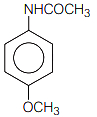
B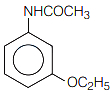
C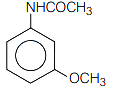
D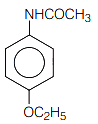
Solution
(D) Phenacetin is a derivative of $p$-aminophenol and is used as an analgesic (painkiller). Its chemical structure is $N$-($4$-ethoxyphenyl)acetamide. Among the given options,the structure corresponding to $p$-ethoxyacetanilide is option $D$.
0 likesView Solution
9
ChemistryMCQTS EAMCET · 2013
The number of elements present in the fourth period is
A
$32$
B
$8$
C
$18$
D
$2$
Solution
(C) For the $4$th period,the principal quantum number $n = 4$.
The orbitals being filled are $4s$,$3d$,and $4p$.
The number of electrons that can be accommodated in these orbitals is $2$ (for $4s$) $+ 10$ (for $3d$) $+ 6$ (for $4p$) $= 18$.
Therefore,the number of elements in the $4$th period is $18$.
The orbitals being filled are $4s$,$3d$,and $4p$.
The number of electrons that can be accommodated in these orbitals is $2$ (for $4s$) $+ 10$ (for $3d$) $+ 6$ (for $4p$) $= 18$.
Therefore,the number of elements in the $4$th period is $18$.
0 likesView Solution
10
ChemistryMCQTS EAMCET · 2013
Which one of the following gives Prussian blue colour?
A
$Fe_2[Fe(CN)_6]$
B
$Na_4[Fe(CN)_6]$
C
$Fe_3[Fe(CN)_6]_3$
D
$Fe_4[Fe(CN)_6]_3$
Solution
(D) The correct option is $(d)$.
Prussian blue is ferric ferrocyanide,which has the chemical formula $Fe_4[Fe(CN)_6]_3$.
It is formed by the reaction of ferric ions $(Fe^{3+})$ with ferrocyanide ions $([Fe(CN)_6]^{4-})$.
Prussian blue is ferric ferrocyanide,which has the chemical formula $Fe_4[Fe(CN)_6]_3$.
It is formed by the reaction of ferric ions $(Fe^{3+})$ with ferrocyanide ions $([Fe(CN)_6]^{4-})$.
0 likesView Solution
11
ChemistryMCQTS EAMCET · 2013
$A$ compound absorbs light in the wavelength region $490-500 \ nm$. Its complementary colour is
A
red
B
blue
C
orange
D
blue-green
Solution
(A) The wavelength region $490-500 \ nm$ corresponds to the blue-green part of the visible spectrum.
According to the colour wheel,the complementary colour of blue-green is red.
When a substance absorbs a specific wavelength of light,the colour observed is the complementary colour of the absorbed radiation.
According to the colour wheel,the complementary colour of blue-green is red.
When a substance absorbs a specific wavelength of light,the colour observed is the complementary colour of the absorbed radiation.
0 likesView Solution
12
ChemistryMCQTS EAMCET · 2013
The sensitivity of a galvanometer that measures current is decreased by $\frac{1}{40}$ times by using a shunt resistance of $10 \Omega$. Then,the value of the resistance of the galvanometer is (in $Omega$)
A
$400$
B
$410$
C
$30$
D
$390$
Solution
(D) The sensitivity of a galvanometer is given by the ratio of the current through the galvanometer $(i_g)$ to the total current $(i)$.
Given that the sensitivity is decreased by $\frac{1}{40}$ times,we have $\frac{i_g}{i} = \frac{1}{40}$.
The formula for the current through a galvanometer with a shunt resistance $S$ and galvanometer resistance $G$ is $i_g = \frac{S}{S+G} i$.
Substituting the given values,where $S = 10 \Omega$ and $G = x$:
$\frac{1}{40} = \frac{10}{10+x}$.
Cross-multiplying gives $10 + x = 400$.
Therefore,$x = 400 - 10 = 390 \Omega$.
Given that the sensitivity is decreased by $\frac{1}{40}$ times,we have $\frac{i_g}{i} = \frac{1}{40}$.
The formula for the current through a galvanometer with a shunt resistance $S$ and galvanometer resistance $G$ is $i_g = \frac{S}{S+G} i$.
Substituting the given values,where $S = 10 \Omega$ and $G = x$:
$\frac{1}{40} = \frac{10}{10+x}$.
Cross-multiplying gives $10 + x = 400$.
Therefore,$x = 400 - 10 = 390 \Omega$.
0 likesView Solution
13
ChemistryMCQTS EAMCET · 2013
The ends of an element of zinc wire are kept at a small temperature difference $\Delta T$ and a small current $I$ is passed through the wire. Then,the heat developed per unit time
A
is proportional to $\Delta T$ and $I$
B
is proportional to $I^3$ and $\Delta T$
C
is proportional to Thomson coefficient of the metal
D
is proportional to $\Delta T$ only
Solution
(A) When a current $I$ flows through a conductor with a temperature difference $\Delta T$ between its ends,the heat developed per unit time is governed by the Thomson effect. The heat produced per unit time (Thomson heat) is given by the formula $H = \sigma I \Delta T$,where $\sigma$ is the Thomson coefficient. Therefore,the heat developed per unit time is directly proportional to both the current $I$ and the temperature difference $\Delta T$.
0 likesView Solution
14
ChemistryMCQTS EAMCET · 2013
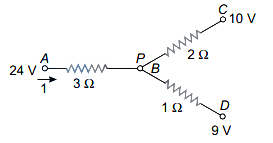
In the circuit shown in the figure,the current $I$ is: (in $\,A$)
A
$6$
B
$2$
C
$4$
D
$7$
Solution
(C) Let the potential at junction $P$ be $V$. According to Kirchhoff's Current Law $(KCL)$ at junction $P$,the sum of currents entering the junction equals the sum of currents leaving the junction.
$\frac{24 - V}{3} = \frac{V - 10}{2} + \frac{V - 9}{1}$
Multiply the entire equation by $6$ to clear the denominators:
$2(24 - V) = 3(V - 10) + 6(V - 9)$
$48 - 2V = 3V - 30 + 6V - 54$
$48 - 2V = 9V - 84$
$11V = 132$
$V = 12 \,V$
Now,calculate the current $I$ flowing through the $3 \,\Omega$ resistor:
$I = \frac{24 - V}{3} = \frac{24 - 12}{3} = \frac{12}{3} = 4 \,A$
Thus,the current $I$ is $4 \,A$.
$\frac{24 - V}{3} = \frac{V - 10}{2} + \frac{V - 9}{1}$
Multiply the entire equation by $6$ to clear the denominators:
$2(24 - V) = 3(V - 10) + 6(V - 9)$
$48 - 2V = 3V - 30 + 6V - 54$
$48 - 2V = 9V - 84$
$11V = 132$
$V = 12 \,V$
Now,calculate the current $I$ flowing through the $3 \,\Omega$ resistor:
$I = \frac{24 - V}{3} = \frac{24 - 12}{3} = \frac{12}{3} = 4 \,A$
Thus,the current $I$ is $4 \,A$.
0 likesView Solution
15
ChemistryMCQTS EAMCET · 2013
The work function of a metal is $2 \text{ eV}$. If a radiation of wavelength $3000 \text{ Å}$ is incident on it,the maximum kinetic energy of the emitted photoelectrons is (Planck's constant $h = 6.6 \times 10^{-34} \text{ J s}$; velocity of light $c = 3 \times 10^8 \text{ m/s}$; $1 \text{ eV} = 1.6 \times 10^{-19} \text{ J}$)
A
$4.4 \times 10^{-19} \text{ J}$
B
$5.6 \times 10^{-19} \text{ J}$
C
$3.4 \times 10^{-19} \text{ J}$
D
$2.5 \times 10^{-19} \text{ J}$
Solution
(C) According to Einstein's photoelectric equation,the maximum kinetic energy $(KE_{max})$ is given by:
$KE_{max} = \frac{hc}{\lambda} - \phi_0$
Given:
Work function $\phi_0 = 2 \text{ eV} = 2 \times 1.6 \times 10^{-19} \text{ J} = 3.2 \times 10^{-19} \text{ J}$
Wavelength $\lambda = 3000 \text{ Å} = 3000 \times 10^{-10} \text{ m} = 3 \times 10^{-7} \text{ m}$
Energy of incident photon $E = \frac{hc}{\lambda} = \frac{6.6 \times 10^{-34} \times 3 \times 10^8}{3 \times 10^{-7}} \text{ J}$
$E = 6.6 \times 10^{-19} \text{ J}$
Now,$KE_{max} = E - \phi_0 = 6.6 \times 10^{-19} \text{ J} - 3.2 \times 10^{-19} \text{ J} = 3.4 \times 10^{-19} \text{ J}$
$KE_{max} = \frac{hc}{\lambda} - \phi_0$
Given:
Work function $\phi_0 = 2 \text{ eV} = 2 \times 1.6 \times 10^{-19} \text{ J} = 3.2 \times 10^{-19} \text{ J}$
Wavelength $\lambda = 3000 \text{ Å} = 3000 \times 10^{-10} \text{ m} = 3 \times 10^{-7} \text{ m}$
Energy of incident photon $E = \frac{hc}{\lambda} = \frac{6.6 \times 10^{-34} \times 3 \times 10^8}{3 \times 10^{-7}} \text{ J}$
$E = 6.6 \times 10^{-19} \text{ J}$
Now,$KE_{max} = E - \phi_0 = 6.6 \times 10^{-19} \text{ J} - 3.2 \times 10^{-19} \text{ J} = 3.4 \times 10^{-19} \text{ J}$
0 likesView Solution
16
ChemistryMCQTS EAMCET · 2013
Initially a photon of wavelength $\lambda_1$ falls on a photocathode and emits an electron of maximum energy $E_1$. If the wavelength of the incident photon is changed to $\lambda_2$,the maximum energy of the electron emitted becomes $E_2$. Then the value of $hc$ ($h=$ Planck's constant,$c=$ velocity of light) is
A
$hc = \frac{(E_1 - E_2) \lambda_1 \lambda_2}{\lambda_2 - \lambda_1}$
B
$hc = \frac{E_1 - E_2}{\lambda_2 - \lambda_1} \cdot (\lambda_1 \lambda_2)$
C
$hc = \frac{(E_1 - E_2)(\lambda_2 - \lambda_1)}{\lambda_1 \lambda_2}$
D
$hc = \frac{\lambda_2 - \lambda_1}{\lambda_1 \lambda_2 E_2} \cdot E_1$
Solution
(A) According to Einstein's photoelectric equation,the maximum kinetic energy $E$ of an emitted electron is given by $E = \frac{hc}{\lambda} - W$,where $W$ is the work function of the metal.
For the first case: $E_1 = \frac{hc}{\lambda_1} - W$ $(i)$
For the second case: $E_2 = \frac{hc}{\lambda_2} - W$ (ii)
Subtracting equation (ii) from equation $(i)$:
$E_1 - E_2 = \left(\frac{hc}{\lambda_1} - W\right) - \left(\frac{hc}{\lambda_2} - W\right)$
$E_1 - E_2 = hc \left(\frac{1}{\lambda_1} - \frac{1}{\lambda_2}\right)$
$E_1 - E_2 = hc \left(\frac{\lambda_2 - \lambda_1}{\lambda_1 \lambda_2}\right)$
Rearranging the terms to solve for $hc$:
$hc = \frac{(E_1 - E_2) \lambda_1 \lambda_2}{\lambda_2 - \lambda_1}$
For the first case: $E_1 = \frac{hc}{\lambda_1} - W$ $(i)$
For the second case: $E_2 = \frac{hc}{\lambda_2} - W$ (ii)
Subtracting equation (ii) from equation $(i)$:
$E_1 - E_2 = \left(\frac{hc}{\lambda_1} - W\right) - \left(\frac{hc}{\lambda_2} - W\right)$
$E_1 - E_2 = hc \left(\frac{1}{\lambda_1} - \frac{1}{\lambda_2}\right)$
$E_1 - E_2 = hc \left(\frac{\lambda_2 - \lambda_1}{\lambda_1 \lambda_2}\right)$
Rearranging the terms to solve for $hc$:
$hc = \frac{(E_1 - E_2) \lambda_1 \lambda_2}{\lambda_2 - \lambda_1}$
0 likesView Solution
17
ChemistryMCQTS EAMCET · 2013
During the electrolysis of copper sulphate aqueous solution using copper electrodes,the reaction taking place at the cathode is:
A
$Cu_{(s)} \longrightarrow Cu^{2+}_{(aq)} + 2e^-$
B
$Cu^{2+}_{(aq)} + 2e^- \longrightarrow Cu_{(s)}$
C
$H^{+}_{(aq)} + e^- \longrightarrow \frac{1}{2} H_{2(g)}$
D
$SO_4^{2-}{_{\text{(aq)}}} \rightarrow SO_{3\text{(g)}} + \frac{1}{2}O_{2\text{(g)}} + 2e^{-}$
Solution
(B) During the electrolysis of an aqueous solution of copper sulphate $(CuSO_4)$ using copper electrodes,both $Cu^{2+}$ and $H^{+}$ ions move towards the cathode.
Since the reduction potential of $Cu^{2+}$ $(+0.34 \ V)$ is higher than that of $H^{+}$ $(0.00 \ V)$,$Cu^{2+}$ ions are preferentially reduced at the cathode.
The reaction at the cathode is:
$Cu^{2+}_{(aq)} + 2e^- \longrightarrow Cu_{(s)}$
Since the reduction potential of $Cu^{2+}$ $(+0.34 \ V)$ is higher than that of $H^{+}$ $(0.00 \ V)$,$Cu^{2+}$ ions are preferentially reduced at the cathode.
The reaction at the cathode is:
$Cu^{2+}_{(aq)} + 2e^- \longrightarrow Cu_{(s)}$
0 likesView Solution
18
ChemistryMCQTS EAMCET · 2013
The extent of charge of a lead accumulator is determined by
A
amount of $PbSO_4$ in the battery
B
amount of $PbO_2$ in the battery
C
specific gravity of $H_2SO_4$ of the battery
D
amount of $Pb$ in the battery
Solution
(C) The extent of charge of a lead accumulator is determined by the specific gravity of the $H_2SO_4$ solution.
During discharge,$H_2SO_4$ is consumed,and its density decreases.
During charging,$H_2SO_4$ is regenerated,and its density increases.
During discharge,$H_2SO_4$ is consumed,and its density decreases.
During charging,$H_2SO_4$ is regenerated,and its density increases.
0 likesView Solution
19
ChemistryMCQTS EAMCET · 2013
Cataract and skin cancer are caused by
A
depletion of nitric oxide
B
depletion of ozone layer
C
increase in methane
D
depletion of nitrous oxide
Solution
(B) The most serious effect of the depletion of the ozone layer is that the $UV$ rays coming from the sun can pass through the stratosphere and reach the surface of the earth. It has been found that with an increase in the exposure to $UV$ rays,the chance for the occurrence of skin cancer increases. Also,exposure of the eye to $UV$ rays damages the cornea and lens of the eye,which may cause cataract and even blindness.
0 likesView Solution
20
ChemistryMCQTS EAMCET · 2013
The structure of $PCC$ is
A
$C_6 H_5 \stackrel{\oplus}{N} HCrO_2 Cl^{\ominus}$
B
$C_6 H_5 \stackrel{\oplus}{N} HCrO_3 Cl^{\ominus}$
C
$C_5 H_5 \stackrel{\oplus}{N} HCrO_2 Cl^{\ominus}$
D
$C_5 H_5 \stackrel{\oplus}{N} HCrO_3 Cl^{\ominus}$
Solution
(D) Pyridinium chlorochromate $(PCC)$ is formed by the reaction of pyridine with chlorochromic acid,which is obtained by dissolving chromium trioxide $(CrO_3)$ in aqueous $HCl$.
The chemical formula for the pyridinium cation is $[C_5 H_5 NH]^+$ and the chlorochromate anion is $[CrO_3 Cl]^-$.
Therefore,the structure of $PCC$ is represented as $[C_5 H_5 NH]^+ [CrO_3 Cl]^-$,which corresponds to $C_5 H_5 \stackrel{\oplus}{N} HCrO_3 Cl^{\ominus}$.
The chemical formula for the pyridinium cation is $[C_5 H_5 NH]^+$ and the chlorochromate anion is $[CrO_3 Cl]^-$.
Therefore,the structure of $PCC$ is represented as $[C_5 H_5 NH]^+ [CrO_3 Cl]^-$,which corresponds to $C_5 H_5 \stackrel{\oplus}{N} HCrO_3 Cl^{\ominus}$.
0 likesView Solution
21
ChemistryMCQTS EAMCET · 2013
Assertion $(A)$: $-NH_2$ group of aniline is ortho,para directing in electrophilic substitutions.
Reason $(R)$: $-NH_2$ group stabilises the arenium ion formed by the ortho,para attack of the electrophile.
The correct answer is
Reason $(R)$: $-NH_2$ group stabilises the arenium ion formed by the ortho,para attack of the electrophile.
The correct answer is
A
Both $(A)$ and $(R)$ are correct,$(R)$ is the correct explanation of $(A)$
B
Both $(A)$ and $(R)$ are correct,$(R)$ is not the correct explanation of $(A)$
C
$(A)$ is correct,but $(R)$ is not correct
D
$(A)$ is not correct,but $(R)$ is correct
Solution
(A) The $-NH_2$ group is a strong electron-donating group due to its lone pair of electrons,which it donates to the benzene ring via the resonance effect ($+M$ effect).
This increases the electron density at the ortho and para positions of the benzene ring.
When an electrophile attacks at the ortho or para position,the resulting arenium ion is stabilized by the resonance donation of the lone pair from the nitrogen atom.
Therefore,both the assertion and the reason are correct,and the reason is the correct explanation for the assertion.
This increases the electron density at the ortho and para positions of the benzene ring.
When an electrophile attacks at the ortho or para position,the resulting arenium ion is stabilized by the resonance donation of the lone pair from the nitrogen atom.
Therefore,both the assertion and the reason are correct,and the reason is the correct explanation for the assertion.
0 likesView Solution
22
ChemistryMCQTS EAMCET · 2013
In which of the following properties do the two enantiomers of lactic acid differ from each other?
A
Sign of specific rotation
B
Density
C
Melting point
D
Refractive Index
Solution
(A) Enantiomers are stereoisomers that are non-superimposable mirror images of each other.
They possess identical physical properties such as melting point,boiling point,density,and refractive index in an achiral environment.
However,they differ in their interaction with plane-polarized light.
One enantiomer rotates the plane of plane-polarized light to the right (dextrorotatory,denoted by $+$),while the other rotates it to the left (levorotatory,denoted by $-$) to the same extent.
Therefore,they differ in the sign of their specific rotation.
They possess identical physical properties such as melting point,boiling point,density,and refractive index in an achiral environment.
However,they differ in their interaction with plane-polarized light.
One enantiomer rotates the plane of plane-polarized light to the right (dextrorotatory,denoted by $+$),while the other rotates it to the left (levorotatory,denoted by $-$) to the same extent.
Therefore,they differ in the sign of their specific rotation.
0 likesView Solution
23
ChemistryMCQTS EAMCET · 2013
Which of the following is not added during the extraction of silver by the cyanide process?
A
$NaCN$
B
Air
C
$Zn$
D
$Na_2S_2O_3$
Solution
(D) In the extraction of silver by the cyanide process (also known as the Mac-Arthur Forrest process),the silver compound is dissolved in a $NaCN$ solution in the presence of air to form a soluble complex salt.
Subsequently,silver is precipitated from this complex salt by the addition of $Zn$,as $Zn$ is more reactive and displaces the $Ag$.
$Na_2S_2O_3$ is not used in this process.
The chemical reactions are:
$Ag_2S + 4NaCN \rightleftharpoons 2Na[Ag(CN)_2] + Na_2S$
$2Na_2S + 2O_2 \longrightarrow 2Na_2SO_4$
$2Na[Ag(CN)_2] + Zn \longrightarrow Na_2[Zn(CN)_4] + 2Ag \downarrow$
Subsequently,silver is precipitated from this complex salt by the addition of $Zn$,as $Zn$ is more reactive and displaces the $Ag$.
$Na_2S_2O_3$ is not used in this process.
The chemical reactions are:
$Ag_2S + 4NaCN \rightleftharpoons 2Na[Ag(CN)_2] + Na_2S$
$2Na_2S + 2O_2 \longrightarrow 2Na_2SO_4$
$2Na[Ag(CN)_2] + Zn \longrightarrow Na_2[Zn(CN)_4] + 2Ag \downarrow$
0 likesView Solution
24
ChemistryMediumMCQTS EAMCET · 2013
What are $X$ and $Y$ respectively in the following sets of reactions?
$I. \ CH_3CH_2CH_2OH \xrightarrow{PBr_3} X$
$II. \ CH_3CH=CH_2 \xrightarrow{HBr, (C_6H_5COO)_2} Y \text{ (major)}$
$I. \ CH_3CH_2CH_2OH \xrightarrow{PBr_3} X$
$II. \ CH_3CH=CH_2 \xrightarrow{HBr, (C_6H_5COO)_2} Y \text{ (major)}$
A
$CH_3CH(Br)CH_3, \ CH_3CH_2CH_2Br$
B
$CH_3CH_2CH_2Br, \ CH_3CH_2CH_2Br$
C
$CH_3CH_2CH_2Br, \ CH_3CH(Br)CH_3$
D
$CH_3CH(Br)CH_3, \ CH_3CH(Br)CH_3$
Solution
(B) In reaction $I$,the reaction of $n$-propanol with $PBr_3$ is a nucleophilic substitution reaction ($S_N2$ mechanism) which converts the alcohol group into a bromide,yielding $n$-propyl bromide $(CH_3CH_2CH_2Br)$.
In reaction $II$,the reaction of propene with $HBr$ in the presence of benzoyl peroxide $((C_6H_5COO)_2)$ proceeds via the anti-Markovnikov addition mechanism (peroxide effect or Kharasch effect). This results in the formation of $n$-propyl bromide $(CH_3CH_2CH_2Br)$ as the major product.
Therefore,$X = CH_3CH_2CH_2Br$ and $Y = CH_3CH_2CH_2Br$.
In reaction $II$,the reaction of propene with $HBr$ in the presence of benzoyl peroxide $((C_6H_5COO)_2)$ proceeds via the anti-Markovnikov addition mechanism (peroxide effect or Kharasch effect). This results in the formation of $n$-propyl bromide $(CH_3CH_2CH_2Br)$ as the major product.
Therefore,$X = CH_3CH_2CH_2Br$ and $Y = CH_3CH_2CH_2Br$.
0 likesView Solution
25
ChemistryMCQTS EAMCET · 2013
$C_2H_6 \stackrel{450^{\circ}C}{\longrightarrow} C_2H_4 + H_2$. The above reaction is called:
A
combustion
B
rearrangement
C
pyrolysis
D
cleavage
Solution
(C) The decomposition of a compound by the application of heat is known as pyrolysis.
Specifically,the pyrolysis of higher alkanes into a mixture of lower alkanes,alkenes,and hydrogen is also referred to as cracking.
Specifically,the pyrolysis of higher alkanes into a mixture of lower alkanes,alkenes,and hydrogen is also referred to as cracking.
0 likesView Solution
26
ChemistryMCQTS EAMCET · 2013
Solution $X$ contains $Na_2CO_3$ and $NaHCO_3$. $20 \ mL$ of $X$ when titrated using methyl orange indicator consumed $60 \ mL$ of $0.1 \ M$ $HCl$ solution. In another experiment,$20 \ mL$ of $X$ solution when titrated using phenolphthalein consumed $20 \ mL$ of $0.1 \ M$ $HCl$ solution. The concentrations (in $mol \ L^{-1}$) of $Na_2CO_3$ and $NaHCO_3$ in $X$ are respectively:
A
$0.1, 0.2$
B
$0.1, 0.1$
C
$0.01, 0.01$
D
$0.1, 0.01$
Solution
(B) For titration of $Na_2CO_3$ and $NaHCO_3$ with $HCl$ using phenolphthalein,the reaction is: $Na_2CO_3 + HCl \longrightarrow NaHCO_3 + NaCl$.
At the phenolphthalein end point,$20 \ mL$ of $0.1 \ M$ $HCl$ is consumed,which corresponds to half the $Na_2CO_3$.
$Moles \ of \ Na_2CO_3 = Moles \ of \ HCl = 20 \ mL \times 0.1 \ M = 2 \ mmol$.
Concentration of $Na_2CO_3 = \frac{2 \ mmol}{20 \ mL} = 0.1 \ M$.
Using methyl orange,both $Na_2CO_3$ and $NaHCO_3$ are neutralized.
Total $HCl$ consumed = $60 \ mL \times 0.1 \ M = 6 \ mmol$.
$HCl$ consumed by $Na_2CO_3$ (complete) = $2 \times (2 \ mmol) = 4 \ mmol$.
$HCl$ consumed by $NaHCO_3$ = $6 \ mmol - 4 \ mmol = 2 \ mmol$.
Concentration of $NaHCO_3 = \frac{2 \ mmol}{20 \ mL} = 0.1 \ M$.
At the phenolphthalein end point,$20 \ mL$ of $0.1 \ M$ $HCl$ is consumed,which corresponds to half the $Na_2CO_3$.
$Moles \ of \ Na_2CO_3 = Moles \ of \ HCl = 20 \ mL \times 0.1 \ M = 2 \ mmol$.
Concentration of $Na_2CO_3 = \frac{2 \ mmol}{20 \ mL} = 0.1 \ M$.
Using methyl orange,both $Na_2CO_3$ and $NaHCO_3$ are neutralized.
Total $HCl$ consumed = $60 \ mL \times 0.1 \ M = 6 \ mmol$.
$HCl$ consumed by $Na_2CO_3$ (complete) = $2 \times (2 \ mmol) = 4 \ mmol$.
$HCl$ consumed by $NaHCO_3$ = $6 \ mmol - 4 \ mmol = 2 \ mmol$.
Concentration of $NaHCO_3 = \frac{2 \ mmol}{20 \ mL} = 0.1 \ M$.
0 likesView Solution
27
ChemistryMCQTS EAMCET · 2013
Observe the following statements:
$1.$ Heavy water is harmful for the growth of animals.
$2.$ Heavy water reacts with $Al_4C_3$ and forms deuterated acetylene.
$3.$ $BaCl_2 \cdot 2D_2O$ is an example of interstitial deuterate.
The correct statements are:
$1.$ Heavy water is harmful for the growth of animals.
$2.$ Heavy water reacts with $Al_4C_3$ and forms deuterated acetylene.
$3.$ $BaCl_2 \cdot 2D_2O$ is an example of interstitial deuterate.
The correct statements are:
A
$1$ and $3$
B
$1$ and $2$
C
$1, 2$ and $3$
D
$2$ and $3$
Solution
(A) Statement $1$ is correct because heavy water $(D_2O)$ slows down metabolic rates and is harmful to living organisms.
Statement $2$ is incorrect because the reaction of aluminum carbide with heavy water produces deuterated methane $(CD_4)$,not acetylene: $Al_4C_3 + 12D_2O \rightarrow 4Al(OD)_3 + 3CD_4$.
Statement $3$ is correct as $BaCl_2 \cdot 2D_2O$ is a known example of an interstitial deuterate where $D_2O$ molecules occupy interstitial sites in the crystal lattice.
Therefore,the correct statements are $1$ and $3$.
Statement $2$ is incorrect because the reaction of aluminum carbide with heavy water produces deuterated methane $(CD_4)$,not acetylene: $Al_4C_3 + 12D_2O \rightarrow 4Al(OD)_3 + 3CD_4$.
Statement $3$ is correct as $BaCl_2 \cdot 2D_2O$ is a known example of an interstitial deuterate where $D_2O$ molecules occupy interstitial sites in the crystal lattice.
Therefore,the correct statements are $1$ and $3$.
0 likesView Solution
28
ChemistryMCQTS EAMCET · 2013
The $pK_a$ values of four carboxylic acids are given below. Identify the weakest carboxylic acid.
A
$4.89$
B
$1.28$
C
$4.76$
D
$2.56$
Solution
(A) The acidity of a carboxylic acid is inversely proportional to its $pK_a$ value.
$A$ higher $pK_a$ value corresponds to a lower $K_a$ value,which means the acid is weaker.
Comparing the given values: $1.28 < 2.56 < 4.76 < 4.89$.
Since $4.89$ is the highest $pK_a$ value,the carboxylic acid with $pK_a = 4.89$ is the weakest acid.
$A$ higher $pK_a$ value corresponds to a lower $K_a$ value,which means the acid is weaker.
Comparing the given values: $1.28 < 2.56 < 4.76 < 4.89$.
Since $4.89$ is the highest $pK_a$ value,the carboxylic acid with $pK_a = 4.89$ is the weakest acid.
0 likesView Solution
29
ChemistryMCQTS EAMCET · 2013
The $pH$ of a buffer solution made by mixing $25 \ mL$ of $0.02 \ M \ NH_4OH$ and $25 \ mL$ of $0.2 \ M \ NH_4Cl$ at $25^{\circ}C$ is ($pK_b$ of $NH_4OH = 4.8$).
A
$5.8$
B
$8.2$
C
$4.8$
D
$3.8$
Solution
(B) The mixture of $NH_4OH$ (a weak base) and $NH_4Cl$ (its salt with a strong acid) forms a basic buffer solution.
For a basic buffer,the $pOH$ is calculated using the Henderson-Hasselbalch equation:
$pOH = pK_b + \log \frac{[Salt]}{[Base]}$
Given:
$pK_b = 4.8$
$[Salt] = 0.2 \ M$
$[Base] = 0.02 \ M$
Substituting the values:
$pOH = 4.8 + \log \left( \frac{0.2}{0.02} \right)$
$pOH = 4.8 + \log(10)$
$pOH = 4.8 + 1 = 5.8$
Since $pH + pOH = 14$ at $25^{\circ}C$:
$pH = 14 - 5.8 = 8.2$
For a basic buffer,the $pOH$ is calculated using the Henderson-Hasselbalch equation:
$pOH = pK_b + \log \frac{[Salt]}{[Base]}$
Given:
$pK_b = 4.8$
$[Salt] = 0.2 \ M$
$[Base] = 0.02 \ M$
Substituting the values:
$pOH = 4.8 + \log \left( \frac{0.2}{0.02} \right)$
$pOH = 4.8 + \log(10)$
$pOH = 4.8 + 1 = 5.8$
Since $pH + pOH = 14$ at $25^{\circ}C$:
$pH = 14 - 5.8 = 8.2$
0 likesView Solution
30
ChemistryMCQTS EAMCET · 2013
$A$ deflection magnetometer is adjusted and a magnet of magnetic moment $M$ is placed on it in the usual manner and the observed deflection is $\theta$. The period of oscillation of the needle before settling of the deflection is $T$. When the magnet is removed,the period of oscillation of the needle is $T_0$ before settling to $0^{\circ}-0^{\circ}$. If the earth's horizontal magnetic field is $B_H$,the relation between $T$ and $T_0$ is
A
$T^2=T_0^2 \cos \theta$
B
$T^2=\frac{T_0^2}{\cos \theta}$
C
$T=T_0 \cos \theta$
D
$T=\frac{T_0}{\cos \theta}$
Solution
(A) In a deflection magnetometer,the magnetic field due to the magnet $F$ and the horizontal component of the earth's magnetic field $B_H$ are perpendicular to each other.
Therefore,the net magnetic field acting on the needle is $B_{net} = \sqrt{F^2 + B_H^2}$.
The time period of oscillation is given by $T = 2\pi \sqrt{\frac{I}{m B_{net}}}$,where $I$ is the moment of inertia and $m$ is the magnetic moment of the needle.
Thus,$T = 2\pi \sqrt{\frac{I}{m \sqrt{F^2 + B_H^2}}}$.
When the magnet is removed,the field acting on the needle is only $B_H$,so the time period is $T_0 = 2\pi \sqrt{\frac{I}{m B_H}}$.
From the principle of the deflection magnetometer,we have $\frac{F}{B_H} = \tan \theta$,which implies $F = B_H \tan \theta$.
Substituting $F$ into the expression for $T$:
$T = 2\pi \sqrt{\frac{I}{m \sqrt{(B_H \tan \theta)^2 + B_H^2}}} = 2\pi \sqrt{\frac{I}{m B_H \sqrt{\tan^2 \theta + 1}}} = 2\pi \sqrt{\frac{I}{m B_H \sec \theta}}$.
Comparing $T$ and $T_0$:
$\frac{T}{T_0} = \sqrt{\frac{1}{\sec \theta}} = \sqrt{\cos \theta}$.
Squaring both sides,we get $T^2 = T_0^2 \cos \theta$.
Therefore,the net magnetic field acting on the needle is $B_{net} = \sqrt{F^2 + B_H^2}$.
The time period of oscillation is given by $T = 2\pi \sqrt{\frac{I}{m B_{net}}}$,where $I$ is the moment of inertia and $m$ is the magnetic moment of the needle.
Thus,$T = 2\pi \sqrt{\frac{I}{m \sqrt{F^2 + B_H^2}}}$.
When the magnet is removed,the field acting on the needle is only $B_H$,so the time period is $T_0 = 2\pi \sqrt{\frac{I}{m B_H}}$.
From the principle of the deflection magnetometer,we have $\frac{F}{B_H} = \tan \theta$,which implies $F = B_H \tan \theta$.
Substituting $F$ into the expression for $T$:
$T = 2\pi \sqrt{\frac{I}{m \sqrt{(B_H \tan \theta)^2 + B_H^2}}} = 2\pi \sqrt{\frac{I}{m B_H \sqrt{\tan^2 \theta + 1}}} = 2\pi \sqrt{\frac{I}{m B_H \sec \theta}}$.
Comparing $T$ and $T_0$:
$\frac{T}{T_0} = \sqrt{\frac{1}{\sec \theta}} = \sqrt{\cos \theta}$.
Squaring both sides,we get $T^2 = T_0^2 \cos \theta$.
0 likesView Solution
31
ChemistryMCQTS EAMCET · 2013
If the harmonic mean of the roots of the equation $\sqrt{2}x^2 - bx + (8 - 2\sqrt{5}) = 0$ is $4$,then the value of $b$ is:
A
$2$
B
$3$
C
$4 - \sqrt{5}$
D
$4 + \sqrt{5}$
Solution
(C) Given the quadratic equation: $\sqrt{2}x^2 - bx + (8 - 2\sqrt{5}) = 0$.
Let the roots of the equation be $\alpha$ and $\beta$.
From the properties of quadratic equations,the sum of the roots is $\alpha + \beta = \frac{-(-b)}{\sqrt{2}} = \frac{b}{\sqrt{2}}$.
The product of the roots is $\alpha\beta = \frac{8 - 2\sqrt{5}}{\sqrt{2}}$.
The harmonic mean $(HM)$ of two roots is given by $HM = \frac{2\alpha\beta}{\alpha + \beta}$.
Given $HM = 4$,we have:
$\frac{2\alpha\beta}{\alpha + \beta} = 4$
Substituting the values of $\alpha + \beta$ and $\alpha\beta$:
$\frac{2 \left( \frac{8 - 2\sqrt{5}}{\sqrt{2}} \right)}{\frac{b}{\sqrt{2}}} = 4$
$\frac{2(8 - 2\sqrt{5})}{b} = 4$
$2(8 - 2\sqrt{5}) = 4b$
$8 - 2\sqrt{5} = 2b$
$b = 4 - \sqrt{5}$.
Let the roots of the equation be $\alpha$ and $\beta$.
From the properties of quadratic equations,the sum of the roots is $\alpha + \beta = \frac{-(-b)}{\sqrt{2}} = \frac{b}{\sqrt{2}}$.
The product of the roots is $\alpha\beta = \frac{8 - 2\sqrt{5}}{\sqrt{2}}$.
The harmonic mean $(HM)$ of two roots is given by $HM = \frac{2\alpha\beta}{\alpha + \beta}$.
Given $HM = 4$,we have:
$\frac{2\alpha\beta}{\alpha + \beta} = 4$
Substituting the values of $\alpha + \beta$ and $\alpha\beta$:
$\frac{2 \left( \frac{8 - 2\sqrt{5}}{\sqrt{2}} \right)}{\frac{b}{\sqrt{2}}} = 4$
$\frac{2(8 - 2\sqrt{5})}{b} = 4$
$2(8 - 2\sqrt{5}) = 4b$
$8 - 2\sqrt{5} = 2b$
$b = 4 - \sqrt{5}$.
0 likesView Solution
32
ChemistryMCQTS EAMCET · 2013
$A$ tension of $20 ~N$ is applied to a copper wire of cross-sectional area $0.01 ~cm^2$. The Young's modulus of copper is $1.1 \times 10^{11} ~N/m^2$ and the Poisson's ratio is $0.32$. The decrease in the cross-sectional area of the wire is:
A
$1.16 \times 10^{-6} ~cm^2$
B
$1.16 \times 10^{-5} ~m^2$
C
$1.16 \times 10^{-4} ~m^2$
D
$1.16 \times 10^{-3} ~cm^2$
Solution
(A) Given: Tension $F = 20 ~N$,Area $A = 0.01 ~cm^2 = 10^{-6} ~m^2$,Young's modulus $Y = 1.1 \times 10^{11} ~N/m^2$,Poisson's ratio $\sigma = 0.32$.
The longitudinal strain is given by $\frac{\Delta l}{l} = \frac{F}{AY} = \frac{20}{10^{-6} \times 1.1 \times 10^{11}} = \frac{20}{1.1 \times 10^5} \approx 1.818 \times 10^{-4}$.
Poisson's ratio is defined as $\sigma = -\frac{\Delta r/r}{\Delta l/l}$. Thus,the lateral strain is $\frac{\Delta r}{r} = -\sigma \frac{\Delta l}{l} = -0.32 \times 1.818 \times 10^{-4} \approx -5.818 \times 10^{-5}$.
The area $A = \pi r^2$,so $\frac{\Delta A}{A} = 2 \frac{\Delta r}{r}$.
The decrease in area is $\Delta A = 2 \times A \times \left( \sigma \frac{\Delta l}{l} \right) = 2 \times 10^{-6} \times 0.32 \times 1.818 \times 10^{-4} \approx 1.16 \times 10^{-10} ~m^2$.
Converting to $cm^2$: $1.16 \times 10^{-10} \times (10^2 ~cm)^2 = 1.16 \times 10^{-6} ~cm^2$.
The longitudinal strain is given by $\frac{\Delta l}{l} = \frac{F}{AY} = \frac{20}{10^{-6} \times 1.1 \times 10^{11}} = \frac{20}{1.1 \times 10^5} \approx 1.818 \times 10^{-4}$.
Poisson's ratio is defined as $\sigma = -\frac{\Delta r/r}{\Delta l/l}$. Thus,the lateral strain is $\frac{\Delta r}{r} = -\sigma \frac{\Delta l}{l} = -0.32 \times 1.818 \times 10^{-4} \approx -5.818 \times 10^{-5}$.
The area $A = \pi r^2$,so $\frac{\Delta A}{A} = 2 \frac{\Delta r}{r}$.
The decrease in area is $\Delta A = 2 \times A \times \left( \sigma \frac{\Delta l}{l} \right) = 2 \times 10^{-6} \times 0.32 \times 1.818 \times 10^{-4} \approx 1.16 \times 10^{-10} ~m^2$.
Converting to $cm^2$: $1.16 \times 10^{-10} \times (10^2 ~cm)^2 = 1.16 \times 10^{-6} ~cm^2$.
0 likesView Solution
33
ChemistryMCQTS EAMCET · 2013
$A$ particle is projected from the ground with an initial speed of $v$ at an angle of projection $\theta$. The average velocity of the particle between its time of projection and the time it reaches the highest point of its trajectory is
A
$\frac{v}{2} \sqrt{1+2 \cos ^2 \theta}$
B
$\frac{v}{2} \sqrt{1+2 \sin ^2 \theta}$
C
$\frac{v}{2} \sqrt{1+3 \cos ^2 \theta}$
D
$v \cos \theta$
Solution
(C) The average velocity is defined as the total displacement divided by the total time taken.
Let the initial position be $(0, 0)$. The highest point is reached at time $t = \frac{v \sin \theta}{g}$.
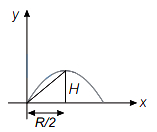
At this time,the horizontal displacement is $x = (v \cos \theta) t = \frac{v^2 \sin \theta \cos \theta}{g} = \frac{R}{2}$,and the vertical displacement is $y = H = \frac{v^2 \sin^2 \theta}{2g}$.
The displacement vector is $\vec{s} = \frac{R}{2} \hat{i} + H \hat{j}$.
The magnitude of displacement is $|\vec{s}| = \sqrt{(\frac{R}{2})^2 + H^2}$.
Substituting $R = \frac{v^2 \sin 2\theta}{g} = \frac{2v^2 \sin \theta \cos \theta}{g}$ and $H = \frac{v^2 \sin^2 \theta}{2g}$:
$|\vec{s}| = \sqrt{(\frac{v^2 \sin \theta \cos \theta}{g})^2 + (\frac{v^2 \sin^2 \theta}{2g})^2} = \frac{v^2 \sin \theta}{g} \sqrt{\cos^2 \theta + \frac{\sin^2 \theta}{4}} = \frac{v^2 \sin \theta}{2g} \sqrt{4 \cos^2 \theta + \sin^2 \theta} = \frac{v^2 \sin \theta}{2g} \sqrt{3 \cos^2 \theta + 1}$.
The time taken is $t = \frac{v \sin \theta}{g}$.
Therefore,average velocity $v_{av} = \frac{|\vec{s}|}{t} = \frac{\frac{v^2 \sin \theta}{2g} \sqrt{3 \cos^2 \theta + 1}}{\frac{v \sin \theta}{g}} = \frac{v}{2} \sqrt{1 + 3 \cos^2 \theta}$.
Let the initial position be $(0, 0)$. The highest point is reached at time $t = \frac{v \sin \theta}{g}$.
At this time,the horizontal displacement is $x = (v \cos \theta) t = \frac{v^2 \sin \theta \cos \theta}{g} = \frac{R}{2}$,and the vertical displacement is $y = H = \frac{v^2 \sin^2 \theta}{2g}$.
The displacement vector is $\vec{s} = \frac{R}{2} \hat{i} + H \hat{j}$.
The magnitude of displacement is $|\vec{s}| = \sqrt{(\frac{R}{2})^2 + H^2}$.
Substituting $R = \frac{v^2 \sin 2\theta}{g} = \frac{2v^2 \sin \theta \cos \theta}{g}$ and $H = \frac{v^2 \sin^2 \theta}{2g}$:
$|\vec{s}| = \sqrt{(\frac{v^2 \sin \theta \cos \theta}{g})^2 + (\frac{v^2 \sin^2 \theta}{2g})^2} = \frac{v^2 \sin \theta}{g} \sqrt{\cos^2 \theta + \frac{\sin^2 \theta}{4}} = \frac{v^2 \sin \theta}{2g} \sqrt{4 \cos^2 \theta + \sin^2 \theta} = \frac{v^2 \sin \theta}{2g} \sqrt{3 \cos^2 \theta + 1}$.
The time taken is $t = \frac{v \sin \theta}{g}$.
Therefore,average velocity $v_{av} = \frac{|\vec{s}|}{t} = \frac{\frac{v^2 \sin \theta}{2g} \sqrt{3 \cos^2 \theta + 1}}{\frac{v \sin \theta}{g}} = \frac{v}{2} \sqrt{1 + 3 \cos^2 \theta}$.
0 likesView Solution
34
ChemistryMCQTS EAMCET · 2013
The radius of ${}_{52}Te^{125}$ nucleus is $6 \text{ fermi}$. The radius of ${}_{13}Al^{27}$ nucleus in meters is
A
$3.6 \times 10^{-12} \text{ m}$
B
$3.6 \times 10^{-15} \text{ m}$
C
$7.2 \times 10^{-8} \text{ m}$
D
$7.2 \times 10^{-15} \text{ m}$
Solution
(B) The relation between the nuclear radius $(R)$ and the mass number $(A)$ is given by the formula: $R = R_0 A^{1/3}$.
Therefore,the ratio of the radii of two nuclei is given by: $\frac{R_1}{R_2} = \left(\frac{A_1}{A_2}\right)^{1/3}$.
Given: $R_1 = 6 \text{ fermi}$,$A_1 = 125$,and $A_2 = 27$.
Substituting the values into the formula:
$\frac{6}{R_2} = \left(\frac{125}{27}\right)^{1/3} = \frac{5}{3}$.
Solving for $R_2$:
$R_2 = \frac{6 \times 3}{5} = \frac{18}{5} = 3.6 \text{ fermi}$.
Since $1 \text{ fermi} = 10^{-15} \text{ m}$,we have:
$R_2 = 3.6 \times 10^{-15} \text{ m}$.
Therefore,the ratio of the radii of two nuclei is given by: $\frac{R_1}{R_2} = \left(\frac{A_1}{A_2}\right)^{1/3}$.
Given: $R_1 = 6 \text{ fermi}$,$A_1 = 125$,and $A_2 = 27$.
Substituting the values into the formula:
$\frac{6}{R_2} = \left(\frac{125}{27}\right)^{1/3} = \frac{5}{3}$.
Solving for $R_2$:
$R_2 = \frac{6 \times 3}{5} = \frac{18}{5} = 3.6 \text{ fermi}$.
Since $1 \text{ fermi} = 10^{-15} \text{ m}$,we have:
$R_2 = 3.6 \times 10^{-15} \text{ m}$.
0 likesView Solution
35
ChemistryMCQTS EAMCET · 2013
Two particles $A$ and $B$ of masses $m$ and $2m$ are suspended from massless springs of force constants $K_1$ and $K_2$. During their oscillation,if their maximum velocities are equal,then the ratio of amplitudes of $A$ and $B$ is
A
$\sqrt{\frac{K_1}{K_2}}$
B
$\sqrt{\frac{K_2}{2K_1}}$
C
$\sqrt{\frac{K_2}{K_1}}$
D
$\sqrt{\frac{2K_1}{K_2}}$
Solution
(B) The maximum velocity of a particle in simple harmonic motion is given by $V_{\max} = A\omega$,where $A$ is the amplitude and $\omega$ is the angular frequency.
For a spring-mass system,$\omega = \sqrt{\frac{K}{m}}$.
Thus,$V_{\max} = A\sqrt{\frac{K}{m}}$.
Given for particle $A$: mass $m_A = m$,force constant $K_A = K_1$,amplitude $A_A$.
Given for particle $B$: mass $m_B = 2m$,force constant $K_B = K_2$,amplitude $A_B$.
Since $(V_{\max})_A = (V_{\max})_B$,we have:
$A_A \sqrt{\frac{K_1}{m}} = A_B \sqrt{\frac{K_2}{2m}}$
$\frac{A_A}{A_B} = \sqrt{\frac{K_2}{2m} \cdot \frac{m}{K_1}}$
$\frac{A_A}{A_B} = \sqrt{\frac{K_2}{2K_1}}$.
For a spring-mass system,$\omega = \sqrt{\frac{K}{m}}$.
Thus,$V_{\max} = A\sqrt{\frac{K}{m}}$.
Given for particle $A$: mass $m_A = m$,force constant $K_A = K_1$,amplitude $A_A$.
Given for particle $B$: mass $m_B = 2m$,force constant $K_B = K_2$,amplitude $A_B$.
Since $(V_{\max})_A = (V_{\max})_B$,we have:
$A_A \sqrt{\frac{K_1}{m}} = A_B \sqrt{\frac{K_2}{2m}}$
$\frac{A_A}{A_B} = \sqrt{\frac{K_2}{2m} \cdot \frac{m}{K_1}}$
$\frac{A_A}{A_B} = \sqrt{\frac{K_2}{2K_1}}$.
0 likesView Solution
36
ChemistryMCQTS EAMCET · 2013
How many corners of $SiO_4$ units are shared in the formation of three-dimensional silicates?
A
$3$
B
$2$
C
$4$
D
$1$
Solution
(C) In three-dimensional silicates,all four corners of the $SiO_4^{4-}$ tetrahedral unit are shared with other tetrahedra.
This sharing of all four oxygen atoms results in a three-dimensional network structure.
Examples of such structures include silica $(SiO_2)$ in its various forms like quartz,tridymite,and cristobalite.
This sharing of all four oxygen atoms results in a three-dimensional network structure.
Examples of such structures include silica $(SiO_2)$ in its various forms like quartz,tridymite,and cristobalite.
0 likesView Solution
37
ChemistryMCQTS EAMCET · 2013
Which one of the following is not correct?
A
Pyrophosphoric acid is a tetrabasic acid
B
Pyrophosphoric acid contains $P-O-P$ linkage
C
Pyrophosphoric acid contains two $P-H$ bonds
D
Orthophosphoric acid can be prepared by dissolving $P_4O_{10}$ in water
Solution
(C) The chemical formula of pyrophosphoric acid is $H_4P_2O_7$.
In this structure,phosphorus is in the $+5$ oxidation state.
It contains four $P-OH$ bonds,two $P=O$ bonds,and one $P-O-P$ linkage.
It does not contain any $P-H$ bonds.
Since it has four $P-OH$ groups,it is a tetrabasic acid.
Orthophosphoric acid $(H_3PO_4)$ is prepared by dissolving $P_4O_{10}$ in water: $P_4O_{10} + 6H_2O \rightarrow 4H_3PO_4$.
Therefore,the statement that pyrophosphoric acid contains two $P-H$ bonds is incorrect.
In this structure,phosphorus is in the $+5$ oxidation state.
It contains four $P-OH$ bonds,two $P=O$ bonds,and one $P-O-P$ linkage.
It does not contain any $P-H$ bonds.
Since it has four $P-OH$ groups,it is a tetrabasic acid.
Orthophosphoric acid $(H_3PO_4)$ is prepared by dissolving $P_4O_{10}$ in water: $P_4O_{10} + 6H_2O \rightarrow 4H_3PO_4$.
Therefore,the statement that pyrophosphoric acid contains two $P-H$ bonds is incorrect.
0 likesView Solution
38
ChemistryMCQTS EAMCET · 2013
$Na_2S_2O_3$ reacts with moist $Cl_2$ to form $Na_2SO_4$,$HCl$ and $X$. Which one of the following is $X$?
A
$H_2S$
B
$SO_2$
C
$SO_3$
D
$S$
Solution
(D) Sodium thiosulphate is oxidised by moist $Cl_2$ (chlorine water) to form sodium sulphate,hydrochloric acid,and sulphur.
The balanced chemical equation is:
$Na_2S_2O_3 + 4Cl_2 + 5H_2O \longrightarrow Na_2SO_4 + 8HCl + S$
Here,$X$ is sulphur $(S)$.
The balanced chemical equation is:
$Na_2S_2O_3 + 4Cl_2 + 5H_2O \longrightarrow Na_2SO_4 + 8HCl + S$
Here,$X$ is sulphur $(S)$.
0 likesView Solution
39
ChemistryMCQTS EAMCET · 2013
Liquid $X$ is used in a bubble chamber to detect neutral mesons and gamma photons. Then,$X$ is
A
$He$
B
$Ne$
C
$Kr$
D
$Xe$
Solution
(D) Liquid $Xe$ (Xenon) is used in bubble chambers for the detection of $\gamma$-photons and neutral mesons due to its high density and high atomic number,which increases the probability of interaction with high-energy particles.
0 likesView Solution
40
ChemistryMCQTS EAMCET · 2013
If $\sin \theta + \cos \theta = p$ and $\sin^3 \theta + \cos^3 \theta = q$,then $p(p^2 - 3)$ is equal to
A
$q$
B
$2q$
C
$-q$
D
$-2q$
Solution
(D) Given,$\sin \theta + \cos \theta = p$ $(i)$
and $\sin^3 \theta + \cos^3 \theta = q$ $(ii)$
We know that $a^3 + b^3 = (a + b)(a^2 - ab + b^2)$.
So,$(\sin \theta + \cos \theta)(\sin^2 \theta - \sin \theta \cos \theta + \cos^2 \theta) = q$
$p(1 - \sin \theta \cos \theta) = q$ (since $\sin^2 \theta + \cos^2 \theta = 1$)
$1 - \sin \theta \cos \theta = \frac{q}{p}$
$\sin \theta \cos \theta = 1 - \frac{q}{p} = \frac{p - q}{p}$ $(iii)$
Now,square equation $(i)$:
$(\sin \theta + \cos \theta)^2 = p^2$
$\sin^2 \theta + \cos^2 \theta + 2 \sin \theta \cos \theta = p^2$
$1 + 2 \sin \theta \cos \theta = p^2$
Substitute $\sin \theta \cos \theta$ from $(iii)$:
$1 + 2 \left( \frac{p - q}{p} \right) = p^2$
$p + 2p - 2q = p^3$
$3p - 2q = p^3$
$p^3 - 3p = -2q$
$p(p^2 - 3) = -2q$
and $\sin^3 \theta + \cos^3 \theta = q$ $(ii)$
We know that $a^3 + b^3 = (a + b)(a^2 - ab + b^2)$.
So,$(\sin \theta + \cos \theta)(\sin^2 \theta - \sin \theta \cos \theta + \cos^2 \theta) = q$
$p(1 - \sin \theta \cos \theta) = q$ (since $\sin^2 \theta + \cos^2 \theta = 1$)
$1 - \sin \theta \cos \theta = \frac{q}{p}$
$\sin \theta \cos \theta = 1 - \frac{q}{p} = \frac{p - q}{p}$ $(iii)$
Now,square equation $(i)$:
$(\sin \theta + \cos \theta)^2 = p^2$
$\sin^2 \theta + \cos^2 \theta + 2 \sin \theta \cos \theta = p^2$
$1 + 2 \sin \theta \cos \theta = p^2$
Substitute $\sin \theta \cos \theta$ from $(iii)$:
$1 + 2 \left( \frac{p - q}{p} \right) = p^2$
$p + 2p - 2q = p^3$
$3p - 2q = p^3$
$p^3 - 3p = -2q$
$p(p^2 - 3) = -2q$
0 likesView Solution
41
ChemistryMCQTS EAMCET · 2013
If $\tan (\pi \cos \theta)=\cot (\pi \sin \theta)$,then a value of $\cos \left(\theta-\frac{\pi}{4}\right)$ among the following is
A
$\frac{1}{2 \sqrt{2}}$
B
$\frac{1}{\sqrt{2}}$
C
$\frac{1}{2}$
D
$\frac{1}{4}$
Solution
(A) Given,$\tan (\pi \cos \theta)=\cot (\pi \sin \theta)$
$\Rightarrow \tan (\pi \cos \theta)=\tan \left(\frac{\pi}{2}-\pi \sin \theta\right)$
$\Rightarrow \pi \cos \theta=\frac{\pi}{2}-\pi \sin \theta$
$\Rightarrow \cos \theta+\sin \theta=\frac{1}{2}$
Dividing both sides by $\sqrt{2}$:
$\Rightarrow \frac{1}{\sqrt{2}} \cos \theta+\frac{1}{\sqrt{2}} \sin \theta=\frac{1}{2 \sqrt{2}}$
$\Rightarrow \cos \theta \cos \frac{\pi}{4}+\sin \theta \sin \frac{\pi}{4}=\frac{1}{2 \sqrt{2}}$
$\Rightarrow \cos \left(\theta-\frac{\pi}{4}\right)=\frac{1}{2 \sqrt{2}}$
$\Rightarrow \tan (\pi \cos \theta)=\tan \left(\frac{\pi}{2}-\pi \sin \theta\right)$
$\Rightarrow \pi \cos \theta=\frac{\pi}{2}-\pi \sin \theta$
$\Rightarrow \cos \theta+\sin \theta=\frac{1}{2}$
Dividing both sides by $\sqrt{2}$:
$\Rightarrow \frac{1}{\sqrt{2}} \cos \theta+\frac{1}{\sqrt{2}} \sin \theta=\frac{1}{2 \sqrt{2}}$
$\Rightarrow \cos \theta \cos \frac{\pi}{4}+\sin \theta \sin \frac{\pi}{4}=\frac{1}{2 \sqrt{2}}$
$\Rightarrow \cos \left(\theta-\frac{\pi}{4}\right)=\frac{1}{2 \sqrt{2}}$
0 likesView Solution
42
ChemistryMCQTS EAMCET · 2013
The equation $x^2-5xy+py^2+3x-8y+2=0$ represents a pair of straight lines. If $\theta$ is the angle between them,then $\sin \theta$ is equal to
A
$\frac{1}{\sqrt{50}}$
B
$\frac{1}{7}$
C
$\frac{1}{5}$
D
$\frac{1}{\sqrt{10}}$
Solution
(A) Comparing the given equation $x^2-5xy+py^2+3x-8y+2=0$ with the general second-degree equation $ax^2+2hxy+by^2+2gx+2fy+c=0$,we get $a=1, h=-\frac{5}{2}, b=p, g=\frac{3}{2}, f=-4, c=2$.
The equation represents a pair of straight lines if $abc+2fgh-af^2-bg^2-ch^2=0$.
Substituting the values: $1(p)(2) + 2(-4)(\frac{3}{2})(-\frac{5}{2}) - 1(-4)^2 - p(\frac{3}{2})^2 - 2(-\frac{5}{2})^2 = 0$.
$2p + 30 - 16 - \frac{9p}{4} - \frac{25}{2} = 0$.
Multiplying by $4$: $8p + 120 - 64 - 9p - 50 = 0$ $\Rightarrow -p + 6 = 0$ $\Rightarrow p=6$.
The angle $\theta$ between the lines is given by $\tan \theta = \left| \frac{2\sqrt{h^2-ab}}{a+b} \right|$.
$\tan \theta = \left| \frac{2\sqrt{(-\frac{5}{2})^2 - 1(6)}}{1+6} \right| = \left| \frac{2\sqrt{\frac{25}{4}-6}}{7} \right| = \left| \frac{2\sqrt{\frac{1}{4}}}{7} \right| = \frac{2(\frac{1}{2})}{7} = \frac{1}{7}$.
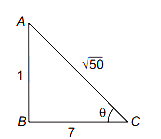
Since $\tan \theta = \frac{1}{7}$,we can form a right-angled triangle with opposite side $1$ and adjacent side $7$. The hypotenuse is $\sqrt{1^2+7^2} = \sqrt{50}$.
Therefore,$\sin \theta = \frac{1}{\sqrt{50}}$.
The equation represents a pair of straight lines if $abc+2fgh-af^2-bg^2-ch^2=0$.
Substituting the values: $1(p)(2) + 2(-4)(\frac{3}{2})(-\frac{5}{2}) - 1(-4)^2 - p(\frac{3}{2})^2 - 2(-\frac{5}{2})^2 = 0$.
$2p + 30 - 16 - \frac{9p}{4} - \frac{25}{2} = 0$.
Multiplying by $4$: $8p + 120 - 64 - 9p - 50 = 0$ $\Rightarrow -p + 6 = 0$ $\Rightarrow p=6$.
The angle $\theta$ between the lines is given by $\tan \theta = \left| \frac{2\sqrt{h^2-ab}}{a+b} \right|$.
$\tan \theta = \left| \frac{2\sqrt{(-\frac{5}{2})^2 - 1(6)}}{1+6} \right| = \left| \frac{2\sqrt{\frac{25}{4}-6}}{7} \right| = \left| \frac{2\sqrt{\frac{1}{4}}}{7} \right| = \frac{2(\frac{1}{2})}{7} = \frac{1}{7}$.
Since $\tan \theta = \frac{1}{7}$,we can form a right-angled triangle with opposite side $1$ and adjacent side $7$. The hypotenuse is $\sqrt{1^2+7^2} = \sqrt{50}$.
Therefore,$\sin \theta = \frac{1}{\sqrt{50}}$.
0 likesView Solution
43
ChemistryMCQTS EAMCET · 2013
If the equation $ax^2 + 2hxy + by^2 + 2gx + 2fy + c = 0$ represents a pair of straight lines,then the square of the distance of their point of intersection from the origin is
A
$\frac{c(a+b)-af^2-bg^2}{ab-h^2}$
B
$\frac{c(a+b)+f^2+g^2}{ab-h^2}$
C
$\frac{c(a+b)-f^2-g^2}{ab-h^2}$
D
$\frac{c(a+b)-f^2-g^2}{(ab-h^2)^2}$
Solution
(C) The point of intersection $(x_0, y_0)$ of the pair of straight lines given by $ax^2 + 2hxy + by^2 + 2gx + 2fy + c = 0$ is found by solving $\frac{\partial}{\partial x} = 2ax + 2hy + 2g = 0$ and $\frac{\partial}{\partial y} = 2hx + 2by + 2f = 0$.
Solving these equations,we get $x_0 = \frac{hf-bg}{ab-h^2}$ and $y_0 = \frac{gh-af}{ab-h^2}$.
The square of the distance from the origin $(0,0)$ is $D^2 = x_0^2 + y_0^2$.
Using the condition for a pair of straight lines $abc + 2fgh - af^2 - bg^2 - ch^2 = 0$,we can simplify $x_0^2 + y_0^2$ to $\frac{c(a+b)-f^2-g^2}{ab-h^2}$.
Solving these equations,we get $x_0 = \frac{hf-bg}{ab-h^2}$ and $y_0 = \frac{gh-af}{ab-h^2}$.
The square of the distance from the origin $(0,0)$ is $D^2 = x_0^2 + y_0^2$.
Using the condition for a pair of straight lines $abc + 2fgh - af^2 - bg^2 - ch^2 = 0$,we can simplify $x_0^2 + y_0^2$ to $\frac{c(a+b)-f^2-g^2}{ab-h^2}$.
0 likesView Solution
44
ChemistryMCQTS EAMCET · 2013
If the equation $ax^2 + 2hxy + by^2 + 2gx + 2fy + c = 0$ represents a pair of straight lines,then the square of the distance of their point of intersection from the origin is
A
$\frac{c(a+b)-af^2-bg^2}{ab-h^2}$
B
$\frac{c(a+b)+f^2+g^2}{ab-h^2}$
C
$\frac{c(a+b)-f^2-g^2}{ab-h^2}$
D
$\frac{c(a+b)-f^2-g^2}{(ab-h^2)^2}$
Solution
(C) The point of intersection $(x_0, y_0)$ of the pair of straight lines given by $ax^2 + 2hxy + by^2 + 2gx + 2fy + c = 0$ is found by solving $\frac{\partial}{\partial x} = 0$ and $\frac{\partial}{\partial y} = 0$.
These partial derivatives are $2ax + 2hy + 2g = 0$ and $2hx + 2by + 2f = 0$.
Solving these,we get $x_0 = \frac{hf-bg}{ab-h^2}$ and $y_0 = \frac{gh-af}{ab-h^2}$.
The square of the distance from the origin $(0,0)$ is $D^2 = x_0^2 + y_0^2 = \left(\frac{hf-bg}{ab-h^2}\right)^2 + \left(\frac{gh-af}{ab-h^2}\right)^2$.
Using the condition for a pair of lines $abc + 2fgh - af^2 - bg^2 - ch^2 = 0$,we simplify the expression to $D^2 = \frac{c(a+b)-f^2-g^2}{ab-h^2}$.
These partial derivatives are $2ax + 2hy + 2g = 0$ and $2hx + 2by + 2f = 0$.
Solving these,we get $x_0 = \frac{hf-bg}{ab-h^2}$ and $y_0 = \frac{gh-af}{ab-h^2}$.
The square of the distance from the origin $(0,0)$ is $D^2 = x_0^2 + y_0^2 = \left(\frac{hf-bg}{ab-h^2}\right)^2 + \left(\frac{gh-af}{ab-h^2}\right)^2$.
Using the condition for a pair of lines $abc + 2fgh - af^2 - bg^2 - ch^2 = 0$,we simplify the expression to $D^2 = \frac{c(a+b)-f^2-g^2}{ab-h^2}$.
0 likesView Solution
45
ChemistryMCQTS EAMCET · 2013
The equation of the pair of lines passing through the origin whose sum and product of slopes are respectively the arithmetic mean and geometric mean of $4$ and $9$ is
A
$12 x^2-13 x y+2 y^2=0$
B
$12 x^2+13 x y+2 y^2=0$
C
$12 x^2-15 x y+2 y^2=0$
D
$12 x^2+15 x y-2 y^2=0$
Solution
(A) Let $m_1$ and $m_2$ be the slopes of the lines.
Given that $m_1+m_2$ is the arithmetic mean of $4$ and $9$,so $m_1+m_2 = \frac{4+9}{2} = \frac{13}{2}$.
Given that $m_1 m_2$ is the geometric mean of $4$ and $9$,so $m_1 m_2 = \sqrt{4 \times 9} = \sqrt{36} = 6$.
The equation of a pair of lines passing through the origin is given by $y^2 - (m_1+m_2)xy + (m_1 m_2)x^2 = 0$.
Substituting the values,we get $y^2 - \frac{13}{2}xy + 6x^2 = 0$.
Multiplying by $2$,we get $2y^2 - 13xy + 12x^2 = 0$,which is $12x^2 - 13xy + 2y^2 = 0$.
Given that $m_1+m_2$ is the arithmetic mean of $4$ and $9$,so $m_1+m_2 = \frac{4+9}{2} = \frac{13}{2}$.
Given that $m_1 m_2$ is the geometric mean of $4$ and $9$,so $m_1 m_2 = \sqrt{4 \times 9} = \sqrt{36} = 6$.
The equation of a pair of lines passing through the origin is given by $y^2 - (m_1+m_2)xy + (m_1 m_2)x^2 = 0$.
Substituting the values,we get $y^2 - \frac{13}{2}xy + 6x^2 = 0$.
Multiplying by $2$,we get $2y^2 - 13xy + 12x^2 = 0$,which is $12x^2 - 13xy + 2y^2 = 0$.
0 likesView Solution
46
ChemistryMCQTS EAMCET · 2013
The circle $4x^2 + 4y^2 - 12x - 12y + 9 = 0$
A
touches both the axes
B
touches the $x$-axis only
C
touches the $y$-axis only
D
does not touch the axes
Solution
(A) The given equation of the circle is $4x^2 + 4y^2 - 12x - 12y + 9 = 0$.
Dividing the entire equation by $4$,we get:
$x^2 + y^2 - 3x - 3y + \frac{9}{4} = 0$
Rearranging the terms to complete the square:
$(x^2 - 3x) + (y^2 - 3y) = -\frac{9}{4}$
Adding $(\frac{3}{2})^2$ to both sides for both $x$ and $y$ terms:
$(x^2 - 3x + \frac{9}{4}) + (y^2 - 3y + \frac{9}{4}) = -\frac{9}{4} + \frac{9}{4} + \frac{9}{4}$
$(x - \frac{3}{2})^2 + (y - \frac{3}{2})^2 = (\frac{3}{2})^2$
Comparing this with the standard form of a circle $(x - h)^2 + (y - k)^2 = r^2$,we have the centre $(h, k) = (\frac{3}{2}, \frac{3}{2})$ and the radius $r = \frac{3}{2}$.
Since the distance of the centre from both axes is equal to the radius (i.e.,$|h| = |k| = r = \frac{3}{2}$),the circle touches both the axes.
Dividing the entire equation by $4$,we get:
$x^2 + y^2 - 3x - 3y + \frac{9}{4} = 0$
Rearranging the terms to complete the square:
$(x^2 - 3x) + (y^2 - 3y) = -\frac{9}{4}$
Adding $(\frac{3}{2})^2$ to both sides for both $x$ and $y$ terms:
$(x^2 - 3x + \frac{9}{4}) + (y^2 - 3y + \frac{9}{4}) = -\frac{9}{4} + \frac{9}{4} + \frac{9}{4}$
$(x - \frac{3}{2})^2 + (y - \frac{3}{2})^2 = (\frac{3}{2})^2$
Comparing this with the standard form of a circle $(x - h)^2 + (y - k)^2 = r^2$,we have the centre $(h, k) = (\frac{3}{2}, \frac{3}{2})$ and the radius $r = \frac{3}{2}$.
Since the distance of the centre from both axes is equal to the radius (i.e.,$|h| = |k| = r = \frac{3}{2}$),the circle touches both the axes.
0 likesView Solution
47
ChemistryMCQTS EAMCET · 2013
If the length of the tangent from $(h, k)$ to the circle $x^2+y^2=16$ is twice the length of the tangent from the same point to the circle $x^2+y^2+2x+2y=0$,then
A
$h^2+k^2+4h+4k+16=0$
B
$h^2+k^2+3h+3k=0$
C
$3h^2+3k^2+8h+8k+16=0$
D
$3h^2+3k^2+4h+4k+16=0$
Solution
(C) The length of the tangent from a point $(h, k)$ to a circle $x^2+y^2+2gx+2fy+c=0$ is given by $\sqrt{h^2+k^2+2gh+2fk+c}$.
For the circle $x^2+y^2-16=0$,the length of the tangent is $L_1 = \sqrt{h^2+k^2-16}$.
For the circle $x^2+y^2+2x+2y=0$,the length of the tangent is $L_2 = \sqrt{h^2+k^2+2h+2k}$.
According to the problem,$L_1 = 2L_2$.
Squaring both sides,we get $L_1^2 = 4L_2^2$.
$h^2+k^2-16 = 4(h^2+k^2+2h+2k)$.
$h^2+k^2-16 = 4h^2+4k^2+8h+8k$.
Rearranging the terms,we get $3h^2+3k^2+8h+8k+16=0$.
For the circle $x^2+y^2-16=0$,the length of the tangent is $L_1 = \sqrt{h^2+k^2-16}$.
For the circle $x^2+y^2+2x+2y=0$,the length of the tangent is $L_2 = \sqrt{h^2+k^2+2h+2k}$.
According to the problem,$L_1 = 2L_2$.
Squaring both sides,we get $L_1^2 = 4L_2^2$.
$h^2+k^2-16 = 4(h^2+k^2+2h+2k)$.
$h^2+k^2-16 = 4h^2+4k^2+8h+8k$.
Rearranging the terms,we get $3h^2+3k^2+8h+8k+16=0$.
0 likesView Solution
48
ChemistryMCQTS EAMCET · 2013
If the circle $x^2+y^2+4x-6y+c=0$ bisects the circumference of the circle $x^2+y^2-6x+4y-12=0$,then $c$ is equal to
A
$16$
B
$24$
C
$-42$
D
$-62$
Solution
(D) The common chord of the two circles $S_1 = x^2+y^2+4x-6y+c=0$ and $S_2 = x^2+y^2-6x+4y-12=0$ is given by $S_1 - S_2 = 0$.
$(x^2+y^2+4x-6y+c) - (x^2+y^2-6x+4y-12) = 0$
$10x - 10y + c + 12 = 0$
Since the first circle bisects the circumference of the second circle,the common chord must pass through the center of the second circle.
The center of the second circle $x^2+y^2-6x+4y-12=0$ is $(-g, -f) = (3, -2)$.
Substituting $(3, -2)$ into the equation of the common chord:
$10(3) - 10(-2) + c + 12 = 0$
$30 + 20 + c + 12 = 0$
$62 + c = 0$
$c = -62$
$(x^2+y^2+4x-6y+c) - (x^2+y^2-6x+4y-12) = 0$
$10x - 10y + c + 12 = 0$
Since the first circle bisects the circumference of the second circle,the common chord must pass through the center of the second circle.
The center of the second circle $x^2+y^2-6x+4y-12=0$ is $(-g, -f) = (3, -2)$.
Substituting $(3, -2)$ into the equation of the common chord:
$10(3) - 10(-2) + c + 12 = 0$
$30 + 20 + c + 12 = 0$
$62 + c = 0$
$c = -62$
0 likesView Solution
49
ChemistryMCQTS EAMCET · 2013
For the circle $C$ with the equation $x^2+y^2-16x-12y+64=0$,match the List-$I$ with the List-$II$ given below.
| List-$I$ | List-$II$ |
| $(i)$ The equation of the polar of $(-5, 1)$ with respect to $C$ | $(A)$ $y = 0$ |
| $(ii)$ The equation of the tangent at $(8, 0)$ to $C$ | $(B)$ $y = 6$ |
| $(iii)$ The equation of the normal at $(2, 6)$ to $C$ | $(C)$ $x + y = 7$ |
| $(iv)$ The equation of the diameter of $C$ through $(8, 12)$ | $(D)$ $13x + 5y = 98$ |
| $(E)$ $x = 8$ |
A
$(D), (A), (B), (E)$
B
$(D), (A), (B), (E)$
C
$(C), (D), (A), (B)$
D
$(C), (E), (B), (A)$
Solution
(A) The given equation of the circle is $x^2+y^2-16x-12y+64=0$. The center is $(8, 6)$ and the radius is $r = \sqrt{8^2+6^2-64} = \sqrt{64+36-64} = 6$.
$(i)$ The equation of the polar of $(x_1, y_1)$ w.r.t. $x^2+y^2+2gx+2fy+c=0$ is $xx_1+yy_1+g(x+x_1)+f(y+y_1)+c=0$.
For $(-5, 1)$,it is $x(-5)+y(1)-8(x-5)-6(y+1)+64=0$ $\Rightarrow -5x+y-8x+40-6y-6+64=0$ $\Rightarrow -13x-5y+98=0$ $\Rightarrow 13x+5y=98$. This matches $(D)$.
$(ii)$ The equation of the tangent at $(x_1, y_1)$ is $xx_1+yy_1-8(x+x_1)-6(y+y_1)+64=0$.
For $(8, 0)$,it is $x(8)+y(0)-8(x+8)-6(y+0)+64=0$ $\Rightarrow 8x-8x-64-6y+64=0$ $\Rightarrow -6y=0$ $\Rightarrow y=0$. This matches $(A)$.
$(iii)$ The normal at any point on a circle passes through the center $(8, 6)$. The normal at $(2, 6)$ passes through $(2, 6)$ and $(8, 6)$. Since the $y$-coordinates are the same,the equation is $y=6$. This matches $(B)$.
$(iv)$ The diameter passes through the center $(8, 6)$ and the point $(8, 12)$. Since the $x$-coordinates are the same,the equation is $x=8$. This matches $(E)$.
Thus,the correct match is $(i)-(D), (ii)-(A), (iii)-(B), (iv)-(E)$.
$(i)$ The equation of the polar of $(x_1, y_1)$ w.r.t. $x^2+y^2+2gx+2fy+c=0$ is $xx_1+yy_1+g(x+x_1)+f(y+y_1)+c=0$.
For $(-5, 1)$,it is $x(-5)+y(1)-8(x-5)-6(y+1)+64=0$ $\Rightarrow -5x+y-8x+40-6y-6+64=0$ $\Rightarrow -13x-5y+98=0$ $\Rightarrow 13x+5y=98$. This matches $(D)$.
$(ii)$ The equation of the tangent at $(x_1, y_1)$ is $xx_1+yy_1-8(x+x_1)-6(y+y_1)+64=0$.
For $(8, 0)$,it is $x(8)+y(0)-8(x+8)-6(y+0)+64=0$ $\Rightarrow 8x-8x-64-6y+64=0$ $\Rightarrow -6y=0$ $\Rightarrow y=0$. This matches $(A)$.
$(iii)$ The normal at any point on a circle passes through the center $(8, 6)$. The normal at $(2, 6)$ passes through $(2, 6)$ and $(8, 6)$. Since the $y$-coordinates are the same,the equation is $y=6$. This matches $(B)$.
$(iv)$ The diameter passes through the center $(8, 6)$ and the point $(8, 12)$. Since the $x$-coordinates are the same,the equation is $x=8$. This matches $(E)$.
Thus,the correct match is $(i)-(D), (ii)-(A), (iii)-(B), (iv)-(E)$.
0 likesView Solution
50
ChemistryMCQTS EAMCET · 2013
$A$ circle of radius $4$,drawn on a chord of the parabola $y^2 = 8x$ as diameter,touches the axis of the parabola. Then,the slope of the chord is
A
$1/2$
B
$3/4$
C
$1$
D
$2$
Solution
(C) The equation of the parabola is $y^2 = 8x$,so $4a = 8$,which gives $a = 2$.
Let the chord be $y = mx + c$.
The points of intersection of the line $y = mx + c$ and the parabola $y^2 = 8x$ are obtained by substituting $x = (y - c)/m$ into the parabola equation: $y^2 = 8(y - c)/m \Rightarrow my^2 - 8y + 8c = 0$.
Let the points be $P(x_1, y_1)$ and $Q(x_2, y_2)$. Then $y_1 + y_2 = 8/m$ and $y_1y_2 = 8c/m$.
The midpoint of the chord is $M = (\frac{x_1+x_2}{2}, \frac{y_1+y_2}{2})$.
The circle with the chord as diameter has radius $R = 4$.
The distance from the center of the circle to the axis of the parabola $(y = 0)$ is equal to the radius $4$,so the $y$-coordinate of the center is $4$ (or $-4$).
Thus,$\frac{y_1+y_2}{2} = 4 \Rightarrow y_1 + y_2 = 8$.
Since $y_1 + y_2 = 8/m$,we have $8/m = 8$,which implies $m = 1$.
Let the chord be $y = mx + c$.
The points of intersection of the line $y = mx + c$ and the parabola $y^2 = 8x$ are obtained by substituting $x = (y - c)/m$ into the parabola equation: $y^2 = 8(y - c)/m \Rightarrow my^2 - 8y + 8c = 0$.
Let the points be $P(x_1, y_1)$ and $Q(x_2, y_2)$. Then $y_1 + y_2 = 8/m$ and $y_1y_2 = 8c/m$.
The midpoint of the chord is $M = (\frac{x_1+x_2}{2}, \frac{y_1+y_2}{2})$.
The circle with the chord as diameter has radius $R = 4$.
The distance from the center of the circle to the axis of the parabola $(y = 0)$ is equal to the radius $4$,so the $y$-coordinate of the center is $4$ (or $-4$).
Thus,$\frac{y_1+y_2}{2} = 4 \Rightarrow y_1 + y_2 = 8$.
Since $y_1 + y_2 = 8/m$,we have $8/m = 8$,which implies $m = 1$.
0 likesView Solution
51
ChemistryMediumMCQTS EAMCET · 2013
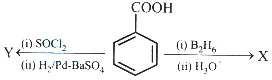
Identify $X$ and $Y$ in the following reactions:
A
Benzyl alcohol,Benzaldehyde
B
Benzyl alcohol,Benzaldehyde
C
Benzaldehyde,Benzaldehyde
D
Toluene,Benzyl alcohol
Solution
(B) $1$. For the formation of $X$: Benzoic acid reacts with $B_2H_6$ followed by hydrolysis $(H_3O^+)$ to undergo reduction,yielding benzyl alcohol $(C_6H_5CH_2OH)$ as $X$.
$2$. For the formation of $Y$: Benzoic acid reacts with $SOCl_2$ to form benzoyl chloride $(C_6H_5COCl)$,which then undergoes Rosenmund reduction using $H_2/Pd-BaSO_4$ to yield benzaldehyde $(C_6H_5CHO)$ as $Y$.
$3$. Therefore,$X$ is benzyl alcohol and $Y$ is benzaldehyde.
$2$. For the formation of $Y$: Benzoic acid reacts with $SOCl_2$ to form benzoyl chloride $(C_6H_5COCl)$,which then undergoes Rosenmund reduction using $H_2/Pd-BaSO_4$ to yield benzaldehyde $(C_6H_5CHO)$ as $Y$.
$3$. Therefore,$X$ is benzyl alcohol and $Y$ is benzaldehyde.
0 likesView Solution
52
ChemistryMediumMCQTS EAMCET · 2013
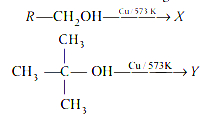
What are $X$ and $Y$ in the following reactions?
A
$X = RCHO, Y = (CH_3)_2C=CH_2$
B
$X = RCOOH, Y = (CH_3)_2C=CH_2$
C
$X = RCHO, Y = (CH_3)_2C=CH_2$
D
$X = RCOR, Y = (CH_3)_2C=O$
Solution
(C) When the vapours of a primary alcohol are passed over heated copper at $573 \ K$,dehydrogenation takes place and an aldehyde is formed: $R-CH_2OH \xrightarrow{Cu/573 \ K} R-CHO + H_2$.
In the case of tertiary alcohols,dehydration takes place to form an alkene: $(CH_3)_3C-OH \xrightarrow{Cu/573 \ K} (CH_3)_2C=CH_2 + H_2O$.
Thus,$X$ is an aldehyde $(RCHO)$ and $Y$ is an alkene $((CH_3)_2C=CH_2)$.
In the case of tertiary alcohols,dehydration takes place to form an alkene: $(CH_3)_3C-OH \xrightarrow{Cu/573 \ K} (CH_3)_2C=CH_2 + H_2O$.
Thus,$X$ is an aldehyde $(RCHO)$ and $Y$ is an alkene $((CH_3)_2C=CH_2)$.
0 likesView Solution
53
ChemistryMediumMCQTS EAMCET · 2013
What are $X$ and $Y$ respectively in the following set of reactions?

A
$Toluene$ ; $p-acetoxy-toluene$
B
$Toluene$ ; $p-acetoxy-toluene$
C
$Phenol$ ; $phenyl-acetate$
D
$Phenol$ ; $p-hydroxy-phenyl-acetate$
Solution
(B) $1$. Reaction with $Zn$ dust and heat: $p-Cresol$ $(p-methylphenol)$ reacts with $Zn$ dust to undergo reduction,where the $-OH$ group is removed and replaced by a hydrogen atom,resulting in the formation of $Toluene$ $(X)$.
$2$. Reaction with $(CH_3CO)_2O$ followed by $H^+$: $p-Cresol$ reacts with acetic anhydride $(CH_3CO)_2O$ to undergo acetylation of the phenolic $-OH$ group,forming $p-acetoxy-toluene$ $(Y)$.
$2$. Reaction with $(CH_3CO)_2O$ followed by $H^+$: $p-Cresol$ reacts with acetic anhydride $(CH_3CO)_2O$ to undergo acetylation of the phenolic $-OH$ group,forming $p-acetoxy-toluene$ $(Y)$.
0 likesView Solution
54
ChemistryMediumMCQTS EAMCET · 2013
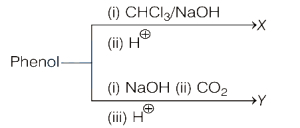
What are $X$ and $Y$ in the following reactions?
A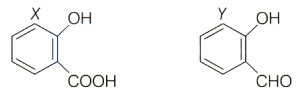
B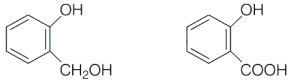
C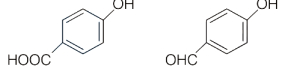
D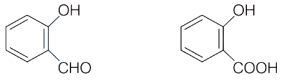
Solution
(D) The reaction of phenol with $CHCl_3$ and aqueous $NaOH$ followed by acidification is the Reimer-Tiemann reaction,which yields $2$-hydroxybenzaldehyde (salicylaldehyde) as product $X$.
The reaction of phenol with $NaOH$ followed by $CO_2$ and then acidification is the Kolbe-Schmitt reaction,which yields $2$-hydroxybenzoic acid (salicylic acid) as product $Y$.
Therefore,$X$ is $2$-hydroxybenzaldehyde and $Y$ is $2$-hydroxybenzoic acid.
The reaction of phenol with $NaOH$ followed by $CO_2$ and then acidification is the Kolbe-Schmitt reaction,which yields $2$-hydroxybenzoic acid (salicylic acid) as product $Y$.
Therefore,$X$ is $2$-hydroxybenzaldehyde and $Y$ is $2$-hydroxybenzoic acid.
0 likesView Solution
55
ChemistryMediumMCQTS EAMCET · 2013
What are $X$ and $Y$ in the following reactions?
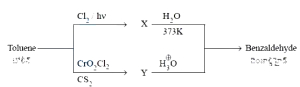
A
$X = C_6H_5CCl_3$,$Y = C_6H_5CH[OCr(OH)Cl_2]_2$
B
$X = C_6H_5CHCl_2$,$Y = C_6H_5CH[OCr(OH)Cl_2]_2$
C
$X = C_6H_5CH_2Cl$,$Y = C_6H_5CH[OCr(OH)_2Cl_2]_2$
D
$X = C_6H_4(CH_3)Cl$,$Y = C_6H_5CH[OCrCl_3]_2$
Solution
(B) The reaction of toluene with $Cl_2$ in the presence of $hv$ (photochemical chlorination) leads to the formation of benzal chloride $(C_6H_5CHCl_2)$ as the intermediate $X$,which upon hydrolysis at $373 \ K$ gives benzaldehyde.
The reaction of toluene with chromyl chloride $(CrO_2Cl_2)$ in $CS_2$ is the Etard reaction. This reaction proceeds through the formation of a brown chromium complex intermediate $Y$,which is $C_6H_5CH[OCr(OH)Cl_2]_2$. This complex upon acidic hydrolysis $(H_3O^+)$ yields benzaldehyde.
Therefore,$X = C_6H_5CHCl_2$ and $Y = C_6H_5CH[OCr(OH)Cl_2]_2$.
The reaction of toluene with chromyl chloride $(CrO_2Cl_2)$ in $CS_2$ is the Etard reaction. This reaction proceeds through the formation of a brown chromium complex intermediate $Y$,which is $C_6H_5CH[OCr(OH)Cl_2]_2$. This complex upon acidic hydrolysis $(H_3O^+)$ yields benzaldehyde.
Therefore,$X = C_6H_5CHCl_2$ and $Y = C_6H_5CH[OCr(OH)Cl_2]_2$.
0 likesView Solution
56
ChemistryMediumMCQTS EAMCET · 2013
What are '$X$' and '$Y$' in the following reaction?
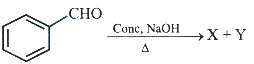
A
Phenol + Sodium benzoate
B
Benzyl alcohol + Benzoic acid
C
Benzyl alcohol + Sodium benzoate
D
Sodium benzyloxide + Benzoic acid
Solution
(C) The given reaction is the Cannizzaro reaction. Benzaldehyde $(C_6H_5CHO)$ does not have an $\alpha$-hydrogen atom,so it undergoes a self-oxidation and reduction (disproportionation) reaction in the presence of a concentrated base like $NaOH$.
One molecule of benzaldehyde is reduced to benzyl alcohol $(C_6H_5CH_2OH)$,and another molecule is oxidized to sodium benzoate $(C_6H_5COONa)$.
Thus,the products '$X$' and '$Y$' are benzyl alcohol and sodium benzoate.
One molecule of benzaldehyde is reduced to benzyl alcohol $(C_6H_5CH_2OH)$,and another molecule is oxidized to sodium benzoate $(C_6H_5COONa)$.
Thus,the products '$X$' and '$Y$' are benzyl alcohol and sodium benzoate.
0 likesView Solution
57
ChemistryMediumMCQTS EAMCET · 2013
What are $X$ and $Y$ respectively in the following set of reactions?

A
Phenyl cyanide,Phenyl cyanide
B
Phenyl cyanide,Phenyl isocyanide
C
Phenyl isocyanide,Phenyl cyanide
D
Phenyl isocyanide,Phenyl isocyanide
Solution
(C) The reaction of aniline with $CHCl_3$ and $KOH$ (carbylamine reaction) produces phenyl isocyanide $(C_6H_5NC)$ as $X$.
The reaction of aniline with $NaNO_2/HCl$ followed by $CuCN/KCN$ (Sandmeyer reaction) produces phenyl cyanide $(C_6H_5CN)$ as $Y$.
Therefore,$X$ is phenyl isocyanide and $Y$ is phenyl cyanide.
The reaction of aniline with $NaNO_2/HCl$ followed by $CuCN/KCN$ (Sandmeyer reaction) produces phenyl cyanide $(C_6H_5CN)$ as $Y$.
Therefore,$X$ is phenyl isocyanide and $Y$ is phenyl cyanide.
0 likesView Solution
58
ChemistryEasyMCQTS EAMCET · 2013
What are $X$ and $Y$ in the following reactions?
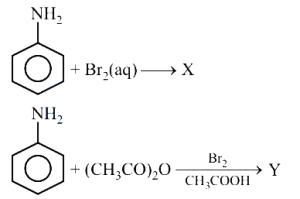
A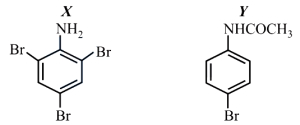
B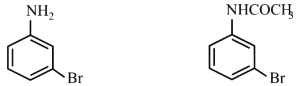
C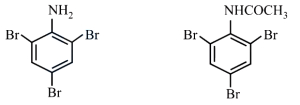
D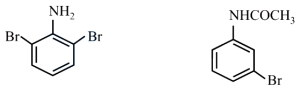
Solution
(A) $(i)$ Aniline is highly reactive towards electrophilic substitution. When treated with $Br_2$ in $H_2O$,it undergoes rapid poly-substitution to form $2, 4, 6-$tribromoaniline as the major product $(X)$.
$(ii)$ To control the reactivity of the $-NH_2$ group,it is first acetylated using acetic anhydride $(CH_3CO)_2O$ to form acetanilide. The $-NHCOCH_3$ group is less activating than the $-NH_2$ group,which restricts the bromination to the $p-$position,yielding $p-$bromoacetanilide as the major product $(Y)$.
$(ii)$ To control the reactivity of the $-NH_2$ group,it is first acetylated using acetic anhydride $(CH_3CO)_2O$ to form acetanilide. The $-NHCOCH_3$ group is less activating than the $-NH_2$ group,which restricts the bromination to the $p-$position,yielding $p-$bromoacetanilide as the major product $(Y)$.
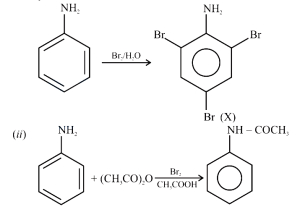
0 likesView Solution
59
ChemistryMediumMCQTS EAMCET · 2013
Identify $X$ and $Y$ in the following reactions:
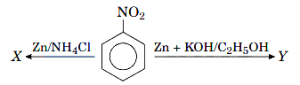
A
$X$ = Nitrosobenzene,$Y$ = Hydrazobenzene
B
$X$ = Aniline,$Y$ = Hydrazobenzene
C
$X$ = Phenylhydroxylamine,$Y$ = Hydrazobenzene
D
$X$ = Hydrazobenzene,$Y$ = Phenylhydroxylamine
Solution
(C) The reduction of nitrobenzene depends on the medium used:
$(i)$ In neutral medium,using $Zn$ dust and $NH_4Cl$ solution,nitrobenzene is reduced to phenylhydroxylamine $(C_6H_5NHOH)$. Thus,$X$ is phenylhydroxylamine.
(ii) In alkaline medium,using $Zn$ and $KOH/C_2H_5OH$,the reduction proceeds further to form hydrazobenzene $(C_6H_5NH-NHC_6H_5)$. Thus,$Y$ is hydrazobenzene.
Therefore,the correct option is $C$.
$(i)$ In neutral medium,using $Zn$ dust and $NH_4Cl$ solution,nitrobenzene is reduced to phenylhydroxylamine $(C_6H_5NHOH)$. Thus,$X$ is phenylhydroxylamine.
(ii) In alkaline medium,using $Zn$ and $KOH/C_2H_5OH$,the reduction proceeds further to form hydrazobenzene $(C_6H_5NH-NHC_6H_5)$. Thus,$Y$ is hydrazobenzene.
Therefore,the correct option is $C$.
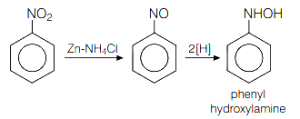
0 likesView Solution
60
ChemistryEasyMCQTS EAMCET · 2013
The number of hydrogen bonds between guanine and cytosine; and between adenine and thymine in $DNA$ is
A
$3, 2$
B
$2, 3$
C
$3, 1$
D
$2, 1$
Solution
(A) In $DNA$,the nitrogenous bases pair specifically through hydrogen bonds.
$G$ (guanine) pairs with $C$ (cytosine) via $3$ hydrogen bonds $(G \equiv C)$.
$A$ (adenine) pairs with $T$ (thymine) via $2$ hydrogen bonds $(A = T)$.
Therefore,the number of hydrogen bonds between guanine and cytosine is $3$,and between adenine and thymine is $2$.
$G$ (guanine) pairs with $C$ (cytosine) via $3$ hydrogen bonds $(G \equiv C)$.
$A$ (adenine) pairs with $T$ (thymine) via $2$ hydrogen bonds $(A = T)$.
Therefore,the number of hydrogen bonds between guanine and cytosine is $3$,and between adenine and thymine is $2$.
0 likesView Solution
61
ChemistryMediumMCQTS EAMCET · 2013
What is the product $X$ in the following Wurtz-Fittig reaction?
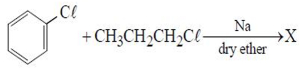
A
Propylbenzene
B
Isopropylbenzene
C
Ethylbenzene
D
Butylbenzene
Solution
(D) The given reaction is a Wurtz-Fittig reaction,which involves the coupling of an aryl halide with an alkyl halide in the presence of sodium metal and dry ether to form an alkylbenzene.
The reaction is:
$C_6H_5Cl + CH_3CH_2CH_2CH_2Cl + 2Na \xrightarrow{\text{dry ether}} C_6H_5-CH_2CH_2CH_2CH_3 + 2NaCl$
The product $X$ formed is $n$-butylbenzene (or simply butylbenzene).
The reaction is:
$C_6H_5Cl + CH_3CH_2CH_2CH_2Cl + 2Na \xrightarrow{\text{dry ether}} C_6H_5-CH_2CH_2CH_2CH_3 + 2NaCl$
The product $X$ formed is $n$-butylbenzene (or simply butylbenzene).
0 likesView Solution
62
ChemistryMediumMCQTS EAMCET · 2013
Identify $X$ and $Y$ in the following reactions:
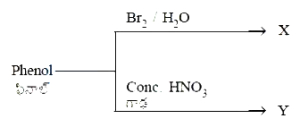
A
$X$ = $2-$bromophenol,$Y$ = $2-$nitrophenol
B
$X$ = $2,4-$dibromophenol,$Y$ = $2,6-$dinitrophenol
C
$X$ = $2,6-$dibromophenol,$Y$ = $2,6-$dinitrophenol
D
$X$ = $2,4,6-$tribromophenol,$Y$ = $2,4,6-$trinitrophenol
Solution
(D) When phenol reacts with bromine water $(Br_2/H_2O)$,it undergoes electrophilic substitution at all ortho and para positions due to the strong activating effect of the $-OH$ group,resulting in the formation of $2,4,6$-tribromophenol $(X)$.
When phenol reacts with concentrated nitric acid $(Conc. HNO_3)$,it undergoes nitration to form $2,4,6$-trinitrophenol,commonly known as picric acid $(Y)$.
When phenol reacts with concentrated nitric acid $(Conc. HNO_3)$,it undergoes nitration to form $2,4,6$-trinitrophenol,commonly known as picric acid $(Y)$.
0 likesView Solution
63
ChemistryMediumMCQTS EAMCET · 2013
The role of copper diaphragm in Whytlaw-Gray's method is
A
preventing the corrosion of electrolytic cell
B
preventing the mixing of $H_2$ and $F_2$
C
as anode
D
as cathode
Solution
(B) In Whytlaw-Gray's method for the preparation of fluorine,the copper diaphragm is used to prevent the mixing of $H_2$ and $F_2$ gases liberated at the cathode and anode,respectively.
The reactions in the electrolytic cell are:
$KHF_2 \rightarrow KF + HF$
$KF \rightarrow K^+ + F^-$
At cathode:
$K^+ + e^- \rightarrow K$
$K + HF \rightarrow KF + H$
$2H \rightarrow H_2$
At anode:
$F^- \rightarrow F + e^-$
$2F \rightarrow F_2$
The reactions in the electrolytic cell are:
$KHF_2 \rightarrow KF + HF$
$KF \rightarrow K^+ + F^-$
At cathode:
$K^+ + e^- \rightarrow K$
$K + HF \rightarrow KF + H$
$2H \rightarrow H_2$
At anode:
$F^- \rightarrow F + e^-$
$2F \rightarrow F_2$
0 likesView Solution
64
ChemistryMediumMCQTS EAMCET · 2013
Match the following types of colloidal systems in List-$I$ with their corresponding names in List-$II$.
| List-$I$ | List-$II$ |
|---|---|
| $(A)$ Solid dispersed in liquid | $(I)$ Emulsion |
| $(B)$ Liquid dispersed in liquid | $(II)$ Foam |
| $(C)$ Gas dispersed in liquid | $(III)$ Gel |
| $(D)$ Liquid dispersed in solid | $(IV)$ Sol |
| $(V)$ Aerosol |
A
$A-IV, B-I, C-II, D-III$
B
$A-III, B-I, C-V, D-II$
C
$A-III, B-I, C-II, D-IV$
D
$A-IV, B-I, C-V, D-III$
Solution
(A) The classification of colloidal systems based on the physical state of the dispersed phase and dispersion medium is as follows:
$(A)$ Solid dispersed in liquid is called a $Sol$ $(IV)$.
$(B)$ Liquid dispersed in liquid is called an $Emulsion$ $(I)$.
$(C)$ Gas dispersed in liquid is called $Foam$ $(II)$.
$(D)$ Liquid dispersed in solid is called a $Gel$ $(III)$.
Therefore,the correct match is $A-IV, B-I, C-II, D-III$.
$(A)$ Solid dispersed in liquid is called a $Sol$ $(IV)$.
$(B)$ Liquid dispersed in liquid is called an $Emulsion$ $(I)$.
$(C)$ Gas dispersed in liquid is called $Foam$ $(II)$.
$(D)$ Liquid dispersed in solid is called a $Gel$ $(III)$.
Therefore,the correct match is $A-IV, B-I, C-II, D-III$.
0 likesView Solution
65
ChemistryMediumMCQTS EAMCET · 2013
The products formed in the reaction of phenol with $Br_2$ dissolved in $CS_2$ at $0^{\circ} C$ are
A
$o$-bromo,$m$-bromo and $p$-bromophenols
B
$o$-bromo and $p$-bromophenols
C
$2,4,6$-tribromo and $2,3,6$-tribromophenols
D
$2,4$-dibromo and $2,6$-dibromophenols
Solution
(B) When phenol is treated with $Br_2$ in the presence of a non-polar solvent like $CS_2$ at low temperature $(0^{\circ} C)$,the reaction is controlled to yield mono-substituted products.
In a non-polar solvent,the ionization of phenol to the highly reactive phenoxide ion is suppressed.
Consequently,the electrophilic substitution occurs only once,leading to the formation of a mixture of $o$-bromophenol and $p$-bromophenol.
In a non-polar solvent,the ionization of phenol to the highly reactive phenoxide ion is suppressed.
Consequently,the electrophilic substitution occurs only once,leading to the formation of a mixture of $o$-bromophenol and $p$-bromophenol.
0 likesView Solution
66
ChemistryMediumMCQTS EAMCET · 2013
Identify $X$ and $Y$ in the following reactions:
$Nitrobenzene \xrightarrow{Zn/NH_4Cl} X$
$Nitrobenzene \xrightarrow{Zn + KOH/C_2H_5OH} Y$
$Nitrobenzene \xrightarrow{Zn/NH_4Cl} X$
$Nitrobenzene \xrightarrow{Zn + KOH/C_2H_5OH} Y$
A
$X = Nitrosobenzene, Y = Hydrazobenzene$
B
$X = Aniline, Y = Hydrazobenzene$
C
$X = Phenylhydroxylamine, Y = Hydrazobenzene$
D
$X = Hydrazobenzene, Y = Phenylhydroxylamine$
Solution
(C) The reduction of nitrobenzene depends on the medium used:
$1$. In neutral medium $(Zn/NH_4Cl)$: Nitrobenzene is reduced to phenylhydroxylamine $(C_6H_5NHOH)$. Thus,$X$ is phenylhydroxylamine.
$2$. In alkaline medium $(Zn + KOH/C_2H_5OH)$: Nitrobenzene undergoes reduction to form azoxybenzene,azobenzene,and finally hydrazobenzene $(C_6H_5NH-NHC_6H_5)$. Thus,$Y$ is hydrazobenzene.
Therefore,the correct option is $C$.
$1$. In neutral medium $(Zn/NH_4Cl)$: Nitrobenzene is reduced to phenylhydroxylamine $(C_6H_5NHOH)$. Thus,$X$ is phenylhydroxylamine.
$2$. In alkaline medium $(Zn + KOH/C_2H_5OH)$: Nitrobenzene undergoes reduction to form azoxybenzene,azobenzene,and finally hydrazobenzene $(C_6H_5NH-NHC_6H_5)$. Thus,$Y$ is hydrazobenzene.
Therefore,the correct option is $C$.
0 likesView Solution
67
ChemistryMediumMCQTS EAMCET · 2013
The number of hydrogen bonds between guanine and cytosine; and between adenine and thymine in $DNA$ is
A
$1, 2$
B
$3, 2$
C
$3, 1$
D
$2, 1$
Solution
(B) In the $DNA$ double helix,the nitrogenous bases pair specifically through hydrogen bonds.
Guanine $(G)$ pairs with cytosine $(C)$ via three hydrogen bonds $(G \equiv C)$.
Adenine $(A)$ pairs with thymine $(T)$ via two hydrogen bonds $(A = T)$.
Therefore,the number of hydrogen bonds between guanine and cytosine is $3$,and between adenine and thymine is $2$.
Guanine $(G)$ pairs with cytosine $(C)$ via three hydrogen bonds $(G \equiv C)$.
Adenine $(A)$ pairs with thymine $(T)$ via two hydrogen bonds $(A = T)$.
Therefore,the number of hydrogen bonds between guanine and cytosine is $3$,and between adenine and thymine is $2$.
0 likesView Solution
68
ChemistryEasyMCQTS EAMCET · 2013
Identify the correct set from the following table:
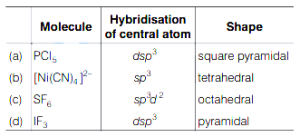
A
| Molecule | Hybridisation | Shape |
|---|---|---|
| $PCl_5$ | $dsp^3$ | square pyramidal |
B
| Molecule | Hybridisation | Shape |
|---|---|---|
| $[Ni(CN)_4]^{2-}$ | $sp^3$ | tetrahedral |
C
| Molecule | Hybridisation | Shape |
|---|---|---|
| $SF_6$ | $sp^3d^2$ | octahedral |
D
| Molecule | Hybridisation | Shape |
|---|---|---|
| $IF_3$ | $dsp^3$ | pyramidal |
Solution
(C) Let us analyze each molecule:
$1$. $PCl_5$: The central atom $P$ has $5$ bond pairs and $0$ lone pairs. Hybridisation is $sp^3d$ and the shape is trigonal bipyramidal.
$2$. $[Ni(CN)_4]^{2-}$: $Ni^{2+}$ has $d^8$ configuration. $CN^-$ is a strong field ligand,causing pairing of electrons. Hybridisation is $dsp^2$ and the shape is square planar.
$3$. $SF_6$: The central atom $S$ has $6$ bond pairs and $0$ lone pairs. Hybridisation is $sp^3d^2$ and the shape is octahedral. This is the correct set.
$4$. $IF_3$: The central atom $I$ has $3$ bond pairs and $2$ lone pairs. Hybridisation is $sp^3d$ and the shape is bent $T$-shaped.
$1$. $PCl_5$: The central atom $P$ has $5$ bond pairs and $0$ lone pairs. Hybridisation is $sp^3d$ and the shape is trigonal bipyramidal.
$2$. $[Ni(CN)_4]^{2-}$: $Ni^{2+}$ has $d^8$ configuration. $CN^-$ is a strong field ligand,causing pairing of electrons. Hybridisation is $dsp^2$ and the shape is square planar.
$3$. $SF_6$: The central atom $S$ has $6$ bond pairs and $0$ lone pairs. Hybridisation is $sp^3d^2$ and the shape is octahedral. This is the correct set.
$4$. $IF_3$: The central atom $I$ has $3$ bond pairs and $2$ lone pairs. Hybridisation is $sp^3d$ and the shape is bent $T$-shaped.
0 likesView Solution
69
ChemistryMediumMCQTS EAMCET · 2013
Which one of the following plots is correct for a first order reaction?
A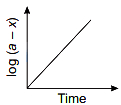
B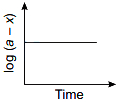
C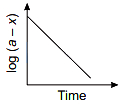
D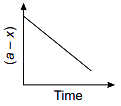
Solution
(C) The integrated rate equation for a first order reaction is given by:
$k = \frac{2.303}{t} \log \frac{a}{(a-x)}$
Rearranging this equation:
$\frac{kt}{2.303} = \log a - \log (a-x)$
$\log (a-x) = -\frac{k}{2.303} t + \log a$
This equation is in the form of a straight line $y = mx + c$,where $y = \log (a-x)$,$x = t$,slope $m = -\frac{k}{2.303}$,and intercept $c = \log a$.
Therefore,a plot of $\log (a-x)$ versus $t$ yields a straight line with a negative slope.
$k = \frac{2.303}{t} \log \frac{a}{(a-x)}$
Rearranging this equation:
$\frac{kt}{2.303} = \log a - \log (a-x)$
$\log (a-x) = -\frac{k}{2.303} t + \log a$
This equation is in the form of a straight line $y = mx + c$,where $y = \log (a-x)$,$x = t$,slope $m = -\frac{k}{2.303}$,and intercept $c = \log a$.
Therefore,a plot of $\log (a-x)$ versus $t$ yields a straight line with a negative slope.
0 likesView Solution
70
ChemistryDifficultMCQTS EAMCET · 2013
Identify phenacetin from the following.
A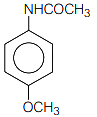
B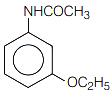
C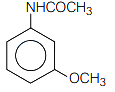
D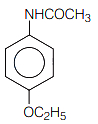
Solution
(D) Phenacetin is a derivative of $p-$aminophenol and is used as an analgesic (painkiller). Its chemical structure is $N-(4-ethoxyphenyl)acetamide$. Comparing this with the given options,the structure in option $D$ corresponds to phenacetin,which features an ethoxy group $(-OC_2H_5)$ at the para position relative to the acetamido group $(-NHCOCH_3)$.
0 likesView Solution
71
ChemistryMediumMCQTS EAMCET · 2013
Which one of the following gives Prussian blue colour?
A
$Fe_2[Fe(CN)_6]$
B
$Na_4[Fe(CN)_6]$
C
$Fe_3[Fe(CN)_6]_3$
D
$Fe_4[Fe(CN)_6]_3$
Solution
(D) Ferric salts (such as $FeCl_3$) react with potassium ferrocyanide to form Prussian blue,which is ferric ferrocyanide.
The chemical reaction is:
$4 FeCl_3 + 3 K_4[Fe(CN)_6] \longrightarrow Fe_4[Fe(CN)_6]_3 + 12 KCl$
The product $Fe_4[Fe(CN)_6]_3$ is known as Prussian blue.
The chemical reaction is:
$4 FeCl_3 + 3 K_4[Fe(CN)_6] \longrightarrow Fe_4[Fe(CN)_6]_3 + 12 KCl$
The product $Fe_4[Fe(CN)_6]_3$ is known as Prussian blue.
0 likesView Solution
72
ChemistryMediumMCQTS EAMCET · 2013
$A$ compound absorbs light in the wavelength region $490-500 \,nm$. Its complementary colour is
A
red
B
blue
C
orange
D
blue-green
Solution
(A) The colour observed is the complementary colour of the light absorbed by the compound.
According to the colour wheel, the wavelength range $490-500 \,nm$ corresponds to the blue-green region of the visible spectrum.
The complementary colour of blue-green is red.
Therefore, the compound will appear red.
According to the colour wheel, the wavelength range $490-500 \,nm$ corresponds to the blue-green region of the visible spectrum.
The complementary colour of blue-green is red.
Therefore, the compound will appear red.
0 likesView Solution
73
ChemistryEasyMCQTS EAMCET · 2013
During the electrolysis of copper sulphate aqueous solution using copper electrodes,the reaction taking place at the cathode is:
A
$Cu \longrightarrow Cu^{2+}_{(aq)} + 2e^{-}$
B
$Cu^{2+}_{(aq)} + 2e^{-} \longrightarrow Cu_{(s)}$
C
$H^{+}_{(aq)} + e^{-} \longrightarrow \frac{1}{2} H_{2(g)}$
D
$S{O_{4}}^{2-}_{(aq)} \longrightarrow SO_{3(g)} + \frac{1}{2} O_{2(g)} + 2e^{-}$
Solution
(B) During the electrolysis of an aqueous solution of copper sulphate using copper electrodes,both $Cu^{2+}$ and $H^{+}$ ions move towards the cathode.
Since the reduction potential of $Cu^{2+}$ is higher than that of $H^{+}$,$Cu^{2+}$ ions are reduced in preference to $H^{+}$ ions.
Thus,copper metal is deposited at the cathode according to the following reaction:
$Cu^{2+}_{(aq)} + 2e^{-} \longrightarrow Cu_{(s)}$
Since the reduction potential of $Cu^{2+}$ is higher than that of $H^{+}$,$Cu^{2+}$ ions are reduced in preference to $H^{+}$ ions.
Thus,copper metal is deposited at the cathode according to the following reaction:
$Cu^{2+}_{(aq)} + 2e^{-} \longrightarrow Cu_{(s)}$
0 likesView Solution
74
ChemistryMediumMCQTS EAMCET · 2013
The extent of charge of a lead accumulator is determined by
A
amount of $PbSO_4$ in the battery
B
amount of $PbO_2$ in the battery
C
specific gravity of $H_2SO_4$ of the battery
D
amount of $Pb$ in the battery
Solution
(C) The extent of charge of a lead accumulator is determined by the specific gravity of the $H_2SO_4$ solution.
During discharge,$H_2SO_4$ is consumed,and its density (specific gravity) decreases.
During charging,$H_2SO_4$ is regenerated,and its density increases.
$A$ fully charged battery typically has a specific gravity of about $1.25$ to $1.30$.
During discharge,$H_2SO_4$ is consumed,and its density (specific gravity) decreases.
During charging,$H_2SO_4$ is regenerated,and its density increases.
$A$ fully charged battery typically has a specific gravity of about $1.25$ to $1.30$.
0 likesView Solution
75
ChemistryMediumMCQTS EAMCET · 2013
The structure of $PCC$ is
A
$C_6 H_5 \stackrel{\oplus}{N} HCrO_2 Cl^{\ominus}$
B
$C_6 H_5 \stackrel{\oplus}{N} HCrO_3 Cl^{\ominus}$
C
$C_5 H_5 \stackrel{\oplus}{N} HCrO_2 Cl^{\ominus}$
D
$C_5 H_5 \stackrel{\oplus}{N} HCrO_3 Cl^{\ominus}$
Solution
(D) Pyridinium chlorochromate $(PCC)$ is formed by the reaction of pyridine with chlorochromic acid,which is obtained by dissolving chromium trioxide $(CrO_3)$ in aqueous $HCl$.
The chemical formula of pyridine is $C_5H_5N$.
When pyridine is protonated,it forms the pyridinium cation,$C_5H_5NH^{\oplus}$.
The chlorochromate anion is $CrO_3Cl^{\ominus}$.
Therefore,the structure of $PCC$ is $C_5H_5NH^{\oplus} CrO_3Cl^{\ominus}$.
The chemical formula of pyridine is $C_5H_5N$.
When pyridine is protonated,it forms the pyridinium cation,$C_5H_5NH^{\oplus}$.
The chlorochromate anion is $CrO_3Cl^{\ominus}$.
Therefore,the structure of $PCC$ is $C_5H_5NH^{\oplus} CrO_3Cl^{\ominus}$.
0 likesView Solution
76
ChemistryMediumMCQTS EAMCET · 2013
Assertion $(A)$: $-NH_2$ group of aniline is ortho,para directing in electrophilic substitutions.
Reason $(R)$: $-NH_2$ group stabilises the arenium ion formed by the ortho,para attack of the electrophile.
The correct answer is
Reason $(R)$: $-NH_2$ group stabilises the arenium ion formed by the ortho,para attack of the electrophile.
The correct answer is
A
Both $(A)$ and $(R)$ are correct,$(R)$ is the correct explanation of $(A)$
B
Both $(A)$ and $(R)$ are correct,$(R)$ is not the correct explanation of $(A)$
C
$(A)$ is correct,but $(R)$ is not correct
D
$(A)$ is not correct,but $(R)$ is correct
Solution
(A) The $-NH_2$ group of aniline is a strong electron-donating group due to the $+M$ (mesomeric) effect.
This effect increases the electron density at the ortho and para positions of the benzene ring,making them more nucleophilic and thus more susceptible to electrophilic attack.
During electrophilic aromatic substitution,the intermediate arenium ion (sigma complex) formed by the attack of an electrophile at the ortho or para positions is stabilized by the resonance donation of the lone pair of electrons from the nitrogen atom of the $-NH_2$ group.
Therefore,both the assertion and the reason are correct,and the reason correctly explains why the $-NH_2$ group is ortho,para directing.
This effect increases the electron density at the ortho and para positions of the benzene ring,making them more nucleophilic and thus more susceptible to electrophilic attack.
During electrophilic aromatic substitution,the intermediate arenium ion (sigma complex) formed by the attack of an electrophile at the ortho or para positions is stabilized by the resonance donation of the lone pair of electrons from the nitrogen atom of the $-NH_2$ group.
Therefore,both the assertion and the reason are correct,and the reason correctly explains why the $-NH_2$ group is ortho,para directing.
0 likesView Solution
77
ChemistryEasyMCQTS EAMCET · 2013
Which of the following is not added during the extraction of silver by the cyanide process?
A
$NaCN$
B
Air
C
$Zn$
D
$Na_2S_2O_3$
Solution
(D) In the extraction of silver by the cyanide process (also known as the Mac-Arthur Forrest process),the silver ore is treated with a dilute solution of $NaCN$ in the presence of air to form a soluble complex,$Na[Ag(CN)_2]$.
The chemical reaction is: $Ag_2S + 4NaCN \rightleftharpoons 2Na[Ag(CN)_2] + Na_2S$.
Air is passed through the solution to oxidize $Na_2S$ to $Na_2SO_4$,preventing the reverse reaction.
Finally,$Zn$ is added to the solution to displace silver from the complex: $2Na[Ag(CN)_2] + Zn \longrightarrow Na_2[Zn(CN)_4] + 2Ag \downarrow$.
$Na_2S_2O_3$ is not used in this process.
The chemical reaction is: $Ag_2S + 4NaCN \rightleftharpoons 2Na[Ag(CN)_2] + Na_2S$.
Air is passed through the solution to oxidize $Na_2S$ to $Na_2SO_4$,preventing the reverse reaction.
Finally,$Zn$ is added to the solution to displace silver from the complex: $2Na[Ag(CN)_2] + Zn \longrightarrow Na_2[Zn(CN)_4] + 2Ag \downarrow$.
$Na_2S_2O_3$ is not used in this process.
0 likesView Solution
78
ChemistryDifficultMCQTS EAMCET · 2013
Solution $X$ contains $Na_2CO_3$ and $NaHCO_3$. $20 \ mL$ of $X$ when titrated using methyl orange indicator consumed $60 \ mL$ of $0.1 \ M \ HCl$ solution. In another experiment,$20 \ mL$ of $X$ solution when titrated using phenolphthalein consumed $20 \ mL$ of $0.1 \ M \ HCl$ solution. The concentrations (in $mol \ L^{-1}$) of $Na_2CO_3$ and $NaHCO_3$ in $X$ are respectively:
A
$0.01, 0.02$
B
$0.1, 0.1$
C
$0.01, 0.01$
D
$0.1, 0.2$
Solution
(B) For titration of a mixture of $Na_2CO_3$ and $NaHCO_3$ against $HCl$:
$1$. With phenolphthalein indicator,the end point corresponds to the conversion of $Na_2CO_3$ to $NaHCO_3$:
$Na_2CO_3 + HCl \rightarrow NaHCO_3 + NaCl$
$Moles \ of \ HCl = Moles \ of \ Na_2CO_3 = 20 \ mL \times 0.1 \ M = 2 \ mmol$.
Concentration of $Na_2CO_3 = \frac{2 \ mmol}{20 \ mL} = 0.1 \ M$.
$2$. With methyl orange indicator,the end point corresponds to the complete neutralization of $Na_2CO_3$ and $NaHCO_3$:
$Na_2CO_3 + 2HCl \rightarrow 2NaCl + CO_2 + H_2O$
$NaHCO_3 + HCl \rightarrow NaCl + CO_2 + H_2O$
Total $HCl$ consumed = $60 \ mL \times 0.1 \ M = 6 \ mmol$.
$HCl$ consumed by $Na_2CO_3$ (complete) = $2 \times 2 \ mmol = 4 \ mmol$.
$HCl$ consumed by $NaHCO_3$ = $6 \ mmol - 4 \ mmol = 2 \ mmol$.
Concentration of $NaHCO_3 = \frac{2 \ mmol}{20 \ mL} = 0.1 \ M$.
Thus,the concentrations are $0.1 \ M$ and $0.1 \ M$.
$1$. With phenolphthalein indicator,the end point corresponds to the conversion of $Na_2CO_3$ to $NaHCO_3$:
$Na_2CO_3 + HCl \rightarrow NaHCO_3 + NaCl$
$Moles \ of \ HCl = Moles \ of \ Na_2CO_3 = 20 \ mL \times 0.1 \ M = 2 \ mmol$.
Concentration of $Na_2CO_3 = \frac{2 \ mmol}{20 \ mL} = 0.1 \ M$.
$2$. With methyl orange indicator,the end point corresponds to the complete neutralization of $Na_2CO_3$ and $NaHCO_3$:
$Na_2CO_3 + 2HCl \rightarrow 2NaCl + CO_2 + H_2O$
$NaHCO_3 + HCl \rightarrow NaCl + CO_2 + H_2O$
Total $HCl$ consumed = $60 \ mL \times 0.1 \ M = 6 \ mmol$.
$HCl$ consumed by $Na_2CO_3$ (complete) = $2 \times 2 \ mmol = 4 \ mmol$.
$HCl$ consumed by $NaHCO_3$ = $6 \ mmol - 4 \ mmol = 2 \ mmol$.
Concentration of $NaHCO_3 = \frac{2 \ mmol}{20 \ mL} = 0.1 \ M$.
Thus,the concentrations are $0.1 \ M$ and $0.1 \ M$.
0 likesView Solution
79
ChemistryMediumMCQTS EAMCET · 2013
The $pK_a$ values of four carboxylic acids are given below. Identify the weakest carboxylic acid.
A
$4.89$
B
$1.28$
C
$4.76$
D
$2.56$
Solution
(A) The acidity of a carboxylic acid is inversely proportional to its $pK_a$ value.
$pK_a = -\log(K_a)$.
$A$ higher $pK_a$ value indicates a lower $K_a$ value,which means the acid is weaker.
Comparing the given values: $1.28 < 2.56 < 4.76 < 4.89$.
Since $4.89$ is the highest $pK_a$ value,the carboxylic acid with $pK_a = 4.89$ is the weakest acid.
$pK_a = -\log(K_a)$.
$A$ higher $pK_a$ value indicates a lower $K_a$ value,which means the acid is weaker.
Comparing the given values: $1.28 < 2.56 < 4.76 < 4.89$.
Since $4.89$ is the highest $pK_a$ value,the carboxylic acid with $pK_a = 4.89$ is the weakest acid.
0 likesView Solution
80
ChemistryDifficultMCQTS EAMCET · 2013
Which one of the following is not correct?
A
Pyrophosphoric acid is a tetrabasic acid
B
Pyrophosphoric acid contains $P-O-P$ linkage
C
Pyrophosphoric acid contains two $P-H$ bonds
D
Orthophosphoric acid can be prepared by dissolving $P_4O_{10}$ in water
Solution
(C) The chemical formula of pyrophosphoric acid is $H_4P_2O_7$.
It has a structure with one $P-O-P$ linkage,four $P-OH$ bonds,and two $P=O$ bonds.
Since it has four $P-OH$ groups,it is a tetrabasic acid.
It does not contain any $P-H$ bonds.
Orthophosphoric acid $(H_3PO_4)$ is prepared by dissolving $P_4O_{10}$ in water: $P_4O_{10} + 6H_2O \longrightarrow 4H_3PO_4$.
Therefore,the statement that pyrophosphoric acid contains two $P-H$ bonds is incorrect.
It has a structure with one $P-O-P$ linkage,four $P-OH$ bonds,and two $P=O$ bonds.
Since it has four $P-OH$ groups,it is a tetrabasic acid.
It does not contain any $P-H$ bonds.
Orthophosphoric acid $(H_3PO_4)$ is prepared by dissolving $P_4O_{10}$ in water: $P_4O_{10} + 6H_2O \longrightarrow 4H_3PO_4$.
Therefore,the statement that pyrophosphoric acid contains two $P-H$ bonds is incorrect.
0 likesView Solution
81
ChemistryMediumMCQTS EAMCET · 2013
The role of the copper diaphragm in Whytlaw-Gray's method is
A
preventing the corrosion of the electrolytic cell
B
preventing the mixing of $H_2$ and $F_2$
C
as an anode
D
as a cathode
Solution
(B) In Whytlaw-Gray's method for the preparation of fluorine,the copper diaphragm is used to prevent the mixing of $H_2$ and $F_2$ gases liberated at the cathode and anode,respectively.
The reactions in the electrolytic cell are as follows:
$KHF_2 \rightarrow KF + HF$
$KF \rightarrow K^+ + F^-$
At the cathode:
$K^+ + e^- \rightarrow K$
$K + HF \rightarrow KF + H$
$2H \rightarrow H_2$
At the anode:
$F^- \rightarrow F + e^-$
$2F \rightarrow F_2$
The reactions in the electrolytic cell are as follows:
$KHF_2 \rightarrow KF + HF$
$KF \rightarrow K^+ + F^-$
At the cathode:
$K^+ + e^- \rightarrow K$
$K + HF \rightarrow KF + H$
$2H \rightarrow H_2$
At the anode:
$F^- \rightarrow F + e^-$
$2F \rightarrow F_2$
0 likesView Solution
82
ChemistryEasyMCQTS EAMCET · 2013
Liquid $X$ is used in a bubble chamber to detect neutral mesons and gamma photons. Then,$X$ is
A
$He$
B
$Ne$
C
$Kr$
D
$Xe$
Solution
(D) Liquid xenon $(Xe)$ is used in bubble chambers for the detection of $\gamma$-photons and neutral mesons due to its high density and high atomic number,which increases the probability of interaction with these particles.
0 likesView Solution
83
ChemistryEasyMCQTS EAMCET · 2013
Example of a biodegradable polymer pair is
A
nylon-$6,6$ and terylene
B
$PHBV$ and dextron
C
bakelite and $PVC$
D
$PET$ and polyethylene
Solution
(B) The polymers which disintegrate by themselves during a certain period of time by enzymatic hydrolysis and to some extent by oxidation are known as biodegradable polymers.
Examples include:
$1$. Poly-$\beta$-hydroxybutyrate-co-$\beta$-hydroxyvalerate $(PHBV)$,which is used in orthopaedic devices and in controlled drug release.
$2$. Poly(glycolic acid)-poly(lactic acid),commonly known as $Dexon$ (or dextron),which is used for stitching of wounds after surgery.
Examples include:
$1$. Poly-$\beta$-hydroxybutyrate-co-$\beta$-hydroxyvalerate $(PHBV)$,which is used in orthopaedic devices and in controlled drug release.
$2$. Poly(glycolic acid)-poly(lactic acid),commonly known as $Dexon$ (or dextron),which is used for stitching of wounds after surgery.
0 likesView Solution
84
ChemistryMediumMCQTS EAMCET · 2013
Heating chloroform with aqueous sodium hydroxide solution forms:
A
sodium acetate
B
sodium oxalate
C
sodium formate
D
chloral
Solution
(C) When chloroform $(CHCl_3)$ is heated with an aqueous solution of sodium hydroxide $(NaOH)$,it undergoes hydrolysis.
The reaction is: $CHCl_3 + 4NaOH \rightarrow HCOONa + 3NaCl + 2H_2O$.
The product formed is sodium formate $(HCOONa)$.
The reaction is: $CHCl_3 + 4NaOH \rightarrow HCOONa + 3NaCl + 2H_2O$.
The product formed is sodium formate $(HCOONa)$.
0 likesView Solution
85
ChemistryMediumMCQTS EAMCET · 2013
The number of octahedral and tetrahedral holes respectively present in a hexagonal close packed $(hcp)$ crystal of $X$ atoms are
A
$X, 2X$
B
$X, X$
C
$2X, X$
D
$2X, 2X$
Solution
(A) In a close packed structure ($hcp$ or $ccp$):
$(I)$ The number of octahedral voids is equal to the number of particles $(N)$ present in the close packing.
$(II)$ The number of tetrahedral voids is equal to $2N$,where $N$ is the number of particles.
Given that there are $X$ atoms,the number of octahedral voids is $X$ and the number of tetrahedral voids is $2X$.
$(I)$ The number of octahedral voids is equal to the number of particles $(N)$ present in the close packing.
$(II)$ The number of tetrahedral voids is equal to $2N$,where $N$ is the number of particles.
Given that there are $X$ atoms,the number of octahedral voids is $X$ and the number of tetrahedral voids is $2X$.
0 likesView Solution
86
ChemistryDifficultMCQTS EAMCET · 2013
The vapour pressure in $mm$ of $Hg$ of an aqueous solution obtained by adding $18 \ g$ of glucose $(C_6H_{12}O_6)$ to $180 \ g$ of water at $100^{\circ}C$ is:
A
$7.60$
B
$76.0$
C
$759$
D
$752.4$
Solution
(D) According to Raoult's law: $\frac{p^{\circ}-p_s}{p^{\circ}} = \frac{n_2}{n_1+n_2}$
Where $p^{\circ}$ is the vapour pressure of pure water at $100^{\circ}C = 760 \ mm \ Hg$.
$p_s$ is the vapour pressure of the solution.
Moles of solute (glucose),$n_2 = \frac{18 \ g}{180 \ g/mol} = 0.1 \ mol$.
Moles of solvent (water),$n_1 = \frac{180 \ g}{18 \ g/mol} = 10 \ mol$.
Substituting the values: $\frac{760 - p_s}{760} = \frac{0.1}{10 + 0.1} = \frac{0.1}{10.1}$.
$760 - p_s = 760 \times \frac{0.1}{10.1} = \frac{76}{10.1} \approx 7.524$.
$p_s = 760 - 7.524 = 752.476 \ mm \ Hg \approx 752.4 \ mm \ Hg$.
Where $p^{\circ}$ is the vapour pressure of pure water at $100^{\circ}C = 760 \ mm \ Hg$.
$p_s$ is the vapour pressure of the solution.
Moles of solute (glucose),$n_2 = \frac{18 \ g}{180 \ g/mol} = 0.1 \ mol$.
Moles of solvent (water),$n_1 = \frac{180 \ g}{18 \ g/mol} = 10 \ mol$.
Substituting the values: $\frac{760 - p_s}{760} = \frac{0.1}{10 + 0.1} = \frac{0.1}{10.1}$.
$760 - p_s = 760 \times \frac{0.1}{10.1} = \frac{76}{10.1} \approx 7.524$.
$p_s = 760 - 7.524 = 752.476 \ mm \ Hg \approx 752.4 \ mm \ Hg$.
0 likesView Solution
87
ChemistryMediumMCQTS EAMCET · 2013
Which one of the following is an isotonic pair of solutions?
A
$0.15 \ M \ NaCl$ and $0.1 \ M \ Na_2SO_4$
B
$0.2 \ M$ Urea and $0.1 \ M$ Sugar
C
$0.1 \ M \ BaCl_2$ and $0.2 \ M$ Urea
D
$0.4 \ M \ MgSO_4$ and $0.1 \ M \ NH_4Cl$
Solution
(A) Two solutions are isotonic if they have the same molar concentration of particles (osmotic pressure).
For $0.15 \ M \ NaCl$: $NaCl$ dissociates into $2$ ions ($Na^+$ and $Cl^-$). The concentration of particles $= 0.15 \times 2 = 0.30 \ M$.
For $0.1 \ M \ Na_2SO_4$: $Na_2SO_4$ dissociates into $3$ ions ($2Na^+$ and $SO_4^{2-}$). The concentration of particles $= 0.1 \times 3 = 0.30 \ M$.
Since both solutions have the same concentration of particles $(0.30 \ M)$,they are isotonic.
For $0.15 \ M \ NaCl$: $NaCl$ dissociates into $2$ ions ($Na^+$ and $Cl^-$). The concentration of particles $= 0.15 \times 2 = 0.30 \ M$.
For $0.1 \ M \ Na_2SO_4$: $Na_2SO_4$ dissociates into $3$ ions ($2Na^+$ and $SO_4^{2-}$). The concentration of particles $= 0.1 \times 3 = 0.30 \ M$.
Since both solutions have the same concentration of particles $(0.30 \ M)$,they are isotonic.
0 likesView Solution
88
ChemistryEasyMCQTS EAMCET · 2013
Match the following types of colloidal systems given in List-$I$ with their respective names given in List-$II$.
| List-$I$ | List-$II$ |
| $(A)$ Solid dispersed in liquid | $(I)$ Emulsion |
| $(B)$ Liquid dispersed in liquid | $(II)$ Foam |
| $(C)$ Gas dispersed in liquid | $(III)$ Gel |
| $(D)$ Liquid dispersed in solid | $(IV)$ Sol |
| - | $(V)$ Aerosol |
A
$IV, I, II, III$
B
$III, I, V, II$
C
$III, I, II, IV$
D
$IV, I, V, III$
Solution
(A) The classification of colloidal systems based on the dispersed phase and dispersion medium is as follows:
$(A)$ Solid dispersed in liquid is called a Sol $(IV)$.
$(B)$ Liquid dispersed in liquid is called an Emulsion $(I)$.
$(C)$ Gas dispersed in liquid is called a Foam $(II)$.
$(D)$ Liquid dispersed in solid is called a Gel $(III)$.
Therefore,the correct matching is $(A-IV, B-I, C-II, D-III)$.
$(A)$ Solid dispersed in liquid is called a Sol $(IV)$.
$(B)$ Liquid dispersed in liquid is called an Emulsion $(I)$.
$(C)$ Gas dispersed in liquid is called a Foam $(II)$.
$(D)$ Liquid dispersed in solid is called a Gel $(III)$.
Therefore,the correct matching is $(A-IV, B-I, C-II, D-III)$.
0 likesView Solution
Vedclass Products
For Students
Vedclass Test Series
Mock tests in real TS EAMCET style covering Chemistry with performance analysis. 5-day free trial.
Start Free TrialFor Teachers
Exam Paper Generator
Generate Set A/B/C/D Chemistry papers from 7.5L+ questions in 2 minutes. 3 chapters free.
Try FreeFor Institutes
Online Exam Module
Run live TS EAMCET mock exams with unlimited students, 360° analytics & white-label branding.
See DemoFrequently Asked Questions
How many Chemistry questions are in TS EAMCET 2013?
There are 194 Chemistry questions from the TS EAMCET 2013 paper on Vedclass, each with a detailed step-by-step solution in English.
Are TS EAMCET 2013 Chemistry solutions available in English?
Yes. All solutions on this page are in English. You can also switch to English or Hindi using the language buttons above the questions.
Can I practice TS EAMCET 2013 Chemistry as a timed test?
Yes. Use the Vedclass Test Series to attempt a full TS EAMCET mock test covering Chemistry with time limits and instant score analysis.
Can teachers create Chemistry papers from TS EAMCET previous year questions?
Yes. The Vedclass Exam Paper Generator lets teachers mix TS EAMCET Chemistry questions and generate Set A/B/C/D papers in minutes.
For Teachers & Institutes
Build a Custom Chemistry Paper
Pick TS EAMCET 2013 Chemistry questions, set difficulty, and generate Set A/B/C/D in 2 minutes.