
ChemistryQ51–100 of 194 questions
Page 2 of 4 · English
51
ChemistryMCQTS EAMCET · 2013
If $x$ is small,so that $x^2$ and higher powers can be neglected,then the approximate value for $\frac{(1-2 x)^{-1}(1-3 x)^{-2}}{(1-4 x)^{-3}}$ is
A
$1-2 x$
B
$1-3 x$
C
$1-4 x$
D
$1-5 x$
Solution
(C) Given expression is $E = \frac{(1-2 x)^{-1}(1-3 x)^{-2}}{(1-4 x)^{-3}}$.
Using the binomial expansion $(1+ax)^n \approx 1+nax$ for small $x$:
$(1-2 x)^{-1} \approx 1 + (-1)(-2x) = 1 + 2x$.
$(1-3 x)^{-2} \approx 1 + (-2)(-3x) = 1 + 6x$.
$(1-4 x)^{-3} \approx 1 + (-3)(-4x) = 1 + 12x$.
Substituting these into the expression:
$E \approx \frac{(1+2x)(1+6x)}{1+12x} = \frac{1 + 6x + 2x + 12x^2}{1+12x}$.
Neglecting $x^2$ and higher powers:
$E \approx \frac{1+8x}{1+12x} = (1+8x)(1+12x)^{-1}$.
Using the binomial expansion again:
$E \approx (1+8x)(1-12x) = 1 - 12x + 8x - 96x^2$.
Neglecting $x^2$:
$E \approx 1 - 4x$.
Using the binomial expansion $(1+ax)^n \approx 1+nax$ for small $x$:
$(1-2 x)^{-1} \approx 1 + (-1)(-2x) = 1 + 2x$.
$(1-3 x)^{-2} \approx 1 + (-2)(-3x) = 1 + 6x$.
$(1-4 x)^{-3} \approx 1 + (-3)(-4x) = 1 + 12x$.
Substituting these into the expression:
$E \approx \frac{(1+2x)(1+6x)}{1+12x} = \frac{1 + 6x + 2x + 12x^2}{1+12x}$.
Neglecting $x^2$ and higher powers:
$E \approx \frac{1+8x}{1+12x} = (1+8x)(1+12x)^{-1}$.
Using the binomial expansion again:
$E \approx (1+8x)(1-12x) = 1 - 12x + 8x - 96x^2$.
Neglecting $x^2$:
$E \approx 1 - 4x$.
0 likesView Solution
52
ChemistryMCQTS EAMCET · 2013
The mid-point of a chord of the ellipse $x^2+4y^2-2x+20y=0$ is $(2, -4)$. The equation of the chord is
A
$x-6y=26$
B
$x+6y=26$
C
$6x-y=26$
D
$6x+y=26$
Solution
(A) The equation of a chord of a conic $S=0$ with mid-point $(x_1, y_1)$ is given by $T=S_1$.
Given ellipse: $S: x^2+4y^2-2x+20y=0$.
Mid-point $(x_1, y_1) = (2, -4)$.
$T = x(x_1) + 4y(y_1) - (x+x_1) + 10(y+y_1) = x(2) + 4y(-4) - (x+2) + 10(y-4) = 2x - 16y - x - 2 + 10y - 40 = x - 6y - 42$.
$S_1 = (x_1)^2 + 4(y_1)^2 - 2(x_1) + 20(y_1) = (2)^2 + 4(-4)^2 - 2(2) + 20(-4) = 4 + 64 - 4 - 80 = -16$.
Equating $T=S_1$:
$x - 6y - 42 = -16$.
$x - 6y = 42 - 16$.
$x - 6y = 26$.
Given ellipse: $S: x^2+4y^2-2x+20y=0$.
Mid-point $(x_1, y_1) = (2, -4)$.
$T = x(x_1) + 4y(y_1) - (x+x_1) + 10(y+y_1) = x(2) + 4y(-4) - (x+2) + 10(y-4) = 2x - 16y - x - 2 + 10y - 40 = x - 6y - 42$.
$S_1 = (x_1)^2 + 4(y_1)^2 - 2(x_1) + 20(y_1) = (2)^2 + 4(-4)^2 - 2(2) + 20(-4) = 4 + 64 - 4 - 80 = -16$.
Equating $T=S_1$:
$x - 6y - 42 = -16$.
$x - 6y = 42 - 16$.
$x - 6y = 26$.
0 likesView Solution
53
ChemistryMCQTS EAMCET · 2013
If the foci of the ellipse $\frac{x^2}{25}+\frac{y^2}{16}=1$ and the hyperbola $\frac{x^2}{4}-\frac{y^2}{b^2}=1$ coincide,then $b^2$ is equal to
A
$4$
B
$5$
C
$8$
D
$9$
Solution
(B) The equation of the ellipse is $\frac{x^2}{25}+\frac{y^2}{16}=1$. Here $a^2=25$ and $b^2=16$.
For an ellipse,$b^2=a^2(1-e^2)$,so $16=25(1-e^2)$,which gives $e^2=1-\frac{16}{25}=\frac{9}{25}$,so $e=\frac{3}{5}$.
The foci of the ellipse are $(\pm ae, 0) = (\pm 5 \times \frac{3}{5}, 0) = (\pm 3, 0)$.
The equation of the hyperbola is $\frac{x^2}{4}-\frac{y^2}{b^2}=1$. Here $a^2=4$,so $a=2$.
Since the foci of the hyperbola coincide with the foci of the ellipse,the foci of the hyperbola are $(\pm 3, 0)$.
For a hyperbola,the foci are $(\pm ae_1, 0)$,so $ae_1=3$. Since $a=2$,we have $2e_1=3$,which means $e_1=\frac{3}{2}$.
For a hyperbola,$b^2=a^2(e_1^2-1)$.
Substituting the values,$b^2=4((\frac{3}{2})^2-1) = 4(\frac{9}{4}-1) = 4(\frac{5}{4}) = 5$.
Thus,$b^2=5$.
For an ellipse,$b^2=a^2(1-e^2)$,so $16=25(1-e^2)$,which gives $e^2=1-\frac{16}{25}=\frac{9}{25}$,so $e=\frac{3}{5}$.
The foci of the ellipse are $(\pm ae, 0) = (\pm 5 \times \frac{3}{5}, 0) = (\pm 3, 0)$.
The equation of the hyperbola is $\frac{x^2}{4}-\frac{y^2}{b^2}=1$. Here $a^2=4$,so $a=2$.
Since the foci of the hyperbola coincide with the foci of the ellipse,the foci of the hyperbola are $(\pm 3, 0)$.
For a hyperbola,the foci are $(\pm ae_1, 0)$,so $ae_1=3$. Since $a=2$,we have $2e_1=3$,which means $e_1=\frac{3}{2}$.
For a hyperbola,$b^2=a^2(e_1^2-1)$.
Substituting the values,$b^2=4((\frac{3}{2})^2-1) = 4(\frac{9}{4}-1) = 4(\frac{5}{4}) = 5$.
Thus,$b^2=5$.
0 likesView Solution
54
ChemistryMCQTS EAMCET · 2013
If $x=9$ is a chord of contact of the hyperbola $x^2-y^2=9$,then the equation of the tangent at one of the points of contact is
A
$x+\sqrt{3} y+2=0$
B
$3 x+2 \sqrt{2} y-3=0$
C
$3 x-\sqrt{2} y+6=0$
D
$x-\sqrt{3} y+2=0$
Solution
(B) Given that $x=9$ is a chord of contact of the hyperbola $x^2-y^2=9$.
Substituting $x=9$ into the hyperbola equation:
$81-y^2=9$
$y^2=72$
$y = \pm 6\sqrt{2}$.
Thus,the points of contact are $(9, 6\sqrt{2})$ and $(9, -6\sqrt{2})$.
Differentiating $x^2-y^2=9$ with respect to $x$:
$2x - 2y \frac{dy}{dx} = 0 \implies \frac{dy}{dx} = \frac{x}{y}$.
At point $(9, 6\sqrt{2})$,the slope $m = \frac{9}{6\sqrt{2}} = \frac{3}{2\sqrt{2}}$.
The equation of the tangent at $(9, 6\sqrt{2})$ is:
$y - 6\sqrt{2} = \frac{3}{2\sqrt{2}}(x-9)$
$2\sqrt{2}y - 24 = 3x - 27$
$3x - 2\sqrt{2}y - 3 = 0$.
At point $(9, -6\sqrt{2})$,the slope $m = \frac{9}{-6\sqrt{2}} = -\frac{3}{2\sqrt{2}}$.
The equation of the tangent at $(9, -6\sqrt{2})$ is:
$y + 6\sqrt{2} = -\frac{3}{2\sqrt{2}}(x-9)$
$2\sqrt{2}y + 24 = -3x + 27$
$3x + 2\sqrt{2}y - 3 = 0$.
Comparing with the options,$3x + 2\sqrt{2}y - 3 = 0$ is option $B$.
Substituting $x=9$ into the hyperbola equation:
$81-y^2=9$
$y^2=72$
$y = \pm 6\sqrt{2}$.
Thus,the points of contact are $(9, 6\sqrt{2})$ and $(9, -6\sqrt{2})$.
Differentiating $x^2-y^2=9$ with respect to $x$:
$2x - 2y \frac{dy}{dx} = 0 \implies \frac{dy}{dx} = \frac{x}{y}$.
At point $(9, 6\sqrt{2})$,the slope $m = \frac{9}{6\sqrt{2}} = \frac{3}{2\sqrt{2}}$.
The equation of the tangent at $(9, 6\sqrt{2})$ is:
$y - 6\sqrt{2} = \frac{3}{2\sqrt{2}}(x-9)$
$2\sqrt{2}y - 24 = 3x - 27$
$3x - 2\sqrt{2}y - 3 = 0$.
At point $(9, -6\sqrt{2})$,the slope $m = \frac{9}{-6\sqrt{2}} = -\frac{3}{2\sqrt{2}}$.
The equation of the tangent at $(9, -6\sqrt{2})$ is:
$y + 6\sqrt{2} = -\frac{3}{2\sqrt{2}}(x-9)$
$2\sqrt{2}y + 24 = -3x + 27$
$3x + 2\sqrt{2}y - 3 = 0$.
Comparing with the options,$3x + 2\sqrt{2}y - 3 = 0$ is option $B$.
0 likesView Solution
55
ChemistryMCQTS EAMCET · 2013
$\lim _{x \rightarrow 0} \frac{\tan ^3 x-\sin ^3 x}{x^5}$ is equal to
A
$\frac{5}{2}$
B
$\frac{3}{2}$
C
$\frac{3}{5}$
D
$\frac{2}{5}$
Solution
(B) We have the limit $L = \lim _{x \rightarrow 0} \frac{\tan ^3 x-\sin ^3 x}{x^5}$.
Using the Taylor series expansions: $\tan x = x + \frac{x^3}{3} + \frac{2x^5}{15} + O(x^7)$ and $\sin x = x - \frac{x^3}{6} + \frac{x^5}{120} + O(x^7)$.
Factorizing the numerator: $\tan^3 x - \sin^3 x = (\tan x - \sin x)(\tan^2 x + \tan x \sin x + \sin^2 x)$.
Now,$\tan x - \sin x = \sin x (\sec x - 1) = \sin x \left(\frac{1-\cos x}{\cos x}\right) = \sin x \cdot \frac{2 \sin^2(x/2)}{\cos x}$.
As $x \rightarrow 0$,$\sin x \approx x$,$\sin(x/2) \approx x/2$,and $\cos x \approx 1$.
So,$\tan x - \sin x \approx x \cdot \frac{2(x/2)^2}{1} = \frac{x^3}{2}$.
Substituting this into the limit expression:
$L = \lim _{x \rightarrow 0} \frac{(\frac{x^3}{2})(\tan^2 x + \tan x \sin x + \sin^2 x)}{x^5}$.
$L = \lim _{x \rightarrow 0} \frac{1}{2} \cdot \frac{\tan^2 x + \tan x \sin x + \sin^2 x}{x^2}$.
Since $\lim _{x \rightarrow 0} \frac{\tan x}{x} = 1$ and $\lim _{x \rightarrow 0} \frac{\sin x}{x} = 1$,we have:
$L = \frac{1}{2} (1^2 + 1 \cdot 1 + 1^2) = \frac{1}{2} (3) = \frac{3}{2}$.
Using the Taylor series expansions: $\tan x = x + \frac{x^3}{3} + \frac{2x^5}{15} + O(x^7)$ and $\sin x = x - \frac{x^3}{6} + \frac{x^5}{120} + O(x^7)$.
Factorizing the numerator: $\tan^3 x - \sin^3 x = (\tan x - \sin x)(\tan^2 x + \tan x \sin x + \sin^2 x)$.
Now,$\tan x - \sin x = \sin x (\sec x - 1) = \sin x \left(\frac{1-\cos x}{\cos x}\right) = \sin x \cdot \frac{2 \sin^2(x/2)}{\cos x}$.
As $x \rightarrow 0$,$\sin x \approx x$,$\sin(x/2) \approx x/2$,and $\cos x \approx 1$.
So,$\tan x - \sin x \approx x \cdot \frac{2(x/2)^2}{1} = \frac{x^3}{2}$.
Substituting this into the limit expression:
$L = \lim _{x \rightarrow 0} \frac{(\frac{x^3}{2})(\tan^2 x + \tan x \sin x + \sin^2 x)}{x^5}$.
$L = \lim _{x \rightarrow 0} \frac{1}{2} \cdot \frac{\tan^2 x + \tan x \sin x + \sin^2 x}{x^2}$.
Since $\lim _{x \rightarrow 0} \frac{\tan x}{x} = 1$ and $\lim _{x \rightarrow 0} \frac{\sin x}{x} = 1$,we have:
$L = \frac{1}{2} (1^2 + 1 \cdot 1 + 1^2) = \frac{1}{2} (3) = \frac{3}{2}$.
0 likesView Solution
56
ChemistryMCQTS EAMCET · 2013
Example of a biodegradable polymer pair is
A
nylon-$6,6$ and terylene
B
$PHBV$ and $Dextron$
C
bakelite and $PVC$
D
$PET$ and polyethylene
Solution
(B) $PHBV$ and $Dextron$ are examples of biodegradable polymers.
Biodegradable polymers are those that disintegrate over time through enzymatic hydrolysis and oxidation.
$PHBV$ (Poly-$\beta$-hydroxybutyrate-co-$\beta$-hydroxyvalerate) is used in orthopaedic devices and controlled drug release.
$Dextron$ (a copolymer of glycolic acid and lactic acid) is used for stitching wounds after surgery.
Thus,the correct pair is $PHBV$ and $Dextron$.
Biodegradable polymers are those that disintegrate over time through enzymatic hydrolysis and oxidation.
$PHBV$ (Poly-$\beta$-hydroxybutyrate-co-$\beta$-hydroxyvalerate) is used in orthopaedic devices and controlled drug release.
$Dextron$ (a copolymer of glycolic acid and lactic acid) is used for stitching wounds after surgery.
Thus,the correct pair is $PHBV$ and $Dextron$.
0 likesView Solution
57
ChemistryMCQTS EAMCET · 2013
The random variable $X$ takes the values $1, 2, 3, \ldots, m$. If $P(X=n) = \frac{1}{m}$ for each $n$,then the variance of $X$ is
A
$\frac{(m+1)(2m+1)}{6}$
B
$\frac{m^2-1}{12}$
C
$\frac{m+1}{2}$
D
$\frac{m^2+1}{12}$
Solution
(B) The random variable $X$ follows a discrete uniform distribution on the set $\{1, 2, \ldots, m\}$.
The mean $\bar{X} = E[X] = \sum_{n=1}^{m} n \cdot P(X=n) = \frac{1}{m} \sum_{n=1}^{m} n = \frac{1}{m} \cdot \frac{m(m+1)}{2} = \frac{m+1}{2}$.
The variance is given by $\operatorname{Var}(X) = E[X^2] - (E[X])^2$.
$E[X^2] = \sum_{n=1}^{m} n^2 \cdot P(X=n) = \frac{1}{m} \sum_{n=1}^{m} n^2 = \frac{1}{m} \cdot \frac{m(m+1)(2m+1)}{6} = \frac{(m+1)(2m+1)}{6}$.
Therefore,$\operatorname{Var}(X) = \frac{(m+1)(2m+1)}{6} - \left(\frac{m+1}{2}\right)^2$.
$\operatorname{Var}(X) = \frac{m+1}{2} \left[ \frac{2(2m+1)}{3} - \frac{m+1}{2} \right] = \frac{m+1}{2} \left[ \frac{8m+4-3m-3}{6} \right] = \frac{m+1}{2} \cdot \frac{5m+1}{6}$ (Wait,let's re-calculate).
$\operatorname{Var}(X) = \frac{(m+1)(2m+1)}{6} - \frac{(m+1)^2}{4} = \frac{m+1}{2} \left[ \frac{2(2m+1) - 3(m+1)}{6} \right] = \frac{m+1}{2} \left[ \frac{4m+2-3m-3}{6} \right] = \frac{m+1}{2} \cdot \frac{m-1}{6} = \frac{m^2-1}{12}$.
The mean $\bar{X} = E[X] = \sum_{n=1}^{m} n \cdot P(X=n) = \frac{1}{m} \sum_{n=1}^{m} n = \frac{1}{m} \cdot \frac{m(m+1)}{2} = \frac{m+1}{2}$.
The variance is given by $\operatorname{Var}(X) = E[X^2] - (E[X])^2$.
$E[X^2] = \sum_{n=1}^{m} n^2 \cdot P(X=n) = \frac{1}{m} \sum_{n=1}^{m} n^2 = \frac{1}{m} \cdot \frac{m(m+1)(2m+1)}{6} = \frac{(m+1)(2m+1)}{6}$.
Therefore,$\operatorname{Var}(X) = \frac{(m+1)(2m+1)}{6} - \left(\frac{m+1}{2}\right)^2$.
$\operatorname{Var}(X) = \frac{m+1}{2} \left[ \frac{2(2m+1)}{3} - \frac{m+1}{2} \right] = \frac{m+1}{2} \left[ \frac{8m+4-3m-3}{6} \right] = \frac{m+1}{2} \cdot \frac{5m+1}{6}$ (Wait,let's re-calculate).
$\operatorname{Var}(X) = \frac{(m+1)(2m+1)}{6} - \frac{(m+1)^2}{4} = \frac{m+1}{2} \left[ \frac{2(2m+1) - 3(m+1)}{6} \right] = \frac{m+1}{2} \left[ \frac{4m+2-3m-3}{6} \right] = \frac{m+1}{2} \cdot \frac{m-1}{6} = \frac{m^2-1}{12}$.
0 likesView Solution
58
ChemistryMCQTS EAMCET · 2013
If in a $\triangle ABC$,$\frac{1}{a+c} + \frac{1}{b+c} = \frac{3}{a+b+c}$,then $\angle C$ is equal to (in $^{\circ}$)
A
$30$
B
$45$
C
$60$
D
$90$
Solution
(C) Given the equation: $\frac{1}{a+c} + \frac{1}{b+c} = \frac{3}{a+b+c}$.
Taking $LCM$ on the left side: $\frac{(b+c) + (a+c)}{(a+c)(b+c)} = \frac{3}{a+b+c}$.
$\frac{a+b+2c}{ab+ac+bc+c^2} = \frac{3}{a+b+c}$.
Cross-multiplying: $(a+b+2c)(a+b+c) = 3(ab+ac+bc+c^2)$.
$(a+b)^2 + c(a+b) + 2c(a+b) + 2c^2 = 3ab + 3ac + 3bc + 3c^2$.
$a^2 + b^2 + 2ab + 3ac + 3bc + 2c^2 = 3ab + 3ac + 3bc + 3c^2$.
$a^2 + b^2 - ab = c^2$.
Using the Law of Cosines: $c^2 = a^2 + b^2 - 2ab \cos C$.
Comparing the two equations: $a^2 + b^2 - ab = a^2 + b^2 - 2ab \cos C$.
$-ab = -2ab \cos C$.
$\cos C = \frac{1}{2}$.
Therefore,$\angle C = 60^{\circ}$.
Taking $LCM$ on the left side: $\frac{(b+c) + (a+c)}{(a+c)(b+c)} = \frac{3}{a+b+c}$.
$\frac{a+b+2c}{ab+ac+bc+c^2} = \frac{3}{a+b+c}$.
Cross-multiplying: $(a+b+2c)(a+b+c) = 3(ab+ac+bc+c^2)$.
$(a+b)^2 + c(a+b) + 2c(a+b) + 2c^2 = 3ab + 3ac + 3bc + 3c^2$.
$a^2 + b^2 + 2ab + 3ac + 3bc + 2c^2 = 3ab + 3ac + 3bc + 3c^2$.
$a^2 + b^2 - ab = c^2$.
Using the Law of Cosines: $c^2 = a^2 + b^2 - 2ab \cos C$.
Comparing the two equations: $a^2 + b^2 - ab = a^2 + b^2 - 2ab \cos C$.
$-ab = -2ab \cos C$.
$\cos C = \frac{1}{2}$.
Therefore,$\angle C = 60^{\circ}$.
0 likesView Solution
59
ChemistryMCQTS EAMCET · 2013
In $\triangle ABC$,if $\frac{1}{b+c} + \frac{1}{c+a} = \frac{3}{a+b+c}$,then $C$ is equal to (in $^{\circ}$)
A
$90$
B
$60$
C
$45$
D
$30$
Solution
(B) Given that,$\frac{1}{b+c} + \frac{1}{c+a} = \frac{3}{a+b+c}$.
Taking common denominators on the left side:
$\frac{(c+a) + (b+c)}{(b+c)(c+a)} = \frac{3}{a+b+c}$
$\frac{a+b+2c}{bc + ab + c^2 + ac} = \frac{3}{a+b+c}$
Cross-multiplying:
$(a+b+2c)(a+b+c) = 3(bc + ab + c^2 + ac)$
$(a+b)^2 + c(a+b) + 2c(a+b) + 2c^2 = 3bc + 3ab + 3c^2 + 3ac$
$a^2 + b^2 + 2ab + 3ac + 3bc + 2c^2 = 3bc + 3ab + 3c^2 + 3ac$
Subtracting $3ac + 3bc$ from both sides:
$a^2 + b^2 + 2ab + 2c^2 = 3ab + 3c^2$
$a^2 + b^2 - c^2 = ab$
Using the Law of Cosines,$\cos C = \frac{a^2 + b^2 - c^2}{2ab}$:
$\cos C = \frac{ab}{2ab} = \frac{1}{2}$
Since $\cos C = \frac{1}{2}$,we have $C = 60^{\circ}$.
Taking common denominators on the left side:
$\frac{(c+a) + (b+c)}{(b+c)(c+a)} = \frac{3}{a+b+c}$
$\frac{a+b+2c}{bc + ab + c^2 + ac} = \frac{3}{a+b+c}$
Cross-multiplying:
$(a+b+2c)(a+b+c) = 3(bc + ab + c^2 + ac)$
$(a+b)^2 + c(a+b) + 2c(a+b) + 2c^2 = 3bc + 3ab + 3c^2 + 3ac$
$a^2 + b^2 + 2ab + 3ac + 3bc + 2c^2 = 3bc + 3ab + 3c^2 + 3ac$
Subtracting $3ac + 3bc$ from both sides:
$a^2 + b^2 + 2ab + 2c^2 = 3ab + 3c^2$
$a^2 + b^2 - c^2 = ab$
Using the Law of Cosines,$\cos C = \frac{a^2 + b^2 - c^2}{2ab}$:
$\cos C = \frac{ab}{2ab} = \frac{1}{2}$
Since $\cos C = \frac{1}{2}$,we have $C = 60^{\circ}$.
0 likesView Solution
60
ChemistryMCQTS EAMCET · 2013
In any $\triangle ABC$,$r_1 r_2 + r_2 r_3 + r_3 r_1$ is equal to
A
$\frac{\Delta^2}{r^2}$
B
$\frac{\Delta}{r}$
C
$\frac{2 \Delta}{r}$
D
$\Delta^2$
Solution
(A) We know that the exradii are given by $r_1 = \frac{\Delta}{s-a}$,$r_2 = \frac{\Delta}{s-b}$,and $r_3 = \frac{\Delta}{s-c}$.
Substituting these into the expression $r_1 r_2 + r_2 r_3 + r_3 r_1$:
$= \frac{\Delta^2}{(s-a)(s-b)} + \frac{\Delta^2}{(s-b)(s-c)} + \frac{\Delta^2}{(s-c)(s-a)}$
$= \frac{\Delta^2(s-c + s-a + s-b)}{(s-a)(s-b)(s-c)}$
Since $2s = a+b+c$,we have $s-a+s-b+s-c = 3s - (a+b+c) = 3s - 2s = s$.
Also,we know that $\Delta^2 = s(s-a)(s-b)(s-c)$,so $(s-a)(s-b)(s-c) = \frac{\Delta^2}{s}$.
Substituting these values:
$= \frac{\Delta^2 \cdot s}{\frac{\Delta^2}{s}} = s^2$
Since $r = \frac{\Delta}{s}$,we have $s = \frac{\Delta}{r}$,so $s^2 = \frac{\Delta^2}{r^2}$.
Substituting these into the expression $r_1 r_2 + r_2 r_3 + r_3 r_1$:
$= \frac{\Delta^2}{(s-a)(s-b)} + \frac{\Delta^2}{(s-b)(s-c)} + \frac{\Delta^2}{(s-c)(s-a)}$
$= \frac{\Delta^2(s-c + s-a + s-b)}{(s-a)(s-b)(s-c)}$
Since $2s = a+b+c$,we have $s-a+s-b+s-c = 3s - (a+b+c) = 3s - 2s = s$.
Also,we know that $\Delta^2 = s(s-a)(s-b)(s-c)$,so $(s-a)(s-b)(s-c) = \frac{\Delta^2}{s}$.
Substituting these values:
$= \frac{\Delta^2 \cdot s}{\frac{\Delta^2}{s}} = s^2$
Since $r = \frac{\Delta}{s}$,we have $s = \frac{\Delta}{r}$,so $s^2 = \frac{\Delta^2}{r^2}$.
0 likesView Solution
61
ChemistryMCQTS EAMCET · 2013
If $A = \begin{bmatrix} -8 & 5 \\ 2 & 4 \end{bmatrix}$ satisfies the equation $x^2 + 4x - p = 0$,then $p$ is equal to
A
$64$
B
$42$
C
$36$
D
$24$
Solution
(B) Given the matrix $A = \begin{bmatrix} -8 & 5 \\ 2 & 4 \end{bmatrix}$.
Since $A$ satisfies the equation $x^2 + 4x - p = 0$,we have $A^2 + 4A - pI = 0$,where $I$ is the identity matrix $\begin{bmatrix} 1 & 0 \\ 0 & 1 \end{bmatrix}$.
First,calculate $A^2$:
$A^2 = \begin{bmatrix} -8 & 5 \\ 2 & 4 \end{bmatrix} \begin{bmatrix} -8 & 5 \\ 2 & 4 \end{bmatrix} = \begin{bmatrix} (-8)(-8) + (5)(2) & (-8)(5) + (5)(4) \\ (2)(-8) + (4)(2) & (2)(5) + (4)(4) \end{bmatrix} = \begin{bmatrix} 64 + 10 & -40 + 20 \\ -16 + 8 & 10 + 16 \end{bmatrix} = \begin{bmatrix} 74 & -20 \\ -8 & 26 \end{bmatrix}$.
Next,calculate $4A$:
$4A = 4 \begin{bmatrix} -8 & 5 \\ 2 & 4 \end{bmatrix} = \begin{bmatrix} -32 & 20 \\ 8 & 16 \end{bmatrix}$.
Now,substitute these into the equation $A^2 + 4A - pI = 0$:
$\begin{bmatrix} 74 & -20 \\ -8 & 26 \end{bmatrix} + \begin{bmatrix} -32 & 20 \\ 8 & 16 \end{bmatrix} - \begin{bmatrix} p & 0 \\ 0 & p \end{bmatrix} = \begin{bmatrix} 0 & 0 \\ 0 & 0 \end{bmatrix}$.
Performing the matrix addition and subtraction:
$\begin{bmatrix} 74 - 32 - p & -20 + 20 - 0 \\ -8 + 8 - 0 & 26 + 16 - p \end{bmatrix} = \begin{bmatrix} 0 & 0 \\ 0 & 0 \end{bmatrix}$.
$\begin{bmatrix} 42 - p & 0 \\ 0 & 42 - p \end{bmatrix} = \begin{bmatrix} 0 & 0 \\ 0 & 0 \end{bmatrix}$.
Comparing the elements,we get $42 - p = 0$,which implies $p = 42$.
Since $A$ satisfies the equation $x^2 + 4x - p = 0$,we have $A^2 + 4A - pI = 0$,where $I$ is the identity matrix $\begin{bmatrix} 1 & 0 \\ 0 & 1 \end{bmatrix}$.
First,calculate $A^2$:
$A^2 = \begin{bmatrix} -8 & 5 \\ 2 & 4 \end{bmatrix} \begin{bmatrix} -8 & 5 \\ 2 & 4 \end{bmatrix} = \begin{bmatrix} (-8)(-8) + (5)(2) & (-8)(5) + (5)(4) \\ (2)(-8) + (4)(2) & (2)(5) + (4)(4) \end{bmatrix} = \begin{bmatrix} 64 + 10 & -40 + 20 \\ -16 + 8 & 10 + 16 \end{bmatrix} = \begin{bmatrix} 74 & -20 \\ -8 & 26 \end{bmatrix}$.
Next,calculate $4A$:
$4A = 4 \begin{bmatrix} -8 & 5 \\ 2 & 4 \end{bmatrix} = \begin{bmatrix} -32 & 20 \\ 8 & 16 \end{bmatrix}$.
Now,substitute these into the equation $A^2 + 4A - pI = 0$:
$\begin{bmatrix} 74 & -20 \\ -8 & 26 \end{bmatrix} + \begin{bmatrix} -32 & 20 \\ 8 & 16 \end{bmatrix} - \begin{bmatrix} p & 0 \\ 0 & p \end{bmatrix} = \begin{bmatrix} 0 & 0 \\ 0 & 0 \end{bmatrix}$.
Performing the matrix addition and subtraction:
$\begin{bmatrix} 74 - 32 - p & -20 + 20 - 0 \\ -8 + 8 - 0 & 26 + 16 - p \end{bmatrix} = \begin{bmatrix} 0 & 0 \\ 0 & 0 \end{bmatrix}$.
$\begin{bmatrix} 42 - p & 0 \\ 0 & 42 - p \end{bmatrix} = \begin{bmatrix} 0 & 0 \\ 0 & 0 \end{bmatrix}$.
Comparing the elements,we get $42 - p = 0$,which implies $p = 42$.
0 likesView Solution
62
ChemistryMCQTS EAMCET · 2013
If $I$ is the identity matrix of order $2$ and $A = \begin{bmatrix} 1 & 1 \\ 0 & 1 \end{bmatrix}$,then for $n \geq 1$,mathematical induction gives
A
$A^n = nA - (n-1)I$
B
$A^n = nA + (n-1)I$
C
$A^n = 2^n A - (n+1)I$
D
$A^n = 2^{n-1} A - (n-1)I$
Solution
(A) Given $A = \begin{bmatrix} 1 & 1 \\ 0 & 1 \end{bmatrix}$.
We calculate the powers of $A$:
$A^2 = \begin{bmatrix} 1 & 1 \\ 0 & 1 \end{bmatrix} \begin{bmatrix} 1 & 1 \\ 0 & 1 \end{bmatrix} = \begin{bmatrix} 1 & 2 \\ 0 & 1 \end{bmatrix}$.
$A^3 = A^2 \cdot A = \begin{bmatrix} 1 & 2 \\ 0 & 1 \end{bmatrix} \begin{bmatrix} 1 & 1 \\ 0 & 1 \end{bmatrix} = \begin{bmatrix} 1 & 3 \\ 0 & 1 \end{bmatrix}$.
By observation,$A^n = \begin{bmatrix} 1 & n \\ 0 & 1 \end{bmatrix}$.
Now,check option $A$: $nA - (n-1)I = n \begin{bmatrix} 1 & 1 \\ 0 & 1 \end{bmatrix} - (n-1) \begin{bmatrix} 1 & 0 \\ 0 & 1 \end{bmatrix}$
$= \begin{bmatrix} n & n \\ 0 & n \end{bmatrix} - \begin{bmatrix} n-1 & 0 \\ 0 & n-1 \end{bmatrix} = \begin{bmatrix} n-(n-1) & n-0 \\ 0-0 & n-(n-1) \end{bmatrix} = \begin{bmatrix} 1 & n \\ 0 & 1 \end{bmatrix} = A^n$.
Thus,the correct relation is $A^n = nA - (n-1)I$.
We calculate the powers of $A$:
$A^2 = \begin{bmatrix} 1 & 1 \\ 0 & 1 \end{bmatrix} \begin{bmatrix} 1 & 1 \\ 0 & 1 \end{bmatrix} = \begin{bmatrix} 1 & 2 \\ 0 & 1 \end{bmatrix}$.
$A^3 = A^2 \cdot A = \begin{bmatrix} 1 & 2 \\ 0 & 1 \end{bmatrix} \begin{bmatrix} 1 & 1 \\ 0 & 1 \end{bmatrix} = \begin{bmatrix} 1 & 3 \\ 0 & 1 \end{bmatrix}$.
By observation,$A^n = \begin{bmatrix} 1 & n \\ 0 & 1 \end{bmatrix}$.
Now,check option $A$: $nA - (n-1)I = n \begin{bmatrix} 1 & 1 \\ 0 & 1 \end{bmatrix} - (n-1) \begin{bmatrix} 1 & 0 \\ 0 & 1 \end{bmatrix}$
$= \begin{bmatrix} n & n \\ 0 & n \end{bmatrix} - \begin{bmatrix} n-1 & 0 \\ 0 & n-1 \end{bmatrix} = \begin{bmatrix} n-(n-1) & n-0 \\ 0-0 & n-(n-1) \end{bmatrix} = \begin{bmatrix} 1 & n \\ 0 & 1 \end{bmatrix} = A^n$.
Thus,the correct relation is $A^n = nA - (n-1)I$.
0 likesView Solution
63
ChemistryMCQTS EAMCET · 2013
$\left|\begin{array}{ccc}x+2 & x+3 & x+5 \\ x+4 & x+6 & x+9 \\ x+8 & x+11 & x+15\end{array}\right|$ is equal to
A
$3x^2+4x+5$
B
$x^3+8x+2$
C
$0$
D
$-2$
Solution
(D) Let $\Delta = \left|\begin{array}{ccc}x+2 & x+3 & x+5 \\ x+4 & x+6 & x+9 \\ x+8 & x+11 & x+15\end{array}\right|$.
Apply operations $R_2 \rightarrow R_2 - R_1$ and $R_3 \rightarrow R_3 - R_1$:
$\Delta = \left|\begin{array}{ccc}x+2 & x+3 & x+5 \\ 2 & 3 & 4 \\ 6 & 8 & 10\end{array}\right|$.
Now,apply $C_2 \rightarrow C_2 - C_1$ and $C_3 \rightarrow C_3 - C_1$:
$\Delta = \left|\begin{array}{ccc}x+2 & 1 & 3 \\ 2 & 1 & 2 \\ 6 & 2 & 4\end{array}\right|$.
Expanding along $R_1$:
$\Delta = (x+2)(4-4) - 1(8-12) + 3(4-6)$
$\Delta = (x+2)(0) - 1(-4) + 3(-2)$
$\Delta = 0 + 4 - 6 = -2$.
Apply operations $R_2 \rightarrow R_2 - R_1$ and $R_3 \rightarrow R_3 - R_1$:
$\Delta = \left|\begin{array}{ccc}x+2 & x+3 & x+5 \\ 2 & 3 & 4 \\ 6 & 8 & 10\end{array}\right|$.
Now,apply $C_2 \rightarrow C_2 - C_1$ and $C_3 \rightarrow C_3 - C_1$:
$\Delta = \left|\begin{array}{ccc}x+2 & 1 & 3 \\ 2 & 1 & 2 \\ 6 & 2 & 4\end{array}\right|$.
Expanding along $R_1$:
$\Delta = (x+2)(4-4) - 1(8-12) + 3(4-6)$
$\Delta = (x+2)(0) - 1(-4) + 3(-2)$
$\Delta = 0 + 4 - 6 = -2$.
0 likesView Solution
64
ChemistryMCQTS EAMCET · 2013
The system of equations $3x + 2y + z = 6$,$3x + 4y + 3z = 14$ and $6x + 10y + 8z = a$ has an infinite number of solutions if $a$ is equal to
A
$8$
B
$12$
C
$24$
D
$36$
Solution
(D) The given system of equations is:
$3x + 2y + z = 6$
$3x + 4y + 3z = 14$
$6x + 10y + 8z = a$
Let $A = \begin{bmatrix} 3 & 2 & 1 \\ 3 & 4 & 3 \\ 6 & 10 & 8 \end{bmatrix}$ and $B = \begin{bmatrix} 6 \\ 14 \\ a \end{bmatrix}$.
First,we calculate the determinant of $A$:
$|A| = 3(32 - 30) - 2(24 - 18) + 1(30 - 24) = 3(2) - 2(6) + 6 = 6 - 12 + 6 = 0$.
Since $|A| = 0$,the system has either no solution or infinite solutions.
For infinite solutions,we must have $(\text{adj } A) \cdot B = 0$.
The cofactor matrix of $A$ is:
$C_{11} = 2, C_{12} = -6, C_{13} = 6$
$C_{21} = -6, C_{22} = 18, C_{23} = -18$
$C_{31} = 2, C_{32} = -6, C_{33} = 6$
Thus,$\text{adj } A = \begin{bmatrix} 2 & -6 & 2 \\ -6 & 18 & -6 \\ 6 & -18 & 6 \end{bmatrix}$.
Now,$(\text{adj } A) \cdot B = \begin{bmatrix} 2 & -6 & 2 \\ -6 & 18 & -6 \\ 6 & -18 & 6 \end{bmatrix} \begin{bmatrix} 6 \\ 14 \\ a \end{bmatrix} = \begin{bmatrix} 12 - 84 + 2a \\ -36 + 252 - 6a \\ 36 - 252 + 6a \end{bmatrix} = \begin{bmatrix} 2a - 72 \\ 216 - 6a \\ 6a - 216 \end{bmatrix}$.
Setting this to zero vector,we get $2a - 72 = 0$,which implies $a = 36$.
$3x + 2y + z = 6$
$3x + 4y + 3z = 14$
$6x + 10y + 8z = a$
Let $A = \begin{bmatrix} 3 & 2 & 1 \\ 3 & 4 & 3 \\ 6 & 10 & 8 \end{bmatrix}$ and $B = \begin{bmatrix} 6 \\ 14 \\ a \end{bmatrix}$.
First,we calculate the determinant of $A$:
$|A| = 3(32 - 30) - 2(24 - 18) + 1(30 - 24) = 3(2) - 2(6) + 6 = 6 - 12 + 6 = 0$.
Since $|A| = 0$,the system has either no solution or infinite solutions.
For infinite solutions,we must have $(\text{adj } A) \cdot B = 0$.
The cofactor matrix of $A$ is:
$C_{11} = 2, C_{12} = -6, C_{13} = 6$
$C_{21} = -6, C_{22} = 18, C_{23} = -18$
$C_{31} = 2, C_{32} = -6, C_{33} = 6$
Thus,$\text{adj } A = \begin{bmatrix} 2 & -6 & 2 \\ -6 & 18 & -6 \\ 6 & -18 & 6 \end{bmatrix}$.
Now,$(\text{adj } A) \cdot B = \begin{bmatrix} 2 & -6 & 2 \\ -6 & 18 & -6 \\ 6 & -18 & 6 \end{bmatrix} \begin{bmatrix} 6 \\ 14 \\ a \end{bmatrix} = \begin{bmatrix} 12 - 84 + 2a \\ -36 + 252 - 6a \\ 36 - 252 + 6a \end{bmatrix} = \begin{bmatrix} 2a - 72 \\ 216 - 6a \\ 6a - 216 \end{bmatrix}$.
Setting this to zero vector,we get $2a - 72 = 0$,which implies $a = 36$.
0 likesView Solution
65
ChemistryMCQTS EAMCET · 2013
If $\cos ^{-1}\left(\frac{5}{13}\right)+\cos ^{-1}\left(\frac{3}{5}\right)=\cos ^{-1} x$,then $x$ is equal to
A
$\frac{3}{65}$
B
$\frac{-36}{65}$
C
$\frac{-33}{65}$
D
$-1$
Solution
(C) We use the formula $\cos ^{-1} A + \cos ^{-1} B = \cos ^{-1} (AB - \sqrt{1-A^2} \sqrt{1-B^2})$.
Given $\cos ^{-1}\left(\frac{5}{13}\right)+\cos ^{-1}\left(\frac{3}{5}\right)=\cos ^{-1} x$.
Here $A = \frac{5}{13}$ and $B = \frac{3}{5}$.
Then $\sqrt{1-A^2} = \sqrt{1-\left(\frac{5}{13}\right)^2} = \sqrt{1-\frac{25}{169}} = \sqrt{\frac{144}{169}} = \frac{12}{13}$.
And $\sqrt{1-B^2} = \sqrt{1-\left(\frac{3}{5}\right)^2} = \sqrt{1-\frac{9}{25}} = \sqrt{\frac{16}{25}} = \frac{4}{5}$.
Substituting these values into the formula:
$\cos ^{-1} x = \cos ^{-1} \left( \frac{5}{13} \cdot \frac{3}{5} - \frac{12}{13} \cdot \frac{4}{5} \right)$.
$\cos ^{-1} x = \cos ^{-1} \left( \frac{15}{65} - \frac{48}{65} \right)$.
$\cos ^{-1} x = \cos ^{-1} \left( \frac{-33}{65} \right)$.
Therefore,$x = \frac{-33}{65}$.
Given $\cos ^{-1}\left(\frac{5}{13}\right)+\cos ^{-1}\left(\frac{3}{5}\right)=\cos ^{-1} x$.
Here $A = \frac{5}{13}$ and $B = \frac{3}{5}$.
Then $\sqrt{1-A^2} = \sqrt{1-\left(\frac{5}{13}\right)^2} = \sqrt{1-\frac{25}{169}} = \sqrt{\frac{144}{169}} = \frac{12}{13}$.
And $\sqrt{1-B^2} = \sqrt{1-\left(\frac{3}{5}\right)^2} = \sqrt{1-\frac{9}{25}} = \sqrt{\frac{16}{25}} = \frac{4}{5}$.
Substituting these values into the formula:
$\cos ^{-1} x = \cos ^{-1} \left( \frac{5}{13} \cdot \frac{3}{5} - \frac{12}{13} \cdot \frac{4}{5} \right)$.
$\cos ^{-1} x = \cos ^{-1} \left( \frac{15}{65} - \frac{48}{65} \right)$.
$\cos ^{-1} x = \cos ^{-1} \left( \frac{-33}{65} \right)$.
Therefore,$x = \frac{-33}{65}$.
0 likesView Solution
66
ChemistryMCQTS EAMCET · 2013
$\tanh ^{-1}\left(\frac{1}{2}\right)+\operatorname{coth}^{-1}(2)$ is equal to
A
$\frac{1}{2} \log 3$
B
$\frac{1}{2} \log 6$
C
$\frac{1}{2} \log 12$
D
$\log 3$
Solution
(D) We know that $\operatorname{coth}^{-1}(x) = \tanh^{-1}\left(\frac{1}{x}\right)$ for $|x| > 1$.
Therefore,$\operatorname{coth}^{-1}(2) = \tanh^{-1}\left(\frac{1}{2}\right)$.
Substituting this into the expression,we get:
$\tanh ^{-1}\left(\frac{1}{2}\right)+\operatorname{coth}^{-1}(2) = \tanh ^{-1}\left(\frac{1}{2}\right)+\tanh ^{-1}\left(\frac{1}{2}\right) = 2 \tanh ^{-1}\left(\frac{1}{2}\right)$.
Using the formula $\tanh ^{-1}(x) = \frac{1}{2} \log \left(\frac{1+x}{1-x}\right)$,we have:
$2 \tanh ^{-1}\left(\frac{1}{2}\right) = 2 \cdot \frac{1}{2} \log \left(\frac{1+\frac{1}{2}}{1-\frac{1}{2}}\right)$.
$= \log \left(\frac{\frac{3}{2}}{\frac{1}{2}}\right) = \log 3$.
Therefore,$\operatorname{coth}^{-1}(2) = \tanh^{-1}\left(\frac{1}{2}\right)$.
Substituting this into the expression,we get:
$\tanh ^{-1}\left(\frac{1}{2}\right)+\operatorname{coth}^{-1}(2) = \tanh ^{-1}\left(\frac{1}{2}\right)+\tanh ^{-1}\left(\frac{1}{2}\right) = 2 \tanh ^{-1}\left(\frac{1}{2}\right)$.
Using the formula $\tanh ^{-1}(x) = \frac{1}{2} \log \left(\frac{1+x}{1-x}\right)$,we have:
$2 \tanh ^{-1}\left(\frac{1}{2}\right) = 2 \cdot \frac{1}{2} \log \left(\frac{1+\frac{1}{2}}{1-\frac{1}{2}}\right)$.
$= \log \left(\frac{\frac{3}{2}}{\frac{1}{2}}\right) = \log 3$.
0 likesView Solution
67
ChemistryMCQTS EAMCET · 2013
The value of $\{x \in R \mid \log_{10} ((1.6)^{1-x^2} - (0.625)^{6(1+x)}) \in R\}$ is
A
$(-\infty, -1) \cup (7, \infty)$
B
$(-1, 5)$
C
$(1, 7)$
D
$(-1, 7)$
Solution
(D) For the expression $\log_{10} ((1.6)^{1-x^2} - (0.625)^{6(1+x)})$ to be defined in $R$,the argument of the logarithm must be strictly greater than $0$.
$(1.6)^{1-x^2} - (0.625)^{6(1+x)} > 0$
$(1.6)^{1-x^2} > (0.625)^{6(1+x)}$
Since $1.6 = \frac{8}{5}$ and $0.625 = \frac{5}{8} = (\frac{8}{5})^{-1}$,we have:
$(\frac{8}{5})^{1-x^2} > ((\frac{8}{5})^{-1})^{6(1+x)}$
$(\frac{8}{5})^{1-x^2} > (\frac{8}{5})^{-6(1+x)}$
Since the base $\frac{8}{5} > 1$,the inequality direction remains the same:
$1 - x^2 > -6(1 + x)$
$1 - x^2 > -6 - 6x$
$x^2 - 6x - 7 < 0$
$(x - 7)(x + 1) < 0$
Thus,$x \in (-1, 7)$.
$(1.6)^{1-x^2} - (0.625)^{6(1+x)} > 0$
$(1.6)^{1-x^2} > (0.625)^{6(1+x)}$
Since $1.6 = \frac{8}{5}$ and $0.625 = \frac{5}{8} = (\frac{8}{5})^{-1}$,we have:
$(\frac{8}{5})^{1-x^2} > ((\frac{8}{5})^{-1})^{6(1+x)}$
$(\frac{8}{5})^{1-x^2} > (\frac{8}{5})^{-6(1+x)}$
Since the base $\frac{8}{5} > 1$,the inequality direction remains the same:
$1 - x^2 > -6(1 + x)$
$1 - x^2 > -6 - 6x$
$x^2 - 6x - 7 < 0$
$(x - 7)(x + 1) < 0$
Thus,$x \in (-1, 7)$.
0 likesView Solution
68
ChemistryMCQTS EAMCET · 2013
The period of $f(x)=\cos \left(\frac{x}{3}\right)+\sin \left(\frac{x}{2}\right)$ is (in $pi$)
A
$2$
B
$4$
C
$8$
D
$12$
Solution
(D) Given,$f(x)=\cos \left(\frac{x}{3}\right)+\sin \left(\frac{x}{2}\right)$.
We know that the period of $\cos(ax)$ and $\sin(ax)$ is $\frac{2\pi}{|a|}$.
For the term $\cos \left(\frac{x}{3}\right)$,the period $T_1 = \frac{2\pi}{1/3} = 6\pi$.
For the term $\sin \left(\frac{x}{2}\right)$,the period $T_2 = \frac{2\pi}{1/2} = 4\pi$.
The period of the sum of two periodic functions is the Least Common Multiple $(LCM)$ of their individual periods.
Therefore,the period of $f(x) = \text{LCM}(6\pi, 4\pi)$.
Since $6\pi = 2 \times 3\pi$ and $4\pi = 2 \times 2\pi$,the $\text{LCM}(6\pi, 4\pi) = 12\pi$.
Thus,the period of $f(x)$ is $12\pi$.
We know that the period of $\cos(ax)$ and $\sin(ax)$ is $\frac{2\pi}{|a|}$.
For the term $\cos \left(\frac{x}{3}\right)$,the period $T_1 = \frac{2\pi}{1/3} = 6\pi$.
For the term $\sin \left(\frac{x}{2}\right)$,the period $T_2 = \frac{2\pi}{1/2} = 4\pi$.
The period of the sum of two periodic functions is the Least Common Multiple $(LCM)$ of their individual periods.
Therefore,the period of $f(x) = \text{LCM}(6\pi, 4\pi)$.
Since $6\pi = 2 \times 3\pi$ and $4\pi = 2 \times 2\pi$,the $\text{LCM}(6\pi, 4\pi) = 12\pi$.
Thus,the period of $f(x)$ is $12\pi$.
0 likesView Solution
69
ChemistryMCQTS EAMCET · 2013
If $f(x) = (p - x^n)^{1/n}$,$p > 0$ and $n$ is a positive integer,then $f[f(x)]$ is equal to
A
$x$
B
$x^n$
C
$p^{1/n}$
D
$p - x^n$
Solution
(A) Given,$f(x) = (p - x^n)^{1/n}$,where $p > 0$.
To find $f[f(x)]$,we substitute $f(x)$ into the function $f$:
$f[f(x)] = f((p - x^n)^{1/n})$
$= (p - ((p - x^n)^{1/n})^n)^{1/n}$
$= (p - (p - x^n))^{1/n}$
$= (p - p + x^n)^{1/n}$
$= (x^n)^{1/n}$
$= x$
To find $f[f(x)]$,we substitute $f(x)$ into the function $f$:
$f[f(x)] = f((p - x^n)^{1/n})$
$= (p - ((p - x^n)^{1/n})^n)^{1/n}$
$= (p - (p - x^n))^{1/n}$
$= (p - p + x^n)^{1/n}$
$= (x^n)^{1/n}$
$= x$
0 likesView Solution
70
ChemistryMCQTS EAMCET · 2013
Let $f$ be a non-zero real-valued continuous function satisfying $f(x+y)=f(x) \cdot f(y)$ for all $x, y \in R$. If $f(2)=9$,then $f(6)$ is equal to
A
$3^2$
B
$3^6$
C
$3^4$
D
$3^3$
Solution
(B) Given the functional equation $f(x+y)=f(x) \cdot f(y)$ for all $x, y \in R$.
We know that the continuous function satisfying this property is of the form $f(x) = a^x$.
Given $f(2) = 9$,we have $a^2 = 9$.
Since $f$ is a non-zero function,$a^2 = 3^2$,which implies $a = 3$ (as $a$ must be positive for $f(x) = a^x$ to be defined for all real $x$).
Thus,$f(x) = 3^x$.
Now,we need to find $f(6)$.
$f(6) = 3^6$.
We know that the continuous function satisfying this property is of the form $f(x) = a^x$.
Given $f(2) = 9$,we have $a^2 = 9$.
Since $f$ is a non-zero function,$a^2 = 3^2$,which implies $a = 3$ (as $a$ must be positive for $f(x) = a^x$ to be defined for all real $x$).
Thus,$f(x) = 3^x$.
Now,we need to find $f(6)$.
$f(6) = 3^6$.
0 likesView Solution
71
ChemistryMCQTS EAMCET · 2013
If $f(x) = \frac{1}{1+\frac{1}{x}}$ and $g(x) = \frac{1}{1+\frac{1}{f(x)}}$,then $g^{\prime}(2)$ is equal to
A
$\frac{1}{5}$
B
$\frac{1}{25}$
C
$5$
D
$\frac{1}{16}$
Solution
(B) Given $f(x) = \frac{1}{1+\frac{1}{x}} = \frac{x}{x+1}$.
Then $g(x) = \frac{1}{1+\frac{1}{f(x)}} = \frac{1}{1+\frac{x+1}{x}} = \frac{1}{\frac{x+x+1}{x}} = \frac{x}{2x+1}$.
To find $g^{\prime}(x)$,we use the quotient rule: $\frac{d}{dx} \left( \frac{u}{v} \right) = \frac{v u^{\prime} - u v^{\prime}}{v^2}$.
$g^{\prime}(x) = \frac{(2x+1)(1) - x(2)}{(2x+1)^2} = \frac{2x+1-2x}{(2x+1)^2} = \frac{1}{(2x+1)^2}$.
Substituting $x = 2$,we get $g^{\prime}(2) = \frac{1}{(2(2)+1)^2} = \frac{1}{5^2} = \frac{1}{25}$.
Then $g(x) = \frac{1}{1+\frac{1}{f(x)}} = \frac{1}{1+\frac{x+1}{x}} = \frac{1}{\frac{x+x+1}{x}} = \frac{x}{2x+1}$.
To find $g^{\prime}(x)$,we use the quotient rule: $\frac{d}{dx} \left( \frac{u}{v} \right) = \frac{v u^{\prime} - u v^{\prime}}{v^2}$.
$g^{\prime}(x) = \frac{(2x+1)(1) - x(2)}{(2x+1)^2} = \frac{2x+1-2x}{(2x+1)^2} = \frac{1}{(2x+1)^2}$.
Substituting $x = 2$,we get $g^{\prime}(2) = \frac{1}{(2(2)+1)^2} = \frac{1}{5^2} = \frac{1}{25}$.
0 likesView Solution
72
ChemistryMCQTS EAMCET · 2013
If $\sqrt{\frac{y}{x}}+\sqrt{\frac{x}{y}}=2$,then $\frac{d y}{d x}$ is equal to
A
$\frac{x^2+y^2}{x+y}$
B
$\frac{x^2-y^2}{x+y}$
C
$1$
D
$2$
Solution
(C) Given the equation: $\sqrt{\frac{y}{x}}+\sqrt{\frac{x}{y}}=2$
Multiplying by $\sqrt{xy}$,we get: $y+x=2\sqrt{xy}$
Squaring both sides: $(x+y)^2 = (2\sqrt{xy})^2$
$x^2+y^2+2xy = 4xy$
$x^2+y^2-2xy = 0$
$(x-y)^2 = 0$
This implies $x-y=0$,or $y=x$
Differentiating both sides with respect to $x$: $\frac{dy}{dx} = \frac{d}{dx}(x) = 1$
Multiplying by $\sqrt{xy}$,we get: $y+x=2\sqrt{xy}$
Squaring both sides: $(x+y)^2 = (2\sqrt{xy})^2$
$x^2+y^2+2xy = 4xy$
$x^2+y^2-2xy = 0$
$(x-y)^2 = 0$
This implies $x-y=0$,or $y=x$
Differentiating both sides with respect to $x$: $\frac{dy}{dx} = \frac{d}{dx}(x) = 1$
0 likesView Solution
73
ChemistryMCQTS EAMCET · 2013
If $\frac{d}{d x}\left[(x+1)\left(x^2+1\right)\left(x^4+1\right)\left(x^8+1\right)\right] = \left(15 x^p-16 x^q+1\right)(x-1)^{-2}$,then $(p, q)$ is equal to
A
$(12, 11)$
B
$(15, 14)$
C
$(16, 14)$
D
$(16, 15)$
Solution
(D) Let $f(x) = (x+1)(x^2+1)(x^4+1)(x^8+1)$.
Multiply and divide by $(x-1)$:
$f(x) = \frac{(x-1)(x+1)(x^2+1)(x^4+1)(x^8+1)}{(x-1)} = \frac{(x^2-1)(x^2+1)(x^4+1)(x^8+1)}{(x-1)} = \frac{(x^4-1)(x^4+1)(x^8+1)}{(x-1)} = \frac{(x^8-1)(x^8+1)}{(x-1)} = \frac{x^{16}-1}{x-1}$.
Now,differentiate $f(x)$ with respect to $x$ using the quotient rule:
$\frac{d}{dx} \left[ \frac{x^{16}-1}{x-1} \right] = \frac{(x-1)(16x^{15}) - (x^{16}-1)(1)}{(x-1)^2} = \frac{16x^{16} - 16x^{15} - x^{16} + 1}{(x-1)^2} = \frac{15x^{16} - 16x^{15} + 1}{(x-1)^2}$.
Comparing this with the given expression $\left(15 x^p-16 x^q+1\right)(x-1)^{-2}$,we get $p=16$ and $q=15$.
Therefore,$(p, q) = (16, 15)$.
Multiply and divide by $(x-1)$:
$f(x) = \frac{(x-1)(x+1)(x^2+1)(x^4+1)(x^8+1)}{(x-1)} = \frac{(x^2-1)(x^2+1)(x^4+1)(x^8+1)}{(x-1)} = \frac{(x^4-1)(x^4+1)(x^8+1)}{(x-1)} = \frac{(x^8-1)(x^8+1)}{(x-1)} = \frac{x^{16}-1}{x-1}$.
Now,differentiate $f(x)$ with respect to $x$ using the quotient rule:
$\frac{d}{dx} \left[ \frac{x^{16}-1}{x-1} \right] = \frac{(x-1)(16x^{15}) - (x^{16}-1)(1)}{(x-1)^2} = \frac{16x^{16} - 16x^{15} - x^{16} + 1}{(x-1)^2} = \frac{15x^{16} - 16x^{15} + 1}{(x-1)^2}$.
Comparing this with the given expression $\left(15 x^p-16 x^q+1\right)(x-1)^{-2}$,we get $p=16$ and $q=15$.
Therefore,$(p, q) = (16, 15)$.
0 likesView Solution
74
ChemistryMCQTS EAMCET · 2013
The relation between pressure $p$ and volume $V$ is given by $p V^{1/4} = \text{constant}$. If the percentage decrease in volume is $\frac{1}{2} \%$,then the percentage increase in pressure is:
A
$\frac{1}{8} \%$
B
$\frac{1}{16} \%$
C
$\frac{1}{4} \%$
D
$\frac{1}{2} \%$
Solution
(A) Given the relation $p V^{1/4} = C$,where $C$ is a constant.
Taking the natural logarithm on both sides: $\ln p + \frac{1}{4} \ln V = \ln C$.
Differentiating both sides with respect to $V$: $\frac{1}{p} \frac{dp}{dV} + \frac{1}{4V} = 0$.
This gives $\frac{dp}{p} = -\frac{1}{4} \frac{dV}{V}$.
We are given that the percentage decrease in volume is $\frac{dV}{V} \times 100 = -\frac{1}{2} \%$.
Substituting this into the differential relation: $\frac{dp}{p} \times 100 = -\frac{1}{4} \left( \frac{dV}{V} \times 100 \right)$.
$\frac{dp}{p} \times 100 = -\frac{1}{4} \left( -\frac{1}{2} \% \right) = \frac{1}{8} \%$.
Thus,the percentage increase in pressure is $\frac{1}{8} \%$.
Taking the natural logarithm on both sides: $\ln p + \frac{1}{4} \ln V = \ln C$.
Differentiating both sides with respect to $V$: $\frac{1}{p} \frac{dp}{dV} + \frac{1}{4V} = 0$.
This gives $\frac{dp}{p} = -\frac{1}{4} \frac{dV}{V}$.
We are given that the percentage decrease in volume is $\frac{dV}{V} \times 100 = -\frac{1}{2} \%$.
Substituting this into the differential relation: $\frac{dp}{p} \times 100 = -\frac{1}{4} \left( \frac{dV}{V} \times 100 \right)$.
$\frac{dp}{p} \times 100 = -\frac{1}{4} \left( -\frac{1}{2} \% \right) = \frac{1}{8} \%$.
Thus,the percentage increase in pressure is $\frac{1}{8} \%$.
0 likesView Solution
75
ChemistryMCQTS EAMCET · 2013
The focal length of a mirror is given by $\frac{2}{f} = \frac{1}{v} - \frac{1}{u}$. In finding the values of $u$ and $v$,the errors are equal to $p$. Then,the relative error in $f$ is
A
$\frac{p}{2}\left(\frac{1}{u} + \frac{1}{v}\right)$
B
$p\left(\frac{1}{u} + \frac{1}{v}\right)$
C
$\frac{p}{2}\left(\frac{1}{u} - \frac{1}{v}\right)$
D
$p\left(\frac{1}{u} - \frac{1}{v}\right)$
Solution
(B) Given the equation: $\frac{2}{f} = \frac{1}{v} - \frac{1}{u}$ $(i)$
Taking the differential of both sides:
$-\frac{2}{f^2} df = -\frac{1}{v^2} dv + \frac{1}{u^2} du$
Given that the errors in $u$ and $v$ are $p$,we have $dv = p$ and $du = p$.
Substituting these into the differential equation:
$-\frac{2}{f^2} df = -\frac{1}{v^2} p + \frac{1}{u^2} p$
$-\frac{2}{f^2} df = p \left( \frac{1}{u^2} - \frac{1}{v^2} \right)$
Using the identity $a^2 - b^2 = (a - b)(a + b)$:
$-\frac{2}{f^2} df = p \left( \frac{1}{u} - \frac{1}{v} \right) \left( \frac{1}{u} + \frac{1}{v} \right)$
From equation $(i)$,$\frac{1}{u} - \frac{1}{v} = -\frac{2}{f}$. Substituting this:
$-\frac{2}{f^2} df = p \left( -\frac{2}{f} \right) \left( \frac{1}{u} + \frac{1}{v} \right)$
Dividing both sides by $-\frac{2}{f}$:
$\frac{df}{f} = p \left( \frac{1}{u} + \frac{1}{v} \right)$
Thus,the relative error in $f$ is $p \left( \frac{1}{u} + \frac{1}{v} \right)$.
Taking the differential of both sides:
$-\frac{2}{f^2} df = -\frac{1}{v^2} dv + \frac{1}{u^2} du$
Given that the errors in $u$ and $v$ are $p$,we have $dv = p$ and $du = p$.
Substituting these into the differential equation:
$-\frac{2}{f^2} df = -\frac{1}{v^2} p + \frac{1}{u^2} p$
$-\frac{2}{f^2} df = p \left( \frac{1}{u^2} - \frac{1}{v^2} \right)$
Using the identity $a^2 - b^2 = (a - b)(a + b)$:
$-\frac{2}{f^2} df = p \left( \frac{1}{u} - \frac{1}{v} \right) \left( \frac{1}{u} + \frac{1}{v} \right)$
From equation $(i)$,$\frac{1}{u} - \frac{1}{v} = -\frac{2}{f}$. Substituting this:
$-\frac{2}{f^2} df = p \left( -\frac{2}{f} \right) \left( \frac{1}{u} + \frac{1}{v} \right)$
Dividing both sides by $-\frac{2}{f}$:
$\frac{df}{f} = p \left( \frac{1}{u} + \frac{1}{v} \right)$
Thus,the relative error in $f$ is $p \left( \frac{1}{u} + \frac{1}{v} \right)$.
0 likesView Solution
76
ChemistryMCQTS EAMCET · 2013
$A$ person observes the top of a tower from a point $A$ on the ground. The angle of elevation of the tower from this point is $60^{\circ}$. He moves $60 \ m$ in the direction perpendicular to the line joining $A$ and the base of the tower. The angle of elevation of the tower from this new point is $45^{\circ}$. Then,the height of the tower (in metres) is
A
$60 \sqrt{\frac{3}{2}}$
B
$60 \sqrt{2}$
C
$60 \sqrt{3}$
D
$30 \sqrt{6}$
Solution
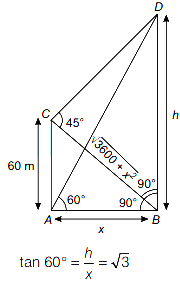
(D) Let the height of the tower be $h$ and the distance of point $A$ from the base of the tower $(B)$ be $x$.
In $\triangle ABD$,$\tan 60^{\circ} = \frac{h}{x}$ $\Rightarrow h = x \sqrt{3}$ $\Rightarrow x = \frac{h}{\sqrt{3}}$.
The person moves $60 \ m$ perpendicular to $AB$ to reach point $C$. Thus,$AC = 60 \ m$ and $\angle CAB = 90^{\circ}$.
In $\triangle ABC$,the distance from $C$ to the base $B$ is $CB = \sqrt{AC^2 + AB^2} = \sqrt{60^2 + x^2}$.
In $\triangle CBD$,the angle of elevation is $45^{\circ}$,so $\tan 45^{\circ} = \frac{h}{CB} = 1$.
Therefore,$h = CB = \sqrt{3600 + x^2} \Rightarrow h^2 = 3600 + x^2$.
Substituting $x^2 = \frac{h^2}{3}$ into the equation: $h^2 = 3600 + \frac{h^2}{3}$.
$\frac{2h^2}{3} = 3600 \Rightarrow h^2 = 1800 \times 3 = 5400$.
$h = \sqrt{5400} = \sqrt{900 \times 6} = 30 \sqrt{6} \ m$.
In $\triangle ABD$,$\tan 60^{\circ} = \frac{h}{x}$ $\Rightarrow h = x \sqrt{3}$ $\Rightarrow x = \frac{h}{\sqrt{3}}$.
The person moves $60 \ m$ perpendicular to $AB$ to reach point $C$. Thus,$AC = 60 \ m$ and $\angle CAB = 90^{\circ}$.
In $\triangle ABC$,the distance from $C$ to the base $B$ is $CB = \sqrt{AC^2 + AB^2} = \sqrt{60^2 + x^2}$.
In $\triangle CBD$,the angle of elevation is $45^{\circ}$,so $\tan 45^{\circ} = \frac{h}{CB} = 1$.
Therefore,$h = CB = \sqrt{3600 + x^2} \Rightarrow h^2 = 3600 + x^2$.
Substituting $x^2 = \frac{h^2}{3}$ into the equation: $h^2 = 3600 + \frac{h^2}{3}$.
$\frac{2h^2}{3} = 3600 \Rightarrow h^2 = 1800 \times 3 = 5400$.
$h = \sqrt{5400} = \sqrt{900 \times 6} = 30 \sqrt{6} \ m$.
0 likesView Solution
77
ChemistryMCQTS EAMCET · 2013
If $\int \frac{d x}{x(\log x-2)(\log x-3)}=I+C$,then $I$ is equal to
A
$\frac{1}{x} \log \left|\frac{\log x-3}{\log x-2}\right|$
B
$\log \left|\frac{\log x-3}{\log x-2}\right|$
C
$\log \left|\frac{\log x-2}{\log x-3}\right|$
D
$\log |(\log x-3)(\log x-2)|$
Solution
(B) Let $I_1 = \int \frac{d x}{x(\log x-2)(\log x-3)}$.
Substitute $t = \log x$,then $d t = \frac{1}{x} d x$.
The integral becomes $I_1 = \int \frac{d t}{(t-2)(t-3)}$.
Using partial fractions,$\frac{1}{(t-2)(t-3)} = \frac{A}{t-2} + \frac{B}{t-3}$.
$1 = A(t-3) + B(t-2)$.
For $t=3$,$B=1$. For $t=2$,$A=-1$.
So,$I_1 = \int \left( \frac{1}{t-3} - \frac{1}{t-2} \right) d t$.
$I_1 = \log |t-3| - \log |t-2| + C = \log \left| \frac{t-3}{t-2} \right| + C$.
Substituting $t = \log x$ back,we get $I = \log \left| \frac{\log x - 3}{\log x - 2} \right|$.
Substitute $t = \log x$,then $d t = \frac{1}{x} d x$.
The integral becomes $I_1 = \int \frac{d t}{(t-2)(t-3)}$.
Using partial fractions,$\frac{1}{(t-2)(t-3)} = \frac{A}{t-2} + \frac{B}{t-3}$.
$1 = A(t-3) + B(t-2)$.
For $t=3$,$B=1$. For $t=2$,$A=-1$.
So,$I_1 = \int \left( \frac{1}{t-3} - \frac{1}{t-2} \right) d t$.
$I_1 = \log |t-3| - \log |t-2| + C = \log \left| \frac{t-3}{t-2} \right| + C$.
Substituting $t = \log x$ back,we get $I = \log \left| \frac{\log x - 3}{\log x - 2} \right|$.
0 likesView Solution
78
ChemistryMCQTS EAMCET · 2013
$\int e^x \left( \frac{2+\sin 2x}{1+\cos 2x} \right) dx$ is equal to
A
$e^x \cot x + C$
B
$2 e^x \sec^2 x + C$
C
$e^x \cos 2x + C$
D
$e^x \tan x + C$
Solution
(D) Let $I = \int e^x \left( \frac{2+\sin 2x}{1+\cos 2x} \right) dx$.
Using the trigonometric identities $1+\cos 2x = 2\cos^2 x$ and $\sin 2x = 2\sin x \cos x$,we get:
$I = \int e^x \left( \frac{2 + 2\sin x \cos x}{2\cos^2 x} \right) dx$
$I = \int e^x \left( \frac{2}{2\cos^2 x} + \frac{2\sin x \cos x}{2\cos^2 x} \right) dx$
$I = \int e^x (\sec^2 x + \tan x) dx$.
We know the standard integral form $\int e^x (f(x) + f'(x)) dx = e^x f(x) + C$.
Here,let $f(x) = \tan x$,then $f'(x) = \sec^2 x$.
Therefore,$I = e^x \tan x + C$.
Using the trigonometric identities $1+\cos 2x = 2\cos^2 x$ and $\sin 2x = 2\sin x \cos x$,we get:
$I = \int e^x \left( \frac{2 + 2\sin x \cos x}{2\cos^2 x} \right) dx$
$I = \int e^x \left( \frac{2}{2\cos^2 x} + \frac{2\sin x \cos x}{2\cos^2 x} \right) dx$
$I = \int e^x (\sec^2 x + \tan x) dx$.
We know the standard integral form $\int e^x (f(x) + f'(x)) dx = e^x f(x) + C$.
Here,let $f(x) = \tan x$,then $f'(x) = \sec^2 x$.
Therefore,$I = e^x \tan x + C$.
0 likesView Solution
79
ChemistryMCQTS EAMCET · 2013
The two surfaces of a concave lens,made of glass of refractive index $1.5$,have the same radii of curvature $R$. It is now immersed in a medium of refractive index $1.75$. Then the lens:
A
becomes a convergent lens of focal length $3.5 R$
B
becomes a convergent lens of focal length $3.0 R$
C
changes as a divergent lens of focal length $3.5 R$
D
changes as a divergent lens of focal length $3.0 R$
Solution
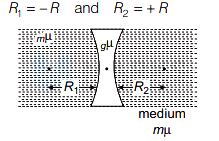
(A) From the lens maker's formula:
$\frac{1}{f} = \left( \frac{\mu_g}{\mu_m} - 1 \right) \left( \frac{1}{R_1} - \frac{1}{R_2} \right)$
Given that the refractive index of the glass lens is $\mu_g = 1.5$ and the refractive index of the medium is $\mu_m = 1.75$.
For a concave lens,the radii of curvature are $R_1 = -R$ and $R_2 = +R$.
Substituting these values into the formula:
$\frac{1}{f} = \left( \frac{1.5}{1.75} - 1 \right) \left( \frac{1}{-R} - \frac{1}{R} \right)$
$\frac{1}{f} = \left( \frac{1.5 - 1.75}{1.75} \right) \left( -\frac{2}{R} \right)$
$\frac{1}{f} = \left( \frac{-0.25}{1.75} \right) \left( -\frac{2}{R} \right)$
$\frac{1}{f} = \left( -\frac{1}{7} \right) \left( -\frac{2}{R} \right) = \frac{2}{7R}$
$f = +3.5 R$
The positive sign of the focal length indicates that the lens behaves as a convergent lens.
$\frac{1}{f} = \left( \frac{\mu_g}{\mu_m} - 1 \right) \left( \frac{1}{R_1} - \frac{1}{R_2} \right)$
Given that the refractive index of the glass lens is $\mu_g = 1.5$ and the refractive index of the medium is $\mu_m = 1.75$.
For a concave lens,the radii of curvature are $R_1 = -R$ and $R_2 = +R$.
Substituting these values into the formula:
$\frac{1}{f} = \left( \frac{1.5}{1.75} - 1 \right) \left( \frac{1}{-R} - \frac{1}{R} \right)$
$\frac{1}{f} = \left( \frac{1.5 - 1.75}{1.75} \right) \left( -\frac{2}{R} \right)$
$\frac{1}{f} = \left( \frac{-0.25}{1.75} \right) \left( -\frac{2}{R} \right)$
$\frac{1}{f} = \left( -\frac{1}{7} \right) \left( -\frac{2}{R} \right) = \frac{2}{7R}$
$f = +3.5 R$
The positive sign of the focal length indicates that the lens behaves as a convergent lens.
0 likesView Solution
80
ChemistryMCQTS EAMCET · 2013
$A$ microscope consists of an objective of focal length $1.9 \ cm$ and an eyepiece of focal length $5 \ cm$. The two lenses are kept at a distance of $10.5 \ cm$. If the image is to be formed at the least distance of distinct vision $(25 \ cm)$,the distance at which the object is to be placed before the objective is: (in $cm$)
A
$6.2$
B
$2.7$
C
$21.0$
D
$4.17$
Solution
(B) For the eyepiece,the image distance $v_e = -25 \ cm$ and focal length $f_e = 5 \ cm$. Using the lens formula $\frac{1}{v_e} - \frac{1}{u_e} = \frac{1}{f_e}$:
$\frac{1}{-25} - \frac{1}{u_e} = \frac{1}{5} \Rightarrow \frac{1}{u_e} = -\frac{1}{25} - \frac{1}{5} = -\frac{6}{25} \Rightarrow u_e = -\frac{25}{6} \ cm$.
The distance of the image formed by the objective from the objective is $v_0 = L - |u_e| = 10.5 - \frac{25}{6} = \frac{63-25}{6} = \frac{38}{6} \ cm$.
For the objective,$f_0 = 1.9 \ cm$ and $v_0 = \frac{38}{6} \ cm$. Using the lens formula $\frac{1}{v_0} - \frac{1}{u_0} = \frac{1}{f_0}$:
$\frac{1}{38/6} - \frac{1}{u_0} = \frac{1}{1.9} \Rightarrow \frac{6}{38} - \frac{1}{u_0} = \frac{10}{19} \Rightarrow \frac{3}{19} - \frac{10}{19} = \frac{1}{u_0}$.
$\frac{1}{u_0} = -\frac{7}{19} \Rightarrow u_0 = -\frac{19}{7} \approx -2.71 \ cm$.
Thus,the object should be placed at a distance of $2.7 \ cm$ from the objective.
$\frac{1}{-25} - \frac{1}{u_e} = \frac{1}{5} \Rightarrow \frac{1}{u_e} = -\frac{1}{25} - \frac{1}{5} = -\frac{6}{25} \Rightarrow u_e = -\frac{25}{6} \ cm$.
The distance of the image formed by the objective from the objective is $v_0 = L - |u_e| = 10.5 - \frac{25}{6} = \frac{63-25}{6} = \frac{38}{6} \ cm$.
For the objective,$f_0 = 1.9 \ cm$ and $v_0 = \frac{38}{6} \ cm$. Using the lens formula $\frac{1}{v_0} - \frac{1}{u_0} = \frac{1}{f_0}$:
$\frac{1}{38/6} - \frac{1}{u_0} = \frac{1}{1.9} \Rightarrow \frac{6}{38} - \frac{1}{u_0} = \frac{10}{19} \Rightarrow \frac{3}{19} - \frac{10}{19} = \frac{1}{u_0}$.
$\frac{1}{u_0} = -\frac{7}{19} \Rightarrow u_0 = -\frac{19}{7} \approx -2.71 \ cm$.
Thus,the object should be placed at a distance of $2.7 \ cm$ from the objective.
0 likesView Solution
81
ChemistryMCQTS EAMCET · 2013
Heating chloroform with aqueous sodium hydroxide solution forms
A
sodium acetate
B
sodium oxalate
C
sodium formate
D
chloral
Solution
(C) When chloroform $(CHCl_3)$ is heated with aqueous sodium hydroxide $(NaOH)$,it undergoes hydrolysis to form an unstable intermediate,methanetriol $(HC(OH)_3)$.
This intermediate loses a water molecule to form formic acid $(HCOOH)$.
Formic acid then reacts with the remaining $NaOH$ to produce sodium formate $(HCOONa)$.
The overall reaction is: $CHCl_3 + 4NaOH \rightarrow HCOONa + 3NaCl + 2H_2O$.
This intermediate loses a water molecule to form formic acid $(HCOOH)$.
Formic acid then reacts with the remaining $NaOH$ to produce sodium formate $(HCOONa)$.
The overall reaction is: $CHCl_3 + 4NaOH \rightarrow HCOONa + 3NaCl + 2H_2O$.
0 likesView Solution
82
ChemistryMCQTS EAMCET · 2013
The base current in a transistor circuit changes from $45 \mu A$ to $140 \mu A$. Accordingly,the collector current changes from $0.2 \text{ mA}$ to $4.0 \text{ mA}$. The current gain is
A
$9.5$
B
$1$
C
$40$
D
$20$
Solution
(C) The current gain $\beta$ of a transistor is defined as the ratio of the change in collector current to the change in base current: $\beta = \frac{\Delta I_C}{\Delta I_B}$.
Given:
Change in base current $\Delta I_B = 140 \mu A - 45 \mu A = 95 \mu A = 95 \times 10^{-6} \text{ A}$.
Change in collector current $\Delta I_C = 4.0 \text{ mA} - 0.2 \text{ mA} = 3.8 \text{ mA} = 3.8 \times 10^{-3} \text{ A}$.
Substituting these values into the formula:
$\beta = \frac{3.8 \times 10^{-3}}{95 \times 10^{-6}} = \frac{3800 \times 10^{-6}}{95 \times 10^{-6}} = 40$.
Therefore,the current gain is $40$.
Given:
Change in base current $\Delta I_B = 140 \mu A - 45 \mu A = 95 \mu A = 95 \times 10^{-6} \text{ A}$.
Change in collector current $\Delta I_C = 4.0 \text{ mA} - 0.2 \text{ mA} = 3.8 \text{ mA} = 3.8 \times 10^{-3} \text{ A}$.
Substituting these values into the formula:
$\beta = \frac{3.8 \times 10^{-3}}{95 \times 10^{-6}} = \frac{3800 \times 10^{-6}}{95 \times 10^{-6}} = 40$.
Therefore,the current gain is $40$.
0 likesView Solution
83
ChemistryMCQTS EAMCET · 2013
The points whose position vectors are $2i+3j+4k$,$3i+4j+2k$,and $4i+2j+3k$ are the vertices of
A
an isosceles triangle
B
a right-angled triangle
C
an equilateral triangle
D
a right-angled isosceles triangle
Solution
(C) Let the position vectors of the vertices be $\vec{a} = 2i+3j+4k$,$\vec{b} = 3i+4j+2k$,and $\vec{c} = 4i+2j+3k$.
The side vectors are:
$\vec{AB} = \vec{b} - \vec{a} = (3-2)i + (4-3)j + (2-4)k = i + j - 2k$.
$\vec{BC} = \vec{c} - \vec{b} = (4-3)i + (2-4)j + (3-2)k = i - 2j + k$.
$\vec{CA} = \vec{a} - \vec{c} = (2-4)i + (3-2)j + (4-3)k = -2i + j + k$.
The lengths of the sides are:
$|\vec{AB}| = \sqrt{1^2 + 1^2 + (-2)^2} = \sqrt{1+1+4} = \sqrt{6}$.
$|\vec{BC}| = \sqrt{1^2 + (-2)^2 + 1^2} = \sqrt{1+4+1} = \sqrt{6}$.
$|\vec{CA}| = \sqrt{(-2)^2 + 1^2 + 1^2} = \sqrt{4+1+1} = \sqrt{6}$.
Since $|\vec{AB}| = |\vec{BC}| = |\vec{CA}| = \sqrt{6}$,all three sides are equal in length.
Therefore,the triangle is an equilateral triangle.
The side vectors are:
$\vec{AB} = \vec{b} - \vec{a} = (3-2)i + (4-3)j + (2-4)k = i + j - 2k$.
$\vec{BC} = \vec{c} - \vec{b} = (4-3)i + (2-4)j + (3-2)k = i - 2j + k$.
$\vec{CA} = \vec{a} - \vec{c} = (2-4)i + (3-2)j + (4-3)k = -2i + j + k$.
The lengths of the sides are:
$|\vec{AB}| = \sqrt{1^2 + 1^2 + (-2)^2} = \sqrt{1+1+4} = \sqrt{6}$.
$|\vec{BC}| = \sqrt{1^2 + (-2)^2 + 1^2} = \sqrt{1+4+1} = \sqrt{6}$.
$|\vec{CA}| = \sqrt{(-2)^2 + 1^2 + 1^2} = \sqrt{4+1+1} = \sqrt{6}$.
Since $|\vec{AB}| = |\vec{BC}| = |\vec{CA}| = \sqrt{6}$,all three sides are equal in length.
Therefore,the triangle is an equilateral triangle.
0 likesView Solution
84
ChemistryMCQTS EAMCET · 2013
The direction ratios of the two lines $AB$ and $AC$ are $1, -1, -1$ and $2, -1, 1$. The direction ratios of the normal to the plane $ABC$ are
A
$2, 3, -1$
B
$2, 2, 1$
C
$3, 2, -1$
D
$-1, 2, 3$
Solution
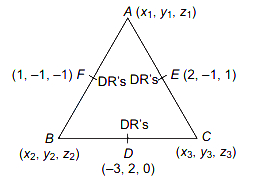
(A) Let the direction ratios of the two lines $AB$ and $AC$ be $\vec{v_1} = \langle 1, -1, -1 \rangle$ and $\vec{v_2} = \langle 2, -1, 1 \rangle$ respectively.
Since the lines $AB$ and $AC$ lie in the plane $ABC$,the normal vector $\vec{n}$ to the plane is given by the cross product of the vectors along these lines:
$\vec{n} = \vec{v_1} \times \vec{v_2} = \begin{vmatrix} \hat{i} & \hat{j} & \hat{k} \\ 1 & -1 & -1 \\ 2 & -1 & 1 \end{vmatrix}$
$\vec{n} = \hat{i}(-1 - 1) - \hat{j}(1 - (-2)) + \hat{k}(-1 - (-2))$
$\vec{n} = \hat{i}(-2) - \hat{j}(3) + \hat{k}(1)$
$\vec{n} = -2\hat{i} - 3\hat{j} + \hat{k}$
Thus,the direction ratios of the normal are $\langle -2, -3, 1 \rangle$. Multiplying by $-1$,we get $\langle 2, 3, -1 \rangle$.
Therefore,the correct option is $A$.
Since the lines $AB$ and $AC$ lie in the plane $ABC$,the normal vector $\vec{n}$ to the plane is given by the cross product of the vectors along these lines:
$\vec{n} = \vec{v_1} \times \vec{v_2} = \begin{vmatrix} \hat{i} & \hat{j} & \hat{k} \\ 1 & -1 & -1 \\ 2 & -1 & 1 \end{vmatrix}$
$\vec{n} = \hat{i}(-1 - 1) - \hat{j}(1 - (-2)) + \hat{k}(-1 - (-2))$
$\vec{n} = \hat{i}(-2) - \hat{j}(3) + \hat{k}(1)$
$\vec{n} = -2\hat{i} - 3\hat{j} + \hat{k}$
Thus,the direction ratios of the normal are $\langle -2, -3, 1 \rangle$. Multiplying by $-1$,we get $\langle 2, 3, -1 \rangle$.
Therefore,the correct option is $A$.
0 likesView Solution
85
ChemistryMCQTS EAMCET · 2013
$A$ plane passing through $(-1, 2, 3)$ and whose normal makes equal angles with the coordinate axes is
A
$x+y+z+4=0$
B
$x-y+z+4=0$
C
$x+y+z-4=0$
D
$x+y+z=0$
Solution
(C) The equation of a plane passing through the point $(x_0, y_0, z_0)$ with normal vector $\vec{n} = \langle a, b, c \rangle$ is given by $a(x-x_0) + b(y-y_0) + c(z-z_0) = 0$.
Given the point is $(-1, 2, 3)$,the equation is $a(x+1) + b(y-2) + c(z-3) = 0$.
The normal makes equal angles $\alpha$ with the coordinate axes,so the direction cosines are $\cos \alpha, \cos \alpha, \cos \alpha$.
Since $\cos^2 \alpha + \cos^2 \alpha + \cos^2 \alpha = 1$,we have $3 \cos^2 \alpha = 1$,which implies $\cos \alpha = \pm \frac{1}{\sqrt{3}}$.
Thus,the direction ratios $\langle a, b, c \rangle$ can be taken as $\langle 1, 1, 1 \rangle$.
Substituting these into the plane equation: $1(x+1) + 1(y-2) + 1(z-3) = 0$.
Simplifying,we get $x + 1 + y - 2 + z - 3 = 0$,which results in $x + y + z - 4 = 0$.
Given the point is $(-1, 2, 3)$,the equation is $a(x+1) + b(y-2) + c(z-3) = 0$.
The normal makes equal angles $\alpha$ with the coordinate axes,so the direction cosines are $\cos \alpha, \cos \alpha, \cos \alpha$.
Since $\cos^2 \alpha + \cos^2 \alpha + \cos^2 \alpha = 1$,we have $3 \cos^2 \alpha = 1$,which implies $\cos \alpha = \pm \frac{1}{\sqrt{3}}$.
Thus,the direction ratios $\langle a, b, c \rangle$ can be taken as $\langle 1, 1, 1 \rangle$.
Substituting these into the plane equation: $1(x+1) + 1(y-2) + 1(z-3) = 0$.
Simplifying,we get $x + 1 + y - 2 + z - 3 = 0$,which results in $x + y + z - 4 = 0$.
0 likesView Solution
86
ChemistryMCQTS EAMCET · 2013
$A$ variable plane passes through a fixed point $(1, 2, 3)$. The foot of the perpendicular from the origin to the plane lies on:
A
a circle
B
a sphere
C
an ellipse
D
a parabola
Solution
(B) Let the equation of the variable plane be $a(x - 1) + b(y - 2) + c(z - 3) = 0$,where $(a, b, c)$ are the direction ratios of the normal to the plane.
Let $P(x_0, y_0, z_0)$ be the foot of the perpendicular from the origin $(0, 0, 0)$ to the plane.
The vector $\vec{OP} = (x_0, y_0, z_0)$ is perpendicular to the plane,so it is parallel to the normal vector $(a, b, c)$.
Thus,we can write $(a, b, c) = k(x_0, y_0, z_0)$ for some constant $k$.
Since $P$ lies on the plane,it satisfies the equation: $x_0(x_0 - 1) + y_0(y_0 - 2) + z_0(z_0 - 3) = 0$.
This simplifies to $x_0^2 - x_0 + y_0^2 - 2y_0 + z_0^2 - 3z_0 = 0$.
Rearranging the terms,we get $(x_0^2 - x_0 + \frac{1}{4}) + (y_0^2 - 2y_0 + 1) + (z_0^2 - 3z_0 + \frac{9}{4}) = \frac{1}{4} + 1 + \frac{9}{4} = \frac{14}{4} = 3.5$.
This is the equation of a sphere with center $(\frac{1}{2}, 1, \frac{3}{2})$ and radius $\sqrt{3.5}$.
Let $P(x_0, y_0, z_0)$ be the foot of the perpendicular from the origin $(0, 0, 0)$ to the plane.
The vector $\vec{OP} = (x_0, y_0, z_0)$ is perpendicular to the plane,so it is parallel to the normal vector $(a, b, c)$.
Thus,we can write $(a, b, c) = k(x_0, y_0, z_0)$ for some constant $k$.
Since $P$ lies on the plane,it satisfies the equation: $x_0(x_0 - 1) + y_0(y_0 - 2) + z_0(z_0 - 3) = 0$.
This simplifies to $x_0^2 - x_0 + y_0^2 - 2y_0 + z_0^2 - 3z_0 = 0$.
Rearranging the terms,we get $(x_0^2 - x_0 + \frac{1}{4}) + (y_0^2 - 2y_0 + 1) + (z_0^2 - 3z_0 + \frac{9}{4}) = \frac{1}{4} + 1 + \frac{9}{4} = \frac{14}{4} = 3.5$.
This is the equation of a sphere with center $(\frac{1}{2}, 1, \frac{3}{2})$ and radius $\sqrt{3.5}$.
0 likesView Solution
87
ChemistryMCQTS EAMCET · 2013
Two numbers are chosen at random from $\{1, 2, 3, 4, 5, 6, 7, 8\}$ at a time. The probability that the smaller of the two numbers is less than $4$ is
A
$\frac{7}{14}$
B
$\frac{8}{14}$
C
$\frac{9}{14}$
D
$\frac{10}{14}$
Solution
(C) Total number of ways to choose $2$ numbers from $8$ is ${}^8C_2 = \frac{8 \times 7}{2} = 28$.
Let the two numbers be $x$ and $y$ such that $x < y$. We want the smaller number $x$ to be less than $4$,i.e.,$x \in \{1, 2, 3\}$.
Case $I$: If $x = 1$,then $y$ can be any of the remaining $7$ numbers $\{2, 3, 4, 5, 6, 7, 8\}$. Number of ways $= 7$.
Case $II$: If $x = 2$,then $y$ can be any of the remaining $6$ numbers $\{3, 4, 5, 6, 7, 8\}$. Number of ways $= 6$.
Case $III$: If $x = 3$,then $y$ can be any of the remaining $5$ numbers $\{4, 5, 6, 7, 8\}$. Number of ways $= 5$.
Total favorable cases $= 7 + 6 + 5 = 18$.
Required probability $= \frac{18}{28} = \frac{9}{14}$.
Let the two numbers be $x$ and $y$ such that $x < y$. We want the smaller number $x$ to be less than $4$,i.e.,$x \in \{1, 2, 3\}$.
Case $I$: If $x = 1$,then $y$ can be any of the remaining $7$ numbers $\{2, 3, 4, 5, 6, 7, 8\}$. Number of ways $= 7$.
Case $II$: If $x = 2$,then $y$ can be any of the remaining $6$ numbers $\{3, 4, 5, 6, 7, 8\}$. Number of ways $= 6$.
Case $III$: If $x = 3$,then $y$ can be any of the remaining $5$ numbers $\{4, 5, 6, 7, 8\}$. Number of ways $= 5$.
Total favorable cases $= 7 + 6 + 5 = 18$.
Required probability $= \frac{18}{28} = \frac{9}{14}$.
0 likesView Solution
88
ChemistryMCQTS EAMCET · 2013
Two fair dice are rolled. The probability of the sum of digits on their faces being greater than or equal to $10$ is
A
$\frac{1}{5}$
B
$\frac{1}{4}$
C
$\frac{1}{8}$
D
$\frac{1}{6}$
Solution
(D) Total sample points,$n(S) = 6 \times 6 = 36$.
Favourable events for sum $\ge 10$ are:
$E = [(4,6), (5,5), (5,6), (6,4), (6,5), (6,6)]$.
Total number of favourable events,$n(E) = 6$.
Required probability $P(E) = \frac{n(E)}{n(S)} = \frac{6}{36} = \frac{1}{6}$.
Favourable events for sum $\ge 10$ are:
$E = [(4,6), (5,5), (5,6), (6,4), (6,5), (6,6)]$.
Total number of favourable events,$n(E) = 6$.
Required probability $P(E) = \frac{n(E)}{n(S)} = \frac{6}{36} = \frac{1}{6}$.
0 likesView Solution
89
ChemistryMCQTS EAMCET · 2013
$A$ bag contains $2n+1$ coins. It is known that $n$ of these coins have a head on both sides,whereas the remaining $n+1$ coins are fair. $A$ coin is picked up at random from the bag and tossed. If the probability that the toss results in a head is $\frac{31}{42}$,then $n$ is equal to
A
$10$
B
$11$
C
$12$
D
$13$
Solution
(A) Let $H$ be the event that the toss results in a head. The bag contains $2n+1$ coins in total.
There are $n$ coins with heads on both sides (biased) and $n+1$ fair coins.
The probability of picking a biased coin is $P(B) = \frac{n}{2n+1}$ and the probability of picking a fair coin is $P(F) = \frac{n+1}{2n+1}$.
If a biased coin is picked,the probability of getting a head is $1$.
If a fair coin is picked,the probability of getting a head is $\frac{1}{2}$.
Using the law of total probability:
$P(H) = P(H|B)P(B) + P(H|F)P(F)$
$\frac{31}{42} = (1) \times \frac{n}{2n+1} + \left(\frac{1}{2}\right) \times \frac{n+1}{2n+1}$
$\frac{31}{42} = \frac{2n + n + 1}{2(2n+1)} = \frac{3n+1}{4n+2}$
$31(4n+2) = 42(3n+1)$
$124n + 62 = 126n + 42$
$20 = 2n$
$n = 10$
There are $n$ coins with heads on both sides (biased) and $n+1$ fair coins.
The probability of picking a biased coin is $P(B) = \frac{n}{2n+1}$ and the probability of picking a fair coin is $P(F) = \frac{n+1}{2n+1}$.
If a biased coin is picked,the probability of getting a head is $1$.
If a fair coin is picked,the probability of getting a head is $\frac{1}{2}$.
Using the law of total probability:
$P(H) = P(H|B)P(B) + P(H|F)P(F)$
$\frac{31}{42} = (1) \times \frac{n}{2n+1} + \left(\frac{1}{2}\right) \times \frac{n+1}{2n+1}$
$\frac{31}{42} = \frac{2n + n + 1}{2(2n+1)} = \frac{3n+1}{4n+2}$
$31(4n+2) = 42(3n+1)$
$124n + 62 = 126n + 42$
$20 = 2n$
$n = 10$
0 likesView Solution
90
ChemistryMCQTS EAMCET · 2013
The number of octahedral and tetrahedral holes respectively present in a hexagonal close packed $(hcp)$ crystal of '$X$' atoms are
A
$X, 2X$
B
$X, X$
C
$2X, X$
D
$2X, 2X$
Solution
(A) In a close packed structure ($hcp$ or $ccp$):
$(i)$ The number of octahedral voids is equal to the number of particles $(N)$ present in the close packing.
(ii) The number of tetrahedral voids is equal to $2 \times N$,where $N$ is the number of particles.
Given that there are '$X$' atoms,the number of octahedral voids is '$X$' and the number of tetrahedral voids is '$2X$'.
Therefore,the correct option is $A$.
$(i)$ The number of octahedral voids is equal to the number of particles $(N)$ present in the close packing.
(ii) The number of tetrahedral voids is equal to $2 \times N$,where $N$ is the number of particles.
Given that there are '$X$' atoms,the number of octahedral voids is '$X$' and the number of tetrahedral voids is '$2X$'.
Therefore,the correct option is $A$.
0 likesView Solution
91
ChemistryMCQTS EAMCET · 2013
The vapour pressure in $mm$ of $Hg$,of an aqueous solution obtained by adding $18 \ g$ of glucose $(C_6H_{12}O_6)$ to $180 \ g$ of water at $100^{\circ} C$ is
A
$7.60$
B
$76.0$
C
$759$
D
$752.4$
Solution
(D) According to Raoult's law,the relative lowering of vapour pressure is given by: $\frac{p^{\circ} - p_s}{p^{\circ}} = \frac{n_2}{n_1 + n_2}$
where,$p^{\circ} = \text{vapour pressure of pure water at } 100^{\circ} C = 760 \ mmHg$.
$p_s = \text{vapour pressure of solution at } 100^{\circ} C$.
$n_2 = \text{moles of glucose} = \frac{18}{180} = 0.1 \ mol$.
$n_1 = \text{moles of water} = \frac{180}{18} = 10 \ mol$.
Substituting these values: $\frac{760 - p_s}{760} = \frac{0.1}{10 + 0.1} = \frac{0.1}{10.1}$.
$760 - p_s = 760 \times \frac{0.1}{10.1} = \frac{76}{10.1} \approx 7.524 \ mmHg$.
$p_s = 760 - 7.524 = 752.476 \ mmHg \approx 752.4 \ mmHg$.
where,$p^{\circ} = \text{vapour pressure of pure water at } 100^{\circ} C = 760 \ mmHg$.
$p_s = \text{vapour pressure of solution at } 100^{\circ} C$.
$n_2 = \text{moles of glucose} = \frac{18}{180} = 0.1 \ mol$.
$n_1 = \text{moles of water} = \frac{180}{18} = 10 \ mol$.
Substituting these values: $\frac{760 - p_s}{760} = \frac{0.1}{10 + 0.1} = \frac{0.1}{10.1}$.
$760 - p_s = 760 \times \frac{0.1}{10.1} = \frac{76}{10.1} \approx 7.524 \ mmHg$.
$p_s = 760 - 7.524 = 752.476 \ mmHg \approx 752.4 \ mmHg$.
0 likesView Solution
92
ChemistryMCQTS EAMCET · 2013
The degree of ionization of $0.10 \ M$ lactic acid is $4.0 \ \%$. The value of $K_a$ is
A
$1.66 \times 10^{-5}$
B
$1.66 \times 10^{-4}$
C
$1.66 \times 10^{-3}$
D
$1.66 \times 10^{-2}$
Solution
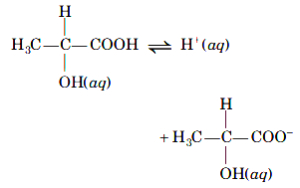
(B) Given: Concentration $(C) = 0.10 \ M$,Degree of ionization $(\alpha) = 4.0 \ \% = 0.04$.
For the dissociation of lactic acid: $CH_3CH(OH)COOH \rightleftharpoons CH_3CH(OH)COO^{-} + H^{+}$.
The equilibrium constant $K_a$ is given by the expression: $K_a = \frac{C\alpha^2}{1-\alpha}$.
Substituting the values: $K_a = \frac{0.1 \times (0.04)^2}{1 - 0.04}$.
$K_a = \frac{0.1 \times 0.0016}{0.96} = \frac{0.00016}{0.96} = \frac{1.6 \times 10^{-4}}{0.96} \approx 1.66 \times 10^{-4}$.
For the dissociation of lactic acid: $CH_3CH(OH)COOH \rightleftharpoons CH_3CH(OH)COO^{-} + H^{+}$.
The equilibrium constant $K_a$ is given by the expression: $K_a = \frac{C\alpha^2}{1-\alpha}$.
Substituting the values: $K_a = \frac{0.1 \times (0.04)^2}{1 - 0.04}$.
$K_a = \frac{0.1 \times 0.0016}{0.96} = \frac{0.00016}{0.96} = \frac{1.6 \times 10^{-4}}{0.96} \approx 1.66 \times 10^{-4}$.
0 likesView Solution
93
ChemistryMCQTS EAMCET · 2013
Which one of the following is an isotonic pair of solutions?
A
$0.15 \ M \ NaCl$ and $0.1 \ M \ Na_2SO_4$
B
$0.2 \ M$ Urea and $0.1 \ M$ Sugar
C
$0.1 \ M \ BaCl_2$ and $0.2 \ M$ Urea
D
$0.4 \ M \ MgSO_4$ and $0.1 \ M \ NH_4Cl$
Solution
(A) Two solutions are isotonic if they have the same molar concentration of particles (osmolarity).
For $0.15 \ M \ NaCl$: $NaCl$ dissociates into $2$ ions ($Na^+$ and $Cl^-$). The concentration of particles $= 0.15 \times 2 = 0.30 \ M$.
For $0.1 \ M \ Na_2SO_4$: $Na_2SO_4$ dissociates into $3$ ions ($2Na^+$ and $SO_4^{2-}$). The concentration of particles $= 0.1 \times 3 = 0.30 \ M$.
Since both solutions have the same concentration of particles,they are isotonic.
For $0.15 \ M \ NaCl$: $NaCl$ dissociates into $2$ ions ($Na^+$ and $Cl^-$). The concentration of particles $= 0.15 \times 2 = 0.30 \ M$.
For $0.1 \ M \ Na_2SO_4$: $Na_2SO_4$ dissociates into $3$ ions ($2Na^+$ and $SO_4^{2-}$). The concentration of particles $= 0.1 \times 3 = 0.30 \ M$.
Since both solutions have the same concentration of particles,they are isotonic.
0 likesView Solution
94
ChemistryMCQTS EAMCET · 2013
At $T \text{ K}$,the ratio of kinetic energies of $4 \text{ g}$ of $H_{2(g)}$ and $8 \text{ g}$ of $O_{2(g)}$ is
A
$1: 4$
B
$4: 1$
C
$2: 1$
D
$8: 1$
Solution
(D) The kinetic energy $(KE)$ of $n$ moles of an ideal gas at temperature $T$ is given by $KE = n \times \frac{3}{2} RT$.
For $4 \text{ g}$ of $H_2$: Moles $n_1 = \frac{4 \text{ g}}{2 \text{ g/mol}} = 2 \text{ mol}$.
$KE_{H_2} = 2 \times \frac{3}{2} RT = 3RT$.
For $8 \text{ g}$ of $O_2$: Moles $n_2 = \frac{8 \text{ g}}{32 \text{ g/mol}} = 0.25 \text{ mol} = \frac{1}{4} \text{ mol}$.
$KE_{O_2} = \frac{1}{4} \times \frac{3}{2} RT = \frac{3}{8} RT$.
Ratio $KE_{H_2} : KE_{O_2} = 3RT : \frac{3}{8} RT = 1 : \frac{1}{8} = 8 : 1$.
For $4 \text{ g}$ of $H_2$: Moles $n_1 = \frac{4 \text{ g}}{2 \text{ g/mol}} = 2 \text{ mol}$.
$KE_{H_2} = 2 \times \frac{3}{2} RT = 3RT$.
For $8 \text{ g}$ of $O_2$: Moles $n_2 = \frac{8 \text{ g}}{32 \text{ g/mol}} = 0.25 \text{ mol} = \frac{1}{4} \text{ mol}$.
$KE_{O_2} = \frac{1}{4} \times \frac{3}{2} RT = \frac{3}{8} RT$.
Ratio $KE_{H_2} : KE_{O_2} = 3RT : \frac{3}{8} RT = 1 : \frac{1}{8} = 8 : 1$.
0 likesView Solution
95
ChemistryMCQTS EAMCET · 2013
The basis of the quantum mechanical model of an atom is
A
angular momentum of electron
B
quantum numbers
C
dual nature of electron
D
black body radiation
Solution
(C) The quantum or wave mechanical model of an atom is based upon the dual nature of the electron,i.e.,the electron exhibits both particle and wave-like properties.
This model incorporates the de Broglie hypothesis regarding the wave nature of matter and the Heisenberg uncertainty principle.
This model incorporates the de Broglie hypothesis regarding the wave nature of matter and the Heisenberg uncertainty principle.
0 likesView Solution
96
ChemistryMCQTS EAMCET · 2013
The number of radial nodes of $3s$ and $2p$ orbitals respectively are
A
$0, 2$
B
$2, 0$
C
$1, 2$
D
$2, 1$
Solution
(B) The number of radial nodes in an orbital is given by the formula: $n - l - 1$.
For the $3s$ orbital:
$n = 3$,$l = 0$.
Number of radial nodes $= 3 - 0 - 1 = 2$.
For the $2p$ orbital:
$n = 2$,$l = 1$.
Number of radial nodes $= 2 - 1 - 1 = 0$.
Thus,the number of radial nodes for $3s$ and $2p$ orbitals are $2$ and $0$ respectively.
For the $3s$ orbital:
$n = 3$,$l = 0$.
Number of radial nodes $= 3 - 0 - 1 = 2$.
For the $2p$ orbital:
$n = 2$,$l = 1$.
Number of radial nodes $= 2 - 1 - 1 = 0$.
Thus,the number of radial nodes for $3s$ and $2p$ orbitals are $2$ and $0$ respectively.
0 likesView Solution
97
ChemistryMCQTS EAMCET · 2013
Two bodies $A$ and $B$ of equal surface area have thermal emissivities of $0.01$ and $0.81$ respectively. The two bodies are radiating energy at the same rate. Maximum energy is radiated from the two bodies $A$ and $B$ at wavelengths $\lambda_A$ and $\lambda_B$ respectively. The difference in these two wavelengths is $1 \mu m$. If the temperature of the body $A$ is $5802 \ K$,then the value of $\lambda_B$ is:
A
$\frac{1}{2} \mu m$
B
$1 \mu m$
C
$2 \mu m$
D
$\frac{3}{2} \mu m$
Solution
(D) According to Stefan-Boltzmann law,the rate of energy radiation is $E = e A \sigma T^4$. Since the surface areas $A$ and the rates of energy radiation $E$ are equal for both bodies,we have $e_A T_A^4 = e_B T_B^4$.
Given $e_A = 0.01$,$e_B = 0.81$,and $T_A = 5802 \ K$,we get:
$T_B^4 = \frac{e_A}{e_B} T_A^4 = \frac{0.01}{0.81} (5802)^4 = \frac{1}{81} (5802)^4$.
Taking the fourth root,$T_B = \frac{5802}{3} = 1934 \ K$.
According to Wien's displacement law,$\lambda_A T_A = \lambda_B T_B = b$ (constant).
Thus,$\lambda_A = \lambda_B \frac{T_B}{T_A} = \lambda_B \frac{1934}{5802} = \frac{\lambda_B}{3}$.
Given the difference $\lambda_B - \lambda_A = 1 \mu m$,we substitute $\lambda_A$:
$\lambda_B - \frac{\lambda_B}{3} = 1 \mu m \Rightarrow \frac{2}{3} \lambda_B = 1 \mu m$.
Therefore,$\lambda_B = \frac{3}{2} \mu m$.
Given $e_A = 0.01$,$e_B = 0.81$,and $T_A = 5802 \ K$,we get:
$T_B^4 = \frac{e_A}{e_B} T_A^4 = \frac{0.01}{0.81} (5802)^4 = \frac{1}{81} (5802)^4$.
Taking the fourth root,$T_B = \frac{5802}{3} = 1934 \ K$.
According to Wien's displacement law,$\lambda_A T_A = \lambda_B T_B = b$ (constant).
Thus,$\lambda_A = \lambda_B \frac{T_B}{T_A} = \lambda_B \frac{1934}{5802} = \frac{\lambda_B}{3}$.
Given the difference $\lambda_B - \lambda_A = 1 \mu m$,we substitute $\lambda_A$:
$\lambda_B - \frac{\lambda_B}{3} = 1 \mu m \Rightarrow \frac{2}{3} \lambda_B = 1 \mu m$.
Therefore,$\lambda_B = \frac{3}{2} \mu m$.
0 likesView Solution
98
ChemistryMCQTS EAMCET · 2013
On a temperature scale $Y$,water freezes at $-160^{\circ} Y$ and boils at $-50^{\circ} Y$. On this $Y$ scale,a temperature of $340 \ K$ is (in $^{\circ} Y$)
A
$-160.3$
B
$-96.3$
C
$-86.3$
D
$-76.3$
Solution
(C) The relationship between any temperature scale $X$ and the Kelvin scale $K$ is given by the formula: $\frac{X - X_{freezing}}{X_{boiling} - X_{freezing}} = \frac{K - 273}{373 - 273}$.
Given for scale $Y$: $Y_{freezing} = -160^{\circ} Y$ and $Y_{boiling} = -50^{\circ} Y$.
Substituting these values into the formula for $K = 340 \ K$:
$\frac{Y - (-160)}{-50 - (-160)} = \frac{340 - 273}{373 - 273}$
$\frac{Y + 160}{110} = \frac{67}{100}$
$Y + 160 = \frac{67 \times 110}{100}$
$Y + 160 = 73.7$
$Y = 73.7 - 160 = -86.3^{\circ} Y$.
Given for scale $Y$: $Y_{freezing} = -160^{\circ} Y$ and $Y_{boiling} = -50^{\circ} Y$.
Substituting these values into the formula for $K = 340 \ K$:
$\frac{Y - (-160)}{-50 - (-160)} = \frac{340 - 273}{373 - 273}$
$\frac{Y + 160}{110} = \frac{67}{100}$
$Y + 160 = \frac{67 \times 110}{100}$
$Y + 160 = 73.7$
$Y = 73.7 - 160 = -86.3^{\circ} Y$.
0 likesView Solution
99
ChemistryMCQTS EAMCET · 2013
Efficiency of a heat engine whose sink is at a temperature of $300 ~K$ is $40 \%$. To increase the efficiency to $60 \%$,keeping the sink temperature constant,the source temperature must be increased by (in $~K$)
A
$750$
B
$500$
C
$250$
D
$1000$
Solution
(C) The efficiency $\eta$ of a Carnot engine is given by $\eta = 1 - \frac{T_2}{T_1}$,where $T_1$ is the source temperature and $T_2$ is the sink temperature.
Given $\eta_1 = 40 \% = 0.4$ and $T_2 = 300 ~K$:
$0.4 = 1 - \frac{300}{T_1} \Rightarrow \frac{300}{T_1} = 0.6 \Rightarrow T_1 = \frac{300}{0.6} = 500 ~K$.
Now,to increase the efficiency to $\eta_2 = 60 \% = 0.6$ with the same sink temperature $T_2 = 300 ~K$:
$0.6 = 1 - \frac{300}{T_1^{\prime}} \Rightarrow \frac{300}{T_1^{\prime}} = 0.4 \Rightarrow T_1^{\prime} = \frac{300}{0.4} = 750 ~K$.
The increase in source temperature is $\Delta T = T_1^{\prime} - T_1 = 750 ~K - 500 ~K = 250 ~K$.
Given $\eta_1 = 40 \% = 0.4$ and $T_2 = 300 ~K$:
$0.4 = 1 - \frac{300}{T_1} \Rightarrow \frac{300}{T_1} = 0.6 \Rightarrow T_1 = \frac{300}{0.6} = 500 ~K$.
Now,to increase the efficiency to $\eta_2 = 60 \% = 0.6$ with the same sink temperature $T_2 = 300 ~K$:
$0.6 = 1 - \frac{300}{T_1^{\prime}} \Rightarrow \frac{300}{T_1^{\prime}} = 0.4 \Rightarrow T_1^{\prime} = \frac{300}{0.4} = 750 ~K$.
The increase in source temperature is $\Delta T = T_1^{\prime} - T_1 = 750 ~K - 500 ~K = 250 ~K$.
0 likesView Solution
100
ChemistryMCQTS EAMCET · 2013
Three moles of an ideal monoatomic gas undergo a cyclic process as shown in the figure. The temperatures of the gas in different states marked as $1, 2, 3$ and $4$ are $400 \ K, 700 \ K, 2500 \ K$ and $1100 \ K$ respectively. The work done by the gas during the process $1-2-3-4-1$ is (universal gas constant is $R$): (in $R$)
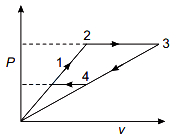
A
$1650$
B
$550$
C
$1100$
D
$2200$
Solution
(A) The work done by the gas in a cyclic process on a $P-V$ diagram is equal to the area enclosed by the cycle.
For the given process $1-2-3-4-1$, the area is the area of the trapezoid formed by the points $(P_2, V_2), (P_2, V_3), (P_1, V_4), (P_1, V_1)$.
Since the lines $1-2$ and $3-4$ pass through the origin, they represent processes where $P \propto V$, meaning $P/V = \text{constant}$.
Using the ideal gas equation $PV = nRT$, we have $P = (nR/V)T$. Since $P/V$ is constant, $T/V^2$ is constant.
However, it is simpler to calculate the work done as the sum of work in individual processes:
$W_{1-2} = 0$ (since it is a line through the origin, $P/V = k$, so $W = \int P dV = \int kV dV = \frac{k}{2}(V_2^2 - V_1^2) = \frac{1}{2}(P_2 V_2 - P_1 V_1) = \frac{nR}{2}(T_2 - T_1)$).
$W_{2-3} = P_2(V_3 - V_2) = nR(T_3 - T_2)$.
$W_{3-4} = 0$ (similar to $1-2$, $W = \frac{nR}{2}(T_4 - T_3)$).
$W_{4-1} = P_1(V_1 - V_4) = nR(T_1 - T_4)$.
Total Work $W = W_{1-2} + W_{2-3} + W_{3-4} + W_{4-1} = \frac{nR}{2}(T_2 - T_1) + nR(T_3 - T_2) + \frac{nR}{2}(T_4 - T_3) + nR(T_1 - T_4)$.
$W = nR [ \frac{1}{2}T_2 - \frac{1}{2}T_1 + T_3 - T_2 + \frac{1}{2}T_4 - \frac{1}{2}T_3 + T_1 - T_4 ]$.
$W = nR [ \frac{1}{2}T_1 - \frac{1}{2}T_2 + \frac{1}{2}T_3 - \frac{1}{2}T_4 ] = \frac{nR}{2} (T_1 - T_2 + T_3 - T_4)$.
Given $n = 3, T_1 = 400 \ K, T_2 = 700 \ K, T_3 = 2500 \ K, T_4 = 1100 \ K$.
$W = \frac{3R}{2} (400 - 700 + 2500 - 1100) = \frac{3R}{2} (1100) = 1650 R$.
For the given process $1-2-3-4-1$, the area is the area of the trapezoid formed by the points $(P_2, V_2), (P_2, V_3), (P_1, V_4), (P_1, V_1)$.
Since the lines $1-2$ and $3-4$ pass through the origin, they represent processes where $P \propto V$, meaning $P/V = \text{constant}$.
Using the ideal gas equation $PV = nRT$, we have $P = (nR/V)T$. Since $P/V$ is constant, $T/V^2$ is constant.
However, it is simpler to calculate the work done as the sum of work in individual processes:
$W_{1-2} = 0$ (since it is a line through the origin, $P/V = k$, so $W = \int P dV = \int kV dV = \frac{k}{2}(V_2^2 - V_1^2) = \frac{1}{2}(P_2 V_2 - P_1 V_1) = \frac{nR}{2}(T_2 - T_1)$).
$W_{2-3} = P_2(V_3 - V_2) = nR(T_3 - T_2)$.
$W_{3-4} = 0$ (similar to $1-2$, $W = \frac{nR}{2}(T_4 - T_3)$).
$W_{4-1} = P_1(V_1 - V_4) = nR(T_1 - T_4)$.
Total Work $W = W_{1-2} + W_{2-3} + W_{3-4} + W_{4-1} = \frac{nR}{2}(T_2 - T_1) + nR(T_3 - T_2) + \frac{nR}{2}(T_4 - T_3) + nR(T_1 - T_4)$.
$W = nR [ \frac{1}{2}T_2 - \frac{1}{2}T_1 + T_3 - T_2 + \frac{1}{2}T_4 - \frac{1}{2}T_3 + T_1 - T_4 ]$.
$W = nR [ \frac{1}{2}T_1 - \frac{1}{2}T_2 + \frac{1}{2}T_3 - \frac{1}{2}T_4 ] = \frac{nR}{2} (T_1 - T_2 + T_3 - T_4)$.
Given $n = 3, T_1 = 400 \ K, T_2 = 700 \ K, T_3 = 2500 \ K, T_4 = 1100 \ K$.
$W = \frac{3R}{2} (400 - 700 + 2500 - 1100) = \frac{3R}{2} (1100) = 1650 R$.
0 likesView Solution
Vedclass Products
For Students
Vedclass Test Series
Mock tests in real TS EAMCET style covering Chemistry with performance analysis. 5-day free trial.
Start Free TrialFor Teachers
Exam Paper Generator
Generate Set A/B/C/D Chemistry papers from 7.5L+ questions in 2 minutes. 3 chapters free.
Try FreeFor Institutes
Online Exam Module
Run live TS EAMCET mock exams with unlimited students, 360° analytics & white-label branding.
See DemoFrequently Asked Questions
How many Chemistry questions are in TS EAMCET 2013?
There are 194 Chemistry questions from the TS EAMCET 2013 paper on Vedclass, each with a detailed step-by-step solution in English.
Are TS EAMCET 2013 Chemistry solutions available in English?
Yes. All solutions on this page are in English. You can also switch to English or Hindi using the language buttons above the questions.
Can I practice TS EAMCET 2013 Chemistry as a timed test?
Yes. Use the Vedclass Test Series to attempt a full TS EAMCET mock test covering Chemistry with time limits and instant score analysis.
Can teachers create Chemistry papers from TS EAMCET previous year questions?
Yes. The Vedclass Exam Paper Generator lets teachers mix TS EAMCET Chemistry questions and generate Set A/B/C/D papers in minutes.
For Teachers & Institutes
Build a Custom Chemistry Paper
Pick TS EAMCET 2013 Chemistry questions, set difficulty, and generate Set A/B/C/D in 2 minutes.