
ChemistryQ51–100 of 183 questions
Page 2 of 4 · English
51
ChemistryMCQTS EAMCET · 2004
For $x \in \mathbb{R}$,the range of $3 \cos (4x - 5) + 4$ lies in the interval
A
$[1, 7]$
B
$[4, 7]$
C
$[0, 7]$
D
$[2, 7]$
Solution
(A) We know that the range of the cosine function is $[-1, 1]$.
Thus,$-1 \leq \cos(4x - 5) \leq 1$.
Multiplying the inequality by $3$,we get:
$-3 \leq 3 \cos(4x - 5) \leq 3$.
Adding $4$ to all sides of the inequality:
$-3 + 4 \leq 3 \cos(4x - 5) + 4 \leq 3 + 4$.
Therefore,$1 \leq 3 \cos(4x - 5) + 4 \leq 7$.
Hence,the expression lies in the interval $[1, 7]$.
Thus,$-1 \leq \cos(4x - 5) \leq 1$.
Multiplying the inequality by $3$,we get:
$-3 \leq 3 \cos(4x - 5) \leq 3$.
Adding $4$ to all sides of the inequality:
$-3 + 4 \leq 3 \cos(4x - 5) + 4 \leq 3 + 4$.
Therefore,$1 \leq 3 \cos(4x - 5) + 4 \leq 7$.
Hence,the expression lies in the interval $[1, 7]$.
0 likesView Solution
52
ChemistryMCQTS EAMCET · 2004
If the distance between the points $(a \cos \theta, a \sin \theta)$ and $(a \cos \phi, a \sin \phi)$ is $2a$,then $\theta$ is equal to
A
$2n\pi \pm \pi + \phi, n \in Z$
B
$n\pi + \frac{\pi}{2} + \phi, n \in Z$
C
$n\pi - \phi, n \in Z$
D
$2n\pi + \phi, n \in Z$
Solution
(A) Let the points be $A = (a \cos \theta, a \sin \theta)$ and $B = (a \cos \phi, a \sin \phi)$.
Given the distance $AB = 2a$.
Using the distance formula:
$AB^2 = (a \cos \theta - a \cos \phi)^2 + (a \sin \theta - a \sin \phi)^2 = (2a)^2$
$a^2(\cos^2 \theta + \cos^2 \phi - 2 \cos \theta \cos \phi + \sin^2 \theta + \sin^2 \phi - 2 \sin \theta \sin \phi) = 4a^2$
$a^2(1 + 1 - 2(\cos \theta \cos \phi + \sin \theta \sin \phi)) = 4a^2$
$2a^2(1 - \cos(\theta - \phi)) = 4a^2$
$1 - \cos(\theta - \phi) = 2$
$\cos(\theta - \phi) = -1$
Since $\cos(\theta - \phi) = -1$,we have $\theta - \phi = (2n + 1)\pi = 2n\pi + \pi$ for $n \in Z$.
Therefore,$\theta = 2n\pi + \pi + \phi$.
Given the distance $AB = 2a$.
Using the distance formula:
$AB^2 = (a \cos \theta - a \cos \phi)^2 + (a \sin \theta - a \sin \phi)^2 = (2a)^2$
$a^2(\cos^2 \theta + \cos^2 \phi - 2 \cos \theta \cos \phi + \sin^2 \theta + \sin^2 \phi - 2 \sin \theta \sin \phi) = 4a^2$
$a^2(1 + 1 - 2(\cos \theta \cos \phi + \sin \theta \sin \phi)) = 4a^2$
$2a^2(1 - \cos(\theta - \phi)) = 4a^2$
$1 - \cos(\theta - \phi) = 2$
$\cos(\theta - \phi) = -1$
Since $\cos(\theta - \phi) = -1$,we have $\theta - \phi = (2n + 1)\pi = 2n\pi + \pi$ for $n \in Z$.
Therefore,$\theta = 2n\pi + \pi + \phi$.
0 likesView Solution
53
ChemistryMCQTS EAMCET · 2004
Suppose $A$ and $B$ are two points on the line $2x-y+3=0$ and $P(1,2)$ is a point such that $PA=PB$. Then,the mid-point of $AB$ is
A
$\left(\frac{-1}{5}, \frac{13}{5}\right)$
B
$\left(\frac{-7}{5}, \frac{9}{5}\right)$
C
$\left(\frac{7}{5}, \frac{-9}{5}\right)$
D
$\left(\frac{-7}{5}, \frac{-9}{5}\right)$
Solution
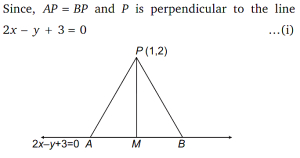
(A) Let $M$ be the mid-point of $AB$. Since $PA=PB$,the triangle $PAB$ is an isosceles triangle with $PA=PB$.
In an isosceles triangle,the median from the vertex $P$ to the base $AB$ is also the altitude to the base $AB$.
Thus,$PM \perp AB$.
The slope of the line $AB$ (which is $2x-y+3=0$ or $y=2x+3$) is $m_1 = 2$.
Since $PM \perp AB$,the slope of $PM$ is $m_2 = -\frac{1}{m_1} = -\frac{1}{2}$.
The line $PM$ passes through $P(1,2)$ and has a slope of $-\frac{1}{2}$.
The equation of line $PM$ is $y-2 = -\frac{1}{2}(x-1)$,which simplifies to $2y-4 = -x+1$,or $x+2y-5=0$.
The mid-point $M$ is the intersection of the lines $2x-y+3=0$ and $x+2y-5=0$.
From the first equation,$y=2x+3$. Substituting this into the second equation:
$x+2(2x+3)-5=0
$ $\Rightarrow x+4x+6-5=0
$ $\Rightarrow 5x+1=0
$ $\Rightarrow x = -\frac{1}{5}$.
Now,$y = 2(-\frac{1}{5})+3 = -\frac{2}{5}+3 = \frac{13}{5}$.
Thus,the mid-point $M$ is $\left(-\frac{1}{5}, \frac{13}{5}\right)$.
In an isosceles triangle,the median from the vertex $P$ to the base $AB$ is also the altitude to the base $AB$.
Thus,$PM \perp AB$.
The slope of the line $AB$ (which is $2x-y+3=0$ or $y=2x+3$) is $m_1 = 2$.
Since $PM \perp AB$,the slope of $PM$ is $m_2 = -\frac{1}{m_1} = -\frac{1}{2}$.
The line $PM$ passes through $P(1,2)$ and has a slope of $-\frac{1}{2}$.
The equation of line $PM$ is $y-2 = -\frac{1}{2}(x-1)$,which simplifies to $2y-4 = -x+1$,or $x+2y-5=0$.
The mid-point $M$ is the intersection of the lines $2x-y+3=0$ and $x+2y-5=0$.
From the first equation,$y=2x+3$. Substituting this into the second equation:
$x+2(2x+3)-5=0
$ $\Rightarrow x+4x+6-5=0
$ $\Rightarrow 5x+1=0
$ $\Rightarrow x = -\frac{1}{5}$.
Now,$y = 2(-\frac{1}{5})+3 = -\frac{2}{5}+3 = \frac{13}{5}$.
Thus,the mid-point $M$ is $\left(-\frac{1}{5}, \frac{13}{5}\right)$.
0 likesView Solution
54
ChemistryMCQTS EAMCET · 2004
The angle between the lines represented by $y^2 \sin^2 \theta - xy \sin^2 \theta + x^2(\cos^2 \theta - 1) = 0$ is
A
$\frac{\pi}{3}$
B
$\frac{\pi}{4}$
C
$\frac{\pi}{6}$
D
$\frac{\pi}{2}$
Solution
(D) The given equation is $x^2(\cos^2 \theta - 1) - xy \sin^2 \theta + y^2 \sin^2 \theta = 0$.
This is a homogeneous equation of the second degree,which can be compared with the general form $ax^2 + 2hxy + by^2 = 0$.
Here,$a = \cos^2 \theta - 1 = -\sin^2 \theta$,$b = \sin^2 \theta$,and $2h = -\sin^2 \theta$.
For a pair of lines represented by $ax^2 + 2hxy + by^2 = 0$,the lines are perpendicular if $a + b = 0$.
Calculating $a + b$:
$a + b = -\sin^2 \theta + \sin^2 \theta = 0$.
Since $a + b = 0$,the lines are perpendicular to each other.
Therefore,the angle between the lines is $\frac{\pi}{2}$.
This is a homogeneous equation of the second degree,which can be compared with the general form $ax^2 + 2hxy + by^2 = 0$.
Here,$a = \cos^2 \theta - 1 = -\sin^2 \theta$,$b = \sin^2 \theta$,and $2h = -\sin^2 \theta$.
For a pair of lines represented by $ax^2 + 2hxy + by^2 = 0$,the lines are perpendicular if $a + b = 0$.
Calculating $a + b$:
$a + b = -\sin^2 \theta + \sin^2 \theta = 0$.
Since $a + b = 0$,the lines are perpendicular to each other.
Therefore,the angle between the lines is $\frac{\pi}{2}$.
0 likesView Solution
55
ChemistryMCQTS EAMCET · 2004
The angle between the lines represented by $y^2 \sin^2 \theta - xy \sin^2 \theta + x^2(\cos^2 \theta - 1) = 0$ is
A
$\frac{\pi}{3}$
B
$\frac{\pi}{4}$
C
$\frac{\pi}{6}$
D
$\frac{\pi}{2}$
Solution
(D) The given equation is $x^2(\cos^2 \theta - 1) - xy \sin^2 \theta + y^2 \sin^2 \theta = 0$.
This is a homogeneous equation of the second degree of the form $ax^2 + 2hxy + by^2 = 0$.
Comparing the coefficients,we get:
$a = \cos^2 \theta - 1 = -\sin^2 \theta$,
$b = \sin^2 \theta$,
$2h = -\sin^2 \theta \Rightarrow h = -\frac{1}{2} \sin^2 \theta$.
Now,check the condition for perpendicular lines:
$a + b = -\sin^2 \theta + \sin^2 \theta = 0$.
Since the sum of the coefficients of $x^2$ and $y^2$ is zero $(a + b = 0)$,the lines represented by the equation are perpendicular to each other.
Therefore,the angle between the lines is $\frac{\pi}{2}$.
This is a homogeneous equation of the second degree of the form $ax^2 + 2hxy + by^2 = 0$.
Comparing the coefficients,we get:
$a = \cos^2 \theta - 1 = -\sin^2 \theta$,
$b = \sin^2 \theta$,
$2h = -\sin^2 \theta \Rightarrow h = -\frac{1}{2} \sin^2 \theta$.
Now,check the condition for perpendicular lines:
$a + b = -\sin^2 \theta + \sin^2 \theta = 0$.
Since the sum of the coefficients of $x^2$ and $y^2$ is zero $(a + b = 0)$,the lines represented by the equation are perpendicular to each other.
Therefore,the angle between the lines is $\frac{\pi}{2}$.
0 likesView Solution
56
ChemistryMCQTS EAMCET · 2004
If $P_1, P_2, P_3$ are the perimeters of the three circles $x^2+y^2+8x-6y=0$,$4x^2+4y^2-4x-12y-186=0$,and $x^2+y^2-6x+6y-9=0$ respectively,then
A
$P_1 < P_2 < P_3$
B
$P_1 < P_3 < P_2$
C
$P_3 < P_2 < P_1$
D
$P_2 < P_3 < P_1$
Solution
(B) The given circles are:
$C_1: x^2+y^2+8x-6y=0$
$C_2: 4x^2+4y^2-4x-12y-186=0 \implies x^2+y^2-x-3y-46.5=0$
$C_3: x^2+y^2-6x+6y-9=0$
Calculating the radii $r_1, r_2, r_3$:
$r_1 = \sqrt{(-4)^2 - (-3)^2 - 0} = \sqrt{16+9} = 5$
$r_2 = \sqrt{(0.5)^2 + (1.5)^2 - (-46.5)} = \sqrt{0.25 + 2.25 + 46.5} = \sqrt{49} = 7$
$r_3 = \sqrt{(3)^2 + (-3)^2 - (-9)} = \sqrt{9+9+9} = \sqrt{27} = 3\sqrt{3} \approx 5.196$
Calculating perimeters $P = 2\pi r$:
$P_1 = 2\pi(5) = 10\pi$
$P_2 = 2\pi(7) = 14\pi$
$P_3 = 2\pi(3\sqrt{3}) = 6\sqrt{3}\pi \approx 10.39\pi$
Comparing the values:
$10\pi < 10.39\pi < 14\pi \implies P_1 < P_3 < P_2$.
$C_1: x^2+y^2+8x-6y=0$
$C_2: 4x^2+4y^2-4x-12y-186=0 \implies x^2+y^2-x-3y-46.5=0$
$C_3: x^2+y^2-6x+6y-9=0$
Calculating the radii $r_1, r_2, r_3$:
$r_1 = \sqrt{(-4)^2 - (-3)^2 - 0} = \sqrt{16+9} = 5$
$r_2 = \sqrt{(0.5)^2 + (1.5)^2 - (-46.5)} = \sqrt{0.25 + 2.25 + 46.5} = \sqrt{49} = 7$
$r_3 = \sqrt{(3)^2 + (-3)^2 - (-9)} = \sqrt{9+9+9} = \sqrt{27} = 3\sqrt{3} \approx 5.196$
Calculating perimeters $P = 2\pi r$:
$P_1 = 2\pi(5) = 10\pi$
$P_2 = 2\pi(7) = 14\pi$
$P_3 = 2\pi(3\sqrt{3}) = 6\sqrt{3}\pi \approx 10.39\pi$
Comparing the values:
$10\pi < 10.39\pi < 14\pi \implies P_1 < P_3 < P_2$.
0 likesView Solution
57
ChemistryMCQTS EAMCET · 2004
If the line $3x - 2y + 6 = 0$ meets the $X$-axis and $Y$-axis at points $A$ and $B$ respectively,then the equation of the circle with radius $AB$ and center at $A$ is:
A
$x^2 + y^2 + 4x + 9 = 0$
B
$x^2 + y^2 + 4x - 9 = 0$
C
$x^2 + y^2 + 4x + 4 = 0$
D
$x^2 + y^2 + 4x - 4 = 0$
Solution
(B) The line is given by $3x - 2y + 6 = 0$.
To find point $A$ (where it meets the $X$-axis),set $y = 0$: $3x + 6 = 0 \Rightarrow x = -2$. So,$A = (-2, 0)$.
To find point $B$ (where it meets the $Y$-axis),set $x = 0$: $-2y + 6 = 0 \Rightarrow y = 3$. So,$B = (0, 3)$.
The radius $r$ is the distance $AB = \sqrt{(0 - (-2))^2 + (3 - 0)^2} = \sqrt{2^2 + 3^2} = \sqrt{4 + 9} = \sqrt{13}$.
The equation of a circle with center $(h, k) = (-2, 0)$ and radius $r = \sqrt{13}$ is $(x - h)^2 + (y - k)^2 = r^2$.
$(x - (-2))^2 + (y - 0)^2 = (\sqrt{13})^2$
$(x + 2)^2 + y^2 = 13$
$x^2 + 4x + 4 + y^2 = 13$
$x^2 + y^2 + 4x - 9 = 0$.
To find point $A$ (where it meets the $X$-axis),set $y = 0$: $3x + 6 = 0 \Rightarrow x = -2$. So,$A = (-2, 0)$.
To find point $B$ (where it meets the $Y$-axis),set $x = 0$: $-2y + 6 = 0 \Rightarrow y = 3$. So,$B = (0, 3)$.
The radius $r$ is the distance $AB = \sqrt{(0 - (-2))^2 + (3 - 0)^2} = \sqrt{2^2 + 3^2} = \sqrt{4 + 9} = \sqrt{13}$.
The equation of a circle with center $(h, k) = (-2, 0)$ and radius $r = \sqrt{13}$ is $(x - h)^2 + (y - k)^2 = r^2$.
$(x - (-2))^2 + (y - 0)^2 = (\sqrt{13})^2$
$(x + 2)^2 + y^2 = 13$
$x^2 + 4x + 4 + y^2 = 13$
$x^2 + y^2 + 4x - 9 = 0$.
0 likesView Solution
58
ChemistryMCQTS EAMCET · 2004
If $(1, a)$ and $(b, 2)$ are conjugate points with respect to the circle $x^2+y^2=25$,then $4a+2b$ is equal to
A
$25$
B
$50$
C
$100$
D
$150$
Solution
(B) The equation of the circle is $x^2+y^2=25$.
Two points $(x_1, y_1)$ and $(x_2, y_2)$ are conjugate with respect to the circle $x^2+y^2=r^2$ if $x_1x_2 + y_1y_2 = r^2$.
Here,$(x_1, y_1) = (1, a)$ and $(x_2, y_2) = (b, 2)$,and $r^2 = 25$.
Substituting these values into the condition,we get:
$(1)(b) + (a)(2) = 25$
$b + 2a = 25$
Multiplying both sides by $2$,we get:
$2b + 4a = 50$
Therefore,$4a + 2b = 50$.
Two points $(x_1, y_1)$ and $(x_2, y_2)$ are conjugate with respect to the circle $x^2+y^2=r^2$ if $x_1x_2 + y_1y_2 = r^2$.
Here,$(x_1, y_1) = (1, a)$ and $(x_2, y_2) = (b, 2)$,and $r^2 = 25$.
Substituting these values into the condition,we get:
$(1)(b) + (a)(2) = 25$
$b + 2a = 25$
Multiplying both sides by $2$,we get:
$2b + 4a = 50$
Therefore,$4a + 2b = 50$.
0 likesView Solution
59
ChemistryMCQTS EAMCET · 2004
The centre of the circle $r^2-4r(\cos \theta+\sin \theta)-4=0$ in Cartesian coordinates is
A
$(1,1)$
B
$(-1,-1)$
C
$(2,2)$
D
$(-2,-2)$
Solution
(C) Given the equation of the circle in polar form: $r^2-4r(\cos \theta+\sin \theta)-4=0$ $(i)$
We know that $x=r \cos \theta$,$y=r \sin \theta$,and $r^2=x^2+y^2$.
Substituting these into equation $(i)$:
$x^2+y^2-4(x+y)-4=0$
$x^2+y^2-4x-4y-4=0$
Comparing this with the general equation of a circle $x^2+y^2+2gx+2fy+c=0$,we get:
$2g = -4 \Rightarrow g = -2$
$2f = -4 \Rightarrow f = -2$
The centre of the circle is $(-g, -f) = (-(-2), -(-2)) = (2, 2)$.
We know that $x=r \cos \theta$,$y=r \sin \theta$,and $r^2=x^2+y^2$.
Substituting these into equation $(i)$:
$x^2+y^2-4(x+y)-4=0$
$x^2+y^2-4x-4y-4=0$
Comparing this with the general equation of a circle $x^2+y^2+2gx+2fy+c=0$,we get:
$2g = -4 \Rightarrow g = -2$
$2f = -4 \Rightarrow f = -2$
The centre of the circle is $(-g, -f) = (-(-2), -(-2)) = (2, 2)$.
0 likesView Solution
60
ChemistryMCQTS EAMCET · 2004
The radius of the circle $r = \sqrt{3} \sin \theta + \cos \theta$ is
A
$1$
B
$2$
C
$3$
D
$4$
Solution
(A) The given equation of the circle is $r = \sqrt{3} \sin \theta + \cos \theta$.
Multiplying both sides by $r$,we get $r^2 = \sqrt{3} (r \sin \theta) + (r \cos \theta)$.
Using the polar to Cartesian coordinate transformations $x = r \cos \theta$ and $y = r \sin \theta$,and $r^2 = x^2 + y^2$,the equation becomes:
$x^2 + y^2 = \sqrt{3} y + x$.
Rearranging the terms,we get $x^2 - x + y^2 - \sqrt{3} y = 0$.
Comparing this with the general form $x^2 + y^2 + 2gx + 2fy + c = 0$,we have $2g = -1 \Rightarrow g = -1/2$ and $2f = -\sqrt{3} \Rightarrow f = -\sqrt{3}/2$,with $c = 0$.
The radius of the circle is given by $\sqrt{g^2 + f^2 - c}$.
Radius $= \sqrt{(-1/2)^2 + (-\sqrt{3}/2)^2 - 0} = \sqrt{1/4 + 3/4} = \sqrt{1} = 1$.
Multiplying both sides by $r$,we get $r^2 = \sqrt{3} (r \sin \theta) + (r \cos \theta)$.
Using the polar to Cartesian coordinate transformations $x = r \cos \theta$ and $y = r \sin \theta$,and $r^2 = x^2 + y^2$,the equation becomes:
$x^2 + y^2 = \sqrt{3} y + x$.
Rearranging the terms,we get $x^2 - x + y^2 - \sqrt{3} y = 0$.
Comparing this with the general form $x^2 + y^2 + 2gx + 2fy + c = 0$,we have $2g = -1 \Rightarrow g = -1/2$ and $2f = -\sqrt{3} \Rightarrow f = -\sqrt{3}/2$,with $c = 0$.
The radius of the circle is given by $\sqrt{g^2 + f^2 - c}$.
Radius $= \sqrt{(-1/2)^2 + (-\sqrt{3}/2)^2 - 0} = \sqrt{1/4 + 3/4} = \sqrt{1} = 1$.
0 likesView Solution
61
ChemistryMCQTS EAMCET · 2004
The number of circles that touch all the three lines $x+y-1=0$,$x-y-1=0$,and $y+1=0$ is
A
$2$
B
$3$
C
$4$
D
$1$
Solution
(C) The given lines are $L_1: x+y-1=0$,$L_2: x-y-1=0$,and $L_3: y+1=0$.
These three lines are not concurrent and form a triangle.
For any triangle,there exists exactly one incircle that touches all three sides internally.
Additionally,there are three excircles,each of which touches one side externally and the extensions of the other two sides.
Therefore,the total number of circles that touch all three lines is $1 + 3 = 4$.
These three lines are not concurrent and form a triangle.
For any triangle,there exists exactly one incircle that touches all three sides internally.
Additionally,there are three excircles,each of which touches one side externally and the extensions of the other two sides.
Therefore,the total number of circles that touch all three lines is $1 + 3 = 4$.
0 likesView Solution
62
ChemistryMCQTS EAMCET · 2004
The polar equation $\cos \theta + 7 \sin \theta = \frac{1}{r}$ represents a
A
circle
B
parabola
C
straight line
D
hyperbola
Solution
(C) The given polar equation is $\cos \theta + 7 \sin \theta = \frac{1}{r}$.
Multiplying both sides by $r$,we get $r \cos \theta + 7 r \sin \theta = 1$.
Using the standard conversion formulas $x = r \cos \theta$ and $y = r \sin \theta$,we substitute these into the equation:
$x + 7y = 1$.
This is the standard form of a linear equation in two variables,which represents a straight line.
Multiplying both sides by $r$,we get $r \cos \theta + 7 r \sin \theta = 1$.
Using the standard conversion formulas $x = r \cos \theta$ and $y = r \sin \theta$,we substitute these into the equation:
$x + 7y = 1$.
This is the standard form of a linear equation in two variables,which represents a straight line.
0 likesView Solution
63
ChemistryMCQTS EAMCET · 2004
If $\frac{x-4}{x^2-5x+6}$ can be expanded in the ascending powers of $x$,then the coefficient of $x^3$ is
A
$\frac{-73}{648}$
B
$\frac{73}{648}$
C
$\frac{71}{648}$
D
$\frac{-71}{648}$
Solution
(A) First,we decompose the expression into partial fractions: $\frac{x-4}{(x-2)(x-3)} = \frac{A}{x-2} + \frac{B}{x-3}$.
Solving for $A$ and $B$,we get $\frac{2}{x-2} - \frac{1}{x-3}$.
Rewrite the expression as: $2(x-2)^{-1} - (x-3)^{-1} = 2(-2)^{-1}(1-\frac{x}{2})^{-1} - (-3)^{-1}(1-\frac{x}{3})^{-1}$.
$= -\left[1 + \frac{x}{2} + (\frac{x}{2})^2 + (\frac{x}{2})^3 + \dots\right] + \frac{1}{3}\left[1 + \frac{x}{3} + (\frac{x}{3})^2 + (\frac{x}{3})^3 + \dots\right]$.
The coefficient of $x^3$ is $-\left(\frac{1}{2}\right)^3 + \frac{1}{3}\left(\frac{1}{3}\right)^3$.
$= -\frac{1}{8} + \frac{1}{81} = \frac{-81 + 8}{648} = -\frac{73}{648}$.
Solving for $A$ and $B$,we get $\frac{2}{x-2} - \frac{1}{x-3}$.
Rewrite the expression as: $2(x-2)^{-1} - (x-3)^{-1} = 2(-2)^{-1}(1-\frac{x}{2})^{-1} - (-3)^{-1}(1-\frac{x}{3})^{-1}$.
$= -\left[1 + \frac{x}{2} + (\frac{x}{2})^2 + (\frac{x}{2})^3 + \dots\right] + \frac{1}{3}\left[1 + \frac{x}{3} + (\frac{x}{3})^2 + (\frac{x}{3})^3 + \dots\right]$.
The coefficient of $x^3$ is $-\left(\frac{1}{2}\right)^3 + \frac{1}{3}\left(\frac{1}{3}\right)^3$.
$= -\frac{1}{8} + \frac{1}{81} = \frac{-81 + 8}{648} = -\frac{73}{648}$.
0 likesView Solution
64
ChemistryMCQTS EAMCET · 2004
The coefficient of $x^{10}$ in the expansion of $(2+3x)e^{-x}$ is
A
$\frac{-26}{10!}$
B
$\frac{-28}{10!}$
C
$\frac{-30}{10!}$
D
$\frac{-32}{10!}$
Solution
(B) We know the expansion of $e^{-x}$ is given by $e^{-x} = 1 - \frac{x}{1!} + \frac{x^2}{2!} - \dots + (-1)^n \frac{x^n}{n!} + \dots$
Now,consider the expression $(2+3x)e^{-x}$:
$(2+3x)e^{-x} = 2e^{-x} + 3xe^{-x}$
To find the coefficient of $x^{10}$:
$1$. In $2e^{-x}$,the term containing $x^{10}$ is $2 \times \frac{(-1)^{10} x^{10}}{10!} = \frac{2}{10!} x^{10}$.
$2$. In $3xe^{-x}$,the term containing $x^{10}$ is $3x \times \frac{(-1)^9 x^9}{9!} = 3x \times \frac{-x^9}{9!} = \frac{-3}{9!} x^{10}$.
To combine these,express $\frac{-3}{9!}$ with a denominator of $10!$:
$\frac{-3}{9!} = \frac{-3 \times 10}{10!} = \frac{-30}{10!}$.
Adding the coefficients:
$\frac{2}{10!} - \frac{30}{10!} = \frac{2-30}{10!} = \frac{-28}{10!}$.
Now,consider the expression $(2+3x)e^{-x}$:
$(2+3x)e^{-x} = 2e^{-x} + 3xe^{-x}$
To find the coefficient of $x^{10}$:
$1$. In $2e^{-x}$,the term containing $x^{10}$ is $2 \times \frac{(-1)^{10} x^{10}}{10!} = \frac{2}{10!} x^{10}$.
$2$. In $3xe^{-x}$,the term containing $x^{10}$ is $3x \times \frac{(-1)^9 x^9}{9!} = 3x \times \frac{-x^9}{9!} = \frac{-3}{9!} x^{10}$.
To combine these,express $\frac{-3}{9!}$ with a denominator of $10!$:
$\frac{-3}{9!} = \frac{-3 \times 10}{10!} = \frac{-30}{10!}$.
Adding the coefficients:
$\frac{2}{10!} - \frac{30}{10!} = \frac{2-30}{10!} = \frac{-28}{10!}$.
0 likesView Solution
65
ChemistryMCQTS EAMCET · 2004
The binomial coefficients which are in decreasing order are
A
${ }^{15} C_5, { }^{15} C_6, { }^{15} C_7$
B
${ }^{15} C_{10}, { }^{15} C_9, { }^{15} C_8$
C
${ }^{15} C_6, { }^{15} C_7, { }^{15} C_8$
D
${ }^{15} C_7, { }^{15} C_6, { }^{15} C_5$
Solution
(D) The binomial coefficients for $n=15$ are ${ }^{15} C_0, { }^{15} C_1, \dots, { }^{15} C_7, { }^{15} C_8, \dots, { }^{15} C_{15}$.
Since ${ }^{15} C_r$ increases as $r$ increases from $0$ to $7$ and decreases as $r$ increases from $8$ to $15$,we look for a sequence where the values are decreasing.
Comparing the options:
$A$: ${ }^{15} C_5 < { }^{15} C_6 < { }^{15} C_7$ (Increasing)
$B$: ${ }^{15} C_{10} < { }^{15} C_9 < { }^{15} C_8$ (Increasing)
$C$: ${ }^{15} C_6 < { }^{15} C_7 < { }^{15} C_8$ (Increasing)
$D$: ${ }^{15} C_7 > { }^{15} C_6 > { }^{15} C_5$ (Decreasing)
Therefore,the sequence in decreasing order is ${ }^{15} C_7, { }^{15} C_6, { }^{15} C_5$. The correct option is $D$.
Since ${ }^{15} C_r$ increases as $r$ increases from $0$ to $7$ and decreases as $r$ increases from $8$ to $15$,we look for a sequence where the values are decreasing.
Comparing the options:
$A$: ${ }^{15} C_5 < { }^{15} C_6 < { }^{15} C_7$ (Increasing)
$B$: ${ }^{15} C_{10} < { }^{15} C_9 < { }^{15} C_8$ (Increasing)
$C$: ${ }^{15} C_6 < { }^{15} C_7 < { }^{15} C_8$ (Increasing)
$D$: ${ }^{15} C_7 > { }^{15} C_6 > { }^{15} C_5$ (Decreasing)
Therefore,the sequence in decreasing order is ${ }^{15} C_7, { }^{15} C_6, { }^{15} C_5$. The correct option is $D$.
0 likesView Solution
66
ChemistryMCQTS EAMCET · 2004
The eccentricity of the conic $36x^2 + 144y^2 - 36x - 96y - 119 = 0$ is
A
$\frac{\sqrt{3}}{2}$
B
$\frac{1}{2}$
C
$\frac{\sqrt{3}}{4}$
D
$\frac{1}{\sqrt{3}}$
Solution
(A) The given equation is $36x^2 + 144y^2 - 36x - 96y - 119 = 0$.
Rearranging the terms,we get $36(x^2 - x) + 144(y^2 - \frac{2}{3}y) = 119$.
Completing the square,we have $36(x^2 - x + \frac{1}{4}) + 144(y^2 - \frac{2}{3}y + \frac{1}{9}) = 119 + 9 + 16$.
This simplifies to $36(x - \frac{1}{2})^2 + 144(y - \frac{1}{3})^2 = 144$.
Dividing by $144$,we get $\frac{(x - 1/2)^2}{4} + \frac{(y - 1/3)^2}{1} = 1$.
This is an ellipse with $a^2 = 4$ and $b^2 = 1$.
The eccentricity $e$ is given by $e = \sqrt{1 - \frac{b^2}{a^2}} = \sqrt{1 - \frac{1}{4}} = \sqrt{\frac{3}{4}} = \frac{\sqrt{3}}{2}$.
Rearranging the terms,we get $36(x^2 - x) + 144(y^2 - \frac{2}{3}y) = 119$.
Completing the square,we have $36(x^2 - x + \frac{1}{4}) + 144(y^2 - \frac{2}{3}y + \frac{1}{9}) = 119 + 9 + 16$.
This simplifies to $36(x - \frac{1}{2})^2 + 144(y - \frac{1}{3})^2 = 144$.
Dividing by $144$,we get $\frac{(x - 1/2)^2}{4} + \frac{(y - 1/3)^2}{1} = 1$.
This is an ellipse with $a^2 = 4$ and $b^2 = 1$.
The eccentricity $e$ is given by $e = \sqrt{1 - \frac{b^2}{a^2}} = \sqrt{1 - \frac{1}{4}} = \sqrt{\frac{3}{4}} = \frac{\sqrt{3}}{2}$.
0 likesView Solution
67
ChemistryMCQTS EAMCET · 2004
In a $\triangle ABC$,$\cos \left(\frac{B+2C+3A}{2}\right) + \cos \left(\frac{A-B}{2}\right)$ is equal to
A
$-1$
B
$0$
C
$1$
D
$2$
Solution
(B) In $\triangle ABC$,we know that $A+B+C = \pi$.
Consider the expression:
$\cos \left(\frac{B+2C+3A}{2}\right) + \cos \left(\frac{A-B}{2}\right)$
Rewrite the argument of the first cosine term using $A+B+C = \pi$:
$\frac{B+2C+3A}{2} = \frac{(A+B+C) + A + C}{2} = \frac{\pi + A + C}{2} = \frac{\pi}{2} + \frac{A+C}{2}$
Wait,let us re-evaluate the expression:
$\frac{B+2C+3A}{2} = \frac{2A+2B+2C + A-B}{2} = \frac{2\pi + (A-B)}{2} = \pi + \frac{A-B}{2}$
Substituting this back:
$\cos \left(\pi + \frac{A-B}{2}\right) + \cos \left(\frac{A-B}{2}\right)$
Using the identity $\cos(\pi + \theta) = -\cos(\theta)$:
$-\cos \left(\frac{A-B}{2}\right) + \cos \left(\frac{A-B}{2}\right) = 0$
Consider the expression:
$\cos \left(\frac{B+2C+3A}{2}\right) + \cos \left(\frac{A-B}{2}\right)$
Rewrite the argument of the first cosine term using $A+B+C = \pi$:
$\frac{B+2C+3A}{2} = \frac{(A+B+C) + A + C}{2} = \frac{\pi + A + C}{2} = \frac{\pi}{2} + \frac{A+C}{2}$
Wait,let us re-evaluate the expression:
$\frac{B+2C+3A}{2} = \frac{2A+2B+2C + A-B}{2} = \frac{2\pi + (A-B)}{2} = \pi + \frac{A-B}{2}$
Substituting this back:
$\cos \left(\pi + \frac{A-B}{2}\right) + \cos \left(\frac{A-B}{2}\right)$
Using the identity $\cos(\pi + \theta) = -\cos(\theta)$:
$-\cos \left(\frac{A-B}{2}\right) + \cos \left(\frac{A-B}{2}\right) = 0$
0 likesView Solution
68
ChemistryMCQTS EAMCET · 2004
If in a $\triangle ABC$,$r_3 = r_1 + r_2 + r$,then $\angle A + \angle B$ is equal to (in $^{\circ}$)
A
$120$
B
$100$
C
$90$
D
$80$
Solution
(C) We know that the exradii and inradius are given by:
$r_1 = 4R \sin \frac{A}{2} \cos \frac{B}{2} \cos \frac{C}{2}$
$r_2 = 4R \cos \frac{A}{2} \sin \frac{B}{2} \cos \frac{C}{2}$
$r_3 = 4R \cos \frac{A}{2} \cos \frac{B}{2} \sin \frac{C}{2}$
$r = 4R \sin \frac{A}{2} \sin \frac{B}{2} \sin \frac{C}{2}$
Given $r_3 = r_1 + r_2 + r$,we have:
$r_3 - r = r_1 + r_2$
$4R \sin \frac{C}{2} \cos \frac{A}{2} \cos \frac{B}{2} - 4R \sin \frac{A}{2} \sin \frac{B}{2} \sin \frac{C}{2} = 4R \cos \frac{C}{2} \sin \frac{A}{2} \cos \frac{B}{2} + 4R \cos \frac{C}{2} \cos \frac{A}{2} \sin \frac{B}{2}$
Dividing by $4R$ and factoring:
$\sin \frac{C}{2} (\cos \frac{A}{2} \cos \frac{B}{2} - \sin \frac{A}{2} \sin \frac{B}{2}) = \cos \frac{C}{2} (\sin \frac{A}{2} \cos \frac{B}{2} + \cos \frac{A}{2} \sin \frac{B}{2})$
Using the identity $\cos(x+y) = \cos x \cos y - \sin x \sin y$ and $\sin(x+y) = \sin x \cos y + \cos x \sin y$:
$\sin \frac{C}{2} \cos(\frac{A+B}{2}) = \cos \frac{C}{2} \sin(\frac{A+B}{2})$
Since $A+B+C = \pi$,$\frac{A+B}{2} = \frac{\pi}{2} - \frac{C}{2}$:
$\sin \frac{C}{2} \cos(\frac{\pi}{2} - \frac{C}{2}) = \cos \frac{C}{2} \sin(\frac{\pi}{2} - \frac{C}{2})$
$\sin \frac{C}{2} \sin \frac{C}{2} = \cos \frac{C}{2} \cos \frac{C}{2}$
$\sin^2 \frac{C}{2} = \cos^2 \frac{C}{2}$
$\tan^2 \frac{C}{2} = 1 \Rightarrow \tan \frac{C}{2} = 1$
$\frac{C}{2} = \frac{\pi}{4} \Rightarrow C = \frac{\pi}{2}$
Therefore,$A+B = \pi - C = \pi - \frac{\pi}{2} = \frac{\pi}{2} = 90^{\circ}$.
$r_1 = 4R \sin \frac{A}{2} \cos \frac{B}{2} \cos \frac{C}{2}$
$r_2 = 4R \cos \frac{A}{2} \sin \frac{B}{2} \cos \frac{C}{2}$
$r_3 = 4R \cos \frac{A}{2} \cos \frac{B}{2} \sin \frac{C}{2}$
$r = 4R \sin \frac{A}{2} \sin \frac{B}{2} \sin \frac{C}{2}$
Given $r_3 = r_1 + r_2 + r$,we have:
$r_3 - r = r_1 + r_2$
$4R \sin \frac{C}{2} \cos \frac{A}{2} \cos \frac{B}{2} - 4R \sin \frac{A}{2} \sin \frac{B}{2} \sin \frac{C}{2} = 4R \cos \frac{C}{2} \sin \frac{A}{2} \cos \frac{B}{2} + 4R \cos \frac{C}{2} \cos \frac{A}{2} \sin \frac{B}{2}$
Dividing by $4R$ and factoring:
$\sin \frac{C}{2} (\cos \frac{A}{2} \cos \frac{B}{2} - \sin \frac{A}{2} \sin \frac{B}{2}) = \cos \frac{C}{2} (\sin \frac{A}{2} \cos \frac{B}{2} + \cos \frac{A}{2} \sin \frac{B}{2})$
Using the identity $\cos(x+y) = \cos x \cos y - \sin x \sin y$ and $\sin(x+y) = \sin x \cos y + \cos x \sin y$:
$\sin \frac{C}{2} \cos(\frac{A+B}{2}) = \cos \frac{C}{2} \sin(\frac{A+B}{2})$
Since $A+B+C = \pi$,$\frac{A+B}{2} = \frac{\pi}{2} - \frac{C}{2}$:
$\sin \frac{C}{2} \cos(\frac{\pi}{2} - \frac{C}{2}) = \cos \frac{C}{2} \sin(\frac{\pi}{2} - \frac{C}{2})$
$\sin \frac{C}{2} \sin \frac{C}{2} = \cos \frac{C}{2} \cos \frac{C}{2}$
$\sin^2 \frac{C}{2} = \cos^2 \frac{C}{2}$
$\tan^2 \frac{C}{2} = 1 \Rightarrow \tan \frac{C}{2} = 1$
$\frac{C}{2} = \frac{\pi}{4} \Rightarrow C = \frac{\pi}{2}$
Therefore,$A+B = \pi - C = \pi - \frac{\pi}{2} = \frac{\pi}{2} = 90^{\circ}$.
0 likesView Solution
69
ChemistryMCQTS EAMCET · 2004
Match the following elements of the matrix $A = \begin{bmatrix} 1 & -1 & 0 \\ 0 & 4 & 2 \\ 3 & -4 & 6 \end{bmatrix}$ with their co-factors and choose the correct answer.
| Element | Co-factor |
| $A$. $-1$ | $(1)$ $-2$ |
| $B$. $1$ | $(2)$ $32$ |
| $C$. $3$ | $(3)$ $4$ |
| $D$. $6$ | $(4)$ $6$ |
| $(5)$ $-6$ |
A
$A-2, B-4, C-1, D-3$
B
$A-2, B-4, C-3, D-1$
C
$A-4, B-2, C-1, D-3$
D
$A-4, B-1, C-2, D-3$
Solution
(C) Let $A = \begin{bmatrix} 1 & -1 & 0 \\ 0 & 4 & 2 \\ 3 & -4 & 6 \end{bmatrix}$.
The co-factor $C_{ij}$ of an element $a_{ij}$ is given by $(-1)^{i+j} M_{ij}$,where $M_{ij}$ is the minor.
For element $-1$ (at position $a_{12}$): $C_{12} = (-1)^{1+2} \begin{vmatrix} 0 & 2 \\ 3 & 6 \end{vmatrix} = -1(0 - 6) = 6$. So,$A-4$.
For element $1$ (at position $a_{11}$): $C_{11} = (-1)^{1+1} \begin{vmatrix} 4 & 2 \\ -4 & 6 \end{vmatrix} = 1(24 - (-8)) = 32$. So,$B-2$.
For element $3$ (at position $a_{31}$): $C_{31} = (-1)^{3+1} \begin{vmatrix} -1 & 0 \\ 4 & 2 \end{vmatrix} = 1(-2 - 0) = -2$. So,$C-1$.
For element $6$ (at position $a_{33}$): $C_{33} = (-1)^{3+3} \begin{vmatrix} 1 & -1 \\ 0 & 4 \end{vmatrix} = 1(4 - 0) = 4$. So,$D-3$.
Thus,the matching is $A-4, B-2, C-1, D-3$.
Therefore,option $C$ is correct.
The co-factor $C_{ij}$ of an element $a_{ij}$ is given by $(-1)^{i+j} M_{ij}$,where $M_{ij}$ is the minor.
For element $-1$ (at position $a_{12}$): $C_{12} = (-1)^{1+2} \begin{vmatrix} 0 & 2 \\ 3 & 6 \end{vmatrix} = -1(0 - 6) = 6$. So,$A-4$.
For element $1$ (at position $a_{11}$): $C_{11} = (-1)^{1+1} \begin{vmatrix} 4 & 2 \\ -4 & 6 \end{vmatrix} = 1(24 - (-8)) = 32$. So,$B-2$.
For element $3$ (at position $a_{31}$): $C_{31} = (-1)^{3+1} \begin{vmatrix} -1 & 0 \\ 4 & 2 \end{vmatrix} = 1(-2 - 0) = -2$. So,$C-1$.
For element $6$ (at position $a_{33}$): $C_{33} = (-1)^{3+3} \begin{vmatrix} 1 & -1 \\ 0 & 4 \end{vmatrix} = 1(4 - 0) = 4$. So,$D-3$.
Thus,the matching is $A-4, B-2, C-1, D-3$.
Therefore,option $C$ is correct.
0 likesView Solution
70
ChemistryMCQTS EAMCET · 2004
The value of $\left|\begin{array}{lll}1990 & 1991 & 1992 \\ 1991 & 1992 & 1993 \\ 1992 & 1993 & 1994\end{array}\right|$ is
A
$1992$
B
$1993$
C
$1994$
D
$0$
Solution
(D) Let $\Delta = \left|\begin{array}{lll}1990 & 1991 & 1992 \\ 1991 & 1992 & 1993 \\ 1992 & 1993 & 1994\end{array}\right|$
Applying the column operations $C_2 \rightarrow C_2 - C_1$ and $C_3 \rightarrow C_3 - C_2$:
$\Delta = \left|\begin{array}{lll}1990 & 1991-1990 & 1992-1991 \\ 1991 & 1992-1991 & 1993-1992 \\ 1992 & 1993-1992 & 1994-1993\end{array}\right|$
$\Delta = \left|\begin{array}{lll}1990 & 1 & 1 \\ 1991 & 1 & 1 \\ 1992 & 1 & 1\end{array}\right|$
Since column $C_2$ and column $C_3$ are identical,the value of the determinant is $0$.
Applying the column operations $C_2 \rightarrow C_2 - C_1$ and $C_3 \rightarrow C_3 - C_2$:
$\Delta = \left|\begin{array}{lll}1990 & 1991-1990 & 1992-1991 \\ 1991 & 1992-1991 & 1993-1992 \\ 1992 & 1993-1992 & 1994-1993\end{array}\right|$
$\Delta = \left|\begin{array}{lll}1990 & 1 & 1 \\ 1991 & 1 & 1 \\ 1992 & 1 & 1\end{array}\right|$
Since column $C_2$ and column $C_3$ are identical,the value of the determinant is $0$.
0 likesView Solution
71
ChemistryMCQTS EAMCET · 2004
If $\sin ^{-1} x+\sin ^{-1}(1-x)=\cos ^{-1} x$,then $x \in$
A
$\{1, 0\}$
B
$\{-1, 1\}$
C
$\{0, \frac{1}{2}\}$
D
$\{2, 0\}$
Solution
(C) Given equation: $\sin ^{-1} x + \sin ^{-1}(1-x) = \cos ^{-1} x$
Since $\cos ^{-1} x = \frac{\pi}{2} - \sin ^{-1} x$,we have:
$\sin ^{-1}(1-x) = \frac{\pi}{2} - \sin ^{-1} x - \sin ^{-1} x = \frac{\pi}{2} - 2\sin ^{-1} x$
Taking $\sin$ on both sides:
$1-x = \sin(\frac{\pi}{2} - 2\sin ^{-1} x) = \cos(2\sin ^{-1} x)$
Using the identity $\cos(2\theta) = 1 - 2\sin^2 \theta$,where $\theta = \sin ^{-1} x$:
$1-x = 1 - 2(\sin(\sin ^{-1} x))^2$
$1-x = 1 - 2x^2$
$2x^2 - x = 0$
$x(2x - 1) = 0$
Thus,$x = 0$ or $x = \frac{1}{2}$.
Checking the values:
For $x=0$: $\sin ^{-1} 0 + \sin ^{-1} 1 = 0 + \frac{\pi}{2} = \frac{\pi}{2}$ and $\cos ^{-1} 0 = \frac{\pi}{2}$. (Valid)
For $x=\frac{1}{2}$: $\sin ^{-1} \frac{1}{2} + \sin ^{-1} \frac{1}{2} = \frac{\pi}{6} + \frac{\pi}{6} = \frac{\pi}{3}$ and $\cos ^{-1} \frac{1}{2} = \frac{\pi}{3}$. (Valid)
Therefore,$x \in \{0, \frac{1}{2}\}$.
Since $\cos ^{-1} x = \frac{\pi}{2} - \sin ^{-1} x$,we have:
$\sin ^{-1}(1-x) = \frac{\pi}{2} - \sin ^{-1} x - \sin ^{-1} x = \frac{\pi}{2} - 2\sin ^{-1} x$
Taking $\sin$ on both sides:
$1-x = \sin(\frac{\pi}{2} - 2\sin ^{-1} x) = \cos(2\sin ^{-1} x)$
Using the identity $\cos(2\theta) = 1 - 2\sin^2 \theta$,where $\theta = \sin ^{-1} x$:
$1-x = 1 - 2(\sin(\sin ^{-1} x))^2$
$1-x = 1 - 2x^2$
$2x^2 - x = 0$
$x(2x - 1) = 0$
Thus,$x = 0$ or $x = \frac{1}{2}$.
Checking the values:
For $x=0$: $\sin ^{-1} 0 + \sin ^{-1} 1 = 0 + \frac{\pi}{2} = \frac{\pi}{2}$ and $\cos ^{-1} 0 = \frac{\pi}{2}$. (Valid)
For $x=\frac{1}{2}$: $\sin ^{-1} \frac{1}{2} + \sin ^{-1} \frac{1}{2} = \frac{\pi}{6} + \frac{\pi}{6} = \frac{\pi}{3}$ and $\cos ^{-1} \frac{1}{2} = \frac{\pi}{3}$. (Valid)
Therefore,$x \in \{0, \frac{1}{2}\}$.
0 likesView Solution
72
ChemistryMCQTS EAMCET · 2004
The set of all solutions of the inequation $x^2 - 2x + 5 \leq 0$ in $R$ is
A
$R - (-\infty, -5)$
B
$R - (5, \infty)$
C
$\phi$
D
$R - (-\infty, -4)$
Solution
(C) Given inequation is $x^2 - 2x + 5 \leq 0$.
We can rewrite the expression by completing the square:
$x^2 - 2x + 1 + 4 \leq 0$
$(x - 1)^2 + 4 \leq 0$
Since $(x - 1)^2 \geq 0$ for all $x \in R$,it follows that $(x - 1)^2 + 4 \geq 4$.
Therefore,$(x - 1)^2 + 4$ is always positive and can never be less than or equal to $0$.
Thus,there are no real values of $x$ that satisfy the given inequation.
The solution set is the empty set,denoted by $\phi$.
We can rewrite the expression by completing the square:
$x^2 - 2x + 1 + 4 \leq 0$
$(x - 1)^2 + 4 \leq 0$
Since $(x - 1)^2 \geq 0$ for all $x \in R$,it follows that $(x - 1)^2 + 4 \geq 4$.
Therefore,$(x - 1)^2 + 4$ is always positive and can never be less than or equal to $0$.
Thus,there are no real values of $x$ that satisfy the given inequation.
The solution set is the empty set,denoted by $\phi$.
0 likesView Solution
73
ChemistryMCQTS EAMCET · 2004
If $f: R \rightarrow R$ is an even function having derivatives of all orders,then which of the following is an odd function?
A
$f^{\prime \prime}$
B
$f^{\prime}$
C
$f^{\prime} + f^{\prime \prime}$
D
$f^{\prime \prime} + f^{\prime \prime \prime}$
Solution
(B) Given that $f(x)$ is an even function,so $f(-x) = f(x)$.
By differentiating both sides with respect to $x$,we get $f^{\prime}(-x) \cdot (-1) = f^{\prime}(x)$,which implies $f^{\prime}(-x) = -f^{\prime}(x)$. Thus,$f^{\prime}$ is an odd function.
By differentiating again,$f^{\prime \prime}(-x) \cdot (-1) = -f^{\prime \prime}(x)$,which implies $f^{\prime \prime}(-x) = f^{\prime \prime}(x)$. Thus,$f^{\prime \prime}$ is an even function.
By differentiating once more,$f^{\prime \prime \prime}(-x) \cdot (-1) = f^{\prime \prime \prime}(x)$,which implies $f^{\prime \prime \prime}(-x) = -f^{\prime \prime \prime}(x)$. Thus,$f^{\prime \prime \prime}$ is an odd function.
Among the given options,$f^{\prime}$ is an odd function. Therefore,option $B$ is correct.
By differentiating both sides with respect to $x$,we get $f^{\prime}(-x) \cdot (-1) = f^{\prime}(x)$,which implies $f^{\prime}(-x) = -f^{\prime}(x)$. Thus,$f^{\prime}$ is an odd function.
By differentiating again,$f^{\prime \prime}(-x) \cdot (-1) = -f^{\prime \prime}(x)$,which implies $f^{\prime \prime}(-x) = f^{\prime \prime}(x)$. Thus,$f^{\prime \prime}$ is an even function.
By differentiating once more,$f^{\prime \prime \prime}(-x) \cdot (-1) = f^{\prime \prime \prime}(x)$,which implies $f^{\prime \prime \prime}(-x) = -f^{\prime \prime \prime}(x)$. Thus,$f^{\prime \prime \prime}$ is an odd function.
Among the given options,$f^{\prime}$ is an odd function. Therefore,option $B$ is correct.
0 likesView Solution
74
ChemistryMCQTS EAMCET · 2004
If $f: N \rightarrow Z$ is defined by $f(n)=\begin{cases} 2 & \text{if } n=3k, k \in Z \\ 10 & \text{if } n=3k+1, k \in Z \\ 0 & \text{if } n=3k+2, k \in Z \end{cases}$,then $\{n \in N: f(n)>2\}$ is equal to
A
$\{3, 6, 4\}$
B
$\{1, 4, 7, \dots\}$
C
$\{4, 7\}$
D
$\{7\}$
Solution
(B) Given the function $f(n)$ defined as:
$f(n) = \begin{cases} 2 & \text{if } n=3k, k \in Z \\ 10 & \text{if } n=3k+1, k \in Z \\ 0 & \text{if } n=3k+2, k \in Z \end{cases}$
We want to find the set $\{n \in N: f(n) > 2\}$.
Looking at the definition,$f(n) > 2$ only when $f(n) = 10$,which occurs when $n = 3k + 1$ for some $k \in Z$.
Since $n \in N$ (natural numbers),we consider $k \geq 0$ (assuming $N = \{1, 2, 3, \dots\}$):
For $k=0, n = 3(0) + 1 = 1$.
For $k=1, n = 3(1) + 1 = 4$.
For $k=2, n = 3(2) + 1 = 7$.
Thus,the set is $\{1, 4, 7, \dots\}$.
$f(n) = \begin{cases} 2 & \text{if } n=3k, k \in Z \\ 10 & \text{if } n=3k+1, k \in Z \\ 0 & \text{if } n=3k+2, k \in Z \end{cases}$
We want to find the set $\{n \in N: f(n) > 2\}$.
Looking at the definition,$f(n) > 2$ only when $f(n) = 10$,which occurs when $n = 3k + 1$ for some $k \in Z$.
Since $n \in N$ (natural numbers),we consider $k \geq 0$ (assuming $N = \{1, 2, 3, \dots\}$):
For $k=0, n = 3(0) + 1 = 1$.
For $k=1, n = 3(1) + 1 = 4$.
For $k=2, n = 3(2) + 1 = 7$.
Thus,the set is $\{1, 4, 7, \dots\}$.
0 likesView Solution
75
ChemistryMCQTS EAMCET · 2004
The function $f: R \rightarrow R$ is defined by $f(x)=3^{-x}$. Observe the following statements about it:
$I$. $f$ is one-one
$II$. $f$ is onto
$III$. $f$ is a decreasing function
Which of these statements are true?
$I$. $f$ is one-one
$II$. $f$ is onto
$III$. $f$ is a decreasing function
Which of these statements are true?
A
Only $I, II$
B
Only $II, III$
C
Only $I, III$
D
$I, II, III$
Solution
(C) Given the function $f: R \rightarrow R$ defined by $f(x) = 3^{-x}$.
$I$. For one-one check: Let $f(x_1) = f(x_2)$.
$3^{-x_1} = 3^{-x_2} \Rightarrow -x_1 = -x_2 \Rightarrow x_1 = x_2$.
Since $f(x_1) = f(x_2) \Rightarrow x_1 = x_2$,the function is one-one.
$II$. For onto check: The range of $f(x) = 3^{-x}$ is $(0, \infty)$,which is a subset of the codomain $R$. Since the range $\neq$ codomain,the function is not onto.
$III$. For decreasing check: $f'(x) = \frac{d}{dx}(3^{-x}) = -3^{-x} \ln 3$. Since $3^{-x} > 0$ and $\ln 3 > 0$,$f'(x) < 0$ for all $x \in R$. Thus,$f$ is a strictly decreasing function.
Therefore,statements $I$ and $III$ are true.
$I$. For one-one check: Let $f(x_1) = f(x_2)$.
$3^{-x_1} = 3^{-x_2} \Rightarrow -x_1 = -x_2 \Rightarrow x_1 = x_2$.
Since $f(x_1) = f(x_2) \Rightarrow x_1 = x_2$,the function is one-one.
$II$. For onto check: The range of $f(x) = 3^{-x}$ is $(0, \infty)$,which is a subset of the codomain $R$. Since the range $\neq$ codomain,the function is not onto.
$III$. For decreasing check: $f'(x) = \frac{d}{dx}(3^{-x}) = -3^{-x} \ln 3$. Since $3^{-x} > 0$ and $\ln 3 > 0$,$f'(x) < 0$ for all $x \in R$. Thus,$f$ is a strictly decreasing function.
Therefore,statements $I$ and $III$ are true.
0 likesView Solution
76
ChemistryMCQTS EAMCET · 2004
If $x > 0$ and $x^y = e^{x-y}$,then $\frac{dy}{dx}$ is equal to
A
$\frac{1}{(1+\log x)^2}$
B
$\frac{\log x}{(1+\log x)^2}$
C
$\left(\frac{\log x}{1+\log x}\right)^2$
D
$\frac{(\log x)^2}{1+\log x}$
Solution
(B) Given the equation $x^y = e^{x-y}$.
Taking the natural logarithm on both sides,we get:
$\ln(x^y) = \ln(e^{x-y})$
$y \ln x = x - y$
Rearranging the terms to isolate $y$:
$y \ln x + y = x$
$y(1 + \ln x) = x$
$y = \frac{x}{1 + \ln x}$
Now,differentiate with respect to $x$ using the quotient rule $\frac{d}{dx}\left(\frac{u}{v}\right) = \frac{u'v - uv'}{v^2}$:
$\frac{dy}{dx} = \frac{(1)(1 + \ln x) - x(\frac{1}{x})}{(1 + \ln x)^2}$
$\frac{dy}{dx} = \frac{1 + \ln x - 1}{(1 + \ln x)^2}$
$\frac{dy}{dx} = \frac{\ln x}{(1 + \ln x)^2}$
Thus,the correct option is $B$.
Taking the natural logarithm on both sides,we get:
$\ln(x^y) = \ln(e^{x-y})$
$y \ln x = x - y$
Rearranging the terms to isolate $y$:
$y \ln x + y = x$
$y(1 + \ln x) = x$
$y = \frac{x}{1 + \ln x}$
Now,differentiate with respect to $x$ using the quotient rule $\frac{d}{dx}\left(\frac{u}{v}\right) = \frac{u'v - uv'}{v^2}$:
$\frac{dy}{dx} = \frac{(1)(1 + \ln x) - x(\frac{1}{x})}{(1 + \ln x)^2}$
$\frac{dy}{dx} = \frac{1 + \ln x - 1}{(1 + \ln x)^2}$
$\frac{dy}{dx} = \frac{\ln x}{(1 + \ln x)^2}$
Thus,the correct option is $B$.
0 likesView Solution
77
ChemistryMCQTS EAMCET · 2004
$A$ particle moves along the curve $y=x^2+2x$. The point on the curve such that the $x$ and $y$ coordinates of the particle change at the same rate is
A
$(1,3)$
B
$\left(\frac{1}{2}, \frac{5}{2}\right)$
C
$\left(-\frac{1}{2}, -\frac{3}{4}\right)$
D
$(-1, -1)$
Solution
(C) Given the equation of the curve is $y=x^2+2x$.
Since the $x$ and $y$ coordinates change at the same rate,we have $\frac{dy}{dt} = \frac{dx}{dt}$.
Differentiating the equation $y=x^2+2x$ with respect to $t$,we get:
$\frac{dy}{dt} = (2x+2) \frac{dx}{dt}$.
Substituting $\frac{dy}{dt} = \frac{dx}{dt}$ into the equation,we get:
$\frac{dx}{dt} = (2x+2) \frac{dx}{dt}$.
Assuming $\frac{dx}{dt} \neq 0$,we divide both sides by $\frac{dx}{dt}$:
$1 = 2x+2$.
$2x = -1 \implies x = -\frac{1}{2}$.
Now,find the corresponding $y$ coordinate by substituting $x = -\frac{1}{2}$ into the curve equation:
$y = \left(-\frac{1}{2}\right)^2 + 2\left(-\frac{1}{2}\right) = \frac{1}{4} - 1 = -\frac{3}{4}$.
Therefore,the point on the curve is $\left(-\frac{1}{2}, -\frac{3}{4}\right)$.
Since the $x$ and $y$ coordinates change at the same rate,we have $\frac{dy}{dt} = \frac{dx}{dt}$.
Differentiating the equation $y=x^2+2x$ with respect to $t$,we get:
$\frac{dy}{dt} = (2x+2) \frac{dx}{dt}$.
Substituting $\frac{dy}{dt} = \frac{dx}{dt}$ into the equation,we get:
$\frac{dx}{dt} = (2x+2) \frac{dx}{dt}$.
Assuming $\frac{dx}{dt} \neq 0$,we divide both sides by $\frac{dx}{dt}$:
$1 = 2x+2$.
$2x = -1 \implies x = -\frac{1}{2}$.
Now,find the corresponding $y$ coordinate by substituting $x = -\frac{1}{2}$ into the curve equation:
$y = \left(-\frac{1}{2}\right)^2 + 2\left(-\frac{1}{2}\right) = \frac{1}{4} - 1 = -\frac{3}{4}$.
Therefore,the point on the curve is $\left(-\frac{1}{2}, -\frac{3}{4}\right)$.
0 likesView Solution
78
ChemistryMCQTS EAMCET · 2004
$A$ point is moving on $y=4-2x^2$. The $x$-coordinate of the point is decreasing at the rate of $5 \text{ units/s}$. Then,the rate at which the $y$-coordinate of the point is changing when the point is at $(1,2)$ is
A
$5 \text{ units/s}$
B
$10 \text{ units/s}$
C
$15 \text{ units/s}$
D
$20 \text{ units/s}$
Solution
(D) The given equation of the curve is $y = 4 - 2x^2$.
On differentiating both sides with respect to time $t$,we get:
$\frac{dy}{dt} = -4x \frac{dx}{dt}$.
Given that the $x$-coordinate is decreasing at the rate of $5 \text{ units/s}$,we have $\frac{dx}{dt} = -5 \text{ units/s}$.
At the point $(1, 2)$,we substitute $x = 1$ and $\frac{dx}{dt} = -5$ into the derivative equation:
$\frac{dy}{dt} = -4(1)(-5) = 20 \text{ units/s}$.
Thus,the $y$-coordinate is increasing at the rate of $20 \text{ units/s}$.
On differentiating both sides with respect to time $t$,we get:
$\frac{dy}{dt} = -4x \frac{dx}{dt}$.
Given that the $x$-coordinate is decreasing at the rate of $5 \text{ units/s}$,we have $\frac{dx}{dt} = -5 \text{ units/s}$.
At the point $(1, 2)$,we substitute $x = 1$ and $\frac{dx}{dt} = -5$ into the derivative equation:
$\frac{dy}{dt} = -4(1)(-5) = 20 \text{ units/s}$.
Thus,the $y$-coordinate is increasing at the rate of $20 \text{ units/s}$.
0 likesView Solution
79
ChemistryMCQTS EAMCET · 2004
An aeroplane flying with uniform speed horizontally $1 \ km$ above the ground is observed at an elevation of $60^{\circ}$. After $10 \ s$,if the elevation is observed to be $30^{\circ}$,then the speed of the plane (in $km/h$) is
A
$\frac{240}{\sqrt{3}}$
B
$200 \sqrt{3}$
C
$240 \sqrt{3}$
D
$\frac{120}{\sqrt{3}}$
Solution
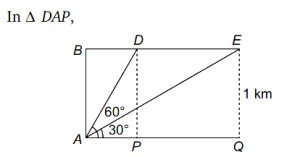
(C) Let the height of the aeroplane be $h = 1 \ km$. Let the positions of the aeroplane be $D$ and $E$ at two different times. Let $A$ be the point of observation on the ground. Let $P$ and $Q$ be the points on the ground directly below $D$ and $E$ respectively. So,$DP = EQ = 1 \ km$.
In $\Delta DAP$,$\tan 60^{\circ} = \frac{DP}{AP}$ $\Rightarrow \sqrt{3} = \frac{1}{AP}$ $\Rightarrow AP = \frac{1}{\sqrt{3}} \ km$.
In $\Delta EAQ$,$\tan 30^{\circ} = \frac{EQ}{AQ}$ $\Rightarrow \frac{1}{\sqrt{3}} = \frac{1}{AP + PQ}$ $\Rightarrow AP + PQ = \sqrt{3}$.
Substituting $AP = \frac{1}{\sqrt{3}}$,we get $\frac{1}{\sqrt{3}} + PQ = \sqrt{3}$ $\Rightarrow PQ = \sqrt{3} - \frac{1}{\sqrt{3}} = \frac{3-1}{\sqrt{3}} = \frac{2}{\sqrt{3}} \ km$.
The distance $PQ$ is covered in $10 \ s$. Therefore,speed $= \frac{\text{Distance}}{\text{Time}} = \frac{2/\sqrt{3} \ km}{10 \ s} = \frac{2}{10\sqrt{3}} \ km/s$.
To convert into $km/h$,multiply by $3600$: $\text{Speed} = \frac{2}{10\sqrt{3}} \times 3600 = \frac{720}{\sqrt{3}} = \frac{720\sqrt{3}}{3} = 240\sqrt{3} \ km/h$.
In $\Delta DAP$,$\tan 60^{\circ} = \frac{DP}{AP}$ $\Rightarrow \sqrt{3} = \frac{1}{AP}$ $\Rightarrow AP = \frac{1}{\sqrt{3}} \ km$.
In $\Delta EAQ$,$\tan 30^{\circ} = \frac{EQ}{AQ}$ $\Rightarrow \frac{1}{\sqrt{3}} = \frac{1}{AP + PQ}$ $\Rightarrow AP + PQ = \sqrt{3}$.
Substituting $AP = \frac{1}{\sqrt{3}}$,we get $\frac{1}{\sqrt{3}} + PQ = \sqrt{3}$ $\Rightarrow PQ = \sqrt{3} - \frac{1}{\sqrt{3}} = \frac{3-1}{\sqrt{3}} = \frac{2}{\sqrt{3}} \ km$.
The distance $PQ$ is covered in $10 \ s$. Therefore,speed $= \frac{\text{Distance}}{\text{Time}} = \frac{2/\sqrt{3} \ km}{10 \ s} = \frac{2}{10\sqrt{3}} \ km/s$.
To convert into $km/h$,multiply by $3600$: $\text{Speed} = \frac{2}{10\sqrt{3}} \times 3600 = \frac{720}{\sqrt{3}} = \frac{720\sqrt{3}}{3} = 240\sqrt{3} \ km/h$.
0 likesView Solution
80
ChemistryMCQTS EAMCET · 2004
If $f(x) = \frac{1}{x^2} \int_3^x (2t - 3f'(t)) dt$,then $f'(3)$ is equal to
A
$\frac{-1}{2}$
B
$\frac{-1}{3}$
C
$\frac{1}{2}$
D
$\frac{1}{3}$
Solution
(C) Given that,$f(x) = \frac{1}{x^2} \int_3^x (2t - 3f'(t)) dt$.
Multiplying by $x^2$,we get $x^2 f(x) = \int_3^x (2t - 3f'(t)) dt$.
Differentiating both sides with respect to $x$ using the product rule and the Leibniz integral rule:
$2x f(x) + x^2 f'(x) = 2x - 3f'(x)$.
At $x = 3$,we have $2(3) f(3) + 3^2 f'(3) = 2(3) - 3f'(3)$.
From the original integral,$f(3) = \frac{1}{3^2} \int_3^3 (2t - 3f'(t)) dt = 0$.
Substituting $f(3) = 0$ into the differentiated equation:
$2(3)(0) + 9f'(3) = 6 - 3f'(3)$.
$9f'(3) + 3f'(3) = 6$.
$12f'(3) = 6$.
$f'(3) = \frac{6}{12} = \frac{1}{2}$.
Multiplying by $x^2$,we get $x^2 f(x) = \int_3^x (2t - 3f'(t)) dt$.
Differentiating both sides with respect to $x$ using the product rule and the Leibniz integral rule:
$2x f(x) + x^2 f'(x) = 2x - 3f'(x)$.
At $x = 3$,we have $2(3) f(3) + 3^2 f'(3) = 2(3) - 3f'(3)$.
From the original integral,$f(3) = \frac{1}{3^2} \int_3^3 (2t - 3f'(t)) dt = 0$.
Substituting $f(3) = 0$ into the differentiated equation:
$2(3)(0) + 9f'(3) = 6 - 3f'(3)$.
$9f'(3) + 3f'(3) = 6$.
$12f'(3) = 6$.
$f'(3) = \frac{6}{12} = \frac{1}{2}$.
0 likesView Solution
81
ChemistryMCQTS EAMCET · 2004
The area bounded by the curve $y = x^2 + 2$,the $x$-axis,and the lines $x = 1$ and $x = 2$ is:
A
$\frac{16}{3} \text{ sq unit}$
B
$\frac{17}{3} \text{ sq unit}$
C
$\frac{13}{3} \text{ sq unit}$
D
$\frac{20}{3} \text{ sq unit}$
Solution
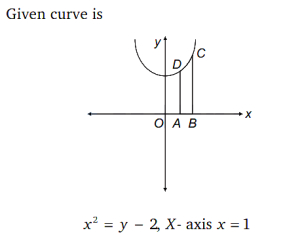
(C) The area bounded by the curve $y = f(x)$,the $x$-axis,and the lines $x = a$ and $x = b$ is given by the integral $\int_{a}^{b} y \, dx$.
Here,$y = x^2 + 2$,$a = 1$,and $b = 2$.
Therefore,the required area is:
$\text{Area} = \int_{1}^{2} (x^2 + 2) \, dx$
$= \left[ \frac{x^3}{3} + 2x \right]_{1}^{2}$
$= \left( \frac{2^3}{3} + 2(2) \right) - \left( \frac{1^3}{3} + 2(1) \right)$
$= \left( \frac{8}{3} + 4 \right) - \left( \frac{1}{3} + 2 \right)$
$= \left( \frac{8 + 12}{3} \right) - \left( \frac{1 + 6}{3} \right)$
$= \frac{20}{3} - \frac{7}{3}$
$= \frac{13}{3} \text{ sq unit}$.
Here,$y = x^2 + 2$,$a = 1$,and $b = 2$.
Therefore,the required area is:
$\text{Area} = \int_{1}^{2} (x^2 + 2) \, dx$
$= \left[ \frac{x^3}{3} + 2x \right]_{1}^{2}$
$= \left( \frac{2^3}{3} + 2(2) \right) - \left( \frac{1^3}{3} + 2(1) \right)$
$= \left( \frac{8}{3} + 4 \right) - \left( \frac{1}{3} + 2 \right)$
$= \left( \frac{8 + 12}{3} \right) - \left( \frac{1 + 6}{3} \right)$
$= \frac{20}{3} - \frac{7}{3}$
$= \frac{13}{3} \text{ sq unit}$.
0 likesView Solution
82
ChemistryMCQTS EAMCET · 2004
Assertion $(A)$: Optical fibres are widely used in communication networks. Reason $(R)$: Optical fibres are small in size,light in weight,flexible,and there is no scope for interference in them.
A
Both $(A)$ and $(R)$ are true and $(R)$ is the correct explanation of $(A)$
B
Both $(A)$ and $(R)$ are true but $(R)$ is not the correct explanation of $(A)$
C
$(A)$ is true but $(R)$ is false
D
$(A)$ is false but $(R)$ is true
Solution
(A) Optical fibres are extensively used in modern communication networks because they offer high bandwidth and low signal attenuation.
In optical fibres,light signals are transmitted via the principle of total internal reflection.
Because the signal is confined within the fibre and is not susceptible to electromagnetic interference,the transmission is highly secure and clear.
Additionally,optical fibres are physically compact,lightweight,and flexible,making them ideal for installation.
Therefore,both the assertion and the reason are true,and the reason correctly explains why optical fibres are widely used.
In optical fibres,light signals are transmitted via the principle of total internal reflection.
Because the signal is confined within the fibre and is not susceptible to electromagnetic interference,the transmission is highly secure and clear.
Additionally,optical fibres are physically compact,lightweight,and flexible,making them ideal for installation.
Therefore,both the assertion and the reason are true,and the reason correctly explains why optical fibres are widely used.
0 likesView Solution
83
ChemistryMCQTS EAMCET · 2004
The principal section of a glass prism is an isosceles triangle $ABC$ with $AB=AC$. The face $AC$ is silvered. $A$ ray of light is incident normally on the face $AB$ and after two reflections,it emerges from the base $BC$ perpendicular to the base. Angle $BAC$ of the prism is (in $^{\circ}$)
A
$30$
B
$36$
C
$60$
D
$72$
Solution
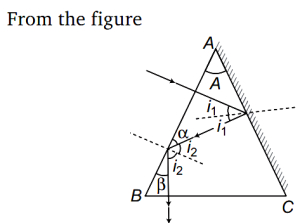
(B) Let the angle of the prism be $A$. Since the triangle is isosceles with $AB=AC$,the base angles are $\angle B = \angle C = (180^{\circ}-A)/2 = 90^{\circ} - A/2$.
$1$. The ray is incident normally on face $AB$,so it enters the prism undeviated.
$2$. At face $AC$ (which is silvered),the angle of incidence $i_1$ is equal to the angle $A$ of the prism.
$3$. After reflection at $AC$,the angle of reflection is also $i_1 = A$. The angle the reflected ray makes with the face $AC$ is $90^{\circ}-A$.
$4$. In the triangle formed by the ray and the sides of the prism,the angle at the face $AB$ is $90^{\circ}-2A$.
$5$. At the second reflection on face $AB$,the angle of incidence $i_2$ is $90^{\circ}-(90^{\circ}-2A) = 2A$.
$6$. The ray then strikes the base $BC$ normally. In the triangle formed by the ray and the base $BC$,the angle at $B$ is $90^{\circ}-2A$. Since the ray is perpendicular to $BC$,we have $90^{\circ}-2A + (90^{\circ}-A/2) = 90^{\circ}$.
$7$. Solving for $A$: $90^{\circ} - 2.5A = 0$,which gives $A = 36^{\circ}$.
$1$. The ray is incident normally on face $AB$,so it enters the prism undeviated.
$2$. At face $AC$ (which is silvered),the angle of incidence $i_1$ is equal to the angle $A$ of the prism.
$3$. After reflection at $AC$,the angle of reflection is also $i_1 = A$. The angle the reflected ray makes with the face $AC$ is $90^{\circ}-A$.
$4$. In the triangle formed by the ray and the sides of the prism,the angle at the face $AB$ is $90^{\circ}-2A$.
$5$. At the second reflection on face $AB$,the angle of incidence $i_2$ is $90^{\circ}-(90^{\circ}-2A) = 2A$.
$6$. The ray then strikes the base $BC$ normally. In the triangle formed by the ray and the base $BC$,the angle at $B$ is $90^{\circ}-2A$. Since the ray is perpendicular to $BC$,we have $90^{\circ}-2A + (90^{\circ}-A/2) = 90^{\circ}$.
$7$. Solving for $A$: $90^{\circ} - 2.5A = 0$,which gives $A = 36^{\circ}$.
0 likesView Solution
84
ChemistryMCQTS EAMCET · 2004
The refracting angle of a prism is $A$ and the refractive index of the material of the prism is $\cot (A / 2)$. The angle of minimum deviation of the prism is
A
$\pi+2 A$
B
$\pi-2 A$
C
$\frac{\pi}{2}+A$
D
$\frac{\pi}{2}-A$
Solution
(B) The formula for the refractive index $\mu$ of a prism in terms of the refracting angle $A$ and the angle of minimum deviation $\delta_m$ is given by:
$\mu = \frac{\sin((A + \delta_m) / 2)}{\sin(A / 2)}$
Given $\mu = \cot(A / 2) = \frac{\cos(A / 2)}{\sin(A / 2)}$,we substitute this into the formula:
$\frac{\cos(A / 2)}{\sin(A / 2)} = \frac{\sin((A + \delta_m) / 2)}{\sin(A / 2)}$
Canceling $\sin(A / 2)$ from both sides,we get:
$\cos(A / 2) = \sin((A + \delta_m) / 2)$
Using the trigonometric identity $\cos \theta = \sin(90^{\circ} - \theta)$ or $\sin(\pi/2 - \theta)$:
$\sin(\pi/2 - A/2) = \sin((A + \delta_m) / 2)$
Equating the angles:
$\pi/2 - A/2 = (A + \delta_m) / 2$
Multiplying by $2$:
$\pi - A = A + \delta_m$
$\delta_m = \pi - 2A$
$\mu = \frac{\sin((A + \delta_m) / 2)}{\sin(A / 2)}$
Given $\mu = \cot(A / 2) = \frac{\cos(A / 2)}{\sin(A / 2)}$,we substitute this into the formula:
$\frac{\cos(A / 2)}{\sin(A / 2)} = \frac{\sin((A + \delta_m) / 2)}{\sin(A / 2)}$
Canceling $\sin(A / 2)$ from both sides,we get:
$\cos(A / 2) = \sin((A + \delta_m) / 2)$
Using the trigonometric identity $\cos \theta = \sin(90^{\circ} - \theta)$ or $\sin(\pi/2 - \theta)$:
$\sin(\pi/2 - A/2) = \sin((A + \delta_m) / 2)$
Equating the angles:
$\pi/2 - A/2 = (A + \delta_m) / 2$
Multiplying by $2$:
$\pi - A = A + \delta_m$
$\delta_m = \pi - 2A$
0 likesView Solution
85
ChemistryMCQTS EAMCET · 2004
In the extraction of sodium by Down's process,cathode and anode respectively are:
A
copper and nickel
B
copper and chromium
C
nickel and chromium
D
iron and graphite
Solution
(D) In the Down's process for the extraction of sodium,the electrolysis of molten $NaCl$ is carried out.
In this cell,the cathode is made of $Iron$ $(Fe)$ and the anode is made of $Graphite$ $(C)$.
Therefore,the cathode and anode are $Iron$ and $Graphite$ respectively.
In this cell,the cathode is made of $Iron$ $(Fe)$ and the anode is made of $Graphite$ $(C)$.
Therefore,the cathode and anode are $Iron$ and $Graphite$ respectively.
0 likesView Solution
86
ChemistryMCQTS EAMCET · 2004
In the hardening stage of plaster of Paris,the compound formed is:
A
$CaSO_4$
B
$Orthorhombic \ CaSO_4 \cdot 2 H_2 O$
C
$CaSO_4 \cdot H_2 O$
D
$Monoclinic \ CaSO_4 \cdot 2 H_2 O$
Solution
(D) Plaster of Paris absorbs water to form monoclinic gypsum,which is a hard substance.
The chemical reaction is:
$CaSO_4 \cdot \frac{1}{2} H_2 O + \frac{3}{2} H_2 O \rightarrow CaSO_4 \cdot 2 H_2 O$
(Monoclinic gypsum)
The chemical reaction is:
$CaSO_4 \cdot \frac{1}{2} H_2 O + \frac{3}{2} H_2 O \rightarrow CaSO_4 \cdot 2 H_2 O$
(Monoclinic gypsum)
0 likesView Solution
87
ChemistryMCQTS EAMCET · 2004
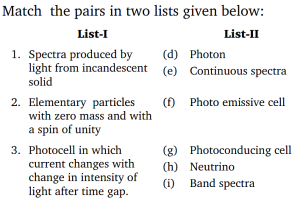
A
$1-$e,$2$-h,$3$-g
B
$1-$i,$2$-h,$3$-f
C
$1-$e,$2$-h,$3$-f
D
$1-$i,$2$-d,$3$-g
Solution
(A) No Solution Available
0 likesView Solution
88
ChemistryMCQTS EAMCET · 2004
Observe the following statements:
$A$. Integrating factor of $\frac{dy}{dx} + y = x^2$ is $e^x$.
$R$. Integrating factor of $\frac{dy}{dx} + P(x)y = Q(x)$ is $e^{\int P(x) dx}$.
Then,the true statement among the following is:
$A$. Integrating factor of $\frac{dy}{dx} + y = x^2$ is $e^x$.
$R$. Integrating factor of $\frac{dy}{dx} + P(x)y = Q(x)$ is $e^{\int P(x) dx}$.
Then,the true statement among the following is:
A
$A$ is true,$R$ is false
B
$A$ is false,$R$ is true
C
$A$ is true,$R$ is true,$R \Rightarrow A$
D
Both are false
Solution
(C) For statement $A$: The given differential equation is $\frac{dy}{dx} + y = x^2$. Comparing this with the standard form $\frac{dy}{dx} + P(x)y = Q(x)$,we get $P(x) = 1$. The integrating factor $(IF)$ is $e^{\int P(x) dx} = e^{\int 1 dx} = e^x$. Thus,statement $A$ is true.
For statement $R$: The standard form of a linear differential equation is $\frac{dy}{dx} + P(x)y = Q(x)$,and its integrating factor is defined as $e^{\int P(x) dx}$. Thus,statement $R$ is true.
Since statement $A$ is derived directly from the definition provided in statement $R$,$R \Rightarrow A$ is true.
For statement $R$: The standard form of a linear differential equation is $\frac{dy}{dx} + P(x)y = Q(x)$,and its integrating factor is defined as $e^{\int P(x) dx}$. Thus,statement $R$ is true.
Since statement $A$ is derived directly from the definition provided in statement $R$,$R \Rightarrow A$ is true.
0 likesView Solution
89
ChemistryMCQTS EAMCET · 2004
The vector $c \cdot (b+c) \times (a+b+c)$ is equal to
A
$c \cdot (b \times a)$
B
$0$
C
$c \cdot (a \times b)$
D
$c \cdot (a \times b)$
Solution
(A) We need to evaluate the expression $c \cdot ((b+c) \times (a+b+c))$.
Using the distributive property of the cross product,we have:
$(b+c) \times (a+b+c) = b \times a + b \times b + b \times c + c \times a + c \times b + c \times c$.
Since the cross product of any vector with itself is zero ($b \times b = 0$ and $c \times c = 0$),the expression simplifies to:
$(b+c) \times (a+b+c) = b \times a + b \times c + c \times a + c \times b$.
Now,taking the dot product with $c$:
$c \cdot (b \times a + b \times c + c \times a + c \times b) = c \cdot (b \times a) + c \cdot (b \times c) + c \cdot (c \times a) + c \cdot (c \times b)$.
Using the scalar triple product property $[x, y, z] = x \cdot (y \times z)$,we get:
$= [c, b, a] + [c, b, c] + [c, c, a] + [c, c, b]$.
Since any scalar triple product with two identical vectors is zero,we have:
$[c, b, c] = 0$,$[c, c, a] = 0$,and $[c, c, b] = 0$.
Thus,the expression simplifies to $[c, b, a] = c \cdot (b \times a)$.
Since $c \cdot (b \times a) = -c \cdot (a \times b)$,and looking at the options,the correct form is $c \cdot (b \times a)$.
Using the distributive property of the cross product,we have:
$(b+c) \times (a+b+c) = b \times a + b \times b + b \times c + c \times a + c \times b + c \times c$.
Since the cross product of any vector with itself is zero ($b \times b = 0$ and $c \times c = 0$),the expression simplifies to:
$(b+c) \times (a+b+c) = b \times a + b \times c + c \times a + c \times b$.
Now,taking the dot product with $c$:
$c \cdot (b \times a + b \times c + c \times a + c \times b) = c \cdot (b \times a) + c \cdot (b \times c) + c \cdot (c \times a) + c \cdot (c \times b)$.
Using the scalar triple product property $[x, y, z] = x \cdot (y \times z)$,we get:
$= [c, b, a] + [c, b, c] + [c, c, a] + [c, c, b]$.
Since any scalar triple product with two identical vectors is zero,we have:
$[c, b, c] = 0$,$[c, c, a] = 0$,and $[c, c, b] = 0$.
Thus,the expression simplifies to $[c, b, a] = c \cdot (b \times a)$.
Since $c \cdot (b \times a) = -c \cdot (a \times b)$,and looking at the options,the correct form is $c \cdot (b \times a)$.
0 likesView Solution
90
ChemistryMCQTS EAMCET · 2004
If the direction ratios $(l, m, n)$ of two lines satisfy the equations $l+m+n=0$ and $mn-2ln+lm=0$,then the angle between the lines is
A
$\frac{\pi}{4}$
B
$\frac{\pi}{3}$
C
$\frac{\pi}{2}$
D
$0$
Solution
(C) Given equations are:
$l+m+n=0 \quad \dots(i)$
$mn-2ln+lm=0 \quad \dots(ii)$
From $(i)$,$l = -(m+n)$. Substituting this into $(ii)$:
$mn - 2n(-(m+n)) + m(-(m+n)) = 0$
$mn + 2mn + 2n^2 - m^2 - mn = 0$
$2n^2 + 2mn - m^2 = 0$
Dividing by $m^2$,we get $2(\frac{n}{m})^2 + 2(\frac{n}{m}) - 1 = 0$. Let the roots be $\frac{n_1}{m_1}$ and $\frac{n_2}{m_2}$.
Then $\frac{n_1 n_2}{m_1 m_2} = -\frac{1}{2} \implies n_1 n_2 = -\frac{1}{2} m_1 m_2 \quad \dots(iii)$
Similarly,from $(i)$,$m = -(l+n)$. Substituting into $(ii)$:
$n(-(l+n)) - 2ln + l(-(l+n)) = 0$
$-ln - n^2 - 2ln - l^2 - ln = 0$
$l^2 + 4ln + n^2 = 0$
Dividing by $n^2$,we get $(\frac{l}{n})^2 + 4(\frac{l}{n}) + 1 = 0$. Let the roots be $\frac{l_1}{n_1}$ and $\frac{l_2}{n_2}$.
Then $\frac{l_1 l_2}{n_1 n_2} = 1 \implies l_1 l_2 = n_1 n_2 \quad \dots(iv)$
From $(iii)$ and $(iv)$,$l_1 l_2 = n_1 n_2 = -\frac{1}{2} m_1 m_2$.
Thus,$l_1 l_2 + m_1 m_2 + n_1 n_2 = l_1 l_2 - 2l_1 l_2 + l_1 l_2 = 0$.
Since $l_1 l_2 + m_1 m_2 + n_1 n_2 = 0$,the lines are perpendicular. Therefore,the angle between them is $\frac{\pi}{2}$.
$l+m+n=0 \quad \dots(i)$
$mn-2ln+lm=0 \quad \dots(ii)$
From $(i)$,$l = -(m+n)$. Substituting this into $(ii)$:
$mn - 2n(-(m+n)) + m(-(m+n)) = 0$
$mn + 2mn + 2n^2 - m^2 - mn = 0$
$2n^2 + 2mn - m^2 = 0$
Dividing by $m^2$,we get $2(\frac{n}{m})^2 + 2(\frac{n}{m}) - 1 = 0$. Let the roots be $\frac{n_1}{m_1}$ and $\frac{n_2}{m_2}$.
Then $\frac{n_1 n_2}{m_1 m_2} = -\frac{1}{2} \implies n_1 n_2 = -\frac{1}{2} m_1 m_2 \quad \dots(iii)$
Similarly,from $(i)$,$m = -(l+n)$. Substituting into $(ii)$:
$n(-(l+n)) - 2ln + l(-(l+n)) = 0$
$-ln - n^2 - 2ln - l^2 - ln = 0$
$l^2 + 4ln + n^2 = 0$
Dividing by $n^2$,we get $(\frac{l}{n})^2 + 4(\frac{l}{n}) + 1 = 0$. Let the roots be $\frac{l_1}{n_1}$ and $\frac{l_2}{n_2}$.
Then $\frac{l_1 l_2}{n_1 n_2} = 1 \implies l_1 l_2 = n_1 n_2 \quad \dots(iv)$
From $(iii)$ and $(iv)$,$l_1 l_2 = n_1 n_2 = -\frac{1}{2} m_1 m_2$.
Thus,$l_1 l_2 + m_1 m_2 + n_1 n_2 = l_1 l_2 - 2l_1 l_2 + l_1 l_2 = 0$.
Since $l_1 l_2 + m_1 m_2 + n_1 n_2 = 0$,the lines are perpendicular. Therefore,the angle between them is $\frac{\pi}{2}$.
0 likesView Solution
91
ChemistryMCQTS EAMCET · 2004
If $(2,-1,3)$ is the foot of the perpendicular drawn from the origin to the plane,then the equation of the plane is
A
$2x-y+3z-14=0$
B
$2x+y-3z+6=0$
C
$2x-y+3z-13=0$
D
$2x+y+3z-10=0$
Solution
(A) Let the origin be $O(0,0,0)$ and the foot of the perpendicular be $P(2,-1,3)$.
Since $OP$ is the normal to the plane,the direction ratios of the normal are the same as the direction ratios of the line $OP$.
The direction ratios of $OP$ are $(2-0, -1-0, 3-0) = (2, -1, 3)$.
Thus,the normal vector to the plane is $\vec{n} = 2\hat{i} - \hat{j} + 3\hat{k}$.
The equation of a plane passing through a point $(x_1, y_1, z_1)$ with normal vector $(a, b, c)$ is given by $a(x-x_1) + b(y-y_1) + c(z-z_1) = 0$.
Substituting the point $P(2, -1, 3)$ and the normal vector $(2, -1, 3)$ into the equation:
$2(x-2) - 1(y-(-1)) + 3(z-3) = 0$
$2(x-2) - 1(y+1) + 3(z-3) = 0$
$2x - 4 - y - 1 + 3z - 9 = 0$
$2x - y + 3z - 14 = 0$
Therefore,the equation of the plane is $2x - y + 3z - 14 = 0$.
Since $OP$ is the normal to the plane,the direction ratios of the normal are the same as the direction ratios of the line $OP$.
The direction ratios of $OP$ are $(2-0, -1-0, 3-0) = (2, -1, 3)$.
Thus,the normal vector to the plane is $\vec{n} = 2\hat{i} - \hat{j} + 3\hat{k}$.
The equation of a plane passing through a point $(x_1, y_1, z_1)$ with normal vector $(a, b, c)$ is given by $a(x-x_1) + b(y-y_1) + c(z-z_1) = 0$.
Substituting the point $P(2, -1, 3)$ and the normal vector $(2, -1, 3)$ into the equation:
$2(x-2) - 1(y-(-1)) + 3(z-3) = 0$
$2(x-2) - 1(y+1) + 3(z-3) = 0$
$2x - 4 - y - 1 + 3z - 9 = 0$
$2x - y + 3z - 14 = 0$
Therefore,the equation of the plane is $2x - y + 3z - 14 = 0$.
0 likesView Solution
92
ChemistryMCQTS EAMCET · 2004
Six faces of an unbiased die are numbered with $2, 3, 5, 7, 11$ and $13$. If two such dice are thrown,then the probability that the sum on the uppermost faces of the dice is an odd number is
A
$\frac{5}{18}$
B
$\frac{5}{36}$
C
$\frac{13}{18}$
D
$\frac{25}{36}$
Solution
(A) The numbers on the die are $\{2, 3, 5, 7, 11, 13\}$.
There is $1$ even number $(2)$ and $5$ odd numbers $(3, 5, 7, 11, 13)$.
The sum of two numbers is odd if and only if one number is even and the other is odd.
Let $E$ be the event that the first die shows an even number and the second shows an odd number,or the first die shows an odd number and the second shows an even number.
Probability of getting an even number $P(Even) = \frac{1}{6}$.
Probability of getting an odd number $P(Odd) = \frac{5}{6}$.
Required probability $= P(Even) \times P(Odd) + P(Odd) \times P(Even)$
$= \left(\frac{1}{6} \times \frac{5}{6}\right) + \left(\frac{5}{6} \times \frac{1}{6}\right)$
$= \frac{5}{36} + \frac{5}{36} = \frac{10}{36} = \frac{5}{18}$.
There is $1$ even number $(2)$ and $5$ odd numbers $(3, 5, 7, 11, 13)$.
The sum of two numbers is odd if and only if one number is even and the other is odd.
Let $E$ be the event that the first die shows an even number and the second shows an odd number,or the first die shows an odd number and the second shows an even number.
Probability of getting an even number $P(Even) = \frac{1}{6}$.
Probability of getting an odd number $P(Odd) = \frac{5}{6}$.
Required probability $= P(Even) \times P(Odd) + P(Odd) \times P(Even)$
$= \left(\frac{1}{6} \times \frac{5}{6}\right) + \left(\frac{5}{6} \times \frac{1}{6}\right)$
$= \frac{5}{36} + \frac{5}{36} = \frac{10}{36} = \frac{5}{18}$.
0 likesView Solution
93
ChemistryMCQTS EAMCET · 2004
Suppose $E$ and $F$ are two events of a random experiment. If the probability of occurrence of $E$ is $1/5$ and the probability of occurrence of $F$ given $E$ is $1/10$,then the probability of non-occurrence of at least one of the events $E$ and $F$ is
A
$1/18$
B
$1/2$
C
$49/50$
D
$1/50$
Solution
(C) Given that,$P(E) = 1/5$ and $P(F|E) = 1/10$.
We need to find the probability of non-occurrence of at least one of the events $E$ and $F$,which is $P((E \cap F)^c) = 1 - P(E \cap F)$.
Using the multiplication theorem of probability,$P(E \cap F) = P(E) \times P(F|E)$.
Substituting the given values,$P(E \cap F) = (1/5) \times (1/10) = 1/50$.
Therefore,the required probability is $1 - P(E \cap F) = 1 - 1/50 = 49/50$.
We need to find the probability of non-occurrence of at least one of the events $E$ and $F$,which is $P((E \cap F)^c) = 1 - P(E \cap F)$.
Using the multiplication theorem of probability,$P(E \cap F) = P(E) \times P(F|E)$.
Substituting the given values,$P(E \cap F) = (1/5) \times (1/10) = 1/50$.
Therefore,the required probability is $1 - P(E \cap F) = 1 - 1/50 = 49/50$.
0 likesView Solution
94
ChemistryMCQTS EAMCET · 2004
$A$ person who tosses an unbiased coin gains two points for turning up a head and loses one point for a tail. If three coins are tossed and the total score $X$ is observed,then the range of $X$ is
A
$\{0, 3, 6\}$
B
$\{-3, 0, 3\}$
C
$\{-3, 0, 3, 6\}$
D
$\{-3, 3, 6\}$
Solution
(C) Let $H$ denote a head and $T$ denote a tail. $A$ head gives $+2$ points and a tail gives $-1$ point. When three coins are tossed,the possible outcomes for the number of heads $(H)$ and tails $(T)$ are:
$1$. Three tails $(0H, 3T)$: Score $= 0(2) + 3(-1) = -3$.
$2$. Two tails and one head $(1H, 2T)$: Score $= 1(2) + 2(-1) = 2 - 2 = 0$.
$3$. One tail and two heads $(2H, 1T)$: Score $= 2(2) + 1(-1) = 4 - 1 = 3$.
$4$. Three heads $(3H, 0T)$: Score $= 3(2) + 0(-1) = 6$.
Therefore,the range of the total score $X$ is $\{-3, 0, 3, 6\}$.
$1$. Three tails $(0H, 3T)$: Score $= 0(2) + 3(-1) = -3$.
$2$. Two tails and one head $(1H, 2T)$: Score $= 1(2) + 2(-1) = 2 - 2 = 0$.
$3$. One tail and two heads $(2H, 1T)$: Score $= 2(2) + 1(-1) = 4 - 1 = 3$.
$4$. Three heads $(3H, 0T)$: Score $= 3(2) + 0(-1) = 6$.
Therefore,the range of the total score $X$ is $\{-3, 0, 3, 6\}$.
0 likesView Solution
95
ChemistryMCQTS EAMCET · 2004
An unbiased coin is tossed to get $2$ points for turning up a head and $1$ point for the tail. If three unbiased coins are tossed simultaneously,then the probability of getting a total of an odd number of points is
A
$\frac{1}{2}$
B
$\frac{1}{4}$
C
$\frac{1}{8}$
D
$\frac{3}{8}$
Solution
(A) Let $H$ denote a head and $T$ denote a tail. The points awarded are $2$ for $H$ and $1$ for $T$.
When three coins are tossed,let $n_H$ be the number of heads and $n_T$ be the number of tails.
The total points $S = 2n_H + 1n_T$.
Since $n_H + n_T = 3$,we have $n_T = 3 - n_H$.
Substituting this,$S = 2n_H + (3 - n_H) = n_H + 3$.
For $S$ to be an odd number,$n_H + 3$ must be odd,which implies $n_H$ must be an even number.
Possible values for $n_H$ are $0$ or $2$ (since $n_H \in \{0, 1, 2, 3\}$).
Case $1$: $n_H = 0$ (all tails,$TTT$).
Probability $P(n_H = 0) = \binom{3}{0} (\frac{1}{2})^0 (\frac{1}{2})^3 = \frac{1}{8}$.
Case $2$: $n_H = 2$ (two heads,one tail,e.g.,$HHT, HTH, THH$).
Probability $P(n_H = 2) = \binom{3}{2} (\frac{1}{2})^2 (\frac{1}{2})^1 = 3 \times \frac{1}{8} = \frac{3}{8}$.
The total probability of getting an odd number of points is $P(n_H = 0) + P(n_H = 2) = \frac{1}{8} + \frac{3}{8} = \frac{4}{8} = \frac{1}{2}$.
When three coins are tossed,let $n_H$ be the number of heads and $n_T$ be the number of tails.
The total points $S = 2n_H + 1n_T$.
Since $n_H + n_T = 3$,we have $n_T = 3 - n_H$.
Substituting this,$S = 2n_H + (3 - n_H) = n_H + 3$.
For $S$ to be an odd number,$n_H + 3$ must be odd,which implies $n_H$ must be an even number.
Possible values for $n_H$ are $0$ or $2$ (since $n_H \in \{0, 1, 2, 3\}$).
Case $1$: $n_H = 0$ (all tails,$TTT$).
Probability $P(n_H = 0) = \binom{3}{0} (\frac{1}{2})^0 (\frac{1}{2})^3 = \frac{1}{8}$.
Case $2$: $n_H = 2$ (two heads,one tail,e.g.,$HHT, HTH, THH$).
Probability $P(n_H = 2) = \binom{3}{2} (\frac{1}{2})^2 (\frac{1}{2})^1 = 3 \times \frac{1}{8} = \frac{3}{8}$.
The total probability of getting an odd number of points is $P(n_H = 0) + P(n_H = 2) = \frac{1}{8} + \frac{3}{8} = \frac{4}{8} = \frac{1}{2}$.
0 likesView Solution
96
ChemistryMCQTS EAMCET · 2004
At $27^{\circ} C$,$500 \ mL$ of helium diffuses in $30 \ minutes$. What is the time (in hours) taken for $1000 \ mL$ of $SO_2$ to diffuse under the same experimental conditions?
A
$240$
B
$3$
C
$2$
D
$4$
Solution
(D) According to Graham's law of diffusion,the rate of diffusion $r$ is inversely proportional to the square root of the molar mass $M$: $\frac{r_1}{r_2} = \sqrt{\frac{M_2}{M_1}}$.
Given,$V_{He} = 500 \ mL$,$t_{He} = 30 \ min$,so $r_{He} = \frac{500}{30} \ mL/min$.
For $SO_2$,$V_{SO_2} = 1000 \ mL$,$t_{SO_2} = t$,so $r_{SO_2} = \frac{1000}{t} \ mL/min$.
Molar masses are $M_{He} = 4 \ g/mol$ and $M_{SO_2} = 64 \ g/mol$.
Substituting the values: $\frac{500/30}{1000/t} = \sqrt{\frac{64}{4}}$.
$\frac{500}{30} \times \frac{t}{1000} = \sqrt{16} = 4$.
$\frac{t}{60} = 4 \Rightarrow t = 240 \ minutes$.
Converting to hours: $t = \frac{240}{60} = 4 \ hours$.
Given,$V_{He} = 500 \ mL$,$t_{He} = 30 \ min$,so $r_{He} = \frac{500}{30} \ mL/min$.
For $SO_2$,$V_{SO_2} = 1000 \ mL$,$t_{SO_2} = t$,so $r_{SO_2} = \frac{1000}{t} \ mL/min$.
Molar masses are $M_{He} = 4 \ g/mol$ and $M_{SO_2} = 64 \ g/mol$.
Substituting the values: $\frac{500/30}{1000/t} = \sqrt{\frac{64}{4}}$.
$\frac{500}{30} \times \frac{t}{1000} = \sqrt{16} = 4$.
$\frac{t}{60} = 4 \Rightarrow t = 240 \ minutes$.
Converting to hours: $t = \frac{240}{60} = 4 \ hours$.
0 likesView Solution
97
ChemistryMCQTS EAMCET · 2004
Which of the following elements has the least number of electrons in its $M$ shell?
A
$K$
B
$Mn$
C
$Ni$
D
$Sc$
Solution
(A) The electronic configurations are as follows:
$K$ $(Z=19)$: $1s^2, 2s^2 2p^6, 3s^2 3p^6, 4s^1$. Electrons in $M$ shell $(n=3)$ = $8$.
$Mn$ $(Z=25)$: $1s^2, 2s^2 2p^6, 3s^2 3p^6 3d^5, 4s^2$. Electrons in $M$ shell $(n=3)$ = $13$.
$Ni$ $(Z=28)$: $1s^2, 2s^2 2p^6, 3s^2 3p^6 3d^8, 4s^2$. Electrons in $M$ shell $(n=3)$ = $16$.
$Sc$ $(Z=21)$: $1s^2, 2s^2 2p^6, 3s^2 3p^6 3d^1, 4s^2$. Electrons in $M$ shell $(n=3)$ = $9$.
Thus,$K$ has the least number of electrons in its $M$ shell.
$K$ $(Z=19)$: $1s^2, 2s^2 2p^6, 3s^2 3p^6, 4s^1$. Electrons in $M$ shell $(n=3)$ = $8$.
$Mn$ $(Z=25)$: $1s^2, 2s^2 2p^6, 3s^2 3p^6 3d^5, 4s^2$. Electrons in $M$ shell $(n=3)$ = $13$.
$Ni$ $(Z=28)$: $1s^2, 2s^2 2p^6, 3s^2 3p^6 3d^8, 4s^2$. Electrons in $M$ shell $(n=3)$ = $16$.
$Sc$ $(Z=21)$: $1s^2, 2s^2 2p^6, 3s^2 3p^6 3d^1, 4s^2$. Electrons in $M$ shell $(n=3)$ = $9$.
Thus,$K$ has the least number of electrons in its $M$ shell.
0 likesView Solution
98
ChemistryMCQTS EAMCET · 2004
Assertion $(A)$: Rapidly changing temperatures can be measured by thermocouples. Reason $(R)$: The thermal capacity of the junction of a thermocouple is very small.
A
Both $(A)$ and $(R)$ are true and $(R)$ is the correct explanation of $(A)$
B
Both $(A)$ and $(R)$ are true but $(R)$ is not the correct explanation of $(A)$
C
$(A)$ is true but $(R)$ is false
D
$(A)$ is false but $(R)$ is true
Solution
(A) thermocouple consists of two dissimilar metal wires joined at two junctions.
When one junction is kept at a constant temperature and the other is exposed to a changing temperature,a thermoelectric electromotive force $(EMF)$ is generated.
Because the junction of a thermocouple is very small,its thermal capacity is extremely low.
Thermal capacity is defined as the product of mass and specific heat capacity $(C = mc)$.
$A$ low thermal capacity means the junction can gain or lose heat very quickly to reach thermal equilibrium with the surroundings.
Therefore,it can respond rapidly to changes in temperature,making it suitable for measuring rapidly changing temperatures.
Thus,$(A)$ is true,$(R)$ is true,and $(R)$ is the correct explanation of $(A)$.
When one junction is kept at a constant temperature and the other is exposed to a changing temperature,a thermoelectric electromotive force $(EMF)$ is generated.
Because the junction of a thermocouple is very small,its thermal capacity is extremely low.
Thermal capacity is defined as the product of mass and specific heat capacity $(C = mc)$.
$A$ low thermal capacity means the junction can gain or lose heat very quickly to reach thermal equilibrium with the surroundings.
Therefore,it can respond rapidly to changes in temperature,making it suitable for measuring rapidly changing temperatures.
Thus,$(A)$ is true,$(R)$ is true,and $(R)$ is the correct explanation of $(A)$.
0 likesView Solution
99
ChemistryMCQTS EAMCET · 2004
$A$ black body of mass $34.38 \ g$ and surface area $19.2 \ cm^2$ is at an initial temperature of $400 \ K$. It is allowed to cool inside an evacuated enclosure kept at a constant temperature of $300 \ K$. The rate of cooling is $0.04 \ ^{\circ}C/s$. The specific heat of the body in $J \ kg^{-1} \ K^{-1}$ is (Stefan's constant $\sigma = 5.73 \times 10^{-8} \ W \ m^{-2} \ K^{-4}$)
A
$2800$
B
$2100$
C
$1400$
D
$1200$
Solution
(C) The rate of cooling of a body is given by the formula: $\frac{d\theta}{dt} = \frac{\sigma A(T^4 - T_0^4)}{ms}$.
Here,$m = 34.38 \times 10^{-3} \ kg$,$A = 19.2 \times 10^{-4} \ m^2$,$T = 400 \ K$,$T_0 = 300 \ K$,and $\frac{d\theta}{dt} = 0.04 \ K/s$.
Rearranging for specific heat $s$: $s = \frac{\sigma A(T^4 - T_0^4)}{m(\frac{d\theta}{dt})}$.
Substituting the values:
$s = \frac{(5.73 \times 10^{-8}) \times (19.2 \times 10^{-4}) \times (400^4 - 300^4)}{(34.38 \times 10^{-3}) \times 0.04}$.
$s = \frac{(5.73 \times 10^{-8}) \times (19.2 \times 10^{-4}) \times (256 \times 10^8 - 81 \times 10^8)}{34.38 \times 10^{-3} \times 0.04}$.
$s = \frac{5.73 \times 19.2 \times 10^{-12} \times 175 \times 10^8}{34.38 \times 10^{-3} \times 0.04}$.
$s = \frac{19249.92 \times 10^{-4}}{1.3752 \times 10^{-3}} \approx 1400 \ J \ kg^{-1} \ K^{-1}$.
Here,$m = 34.38 \times 10^{-3} \ kg$,$A = 19.2 \times 10^{-4} \ m^2$,$T = 400 \ K$,$T_0 = 300 \ K$,and $\frac{d\theta}{dt} = 0.04 \ K/s$.
Rearranging for specific heat $s$: $s = \frac{\sigma A(T^4 - T_0^4)}{m(\frac{d\theta}{dt})}$.
Substituting the values:
$s = \frac{(5.73 \times 10^{-8}) \times (19.2 \times 10^{-4}) \times (400^4 - 300^4)}{(34.38 \times 10^{-3}) \times 0.04}$.
$s = \frac{(5.73 \times 10^{-8}) \times (19.2 \times 10^{-4}) \times (256 \times 10^8 - 81 \times 10^8)}{34.38 \times 10^{-3} \times 0.04}$.
$s = \frac{5.73 \times 19.2 \times 10^{-12} \times 175 \times 10^8}{34.38 \times 10^{-3} \times 0.04}$.
$s = \frac{19249.92 \times 10^{-4}}{1.3752 \times 10^{-3}} \approx 1400 \ J \ kg^{-1} \ K^{-1}$.
0 likesView Solution
100
ChemistryMCQTS EAMCET · 2004
If $4$ moles of an ideal monoatomic gas at temperature $400 ~K$ is mixed with $2$ moles of another ideal monoatomic gas at temperature $700 ~K$,the temperature of the mixture is
A
$550^{\circ} C$
B
$5000^{\circ} C$
C
$550 ~K$
D
$500 ~K$
Solution
(D) For an ideal monoatomic gas,the internal energy is given by $U = n C_V T$,where $C_V = \frac{3}{2} R$.
When two gases are mixed in an adiabatic container,the total internal energy is conserved: $U_{mix} = U_1 + U_2$.
$(n_1 + n_2) C_V T_{mix} = n_1 C_V T_1 + n_2 C_V T_2$.
Since the gases are both monoatomic,$C_V$ cancels out:
$T_{mix} = \frac{n_1 T_1 + n_2 T_2}{n_1 + n_2}$.
Substituting the given values:
$T_{mix} = \frac{4(400) + 2(700)}{4 + 2}$.
$T_{mix} = \frac{1600 + 1400}{6} = \frac{3000}{6} = 500 ~K$.
When two gases are mixed in an adiabatic container,the total internal energy is conserved: $U_{mix} = U_1 + U_2$.
$(n_1 + n_2) C_V T_{mix} = n_1 C_V T_1 + n_2 C_V T_2$.
Since the gases are both monoatomic,$C_V$ cancels out:
$T_{mix} = \frac{n_1 T_1 + n_2 T_2}{n_1 + n_2}$.
Substituting the given values:
$T_{mix} = \frac{4(400) + 2(700)}{4 + 2}$.
$T_{mix} = \frac{1600 + 1400}{6} = \frac{3000}{6} = 500 ~K$.
0 likesView Solution
Vedclass Products
For Students
Vedclass Test Series
Mock tests in real TS EAMCET style covering Chemistry with performance analysis. 5-day free trial.
Start Free TrialFor Teachers
Exam Paper Generator
Generate Set A/B/C/D Chemistry papers from 7.5L+ questions in 2 minutes. 3 chapters free.
Try FreeFor Institutes
Online Exam Module
Run live TS EAMCET mock exams with unlimited students, 360° analytics & white-label branding.
See DemoFrequently Asked Questions
How many Chemistry questions are in TS EAMCET 2004?
There are 183 Chemistry questions from the TS EAMCET 2004 paper on Vedclass, each with a detailed step-by-step solution in English.
Are TS EAMCET 2004 Chemistry solutions available in English?
Yes. All solutions on this page are in English. You can also switch to English or Hindi using the language buttons above the questions.
Can I practice TS EAMCET 2004 Chemistry as a timed test?
Yes. Use the Vedclass Test Series to attempt a full TS EAMCET mock test covering Chemistry with time limits and instant score analysis.
Can teachers create Chemistry papers from TS EAMCET previous year questions?
Yes. The Vedclass Exam Paper Generator lets teachers mix TS EAMCET Chemistry questions and generate Set A/B/C/D papers in minutes.
For Teachers & Institutes
Build a Custom Chemistry Paper
Pick TS EAMCET 2004 Chemistry questions, set difficulty, and generate Set A/B/C/D in 2 minutes.