
ChemistryQ101–150 of 183 questions
Page 3 of 4 · English
101
ChemistryMCQTS EAMCET · 2004
The pressure and density of a given mass of a diatomic gas $\left(\gamma = \frac{7}{5}\right)$ change adiabatically from $(P, d)$ to $(P^{\prime}, d^{\prime})$. If $\frac{d^{\prime}}{d} = 32$,then $\frac{P^{\prime}}{P}$ is $(\gamma = \text{ratio of specific heats})$
A
$\frac{1}{128}$
B
$\frac{1}{64}$
C
$64$
D
$128$
Solution
(D) For an adiabatic process,the relationship between pressure $P$ and density $\rho$ is given by $P \propto \rho^{\gamma}$.
Therefore,we can write the ratio as $\frac{P^{\prime}}{P} = \left( \frac{d^{\prime}}{d} \right)^{\gamma}$.
Given $\frac{d^{\prime}}{d} = 32$ and $\gamma = \frac{7}{5}$.
Substituting these values,we get $\frac{P^{\prime}}{P} = (32)^{7/5}$.
Since $32 = 2^5$,we have $\frac{P^{\prime}}{P} = (2^5)^{7/5} = 2^7$.
Calculating $2^7$,we get $2^7 = 128$.
Thus,the ratio $\frac{P^{\prime}}{P} = 128$.
Therefore,we can write the ratio as $\frac{P^{\prime}}{P} = \left( \frac{d^{\prime}}{d} \right)^{\gamma}$.
Given $\frac{d^{\prime}}{d} = 32$ and $\gamma = \frac{7}{5}$.
Substituting these values,we get $\frac{P^{\prime}}{P} = (32)^{7/5}$.
Since $32 = 2^5$,we have $\frac{P^{\prime}}{P} = (2^5)^{7/5} = 2^7$.
Calculating $2^7$,we get $2^7 = 128$.
Thus,the ratio $\frac{P^{\prime}}{P} = 128$.
0 likesView Solution
102
ChemistryMCQTS EAMCET · 2004
Two identical vessels $A$ and $B$ with frictionless pistons contain the same ideal gas at the same temperature and the same volume $V$. The masses of gas in $A$ and $B$ are $m_A$ and $m_B$,respectively. The gases are allowed to expand isothermally to the same final volume $2V$. The changes in pressures of the gas in $A$ and $B$ are found to be $\Delta P$ and $1.5 \Delta P$,respectively. Then:
A
$9 m_A = 4 m_B$
B
$3 m_A = 2 m_B$
C
$2 m_A = 3 m_B$
D
$4 m_A = 9 m_B$
Solution
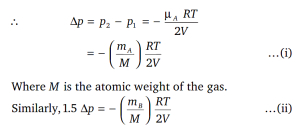
(B) For an ideal gas,the pressure $P$ is given by $P = \frac{nRT}{V} = \frac{m}{M} \frac{RT}{V}$,where $m$ is the mass,$M$ is the molar mass,$R$ is the gas constant,and $T$ is the temperature.
Initially,for vessel $A$,$P_{A,i} = \frac{m_A RT}{MV}$. After isothermal expansion to volume $2V$,$P_{A,f} = \frac{m_A RT}{M(2V)}$.
The change in pressure for vessel $A$ is $\Delta P = |P_{A,f} - P_{A,i}| = \frac{m_A RT}{2MV}$.
Similarly,for vessel $B$,the change in pressure is $1.5 \Delta P = |P_{B,f} - P_{B,i}| = \frac{m_B RT}{2MV}$.
Dividing the two equations:
$\frac{1.5 \Delta P}{\Delta P} = \frac{\frac{m_B RT}{2MV}}{\frac{m_A RT}{2MV}}$
$1.5 = \frac{m_B}{m_A}$
$\frac{3}{2} = \frac{m_B}{m_A}$
$3 m_A = 2 m_B$.
Initially,for vessel $A$,$P_{A,i} = \frac{m_A RT}{MV}$. After isothermal expansion to volume $2V$,$P_{A,f} = \frac{m_A RT}{M(2V)}$.
The change in pressure for vessel $A$ is $\Delta P = |P_{A,f} - P_{A,i}| = \frac{m_A RT}{2MV}$.
Similarly,for vessel $B$,the change in pressure is $1.5 \Delta P = |P_{B,f} - P_{B,i}| = \frac{m_B RT}{2MV}$.
Dividing the two equations:
$\frac{1.5 \Delta P}{\Delta P} = \frac{\frac{m_B RT}{2MV}}{\frac{m_A RT}{2MV}}$
$1.5 = \frac{m_B}{m_A}$
$\frac{3}{2} = \frac{m_B}{m_A}$
$3 m_A = 2 m_B$.
0 likesView Solution
103
ChemistryEasyMCQTS EAMCET · 2004
The average $C-H$ bond energy is $416 \ kJ \ mol^{-1}$. Which of the following equations correctly represents the bond dissociation of $CH_4$?
A
$CH_{4(g)} + 416 \ kJ \longrightarrow C_{(g)} + 4H_{(g)}$
B
$CH_{4(g)} \longrightarrow C_{(g)} + 4H_{(g)} + 416 \ kJ$
C
$CH_{4(g)} + 1664 \ kJ \longrightarrow C_{(g)} + 4H_{(g)}$
D
$CH_{4(g)} \longrightarrow C_{(g)} + 4H_{(g)} + 1664 \ kJ$
Solution
(C) The molecule $CH_4$ contains four $C-H$ bonds.
To break one mole of $CH_4$ into gaseous carbon and hydrogen atoms,all four $C-H$ bonds must be broken.
The total energy required is $4 \times 416 \ kJ \ mol^{-1} = 1664 \ kJ \ mol^{-1}$.
Therefore,the correct thermochemical equation is $CH_{4(g)} + 1664 \ kJ \longrightarrow C_{(g)} + 4H_{(g)}$.
To break one mole of $CH_4$ into gaseous carbon and hydrogen atoms,all four $C-H$ bonds must be broken.
The total energy required is $4 \times 416 \ kJ \ mol^{-1} = 1664 \ kJ \ mol^{-1}$.
Therefore,the correct thermochemical equation is $CH_{4(g)} + 1664 \ kJ \longrightarrow C_{(g)} + 4H_{(g)}$.
0 likesView Solution
104
ChemistryMCQTS EAMCET · 2004
The position of a particle at time $t$ is given by the equation $x(t) = \frac{v_0}{A}(1 - e^{-At})$,where $v_0$ is a constant and $A > 0$. The dimensions of $v_0$ and $A$ respectively are:
A
$[M^0 LT^0]$ and $[M^0 L^0 T^{-1}]$
B
$[M^0 LT^{-1}]$ and $[M^0 LT^{-2}]$
C
$[M^0 LT^{-1}]$ and $[M^0 L^0 T]$
D
$[M^0 LT^{-1}]$ and $[M^0 L^0 T^{-1}]$
Solution
(D) In the equation $x(t) = \frac{v_0}{A}(1 - e^{-At})$,the exponent of the exponential function must be dimensionless. Therefore,the dimension of $At$ must be $1$.
$[A][T] = [M^0 L^0 T^0] \implies [A] = [T^{-1}] = [M^0 L^0 T^{-1}]$.
Since the term $(1 - e^{-At})$ is dimensionless,the dimension of $x$ must be equal to the dimension of $\frac{v_0}{A}$.
$[x] = \frac{[v_0]}{[A]} \implies [L] = \frac{[v_0]}{[T^{-1}]} \implies [v_0] = [L][T^{-1}] = [M^0 LT^{-1}]$.
Thus,the dimensions of $v_0$ are $[M^0 LT^{-1}]$ and the dimensions of $A$ are $[M^0 L^0 T^{-1}]$.
$[A][T] = [M^0 L^0 T^0] \implies [A] = [T^{-1}] = [M^0 L^0 T^{-1}]$.
Since the term $(1 - e^{-At})$ is dimensionless,the dimension of $x$ must be equal to the dimension of $\frac{v_0}{A}$.
$[x] = \frac{[v_0]}{[A]} \implies [L] = \frac{[v_0]}{[T^{-1}]} \implies [v_0] = [L][T^{-1}] = [M^0 LT^{-1}]$.
Thus,the dimensions of $v_0$ are $[M^0 LT^{-1}]$ and the dimensions of $A$ are $[M^0 L^0 T^{-1}]$.
0 likesView Solution
105
ChemistryMCQTS EAMCET · 2004
Consider the following statements $A$ and $B$ and identify the correct answer:
$A$. Fresnel's diffraction pattern occurs when the source of light or the screen on which the diffraction pattern is seen,or when both,are at a finite distance from the aperture.
$B$. Diffracted light can be used to estimate the helical structure of nucleic acids.
$A$. Fresnel's diffraction pattern occurs when the source of light or the screen on which the diffraction pattern is seen,or when both,are at a finite distance from the aperture.
$B$. Diffracted light can be used to estimate the helical structure of nucleic acids.
A
$A$ and $B$ are true
B
$A$ and $B$ are false
C
$A$ is true but $B$ is false
D
$A$ is false but $B$ is true
Solution
(A) Statement $A$ is true: Fresnel diffraction is characterized by the source and/or the screen being at a finite distance from the diffracting aperture or obstacle.
Statement $B$ is true: $X$-ray diffraction (a form of diffraction) is a standard technique used to determine the molecular structure of complex biological molecules,including the helical structure of nucleic acids ($DNA$/$RNA$).
Statement $B$ is true: $X$-ray diffraction (a form of diffraction) is a standard technique used to determine the molecular structure of complex biological molecules,including the helical structure of nucleic acids ($DNA$/$RNA$).
0 likesView Solution
106
ChemistryMCQTS EAMCET · 2004
The wavelengths of two notes in air are $\frac{36}{195} ~m$ and $\frac{36}{193} ~m$. Each note produces $10$ beats per second separately with a third note of fixed frequency. The velocity of sound in air in $m/s$ is
A
$330$
B
$340$
C
$350$
D
$360$
Solution
(D) Let the frequency of the third note be $n$ and the velocity of sound be $v$. The frequency of a note is given by $f = \frac{v}{\lambda}$.
For the first note,frequency $f_1 = \frac{v}{36/195} = \frac{195v}{36}$.
For the second note,frequency $f_2 = \frac{v}{36/193} = \frac{193v}{36}$.
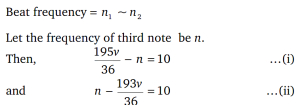
Since both produce $10$ beats per second with the third note,we have:
$\frac{195v}{36} - n = 10$ ...$(i)$
$n - \frac{193v}{36} = 10$ ...(ii)
Adding equations $(i)$ and (ii):
$\frac{195v}{36} - \frac{193v}{36} = 20$
$\frac{2v}{36} = 20$
$\frac{v}{18} = 20$
$v = 360 ~m/s$.
For the first note,frequency $f_1 = \frac{v}{36/195} = \frac{195v}{36}$.
For the second note,frequency $f_2 = \frac{v}{36/193} = \frac{193v}{36}$.
Since both produce $10$ beats per second with the third note,we have:
$\frac{195v}{36} - n = 10$ ...$(i)$
$n - \frac{193v}{36} = 10$ ...(ii)
Adding equations $(i)$ and (ii):
$\frac{195v}{36} - \frac{193v}{36} = 20$
$\frac{2v}{36} = 20$
$\frac{v}{18} = 20$
$v = 360 ~m/s$.
0 likesView Solution
107
ChemistryMCQTS EAMCET · 2004
An iron load of $2 \ kg$ is suspended in air from the free end of a sonometer wire of length $1 \ m$. $A$ tuning fork of frequency $256 \ Hz$ is in resonance with $\frac{1}{\sqrt{7}}$ times the length of the sonometer wire. If the load is immersed in water,the length of the wire in metres that will be in resonance with the same tuning fork is (Specific gravity of iron $= 8$)
A
$\sqrt{8}$
B
$\sqrt{6}$
C
$\frac{1}{\sqrt{6}}$
D
$\frac{1}{\sqrt{8}}$
Solution
(D) The frequency of a sonometer wire is given by $f = \frac{1}{2l} \sqrt{\frac{T}{\mu}}$. Since $f$ and $\mu$ are constant,$l \propto \sqrt{T}$.
Therefore,$\frac{l_{\text{air}}}{l_{\text{water}}} = \sqrt{\frac{T_{\text{air}}}{T_{\text{water}}}}$.
In air,the tension $T_{\text{air}} = mg$. When immersed in water,the buoyant force $F_B$ acts upwards,so $T_{\text{water}} = mg - F_B$.
Given specific gravity $\sigma = 8$,the density of iron $\rho = 8 \rho_w$. The buoyant force $F_B = V \rho_w g = \frac{m}{\rho} \rho_w g = \frac{m}{8 \rho_w} \rho_w g = \frac{mg}{8}$.
Thus,$T_{\text{water}} = mg - \frac{mg}{8} = \frac{7}{8} mg = \frac{7}{8} T_{\text{air}}$.
Substituting this into the ratio: $\frac{l_{\text{air}}}{l_{\text{water}}} = \sqrt{\frac{T_{\text{air}}}{\frac{7}{8} T_{\text{air}}}} = \sqrt{\frac{8}{7}}$.
Given $l_{\text{air}} = \frac{1}{\sqrt{7}} \times 1 \ m$,we have $l_{\text{water}} = l_{\text{air}} \times \sqrt{\frac{7}{8}} = \frac{1}{\sqrt{7}} \times \sqrt{\frac{7}{8}} = \frac{1}{\sqrt{8}} \ m$.
Therefore,$\frac{l_{\text{air}}}{l_{\text{water}}} = \sqrt{\frac{T_{\text{air}}}{T_{\text{water}}}}$.
In air,the tension $T_{\text{air}} = mg$. When immersed in water,the buoyant force $F_B$ acts upwards,so $T_{\text{water}} = mg - F_B$.
Given specific gravity $\sigma = 8$,the density of iron $\rho = 8 \rho_w$. The buoyant force $F_B = V \rho_w g = \frac{m}{\rho} \rho_w g = \frac{m}{8 \rho_w} \rho_w g = \frac{mg}{8}$.
Thus,$T_{\text{water}} = mg - \frac{mg}{8} = \frac{7}{8} mg = \frac{7}{8} T_{\text{air}}$.
Substituting this into the ratio: $\frac{l_{\text{air}}}{l_{\text{water}}} = \sqrt{\frac{T_{\text{air}}}{\frac{7}{8} T_{\text{air}}}} = \sqrt{\frac{8}{7}}$.
Given $l_{\text{air}} = \frac{1}{\sqrt{7}} \times 1 \ m$,we have $l_{\text{water}} = l_{\text{air}} \times \sqrt{\frac{7}{8}} = \frac{1}{\sqrt{7}} \times \sqrt{\frac{7}{8}} = \frac{1}{\sqrt{8}} \ m$.
0 likesView Solution
108
ChemistryMCQTS EAMCET · 2004
$A$ block of mass $2 ~kg$ is initially at rest on a horizontal frictionless surface. $A$ horizontal force $\overrightarrow{F} = (9 - x^2) \hat{i} ~N$ acts on it,starting from $x = 0$. The maximum kinetic energy of the block between $x = 0$ and $x = 3 ~m$ in joules is:
A
$24$
B
$20$
C
$18$
D
$15$
Solution
(C) The work done by the force on the block is equal to the change in its kinetic energy.
Since the block starts from rest at $x = 0$,the kinetic energy $KE$ at any position $x$ is given by the work done by the force $F$ from $x = 0$ to $x$.
$KE = \int_{0}^{x} F dx = \int_{0}^{x} (9 - x^2) dx = 9x - \frac{x^3}{3}$.
To find the maximum kinetic energy,we find where the force becomes zero:
$F = 9 - x^2 = 0 \implies x^2 = 9 \implies x = 3 ~m$.
At $x = 3 ~m$,the kinetic energy is:
$KE_{max} = \int_{0}^{3} (9 - x^2) dx = [9x - \frac{x^3}{3}]_{0}^{3} = (9(3) - \frac{3^3}{3}) - 0 = 27 - 9 = 18 ~J$.
Since the block starts from rest at $x = 0$,the kinetic energy $KE$ at any position $x$ is given by the work done by the force $F$ from $x = 0$ to $x$.
$KE = \int_{0}^{x} F dx = \int_{0}^{x} (9 - x^2) dx = 9x - \frac{x^3}{3}$.
To find the maximum kinetic energy,we find where the force becomes zero:
$F = 9 - x^2 = 0 \implies x^2 = 9 \implies x = 3 ~m$.
At $x = 3 ~m$,the kinetic energy is:
$KE_{max} = \int_{0}^{3} (9 - x^2) dx = [9x - \frac{x^3}{3}]_{0}^{3} = (9(3) - \frac{3^3}{3}) - 0 = 27 - 9 = 18 ~J$.
0 likesView Solution
109
ChemistryMCQTS EAMCET · 2004
Two particles of equal mass have velocities $\overrightarrow{v}_1=4 \hat{i} \text{ ms}^{-1}$ and $\overrightarrow{v}_2=4 \hat{j} \text{ ms}^{-1}$. The first particle has an acceleration $\overrightarrow{a}_1=(5 \hat{i}+5 \hat{j}) \text{ ms}^{-2}$ while the acceleration of the other particle is zero. The centre of mass of the two particles moves in a path of
A
straight line
B
parabola
C
circle
D
ellipse
Solution
(B) The velocity of the centre of mass is given by $\overrightarrow{v}_{CM} = \frac{m_1 \overrightarrow{v}_1 + m_2 \overrightarrow{v}_2}{m_1 + m_2}$.
Since $m_1 = m_2 = m$,we have $\overrightarrow{v}_{CM} = \frac{\overrightarrow{v}_1 + \overrightarrow{v}_2}{2} = \frac{4 \hat{i} + 4 \hat{j}}{2} = (2 \hat{i} + 2 \hat{j}) \text{ ms}^{-1}$.
The acceleration of the centre of mass is $\overrightarrow{a}_{CM} = \frac{m_1 \overrightarrow{a}_1 + m_2 \overrightarrow{a}_2}{m_1 + m_2}$.
Given $\overrightarrow{a}_1 = (5 \hat{i} + 5 \hat{j}) \text{ ms}^{-2}$ and $\overrightarrow{a}_2 = 0$,we get $\overrightarrow{a}_{CM} = \frac{\overrightarrow{a}_1 + 0}{2} = (2.5 \hat{i} + 2.5 \hat{j}) \text{ ms}^{-2}$.
Since the acceleration $\overrightarrow{a}_{CM}$ is constant and the initial velocity $\overrightarrow{v}_{CM}$ is not parallel to the acceleration $\overrightarrow{a}_{CM}$,the path of the centre of mass is a parabola.
Since $m_1 = m_2 = m$,we have $\overrightarrow{v}_{CM} = \frac{\overrightarrow{v}_1 + \overrightarrow{v}_2}{2} = \frac{4 \hat{i} + 4 \hat{j}}{2} = (2 \hat{i} + 2 \hat{j}) \text{ ms}^{-1}$.
The acceleration of the centre of mass is $\overrightarrow{a}_{CM} = \frac{m_1 \overrightarrow{a}_1 + m_2 \overrightarrow{a}_2}{m_1 + m_2}$.
Given $\overrightarrow{a}_1 = (5 \hat{i} + 5 \hat{j}) \text{ ms}^{-2}$ and $\overrightarrow{a}_2 = 0$,we get $\overrightarrow{a}_{CM} = \frac{\overrightarrow{a}_1 + 0}{2} = (2.5 \hat{i} + 2.5 \hat{j}) \text{ ms}^{-2}$.
Since the acceleration $\overrightarrow{a}_{CM}$ is constant and the initial velocity $\overrightarrow{v}_{CM}$ is not parallel to the acceleration $\overrightarrow{a}_{CM}$,the path of the centre of mass is a parabola.
0 likesView Solution
110
ChemistryEasyMCQTS EAMCET · 2004
Match the following lists:
| List-$I$ | List-$II$ |
| $A$. Ethane | $1$. $2 \ sp$ carbons |
| $B$. Ethylene | $2$. $6 \ sp^2$ carbons |
| $C$. Acetylene | $3$. $2 \ sp^3$ carbons |
| $D$. Benzene | $4$. $2 \ sp^2$ carbons |
| $5$. $1 \ sp$ and $1 \ sp^2$ carbons |
A
$A-3, B-4, C-1, D-2$
B
$A-4, B-5, C-3, D-2$
C
$A-3, B-1, C-2, D-5$
D
$A-2, B-3, C-4, D-5$
Solution
(A) The hybridization of carbon atoms in the given molecules is as follows:
$A$. Ethane $(CH_3-CH_3)$: Both carbon atoms are $sp^3$ hybridized. Thus,$A-3$.
$B$. Ethylene $(CH_2=CH_2)$: Both carbon atoms are $sp^2$ hybridized. Thus,$B-4$.
$C$. Acetylene $(CH \equiv CH)$: Both carbon atoms are $sp$ hybridized. Thus,$C-1$.
$D$. Benzene $(C_6H_6)$: All six carbon atoms in the ring are $sp^2$ hybridized. Thus,$D-2$.
Therefore,the correct matching is $A-3, B-4, C-1, D-2$.
$A$. Ethane $(CH_3-CH_3)$: Both carbon atoms are $sp^3$ hybridized. Thus,$A-3$.
$B$. Ethylene $(CH_2=CH_2)$: Both carbon atoms are $sp^2$ hybridized. Thus,$B-4$.
$C$. Acetylene $(CH \equiv CH)$: Both carbon atoms are $sp$ hybridized. Thus,$C-1$.
$D$. Benzene $(C_6H_6)$: All six carbon atoms in the ring are $sp^2$ hybridized. Thus,$D-2$.
Therefore,the correct matching is $A-3, B-4, C-1, D-2$.
0 likesView Solution
111
ChemistryMediumMCQTS EAMCET · 2004
Which of the following is a favourable factor for cation formation?
A
High electronegativity
B
High electron affinity
C
Low ionisation potential
D
Smaller atomic size
Solution
(C) Cation formation involves the loss of an electron from a neutral atom. $M \rightarrow M^+ + e^-$.
This process requires energy,known as ionisation energy.
Therefore,a lower ionisation potential (or ionisation energy) makes it easier for an atom to lose an electron and form a cation.
This process requires energy,known as ionisation energy.
Therefore,a lower ionisation potential (or ionisation energy) makes it easier for an atom to lose an electron and form a cation.
0 likesView Solution
112
ChemistryMediumMCQTS EAMCET · 2004
Which of the following is not correct regarding the properties of ionic compounds?
A
Ionic compounds have high melting and boiling points
B
Their reaction velocity in aqueous medium is very high
C
Ionic compounds in their molten and aqueous solutions do not conduct electricity
D
They are highly soluble in polar solvents
Solution
(C) Ionic compounds consist of ions that are held together by strong electrostatic forces of attraction.
In the solid state,these ions are fixed in a lattice and cannot move,making them poor conductors.
However,in the molten state or when dissolved in water,the ions become free to move,which allows them to conduct electricity.
Therefore,the statement that ionic compounds do not conduct electricity in molten or aqueous solutions is incorrect.
In the solid state,these ions are fixed in a lattice and cannot move,making them poor conductors.
However,in the molten state or when dissolved in water,the ions become free to move,which allows them to conduct electricity.
Therefore,the statement that ionic compounds do not conduct electricity in molten or aqueous solutions is incorrect.
0 likesView Solution
113
ChemistryMediumMCQTS EAMCET · 2004
In which of the following reactions,the concentration of product is higher than the concentration of reactant at equilibrium? $(K = \text{equilibrium constant})$
A
$A \rightleftharpoons B ; K = 0.001$
B
$M \rightleftharpoons N ; K = 10$
C
$X \rightleftharpoons Y ; K = 0.005$
D
$R \rightleftharpoons P ; K = 0.01$
Solution
(B) For a general reaction,the equilibrium constant is defined as $K_c = \frac{[\text{Product}]}{[\text{Reactant}]}$.
If $[\text{Product}] > [\text{Reactant}]$,then the ratio $K_c$ must be greater than $1$.
Comparing the given values:
$A: K = 0.001 < 1$
$B: K = 10 > 1$
$C: K = 0.005 < 1$
$D: K = 0.01 < 1$
Therefore,in reaction $B$,the concentration of the product is higher than the concentration of the reactant.
If $[\text{Product}] > [\text{Reactant}]$,then the ratio $K_c$ must be greater than $1$.
Comparing the given values:
$A: K = 0.001 < 1$
$B: K = 10 > 1$
$C: K = 0.005 < 1$
$D: K = 0.01 < 1$
Therefore,in reaction $B$,the concentration of the product is higher than the concentration of the reactant.
0 likesView Solution
114
ChemistryMCQTS EAMCET · 2004
........ of a reaction cannot be determined experimentally.
A
Order
B
Rate
C
Rate constant
D
Molecularity
Solution
(D) The correct answer is $D$.
Molecularity is a theoretical concept defined as the number of reacting species (atoms,ions,or molecules) taking part in an elementary reaction,which must collide simultaneously in order to bring about a chemical reaction.
It is determined by examining the balanced chemical equation of an elementary step.
In contrast,the order of a reaction is an experimental quantity determined from the rate law.
Molecularity is a theoretical concept defined as the number of reacting species (atoms,ions,or molecules) taking part in an elementary reaction,which must collide simultaneously in order to bring about a chemical reaction.
It is determined by examining the balanced chemical equation of an elementary step.
In contrast,the order of a reaction is an experimental quantity determined from the rate law.
0 likesView Solution
115
ChemistryMCQTS EAMCET · 2004
If $(x-2)$ is a common factor of the expressions $x^2+ax+b$ and $x^2+cx+d$,then $\frac{b-d}{c-a}$ is equal to
A
$-2$
B
$-1$
C
$1$
D
$2$
Solution
(D) Since $(x-2)$ is a common factor of the expressions $x^2+ax+b$ and $x^2+cx+d$,we have:
$2^2 + 2a + b = 0 \Rightarrow 4 + 2a + b = 0$ ... $(i)$
$2^2 + 2c + d = 0 \Rightarrow 4 + 2c + d = 0$ ... $(ii)$
Subtracting equation $(ii)$ from equation $(i)$:
$(4 + 2a + b) - (4 + 2c + d) = 0$
$2a + b - 2c - d = 0$
$b - d = 2c - 2a$
$b - d = 2(c - a)$
Therefore,$\frac{b-d}{c-a} = 2$.
$2^2 + 2a + b = 0 \Rightarrow 4 + 2a + b = 0$ ... $(i)$
$2^2 + 2c + d = 0 \Rightarrow 4 + 2c + d = 0$ ... $(ii)$
Subtracting equation $(ii)$ from equation $(i)$:
$(4 + 2a + b) - (4 + 2c + d) = 0$
$2a + b - 2c - d = 0$
$b - d = 2c - 2a$
$b - d = 2(c - a)$
Therefore,$\frac{b-d}{c-a} = 2$.
0 likesView Solution
116
ChemistryMCQTS EAMCET · 2004
The value of $\sqrt{42+\sqrt{42+\sqrt{42+\ldots}}}$ is equal to:
A
$7$
B
$-6$
C
$5$
D
$4$
Solution
(A) Let $y = \sqrt{42+\sqrt{42+\sqrt{42+\ldots}}}$.
Since the expression is infinite,we can write:
$y = \sqrt{42+y}$.
Squaring both sides,we get:
$y^2 = 42 + y$.
Rearranging the terms to form a quadratic equation:
$y^2 - y - 42 = 0$.
Factoring the quadratic equation:
$(y - 7)(y + 6) = 0$.
This gives two possible values for $y$: $y = 7$ or $y = -6$.
Since the square root of a positive number must be positive,$y$ cannot be $-6$.
Therefore,the value is $y = 7$.
Since the expression is infinite,we can write:
$y = \sqrt{42+y}$.
Squaring both sides,we get:
$y^2 = 42 + y$.
Rearranging the terms to form a quadratic equation:
$y^2 - y - 42 = 0$.
Factoring the quadratic equation:
$(y - 7)(y + 6) = 0$.
This gives two possible values for $y$: $y = 7$ or $y = -6$.
Since the square root of a positive number must be positive,$y$ cannot be $-6$.
Therefore,the value is $y = 7$.
0 likesView Solution
117
ChemistryMCQTS EAMCET · 2004
If $f(x)$ is a polynomial of degree $n$ with rational coefficients and $1+2i, 2-\sqrt{3},$ and $5$ are three roots of $f(x)=0$,then the least value of $n$ is
A
$5$
B
$4$
C
$3$
D
$6$
Solution
(A) Given that $f(x)$ is a polynomial with rational coefficients.
If a complex number $a+bi$ is a root,its conjugate $a-bi$ must also be a root.
Thus,$1+2i$ and $1-2i$ are roots.
If a surd $a+\sqrt{b}$ is a root,its conjugate $a-\sqrt{b}$ must also be a root.
Thus,$2-\sqrt{3}$ and $2+\sqrt{3}$ are roots.
Additionally,$5$ is given as a root.
Therefore,the roots are $1+2i, 1-2i, 2-\sqrt{3}, 2+\sqrt{3},$ and $5$.
Counting these,we have $5$ distinct roots.
Since the polynomial has at least these $5$ roots,the least value of $n$ is $5$.
If a complex number $a+bi$ is a root,its conjugate $a-bi$ must also be a root.
Thus,$1+2i$ and $1-2i$ are roots.
If a surd $a+\sqrt{b}$ is a root,its conjugate $a-\sqrt{b}$ must also be a root.
Thus,$2-\sqrt{3}$ and $2+\sqrt{3}$ are roots.
Additionally,$5$ is given as a root.
Therefore,the roots are $1+2i, 1-2i, 2-\sqrt{3}, 2+\sqrt{3},$ and $5$.
Counting these,we have $5$ distinct roots.
Since the polynomial has at least these $5$ roots,the least value of $n$ is $5$.
0 likesView Solution
118
ChemistryMCQTS EAMCET · 2004
If $x_n = \cos \frac{\pi}{2^n} + i \sin \frac{\pi}{2^n}$,then $\prod_{n=1}^{\infty} x_n$ is equal to
A
$-1$
B
$1$
C
$\frac{1}{\sqrt{2}}$
D
$\frac{i}{\sqrt{2}}$
Solution
(A) Given that $x_n = \cos \frac{\pi}{2^n} + i \sin \frac{\pi}{2^n} = e^{i \frac{\pi}{2^n}}$.
We need to evaluate the infinite product $\prod_{n=1}^{\infty} x_n = \prod_{n=1}^{\infty} e^{i \frac{\pi}{2^n}}$.
Using the property of exponents,$\prod_{n=1}^{\infty} e^{i \frac{\pi}{2^n}} = e^{i \sum_{n=1}^{\infty} \frac{\pi}{2^n}}$.
The exponent is a geometric series: $\sum_{n=1}^{\infty} \frac{\pi}{2^n} = \pi \left( \frac{1/2}{1 - 1/2} \right) = \pi \left( \frac{1/2}{1/2} \right) = \pi$.
Therefore,the product is $e^{i \pi}$.
Using Euler's formula,$e^{i \pi} = \cos \pi + i \sin \pi = -1 + 0i = -1$.
We need to evaluate the infinite product $\prod_{n=1}^{\infty} x_n = \prod_{n=1}^{\infty} e^{i \frac{\pi}{2^n}}$.
Using the property of exponents,$\prod_{n=1}^{\infty} e^{i \frac{\pi}{2^n}} = e^{i \sum_{n=1}^{\infty} \frac{\pi}{2^n}}$.
The exponent is a geometric series: $\sum_{n=1}^{\infty} \frac{\pi}{2^n} = \pi \left( \frac{1/2}{1 - 1/2} \right) = \pi \left( \frac{1/2}{1/2} \right) = \pi$.
Therefore,the product is $e^{i \pi}$.
Using Euler's formula,$e^{i \pi} = \cos \pi + i \sin \pi = -1 + 0i = -1$.
0 likesView Solution
119
ChemistryMCQTS EAMCET · 2004
The value of $\sum_{n=0}^{\infty}\left(\frac{2 i}{3}\right)^n$ is
A
$\frac{9+6 i}{13}$
B
$\frac{9-6 i}{13}$
C
$9+6 i$
D
$9-6 i$
Solution
(A) The given series is an infinite geometric progression with the first term $a = 1$ and common ratio $r = \frac{2i}{3}$.
Since $|r| = |\frac{2i}{3}| = \frac{2}{3} < 1$,the sum $S$ is given by $S = \frac{a}{1-r}$.
$S = \frac{1}{1 - \frac{2i}{3}} = \frac{1}{\frac{3-2i}{3}} = \frac{3}{3-2i}$.
To simplify,multiply the numerator and denominator by the conjugate $(3+2i)$:
$S = \frac{3(3+2i)}{(3-2i)(3+2i)} = \frac{9+6i}{3^2 - (2i)^2} = \frac{9+6i}{9 - (-4)} = \frac{9+6i}{13}$.
Since $|r| = |\frac{2i}{3}| = \frac{2}{3} < 1$,the sum $S$ is given by $S = \frac{a}{1-r}$.
$S = \frac{1}{1 - \frac{2i}{3}} = \frac{1}{\frac{3-2i}{3}} = \frac{3}{3-2i}$.
To simplify,multiply the numerator and denominator by the conjugate $(3+2i)$:
$S = \frac{3(3+2i)}{(3-2i)(3+2i)} = \frac{9+6i}{3^2 - (2i)^2} = \frac{9+6i}{9 - (-4)} = \frac{9+6i}{13}$.
0 likesView Solution
120
ChemistryMCQTS EAMCET · 2004
$S_1, S_2, \ldots, S_{10}$ are the speakers in a conference. If $S_1$ addresses only after $S_2$,then the number of ways the speakers address is
A
$10!$
B
$9!$
C
$10 \times 8!$
D
$\frac{10!}{2}$
Solution
(D) There are $10$ speakers in total. The condition is that $S_1$ must speak after $S_2$.
In any arrangement of $10$ speakers,there are only two possibilities for the relative order of $S_1$ and $S_2$: either $S_1$ speaks before $S_2$ or $S_2$ speaks before $S_1$.
Since these two cases are equally likely,exactly half of the total permutations $(10!)$ will satisfy the condition that $S_2$ speaks before $S_1$ (which is equivalent to $S_1$ speaking after $S_2$).
Therefore,the required number of ways is $\frac{10!}{2}$.
In any arrangement of $10$ speakers,there are only two possibilities for the relative order of $S_1$ and $S_2$: either $S_1$ speaks before $S_2$ or $S_2$ speaks before $S_1$.
Since these two cases are equally likely,exactly half of the total permutations $(10!)$ will satisfy the condition that $S_2$ speaks before $S_1$ (which is equivalent to $S_1$ speaking after $S_2$).
Therefore,the required number of ways is $\frac{10!}{2}$.
0 likesView Solution
121
ChemistryMCQTS EAMCET · 2004
The value of $\lim_{n \rightarrow \infty} \frac{1}{n^3} \sum_{k=1}^n (k^2 x)$ is
A
$x$
B
$\frac{x}{2}$
C
$\frac{x}{3}$
D
$\frac{x}{4}$
Solution
(C) We are given the limit: $\lim_{n \rightarrow \infty} \frac{1}{n^3} \sum_{k=1}^n (k^2 x)$.
Since $x$ is independent of $k$,we can take it out of the summation: $x \lim_{n \rightarrow \infty} \frac{1}{n} \sum_{k=1}^n \left(\frac{k}{n}\right)^2$.
Using the definition of a definite integral as the limit of a Riemann sum,$\lim_{n \rightarrow \infty} \frac{1}{n} \sum_{k=1}^n f\left(\frac{k}{n}\right) = \int_0^1 f(t) dt$.
Here,$f(t) = t^2$,so the expression becomes: $x \int_0^1 t^2 dt$.
Evaluating the integral: $x \left[ \frac{t^3}{3} \right]_0^1 = x \left( \frac{1}{3} - 0 \right) = \frac{x}{3}$.
Since $x$ is independent of $k$,we can take it out of the summation: $x \lim_{n \rightarrow \infty} \frac{1}{n} \sum_{k=1}^n \left(\frac{k}{n}\right)^2$.
Using the definition of a definite integral as the limit of a Riemann sum,$\lim_{n \rightarrow \infty} \frac{1}{n} \sum_{k=1}^n f\left(\frac{k}{n}\right) = \int_0^1 f(t) dt$.
Here,$f(t) = t^2$,so the expression becomes: $x \int_0^1 t^2 dt$.
Evaluating the integral: $x \left[ \frac{t^3}{3} \right]_0^1 = x \left( \frac{1}{3} - 0 \right) = \frac{x}{3}$.
0 likesView Solution
122
ChemistryMCQTS EAMCET · 2004
The value of the series $x \log _e a + \frac{x^3}{3!} (\log _e a)^3 + \frac{x^5}{5!} (\log _e a)^5 + \dots$ is
A
$\cosh(x \log _e a)$
B
$\coth(x \log _e a)$
C
$\sinh(x \log _e a)$
D
$\tanh(x \log _e a)$
Solution
(C) Let $y = x \log _e a$. The given series is $y + \frac{y^3}{3!} + \frac{y^5}{5!} + \dots$
We know the Taylor series expansion for the hyperbolic sine function is $\sinh(y) = y + \frac{y^3}{3!} + \frac{y^5}{5!} + \dots$
Substituting $y = x \log _e a$ back into the series,we get $\sinh(x \log _e a)$.
Thus,the value of the series is $\sinh(x \log _e a)$.
We know the Taylor series expansion for the hyperbolic sine function is $\sinh(y) = y + \frac{y^3}{3!} + \frac{y^5}{5!} + \dots$
Substituting $y = x \log _e a$ back into the series,we get $\sinh(x \log _e a)$.
Thus,the value of the series is $\sinh(x \log _e a)$.
0 likesView Solution
123
ChemistryMCQTS EAMCET · 2004
$\sum_{k=1}^5 \frac{1^3+2^3+\ldots+k^3}{1+3+5+\ldots+(2k-1)}$ is equal to (in $.5$)
A
$22$
B
$24$
C
$28$
D
$32$
Solution
(A) We know that the sum of the first $k$ cubes is $\sum_{i=1}^k i^3 = \left(\frac{k(k+1)}{2}\right)^2$ and the sum of the first $k$ odd numbers is $\sum_{i=1}^k (2i-1) = k^2$.
Substituting these into the expression:
$\sum_{k=1}^5 \frac{\left(\frac{k(k+1)}{2}\right)^2}{k^2} = \sum_{k=1}^5 \frac{k^2(k+1)^2}{4k^2} = \sum_{k=1}^5 \frac{(k+1)^2}{4}$.
Expanding the sum for $k=1$ to $5$:
$= \frac{1}{4} [2^2 + 3^2 + 4^2 + 5^2 + 6^2] = \frac{1}{4} [4 + 9 + 16 + 25 + 36] = \frac{90}{4} = 22.5$.
Substituting these into the expression:
$\sum_{k=1}^5 \frac{\left(\frac{k(k+1)}{2}\right)^2}{k^2} = \sum_{k=1}^5 \frac{k^2(k+1)^2}{4k^2} = \sum_{k=1}^5 \frac{(k+1)^2}{4}$.
Expanding the sum for $k=1$ to $5$:
$= \frac{1}{4} [2^2 + 3^2 + 4^2 + 5^2 + 6^2] = \frac{1}{4} [4 + 9 + 16 + 25 + 36] = \frac{90}{4} = 22.5$.
0 likesView Solution
124
ChemistryMediumMCQTS EAMCET · 2004
Identify the correct decreasing order of the following with respect to altitude from the Earth's surface:
$I$. Troposphere
$II$. Mesosphere
$III$. Thermosphere
$I$. Troposphere
$II$. Mesosphere
$III$. Thermosphere
A
$II, III, I$
B
$III, II, I$
C
$I, II, III$
D
$I, III, II$
Solution
(B) The atmosphere is divided into layers based on altitude from the Earth's surface:
$1$. Troposphere: $0-10 \ km$
$2$. Stratosphere: $10-50 \ km$
$3$. Mesosphere: $50-85 \ km$
$4$. Thermosphere: $85-500 \ km$
Comparing the altitudes,the order is Thermosphere $(85-500 \ km)$ > Mesosphere $(50-85 \ km)$ > Troposphere $(0-10 \ km)$.
Therefore,the decreasing order of altitude is $III, II, I$.
$1$. Troposphere: $0-10 \ km$
$2$. Stratosphere: $10-50 \ km$
$3$. Mesosphere: $50-85 \ km$
$4$. Thermosphere: $85-500 \ km$
Comparing the altitudes,the order is Thermosphere $(85-500 \ km)$ > Mesosphere $(50-85 \ km)$ > Troposphere $(0-10 \ km)$.
Therefore,the decreasing order of altitude is $III, II, I$.
0 likesView Solution
125
ChemistryMCQTS EAMCET · 2004
The angle between the lines represented by $y^2 \sin^2 \theta - xy \sin^2 \theta + x^2(\cos^2 \theta - 1) = 0$ is
A
$\frac{\pi}{3}$
B
$\frac{\pi}{4}$
C
$\frac{\pi}{6}$
D
$\frac{\pi}{2}$
Solution
(D) The given equation is $x^2(\cos^2 \theta - 1) - xy \sin^2 \theta + y^2 \sin^2 \theta = 0$.
Since $\cos^2 \theta - 1 = -\sin^2 \theta$,the equation becomes:
$-\sin^2 \theta x^2 - \sin^2 \theta xy + \sin^2 \theta y^2 = 0$.
Dividing by $-\sin^2 \theta$ (assuming $\sin \theta \neq 0$),we get:
$x^2 + xy - y^2 = 0$.
Comparing this with the general homogeneous equation $ax^2 + 2hxy + by^2 = 0$,we have $a = 1$,$2h = 1$,and $b = -1$.
The condition for the lines to be perpendicular is $a + b = 0$.
Here,$a + b = 1 + (-1) = 0$.
Therefore,the lines are perpendicular to each other,and the angle between them is $\frac{\pi}{2}$.
Since $\cos^2 \theta - 1 = -\sin^2 \theta$,the equation becomes:
$-\sin^2 \theta x^2 - \sin^2 \theta xy + \sin^2 \theta y^2 = 0$.
Dividing by $-\sin^2 \theta$ (assuming $\sin \theta \neq 0$),we get:
$x^2 + xy - y^2 = 0$.
Comparing this with the general homogeneous equation $ax^2 + 2hxy + by^2 = 0$,we have $a = 1$,$2h = 1$,and $b = -1$.
The condition for the lines to be perpendicular is $a + b = 0$.
Here,$a + b = 1 + (-1) = 0$.
Therefore,the lines are perpendicular to each other,and the angle between them is $\frac{\pi}{2}$.
0 likesView Solution
126
ChemistryMCQTS EAMCET · 2004
If $(1, a)$ and $(b, 2)$ are conjugate points with respect to the circle $x^2+y^2=25$,then $4a+2b$ is equal to
A
$25$
B
$50$
C
$100$
D
$150$
Solution
(B) The equation of the circle is $x^2+y^2=25$.
Two points $(x_1, y_1)$ and $(x_2, y_2)$ are conjugate with respect to the circle $x^2+y^2=r^2$ if $x_1x_2 + y_1y_2 = r^2$.
Here,$(x_1, y_1) = (1, a)$ and $(x_2, y_2) = (b, 2)$,and $r^2 = 25$.
Substituting these values into the condition,we get:
$(1)(b) + (a)(2) = 25$
$b + 2a = 25$
We need to find the value of $4a + 2b$.
Multiplying the equation $b + 2a = 25$ by $2$,we get:
$2(b + 2a) = 2(25)$
$2b + 4a = 50$
Thus,$4a + 2b = 50$.
Two points $(x_1, y_1)$ and $(x_2, y_2)$ are conjugate with respect to the circle $x^2+y^2=r^2$ if $x_1x_2 + y_1y_2 = r^2$.
Here,$(x_1, y_1) = (1, a)$ and $(x_2, y_2) = (b, 2)$,and $r^2 = 25$.
Substituting these values into the condition,we get:
$(1)(b) + (a)(2) = 25$
$b + 2a = 25$
We need to find the value of $4a + 2b$.
Multiplying the equation $b + 2a = 25$ by $2$,we get:
$2(b + 2a) = 2(25)$
$2b + 4a = 50$
Thus,$4a + 2b = 50$.
0 likesView Solution
127
ChemistryMediumMCQTS EAMCET · 2004
What is the correct structure of $4$-bromo-$3$-methylbut-$1$-ene?
A
$Br-CH_2-CH=C(CH_3)_2$
B
$CH_2=CH-CH(CH_3)-CH_2Br$
C
$CH_2=C(CH_3)-CH_2Br$
D
$CH_3-C(CH_3)=CH-CH_2Br$
Solution
(B) To determine the structure of $4$-bromo-$3$-methylbut-$1$-ene,we analyze the $IUPAC$ name:
$1$. The parent chain is 'but$-1-$ene',which means a four-carbon chain with a double bond at the first position: $CH_2=CH-CH_2-CH_3$.
$2$. The substituent '$3$-methyl' indicates a methyl group $(-CH_3)$ attached to the third carbon atom.
$3$. The substituent '$4$-bromo' indicates a bromine atom $(-Br)$ attached to the fourth carbon atom.
$4$. Combining these,the structure is $CH_2=CH-CH(CH_3)-CH_2Br$.
Thus,the correct option is $B$.
$1$. The parent chain is 'but$-1-$ene',which means a four-carbon chain with a double bond at the first position: $CH_2=CH-CH_2-CH_3$.
$2$. The substituent '$3$-methyl' indicates a methyl group $(-CH_3)$ attached to the third carbon atom.
$3$. The substituent '$4$-bromo' indicates a bromine atom $(-Br)$ attached to the fourth carbon atom.
$4$. Combining these,the structure is $CH_2=CH-CH(CH_3)-CH_2Br$.
Thus,the correct option is $B$.
0 likesView Solution
128
ChemistryEasyMCQTS EAMCET · 2004
The metal used for the de-bromination reaction of $1, 2$-dibromoethane is:
A
$Na$
B
$Zn$
C
$Mg$
D
$Li$
Solution
(B) The de-bromination of vicinal dihalides like $1, 2$-dibromoethane is carried out using zinc $(Zn)$ dust in the presence of alcohol (usually ethanol) upon heating.
This reaction is a type of elimination reaction where the two bromine atoms are removed to form an alkene.
The chemical equation is:
$BrCH_2-CH_2Br + Zn \xrightarrow{\text{alcohol}, \Delta} CH_2=CH_2 + ZnBr_2$
Thus,the correct metal is $Zn$.
This reaction is a type of elimination reaction where the two bromine atoms are removed to form an alkene.
The chemical equation is:
$BrCH_2-CH_2Br + Zn \xrightarrow{\text{alcohol}, \Delta} CH_2=CH_2 + ZnBr_2$
Thus,the correct metal is $Zn$.
0 likesView Solution
129
ChemistryMediumMCQTS EAMCET · 2004
The following reaction is an example of a ....... reaction: $CH_2Br-CH_2Br + 2KOH (alc.) \xrightarrow{\Delta} CH \equiv CH + 2KBr + 2H_2O$
A
addition
B
dehydrobromination
C
substitution
D
debromination
Solution
(B) The given reaction is the reaction of ethylene dibromide with alcoholic $KOH$ to form acetylene.
In this reaction,two molecules of $HBr$ are removed from the vicinal dihalide,which is known as dehydrobromination (a type of dehydrohalogenation).
In this reaction,two molecules of $HBr$ are removed from the vicinal dihalide,which is known as dehydrobromination (a type of dehydrohalogenation).
0 likesView Solution
130
ChemistryMediumMCQTS EAMCET · 2004
What is the molecular formula of the product formed when benzene is reacted with ethyl chloride in the presence of anhydrous aluminium chloride?
A
$C_8H_{10}$
B
$C_6H_6$
C
$C_8H_8$
D
$C_6H_5Cl$
Solution
(A) In the presence of a Lewis acid (like $AlCl_3$),benzene undergoes an electrophilic substitution reaction with an alkyl halide. This reaction is known as Friedel-Crafts alkylation.
The reaction is as follows:
$C_6H_6 + C_2H_5Cl \xrightarrow{AlCl_3} C_6H_5-C_2H_5 + HCl$
The product formed is ethylbenzene,which has the molecular formula $C_8H_{10}$.
The reaction is as follows:
$C_6H_6 + C_2H_5Cl \xrightarrow{AlCl_3} C_6H_5-C_2H_5 + HCl$
The product formed is ethylbenzene,which has the molecular formula $C_8H_{10}$.
0 likesView Solution
131
ChemistryMediumMCQTS EAMCET · 2004
Exhausted permutit does not contain ....... ion.
A
$Na^{+}$
B
$Mg^{2+}$
C
$Al^{3+}$
D
$Si^{4+}$
Solution
(A) Permutit,also known as zeolite,is a hydrated sodium aluminosilicate with the general formula $Na_2Al_2Si_2O_8 \cdot xH_2O$.
It is used to remove the hardness of water by ion exchange.
During the process,the $Na^{+}$ ions in the zeolite are replaced by $Ca^{2+}$ and $Mg^{2+}$ ions present in hard water,making the water soft.
When all the $Na^{+}$ ions are replaced by $Ca^{2+}$ or $Mg^{2+}$ ions,the permutit becomes exhausted.
Therefore,exhausted permutit does not contain $Na^{+}$ ions.
It is used to remove the hardness of water by ion exchange.
During the process,the $Na^{+}$ ions in the zeolite are replaced by $Ca^{2+}$ and $Mg^{2+}$ ions present in hard water,making the water soft.
When all the $Na^{+}$ ions are replaced by $Ca^{2+}$ or $Mg^{2+}$ ions,the permutit becomes exhausted.
Therefore,exhausted permutit does not contain $Na^{+}$ ions.
0 likesView Solution
132
ChemistryMCQTS EAMCET · 2004
$\begin{aligned} & f(x, y)=2(x-y)^2-x^4-y^4 \\ & \left|\left(f_{x x} f_{y y}-f_{x y}^2\right)\right|_{(0,0)} \end{aligned}$
A
$32$
B
$16$
C
$0$
D
$-1$
Solution
(C) Given function is $f(x, y) = 2(x-y)^2 - x^4 - y^4$.
First,we find the partial derivatives:
$f_x = \frac{\partial}{\partial x} [2(x-y)^2 - x^4 - y^4] = 4(x-y) - 4x^3$.
$f_y = \frac{\partial}{\partial y} [2(x-y)^2 - x^4 - y^4] = -4(x-y) - 4y^3$.
Now,we find the second-order partial derivatives:
$f_{xx} = \frac{\partial}{\partial x} [4(x-y) - 4x^3] = 4 - 12x^2$.
$f_{yy} = \frac{\partial}{\partial y} [-4(x-y) - 4y^3] = 4 - 12y^2$.
$f_{xy} = \frac{\partial}{\partial y} [4(x-y) - 4x^3] = -4$.
Evaluating these at $(0,0)$:
$f_{xx}(0,0) = 4 - 12(0)^2 = 4$.
$f_{yy}(0,0) = 4 - 12(0)^2 = 4$.
$f_{xy}(0,0) = -4$.
Finally,calculate the expression:
$f_{xx}f_{yy} - f_{xy}^2 = (4)(4) - (-4)^2 = 16 - 16 = 0$.
First,we find the partial derivatives:
$f_x = \frac{\partial}{\partial x} [2(x-y)^2 - x^4 - y^4] = 4(x-y) - 4x^3$.
$f_y = \frac{\partial}{\partial y} [2(x-y)^2 - x^4 - y^4] = -4(x-y) - 4y^3$.
Now,we find the second-order partial derivatives:
$f_{xx} = \frac{\partial}{\partial x} [4(x-y) - 4x^3] = 4 - 12x^2$.
$f_{yy} = \frac{\partial}{\partial y} [-4(x-y) - 4y^3] = 4 - 12y^2$.
$f_{xy} = \frac{\partial}{\partial y} [4(x-y) - 4x^3] = -4$.
Evaluating these at $(0,0)$:
$f_{xx}(0,0) = 4 - 12(0)^2 = 4$.
$f_{yy}(0,0) = 4 - 12(0)^2 = 4$.
$f_{xy}(0,0) = -4$.
Finally,calculate the expression:
$f_{xx}f_{yy} - f_{xy}^2 = (4)(4) - (-4)^2 = 16 - 16 = 0$.
0 likesView Solution
133
ChemistryMCQTS EAMCET · 2004
If $\frac{x+1}{(2x-1)(3x+1)}=\frac{A}{(2x-1)}+\frac{B}{(3x+1)}$,then $16A+9B$ is equal to
A
$4$
B
$5$
C
$6$
D
$8$
Solution
(C) Given that,$\frac{x+1}{(2x-1)(3x+1)}=\frac{A}{(2x-1)}+\frac{B}{(3x+1)}$
Multiplying both sides by $(2x-1)(3x+1)$,we get:
$x+1 = A(3x+1) + B(2x-1)$
$x+1 = x(3A+2B) + (A-B)$
Comparing the coefficients of $x$ and the constant terms on both sides,we get:
$3A+2B = 1$ ...$(i)$
$A-B = 1$ ...$(ii)$
From equation $(ii)$,$A = B+1$. Substituting this into equation $(i)$:
$3(B+1) + 2B = 1$
$3B+3+2B = 1$
$5B = -2 \Rightarrow B = -\frac{2}{5}$
Now,$A = -\frac{2}{5} + 1 = \frac{3}{5}$
We need to find $16A+9B$:
$16\left(\frac{3}{5}\right) + 9\left(-\frac{2}{5}\right) = \frac{48}{5} - \frac{18}{5} = \frac{30}{5} = 6$
Multiplying both sides by $(2x-1)(3x+1)$,we get:
$x+1 = A(3x+1) + B(2x-1)$
$x+1 = x(3A+2B) + (A-B)$
Comparing the coefficients of $x$ and the constant terms on both sides,we get:
$3A+2B = 1$ ...$(i)$
$A-B = 1$ ...$(ii)$
From equation $(ii)$,$A = B+1$. Substituting this into equation $(i)$:
$3(B+1) + 2B = 1$
$3B+3+2B = 1$
$5B = -2 \Rightarrow B = -\frac{2}{5}$
Now,$A = -\frac{2}{5} + 1 = \frac{3}{5}$
We need to find $16A+9B$:
$16\left(\frac{3}{5}\right) + 9\left(-\frac{2}{5}\right) = \frac{48}{5} - \frac{18}{5} = \frac{30}{5} = 6$
0 likesView Solution
134
ChemistryDifficultMCQTS EAMCET · 2004
Study the following table:
Which of the two sets of buffer solutions have the least $pH$?
| Buffer Solution | Volume (in $mL$) of $0.1 \ M$ Weak acid | Volume (in $mL$) of $0.1 \ M$ sodium salt of weak acid |
|---|---|---|
| $I$ | $4.0$ | $4.0$ |
| $II$ | $4.0$ | $40.0$ |
| $III$ | $40.0$ | $4.0$ |
| $IV$ | $0.1$ | $10.0$ |
Which of the two sets of buffer solutions have the least $pH$?
A
$I$ and $II$
B
$I$ and $III$
C
$II$ and $III$
D
$III$ and $IV$
Solution
(B) For a buffer solution,the $pH$ is calculated using the Henderson-Hasselbalch equation:
$pH = pKa + \log \left( \frac{[salt]}{[acid]} \right)$
Since the molarity of the acid and the salt are the same $(0.1 \ M)$,the ratio $\frac{[salt]}{[acid]}$ is equivalent to the ratio of their volumes: $\frac{V_{salt}}{V_{acid}}$.
The $pH$ is lowest when the ratio $\frac{[salt]}{[acid]}$ is the smallest,which occurs when the volume of the acid is high and the volume of the salt is low.
Calculating the ratios for each:
$I: \frac{4.0}{4.0} = 1.0$
$II: \frac{40.0}{4.0} = 10.0$
$III: \frac{4.0}{40.0} = 0.1$
$IV: \frac{10.0}{0.1} = 100.0$
Comparing the ratios,$III$ $(0.1)$ and $I$ $(1.0)$ have the lowest values. However,looking at the options provided,$III$ has the lowest ratio,followed by $I$. Re-evaluating the question for the two sets with the lowest $pH$,$III$ and $I$ are the correct candidates.
$pH = pKa + \log \left( \frac{[salt]}{[acid]} \right)$
Since the molarity of the acid and the salt are the same $(0.1 \ M)$,the ratio $\frac{[salt]}{[acid]}$ is equivalent to the ratio of their volumes: $\frac{V_{salt}}{V_{acid}}$.
The $pH$ is lowest when the ratio $\frac{[salt]}{[acid]}$ is the smallest,which occurs when the volume of the acid is high and the volume of the salt is low.
Calculating the ratios for each:
$I: \frac{4.0}{4.0} = 1.0$
$II: \frac{40.0}{4.0} = 10.0$
$III: \frac{4.0}{40.0} = 0.1$
$IV: \frac{10.0}{0.1} = 100.0$
Comparing the ratios,$III$ $(0.1)$ and $I$ $(1.0)$ have the lowest values. However,looking at the options provided,$III$ has the lowest ratio,followed by $I$. Re-evaluating the question for the two sets with the lowest $pH$,$III$ and $I$ are the correct candidates.
0 likesView Solution
135
ChemistryMCQTS EAMCET · 2004
Consider the following statements $A$ and $B$ and identify the correct answer:
$A$. When a person walks on a rough surface,the direction of the frictional force exerted by the surface on the person is in the direction of his motion.
$B$. When a cycle is in motion,the force of friction exerted by the ground on the front wheel is in the backward direction.
$A$. When a person walks on a rough surface,the direction of the frictional force exerted by the surface on the person is in the direction of his motion.
$B$. When a cycle is in motion,the force of friction exerted by the ground on the front wheel is in the backward direction.
A
$A$ and $B$ are correct
B
$A$ is correct,$B$ is wrong
C
$A$ and $B$ are wrong
D
$A$ is wrong,$B$ is correct
Solution
(D) Statement $A$ is incorrect. When a person walks,they push the ground backward with their foot. According to Newton's third law,the ground exerts an equal and opposite force on the person in the forward direction. Thus,the frictional force acts in the direction of motion.
Statement $B$ is correct. For a cycle,the rear wheel is driven by the chain,so the ground exerts a forward frictional force on it. However,the front wheel is a rolling wheel that is not driven; it experiences a backward frictional force from the ground to oppose its rotation and motion.
Statement $B$ is correct. For a cycle,the rear wheel is driven by the chain,so the ground exerts a forward frictional force on it. However,the front wheel is a rolling wheel that is not driven; it experiences a backward frictional force from the ground to oppose its rotation and motion.
0 likesView Solution
136
ChemistryMCQTS EAMCET · 2004
If the function $y = \sin^{-1} x$,then $(1 - x^2) \frac{d^2 y}{d x^2}$ is equal to
A
$-x \frac{d y}{d x}$
B
$0$
C
$x \frac{d y}{d x}$
D
$x \left(\frac{d y}{d x}\right)^2$
Solution
(C) Given $y = \sin^{-1} x$.
Differentiating with respect to $x$,we get:
$\frac{d y}{d x} = \frac{1}{\sqrt{1 - x^2}}$.
Squaring both sides:
$\left(\frac{d y}{d x}\right)^2 = \frac{1}{1 - x^2}$.
$(1 - x^2) \left(\frac{d y}{d x}\right)^2 = 1$.
Differentiating again with respect to $x$:
$(1 - x^2) \cdot 2 \left(\frac{d y}{d x}\right) \cdot \frac{d^2 y}{d x^2} + \left(\frac{d y}{d x}\right)^2 \cdot (-2x) = 0$.
Dividing by $2 \frac{d y}{d x}$ (assuming $\frac{d y}{d x} \neq 0$):
$(1 - x^2) \frac{d^2 y}{d x^2} - x \frac{d y}{d x} = 0$.
Therefore,$(1 - x^2) \frac{d^2 y}{d x^2} = x \frac{d y}{d x}$.
Differentiating with respect to $x$,we get:
$\frac{d y}{d x} = \frac{1}{\sqrt{1 - x^2}}$.
Squaring both sides:
$\left(\frac{d y}{d x}\right)^2 = \frac{1}{1 - x^2}$.
$(1 - x^2) \left(\frac{d y}{d x}\right)^2 = 1$.
Differentiating again with respect to $x$:
$(1 - x^2) \cdot 2 \left(\frac{d y}{d x}\right) \cdot \frac{d^2 y}{d x^2} + \left(\frac{d y}{d x}\right)^2 \cdot (-2x) = 0$.
Dividing by $2 \frac{d y}{d x}$ (assuming $\frac{d y}{d x} \neq 0$):
$(1 - x^2) \frac{d^2 y}{d x^2} - x \frac{d y}{d x} = 0$.
Therefore,$(1 - x^2) \frac{d^2 y}{d x^2} = x \frac{d y}{d x}$.
0 likesView Solution
137
ChemistryMCQTS EAMCET · 2004
$\int_0^2 \frac{2x-2}{2x-x^2} dx$ is equal to
A
$0$
B
$2$
C
$3$
D
$4$
Solution
(A) Let $I = \int_0^2 \frac{2x-2}{2x-x^2} dx$.
Notice that the integrand is improper at the boundaries $x=0$ and $x=2$ because the denominator $2x-x^2 = x(2-x)$ becomes zero at these points.
We evaluate the improper integral as a limit: $I = \lim_{\epsilon \to 0^+} \int_{\epsilon}^{2-\epsilon} \frac{2x-2}{2x-x^2} dx$.
Let $f(x) = 2x-x^2$,then $f'(x) = 2-2x = -(2x-2)$.
Thus,$\int \frac{2x-2}{2x-x^2} dx = -\int \frac{f'(x)}{f(x)} dx = -\ln|2x-x^2| + C$.
Evaluating the definite integral:
$I = \lim_{\epsilon \to 0^+} [-\ln|2x-x^2|]_{\epsilon}^{2-\epsilon} = \lim_{\epsilon \to 0^+} [-\ln|2(2-\epsilon)-(2-\epsilon)^2| - (-\ln|2\epsilon-\epsilon^2|)]$.
$I = \lim_{\epsilon \to 0^+} [\ln|2\epsilon-\epsilon^2| - \ln|4-2\epsilon-(4-4\epsilon+\epsilon^2)|] = \lim_{\epsilon \to 0^+} [\ln|2\epsilon-\epsilon^2| - \ln|2\epsilon-\epsilon^2|] = 0$.
Since the limits of the logarithmic terms cancel out symmetrically,the principal value of the integral is $0$.
Notice that the integrand is improper at the boundaries $x=0$ and $x=2$ because the denominator $2x-x^2 = x(2-x)$ becomes zero at these points.
We evaluate the improper integral as a limit: $I = \lim_{\epsilon \to 0^+} \int_{\epsilon}^{2-\epsilon} \frac{2x-2}{2x-x^2} dx$.
Let $f(x) = 2x-x^2$,then $f'(x) = 2-2x = -(2x-2)$.
Thus,$\int \frac{2x-2}{2x-x^2} dx = -\int \frac{f'(x)}{f(x)} dx = -\ln|2x-x^2| + C$.
Evaluating the definite integral:
$I = \lim_{\epsilon \to 0^+} [-\ln|2x-x^2|]_{\epsilon}^{2-\epsilon} = \lim_{\epsilon \to 0^+} [-\ln|2(2-\epsilon)-(2-\epsilon)^2| - (-\ln|2\epsilon-\epsilon^2|)]$.
$I = \lim_{\epsilon \to 0^+} [\ln|2\epsilon-\epsilon^2| - \ln|4-2\epsilon-(4-4\epsilon+\epsilon^2)|] = \lim_{\epsilon \to 0^+} [\ln|2\epsilon-\epsilon^2| - \ln|2\epsilon-\epsilon^2|] = 0$.
Since the limits of the logarithmic terms cancel out symmetrically,the principal value of the integral is $0$.
0 likesView Solution
138
ChemistryMCQTS EAMCET · 2004
$\int_{-\frac{\pi}{2}}^{\frac{\pi}{2}} \log \left(\frac{2-\sin \theta}{2+\sin \theta}\right) d \theta$ is equal to
A
$0$
B
$1$
C
$2$
D
$-1$
Solution
(A) Let $I = \int_{-\frac{\pi}{2}}^{\frac{\pi}{2}} \log \left(\frac{2-\sin \theta}{2+\sin \theta}\right) d \theta$.
Define $f(\theta) = \log \left(\frac{2-\sin \theta}{2+\sin \theta}\right)$.
Now,check for parity:
$f(-\theta) = \log \left(\frac{2-\sin(-\theta)}{2+\sin(-\theta)}\right) = \log \left(\frac{2+\sin \theta}{2-\sin \theta}\right)$.
Using the property $\log(\frac{a}{b}) = -\log(\frac{b}{a})$,we get:
$f(-\theta) = -\log \left(\frac{2-\sin \theta}{2+\sin \theta}\right) = -f(\theta)$.
Since $f(-\theta) = -f(\theta)$,the function $f(\theta)$ is an odd function.
By the property of definite integrals,if $f(x)$ is an odd function,then $\int_{-a}^{a} f(x) dx = 0$.
Therefore,$I = 0$.
Define $f(\theta) = \log \left(\frac{2-\sin \theta}{2+\sin \theta}\right)$.
Now,check for parity:
$f(-\theta) = \log \left(\frac{2-\sin(-\theta)}{2+\sin(-\theta)}\right) = \log \left(\frac{2+\sin \theta}{2-\sin \theta}\right)$.
Using the property $\log(\frac{a}{b}) = -\log(\frac{b}{a})$,we get:
$f(-\theta) = -\log \left(\frac{2-\sin \theta}{2+\sin \theta}\right) = -f(\theta)$.
Since $f(-\theta) = -f(\theta)$,the function $f(\theta)$ is an odd function.
By the property of definite integrals,if $f(x)$ is an odd function,then $\int_{-a}^{a} f(x) dx = 0$.
Therefore,$I = 0$.
0 likesView Solution
139
ChemistryMCQTS EAMCET · 2004
$y=A e^x+B e^{2 x}+C e^{3 x}$ satisfies the differential equation
A
$y^{\prime \prime \prime}-6 y^{\prime \prime}+11 y^{\prime}-6 y=0$
B
$y^{\prime \prime \prime}+6 y^{\prime \prime}+11 y^{\prime}+6 y=0$
C
$y^{\prime \prime \prime}+6 y^{\prime \prime}-11 y^{\prime}+6 y=0$
D
$y^{\prime \prime \prime}-6 y^{\prime \prime}-11 y^{\prime}+6 y=0$
Solution
(A) Given that,$y = A e^x + B e^{2x} + C e^{3x}$ ... $(i)$
Differentiating with respect to $x$,we get:
$y^{\prime} = A e^x + 2B e^{2x} + 3C e^{3x}$ ... (ii)
Differentiating again with respect to $x$,we get:
$y^{\prime \prime} = A e^x + 4B e^{2x} + 9C e^{3x}$ ... (iii)
Differentiating again with respect to $x$,we get:
$y^{\prime \prime \prime} = A e^x + 8B e^{2x} + 27C e^{3x}$ ... (iv)
The given equation is a linear combination of $e^x, e^{2x}, e^{3x}$. The characteristic equation is $(m-1)(m-2)(m-3) = 0$.
Expanding this,we get:
$(m^2 - 3m + 2)(m - 3) = 0$
$m^3 - 3m^2 - 3m^2 + 9m + 2m - 6 = 0$
$m^3 - 6m^2 + 11m - 6 = 0$
Replacing $m^k$ with $y^{(k)}$,we get the differential equation:
$y^{\prime \prime \prime} - 6y^{\prime \prime} + 11y^{\prime} - 6y = 0$.
Differentiating with respect to $x$,we get:
$y^{\prime} = A e^x + 2B e^{2x} + 3C e^{3x}$ ... (ii)
Differentiating again with respect to $x$,we get:
$y^{\prime \prime} = A e^x + 4B e^{2x} + 9C e^{3x}$ ... (iii)
Differentiating again with respect to $x$,we get:
$y^{\prime \prime \prime} = A e^x + 8B e^{2x} + 27C e^{3x}$ ... (iv)
The given equation is a linear combination of $e^x, e^{2x}, e^{3x}$. The characteristic equation is $(m-1)(m-2)(m-3) = 0$.
Expanding this,we get:
$(m^2 - 3m + 2)(m - 3) = 0$
$m^3 - 3m^2 - 3m^2 + 9m + 2m - 6 = 0$
$m^3 - 6m^2 + 11m - 6 = 0$
Replacing $m^k$ with $y^{(k)}$,we get the differential equation:
$y^{\prime \prime \prime} - 6y^{\prime \prime} + 11y^{\prime} - 6y = 0$.
0 likesView Solution
140
ChemistryMCQTS EAMCET · 2004
For any integer $n \geq 1$,the number of positive divisors of $n$ is denoted by $d(n)$. Then,for a prime $P$,$d(d(d(P^7)))$ is equal to
A
$1$
B
$2$
C
$3$
D
$P$
Solution
(C) Given that $d(n)$ represents the number of positive divisors of $n$.
For a prime number $P$,the number of divisors of $P^7$ is $7+1 = 8$.
So,$d(P^7) = 8$.
Next,we find $d(d(P^7)) = d(8)$. Since $8 = 2^3$,the number of divisors is $3+1 = 4$.
So,$d(d(P^7)) = 4$.
Finally,we find $d(d(d(P^7))) = d(4)$. Since $4 = 2^2$,the number of divisors is $2+1 = 3$.
Therefore,$d(d(d(P^7))) = 3$.
For a prime number $P$,the number of divisors of $P^7$ is $7+1 = 8$.
So,$d(P^7) = 8$.
Next,we find $d(d(P^7)) = d(8)$. Since $8 = 2^3$,the number of divisors is $3+1 = 4$.
So,$d(d(P^7)) = 4$.
Finally,we find $d(d(d(P^7))) = d(4)$. Since $4 = 2^2$,the number of divisors is $2+1 = 3$.
Therefore,$d(d(d(P^7))) = 3$.
0 likesView Solution
141
ChemistryMCQTS EAMCET · 2004
If $\log _{27}(\log _3 x) = \frac{1}{3}$,then the value of $x$ is
A
$3$
B
$6$
C
$9$
D
$27$
Solution
(D) Given that,$\log _{27}(\log _3 x) = \frac{1}{3}$.
Using the definition of logarithm,$\log _a b = c \implies b = a^c$,we get:
$\log _3 x = (27)^{1/3}$.
Since $27 = 3^3$,we have $(27)^{1/3} = (3^3)^{1/3} = 3^1 = 3$.
So,$\log _3 x = 3$.
Again,using the definition of logarithm,$x = 3^3$.
Therefore,$x = 27$.
Using the definition of logarithm,$\log _a b = c \implies b = a^c$,we get:
$\log _3 x = (27)^{1/3}$.
Since $27 = 3^3$,we have $(27)^{1/3} = (3^3)^{1/3} = 3^1 = 3$.
So,$\log _3 x = 3$.
Again,using the definition of logarithm,$x = 3^3$.
Therefore,$x = 27$.
0 likesView Solution
142
ChemistryMCQTS EAMCET · 2004
If $3 \hat{i}+3 \hat{j}+\sqrt{3} \hat{k}$,$\hat{i}+\hat{k}$,and $\sqrt{3} \hat{i}+\sqrt{3} \hat{j}+\lambda \hat{k}$ are coplanar,then $\lambda$ is equal to
A
$1$
B
$2$
C
$3$
D
$4$
Solution
(A) Let $\vec{a} = 3 \hat{i} + 3 \hat{j} + \sqrt{3} \hat{k}$,$\vec{b} = \hat{i} + \hat{k}$,and $\vec{c} = \sqrt{3} \hat{i} + \sqrt{3} \hat{j} + \lambda \hat{k}$.
Since these vectors are coplanar,their scalar triple product must be zero,i.e.,$\vec{a} \cdot (\vec{b} \times \vec{c}) = 0$.
This is equivalent to the determinant of the matrix formed by their components being zero:
$\begin{vmatrix} 3 & 3 & \sqrt{3} \\ 1 & 0 & 1 \\ \sqrt{3} & \sqrt{3} & \lambda \end{vmatrix} = 0$
Expanding the determinant along the first row:
$3(0 - \sqrt{3}) - 3(\lambda - \sqrt{3}) + \sqrt{3}(\sqrt{3} - 0) = 0$
$-3\sqrt{3} - 3\lambda + 3\sqrt{3} + 3 = 0$
$-3\lambda + 3 = 0$
$3\lambda = 3$
$\lambda = 1$
Since these vectors are coplanar,their scalar triple product must be zero,i.e.,$\vec{a} \cdot (\vec{b} \times \vec{c}) = 0$.
This is equivalent to the determinant of the matrix formed by their components being zero:
$\begin{vmatrix} 3 & 3 & \sqrt{3} \\ 1 & 0 & 1 \\ \sqrt{3} & \sqrt{3} & \lambda \end{vmatrix} = 0$
Expanding the determinant along the first row:
$3(0 - \sqrt{3}) - 3(\lambda - \sqrt{3}) + \sqrt{3}(\sqrt{3} - 0) = 0$
$-3\sqrt{3} - 3\lambda + 3\sqrt{3} + 3 = 0$
$-3\lambda + 3 = 0$
$3\lambda = 3$
$\lambda = 1$
0 likesView Solution
143
ChemistryMCQTS EAMCET · 2004
If the vectors $\hat{i}+3 \hat{j}+4 \hat{k}$ and $\lambda \hat{i}-4 \hat{j}+\hat{k}$ are orthogonal to each other,then $\lambda$ is equal to:
A
$5$
B
$-5$
C
$8$
D
$-8$
Solution
(C) Let $\vec{a} = \hat{i} + 3\hat{j} + 4\hat{k}$ and $\vec{b} = \lambda\hat{i} - 4\hat{j} + \hat{k}$.
Since the vectors $\vec{a}$ and $\vec{b}$ are orthogonal,their dot product must be zero,i.e.,$\vec{a} \cdot \vec{b} = 0$.
Calculating the dot product:
$(\hat{i} + 3\hat{j} + 4\hat{k}) \cdot (\lambda\hat{i} - 4\hat{j} + \hat{k}) = 0$
$(1)(\lambda) + (3)(-4) + (4)(1) = 0$
$\lambda - 12 + 4 = 0$
$\lambda - 8 = 0$
$\lambda = 8$.
Since the vectors $\vec{a}$ and $\vec{b}$ are orthogonal,their dot product must be zero,i.e.,$\vec{a} \cdot \vec{b} = 0$.
Calculating the dot product:
$(\hat{i} + 3\hat{j} + 4\hat{k}) \cdot (\lambda\hat{i} - 4\hat{j} + \hat{k}) = 0$
$(1)(\lambda) + (3)(-4) + (4)(1) = 0$
$\lambda - 12 + 4 = 0$
$\lambda - 8 = 0$
$\lambda = 8$.
0 likesView Solution
144
ChemistryMCQTS EAMCET · 2004
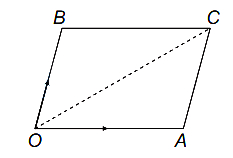
If $\hat{i}+2 \hat{j}+3 \hat{k}$ and $3 \hat{i}+2 \hat{j}+\hat{k}$ are sides of a parallelogram,then a unit vector parallel to one of the diagonals of the parallelogram is
A
$\frac{\hat{i}+\hat{j}+\hat{k}}{\sqrt{3}}$
B
$\frac{\hat{i}-\hat{j}+\hat{k}}{\sqrt{3}}$
C
$\frac{\hat{i}+\hat{j}-\hat{k}}{\sqrt{3}}$
D
$\frac{-\hat{i}+\hat{j}+\hat{k}}{\sqrt{3}}$
Solution
(A) Let the sides of the parallelogram be represented by vectors $\vec{a} = \hat{i}+2 \hat{j}+3 \hat{k}$ and $\vec{b} = 3 \hat{i}+2 \hat{j}+\hat{k}$.
The diagonals of the parallelogram are given by $\vec{d_1} = \vec{a} + \vec{b}$ and $\vec{d_2} = \vec{a} - \vec{b}$.
Calculating $\vec{d_1} = (\hat{i}+2 \hat{j}+3 \hat{k}) + (3 \hat{i}+2 \hat{j}+\hat{k}) = 4\hat{i} + 4\hat{j} + 4\hat{k} = 4(\hat{i} + \hat{j} + \hat{k})$.
The unit vector parallel to $\vec{d_1}$ is $\frac{\vec{d_1}}{|\vec{d_1}|} = \frac{4(\hat{i} + \hat{j} + \hat{k})}{\sqrt{4^2 + 4^2 + 4^2}} = \frac{4(\hat{i} + \hat{j} + \hat{k})}{\sqrt{16+16+16}} = \frac{4(\hat{i} + \hat{j} + \hat{k})}{\sqrt{48}} = \frac{4(\hat{i} + \hat{j} + \hat{k})}{4\sqrt{3}} = \frac{\hat{i} + \hat{j} + \hat{k}}{\sqrt{3}}$.
Calculating $\vec{d_2} = (\hat{i}+2 \hat{j}+3 \hat{k}) - (3 \hat{i}+2 \hat{j}+\hat{k}) = -2\hat{i} + 0\hat{j} + 2\hat{k} = -2\hat{i} + 2\hat{k}$.
The unit vector parallel to $\vec{d_2}$ is $\frac{-2\hat{i} + 2\hat{k}}{\sqrt{(-2)^2 + 2^2}} = \frac{-2\hat{i} + 2\hat{k}}{\sqrt{8}} = \frac{-2\hat{i} + 2\hat{k}}{2\sqrt{2}} = \frac{-\hat{i} + \hat{k}}{\sqrt{2}}$.
Comparing with the given options,the correct unit vector is $\frac{\hat{i} + \hat{j} + \hat{k}}{\sqrt{3}}$.
The diagonals of the parallelogram are given by $\vec{d_1} = \vec{a} + \vec{b}$ and $\vec{d_2} = \vec{a} - \vec{b}$.
Calculating $\vec{d_1} = (\hat{i}+2 \hat{j}+3 \hat{k}) + (3 \hat{i}+2 \hat{j}+\hat{k}) = 4\hat{i} + 4\hat{j} + 4\hat{k} = 4(\hat{i} + \hat{j} + \hat{k})$.
The unit vector parallel to $\vec{d_1}$ is $\frac{\vec{d_1}}{|\vec{d_1}|} = \frac{4(\hat{i} + \hat{j} + \hat{k})}{\sqrt{4^2 + 4^2 + 4^2}} = \frac{4(\hat{i} + \hat{j} + \hat{k})}{\sqrt{16+16+16}} = \frac{4(\hat{i} + \hat{j} + \hat{k})}{\sqrt{48}} = \frac{4(\hat{i} + \hat{j} + \hat{k})}{4\sqrt{3}} = \frac{\hat{i} + \hat{j} + \hat{k}}{\sqrt{3}}$.
Calculating $\vec{d_2} = (\hat{i}+2 \hat{j}+3 \hat{k}) - (3 \hat{i}+2 \hat{j}+\hat{k}) = -2\hat{i} + 0\hat{j} + 2\hat{k} = -2\hat{i} + 2\hat{k}$.
The unit vector parallel to $\vec{d_2}$ is $\frac{-2\hat{i} + 2\hat{k}}{\sqrt{(-2)^2 + 2^2}} = \frac{-2\hat{i} + 2\hat{k}}{\sqrt{8}} = \frac{-2\hat{i} + 2\hat{k}}{2\sqrt{2}} = \frac{-\hat{i} + \hat{k}}{\sqrt{2}}$.
Comparing with the given options,the correct unit vector is $\frac{\hat{i} + \hat{j} + \hat{k}}{\sqrt{3}}$.
0 likesView Solution
145
ChemistryMCQTS EAMCET · 2004
If the plane $3x - 2y - z - 18 = 0$ meets the coordinate axes at $A$,$B$,and $C$,then the centroid of $\triangle ABC$ is:
A
$(2, 3, -6)$
B
$(2, -3, 6)$
C
$(-2, -3, 6)$
D
$(2, -3, -6)$
Solution
(D) The given equation of the plane is $3x - 2y - z = 18$.
Dividing by $18$ to convert it into intercept form $\frac{x}{a} + \frac{y}{b} + \frac{z}{c} = 1$:
$\frac{3x}{18} - \frac{2y}{18} - \frac{z}{18} = 1$
$\frac{x}{6} + \frac{y}{-9} + \frac{z}{-18} = 1$.
Thus,the plane meets the coordinate axes at points $A(6, 0, 0)$,$B(0, -9, 0)$,and $C(0, 0, -18)$.
The centroid $(G)$ of $\triangle ABC$ with vertices $(x_1, y_1, z_1)$,$(x_2, y_2, z_2)$,and $(x_3, y_3, z_3)$ is given by $(\frac{x_1+x_2+x_3}{3}, \frac{y_1+y_2+y_3}{3}, \frac{z_1+z_2+z_3}{3})$.
$G = (\frac{6+0+0}{3}, \frac{0-9+0}{3}, \frac{0+0-18}{3}) = (2, -3, -6)$.
Dividing by $18$ to convert it into intercept form $\frac{x}{a} + \frac{y}{b} + \frac{z}{c} = 1$:
$\frac{3x}{18} - \frac{2y}{18} - \frac{z}{18} = 1$
$\frac{x}{6} + \frac{y}{-9} + \frac{z}{-18} = 1$.
Thus,the plane meets the coordinate axes at points $A(6, 0, 0)$,$B(0, -9, 0)$,and $C(0, 0, -18)$.
The centroid $(G)$ of $\triangle ABC$ with vertices $(x_1, y_1, z_1)$,$(x_2, y_2, z_2)$,and $(x_3, y_3, z_3)$ is given by $(\frac{x_1+x_2+x_3}{3}, \frac{y_1+y_2+y_3}{3}, \frac{z_1+z_2+z_3}{3})$.
$G = (\frac{6+0+0}{3}, \frac{0-9+0}{3}, \frac{0+0-18}{3}) = (2, -3, -6)$.
0 likesView Solution
146
ChemistryMCQTS EAMCET · 2004
If $(2,-1,3)$ is the foot of the perpendicular drawn from the origin to the plane,then the equation of the plane is
A
$2x+y-3z+6=0$
B
$2x-y+3z-14=0$
C
$2x-y+3z-13=0$
D
$2x+y+3z-10=0$
Solution
(B) Let the origin be $O(0,0,0)$ and the foot of the perpendicular from the origin to the plane be $P(2,-1,3)$.
Since $OP$ is perpendicular to the plane,the vector $\vec{OP}$ is the normal vector to the plane.
The direction ratios of the normal vector $\vec{OP}$ are $(2-0, -1-0, 3-0) = (2, -1, 3)$.
The equation of a plane passing through a point $(x_1, y_1, z_1)$ with normal vector $(a, b, c)$ is given by $a(x-x_1) + b(y-y_1) + c(z-z_1) = 0$.
Substituting the point $P(2, -1, 3)$ and the normal vector $(2, -1, 3)$ into the equation:
$2(x-2) - 1(y-(-1)) + 3(z-3) = 0$
$2(x-2) - 1(y+1) + 3(z-3) = 0$
$2x - 4 - y - 1 + 3z - 9 = 0$
$2x - y + 3z - 14 = 0$
Thus,the equation of the plane is $2x - y + 3z - 14 = 0$.
Since $OP$ is perpendicular to the plane,the vector $\vec{OP}$ is the normal vector to the plane.
The direction ratios of the normal vector $\vec{OP}$ are $(2-0, -1-0, 3-0) = (2, -1, 3)$.
The equation of a plane passing through a point $(x_1, y_1, z_1)$ with normal vector $(a, b, c)$ is given by $a(x-x_1) + b(y-y_1) + c(z-z_1) = 0$.
Substituting the point $P(2, -1, 3)$ and the normal vector $(2, -1, 3)$ into the equation:
$2(x-2) - 1(y-(-1)) + 3(z-3) = 0$
$2(x-2) - 1(y+1) + 3(z-3) = 0$
$2x - 4 - y - 1 + 3z - 9 = 0$
$2x - y + 3z - 14 = 0$
Thus,the equation of the plane is $2x - y + 3z - 14 = 0$.
0 likesView Solution
147
ChemistryMCQTS EAMCET · 2004
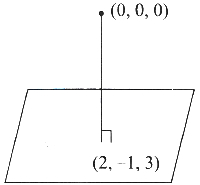
If $(2, -1, 3)$ is the foot of the perpendicular drawn from the origin to a plane,then the equation of that plane is
A
$2x + y - 3z + 6 = 0$
B
$2x - y + 3z - 14 = 0$
C
$2x - y + 3z - 13 = 0$
D
$2x + y + 3z - 10 = 0$
Solution
(B) Let the equation of the plane be $ax + by + cz + d = 0$.
Since the line segment joining the origin $(0, 0, 0)$ and the point $(2, -1, 3)$ is perpendicular to the plane,the direction ratios of the normal to the plane are given by the coordinates of the foot of the perpendicular:
$a = 2 - 0 = 2$
$b = -1 - 0 = -1$
$c = 3 - 0 = 3$
Thus,the equation of the plane is $2x - y + 3z + d = 0$.
Since the plane passes through the point $(2, -1, 3)$,we substitute these coordinates into the equation:
$2(2) - (-1) + 3(3) + d = 0$
$4 + 1 + 9 + d = 0$
$14 + d = 0$
$d = -14$
Therefore,the equation of the plane is $2x - y + 3z - 14 = 0$.
Since the line segment joining the origin $(0, 0, 0)$ and the point $(2, -1, 3)$ is perpendicular to the plane,the direction ratios of the normal to the plane are given by the coordinates of the foot of the perpendicular:
$a = 2 - 0 = 2$
$b = -1 - 0 = -1$
$c = 3 - 0 = 3$
Thus,the equation of the plane is $2x - y + 3z + d = 0$.
Since the plane passes through the point $(2, -1, 3)$,we substitute these coordinates into the equation:
$2(2) - (-1) + 3(3) + d = 0$
$4 + 1 + 9 + d = 0$
$14 + d = 0$
$d = -14$
Therefore,the equation of the plane is $2x - y + 3z - 14 = 0$.
0 likesView Solution
148
ChemistryEasyMCQTS EAMCET · 2004
In the extraction of sodium by Down's process,cathode and anode respectively are
A
copper and nickel
B
copper and chromium
C
nickel and chromium
D
iron and graphite
Solution
(D) In the extraction of sodium by Down's process,the electrolytic cell consists of an iron cathode and a graphite anode. The molten $NaCl$ is electrolyzed to produce sodium metal at the cathode and chlorine gas at the anode.
0 likesView Solution
149
ChemistryMediumMCQTS EAMCET · 2004
In the hardening stage of Plaster of Paris,the compound formed is:
A
$CaSO_4$
B
$Orthorhombic \ CaSO_4 \cdot 2H_2O$
C
$CaSO_4 \cdot H_2O$
D
$Monoclinic \ CaSO_4 \cdot 2H_2O$
Solution
(D) Plaster of Paris is $CaSO_4 \cdot \frac{1}{2}H_2O$.
When mixed with water,it sets into a hard mass of gypsum,which is $CaSO_4 \cdot 2H_2O$.
The crystalline form of gypsum formed during this hardening process is monoclinic.
When mixed with water,it sets into a hard mass of gypsum,which is $CaSO_4 \cdot 2H_2O$.
The crystalline form of gypsum formed during this hardening process is monoclinic.
0 likesView Solution
150
ChemistryMCQTS EAMCET · 2004
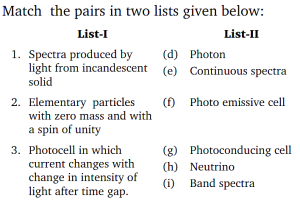
A
$1-$e,$2$-h,$3$-g
B
$1-$i,$2$-h,$3$-f
C
$1-$e,$2$-h,$3$-f
D
$1-$i,$2$-d,$3$-g
Solution
(A) No Solution Available
0 likesView Solution
Vedclass Products
For Students
Vedclass Test Series
Mock tests in real TS EAMCET style covering Chemistry with performance analysis. 5-day free trial.
Start Free TrialFor Teachers
Exam Paper Generator
Generate Set A/B/C/D Chemistry papers from 7.5L+ questions in 2 minutes. 3 chapters free.
Try FreeFor Institutes
Online Exam Module
Run live TS EAMCET mock exams with unlimited students, 360° analytics & white-label branding.
See DemoFrequently Asked Questions
How many Chemistry questions are in TS EAMCET 2004?
There are 183 Chemistry questions from the TS EAMCET 2004 paper on Vedclass, each with a detailed step-by-step solution in English.
Are TS EAMCET 2004 Chemistry solutions available in English?
Yes. All solutions on this page are in English. You can also switch to English or Hindi using the language buttons above the questions.
Can I practice TS EAMCET 2004 Chemistry as a timed test?
Yes. Use the Vedclass Test Series to attempt a full TS EAMCET mock test covering Chemistry with time limits and instant score analysis.
Can teachers create Chemistry papers from TS EAMCET previous year questions?
Yes. The Vedclass Exam Paper Generator lets teachers mix TS EAMCET Chemistry questions and generate Set A/B/C/D papers in minutes.
For Teachers & Institutes
Build a Custom Chemistry Paper
Pick TS EAMCET 2004 Chemistry questions, set difficulty, and generate Set A/B/C/D in 2 minutes.