
PhysicsQ1–40 of 40 questions
Page 1 of 1 · English
1
PhysicsDifficultMCQTS EAMCET · 2004
Two particles of equal mass have velocities $\overrightarrow{v}_1=4 \hat{i} \text{ ms}^{-1}$ and $\overrightarrow{v}_2=4 \hat{j} \text{ ms}^{-1}$. The first particle has an acceleration $\overrightarrow{a}_1=(5 \hat{i}+5 \hat{j}) \text{ ms}^{-2}$ while the acceleration of the other particle is zero. The centre of mass of the two particles moves in a path of
A
straight line
B
parabola
C
circle
D
ellipse
Solution
(A) The velocity of the centre of mass $(v_{CM})$ is given by:
$v_{CM} = \frac{m_1 \overrightarrow{v}_1 + m_2 \overrightarrow{v}_2}{m_1 + m_2} = \frac{\overrightarrow{v}_1 + \overrightarrow{v}_2}{2}$ (since $m_1 = m_2 = m$).
$v_{CM} = \frac{4 \hat{i} + 4 \hat{j}}{2} = (2 \hat{i} + 2 \hat{j}) \text{ ms}^{-1}$.
The acceleration of the centre of mass $(a_{CM})$ is given by:
$a_{CM} = \frac{m_1 \overrightarrow{a}_1 + m_2 \overrightarrow{a}_2}{m_1 + m_2} = \frac{\overrightarrow{a}_1 + 0}{2} = \frac{5 \hat{i} + 5 \hat{j}}{2} = (2.5 \hat{i} + 2.5 \hat{j}) \text{ ms}^{-2}$.
Since the acceleration vector $\overrightarrow{a}_{CM}$ is constant,the centre of mass moves with constant acceleration.
Because the initial velocity $\overrightarrow{v}_{CM}$ and the acceleration $\overrightarrow{a}_{CM}$ are parallel (both are in the direction of $\hat{i} + \hat{j}$),the path of the centre of mass is a straight line.
$v_{CM} = \frac{m_1 \overrightarrow{v}_1 + m_2 \overrightarrow{v}_2}{m_1 + m_2} = \frac{\overrightarrow{v}_1 + \overrightarrow{v}_2}{2}$ (since $m_1 = m_2 = m$).
$v_{CM} = \frac{4 \hat{i} + 4 \hat{j}}{2} = (2 \hat{i} + 2 \hat{j}) \text{ ms}^{-1}$.
The acceleration of the centre of mass $(a_{CM})$ is given by:
$a_{CM} = \frac{m_1 \overrightarrow{a}_1 + m_2 \overrightarrow{a}_2}{m_1 + m_2} = \frac{\overrightarrow{a}_1 + 0}{2} = \frac{5 \hat{i} + 5 \hat{j}}{2} = (2.5 \hat{i} + 2.5 \hat{j}) \text{ ms}^{-2}$.
Since the acceleration vector $\overrightarrow{a}_{CM}$ is constant,the centre of mass moves with constant acceleration.
Because the initial velocity $\overrightarrow{v}_{CM}$ and the acceleration $\overrightarrow{a}_{CM}$ are parallel (both are in the direction of $\hat{i} + \hat{j}$),the path of the centre of mass is a straight line.
0 likesView Solution
2
PhysicsMediumMCQTS EAMCET · 2004
Consider the following statements $A$ and $B$ and identify the correct answer:
$A$. When a person walks on a rough surface,the direction of the frictional force exerted by the surface on the person is in the same direction as his motion.
$B$. When a cycle is in motion,the force of friction exerted by the ground on the front wheel is in the backward direction.
$A$. When a person walks on a rough surface,the direction of the frictional force exerted by the surface on the person is in the same direction as his motion.
$B$. When a cycle is in motion,the force of friction exerted by the ground on the front wheel is in the backward direction.
A
$A$ and $B$ are correct
B
$A$ is correct,$B$ is wrong
C
$A$ and $B$ are wrong
D
$A$ is wrong,$B$ is correct
Solution
(D) Statement $A$ is wrong. When a person walks,they push the ground backward with their foot. According to Newton's third law,the ground exerts an equal and opposite force on the person in the forward direction. This static friction force is what propels the person forward.
Statement $B$ is correct. For the front wheel of a cycle (which is not driven by a chain),the ground exerts a frictional force in the backward direction to oppose the rolling motion,which causes the wheel to decelerate or maintain its state of motion relative to the ground.
Statement $B$ is correct. For the front wheel of a cycle (which is not driven by a chain),the ground exerts a frictional force in the backward direction to oppose the rolling motion,which causes the wheel to decelerate or maintain its state of motion relative to the ground.
0 likesView Solution
3
PhysicsEasyMCQTS EAMCET · 2004
$A$ $2 \,kg$ ball moving at $24 \,ms^{-1}$ undergoes inelastic head-on collision with a $4 \,kg$ ball moving in the opposite direction at $48 \,ms^{-1}$. If the coefficient of restitution is $2/3$, their velocities in $ms^{-1}$ after impact are
A
$-56, -8$
B
$-28, -4$
C
$-14, -2$
D
$-7, -1$
Solution
(A) Given: $m_1 = 2 \,kg$, $v_1 = 24 \,ms^{-1}$, $m_2 = 4 \,kg$, $v_2 = -48 \,ms^{-1}$ (opposite direction), $e = 2/3$.
Using the formula for final velocities after collision:
$v_1' = \frac{m_1 v_1 + m_2 v_2 + e m_2 (v_2 - v_1)}{m_1 + m_2}$
$v_1' = \frac{(2)(24) + (4)(-48) + (2/3)(4)(-48 - 24)}{2 + 4}$
$v_1' = \frac{48 - 192 + (8/3)(-72)}{6} = \frac{-144 - 192}{6} = \frac{-336}{6} = -56 \,ms^{-1}$.
Using the conservation of momentum or the restitution equation $v_2' - v_1' = e(v_1 - v_2)$:
$v_2' - (-56) = (2/3)(24 - (-48))$
$v_2' + 56 = (2/3)(72) = 48$
$v_2' = 48 - 56 = -8 \,ms^{-1}$.
Using the formula for final velocities after collision:
$v_1' = \frac{m_1 v_1 + m_2 v_2 + e m_2 (v_2 - v_1)}{m_1 + m_2}$
$v_1' = \frac{(2)(24) + (4)(-48) + (2/3)(4)(-48 - 24)}{2 + 4}$
$v_1' = \frac{48 - 192 + (8/3)(-72)}{6} = \frac{-144 - 192}{6} = \frac{-336}{6} = -56 \,ms^{-1}$.
Using the conservation of momentum or the restitution equation $v_2' - v_1' = e(v_1 - v_2)$:
$v_2' - (-56) = (2/3)(24 - (-48))$
$v_2' + 56 = (2/3)(72) = 48$
$v_2' = 48 - 56 = -8 \,ms^{-1}$.
0 likesView Solution
4
PhysicsMediumMCQTS EAMCET · 2004
At a given instant of time,two particles have position vectors $4 \hat{i} + 4 \hat{j} + 57 \hat{k} \ m$ and $2 \hat{i} + 2 \hat{j} + 5 \hat{k} \ m$ respectively. If the velocity of the first particle is $0.4 \hat{i} \ ms^{-1}$,what is the velocity of the second particle in $ms^{-1}$ if they collide after $10 \ s$?
A
$6(\hat{i} - \hat{j} + \frac{1}{3} \hat{k})$
B
$0.6(\hat{i} - \hat{j} + \frac{1}{3} \hat{k})$
C
$6(\hat{i} + \hat{j} + \frac{1}{3} \hat{k})$
D
$0.6(\hat{i} + \hat{j} - \frac{1}{3} \hat{k})$
Solution
(B) Let the position vectors of the two particles be $\vec{r}_1 = 4\hat{i} + 4\hat{j} + 57\hat{k}$ and $\vec{r}_2 = 2\hat{i} + 2\hat{j} + 5\hat{k}$.
For the particles to collide at time $t = 10 \ s$,their positions at that instant must be equal: $\vec{r}_1 + \vec{v}_1 t = \vec{r}_2 + \vec{v}_2 t$.
Substituting the given values: $(4\hat{i} + 4\hat{j} + 57\hat{k}) + (0.4\hat{i})(10) = (2\hat{i} + 2\hat{j} + 5\hat{k}) + \vec{v}_2(10)$.
$(4\hat{i} + 4\hat{j} + 57\hat{k}) + 4\hat{i} = (2\hat{i} + 2\hat{j} + 5\hat{k}) + 10\vec{v}_2$.
$8\hat{i} + 4\hat{j} + 57\hat{k} = 2\hat{i} + 2\hat{j} + 5\hat{k} + 10\vec{v}_2$.
$10\vec{v}_2 = (8-2)\hat{i} + (4-2)\hat{j} + (57-5)\hat{k} = 6\hat{i} + 2\hat{j} + 52\hat{k}$.
Wait,re-evaluating the vector subtraction: $10\vec{v}_2 = (4\hat{i} + 4\hat{j} + 57\hat{k} + 4\hat{i}) - (2\hat{i} + 2\hat{j} + 5\hat{k}) = 6\hat{i} + 2\hat{j} + 52\hat{k}$.
Given the options,there is a typo in the provided question's vector values. Assuming the intended vector for the first particle was $4\hat{i} - 4\hat{j} + 7\hat{k}$ as per the provided solution logic:
$10\vec{v}_2 = (4\hat{i} - 4\hat{j} + 7\hat{k} + 4\hat{i}) - (2\hat{i} + 2\hat{j} + 5\hat{k}) = 6\hat{i} - 6\hat{j} + 2\hat{k}$.
$\vec{v}_2 = 0.6(\hat{i} - \hat{j} + \frac{1}{3}\hat{k}) \ ms^{-1}$.
For the particles to collide at time $t = 10 \ s$,their positions at that instant must be equal: $\vec{r}_1 + \vec{v}_1 t = \vec{r}_2 + \vec{v}_2 t$.
Substituting the given values: $(4\hat{i} + 4\hat{j} + 57\hat{k}) + (0.4\hat{i})(10) = (2\hat{i} + 2\hat{j} + 5\hat{k}) + \vec{v}_2(10)$.
$(4\hat{i} + 4\hat{j} + 57\hat{k}) + 4\hat{i} = (2\hat{i} + 2\hat{j} + 5\hat{k}) + 10\vec{v}_2$.
$8\hat{i} + 4\hat{j} + 57\hat{k} = 2\hat{i} + 2\hat{j} + 5\hat{k} + 10\vec{v}_2$.
$10\vec{v}_2 = (8-2)\hat{i} + (4-2)\hat{j} + (57-5)\hat{k} = 6\hat{i} + 2\hat{j} + 52\hat{k}$.
Wait,re-evaluating the vector subtraction: $10\vec{v}_2 = (4\hat{i} + 4\hat{j} + 57\hat{k} + 4\hat{i}) - (2\hat{i} + 2\hat{j} + 5\hat{k}) = 6\hat{i} + 2\hat{j} + 52\hat{k}$.
Given the options,there is a typo in the provided question's vector values. Assuming the intended vector for the first particle was $4\hat{i} - 4\hat{j} + 7\hat{k}$ as per the provided solution logic:
$10\vec{v}_2 = (4\hat{i} - 4\hat{j} + 7\hat{k} + 4\hat{i}) - (2\hat{i} + 2\hat{j} + 5\hat{k}) = 6\hat{i} - 6\hat{j} + 2\hat{k}$.
$\vec{v}_2 = 0.6(\hat{i} - \hat{j} + \frac{1}{3}\hat{k}) \ ms^{-1}$.
0 likesView Solution
5
PhysicsEasyMCQTS EAMCET · 2004
The escape velocity of a body on the earth's surface is $v_e$. $A$ body is thrown up with a speed $\sqrt{5} v_e$. Assuming that the sun and planets do not influence the motion of the body,the velocity of the body at infinite distance is:
A
$0$
B
$v_e$
C
$\sqrt{2} v_e$
D
$2v_e$
Solution
(D) According to the principle of conservation of energy,the total energy at the surface of the earth must equal the total energy at an infinite distance.
Let $m$ be the mass of the body and $M$ be the mass of the earth.
At the surface: $E_i = \frac{1}{2}mv^2 - \frac{GMm}{R} = \frac{1}{2}mv^2 - \frac{1}{2}mv_e^2$ (since $v_e^2 = \frac{2GM}{R}$).
At infinite distance: $E_f = \frac{1}{2}mv'^2 - 0 = \frac{1}{2}mv'^2$.
Equating $E_i = E_f$: $\frac{1}{2}mv^2 - \frac{1}{2}mv_e^2 = \frac{1}{2}mv'^2$.
Thus,$v'^2 = v^2 - v_e^2$.
Given $v = \sqrt{5}v_e$,we have $v'^2 = (\sqrt{5}v_e)^2 - v_e^2 = 5v_e^2 - v_e^2 = 4v_e^2$.
Therefore,$v' = \sqrt{4v_e^2} = 2v_e$.
Let $m$ be the mass of the body and $M$ be the mass of the earth.
At the surface: $E_i = \frac{1}{2}mv^2 - \frac{GMm}{R} = \frac{1}{2}mv^2 - \frac{1}{2}mv_e^2$ (since $v_e^2 = \frac{2GM}{R}$).
At infinite distance: $E_f = \frac{1}{2}mv'^2 - 0 = \frac{1}{2}mv'^2$.
Equating $E_i = E_f$: $\frac{1}{2}mv^2 - \frac{1}{2}mv_e^2 = \frac{1}{2}mv'^2$.
Thus,$v'^2 = v^2 - v_e^2$.
Given $v = \sqrt{5}v_e$,we have $v'^2 = (\sqrt{5}v_e)^2 - v_e^2 = 5v_e^2 - v_e^2 = 4v_e^2$.
Therefore,$v' = \sqrt{4v_e^2} = 2v_e$.
0 likesView Solution
6
PhysicsDifficultMCQTS EAMCET · 2004
There are two holes,one each along the opposite sides of a wide rectangular tank. The cross-section of each hole is $0.01 \,m^2$ and the vertical distance between the holes is $1 \,m$. The tank is filled with water. The net force on the tank in newton when the water flows out of the holes is (Density of water $= 1000 \,kg/m^3$,$g = 10 \,m/s^2$)
A
$100$
B
$200$
C
$300$
D
$400$
Solution
(B) According to Torricelli's law,the velocity of efflux from a hole at depth $h$ is $v = \sqrt{2gh}$.
The force exerted by the water jet exiting a hole of area $A$ is given by $F = \rho A v^2$.
For the upper hole at depth $h_1$,the force is $F_1 = \rho A (2gh_1)$.
For the lower hole at depth $h_2 = h_1 + h$,where $h = 1 \,m$ is the vertical distance between the holes,the force is $F_2 = \rho A (2g(h_1 + h))$.
Since the holes are on opposite sides,the forces act in opposite directions. The net force $F_{net}$ on the tank is the difference between these forces:
$F_{net} = F_2 - F_1 = \rho A (2g(h_1 + h)) - \rho A (2gh_1) = 2 \rho A g h$.
Substituting the given values: $\rho = 1000 \,kg/m^3$,$A = 0.01 \,m^2$,$g = 10 \,m/s^2$,and $h = 1 \,m$:
$F_{net} = 2 \times 1000 \times 0.01 \times 10 \times 1 = 200 \,N$.
The force exerted by the water jet exiting a hole of area $A$ is given by $F = \rho A v^2$.
For the upper hole at depth $h_1$,the force is $F_1 = \rho A (2gh_1)$.
For the lower hole at depth $h_2 = h_1 + h$,where $h = 1 \,m$ is the vertical distance between the holes,the force is $F_2 = \rho A (2g(h_1 + h))$.
Since the holes are on opposite sides,the forces act in opposite directions. The net force $F_{net}$ on the tank is the difference between these forces:
$F_{net} = F_2 - F_1 = \rho A (2g(h_1 + h)) - \rho A (2gh_1) = 2 \rho A g h$.
Substituting the given values: $\rho = 1000 \,kg/m^3$,$A = 0.01 \,m^2$,$g = 10 \,m/s^2$,and $h = 1 \,m$:
$F_{net} = 2 \times 1000 \times 0.01 \times 10 \times 1 = 200 \,N$.
0 likesView Solution
7
PhysicsDifficultMCQTS EAMCET · 2004
One end of a uniform glass capillary tube of radius $r = 0.025 \ cm$ is immersed vertically in water to a depth $h = 1 \ cm$. The excess pressure in $N/m^2$ required to blow an air bubble out of the tube is: (Surface tension of water $T = 7 \times 10^{-2} \ N/m$,Density of water $\rho = 10^3 \ kg/m^3$,Acceleration due to gravity $g = 10 \ m/s^2$)
A
$0.0048 \times 10^5$
B
$0.0066 \times 10^5$
C
$1.0048 \times 10^5$
D
$1.0066 \times 10^5$
Solution
(B) The total pressure required to blow an air bubble at a depth $h$ is the sum of the hydrostatic pressure at that depth and the excess pressure due to surface tension at the bubble interface.
$1$. Hydrostatic pressure at depth $h = 1 \ cm = 0.01 \ m$ is $P_h = \rho g h = 10^3 \times 10 \times 0.01 = 100 \ N/m^2$.
$2$. The excess pressure due to surface tension for a bubble of radius $r = 0.025 \ cm = 2.5 \times 10^{-4} \ m$ is $P_s = \frac{2T}{r} = \frac{2 \times 7 \times 10^{-2}}{2.5 \times 10^{-4}} = \frac{14 \times 10^{-2}}{2.5 \times 10^{-4}} = 5.6 \times 10^2 = 560 \ N/m^2$.
$3$. Total excess pressure $P = P_h + P_s = 100 + 560 = 660 \ N/m^2$.
$4$. Converting to the required scientific notation: $660 \ N/m^2 = 0.0066 \times 10^5 \ N/m^2$.
$1$. Hydrostatic pressure at depth $h = 1 \ cm = 0.01 \ m$ is $P_h = \rho g h = 10^3 \times 10 \times 0.01 = 100 \ N/m^2$.
$2$. The excess pressure due to surface tension for a bubble of radius $r = 0.025 \ cm = 2.5 \times 10^{-4} \ m$ is $P_s = \frac{2T}{r} = \frac{2 \times 7 \times 10^{-2}}{2.5 \times 10^{-4}} = \frac{14 \times 10^{-2}}{2.5 \times 10^{-4}} = 5.6 \times 10^2 = 560 \ N/m^2$.
$3$. Total excess pressure $P = P_h + P_s = 100 + 560 = 660 \ N/m^2$.
$4$. Converting to the required scientific notation: $660 \ N/m^2 = 0.0066 \times 10^5 \ N/m^2$.
0 likesView Solution
8
PhysicsDifficultMCQTS EAMCET · 2004
Water in a river $20 \ m$ deep is flowing at a speed of $10 \ ms^{-1}$. The shearing stress between the horizontal layers of water in the river in $Nm^{-2}$ is (Coefficient of viscosity of water $= 10^{-3} \ SI \ units$)
A
$1 \times 10^{-2}$
B
$0.5 \times 10^{-2}$
C
$1 \times 10^{-3}$
D
$0.5 \times 10^{-3}$
Solution
(D) The shearing stress $\tau$ is given by the formula: $\tau = \eta \left( \frac{dv}{dx} \right)$.
Here,$\eta = 10^{-3} \ SI \ units$ is the coefficient of viscosity.
The velocity gradient $\frac{dv}{dx}$ is calculated as the velocity $v$ divided by the depth $x$.
Given $v = 10 \ ms^{-1}$ and $x = 20 \ m$,we have $\frac{dv}{dx} = \frac{10}{20} = 0.5 \ s^{-1}$.
Substituting these values into the formula:
$\tau = 10^{-3} \times 0.5 = 0.5 \times 10^{-3} \ Nm^{-2}$.
Here,$\eta = 10^{-3} \ SI \ units$ is the coefficient of viscosity.
The velocity gradient $\frac{dv}{dx}$ is calculated as the velocity $v$ divided by the depth $x$.
Given $v = 10 \ ms^{-1}$ and $x = 20 \ m$,we have $\frac{dv}{dx} = \frac{10}{20} = 0.5 \ s^{-1}$.
Substituting these values into the formula:
$\tau = 10^{-3} \times 0.5 = 0.5 \times 10^{-3} \ Nm^{-2}$.
0 likesView Solution
9
PhysicsDifficultMCQTS EAMCET · 2004
$A$ metallic ring of radius $r$ and cross-sectional area $A$ is fitted into a wooden circular disc of radius $R$ $(R > r)$. If the Young's modulus of the material of the ring is $Y$,the force with which the metal ring expands is
A
$\frac{A Y R}{r}$
B
$\frac{A Y(R-r)}{r}$
C
$\frac{Y(R-r)}{A r}$
D
$\frac{Y R}{A R}$
Solution
(B) The Young's modulus $Y$ is defined as the ratio of stress to strain: $Y = \frac{F/A}{\Delta L/L}$.
Here,the initial length of the ring is $L = 2 \pi r$.
The change in length when it is stretched to radius $R$ is $\Delta L = 2 \pi R - 2 \pi r = 2 \pi (R - r)$.
Rearranging the formula for force $F$,we get $F = \frac{Y A \Delta L}{L}$.
Substituting the values: $F = \frac{Y A [2 \pi (R - r)]}{2 \pi r}$.
Simplifying the expression,we get $F = \frac{A Y (R - r)}{r}$.
Here,the initial length of the ring is $L = 2 \pi r$.
The change in length when it is stretched to radius $R$ is $\Delta L = 2 \pi R - 2 \pi r = 2 \pi (R - r)$.
Rearranging the formula for force $F$,we get $F = \frac{Y A \Delta L}{L}$.
Substituting the values: $F = \frac{Y A [2 \pi (R - r)]}{2 \pi r}$.
Simplifying the expression,we get $F = \frac{A Y (R - r)}{r}$.
0 likesView Solution
10
PhysicsDifficultMCQTS EAMCET · 2004
The horizontal and vertical displacements $x$ and $y$ of a projectile at a given time $t$ are given by $x = 6t \text{ m}$ and $y = 8t - 5t^2 \text{ m}$. The range of the projectile in metres is:
A
$9.6$
B
$10.6$
C
$19.2$
D
$38.4$
Solution
(A) The horizontal displacement is given by $x = (u \cos \theta) t = 6t$,which implies $u \cos \theta = 6 \text{ m/s}$.
The vertical displacement is given by $y = (u \sin \theta) t - \frac{1}{2} g t^2 = 8t - 5t^2$. Comparing this with the standard equation,we get $u \sin \theta = 8 \text{ m/s}$ and $\frac{1}{2} g = 5$,so $g = 10 \text{ m/s}^2$.
The range $R$ of a projectile is given by the formula $R = \frac{u^2 \sin 2\theta}{g} = \frac{2(u \sin \theta)(u \cos \theta)}{g}$.
Substituting the values: $R = \frac{2 \times 8 \times 6}{10} = \frac{96}{10} = 9.6 \text{ m}$.
The vertical displacement is given by $y = (u \sin \theta) t - \frac{1}{2} g t^2 = 8t - 5t^2$. Comparing this with the standard equation,we get $u \sin \theta = 8 \text{ m/s}$ and $\frac{1}{2} g = 5$,so $g = 10 \text{ m/s}^2$.
The range $R$ of a projectile is given by the formula $R = \frac{u^2 \sin 2\theta}{g} = \frac{2(u \sin \theta)(u \cos \theta)}{g}$.
Substituting the values: $R = \frac{2 \times 8 \times 6}{10} = \frac{96}{10} = 9.6 \text{ m}$.
0 likesView Solution
11
PhysicsMediumMCQTS EAMCET · 2004
The time period of a simple pendulum is $T$. When the length is increased by $10 \ cm$,its period is $T_1$. When the length is decreased by $10 \ cm$,its period is $T_2$. Then,the relation between $T, T_1$,and $T_2$ is
A
$\frac{2}{T^2}=\frac{1}{T_1^2}+\frac{1}{T_2^2}$
B
$\frac{2}{T^2}=\frac{1}{T_1^2}-\frac{1}{T_2^2}$
C
$2 T^2=T_1^2+T_2^2$
D
$2 T^2=T_1^2-T_2^2$
Solution
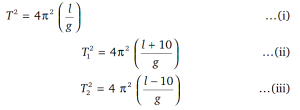
(C) The time period of a simple pendulum is given by $T = 2 \pi \sqrt{\frac{l}{g}}$,so $T^2 = 4 \pi^2 \left(\frac{l}{g}\right) \quad ...(i)$
When the length is increased by $10 \ cm$,the new time period $T_1$ is given by $T_1^2 = 4 \pi^2 \left(\frac{l+10}{g}\right) \quad ...(ii)$
When the length is decreased by $10 \ cm$,the new time period $T_2$ is given by $T_2^2 = 4 \pi^2 \left(\frac{l-10}{g}\right) \quad ...(iii)$
Adding equations $(ii)$ and $(iii)$,we get:
$T_1^2 + T_2^2 = 4 \pi^2 \left(\frac{l+10}{g}\right) + 4 \pi^2 \left(\frac{l-10}{g}\right)$
$T_1^2 + T_2^2 = \frac{4 \pi^2}{g} (l + 10 + l - 10)$
$T_1^2 + T_2^2 = \frac{4 \pi^2}{g} (2l)$
$T_1^2 + T_2^2 = 2 \left(4 \pi^2 \frac{l}{g}\right)$
Substituting equation $(i)$ into this,we get:
$T_1^2 + T_2^2 = 2 T^2$
When the length is increased by $10 \ cm$,the new time period $T_1$ is given by $T_1^2 = 4 \pi^2 \left(\frac{l+10}{g}\right) \quad ...(ii)$
When the length is decreased by $10 \ cm$,the new time period $T_2$ is given by $T_2^2 = 4 \pi^2 \left(\frac{l-10}{g}\right) \quad ...(iii)$
Adding equations $(ii)$ and $(iii)$,we get:
$T_1^2 + T_2^2 = 4 \pi^2 \left(\frac{l+10}{g}\right) + 4 \pi^2 \left(\frac{l-10}{g}\right)$
$T_1^2 + T_2^2 = \frac{4 \pi^2}{g} (l + 10 + l - 10)$
$T_1^2 + T_2^2 = \frac{4 \pi^2}{g} (2l)$
$T_1^2 + T_2^2 = 2 \left(4 \pi^2 \frac{l}{g}\right)$
Substituting equation $(i)$ into this,we get:
$T_1^2 + T_2^2 = 2 T^2$
0 likesView Solution
12
PhysicsEasyMCQTS EAMCET · 2004
$A$ metallic solid sphere is rotating about its diameter as an axis of rotation. If the temperature is increased by $200^{\circ} C$,the percentage increase in its moment of inertia is (Coefficient of linear expansion of the metal $= 10^{-5} /^{\circ} C$) (in $\%$)
A
$0.1$
B
$0.2$
C
$0.3$
D
$0.4$
Solution
(D) The moment of inertia of a solid sphere about its diameter is given by $I = \frac{2}{5} m R^2$.
Since mass $m$ remains constant,$I \propto R^2$.
The fractional change in moment of inertia is given by $\frac{\Delta I}{I} = 2 \frac{\Delta R}{R}$.
We know that the linear expansion is given by $\frac{\Delta R}{R} = \alpha \Delta t$,where $\alpha = 10^{-5} /^{\circ} C$ and $\Delta t = 200^{\circ} C$.
Substituting these values,we get $\frac{\Delta I}{I} = 2 \alpha \Delta t$.
To find the percentage increase,we multiply by $100$:
$\text{Percentage increase} = 2 \times 10^{-5} \times 200 \times 100 = 0.4 \%$.
Since mass $m$ remains constant,$I \propto R^2$.
The fractional change in moment of inertia is given by $\frac{\Delta I}{I} = 2 \frac{\Delta R}{R}$.
We know that the linear expansion is given by $\frac{\Delta R}{R} = \alpha \Delta t$,where $\alpha = 10^{-5} /^{\circ} C$ and $\Delta t = 200^{\circ} C$.
Substituting these values,we get $\frac{\Delta I}{I} = 2 \alpha \Delta t$.
To find the percentage increase,we multiply by $100$:
$\text{Percentage increase} = 2 \times 10^{-5} \times 200 \times 100 = 0.4 \%$.
0 likesView Solution
13
PhysicsDifficultMCQTS EAMCET · 2004
$A$ thin uniform square lamina of side $a$ is placed in the $xy$-plane with its sides parallel to $X$ and $Y$-axes and with its centre coinciding with the origin. Its moment of inertia about an axis passing through a point on the $Y$-axis at a distance $y = 2a$ and parallel to the $X$-axis is equal to its moment of inertia about an axis passing through a point on the $X$-axis at a distance $x = d$ and perpendicular to the $xy$-plane. Then the value of $d$ is:
A
$\frac{7}{3} a$
B
$\frac{\sqrt{47}}{12} a$
C
$\frac{9}{5} a$
D
$\frac{\sqrt{51}}{12} a$
Solution
(B) Let the mass of the square lamina be $m$. The moment of inertia of the square lamina about an axis passing through its center of mass and parallel to the $X$-axis is $I_{cm,x} = \frac{ma^2}{12}$.
Using the parallel axis theorem,the moment of inertia about an axis parallel to the $X$-axis passing through $(0, 2a)$ is:
$I_1 = I_{cm,x} + m(2a)^2 = \frac{ma^2}{12} + 4ma^2 = \frac{49ma^2}{12}$.
The moment of inertia of the square lamina about an axis passing through its center of mass and perpendicular to the $xy$-plane is $I_{cm,z} = I_{cm,x} + I_{cm,y} = \frac{ma^2}{12} + \frac{ma^2}{12} = \frac{ma^2}{6}$.
Using the parallel axis theorem,the moment of inertia about an axis passing through $(d, 0)$ and perpendicular to the $xy$-plane is:
$I_2 = I_{cm,z} + md^2 = \frac{ma^2}{6} + md^2$.
Equating $I_1$ and $I_2$:
$\frac{49ma^2}{12} = \frac{ma^2}{6} + md^2$.
$\frac{49a^2}{12} - \frac{2a^2}{12} = d^2$.
$d^2 = \frac{47a^2}{12}$.
$d = \sqrt{\frac{47}{12}} a$.
Using the parallel axis theorem,the moment of inertia about an axis parallel to the $X$-axis passing through $(0, 2a)$ is:
$I_1 = I_{cm,x} + m(2a)^2 = \frac{ma^2}{12} + 4ma^2 = \frac{49ma^2}{12}$.
The moment of inertia of the square lamina about an axis passing through its center of mass and perpendicular to the $xy$-plane is $I_{cm,z} = I_{cm,x} + I_{cm,y} = \frac{ma^2}{12} + \frac{ma^2}{12} = \frac{ma^2}{6}$.
Using the parallel axis theorem,the moment of inertia about an axis passing through $(d, 0)$ and perpendicular to the $xy$-plane is:
$I_2 = I_{cm,z} + md^2 = \frac{ma^2}{6} + md^2$.
Equating $I_1$ and $I_2$:
$\frac{49ma^2}{12} = \frac{ma^2}{6} + md^2$.
$\frac{49a^2}{12} - \frac{2a^2}{12} = d^2$.
$d^2 = \frac{47a^2}{12}$.
$d = \sqrt{\frac{47}{12}} a$.
0 likesView Solution
14
PhysicsMediumMCQTS EAMCET · 2004
$A$ particle of mass $1 \ kg$ is projected with an initial velocity $10 \ ms^{-1}$ at an angle of projection $45^{\circ}$ with the horizontal. The average torque acting on the projectile,between the time at which it is projected and the time at which it strikes the ground,about the point of projection in $Nm$ is:
A
$25$
B
$50$
C
$75$
D
$100$
Solution
(B) The average torque $\tau_{avg}$ is defined as the rate of change of angular momentum: $\tau_{avg} = \frac{\Delta L}{\Delta t}$.
At the point of projection,the angular momentum $L_i = 0$.
At the point of impact,the projectile is at a horizontal distance $R$ (range) from the point of projection. The vertical velocity component is $v_y = -u \sin \theta$ and the horizontal component is $v_x = u \cos \theta$.
The angular momentum at the point of impact is $L_f = m \times v_y \times R = m(-u \sin \theta) \times \frac{u^2 \sin 2\theta}{g} = -\frac{m u^3 \sin \theta \sin 2\theta}{g}$.
Alternatively,using the torque due to gravity: $\tau = \vec{r} \times \vec{F} = \vec{r} \times m\vec{g}$.
The average torque is $\tau_{avg} = \frac{1}{T} \int_0^T \tau dt = \frac{1}{T} \int_0^T (mg \cdot x) dt = \frac{mg}{T} \int_0^T (u \cos \theta) t dt = \frac{mg u \cos \theta}{T} [\frac{t^2}{2}]_0^T = \frac{mg u \cos \theta T}{2}$.
Since $T = \frac{2u \sin \theta}{g}$,we have $\tau_{avg} = \frac{mg u \cos \theta}{2} \times \frac{2u \sin \theta}{g} = m u^2 \sin \theta \cos \theta = \frac{1}{2} m u^2 \sin 2\theta$.
Substituting the values: $m = 1 \ kg$,$u = 10 \ ms^{-1}$,$\theta = 45^{\circ}$.
$\tau_{avg} = \frac{1}{2} \times 1 \times (10)^2 \times \sin(90^{\circ}) = \frac{1}{2} \times 100 \times 1 = 50 \ Nm$.
At the point of projection,the angular momentum $L_i = 0$.
At the point of impact,the projectile is at a horizontal distance $R$ (range) from the point of projection. The vertical velocity component is $v_y = -u \sin \theta$ and the horizontal component is $v_x = u \cos \theta$.
The angular momentum at the point of impact is $L_f = m \times v_y \times R = m(-u \sin \theta) \times \frac{u^2 \sin 2\theta}{g} = -\frac{m u^3 \sin \theta \sin 2\theta}{g}$.
Alternatively,using the torque due to gravity: $\tau = \vec{r} \times \vec{F} = \vec{r} \times m\vec{g}$.
The average torque is $\tau_{avg} = \frac{1}{T} \int_0^T \tau dt = \frac{1}{T} \int_0^T (mg \cdot x) dt = \frac{mg}{T} \int_0^T (u \cos \theta) t dt = \frac{mg u \cos \theta}{T} [\frac{t^2}{2}]_0^T = \frac{mg u \cos \theta T}{2}$.
Since $T = \frac{2u \sin \theta}{g}$,we have $\tau_{avg} = \frac{mg u \cos \theta}{2} \times \frac{2u \sin \theta}{g} = m u^2 \sin \theta \cos \theta = \frac{1}{2} m u^2 \sin 2\theta$.
Substituting the values: $m = 1 \ kg$,$u = 10 \ ms^{-1}$,$\theta = 45^{\circ}$.
$\tau_{avg} = \frac{1}{2} \times 1 \times (10)^2 \times \sin(90^{\circ}) = \frac{1}{2} \times 100 \times 1 = 50 \ Nm$.
0 likesView Solution
15
PhysicsMediumMCQTS EAMCET · 2004
Assertion $(A)$: Rapidly changing temperatures can be measured by thermocouples.
Reason $(R)$: The thermal capacity of the junction of a thermocouple is very small.
Reason $(R)$: The thermal capacity of the junction of a thermocouple is very small.
A
Both $(A)$ and $(R)$ are true and $(R)$ is the correct explanation of $(A)$
B
Both $(A)$ and $(R)$ are true but $(R)$ is not the correct explanation of $(A)$
C
$(A)$ is true but $(R)$ is false
D
$(A)$ is false but $(R)$ is true
Solution
(A) thermocouple consists of two junctions of dissimilar metals.
Because the junctions are very small,their thermal capacity (mass $\times$ specific heat) is extremely low.
Thermal capacity determines how much heat is required to change the temperature of an object.
Since the thermal capacity is very small,the junction can quickly gain or lose heat to reach thermal equilibrium with the surrounding environment.
This allows the thermocouple to respond rapidly to changes in temperature.
Therefore,both $(A)$ and $(R)$ are true,and $(R)$ is the correct explanation of $(A)$.
Because the junctions are very small,their thermal capacity (mass $\times$ specific heat) is extremely low.
Thermal capacity determines how much heat is required to change the temperature of an object.
Since the thermal capacity is very small,the junction can quickly gain or lose heat to reach thermal equilibrium with the surrounding environment.
This allows the thermocouple to respond rapidly to changes in temperature.
Therefore,both $(A)$ and $(R)$ are true,and $(R)$ is the correct explanation of $(A)$.
0 likesView Solution
16
PhysicsDifficultMCQTS EAMCET · 2004
$A$ black body of mass $34.38 \ g$ and surface area $19.2 \ cm^2$ is at an initial temperature of $400 \ K$. It is allowed to cool inside an evacuated enclosure kept at a constant temperature of $300 \ K$. The rate of cooling is $0.04 \ ^{\circ}C/s$. The specific heat of the body in $J \ kg^{-1} \ K^{-1}$ is (Stefan's constant $\sigma = 5.73 \times 10^{-8} \ W \ m^{-2} \ K^{-4}$)
A
$2800$
B
$2100$
C
$1400$
D
$1200$
Solution
(C) The rate of cooling of a body is given by the formula: $\frac{d\theta}{dt} = \frac{\sigma A(T^4 - T_0^4)}{ms}$.
Here,$\sigma = 5.73 \times 10^{-8} \ W \ m^{-2} \ K^{-4}$,$A = 19.2 \times 10^{-4} \ m^2$,$T = 400 \ K$,$T_0 = 300 \ K$,$m = 34.38 \times 10^{-3} \ kg$,and $\frac{d\theta}{dt} = 0.04 \ K/s$.
Rearranging for specific heat $s$: $s = \frac{\sigma A(T^4 - T_0^4)}{m(\frac{d\theta}{dt})}$.
Substituting the values: $s = \frac{(5.73 \times 10^{-8}) \times (19.2 \times 10^{-4}) \times (400^4 - 300^4)}{(34.38 \times 10^{-3}) \times 0.04}$.
$s = \frac{(5.73 \times 10^{-8}) \times (19.2 \times 10^{-4}) \times (256 \times 10^8 - 81 \times 10^8)}{34.38 \times 10^{-3} \times 0.04}$.
$s = \frac{5.73 \times 19.2 \times 10^{-12} \times 175 \times 10^8}{1.3752 \times 10^{-3}}$.
$s = \frac{19246.08 \times 10^{-4}}{1.3752 \times 10^{-3}} = \frac{1.9246}{0.0013752} \approx 1400 \ J \ kg^{-1} \ K^{-1}$.
Here,$\sigma = 5.73 \times 10^{-8} \ W \ m^{-2} \ K^{-4}$,$A = 19.2 \times 10^{-4} \ m^2$,$T = 400 \ K$,$T_0 = 300 \ K$,$m = 34.38 \times 10^{-3} \ kg$,and $\frac{d\theta}{dt} = 0.04 \ K/s$.
Rearranging for specific heat $s$: $s = \frac{\sigma A(T^4 - T_0^4)}{m(\frac{d\theta}{dt})}$.
Substituting the values: $s = \frac{(5.73 \times 10^{-8}) \times (19.2 \times 10^{-4}) \times (400^4 - 300^4)}{(34.38 \times 10^{-3}) \times 0.04}$.
$s = \frac{(5.73 \times 10^{-8}) \times (19.2 \times 10^{-4}) \times (256 \times 10^8 - 81 \times 10^8)}{34.38 \times 10^{-3} \times 0.04}$.
$s = \frac{5.73 \times 19.2 \times 10^{-12} \times 175 \times 10^8}{1.3752 \times 10^{-3}}$.
$s = \frac{19246.08 \times 10^{-4}}{1.3752 \times 10^{-3}} = \frac{1.9246}{0.0013752} \approx 1400 \ J \ kg^{-1} \ K^{-1}$.
0 likesView Solution
17
PhysicsDifficultMCQTS EAMCET · 2004
If $4$ moles of an ideal monoatomic gas at temperature $400 \,K$ is mixed with $2$ moles of another ideal monoatomic gas at temperature $700 \,K$, the temperature of the mixture is:
A
$550^{\circ} C$
B
$5000^{\circ} C$
C
$550 \,K$
D
$500 \,K$
Solution
(D) For an ideal gas mixture, the final temperature $T$ is given by the conservation of internal energy. Since both gases are monoatomic, the molar heat capacity at constant volume $C_V$ is the same for both.
The formula for the final temperature is:
$T = \frac{n_1 T_1 + n_2 T_2}{n_1 + n_2}$
Given:
$n_1 = 4 \,mol$, $T_1 = 400 \,K$
$n_2 = 2 \,mol$, $T_2 = 700 \,K$
Substituting the values:
$T = \frac{4(400) + 2(700)}{4 + 2}$
$T = \frac{1600 + 1400}{6}$
$T = \frac{3000}{6}$
$T = 500 \,K$
The formula for the final temperature is:
$T = \frac{n_1 T_1 + n_2 T_2}{n_1 + n_2}$
Given:
$n_1 = 4 \,mol$, $T_1 = 400 \,K$
$n_2 = 2 \,mol$, $T_2 = 700 \,K$
Substituting the values:
$T = \frac{4(400) + 2(700)}{4 + 2}$
$T = \frac{1600 + 1400}{6}$
$T = \frac{3000}{6}$
$T = 500 \,K$
0 likesView Solution
18
PhysicsDifficultMCQTS EAMCET · 2004
The pressure and density of a given mass of a diatomic gas $\left(\gamma = \frac{7}{5}\right)$ change adiabatically from $(P, d)$ to $(P^{\prime}, d^{\prime})$. If $\frac{d^{\prime}}{d} = 32$,then $\frac{P^{\prime}}{P}$ is $(\gamma = \text{ratio of specific heats})$.
A
$\frac{1}{128}$
B
$\frac{1}{64}$
C
$64$
D
$128$
Solution
(D) For an adiabatic process,the relationship between pressure $P$ and density $\rho$ (or $d$) is given by $P \propto \rho^\gamma$.
Thus,$\frac{P^{\prime}}{P} = \left(\frac{d^{\prime}}{d}\right)^\gamma$.
Given $\frac{d^{\prime}}{d} = 32$ and $\gamma = \frac{7}{5}$.
Substituting these values: $\frac{P^{\prime}}{P} = (32)^{7/5}$.
Since $32 = 2^5$,we have $\frac{P^{\prime}}{P} = (2^5)^{7/5} = 2^7$.
Calculating $2^7 = 128$.
Therefore,the ratio $\frac{P^{\prime}}{P} = 128$.
Thus,$\frac{P^{\prime}}{P} = \left(\frac{d^{\prime}}{d}\right)^\gamma$.
Given $\frac{d^{\prime}}{d} = 32$ and $\gamma = \frac{7}{5}$.
Substituting these values: $\frac{P^{\prime}}{P} = (32)^{7/5}$.
Since $32 = 2^5$,we have $\frac{P^{\prime}}{P} = (2^5)^{7/5} = 2^7$.
Calculating $2^7 = 128$.
Therefore,the ratio $\frac{P^{\prime}}{P} = 128$.
0 likesView Solution
19
PhysicsDifficultMCQTS EAMCET · 2004
Two identical vessels $A$ and $B$ with frictionless pistons contain the same ideal gas at the same temperature and the same volume $V$. The masses of gas in $A$ and $B$ are $m_A$ and $m_B$,respectively. The gases are allowed to expand isothermally to the same final volume $2V$. The changes in pressures of the gas in $A$ and $B$ are found to be $\Delta P$ and $1.5 \Delta P$,respectively. Then
A
$9 m_A = 4 m_B$
B
$3 m_A = 2 m_B$
C
$2 m_A = 3 m_B$
D
$4 m_A = 9 m_B$
Solution
(B) For an ideal gas,the pressure $P$ is given by $P = \frac{nRT}{V} = \frac{m}{MV} RT$,where $m$ is the mass of the gas and $M$ is the molar mass.
For vessel $A$,the initial pressure is $P_{A,i} = \frac{m_A RT}{MV}$ and the final pressure is $P_{A,f} = \frac{m_A RT}{M(2V)}$.
The change in pressure is $\Delta P = P_{A,i} - P_{A,f} = \frac{m_A RT}{MV} - \frac{m_A RT}{2MV} = \frac{m_A RT}{2MV}$.
Similarly,for vessel $B$,the change in pressure is $1.5 \Delta P = \frac{m_B RT}{2MV}$.
Dividing the expression for $1.5 \Delta P$ by the expression for $\Delta P$,we get:
$\frac{1.5 \Delta P}{\Delta P} = \frac{m_B RT / 2MV}{m_A RT / 2MV} = \frac{m_B}{m_A}$.
Therefore,$1.5 = \frac{m_B}{m_A}$,which implies $\frac{3}{2} = \frac{m_B}{m_A}$,or $3 m_A = 2 m_B$.
For vessel $A$,the initial pressure is $P_{A,i} = \frac{m_A RT}{MV}$ and the final pressure is $P_{A,f} = \frac{m_A RT}{M(2V)}$.
The change in pressure is $\Delta P = P_{A,i} - P_{A,f} = \frac{m_A RT}{MV} - \frac{m_A RT}{2MV} = \frac{m_A RT}{2MV}$.
Similarly,for vessel $B$,the change in pressure is $1.5 \Delta P = \frac{m_B RT}{2MV}$.
Dividing the expression for $1.5 \Delta P$ by the expression for $\Delta P$,we get:
$\frac{1.5 \Delta P}{\Delta P} = \frac{m_B RT / 2MV}{m_A RT / 2MV} = \frac{m_B}{m_A}$.
Therefore,$1.5 = \frac{m_B}{m_A}$,which implies $\frac{3}{2} = \frac{m_B}{m_A}$,or $3 m_A = 2 m_B$.
0 likesView Solution
20
PhysicsMediumMCQTS EAMCET · 2004
The position of a particle at time $t$ is given by the equation $x(t) = \frac{v_0}{A}(1 - e^{-At})$,where $v_0$ is a constant and $A > 0$. The dimensions of $v_0$ and $A$ respectively are:
A
$[M^0 LT^0]$ and $[M^0 L^0 T^{-1}]$
B
$[M^0 LT^{-1}]$ and $[M^0 LT^{-2}]$
C
$[M^0 LT^{-1}]$ and $[M^0 L^0 T]$
D
$[M^0 LT^{-1}]$ and $[M^0 L^0 T^{-1}]$
Solution
(D) In the equation $x(t) = \frac{v_0}{A}(1 - e^{-At})$,the exponent of the exponential function must be dimensionless. Therefore,the dimensions of $At$ must be $[M^0 L^0 T^0]$.
Since $[t] = [T]$,we have $[A][T] = [1]$,which implies $[A] = [T^{-1}] = [M^0 L^0 T^{-1}]$.
Next,the term $(1 - e^{-At})$ is dimensionless. Thus,the dimensions of $x$ must be equal to the dimensions of $\frac{v_0}{A}$.
$[x] = \frac{[v_0]}{[A]} \implies [L] = \frac{[v_0]}{[T^{-1}]}$.
Therefore,$[v_0] = [L][T^{-1}] = [M^0 LT^{-1}]$.
Thus,the dimensions of $v_0$ and $A$ are $[M^0 LT^{-1}]$ and $[M^0 L^0 T^{-1}]$ respectively.
Since $[t] = [T]$,we have $[A][T] = [1]$,which implies $[A] = [T^{-1}] = [M^0 L^0 T^{-1}]$.
Next,the term $(1 - e^{-At})$ is dimensionless. Thus,the dimensions of $x$ must be equal to the dimensions of $\frac{v_0}{A}$.
$[x] = \frac{[v_0]}{[A]} \implies [L] = \frac{[v_0]}{[T^{-1}]}$.
Therefore,$[v_0] = [L][T^{-1}] = [M^0 LT^{-1}]$.
Thus,the dimensions of $v_0$ and $A$ are $[M^0 LT^{-1}]$ and $[M^0 L^0 T^{-1}]$ respectively.
0 likesView Solution
21
PhysicsDifficultMCQTS EAMCET · 2004
The wavelengths of two notes in air are $\frac{36}{195} \,m$ and $\frac{36}{193} \,m$. Each note produces $10$ beats per second separately with a third note of fixed frequency. The velocity of sound in air in $m/s$ is
A
$330$
B
$340$
C
$350$
D
$360$
Solution
(D) Let the frequency of the third note be $n$ and the velocity of sound be $v$.
The frequencies of the two notes are $n_1 = \frac{v}{\lambda_1} = \frac{v}{36/195} = \frac{195v}{36}$ and $n_2 = \frac{v}{\lambda_2} = \frac{v}{36/193} = \frac{193v}{36}$.
Since each note produces $10$ beats per second with the third note,we have:
$\frac{195v}{36} - n = 10$ ---$(i)$
$n - \frac{193v}{36} = 10$ ---(ii)
Adding equations $(i)$ and (ii):
$\frac{195v}{36} - \frac{193v}{36} = 10 + 10$
$\frac{2v}{36} = 20$
$\frac{v}{18} = 20$
$v = 360 \,m/s$.
The frequencies of the two notes are $n_1 = \frac{v}{\lambda_1} = \frac{v}{36/195} = \frac{195v}{36}$ and $n_2 = \frac{v}{\lambda_2} = \frac{v}{36/193} = \frac{193v}{36}$.
Since each note produces $10$ beats per second with the third note,we have:
$\frac{195v}{36} - n = 10$ ---$(i)$
$n - \frac{193v}{36} = 10$ ---(ii)
Adding equations $(i)$ and (ii):
$\frac{195v}{36} - \frac{193v}{36} = 10 + 10$
$\frac{2v}{36} = 20$
$\frac{v}{18} = 20$
$v = 360 \,m/s$.
0 likesView Solution
22
PhysicsDifficultMCQTS EAMCET · 2004
An iron load of $2 \ kg$ is suspended in air from the free end of a sonometer wire of length $1 \ m$. $A$ tuning fork of frequency $256 \ Hz$ is in resonance with $\frac{1}{\sqrt{7}}$ times the length of the sonometer wire. If the load is immersed in water,the length of the wire in metres that will be in resonance with the same tuning fork is (Specific gravity of iron $= 8$).
A
$\sqrt{8}$
B
$\sqrt{6}$
C
$\frac{1}{\sqrt{6}}$
D
$\frac{1}{\sqrt{8}}$
Solution
(D) The frequency of a sonometer wire is given by $f = \frac{1}{2l} \sqrt{\frac{T}{\mu}}$. Since $f$ and $\mu$ are constant,we have $l \propto \sqrt{T}$.
Thus,$\frac{l_{\text{air}}}{l_{\text{water}}} = \sqrt{\frac{T_{\text{air}}}{T_{\text{water}}}}$.
In air,the tension $T_{\text{air}} = mg$. When immersed in water,the buoyant force $F_B$ acts upwards,so $T_{\text{water}} = mg - F_B$.
Given specific gravity $\sigma = 8$,the density of iron $\rho = 8 \rho_w$. The buoyant force $F_B = V \rho_w g = \frac{m}{\rho} \rho_w g = \frac{m}{8 \rho_w} \rho_w g = \frac{mg}{8}$.
Therefore,$T_{\text{water}} = mg - \frac{mg}{8} = \frac{7}{8} mg = \frac{7}{8} T_{\text{air}}$.
Substituting this into the ratio: $\frac{l_{\text{air}}}{l_{\text{water}}} = \sqrt{\frac{T_{\text{air}}}{\frac{7}{8} T_{\text{air}}}} = \sqrt{\frac{8}{7}}$.
Given $l_{\text{air}} = \frac{1}{\sqrt{7}} \times 1 \ m = \frac{1}{\sqrt{7}} \ m$.
Then $l_{\text{water}} = l_{\text{air}} \times \sqrt{\frac{7}{8}} = \frac{1}{\sqrt{7}} \times \sqrt{\frac{7}{8}} = \frac{1}{\sqrt{8}} \ m$.
Thus,$\frac{l_{\text{air}}}{l_{\text{water}}} = \sqrt{\frac{T_{\text{air}}}{T_{\text{water}}}}$.
In air,the tension $T_{\text{air}} = mg$. When immersed in water,the buoyant force $F_B$ acts upwards,so $T_{\text{water}} = mg - F_B$.
Given specific gravity $\sigma = 8$,the density of iron $\rho = 8 \rho_w$. The buoyant force $F_B = V \rho_w g = \frac{m}{\rho} \rho_w g = \frac{m}{8 \rho_w} \rho_w g = \frac{mg}{8}$.
Therefore,$T_{\text{water}} = mg - \frac{mg}{8} = \frac{7}{8} mg = \frac{7}{8} T_{\text{air}}$.
Substituting this into the ratio: $\frac{l_{\text{air}}}{l_{\text{water}}} = \sqrt{\frac{T_{\text{air}}}{\frac{7}{8} T_{\text{air}}}} = \sqrt{\frac{8}{7}}$.
Given $l_{\text{air}} = \frac{1}{\sqrt{7}} \times 1 \ m = \frac{1}{\sqrt{7}} \ m$.
Then $l_{\text{water}} = l_{\text{air}} \times \sqrt{\frac{7}{8}} = \frac{1}{\sqrt{7}} \times \sqrt{\frac{7}{8}} = \frac{1}{\sqrt{8}} \ m$.
0 likesView Solution
23
PhysicsDifficultMCQTS EAMCET · 2004
$A$ block of mass $2 \ kg$ is initially at rest on a horizontal frictionless surface. $A$ horizontal force $\overrightarrow{F} = (9 - x^2) \hat{i} \ N$ acts on it,starting from $x = 0$. The maximum kinetic energy of the block between $x = 0$ and $x = 3 \ m$ in joules is:
A
$24$
B
$20$
C
$18$
D
$15$
Solution
(C) The work done by the force on the block is equal to the change in its kinetic energy.
Since the block starts from rest at $x = 0$,the kinetic energy $KE$ at any position $x$ is given by the work done $W = \int_{0}^{x} F \, dx$.
$KE = \int_{0}^{x} (9 - x^2) \, dx = 9x - \frac{x^3}{3}$.
To find the maximum kinetic energy,we set the force $F = 0$ to find the equilibrium position where acceleration is zero:
$9 - x^2 = 0 \implies x^2 = 9 \implies x = 3 \ m$.
At $x = 3 \ m$,the kinetic energy is:
$KE_{max} = \int_{0}^{3} (9 - x^2) \, dx = [9x - \frac{x^3}{3}]_{0}^{3} = (9(3) - \frac{3^3}{3}) - 0 = 27 - 9 = 18 \ J$.
Since the block starts from rest at $x = 0$,the kinetic energy $KE$ at any position $x$ is given by the work done $W = \int_{0}^{x} F \, dx$.
$KE = \int_{0}^{x} (9 - x^2) \, dx = 9x - \frac{x^3}{3}$.
To find the maximum kinetic energy,we set the force $F = 0$ to find the equilibrium position where acceleration is zero:
$9 - x^2 = 0 \implies x^2 = 9 \implies x = 3 \ m$.
At $x = 3 \ m$,the kinetic energy is:
$KE_{max} = \int_{0}^{3} (9 - x^2) \, dx = [9x - \frac{x^3}{3}]_{0}^{3} = (9(3) - \frac{3^3}{3}) - 0 = 27 - 9 = 18 \ J$.
0 likesView Solution
24
PhysicsEasyMCQTS EAMCET · 2004
In an $n-p-n$ transistor,in $CE$ configuration:
A
$1$ and $2$ are correct
B
$1$ and $3$ are correct
C
$1$ and $4$ are correct
D
$2$ and $3$ are correct
Solution
(C) $1$. The emitter is heavily doped compared to the collector to provide a large number of charge carriers. This statement is correct.
$2$. Emitter and collector cannot be interchanged because they are designed differently in terms of doping concentration and physical size. This statement is incorrect.
$3$. The base region is very thin but is lightly doped to minimize recombination of charge carriers. This statement is incorrect.
$4$. In an $n-p-n$ transistor,the conventional current flows from the base to the emitter (as electrons flow from emitter to base). This statement is correct.
Therefore,statements $1$ and $4$ are correct.
$2$. Emitter and collector cannot be interchanged because they are designed differently in terms of doping concentration and physical size. This statement is incorrect.
$3$. The base region is very thin but is lightly doped to minimize recombination of charge carriers. This statement is incorrect.
$4$. In an $n-p-n$ transistor,the conventional current flows from the base to the emitter (as electrons flow from emitter to base). This statement is correct.
Therefore,statements $1$ and $4$ are correct.
0 likesView Solution
25
PhysicsDifficultMCQTS EAMCET · 2004
The plates of a parallel plate capacitor are charged up to $200 \ V$. $A$ dielectric slab of thickness $4 \ mm$ is inserted between its plates. Then,to maintain the same potential difference between the plates of the capacitor,the distance between the plates is increased by $3.2 \ mm$. The dielectric constant of the dielectric slab is
A
$1$
B
$4$
C
$5$
D
$6$
Solution
(C) The capacitance of a parallel plate capacitor with air is $C = \frac{\varepsilon_0 A}{d}$.
When a dielectric slab of thickness $t$ and dielectric constant $K$ is inserted,the new capacitance is $C' = \frac{\varepsilon_0 A}{d - t + \frac{t}{K}}$.
Since the potential difference $V$ is maintained constant and the charge $Q$ remains constant (as the battery is disconnected),the capacitance must remain the same: $C = C'$.
Therefore,$\frac{\varepsilon_0 A}{d} = \frac{\varepsilon_0 A}{d' - t + \frac{t}{K}}$,where $d'$ is the new distance between the plates.
This simplifies to $d = d' - t + \frac{t}{K}$,or $d' - d = t(1 - \frac{1}{K})$.
Given $d' - d = 3.2 \ mm$ and $t = 4 \ mm$,we have:
$3.2 = 4(1 - \frac{1}{K})$
$\frac{3.2}{4} = 1 - \frac{1}{K}$
$0.8 = 1 - \frac{1}{K}$
$\frac{1}{K} = 1 - 0.8 = 0.2$
$K = \frac{1}{0.2} = 5$.
When a dielectric slab of thickness $t$ and dielectric constant $K$ is inserted,the new capacitance is $C' = \frac{\varepsilon_0 A}{d - t + \frac{t}{K}}$.
Since the potential difference $V$ is maintained constant and the charge $Q$ remains constant (as the battery is disconnected),the capacitance must remain the same: $C = C'$.
Therefore,$\frac{\varepsilon_0 A}{d} = \frac{\varepsilon_0 A}{d' - t + \frac{t}{K}}$,where $d'$ is the new distance between the plates.
This simplifies to $d = d' - t + \frac{t}{K}$,or $d' - d = t(1 - \frac{1}{K})$.
Given $d' - d = 3.2 \ mm$ and $t = 4 \ mm$,we have:
$3.2 = 4(1 - \frac{1}{K})$
$\frac{3.2}{4} = 1 - \frac{1}{K}$
$0.8 = 1 - \frac{1}{K}$
$\frac{1}{K} = 1 - 0.8 = 0.2$
$K = \frac{1}{0.2} = 5$.
0 likesView Solution
26
PhysicsMediumMCQTS EAMCET · 2004
$n$ conducting wires of same dimensions but having resistivities $1, 2, 3, . . . , n$ are connected in series. The equivalent resistivity of the combination is
A
$\frac{n(n+1)}{2}$
B
$\frac{n+1}{2}$
C
$\frac{n+2}{2n}$
D
$\frac{2n}{n+1}$
Solution
(A) The resistance of a wire is given by $R = \rho \frac{L}{A}$.
Since all wires have the same dimensions ($L$ and $A$ are constant),the resistance $R$ is directly proportional to the resistivity $\rho$.
When $n$ wires are connected in series,the total resistance is $R_{eq} = R_1 + R_2 + . . . + R_n$.
Substituting $R = \rho \frac{L}{A}$,we get $\rho_{eq} \frac{L}{A} = \rho_1 \frac{L}{A} + \rho_2 \frac{L}{A} + . . . + \rho_n \frac{L}{A}$.
Canceling $\frac{L}{A}$ from both sides,we get $\rho_{eq} = \rho_1 + \rho_2 + . . . + \rho_n$.
Given $\rho_1 = 1, \rho_2 = 2, . . . , \rho_n = n$,the equivalent resistivity is $\rho_{eq} = 1 + 2 + 3 + . . . + n$.
Using the sum formula for the first $n$ natural numbers,$\rho_{eq} = \frac{n(n+1)}{2}$.
Since all wires have the same dimensions ($L$ and $A$ are constant),the resistance $R$ is directly proportional to the resistivity $\rho$.
When $n$ wires are connected in series,the total resistance is $R_{eq} = R_1 + R_2 + . . . + R_n$.
Substituting $R = \rho \frac{L}{A}$,we get $\rho_{eq} \frac{L}{A} = \rho_1 \frac{L}{A} + \rho_2 \frac{L}{A} + . . . + \rho_n \frac{L}{A}$.
Canceling $\frac{L}{A}$ from both sides,we get $\rho_{eq} = \rho_1 + \rho_2 + . . . + \rho_n$.
Given $\rho_1 = 1, \rho_2 = 2, . . . , \rho_n = n$,the equivalent resistivity is $\rho_{eq} = 1 + 2 + 3 + . . . + n$.
Using the sum formula for the first $n$ natural numbers,$\rho_{eq} = \frac{n(n+1)}{2}$.
0 likesView Solution
27
PhysicsDifficultMCQTS EAMCET · 2004
Two cells $A$ and $B$ are connected in the secondary circuit of a potentiometer one at a time,and the balancing lengths are $400 \ cm$ and $440 \ cm$ respectively. The emf of cell $A$ is $1.08 \ V$. The emf of the second cell $B$ in volts is:
A
$1.08$
B
$1.188$
C
$11.88$
D
$12.8$
Solution
(B) In a potentiometer,the emf $E$ of a cell is directly proportional to its balancing length $l$,i.e.,$E \propto l$.
Therefore,for two cells $E_1$ and $E_2$ with balancing lengths $l_1$ and $l_2$,we have the relation: $\frac{E_1}{E_2} = \frac{l_1}{l_2}$.
Given: $E_A = 1.08 \ V$,$l_A = 400 \ cm$,and $l_B = 440 \ cm$.
Substituting the values into the formula:
$\frac{1.08}{E_B} = \frac{400}{440}$
$E_B = \frac{440 \times 1.08}{400}$
$E_B = 1.1 \times 1.08 = 1.188 \ V$.
Thus,the emf of the second cell $B$ is $1.188 \ V$.
Therefore,for two cells $E_1$ and $E_2$ with balancing lengths $l_1$ and $l_2$,we have the relation: $\frac{E_1}{E_2} = \frac{l_1}{l_2}$.
Given: $E_A = 1.08 \ V$,$l_A = 400 \ cm$,and $l_B = 440 \ cm$.
Substituting the values into the formula:
$\frac{1.08}{E_B} = \frac{400}{440}$
$E_B = \frac{440 \times 1.08}{400}$
$E_B = 1.1 \times 1.08 = 1.188 \ V$.
Thus,the emf of the second cell $B$ is $1.188 \ V$.
0 likesView Solution
28
PhysicsDifficultMCQTS EAMCET · 2004
Electrons ejected from the surface of a metal,when light of a certain frequency is incident on it,are stopped fully by a retarding potential of $3 \ V$. The photoelectric effect on this metallic surface begins at a frequency of $6 \times 10^{14} \ s^{-1}$. The frequency of the incident light in $s^{-1}$ is: [Planck's constant $= 6.4 \times 10^{-34} \ J \cdot s$,charge on the electron $= 1.6 \times 10^{-19} \ C$]
A
$7.5 \times 10^{13}$
B
$13.5 \times 10^{13}$
C
$13.5 \times 10^{14}$
D
$7.5 \times 10^{15}$
Solution
(C) Einstein's photoelectric equation is given by:
$h \nu = h \nu_0 + K_{max}$
Since the stopping potential $V_0 = 3 \ V$,the maximum kinetic energy $K_{max} = e V_0 = 1.6 \times 10^{-19} \times 3 \ J$.
The threshold frequency $\nu_0 = 6 \times 10^{14} \ s^{-1}$.
Using the relation $h \nu = h \nu_0 + e V_0$,we get:
$\nu = \nu_0 + \frac{e V_0}{h}$
$\nu = 6 \times 10^{14} + \frac{1.6 \times 10^{-19} \times 3}{6.4 \times 10^{-34}}$
$\nu = 6 \times 10^{14} + \frac{4.8 \times 10^{-19}}{6.4 \times 10^{-34}}$
$\nu = 6 \times 10^{14} + 0.75 \times 10^{15}$
$\nu = 6 \times 10^{14} + 7.5 \times 10^{14} = 13.5 \times 10^{14} \ s^{-1}$.
$h \nu = h \nu_0 + K_{max}$
Since the stopping potential $V_0 = 3 \ V$,the maximum kinetic energy $K_{max} = e V_0 = 1.6 \times 10^{-19} \times 3 \ J$.
The threshold frequency $\nu_0 = 6 \times 10^{14} \ s^{-1}$.
Using the relation $h \nu = h \nu_0 + e V_0$,we get:
$\nu = \nu_0 + \frac{e V_0}{h}$
$\nu = 6 \times 10^{14} + \frac{1.6 \times 10^{-19} \times 3}{6.4 \times 10^{-34}}$
$\nu = 6 \times 10^{14} + \frac{4.8 \times 10^{-19}}{6.4 \times 10^{-34}}$
$\nu = 6 \times 10^{14} + 0.75 \times 10^{15}$
$\nu = 6 \times 10^{14} + 7.5 \times 10^{14} = 13.5 \times 10^{14} \ s^{-1}$.
0 likesView Solution
29
PhysicsMediumMCQTS EAMCET · 2004
$\Delta \lambda$ is the difference between the wavelength of the $K_\alpha$ line and the minimum wavelength of the continuous $X$-ray spectrum when the $X$-ray tube is operated at a voltage $V$. If the operating voltage is changed to $V / 3$,then the above difference is $\Delta \lambda^{\prime}$. Then:
A
$\Delta \lambda^{\prime} = 5 \Delta \lambda$
B
$\Delta \lambda^{\prime} = 4 \Delta \lambda$
C
$\Delta \lambda^{\prime} = 3 \Delta \lambda$
D
$\Delta \lambda^{\prime} < 3 \Delta \lambda$
Solution
(D) The wavelength of the $K_\alpha$ line,denoted as $\lambda_{K_\alpha}$,is constant and independent of the operating voltage $V$.
The minimum wavelength of the continuous $X$-ray spectrum is given by $\lambda_{min} = \frac{hc}{eV}$.
Given $\Delta \lambda = \lambda_{min} - \lambda_{K_\alpha} = \frac{hc}{eV} - \lambda_{K_\alpha}$.
When the voltage is changed to $V^{\prime} = V/3$,the new minimum wavelength is $\lambda_{min}^{\prime} = \frac{hc}{e(V/3)} = 3 \frac{hc}{eV} = 3 \lambda_{min}$.
The new difference is $\Delta \lambda^{\prime} = \lambda_{min}^{\prime} - \lambda_{K_\alpha} = 3 \lambda_{min} - \lambda_{K_\alpha}$.
Since $\lambda_{min} = \Delta \lambda + \lambda_{K_\alpha}$,we substitute this into the expression for $\Delta \lambda^{\prime}$:
$\Delta \lambda^{\prime} = 3(\Delta \lambda + \lambda_{K_\alpha}) - \lambda_{K_\alpha} = 3 \Delta \lambda + 3 \lambda_{K_\alpha} - \lambda_{K_\alpha} = 3 \Delta \lambda + 2 \lambda_{K_\alpha}$.
Since $\lambda_{K_\alpha} > 0$,it follows that $\Delta \lambda^{\prime} > 3 \Delta \lambda$. Therefore,the correct option is $D$.
The minimum wavelength of the continuous $X$-ray spectrum is given by $\lambda_{min} = \frac{hc}{eV}$.
Given $\Delta \lambda = \lambda_{min} - \lambda_{K_\alpha} = \frac{hc}{eV} - \lambda_{K_\alpha}$.
When the voltage is changed to $V^{\prime} = V/3$,the new minimum wavelength is $\lambda_{min}^{\prime} = \frac{hc}{e(V/3)} = 3 \frac{hc}{eV} = 3 \lambda_{min}$.
The new difference is $\Delta \lambda^{\prime} = \lambda_{min}^{\prime} - \lambda_{K_\alpha} = 3 \lambda_{min} - \lambda_{K_\alpha}$.
Since $\lambda_{min} = \Delta \lambda + \lambda_{K_\alpha}$,we substitute this into the expression for $\Delta \lambda^{\prime}$:
$\Delta \lambda^{\prime} = 3(\Delta \lambda + \lambda_{K_\alpha}) - \lambda_{K_\alpha} = 3 \Delta \lambda + 3 \lambda_{K_\alpha} - \lambda_{K_\alpha} = 3 \Delta \lambda + 2 \lambda_{K_\alpha}$.
Since $\lambda_{K_\alpha} > 0$,it follows that $\Delta \lambda^{\prime} > 3 \Delta \lambda$. Therefore,the correct option is $D$.
0 likesView Solution
30
PhysicsDifficultMCQTS EAMCET · 2004
Three point charges $1 \ C$,$-2 \ C$,and $-2 \ C$ are placed at the vertices of an equilateral triangle of side $1 \ m$. The work done by an external force to increase the separation of the charges to $2 \ m$ in joules is ($\varepsilon_0 =$ permittivity of air).
A
$\frac{1}{4 \pi \varepsilon_0}$
B
$\frac{1}{8 \pi \varepsilon_0}$
C
$\frac{1}{16 \pi \varepsilon_0}$
D
$0$
Solution
(D) The potential energy of a system of charges is given by $U = \sum \frac{k q_i q_j}{r_{ij}}$.
Initially,the side length is $r_1 = 1 \ m$. The potential energy is $U_1 = \frac{1}{4 \pi \varepsilon_0} [\frac{(1)(-2)}{1} + \frac{(-2)(-2)}{1} + \frac{(-2)(1)}{1}] = \frac{1}{4 \pi \varepsilon_0} [-2 + 4 - 2] = 0$.
Finally,the side length is $r_2 = 2 \ m$. The potential energy is $U_2 = \frac{1}{4 \pi \varepsilon_0} [\frac{(1)(-2)}{2} + \frac{(-2)(-2)}{2} + \frac{(-2)(1)}{2}] = \frac{1}{4 \pi \varepsilon_0} [-1 + 2 - 1] = 0$.
The work done by an external force is $W = U_2 - U_1 = 0 - 0 = 0 \ J$.
Initially,the side length is $r_1 = 1 \ m$. The potential energy is $U_1 = \frac{1}{4 \pi \varepsilon_0} [\frac{(1)(-2)}{1} + \frac{(-2)(-2)}{1} + \frac{(-2)(1)}{1}] = \frac{1}{4 \pi \varepsilon_0} [-2 + 4 - 2] = 0$.
Finally,the side length is $r_2 = 2 \ m$. The potential energy is $U_2 = \frac{1}{4 \pi \varepsilon_0} [\frac{(1)(-2)}{2} + \frac{(-2)(-2)}{2} + \frac{(-2)(1)}{2}] = \frac{1}{4 \pi \varepsilon_0} [-1 + 2 - 1] = 0$.
The work done by an external force is $W = U_2 - U_1 = 0 - 0 = 0 \ J$.
0 likesView Solution
31
PhysicsDifficultMCQTS EAMCET · 2004
$A$ wire of length $l$ is bent into a circular coil of one turn of radius $R_1$. Another wire of the same material and same area of cross-section and same length is bent into a circular coil of two turns of radius $R_2$. When the same current flows through the two coils,the ratio of magnetic induction at the centres of the two coils is
A
$1: 2$
B
$1: 1$
C
$1: 4$
D
$3: 1$
Solution
(C) The magnetic induction $B$ at the centre of a circular coil of $n$ turns with radius $R$ carrying current $i$ is given by $B = \frac{\mu_0 n i}{2 R}$.
Since $B \propto \frac{n}{R}$,we have $\frac{B_1}{B_2} = \frac{n_1}{n_2} \times \frac{R_2}{R_1}$.
For the first coil,$n_1 = 1$ and length $l = 2 \pi R_1$,so $R_1 = \frac{l}{2 \pi}$.
For the second coil,$n_2 = 2$ and length $l = 2 \times (2 \pi R_2)$,so $R_2 = \frac{l}{4 \pi}$.
Thus,$\frac{R_2}{R_1} = \frac{l / 4 \pi}{l / 2 \pi} = \frac{1}{2}$.
Substituting these values,$\frac{B_1}{B_2} = \frac{1}{2} \times \frac{1}{2} = \frac{1}{4}$.
Therefore,the ratio $B_1: B_2 = 1: 4$.
Since $B \propto \frac{n}{R}$,we have $\frac{B_1}{B_2} = \frac{n_1}{n_2} \times \frac{R_2}{R_1}$.
For the first coil,$n_1 = 1$ and length $l = 2 \pi R_1$,so $R_1 = \frac{l}{2 \pi}$.
For the second coil,$n_2 = 2$ and length $l = 2 \times (2 \pi R_2)$,so $R_2 = \frac{l}{4 \pi}$.
Thus,$\frac{R_2}{R_1} = \frac{l / 4 \pi}{l / 2 \pi} = \frac{1}{2}$.
Substituting these values,$\frac{B_1}{B_2} = \frac{1}{2} \times \frac{1}{2} = \frac{1}{4}$.
Therefore,the ratio $B_1: B_2 = 1: 4$.
0 likesView Solution
32
PhysicsDifficultMCQTS EAMCET · 2004
Magnetic induction at the centre of a circular loop of area $\pi \ m^2$ is $0.1 \ T$. The magnetic moment of the loop is ( $\mu_0 = \text{permeability of air}$ ).
A
$\frac{0.1 \pi}{\mu_0}$
B
$\frac{0.2 \pi}{\mu_0}$
C
$\frac{0.3 \pi}{\mu_0}$
D
$\frac{0.4 \pi}{\mu_0}$
Solution
(B) The magnetic induction $B$ at the centre of a circular loop with $n$ turns and radius $r$ carrying current $i$ is given by:
$B = \frac{\mu_0 n i}{2r}$
From this, we can express the current as:
$i = \frac{2 B r}{\mu_0 n}$
The magnetic moment $M$ of the loop is defined as:
$M = n i A$
Substituting the expression for $i$:
$M = n \left( \frac{2 B r}{\mu_0 n} \right) A = \frac{2 B r A}{\mu_0}$
Given area $A = \pi \ m^2$, we know $A = \pi r^2$, so $\pi r^2 = \pi$, which implies $r = 1 \ m$.
Substituting the values $B = 0.1 \ T$, $r = 1 \ m$, and $A = \pi \ m^2$:
$M = \frac{2 \times 0.1 \times 1 \times \pi}{\mu_0} = \frac{0.2 \pi}{\mu_0}$
$B = \frac{\mu_0 n i}{2r}$
From this, we can express the current as:
$i = \frac{2 B r}{\mu_0 n}$
The magnetic moment $M$ of the loop is defined as:
$M = n i A$
Substituting the expression for $i$:
$M = n \left( \frac{2 B r}{\mu_0 n} \right) A = \frac{2 B r A}{\mu_0}$
Given area $A = \pi \ m^2$, we know $A = \pi r^2$, so $\pi r^2 = \pi$, which implies $r = 1 \ m$.
Substituting the values $B = 0.1 \ T$, $r = 1 \ m$, and $A = \pi \ m^2$:
$M = \frac{2 \times 0.1 \times 1 \times \pi}{\mu_0} = \frac{0.2 \pi}{\mu_0}$
0 likesView Solution
33
PhysicsMediumMCQTS EAMCET · 2004
The magnetic needle of a vibration magnetometer makes $12$ oscillations per minute in the horizontal component of earth's magnetic field. When an external short bar magnet is placed at some distance along the axis of the needle in the same line,it makes $15$ oscillations per minute. If the poles of the bar magnet are interchanged,the number of oscillations it makes per minute is
A
$\sqrt{61}$
B
$\sqrt{63}$
C
$\sqrt{65}$
D
$\sqrt{67}$
Solution
(B) The frequency of oscillation $n$ of a vibration magnetometer is given by $n = \frac{1}{2 \pi} \sqrt{\frac{M H}{I}}$,which implies $n \propto \sqrt{B_{net}}$.
In the first case,the net magnetic field is $H$. So,$n_1 = 12 \propto \sqrt{H}$.
In the second case,the bar magnet is placed along the axis,so the net field is $H + H_1$. Thus,$n_2 = 15 \propto \sqrt{H + H_1}$.
Taking the ratio: $\frac{15}{12} = \sqrt{\frac{H + H_1}{H}} \Rightarrow \frac{5}{4} = \sqrt{1 + \frac{H_1}{H}} \Rightarrow \frac{25}{16} = 1 + \frac{H_1}{H} \Rightarrow \frac{H_1}{H} = \frac{9}{16}$.
When the poles are interchanged,the field becomes $H - H_1$. Let the new frequency be $n_3$.
$\frac{n_3}{n_1} = \sqrt{\frac{H - H_1}{H}} = \sqrt{1 - \frac{H_1}{H}} = \sqrt{1 - \frac{9}{16}} = \sqrt{\frac{7}{16}} = \frac{\sqrt{7}}{4}$.
Therefore,$n_3 = 12 \times \frac{\sqrt{7}}{4} = 3 \sqrt{7} = \sqrt{9 \times 7} = \sqrt{63}$ oscillations per minute.
In the first case,the net magnetic field is $H$. So,$n_1 = 12 \propto \sqrt{H}$.
In the second case,the bar magnet is placed along the axis,so the net field is $H + H_1$. Thus,$n_2 = 15 \propto \sqrt{H + H_1}$.
Taking the ratio: $\frac{15}{12} = \sqrt{\frac{H + H_1}{H}} \Rightarrow \frac{5}{4} = \sqrt{1 + \frac{H_1}{H}} \Rightarrow \frac{25}{16} = 1 + \frac{H_1}{H} \Rightarrow \frac{H_1}{H} = \frac{9}{16}$.
When the poles are interchanged,the field becomes $H - H_1$. Let the new frequency be $n_3$.
$\frac{n_3}{n_1} = \sqrt{\frac{H - H_1}{H}} = \sqrt{1 - \frac{H_1}{H}} = \sqrt{1 - \frac{9}{16}} = \sqrt{\frac{7}{16}} = \frac{\sqrt{7}}{4}$.
Therefore,$n_3 = 12 \times \frac{\sqrt{7}}{4} = 3 \sqrt{7} = \sqrt{9 \times 7} = \sqrt{63}$ oscillations per minute.
0 likesView Solution
34
PhysicsEasyMCQTS EAMCET · 2004
The magnetic induction and the intensity of the magnetic field inside an iron core of an electromagnet are $1 \ Wb \ m^{-2}$ and $150 \ A \ m^{-1}$,respectively. The relative permeability of iron is $(\mu_0 = 4 \pi \times 10^{-7} \ H \ m^{-1})$.
A
$\frac{10^6}{4 \pi}$
B
$\frac{10^6}{6 \pi}$
C
$\frac{10^5}{4 \pi}$
D
$\frac{10^5}{6 \pi}$
Solution
(D) The relationship between magnetic induction $B$,magnetic field intensity $H$,and relative permeability $\mu_r$ is given by $B = \mu H = \mu_r \mu_0 H$.
Here,$B = 1 \ Wb \ m^{-2}$ and $H = 150 \ A \ m^{-1}$.
Rearranging the formula to solve for $\mu_r$:
$\mu_r = \frac{B}{\mu_0 H}$
Substituting the given values:
$\mu_r = \frac{1}{(4 \pi \times 10^{-7}) \times 150}$
$\mu_r = \frac{1}{600 \pi \times 10^{-7}}$
$\mu_r = \frac{10^7}{600 \pi} = \frac{10^5}{6 \pi}$.
Here,$B = 1 \ Wb \ m^{-2}$ and $H = 150 \ A \ m^{-1}$.
Rearranging the formula to solve for $\mu_r$:
$\mu_r = \frac{B}{\mu_0 H}$
Substituting the given values:
$\mu_r = \frac{1}{(4 \pi \times 10^{-7}) \times 150}$
$\mu_r = \frac{1}{600 \pi \times 10^{-7}}$
$\mu_r = \frac{10^7}{600 \pi} = \frac{10^5}{6 \pi}$.
0 likesView Solution
35
PhysicsEasyMCQTS EAMCET · 2004
Consider the following two statements,$A$ and $B$ and identify the correct answer given below:
$A$. Nuclear density is same for all nuclei.
$B$. Radius of the nucleus $R$ and its mass number $A$ are related as $\sqrt{A} \propto R^{1 / 6}$.
$A$. Nuclear density is same for all nuclei.
$B$. Radius of the nucleus $R$ and its mass number $A$ are related as $\sqrt{A} \propto R^{1 / 6}$.
A
Both $A$ and $B$ are true
B
Both $A$ and $B$ are false
C
$A$ is true but $B$ is false
D
$A$ is false but $B$ is true
Solution
(C) The nuclear density is independent of the mass number and is approximately constant for all nuclei,given by $\rho \approx 2.3 \times 10^{17} \ kg/m^3$. Thus,statement $A$ is true.
The relationship between the radius of the nucleus $R$ and the mass number $A$ is given by $R = R_0 A^{1/3}$,where $R_0$ is a constant. This implies $R^3 \propto A$,or $R \propto A^{1/3}$.
Given statement $B$ is $\sqrt{A} \propto R^{1/6}$. Squaring both sides gives $A \propto R^{1/3}$,which contradicts the established relation $R \propto A^{1/3}$ (or $A \propto R^3$). Therefore,statement $B$ is false.
Hence,$A$ is true and $B$ is false.
The relationship between the radius of the nucleus $R$ and the mass number $A$ is given by $R = R_0 A^{1/3}$,where $R_0$ is a constant. This implies $R^3 \propto A$,or $R \propto A^{1/3}$.
Given statement $B$ is $\sqrt{A} \propto R^{1/6}$. Squaring both sides gives $A \propto R^{1/3}$,which contradicts the established relation $R \propto A^{1/3}$ (or $A \propto R^3$). Therefore,statement $B$ is false.
Hence,$A$ is true and $B$ is false.
0 likesView Solution
36
PhysicsEasyMCQTS EAMCET · 2004
Assertion $(A)$: Optical fibres are widely used in communication networks. Reason $(R)$: Optical fibres are small in size,light in weight,flexible,and there is no scope for interference in them.
A
Both $(A)$ and $(R)$ are true and $(R)$ is the correct explanation of $(A)$
B
Both $(A)$ and $(R)$ are true but $(R)$ is not the correct explanation of $(A)$
C
$(A)$ is true but $(R)$ is false
D
$(A)$ is false but $(R)$ is true
Solution
(A) Optical fibres are extensively used in modern communication systems because they offer high bandwidth and low signal loss.
They are physically small,lightweight,and flexible,making them easy to install.
Since light signals are confined within the fibre due to total internal reflection,they are immune to electromagnetic interference,which is a significant advantage over copper wires.
Therefore,both the assertion and the reason are true,and the reason correctly explains why optical fibres are widely used.
They are physically small,lightweight,and flexible,making them easy to install.
Since light signals are confined within the fibre due to total internal reflection,they are immune to electromagnetic interference,which is a significant advantage over copper wires.
Therefore,both the assertion and the reason are true,and the reason correctly explains why optical fibres are widely used.
0 likesView Solution
37
PhysicsDifficultMCQTS EAMCET · 2004
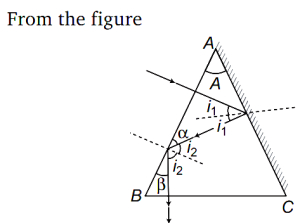
The principal section of a glass prism is an isosceles triangle $ABC$ with $AB = AC$. The face $AC$ is silvered. $A$ ray of light is incident normally on the face $AB$ and after two reflections,it emerges from the base $BC$ perpendicular to the base. The angle $BAC$ of the prism is: (in $^{\circ}$)
A
$30$
B
$36$
C
$60$
D
$72$
Solution
(B) Let the angle of the prism be $A$. Since the ray is incident normally on face $AB$,it enters the prism without deviation.
At the silvered face $AC$,the angle of incidence $i_1$ is equal to the prism angle $A$ (as the normal to $AC$ makes an angle $A$ with the normal to $AB$).
By the law of reflection,the angle of reflection is also $i_1 = A$.
In the triangle formed by the ray and the faces,the angle at the base $AB$ is $90^{\circ} - A$. Thus,the angle of incidence at the second reflection on face $AB$ is $i_2 = 90^{\circ} - (90^{\circ} - 2A) = 2A$.
Finally,the ray emerges from the base $BC$ normally. In the triangle near vertex $B$,the angles are $B$,$90^{\circ} - i_2$,and $90^{\circ}$. Since $AB = AC$,the base angles are $B = C = (180^{\circ} - A) / 2 = 90^{\circ} - A/2$.
From the geometry of the path,the sum of angles in the triangle formed by the ray inside the prism is $A + 2A + 2A = 180^{\circ}$.
$5A = 180^{\circ} \implies A = 36^{\circ}$.
At the silvered face $AC$,the angle of incidence $i_1$ is equal to the prism angle $A$ (as the normal to $AC$ makes an angle $A$ with the normal to $AB$).
By the law of reflection,the angle of reflection is also $i_1 = A$.
In the triangle formed by the ray and the faces,the angle at the base $AB$ is $90^{\circ} - A$. Thus,the angle of incidence at the second reflection on face $AB$ is $i_2 = 90^{\circ} - (90^{\circ} - 2A) = 2A$.
Finally,the ray emerges from the base $BC$ normally. In the triangle near vertex $B$,the angles are $B$,$90^{\circ} - i_2$,and $90^{\circ}$. Since $AB = AC$,the base angles are $B = C = (180^{\circ} - A) / 2 = 90^{\circ} - A/2$.
From the geometry of the path,the sum of angles in the triangle formed by the ray inside the prism is $A + 2A + 2A = 180^{\circ}$.
$5A = 180^{\circ} \implies A = 36^{\circ}$.
0 likesView Solution
38
PhysicsDifficultMCQTS EAMCET · 2004
The refracting angle of a prism is $A$ and the refractive index of the material of the prism is $\cot (A / 2)$. The angle of minimum deviation of the prism is
A
$\pi+2 A$
B
$\pi-2 A$
C
$\frac{\pi}{2}+A$
D
$\frac{\pi}{2}-A$
Solution
(B) The formula for the refractive index $\mu$ of a prism in terms of the refracting angle $A$ and the angle of minimum deviation $\delta_m$ is given by:
$\mu = \frac{\sin((A + \delta_m) / 2)}{\sin(A / 2)}$
Given $\mu = \cot(A / 2) = \frac{\cos(A / 2)}{\sin(A / 2)}$,we substitute this into the formula:
$\frac{\cos(A / 2)}{\sin(A / 2)} = \frac{\sin((A + \delta_m) / 2)}{\sin(A / 2)}$
Canceling $\sin(A / 2)$ from both sides,we get:
$\cos(A / 2) = \sin((A + \delta_m) / 2)$
Using the trigonometric identity $\cos \theta = \sin(90^{\circ} - \theta)$ or $\sin(\pi/2 - \theta)$:
$\sin(\pi/2 - A/2) = \sin((A + \delta_m) / 2)$
Equating the angles:
$\pi/2 - A/2 = (A + \delta_m) / 2$
Multiplying by $2$:
$\pi - A = A + \delta_m$
$\delta_m = \pi - 2A$
$\mu = \frac{\sin((A + \delta_m) / 2)}{\sin(A / 2)}$
Given $\mu = \cot(A / 2) = \frac{\cos(A / 2)}{\sin(A / 2)}$,we substitute this into the formula:
$\frac{\cos(A / 2)}{\sin(A / 2)} = \frac{\sin((A + \delta_m) / 2)}{\sin(A / 2)}$
Canceling $\sin(A / 2)$ from both sides,we get:
$\cos(A / 2) = \sin((A + \delta_m) / 2)$
Using the trigonometric identity $\cos \theta = \sin(90^{\circ} - \theta)$ or $\sin(\pi/2 - \theta)$:
$\sin(\pi/2 - A/2) = \sin((A + \delta_m) / 2)$
Equating the angles:
$\pi/2 - A/2 = (A + \delta_m) / 2$
Multiplying by $2$:
$\pi - A = A + \delta_m$
$\delta_m = \pi - 2A$
0 likesView Solution
39
PhysicsMediumMCQTS EAMCET · 2004
In $n-p-n$ transistor,in $CE$ configuration:
A
$1$ and $2$ are correct
B
$1$ and $3$ are correct
C
$1$ and $4$ are correct
D
$2$ and $3$ are correct
Solution
(C) $1$. The emitter is heavily doped compared to the collector to provide a large number of charge carriers. This statement is correct.
$2$. Emitter and collector cannot be interchanged because they have different doping levels and physical dimensions. This statement is incorrect.
$3$. The base region is very thin and lightly doped to allow most charge carriers from the emitter to pass through to the collector. This statement is incorrect.
$4$. In an $n-p-n$ transistor,the conventional current flows from the collector to the base and from the base to the emitter (or simply,the emitter current $I_E$ flows out of the emitter). The conventional current direction is from base to emitter in the $n-p-n$ transistor structure. This statement is correct.
Therefore,statements $1$ and $4$ are correct.
$2$. Emitter and collector cannot be interchanged because they have different doping levels and physical dimensions. This statement is incorrect.
$3$. The base region is very thin and lightly doped to allow most charge carriers from the emitter to pass through to the collector. This statement is incorrect.
$4$. In an $n-p-n$ transistor,the conventional current flows from the collector to the base and from the base to the emitter (or simply,the emitter current $I_E$ flows out of the emitter). The conventional current direction is from base to emitter in the $n-p-n$ transistor structure. This statement is correct.
Therefore,statements $1$ and $4$ are correct.
0 likesView Solution
40
PhysicsMediumMCQTS EAMCET · 2004
Consider the following statements $A$ and $B$ and identify the correct answer:
$A$. Fresnel's diffraction pattern occurs when the source of light or the screen on which the diffraction pattern is seen,or when both are at a finite distance from the aperture.
$B$. Diffracted light can be used to estimate the helical structure of nucleic acids.
$A$. Fresnel's diffraction pattern occurs when the source of light or the screen on which the diffraction pattern is seen,or when both are at a finite distance from the aperture.
$B$. Diffracted light can be used to estimate the helical structure of nucleic acids.
A
$A$ and $B$ are true
B
$A$ and $B$ are false
C
$A$ is true but $B$ is false
D
$A$ is false but $B$ is true
Solution
(A) Statement $A$ is true: In Fresnel diffraction,the source of light and the screen are at a finite distance from the diffracting aperture or obstacle. This is in contrast to Fraunhofer diffraction,where both are at an infinite distance.
Statement $B$ is true: $X$-ray diffraction (a form of diffraction) is a standard technique used to determine the molecular structure of complex biological molecules,including the helical structure of nucleic acids like $DNA$.
Therefore,both statements $A$ and $B$ are correct.
Statement $B$ is true: $X$-ray diffraction (a form of diffraction) is a standard technique used to determine the molecular structure of complex biological molecules,including the helical structure of nucleic acids like $DNA$.
Therefore,both statements $A$ and $B$ are correct.
0 likesView Solution
Vedclass Products
For Students
Vedclass Test Series
Mock tests in real TS EAMCET style covering Physics with performance analysis. 5-day free trial.
Start Free TrialFor Teachers
Exam Paper Generator
Generate Set A/B/C/D Physics papers from 7.5L+ questions in 2 minutes. 3 chapters free.
Try FreeFor Institutes
Online Exam Module
Run live TS EAMCET mock exams with unlimited students, 360° analytics & white-label branding.
See DemoFrequently Asked Questions
How many Physics questions are in TS EAMCET 2004?
There are 40 Physics questions from the TS EAMCET 2004 paper on Vedclass, each with a detailed step-by-step solution in English.
Are TS EAMCET 2004 Physics solutions available in English?
Yes. All solutions on this page are in English. You can also switch to English or Hindi using the language buttons above the questions.
Can I practice TS EAMCET 2004 Physics as a timed test?
Yes. Use the Vedclass Test Series to attempt a full TS EAMCET mock test covering Physics with time limits and instant score analysis.
Can teachers create Physics papers from TS EAMCET previous year questions?
Yes. The Vedclass Exam Paper Generator lets teachers mix TS EAMCET Physics questions and generate Set A/B/C/D papers in minutes.
For Teachers & Institutes
Build a Custom Physics Paper
Pick TS EAMCET 2004 Physics questions, set difficulty, and generate Set A/B/C/D in 2 minutes.