
MathematicsQ201–256 of 769 questions
Page 5 of 12 · English
201
MathematicsDifficultMCQMHT CET · 2024
The maximum value of $(\cos \alpha_1) \cdot (\cos \alpha_2) \ldots (\cos \alpha_n)$ under the constraints $0 \leq \alpha_1, \alpha_2, \ldots, \alpha_n \leq \frac{\pi}{2}$ and $(\cot \alpha_1) \cdot (\cot \alpha_2) \ldots (\cot \alpha_n) = 1$ is
A
$\frac{1}{2^{(n/2)}}$
B
$\frac{1}{2^n}$
C
$2^n$
D
$2^{(n/2)}$
Solution
(A) Given $(\cot \alpha_1)(\cot \alpha_2) \ldots (\cot \alpha_n) = 1$.
This implies $(\cos \alpha_1 \cos \alpha_2 \ldots \cos \alpha_n) = (\sin \alpha_1 \sin \alpha_2 \ldots \sin \alpha_n)$.
Let $P = \cos \alpha_1 \cos \alpha_2 \ldots \cos \alpha_n$.
Then $P^2 = (\cos \alpha_1 \ldots \cos \alpha_n)(\sin \alpha_1 \ldots \sin \alpha_n)$.
$P^2 = \frac{1}{2^n} (2 \sin \alpha_1 \cos \alpha_1) (2 \sin \alpha_2 \cos \alpha_2) \ldots (2 \sin \alpha_n \cos \alpha_n)$.
$P^2 = \frac{1}{2^n} \sin(2\alpha_1) \sin(2\alpha_2) \ldots \sin(2\alpha_n)$.
Since $\sin(2\alpha_i) \leq 1$ for all $i$,we have $P^2 \leq \frac{1}{2^n}$.
Taking the square root,$P \leq \frac{1}{\sqrt{2^n}} = \frac{1}{2^{(n/2)}}$.
The maximum value is $\frac{1}{2^{(n/2)}}$.
This implies $(\cos \alpha_1 \cos \alpha_2 \ldots \cos \alpha_n) = (\sin \alpha_1 \sin \alpha_2 \ldots \sin \alpha_n)$.
Let $P = \cos \alpha_1 \cos \alpha_2 \ldots \cos \alpha_n$.
Then $P^2 = (\cos \alpha_1 \ldots \cos \alpha_n)(\sin \alpha_1 \ldots \sin \alpha_n)$.
$P^2 = \frac{1}{2^n} (2 \sin \alpha_1 \cos \alpha_1) (2 \sin \alpha_2 \cos \alpha_2) \ldots (2 \sin \alpha_n \cos \alpha_n)$.
$P^2 = \frac{1}{2^n} \sin(2\alpha_1) \sin(2\alpha_2) \ldots \sin(2\alpha_n)$.
Since $\sin(2\alpha_i) \leq 1$ for all $i$,we have $P^2 \leq \frac{1}{2^n}$.
Taking the square root,$P \leq \frac{1}{\sqrt{2^n}} = \frac{1}{2^{(n/2)}}$.
The maximum value is $\frac{1}{2^{(n/2)}}$.
0 likesView Solution
202
MathematicsEasyMCQMHT CET · 2024
The principal solutions of the equation $\sqrt{3} \sec x + 2 = 0$ are
A
$\frac{2 \pi}{3}, \frac{4 \pi}{3}$
B
$\frac{4 \pi}{3}, \frac{5 \pi}{3}$
C
$\frac{5 \pi}{6}, \frac{7 \pi}{6}$
D
$\frac{7 \pi}{6}, \frac{11 \pi}{6}$
Solution
(C) Given the equation $\sqrt{3} \sec x + 2 = 0$.
$\sqrt{3} \sec x = -2$
$\sec x = -\frac{2}{\sqrt{3}}$
$\cos x = -\frac{\sqrt{3}}{2}$
Since $\cos x$ is negative in the second and third quadrants,we find the values in $[0, 2\pi]$.
In the second quadrant: $x = \pi - \frac{\pi}{6} = \frac{5\pi}{6}$.
In the third quadrant: $x = \pi + \frac{\pi}{6} = \frac{7\pi}{6}$.
Thus,the principal solutions are $\frac{5\pi}{6}$ and $\frac{7\pi}{6}$.
$\sqrt{3} \sec x = -2$
$\sec x = -\frac{2}{\sqrt{3}}$
$\cos x = -\frac{\sqrt{3}}{2}$
Since $\cos x$ is negative in the second and third quadrants,we find the values in $[0, 2\pi]$.
In the second quadrant: $x = \pi - \frac{\pi}{6} = \frac{5\pi}{6}$.
In the third quadrant: $x = \pi + \frac{\pi}{6} = \frac{7\pi}{6}$.
Thus,the principal solutions are $\frac{5\pi}{6}$ and $\frac{7\pi}{6}$.
0 likesView Solution
203
MathematicsDifficultMCQMHT CET · 2024
Let $S=\{x \in(-\pi, \pi) \mid x \neq 0, \pm \frac{\pi}{2}\}$. The sum of all distinct solutions of the equation $\sqrt{3} \sec x+\operatorname{cosec} x+2(\tan x-\cot x)=0$ in the set $S$ is equal to
A
$-\frac{7 \pi}{9}$
B
$-\frac{2 \pi}{9}$
C
$0$
D
$\frac{5 \pi}{9}$
Solution
(C) Given equation: $\sqrt{3} \sec x+\operatorname{cosec} x+2(\tan x-\cot x)=0$
Dividing by $2$: $\frac{\sqrt{3}}{2} \sec x+\frac{1}{2} \operatorname{cosec} x=\cot x-\tan x$
Converting to $\sin x$ and $\cos x$: $\frac{\sqrt{3}}{2 \cos x}+\frac{1}{2 \sin x}=\frac{\cos x}{\sin x}-\frac{\sin x}{\cos x}$
Multiplying by $\sin x \cos x$: $\frac{\sqrt{3}}{2} \sin x+\frac{1}{2} \cos x=\cos^2 x-\sin^2 x$
Using $\cos(A-B)$ and $\cos 2x$ formulas: $\cos(x-\frac{\pi}{6})=\cos 2x$
General solution: $2x = 2n\pi \pm (x-\frac{\pi}{6})$
Case $1$: $2x = 2n\pi + x - \frac{\pi}{6} \implies x = 2n\pi - \frac{\pi}{6}$
For $n=0, x=-\frac{\pi}{6} \in S$. For $n=1, x=\frac{11\pi}{6} \notin S$.
Case $2$: $2x = 2n\pi - (x - \frac{\pi}{6}) \implies 3x = 2n\pi + \frac{\pi}{6} \implies x = \frac{2n\pi}{3} + \frac{\pi}{18}$
For $n=0, x=\frac{\pi}{18} \in S$. For $n=1, x=\frac{13\pi}{18} \in S$. For $n=-1, x=-\frac{11\pi}{18} \in S$.
Sum of solutions: $-\frac{\pi}{6} + \frac{\pi}{18} + \frac{13\pi}{18} - \frac{11\pi}{18} = \frac{-3\pi + \pi + 13\pi - 11\pi}{18} = 0$.
Dividing by $2$: $\frac{\sqrt{3}}{2} \sec x+\frac{1}{2} \operatorname{cosec} x=\cot x-\tan x$
Converting to $\sin x$ and $\cos x$: $\frac{\sqrt{3}}{2 \cos x}+\frac{1}{2 \sin x}=\frac{\cos x}{\sin x}-\frac{\sin x}{\cos x}$
Multiplying by $\sin x \cos x$: $\frac{\sqrt{3}}{2} \sin x+\frac{1}{2} \cos x=\cos^2 x-\sin^2 x$
Using $\cos(A-B)$ and $\cos 2x$ formulas: $\cos(x-\frac{\pi}{6})=\cos 2x$
General solution: $2x = 2n\pi \pm (x-\frac{\pi}{6})$
Case $1$: $2x = 2n\pi + x - \frac{\pi}{6} \implies x = 2n\pi - \frac{\pi}{6}$
For $n=0, x=-\frac{\pi}{6} \in S$. For $n=1, x=\frac{11\pi}{6} \notin S$.
Case $2$: $2x = 2n\pi - (x - \frac{\pi}{6}) \implies 3x = 2n\pi + \frac{\pi}{6} \implies x = \frac{2n\pi}{3} + \frac{\pi}{18}$
For $n=0, x=\frac{\pi}{18} \in S$. For $n=1, x=\frac{13\pi}{18} \in S$. For $n=-1, x=-\frac{11\pi}{18} \in S$.
Sum of solutions: $-\frac{\pi}{6} + \frac{\pi}{18} + \frac{13\pi}{18} - \frac{11\pi}{18} = \frac{-3\pi + \pi + 13\pi - 11\pi}{18} = 0$.
0 likesView Solution
204
MathematicsEasyMCQMHT CET · 2024
In $(0, 2\pi)$,the number of solutions of $\tan \theta + \sec \theta = 2 \cos \theta$ is:
A
$0$
B
$1$
C
$2$
D
$3$
Solution
(C) Given equation: $\tan \theta + \sec \theta = 2 \cos \theta$
$\Rightarrow \frac{\sin \theta}{\cos \theta} + \frac{1}{\cos \theta} = 2 \cos \theta$
$\Rightarrow \sin \theta + 1 = 2 \cos^2 \theta$
$\Rightarrow \sin \theta + 1 = 2(1 - \sin^2 \theta)$
$\Rightarrow 2 \sin^2 \theta + \sin \theta - 1 = 0$
$\Rightarrow (2 \sin \theta - 1)(\sin \theta + 1) = 0$
$\therefore \sin \theta = \frac{1}{2}$ or $\sin \theta = -1$
For $\theta \in (0, 2\pi)$:
If $\sin \theta = \frac{1}{2}$,then $\theta = \frac{\pi}{6}, \frac{5\pi}{6}$.
If $\sin \theta = -1$,then $\theta = \frac{3\pi}{2}$.
However,at $\theta = \frac{3\pi}{2}$,$\tan \theta$ and $\sec \theta$ are undefined.
Thus,the valid solutions are $\theta = \frac{\pi}{6}$ and $\theta = \frac{5\pi}{6}$.
Therefore,the number of solutions is $2$.
$\Rightarrow \frac{\sin \theta}{\cos \theta} + \frac{1}{\cos \theta} = 2 \cos \theta$
$\Rightarrow \sin \theta + 1 = 2 \cos^2 \theta$
$\Rightarrow \sin \theta + 1 = 2(1 - \sin^2 \theta)$
$\Rightarrow 2 \sin^2 \theta + \sin \theta - 1 = 0$
$\Rightarrow (2 \sin \theta - 1)(\sin \theta + 1) = 0$
$\therefore \sin \theta = \frac{1}{2}$ or $\sin \theta = -1$
For $\theta \in (0, 2\pi)$:
If $\sin \theta = \frac{1}{2}$,then $\theta = \frac{\pi}{6}, \frac{5\pi}{6}$.
If $\sin \theta = -1$,then $\theta = \frac{3\pi}{2}$.
However,at $\theta = \frac{3\pi}{2}$,$\tan \theta$ and $\sec \theta$ are undefined.
Thus,the valid solutions are $\theta = \frac{\pi}{6}$ and $\theta = \frac{5\pi}{6}$.
Therefore,the number of solutions is $2$.
0 likesView Solution
205
MathematicsMediumMCQMHT CET · 2024
The number of solutions of $2^{1+|\cos x|+|\cos x|^2+\ldots} = 4$ in $(-\pi, \pi)$ is
A
$2$
B
$3$
C
$4$
D
$6$
Solution
(C) Given the equation $2^{1+|\cos x|+|\cos x|^2+\ldots} = 4$.
Since the exponent is an infinite geometric series with first term $a = 1$ and common ratio $r = |\cos x|$,where $|\cos x| < 1$,the sum is $\frac{1}{1-|\cos x|}$.
Thus,$2^{\frac{1}{1-|\cos x|}} = 2^2$.
Equating the exponents,we get $\frac{1}{1-|\cos x|} = 2$.
$1 - |\cos x| = \frac{1}{2} \Rightarrow |\cos x| = \frac{1}{2}$.
This implies $\cos x = \frac{1}{2}$ or $\cos x = -\frac{1}{2}$.
In the interval $(-\pi, \pi)$,the solutions for $\cos x = \frac{1}{2}$ are $x = \frac{\pi}{3}, -\frac{\pi}{3}$.
The solutions for $\cos x = -\frac{1}{2}$ are $x = \frac{2\pi}{3}, -\frac{2\pi}{3}$.
Therefore,the total number of solutions is $4$.
Since the exponent is an infinite geometric series with first term $a = 1$ and common ratio $r = |\cos x|$,where $|\cos x| < 1$,the sum is $\frac{1}{1-|\cos x|}$.
Thus,$2^{\frac{1}{1-|\cos x|}} = 2^2$.
Equating the exponents,we get $\frac{1}{1-|\cos x|} = 2$.
$1 - |\cos x| = \frac{1}{2} \Rightarrow |\cos x| = \frac{1}{2}$.
This implies $\cos x = \frac{1}{2}$ or $\cos x = -\frac{1}{2}$.
In the interval $(-\pi, \pi)$,the solutions for $\cos x = \frac{1}{2}$ are $x = \frac{\pi}{3}, -\frac{\pi}{3}$.
The solutions for $\cos x = -\frac{1}{2}$ are $x = \frac{2\pi}{3}, -\frac{2\pi}{3}$.
Therefore,the total number of solutions is $4$.
0 likesView Solution
206
MathematicsMediumMCQMHT CET · 2024
The number of solutions of $\tan x + \sec x = 2 \cos x$ in $[0, 2 \pi]$ is
A
$2$
B
$3$
C
$0$
D
$1$
Solution
(A) The given equation is defined for $x \neq \frac{\pi}{2}, \frac{3 \pi}{2}$.
Given equation: $\tan x + \sec x = 2 \cos x$
$\Rightarrow \frac{\sin x}{\cos x} + \frac{1}{\cos x} = 2 \cos x$
$\Rightarrow \frac{\sin x + 1}{\cos x} = 2 \cos x$
$\Rightarrow \sin x + 1 = 2 \cos^2 x$
$\Rightarrow \sin x + 1 = 2(1 - \sin^2 x)$
$\Rightarrow \sin x + 1 = 2(1 - \sin x)(1 + \sin x)$
$\Rightarrow (1 + \sin x)[1 - 2(1 - \sin x)] = 0$
$\Rightarrow (1 + \sin x)(2 \sin x - 1) = 0$
Case $1$: $1 + \sin x = 0 \Rightarrow \sin x = -1$. This implies $x = \frac{3 \pi}{2}$,but at $x = \frac{3 \pi}{2}$,$\tan x$ and $\sec x$ are undefined. So,this is not a solution.
Case $2$: $2 \sin x - 1 = 0 \Rightarrow \sin x = \frac{1}{2}$.
In the interval $[0, 2 \pi]$,$\sin x = \frac{1}{2}$ at $x = \frac{\pi}{6}$ and $x = \frac{5 \pi}{6}$.
Thus,the number of solutions is $2$.
Given equation: $\tan x + \sec x = 2 \cos x$
$\Rightarrow \frac{\sin x}{\cos x} + \frac{1}{\cos x} = 2 \cos x$
$\Rightarrow \frac{\sin x + 1}{\cos x} = 2 \cos x$
$\Rightarrow \sin x + 1 = 2 \cos^2 x$
$\Rightarrow \sin x + 1 = 2(1 - \sin^2 x)$
$\Rightarrow \sin x + 1 = 2(1 - \sin x)(1 + \sin x)$
$\Rightarrow (1 + \sin x)[1 - 2(1 - \sin x)] = 0$
$\Rightarrow (1 + \sin x)(2 \sin x - 1) = 0$
Case $1$: $1 + \sin x = 0 \Rightarrow \sin x = -1$. This implies $x = \frac{3 \pi}{2}$,but at $x = \frac{3 \pi}{2}$,$\tan x$ and $\sec x$ are undefined. So,this is not a solution.
Case $2$: $2 \sin x - 1 = 0 \Rightarrow \sin x = \frac{1}{2}$.
In the interval $[0, 2 \pi]$,$\sin x = \frac{1}{2}$ at $x = \frac{\pi}{6}$ and $x = \frac{5 \pi}{6}$.
Thus,the number of solutions is $2$.
0 likesView Solution
207
MathematicsMediumMCQMHT CET · 2024
$\frac{d}{d x}\left(\cos ^{-1}\left(\frac{x-\frac{1}{x}}{x+\frac{1}{x}}\right)\right)=$
A
$\frac{x^2+1}{x^2-1}$
B
$\frac{2}{1+x^2}$
C
$\frac{-1}{1+x^2}$
D
$\frac{-2}{1+x^2}$
Solution
(D) Let $y = \cos ^{-1}\left(\frac{x-\frac{1}{x}}{x+\frac{1}{x}}\right)$.
Simplifying the expression inside the inverse cosine function:
$y = \cos ^{-1}\left(\frac{x^2-1}{x^2+1}\right) = \cos ^{-1}\left(-\left(\frac{1-x^2}{1+x^2}\right)\right)$.
Using the property $\cos ^{-1}(-z) = \pi - \cos ^{-1}(z)$,we get:
$y = \pi - \cos ^{-1}\left(\frac{1-x^2}{1+x^2}\right)$.
Substitute $x = \tan \theta$,which implies $\theta = \tan ^{-1} x$:
$y = \pi - \cos ^{-1}\left(\frac{1-\tan ^2 \theta}{1+\tan ^2 \theta}\right)$.
Since $\cos 2\theta = \frac{1-\tan ^2 \theta}{1+\tan ^2 \theta}$,we have:
$y = \pi - \cos ^{-1}(\cos 2\theta) = \pi - 2\theta = \pi - 2\tan ^{-1} x$.
Differentiating with respect to $x$:
$\frac{d y}{d x} = \frac{d}{d x}(\pi - 2\tan ^{-1} x) = 0 - 2\left(\frac{1}{1+x^2}\right) = \frac{-2}{1+x^2}$.
Simplifying the expression inside the inverse cosine function:
$y = \cos ^{-1}\left(\frac{x^2-1}{x^2+1}\right) = \cos ^{-1}\left(-\left(\frac{1-x^2}{1+x^2}\right)\right)$.
Using the property $\cos ^{-1}(-z) = \pi - \cos ^{-1}(z)$,we get:
$y = \pi - \cos ^{-1}\left(\frac{1-x^2}{1+x^2}\right)$.
Substitute $x = \tan \theta$,which implies $\theta = \tan ^{-1} x$:
$y = \pi - \cos ^{-1}\left(\frac{1-\tan ^2 \theta}{1+\tan ^2 \theta}\right)$.
Since $\cos 2\theta = \frac{1-\tan ^2 \theta}{1+\tan ^2 \theta}$,we have:
$y = \pi - \cos ^{-1}(\cos 2\theta) = \pi - 2\theta = \pi - 2\tan ^{-1} x$.
Differentiating with respect to $x$:
$\frac{d y}{d x} = \frac{d}{d x}(\pi - 2\tan ^{-1} x) = 0 - 2\left(\frac{1}{1+x^2}\right) = \frac{-2}{1+x^2}$.
0 likesView Solution
208
MathematicsMediumMCQMHT CET · 2024
If for $x \in \left(0, \frac{1}{4}\right)$,the derivative of $\tan^{-1}\left(\frac{6x\sqrt{x}}{1-9x^3}\right)$ is $\sqrt{x} \cdot g(x)$,then $g(x)$ equals
A
$\frac{3x\sqrt{x}}{1-9x^3}$
B
$\frac{3x}{1-9x^3}$
C
$\frac{3}{1+9x^3}$
D
$\frac{9}{1+9x^3}$
Solution
(D) Let $y = \tan^{-1}\left(\frac{6x\sqrt{x}}{1-9x^3}\right)$.
We can rewrite the argument of $\tan^{-1}$ as follows:
$y = \tan^{-1}\left(\frac{2(3x\sqrt{x})}{1-(3x\sqrt{x})^2}\right)$.
Using the formula $2\tan^{-1}(\theta) = \tan^{-1}\left(\frac{2\theta}{1-\theta^2}\right)$,where $\theta = 3x\sqrt{x} = 3x^{3/2}$,we get:
$y = 2\tan^{-1}(3x^{3/2})$.
Differentiating with respect to $x$ using the chain rule:
$\frac{dy}{dx} = 2 \cdot \frac{1}{1+(3x^{3/2})^2} \cdot \frac{d}{dx}(3x^{3/2})$.
$\frac{dy}{dx} = \frac{2}{1+9x^3} \cdot (3 \cdot \frac{3}{2} x^{1/2})$.
$\frac{dy}{dx} = \frac{2}{1+9x^3} \cdot \frac{9}{2} \sqrt{x} = \frac{9\sqrt{x}}{1+9x^3}$.
Given $\frac{dy}{dx} = \sqrt{x} \cdot g(x)$,we have $\sqrt{x} \cdot g(x) = \frac{9\sqrt{x}}{1+9x^3}$.
Therefore,$g(x) = \frac{9}{1+9x^3}$.
We can rewrite the argument of $\tan^{-1}$ as follows:
$y = \tan^{-1}\left(\frac{2(3x\sqrt{x})}{1-(3x\sqrt{x})^2}\right)$.
Using the formula $2\tan^{-1}(\theta) = \tan^{-1}\left(\frac{2\theta}{1-\theta^2}\right)$,where $\theta = 3x\sqrt{x} = 3x^{3/2}$,we get:
$y = 2\tan^{-1}(3x^{3/2})$.
Differentiating with respect to $x$ using the chain rule:
$\frac{dy}{dx} = 2 \cdot \frac{1}{1+(3x^{3/2})^2} \cdot \frac{d}{dx}(3x^{3/2})$.
$\frac{dy}{dx} = \frac{2}{1+9x^3} \cdot (3 \cdot \frac{3}{2} x^{1/2})$.
$\frac{dy}{dx} = \frac{2}{1+9x^3} \cdot \frac{9}{2} \sqrt{x} = \frac{9\sqrt{x}}{1+9x^3}$.
Given $\frac{dy}{dx} = \sqrt{x} \cdot g(x)$,we have $\sqrt{x} \cdot g(x) = \frac{9\sqrt{x}}{1+9x^3}$.
Therefore,$g(x) = \frac{9}{1+9x^3}$.
0 likesView Solution
209
MathematicsMediumMCQMHT CET · 2024
If $y = \sin^{-1}\left(\frac{3x}{2} - \frac{x^3}{2}\right)$,then $\frac{dy}{dx}$ is equal to
A
$\frac{3}{2\sqrt{x^2-4}}$
B
$\frac{3}{\sqrt{4-x^2}}$
C
$\frac{3}{2\sqrt{1-x^2}}$
D
$\frac{4}{\sqrt{4-x^2}}$
Solution
(B) Given $y = \sin^{-1}\left(\frac{3x}{2} - \frac{x^3}{2}\right)$.
We can rewrite the expression as $y = \sin^{-1}\left(3\left(\frac{x}{2}\right) - 4\left(\frac{x}{2}\right)^3\right)$.
Let $\frac{x}{2} = \sin \theta$,which implies $\theta = \sin^{-1}\left(\frac{x}{2}\right)$.
Substituting this into the equation,we get $y = \sin^{-1}(3\sin \theta - 4\sin^3 \theta)$.
Using the trigonometric identity $\sin(3\theta) = 3\sin \theta - 4\sin^3 \theta$,we have $y = \sin^{-1}(\sin 3\theta) = 3\theta$.
Substituting $\theta$ back,$y = 3\sin^{-1}\left(\frac{x}{2}\right)$.
Differentiating with respect to $x$,we get $\frac{dy}{dx} = 3 \cdot \frac{1}{\sqrt{1 - (x/2)^2}} \cdot \frac{1}{2}$.
$\frac{dy}{dx} = \frac{3}{2 \cdot \sqrt{\frac{4-x^2}{4}}} = \frac{3}{2 \cdot \frac{\sqrt{4-x^2}}{2}} = \frac{3}{\sqrt{4-x^2}}$.
We can rewrite the expression as $y = \sin^{-1}\left(3\left(\frac{x}{2}\right) - 4\left(\frac{x}{2}\right)^3\right)$.
Let $\frac{x}{2} = \sin \theta$,which implies $\theta = \sin^{-1}\left(\frac{x}{2}\right)$.
Substituting this into the equation,we get $y = \sin^{-1}(3\sin \theta - 4\sin^3 \theta)$.
Using the trigonometric identity $\sin(3\theta) = 3\sin \theta - 4\sin^3 \theta$,we have $y = \sin^{-1}(\sin 3\theta) = 3\theta$.
Substituting $\theta$ back,$y = 3\sin^{-1}\left(\frac{x}{2}\right)$.
Differentiating with respect to $x$,we get $\frac{dy}{dx} = 3 \cdot \frac{1}{\sqrt{1 - (x/2)^2}} \cdot \frac{1}{2}$.
$\frac{dy}{dx} = \frac{3}{2 \cdot \sqrt{\frac{4-x^2}{4}}} = \frac{3}{2 \cdot \frac{\sqrt{4-x^2}}{2}} = \frac{3}{\sqrt{4-x^2}}$.
0 likesView Solution
210
MathematicsDifficultMCQMHT CET · 2024
Derivative of $\tan ^{-1} \sqrt{\frac{1-x}{1+x}}$ with respect to $\cos ^{-1}\left(4 x^3-3 x\right)$ is
A
$\frac{-1}{6}$
B
$\frac{2}{3}$
C
$\frac{3}{2}$
D
$\frac{1}{6}$
Solution
(D) Let $y = \tan ^{-1} \sqrt{\frac{1-x}{1+x}}$ and $z = \cos ^{-1}(4x^3 - 3x)$.
For $y$,substitute $x = \cos 2\theta$. Then $\sqrt{\frac{1-\cos 2\theta}{1+\cos 2\theta}} = \sqrt{\frac{2\sin^2 \theta}{2\cos^2 \theta}} = \tan \theta$.
So,$y = \tan^{-1}(\tan \theta) = \theta = \frac{1}{2} \cos^{-1} x$.
For $z$,substitute $x = \cos \theta$. Then $z = \cos^{-1}(\cos 3\theta) = 3\theta = 3 \cos^{-1} x$.
Now,differentiate $y$ and $z$ with respect to $x$:
$\frac{dy}{dx} = \frac{1}{2} \left( \frac{-1}{\sqrt{1-x^2}} \right) = \frac{-1}{2\sqrt{1-x^2}}$.
$\frac{dz}{dx} = 3 \left( \frac{-1}{\sqrt{1-x^2}} \right) = \frac{-3}{\sqrt{1-x^2}}$.
Finally,$\frac{dy}{dz} = \frac{dy/dx}{dz/dx} = \frac{-1/(2\sqrt{1-x^2})}{-3/\sqrt{1-x^2}} = \frac{1}{6}$.
For $y$,substitute $x = \cos 2\theta$. Then $\sqrt{\frac{1-\cos 2\theta}{1+\cos 2\theta}} = \sqrt{\frac{2\sin^2 \theta}{2\cos^2 \theta}} = \tan \theta$.
So,$y = \tan^{-1}(\tan \theta) = \theta = \frac{1}{2} \cos^{-1} x$.
For $z$,substitute $x = \cos \theta$. Then $z = \cos^{-1}(\cos 3\theta) = 3\theta = 3 \cos^{-1} x$.
Now,differentiate $y$ and $z$ with respect to $x$:
$\frac{dy}{dx} = \frac{1}{2} \left( \frac{-1}{\sqrt{1-x^2}} \right) = \frac{-1}{2\sqrt{1-x^2}}$.
$\frac{dz}{dx} = 3 \left( \frac{-1}{\sqrt{1-x^2}} \right) = \frac{-3}{\sqrt{1-x^2}}$.
Finally,$\frac{dy}{dz} = \frac{dy/dx}{dz/dx} = \frac{-1/(2\sqrt{1-x^2})}{-3/\sqrt{1-x^2}} = \frac{1}{6}$.
0 likesView Solution
211
MathematicsMediumMCQMHT CET · 2024
If $y=\sin ^2\left(\cot ^{-1} \sqrt{\frac{1+x}{1-x}}\right)$,then $\frac{d y}{d x}$ has the value
A
$\frac{-1}{2}$
B
$\frac{1}{2}$
C
-$1$
D
$1$
Solution
(A) Given $y=\sin ^2\left(\cot ^{-1} \sqrt{\frac{1+x}{1-x}}\right)$.
Let $\theta=\cot ^{-1} \sqrt{\frac{1+x}{1-x}}$,then $\cot \theta = \sqrt{\frac{1+x}{1-x}}$.
Squaring both sides,we get $\cot^2 \theta = \frac{1+x}{1-x}$.
Using the identity $1+\cot^2 \theta = \csc^2 \theta$,we have $\csc^2 \theta = 1 + \frac{1+x}{1-x} = \frac{1-x+1+x}{1-x} = \frac{2}{1-x}$.
Since $\sin^2 \theta = \frac{1}{\csc^2 \theta}$,we get $\sin^2 \theta = \frac{1-x}{2}$.
Substituting this back into the expression for $y$,we get $y = \sin^2 \theta = \frac{1-x}{2}$.
Now,differentiating with respect to $x$,we get $\frac{dy}{dx} = \frac{d}{dx} \left(\frac{1}{2} - \frac{x}{2}\right) = 0 - \frac{1}{2} = -\frac{1}{2}$.
Let $\theta=\cot ^{-1} \sqrt{\frac{1+x}{1-x}}$,then $\cot \theta = \sqrt{\frac{1+x}{1-x}}$.
Squaring both sides,we get $\cot^2 \theta = \frac{1+x}{1-x}$.
Using the identity $1+\cot^2 \theta = \csc^2 \theta$,we have $\csc^2 \theta = 1 + \frac{1+x}{1-x} = \frac{1-x+1+x}{1-x} = \frac{2}{1-x}$.
Since $\sin^2 \theta = \frac{1}{\csc^2 \theta}$,we get $\sin^2 \theta = \frac{1-x}{2}$.
Substituting this back into the expression for $y$,we get $y = \sin^2 \theta = \frac{1-x}{2}$.
Now,differentiating with respect to $x$,we get $\frac{dy}{dx} = \frac{d}{dx} \left(\frac{1}{2} - \frac{x}{2}\right) = 0 - \frac{1}{2} = -\frac{1}{2}$.
0 likesView Solution
212
MathematicsEasyMCQMHT CET · 2024
If $x^2 y^2 = \sin^{-1} x + \cos^{-1} x$,then $\frac{dy}{dx}$ at $x = 1$ and $y = 2$ is
A
$\frac{1}{2}$
B
$2$
C
$-\frac{1}{2}$
D
$-2$
Solution
(D) We know that $\sin^{-1} x + \cos^{-1} x = \frac{\pi}{2}$ for all $x \in [-1, 1]$.
Given equation is $x^2 y^2 = \frac{\pi}{2}$.
Differentiating both sides with respect to $x$ using the product rule:
$\frac{d}{dx}(x^2 y^2) = \frac{d}{dx}(\frac{\pi}{2})$
$2x y^2 + x^2 (2y \frac{dy}{dx}) = 0$
Divide by $2x$ (assuming $x \neq 0$):
$y^2 + xy \frac{dy}{dx} = 0$
Substitute $x = 1$ and $y = 2$:
$(2)^2 + (1)(2) \frac{dy}{dx} = 0$
$4 + 2 \frac{dy}{dx} = 0$
$2 \frac{dy}{dx} = -4$
$\frac{dy}{dx} = -2$
Given equation is $x^2 y^2 = \frac{\pi}{2}$.
Differentiating both sides with respect to $x$ using the product rule:
$\frac{d}{dx}(x^2 y^2) = \frac{d}{dx}(\frac{\pi}{2})$
$2x y^2 + x^2 (2y \frac{dy}{dx}) = 0$
Divide by $2x$ (assuming $x \neq 0$):
$y^2 + xy \frac{dy}{dx} = 0$
Substitute $x = 1$ and $y = 2$:
$(2)^2 + (1)(2) \frac{dy}{dx} = 0$
$4 + 2 \frac{dy}{dx} = 0$
$2 \frac{dy}{dx} = -4$
$\frac{dy}{dx} = -2$
0 likesView Solution
213
MathematicsMediumMCQMHT CET · 2024
If $y = \sin^{-1}\left(\frac{\log x^2}{1+(\log x)^2}\right)$,then $\left(\frac{dy}{dx}\right)_{x=1} = $
A
$2$
B
$\frac{1}{2}$
C
$\frac{2}{3}$
D
$-2$
Solution
(A) Given $y = \sin^{-1}\left(\frac{\log x^2}{1+(\log x)^2}\right) = \sin^{-1}\left(\frac{2 \log x}{1+(\log x)^2}\right)$.
Let $\log x = \tan \theta$,then $y = \sin^{-1}\left(\frac{2 \tan \theta}{1+\tan^2 \theta}\right) = \sin^{-1}(\sin 2\theta) = 2\theta$.
Substituting back,$y = 2 \tan^{-1}(\log x)$.
Differentiating with respect to $x$:
$\frac{dy}{dx} = 2 \times \frac{1}{1+(\log x)^2} \times \frac{1}{x}$.
At $x = 1$,$\log 1 = 0$,so $\left(\frac{dy}{dx}\right)_{x=1} = 2 \times \frac{1}{1+0^2} \times \frac{1}{1} = 2 \times 1 \times 1 = 2$.
Let $\log x = \tan \theta$,then $y = \sin^{-1}\left(\frac{2 \tan \theta}{1+\tan^2 \theta}\right) = \sin^{-1}(\sin 2\theta) = 2\theta$.
Substituting back,$y = 2 \tan^{-1}(\log x)$.
Differentiating with respect to $x$:
$\frac{dy}{dx} = 2 \times \frac{1}{1+(\log x)^2} \times \frac{1}{x}$.
At $x = 1$,$\log 1 = 0$,so $\left(\frac{dy}{dx}\right)_{x=1} = 2 \times \frac{1}{1+0^2} \times \frac{1}{1} = 2 \times 1 \times 1 = 2$.
0 likesView Solution
214
MathematicsMediumMCQMHT CET · 2024
If $y = \sec(\tan^{-1} x)$,then $\frac{dy}{dx}$ at $x = 1$ is equal to
A
$\frac{1}{2}$
B
$\frac{1}{\sqrt{2}}$
C
$\sqrt{2}$
D
$1$
Solution
(B) Given $y = \sec(\tan^{-1} x)$.
Let $\tan^{-1} x = \theta$,then $\tan \theta = x$.
We know that $\sec^2 \theta = 1 + \tan^2 \theta = 1 + x^2$,so $\sec \theta = \sqrt{1 + x^2}$.
Thus,$y = \sqrt{1 + x^2}$.
Differentiating with respect to $x$:
$\frac{dy}{dx} = \frac{d}{dx}(\sqrt{1 + x^2}) = \frac{1}{2\sqrt{1 + x^2}} \cdot (2x) = \frac{x}{\sqrt{1 + x^2}}$.
At $x = 1$:
$\left(\frac{dy}{dx}\right)_{x=1} = \frac{1}{\sqrt{1 + 1^2}} = \frac{1}{\sqrt{2}}$.
Let $\tan^{-1} x = \theta$,then $\tan \theta = x$.
We know that $\sec^2 \theta = 1 + \tan^2 \theta = 1 + x^2$,so $\sec \theta = \sqrt{1 + x^2}$.
Thus,$y = \sqrt{1 + x^2}$.
Differentiating with respect to $x$:
$\frac{dy}{dx} = \frac{d}{dx}(\sqrt{1 + x^2}) = \frac{1}{2\sqrt{1 + x^2}} \cdot (2x) = \frac{x}{\sqrt{1 + x^2}}$.
At $x = 1$:
$\left(\frac{dy}{dx}\right)_{x=1} = \frac{1}{\sqrt{1 + 1^2}} = \frac{1}{\sqrt{2}}$.
0 likesView Solution
215
MathematicsEasyMCQMHT CET · 2024
If $y=\tan ^{-1}\left(\frac{2+3 x}{3-2 x}\right)+\tan ^{-1}\left(\frac{4 x}{1+5 x^2}\right)$,then $\frac{d y}{d x}=$
A
$\frac{1}{1+25 x^2}$
B
$\frac{5}{1+25 x^2}$
C
$\frac{1}{1+5 x^2}$
D
$\frac{5}{1+5 x^2}$
Solution
(B) Given $y=\tan ^{-1}\left(\frac{2+3 x}{3-2 x}\right)+\tan ^{-1}\left(\frac{4 x}{1+5 x^2}\right)$
We can rewrite the first term as $\tan ^{-1}\left(\frac{\frac{2}{3}+x}{1-\frac{2}{3} x}\right) = \tan ^{-1}\left(\frac{2}{3}\right) + \tan ^{-1}(x)$
We can rewrite the second term as $\tan ^{-1}\left(\frac{5 x-x}{1+(5 x)(x)}\right) = \tan ^{-1}(5 x) - \tan ^{-1}(x)$
Adding these together,we get $y = \tan ^{-1}\left(\frac{2}{3}\right) + \tan ^{-1}(x) + \tan ^{-1}(5 x) - \tan ^{-1}(x)$
Simplifying,$y = \tan ^{-1}\left(\frac{2}{3}\right) + \tan ^{-1}(5 x)$
Now,differentiating with respect to $x$:
$\frac{d y}{d x} = 0 + \frac{1}{1+(5 x)^2} \cdot \frac{d}{d x}(5 x)$
$\frac{d y}{d x} = \frac{5}{1+25 x^2}$
We can rewrite the first term as $\tan ^{-1}\left(\frac{\frac{2}{3}+x}{1-\frac{2}{3} x}\right) = \tan ^{-1}\left(\frac{2}{3}\right) + \tan ^{-1}(x)$
We can rewrite the second term as $\tan ^{-1}\left(\frac{5 x-x}{1+(5 x)(x)}\right) = \tan ^{-1}(5 x) - \tan ^{-1}(x)$
Adding these together,we get $y = \tan ^{-1}\left(\frac{2}{3}\right) + \tan ^{-1}(x) + \tan ^{-1}(5 x) - \tan ^{-1}(x)$
Simplifying,$y = \tan ^{-1}\left(\frac{2}{3}\right) + \tan ^{-1}(5 x)$
Now,differentiating with respect to $x$:
$\frac{d y}{d x} = 0 + \frac{1}{1+(5 x)^2} \cdot \frac{d}{d x}(5 x)$
$\frac{d y}{d x} = \frac{5}{1+25 x^2}$
0 likesView Solution
216
MathematicsMediumMCQMHT CET · 2024
If $f(x) = \frac{x^2-x}{x^2+2x}$,then the value of $\frac{d}{dx}(f^{-1}(x))$ at $x = 2$ is:
A
-$3$
B
$3$
C
-$1$
D
$1$
Solution
(B) Given $f(x) = \frac{x^2-x}{x^2+2x}$. For $x \neq 0$,we can simplify this as $f(x) = \frac{x-1}{x+2}$.
Let $y = \frac{x-1}{x+2}$.
To find $f^{-1}(x)$,we solve for $x$ in terms of $y$:
$y(x+2) = x-1$
$yx + 2y = x - 1$
$yx - x = -1 - 2y$
$x(y-1) = -(1+2y)$
$x = \frac{2y+1}{1-y}$.
Thus,$f^{-1}(x) = \frac{2x+1}{1-x}$.
Now,we differentiate $f^{-1}(x)$ with respect to $x$ using the quotient rule:
$\frac{d}{dx}(f^{-1}(x)) = \frac{d}{dx}\left(\frac{2x+1}{1-x}\right) = \frac{(1-x)(2) - (2x+1)(-1)}{(1-x)^2}$
$= \frac{2 - 2x + 2x + 1}{(1-x)^2} = \frac{3}{(1-x)^2}$.
Evaluating at $x = 2$:
$\frac{d}{dx}(f^{-1}(x))|_{x=2} = \frac{3}{(1-2)^2} = \frac{3}{(-1)^2} = 3$.
Let $y = \frac{x-1}{x+2}$.
To find $f^{-1}(x)$,we solve for $x$ in terms of $y$:
$y(x+2) = x-1$
$yx + 2y = x - 1$
$yx - x = -1 - 2y$
$x(y-1) = -(1+2y)$
$x = \frac{2y+1}{1-y}$.
Thus,$f^{-1}(x) = \frac{2x+1}{1-x}$.
Now,we differentiate $f^{-1}(x)$ with respect to $x$ using the quotient rule:
$\frac{d}{dx}(f^{-1}(x)) = \frac{d}{dx}\left(\frac{2x+1}{1-x}\right) = \frac{(1-x)(2) - (2x+1)(-1)}{(1-x)^2}$
$= \frac{2 - 2x + 2x + 1}{(1-x)^2} = \frac{3}{(1-x)^2}$.
Evaluating at $x = 2$:
$\frac{d}{dx}(f^{-1}(x))|_{x=2} = \frac{3}{(1-2)^2} = \frac{3}{(-1)^2} = 3$.
0 likesView Solution
217
MathematicsMediumMCQMHT CET · 2024
If $\frac{dy}{dx} = y + 3$,$y + 3 > 0$ and $y(0) = 2$,then $y(\log 2)$ is equal to
A
$13$
B
$(-2)$
C
$7$
D
$5$
Solution
(C) Given the differential equation $\frac{dy}{dx} = y + 3$.
Separating the variables,we get $\frac{dy}{y + 3} = dx$.
Integrating both sides,we have $\int \frac{dy}{y + 3} = \int dx + C$.
This gives $\log(y + 3) = x + C$ ... $(i)$.
Given $y(0) = 2$,substitute $x = 0$ and $y = 2$ into $(i)$:
$\log(2 + 3) = 0 + C \Rightarrow C = \log 5$.
Substituting $C$ back into $(i)$,we get $\log(y + 3) = x + \log 5$.
Taking the exponential of both sides,$y + 3 = e^{x + \log 5} = 5e^x$.
Thus,$y = 5e^x - 3$.
Now,calculate $y(\log 2)$:
$y(\log 2) = 5e^{\log 2} - 3 = 5(2) - 3 = 10 - 3 = 7$.
Separating the variables,we get $\frac{dy}{y + 3} = dx$.
Integrating both sides,we have $\int \frac{dy}{y + 3} = \int dx + C$.
This gives $\log(y + 3) = x + C$ ... $(i)$.
Given $y(0) = 2$,substitute $x = 0$ and $y = 2$ into $(i)$:
$\log(2 + 3) = 0 + C \Rightarrow C = \log 5$.
Substituting $C$ back into $(i)$,we get $\log(y + 3) = x + \log 5$.
Taking the exponential of both sides,$y + 3 = e^{x + \log 5} = 5e^x$.
Thus,$y = 5e^x - 3$.
Now,calculate $y(\log 2)$:
$y(\log 2) = 5e^{\log 2} - 3 = 5(2) - 3 = 10 - 3 = 7$.
0 likesView Solution
218
MathematicsEasyMCQMHT CET · 2024
If $y = A \cos nx + B \sin nx$,then $\frac{d^2 y}{dx^2} = $
A
$-n^2 y$
B
$n^2 y$
C
$n^2 x$
D
$n^2 x^2$
Solution
(A) Given $y = A \cos nx + B \sin nx$ ...$(i)$
Differentiating with respect to $x$,we get:
$\frac{dy}{dx} = -An \sin nx + Bn \cos nx$
Again differentiating with respect to $x$,we get:
$\frac{d^2 y}{dx^2} = -An^2 \cos nx - Bn^2 \sin nx$
Factoring out $-n^2$:
$\frac{d^2 y}{dx^2} = -n^2 (A \cos nx + B \sin nx)$
Substituting $y$ from equation $(i)$:
$\frac{d^2 y}{dx^2} = -n^2 y$
Differentiating with respect to $x$,we get:
$\frac{dy}{dx} = -An \sin nx + Bn \cos nx$
Again differentiating with respect to $x$,we get:
$\frac{d^2 y}{dx^2} = -An^2 \cos nx - Bn^2 \sin nx$
Factoring out $-n^2$:
$\frac{d^2 y}{dx^2} = -n^2 (A \cos nx + B \sin nx)$
Substituting $y$ from equation $(i)$:
$\frac{d^2 y}{dx^2} = -n^2 y$
0 likesView Solution
219
MathematicsMediumMCQMHT CET · 2024
If $y=ax^{n+1}+b x^{-n}$,then $x^2 \frac{d^2 y}{d x^2}=$
A
$n(n+1) y$
B
$(n+1)(n-2) y$
C
$n(n-2) y$
D
$(n+1) y$
Solution
(A) Given $y = a x^{n+1} + b x^{-n}$.
First,differentiate with respect to $x$:
$\frac{dy}{dx} = a(n+1) x^n - bn x^{-n-1}$.
Now,differentiate again with respect to $x$ to find the second derivative:
$\frac{d^2 y}{dx^2} = a(n+1)n x^{n-1} - bn(-n-1) x^{-n-2}$.
$\frac{d^2 y}{dx^2} = a n(n+1) x^{n-1} + b n(n+1) x^{-n-2}$.
Factor out $n(n+1)$:
$\frac{d^2 y}{dx^2} = n(n+1) [a x^{n-1} + b x^{-n-2}]$.
Multiply both sides by $x^2$:
$x^2 \frac{d^2 y}{dx^2} = n(n+1) [a x^{n+1} + b x^{-n}]$.
Since $y = a x^{n+1} + b x^{-n}$,we substitute $y$ into the equation:
$x^2 \frac{d^2 y}{dx^2} = n(n+1) y$.
First,differentiate with respect to $x$:
$\frac{dy}{dx} = a(n+1) x^n - bn x^{-n-1}$.
Now,differentiate again with respect to $x$ to find the second derivative:
$\frac{d^2 y}{dx^2} = a(n+1)n x^{n-1} - bn(-n-1) x^{-n-2}$.
$\frac{d^2 y}{dx^2} = a n(n+1) x^{n-1} + b n(n+1) x^{-n-2}$.
Factor out $n(n+1)$:
$\frac{d^2 y}{dx^2} = n(n+1) [a x^{n-1} + b x^{-n-2}]$.
Multiply both sides by $x^2$:
$x^2 \frac{d^2 y}{dx^2} = n(n+1) [a x^{n+1} + b x^{-n}]$.
Since $y = a x^{n+1} + b x^{-n}$,we substitute $y$ into the equation:
$x^2 \frac{d^2 y}{dx^2} = n(n+1) y$.
0 likesView Solution
220
MathematicsMediumMCQMHT CET · 2024
If $x^2+y^2=t+\frac{1}{t}$ and $x^4+y^4=t^2+\frac{1}{t^2}$,then $\frac{dy}{dx}=$
A
$\frac{1}{x^3 y}$
B
$\frac{1}{x y^3}$
C
$-\frac{1}{x y^3}$
D
$-\frac{1}{x^3 y}$
Solution
(D) Given: $x^2+y^2=t+\frac{1}{t}$ and $x^4+y^4=t^2+\frac{1}{t^2}$.
Squaring the first equation: $(x^2+y^2)^2 = (t+\frac{1}{t})^2$.
$x^4+y^4+2x^2y^2 = t^2+\frac{1}{t^2}+2$.
Substituting $x^4+y^4 = t^2+\frac{1}{t^2}$ into the equation:
$(t^2+\frac{1}{t^2}) + 2x^2y^2 = t^2+\frac{1}{t^2}+2$.
$2x^2y^2 = 2 \implies x^2y^2 = 1$.
Thus,$y^2 = \frac{1}{x^2}$.
Differentiating both sides with respect to $x$:
$2y \frac{dy}{dx} = -2x^{-3} = -\frac{2}{x^3}$.
$\frac{dy}{dx} = -\frac{1}{x^3y}$.
Squaring the first equation: $(x^2+y^2)^2 = (t+\frac{1}{t})^2$.
$x^4+y^4+2x^2y^2 = t^2+\frac{1}{t^2}+2$.
Substituting $x^4+y^4 = t^2+\frac{1}{t^2}$ into the equation:
$(t^2+\frac{1}{t^2}) + 2x^2y^2 = t^2+\frac{1}{t^2}+2$.
$2x^2y^2 = 2 \implies x^2y^2 = 1$.
Thus,$y^2 = \frac{1}{x^2}$.
Differentiating both sides with respect to $x$:
$2y \frac{dy}{dx} = -2x^{-3} = -\frac{2}{x^3}$.
$\frac{dy}{dx} = -\frac{1}{x^3y}$.
0 likesView Solution
221
MathematicsMediumMCQMHT CET · 2024
If $F(x) = \left(f\left(\frac{x}{2}\right)\right)^2 + \left(g\left(\frac{x}{2}\right)\right)^2$,where $f^{\prime \prime}(x) = -f(x)$ and $g(x) = f^{\prime}(x)$,and given $F(5) = 5$,then $F(10)$ is equal to
A
$5$
B
$10$
C
$15$
D
$0$
Solution
(A) Given $F(x) = \left(f\left(\frac{x}{2}\right)\right)^2 + \left(g\left(\frac{x}{2}\right)\right)^2$.
Differentiating with respect to $x$,we get:
$F^{\prime}(x) = 2 f\left(\frac{x}{2}\right) \cdot f^{\prime}\left(\frac{x}{2}\right) \cdot \frac{1}{2} + 2 g\left(\frac{x}{2}\right) \cdot g^{\prime}\left(\frac{x}{2}\right) \cdot \frac{1}{2}$
$F^{\prime}(x) = f\left(\frac{x}{2}\right) \cdot f^{\prime}\left(\frac{x}{2}\right) + g\left(\frac{x}{2}\right) \cdot g^{\prime}\left(\frac{x}{2}\right)$
Since $g(x) = f^{\prime}(x)$,we have $g^{\prime}(x) = f^{\prime \prime}(x) = -f(x)$.
Substituting these into the derivative expression:
$F^{\prime}(x) = f\left(\frac{x}{2}\right) \cdot g\left(\frac{x}{2}\right) + g\left(\frac{x}{2}\right) \cdot (-f\left(\frac{x}{2}\right))$
$F^{\prime}(x) = f\left(\frac{x}{2}\right) \cdot g\left(\frac{x}{2}\right) - g\left(\frac{x}{2}\right) \cdot f\left(\frac{x}{2}\right) = 0$
Since $F^{\prime}(x) = 0$,$F(x)$ is a constant function.
Given $F(5) = 5$,it follows that $F(x) = 5$ for all $x$.
Therefore,$F(10) = 5$.
Differentiating with respect to $x$,we get:
$F^{\prime}(x) = 2 f\left(\frac{x}{2}\right) \cdot f^{\prime}\left(\frac{x}{2}\right) \cdot \frac{1}{2} + 2 g\left(\frac{x}{2}\right) \cdot g^{\prime}\left(\frac{x}{2}\right) \cdot \frac{1}{2}$
$F^{\prime}(x) = f\left(\frac{x}{2}\right) \cdot f^{\prime}\left(\frac{x}{2}\right) + g\left(\frac{x}{2}\right) \cdot g^{\prime}\left(\frac{x}{2}\right)$
Since $g(x) = f^{\prime}(x)$,we have $g^{\prime}(x) = f^{\prime \prime}(x) = -f(x)$.
Substituting these into the derivative expression:
$F^{\prime}(x) = f\left(\frac{x}{2}\right) \cdot g\left(\frac{x}{2}\right) + g\left(\frac{x}{2}\right) \cdot (-f\left(\frac{x}{2}\right))$
$F^{\prime}(x) = f\left(\frac{x}{2}\right) \cdot g\left(\frac{x}{2}\right) - g\left(\frac{x}{2}\right) \cdot f\left(\frac{x}{2}\right) = 0$
Since $F^{\prime}(x) = 0$,$F(x)$ is a constant function.
Given $F(5) = 5$,it follows that $F(x) = 5$ for all $x$.
Therefore,$F(10) = 5$.
0 likesView Solution
222
MathematicsEasyMCQMHT CET · 2024
Let $f$ be a twice differentiable function such that $f^{\prime \prime}(x) = -f(x)$,$f^{\prime}(x) = g(x)$ and $h(x) = [f(x)]^2 + [g(x)]^2$. If $h(5) = 1$,then $h(10)$ is $\qquad$
A
$2$
B
$4$
C
$-1$
D
$1$
Solution
(D) Given $h(x) = [f(x)]^2 + [g(x)]^2$.
Taking the derivative with respect to $x$:
$h^{\prime}(x) = 2f(x)f^{\prime}(x) + 2g(x)g^{\prime}(x)$.
Since $f^{\prime}(x) = g(x)$,we have $g^{\prime}(x) = f^{\prime \prime}(x)$.
Given $f^{\prime \prime}(x) = -f(x)$,we substitute these into the derivative:
$h^{\prime}(x) = 2f(x)g(x) + 2g(x)(-f(x)) = 2f(x)g(x) - 2f(x)g(x) = 0$.
Since $h^{\prime}(x) = 0$,$h(x)$ is a constant function.
Therefore,$h(5) = h(10) = 1$.
Taking the derivative with respect to $x$:
$h^{\prime}(x) = 2f(x)f^{\prime}(x) + 2g(x)g^{\prime}(x)$.
Since $f^{\prime}(x) = g(x)$,we have $g^{\prime}(x) = f^{\prime \prime}(x)$.
Given $f^{\prime \prime}(x) = -f(x)$,we substitute these into the derivative:
$h^{\prime}(x) = 2f(x)g(x) + 2g(x)(-f(x)) = 2f(x)g(x) - 2f(x)g(x) = 0$.
Since $h^{\prime}(x) = 0$,$h(x)$ is a constant function.
Therefore,$h(5) = h(10) = 1$.
0 likesView Solution
223
MathematicsDifficultMCQMHT CET · 2024
If $8 f(x)+6 f\left(\frac{1}{x}\right)=x+5$ and $y=x^2 f(x)$,then $\frac{d y}{d x}$ at $x=-1$ is
A
$14$
B
$-14$
C
$\frac{1}{14}$
D
$-\frac{1}{14}$
Solution
(D) Given $8 f(x)+6 f\left(\frac{1}{x}\right)=x+5 \dots (i)$
Replacing $x$ with $\frac{1}{x}$,we get $8 f\left(\frac{1}{x}\right)+6 f(x)=\frac{1}{x}+5 \dots (ii)$
Multiply $(i)$ by $4$ and $(ii)$ by $3$:
$32 f(x)+24 f\left(\frac{1}{x}\right)=4x+20 \dots (iii)$
$18 f(x)+24 f\left(\frac{1}{x}\right)=\frac{3}{x}+15 \dots (iv)$
Subtracting $(iv)$ from $(iii)$:
$14 f(x)=4x-\frac{3}{x}+5 \implies f(x)=\frac{1}{14}\left(4x-\frac{3}{x}+5\right)$
Then $f'(x)=\frac{1}{14}\left(4+\frac{3}{x^2}\right)$
At $x=-1$:
$f(-1)=\frac{1}{14}(-4+3+5)=\frac{4}{14}=\frac{2}{7}$
$f'(-1)=\frac{1}{14}(4+3)=\frac{7}{14}=\frac{1}{2}$
Given $y=x^2 f(x)$,differentiating w.r.t $x$:
$\frac{dy}{dx}=2x f(x)+x^2 f'(x)$
At $x=-1$:
$\left.\frac{dy}{dx}\right|_{x=-1}=2(-1)f(-1)+(-1)^2 f'(-1)$
$= -2\left(\frac{2}{7}\right) + 1\left(\frac{1}{2}\right) = -\frac{4}{7} + \frac{1}{2} = \frac{-8+7}{14} = -\frac{1}{14}$
Replacing $x$ with $\frac{1}{x}$,we get $8 f\left(\frac{1}{x}\right)+6 f(x)=\frac{1}{x}+5 \dots (ii)$
Multiply $(i)$ by $4$ and $(ii)$ by $3$:
$32 f(x)+24 f\left(\frac{1}{x}\right)=4x+20 \dots (iii)$
$18 f(x)+24 f\left(\frac{1}{x}\right)=\frac{3}{x}+15 \dots (iv)$
Subtracting $(iv)$ from $(iii)$:
$14 f(x)=4x-\frac{3}{x}+5 \implies f(x)=\frac{1}{14}\left(4x-\frac{3}{x}+5\right)$
Then $f'(x)=\frac{1}{14}\left(4+\frac{3}{x^2}\right)$
At $x=-1$:
$f(-1)=\frac{1}{14}(-4+3+5)=\frac{4}{14}=\frac{2}{7}$
$f'(-1)=\frac{1}{14}(4+3)=\frac{7}{14}=\frac{1}{2}$
Given $y=x^2 f(x)$,differentiating w.r.t $x$:
$\frac{dy}{dx}=2x f(x)+x^2 f'(x)$
At $x=-1$:
$\left.\frac{dy}{dx}\right|_{x=-1}=2(-1)f(-1)+(-1)^2 f'(-1)$
$= -2\left(\frac{2}{7}\right) + 1\left(\frac{1}{2}\right) = -\frac{4}{7} + \frac{1}{2} = \frac{-8+7}{14} = -\frac{1}{14}$
0 likesView Solution
224
MathematicsMediumMCQMHT CET · 2024
Let $f$ be a twice differentiable function such that $f^{\prime \prime}(x) = -f(x)$,$f^{\prime}(x) = g(x)$,and $h(x) = (f(x))^2 + (g(x))^2$. If $h(5) = 1$,then the value of $h(10)$ is
A
$2$
B
$1$
C
$\frac{1}{2}$
D
$-1$
Solution
(B) Given $h(x) = [f(x)]^2 + [g(x)]^2$.
Differentiating $h(x)$ with respect to $x$,we get:
$h^{\prime}(x) = 2f(x)f^{\prime}(x) + 2g(x)g^{\prime}(x)$.
Since $f^{\prime}(x) = g(x)$,it follows that $f^{\prime \prime}(x) = g^{\prime}(x)$.
Given $f^{\prime \prime}(x) = -f(x)$,we have $g^{\prime}(x) = -f(x)$.
Substituting these into the derivative expression:
$h^{\prime}(x) = 2f(x)g(x) + 2g(x)(-f(x)) = 2f(x)g(x) - 2f(x)g(x) = 0$.
Since $h^{\prime}(x) = 0$,$h(x)$ is a constant function.
Therefore,$h(5) = h(10) = 1$.
Differentiating $h(x)$ with respect to $x$,we get:
$h^{\prime}(x) = 2f(x)f^{\prime}(x) + 2g(x)g^{\prime}(x)$.
Since $f^{\prime}(x) = g(x)$,it follows that $f^{\prime \prime}(x) = g^{\prime}(x)$.
Given $f^{\prime \prime}(x) = -f(x)$,we have $g^{\prime}(x) = -f(x)$.
Substituting these into the derivative expression:
$h^{\prime}(x) = 2f(x)g(x) + 2g(x)(-f(x)) = 2f(x)g(x) - 2f(x)g(x) = 0$.
Since $h^{\prime}(x) = 0$,$h(x)$ is a constant function.
Therefore,$h(5) = h(10) = 1$.
0 likesView Solution
225
MathematicsDifficultMCQMHT CET · 2024
If $f(1)=1$ and $f^{\prime}(1)=3$,then the derivative of $f(f(f(x)))+(f(x))^2$ at $x=1$ is
A
$12$
B
$30$
C
$15$
D
$33$
Solution
(D) Let $y = f(f(f(x))) + (f(x))^2$.
Applying the chain rule,the derivative is:
$\frac{dy}{dx} = f^{\prime}(f(f(x))) \cdot f^{\prime}(f(x)) \cdot f^{\prime}(x) + 2f(x)f^{\prime}(x)$.
Evaluating at $x=1$:
$\left. \frac{dy}{dx} \right|_{x=1} = f^{\prime}(f(f(1))) \cdot f^{\prime}(f(1)) \cdot f^{\prime}(1) + 2f(1)f^{\prime}(1)$.
Given $f(1)=1$ and $f^{\prime}(1)=3$,we have:
$f(f(1)) = f(1) = 1$ and $f(f(f(1))) = f(1) = 1$.
Substituting these values:
$\left. \frac{dy}{dx} \right|_{x=1} = f^{\prime}(1) \cdot f^{\prime}(1) \cdot f^{\prime}(1) + 2(1)(3) = 3 \cdot 3 \cdot 3 + 6 = 27 + 6 = 33$.
Applying the chain rule,the derivative is:
$\frac{dy}{dx} = f^{\prime}(f(f(x))) \cdot f^{\prime}(f(x)) \cdot f^{\prime}(x) + 2f(x)f^{\prime}(x)$.
Evaluating at $x=1$:
$\left. \frac{dy}{dx} \right|_{x=1} = f^{\prime}(f(f(1))) \cdot f^{\prime}(f(1)) \cdot f^{\prime}(1) + 2f(1)f^{\prime}(1)$.
Given $f(1)=1$ and $f^{\prime}(1)=3$,we have:
$f(f(1)) = f(1) = 1$ and $f(f(f(1))) = f(1) = 1$.
Substituting these values:
$\left. \frac{dy}{dx} \right|_{x=1} = f^{\prime}(1) \cdot f^{\prime}(1) \cdot f^{\prime}(1) + 2(1)(3) = 3 \cdot 3 \cdot 3 + 6 = 27 + 6 = 33$.
0 likesView Solution
226
MathematicsMediumMCQMHT CET · 2024
If $f(1)=1$ and $f^{\prime}(1)=5$,then the derivative of $f(f(f(x)))+(f(x))^2$ at $x=1$ is
A
$125$
B
$1250$
C
$135$
D
$35$
Solution
(C) Let $y = f(f(f(x))) + (f(x))^2$.
Applying the chain rule,the derivative is:
$\frac{dy}{dx} = f^{\prime}(f(f(x))) \cdot f^{\prime}(f(x)) \cdot f^{\prime}(x) + 2f(x) \cdot f^{\prime}(x)$.
At $x=1$,we have:
$\left(\frac{dy}{dx}\right)_{x=1} = f^{\prime}(f(f(1))) \cdot f^{\prime}(f(1)) \cdot f^{\prime}(1) + 2f(1) \cdot f^{\prime}(1)$.
Given $f(1)=1$ and $f^{\prime}(1)=5$,we substitute these values:
$= f^{\prime}(f(f(1))) \cdot f^{\prime}(f(1)) \cdot 5 + 2(1)(5)$.
Since $f(1)=1$,then $f(f(1)) = f(1) = 1$.
$= f^{\prime}(1) \cdot f^{\prime}(1) \cdot 5 + 10$.
$= 5 \cdot 5 \cdot 5 + 10 = 125 + 10 = 135$.
Applying the chain rule,the derivative is:
$\frac{dy}{dx} = f^{\prime}(f(f(x))) \cdot f^{\prime}(f(x)) \cdot f^{\prime}(x) + 2f(x) \cdot f^{\prime}(x)$.
At $x=1$,we have:
$\left(\frac{dy}{dx}\right)_{x=1} = f^{\prime}(f(f(1))) \cdot f^{\prime}(f(1)) \cdot f^{\prime}(1) + 2f(1) \cdot f^{\prime}(1)$.
Given $f(1)=1$ and $f^{\prime}(1)=5$,we substitute these values:
$= f^{\prime}(f(f(1))) \cdot f^{\prime}(f(1)) \cdot 5 + 2(1)(5)$.
Since $f(1)=1$,then $f(f(1)) = f(1) = 1$.
$= f^{\prime}(1) \cdot f^{\prime}(1) \cdot 5 + 10$.
$= 5 \cdot 5 \cdot 5 + 10 = 125 + 10 = 135$.
0 likesView Solution
227
MathematicsDifficultMCQMHT CET · 2024
The function $y(x)$ represented by $x=\sin t$,$y=a e^{t \sqrt{2}}+b e^{-t \sqrt{2}}$,$t \in\left(\frac{-\pi}{2}, \frac{\pi}{2}\right)$ satisfies the equation $(1-x^2) y^{\prime \prime}-x y^{\prime}=k y$,then the value of $k$ is
A
$1$
B
$2$
C
$-1$
D
$0$
Solution
(B) Given $x = \sin t$,we have $\frac{dx}{dt} = \cos t$.
Given $y = a e^{t \sqrt{2}} + b e^{-t \sqrt{2}}$.
Then $\frac{dy}{dt} = a \sqrt{2} e^{t \sqrt{2}} - b \sqrt{2} e^{-t \sqrt{2}} = \sqrt{2}(a e^{t \sqrt{2}} - b e^{-t \sqrt{2}})$.
Now,$\frac{dy}{dx} = \frac{dy/dt}{dx/dt} = \frac{\sqrt{2}(a e^{t \sqrt{2}} - b e^{-t \sqrt{2}})}{\cos t}$.
Let $y' = \frac{dy}{dx}$. Then $y' \cos t = \sqrt{2}(a e^{t \sqrt{2}} - b e^{-t \sqrt{2}})$.
Differentiating both sides with respect to $t$:
$y'' \cos t - y' \sin t = \sqrt{2} \cdot \sqrt{2}(a e^{t \sqrt{2}} + b e^{-t \sqrt{2}}) = 2y$.
Since $\cos t = \sqrt{1 - \sin^2 t} = \sqrt{1 - x^2}$,we have $y'' \sqrt{1 - x^2} - y' \frac{dx}{dt} \cdot \frac{1}{\cos t} \cdot \sin t = 2y$.
Actually,using $y' = \frac{dy}{dx}$,we have $\frac{d}{dx}(y' \cos t) = \frac{d}{dx}(\sqrt{2}(a e^{t \sqrt{2}} - b e^{-t \sqrt{2}}))$.
$y'' \cos t + y'(-\sin t) \frac{dt}{dx} = 2y \frac{dt}{dx}$.
Since $\frac{dt}{dx} = \frac{1}{\cos t}$,we get $y'' \cos t - y' \frac{\sin t}{\cos t} = 2y \frac{1}{\cos t}$.
Multiplying by $\cos t$: $y'' \cos^2 t - y' \sin t = 2y$.
Substituting $\cos^2 t = 1 - x^2$ and $\sin t = x$:
$(1 - x^2) y'' - x y' = 2y$.
Comparing with $(1 - x^2) y'' - x y' = ky$,we get $k = 2$.
Given $y = a e^{t \sqrt{2}} + b e^{-t \sqrt{2}}$.
Then $\frac{dy}{dt} = a \sqrt{2} e^{t \sqrt{2}} - b \sqrt{2} e^{-t \sqrt{2}} = \sqrt{2}(a e^{t \sqrt{2}} - b e^{-t \sqrt{2}})$.
Now,$\frac{dy}{dx} = \frac{dy/dt}{dx/dt} = \frac{\sqrt{2}(a e^{t \sqrt{2}} - b e^{-t \sqrt{2}})}{\cos t}$.
Let $y' = \frac{dy}{dx}$. Then $y' \cos t = \sqrt{2}(a e^{t \sqrt{2}} - b e^{-t \sqrt{2}})$.
Differentiating both sides with respect to $t$:
$y'' \cos t - y' \sin t = \sqrt{2} \cdot \sqrt{2}(a e^{t \sqrt{2}} + b e^{-t \sqrt{2}}) = 2y$.
Since $\cos t = \sqrt{1 - \sin^2 t} = \sqrt{1 - x^2}$,we have $y'' \sqrt{1 - x^2} - y' \frac{dx}{dt} \cdot \frac{1}{\cos t} \cdot \sin t = 2y$.
Actually,using $y' = \frac{dy}{dx}$,we have $\frac{d}{dx}(y' \cos t) = \frac{d}{dx}(\sqrt{2}(a e^{t \sqrt{2}} - b e^{-t \sqrt{2}}))$.
$y'' \cos t + y'(-\sin t) \frac{dt}{dx} = 2y \frac{dt}{dx}$.
Since $\frac{dt}{dx} = \frac{1}{\cos t}$,we get $y'' \cos t - y' \frac{\sin t}{\cos t} = 2y \frac{1}{\cos t}$.
Multiplying by $\cos t$: $y'' \cos^2 t - y' \sin t = 2y$.
Substituting $\cos^2 t = 1 - x^2$ and $\sin t = x$:
$(1 - x^2) y'' - x y' = 2y$.
Comparing with $(1 - x^2) y'' - x y' = ky$,we get $k = 2$.
0 likesView Solution
228
MathematicsEasyMCQMHT CET · 2024
The domain of definition of $f(x) = \frac{\log_2(x+3)}{x^2+3x+2}$ is
A
$R - \{-1, -2\}$
B
$(-2, \infty)$
C
$R - \{-1, -2, -3\}$
D
$(-3, \infty) - \{-1, -2\}$
Solution
(D) Given,$f(x) = \frac{\log_2(x+3)}{x^2+3x+2}$.
For the function to be defined,the denominator must not be zero:
$x^2 + 3x + 2 \neq 0$
$(x+1)(x+2) \neq 0$
$x \neq -1$ and $x \neq -2$.
Also,the argument of the logarithm must be positive:
$x + 3 > 0$
$x > -3$.
Combining these conditions,the domain is $x \in (-3, \infty) - \{-1, -2\}$.
For the function to be defined,the denominator must not be zero:
$x^2 + 3x + 2 \neq 0$
$(x+1)(x+2) \neq 0$
$x \neq -1$ and $x \neq -2$.
Also,the argument of the logarithm must be positive:
$x + 3 > 0$
$x > -3$.
Combining these conditions,the domain is $x \in (-3, \infty) - \{-1, -2\}$.
0 likesView Solution
229
MathematicsEasyMCQMHT CET · 2024
Domain of definition of the real valued function $f(x) = \sqrt{\sin^{-1}(2x) + \frac{\pi}{6}}$ is
A
$\left[-\frac{1}{4}, \frac{1}{2}\right]$
B
$\left[-\frac{3}{2}, \frac{1}{2}\right]$
C
$\left[-\frac{3}{2}, \frac{1}{9}\right]$
D
$\left[-\frac{1}{4}, \frac{3}{4}\right]$
Solution
(A) For the function $f(x) = \sqrt{\sin^{-1}(2x) + \frac{\pi}{6}}$ to be defined,the expression inside the square root must be non-negative:
$\sin^{-1}(2x) + \frac{\pi}{6} \geq 0$
$\sin^{-1}(2x) \geq -\frac{\pi}{6}$
Also,the domain of $\sin^{-1}(\theta)$ is $[-1, 1]$,so $-1 \leq 2x \leq 1$,which implies $-0.5 \leq x \leq 0.5$.
The range of $\sin^{-1}(2x)$ is $[-\frac{\pi}{2}, \frac{\pi}{2}]$.
Combining these,we have $-\frac{\pi}{6} \leq \sin^{-1}(2x) \leq \frac{\pi}{2}$.
Taking the sine of all parts:
$\sin(-\frac{\pi}{6}) \leq 2x \leq \sin(\frac{\pi}{2})$
$-\frac{1}{2} \leq 2x \leq 1$
Dividing by $2$:
$-\frac{1}{4} \leq x \leq \frac{1}{2}$
Thus,the domain is $\left[-\frac{1}{4}, \frac{1}{2}\right]$.
$\sin^{-1}(2x) + \frac{\pi}{6} \geq 0$
$\sin^{-1}(2x) \geq -\frac{\pi}{6}$
Also,the domain of $\sin^{-1}(\theta)$ is $[-1, 1]$,so $-1 \leq 2x \leq 1$,which implies $-0.5 \leq x \leq 0.5$.
The range of $\sin^{-1}(2x)$ is $[-\frac{\pi}{2}, \frac{\pi}{2}]$.
Combining these,we have $-\frac{\pi}{6} \leq \sin^{-1}(2x) \leq \frac{\pi}{2}$.
Taking the sine of all parts:
$\sin(-\frac{\pi}{6}) \leq 2x \leq \sin(\frac{\pi}{2})$
$-\frac{1}{2} \leq 2x \leq 1$
Dividing by $2$:
$-\frac{1}{4} \leq x \leq \frac{1}{2}$
Thus,the domain is $\left[-\frac{1}{4}, \frac{1}{2}\right]$.
0 likesView Solution
230
MathematicsEasyMCQMHT CET · 2024
The domain of definition of the function $f(x)$ given by the equation $2^x + 2^y = 2$ is
A
$0 < x \leqslant 1$
B
$0 \leqslant x \leqslant 1$
C
$-\infty < x \leqslant 0$
D
$-\infty < x < 1$
Solution
(D) Given the equation $2^x + 2^y = 2$.
Rearranging for $2^y$,we get $2^y = 2 - 2^x$.
Taking the logarithm base $2$ on both sides,$y = \log_2(2 - 2^x)$.
For the function to be defined,the argument of the logarithm must be strictly positive: $2 - 2^x > 0$.
This implies $2^x < 2$.
Since $2 = 2^1$,we have $2^x < 2^1$.
Since the base $2 > 1$,the inequality holds for $x < 1$.
Thus,the domain is $(-\infty, 1)$,which is written as $-\infty < x < 1$.
Rearranging for $2^y$,we get $2^y = 2 - 2^x$.
Taking the logarithm base $2$ on both sides,$y = \log_2(2 - 2^x)$.
For the function to be defined,the argument of the logarithm must be strictly positive: $2 - 2^x > 0$.
This implies $2^x < 2$.
Since $2 = 2^1$,we have $2^x < 2^1$.
Since the base $2 > 1$,the inequality holds for $x < 1$.
Thus,the domain is $(-\infty, 1)$,which is written as $-\infty < x < 1$.
0 likesView Solution
231
MathematicsEasyMCQMHT CET · 2024
The domain of definition of the function $y(x)$ given by the equation $2^x+2^y=2$ is
A
$0 < x \leq 1$
B
$0 \leq x \leq 1$
C
$-\infty < x \leq 0$
D
$-\infty < x < 1$
Solution
(D) Given the equation $2^x + 2^y = 2$.
Rearranging for $2^y$,we get $2^y = 2 - 2^x$.
Since $2^y > 0$ for all real $y$,the expression $2 - 2^x$ must be strictly greater than $0$.
$2 - 2^x > 0$
$2^x < 2$
$2^x < 2^1$
Since the base $2 > 1$,the inequality holds for the exponents:
$x < 1$.
Thus,the domain of the function is $(-\infty, 1)$,which is written as $-\infty < x < 1$.
Rearranging for $2^y$,we get $2^y = 2 - 2^x$.
Since $2^y > 0$ for all real $y$,the expression $2 - 2^x$ must be strictly greater than $0$.
$2 - 2^x > 0$
$2^x < 2$
$2^x < 2^1$
Since the base $2 > 1$,the inequality holds for the exponents:
$x < 1$.
Thus,the domain of the function is $(-\infty, 1)$,which is written as $-\infty < x < 1$.
0 likesView Solution
232
MathematicsEasyMCQMHT CET · 2024
If $[x]^2-5[x]+6=0$,where $[x]$ denotes the greatest integer function,then
A
$x \in [2,3)$
B
$x \in [2,3]$
C
$x \in [2,4]$
D
$x \in [2,4)$
Solution
(D) Given equation: $[x]^2-5[x]+6=0$
Let $[x] = a$.
Then the equation becomes $a^2-5a+6=0$.
Factoring the quadratic equation: $(a-2)(a-3)=0$.
This gives $a=2$ or $a=3$.
Substituting back $[x]=a$,we get $[x]=2$ or $[x]=3$.
For $[x]=2$,the range of $x$ is $x \in [2,3)$.
For $[x]=3$,the range of $x$ is $x \in [3,4)$.
Combining these intervals,we get $x \in [2,3) \cup [3,4) = [2,4)$.
Let $[x] = a$.
Then the equation becomes $a^2-5a+6=0$.
Factoring the quadratic equation: $(a-2)(a-3)=0$.
This gives $a=2$ or $a=3$.
Substituting back $[x]=a$,we get $[x]=2$ or $[x]=3$.
For $[x]=2$,the range of $x$ is $x \in [2,3)$.
For $[x]=3$,the range of $x$ is $x \in [3,4)$.
Combining these intervals,we get $x \in [2,3) \cup [3,4) = [2,4)$.
0 likesView Solution
233
MathematicsEasyMCQMHT CET · 2024
The domain of the function $f(x) = \frac{\sin^{-1}(x-3)}{\sqrt{9-x^2}}$ is
A
$(2, 3)$
B
$[2, 3)$
C
$[2, 3]$
D
$(2, 3]$
Solution
(B) For the function $f(x)$ to be defined,the expression inside the square root must be strictly positive and the argument of $\sin^{-1}$ must be in the interval $[-1, 1]$.
$1$. For the denominator: $9 - x^2 > 0$ $\Rightarrow x^2 < 9$ $\Rightarrow -3 < x < 3 \dots (i)$.
$2$. For the numerator: $-1 \leq x - 3 \leq 1 \Rightarrow 2 \leq x \leq 4 \dots (ii)$.
$3$. Taking the intersection of $(i)$ and $(ii)$,we get $2 \leq x < 3$.
Thus,the domain is $[2, 3)$.
$1$. For the denominator: $9 - x^2 > 0$ $\Rightarrow x^2 < 9$ $\Rightarrow -3 < x < 3 \dots (i)$.
$2$. For the numerator: $-1 \leq x - 3 \leq 1 \Rightarrow 2 \leq x \leq 4 \dots (ii)$.
$3$. Taking the intersection of $(i)$ and $(ii)$,we get $2 \leq x < 3$.
Thus,the domain is $[2, 3)$.
0 likesView Solution
234
MathematicsEasyMCQMHT CET · 2024
Range of the function $f(x) = \frac{x^2+x+2}{x^2+x+1}, x \in R$ is
A
$\left(1, \frac{7}{3}\right)$
B
$\left[1, \frac{7}{3}\right)$
C
$\left(1, \frac{7}{3}\right]$
D
$\left[1, \frac{7}{3}\right]$
Solution
(C) Let $y = \frac{x^2+x+2}{x^2+x+1}$.
$y(x^2+x+1) = x^2+x+2$
$(y-1)x^2 + (y-1)x + (y-2) = 0$.
For $x \in R$,the discriminant $D \geq 0$.
$D = (y-1)^2 - 4(y-1)(y-2) \geq 0$.
$(y-1)[(y-1) - 4(y-2)] \geq 0$.
$(y-1)(-3y+7) \geq 0$.
$(y-1)(3y-7) \leq 0$.
Thus,$1 < y \leq \frac{7}{3}$.
Since $x^2+x+1 = (x+1/2)^2 + 3/4 > 0$,$y$ can never be $1$ because the numerator $x^2+x+2$ is always greater than the denominator $x^2+x+1$.
Therefore,the range is $\left(1, \frac{7}{3}\right]$.
$y(x^2+x+1) = x^2+x+2$
$(y-1)x^2 + (y-1)x + (y-2) = 0$.
For $x \in R$,the discriminant $D \geq 0$.
$D = (y-1)^2 - 4(y-1)(y-2) \geq 0$.
$(y-1)[(y-1) - 4(y-2)] \geq 0$.
$(y-1)(-3y+7) \geq 0$.
$(y-1)(3y-7) \leq 0$.
Thus,$1 < y \leq \frac{7}{3}$.
Since $x^2+x+1 = (x+1/2)^2 + 3/4 > 0$,$y$ can never be $1$ because the numerator $x^2+x+2$ is always greater than the denominator $x^2+x+1$.
Therefore,the range is $\left(1, \frac{7}{3}\right]$.
0 likesView Solution
235
MathematicsEasyMCQMHT CET · 2024
If $f(x) = \log_{e}\left(\frac{1-x}{1+x}\right)$,$|x| < 1$,then $f\left(\frac{2x}{1+x^2}\right)$ is equal to
A
$2f(x^2)$
B
$(f(x))^2$
C
$-2f(x)$
D
$2f(x)$
Solution
(D) Given $f(x) = \log_{e}\left(\frac{1-x}{1+x}\right)$.
We need to evaluate $f\left(\frac{2x}{1+x^2}\right)$.
Substituting $\frac{2x}{1+x^2}$ for $x$ in $f(x)$:
$f\left(\frac{2x}{1+x^2}\right) = \log_{e}\left(\frac{1-\frac{2x}{1+x^2}}{1+\frac{2x}{1+x^2}}\right)$
$= \log_{e}\left(\frac{\frac{1+x^2-2x}{1+x^2}}{\frac{1+x^2+2x}{1+x^2}}\right)$
$= \log_{e}\left(\frac{(1-x)^2}{(1+x)^2}\right)$
$= \log_{e}\left(\left(\frac{1-x}{1+x}\right)^2\right)$
$= 2\log_{e}\left(\frac{1-x}{1+x}\right)$
$= 2f(x)$.
We need to evaluate $f\left(\frac{2x}{1+x^2}\right)$.
Substituting $\frac{2x}{1+x^2}$ for $x$ in $f(x)$:
$f\left(\frac{2x}{1+x^2}\right) = \log_{e}\left(\frac{1-\frac{2x}{1+x^2}}{1+\frac{2x}{1+x^2}}\right)$
$= \log_{e}\left(\frac{\frac{1+x^2-2x}{1+x^2}}{\frac{1+x^2+2x}{1+x^2}}\right)$
$= \log_{e}\left(\frac{(1-x)^2}{(1+x)^2}\right)$
$= \log_{e}\left(\left(\frac{1-x}{1+x}\right)^2\right)$
$= 2\log_{e}\left(\frac{1-x}{1+x}\right)$
$= 2f(x)$.
0 likesView Solution
236
MathematicsEasyMCQMHT CET · 2024
If $g(x)=x^2+x-1$ and $(g \circ f)(x)=4 x^2-10 x+5$,then $f(2)$ is equal to
A
$1$
B
$-1$
C
$2$
D
$-2$
Solution
(D) Given that $g(x)=x^2+x-1$ and $(g \circ f)(x)=4 x^2-10 x+5$.
By definition,$(g \circ f)(x) = g(f(x))$.
So,$(f(x))^2 + f(x) - 1 = 4x^2 - 10x + 5$.
To find $f(2)$,we substitute $x=2$ into the equation:
$(f(2))^2 + f(2) - 1 = 4(2)^2 - 10(2) + 5$.
$(f(2))^2 + f(2) - 1 = 4(4) - 20 + 5$.
$(f(2))^2 + f(2) - 1 = 16 - 20 + 5$.
$(f(2))^2 + f(2) - 1 = 1$.
$(f(2))^2 + f(2) - 2 = 0$.
Let $y = f(2)$,then $y^2 + y - 2 = 0$.
Factoring the quadratic equation: $(y+2)(y-1) = 0$.
Thus,$y = -2$ or $y = 1$.
Checking the options,$-2$ is provided as option $D$.
By definition,$(g \circ f)(x) = g(f(x))$.
So,$(f(x))^2 + f(x) - 1 = 4x^2 - 10x + 5$.
To find $f(2)$,we substitute $x=2$ into the equation:
$(f(2))^2 + f(2) - 1 = 4(2)^2 - 10(2) + 5$.
$(f(2))^2 + f(2) - 1 = 4(4) - 20 + 5$.
$(f(2))^2 + f(2) - 1 = 16 - 20 + 5$.
$(f(2))^2 + f(2) - 1 = 1$.
$(f(2))^2 + f(2) - 2 = 0$.
Let $y = f(2)$,then $y^2 + y - 2 = 0$.
Factoring the quadratic equation: $(y+2)(y-1) = 0$.
Thus,$y = -2$ or $y = 1$.
Checking the options,$-2$ is provided as option $D$.
0 likesView Solution
237
MathematicsEasyMCQMHT CET · 2024
If the function $f(x)=x^3+e^{\frac{x}{2}}$ and $g(x)=f^{-1}(x)$,then the value of $g^{\prime}(1)$ is
A
$1$
B
$0$
C
$2$
D
$\frac{1}{2}$
Solution
(C) Given $f(x) = x^3 + e^{\frac{x}{2}}$.
First,find the value of $x$ such that $f(x) = 1$.
$x^3 + e^{\frac{x}{2}} = 1$.
By inspection,if $x = 0$,then $f(0) = 0^3 + e^0 = 0 + 1 = 1$.
Thus,$f(0) = 1$,which implies $g(1) = 0$.
We know that $g(f(x)) = x$.
Differentiating both sides with respect to $x$ using the chain rule:
$g^{\prime}(f(x)) \cdot f^{\prime}(x) = 1$.
To find $g^{\prime}(1)$,we set $x = 0$:
$g^{\prime}(f(0)) \cdot f^{\prime}(0) = 1 \Rightarrow g^{\prime}(1) \cdot f^{\prime}(0) = 1$.
Now,calculate $f^{\prime}(x)$:
$f^{\prime}(x) = 3x^2 + \frac{1}{2} e^{\frac{x}{2}}$.
$f^{\prime}(0) = 3(0)^2 + \frac{1}{2} e^0 = 0 + \frac{1}{2} = \frac{1}{2}$.
Therefore,$g^{\prime}(1) = \frac{1}{f^{\prime}(0)} = \frac{1}{1/2} = 2$.
First,find the value of $x$ such that $f(x) = 1$.
$x^3 + e^{\frac{x}{2}} = 1$.
By inspection,if $x = 0$,then $f(0) = 0^3 + e^0 = 0 + 1 = 1$.
Thus,$f(0) = 1$,which implies $g(1) = 0$.
We know that $g(f(x)) = x$.
Differentiating both sides with respect to $x$ using the chain rule:
$g^{\prime}(f(x)) \cdot f^{\prime}(x) = 1$.
To find $g^{\prime}(1)$,we set $x = 0$:
$g^{\prime}(f(0)) \cdot f^{\prime}(0) = 1 \Rightarrow g^{\prime}(1) \cdot f^{\prime}(0) = 1$.
Now,calculate $f^{\prime}(x)$:
$f^{\prime}(x) = 3x^2 + \frac{1}{2} e^{\frac{x}{2}}$.
$f^{\prime}(0) = 3(0)^2 + \frac{1}{2} e^0 = 0 + \frac{1}{2} = \frac{1}{2}$.
Therefore,$g^{\prime}(1) = \frac{1}{f^{\prime}(0)} = \frac{1}{1/2} = 2$.
0 likesView Solution
238
MathematicsDifficultMCQMHT CET · 2024
If $f(x) = \frac{x}{2-x}$ and $g(x) = \frac{x+1}{x+2}$,then $(g \circ g \circ f)(x) = $
A
$\frac{6+x}{10-2x}$
B
$\frac{6-x}{10+2x}$
C
$\frac{6+x}{10+2x}$
D
$\frac{6-x}{10-2x}$
Solution
(D) Given $f(x) = \frac{x}{2-x}$ and $g(x) = \frac{x+1}{x+2}$.
First,find $(g \circ f)(x) = g(f(x)) = \frac{f(x)+1}{f(x)+2} = \frac{\frac{x}{2-x} + 1}{\frac{x}{2-x} + 2} = \frac{\frac{x+2-x}{2-x}}{\frac{x+4-2x}{2-x}} = \frac{2}{4-x}$.
Now,find $(g \circ g \circ f)(x) = g((g \circ f)(x)) = g\left(\frac{2}{4-x}\right)$.
Substitute $x = \frac{2}{4-x}$ into $g(x) = \frac{x+1}{x+2}$:
$(g \circ g \circ f)(x) = \frac{\frac{2}{4-x} + 1}{\frac{2}{4-x} + 2} = \frac{\frac{2 + 4 - x}{4-x}}{\frac{2 + 8 - 2x}{4-x}} = \frac{6-x}{10-2x}$.
First,find $(g \circ f)(x) = g(f(x)) = \frac{f(x)+1}{f(x)+2} = \frac{\frac{x}{2-x} + 1}{\frac{x}{2-x} + 2} = \frac{\frac{x+2-x}{2-x}}{\frac{x+4-2x}{2-x}} = \frac{2}{4-x}$.
Now,find $(g \circ g \circ f)(x) = g((g \circ f)(x)) = g\left(\frac{2}{4-x}\right)$.
Substitute $x = \frac{2}{4-x}$ into $g(x) = \frac{x+1}{x+2}$:
$(g \circ g \circ f)(x) = \frac{\frac{2}{4-x} + 1}{\frac{2}{4-x} + 2} = \frac{\frac{2 + 4 - x}{4-x}}{\frac{2 + 8 - 2x}{4-x}} = \frac{6-x}{10-2x}$.
0 likesView Solution
239
MathematicsEasyMCQMHT CET · 2024
Let $f(x) = \frac{\alpha x}{x+1}$,$x \neq -1$. If $f(f(x)) = x$,then the value of $\alpha$ is . . . . . . .
A
$1$
B
$-1$
C
$2$
D
$-2$
Solution
(B) Given the function $f(x) = \frac{\alpha x}{x+1}$.
We need to find $f(f(x))$:
$f(f(x)) = f\left(\frac{\alpha x}{x+1}\right) = \frac{\alpha \left(\frac{\alpha x}{x+1}\right)}{\frac{\alpha x}{x+1} + 1}$
Simplify the expression:
$f(f(x)) = \frac{\frac{\alpha^2 x}{x+1}}{\frac{\alpha x + x + 1}{x+1}} = \frac{\alpha^2 x}{(\alpha + 1)x + 1}$
Given $f(f(x)) = x$,so:
$\frac{\alpha^2 x}{(\alpha + 1)x + 1} = x$
Assuming $x \neq 0$,we divide by $x$:
$\frac{\alpha^2}{(\alpha + 1)x + 1} = 1$
$\alpha^2 = (\alpha + 1)x + 1$
For this to hold for all $x$ in the domain,the coefficient of $x$ must be $0$ and the constant term must be $1$:
$\alpha + 1 = 0 \implies \alpha = -1$
Checking the constant term: $(-1)^2 = 1$,which is true.
Thus,$\alpha = -1$.
We need to find $f(f(x))$:
$f(f(x)) = f\left(\frac{\alpha x}{x+1}\right) = \frac{\alpha \left(\frac{\alpha x}{x+1}\right)}{\frac{\alpha x}{x+1} + 1}$
Simplify the expression:
$f(f(x)) = \frac{\frac{\alpha^2 x}{x+1}}{\frac{\alpha x + x + 1}{x+1}} = \frac{\alpha^2 x}{(\alpha + 1)x + 1}$
Given $f(f(x)) = x$,so:
$\frac{\alpha^2 x}{(\alpha + 1)x + 1} = x$
Assuming $x \neq 0$,we divide by $x$:
$\frac{\alpha^2}{(\alpha + 1)x + 1} = 1$
$\alpha^2 = (\alpha + 1)x + 1$
For this to hold for all $x$ in the domain,the coefficient of $x$ must be $0$ and the constant term must be $1$:
$\alpha + 1 = 0 \implies \alpha = -1$
Checking the constant term: $(-1)^2 = 1$,which is true.
Thus,$\alpha = -1$.
0 likesView Solution
240
MathematicsEasyMCQMHT CET · 2024
If $f:[1, \infty) \rightarrow [2, \infty)$ is given by $f(x) = x + \frac{1}{x}$,then $f^{-1}(x)$ equals
A
$\frac{x + \sqrt{x^2 - 4}}{2}$
B
$\frac{2}{1 + x^2}$
C
$\frac{x - \sqrt{x^2 - 4}}{2}$
D
$1 + \sqrt{x^2 - 4}$
Solution
(A) Given $f(x) = x + \frac{1}{x}$.
Let $y = f(x) = x + \frac{1}{x}$.
Multiplying by $x$,we get $xy = x^2 + 1$,which implies $x^2 - xy + 1 = 0$.
Using the quadratic formula to solve for $x$:
$x = \frac{y \pm \sqrt{y^2 - 4}}{2}$.
Since the domain is $x \in [1, \infty)$,we must have $x \ge 1$.
If we take $x = \frac{y - \sqrt{y^2 - 4}}{2}$,then for $y=2$,$x=1$,but for $y > 2$,this value would be less than $1$.
Thus,we choose the positive root: $x = \frac{y + \sqrt{y^2 - 4}}{2}$.
Therefore,$f^{-1}(x) = \frac{x + \sqrt{x^2 - 4}}{2}$.
Let $y = f(x) = x + \frac{1}{x}$.
Multiplying by $x$,we get $xy = x^2 + 1$,which implies $x^2 - xy + 1 = 0$.
Using the quadratic formula to solve for $x$:
$x = \frac{y \pm \sqrt{y^2 - 4}}{2}$.
Since the domain is $x \in [1, \infty)$,we must have $x \ge 1$.
If we take $x = \frac{y - \sqrt{y^2 - 4}}{2}$,then for $y=2$,$x=1$,but for $y > 2$,this value would be less than $1$.
Thus,we choose the positive root: $x = \frac{y + \sqrt{y^2 - 4}}{2}$.
Therefore,$f^{-1}(x) = \frac{x + \sqrt{x^2 - 4}}{2}$.
0 likesView Solution
241
MathematicsDifficultMCQMHT CET · 2024
For a suitably chosen real constant $a$,let a function $f: R-\{-a\} \rightarrow R$ be defined by $f(x)=\frac{a-x}{a+x}$. Further suppose that for any real number $x \neq-a$ and $f(x) \neq-a$,$(f \circ f)(x)=x$. Then $f\left(-\frac{1}{5}\right)$ is equal to
A
$1.5$
B
$2.0$
C
$1.0$
D
$3.0$
Solution
(A) Given: $f(x)=\frac{a-x}{a+x}$.
Since $(f \circ f)(x)=x$,we have:
$f(f(x)) = \frac{a-f(x)}{a+f(x)} = x$
Substituting $f(x) = \frac{a-x}{a+x}$:
$\frac{a-\frac{a-x}{a+x}}{a+\frac{a-x}{a+x}} = x$
$\frac{a(a+x)-(a-x)}{a(a+x)+(a-x)} = x$
$\frac{a^2+ax-a+x}{a^2+ax+a-x} = x$
$a^2+ax-a+x = x(a^2+ax+a-x)$
$a^2+ax-a+x = a^2x+ax^2+ax-x^2$
$(a-1)x^2 + (a^2-1)x - (a^2-a) = 0$
$(a-1)x^2 + (a-1)(a+1)x - a(a-1) = 0$
For this to hold for all $x$,we must have $a-1=0$,so $a=1$.
Thus,$f(x) = \frac{1-x}{1+x}$.
Now,$f\left(-\frac{1}{5}\right) = \frac{1-(-1/5)}{1+(-1/5)} = \frac{1+1/5}{1-1/5} = \frac{6/5}{4/5} = \frac{6}{4} = 1.5$.
Since $(f \circ f)(x)=x$,we have:
$f(f(x)) = \frac{a-f(x)}{a+f(x)} = x$
Substituting $f(x) = \frac{a-x}{a+x}$:
$\frac{a-\frac{a-x}{a+x}}{a+\frac{a-x}{a+x}} = x$
$\frac{a(a+x)-(a-x)}{a(a+x)+(a-x)} = x$
$\frac{a^2+ax-a+x}{a^2+ax+a-x} = x$
$a^2+ax-a+x = x(a^2+ax+a-x)$
$a^2+ax-a+x = a^2x+ax^2+ax-x^2$
$(a-1)x^2 + (a^2-1)x - (a^2-a) = 0$
$(a-1)x^2 + (a-1)(a+1)x - a(a-1) = 0$
For this to hold for all $x$,we must have $a-1=0$,so $a=1$.
Thus,$f(x) = \frac{1-x}{1+x}$.
Now,$f\left(-\frac{1}{5}\right) = \frac{1-(-1/5)}{1+(-1/5)} = \frac{1+1/5}{1-1/5} = \frac{6/5}{4/5} = \frac{6}{4} = 1.5$.
0 likesView Solution
242
MathematicsDifficultMCQMHT CET · 2024
Let $f(x)=(x+1)^2-1, x \geqslant-1$,then the set $\{x : f(x)=f^{-1}(x)\}$ is
A
$\{0, 1, -1\}$
B
$\{0, -1\}$
C
$\{0, -1, \frac{-3+i \sqrt{3}}{2}, \frac{-3-i \sqrt{3}}{2}\}$
D
$\phi$
Solution
(B) Given $f(x) = (x+1)^2 - 1$ for $x \geqslant -1$.
Since $f(x)$ is an increasing function for $x \geqslant -1$,the solutions to $f(x) = f^{-1}(x)$ are the same as the solutions to $f(x) = x$.
Setting $f(x) = x$:
$(x+1)^2 - 1 = x$
$x^2 + 2x + 1 - 1 = x$
$x^2 + x = 0$
$x(x+1) = 0$
This gives $x = 0$ or $x = -1$.
Both values satisfy the condition $x \geqslant -1$.
Thus,the set is $\{0, -1\}$.
Since $f(x)$ is an increasing function for $x \geqslant -1$,the solutions to $f(x) = f^{-1}(x)$ are the same as the solutions to $f(x) = x$.
Setting $f(x) = x$:
$(x+1)^2 - 1 = x$
$x^2 + 2x + 1 - 1 = x$
$x^2 + x = 0$
$x(x+1) = 0$
This gives $x = 0$ or $x = -1$.
Both values satisfy the condition $x \geqslant -1$.
Thus,the set is $\{0, -1\}$.
0 likesView Solution
243
MathematicsDifficultMCQMHT CET · 2024
If $[x]^2-5[x]+6=0$,where $[.]$ denotes the greatest integer function,then
A
$x \in(2,4]$
B
$x \in[2,4]$
C
$x \in[2,4)$
D
$x \in(2,4)$
Solution
(C) Given equation: $[x]^2-5[x]+6=0$
Let $[x] = a$.
Then the equation becomes $a^2 - 5a + 6 = 0$.
Factoring the quadratic equation: $(a-2)(a-3) = 0$.
This gives $a = 2$ or $a = 3$.
Substituting back $[x] = a$,we get $[x] = 2$ or $[x] = 3$.
By the definition of the greatest integer function:
If $[x] = 2$,then $x \in [2, 3)$.
If $[x] = 3$,then $x \in [3, 4)$.
Combining these intervals,we get $x \in [2, 3) \cup [3, 4) = [2, 4)$.
Thus,the correct option is $C$.
Let $[x] = a$.
Then the equation becomes $a^2 - 5a + 6 = 0$.
Factoring the quadratic equation: $(a-2)(a-3) = 0$.
This gives $a = 2$ or $a = 3$.
Substituting back $[x] = a$,we get $[x] = 2$ or $[x] = 3$.
By the definition of the greatest integer function:
If $[x] = 2$,then $x \in [2, 3)$.
If $[x] = 3$,then $x \in [3, 4)$.
Combining these intervals,we get $x \in [2, 3) \cup [3, 4) = [2, 4)$.
Thus,the correct option is $C$.
0 likesView Solution
244
MathematicsMediumMCQMHT CET · 2024
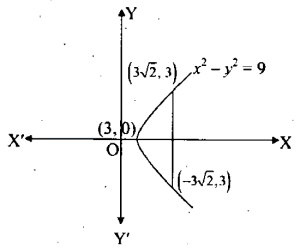
The area of the region bounded by the hyperbola $x^2-y^2=9$ and its latus rectum is
A
$9[\sqrt{2}-\log (\sqrt{2}+1)]$ sq. units
B
$4[\sqrt{2}-\log (\sqrt{2}+1)]$ sq. units
C
$3[\sqrt{2}-\log (\sqrt{2}+1)]$ sq. units
D
$18[\sqrt{2}-\log (\sqrt{2}+1)]$ sq. units
Solution
(D) The equation of the hyperbola is $x^2-y^2=9$,which can be written as $\frac{x^2}{3^2}-\frac{y^2}{3^2}=1$.
Here,$a=3$ and $b=3$.
The eccentricity $e = \sqrt{1+\frac{b^2}{a^2}} = \sqrt{1+\frac{9}{9}} = \sqrt{2}$.
The latus rectum is at $x=ae = 3\sqrt{2}$.
The area bounded by the hyperbola and its latus rectum in the first quadrant is $\int_{a}^{ae} y \, dx = \int_{3}^{3\sqrt{2}} \sqrt{x^2-9} \, dx$.
Since the hyperbola is symmetric about both axes,the total area is $4 \int_{3}^{3\sqrt{2}} \sqrt{x^2-9} \, dx$.
Using the formula $\int \sqrt{x^2-a^2} \, dx = \frac{x}{2}\sqrt{x^2-a^2} - \frac{a^2}{2}\log|x+\sqrt{x^2-a^2}|$,we get:
Area $= 4 \left[ \frac{x}{2}\sqrt{x^2-9} - \frac{9}{2}\log|x+\sqrt{x^2-9}| \right]_{3}^{3\sqrt{2}}$.
$= 4 \left[ (\frac{3\sqrt{2}}{2}\sqrt{18-9} - \frac{9}{2}\log|3\sqrt{2}+\sqrt{18-9}|) - (0 - \frac{9}{2}\log|3+0|) \right]$.
$= 4 \left[ \frac{3\sqrt{2}}{2}(3) - \frac{9}{2}\log(3\sqrt{2}+3) + \frac{9}{2}\log(3) \right]$.
$= 4 \left[ \frac{9\sqrt{2}}{2} - \frac{9}{2}\log(\frac{3\sqrt{2}+3}{3}) \right]$.
$= 4 \left[ \frac{9\sqrt{2}}{2} - \frac{9}{2}\log(\sqrt{2}+1) \right]$.
$= 18[\sqrt{2}-\log(\sqrt{2}+1)]$ sq. units.
Here,$a=3$ and $b=3$.
The eccentricity $e = \sqrt{1+\frac{b^2}{a^2}} = \sqrt{1+\frac{9}{9}} = \sqrt{2}$.
The latus rectum is at $x=ae = 3\sqrt{2}$.
The area bounded by the hyperbola and its latus rectum in the first quadrant is $\int_{a}^{ae} y \, dx = \int_{3}^{3\sqrt{2}} \sqrt{x^2-9} \, dx$.
Since the hyperbola is symmetric about both axes,the total area is $4 \int_{3}^{3\sqrt{2}} \sqrt{x^2-9} \, dx$.
Using the formula $\int \sqrt{x^2-a^2} \, dx = \frac{x}{2}\sqrt{x^2-a^2} - \frac{a^2}{2}\log|x+\sqrt{x^2-a^2}|$,we get:
Area $= 4 \left[ \frac{x}{2}\sqrt{x^2-9} - \frac{9}{2}\log|x+\sqrt{x^2-9}| \right]_{3}^{3\sqrt{2}}$.
$= 4 \left[ (\frac{3\sqrt{2}}{2}\sqrt{18-9} - \frac{9}{2}\log|3\sqrt{2}+\sqrt{18-9}|) - (0 - \frac{9}{2}\log|3+0|) \right]$.
$= 4 \left[ \frac{3\sqrt{2}}{2}(3) - \frac{9}{2}\log(3\sqrt{2}+3) + \frac{9}{2}\log(3) \right]$.
$= 4 \left[ \frac{9\sqrt{2}}{2} - \frac{9}{2}\log(\frac{3\sqrt{2}+3}{3}) \right]$.
$= 4 \left[ \frac{9\sqrt{2}}{2} - \frac{9}{2}\log(\sqrt{2}+1) \right]$.
$= 18[\sqrt{2}-\log(\sqrt{2}+1)]$ sq. units.
0 likesView Solution
245
MathematicsEasyMCQMHT CET · 2024
The value of $\int e^x \left( \frac{1 - \sin x}{1 - \cos x} \right) dx$ is equal to
A
$-e^x \cot \frac{x}{2} + c$,(where $c$ is a constant of integration)
B
$e^x \cot \frac{x}{2} + c$,(where $c$ is a constant of integration)
C
$e^x \operatorname{cosec} \frac{x}{2} + c$,(where $c$ is a constant of integration)
D
$-e^x \operatorname{cosec} \frac{x}{2} + c$,(where $c$ is a constant of integration)
Solution
(A) We need to evaluate the integral $I = \int e^x \left( \frac{1 - \sin x}{1 - \cos x} \right) dx$.
Using trigonometric identities,$1 - \sin x = 1 - 2 \sin \frac{x}{2} \cos \frac{x}{2}$ and $1 - \cos x = 2 \sin^2 \frac{x}{2}$.
Substituting these into the integral:
$I = \int e^x \left( \frac{1 - 2 \sin \frac{x}{2} \cos \frac{x}{2}}{2 \sin^2 \frac{x}{2}} \right) dx$
$I = \int e^x \left( \frac{1}{2 \sin^2 \frac{x}{2}} - \frac{2 \sin \frac{x}{2} \cos \frac{x}{2}}{2 \sin^2 \frac{x}{2}} \right) dx$
$I = \int e^x \left( \frac{1}{2} \operatorname{cosec}^2 \frac{x}{2} - \cot \frac{x}{2} \right) dx$.
Let $f(x) = -\cot \frac{x}{2}$. Then $f'(x) = -(-\operatorname{cosec}^2 \frac{x}{2}) \cdot \frac{1}{2} = \frac{1}{2} \operatorname{cosec}^2 \frac{x}{2}$.
Since the integral is of the form $\int e^x (f(x) + f'(x)) dx = e^x f(x) + c$,
$I = e^x (-\cot \frac{x}{2}) + c = -e^x \cot \frac{x}{2} + c$.
Using trigonometric identities,$1 - \sin x = 1 - 2 \sin \frac{x}{2} \cos \frac{x}{2}$ and $1 - \cos x = 2 \sin^2 \frac{x}{2}$.
Substituting these into the integral:
$I = \int e^x \left( \frac{1 - 2 \sin \frac{x}{2} \cos \frac{x}{2}}{2 \sin^2 \frac{x}{2}} \right) dx$
$I = \int e^x \left( \frac{1}{2 \sin^2 \frac{x}{2}} - \frac{2 \sin \frac{x}{2} \cos \frac{x}{2}}{2 \sin^2 \frac{x}{2}} \right) dx$
$I = \int e^x \left( \frac{1}{2} \operatorname{cosec}^2 \frac{x}{2} - \cot \frac{x}{2} \right) dx$.
Let $f(x) = -\cot \frac{x}{2}$. Then $f'(x) = -(-\operatorname{cosec}^2 \frac{x}{2}) \cdot \frac{1}{2} = \frac{1}{2} \operatorname{cosec}^2 \frac{x}{2}$.
Since the integral is of the form $\int e^x (f(x) + f'(x)) dx = e^x f(x) + c$,
$I = e^x (-\cot \frac{x}{2}) + c = -e^x \cot \frac{x}{2} + c$.
0 likesView Solution
246
MathematicsMediumMCQMHT CET · 2024
$\int \frac{(x^2+1)}{(x+1)^2} dx =$
A
$x-2 \log |x+1|-\frac{1}{x+1}+c$,where $c$ is a constant of integration.
B
$x-2 \log |x+1|-\frac{2}{x+1}+c$,where $c$ is a constant of integration.
C
$x-\log |x+1|-\frac{2}{x+1}+c$,where $c$ is a constant of integration.
D
$x-\log |x+1|-\frac{x}{x+1}+c$,where $c$ is a constant of integration.
Solution
(B) Let $I = \int \frac{x^2+1}{(x+1)^2} dx$.
We can rewrite the numerator as $x^2+1 = (x^2+2x+1) - 2x = (x+1)^2 - 2x$.
So,$I = \int \frac{(x+1)^2 - 2x}{(x+1)^2} dx = \int 1 dx - \int \frac{2x}{(x+1)^2} dx$.
For the second integral,write $2x = 2(x+1) - 2$.
$I = x - \int \frac{2(x+1)-2}{(x+1)^2} dx = x - 2 \int \frac{1}{x+1} dx + 2 \int \frac{1}{(x+1)^2} dx$.
Integrating these terms,we get $I = x - 2 \log |x+1| + 2 \left( -\frac{1}{x+1} \right) + c$.
$I = x - 2 \log |x+1| - \frac{2}{x+1} + c$.
We can rewrite the numerator as $x^2+1 = (x^2+2x+1) - 2x = (x+1)^2 - 2x$.
So,$I = \int \frac{(x+1)^2 - 2x}{(x+1)^2} dx = \int 1 dx - \int \frac{2x}{(x+1)^2} dx$.
For the second integral,write $2x = 2(x+1) - 2$.
$I = x - \int \frac{2(x+1)-2}{(x+1)^2} dx = x - 2 \int \frac{1}{x+1} dx + 2 \int \frac{1}{(x+1)^2} dx$.
Integrating these terms,we get $I = x - 2 \log |x+1| + 2 \left( -\frac{1}{x+1} \right) + c$.
$I = x - 2 \log |x+1| - \frac{2}{x+1} + c$.
0 likesView Solution
247
MathematicsMediumMCQMHT CET · 2024
$\int \tan ^{-1}\left(\sqrt{\frac{1-\sin x}{1+\sin x}}\right) d x=$
A
$\frac{\pi}{4} x-\frac{x^2}{4}+c$,where $c$ is a constant of integration.
B
$\frac{\pi}{4}-\frac{x}{2}+c$,where $c$ is a constant of integration.
C
$\frac{\pi}{4} x+\frac{x^2}{4}+c$,where $c$ is a constant of integration.
D
$\frac{\pi}{4} x-x+c$,where $c$ is a constant of integration.
Solution
(A) Let $I = \int \tan ^{-1}\left(\sqrt{\frac{1-\sin x}{1+\sin x}}\right) d x$
Using the identities $1-\sin x = (\cos \frac{x}{2} - \sin \frac{x}{2})^2$ and $1+\sin x = (\cos \frac{x}{2} + \sin \frac{x}{2})^2$:
$I = \int \tan ^{-1}\left(\sqrt{\frac{(\cos \frac{x}{2} - \sin \frac{x}{2})^2}{(\cos \frac{x}{2} + \sin \frac{x}{2})^2}}\right) d x$
$I = \int \tan ^{-1}\left(\frac{\cos \frac{x}{2} - \sin \frac{x}{2}}{\cos \frac{x}{2} + \sin \frac{x}{2}}\right) d x$
Dividing numerator and denominator by $\cos \frac{x}{2}$:
$I = \int \tan ^{-1}\left(\frac{1 - \tan \frac{x}{2}}{1 + \tan \frac{x}{2}}\right) d x$
Since $\tan(\frac{\pi}{4} - \theta) = \frac{1 - \tan \theta}{1 + \tan \theta}$:
$I = \int \tan ^{-1}\left(\tan \left(\frac{\pi}{4} - \frac{x}{2}\right)\right) d x$
$I = \int \left(\frac{\pi}{4} - \frac{x}{2}\right) d x$
$I = \frac{\pi}{4} x - \frac{x^2}{4} + c$
Using the identities $1-\sin x = (\cos \frac{x}{2} - \sin \frac{x}{2})^2$ and $1+\sin x = (\cos \frac{x}{2} + \sin \frac{x}{2})^2$:
$I = \int \tan ^{-1}\left(\sqrt{\frac{(\cos \frac{x}{2} - \sin \frac{x}{2})^2}{(\cos \frac{x}{2} + \sin \frac{x}{2})^2}}\right) d x$
$I = \int \tan ^{-1}\left(\frac{\cos \frac{x}{2} - \sin \frac{x}{2}}{\cos \frac{x}{2} + \sin \frac{x}{2}}\right) d x$
Dividing numerator and denominator by $\cos \frac{x}{2}$:
$I = \int \tan ^{-1}\left(\frac{1 - \tan \frac{x}{2}}{1 + \tan \frac{x}{2}}\right) d x$
Since $\tan(\frac{\pi}{4} - \theta) = \frac{1 - \tan \theta}{1 + \tan \theta}$:
$I = \int \tan ^{-1}\left(\tan \left(\frac{\pi}{4} - \frac{x}{2}\right)\right) d x$
$I = \int \left(\frac{\pi}{4} - \frac{x}{2}\right) d x$
$I = \frac{\pi}{4} x - \frac{x^2}{4} + c$
0 likesView Solution
248
MathematicsEasyMCQMHT CET · 2024
If $\int\left(\frac{4 e^x-25}{2 e^x-5}\right) d x=A x+B \log \left(2 e^x-5\right)+c$ (where $c$ is a constant of integration),then:
A
$A=5, B=3$
B
$A=5, B=-3$
C
$A=-5, B=3$
D
$A=-5, B=-3$
Solution
(B) We are given the integral $I = \int \frac{4 e^x-25}{2 e^x-5} dx$.
To solve this,we rewrite the numerator in terms of the denominator:
$4 e^x - 25 = 2(2 e^x - 5) - 15$.
Wait,let's adjust the split:
$4 e^x - 25 = 2(2 e^x - 5) - 15$.
Actually,a better split is:
$4 e^x - 25 = 2(2 e^x - 5) - 15$.
Let's re-evaluate:
$4 e^x - 25 = 2(2 e^x - 5) - 15$.
Wait,$2(2 e^x - 5) = 4 e^x - 10$.
So,$4 e^x - 25 = (4 e^x - 10) - 15 = 2(2 e^x - 5) - 15$.
Thus,$\int \frac{4 e^x-25}{2 e^x-5} dx = \int \left( 2 - \frac{15}{2 e^x-5} \right) dx$.
This does not match the form $Ax + B \log(2 e^x - 5)$.
Let's try another approach:
Multiply numerator and denominator by $e^{-x}$:
$\int \frac{4 - 25 e^{-x}}{2 - 5 e^{-x}} dx$.
Let $u = 2 - 5 e^{-x}$,then $du = 5 e^{-x} dx$,so $dx = \frac{du}{5 e^{-x}} = \frac{du}{5(2-u)/5} = \frac{du}{2-u}$.
This is complex. Let's use the method:
$4 e^x - 25 = A(2 e^x - 5) + B(2 e^x)$.
$4 e^x - 25 = (2A + 2B) e^x - 5A$.
Comparing coefficients:
$-5A = -25 \implies A = 5$.
$2A + 2B = 4 \implies 10 + 2B = 4 \implies 2B = -6 \implies B = -3$.
So,$\int \frac{4 e^x-25}{2 e^x-5} dx = \int \left( 5 - 3 \frac{2 e^x}{2 e^x-5} \right) dx = 5x - 3 \log|2 e^x - 5| + c$.
Therefore,$A=5$ and $B=-3$.
To solve this,we rewrite the numerator in terms of the denominator:
$4 e^x - 25 = 2(2 e^x - 5) - 15$.
Wait,let's adjust the split:
$4 e^x - 25 = 2(2 e^x - 5) - 15$.
Actually,a better split is:
$4 e^x - 25 = 2(2 e^x - 5) - 15$.
Let's re-evaluate:
$4 e^x - 25 = 2(2 e^x - 5) - 15$.
Wait,$2(2 e^x - 5) = 4 e^x - 10$.
So,$4 e^x - 25 = (4 e^x - 10) - 15 = 2(2 e^x - 5) - 15$.
Thus,$\int \frac{4 e^x-25}{2 e^x-5} dx = \int \left( 2 - \frac{15}{2 e^x-5} \right) dx$.
This does not match the form $Ax + B \log(2 e^x - 5)$.
Let's try another approach:
Multiply numerator and denominator by $e^{-x}$:
$\int \frac{4 - 25 e^{-x}}{2 - 5 e^{-x}} dx$.
Let $u = 2 - 5 e^{-x}$,then $du = 5 e^{-x} dx$,so $dx = \frac{du}{5 e^{-x}} = \frac{du}{5(2-u)/5} = \frac{du}{2-u}$.
This is complex. Let's use the method:
$4 e^x - 25 = A(2 e^x - 5) + B(2 e^x)$.
$4 e^x - 25 = (2A + 2B) e^x - 5A$.
Comparing coefficients:
$-5A = -25 \implies A = 5$.
$2A + 2B = 4 \implies 10 + 2B = 4 \implies 2B = -6 \implies B = -3$.
So,$\int \frac{4 e^x-25}{2 e^x-5} dx = \int \left( 5 - 3 \frac{2 e^x}{2 e^x-5} \right) dx = 5x - 3 \log|2 e^x - 5| + c$.
Therefore,$A=5$ and $B=-3$.
0 likesView Solution
249
MathematicsMediumMCQMHT CET · 2024
$\int \frac{x^4+x^2+1}{x^2-x+1} \,d x$ is equal to
A
$\frac{x^3}{3}-\frac{x^2}{2}+x+c$,(where $c$ is a constant of integration)
B
$\frac{x^3}{3}+\frac{x^2}{2}+x+c$,(where $c$ is a constant of integration)
C
$\frac{x^3}{3}-\frac{x^2}{2}-x+c$,(where $c$ is a constant of integration)
D
$\frac{x^3}{3}+\frac{x^2}{2}-x+c$,(where $c$ is a constant of integration)
Solution
(B) We know that $x^4+x^2+1 = (x^2+1)^2 - x^2 = (x^2+x+1)(x^2-x+1)$.
Therefore,the integral becomes:
$I = \int \frac{(x^2+x+1)(x^2-x+1)}{x^2-x+1} \,d x$
$I = \int (x^2+x+1) \,d x$
Integrating term by term:
$I = \frac{x^3}{3} + \frac{x^2}{2} + x + c$
Thus,the correct option is $B$.
Therefore,the integral becomes:
$I = \int \frac{(x^2+x+1)(x^2-x+1)}{x^2-x+1} \,d x$
$I = \int (x^2+x+1) \,d x$
Integrating term by term:
$I = \frac{x^3}{3} + \frac{x^2}{2} + x + c$
Thus,the correct option is $B$.
0 likesView Solution
250
MathematicsEasyMCQMHT CET · 2024
If $\frac{d}{d x} f(x)=4 x^3-\frac{3}{x^4}$ such that $f(2)=0$,then $f(x)$ is equal to
A
$x^4+\frac{1}{x^3}+\frac{129}{8}$
B
$x^4+\frac{1}{x^3}-\frac{129}{8}$
C
$x^3+\frac{1}{x^4}+\frac{129}{8}$
D
$x^3+\frac{1}{x^4}-\frac{129}{8}$
Solution
(B) Given that $f^{\prime}(x)=4 x^3-3 x^{-4}$.
Integrating both sides with respect to $x$:
$f(x) = \int (4x^3 - 3x^{-4}) dx$
$f(x) = 4 \cdot \frac{x^4}{4} - 3 \cdot \frac{x^{-3}}{-3} + c$
$f(x) = x^4 + \frac{1}{x^3} + c$
Given that $f(2) = 0$,substitute $x = 2$:
$0 = (2)^4 + \frac{1}{2^3} + c$
$0 = 16 + \frac{1}{8} + c$
$0 = \frac{128+1}{8} + c$
$c = -\frac{129}{8}$
Therefore,$f(x) = x^4 + \frac{1}{x^3} - \frac{129}{8}$.
Integrating both sides with respect to $x$:
$f(x) = \int (4x^3 - 3x^{-4}) dx$
$f(x) = 4 \cdot \frac{x^4}{4} - 3 \cdot \frac{x^{-3}}{-3} + c$
$f(x) = x^4 + \frac{1}{x^3} + c$
Given that $f(2) = 0$,substitute $x = 2$:
$0 = (2)^4 + \frac{1}{2^3} + c$
$0 = 16 + \frac{1}{8} + c$
$0 = \frac{128+1}{8} + c$
$c = -\frac{129}{8}$
Therefore,$f(x) = x^4 + \frac{1}{x^3} - \frac{129}{8}$.
0 likesView Solution
251
MathematicsDifficultMCQMHT CET · 2024
$\int \frac{x^3-7 x+6}{x^2+3 x} \,d x=$
A
$\frac{x^2}{2}+3 x-\log |x|+c$, where $c$ is a constant of integration.
B
$\frac{x^2}{2}+3 x+2 \log |x|+c$, where $c$ is a constant of integration.
C
$\frac{x^2}{2}-3 x+2 \log |x|+c$, where $c$ is a constant of integration.
D
$\frac{x^2}{2}-3 x-\log |x|+c$, where $c$ is a constant of integration.
Solution
(C) First, perform polynomial long division on the integrand $\frac{x^3-7x+6}{x^2+3x}$.
Dividing $x^3-7x+6$ by $x^2+3x$ gives a quotient of $(x-3)$ and a remainder of $(2x+6)$.
Thus, $\frac{x^3-7x+6}{x^2+3x} = x-3 + \frac{2x+6}{x^2+3x}$.
Simplify the remainder term: $\frac{2x+6}{x^2+3x} = \frac{2(x+3)}{x(x+3)} = \frac{2}{x}$ for $x \neq -3$.
Now, integrate the expression: $\int (x-3+\frac{2}{x}) dx$.
$= \int x dx - \int 3 dx + \int \frac{2}{x} dx$.
$= \frac{x^2}{2} - 3x + 2 \log |x| + c$.
Dividing $x^3-7x+6$ by $x^2+3x$ gives a quotient of $(x-3)$ and a remainder of $(2x+6)$.
Thus, $\frac{x^3-7x+6}{x^2+3x} = x-3 + \frac{2x+6}{x^2+3x}$.
Simplify the remainder term: $\frac{2x+6}{x^2+3x} = \frac{2(x+3)}{x(x+3)} = \frac{2}{x}$ for $x \neq -3$.
Now, integrate the expression: $\int (x-3+\frac{2}{x}) dx$.
$= \int x dx - \int 3 dx + \int \frac{2}{x} dx$.
$= \frac{x^2}{2} - 3x + 2 \log |x| + c$.
0 likesView Solution
252
MathematicsEasyMCQMHT CET · 2024
$\int 3^{3^x} \cdot 3^x \, dx =$
A
$\frac{3^x}{(\log 3)^2} + c$,where $c$ is a constant of integration.
B
$\frac{3^{3^x}}{\log 3} + c$,where $c$ is a constant of integration.
C
$\frac{3^{3^x}}{(\log 3)^2} + c$,where $c$ is a constant of integration.
D
$\frac{3^x}{\log 3} + c$,where $c$ is a constant of integration.
Solution
(C) Let $I = \int 3^{3^x} \cdot 3^x \, dx$.
Substitute $t = 3^x$.
Then,$dt = 3^x \log 3 \, dx$,which implies $3^x \, dx = \frac{1}{\log 3} \, dt$.
Substituting these into the integral:
$I = \int 3^t \cdot \frac{1}{\log 3} \, dt$.
$I = \frac{1}{\log 3} \int 3^t \, dt$.
Using the formula $\int a^x \, dx = \frac{a^x}{\log a} + c$:
$I = \frac{1}{\log 3} \cdot \frac{3^t}{\log 3} + c$.
$I = \frac{3^t}{(\log 3)^2} + c$.
Substituting $t = 3^x$ back:
$I = \frac{3^{3^x}}{(\log 3)^2} + c$.
Substitute $t = 3^x$.
Then,$dt = 3^x \log 3 \, dx$,which implies $3^x \, dx = \frac{1}{\log 3} \, dt$.
Substituting these into the integral:
$I = \int 3^t \cdot \frac{1}{\log 3} \, dt$.
$I = \frac{1}{\log 3} \int 3^t \, dt$.
Using the formula $\int a^x \, dx = \frac{a^x}{\log a} + c$:
$I = \frac{1}{\log 3} \cdot \frac{3^t}{\log 3} + c$.
$I = \frac{3^t}{(\log 3)^2} + c$.
Substituting $t = 3^x$ back:
$I = \frac{3^{3^x}}{(\log 3)^2} + c$.
0 likesView Solution
253
MathematicsEasyMCQMHT CET · 2024
$\int \frac{\log \sqrt{x}}{3 x} \,d x$ is equal to
A
$\frac{1}{3}(\log \sqrt{x})+c$,(where $c$ is a constant of integration)
B
$\frac{2}{3}(\log \sqrt{x})^2+c$,(where $c$ is a constant of integration)
C
$\frac{2}{3}(\log x)^2+c$,(where $c$ is a constant of integration)
D
$\frac{1}{12}(\log x)^2+c$,(where $c$ is a constant of integration)
Solution
(D) Let $I = \int \frac{\log \sqrt{x}}{3 x} \,d x$.
We know that $\log \sqrt{x} = \log (x^{1/2}) = \frac{1}{2} \log x$.
Substituting this into the integral:
$I = \int \frac{\frac{1}{2} \log x}{3 x} \,d x = \frac{1}{6} \int \frac{\log x}{x} \,d x$.
Let $u = \log x$,then $du = \frac{1}{x} \,d x$.
The integral becomes $I = \frac{1}{6} \int u \,du = \frac{1}{6} \cdot \frac{u^2}{2} + c = \frac{u^2}{12} + c$.
Substituting $u = \log x$ back,we get $I = \frac{1}{12} (\log x)^2 + c$.
We know that $\log \sqrt{x} = \log (x^{1/2}) = \frac{1}{2} \log x$.
Substituting this into the integral:
$I = \int \frac{\frac{1}{2} \log x}{3 x} \,d x = \frac{1}{6} \int \frac{\log x}{x} \,d x$.
Let $u = \log x$,then $du = \frac{1}{x} \,d x$.
The integral becomes $I = \frac{1}{6} \int u \,du = \frac{1}{6} \cdot \frac{u^2}{2} + c = \frac{u^2}{12} + c$.
Substituting $u = \log x$ back,we get $I = \frac{1}{12} (\log x)^2 + c$.
0 likesView Solution
254
MathematicsEasyMCQMHT CET · 2024
The value of $I = \int \frac{dx}{x^2(x^4+1)^{3/4}}$ is
A
$-\left(x^4+1\right)^{1/4} + c$
B
$\left(x^4+1\right)^{1/4} + c$
C
$\left(1+\frac{1}{x^4}\right)^{1/4} + c$
D
$-\left(1+\frac{1}{x^4}\right)^{1/4} + c$
Solution
(D) Given $I = \int \frac{dx}{x^2(x^4+1)^{3/4}}$.
We can rewrite the integral by taking $x^4$ common from the bracket:
$I = \int \frac{dx}{x^2 \left(x^4(1 + \frac{1}{x^4})\right)^{3/4}} = \int \frac{dx}{x^2 \cdot x^3 (1 + \frac{1}{x^4})^{3/4}} = \int \frac{dx}{x^5 (1 + \frac{1}{x^4})^{3/4}}$.
Let $t = 1 + \frac{1}{x^4}$.
Then $dt = -\frac{4}{x^5} dx$,which implies $\frac{dx}{x^5} = -\frac{1}{4} dt$.
Substituting these into the integral:
$I = \int -\frac{1}{4} t^{-3/4} dt = -\frac{1}{4} \left( \frac{t^{1/4}}{1/4} \right) + c = -t^{1/4} + c$.
Substituting back $t = 1 + \frac{1}{x^4}$:
$I = -\left(1 + \frac{1}{x^4}\right)^{1/4} + c$.
We can rewrite the integral by taking $x^4$ common from the bracket:
$I = \int \frac{dx}{x^2 \left(x^4(1 + \frac{1}{x^4})\right)^{3/4}} = \int \frac{dx}{x^2 \cdot x^3 (1 + \frac{1}{x^4})^{3/4}} = \int \frac{dx}{x^5 (1 + \frac{1}{x^4})^{3/4}}$.
Let $t = 1 + \frac{1}{x^4}$.
Then $dt = -\frac{4}{x^5} dx$,which implies $\frac{dx}{x^5} = -\frac{1}{4} dt$.
Substituting these into the integral:
$I = \int -\frac{1}{4} t^{-3/4} dt = -\frac{1}{4} \left( \frac{t^{1/4}}{1/4} \right) + c = -t^{1/4} + c$.
Substituting back $t = 1 + \frac{1}{x^4}$:
$I = -\left(1 + \frac{1}{x^4}\right)^{1/4} + c$.
0 likesView Solution
255
MathematicsEasyMCQMHT CET · 2024
If $\int \frac{x+1}{\sqrt{2x-1}} \, dx = f(x) \sqrt{2x-1} + c$,(where $c$ is a constant of integration),then $f(x)$ is equal to
A
$\frac{1}{3}(x+1)$
B
$\frac{1}{3}(x+4)$
C
$\frac{2}{3}(x+2)$
D
$\frac{2}{3}(x-4)$
Solution
(B) Let $I = \int \frac{x+1}{\sqrt{2x-1}} \, dx$.
Substitute $2x-1 = t^2$,which implies $x = \frac{t^2+1}{2}$ and $dx = t \, dt$.
Then $x+1 = \frac{t^2+1}{2} + 1 = \frac{t^2+3}{2}$.
Substituting these into the integral:
$I = \int \frac{(\frac{t^2+3}{2}) t \, dt}{t} = \int \frac{t^2+3}{2} \, dt$.
$I = \frac{1}{2} (\frac{t^3}{3} + 3t) + c = \frac{t^3}{6} + \frac{3t}{2} + c$.
Factor out $\frac{t}{6}$:
$I = \frac{t}{6} (t^2 + 9) + c$.
Substitute $t = \sqrt{2x-1}$ back:
$I = \frac{\sqrt{2x-1}}{6} (2x-1+9) + c = \frac{\sqrt{2x-1}}{6} (2x+8) + c$.
$I = \sqrt{2x-1} \cdot \frac{2(x+4)}{6} + c = \sqrt{2x-1} \cdot \frac{x+4}{3} + c$.
Comparing this with $f(x) \sqrt{2x-1} + c$,we get $f(x) = \frac{x+4}{3}$.
Substitute $2x-1 = t^2$,which implies $x = \frac{t^2+1}{2}$ and $dx = t \, dt$.
Then $x+1 = \frac{t^2+1}{2} + 1 = \frac{t^2+3}{2}$.
Substituting these into the integral:
$I = \int \frac{(\frac{t^2+3}{2}) t \, dt}{t} = \int \frac{t^2+3}{2} \, dt$.
$I = \frac{1}{2} (\frac{t^3}{3} + 3t) + c = \frac{t^3}{6} + \frac{3t}{2} + c$.
Factor out $\frac{t}{6}$:
$I = \frac{t}{6} (t^2 + 9) + c$.
Substitute $t = \sqrt{2x-1}$ back:
$I = \frac{\sqrt{2x-1}}{6} (2x-1+9) + c = \frac{\sqrt{2x-1}}{6} (2x+8) + c$.
$I = \sqrt{2x-1} \cdot \frac{2(x+4)}{6} + c = \sqrt{2x-1} \cdot \frac{x+4}{3} + c$.
Comparing this with $f(x) \sqrt{2x-1} + c$,we get $f(x) = \frac{x+4}{3}$.
0 likesView Solution
256
MathematicsEasyMCQMHT CET · 2024
If $\int(2x+4)\sqrt{x-1}dx = a(x-1)^{5/2} + b(x-1)^{3/2} + c$ where $c$ is a constant of integration,then the value of $(2a+b)$ is
A
$\frac{20}{5}$
B
$\frac{28}{5}$
C
$\frac{48}{5}$
D
$\frac{16}{5}$
Solution
(B) Let $I = \int(2x+4)\sqrt{x-1}dx$.
Substitute $t = x-1$,so $x = t+1$ and $dx = dt$.
Then $I = \int(2(t+1)+4)\sqrt{t}dt = \int(2t+6)\sqrt{t}dt$.
$I = \int(2t^{3/2} + 6t^{1/2})dt$.
Integrating term by term:
$I = 2 \cdot \frac{t^{5/2}}{5/2} + 6 \cdot \frac{t^{3/2}}{3/2} + c$.
$I = \frac{4}{5}t^{5/2} + 4t^{3/2} + c$.
Substituting back $t = x-1$:
$I = \frac{4}{5}(x-1)^{5/2} + 4(x-1)^{3/2} + c$.
Comparing this with $a(x-1)^{5/2} + b(x-1)^{3/2} + c$,we get $a = \frac{4}{5}$ and $b = 4$.
Therefore,$2a+b = 2(\frac{4}{5}) + 4 = \frac{8}{5} + 4 = \frac{8+20}{5} = \frac{28}{5}$.
Substitute $t = x-1$,so $x = t+1$ and $dx = dt$.
Then $I = \int(2(t+1)+4)\sqrt{t}dt = \int(2t+6)\sqrt{t}dt$.
$I = \int(2t^{3/2} + 6t^{1/2})dt$.
Integrating term by term:
$I = 2 \cdot \frac{t^{5/2}}{5/2} + 6 \cdot \frac{t^{3/2}}{3/2} + c$.
$I = \frac{4}{5}t^{5/2} + 4t^{3/2} + c$.
Substituting back $t = x-1$:
$I = \frac{4}{5}(x-1)^{5/2} + 4(x-1)^{3/2} + c$.
Comparing this with $a(x-1)^{5/2} + b(x-1)^{3/2} + c$,we get $a = \frac{4}{5}$ and $b = 4$.
Therefore,$2a+b = 2(\frac{4}{5}) + 4 = \frac{8}{5} + 4 = \frac{8+20}{5} = \frac{28}{5}$.
0 likesView Solution
Vedclass Products
For Students
Vedclass Test Series
Mock tests in real MHT CET style covering Mathematics with performance analysis. 5-day free trial.
Start Free TrialFor Teachers
Exam Paper Generator
Generate Set A/B/C/D Mathematics papers from 7.5L+ questions in 2 minutes. 3 chapters free.
Try FreeFor Institutes
Online Exam Module
Run live MHT CET mock exams with unlimited students, 360° analytics & white-label branding.
See DemoFrequently Asked Questions
How many Mathematics questions are in MHT CET 2024?
There are 769 Mathematics questions from the MHT CET 2024 paper on Vedclass, each with a detailed step-by-step solution in English.
Are MHT CET 2024 Mathematics solutions available in English?
Yes. All solutions on this page are in English. You can also switch to English or Hindi using the language buttons above the questions.
Can I practice MHT CET 2024 Mathematics as a timed test?
Yes. Use the Vedclass Test Series to attempt a full MHT CET mock test covering Mathematics with time limits and instant score analysis.
Can teachers create Mathematics papers from MHT CET previous year questions?
Yes. The Vedclass Exam Paper Generator lets teachers mix MHT CET Mathematics questions and generate Set A/B/C/D papers in minutes.
For Teachers & Institutes
Build a Custom Mathematics Paper
Pick MHT CET 2024 Mathematics questions, set difficulty, and generate Set A/B/C/D in 2 minutes.