
MathematicsQ101–200 of 769 questions
Page 3 of 12 · English
101
MathematicsEasyMCQMHT CET · 2024
The number of arrangements of the letters of the word $MANAMA$ in which two $M$'s do not appear adjacent is
A
$40$
B
$60$
C
$80$
D
$100$
Solution
(A) The word $MANAMA$ contains $6$ letters: $M$ appears $2$ times and $A$ appears $3$ times,and $N$ appears $1$ time.
First,we arrange the letters other than $M$,which are $A, A, A, N$.
The number of ways to arrange these $4$ letters is $\frac{4!}{3!1!} = 4$.
These $4$ letters create $5$ possible gaps (including the ends) where the $2$ $M$'s can be placed so that they are not adjacent.
The number of ways to choose $2$ gaps out of $5$ is $\binom{5}{2} = 10$.
Since the $2$ $M$'s are identical,the number of ways to place them is $\binom{5}{2} = 10$.
Therefore,the total number of arrangements is $4 \times 10 = 40$.
First,we arrange the letters other than $M$,which are $A, A, A, N$.
The number of ways to arrange these $4$ letters is $\frac{4!}{3!1!} = 4$.
These $4$ letters create $5$ possible gaps (including the ends) where the $2$ $M$'s can be placed so that they are not adjacent.
The number of ways to choose $2$ gaps out of $5$ is $\binom{5}{2} = 10$.
Since the $2$ $M$'s are identical,the number of ways to place them is $\binom{5}{2} = 10$.
Therefore,the total number of arrangements is $4 \times 10 = 40$.
0 likesView Solution
102
MathematicsMediumMCQMHT CET · 2024
$A$ five-digit number divisible by $3$ is to be formed using the digits $0, 1, 2, 3, 4, 5$ without repetition. The total number of ways this can be done is:
A
$216$
B
$240$
C
$96$
D
$120$
Solution
(A) number is divisible by $3$ if the sum of its digits is divisible by $3$. The sum of all given digits is $0+1+2+3+4+5 = 15$. Since we need a $5$-digit number,we must exclude one digit such that the sum of the remaining $5$ digits is divisible by $3$.
Case $1$: Exclude $0$. The remaining digits are ${1, 2, 3, 4, 5}$. The sum is $15$,which is divisible by $3$. The number of $5$-digit numbers formed is $5! = 120$.
Case $2$: Exclude $3$. The remaining digits are ${0, 1, 2, 4, 5}$. The sum is $12$,which is divisible by $3$. The number of $5$-digit numbers formed is $5! - 4! = 120 - 24 = 96$.
Note: If we exclude any other digit (like $1, 2, 4, 5$),the sum of the remaining digits will not be divisible by $3$.
Total ways $= 120 + 96 = 216$.
Case $1$: Exclude $0$. The remaining digits are ${1, 2, 3, 4, 5}$. The sum is $15$,which is divisible by $3$. The number of $5$-digit numbers formed is $5! = 120$.
Case $2$: Exclude $3$. The remaining digits are ${0, 1, 2, 4, 5}$. The sum is $12$,which is divisible by $3$. The number of $5$-digit numbers formed is $5! - 4! = 120 - 24 = 96$.
Note: If we exclude any other digit (like $1, 2, 4, 5$),the sum of the remaining digits will not be divisible by $3$.
Total ways $= 120 + 96 = 216$.
0 likesView Solution
103
MathematicsMediumMCQMHT CET · 2024
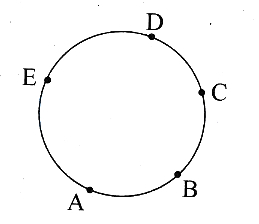
Five persons $A, B, C, D$ and $E$ are seated in a circular arrangement. If each of them is given a hat of one of the three colours: red,blue,and green,then the number of ways of distributing the hats such that the persons seated in adjacent seats get different coloured hats is:
A
$30$
B
$15$
C
$60$
D
$40$
Solution
(A) Let the colours be $R, B, G$. The number of ways to colour the vertices of a cycle graph $C_n$ with $k$ colours such that no two adjacent vertices have the same colour is given by the chromatic polynomial $P(C_n, k) = (k-1)^n + (-1)^n(k-1)$.
Here,$n = 5$ (number of persons) and $k = 3$ (number of colours).
Substituting the values:
$P(C_5, 3) = (3-1)^5 + (-1)^5(3-1)$
$= 2^5 - 2$
$= 32 - 2$
$= 30$
Thus,there are $30$ ways to distribute the hats.
Here,$n = 5$ (number of persons) and $k = 3$ (number of colours).
Substituting the values:
$P(C_5, 3) = (3-1)^5 + (-1)^5(3-1)$
$= 2^5 - 2$
$= 32 - 2$
$= 30$
Thus,there are $30$ ways to distribute the hats.
0 likesView Solution
104
MathematicsEasyMCQMHT CET · 2024
Three houses are available in a locality. Three persons apply for the houses. Each applies for one house without consulting others. The probability that all the three persons apply for the same house is
A
$\frac{1}{9}$
B
$\frac{2}{9}$
C
$\frac{7}{9}$
D
$\frac{8}{9}$
Solution
(A) Each of the $3$ persons can choose any of the $3$ houses independently.
Total number of ways for $3$ persons to choose houses $= 3 \times 3 \times 3 = 27$.
For all $3$ persons to apply for the same house,they must all choose house $1$,or all choose house $2$,or all choose house $3$.
Thus,the number of favourable cases $= 3$.
Therefore,the required probability $= \frac{3}{27} = \frac{1}{9}$.
Total number of ways for $3$ persons to choose houses $= 3 \times 3 \times 3 = 27$.
For all $3$ persons to apply for the same house,they must all choose house $1$,or all choose house $2$,or all choose house $3$.
Thus,the number of favourable cases $= 3$.
Therefore,the required probability $= \frac{3}{27} = \frac{1}{9}$.
0 likesView Solution
105
MathematicsMediumMCQMHT CET · 2024
Let $A$ and $B$ be two events such that the probability that exactly one of them occurs is $\frac{2}{5}$ and the probability that $A$ or $B$ occurs is $\frac{1}{2}$,then the probability of both of them occurring together is
A
$0.1$
B
$0.2$
C
$0.01$
D
$0.02$
Solution
(A) Given that,the probability that exactly one of them occurs is $P(A \cup B) - P(A \cap B) = \frac{2}{5} \dots (i)$
The probability that $A$ or $B$ occurs is $P(A \cup B) = \frac{1}{2} \dots (ii)$
We know that the probability of exactly one event occurring is given by $P(A \cup B) - P(A \cap B)$.
Substituting the values from $(i)$ and $(ii)$:
$\frac{1}{2} - P(A \cap B) = \frac{2}{5}$
$P(A \cap B) = \frac{1}{2} - \frac{2}{5}$
$P(A \cap B) = \frac{5 - 4}{10} = \frac{1}{10} = 0.1$
The probability that $A$ or $B$ occurs is $P(A \cup B) = \frac{1}{2} \dots (ii)$
We know that the probability of exactly one event occurring is given by $P(A \cup B) - P(A \cap B)$.
Substituting the values from $(i)$ and $(ii)$:
$\frac{1}{2} - P(A \cap B) = \frac{2}{5}$
$P(A \cap B) = \frac{1}{2} - \frac{2}{5}$
$P(A \cap B) = \frac{5 - 4}{10} = \frac{1}{10} = 0.1$
0 likesView Solution
106
MathematicsEasyMCQMHT CET · 2024
In a class of $300$ students,every student reads $5$ newspapers and every newspaper is read by $60$ students. Then the number of newspapers is
A
at least $30$
B
at most $20$
C
exactly $25$
D
exactly $10$
Solution
(C) Let $N$ be the number of newspapers.
Total number of reading sessions performed by students $= 300 \times 5 = 1500$.
Since each newspaper is read by $60$ students,the total number of reading sessions is also equal to $60 \times N$.
Equating the two,we get:
$60 \times N = 1500$
$N = \frac{1500}{60} = 25$.
Thus,the number of newspapers is $25$.
Total number of reading sessions performed by students $= 300 \times 5 = 1500$.
Since each newspaper is read by $60$ students,the total number of reading sessions is also equal to $60 \times N$.
Equating the two,we get:
$60 \times N = 1500$
$N = \frac{1500}{60} = 25$.
Thus,the number of newspapers is $25$.
0 likesView Solution
107
MathematicsEasyMCQMHT CET · 2024
An urn contains nine balls of which three are red,four are blue and two are green. Three balls are drawn at random without replacement from the urn. The probability that the three balls have different colours is
A
$\frac{1}{3}$
B
$\frac{2}{7}$
C
$\frac{1}{21}$
D
$\frac{2}{23}$
Solution
(B) The total number of balls is $3 + 4 + 2 = 9$.
The number of ways to choose $3$ balls out of $9$ is given by $^{9}C_{3} = \frac{9 \times 8 \times 7}{3 \times 2 \times 1} = 84$.
To have three balls of different colours,we must select one red,one blue,and one green ball.
The number of ways to select one ball of each colour is $^{3}C_{1} \times ^{4}C_{1} \times ^{2}C_{1} = 3 \times 4 \times 2 = 24$.
The required probability is $\frac{24}{84} = \frac{2}{7}$.
The number of ways to choose $3$ balls out of $9$ is given by $^{9}C_{3} = \frac{9 \times 8 \times 7}{3 \times 2 \times 1} = 84$.
To have three balls of different colours,we must select one red,one blue,and one green ball.
The number of ways to select one ball of each colour is $^{3}C_{1} \times ^{4}C_{1} \times ^{2}C_{1} = 3 \times 4 \times 2 = 24$.
The required probability is $\frac{24}{84} = \frac{2}{7}$.
0 likesView Solution
108
MathematicsMediumMCQMHT CET · 2024
If two fair dice are rolled,then the probability that the sum of the numbers on the upper faces is at least $9$,is
A
$\frac{1}{3}$
B
$\frac{4}{11}$
C
$\frac{5}{18}$
D
$\frac{5}{36}$
Solution
(C) When two fair dice are rolled,the total number of possible outcomes is $6 \times 6 = 36$.
We want the sum of the numbers on the upper faces to be at least $9$,which means the sum can be $9, 10, 11,$ or $12$.
The favorable outcomes are:
Sum $= 9: (3, 6), (4, 5), (5, 4), (6, 3)$
Sum $= 10: (4, 6), (5, 5), (6, 4)$
Sum $= 11: (5, 6), (6, 5)$
Sum $= 12: (6, 6)$
The total number of favorable outcomes is $4 + 3 + 2 + 1 = 10$.
Therefore,the required probability is $\frac{10}{36} = \frac{5}{18}$.
We want the sum of the numbers on the upper faces to be at least $9$,which means the sum can be $9, 10, 11,$ or $12$.
The favorable outcomes are:
Sum $= 9: (3, 6), (4, 5), (5, 4), (6, 3)$
Sum $= 10: (4, 6), (5, 5), (6, 4)$
Sum $= 11: (5, 6), (6, 5)$
Sum $= 12: (6, 6)$
The total number of favorable outcomes is $4 + 3 + 2 + 1 = 10$.
Therefore,the required probability is $\frac{10}{36} = \frac{5}{18}$.
0 likesView Solution
109
MathematicsDifficultMCQMHT CET · 2024
There are three events $A, B, C$,one of which must and only one can happen. The odds are $8:3$ against $A$,$5:2$ against $B$,and the odds against $C$ are $43:17k$. Then the value of $k$ is:
A
$\frac{1}{2}$
B
$2$
C
$\frac{1}{3}$
D
$\frac{1}{4}$
Solution
(B) Given that events $A, B, C$ are mutually exclusive and exhaustive,we have $P(A) + P(B) + P(C) = 1$.
Odds against $A$ are $8:3$,so $P(A) = \frac{3}{8+3} = \frac{3}{11}$.
Odds against $B$ are $5:2$,so $P(B) = \frac{2}{5+2} = \frac{2}{7}$.
Since $P(A) + P(B) + P(C) = 1$,we have $P(C) = 1 - (\frac{3}{11} + \frac{2}{7}) = 1 - (\frac{21+22}{77}) = 1 - \frac{43}{77} = \frac{34}{77}$.
The odds against $C$ are given by $\frac{P(C^c)}{P(C)} = \frac{1 - P(C)}{P(C)} = \frac{1 - 34/77}{34/77} = \frac{43/77}{34/77} = \frac{43}{34}$.
Given the odds against $C$ are $43:17k$,we equate: $\frac{43}{17k} = \frac{43}{34}$.
Thus,$17k = 34$,which implies $k = 2$.
Odds against $A$ are $8:3$,so $P(A) = \frac{3}{8+3} = \frac{3}{11}$.
Odds against $B$ are $5:2$,so $P(B) = \frac{2}{5+2} = \frac{2}{7}$.
Since $P(A) + P(B) + P(C) = 1$,we have $P(C) = 1 - (\frac{3}{11} + \frac{2}{7}) = 1 - (\frac{21+22}{77}) = 1 - \frac{43}{77} = \frac{34}{77}$.
The odds against $C$ are given by $\frac{P(C^c)}{P(C)} = \frac{1 - P(C)}{P(C)} = \frac{1 - 34/77}{34/77} = \frac{43/77}{34/77} = \frac{43}{34}$.
Given the odds against $C$ are $43:17k$,we equate: $\frac{43}{17k} = \frac{43}{34}$.
Thus,$17k = 34$,which implies $k = 2$.
0 likesView Solution
110
MathematicsEasyMCQMHT CET · 2024
$A$ man and his wife appear for an interview for two posts. The probability of the husband's selection is $\frac{1}{7}$ and that of the wife's selection is $\frac{1}{5}$. If they appear for the interview independently,then the probability that only one of them is selected is:
A
$\frac{1}{7}$
B
$\frac{2}{7}$
C
$\frac{6}{7}$
D
$\frac{4}{7}$
Solution
(B) Let $H$ be the event that the husband is selected and $W$ be the event that the wife is selected.
Given $P(H) = \frac{1}{7}$ and $P(W) = \frac{1}{5}$.
The probability that the husband is not selected is $P(H') = 1 - \frac{1}{7} = \frac{6}{7}$.
The probability that the wife is not selected is $P(W') = 1 - \frac{1}{5} = \frac{4}{5}$.
The probability that only one of them is selected is given by $P(\text{only } H) + P(\text{only } W)$.
$P(\text{only } H) = P(H) \times P(W') = \frac{1}{7} \times \frac{4}{5} = \frac{4}{35}$.
$P(\text{only } W) = P(W) \times P(H') = \frac{1}{5} \times \frac{6}{7} = \frac{6}{35}$.
Therefore,the required probability is $\frac{4}{35} + \frac{6}{35} = \frac{10}{35} = \frac{2}{7}$.
Given $P(H) = \frac{1}{7}$ and $P(W) = \frac{1}{5}$.
The probability that the husband is not selected is $P(H') = 1 - \frac{1}{7} = \frac{6}{7}$.
The probability that the wife is not selected is $P(W') = 1 - \frac{1}{5} = \frac{4}{5}$.
The probability that only one of them is selected is given by $P(\text{only } H) + P(\text{only } W)$.
$P(\text{only } H) = P(H) \times P(W') = \frac{1}{7} \times \frac{4}{5} = \frac{4}{35}$.
$P(\text{only } W) = P(W) \times P(H') = \frac{1}{5} \times \frac{6}{7} = \frac{6}{35}$.
Therefore,the required probability is $\frac{4}{35} + \frac{6}{35} = \frac{10}{35} = \frac{2}{7}$.
0 likesView Solution
111
MathematicsEasyMCQMHT CET · 2024
Four persons can hit a target correctly with probabilities $\frac{1}{2}, \frac{1}{3}, \frac{1}{4}$ and $\frac{1}{5}$ respectively. If all hit at the target independently,then the probability that the target would be hit,is
A
$\frac{1}{5}$
B
$\frac{3}{5}$
C
$\frac{2}{5}$
D
$\frac{4}{5}$
Solution
(D) Let $A, B, C,$ and $D$ be the events that the four persons hit the target respectively.
Given probabilities are $P(A) = \frac{1}{2}, P(B) = \frac{1}{3}, P(C) = \frac{1}{4}, P(D) = \frac{1}{5}$.
The probability that the target is not hit by any of them is the probability that all four miss the target.
$P(A') = 1 - \frac{1}{2} = \frac{1}{2}$
$P(B') = 1 - \frac{1}{3} = \frac{2}{3}$
$P(C') = 1 - \frac{1}{4} = \frac{3}{4}$
$P(D') = 1 - \frac{1}{5} = \frac{4}{5}$
Since the events are independent,the probability that none hit the target is:
$P(\text{None hit}) = P(A') \times P(B') \times P(C') \times P(D') = \frac{1}{2} \times \frac{2}{3} \times \frac{3}{4} \times \frac{4}{5} = \frac{1}{5}$.
The probability that the target is hit at least once is:
$P(\text{Target is hit}) = 1 - P(\text{None hit}) = 1 - \frac{1}{5} = \frac{4}{5}$.
Given probabilities are $P(A) = \frac{1}{2}, P(B) = \frac{1}{3}, P(C) = \frac{1}{4}, P(D) = \frac{1}{5}$.
The probability that the target is not hit by any of them is the probability that all four miss the target.
$P(A') = 1 - \frac{1}{2} = \frac{1}{2}$
$P(B') = 1 - \frac{1}{3} = \frac{2}{3}$
$P(C') = 1 - \frac{1}{4} = \frac{3}{4}$
$P(D') = 1 - \frac{1}{5} = \frac{4}{5}$
Since the events are independent,the probability that none hit the target is:
$P(\text{None hit}) = P(A') \times P(B') \times P(C') \times P(D') = \frac{1}{2} \times \frac{2}{3} \times \frac{3}{4} \times \frac{4}{5} = \frac{1}{5}$.
The probability that the target is hit at least once is:
$P(\text{Target is hit}) = 1 - P(\text{None hit}) = 1 - \frac{1}{5} = \frac{4}{5}$.
0 likesView Solution
112
MathematicsEasyMCQMHT CET · 2024
Two friends $A$ and $B$ apply for a job in the same company. The probability of $A$ getting selected is $\frac{2}{5}$ and that of $B$ is $\frac{4}{7}$. Then the probability that one of them is selected is:
A
$\frac{8}{35}$
B
$\frac{18}{35}$
C
$\frac{26}{35}$
D
$\frac{34}{35}$
Solution
(B) Given: $P(A) = \frac{2}{5}$ and $P(B) = \frac{4}{7}$.
We need to find the probability that exactly one of them is selected.
This is given by the formula: $P(\text{exactly one}) = P(A \cap B') + P(A' \cap B)$.
Since the events are independent,$P(A \cap B') = P(A) \times P(B')$ and $P(A' \cap B) = P(A') \times P(B)$.
Here,$P(A') = 1 - P(A) = 1 - \frac{2}{5} = \frac{3}{5}$ and $P(B') = 1 - P(B) = 1 - \frac{4}{7} = \frac{3}{7}$.
Substituting the values:
$P(\text{exactly one}) = \left(\frac{2}{5} \times \frac{3}{7}\right) + \left(\frac{3}{5} \times \frac{4}{7}\right)$
$= \frac{6}{35} + \frac{12}{35}$
$= \frac{18}{35}$.
We need to find the probability that exactly one of them is selected.
This is given by the formula: $P(\text{exactly one}) = P(A \cap B') + P(A' \cap B)$.
Since the events are independent,$P(A \cap B') = P(A) \times P(B')$ and $P(A' \cap B) = P(A') \times P(B)$.
Here,$P(A') = 1 - P(A) = 1 - \frac{2}{5} = \frac{3}{5}$ and $P(B') = 1 - P(B) = 1 - \frac{4}{7} = \frac{3}{7}$.
Substituting the values:
$P(\text{exactly one}) = \left(\frac{2}{5} \times \frac{3}{7}\right) + \left(\frac{3}{5} \times \frac{4}{7}\right)$
$= \frac{6}{35} + \frac{12}{35}$
$= \frac{18}{35}$.
0 likesView Solution
113
MathematicsMediumMCQMHT CET · 2024
If the angles $A, B$ and $C$ of a triangle $ABC$ are in the ratio $2:3:7$ respectively,then the sides $a, b$ and $c$ are respectively in the ratio
A
$2: \sqrt{2}:(\sqrt{3}+1)$
B
$\sqrt{2}: 2:(\sqrt{3}+1)$
C
$(\sqrt{3}+1): \sqrt{2}: 2$
D
$2:(\sqrt{3}+1): \sqrt{2}$
Solution
(B) The angles of triangle $ABC$ are in the ratio $2:3:7$. Let the common multiple be $x$.
$\angle A = 2x, \angle B = 3x, \angle C = 7x$.
Since the sum of the angles of a triangle is $180^{\circ}$,we have $2x + 3x + 7x = 180^{\circ} \implies 12x = 180^{\circ} \implies x = 15^{\circ}$.
Thus,$\angle A = 30^{\circ}, \angle B = 45^{\circ}, \angle C = 105^{\circ}$.
By the sine rule,$\frac{a}{\sin A} = \frac{b}{\sin B} = \frac{c}{\sin C}$.
Substituting the values: $\frac{a}{\sin 30^{\circ}} = \frac{b}{\sin 45^{\circ}} = \frac{c}{\sin 105^{\circ}}$.
We know $\sin 30^{\circ} = \frac{1}{2}$,$\sin 45^{\circ} = \frac{1}{\sqrt{2}}$,and $\sin 105^{\circ} = \sin(60^{\circ} + 45^{\circ}) = \sin 60^{\circ} \cos 45^{\circ} + \cos 60^{\circ} \sin 45^{\circ} = \frac{\sqrt{3}}{2} \cdot \frac{1}{\sqrt{2}} + \frac{1}{2} \cdot \frac{1}{\sqrt{2}} = \frac{\sqrt{3}+1}{2\sqrt{2}}$.
Therefore,$\frac{a}{1/2} = \frac{b}{1/\sqrt{2}} = \frac{c}{(\sqrt{3}+1)/(2\sqrt{2})}$.
Multiplying by $\frac{1}{2}$,we get $\frac{a}{\sqrt{2}} = \frac{b}{2} = \frac{c}{\sqrt{3}+1}$.
Thus,the ratio $a:b:c = \sqrt{2}: 2: (\sqrt{3}+1)$.
$\angle A = 2x, \angle B = 3x, \angle C = 7x$.
Since the sum of the angles of a triangle is $180^{\circ}$,we have $2x + 3x + 7x = 180^{\circ} \implies 12x = 180^{\circ} \implies x = 15^{\circ}$.
Thus,$\angle A = 30^{\circ}, \angle B = 45^{\circ}, \angle C = 105^{\circ}$.
By the sine rule,$\frac{a}{\sin A} = \frac{b}{\sin B} = \frac{c}{\sin C}$.
Substituting the values: $\frac{a}{\sin 30^{\circ}} = \frac{b}{\sin 45^{\circ}} = \frac{c}{\sin 105^{\circ}}$.
We know $\sin 30^{\circ} = \frac{1}{2}$,$\sin 45^{\circ} = \frac{1}{\sqrt{2}}$,and $\sin 105^{\circ} = \sin(60^{\circ} + 45^{\circ}) = \sin 60^{\circ} \cos 45^{\circ} + \cos 60^{\circ} \sin 45^{\circ} = \frac{\sqrt{3}}{2} \cdot \frac{1}{\sqrt{2}} + \frac{1}{2} \cdot \frac{1}{\sqrt{2}} = \frac{\sqrt{3}+1}{2\sqrt{2}}$.
Therefore,$\frac{a}{1/2} = \frac{b}{1/\sqrt{2}} = \frac{c}{(\sqrt{3}+1)/(2\sqrt{2})}$.
Multiplying by $\frac{1}{2}$,we get $\frac{a}{\sqrt{2}} = \frac{b}{2} = \frac{c}{\sqrt{3}+1}$.
Thus,the ratio $a:b:c = \sqrt{2}: 2: (\sqrt{3}+1)$.
0 likesView Solution
114
MathematicsDifficultMCQMHT CET · 2024
In a triangle $ABC$,with usual notations,if $m \angle A = 45^{\circ}$ and $m \angle B = 75^{\circ}$,then $a + c \sqrt{2}$ is equal to:
A
$b$
B
$\frac{b}{2}$
C
$2b$
D
$3b$
Solution
(C) Given that: $m \angle A = 45^{\circ}, m \angle B = 75^{\circ}$.
Since the sum of angles in a triangle is $180^{\circ}$,$m \angle C = 180^{\circ} - (45^{\circ} + 75^{\circ}) = 60^{\circ}$.
Using the Sine Rule: $\frac{a}{\sin A} = \frac{b}{\sin B} = \frac{c}{\sin C} = k$.
Thus,$a = k \sin 45^{\circ} = \frac{k}{\sqrt{2}}$,$b = k \sin 75^{\circ} = k \sin(45^{\circ} + 30^{\circ}) = k \left( \frac{1}{\sqrt{2}} \cdot \frac{\sqrt{3}}{2} + \frac{1}{\sqrt{2}} \cdot \frac{1}{2} \right) = \frac{k(\sqrt{3} + 1)}{2\sqrt{2}}$,and $c = k \sin 60^{\circ} = \frac{k\sqrt{3}}{2}$.
We need to find $a + c\sqrt{2}$:
$a + c\sqrt{2} = \frac{k}{\sqrt{2}} + \frac{k\sqrt{3}}{2} \cdot \sqrt{2} = \frac{k}{\sqrt{2}} + \frac{k\sqrt{3}}{\sqrt{2}} = \frac{k(1 + \sqrt{3})}{\sqrt{2}}$.
From the expression for $b$,we have $b = \frac{k(\sqrt{3} + 1)}{2\sqrt{2}}$,which implies $2b = \frac{k(\sqrt{3} + 1)}{\sqrt{2}}$.
Therefore,$a + c\sqrt{2} = 2b$.
Since the sum of angles in a triangle is $180^{\circ}$,$m \angle C = 180^{\circ} - (45^{\circ} + 75^{\circ}) = 60^{\circ}$.
Using the Sine Rule: $\frac{a}{\sin A} = \frac{b}{\sin B} = \frac{c}{\sin C} = k$.
Thus,$a = k \sin 45^{\circ} = \frac{k}{\sqrt{2}}$,$b = k \sin 75^{\circ} = k \sin(45^{\circ} + 30^{\circ}) = k \left( \frac{1}{\sqrt{2}} \cdot \frac{\sqrt{3}}{2} + \frac{1}{\sqrt{2}} \cdot \frac{1}{2} \right) = \frac{k(\sqrt{3} + 1)}{2\sqrt{2}}$,and $c = k \sin 60^{\circ} = \frac{k\sqrt{3}}{2}$.
We need to find $a + c\sqrt{2}$:
$a + c\sqrt{2} = \frac{k}{\sqrt{2}} + \frac{k\sqrt{3}}{2} \cdot \sqrt{2} = \frac{k}{\sqrt{2}} + \frac{k\sqrt{3}}{\sqrt{2}} = \frac{k(1 + \sqrt{3})}{\sqrt{2}}$.
From the expression for $b$,we have $b = \frac{k(\sqrt{3} + 1)}{2\sqrt{2}}$,which implies $2b = \frac{k(\sqrt{3} + 1)}{\sqrt{2}}$.
Therefore,$a + c\sqrt{2} = 2b$.
0 likesView Solution
115
MathematicsMediumMCQMHT CET · 2024
If in a triangle $ABC$,with usual notations,the angles are in $A$.$P$. and $b:c = \sqrt{3}:\sqrt{2}$,then angle $A = $ (in $^{\circ}$)
A
$30$
B
$60$
C
$75$
D
$45$
Solution
(C) Given that the angles $A, B, C$ are in $A$.$P$.,we have $A+C = 2B$. Since $A+B+C = 180^{\circ}$,it follows that $3B = 180^{\circ}$,so $B = 60^{\circ}$.
Using the sine rule,$\frac{b}{\sin B} = \frac{c}{\sin C}$,we have $\frac{b}{c} = \frac{\sin B}{\sin C}$.
Substituting the given values,$\frac{\sqrt{3}}{\sqrt{2}} = \frac{\sin 60^{\circ}}{\sin C} = \frac{\sqrt{3}/2}{\sin C}$.
This simplifies to $\sin C = \frac{\sqrt{3}}{2} \times \frac{\sqrt{2}}{\sqrt{3}} = \frac{\sqrt{2}}{2} = \frac{1}{\sqrt{2}}$.
Thus,$C = 45^{\circ}$.
Finally,$A = 180^{\circ} - (B + C) = 180^{\circ} - (60^{\circ} + 45^{\circ}) = 180^{\circ} - 105^{\circ} = 75^{\circ}$.
Using the sine rule,$\frac{b}{\sin B} = \frac{c}{\sin C}$,we have $\frac{b}{c} = \frac{\sin B}{\sin C}$.
Substituting the given values,$\frac{\sqrt{3}}{\sqrt{2}} = \frac{\sin 60^{\circ}}{\sin C} = \frac{\sqrt{3}/2}{\sin C}$.
This simplifies to $\sin C = \frac{\sqrt{3}}{2} \times \frac{\sqrt{2}}{\sqrt{3}} = \frac{\sqrt{2}}{2} = \frac{1}{\sqrt{2}}$.
Thus,$C = 45^{\circ}$.
Finally,$A = 180^{\circ} - (B + C) = 180^{\circ} - (60^{\circ} + 45^{\circ}) = 180^{\circ} - 105^{\circ} = 75^{\circ}$.
0 likesView Solution
116
MathematicsEasyMCQMHT CET · 2024
The angles of a triangle are in the ratio $5:1:6$. The ratio of the smallest side to the greatest side is:
A
$\sqrt{3}+1: 2 \sqrt{2}$
B
$2 \sqrt{2}: \sqrt{3}+1$
C
$2 \sqrt{2}: \sqrt{3}-1$
D
$\sqrt{3}-1: 2 \sqrt{2}$
Solution
(D) Let the angles of the triangle be $5x, x, 6x$.
Since the sum of angles in a triangle is $180^{\circ}$,we have $5x + x + 6x = 180^{\circ}$,which gives $12x = 180^{\circ}$,so $x = 15^{\circ}$.
The angles are $75^{\circ}, 15^{\circ}, 90^{\circ}$.
Let the sides opposite to these angles be $a, b, c$ respectively. By the Sine Rule,$\frac{a}{\sin 75^{\circ}} = \frac{b}{\sin 15^{\circ}} = \frac{c}{\sin 90^{\circ}} = k$.
The smallest side is $b$ (opposite to $15^{\circ}$) and the greatest side is $c$ (opposite to $90^{\circ}$).
The ratio of the smallest side to the greatest side is $\frac{b}{c} = \frac{\sin 15^{\circ}}{\sin 90^{\circ}}$.
We know $\sin 15^{\circ} = \sin(45^{\circ}-30^{\circ}) = \sin 45^{\circ} \cos 30^{\circ} - \cos 45^{\circ} \sin 30^{\circ} = \frac{1}{\sqrt{2}} \cdot \frac{\sqrt{3}}{2} - \frac{1}{\sqrt{2}} \cdot \frac{1}{2} = \frac{\sqrt{3}-1}{2\sqrt{2}}$.
Since $\sin 90^{\circ} = 1$,the ratio is $\frac{\sqrt{3}-1}{2\sqrt{2}} : 1 = \sqrt{3}-1 : 2\sqrt{2}$.
Since the sum of angles in a triangle is $180^{\circ}$,we have $5x + x + 6x = 180^{\circ}$,which gives $12x = 180^{\circ}$,so $x = 15^{\circ}$.
The angles are $75^{\circ}, 15^{\circ}, 90^{\circ}$.
Let the sides opposite to these angles be $a, b, c$ respectively. By the Sine Rule,$\frac{a}{\sin 75^{\circ}} = \frac{b}{\sin 15^{\circ}} = \frac{c}{\sin 90^{\circ}} = k$.
The smallest side is $b$ (opposite to $15^{\circ}$) and the greatest side is $c$ (opposite to $90^{\circ}$).
The ratio of the smallest side to the greatest side is $\frac{b}{c} = \frac{\sin 15^{\circ}}{\sin 90^{\circ}}$.
We know $\sin 15^{\circ} = \sin(45^{\circ}-30^{\circ}) = \sin 45^{\circ} \cos 30^{\circ} - \cos 45^{\circ} \sin 30^{\circ} = \frac{1}{\sqrt{2}} \cdot \frac{\sqrt{3}}{2} - \frac{1}{\sqrt{2}} \cdot \frac{1}{2} = \frac{\sqrt{3}-1}{2\sqrt{2}}$.
Since $\sin 90^{\circ} = 1$,the ratio is $\frac{\sqrt{3}-1}{2\sqrt{2}} : 1 = \sqrt{3}-1 : 2\sqrt{2}$.
0 likesView Solution
117
MathematicsDifficultMCQMHT CET · 2024
In a triangle $ABC$,with usual notations,$2 ac \sin \left(\frac{A-B+C}{2}\right)$ is equal to
A
$a^2+b^2-c^2$
B
$b^2-a^2+c^2$
C
$c^2+a^2-b^2$
D
$a^2-b^2-c^2$
Solution
(C) We know that in any triangle $ABC$,$A+B+C = \pi$.
Therefore,$A+C = \pi - B$.
Substituting this into the expression:
$2 ac \sin \left(\frac{A-B+C}{2}\right) = 2 ac \sin \left(\frac{(A+C)-B}{2}\right)$
$= 2 ac \sin \left(\frac{(\pi-B)-B}{2}\right)$
$= 2 ac \sin \left(\frac{\pi-2B}{2}\right)$
$= 2 ac \sin \left(\frac{\pi}{2} - B\right)$
$= 2 ac \cos B$
Using the cosine rule,$\cos B = \frac{a^2+c^2-b^2}{2ac}$.
Substituting this value:
$= 2 ac \left(\frac{a^2+c^2-b^2}{2ac}\right)$
$= a^2+c^2-b^2$.
Therefore,$A+C = \pi - B$.
Substituting this into the expression:
$2 ac \sin \left(\frac{A-B+C}{2}\right) = 2 ac \sin \left(\frac{(A+C)-B}{2}\right)$
$= 2 ac \sin \left(\frac{(\pi-B)-B}{2}\right)$
$= 2 ac \sin \left(\frac{\pi-2B}{2}\right)$
$= 2 ac \sin \left(\frac{\pi}{2} - B\right)$
$= 2 ac \cos B$
Using the cosine rule,$\cos B = \frac{a^2+c^2-b^2}{2ac}$.
Substituting this value:
$= 2 ac \left(\frac{a^2+c^2-b^2}{2ac}\right)$
$= a^2+c^2-b^2$.
0 likesView Solution
118
MathematicsMediumMCQMHT CET · 2024
In a triangle $ABC$,$l(AB)=\sqrt{23}$ units,$l(BC)=3$ units,$l(CA)=4$ units,then $\frac{\cot A+\cot C}{\cot B}$ is
A
$1$
B
$2$
C
$4$
D
$8$
Solution
(B) Let $a, b, c$ be the side lengths opposite to vertices $A, B, C$ respectively. Here,$a = 3$,$b = 4$,and $c = \sqrt{23}$.
Using the cotangent rule,$\cot A = \frac{b^2+c^2-a^2}{4\Delta}$,$\cot B = \frac{a^2+c^2-b^2}{4\Delta}$,and $\cot C = \frac{a^2+b^2-c^2}{4\Delta}$,where $\Delta$ is the area of the triangle.
Then,$\frac{\cot A+\cot C}{\cot B} = \frac{\frac{b^2+c^2-a^2}{4\Delta} + \frac{a^2+b^2-c^2}{4\Delta}}{\frac{a^2+c^2-b^2}{4\Delta}} = \frac{b^2+c^2-a^2+a^2+b^2-c^2}{a^2+c^2-b^2} = \frac{2b^2}{a^2+c^2-b^2}$.
Substituting the values: $a^2 = 9$,$b^2 = 16$,$c^2 = 23$.
$\frac{2(16)}{9+23-16} = \frac{32}{16} = 2$.
Using the cotangent rule,$\cot A = \frac{b^2+c^2-a^2}{4\Delta}$,$\cot B = \frac{a^2+c^2-b^2}{4\Delta}$,and $\cot C = \frac{a^2+b^2-c^2}{4\Delta}$,where $\Delta$ is the area of the triangle.
Then,$\frac{\cot A+\cot C}{\cot B} = \frac{\frac{b^2+c^2-a^2}{4\Delta} + \frac{a^2+b^2-c^2}{4\Delta}}{\frac{a^2+c^2-b^2}{4\Delta}} = \frac{b^2+c^2-a^2+a^2+b^2-c^2}{a^2+c^2-b^2} = \frac{2b^2}{a^2+c^2-b^2}$.
Substituting the values: $a^2 = 9$,$b^2 = 16$,$c^2 = 23$.
$\frac{2(16)}{9+23-16} = \frac{32}{16} = 2$.
0 likesView Solution
119
MathematicsEasyMCQMHT CET · 2024
If the lengths of the sides of a triangle are $3, 5, 7$,then the largest angle of the triangle is
A
$\frac{\pi}{2}$
B
$\frac{5 \pi}{6}$
C
$\frac{2 \pi}{3}$
D
$\frac{3 \pi}{4}$
Solution
(C) Let the sides of the triangle be $a=3$,$b=5$,and $c=7$.
Since the largest side is $c=7$,the largest angle is $\angle C$.
Using the Law of Cosines: $\cos C = \frac{a^2 + b^2 - c^2}{2ab}$.
Substituting the values: $\cos C = \frac{3^2 + 5^2 - 7^2}{2 \times 3 \times 5} = \frac{9 + 25 - 49}{30} = \frac{-15}{30} = -\frac{1}{2}$.
Therefore,$\angle C = \arccos(-\frac{1}{2}) = \frac{2\pi}{3}$.
Since the largest side is $c=7$,the largest angle is $\angle C$.
Using the Law of Cosines: $\cos C = \frac{a^2 + b^2 - c^2}{2ab}$.
Substituting the values: $\cos C = \frac{3^2 + 5^2 - 7^2}{2 \times 3 \times 5} = \frac{9 + 25 - 49}{30} = \frac{-15}{30} = -\frac{1}{2}$.
Therefore,$\angle C = \arccos(-\frac{1}{2}) = \frac{2\pi}{3}$.
0 likesView Solution
120
MathematicsMediumMCQMHT CET · 2024
In $\triangle ABC$,with usual notations,if $b=3$,$c=8$,and $m\angle A=60^{\circ}$,then the circumradius of the triangle is . . . . . . units.
A
$\frac{7}{3}$
B
$\frac{7\sqrt{2}}{3}$
C
$\frac{7}{\sqrt{3}}$
D
$\frac{7\sqrt{3}}{2}$
Solution
(C) Using the cosine rule,we find the side $a$:
$a^2 = b^2 + c^2 - 2bc \cos A$
$a^2 = 3^2 + 8^2 - 2(3)(8) \cos 60^{\circ}$
$a^2 = 9 + 64 - 48 \times \frac{1}{2}$
$a^2 = 73 - 24 = 49$
$a = 7$
Using the sine rule,the circumradius $R$ is given by:
$R = \frac{a}{2 \sin A}$
$R = \frac{7}{2 \sin 60^{\circ}}$
$R = \frac{7}{2 \times \frac{\sqrt{3}}{2}}$
$R = \frac{7}{\sqrt{3}}$
$a^2 = b^2 + c^2 - 2bc \cos A$
$a^2 = 3^2 + 8^2 - 2(3)(8) \cos 60^{\circ}$
$a^2 = 9 + 64 - 48 \times \frac{1}{2}$
$a^2 = 73 - 24 = 49$
$a = 7$
Using the sine rule,the circumradius $R$ is given by:
$R = \frac{a}{2 \sin A}$
$R = \frac{7}{2 \sin 60^{\circ}}$
$R = \frac{7}{2 \times \frac{\sqrt{3}}{2}}$
$R = \frac{7}{\sqrt{3}}$
0 likesView Solution
121
MathematicsDifficultMCQMHT CET · 2024
If $(a+b) \cos C + (b+c) \cos A + (c+a) \cos B = 72$ and if $a = 18, b = 24$,then the area of the triangle $ABC$ is
A
$144 \text{ sq. units}$
B
$216 \text{ sq. units}$
C
$256 \text{ sq. units}$
D
$296 \text{ sq. units}$
Solution
(B) Given the equation: $(a+b) \cos C + (b+c) \cos A + (c+a) \cos B = 72$
Expanding the terms: $a \cos C + b \cos C + b \cos A + c \cos A + c \cos B + a \cos B = 72$
Rearranging the terms: $(a \cos C + c \cos A) + (b \cos A + a \cos B) + (b \cos C + c \cos B) = 72$
Using the projection formula: $b = c \cos A + a \cos C$,$c = a \cos B + b \cos A$,and $a = b \cos C + c \cos B$
Substituting these into the equation: $b + c + a = 72$
Given $a = 18$ and $b = 24$: $18 + 24 + c = 72$ $\Rightarrow 42 + c = 72$ $\Rightarrow c = 30$
The semi-perimeter $s = \frac{a+b+c}{2} = \frac{72}{2} = 36$
Using Heron's formula: $\text{Area} = \sqrt{s(s-a)(s-b)(s-c)}$
$\text{Area} = \sqrt{36(36-18)(36-24)(36-30)} = \sqrt{36 \times 18 \times 12 \times 6}$
$\text{Area} = \sqrt{36 \times 1296} = 6 \times 36 = 216 \text{ sq. units}$
Expanding the terms: $a \cos C + b \cos C + b \cos A + c \cos A + c \cos B + a \cos B = 72$
Rearranging the terms: $(a \cos C + c \cos A) + (b \cos A + a \cos B) + (b \cos C + c \cos B) = 72$
Using the projection formula: $b = c \cos A + a \cos C$,$c = a \cos B + b \cos A$,and $a = b \cos C + c \cos B$
Substituting these into the equation: $b + c + a = 72$
Given $a = 18$ and $b = 24$: $18 + 24 + c = 72$ $\Rightarrow 42 + c = 72$ $\Rightarrow c = 30$
The semi-perimeter $s = \frac{a+b+c}{2} = \frac{72}{2} = 36$
Using Heron's formula: $\text{Area} = \sqrt{s(s-a)(s-b)(s-c)}$
$\text{Area} = \sqrt{36(36-18)(36-24)(36-30)} = \sqrt{36 \times 18 \times 12 \times 6}$
$\text{Area} = \sqrt{36 \times 1296} = 6 \times 36 = 216 \text{ sq. units}$
0 likesView Solution
122
MathematicsMediumMCQMHT CET · 2024
With usual notations,if the lengths of the sides of a triangle are $7 \text{ cm}$,$4\sqrt{3} \text{ cm}$,and $\sqrt{13} \text{ cm}$,then the measure of the smallest angle is
A
$\frac{\pi}{2}$
B
$\frac{\pi}{6}$
C
$\frac{\pi}{3}$
D
$\frac{\pi}{4}$
Solution
(B) Let the sides be $a = 7$,$b = 4\sqrt{3}$,and $c = \sqrt{13}$.
Since $c$ is the smallest side,the smallest angle is $C$.
Using the law of cosines: $\cos C = \frac{a^2 + b^2 - c^2}{2ab}$.
Substituting the values: $\cos C = \frac{7^2 + (4\sqrt{3})^2 - (\sqrt{13})^2}{2 \times 7 \times 4\sqrt{3}}$.
$\cos C = \frac{49 + 48 - 13}{56\sqrt{3}} = \frac{84}{56\sqrt{3}} = \frac{3}{2\sqrt{3}} = \frac{\sqrt{3}}{2}$.
Therefore,$C = \cos^{-1}\left(\frac{\sqrt{3}}{2}\right) = \frac{\pi}{6}$.
Since $c$ is the smallest side,the smallest angle is $C$.
Using the law of cosines: $\cos C = \frac{a^2 + b^2 - c^2}{2ab}$.
Substituting the values: $\cos C = \frac{7^2 + (4\sqrt{3})^2 - (\sqrt{13})^2}{2 \times 7 \times 4\sqrt{3}}$.
$\cos C = \frac{49 + 48 - 13}{56\sqrt{3}} = \frac{84}{56\sqrt{3}} = \frac{3}{2\sqrt{3}} = \frac{\sqrt{3}}{2}$.
Therefore,$C = \cos^{-1}\left(\frac{\sqrt{3}}{2}\right) = \frac{\pi}{6}$.
0 likesView Solution
123
MathematicsEasyMCQMHT CET · 2024
The equation $(\cos p - 1) x^2 + (\cos p) x + \sin p = 0$ in the variable $x$ has real roots. Then $p$ can take any value in the interval
A
$(0, 2\pi)$
B
$(-\pi, 0)$
C
$(-\frac{\pi}{2}, \frac{\pi}{2})$
D
$(0, \pi)$
Solution
(D) Given the quadratic equation $(\cos p - 1) x^2 + (\cos p) x + \sin p = 0$.
For the equation to have real roots,the discriminant $D = b^2 - 4ac \geq 0$.
Here,$a = \cos p - 1$,$b = \cos p$,and $c = \sin p$.
Substituting these into the discriminant condition:
$(\cos p)^2 - 4(\cos p - 1)(\sin p) \geq 0$
$\cos^2 p - 4\sin p \cos p + 4\sin p \geq 0$
Since $\cos p - 1 \neq 0$,we have $\cos p \neq 1$,which implies $p \neq 2n\pi$.
For $p \in (0, \pi)$,$\sin p > 0$ and $\cos p - 1 < 0$.
The condition simplifies to $p \in (0, \pi)$ as it satisfies the discriminant inequality for real roots.
For the equation to have real roots,the discriminant $D = b^2 - 4ac \geq 0$.
Here,$a = \cos p - 1$,$b = \cos p$,and $c = \sin p$.
Substituting these into the discriminant condition:
$(\cos p)^2 - 4(\cos p - 1)(\sin p) \geq 0$
$\cos^2 p - 4\sin p \cos p + 4\sin p \geq 0$
Since $\cos p - 1 \neq 0$,we have $\cos p \neq 1$,which implies $p \neq 2n\pi$.
For $p \in (0, \pi)$,$\sin p > 0$ and $\cos p - 1 < 0$.
The condition simplifies to $p \in (0, \pi)$ as it satisfies the discriminant inequality for real roots.
0 likesView Solution
124
MathematicsMediumMCQMHT CET · 2024
Let $\alpha, \beta$ be the roots of the equation $x^2-px+r=0$ and $\frac{\alpha}{2}, 2\beta$ be the roots of the equation $x^2-qx+r=0$. Then the value of $r$ is
A
$\frac{2}{9}(p-q)(2q-p)$
B
$\frac{2}{9}(q-p)(2p-q)$
C
$\frac{2}{9}(q-2p)(2q-p)$
D
$\frac{2}{9}(2p-q)(2q-p)$
Solution
(D) Given that $\alpha$ and $\beta$ are the roots of $x^2-px+r=0$.
From the relation between roots and coefficients,we have $\alpha+\beta=p$ $(i)$ and $\alpha\beta=r$.
Given that $\frac{\alpha}{2}$ and $2\beta$ are the roots of $x^2-qx+r=0$.
From the relation between roots and coefficients,we have $\frac{\alpha}{2}+2\beta=q$,which implies $\alpha+4\beta=2q$ $(ii)$.
Also,the product of roots is $\frac{\alpha}{2} \times 2\beta = r$,so $\alpha\beta=r$.
Subtracting $(i)$ from $(ii)$,we get $(\alpha+4\beta)-(\alpha+\beta)=2q-p$,which simplifies to $3\beta=2q-p$,so $\beta=\frac{2q-p}{3}$.
Substituting $\beta$ into $(i)$,we get $\alpha=p-\frac{2q-p}{3} = \frac{3p-2q+p}{3} = \frac{4p-2q}{3} = \frac{2(2p-q)}{3}$.
Since $r=\alpha\beta$,we have $r = \left(\frac{2(2p-q)}{3}\right) \left(\frac{2q-p}{3}\right) = \frac{2}{9}(2p-q)(2q-p)$.
From the relation between roots and coefficients,we have $\alpha+\beta=p$ $(i)$ and $\alpha\beta=r$.
Given that $\frac{\alpha}{2}$ and $2\beta$ are the roots of $x^2-qx+r=0$.
From the relation between roots and coefficients,we have $\frac{\alpha}{2}+2\beta=q$,which implies $\alpha+4\beta=2q$ $(ii)$.
Also,the product of roots is $\frac{\alpha}{2} \times 2\beta = r$,so $\alpha\beta=r$.
Subtracting $(i)$ from $(ii)$,we get $(\alpha+4\beta)-(\alpha+\beta)=2q-p$,which simplifies to $3\beta=2q-p$,so $\beta=\frac{2q-p}{3}$.
Substituting $\beta$ into $(i)$,we get $\alpha=p-\frac{2q-p}{3} = \frac{3p-2q+p}{3} = \frac{4p-2q}{3} = \frac{2(2p-q)}{3}$.
Since $r=\alpha\beta$,we have $r = \left(\frac{2(2p-q)}{3}\right) \left(\frac{2q-p}{3}\right) = \frac{2}{9}(2p-q)(2q-p)$.
0 likesView Solution
125
MathematicsMediumMCQMHT CET · 2024
In a $\triangle PQR$,$m \angle R = \frac{\pi}{2}$. If $\tan \left(\frac{P}{2}\right)$ and $\tan \left(\frac{Q}{2}\right)$ are the roots of the equation $ax^2 + bx + c = 0$ $(a \neq 0)$,then:
A
$a+b=c$
B
$b+c=a$
C
$a+c=b$
D
$b=c$
Solution
(A) In $\triangle PQR$,$\angle P + \angle Q + \angle R = 180^{\circ}$.
Since $\angle R = \frac{\pi}{2} = 90^{\circ}$,we have $\angle P + \angle Q = 90^{\circ}$.
Dividing by $2$,we get $\frac{P}{2} + \frac{Q}{2} = 45^{\circ} = \frac{\pi}{4}$.
Given that $\tan \left(\frac{P}{2}\right)$ and $\tan \left(\frac{Q}{2}\right)$ are roots of $ax^2 + bx + c = 0$,by Vieta's formulas:
Sum of roots: $\tan \left(\frac{P}{2}\right) + \tan \left(\frac{Q}{2}\right) = -\frac{b}{a}$.
Product of roots: $\tan \left(\frac{P}{2}\right) \tan \left(\frac{Q}{2}\right) = \frac{c}{a}$.
Using the identity $\tan(A+B) = \frac{\tan A + \tan B}{1 - \tan A \tan B}$:
$\tan \left(\frac{P}{2} + \frac{Q}{2}\right) = \frac{\tan \frac{P}{2} + \tan \frac{Q}{2}}{1 - \tan \frac{P}{2} \tan \frac{Q}{2}}$.
Substituting the values: $\tan \left(\frac{\pi}{4}\right) = \frac{-b/a}{1 - c/a}$.
$1 = \frac{-b/a}{(a-c)/a} = \frac{-b}{a-c}$.
$a - c = -b$,which implies $a + b = c$.
Since $\angle R = \frac{\pi}{2} = 90^{\circ}$,we have $\angle P + \angle Q = 90^{\circ}$.
Dividing by $2$,we get $\frac{P}{2} + \frac{Q}{2} = 45^{\circ} = \frac{\pi}{4}$.
Given that $\tan \left(\frac{P}{2}\right)$ and $\tan \left(\frac{Q}{2}\right)$ are roots of $ax^2 + bx + c = 0$,by Vieta's formulas:
Sum of roots: $\tan \left(\frac{P}{2}\right) + \tan \left(\frac{Q}{2}\right) = -\frac{b}{a}$.
Product of roots: $\tan \left(\frac{P}{2}\right) \tan \left(\frac{Q}{2}\right) = \frac{c}{a}$.
Using the identity $\tan(A+B) = \frac{\tan A + \tan B}{1 - \tan A \tan B}$:
$\tan \left(\frac{P}{2} + \frac{Q}{2}\right) = \frac{\tan \frac{P}{2} + \tan \frac{Q}{2}}{1 - \tan \frac{P}{2} \tan \frac{Q}{2}}$.
Substituting the values: $\tan \left(\frac{\pi}{4}\right) = \frac{-b/a}{1 - c/a}$.
$1 = \frac{-b/a}{(a-c)/a} = \frac{-b}{a-c}$.
$a - c = -b$,which implies $a + b = c$.
0 likesView Solution
126
MathematicsMediumMCQMHT CET · 2024
The equation $e^{\sin x} - e^{-\sin x} = 4$ has . . . . . . solutions.
A
$2$
B
$4$
C
$3$
D
no
Solution
(D) Let $e^{\sin x} = y$. Since $e^{\sin x} > 0$,we have $y > 0$.
The equation becomes $y - \frac{1}{y} = 4$,which simplifies to $y^2 - 4y - 1 = 0$.
Solving for $y$ using the quadratic formula,$y = \frac{4 \pm \sqrt{16 - 4(1)(-1)}}{2} = \frac{4 \pm \sqrt{20}}{2} = 2 \pm \sqrt{5}$.
Since $y > 0$,we must have $y = 2 + \sqrt{5}$.
Thus,$e^{\sin x} = 2 + \sqrt{5}$.
Taking the natural logarithm on both sides,$\sin x = \ln(2 + \sqrt{5})$.
Since $\sqrt{5} \approx 2.236$,$2 + \sqrt{5} \approx 4.236$.
We know that $e \approx 2.718$,so $\ln(4.236) > \ln(e) = 1$.
Therefore,$\sin x > 1$,which is impossible for any real $x$.
Hence,the equation has no real solutions.
The equation becomes $y - \frac{1}{y} = 4$,which simplifies to $y^2 - 4y - 1 = 0$.
Solving for $y$ using the quadratic formula,$y = \frac{4 \pm \sqrt{16 - 4(1)(-1)}}{2} = \frac{4 \pm \sqrt{20}}{2} = 2 \pm \sqrt{5}$.
Since $y > 0$,we must have $y = 2 + \sqrt{5}$.
Thus,$e^{\sin x} = 2 + \sqrt{5}$.
Taking the natural logarithm on both sides,$\sin x = \ln(2 + \sqrt{5})$.
Since $\sqrt{5} \approx 2.236$,$2 + \sqrt{5} \approx 4.236$.
We know that $e \approx 2.718$,so $\ln(4.236) > \ln(e) = 1$.
Therefore,$\sin x > 1$,which is impossible for any real $x$.
Hence,the equation has no real solutions.
0 likesView Solution
127
MathematicsMediumMCQMHT CET · 2024
If $\sin (\theta-\alpha), \sin \theta$ and $\sin (\theta+\alpha)$ are in $H.P.$,then the value of $\cos ^2 \theta$ is
A
$1-2 \cos ^2 \frac{\alpha}{2}$
B
$1+2 \cos ^2 \frac{\alpha}{2}$
C
$1-4 \cos ^2 \frac{\alpha}{2}$
D
$1+4 \cos ^2 \frac{\alpha}{2}$
Solution
(A) Given that $\sin (\theta-\alpha), \sin \theta, \sin (\theta+\alpha)$ are in $H.P.$
$\Rightarrow \frac{1}{\sin (\theta-\alpha)}, \frac{1}{\sin \theta}, \frac{1}{\sin (\theta+\alpha)}$ are in $A.P.$
$\therefore \frac{2}{\sin \theta} = \frac{1}{\sin (\theta-\alpha)} + \frac{1}{\sin (\theta+\alpha)}$
$\Rightarrow \frac{2}{\sin \theta} = \frac{\sin (\theta+\alpha) + \sin (\theta-\alpha)}{\sin (\theta-\alpha) \sin (\theta+\alpha)}$
Using the formula $\sin (A+B) + \sin (A-B) = 2 \sin A \cos B$ and $\sin (A-B) \sin (A+B) = \sin^2 A - \sin^2 B$:
$\Rightarrow \frac{2}{\sin \theta} = \frac{2 \sin \theta \cos \alpha}{\sin^2 \theta - \sin^2 \alpha}$
$\Rightarrow \sin^2 \theta - \sin^2 \alpha = \sin^2 \theta \cos \alpha$
$\Rightarrow \sin^2 \theta (1 - \cos \alpha) = \sin^2 \alpha$
Using $1 - \cos \alpha = 2 \sin^2 \frac{\alpha}{2}$ and $\sin \alpha = 2 \sin \frac{\alpha}{2} \cos \frac{\alpha}{2}$:
$\Rightarrow \sin^2 \theta (2 \sin^2 \frac{\alpha}{2}) = 4 \sin^2 \frac{\alpha}{2} \cos^2 \frac{\alpha}{2}$
$\Rightarrow \sin^2 \theta = 2 \cos^2 \frac{\alpha}{2}$
Since $\sin^2 \theta = 1 - \cos^2 \theta$:
$1 - \cos^2 \theta = 2 \cos^2 \frac{\alpha}{2}$
$\Rightarrow \cos^2 \theta = 1 - 2 \cos^2 \frac{\alpha}{2}$
$\Rightarrow \frac{1}{\sin (\theta-\alpha)}, \frac{1}{\sin \theta}, \frac{1}{\sin (\theta+\alpha)}$ are in $A.P.$
$\therefore \frac{2}{\sin \theta} = \frac{1}{\sin (\theta-\alpha)} + \frac{1}{\sin (\theta+\alpha)}$
$\Rightarrow \frac{2}{\sin \theta} = \frac{\sin (\theta+\alpha) + \sin (\theta-\alpha)}{\sin (\theta-\alpha) \sin (\theta+\alpha)}$
Using the formula $\sin (A+B) + \sin (A-B) = 2 \sin A \cos B$ and $\sin (A-B) \sin (A+B) = \sin^2 A - \sin^2 B$:
$\Rightarrow \frac{2}{\sin \theta} = \frac{2 \sin \theta \cos \alpha}{\sin^2 \theta - \sin^2 \alpha}$
$\Rightarrow \sin^2 \theta - \sin^2 \alpha = \sin^2 \theta \cos \alpha$
$\Rightarrow \sin^2 \theta (1 - \cos \alpha) = \sin^2 \alpha$
Using $1 - \cos \alpha = 2 \sin^2 \frac{\alpha}{2}$ and $\sin \alpha = 2 \sin \frac{\alpha}{2} \cos \frac{\alpha}{2}$:
$\Rightarrow \sin^2 \theta (2 \sin^2 \frac{\alpha}{2}) = 4 \sin^2 \frac{\alpha}{2} \cos^2 \frac{\alpha}{2}$
$\Rightarrow \sin^2 \theta = 2 \cos^2 \frac{\alpha}{2}$
Since $\sin^2 \theta = 1 - \cos^2 \theta$:
$1 - \cos^2 \theta = 2 \cos^2 \frac{\alpha}{2}$
$\Rightarrow \cos^2 \theta = 1 - 2 \cos^2 \frac{\alpha}{2}$
0 likesView Solution
128
MathematicsEasyMCQMHT CET · 2024
If $n(A)=4$ and $n(B)=2$,then the number of subsets of the set $A \times B$ each having at least $3$ elements is:
A
$275$
B
$510$
C
$219$
D
$256$
Solution
(C) Given $n(A)=4$ and $n(B)=2$.
The number of elements in the Cartesian product $A \times B$ is $n(A \times B) = n(A) \times n(B) = 4 \times 2 = 8$.
We need to find the number of subsets of $A \times B$ having at least $3$ elements.
The total number of subsets of a set with $8$ elements is $2^8 = 256$.
The number of subsets with $0, 1,$ or $2$ elements are given by $\binom{8}{0} + \binom{8}{1} + \binom{8}{2}$.
$\binom{8}{0} = 1$,$\binom{8}{1} = 8$,and $\binom{8}{2} = \frac{8 \times 7}{2} = 28$.
Sum of these subsets $= 1 + 8 + 28 = 37$.
The number of subsets with at least $3$ elements $= 2^8 - (\binom{8}{0} + \binom{8}{1} + \binom{8}{2}) = 256 - 37 = 219$.
The number of elements in the Cartesian product $A \times B$ is $n(A \times B) = n(A) \times n(B) = 4 \times 2 = 8$.
We need to find the number of subsets of $A \times B$ having at least $3$ elements.
The total number of subsets of a set with $8$ elements is $2^8 = 256$.
The number of subsets with $0, 1,$ or $2$ elements are given by $\binom{8}{0} + \binom{8}{1} + \binom{8}{2}$.
$\binom{8}{0} = 1$,$\binom{8}{1} = 8$,and $\binom{8}{2} = \frac{8 \times 7}{2} = 28$.
Sum of these subsets $= 1 + 8 + 28 = 37$.
The number of subsets with at least $3$ elements $= 2^8 - (\binom{8}{0} + \binom{8}{1} + \binom{8}{2}) = 256 - 37 = 219$.
0 likesView Solution
129
MathematicsMediumMCQMHT CET · 2024
Let $S$ be a non-empty subset of $\mathbb{R}$. Consider the following statement:
$p$ : There is a rational number $x \in S$ such that $x > 0$.
Which of the following statements is the negation of the statement $p$?
$p$ : There is a rational number $x \in S$ such that $x > 0$.
Which of the following statements is the negation of the statement $p$?
A
There is a rational number $x \in S$ such that $x \leq 0$.
B
There is no rational number $x \in S$ such that $x \leq 0$.
C
Every rational number $x \in S$ satisfies $x \leq 0$.
D
$x \in S$ and $x \leq 0 \Rightarrow x$ is not a rational number.
Solution
(C) The given statement $p$ is: $\exists x \in S$ such that $x > 0$.
To find the negation $\sim p$,we apply the rule $\sim(\exists x, P(x)) \equiv \forall x, \sim P(x)$.
$\sim p : \forall x \in S, x \leq 0$.
This means that every rational number $x \in S$ satisfies $x \leq 0$.
To find the negation $\sim p$,we apply the rule $\sim(\exists x, P(x)) \equiv \forall x, \sim P(x)$.
$\sim p : \forall x \in S, x \leq 0$.
This means that every rational number $x \in S$ satisfies $x \leq 0$.
0 likesView Solution
130
MathematicsEasyMCQMHT CET · 2024
$A$ student scores the following marks in five tests: $54, 45, 41, 43, 57$. His score is not known for the sixth test. If the mean score is $48$ in six tests,then the standard deviation of marks in six tests is
A
$\frac{100}{\sqrt{3}}$
B
$\frac{10}{\sqrt{3}}$
C
$\frac{100}{3}$
D
$\frac{10}{3}$
Solution
(B) Let the sixth test score be $x$.
Given the mean of six tests is $48$,we have:
$\frac{54+45+41+43+57+x}{6} = 48$
$240 + x = 288$
$x = 48$.
The marks are $54, 45, 41, 43, 57, 48$.
The mean $\bar{x} = 48$.
The standard deviation $\sigma = \sqrt{\frac{1}{n} \sum (x_i - \bar{x})^2}$.
$\sigma = \sqrt{\frac{(54-48)^2 + (45-48)^2 + (41-48)^2 + (43-48)^2 + (57-48)^2 + (48-48)^2}{6}}$
$\sigma = \sqrt{\frac{6^2 + (-3)^2 + (-7)^2 + (-5)^2 + 9^2 + 0^2}{6}}$
$\sigma = \sqrt{\frac{36 + 9 + 49 + 25 + 81 + 0}{6}}$
$\sigma = \sqrt{\frac{200}{6}} = \sqrt{\frac{100}{3}} = \frac{10}{\sqrt{3}}$.
Given the mean of six tests is $48$,we have:
$\frac{54+45+41+43+57+x}{6} = 48$
$240 + x = 288$
$x = 48$.
The marks are $54, 45, 41, 43, 57, 48$.
The mean $\bar{x} = 48$.
The standard deviation $\sigma = \sqrt{\frac{1}{n} \sum (x_i - \bar{x})^2}$.
$\sigma = \sqrt{\frac{(54-48)^2 + (45-48)^2 + (41-48)^2 + (43-48)^2 + (57-48)^2 + (48-48)^2}{6}}$
$\sigma = \sqrt{\frac{6^2 + (-3)^2 + (-7)^2 + (-5)^2 + 9^2 + 0^2}{6}}$
$\sigma = \sqrt{\frac{36 + 9 + 49 + 25 + 81 + 0}{6}}$
$\sigma = \sqrt{\frac{200}{6}} = \sqrt{\frac{100}{3}} = \frac{10}{\sqrt{3}}$.
0 likesView Solution
131
MathematicsEasyMCQMHT CET · 2024
The variance of the first $50$ even natural numbers is
A
$833$
B
$473$
C
$\frac{437}{4}$
D
$\frac{833}{4}$
Solution
(A) The first $50$ even natural numbers are $2, 4, 6, \dots, 100$.
The mean $\bar{x} = \frac{2+4+\dots+100}{50} = \frac{2(1+2+\dots+50)}{50} = \frac{2 \times \frac{50 \times 51}{2}}{50} = 51$.
The variance is given by $\sigma^2 = \frac{\sum x_i^2}{n} - (\bar{x})^2$.
$\sum x_i^2 = 2^2 + 4^2 + \dots + 100^2 = 4(1^2 + 2^2 + \dots + 50^2)$.
Using the sum of squares formula $\sum_{k=1}^n k^2 = \frac{n(n+1)(2n+1)}{6}$:
$\sum x_i^2 = 4 \times \frac{50 \times 51 \times 101}{6} = 2 \times 50 \times 17 \times 101 = 171700$.
$\sigma^2 = \frac{171700}{50} - (51)^2 = 3434 - 2601 = 833$.
The mean $\bar{x} = \frac{2+4+\dots+100}{50} = \frac{2(1+2+\dots+50)}{50} = \frac{2 \times \frac{50 \times 51}{2}}{50} = 51$.
The variance is given by $\sigma^2 = \frac{\sum x_i^2}{n} - (\bar{x})^2$.
$\sum x_i^2 = 2^2 + 4^2 + \dots + 100^2 = 4(1^2 + 2^2 + \dots + 50^2)$.
Using the sum of squares formula $\sum_{k=1}^n k^2 = \frac{n(n+1)(2n+1)}{6}$:
$\sum x_i^2 = 4 \times \frac{50 \times 51 \times 101}{6} = 2 \times 50 \times 17 \times 101 = 171700$.
$\sigma^2 = \frac{171700}{50} - (51)^2 = 3434 - 2601 = 833$.
0 likesView Solution
132
MathematicsEasyMCQMHT CET · 2024
The mean of $n$ observations is $\bar{x}$. If three observations $n+1, n-1, 2n-1$ are added such that the mean remains the same,then the value of $n$ is
A
$\frac{2 \bar{x}+1}{3}$
B
$\frac{3 \bar{x}-1}{4}$
C
$\frac{3 \bar{x}+1}{4}$
D
$\frac{\bar{x}+1}{4}$
Solution
(C) Let the sum of $n$ observations be $S_n = n \bar{x}$.
When three observations $n+1, n-1, 2n-1$ are added,the new sum becomes $S_{new} = n \bar{x} + (n+1) + (n-1) + (2n-1) = n \bar{x} + 4n - 1$.
The new number of observations is $n+3$.
Given that the mean remains the same,we have:
$\bar{x} = \frac{n \bar{x} + 4n - 1}{n+3}$
Multiplying both sides by $(n+3)$:
$\bar{x}(n+3) = n \bar{x} + 4n - 1$
$n \bar{x} + 3 \bar{x} = n \bar{x} + 4n - 1$
Subtracting $n \bar{x}$ from both sides:
$3 \bar{x} = 4n - 1$
$4n = 3 \bar{x} + 1$
$n = \frac{3 \bar{x} + 1}{4}$
When three observations $n+1, n-1, 2n-1$ are added,the new sum becomes $S_{new} = n \bar{x} + (n+1) + (n-1) + (2n-1) = n \bar{x} + 4n - 1$.
The new number of observations is $n+3$.
Given that the mean remains the same,we have:
$\bar{x} = \frac{n \bar{x} + 4n - 1}{n+3}$
Multiplying both sides by $(n+3)$:
$\bar{x}(n+3) = n \bar{x} + 4n - 1$
$n \bar{x} + 3 \bar{x} = n \bar{x} + 4n - 1$
Subtracting $n \bar{x}$ from both sides:
$3 \bar{x} = 4n - 1$
$4n = 3 \bar{x} + 1$
$n = \frac{3 \bar{x} + 1}{4}$
0 likesView Solution
133
MathematicsEasyMCQMHT CET · 2024
The mean of the numbers $a, b, 8, 5, 10$ is $6$ and the variance is $6.8$. Then which of the following gives possible values of $a$ and $b$?
A
$a=3, b=4$
B
$a=0, b=7$
C
$a=5, b=2$
D
$a=1, b=6$
Solution
(A) Given the mean $\bar{x} = 6$ for the numbers $a, b, 8, 5, 10$:
$\frac{a+b+8+5+10}{5} = 6$
$a+b+23 = 30$ $\Rightarrow a+b = 7$ $\Rightarrow a = 7-b$ $(i)$
Given the variance $\sigma^2 = 6.8$:
$\sigma^2 = \frac{\sum x_i^2}{n} - (\bar{x})^2$
$6.8 = \frac{a^2+b^2+8^2+5^2+10^2}{5} - 6^2$
$6.8 = \frac{a^2+b^2+64+25+100}{5} - 36$
$6.8 + 36 = \frac{a^2+b^2+189}{5}$
$42.8 \times 5 = a^2+b^2+189$
$214 = a^2+b^2+189 \Rightarrow a^2+b^2 = 25$ (ii)
Substitute $(i)$ into (ii):
$(7-b)^2 + b^2 = 25$
$49 - 14b + b^2 + b^2 = 25$
$2b^2 - 14b + 24 = 0$
$b^2 - 7b + 12 = 0$
$(b-3)(b-4) = 0$
So,$b=3$ or $b=4$.
If $b=3$,$a=4$. If $b=4$,$a=3$. Thus,the pair $(a, b)$ is $(3, 4)$ or $(4, 3)$.
$\frac{a+b+8+5+10}{5} = 6$
$a+b+23 = 30$ $\Rightarrow a+b = 7$ $\Rightarrow a = 7-b$ $(i)$
Given the variance $\sigma^2 = 6.8$:
$\sigma^2 = \frac{\sum x_i^2}{n} - (\bar{x})^2$
$6.8 = \frac{a^2+b^2+8^2+5^2+10^2}{5} - 6^2$
$6.8 = \frac{a^2+b^2+64+25+100}{5} - 36$
$6.8 + 36 = \frac{a^2+b^2+189}{5}$
$42.8 \times 5 = a^2+b^2+189$
$214 = a^2+b^2+189 \Rightarrow a^2+b^2 = 25$ (ii)
Substitute $(i)$ into (ii):
$(7-b)^2 + b^2 = 25$
$49 - 14b + b^2 + b^2 = 25$
$2b^2 - 14b + 24 = 0$
$b^2 - 7b + 12 = 0$
$(b-3)(b-4) = 0$
So,$b=3$ or $b=4$.
If $b=3$,$a=4$. If $b=4$,$a=3$. Thus,the pair $(a, b)$ is $(3, 4)$ or $(4, 3)$.
0 likesView Solution
134
MathematicsEasyMCQMHT CET · 2024
If the sum of the deviations of $50$ observations from $30$ is $50$,then the mean of these observations is:
A
$30$
B
$51$
C
$50$
D
$31$
Solution
(D) Let the observations be $x_1, x_2, x_3, \ldots, x_{50}$.
Given that the sum of deviations from $30$ is $50$,we have:
$\sum_{i=1}^{50} (x_i - 30) = 50$
Expanding the summation:
$\sum_{i=1}^{50} x_i - \sum_{i=1}^{50} 30 = 50$
$\sum_{i=1}^{50} x_i - (50 \times 30) = 50$
$\sum_{i=1}^{50} x_i - 1500 = 50$
$\sum_{i=1}^{50} x_i = 1550$
Now,the mean $\bar{x}$ is given by:
$\bar{x} = \frac{\sum_{i=1}^{50} x_i}{n} = \frac{1550}{50} = 31$
Given that the sum of deviations from $30$ is $50$,we have:
$\sum_{i=1}^{50} (x_i - 30) = 50$
Expanding the summation:
$\sum_{i=1}^{50} x_i - \sum_{i=1}^{50} 30 = 50$
$\sum_{i=1}^{50} x_i - (50 \times 30) = 50$
$\sum_{i=1}^{50} x_i - 1500 = 50$
$\sum_{i=1}^{50} x_i = 1550$
Now,the mean $\bar{x}$ is given by:
$\bar{x} = \frac{\sum_{i=1}^{50} x_i}{n} = \frac{1550}{50} = 31$
0 likesView Solution
135
MathematicsMediumMCQMHT CET · 2024
The mean and variance of seven observations are $8$ and $16$ respectively. If five of the observations are $2, 4, 10, 12, 14$,then the product of the remaining two observations is:
A
$45$
B
$44$
C
$48$
D
$40$
Solution
(C) Let the unknown observations be $x$ and $y$.
Given the mean of $7$ observations is $8$:
$\frac{2+4+10+12+14+x+y}{7} = 8$
$42+x+y = 56$
$x+y = 14$ ... $(i)$
Given the variance is $16$:
$\frac{\sum x_i^2}{n} - (\text{mean})^2 = 16$
$\frac{2^2+4^2+10^2+12^2+14^2+x^2+y^2}{7} - 8^2 = 16$
$\frac{4+16+100+144+196+x^2+y^2}{7} = 16+64$
$460+x^2+y^2 = 7 \times 80 = 560$
$x^2+y^2 = 100$ ... $(ii)$
From $(i)$,$y = 14-x$. Substituting into $(ii)$:
$x^2 + (14-x)^2 = 100$
$x^2 + 196 - 28x + x^2 = 100$
$2x^2 - 28x + 96 = 0$
$x^2 - 14x + 48 = 0$
$(x-6)(x-8) = 0$
So,$x=6$ and $y=8$ (or vice versa).
The product is $6 \times 8 = 48$.
Given the mean of $7$ observations is $8$:
$\frac{2+4+10+12+14+x+y}{7} = 8$
$42+x+y = 56$
$x+y = 14$ ... $(i)$
Given the variance is $16$:
$\frac{\sum x_i^2}{n} - (\text{mean})^2 = 16$
$\frac{2^2+4^2+10^2+12^2+14^2+x^2+y^2}{7} - 8^2 = 16$
$\frac{4+16+100+144+196+x^2+y^2}{7} = 16+64$
$460+x^2+y^2 = 7 \times 80 = 560$
$x^2+y^2 = 100$ ... $(ii)$
From $(i)$,$y = 14-x$. Substituting into $(ii)$:
$x^2 + (14-x)^2 = 100$
$x^2 + 196 - 28x + x^2 = 100$
$2x^2 - 28x + 96 = 0$
$x^2 - 14x + 48 = 0$
$(x-6)(x-8) = 0$
So,$x=6$ and $y=8$ (or vice versa).
The product is $6 \times 8 = 48$.
0 likesView Solution
136
MathematicsEasyMCQMHT CET · 2024
The mean of $100$ observations is $50$ and their standard deviation is $5$. Then,the sum of the squares of all the observations is:
A
$252500$
B
$250500$
C
$250000$
D
$255000$
Solution
(A) Given: $n = 100$,$\bar{x} = 50$,and $\sigma = 5$.
We know that the mean $\bar{x} = \frac{\sum x_i}{n} = 50$.
Therefore,$\sum x_i = 50 \times 100 = 5000$.
The formula for standard deviation is $\sigma = \sqrt{\frac{\sum x_i^2}{n} - (\bar{x})^2}$.
Substituting the values: $5 = \sqrt{\frac{\sum x_i^2}{100} - (50)^2}$.
Squaring both sides: $25 = \frac{\sum x_i^2}{100} - 2500$.
$\frac{\sum x_i^2}{100} = 2500 + 25 = 2525$.
$\sum x_i^2 = 2525 \times 100 = 252500$.
We know that the mean $\bar{x} = \frac{\sum x_i}{n} = 50$.
Therefore,$\sum x_i = 50 \times 100 = 5000$.
The formula for standard deviation is $\sigma = \sqrt{\frac{\sum x_i^2}{n} - (\bar{x})^2}$.
Substituting the values: $5 = \sqrt{\frac{\sum x_i^2}{100} - (50)^2}$.
Squaring both sides: $25 = \frac{\sum x_i^2}{100} - 2500$.
$\frac{\sum x_i^2}{100} = 2500 + 25 = 2525$.
$\sum x_i^2 = 2525 \times 100 = 252500$.
0 likesView Solution
137
MathematicsEasyMCQMHT CET · 2024
Consider three observations $a, b,$ and $c$ such that $b = a + c$. If the standard deviation of $a + 2, b + 2, c + 2$ is $d$,then which of the following holds true?
A
$b^2 = 3(a^2 + c^2 + d^2)$
B
$b^2 = a^2 + c^2 + 3d^2$
C
$b^2 = 3(a^2 + c^2) - 9d^2$
D
$b^2 = 3(a^2 + c^2) + 9d^2$
Solution
(C) The mean of $a, b, c$ is $\bar{x} = \frac{a+b+c}{3}$.
Since $b = a + c$,we have $\bar{x} = \frac{b+b}{3} = \frac{2b}{3}$.
The standard deviation of $a+2, b+2, c+2$ is the same as the standard deviation of $a, b, c$,which is $d$.
Thus,$d^2 = \frac{a^2+b^2+c^2}{3} - (\bar{x})^2$.
$d^2 = \frac{a^2+b^2+c^2}{3} - \left(\frac{2b}{3}\right)^2$.
$d^2 = \frac{a^2+b^2+c^2}{3} - \frac{4b^2}{9}$.
$d^2 = \frac{3(a^2+b^2+c^2) - 4b^2}{9}$.
$9d^2 = 3(a^2+c^2+b^2) - 4b^2$.
$9d^2 = 3(a^2+c^2) + 3b^2 - 4b^2$.
$9d^2 = 3(a^2+c^2) - b^2$.
Therefore,$b^2 = 3(a^2+c^2) - 9d^2$.
Since $b = a + c$,we have $\bar{x} = \frac{b+b}{3} = \frac{2b}{3}$.
The standard deviation of $a+2, b+2, c+2$ is the same as the standard deviation of $a, b, c$,which is $d$.
Thus,$d^2 = \frac{a^2+b^2+c^2}{3} - (\bar{x})^2$.
$d^2 = \frac{a^2+b^2+c^2}{3} - \left(\frac{2b}{3}\right)^2$.
$d^2 = \frac{a^2+b^2+c^2}{3} - \frac{4b^2}{9}$.
$d^2 = \frac{3(a^2+b^2+c^2) - 4b^2}{9}$.
$9d^2 = 3(a^2+c^2+b^2) - 4b^2$.
$9d^2 = 3(a^2+c^2) + 3b^2 - 4b^2$.
$9d^2 = 3(a^2+c^2) - b^2$.
Therefore,$b^2 = 3(a^2+c^2) - 9d^2$.
0 likesView Solution
138
MathematicsEasyMCQMHT CET · 2024
The mean and variance of seven observations are $8$ and $16$ respectively. If $5$ of the observations are $2, 4, 10, 12, 14$, then the square root of the product of the remaining two observations is (in $\sqrt{3}$)
A
$4$
B
$3$
C
$2$
D
$5$
Solution
(A) Let the unknown observations be $x$ and $y$.
Given mean $\bar{x} = 8$ for $n = 7$ observations.
$\frac{2+4+10+12+14+x+y}{7} = 8$
$42 + x + y = 56 \Rightarrow x + y = 14 \dots (i)$
Given variance $\sigma^2 = 16$.
$\sigma^2 = \frac{\sum x_i^2}{n} - (\bar{x})^2$
$16 = \frac{2^2+4^2+10^2+12^2+14^2+x^2+y^2}{7} - 8^2$
$16 + 64 = \frac{4+16+100+144+196+x^2+y^2}{7}$
$80 \times 7 = 460 + x^2 + y^2$
$560 = 460 + x^2 + y^2 \Rightarrow x^2 + y^2 = 100 \dots (ii)$
From $(i)$, $y = 14 - x$. Substituting in $(ii)$:
$x^2 + (14 - x)^2 = 100$
$x^2 + 196 - 28x + x^2 = 100$
$2x^2 - 28x + 96 = 0 \Rightarrow x^2 - 14x + 48 = 0$
$(x - 6)(x - 8) = 0$. Thus, $x = 6$ or $x = 8$.
If $x = 6$, $y = 8$. If $x = 8$, $y = 6$.
The product $xy = 48$.
The square root of the product is $\sqrt{48} = \sqrt{16 \times 3} = 4 \sqrt{3}$.
Given mean $\bar{x} = 8$ for $n = 7$ observations.
$\frac{2+4+10+12+14+x+y}{7} = 8$
$42 + x + y = 56 \Rightarrow x + y = 14 \dots (i)$
Given variance $\sigma^2 = 16$.
$\sigma^2 = \frac{\sum x_i^2}{n} - (\bar{x})^2$
$16 = \frac{2^2+4^2+10^2+12^2+14^2+x^2+y^2}{7} - 8^2$
$16 + 64 = \frac{4+16+100+144+196+x^2+y^2}{7}$
$80 \times 7 = 460 + x^2 + y^2$
$560 = 460 + x^2 + y^2 \Rightarrow x^2 + y^2 = 100 \dots (ii)$
From $(i)$, $y = 14 - x$. Substituting in $(ii)$:
$x^2 + (14 - x)^2 = 100$
$x^2 + 196 - 28x + x^2 = 100$
$2x^2 - 28x + 96 = 0 \Rightarrow x^2 - 14x + 48 = 0$
$(x - 6)(x - 8) = 0$. Thus, $x = 6$ or $x = 8$.
If $x = 6$, $y = 8$. If $x = 8$, $y = 6$.
The product $xy = 48$.
The square root of the product is $\sqrt{48} = \sqrt{16 \times 3} = 4 \sqrt{3}$.
0 likesView Solution
139
MathematicsDifficultMCQMHT CET · 2024
The mean and the standard deviation of $10$ observations are $20$ and $2$ respectively. Each of these $10$ observations is multiplied by $p$ and then reduced by $q$,where $p \neq 0$ and $q \neq 0$. If the new mean and new standard deviation (s.d.) become half of the original values,then $q$ is equal to
A
$-20$
B
-$5$
C
$10$
D
-$10$
Solution
(A) Given: Original mean $\bar{x} = 20$,original standard deviation $\sigma = 2$.
If each observation $x_i$ is transformed to $y_i = p x_i - q$,then the new mean $\bar{y} = p \bar{x} - q$ and the new standard deviation $\sigma_y = |p| \sigma$.
Given that the new mean is half of the original mean: $\bar{y} = \frac{20}{2} = 10$.
So,$p(20) - q = 10 \implies 20p - q = 10$ $(i)$.
Given that the new standard deviation is half of the original standard deviation: $\sigma_y = \frac{2}{2} = 1$.
So,$|p| \times 2 = 1 \implies |p| = \frac{1}{2} \implies p = \pm \frac{1}{2}$.
Case $1$: If $p = \frac{1}{2}$,then $20(\frac{1}{2}) - q = 10 \implies 10 - q = 10 \implies q = 0$. This contradicts the condition $q \neq 0$.
Case $2$: If $p = -\frac{1}{2}$,then $20(-\frac{1}{2}) - q = 10 \implies -10 - q = 10 \implies q = -20$.
Thus,$q = -20$.
If each observation $x_i$ is transformed to $y_i = p x_i - q$,then the new mean $\bar{y} = p \bar{x} - q$ and the new standard deviation $\sigma_y = |p| \sigma$.
Given that the new mean is half of the original mean: $\bar{y} = \frac{20}{2} = 10$.
So,$p(20) - q = 10 \implies 20p - q = 10$ $(i)$.
Given that the new standard deviation is half of the original standard deviation: $\sigma_y = \frac{2}{2} = 1$.
So,$|p| \times 2 = 1 \implies |p| = \frac{1}{2} \implies p = \pm \frac{1}{2}$.
Case $1$: If $p = \frac{1}{2}$,then $20(\frac{1}{2}) - q = 10 \implies 10 - q = 10 \implies q = 0$. This contradicts the condition $q \neq 0$.
Case $2$: If $p = -\frac{1}{2}$,then $20(-\frac{1}{2}) - q = 10 \implies -10 - q = 10 \implies q = -20$.
Thus,$q = -20$.
0 likesView Solution
140
MathematicsMediumMCQMHT CET · 2024
The variance of $20$ observations is $5$. If each observation is multiplied by $3$ and then $8$ is added to each number,then the variance of the resulting observations is:
A
$35$
B
$55$
C
$25$
D
$45$
Solution
(D) Let the observations be $x_1, x_2, \dots, x_{20}$ with variance $\sigma^2 = 5$.
If each observation is multiplied by a constant $a$,the new variance becomes $a^2 \sigma^2$.
Here,$a = 3$,so the new variance is $3^2 \times 5 = 9 \times 5 = 45$.
Adding a constant $b$ to each observation does not change the variance.
Therefore,the final variance remains $45$.
If each observation is multiplied by a constant $a$,the new variance becomes $a^2 \sigma^2$.
Here,$a = 3$,so the new variance is $3^2 \times 5 = 9 \times 5 = 45$.
Adding a constant $b$ to each observation does not change the variance.
Therefore,the final variance remains $45$.
0 likesView Solution
141
MathematicsMediumMCQMHT CET · 2024
The mean and variance of six observations are $6$ and $12$ respectively. If each observation is multiplied by $3$,then the new variance of the resulting observations is:
A
$288$
B
$36$
C
$18$
D
$108$
Solution
(D) Let the original observations be $x_1, x_2, \dots, x_6$ with variance $\sigma^2 = 12$.
When each observation is multiplied by a constant $k$,the new variance $\sigma'^2$ is given by $\sigma'^2 = k^2 \sigma^2$.
Here,$k = 3$ and $\sigma^2 = 12$.
Therefore,the new variance is:
$\sigma'^2 = 3^2 \times 12$
$\sigma'^2 = 9 \times 12$
$\sigma'^2 = 108$
When each observation is multiplied by a constant $k$,the new variance $\sigma'^2$ is given by $\sigma'^2 = k^2 \sigma^2$.
Here,$k = 3$ and $\sigma^2 = 12$.
Therefore,the new variance is:
$\sigma'^2 = 3^2 \times 12$
$\sigma'^2 = 9 \times 12$
$\sigma'^2 = 108$
0 likesView Solution
142
MathematicsMediumMCQMHT CET · 2024
The mean and variance of $7$ observations are $8$ and $16$ respectively. If the first five observations are $2, 4, 10, 12, 14$,then the absolute difference of the remaining two observations is
A
$1$
B
$2$
C
$3$
D
$4$
Solution
(B) Let the unknown numbers be $x$ and $y$.
Given mean $\bar{x} = 8$.
$\frac{2+4+10+12+14+x+y}{7} = 8$
$42 + x + y = 56$
$x + y = 14$ $... (i)$
Given variance $\sigma^2 = 16$.
We know $\sigma^2 = \frac{\sum x_i^2}{n} - (\bar{x})^2$.
$16 = \frac{2^2+4^2+10^2+12^2+14^2+x^2+y^2}{7} - 8^2$
$16 + 64 = \frac{4+16+100+144+196+x^2+y^2}{7}$
$80 \times 7 = 460 + x^2 + y^2$
$560 = 460 + x^2 + y^2$
$x^2 + y^2 = 100$ $... (ii)$
From $(x+y)^2 = x^2 + y^2 + 2xy$,we have $14^2 = 100 + 2xy$.
$196 - 100 = 2xy$ $\Rightarrow 2xy = 96$ $\Rightarrow xy = 48$.
Now,$(x-y)^2 = (x+y)^2 - 4xy = 14^2 - 4(48) = 196 - 192 = 4$.
$|x-y| = \sqrt{4} = 2$.
Given mean $\bar{x} = 8$.
$\frac{2+4+10+12+14+x+y}{7} = 8$
$42 + x + y = 56$
$x + y = 14$ $... (i)$
Given variance $\sigma^2 = 16$.
We know $\sigma^2 = \frac{\sum x_i^2}{n} - (\bar{x})^2$.
$16 = \frac{2^2+4^2+10^2+12^2+14^2+x^2+y^2}{7} - 8^2$
$16 + 64 = \frac{4+16+100+144+196+x^2+y^2}{7}$
$80 \times 7 = 460 + x^2 + y^2$
$560 = 460 + x^2 + y^2$
$x^2 + y^2 = 100$ $... (ii)$
From $(x+y)^2 = x^2 + y^2 + 2xy$,we have $14^2 = 100 + 2xy$.
$196 - 100 = 2xy$ $\Rightarrow 2xy = 96$ $\Rightarrow xy = 48$.
Now,$(x-y)^2 = (x+y)^2 - 4xy = 14^2 - 4(48) = 196 - 192 = 4$.
$|x-y| = \sqrt{4} = 2$.
0 likesView Solution
143
MathematicsMediumMCQMHT CET · 2024
In an experiment with $15$ observations for $x$,the following results were available: $\sum x^2 = 2830$ and $\sum x = 170$. One observation $20$ was found to be wrong and was replaced by the correct value $30$. Then the corrected variance is:
A
$78$
B
$210$
C
$225$
D
$88$
Solution
(A) Given: $n = 15$,$\sum x = 170$,and $\sum x^2 = 2830$.
Corrected sum of observations: $\sum x = 170 - 20 + 30 = 180$.
Corrected sum of squares: $\sum x^2 = 2830 - (20)^2 + (30)^2 = 2830 - 400 + 900 = 3330$.
Corrected variance is given by the formula: $\sigma^2 = \frac{\sum x^2}{n} - \left(\frac{\sum x}{n}\right)^2$.
Substituting the values: $\sigma^2 = \frac{3330}{15} - \left(\frac{180}{15}\right)^2$.
$\sigma^2 = 222 - (12)^2 = 222 - 144 = 78$.
Corrected sum of observations: $\sum x = 170 - 20 + 30 = 180$.
Corrected sum of squares: $\sum x^2 = 2830 - (20)^2 + (30)^2 = 2830 - 400 + 900 = 3330$.
Corrected variance is given by the formula: $\sigma^2 = \frac{\sum x^2}{n} - \left(\frac{\sum x}{n}\right)^2$.
Substituting the values: $\sigma^2 = \frac{3330}{15} - \left(\frac{180}{15}\right)^2$.
$\sigma^2 = 222 - (12)^2 = 222 - 144 = 78$.
0 likesView Solution
144
MathematicsDifficultMCQMHT CET · 2024
If for some $x \in R^{+} \cup \{0\}$,the frequency distribution of the marks obtained by $20$ students in a test is given by the table below,then find the mean of the marks.
| Marks: | $2$ | $3$ | $5$ | $7$ |
| Frequency: | $(x+1)^2$ | $2x-5$ | $x^2-3x$ | $x$ |
A
$3.0$
B
$2.8$
C
$2.5$
D
$3.2$
Solution
(B) The total number of students is $N = 20$.
Sum of frequencies $\Sigma f_i = (x+1)^2 + (2x-5) + (x^2-3x) + x = 20$.
Expanding the terms: $(x^2+2x+1) + 2x - 5 + x^2 - 3x + x = 20$.
$2x^2 + 2x - 4 = 20$ $\Rightarrow 2x^2 + 2x - 24 = 0$ $\Rightarrow x^2 + x - 12 = 0$.
Factoring the quadratic: $(x+4)(x-3) = 0$.
Since $x \in R^{+} \cup \{0\}$,we have $x = 3$.
Now,calculate the frequencies for $x=3$:
Marks $2$: $(3+1)^2 = 16$.
Marks $3$: $2(3)-5 = 1$.
Marks $5$: $3^2-3(3) = 0$.
Marks $7$: $3$.
Check sum: $16+1+0+3 = 20$. Correct.
Mean $\bar{x} = \frac{\Sigma f_i x_i}{N} = \frac{2(16) + 3(1) + 5(0) + 7(3)}{20} = \frac{32 + 3 + 0 + 21}{20} = \frac{56}{20} = 2.8$.
Sum of frequencies $\Sigma f_i = (x+1)^2 + (2x-5) + (x^2-3x) + x = 20$.
Expanding the terms: $(x^2+2x+1) + 2x - 5 + x^2 - 3x + x = 20$.
$2x^2 + 2x - 4 = 20$ $\Rightarrow 2x^2 + 2x - 24 = 0$ $\Rightarrow x^2 + x - 12 = 0$.
Factoring the quadratic: $(x+4)(x-3) = 0$.
Since $x \in R^{+} \cup \{0\}$,we have $x = 3$.
Now,calculate the frequencies for $x=3$:
Marks $2$: $(3+1)^2 = 16$.
Marks $3$: $2(3)-5 = 1$.
Marks $5$: $3^2-3(3) = 0$.
Marks $7$: $3$.
Check sum: $16+1+0+3 = 20$. Correct.
Mean $\bar{x} = \frac{\Sigma f_i x_i}{N} = \frac{2(16) + 3(1) + 5(0) + 7(3)}{20} = \frac{32 + 3 + 0 + 21}{20} = \frac{56}{20} = 2.8$.
0 likesView Solution
145
MathematicsEasyMCQMHT CET · 2024
Variance of first $n$ natural numbers is $\qquad$ .
A
$n^2-\frac{1}{12}$
B
$\frac{(n-1)^2}{12}$
C
$\frac{n^2}{12}-1$
D
$\frac{n^2-1}{12}$
Solution
(D) The variance $\sigma^2$ of the first $n$ natural numbers is given by the formula $\sigma^2 = \frac{1}{n} \sum_{i=1}^{n} x_i^2 - (\bar{x})^2$.
Here,$\sum x_i^2 = \frac{n(n+1)(2n+1)}{6}$ and $\bar{x} = \frac{n+1}{2}$.
Substituting these values:
$\sigma^2 = \frac{1}{n} \left( \frac{n(n+1)(2n+1)}{6} \right) - \left( \frac{n+1}{2} \right)^2$
$\sigma^2 = \frac{(n+1)(2n+1)}{6} - \frac{(n+1)^2}{4}$
Taking $\frac{n+1}{2}$ as a common factor:
$\sigma^2 = \frac{n+1}{2} \left( \frac{2n+1}{3} - \frac{n+1}{2} \right)$
$\sigma^2 = \frac{n+1}{2} \left( \frac{4n+2 - 3n-3}{6} \right)$
$\sigma^2 = \frac{n+1}{2} \left( \frac{n-1}{6} \right)$
$\sigma^2 = \frac{n^2-1}{12}$
Here,$\sum x_i^2 = \frac{n(n+1)(2n+1)}{6}$ and $\bar{x} = \frac{n+1}{2}$.
Substituting these values:
$\sigma^2 = \frac{1}{n} \left( \frac{n(n+1)(2n+1)}{6} \right) - \left( \frac{n+1}{2} \right)^2$
$\sigma^2 = \frac{(n+1)(2n+1)}{6} - \frac{(n+1)^2}{4}$
Taking $\frac{n+1}{2}$ as a common factor:
$\sigma^2 = \frac{n+1}{2} \left( \frac{2n+1}{3} - \frac{n+1}{2} \right)$
$\sigma^2 = \frac{n+1}{2} \left( \frac{4n+2 - 3n-3}{6} \right)$
$\sigma^2 = \frac{n+1}{2} \left( \frac{n-1}{6} \right)$
$\sigma^2 = \frac{n^2-1}{12}$
0 likesView Solution
146
MathematicsMediumMCQMHT CET · 2024
The number of possible distinct straight lines passing through $(2,3)$ and forming a triangle with the coordinate axes whose area is $12$ sq. units is:
A
one
B
two
C
three
D
four
Solution
(C) Let the equation of the line be $\frac{x}{a} + \frac{y}{b} = 1$.
Since the line passes through the point $(2,3)$,we have $\frac{2}{a} + \frac{3}{b} = 1$,which implies $2b + 3a = ab$.
Given the area of the triangle is $12$ sq. units,we have $\frac{1}{2}|ab| = 12$,so $ab = \pm 24$.
Case $I$: $ab = 24$. Substituting $b = \frac{24}{a}$ into $2b + 3a = ab$,we get $2(\frac{24}{a}) + 3a = 24$,which simplifies to $3a^2 - 24a + 48 = 0$,or $a^2 - 8a + 16 = 0$. This gives $(a-4)^2 = 0$,so $a = 4$ and $b = 6$. This provides $1$ line.
Case $II$: $ab = -24$. Substituting $b = \frac{-24}{a}$ into $2b + 3a = ab$,we get $2(\frac{-24}{a}) + 3a = -24$,which simplifies to $3a^2 + 24a - 48 = 0$,or $a^2 + 8a - 16 = 0$. The roots are $a = \frac{-8 \pm \sqrt{64 - 4(1)(-16)}}{2} = -4 \pm 4\sqrt{2}$. Since $b = \frac{-24}{a}$,each value of $a$ gives a distinct value of $b$. This provides $2$ additional lines.
Thus,the total number of possible lines is $1 + 2 = 3$.
Since the line passes through the point $(2,3)$,we have $\frac{2}{a} + \frac{3}{b} = 1$,which implies $2b + 3a = ab$.
Given the area of the triangle is $12$ sq. units,we have $\frac{1}{2}|ab| = 12$,so $ab = \pm 24$.
Case $I$: $ab = 24$. Substituting $b = \frac{24}{a}$ into $2b + 3a = ab$,we get $2(\frac{24}{a}) + 3a = 24$,which simplifies to $3a^2 - 24a + 48 = 0$,or $a^2 - 8a + 16 = 0$. This gives $(a-4)^2 = 0$,so $a = 4$ and $b = 6$. This provides $1$ line.
Case $II$: $ab = -24$. Substituting $b = \frac{-24}{a}$ into $2b + 3a = ab$,we get $2(\frac{-24}{a}) + 3a = -24$,which simplifies to $3a^2 + 24a - 48 = 0$,or $a^2 + 8a - 16 = 0$. The roots are $a = \frac{-8 \pm \sqrt{64 - 4(1)(-16)}}{2} = -4 \pm 4\sqrt{2}$. Since $b = \frac{-24}{a}$,each value of $a$ gives a distinct value of $b$. This provides $2$ additional lines.
Thus,the total number of possible lines is $1 + 2 = 3$.
0 likesView Solution
147
MathematicsEasyMCQMHT CET · 2024
If $A(-4, 5, p)$,$B(3, 1, 4)$,and $C(-2, 0, q)$ are the vertices of a triangle $ABC$ and $G(r, q, 1)$ is its centroid,then the value of $2p + q - r$ is equal to
A
-$3$
B
-$6$
C
$9$
D
$4$
Solution
(A) Given vertices are $A(-4, 5, p)$,$B(3, 1, 4)$,and $C(-2, 0, q)$.
The centroid $G(r, q, 1)$ of a triangle with vertices $(x_1, y_1, z_1)$,$(x_2, y_2, z_2)$,and $(x_3, y_3, z_3)$ is given by $\left(\frac{x_1+x_2+x_3}{3}, \frac{y_1+y_2+y_3}{3}, \frac{z_1+z_2+z_3}{3}\right)$.
Equating the coordinates,we have:
$r = \frac{-4+3-2}{3} = \frac{-3}{3} = -1$
$q = \frac{5+1+0}{3} = \frac{6}{3} = 2$
$1 = \frac{p+4+q}{3} \Rightarrow p+4+q = 3$
Substituting $q=2$ into the equation: $p+4+2 = 3$ $\Rightarrow p+6 = 3$ $\Rightarrow p = -3$.
Now,calculating $2p + q - r$:
$2(-3) + 2 - (-1) = -6 + 2 + 1 = -3$.
The centroid $G(r, q, 1)$ of a triangle with vertices $(x_1, y_1, z_1)$,$(x_2, y_2, z_2)$,and $(x_3, y_3, z_3)$ is given by $\left(\frac{x_1+x_2+x_3}{3}, \frac{y_1+y_2+y_3}{3}, \frac{z_1+z_2+z_3}{3}\right)$.
Equating the coordinates,we have:
$r = \frac{-4+3-2}{3} = \frac{-3}{3} = -1$
$q = \frac{5+1+0}{3} = \frac{6}{3} = 2$
$1 = \frac{p+4+q}{3} \Rightarrow p+4+q = 3$
Substituting $q=2$ into the equation: $p+4+2 = 3$ $\Rightarrow p+6 = 3$ $\Rightarrow p = -3$.
Now,calculating $2p + q - r$:
$2(-3) + 2 - (-1) = -6 + 2 + 1 = -3$.
0 likesView Solution
148
MathematicsEasyMCQMHT CET · 2024
The line $L$ given by $\frac{x}{5}+\frac{y}{b}=1$ passes through the point $(13,32)$. The line $K$ is parallel to line $L$ and has the equation $\frac{x}{c}+\frac{y}{3}=1$. Then the distance between $L$ and $K$ is $\qquad$ units.
A
$\frac{23}{15}$
B
$\sqrt{17}$
C
$\frac{17}{\sqrt{15}}$
D
$\frac{23}{\sqrt{17}}$
Solution
(D) Line $L$ passes through $(13, 32)$.
$\frac{13}{5} + \frac{32}{b} = 1$
$\frac{32}{b} = 1 - \frac{13}{5} = -\frac{8}{5}$
$b = -20$
So,the equation of $L$ is $\frac{x}{5} - \frac{y}{20} = 1$,which simplifies to $4x - y - 20 = 0$.
The slope of $L$ is $m_1 = 4$.
Since line $K$ is parallel to $L$,its slope $m_2$ must be $4$.
The equation of $K$ is $\frac{x}{c} + \frac{y}{3} = 1$,which can be written as $y = -\frac{3}{c}x + 3$.
Thus,$-\frac{3}{c} = -4 \Rightarrow c = \frac{3}{4}$.
The equation of $K$ is $\frac{x}{3/4} + \frac{y}{3} = 1$ $\Rightarrow \frac{4x}{3} + \frac{y}{3} = 1$ $\Rightarrow 4x + y - 3 = 0$.
Wait,re-evaluating the slope: The equation $\frac{x}{c} + \frac{y}{3} = 1$ gives $y = -\frac{3}{c}x + 3$. For this to be parallel to $4x - y - 20 = 0$ (i.e.,$y = 4x - 20$),we need $-\frac{3}{c} = 4$,so $c = -\frac{3}{4}$.
The equation of $K$ becomes $\frac{x}{-3/4} + \frac{y}{3} = 1$ $\Rightarrow -\frac{4x}{3} + \frac{y}{3} = 1$ $\Rightarrow -4x + y = 3$ $\Rightarrow 4x - y + 3 = 0$.
The distance between $4x - y - 20 = 0$ and $4x - y + 3 = 0$ is $\frac{|-20 - 3|}{\sqrt{4^2 + (-1)^2}} = \frac{23}{\sqrt{17}}$.
$\frac{13}{5} + \frac{32}{b} = 1$
$\frac{32}{b} = 1 - \frac{13}{5} = -\frac{8}{5}$
$b = -20$
So,the equation of $L$ is $\frac{x}{5} - \frac{y}{20} = 1$,which simplifies to $4x - y - 20 = 0$.
The slope of $L$ is $m_1 = 4$.
Since line $K$ is parallel to $L$,its slope $m_2$ must be $4$.
The equation of $K$ is $\frac{x}{c} + \frac{y}{3} = 1$,which can be written as $y = -\frac{3}{c}x + 3$.
Thus,$-\frac{3}{c} = -4 \Rightarrow c = \frac{3}{4}$.
The equation of $K$ is $\frac{x}{3/4} + \frac{y}{3} = 1$ $\Rightarrow \frac{4x}{3} + \frac{y}{3} = 1$ $\Rightarrow 4x + y - 3 = 0$.
Wait,re-evaluating the slope: The equation $\frac{x}{c} + \frac{y}{3} = 1$ gives $y = -\frac{3}{c}x + 3$. For this to be parallel to $4x - y - 20 = 0$ (i.e.,$y = 4x - 20$),we need $-\frac{3}{c} = 4$,so $c = -\frac{3}{4}$.
The equation of $K$ becomes $\frac{x}{-3/4} + \frac{y}{3} = 1$ $\Rightarrow -\frac{4x}{3} + \frac{y}{3} = 1$ $\Rightarrow -4x + y = 3$ $\Rightarrow 4x - y + 3 = 0$.
The distance between $4x - y - 20 = 0$ and $4x - y + 3 = 0$ is $\frac{|-20 - 3|}{\sqrt{4^2 + (-1)^2}} = \frac{23}{\sqrt{17}}$.
0 likesView Solution
149
MathematicsDifficultMCQMHT CET · 2024
If $O(0,0)$,$A(1,2)$,and $B(3,4)$ are the vertices of triangle $OAB$,then the joint equation of the altitude and median drawn from $O$ is
A
$3x^2-xy-2y^2=0$
B
$3x^2+xy+2y^2=0$
C
$3x^2-xy+2y^2=0$
D
$3x^2+xy-2y^2=0$
Solution
(D) Let $D$ be the midpoint of $AB$. The coordinates of $D$ are $\left(\frac{1+3}{2}, \frac{2+4}{2}\right) = (2,3)$.
The median $OD$ passes through $(0,0)$ and $(2,3)$. Its equation is $y = \frac{3}{2}x$,which simplifies to $3x-2y=0$.
The slope of line $AB$ is $m_{AB} = \frac{4-2}{3-1} = \frac{2}{2} = 1$.
The altitude $OE$ is perpendicular to $AB$,so its slope is $m_{OE} = -\frac{1}{m_{AB}} = -1$.
The equation of the altitude $OE$ is $y = -x$,which simplifies to $x+y=0$.
The joint equation of the median and altitude is $(3x-2y)(x+y) = 0$.
Expanding this,we get $3x^2 + 3xy - 2xy - 2y^2 = 0$,which is $3x^2 + xy - 2y^2 = 0$.
The median $OD$ passes through $(0,0)$ and $(2,3)$. Its equation is $y = \frac{3}{2}x$,which simplifies to $3x-2y=0$.
The slope of line $AB$ is $m_{AB} = \frac{4-2}{3-1} = \frac{2}{2} = 1$.
The altitude $OE$ is perpendicular to $AB$,so its slope is $m_{OE} = -\frac{1}{m_{AB}} = -1$.
The equation of the altitude $OE$ is $y = -x$,which simplifies to $x+y=0$.
The joint equation of the median and altitude is $(3x-2y)(x+y) = 0$.
Expanding this,we get $3x^2 + 3xy - 2xy - 2y^2 = 0$,which is $3x^2 + xy - 2y^2 = 0$.
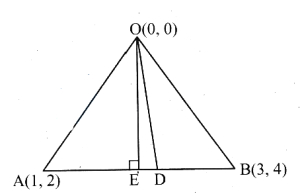
0 likesView Solution
150
MathematicsDifficultMCQMHT CET · 2024
$\triangle OAB$ is formed by the lines $x^2-4xy+y^2=0$ and the line $AB$. The equation of line $AB$ is $2x+3y-1=0$. Then the equation of the median of the triangle drawn from the origin is
A
$7x+8y=0$
B
$7x-8y=0$
C
$8x+7y=0$
D
$8x-7y=0$
Solution
(B) Let $D$ be the midpoint of line $AB$.
Let $A = (x_1, y_1)$ and $B = (x_2, y_2)$.
Then $D = (\frac{x_1+x_2}{2}, \frac{y_1+y_2}{2})$.
The combined equation of sides $OA$ and $OB$ is $x^2-4xy+y^2=0$.
The equation of line $AB$ is $2x+3y-1=0$,so $x = \frac{1-3y}{2}$.
Substituting this into the combined equation:
$(\frac{1-3y}{2})^2 - 4(\frac{1-3y}{2})y + y^2 = 0$
$(1-3y)^2 - 8y(1-3y) + 4y^2 = 0$
$1 - 6y + 9y^2 - 8y + 24y^2 + 4y^2 = 0$
$37y^2 - 14y + 1 = 0$.
Sum of roots $y_1+y_2 = \frac{14}{37}$.
$y$-coordinate of $D = \frac{y_1+y_2}{2} = \frac{7}{37}$.
Since $D$ lies on $2x+3y-1=0$:
$2x + 3(\frac{7}{37}) - 1 = 0$
$2x + \frac{21}{37} - 1 = 0$
$2x = 1 - \frac{21}{37} = \frac{16}{37} \Rightarrow x = \frac{8}{37}$.
Thus,$D = (\frac{8}{37}, \frac{7}{37})$.
The equation of the median $OD$ passing through $(0,0)$ and $(\frac{8}{37}, \frac{7}{37})$ is:
$\frac{y-0}{x-0} = \frac{7/37}{8/37} = \frac{7}{8}$
$8y = 7x \Rightarrow 7x-8y=0$.
Let $A = (x_1, y_1)$ and $B = (x_2, y_2)$.
Then $D = (\frac{x_1+x_2}{2}, \frac{y_1+y_2}{2})$.
The combined equation of sides $OA$ and $OB$ is $x^2-4xy+y^2=0$.
The equation of line $AB$ is $2x+3y-1=0$,so $x = \frac{1-3y}{2}$.
Substituting this into the combined equation:
$(\frac{1-3y}{2})^2 - 4(\frac{1-3y}{2})y + y^2 = 0$
$(1-3y)^2 - 8y(1-3y) + 4y^2 = 0$
$1 - 6y + 9y^2 - 8y + 24y^2 + 4y^2 = 0$
$37y^2 - 14y + 1 = 0$.
Sum of roots $y_1+y_2 = \frac{14}{37}$.
$y$-coordinate of $D = \frac{y_1+y_2}{2} = \frac{7}{37}$.
Since $D$ lies on $2x+3y-1=0$:
$2x + 3(\frac{7}{37}) - 1 = 0$
$2x + \frac{21}{37} - 1 = 0$
$2x = 1 - \frac{21}{37} = \frac{16}{37} \Rightarrow x = \frac{8}{37}$.
Thus,$D = (\frac{8}{37}, \frac{7}{37})$.
The equation of the median $OD$ passing through $(0,0)$ and $(\frac{8}{37}, \frac{7}{37})$ is:
$\frac{y-0}{x-0} = \frac{7/37}{8/37} = \frac{7}{8}$
$8y = 7x \Rightarrow 7x-8y=0$.
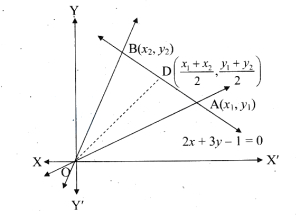
0 likesView Solution
151
MathematicsMediumMCQMHT CET · 2024
The values of $a$ and $b$,so that the function $f(x) = \begin{cases} x+a \sqrt{2} \sin x, & 0 \leq x \leq \frac{\pi}{4} \\ 2 x \cot x+b, & \frac{\pi}{4} < x \leq \frac{\pi}{2} \\ a \cos 2 x-b \sin x, & \frac{\pi}{2} < x \leq \pi \end{cases}$ is continuous for $0 \leq x \leq \pi$,are respectively given by
A
$+\frac{\pi}{12}, -\frac{\pi}{6}$
B
$-\frac{\pi}{6}, -\frac{\pi}{12}$
C
$\frac{\pi}{6}, \frac{\pi}{12}$
D
$\frac{\pi}{6}, -\frac{\pi}{12}$
Solution
(D) Since the function is continuous at $x = \frac{\pi}{4}$ and $x = \frac{\pi}{2}$,we have:
At $x = \frac{\pi}{4}$:
$\lim_{x \to \frac{\pi}{4}^-} (x + a \sqrt{2} \sin x) = \lim_{x \to \frac{\pi}{4}^+} (2x \cot x + b)$
$\frac{\pi}{4} + a \sqrt{2} \cdot \frac{1}{\sqrt{2}} = 2 \cdot \frac{\pi}{4} \cdot 1 + b$
$\frac{\pi}{4} + a = \frac{\pi}{2} + b \implies a - b = \frac{\pi}{4}$ . . . $(i)$
At $x = \frac{\pi}{2}$:
$\lim_{x \to \frac{\pi}{2}^-} (2x \cot x + b) = \lim_{x \to \frac{\pi}{2}^+} (a \cos 2x - b \sin x)$
$2 \cdot \frac{\pi}{2} \cdot 0 + b = a \cos \pi - b \sin \frac{\pi}{2}$
$b = -a - b \implies a + 2b = 0$ . . . $(ii)$
Solving $(i)$ and $(ii)$:
From $(ii)$,$a = -2b$. Substituting in $(i)$:
$-2b - b = \frac{\pi}{4} \implies -3b = \frac{\pi}{4} \implies b = -\frac{\pi}{12}$
Then $a = -2(-\frac{\pi}{12}) = \frac{\pi}{6}$.
Thus,$a = \frac{\pi}{6}$ and $b = -\frac{\pi}{12}$.
At $x = \frac{\pi}{4}$:
$\lim_{x \to \frac{\pi}{4}^-} (x + a \sqrt{2} \sin x) = \lim_{x \to \frac{\pi}{4}^+} (2x \cot x + b)$
$\frac{\pi}{4} + a \sqrt{2} \cdot \frac{1}{\sqrt{2}} = 2 \cdot \frac{\pi}{4} \cdot 1 + b$
$\frac{\pi}{4} + a = \frac{\pi}{2} + b \implies a - b = \frac{\pi}{4}$ . . . $(i)$
At $x = \frac{\pi}{2}$:
$\lim_{x \to \frac{\pi}{2}^-} (2x \cot x + b) = \lim_{x \to \frac{\pi}{2}^+} (a \cos 2x - b \sin x)$
$2 \cdot \frac{\pi}{2} \cdot 0 + b = a \cos \pi - b \sin \frac{\pi}{2}$
$b = -a - b \implies a + 2b = 0$ . . . $(ii)$
Solving $(i)$ and $(ii)$:
From $(ii)$,$a = -2b$. Substituting in $(i)$:
$-2b - b = \frac{\pi}{4} \implies -3b = \frac{\pi}{4} \implies b = -\frac{\pi}{12}$
Then $a = -2(-\frac{\pi}{12}) = \frac{\pi}{6}$.
Thus,$a = \frac{\pi}{6}$ and $b = -\frac{\pi}{12}$.
0 likesView Solution
152
MathematicsMediumMCQMHT CET · 2024
If $f(x) = \begin{cases} \frac{a}{2}(x - |x|), & \text{for } x < 0 \\ 0, & \text{for } x = 0 \\ bx^2 \sin \left( \frac{1}{x} \right), & \text{for } x > 0 \end{cases}$ is continuous at $x = 0$,then
A
$a$ is any real value and $b$ is any real value
B
$a$ is only rational value and $b$ is any real value
C
$a$ is only irrational value and $b$ is any real value
D
$a$ is only rational value and $b$ is only rational value
Solution
(A) For $f(x)$ to be continuous at $x = 0$,we must have $\lim_{x \to 0^{-}} f(x) = f(0) = \lim_{x \to 0^{+}} f(x)$.
First,consider the left-hand limit: $\lim_{x \to 0^{-}} f(x) = \lim_{x \to 0^{-}} \frac{a}{2}(x - |x|)$.
Since $x < 0$,$|x| = -x$,so $\lim_{x \to 0^{-}} \frac{a}{2}(x - (-x)) = \lim_{x \to 0^{-}} \frac{a}{2}(2x) = \lim_{x \to 0^{-}} ax = 0$.
This holds true for any real value of $a$.
Next,consider the right-hand limit: $\lim_{x \to 0^{+}} f(x) = \lim_{x \to 0^{+}} bx^2 \sin \left( \frac{1}{x} \right)$.
We know that $-1 \leq \sin \left( \frac{1}{x} \right) \leq 1$.
Multiplying by $bx^2$,we get $-|bx^2| \leq bx^2 \sin \left( \frac{1}{x} \right) \leq |bx^2|$.
By the Squeeze Theorem,as $x \to 0$,$bx^2 \sin \left( \frac{1}{x} \right) \to 0$.
This holds true for any real value of $b$.
Thus,$f(x)$ is continuous at $x = 0$ for any real values of $a$ and $b$.
First,consider the left-hand limit: $\lim_{x \to 0^{-}} f(x) = \lim_{x \to 0^{-}} \frac{a}{2}(x - |x|)$.
Since $x < 0$,$|x| = -x$,so $\lim_{x \to 0^{-}} \frac{a}{2}(x - (-x)) = \lim_{x \to 0^{-}} \frac{a}{2}(2x) = \lim_{x \to 0^{-}} ax = 0$.
This holds true for any real value of $a$.
Next,consider the right-hand limit: $\lim_{x \to 0^{+}} f(x) = \lim_{x \to 0^{+}} bx^2 \sin \left( \frac{1}{x} \right)$.
We know that $-1 \leq \sin \left( \frac{1}{x} \right) \leq 1$.
Multiplying by $bx^2$,we get $-|bx^2| \leq bx^2 \sin \left( \frac{1}{x} \right) \leq |bx^2|$.
By the Squeeze Theorem,as $x \to 0$,$bx^2 \sin \left( \frac{1}{x} \right) \to 0$.
This holds true for any real value of $b$.
Thus,$f(x)$ is continuous at $x = 0$ for any real values of $a$ and $b$.
0 likesView Solution
153
MathematicsMediumMCQMHT CET · 2024
Let $f(x) = \begin{cases} \frac{1 - \cos 4x}{x^2}, & x < 0 \\ a, & x = 0 \\ \frac{\sqrt{x} + \sqrt{2}}{\sqrt{16 + \sqrt{x}}}, & x > 0 \end{cases}$
If $f(x)$ is continuous at $x = 0$,then the value of $a$ is
If $f(x)$ is continuous at $x = 0$,then the value of $a$ is
A
$8$
B
$4$
C
$1/2$
D
$2$
Solution
(A) For $f(x)$ to be continuous at $x = 0$,the left-hand limit must equal the function value at $x = 0$.
$\lim_{x \rightarrow 0^-} f(x) = f(0)$
Given $f(0) = a$.
$\lim_{x \rightarrow 0^-} \frac{1 - \cos 4x}{x^2} = a$
Using the identity $1 - \cos \theta = 2 \sin^2(\theta/2)$,we have $1 - \cos 4x = 2 \sin^2 2x$.
$\lim_{x \rightarrow 0^-} \frac{2 \sin^2 2x}{x^2} = a$
Multiply and divide by $4$ to use the standard limit $\lim_{\theta \rightarrow 0} \frac{\sin \theta}{\theta} = 1$.
$\lim_{x \rightarrow 0^-} 2 \times \left( \frac{\sin 2x}{2x} \right)^2 \times 4 = a$
$2 \times (1)^2 \times 4 = a$
$a = 8$.
$\lim_{x \rightarrow 0^-} f(x) = f(0)$
Given $f(0) = a$.
$\lim_{x \rightarrow 0^-} \frac{1 - \cos 4x}{x^2} = a$
Using the identity $1 - \cos \theta = 2 \sin^2(\theta/2)$,we have $1 - \cos 4x = 2 \sin^2 2x$.
$\lim_{x \rightarrow 0^-} \frac{2 \sin^2 2x}{x^2} = a$
Multiply and divide by $4$ to use the standard limit $\lim_{\theta \rightarrow 0} \frac{\sin \theta}{\theta} = 1$.
$\lim_{x \rightarrow 0^-} 2 \times \left( \frac{\sin 2x}{2x} \right)^2 \times 4 = a$
$2 \times (1)^2 \times 4 = a$
$a = 8$.
0 likesView Solution
154
MathematicsDifficultMCQMHT CET · 2024
If the function $f(x) = \begin{cases} -2 \sin x, & x \leq \frac{-\pi}{2} \\ A \sin x+B, & \frac{-\pi}{2} < x < \frac{\pi}{2} \\ \cos x, & x \geq \frac{\pi}{2} \end{cases}$ is continuous everywhere,then the values of $A$ and $B$ are respectively
A
$(-1, 1)$
B
$(1, -1)$
C
$(1, 1)$
D
$(-1, -1)$
Solution
(A) Since $f(x)$ is continuous everywhere,it must be continuous at $x = -\frac{\pi}{2}$ and $x = \frac{\pi}{2}$.
At $x = -\frac{\pi}{2}$:
$\lim_{x \rightarrow -\frac{\pi}{2}^-} f(x) = \lim_{x \rightarrow -\frac{\pi}{2}^+} f(x)$
$-2 \sin(-\frac{\pi}{2}) = A \sin(-\frac{\pi}{2}) + B$
$-2(-1) = A(-1) + B$
$2 = -A + B$ ... $(i)$
At $x = \frac{\pi}{2}$:
$\lim_{x \rightarrow \frac{\pi}{2}^-} f(x) = \lim_{x \rightarrow \frac{\pi}{2}^+} f(x)$
$A \sin(\frac{\pi}{2}) + B = \cos(\frac{\pi}{2})$
$A(1) + B = 0$
$A + B = 0$ ... $(ii)$
Adding $(i)$ and $(ii)$:
$(-A + B) + (A + B) = 2 + 0$
$2B = 2 \Rightarrow B = 1$
Substituting $B = 1$ in $(ii)$:
$A + 1 = 0 \Rightarrow A = -1$
Thus,the values are $A = -1$ and $B = 1$.
At $x = -\frac{\pi}{2}$:
$\lim_{x \rightarrow -\frac{\pi}{2}^-} f(x) = \lim_{x \rightarrow -\frac{\pi}{2}^+} f(x)$
$-2 \sin(-\frac{\pi}{2}) = A \sin(-\frac{\pi}{2}) + B$
$-2(-1) = A(-1) + B$
$2 = -A + B$ ... $(i)$
At $x = \frac{\pi}{2}$:
$\lim_{x \rightarrow \frac{\pi}{2}^-} f(x) = \lim_{x \rightarrow \frac{\pi}{2}^+} f(x)$
$A \sin(\frac{\pi}{2}) + B = \cos(\frac{\pi}{2})$
$A(1) + B = 0$
$A + B = 0$ ... $(ii)$
Adding $(i)$ and $(ii)$:
$(-A + B) + (A + B) = 2 + 0$
$2B = 2 \Rightarrow B = 1$
Substituting $B = 1$ in $(ii)$:
$A + 1 = 0 \Rightarrow A = -1$
Thus,the values are $A = -1$ and $B = 1$.
0 likesView Solution
155
MathematicsMediumMCQMHT CET · 2024
Let $f(x) = \frac{1-\tan x}{4x-\pi}$,where $x \neq \frac{\pi}{4}$ and $x \in [0, \frac{\pi}{2}]$. If $f(x)$ is continuous in $[0, \frac{\pi}{2}]$,then $f(\frac{\pi}{4})$ is:
A
$-\frac{1}{2}$
B
$\frac{1}{2}$
C
$1$
D
$-1$
Solution
(A) Since $f(x)$ is continuous in $[0, \frac{\pi}{2}]$,it must be continuous at $x = \frac{\pi}{4}$.
Therefore,$f(\frac{\pi}{4}) = \lim_{x \to \frac{\pi}{4}} f(x) = \lim_{x \to \frac{\pi}{4}} \frac{1-\tan x}{4x-\pi}$.
This is a $\frac{0}{0}$ indeterminate form,so we apply $L$'Hospital's rule by differentiating the numerator and denominator with respect to $x$:
$f(\frac{\pi}{4}) = \lim_{x \to \frac{\pi}{4}} \frac{\frac{d}{dx}(1-\tan x)}{\frac{d}{dx}(4x-\pi)} = \lim_{x \to \frac{\pi}{4}} \frac{-\sec^2 x}{4}$.
Substituting $x = \frac{\pi}{4}$:
$f(\frac{\pi}{4}) = \frac{-\sec^2(\frac{\pi}{4})}{4} = \frac{-(\sqrt{2})^2}{4} = \frac{-2}{4} = -\frac{1}{2}$.
Therefore,$f(\frac{\pi}{4}) = \lim_{x \to \frac{\pi}{4}} f(x) = \lim_{x \to \frac{\pi}{4}} \frac{1-\tan x}{4x-\pi}$.
This is a $\frac{0}{0}$ indeterminate form,so we apply $L$'Hospital's rule by differentiating the numerator and denominator with respect to $x$:
$f(\frac{\pi}{4}) = \lim_{x \to \frac{\pi}{4}} \frac{\frac{d}{dx}(1-\tan x)}{\frac{d}{dx}(4x-\pi)} = \lim_{x \to \frac{\pi}{4}} \frac{-\sec^2 x}{4}$.
Substituting $x = \frac{\pi}{4}$:
$f(\frac{\pi}{4}) = \frac{-\sec^2(\frac{\pi}{4})}{4} = \frac{-(\sqrt{2})^2}{4} = \frac{-2}{4} = -\frac{1}{2}$.
0 likesView Solution
156
MathematicsMediumMCQMHT CET · 2024
If the function $f$ defined on $\left(\frac{\pi}{6}, \frac{\pi}{3}\right)$ by $f(x)=\begin{cases} \frac{\sqrt{2} \cos x-1}{\cot x-1}, & x \neq \frac{\pi}{4} \\ k, & x=\frac{\pi}{4} \end{cases}$ is continuous,then $k$ is equal to
A
$\frac{1}{2}$
B
$2$
C
$1$
D
$\frac{1}{\sqrt{2}}$
Solution
(A) Since $f(x)$ is continuous on $\left(\frac{\pi}{6}, \frac{\pi}{3}\right)$,it must be continuous at $x=\frac{\pi}{4}$.
Therefore,$f\left(\frac{\pi}{4}\right) = \lim_{x \rightarrow \frac{\pi}{4}} f(x) = \lim_{x \rightarrow \frac{\pi}{4}} \frac{\sqrt{2} \cos x-1}{\cot x-1}$.
This is a $\frac{0}{0}$ indeterminate form.
Applying $L$'Hospital's rule,we differentiate the numerator and denominator with respect to $x$:
$k = \lim_{x \rightarrow \frac{\pi}{4}} \frac{\frac{d}{dx}(\sqrt{2} \cos x - 1)}{\frac{d}{dx}(\cot x - 1)} = \lim_{x \rightarrow \frac{\pi}{4}} \frac{-\sqrt{2} \sin x}{-\operatorname{cosec}^2 x} = \lim_{x \rightarrow \frac{\pi}{4}} \frac{\sqrt{2} \sin x}{\operatorname{cosec}^2 x}$.
Substituting $x = \frac{\pi}{4}$:
$k = \frac{\sqrt{2} \sin(\frac{\pi}{4})}{\operatorname{cosec}^2(\frac{\pi}{4})} = \frac{\sqrt{2} \cdot \frac{1}{\sqrt{2}}}{(\sqrt{2})^2} = \frac{1}{2}$.
Therefore,$f\left(\frac{\pi}{4}\right) = \lim_{x \rightarrow \frac{\pi}{4}} f(x) = \lim_{x \rightarrow \frac{\pi}{4}} \frac{\sqrt{2} \cos x-1}{\cot x-1}$.
This is a $\frac{0}{0}$ indeterminate form.
Applying $L$'Hospital's rule,we differentiate the numerator and denominator with respect to $x$:
$k = \lim_{x \rightarrow \frac{\pi}{4}} \frac{\frac{d}{dx}(\sqrt{2} \cos x - 1)}{\frac{d}{dx}(\cot x - 1)} = \lim_{x \rightarrow \frac{\pi}{4}} \frac{-\sqrt{2} \sin x}{-\operatorname{cosec}^2 x} = \lim_{x \rightarrow \frac{\pi}{4}} \frac{\sqrt{2} \sin x}{\operatorname{cosec}^2 x}$.
Substituting $x = \frac{\pi}{4}$:
$k = \frac{\sqrt{2} \sin(\frac{\pi}{4})}{\operatorname{cosec}^2(\frac{\pi}{4})} = \frac{\sqrt{2} \cdot \frac{1}{\sqrt{2}}}{(\sqrt{2})^2} = \frac{1}{2}$.
0 likesView Solution
157
MathematicsDifficultMCQMHT CET · 2024
Let $K$ be the set of all real values of $x$,where the function $f(x) = \sin |x| - |x| + 2(x - \pi) \cos |x|$ is not differentiable. Then the set $K$ is
A
$\{ 0 \}$
B
an empty set
C
$\{ \pi \}$
D
$\{ 0, \pi \}$
Solution
(B) Given $f(x) = \sin |x| - |x| + 2(x - \pi) \cos |x|$.
Since $|x|$ is not differentiable at $x = 0$,we check the differentiability of $f(x)$ at $x = 0$.
For $x \ge 0$,$f(x) = \sin x - x + 2(x - \pi) \cos x$.
For $x < 0$,$f(x) = \sin(-x) - (-x) + 2(x - \pi) \cos(-x) = -\sin x + x + 2(x - \pi) \cos x$.
Now,we find the left-hand derivative $(LHD)$ and right-hand derivative $(RHD)$ at $x = 0$.
$f'(x)$ for $x > 0$ is $\cos x - 1 + 2 \cos x - 2(x - \pi) \sin x = 3 \cos x - 1 - 2(x - \pi) \sin x$.
$f'(0^+) = 3(1) - 1 - 2(-\pi)(0) = 2$.
$f'(x)$ for $x < 0$ is $-\cos x + 1 + 2 \cos x - 2(x - \pi) \sin x = \cos x + 1 - 2(x - \pi) \sin x$.
$f'(0^-) = 1 + 1 - 2(-\pi)(0) = 2$.
Since $f'(0^+) = f'(0^-) = 2$,the function is differentiable at $x = 0$.
Since the function is composed of differentiable functions everywhere else,$f(x)$ is differentiable for all $x \in \mathbb{R}$.
Therefore,the set $K$ of points where $f(x)$ is not differentiable is an empty set.
Since $|x|$ is not differentiable at $x = 0$,we check the differentiability of $f(x)$ at $x = 0$.
For $x \ge 0$,$f(x) = \sin x - x + 2(x - \pi) \cos x$.
For $x < 0$,$f(x) = \sin(-x) - (-x) + 2(x - \pi) \cos(-x) = -\sin x + x + 2(x - \pi) \cos x$.
Now,we find the left-hand derivative $(LHD)$ and right-hand derivative $(RHD)$ at $x = 0$.
$f'(x)$ for $x > 0$ is $\cos x - 1 + 2 \cos x - 2(x - \pi) \sin x = 3 \cos x - 1 - 2(x - \pi) \sin x$.
$f'(0^+) = 3(1) - 1 - 2(-\pi)(0) = 2$.
$f'(x)$ for $x < 0$ is $-\cos x + 1 + 2 \cos x - 2(x - \pi) \sin x = \cos x + 1 - 2(x - \pi) \sin x$.
$f'(0^-) = 1 + 1 - 2(-\pi)(0) = 2$.
Since $f'(0^+) = f'(0^-) = 2$,the function is differentiable at $x = 0$.
Since the function is composed of differentiable functions everywhere else,$f(x)$ is differentiable for all $x \in \mathbb{R}$.
Therefore,the set $K$ of points where $f(x)$ is not differentiable is an empty set.
0 likesView Solution
158
MathematicsMediumMCQMHT CET · 2024
The value of the integral $\int_{-\frac{\pi}{2}}^{\frac{\pi}{2}} \left(x^2 + \log \frac{\pi-x}{\pi+x}\right) \cos x \, dx$ is equal to
A
$0$
B
$\frac{\pi^2}{2} - 4$
C
$\frac{\pi^2}{2}$
D
$\frac{\pi^2}{2} + 4$
Solution
(B) Let $I = \int_{-\frac{\pi}{2}}^{\frac{\pi}{2}} \left[x^2 + \log \left(\frac{\pi-x}{\pi+x}\right)\right] \cos x \, dx$.
We can split the integral as $I = I_1 + I_2$,where $I_1 = \int_{-\frac{\pi}{2}}^{\frac{\pi}{2}} x^2 \cos x \, dx$ and $I_2 = \int_{-\frac{\pi}{2}}^{\frac{\pi}{2}} \log \left(\frac{\pi-x}{\pi+x}\right) \cos x \, dx$.
Since $f(x) = \log \left(\frac{\pi-x}{\pi+x}\right) \cos x$ is an odd function because $f(-x) = \log \left(\frac{\pi+x}{\pi-x}\right) \cos(-x) = -\log \left(\frac{\pi-x}{\pi+x}\right) \cos x = -f(x)$,we have $I_2 = 0$.
Now,$I_1 = \int_{-\frac{\pi}{2}}^{\frac{\pi}{2}} x^2 \cos x \, dx = 2 \int_{0}^{\frac{\pi}{2}} x^2 \cos x \, dx$ (since $x^2 \cos x$ is an even function).
Using integration by parts: $\int x^2 \cos x \, dx = x^2 \sin x - \int 2x \sin x \, dx = x^2 \sin x - 2 \left[x(-\cos x) - \int 1(-\cos x) \, dx\right] = x^2 \sin x + 2x \cos x - 2 \sin x$.
Evaluating from $0$ to $\frac{\pi}{2}$: $2 \left[x^2 \sin x + 2x \cos x - 2 \sin x\right]_{0}^{\frac{\pi}{2}} = 2 \left[\left(\frac{\pi^2}{4} \cdot 1 + 2 \cdot \frac{\pi}{2} \cdot 0 - 2 \cdot 1\right) - (0 + 0 - 0)\right] = 2 \left(\frac{\pi^2}{4} - 2\right) = \frac{\pi^2}{2} - 4$.
Thus,$I = \frac{\pi^2}{2} - 4$.
We can split the integral as $I = I_1 + I_2$,where $I_1 = \int_{-\frac{\pi}{2}}^{\frac{\pi}{2}} x^2 \cos x \, dx$ and $I_2 = \int_{-\frac{\pi}{2}}^{\frac{\pi}{2}} \log \left(\frac{\pi-x}{\pi+x}\right) \cos x \, dx$.
Since $f(x) = \log \left(\frac{\pi-x}{\pi+x}\right) \cos x$ is an odd function because $f(-x) = \log \left(\frac{\pi+x}{\pi-x}\right) \cos(-x) = -\log \left(\frac{\pi-x}{\pi+x}\right) \cos x = -f(x)$,we have $I_2 = 0$.
Now,$I_1 = \int_{-\frac{\pi}{2}}^{\frac{\pi}{2}} x^2 \cos x \, dx = 2 \int_{0}^{\frac{\pi}{2}} x^2 \cos x \, dx$ (since $x^2 \cos x$ is an even function).
Using integration by parts: $\int x^2 \cos x \, dx = x^2 \sin x - \int 2x \sin x \, dx = x^2 \sin x - 2 \left[x(-\cos x) - \int 1(-\cos x) \, dx\right] = x^2 \sin x + 2x \cos x - 2 \sin x$.
Evaluating from $0$ to $\frac{\pi}{2}$: $2 \left[x^2 \sin x + 2x \cos x - 2 \sin x\right]_{0}^{\frac{\pi}{2}} = 2 \left[\left(\frac{\pi^2}{4} \cdot 1 + 2 \cdot \frac{\pi}{2} \cdot 0 - 2 \cdot 1\right) - (0 + 0 - 0)\right] = 2 \left(\frac{\pi^2}{4} - 2\right) = \frac{\pi^2}{2} - 4$.
Thus,$I = \frac{\pi^2}{2} - 4$.
0 likesView Solution
159
MathematicsMediumMCQMHT CET · 2024
If $\int \frac{d x}{3-2 \cos 2 x}=\frac{\tan ^{-1}(f(x))}{\sqrt{5}}+c$,(where $c$ is the constant of integration),then $f(\pi / 4)$ has the value:
A
$-\sqrt{5}$
B
$\sqrt{5}$
C
$\frac{2}{\sqrt{5}}$
D
$\frac{1}{\sqrt{5}}$
Solution
(B) Let $I = \int \frac{dx}{3-2 \cos 2x}$.
Using the identity $\cos 2x = \frac{1-\tan^2 x}{1+\tan^2 x}$,we have:
$I = \int \frac{dx}{3-2(\frac{1-\tan^2 x}{1+\tan^2 x})} = \int \frac{(1+\tan^2 x) dx}{3(1+\tan^2 x) - 2(1-\tan^2 x)}$.
$I = \int \frac{\sec^2 x dx}{3+3\tan^2 x - 2 + 2\tan^2 x} = \int \frac{\sec^2 x dx}{1+5\tan^2 x}$.
Let $t = \tan x$,then $dt = \sec^2 x dx$.
$I = \int \frac{dt}{1+(\sqrt{5}t)^2} = \frac{1}{\sqrt{5}} \tan^{-1}(\sqrt{5}t) + c$.
Substituting $t = \tan x$,we get $I = \frac{1}{\sqrt{5}} \tan^{-1}(\sqrt{5} \tan x) + c$.
Comparing this with $\frac{\tan^{-1}(f(x))}{\sqrt{5}} + c$,we find $f(x) = \sqrt{5} \tan x$.
Therefore,$f(\pi/4) = \sqrt{5} \tan(\pi/4) = \sqrt{5} \times 1 = \sqrt{5}$.
Using the identity $\cos 2x = \frac{1-\tan^2 x}{1+\tan^2 x}$,we have:
$I = \int \frac{dx}{3-2(\frac{1-\tan^2 x}{1+\tan^2 x})} = \int \frac{(1+\tan^2 x) dx}{3(1+\tan^2 x) - 2(1-\tan^2 x)}$.
$I = \int \frac{\sec^2 x dx}{3+3\tan^2 x - 2 + 2\tan^2 x} = \int \frac{\sec^2 x dx}{1+5\tan^2 x}$.
Let $t = \tan x$,then $dt = \sec^2 x dx$.
$I = \int \frac{dt}{1+(\sqrt{5}t)^2} = \frac{1}{\sqrt{5}} \tan^{-1}(\sqrt{5}t) + c$.
Substituting $t = \tan x$,we get $I = \frac{1}{\sqrt{5}} \tan^{-1}(\sqrt{5} \tan x) + c$.
Comparing this with $\frac{\tan^{-1}(f(x))}{\sqrt{5}} + c$,we find $f(x) = \sqrt{5} \tan x$.
Therefore,$f(\pi/4) = \sqrt{5} \tan(\pi/4) = \sqrt{5} \times 1 = \sqrt{5}$.
0 likesView Solution
160
MathematicsMediumMCQMHT CET · 2024
If $\int_{0}^{\frac{\pi}{3}} \frac{\tan \theta}{\sqrt{2 k \sec \theta}} d \theta = 1 - \frac{1}{\sqrt{2}}$,$(k > 0)$,then the value of $k$ is
A
$2$
B
$1$
C
$\frac{1}{2}$
D
$4$
Solution
(A) Let $I = \int_{0}^{\frac{\pi}{3}} \frac{\tan \theta}{\sqrt{2 k \sec \theta}} d \theta$.
$= \frac{1}{\sqrt{2 k}} \int_{0}^{\frac{\pi}{3}} \frac{\sin \theta}{\cos \theta} \times \sqrt{\cos \theta} d \theta$.
$= \frac{1}{\sqrt{2 k}} \int_{0}^{\frac{\pi}{3}} \frac{\sin \theta}{\sqrt{\cos \theta}} d \theta$.
Let $\cos \theta = t$,then $-\sin \theta d \theta = dt$,so $\sin \theta d \theta = -dt$.
When $\theta = 0$,$t = 1$. When $\theta = \frac{\pi}{3}$,$t = \frac{1}{2}$.
$I = \frac{-1}{\sqrt{2 k}} \int_{1}^{\frac{1}{2}} t^{-\frac{1}{2}} dt = \frac{1}{\sqrt{2 k}} \int_{\frac{1}{2}}^{1} t^{-\frac{1}{2}} dt$.
$I = \frac{1}{\sqrt{2 k}} [2\sqrt{t}]_{\frac{1}{2}}^{1} = \frac{2}{\sqrt{2 k}} (1 - \frac{1}{\sqrt{2}}) = \frac{\sqrt{2}}{\sqrt{k}} (1 - \frac{1}{\sqrt{2}})$.
Given $I = 1 - \frac{1}{\sqrt{2}}$,we have $\frac{\sqrt{2}}{\sqrt{k}} = 1$,which implies $\sqrt{k} = \sqrt{2}$,so $k = 2$.
$= \frac{1}{\sqrt{2 k}} \int_{0}^{\frac{\pi}{3}} \frac{\sin \theta}{\cos \theta} \times \sqrt{\cos \theta} d \theta$.
$= \frac{1}{\sqrt{2 k}} \int_{0}^{\frac{\pi}{3}} \frac{\sin \theta}{\sqrt{\cos \theta}} d \theta$.
Let $\cos \theta = t$,then $-\sin \theta d \theta = dt$,so $\sin \theta d \theta = -dt$.
When $\theta = 0$,$t = 1$. When $\theta = \frac{\pi}{3}$,$t = \frac{1}{2}$.
$I = \frac{-1}{\sqrt{2 k}} \int_{1}^{\frac{1}{2}} t^{-\frac{1}{2}} dt = \frac{1}{\sqrt{2 k}} \int_{\frac{1}{2}}^{1} t^{-\frac{1}{2}} dt$.
$I = \frac{1}{\sqrt{2 k}} [2\sqrt{t}]_{\frac{1}{2}}^{1} = \frac{2}{\sqrt{2 k}} (1 - \frac{1}{\sqrt{2}}) = \frac{\sqrt{2}}{\sqrt{k}} (1 - \frac{1}{\sqrt{2}})$.
Given $I = 1 - \frac{1}{\sqrt{2}}$,we have $\frac{\sqrt{2}}{\sqrt{k}} = 1$,which implies $\sqrt{k} = \sqrt{2}$,so $k = 2$.
0 likesView Solution
161
MathematicsDifficultMCQMHT CET · 2024
The value of $\int_{\frac{\pi}{6}}^{\frac{\pi}{4}} \frac{1}{\sin 2 x(\tan ^5 x+\cot ^5 x)} dx$ is
A
$\frac{1}{5}(\frac{\pi}{4}-\tan ^{-1}(\frac{1}{3 \sqrt{3}}))$
B
$\frac{1}{2}(\frac{\pi}{4}-\tan ^{-1}(\frac{1}{9 \sqrt{3}}))$
C
$\frac{1}{10}(\frac{\pi}{4}-\tan ^{-1}(\frac{1}{9 \sqrt{3}}))$
D
$\frac{1}{10}(\frac{\pi}{4}-\tan ^{-1}(\frac{1}{3 \sqrt{3}}))$
Solution
(C) $I = \int_{\frac{\pi}{6}}^{\frac{\pi}{4}} \frac{1}{\sin 2 x(\tan ^5 x+\cot ^5 x)} dx$
Using $\sin 2x = \frac{2 \tan x}{1+\tan ^2 x}$ and $\cot x = \frac{1}{\tan x}$,we get:
$I = \int_{\frac{\pi}{6}}^{\frac{\pi}{4}} \frac{1+\tan ^2 x}{2 \tan x(\tan ^5 x + \frac{1}{\tan ^5 x})} dx$
$I = \int_{\frac{\pi}{6}}^{\frac{\pi}{4}} \frac{\sec ^2 x}{2 \tan x(\frac{\tan ^{10} x + 1}{\tan ^5 x})} dx = \int_{\frac{\pi}{6}}^{\frac{\pi}{4}} \frac{\tan ^4 x \sec ^2 x}{2(\tan ^{10} x + 1)} dx$
Let $\tan x = t$,then $\sec ^2 x dx = dt$.
When $x = \frac{\pi}{6}, t = \frac{1}{\sqrt{3}}$. When $x = \frac{\pi}{4}, t = 1$.
$I = \int_{\frac{1}{\sqrt{3}}}^{1} \frac{t^4}{2(t^{10} + 1)} dt$
Let $t^5 = u$,then $5t^4 dt = du$,so $t^4 dt = \frac{du}{5}$.
When $t = \frac{1}{\sqrt{3}}, u = (\frac{1}{\sqrt{3}})^5 = \frac{1}{9 \sqrt{3}}$. When $t = 1, u = 1$.
$I = \frac{1}{10} \int_{\frac{1}{9 \sqrt{3}}}^{1} \frac{du}{u^2 + 1} = \frac{1}{10} [\tan ^{-1} u]_{\frac{1}{9 \sqrt{3}}}^{1}$
$I = \frac{1}{10} (\tan ^{-1} 1 - \tan ^{-1}(\frac{1}{9 \sqrt{3}})) = \frac{1}{10} (\frac{\pi}{4} - \tan ^{-1}(\frac{1}{9 \sqrt{3}}))$
Using $\sin 2x = \frac{2 \tan x}{1+\tan ^2 x}$ and $\cot x = \frac{1}{\tan x}$,we get:
$I = \int_{\frac{\pi}{6}}^{\frac{\pi}{4}} \frac{1+\tan ^2 x}{2 \tan x(\tan ^5 x + \frac{1}{\tan ^5 x})} dx$
$I = \int_{\frac{\pi}{6}}^{\frac{\pi}{4}} \frac{\sec ^2 x}{2 \tan x(\frac{\tan ^{10} x + 1}{\tan ^5 x})} dx = \int_{\frac{\pi}{6}}^{\frac{\pi}{4}} \frac{\tan ^4 x \sec ^2 x}{2(\tan ^{10} x + 1)} dx$
Let $\tan x = t$,then $\sec ^2 x dx = dt$.
When $x = \frac{\pi}{6}, t = \frac{1}{\sqrt{3}}$. When $x = \frac{\pi}{4}, t = 1$.
$I = \int_{\frac{1}{\sqrt{3}}}^{1} \frac{t^4}{2(t^{10} + 1)} dt$
Let $t^5 = u$,then $5t^4 dt = du$,so $t^4 dt = \frac{du}{5}$.
When $t = \frac{1}{\sqrt{3}}, u = (\frac{1}{\sqrt{3}})^5 = \frac{1}{9 \sqrt{3}}$. When $t = 1, u = 1$.
$I = \frac{1}{10} \int_{\frac{1}{9 \sqrt{3}}}^{1} \frac{du}{u^2 + 1} = \frac{1}{10} [\tan ^{-1} u]_{\frac{1}{9 \sqrt{3}}}^{1}$
$I = \frac{1}{10} (\tan ^{-1} 1 - \tan ^{-1}(\frac{1}{9 \sqrt{3}})) = \frac{1}{10} (\frac{\pi}{4} - \tan ^{-1}(\frac{1}{9 \sqrt{3}}))$
0 likesView Solution
162
MathematicsDifficultMCQMHT CET · 2024
The integral $\int_{\frac{\pi}{6}}^{\frac{\pi}{4}} \frac{d x}{\sin 2 x(\tan ^5 x+\cot ^5 x)}$ is equal to
A
$\frac{1}{5}(\frac{\pi}{4}-\tan ^{-1}(\frac{1}{3 \sqrt{3}}))$
B
$\frac{1}{10}(\frac{\pi}{4}-\tan ^{-1}(\frac{1}{9 \sqrt{3}}))$
C
$\frac{1}{20} \tan ^{-1}(\frac{1}{9 \sqrt{3}})$
D
$\frac{\pi}{40}$
Solution
(B) Let $I = \int_{\frac{\pi}{6}}^{\frac{\pi}{4}} \frac{d x}{\sin 2 x(\tan ^5 x+\cot ^5 x)}$
Using $\sin 2x = 2 \sin x \cos x$ and $\cot x = \frac{1}{\tan x}$,we have:
$I = \int_{\frac{\pi}{6}}^{\frac{\pi}{4}} \frac{d x}{2 \sin x \cos x(\tan ^5 x+\frac{1}{\tan ^5 x})}$
Multiply numerator and denominator by $\sec^2 x$:
$I = \frac{1}{2} \int_{\frac{\pi}{6}}^{\frac{\pi}{4}} \frac{\sec^2 x}{\tan x(\frac{\tan^{10} x+1}{\tan^5 x})} dx = \frac{1}{2} \int_{\frac{\pi}{6}}^{\frac{\pi}{4}} \frac{\tan^4 x \sec^2 x}{\tan^{10} x+1} dx$
Let $t = \tan^5 x$,then $dt = 5 \tan^4 x \sec^2 x dx$,so $\tan^4 x \sec^2 x dx = \frac{dt}{5}$.
When $x = \frac{\pi}{6}$,$t = (\frac{1}{\sqrt{3}})^5 = \frac{1}{9 \sqrt{3}}$. When $x = \frac{\pi}{4}$,$t = 1^5 = 1$.
$I = \frac{1}{2} \int_{\frac{1}{9 \sqrt{3}}}^{1} \frac{dt/5}{t^2+1} = \frac{1}{10} [\tan^{-1} t]_{\frac{1}{9 \sqrt{3}}}^{1}$
$I = \frac{1}{10} (\tan^{-1}(1) - \tan^{-1}(\frac{1}{9 \sqrt{3}})) = \frac{1}{10} (\frac{\pi}{4} - \tan^{-1}(\frac{1}{9 \sqrt{3}}))$
Using $\sin 2x = 2 \sin x \cos x$ and $\cot x = \frac{1}{\tan x}$,we have:
$I = \int_{\frac{\pi}{6}}^{\frac{\pi}{4}} \frac{d x}{2 \sin x \cos x(\tan ^5 x+\frac{1}{\tan ^5 x})}$
Multiply numerator and denominator by $\sec^2 x$:
$I = \frac{1}{2} \int_{\frac{\pi}{6}}^{\frac{\pi}{4}} \frac{\sec^2 x}{\tan x(\frac{\tan^{10} x+1}{\tan^5 x})} dx = \frac{1}{2} \int_{\frac{\pi}{6}}^{\frac{\pi}{4}} \frac{\tan^4 x \sec^2 x}{\tan^{10} x+1} dx$
Let $t = \tan^5 x$,then $dt = 5 \tan^4 x \sec^2 x dx$,so $\tan^4 x \sec^2 x dx = \frac{dt}{5}$.
When $x = \frac{\pi}{6}$,$t = (\frac{1}{\sqrt{3}})^5 = \frac{1}{9 \sqrt{3}}$. When $x = \frac{\pi}{4}$,$t = 1^5 = 1$.
$I = \frac{1}{2} \int_{\frac{1}{9 \sqrt{3}}}^{1} \frac{dt/5}{t^2+1} = \frac{1}{10} [\tan^{-1} t]_{\frac{1}{9 \sqrt{3}}}^{1}$
$I = \frac{1}{10} (\tan^{-1}(1) - \tan^{-1}(\frac{1}{9 \sqrt{3}})) = \frac{1}{10} (\frac{\pi}{4} - \tan^{-1}(\frac{1}{9 \sqrt{3}}))$
0 likesView Solution
163
MathematicsMediumMCQMHT CET · 2024
$\int_0^a \frac{x-a}{x+a} dx =$
A
$a - 2a \log 2$
B
$a - a \log 2$
C
$a + 2a \log 2$
D
$a + a \log 2$
Solution
(A) Let $I = \int_0^a \frac{x-a}{x+a} dx$.
Substitute $t = x + a$,so $x = t - a$ and $dx = dt$.
When $x = 0$,$t = a$.
When $x = a$,$t = 2a$.
Thus,$I = \int_a^{2a} \frac{(t-a)-a}{t} dt = \int_a^{2a} \frac{t-2a}{t} dt$.
$I = \int_a^{2a} (1 - \frac{2a}{t}) dt$.
$I = [t]_a^{2a} - 2a [\log |t|]_a^{2a}$.
$I = (2a - a) - 2a (\log 2a - \log a)$.
$I = a - 2a \log(\frac{2a}{a})$.
$I = a - 2a \log 2$.
Substitute $t = x + a$,so $x = t - a$ and $dx = dt$.
When $x = 0$,$t = a$.
When $x = a$,$t = 2a$.
Thus,$I = \int_a^{2a} \frac{(t-a)-a}{t} dt = \int_a^{2a} \frac{t-2a}{t} dt$.
$I = \int_a^{2a} (1 - \frac{2a}{t}) dt$.
$I = [t]_a^{2a} - 2a [\log |t|]_a^{2a}$.
$I = (2a - a) - 2a (\log 2a - \log a)$.
$I = a - 2a \log(\frac{2a}{a})$.
$I = a - 2a \log 2$.
0 likesView Solution
164
MathematicsMediumMCQMHT CET · 2024
The value of the integral $\int_{-2}^0 (x^3 + 3x^2 + 3x + 5 + (x + 1) \cos(x + 1)) \, dx$ is equal to:
A
$0$
B
$6$
C
$4$
D
$8$
Solution
(D) Let $I = \int_{-2}^0 (x^3 + 3x^2 + 3x + 5 + (x + 1) \cos(x + 1)) \, dx$.
We can rewrite the expression as:
$I = \int_{-2}^0 ((x + 1)^3 + 4 + (x + 1) \cos(x + 1)) \, dx$.
Substitute $t = x + 1$,then $dt = dx$.
When $x = -2$,$t = -1$. When $x = 0$,$t = 1$.
So,$I = \int_{-1}^1 (t^3 + 4 + t \cos t) \, dt$.
We know that $t^3$ and $t \cos t$ are odd functions,and the integral of an odd function over a symmetric interval $[-a, a]$ is $0$.
Therefore,$I = \int_{-1}^1 t^3 \, dt + \int_{-1}^1 4 \, dt + \int_{-1}^1 t \cos t \, dt$.
$I = 0 + \int_{-1}^1 4 \, dt + 0$.
$I = 4 [t]_{-1}^1 = 4(1 - (-1)) = 4(2) = 8$.
The correct value is $8$.
We can rewrite the expression as:
$I = \int_{-2}^0 ((x + 1)^3 + 4 + (x + 1) \cos(x + 1)) \, dx$.
Substitute $t = x + 1$,then $dt = dx$.
When $x = -2$,$t = -1$. When $x = 0$,$t = 1$.
So,$I = \int_{-1}^1 (t^3 + 4 + t \cos t) \, dt$.
We know that $t^3$ and $t \cos t$ are odd functions,and the integral of an odd function over a symmetric interval $[-a, a]$ is $0$.
Therefore,$I = \int_{-1}^1 t^3 \, dt + \int_{-1}^1 4 \, dt + \int_{-1}^1 t \cos t \, dt$.
$I = 0 + \int_{-1}^1 4 \, dt + 0$.
$I = 4 [t]_{-1}^1 = 4(1 - (-1)) = 4(2) = 8$.
The correct value is $8$.
0 likesView Solution
165
MathematicsMediumMCQMHT CET · 2024
Let $f$ and $g$ be continuous functions on $[0, a]$ such that $f(x)=f(a-x)$ and $g(x)+g(a-x)=4$,then $\int_0^a f(x) g(x) d x$ is equal to
A
$4 \int_0^a f(x) d x$
B
$\int_0^a f(x) d x$
C
$2 \int_0^{a} f(x) d x$
D
$-3 \int_0^a f(x) d x$
Solution
(C) Let $I = \int_0^a f(x) g(x) dx$.
Using the property $\int_0^a h(x) dx = \int_0^a h(a-x) dx$,we have:
$I = \int_0^a f(a-x) g(a-x) dx$.
Since $f(x) = f(a-x)$ and $g(a-x) = 4 - g(x)$,we substitute these into the integral:
$I = \int_0^a f(x) (4 - g(x)) dx$.
$I = 4 \int_0^a f(x) dx - \int_0^a f(x) g(x) dx$.
$I = 4 \int_0^a f(x) dx - I$.
$2I = 4 \int_0^a f(x) dx$.
$I = 2 \int_0^a f(x) dx$.
Using the property $\int_0^a h(x) dx = \int_0^a h(a-x) dx$,we have:
$I = \int_0^a f(a-x) g(a-x) dx$.
Since $f(x) = f(a-x)$ and $g(a-x) = 4 - g(x)$,we substitute these into the integral:
$I = \int_0^a f(x) (4 - g(x)) dx$.
$I = 4 \int_0^a f(x) dx - \int_0^a f(x) g(x) dx$.
$I = 4 \int_0^a f(x) dx - I$.
$2I = 4 \int_0^a f(x) dx$.
$I = 2 \int_0^a f(x) dx$.
0 likesView Solution
166
MathematicsMediumMCQMHT CET · 2024
The value of $I=\int_{\sqrt{\log _e 2}}^{\sqrt{\log _e 3}} \frac{x \sin x^2}{\sin x^2+\sin \left(\log _e 6-x^2\right)} d x$ is
A
$\frac{1}{4} \log _e \frac{3}{2}$
B
$\frac{1}{2} \log _e \frac{3}{2}$
C
$\log _{e} \frac{3}{2}$
D
$\frac{1}{6} \log _e \frac{3}{2}$
Solution
(A) Let $I=\int_{\sqrt{\log 2}}^{\sqrt{\log 3}} \frac{x \sin x^2}{\sin x^2+\sin (\log 6-x^2)} d x$.
Put $x^2=t$,then $2x \, dx = dt$,so $x \, dx = \frac{1}{2} dt$.
The limits change as follows: when $x = \sqrt{\log 2}$,$t = \log 2$; when $x = \sqrt{\log 3}$,$t = \log 3$.
Thus,$I = \frac{1}{2} \int_{\log 2}^{\log 3} \frac{\sin t}{\sin t + \sin (\log 6 - t)} dt \quad \dots (i)$
Using the property $\int_a^b f(t) dt = \int_a^b f(a+b-t) dt$,we get:
$I = \frac{1}{2} \int_{\log 2}^{\log 3} \frac{\sin (\log 2 + \log 3 - t)}{\sin (\log 2 + \log 3 - t) + \sin (\log 6 - (\log 2 + \log 3 - t))} dt$
$I = \frac{1}{2} \int_{\log 2}^{\log 3} \frac{\sin (\log 6 - t)}{\sin (\log 6 - t) + \sin t} dt \quad \dots (ii)$
Adding $(i)$ and $(ii)$:
$2I = \frac{1}{2} \int_{\log 2}^{\log 3} \frac{\sin t + \sin (\log 6 - t)}{\sin t + \sin (\log 6 - t)} dt$
$2I = \frac{1}{2} \int_{\log 2}^{\log 3} 1 \, dt = \frac{1}{2} [t]_{\log 2}^{\log 3} = \frac{1}{2} (\log 3 - \log 2) = \frac{1}{2} \log \left(\frac{3}{2}\right)$
$I = \frac{1}{4} \log \left(\frac{3}{2}\right)$.
Put $x^2=t$,then $2x \, dx = dt$,so $x \, dx = \frac{1}{2} dt$.
The limits change as follows: when $x = \sqrt{\log 2}$,$t = \log 2$; when $x = \sqrt{\log 3}$,$t = \log 3$.
Thus,$I = \frac{1}{2} \int_{\log 2}^{\log 3} \frac{\sin t}{\sin t + \sin (\log 6 - t)} dt \quad \dots (i)$
Using the property $\int_a^b f(t) dt = \int_a^b f(a+b-t) dt$,we get:
$I = \frac{1}{2} \int_{\log 2}^{\log 3} \frac{\sin (\log 2 + \log 3 - t)}{\sin (\log 2 + \log 3 - t) + \sin (\log 6 - (\log 2 + \log 3 - t))} dt$
$I = \frac{1}{2} \int_{\log 2}^{\log 3} \frac{\sin (\log 6 - t)}{\sin (\log 6 - t) + \sin t} dt \quad \dots (ii)$
Adding $(i)$ and $(ii)$:
$2I = \frac{1}{2} \int_{\log 2}^{\log 3} \frac{\sin t + \sin (\log 6 - t)}{\sin t + \sin (\log 6 - t)} dt$
$2I = \frac{1}{2} \int_{\log 2}^{\log 3} 1 \, dt = \frac{1}{2} [t]_{\log 2}^{\log 3} = \frac{1}{2} (\log 3 - \log 2) = \frac{1}{2} \log \left(\frac{3}{2}\right)$
$I = \frac{1}{4} \log \left(\frac{3}{2}\right)$.
0 likesView Solution
167
MathematicsMediumMCQMHT CET · 2024
The integral $\int_{\frac{-1}{2}}^{\frac{1}{2}} \left([x] + \log_{e}\left(\frac{1+x}{1-x}\right)\right) dx$,where $[x]$ represents the greatest integer function,equals:
A
$-\frac{1}{2}$
B
$\log_{e}\left(\frac{1}{2}\right)$
C
$\frac{1}{2}$
D
$2 \log_{e}\left(\frac{1}{2}\right)$
Solution
(A) Let $I = \int_{\frac{-1}{2}}^{\frac{1}{2}} \left([x] + \log_{e}\left(\frac{1+x}{1-x}\right)\right) dx$.
We can split the integral as:
$I = \int_{\frac{-1}{2}}^{0} [x] dx + \int_{0}^{\frac{1}{2}} [x] dx + \int_{\frac{-1}{2}}^{\frac{1}{2}} \log_{e}\left(\frac{1+x}{1-x}\right) dx$.
Let $g(x) = \log_{e}\left(\frac{1+x}{1-x}\right)$.
Then $g(-x) = \log_{e}\left(\frac{1-x}{1+x}\right) = \log_{e}\left(\left(\frac{1+x}{1-x}\right)^{-1}\right) = -\log_{e}\left(\frac{1+x}{1-x}\right) = -g(x)$.
Since $g(-x) = -g(x)$,$g(x)$ is an odd function.
Therefore,$\int_{\frac{-1}{2}}^{\frac{1}{2}} g(x) dx = 0$.
Now,for the greatest integer function $[x]$:
In the interval $[-\frac{1}{2}, 0)$,$[x] = -1$.
In the interval $[0, \frac{1}{2}]$,$[x] = 0$.
Thus,$I = \int_{\frac{-1}{2}}^{0} (-1) dx + \int_{0}^{\frac{1}{2}} (0) dx + 0$.
$I = [-x]_{\frac{-1}{2}}^{0} = -(0 - (-\frac{1}{2})) = -\frac{1}{2}$.
We can split the integral as:
$I = \int_{\frac{-1}{2}}^{0} [x] dx + \int_{0}^{\frac{1}{2}} [x] dx + \int_{\frac{-1}{2}}^{\frac{1}{2}} \log_{e}\left(\frac{1+x}{1-x}\right) dx$.
Let $g(x) = \log_{e}\left(\frac{1+x}{1-x}\right)$.
Then $g(-x) = \log_{e}\left(\frac{1-x}{1+x}\right) = \log_{e}\left(\left(\frac{1+x}{1-x}\right)^{-1}\right) = -\log_{e}\left(\frac{1+x}{1-x}\right) = -g(x)$.
Since $g(-x) = -g(x)$,$g(x)$ is an odd function.
Therefore,$\int_{\frac{-1}{2}}^{\frac{1}{2}} g(x) dx = 0$.
Now,for the greatest integer function $[x]$:
In the interval $[-\frac{1}{2}, 0)$,$[x] = -1$.
In the interval $[0, \frac{1}{2}]$,$[x] = 0$.
Thus,$I = \int_{\frac{-1}{2}}^{0} (-1) dx + \int_{0}^{\frac{1}{2}} (0) dx + 0$.
$I = [-x]_{\frac{-1}{2}}^{0} = -(0 - (-\frac{1}{2})) = -\frac{1}{2}$.
0 likesView Solution
168
MathematicsDifficultMCQMHT CET · 2024
The value of $I = \int_{-\frac{\pi}{2}}^{\frac{\pi}{2}} \frac{x^2 \cos x}{1+e^{-x}} \,dx$ is equal to
A
$\frac{\pi^2}{4}-2$
B
$\frac{\pi^2}{4}+2$
C
$\pi^2-e^{\frac{\pi}{2}}$
D
$\pi^2+e^{\frac{\pi}{2}}$
Solution
(A) Let $I = \int_{-\frac{\pi}{2}}^{\frac{\pi}{2}} \frac{x^2 \cos x}{1+e^{-x}} \,dx \quad ...(i)$
Using the property $\int_{a}^{b} f(x) dx = \int_{a}^{b} f(a+b-x) dx$, we get:
$I = \int_{-\frac{\pi}{2}}^{\frac{\pi}{2}} \frac{(-x)^2 \cos(-x)}{1+e^{-(-x)}} \,dx = \int_{-\frac{\pi}{2}}^{\frac{\pi}{2}} \frac{x^2 \cos x}{1+e^x} \,dx \quad ...(ii)$
Adding $(i)$ and $(ii)$:
$2I = \int_{-\frac{\pi}{2}}^{\frac{\pi}{2}} x^2 \cos x \left( \frac{1}{1+e^{-x}} + \frac{1}{1+e^x} \right) dx$
Since $\frac{1}{1+e^{-x}} + \frac{1}{1+e^x} = \frac{e^x}{e^x+1} + \frac{1}{1+e^x} = 1$, we have:
$2I = \int_{-\frac{\pi}{2}}^{\frac{\pi}{2}} x^2 \cos x \,dx$
Since $f(x) = x^2 \cos x$ is an even function, $2I = 2 \int_{0}^{\frac{\pi}{2}} x^2 \cos x \,dx$, so $I = \int_{0}^{\frac{\pi}{2}} x^2 \cos x \,dx$
Using integration by parts:
$I = [x^2 \sin x]_0^{\frac{\pi}{2}} - \int_{0}^{\frac{\pi}{2}} 2x \sin x \,dx$
$I = [x^2 \sin x]_0^{\frac{\pi}{2}} - 2([-x \cos x]_0^{\frac{\pi}{2}} + \int_{0}^{\frac{\pi}{2}} \cos x \,dx)$
$I = [x^2 \sin x + 2x \cos x - 2 \sin x]_0^{\frac{\pi}{2}}$
$I = ((\frac{\pi}{2})^2 \sin(\frac{\pi}{2}) + 2(\frac{\pi}{2}) \cos(\frac{\pi}{2}) - 2 \sin(\frac{\pi}{2})) - (0 + 0 - 0)$
$I = \frac{\pi^2}{4}(1) + 0 - 2(1) = \frac{\pi^2}{4} - 2$
Using the property $\int_{a}^{b} f(x) dx = \int_{a}^{b} f(a+b-x) dx$, we get:
$I = \int_{-\frac{\pi}{2}}^{\frac{\pi}{2}} \frac{(-x)^2 \cos(-x)}{1+e^{-(-x)}} \,dx = \int_{-\frac{\pi}{2}}^{\frac{\pi}{2}} \frac{x^2 \cos x}{1+e^x} \,dx \quad ...(ii)$
Adding $(i)$ and $(ii)$:
$2I = \int_{-\frac{\pi}{2}}^{\frac{\pi}{2}} x^2 \cos x \left( \frac{1}{1+e^{-x}} + \frac{1}{1+e^x} \right) dx$
Since $\frac{1}{1+e^{-x}} + \frac{1}{1+e^x} = \frac{e^x}{e^x+1} + \frac{1}{1+e^x} = 1$, we have:
$2I = \int_{-\frac{\pi}{2}}^{\frac{\pi}{2}} x^2 \cos x \,dx$
Since $f(x) = x^2 \cos x$ is an even function, $2I = 2 \int_{0}^{\frac{\pi}{2}} x^2 \cos x \,dx$, so $I = \int_{0}^{\frac{\pi}{2}} x^2 \cos x \,dx$
Using integration by parts:
$I = [x^2 \sin x]_0^{\frac{\pi}{2}} - \int_{0}^{\frac{\pi}{2}} 2x \sin x \,dx$
$I = [x^2 \sin x]_0^{\frac{\pi}{2}} - 2([-x \cos x]_0^{\frac{\pi}{2}} + \int_{0}^{\frac{\pi}{2}} \cos x \,dx)$
$I = [x^2 \sin x + 2x \cos x - 2 \sin x]_0^{\frac{\pi}{2}}$
$I = ((\frac{\pi}{2})^2 \sin(\frac{\pi}{2}) + 2(\frac{\pi}{2}) \cos(\frac{\pi}{2}) - 2 \sin(\frac{\pi}{2})) - (0 + 0 - 0)$
$I = \frac{\pi^2}{4}(1) + 0 - 2(1) = \frac{\pi^2}{4} - 2$
0 likesView Solution
169
MathematicsMediumMCQMHT CET · 2024
The value of $\int_0^{\frac{\pi}{2}}|\sin x-\cos x| d x$ is
A
$2 \sqrt{2}+1$
B
$2(\sqrt{2}+1)$
C
$2(\sqrt{2}-1)$
D
$2 \sqrt{2}-1$
Solution
(C) Let $I = \int_0^{\frac{\pi}{2}}|\sin x-\cos x| d x$.
The function $|\sin x - \cos x|$ changes sign at $x = \frac{\pi}{4}$ in the interval $[0, \frac{\pi}{2}]$.
For $0 \leq x \leq \frac{\pi}{4}$,$\cos x \geq \sin x$,so $|\sin x - \cos x| = \cos x - \sin x$.
For $\frac{\pi}{4} \leq x \leq \frac{\pi}{2}$,$\sin x \geq \cos x$,so $|\sin x - \cos x| = \sin x - \cos x$.
Thus,$I = \int_0^{\frac{\pi}{4}}(\cos x - \sin x) d x + \int_{\frac{\pi}{4}}^{\frac{\pi}{2}}(\sin x - \cos x) d x$.
Evaluating the integrals:
$I = [\sin x + \cos x]_0^{\frac{\pi}{4}} + [-\cos x - \sin x]_{\frac{\pi}{4}}^{\frac{\pi}{2}}$.
$I = [(\sin \frac{\pi}{4} + \cos \frac{\pi}{4}) - (\sin 0 + \cos 0)] + [(-\cos \frac{\pi}{2} - \sin \frac{\pi}{2}) - (-\cos \frac{\pi}{4} - \sin \frac{\pi}{4})]$.
$I = [(\frac{1}{\sqrt{2}} + \frac{1}{\sqrt{2}}) - (0 + 1)] + [(0 - 1) - (-\frac{1}{\sqrt{2}} - \frac{1}{\sqrt{2}})]$.
$I = [\frac{2}{\sqrt{2}} - 1] + [-1 + \frac{2}{\sqrt{2}}]$.
$I = \sqrt{2} - 1 - 1 + \sqrt{2} = 2\sqrt{2} - 2 = 2(\sqrt{2} - 1)$.
The function $|\sin x - \cos x|$ changes sign at $x = \frac{\pi}{4}$ in the interval $[0, \frac{\pi}{2}]$.
For $0 \leq x \leq \frac{\pi}{4}$,$\cos x \geq \sin x$,so $|\sin x - \cos x| = \cos x - \sin x$.
For $\frac{\pi}{4} \leq x \leq \frac{\pi}{2}$,$\sin x \geq \cos x$,so $|\sin x - \cos x| = \sin x - \cos x$.
Thus,$I = \int_0^{\frac{\pi}{4}}(\cos x - \sin x) d x + \int_{\frac{\pi}{4}}^{\frac{\pi}{2}}(\sin x - \cos x) d x$.
Evaluating the integrals:
$I = [\sin x + \cos x]_0^{\frac{\pi}{4}} + [-\cos x - \sin x]_{\frac{\pi}{4}}^{\frac{\pi}{2}}$.
$I = [(\sin \frac{\pi}{4} + \cos \frac{\pi}{4}) - (\sin 0 + \cos 0)] + [(-\cos \frac{\pi}{2} - \sin \frac{\pi}{2}) - (-\cos \frac{\pi}{4} - \sin \frac{\pi}{4})]$.
$I = [(\frac{1}{\sqrt{2}} + \frac{1}{\sqrt{2}}) - (0 + 1)] + [(0 - 1) - (-\frac{1}{\sqrt{2}} - \frac{1}{\sqrt{2}})]$.
$I = [\frac{2}{\sqrt{2}} - 1] + [-1 + \frac{2}{\sqrt{2}}]$.
$I = \sqrt{2} - 1 - 1 + \sqrt{2} = 2\sqrt{2} - 2 = 2(\sqrt{2} - 1)$.
0 likesView Solution
170
MathematicsDifficultMCQMHT CET · 2024
The value of $\int_{-\frac{\pi}{4}}^{\frac{\pi}{4}} (\sin x)^{-4} \,dx$ is
A
$\frac{-3}{2}$
B
$0$
C
$\infty$
D
$\frac{8}{3}$
Solution
(C) Let $I = \int_{-\frac{\pi}{4}}^{\frac{\pi}{4}} (\sin x)^{-4} \,dx$.
Since $f(x) = (\sin x)^{-4} = \frac{1}{\sin^4 x}$ is an even function,we have:
$I = 2 \int_{0}^{\frac{\pi}{4}} \csc^4 x \,dx$.
Using the identity $\csc^2 x = 1 + \cot^2 x$,we get:
$I = 2 \int_{0}^{\frac{\pi}{4}} (1 + \cot^2 x) \csc^2 x \,dx$.
Let $u = \cot x$,then $du = -\csc^2 x \,dx$.
As $x \to 0^+$,$u \to \infty$. When $x = \frac{\pi}{4}$,$u = 1$.
$I = 2 \int_{\infty}^{1} (1 + u^2) (-du) = 2 \int_{1}^{\infty} (1 + u^2) \,du$.
Evaluating this integral: $2 [u + \frac{u^3}{3}]_{1}^{\infty} = \infty$.
The integral is divergent.
Since $f(x) = (\sin x)^{-4} = \frac{1}{\sin^4 x}$ is an even function,we have:
$I = 2 \int_{0}^{\frac{\pi}{4}} \csc^4 x \,dx$.
Using the identity $\csc^2 x = 1 + \cot^2 x$,we get:
$I = 2 \int_{0}^{\frac{\pi}{4}} (1 + \cot^2 x) \csc^2 x \,dx$.
Let $u = \cot x$,then $du = -\csc^2 x \,dx$.
As $x \to 0^+$,$u \to \infty$. When $x = \frac{\pi}{4}$,$u = 1$.
$I = 2 \int_{\infty}^{1} (1 + u^2) (-du) = 2 \int_{1}^{\infty} (1 + u^2) \,du$.
Evaluating this integral: $2 [u + \frac{u^3}{3}]_{1}^{\infty} = \infty$.
The integral is divergent.
0 likesView Solution
171
MathematicsMediumMCQMHT CET · 2024
$\int_0^{\frac{\pi}{4}} \log \left(\frac{\sin x+\cos x}{\cos x}\right) d x=$
A
$\frac{\pi}{2} \log 2$
B
$\frac{\pi}{4} \log 2$
C
$\frac{\pi}{6} \log 2$
D
$\frac{\pi}{8} \log 2$
Solution
(D) Let $I = \int_0^{\frac{\pi}{4}} \log \left(\frac{\sin x + \cos x}{\cos x}\right) dx$.
Simplifying the integrand,we get $I = \int_0^{\frac{\pi}{4}} \log(1 + \tan x) dx$.
Using the property $\int_0^a f(x) dx = \int_0^a f(a-x) dx$,we have:
$I = \int_0^{\frac{\pi}{4}} \log \left[1 + \tan \left(\frac{\pi}{4} - x\right)\right] dx$.
Using the formula $\tan(A-B) = \frac{\tan A - \tan B}{1 + \tan A \tan B}$,we get:
$I = \int_0^{\frac{\pi}{4}} \log \left[1 + \frac{1 - \tan x}{1 + \tan x}\right] dx$.
$I = \int_0^{\frac{\pi}{4}} \log \left(\frac{1 + \tan x + 1 - \tan x}{1 + \tan x}\right) dx$.
$I = \int_0^{\frac{\pi}{4}} \log \left(\frac{2}{1 + \tan x}\right) dx$.
$I = \int_0^{\frac{\pi}{4}} (\log 2 - \log(1 + \tan x)) dx$.
$I = \int_0^{\frac{\pi}{4}} \log 2 dx - \int_0^{\frac{\pi}{4}} \log(1 + \tan x) dx$.
$I = \log 2 [x]_0^{\frac{\pi}{4}} - I$.
$2I = \frac{\pi}{4} \log 2$.
$I = \frac{\pi}{8} \log 2$.
Simplifying the integrand,we get $I = \int_0^{\frac{\pi}{4}} \log(1 + \tan x) dx$.
Using the property $\int_0^a f(x) dx = \int_0^a f(a-x) dx$,we have:
$I = \int_0^{\frac{\pi}{4}} \log \left[1 + \tan \left(\frac{\pi}{4} - x\right)\right] dx$.
Using the formula $\tan(A-B) = \frac{\tan A - \tan B}{1 + \tan A \tan B}$,we get:
$I = \int_0^{\frac{\pi}{4}} \log \left[1 + \frac{1 - \tan x}{1 + \tan x}\right] dx$.
$I = \int_0^{\frac{\pi}{4}} \log \left(\frac{1 + \tan x + 1 - \tan x}{1 + \tan x}\right) dx$.
$I = \int_0^{\frac{\pi}{4}} \log \left(\frac{2}{1 + \tan x}\right) dx$.
$I = \int_0^{\frac{\pi}{4}} (\log 2 - \log(1 + \tan x)) dx$.
$I = \int_0^{\frac{\pi}{4}} \log 2 dx - \int_0^{\frac{\pi}{4}} \log(1 + \tan x) dx$.
$I = \log 2 [x]_0^{\frac{\pi}{4}} - I$.
$2I = \frac{\pi}{4} \log 2$.
$I = \frac{\pi}{8} \log 2$.
0 likesView Solution
172
MathematicsEasyMCQMHT CET · 2024
$\int_{0.2}^{3.5} [x] \, dx = $ (where $[x]$ is the greatest integer function not greater than $x$)
A
$4$
B
$4.2$
C
$4.5$
D
$4.4$
Solution
(C) We evaluate the definite integral by splitting the interval based on the jumps of the greatest integer function $[x]$:
$\int_{0.2}^{3.5} [x] \, dx = \int_{0.2}^{1} [x] \, dx + \int_{1}^{2} [x] \, dx + \int_{2}^{3} [x] \, dx + \int_{3}^{3.5} [x] \, dx$
Since $[x] = 0$ for $x \in [0.2, 1)$,$[x] = 1$ for $x \in [1, 2)$,$[x] = 2$ for $x \in [2, 3)$,and $[x] = 3$ for $x \in [3, 3.5)$:
$= \int_{0.2}^{1} 0 \, dx + \int_{1}^{2} 1 \, dx + \int_{2}^{3} 2 \, dx + \int_{3}^{3.5} 3 \, dx$
$= 0 + [x]_{1}^{2} + 2[x]_{2}^{3} + 3[x]_{3}^{3.5}$
$= 0 + (2 - 1) + 2(3 - 2) + 3(3.5 - 3)$
$= 0 + 1 + 2(1) + 3(0.5)$
$= 1 + 2 + 1.5 = 4.5$
$\int_{0.2}^{3.5} [x] \, dx = \int_{0.2}^{1} [x] \, dx + \int_{1}^{2} [x] \, dx + \int_{2}^{3} [x] \, dx + \int_{3}^{3.5} [x] \, dx$
Since $[x] = 0$ for $x \in [0.2, 1)$,$[x] = 1$ for $x \in [1, 2)$,$[x] = 2$ for $x \in [2, 3)$,and $[x] = 3$ for $x \in [3, 3.5)$:
$= \int_{0.2}^{1} 0 \, dx + \int_{1}^{2} 1 \, dx + \int_{2}^{3} 2 \, dx + \int_{3}^{3.5} 3 \, dx$
$= 0 + [x]_{1}^{2} + 2[x]_{2}^{3} + 3[x]_{3}^{3.5}$
$= 0 + (2 - 1) + 2(3 - 2) + 3(3.5 - 3)$
$= 0 + 1 + 2(1) + 3(0.5)$
$= 1 + 2 + 1.5 = 4.5$
0 likesView Solution
173
MathematicsMediumMCQMHT CET · 2024
If $I = \int_0^{\frac{\pi}{4}} \log (1 + \tan x) \, dx$,then the value of $I$ is
A
$\frac{\pi}{16} \log 2$
B
$\frac{\pi}{2} \log 2$
C
$\frac{\pi}{8} \log 2$
D
$\frac{\pi}{4} \log 2$
Solution
(C) Let $I = \int_0^{\frac{\pi}{4}} \log (1 + \tan x) \, dx$.
Using the property $\int_0^a f(x) \, dx = \int_0^a f(a - x) \, dx$,we get:
$I = \int_0^{\frac{\pi}{4}} \log \left[ 1 + \tan \left( \frac{\pi}{4} - x \right) \right] \, dx$
Since $\tan \left( \frac{\pi}{4} - x \right) = \frac{\tan \frac{\pi}{4} - \tan x}{1 + \tan \frac{\pi}{4} \tan x} = \frac{1 - \tan x}{1 + \tan x}$,we have:
$I = \int_0^{\frac{\pi}{4}} \log \left( 1 + \frac{1 - \tan x}{1 + \tan x} \right) \, dx$
$I = \int_0^{\frac{\pi}{4}} \log \left( \frac{1 + \tan x + 1 - \tan x}{1 + \tan x} \right) \, dx$
$I = \int_0^{\frac{\pi}{4}} \log \left( \frac{2}{1 + \tan x} \right) \, dx$
$I = \int_0^{\frac{\pi}{4}} (\log 2 - \log (1 + \tan x)) \, dx$
$I = \int_0^{\frac{\pi}{4}} \log 2 \, dx - \int_0^{\frac{\pi}{4}} \log (1 + \tan x) \, dx$
$I = \log 2 [x]_0^{\frac{\pi}{4}} - I$
$2I = \frac{\pi}{4} \log 2$
$I = \frac{\pi}{8} \log 2$
Using the property $\int_0^a f(x) \, dx = \int_0^a f(a - x) \, dx$,we get:
$I = \int_0^{\frac{\pi}{4}} \log \left[ 1 + \tan \left( \frac{\pi}{4} - x \right) \right] \, dx$
Since $\tan \left( \frac{\pi}{4} - x \right) = \frac{\tan \frac{\pi}{4} - \tan x}{1 + \tan \frac{\pi}{4} \tan x} = \frac{1 - \tan x}{1 + \tan x}$,we have:
$I = \int_0^{\frac{\pi}{4}} \log \left( 1 + \frac{1 - \tan x}{1 + \tan x} \right) \, dx$
$I = \int_0^{\frac{\pi}{4}} \log \left( \frac{1 + \tan x + 1 - \tan x}{1 + \tan x} \right) \, dx$
$I = \int_0^{\frac{\pi}{4}} \log \left( \frac{2}{1 + \tan x} \right) \, dx$
$I = \int_0^{\frac{\pi}{4}} (\log 2 - \log (1 + \tan x)) \, dx$
$I = \int_0^{\frac{\pi}{4}} \log 2 \, dx - \int_0^{\frac{\pi}{4}} \log (1 + \tan x) \, dx$
$I = \log 2 [x]_0^{\frac{\pi}{4}} - I$
$2I = \frac{\pi}{4} \log 2$
$I = \frac{\pi}{8} \log 2$
0 likesView Solution
174
MathematicsEasyMCQMHT CET · 2024
If $[x]$ denotes the greatest integer function,then $\int_0^5 x^2[x] d x=$
A
$\frac{244}{3}$
B
$\frac{316}{3}$
C
$\frac{200}{3}$
D
$\frac{400}{3}$
Solution
(D) We split the integral based on the definition of the greatest integer function $[x]$ in the interval $[0, 5]$:
$\int_0^5 x^2[x] d x = \int_0^1 x^2(0) d x + \int_1^2 x^2(1) d x + \int_2^3 x^2(2) d x + \int_3^4 x^2(3) d x + \int_4^5 x^2(4) d x$
$= 0 + \left[\frac{x^3}{3}\right]_1^2 + 2\left[\frac{x^3}{3}\right]_2^3 + 3\left[\frac{x^3}{3}\right]_3^4 + 4\left[\frac{x^3}{3}\right]_4^5$
$= \frac{1}{3}(8 - 1) + \frac{2}{3}(27 - 8) + \frac{3}{3}(64 - 27) + \frac{4}{3}(125 - 64)$
$= \frac{7}{3} + \frac{38}{3} + 37 + \frac{244}{3}$
$= \frac{7 + 38 + 111 + 244}{3} = \frac{400}{3}$
$\int_0^5 x^2[x] d x = \int_0^1 x^2(0) d x + \int_1^2 x^2(1) d x + \int_2^3 x^2(2) d x + \int_3^4 x^2(3) d x + \int_4^5 x^2(4) d x$
$= 0 + \left[\frac{x^3}{3}\right]_1^2 + 2\left[\frac{x^3}{3}\right]_2^3 + 3\left[\frac{x^3}{3}\right]_3^4 + 4\left[\frac{x^3}{3}\right]_4^5$
$= \frac{1}{3}(8 - 1) + \frac{2}{3}(27 - 8) + \frac{3}{3}(64 - 27) + \frac{4}{3}(125 - 64)$
$= \frac{7}{3} + \frac{38}{3} + 37 + \frac{244}{3}$
$= \frac{7 + 38 + 111 + 244}{3} = \frac{400}{3}$
0 likesView Solution
175
MathematicsMediumMCQMHT CET · 2024
$\int_0^{\frac{\pi}{4}} \frac{\sec ^2 x}{(1+\tan x)(2+\tan x)} d x=$
A
$\log \left(\frac{3}{4}\right)$
B
$\frac{1}{3} \log \left(\frac{4}{3}\right)$
C
$\log \left(\frac{4}{3}\right)$
D
$\frac{1}{4} \log \left(\frac{3}{4}\right)$
Solution
(C) Let $1+\tan x = t$. Then $\sec^2 x \, dx = dt$.
When $x = 0$,$t = 1+\tan(0) = 1$.
When $x = \frac{\pi}{4}$,$t = 1+\tan(\frac{\pi}{4}) = 2$.
The integral becomes:
$\int_1^2 \frac{dt}{t(t+1)}$.
Using partial fractions: $\frac{1}{t(t+1)} = \frac{1}{t} - \frac{1}{t+1}$.
So,the integral is $\int_1^2 \left( \frac{1}{t} - \frac{1}{t+1} \right) dt$.
$= [\log|t| - \log|t+1|]_1^2 = [\log|\frac{t}{t+1}|]_1^2$.
$= \log(\frac{2}{3}) - \log(\frac{1}{2}) = \log(\frac{2/3}{1/2}) = \log(\frac{4}{3})$.
When $x = 0$,$t = 1+\tan(0) = 1$.
When $x = \frac{\pi}{4}$,$t = 1+\tan(\frac{\pi}{4}) = 2$.
The integral becomes:
$\int_1^2 \frac{dt}{t(t+1)}$.
Using partial fractions: $\frac{1}{t(t+1)} = \frac{1}{t} - \frac{1}{t+1}$.
So,the integral is $\int_1^2 \left( \frac{1}{t} - \frac{1}{t+1} \right) dt$.
$= [\log|t| - \log|t+1|]_1^2 = [\log|\frac{t}{t+1}|]_1^2$.
$= \log(\frac{2}{3}) - \log(\frac{1}{2}) = \log(\frac{2/3}{1/2}) = \log(\frac{4}{3})$.
0 likesView Solution
176
MathematicsEasyMCQMHT CET · 2024
The value of $\int_{-\frac{\pi}{2}}^{\frac{\pi}{2}} \frac{\sin ^2 x}{1+2^x} \,d x$ is
A
$\frac{\pi}{4}$
B
$\frac{\pi}{8}$
C
$\frac{\pi}{2}$
D
$4 \pi$
Solution
(A) Let $I = \int_{-\frac{\pi}{2}}^{\frac{\pi}{2}} \frac{\sin ^2 x}{1+2^x} \,d x$ ... $(i)$
Using the property $\int_{a}^{b} f(x) \,d x = \int_{a}^{b} f(a+b-x) \,d x$, we get:
$I = \int_{-\frac{\pi}{2}}^{\frac{\pi}{2}} \frac{\sin ^2 (-x)}{1+2^{-x}} \,d x = \int_{-\frac{\pi}{2}}^{\frac{\pi}{2}} \frac{\sin ^2 x}{1+\frac{1}{2^x}} \,d x = \int_{-\frac{\pi}{2}}^{\frac{\pi}{2}} \frac{2^x \sin ^2 x}{2^x+1} \,d x$ ... (ii)
Adding $(i)$ and (ii):
$2I = \int_{-\frac{\pi}{2}}^{\frac{\pi}{2}} \frac{\sin ^2 x (1+2^x)}{1+2^x} \,d x = \int_{-\frac{\pi}{2}}^{\frac{\pi}{2}} \sin ^2 x \,d x$
Since $\sin ^2 x$ is an even function, $2I = 2 \int_{0}^{\frac{\pi}{2}} \sin ^2 x \,d x$, so $I = \int_{0}^{\frac{\pi}{2}} \sin ^2 x \,d x$.
Using $\sin ^2 x = \frac{1-\cos 2x}{2}$:
$I = \int_{0}^{\frac{\pi}{2}} \frac{1-\cos 2x}{2} \,d x = \frac{1}{2} [x - \frac{\sin 2x}{2}]_{0}^{\frac{\pi}{2}} = \frac{1}{2} [(\frac{\pi}{2} - 0) - (0 - 0)] = \frac{\pi}{4}$.
Using the property $\int_{a}^{b} f(x) \,d x = \int_{a}^{b} f(a+b-x) \,d x$, we get:
$I = \int_{-\frac{\pi}{2}}^{\frac{\pi}{2}} \frac{\sin ^2 (-x)}{1+2^{-x}} \,d x = \int_{-\frac{\pi}{2}}^{\frac{\pi}{2}} \frac{\sin ^2 x}{1+\frac{1}{2^x}} \,d x = \int_{-\frac{\pi}{2}}^{\frac{\pi}{2}} \frac{2^x \sin ^2 x}{2^x+1} \,d x$ ... (ii)
Adding $(i)$ and (ii):
$2I = \int_{-\frac{\pi}{2}}^{\frac{\pi}{2}} \frac{\sin ^2 x (1+2^x)}{1+2^x} \,d x = \int_{-\frac{\pi}{2}}^{\frac{\pi}{2}} \sin ^2 x \,d x$
Since $\sin ^2 x$ is an even function, $2I = 2 \int_{0}^{\frac{\pi}{2}} \sin ^2 x \,d x$, so $I = \int_{0}^{\frac{\pi}{2}} \sin ^2 x \,d x$.
Using $\sin ^2 x = \frac{1-\cos 2x}{2}$:
$I = \int_{0}^{\frac{\pi}{2}} \frac{1-\cos 2x}{2} \,d x = \frac{1}{2} [x - \frac{\sin 2x}{2}]_{0}^{\frac{\pi}{2}} = \frac{1}{2} [(\frac{\pi}{2} - 0) - (0 - 0)] = \frac{\pi}{4}$.
0 likesView Solution
177
MathematicsMediumMCQMHT CET · 2024
$\int_{\frac{\pi}{3}}^{\frac{\pi}{2}} \frac{\sqrt{1+\cos x}}{(1-\cos x)^{\frac{5}{2}}} d x=$
A
$\frac{1}{2}$
B
$\frac{-1}{2}$
C
$\frac{3}{2}$
D
$\frac{-3}{2}$
Solution
(C) Let $I = \int_{\pi / 3}^{\pi / 2} \frac{\sqrt{1+\cos x}}{(1-\cos x)^{\frac{5}{2}}} d x$.
We know that $\sqrt{1+\cos x} = \sqrt{2\cos^2(x/2)} = \sqrt{2}\cos(x/2)$ and $\sqrt{1-\cos x} = \sqrt{2\sin^2(x/2)} = \sqrt{2}\sin(x/2)$.
Alternatively,multiply numerator and denominator by $\sqrt{1-\cos x}$:
$I = \int_{\pi / 3}^{\pi / 2} \frac{\sqrt{1-\cos^2 x}}{(1-\cos x)^3} d x = \int_{\pi / 3}^{\pi / 2} \frac{\sin x}{(1-\cos x)^3} d x$.
Let $t = 1 - \cos x$,then $dt = \sin x \, dx$.
When $x = \pi/3$,$t = 1 - \cos(\pi/3) = 1 - 1/2 = 1/2$.
When $x = \pi/2$,$t = 1 - \cos(\pi/2) = 1 - 0 = 1$.
Thus,$I = \int_{1/2}^{1} t^{-3} dt = \left[ \frac{t^{-2}}{-2} \right]_{1/2}^{1} = -\frac{1}{2} [1 - (1/2)^{-2}] = -\frac{1}{2} [1 - 4] = -\frac{1}{2} (-3) = \frac{3}{2}$.
We know that $\sqrt{1+\cos x} = \sqrt{2\cos^2(x/2)} = \sqrt{2}\cos(x/2)$ and $\sqrt{1-\cos x} = \sqrt{2\sin^2(x/2)} = \sqrt{2}\sin(x/2)$.
Alternatively,multiply numerator and denominator by $\sqrt{1-\cos x}$:
$I = \int_{\pi / 3}^{\pi / 2} \frac{\sqrt{1-\cos^2 x}}{(1-\cos x)^3} d x = \int_{\pi / 3}^{\pi / 2} \frac{\sin x}{(1-\cos x)^3} d x$.
Let $t = 1 - \cos x$,then $dt = \sin x \, dx$.
When $x = \pi/3$,$t = 1 - \cos(\pi/3) = 1 - 1/2 = 1/2$.
When $x = \pi/2$,$t = 1 - \cos(\pi/2) = 1 - 0 = 1$.
Thus,$I = \int_{1/2}^{1} t^{-3} dt = \left[ \frac{t^{-2}}{-2} \right]_{1/2}^{1} = -\frac{1}{2} [1 - (1/2)^{-2}] = -\frac{1}{2} [1 - 4] = -\frac{1}{2} (-3) = \frac{3}{2}$.
0 likesView Solution
178
MathematicsEasyMCQMHT CET · 2024
For the matrix $A=\left[\begin{array}{ccc}2 & 0 & -1 \\ 3 & 1 & 2 \\ -1 & 1 & 2\end{array}\right]$,the matrix of cofactors is
A
$\left[\begin{array}{ccc}0 & 8 & -4 \\ -1 & 3 & 2 \\ 1 & -7 & 2\end{array}\right]$
B
$\left[\begin{array}{ccc}0 & -8 & 4 \\ -1 & 3 & -2 \\ 1 & -7 & 2\end{array}\right]$
C
$\left[\begin{array}{ccc}0 & 8 & -4 \\ 1 & -3 & 2 \\ -1 & 7 & -2\end{array}\right]$
D
$\left[\begin{array}{ccc}0 & -8 & 4 \\ -1 & 3 & 2 \\ -1 & -7 & 2\end{array}\right]$
Solution
(B) To find the matrix of cofactors,we calculate the cofactor $A_{ij}$ for each element $a_{ij}$ using the formula $A_{ij} = (-1)^{i+j} M_{ij}$,where $M_{ij}$ is the minor of the element $a_{ij}$.
$A_{11} = (-1)^{1+1} \begin{vmatrix} 1 & 2 \\ 1 & 2 \end{vmatrix} = (1)(2-2) = 0$
$A_{12} = (-1)^{1+2} \begin{vmatrix} 3 & 2 \\ -1 & 2 \end{vmatrix} = (-1)(6 - (-2)) = -8$
$A_{13} = (-1)^{1+3} \begin{vmatrix} 3 & 1 \\ -1 & 1 \end{vmatrix} = (1)(3 - (-1)) = 4$
$A_{21} = (-1)^{2+1} \begin{vmatrix} 0 & -1 \\ 1 & 2 \end{vmatrix} = (-1)(0 - (-1)) = -1$
$A_{22} = (-1)^{2+2} \begin{vmatrix} 2 & -1 \\ -1 & 2 \end{vmatrix} = (1)(4 - 1) = 3$
$A_{23} = (-1)^{2+3} \begin{vmatrix} 2 & 0 \\ -1 & 1 \end{vmatrix} = (-1)(2 - 0) = -2$
$A_{31} = (-1)^{3+1} \begin{vmatrix} 0 & -1 \\ 1 & 2 \end{vmatrix} = (1)(0 - (-1)) = 1$
$A_{32} = (-1)^{3+2} \begin{vmatrix} 2 & -1 \\ 3 & 2 \end{vmatrix} = (-1)(4 - (-3)) = -7$
$A_{33} = (-1)^{3+3} \begin{vmatrix} 2 & 0 \\ 3 & 1 \end{vmatrix} = (1)(2 - 0) = 2$
Thus,the matrix of cofactors is $\left[\begin{array}{ccc}0 & -8 & 4 \\ -1 & 3 & -2 \\ 1 & -7 & 2\end{array}\right]$.
$A_{11} = (-1)^{1+1} \begin{vmatrix} 1 & 2 \\ 1 & 2 \end{vmatrix} = (1)(2-2) = 0$
$A_{12} = (-1)^{1+2} \begin{vmatrix} 3 & 2 \\ -1 & 2 \end{vmatrix} = (-1)(6 - (-2)) = -8$
$A_{13} = (-1)^{1+3} \begin{vmatrix} 3 & 1 \\ -1 & 1 \end{vmatrix} = (1)(3 - (-1)) = 4$
$A_{21} = (-1)^{2+1} \begin{vmatrix} 0 & -1 \\ 1 & 2 \end{vmatrix} = (-1)(0 - (-1)) = -1$
$A_{22} = (-1)^{2+2} \begin{vmatrix} 2 & -1 \\ -1 & 2 \end{vmatrix} = (1)(4 - 1) = 3$
$A_{23} = (-1)^{2+3} \begin{vmatrix} 2 & 0 \\ -1 & 1 \end{vmatrix} = (-1)(2 - 0) = -2$
$A_{31} = (-1)^{3+1} \begin{vmatrix} 0 & -1 \\ 1 & 2 \end{vmatrix} = (1)(0 - (-1)) = 1$
$A_{32} = (-1)^{3+2} \begin{vmatrix} 2 & -1 \\ 3 & 2 \end{vmatrix} = (-1)(4 - (-3)) = -7$
$A_{33} = (-1)^{3+3} \begin{vmatrix} 2 & 0 \\ 3 & 1 \end{vmatrix} = (1)(2 - 0) = 2$
Thus,the matrix of cofactors is $\left[\begin{array}{ccc}0 & -8 & 4 \\ -1 & 3 & -2 \\ 1 & -7 & 2\end{array}\right]$.
0 likesView Solution
179
MathematicsMediumMCQMHT CET · 2024
If $w = \frac{-1-i \sqrt{3}}{2}$ where $i = \sqrt{-1}$,then the value of $\left|\begin{array}{ccc}1 & w & w^2 \\ w & w^2 & 1 \\ w^2 & 1 & w\end{array}\right|$ is
A
-$1$
B
$0$
C
$1$
D
$3$
Solution
(B) Given $w = \frac{-1-i \sqrt{3}}{2}$,which is the complex cube root of unity,denoted as $\omega$.
We know that $1 + \omega + \omega^2 = 0$ and $\omega^3 = 1$.
Let $\Delta = \left|\begin{array}{ccc}1 & \omega & \omega^2 \\ \omega & \omega^2 & 1 \\ \omega^2 & 1 & \omega\end{array}\right|$.
Applying the column operation $C_1 \to C_1 + C_2 + C_3$:
$\Delta = \left|\begin{array}{ccc}1 + \omega + \omega^2 & \omega & \omega^2 \\ \omega + \omega^2 + 1 & \omega^2 & 1 \\ \omega^2 + 1 + \omega & 1 & \omega\end{array}\right|$
Since $1 + \omega + \omega^2 = 0$,we get:
$\Delta = \left|\begin{array}{ccc}0 & \omega & \omega^2 \\ 0 & \omega^2 & 1 \\ 0 & 1 & \omega\end{array}\right|$
Since all elements of the first column are $0$,the value of the determinant is $0$.
We know that $1 + \omega + \omega^2 = 0$ and $\omega^3 = 1$.
Let $\Delta = \left|\begin{array}{ccc}1 & \omega & \omega^2 \\ \omega & \omega^2 & 1 \\ \omega^2 & 1 & \omega\end{array}\right|$.
Applying the column operation $C_1 \to C_1 + C_2 + C_3$:
$\Delta = \left|\begin{array}{ccc}1 + \omega + \omega^2 & \omega & \omega^2 \\ \omega + \omega^2 + 1 & \omega^2 & 1 \\ \omega^2 + 1 + \omega & 1 & \omega\end{array}\right|$
Since $1 + \omega + \omega^2 = 0$,we get:
$\Delta = \left|\begin{array}{ccc}0 & \omega & \omega^2 \\ 0 & \omega^2 & 1 \\ 0 & 1 & \omega\end{array}\right|$
Since all elements of the first column are $0$,the value of the determinant is $0$.
0 likesView Solution
180
MathematicsEasyMCQMHT CET · 2024
Let $X = \begin{bmatrix} a \\ b \\ c \end{bmatrix}$,$A = \begin{bmatrix} 1 & -1 & 2 \\ 2 & 0 & 1 \\ 3 & 2 & 1 \end{bmatrix}$,and $B = \begin{bmatrix} 3 \\ 1 \\ 4 \end{bmatrix}$. If $AX = B$,then the value of $2a - 3b + 4c$ is:
A
$0$
B
$-4$
C
$6$
D
$4$
Solution
(D) Given the matrix equation $AX = B$:
$\begin{bmatrix} 1 & -1 & 2 \\ 2 & 0 & 1 \\ 3 & 2 & 1 \end{bmatrix} \begin{bmatrix} a \\ b \\ c \end{bmatrix} = \begin{bmatrix} 3 \\ 1 \\ 4 \end{bmatrix}$
This gives the system of linear equations:
$a - b + 2c = 3$ $(i)$
$2a + c = 1$ $(ii)$
$3a + 2b + c = 4$ $(iii)$
From $(ii)$,we have $c = 1 - 2a$.
Substitute $c$ into $(i)$: $a - b + 2(1 - 2a) = 3 \implies a - b + 2 - 4a = 3 \implies -3a - b = 1 \implies b = -3a - 1$.
Substitute $a, b, c$ into $(iii)$: $3a + 2(-3a - 1) + (1 - 2a) = 4$
$3a - 6a - 2 + 1 - 2a = 4$
$-5a - 1 = 4$
$-5a = 5 \implies a = -1$.
Now find $b$ and $c$:
$b = -3(-1) - 1 = 3 - 1 = 2$.
$c = 1 - 2(-1) = 1 + 2 = 3$.
Finally,calculate $2a - 3b + 4c$:
$2(-1) - 3(2) + 4(3) = -2 - 6 + 12 = 4$.
$\begin{bmatrix} 1 & -1 & 2 \\ 2 & 0 & 1 \\ 3 & 2 & 1 \end{bmatrix} \begin{bmatrix} a \\ b \\ c \end{bmatrix} = \begin{bmatrix} 3 \\ 1 \\ 4 \end{bmatrix}$
This gives the system of linear equations:
$a - b + 2c = 3$ $(i)$
$2a + c = 1$ $(ii)$
$3a + 2b + c = 4$ $(iii)$
From $(ii)$,we have $c = 1 - 2a$.
Substitute $c$ into $(i)$: $a - b + 2(1 - 2a) = 3 \implies a - b + 2 - 4a = 3 \implies -3a - b = 1 \implies b = -3a - 1$.
Substitute $a, b, c$ into $(iii)$: $3a + 2(-3a - 1) + (1 - 2a) = 4$
$3a - 6a - 2 + 1 - 2a = 4$
$-5a - 1 = 4$
$-5a = 5 \implies a = -1$.
Now find $b$ and $c$:
$b = -3(-1) - 1 = 3 - 1 = 2$.
$c = 1 - 2(-1) = 1 + 2 = 3$.
Finally,calculate $2a - 3b + 4c$:
$2(-1) - 3(2) + 4(3) = -2 - 6 + 12 = 4$.
0 likesView Solution
181
MathematicsEasyMCQMHT CET · 2024
Let $A = \begin{bmatrix} 1 & -1 & 1 \\ 2 & 1 & -3 \\ 1 & 1 & 1 \end{bmatrix}$ and $B = \begin{bmatrix} 4 \\ 0 \\ 2 \end{bmatrix}$ such that $AX = B$,then $X =$
A
$\begin{bmatrix} -1 \\ 2 \\ 1 \end{bmatrix}$
B
$\begin{bmatrix} 2 \\ -1 \\ 1 \end{bmatrix}$
C
$\begin{bmatrix} -1 \\ 1 \\ 2 \end{bmatrix}$
D
$\begin{bmatrix} -2 \\ 1 \\ -1 \end{bmatrix}$
Solution
(B) Given the matrix equation $AX = B$,we have:
$\begin{bmatrix} 1 & -1 & 1 \\ 2 & 1 & -3 \\ 1 & 1 & 1 \end{bmatrix} \begin{bmatrix} x_1 \\ x_2 \\ x_3 \end{bmatrix} = \begin{bmatrix} 4 \\ 0 \\ 2 \end{bmatrix}$
Applying row operations $R_2 \rightarrow R_2 - 2R_1$ and $R_3 \rightarrow R_3 - R_1$:
$\begin{bmatrix} 1 & -1 & 1 \\ 0 & 3 & -5 \\ 0 & 2 & 0 \end{bmatrix} \begin{bmatrix} x_1 \\ x_2 \\ x_3 \end{bmatrix} = \begin{bmatrix} 4 \\ -8 \\ -2 \end{bmatrix}$
From the third row,$2x_2 = -2$,which gives $x_2 = -1$.
Substituting $x_2 = -1$ into the second row equation $3x_2 - 5x_3 = -8$:
$3(-1) - 5x_3 = -8 \Rightarrow -3 - 5x_3 = -8 \Rightarrow -5x_3 = -5 \Rightarrow x_3 = 1$.
Substituting $x_2 = -1$ and $x_3 = 1$ into the first row equation $x_1 - x_2 + x_3 = 4$:
$x_1 - (-1) + 1 = 4 \Rightarrow x_1 + 1 + 1 = 4 \Rightarrow x_1 = 2$.
Thus,$X = \begin{bmatrix} 2 \\ -1 \\ 1 \end{bmatrix}$.
$\begin{bmatrix} 1 & -1 & 1 \\ 2 & 1 & -3 \\ 1 & 1 & 1 \end{bmatrix} \begin{bmatrix} x_1 \\ x_2 \\ x_3 \end{bmatrix} = \begin{bmatrix} 4 \\ 0 \\ 2 \end{bmatrix}$
Applying row operations $R_2 \rightarrow R_2 - 2R_1$ and $R_3 \rightarrow R_3 - R_1$:
$\begin{bmatrix} 1 & -1 & 1 \\ 0 & 3 & -5 \\ 0 & 2 & 0 \end{bmatrix} \begin{bmatrix} x_1 \\ x_2 \\ x_3 \end{bmatrix} = \begin{bmatrix} 4 \\ -8 \\ -2 \end{bmatrix}$
From the third row,$2x_2 = -2$,which gives $x_2 = -1$.
Substituting $x_2 = -1$ into the second row equation $3x_2 - 5x_3 = -8$:
$3(-1) - 5x_3 = -8 \Rightarrow -3 - 5x_3 = -8 \Rightarrow -5x_3 = -5 \Rightarrow x_3 = 1$.
Substituting $x_2 = -1$ and $x_3 = 1$ into the first row equation $x_1 - x_2 + x_3 = 4$:
$x_1 - (-1) + 1 = 4 \Rightarrow x_1 + 1 + 1 = 4 \Rightarrow x_1 = 2$.
Thus,$X = \begin{bmatrix} 2 \\ -1 \\ 1 \end{bmatrix}$.
0 likesView Solution
182
MathematicsEasyMCQMHT CET · 2024
The differential equation $\left[\frac{1+\left(\frac{dy}{dx}\right)^2}{\left(\frac{d^2y}{dx^2}\right)^{\frac{3}{2}}}\right]^2 = kx$ is of
A
order $= 2$,degree $= 3$
B
order $= 3$,degree $= 2$
C
order $= 2$,degree $= 2$
D
order $= 3$,degree $= 3$
Solution
(A) Given the differential equation: $\left[\frac{1+\left(\frac{dy}{dx}\right)^2}{\left(\frac{d^2y}{dx^2}\right)^{\frac{3}{2}}}\right]^2 = kx$
First,simplify the expression by removing the fractional exponent:
$\frac{\left[1+\left(\frac{dy}{dx}\right)^2\right]^2}{\left(\frac{d^2y}{dx^2}\right)^3} = kx$
Now,multiply both sides by $\left(\frac{d^2y}{dx^2}\right)^3$:
$\left[1+\left(\frac{dy}{dx}\right)^2\right]^2 = kx \left(\frac{d^2y}{dx^2}\right)^3$
The order of a differential equation is the highest derivative present,which is $\frac{d^2y}{dx^2}$,so the order is $2$.
The degree is the power of the highest derivative when the equation is expressed as a polynomial in derivatives,which is $3$.
Therefore,the order is $2$ and the degree is $3$.
First,simplify the expression by removing the fractional exponent:
$\frac{\left[1+\left(\frac{dy}{dx}\right)^2\right]^2}{\left(\frac{d^2y}{dx^2}\right)^3} = kx$
Now,multiply both sides by $\left(\frac{d^2y}{dx^2}\right)^3$:
$\left[1+\left(\frac{dy}{dx}\right)^2\right]^2 = kx \left(\frac{d^2y}{dx^2}\right)^3$
The order of a differential equation is the highest derivative present,which is $\frac{d^2y}{dx^2}$,so the order is $2$.
The degree is the power of the highest derivative when the equation is expressed as a polynomial in derivatives,which is $3$.
Therefore,the order is $2$ and the degree is $3$.
0 likesView Solution
183
MathematicsEasyMCQMHT CET · 2024
If the order and degree of the differential equation $\left(\frac{d^2 y}{dx^2}\right)^5 + 4 \frac{\left(\frac{d^2 y}{dx^2}\right)^5}{\left(\frac{d^3 y}{dx^3}\right)} + \frac{d^3 y}{dx^3} = \sin x$ are $m$ and $n$ respectively,then the value of $(m^2 + n^2)$ is equal to
A
$29$
B
$13$
C
$5$
D
$8$
Solution
(B) Given the differential equation: $\left(\frac{d^2 y}{dx^2}\right)^5 + 4 \frac{\left(\frac{d^2 y}{dx^2}\right)^5}{\frac{d^3 y}{dx^3}} + \frac{d^3 y}{dx^3} = \sin x$.
Multiply the entire equation by $\frac{d^3 y}{dx^3}$ to eliminate the fraction:
$\left(\frac{d^2 y}{dx^2}\right)^5 \cdot \frac{d^3 y}{dx^3} + 4\left(\frac{d^2 y}{dx^2}\right)^5 + \left(\frac{d^3 y}{dx^3}\right)^2 = \sin x \cdot \frac{d^3 y}{dx^3}$.
The highest order derivative present is $\frac{d^3 y}{dx^3}$,so the order $m = 3$.
The highest power of the highest order derivative is $2$,so the degree $n = 2$.
Therefore,$m^2 + n^2 = 3^2 + 2^2 = 9 + 4 = 13$.
Multiply the entire equation by $\frac{d^3 y}{dx^3}$ to eliminate the fraction:
$\left(\frac{d^2 y}{dx^2}\right)^5 \cdot \frac{d^3 y}{dx^3} + 4\left(\frac{d^2 y}{dx^2}\right)^5 + \left(\frac{d^3 y}{dx^3}\right)^2 = \sin x \cdot \frac{d^3 y}{dx^3}$.
The highest order derivative present is $\frac{d^3 y}{dx^3}$,so the order $m = 3$.
The highest power of the highest order derivative is $2$,so the degree $n = 2$.
Therefore,$m^2 + n^2 = 3^2 + 2^2 = 9 + 4 = 13$.
0 likesView Solution
184
MathematicsEasyMCQMHT CET · 2024
The order of the differential equation,whose general solution is given by $y = (c_1 + c_2) \cos (x + c_3) - c_4 e^{x + c_5}$,where $c_1, c_2, c_3, c_4$ and $c_5$ are arbitrary constants,is
A
$5$
B
$3$
C
$4$
D
$2$
Solution
(B) Given the general solution: $y = (c_1 + c_2) \cos (x + c_3) - c_4 e^{x + c_5}$.
We can simplify the expression by grouping the constants:
Let $A = c_1 + c_2$ and $B = c_4 e^{c_5}$.
Then the equation becomes $y = A \cos (x + c_3) - B e^x$.
Expanding the cosine term: $y = A (\cos x \cos c_3 - \sin x \sin c_3) - B e^x$.
$y = (A \cos c_3) \cos x - (A \sin c_3) \sin x - B e^x$.
Let $K_1 = A \cos c_3$,$K_2 = -A \sin c_3$,and $K_3 = -B$.
Thus,$y = K_1 \cos x + K_2 \sin x + K_3 e^x$.
There are $3$ independent arbitrary constants $(K_1, K_2, K_3)$.
The order of a differential equation is equal to the number of independent arbitrary constants in its general solution.
Therefore,the order of the differential equation is $3$.
We can simplify the expression by grouping the constants:
Let $A = c_1 + c_2$ and $B = c_4 e^{c_5}$.
Then the equation becomes $y = A \cos (x + c_3) - B e^x$.
Expanding the cosine term: $y = A (\cos x \cos c_3 - \sin x \sin c_3) - B e^x$.
$y = (A \cos c_3) \cos x - (A \sin c_3) \sin x - B e^x$.
Let $K_1 = A \cos c_3$,$K_2 = -A \sin c_3$,and $K_3 = -B$.
Thus,$y = K_1 \cos x + K_2 \sin x + K_3 e^x$.
There are $3$ independent arbitrary constants $(K_1, K_2, K_3)$.
The order of a differential equation is equal to the number of independent arbitrary constants in its general solution.
Therefore,the order of the differential equation is $3$.
0 likesView Solution
185
MathematicsMediumMCQMHT CET · 2024
The differential equation obtained by eliminating the arbitrary constant from the equation $y^2 = (x + c)^3$ is
A
$\left(\frac{dy}{dx}\right)^3 = 27y$
B
$\left(\frac{dy}{dx}\right)^3 = -27y$
C
$8\left(\frac{dy}{dx}\right)^3 = 27y$
D
$8\left(\frac{dy}{dx}\right)^3 + 27y = 0$
Solution
(C) Given equation: $y^2 = (x + c)^3$
Differentiating both sides with respect to $x$:
$2y \frac{dy}{dx} = 3(x + c)^2$
From this,we have $(x + c)^2 = \frac{2y}{3} \frac{dy}{dx}$.
Cubing both sides:
$(x + c)^6 = \left(\frac{2y}{3} \frac{dy}{dx}\right)^3$
Since $(x + c)^3 = y^2$,we have $(x + c)^6 = (y^2)^2 = y^4$.
Substituting this into the equation:
$y^4 = \frac{8y^3}{27} \left(\frac{dy}{dx}\right)^3$
Dividing both sides by $y^3$ (assuming $y \neq 0$):
$y = \frac{8}{27} \left(\frac{dy}{dx}\right)^3$
$27y = 8 \left(\frac{dy}{dx}\right)^3$
Differentiating both sides with respect to $x$:
$2y \frac{dy}{dx} = 3(x + c)^2$
From this,we have $(x + c)^2 = \frac{2y}{3} \frac{dy}{dx}$.
Cubing both sides:
$(x + c)^6 = \left(\frac{2y}{3} \frac{dy}{dx}\right)^3$
Since $(x + c)^3 = y^2$,we have $(x + c)^6 = (y^2)^2 = y^4$.
Substituting this into the equation:
$y^4 = \frac{8y^3}{27} \left(\frac{dy}{dx}\right)^3$
Dividing both sides by $y^3$ (assuming $y \neq 0$):
$y = \frac{8}{27} \left(\frac{dy}{dx}\right)^3$
$27y = 8 \left(\frac{dy}{dx}\right)^3$
0 likesView Solution
186
MathematicsMediumMCQMHT CET · 2024
If $x \frac{dy}{dx} = y(\log y - \log x + 1)$,then the general solution of this equation is
A
$\log \left(\frac{x}{y}\right) = cy$,where $c$ is a constant of integration.
B
$\log \left(\frac{x}{y}\right) = cx$,where $c$ is a constant of integration.
C
$\log \left(\frac{y}{x}\right) = cy$,where $c$ is a constant of integration.
D
$\log \left(\frac{y}{x}\right) = cx$,where $c$ is a constant of integration.
Solution
(D) Given the differential equation: $x \frac{dy}{dx} = y(\log y - \log x + 1)$.
Dividing by $x$,we get $\frac{dy}{dx} = \frac{y}{x} (\log(\frac{y}{x}) + 1)$.
This is a homogeneous differential equation. Let $v = \frac{y}{x}$,so $y = vx$.
Differentiating with respect to $x$,we get $\frac{dy}{dx} = v + x \frac{dv}{dx}$.
Substituting these into the equation: $v + x \frac{dv}{dx} = v(\log v + 1)$.
$v + x \frac{dv}{dx} = v \log v + v$.
$x \frac{dv}{dx} = v \log v$.
Separating the variables: $\frac{dv}{v \log v} = \frac{dx}{x}$.
Integrating both sides: $\int \frac{1}{v \log v} dv = \int \frac{1}{x} dx$.
Let $u = \log v$,then $du = \frac{1}{v} dv$. The integral becomes $\int \frac{1}{u} du = \int \frac{1}{x} dx$.
$\log(u) = \log(x) + \log(c)$,where $\log(c)$ is the constant of integration.
$\log(\log v) = \log(cx)$.
Taking the exponential of both sides: $\log v = cx$.
Substituting $v = \frac{y}{x}$ back: $\log(\frac{y}{x}) = cx$.
Dividing by $x$,we get $\frac{dy}{dx} = \frac{y}{x} (\log(\frac{y}{x}) + 1)$.
This is a homogeneous differential equation. Let $v = \frac{y}{x}$,so $y = vx$.
Differentiating with respect to $x$,we get $\frac{dy}{dx} = v + x \frac{dv}{dx}$.
Substituting these into the equation: $v + x \frac{dv}{dx} = v(\log v + 1)$.
$v + x \frac{dv}{dx} = v \log v + v$.
$x \frac{dv}{dx} = v \log v$.
Separating the variables: $\frac{dv}{v \log v} = \frac{dx}{x}$.
Integrating both sides: $\int \frac{1}{v \log v} dv = \int \frac{1}{x} dx$.
Let $u = \log v$,then $du = \frac{1}{v} dv$. The integral becomes $\int \frac{1}{u} du = \int \frac{1}{x} dx$.
$\log(u) = \log(x) + \log(c)$,where $\log(c)$ is the constant of integration.
$\log(\log v) = \log(cx)$.
Taking the exponential of both sides: $\log v = cx$.
Substituting $v = \frac{y}{x}$ back: $\log(\frac{y}{x}) = cx$.
0 likesView Solution
187
MathematicsMediumMCQMHT CET · 2024
The solution of the differential equation $\frac{dy}{dx}=(x-y)^2$ when $y(1)=1$ is
A
$\log \left|\frac{2-y}{2-x}\right|=2(y-1)$
B
$-\log \left|\frac{1+x-y}{1-x+y}\right|=x+y-2$
C
$\log \left|\frac{2-x}{2-y}\right|=x-y$
D
$-\log \left|\frac{1-x+y}{1+x-y}\right|=2(x-1)$
Solution
(D) Given differential equation is $\frac{dy}{dx}=(x-y)^2$ $(i)$.
Let $x-y=t$. Then $1-\frac{dy}{dx}=\frac{dt}{dx}$,which implies $\frac{dy}{dx}=1-\frac{dt}{dx}$.
Substituting into $(i)$,we get $1-\frac{dt}{dx}=t^2$,so $\frac{dt}{dx}=1-t^2$.
Separating variables,$dx = \frac{1}{1-t^2} dt$.
Integrating both sides,$x = \int \frac{1}{1-t^2} dt = \frac{1}{2} \log \left|\frac{1+t}{1-t}\right| + c$.
Substituting $t=x-y$,we get $x = \frac{1}{2} \log \left|\frac{1+x-y}{1-x+y}\right| + c$.
Given $y(1)=1$,at $x=1$,$y=1$: $1 = \frac{1}{2} \log \left|\frac{1+1-1}{1-1+1}\right| + c \Rightarrow 1 = \frac{1}{2} \log(1) + c \Rightarrow c=1$.
Thus,$x = \frac{1}{2} \log \left|\frac{1+x-y}{1-x+y}\right| + 1$.
$x-1 = \frac{1}{2} \log \left|\frac{1+x-y}{1-x+y}\right| \Rightarrow 2(x-1) = \log \left|\frac{1+x-y}{1-x+y}\right|$.
Using $\log(a/b) = -\log(b/a)$,we get $2(x-1) = -\log \left|\frac{1-x+y}{1+x-y}\right|$.
Let $x-y=t$. Then $1-\frac{dy}{dx}=\frac{dt}{dx}$,which implies $\frac{dy}{dx}=1-\frac{dt}{dx}$.
Substituting into $(i)$,we get $1-\frac{dt}{dx}=t^2$,so $\frac{dt}{dx}=1-t^2$.
Separating variables,$dx = \frac{1}{1-t^2} dt$.
Integrating both sides,$x = \int \frac{1}{1-t^2} dt = \frac{1}{2} \log \left|\frac{1+t}{1-t}\right| + c$.
Substituting $t=x-y$,we get $x = \frac{1}{2} \log \left|\frac{1+x-y}{1-x+y}\right| + c$.
Given $y(1)=1$,at $x=1$,$y=1$: $1 = \frac{1}{2} \log \left|\frac{1+1-1}{1-1+1}\right| + c \Rightarrow 1 = \frac{1}{2} \log(1) + c \Rightarrow c=1$.
Thus,$x = \frac{1}{2} \log \left|\frac{1+x-y}{1-x+y}\right| + 1$.
$x-1 = \frac{1}{2} \log \left|\frac{1+x-y}{1-x+y}\right| \Rightarrow 2(x-1) = \log \left|\frac{1+x-y}{1-x+y}\right|$.
Using $\log(a/b) = -\log(b/a)$,we get $2(x-1) = -\log \left|\frac{1-x+y}{1+x-y}\right|$.
0 likesView Solution
188
MathematicsEasyMCQMHT CET · 2024
If $(2+\sin x) \frac{dy}{dx}+(y+1) \cos x=0$ and $y(0)=1$,then $y\left(\frac{\pi}{2}\right)$ is equal to
A
$-\frac{2}{3}$
B
$-\frac{1}{3}$
C
$\frac{4}{3}$
D
$\frac{1}{3}$
Solution
(D) Given the differential equation: $(2+\sin x) \frac{dy}{dx} + (y+1) \cos x = 0$.
Rearranging the terms to separate the variables: $\frac{1}{y+1} dy = -\frac{\cos x}{2+\sin x} dx$.
Integrating both sides: $\int \frac{1}{y+1} dy = -\int \frac{\cos x}{2+\sin x} dx$.
This gives: $\ln(y+1) = -\ln(2+\sin x) + C$.
Using the initial condition $y(0)=1$: $\ln(1+1) = -\ln(2+\sin 0) + C \implies \ln 2 = -\ln 2 + C \implies C = 2\ln 2 = \ln 4$.
Substituting $C$ back into the equation: $\ln(y+1) = -\ln(2+\sin x) + \ln 4 = \ln\left(\frac{4}{2+\sin x}\right)$.
Taking the exponential of both sides: $y+1 = \frac{4}{2+\sin x} \implies y = \frac{4}{2+\sin x} - 1$.
Now,evaluating at $x = \frac{\pi}{2}$: $y\left(\frac{\pi}{2}\right) = \frac{4}{2+\sin(\pi/2)} - 1 = \frac{4}{2+1} - 1 = \frac{4}{3} - 1 = \frac{1}{3}$.
Rearranging the terms to separate the variables: $\frac{1}{y+1} dy = -\frac{\cos x}{2+\sin x} dx$.
Integrating both sides: $\int \frac{1}{y+1} dy = -\int \frac{\cos x}{2+\sin x} dx$.
This gives: $\ln(y+1) = -\ln(2+\sin x) + C$.
Using the initial condition $y(0)=1$: $\ln(1+1) = -\ln(2+\sin 0) + C \implies \ln 2 = -\ln 2 + C \implies C = 2\ln 2 = \ln 4$.
Substituting $C$ back into the equation: $\ln(y+1) = -\ln(2+\sin x) + \ln 4 = \ln\left(\frac{4}{2+\sin x}\right)$.
Taking the exponential of both sides: $y+1 = \frac{4}{2+\sin x} \implies y = \frac{4}{2+\sin x} - 1$.
Now,evaluating at $x = \frac{\pi}{2}$: $y\left(\frac{\pi}{2}\right) = \frac{4}{2+\sin(\pi/2)} - 1 = \frac{4}{2+1} - 1 = \frac{4}{3} - 1 = \frac{1}{3}$.
0 likesView Solution
189
MathematicsMediumMCQMHT CET · 2024
If $y=y(x)$ is the solution of the differential equation $\left(\frac{5+e^x}{2+y}\right) \frac{dy}{dx}+e^x=0$ satisfying $y(0)=1$,then a value of $y(\log 13)$ is
A
$-1$
B
$0$
C
$1$
D
$2$
Solution
(A) Given the differential equation: $\left(\frac{5+e^x}{2+y}\right) \frac{dy}{dx} + e^x = 0$.
Separating the variables,we get: $\frac{dy}{2+y} = -\frac{e^x}{5+e^x} dx$.
Integrating both sides: $\int \frac{dy}{2+y} = -\int \frac{e^x}{5+e^x} dx$.
This gives: $\log |2+y| = -\log |5+e^x| + C$.
Using the initial condition $y(0)=1$: $\log |2+1| = -\log |5+e^0| + C \Rightarrow \log 3 = -\log 6 + C \Rightarrow C = \log 3 + \log 6 = \log 18$.
Thus,$\log |2+y| = \log \left|\frac{18}{5+e^x}\right|$,which implies $2+y = \frac{18}{5+e^x}$.
So,$y(x) = \frac{18}{5+e^x} - 2$.
For $x = \log 13$,$y(\log 13) = \frac{18}{5+e^{\log 13}} - 2 = \frac{18}{5+13} - 2 = \frac{18}{18} - 2 = 1 - 2 = -1$.
Separating the variables,we get: $\frac{dy}{2+y} = -\frac{e^x}{5+e^x} dx$.
Integrating both sides: $\int \frac{dy}{2+y} = -\int \frac{e^x}{5+e^x} dx$.
This gives: $\log |2+y| = -\log |5+e^x| + C$.
Using the initial condition $y(0)=1$: $\log |2+1| = -\log |5+e^0| + C \Rightarrow \log 3 = -\log 6 + C \Rightarrow C = \log 3 + \log 6 = \log 18$.
Thus,$\log |2+y| = \log \left|\frac{18}{5+e^x}\right|$,which implies $2+y = \frac{18}{5+e^x}$.
So,$y(x) = \frac{18}{5+e^x} - 2$.
For $x = \log 13$,$y(\log 13) = \frac{18}{5+e^{\log 13}} - 2 = \frac{18}{5+13} - 2 = \frac{18}{18} - 2 = 1 - 2 = -1$.
0 likesView Solution
190
MathematicsMediumMCQMHT CET · 2024
Given that the slope of the tangent to a curve $y=y(x)$ at any point $(x, y)$ is $\frac{2y}{x^2}$. If the curve passes through the centre of the circle $x^2+y^2-2x-2y=0$,then its equation is
A
$x \log |y|=x-1$
B
$x \log |y|=-2(x-1)$
C
$x \log |y|=2(x-1)$
D
$x^2 \log |y|=-2(x-1)$
Solution
(C) The equation of the given circle is $x^2+y^2-2x-2y=0$.
Completing the square,we get $(x-1)^2+(y-1)^2=2$.
Thus,the centre of the circle is $(1, 1)$.
The slope of the tangent to the curve is given by $\frac{dy}{dx} = \frac{2y}{x^2}$.
Separating the variables,we have $\int \frac{1}{y} dy = \int \frac{2}{x^2} dx$.
Integrating both sides,we get $\log |y| = -\frac{2}{x} + c$.
Since the curve passes through $(1, 1)$,we substitute $x=1$ and $y=1$:
$\log |1| = -\frac{2}{1} + c \implies 0 = -2 + c \implies c = 2$.
Substituting $c=2$ into the general solution,we get $\log |y| = -\frac{2}{x} + 2$.
Multiplying by $x$,we get $x \log |y| = -2 + 2x = 2(x-1)$.
Completing the square,we get $(x-1)^2+(y-1)^2=2$.
Thus,the centre of the circle is $(1, 1)$.
The slope of the tangent to the curve is given by $\frac{dy}{dx} = \frac{2y}{x^2}$.
Separating the variables,we have $\int \frac{1}{y} dy = \int \frac{2}{x^2} dx$.
Integrating both sides,we get $\log |y| = -\frac{2}{x} + c$.
Since the curve passes through $(1, 1)$,we substitute $x=1$ and $y=1$:
$\log |1| = -\frac{2}{1} + c \implies 0 = -2 + c \implies c = 2$.
Substituting $c=2$ into the general solution,we get $\log |y| = -\frac{2}{x} + 2$.
Multiplying by $x$,we get $x \log |y| = -2 + 2x = 2(x-1)$.
0 likesView Solution
191
MathematicsMediumMCQMHT CET · 2024
The particular solution of the differential equation $(1+y^2)(1+\log x) dx + x dy = 0$ at $x=1, y=1$ is
A
$\log x - \frac{1}{2}(\log x)^2 - \tan^{-1} y = -\frac{\pi}{4}$
B
$\log x + \frac{1}{2}(\log x)^2 + \tan^{-1} y = \frac{\pi}{4}$
C
$\log x - \frac{1}{2}(\log x)^2 + \tan^{-1} y = \frac{\pi}{4}$
D
$\log x + \frac{1}{2}(\log x)^2 - \tan^{-1} y = \frac{\pi}{4}$
Solution
(B) Given differential equation: $(1+y^2)(1+\log x) dx + x dy = 0$
Rearranging the terms: $(1+y^2)(1+\log x) dx = -x dy$
Separating the variables: $\frac{1+\log x}{x} dx = -\frac{1}{1+y^2} dy$
Integrating both sides: $\int \frac{1+\log x}{x} dx = -\int \frac{1}{1+y^2} dy$
Let $1+\log x = t$,then $\frac{1}{x} dx = dt$.
Substituting this: $\int t dt = -\tan^{-1} y + C$
$\frac{t^2}{2} = -\tan^{-1} y + C$
$\frac{(1+\log x)^2}{2} = -\tan^{-1} y + C$
At $x=1, y=1$: $\frac{(1+\log 1)^2}{2} = -\tan^{-1}(1) + C$
$\frac{1}{2} = -\frac{\pi}{4} + C \implies C = \frac{1}{2} + \frac{\pi}{4}$
Substituting $C$ back: $\frac{(1+\log x)^2}{2} = -\tan^{-1} y + \frac{1}{2} + \frac{\pi}{4}$
$\frac{1 + 2\log x + (\log x)^2}{2} = -\tan^{-1} y + \frac{1}{2} + \frac{\pi}{4}$
$\frac{1}{2} + \log x + \frac{(\log x)^2}{2} = -\tan^{-1} y + \frac{1}{2} + \frac{\pi}{4}$
$\log x + \frac{(\log x)^2}{2} + \tan^{-1} y = \frac{\pi}{4}$
Rearranging the terms: $(1+y^2)(1+\log x) dx = -x dy$
Separating the variables: $\frac{1+\log x}{x} dx = -\frac{1}{1+y^2} dy$
Integrating both sides: $\int \frac{1+\log x}{x} dx = -\int \frac{1}{1+y^2} dy$
Let $1+\log x = t$,then $\frac{1}{x} dx = dt$.
Substituting this: $\int t dt = -\tan^{-1} y + C$
$\frac{t^2}{2} = -\tan^{-1} y + C$
$\frac{(1+\log x)^2}{2} = -\tan^{-1} y + C$
At $x=1, y=1$: $\frac{(1+\log 1)^2}{2} = -\tan^{-1}(1) + C$
$\frac{1}{2} = -\frac{\pi}{4} + C \implies C = \frac{1}{2} + \frac{\pi}{4}$
Substituting $C$ back: $\frac{(1+\log x)^2}{2} = -\tan^{-1} y + \frac{1}{2} + \frac{\pi}{4}$
$\frac{1 + 2\log x + (\log x)^2}{2} = -\tan^{-1} y + \frac{1}{2} + \frac{\pi}{4}$
$\frac{1}{2} + \log x + \frac{(\log x)^2}{2} = -\tan^{-1} y + \frac{1}{2} + \frac{\pi}{4}$
$\log x + \frac{(\log x)^2}{2} + \tan^{-1} y = \frac{\pi}{4}$
0 likesView Solution
192
MathematicsMediumMCQMHT CET · 2024
The general solution of the differential equation $\frac{1}{x} \frac{dy}{dx} = \tan^{-1} x$ is
A
$y + \frac{x^2 \tan^{-1} x}{2} + c = 0$,where $c$ is a constant of integration.
B
$y + x \tan^{-1} x + c = 0$,where $c$ is a constant of integration.
C
$y - x - \tan^{-1} x + c = 0$,where $c$ is a constant of integration.
D
$y = \frac{x^2 \tan^{-1} x}{2} - \frac{1}{2}(x - \tan^{-1} x) + c$,where $c$ is a constant of integration.
Solution
(D) Given the differential equation: $\frac{1}{x} \frac{dy}{dx} = \tan^{-1} x$
Separating the variables,we get: $dy = x \tan^{-1} x dx$
Integrating both sides: $y = \int x \tan^{-1} x dx$
Using integration by parts,$\int u dv = uv - \int v du$,where $u = \tan^{-1} x$ and $dv = x dx$:
$y = \tan^{-1} x \cdot \frac{x^2}{2} - \int \frac{1}{1+x^2} \cdot \frac{x^2}{2} dx$
$y = \frac{x^2 \tan^{-1} x}{2} - \frac{1}{2} \int \frac{x^2}{1+x^2} dx$
Adding and subtracting $1$ in the numerator:
$y = \frac{x^2 \tan^{-1} x}{2} - \frac{1}{2} \int \frac{x^2+1-1}{1+x^2} dx$
$y = \frac{x^2 \tan^{-1} x}{2} - \frac{1}{2} \left( \int 1 dx - \int \frac{1}{1+x^2} dx \right)$
$y = \frac{x^2 \tan^{-1} x}{2} - \frac{1}{2} (x - \tan^{-1} x) + c$
Separating the variables,we get: $dy = x \tan^{-1} x dx$
Integrating both sides: $y = \int x \tan^{-1} x dx$
Using integration by parts,$\int u dv = uv - \int v du$,where $u = \tan^{-1} x$ and $dv = x dx$:
$y = \tan^{-1} x \cdot \frac{x^2}{2} - \int \frac{1}{1+x^2} \cdot \frac{x^2}{2} dx$
$y = \frac{x^2 \tan^{-1} x}{2} - \frac{1}{2} \int \frac{x^2}{1+x^2} dx$
Adding and subtracting $1$ in the numerator:
$y = \frac{x^2 \tan^{-1} x}{2} - \frac{1}{2} \int \frac{x^2+1-1}{1+x^2} dx$
$y = \frac{x^2 \tan^{-1} x}{2} - \frac{1}{2} \left( \int 1 dx - \int \frac{1}{1+x^2} dx \right)$
$y = \frac{x^2 \tan^{-1} x}{2} - \frac{1}{2} (x - \tan^{-1} x) + c$
0 likesView Solution
193
MathematicsMediumMCQMHT CET · 2024
The general solution of the differential equation $\frac{dy}{dx} = \frac{y + \sqrt{x^2 - y^2}}{x}$ is
A
$\sin^{-1} y = \log x + c$,where $c$ is a constant of integration.
B
$\frac{y}{x} = \sin^{-1} x + c$,where $c$ is a constant of integration.
C
$\frac{y}{x} = \sqrt{x^2 - y^2} + c$,where $c$ is a constant of integration.
D
$\sin^{-1}\left(\frac{y}{x}\right) = \log x + c$,where $c$ is a constant of integration.
Solution
(D) Given the differential equation: $\frac{dy}{dx} = \frac{y + \sqrt{x^2 - y^2}}{x} \dots (i)$
Since this is a homogeneous differential equation,we substitute $y = vx$,which implies $\frac{dy}{dx} = v + x\frac{dv}{dx} \dots (ii)$
Substituting $(ii)$ into $(i)$:
$v + x\frac{dv}{dx} = \frac{vx + \sqrt{x^2 - v^2x^2}}{x}$
$v + x\frac{dv}{dx} = v + \sqrt{1 - v^2}$
$x\frac{dv}{dx} = \sqrt{1 - v^2}$
Separating the variables:
$\int \frac{dv}{\sqrt{1 - v^2}} = \int \frac{dx}{x}$
Integrating both sides:
$\sin^{-1}(v) = \log|x| + c$
Substituting $v = \frac{y}{x}$ back:
$\sin^{-1}\left(\frac{y}{x}\right) = \log|x| + c$
Since this is a homogeneous differential equation,we substitute $y = vx$,which implies $\frac{dy}{dx} = v + x\frac{dv}{dx} \dots (ii)$
Substituting $(ii)$ into $(i)$:
$v + x\frac{dv}{dx} = \frac{vx + \sqrt{x^2 - v^2x^2}}{x}$
$v + x\frac{dv}{dx} = v + \sqrt{1 - v^2}$
$x\frac{dv}{dx} = \sqrt{1 - v^2}$
Separating the variables:
$\int \frac{dv}{\sqrt{1 - v^2}} = \int \frac{dx}{x}$
Integrating both sides:
$\sin^{-1}(v) = \log|x| + c$
Substituting $v = \frac{y}{x}$ back:
$\sin^{-1}\left(\frac{y}{x}\right) = \log|x| + c$
0 likesView Solution
194
MathematicsMediumMCQMHT CET · 2024
The general solution of $\frac{dy}{dx} = \frac{x+y+1}{x+y-1}$ is
A
$y = x + \log(x+y) + c$,where $c$ is a constant of integration.
B
$y = x - \log(x+y) + c$,where $c$ is a constant of integration.
C
$y = x - \log(2x+y) + c$,where $c$ is a constant of integration.
D
$y = x^2 + \log(x+y) + c$,where $c$ is a constant of integration.
Solution
(A) Given the differential equation: $\frac{dy}{dx} = \frac{x+y+1}{x+y-1} \dots (i)$
Let $x+y = v$. Then,differentiating with respect to $x$,we get $1 + \frac{dy}{dx} = \frac{dv}{dx}$,which implies $\frac{dy}{dx} = \frac{dv}{dx} - 1 \dots (ii)$
Substituting $(ii)$ into $(i)$:
$\frac{dv}{dx} - 1 = \frac{v+1}{v-1}$
$\frac{dv}{dx} = \frac{v+1}{v-1} + 1 = \frac{v+1+v-1}{v-1} = \frac{2v}{v-1}$
Separating the variables:
$\frac{v-1}{2v} dv = dx$
$\frac{1}{2} (1 - \frac{1}{v}) dv = dx$
Integrating both sides:
$\frac{1}{2} (v - \log|v|) = x + c_1$
$v - \log|v| = 2x + 2c_1$
Substituting $v = x+y$:
$(x+y) - \log|x+y| = 2x + c$
$y - \log|x+y| = x + c$
$y = x + \log|x+y| + c$,where $c = -2c_1$.
Let $x+y = v$. Then,differentiating with respect to $x$,we get $1 + \frac{dy}{dx} = \frac{dv}{dx}$,which implies $\frac{dy}{dx} = \frac{dv}{dx} - 1 \dots (ii)$
Substituting $(ii)$ into $(i)$:
$\frac{dv}{dx} - 1 = \frac{v+1}{v-1}$
$\frac{dv}{dx} = \frac{v+1}{v-1} + 1 = \frac{v+1+v-1}{v-1} = \frac{2v}{v-1}$
Separating the variables:
$\frac{v-1}{2v} dv = dx$
$\frac{1}{2} (1 - \frac{1}{v}) dv = dx$
Integrating both sides:
$\frac{1}{2} (v - \log|v|) = x + c_1$
$v - \log|v| = 2x + 2c_1$
Substituting $v = x+y$:
$(x+y) - \log|x+y| = 2x + c$
$y - \log|x+y| = x + c$
$y = x + \log|x+y| + c$,where $c = -2c_1$.
0 likesView Solution
195
MathematicsMediumMCQMHT CET · 2024
The general solution of the differential equation $e^{y-x} \frac{dy}{dx} = y \left( \frac{\sin x + \cos x}{1 + y \log y} \right)$ is
A
$e^y \log y = e^x \sin x + c$,where $c$ is a constant of integration.
B
$e^y = e^x \sin x + c$,where $c$ is a constant of integration.
C
$\log y = e^x \sin x + c$,where $c$ is a constant of integration.
D
$y \log y = e^x \sin x + c$,where $c$ is a constant of integration.
Solution
(A) Given differential equation: $e^{y-x} \frac{dy}{dx} = y \left( \frac{\sin x + \cos x}{1 + y \log y} \right)$
Rearranging the terms: $\frac{e^y}{e^x} \frac{dy}{dx} = \frac{y}{1 + y \log y} (\sin x + \cos x)$
Separating the variables: $\frac{e^y (1 + y \log y)}{y} dy = e^x (\sin x + \cos x) dx$
Simplifying the left side: $e^y \left( \log y + \frac{1}{y} \right) dy = e^x (\sin x + \cos x) dx$
Integrating both sides: $\int e^y \left( \log y + \frac{1}{y} \right) dy = \int e^x (\sin x + \cos x) dx$
Using the identity $\int e^t (f(t) + f'(t)) dt = e^t f(t) + c$,we get: $e^y \log y = e^x \sin x + c$.
Rearranging the terms: $\frac{e^y}{e^x} \frac{dy}{dx} = \frac{y}{1 + y \log y} (\sin x + \cos x)$
Separating the variables: $\frac{e^y (1 + y \log y)}{y} dy = e^x (\sin x + \cos x) dx$
Simplifying the left side: $e^y \left( \log y + \frac{1}{y} \right) dy = e^x (\sin x + \cos x) dx$
Integrating both sides: $\int e^y \left( \log y + \frac{1}{y} \right) dy = \int e^x (\sin x + \cos x) dx$
Using the identity $\int e^t (f(t) + f'(t)) dt = e^t f(t) + c$,we get: $e^y \log y = e^x \sin x + c$.
0 likesView Solution
196
MathematicsDifficultMCQMHT CET · 2024
The particular solution of the differential equation,$x y \frac{dy}{dx} = x^2 + 2y^2$ when $y(1) = 0$ is
A
$\frac{x^2+y^2}{x^3} = 1$
B
$x^2+y^2 = x$
C
$x^2+y^2 = x^4$
D
$x^2+2y^2 = x^4$
Solution
(C) Given differential equation is $x y \frac{dy}{dx} = x^2 + 2y^2$.
Dividing by $xy$,we get $\frac{dy}{dx} = \frac{x^2+2y^2}{xy} = \frac{x}{y} + \frac{2y}{x} \dots(i)$
This is a homogeneous differential equation. Put $y = vx$,then $\frac{dy}{dx} = v + x \frac{dv}{dx} \dots(ii)$
Substituting $(ii)$ in $(i)$,we get $v + x \frac{dv}{dx} = \frac{1}{v} + 2v$.
Subtracting $v$ from both sides,$x \frac{dv}{dx} = \frac{1}{v} + v = \frac{1+v^2}{v}$.
Separating variables,$\frac{v}{1+v^2} dv = \frac{1}{x} dx$.
Integrating both sides,$\frac{1}{2} \ln(1+v^2) = \ln|x| + C$.
Multiplying by $2$,$\ln(1+v^2) = 2\ln|x| + 2C = \ln(x^2) + K$.
Thus,$1+v^2 = c x^2$.
Substituting $v = \frac{y}{x}$,we get $1 + \frac{y^2}{x^2} = c x^2$,which simplifies to $x^2 + y^2 = c x^4$.
Given $y(1) = 0$,we have $1^2 + 0^2 = c(1)^4$,so $c = 1$.
Therefore,the particular solution is $x^2 + y^2 = x^4$.
Dividing by $xy$,we get $\frac{dy}{dx} = \frac{x^2+2y^2}{xy} = \frac{x}{y} + \frac{2y}{x} \dots(i)$
This is a homogeneous differential equation. Put $y = vx$,then $\frac{dy}{dx} = v + x \frac{dv}{dx} \dots(ii)$
Substituting $(ii)$ in $(i)$,we get $v + x \frac{dv}{dx} = \frac{1}{v} + 2v$.
Subtracting $v$ from both sides,$x \frac{dv}{dx} = \frac{1}{v} + v = \frac{1+v^2}{v}$.
Separating variables,$\frac{v}{1+v^2} dv = \frac{1}{x} dx$.
Integrating both sides,$\frac{1}{2} \ln(1+v^2) = \ln|x| + C$.
Multiplying by $2$,$\ln(1+v^2) = 2\ln|x| + 2C = \ln(x^2) + K$.
Thus,$1+v^2 = c x^2$.
Substituting $v = \frac{y}{x}$,we get $1 + \frac{y^2}{x^2} = c x^2$,which simplifies to $x^2 + y^2 = c x^4$.
Given $y(1) = 0$,we have $1^2 + 0^2 = c(1)^4$,so $c = 1$.
Therefore,the particular solution is $x^2 + y^2 = x^4$.
0 likesView Solution
197
MathematicsMediumMCQMHT CET · 2024
The general solution of $\frac{dy}{dx} + \sin \left(\frac{x+y}{2}\right) = \sin \left(\frac{x-y}{2}\right)$ is
A
$\log \tan \left(\frac{y}{2}\right) = C - 2 \sin x$
B
$\log \tan \left(\frac{y}{4}\right) = C - 2 \sin \left(\frac{x}{2}\right)$
C
$\log \tan \left(\frac{y}{2} + \frac{\pi}{4}\right) = C - 2 \sin x$
D
$\log \tan \left(\frac{y}{2} + \frac{\pi}{4}\right) = C - 2 \sin \left(\frac{x}{2}\right)$
Solution
(B) Given the differential equation: $\frac{dy}{dx} + \sin \left(\frac{x+y}{2}\right) = \sin \left(\frac{x-y}{2}\right)$
Rearranging the terms: $\frac{dy}{dx} = \sin \left(\frac{x-y}{2}\right) - \sin \left(\frac{x+y}{2}\right)$
Using the trigonometric identity $\sin A - \sin B = 2 \cos \left(\frac{A+B}{2}\right) \sin \left(\frac{A-B}{2}\right)$,we get:
$\frac{dy}{dx} = 2 \cos \left(\frac{x}{2}\right) \sin \left(-\frac{y}{2}\right) = -2 \sin \left(\frac{y}{2}\right) \cos \left(\frac{x}{2}\right)$
Separating the variables: $\int \operatorname{cosec} \left(\frac{y}{2}\right) dy = -\int 2 \cos \left(\frac{x}{2}\right) dx$
Integrating both sides: $2 \log \tan \left(\frac{y}{4}\right) = -4 \sin \left(\frac{x}{2}\right) + c_1$
Dividing by $2$: $\log \tan \left(\frac{y}{4}\right) = -2 \sin \left(\frac{x}{2}\right) + C$,where $C = \frac{c_1}{2}$.
Rearranging the terms: $\frac{dy}{dx} = \sin \left(\frac{x-y}{2}\right) - \sin \left(\frac{x+y}{2}\right)$
Using the trigonometric identity $\sin A - \sin B = 2 \cos \left(\frac{A+B}{2}\right) \sin \left(\frac{A-B}{2}\right)$,we get:
$\frac{dy}{dx} = 2 \cos \left(\frac{x}{2}\right) \sin \left(-\frac{y}{2}\right) = -2 \sin \left(\frac{y}{2}\right) \cos \left(\frac{x}{2}\right)$
Separating the variables: $\int \operatorname{cosec} \left(\frac{y}{2}\right) dy = -\int 2 \cos \left(\frac{x}{2}\right) dx$
Integrating both sides: $2 \log \tan \left(\frac{y}{4}\right) = -4 \sin \left(\frac{x}{2}\right) + c_1$
Dividing by $2$: $\log \tan \left(\frac{y}{4}\right) = -2 \sin \left(\frac{x}{2}\right) + C$,where $C = \frac{c_1}{2}$.
0 likesView Solution
198
MathematicsMediumMCQMHT CET · 2024
If $y(x)$ is the solution of the differential equation $(x+2) \frac{dy}{dx} = x^2+4x-9, x \neq -2$ and $y(0) = 0$,then $y(-4)$ is equal to
A
$0$
B
$1$
C
-$1$
D
$2$
Solution
(A) Given the differential equation: $(x+2) \frac{dy}{dx} = x^2+4x-9$.
We can rewrite the right side as: $x^2+4x-9 = (x^2+4x+4) - 13 = (x+2)^2 - 13$.
So,$\frac{dy}{dx} = \frac{(x+2)^2 - 13}{x+2} = (x+2) - \frac{13}{x+2}$.
Integrating both sides with respect to $x$:
$\int dy = \int (x+2) dx - 13 \int \frac{1}{x+2} dx$.
$y = \frac{(x+2)^2}{2} - 13 \ln|x+2| + C$.
Given $y(0) = 0$,substitute $x=0$ and $y=0$:
$0 = \frac{(0+2)^2}{2} - 13 \ln|0+2| + C$.
$0 = 2 - 13 \ln(2) + C \implies C = 13 \ln(2) - 2$.
Thus,the solution is $y(x) = \frac{(x+2)^2}{2} - 13 \ln|x+2| + 13 \ln(2) - 2$.
Now,find $y(-4)$:
$y(-4) = \frac{(-4+2)^2}{2} - 13 \ln|-4+2| + 13 \ln(2) - 2$.
$y(-4) = \frac{(-2)^2}{2} - 13 \ln(2) + 13 \ln(2) - 2$.
$y(-4) = \frac{4}{2} - 2 = 2 - 2 = 0$.
We can rewrite the right side as: $x^2+4x-9 = (x^2+4x+4) - 13 = (x+2)^2 - 13$.
So,$\frac{dy}{dx} = \frac{(x+2)^2 - 13}{x+2} = (x+2) - \frac{13}{x+2}$.
Integrating both sides with respect to $x$:
$\int dy = \int (x+2) dx - 13 \int \frac{1}{x+2} dx$.
$y = \frac{(x+2)^2}{2} - 13 \ln|x+2| + C$.
Given $y(0) = 0$,substitute $x=0$ and $y=0$:
$0 = \frac{(0+2)^2}{2} - 13 \ln|0+2| + C$.
$0 = 2 - 13 \ln(2) + C \implies C = 13 \ln(2) - 2$.
Thus,the solution is $y(x) = \frac{(x+2)^2}{2} - 13 \ln|x+2| + 13 \ln(2) - 2$.
Now,find $y(-4)$:
$y(-4) = \frac{(-4+2)^2}{2} - 13 \ln|-4+2| + 13 \ln(2) - 2$.
$y(-4) = \frac{(-2)^2}{2} - 13 \ln(2) + 13 \ln(2) - 2$.
$y(-4) = \frac{4}{2} - 2 = 2 - 2 = 0$.
0 likesView Solution
199
MathematicsMediumMCQMHT CET · 2024
The general solution of the differential equation $\frac{dy}{dx} = \frac{3e^{2x} + 3e^{4x}}{e^x + e^{-x}}$ is
A
$y = e^{-3x} + c$,where $c$ is a constant of integration.
B
$y = e^x + c$,where $c$ is a constant of integration.
C
$y = e^{3x} + c$,where $c$ is a constant of integration.
D
$y = e^{-x} + c$,where $c$ is a constant of integration.
Solution
(C) Given the differential equation: $\frac{dy}{dx} = \frac{3e^{2x} + 3e^{4x}}{e^x + e^{-x}}$
Simplify the numerator by factoring out $3e^{2x}$: $3e^{2x}(1 + e^{2x})$
Simplify the denominator: $e^x + e^{-x} = e^x + \frac{1}{e^x} = \frac{e^{2x} + 1}{e^x}$
Substitute these back into the equation: $\frac{dy}{dx} = \frac{3e^{2x}(1 + e^{2x})}{\frac{e^{2x} + 1}{e^x}}$
Cancel the common term $(1 + e^{2x})$: $\frac{dy}{dx} = 3e^{2x} \cdot e^x = 3e^{3x}$
Integrate both sides with respect to $x$: $\int dy = \int 3e^{3x} dx$
$y = 3 \cdot \frac{e^{3x}}{3} + c = e^{3x} + c$
Simplify the numerator by factoring out $3e^{2x}$: $3e^{2x}(1 + e^{2x})$
Simplify the denominator: $e^x + e^{-x} = e^x + \frac{1}{e^x} = \frac{e^{2x} + 1}{e^x}$
Substitute these back into the equation: $\frac{dy}{dx} = \frac{3e^{2x}(1 + e^{2x})}{\frac{e^{2x} + 1}{e^x}}$
Cancel the common term $(1 + e^{2x})$: $\frac{dy}{dx} = 3e^{2x} \cdot e^x = 3e^{3x}$
Integrate both sides with respect to $x$: $\int dy = \int 3e^{3x} dx$
$y = 3 \cdot \frac{e^{3x}}{3} + c = e^{3x} + c$
0 likesView Solution
200
MathematicsDifficultMCQMHT CET · 2024
The slope of the tangent at $(x, y)$ to a curve passing through $\left(1, \frac{\pi}{4}\right)$ is $\frac{y}{x}-\cos ^2 \frac{y}{x}$. Find the equation of the curve.
A
$y=\tan ^{-1}\left(\log \left(\frac{e}{x}\right)\right)$
B
$y=x^2\left(\tan ^{-1}\left(\log \frac{e}{x}\right)\right)$
C
$y=x\left(\tan ^{-1}\left(\log \frac{e}{x}\right)\right)$
D
$y=\frac{1}{x}\left(\tan ^{-1}\left(\log \frac{e}{x}\right)\right)$
Solution
(C) Given the differential equation: $\frac{dy}{dx} = \frac{y}{x} - \cos^2 \frac{y}{x} \dots (i)$
Substitute $y = vx$,then $\frac{dy}{dx} = v + x \frac{dv}{dx} \dots (ii)$
Substituting $(ii)$ into $(i)$: $v + x \frac{dv}{dx} = v - \cos^2 v \Rightarrow x \frac{dv}{dx} = -\cos^2 v$
Separating variables: $\sec^2 v \, dv = -\frac{1}{x} \, dx$
Integrating both sides: $\int \sec^2 v \, dv = -\int \frac{1}{x} \, dx + C \Rightarrow \tan v = -\log |x| + C$
Since $v = \frac{y}{x}$,we have $\tan \frac{y}{x} = -\log x + C \dots (iii)$
The curve passes through $(1, \frac{\pi}{4})$,so $\tan \frac{\pi}{4} = -\log 1 + C \Rightarrow 1 = 0 + C \Rightarrow C = 1$
Thus,$\tan \frac{y}{x} = 1 - \log x = \log e - \log x = \log \frac{e}{x}$
Therefore,$y = x \tan^{-1} \left( \log \frac{e}{x} \right)$.
Substitute $y = vx$,then $\frac{dy}{dx} = v + x \frac{dv}{dx} \dots (ii)$
Substituting $(ii)$ into $(i)$: $v + x \frac{dv}{dx} = v - \cos^2 v \Rightarrow x \frac{dv}{dx} = -\cos^2 v$
Separating variables: $\sec^2 v \, dv = -\frac{1}{x} \, dx$
Integrating both sides: $\int \sec^2 v \, dv = -\int \frac{1}{x} \, dx + C \Rightarrow \tan v = -\log |x| + C$
Since $v = \frac{y}{x}$,we have $\tan \frac{y}{x} = -\log x + C \dots (iii)$
The curve passes through $(1, \frac{\pi}{4})$,so $\tan \frac{\pi}{4} = -\log 1 + C \Rightarrow 1 = 0 + C \Rightarrow C = 1$
Thus,$\tan \frac{y}{x} = 1 - \log x = \log e - \log x = \log \frac{e}{x}$
Therefore,$y = x \tan^{-1} \left( \log \frac{e}{x} \right)$.
0 likesView Solution
Vedclass Products
For Students
Vedclass Test Series
Mock tests in real MHT CET style covering Mathematics with performance analysis. 5-day free trial.
Start Free TrialFor Teachers
Exam Paper Generator
Generate Set A/B/C/D Mathematics papers from 7.5L+ questions in 2 minutes. 3 chapters free.
Try FreeFor Institutes
Online Exam Module
Run live MHT CET mock exams with unlimited students, 360° analytics & white-label branding.
See DemoFrequently Asked Questions
How many Mathematics questions are in MHT CET 2024?
There are 769 Mathematics questions from the MHT CET 2024 paper on Vedclass, each with a detailed step-by-step solution in English.
Are MHT CET 2024 Mathematics solutions available in English?
Yes. All solutions on this page are in English. You can also switch to English or Hindi using the language buttons above the questions.
Can I practice MHT CET 2024 Mathematics as a timed test?
Yes. Use the Vedclass Test Series to attempt a full MHT CET mock test covering Mathematics with time limits and instant score analysis.
Can teachers create Mathematics papers from MHT CET previous year questions?
Yes. The Vedclass Exam Paper Generator lets teachers mix MHT CET Mathematics questions and generate Set A/B/C/D papers in minutes.
For Teachers & Institutes
Build a Custom Mathematics Paper
Pick MHT CET 2024 Mathematics questions, set difficulty, and generate Set A/B/C/D in 2 minutes.